EP1357113A1 - 6-(1-fluoroethyl)-5-iodo-4-aminopyrimidine compounds, process for preparation of the same, and pest controllers for agricultural and horticultural use - Google Patents
6-(1-fluoroethyl)-5-iodo-4-aminopyrimidine compounds, process for preparation of the same, and pest controllers for agricultural and horticultural use Download PDFInfo
- Publication number
- EP1357113A1 EP1357113A1 EP02715717A EP02715717A EP1357113A1 EP 1357113 A1 EP1357113 A1 EP 1357113A1 EP 02715717 A EP02715717 A EP 02715717A EP 02715717 A EP02715717 A EP 02715717A EP 1357113 A1 EP1357113 A1 EP 1357113A1
- Authority
- EP
- European Patent Office
- Prior art keywords
- group
- carbon atoms
- fluoroethyl
- iodo
- atom
- Prior art date
- Legal status (The legal status is an assumption and is not a legal conclusion. Google has not performed a legal analysis and makes no representation as to the accuracy of the status listed.)
- Granted
Links
- 0 C[C@](C(N)=C(C(NC(*)[Al])=NC)I)F Chemical compound C[C@](C(N)=C(C(NC(*)[Al])=NC)I)F 0.000 description 1
Classifications
-
- C—CHEMISTRY; METALLURGY
- C07—ORGANIC CHEMISTRY
- C07D—HETEROCYCLIC COMPOUNDS
- C07D239/00—Heterocyclic compounds containing 1,3-diazine or hydrogenated 1,3-diazine rings
- C07D239/02—Heterocyclic compounds containing 1,3-diazine or hydrogenated 1,3-diazine rings not condensed with other rings
- C07D239/24—Heterocyclic compounds containing 1,3-diazine or hydrogenated 1,3-diazine rings not condensed with other rings having three or more double bonds between ring members or between ring members and non-ring members
- C07D239/28—Heterocyclic compounds containing 1,3-diazine or hydrogenated 1,3-diazine rings not condensed with other rings having three or more double bonds between ring members or between ring members and non-ring members with hetero atoms or with carbon atoms having three bonds to hetero atoms with at the most one bond to halogen, directly attached to ring carbon atoms
- C07D239/32—One oxygen, sulfur or nitrogen atom
- C07D239/42—One nitrogen atom
-
- A—HUMAN NECESSITIES
- A01—AGRICULTURE; FORESTRY; ANIMAL HUSBANDRY; HUNTING; TRAPPING; FISHING
- A01N—PRESERVATION OF BODIES OF HUMANS OR ANIMALS OR PLANTS OR PARTS THEREOF; BIOCIDES, e.g. AS DISINFECTANTS, AS PESTICIDES OR AS HERBICIDES; PEST REPELLANTS OR ATTRACTANTS; PLANT GROWTH REGULATORS
- A01N43/00—Biocides, pest repellants or attractants, or plant growth regulators containing heterocyclic compounds
- A01N43/48—Biocides, pest repellants or attractants, or plant growth regulators containing heterocyclic compounds having rings with two nitrogen atoms as the only ring hetero atoms
- A01N43/54—1,3-Diazines; Hydrogenated 1,3-diazines
Definitions
- the present invention relates to a novel 6-(1-fluoroethyl)-5-iodo-4-aminopyrimidine compound useful as agricultural and horticultural chemicals for controlling noxious organisms.
- the 6-(1-fluoroethyl)-5-iodo-4-aminopyrimidine compound of the present invention is a novel compound and it has not been known that it has agricultural and horticultural effects of controlling noxious organisms.
- An object of the present invention is to provide a novel 6-(1-fluoroethyl)-5-iodo-4-aminopyrimidine compound, a process for preparing the same and agricultural and horticultural chemicals for controlling noxious organisms containing the same as an effective ingredient.
- the present inventors have studied to solve the above-mentioned problems, and as a result, they have found that novel 6-(1-fluoroethyl)-5-iodo-4-aminopyrimidine compounds have remarkable insecticidal, acaricidal, nematocidal and fungicidal effects for an agricultural and horticultural use, whereby they have accomplished the present invention.
- the present invention is as shown below.
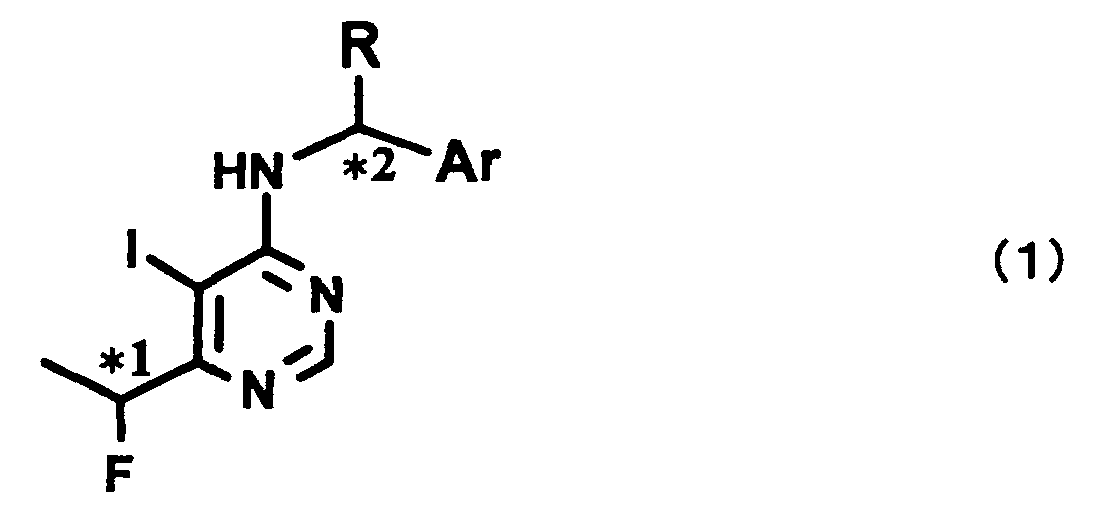
- the first invention relates to a 6-(1-fluoroethyl)-5-iodo-4-aminopyrimidine compound represented by the following formula (1): wherein Ar represents a phenyl group, a naphthyl group, a thienyl group, an indanyl group or a 1,4-benzodioxan-6-yl group, which is unsubstituted or substituted by 1 to 3 substituents selected from the group consisting of a halogen atom, an alkyl group having 1 to 4 carbon atoms, a haloalkyl group having 1 to 4 carbon atoms, an alkoxy group having 1 to 4 carbon atoms, a haloalkoxy group having 1 to 4 carbon atoms and a phenoxy group; R represents a hydrogen atom or an alkyl group having 1 to 4 carbon atoms; *1 represents an asymmetric carbon atom; *2 represents an asymmetric carbon atom when R represents an alkyl group having 1
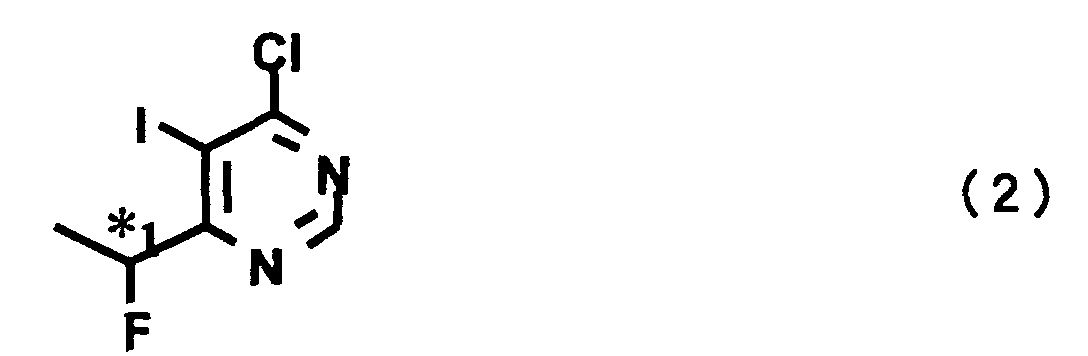
- the second invention relates to a process for preparing the 6- (1-fluoroethyl)-5-iodo-4-aminopyrimidine compound represented by the above-mentioned formula (1), which comprises reacting 4-chloro-6-(1-fluoroethyl)-5-iodopyrimidine represented by the following formula (2): wherein *1 has the same meaning as defined above, with an amine represented by the following formula (3): wherein Ar, R and *2 have the same meanings as defined above.
- the third invention relates to an agricultural and horticultural chemicals for controlling noxious organisms containing the 6- (1-fluoroethyl)-5-iodo-4-aminopyrimidine compound represented by the above-mentioned formula (1) as an effective ingredient.
- Ar is a phenyl group, a naphthyl group, a thienyl group, an indanyl group or a 1,4-benzodioxan-6-yl group, which is unsubstituted or substituted by 1 to 3 substituents selected from the group consisting of a halogen atom, an alkyl group having 1 to 4 carbon atoms, a haloalkyl group having 1 to 4 carbon atoms, an alkoxy group having 1 to 4 carbon atoms, a haloalkoxy group having 1 to 4 carbon atoms and a phenoxy group.
- R is a hydrogen atom or an alkyl group having 1 to 4 carbon atoms.
- halogen atom which is a substituent for Ar
- a chlorine atom for example, a chlorine atom, an iodine atom, a bromine atom, a fluorine atom, etc., and preferably a chlorine atom and a fluorine atom.
- alkyl group having 1 to 4 carbon atoms which is a substituent for Ar there may be mentioned, for example, a straight or branched alkyl group, and preferably a methyl group, an ethyl group, an isopropyl group and a t-butyl group.
- haloalkyl group having 1 to 4 carbon atoms which is a substituent for Ar there may be mentioned, for example, a difluoromethyl group, a trifluoromethyl group, 2,2,2-trifluoroethyl group, a 2-fluoroethyl group, etc., preferably a trifluoromethyl group.
- alkoxy group having 1 to 4 carbon atoms which is a substituent for Ar there may be mentioned, for example, a straight or branched alkoxy group, preferably a methoxy group and an ethoxy group.
- haloalkoxy group having 1 to 4 carbon atoms which is a substituent for Ar there may be mentioned, for example, a difluoromethoxy group, a trifluoromethoxy group, 2,2,2-trifluoroethoxy group, a 2-trifluoroethoxy group, etc., and preferably a difluoromethoxy group and a trifluoromethoxy group.
- a phenoxy group which is a substituent for Ar there may be mentioned, for example, a phenoxy group which may be substituted by the above-mentioned halogen atom, the alkyl group having 1 to 4 carbon atoms, the haloalkyl group having 1 to 4 carbon atoms, the alkoxy group having 1 to 4 carbon atoms or a haloalkoxy group having 1 to 4 carbon atoms, preferably an unsubstituted phenoxy group.
- a number of these substituents is preferably 1 to 3.
- alkyl group having 1 to 4 carbon atoms of R there may be mentioned, for example, a straight or branched alkyl group, and preferably a methyl group, an ethyl group, an i-propyl group, a n-butyl group and an i-butyl group.
- the compound (1) of the present invention has an amino group so that an acid addition salt derived therefrom is also included in the present invention.
- an inorganic acid such as hydrochloric acid, hydrobromic acid, nitric acid, sulfuric acid, phosphoric acid, etc.
- a carboxylic acid such as formic acid, oxalic acid, fumaric acid, adipic acid, stearic acid, oleic acid, aconitic acid, etc.
- a sulfonic acid such as methanesulfonic acid, benzenesulfonic acid, p-toluenesulfonic acid, etc.
- saccharine etc.
- the compound (1) of the present invention contains an asymmetric carbon atom represented by *1 and *2 so that the respective optical isomers, racemic isomers, diastereomers or a mixture thereof derived therefrom are each included in the present invention.
- particularly preferred compounds may include the following.
- Compound (1) is synthesized by reacting Compound (2) with Compound (3) in a solvent, in the presence of a base.
- the solvent it is not particularly limited so long as it does not directly participate in the present reaction, and there may be mentioned, for example, a chlorinated or not chlorinated aromatic, aliphatic or alicyclic hydrocarbon such as benzene, toluene, xylene, methylnaphthalene, petroleum ether, ligroin, hexane, chlorobenzene, dichlorobenzene, chloroform, dichloroethane, trichloroethylene, etc.; an ether such as tetrahydrofuran, dioxane, diethyl ether, etc.; a nitrile such as acetonitrile, propionitrile, etc.; a ketone such as acetone, methyl ethyl ketone, etc.; an aprotic polar solvent such as N,N-dimethylformamide, dimethylsulfoxide, sulforane, N,N-dimethylimid
- An amount of the solvent to be used is preferably such that the content of Compound (2) becomes 5 to 80% by weight; and more preferably 10 to 70% by weight.
- a kind of the base is not specifically limited, and an organic base and an inorganic base are mentioned.
- a tertiary amine such as triethylamine
- an organic base such as DBU
- an inorganic base such as a hydride, hydroxide, carbonate, hydrogen carbonate of an alkali metal or an alkaline earth metal
- an organic base such as triethylamine
- An amount of the base to be used is preferably 1 to 5-fold mol, more preferably 1.2 to 2.0-fold mol based on the amount of Compound (2).
- a reaction temperature is not specifically limited, and it is preferably within the temperature range from a room temperature to a boiling point or less of the solvent to be used, particularly preferably 60 to 110°C.
- a reaction time may vary depending on the above-mentioned concentration and temperature, and generally 0.5 to 8 hours.
- An amount of the starting compound to be used is preferably 1.0 to 5-fold mol of Compound (3) based on the amount of Compound (2), and more preferably 1 to 1.1-fold mol.
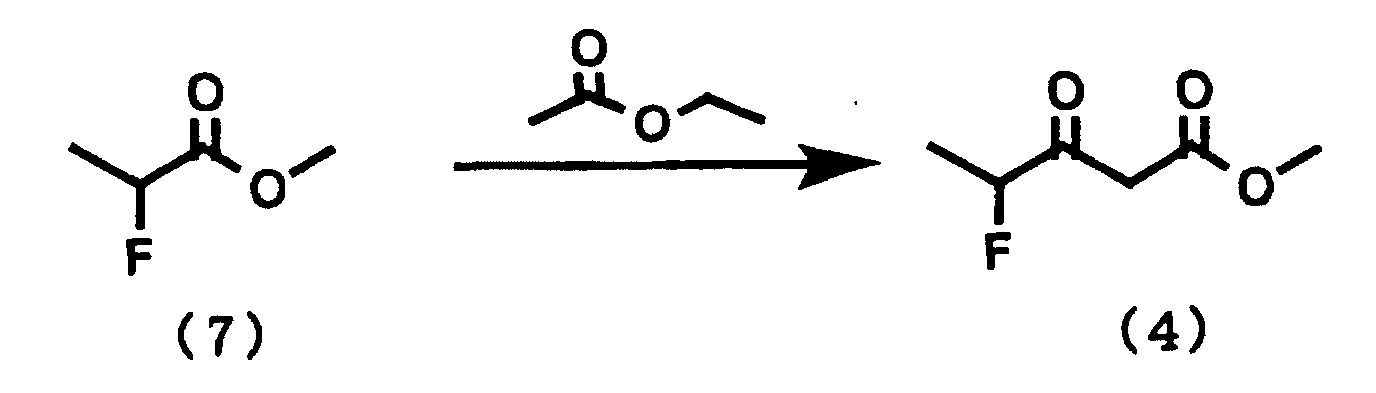
- Compound (2) to be used in the present invention can be prepared by the method shown in the following scheme according to the description of Japanese Patent Application No. 2000-384776. wherein *1 has the same meaning as defined above.
- Compound (4) can be prepared, for example, by the method according to Japanese Provisional Patent Application No. 171834/1999.
- Compound (3) may be a commercially available product or may be prepared by the method shown in the following scheme. wherein Ar, R and *2 have the same meanings as defined above.
- the desired Compound (1) prepared as mentioned above may be subjected to usual post-treatment such as extraction, concentration, filtration, etc. after completion of the reaction, and, if necessary, may be subjected to purification by the known methods such as recrystallization, various kinds of chromatographies, etc.
- agricultural and horticultural noxious insects e.g. Hemiptera (planthoppers, leafhoppers, aphides, white-flies, etc.), Lepidoptera (cabbage armyworms, diamond-back moth, leafroller moths, pyralid moths, codling moths, cabbage butterfly, etc.), Coleoptera (Tenebrionid beetles, leafbeetles, weevils, scarabs, etc.), Acarina (citrus red mite, two-spotted spider mite, etc.
- agricultural and horticultural noxious insects e.g. Hemiptera (planthoppers, leafhoppers, aphides, white-flies, etc.), Lepidoptera (cabbage armyworms, diamond-back moth, leafroller moths, pyralid moths, codling moths, cabbage butterfly, etc.), Coleoptera (Tenebrionid beetles, leafbeetles,
- nematodes e.g. root knot nematodes, cystcid nematodes, root lesion nematodes, white-tip nematodes, pine wood nematodes
- bulb mite in soil hygienically noxious insects (e.g. flies, mosquitoes, cockroaches, etc.), noxious insects of stored grains (e.g. rust-red flour beetles, bean weevils, etc.), wood insects (e.g.
- termite such as formosan subterranean termite, Reticulitermes speratus and Cryptotermes domesticus; powderpost beetles, drugstore beetles, carpenter moths, long-horned beetle, bark beetles, etc.
- agricultural and horticultural diseases e.g. wheat brown rust, barley powdery mildew, cucumber downy mildew, rice blast ( pyricularia oryzea ), tomato late blight, etc.
- the agricultural and horticultural chemical for controlling noxious organisms of the present invention has particularly remarkable in insecticidal, acaricidal and nematocidal effects, and contains one or more kinds of Compound (1) as an effective ingredient.
- Compound (1) may be used singly, however, it is generally preferred to use the same by formulating a carrier, surfactant, dispersant, auxiliary, etc. (for example, it is prepared as a composition such as dust powder, an emulsifiable concentrate, a fine granule, a granule, a wettable powder, an oily suspension, an aerosol, etc.) according to the conventionally known method.
- a carrier for example, it is prepared as a composition such as dust powder, an emulsifiable concentrate, a fine granule, a granule, a wettable powder, an oily suspension, an aerosol, etc.
- a solid carrier such as talc, bentonite, clay, kaolin, diatomaceous earth, white carbon, vermiculite, calcium hydroxide, siliceous sand, ammonium sulfate, urea, etc.
- a liquid carrier such as hydrocarbon (kerosine, mineral oil, etc.), aromatic hydrocarbon, (benzene, toluene, xylene, etc.), chlorinated hydrocarbon (chloroform, carbon tetrachloride, etc.), ethers (dioxane, tetrahydrofuran, etc.), ketones (acetone, cyclohexanone, isophorone, etc.), esters (ethyl acetate, ethyleneglycol acetate, dibutyl maleate, etc.), alcohols (methanol, n-hexanol, ethylene glycol, etc.), aprotic polar solvent (dimethylformamide, dimethyl
- surfactant and dispersant which can be used for improving attachment of the present chemical to and absorption thereof in animals and plants, and improving characteristics such as dispersion, emulsification and spreading of the chemical
- alcohol sulfates for example, alcohol sulfates, alkylsulfonate, lignosulfonate and polyoxyethylene glycol ether.
- a surfactant there may be used commercially available products, for example, Neopelex powder (trade name, produced by Kao K.K.), Demol (trade name, produced by Kao K.K.), Toxanone (trade name, produced by Sanyo Chemical Industries, Ltd.) and the like.
- carboxymethyl cellulose for improving properties of its formulation
- polyethylene glycol and gum arabic can be used as an auxiliary.
- the above-mentioned carrier, surfactant, dispersant and auxiliary can be used singly or in a suitable combination, respectively, depending on the respective purposes.
- the concentration of the active ingredient is generally 1 to 50% by weight in an emulsifyable concentrate, generally 0.3 to 25% by weight in a dustable powder, generally 1 to 90% by weight in a wettable powder, generally 0.5 to 5% by weight in a granule, generally 0.5 to 5% by weight in an oily suspension, and generally 0.1 to 5% by weight in an aerosol.
- formulations can be provided for various uses by diluting them to a suitable concentration and spraying them to stems and leaves of plants, soil and paddy field surface, or by applying them directly thereto, depending on the purposes.
- the crystal was purified by recrystallization from ethyl acetate-hexane to obtain 76.0 g of the desired product as colorless needle-like crystal. m.p. 195 to 196°C
- Compound (1) Five parts by weight of Compound (1) were uniformly mixed with 35 parts by weight of bentonite, 57 parts by weight of talc, 1 part by weight of Neopelex powder (trade name, produced by Kao K.K.) and 2 parts by weight of sodium lignosulfonate, then the mixture was kneaded with addition of a small amount of water, followed by granulation and drying, to obtain a granule.
- Compound (1) Ten parts by weight of Compound (1) were uniformly mixed with 70 parts by weight of kaolin, 18 parts by weight of white carbon, 1.5 parts by weight of Neopelex powder (trade name, produced by Kao K.K.) and 0.5 part by weight of Demol (trade name, produced by Kao K.K.), then the mixture was pulverized to obtain a wettable powder.
- Compound (1) Twenty parts by weight of Compound (1) were uniformly mixed with 70 parts by weight of xylene by adding 10 parts by weight of Toxanone (trade name, produced by Sanyo Chemical Industries, Ltd.), and mixed therein uniformly to obtain an emulsifiable concentrate.
- Toxanone trade name, produced by Sanyo Chemical Industries, Ltd.
- Compound (1) Five parts by weight of Compound (1) were uniformly mixed with 50 parts by weight of talc and 45 parts by weight of kaolin to obtain dustable powder.
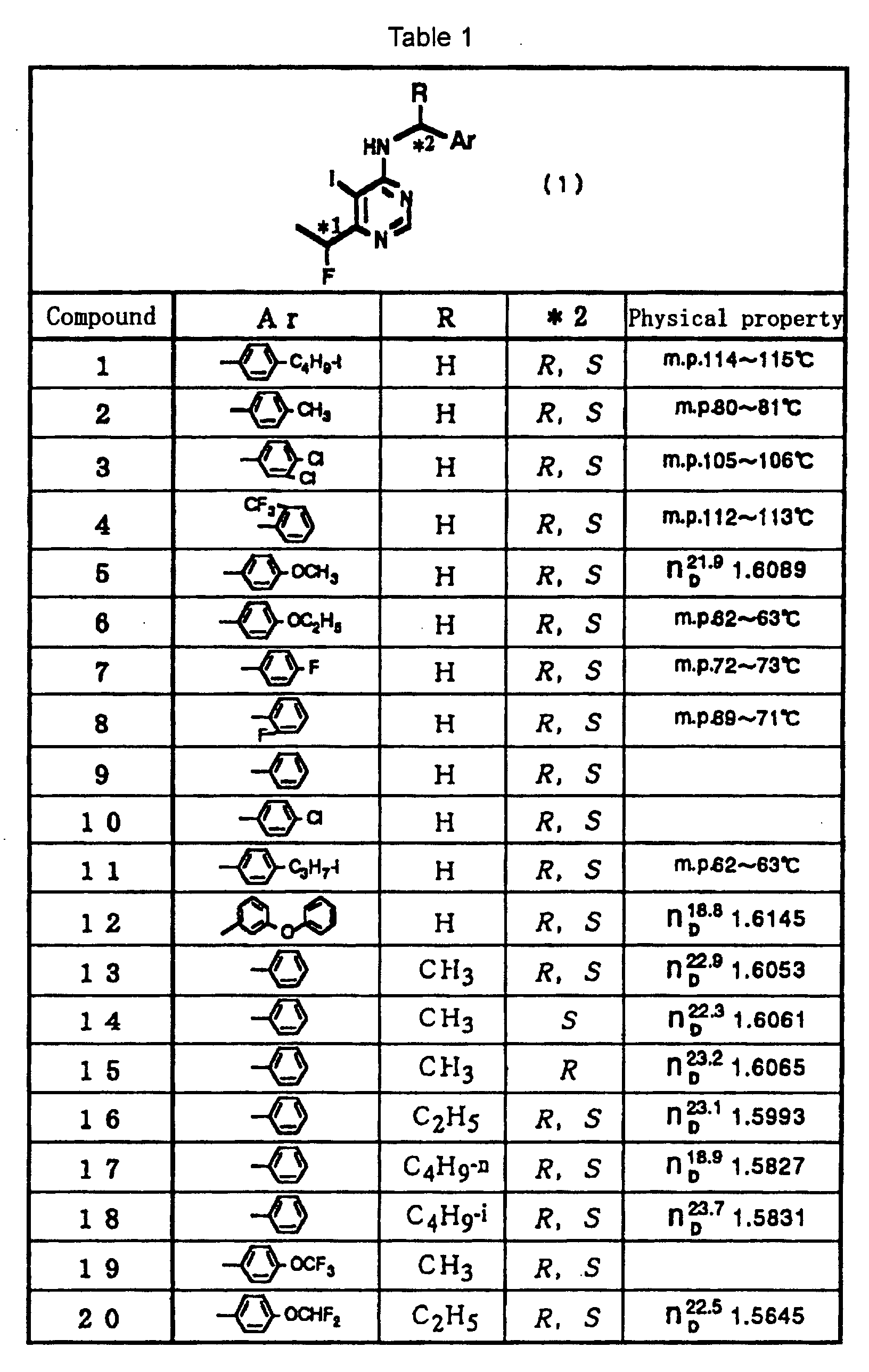
- the respective wettable powders of Compounds (1) shown in Table 1 prepared as in Example 2 were diluted to 1000 ppm with water containing a surfactant (0.01%), and in these respective chemical solutions, cabbage leaves (5 x 5 cm) were dipped for 30 seconds, and each leaf was put into the respective plastic cups and air-dried.
- the respective wettable powders of Compounds (1) shown in Table 1 prepared as in Example 2 were diluted to 100 ppm with water containing a surfactant (0.01%), and in these respective chemical solutions, cabbage leaves (5 x 5 cm) were dipped for 30 seconds, and each leaf was put into the respective plastic cups and air-dried.
- Acetone solutions of Compounds (1) shown in Table 1 were migrated into a PDA (potato dextrose agar) medium with a final concentration of 40 ppm to prepare plate culture media.
- PDA potato dextrose agar
- Respective colonies of monilia furcticola and pyricularia oryzea each previously grown in PDA plate culture media were cut with 1 mm square by a scalpel and inoculated to plate culture media containing chemicals.
- Judgment of the effects was carried out with 6 ranks from 5 to 0 in which a colony growth-inhibiting ratio of 95 to 100% was rated 5, 85 to 95% was 4, 85 to 70% was 3, 45 to 70% was 2, 10 to 45% was 1, and 10 to 0% was 0.
- novel 6-(1-fluoroethyl)-5-iodo-4-aminopyrimidine compound of the present invention has excellent effects of controlling noxious organisms for an agricultural and horticultural use.
Landscapes
- Organic Chemistry (AREA)
- Chemical & Material Sciences (AREA)
- Life Sciences & Earth Sciences (AREA)
- Health & Medical Sciences (AREA)
- Plant Pathology (AREA)
- Engineering & Computer Science (AREA)
- Dentistry (AREA)
- General Health & Medical Sciences (AREA)
- Wood Science & Technology (AREA)
- Zoology (AREA)
- Environmental Sciences (AREA)
- Pest Control & Pesticides (AREA)
- Agronomy & Crop Science (AREA)
- Plural Heterocyclic Compounds (AREA)
- Agricultural Chemicals And Associated Chemicals (AREA)
- Low-Molecular Organic Synthesis Reactions Using Catalysts (AREA)
Abstract
a process for preparing the same, and agricultural and horticultural chemicals for controlling noxious organisms.
Description


- 1 is an asymmetric carbon atom.
- 2 is an asymmetric carbon atom when R is an alkyl group having 1 to 4 carbon atoms.



m.p. 170.0 to 171.5°C
m.p. 195 to 196°C
b.p.116 to 118°C/4 mmHg
m.p. 114 to 115°C
1H-NMR (CDCl3, δ ppm)
1.32 (9H, s), 1.61 to 1.71 (3H, d-d), 4.68 to 4.70 (2H, d), 3.74 to 3.81 (2H, q), 5.70 to 5.92 (1H, d-q), 5.76 (1H, b), 7.26 to 7.41 (4H, m), 8.50 (1H, s)
1H-NMR (CDCl3, δ ppm)
1.57 to 1.69 (6H, m), 4.68 to 4.70 (2H, d), 5.24 to 5.92 (1H, d-q), 5.83 (1H, b), 7.24 to 7.37 (5H, m), 8.43 (1H, s)
- 1 is all racemic mixtures (R,S).


Claims (6)
- A 6-(1-fluoroethyl)-5-iodo-4-aminopyrimidine compound represented by the following formula (1):wherein Ar represents a phenyl group, a naphthyl group, a thienyl group, an indanyl group or a 1,4-benzodioxan-6-yl group, which is unsubstituted or substituted by 1 to 3 substituents selected from the group consisting of a halogen atom, an alkyl group having 1 to 4 carbon atoms, a haloalkyl group having 1 to 4 carbon atoms, an alkoxy group having 1 to 4 carbon atoms, a haloalkoxy group having 1 to 4 carbon atoms and a phenoxy group; R represents a hydrogen atom or an alkyl group having 1 to 4 carbon atoms; *1 represents an asymmetric carbon atom; *2 represents an asymmetric carbon atom when R represents an alkyl group having 1 to 4 carbon atoms.

- The 6-(1-fluoroethyl)-5-iodo-4-aminopyrimidine compound according to Claim 1, wherein Ar in the above mentioned formula (1) is a phenyl group substituted by 1 to 3 substituents selected from the group consisting of a halogen atom, an alkyl group having 1 to 4 carbon atoms, a haloalkyl group having 1 to 4 carbon atoms, an alkoxy group having 1 to 4 carbon atoms, a haloalkoxy group having 1 to 4 carbon atoms and a phenoxy group, or an unsubstituted phenyl group.
- The 6-(1-fluoroethyl)-5-iodo-4-aminopyrimidine compound according to Claim 1 or 2, wherein the substituent for Ar is selected from the group consisting of a chlorine atom, a fluorine atom, a methyl group, an ethyl group, an isopropyl group, a t-butyl group, a trifluoromethyl group, a methoxy group, an ethoxy group, a difluoromethoxy group, a trifluoromethoxy group and an unsubstituted phenoxy group.
- The 6-(1-fluoroethyl)-5-iodo-4-aminopyrimidine compound according to any one of Claims 1 to 3, wherein R is a hydrogen atom, a methyl group, an ethyl group, an i-propyl group, a n-butyl group or an i-butyl group.
- A process for preparing the 6-(1-fluoroethyl)-5-iodo-4-aminopyrimidine compound represented by the formula (1) according to Claim 1, which comprises reacting 4-chloro-6-(1-fluoroethyl)-5-iodopyrimidine represented by the following formula (2):wherein *1 has the same meaning as defined in Claim 1,

with an amine represented by the following formula (3):wherein Ar, R and *2 have the same meanings as defined in Claim 1.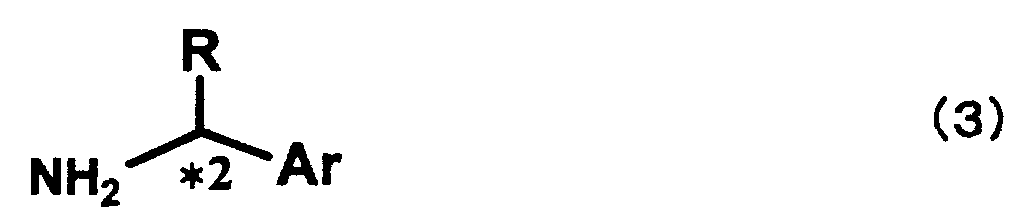
- A chemical for controlling noxious organisms containing the 6-(1-fluoroethyl)-5-iodo-4-aminopyrimidine compound represented by the formula (1) according to Claim 1 as an effective ingredient.
Priority Applications (1)
| Application Number | Priority Date | Filing Date | Title |
|---|---|---|---|
| CY20091100662T CY1109178T1 (en) | 2001-01-11 | 2009-06-24 | COMPOUNDS 6- (1-FLUOROYTHYL) -5-IODIO-4-AMINOPYRIMIDINE, METHOD FOR THEIR PREPARATION AND AGRICULTURAL MEASURES FOR AGRICULTURE AGRICULTURE |
Applications Claiming Priority (3)
| Application Number | Priority Date | Filing Date | Title |
|---|---|---|---|
| JP2001003825 | 2001-01-11 | ||
| JP2001003825 | 2001-01-11 | ||
| PCT/JP2002/000064 WO2002066444A1 (en) | 2001-01-11 | 2002-01-10 | 6-(1-fluoroethyl)-5-iodo-4-aminopyrimidine compounds, process for preparation of the same, and pest controllers for agricultural and horticultural use |
Publications (3)
| Publication Number | Publication Date |
|---|---|
| EP1357113A1 true EP1357113A1 (en) | 2003-10-29 |
| EP1357113A4 EP1357113A4 (en) | 2005-09-07 |
| EP1357113B1 EP1357113B1 (en) | 2009-03-25 |
Family
ID=18872109
Family Applications (1)
| Application Number | Title | Priority Date | Filing Date |
|---|---|---|---|
| EP02715717A Expired - Lifetime EP1357113B1 (en) | 2001-01-11 | 2002-01-10 | 6-(1-fluoroethyl)-5-iodo-4-aminopyrimidine compounds, process for preparation of the same, and pest controllers for agricultural and horticultural use |
Country Status (16)
| Country | Link |
|---|---|
| US (1) | US6867212B2 (en) |
| EP (1) | EP1357113B1 (en) |
| JP (1) | JP2008285490A (en) |
| KR (1) | KR100745205B1 (en) |
| CN (1) | CN1479726A (en) |
| AT (1) | ATE426595T1 (en) |
| BR (1) | BR0206383A (en) |
| CA (1) | CA2434230A1 (en) |
| CY (1) | CY1109178T1 (en) |
| DE (1) | DE60231702D1 (en) |
| DK (1) | DK1357113T3 (en) |
| ES (1) | ES2322984T3 (en) |
| IL (1) | IL156810A0 (en) |
| MX (1) | MXPA03006178A (en) |
| PT (1) | PT1357113E (en) |
| WO (1) | WO2002066444A1 (en) |
Families Citing this family (1)
| Publication number | Priority date | Publication date | Assignee | Title |
|---|---|---|---|---|
| JP5613461B2 (en) * | 2010-06-02 | 2014-10-22 | 日本農薬株式会社 | Pyrimidine derivatives, agricultural and horticultural insecticides containing the derivatives, and methods of use thereof |
Family Cites Families (9)
| Publication number | Priority date | Publication date | Assignee | Title |
|---|---|---|---|---|
| JPH0625159B2 (en) | 1987-09-10 | 1994-04-06 | 宇部興産株式会社 | Aralkylaminopyrimidine derivatives, a method for producing the same, and insecticides, acaricides and fungicides containing the derivatives as active ingredients |
| US4931455A (en) * | 1988-01-07 | 1990-06-05 | Ube Industries, Ltd. | Alkylaminopyrimidine derivative and insecticide, acaricide and fungicide containing the same as active ingredient |
| BG94957A (en) * | 1990-08-10 | 1993-12-24 | Ciba - Geigy Ag | PYRIMIDINE DERIVATIVES AND PLANT PEST CONTROL |
| JP3074658B2 (en) * | 1991-11-22 | 2000-08-07 | 宇部興産株式会社 | Aralkylaminopyrimidine derivatives, their preparation and pesticides |
| JP3074657B2 (en) * | 1992-08-21 | 2000-08-07 | 宇部興産株式会社 | Aralkylaminopyrimidine derivatives, their preparation and pesticides |
| JP2649129B2 (en) * | 1992-09-11 | 1997-09-03 | 宇部興産株式会社 | Naphthylalkylaminopyrimidine derivatives, their preparation and pesticides |
| JP3083032B2 (en) * | 1993-08-10 | 2000-09-04 | 宇部興産株式会社 | 4-Aminopyrimidine derivative, production method thereof and pesticide |
| JP3903585B2 (en) * | 1998-04-17 | 2007-04-11 | 宇部興産株式会社 | 5-Iodo-4-phenethylaminopyrimidine derivative, its production method and pesticide for agricultural and horticultural use |
| JP4838959B2 (en) * | 2001-01-11 | 2011-12-14 | マクテシム・ケミカル・ワークス・リミテツド | 6- (1-Fluoroethyl) -5-iodo-4-aminopyrimidine derivative, its production method and pesticide for agricultural and horticultural use |
-
2002
- 2002-01-10 DE DE60231702T patent/DE60231702D1/en not_active Expired - Lifetime
- 2002-01-10 CN CNA028032624A patent/CN1479726A/en active Pending
- 2002-01-10 ES ES02715717T patent/ES2322984T3/en not_active Expired - Lifetime
- 2002-01-10 MX MXPA03006178A patent/MXPA03006178A/en unknown
- 2002-01-10 WO PCT/JP2002/000064 patent/WO2002066444A1/en not_active Ceased
- 2002-01-10 AT AT02715717T patent/ATE426595T1/en active
- 2002-01-10 IL IL15681002A patent/IL156810A0/en not_active IP Right Cessation
- 2002-01-10 DK DK02715717T patent/DK1357113T3/en active
- 2002-01-10 KR KR1020037009254A patent/KR100745205B1/en not_active Expired - Fee Related
- 2002-01-10 PT PT02715717T patent/PT1357113E/en unknown
- 2002-01-10 US US10/250,971 patent/US6867212B2/en not_active Expired - Fee Related
- 2002-01-10 CA CA002434230A patent/CA2434230A1/en not_active Abandoned
- 2002-01-10 EP EP02715717A patent/EP1357113B1/en not_active Expired - Lifetime
- 2002-01-10 BR BR0206383-2A patent/BR0206383A/en not_active Application Discontinuation
-
2008
- 2008-05-30 JP JP2008141962A patent/JP2008285490A/en active Pending
-
2009
- 2009-06-24 CY CY20091100662T patent/CY1109178T1/en unknown
Also Published As
| Publication number | Publication date |
|---|---|
| ATE426595T1 (en) | 2009-04-15 |
| BR0206383A (en) | 2004-02-03 |
| CN1479726A (en) | 2004-03-03 |
| US6867212B2 (en) | 2005-03-15 |
| CA2434230A1 (en) | 2002-08-29 |
| US20040063945A1 (en) | 2004-04-01 |
| JP2008285490A (en) | 2008-11-27 |
| DK1357113T3 (en) | 2009-07-27 |
| ES2322984T3 (en) | 2009-07-03 |
| MXPA03006178A (en) | 2003-12-11 |
| EP1357113B1 (en) | 2009-03-25 |
| KR100745205B1 (en) | 2007-08-02 |
| DE60231702D1 (en) | 2009-05-07 |
| CY1109178T1 (en) | 2014-07-02 |
| WO2002066444A1 (en) | 2002-08-29 |
| EP1357113A4 (en) | 2005-09-07 |
| PT1357113E (en) | 2009-05-18 |
| KR20030074703A (en) | 2003-09-19 |
| IL156810A0 (en) | 2004-02-08 |
Similar Documents
| Publication | Publication Date | Title |
|---|---|---|
| EP0665225B1 (en) | 4-Phenethylamino pyrimidine derivative, process for preparing the same and agricultural and horticultural chemical for controlling noxious organisms containing the same | |
| US4988704A (en) | Pyrimidine derivative, process for preparing same and argicultural or horticultural fungicidal composition containing same | |
| EP0617014B1 (en) | Oxime ether compound, processes for preparing the same and fungicide containing the same | |
| EP0658547B1 (en) | N-pyrazolyl carbamate derivative, agricultural/horticultural fungicide containing the same as active ingredient and production intermediate thereof | |
| EP1357113B1 (en) | 6-(1-fluoroethyl)-5-iodo-4-aminopyrimidine compounds, process for preparation of the same, and pest controllers for agricultural and horticultural use | |
| JP3511729B2 (en) | 4- [2- (trifluoroalkoxy-substituted phenyl) ethylamino] pyrimidine derivative, its production method and pesticide for agricultural and horticultural use | |
| JP4838959B2 (en) | 6- (1-Fluoroethyl) -5-iodo-4-aminopyrimidine derivative, its production method and pesticide for agricultural and horticultural use | |
| US6521627B1 (en) | 5-Iodo-4-phenethylaminopyrimidine derivative, intermediate thereof, processes for producing the same and agricultural and horticultural pesticides | |
| JP3074658B2 (en) | Aralkylaminopyrimidine derivatives, their preparation and pesticides | |
| JP3211518B2 (en) | Phenoxyalkylamine derivatives, their preparation and pesticides for agricultural and horticultural use | |
| EP0543402B1 (en) | Aralkylaminopyrimidine derivative, method for preparing the same and composition for controlling noxious organisms | |
| KR0157319B1 (en) | Novel pyrazolyl acrylic acid derivatives useful as systemic fungicides for plant and substance protection | |
| JPH11302261A (en) | 5-Iodo-4-phenethylaminopyrimidine derivative, process for producing the same, and pesticidal agent for agricultural and horticultural use | |
| EP0618195B1 (en) | Insecticidal, acaricidal and fungicidal pyrazole phenoxyalkylamin derivatives and process for preparing the same | |
| JPH07112972A (en) | Pyrazolecarboxamide derivative, its manufacturing method and pest control agent for agricultural and horticultural use | |
| JP3543411B2 (en) | 4-Aminopyrimidine derivative, production method thereof and pesticide for agricultural and horticultural use | |
| JP4449229B2 (en) | 6- (1-Fluoroethyl) -5-iodo-4-alkylaminopyrimidine derivatives, their production and pesticides for agriculture and horticulture | |
| JP2730019B2 (en) | Aralkylamine derivatives, their production and fungicides | |
| JP3083032B2 (en) | 4-Aminopyrimidine derivative, production method thereof and pesticide | |
| JP2649129B2 (en) | Naphthylalkylaminopyrimidine derivatives, their preparation and pesticides | |
| US5252596A (en) | Phenoxyalkylamine derivative and method for controlling noxious organisms containing the same | |
| JPH06256319A (en) | Aralkyloxypyrimidine derivative, its production and controller against harmful organism | |
| JP2000186089A (en) | 5-Azolylpyrimidine derivatives, their production and fungicides for agricultural and horticultural use | |
| JP2002316979A (en) | 6- (1-Fluoroethyl) -5-iodo-4-aminopyrimidine compound, production method thereof and pesticide for agricultural and horticultural use | |
| JPH0912551A (en) | Iminothioether compounds, their manufacturing methods and intermediates, and bactericides and acaricides |
Legal Events
| Date | Code | Title | Description |
|---|---|---|---|
| PUAI | Public reference made under article 153(3) epc to a published international application that has entered the european phase |
Free format text: ORIGINAL CODE: 0009012 |
|
| 17P | Request for examination filed |
Effective date: 20030718 |
|
| AK | Designated contracting states |
Kind code of ref document: A1 Designated state(s): AT BE CH CY DE DK ES FI FR GB GR IE IT LI LU MC NL PT SE TR |
|
| AX | Request for extension of the european patent |
Extension state: AL LT LV MK RO SI |
|
| A4 | Supplementary search report drawn up and despatched |
Effective date: 20050725 |
|
| 17Q | First examination report despatched |
Effective date: 20070305 |
|
| 17Q | First examination report despatched |
Effective date: 20070305 |
|
| RAP1 | Party data changed (applicant data changed or rights of an application transferred) |
Owner name: MAKHTESHIM CHEMICAL WORKS LIMITED |
|
| GRAP | Despatch of communication of intention to grant a patent |
Free format text: ORIGINAL CODE: EPIDOSNIGR1 |
|
| GRAS | Grant fee paid |
Free format text: ORIGINAL CODE: EPIDOSNIGR3 |
|
| GRAA | (expected) grant |
Free format text: ORIGINAL CODE: 0009210 |
|
| AK | Designated contracting states |
Kind code of ref document: B1 Designated state(s): AT BE CH CY DE DK ES FI FR GB GR IE IT LI LU MC NL PT SE TR |
|
| REG | Reference to a national code |
Ref country code: GB Ref legal event code: FG4D |
|
| REG | Reference to a national code |
Ref country code: CH Ref legal event code: EP |
|
| REG | Reference to a national code |
Ref country code: IE Ref legal event code: FG4D |
|
| REG | Reference to a national code |
Ref country code: CH Ref legal event code: NV Representative=s name: E. BLUM & CO. AG PATENT- UND MARKENANWAELTE VSP |
|
| REF | Corresponds to: |
Ref document number: 60231702 Country of ref document: DE Date of ref document: 20090507 Kind code of ref document: P |
|
| REG | Reference to a national code |
Ref country code: GR Ref legal event code: EP Ref document number: 20090401136 Country of ref document: GR |
|
| REG | Reference to a national code |
Ref country code: PT Ref legal event code: SC4A Free format text: AVAILABILITY OF NATIONAL TRANSLATION Effective date: 20090512 |
|
| REG | Reference to a national code |
Ref country code: ES Ref legal event code: FG2A Ref document number: 2322984 Country of ref document: ES Kind code of ref document: T3 |
|
| REG | Reference to a national code |
Ref country code: DK Ref legal event code: T3 |
|
| REG | Reference to a national code |
Ref country code: SE Ref legal event code: TRGR |
|
| PLBE | No opposition filed within time limit |
Free format text: ORIGINAL CODE: 0009261 |
|
| STAA | Information on the status of an ep patent application or granted ep patent |
Free format text: STATUS: NO OPPOSITION FILED WITHIN TIME LIMIT |
|
| 26N | No opposition filed |
Effective date: 20091229 |
|
| PGFP | Annual fee paid to national office [announced via postgrant information from national office to epo] |
Ref country code: TR Payment date: 20120103 Year of fee payment: 11 |
|
| PGFP | Annual fee paid to national office [announced via postgrant information from national office to epo] |
Ref country code: IT Payment date: 20120125 Year of fee payment: 11 |
|
| PGFP | Annual fee paid to national office [announced via postgrant information from national office to epo] |
Ref country code: LU Payment date: 20130123 Year of fee payment: 12 |
|
| PGFP | Annual fee paid to national office [announced via postgrant information from national office to epo] |
Ref country code: FR Payment date: 20130207 Year of fee payment: 12 Ref country code: SE Payment date: 20130122 Year of fee payment: 12 Ref country code: MC Payment date: 20130122 Year of fee payment: 12 Ref country code: DE Payment date: 20130328 Year of fee payment: 12 Ref country code: GB Payment date: 20130122 Year of fee payment: 12 Ref country code: ES Payment date: 20130122 Year of fee payment: 12 Ref country code: FI Payment date: 20130121 Year of fee payment: 12 Ref country code: DK Payment date: 20130124 Year of fee payment: 12 Ref country code: CH Payment date: 20130123 Year of fee payment: 12 Ref country code: IE Payment date: 20130121 Year of fee payment: 12 |
|
| PGFP | Annual fee paid to national office [announced via postgrant information from national office to epo] |
Ref country code: CY Payment date: 20130104 Year of fee payment: 12 Ref country code: GR Payment date: 20130121 Year of fee payment: 12 Ref country code: BE Payment date: 20130121 Year of fee payment: 12 Ref country code: NL Payment date: 20130121 Year of fee payment: 12 |
|
| PGFP | Annual fee paid to national office [announced via postgrant information from national office to epo] |
Ref country code: PT Payment date: 20130103 Year of fee payment: 12 Ref country code: AT Payment date: 20130121 Year of fee payment: 12 |
|
| REG | Reference to a national code |
Ref country code: PT Ref legal event code: MM4A Free format text: LAPSE DUE TO NON-PAYMENT OF FEES Effective date: 20140710 |
|
| BERE | Be: lapsed |
Owner name: MAKHTESHIM CHEMICAL WORKS LIMITED Effective date: 20140131 |
|
| REG | Reference to a national code |
Ref country code: DE Ref legal event code: R119 Ref document number: 60231702 Country of ref document: DE |
|
| REG | Reference to a national code |
Ref country code: NL Ref legal event code: V1 Effective date: 20140801 |
|
| PG25 | Lapsed in a contracting state [announced via postgrant information from national office to epo] |
Ref country code: LU Free format text: LAPSE BECAUSE OF NON-PAYMENT OF DUE FEES Effective date: 20140110 Ref country code: MC Free format text: LAPSE BECAUSE OF NON-PAYMENT OF DUE FEES Effective date: 20140131 |
|
| REG | Reference to a national code |
Ref country code: CH Ref legal event code: PL |
|
| REG | Reference to a national code |
Ref country code: DK Ref legal event code: EBP Effective date: 20140131 |
|
| REG | Reference to a national code |
Ref country code: AT Ref legal event code: MM01 Ref document number: 426595 Country of ref document: AT Kind code of ref document: T Effective date: 20140110 |
|
| REG | Reference to a national code |
Ref country code: SE Ref legal event code: EUG |
|
| GBPC | Gb: european patent ceased through non-payment of renewal fee |
Effective date: 20140110 |
|
| REG | Reference to a national code |
Ref country code: GR Ref legal event code: ML Ref document number: 20090401136 Country of ref document: GR Effective date: 20140801 |
|
| REG | Reference to a national code |
Ref country code: DE Ref legal event code: R119 Ref document number: 60231702 Country of ref document: DE Effective date: 20140801 |
|
| PG25 | Lapsed in a contracting state [announced via postgrant information from national office to epo] |
Ref country code: DE Free format text: LAPSE BECAUSE OF NON-PAYMENT OF DUE FEES Effective date: 20140801 Ref country code: CY Free format text: LAPSE BECAUSE OF NON-PAYMENT OF DUE FEES Effective date: 20140110 Ref country code: FI Free format text: LAPSE BECAUSE OF NON-PAYMENT OF DUE FEES Effective date: 20140110 Ref country code: NL Free format text: LAPSE BECAUSE OF NON-PAYMENT OF DUE FEES Effective date: 20140801 Ref country code: GR Free format text: LAPSE BECAUSE OF NON-PAYMENT OF DUE FEES Effective date: 20140801 Ref country code: LI Free format text: LAPSE BECAUSE OF NON-PAYMENT OF DUE FEES Effective date: 20140131 Ref country code: CH Free format text: LAPSE BECAUSE OF NON-PAYMENT OF DUE FEES Effective date: 20140131 |
|
| REG | Reference to a national code |
Ref country code: FR Ref legal event code: ST Effective date: 20140930 |
|
| REG | Reference to a national code |
Ref country code: IE Ref legal event code: MM4A |
|
| PG25 | Lapsed in a contracting state [announced via postgrant information from national office to epo] |
Ref country code: AT Free format text: LAPSE BECAUSE OF NON-PAYMENT OF DUE FEES Effective date: 20140110 Ref country code: SE Free format text: LAPSE BECAUSE OF NON-PAYMENT OF DUE FEES Effective date: 20140111 Ref country code: FR Free format text: LAPSE BECAUSE OF NON-PAYMENT OF DUE FEES Effective date: 20140131 Ref country code: GB Free format text: LAPSE BECAUSE OF NON-PAYMENT OF DUE FEES Effective date: 20140110 |
|
| PG25 | Lapsed in a contracting state [announced via postgrant information from national office to epo] |
Ref country code: PT Free format text: LAPSE BECAUSE OF NON-PAYMENT OF DUE FEES Effective date: 20140710 |
|
| PG25 | Lapsed in a contracting state [announced via postgrant information from national office to epo] |
Ref country code: DK Free format text: LAPSE BECAUSE OF NON-PAYMENT OF DUE FEES Effective date: 20140131 Ref country code: IE Free format text: LAPSE BECAUSE OF NON-PAYMENT OF DUE FEES Effective date: 20140110 Ref country code: BE Free format text: LAPSE BECAUSE OF NON-PAYMENT OF DUE FEES Effective date: 20140131 |
|
| REG | Reference to a national code |
Ref country code: ES Ref legal event code: FD2A Effective date: 20150504 |
|
| PG25 | Lapsed in a contracting state [announced via postgrant information from national office to epo] |
Ref country code: ES Free format text: LAPSE BECAUSE OF NON-PAYMENT OF DUE FEES Effective date: 20140111 |
|
| PG25 | Lapsed in a contracting state [announced via postgrant information from national office to epo] |
Ref country code: IT Free format text: LAPSE BECAUSE OF NON-PAYMENT OF DUE FEES Effective date: 20140110 |
|
| PG25 | Lapsed in a contracting state [announced via postgrant information from national office to epo] |
Ref country code: TR Free format text: LAPSE BECAUSE OF NON-PAYMENT OF DUE FEES Effective date: 20140110 |