EP1353099A2 - Gleitringdichtung mit Verdrehsicherung - Google Patents
Gleitringdichtung mit Verdrehsicherung Download PDFInfo
- Publication number
- EP1353099A2 EP1353099A2 EP03007725A EP03007725A EP1353099A2 EP 1353099 A2 EP1353099 A2 EP 1353099A2 EP 03007725 A EP03007725 A EP 03007725A EP 03007725 A EP03007725 A EP 03007725A EP 1353099 A2 EP1353099 A2 EP 1353099A2
- Authority
- EP
- European Patent Office
- Prior art keywords
- sealing body
- ring
- sealing
- radially outer
- mechanical seal
- Prior art date
- Legal status (The legal status is an assumption and is not a legal conclusion. Google has not performed a legal analysis and makes no representation as to the accuracy of the status listed.)
- Granted
Links
- 238000007789 sealing Methods 0.000 claims abstract description 95
- 239000013536 elastomeric material Substances 0.000 claims description 10
- 230000007423 decrease Effects 0.000 claims 1
- 229920001971 elastomer Polymers 0.000 abstract description 2
- 239000000806 elastomer Substances 0.000 abstract 1
- 230000003014 reinforcing effect Effects 0.000 abstract 1
- 230000005540 biological transmission Effects 0.000 description 6
- 230000002093 peripheral effect Effects 0.000 description 4
- 239000013013 elastic material Substances 0.000 description 3
- 238000004519 manufacturing process Methods 0.000 description 3
- 230000003068 static effect Effects 0.000 description 3
- 238000011109 contamination Methods 0.000 description 2
- 239000007788 liquid Substances 0.000 description 2
- 239000000314 lubricant Substances 0.000 description 2
- 230000013011 mating Effects 0.000 description 2
- 239000000725 suspension Substances 0.000 description 2
- 238000005452 bending Methods 0.000 description 1
- 239000000356 contaminant Substances 0.000 description 1
- 238000005260 corrosion Methods 0.000 description 1
- 230000007797 corrosion Effects 0.000 description 1
- 230000006735 deficit Effects 0.000 description 1
- 238000011161 development Methods 0.000 description 1
- 230000018109 developmental process Effects 0.000 description 1
- 238000006073 displacement reaction Methods 0.000 description 1
- 230000010354 integration Effects 0.000 description 1
- 238000012423 maintenance Methods 0.000 description 1
- 239000003415 peat Substances 0.000 description 1
- 230000008092 positive effect Effects 0.000 description 1
- 230000003746 surface roughness Effects 0.000 description 1
Images


Classifications
-
- F—MECHANICAL ENGINEERING; LIGHTING; HEATING; WEAPONS; BLASTING
- F16—ENGINEERING ELEMENTS AND UNITS; GENERAL MEASURES FOR PRODUCING AND MAINTAINING EFFECTIVE FUNCTIONING OF MACHINES OR INSTALLATIONS; THERMAL INSULATION IN GENERAL
- F16J—PISTONS; CYLINDERS; SEALINGS
- F16J15/00—Sealings
- F16J15/16—Sealings between relatively-moving surfaces
- F16J15/34—Sealings between relatively-moving surfaces with slip-ring pressed against a more or less radial face on one member
- F16J15/3436—Pressing means
- F16J15/344—Pressing means the pressing force being applied by means of an elastic ring supporting the slip-ring
Definitions
- the invention describes a mechanical seal, in particular a drive seal, comprising an angular slide and mating ring that matches your radial Sealing legs form a sealing surface, and consisting of elastomeric material, trapezoidal sealing bodies between the one that receives the mechanical seal Housing and the radially outer surface of the axial leg of the sliding and Counter ring are arranged, the trapezoidal sealing body with a metallic stiffening ring.
- DE OS 16 50 024 proposes to integrate a metallic suspension body in the sealing body.
- a loose sealing body to be inserted between the slide ring and the machine housing is to be created which, with the simplest design, permits a relatively large axial movement of the slide ring without losing the rotationally fixed contact both on the back of the slide ring and on the machine housing.
- US Pat. No. 3,279,804 proposes to connect metallic stamped parts to the radially outer end of the sealing body as stiffening rings, so that the sealing body is rigidly connected to the housing. Tilting of the sealing body at the radially outer end would thus be excluded.
- the publication further discloses the connection of an S-shaped bent stamped part to the radially outer end of the sealing body. In this solution, only one leg of the stamped part is in contact with the housing, the other leg is spaced from the housing and an elastomeric material is applied, so that there is a seal between the stamped part and the housing. Sealing is only possible to a limited extent here, since one leg of the metallic, circular stamped part is directly connected to the housing, the stamped part specifies the seat of the sealing body in the housing.
- a rigid connection to the stiffening ring thus leads to voltage peaks on the outer surfaces of the sealing body, which can lead to a loosening of the connection between the stiffening ring and the sealing body.
- the connection of the sealing body to the housing via a stiffening ring also means that a large torque can be transmitted here. This is again a disadvantage with regard to the flow of force, since the greatest circumferential forces occur on the radially outer surface of the sliding or counter rings.
- the sealing body has a stiffening ring which is directly above the radially outer surface of the axial legs of the slide and counter ring arranged is, on the stiffening ring, in the direction of the radially outer surfaces of the axial leg of the slide and counter ring, a wavy, elastomeric Sealing profile is molded and that the connection between the sealing body and radially outer surface of the axial legs of the slide and counter ring as a press fit is tolerated.
- the radially outer surface of the slide or counter ring has one suitable surface roughness and is ground.
- the configuration of the sealing body according to the invention now makes it possible to ensure an optimal connection of the sealing body to the slide ring and thus a reliable transmission of the torque.
- the wave-shaped, elastomeric sealing profile offers the possibility of easy assembly and on the other hand the wave profile ensures that the elastomeric material is not overused. Overloading cannot take place because the excess, elastomeric material can escape into the troughs during assembly.
- the dimensioning between the radially inner surface of the sealing body and the radially outer surface of the slide and counter rings is designed as an interference fit. There is therefore no loose connection, but the components are held together non-positively.
- a further advantage according to the invention results from the press fit in that the components cannot fall apart during assembly and that the sealing body cannot be moved when dirt builds up on the slide ring.
- the height of the elastomeric sealing profile is low and is in the range of approximately one to a few millimeters. Due to the low height of the wave-shaped sealing profile, the sealing body is only subject to slight setting, which in turn has a positive effect on the maintenance behavior and the transmission of the torque.
- the radially inner peripheral surface of the sealing body is a twisting of the Sealing body on the inner circumference is no longer possible. This is why the sealing body does not lift off the slide ring and there can be no contamination lubricants still get under the sealing body.
- the sealing body Due to the axial and radial movements of the sliding or counter rings, u. a. tensile stress in the sealing elements. These tensile stresses reach the outer surfaces of the sealing body their maximum. So the connection between The sealing body and the stiffening ring are loaded to the maximum at these points. Around Minimizing and / or redirecting loads is proposed in the invention, to provide strain relief in these areas in the sealing body.
- the strain relief is in the form of a hollow undercut directly in the Connection area between the elastomeric material and the stiffening ring on the Molded sealing body.
- the outer circumferential surfaces of the axial legs of the slide and counter rings be slightly conical.
- the slightly conical design makes assembly easier, but the connection always remains a press fit.
- the sealing body follows the conical design of the sliding and counter rings in that the elastomeric material with the wave-shaped profile is also conical on the inner circumference of the stiffening ring, so that the surfaces of the components are always parallel when joining.
- the invention proposed to integrate a further stiffening ring in the sealing body.
- This stiffening ring is according to the invention in the radially outer end of the Introduced sealing body and also has, on its side facing the housing Side, a wavy sealing profile. This is related to the fit dimensions Connection also designed as a press fit.
- the radially inner one Stiffening ring is also a strain relief in the form of an undercut conformable.
- the stiffening ring becomes more or more during mold filling exposed to less great pressures.
- the liquid, elastomeric Material flow around the stiffening ring, which in turn leads to the deformation of the Stiffening ring could lead. It is therefore proposed in the invention that Stiffening ring with openings so that the liquid, elastomeric material can flow through the stiffening ring during mold filling.
- the inventive integration of a stiffening ring in the sealing body is for the type of drive seals provided, where a due to the size Form-locking torque transmission is only expensive to manufacture is to be realized.
- FIG. 1 shows the section through a sealing body 1 according to the invention for a mechanical seal, comprising a trapezoidal sealing body 2, a stiffening ring 3 and a wave-shaped sealing profile 4.
- the stiffening ring 3 is L-shaped for production reasons, the short leg is directed radially outward.
- notches 6 are embedded in the sealing body 1.
- a strain relief 8 is formed on the axially outer side 7 of the sealing body 1. In this exemplary embodiment, the strain relief 8 is designed as an approximately circular undercut.
- a further sealing profile 4 is formed on the radially inner peripheral surface 9 of the sealing body 1. The surface is wave-shaped 10 and can also be conical, depending on the sliding or counter ring.
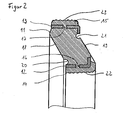
- FIG. 2 shows the section through a sealing body 11 for a mechanical seal, each with a stiffening ring 12, 13 on the radially inner 14 and outer 15 peripheral surface.
- the stiffening rings 12, 13 have openings 16, 17 which can be contained in the stiffening rings 12, 13 in the form of regular or irregularly arranged holes.
- the stiffening rings 12, 13 can also be made from perforated sheets.
- Strain relief devices 20, 21 are let into the axially outer surfaces 18, 19 of the sealing body 11.
- wave-shaped sealing profiles 22, 23 are formed, which can also be conical.
- Figure 3 shows the section through a drive seal 24, which by means of a trapezoidal sealing body 25 is mounted in a housing 26.
- a trapezoidal sealing body 25 On the radial Surface 27 of the sliding or counter ring 28 is the sealing body 25 by means of a Stiffening ring 29 fixed.
Landscapes
- Engineering & Computer Science (AREA)
- General Engineering & Computer Science (AREA)
- Mechanical Engineering (AREA)
- Mechanical Sealing (AREA)
Abstract
Description
Die Drehmomente in einer gattungsgemäßen Laufwerkdichtung werden dabei von den Gleitflächen über die axialen Schenkel der Gleit- und Gegenringe und die Dichtkörper auf das Gehäuse übertragen. Damit die Drehmomente von den axialen Schenkeln der Gleit- und Gegenringe auf die Dichtkörper übertragen werden können, muß an dieser Verbindungsstelle eine ausreichende Haftreibung vorhanden sein. Dabei kann die Kraft, die von den Dichtkörpern auf die Gleit- und Gegenringe ausgeübt wird, u. a. über die Schrägstellung und die Abmaße der trapezförmigen Dichtkörper gesteuert werden.
Durch eine solche Einbindung eines Federungskörpers wird erreicht, dass bei axialer Verschiebung des Gleitringes der Dichtkörper sowohl auf Druck als auch auf Biegung, im Gegensatz zur üblichen Schubbeanspruchung bei den bekannten Dichtkörpern, beansprucht wird.
Bei dieser Lösung wird zwar der Kraftfluß im Dichtkörper gezielt beeinflusst, ein Kippen des Dichtkörpers kann aber nicht verhindert werden. So dass es insbesondere am Gleitringrücken zu einer verminderten Auflage des Dichtkörpers und somit zu einer verminderten Haftreibung und zu niedrigeren übertragbaren Drehmomenten kommen kann. Gleichzeitig können, im Falle des Kippens des Dichtkörpers, Verunreinigungen und Schmiermittel unter den Dichtkörper gelangen, was zu einer dauerhaften Beeinträchtigung des Kraftflusses führen kann.
Eine Abdichtung ist hierbei aber nur bedingt möglich, da ein Schenkel des metallischen, kreisförmigen Stanzteiles unmittelbar mit dem Gehäuse in Verbindung steht, gibt das Stanzteil den Sitz des Dichtkörpers im Gehäuse vor. Um eine Dichtheit am Gehäuse durch den am anderen Schenkelende befindlichen elastomeren Werkstoff zu erlangen, muß dieser über das radial äußere Ende des Stanzteiles hinausragen. Da gummielastische Werkstoffe aber nahezu inkompressibel sind, wird der gummielastische Werkstoff bei der Montage aber so stark deformiert, dass er beschädigt oder sogar zerstört werden kann.
Da der gummielastische Werkstorf über den Versteifungsring hinausragt und der Versteifungsring nicht elastisch ist, kann es zu Schwierigkeiten beim Einfügen der Gleitringdichtung in das Gehäuse kommen. Der Einsatz von Montagehilfen oder Vorrichtungen ist dabei kostenintensiv und zeitaufwendig.
Ein weiterer Nachteil ist die starre Anbindung des Dichtkörpers an den Versteifungsring. Radiale und axiale Verschiebung der Gleitringe führen zu Zugspannungen, die an den axial äußeren Oberflächen der Dichtkörper am größten sind. Eine starre Anbindung an den Versteifungsring führt somit an den äußeren Oberflächen der Dichtkörper zu Spannungsspitzen, die zu einem Lösen der Verbindung zwischen Versteifungsring und Dichtkörper führen kann.
Die Anbindung des Dichtkörpers über einen Versteifungsring an das Gehäuse bedingt weiterhin, dass hier ein großes Drehmoment übertragen werden kann. Dies stellt in Bezug auf den Kraftfluß wiederum einen Nachteil dar, da die größten Umfangskräfte an der radial äußeren Oberfläche der Gleit- bzw. Gegenringe auftreten.
Die Bemaßung zwischen der radial inneren Oberfläche des Dichtkörpers und der radial äußeren Oberfläche der Gleit- und Gegenringe ist als Presspassung ausgeführt. Es besteht daher keine lose Verbindung, sondern die Bauteile werden kraftschlüssig zusammengehalten. Somit stehen, neben der aus den Abmaßen und der Schrägstellung der Dichtkörper aufgebrachten Kräften, weitere Kräfte zu Verfügung, welche die Haftreibung erhöhen und die eine optimale Übertragung der Drehmomente unterstützen. So können selbst größte Drehmomente, wie sie z. B. bei einem Verkleben der Gleitflächen durch Schmutz oder Korrosion entstehen, übertragen werden.
Ein weiterer erfindungsgemäßer Vorteil ergibt sich durch die Presspassung dahingehend, dass die Bauteile während der Montage nicht auseinanderfallen können und dass kein Verschieben des Dichtkörpers, bei sich auf dem Gleitring aufbauendem Schmutz, erfolgen kann.
Im Gegensatz zur radialen Höhe der trapezförmigen Dichtkörper ist die Höhe des elastomeren Dichtprofils gering und liegt im Bereich von etwa einem bis zu wenigen Millimetern. Durch die geringe Höhe des wellenförmigen Dichtungsprofils unterliegt der Dichtkörper auch nur einem geringen Setzen, was sich wiederum positiv auf das Wartungsverhalten und die Übertragung des Drehmomentes auswirkt.
Der konischen Ausbildung der Gleit- und Gegenringe folgt der Dichtkörper dadurch, dass der elastomere Werkstoff, mit der wellenförmigen Profilierung, am inneren Umfang des Versteifungsringes ebenfalls konisch ausgebildet ist, so dass sich die Oberflächen der Bauteile beim Fügen stets parallel gegenüber stehen.
Der Versteifungsring 3 ist fertigungsbedingt L-förmig ausgeführt, dabei ist der kurze Schenkel nach radial außen gerichtet. Um den Versteifungsring 3 während des Forrnfüllens in seiner Position zu halten, sind in den Dichtkörper 1 Kerben 6 eingelassen.
Auf der axial äußeren Seite 7 des Dichtkörpers 1 ist eine Zugentlastung 8 angeformt. Die Zugentlastung 8 ist in diesem Ausführungsbeispiel als etwa kreisförmige Hinterschneidung ausgeführt.
An der radial inneren Umfangsoberfläche 9 des Dichtkörpers 1 ist ein weiteres Dichtungsprofil 4 angeformt. Die Oberfläche ist dabei wellenförmig 10 ausgebildet und kann je nach Gleit- bzw. Gegenring auch konisch ausgeführt sein.
In die axial äußeren Oberflächen 18, 19 des Dichtkörpers 11 sind Zugentlastungen 20, 21 eingelassen. An die radialen Enden 14, 15 des Dichtkörpers 11 sind wellenförmige Dichtprofile 22, 23 angeformt, die auch konisch verlaufen können.
Claims (6)
- Gleitringdichtung, insbesondere Laufwerkdichtung (24), umfassend einen winkelförmigen Gleit- und Gegenring (28), die mit Ihren radialen Dichtschenkeln eine Dichtfläche bilden, und aus elastomerem Werkstoff bestehenden, trapezförmigen Dichtkörpern (1, 11, 25), die zwischen dem, die Gleitringdichtung aufnehmenden Gehäuse (26) und der radial äußeren Oberfläche der axialen Schenkel (27) des Gleit- und Gegenringes angeordnet sind, wobei die trapezförmigen Dichtkörper (1, 11) mit einem metallischen Versteifungsring (3, 12, 13, 29) ausgestattet sind, dadurch gekennzeichnet, dass der Dichtkörper (1, 11) einen Versteifungsring (3, 12, 13, 29) besitzt, der unmittelbar an der radial äußeren Oberfläche der axialen Schenkel (27) des Gleit- und Gegenringes angeordnet ist, wobei an den Versteifungsring (3, 12, 13, 29), in Richtung der radial äußeren Oberflächen der axialen Schenkel des Gleit- und Gegenringes, ein wellenförmiges, elastomeres Dichtungsprofil (4, 22, 23) angeformt ist und dass die Verbindung zwischen Dichtkörper (1, 11, 25) und radial äußerer Oberfläche der axialen Schenkel (27) des Gleit- und Gegenringes als Preßsitz toleriert ist.
- Gleitringdichtung nach Anspruch 1, dadurch gekennzeichnet, dass am axial äußeren Ende (7) des trapezförmigen Dichtkörpers (2), unmittelbar oberhalb der radial äußeren Oberfläche des Versteifungsringes (3), eine Zugentlastung (8), in Form einer Hinterschneidung, insbesondere als Radius, ausgebildet ist.
- Gleitringdichtung nach einem der Ansprüche 1 und 2, dadurch gekennzeichnet, dass sich der Durchmesser der radial äußeren Oberfläche der axialen Schenkel des Gleitund Gegenringes zum axial äußeren Ende hin verringert, so dass eine leicht konische Verbindung zwischen Dichtkörper (1) und Gleit- bzw. Gegenring gebildet ist.
- Gleitringdichtung nach einem der Ansprüche 1 bis 3, dadurch gekennzeichnet, dass in dem radial äußere Ende des trapezförmigen Dichtkörpers (11), unmittelbar am die Gleitringdichtung aufnehmenden Gehäuse, ein weiterer Versteifungsring (13) vorgesehen ist, an dessen radial äußerer Oberfläche ein wellenförmiges Dichtungsprofil (23) vorgesehen ist und dass die Verbindung zwischen radial äußerer Oberfläche des wellenförmiges Dichtungsprofils (23) und Gehäuse als Preßsitz toleriert ist.
- Gleitringdichtung nach Anspruch 4, dadurch gekennzeichnet, dass am axial inneren Ende (19) des trapezförmigen Dichtkörpers (11) unmittelbar unterhalb des radialen Endes des Versteifungsringes (13) eine Zugentlastung (21), in Form einer Hinterschneidung, insbesondere als Radius, ausgebildet ist.
- Gleitringdichtung nach einem der Ansprüche 1 bis 5, dadurch gekennzeichnet, dass in dem Versteifungsring (3, 12, 13, 29) Öffnungen (16, 17) vorgesehen sind, so dass eine Verbindung zwischen wellenförmigem Dichtungsprofil (4, 22, 23) und trapezförmigem Dichtungskörper (2, 11, 25) gegeben ist.
Applications Claiming Priority (2)
| Application Number | Priority Date | Filing Date | Title |
|---|---|---|---|
| DE10216140 | 2002-04-12 | ||
| DE2002116140 DE10216140B4 (de) | 2002-04-12 | 2002-04-12 | Gleitringdichtung mit Verdrehsicherung |
Publications (3)
| Publication Number | Publication Date |
|---|---|
| EP1353099A2 true EP1353099A2 (de) | 2003-10-15 |
| EP1353099A3 EP1353099A3 (de) | 2004-02-04 |
| EP1353099B1 EP1353099B1 (de) | 2006-07-05 |
Family
ID=28051269
Family Applications (1)
| Application Number | Title | Priority Date | Filing Date |
|---|---|---|---|
| EP20030007725 Expired - Lifetime EP1353099B1 (de) | 2002-04-12 | 2003-04-04 | Gleitringdichtung mit Verdrehsicherung |
Country Status (3)
| Country | Link |
|---|---|
| EP (1) | EP1353099B1 (de) |
| DE (2) | DE10216140B4 (de) |
| ES (1) | ES2268197T3 (de) |
Cited By (3)
| Publication number | Priority date | Publication date | Assignee | Title |
|---|---|---|---|---|
| WO2007137640A1 (de) * | 2006-05-31 | 2007-12-06 | Burgmann Industries Gmbh & Co. Kg | Trägerring für einen gleitring einer gleitringdichtungsanordnung |
| CN100513850C (zh) * | 2005-08-23 | 2009-07-15 | 浙江华夏阀门有限公司 | 三角截面密封套 |
| JP2014510239A (ja) * | 2011-02-17 | 2014-04-24 | フェデラル−モーグル ブルシャイト ゲゼルシャフト ミット ベシュレンクテル ハフツング | スライドリングシール |
Citations (2)
| Publication number | Priority date | Publication date | Assignee | Title |
|---|---|---|---|---|
| US3279804A (en) | 1963-07-05 | 1966-10-18 | Chicago Rawhide Mfg Co | End face seal assembly |
| DE1650024A1 (de) | 1967-11-16 | 1970-08-13 | Goetzewerke | Axiale Abdichtung fuer umlaufende Maschinenteile |
Family Cites Families (9)
| Publication number | Priority date | Publication date | Assignee | Title |
|---|---|---|---|---|
| US3336660A (en) * | 1962-11-13 | 1967-08-22 | Federal Mogul Corp | Face seals |
| DE6904242U (de) * | 1969-02-03 | 1969-04-30 | Goetze F Ag | Stuetzring fuer gleitringdichtungen |
| JPS589870B2 (ja) * | 1975-08-30 | 1983-02-23 | エヌオーケー株式会社 | メカニカルシ−ル |
| EP0005159B1 (de) * | 1978-03-20 | 1981-07-08 | Goetze Ag | Gleitringdichtung |
| DE3412594C2 (de) * | 1984-04-04 | 1986-07-31 | Goetze Ag, 5093 Burscheid | Gleitringdichtung |
| DE3739514C2 (de) * | 1987-11-21 | 1995-07-13 | Kaco Gmbh Co | Dichtring |
| GB9115991D0 (en) * | 1991-07-24 | 1991-09-11 | Crane John Uk Ltd | Mechanical face seals |
| DE4131472A1 (de) * | 1991-09-21 | 1993-03-25 | Schaeffler Waelzlager Kg | Radialwellendichtring aus elastomerem werkstoff |
| DE19955860B4 (de) * | 1999-11-20 | 2004-04-08 | Federal-Mogul Burscheid Gmbh | Gleitringdichtung |
-
2002
- 2002-04-12 DE DE2002116140 patent/DE10216140B4/de not_active Expired - Fee Related
-
2003
- 2003-04-04 EP EP20030007725 patent/EP1353099B1/de not_active Expired - Lifetime
- 2003-04-04 ES ES03007725T patent/ES2268197T3/es not_active Expired - Lifetime
- 2003-04-04 DE DE50304111T patent/DE50304111D1/de not_active Expired - Lifetime
Patent Citations (2)
| Publication number | Priority date | Publication date | Assignee | Title |
|---|---|---|---|---|
| US3279804A (en) | 1963-07-05 | 1966-10-18 | Chicago Rawhide Mfg Co | End face seal assembly |
| DE1650024A1 (de) | 1967-11-16 | 1970-08-13 | Goetzewerke | Axiale Abdichtung fuer umlaufende Maschinenteile |
Cited By (5)
| Publication number | Priority date | Publication date | Assignee | Title |
|---|---|---|---|---|
| CN100513850C (zh) * | 2005-08-23 | 2009-07-15 | 浙江华夏阀门有限公司 | 三角截面密封套 |
| WO2007137640A1 (de) * | 2006-05-31 | 2007-12-06 | Burgmann Industries Gmbh & Co. Kg | Trägerring für einen gleitring einer gleitringdichtungsanordnung |
| US8267406B2 (en) | 2006-05-31 | 2012-09-18 | Eagleburgmann Germany Gmbh & Co. Kg | Retaining ring for a seal ring of a mechanical seal assembly |
| JP2014510239A (ja) * | 2011-02-17 | 2014-04-24 | フェデラル−モーグル ブルシャイト ゲゼルシャフト ミット ベシュレンクテル ハフツング | スライドリングシール |
| US9574665B2 (en) | 2011-02-17 | 2017-02-21 | Federal-Mogul Burscheid Gmbh | Slide ring seal |
Also Published As
| Publication number | Publication date |
|---|---|
| DE50304111D1 (de) | 2006-08-17 |
| ES2268197T3 (es) | 2007-03-16 |
| DE10216140B4 (de) | 2004-07-08 |
| DE10216140A1 (de) | 2003-11-06 |
| EP1353099B1 (de) | 2006-07-05 |
| EP1353099A3 (de) | 2004-02-04 |
Similar Documents
| Publication | Publication Date | Title |
|---|---|---|
| DE102010001345B4 (de) | Drehdurchführung | |
| EP2459906B1 (de) | Dichtungsanordnung | |
| DE2004046C2 (de) | Dichtung | |
| EP0050213B1 (de) | Selbstausrichtende Lagerung | |
| EP1995088B1 (de) | Einsatzlagerteil, elastisches Einsatzlager und Federbeinlageranordnung | |
| DE2654738A1 (de) | Schmiermitteldichtung | |
| EP2532932A1 (de) | Radialwellendichtung | |
| DE102011001868A1 (de) | Dichtkette | |
| EP3320240A1 (de) | Drehdurchführung für ein fahrzeug | |
| EP0493731B1 (de) | Elastisches Lager | |
| DE102009058216B4 (de) | Dichtungsanordnung und Gelenk einer Kette mit der Dichtungsanordnung | |
| DE102018102758A1 (de) | Feder für ein Rückschlagventil, Rückschlagventil mit einer derartigen Feder, regelbarer Schwingungsdämpfer mit einem solchen Rückschlagventil sowie Kraftfahrzeug mit einem derartigen regelbaren Schwingungsdämpfer | |
| DE2726033A1 (de) | Dichtung, insbesondere fuer kettenbolzen an raupenschleppern o.dgl. | |
| DE10113442C2 (de) | Lageranordnung für ein Wellenlager | |
| DE102014219859A1 (de) | Kreuzgelenk | |
| WO2010009799A1 (de) | Kreiselpumpe | |
| EP1353099B1 (de) | Gleitringdichtung mit Verdrehsicherung | |
| DE102008024163A1 (de) | Verbundkolben für ein Kraftfahrzeuggetriebe | |
| DE102013216773B4 (de) | Radialwellendichtring zur Abdichtung eines Gehäuseteils eines Kraftfahrzeugmotors oder -getriebes gegen eine Welle | |
| WO2014108122A1 (de) | Dichtung für eine hydraulische kolben-zylinder-anordnung | |
| DE10237966B4 (de) | Hydrolager mit Elastomerfeder | |
| DE3220192C1 (de) | Lippendichtungsring | |
| DE102008014222B3 (de) | Anordnung zum Verschleißausgleich bei insbesondere aus Kunststoff bestehenden sog. "Harmonic-Drive"-Getrieben | |
| DE102007016172B4 (de) | Kugelhülsengelenk | |
| EP4317749B1 (de) | Dichtungsanordnung und wasseraufbereitungsgerät, das die dichtungsanordnung umfasst |
Legal Events
| Date | Code | Title | Description |
|---|---|---|---|
| PUAI | Public reference made under article 153(3) epc to a published international application that has entered the european phase |
Free format text: ORIGINAL CODE: 0009012 |
|
| AK | Designated contracting states |
Kind code of ref document: A2 Designated state(s): AT BE BG CH CY CZ DE DK EE ES FI FR GB GR HU IE IT LI LU MC NL PT RO SE SI SK TR |
|
| AX | Request for extension of the european patent |
Extension state: AL LT LV MK |
|
| PUAL | Search report despatched |
Free format text: ORIGINAL CODE: 0009013 |
|
| AK | Designated contracting states |
Kind code of ref document: A3 Designated state(s): AT BE BG CH CY CZ DE DK EE ES FI FR GB GR HU IE IT LI LU MC NL PT RO SE SI SK TR |
|
| AX | Request for extension of the european patent |
Extension state: AL LT LV MK |
|
| 17P | Request for examination filed |
Effective date: 20040722 |
|
| AKX | Designation fees paid |
Designated state(s): DE ES FR GB IT |
|
| 17Q | First examination report despatched |
Effective date: 20040917 |
|
| GRAP | Despatch of communication of intention to grant a patent |
Free format text: ORIGINAL CODE: EPIDOSNIGR1 |
|
| GRAS | Grant fee paid |
Free format text: ORIGINAL CODE: EPIDOSNIGR3 |
|
| GRAA | (expected) grant |
Free format text: ORIGINAL CODE: 0009210 |
|
| AK | Designated contracting states |
Kind code of ref document: B1 Designated state(s): DE ES FR GB IT |
|
| PG25 | Lapsed in a contracting state [announced via postgrant information from national office to epo] |
Ref country code: IT Free format text: LAPSE BECAUSE OF FAILURE TO SUBMIT A TRANSLATION OF THE DESCRIPTION OR TO PAY THE FEE WITHIN THE PRESCRIBED TIME-LIMIT;WARNING: LAPSES OF ITALIAN PATENTS WITH EFFECTIVE DATE BEFORE 2007 MAY HAVE OCCURRED AT ANY TIME BEFORE 2007. THE CORRECT EFFECTIVE DATE MAY BE DIFFERENT FROM THE ONE RECORDED. Effective date: 20060705 |
|
| REG | Reference to a national code |
Ref country code: GB Ref legal event code: FG4D Free format text: NOT ENGLISH |
|
| GBT | Gb: translation of ep patent filed (gb section 77(6)(a)/1977) |
Effective date: 20060721 |
|
| REF | Corresponds to: |
Ref document number: 50304111 Country of ref document: DE Date of ref document: 20060817 Kind code of ref document: P |
|
| ET | Fr: translation filed | ||
| REG | Reference to a national code |
Ref country code: ES Ref legal event code: FG2A Ref document number: 2268197 Country of ref document: ES Kind code of ref document: T3 |
|
| PLBE | No opposition filed within time limit |
Free format text: ORIGINAL CODE: 0009261 |
|
| STAA | Information on the status of an ep patent application or granted ep patent |
Free format text: STATUS: NO OPPOSITION FILED WITHIN TIME LIMIT |
|
| 26N | No opposition filed |
Effective date: 20070410 |
|
| PGFP | Annual fee paid to national office [announced via postgrant information from national office to epo] |
Ref country code: FR Payment date: 20110331 Year of fee payment: 9 |
|
| PGFP | Annual fee paid to national office [announced via postgrant information from national office to epo] |
Ref country code: DE Payment date: 20110429 Year of fee payment: 9 Ref country code: ES Payment date: 20110425 Year of fee payment: 9 Ref country code: GB Payment date: 20110328 Year of fee payment: 9 |
|
| PGFP | Annual fee paid to national office [announced via postgrant information from national office to epo] |
Ref country code: IT Payment date: 20110416 Year of fee payment: 9 |
|
| GBPC | Gb: european patent ceased through non-payment of renewal fee |
Effective date: 20120404 |
|
| REG | Reference to a national code |
Ref country code: FR Ref legal event code: ST Effective date: 20121228 |
|
| PG25 | Lapsed in a contracting state [announced via postgrant information from national office to epo] |
Ref country code: GB Free format text: LAPSE BECAUSE OF NON-PAYMENT OF DUE FEES Effective date: 20120404 |
|
| REG | Reference to a national code |
Ref country code: DE Ref legal event code: R119 Ref document number: 50304111 Country of ref document: DE Effective date: 20121101 |
|
| PG25 | Lapsed in a contracting state [announced via postgrant information from national office to epo] |
Ref country code: IT Free format text: LAPSE BECAUSE OF NON-PAYMENT OF DUE FEES Effective date: 20120404 Ref country code: FR Free format text: LAPSE BECAUSE OF NON-PAYMENT OF DUE FEES Effective date: 20120430 |
|
| REG | Reference to a national code |
Ref country code: ES Ref legal event code: FD2A Effective date: 20130715 |
|
| PG25 | Lapsed in a contracting state [announced via postgrant information from national office to epo] |
Ref country code: ES Free format text: LAPSE BECAUSE OF NON-PAYMENT OF DUE FEES Effective date: 20120405 |
|
| PG25 | Lapsed in a contracting state [announced via postgrant information from national office to epo] |
Ref country code: DE Free format text: LAPSE BECAUSE OF NON-PAYMENT OF DUE FEES Effective date: 20121101 |