EP1347597B1 - Eingebettetes System mit mehreren Kanälen zum Empfang von Daten - Google Patents
Eingebettetes System mit mehreren Kanälen zum Empfang von Daten Download PDFInfo
- Publication number
- EP1347597B1 EP1347597B1 EP03251009A EP03251009A EP1347597B1 EP 1347597 B1 EP1347597 B1 EP 1347597B1 EP 03251009 A EP03251009 A EP 03251009A EP 03251009 A EP03251009 A EP 03251009A EP 1347597 B1 EP1347597 B1 EP 1347597B1
- Authority
- EP
- European Patent Office
- Prior art keywords
- data
- broadcast
- broadcast data
- memory
- buffers
- Prior art date
- Legal status (The legal status is an assumption and is not a legal conclusion. Google has not performed a legal analysis and makes no representation as to the accuracy of the status listed.)
- Expired - Lifetime
Links
Images




Classifications
-
- H—ELECTRICITY
- H04—ELECTRIC COMMUNICATION TECHNIQUE
- H04L—TRANSMISSION OF DIGITAL INFORMATION, e.g. TELEGRAPHIC COMMUNICATION
- H04L49/00—Packet switching elements
- H04L49/90—Buffering arrangements
- H04L49/901—Buffering arrangements using storage descriptor, e.g. read or write pointers
-
- H—ELECTRICITY
- H04—ELECTRIC COMMUNICATION TECHNIQUE
- H04L—TRANSMISSION OF DIGITAL INFORMATION, e.g. TELEGRAPHIC COMMUNICATION
- H04L49/00—Packet switching elements
- H04L49/90—Buffering arrangements
Definitions
- the present invention generally relates to network devices, and more particularly to an embedded system in a communication network having dedicated data receiving channel for broadcast data.
- Computing systems with constrained resources are becoming very common in environments in which communications with one or more other devices are required. Frequently, these systems are referred to as embedded systems. They are typically limited in functionality, and have fewer resources than a typical personal computer, i.e., limited processing capability, memory size and speed of internal bus structures, for example.
- a print server in a local area network is an example of an embedded system in a network.
- data coming in from the network can be lumped into two categories, broadcast and non-broadcast.
- Non-broadcast data is characterized as being sent to a particular node where an embedded system is logically located.
- Broadcast data refers to data sent to a group of nodes or all nodes on the network.
- broadcast data traffic increases, thus making it difficult for the embedded systems to receive and process the increased data flow from the network, particularly the non-broadcast data necessary for performing the particular functions of the embedded systems.
- the processors in the embedded systems typically do not have the bandwidth to process the incoming data fast enough and/or adequate memory (buffer structures) to store all the incoming data.
- U.S. Patent No. 5,793,978 describes a router for routing packets to devices in a computer network. If a packet to be sent to the network is a broadcast message, it is placed on a separate broadcast transmit queue from non-broadcast messages.
- WO 98/44686 relates to ATM switches in a telecommunications system for handling point-to-point and point-to-multipoint connections.
- the system of WO 98/44686 includes a buffer structure for storing cells in accordance with priority classes and determining the locations of the cells in the buffers. All input cells are received through a single channel.
- HAUNG Y R ET AL 'A high performance input access scheme for ATM Multicast switching', 1996, IEE International Conference on Communication (ICC) describes an ATM multicast switching device in which data from multicast and unicast queues is sent to an input access controller and then to a multicast packet switch.
- ICC International Conference on Communication
- An embedded system includes a memory for storing data received from the communication network, and a controller for determining whether the data received from the communication network is broadcast data or non-broadcast data.
- a data controller is included in the system and has a first channel for storing the broadcast data received from the communication network in the memory, and a second channel for storing the non-broadcast data.
- the embedded system in accordance with an embodiment of the present invention is indicated generally at 10, and is adapted to be connected to a communication network 12, which includes a combination of function media (such as the embedded system 10), infrastructure and other computing devices.
- the network 12 such as a local area network (LAN), a wide area network (WAN) or a personal area network (PAN), allows information to be generated and shared across the media.
- the embedded system 10 includes a physical layer 14 for encoding and decoding data transmitted to and received from the network 12 in various known methods.
- a media access controller (MAC) 16 is connected to the physical layer 14 and is responsible for controlling access between the embedded system 10 and the network 12, error checking and address filtering of data from the network.
- MAC media access controller
- the MAC 16 is also adapted to determine whether the incoming data is broadcast data or non-broadcast data.
- the MAC 16 also includes an address or a group of addresses, which is unique to the node or address of the embedded system 10, and filters out non-broadcast data that is not intended for the node of the embedded system.
- the embedded system 10 also includes a multi-channel direct memory access (DMA) controller 18 for controlling transfer of data between a memory 20 of the embedded system and the network 12.
- the memory 20 is a random access memory (RAM).
- the DMA controller 18 includes a non-broadcast data receive channel 21 and a broadcast data receive channel 23 for respectively controlling transfer of non-broadcast data and broadcast data between the memory 20 and the network 12.
- a first in first out (FIFO) buffer 22 is provided between the DMA controller 18 and the MAC 16 for limited storage of incoming data from and outgoing data to the network 12.
- Data from the network 12 is stored in the RAM memory 20, where it is accessible to a processor 26.
- Data from the processor 26 that is intended to be sent (transmitted) to the network 12 is also stored in the RAM memory 20 prior to being read by the DMA controller 18.
- the processor 26 is responsible for executing instructions that control the functions of the embedded system 10.
- the instructions for the processor 26 are provided in a firmware stored in a program memory 28.
- the embedded system 10 also includes a function interface 30 for operatively connecting the embedded system 10 to other control systems, e.g., printing, scanning and communication interfaces to other network links such as LAN, WAN, etc.
- a digital controller 32 provides the means necessary for the various components (i.e., the DMA controller 18, the RAM memory 20, the processor 26, the program memory 28 and the function interface 30) of the embedded system 10 to operatively communicate with each other.
- a data packet 34 includes predefined fields that provide pertinent information required by the network 12. Those in the art will recognize that the information contained in the data packet 34 is driven by the standard associated with the network 12 to which the embedded system 10 is interfaced. Examples of the standard include Ethernet, IEEE 802.11, IEEE 802.3, IEEE 802.4, IEEE 802.5 and BLUETOOTH, for example.
- the packet includes a start delimiter (SD) field 36 for indicating the beginning of the packet 34, and a destination address (DA) field 38 for indicating the intended recipient of the packet.
- SD start delimiter
- DA destination address
- the DA field 38 also indicates whether or not the packet 34 contains broadcast data, preferably by a special bit. It should be understood, however, that other fields within the packet 34 may also indicate whether the data that it is carrying is a broadcast or non-broadcast and through other means besides a special bit.
- a source address (SA) field 40 provides the identification of the node from which the data packet 34 originated, a control field (CF) 42 describes the type of packet being sent, and often the length of the packet, and a data field 44 stores the data, either broadcast or non-broadcast, intended for the destination(s) of the packet 34.
- a cyclic redundancy checksum (CRC) field 46 provides information for determining whether an error has occurred in the data in the field 44 during transmission, and an end delimiter (ED) field 48 indicates the end point of the data packet 34.
- CRC cyclic redundancy checksum
- ED end delimiter
- the RAM memory 20 includes a plurality of buffers 50, each for storing data carried in a single data packet 34. Two or more buffers 50 may store data contained in a single data packet 34, however, if necessary, as those skilled in the art will recognize. Each buffer 50 is designated by the processor 26 to store either broadcast data or non-broadcast data.
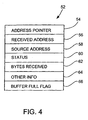
- the RAM memory 20 also includes a corresponding non-broadcast data pointer 52 for each buffer 50 designated to store non-broadcast data, and a corresponding broadcast data pointer 53 for each buffer 50 designated to store broadcast data.
- Both types of pointers 52, 53 includes an address pointer field 54 identifying its corresponding buffer 50, a received address field 56 identifying the destination address of the data carried in the data packet 34.
- a source address field 58 indicates the address from where the data originated.
- status field 60 may indicate whether the data stored in the corresponding buffer 50 is a broadcast data or not. This field 60 can also be used for flagging errors, such as collision, CRC error, etc.
- a field 62 indicates the number of bytes of data stored in the corresponding buffer 50, and a field 64 is used for other information that may be of use to the embedded system designer, for example, storing network transport checksum.
- a field 66 includes a flag indicating whether the corresponding buffer 50 is storing data.
- the data packet 34 from the network 12 is received by the MAC controller 16 after it has been appropriately processed (i.e., decoded) by the physical layer 14.
- the MAC controller 16 determines whether the packet contains broadcast data, usually from the DA field 38.
- the data contained in the data field 44 of the packet 34 is then forwarded to the FIFO buffer 22 along with an indication as to whether the received data is broadcast data or non-broadcast data.
- the DMA controller 18 first determines whether the data in the packet 34 is broadcast data or non-broadcast data (block 70). If the data received is non-broadcast data, the DMA controller 18 refers to the non-broadcast pointer 52 corresponding to the next available non-broadcast buffer 50 for the location of that buffer (block 73). The received data is stored in the next available non-broadcast buffer 50 in the RAM memory 20 via the non-broadcast data receive channel 21 (block 74), if a buffer is available at block 72.
- all the fields in the corresponding non-broadcast pointer 52 are updated by the processor 26 to reflect the information relating to the newly stored non-broadcast data (block 76).
- the DMA controller 18 then checks the next non-broadcast pointer 52 (block 78), and determines if its corresponding non-broadcast buffer 50 is available to store non-broadcast data (block 80).
- the DMA controller 18 checks the field 66 of the pointer 52 for a buffer full flag for this purpose.
- the DMA controller 18 sends an interrupt to the processor 26 (block 81).
- the pointers 52 are accessed by the DMA controller 18 in a sequential order, and the data in the buffers 50 are processed by the processor 26 in that same order. Accordingly, once the last non-broadcast pointer 52 or buffer 50 in the RAM memory 20 has been accessed or processed, the first non-broadcast pointer and buffer become the next pointer and buffer.
- the DMA controller 18 determines if a broadcast buffer 50 in the RAM memory 20 is available for storage (block 82). If so, the DMA controller 18 refers to the broadcast pointer 53 corresponding to the next available broadcast buffer 50 for the location of that buffer (block 84). The received broadcast data is stored in the next available broadcast buffer 50 via the broadcast data receive channel 23 (block 86).
- the DMA controller 18 checks the next broadcast pointer 53 (block 90), and determines if its corresponding broadcast buffer 50 is available to store broadcast data (block 92). The DMA controller 18 checks the field 66 of the pointer 53 for a buffer full flag for this purpose.
- the DMA controller 18 sends an interrupt to the processor 26 (block 94).
- the pointers 53 are also accessed by the DMA controller 18 in a sequential order, and the data in the buffers 50 are processed by the processor 26 in that same order. Accordingly, once the last pointer 53 or its corresponding buffer 50 in the RAM memory 20 has been accessed or processed, the first broadcast pointer 53 and buffer 50 become the next broadcast pointer and buffer.
- the processor 26 processes the stored data when it has the available bandwidth.
- the processor 26 gives priority to the processing of non-broadcast data, since it is typically associated with the particular function of the device.
- the broadcast data is processed after the non-broadcast data has been processed.
- Other processing orders should be recognizable by those skilled in the art.
- the processor 26 may vary the allocation of the buffers 50 for receiving broadcast and non-broadcast data. This generally depends on the amount of buffers 50 that are available and how busy the processor 26 is.
- the embedded system includes a DMA controller having a channel for receiving and storing non-broadcast data to the memory and a separate channel for receiving and storing broadcast data.
Landscapes
- Engineering & Computer Science (AREA)
- Computer Networks & Wireless Communication (AREA)
- Signal Processing (AREA)
- Computer And Data Communications (AREA)
- Data Exchanges In Wide-Area Networks (AREA)
- Small-Scale Networks (AREA)
- Two-Way Televisions, Distribution Of Moving Picture Or The Like (AREA)
Claims (8)
- Ein eingebettetes System (10) in einem Kommunikationsnetzwerk (12), das folgende Merkmale umfasst:einen Speicher (20) zum Speichern von Daten, die von dem Kommunikationsnetzwerk (12) empfangen werden;eine Einrichtung (16) zum Bestimmen, ob die Daten, die von dem Kommunikationsnetzwerk empfangen werden, Rundsendedaten oder Nicht-Rundsendedaten sind;einen Steuerpuffer (22) zum Stellen von Daten, die von dem Kommunikationsnetzwerk (12) über die Bestimmungseinrichtung (16) empfangen werden, in eine Warteschlange; undeine Datensteuerung (18) mit einem ersten Kanal (23) zum Speichern der Rundsendedaten von dem Steuerpuffer (22) in dem Speicher (20), und einem zweiten Kanal (21) zum Speichern der Nicht-Rundsendedaten von dem Steuerpuffer (22) in dem Speicher.
- Das System (10) gemäß Anspruch 1, bei dem der Speicher (20) eine Mehrzahl von Puffern (50), die zum Speichern der Nicht-Rundsendedaten bestimmt sind, und eine Mehrzahl von Puffern (50) umfasst, die zum Speichern der Rundsendedaten bestimmt sind.
- Das System gemäß Anspruch 2, das ferner einen Prozessor (26) zum Bestimmen einer vorbestimmten Anzahl der Puffer (50) für die Speicherung der Nicht-Ründsendedaten und einer vorbestimmten Anzahl der Puffer (50) für die Speicherung der Rundsendedaten umfasst.
- Das System gemäß Anspruch 2, bei dem der Speicher (20) einen Zeiger (52, 53) umfasst, der jedem der Nicht-Rundsendedaten-Speicherpuffer und der Rundsendedaten-Speicherpuffer entspricht.
- Das System gemäß Anspruch 4, bei dem die Zeiger (52, 53) ein Feld (60) zum Anzeigen, ob Daten, die in einem entsprechenden der Puffer gespeichert sind, die Rundsendedaten oder die Nicht-Rundsendedaten sind, und ein Feld (66) zum Anzeigen umfassen, ob der entsprechende Puffer voll ist.
- Das System (10) gemäß Anspruch 1, das ferner folgende Merkmale umfasst:einen Prozessor (26) zum Verarbeiten von Daten, die in den Puffern (50) gespeichert sind;einen Programmspeicher (28) zum Speichern von Betriebsbefehlen für den Prozessor (26); undeine Systemsteuerung (32) zum Liefern von Kommunikation zwischen dem Prozessor (26), dem Programmspeicher (28), dem Datenspeicher (20) und der Datensteuerung (18).
- Das System (10) gemäß Anspruch 6, das ferner folgendes Merkmal umfasst:eine physikalische Schicht (14), die zwischen der Bestimmungseinrichtung (16) und dem Kommunikationsnetzwerk (12) verbunden ist, zum Codieren und Decodieren von Daten, die an das Kommunikationsnetzwerk gesendet werden und von demselben empfangen werden.
- Das System (10) gemäß Anspruch 6, das ferner eine Funktionsschnittstelle (30) umfasst, die mit der Systemsteuerung (32) verbunden ist, zum wirksamen Verbinden des eingebetteten Systems mit einem Netzwerkmedium.
Applications Claiming Priority (2)
| Application Number | Priority Date | Filing Date | Title |
|---|---|---|---|
| US95191 | 2002-03-11 | ||
| US10/095,191 US20030172176A1 (en) | 2002-03-11 | 2002-03-11 | Embedded system having multiple data receiving channels |
Publications (3)
| Publication Number | Publication Date |
|---|---|
| EP1347597A2 EP1347597A2 (de) | 2003-09-24 |
| EP1347597A3 EP1347597A3 (de) | 2004-03-10 |
| EP1347597B1 true EP1347597B1 (de) | 2006-05-10 |
Family
ID=27788210
Family Applications (1)
| Application Number | Title | Priority Date | Filing Date |
|---|---|---|---|
| EP03251009A Expired - Lifetime EP1347597B1 (de) | 2002-03-11 | 2003-02-19 | Eingebettetes System mit mehreren Kanälen zum Empfang von Daten |
Country Status (3)
| Country | Link |
|---|---|
| US (1) | US20030172176A1 (de) |
| EP (1) | EP1347597B1 (de) |
| DE (1) | DE60305090T2 (de) |
Families Citing this family (2)
| Publication number | Priority date | Publication date | Assignee | Title |
|---|---|---|---|---|
| US7424553B1 (en) * | 2004-04-15 | 2008-09-09 | Xilinx, Inc. | Method and apparatus for communicating data between a network transceiver and memory circuitry |
| US8116312B2 (en) | 2006-02-08 | 2012-02-14 | Solarflare Communications, Inc. | Method and apparatus for multicast packet reception |
Family Cites Families (10)
| Publication number | Priority date | Publication date | Assignee | Title |
|---|---|---|---|---|
| JP3104429B2 (ja) * | 1992-10-08 | 2000-10-30 | 株式会社日立製作所 | コピー機能を有する共通バッファ形atmスイッチ及びそのコピー方法 |
| US5793978A (en) * | 1994-12-29 | 1998-08-11 | Cisco Technology, Inc. | System for routing packets by separating packets in to broadcast packets and non-broadcast packets and allocating a selected communication bandwidth to the broadcast packets |
| DE69532448T2 (de) * | 1995-10-20 | 2004-10-21 | Ibm | Brückenvorrichtung zur Verkehrsfilterung in Kommunikationsnetzen |
| US5898687A (en) * | 1996-07-24 | 1999-04-27 | Cisco Systems, Inc. | Arbitration mechanism for a multicast logic engine of a switching fabric circuit |
| US6185223B1 (en) * | 1996-12-04 | 2001-02-06 | Conexant Systems, Inc. | Apparatus and method for providing fire wall protection for systems in communication with an a synchronous transfer mode system |
| US6098110A (en) * | 1996-12-30 | 2000-08-01 | Compaq Computer Corporation | Network switch with a multiple bus structure and a bridge interface for transferring network data between different buses |
| SE520265C2 (sv) * | 1997-04-01 | 2003-06-17 | Ericsson Telefon Ab L M | Förfarande och anording för rättvis fördelning av bandbredd i en ATM-växel |
| US6185185B1 (en) * | 1997-11-21 | 2001-02-06 | International Business Machines Corporation | Methods, systems and computer program products for suppressing multiple destination traffic in a computer network |
| US6363075B1 (en) * | 1998-01-23 | 2002-03-26 | Industrial Technology Research Institute | Shared buffer management mechanism and method using multiple linked lists in a high speed packet switching system |
| US6680906B1 (en) * | 1999-03-31 | 2004-01-20 | Cisco Technology, Inc. | Regulating packet traffic in an integrated services network |
-
2002
- 2002-03-11 US US10/095,191 patent/US20030172176A1/en not_active Abandoned
-
2003
- 2003-02-19 DE DE60305090T patent/DE60305090T2/de not_active Expired - Fee Related
- 2003-02-19 EP EP03251009A patent/EP1347597B1/de not_active Expired - Lifetime
Also Published As
| Publication number | Publication date |
|---|---|
| US20030172176A1 (en) | 2003-09-11 |
| DE60305090D1 (de) | 2006-06-14 |
| DE60305090T2 (de) | 2006-12-07 |
| EP1347597A2 (de) | 2003-09-24 |
| EP1347597A3 (de) | 2004-03-10 |
Similar Documents
| Publication | Publication Date | Title |
|---|---|---|
| US11916781B2 (en) | System and method for facilitating efficient utilization of an output buffer in a network interface controller (NIC) | |
| EP1137225B1 (de) | Vermittlungseinrichtung und Vermittlungsverfahren | |
| US6496516B1 (en) | Ring interface and ring network bus flow control system | |
| US5287535A (en) | Switching node in label multiplexing type switching network | |
| US7733889B2 (en) | Network switching device and method dividing packets and storing divided packets in shared buffer | |
| CN101291194B (zh) | 报文保序的方法和系统 | |
| US6574194B1 (en) | Architecture of data communications switching system and associated method | |
| US7023849B2 (en) | Packet switching apparatus, method of transmitting multicast packet at packet switching apparatus, and setup method of packet switching apparatus | |
| EP0448494A2 (de) | Verfahren zur Steuerung des Zugangs zu einem Bus in einem (DBDQ)-Netzwerk, bestehend aus zwei Bussen und einer verteilten Warteschlange | |
| US20090046735A1 (en) | Method for providing prioritized data movement between endpoints connected by multiple logical channels | |
| JP3394504B2 (ja) | 並列スイッチングエンジン中で、パケット順序の完全性を維持する方法および装置 | |
| HK1044427A1 (zh) | 管理多個異步傳輸模式的信元隊列的方法和裝置 | |
| JPS611146A (ja) | 情報通信装置 | |
| EP1351439B1 (de) | Eingebettetes System für die Überlastregelung von Rundfunkverkehr in einem Kommunikationsnetzwerk | |
| JP2000269997A (ja) | Lan中継交換装置 | |
| US7295564B2 (en) | Virtual output queue (VoQ) management method and apparatus | |
| US7554908B2 (en) | Techniques to manage flow control | |
| US5528763A (en) | System for admitting cells of packets from communication network into buffer of attachment of communication adapter | |
| US20140185629A1 (en) | Queue processing method | |
| US6418118B1 (en) | Network device including selective discard of packets | |
| EP1347597B1 (de) | Eingebettetes System mit mehreren Kanälen zum Empfang von Daten | |
| US6621825B1 (en) | Method and apparatus for per connection queuing of multicast transmissions | |
| RU2257678C2 (ru) | Модульный масштабируемый коммутатор и способ распределения кадров в сети быстрого ethernet | |
| CN118784748A (zh) | 一种数据传输方法、设备、数据处理网络系统及介质 | |
| CN110730130B (zh) | 报文发送方法、装置、网络设备及存储介质 |
Legal Events
| Date | Code | Title | Description |
|---|---|---|---|
| PUAI | Public reference made under article 153(3) epc to a published international application that has entered the european phase |
Free format text: ORIGINAL CODE: 0009012 |
|
| AK | Designated contracting states |
Kind code of ref document: A2 Designated state(s): AT BE BG CH CY CZ DE DK EE ES FI FR GB GR HU IE IT LI LU MC NL PT SE SI SK TR |
|
| AX | Request for extension of the european patent |
Extension state: AL LT LV MK RO |
|
| PUAL | Search report despatched |
Free format text: ORIGINAL CODE: 0009013 |
|
| AK | Designated contracting states |
Kind code of ref document: A3 Designated state(s): AT BE BG CH CY CZ DE DK EE ES FI FR GB GR HU IE IT LI LU MC NL PT SE SI SK TR |
|
| AX | Request for extension of the european patent |
Extension state: AL LT LV MK RO |
|
| RIC1 | Information provided on ipc code assigned before grant |
Ipc: 7H 04L 12/56 B Ipc: 7H 04L 12/18 A |
|
| 17P | Request for examination filed |
Effective date: 20040819 |
|
| 17Q | First examination report despatched |
Effective date: 20040915 |
|
| AKX | Designation fees paid |
Designated state(s): DE FR GB |
|
| GRAP | Despatch of communication of intention to grant a patent |
Free format text: ORIGINAL CODE: EPIDOSNIGR1 |
|
| GRAS | Grant fee paid |
Free format text: ORIGINAL CODE: EPIDOSNIGR3 |
|
| GRAA | (expected) grant |
Free format text: ORIGINAL CODE: 0009210 |
|
| AK | Designated contracting states |
Kind code of ref document: B1 Designated state(s): DE FR GB |
|
| REG | Reference to a national code |
Ref country code: GB Ref legal event code: FG4D |
|
| REF | Corresponds to: |
Ref document number: 60305090 Country of ref document: DE Date of ref document: 20060614 Kind code of ref document: P |
|
| ET | Fr: translation filed | ||
| PLBE | No opposition filed within time limit |
Free format text: ORIGINAL CODE: 0009261 |
|
| STAA | Information on the status of an ep patent application or granted ep patent |
Free format text: STATUS: NO OPPOSITION FILED WITHIN TIME LIMIT |
|
| 26N | No opposition filed |
Effective date: 20070213 |
|
| PGFP | Annual fee paid to national office [announced via postgrant information from national office to epo] |
Ref country code: GB Payment date: 20090227 Year of fee payment: 7 |
|
| PGFP | Annual fee paid to national office [announced via postgrant information from national office to epo] |
Ref country code: DE Payment date: 20090331 Year of fee payment: 7 |
|
| PGFP | Annual fee paid to national office [announced via postgrant information from national office to epo] |
Ref country code: FR Payment date: 20090217 Year of fee payment: 7 |
|
| GBPC | Gb: european patent ceased through non-payment of renewal fee |
Effective date: 20100219 |
|
| REG | Reference to a national code |
Ref country code: FR Ref legal event code: ST Effective date: 20101029 |
|
| PG25 | Lapsed in a contracting state [announced via postgrant information from national office to epo] |
Ref country code: FR Free format text: LAPSE BECAUSE OF NON-PAYMENT OF DUE FEES Effective date: 20100301 |
|
| PG25 | Lapsed in a contracting state [announced via postgrant information from national office to epo] |
Ref country code: DE Free format text: LAPSE BECAUSE OF NON-PAYMENT OF DUE FEES Effective date: 20100901 |
|
| PG25 | Lapsed in a contracting state [announced via postgrant information from national office to epo] |
Ref country code: GB Free format text: LAPSE BECAUSE OF NON-PAYMENT OF DUE FEES Effective date: 20100219 |