EP1345802B2 - Procede et dispositif permettant de surveiller le comportement de conduite de vehicules sur rails - Google Patents
Procede et dispositif permettant de surveiller le comportement de conduite de vehicules sur rails Download PDFInfo
- Publication number
- EP1345802B2 EP1345802B2 EP01985425.6A EP01985425A EP1345802B2 EP 1345802 B2 EP1345802 B2 EP 1345802B2 EP 01985425 A EP01985425 A EP 01985425A EP 1345802 B2 EP1345802 B2 EP 1345802B2
- Authority
- EP
- European Patent Office
- Prior art keywords
- monitoring
- signals
- operating parameters
- rail vehicle
- rail
- Prior art date
- Legal status (The legal status is an assumption and is not a legal conclusion. Google has not performed a legal analysis and makes no representation as to the accuracy of the status listed.)
- Expired - Lifetime
Links
- 238000012544 monitoring process Methods 0.000 title claims abstract description 107
- 238000000034 method Methods 0.000 title claims abstract description 29
- 238000011156 evaluation Methods 0.000 claims abstract description 36
- 230000001419 dependent effect Effects 0.000 claims abstract description 3
- 230000001133 acceleration Effects 0.000 claims description 24
- 230000006399 behavior Effects 0.000 claims description 12
- 238000004458 analytical method Methods 0.000 claims description 8
- 238000003745 diagnosis Methods 0.000 claims description 4
- 230000003595 spectral effect Effects 0.000 claims description 3
- 230000007547 defect Effects 0.000 claims 2
- 231100001261 hazardous Toxicity 0.000 claims 1
- 238000010972 statistical evaluation Methods 0.000 claims 1
- 238000001228 spectrum Methods 0.000 description 25
- 238000012545 processing Methods 0.000 description 15
- 238000010586 diagram Methods 0.000 description 8
- 238000005259 measurement Methods 0.000 description 7
- 238000001514 detection method Methods 0.000 description 5
- 238000012423 maintenance Methods 0.000 description 4
- 238000011161 development Methods 0.000 description 3
- 230000018109 developmental process Effects 0.000 description 3
- 230000009466 transformation Effects 0.000 description 3
- 206010012411 Derailment Diseases 0.000 description 2
- 230000008859 change Effects 0.000 description 2
- 238000004891 communication Methods 0.000 description 2
- 238000010183 spectrum analysis Methods 0.000 description 2
- 238000007619 statistical method Methods 0.000 description 2
- 238000012546 transfer Methods 0.000 description 2
- 238000012935 Averaging Methods 0.000 description 1
- 230000006978 adaptation Effects 0.000 description 1
- 230000002238 attenuated effect Effects 0.000 description 1
- 230000005540 biological transmission Effects 0.000 description 1
- 230000015572 biosynthetic process Effects 0.000 description 1
- 238000006243 chemical reaction Methods 0.000 description 1
- 230000003750 conditioning effect Effects 0.000 description 1
- 230000000694 effects Effects 0.000 description 1
- 230000005284 excitation Effects 0.000 description 1
- 230000007717 exclusion Effects 0.000 description 1
- 238000000605 extraction Methods 0.000 description 1
- 238000000556 factor analysis Methods 0.000 description 1
- 230000001771 impaired effect Effects 0.000 description 1
- 230000000977 initiatory effect Effects 0.000 description 1
- 230000008569 process Effects 0.000 description 1
- 230000035484 reaction time Effects 0.000 description 1
- 230000008439 repair process Effects 0.000 description 1
- 230000004044 response Effects 0.000 description 1
- 238000005070 sampling Methods 0.000 description 1
- 230000035939 shock Effects 0.000 description 1
- 230000002269 spontaneous effect Effects 0.000 description 1
- 230000001960 triggered effect Effects 0.000 description 1
Images



Classifications
-
- G—PHYSICS
- G01—MEASURING; TESTING
- G01H—MEASUREMENT OF MECHANICAL VIBRATIONS OR ULTRASONIC, SONIC OR INFRASONIC WAVES
- G01H1/00—Measuring characteristics of vibrations in solids by using direct conduction to the detector
- G01H1/003—Measuring characteristics of vibrations in solids by using direct conduction to the detector of rotating machines
-
- B—PERFORMING OPERATIONS; TRANSPORTING
- B61—RAILWAYS
- B61K—AUXILIARY EQUIPMENT SPECIALLY ADAPTED FOR RAILWAYS, NOT OTHERWISE PROVIDED FOR
- B61K9/00—Railway vehicle profile gauges; Detecting or indicating overheating of components; Apparatus on locomotives or cars to indicate bad track sections; General design of track recording vehicles
- B61K9/12—Measuring or surveying wheel-rims
-
- B—PERFORMING OPERATIONS; TRANSPORTING
- B61—RAILWAYS
- B61L—GUIDING RAILWAY TRAFFIC; ENSURING THE SAFETY OF RAILWAY TRAFFIC
- B61L23/00—Control, warning or like safety means along the route or between vehicles or trains
-
- B—PERFORMING OPERATIONS; TRANSPORTING
- B61—RAILWAYS
- B61L—GUIDING RAILWAY TRAFFIC; ENSURING THE SAFETY OF RAILWAY TRAFFIC
- B61L27/00—Central railway traffic control systems; Trackside control; Communication systems specially adapted therefor
- B61L27/50—Trackside diagnosis or maintenance, e.g. software upgrades
- B61L27/57—Trackside diagnosis or maintenance, e.g. software upgrades for vehicles or trains, e.g. trackside supervision of train conditions
Definitions
- the invention relates to a method and a device for monitoring the driving behavior of rail vehicles and the diagnosis of components of rail vehicles.
- the invention is based on the object of creating a method and a device of the generic type by means of which reliable monitoring of the driving behavior of rail vehicles is possible with minimal triggering of false alarms.
- this object is achieved by a method with the features mentioned in claim 1 and a device with the features mentioned in claim 15.
- the signals corresponding to the different operating parameters in the different monitoring levels can optionally be subjected to different evaluation algorithms.
- This allows the evaluation of the signals to be adapted to the different monitoring levels in a simple manner, with optimal evaluation algorithms being used in accordance with a necessary reaction time for recognizing relevant events.
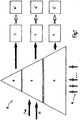
- Figure 1 shows schematically a monitoring system 10 for a rail vehicle.
- the rail vehicle can, for example, be a car of a high-speed train, for example an intermediate car, a control car, a restaurant car or a powered end car.
- the subject matter of the invention can also be transferred to other rail vehicles, for example freight cars, passenger coaches, traction vehicles or the like.
- the monitoring system 10 comprises three monitoring levels 12, 14 and 16.
- the monitoring levels 12, 14 and 16 are hierarchically based on one another.
- the first monitoring level 12 contains general diagnoses for the detection of damage, errors or the like in the initial stage, which can be remedied in the context of maintenance, repairs and / or maintenance in a non-critical manner.
- the monitoring level 16 contains what is known as a unit protection system, which detects, for example, loss of contact between wheel / rail, including the extreme case of a rail vehicle derailment.
- the monitoring system 10 is provided with signals designated 18 overall.
- the signals 18 are supplied, among other things, by acceleration sensors arranged on individual components of the rail vehicle.
- the acceleration sensors can, for example, be assigned to a wheel set, wheel set bearing, bogie, car body, spring / damper systems. These acceleration sensors detect the accelerations acting on the respective components as a result of the wheel / rail contact.
- the accelerations can be recorded and evaluated in all three spatial directions, i.e. in the direction of travel, vertical to the direction of travel and transverse to the direction of travel.
- the signals 18 also include an actual speed v of the rail vehicle, a mileage of the rail vehicle and temperature signals that are proportionally measured wheelset bearing temperatures. If necessary, further physical quantities that characterize the operating parameters of the rail vehicle can also be fed to the monitoring system.
- the signals 18 thus all represent momentary dynamic measured variables of the monitored rail vehicle.
- the signals 18 fed to the monitoring system 10 are subjected to different evaluation algorithms. This affects both the type of evaluation and the time span of the evaluation. This will be discussed in greater detail using the following figures.
- the signals 18 are evaluated to determine whether events to be assigned to the monitoring levels 12, 14 or 16 are recognized. In the most uncritical monitoring level 12, for example, a processing time of up to a time period t 1 of, for example, 300 s is provided.
- a message 12 ' is sent to maintenance or the like.
- the processing of the signals 18 takes place with a processing time span t 2 , which is, for example, up to 30 s. Because of the more critical damage development to be assigned to the monitoring level 14, the processing time is faster here.
- a message 14 ' is issued which, for example, triggers an onboard message in the rail vehicle, for example to a train driver, a train control center or the like.
- processing takes place with a correspondingly adapted processing time t 3 , which is, for example, up to 0.1 s. If an event to be assigned to the monitoring level 16 is recognized, a message 16 'is issued which directly or indirectly triggers an intervention in the driving operation of the rail vehicle, for example an emergency braking or the like.
- staggered reports 12 ', 14' and 16 ' are provided in accordance with the monitoring levels 12, 14, 16. While the events to be assigned to the monitoring level 12 are not time-critical, events to be assigned to the monitoring level 14 lead directly to messages to an internal communication network of the rail vehicle (in the case of the train formation to the communication network of the train) with possible suggestions for countermeasures to be initiated by the train crew.
- the messages 16 ' trigger immediate countermeasures.
- the monitoring system 10 is also fed control or reference variables, which, for example, a minimum speed v min of the rail vehicle and a linking algorithm 20 (combination logics 44, 68, 82, Figures 2 to 6 ) of the signals 18 according to the processing of the signals in the individual monitoring levels 12, 14 and 16 respectively.
- control or reference variables for example, a minimum speed v min of the rail vehicle and a linking algorithm 20 (combination logics 44, 68, 82, Figures 2 to 6 ) of the signals 18 according to the processing of the signals in the individual monitoring levels 12, 14 and 16 respectively.
- the evaluation algorithms to be used in the individual monitoring levels 12, 14 and 16 the following should be noted.
- procedures in the frequency range are effective. Due to the signal statistics improved by averaging procedures, these have the potential to track the natural frequencies of running gears and rail vehicles during travel and to recognize changes caused by damage or wear at an early stage. The excitation influences originating from the track superstructure do not interfere with the detection and assessment of the frequency position.
- the evaluation algorithms used in the monitoring level 16 are able to detect spontaneous derailments.
- Time series analyzes hoverogram analyzes are carried out in different speed classes.
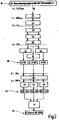
- FIG. 2 shows the evaluation algorithms of the signals 18 in the monitoring level 12 in a block diagram.
- Sixteen acceleration signals of individual components of the rail vehicle are present as output signals. This can be, for example, acceleration signals from the wheelset bearing housing, bogie or the like.
- the acceleration channels are read in with a sampling rate that is adapted to the highest frequency of interest in time processing, for example 32 kHz. They are then digitally filtered and sampled down (step 21). This limits the frequency band and minimizes the computing effort for the evaluation algorithms.
- the evaluation then takes place with a Hanning window (step 22) in order to reduce distortions in the frequency domain.
- the amplitude and phase spectra of the signals are then determined by means of a spectral analysis 22.
- FFT Fast Fourier Transformation
- the degree of overlap of the individual spectra can be varied within the limits between 30% and 70%, for example, in deviation from the preferably 50%.
- nineteen spectra, for example, are available for each of the channels 16, of which the spectral auto and cross powers are determined (step 24) by suitable combination (step 30) and then averaged (step 26).
- the averaged phase spectra 34 are determined on the basis of the cross powers.
- Averaged coherence spectra 32 are determined on the basis of the auto and cross powers.
- the spectra 28, 32 and 34 are determined and temporarily stored over a period of, for example, 120 s (or optionally 180 s, 240 s, 300 s or 360 s).
- the traveling speed v of the rail vehicle is measured once at the beginning and once at the end of each 20s detection window and is also stored temporarily. The smallest possible change in speed is used as a criterion for final archiving of a spectrum originating from the set time window.
- a selection circuit 38 can be used to define frequency bands to be monitored (monitoring bands) within the present amplitude spectra 28, phase spectra 34 and coherence spectra 32 by defining lower and upper band limits. Various parameters are evaluated within these defined frequency bands. First, the frequency of the maximum (peak) within the frequency band is determined. It is then checked whether the peak lies within the upper and lower frequency limit (parameters 1 and 2). If the peak leaves this frequency range, an alarm bit is set. The amplitude value of the peak must lie within the defined amplitude limit (parameters 3 and 4). If the range set by the upper and lower amplitude limit is left, an alarm bit is also set. The -3dB point is also monitored in the amplitude spectrum.
- This -3dB point appears in the spectrum both to the left and to the right of the peak.
- the lower and the upper frequency limit can be set for both -3dB points (parameters 5 to 8). This provides information about the curve shape around the peak area. If the -3dB point leaves the range defined by the limits, an alarm bit is also set.
- a check 40 of the averaged spectra is thus possible, with only parameters 1 to 4 being activated for coherence spectra 32 and phase spectra 34, while parameters 1 to 8 are activated for amplitude spectra 28.
- the monitoring 40 for exceeding the limit value is only applied to the amplitude spectra 28 provided for archiving.
- the maximum alarm signals (alarm bits) 42 256 alarm signals A 1 , 256 alarm signals A 2 , 1024 alarm signals A 3 ) resulting from the checking of the parameters are fed to a logic logic 44 which links the alarm signals 42 with one another and, if the conditions are met, to an alarm 46, for example in the set 300s cycle.
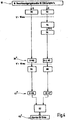
- FIG. 3 shows the evaluation algorithms of the signals 18 in the monitoring level 14 in a block diagram.
- the acceleration signals of individual components of the rail vehicle are again present as output signals.
- the four bearing signals from the bogies of a rail vehicle are preferably evaluated here, so that eight of the acceleration signals 18 are evaluated. These are split into two sub-bands via a filter (splitter) 48.
- the lower subband (low) 50 covers a range from, for example, 0 to 400 Hz, while the upper subband (high) 52 covers the frequency range from, for example, 0.4 to 16 kHz.
- the mean value and the variance are calculated from the samples located in the respective sub-bands 50 and 52 over a period of 1 s.
- the respective 1-second kurtosis value is then calculated from this (steps 54 and 56). These 1-second kurtosis values are then averaged over a period of 30 s (steps 58 and 60, respectively).
- eight features M 4 kurtosis values in the low subband
- eight features M 5 kurtosis values in the high subband
- a further sixteen features 36 '(8 x M 4 + 8 x M 5 ) are thus available here.
- step 62 or 66 there is a check for exceeding limit values. If one of the kurtosis values exceeds the specifiable limit value, an alarm bit 42 'can be generated in each case. Eight alarm signals A 4 and eight alarm signals A 5 are thus available here. These are routed via a logic system 68 which links the alarm signals 42 'with one another and, if the conditions are met, leads to an alarm 46', for example at the set 30s cycle.
- Figure 4 shows the evaluation algorithms of the signals 18 in the monitoring level 16 in a block diagram.
- the sixteen acceleration signals of individual components of the rail vehicle are again present as output signals.
- a crest factor is determined for eight of these acceleration signals and a histogram analysis is carried out for a further eight (the same or the other) acceleration signals.
- the signals are again sampled with a sample frequency of 32 kHz.
- the individual values are recorded in 10 ms time windows, that is to say in bursts of 320 individual values.
- the peak value and the RMS value are determined and the quotient of the peak value and the RMS value (crest factor) is formed.
- eight features M 6 are available.
- the histogram analysis takes place for eight acceleration signals, in particular for the four bearing signals of the bogies of the rail vehicle.
- the acquisition also takes place in 10 ms time windows, i.e. in bursts of 320 values.
- the largest positive and smallest negative value are selected from these 320 values per time window (step 74) and entered in the histogram 76. This means that two values occur per 10 ms time window for each monitored acceleration signal.
- the histogram analysis the frequency of certain acceleration values is monitored in four speed classes. A histogram 76 is created for each speed class and signal.
- the crest factor analysis thus provides eight features M 6 and the histogram analysis provides thirty-two features M 7 .
- a total of forty features 36 ′′ (8 x M 6 + 32 x M 7 ) are available in the monitoring level 16.
- the individual features are monitored for exceeding a threshold value.
- the features obtained as a result of the histogram analysis are monitored for exceeding a symmetrical threshold value.
- This symmetrical threshold value can be set as a parameter. Since the speed is recorded in 1s steps, the values recorded in these 100x10ms time windows belong to the same speed class. The size of the acceleration values is monitored depending on the speed class. If an adjustable maximum value is exceeded or the threshold value of the crest factor is exceeded, a signal alarm is given.
- alarm signals (alarm bits) 42 ′′ are to a logic logic 82 which links the alarm signals 42 ′′ to one another and, if the conditions are met, leads to an alarm 46 ′′, for example in the set 10 ms cycle.
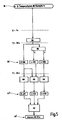
- FIG. 5 shows in a block diagram the evaluation algorithms of the temperature signals, which are available in the total amount of signals 18.
- the temperatures are monitored in the monitoring level 14, since so-called hot runners can be detected via the temperature monitoring, which can arise as a result of bearing damage in the early stages.
- Another monitoring criterion is the difference between the individual temperature of a bearing and the average temperature of all bearing half-shells of a bogie, which must also not exceed a certain limit value.
- the bearing-specific temperature deviation ⁇ T determined in the signal processing is monitored for a threshold value that can be set as a parameter.
- the bogie-specific maximum temperature T max can be programmed as an alarm parameter.
- the check 88 is carried out to determine whether the temperature T individual > T max or the temperature T individual > T average + ⁇ T limit .
- the maximum resulting from the checking of the parameters alarm signals 42 ' (eight alarm signals A 8 , four alarm signals A 9 , four alarm signals A 10 ) are fed to the logic logic 68, which links the alarm signals together and, if the conditions are met, to an alarm 46', for example in set 30s cycle.
- FIG. 6 shows in a block diagram the entire monitoring system 10 with the evaluation algorithms in the monitoring levels 12, 14 and 16. Overall, the following summarized signal processing or determination of features, alarm bits and alarms triggered by the linking logic results. These procedures have already been explained in detail with reference to the preceding figures.
- the check for limit value violations takes place with the frequency range monitoring after the spectrum selection has been made in adjustable time windows (120 or 180/240/300/360 seconds).
- the monitoring is applied to sixteen acceleration signals as well as eight coherence and phase combinations per vehicle.
- a maximum of eight freely selectable alarm bits can be linked for frequency monitoring and trigger an external alarm after being checked by a timer.
- the timing element ensures that an alarm condition is met only via the link result of two successive stored measurements (spectrum determinations) in order to forward an alarm to the external.
- the monitoring of the bearing temperatures is directly related to the bearing vibration monitoring by means of kurtosis.
- Each storage temperature is checked for two alarm conditions (T max and ⁇ T limit ). This means that sixteen alarm bits are available per vehicle.
- the result of the storage temperature monitoring is also available in 30s intervals like the kurtosis monitoring, i.e. when linking kurtosis and temperature alarms, no management of different time intervals is necessary.
- the detected alarm bits are written into a kurtosis temperature signal alarm file, which is updated every 30 seconds.
- the signal alarms are linked in the logic editor and trigger an alarm when the condition is met.
- FIG. 7 shows schematically the structure of the monitoring system 10.
- the monitoring system 10 has a modular structure, so that separate commissioning (of the individual monitoring levels 12, 14 and 16) as well as a quick exchange of individual components and the possibility of individual adaptation to other conditions is possible.
- the signals 18 of the sensors (not shown) are adapted to the input areas of analog / digital converters 102 via signal conditioning 100.
- the analog / digital converters 102 are implemented according to the required number of channels of the signals to be processed and the conversion rate of 32 kSamples per second.
- the analog / digital converters are connected to a digital signal processor (DSP) 104, in which the signal processing or processing, the feature extraction, the limit value comparisons and the alarming - is implemented - as explained in the previous figures.
- DSP digital signal processor
- a flash memory 106 for loading the program and an external memory 108 for storing the data are assigned to the digital signal processor 104.
- the sequence control of the digital signal processor 104 is carried out by a computing system 110 to which a flash memory disc 112 is assigned for temporary storage of the measurement data.
- a hard disk memory 114 is assigned to the computing system 110.
- This equipment makes it possible to write the data to the flash memory 112 while the rail vehicle is being used as intended and to transfer the data (copy) to the hard disk memory 114 only when the rail vehicle is at a standstill. This increases the data security of the monitoring system 10.
- the size of the flash memory 112 must be adapted to the maximum travel time of the rail vehicle and can be rewritten after each transfer to the hard disk memory 114.
Landscapes
- Engineering & Computer Science (AREA)
- Mechanical Engineering (AREA)
- Physics & Mathematics (AREA)
- General Physics & Mathematics (AREA)
- Health & Medical Sciences (AREA)
- Biomedical Technology (AREA)
- General Health & Medical Sciences (AREA)
- Electric Propulsion And Braking For Vehicles (AREA)
- Vehicle Cleaning, Maintenance, Repair, Refitting, And Outriggers (AREA)
- Time Recorders, Dirve Recorders, Access Control (AREA)
- Emergency Alarm Devices (AREA)
Claims (15)
- Procédé de surveillance des caractéristiques de circulation de véhicules ferroviaires et de diagnostic de composants de véhicules ferroviaires, des paramètres de fonctionnement identiques et différents, c'est-à-dire des signaux de mesure, du véhicule ferroviaire ou de composants du véhicule ferroviaire étant enregistrés et exploités pendant son usage conforme à sa destination, caractérisé en ce qu'au moins une partie des paramètres de fonctionnement enregistrés d'une pluralité de niveaux de surveillance sont associés parallèlement à une hiérarchie de surveillance et au moins deux paramètres de fonctionnement (signaux de mesure) associés au même niveau de surveillance sont rattachés l'un à l'autre pour obtenir des informations liées aux incidents et caractérisant les caractéristiques de circulation et le diagnostic des composants, les paramètres de fonctionnement des niveaux de surveillance étant soumis à des algorithmes d'exploitation identiques et/ou différents en fonction de l'association à un des niveaux de surveillance.
- Procédé selon l'une quelconque des revendications précédentes, caractérisé en ce qu'il est prévu trois niveaux de surveillance (12, 14, 16).
- Procédé selon l'une quelconque des revendications précédentes, caractérisé en ce que, dans le premier niveau de surveillance (12), des diagnostics généraux pour l'enregistrement de détériorations, anomalies ou similaires sont réalisés.
- Procédé selon la revendication 3, caractérisé en ce que, dans le niveau de surveillance (12), les signaux correspondant aux paramètres de fonctionnement sont soumis à des procédés d'exploitation de fréquence, notamment des analyses spectrales, des corrélations ou similaires.
- Procédé selon l'une quelconque des revendications précédentes, caractérisé en ce que, dans le deuxième niveau de surveillance (14), les détériorations, anomalies ou similaires avancées entraînant des situations de circulation à risques sont détectées.
- Procédé selon la revendication 5, caractérisé en ce que, dans le niveau de surveillance (14), les signaux correspondant aux paramètres de fonctionnement sont soumis à des procédés d'exploitation statistiques, notamment des déterminations de valeur de kurtose.
- Procédé selon l'une quelconque des revendications précédentes, caractérisé en ce qu'une protection des agrégats a lieu dans le troisième niveau de surveillance (16).
- Procédé selon la revendication 7, caractérisé en ce que, dans le niveau de surveillance (16), les signaux correspondant aux paramètres de fonctionnement sont soumis à des procédés d'exploitation de plage temporelle, notamment à une analyse de facteur de crête et d'histogramme.
- Procédé selon l'une quelconque des revendications précédentes, caractérisé en ce qu'on enregistre comme paramètres de fonctionnement les signaux d'accélération de composants du véhicule ferroviaire, les signaux de température de composants du véhicule ferroviaire, un signal de vitesse réelle du véhicule ferroviaire, une performance kilométrique du véhicule ferroviaire.
- Procédé selon l'une quelconque des revendications précédentes, caractérisé en ce que l'exploitation des paramètres de fonctionnement a lieu avec une durée différente dans les différents niveaux de surveillance.
- Procédé selon l'une quelconque des revendications précédentes, caractérisé en ce que tous les signaux d'anomalies se produisant dans un niveau de surveillance (12, 14, 16) sont communiqués respectivement à une logique de rattachement (44, 68, 62) pour créer des messages d'alarme (12', 14', 16').
- Procédé selon l'une quelconque des revendications précédentes, caractérisé en ce qu'une vitesse minimale du véhicule ferroviaire sert de grandeur directrice.
- Procédé selon l'une quelconque des revendications précédentes, caractérisé en ce que les signaux, les exploitations et/ou les messages sont sauvegardés pendant un laps de temps pouvant être choisi.
- Procédé selon la revendication 13, caractérisé en ce que la sauvegarde des données dans une mémoire intermédiaire a lieu pendant un déplacement du véhicule ferroviaire et que les données sont transcrites sur une mémoire de disque dur ou similaire à l'arrêt du véhicule ferroviaire.
- Dispositif de surveillance des caractéristiques de circulation de véhicules ferroviaires et de diagnostic de composants de véhicules ferroviaires, caractérisé par des premiers moyens d'enregistrement de paramètres de fonctionnement du véhicule ferroviaire ou de composants du véhicule ferroviaire, des deuxièmes moyens d'association en parallèle des paramètres de fonctionnement à différents niveaux de surveillance (12, 14, 16) d'un système de surveillance (10), des troisièmes moyens permettant dans les niveaux de surveillance (12, 14, 16) des algorithmes d'exploitation identiques et/ou différents des signaux correspondant aux paramètres de fonctionnement ainsi que des quatrièmes moyens de génération de messages (12', 14', 16') ou actions associés à l'exploitation dans les niveaux de surveillance (12, 14, 16).
Priority Applications (1)
| Application Number | Priority Date | Filing Date | Title |
|---|---|---|---|
| DK01985425T DK1345802T3 (da) | 2000-12-22 | 2001-12-20 | Fremgangsmåde og anordning til overvågning af skinneköretöjers körselsadfærd |
Applications Claiming Priority (3)
| Application Number | Priority Date | Filing Date | Title |
|---|---|---|---|
| DE10065786 | 2000-12-22 | ||
| DE10065786 | 2000-12-22 | ||
| PCT/EP2001/015116 WO2002051685A1 (fr) | 2000-12-22 | 2001-12-20 | Procede et dispositif permettant de surveiller le comportement de conduite de vehicules sur rails |
Publications (3)
| Publication Number | Publication Date |
|---|---|
| EP1345802A1 EP1345802A1 (fr) | 2003-09-24 |
| EP1345802B1 EP1345802B1 (fr) | 2005-07-06 |
| EP1345802B2 true EP1345802B2 (fr) | 2020-11-04 |
Family
ID=7669470
Family Applications (1)
| Application Number | Title | Priority Date | Filing Date |
|---|---|---|---|
| EP01985425.6A Expired - Lifetime EP1345802B2 (fr) | 2000-12-22 | 2001-12-20 | Procede et dispositif permettant de surveiller le comportement de conduite de vehicules sur rails |
Country Status (5)
| Country | Link |
|---|---|
| EP (1) | EP1345802B2 (fr) |
| AT (1) | ATE299105T1 (fr) |
| DE (2) | DE10163148B4 (fr) |
| ES (1) | ES2240542T3 (fr) |
| WO (1) | WO2002051685A1 (fr) |
Families Citing this family (6)
| Publication number | Priority date | Publication date | Assignee | Title |
|---|---|---|---|---|
| DE10220412A1 (de) * | 2002-05-08 | 2003-12-18 | Istec Gmbh | Verfahren und Vorrichtung zum Überwachen des Verhaltens von Maschinen und Maschinenanlagen |
| DE10243536B4 (de) * | 2002-09-16 | 2005-09-08 | Audi Ag | Verfahren und Vorrichtung zur Auslegung von Fahrzeugen und/oder Fahrzeugbauteilen |
| EP1900597B1 (fr) | 2006-09-18 | 2009-08-05 | Bombardier Transportation GmbH | Système de diagnostic et procédé pour surveiller un système ferroviaire |
| DE102016116419A1 (de) | 2016-09-02 | 2018-03-08 | Knorr-Bremse Systeme für Schienenfahrzeuge GmbH | Verfahren und Vorrichtung zum Überwachen von Fahrzeugzuständen in Schienenfahrzeugen |
| EP3774487A1 (fr) | 2018-05-16 | 2021-02-17 | Siemens Mobility Austria GmbH | Procédé et dispositif de diagnostic et de surveillance de véhicules, de composants de véhicule et de voies de circulation |
| CN115356133B (zh) * | 2022-08-23 | 2024-06-25 | 华东交通大学 | 一种转向架运行工况在线监测、实时分类与识别算法 |
Citations (4)
| Publication number | Priority date | Publication date | Assignee | Title |
|---|---|---|---|---|
| DE4411326A1 (de) † | 1994-03-25 | 1995-09-28 | Aeg Westinghouse Transport | Verfahren zur Diagnose der Betriebsfähigkeit eines elektrischen Systems |
| US5777891A (en) † | 1991-05-07 | 1998-07-07 | Dapco Industries Inc | Method for real-time ultrasonic testing system |
| DE19827271A1 (de) † | 1998-06-19 | 1999-12-23 | Andreas Mueller | On-line Erfassungssystem mit Auswerteteil für rad- und gleisbezogene Daten für Hochgeschwindigkeitszüge |
| WO2000002022A1 (fr) † | 1998-07-03 | 2000-01-13 | Kuehn Robert | Procede et dispositif pour controler en continu l'apparition de modifications dans des elements ou des ensembles de tout type |
Family Cites Families (8)
| Publication number | Priority date | Publication date | Assignee | Title |
|---|---|---|---|---|
| JP3340541B2 (ja) * | 1993-12-17 | 2002-11-05 | 株式会社小野測器 | 検査装置 |
| DE19826220A1 (de) * | 1998-06-09 | 1999-12-23 | Tamas Diebel | Vorrichtung zur Erkennung von Fahrwerkschäden an Schienenfahrzeugen während der Fahrt |
| DE19826115A1 (de) * | 1998-06-12 | 1999-12-16 | Eckehart Zehrfeldt | Einrichtung zur Überwachung der Räder und Fahrgestelle an schienengebundenen Fahrzeugen |
| DE19827931C1 (de) * | 1998-06-23 | 1999-12-02 | Albrecht Mayer | Sensorüberwachungssystem für mehrachsige Fahrzeuge |
| DE19855145A1 (de) * | 1998-07-16 | 2000-01-20 | Robert Kuehn | Verfahren und Vorrichtung zur laufenden Überwachung von schwingungsfähigen Elementen oder Gesamtheiten jeglicher Art auf das Auftreten von Veränderungen |
| ATE285352T1 (de) * | 1998-08-10 | 2005-01-15 | Tokyu Car Corp | Verfahren und vorrichtung zum feststellen des entgleisens von eisenbahnwagen |
| DE19852220C2 (de) * | 1998-11-12 | 2001-07-26 | Stn Atlas Elektronik Gmbh | Verfahren zur Erkennung von Schäden im Schienenverkehr |
| DE19911848A1 (de) * | 1999-03-17 | 2000-09-21 | Robert Kuehn | Verfahren zur Überwachung von Daten betreffend den Betrieb von Schienenfahrzeugen |
-
2001
- 2001-12-20 ES ES01985425T patent/ES2240542T3/es not_active Expired - Lifetime
- 2001-12-20 WO PCT/EP2001/015116 patent/WO2002051685A1/fr not_active Ceased
- 2001-12-20 AT AT01985425T patent/ATE299105T1/de active
- 2001-12-20 EP EP01985425.6A patent/EP1345802B2/fr not_active Expired - Lifetime
- 2001-12-20 DE DE10163148A patent/DE10163148B4/de not_active Expired - Fee Related
- 2001-12-20 DE DE50106705T patent/DE50106705D1/de not_active Expired - Lifetime
Patent Citations (4)
| Publication number | Priority date | Publication date | Assignee | Title |
|---|---|---|---|---|
| US5777891A (en) † | 1991-05-07 | 1998-07-07 | Dapco Industries Inc | Method for real-time ultrasonic testing system |
| DE4411326A1 (de) † | 1994-03-25 | 1995-09-28 | Aeg Westinghouse Transport | Verfahren zur Diagnose der Betriebsfähigkeit eines elektrischen Systems |
| DE19827271A1 (de) † | 1998-06-19 | 1999-12-23 | Andreas Mueller | On-line Erfassungssystem mit Auswerteteil für rad- und gleisbezogene Daten für Hochgeschwindigkeitszüge |
| WO2000002022A1 (fr) † | 1998-07-03 | 2000-01-13 | Kuehn Robert | Procede et dispositif pour controler en continu l'apparition de modifications dans des elements ou des ensembles de tout type |
Also Published As
| Publication number | Publication date |
|---|---|
| EP1345802B1 (fr) | 2005-07-06 |
| EP1345802A1 (fr) | 2003-09-24 |
| DE10163148A1 (de) | 2002-10-17 |
| WO2002051685A1 (fr) | 2002-07-04 |
| ES2240542T3 (es) | 2005-10-16 |
| DE50106705D1 (de) | 2005-08-11 |
| DE10163148B4 (de) | 2004-04-15 |
| ATE299105T1 (de) | 2005-07-15 |
Similar Documents
| Publication | Publication Date | Title |
|---|---|---|
| EP2212180B1 (fr) | Détermination de la durée de vie résiduelle d'un élément de véhicule | |
| EP2288530B1 (fr) | Procédé de surveillance d'au moins un paramètre système influencé par le comportement de fonctionnement de véhicules ou de trains | |
| EP0455993A2 (fr) | Méthode et dispositif pour établir et contrÀ´ler l'état d'un composant technique d'un véhicule | |
| EP1129002B1 (fr) | Procede d'identification de dommages concernant le trafic ferroviaire | |
| DE10020521A1 (de) | Verfahren und Vorrichtung zum Überwachen des Fahrverhaltens von Schienenfahrzeugen | |
| DE102021203266A1 (de) | Verfahren und Fahrzeugsystem zum Bestimmen eines Zustands der Komponenten eines Fahrwerks | |
| DE102016109497A1 (de) | Verfahren und Vorrichtung zum Ermitteln des Verschleißzustandes von Komponenten eines Schienenfahrzeugs | |
| EP4405229B1 (fr) | Procédé de détection d'un dommage sur un système de transport et dispositif de commande associé | |
| WO2018041569A1 (fr) | Dispositif et procédé pour déterminer l'état de voies ferrées | |
| EP1345802B2 (fr) | Procede et dispositif permettant de surveiller le comportement de conduite de vehicules sur rails | |
| DE10161283B4 (de) | Verfahren und Vorrichtung zum Überwachen des Fahrverhaltens von Schienenfahrzeugen und der Diagnose von Komponenten von Schienenfahrzeugen | |
| DE10020519A1 (de) | Verfahren zum Überwachen von Fahreigenschaften eines Schienenfahrzeuges | |
| EP1506900A1 (fr) | Procédé et dispositif d'essai des freins pneumatiques et / ou hydrauliques des véhicules ferroviaires | |
| DE102020001154A1 (de) | Verfahren zum Betrieb eines Fahrzeuges | |
| DE102013105397B4 (de) | Zustandsüberwachung eines Schienenfahrzeugs | |
| DE10145433A1 (de) | Verfahren und Vorrichtung zur Fehlerüberwachung von Komponenten von Schienenfahrzeugen | |
| DE10062606A1 (de) | Verfahren und Einrichtung zum Überwachen des mechanischen Zustands von elektrisch angetriebenen Fahrzeugen im regulären Fahrbetrieb | |
| EP1361489B1 (fr) | Procédé et dispositif de surveillance du comportement de machines et des installations de machines | |
| EP3507166B1 (fr) | Procédé et dispositif permettant de surveiller des états de véhicules ferroviaires | |
| EP2105341B1 (fr) | Dispositif d'alimentation en énergie pour un véhicule | |
| WO2000002022A1 (fr) | Procede et dispositif pour controler en continu l'apparition de modifications dans des elements ou des ensembles de tout type | |
| DE102023118875B3 (de) | Verfahren zur Erkennung eines Dämpferzustandes, System, Computerprogrammprodukt und Fahrzeug | |
| DE102019123454B4 (de) | Verfahren zum Prognostizieren des Verschleißes eines Bauteils eines Fahrzeugs sowie Fahrzeug | |
| DE102017114542A1 (de) | Verfahren zur Überwachung der Luftfilter einer Klimaanlage für ein Schienenfahrzeug | |
| DE102023135164A1 (de) | Verfahren und vorrichtung zum vorhersagen eines bremsleistungsniveaus oder einer bremsleistungs-performance mindestens einer bremse oder eines bremssystems eines schienenfahrzeugs oder eines verbands mehrerer schienenfahrzeuge |
Legal Events
| Date | Code | Title | Description |
|---|---|---|---|
| PUAI | Public reference made under article 153(3) epc to a published international application that has entered the european phase |
Free format text: ORIGINAL CODE: 0009012 |
|
| 17P | Request for examination filed |
Effective date: 20030510 |
|
| AK | Designated contracting states |
Kind code of ref document: A1 Designated state(s): AT BE CH CY DE DK ES FI FR GB GR IE IT LI LU MC NL PT SE TR |
|
| AX | Request for extension of the european patent |
Extension state: AL LT LV MK RO SI |
|
| RIN1 | Information on inventor provided before grant (corrected) |
Inventor name: SAEGLITZ, MARIO Inventor name: KOLBASSEFF, ALEXANDER Inventor name: SUNDER, REINHOLD Inventor name: BRANDENBURG, LUTZ Inventor name: WALTER, JOHANNES Inventor name: KOLUPA, JENS Inventor name: KLOCKOW, THOMAS Inventor name: ALDER, PHIL Inventor name: KIENINGER, KURT Inventor name: ROEHM, ANDREAS |
|
| 17Q | First examination report despatched |
Effective date: 20031110 |
|
| GRAP | Despatch of communication of intention to grant a patent |
Free format text: ORIGINAL CODE: EPIDOSNIGR1 |
|
| GRAS | Grant fee paid |
Free format text: ORIGINAL CODE: EPIDOSNIGR3 |
|
| RAP1 | Party data changed (applicant data changed or rights of an application transferred) |
Owner name: DB FERNVERKEHR AG |
|
| GRAA | (expected) grant |
Free format text: ORIGINAL CODE: 0009210 |
|
| AK | Designated contracting states |
Kind code of ref document: B1 Designated state(s): AT BE CH CY DE DK ES FI FR GB GR IE IT LI LU MC NL PT SE TR |
|
| PG25 | Lapsed in a contracting state [announced via postgrant information from national office to epo] |
Ref country code: TR Free format text: LAPSE BECAUSE OF FAILURE TO SUBMIT A TRANSLATION OF THE DESCRIPTION OR TO PAY THE FEE WITHIN THE PRESCRIBED TIME-LIMIT Effective date: 20050706 Ref country code: IE Free format text: LAPSE BECAUSE OF FAILURE TO SUBMIT A TRANSLATION OF THE DESCRIPTION OR TO PAY THE FEE WITHIN THE PRESCRIBED TIME-LIMIT Effective date: 20050706 Ref country code: FI Free format text: LAPSE BECAUSE OF FAILURE TO SUBMIT A TRANSLATION OF THE DESCRIPTION OR TO PAY THE FEE WITHIN THE PRESCRIBED TIME-LIMIT Effective date: 20050706 |
|
| REG | Reference to a national code |
Ref country code: GB Ref legal event code: FG4D Free format text: NOT ENGLISH |
|
| REG | Reference to a national code |
Ref country code: CH Ref legal event code: EP |
|
| REG | Reference to a national code |
Ref country code: SE Ref legal event code: TRGR |
|
| REG | Reference to a national code |
Ref country code: CH Ref legal event code: NV Representative=s name: RIEDERER HASLER & PARTNER PATENTANWAELTE AG |
|
| REG | Reference to a national code |
Ref country code: IE Ref legal event code: FG4D Free format text: LANGUAGE OF EP DOCUMENT: GERMAN |
|
| REF | Corresponds to: |
Ref document number: 50106705 Country of ref document: DE Date of ref document: 20050811 Kind code of ref document: P |
|
| REG | Reference to a national code |
Ref country code: DK Ref legal event code: T3 |
|
| GBT | Gb: translation of ep patent filed (gb section 77(6)(a)/1977) |
Effective date: 20050810 |
|
| PG25 | Lapsed in a contracting state [announced via postgrant information from national office to epo] |
Ref country code: GR Free format text: LAPSE BECAUSE OF FAILURE TO SUBMIT A TRANSLATION OF THE DESCRIPTION OR TO PAY THE FEE WITHIN THE PRESCRIBED TIME-LIMIT Effective date: 20051006 |
|
| REG | Reference to a national code |
Ref country code: ES Ref legal event code: FG2A Ref document number: 2240542 Country of ref document: ES Kind code of ref document: T3 |
|
| PG25 | Lapsed in a contracting state [announced via postgrant information from national office to epo] |
Ref country code: PT Free format text: LAPSE BECAUSE OF FAILURE TO SUBMIT A TRANSLATION OF THE DESCRIPTION OR TO PAY THE FEE WITHIN THE PRESCRIBED TIME-LIMIT Effective date: 20051212 |
|
| PG25 | Lapsed in a contracting state [announced via postgrant information from national office to epo] |
Ref country code: CY Free format text: LAPSE BECAUSE OF FAILURE TO SUBMIT A TRANSLATION OF THE DESCRIPTION OR TO PAY THE FEE WITHIN THE PRESCRIBED TIME-LIMIT Effective date: 20051220 |
|
| PG25 | Lapsed in a contracting state [announced via postgrant information from national office to epo] |
Ref country code: MC Free format text: LAPSE BECAUSE OF NON-PAYMENT OF DUE FEES Effective date: 20051231 Ref country code: LU Free format text: LAPSE BECAUSE OF NON-PAYMENT OF DUE FEES Effective date: 20051231 |
|
| REG | Reference to a national code |
Ref country code: IE Ref legal event code: FD4D |
|
| ET | Fr: translation filed | ||
| PLBI | Opposition filed |
Free format text: ORIGINAL CODE: 0009260 |
|
| PLAX | Notice of opposition and request to file observation + time limit sent |
Free format text: ORIGINAL CODE: EPIDOSNOBS2 |
|
| 26 | Opposition filed |
Opponent name: SIEMENS ABTEILUNG: CT IP TS Effective date: 20060405 |
|
| NLR1 | Nl: opposition has been filed with the epo |
Opponent name: SIEMENS ABTEILUNG: CT IP TS |
|
| PLAF | Information modified related to communication of a notice of opposition and request to file observations + time limit |
Free format text: ORIGINAL CODE: EPIDOSCOBS2 |
|
| PLBB | Reply of patent proprietor to notice(s) of opposition received |
Free format text: ORIGINAL CODE: EPIDOSNOBS3 |
|
| PGFP | Annual fee paid to national office [announced via postgrant information from national office to epo] |
Ref country code: BE Payment date: 20070521 Year of fee payment: 6 |
|
| BERE | Be: lapsed |
Owner name: DB FERNVERKEHR A.G. Effective date: 20071231 |
|
| PLAY | Examination report in opposition despatched + time limit |
Free format text: ORIGINAL CODE: EPIDOSNORE2 |
|
| PG25 | Lapsed in a contracting state [announced via postgrant information from national office to epo] |
Ref country code: BE Free format text: LAPSE BECAUSE OF NON-PAYMENT OF DUE FEES Effective date: 20071231 |
|
| PLAH | Information related to despatch of examination report in opposition + time limit modified |
Free format text: ORIGINAL CODE: EPIDOSCORE2 |
|
| PLBC | Reply to examination report in opposition received |
Free format text: ORIGINAL CODE: EPIDOSNORE3 |
|
| PLAT | Information related to reply to examination report in opposition deleted |
Free format text: ORIGINAL CODE: EPIDOSDORE3 |
|
| PLBC | Reply to examination report in opposition received |
Free format text: ORIGINAL CODE: EPIDOSNORE3 |
|
| PLAL | Information related to reply to examination report in opposition modified |
Free format text: ORIGINAL CODE: EPIDOSCORE3 |
|
| PLAP | Information related to despatch of examination report in opposition + time limit deleted |
Free format text: ORIGINAL CODE: EPIDOSDORE2 |
|
| PLAT | Information related to reply to examination report in opposition deleted |
Free format text: ORIGINAL CODE: EPIDOSDORE3 |
|
| PLAY | Examination report in opposition despatched + time limit |
Free format text: ORIGINAL CODE: EPIDOSNORE2 |
|
| PLBC | Reply to examination report in opposition received |
Free format text: ORIGINAL CODE: EPIDOSNORE3 |
|
| REG | Reference to a national code |
Ref country code: FR Ref legal event code: PLFP Year of fee payment: 15 |
|
| REG | Reference to a national code |
Ref country code: FR Ref legal event code: PLFP Year of fee payment: 16 |
|
| PGFP | Annual fee paid to national office [announced via postgrant information from national office to epo] |
Ref country code: NL Payment date: 20161221 Year of fee payment: 16 Ref country code: DK Payment date: 20161222 Year of fee payment: 16 |
|
| PGFP | Annual fee paid to national office [announced via postgrant information from national office to epo] |
Ref country code: SE Payment date: 20161222 Year of fee payment: 16 Ref country code: IT Payment date: 20161220 Year of fee payment: 16 |
|
| APBM | Appeal reference recorded |
Free format text: ORIGINAL CODE: EPIDOSNREFNO |
|
| APBP | Date of receipt of notice of appeal recorded |
Free format text: ORIGINAL CODE: EPIDOSNNOA2O |
|
| APAH | Appeal reference modified |
Free format text: ORIGINAL CODE: EPIDOSCREFNO |
|
| PLAB | Opposition data, opponent's data or that of the opponent's representative modified |
Free format text: ORIGINAL CODE: 0009299OPPO |
|
| R26 | Opposition filed (corrected) |
Opponent name: SIEMENS AKTIENGESELLSCHAFT Effective date: 20060405 |
|
| REG | Reference to a national code |
Ref country code: FR Ref legal event code: PLFP Year of fee payment: 17 |
|
| APBQ | Date of receipt of statement of grounds of appeal recorded |
Free format text: ORIGINAL CODE: EPIDOSNNOA3O |
|
| REG | Reference to a national code |
Ref country code: DK Ref legal event code: EBP Effective date: 20171231 |
|
| REG | Reference to a national code |
Ref country code: NL Ref legal event code: MM Effective date: 20180101 |
|
| PG25 | Lapsed in a contracting state [announced via postgrant information from national office to epo] |
Ref country code: SE Free format text: LAPSE BECAUSE OF NON-PAYMENT OF DUE FEES Effective date: 20171221 |
|
| PG25 | Lapsed in a contracting state [announced via postgrant information from national office to epo] |
Ref country code: NL Free format text: LAPSE BECAUSE OF NON-PAYMENT OF DUE FEES Effective date: 20180101 |
|
| PG25 | Lapsed in a contracting state [announced via postgrant information from national office to epo] |
Ref country code: IT Free format text: LAPSE BECAUSE OF NON-PAYMENT OF DUE FEES Effective date: 20171220 |
|
| PG25 | Lapsed in a contracting state [announced via postgrant information from national office to epo] |
Ref country code: DK Free format text: LAPSE BECAUSE OF NON-PAYMENT OF DUE FEES Effective date: 20171231 |
|
| REG | Reference to a national code |
Ref country code: CH Ref legal event code: PK Free format text: BERICHTIGUNGEN |
|
| RIC2 | Information provided on ipc code assigned after grant |
Ipc: B61K 9/12 20060101AFI20020711BHEP Ipc: G01H 1/00 20060101ALI20020711BHEP Ipc: B61L 23/00 20060101ALI20020711BHEP Ipc: G01M 17/10 20060101ALI20020711BHEP |
|
| APBU | Appeal procedure closed |
Free format text: ORIGINAL CODE: EPIDOSNNOA9O |
|
| PGFP | Annual fee paid to national office [announced via postgrant information from national office to epo] |
Ref country code: DE Payment date: 20191217 Year of fee payment: 19 |
|
| PGFP | Annual fee paid to national office [announced via postgrant information from national office to epo] |
Ref country code: FR Payment date: 20191218 Year of fee payment: 19 |
|
| PGFP | Annual fee paid to national office [announced via postgrant information from national office to epo] |
Ref country code: AT Payment date: 20191213 Year of fee payment: 19 Ref country code: CH Payment date: 20191220 Year of fee payment: 19 |
|
| PGFP | Annual fee paid to national office [announced via postgrant information from national office to epo] |
Ref country code: GB Payment date: 20191220 Year of fee payment: 19 Ref country code: ES Payment date: 20200122 Year of fee payment: 19 |
|
| PUAH | Patent maintained in amended form |
Free format text: ORIGINAL CODE: 0009272 |
|
| STAA | Information on the status of an ep patent application or granted ep patent |
Free format text: STATUS: PATENT MAINTAINED AS AMENDED |
|
| REG | Reference to a national code |
Ref country code: CH Ref legal event code: AELC |
|
| 27A | Patent maintained in amended form |
Effective date: 20201104 |
|
| AK | Designated contracting states |
Kind code of ref document: B2 Designated state(s): AT BE CH CY DE DK ES FI FR GB GR IE IT LI LU MC NL PT SE TR |
|
| REG | Reference to a national code |
Ref country code: DE Ref legal event code: R102 Ref document number: 50106705 Country of ref document: DE |
|
| PG25 | Lapsed in a contracting state [announced via postgrant information from national office to epo] |
Ref country code: ES Free format text: LAPSE BECAUSE OF FAILURE TO SUBMIT A TRANSLATION OF THE DESCRIPTION OR TO PAY THE FEE WITHIN THE PRESCRIBED TIME-LIMIT Effective date: 20201104 |
|
| REG | Reference to a national code |
Ref country code: DE Ref legal event code: R119 Ref document number: 50106705 Country of ref document: DE |
|
| REG | Reference to a national code |
Ref country code: CH Ref legal event code: PL |
|
| REG | Reference to a national code |
Ref country code: AT Ref legal event code: MM01 Ref document number: 299105 Country of ref document: AT Kind code of ref document: T Effective date: 20201220 |
|
| GBPC | Gb: european patent ceased through non-payment of renewal fee |
Effective date: 20201220 |
|
| PG25 | Lapsed in a contracting state [announced via postgrant information from national office to epo] |
Ref country code: AT Free format text: LAPSE BECAUSE OF NON-PAYMENT OF DUE FEES Effective date: 20201220 Ref country code: FR Free format text: LAPSE BECAUSE OF NON-PAYMENT OF DUE FEES Effective date: 20201231 |
|
| PG25 | Lapsed in a contracting state [announced via postgrant information from national office to epo] |
Ref country code: LI Free format text: LAPSE BECAUSE OF NON-PAYMENT OF DUE FEES Effective date: 20201231 Ref country code: DE Free format text: LAPSE BECAUSE OF NON-PAYMENT OF DUE FEES Effective date: 20210701 Ref country code: CH Free format text: LAPSE BECAUSE OF NON-PAYMENT OF DUE FEES Effective date: 20201231 Ref country code: GB Free format text: LAPSE BECAUSE OF NON-PAYMENT OF DUE FEES Effective date: 20201220 |