EP1344802A1 - Non-aqueous ink composition - Google Patents
Non-aqueous ink composition Download PDFInfo
- Publication number
- EP1344802A1 EP1344802A1 EP20030005323 EP03005323A EP1344802A1 EP 1344802 A1 EP1344802 A1 EP 1344802A1 EP 20030005323 EP20030005323 EP 20030005323 EP 03005323 A EP03005323 A EP 03005323A EP 1344802 A1 EP1344802 A1 EP 1344802A1
- Authority
- EP
- European Patent Office
- Prior art keywords
- solvent
- ink
- ester
- weight
- smaller
- Prior art date
- Legal status (The legal status is an assumption and is not a legal conclusion. Google has not performed a legal analysis and makes no representation as to the accuracy of the status listed.)
- Granted
Links
Classifications
-
- C—CHEMISTRY; METALLURGY
- C09—DYES; PAINTS; POLISHES; NATURAL RESINS; ADHESIVES; COMPOSITIONS NOT OTHERWISE PROVIDED FOR; APPLICATIONS OF MATERIALS NOT OTHERWISE PROVIDED FOR
- C09D—COATING COMPOSITIONS, e.g. PAINTS, VARNISHES OR LACQUERS; FILLING PASTES; CHEMICAL PAINT OR INK REMOVERS; INKS; CORRECTING FLUIDS; WOODSTAINS; PASTES OR SOLIDS FOR COLOURING OR PRINTING; USE OF MATERIALS THEREFOR
- C09D11/00—Inks
- C09D11/30—Inkjet printing inks
- C09D11/32—Inkjet printing inks characterised by colouring agents
- C09D11/324—Inkjet printing inks characterised by colouring agents containing carbon black
- C09D11/326—Inkjet printing inks characterised by colouring agents containing carbon black characterised by the pigment dispersant
-
- C—CHEMISTRY; METALLURGY
- C09—DYES; PAINTS; POLISHES; NATURAL RESINS; ADHESIVES; COMPOSITIONS NOT OTHERWISE PROVIDED FOR; APPLICATIONS OF MATERIALS NOT OTHERWISE PROVIDED FOR
- C09B—ORGANIC DYES OR CLOSELY-RELATED COMPOUNDS FOR PRODUCING DYES, e.g. PIGMENTS; MORDANTS; LAKES
- C09B67/00—Influencing the physical, e.g. the dyeing or printing properties of dyestuffs without chemical reactions, e.g. by treating with solvents grinding or grinding assistants, coating of pigments or dyes; Process features in the making of dyestuff preparations; Dyestuff preparations of a special physical nature, e.g. tablets, films
- C09B67/006—Preparation of organic pigments
- C09B67/0069—Non aqueous dispersions of pigments containing only a solvent and a dispersing agent
-
- C—CHEMISTRY; METALLURGY
- C09—DYES; PAINTS; POLISHES; NATURAL RESINS; ADHESIVES; COMPOSITIONS NOT OTHERWISE PROVIDED FOR; APPLICATIONS OF MATERIALS NOT OTHERWISE PROVIDED FOR
- C09D—COATING COMPOSITIONS, e.g. PAINTS, VARNISHES OR LACQUERS; FILLING PASTES; CHEMICAL PAINT OR INK REMOVERS; INKS; CORRECTING FLUIDS; WOODSTAINS; PASTES OR SOLIDS FOR COLOURING OR PRINTING; USE OF MATERIALS THEREFOR
- C09D11/00—Inks
- C09D11/30—Inkjet printing inks
- C09D11/36—Inkjet printing inks based on non-aqueous solvents
Definitions
- This invention relates to an ink composition for a printer, and more particularly to a non-aqueous ink composition containing therein non-volatile solvent as a main material.
- Ink jet recording has been rapidly put into wide use since it realizes high-speed printing with relatively less noise.
- highly flowable liquid ink is injected onto a recording medium through a fine nozzle, and the ink jet printers are broadly divided into an on demand type and a continuous type.
- Inks for ink jet printers are broadly divided into an aqueous type and a non-aqueous type.
- the aqueous type inks generally comprise water-soluble dye such as acid dye, direct dye and basic dye dissolved in glycol solvent and water, and there has been a problem that ink jet printings by an aqueous type ink are generally poor in resistance to water.
- non-aqueous type inks are excellent in resistance to water.
- the non-aqueous type inks are broadly divided into solvent type inks and oil type inks.
- various kinds of oil type inks have been proposed since the oil type ink is advantageous as ink for high-speed ink jet printer in that it is less apt to cause clogging of the nozzle and requires less frequent cleaning during printing.
- an ink jet ink which is excellent in discharge stability from a nozzle
- an ink which is 5 to 15pcs in viscosity at 25° C and in which organic pigment atomized by kneading a mixture of at least three components including organic pigment, water-soluble inorganic salt in an weight not lighter than three times the weight of the organic pigment and water-soluble solvent is dispersed in high-boiling solvent together with suitable dispersant.
- the primary object of the present invention is to provide a non-aqueous ink composition which is excellent in shelf stability of ink.
- a non-aqueous ink composition comprising pigment, solvent and dispersant, wherein the dispersant has an ester structure and the solvent contains therein not smaller than 60% by weight polar organic solvent which contains therein not smaller than 10% by weight ester solvent.
- the polar organic solvent contains the ester solvent preferably in not smaller than 30% by weight, and more preferably in not smaller than 50% by weight.
- the entire polar organic solvent may be ester solvent.
- the balance of the solvent may be, for instance, aliphatic solvent.
- the dispersant has a polyester amine structure or a fatty amine structure.
- non-aqueous ink composition be 2 to 30mPas in viscosity at 23° C.
- the non-aqueous ink composition of the present invention may contain one or more components other than the pigment, solvent and dispersant, e.g., resin for fixing the pigment.
- Dispersant is generally apt to be dissolved in polar organic solvent. Since the non-aqueous ink composition of the present invention contains polar organic solvent in an amount not smaller than 60% by weight of the solvent, the dispersant is stably dissolved in the ink composition and agglomeration of pigment particles is suppressed. Further, since in the non-aqueous ink composition of the present invention, the polar organic solvent contains not smaller than 10% by weight ester solvent, in which dispersant having an ester structure is especially apt to be dissolved, agglomeration of pigment particles is further suppressed and non-aqueous ink excellent in shelf stability can be obtained.
- non-aqueous ink component of the present invention contains polar organic solvent in an amount not smaller than 60% by weight of the solvent, blur of an image on plain paper can be effectively suppressed.
- non-aqueous ink component of the present invention is excellent in shelf stability, discharging conditions hardly change even if the ink is used after long storage, and accordingly images obtained can be stabilized.
- a non-aqueous ink composition comprising pigment, solvent and dispersant, wherein the dispersant has an ester structure and the solvent contains therein not smaller than 60% by weight polar organic solvent which contains therein not smaller than 10% by weight ester solvent.
- polar organic solvent ester solvent, alcohol solvent, higher fatty acid solvent, ether solvent and a mixture of these solvents may be used. It is preferred that the polar organic solvent forms a single phase when mixed with solvent other than polar organic solvent.
- ester solvents such as methyl laurate, isopropyl laurate, isopropyl palmitate, isostearyl palmitate, methyl oleate, isopropyl oleate, butyl oleate, methyl linoleate, isobutyl linoleate, ethyl linoleate, isopropyl isostearate, methyl soybean oil, isobutyl soybean oil, methyl tallate, isobutyl tallate, di-isopropyl adipate, di-isopropyl sebacate, diethyl sebacate, propylene glycol monocaprate, trimethylolpropane tri-2-ethylhexanoate and glyceryl tri-2-ethylhexanoate; alcohol solvents such as isomyristyl alcohol, isopalmityl alcohol, isostearyl alcohol and oleyl alcohol; higher fatty acid solvents such as
- non-polar solvent such as aliphatic solvent and aromatic solvent
- aliphatic solvent for instance, Teclen N-16, Teclen N-20, Teclen N-22, Nisseki Naphthesol L, Nisseki Naphthesol M, Nisseki Naphthesol H, #0 Solvent L, #0 Solvent M, #0 Solvent H, Nisseki Isosol 300, Nisseki Isosol 400, AF-4, AF-5, AF-6 and AF-7 which are available from NIPPON OIL CORPORATION, and Isopar G, Isopar H, Isopar L, Isopar M, Exxo1D40, Exxo1D80, Exxo1D100, Exxo1D130 and Exxo1D140 which are available from Exxon may be suitably employed.
- aromatic solvent for instance, Nisseki Leansol G (alkylbenzene) may be suitably employed.
- hydroxyl-group-containing carboxylate esters salts of long-chain polyamino-amide and polymeric acid ester, salts of polymeric polycarboxylic acid, salts of long-chain polyamino-amide and polar acid ester, polymeric unsaturated acid ester, polymeric copolymer, denatured polyurethane, denatured polyacrylate, polyether-ester type anionic surface active agent, salts of formalin naphthalenesulfonate condensate, salts of formalin aromatic sulfonate condensate, polyoxyethylene alkylphosphoric acid ester, polyoxyethylene nonylphenyl ether, polyester polyamine, stearylamine acetate and the like may be used.
- esters solvents and dispersants having an ester structure are especially advantageous in that more stable dispersion can be obtained, that is, the pigment is finer particle size and the ink is small in particle size change and/or viscosity change when left to stand under high temperature.
- the ester solvent should be contained in an amount not smaller than 10% by weight of the polar organic solvent, it should be contained preferably in an amount not smaller than 30% by weight of the polar organic solvent, and more preferably in an amount not smaller than 50% by weight of the polar organic solvent in order to improve dispersion of the pigment in ink.
- any of those known in the field of printing may be used irrespective of whether it is inorganic or organic.
- carbon black cadmium red, molybdenum red, chromium yellow, cadmium yellow, titanium yellow, chromium oxide, pirigian, cobalt green, ultramarine blue, Prussian blue, cobalt blue, azo-pigments, phthalocyanine pigments, quinacridone pigments, isoindolinone pigments, dioxazine pigments, vat pigments, perylene pigments, perinone pigments, thioindigo pigments, quinophthalon pigments and metal complex pigments may be employed.
- the pigment may be used either alone or in suitable combinations but it is preferred that the pigment be contained from 0.01 to 20 mass % of the entire ink composition.
- the ink composition of the present invention may be added with resin soluble to the aforesaid polar organic solvent in order to improve fixing of ink to a recording medium and/or to adjust spread of ink on a recording medium.
- resin soluble to the aforesaid polar organic solvent for example, acrylic resins, styrene-acrylic resins, styrene-maleic resins, rosin resins, rosin ester resins, ethylene-vinyl acetate resins, petroleum resins, coumarone-indene resins, terpene phenol resins, phenol resins, urethane resins, melamine resins, urea resins, epoxy resins, cellulose resins, vinyl chloride acetate resins, xylene resins, alkyd resins, aliphatic resins, butyral resins, maleic resins and fumaric resins may be employed.
- Inks were obtained in the same manner as the embodiment 1 except that pigment, polar organic solvent, non-polar solvent and dispersant shown in the following table 1 were employed.
- Inks were obtained in the same manner as the embodiment 1 except that pigment, polar organic solvent, non-polar solvent and dispersant shown in the following table 2 were employed.
- the particle size of the ink was measured by the use of a Dynamic Light Scattering Particle Size Distribution LB-500 (Horiba Seisakusho), and the viscosity of the ink was measured by the use of HAAKE rheometer RS75.
- o ⁇ The rates of change of particle size and viscosity of the ink were both smaller than 5%.
- ⁇ The rate of change of particle size or viscosity of the ink were not smaller than 5% and smaller than 10%.
- ⁇ The rate of change of particle size or viscosity of the ink were not smaller than 10% and smaller than 20%.
- x The rate of change of particle size or viscosity of the ink were not smaller than 20%.
- the dispersant is well dissolved in the ink and agglomeration of the pigment can be suppressed, whereby an ink which is excellent in shelf stability and less generates blur can be obtained.
Landscapes
- Chemical & Material Sciences (AREA)
- Organic Chemistry (AREA)
- Life Sciences & Earth Sciences (AREA)
- Engineering & Computer Science (AREA)
- Materials Engineering (AREA)
- Wood Science & Technology (AREA)
- Dispersion Chemistry (AREA)
- Chemical Kinetics & Catalysis (AREA)
- Inks, Pencil-Leads, Or Crayons (AREA)
Abstract
Description
- This invention relates to an ink composition for a printer, and more particularly to a non-aqueous ink composition containing therein non-volatile solvent as a main material.
- Ink jet recording has been rapidly put into wide use since it realizes high-speed printing with relatively less noise. In an ink jet printer, highly flowable liquid ink is injected onto a recording medium through a fine nozzle, and the ink jet printers are broadly divided into an on demand type and a continuous type.
- Inks for ink jet printers are broadly divided into an aqueous type and a non-aqueous type. The aqueous type inks generally comprise water-soluble dye such as acid dye, direct dye and basic dye dissolved in glycol solvent and water, and there has been a problem that ink jet printings by an aqueous type ink are generally poor in resistance to water.
- On the other hand, non-aqueous type inks are excellent in resistance to water. The non-aqueous type inks are broadly divided into solvent type inks and oil type inks. Especially, various kinds of oil type inks have been proposed since the oil type ink is advantageous as ink for high-speed ink jet printer in that it is less apt to cause clogging of the nozzle and requires less frequent cleaning during printing.
- For example, in Japanese Unexamined Patent Publication No. 57(1982)-10661, there is disclosed on oil type ink in which specific dispersant and fine pigment particles are dispersed in non-aqueous solvent such as aliphatic or aromatic hydrocarbon series solvent, halogenated hydrocarbon series solvent, ether series solvent, ketone series solvent, ester series solvent, polyhydric alcohol or the like. However this ink is disadvantageous in that it is not sufficiently satisfactory in shelf stability and it is difficult to keep sufficient discharge stability unless the pigment particles are further atomized since the inner diameter of the nozzle becomes smaller in order to meet demand for higher resolution.
- As an ink jet ink which is excellent in discharge stability from a nozzle, there has been disclosed, in Japanese Unexamined Patent Publication No. 11(1999)-279467, an ink which is 5 to 15pcs in viscosity at 25° C and in which organic pigment atomized by kneading a mixture of at least three components including organic pigment, water-soluble inorganic salt in an weight not lighter than three times the weight of the organic pigment and water-soluble solvent is dispersed in high-boiling solvent together with suitable dispersant.
- However, though the ink jet ink disclosed in Japanese Unexamined Patent Publication No. 11(1999)-279467 is improved in some extent in resistance to clogging and/or ink discharge stability in the nozzle or in the ink supply path, it is not sufficiently satisfactory in shelf stability and agglomeration of pigment particles occurs with time, which result in deterioration in dispersion of pigment particles.
- When shelf stability of ink is unsatisfactory, discharge of ink becomes instable and condensation of pigment particles in the ink becomes insufficient, which results in a drop out of a part of the image, blur of the image and/or an insufficient image density (especially a solid part of the image) . Further, when ink stored for a long time is used, discharging conditions (e.g., the voltage to be applied to the ink jet), the rate at which the ink is condensed and the like can be different from when fresh ink is used, which means that the recorded images change with the state of storing the ink.
- In view of the foregoing observations and description, the primary object of the present invention is to provide a non-aqueous ink composition which is excellent in shelf stability of ink.
- In accordance with the present invention, there is provided a non-aqueous ink composition comprising pigment, solvent and dispersant, wherein the dispersant has an ester structure and the solvent contains therein not smaller than 60% by weight polar organic solvent which contains therein not smaller than 10% by weight ester solvent.
- The polar organic solvent contains the ester solvent preferably in not smaller than 30% by weight, and more preferably in not smaller than 50% by weight. The entire polar organic solvent may be ester solvent.
- The balance of the solvent may be, for instance, aliphatic solvent.
- Preferably the dispersant has a polyester amine structure or a fatty amine structure.
- It is preferred that the non-aqueous ink composition be 2 to 30mPas in viscosity at 23° C.
- The non-aqueous ink composition of the present invention may contain one or more components other than the pigment, solvent and dispersant, e.g., resin for fixing the pigment.
- Dispersant is generally apt to be dissolved in polar organic solvent. Since the non-aqueous ink composition of the present invention contains polar organic solvent in an amount not smaller than 60% by weight of the solvent, the dispersant is stably dissolved in the ink composition and agglomeration of pigment particles is suppressed. Further, since in the non-aqueous ink composition of the present invention, the polar organic solvent contains not smaller than 10% by weight ester solvent, in which dispersant having an ester structure is especially apt to be dissolved, agglomeration of pigment particles is further suppressed and non-aqueous ink excellent in shelf stability can be obtained.
- Further, since agglomeration of pigment particles is suppressed, discharge of ink is stabilized and the problems of a drop out of a part of the image, blur of the image, an insufficient image density can be avoided. Since the non-aqueous ink component of the present invention contains polar organic solvent in an amount not smaller than 60% by weight of the solvent, blur of an image on plain paper can be effectively suppressed. This is probably because plain paper has been sized (hydrophobic treatment) in order to prevent blur when written with an aqueous utensil such as an aqueous ball point pen or an aqueous fountain pen and ink containing a polar (hydrophilic) component is more advantageous than ink containing a non-polar (hydrophobic) component (e.g., aliphatic solvent) in suppressing blur or strike through.
- Further, since the non-aqueous ink component of the present invention is excellent in shelf stability, discharging conditions hardly change even if the ink is used after long storage, and accordingly images obtained can be stabilized.
- In accordance with the present invention, there is provided a non-aqueous ink composition comprising pigment, solvent and dispersant, wherein the dispersant has an ester structure and the solvent contains therein not smaller than 60% by weight polar organic solvent which contains therein not smaller than 10% by weight ester solvent.
- As the polar organic solvent, ester solvent, alcohol solvent, higher fatty acid solvent, ether solvent and a mixture of these solvents may be used. It is preferred that the polar organic solvent forms a single phase when mixed with solvent other than polar organic solvent.
- For example, ester solvents such as methyl laurate, isopropyl laurate, isopropyl palmitate, isostearyl palmitate, methyl oleate, isopropyl oleate, butyl oleate, methyl linoleate, isobutyl linoleate, ethyl linoleate, isopropyl isostearate, methyl soybean oil, isobutyl soybean oil, methyl tallate, isobutyl tallate, di-isopropyl adipate, di-isopropyl sebacate, diethyl sebacate, propylene glycol monocaprate, trimethylolpropane tri-2-ethylhexanoate and glyceryl tri-2-ethylhexanoate; alcohol solvents such as isomyristyl alcohol, isopalmityl alcohol, isostearyl alcohol and oleyl alcohol; higher fatty acid solvents such as isononanoic acid, isomyristic acid, hexadecanoic acid, isopalmitic acid, oleic acid and isostearic acid; and ether solvents such as diethylene glycol monobutyl ether, ethylene glycol monobutyl ether, propylene glycol monobutyl ether, and propylene glycol dibutyl ether can be employed.
- As the balance of the solvent, non-polar solvent such as aliphatic solvent and aromatic solvent can be employed. As the aliphatic solvent, for instance, Teclen N-16, Teclen N-20, Teclen N-22, Nisseki Naphthesol L, Nisseki Naphthesol M, Nisseki Naphthesol H, #0 Solvent L, #0 Solvent M, #0 Solvent H, Nisseki Isosol 300, Nisseki Isosol 400, AF-4, AF-5, AF-6 and AF-7 which are available from NIPPON OIL CORPORATION, and Isopar G, Isopar H, Isopar L, Isopar M, Exxo1D40, Exxo1D80, Exxo1D100, Exxo1D130 and Exxo1D140 which are available from Exxon may be suitably employed. As the aromatic solvent, for instance, Nisseki Leansol G (alkylbenzene) may be suitably employed.
- As the dispersant, hydroxyl-group-containing carboxylate esters, salts of long-chain polyamino-amide and polymeric acid ester, salts of polymeric polycarboxylic acid, salts of long-chain polyamino-amide and polar acid ester, polymeric unsaturated acid ester, polymeric copolymer, denatured polyurethane, denatured polyacrylate, polyether-ester type anionic surface active agent, salts of formalin naphthalenesulfonate condensate, salts of formalin aromatic sulfonate condensate, polyoxyethylene alkylphosphoric acid ester, polyoxyethylene nonylphenyl ether, polyester polyamine, stearylamine acetate and the like may be used.
- For example, "Anti-Terra-U" (polyamino-amide phosphate), "Anti-Terra-203/204" (polymeric polycarboxylate), "Disperbyk-101" (polyamino-amide phosphate and acid ester), "Disperbyk-107" (hydroxyl-group-containing carboxylate ester), "Disperbyk-110" (acid-radial-containing copolymer), "Disperbyk-130" (ployamide), "Disperbyk-161", "Disperbyk-162", "Disperbyk-163" "Disperbyk-164", "Disperbyk-165", "Disperbyk-166", "Disperbyk-170" (polymeric copolymer), "Disperbyk-400", "Bykumen" (polymeric unsaturated acid ester), "BYK-P104/P105" (polymeric unsaturated acid polycarboxylic acid), "BYK-P104S/240S" (polymeric unsaturated acid polycarboxylic acid and silicone), and "Lactimon" (long-chain amine, unsaturated acid polycarboxylic acid and silcone) which are available from BYK Chemie may be employed.
- Further, "Efka 44", "Efka 46", "Efka 47", "Efka 48", "Efka 49", "Efka 54", "Efka 63", "Efka 64", "Efka 65", "Efka 66", "Efka 71", "Efka 701", "Efka 764", "Efka 766", "Efka Polymer 100" (denatured polyacrylate), "Efka Polymer 150" (denatured aliphatic polymer), "Efka Polymer 400", "Efka Polymer 401", "Efka Polymer 402", "Efka Polymer 403", "Efka Polymer 450", "Efka Polymer 451", "Efka Polymer 452", "Efka Polymer 453" (denatured polyacrylate), and "Efka Polymer 745" (copper phthalocyanine), which are available from EfkaCHEMICALS; "FlowrenTG-710" (urethane oligomer), "FlowrenDOPA-15B", (acryl oligomer), "FlowrenSH-290/SP1000", "Polyflow No. 50E", and "Polyflow No. 300" (acryl copolymer), which are available from Kyoei Kagaku; and "Disperlon KS-860", "Disperlon KS-873N", "Disperlon KS-874" (polymeric dispersant), #2150 (aliphatic polycarboxylic acid), "#7004" (polyether ester type), and "DA-703-50" (polyester acid amide-amine salt), which are available from Kusumoto Kasei, may be employed.
- Further, "DEMOL RN", "DEMOL N" (sodium salt of formalin naphthalenesulfonate condensate), "DEMOL MS.C", "DEMOL SN-B" (sodium salt of formalin aromatic sulfonate condensate), "DEMOL EP", "HOMOGENOL-18" (polycarboxylic acid type polymer), "EMULGEN 920", "EMULGEN 930", "EMULGEN 931", "EMULGEN 935", "EMULGEN 950", "EMULGEN 985" (polyoxyethylene nonylphenyl ether), "Acetamine 24" (coconutamine acetate), and "Acetamine 86" (stearylamine acetate), which are available from Kao Corporation, "Solsperse 5000" (phthalocyanine ammonium), "Solsperse 13940" (polyester amine), "Solsperse 17000", "Solsperse 18000" (fatty acid amine), "Solsperse 22000", "Solsperse 24000", and "Solsperse 28000", which are available from AVECIA, and "Nikkol T-106" (polyoxyethylene sorbitanmonooleate), "MYS-IEX" (polyoxyethylene monostearate) and "Hexagline 4-0)" (hexaglyceryltetraoleate), which are available from Nikko Chemical, may be employed.
- Among combinations of these solvents and dispersants, combinations of ester solvents and dispersants having an ester structure (especially, dispersants having a polyesteramine structure or a fatty acid amine structure) are especially advantageous in that more stable dispersion can be obtained, that is, the pigment is finer particle size and the ink is small in particle size change and/or viscosity change when left to stand under high temperature. Though the ester solvent should be contained in an amount not smaller than 10% by weight of the polar organic solvent, it should be contained preferably in an amount not smaller than 30% by weight of the polar organic solvent, and more preferably in an amount not smaller than 50% by weight of the polar organic solvent in order to improve dispersion of the pigment in ink.
- As the pigment, any of those known in the field of printing may be used irrespective of whether it is inorganic or organic. For example, carbon black, cadmium red, molybdenum red, chromium yellow, cadmium yellow, titanium yellow, chromium oxide, pirigian, cobalt green, ultramarine blue, Prussian blue, cobalt blue, azo-pigments, phthalocyanine pigments, quinacridone pigments, isoindolinone pigments, dioxazine pigments, vat pigments, perylene pigments, perinone pigments, thioindigo pigments, quinophthalon pigments and metal complex pigments may be employed.
- The pigment may be used either alone or in suitable combinations but it is preferred that the pigment be contained from 0.01 to 20 mass % of the entire ink composition.
- The ink composition of the present invention may be added with resin soluble to the aforesaid polar organic solvent in order to improve fixing of ink to a recording medium and/or to adjust spread of ink on a recording medium. For example, acrylic resins, styrene-acrylic resins, styrene-maleic resins, rosin resins, rosin ester resins, ethylene-vinyl acetate resins, petroleum resins, coumarone-indene resins, terpene phenol resins, phenol resins, urethane resins, melamine resins, urea resins, epoxy resins, cellulose resins, vinyl chloride acetate resins, xylene resins, alkyd resins, aliphatic resins, butyral resins, maleic resins and fumaric resins may be employed.
- The present invention will be described in detail with reference to embodiments, hereinbelow.
- 42 parts by weight of ethyl oleate, 25 parts by weight of isostearyl alcohol and 20 parts by weight of naphthenic solvent (Nisseki AF-6) were mixed and 8 parts by weight of Solsperse 13940 (AVECIA) was dissolved in the mixture as dispersant. Then 5 parts by weight of carbon black (MA-8) was added to the resultant mixture and premixed. Then the resultant mixture was dispersed by bead mill with residence time of about 20 minutes, thereby obtaining ink.
- Inks were obtained in the same manner as the embodiment 1 except that pigment, polar organic solvent, non-polar solvent and dispersant shown in the following table 1 were employed.
- Inks were obtained in the same manner as the embodiment 1 except that pigment, polar organic solvent, non-polar solvent and dispersant shown in the following table 2 were employed.
- Ink was left to stand in a sealed container for 6 months under 70° C, and thereafter the shelf stability was evaluated as follows on the basis of the measured values of changes of particle size and viscosity of the ink. The rates of change of particle size and viscosity of the ink were obtained according to the following formula.
- The particle size of the ink was measured by the use of a Dynamic Light Scattering Particle Size Distribution LB-500 (Horiba Seisakusho), and the viscosity of the ink was measured by the use of HAAKE rheometer RS75.
o ○ : The rates of change of particle size and viscosity of the ink were both smaller than 5%.
○ : The rate of change of particle size or viscosity of the ink were not smaller than 5% and smaller than 10%.
Δ : The rate of change of particle size or viscosity of the ink were not smaller than 10% and smaller than 20%.
x : The rate of change of particle size or viscosity of the ink were not smaller than 20%. - 6 point characters were printed on plain paper (Riso thick type S: Riso Kagaku Corporation), and blur was visually evaluated as follows.
○ : less blur
Δ : more blur
x : much more blur - The result was as shown in the following tables 1 and 2.


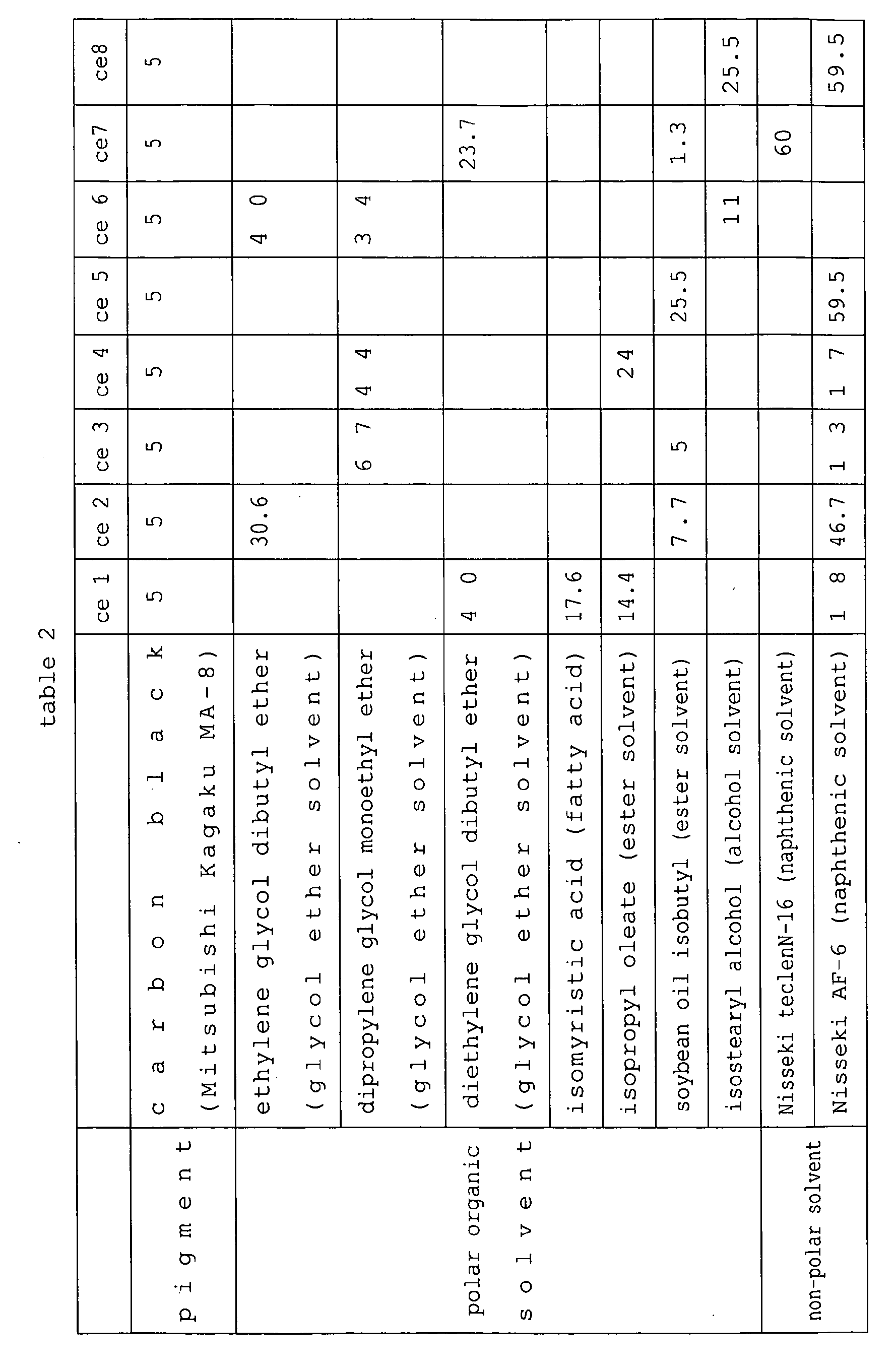

- Ink in accordance with the comparative example 1 where though the solvent contained 80%byweight polar organic solvent and 20% by weight of the polar organic solvent was ester solvent, the dispersant was ether dispersant not having an ester structure was unsatisfactory in shelf stability. Inks in accordance with the comparative examples 2 and 5 where though not smaller than 10% by weight of the polar organic solvent was ester solvent and the dispersant had an ester structure, the amount of the polar organic solvent was smaller than 60% by weight of the solvent were unsatisfactory in shelf stability and not good in blur. Inks in accordance with the comparative examples 3, 4 and 6 where though the dispersant had an ester structure and the amount of the polar organic solvent was not smaller than 60% by weight of the solvent, the amount of the ester solvent was smaller than 10% by weight of the polar organic solvent (the comparative example 6 contained no ester solvent) were unsatisfactory in shelf stability. Inks in accordance with the comparative examples 7 and 8 where though the dispersant had an ester structure, the amount of the ester solvent was smaller than 10% by weight of the polar organic solvent (the comparative example 8 contained no ester solvent) and the amount of the polar organic solvent was smaller than 60% by weight of the solvent were unsatisfactory in shelf stability and not good in blur. Whereas, inks in accordance with the embodiments 1 to 6 were all satisfactory in shelf stability and all good in blur.
- As can be understood from description above, in the non-aqueous ink composition of the present invention where not smaller than 60% by weight of the solvent is polar organic solvent and the polar organic solvent contains therein at least 10% by weight ester solvent, the dispersant is well dissolved in the ink and agglomeration of the pigment can be suppressed, whereby an ink which is excellent in shelf stability and less generates blur can be obtained.
Claims (8)
- A non-aqueous ink composition comprising pigment, solvent and dispersant, wherein the dispersant has an ester structure and the solvent contains therein not smaller than 60% by weight polar organic solvent which contains therein not smaller than 10% by weight ester solvent.
- A non-aqueous ink composition as defined in Claim 1 in which the polar organic solvent contains the ester solvent in not smaller than 30% by weight.
- A non-aqueous ink composition as defined in Claim 2 in which the polar organic solvent contains the ester solvent in not smaller than 50% by weight.
- A non-aqueous ink composition as defined in any one of Claims 1 to 3 in which the solvent contains aliphatic solvent.
- A non-aqueous ink composition as defined in any one of Claims 1 to 4 in which the dispersant has a polyester amine structure.
- A non-aqueous ink composition as defined in any one of Claims 1 to 4 in which the dispersant has a fatty amine structure.
- A non-aqueous ink composition as defined in any one of Claims 1 to 6 which is 2 to 30mPas in viscosity at 23° C.
- A non-aqueous ink composition as defined in any one of Claims 1 to 7 further comprising resin for fixing the pigment.
Applications Claiming Priority (2)
| Application Number | Priority Date | Filing Date | Title |
|---|---|---|---|
| JP2002066429 | 2002-03-12 | ||
| JP2002066429A JP2003261808A (en) | 2002-03-12 | 2002-03-12 | Non-aqueous ink composition |
Publications (2)
| Publication Number | Publication Date |
|---|---|
| EP1344802A1 true EP1344802A1 (en) | 2003-09-17 |
| EP1344802B1 EP1344802B1 (en) | 2005-02-02 |
Family
ID=27764478
Family Applications (1)
| Application Number | Title | Priority Date | Filing Date |
|---|---|---|---|
| EP20030005323 Expired - Lifetime EP1344802B1 (en) | 2002-03-12 | 2003-03-11 | Non-aqueous ink composition |
Country Status (5)
| Country | Link |
|---|---|
| US (1) | US7022172B2 (en) |
| EP (1) | EP1344802B1 (en) |
| JP (1) | JP2003261808A (en) |
| CN (1) | CN1273549C (en) |
| DE (1) | DE60300297T2 (en) |
Cited By (5)
| Publication number | Priority date | Publication date | Assignee | Title |
|---|---|---|---|---|
| EP1354920A3 (en) * | 2002-04-16 | 2003-11-12 | Riso Kagaku Corporation | Non-aqueous ink composition |
| EP1783183A1 (en) * | 2005-11-04 | 2007-05-09 | Riso Kagaku Corporation | Inkjet ink |
| WO2011078854A1 (en) * | 2009-12-22 | 2011-06-30 | Hewlett-Packard Development Company | Ink composition and method of preparing same |
| IT201700012056A1 (en) * | 2017-02-03 | 2018-08-03 | Serio Martino Di | Compositions containing fatty acid esters of vegetable origin as solvents |
| WO2021106950A1 (en) * | 2019-11-27 | 2021-06-03 | Ricoh Company, Ltd. | Ink compositions |
Families Citing this family (29)
| Publication number | Priority date | Publication date | Assignee | Title |
|---|---|---|---|---|
| US7153352B2 (en) * | 2003-05-12 | 2006-12-26 | Riso Kagaku Corporation | Ink for inkjet recording |
| JP4555602B2 (en) * | 2003-05-12 | 2010-10-06 | 理想科学工業株式会社 | Ink for inkjet recording |
| JP4616570B2 (en) * | 2004-03-31 | 2011-01-19 | 理想科学工業株式会社 | Oil-based inkjet ink |
| US7393400B2 (en) | 2005-07-26 | 2008-07-01 | Toshiba Tec Kabushiki Kaisha | Non-aqueous ink composition for ink jet |
| US7303621B2 (en) | 2005-08-31 | 2007-12-04 | Toshiba Tec Kabushiki Kaisha | Ink composition for inkjet |
| US7300508B2 (en) | 2005-09-06 | 2007-11-27 | Toshiba Tec Kabushiki Kaisha | Ink composition for inkjet |
| JP2007154149A (en) * | 2005-12-08 | 2007-06-21 | Toshiba Tec Corp | Non-aqueous ink composition for inkjet |
| JP2007161890A (en) * | 2005-12-14 | 2007-06-28 | Seiko Epson Corp | Non-aqueous ink composition for inkjet recording |
| JP2007161892A (en) * | 2005-12-14 | 2007-06-28 | Seiko Epson Corp | Non-aqueous ink composition for inkjet recording |
| US7645332B2 (en) | 2006-04-28 | 2010-01-12 | Toshiba Tec Kabushiki Kaisha | Non-aqueous ink composition for inkjet |
| US8741039B2 (en) * | 2007-02-21 | 2014-06-03 | Sanford, L.P. | Permanent ink compositions and writing instruments containing same |
| JP4986261B2 (en) * | 2007-03-15 | 2012-07-25 | セイコーエプソン株式会社 | Inkjet recording method |
| JP5384015B2 (en) | 2007-03-30 | 2014-01-08 | 理想科学工業株式会社 | Inkjet ink |
| JP4977637B2 (en) | 2008-02-06 | 2012-07-18 | 理想科学工業株式会社 | Inkjet printing method and ink set |
| JP5285325B2 (en) | 2008-05-09 | 2013-09-11 | 理想科学工業株式会社 | Non-aqueous pigment ink for inkjet and non-aqueous pigment ink set for inkjet |
| JP5524536B2 (en) * | 2009-03-25 | 2014-06-18 | 理想科学工業株式会社 | Non-aqueous pigment ink |
| JP5588638B2 (en) * | 2009-08-19 | 2014-09-10 | 理想科学工業株式会社 | Non-aqueous pigment ink |
| JP4778095B1 (en) * | 2010-03-19 | 2011-09-21 | 理想科学工業株式会社 | Oil-based inkjet ink |
| US8366819B2 (en) * | 2010-03-25 | 2013-02-05 | Riso Kagaku Corporation | Oily inkjet ink |
| JP2012102200A (en) * | 2010-11-09 | 2012-05-31 | Riso Kagaku Corp | Oil-based inkjet ink |
| JP6000528B2 (en) * | 2011-11-04 | 2016-09-28 | 理想科学工業株式会社 | Non-aqueous inkjet ink |
| CN103224723B (en) * | 2012-01-27 | 2017-03-01 | 精工爱普生株式会社 | Inkjet-recording non-aqueous ink composition and ink jet recording method |
| FR2997956B1 (en) | 2012-11-15 | 2015-04-10 | Markem Imaje | INK COMPOSITION FOR CONTINUOUS JET PRINTING IN PARTICULAR ON ORGANIC POLYMER SUBSTRATES. |
| EP2964710B1 (en) * | 2013-03-07 | 2018-10-03 | OCE-Technologies B.V. | Ink composition |
| JP6371523B2 (en) | 2013-12-27 | 2018-08-08 | 理想科学工業株式会社 | Inkjet printing method and non-aqueous ink set |
| FR3033572B1 (en) | 2015-03-13 | 2019-05-10 | Dover Europe Sarl | INK COMPOSITION FOR CONTINUOUS JET PRINTING IN PARTICULAR ON ORGANIC POLYMER SUBSTRATES. |
| CN108441029A (en) * | 2018-05-22 | 2018-08-24 | 桂林理工大学 | A kind of high parsing black nano ink and preparation method thereof being applied to 800-1200 DEG C of operating mode |
| JP7105129B2 (en) * | 2018-07-31 | 2022-07-22 | 理想科学工業株式会社 | Oil-based inkjet ink set and printing method |
| JP2026025086A (en) | 2024-08-02 | 2026-02-13 | サカタインクス株式会社 | Ink composition for inkjet printing |
Citations (6)
| Publication number | Priority date | Publication date | Assignee | Title |
|---|---|---|---|---|
| JPH06287310A (en) * | 1993-04-05 | 1994-10-11 | Mitsubishi Heavy Ind Ltd | Preparation of suspension of fine particles of composite resin material dispersed in nonaqueous solvent |
| JPH08231914A (en) * | 1994-12-26 | 1996-09-10 | Sakura Color Prod Corp | Ink composition |
| EP0878517A2 (en) * | 1997-05-13 | 1998-11-18 | Lexmark International, Inc. | Method for grinding colorants |
| US5849814A (en) * | 1994-12-26 | 1998-12-15 | Sakura Color Products Corporation | Ink composition |
| WO2002016516A1 (en) * | 2000-08-24 | 2002-02-28 | Bic Corporation | Solvent-based non-fluorescent inks for writing instruments based upon pigment dispersions in non-aqueous solvents |
| WO2002098987A2 (en) * | 2001-06-06 | 2002-12-12 | Danisco A/S | Liquid colour compositions with acylglycerols as dispersants |
Family Cites Families (18)
| Publication number | Priority date | Publication date | Assignee | Title |
|---|---|---|---|---|
| JPS5710661A (en) | 1980-06-24 | 1982-01-20 | Canon Inc | Recording liquid |
| US4822418A (en) * | 1981-03-27 | 1989-04-18 | Dataproducts Corporation | Drop on demand ink jet ink comprising dubutyl sebecate |
| JPS5980476A (en) | 1982-10-29 | 1984-05-09 | Pilot Pen Co Ltd:The | Erasable ink for ball-point pen |
| JPS61261380A (en) * | 1985-05-15 | 1986-11-19 | Pentel Kk | Marking ink composition |
| US4954174A (en) * | 1987-08-24 | 1990-09-04 | Sakura Color Products Corporation | Erasable ink compositions |
| GB9100614D0 (en) | 1991-01-11 | 1991-02-27 | Xaar Ltd | Ink composition |
| JP3049456B2 (en) * | 1992-03-31 | 2000-06-05 | オリヱント化学工業株式会社 | Ink composition for writing board |
| US6004388A (en) * | 1994-09-16 | 1999-12-21 | Mitsubishi Pencil Kabushiki Kaisha | Non-aqueous ink for ball point pen, and ball point pen |
| GB9521673D0 (en) * | 1995-10-23 | 1996-01-03 | Xaar Ltd | Ink jet printer dispersion inks |
| JP3546689B2 (en) | 1998-03-30 | 2004-07-28 | 東洋インキ製造株式会社 | Inkjet ink |
| US7030173B2 (en) * | 1998-09-04 | 2006-04-18 | Illinois Tool Works, Inc. | High resolution pigment ink for impulse ink jet printing |
| US6187086B1 (en) * | 1999-02-19 | 2001-02-13 | Hewlett-Packard Company | Bleed control solvents for pigmented and dye-based inks |
| JP4371571B2 (en) * | 2000-12-28 | 2009-11-25 | 三菱鉛筆株式会社 | Oil-based ink composition for ballpoint pens |
| CA2445416A1 (en) * | 2001-04-27 | 2002-11-07 | Ajinomoto Co., Inc. | Decolorable ink for inkjet printing and inkjet printing method using same |
| DE10221609A1 (en) * | 2001-05-21 | 2003-01-16 | Benq Corp | Ink-jet ink comprises polyethylene glycol fatty acid ester |
| US7381754B2 (en) * | 2001-07-31 | 2008-06-03 | Mitsubishi Pencil Co., Ltd. | Oil-based ink composition and uses thereof |
| JP4460222B2 (en) * | 2002-04-16 | 2010-05-12 | 理想科学工業株式会社 | Non-aqueous ink composition |
| US7153352B2 (en) * | 2003-05-12 | 2006-12-26 | Riso Kagaku Corporation | Ink for inkjet recording |
-
2002
- 2002-03-12 JP JP2002066429A patent/JP2003261808A/en active Pending
-
2003
- 2003-03-11 DE DE2003600297 patent/DE60300297T2/en not_active Expired - Lifetime
- 2003-03-11 EP EP20030005323 patent/EP1344802B1/en not_active Expired - Lifetime
- 2003-03-12 US US10/385,859 patent/US7022172B2/en not_active Expired - Lifetime
- 2003-03-12 CN CNB031200680A patent/CN1273549C/en not_active Expired - Lifetime
Patent Citations (6)
| Publication number | Priority date | Publication date | Assignee | Title |
|---|---|---|---|---|
| JPH06287310A (en) * | 1993-04-05 | 1994-10-11 | Mitsubishi Heavy Ind Ltd | Preparation of suspension of fine particles of composite resin material dispersed in nonaqueous solvent |
| JPH08231914A (en) * | 1994-12-26 | 1996-09-10 | Sakura Color Prod Corp | Ink composition |
| US5849814A (en) * | 1994-12-26 | 1998-12-15 | Sakura Color Products Corporation | Ink composition |
| EP0878517A2 (en) * | 1997-05-13 | 1998-11-18 | Lexmark International, Inc. | Method for grinding colorants |
| WO2002016516A1 (en) * | 2000-08-24 | 2002-02-28 | Bic Corporation | Solvent-based non-fluorescent inks for writing instruments based upon pigment dispersions in non-aqueous solvents |
| WO2002098987A2 (en) * | 2001-06-06 | 2002-12-12 | Danisco A/S | Liquid colour compositions with acylglycerols as dispersants |
Non-Patent Citations (2)
| Title |
|---|
| PATENT ABSTRACTS OF JAPAN vol. 1995, no. 01 28 February 1995 (1995-02-28) * |
| PATENT ABSTRACTS OF JAPAN vol. 1997, no. 01 31 January 1997 (1997-01-31) * |
Cited By (11)
| Publication number | Priority date | Publication date | Assignee | Title |
|---|---|---|---|---|
| EP1354920A3 (en) * | 2002-04-16 | 2003-11-12 | Riso Kagaku Corporation | Non-aqueous ink composition |
| US7060125B2 (en) | 2002-04-16 | 2006-06-13 | Riso Kagaku Corporation | Non-aqueous ink composition |
| EP1783183A1 (en) * | 2005-11-04 | 2007-05-09 | Riso Kagaku Corporation | Inkjet ink |
| US7799123B2 (en) | 2005-11-04 | 2010-09-21 | Riso Kagaku Corporation | Inkjet ink |
| WO2011078854A1 (en) * | 2009-12-22 | 2011-06-30 | Hewlett-Packard Development Company | Ink composition and method of preparing same |
| US8791174B2 (en) | 2009-12-22 | 2014-07-29 | Hewlett-Packard Development Company, L.P. | Ink composition and method of preparing same |
| IT201700012056A1 (en) * | 2017-02-03 | 2018-08-03 | Serio Martino Di | Compositions containing fatty acid esters of vegetable origin as solvents |
| WO2018142320A1 (en) * | 2017-02-03 | 2018-08-09 | Benessere Vincenzo | Compositions containing fatty acid esters of vegetable origin as solvents |
| WO2021106950A1 (en) * | 2019-11-27 | 2021-06-03 | Ricoh Company, Ltd. | Ink compositions |
| KR20220087518A (en) * | 2019-11-27 | 2022-06-24 | 가부시키가이샤 리코 | ink composition |
| US12545796B2 (en) | 2019-11-27 | 2026-02-10 | Ricoh Company, Ltd. | Ink compositions |
Also Published As
| Publication number | Publication date |
|---|---|
| JP2003261808A (en) | 2003-09-19 |
| DE60300297D1 (en) | 2005-03-10 |
| CN1273549C (en) | 2006-09-06 |
| EP1344802B1 (en) | 2005-02-02 |
| CN1443813A (en) | 2003-09-24 |
| US7022172B2 (en) | 2006-04-04 |
| US20030177948A1 (en) | 2003-09-25 |
| DE60300297T2 (en) | 2006-01-12 |
Similar Documents
| Publication | Publication Date | Title |
|---|---|---|
| EP1344802B1 (en) | Non-aqueous ink composition | |
| EP1354920B1 (en) | Non-aqueous ink composition | |
| EP0985715B1 (en) | Recording liquid, printed product and ink jet recording method | |
| US5538549A (en) | Recording ink having pigment particles | |
| EP0726299B1 (en) | Ink composition suitable for ink jet recording | |
| JP4563714B2 (en) | Non-aqueous inkjet ink | |
| EP2554610B1 (en) | Inkjet ink and method for forming inkjet image | |
| EP1995287A1 (en) | Ink set, ink jet recording method, ind cartridge, recording unit, and ink jet recording apparatus | |
| JP4277986B2 (en) | Non-aqueous inkjet ink and method for producing the same | |
| JP5028440B2 (en) | Oil-based inkjet ink | |
| JP2007197500A (en) | Non-aqueous pigment ink | |
| JP2010248462A (en) | Non-aqueous pigment ink | |
| JPH06264016A (en) | Ink for ink jet recording | |
| JP4837901B2 (en) | Oil-based inkjet ink | |
| JPH09328644A (en) | Ink composition for inkjet recording | |
| JPH06145570A (en) | Inkjet recording ink and inkjet recording method | |
| JP5878735B2 (en) | Non-aqueous pigment ink for inkjet | |
| US20040227799A1 (en) | Ink for inkjet recording | |
| JP2013047289A (en) | Non-aqueous ink | |
| JPH06248210A (en) | Inkjet recording ink | |
| JP5422303B2 (en) | Non-aqueous pigment ink | |
| JP2001164157A (en) | Inkjet ink | |
| JP2007063527A (en) | Ink jet ink composition | |
| JP5844590B2 (en) | Non-aqueous inkjet ink | |
| JP2024076789A (en) | Oil-based inkjet ink |
Legal Events
| Date | Code | Title | Description |
|---|---|---|---|
| PUAI | Public reference made under article 153(3) epc to a published international application that has entered the european phase |
Free format text: ORIGINAL CODE: 0009012 |
|
| 17P | Request for examination filed |
Effective date: 20030311 |
|
| AK | Designated contracting states |
Kind code of ref document: A1 Designated state(s): AT BE BG CH CY CZ DE DK EE ES FI FR GB GR HU IE IT LI LU MC NL PT SE SI SK TR |
|
| AX | Request for extension of the european patent |
Extension state: AL LT LV MK RO |
|
| 17Q | First examination report despatched |
Effective date: 20040319 |
|
| AKX | Designation fees paid |
Designated state(s): DE FR GB |
|
| GRAP | Despatch of communication of intention to grant a patent |
Free format text: ORIGINAL CODE: EPIDOSNIGR1 |
|
| GRAS | Grant fee paid |
Free format text: ORIGINAL CODE: EPIDOSNIGR3 |
|
| GRAA | (expected) grant |
Free format text: ORIGINAL CODE: 0009210 |
|
| AK | Designated contracting states |
Kind code of ref document: B1 Designated state(s): DE FR GB |
|
| REG | Reference to a national code |
Ref country code: GB Ref legal event code: FG4D |
|
| REG | Reference to a national code |
Ref country code: IE Ref legal event code: FG4D |
|
| REF | Corresponds to: |
Ref document number: 60300297 Country of ref document: DE Date of ref document: 20050310 Kind code of ref document: P |
|
| PLBE | No opposition filed within time limit |
Free format text: ORIGINAL CODE: 0009261 |
|
| STAA | Information on the status of an ep patent application or granted ep patent |
Free format text: STATUS: NO OPPOSITION FILED WITHIN TIME LIMIT |
|
| 26N | No opposition filed |
Effective date: 20051103 |
|
| ET | Fr: translation filed | ||
| REG | Reference to a national code |
Ref country code: FR Ref legal event code: PLFP Year of fee payment: 14 |
|
| REG | Reference to a national code |
Ref country code: FR Ref legal event code: PLFP Year of fee payment: 15 |
|
| REG | Reference to a national code |
Ref country code: DE Ref legal event code: R082 Ref document number: 60300297 Country of ref document: DE Representative=s name: KLUNKER IP PATENTANWAELTE PARTG MBB, DE |
|
| REG | Reference to a national code |
Ref country code: FR Ref legal event code: PLFP Year of fee payment: 16 |
|
| PGFP | Annual fee paid to national office [announced via postgrant information from national office to epo] |
Ref country code: GB Payment date: 20220324 Year of fee payment: 20 Ref country code: DE Payment date: 20220322 Year of fee payment: 20 |
|
| PGFP | Annual fee paid to national office [announced via postgrant information from national office to epo] |
Ref country code: FR Payment date: 20220328 Year of fee payment: 20 |
|
| REG | Reference to a national code |
Ref country code: DE Ref legal event code: R071 Ref document number: 60300297 Country of ref document: DE |
|
| REG | Reference to a national code |
Ref country code: GB Ref legal event code: PE20 Expiry date: 20230310 |
|
| PG25 | Lapsed in a contracting state [announced via postgrant information from national office to epo] |
Ref country code: GB Free format text: LAPSE BECAUSE OF EXPIRATION OF PROTECTION Effective date: 20230310 |