EP1342825A1 - Nonwoven fabric for wiper - Google Patents
Nonwoven fabric for wiper Download PDFInfo
- Publication number
- EP1342825A1 EP1342825A1 EP20030002228 EP03002228A EP1342825A1 EP 1342825 A1 EP1342825 A1 EP 1342825A1 EP 20030002228 EP20030002228 EP 20030002228 EP 03002228 A EP03002228 A EP 03002228A EP 1342825 A1 EP1342825 A1 EP 1342825A1
- Authority
- EP
- European Patent Office
- Prior art keywords
- nonwoven fabric
- bonded regions
- fibers
- wipers
- extra
- Prior art date
- Legal status (The legal status is an assumption and is not a legal conclusion. Google has not performed a legal analysis and makes no representation as to the accuracy of the status listed.)
- Granted
Links
Images
Classifications
-
- D—TEXTILES; PAPER
- D04—BRAIDING; LACE-MAKING; KNITTING; TRIMMINGS; NON-WOVEN FABRICS
- D04H—MAKING TEXTILE FABRICS, e.g. FROM FIBRES OR FILAMENTARY MATERIAL; FABRICS MADE BY SUCH PROCESSES OR APPARATUS, e.g. FELTS, NON-WOVEN FABRICS; COTTON-WOOL; WADDING ; NON-WOVEN FABRICS FROM STAPLE FIBRES, FILAMENTS OR YARNS, BONDED WITH AT LEAST ONE WEB-LIKE MATERIAL DURING THEIR CONSOLIDATION
- D04H1/00—Non-woven fabrics formed wholly or mainly of staple fibres or like relatively short fibres
- D04H1/40—Non-woven fabrics formed wholly or mainly of staple fibres or like relatively short fibres from fleeces or layers composed of fibres without existing or potential cohesive properties
- D04H1/44—Non-woven fabrics formed wholly or mainly of staple fibres or like relatively short fibres from fleeces or layers composed of fibres without existing or potential cohesive properties the fleeces or layers being consolidated by mechanical means, e.g. by rolling
- D04H1/46—Non-woven fabrics formed wholly or mainly of staple fibres or like relatively short fibres from fleeces or layers composed of fibres without existing or potential cohesive properties the fleeces or layers being consolidated by mechanical means, e.g. by rolling by needling or like operations to cause entanglement of fibres
- D04H1/48—Non-woven fabrics formed wholly or mainly of staple fibres or like relatively short fibres from fleeces or layers composed of fibres without existing or potential cohesive properties the fleeces or layers being consolidated by mechanical means, e.g. by rolling by needling or like operations to cause entanglement of fibres in combination with at least one other method of consolidation
-
- A—HUMAN NECESSITIES
- A47—FURNITURE; DOMESTIC ARTICLES OR APPLIANCES; COFFEE MILLS; SPICE MILLS; SUCTION CLEANERS IN GENERAL
- A47L—DOMESTIC WASHING OR CLEANING; SUCTION CLEANERS IN GENERAL
- A47L13/00—Implements for cleaning floors, carpets, furniture, walls, or wall coverings
- A47L13/10—Scrubbing; Scouring; Cleaning; Polishing
- A47L13/16—Cloths; Pads; Sponges
-
- B—PERFORMING OPERATIONS; TRANSPORTING
- B08—CLEANING
- B08B—CLEANING IN GENERAL; PREVENTION OF FOULING IN GENERAL
- B08B1/00—Cleaning by methods involving the use of tools
- B08B1/10—Cleaning by methods involving the use of tools characterised by the type of cleaning tool
- B08B1/14—Wipes; Absorbent members, e.g. swabs or sponges
- B08B1/143—Wipes
-
- D—TEXTILES; PAPER
- D04—BRAIDING; LACE-MAKING; KNITTING; TRIMMINGS; NON-WOVEN FABRICS
- D04H—MAKING TEXTILE FABRICS, e.g. FROM FIBRES OR FILAMENTARY MATERIAL; FABRICS MADE BY SUCH PROCESSES OR APPARATUS, e.g. FELTS, NON-WOVEN FABRICS; COTTON-WOOL; WADDING ; NON-WOVEN FABRICS FROM STAPLE FIBRES, FILAMENTS OR YARNS, BONDED WITH AT LEAST ONE WEB-LIKE MATERIAL DURING THEIR CONSOLIDATION
- D04H1/00—Non-woven fabrics formed wholly or mainly of staple fibres or like relatively short fibres
- D04H1/40—Non-woven fabrics formed wholly or mainly of staple fibres or like relatively short fibres from fleeces or layers composed of fibres without existing or potential cohesive properties
- D04H1/42—Non-woven fabrics formed wholly or mainly of staple fibres or like relatively short fibres from fleeces or layers composed of fibres without existing or potential cohesive properties characterised by the use of certain kinds of fibres insofar as this use has no preponderant influence on the consolidation of the fleece
- D04H1/4282—Addition polymers
-
- D—TEXTILES; PAPER
- D04—BRAIDING; LACE-MAKING; KNITTING; TRIMMINGS; NON-WOVEN FABRICS
- D04H—MAKING TEXTILE FABRICS, e.g. FROM FIBRES OR FILAMENTARY MATERIAL; FABRICS MADE BY SUCH PROCESSES OR APPARATUS, e.g. FELTS, NON-WOVEN FABRICS; COTTON-WOOL; WADDING ; NON-WOVEN FABRICS FROM STAPLE FIBRES, FILAMENTS OR YARNS, BONDED WITH AT LEAST ONE WEB-LIKE MATERIAL DURING THEIR CONSOLIDATION
- D04H1/00—Non-woven fabrics formed wholly or mainly of staple fibres or like relatively short fibres
- D04H1/40—Non-woven fabrics formed wholly or mainly of staple fibres or like relatively short fibres from fleeces or layers composed of fibres without existing or potential cohesive properties
- D04H1/42—Non-woven fabrics formed wholly or mainly of staple fibres or like relatively short fibres from fleeces or layers composed of fibres without existing or potential cohesive properties characterised by the use of certain kinds of fibres insofar as this use has no preponderant influence on the consolidation of the fleece
- D04H1/4326—Condensation or reaction polymers
-
- D—TEXTILES; PAPER
- D04—BRAIDING; LACE-MAKING; KNITTING; TRIMMINGS; NON-WOVEN FABRICS
- D04H—MAKING TEXTILE FABRICS, e.g. FROM FIBRES OR FILAMENTARY MATERIAL; FABRICS MADE BY SUCH PROCESSES OR APPARATUS, e.g. FELTS, NON-WOVEN FABRICS; COTTON-WOOL; WADDING ; NON-WOVEN FABRICS FROM STAPLE FIBRES, FILAMENTS OR YARNS, BONDED WITH AT LEAST ONE WEB-LIKE MATERIAL DURING THEIR CONSOLIDATION
- D04H1/00—Non-woven fabrics formed wholly or mainly of staple fibres or like relatively short fibres
- D04H1/40—Non-woven fabrics formed wholly or mainly of staple fibres or like relatively short fibres from fleeces or layers composed of fibres without existing or potential cohesive properties
- D04H1/42—Non-woven fabrics formed wholly or mainly of staple fibres or like relatively short fibres from fleeces or layers composed of fibres without existing or potential cohesive properties characterised by the use of certain kinds of fibres insofar as this use has no preponderant influence on the consolidation of the fleece
- D04H1/4382—Stretched reticular film fibres; Composite fibres; Mixed fibres; Ultrafine fibres; Fibres for artificial leather
- D04H1/43825—Composite fibres
- D04H1/43828—Composite fibres sheath-core
-
- D—TEXTILES; PAPER
- D04—BRAIDING; LACE-MAKING; KNITTING; TRIMMINGS; NON-WOVEN FABRICS
- D04H—MAKING TEXTILE FABRICS, e.g. FROM FIBRES OR FILAMENTARY MATERIAL; FABRICS MADE BY SUCH PROCESSES OR APPARATUS, e.g. FELTS, NON-WOVEN FABRICS; COTTON-WOOL; WADDING ; NON-WOVEN FABRICS FROM STAPLE FIBRES, FILAMENTS OR YARNS, BONDED WITH AT LEAST ONE WEB-LIKE MATERIAL DURING THEIR CONSOLIDATION
- D04H1/00—Non-woven fabrics formed wholly or mainly of staple fibres or like relatively short fibres
- D04H1/40—Non-woven fabrics formed wholly or mainly of staple fibres or like relatively short fibres from fleeces or layers composed of fibres without existing or potential cohesive properties
- D04H1/42—Non-woven fabrics formed wholly or mainly of staple fibres or like relatively short fibres from fleeces or layers composed of fibres without existing or potential cohesive properties characterised by the use of certain kinds of fibres insofar as this use has no preponderant influence on the consolidation of the fleece
- D04H1/4382—Stretched reticular film fibres; Composite fibres; Mixed fibres; Ultrafine fibres; Fibres for artificial leather
- D04H1/43825—Composite fibres
- D04H1/43832—Composite fibres side-by-side
-
- D—TEXTILES; PAPER
- D04—BRAIDING; LACE-MAKING; KNITTING; TRIMMINGS; NON-WOVEN FABRICS
- D04H—MAKING TEXTILE FABRICS, e.g. FROM FIBRES OR FILAMENTARY MATERIAL; FABRICS MADE BY SUCH PROCESSES OR APPARATUS, e.g. FELTS, NON-WOVEN FABRICS; COTTON-WOOL; WADDING ; NON-WOVEN FABRICS FROM STAPLE FIBRES, FILAMENTS OR YARNS, BONDED WITH AT LEAST ONE WEB-LIKE MATERIAL DURING THEIR CONSOLIDATION
- D04H1/00—Non-woven fabrics formed wholly or mainly of staple fibres or like relatively short fibres
- D04H1/40—Non-woven fabrics formed wholly or mainly of staple fibres or like relatively short fibres from fleeces or layers composed of fibres without existing or potential cohesive properties
- D04H1/42—Non-woven fabrics formed wholly or mainly of staple fibres or like relatively short fibres from fleeces or layers composed of fibres without existing or potential cohesive properties characterised by the use of certain kinds of fibres insofar as this use has no preponderant influence on the consolidation of the fleece
- D04H1/4382—Stretched reticular film fibres; Composite fibres; Mixed fibres; Ultrafine fibres; Fibres for artificial leather
- D04H1/43835—Mixed fibres, e.g. at least two chemically different fibres or fibre blends
-
- D—TEXTILES; PAPER
- D04—BRAIDING; LACE-MAKING; KNITTING; TRIMMINGS; NON-WOVEN FABRICS
- D04H—MAKING TEXTILE FABRICS, e.g. FROM FIBRES OR FILAMENTARY MATERIAL; FABRICS MADE BY SUCH PROCESSES OR APPARATUS, e.g. FELTS, NON-WOVEN FABRICS; COTTON-WOOL; WADDING ; NON-WOVEN FABRICS FROM STAPLE FIBRES, FILAMENTS OR YARNS, BONDED WITH AT LEAST ONE WEB-LIKE MATERIAL DURING THEIR CONSOLIDATION
- D04H1/00—Non-woven fabrics formed wholly or mainly of staple fibres or like relatively short fibres
- D04H1/40—Non-woven fabrics formed wholly or mainly of staple fibres or like relatively short fibres from fleeces or layers composed of fibres without existing or potential cohesive properties
- D04H1/42—Non-woven fabrics formed wholly or mainly of staple fibres or like relatively short fibres from fleeces or layers composed of fibres without existing or potential cohesive properties characterised by the use of certain kinds of fibres insofar as this use has no preponderant influence on the consolidation of the fleece
- D04H1/4382—Stretched reticular film fibres; Composite fibres; Mixed fibres; Ultrafine fibres; Fibres for artificial leather
- D04H1/43838—Ultrafine fibres, e.g. microfibres
-
- D—TEXTILES; PAPER
- D04—BRAIDING; LACE-MAKING; KNITTING; TRIMMINGS; NON-WOVEN FABRICS
- D04H—MAKING TEXTILE FABRICS, e.g. FROM FIBRES OR FILAMENTARY MATERIAL; FABRICS MADE BY SUCH PROCESSES OR APPARATUS, e.g. FELTS, NON-WOVEN FABRICS; COTTON-WOOL; WADDING ; NON-WOVEN FABRICS FROM STAPLE FIBRES, FILAMENTS OR YARNS, BONDED WITH AT LEAST ONE WEB-LIKE MATERIAL DURING THEIR CONSOLIDATION
- D04H1/00—Non-woven fabrics formed wholly or mainly of staple fibres or like relatively short fibres
- D04H1/40—Non-woven fabrics formed wholly or mainly of staple fibres or like relatively short fibres from fleeces or layers composed of fibres without existing or potential cohesive properties
- D04H1/44—Non-woven fabrics formed wholly or mainly of staple fibres or like relatively short fibres from fleeces or layers composed of fibres without existing or potential cohesive properties the fleeces or layers being consolidated by mechanical means, e.g. by rolling
- D04H1/46—Non-woven fabrics formed wholly or mainly of staple fibres or like relatively short fibres from fleeces or layers composed of fibres without existing or potential cohesive properties the fleeces or layers being consolidated by mechanical means, e.g. by rolling by needling or like operations to cause entanglement of fibres
- D04H1/48—Non-woven fabrics formed wholly or mainly of staple fibres or like relatively short fibres from fleeces or layers composed of fibres without existing or potential cohesive properties the fleeces or layers being consolidated by mechanical means, e.g. by rolling by needling or like operations to cause entanglement of fibres in combination with at least one other method of consolidation
- D04H1/49—Non-woven fabrics formed wholly or mainly of staple fibres or like relatively short fibres from fleeces or layers composed of fibres without existing or potential cohesive properties the fleeces or layers being consolidated by mechanical means, e.g. by rolling by needling or like operations to cause entanglement of fibres in combination with at least one other method of consolidation entanglement by fluid jet in combination with another consolidation means
-
- D—TEXTILES; PAPER
- D04—BRAIDING; LACE-MAKING; KNITTING; TRIMMINGS; NON-WOVEN FABRICS
- D04H—MAKING TEXTILE FABRICS, e.g. FROM FIBRES OR FILAMENTARY MATERIAL; FABRICS MADE BY SUCH PROCESSES OR APPARATUS, e.g. FELTS, NON-WOVEN FABRICS; COTTON-WOOL; WADDING ; NON-WOVEN FABRICS FROM STAPLE FIBRES, FILAMENTS OR YARNS, BONDED WITH AT LEAST ONE WEB-LIKE MATERIAL DURING THEIR CONSOLIDATION
- D04H1/00—Non-woven fabrics formed wholly or mainly of staple fibres or like relatively short fibres
- D04H1/40—Non-woven fabrics formed wholly or mainly of staple fibres or like relatively short fibres from fleeces or layers composed of fibres without existing or potential cohesive properties
- D04H1/44—Non-woven fabrics formed wholly or mainly of staple fibres or like relatively short fibres from fleeces or layers composed of fibres without existing or potential cohesive properties the fleeces or layers being consolidated by mechanical means, e.g. by rolling
- D04H1/46—Non-woven fabrics formed wholly or mainly of staple fibres or like relatively short fibres from fleeces or layers composed of fibres without existing or potential cohesive properties the fleeces or layers being consolidated by mechanical means, e.g. by rolling by needling or like operations to cause entanglement of fibres
- D04H1/492—Non-woven fabrics formed wholly or mainly of staple fibres or like relatively short fibres from fleeces or layers composed of fibres without existing or potential cohesive properties the fleeces or layers being consolidated by mechanical means, e.g. by rolling by needling or like operations to cause entanglement of fibres by fluid jet
- D04H1/495—Non-woven fabrics formed wholly or mainly of staple fibres or like relatively short fibres from fleeces or layers composed of fibres without existing or potential cohesive properties the fleeces or layers being consolidated by mechanical means, e.g. by rolling by needling or like operations to cause entanglement of fibres by fluid jet for formation of patterns, e.g. drilling or rearrangement
-
- D—TEXTILES; PAPER
- D04—BRAIDING; LACE-MAKING; KNITTING; TRIMMINGS; NON-WOVEN FABRICS
- D04H—MAKING TEXTILE FABRICS, e.g. FROM FIBRES OR FILAMENTARY MATERIAL; FABRICS MADE BY SUCH PROCESSES OR APPARATUS, e.g. FELTS, NON-WOVEN FABRICS; COTTON-WOOL; WADDING ; NON-WOVEN FABRICS FROM STAPLE FIBRES, FILAMENTS OR YARNS, BONDED WITH AT LEAST ONE WEB-LIKE MATERIAL DURING THEIR CONSOLIDATION
- D04H1/00—Non-woven fabrics formed wholly or mainly of staple fibres or like relatively short fibres
- D04H1/40—Non-woven fabrics formed wholly or mainly of staple fibres or like relatively short fibres from fleeces or layers composed of fibres without existing or potential cohesive properties
- D04H1/54—Non-woven fabrics formed wholly or mainly of staple fibres or like relatively short fibres from fleeces or layers composed of fibres without existing or potential cohesive properties by welding together the fibres, e.g. by partially melting or dissolving
-
- D—TEXTILES; PAPER
- D04—BRAIDING; LACE-MAKING; KNITTING; TRIMMINGS; NON-WOVEN FABRICS
- D04H—MAKING TEXTILE FABRICS, e.g. FROM FIBRES OR FILAMENTARY MATERIAL; FABRICS MADE BY SUCH PROCESSES OR APPARATUS, e.g. FELTS, NON-WOVEN FABRICS; COTTON-WOOL; WADDING ; NON-WOVEN FABRICS FROM STAPLE FIBRES, FILAMENTS OR YARNS, BONDED WITH AT LEAST ONE WEB-LIKE MATERIAL DURING THEIR CONSOLIDATION
- D04H1/00—Non-woven fabrics formed wholly or mainly of staple fibres or like relatively short fibres
- D04H1/40—Non-woven fabrics formed wholly or mainly of staple fibres or like relatively short fibres from fleeces or layers composed of fibres without existing or potential cohesive properties
- D04H1/58—Non-woven fabrics formed wholly or mainly of staple fibres or like relatively short fibres from fleeces or layers composed of fibres without existing or potential cohesive properties by applying, incorporating or activating chemical or thermoplastic bonding agents, e.g. adhesives
- D04H1/60—Non-woven fabrics formed wholly or mainly of staple fibres or like relatively short fibres from fleeces or layers composed of fibres without existing or potential cohesive properties by applying, incorporating or activating chemical or thermoplastic bonding agents, e.g. adhesives the bonding agent being applied in dry state, e.g. thermo-activatable agents in solid or molten state, and heat being applied subsequently
- D04H1/62—Non-woven fabrics formed wholly or mainly of staple fibres or like relatively short fibres from fleeces or layers composed of fibres without existing or potential cohesive properties by applying, incorporating or activating chemical or thermoplastic bonding agents, e.g. adhesives the bonding agent being applied in dry state, e.g. thermo-activatable agents in solid or molten state, and heat being applied subsequently at spaced points or locations
-
- D—TEXTILES; PAPER
- D04—BRAIDING; LACE-MAKING; KNITTING; TRIMMINGS; NON-WOVEN FABRICS
- D04H—MAKING TEXTILE FABRICS, e.g. FROM FIBRES OR FILAMENTARY MATERIAL; FABRICS MADE BY SUCH PROCESSES OR APPARATUS, e.g. FELTS, NON-WOVEN FABRICS; COTTON-WOOL; WADDING ; NON-WOVEN FABRICS FROM STAPLE FIBRES, FILAMENTS OR YARNS, BONDED WITH AT LEAST ONE WEB-LIKE MATERIAL DURING THEIR CONSOLIDATION
- D04H1/00—Non-woven fabrics formed wholly or mainly of staple fibres or like relatively short fibres
- D04H1/40—Non-woven fabrics formed wholly or mainly of staple fibres or like relatively short fibres from fleeces or layers composed of fibres without existing or potential cohesive properties
- D04H1/58—Non-woven fabrics formed wholly or mainly of staple fibres or like relatively short fibres from fleeces or layers composed of fibres without existing or potential cohesive properties by applying, incorporating or activating chemical or thermoplastic bonding agents, e.g. adhesives
- D04H1/64—Non-woven fabrics formed wholly or mainly of staple fibres or like relatively short fibres from fleeces or layers composed of fibres without existing or potential cohesive properties by applying, incorporating or activating chemical or thermoplastic bonding agents, e.g. adhesives the bonding agent being applied in wet state, e.g. chemical agents in dispersions or solutions
- D04H1/66—Non-woven fabrics formed wholly or mainly of staple fibres or like relatively short fibres from fleeces or layers composed of fibres without existing or potential cohesive properties by applying, incorporating or activating chemical or thermoplastic bonding agents, e.g. adhesives the bonding agent being applied in wet state, e.g. chemical agents in dispersions or solutions at spaced points or locations
-
- D—TEXTILES; PAPER
- D04—BRAIDING; LACE-MAKING; KNITTING; TRIMMINGS; NON-WOVEN FABRICS
- D04H—MAKING TEXTILE FABRICS, e.g. FROM FIBRES OR FILAMENTARY MATERIAL; FABRICS MADE BY SUCH PROCESSES OR APPARATUS, e.g. FELTS, NON-WOVEN FABRICS; COTTON-WOOL; WADDING ; NON-WOVEN FABRICS FROM STAPLE FIBRES, FILAMENTS OR YARNS, BONDED WITH AT LEAST ONE WEB-LIKE MATERIAL DURING THEIR CONSOLIDATION
- D04H1/00—Non-woven fabrics formed wholly or mainly of staple fibres or like relatively short fibres
- D04H1/70—Non-woven fabrics formed wholly or mainly of staple fibres or like relatively short fibres characterised by the method of forming fleeces or layers, e.g. reorientation of fibres
- D04H1/72—Non-woven fabrics formed wholly or mainly of staple fibres or like relatively short fibres characterised by the method of forming fleeces or layers, e.g. reorientation of fibres the fibres being randomly arranged
- D04H1/732—Non-woven fabrics formed wholly or mainly of staple fibres or like relatively short fibres characterised by the method of forming fleeces or layers, e.g. reorientation of fibres the fibres being randomly arranged by fluid current, e.g. air-lay
-
- Y—GENERAL TAGGING OF NEW TECHNOLOGICAL DEVELOPMENTS; GENERAL TAGGING OF CROSS-SECTIONAL TECHNOLOGIES SPANNING OVER SEVERAL SECTIONS OF THE IPC; TECHNICAL SUBJECTS COVERED BY FORMER USPC CROSS-REFERENCE ART COLLECTIONS [XRACs] AND DIGESTS
- Y10—TECHNICAL SUBJECTS COVERED BY FORMER USPC
- Y10T—TECHNICAL SUBJECTS COVERED BY FORMER US CLASSIFICATION
- Y10T442/00—Fabric [woven, knitted, or nonwoven textile or cloth, etc.]
- Y10T442/60—Nonwoven fabric [i.e., nonwoven strand or fiber material]
-
- Y—GENERAL TAGGING OF NEW TECHNOLOGICAL DEVELOPMENTS; GENERAL TAGGING OF CROSS-SECTIONAL TECHNOLOGIES SPANNING OVER SEVERAL SECTIONS OF THE IPC; TECHNICAL SUBJECTS COVERED BY FORMER USPC CROSS-REFERENCE ART COLLECTIONS [XRACs] AND DIGESTS
- Y10—TECHNICAL SUBJECTS COVERED BY FORMER USPC
- Y10T—TECHNICAL SUBJECTS COVERED BY FORMER US CLASSIFICATION
- Y10T442/00—Fabric [woven, knitted, or nonwoven textile or cloth, etc.]
- Y10T442/60—Nonwoven fabric [i.e., nonwoven strand or fiber material]
- Y10T442/608—Including strand or fiber material which is of specific structural definition
-
- Y—GENERAL TAGGING OF NEW TECHNOLOGICAL DEVELOPMENTS; GENERAL TAGGING OF CROSS-SECTIONAL TECHNOLOGIES SPANNING OVER SEVERAL SECTIONS OF THE IPC; TECHNICAL SUBJECTS COVERED BY FORMER USPC CROSS-REFERENCE ART COLLECTIONS [XRACs] AND DIGESTS
- Y10—TECHNICAL SUBJECTS COVERED BY FORMER USPC
- Y10T—TECHNICAL SUBJECTS COVERED BY FORMER US CLASSIFICATION
- Y10T442/00—Fabric [woven, knitted, or nonwoven textile or cloth, etc.]
- Y10T442/60—Nonwoven fabric [i.e., nonwoven strand or fiber material]
- Y10T442/637—Including strand or fiber material which is a monofilament composed of two or more polymeric materials in physically distinct relationship [e.g., sheath-core, side-by-side, islands-in-sea, fibrils-in-matrix, etc.] or composed of physical blend of chemically different polymeric materials or a physical blend of a polymeric material and a filler material
Definitions
- the present invention relates to a nonwoven fabric for wipers, more precisely to that for wipers which has the ability to wipe off even oily stains and caked persistent stains, not so much fluffing even when used repeatedly, and of which the washing resistance is good.
- a wiping material is proposed, which is produced by hydroentangling and integrating heat-fusing fiber webs and extra-fine fiber webs followed by fusing the thus-entangled, heat-fusing fibers (JP-A 3-152255).
- the wiping material of the type may wipe off light dirt such as dust or the like but could not remove caked persistent stains.
- Another problem with it is that, when the wiping material is washed, its surface often fluffs up and some fibers often drop away from it. Still another problem is that it is not flexible.
- Nonwoven fabric for wipers which includes mechanically divided extra-fine fibers and is bulky and of which the wiping performance and the long-term durability are good (JP-A 5-56903).
- the nonwoven fabric for wipers of the type is good for wiping off dust and the like but is still unsatisfactory for removing persistent stains.
- a nonwoven fabric for wipers which comprises mixed fibers of extra-fine fibers and thick fibers for improving its ability to remove caked stains (JP-A 6-14860). Also proposed is a wiper produced by laminating and entangling spunlaid webs and paper sheets for improving its washing resistance (JP-A 7-67820).
- these wipers have a tough feel and are not flexible, and therefore they are not satisfactorily effective for wiping articles having a three-dimensionally patterned face.
- the present invention is to solve the problems noted above, and its object is to provide a nonwoven fabric for wipers which has the ability to well wipe off even oily stains and caked persistent stains, capable of exhibiting its excellent cleaning capabilities in accordance with three-dimensionally patterned faces of the articles to be wiped, and which has good flexibility and good washing resistance.
- the invention is a nonwoven fabric for wipers which contains extra-fine fibers comprising, linear and/or dot-like bonded regions and non-bonded regions on its surface, the bonded regions account for from 10 to 80% of the surface area of the nonwoven fabric and the distance between the neighboring bonded regions is at most 20 mm.
- the nonwoven fabric for wipers of the invention contains extra-fine fibers and is characterized in that its surface comprises linear and/or dot-like bonded regions and non-bonded regions. Having the bonded regions and the non-bonded regions in its surface, the nonwoven fabric of the invention has good cleaning capabilities of removing not only light dirt such as oily film or ink stains but also heavy dirt such as caked persistent stains, not giving so much fluff, and it is washable for repeated use.
- the single fiber fineness of the extra-fine fibers for use in the nonwoven fabric of the invention is at most 0.5 dtex, more preferably from 0.05 to 0.45 dtex.
- the extra-fine fibers of the type may be, for example, direct spun fibers or those obtained from splittable conjugated fibers.
- splittable conjugated fibers are preferred.
- the extra-fine fibers are prepared by dividing splittable conjugated fibers each having a nearly circular cross-sectional profile.
- splittable conjugated fibers may be mechanically processed by hydroentangling or by needlepunching or may be chemically processed for dissolution and removal or for swelling and shrinkage to give the extra-fine fibers for use in the invention.
- the splittable conjugated fibers for the invention may be formed of at least two different types of resin.
- the resin includes, for example, polyester polymers, polyolef in polymers, polyamide polymers, polystyrene polymers, polyacrylonitrile polymers, polyvinyl alcohol polymers, and ethylene-vinyl alcohol copolymers.
- One or more such polymers may be used for one component of the fibers, but these are not limitative.
- the polyesters may be fiber-forming polyesters , which are formed of, for example, aromatic dicarboxylic acids such as terephthalic acid, isophthalic acid, naphthalene-2,6-dicarboxylic acid, phthalic acid, ⁇ , ⁇ -(4-carboxyphenoxy)ethane, 4,4-dicarboxydiphenyl, 5-sodium sulfoisophthalate; or aliphatic dicarboxylic acids such as azelaic acid, adipic acid, sebacic acid; or their esters; and diols such as ethylene glycol, diethylene glycol, 1,3-propanediol, 1,4-butanediol, 1,6-hexanediol, neopentyl glycol, cyclohexane-1,4-dimethanol, polyethylene glycol, polytetramethylene glycol.
- aromatic dicarboxylic acids such as terephthalic acid, iso
- the polyamides include, for example, aliphatic polyamides and semiaromatic polyamides of which the principal component is nylon 6, nylon 66 or nylon 12. They may contain a minor amount of a third component.
- two resin components may be conjugated into bicomponent fibers having a chrysanthemum-patterned cross-sectional profile in which the two resin components are alternately radially aligned; into those having a bimetal-patterned cross-sectional profile in which the two resin components are alternately layered; or into those having a sea/island patterned cross-sectional profile in which islands of one resin component are dispersed in a sea matrix of the other resin component.
- chrysanthemum-patterned fibers and bimetal-patterned fibers are preferred for use herein, since the extra-fine fibers derived from them may have a sharp cross-sectional profile and therefore they are more effective for wiping off stains, especially for wiping off oily stains.
- heat-fusing fibers may also be used. Containing heat-fusing fibers, the shape stability of the nonwoven fabric for wipers of the invention is improved.
- the proportion of the extra-fine fibers in the nonwoven fabric that contain heat-fusing fibers is at least 50%. If it is smaller than 50%, the wiping capability of the nonwoven fabric will worsen.
- the proportion of the splittable conjugated fibers therein is at least 80%.
- the heat-fusing fibers may be those of a single component, but are preferably side-by-side type or core-sheath type heat-fusing conjugated fibers of at least two resin components including those not fusing in heat treatment, since the non-fusing part of the fibers acts to retain the fiber strength.
- the melting point of the fusing components of the fibers it is desirable that the melting point difference between the extra-fine fibers and the heat-fusing fibers that constitute the nonwoven fabric is at least 10°C in order that the extra-fine fibers do not fuse with the heat-fusing fibers.
- the component for the heat-fusing fibers various combinations may be mentioned, including, for example, 6-nylon/polyethylene, polypropylene/polyethylene, polypropylene/ethylene-vinyl acetate copolymer, polyester/polypropylene, polyester/polyethylene, 6-nylon/66-nylon, and high-density polyester/low-density polyester, but these are not limitative.
- the nonwoven fabric for wipers of the invention contains the extra-fine fibers mentioned above. For realizing excellent oil-removing capabilities and flexibility thereof, it is more desirable that the nonwoven fabric is composed of 100% extra-fine fibers.
- the other fibers that may be combined with the extra-fine fibers in the invention are not specifically defined, and may be any of various natural fibers and synthetic fibers.
- the method of producing the nonwoven fabric for wipers of the invention is not specifically defined.
- it may be formed of fiber webs that are prepared according to drylaying of carding, air-laying, spun-bonding or to wetlaying.
- the fiber webs are preferably random-laid webs, semirandom-laid webs or parallel-laid webs.
- the fiber webs are formed by mixing various fibers such as extra-fine fibers and heat-fusing fibers mentioned above followed by processing them into fiber webs according to a carding process or an air-laying process.
- the splittable conjugated fibers may be processed into the intended extra-fine fibers before they are formed into fiber webs, but it is desirable that the splittable conjugated fibers are formed into fiber webs and, after the resulting fiber webs are layered, they are mechanically processed by needle-punching or water-jet treatment whereby the splittable conjugated fibers in the layered webs are divided to give the intended extra-fine fibers therein and the resulting extra-fine fibers are entangled at the same time through the treatment. In this process, the fiber-to-fiber bonding in the nonwoven fabric produced may be more strengthened.
- the nonwoven fabric for wipers of the invention has, in its surface, linear and/or dot-like bonded regions and non-bonded regions, and therefore has the ability to wipe off various dirt.
- the non-bonded regions of the nonwoven fabric act to wipe off light dirt such as oily stains, and the bonded regions thereof act to wipe off caked persistent stains. Therefore, the nonwoven fabric exhibits its ability to wipe off various types of dirt.
- the fibers are partly fixed and are harder than those in the non-bonded regions. Therefore, the fibers in these regions are more effective for wiping off persistent stains.
- the bonded regions enhance the wiping performance with the nonwoven fabric.
- the nonwoven fabric is, as a whole, toughened in some degree and it well fits to the hand while used for wiping operation.
- the nonwoven fabric also has the non-bonded regions and it keeps its softness. Accordingly, the nonwoven fabric well follows even three-dimensionally patterned faces of the articles to be cleaned with it.
- the bonded regions account for from 10 to 80% of the surface area of the nonwoven fabric. If the area of the bonded regions exceeds 80%, the nonwoven fabric will be too hard, and the its feel to the hand and its wiping performance will worsen. If so, in addition, the extra-fine fibers that are effective for wiping off light dirt such as oily stains will be covered with resin, and, as a result, the oil-wiping capability of the nonwoven fabric will worsen. On the other hand, if the area of the bonded regions is smaller than 10%, the fibers could not be satisfactorily fixed, and the surface of the nonwoven fabric will readily fluff up.
- the nonwoven fabric could not resist to external physical shock such as washing, and the nonwoven fabric will be readily deformed and could not be used repeatedly.
- surface fluffing resistance and washing resistance of the nonwoven fabric preferably account for from 10 to 50%, more preferably from 10 to 40%.
- the bonded regions in the invention may be formed by the use of a resin binder.
- a resin binder of emulsion may be used.
- the binder resin includes, for example, acrylic resins, acrylate copolymer resins, polyurethane resins, vinyl acetate copolymer resins, epoxy resins and styrene-acrylic copolymer resins, but is not limited to them.
- the method of forming the bonded regions is not specifically defined.
- the layered fiber webs may be partly bonded by emboss-rolling, or a resin binder may be transferred onto them through gravure-rolling.
- a gravure roll it is desirable that a pattern of continuous lines is formed.
- the patterns of (I) to (III) in Fig. 1 are preferred as they better the wiping capability and the design of the nonwoven fabric.
- the bonded regions are so formed that the distance between the neighboring bonded regions can be at most 20 mm, preferably at most 10 mm, more preferably from 2 to 8 mm.
- the bonded regions may be formed to have a dot-like pattern of, for example, (IV) to (V) of Fig. 1. Having the pattern, the nonwoven fabric may be more flexible, and its ability to wipe off oily stains may be improved.
- the bonded regions may be a combination of the linear pattern and the dot - like pattern mentioned above, and various patterns may be employed for the bonded regions in accordance with the object thereof.
- the binder having permeated through the thickness of the nonwoven fabric for wipers may be localized around both faces of the nonwoven fabric or may be uniformly permeated through the depth of the nonwoven fabric, depending on the drying condition after the binder resin application.
- the nonwoven fabric is prevented from fluffing up and its washing resistance is good.
- the binder resin localized around the faces of the nonwoven fabric is more effective for increasing the surface strength of the nonwoven fabric and for enhancing the wiping capability thereof to remove persistent strains.
- the nonwoven fabric is soft and may well fit to the hand, and it may well follow even three-dimensionally patterned faces of the articles to be cleaned with it. To that effect, the wiping capability of the nonwoven fabric of the type is better.
- the nonwoven fabric for wipers of the invention it is desirable that at least a part of the individual fibers in the non-bonded regions are fixed by the bonded regions. Concretely, some fibers in the non-bonded regions of the nonwoven fabric are embedded in the bonded regions and are thereby fixed. In that condition, the nonwoven fabric well keeps its soft feel and its wiping capability, not so much fluffing up to leave its fluff, and its washing resistance is good.
- the nonwoven fabric of the type is very favorable for wipers.
- the nonwoven fabric for wipers of the invention has the above-mentioned, linear and/or dot-like bonded regions.
- the bonded regions are so formed that the distance between the neighboring bonded regions can be at most 20 mm, preferably 2 to 10 mm. If the distance between the neighboring bonded regions is larger than 20 mm, the dimensional stability of the nonwoven fabric will lower and the washing resistance thereof will also lower. On the other hand, if the distance between them is smaller than 2 mm, the nonwoven fabric will have a hard feel.
- the distance between the neighboring bonded regions is most preferably from 2 to 8 mm.
- the distance between the neighboring bonded regions referred to in the invention is the shortest distance therebetween, and it is obtained by measuring the shortest distance between the ends of the neighboring bonded regions.
- the surface of the nonwoven fabric for wipers of the invention may be flat, but is preferably further processed to have a perforated or embossed pattern for further enhancing the wiping capability of the nonwoven fabric.
- the wiping capability of the nonwoven fabric is further bettered.
- Another advantage thereof is that the nonwoven fabric thus having such an embossed surface well follows even three-dimensionally patterned faces of the articles to be wiped with it to exhibit its wiping effect and, in addition, it is believed that the extra-fine fibers could more readily appear on the surface of the nonwoven fabric of the type to act to wipe off light dirt such as oily stains.
- a method of hydroentangling that comprises spreading fiber webs on a belt support of a meshed resin net or metal net followed by applying water jets to them to thereby make the constituent fibers entangled.
- the height difference between the knuckles of the weft and those of the warp of the mesh belt is transferred onto the nonwoven fabric webs, and the nonwoven fabric thus processed is to have the intended embossed pattern on its surface.
- another method of applying an embossing roll to the nonwoven fabric under pressure to thereby make the nonwoven fabric have the intended embossed pattern is another method of applying an embossing roll to the nonwoven fabric under pressure to thereby make the nonwoven fabric have the intended embossed pattern.
- the nonwoven fabric processed therein may have a soft feel and, even after washed, it well keeps the embossed pattern.
- the nonwoven fabric thus having such an embossed pattern may also be processed with a binder resin or the like to form the bonded regions therein.
- the embossed pattern referred to herein may be formed according to the methods mentioned hereinabove.
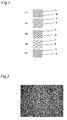
- a nonwoven fabric having a pattern as in Fig. 2 may be used in the invention.
- the height difference between the hills and the valleys of the pattern is at least 20% of the thickness of the nonwoven fabric. If having the height difference of at least 20%, the surface area of the nonwoven fabric increases and therefore the length thereof to be in contact with dirt is prolonged. Having the advantages, the nonwoven fabric is more easily handled when used for wiping off dirt.
- the dirt to be wiped off may be physically caught by the hills of the embossed pattern of the nonwoven fabric and it may therefore well adhere to the nonwoven fabric. For these reasons, the wiping capability of the nonwoven fabric is much more enhanced. Moreover, some dirt may be kept caught in the valleys of the nonwoven fabric, and do not move to other articles to stain them that are leaned with the nonwoven fabric. If the height difference is smaller than 20%, the surface of the nonwoven fabric will be flat, and if so, the nonwoven fabric could not well catch dirt and its wiping capability could not be so good. If so, in addition, the dirt once caught by the nonwoven fabric will move to other articles to stain them.
- the hills are formed to be both in the bonded regions and the non-bonded regions.
- the hills improve the wiping capability of the nonwoven fabric to well follow even the surfaces of non-flat articles to be wiped with it, and, in addition, the nonwoven fabric of the type has much improved washing resistance.
- the hills overlap with the bonded regions, and they are more hardened as the constituent fibers are concentrated therein. Accordingly, the thus-hardened hills are more effective for wiping off persistent stains.
- the nonwoven fabric for wipers of the invention has bonded regions in which the surface of the nonwoven fabric is prevented from fluffing up. Even after washed, the entangled points of the constituent fibers of the nonwoven fabric do not shift and the nonwoven fabric is therefore not deformed. Accordingly, the nonwoven fabric can be used repeatedly. In case where extra-fine fibers having edges are used therein, the nonwoven fabric is effective even for wiping off extremely fine dirt.
- the advantage of the nonwoven fabric of the type is that it may well catch such fine dirt and may readily hold it on its surface.
- the nonwoven fabric of the invention is usable for various wipers, which are, for example, for wiping noble metal articles such as jellies and for wiping dishes, tables, glass articles, electric appliances, furniture, gas cookers, etc.
- the wipers to be obtained in the invention are highly resistant to washing and can be used repeatedly, and therefore they are economical.
- Thickness of nonwoven fabric is the thickness of nonwoven fabric
- the thickness of a sample is measured at 10 points under a load of 12 gf/cm 2 applied thereto, and the data are averaged. Height difference in embossed pattern of nonwoven fabric: A CCD laser dislocation sensor, LK-2000 (by Keyence) is used. With no load applied thereto, the thickness of a sample is measured at 6 hill peaks and 6 valley bottoms thereof. The data are averaged, and the difference between the two averages is divided by the thickness of the hill peaks. This indicates the height difference.
- Splittable conjugated fibers having a cross-sectional profile of alternately-layered nylon 6 and polyethylene terephthalate (Kuraray's WRAMP, having a fineness of 3.8 dtex and a fiber length of 51 mm) alone (100%) were fed into a carding machine and processed into fiber webs .
- the resulting webs were processed by hydroentangling whereby the constituent fibers were divided into extra-fine fibers and the thus-split extra-fine fibers were entangled. After thus processed by hydroentangling. the webs were coated with an acrylic resin (by Nippon Carbide) with a gravure roll having a waved pattern of II in Fig. 1.
- the area ratio of the pattern is 13%, the binder pitch is 3.2 mm, and the binder amount is 2 g/m 2 .
- the process gave a nonwoven fabric for wipers, having a mass per unit area of 80 g/m 2 .
- the nonwoven fabric was observed, and was found to have linear bonded regions formed of the acrylic resin and non-bonded regions.
- the nonwoven fabric was observed in more detail, and it was confirmed that some ends of the extra-fine fibers in the non-bonded regions were embedded in the bonded regions and were fixed therein.
- the distance between the neighboring bonded regions was 3.0 mm.
- the data of the nonwoven fabric are given in Table 1.
- a nonwoven fabric for wipers having a mass per unit area of 80 g/m 2 was produced in the same manner as in Example 1 except for the following changes:
- the webs obtained in Example 1 were processed by hydroentangling on a herringbone-patterned net so that the net pattern was transferred onto the webs, and the webs therefore had the embossed herringbone pattern.
- the nonwoven fabric was observed, and was found to have linear bonded regions formed of the acrylic resin and non-bonded regions .
- the nonwoven fabric was observed in more detail, and it was confirmed that some ends of the extra-fine fibers in the non-bonded regions were embedded in the bonded regions and were fixed therein.
- the distance between the neighboring bonded regions was 3.0 mm. See Table 1.
- a nonwoven fabric for wipers having a unit weight of 80 g/m 2 was produced in the same manner as in Example 2 except for the following changes: Splittable conjugated fibers having a cross-sectional profile of alternately-layered nylon 6 and polyethylene terephthalate (Kuraray's WRAMP, having a fineness of 3.8 dtex and a fiber length of 51 mm) 85% and core/sheath bicomponent binder fibers of which the core is polypropylene and the sheath is polyethylene (Daiwabo's NBF(H), 2.2 dtex, 51 mm) 15% were fed into a carding machine and processed into fiber webs.
- Kuraray's WRAMP having a fineness of 3.8 dtex and a fiber length of 51 mm
- core/sheath bicomponent binder fibers of which the core is polypropylene and the sheath is polyethylene (Daiwabo's NBF(H), 2.2 dtex, 51 mm) 15%
- the resulting webs were processed by hydroentangling whereby the splittable fibers were divided into extra-fine fibers and the resulting fibers were entangled. Thus processed, the webs were heat-set and the binder fibers therein were thereby fused. The distance between the neighboring bonded regions in the nonwoven fabric thus produced was 3.0 mm. See Table 1.
- a nonwoven fabric for wipers having a mass per unit area of 80 g/m 2 was produced in the same manner as in Example 2, to which, however, the acrylic resin was not applied. See Table 1.
- a nonwoven fabric for wipers having a mass per unit area of 80 g/m 2 was produced in the same manner as in Example 3, to which, however, the acrylic resin was not applied. See Table 1.
- Splittable conjugated fibers having a chrysanthemum-patterned cross-sectional profile of radially-aligned nylon 6 and polyethylene terephthalate (having a fineness of 2.2 dtex and a fiber length of 38 mm) 40% and polyethylene terephthalate fibers (having a fineness of 16.5 dtex and a fiber length of 51 mm) 60% were fed into a carding machine and processed into fiber webs.
- the resulting fibers webs were sprayed with an acrylic emulsion (15 g/m 2 in terms of the solid content of the emulsion), and then heat-set at 150°C for 3 minutes whereby the constituent fibers were bonded to each other to give a nonwoven fabric for wipers. See Table 1.
- a square of 20 cm ⁇ 20 cm is marked on a wiper sample, and the sample is washed 5 times according to the washing test method of JIS L1096. After washed, the shrinkage percentage of the sample is measured. Based on the CD (cross direction) shrinkage percentage thereof, the sample is evaluated in 3 ranks as follows:
- a circular seal is impressed with oily ink.
- a wiper sample of 15 cm ⁇ 15 cm is folded in four. An operator carries the wiper sample in the hand, and completely wipes off the oily film with the wiper sample. The number of wiping operations that has been done before the film is completely wiped off is counted.
- the absorbance (A) of a glass sheet is measured. Moriwiper (by Sumiko Lubricant) is circularly applied to the glass sheet, and dried. After dried, the absorbance (B) of the glass sheet is measured. The glass sheet is set on the sample stand of a rubbing fastness tester. A wiper sample having a controlled water content of 100% is fitted to the friction probe of the tester, and this is moved once back and forth on the glass sheet to wipe off the stain. After this, the absorbance (C) of the glass sheet is measured.
- the wipers formed of the nonwoven fabric of the invention have good wiping capabilities and washing resistance.
- the nonwoven fabric of the invention exhibits excellent wiping capabilities to remove any and every dirt including oily stains and persistent stains under any cleaning conditions. While used for wiping off dirt, the wipers formed of the nonwoven fabric fluff up little. As their washing resistance is good, the wipers are usable repeatedly.
Landscapes
- Engineering & Computer Science (AREA)
- Textile Engineering (AREA)
- Mechanical Engineering (AREA)
- Chemical & Material Sciences (AREA)
- Chemical Kinetics & Catalysis (AREA)
- Dispersion Chemistry (AREA)
- General Chemical & Material Sciences (AREA)
- Cleaning Implements For Floors, Carpets, Furniture, Walls, And The Like (AREA)
- Nonwoven Fabrics (AREA)
Abstract
Description
- The present invention relates to a nonwoven fabric for wipers, more precisely to that for wipers which has the ability to wipe off even oily stains and caked persistent stains, not so much fluffing even when used repeatedly, and of which the washing resistance is good.
- Various nonwoven fabric wipers of extra-fine fibers have been proposed and are now widely used. For example, a wiping material is proposed, which is produced by hydroentangling and integrating heat-fusing fiber webs and extra-fine fiber webs followed by fusing the thus-entangled, heat-fusing fibers (JP-A 3-152255). The wiping material of the type may wipe off light dirt such as dust or the like but could not remove caked persistent stains. Another problem with it is that, when the wiping material is washed, its surface often fluffs up and some fibers often drop away from it. Still another problem is that it is not flexible.
- Disclosed is a nonwoven fabric for wipers, which includes mechanically divided extra-fine fibers and is bulky and of which the wiping performance and the long-term durability are good (JP-A 5-56903). The nonwoven fabric for wipers of the type is good for wiping off dust and the like but is still unsatisfactory for removing persistent stains.
- On the other hand, a nonwoven fabric for wipers is proposed, which comprises mixed fibers of extra-fine fibers and thick fibers for improving its ability to remove caked stains (JP-A 6-14860). Also proposed is a wiper produced by laminating and entangling spunlaid webs and paper sheets for improving its washing resistance (JP-A 7-67820). However, these wipers have a tough feel and are not flexible, and therefore they are not satisfactorily effective for wiping articles having a three-dimensionally patterned face.
- As mentioned above, the current situation in the art is that no one has proposed as yet a nonwoven fabric for wipers which has the ability to wipe off even oily stains and caked persistent stains and has good washing resistance.
- The present invention is to solve the problems noted above, and its object is to provide a nonwoven fabric for wipers which has the ability to well wipe off even oily stains and caked persistent stains, capable of exhibiting its excellent cleaning capabilities in accordance with three-dimensionally patterned faces of the articles to be wiped, and which has good flexibility and good washing resistance.
- Specifically, the invention is a nonwoven fabric for wipers which contains extra-fine fibers comprising, linear and/or dot-like bonded regions and non-bonded regions on its surface, the bonded regions account for from 10 to 80% of the surface area of the nonwoven fabric and the distance between the neighboring bonded regions is at most 20 mm.
-
- Fig. 1 shows some examples of the pattern of the gravure roll that may be used in the invention.
- Fig. 2 shows one example of the surface of the nonwoven fabric of the invention.
- The nonwoven fabric for wipers of the invention contains extra-fine fibers and is characterized in that its surface comprises linear and/or dot-like bonded regions and non-bonded regions. Having the bonded regions and the non-bonded regions in its surface, the nonwoven fabric of the invention has good cleaning capabilities of removing not only light dirt such as oily film or ink stains but also heavy dirt such as caked persistent stains, not giving so much fluff, and it is washable for repeated use.
- Preferably, the single fiber fineness of the extra-fine fibers for use in the nonwoven fabric of the invention is at most 0.5 dtex, more preferably from 0.05 to 0.45 dtex. The extra-fine fibers of the type may be, for example, direct spun fibers or those obtained from splittable conjugated fibers. For the extra-fine fibers for use in the invention, preferred are splittable conjugated fibers. Especially preferably, the extra-fine fibers are prepared by dividing splittable conjugated fibers each having a nearly circular cross-sectional profile. This is because the cross-sectional profile of the extra-fine fibers derived from the splittable conjugated fibers of the type may have sharp shapes, and therefore, the nonwoven fabric that contains the extra-fine fibers of the type is favorable for removing oily stains. Such splittable conjugated fibers may be mechanically processed by hydroentangling or by needlepunching or may be chemically processed for dissolution and removal or for swelling and shrinkage to give the extra-fine fibers for use in the invention.
- The splittable conjugated fibers for the invention may be formed of at least two different types of resin. The resin includes, for example, polyester polymers, polyolef in polymers, polyamide polymers, polystyrene polymers, polyacrylonitrile polymers, polyvinyl alcohol polymers, and ethylene-vinyl alcohol copolymers. One or more such polymers may be used for one component of the fibers, but these are not limitative.
- The polyesters may be fiber-forming polyesters , which are formed of, for example, aromatic dicarboxylic acids such as terephthalic acid, isophthalic acid, naphthalene-2,6-dicarboxylic acid, phthalic acid, α,β-(4-carboxyphenoxy)ethane, 4,4-dicarboxydiphenyl, 5-sodium sulfoisophthalate; or aliphatic dicarboxylic acids such as azelaic acid, adipic acid, sebacic acid; or their esters; and diols such as ethylene glycol, diethylene glycol, 1,3-propanediol, 1,4-butanediol, 1,6-hexanediol, neopentyl glycol, cyclohexane-1,4-dimethanol, polyethylene glycol, polytetramethylene glycol. Preferably, at least 80 mol% of the constituent units of the polyesters are ethylene terephthalate units.
- The polyamides include, for example, aliphatic polyamides and semiaromatic polyamides of which the principal component is nylon 6, nylon 66 or nylon 12. They may contain a minor amount of a third component.
- The conjugation morphology of these resin components to give the conjugated fibers is not specifically defined. For example, two resin components may be conjugated into bicomponent fibers having a chrysanthemum-patterned cross-sectional profile in which the two resin components are alternately radially aligned; into those having a bimetal-patterned cross-sectional profile in which the two resin components are alternately layered; or into those having a sea/island patterned cross-sectional profile in which islands of one resin component are dispersed in a sea matrix of the other resin component. Of the splittable conjugated fibers of those types, chrysanthemum-patterned fibers and bimetal-patterned fibers are preferred for use herein, since the extra-fine fibers derived from them may have a sharp cross-sectional profile and therefore they are more effective for wiping off stains, especially for wiping off oily stains.
- In the invention, heat-fusing fibers may also be used. Containing heat-fusing fibers, the shape stability of the nonwoven fabric for wipers of the invention is improved. Preferably, the proportion of the extra-fine fibers in the nonwoven fabric that contain heat-fusing fibers is at least 50%. If it is smaller than 50%, the wiping capability of the nonwoven fabric will worsen. Especially when the nonwoven fabric is used for wiping off oily stains, the proportion of the splittable conjugated fibers therein is at least 80%. In this, the heat-fusing fibers may be those of a single component, but are preferably side-by-side type or core-sheath type heat-fusing conjugated fibers of at least two resin components including those not fusing in heat treatment, since the non-fusing part of the fibers acts to retain the fiber strength. Regarding the melting point of the fusing components of the fibers, it is desirable that the melting point difference between the extra-fine fibers and the heat-fusing fibers that constitute the nonwoven fabric is at least 10°C in order that the extra-fine fibers do not fuse with the heat-fusing fibers.
- For the component for the heat-fusing fibers, various combinations may be mentioned, including, for example, 6-nylon/polyethylene, polypropylene/polyethylene, polypropylene/ethylene-vinyl acetate copolymer, polyester/polypropylene, polyester/polyethylene, 6-nylon/66-nylon, and high-density polyester/low-density polyester, but these are not limitative.
- The nonwoven fabric for wipers of the invention contains the extra-fine fibers mentioned above. For realizing excellent oil-removing capabilities and flexibility thereof, it is more desirable that the nonwoven fabric is composed of 100% extra-fine fibers. The other fibers that may be combined with the extra-fine fibers in the invention are not specifically defined, and may be any of various natural fibers and synthetic fibers.
- The method of producing the nonwoven fabric for wipers of the invention is not specifically defined. For example, it may be formed of fiber webs that are prepared according to drylaying of carding, air-laying, spun-bonding or to wetlaying. The fiber webs are preferably random-laid webs, semirandom-laid webs or parallel-laid webs.
- In the invention, it is especially preferable that the fiber webs are formed by mixing various fibers such as extra-fine fibers and heat-fusing fibers mentioned above followed by processing them into fiber webs according to a carding process or an air-laying process.
- In case where the extra-fine fibers are derived from splittable conjugated fibers by mechanically dividing them, the splittable conjugated fibers may be processed into the intended extra-fine fibers before they are formed into fiber webs, but it is desirable that the splittable conjugated fibers are formed into fiber webs and, after the resulting fiber webs are layered, they are mechanically processed by needle-punching or water-jet treatment whereby the splittable conjugated fibers in the layered webs are divided to give the intended extra-fine fibers therein and the resulting extra-fine fibers are entangled at the same time through the treatment. In this process, the fiber-to-fiber bonding in the nonwoven fabric produced may be more strengthened.
- The nonwoven fabric for wipers of the invention has, in its surface, linear and/or dot-like bonded regions and non-bonded regions, and therefore has the ability to wipe off various dirt. Specifically, the non-bonded regions of the nonwoven fabric act to wipe off light dirt such as oily stains, and the bonded regions thereof act to wipe off caked persistent stains. Therefore, the nonwoven fabric exhibits its ability to wipe off various types of dirt. In the bonded regions, the fibers are partly fixed and are harder than those in the non-bonded regions. Therefore, the fibers in these regions are more effective for wiping off persistent stains. In addition, the bonded regions enhance the wiping performance with the nonwoven fabric. This is because, as having the fixed and toughened, bonded regions, the nonwoven fabric is, as a whole, toughened in some degree and it well fits to the hand while used for wiping operation. In addition, the nonwoven fabric also has the non-bonded regions and it keeps its softness. Accordingly, the nonwoven fabric well follows even three-dimensionally patterned faces of the articles to be cleaned with it.
- It is a matter of importance that the bonded regions account for from 10 to 80% of the surface area of the nonwoven fabric. If the area of the bonded regions exceeds 80%, the nonwoven fabric will be too hard, and the its feel to the hand and its wiping performance will worsen. If so, in addition, the extra-fine fibers that are effective for wiping off light dirt such as oily stains will be covered with resin, and, as a result, the oil-wiping capability of the nonwoven fabric will worsen. On the other hand, if the area of the bonded regions is smaller than 10%, the fibers could not be satisfactorily fixed, and the surface of the nonwoven fabric will readily fluff up. If so, the nonwoven fabric could not resist to external physical shock such as washing, and the nonwoven fabric will be readily deformed and could not be used repeatedly. For better wiping capability, surface fluffing resistance and washing resistance of the nonwoven fabric, the bonded regions preferably account for from 10 to 50%, more preferably from 10 to 40%.
- The bonded regions in the invention may be formed by the use of a resin binder. For example, a resin binder of emulsion may be used. The binder resin includes, for example, acrylic resins, acrylate copolymer resins, polyurethane resins, vinyl acetate copolymer resins, epoxy resins and styrene-acrylic copolymer resins, but is not limited to them.
- The method of forming the bonded regions is not specifically defined. For example, the layered fiber webs may be partly bonded by emboss-rolling, or a resin binder may be transferred onto them through gravure-rolling. In the invention, when a gravure roll is used, it is desirable that a pattern of continuous lines is formed. For example, the patterns of (I) to (III) in Fig. 1 are preferred as they better the wiping capability and the design of the nonwoven fabric. In addition, it is desirable that at least a part of the fibers in the non-bonded regions of the nonwoven fabric may be embedded in the bonded regions for further improving the washing resistance of the nonwoven fabric. For this, the bonded regions are so formed that the distance between the neighboring bonded regions can be at most 20 mm, preferably at most 10 mm, more preferably from 2 to 8 mm.
- In the invention, the bonded regions may be formed to have a dot-like pattern of, for example, (IV) to (V) of Fig. 1. Having the pattern, the nonwoven fabric may be more flexible, and its ability to wipe off oily stains may be improved. The bonded regions may be a combination of the linear pattern and the dot - like pattern mentioned above, and various patterns may be employed for the bonded regions in accordance with the object thereof.
- The binder having permeated through the thickness of the nonwoven fabric for wipers may be localized around both faces of the nonwoven fabric or may be uniformly permeated through the depth of the nonwoven fabric, depending on the drying condition after the binder resin application.
- In any case where the binder resin has been localized around both faces of the nonwoven fabric or uniformly permeated through the depth thereof, the nonwoven fabric is prevented from fluffing up and its washing resistance is good. However, the binder resin localized around the faces of the nonwoven fabric is more effective for increasing the surface strength of the nonwoven fabric and for enhancing the wiping capability thereof to remove persistent strains. In that condition, in addition, the nonwoven fabric is soft and may well fit to the hand, and it may well follow even three-dimensionally patterned faces of the articles to be cleaned with it. To that effect, the wiping capability of the nonwoven fabric of the type is better.
- In the nonwoven fabric for wipers of the invention, it is desirable that at least a part of the individual fibers in the non-bonded regions are fixed by the bonded regions. Concretely, some fibers in the non-bonded regions of the nonwoven fabric are embedded in the bonded regions and are thereby fixed. In that condition, the nonwoven fabric well keeps its soft feel and its wiping capability, not so much fluffing up to leave its fluff, and its washing resistance is good. The nonwoven fabric of the type is very favorable for wipers.
- The nonwoven fabric for wipers of the invention has the above-mentioned, linear and/or dot-like bonded regions. For better wiping capability and better washing resistance of the nonwoven fabric, the bonded regions are so formed that the distance between the neighboring bonded regions can be at most 20 mm, preferably 2 to 10 mm. If the distance between the neighboring bonded regions is larger than 20 mm, the dimensional stability of the nonwoven fabric will lower and the washing resistance thereof will also lower. On the other hand, if the distance between them is smaller than 2 mm, the nonwoven fabric will have a hard feel. For keeping the oil-wiping capability of the extra-fine fibers as such and for ensuring better washing resistance of the nonwoven fabric, the distance between the neighboring bonded regions is most preferably from 2 to 8 mm. The distance between the neighboring bonded regions referred to in the invention is the shortest distance therebetween, and it is obtained by measuring the shortest distance between the ends of the neighboring bonded regions.
- The surface of the nonwoven fabric for wipers of the invention may be flat, but is preferably further processed to have a perforated or embossed pattern for further enhancing the wiping capability of the nonwoven fabric. Specifically, owing to the synergistic effect of the embossed pattern and the bonded regions in the surface of the nonwoven fabric, the wiping capability of the nonwoven fabric is further bettered. Another advantage thereof is that the nonwoven fabric thus having such an embossed surface well follows even three-dimensionally patterned faces of the articles to be wiped with it to exhibit its wiping effect and, in addition, it is believed that the extra-fine fibers could more readily appear on the surface of the nonwoven fabric of the type to act to wipe off light dirt such as oily stains. For processing the surface of the nonwoven fabric to make it have an embossed pattern, for example, employable is a method of hydroentangling that comprises spreading fiber webs on a belt support of a meshed resin net or metal net followed by applying water jets to them to thereby make the constituent fibers entangled. In this process, the height difference between the knuckles of the weft and those of the warp of the mesh belt is transferred onto the nonwoven fabric webs, and the nonwoven fabric thus processed is to have the intended embossed pattern on its surface. Also employable for it is another method of applying an embossing roll to the nonwoven fabric under pressure to thereby make the nonwoven fabric have the intended embossed pattern. In the invention, preferred is the method of hydroentangling, since the nonwoven fabric processed therein may have a soft feel and, even after washed, it well keeps the embossed pattern. The nonwoven fabric thus having such an embossed pattern may also be processed with a binder resin or the like to form the bonded regions therein.
- The embossed pattern referred to herein may be formed according to the methods mentioned hereinabove. For example, a nonwoven fabric having a pattern as in Fig. 2 may be used in the invention. In case where the nonwoven fabric of the type having such an embossed pattern is used in the invention, it is desirable that the height difference between the hills and the valleys of the pattern is at least 20% of the thickness of the nonwoven fabric. If having the height difference of at least 20%, the surface area of the nonwoven fabric increases and therefore the length thereof to be in contact with dirt is prolonged. Having the advantages, the nonwoven fabric is more easily handled when used for wiping off dirt. In addition, the dirt to be wiped off may be physically caught by the hills of the embossed pattern of the nonwoven fabric and it may therefore well adhere to the nonwoven fabric. For these reasons, the wiping capability of the nonwoven fabric is much more enhanced. Moreover, some dirt may be kept caught in the valleys of the nonwoven fabric, and do not move to other articles to stain them that are leaned with the nonwoven fabric. If the height difference is smaller than 20%, the surface of the nonwoven fabric will be flat, and if so, the nonwoven fabric could not well catch dirt and its wiping capability could not be so good. If so, in addition, the dirt once caught by the nonwoven fabric will move to other articles to stain them.
- In the invention, it is further desirable that the hills are formed to be both in the bonded regions and the non-bonded regions. Thus formed to be both in the bonded regions and the non-bonded regions, the hills improve the wiping capability of the nonwoven fabric to well follow even the surfaces of non-flat articles to be wiped with it, and, in addition, the nonwoven fabric of the type has much improved washing resistance. Moreover, the hills overlap with the bonded regions, and they are more hardened as the constituent fibers are concentrated therein. Accordingly, the thus-hardened hills are more effective for wiping off persistent stains.
- As so mentioned here in above, the nonwoven fabric for wipers of the invention has bonded regions in which the surface of the nonwoven fabric is prevented from fluffing up. Even after washed, the entangled points of the constituent fibers of the nonwoven fabric do not shift and the nonwoven fabric is therefore not deformed. Accordingly, the nonwoven fabric can be used repeatedly. In case where extra-fine fibers having edges are used therein, the nonwoven fabric is effective even for wiping off extremely fine dirt. The advantage of the nonwoven fabric of the type is that it may well catch such fine dirt and may readily hold it on its surface.
- The nonwoven fabric of the invention is usable for various wipers, which are, for example, for wiping noble metal articles such as jellies and for wiping dishes, tables, glass articles, electric appliances, furniture, gas cookers, etc.
- The wipers to be obtained in the invention are highly resistant to washing and can be used repeatedly, and therefore they are economical.
- The invention is described in more detail with reference to the following Examples, which, however, are not intended to restrict the scope of the invention. In the Examples, the physical properties were measured according to the methods mentioned below.
- The thickness of a sample is measured at 10 points under a load of 12 gf/cm2 applied thereto, and the data are averaged. Height difference in embossed pattern of nonwoven fabric:
A CCD laser dislocation sensor, LK-2000 (by Keyence) is used. With no load applied thereto, the thickness of a sample is measured at 6 hill peaks and 6 valley bottoms thereof. The data are averaged, and the difference between the two averages is divided by the thickness of the hill peaks. This indicates the height difference. - Splittable conjugated fibers having a cross-sectional profile of alternately-layered nylon 6 and polyethylene terephthalate (Kuraray's WRAMP, having a fineness of 3.8 dtex and a fiber length of 51 mm) alone (100%) were fed into a carding machine and processed into fiber webs . The resulting webs were processed by hydroentangling whereby the constituent fibers were divided into extra-fine fibers and the thus-split extra-fine fibers were entangled. After thus processed by hydroentangling. the webs were coated with an acrylic resin (by Nippon Carbide) with a gravure roll having a waved pattern of II in Fig. 1. The area ratio of the pattern is 13%, the binder pitch is 3.2 mm, and the binder amount is 2 g/m2. The process gave a nonwoven fabric for wipers, having a mass per unit area of 80 g/m2. The nonwoven fabric was observed, and was found to have linear bonded regions formed of the acrylic resin and non-bonded regions. The nonwoven fabric was observed in more detail, and it was confirmed that some ends of the extra-fine fibers in the non-bonded regions were embedded in the bonded regions and were fixed therein. The distance between the neighboring bonded regions was 3.0 mm. The data of the nonwoven fabric are given in Table 1.
- A nonwoven fabric for wipers having a mass per unit area of 80 g/m2 was produced in the same manner as in Example 1 except for the following changes: The webs obtained in Example 1 were processed by hydroentangling on a herringbone-patterned net so that the net pattern was transferred onto the webs, and the webs therefore had the embossed herringbone pattern. Thus obtained, the nonwoven fabric was observed, and was found to have linear bonded regions formed of the acrylic resin and non-bonded regions . The nonwoven fabric was observed in more detail, and it was confirmed that some ends of the extra-fine fibers in the non-bonded regions were embedded in the bonded regions and were fixed therein. The distance between the neighboring bonded regions was 3.0 mm. See Table 1.
- A nonwoven fabric for wipers having a unit weight of 80 g/m2 was produced in the same manner as in Example 2 except for the following changes: Splittable conjugated fibers having a cross-sectional profile of alternately-layered nylon 6 and polyethylene terephthalate (Kuraray's WRAMP, having a fineness of 3.8 dtex and a fiber length of 51 mm) 85% and core/sheath bicomponent binder fibers of which the core is polypropylene and the sheath is polyethylene (Daiwabo's NBF(H), 2.2 dtex, 51 mm) 15% were fed into a carding machine and processed into fiber webs. The resulting webs were processed by hydroentangling whereby the splittable fibers were divided into extra-fine fibers and the resulting fibers were entangled. Thus processed, the webs were heat-set and the binder fibers therein were thereby fused. The distance between the neighboring bonded regions in the nonwoven fabric thus produced was 3.0 mm. See Table 1.
- A nonwoven fabric for wipers having a mass per unit area of 80 g/m2 was produced in the same manner as in Example 2, to which, however, the acrylic resin was not applied. See Table 1.
- A nonwoven fabric for wipers having a mass per unit area of 80 g/m2 was produced in the same manner as in Example 3, to which, however, the acrylic resin was not applied. See Table 1.
- Splittable conjugated fibers having a chrysanthemum-patterned cross-sectional profile of radially-aligned nylon 6 and polyethylene terephthalate (having a fineness of 2.2 dtex and a fiber length of 38 mm) 40% and polyethylene terephthalate fibers (having a fineness of 16.5 dtex and a fiber length of 51 mm) 60% were fed into a carding machine and processed into fiber webs. The resulting fibers webs were sprayed with an acrylic emulsion (15 g/m2 in terms of the solid content of the emulsion), and then heat-set at 150°C for 3 minutes whereby the constituent fibers were bonded to each other to give a nonwoven fabric for wipers. See Table 1.
Table 1 mass per unit area (g/m2) Thickness (mm) Bonded Regions (%) Height Difference (%) in Embossed Pattern Example 1 80 0.54 13 15 Example 2 80 0.52 13 38 Example 3 80 0.51 13 33 Comp. Ex. 1 80 0.57 0 41 Comp. Ex. 2 80 0.54 0 39 Comp. Ex. 3 150 2.6 100 10 - The nonwoven fabrics for wipers obtained in the above-mentioned Examples and Comparative Examples were worked into wipers, and evaluated in the manner mentioned below. The results are given in Table 2.
- 0.1 g of water is dropped onto a mirror face through a syringe. A wiper sample of 15 cm × 15 cm is folded in four. An operator carries the wiper sample in the hand, and circularly moves it 10 times on the mirror face to wipe up the water. Then, the thus wiped mirror face is checked for the fiber leavings thereon from the wiper sample. Thus tried, the wiper sample is evaluated in 5 ranks as follows:
- 5: No fluff found.
- 4: 1 to 5 fiber leavings found.
- 3: 6 to 25 fiber leavings found.
- 2: 26 to 50 fiber leavings found.
- A square of 20 cm × 20 cm is marked on a wiper sample, and the sample is washed 5 times according to the washing test method of JIS L1096. After washed, the shrinkage percentage of the sample is measured. Based on the CD (cross direction) shrinkage percentage thereof, the sample is evaluated in 3 ranks as follows:
- A: less than +/- 3%.
- B: +/- 3% to 5%.
- C: more than +/- 5%.
- On a glass sheet, a circular seal is impressed with oily ink. A wiper sample of 15 cm × 15 cm is folded in four. An operator carries the wiper sample in the hand, and completely wipes off the oily film with the wiper sample. The number of wiping operations that has been done before the film is completely wiped off is counted.
- The absorbance (A) of a glass sheet is measured. Moriwiper (by Sumiko Lubricant) is circularly applied to the glass sheet, and dried. After dried, the absorbance (B) of the glass sheet is measured. The glass sheet is set on the sample stand of a rubbing fastness tester. A wiper sample having a controlled water content of 100% is fitted to the friction probe of the tester, and this is moved once back and forth on the glass sheet to wipe off the stain. After this, the absorbance (C) of the glass sheet is measured.
- According to the following equation, the degree of stain removal is obtained.

- Evaluation of feel:
- The feel of each wiper sample in the hand is evaluated in 3 ranks as follows:
A: Soft to the hand.
B: A little hard to the hand.
C: Hard to the hand.Table 2 Fluffing Resistance Washing resistance Oil Stains Wiping Capability Persistent Stains Wiping Capability Feel Example 1 5 A 9 56.4 A Example 2 5 A 9 57.0 A Example 3 5 A 8 51.2 A to B Comp. Example 1 2 C 8 6.6 B Comp. Example 2 3 B 9 10.2 B Comp. Example 3 3 to 4 B 7 16.4 C - As is obvious from Table 2, it is understood that the wipers formed of the nonwoven fabric of the invention have good wiping capabilities and washing resistance.
- As described in detail with reference to its preferred embodiments, the nonwoven fabric of the invention exhibits excellent wiping capabilities to remove any and every dirt including oily stains and persistent stains under any cleaning conditions. While used for wiping off dirt, the wipers formed of the nonwoven fabric fluff up little. As their washing resistance is good, the wipers are usable repeatedly.
Claims (4)
- A nonwoven fabric for wipers which contains extra-fine fibers comprising, linear and/or dot-like bonded regions and non-bonded regions on its surface, the bonded regions account for from 10 to 80% of the surface area of the nonwoven fabric and the distance between the neighboring bonded regions is at most 20 mm.
- The nonwoven fabric for wipers as defined in claim 1, of which the surface has embossed patterns of such that the height difference between the hills and the valleys of the pattern is at least 20% of the thickness of the nonwoven fabric.
- The nonwoven fabric for wipers as defined in claim 1 or 2, which is formed of 100% extra-fine fibers.
- A wiper made of the nonwoven fabric for wipers of any one of claims 1 to 3.
Applications Claiming Priority (2)
| Application Number | Priority Date | Filing Date | Title |
|---|---|---|---|
| JP2002031914 | 2002-02-08 | ||
| JP2002031914 | 2002-02-08 |
Publications (3)
| Publication Number | Publication Date |
|---|---|
| EP1342825A1 true EP1342825A1 (en) | 2003-09-10 |
| EP1342825B1 EP1342825B1 (en) | 2006-04-19 |
| EP1342825B2 EP1342825B2 (en) | 2010-11-03 |
Family
ID=27654801
Family Applications (1)
| Application Number | Title | Priority Date | Filing Date |
|---|---|---|---|
| EP20030002228 Expired - Lifetime EP1342825B2 (en) | 2002-02-08 | 2003-01-31 | Nonwoven fabric for wiper |
Country Status (9)
| Country | Link |
|---|---|
| US (1) | US20030176132A1 (en) |
| EP (1) | EP1342825B2 (en) |
| JP (1) | JP4597487B2 (en) |
| KR (1) | KR100494211B1 (en) |
| CN (1) | CN1436886B (en) |
| AU (1) | AU2003200405B9 (en) |
| DE (1) | DE60304615T3 (en) |
| SG (1) | SG128436A1 (en) |
| TW (1) | TWI229158B (en) |
Cited By (12)
| Publication number | Priority date | Publication date | Assignee | Title |
|---|---|---|---|---|
| WO2005110182A1 (en) | 2004-04-30 | 2005-11-24 | 3M Innovative Properties Company | Applicator pad and related methods |
| WO2007073885A1 (en) * | 2005-12-19 | 2007-07-05 | Oerlikon Textile Gmbh & Co. Kg | Method and device for strengthening a running fleece web, and fleece |
| DE102008033253A1 (en) * | 2008-07-15 | 2010-01-21 | Fleissner Gmbh | Producing a structured non-woven fabric, comprises impacting the non-woven that rests on a surface giving a structure with a medium such as water or vapor standing under pressure, and guiding the non-woven to be structured to a drum |
| WO2010090923A3 (en) * | 2009-02-06 | 2011-01-27 | Nike International, Ltd. | Thermoplastic non-woven textile elements |
| WO2011106663A1 (en) * | 2010-02-25 | 2011-09-01 | The Procter & Gamble Company | Bond patterns for fibrous webs |
| US9579848B2 (en) | 2009-02-06 | 2017-02-28 | Nike, Inc. | Methods of joining textiles and other elements incorporating a thermoplastic polymer material |
| EP3167788A1 (en) * | 2015-11-12 | 2017-05-17 | CMC Consumer Medical Care GmbH | Cleaning item with an absorbent base material |
| EP3187635A1 (en) * | 2015-12-30 | 2017-07-05 | Hayat Kimya Sanayi Anonim Sirketi | Soft nonwoven fabric |
| US9732454B2 (en) | 2009-02-06 | 2017-08-15 | Nike, Inc. | Textured elements incorporating non-woven textile materials and methods for manufacturing the textured elements |
| WO2017140403A1 (en) * | 2016-02-17 | 2017-08-24 | Carl Freudenberg Kg | Nonwoven with an embossed mesh pattern |
| US10682265B2 (en) | 2015-11-12 | 2020-06-16 | Pfnonwovens Llc | Nonwoven with improved abrasion resistance and method of making the same |
| US11779071B2 (en) | 2012-04-03 | 2023-10-10 | Nike, Inc. | Apparel and other products incorporating a thermoplastic polymer material |
Families Citing this family (38)
| Publication number | Priority date | Publication date | Assignee | Title |
|---|---|---|---|---|
| AU2003291518A1 (en) * | 2002-11-13 | 2004-06-03 | The Procter And Gamble Company | Nonwoven wipe with resilient wet thickness |
| US8513147B2 (en) | 2003-06-19 | 2013-08-20 | Eastman Chemical Company | Nonwovens produced from multicomponent fibers |
| US7892993B2 (en) | 2003-06-19 | 2011-02-22 | Eastman Chemical Company | Water-dispersible and multicomponent fibers from sulfopolyesters |
| US7687143B2 (en) | 2003-06-19 | 2010-03-30 | Eastman Chemical Company | Water-dispersible and multicomponent fibers from sulfopolyesters |
| US20040260034A1 (en) * | 2003-06-19 | 2004-12-23 | Haile William Alston | Water-dispersible fibers and fibrous articles |
| EP1524350B2 (en) * | 2003-10-17 | 2013-04-17 | Reifenhäuser GmbH & Co. KG Maschinenfabrik | Fiber laminates and methods for producing them |
| WO2005099549A1 (en) * | 2004-04-01 | 2005-10-27 | Yamada, Chiyoe | Cleaning tool sheet and cleaning tool |
| US7635745B2 (en) | 2006-01-31 | 2009-12-22 | Eastman Chemical Company | Sulfopolyester recovery |
| US9091005B2 (en) * | 2006-02-24 | 2015-07-28 | Mitsui Chemicals, Inc. | Nonwoven web for fastener female member |
| JP4722736B2 (en) * | 2006-03-13 | 2011-07-13 | 株式会社クラレ | Floor cleaning sheet |
| US20070254145A1 (en) * | 2006-05-01 | 2007-11-01 | The Procter & Gamble Company | Molded elements |
| US20070270071A1 (en) * | 2006-05-18 | 2007-11-22 | Greer J Travis | Nonwoven fabric towel |
| US7789870B2 (en) * | 2007-02-23 | 2010-09-07 | The Procter & Gamble Company | Nonwoven fabric for a female component of a fastening system |
| DE202007016063U1 (en) * | 2007-11-07 | 2008-03-20 | a&n&a Nord-Süd-Industrie Vertriebs GmbH & Co. KG | Embossed nonwoven |
| KR100919595B1 (en) * | 2007-11-22 | 2009-09-29 | 이왕섭 | Manufacturing method and structure coefficient of friction lower cellulose fiber clean pad |
| US8850719B2 (en) | 2009-02-06 | 2014-10-07 | Nike, Inc. | Layered thermoplastic non-woven textile elements |
| US8512519B2 (en) | 2009-04-24 | 2013-08-20 | Eastman Chemical Company | Sulfopolyesters for paper strength and process |
| JP5610786B2 (en) * | 2010-02-17 | 2014-10-22 | 大王製紙株式会社 | Industrial wipes |
| US20120183861A1 (en) | 2010-10-21 | 2012-07-19 | Eastman Chemical Company | Sulfopolyester binders |
| CN103210131B (en) * | 2010-11-22 | 2015-09-30 | 花王株式会社 | Lofty sheet and manufacture method thereof |
| KR20130033866A (en) * | 2011-09-27 | 2013-04-04 | 삼성전기주식회사 | Porous sheet and manufacturing method for porous sheet |
| US8840757B2 (en) | 2012-01-31 | 2014-09-23 | Eastman Chemical Company | Processes to produce short cut microfibers |
| US9056032B2 (en) | 2012-06-29 | 2015-06-16 | The Procter & Gamble Company | Wearable article with outwardmost layer of multicomponent fiber nonwoven providing enhanced mechanical features |
| US9617685B2 (en) | 2013-04-19 | 2017-04-11 | Eastman Chemical Company | Process for making paper and nonwoven articles comprising synthetic microfiber binders |
| EP3049564B1 (en) | 2013-09-24 | 2020-05-20 | The Procter and Gamble Company | Nonwoven web with highly detailed and structurally advantageous bond pattern |
| US9598802B2 (en) | 2013-12-17 | 2017-03-21 | Eastman Chemical Company | Ultrafiltration process for producing a sulfopolyester concentrate |
| US9605126B2 (en) | 2013-12-17 | 2017-03-28 | Eastman Chemical Company | Ultrafiltration process for the recovery of concentrated sulfopolyester dispersion |
| CN104000544A (en) * | 2014-05-21 | 2014-08-27 | 临安大拇指清洁用品有限公司 | Cleaning cloth with efficient dust collection effect |
| CN105671794A (en) * | 2014-11-18 | 2016-06-15 | 深圳科宏健科技有限公司 | Wiping cloth and preparation method thereof |
| CN104688140A (en) * | 2015-04-05 | 2015-06-10 | 高尚义 | Book type cleaning cloth |
| CN107847355B (en) * | 2015-07-15 | 2021-03-30 | 阿文提特种材料公司 | Low fiber shedding imaged hydroentangled nonwoven composites |
| CA3076220A1 (en) * | 2017-10-06 | 2019-04-11 | Berry Global, Inc. | Cleaning fabric |
| CN107901543A (en) * | 2017-11-17 | 2018-04-13 | 太原理工大学 | A kind of composite material squeezes the preparation method of oiling roller non-woven fabrics |
| JP7088669B2 (en) * | 2017-12-26 | 2022-06-21 | 日本製紙クレシア株式会社 | Non-woven wiper and its manufacturing method, manufacturing equipment |
| MY205743A (en) * | 2018-04-24 | 2024-11-11 | Kuraray Kuraflex Co Ltd | Nonwoven fabric and method for producing same |
| US11383479B2 (en) * | 2020-03-24 | 2022-07-12 | The Procter And Gamble Company | Hair cleaning implement |
| WO2024097278A1 (en) * | 2022-11-02 | 2024-05-10 | Kimberly-Clark Worldwide, Inc. | Wiping product with topographical pattern |
| CN118910811A (en) * | 2024-09-14 | 2024-11-08 | 广东厚海锐膜新材料科技有限公司 | Composite nanofiber membrane cloth and preparation method thereof |
Citations (5)
| Publication number | Priority date | Publication date | Assignee | Title |
|---|---|---|---|---|
| US4525411A (en) * | 1980-09-15 | 1985-06-25 | Firma Carl Freudenberg | Cleaning cloth |
| WO1996041041A1 (en) * | 1995-06-07 | 1996-12-19 | Kimberly-Clark Worldwide, Inc. | Fine denier fibers and fabrics made therefrom |
| US5993943A (en) * | 1987-12-21 | 1999-11-30 | 3M Innovative Properties Company | Oriented melt-blown fibers, processes for making such fibers and webs made from such fibers |
| US20010037850A1 (en) * | 1996-11-26 | 2001-11-08 | Marmon Samuel Edward | Entangled nonwoven fabrics and methods for forming the same |
| EP1175863A1 (en) * | 1999-11-30 | 2002-01-30 | Unitika Ltd. | Wiping cloth made of nonwoven fabric and process for producing the same |
Family Cites Families (11)
| Publication number | Priority date | Publication date | Assignee | Title |
|---|---|---|---|---|
| US4426417A (en) * | 1983-03-28 | 1984-01-17 | Kimberly-Clark Corporation | Nonwoven wiper |
| US4587154A (en) † | 1985-07-08 | 1986-05-06 | Kimberly-Clark Corporation | Oil and grease absorbent rinsable nonwoven fabric |
| US4925722A (en) * | 1988-07-20 | 1990-05-15 | International Paper Company | Disposable semi-durable nonwoven fabric |
| US5810954A (en) * | 1996-02-20 | 1998-09-22 | Kimberly-Clark Worldwide, Inc. | Method of forming a fine fiber barrier fabric with improved drape and strength of making same |
| JPH10251954A (en) * | 1997-03-07 | 1998-09-22 | Uni Charm Corp | Wiping sheet and its production |
| US6315864B2 (en) * | 1997-10-30 | 2001-11-13 | Kimberly-Clark Worldwide, Inc. | Cloth-like base sheet and method for making the same |
| JP3400702B2 (en) * | 1997-12-26 | 2003-04-28 | ユニ・チャーム株式会社 | Nonwoven fabric manufacturing method |
| MXPA01012972A (en) † | 1999-06-18 | 2002-09-02 | 3M Innovative Properties Co | Nonwoven sheets, adhesive articles, and methods for making the same. |
| US20030036741A1 (en) * | 1999-10-14 | 2003-02-20 | Kimberly-Clark Worldwide, Inc. | Textured airlaid materials |
| DE10002778B4 (en) * | 2000-01-22 | 2012-05-24 | Robert Groten | Use of a microfilament nonwoven fabric as a cleaning cloth |
| CN1245542C (en) * | 2003-02-28 | 2006-03-15 | 李官奇 | Synthetic fiber containing animal hair protein and manufacturing method thereof |
-
2003
- 2003-01-24 SG SG200300164A patent/SG128436A1/en unknown
- 2003-01-31 DE DE60304615T patent/DE60304615T3/en not_active Expired - Lifetime
- 2003-01-31 EP EP20030002228 patent/EP1342825B2/en not_active Expired - Lifetime
- 2003-02-04 AU AU2003200405A patent/AU2003200405B9/en not_active Ceased
- 2003-02-05 US US10/358,331 patent/US20030176132A1/en not_active Abandoned
- 2003-02-05 KR KR10-2003-0007102A patent/KR100494211B1/en not_active Expired - Fee Related
- 2003-02-06 JP JP2003029057A patent/JP4597487B2/en not_active Expired - Fee Related
- 2003-02-07 TW TW92102472A patent/TWI229158B/en not_active IP Right Cessation
- 2003-02-08 CN CN031200508A patent/CN1436886B/en not_active Expired - Lifetime
Patent Citations (5)
| Publication number | Priority date | Publication date | Assignee | Title |
|---|---|---|---|---|
| US4525411A (en) * | 1980-09-15 | 1985-06-25 | Firma Carl Freudenberg | Cleaning cloth |
| US5993943A (en) * | 1987-12-21 | 1999-11-30 | 3M Innovative Properties Company | Oriented melt-blown fibers, processes for making such fibers and webs made from such fibers |
| WO1996041041A1 (en) * | 1995-06-07 | 1996-12-19 | Kimberly-Clark Worldwide, Inc. | Fine denier fibers and fabrics made therefrom |
| US20010037850A1 (en) * | 1996-11-26 | 2001-11-08 | Marmon Samuel Edward | Entangled nonwoven fabrics and methods for forming the same |
| EP1175863A1 (en) * | 1999-11-30 | 2002-01-30 | Unitika Ltd. | Wiping cloth made of nonwoven fabric and process for producing the same |
Cited By (30)
| Publication number | Priority date | Publication date | Assignee | Title |
|---|---|---|---|---|
| WO2005110182A1 (en) | 2004-04-30 | 2005-11-24 | 3M Innovative Properties Company | Applicator pad and related methods |
| US7578023B2 (en) | 2004-04-30 | 2009-08-25 | 3M Innovative Properties Company | Applicator pad |
| WO2007073885A1 (en) * | 2005-12-19 | 2007-07-05 | Oerlikon Textile Gmbh & Co. Kg | Method and device for strengthening a running fleece web, and fleece |
| DE102008033253A1 (en) * | 2008-07-15 | 2010-01-21 | Fleissner Gmbh | Producing a structured non-woven fabric, comprises impacting the non-woven that rests on a surface giving a structure with a medium such as water or vapor standing under pressure, and guiding the non-woven to be structured to a drum |
| US10982364B2 (en) | 2009-02-06 | 2021-04-20 | Nike, Inc. | Thermoplastic non-woven textile elements |
| US12371829B2 (en) | 2009-02-06 | 2025-07-29 | Nike, Inc. | Thermoplastic non-woven textile elements |
| CN102292487A (en) * | 2009-02-06 | 2011-12-21 | 耐克国际有限公司 | Thermoplastic Nonwoven Elements |
| CN102292487B (en) * | 2009-02-06 | 2014-03-12 | 耐克国际有限公司 | Thermoplastic Nonwoven Elements |
| US9579848B2 (en) | 2009-02-06 | 2017-02-28 | Nike, Inc. | Methods of joining textiles and other elements incorporating a thermoplastic polymer material |
| US12404615B2 (en) | 2009-02-06 | 2025-09-02 | Nike, Inc. | Thermoplastic non-woven textile elements |
| US9682512B2 (en) | 2009-02-06 | 2017-06-20 | Nike, Inc. | Methods of joining textiles and other elements incorporating a thermoplastic polymer material |
| US10982363B2 (en) | 2009-02-06 | 2021-04-20 | Nike, Inc. | Thermoplastic non-woven textile elements |
| US10625472B2 (en) | 2009-02-06 | 2020-04-21 | Nike, Inc. | Methods of joining textiles and other elements incorporating a thermoplastic polymer material |
| US9732454B2 (en) | 2009-02-06 | 2017-08-15 | Nike, Inc. | Textured elements incorporating non-woven textile materials and methods for manufacturing the textured elements |
| WO2010090923A3 (en) * | 2009-02-06 | 2011-01-27 | Nike International, Ltd. | Thermoplastic non-woven textile elements |
| US10131091B2 (en) | 2009-02-06 | 2018-11-20 | Nike, Inc. | Methods of joining textiles and other elements incorporating a thermoplastic polymer material |
| US10138582B2 (en) | 2009-02-06 | 2018-11-27 | Nike, Inc. | Thermoplastic non-woven textile elements |
| US10174447B2 (en) | 2009-02-06 | 2019-01-08 | Nike, Inc. | Thermoplastic non-woven textile elements |
| WO2011106663A1 (en) * | 2010-02-25 | 2011-09-01 | The Procter & Gamble Company | Bond patterns for fibrous webs |
| US11779071B2 (en) | 2012-04-03 | 2023-10-10 | Nike, Inc. | Apparel and other products incorporating a thermoplastic polymer material |
| US12490793B2 (en) | 2012-04-03 | 2025-12-09 | Nike, Inc. | Apparel and other products incorporating a thermoplastic polymer material |
| US12490792B2 (en) | 2012-04-03 | 2025-12-09 | Nike, Inc. | Apparel and other products incorporating a thermoplastic polymer material |
| US12495852B2 (en) | 2012-04-03 | 2025-12-16 | Nike, Inc. | Knitted and woven components and articles of footwear containing the same |
| US12495851B2 (en) | 2012-04-03 | 2025-12-16 | Nike, Inc. | Apparel and other products incorporating a thermoplastic polymer material |
| US10682265B2 (en) | 2015-11-12 | 2020-06-16 | Pfnonwovens Llc | Nonwoven with improved abrasion resistance and method of making the same |
| EP3167788A1 (en) * | 2015-11-12 | 2017-05-17 | CMC Consumer Medical Care GmbH | Cleaning item with an absorbent base material |
| WO2017131597A1 (en) * | 2015-12-30 | 2017-08-03 | Hayat Kimya San. A. Ş. | Soft nonwoven fabric |
| EP3187635A1 (en) * | 2015-12-30 | 2017-07-05 | Hayat Kimya Sanayi Anonim Sirketi | Soft nonwoven fabric |
| WO2017140403A1 (en) * | 2016-02-17 | 2017-08-24 | Carl Freudenberg Kg | Nonwoven with an embossed mesh pattern |
| US11668032B2 (en) | 2016-02-17 | 2023-06-06 | Carl Freudenberg Kg | Nonwoven with an embossed mesh pattern |
Also Published As
| Publication number | Publication date |
|---|---|
| KR100494211B1 (en) | 2005-06-13 |
| EP1342825B2 (en) | 2010-11-03 |
| CN1436886B (en) | 2010-05-26 |
| JP4597487B2 (en) | 2010-12-15 |
| SG128436A1 (en) | 2007-01-30 |
| DE60304615T3 (en) | 2011-05-19 |
| US20030176132A1 (en) | 2003-09-18 |
| EP1342825B1 (en) | 2006-04-19 |
| AU2003200405A1 (en) | 2003-08-28 |
| JP2003301359A (en) | 2003-10-24 |
| TW200303384A (en) | 2003-09-01 |
| DE60304615D1 (en) | 2006-05-24 |
| CN1436886A (en) | 2003-08-20 |
| TWI229158B (en) | 2005-03-11 |
| AU2003200405B9 (en) | 2007-03-15 |
| DE60304615T2 (en) | 2007-05-03 |
| AU2003200405B2 (en) | 2006-10-12 |
| KR20030068043A (en) | 2003-08-19 |
Similar Documents
| Publication | Publication Date | Title |
|---|---|---|
| EP1342825B2 (en) | Nonwoven fabric for wiper | |
| CA2155315C (en) | Stitchbonded articles and method of making same | |
| JPS6319621B2 (en) | ||
| WO2003050339A1 (en) | Imaged nonwoven fabrics in hygienic wipe applications | |
| WO1999046119A1 (en) | Nonwoven composite laminate for cleaning pads and wipes | |
| KR101764928B1 (en) | Industrial wipe | |
| JPH0593350A (en) | Nonwoven fabric for wiping | |
| JP2000234253A (en) | Bulky nonwoven fabric, its production and wiping material using the same | |
| JP3967848B2 (en) | Nonwoven fabric for cleaning and method for producing the same | |
| JP2003230520A (en) | Non-woven fabric for wiper | |
| JP7050281B2 (en) | Laminated non-woven fabric | |
| JPH0913257A (en) | Fiber structure with a dry feeling | |
| KR20050113496A (en) | Multi-composite non woven fabric and method for making the same | |
| JP4293895B2 (en) | Laminated nonwoven fabric and abrasive nonwoven fabric | |
| JP4113516B2 (en) | Laminated nonwoven fabric and method for producing the same, and abrasive nonwoven fabric | |
| JP2004313425A (en) | Wiping sheet | |
| JPH11241259A (en) | Non-woven fabric, wiping cloth and skin material | |
| JP2005245715A (en) | Wiping cloth especially suitable for kitchen use | |
| JPH085153B2 (en) | mat | |
| JP2010216042A (en) | Ultrafine fiber nonwoven fabric and method for producing the same | |
| JPH0730837U (en) | Bedding sheets | |
| JPH04166123A (en) | Wiping cloth | |
| JPH10312240A (en) | Mouse pad |
Legal Events
| Date | Code | Title | Description |
|---|---|---|---|
| PUAI | Public reference made under article 153(3) epc to a published international application that has entered the european phase |
Free format text: ORIGINAL CODE: 0009012 |
|
| AK | Designated contracting states |
Kind code of ref document: A1 Designated state(s): AT BE BG CH CY CZ DE DK EE ES FI FR GB GR HU IE IT LI LU MC NL PT SE SI SK TR |
|
| AX | Request for extension of the european patent |
Extension state: AL LT LV MK RO |
|
| 17P | Request for examination filed |
Effective date: 20040304 |
|
| AKX | Designation fees paid |
Designated state(s): DE FR GB IT NL SE |
|
| 17Q | First examination report despatched |
Effective date: 20040428 |
|
| GRAP | Despatch of communication of intention to grant a patent |
Free format text: ORIGINAL CODE: EPIDOSNIGR1 |
|
| GRAS | Grant fee paid |
Free format text: ORIGINAL CODE: EPIDOSNIGR3 |
|
| GRAA | (expected) grant |
Free format text: ORIGINAL CODE: 0009210 |
|
| AK | Designated contracting states |
Kind code of ref document: B1 Designated state(s): DE FR GB IT NL SE |
|
| PG25 | Lapsed in a contracting state [announced via postgrant information from national office to epo] |
Ref country code: NL Free format text: LAPSE BECAUSE OF FAILURE TO SUBMIT A TRANSLATION OF THE DESCRIPTION OR TO PAY THE FEE WITHIN THE PRESCRIBED TIME-LIMIT Effective date: 20060419 Ref country code: IT Free format text: LAPSE BECAUSE OF FAILURE TO SUBMIT A TRANSLATION OF THE DESCRIPTION OR TO PAY THE FEE WITHIN THE PRESCRIBED TIME-LIMIT;WARNING: LAPSES OF ITALIAN PATENTS WITH EFFECTIVE DATE BEFORE 2007 MAY HAVE OCCURRED AT ANY TIME BEFORE 2007. THE CORRECT EFFECTIVE DATE MAY BE DIFFERENT FROM THE ONE RECORDED. Effective date: 20060419 |
|
| REG | Reference to a national code |
Ref country code: GB Ref legal event code: FG4D |
|
| REF | Corresponds to: |
Ref document number: 60304615 Country of ref document: DE Date of ref document: 20060524 Kind code of ref document: P |
|
| PG25 | Lapsed in a contracting state [announced via postgrant information from national office to epo] |
Ref country code: SE Free format text: LAPSE BECAUSE OF FAILURE TO SUBMIT A TRANSLATION OF THE DESCRIPTION OR TO PAY THE FEE WITHIN THE PRESCRIBED TIME-LIMIT Effective date: 20060719 |
|
| NLV1 | Nl: lapsed or annulled due to failure to fulfill the requirements of art. 29p and 29m of the patents act | ||
| ET | Fr: translation filed | ||
| PLBI | Opposition filed |
Free format text: ORIGINAL CODE: 0009260 |
|
| PLAX | Notice of opposition and request to file observation + time limit sent |
Free format text: ORIGINAL CODE: EPIDOSNOBS2 |
|
| 26 | Opposition filed |
Opponent name: THE PROCTER & GAMBLE COMPANY Effective date: 20070118 |
|
| PLAF | Information modified related to communication of a notice of opposition and request to file observations + time limit |
Free format text: ORIGINAL CODE: EPIDOSCOBS2 |
|
| PLAF | Information modified related to communication of a notice of opposition and request to file observations + time limit |
Free format text: ORIGINAL CODE: EPIDOSCOBS2 |
|
| PLBB | Reply of patent proprietor to notice(s) of opposition received |
Free format text: ORIGINAL CODE: EPIDOSNOBS3 |
|
| PUAH | Patent maintained in amended form |
Free format text: ORIGINAL CODE: 0009272 |
|
| STAA | Information on the status of an ep patent application or granted ep patent |
Free format text: STATUS: PATENT MAINTAINED AS AMENDED |
|
| 27A | Patent maintained in amended form |
Effective date: 20101103 |
|
| AK | Designated contracting states |
Kind code of ref document: B2 Designated state(s): DE FR GB IT NL SE |
|
| REG | Reference to a national code |
Ref country code: FR Ref legal event code: PLFP Year of fee payment: 14 |
|
| REG | Reference to a national code |
Ref country code: FR Ref legal event code: PLFP Year of fee payment: 15 |
|
| PGFP | Annual fee paid to national office [announced via postgrant information from national office to epo] |
Ref country code: FR Payment date: 20161215 Year of fee payment: 15 |
|
| PGFP | Annual fee paid to national office [announced via postgrant information from national office to epo] |
Ref country code: DE Payment date: 20170125 Year of fee payment: 15 |
|
| PGFP | Annual fee paid to national office [announced via postgrant information from national office to epo] |
Ref country code: GB Payment date: 20170125 Year of fee payment: 15 |
|
| PGFP | Annual fee paid to national office [announced via postgrant information from national office to epo] |
Ref country code: IT Payment date: 20170123 Year of fee payment: 15 |
|
| REG | Reference to a national code |
Ref country code: DE Ref legal event code: R119 Ref document number: 60304615 Country of ref document: DE |
|
| GBPC | Gb: european patent ceased through non-payment of renewal fee |
Effective date: 20180131 |
|
| PG25 | Lapsed in a contracting state [announced via postgrant information from national office to epo] |
Ref country code: DE Free format text: LAPSE BECAUSE OF NON-PAYMENT OF DUE FEES Effective date: 20180801 Ref country code: FR Free format text: LAPSE BECAUSE OF NON-PAYMENT OF DUE FEES Effective date: 20180131 |
|
| REG | Reference to a national code |
Ref country code: FR Ref legal event code: ST Effective date: 20180928 |
|
| PG25 | Lapsed in a contracting state [announced via postgrant information from national office to epo] |
Ref country code: GB Free format text: LAPSE BECAUSE OF NON-PAYMENT OF DUE FEES Effective date: 20180131 |
|
| PG25 | Lapsed in a contracting state [announced via postgrant information from national office to epo] |
Ref country code: IT Free format text: LAPSE BECAUSE OF NON-PAYMENT OF DUE FEES Effective date: 20180131 |