EP1341083B1 - Parallel-process execution method and multiprocessor-type computer - Google Patents
Parallel-process execution method and multiprocessor-type computer Download PDFInfo
- Publication number
- EP1341083B1 EP1341083B1 EP03250990A EP03250990A EP1341083B1 EP 1341083 B1 EP1341083 B1 EP 1341083B1 EP 03250990 A EP03250990 A EP 03250990A EP 03250990 A EP03250990 A EP 03250990A EP 1341083 B1 EP1341083 B1 EP 1341083B1
- Authority
- EP
- European Patent Office
- Prior art keywords
- parallel
- cpu
- program
- idle
- processes
- Prior art date
- Legal status (The legal status is an assumption and is not a legal conclusion. Google has not performed a legal analysis and makes no representation as to the accuracy of the status listed.)
- Expired - Lifetime
Links
Images



Classifications
-
- G—PHYSICS
- G06—COMPUTING OR CALCULATING; COUNTING
- G06F—ELECTRIC DIGITAL DATA PROCESSING
- G06F9/00—Arrangements for program control, e.g. control units
- G06F9/06—Arrangements for program control, e.g. control units using stored programs, i.e. using an internal store of processing equipment to receive or retain programs
- G06F9/46—Multiprogramming arrangements
- G06F9/50—Allocation of resources, e.g. of the central processing unit [CPU]
- G06F9/5061—Partitioning or combining of resources
- G06F9/5066—Algorithms for mapping a plurality of inter-dependent sub-tasks onto a plurality of physical CPUs
-
- G—PHYSICS
- G06—COMPUTING OR CALCULATING; COUNTING
- G06F—ELECTRIC DIGITAL DATA PROCESSING
- G06F8/00—Arrangements for software engineering
- G06F8/40—Transformation of program code
- G06F8/41—Compilation
- G06F8/45—Exploiting coarse grain parallelism in compilation, i.e. parallelism between groups of instructions
- G06F8/451—Code distribution
Definitions
- the present invention relates to a parallel-process execution method, a multiprocessor-type computer, a parallel-process execution program, and a recording medium in which the parallel-process execution program is recorded.
- the parallel-process execution method executes a parallel process and another process in a time-sharing manner
- the multiprocessor-type computer executes such a parallel-process execution method
- the parallel-process execution program makes a computer execute such a parallel-process execution method
- the recording medium stores such a parallel-process execution program.
- Computers each having a plurality of processors can execute a single program in parallel by using the plurality of processors.
- a program which can be executed in parallel is referred to as a parallel program.
- a parallel program When a parallel program is executed, a plurality of parallel processes are generated from the parallel program, where the respective parallel processes can be executed in parallel.
- the plurality of parallel processes are executed in parallel by separate processors.
- the respective processors exchange data with each other, and execute a sequence of processing defined in the parallel program.
- the process is a unit of processing containing at least one thread, and the processor is a processing device such as a CPU (central processing unit) or MPU (micro processing unit).
- the processors are assumed to be CPUs.
- a CPU may execute a third process.
- execution of the third process may not be completed when execution of the second parallel process which is required to exchange data with the first parallel process reaches a check point. Therefore, a further synchronization wait time occurs in the CPU which executes the second parallel process. The occurrence of such a synchronization wait time decreases the processing efficiency of the computer system.
- charges are made for the synchronization waits. This is disadvantageous to users of the computer system.
- a plurality of CPUs in a computer system operate in a time-sharing manner so that parallel processes and other processes are executed in predetermined periods (phases) which simultaneously begin and end in the plurality of CPUs. That is, executions of a plurality of parallel processes generated from a parallel program simultaneously begin and end in the plurality of CPUs.
- synchronization wait times which occur during executions of parallel processes in the system disclosed in JPP No. 10-74150 become the same as synchronization wait times which occur in the case where the time-sharing processing is not performed. Therefore, it is possible to minimize the synchronization wait times which occur between parallel processes constituting a parallel program, and prevent the decrease in the system efficiency.
- a turnaround time i.e., a time from a start to an end of execution of a process
- the lengths of the respective phases are fixed. Therefore, the turnaround time cannot be guaranteed for each parallel program.
- 50% of the processing capability of a multiprocessor-type computer is required to be used. According to the process scheduling method disclosed in JPP No. 10-74150, only a time corresponding to one phase (e.g., 10%) can be allocated for execution of such a parallel program, and therefore it is impossible to guarantee turnaround times.
- a scheduling method by which a turnaround time is guaranteed is referred to as a turnaround preference policy.
- a period is defined on a time axis, and is equally divided into 10 to 20 unit times (which are referred to as timeslots), and the timeslots are allocated to parallel processes.
- the percentage of timeslots allocated to each parallel process is referred to as a CPU allocation ratio.
- the priorities of the processes to be executed in the respectively allocated timeslots are maximized.
- the parallel processes are executed in the allocated timeslots in harmony with each other with high reliability.
- no process other than the above processes to which the timeslots are allocated is executed, in timeslots which are not allocated to the above processes, or by a CPU which is in an idle state due to an I/O wait and the like. Therefore, turnaround times are guaranteed.
- timeslots which are not allocated to processes are referred to as idle CPU resources.
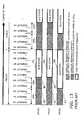
- Fig. 13 is a diagram indicating execution operations in accordance with the conventional turnaround preference policy.
- the parallel processes A1 to A3 are respectively executed by the CPU#0 to CPU#2, in the timeslots #0 to #2.
- the parallel processes B1 and B2 are respectively executed by the CPU#0 and CPU#1, in the timeslots #3 and #4.
- the CPU#0 and CPU#1 are respectively in the idle states P1 and P2, in the timeslots #5 to #9, and the CPU#2 is in the idle state P3 in the timeslots #3 to #9.
- the parallel processes A1 to A3 and the parallel processes B1 and B2 are executed in only the allocated timeslots, and are not executed in the other timeslots. Therefore, the idle times of the CPUs become long, and the utilization ratio of the system is small. That is, although the guarantee of the turnaround times is beneficial to users, the small throughput of the entire system is disadvantageous to the service provider of the computer system.
- FRANKE H ET AL 'Gang scheduling for highly efficient, distributed multiprocessor systems' FRONTIERS OF MASSIVELY PARALLEL COMPUTING, 1996.
- PROCEEDINGS FRONTIERS '96. SIXTH SYMPOSIUM ON THE ANNAPOLIS, MA, USA 27-31 OCT. 1996, LOS ALAMITOS, CA, USA, IEEE COMPUT. SOC, US, 27 October 1996 (1996-10-27), pages 4-12, XP010201571 ISBN: 0-8186-7551-9 discloses a parallel-process execution method in which a set of threads or processes to be executed at the same time is called a "gang" (job). Each parallel job is executed within a "class" which is allocated a fraction of the execution time.
- the execution time allocated to each job is arranged to ensure gang scheduling.
- each gang member simply executes for the assigned fraction of the execution time. If there are empty classes (idle slots), the time is reallocated, making use of a Local Scheduling Table which records classes, execution time fractions, a "pids" field specifying local processes or gang members, and an empty cycles field indicating how the time of an empty class is to be reallocated.
- One way of reallocation is to give preference to bigger jobs, i.e. jobs in a higher class.
- a parallel process execution method for executing, in cycles of a predetermined period and by a plurality of processors in parallel, processes generated from at least one parallel program.
- a multiprocessor type computer comprises:
- a parallel-process execution program as set forth in claim 7. This program may be recorded on a recording medium.
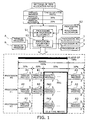
- Fig. 1 is a diagram illustrating the basic principle of the present invention.
- the parallel-process execution method according to the present invention, at least one parallel program is executed by a multiprocessor-type computer having a plurality of processors in a time-sharing manner.
- the plurality of processors are identified with identifiers #0 to #2.
- the parallel programs A and B are executed in a time-sharing manner.
- step S1 parallel processes A1, A2, A3, B1, or B2 generated from parallel programs A and B are assigned to processing time periods so that the parallel processes A1 to A3, or B1 and B2 can operate in parallel for time periods corresponding to processor allocation ratios preset for the parallel programs A and B, where the processing time periods are respectively defined for the plurality of processors 1 to 3 within every predetermined period (cycle).
- Each processor allocation ratio (time allocation ratio) is preset for a parallel program and a processor, and is a percentage of a time in which a parallel process generated from the parallel program occupies the processor in each predetermined period.
- the processor allocation ratio (time allocation ratio) for the parallel program A is set to 30%
- the processor allocation ratio (time allocation ratio) for the parallel program B is set to 20%.
- step S3 the plurality of processors 1 to 3 execute the plurality of parallel processes which are assigned to the respective processing time periods.
- the executions of the plurality of parallel processes PA1 to PA3 simultaneously begin.
- executions of the plurality of parallel processes PA1 to PA3 are simultaneously ended.
- data are exchanged between the plurality of processors which execute the plurality of parallel processes, when necessary.
- a multiprocessor-type computer performing time sharing processing is used, and the time periods corresponding to the processor allocation ratios (which are preset for parallel programs) are respectively allocated for the parallel programs so that the parallel programs operate in parallel in the multiprocessor type computer.
- a plurality of parallel processes are assigned to idle time periods in the processing time periods of the plurality of processors to which no process has been assigned yet. Therefore, the throughput of the entire system can be increased. Further, since more than one parallel process generated from each parallel program simultaneously begins and ends, it is possible to prevent increase in the synchronization wait times for data exchange which is conventionally caused by the time sharing processing.
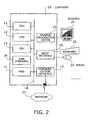
- Fig. 2 is a diagram illustrating an exemplary hardware construction of a multiprocessor-type computer to which the present invention can be applied.
- a plurality of CPUs 11 to 13 control the entire system.
- the CPUs 11 to 13 are connected with each other through a bus 18, and execute processes which are generated based on a shared program or the like stored in a RAM 19.
- each of the CPUs 11 to 13 is connected through the bus 18 to the RAM 19, a hard disk drive (HDD) 14, a graphic processing device 15, an input interface 16, and a communication interface 17.
- HDD hard disk drive
- a monitor 20 is connected to the graphic processing device 15, which makes the monitor 20 display an image on an screen in accordance with an instruction from the CPUs 11 to 13.
- a keyboard 21 and a mouse 22 are connected to the input interface 16, which transmits signals transmitted from the keyboard 21 and the mouse 22, to the CPUs 11 to 13 through the bus 18.
- the communication interface 17 is connected to a network 23, which is, for example, a wide-area network such as the Internet.
- the communication interface 17 is provided for exchanging data with other computers through the network 23.
- Fig. 3 is a block diagram illustrating the functions of the operating system (OS) for realizing the embodiment.
- OS operating system
- the OS 30 is booted in the computer 10.
- the OS 30 includes a timeslot-assignment map 31, an assignment bit map 32, an idle-timeslot map 33, a graphical user interface (GUI) 34, programs 35, a resource management system 36, and a CPU-resource additional-allocation system 37.
- the resource management system 36 and the CPU-resource additional-allocation system 37 are arranged in one of the CPUs 11 to 13.
- the OS 30 recognizes the CPUs 11 to 13 by the identifiers CPU#0, CPU#1, and CPU#2, respectively.
- the timeslot-assignment map 31 is data defining a schedule of operations for harmonizing process execution timings.
- arbitrary data can be registered as the timeslot-assignment map 31 when the data is inputted by user's manipulation.
- an assignment of a process to be executed by each CPU in each timeslot is registered. Therefore, based on the timeslot-assignment map 31, it is possible to recognize which process is assigned to the current timeslot of each CPU. Details of the timeslot-assignment map 31 are explained later.
- the assignment bit map 32 is data defining CPUs to which processes generated from each program can be assigned. In this data, an assignment of a process which each CPU can execute is indicated by bit information (0 or 1) corresponding to each program. Therefore, based on the assignment bit map 32, it is possible to recognize to which CPU the processes generated from each program can be assigned. Details of the assignment bit map 32 are explained later.
- the idle-timeslot map 33 stores bit information indicating the timeslots to which processes are assigned in the timeslot-assignment map 31 or the timeslots to which processes are not yet assigned in the timeslot-assignment map 31 (i.e., idle-CPU-resource information). Therefore, based on the idle-timeslot map 33, it is possible to recognize which timeslot is idle. Details of the idle-timeslot map 33 are explained later.
- the GUI 34 interprets the signals inputted from input devices such as the keyboard 21 and the mouse 22, generates various commands, and sends the generated commands to the resource management system 36. Thus, an interactive process is generated in the resource management system 36. In addition, the GUI 34 displays on the monitor 20 information sent from the resource management system 36.
- Each of the programs 35 is a parallel program or nonparallel program.
- the parallel program is a program which can be executed by CPUs in parallel
- the nonparallel program is a program which is executed by one of the CPUs.
- at least a portion of each of the programs 35 is read from the HDD 14 into the RAM 19.
- the resource management system 36 refers to information registered in the assignment bit map 32 and the CPU-resource additional-allocation system 37, and assigns processes to each CPU. Details of the above information registered in the assignment bit map 32 and the CPU-resource additional-allocation system 37 are explained later, and details of the resource management system 36 are also explained later with reference to Fig. 4.
- the CPU-resource additional-allocation system 37 selects a parallel program for which idle CPU resources are to be additionally allocated, and determines whether or not the parallel program can operate in a harmonized manner by using the idle CPU resources. In addition, the CPU-resource additional-allocation system 37 registers a result of the determination in the idle-timeslot map 33, and sends a command to the resource management system 36. Details of the CPU-resource additional-allocation system 37 are explained later with reference to Fig. 4.
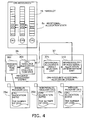
- Fig. 4 is a diagram illustrating details of constructions of the resource management system and the additional allocation system.
- the operations of the resource management system 36 and the CPU-resource additional-allocation system 37 in Fig. 3 are realized by at least one of the CPUs 11 to 13. After messages are exchanged between the resource management system 36 and the CPU-resource additional-allocation system 37, the resource management system 36 and the CPU-resource additional-allocation system 37 operate independently of each other.
- the resource management system 36 comprises a CPU-resource allocation-and-deallocation unit 361 and a process execution unit 362, where the CPU-resource allocation-and-deallocation unit 361 assigns processes to CPU resources, and the process execution unit 362 executes the assigned processes.
- the resources on the system managed by the resource management system 36 include CPU resources and memory resources. Since the present invention is mainly related to utilization of the CPU resources, the CPU resources are explained below.
- the CPU resources are data processing functions realized by the CPUs 11 to 13, and are managed on a timeslot-by-timeslot basis.
- the timeslot (TS) is a unit of allocation of the CPU resources. That is, CPU usage times can be allocated to the processes in timeslots.
- a percentage of timeslots allocated to a processor (except for the additionally allocated timeslots) in each period is referred to as a CPU allocation ratio.
- the CPU-resource allocation-and-deallocation unit 361 allocates CPU resources to processes for executing a program, according to a CPU allocation ratio and a degree of parallelism required by the program, and deallocates CPU resources allocated to completed processes, where the degree of parallelism corresponds to the number of CPUs. At this time, the state of the idle CPU resources is changed.
- the CPU-resource allocation-and-deallocation unit 361 performs processing for priority control (which is different from the processing performed by the additional-allocation-object selection unit 371). For example, in the processing for priority control, the execution priority is raised so that processes are executed by CPU resources to which the processes are assigned, or lowered so that a process other than a process which is assigned to a CPU resource is not executed by the CPU resource.
- the execution priority is set for each process, and indicates a rank of priority based on which a CPU determines one of a plurality of processes to be executed. Processes of programs which are executed through the resource management system are assigned to timeslots of the CPUs, and processes which are not executed through the resource management system are not assigned to timeslots of the CPUs. The processes which are not executed through the resource management system are determined to be or not to be executed based on the execution priority. Specifically, each CPU executes a process having the highest execution priority.
- the CPU-resource allocation-and-deallocation unit 361 controls switching of processes executed by the process execution unit 362.
- processing performed by the process execution unit 362 is interrupted and a context is switched in response to determination of a process to be executed in the coming timeslot. That is, a context of the process which has been executed by the process execution unit 362 is saved, and a context corresponding to the process to be executed is passed to the process execution unit 362.
- the contexts are information which is necessary for execution of the respective processes, and include, for example, a value in a program counter at the time of the interruption of the process and the like.
- the CPU-resource allocation-and-deallocation unit 361 assigns at least one process to CPU resources in accordance with CPU allocation ratios.
- the CPU-resource allocation-and-deallocation unit 361 notifies the CPU-resource additional-allocation system 37 of the change of the state, and prompts the CPU-resource additional-allocation system 37 to perform additional allocation of idle CPU resources.
- the CPU-resource allocation-and-deallocation unit 361 refers to registered information, which is information on additional allocation such as the idle-timeslot map 33, and explained in detail later.
- the CPU-resource allocation-and-deallocation unit 361 determines processes to be executed in idle timeslots based on the registered information (i.e., assigns the processes to the idle timeslots).
- the process execution unit 362 generates processes (parallel processes and/or a nonparallel process) based on a plurality of parallel programs 35a to 35c and a command sent from the GUI 34, and executes the generated processes in a time-sharing manner. At this time, the process execution unit 362 executes processes assigned to CPU resources.
- the CPU-resource additional-allocation system 37 comprises an additional-allocation-object selection unit 371 and a permissibility-of-additional-allocation determination unit 372, where the additional-allocation-object selection unit 371 selects parallel processes to which idle CPU resources are to be additionally allocated, and the permissibility-of-additional-allocation determination unit 372 determines whether or not the parallel processes can operate in a harmonized manner by using the idle CPU resources.
- the CPU-resource additional-allocation system 37 operates when parallel processes are submitted or ended.
- the additional-allocation-object selection unit 371 selects a parallel program for which idle CPU resources are to be additionally allocated. Specifically, the additional-allocation-object selection unit 371 sorts and manages the assignment bit map 32 for each parallel program according to a CPU allocation ratio and a degree of parallelism which are required by the parallel program, as explained later with reference to Fig. 8.
- the degree of parallelism is the number of CPUs which execute, in parallel, parallel processes generated from a parallel program.
- the additional-allocation-object selection unit 371 selects parallel processes in decreasing order of the CPU allocation ratio. When more than one parallel program requires an identical CPU allocation ratio, the additional-allocation-object selection unit 371 selects parallel processes in decreasing order of the degree of parallelism.
- the permissibility-of-additional-allocation determination unit 372 determines whether or not the parallel program selected by the additional-allocation-object selection unit 371 can operate in a harmonized manner by using idle CPU resources. Only when yes is determined, additional allocation of CPU resources is permitted, i.e., information indicating the permission is registered in the idle-timeslot map 33. When the registration is completed, the permissibility-of-additional-allocation determination unit 372 notifies the CPU-resource allocation-and-deallocation unit 361 of the completion of the registration.
- the permissibility-of-additional-allocation determination unit 372 may generate a temporary additional assignment map having the same structure as the timeslot-assignment map 31 (i.e., the structure which enables allocation processing by the resource management system 36). Further, when the permissibility-of-additional-allocation determination unit 372 notifies the CPU-resource allocation-and-deallocation unit 361 of the completion of the registration, the permissibility-of-additional-allocation determination unit 372 also sends information necessary for the allocation processing, such as CPU numbers and timeslots which are registered. Then, the resource management system 36 performs the additional allocation based on such information.
- the additional allocation can be performed by reference to the timeslot-assignment map 31, the assignment bit map 32, and the idle-timeslot map 33, or to the temporary additional assignment map or the information necessary for the allocation processing which is sent from the permissibility-of-additional-allocation determination unit 372 to the CPU-resource allocation-and-deallocation unit 361.
- the information necessary for the allocation processing is simply referred to as registered information. Details of the permissibility-of-additional-allocation determination unit 372 are explained later with reference to Fig. 9.
- the process execution unit 362 When parallel programs 35a, 35c, and nonparallel program 35b are submitted to the above construction, the process execution unit 362 generates parallel processes #11, #12, #31, and #32, and nonparallel process #21.
- the CPU-resource allocation-and-deallocation unit 361 sends a message to the CPU-resource additional-allocation system 37. Then, the permissibility-of-additional-allocation determination unit 372 in the CPU-resource additional-allocation system 37 registers additional allocation of idle CPU resources in the idle-timeslot map 33, and notifies the CPU-resource allocation-and-deallocation unit 361 of completion of the registration of the allocation.
- the CPU-resource allocation-and-deallocation unit 361 When the CPU-resource allocation-and-deallocation unit 361 is notified of the completion of the registration of the allocation, the CPU-resource allocation-and-deallocation unit 361 performs additional allocation in accordance with the registered information in the idle-timeslot map 33 (which is sent with the notification) as indicated in Fig. 4 as "Additional-allocation State Ex.”
- the additional-allocation state Ex is a state of additional allocation in accordance with the registered information sent with the notification.
- the process execution unit 362 makes the corresponding CPUs execute the processes in accordance with the above additional allocation.
- the parallel processes #11 and #12 of the parallel program (#1) 35a are entered in ones of the timeslots TS by normal allocation, and the nonparallel process #21 of the nonparallel program (#2) 35b and the parallel processes #31 and #32 of the parallel program (#3) 35c are entered in several other ones of the timeslots TS by additional allocation.
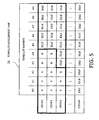
- Fig. 5 is a diagram illustrating an example of a timeslot-assignment map.
- each period is divided into ten timeslots, and the timeslot numbers #0 to #9 are assigned to the respective timeslots.
- the timeslot-assignment map 31 a process which is to be executed in each of the timeslots #0 to #9 by each of a plurality of CPUs #0 to #M is set.
- the three CPUs #0 to #2 may be referred to as all CPUs.
- parallel processes generated from a parallel program A are set in the timeslots #0 to #2 of all of the CPUs #0 to #2, and parallel processes generated from a parallel program B are set in the timeslots #3 and #4 of the CPUs #0 and #1.
- No process is set in the timeslots #3 and #4 of the CPU #2 and the timeslots #5 to #9 of the CPUs #0 to #2. That is, the timeslots #3 and #4 of the CPU #2 and the timeslots #5 to #9 of the CPUs #0 to #2 are idle timeslots.
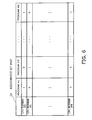
- Fig. 6 is a diagram illustrating an example of an assignment bit map.
- parallel processes are assigned to the respective CPUs.
- the assignment bit map 32 of Fig. 6 a value indicating whether or not there is a process to be executed by each of the CPUs #0 to #M in each of the parallel programs #1 to #N is set.
- the value is set as bit information indicating 0 or 1, and a series of bits indicating allocations of the CPUs #0 to #M in each column can be simultaneously used in calculation.
- the series of bits may have a data form having a unit length of a byte, word, or double word.
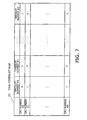
- Fig. 7 is a diagram illustrating an example of an idle-timeslot map.
- each period is divided into ten timeslots, and the timeslot numbers #0 to #9 are assigned to the respective timeslots.
- a value indicating whether or not there is a process to be executed by each of the CPUs #0 to #M in each of the timeslots #0 to #9 is set.
- the value is set as bit information indicating 0 or 1, and a series of bits indicating allocations of the CPUs #0 to #M and corresponding to each timeslot can be simultaneously used in calculation.
- the series of bits may have a data form having a unit length of a byte, word, or double word.
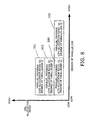
- Fig. 8 is a diagram illustrating an example of selection priority assignment for preferential selection.
- the ordinate corresponds to the CPU allocation ratio
- the abscissa corresponds to the degree of parallelism.
- Fig. 8 indicates the selection priorities of the respective parallel programs 101 to 104 indicated in the assignment bit map 32.
- the selection priorities of parallel programs are assigned in decreasing order of the CPU allocation ratio
- the selection priorities of parallel programs having an identical CPU allocation ratio are assigned in decreasing order of the degree of parallelism.
- a higher selection priority is assigned to a parallel program indicated in an upper area.
- a higher selection priority is assigned to the right one of the parallel programs 103 and 104 having the identical CPU allocation ratio than the left one.
- the highest selection priority is assigned to the parallel program 101, and the second highest selection priority is assigned to the parallel program 102. Since the parallel programs 103 and 104 have the same CPU allocation ratio, the third highest selection priority is assigned to the parallel program 103, and the lowest selection priority is assigned to the parallel program 104.
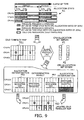
- Fig. 9 is a diagram indicating a determination procedure in the permissibility-of-additional-allocation determination unit.
- the permissibility-of-additional-allocation determination unit 372 determines whether or not the parallel processes can operate in a harmonized manner by using idle CPU resources, and whether or not additional allocation of idle CPU resources is permitted.
- the permissibility-of-additional-allocation determination unit 372 determines whether or not additional allocation of idle CPU resources is permitted, based on the data by using the following formula (1) for determination.
- P i & E k P i : Additional Allocation Permitted P i & E k ⁇ P i : Additional Allocation Not Permitted ⁇
- P i is a bit series indicating CPUs allocated to parallel processes generated from a parallel program i in the assignment bit map 32
- E k is a bit series indicating idle timeslots having a timeslot number k in the idle-timeslot map 33 (which is indicated in Fig. 9 and is hereinbelow referred to as the idle-timeslot map TS1).
- a bitwise logical product of the bit series P i in the assignment bit map 32 and the bit series E k in the idle-timeslot map 33 is obtained, and the determination about the permission is made based on whether or not the set of the logical products coincides with bit series P i .
- the allocation state S1 is a state of CPU resources allocated based on the timeslot-assignment map 31.
- the idle-timeslot map is denoted by TS1.
- a bit series indicating CPUs required to be allocated to parallel processes generated from the parallel program A is indicated as the CPU allocation bit series P 1
- a bit series indicating CPUs required to be allocated to parallel processes generated from the parallel program B is indicated as the CPU allocation bit series P 2 .
- the result PR1 is obtained by the determination processing.
- the result PR2 is obtained by the determination processing. That is, as illustrated in Fig. 9, it is possible to recognize the timeslots which can be allocated to the parallel programs A and B. Then, the idle-timeslot map TS1 is updated to the idle-timeslot map TS2.
- the CPU-resource allocation-and-deallocation unit 361 in the resource management system 36 additionally assigns the parallel processes to the CPU resources.
- the execution state of the parallel processes to which the CPU resources are allocated in accordance with the idle-timeslot map TS2 is explained later together with the advantages of embodiments of the invention by referring to Fig. 10.
- Fig. 11 is a flow diagram indicating processing for execution of parallel processes in the present embodiment.
- the processing of Fig. 11 is performed by one of the CPUs when parallel processes are submitted into the system or completed.
- the sequence of processing indicated in Fig. 11 is explained below step by step, where the names of the functions referred to in Fig. 11 are based on Figs. 3 and 4.
- Step S11 The CPU-resource allocation-and-deallocation unit 361 in the resource management system 36 allocates CPU resources to processes included in a program according to a CPU allocation ratio and the number of CPUs which are required by the program, and deallocates CPU resources allocated to completed processes. At this time, the state of the idle CPU resources is changed.
- Step S12 The CPU-resource allocation-and-deallocation unit 361 in the resource management system 36 notifies the CPU-resource additional-allocation system 37 of the change of the state of the idle CPU resources, and prompts the CPU-resource additional-allocation system 37 to perform additional allocation of idle CPU resources. Thereafter, the resource management system 36 and the CPU-resource additional-allocation system 37 operate independently of each other. The operations in the following steps S13 to S18 are performed by the CPU-resource additional-allocation system 37. In addition, the CPU-resource allocation-and-deallocation unit 361 performs processing for priority control (which is different from the processing performed by the additional-allocation-object selection unit 371).
- the execution priority is raised so that a parallel process which is assigned to a CPU resource in step S11 can operate by using the CPU resource, or lowered so that a parallel process other than a parallel process which is assigned to a CPU resource in step S11 can not operate by using the CPU resource.
- the CPU resources are controlled to be used for execution of parallel processes to which high execution priorities are assigned. That is, when the execution priorities of the parallel processes to which the CPU resources are allocated in step S11 become high, the parallel processes operate by using the CPU resources.
- the additional-allocation-object selection unit 371 in the CPU-resource additional-allocation system 37 selects a parallel program to which idle CPU resources are to be additionally allocated. At this time, the additional-allocation-object selection unit 371 selects a parallel program i according to a CPU allocation ratio and a degree of parallelism. In addition, the target timeslot number k in the idle-timeslot map 33 is initialized (i.e., k is set to zero).
- Step S14 The additional-allocation-object selection unit 371 in the CPU-resource additional-allocation system 37 obtains a bitwise logical product I of a portion of the assignment bit map 32 corresponding to the parallel program i and a portion of the idle-timeslot map 33 corresponding to the target timeslot number k (see Fig. 9).
- Step S15 The permissibility-of-additional-allocation determination unit 372 in the CPU-resource additional-allocation system 37 determines whether or not the parallel processes generated from the parallel program selected in step S13 can operate in a harmonized manner by using idle CPU resources. Only when yes is determined, additional allocation of CPU resources is permitted. That is, the permissibility-of-additional-allocation determination unit 372 in the CPU-resource additional-allocation system 37 determines whether or not the bitwise logical product I coincides with the portion of the assignment bit map 32 corresponding to the parallel program i.
- step S16 When the bitwise logical product I coincides with the portion of the assignment bit map 32 corresponding to the parallel program i, the operation goes to step S16. When the bitwise logical product I does not coincide with the portion of the assignment bit map 32 corresponding to the parallel program i, the operation goes to step S17. When the operation goes to step S17, the target timeslot number k is incremented by one (i.e., k is incremented to k+1) so that the object to be processed moves to the next timeslot in the idle-timeslot map 33.
- Step S16 Since it is determined in step S15 that the bitwise logical product I coincides with the portion of the assignment bit map 32 corresponding to the parallel program i, the permissibility-of-additional-allocation determination unit 372 in the CPU-resource additional-allocation system 37 updates the portion of the idle-timeslot map 33 corresponding to the target timeslot number k.
- the updated idle-timeslot map 33 (indicating idle CPU resources) is referred to by the resource management system 36 for additional allocation of idle CPU resources.
- Step S17 The permissibility-of-additional-allocation determination unit 372 in the CPU-resource additional-allocation system 37 determines whether or not the target timeslot number k incremented in step S15 exceeds the maximum timeslot number. When yes is determined in step S17, the operation goes to step S18. When no is determined in step S17, the operation goes back to step S14.
- Step S18 The additional-allocation-object selection unit 371 in the CPU-resource additional-allocation system 37 determines whether or not another parallel program to which idle CPU resources can be additionally allocated exists in the assignment bit map 32. Thus, the operations in steps S13 to S18 are repeated until no parallel program to which idle CPU resources can be additionally allocated remains in the assignment bit map 32.
- the CPU-resource allocation-and-deallocation unit 361 in the resource management system 36 allocates to parallel processes idle CPU resources which are to be allocated to the parallel processes.
- the CPU-resource allocation-and-deallocation unit 361 controls (raises or lowers) the execution priorities of the parallel processes so that the parallel processes operate by using the idle CPU resources.
- parallel processes having high execution priorities can use CPU resources.
- the parallel processes allocated CPU resources are executed by the process execution unit 362 in the resource management system 36. That is, the parallel processes having high execution priorities operate by using idle CPU resources.
- step S19 the parallel processes operate by using the idle CPU resources allocated in step S16 until parallel processes are next submitted or completed.
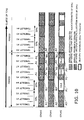
- Fig. 10 is a diagram indicating an execution state after additional allocation of CPU resources in the present embodiment.
- a result of scheduling after determination of additional allocation by the CPU-resource additional-allocation system according to the present invention is shown in Fig. 10. Assume the following two parallel programs exist.
- the additional-allocation-object selection unit 371 which selects objects to which idle CPU resources are to be additionally allocated according to the CPU allocation ratios, additionally allocates idle CPU resources (corresponding to a CPU allocation ratio of 50%) to the respective parallel programs as follows:
- idle CPU resources are allocated according to CPU allocation ratios required by parallel programs. Therefore, the parallel programs can operate by using the idle CPU resources in desirable order of precedence.
- the computer-readable recording medium may be a magnetic recording device, a semiconductor memory, or the like.
- a portable recording medium such as a CD-ROM (Compact Disk Read Only Memory), a flexible disk, and the like in which the program is recorded.
- CD-ROM Compact Disk Read Only Memory
Landscapes
- Engineering & Computer Science (AREA)
- Theoretical Computer Science (AREA)
- Software Systems (AREA)
- General Engineering & Computer Science (AREA)
- Physics & Mathematics (AREA)
- General Physics & Mathematics (AREA)
- Multi Processors (AREA)
- Debugging And Monitoring (AREA)
- Devices For Executing Special Programs (AREA)
Applications Claiming Priority (2)
| Application Number | Priority Date | Filing Date | Title |
|---|---|---|---|
| JP2002053383 | 2002-02-28 | ||
| JP2002053383A JP2003256221A (ja) | 2002-02-28 | 2002-02-28 | 並列プロセス実行方法、及びマルチプロセッサ型コンピュータ |
Publications (3)
| Publication Number | Publication Date |
|---|---|
| EP1341083A2 EP1341083A2 (en) | 2003-09-03 |
| EP1341083A3 EP1341083A3 (en) | 2004-06-16 |
| EP1341083B1 true EP1341083B1 (en) | 2006-08-16 |
Family
ID=27678553
Family Applications (1)
| Application Number | Title | Priority Date | Filing Date |
|---|---|---|---|
| EP03250990A Expired - Lifetime EP1341083B1 (en) | 2002-02-28 | 2003-02-18 | Parallel-process execution method and multiprocessor-type computer |
Country Status (4)
| Country | Link |
|---|---|
| US (1) | US20030163512A1 (enExample) |
| EP (1) | EP1341083B1 (enExample) |
| JP (1) | JP2003256221A (enExample) |
| DE (1) | DE60307532T2 (enExample) |
Families Citing this family (45)
| Publication number | Priority date | Publication date | Assignee | Title |
|---|---|---|---|---|
| US8707317B2 (en) * | 2004-04-30 | 2014-04-22 | Microsoft Corporation | Reserving a fixed amount of hardware resources of a multimedia console for system application and controlling the unreserved resources by the multimedia application |
| JP4711672B2 (ja) * | 2004-12-24 | 2011-06-29 | 富士通株式会社 | 情報処理方法及びプログラム |
| JP4555145B2 (ja) | 2005-04-28 | 2010-09-29 | 富士通株式会社 | バッチスケジューリングプログラム、バッチスケジューリング方法およびバッチスケジューリング装置 |
| US20080178177A1 (en) * | 2007-01-19 | 2008-07-24 | Charles Jens Archer | Method and Apparatus for Operating a Massively Parallel Computer System to Utilize Idle Processor Capability at Process Synchronization Points |
| JP5243822B2 (ja) * | 2007-03-28 | 2013-07-24 | インターナショナル・ビジネス・マシーンズ・コーポレーション | 仮想化されたデータ処理環境におけるワークロード管理 |
| US9165032B2 (en) * | 2007-11-21 | 2015-10-20 | Hewlett-Packard Development Company, L.P. | Allocation of resources for concurrent query execution via adaptive segmentation |
| JP5100596B2 (ja) | 2008-10-03 | 2012-12-19 | キヤノン株式会社 | 情報処理装置及び情報処理方法 |
| WO2011078162A1 (ja) * | 2009-12-24 | 2011-06-30 | 日本電気株式会社 | スケジューリング装置、スケジューリング方法及びプログラム |
| US9229783B2 (en) | 2010-03-31 | 2016-01-05 | International Business Machines Corporation | Methods and apparatus for resource capacity evaluation in a system of virtual containers |
| JP5574816B2 (ja) | 2010-05-14 | 2014-08-20 | キヤノン株式会社 | データ処理装置及びデータ処理方法 |
| JP5618670B2 (ja) | 2010-07-21 | 2014-11-05 | キヤノン株式会社 | データ処理装置及びその制御方法 |
| US8869164B2 (en) | 2010-09-02 | 2014-10-21 | International Business Machines Corporation | Scheduling a parallel job in a system of virtual containers |
| KR101710910B1 (ko) | 2010-09-27 | 2017-03-13 | 삼성전자 주식회사 | 프로세싱 유닛의 동적 자원 할당을 위한 방법 및 장치 |
| KR20120067825A (ko) * | 2010-12-16 | 2012-06-26 | 한국전자통신연구원 | 임베디드 리눅스를 위한 적응형 프로세스 스케쥴링 방법 |
| WO2012112302A2 (en) * | 2011-02-17 | 2012-08-23 | Siemens Aktiengesellschaft | Parallel processing in human-machine interface applications |
| JP5768586B2 (ja) * | 2011-08-17 | 2015-08-26 | 日本電気株式会社 | 計算装置、計算装置の制御方法、及びプログラム |
| US8775837B2 (en) * | 2011-08-19 | 2014-07-08 | Oracle International Corporation | System and method for enabling turbo mode in a processor |
| JP2013047892A (ja) * | 2011-08-29 | 2013-03-07 | Fujitsu Ltd | 情報処理装置、スケジューリング方法およびプログラム |
| WO2013046321A1 (ja) * | 2011-09-27 | 2013-04-04 | 株式会社 日立製作所 | 周期送信制御装置、周期送信制御方法、および周期送信制御プログラム |
| US9286130B2 (en) * | 2012-08-27 | 2016-03-15 | International Business Machines Corporation | Optimizing virtual machine deployment time by temporarily allocating more processing resources during the initial deployment time of the virtual machine |
| JP2015195003A (ja) * | 2014-03-25 | 2015-11-05 | パナソニックIpマネジメント株式会社 | コマンド制御装置、コマンド制御方法および集積回路 |
| CN104090817A (zh) * | 2014-07-15 | 2014-10-08 | 浪潮电子信息产业股份有限公司 | 一种linux shell脚本并行执行与超时自动退出的处理方法 |
| CN105988872B (zh) * | 2015-02-03 | 2020-02-18 | 阿里巴巴集团控股有限公司 | 一种cpu资源分配的方法、装置及电子设备 |
| JP6540166B2 (ja) * | 2015-03-31 | 2019-07-10 | オムロン株式会社 | 制御装置 |
| JP2018018171A (ja) * | 2016-07-25 | 2018-02-01 | 富士通株式会社 | 並列処理装置、ジョブスケジューリング方法、およびジョブスケジューリングプログラム |
| KR102549994B1 (ko) * | 2017-03-29 | 2023-06-29 | 아브 이니티오 테크놀로지 엘엘시 | 가변 레벨 병렬화를 사용하여 데이터 처리 동작을 수행하기 위한 시스템 및 방법 |
| KR101889749B1 (ko) | 2017-07-21 | 2018-09-20 | 주식회사 티맥스데이터 | 메시지 스케줄링 방법 |
| US11188434B2 (en) | 2017-12-08 | 2021-11-30 | Ab Initio Technology Llc | Systems and methods for monitoring execution of structured query language (SQL) queries |
| US12032631B2 (en) | 2018-05-30 | 2024-07-09 | Ab Initio Technology Llc | Systems and methods for dataflow graph optimization |
| US11579799B2 (en) * | 2020-03-18 | 2023-02-14 | Micron Technology, Inc. | Dynamic selection of cores for processing responses |
| US12405933B2 (en) | 2020-11-30 | 2025-09-02 | Getac Technology Corporation | Content management system for trained machine learning models |
| US11271810B1 (en) | 2020-11-30 | 2022-03-08 | Getac Technology Corporation | Heterogeneous cross-cloud service interoperability |
| US11604773B2 (en) | 2020-11-30 | 2023-03-14 | Whp Workflow Solutions, Inc. | Hierarchical data ingestion in a universal schema |
| US12444190B2 (en) | 2020-11-30 | 2025-10-14 | Getac Technology Corporation | Artificial intelligence (AI) trained data model selection |
| US11468671B2 (en) | 2020-11-30 | 2022-10-11 | Getac Technology Corporation | Sentiment analysis for situational awareness |
| US11720414B2 (en) * | 2020-11-30 | 2023-08-08 | Whp Workflow Solutions, Inc. | Parallel execution controller for partitioned segments of a data model |
| US11477616B2 (en) | 2020-11-30 | 2022-10-18 | Getac Technology Corporation | Safety detection controller |
| US11540027B2 (en) | 2020-11-30 | 2022-12-27 | Getac Technology Corporation | Performant ad hoc data ingestion |
| US11630677B2 (en) | 2020-11-30 | 2023-04-18 | Whp Workflow Solutions, Inc. | Data aggregation with self-configuring drivers |
| US11605288B2 (en) | 2020-11-30 | 2023-03-14 | Whp Workflow Solutions, Inc. | Network operating center (NOC) workspace interoperability |
| US11977993B2 (en) | 2020-11-30 | 2024-05-07 | Getac Technology Corporation | Data source correlation techniques for machine learning and convolutional neural models |
| MX2023008982A (es) | 2021-01-31 | 2023-12-04 | Ab Initio Technology Llc | Sistema de procesamiento de datos con manipulacion de grupos de conjuntos de datos logicos. |
| AU2022213420A1 (en) | 2021-01-31 | 2023-07-27 | Ab Initio Technology Llc | Dataset multiplexer for data processing system |
| CN112929846B (zh) * | 2021-02-26 | 2022-07-22 | 北京邮电大学 | 基于车载设备的时间分配方法、装置、设备及存储介质 |
| US20220365931A1 (en) * | 2021-05-14 | 2022-11-17 | International Business Machines Corporation | Dynamic degree of query parallelism optimization |
Family Cites Families (6)
| Publication number | Priority date | Publication date | Assignee | Title |
|---|---|---|---|---|
| JPH02242434A (ja) * | 1989-03-16 | 1990-09-26 | Hitachi Ltd | タスクのスケジューリング方法 |
| JP3730740B2 (ja) * | 1997-02-24 | 2006-01-05 | 株式会社日立製作所 | 並列ジョブ多重スケジューリング方法 |
| US6345287B1 (en) * | 1997-11-26 | 2002-02-05 | International Business Machines Corporation | Gang scheduling for resource allocation in a cluster computing environment |
| JP2001167060A (ja) * | 1999-12-07 | 2001-06-22 | Hitachi Ltd | タスク並列化方法 |
| JP2002007150A (ja) * | 2000-06-19 | 2002-01-11 | Hitachi Ltd | プロセスのスケジューリング方法および装置およびプロセスのスケジューリングプログラムを記録したコンピュータ読み取り可能な記録媒体 |
| JP3891936B2 (ja) * | 2001-02-28 | 2007-03-14 | 富士通株式会社 | 並列プロセス実行方法、及びマルチプロセッサ型コンピュータ |
-
2002
- 2002-02-28 JP JP2002053383A patent/JP2003256221A/ja active Pending
-
2003
- 2003-02-18 EP EP03250990A patent/EP1341083B1/en not_active Expired - Lifetime
- 2003-02-18 DE DE60307532T patent/DE60307532T2/de not_active Expired - Fee Related
- 2003-02-21 US US10/371,106 patent/US20030163512A1/en not_active Abandoned
Also Published As
| Publication number | Publication date |
|---|---|
| US20030163512A1 (en) | 2003-08-28 |
| EP1341083A2 (en) | 2003-09-03 |
| EP1341083A3 (en) | 2004-06-16 |
| DE60307532T2 (de) | 2006-12-21 |
| DE60307532D1 (de) | 2006-09-28 |
| JP2003256221A (ja) | 2003-09-10 |
Similar Documents
| Publication | Publication Date | Title |
|---|---|---|
| EP1341083B1 (en) | Parallel-process execution method and multiprocessor-type computer | |
| CN1278235C (zh) | 用于向一处理器让与资源的系统 | |
| US7159216B2 (en) | Method and apparatus for dispatching tasks in a non-uniform memory access (NUMA) computer system | |
| US6957435B2 (en) | Method and apparatus for allocating processor resources in a logically partitioned computer system | |
| JP3891936B2 (ja) | 並列プロセス実行方法、及びマルチプロセッサ型コンピュータ | |
| JP5400482B2 (ja) | 管理計算機、リソース管理方法、リソース管理プログラム、記録媒体および情報処理システム | |
| US20050081208A1 (en) | Framework for pluggable schedulers | |
| RU2571366C2 (ru) | Виртуальная архитектура неоднородного доступа к памяти для виртуальных машин | |
| US7853928B2 (en) | Creating a physical trace from a virtual trace | |
| MXPA04008080A (es) | Metodo y aparato para resegmentar dinamicamente un sistema de computadora, en respuesta a cargas de trabajo de segmentacion. | |
| US9183061B2 (en) | Preserving, from resource management adjustment, portions of an overcommitted resource managed by a hypervisor | |
| US11586471B2 (en) | Computer system and control method for computer system | |
| JP2010044784A (ja) | システムにおける要求のスケジューリング | |
| JP4185103B2 (ja) | 実行可能プログラムをスケジューリングするためのシステム及び方法 | |
| JP5810918B2 (ja) | スケジューリング装置、スケジューリング方法及びプログラム | |
| CN114546587A (zh) | 一种在线图像识别服务的扩缩容方法及相关装置 | |
| Nickolay et al. | Towards accommodating real-time jobs on HPC platforms | |
| EP1630671A1 (en) | Framework for pluggable schedulers | |
| JP2019071026A (ja) | 計算機およびcpuコア割当方法 | |
| KR20170094911A (ko) | 반도체 장치의 동작 방법 및 반도체 시스템 | |
| JP2004152060A (ja) | 計算機システム、および、そのディスクサブシステム | |
| Bernard | THE SGUCRAY T3E: EXPERIENCES AND INSIGHTS | |
| Kousalya et al. | K-Level with Buddy Memory Allocation (BMA) Approach for Parallel Workload Scheduling | |
| JPH04116742A (ja) | 仮想記憶システムにおけるメモリ割り当て方式 | |
| Jervert et al. | Multi-console intelligent satellite graphics |
Legal Events
| Date | Code | Title | Description |
|---|---|---|---|
| PUAI | Public reference made under article 153(3) epc to a published international application that has entered the european phase |
Free format text: ORIGINAL CODE: 0009012 |
|
| AK | Designated contracting states |
Kind code of ref document: A2 Designated state(s): AT BE BG CH CY CZ DE DK EE ES FI FR GB GR HU IE IT LI LU MC NL PT SE SI SK TR |
|
| AX | Request for extension of the european patent |
Extension state: AL LT LV MK RO |
|
| PUAL | Search report despatched |
Free format text: ORIGINAL CODE: 0009013 |
|
| AK | Designated contracting states |
Kind code of ref document: A3 Designated state(s): AT BE BG CH CY CZ DE DK EE ES FI FR GB GR HU IE IT LI LU MC NL PT SE SI SK TR |
|
| AX | Request for extension of the european patent |
Extension state: AL LT LV MK RO |
|
| RIC1 | Information provided on ipc code assigned before grant |
Ipc: 7G 06F 9/46 A |
|
| 17P | Request for examination filed |
Effective date: 20041208 |
|
| AKX | Designation fees paid |
Designated state(s): DE FR GB |
|
| 17Q | First examination report despatched |
Effective date: 20050614 |
|
| RIC1 | Information provided on ipc code assigned before grant |
Ipc: G06F 9/45 20060101ALI20060111BHEP Ipc: G06F 9/46 20060101AFI20060111BHEP |
|
| GRAP | Despatch of communication of intention to grant a patent |
Free format text: ORIGINAL CODE: EPIDOSNIGR1 |
|
| GRAS | Grant fee paid |
Free format text: ORIGINAL CODE: EPIDOSNIGR3 |
|
| GRAA | (expected) grant |
Free format text: ORIGINAL CODE: 0009210 |
|
| AK | Designated contracting states |
Kind code of ref document: B1 Designated state(s): DE FR GB |
|
| REG | Reference to a national code |
Ref country code: GB Ref legal event code: FG4D |
|
| REF | Corresponds to: |
Ref document number: 60307532 Country of ref document: DE Date of ref document: 20060928 Kind code of ref document: P |
|
| PGFP | Annual fee paid to national office [announced via postgrant information from national office to epo] |
Ref country code: GB Payment date: 20070215 Year of fee payment: 5 |
|
| PGFP | Annual fee paid to national office [announced via postgrant information from national office to epo] |
Ref country code: DE Payment date: 20070313 Year of fee payment: 5 |
|
| ET | Fr: translation filed | ||
| PLBE | No opposition filed within time limit |
Free format text: ORIGINAL CODE: 0009261 |
|
| STAA | Information on the status of an ep patent application or granted ep patent |
Free format text: STATUS: NO OPPOSITION FILED WITHIN TIME LIMIT |
|
| 26N | No opposition filed |
Effective date: 20070518 |
|
| PGFP | Annual fee paid to national office [announced via postgrant information from national office to epo] |
Ref country code: FR Payment date: 20061228 Year of fee payment: 5 |
|
| GBPC | Gb: european patent ceased through non-payment of renewal fee |
Effective date: 20080218 |
|
| REG | Reference to a national code |
Ref country code: FR Ref legal event code: ST Effective date: 20081031 |
|
| PG25 | Lapsed in a contracting state [announced via postgrant information from national office to epo] |
Ref country code: DE Free format text: LAPSE BECAUSE OF NON-PAYMENT OF DUE FEES Effective date: 20080902 |
|
| PG25 | Lapsed in a contracting state [announced via postgrant information from national office to epo] |
Ref country code: FR Free format text: LAPSE BECAUSE OF NON-PAYMENT OF DUE FEES Effective date: 20080229 |
|
| PG25 | Lapsed in a contracting state [announced via postgrant information from national office to epo] |
Ref country code: GB Free format text: LAPSE BECAUSE OF NON-PAYMENT OF DUE FEES Effective date: 20080218 |