EP1340624A1 - Writing utensil excellent in cap-off characteristics - Google Patents
Writing utensil excellent in cap-off characteristics Download PDFInfo
- Publication number
- EP1340624A1 EP1340624A1 EP01993392A EP01993392A EP1340624A1 EP 1340624 A1 EP1340624 A1 EP 1340624A1 EP 01993392 A EP01993392 A EP 01993392A EP 01993392 A EP01993392 A EP 01993392A EP 1340624 A1 EP1340624 A1 EP 1340624A1
- Authority
- EP
- European Patent Office
- Prior art keywords
- ink
- feed
- cap
- writing instrument
- substance
- Prior art date
- Legal status (The legal status is an assumption and is not a legal conclusion. Google has not performed a legal analysis and makes no representation as to the accuracy of the status listed.)
- Withdrawn
Links
Images


Classifications
-
- B—PERFORMING OPERATIONS; TRANSPORTING
- B43—WRITING OR DRAWING IMPLEMENTS; BUREAU ACCESSORIES
- B43K—IMPLEMENTS FOR WRITING OR DRAWING
- B43K23/00—Holders or connectors for writing implements; Means for protecting the writing-points
- B43K23/08—Protecting means, e.g. caps
-
- B—PERFORMING OPERATIONS; TRANSPORTING
- B43—WRITING OR DRAWING IMPLEMENTS; BUREAU ACCESSORIES
- B43K—IMPLEMENTS FOR WRITING OR DRAWING
- B43K1/00—Nibs; Writing-points
-
- B—PERFORMING OPERATIONS; TRANSPORTING
- B43—WRITING OR DRAWING IMPLEMENTS; BUREAU ACCESSORIES
- B43K—IMPLEMENTS FOR WRITING OR DRAWING
- B43K1/00—Nibs; Writing-points
- B43K1/12—Writing-points comprising fibres; Felt pads
-
- B—PERFORMING OPERATIONS; TRANSPORTING
- B43—WRITING OR DRAWING IMPLEMENTS; BUREAU ACCESSORIES
- B43K—IMPLEMENTS FOR WRITING OR DRAWING
- B43K8/00—Pens with writing-points other than nibs or balls
- B43K8/02—Pens with writing-points other than nibs or balls with writing-points comprising fibres, felt, or similar porous or capillary material
-
- C—CHEMISTRY; METALLURGY
- C09—DYES; PAINTS; POLISHES; NATURAL RESINS; ADHESIVES; COMPOSITIONS NOT OTHERWISE PROVIDED FOR; APPLICATIONS OF MATERIALS NOT OTHERWISE PROVIDED FOR
- C09D—COATING COMPOSITIONS, e.g. PAINTS, VARNISHES OR LACQUERS; FILLING PASTES; CHEMICAL PAINT OR INK REMOVERS; INKS; CORRECTING FLUIDS; WOODSTAINS; PASTES OR SOLIDS FOR COLOURING OR PRINTING; USE OF MATERIALS THEREFOR
- C09D11/00—Inks
- C09D11/16—Writing inks
- C09D11/18—Writing inks specially adapted for ball-point writing instruments
Definitions
- the present invention relates to a writing instrument having an excellent cap-off performance which has a good writing performance even after the pen tip is left to stand in the air for a long period of time.
- a substance such as paraffin wax providing a cap-off property has an excellent effect, but paraffin wax has a low critical surface tension, so that the ink is a little deteriorated in a wetting property with respect to the pen tip to cause the problem of reduction in the ink discharge amount. Further, there involved are the problems in that it takes time until the pen tip is filled with the ink and that starving is slightly brought about.
- the present invention intends to solve them, and an object thereof is to provide a writing instrument having an excellent cap-off performance in which a pen tip is quickly filled with an ink and starving is not caused and which has a stable ink discharge amount and provides a good writing performance even after the pen tip is left to stand in the air over a long period of time.
- the present invention comprises the following items (1) to (4).
- a writing instrument having an excellent cap-off performance which provides a good writing performance even after the pen tip is left to stand in the air for a long period of time.
- the writing instrument having an excellent cap-off performance which is the first invention of the present invention is a writing instrument in which a pen tip comprising a fibrous feed or a plastic feed is coated with a coating agent comprising a substance providing a cap-off property, wherein an ink for the above writing instrument contains a fluorine base surfactant and/or a silicone base surfactant.
- the second invention of the present invention is a writing instrument having an excellent cap-off performance in which a pen tip comprising a fibrous feed or a plastic feed is coated with a coating agent comprising a substance providing a cap-off property, wherein the above coating agent contains a substance which is solid at room temperature and has a solubility of 5 % or less in an ink solvent at room temperature and which has a polar functional group.
- the writing instrument in the present invention shall not specifically be restricted as long as it is a writing instrument having a pen tip comprising a fibrous feed or a plastic feed, and it includes, for example, (1) as shown in Fig. 1, a free ink type writing instrument 10 which has a barrel to be an ink tank part 11 for directly storing an ink and a collector member 12 for temporarily holding the ink and in which the ink is introduced from the ink tank part 11 into a pen tip 13 via a feed 14 (or directly), (2) as shown in Fig.
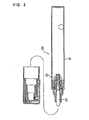
- a writing instrument 20 which has a barrel to be an ink tank part 21 for directly storing an ink and in which an ink is introduced from the ink tank part 21 into a pen tip 22 via a valve mechanism part 23 directly (or via a feed) and (3) as shown in Fig. 3, a writing instrument 30 which has an ink reservoir 32 occluding an ink in a barrel 31 and in which the ink is introduced from the above ink reservoir 32 into a pen tip 33 directly (or via a feed).
- a material, a structure and a production method of the pen tip comprising a fibrous feed or a plastic feed shall not specifically be restricted and include, for example, pen tips comprising fibrous feeds comprising parallel fiber bundles comprising one or a combination of two or more kinds of natural fibers, animal hair fibers, polyacetal base resins, acryl base resins, polyester base resins, polyamide base resins, polyurethane base resins, polyolefin base resins, polyvinyl base resins, polycarbonate base resins, polyether base resins and polyphenylene base resins; fiber feeds of felt and the like prepared by processing fibrous bundles; or fiber feeds prepared by processing fibrous bundles with resins; plastic feeds comprising the various plastic materials described above and having grooves for ink in an axial direction; and porous bodies obtained by melting and bonding powders of the various plastics described above.
- the forms thereof include optional ones such as tabular bodies, fiber-converged bodies, sintered bodies and foamed bodies.
- the shape of the pen tip comprising a fibrous feed or a plastic feed shall not specifically be restricted as long as it is a shape usually used for writing instruments.
- Those having a porosity of 30 to 75 % and a slit size of about 1 to 20 ⁇ m are preferred when a fibrous feed is used for the pen tip, and those having an average slit size of 20 to 40 ⁇ m are preferred when a plastic feed is used for the pen tip.
- slit size porosity ⁇ (radius of yarn)/(1 - porosity)
- the coating agent comprising a substance providing a cap-off property is a substance which can inhibit the pen tip comprising a fibrous feed or a plastic feed from drying, and it shall not specifically be restricted as long as it has the characteristic that it is solid at room temperature (25°C, hereinafter the same shall apply) and that it has a solubility of 10 % or less in an ink solvent at room temperature.
- glycerin derivatives such as diglycerin monostearate, triglycerin monostearate, pentaglycerin tristearate, hexaglycerin tristearate and decaglycerin distearate; alkylphosphoric acid esters such as polyoxyethylene-stearyl phosphate; polyoxyethylenesorbitan fatty acid esters such as polyoxyethylenesorbitan monostearate and polyoxyethylenesorbitan tristearate; polyoxyethylenesorbit fatty acid esters such as polyoxyethylenesorbit hexastearate; paraffin wax; microcrystalline wax; pentaerythritol derivatives such as pentaerythritol monostearate and pentaerythritol distearate; lecithin; saccharose esters; polyolefin wax; and ascorbic acid stearate.
- alkylphosphoric acid esters such as polyoxyethylene-stearyl phosphate
- polyoxyethylenesorbitan fatty acid esters such as
- it is solid at room temperature and has a solubility of 10 % or less in an ink solvent at room temperature. Further, from the viewpoint of making it difficult for the substance providing a cap-off property to be desorbed by physical friction of the pen tip caused by writing and by flow-out of the ink, those which are harder and have a lower solubility are preferred. Diglycerin monostearate, pentaglycerin tristearate, polyoxyethylenestearyl phosphate and lecithin are preferred because the durability and the effects are higher.
- a method for coating the fibrous feed or the plastic feed with the substance having the characteristics described above can be carried out by, for example, dissolving the substance having the characteristics described above in a solvent capable of dissolving the above substance, subjecting the fibrous feed or the plastic feed to dipping treatment in the solution or spraying treatment with it and then drying by heating or at room temperature.
- the solubility is extremely low, the substance can be coated by dipping the feed in the heated solution and cooling it.
- the solvents for dissolving the coating agent having the characteristics described above include, for example, alcohols such as methyl alcohol, ethyl alcohol, n-propyl alcohol and isopropyl alcohol, glycols such as ethylene glycol monomethyl ether, ethylene glycol monoethyl ether and propylene glycol monomethyl ether, ketones such as acetone and methyl ethyl ketone, esters such as methyl acetate, ethyl acetate, butyl acetate, ethylene glycol monomethyl ether acetate and propylene glycol monoethyl ether acetate, ethers such as dimethyl ether and diethyl ether, hydrocarbons such as hexane, isohexane, heptane and methylcyclohexane, and chlorinated compounds such as chloroform and methylene chloride.
- alcohols such as methyl alcohol, ethyl alcohol, n-propyl alcohol and isoprop
- An amount of the coating agent coated on the fibrous feed or the plastic feed is 0.01 to 20 % by weight, preferably 0.1 to 10 % by weight and more preferably 0.3 to 5 % by weight in terms of a weight ratio based on the fibrous feed or the plastic feed.
- the coating amount is less than 0.01 % by weight, the effects brought about by coating can not be achieved. On the other hand, if it exceeds 20 % by weight, the substance having a vaporization-inhibiting function is coated too much on the fibrous feed or the plastic feed, and the functions which have to be exerted primarily by the fibrous feed or the plastic feed are damaged. Thus, the ink is less likely to be discharged, and starving is caused. Accordingly, neither of the amounts is preferred.
- a colorant, a solvent, a resin which is soluble in the above solvent and the other additives for ink for a writing instrument as well as the fluorine base surfactant and/or the silicone base surfactant have to be added to the ink used in the first invention of the present invention.
- the colorant includes oil-soluble dyes and pigments, and almost all of conventional oil-soluble dyes which can be dissolved in organic solvents can be used as the oil-soluble dyes.
- the dyes include, for example, Orazol Yellow 2GLN, Orazol Red 3GL, Orazol Blue 2GLN, Neonzapon Blue FLE, Spirit Black SP, Valifast Red 1308, Oil Blue BA, Oil Yellow 185, Oil Red TR71, Oil Black S, Victoria Blue, Rhodamine 6JHSA and Flex Yellow 105, and the pigments shall not specifically be restricted and include, for example, organic pigments such as azo base pigments, condensed polyazo base pigments, phthalocyanine base . pigments, metal complex salt pigments, thioindigo pigments, dye lake pigments and fluorescent pigments, and inorganic pigments such as carbon black and titanium oxide.
- processed pigments capable of being used as well are processed pigments the surfaces of which are processed by coating resins, for example, various Microlys A types, AS Black, AS Blue and IK Red. These dyes and/or pigments can be used alone or in a mixture of two or more kinds thereof. A use amount thereof varies depending on the kind of the colorant and the other ink components, and it is 1 to 30 % by weight, preferably 2 to 15 % by weight based on the total amount of the ink.
- the solvent which can be used in the present invention includes, for example, lower alcohols such as ethyl alcohol, propyl alcohol and isopropyl alcohol, aromatic hydrocarbons such as toluene and xylene, lower aliphatic ketones such as methyl ethyl ketone and methyl isobutyl ketone, lower alcohol esters of lower fatty acids such as ethyl acetate and butyl acetate, aliphatic hydrocarbons such as hexane and heptane, alicyclic hydrocarbons such as cyclohexane and ethylcyclohexane and glycol ethers such as propylene glycol monomethyl ether.
- lower alcohols such as ethyl alcohol, propyl alcohol and isopropyl alcohol
- aromatic hydrocarbons such as toluene and xylene
- lower aliphatic ketones such as methyl ethyl ketone and methyl isobutyl
- solvents each can be used alone or in a mixture of two or more kinds thereof.
- a use amount thereof is 50 to 95 % by weight, preferably 70 to 85 % by weight based on the total amount of the ink.
- the resin which can be used in the present invention is used as a film-forming agent, a sticking agent onto a face to be coated, a viscosity-controlling agent for the ink and a dispersant for the colorant, and various natural resins and synthetic resins which have so far been used can be used.
- rosin base resins such as rosin, ester gums, maleic acid-modified rosin and phenol-modified rosin
- cellulose base resins such as ethyl cellulose and nitrocellulose
- vinyl base resins such as polyvinylbutyral and vinyl chloride-vinyl acetate copolymer resins
- petroleum base resins ketone base resins
- acryl base resins condensation products of aldehyde and urea and a maleic acid resin.
- a use amount thereof is 0.1 to 30 % by weight, preferably 1 to 20 % by weight based on the total amount of the ink.
- the other additives for a writing instrument include, for example, anionic, nonionic and cationic surfactants, preservatives, fungicides, rust preventives, lubricants and pH-controlling agents.
- the fluorine base surfactant used in the first invention of the present invention includes, for example, perfluoroalkylsulfonates, perfluoroalkylcarboxylates, perfluoroalkyloxyethyleneethanols and fluorinated alkyl esters.
- the silicone base surfactant includes, for example, dimethylsilicone, cyclic silicone, trimethylsiloxysilicic acid, methylphenylsilicone, polyether-modified silicone, methylstyryl-modified silicone, alkyl-modified silicone, higher fatty acid ester-modified silicone, higher alkoxy-modified silicone and fluorine-modified silicone.
- fluorinated alkyl esters and polyether-modified silicone which have a suitable solubility are preferred from the viewpoint of reducing a surface tension of the ink.
- the fluorine base surfactant and/or the silicone base surfactant added to the ink have a content of 0.005 to 10 % by weight, preferably 0.01 to 5 % by weight based on the total amount of the ink composition.
- this content is less than 0.005 % by weight, the wetting property and the ink discharge property can not be improved. On the other hand, if it exceeds 10 % by weight, the film forming-ability brought about by the coating substance is weakened, and the non-drying property can not be secured.
- the fibrous feed or the plastic feed is coated with the substance providing a cap-off property described above, that is, the coating agent which is solid at room temperature and has a solubility of 10 % or less in the ink solvent at room temperature, whereby a very fragile film can be formed on the surface part of the fibrous feed or the plastic feed, and this film prevents the solvent, which is a volatile component contained in the ink, from vaporizing.
- the above film is broken by writing pressure in writing to allow a pen to write.
- the substance providing a cap-off property coated on the fibrous feed or the plastic feed of the pen tip is dissolved again in the ink only by a required amount, though the dissolved amount is a little different depending on the coated amount described above, and then a new film is formed on the pen tip surface by virtue of interaction with the ink solvent when the pen tip is exposed to the air next time.
- the coating agent makes it possible to repeat this film formation ⁇ writing ⁇ film formation ⁇ writing --- many times, that is, forms a film which is always reproduced at the pen tip and broken in writing. This effect shall be repeated until the ink filled in the ink tank part or occluded in the ink reservoir is exhausted.
- the fluorine base surfactant and/or the silicone base surfactant added to the ink effectively work against the problems that the wetting property of the ink with respect to the pen tip is deteriorated and it takes time until the pen tip is filled with the ink when using paraffin wax among the substances providing a cap-off property, and the problems that starving is caused a little and the ink discharge amount is reduced.
- This provides a writing instrument having an excellent cap-off performance in which a pen tip is quickly filled with an ink to prevent starving from being caused and which has a stable ink discharge amount and achieves a good writing performance even after the pen tip is left to stand in the air over a long period of time.
- the writing instrument of the second invention of the present invention having an excellent cap-off performance is a writing instrument in which a pen tip comprising a fibrous feed or a plastic feed is coated with the coating agent comprising the substance providing a cap-off property, and it is characterized in that the coating agent described above contains a substance having a polar functional group which is solid at room temperature and which has a solubility of 5 % or less in an ink solvent at room temperature.
- the coating agent used in the second invention of the present invention contains the substance providing the pen tip comprising a fibrous feed or a plastic feed with a cap-off property and the substance having a polar functional group which is solid at room temperature and which has a solubility of 5 % or less in an ink solvent at room temperature.
- the pen tip comprising a fibrous feed or a plastic feed can be inhibited from drying without having such damages of the writing performances as reduction in the ink discharge amount.
- the substance providing a cap-off property in the second invention of the present invention is a substance which can inhibit drying of the pen tip comprising a fibrous feed or a plastic feed, and it shall not specifically be restricted as long as it has the characteristic in that it is solid at room temperature (25°C, hereinafter the same shall apply) and that it has a solubility of 10 % or less in an ink solvent at room temperature.
- glycerin derivatives such as diglycerin monostearate, triglycerin monostearate, pentaglycerin tristearate, hexaglycerin tristearate and decaglycerin distearate; alkylphosphoric acid esters such as polyoxyethylenestearyl phosphate; polyoxyethylenesorbitan fatty acid esters such as polyoxyethylenesorbitan monostearate and polyoxyethylenesorbitan tristearate; polyoxyethylenesorbit fatty acid esters such as polyoxyethylenesorbit hexastearate; paraffin wax; microcrystalline wax; pentaerythritol derivatives such as pentaerythritol monostearate and pentaerythritol distearate; lecithin; saccharose esters; polyolefin wax and ascorbic acid stearate, which have been listed as the examples in the first invention of the present invention.
- alkylphosphoric acid esters such as polyoxyethylenestearyl phosphate
- it is solid at room temperature and has a solubility of 10 % or less in an ink solvent at room temperature.
- solubility 10 % or less in an ink solvent at room temperature.
- those which are harder and have a lower solubility are preferred.
- Those having a melting point of 40°C or higher and a slight tackiness to the pen feed, for example, hexaglycerin tristearate, paraffin wax and microcrystalline wax are preferred because the durability and the effects are elevated.
- the substance having a polar functional group used in the second invention of the present invention is a substance having a polar functional group, for example, a polar functional group such as a hydroxyl group, an ester group, an amino group, an ether group, a carbonyl group and an amide group in a molecule of an organic compound. It is solid at room temperature and has a solubility of 5 % or less in an ink solvent at room temperature, and it has a suitable compatibility with the substance providing a cap-off property.
- a polar functional group such as a hydroxyl group, an ester group, an amino group, an ether group, a carbonyl group and an amide group in a molecule of an organic compound. It is solid at room temperature and has a solubility of 5 % or less in an ink solvent at room temperature, and it has a suitable compatibility with the substance providing a cap-off property.
- Such substance having a polar functional group includes at least one selected from the group consisting of oxidized paraffin, urethane type waxes and alcohol type waxes each having a polar functional group.
- oxidized paraffin NSP-8070 polar functional group: ester group
- urethane type waxes NPS-6010 polar functional group: urethane group
- NPS-6115 polar functional group: urethane group
- HAD-5090 polar functional group: urethane group
- HAD-5080 polar functional group: urethane group
- alcohol type waxes NPS-9035 polar functional group: hydroxyl group
- NPS-9125 polar functional group: hydroxyl group
- NPS-9210 polar functional group: hydroxyl group
- urethane type waxes NPS-6010 and HAD-5090 and alcohol type wax NPS-9125 are urethane type waxes NPS-6010 and HAD-5090 and alcohol type wax NPS-9125, which improve an ink wetting property with respect to the pen feed through combined use thereof.
- These substances having a polar functional group can inhibit the pen tip comprising a fibrous feed or a plastic feed from drying and have an excellent function of improving deterioration in a wetting property of the ink with respect to the pen tip and reduction in the ink discharge amount which are observed when using the substance providing a cap-off property but having no polar functional group such as paraffin wax and the like described above.
- An amount of the coating agent coated on the fibrous feed or the plastic feed is 0.01 to 20 % by weight, preferably 0.1 to 10 % by weight and more preferably 0.3 to 5 % by weight in terms of a weight ratio based on the fibrous feed or the plastic feed.
- the substance having a polar functional group described above has a content of 0.01 % by weight or more, preferably 0.05 to 100 % by weight based on the total amount of the coating agent.
- the substance having a polar functional group described above has a content of less than 0.01 % by weight, brought about are the problems of deterioration in a wetting property of the ink with respect to the pen tip and reduction in the ink discharge amount, and therefore it is not preferred.
- the pen tip comprising a fibrous feed or a plastic feed can be inhibited from drying without having such damages of the writing performances as reduction in the ink discharge amount.
- a method for coating the fibrous feed or the plastic feed with the coating agent comprising the substance having a polar functional group with the characteristics described above is the same as in the first invention. That is, the coating method, a solvent dissolving the above coating agent and the value limits and significance thereof are the same as in the first invention.
- a colorant, a solvent, a resin which is soluble in the above solvent and the other additives for an ink for a writing instrument can be used as the ink components used in the second invention of the present invention, and these components also are the same as those used in the first invention described above.
- the fibrous feed or the plastic feed is coated with the coating agent comprising the substance providing a cap-off property described above and the substance having a polar functional group with the characteristics described above or the coating agent in which the total amount thereof comprises the substance having a polar functional group with the characteristics described above, whereby a very fragile film can be formed on the surface part of the fibrous feed or the plastic feed, and this film prevents the solvent, which is a volatile component contained in the ink from vaporizing.
- the above film is broken by writing pressure in writing to make it possible to write.
- the substance providing a cap-off property coated on the fibrous feed or the plastic feed of the pen tip is dissolved again in the ink only by a required amount, though the dissolved amount is a little different depending on the coating amount described above, and then a new film is formed on the pen tip surface by virtue of interaction with the ink solvent, when the pen tip is exposed to the air next time.
- the coating agent makes it possible to repeat this film formation ⁇ writing ⁇ film formation ⁇ writing --- many times, that is, forms a film which is always reproduced at the pen tip and broken in writing. This effect shall be repeated until the ink filled in the ink tank part or occluded in the ink reservoir is exhausted.
- the substance having no polar functional group such as paraffin wax and the like described above when using the substance having no polar functional group such as paraffin wax and the like described above among the substances providing a cap-off property, the low critical surface tension thereof deteriorates slightly a wetting property of the ink with respect to the pen tip to cause the problem of reduction in the ink discharge amount.
- the substance having a polar functional group with the characteristics described above is contained therein, and therefore provided is a writing instrument having an excellent cap-off performance in which a pen tip is quickly filled with an ink and which has a stable ink discharge amount without causing starving and achieves a good writing performance even after the pen tip is left to stand in the air over a long period of time.
- the writing instrument of the present invention shall not be restricted to the embodiments described above and can be changed to various embodiments as long as the scope of the present invention is not changed. It can be applied to, for example, an applicator for cosmetics and the like.
- the present invention may involve an embodiment in which the first invention and the second invention of the present invention are used in combination, that is, a writing instrument having much superior cap-off performance in which a pen tip comprising a fibrous feed or a plastic feed is coated with the coating agent comprising the substance providing a cap-off property, wherein the coating agent described above contains the substance having a polar functional group which is solid at room temperature and which has a solubility of 5 % or less in an ink solvent at room temperature, and the fluorine base surfactant and/or the silicone base surfactant are added to an ink for the writing instrument described above.
- the present invention (the first invention and the second invention) is effective as well for writing instruments in which not only a pen tip comprising a fibrous feed or a plastic feed but also a feed and an ink reservoir are coated with a coating agent.
- Example 1 Propylene glycol monomethyl ether 69.99 % by weight Ethanol 10.00 % by weight Dye: Valifast Black #3830 (manufactured by Orient Chemical 10.00 % by weight Indusries, Ltd.) Resin: Hitanol 2500 (manufactured by Hitachi Chemical Co., Ltd.) 10.00 % by weight Fluorine base surfactant: Florade FC431 (manufactured by Sumitomo 3M Limited) 0.01 % by weight
- Used as a pen feed was a feed comprising a sliver of an acryl fiber and having a weight of 0.17 g, a length of 33 mm and a diameter of 4.0 mm (porosity: 55 %).
- Paraffin wax (“Paraffin 135F” manufactured by Nippon Seiro Co., Ltd.) was used as the substance providing a cap-off property.
- Paraffin wax described above had a solubility of 0.2 % in an ink solvent (a solvent comprising propylene glycol monomethyl ether and ethanol) at room temperature.
- the coating substance was dissolved in isohexane, which was a solvent, to prepare a 4 % solution, and the acryl pen feed described above was dipped in the solution prepared and continued to be dipped at 50°C for 2 hours. Then, the feed was pulled up and put on a mesh-like vessel, and it was dried at 50°C for a whole day and night (24 hours) to remove the solvent and then used.
- An amount of the coating agent adhered on the acryl pen feed was shown by a difference in a weight of the pen feed before and after the treatment, and showing it by a weight % based on the weight of the pen feed before the treatment, it was 4 % by weight.
- Example 2 Propylene glycol monomethyl ether 69.50 % by weight Ethanol 10.00 % by weight Valifast Black #3830 (manufactured by Orient Chemical Industries, Ltd.) 10.00 % by weight Hitanol 2500 (manufactured by Hitachi Chemical Co., Ltd.) 10.00 % by weight Silicone base surfactant: (modified silicone KP316: manufactured by Shin-etsu Chemical Co., Ltd.) 0.50 % by weight
- Example 3 Propylene glycol monomethyl ether 69.97 % by weight Ethanol 10.00 % by weight Valifast Black #3830 (manufactured by Orient Chemical Industries, Ltd.) 10.00 % by weight Hitanol 2500 (manufactured by Hitachi Chemical Co., Ltd.) 10.00 % by weight Fluorine base surfactant: Florade FC431 (manufactured by Sumitomo 3M Limited) 0.01 % by weight Silicone base surfactant: (modified silicone KP316: manufactured by Shin-etsu Chemical Co., Ltd.) 0.02 % by weight
- Example 1 The same components (provided that propylene glycol monomethyl ether was controlled to 70.00 % by weight) as used in Example 1 described above were used, except that the fluorine base surfactant (Florade FC431) was excluded in the ink composition of Example 1.
- fluorine base surfactant Florade FC431
- the writing instruments prepared in Examples 1 to 3 and Comparative Example 1 were used to evaluate an ink discharge amount and a cap-off performance by the following methods.
- the marking pen described above was used to write 50 m on paper by means of a writing test machine, and the ink discharge amount discharged was measured.
- the marking pen described above was left to stand at a temperature of 25°C and a humidity of 65% for 2 weeks in a room with a cap off, and then the writing property was evaluated according to the following evaluation criteria.
- the writing instruments prepared in Examples 1 to 3 falling in the range of the present invention are writing instruments having an excellent cap-off performance in which a pen tip is quickly filled with an ink and starving is not caused and which does not cause reduction in an ink discharge amount and provides a good writing performance even after the pen tip is left to stand in the air over a long period of time as compared with the writing instrument prepared in Comparative Example 1 falling outside the range of the present invention.
- a pen feed comprising a sliver of an acryl fiber and having a weight of 0.17 g, a length of 33 mm and a diameter of 4.0 mm (porosity: 55 %).
- Normal paraffin (125F, melting point: 53°C, manufactured by Nippon Seiro Co., Ltd.) was used as the substance providing a cap-off property. Further, urethane type wax (HAD5090, manufactured by Nippon Seiro Co., Ltd.) was used as the substance having a polar functional group.
- Normal paraffin had a solubility of 0.2 % in an ink solvent (a solvent comprising n-propyl alcohol and propylene glycol monomethyl ether) at room temperature, and the urethane type wax described above had a solubility of 0.1 % or less.
- ink solvent a solvent comprising n-propyl alcohol and propylene glycol monomethyl ether
- the coating agent (the substance providing a cap-off property and the substance having a polar functional group described above) was dissolved in methylene chloride, which was a solvent, to prepare a 4 % solution, and the pen feed described above was dipped in the solution prepared and continued to be dipped at 50°C for 2 hours. Then, the feed was pulled up and put on a mesh-like vessel, and it was dried at 50°C for a whole day and night (24 hours) to remove the solvent and then used.
- methylene chloride which was a solvent
- An amount of the coating agent adhered on the pen tip was shown by a difference in a weight of the ink reservoir before and after the treatment and shown by a weight % based on the weight of the pen feed before the treatment.
- the pen tips having the adhered amounts shown in the following Table 2 were used.
- Used in Example 7 was an ink prepared by further blending the ink having the composition shown below with 0.1 % by weight of a silicone base surfactant (modified silicone KP-316: manufactured by Shin-etsu Chemical Co., Ltd.) (provided that propylene glycol monomethyl ether was controlled to 69.9 % by weight with the whole amount being 100 % by weight).
- a silicone base surfactant modified silicone KP-316: manufactured by Shin-etsu Chemical Co., Ltd.
- composition of the ink :
- Solvent n-propyl alcohol 14.0 % by weight
- Solvent propylene glycol monomethyl ether 70.0 % by weight
- Resin Laropearl A101 (manufactured by BASF) (condensation product of aldehyde and urea) 12.0 % by weight
- Dye Victoria Blue BSA 3.0 % by weight (manufactured by Zeneca Co., Ltd.)
- Dye Rhodamine 6JHSA (manufactured by Zeneca Co., Ltd.) 1.0 % by weigh
- the ink (4.5 g) and the pen feed each described above were used to obtain a writing instrument (marking pen) of a sliver type shown in Fig. 3.
- the respective writing instruments were used to evaluate an ink discharge amount and a cap-off performance by the following methods.
- Example 4 A o ⁇ 0.80
- Example 5 B ⁇ 0.85
- Example 6 C o ⁇ 0.72
- Example 7 C o ⁇ 0.82 Comparative
- Example 2 Un-treated ⁇ 1.00 Comparative.
- Example 3 D D ⁇ 0.62
- the writing instruments prepared in Examples 4 to 7 falling in the range of the present invention are writing instruments having an excellent cap-off performance in which a pen tip is quickly filled with an ink and starving is not caused and which does not cause reduction in an ink discharge amount and provides a good writing performance even after the pen tip is left to stand in the air over a long period of time as compared with the writing instruments prepared in Comparative Examples 2 to 3 falling outside the range of the present invention.
- the writing instrument of the present invention is suited to a writing instrument in which an ink is penetrated into a pen tip comprising a fibrous feed or a plastic feed, such as a marking pen, a felt-tip pen and a writing brush pen.
Landscapes
- Chemical & Material Sciences (AREA)
- Life Sciences & Earth Sciences (AREA)
- Engineering & Computer Science (AREA)
- Materials Engineering (AREA)
- Wood Science & Technology (AREA)
- Organic Chemistry (AREA)
- Inks, Pencil-Leads, Or Crayons (AREA)
- Pens And Brushes (AREA)
Abstract
Description
Diglycerin monostearate, pentaglycerin tristearate, polyoxyethylenestearyl phosphate and lecithin are preferred because the durability and the effects are higher.
| Example 1 | |
| Propylene glycol monomethyl ether | 69.99 % by weight |
| Ethanol | 10.00 % by weight |
| Dye: Valifast Black #3830 (manufactured by Orient Chemical | 10.00 % by weight |
| Indusries, Ltd.) | |
| Resin: Hitanol 2500 (manufactured by Hitachi Chemical Co., Ltd.) | 10.00 % by weight |
| Fluorine base surfactant: Florade FC431 (manufactured by Sumitomo 3M Limited) | 0.01 % by weight |
| Example 2 | ||
| Propylene glycol monomethyl ether | 69.50 | % by weight |
| Ethanol | 10.00 | % by weight |
| Valifast Black #3830 (manufactured by Orient Chemical Industries, Ltd.) | 10.00 | % by weight |
| Hitanol 2500 (manufactured by Hitachi Chemical Co., Ltd.) | 10.00 | % by weight |
| Silicone base surfactant: (modified silicone KP316: manufactured by Shin-etsu Chemical Co., Ltd.) | 0.50 | % by weight |
| Example 3 | ||
| Propylene glycol monomethyl ether | 69.97 | % by weight |
| Ethanol | 10.00 | % by weight |
| Valifast Black #3830 (manufactured by Orient Chemical Industries, Ltd.) | 10.00 | % by weight |
| Hitanol 2500 (manufactured by Hitachi Chemical Co., Ltd.) | 10.00 | % by weight |
| Fluorine base surfactant: Florade FC431 (manufactured by Sumitomo 3M Limited) | 0.01 | % by weight |
| Silicone base surfactant: (modified silicone KP316: manufactured by Shin-etsu Chemical Co., Ltd.) | 0.02 | % by weight |
| Ink discharge amount (mg/50 m) | Cap-off performance | |
| Example 1 | 530 | o ○ |
| Example 2 | 510 | ○ |
| Example 3 | 530 | ○ |
| Comparative Example 1 | 340 | Δ |
| Solvent: n-propyl alcohol | 14.0 | % by weight |
| Solvent: propylene glycol monomethyl ether | 70.0 | % by weight |
| Resin: Laropearl A101 (manufactured by BASF) (condensation product of aldehyde and urea) | 12.0 | % by weight |
| Dye: Victoria Blue BSA | 3.0 | % by weight |
| (manufactured by Zeneca Co., Ltd.) Dye: Rhodamine 6JHSA (manufactured by Zeneca Co., Ltd.) | 1.0 | % by weigh |
| Kind of pen feed | Cap-off performance | Ink discharge amount (g/100 m) | |
| Example 4 | A | o ○ | 0.80 |
| Example 5 | B | ○ | 0.85 |
| Example 6 | C | o ○ | 0.72 |
| Example 7 | C | o ○ | 0.82 |
| Comparative Example 2 | Un-treated | × | 1.00 |
| Comparative. Example 3 | D | ○ | 0.62 |
Claims (5)
- A writing instrument having an excellent cap-off performance in which a pen tip comprising a fibrous feed or a plastic feed is coated with a coating agent comprising a substance providing a cap-off property, wherein an ink for the above writing instrument contains a fluorine base surfactant and/or a silicone base surfactant.
- A writing instrument having an excellent cap-off performance in which a pen tip comprising a fibrous feed or a plastic feed is coated with a coating agent comprising a substance providing a cap-off property, wherein the above coating agent contains a substance which is solid at room temperature and has a solubility of 5 % or less in an ink solvent at room temperature and which has a polar functional group.
- The writing instrument having an excellent cap-off performance as described in claim 2, wherein an ink for the above writing instrument contains a fluorine base surfactant and/or a silicone base surfactant.
- The writing instrument having an excellent cap-off performance as described in claim 2 or 3, wherein the substance having a polar functional group described above is at least one selected from the group consisting of oxidized paraffin, urethane type waxes and alcohol type waxes each having a polar functional group.
- The writing instrument having an excellent cap-off performance as described in any of claims 2 to 4, wherein the substance having a polar functional group described above has a content of 0.01 % by weight or more based on the total amount of the coating agent.
Applications Claiming Priority (7)
| Application Number | Priority Date | Filing Date | Title |
|---|---|---|---|
| JP2000342303 | 2000-11-09 | ||
| JP2000342302 | 2000-11-09 | ||
| JP2000342302 | 2000-11-09 | ||
| JP2000342303 | 2000-11-09 | ||
| JP2001312783A JP2002205486A (en) | 2000-11-09 | 2001-10-10 | Writing instrument with excellent cap-off performance |
| JP2001312783 | 2001-10-10 | ||
| PCT/JP2001/009794 WO2002038394A1 (en) | 2000-11-09 | 2001-11-08 | Writing utensil excellent in cap-off characteristics |
Publications (2)
| Publication Number | Publication Date |
|---|---|
| EP1340624A1 true EP1340624A1 (en) | 2003-09-03 |
| EP1340624A4 EP1340624A4 (en) | 2004-12-01 |
Family
ID=27345157
Family Applications (1)
| Application Number | Title | Priority Date | Filing Date |
|---|---|---|---|
| EP01993392A Withdrawn EP1340624A4 (en) | 2000-11-09 | 2001-11-08 | Writing utensil excellent in cap-off characteristics |
Country Status (5)
| Country | Link |
|---|---|
| US (1) | US7001094B2 (en) |
| EP (1) | EP1340624A4 (en) |
| JP (1) | JP2002205486A (en) |
| AU (1) | AU2002224023A1 (en) |
| WO (1) | WO2002038394A1 (en) |
Families Citing this family (10)
| Publication number | Priority date | Publication date | Assignee | Title |
|---|---|---|---|---|
| CN1660603B (en) * | 2004-02-26 | 2013-03-27 | 李全水 | Multi purpose fountain flexible pen |
| US8652202B2 (en) | 2008-08-22 | 2014-02-18 | Edwards Lifesciences Corporation | Prosthetic heart valve and delivery apparatus |
| DE102009032615A1 (en) * | 2009-07-10 | 2011-01-20 | J. S. Staedtler Gmbh & Co. Kg | Ink for writing, drawing and / or painting equipment and their use |
| USD643068S1 (en) * | 2010-05-07 | 2011-08-09 | Michael Wayne Teague | Highlighter nib |
| US9078986B2 (en) | 2011-11-11 | 2015-07-14 | Ala Device, Llc | Adjustable laryngeal airway (ALA) device and method of use |
| JP6178180B2 (en) * | 2013-09-12 | 2017-08-09 | 株式会社サクラクレパス | Ink composition for oil-based marking pen |
| CN105589579A (en) * | 2014-11-07 | 2016-05-18 | 精工爱普生株式会社 | Digital pen |
| US10959846B2 (en) | 2017-05-10 | 2021-03-30 | Edwards Lifesciences Corporation | Mitral valve spacer device |
| JP7263922B2 (en) * | 2018-06-01 | 2023-04-25 | スターライト工業株式会社 | Monomer cast polyamide resin composition for sliding member and sliding member |
| CN114537017B (en) * | 2022-03-11 | 2023-04-25 | 德清县扬烨制笔股份有限公司 | Bullet type environment-friendly durable glue-free PET fiber nib |
Family Cites Families (15)
| Publication number | Priority date | Publication date | Assignee | Title |
|---|---|---|---|---|
| GB1428972A (en) | 1972-07-18 | 1976-03-24 | Wilkinson Sword Ltd | Pens and nibs therefor |
| JPS5419826A (en) * | 1977-07-12 | 1979-02-14 | Mitsubishi Pencil Co | Pen chip sealing method of marking pen |
| JPS56112980A (en) | 1980-02-12 | 1981-09-05 | Sakura Color Prod Corp | Ink composition for marking pen |
| JPS5824498A (en) * | 1981-06-30 | 1983-02-14 | 東京帽子株式会社 | Pen lead for note having flexibility |
| JPS58108270A (en) | 1981-12-21 | 1983-06-28 | Pilot Ink Co Ltd | Ink for marking pen |
| GB2131040B (en) * | 1982-10-20 | 1986-02-12 | Sakura Color Prod Corp | Aqueous ink compositions for ball-point pens |
| US5013361A (en) | 1985-01-23 | 1991-05-07 | The Gillette Company | Ball-point writing instrument containing an aqueous ink composition |
| JPS63178177A (en) * | 1987-01-19 | 1988-07-22 | Mitsubishi Pencil Co Ltd | Oil-based ink |
| JP2594457B2 (en) | 1988-04-14 | 1997-03-26 | 三菱鉛筆株式会社 | Ink for marking pen |
| JPH02232277A (en) | 1989-03-06 | 1990-09-14 | Mitsubishi Pencil Co Ltd | Ink for marking pen |
| US5763525A (en) * | 1992-10-23 | 1998-06-09 | Avery Dennison Corporation | Erasable marking composition |
| JP2000509410A (en) * | 1995-11-01 | 2000-07-25 | エイブリー・デニソン・コーポレーション | Aqueous-based shear-dilutable erasable ink and rollerball pen containing same |
| DE19735604A1 (en) * | 1997-08-15 | 1999-02-18 | Staedtler Fa J S | Aqueous ink with extended cap-off-time and process for its preparation |
| JP3914334B2 (en) * | 1998-05-25 | 2007-05-16 | シヤチハタ株式会社 | Oil-based ink for marking pens |
| US6474893B1 (en) * | 1998-12-18 | 2002-11-05 | Mitsubishi Pencil Kabushiki Kaisha | Writing instrument having excellent cap-off performance |
-
2001
- 2001-10-10 JP JP2001312783A patent/JP2002205486A/en not_active Withdrawn
- 2001-11-08 AU AU2002224023A patent/AU2002224023A1/en not_active Abandoned
- 2001-11-08 WO PCT/JP2001/009794 patent/WO2002038394A1/en not_active Ceased
- 2001-11-08 US US10/416,183 patent/US7001094B2/en not_active Expired - Fee Related
- 2001-11-08 EP EP01993392A patent/EP1340624A4/en not_active Withdrawn
Also Published As
| Publication number | Publication date |
|---|---|
| EP1340624A4 (en) | 2004-12-01 |
| US20040028462A1 (en) | 2004-02-12 |
| US7001094B2 (en) | 2006-02-21 |
| WO2002038394A1 (en) | 2002-05-16 |
| AU2002224023A1 (en) | 2002-05-21 |
| JP2002205486A (en) | 2002-07-23 |
Similar Documents
| Publication | Publication Date | Title |
|---|---|---|
| US6474893B1 (en) | Writing instrument having excellent cap-off performance | |
| US7001094B2 (en) | Writing utensil having excellent cap-off performance | |
| JP4690662B2 (en) | Water-based ballpoint pen | |
| JPWO2000037265A1 (en) | A writing instrument with excellent cap-off performance | |
| US6761496B2 (en) | Writing utensil | |
| KR100290049B1 (en) | W / 0 type ink | |
| US6955491B2 (en) | Marking pen with excellent cap-off performance | |
| JP2006206658A (en) | Water-based ink composition for ballpoint pen and ballpoint pen incorporating the same | |
| JP4518629B2 (en) | Writing instrument with excellent cap-off performance | |
| JP2002192877A (en) | Marking pen with excellent cap-off performance | |
| JP2001205970A (en) | Writing instrument with excellent cap-off performance | |
| JP2002192876A (en) | Marking pen for writing board with excellent cap-off performance | |
| JP7812200B2 (en) | Water-based ink composition for ballpoint pens and water-based ballpoint pens containing the same | |
| JP4322152B2 (en) | Ink composition for direct liquid type oil-based marking pen | |
| JP2007290196A (en) | Discoloration ballpoint pen | |
| JP2024094479A (en) | Water-based ink composition for writing instruments, and writing instruments and ink cartridges for writing instruments containing the same | |
| JP2003039879A (en) | Writing instrument with excellent cap-off performance | |
| WO2024237160A1 (en) | Aqueous ink composition for writing utensils, and writing utensil obtained using same | |
| JPH0848928A (en) | Ink composition for oil-based ballpoint pens | |
| JPH06228486A (en) | Water-based ink composition having water resistance | |
| JPH07179803A (en) | Ink composition for ballpoint pen | |
| JPH11310743A (en) | Oil-based ballpoint pen ink | |
| JP2023066936A (en) | Aqueous ink composition for writing instrument, and writing instrument and ink cartridge for writing instrument storing the same | |
| JP2006095780A (en) | Ink storage cylinder for writing or applicator and writing or applicator using the same | |
| JPH07166118A (en) | Ink for oil-based marking pen |
Legal Events
| Date | Code | Title | Description |
|---|---|---|---|
| PUAI | Public reference made under article 153(3) epc to a published international application that has entered the european phase |
Free format text: ORIGINAL CODE: 0009012 |
|
| 17P | Request for examination filed |
Effective date: 20030606 |
|
| AK | Designated contracting states |
Kind code of ref document: A1 Designated state(s): AT BE CH CY DE DK ES FI FR GB GR IE IT LI LU MC NL PT SE TR |
|
| AX | Request for extension of the european patent |
Extension state: AL LT LV MK RO SI |
|
| RBV | Designated contracting states (corrected) |
Designated state(s): GB IT |
|
| REG | Reference to a national code |
Ref country code: DE Ref legal event code: 8566 |
|
| RIC1 | Information provided on ipc code assigned before grant |
Ipc: 7C 09D 11/00 B Ipc: 7B 43K 1/00 B Ipc: 7B 43K 1/12 B Ipc: 7B 43K 8/02 A |
|
| A4 | Supplementary search report drawn up and despatched |
Effective date: 20041014 |
|
| 17Q | First examination report despatched |
Effective date: 20041117 |
|
| 17Q | First examination report despatched |
Effective date: 20050119 |
|
| 17Q | First examination report despatched |
Effective date: 20050119 |
|
| STAA | Information on the status of an ep patent application or granted ep patent |
Free format text: STATUS: THE APPLICATION IS DEEMED TO BE WITHDRAWN |
|
| 18D | Application deemed to be withdrawn |
Effective date: 20080610 |