EP1335522B1 - Verfahren zum Verwalten von Multicast Teilnehmern in einem Mobilfunknetz - Google Patents
Verfahren zum Verwalten von Multicast Teilnehmern in einem Mobilfunknetz Download PDFInfo
- Publication number
- EP1335522B1 EP1335522B1 EP20030250813 EP03250813A EP1335522B1 EP 1335522 B1 EP1335522 B1 EP 1335522B1 EP 20030250813 EP20030250813 EP 20030250813 EP 03250813 A EP03250813 A EP 03250813A EP 1335522 B1 EP1335522 B1 EP 1335522B1
- Authority
- EP
- European Patent Office
- Prior art keywords
- multicast
- sgsn
- subscriber
- data
- ggsn
- Prior art date
- Legal status (The legal status is an assumption and is not a legal conclusion. Google has not performed a legal analysis and makes no representation as to the accuracy of the status listed.)
- Expired - Lifetime
Links
Images


Classifications
-
- H—ELECTRICITY
- H04—ELECTRIC COMMUNICATION TECHNIQUE
- H04W—WIRELESS COMMUNICATION NETWORKS
- H04W8/00—Network data management
- H04W8/02—Processing of mobility data, e.g. registration information at HLR [Home Location Register] or VLR [Visitor Location Register]; Transfer of mobility data, e.g. between HLR, VLR or external networks
-
- H—ELECTRICITY
- H04—ELECTRIC COMMUNICATION TECHNIQUE
- H04L—TRANSMISSION OF DIGITAL INFORMATION, e.g. TELEGRAPHIC COMMUNICATION
- H04L12/00—Data switching networks
- H04L12/02—Details
- H04L12/16—Arrangements for providing special services to substations
- H04L12/18—Arrangements for providing special services to substations for broadcast or conference, e.g. multicast
- H04L12/189—Arrangements for providing special services to substations for broadcast or conference, e.g. multicast in combination with wireless systems
-
- H—ELECTRICITY
- H04—ELECTRIC COMMUNICATION TECHNIQUE
- H04L—TRANSMISSION OF DIGITAL INFORMATION, e.g. TELEGRAPHIC COMMUNICATION
- H04L45/00—Routing or path finding of packets in data switching networks
- H04L45/02—Topology update or discovery
-
- H—ELECTRICITY
- H04—ELECTRIC COMMUNICATION TECHNIQUE
- H04L—TRANSMISSION OF DIGITAL INFORMATION, e.g. TELEGRAPHIC COMMUNICATION
- H04L45/00—Routing or path finding of packets in data switching networks
- H04L45/02—Topology update or discovery
- H04L45/04—Interdomain routing, e.g. hierarchical routing
-
- H—ELECTRICITY
- H04—ELECTRIC COMMUNICATION TECHNIQUE
- H04L—TRANSMISSION OF DIGITAL INFORMATION, e.g. TELEGRAPHIC COMMUNICATION
- H04L45/00—Routing or path finding of packets in data switching networks
- H04L45/16—Multipoint routing
-
- H—ELECTRICITY
- H04—ELECTRIC COMMUNICATION TECHNIQUE
- H04W—WIRELESS COMMUNICATION NETWORKS
- H04W8/00—Network data management
- H04W8/22—Processing or transfer of terminal data, e.g. status or physical capabilities
-
- H—ELECTRICITY
- H04—ELECTRIC COMMUNICATION TECHNIQUE
- H04W—WIRELESS COMMUNICATION NETWORKS
- H04W28/00—Network traffic management; Network resource management
- H04W28/02—Traffic management, e.g. flow control or congestion control
- H04W28/10—Flow control between communication endpoints
- H04W28/14—Flow control between communication endpoints using intermediate storage
-
- H—ELECTRICITY
- H04—ELECTRIC COMMUNICATION TECHNIQUE
- H04W—WIRELESS COMMUNICATION NETWORKS
- H04W4/00—Services specially adapted for wireless communication networks; Facilities therefor
- H04W4/06—Selective distribution of broadcast services, e.g. multimedia broadcast multicast service [MBMS]; Services to user groups; One-way selective calling services
-
- H—ELECTRICITY
- H04—ELECTRIC COMMUNICATION TECHNIQUE
- H04W—WIRELESS COMMUNICATION NETWORKS
- H04W40/00—Communication routing or communication path finding
- H04W40/24—Connectivity information management, e.g. connectivity discovery or connectivity update
- H04W40/248—Connectivity information update
-
- H—ELECTRICITY
- H04—ELECTRIC COMMUNICATION TECHNIQUE
- H04W—WIRELESS COMMUNICATION NETWORKS
- H04W40/00—Communication routing or communication path finding
- H04W40/24—Connectivity information management, e.g. connectivity discovery or connectivity update
- H04W40/26—Connectivity information management, e.g. connectivity discovery or connectivity update for hybrid routing by combining proactive and reactive routing
-
- H—ELECTRICITY
- H04—ELECTRIC COMMUNICATION TECHNIQUE
- H04W—WIRELESS COMMUNICATION NETWORKS
- H04W40/00—Communication routing or communication path finding
- H04W40/34—Modification of an existing route
- H04W40/36—Modification of an existing route due to handover
-
- H—ELECTRICITY
- H04—ELECTRIC COMMUNICATION TECHNIQUE
- H04W—WIRELESS COMMUNICATION NETWORKS
- H04W60/00—Affiliation to network, e.g. registration; Terminating affiliation with the network, e.g. de-registration
Definitions
- the present invention relates to a method for managing multicast subscribers in mobile network.
- Multicast is a traffic widely used in Internet communications. With multicast traffic, data packets in the same route are only transmitted once according to the traffic content instead of being transmitted many times according to number of different subscribers, thus network resources are saved. Similarly, multicast traffic can also be used in a mobile network to save network resources. Due to the mobility of subscribers in a mobile network, multicast groups at network nodes vary dynamically, and normally only one-way connections exist between the system and subscribers. Therefore, the dynamic variation of multicast group members at a current node is difficult to ascertain.
- the typical method to implement multicast in a mobile network is to manage subscribers in multicast groups through querying for the data of the subscribers, i.e., determine the distribution of subscribers in multicast groups through querying for subscriber data stored in HLR (Home Location Register) of the mobile network, and then a forwarding path is set up separately for each subscriber.
- HLR Home Location Register
- Dynamic distribution in the network for members in the groups is obtained by querying HLR, and in order to determine the forwarding paths, HLR should be queried whenever a multicast data packet is received. Such a method degrades the processing efficiency and may result in overload in the HLR. Furthermore, because each subscriber occupies a forwarding path exclusively, the multicast mode is a combination of unicast traffics basically inside the mobile network, which results in continuous establishment and release of wireless channels to implement multicast traffic with the method, thus conventional method for managing multicast subscribers in mobile network will impact and consume resources in mobile network greatly.
- the key to overcome said problem is to determine the topological distribution of subscribers in network as well as forwarding paths.
- conventional method is to establish the topology of multicast subscriber groups in the network through transmitting query packets and receiving response messages periodically by the system.
- mobile network a similar method can be also used, i.e., to establish a forwarding table for multicast subscribers through querying for current states of multicast subscriber groups at nodes periodically.
- occupancy of network resources and wireless resources will increase drastically with increase in groups; if multicast paths are determined through querying in local databases at nodes of the network, query requests and occupancy for network resources in the entire network will increase drastically with the increase of nodes.
- the processing efficiency will decrease with increase of subscriber groups due to more and more query requests to be processed at nodes; for mobile subscribers, the variation of subscriber distribution in current group is difficult to be obtained in real-time query method, and thus the forwarding paths for multicast data cannot be adjusted in time.
- subscribers' movement makes the amount of subscribers at network nodes uncertain, and thus whether to use point-to-multipoint channel or point-to-point channel for the wireless interface is difficult to determine at the wireless interface side.
- 3GPP TR 23.846 1.0.0 (01-2002), p16 to 45 discloses a multimedia broadcast/multimedia service (MBMS) system in which a MBMS distribution tree is used.
- MBMS multimedia broadcast/multimedia service
- the object of the present invention is to provide a highly-effective method for managing multicast subscribers in mobile network to improve the utilization coefficient of system resources.
- a method for managing multicast subscribers in a mobile network provided by the present invention is set out in Claim 1.
- Preferred features of the invention are set out in Claims 2 to 12.
- multicast data is classified to several hierarchies to store in the system to determine how the multicast data is forwarded and to determine the cells to which the multicast data is forwarded; when a subscriber joins a multicast group or a multicast subscriber exits a multicast group, said hierarchical multicast route data and said multicast record data in system are modified accordingly.
- said hierarchical multicast route data is updated accordingly, thus the present invention has the following advantages:
- the network usually comprises a Gateway GPRS Support Node (GGSN) 2, Serving GPRS Support Node (SGSNs) 3, Radio Access Network (RANs) 4, and mobile stations 5.
- GGSN Gateway GPRS Support Node
- SGSNs Serving GPRS Support Node
- RANs Radio Access Network
- the specific multicast subscriber groups can be always considered to connect with a specific GGSN group when viewed from the SGSN side.
- the GGSN 2 receives multicast data through an external network 1 and forwards the multicast data to SGSNs 3 in the mobile network, and then the SGSNs 3 sent the multicast data to the mobile stations 5 through the RANs 4.
- some optimization strategies may be utilized to ensure that a SGSN is only associated with a specific GGSN for a specific multicast subscriber group, such a topological structure of mobile network is shown in Fig.2.
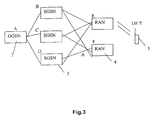
- Fig.3 for the multicast data, in practice, the same set of multicast data may come from different SGSNs due to the many-many relation between SGSNs and RANs, thus a RAN may receive the same data from different nodes. If said method is used to manage multicast data and routes without any simplification of network topological structure, it will result in waste of system resources and chaos of management. Thus the logical relationship among nodes in Fig.3 should be simplified to make the relation between SGSNs and RANs be point-to-multipoint relationship as shown in Fig.2.
- each SGSN in the network can corresponds to one or more RANs, while each RAN corresponds to only one SGSN.
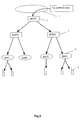
- Fig.3 meshy topological structure is needed to change to be tree topological structure.
- the data of a RAN subscriber registered at node E can be transmitted via the SGSN at node B, SGSN at node C, and SGSN at node D usually according to original node where the subscriber registered.
- the data of a RAN subscriber registered at node E can only be transmitted via the SGSN at node B.
- each RAN can be associated with only one SGSN, thus the network topology in Fig.3 is transformed into a tree topological structure, as shown in Fig.1.
- a RAN subscriber registered at node E may correspond to 2 nodes: SGSN at node C and SGSN at node B, wherein the former is used to process normal traffics and can be called as a 'Register SGSN', and the latter is used to process multicast traffics and can be called as a 'multicast SGSN'.
- Fig.1 is the flowchart of an embodiment of the present invention.
- the data related with multicast traffic is classified into 2 types: multicast-related record data and multicast route data.
- Said multicast-related record data stores the information related to subscribers joined a multicast subscriber group and is used to query for multicast traffic instead of forwarding multicast data, thus distribution of subscribers in a multicast subscriber group can be determined.
- the data is stored in both HLRs and SGSNs to avoid the repeated query in HLRs and overload for HLR.
- Said multicast route data is used to determine how the nodes forward data at the topological structure of network.
- the multicast route data is used to determine the forwarding path of data, and hierarchical store method is used in the present invention.
- the basic ideal in managing multicast route data is to utilize the features of mobile network, i.e., positions of subscribers needing register and subscribers' positions needing update when the subscribers' positions vary, to maintain and update the multicast route data.
- the multicast route data is only related to the topological distribution of subscribers in groups in network, and it has no business with the actual information of each subscriber.
- the multicast-related record data and multicast route data supplement each other, which can determine not only the topological distribution of subscriber groups at nodes of network, but also not only distribution of subscribers at nodes of network, thus the high efficiency and effectiveness of multicast data forwarding can be guaranteed.
- the present invention mainly relates to the management of multicast route data.
- the multicast route data is classified into 2 hierarchies: the first-hierarchy data is stored in GGSN (Gateway GPRS Support Node) to record how the multicast data received forwards multicast data to SGSN; while the second-hierarchy data is stored in SGSN to record how the multicast data received forwards multicast data to subscriber cells.
- the multicast route data stored in SGSNs may also include the amount of subscribers in each cell to determine whether a point-to-multipoint channel or a point-to-point channel is used for the air interface in forwarding multicast messages to the cell according to the amount of subscribers.
- GGSN multicast route tables should be established at GGSN nodes to record how the multicast data received forwards multicast data to SGSN; said table comprises the following fields:
- SGSN multicast route tables are established at SGSN nodes to record how the multicast data received forwards multicast data to subscriber cells, said table comprises the following fields:
- GGSN1 For example, two subscribers joined subscriber group 100 are in SGSN1 and SGSN2 respectively and the subscriber group 100 corresponds to GGSN1 according to the optimization strategy, the following GGSN multicast route table should be established at GGSN1: Group No. Traffic Node Update Flag 100 SGSN1 Y SGSN2 Y ... ...
- the following SGSN multicast route table should be established at SGSN1: Group No. GGSN Cell Amount of Subscribers Update Flag 100 GGSN C1 12 Y 1 C2 11 Y ... ... ...
- GGSN1 For the received multicast data with 'Group No. 100', GGSN1 queries in its own GGSN multicast route table to determine that subscribers with 'Group No. 100' are distributed at SGSN1 and SGSN2. Then GGSN1 forward the multicast data to SGSN1 and SGSN2. Wherein when receiving multicast data with 'Group No. 100', SGSN1 queries in its own multicast route table to determine to forward the multicast data to C1 and C2. At the same time, SGSN1 will determine the forwarding mode of multicast data for the air interface according to the amount of subscribers in the cells.
- a SGSN finds that there are more subscribers in a cell, it will inform the RAN of a group number to identify and allocate a point-to-multipoint channel; if finding that there are fewer subscribers in the cell, the SGSN will search for the subscribers in the cell and allocate a point-to-point channel for each subscriber. As the result, the subscribers distributed in C1 and C2 can receive the multicast data.
- a SGSN multicast route table may not include the 'Amount of subscribers' field to simplify the complexity of managing data in the multicast route table.
- the forwarding mode of multicast data for the wireless interface is merely unable to determine, and the forwarding of multicast data at network side will not be affected.
- the SGSN forwards the multicast data to corresponding cells, and then the cells themselves determine the forwarding mode of multicast data for the air interface.
- step (2) the SGSN determines whether some subscriber joins a multicast subscriber group or a multicast exits a multicast subscriber group. If yes, hierarchical multicast route data will be modified accordingly in step (3). That is to say, during the process of establishing said route table, a SGSN first determines whether route data related with the subscriber exists, if it not, the data should be added in the route table and at the same time the SGSN determines whether to inform the GGSN of modifying the multicast route table; if yes, the SGSN will add an 'Updated' flag. If the SGSN route table requires calculating the amount of subscribers in each cell, the data of 'Amount of Subscribers' in the SGSN multicast route table should be modified. In this way, multicast route tables can be established and maintained at SGSNs and GGSNs in turn.
- SGSN multicast route table When a multicast subscriber exits a multicast subscriber group, it is no need to modify the SGSN multicast route table and GGSN multicast route table if the SGSN multicast route table doesn't include the 'Amount of Subscribers', and only the multicast-related record data at SGSNs is modified and the HLR is informed of modifying multicast-related record data of the subscribers. Possible modification of data in the multicast route table can be done in subsequent location register. If the SGSN multicast route table includes an 'Amount of Subscribers' field, besides said operation the SGSN should determine whether to delete corresponding data and inform the GGSN of updating the GGSN multicast route table according to the updated Amount of Subscribers' in the SGSN multicast route table.
- the subscriber detaches and the subscriber is a member of a subscriber group, it can be processed in a method similarly to the mode of 'user exit'.
- the GGSN when receiving multicast data group from an external network, the GGSN queries in the GGSN multicast route table (the first-hierarchy) and then forwards the multicast data to corresponding SGSN.
- the corresponding SGSN queries in the SGSN multicast route table (the second-hierarchy) to determine the distribution of corresponding subscriber groups, and forward the multicast data to corresponding cells, thus the multicast data is forwarded.
- said SGSN multicast route table includes the record of 'Amount of Subscribers' of each cell, said SGSN can also determine the forwarding mode of multicast data for the wireless interface.
- the SGSN will inform the RAN of establishing a point-to-multipoint channel with a corresponding group ID; if there are fewer subscribers in the cell, the SGSN will inform the RAN of establishing point-to-point channels with Subscriber ID.
- the process through which a subscriber joins a subscriber group comprises the following steps, referring to Fig.4:
- a subscriber sends a request to a multicast subscriber group comprising the Group No. to which the subscriber will join; then turn to step 12, the SGSN parses out the only corresponding GGSN according to the Group No. and the optimization strategy, and forwards the subscriber's request to the GGSN; in step 13, the GGSN implements corresponding operation according to the subscriber's request to determine whether the subscriber is allowed to join the multicast subscriber group, if the GGSN determines to allow the subscriber to join the multicast subscriber group through implementing corresponding operation, e.g., querying subscriber multicast record in HLR to determine whether the subscriber has a corresponding authority, and a 'Multicast Subscriber Group Activation indication' is feedback to the SGSN; in step 14, after receiving the 'Multicast Subscriber Group Activation indication', the SGSN instructs the RAN to implement operations (e.g., forwarding multicast parameters) to add the subscriber in the subscriber group, and returns the
- the SGSN modifies corresponding multicast-related record data and SGSN multicast route table according to the current position of the subscriber to reflect that the subscriber has joined the subscriber group as well as the topological distribution of the subscribers in the subscriber group in the SGSN area; in step 15, SGSN feedbacks the 'multicast activated response' message to GGSN, GGSN modifies the GGSN multicast route table according to the message; in step 16, SGSN informs HLR of the message that the subscriber has joined the subscriber group, HLR modifies the multicast-related record data of the subscriber to reflect the fact that the subscriber has joined the subscriber group.
- step 2 when being determined that no subscriber joins the subscriber group or a multicast subscriber exits the group, turn to step 4.
- step 4 the system determines whether the multicast subscribers are performing location register and location update, if yes, the hierarchical multicast route data of the system is updated accordingly in step 5; otherwise end the process.
- the multicast route data may reflect the variation of subscriber's state in time due to no normal message exchange between the subscriber and the network.
- the multicast route tables in the system should reflect the dynamic variation of subscribers in subscriber groups at nodes and should update automatically.
- step 5 the update of hierarchical multicast route data can be achieved during location register of subscribers' terminal.
- the network node receives a location register message from the terminal, it determines that the terminal is still in the managed range of the node and determines that whether the current position of the subscriber is recorded correctly. If the network detects that the terminal didn't register its position for several time circles, it will deem that the subscriber is detached due to some reasons.
- the SGSN can obtain the subscriber group which the subscriber joined through querying in the local database according to the subscriber's ID each time the subscriber registers his/her position. Subsequently, the SGSN updates the SGSN multicast route table according to the subscriber group, which the subscriber joined. The steps are described as following:
- the SGSN submits Subscriber Group Exist' messages to corresponding GGSNs periodically or when it detects a GGSN restarts according to the multicast route group information stored in it. If the GGSN doesn't receive the message for a certain time, it may deem that the corresponding route data is invalid and can be deleted. If the GGSN receives the message and finds it new to the existing data, it will deem that update data at the GGSN needs to be updated to reflect the current topological distribution of subscriber groups and avoid inconsistency between different multicast data tables.
- the update of hierarchical multicast route data described in step 5 can also be performed when the position of a subscriber's terminal is updated. For example, suppose the SGSN forwards multicast data to a cell at a specific second, but all subscribers in the cell moves out of the cell at the next second, the SGSN should not forward multicast data to the cell. Hence the multicast route tables should reflect the dynamic variation of subscribers' positions.
- the update of multicast route data may be performed through the following steps:
- said hierarchical multicast route table can be adjusted automatically to ensure the consistency between the content of the multicast route tables and the current topological distribution of multicast subscribers in the subscriber groups, thus any inconsistency and resources waste when forwarding multicast data are avoided due to abnormalities.
- the location register of subscribers' terminals in present invention comprises initial attachment and periodical positions register.
Landscapes
- Engineering & Computer Science (AREA)
- Computer Networks & Wireless Communication (AREA)
- Signal Processing (AREA)
- Databases & Information Systems (AREA)
- Mobile Radio Communication Systems (AREA)
- Data Exchanges In Wide-Area Networks (AREA)
- Small-Scale Networks (AREA)
Claims (12)
- Verfahren zum Verwalten von Multicast-Teilnehmern in einem Mobilnetz, umfassend die folgenden Schritte:(i) Klassifizieren von Daten, die sich auf einen Multicast-Verkehr beziehen, in Multicast-bezogene Aufzeichnungsdaten und Multicast-Routendaten, wobei die Multicast-bezogenen Aufzeichnungsdaten Information von Teilnehmern in einer Multicast-Teilnehmergruppe speichern und verwendet werden, um nach einem Multicast-Verkehr abzufragen, um die Mitgliedschaft von Teilnehmern in der Multicast-Teilnehmergruppe zu bestimmen, und wobei die Multicast-Routendaten in einer hierarchische Struktur gespeichert und verwendet werden, um einen Weiterleitungspfad von Multicast-Daten zu bestimmen;(ii) Modifizieren der hierarchischen Multicast-Routendaten und der Multicast-bezogenen Aufzeichnungsdaten, wenn ein Teilnehmer (5) einer Multicast-Gruppe beitritt oder ein Multicast-Teilnehmer (5) eine Multicast-Gruppe verlässt; und(iii) Aktualisieren der hierarchischen Multicast-Routendaten, wenn ein Multicast-Teilnehmer (5) eine Aufenthaltsort-Registrierung oder eine Aufenthaltsort-Aktualisierung in dem Netz ausführt.
- Verfahren zum Verwalten von Multicast-Teilnehmern nach Anspruch 1, ferner umfassend den Schritt zum Bilden einer topologischen Baumstruktur auf Grundlage von Netzknoten, um einen Multicast-Dienst auszuführen.
- Verfahren zum Verwalten von Multicast-Teilnehmern gemäß Anspruch 2, wobei die Multicast-Daten in einer Struktur mit zwei Hierarchien gespeichert werden;
wobei die Multicast-Daten der ersten Hierarchie in einem Gateway GPRS Unterstützungsknoten gespeichert werden, der als GGSN (2) nachstehend bezeichnet wird; und
die Multicast-Daten der zweiten Hierarchie in bedienenden General Packet Radio Service Unterstützungsknoten, die nachstehend als SGSNs (3) bezeichnet werden, gespeichert werden. - Verfahren zum Verwalten von Multicast-Teilnehmern nach Anspruch 3, wobei jeder SGSN (3) wenigstens einem Radio Access Network, welches nachstehend als RAN (4) bezeichnet wird, entspricht, und jedes RAN (4) einem SGSN (3) entspricht.
- Verfahren zum Verwalten von Multicast-Teilnehmern nach Anspruch 3, wobei eine GGSN Multicast-Routentabelle in dem GGSN (2) zum Aufzeichnen der Multicast-Routendaten der ersten Hierarchie eingerichtet wird, wobei die GGSN Multicast-Routentabelle die folgenden Felder umfasst:"Group number" (Gruppennummer), das verwendet wird, um eine Multicast-Gruppe zu identifizieren, deren Verkehr durch den GGSN (2) ausgeführt wird;"Traffic Node" (Verkehrsknoten), das verwendet wird, um einen Ziel-SGSN zu identifizieren, an den die Multicast-Daten von dem GGSN (2) per Multicast übertragen werden; und"Update Flag" (Aktualisierungsflag), das verwendet wird, um zu identifizieren, ob die Aufzeichnung aktualisiert worden ist.
- Verfahren zum Verwalten von Multicast-Teilnehmern nach Anspruch 3, wobei eine SGSN Multicast-Routentabelle in jedem SGSN (3) zum Aufzeichnen der Multicast-Routendaten der zweiten Hierarchie und zum Dienen als eine Referenz für den Weiterleitungsmodus für Multicast-Daten eingerichtet wird, wobei die SGSN Multicast-Routentabelle die folgenden Felder umfasst:"Group number" (Gruppennummer), das verwendet wird, um eine Multicast-Gruppe zu identifizieren, deren Verkehr durch einen der SGSNs (3) ausgeführt wird;"Gateway Node" (Gateway Knoten), das verwendet wird, um den GGSN (2) entsprechend zu der Multicast-Gruppe zu identifizieren;"Cell" (Zelle), das verwendet wird, um eine Zielzelle zu identifizieren, an die die Multicast-Daten durch den SGSN (3) per Multicast übertragen werden;"Amount of subscribers" (Menge von Teilnehmern), das ein optionales Feld ist und verwendet wird, um die Menge von Teilnehmern (5) der Multicast-Gruppe der Zielzelle zu identifizieren; und"Update Flag" (Aktualisierungsflag), das verwendet wird, um zu identifizieren, ob die Aufzeichnung aktualisiert worden ist.
- Verfahren zum Verwalten von Multicast-Teilnehmern nach Anspruch 3, wobei der Prozess eines Teilnehmers (5), der einer Teilnehmergruppe im Schritt (ii) beitritt, die folgenden Schritte umfasst, dass:(i) ein Teilnehmer (5) eine Aufforderung an einen der SGSNs (3) sendet, wobei die Aufforderung die Gruppennummer der Multicast-Teilnehmergruppe enthält, der der Teilnehmer (5) beitreten wird;(ii) der SGSN (3) einen einzigartigen entsprechenden GGSN (2) entsprechend zu der Gruppenummer und einer Wählstrategie heraussucht und die Aufforderung des Teilnehmers an den GGSN (2) weiterleitet;(iii) der GGSN (2) bestimmt, ob dem Teilnehmer (5) bei der Aufforderung des Teilnehmers erlaubt wird der Multicast-Teilnehmergruppe beizutreten, und eine 'Multicast-Teilnehmergruppe-Aktivierungsanzeige' ("Multicast Subscriber Group Activation indication") Nachricht an den SGSN (3) für den Fall sendet, dass dem Teilnehmer erlaubt wird beizutreten;(iv) nach Empfangen der 'Multicast-Teilnehmergruppe-Aktivierungsanzeige' der SGSN den entsprechenden RAN (4) anweist Operationen zu implementieren, um den Teilnehmer (5) in der. Teilnehmergruppe hinzuzufügen, und der entsprechende RAN (4) das Ergebnis an den SGSN (3) zurückgibt, wobei der SGSN (3) die entsprechenden SGSN Multicast-bezogenen Aufzeichnungsdaten und die SGSN Multicast-Routentabelle in Übereinstimmung mit der gegenwärtigen Zelle, wo der Teilnehmer (5) sich befindet, modifiziert;(v) der SGSN (3) eine 'Multicast-aktivierte Antwort' Nachricht zurück an den GGSN (2) führt und der GGSN (2) die GGSN Multicast-Routentabelle in Übereinstimmung mit der Nachricht modifiziert; und(vi) der SGSN (3) das entsprechende HLR über die Information, dass der Teilnehmer (5) der Teilnehmergruppe beigetreten ist, informiert, und das HLR die entsprechenden Multicast-bezogenen Aufzeichnungsdaten modifiziert.
- Verfahren zum Verwalten von Multicast-Teilnehmern nach Anspruch 6, wobei der Aufenthaltsort-Registrierungsschritt (iii) die folgenden Schritte umfasst, dass:(Bi) der SGSN (3) in den Multicast-bezogenen Eintragsdaten sucht, um zu bestimmen, ob der Teilnehmer (5) der entsprechenden Multicast-Teilnehmergruppe beigetreten ist, in der SGSN Multicast-Routentabelle in Übereinstimmung mit der Gruppennummer der speziellen Multicast-Teilnehmergruppe, der der Teilnehmer beigetreten ist, und der gegenwärtigen Zelle, wo sich der Teilnehmer (5) befindet, sucht, für den Fall, dass der Teilnehmer (5) der Multicast-Teilnehmergruppe beigetreten ist, die Daten für den Fall, dass die SGSN Multicast-Routentabelle keine Daten entsprechend zu der Teilnehmer-Gruppennummer und der Zelle, wo sich der Teilnehmer befindet, aufweist, hinzufügt, bestimmt, ob die Multicast-Routendaten der Multicast-Teilnehmergruppe in der SGSN Multicast-Routentabelle existieren; und den GGSN (2) über eine Aktualisierung der GGSN Multicast-Routentabelle für den Fall informiert, dass die Multicast-Routendaten der Multicast-Teilnehmergruppe in der SGSN Multicast-Routentabelle nicht existieren; und das "aktualisierte Flag" für den Fall, dass entsprechende GGSN Daten in der SGSN Multicast-Routentabelle existieren, aktualisiert; und(Bii) für den Fall, dass die SGSN Multicast-Routentabelle nicht für eine vorgegebene Zeit aktualisiert worden ist, der SGSN (3) die entsprechenden Daten aus der SGSN Multicast-Routentabelle löscht und bestimmt, ob Multicast-Routendaten der Multicast-Teilnehmergruppe in der SGSN Multicast-Routentabelle existieren, und eine Aktualisierungsnachricht an den GGSN (2) für den Fall sendet, dass Multicast-Routendaten der Multicast-Teilnehmergruppe in der SGSN Multicast-Routentabelle existieren.
- Verfahren zum Verwalten von Multicast-Teilnehmern nach Anspruch 6, wobei der Schritt (iii) die folgenden Schritte umfasst:(Ci) Bestimmen, ob die Aufenthaltsort-Aktualisierung des Multicast-Teilnehmers innerhalb des SGSN (3) ausgeführt werden kann, wobei der SGSN (3) in dem Multicast-bezogenen Aufzeichnungsdaten in Übereinstimmung mit der Teilnehmer-ID und der Positionsinformation, die von dem Teilnehmer (5) übergeben wird, für den Fall sucht, dass die Aufenthaltsortaktualisierung innerhalb des SGSN (3) ausgeführt werden kann, Ermitteln der Gruppennummer der Multicast-Gruppe, der der Teilnehmer (5) beigetreten ist, und Aktualisieren der SGSN Multicast-Routentabelle auf Grundlage der Gruppennummer und der Positionsinformation;(Cii) wenn sich der Teilnehmer (5) zu einem anderen SGSN (3) bewegt, Übergeben, durch den Teilnehmer (5), des ursprünglichen International Mobil Station Identifier (Internationaler Mobilstations-Identifizierer) und der ursprünglichen SGSN ID, auf Grundlage derer der neue SGSN (3) sämtliche Daten des Teilnehmers aus dem ursprünglichen SGSN (3) zurückholt; gleichzeitig Aktualisieren der SGSN Multicast-Routentabelle durch den ursprünglichen SGSN (3), und Bestimmen, ob entsprechende Daten aus der SGSN Multicast-Routentabelle in Übereinstimmung mit der aktualisierten Menge von Teilnehmern gelöscht werden sollen, und Informieren des ursprünglichen GGSN (2) über eine Aktualisierung der GGSN Multicast-Routentabelle für den Fall, dass die ursprüngliche SGSN Multicast-Routentabelle die "Menge von Teilnehmern" enthält, wobei der neue SGSN (3) bestimmt, ob die SGSN Multicast-Routentabelle aktualisiert werden muss, in Übereinstimmung mit der Gruppennummer der Multicast-Teilnehmergruppe, der der Teilnehmer beigetreten ist, der gegenwärtigen Zelle, wo sich der Teilnehmer (5) befindet, und ob die Multicast-Teilnehmergruppe ein Roaming unterstützt, und Bestimmen, ob der entsprechende GGSN zum Aktualisieren der Multicast-Routentabelle benachrichtigt werden muss, in Übereinstimmung mit dem gegenwärtigen Zustand der SGSN Multicast-Routentabelle, für den Fall, dass die Teilnehmergruppe ein Roaming unterstützt.
- Verfahren zum Verwalten von Multicast-Teilnehmern nach Anspruch 9, wobei der Schritt zum Bestimmen, ob die entsprechende GGSN Multicast-Routentabelle zu aktualisieren ist, in Übereinstimmung mit dem gegenwärtigen Zustand der SGSN Multicast-Routentabelle für den Fall, dass die Teilnehmergruppe im Schritt (Cii) ein Roaming unterstützt, die folgenden Schritte umfasst:(Di) für den Fall, dass der Teilnehmer (5) in einem "Ruhezustand" ist, Aktualisieren der SGSN Multicast-Routentabelle durch den neuen SGSN (3), Wählen eines GGSN (2) in Übereinstimmung mit einer gegenwärtigen Wählstrategie, und Bestimmen, ob entsprechende GGSN Daten in der SGSN Multicast-Routentabelle existieren; gleichzeitig Informieren des gewählten GGSN (2) über eine Aktualisierung in der gegenwärtigen GGSN Multicast-Routentabelle für den Fall, das die entsprechenden Daten nicht in der SGSN Multicast-Routentabelle existieren;(Dii) für den Fall, dass der Teilnehmer in einem 'Verbindungszustand' ist und die Teilnehmergruppe, der der Teilnehmer beigetreten ist, nicht eine kontinuierliche Datenübertragung unterstützt, Aktualisieren der SGSN Multicast-Routentabelle durch den neuen SGSN (3), Wählen eines GGSN (2) in Übereinstimmung mit einer gegenwärtigen Wählstrategie, Bestimmen, ob entsprechende GGSN Daten in der SGSN Multicast-Routentabelle existieren, und Informieren des gewählten GGSN (2) über eine Aktualisierung der entsprechenden GGSN Multicast-Routentabelle für den Fall, dass die entsprechenden Daten nicht in der SGSN Multicast-Routentabelle existieren;(Diii) für den Fall, dass der Teilnehmer (5) in einem 'Verbindungszustand' ist und die Teilnehmergruppe, der der Teilnehmer (5) beigetreten ist, eine kontinuierliche Datenübertragung unterstützt, Bestimmen, durch den neuen SGSN (3), ob entsprechende Daten in der SGSN Multicast-Routentabelle existieren, und Informieren des ursprünglichen GGSN (2) über eine Aktualisierung der GGSN Multicast-Routentabelle für den Fall, dass entsprechende Daten nicht in der SGSN Multicast-Routentabelle existieren, Einrichten eines vorübergehenden Datenkanals zwischen dem ursprünglichen GGSN (2) und dem neunen SGSN (3), um so eine kontinuierliche Übertragung von Multicast-Daten zu unterstützen; auf einen Abschluss der Datenübertragung hin, Informieren, durch den neuen SGSN (3), des ursprünglichen GGSN (2) über eine Löschung des Datenkanals, Wählen eines GGSN (2) in Übereinstimmung mit einer gegenwärtigen Wählstrategie, Bestimmen, ob entsprechende Daten in der SGSN Multicast-Routentabelle existieren und Informieren des gewählten GGSN (2) über eine Aktualisierung der entsprechenden GGSN Multicast-Routentabelle für den Fall, dass entsprechende Daten in der SGSN Multicast-Routentabelle existieren.
- Verfahren zum Verwalten von Multicast-Teilnehmern nach Anspruch 3, 4, 5, 6, 7, 8, 9 oder 10, ferner umfassend die Schritte, dass:(Ei) der SGSN (3) in Übereinstimmung mit der Gruppenummer, die in der SGSN Multicast-Routentabelle gespeichert ist, und dem GGSN Identifizierer, der in Übereinstimmung mit der Gruppennummer herausgesucht wurde, Übergeben einer Nachricht bezüglich der Existenz des Teilnehmers (5) an den entsprechenden GGSN (2) periodisch oder wenn eine Erfassung des GGSN (2) erneut startet;(Eii) für den Fall, dass die GGSN Multicast-Routentabelle nicht die Nachricht bezüglich der Existenz des Multicast-Gruppenteilnehmers von dem SGSN (3) für eine vorgegebene Zeit empfängt, die entsprechenden Daten in der GGSN Multicast-Routentabelle gelöscht werden;(Eiii) für den Fall, dass die GGSN Multicast-Routentabelle die Nachricht bezüglich der Existenz des Teilnehmers, die von dem SGSN (3) übergeben wird, empfängt, aber Daten entsprechend zu der Multicast-Gruppe nicht in der GGSN Multicast-Routentabelle sind, die entsprechenden Daten in der GGSN Multicast-Routentabelle hinzugefügt werden.
- Verfahren zum Verwalten von Multicast-Teilnehmern nach Anspruch 8, ferner umfassend den Schritt zum Berechnen der Menge von Teilnehmern in den Zellen, die von dem SGSN (3) bedient werden, für eine Periode, und Aktualisieren der SGSN Multicast-Routentabelle in Übereinstimmung mit dem Berechnungsergebnis.
Applications Claiming Priority (2)
| Application Number | Priority Date | Filing Date | Title |
|---|---|---|---|
| CN02103932 | 2002-02-09 | ||
| CNB021039321A CN1177436C (zh) | 2002-02-09 | 2002-02-09 | 移动网络中多播用户的管理方法 |
Publications (2)
| Publication Number | Publication Date |
|---|---|
| EP1335522A1 EP1335522A1 (de) | 2003-08-13 |
| EP1335522B1 true EP1335522B1 (de) | 2007-06-20 |
Family
ID=27587811
Family Applications (1)
| Application Number | Title | Priority Date | Filing Date |
|---|---|---|---|
| EP20030250813 Expired - Lifetime EP1335522B1 (de) | 2002-02-09 | 2003-02-10 | Verfahren zum Verwalten von Multicast Teilnehmern in einem Mobilfunknetz |
Country Status (6)
| Country | Link |
|---|---|
| US (1) | US7545825B2 (de) |
| EP (1) | EP1335522B1 (de) |
| JP (1) | JP4115852B2 (de) |
| CN (1) | CN1177436C (de) |
| AT (1) | ATE365409T1 (de) |
| DE (1) | DE60314467D1 (de) |
Families Citing this family (69)
| Publication number | Priority date | Publication date | Assignee | Title |
|---|---|---|---|---|
| US7457275B2 (en) * | 2002-04-09 | 2008-11-25 | Jianguo Zhao | Method for implementing Iu-Flex based MBMS |
| GB2403622A (en) * | 2003-06-30 | 2005-01-05 | Inquam | Dynamically adding users to a group in a telecommunications system |
| KR100553722B1 (ko) * | 2003-09-04 | 2006-02-24 | 삼성전자주식회사 | 트리 구조의 무선 네트워크에서 라우팅 경로 복구 방법 |
| CN1333549C (zh) * | 2003-09-16 | 2007-08-22 | 华为技术有限公司 | 一种集群业务中动态更新群组信息的方法 |
| US7596107B1 (en) * | 2004-01-26 | 2009-09-29 | Cisco Technology, Inc. | System and method for enabling multicast group services in a network environment |
| US20050198643A1 (en) * | 2004-02-17 | 2005-09-08 | Lachelt David J. | Journaling proxy in activation solution |
| US20050213576A1 (en) * | 2004-03-29 | 2005-09-29 | Stephens Adrian P | Multicasting in wireless networks |
| JP4480512B2 (ja) * | 2004-08-10 | 2010-06-16 | 株式会社エヌ・ティ・ティ・ドコモ | 移動通信システム及びサービス制御装置 |
| US8095601B2 (en) * | 2004-10-22 | 2012-01-10 | Microsoft Corporation | Inter-proximity communication within a rendezvous federation |
| US8095600B2 (en) * | 2004-10-22 | 2012-01-10 | Microsoft Corporation | Inter-proximity communication within a rendezvous federation |
| US7694167B2 (en) * | 2004-10-22 | 2010-04-06 | Microsoft Corporation | Maintaining routing consistency within a rendezvous federation |
| US20060090003A1 (en) * | 2004-10-22 | 2006-04-27 | Microsoft Corporation | Rendezvousing resource requests with corresponding resources |
| US20080288659A1 (en) | 2006-11-09 | 2008-11-20 | Microsoft Corporation | Maintaining consistency within a federation infrastructure |
| US8014321B2 (en) * | 2004-10-22 | 2011-09-06 | Microsoft Corporation | Rendezvousing resource requests with corresponding resources |
| US7730220B2 (en) * | 2004-10-22 | 2010-06-01 | Microsoft Corporation | Broadcasting communication within a rendezvous federation |
| US8549180B2 (en) | 2004-10-22 | 2013-10-01 | Microsoft Corporation | Optimizing access to federation infrastructure-based resources |
| US7958262B2 (en) | 2004-10-22 | 2011-06-07 | Microsoft Corporation | Allocating and reclaiming resources within a rendezvous federation |
| US8392515B2 (en) * | 2004-10-22 | 2013-03-05 | Microsoft Corporation | Subfederation creation and maintenance in a federation infrastructure |
| US20110082928A1 (en) | 2004-10-22 | 2011-04-07 | Microsoft Corporation | Maintaining consistency within a federation infrastructure |
| US7437170B2 (en) * | 2004-11-29 | 2008-10-14 | Kyocera Corporation | System and method for efficient push-to-talk communications |
| US7801068B2 (en) * | 2004-12-29 | 2010-09-21 | Motorola, Inc. | Selectively receiving data in a multicast environment |
| US8121276B2 (en) * | 2005-06-21 | 2012-02-21 | Broadcom Corporation | Multicast call processing unit for telecommunication devices |
| KR100728297B1 (ko) | 2006-01-17 | 2007-06-13 | 삼성전자주식회사 | 무선 애드 혹 네트워크에서의 무선 자원 처리 방법 및 그장치 |
| TWI289387B (en) * | 2006-02-17 | 2007-11-01 | Hon Hai Prec Ind Co Ltd | Wireless network multicasting system and method |
| GB0608612D0 (en) * | 2006-05-02 | 2006-06-14 | Vodafone Plc | Telecommunications networks |
| US9198084B2 (en) | 2006-05-26 | 2015-11-24 | Qualcomm Incorporated | Wireless architecture for a traditional wire-based protocol |
| US20070274246A1 (en) * | 2006-05-26 | 2007-11-29 | Stephens Adrian P | Reliable multicast in a network having a power saving protocol |
| CN100579280C (zh) * | 2006-06-23 | 2010-01-06 | 华为技术有限公司 | 一种确定多播服务用户位置区域的方法 |
| WO2008040243A1 (en) * | 2006-09-20 | 2008-04-10 | Huawei Technologies Co., Ltd. | A method, multicast-broadcast device and system for a terminal terminating multicast-broadcast service |
| CN101150852B (zh) * | 2006-09-20 | 2012-02-22 | 华为技术有限公司 | 终端退出多播广播业务的方法及多播广播系统 |
| US8667144B2 (en) | 2007-07-25 | 2014-03-04 | Qualcomm Incorporated | Wireless architecture for traditional wire based protocol |
| CN101369985A (zh) * | 2007-08-15 | 2009-02-18 | 华为技术有限公司 | 一种加入群组的方法和系统 |
| KR100873284B1 (ko) | 2007-08-31 | 2008-12-11 | 에스케이 텔레콤주식회사 | 이동통신에서의 멀티캐스트 방송 타입 컨텐츠 공급 서비스가입 시스템 및 방법 |
| US8811294B2 (en) | 2008-04-04 | 2014-08-19 | Qualcomm Incorporated | Apparatus and methods for establishing client-host associations within a wireless network |
| EP2129037A1 (de) * | 2008-05-29 | 2009-12-02 | THOMSON Licensing | Verfahren und Vorrichtung zur Multicast-Gruppenverwaltung |
| US9398089B2 (en) | 2008-12-11 | 2016-07-19 | Qualcomm Incorporated | Dynamic resource sharing among multiple wireless devices |
| US8976722B2 (en) * | 2008-12-18 | 2015-03-10 | Qualcomm Incorporated | Managing transmission protocols for group communications within a wireless communications network |
| US20100157870A1 (en) * | 2008-12-19 | 2010-06-24 | Qualcomm Incorporated | Managing a multicast group membership table at an access network within a wireless communications system |
| US20100205321A1 (en) * | 2009-02-12 | 2010-08-12 | Qualcomm Incorporated | Negotiable and adaptable periodic link status monitoring |
| US9264248B2 (en) * | 2009-07-02 | 2016-02-16 | Qualcomm Incorporated | System and method for avoiding and resolving conflicts in a wireless mobile display digital interface multicast environment |
| JP5375970B2 (ja) * | 2009-12-04 | 2013-12-25 | 富士通株式会社 | 基地局装置、移動端末、通信システムおよび無線通信方法 |
| US9582238B2 (en) | 2009-12-14 | 2017-02-28 | Qualcomm Incorporated | Decomposed multi-stream (DMS) techniques for video display systems |
| JP5561096B2 (ja) * | 2010-10-19 | 2014-07-30 | 富士通株式会社 | 放送型データ配信サービス情報配信方法、移動網管理装置及び無線ネットワーク制御装置 |
| US9065876B2 (en) | 2011-01-21 | 2015-06-23 | Qualcomm Incorporated | User input back channel from a wireless sink device to a wireless source device for multi-touch gesture wireless displays |
| US8964783B2 (en) | 2011-01-21 | 2015-02-24 | Qualcomm Incorporated | User input back channel for wireless displays |
| US9413803B2 (en) | 2011-01-21 | 2016-08-09 | Qualcomm Incorporated | User input back channel for wireless displays |
| US10135900B2 (en) | 2011-01-21 | 2018-11-20 | Qualcomm Incorporated | User input back channel for wireless displays |
| US20130013318A1 (en) | 2011-01-21 | 2013-01-10 | Qualcomm Incorporated | User input back channel for wireless displays |
| US9787725B2 (en) | 2011-01-21 | 2017-10-10 | Qualcomm Incorporated | User input back channel for wireless displays |
| US9503771B2 (en) | 2011-02-04 | 2016-11-22 | Qualcomm Incorporated | Low latency wireless display for graphics |
| US8674957B2 (en) | 2011-02-04 | 2014-03-18 | Qualcomm Incorporated | User input device for wireless back channel |
| US10108386B2 (en) | 2011-02-04 | 2018-10-23 | Qualcomm Incorporated | Content provisioning for wireless back channel |
| US9380079B2 (en) * | 2011-06-29 | 2016-06-28 | Cable Television Laboratories, Inc. | Content multicasting |
| US9525998B2 (en) | 2012-01-06 | 2016-12-20 | Qualcomm Incorporated | Wireless display with multiscreen service |
| US8964580B2 (en) * | 2012-01-23 | 2015-02-24 | Nvidia Corporation | Device topology and capability discovery and reporting techniques |
| EP2670083B1 (de) * | 2012-05-28 | 2015-05-06 | Itron, Inc. | Effizientes Multicast in einem smarten Gitter |
| CN104427553B (zh) * | 2013-09-05 | 2019-08-02 | 中兴通讯股份有限公司 | 一种组播组优化方法及锚点 |
| US9807574B2 (en) * | 2013-10-03 | 2017-10-31 | Parallel Wireless, Inc. | Multicast and broadcast services over a mesh network |
| CN105684469A (zh) * | 2013-10-31 | 2016-06-15 | 日本电气株式会社 | Mtc所用的设备、系统和方法 |
| US9178770B2 (en) * | 2013-12-23 | 2015-11-03 | International Business Machines Corporation | Auto incorporation of new components into a hierarchical network |
| US11182870B2 (en) * | 2014-12-24 | 2021-11-23 | Mcafee, Llc | System and method for collective and collaborative navigation by a group of individuals |
| US10608956B2 (en) | 2015-12-17 | 2020-03-31 | Intel Corporation | Adaptive fabric multicast schemes |
| US10873473B2 (en) | 2017-07-17 | 2020-12-22 | Nicira, Inc. | Distributed multicast logical router |
| US11063872B2 (en) * | 2019-10-24 | 2021-07-13 | Vmware, Inc. | Scalable overlay multicast routing |
| CN111352984B (zh) * | 2020-02-19 | 2023-04-18 | 中国联合网络通信集团有限公司 | 数据分发方法、设备和存储介质 |
| US12316471B2 (en) | 2021-01-21 | 2025-05-27 | VMware LLC | Distributing multicast receiver information across multi-tier edge gateways |
| US11895010B2 (en) | 2021-06-29 | 2024-02-06 | VMware LLC | Active-active support of multicast streams in virtualized environment |
| CN116055381B (zh) * | 2021-10-28 | 2025-10-21 | 北京灵汐科技有限公司 | 基于众核系统的路由表更新方法、装置及电子设备 |
| US11784926B2 (en) | 2021-11-22 | 2023-10-10 | Vmware, Inc. | Optimized processing of multicast data messages in a host |
Family Cites Families (36)
| Publication number | Priority date | Publication date | Assignee | Title |
|---|---|---|---|---|
| US3882421A (en) | 1972-05-25 | 1975-05-06 | Honeywell Inc | Low power pulse generator |
| US5570422A (en) | 1990-05-15 | 1996-10-29 | Siecor Puerto Rico, Inc. | Telephone network interface device |
| CA2137587C (en) * | 1994-12-08 | 1999-03-23 | Murray Charles Baker | Broadcast/multicast filtering by the bridge-based access point |
| US5960075A (en) | 1995-02-16 | 1999-09-28 | Northern Telecom Limited | Switchmode power converters for telephone subscriber line interface circuits |
| US5920615A (en) | 1995-10-19 | 1999-07-06 | British Telecommunications Public Limited Company | Telecommunications switch |
| JPH09139961A (ja) | 1995-11-14 | 1997-05-27 | Fujitsu Ltd | 自動回線分配装置 |
| US5805571A (en) | 1996-03-19 | 1998-09-08 | Zwan; Bryan J. | Dynamic communication line analyzer apparatus and method |
| JP3233012B2 (ja) | 1996-04-11 | 2001-11-26 | 株式会社日立製作所 | 移動通信システムにおけるレイヤとセルの選択方法 |
| US5974300A (en) | 1996-07-30 | 1999-10-26 | Lucent Technologies Inc. | Two-way wireless cellular messaging system |
| US6118766A (en) | 1996-08-21 | 2000-09-12 | Godigital Networks Corporation | Multiple ISDN carrier system |
| KR100204061B1 (ko) | 1996-12-21 | 1999-06-15 | 이계철 | 에이티엠 교환시스템에서의 시험기능을 구비한 가입자제어모듈 |
| US5970488A (en) * | 1997-05-05 | 1999-10-19 | Northrop Grumman Corporation | Real-time distributed database system and method |
| US6212274B1 (en) | 1997-06-26 | 2001-04-03 | Data Race, Inc. | Line powered modem |
| US5982851A (en) | 1997-06-30 | 1999-11-09 | Harris Corporation | Call yourself BERT testing of ISDN line |
| JPH1132370A (ja) | 1997-07-08 | 1999-02-02 | Hitachi Ltd | 移動体通信システム、移動加入者交換機、マルチキャスト通信方法および記憶媒体 |
| FI105874B (fi) | 1997-08-12 | 2000-10-13 | Nokia Mobile Phones Ltd | Monipistematkaviestinlähetys |
| US6185191B1 (en) | 1997-12-03 | 2001-02-06 | Harris Corporation | Testing of ISDN line via auxiliary channel signaling |
| FI108829B (fi) | 1998-04-02 | 2002-03-28 | Nokia Corp | Menetelmä pakettiverkossa |
| US6301351B1 (en) | 1998-04-08 | 2001-10-09 | Sbc Technology Resources Inc. | Device and method for transferring unbundled network elements between local exchange carriers |
| US6259676B1 (en) | 1998-06-17 | 2001-07-10 | Nokia Telecommunications Oy | Upgrading of subscriber connection |
| JP2000217157A (ja) | 1999-01-26 | 2000-08-04 | Mitsubishi Electric Corp | 移動通信システムおよび移動局 |
| CA2281208A1 (en) | 1999-08-31 | 2001-02-28 | Nortel Networks Corporation | Single-ended subscriber loop qualification for xdsl service |
| ATE330402T1 (de) | 1999-08-31 | 2006-07-15 | Canon Kk | Informationssignalverarbeitungsvorrichtung, zugehöriges system, zugehörige methode und zugehöriges speichermedium |
| JP3721906B2 (ja) | 1999-12-15 | 2005-11-30 | 株式会社日立製作所 | 移動通信システム及び移動通信システムにおけるマルチキャスト方法 |
| ATE376298T1 (de) | 2000-04-24 | 2007-11-15 | Broadcom Corp | System und verfahren zur leistungsversorgung über ein hausfernsprechnetzwerk |
| US20020015489A1 (en) | 2000-07-03 | 2002-02-07 | Shimon Ben-David | System and method for power feeding a line coupled to an exchange |
| JP3627631B2 (ja) | 2000-07-24 | 2005-03-09 | 日本電信電話株式会社 | パケット情報転送処理装置とストリーム情報転送処理装置およびストリーム情報転送ネットワークサービス提供方法 |
| JP3833450B2 (ja) * | 2000-07-27 | 2006-10-11 | 三菱電機株式会社 | 通信制御方式及びルータ |
| JP2002051167A (ja) | 2000-08-02 | 2002-02-15 | Ntt Comware Corp | 発信者識別接続方法及びシステム装置 |
| AU2001296378A1 (en) * | 2000-09-29 | 2002-04-08 | The Regents Of The University Of California | Ad hoc network accessing using distributed election of a shared transmission schedule |
| US6415022B1 (en) | 2000-12-07 | 2002-07-02 | Global Switches Corporation | User programmable telephone wiring access terminal |
| DE10064107A1 (de) | 2000-12-21 | 2002-06-27 | Siemens Ag | Verfahren zum Verteilen einer Gruppennachricht in einem Funkkommunikationssystem sowie zugehöriges Funkkommunikationssystem |
| WO2002066230A1 (en) | 2001-02-22 | 2002-08-29 | Yupo Corporation | Label for in-mold forming |
| US20050021833A1 (en) * | 2001-08-29 | 2005-01-27 | Frank Hundscheid | Method and device for multicasting in a umts network |
| DE50114632D1 (de) * | 2001-10-19 | 2009-02-12 | Siemens Ag | Verfahren und ein mobil-kommunikationsnetz zur bereitstellung von multicast- und/oder broadcastdiensten |
| CN101047607A (zh) * | 2006-06-01 | 2007-10-03 | 华为技术有限公司 | 实现组播业务的系统及方法 |
-
2002
- 2002-02-09 CN CNB021039321A patent/CN1177436C/zh not_active Expired - Lifetime
-
2003
- 2003-02-05 US US10/359,383 patent/US7545825B2/en not_active Expired - Lifetime
- 2003-02-10 AT AT03250813T patent/ATE365409T1/de not_active IP Right Cessation
- 2003-02-10 DE DE60314467T patent/DE60314467D1/de not_active Expired - Lifetime
- 2003-02-10 JP JP2003032870A patent/JP4115852B2/ja not_active Expired - Lifetime
- 2003-02-10 EP EP20030250813 patent/EP1335522B1/de not_active Expired - Lifetime
Also Published As
| Publication number | Publication date |
|---|---|
| US20030152098A1 (en) | 2003-08-14 |
| EP1335522A1 (de) | 2003-08-13 |
| DE60314467D1 (de) | 2007-08-02 |
| JP4115852B2 (ja) | 2008-07-09 |
| CN1177436C (zh) | 2004-11-24 |
| JP2003258860A (ja) | 2003-09-12 |
| ATE365409T1 (de) | 2007-07-15 |
| US7545825B2 (en) | 2009-06-09 |
| CN1437355A (zh) | 2003-08-20 |
Similar Documents
| Publication | Publication Date | Title |
|---|---|---|
| US7545825B2 (en) | Method for managing multicast subscribers in mobile network | |
| Levine et al. | Improving internet multicast with routing labels | |
| US8081628B2 (en) | Multicast distribution tree establishment and maintenance in a wireless multi-hop relay communication system | |
| CN1327667C (zh) | Ad-hoc网络中的多播路由 | |
| US8521196B2 (en) | Method and system for implementing multimedia broadcast/multicast service | |
| US8724533B2 (en) | Multicast support by mobile routers in a mobile ad hoc network | |
| US8059572B2 (en) | Method of transmitting and receiving multicast data | |
| TWI357242B (en) | Route selection in wireless networks | |
| JP5653912B2 (ja) | マルチキャスト・グループ管理のための方法及び装置 | |
| CN101222414A (zh) | 实现组播通信的装置、系统和方法 | |
| JP7154300B2 (ja) | 通信方法、装置、およびシステム | |
| US20050180447A1 (en) | Multicast method in zigbee network | |
| US20070213081A1 (en) | Method and System for Controlling Multimedia Broadcast Multicast Service Session Procedure | |
| US20140126575A1 (en) | Method of Routing a Multicast Stream in Non-Storage Mode | |
| JP2002044143A (ja) | 通信制御方式及びルータ及び通信制御方法 | |
| KR20070084547A (ko) | 대규모 무선 메쉬 네트워크에 있어서 멀티캐스트 라우팅을지원하는 시스템 및 방법 | |
| CN110149274A (zh) | 基于位置信息和内容推送的命名数据网络综合路由方法 | |
| US8102870B2 (en) | System, server and method for optimizing a group management protocol | |
| US20250168600A1 (en) | Method and Apparatus for Multicast and Broadcast Service | |
| WO2007054006A1 (en) | A base station of wideband wireless access system and a method for realizing group-broadcast service | |
| US20040068578A1 (en) | Forwarding tree generation in a communications network | |
| Omar et al. | Multicast support for mobile-IP with the hierarchical local registration approach | |
| CN110996266A (zh) | 自组网系统的多播组数据传输方法 | |
| US20120287839A1 (en) | Method and apparatus for updating multicast and broadcast service | |
| CN100563213C (zh) | 互联网组管理协议侦听的实现方法、系统及装置 |
Legal Events
| Date | Code | Title | Description |
|---|---|---|---|
| PUAI | Public reference made under article 153(3) epc to a published international application that has entered the european phase |
Free format text: ORIGINAL CODE: 0009012 |
|
| AK | Designated contracting states |
Designated state(s): AT BE BG CH CY CZ DE DK EE ES FI FR GB GR HU IE IT LI LU MC NL PT SE SI SK TR |
|
| AX | Request for extension of the european patent |
Extension state: AL LT LV MK RO |
|
| 17P | Request for examination filed |
Effective date: 20040205 |
|
| 17Q | First examination report despatched |
Effective date: 20040311 |
|
| AKX | Designation fees paid |
Designated state(s): AT BE BG CH CY CZ DE DK EE ES FI FR GB GR HU IE IT LI LU MC NL PT SE SI SK TR |
|
| GRAP | Despatch of communication of intention to grant a patent |
Free format text: ORIGINAL CODE: EPIDOSNIGR1 |
|
| GRAS | Grant fee paid |
Free format text: ORIGINAL CODE: EPIDOSNIGR3 |
|
| GRAA | (expected) grant |
Free format text: ORIGINAL CODE: 0009210 |
|
| AK | Designated contracting states |
Kind code of ref document: B1 Designated state(s): AT BE BG CH CY CZ DE DK EE ES FI FR GB GR HU IE IT LI LU MC NL PT SE SI SK TR |
|
| PG25 | Lapsed in a contracting state [announced via postgrant information from national office to epo] |
Ref country code: LI Free format text: LAPSE BECAUSE OF FAILURE TO SUBMIT A TRANSLATION OF THE DESCRIPTION OR TO PAY THE FEE WITHIN THE PRESCRIBED TIME-LIMIT Effective date: 20070620 Ref country code: CH Free format text: LAPSE BECAUSE OF FAILURE TO SUBMIT A TRANSLATION OF THE DESCRIPTION OR TO PAY THE FEE WITHIN THE PRESCRIBED TIME-LIMIT Effective date: 20070620 |
|
| REG | Reference to a national code |
Ref country code: GB Ref legal event code: FG4D |
|
| REG | Reference to a national code |
Ref country code: CH Ref legal event code: EP |
|
| REG | Reference to a national code |
Ref country code: IE Ref legal event code: FG4D |
|
| REF | Corresponds to: |
Ref document number: 60314467 Country of ref document: DE Date of ref document: 20070802 Kind code of ref document: P |
|
| PG25 | Lapsed in a contracting state [announced via postgrant information from national office to epo] |
Ref country code: SE Free format text: LAPSE BECAUSE OF FAILURE TO SUBMIT A TRANSLATION OF THE DESCRIPTION OR TO PAY THE FEE WITHIN THE PRESCRIBED TIME-LIMIT Effective date: 20070920 |
|
| PG25 | Lapsed in a contracting state [announced via postgrant information from national office to epo] |
Ref country code: AT Free format text: LAPSE BECAUSE OF FAILURE TO SUBMIT A TRANSLATION OF THE DESCRIPTION OR TO PAY THE FEE WITHIN THE PRESCRIBED TIME-LIMIT Effective date: 20070620 |
|
| NLV1 | Nl: lapsed or annulled due to failure to fulfill the requirements of art. 29p and 29m of the patents act | ||
| REG | Reference to a national code |
Ref country code: CH Ref legal event code: PL |
|
| PG25 | Lapsed in a contracting state [announced via postgrant information from national office to epo] |
Ref country code: BE Free format text: LAPSE BECAUSE OF FAILURE TO SUBMIT A TRANSLATION OF THE DESCRIPTION OR TO PAY THE FEE WITHIN THE PRESCRIBED TIME-LIMIT Effective date: 20070620 |
|
| PG25 | Lapsed in a contracting state [announced via postgrant information from national office to epo] |
Ref country code: SI Free format text: LAPSE BECAUSE OF FAILURE TO SUBMIT A TRANSLATION OF THE DESCRIPTION OR TO PAY THE FEE WITHIN THE PRESCRIBED TIME-LIMIT Effective date: 20070620 Ref country code: CZ Free format text: LAPSE BECAUSE OF FAILURE TO SUBMIT A TRANSLATION OF THE DESCRIPTION OR TO PAY THE FEE WITHIN THE PRESCRIBED TIME-LIMIT Effective date: 20070620 Ref country code: NL Free format text: LAPSE BECAUSE OF FAILURE TO SUBMIT A TRANSLATION OF THE DESCRIPTION OR TO PAY THE FEE WITHIN THE PRESCRIBED TIME-LIMIT Effective date: 20070620 Ref country code: ES Free format text: LAPSE BECAUSE OF FAILURE TO SUBMIT A TRANSLATION OF THE DESCRIPTION OR TO PAY THE FEE WITHIN THE PRESCRIBED TIME-LIMIT Effective date: 20071001 Ref country code: BG Free format text: LAPSE BECAUSE OF FAILURE TO SUBMIT A TRANSLATION OF THE DESCRIPTION OR TO PAY THE FEE WITHIN THE PRESCRIBED TIME-LIMIT Effective date: 20070920 |
|
| EN | Fr: translation not filed | ||
| PG25 | Lapsed in a contracting state [announced via postgrant information from national office to epo] |
Ref country code: SK Free format text: LAPSE BECAUSE OF FAILURE TO SUBMIT A TRANSLATION OF THE DESCRIPTION OR TO PAY THE FEE WITHIN THE PRESCRIBED TIME-LIMIT Effective date: 20070620 |
|
| PLBE | No opposition filed within time limit |
Free format text: ORIGINAL CODE: 0009261 |
|
| STAA | Information on the status of an ep patent application or granted ep patent |
Free format text: STATUS: NO OPPOSITION FILED WITHIN TIME LIMIT |
|
| PG25 | Lapsed in a contracting state [announced via postgrant information from national office to epo] |
Ref country code: GR Free format text: LAPSE BECAUSE OF FAILURE TO SUBMIT A TRANSLATION OF THE DESCRIPTION OR TO PAY THE FEE WITHIN THE PRESCRIBED TIME-LIMIT Effective date: 20070921 Ref country code: DK Free format text: LAPSE BECAUSE OF FAILURE TO SUBMIT A TRANSLATION OF THE DESCRIPTION OR TO PAY THE FEE WITHIN THE PRESCRIBED TIME-LIMIT Effective date: 20070620 Ref country code: IT Free format text: LAPSE BECAUSE OF FAILURE TO SUBMIT A TRANSLATION OF THE DESCRIPTION OR TO PAY THE FEE WITHIN THE PRESCRIBED TIME-LIMIT Effective date: 20070620 Ref country code: DE Free format text: LAPSE BECAUSE OF FAILURE TO SUBMIT A TRANSLATION OF THE DESCRIPTION OR TO PAY THE FEE WITHIN THE PRESCRIBED TIME-LIMIT Effective date: 20070921 |
|
| 26N | No opposition filed |
Effective date: 20080325 |
|
| PG25 | Lapsed in a contracting state [announced via postgrant information from national office to epo] |
Ref country code: FR Free format text: LAPSE BECAUSE OF FAILURE TO SUBMIT A TRANSLATION OF THE DESCRIPTION OR TO PAY THE FEE WITHIN THE PRESCRIBED TIME-LIMIT Effective date: 20080222 |
|
| PG25 | Lapsed in a contracting state [announced via postgrant information from national office to epo] |
Ref country code: MC Free format text: LAPSE BECAUSE OF NON-PAYMENT OF DUE FEES Effective date: 20080228 |
|
| PG25 | Lapsed in a contracting state [announced via postgrant information from national office to epo] |
Ref country code: EE Free format text: LAPSE BECAUSE OF FAILURE TO SUBMIT A TRANSLATION OF THE DESCRIPTION OR TO PAY THE FEE WITHIN THE PRESCRIBED TIME-LIMIT Effective date: 20070620 Ref country code: IE Free format text: LAPSE BECAUSE OF NON-PAYMENT OF DUE FEES Effective date: 20080211 |
|
| PG25 | Lapsed in a contracting state [announced via postgrant information from national office to epo] |
Ref country code: FI Free format text: LAPSE BECAUSE OF FAILURE TO SUBMIT A TRANSLATION OF THE DESCRIPTION OR TO PAY THE FEE WITHIN THE PRESCRIBED TIME-LIMIT Effective date: 20070620 |
|
| PG25 | Lapsed in a contracting state [announced via postgrant information from national office to epo] |
Ref country code: CY Free format text: LAPSE BECAUSE OF FAILURE TO SUBMIT A TRANSLATION OF THE DESCRIPTION OR TO PAY THE FEE WITHIN THE PRESCRIBED TIME-LIMIT Effective date: 20070620 |
|
| PG25 | Lapsed in a contracting state [announced via postgrant information from national office to epo] |
Ref country code: HU Free format text: LAPSE BECAUSE OF FAILURE TO SUBMIT A TRANSLATION OF THE DESCRIPTION OR TO PAY THE FEE WITHIN THE PRESCRIBED TIME-LIMIT Effective date: 20071221 Ref country code: LU Free format text: LAPSE BECAUSE OF NON-PAYMENT OF DUE FEES Effective date: 20080210 |
|
| PG25 | Lapsed in a contracting state [announced via postgrant information from national office to epo] |
Ref country code: TR Free format text: LAPSE BECAUSE OF FAILURE TO SUBMIT A TRANSLATION OF THE DESCRIPTION OR TO PAY THE FEE WITHIN THE PRESCRIBED TIME-LIMIT Effective date: 20070620 |
|
| PG25 | Lapsed in a contracting state [announced via postgrant information from national office to epo] |
Ref country code: PT Free format text: LAPSE BECAUSE OF FAILURE TO SUBMIT A TRANSLATION OF THE DESCRIPTION OR TO PAY THE FEE WITHIN THE PRESCRIBED TIME-LIMIT Effective date: 20070620 |
|
| PGFP | Annual fee paid to national office [announced via postgrant information from national office to epo] |
Ref country code: GB Payment date: 20211230 Year of fee payment: 20 |
|
| REG | Reference to a national code |
Ref country code: GB Ref legal event code: PE20 Expiry date: 20230209 |
|
| PG25 | Lapsed in a contracting state [announced via postgrant information from national office to epo] |
Ref country code: GB Free format text: LAPSE BECAUSE OF EXPIRATION OF PROTECTION Effective date: 20230209 |