EP1334764A2 - Hydrogen-permeable membrane and manufacturing method of the same - Google Patents
Hydrogen-permeable membrane and manufacturing method of the same Download PDFInfo
- Publication number
- EP1334764A2 EP1334764A2 EP03002170A EP03002170A EP1334764A2 EP 1334764 A2 EP1334764 A2 EP 1334764A2 EP 03002170 A EP03002170 A EP 03002170A EP 03002170 A EP03002170 A EP 03002170A EP 1334764 A2 EP1334764 A2 EP 1334764A2
- Authority
- EP
- European Patent Office
- Prior art keywords
- layer
- hydrogen
- permeable membrane
- permeable
- catalyst
- Prior art date
- Legal status (The legal status is an assumption and is not a legal conclusion. Google has not performed a legal analysis and makes no representation as to the accuracy of the status listed.)
- Granted
Links
Images


Classifications
-
- B—PERFORMING OPERATIONS; TRANSPORTING
- B01—PHYSICAL OR CHEMICAL PROCESSES OR APPARATUS IN GENERAL
- B01D—SEPARATION
- B01D69/00—Semi-permeable membranes for separation processes or apparatus characterised by their form, structure or properties; Manufacturing processes specially adapted therefor
- B01D69/02—Semi-permeable membranes for separation processes or apparatus characterised by their form, structure or properties; Manufacturing processes specially adapted therefor characterised by their properties
-
- B—PERFORMING OPERATIONS; TRANSPORTING
- B01—PHYSICAL OR CHEMICAL PROCESSES OR APPARATUS IN GENERAL
- B01D—SEPARATION
- B01D53/00—Separation of gases or vapours; Recovering vapours of volatile solvents from gases; Chemical or biological purification of waste gases, e.g. engine exhaust gases, smoke, fumes, flue gases, aerosols
- B01D53/22—Separation of gases or vapours; Recovering vapours of volatile solvents from gases; Chemical or biological purification of waste gases, e.g. engine exhaust gases, smoke, fumes, flue gases, aerosols by diffusion
- B01D53/228—Separation of gases or vapours; Recovering vapours of volatile solvents from gases; Chemical or biological purification of waste gases, e.g. engine exhaust gases, smoke, fumes, flue gases, aerosols by diffusion characterised by specific membranes
-
- B—PERFORMING OPERATIONS; TRANSPORTING
- B01—PHYSICAL OR CHEMICAL PROCESSES OR APPARATUS IN GENERAL
- B01D—SEPARATION
- B01D67/00—Processes specially adapted for manufacturing semi-permeable membranes for separation processes or apparatus
- B01D67/0039—Inorganic membrane manufacture
- B01D67/0069—Inorganic membrane manufacture by deposition from the liquid phase, e.g. electrochemical deposition
-
- B—PERFORMING OPERATIONS; TRANSPORTING
- B01—PHYSICAL OR CHEMICAL PROCESSES OR APPARATUS IN GENERAL
- B01D—SEPARATION
- B01D67/00—Processes specially adapted for manufacturing semi-permeable membranes for separation processes or apparatus
- B01D67/0039—Inorganic membrane manufacture
- B01D67/0072—Inorganic membrane manufacture by deposition from the gaseous phase, e.g. sputtering, CVD, PVD
-
- B—PERFORMING OPERATIONS; TRANSPORTING
- B01—PHYSICAL OR CHEMICAL PROCESSES OR APPARATUS IN GENERAL
- B01D—SEPARATION
- B01D69/00—Semi-permeable membranes for separation processes or apparatus characterised by their form, structure or properties; Manufacturing processes specially adapted therefor
-
- B—PERFORMING OPERATIONS; TRANSPORTING
- B01—PHYSICAL OR CHEMICAL PROCESSES OR APPARATUS IN GENERAL
- B01D—SEPARATION
- B01D69/00—Semi-permeable membranes for separation processes or apparatus characterised by their form, structure or properties; Manufacturing processes specially adapted therefor
- B01D69/12—Composite membranes; Ultra-thin membranes
- B01D69/1213—Laminated layers
-
- B—PERFORMING OPERATIONS; TRANSPORTING
- B01—PHYSICAL OR CHEMICAL PROCESSES OR APPARATUS IN GENERAL
- B01D—SEPARATION
- B01D69/00—Semi-permeable membranes for separation processes or apparatus characterised by their form, structure or properties; Manufacturing processes specially adapted therefor
- B01D69/12—Composite membranes; Ultra-thin membranes
- B01D69/1216—Three or more layers
-
- B—PERFORMING OPERATIONS; TRANSPORTING
- B01—PHYSICAL OR CHEMICAL PROCESSES OR APPARATUS IN GENERAL
- B01D—SEPARATION
- B01D71/00—Semi-permeable membranes for separation processes or apparatus characterised by the material; Manufacturing processes specially adapted therefor
- B01D71/02—Inorganic material
- B01D71/022—Metals
- B01D71/0221—Group 4 or 5 metals
-
- B—PERFORMING OPERATIONS; TRANSPORTING
- B01—PHYSICAL OR CHEMICAL PROCESSES OR APPARATUS IN GENERAL
- B01D—SEPARATION
- B01D71/00—Semi-permeable membranes for separation processes or apparatus characterised by the material; Manufacturing processes specially adapted therefor
- B01D71/02—Inorganic material
- B01D71/022—Metals
- B01D71/0223—Group 8, 9 or 10 metals
- B01D71/02231—Palladium
-
- B—PERFORMING OPERATIONS; TRANSPORTING
- B01—PHYSICAL OR CHEMICAL PROCESSES OR APPARATUS IN GENERAL
- B01D—SEPARATION
- B01D71/00—Semi-permeable membranes for separation processes or apparatus characterised by the material; Manufacturing processes specially adapted therefor
- B01D71/02—Inorganic material
- B01D71/022—Metals
- B01D71/0223—Group 8, 9 or 10 metals
- B01D71/02232—Nickel
-
- C—CHEMISTRY; METALLURGY
- C01—INORGANIC CHEMISTRY
- C01B—NON-METALLIC ELEMENTS; COMPOUNDS THEREOF; METALLOIDS OR COMPOUNDS THEREOF NOT COVERED BY SUBCLASS C01C
- C01B3/00—Hydrogen; Gaseous mixtures containing hydrogen; Separation of hydrogen from mixtures containing it; Purification of hydrogen; Reversible storage of hydrogen
- C01B3/02—Production of hydrogen; Production of gaseous mixtures containing hydrogen
- C01B3/32—Production of hydrogen; Production of gaseous mixtures containing hydrogen by reaction of gaseous or liquid organic compounds with gasifying agents, e.g. water, carbon dioxide or air
- C01B3/323—Catalytic reaction of gaseous or liquid organic compounds other than hydrocarbons with gasifying agents
-
- C—CHEMISTRY; METALLURGY
- C01—INORGANIC CHEMISTRY
- C01B—NON-METALLIC ELEMENTS; COMPOUNDS THEREOF; METALLOIDS OR COMPOUNDS THEREOF NOT COVERED BY SUBCLASS C01C
- C01B3/00—Hydrogen; Gaseous mixtures containing hydrogen; Separation of hydrogen from mixtures containing it; Purification of hydrogen; Reversible storage of hydrogen
- C01B3/50—Separation of hydrogen or hydrogen-containing gases from gaseous mixtures, e.g. purification
- C01B3/501—Separation of hydrogen or hydrogen-containing gases from gaseous mixtures, e.g. purification by diffusion
- C01B3/503—Separation of hydrogen or hydrogen-containing gases from gaseous mixtures, e.g. purification by diffusion characterised by membranes
-
- C—CHEMISTRY; METALLURGY
- C01—INORGANIC CHEMISTRY
- C01B—NON-METALLIC ELEMENTS; COMPOUNDS THEREOF; METALLOIDS OR COMPOUNDS THEREOF NOT COVERED BY SUBCLASS C01C
- C01B3/00—Hydrogen; Gaseous mixtures containing hydrogen; Separation of hydrogen from mixtures containing it; Purification of hydrogen; Reversible storage of hydrogen
- C01B3/50—Separation of hydrogen or hydrogen-containing gases from gaseous mixtures, e.g. purification
- C01B3/501—Separation of hydrogen or hydrogen-containing gases from gaseous mixtures, e.g. purification by diffusion
- C01B3/503—Separation of hydrogen or hydrogen-containing gases from gaseous mixtures, e.g. purification by diffusion characterised by membranes
- C01B3/505—Membranes containing palladium
-
- H—ELECTRICITY
- H01—ELECTRIC ELEMENTS
- H01M—PROCESSES OR MEANS, e.g. BATTERIES, FOR THE DIRECT CONVERSION OF CHEMICAL ENERGY INTO ELECTRICAL ENERGY
- H01M4/00—Electrodes
- H01M4/86—Inert electrodes with catalytic activity, e.g. for fuel cells
- H01M4/8605—Porous electrodes
-
- H—ELECTRICITY
- H01—ELECTRIC ELEMENTS
- H01M—PROCESSES OR MEANS, e.g. BATTERIES, FOR THE DIRECT CONVERSION OF CHEMICAL ENERGY INTO ELECTRICAL ENERGY
- H01M4/00—Electrodes
- H01M4/86—Inert electrodes with catalytic activity, e.g. for fuel cells
- H01M4/88—Processes of manufacture
- H01M4/8803—Supports for the deposition of the catalytic active composition
- H01M4/8814—Temporary supports, e.g. decal
-
- H—ELECTRICITY
- H01—ELECTRIC ELEMENTS
- H01M—PROCESSES OR MEANS, e.g. BATTERIES, FOR THE DIRECT CONVERSION OF CHEMICAL ENERGY INTO ELECTRICAL ENERGY
- H01M4/00—Electrodes
- H01M4/86—Inert electrodes with catalytic activity, e.g. for fuel cells
- H01M4/88—Processes of manufacture
- H01M4/8825—Methods for deposition of the catalytic active composition
-
- H—ELECTRICITY
- H01—ELECTRIC ELEMENTS
- H01M—PROCESSES OR MEANS, e.g. BATTERIES, FOR THE DIRECT CONVERSION OF CHEMICAL ENERGY INTO ELECTRICAL ENERGY
- H01M4/00—Electrodes
- H01M4/86—Inert electrodes with catalytic activity, e.g. for fuel cells
- H01M4/90—Selection of catalytic material
-
- H—ELECTRICITY
- H01—ELECTRIC ELEMENTS
- H01M—PROCESSES OR MEANS, e.g. BATTERIES, FOR THE DIRECT CONVERSION OF CHEMICAL ENERGY INTO ELECTRICAL ENERGY
- H01M4/00—Electrodes
- H01M4/86—Inert electrodes with catalytic activity, e.g. for fuel cells
- H01M4/90—Selection of catalytic material
- H01M4/92—Metals of platinum group
-
- H—ELECTRICITY
- H01—ELECTRIC ELEMENTS
- H01M—PROCESSES OR MEANS, e.g. BATTERIES, FOR THE DIRECT CONVERSION OF CHEMICAL ENERGY INTO ELECTRICAL ENERGY
- H01M4/00—Electrodes
- H01M4/86—Inert electrodes with catalytic activity, e.g. for fuel cells
- H01M4/90—Selection of catalytic material
- H01M4/92—Metals of platinum group
- H01M4/925—Metals of platinum group supported on carriers, e.g. powder carriers
-
- H—ELECTRICITY
- H01—ELECTRIC ELEMENTS
- H01M—PROCESSES OR MEANS, e.g. BATTERIES, FOR THE DIRECT CONVERSION OF CHEMICAL ENERGY INTO ELECTRICAL ENERGY
- H01M8/00—Fuel cells; Manufacture thereof
- H01M8/10—Fuel cells with solid electrolytes
- H01M8/1004—Fuel cells with solid electrolytes characterised by membrane-electrode assemblies [MEA]
-
- B—PERFORMING OPERATIONS; TRANSPORTING
- B01—PHYSICAL OR CHEMICAL PROCESSES OR APPARATUS IN GENERAL
- B01D—SEPARATION
- B01D2325/00—Details relating to properties of membranes
- B01D2325/06—Surface irregularities
-
- C—CHEMISTRY; METALLURGY
- C01—INORGANIC CHEMISTRY
- C01B—NON-METALLIC ELEMENTS; COMPOUNDS THEREOF; METALLOIDS OR COMPOUNDS THEREOF NOT COVERED BY SUBCLASS C01C
- C01B2203/00—Integrated processes for the production of hydrogen or synthesis gas
- C01B2203/02—Processes for making hydrogen or synthesis gas
- C01B2203/0205—Processes for making hydrogen or synthesis gas containing a reforming step
- C01B2203/0227—Processes for making hydrogen or synthesis gas containing a reforming step containing a catalytic reforming step
- C01B2203/0233—Processes for making hydrogen or synthesis gas containing a reforming step containing a catalytic reforming step the reforming step being a steam reforming step
-
- C—CHEMISTRY; METALLURGY
- C01—INORGANIC CHEMISTRY
- C01B—NON-METALLIC ELEMENTS; COMPOUNDS THEREOF; METALLOIDS OR COMPOUNDS THEREOF NOT COVERED BY SUBCLASS C01C
- C01B2203/00—Integrated processes for the production of hydrogen or synthesis gas
- C01B2203/04—Integrated processes for the production of hydrogen or synthesis gas containing a purification step for the hydrogen or the synthesis gas
- C01B2203/0405—Purification by membrane separation
-
- C—CHEMISTRY; METALLURGY
- C01—INORGANIC CHEMISTRY
- C01B—NON-METALLIC ELEMENTS; COMPOUNDS THEREOF; METALLOIDS OR COMPOUNDS THEREOF NOT COVERED BY SUBCLASS C01C
- C01B2203/00—Integrated processes for the production of hydrogen or synthesis gas
- C01B2203/04—Integrated processes for the production of hydrogen or synthesis gas containing a purification step for the hydrogen or the synthesis gas
- C01B2203/0465—Composition of the impurity
- C01B2203/047—Composition of the impurity the impurity being carbon monoxide
-
- C—CHEMISTRY; METALLURGY
- C01—INORGANIC CHEMISTRY
- C01B—NON-METALLIC ELEMENTS; COMPOUNDS THEREOF; METALLOIDS OR COMPOUNDS THEREOF NOT COVERED BY SUBCLASS C01C
- C01B2203/00—Integrated processes for the production of hydrogen or synthesis gas
- C01B2203/04—Integrated processes for the production of hydrogen or synthesis gas containing a purification step for the hydrogen or the synthesis gas
- C01B2203/0465—Composition of the impurity
- C01B2203/0475—Composition of the impurity the impurity being carbon dioxide
-
- C—CHEMISTRY; METALLURGY
- C01—INORGANIC CHEMISTRY
- C01B—NON-METALLIC ELEMENTS; COMPOUNDS THEREOF; METALLOIDS OR COMPOUNDS THEREOF NOT COVERED BY SUBCLASS C01C
- C01B2203/00—Integrated processes for the production of hydrogen or synthesis gas
- C01B2203/04—Integrated processes for the production of hydrogen or synthesis gas containing a purification step for the hydrogen or the synthesis gas
- C01B2203/0465—Composition of the impurity
- C01B2203/048—Composition of the impurity the impurity being an organic compound
-
- C—CHEMISTRY; METALLURGY
- C01—INORGANIC CHEMISTRY
- C01B—NON-METALLIC ELEMENTS; COMPOUNDS THEREOF; METALLOIDS OR COMPOUNDS THEREOF NOT COVERED BY SUBCLASS C01C
- C01B2203/00—Integrated processes for the production of hydrogen or synthesis gas
- C01B2203/10—Catalysts for performing the hydrogen forming reactions
- C01B2203/1041—Composition of the catalyst
- C01B2203/1076—Copper or zinc-based catalysts
-
- C—CHEMISTRY; METALLURGY
- C01—INORGANIC CHEMISTRY
- C01B—NON-METALLIC ELEMENTS; COMPOUNDS THEREOF; METALLOIDS OR COMPOUNDS THEREOF NOT COVERED BY SUBCLASS C01C
- C01B2203/00—Integrated processes for the production of hydrogen or synthesis gas
- C01B2203/12—Feeding the process for making hydrogen or synthesis gas
- C01B2203/1205—Composition of the feed
- C01B2203/1211—Organic compounds or organic mixtures used in the process for making hydrogen or synthesis gas
- C01B2203/1217—Alcohols
- C01B2203/1223—Methanol
-
- Y—GENERAL TAGGING OF NEW TECHNOLOGICAL DEVELOPMENTS; GENERAL TAGGING OF CROSS-SECTIONAL TECHNOLOGIES SPANNING OVER SEVERAL SECTIONS OF THE IPC; TECHNICAL SUBJECTS COVERED BY FORMER USPC CROSS-REFERENCE ART COLLECTIONS [XRACs] AND DIGESTS
- Y02—TECHNOLOGIES OR APPLICATIONS FOR MITIGATION OR ADAPTATION AGAINST CLIMATE CHANGE
- Y02E—REDUCTION OF GREENHOUSE GAS [GHG] EMISSIONS, RELATED TO ENERGY GENERATION, TRANSMISSION OR DISTRIBUTION
- Y02E60/00—Enabling technologies; Technologies with a potential or indirect contribution to GHG emissions mitigation
- Y02E60/30—Hydrogen technology
- Y02E60/50—Fuel cells
-
- Y—GENERAL TAGGING OF NEW TECHNOLOGICAL DEVELOPMENTS; GENERAL TAGGING OF CROSS-SECTIONAL TECHNOLOGIES SPANNING OVER SEVERAL SECTIONS OF THE IPC; TECHNICAL SUBJECTS COVERED BY FORMER USPC CROSS-REFERENCE ART COLLECTIONS [XRACs] AND DIGESTS
- Y02—TECHNOLOGIES OR APPLICATIONS FOR MITIGATION OR ADAPTATION AGAINST CLIMATE CHANGE
- Y02P—CLIMATE CHANGE MITIGATION TECHNOLOGIES IN THE PRODUCTION OR PROCESSING OF GOODS
- Y02P20/00—Technologies relating to chemical industry
- Y02P20/50—Improvements relating to the production of bulk chemicals
- Y02P20/52—Improvements relating to the production of bulk chemicals using catalysts, e.g. selective catalysts
-
- Y—GENERAL TAGGING OF NEW TECHNOLOGICAL DEVELOPMENTS; GENERAL TAGGING OF CROSS-SECTIONAL TECHNOLOGIES SPANNING OVER SEVERAL SECTIONS OF THE IPC; TECHNICAL SUBJECTS COVERED BY FORMER USPC CROSS-REFERENCE ART COLLECTIONS [XRACs] AND DIGESTS
- Y10—TECHNICAL SUBJECTS COVERED BY FORMER USPC
- Y10T—TECHNICAL SUBJECTS COVERED BY FORMER US CLASSIFICATION
- Y10T428/00—Stock material or miscellaneous articles
- Y10T428/12—All metal or with adjacent metals
- Y10T428/12493—Composite; i.e., plural, adjacent, spatially distinct metal components [e.g., layers, joint, etc.]
- Y10T428/12771—Transition metal-base component
- Y10T428/12806—Refractory [Group IVB, VB, or VIB] metal-base component
- Y10T428/12819—Group VB metal-base component
-
- Y—GENERAL TAGGING OF NEW TECHNOLOGICAL DEVELOPMENTS; GENERAL TAGGING OF CROSS-SECTIONAL TECHNOLOGIES SPANNING OVER SEVERAL SECTIONS OF THE IPC; TECHNICAL SUBJECTS COVERED BY FORMER USPC CROSS-REFERENCE ART COLLECTIONS [XRACs] AND DIGESTS
- Y10—TECHNICAL SUBJECTS COVERED BY FORMER USPC
- Y10T—TECHNICAL SUBJECTS COVERED BY FORMER US CLASSIFICATION
- Y10T428/00—Stock material or miscellaneous articles
- Y10T428/12—All metal or with adjacent metals
- Y10T428/12493—Composite; i.e., plural, adjacent, spatially distinct metal components [e.g., layers, joint, etc.]
- Y10T428/12771—Transition metal-base component
- Y10T428/12861—Group VIII or IB metal-base component
- Y10T428/12875—Platinum group metal-base component
Definitions
- the invention relates to a hydrogen-permeable membrane and a manufacturing method thereof.
- a fuel cell system includes a fuel cell, a fuel gas supplying portion which supplies a fuel gas containing a hydrogen gas to the fuel cell, and an oxidizing gas supplying portion which supplies an oxidizing gas containing an oxygen gas to the fuel cell.
- a fuel gas supplying portion which supplies a fuel gas containing a hydrogen gas to the fuel cell
- an oxidizing gas supplying portion which supplies an oxidizing gas containing an oxygen gas to the fuel cell.
- the fuel gas supplying portion normally includes a reforming portion which generates a mixed gas (a reformed gas) containing the hydrogen gas from the hydrocarbon compound, and a hydrogen separating portion which separates the hydrogen gas from the reformed gas.
- a hydrogen-permeable membrane for making the hydrogen selectively permeate therethrough is provided to the hydrogen separating portion.
- the reformed gas containing the hydrogen gas is supplied to one surface of the hydrogen-permeable membrane, and the hydrogen gas is extracted from the other surface.
- Japanese Patent Laid-Open Publication No. 11-276866 discloses a hydrogen-permeable membrane of a self-supporting membrane type in which Pd (palladium) coating layers are formed on both surfaces of a V (vanadium) base layer.
- Pd palladium
- V vanadium
- a first aspect of the invention relates to a hydrogen-permeable membrane which includes a permeable layer having a function of making the hydrogen permeate therethrough, and a catalyst layer which acts as a catalyst for promoting the permeation of the hydrogen contained in the permeable layer, and which is provided on at least one surface of the permeable layer to form a surface layer of the hydrogen-permeable membrane.
- a contact area of the catalyst layer which contacts gas is larger than an area of the permeable layer.
- the contact area of the catalyst layer is larger than the area of the permeable layer, the number of active spots in the catalyst layer is relatively large. Accordingly, a rate of catalytic reaction (catalytic performance) by the catalyst layer can be enhanced, which consequently improves the hydrogen permeability of the hydrogen-permeable membrane.
- the hydrogen-permeable membrane according to the first aspect since the number of the active spots is relatively large, the deterioration in catalytic performance of the catalyst layer can be suppressed. Namely, the hydrogen-permeable membrane according to the first aspect can exhibits relatively high hydrogen permeability even in the above-mentioned case.
- the hydrogen-permeable membrane may be either one of a self-supporting membrane and a supporting membrane which is formed on a base body.
- the catalyst layer include a first layer which covers the permeable layer, and a second layer which is provided on the first layer and makes the contact area larger than the area of the permeable layer.
- the permeable layer When the permeable layer is covered with a coating layer, the deterioration of the hydrogen permeability of the hydrogen-permeable membrane due to oxidation of the permeable layer or the like can be suppressed.
- the second layer may include a convex portion which is provided on the first layer.
- the convex portion may be a supporting catalyst.
- the convex portion may include an uneven surface.
- the second layer may be a porous layer.
- the contact area can be increased.
- the contact-area-increasing layer can employ various forms.
- the permeable layer contain a Group VA element
- the first layer contain Pd (palladium)
- the second layer contain at least one metal element selected from the group consisting of Pd, Ru (ruthenium), Rh (rhodium), Ir (iridium), Pt (platinum), Re (rhenium) and Ni (nickel).
- Group VA is also referred to as a "Group 5".
- V vanadium
- Nb niobium
- Ta tantalum
- Group VA elements have excellent hydrogen permeability.
- Pd is relatively difficult to oxidize, which can prevent oxidation of the Group VA elements that are relatively easy to oxidize.
- Pd has a function of making the hydrogen permeate therethrough, and acts as a catalyst on the hydrogen to promote the permeation of the hydrogen in the permeable layer. Then, when a metal element which is contained in the contact-area-increasing layer is selected in accordance with a use condition of the hydrogen-permeable membrane, the selected metal element can exhibit a high catalytic performance. Therefore, when this structure is employed, a hydrogen-permeable membrane having excellent hydrogen permeability can be obtained.
- the catalyst layer may include a first layer which covers the permeable layer, and a second layer which is provided on the first layer, and whose reaction rate of separating a hydrogen molecule into a hydrogen atom is higher than that of the first layer.
- the first layer may contain Pd.
- a second aspect of the invention relates to a hydrogen-permeable membrane which includes a permeable layer that contains a Group VA element and has a function of making a hydrogen permeate therethrough, and a catalyst layer which functions as a catalyst for promoting permeation of the hydrogen in the permeable layer, and which is provided on at least one surface of the permeable layer to form a surface of the hydrogen-permeable membrane.
- the catalyst layer contains at least one metal element selected from a group consisting of Ru, Rh, Ir, Pt, Re and Ni.
- the Group VA elements have excellent hydrogen permeability. Any metal element in the group acts as a catalyst on the hydrogen to promote the permeation of the hydrogen in the permeable layer. Therefore, the hydrogen permeability of the hydrogen-permeable membrane can be enhanced by selecting a metal element which is contained in the catalyst layer in accordance with a use condition of the hydrogen-permeable membrane.
- the catalyst layer include the first layer which covers the permeable layer and contains Pd, and the second layer which is provided on the coating layer and contains the selected metal element.
- Pd is relatively difficult to oxidize, which can prevent oxidation of the Group VA elements which are relatively easy to oxidize. Also, Pd has a function of making the hydrogen permeate therethrough, and acts as a catalyst on the hydrogen to promote the permeation of the hydrogen in the permeable layer. Therefore, deterioration of the hydrogen permeability of the hydrogen permeable membrane due to oxidation of the permeable layer can be suppressed by employing this structure.
- a third aspect of the invention relates to a manufacturing method of the hydrogen-permeable membrane which makes hydrogen selectively permeate therethrough.
- This method includes steps of preparing a base body, arranging the base body in an inert atmosphere, and sequentially forming, in the inert atmosphere, a first layer which contains Pd on the base body, a second layer which contains a Group VA element on the first layer, and a third layer which contains Pd on the second layer.
- the hydrogen-permeable membrane in which layers containing Pd are formed on both surfaces of the layer containing a Group VA element By employing this method, the hydrogen-permeable membrane in which layers containing Pd are formed on both surfaces of the layer containing a Group VA element. Each layer of the hydrogen-permeable membrane is sequentially formed in the inert atmosphere. Therefore, deterioration of the hydrogen permeability due to a fact that there exists an impurity such as an oxide or the like on an interface of each layer of the hydrogen-permeable membrane can be prevented. Namely, the hydrogen permeability of the manufactured hydrogen-permeable membrane can be enhanced by employing the above-mentioned method.
- the base body be formed of a porous material.
- the above-mentioned method include a step of removing the base body.
- the invention can be implemented in a variety of forms such as a fuel cell system in which a hydrogen-permeable membrane is used, an apparatus such as a movable body on which the fuel cell system is mounted, a hydrogen purifying device in which the hydrogen-permeable membrane is used, and the like.
- A-1. Fuel cell system A-1. Fuel cell system:
- FIG. 1 is an explanatory view showing an outline of a fuel cell system according to a first embodiment.
- the fuel cell system includes a fuel cell 100, a fuel gas supplying portion 200 which supplies a fuel gas containing a hydrogen gas to the fuel cell, and an oxidizing gas supplying portion 300 which supplies an oxidizing gas containing an oxygen gas to the fuel cell.
- the fuel cell 100 is a polymer electrolyte fuel cell which is relatively compact and excels in generation efficiency.
- the fuel gas supplying portion 200 shown in FIG. 1 generates the fuel gas containing the hydrogen gas, and supplies it to the fuel cell 100.
- the fuel gas supplying portion 200 includes a raw material tank 212, a water tank 214, a first evaporator 222, a second evaporator 224, a reforming portion 230, a hydrogen separating portion 240, a combustion portion 250, and a condenser 260. Note that methanol is stored in the raw material tank 212.
- a liquid mixture in which the methanol from the raw material tank 212 and water from the water tank 214 are mixed is introduced into the first evaporator 222.
- the first evaporator 222 evaporates the introduced liquid mixture, and supplies a mixed gas of methanol and water (hereinafter referred to as a raw material gas) to the reforming portion 230.
- the second evaporator 224 evaporates the water introduced from the water tank 214, and supplies water vapor to an extracting chamber 490 of the hydrogen separating portion 240.
- the reforming portion 230 supports a catalyst which promotes a reforming reaction, and reforms the supplied raw material gas to generate a reformed gas containing the hydrogen gas.
- a catalyst for example, a CuO-ZnO type catalyst or a Cu-ZnO type catalyst can be employed.
- chemical reactions shown in following equations (1), (2) sequentially proceed, and the reformed gas containing the hydrogen gas is generated. Namely, as a whole chemical reaction in the reforming portion 230, a reforming reaction shown in an equation (3) proceeds. Note that this reforming reaction is referred to as a steam reforming.
- the hydrogen separating portion 240 generates a fuel gas containing the hydrogen gas by separating the hydrogen gas from the reformed gas supplied from the reforming portion 230.
- the hydrogen separating portion 240 includes a hydrogen-permeable membrane 400, a supplying chamber 480, and an extracting chamber 490.
- the reformed gas is supplied to the supplying chamber 480 from the reforming portion 230, and the water vapor is supplied to the extracting chamber 490 from the second evaporator 224.
- FIG. 2 is an explanatory view showing an example of the hydrogen separating portion 240. As shown in the figure, the hydrogen separating portion 240 is formed by integrating the hydrogen-permeable membrane 400, the supplying chamber 480 and the extracting chamber 490.
- the hydrogen-permeable membrane is sandwiched between the supplying chamber 480 and the extracting chamber 490. Note that FIG. 1 shows that the reformed gas and the water vapor flow in the same direction. However, the reformed gas and the water vapor actually flow in opposed directions.
- the hydrogen-permeable membrane 400 separates the hydrogen gas from the reformed gas (including the raw material gas, a carbon monoxide gas, carbon dioxide gas, the hydrogen gas and the like) supplied to the supplying chamber 480 by making the hydrogen gas selectively permeate therethrough. Namely, the reformed gas containing the hydrogen gas is supplied to a first surface S1 of the hydrogen-permeable membrane 400, and only the hydrogen gas permeates therethrough and comes out from a second surface S2. Note that the hydrogen-permeable membrane 400 will be explained later in detail.
- the water vapor supplied to the extracting chamber 490 functions as a carrier gas for carrying the hydrogen gas which permeates through the hydrogen-permeable membrane, and promotes the permeation of the hydrogen gas.
- the hydrogen gas in the supplying chamber 480 permeates through the hydrogen-permeable membrane in accordance with a difference between a partial pressure of hydrogen in the supplying chamber 480 and that in the extracting chamber 490. More particularly, the hydrogen gas permeates through the hydrogen-permeable membrane proportional to a difference between a square root of the partial pressure of the hydrogen in the supplying chamber and a square root of the partial pressure of the hydrogen in the extracting chamber.
- the carrier gas water vapor
- the carrier gas water vapor
- the reformed gas and the carrier gas are set to flow in opposed directions in the supplying chamber 480 and the extracting chamber 490, as shown in FIG. 2.
- the reformed gas and the carrier gas may be set to flow in parallel, or to flow in orthogonal directions.
- the hydrogen gas can be relatively efficiently separated from the reformed gas.
- the combustion portion 250 shown in FIG. 1 oxidizes an impermeable gas (that is, a gas which does not permeate through the hydrogen-permeable membrane) which is released from the supplying chamber 480. More particularly, the carbon monoxide gas is oxidized into the carbon dioxide gas, and the hydrogen gas is oxidized into the water vapor. As a result, the carbon monoxide gas which is contained in the impermeable gas can be prevented from being released into the atmosphere.
- an impermeable gas that is, a gas which does not permeate through the hydrogen-permeable membrane
- the condenser 260 supplies the fuel gas to the fuel cell 100 after condensing and removing the water vapor which is contained in the fuel gas released from the extracting chamber 490. Note that condensed water which is obtained in the condenser 260 is returned to the water tank 214.
- the oxidizing gas supplying portion 300 shown in FIG. 1 includes a blower 310, and supplies the oxidizing gas (air) containing the oxygen gas to the fuel cell 100.
- the fuel cell 100 shown in FIG. 1 generates electricity using the fuel gas which is supplied from the fuel gas supplying portion 200, and the oxidizing gas which is supplied from the oxidizing gas supplying portion 300.
- FIG. 3 is an explanatory view in schematic form showing a vertical section of the hydrogen-permeable membrane 400 shown in FIG. 1. Note that the hydrogen-permeable membrane 400 is a metal self-supporting membrane in sheet form.
- the hydrogen-permeable membrane 400 has a three-layer structure. More particularly, the hydrogen-permeable membrane includes one base layer 401, and two coating layers 411, 421, one of the coating layers being formed on one surface of the base layer 401 and the other coating layer being formed on the other surface of the base layer 401, which are formed on both surfaces of the base layer 401.
- the first coating layer 411 forms a surface layer of the first surface S1 of the hydrogen-permeable membrane
- the second coating layer 421 forms a surface layer of the second surface S2 of the hydrogen-permeable membrane.
- the base layer 401 contains a Group VA element.
- a Group VA element V (vanadium), Nb (niobium), Ta (tantalum) or the like can be employed.
- Coating layers 411, 421 contain Pd (palladium). Note that the base layer 401, and the coating layers 411, 421 are formed in thickness of, for example, approximately 20 ⁇ m and approximately 30 ⁇ m, respectively.
- the base layer 401 is formed of V
- the coating layers 411, 421 are formed of Pd will be explained as an example.
- a hydrogen molecule permeates through the hydrogen-permeable membrane 400 in the processes shown in FIG. 3.
- the hydrogen molecule is initially dissociated into two hydrogen atoms in the first Pd coating layer 411.
- the hydrogen atoms obtained by dissociating the hydrogen molecule sequentially permeate through each layer 411, 401, 421.
- the two hydrogen atoms which have permeated through the layers are recombined in the second Pd coating layer 421 to be a hydrogen molecule.
- V which forms the base layer 401 has a function of making the hydrogen permeate therethrough.
- Pd which forms the coating layers 411, 421 have a function of making the hydrogen permeate therethrough as well as a function of acting as a catalyst on the hydrogen to promote the dissociation of the hydrogen molecule into the hydrogen atoms and the recombination of the hydrogen atoms into the hydrogen molecule. Note that the hydrogen permeability of V is considerably superior to the hydrogen permeability of Pd.
- a V base layer (foil) is prepared, and a surface of the V base layer is cleaned by etching or the like. Then, Pd coating layers are formed on both surfaces of the V base layer.
- the cleaning processing is preformed in order to remove an impurity such as an oxide formed on the surface of the V base layer. Namely, when the cleaning processing is not performed, the impurity remains on an interface of each layer of the hydrogen-permeable membrane. When the impurity remains, the hydrogen permeability of the hydrogen-permeable membrane deteriorates. Therefore, in the method, the deterioration of the hydrogen permeability due to the impurity which remains on the interface of each layer of the hydrogen-permeable membrane is suppressed by performing the cleaning processing.
- a manufacturing method is devised such that the impurity does not intrude in the interface of each layer while omitting the cleaning processes.
- FIG. 4 is a flow chart showing a manufacturing procedure of the hydrogen-permeable membrane 400 shown in FIG. 3.
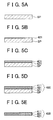
- FIGS. 5A to 5E are explanatory views showing the hydrogen-permeable membrane 400 manufactured according to the flow chart shown in FIG. 4.
- step S101 the base body SP is initially prepared.
- a member formed of a resin material, a ceramics material such as glass, a metal material such as A1, or the like can be employed.
- the base body SP is arranged in a chamber (not shown) which is in an inert atmosphere due to a nitrogen gas, an argon gas or the like.
- step S102 (FIG. 4), as shown in FIGS. 5B to 5D, three layers which form the hydrogen-permeable membrane are sequentially formed. More particularly, the Pd coating layer 421 (FIG. 3) is formed on the base body SP, as shown in FIG. 5B. Next, the V base layer 401 is formed on the Pd coating layer 421, as shown in FIG. 5C. Finally, the Pd coating layer 411 is formed on the V base layer 401, as shown in FIG. 5D. Note that each layer can be formed by electroplating, electroless plating, a spatter method, an ion plating method, a CVD method, or the like.
- step S103 the base body SP is removed.
- the base body is formed of a resin material
- only the resin material is dissolved using a solvent suitable for the resin material.
- the base body is formed of glass
- only the glass is etched using a hydrofluoric acid.
- glass with low melting point is used as the base body, only the glass can be molten by heating.
- the base body is formed of A1, only A1 is dissolved using an alkaline solution.
- the hydrogen-permeable membrane 400 of the self-supporting membrane type can be obtained by removing the base body.
- the hydrogen-permeable membrane 400 of the self-supporting membrane type is obtained by dissolving the base body SP.
- the hydrogen-permeable membrane of the self-supporting membrane type may be obtained by removing the hydrogen-permeable membrane from the base body. This method has an advantage that the base body can be reused.
- the hydrogen-permeable membrane of the self-supporting membrane type can be easily obtained without being damaged.
- each layer which forms the hydrogen-permeable membrane is sequentially formed in the inert atmosphere. Accordingly, the etching processing (cleaning processing) of the V base layer can be omitted, and the impurity such as the oxide can be prevented from intruding in the interface of each layer of the hydrogen-permeable membrane. Therefore, the hydrogen permeability of the hydrogen-permeable membrane can be enhanced.
- the base layer 401 is formed of V.
- the base layer 401 may be formed of an alloy containing V.
- the coating layers 411, 421 are formed of Pd.
- the coating layers 411, 421 may be formed of an alloy containing Pd.
- a case where V is used as a Group VA element has been explained.
- Nb or Ta which has characteristics similar to V may be used in place of V.
- the base layer is not limited as long as it contains a Group VA element.
- the coating layer is not limited as long as it contains Pd.
- the hydrogen-permeable membrane of the self-supporting membrane type is used.
- the hydrogen-permeable membrane of the supporting membrane type may be used.
- a base body formed of a porous material in which gas can flow is prepared in step S101 shown in FIG. 4, and step S103 shown in FIG. 4 is omitted.
- a porous member such as a ceramics member which is formed of alumina, silicon nitride, silica or the like, and a sintered metal member which is formed of stainless steel or the like can be used.
- the impurity such as the oxide can be prevented from intruding in the interface of each layer of the hydrogen-permeable membrane. Accordingly, the hydrogen permeability of the hydrogen-permeable membrane can be enhanced.
- the V base layer 401 has a function of making the hydrogen permeate therethrough
- the Pd coating layers 411, 421 has a function of promoting the permeation of the hydrogen in the V base layer by acting as a catalyst on the hydrogen to promote the dissociation and the recombination of the hydrogen.
- the hydrogen-permeable membrane 400 includes a permeable layer which consists of the V base layer 401, and a catalyst layer which consists of the Pd coating layers 411, 421.
- the reformed gas is supplied to the first surface S1 of the hydrogen-permeable membrane 400.
- the reformed gas contains the carbon monoxide gas, as shown in the equation (1).
- a rate of catalytic reaction catalytic performance
- an operating temperature of the hydrogen-permeable membrane is relatively low (for example, below approximately 300-400 degrees Celsius)
- the permeability of the V base layer is enhanced. Meanwhile, the catalytic performance of the Pd coating layer deteriorates.
- the hydrogen permeability of the hydrogen-permeable membrane is enhanced by using the devised catalyst layer which forms the surface of the hydrogen-permeable membrane. More particularly, a contact area of the catalyst layer which contacts gas is increased, as described later.
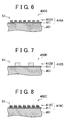
- FIG. 6 is a vertical sectional view in schematic form showing an enlarge view in the vicinity of a surface of a first hydrogen-permeable membrane 400A according to the second embodiment. Note that the area in the vicinity of the surface of the first surface S 1 of the hydrogen-permeable membrane 400A is shown in FIG. 6. However, the second surface (a surface corresponding to the second surface S2 of the hydrogen-permeable membrane 400 shown in FIG. 3) has the same structure as the first surface S1.
- a catalyst layer 410A consists of the Pd coating layer 411 and a contact-area-increasing layer 412A which is provided on the Pd coating layer 411.
- the contact-area-increasing layer 412A includes a plurality of convex portions which is formed of Pd.
- the convex portions are in a substantially rectangular parallelopiped shape, and are arranged on the Pd coating layer 411 in a matrix configuration.
- the catalyst layer 410A is formed, for example, by forming the Pd coating layer over the V base layer, partly masking the Pd coating layer, and laminating the Pd layer. Then, the masking is further removed from the catalyst layer 410A.
- the catalyst layer 410A is formed by forming the relatively thick Pd layer over the V base layer, and partly etching the Pd layer.
- the convex portion is formed of Pd in FIG. 6.
- the convex portion may be formed of a Pd alloy containing Pd.
- the convex portion may contain Ru (ruthenium), Rh (rhodium), Ir (iridium), Pt (platinum), Re (rhenium), Ni (nickel) and the like.
- FIG. 7 is a vertical sectional view in schematic form showing an enlarge view in the vicinity of a surface of a hydrogen-permeable membrane 400B which is a first modified example of the second embodiment.
- the catalyst layer 410B consists of the Pd coating layer 411 and a contact-area-increasing layer 412B.
- the contact-area-increasing layer 412B includes a plurality of supporting Pd catalysts (convex portions) which is formed by a carrier supporting Pd.
- a plurality of the supporting Pd catalysts has a substantially cylindrical shape, and is arranged on the Pd coating layer 411 in a matrix configuration.
- the supporting Pd catalyst is a catalyst in which an active ingredient (Pd) is dispersed and supported on the surface of the carrier in a particulate form or a membrane form.
- the carrier is formed of a porous material such as almina.
- the hydrogen atom, which is dissociated by Pd on the carrier, moves on the surface of the carrier to reach the Pd coating layer 411 by a phenomenon called "spillover".
- the catalyst layer 410B is formed , for example, by forming the Pd coating layer over the V base layer, arranging the supporting Pd catalyst on the Pd coating layer, and performing heating and high-pressure processing. Note that the supporting Pd catalyst is fixed on the Pd coating layer by mutual diffusion between the Pd on the carrier and Pd forming the coating layer.
- the supporting catalyst supports Pd.
- the supporting catalyst may support Ru, Rh, Ir, Pt, Re, Ni or the like in place of Pd.
- surface of the supporting Pd catalyst may be uneven surface as the convex portion of the FIGS. 8 to 10 to be hereinafter described.
- FIG. 8 is a vertical sectional view in schematic form showing an enlarge view in the vicinity of a surface of a hydrogen-permeable membrane 400C which is a second modified example of the second embodiment.
- the catalyst layer 410C consists of the Pd coating layer 411 and a contact-area-increasing layer 412C.
- the contact-area-increasing layer 412C includes a plurality of Pd black fine powder (convex portion).
- the Pd black is black palladium in fine power form which can be obtained when a chemical compound such as a salt, an oxide or a hydroxide of the palladium is reduced.
- the Pd black has an uneven surface, and is provided on the Pd coating layer while being dispersed at a substantially uniform area density.
- the catalyst layer 410C is formed, for example, by forming the Pd coating layer over the V base layer, applying a suspension containing the Pd black and an organic solvent on the Pd coating layer, and heating the V base layer, and Pd coating layer and the suspension at a temperature which is higher than the operating temperature of the hydrogen-permeable membrane. Note that the organic solvent is removed and the Pd black is fixed on the Pd coating layer by heating.
- Pd black is used in FIG. 8.
- Pt black or the like may be used in place of Pd black.
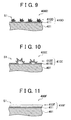
- FIG. 9 is a vertical sectional view in schematic form showing an enlarge view in the vicinity of a surface of a hydrogen-permeable membrane 400D which is a third modified example of the second embodiment.
- the catalyst layer 410D consists of the Pd coating layer 411 and a contact-area-increasing layer 412D.
- the contact-area-increasing layer 412D includes a plurality of convex portions which is covered with the Pd membrane.
- the convex portion whose nucleus is a metal (for example, Pd) has an uneven surface and is provided on the Pd coating layer 411 while being dispersed at a substantially the uniform area density.
- the catalyst layer 410D is formed, for example, by forming the Pd coating layer over the V base layer, arranging the metal (for example, Pd) nucleus on the Pd coating layer, and selectively providing a Pd plating membrane on a periphery of the nucleus by electoless Pd plating. Note that when a certain electroless is employed, porous (in a sponge form ) Pd plating membrane can be formed. Also, as a nucleus, another metal may be employed in place of Pd.
- the Pd plating membrane is formed on the uneven surface of the convex portion.
- a membrane of Ru, Rh, Ir, Pt, Re, Ni or the like may be formed in place of Pd.
- FIG. 10 is a vertical sectional view in schematic form showing an enlarge view in the vicinity of the surface of a hydrogen-permeable membrane 400E which is a fourth modified example of the second embodiment.
- a catalyst layer 410E consists of a Pd coating layer 411E and a contact-area-increasing layer 412E.
- the contact-area-increasing layer 412E includes a plurality of convex portions which is covered with the Pd layer.
- the convex portion in which the Pd layer is laminated on the carrier which is arranged on the V base layer has an uneven surface, and is arranged on the Pd coating layer 411E while being dispersed at a substantially uniform area density.
- the contact layer 410E is formed, for example, by arranging a ceramics carrier such as alumina, cilica or zirconia on the V base layer and then laminating the Pd layer. Note that the Pd layer is laminated after the ceramics carrier is temporarily fixed on the V base layer by heating.
- a ceramics carrier such as alumina, cilica or zirconia
- FIG. 11 is a vertical sectional view in schematic form showing an enlarge view in the vicinity of a surface of a hydrogen-permeable membrane 400F which is a fifth modified example of the second embodiment.
- a catalyst layer 410F consists of the Pd coating layer 411 and a contact-area-increasing layer 412F.
- the contact-area-increasing layer 412F is a porous layer containing Pd, and is formed so as to cover the Pd coating layer 411.
- the contact layer 410F is formed, for example, by forming the Pd coating layer 411 over the V base layer, composite-plating Pd and a resin on the Pd coating layer 411, and then dissolving the resin using a solvent.
- a resin PTFE (polytetrafluoro-ethylene) or the like may be employed.
- porous layer contains Pd in FIG. 11.
- the porous layer may contain Ru, Rh, Ir, Pt, Re, Ni or the like in place of Pd.
- the hydrogen-permeable membranes 400A to 400F shown in FIGS. 6 to 9 and FIG. 11 can be manufactured, for example, by forming the Pd coating layer on both surfaces of the V base layer (foil), and then forming the contact-area-increasing layer.
- the hydrogen-permeable membranes 400A to 400F shown in FIGS. 6 to 9 and FIG. 11 may be manufactured by preparing the hydrogen-permeable shown in FIG. 3 using the manufacturing method according to the first embodiment (FIGS. 4, 5), and then forming the contact-area-increasing layer on each of the coating layers 411, 421. Note that the hydrogen-permeable membrane 410E shown in FIG.
- the 10 can be manufactured by forming the V base layer, being temporarily fixed the ceramics carrier on the V base layer by heating, and then laminating the Pd layer in S102 shown in FIG. 4.
- the manufacturing method according to the first embodiment is employed, the impurity can be prevented from intruding in the interface of each layer of the hydrogen-permeable membrane. As a result, an advantage that deterioration of the hydrogen permeability due to the impurity can be suppressed is offered.
- the hydrogen-permeable membranes 400A to 400F includes the permeable layer (base layer) 401 having a function of making the hydrogen permeate therethrough, and the catalyst layers 410A to 410F which act as catalysts for promoting the permeation of the hydrogen in the permeable layer.
- the catalyst layers 410A to 410F include the coating layer 411 which covers the permeable layer 401 and the contact-area-increasing layers 412A to 412F.
- the contact-area-increasing layers 412A to 412E shown in FIGS. 6 to 10 have relatively large surface areas. Also, the contact-area-increasing layer 412F shown in FIG. 11 has an inner space.
- a contact area of the catalyst layer 410F which contacts gas is larger than an area in which the permeable layer 401 contacts the Pd coating layer 411.
- the contact area of the catalyst layer 410F which contacts gas is larger than an area of a portion of the permeable layer 401, in which the catalyst layer 410F is provided.
- the number of active spots in the catalyst layer is relatively large. Therefore, even when a catalytic poison such as the carbon monoxide gas is contained in gas which contacts the hydrogen-permeable membrane, or when the operating temperature of the hydrogen-permeable membrane is relatively low, relatively high hydrogen permeability can be exhibited.
- a catalytic poison such as the carbon monoxide gas
- the thinner the used V base layer is, the more the hydrogen permeability can be enhanced.
- the hydrogen-permeable membrane of the self-supporting membrane type is employed, and the contact-area-increasing layer is provided on each of the two coating layers of the hydrogen-permeable membrane.
- the contact-area-increasing layer may be provided on one of the coating layers.
- the hydrogen-permeable membrane of the self-supporting membrane type is employed.
- the hydrogen-permeable membrane of the supporting membrane type may be used. In this case, the contact-area-increasing layer may be provided only on one of the coating layers which is not adjacent to the carrier.
- the catalyst layers 410A to 410F include the Pd coating layer 411. This is to prevent the V base layer from being oxidized by covering the V base layer 401, which is relatively easy to oxidize, with the Pd coating layer 411, which is relatively difficult to oxidize. However, when the hydrogen-permeable membrane is not exposed to an oxidizing atmosphere, the catalyst layer need not include the Pd coating layer.
- a catalyst layer is required to have a contact area which contacts gas and is larger than an area of the permeable layer which contacts the catalyst layer.
- the catalyst layer is required to be provided on at least one surface of the permeable layer.
- the number of active spots is increased by increasing the contact area of the catalyst layer in order to enhance the permeability of the catalyst layer.
- a reaction rate (this is also referred to as a turnover frequency) per an active spot may be increased in place of increasing the number of active spots.
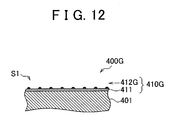
- FIG. 12 is a vertical sectional view in schematic form showing an enlarge view in the vicinity of a surface of a hydrogen-permeable membrane 400G according to a third embodiment.
- a catalyst layer 410G consists of the Pd coating layer 411 and a reaction rate increasing layer 412G which is provided on the Pd coating layer 411.
- the reaction rate increasing layer 412G includes a convex portion formed of Pt. Note that the convex portion is provided on the Pd coating layer 411 while being dispersed at a substantially uniform area density.
- the catalyst layer 410G is formed, for example, by forming the Pd coating layer over the V base layer, and then laminating Pt (the convex portions in the figure) onto the Pd coating layer for a short period of time such that the Pt does not cover the entire Pt coating layer.
- the convex portion can be formed by electroplating, electroless plating, a spatter method, an ion plating method, a CVD method, or the like.
- the hydrogen-permeable membrane 400G includes the permeable layer 401 which contains a Group VA element and has a function of making the hydrogen permeate therethrough, and the catalyst layer 410G which acts as a catalyst to promote the permeation of the hydrogen in the permeable layer.
- the catalyst layer 410G includes the Pd coating layer 411 which covers the permeable layer 401, and the reaction rate increasing layer 412G which is provided on the coating layer 411 and formed of Pt.
- the reaction rate per an active spot in Pt is higher than that in Pd.
- the convex portion is formed of Pt in FIG. 12.
- the convex portion may be formed of a Pt alloy containing Pt.
- the convex portion may contain Ru, Rh, Ir, Re, Ni, or the like.
- Ru is particularly suitable for a fuel cell system shown in FIG. 1 since Ru has a relatively high catalytic performance and is not likely to be poisoned by the carbon monoxide gas.
- a metal element may be selected in accordance with a use condition of the hydrogen-permeable membrane such as a temperature, a gas atmosphere, a pressure or the like.
- the reaction rate increasing layer 412G includes the convex portion which is partly formed on the Pd coating layer 411.
- the reaction rate increasing layer may include the Pt layer which covers the entire Pd coating layer.
- the Pd coating layer may be omitted. Namely, when the Pt layer is provided on the entire area of the V base layer 401, the V base layer 401,which is relatively easy to oxidize, is covered with the Pt layer. Accordingly, even when the Pd coating layer is omitted, oxidization of the V base layer can be prevented. Note that since the hydrogen permeability of Pt is not remarkably high, it is preferable to make the Pt layer as thin as possible.
- the catalyst layer 410G includes the Pd coating layer 411.
- the Pd coating layer may be omitted.
- the catalyst layer needs to contain at least one metal element selected from the group consisting of Ru, Rh, Ir, Pt, Re, and Ni.
Landscapes
- Chemical & Material Sciences (AREA)
- Chemical Kinetics & Catalysis (AREA)
- Engineering & Computer Science (AREA)
- Inorganic Chemistry (AREA)
- Electrochemistry (AREA)
- General Chemical & Material Sciences (AREA)
- Organic Chemistry (AREA)
- Manufacturing & Machinery (AREA)
- Materials Engineering (AREA)
- Combustion & Propulsion (AREA)
- Health & Medical Sciences (AREA)
- General Health & Medical Sciences (AREA)
- Life Sciences & Earth Sciences (AREA)
- Sustainable Development (AREA)
- Sustainable Energy (AREA)
- Analytical Chemistry (AREA)
- Oil, Petroleum & Natural Gas (AREA)
- Separation Using Semi-Permeable Membranes (AREA)
- Hydrogen, Water And Hydrids (AREA)
- Fuel Cell (AREA)
Abstract
Description
Claims (14)
- A hydrogen-permeable membrane including a permeable layer (401) having a function of making hydrogen permeate therethrough; and a catalyst layer (411, 421, 410A-410G) which acts as a catalyst for promoting permeation of the hydrogen in the permeable layer (401), and which is provided on at least one surface of the permeable layer (401) to form a surface layer of the hydrogen-permeable membrane, characterized in that:a contact area of the catalyst layer (411, 421, 410A-410G) which contacts gas is larger than an area of the permeable layer (401).
- The hydrogen-permeable membrane according to claim 1, characterized in that the catalyst layer (410A-410G) includes a first layer (411, 411E) which covers the permeable layer (401), and a second layer (412A-412G) which is provided on the first layer (411, 411E) in order to make the contact area larger than the area of the permeable layer (401).
- The hydrogen-permeable membrane according to claim 2, characterized in that the second layer (412A-412E, 412G) includes a convex portion which is provided on the first layer (411, 411E).
- The hydrogen-permeable membrane according to claim 3, characterized in that the convex portion is a supporting catalyst.
- The hydrogen-permeable membrane according to claim 3 or 4, characterized in that the convex portion includes an uneven surface.
- The hydrogen-permeable membrane according to any one of claims 2 to 5, characterized in that the second layer (412F) is a porous layer.
- The hydrogen-permeable membrane according to any one of claims 2 to 6, characterized in that the permeable layer (401) contains a Group VA element, the first layer (411, 411E) contains Pd, and the second layer (412A-412D, 412F, 412G) contains at least one metal element selected from a group consisting of Ru, Rh, Pd, Ir, Pt, Re, and Ni.
- The hydrogen-permeable membrane according to claim 1, characterized in that the catalyst layer (410G) includes a first layer (411) which covers the permeable layer (401), and a second layer (412G) which is provided on the first layer (411), and whose reaction rate at which a hydrogen atom is dissociated from a hydrogen molecule is higher than that of the first layer (411).
- The hydrogen-permeable membrane according to claim 8, characterized in that the first layer (411) contains Pd.
- A hydrogen-permeable membrane including a permeable layer (401) which contains a Group VA element and has a function of making hydrogen permeate therethrough; and a catalyst layer (411, 421, 410A-410G) which functions as a catalyst for promoting permeation of the hydrogen in the permeable layer (401), and which is provided on the permeable layer (401) to form a surface of the hydrogen-permeable membrane, characterized in that
the catalyst layer (411, 421, 410A-410G) contains at least one metal element selected from a group consisting of Ru, Rh, Ir, Pt, Re and Ni. - The hydrogen-permeable membrane according to claim 10, characterized in that the catalyst layer (411, 421, 410A-410D, 41 OF, 410G) includes a first layer (411) which covers the permeable layer (401) and contains Pd, and a second layer (412A-412D, 412F, 412G) which is provided on the first layer (411) and contains the selected at least one metal element.
- A manufacturing method of the hydrogen-permeable membrane which makes hydrogen selectively permeate therethrough, characterized by comprising the following steps of:preparing a base body (SP);arranging the base body (SP) in an inert atmosphere; andsequentially forming, in the inert atmosphere, a first layer (421) which contains Pd on the base body (SP), a second layer (401) which contains a Group VA element on the first layer, and a third layer (411) which contains Pd on the second layer (401).
- The method according to claim 12, characterized in that the base body (SP) is formed of a porous material.
- The method according to claim 12 or 13, characterized by further comprising the step of removing the base body (SP).
Applications Claiming Priority (2)
| Application Number | Priority Date | Filing Date | Title |
|---|---|---|---|
| JP2002026935 | 2002-02-04 | ||
| JP2002026935A JP3801061B2 (en) | 2002-02-04 | 2002-02-04 | Hydrogen permeable membrane |
Publications (3)
| Publication Number | Publication Date |
|---|---|
| EP1334764A2 true EP1334764A2 (en) | 2003-08-13 |
| EP1334764A3 EP1334764A3 (en) | 2003-10-15 |
| EP1334764B1 EP1334764B1 (en) | 2010-05-26 |
Family
ID=27606474
Family Applications (1)
| Application Number | Title | Priority Date | Filing Date |
|---|---|---|---|
| EP03002170A Expired - Lifetime EP1334764B1 (en) | 2002-02-04 | 2003-02-03 | Hydrogen-permeable membrane |
Country Status (4)
| Country | Link |
|---|---|
| US (1) | US7049008B2 (en) |
| EP (1) | EP1334764B1 (en) |
| JP (1) | JP3801061B2 (en) |
| DE (1) | DE60332683D1 (en) |
Cited By (3)
| Publication number | Priority date | Publication date | Assignee | Title |
|---|---|---|---|---|
| WO2005102918A1 (en) * | 2004-04-26 | 2005-11-03 | Toyota Jidosha Kabushiki Kaisha | Hydrogen separation membrane and fuel cell, and manufacturing method therefor |
| WO2007049130A1 (en) * | 2005-10-28 | 2007-05-03 | Toyota Jidosha Kabushiki Kaisha | Hydrogen separation membrane with a carrier, fuel cell and hydrogen separation apparatus having same, and method of manufacturing same |
| EP2075052A1 (en) * | 2002-07-25 | 2009-07-01 | Dai Nippon Insatsu Kabushiki Kaisha | Thin film support substrate for use in hydrogen production filter and production method of hydrogen production filter |
Families Citing this family (14)
| Publication number | Priority date | Publication date | Assignee | Title |
|---|---|---|---|---|
| JP4171978B2 (en) * | 2002-05-27 | 2008-10-29 | ソニー株式会社 | Fuel reformer and manufacturing method thereof, electrode for electrochemical device, and electrochemical device |
| JP4363633B2 (en) * | 2004-02-17 | 2009-11-11 | 株式会社アルバック | Double phase alloy for hydrogen separation / purification and production method thereof, metal membrane for hydrogen separation / purification and production method thereof |
| US20060083852A1 (en) * | 2004-10-18 | 2006-04-20 | Yoocham Jeon | Fuel cell apparatus and method of manufacture thereof |
| JP4661444B2 (en) * | 2005-08-08 | 2011-03-30 | トヨタ自動車株式会社 | Hydrogen permeable membrane and method for producing hydrogen permeable membrane |
| JP4665656B2 (en) * | 2005-08-10 | 2011-04-06 | トヨタ自動車株式会社 | Hydrogen permeable membrane and method for producing hydrogen permeable membrane |
| JP4730216B2 (en) * | 2005-09-26 | 2011-07-20 | 株式会社デンソー | Reducing agent reforming apparatus and exhaust gas purification apparatus using the same |
| WO2008102509A1 (en) * | 2007-02-19 | 2008-08-28 | Mitsubishi Gas Chemical Company, Inc. | Hydrogen purification method, hydrogen separation membrane, and hydrogen purification apparatus |
| WO2009102009A1 (en) * | 2008-02-15 | 2009-08-20 | National Institute Of Advanced Industrial Science And Technology | Filmy self-supporting thin metal film for hydrogen separation and process for producing the same |
| JP5235489B2 (en) * | 2008-05-13 | 2013-07-10 | 大日本印刷株式会社 | Hydrogen permselective membrane and method for producing the same |
| KR101336768B1 (en) * | 2011-07-22 | 2013-12-16 | 한국에너지기술연구원 | Protection layer of hydrogen membrane and preparation method thereof |
| JP6161054B2 (en) * | 2012-10-11 | 2017-07-12 | 国立研究開発法人産業技術総合研究所 | Method for producing catalytic reaction tube |
| JP2014169222A (en) * | 2014-03-18 | 2014-09-18 | Tokyo Gas Co Ltd | Hydrogen manufacturing apparatus |
| JP7430908B2 (en) * | 2020-07-14 | 2024-02-14 | 国立研究開発法人物質・材料研究機構 | Sample for hydrogen permeation detection and its manufacturing method |
| JP7452854B2 (en) * | 2020-07-20 | 2024-03-19 | 国立研究開発法人物質・材料研究機構 | Sample for hydrogen permeation detection and its manufacturing method |
Citations (2)
| Publication number | Priority date | Publication date | Assignee | Title |
|---|---|---|---|---|
| DE3235578A1 (en) | 1982-09-25 | 1984-03-29 | Kernforschungsanlage Jülich GmbH, 5170 Jülich | Method and device for hydrogenating hydrogenable organic compounds with cathodically released hydrogen |
| EP1258283A1 (en) | 1999-11-18 | 2002-11-20 | Toyota Jidosha Kabushiki Kaisha | Device forming fuel gas for fuel cell and composite material for hydrogen separation |
Family Cites Families (13)
| Publication number | Priority date | Publication date | Assignee | Title |
|---|---|---|---|---|
| US2719797A (en) * | 1950-05-23 | 1955-10-04 | Baker & Co Inc | Platinizing tantalum |
| NL7607390A (en) * | 1975-07-09 | 1977-01-11 | Montedison Spa | PROCESS FOR THE MANUFACTURE OF METALLIC AND / OR METAL-CERAMIC AND / OR CERAMIC SPONGE. |
| US4200975A (en) * | 1978-05-30 | 1980-05-06 | Western Electric Company, Incorporated | Additive method of forming circuit crossovers |
| JPH01219001A (en) | 1988-02-25 | 1989-09-01 | Hidekazu Kikuchi | Production of hydrogen |
| JPH01266833A (en) | 1988-04-20 | 1989-10-24 | Sanyo Electric Co Ltd | Production of hydrogen separating membrane |
| US5738708A (en) * | 1995-06-07 | 1998-04-14 | The Regents Of The University Of California Office Of Technology Transfer | Composite metal membrane |
| US6461408B2 (en) * | 1995-11-06 | 2002-10-08 | Robert E. Buxbaum | Hydrogen generator |
| US5985468A (en) * | 1997-04-30 | 1999-11-16 | Masco Corporation | Article having a multilayer protective and decorative coating |
| JPH1157432A (en) | 1997-08-27 | 1999-03-02 | Tonen Corp | Hydrogen separation material |
| JPH11114388A (en) | 1997-10-13 | 1999-04-27 | Tonen Corp | Hydrogen separation material |
| JPH11276866A (en) | 1998-03-31 | 1999-10-12 | Tokyo Gas Co Ltd | Hydrogen permeable membrane and method for producing the same |
| US6596057B2 (en) * | 1999-03-22 | 2003-07-22 | Idatech, Llc | Hydrogen-selective metal membranes, membrane modules, purification assemblies and methods of forming the same |
| JP4153623B2 (en) | 1999-07-23 | 2008-09-24 | アテネ株式会社 | Gas separation membrane and method for producing the same |
-
2002
- 2002-02-04 JP JP2002026935A patent/JP3801061B2/en not_active Expired - Fee Related
-
2003
- 2003-01-27 US US10/351,531 patent/US7049008B2/en not_active Expired - Fee Related
- 2003-02-03 EP EP03002170A patent/EP1334764B1/en not_active Expired - Lifetime
- 2003-02-03 DE DE60332683T patent/DE60332683D1/en not_active Expired - Lifetime
Patent Citations (2)
| Publication number | Priority date | Publication date | Assignee | Title |
|---|---|---|---|---|
| DE3235578A1 (en) | 1982-09-25 | 1984-03-29 | Kernforschungsanlage Jülich GmbH, 5170 Jülich | Method and device for hydrogenating hydrogenable organic compounds with cathodically released hydrogen |
| EP1258283A1 (en) | 1999-11-18 | 2002-11-20 | Toyota Jidosha Kabushiki Kaisha | Device forming fuel gas for fuel cell and composite material for hydrogen separation |
Cited By (6)
| Publication number | Priority date | Publication date | Assignee | Title |
|---|---|---|---|---|
| EP2075052A1 (en) * | 2002-07-25 | 2009-07-01 | Dai Nippon Insatsu Kabushiki Kaisha | Thin film support substrate for use in hydrogen production filter and production method of hydrogen production filter |
| WO2005102918A1 (en) * | 2004-04-26 | 2005-11-03 | Toyota Jidosha Kabushiki Kaisha | Hydrogen separation membrane and fuel cell, and manufacturing method therefor |
| US7862643B2 (en) | 2004-04-26 | 2011-01-04 | Toyota Jidosha Kabushiki Kaisha | Hydrogen separation membrane and fuel cell, and manufacturing method therefor |
| DE112005000937B4 (en) * | 2004-04-26 | 2012-07-26 | Toyota Jidosha K.K. | Hydrogen separation membrane and fuel cell and manufacturing method therefor |
| WO2007049130A1 (en) * | 2005-10-28 | 2007-05-03 | Toyota Jidosha Kabushiki Kaisha | Hydrogen separation membrane with a carrier, fuel cell and hydrogen separation apparatus having same, and method of manufacturing same |
| US9017757B2 (en) | 2005-10-28 | 2015-04-28 | Toyota Jidosha Kabushiki Kaisha | Hydrogen separation membrane with a carrier, fuel cell and hydrogen separation apparatus having same, and method of manufacturing same |
Also Published As
| Publication number | Publication date |
|---|---|
| US20030148884A1 (en) | 2003-08-07 |
| JP3801061B2 (en) | 2006-07-26 |
| JP2003225544A (en) | 2003-08-12 |
| DE60332683D1 (en) | 2010-07-08 |
| EP1334764B1 (en) | 2010-05-26 |
| US7049008B2 (en) | 2006-05-23 |
| EP1334764A3 (en) | 2003-10-15 |
Similar Documents
| Publication | Publication Date | Title |
|---|---|---|
| EP1334764B1 (en) | Hydrogen-permeable membrane | |
| Uemiya | Brief review of steam reforming using a metal membrane reactor | |
| US6896709B1 (en) | Miniature fuel reformer and system using metal thin film | |
| JP4789946B2 (en) | Hydrogen separation method and apparatus | |
| EP1300188B1 (en) | Hydrogen-permeable membrane, manufacturing method of the same, and hydrogen gas separator using the same | |
| JP2007292010A (en) | Purification of exhaust gas containing nitrogen oxides exhausted from internal combustion engines | |
| KR102168018B1 (en) | Fuel cell system associated with a fuel reformer that additionally performs methanation | |
| US7678181B2 (en) | Hydrogen permeable membrane, fuel cell and hydrogen extracting apparatus equipped with the hydrogen permeable membrane, and method of manufacturing the hydrogen permeable membrane | |
| JP4347129B2 (en) | Reaction tube and reaction plate for hydrogen production | |
| JP2004344731A (en) | Hydrogen permeable membrane | |
| JP2008251382A (en) | Solid oxide fuel cell | |
| US20060292418A1 (en) | Fuel cell system | |
| JP2009242216A (en) | Apparatus for generating and separating hydrogen, fuel cell system using the same, and internal combustion engine system | |
| JP2004148138A (en) | Hydrogen separation membrane and hydrogen production apparatus using the same | |
| JP2004265802A (en) | Fuel gas generation system for fuel cells | |
| JP4046071B2 (en) | Hydrogen purification device and fuel cell | |
| JP2002100388A (en) | Hydrogen production method for fuel cell and manufacturing equipment | |
| JP2005219936A (en) | Apparatus and fuel cell comprising hydrogen permeable metal layer | |
| JP2007136337A (en) | Hydrogen separation membrane member | |
| CN101151761A (en) | Hydrogen generating device and fuel cell system including hydrogen generating device | |
| KR101030045B1 (en) | Reformer for fuel cell and fuel cell system comprising same | |
| JP2004099369A (en) | Fuel reformer | |
| GB2401071A (en) | Reactor for removal of carbon monoxide from a reformate stream | |
| JPH10261425A (en) | Method and apparatus for removing carbon monoxide | |
| JP2005166305A (en) | Fuel cell system |
Legal Events
| Date | Code | Title | Description |
|---|---|---|---|
| PUAI | Public reference made under article 153(3) epc to a published international application that has entered the european phase |
Free format text: ORIGINAL CODE: 0009012 |
|
| 17P | Request for examination filed |
Effective date: 20030225 |
|
| AK | Designated contracting states |
Designated state(s): AT BE BG CH CY CZ DE DK EE ES FI FR GB GR HU IE IT LI LU MC NL PT SE SI SK TR |
|
| AX | Request for extension of the european patent |
Extension state: AL LT LV MK RO |
|
| PUAL | Search report despatched |
Free format text: ORIGINAL CODE: 0009013 |
|
| AK | Designated contracting states |
Kind code of ref document: A3 Designated state(s): AT BE BG CH CY CZ DE DK EE ES FI FR GB GR HU IE IT LI LU MC NL PT SE SI SK TR |
|
| AX | Request for extension of the european patent |
Extension state: AL LT LV MK RO |
|
| AKX | Designation fees paid |
Designated state(s): DE FR GB IT |
|
| 17Q | First examination report despatched |
Effective date: 20090903 |
|
| GRAP | Despatch of communication of intention to grant a patent |
Free format text: ORIGINAL CODE: EPIDOSNIGR1 |
|
| RTI1 | Title (correction) |
Free format text: HYDROGEN-PERMEABLE MEMBRANE |
|
| GRAS | Grant fee paid |
Free format text: ORIGINAL CODE: EPIDOSNIGR3 |
|
| GRAA | (expected) grant |
Free format text: ORIGINAL CODE: 0009210 |
|
| RIN1 | Information on inventor provided before grant (corrected) |
Inventor name: SATO, HIROMICHI Inventor name: ITO, NAOKI Inventor name: NAKATA, TOSHIHIDE Inventor name: IIJIMA, MASAHIKO Inventor name: AOYAMA, SATOSHI |
|
| AK | Designated contracting states |
Kind code of ref document: B1 Designated state(s): DE FR GB IT |
|
| REG | Reference to a national code |
Ref country code: GB Ref legal event code: FG4D |
|
| REF | Corresponds to: |
Ref document number: 60332683 Country of ref document: DE Date of ref document: 20100708 Kind code of ref document: P |
|
| PLBE | No opposition filed within time limit |
Free format text: ORIGINAL CODE: 0009261 |
|
| STAA | Information on the status of an ep patent application or granted ep patent |
Free format text: STATUS: NO OPPOSITION FILED WITHIN TIME LIMIT |
|
| 26N | No opposition filed |
Effective date: 20110301 |
|
| REG | Reference to a national code |
Ref country code: DE Ref legal event code: R097 Ref document number: 60332683 Country of ref document: DE Effective date: 20110228 |
|
| REG | Reference to a national code |
Ref country code: GB Ref legal event code: 746 Effective date: 20121112 |
|
| REG | Reference to a national code |
Ref country code: DE Ref legal event code: R084 Ref document number: 60332683 Country of ref document: DE Effective date: 20121115 |
|
| PGFP | Annual fee paid to national office [announced via postgrant information from national office to epo] |
Ref country code: DE Payment date: 20140129 Year of fee payment: 12 |
|
| PGFP | Annual fee paid to national office [announced via postgrant information from national office to epo] |
Ref country code: FR Payment date: 20140211 Year of fee payment: 12 Ref country code: IT Payment date: 20140214 Year of fee payment: 12 |
|
| PGFP | Annual fee paid to national office [announced via postgrant information from national office to epo] |
Ref country code: GB Payment date: 20140129 Year of fee payment: 12 |
|
| REG | Reference to a national code |
Ref country code: DE Ref legal event code: R119 Ref document number: 60332683 Country of ref document: DE |
|
| GBPC | Gb: european patent ceased through non-payment of renewal fee |
Effective date: 20150203 |
|
| REG | Reference to a national code |
Ref country code: FR Ref legal event code: ST Effective date: 20151030 |
|
| PG25 | Lapsed in a contracting state [announced via postgrant information from national office to epo] |
Ref country code: IT Free format text: LAPSE BECAUSE OF NON-PAYMENT OF DUE FEES Effective date: 20150203 |
|
| PG25 | Lapsed in a contracting state [announced via postgrant information from national office to epo] |
Ref country code: GB Free format text: LAPSE BECAUSE OF NON-PAYMENT OF DUE FEES Effective date: 20150203 Ref country code: DE Free format text: LAPSE BECAUSE OF NON-PAYMENT OF DUE FEES Effective date: 20150901 |
|
| PG25 | Lapsed in a contracting state [announced via postgrant information from national office to epo] |
Ref country code: FR Free format text: LAPSE BECAUSE OF NON-PAYMENT OF DUE FEES Effective date: 20150302 |