EP1331492A1 - Procédé de détermination du caractère inévitable de la collision entre un véhicule et un obstacle - Google Patents
Procédé de détermination du caractère inévitable de la collision entre un véhicule et un obstacle Download PDFInfo
- Publication number
- EP1331492A1 EP1331492A1 EP03290169A EP03290169A EP1331492A1 EP 1331492 A1 EP1331492 A1 EP 1331492A1 EP 03290169 A EP03290169 A EP 03290169A EP 03290169 A EP03290169 A EP 03290169A EP 1331492 A1 EP1331492 A1 EP 1331492A1
- Authority
- EP
- European Patent Office
- Prior art keywords
- vehicle
- obstacle
- collision
- speed
- acceleration
- Prior art date
- Legal status (The legal status is an assumption and is not a legal conclusion. Google has not performed a legal analysis and makes no representation as to the accuracy of the status listed.)
- Granted
Links
- 238000000034 method Methods 0.000 title claims description 22
- 230000001133 acceleration Effects 0.000 claims abstract description 50
- 238000004364 calculation method Methods 0.000 claims description 14
- 230000006870 function Effects 0.000 claims description 9
- 238000001514 detection method Methods 0.000 claims description 8
- 230000006399 behavior Effects 0.000 description 4
- 238000013213 extrapolation Methods 0.000 description 4
- 238000005259 measurement Methods 0.000 description 4
- 230000000977 initiatory effect Effects 0.000 description 2
- 238000013459 approach Methods 0.000 description 1
- 230000008859 change Effects 0.000 description 1
- 230000000295 complement effect Effects 0.000 description 1
- 238000012790 confirmation Methods 0.000 description 1
- 238000011161 development Methods 0.000 description 1
- 230000007613 environmental effect Effects 0.000 description 1
- 230000002349 favourable effect Effects 0.000 description 1
- 230000010365 information processing Effects 0.000 description 1
- 230000010354 integration Effects 0.000 description 1
- 238000012986 modification Methods 0.000 description 1
- 230000004048 modification Effects 0.000 description 1
- 230000008569 process Effects 0.000 description 1
- 238000012545 processing Methods 0.000 description 1
- 230000009257 reactivity Effects 0.000 description 1
- 230000035939 shock Effects 0.000 description 1
- 238000012384 transportation and delivery Methods 0.000 description 1
Images


Classifications
-
- B—PERFORMING OPERATIONS; TRANSPORTING
- B60—VEHICLES IN GENERAL
- B60R—VEHICLES, VEHICLE FITTINGS, OR VEHICLE PARTS, NOT OTHERWISE PROVIDED FOR
- B60R21/00—Arrangements or fittings on vehicles for protecting or preventing injuries to occupants or pedestrians in case of accidents or other traffic risks
- B60R21/01—Electrical circuits for triggering passive safety arrangements, e.g. airbags, safety belt tighteners, in case of vehicle accidents or impending vehicle accidents
- B60R21/013—Electrical circuits for triggering passive safety arrangements, e.g. airbags, safety belt tighteners, in case of vehicle accidents or impending vehicle accidents including means for detecting collisions, impending collisions or roll-over
- B60R21/0134—Electrical circuits for triggering passive safety arrangements, e.g. airbags, safety belt tighteners, in case of vehicle accidents or impending vehicle accidents including means for detecting collisions, impending collisions or roll-over responsive to imminent contact with an obstacle, e.g. using radar systems
-
- G—PHYSICS
- G01—MEASURING; TESTING
- G01S—RADIO DIRECTION-FINDING; RADIO NAVIGATION; DETERMINING DISTANCE OR VELOCITY BY USE OF RADIO WAVES; LOCATING OR PRESENCE-DETECTING BY USE OF THE REFLECTION OR RERADIATION OF RADIO WAVES; ANALOGOUS ARRANGEMENTS USING OTHER WAVES
- G01S13/00—Systems using the reflection or reradiation of radio waves, e.g. radar systems; Analogous systems using reflection or reradiation of waves whose nature or wavelength is irrelevant or unspecified
- G01S13/88—Radar or analogous systems specially adapted for specific applications
- G01S13/93—Radar or analogous systems specially adapted for specific applications for anti-collision purposes
- G01S13/931—Radar or analogous systems specially adapted for specific applications for anti-collision purposes of land vehicles
-
- G—PHYSICS
- G08—SIGNALLING
- G08G—TRAFFIC CONTROL SYSTEMS
- G08G1/00—Traffic control systems for road vehicles
- G08G1/16—Anti-collision systems
- G08G1/165—Anti-collision systems for passive traffic, e.g. including static obstacles, trees
-
- G—PHYSICS
- G08—SIGNALLING
- G08G—TRAFFIC CONTROL SYSTEMS
- G08G1/00—Traffic control systems for road vehicles
- G08G1/16—Anti-collision systems
- G08G1/166—Anti-collision systems for active traffic, e.g. moving vehicles, pedestrians, bikes
-
- B—PERFORMING OPERATIONS; TRANSPORTING
- B60—VEHICLES IN GENERAL
- B60R—VEHICLES, VEHICLE FITTINGS, OR VEHICLE PARTS, NOT OTHERWISE PROVIDED FOR
- B60R21/00—Arrangements or fittings on vehicles for protecting or preventing injuries to occupants or pedestrians in case of accidents or other traffic risks
- B60R21/01—Electrical circuits for triggering passive safety arrangements, e.g. airbags, safety belt tighteners, in case of vehicle accidents or impending vehicle accidents
- B60R2021/01204—Actuation parameters of safety arrangents
- B60R2021/01252—Devices other than bags
- B60R2021/01259—Brakes
-
- B—PERFORMING OPERATIONS; TRANSPORTING
- B60—VEHICLES IN GENERAL
- B60R—VEHICLES, VEHICLE FITTINGS, OR VEHICLE PARTS, NOT OTHERWISE PROVIDED FOR
- B60R21/00—Arrangements or fittings on vehicles for protecting or preventing injuries to occupants or pedestrians in case of accidents or other traffic risks
- B60R21/01—Electrical circuits for triggering passive safety arrangements, e.g. airbags, safety belt tighteners, in case of vehicle accidents or impending vehicle accidents
- B60R2021/01204—Actuation parameters of safety arrangents
- B60R2021/01252—Devices other than bags
- B60R2021/01265—Seat belts
- B60R2021/01272—Belt tensioners
-
- G—PHYSICS
- G01—MEASURING; TESTING
- G01S—RADIO DIRECTION-FINDING; RADIO NAVIGATION; DETERMINING DISTANCE OR VELOCITY BY USE OF RADIO WAVES; LOCATING OR PRESENCE-DETECTING BY USE OF THE REFLECTION OR RERADIATION OF RADIO WAVES; ANALOGOUS ARRANGEMENTS USING OTHER WAVES
- G01S13/00—Systems using the reflection or reradiation of radio waves, e.g. radar systems; Analogous systems using reflection or reradiation of waves whose nature or wavelength is irrelevant or unspecified
- G01S13/88—Radar or analogous systems specially adapted for specific applications
- G01S13/93—Radar or analogous systems specially adapted for specific applications for anti-collision purposes
- G01S13/931—Radar or analogous systems specially adapted for specific applications for anti-collision purposes of land vehicles
- G01S2013/932—Radar or analogous systems specially adapted for specific applications for anti-collision purposes of land vehicles using own vehicle data, e.g. ground speed, steering wheel direction
Definitions
- the present invention relates to motor vehicles, and more specifically the safety equipment for such vehicles.
- US-A-5,314,037 describes a collision avoidance system for a vehicle; the vehicle is equipped with one or more laser radars, which detect the position, direction of movement, speed and size of obstacles. It is also planned to use a steering angle sensor or gyroscope to provide information on the direction variations of the vehicle equipped with the system.
- the system calculates an estimated collision instant, by the ratio between the distance of the vehicle to obstacle and the relative speed of vehicle to obstacle. This estimated instant is compared to a minimum admissible time, the calculation of which involves a multivariate function. The nature of this function is not specified. In depending on the nature of the comparison, different alarms are implemented.
- US-A-6,085,151 describes a predictive collision sensor system. This document suggests methods for analyzing obstacles and their behavior.
- the inevitable collision area is the intersection of the area swept by the vehicle in an avoidance path from the left with the maximum possible acceleration and the area swept by the vehicle in a avoidance path to the right with the maximum possible acceleration.
- the maximum acceleration has a fixed value depending on the direction of the vehicle speed.
- the maximum acceleration has a fixed module following normal direction at vehicle speed.
- the method comprises the detection of at least a vehicle parameter, and that at least one component of the acceleration maximum depends on the detected parameter.
- the calculation routine calculates the area of inevitable collision as the intersection of the area swept by the vehicle in a path avoidance by the left with the maximum possible acceleration and the swept area by the vehicle in a right-sided avoidance path with acceleration maximum possible.
- the maximum acceleration has a fixed value depending on the direction of the vehicle speed.
- the maximum acceleration has a fixed module following normal direction at vehicle speed.
- the calculation routine calculates at least one component of maximum acceleration as a function of a parameter received by the routine reception.
- the invention further relates to a character determination system. inevitable collision of a vehicle and an obstacle, comprising a system of embedded calculation with a memory containing a program as described previously.
- the invention proposes, for a vehicle, to determine the inevitability a collision between a vehicle and an obstacle moving relative to the vehicle, in taking into account the most effective avoidance strategies that can be implemented works the driver of the vehicle.
- the method is described with reference to a vehicle automobile; it is more generally likely to apply when a obstacle avoidance strategy is possible for a vehicle, automobile or other.
- Figure 1 shows a schematic representation of a vehicle, and its avoidance trajectories.
- vehicle 2 which is initially assumed to be moving along the x axis. It also shows a left avoidance path 4, which corresponds to a left turn by the driver of the vehicle, according to the maximum possible acceleration.
- This trajectory is shown in the figure by two curves 6, 8, between which is the set of places scanned by the vehicle during its movement.
- the figure still shows the acceleration vector AT G corresponding: it has a lateral component - in the direction y - and a longitudinal component - in the direction x; this last component is negative, and translates braking concomitant with turning to the left.
- This avoidance trajectory is therefore the trajectory which corresponds to the maximum possible avoidance for the vehicle.
- the figure shows the obstacle avoidance path 10 from the right; as in the previous case, this trajectory is materialized by two curves 12 and 14, and corresponds to the maximum acceleration AT D possible to avoid the obstacle by passing to its right.
- Curves 8 and 12 materializing the right limit of the avoidance path from the left and the left limit of the avoidance path from the right define an area 16 on the front of the vehicle.
- the vehicle scans necessarily this zone 16, whatever the reaction of the driver of the vehicle - right avoidance, left avoidance or no reaction.
- This zone is therefore described in the following as an inevitable collision zone. The calculation of the form of this area is detailed in the following description.
- the invention proposes to take this area into account, and to consider that a collision with an obstacle is inevitable since the relative position and speed of the obstacle in relation to the vehicle are such that the obstacle will enter the area inevitable collision.
- Figure 2 shows a schematic representation of a vehicle, an obstacle, and an inevitable collision zone; the vehicle 2 has been brought to the figure again, the inevitable collision zone 16, the x and y axes, as well as an obstacle 18.
- the origin O of the reference mark is on the front of the vehicle longitudinally and transversely in the middle of it.
- the figure still shows the initial speed V 0 of the vehicle, along the x axis.
- the shape of the inevitable collision zone can be calculated, considering the initial speed of the vehicle, as well as the maximum possible acceleration.
- the speed is a vector of coordinates (v 0 , 0).
- the maximum acceleration is a vector of coordinates (a f , a b ).
- the negative value a f of acceleration corresponds to the maximum braking of the vehicle, while the positive value a b corresponds to the maximum lateral acceleration possible for an avoidance strategy; this value a b is positive for a strategy of avoidance by the left or negative for a strategy of avoidance by the right.
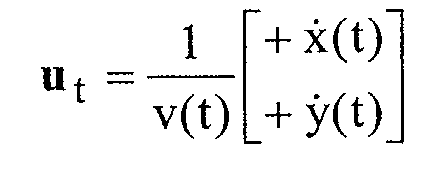
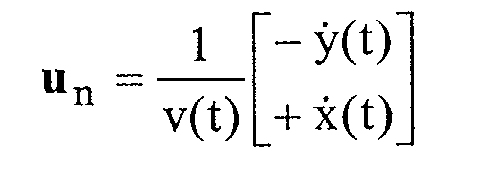
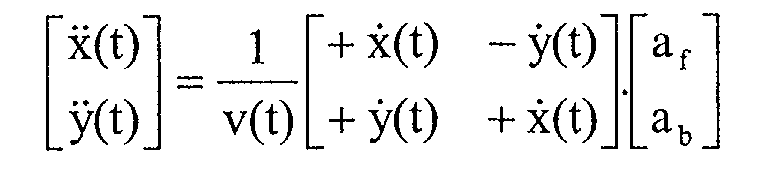
- the acceleration in the terrestrial reference (x, y) is therefore written as a function of the components (a f , a b ) of the acceleration in the reference (u t , u n ) noting the second derivative with respect to the time of the abscissa x (t) of the vehicle and ⁇ (t) the second derivative with respect to the time of the ordinate y (t) of the vehicle; this gives
- the inevitable zone 16 is simply defined using the same equations, but considering instead of the initial speed (v 0 , 0) of the vehicle the relative speed of the vehicle by relation to the obstacle along the x axis, (V r0x , 0).
- the avoidance strategy could be appropriate - turning in a direction opposite to the relative lateral speed of the obstacle; it could also be bad - steering in the direction of the relative lateral speed of the obstacle.
- the inevitable collision zone is shifted to the left (positive y values) for a positive normal component V r0y of the relative speed of the vehicle with respect to the obstacle; this qualitatively corresponds to the fact that an avoidance strategy by turning to the left is inappropriate, and that an avoidance strategy by turning to the right is more appropriate.
- the maximum possible acceleration is defined by a maximum possible value of braking acceleration, and a maximum possible value of lateral acceleration.
- a maximum possible value for these two parameters is 10 ms -2 ; this value corresponds to a favorable hypothesis, of a rapid reaction of the driver, of a good condition of the tires and of a good grip on the road. These maximum values correspond to an inevitable collision area as small as possible.
- Figures 3 to 5 show different examples of calculating the inevitable area, in a reference (x, y), graduated in meters, the origin of which is offset from the indications given above, to be on the front corner vehicle law. We have also shown in the figure, for certain points in the inevitable zone, the instant at which the vehicle reaches this point. All examples are calculated for maximum values of 10 ms -2 for longitudinal and transverse acceleration
- Figure 3 shows an example with a speed v 0 of 40 km / h, and a relative speed of 30 km / h - a moving obstacle at a speed of 10 km / h in the same direction as the vehicle.
- Figure 4 shows another example, with a speed v 0 of 90 km / h, and a relative speed of 30 km / h - a moving obstacle at a speed of 60 km / h in the same direction as the vehicle.
- the comparison of Figures 3 and 4 shows that the inevitable zone is smaller for a higher absolute speed of the vehicle - but that the different points of this zone are reached more quickly.
- Figure 5 shows an example with a speed v 0 of 90 km / h, and a relative speed of 60 km / h - a moving obstacle at a speed of 30 km / h in the same direction as the vehicle.
- the comparison of Figures 4 and 5 shows that the inevitable area is significantly larger for a higher relative speed - but that the area is scanned in each case in substantially equal time.
- the foregoing description therefore teaches how to calculate, from the absolute speed of the vehicle, or the relative speed of the vehicle with respect to the obstacle, an inevitable collision zone. This area can be calculated at any moment. You can also update it only if there is an obstacle, or modification of the vehicle speed.
- Figure 6 shows a graph representing the logical architecture of a system implementing the invention.
- the vehicle sensors which provide vehicle speed information; if applicable, these sensors can transmit other parameters, such as the steering angle, the state of tires; these other parameters can influence the choice of accelerations maximum.
- the detection sensors providing the position and the case are represented at 22. the speed of the obstacle.
- the information provided by the sensors 20 and by the sensors 22 is applied to a computer system or calculator 24 which is implemented in a dedicated processor, by a program in a processor, by a computing circuit specialized or others, with an associated memory. More specifically, we have represented in the figure of the logical elements used in this computer.
- the first element is an element 26 for calculating the inevitable collision area; he receives the information from vehicle sensors, including speed; he receives the if applicable, the obstacle speed information coming from the sensors 22, in the measurement of the speed of the obstacle is taken into account.
- the second element 28 is a element for taking the measurement error into account; this is optional, and highlights uses the method described in the French patent application filed the same day under the title "Method of probabilistic processing of points detected by a system of environmental supervision ". It provides information on the position of the obstacle, restated to take into account the measurement error, and allows a probabilistic approach of the obstacle.
- the third element is an element 30 for calculating the presence of the obstacle in the inevitable collision zone; it receives the definition of the inevitable collision zone from item 26 and position from item 28 (or directly from element 22) and outputs a warning signal representative of the presence of the obstacle in the inevitable collision zone.
- the senor could be the one defined for an ACC function ("automatic cruise control") or "Collision Warning "(collision warning). This sensor can therefore be used for several functions, thus requiring no additional cost.
- a system for calculating the area of inevitable collision able to calculate the area and determine if an obstacle is present in this area.
- the calculation system is, as described above, implemented at using a dedicated processor or other means of calculation. It implements a inevitability determination program, which is stored in memory associated; this program presents a routine for receiving a speed value of the vehicle or the relative speed of the vehicle in relation to the obstacle and the position of the obstacle relative to the vehicle, a calculation routine relative to the vehicle from an inevitable collision zone from maximum acceleration possible for the vehicle and the measured speed or relative speed; and an routine determining if the position of the obstacle is included in the collision zone inevitable.
- Routine here means a set of instructions capable of controlling the operation of a processor to perform a function.
- the frequency of information processing may be set by the frequency of deliveries of the various sensors, and is preferably greater than 40 Hz, for sufficient reactivity of the system.
- the invention applies in particular to the control of safety equipment.
- an obstacle is detected in the inevitable collision zone, it is possible to generate an alert to the safety equipment that can be activated. Otherwise, the system waits for a new acquisition of the sensor (s).
- the activated protection systems are not detailed here; we can mention as for example only the airbags.
- the alert issued can be used alone for the triggering of protection systems, or come as confirmation of a collision detection system using another methodology presenting uncertainties about the inevitable aspect of the crash. Eventually, it could be asked the system to validate the alert several times before transmitting it to the vehicle.
- the present invention is not limited to the examples and methods of realization described and represented, but it is susceptible of numerous variants accessible to those skilled in the art.
- the order of the different stages of the process is indifferent; thus, if it is necessary to know the speed of the vehicle or the relative speed of the vehicle to calculate the inevitable collision area we can measure the position of the obstacle at the same time as its speed, measure the position of the obstacle at the same time that we perform the calculation of the inevitable collision area, or measure this position after calculating the inevitable collision area.
Landscapes
- Engineering & Computer Science (AREA)
- Physics & Mathematics (AREA)
- Radar, Positioning & Navigation (AREA)
- Remote Sensing (AREA)
- General Physics & Mathematics (AREA)
- Electromagnetism (AREA)
- Computer Networks & Wireless Communication (AREA)
- Mechanical Engineering (AREA)
- Control Of Driving Devices And Active Controlling Of Vehicle (AREA)
- Traffic Control Systems (AREA)
- Air Bags (AREA)
Abstract
Description
- l'extrapolation des comportements des objets ne sont que des suppositions, et ne prennent pas en compte d'éventuels changements brusques - comme un coup de volant du conducteur qui veut éviter l'obstacle. Des incertitudes sur la conclusion de la scène existent et il est difficile d'être sûr qu'aucun élément perturbateur ne s'introduit dans le déroulement prévu de la scène; l'incertitude est d'autant plus élevée que l'extrapolation porte sur une durée importante;
- elles nécessitent des systèmes de détection très performants, très complets, permettant de détecter la position et le contour de l'objet, la vitesse des objets, l'accélération; ces systèmes sont fiables et donc coûteux.
- mesure de la vitesse du véhicule ou de la vitesse relative du véhicule par rapport à l'obstacle ;
- calcul par rapport au véhicule d'une zone de collision inévitable à partir de l'accélération maximale possible pour le véhicule et de la vitesse ou de la vitesse relative mesurée;
- mesure de la position de l'obstacle par rapport au véhicule;
- détermination du caractère inévitable de la collision si la position de l'obstacle est incluse dans la zone de collision inévitable.
- la détermination du caractère inévitable de la collision d'un véhicule et d'un obstacle selon de tels procédés de détermination;
- le déclenchement de l'équipement en cas de détermination que la collision est inévitable.
- une routine de réception d'une valeur de la vitesse du véhicule ou de la vitesse relative du véhicule par rapport à l'obstacle et de la position de l'obstacle par rapport au véhicule
- une routine de calcul par rapport au véhicule d'une zone de collision inévitable à partir de l'accélération maximale possible pour le véhicule et de la vitesse ou de la vitesse relative mesurée; et
- une routine déterminant si la position de l'obstacle est incluse dans la zone de collision inévitable.
- figure 1 une représentation schématique d'un véhicule, et de ses trajectoires d'évitement;
- figure 2 une représentation schématique d'un véhicule, d'un obstacle, et d'une zone de collision inévitable;
- figures 3 à 5, des graphes de la zone de collision inévitable pour différentes configurations du véhicule et de l'obstacle.
- figure 6, un graphe représentant les étapes du procédé de l'invention.


- de la courbe 8 comme le mouvement d'un point de coordonnées initiales (0, y0) animé d'une vitesse initiale (v0, 0) et d'une accélération initiale (af, -ab), avec ab positif et
- de la courbe 12 comme le mouvement d'un point de coordonnées initiales (0, -y0) animé d'une vitesse initiale (v0, 0) et d'une accélération initiale (af, ab), avec ab positif.
- position des obstacles;
- vitesse relative des obstacles détectés à l'avant du véhicule.
Claims (12)
- Un procédé de détermination du caractère inévitable de la collision d'un véhicule (2) et d'un obstacle (18), comprenant les étapes de :mesure (20) de la vitesse du véhicule ou de la vitesse relative du véhicule par rapport à l'obstacle ;calcul par rapport au véhicule d'une zone (16) de collision inévitable à partir de l'accélération maximale possible pour le véhicule et de la vitesse ou de la vitesse relative mesurée;mesure (22) de la position de l'obstacle par rapport au véhicule;détermination du caractère inévitable de la collision si la position de l'obstacle est incluse dans la zone de collision inévitable.
- Le procédé de la revendication 1, caractérisé en ce que la zone de collision inévitable est l'intersection de la zone balayée par le véhicule dans une trajectoire d'évitement par la gauche avec l'accélération maximale possible et de la zone balayée par le véhicule dans une trajectoire d'évitement par la droite avec l'accélération maximale possible.
- Le procédé de la revendication 1 ou 2, caractérisé en ce que l'accélération maximale présente une valeur fixe suivant la direction de la vitesse du véhicule.
- Le procédé de la revendication 1, 2 ou 3, caractérisé en ce que l'accélération maximale présente un module fixe suivant la direction normale à la vitesse du véhicule.
- Le procédé de la revendication 1 ou 2, caractérisé en ce qu'il comprend la détection d'au moins un paramètre du véhicule, et en ce qu'au moins une composante de l'accélération maximale est fonction du paramètre détecté.
- Un procédé de déclenchement d'un équipement de sécurité dans un véhicule, comprenant :la détermination du caractère inévitable de la collision d'un véhicule (2) et d'un obstacle (18) selon le procédé de l'une des revendications 1 à 5;le déclenchement de l'équipement en cas de détermination que la collision est inévitable.
- Un programme de détermination du caractère inévitable de la collision d'un véhicule (2) et d'un obstacle (18), comprenant :une routine de réception d'une valeur de la vitesse du véhicule ou de la vitesse relative du véhicule par rapport à l'obstacle et de la position de l'obstacle par rapport au véhiculeune routine de calcul par rapport au véhicule d'une zone (16) de collision inévitable à partir de l'accélération maximale possible pour le véhicule et de la vitesse ou de la vitesse relative mesurée; etune routine déterminant si la position de l'obstacle est incluse dans la zone de collision inévitable.
- Le programme de la revendication 7, caractérisé en ce que la routine de calcul calcule la zone de collision inévitable comme l'intersection de la zone balayée par le véhicule dans une trajectoire d'évitement par la gauche avec l'accélération maximale possible et de la zone balayée par le véhicule dans une trajectoire d'évitement par la droite avec l'accélération maximale possible.
- Le programme de la revendication 7 ou 8, caractérisé en ce que l'accélération maximale présente une valeur fixe suivant la direction de la vitesse du véhicule.
- Le programme de la revendication 7, 8 ou 9, caractérisé en ce que l'accélération maximale présente un module fixe suivant la direction normale à la vitesse du véhicule.
- Le programme de la revendication 7 ou 8, caractérisé en ce que la routine de calcul calcule au moins une composante de l'accélération maximale en fonction d'un paramètre reçu par la routine de réception.
- Un système de détermination du caractère inévitable de la collision d'un véhicule (2) et d'un obstacle (18), comprenant un système de calcul embarqué (24) avec une mémoire contenant un programme selon l'une des revendications 7 à 11.
Applications Claiming Priority (2)
| Application Number | Priority Date | Filing Date | Title |
|---|---|---|---|
| FR0200869 | 2002-01-24 | ||
| FR0200869A FR2835081B1 (fr) | 2002-01-24 | 2002-01-24 | Procede de determination du caractere inevitable de la collision entre un vehicule et un obstacle |
Publications (2)
| Publication Number | Publication Date |
|---|---|
| EP1331492A1 true EP1331492A1 (fr) | 2003-07-30 |
| EP1331492B1 EP1331492B1 (fr) | 2011-07-13 |
Family
ID=8871398
Family Applications (1)
| Application Number | Title | Priority Date | Filing Date |
|---|---|---|---|
| EP03290169A Expired - Lifetime EP1331492B1 (fr) | 2002-01-24 | 2003-01-23 | Procédé de détermination du caractère inévitable de la collision entre un véhicule et un obstacle |
Country Status (3)
| Country | Link |
|---|---|
| EP (1) | EP1331492B1 (fr) |
| AT (1) | ATE516513T1 (fr) |
| FR (1) | FR2835081B1 (fr) |
Cited By (3)
| Publication number | Priority date | Publication date | Assignee | Title |
|---|---|---|---|---|
| CN110189547A (zh) * | 2019-05-30 | 2019-08-30 | 广州小鹏汽车科技有限公司 | 一种障碍物检测方法、装置及车辆 |
| EP4620768A1 (fr) * | 2024-03-22 | 2025-09-24 | Zenseact AB | Interventions de direction pour véhicules |
| CN122275946A (zh) * | 2026-04-30 | 2026-06-26 | 广州小马慧行科技有限公司 | 港口码头岸桥阻塞状况感知方法、装置、计算机设备及介质 |
Families Citing this family (2)
| Publication number | Priority date | Publication date | Assignee | Title |
|---|---|---|---|---|
| EP2172920B1 (fr) | 2008-10-01 | 2011-12-07 | Volvo Car Corporation | Évaluation de la menace pour des événements inattendus |
| CN106218612B (zh) * | 2016-07-27 | 2019-07-16 | 宇龙计算机通信科技(深圳)有限公司 | 一种汽车安全行驶的方法、装置以及终端 |
Citations (6)
| Publication number | Priority date | Publication date | Assignee | Title |
|---|---|---|---|---|
| JPH05274035A (ja) * | 1992-03-30 | 1993-10-22 | Mazda Motor Corp | 障害物検出装置 |
| US5314037A (en) | 1993-01-22 | 1994-05-24 | Shaw David C H | Automobile collision avoidance system |
| US5332057A (en) * | 1991-08-27 | 1994-07-26 | Mazda Motor Corporation | Contact preventive apparatus for vehicles |
| JPH0911870A (ja) * | 1995-07-03 | 1997-01-14 | Toyota Motor Corp | 車両走行制御装置 |
| US6084508A (en) * | 1997-07-17 | 2000-07-04 | Volkswagen Ag | Automatic emergency braking method and arrangement |
| US6085151A (en) | 1998-01-20 | 2000-07-04 | Automotive Systems Laboratory, Inc. | Predictive collision sensing system |
Family Cites Families (1)
| Publication number | Priority date | Publication date | Assignee | Title |
|---|---|---|---|---|
| DE10102771A1 (de) * | 2001-01-23 | 2002-07-25 | Bosch Gmbh Robert | Einrichtung zum Bereitstellen von Signalen in einem Kraftfahrzeug |
-
2002
- 2002-01-24 FR FR0200869A patent/FR2835081B1/fr not_active Expired - Fee Related
-
2003
- 2003-01-23 AT AT03290169T patent/ATE516513T1/de not_active IP Right Cessation
- 2003-01-23 EP EP03290169A patent/EP1331492B1/fr not_active Expired - Lifetime
Patent Citations (6)
| Publication number | Priority date | Publication date | Assignee | Title |
|---|---|---|---|---|
| US5332057A (en) * | 1991-08-27 | 1994-07-26 | Mazda Motor Corporation | Contact preventive apparatus for vehicles |
| JPH05274035A (ja) * | 1992-03-30 | 1993-10-22 | Mazda Motor Corp | 障害物検出装置 |
| US5314037A (en) | 1993-01-22 | 1994-05-24 | Shaw David C H | Automobile collision avoidance system |
| JPH0911870A (ja) * | 1995-07-03 | 1997-01-14 | Toyota Motor Corp | 車両走行制御装置 |
| US6084508A (en) * | 1997-07-17 | 2000-07-04 | Volkswagen Ag | Automatic emergency braking method and arrangement |
| US6085151A (en) | 1998-01-20 | 2000-07-04 | Automotive Systems Laboratory, Inc. | Predictive collision sensing system |
Non-Patent Citations (3)
| Title |
|---|
| ANDREWS S ET AL: "A two-dimensional vehicle control strategy for automated obstacle avoidance", INTELLIGENT TRANSPORTATION SYSTEM, 1997. ITSC '97., IEEE CONFERENCE ON BOSTON, MA, USA 9-12 NOV. 1997, NEW YORK, NY, USA,IEEE, US, 9 November 1997 (1997-11-09), pages 841 - 846, XP010270784, ISBN: 0-7803-4269-0 * |
| PATENT ABSTRACTS OF JAPAN vol. 018, no. 050 (P - 1683) 26 January 1994 (1994-01-26) * |
| PATENT ABSTRACTS OF JAPAN vol. 1997, no. 05 30 May 1997 (1997-05-30) * |
Cited By (3)
| Publication number | Priority date | Publication date | Assignee | Title |
|---|---|---|---|---|
| CN110189547A (zh) * | 2019-05-30 | 2019-08-30 | 广州小鹏汽车科技有限公司 | 一种障碍物检测方法、装置及车辆 |
| EP4620768A1 (fr) * | 2024-03-22 | 2025-09-24 | Zenseact AB | Interventions de direction pour véhicules |
| CN122275946A (zh) * | 2026-04-30 | 2026-06-26 | 广州小马慧行科技有限公司 | 港口码头岸桥阻塞状况感知方法、装置、计算机设备及介质 |
Also Published As
| Publication number | Publication date |
|---|---|
| ATE516513T1 (de) | 2011-07-15 |
| FR2835081B1 (fr) | 2004-04-02 |
| EP1331492B1 (fr) | 2011-07-13 |
| FR2835081A1 (fr) | 2003-07-25 |
Similar Documents
| Publication | Publication Date | Title |
|---|---|---|
| EP3994042B1 (fr) | Procédé de détermination d'une trajectoire d'évitement d'un véhicule automobile | |
| US20220048522A1 (en) | Information processing system, program, and control method | |
| FR3045177A1 (fr) | Procede de controle d'une fonctionnalite d'un vehicule automobile au moyen d'un terminal mobile | |
| FR2952887A1 (fr) | Procede et appareil de commande pour la detection de la fatigue d'un conducteur | |
| FR3112746A1 (fr) | procédé de détermination d’une trajectoire d’un véhicule automobile | |
| FR2956848A1 (fr) | Systeme d'assistance de conduite et procede d'assistance de conduite automatique | |
| EP4077086B1 (fr) | Procédé de détermination d'un profil de vitesse d'un vehicule automobile à accélération non prédéterminée | |
| FR2863557A1 (fr) | Systeme et procede de determination du degre d'eveil | |
| FR3120040A1 (fr) | Procédé d’activation d’un système d’évitement d’obstacle pour véhicule automobile | |
| EP1331492B1 (fr) | Procédé de détermination du caractère inévitable de la collision entre un véhicule et un obstacle | |
| EP4223604A1 (fr) | Procédé de détection de danger dans l'environnement d'un véhicule automobile | |
| FR3117975A1 (fr) | Dispositif et procédé de contrôle de véhicule dépendant de la trajectoire | |
| EP3789259A1 (fr) | Procédé de gestion d'une distance de sécurité | |
| EP1331621B1 (fr) | Procédé de supervision de l'environnement d'un véhicule | |
| EP3472015B1 (fr) | Procédé de détermination d'une classe de conduite de référence | |
| EP3700172A1 (fr) | Dispositif électronique de bridage, dispositif de surveillance, véhicule automobile autonome, système de transport, procédé de bridage et produit programme ordinateur associés | |
| FR3092914A1 (fr) | Procédé de détermination de la trajectoire d'un véhicule comprenant quatre roues directrices | |
| EP3983273B1 (fr) | Procédé de détermination de la vitesse maximale autorisée pour un véhicule automobile mettant en ?uvre une fonction de régulation de vitesse | |
| FR2973320B1 (fr) | Procede et dispositif d'assistance pour une manoeuvre de stationnement d'un vehicule | |
| FR3062836A1 (fr) | Procede et systeme de determination d'un indice de confiance associe a un objet d'un environnement d'un vehicule | |
| EP4490005B1 (fr) | Procédé de sélection d'un objet mobile pour la mise en oeuvre d'une fonction de régulation de vitesse adaptative pour un véhicule automobile | |
| EP4526167B1 (fr) | Procédé et dispositif de contrôle d'un système de régulation de vitesse d'un véhicule en approche d'un élément de signalisation routière | |
| FR3139532A1 (fr) | Procédé de détection d’une collision prochaine, procédé d’étalonnage d’un système de détection de collision et véhicule automobile associé | |
| FR2831309A1 (fr) | Systeme de generation d'un signal d'information relatif a un choc inevitable d'un vehicule contre un obstacle | |
| FR3135048A1 (fr) | Procédé de suivi d’au moins une limite de bord de voie de circulation et véhicule automobile associé |
Legal Events
| Date | Code | Title | Description |
|---|---|---|---|
| PUAI | Public reference made under article 153(3) epc to a published international application that has entered the european phase |
Free format text: ORIGINAL CODE: 0009012 |
|
| AK | Designated contracting states |
Designated state(s): AT BE BG CH CY CZ DE DK EE ES FI FR GB GR HU IE IT LI LU MC NL PT SE SI SK TR |
|
| AX | Request for extension of the european patent |
Extension state: AL LT LV MK RO |
|
| 17P | Request for examination filed |
Effective date: 20040130 |
|
| AKX | Designation fees paid |
Designated state(s): AT BE BG CH CY CZ DE DK EE ES FI FR GB GR HU IE IT LI LU MC NL PT SE SI SK TR |
|
| 17Q | First examination report despatched |
Effective date: 20090428 |
|
| GRAP | Despatch of communication of intention to grant a patent |
Free format text: ORIGINAL CODE: EPIDOSNIGR1 |
|
| GRAS | Grant fee paid |
Free format text: ORIGINAL CODE: EPIDOSNIGR3 |
|
| GRAA | (expected) grant |
Free format text: ORIGINAL CODE: 0009210 |
|
| AK | Designated contracting states |
Kind code of ref document: B1 Designated state(s): AT BE BG CH CY CZ DE DK EE ES FI FR GB GR HU IE IT LI LU MC NL PT SE SI SK TR |
|
| REG | Reference to a national code |
Ref country code: GB Ref legal event code: FG4D Free format text: NOT ENGLISH |
|
| REG | Reference to a national code |
Ref country code: CH Ref legal event code: EP |
|
| REG | Reference to a national code |
Ref country code: IE Ref legal event code: FG4D Free format text: LANGUAGE OF EP DOCUMENT: FRENCH |
|
| REG | Reference to a national code |
Ref country code: DE Ref legal event code: R096 Ref document number: 60337657 Country of ref document: DE Effective date: 20110901 |
|
| REG | Reference to a national code |
Ref country code: NL Ref legal event code: VDEP Effective date: 20110713 |
|
| REG | Reference to a national code |
Ref country code: GB Ref legal event code: 746 Effective date: 20111128 |
|
| REG | Reference to a national code |
Ref country code: AT Ref legal event code: MK05 Ref document number: 516513 Country of ref document: AT Kind code of ref document: T Effective date: 20110713 |
|
| PG25 | Lapsed in a contracting state [announced via postgrant information from national office to epo] |
Ref country code: SE Free format text: LAPSE BECAUSE OF FAILURE TO SUBMIT A TRANSLATION OF THE DESCRIPTION OR TO PAY THE FEE WITHIN THE PRESCRIBED TIME-LIMIT Effective date: 20110713 Ref country code: NL Free format text: LAPSE BECAUSE OF FAILURE TO SUBMIT A TRANSLATION OF THE DESCRIPTION OR TO PAY THE FEE WITHIN THE PRESCRIBED TIME-LIMIT Effective date: 20110713 Ref country code: PT Free format text: LAPSE BECAUSE OF FAILURE TO SUBMIT A TRANSLATION OF THE DESCRIPTION OR TO PAY THE FEE WITHIN THE PRESCRIBED TIME-LIMIT Effective date: 20111114 Ref country code: FI Free format text: LAPSE BECAUSE OF FAILURE TO SUBMIT A TRANSLATION OF THE DESCRIPTION OR TO PAY THE FEE WITHIN THE PRESCRIBED TIME-LIMIT Effective date: 20110713 |
|
| REG | Reference to a national code |
Ref country code: IE Ref legal event code: FD4D |
|
| PG25 | Lapsed in a contracting state [announced via postgrant information from national office to epo] |
Ref country code: SI Free format text: LAPSE BECAUSE OF FAILURE TO SUBMIT A TRANSLATION OF THE DESCRIPTION OR TO PAY THE FEE WITHIN THE PRESCRIBED TIME-LIMIT Effective date: 20110713 Ref country code: AT Free format text: LAPSE BECAUSE OF FAILURE TO SUBMIT A TRANSLATION OF THE DESCRIPTION OR TO PAY THE FEE WITHIN THE PRESCRIBED TIME-LIMIT Effective date: 20110713 Ref country code: GR Free format text: LAPSE BECAUSE OF FAILURE TO SUBMIT A TRANSLATION OF THE DESCRIPTION OR TO PAY THE FEE WITHIN THE PRESCRIBED TIME-LIMIT Effective date: 20111014 Ref country code: CY Free format text: LAPSE BECAUSE OF FAILURE TO SUBMIT A TRANSLATION OF THE DESCRIPTION OR TO PAY THE FEE WITHIN THE PRESCRIBED TIME-LIMIT Effective date: 20110713 |
|
| REG | Reference to a national code |
Ref country code: DE Ref legal event code: R084 Ref document number: 60337657 Country of ref document: DE Effective date: 20111119 |
|
| PG25 | Lapsed in a contracting state [announced via postgrant information from national office to epo] |
Ref country code: SK Free format text: LAPSE BECAUSE OF FAILURE TO SUBMIT A TRANSLATION OF THE DESCRIPTION OR TO PAY THE FEE WITHIN THE PRESCRIBED TIME-LIMIT Effective date: 20110713 Ref country code: CZ Free format text: LAPSE BECAUSE OF FAILURE TO SUBMIT A TRANSLATION OF THE DESCRIPTION OR TO PAY THE FEE WITHIN THE PRESCRIBED TIME-LIMIT Effective date: 20110713 Ref country code: IE Free format text: LAPSE BECAUSE OF FAILURE TO SUBMIT A TRANSLATION OF THE DESCRIPTION OR TO PAY THE FEE WITHIN THE PRESCRIBED TIME-LIMIT Effective date: 20110713 |
|
| PLBE | No opposition filed within time limit |
Free format text: ORIGINAL CODE: 0009261 |
|
| STAA | Information on the status of an ep patent application or granted ep patent |
Free format text: STATUS: NO OPPOSITION FILED WITHIN TIME LIMIT |
|
| PG25 | Lapsed in a contracting state [announced via postgrant information from national office to epo] |
Ref country code: IT Free format text: LAPSE BECAUSE OF FAILURE TO SUBMIT A TRANSLATION OF THE DESCRIPTION OR TO PAY THE FEE WITHIN THE PRESCRIBED TIME-LIMIT Effective date: 20110713 Ref country code: EE Free format text: LAPSE BECAUSE OF FAILURE TO SUBMIT A TRANSLATION OF THE DESCRIPTION OR TO PAY THE FEE WITHIN THE PRESCRIBED TIME-LIMIT Effective date: 20110713 |
|
| 26N | No opposition filed |
Effective date: 20120416 |
|
| PG25 | Lapsed in a contracting state [announced via postgrant information from national office to epo] |
Ref country code: DK Free format text: LAPSE BECAUSE OF FAILURE TO SUBMIT A TRANSLATION OF THE DESCRIPTION OR TO PAY THE FEE WITHIN THE PRESCRIBED TIME-LIMIT Effective date: 20110713 |
|
| BERE | Be: lapsed |
Owner name: PEUGEOT CITROEN AUTOMOBILES SA Effective date: 20120131 |
|
| REG | Reference to a national code |
Ref country code: DE Ref legal event code: R097 Ref document number: 60337657 Country of ref document: DE Effective date: 20120416 |
|
| PG25 | Lapsed in a contracting state [announced via postgrant information from national office to epo] |
Ref country code: MC Free format text: LAPSE BECAUSE OF NON-PAYMENT OF DUE FEES Effective date: 20120131 |
|
| REG | Reference to a national code |
Ref country code: CH Ref legal event code: PL |
|
| PG25 | Lapsed in a contracting state [announced via postgrant information from national office to epo] |
Ref country code: CH Free format text: LAPSE BECAUSE OF NON-PAYMENT OF DUE FEES Effective date: 20120131 Ref country code: LI Free format text: LAPSE BECAUSE OF NON-PAYMENT OF DUE FEES Effective date: 20120131 |
|
| PG25 | Lapsed in a contracting state [announced via postgrant information from national office to epo] |
Ref country code: BE Free format text: LAPSE BECAUSE OF NON-PAYMENT OF DUE FEES Effective date: 20120131 |
|
| PG25 | Lapsed in a contracting state [announced via postgrant information from national office to epo] |
Ref country code: ES Free format text: LAPSE BECAUSE OF FAILURE TO SUBMIT A TRANSLATION OF THE DESCRIPTION OR TO PAY THE FEE WITHIN THE PRESCRIBED TIME-LIMIT Effective date: 20111024 |
|
| PG25 | Lapsed in a contracting state [announced via postgrant information from national office to epo] |
Ref country code: BG Free format text: LAPSE BECAUSE OF FAILURE TO SUBMIT A TRANSLATION OF THE DESCRIPTION OR TO PAY THE FEE WITHIN THE PRESCRIBED TIME-LIMIT Effective date: 20111013 |
|
| PG25 | Lapsed in a contracting state [announced via postgrant information from national office to epo] |
Ref country code: TR Free format text: LAPSE BECAUSE OF FAILURE TO SUBMIT A TRANSLATION OF THE DESCRIPTION OR TO PAY THE FEE WITHIN THE PRESCRIBED TIME-LIMIT Effective date: 20110713 |
|
| PG25 | Lapsed in a contracting state [announced via postgrant information from national office to epo] |
Ref country code: LU Free format text: LAPSE BECAUSE OF NON-PAYMENT OF DUE FEES Effective date: 20120123 |
|
| PG25 | Lapsed in a contracting state [announced via postgrant information from national office to epo] |
Ref country code: HU Free format text: LAPSE BECAUSE OF FAILURE TO SUBMIT A TRANSLATION OF THE DESCRIPTION OR TO PAY THE FEE WITHIN THE PRESCRIBED TIME-LIMIT Effective date: 20030123 |
|
| PGFP | Annual fee paid to national office [announced via postgrant information from national office to epo] |
Ref country code: GB Payment date: 20141219 Year of fee payment: 13 |
|
| REG | Reference to a national code |
Ref country code: FR Ref legal event code: PLFP Year of fee payment: 14 |
|
| PGFP | Annual fee paid to national office [announced via postgrant information from national office to epo] |
Ref country code: DE Payment date: 20151217 Year of fee payment: 14 |
|
| GBPC | Gb: european patent ceased through non-payment of renewal fee |
Effective date: 20160123 |
|
| PG25 | Lapsed in a contracting state [announced via postgrant information from national office to epo] |
Ref country code: GB Free format text: LAPSE BECAUSE OF NON-PAYMENT OF DUE FEES Effective date: 20160123 |
|
| REG | Reference to a national code |
Ref country code: FR Ref legal event code: PLFP Year of fee payment: 15 |
|
| PGFP | Annual fee paid to national office [announced via postgrant information from national office to epo] |
Ref country code: FR Payment date: 20161221 Year of fee payment: 15 |
|
| REG | Reference to a national code |
Ref country code: DE Ref legal event code: R119 Ref document number: 60337657 Country of ref document: DE |
|
| PG25 | Lapsed in a contracting state [announced via postgrant information from national office to epo] |
Ref country code: DE Free format text: LAPSE BECAUSE OF NON-PAYMENT OF DUE FEES Effective date: 20170801 |
|
| REG | Reference to a national code |
Ref country code: FR Ref legal event code: CA Effective date: 20180312 Ref country code: FR Ref legal event code: CD Owner name: PEUGEOT CITROEN AUTOMOBILES SA, FR Effective date: 20180312 |
|
| PG25 | Lapsed in a contracting state [announced via postgrant information from national office to epo] |
Ref country code: FR Free format text: LAPSE BECAUSE OF NON-PAYMENT OF DUE FEES Effective date: 20180131 |
|
| REG | Reference to a national code |
Ref country code: FR Ref legal event code: ST Effective date: 20180928 |