EP1331218B1 - Verfahren zur Herstellung von geschützten 3-Amino-1,2-Dihydroxypropanacetal und Derivate davon - Google Patents
Verfahren zur Herstellung von geschützten 3-Amino-1,2-Dihydroxypropanacetal und Derivate davon Download PDFInfo
- Publication number
- EP1331218B1 EP1331218B1 EP03006773A EP03006773A EP1331218B1 EP 1331218 B1 EP1331218 B1 EP 1331218B1 EP 03006773 A EP03006773 A EP 03006773A EP 03006773 A EP03006773 A EP 03006773A EP 1331218 B1 EP1331218 B1 EP 1331218B1
- Authority
- EP
- European Patent Office
- Prior art keywords
- protecting groups
- protected
- acetal
- amino
- dihydroxypropane
- Prior art date
- Legal status (The legal status is an assumption and is not a legal conclusion. Google has not performed a legal analysis and makes no representation as to the accuracy of the status listed.)
- Expired - Lifetime
Links
- 238000000034 method Methods 0.000 title claims description 34
- -1 3-amino-1,2-dihydroxy-propane acetal Chemical class 0.000 title claims description 32
- 230000008569 process Effects 0.000 title claims description 30
- DHKHKXVYLBGOIT-UHFFFAOYSA-N acetaldehyde Diethyl Acetal Natural products CCOC(C)OCC DHKHKXVYLBGOIT-UHFFFAOYSA-N 0.000 title claims description 24
- 238000002360 preparation method Methods 0.000 title description 10
- 125000006239 protecting group Chemical group 0.000 claims description 17
- 239000002253 acid Substances 0.000 claims description 13
- 150000001875 compounds Chemical class 0.000 claims description 12
- 238000004519 manufacturing process Methods 0.000 claims description 12
- 239000011541 reaction mixture Substances 0.000 claims description 11
- 239000002904 solvent Substances 0.000 claims description 10
- 238000006462 rearrangement reaction Methods 0.000 claims description 8
- 150000004820 halides Chemical class 0.000 claims description 7
- 229910052801 chlorine Inorganic materials 0.000 claims description 6
- 125000005843 halogen group Chemical group 0.000 claims description 6
- 229910052794 bromium Inorganic materials 0.000 claims description 5
- 125000004423 acyloxy group Chemical group 0.000 claims description 3
- 125000003545 alkoxy group Chemical group 0.000 claims description 3
- 125000001118 alkylidene group Chemical group 0.000 claims description 3
- 125000004104 aryloxy group Chemical group 0.000 claims description 3
- 229910052736 halogen Inorganic materials 0.000 claims description 3
- 238000000638 solvent extraction Methods 0.000 claims description 3
- QAOWNCQODCNURD-UHFFFAOYSA-L sulfate group Chemical group S(=O)(=O)([O-])[O-] QAOWNCQODCNURD-UHFFFAOYSA-L 0.000 claims description 3
- IOVCWXUNBOPUCH-UHFFFAOYSA-M Nitrite anion Chemical compound [O-]N=O IOVCWXUNBOPUCH-UHFFFAOYSA-M 0.000 claims description 2
- 150000005676 cyclic carbonates Chemical group 0.000 claims description 2
- OSFBJERFMQCEQY-UHFFFAOYSA-N propylidene Chemical group [CH]CC OSFBJERFMQCEQY-UHFFFAOYSA-N 0.000 claims description 2
- 125000002777 acetyl group Chemical group [H]C([H])([H])C(*)=O 0.000 claims 3
- JGJLWPGRMCADHB-UHFFFAOYSA-N hypobromite Chemical compound Br[O-] JGJLWPGRMCADHB-UHFFFAOYSA-N 0.000 claims 2
- WQYVRQLZKVEZGA-UHFFFAOYSA-N hypochlorite Chemical group Cl[O-] WQYVRQLZKVEZGA-UHFFFAOYSA-N 0.000 claims 2
- 125000003968 arylidene group Chemical group [H]C(c)=* 0.000 claims 1
- 125000000837 carbohydrate group Chemical group 0.000 claims 1
- 125000006245 phosphate protecting group Chemical group 0.000 claims 1
- HXOYWCSTHVTLOW-YFKPBYRVSA-N [(4s)-2,2-dimethyl-1,3-dioxolan-4-yl]methanamine Chemical compound CC1(C)OC[C@H](CN)O1 HXOYWCSTHVTLOW-YFKPBYRVSA-N 0.000 description 24
- 238000006243 chemical reaction Methods 0.000 description 21
- FUDDLSHBRSNCBV-UHFFFAOYSA-N 4-hydroxyoxolan-2-one Chemical compound OC1COC(=O)C1 FUDDLSHBRSNCBV-UHFFFAOYSA-N 0.000 description 18
- HEDRZPFGACZZDS-UHFFFAOYSA-N Chloroform Chemical compound ClC(Cl)Cl HEDRZPFGACZZDS-UHFFFAOYSA-N 0.000 description 16
- 229910052799 carbon Inorganic materials 0.000 description 16
- 239000000203 mixture Substances 0.000 description 15
- HEDRZPFGACZZDS-MICDWDOJSA-N Trichloro(2H)methane Chemical compound [2H]C(Cl)(Cl)Cl HEDRZPFGACZZDS-MICDWDOJSA-N 0.000 description 14
- XLYOFNOQVPJJNP-UHFFFAOYSA-N water Substances O XLYOFNOQVPJJNP-UHFFFAOYSA-N 0.000 description 13
- FUDDLSHBRSNCBV-VKHMYHEASA-N (4s)-4-hydroxyoxolan-2-one Chemical compound O[C@@H]1COC(=O)C1 FUDDLSHBRSNCBV-VKHMYHEASA-N 0.000 description 12
- 150000001408 amides Chemical class 0.000 description 12
- CSCPPACGZOOCGX-UHFFFAOYSA-N Acetone Chemical compound CC(C)=O CSCPPACGZOOCGX-UHFFFAOYSA-N 0.000 description 10
- QGZKDVFQNNGYKY-UHFFFAOYSA-N Ammonia Chemical compound N QGZKDVFQNNGYKY-UHFFFAOYSA-N 0.000 description 10
- CTKINSOISVBQLD-GSVOUGTGSA-N (R)-Glycidol Chemical compound OC[C@@H]1CO1 CTKINSOISVBQLD-GSVOUGTGSA-N 0.000 description 9
- 239000002585 base Substances 0.000 description 9
- 230000015572 biosynthetic process Effects 0.000 description 9
- 239000000543 intermediate Substances 0.000 description 9
- 238000003786 synthesis reaction Methods 0.000 description 9
- SIBFQOUHOCRXDL-VKHMYHEASA-N (2r)-3-bromopropane-1,2-diol Chemical compound OC[C@@H](O)CBr SIBFQOUHOCRXDL-VKHMYHEASA-N 0.000 description 8
- WPOHUQOEJUSLGO-UHFFFAOYSA-N 3,4-dihydroxybutanamide Chemical compound NC(=O)CC(O)CO WPOHUQOEJUSLGO-UHFFFAOYSA-N 0.000 description 8
- AQHHHDLHHXJYJD-UHFFFAOYSA-N propranolol Chemical compound C1=CC=C2C(OCC(O)CNC(C)C)=CC=CC2=C1 AQHHHDLHHXJYJD-UHFFFAOYSA-N 0.000 description 7
- 239000000243 solution Substances 0.000 description 7
- JSPLKZUTYZBBKA-UHFFFAOYSA-N trioxidane Chemical compound OOO JSPLKZUTYZBBKA-UHFFFAOYSA-N 0.000 description 7
- KQIGMPWTAHJUMN-UHFFFAOYSA-N 3-aminopropane-1,2-diol Chemical compound NCC(O)CO KQIGMPWTAHJUMN-UHFFFAOYSA-N 0.000 description 6
- VEXZGXHMUGYJMC-UHFFFAOYSA-N Hydrochloric acid Chemical compound Cl VEXZGXHMUGYJMC-UHFFFAOYSA-N 0.000 description 6
- HEMHJVSKTPXQMS-UHFFFAOYSA-M Sodium hydroxide Chemical compound [OH-].[Na+] HEMHJVSKTPXQMS-UHFFFAOYSA-M 0.000 description 6
- 150000001412 amines Chemical class 0.000 description 6
- AMEDKBHURXXSQO-UHFFFAOYSA-N azonous acid Chemical compound ONO AMEDKBHURXXSQO-UHFFFAOYSA-N 0.000 description 6
- 150000002402 hexoses Chemical class 0.000 description 6
- NDVLTYZPCACLMA-UHFFFAOYSA-N silver oxide Chemical compound [O-2].[Ag+].[Ag+] NDVLTYZPCACLMA-UHFFFAOYSA-N 0.000 description 6
- 238000005160 1H NMR spectroscopy Methods 0.000 description 5
- YFIKCGAYKHZRBO-UHFFFAOYSA-N 2,2-dihydroxybutanamide Chemical compound CCC(O)(O)C(N)=O YFIKCGAYKHZRBO-UHFFFAOYSA-N 0.000 description 5
- KQIGMPWTAHJUMN-VKHMYHEASA-N 3-aminopropane-1,2-diol Chemical compound NC[C@H](O)CO KQIGMPWTAHJUMN-VKHMYHEASA-N 0.000 description 5
- 150000001241 acetals Chemical group 0.000 description 5
- 229910021529 ammonia Inorganic materials 0.000 description 5
- 238000001644 13C nuclear magnetic resonance spectroscopy Methods 0.000 description 4
- HEWZVZIVELJPQZ-UHFFFAOYSA-N 2,2-dimethoxypropane Chemical compound COC(C)(C)OC HEWZVZIVELJPQZ-UHFFFAOYSA-N 0.000 description 4
- FAPWRFPIFSIZLT-UHFFFAOYSA-M Sodium chloride Chemical compound [Na+].[Cl-] FAPWRFPIFSIZLT-UHFFFAOYSA-M 0.000 description 4
- DNSISZSEWVHGLH-UHFFFAOYSA-N butanamide Chemical compound CCCC(N)=O DNSISZSEWVHGLH-UHFFFAOYSA-N 0.000 description 4
- 150000001720 carbohydrates Chemical class 0.000 description 4
- 239000000460 chlorine Substances 0.000 description 4
- 239000003814 drug Substances 0.000 description 4
- 150000002596 lactones Chemical class 0.000 description 4
- 239000007788 liquid Substances 0.000 description 4
- JHJLBTNAGRQEKS-UHFFFAOYSA-M sodium bromide Chemical compound [Na+].[Br-] JHJLBTNAGRQEKS-UHFFFAOYSA-M 0.000 description 4
- LPXPTNMVRIOKMN-UHFFFAOYSA-M sodium nitrite Chemical compound [Na+].[O-]N=O LPXPTNMVRIOKMN-UHFFFAOYSA-M 0.000 description 4
- 239000007858 starting material Substances 0.000 description 4
- DZAIOXUZHHTJKN-VKHMYHEASA-N 3S,4-dihydroxy-butyric acid Chemical compound OC[C@@H](O)CC(O)=O DZAIOXUZHHTJKN-VKHMYHEASA-N 0.000 description 3
- OKKJLVBELUTLKV-UHFFFAOYSA-N Methanol Chemical compound OC OKKJLVBELUTLKV-UHFFFAOYSA-N 0.000 description 3
- ZMXDDKWLCZADIW-UHFFFAOYSA-N N,N-Dimethylformamide Chemical compound CN(C)C=O ZMXDDKWLCZADIW-UHFFFAOYSA-N 0.000 description 3
- 238000005481 NMR spectroscopy Methods 0.000 description 3
- KWYUFKZDYYNOTN-UHFFFAOYSA-M Potassium hydroxide Chemical compound [OH-].[K+] KWYUFKZDYYNOTN-UHFFFAOYSA-M 0.000 description 3
- PMZURENOXWZQFD-UHFFFAOYSA-L Sodium Sulfate Chemical compound [Na+].[Na+].[O-]S([O-])(=O)=O PMZURENOXWZQFD-UHFFFAOYSA-L 0.000 description 3
- 125000003158 alcohol group Chemical group 0.000 description 3
- 239000007864 aqueous solution Substances 0.000 description 3
- 229910052731 fluorine Inorganic materials 0.000 description 3
- 229910052740 iodine Inorganic materials 0.000 description 3
- 239000000463 material Substances 0.000 description 3
- 238000002390 rotary evaporation Methods 0.000 description 3
- 229910001923 silver oxide Inorganic materials 0.000 description 3
- 229910052938 sodium sulfate Inorganic materials 0.000 description 3
- 235000011152 sodium sulphate Nutrition 0.000 description 3
- SSZWWUDQMAHNAQ-VKHMYHEASA-N (R)-3-chloro-1,2-propanediol Chemical compound OC[C@@H](O)CCl SSZWWUDQMAHNAQ-VKHMYHEASA-N 0.000 description 2
- VHUUQVKOLVNVRT-UHFFFAOYSA-N Ammonium hydroxide Chemical compound [NH4+].[OH-] VHUUQVKOLVNVRT-UHFFFAOYSA-N 0.000 description 2
- RTZKZFJDLAIYFH-UHFFFAOYSA-N Diethyl ether Chemical compound CCOCC RTZKZFJDLAIYFH-UHFFFAOYSA-N 0.000 description 2
- IAZDPXIOMUYVGZ-UHFFFAOYSA-N Dimethylsulphoxide Chemical compound CS(C)=O IAZDPXIOMUYVGZ-UHFFFAOYSA-N 0.000 description 2
- CTKINSOISVBQLD-UHFFFAOYSA-N Glycidol Chemical compound OCC1CO1 CTKINSOISVBQLD-UHFFFAOYSA-N 0.000 description 2
- GUBGYTABKSRVRQ-QKKXKWKRSA-N Lactose Natural products OC[C@H]1O[C@@H](O[C@H]2[C@H](O)[C@@H](O)C(O)O[C@@H]2CO)[C@H](O)[C@@H](O)[C@H]1O GUBGYTABKSRVRQ-QKKXKWKRSA-N 0.000 description 2
- 229920002774 Maltodextrin Polymers 0.000 description 2
- 229910019142 PO4 Inorganic materials 0.000 description 2
- UIIMBOGNXHQVGW-DEQYMQKBSA-M Sodium bicarbonate-14C Chemical compound [Na+].O[14C]([O-])=O UIIMBOGNXHQVGW-DEQYMQKBSA-M 0.000 description 2
- 229920002472 Starch Polymers 0.000 description 2
- QAOWNCQODCNURD-UHFFFAOYSA-N Sulfuric acid Chemical compound OS(O)(=O)=O QAOWNCQODCNURD-UHFFFAOYSA-N 0.000 description 2
- 239000000908 ammonium hydroxide Substances 0.000 description 2
- 150000004646 arylidenes Chemical group 0.000 description 2
- 230000008901 benefit Effects 0.000 description 2
- 239000002876 beta blocker Substances 0.000 description 2
- 229940097320 beta blocking agent Drugs 0.000 description 2
- 235000014633 carbohydrates Nutrition 0.000 description 2
- 239000003153 chemical reaction reagent Substances 0.000 description 2
- 239000013078 crystal Substances 0.000 description 2
- VILAVOFMIJHSJA-UHFFFAOYSA-N dicarbon monoxide Chemical group [C]=C=O VILAVOFMIJHSJA-UHFFFAOYSA-N 0.000 description 2
- 229940079593 drug Drugs 0.000 description 2
- 125000002887 hydroxy group Chemical group [H]O* 0.000 description 2
- RAXXELZNTBOGNW-UHFFFAOYSA-N imidazole Natural products C1=CNC=N1 RAXXELZNTBOGNW-UHFFFAOYSA-N 0.000 description 2
- 150000002500 ions Chemical class 0.000 description 2
- 239000008101 lactose Substances 0.000 description 2
- 230000003287 optical effect Effects 0.000 description 2
- NBIIXXVUZAFLBC-UHFFFAOYSA-K phosphate Chemical group [O-]P([O-])([O-])=O NBIIXXVUZAFLBC-UHFFFAOYSA-K 0.000 description 2
- 239000010452 phosphate Chemical group 0.000 description 2
- 150000003839 salts Chemical class 0.000 description 2
- 239000011780 sodium chloride Substances 0.000 description 2
- 235000010288 sodium nitrite Nutrition 0.000 description 2
- 235000019698 starch Nutrition 0.000 description 2
- 239000008107 starch Substances 0.000 description 2
- 125000001424 substituent group Chemical group 0.000 description 2
- 235000000346 sugar Nutrition 0.000 description 2
- 239000003768 thromboxane synthase inhibitor Substances 0.000 description 2
- 229910052723 transition metal Inorganic materials 0.000 description 2
- 150000003624 transition metals Chemical class 0.000 description 2
- SSZWWUDQMAHNAQ-GSVOUGTGSA-N (2s)-3-chloropropane-1,2-diol Chemical compound OC[C@H](O)CCl SSZWWUDQMAHNAQ-GSVOUGTGSA-N 0.000 description 1
- DNIAPMSPPWPWGF-GSVOUGTGSA-N (R)-(-)-Propylene glycol Chemical compound C[C@@H](O)CO DNIAPMSPPWPWGF-GSVOUGTGSA-N 0.000 description 1
- DZAIOXUZHHTJKN-UHFFFAOYSA-N 2-Desoxy-D-glycero-tetronsaeure Natural products OCC(O)CC(O)=O DZAIOXUZHHTJKN-UHFFFAOYSA-N 0.000 description 1
- LBLYYCQCTBFVLH-UHFFFAOYSA-N 2-Methylbenzenesulfonic acid Chemical compound CC1=CC=CC=C1S(O)(=O)=O LBLYYCQCTBFVLH-UHFFFAOYSA-N 0.000 description 1
- HVCOBJNICQPDBP-UHFFFAOYSA-N 3-[3-[3,5-dihydroxy-6-methyl-4-(3,4,5-trihydroxy-6-methyloxan-2-yl)oxyoxan-2-yl]oxydecanoyloxy]decanoic acid;hydrate Chemical class O.OC1C(OC(CC(=O)OC(CCCCCCC)CC(O)=O)CCCCCCC)OC(C)C(O)C1OC1C(O)C(O)C(O)C(C)O1 HVCOBJNICQPDBP-UHFFFAOYSA-N 0.000 description 1
- BMYNFMYTOJXKLE-UHFFFAOYSA-N 3-azaniumyl-2-hydroxypropanoate Chemical compound NCC(O)C(O)=O BMYNFMYTOJXKLE-UHFFFAOYSA-N 0.000 description 1
- SIBFQOUHOCRXDL-UHFFFAOYSA-N 3-bromopropane-1,2-diol Chemical compound OCC(O)CBr SIBFQOUHOCRXDL-UHFFFAOYSA-N 0.000 description 1
- WKBOTKDWSSQWDR-UHFFFAOYSA-N Bromine atom Chemical compound [Br] WKBOTKDWSSQWDR-UHFFFAOYSA-N 0.000 description 1
- UXVMQQNJUSDDNG-UHFFFAOYSA-L Calcium chloride Chemical compound [Cl-].[Cl-].[Ca+2] UXVMQQNJUSDDNG-UHFFFAOYSA-L 0.000 description 1
- ZAMOUSCENKQFHK-UHFFFAOYSA-N Chlorine atom Chemical compound [Cl] ZAMOUSCENKQFHK-UHFFFAOYSA-N 0.000 description 1
- 102000004190 Enzymes Human genes 0.000 description 1
- 108090000790 Enzymes Proteins 0.000 description 1
- 239000004593 Epoxy Substances 0.000 description 1
- PXGOKWXKJXAPGV-UHFFFAOYSA-N Fluorine Chemical compound FF PXGOKWXKJXAPGV-UHFFFAOYSA-N 0.000 description 1
- DGAQECJNVWCQMB-PUAWFVPOSA-M Ilexoside XXIX Chemical compound C[C@@H]1CC[C@@]2(CC[C@@]3(C(=CC[C@H]4[C@]3(CC[C@@H]5[C@@]4(CC[C@@H](C5(C)C)OS(=O)(=O)[O-])C)C)[C@@H]2[C@]1(C)O)C)C(=O)O[C@H]6[C@@H]([C@H]([C@@H]([C@H](O6)CO)O)O)O.[Na+] DGAQECJNVWCQMB-PUAWFVPOSA-M 0.000 description 1
- 238000005684 Liebig rearrangement reaction Methods 0.000 description 1
- 102000004882 Lipase Human genes 0.000 description 1
- 108090001060 Lipase Proteins 0.000 description 1
- 239000004367 Lipase Substances 0.000 description 1
- FHVOWCCKXYATFX-VKHMYHEASA-N NC[C@@H](CN=O)O Chemical compound NC[C@@H](CN=O)O FHVOWCCKXYATFX-VKHMYHEASA-N 0.000 description 1
- IOVCWXUNBOPUCH-UHFFFAOYSA-N Nitrous acid Chemical compound ON=O IOVCWXUNBOPUCH-UHFFFAOYSA-N 0.000 description 1
- YGYAWVDWMABLBF-UHFFFAOYSA-N Phosgene Chemical compound ClC(Cl)=O YGYAWVDWMABLBF-UHFFFAOYSA-N 0.000 description 1
- 239000005708 Sodium hypochlorite Substances 0.000 description 1
- 229940111979 Thromboxane synthase inhibitor Drugs 0.000 description 1
- CXEYOZINMDORTM-UHFFFAOYSA-M [Na+].Cl.[Br-] Chemical compound [Na+].Cl.[Br-] CXEYOZINMDORTM-UHFFFAOYSA-M 0.000 description 1
- 150000008044 alkali metal hydroxides Chemical class 0.000 description 1
- WQZGKKKJIJFFOK-PHYPRBDBSA-N alpha-D-galactose Chemical class OC[C@H]1O[C@H](O)[C@H](O)[C@@H](O)[C@H]1O WQZGKKKJIJFFOK-PHYPRBDBSA-N 0.000 description 1
- 238000004458 analytical method Methods 0.000 description 1
- 239000003443 antiviral agent Substances 0.000 description 1
- 230000000903 blocking effect Effects 0.000 description 1
- GDTBXPJZTBHREO-UHFFFAOYSA-N bromine Substances BrBr GDTBXPJZTBHREO-UHFFFAOYSA-N 0.000 description 1
- 239000001110 calcium chloride Substances 0.000 description 1
- 229910001628 calcium chloride Inorganic materials 0.000 description 1
- 239000003054 catalyst Substances 0.000 description 1
- 230000003197 catalytic effect Effects 0.000 description 1
- 239000003795 chemical substances by application Substances 0.000 description 1
- 239000000470 constituent Substances 0.000 description 1
- 238000001035 drying Methods 0.000 description 1
- 230000000694 effects Effects 0.000 description 1
- 230000002255 enzymatic effect Effects 0.000 description 1
- 150000002148 esters Chemical class 0.000 description 1
- RIFGWPKJUGCATF-UHFFFAOYSA-N ethyl chloroformate Chemical compound CCOC(Cl)=O RIFGWPKJUGCATF-UHFFFAOYSA-N 0.000 description 1
- 239000000284 extract Substances 0.000 description 1
- 238000000605 extraction Methods 0.000 description 1
- 239000011737 fluorine Substances 0.000 description 1
- 150000002367 halogens Chemical group 0.000 description 1
- ZYCMDWDFIQDPLP-UHFFFAOYSA-N hbr bromine Chemical compound Br.Br ZYCMDWDFIQDPLP-UHFFFAOYSA-N 0.000 description 1
- 238000010438 heat treatment Methods 0.000 description 1
- 229910001385 heavy metal Inorganic materials 0.000 description 1
- XLYOFNOQVPJJNP-UHFFFAOYSA-M hydroxide Chemical compound [OH-] XLYOFNOQVPJJNP-UHFFFAOYSA-M 0.000 description 1
- 229910052500 inorganic mineral Inorganic materials 0.000 description 1
- 230000002452 interceptive effect Effects 0.000 description 1
- PNDPGZBMCMUPRI-UHFFFAOYSA-N iodine Chemical compound II PNDPGZBMCMUPRI-UHFFFAOYSA-N 0.000 description 1
- 235000019421 lipase Nutrition 0.000 description 1
- 239000004973 liquid crystal related substance Substances 0.000 description 1
- 125000000325 methylidene group Chemical group [H]C([H])=* 0.000 description 1
- IUBSYMUCCVWXPE-UHFFFAOYSA-N metoprolol Chemical compound COCCC1=CC=C(OCC(O)CNC(C)C)C=C1 IUBSYMUCCVWXPE-UHFFFAOYSA-N 0.000 description 1
- 229960002237 metoprolol Drugs 0.000 description 1
- 239000011707 mineral Substances 0.000 description 1
- 235000010755 mineral Nutrition 0.000 description 1
- DNIAPMSPPWPWGF-UHFFFAOYSA-N monopropylene glycol Natural products CC(O)CO DNIAPMSPPWPWGF-UHFFFAOYSA-N 0.000 description 1
- 230000003472 neutralizing effect Effects 0.000 description 1
- 230000003647 oxidation Effects 0.000 description 1
- 238000007254 oxidation reaction Methods 0.000 description 1
- 230000037361 pathway Effects 0.000 description 1
- 150000002978 peroxides Chemical class 0.000 description 1
- 150000003904 phospholipids Chemical class 0.000 description 1
- 239000003880 polar aprotic solvent Substances 0.000 description 1
- 150000003140 primary amides Chemical class 0.000 description 1
- 229960004063 propylene glycol Drugs 0.000 description 1
- 235000013772 propylene glycol Nutrition 0.000 description 1
- 238000011084 recovery Methods 0.000 description 1
- 229910052708 sodium Inorganic materials 0.000 description 1
- 239000011734 sodium Substances 0.000 description 1
- SUKJFIGYRHOWBL-UHFFFAOYSA-N sodium hypochlorite Chemical compound [Na+].Cl[O-] SUKJFIGYRHOWBL-UHFFFAOYSA-N 0.000 description 1
- 239000007787 solid Substances 0.000 description 1
- 239000000126 substance Substances 0.000 description 1
- 230000002194 synthesizing effect Effects 0.000 description 1
- 239000006188 syrup Substances 0.000 description 1
- 235000020357 syrup Nutrition 0.000 description 1
- 230000009466 transformation Effects 0.000 description 1
Classifications
-
- C—CHEMISTRY; METALLURGY
- C07—ORGANIC CHEMISTRY
- C07D—HETEROCYCLIC COMPOUNDS
- C07D317/00—Heterocyclic compounds containing five-membered rings having two oxygen atoms as the only ring hetero atoms
- C07D317/08—Heterocyclic compounds containing five-membered rings having two oxygen atoms as the only ring hetero atoms having the hetero atoms in positions 1 and 3
- C07D317/10—Heterocyclic compounds containing five-membered rings having two oxygen atoms as the only ring hetero atoms having the hetero atoms in positions 1 and 3 not condensed with other rings
- C07D317/14—Heterocyclic compounds containing five-membered rings having two oxygen atoms as the only ring hetero atoms having the hetero atoms in positions 1 and 3 not condensed with other rings with substituted hydrocarbon radicals attached to ring carbon atoms
- C07D317/30—Radicals substituted by carbon atoms having three bonds to hetero atoms with at the most one bond to halogen, e.g. ester or nitrile radicals
-
- C—CHEMISTRY; METALLURGY
- C07—ORGANIC CHEMISTRY
- C07C—ACYCLIC OR CARBOCYCLIC COMPOUNDS
- C07C213/00—Preparation of compounds containing amino and hydroxy, amino and etherified hydroxy or amino and esterified hydroxy groups bound to the same carbon skeleton
-
- C—CHEMISTRY; METALLURGY
- C07—ORGANIC CHEMISTRY
- C07C—ACYCLIC OR CARBOCYCLIC COMPOUNDS
- C07C213/00—Preparation of compounds containing amino and hydroxy, amino and etherified hydroxy or amino and esterified hydroxy groups bound to the same carbon skeleton
- C07C213/02—Preparation of compounds containing amino and hydroxy, amino and etherified hydroxy or amino and esterified hydroxy groups bound to the same carbon skeleton by reactions involving the formation of amino groups from compounds containing hydroxy groups or etherified or esterified hydroxy groups
-
- C—CHEMISTRY; METALLURGY
- C07—ORGANIC CHEMISTRY
- C07C—ACYCLIC OR CARBOCYCLIC COMPOUNDS
- C07C29/00—Preparation of compounds having hydroxy or O-metal groups bound to a carbon atom not belonging to a six-membered aromatic ring
- C07C29/62—Preparation of compounds having hydroxy or O-metal groups bound to a carbon atom not belonging to a six-membered aromatic ring by introduction of halogen; by substitution of halogen atoms by other halogen atoms
-
- C—CHEMISTRY; METALLURGY
- C07—ORGANIC CHEMISTRY
- C07D—HETEROCYCLIC COMPOUNDS
- C07D301/00—Preparation of oxiranes
- C07D301/02—Synthesis of the oxirane ring
- C07D301/24—Synthesis of the oxirane ring by splitting off HAL—Y from compounds containing the radical HAL—C—C—OY
- C07D301/26—Y being hydrogen
-
- C—CHEMISTRY; METALLURGY
- C07—ORGANIC CHEMISTRY
- C07D—HETEROCYCLIC COMPOUNDS
- C07D317/00—Heterocyclic compounds containing five-membered rings having two oxygen atoms as the only ring hetero atoms
- C07D317/08—Heterocyclic compounds containing five-membered rings having two oxygen atoms as the only ring hetero atoms having the hetero atoms in positions 1 and 3
- C07D317/10—Heterocyclic compounds containing five-membered rings having two oxygen atoms as the only ring hetero atoms having the hetero atoms in positions 1 and 3 not condensed with other rings
- C07D317/14—Heterocyclic compounds containing five-membered rings having two oxygen atoms as the only ring hetero atoms having the hetero atoms in positions 1 and 3 not condensed with other rings with substituted hydrocarbon radicals attached to ring carbon atoms
- C07D317/28—Radicals substituted by nitrogen atoms
-
- C—CHEMISTRY; METALLURGY
- C07—ORGANIC CHEMISTRY
- C07B—GENERAL METHODS OF ORGANIC CHEMISTRY; APPARATUS THEREFOR
- C07B2200/00—Indexing scheme relating to specific properties of organic compounds
- C07B2200/07—Optical isomers
Definitions
- the present invention relates to a process for the preparation of protected 3-amino-1,2-dihydroxypropane acetal, particularly in chiral forms, for use as an intermediate in the preparation of various 3-carbon compounds which are chiral.
- the present invention relates to the process for preparation of 3-amino-1,2-dihydroxypropane isopropylidene acetal.
- the invention is particularly useful for preparation of glycidol, 1-bromo-2,3-dihydroxypropane, or 3-amino-1,2-dihydroxypropane starting from 3-hydroxy- ⁇ -butyrolactone.
- Chiral 3-carbon synthons are very important compounds because they are used in a variety of pharmaceuticals and material science applications ranging from beta-blocker drugs, phospholipid and glycolipid analogs, thromboxane synthase inhibitors, sulfolipids and liquid crystal materials.
- chiral 3-carbon synthons are extremely expensive.
- Three key 3-carbon building blocks are (R)-glycidol ( 2 ), (R)-1-bromo-2,3-dihydroxypropane ( 3 ) and (S)-3-amino-1,2-dihydroxypropane ( 4 ).
- the aminodiol 4 is a substructure that appears in a large class of important drugs especially the ⁇ -blockers such as Propanalol ( 5 ) and Metoprolol ( 6 ) , the antiviral agent ( 7 ) and the thromboxane synthase inhibitor ( 8 ) .
- the problem underlying the present invention is to provide a process for preparing 3-carbon synthons, in particular in chiral form, which is inexpensive, safe, and easy to perform.
- the present invention relates thus to a process for preparing a protected 3-amino-1,2-dihydroxypropane acetal in a Hoffman rearrangement reaction mixture, which comprises reacting a 4-carbon protected 1,2-dihydroxybutryamide in a Hoffman rearrangement reaction mixture with a hypohalite in the presence of a base in a solvent for the reaction mixture to produce the 3-carbon protected 3-amino-1,2-dihydroxypropane acetal.
- the process uses 3-hydroxy- ⁇ -butyrolactone as the starting material.
- the protected 3-amino-1,2-dihydroxypropane is a useful intermediate for the synthesis of 3-carbon chiral compounds important for the manufacture of pharmaceuticals.
- the present invention provides a process for preparing 3-carbon compounds which are useful for the manufacture of a variety of pharmaceutical compounds.
- the process uses as the starting material, 3-hydroxy- ⁇ -butyrolactone ( 1 ) which is a renewable natural resource that is obtainable from starch, lactose, maltodextrins and other readily available carbohydrate feedstock.
- the protected 3,4-dihydroxybutyramide is produced from 3,4-dihydroxybutyramide in a reactive mixture which comprises an acid and a protecting group in a solvent for the reaction to produce the protected 3,4-dihydroxybutyramide.
- the 3,4-dihydroxybutyramide is produced from 3-hydroxy-y-butyrolactone in a reactive mixture comprising ammonia in a solvent for the reaction to produce the protected 3,4-dihydroxybutyramide.
- the 3-hydroxy- ⁇ -butyrolactone and protected 3-amino-1,2-dihydroxypropane acetal produced are chiral.
- the process can use protecting groups selected from the group consisting of alkyloxy, aryloxy, acyloxy, halo, sulfonyloxy, sulfate, phosphate, saccharide and combinations thereof.
- the protecting group is an acetal selected from the group consisting of alkylidene, arylidene; acylidene and combinations thereof.
- the protecting group is a geminal dimethoxy-acetal.
- the present invention further relates to the production of 3-carbon intermediates useful manufacture of pharmaceutical compounds.
- the production of 3-amino-1,2-dihydroxypropane wherein the protected 3-amino-1,2-dihydroxypropane acetal produced is further reacted to an acid which produces the 1-amino-2,3-dihydroxypropane;
- the production of 1-halo-2,3-dihydroxypropane wherein the protected 3-amino-1,2-dihydroxypropane acetal produced is further reacted with a halide source and a nitrite in the presence of an acid to produce the 1-halo-2,3-dihydroxypropane; or the production of 2,3-epoxy wherein in addition the 1-halo-2,3-dihydroxypropane is reacted with a base to form chiral 2,3-epoxy-1-hydroxypropane.
- the protected 3-amino-1,2-dihydroxypropane acetal is chiral and is converted as above to chiral 3-amino-1,2-dihydroxypropane or chiral 1-halo-2,3-dihydroxypropane are chiral.
- the halo is selected from the group consisting of Cl, Br, I and F.
- the present invention relates to a process which comprises: (a) reacting 3-hydroxy- ⁇ -butyrolactone with ammonia to produce 3,4-dihydroxybutyramide; (b) reacting the 3,4-dihydroxybutyramide with acetone and dimethyoxypropane in the presence of an acid to produce 3,4-dihydroxybutyramide isopropylidene acetal; and (c) reacting the 1,2-dihydroxybutyramide isopropylidene acetal with an hypohalite in the presence of a base to produce 3-amino-1,2-dihydroxypropane isopropylidene acetal.
- Hollingsworth which discloses a process for the synthesis (S)-3,4-dihydroxybutanoic salt by converting a hexose source which contains hexose as a substituent and another sugar attached to the hexose substituent in the 4 position via (S)-3,4-dihydroxybutyric acid as an intermediate; U.S. Patent No. 5,292,939 to R. Hollingsworth which discloses synthesis of (S)-3,4-dihydroxybutyric acid from substituted D-hexose; and U.S. Patent No. 5,808,107 to R. Hollingsworth which discloses another process for producing chiral lactones. These references are herein incorporated by reference.
- the butyramide is then converted to a protected 3-carbon amine ( 11A ) by treatment with hypohalite ion in the presence of hydroxide ion.
- the protected amine is then deprotected with an acid to give 4 or converted to a halo diol such as 3 by treatment with nitrous acid and halide ion.
- a halo diol such as 3 by treatment with nitrous acid and halide ion.
- the important step in obtaining 11A is a 1-carbon chain descension step in which the 4-carbon protected dihydroxybutryamide ( 10A ) is stereospecifically and quantitatively converted to the pure 3-carbon primary amine ( 11A ) via a Hoffman rearrangement reaction on the protected amide ( 10A ).
- a Hoffman rearrangement reaction primary amides react with OCl - or OBr - in the presence of a strong base to form amines with the loss of the carbonyl carbon atom.
- a reaction on a ⁇ -hydroxyamide normally fails because of participation by the alcohol function to form a lactone.
- One important aspect of this invention is that participation of the alcohol functions can be avoided by tying up the interfering alcohol functions with blocking or protecting groups.
- the 3 and 4 hydroxyl groups of the dihydroxybutyramide ( 9 ) can be protected with any combination of protecting groups which includes but is not limited to the constituents of the group consisting of alkyloxy, aryloxy, acyloxy, halo, sulfonyloxy, sulfate, phosphate or saccharide.
- the groups may be any combination of alkylidene, arylidene or acylidene groups which includes such acetals such as propylidene, benzylidene, ethylidene and methylidene.
- the protecting group is a geminal dimethoxy-acetal such as 2,2-dimethoxypropane which forms a cyclic acetal with the 3 and 4 hydroxyl groups of the dihydroxybutyramide (2) to form the protected dihydroxybutyramide ( 10A ).
- Scheme 2 shows the preferred synthesis of 3-amino-1,2-dihydroxypropane isopropylidene acetal ( 11 ) and 3-carbon chiral intermediates.
- X is a halogen such as chlorine, iodine, fluorine or bromine.
- 3-hydroxy- ⁇ -butyrolactone ( 1 ) is converted to 3,4-dihydroxybutyramide ( 9 ) in a reaction with ammonium hydroxide at room temperature.
- the reaction of the 3-hydroxy- ⁇ -butyrolactone with ammonia in step (a) is preferably in aqueous solution at temperatures between -70°C and 100°C.
- the ammonia is preferably between 1 and 4 molar equivalents, optimally 1.2.
- the water is removed preferably at reduced pressures (10 to 30 mm of Hg) at 30° to 50°C.
- 9 is converted to the protected butyramide ( 10 ) in a reaction mixture containing a protecting group such as 2,2-dimethoxypropane, and an acid in a solvent such as acetone.
- 9 is reacted with acetone and dimethoxypropane in the presence of a strong acid (sulfuric, hydrochloric, phosphoric, toluene sulfonic acid) at 15° to 70°C for at least 30 minutes and then held at 20 to 25°C for about 6 to 12 hours.
- a strong acid sulfuric, hydrochloric, phosphoric, toluene sulfonic acid
- Silver oxide is added to eliminate the acid. Any compatible neutralizing agent can be used.
- a hypohalite Cl, I, or Br
- a base preferably an alkali metal hydroxide such as sodium hydroxide, potassium hydroxide
- 11 can be converted to 1-halo-2,3-dihydroxypropane halide ( 3 ) in a reaction containing an acid and the halide which can then be converted to an epoxyalcohol ( 2 ) in a reaction containing a base.
- reacting 11 with an acid will convert the protected amide to 3-amino-1,2-dihydroxypropane ( 4 ).
- the bromodiol (R)-1-bromo-2,3-dihydroxypropane) can be readily converted to (R)-glycidol by treatment with silver oxide at room temperature in a polar aprotic solvent such as dimethylformamide or dimethylsulfoxide.
- the dihydroxyamide 9 can be protected with any acetal function including benzylidene, ethylidene, methylidene and propylidene.
- it may be protected by conversion to a cyclic carbonate by treatment with reagents such as phosgene, ethylchloroformate or the corresponding acyl imidazole.
- the carbonyl carbon of 10 is removed via a Hoffman rearrangement reaction .
- the present invention has several advantages over the prior art.
- the major advantage is that 1 is readily available in high optical and chemical purity and the reagents employed in the 1-carbon descension are cheap and safe to handle.
- There are no environmentally undesirable materials such as heavy metal ions involved as in some prior art processes (Byun, Y.-S., et al., J. Org. Chem. 59:668-671 (1994)).
- the optical purity of the product is high unlike in some prior art methods (Byun, H.-S., et al., J. Org.
- This Example shows the preparation of (S)-3-amino-1,2-dihydroxypropane isopropylidene acetal 11 from (S)-3-hydroxy- ⁇ -butyrolactone 1 .
- the amide ( 10 ) (1.59 g 0.01 mol) was treated with 10 to 12% sodium hypochlorite solution (10 ml) and the mixture stirred until all of the solid had dissolved (-5 mins).
- Sodium hydroxide (1.59 g dissolved in 10 ml water) was added to the mixture and the solution was warmed to 50-60°C and then kept there for 24 hours by which time conversion to amine 11 completed.
- 1 H-NMR spectroscopy indicated 100% conversion of 10 to 11 .
- the amine 11 was isolated by extraction of the mixture with ether as a light yellow liquid which upon standing gave colorless crystals mp 54-56°C. The yield was 1.11 g (85%).
- the amine 11 has previously been reported to be liquid, bp 62-65°C, 15 torr (Danklmaier, J., Hoenig, H., Liebigs Ann. Chem. 1149-1154 (1988)) probably because it had not been isolated in as pure a state as reported herein.
- This Example shows the conversion of (S)-3-amino-1,2-dihydroxypropane isopropylidene acetal 11 to (S)-1-chloro-2,3-dihydroxypropane 3 .
- This Example shows the conversion of (S)-3-amino-1,2-dihydroxypropane isopropylidene acetal 11 to (S)-3-amino-1,2-dihydroxypropane 4 .
- This conversion was readily effected by treatment of the acetal ( 11 ) with 1.1 equivalents of a mineral acid in water followed by the removal of the solvent by rotary evaporation. This yielded the corresponding salt.
- This example shows the preparation of (R)-glycidol ( 2 ) from (R)-1-bromo-2,3-dihydroxypropane ( 3 ). This conversion was readily effected by treatment of the bromodiol with a base in water which yielded the epoxyalcohol ( 2 ).
- This example shows the preparation of (R)-3-Chloro-1,2-propanediol ( 12 ) from (S)-3-amino-1,2-dihydroxypropane isopropylidene acetal ( 11 ).
- the amine 11 2.62 g (0.02 mol) was dissolved in 10 ml water.
- Sodium chloride 8.78 g (0.15 mol) was added along with concentrated hydrochloric acid (37%) 20 ml (0.2 mol) diluted with 10 ml water.
- Sodium nitirte 10.4 g (0.15) was then added over a period of 10 minutes. The mixture was then stirred for 24 hours after which time an analysis of the reaction by NMR spectroscopy indicated complete conversion to the chlorodiol.
Landscapes
- Chemical & Material Sciences (AREA)
- Organic Chemistry (AREA)
- Chemical Kinetics & Catalysis (AREA)
- Organic Low-Molecular-Weight Compounds And Preparation Thereof (AREA)
Claims (8)
- Verfahren für die Herstellung eines geschützten 3-Amino-1,2-dihydroxypropanacetals in einer Hoffman-Umlagerungsreaktionsmischung, mit der Formel (1):
 Reagieren eines geschützten 1,2-Dihydroxybutyramids in einer Reaktionsmischung, mit der Formel (2):
 mit einem Hypohalit in der Gegenwart einer Base in einem Lösungsmittel für die Reaktionsmischung und Wiedergewinnen des geschützten 3-Amino-1,2-dihydroxypropanacetals durch Lösungsmittelextraktion.
 - Verfahren nach Anspruch 1, ferner umfassend den Schritt des Reagierens der Verbindung von Formel 1 mit einer Halogenidquelle in Gegenwart einer Säure, um dadurch eine Verbindung der Formel (3) zu bilden:

- Verfahren nach Anspruch 1, ferner umfassend den Schritt des Reagierens der Verbindung der Formel (1) mit einer Halogenidquelle und einem Nitrit in Gegenwart einer Säure, um dadurch eine Verbindung der Formel (4) zu bilden:

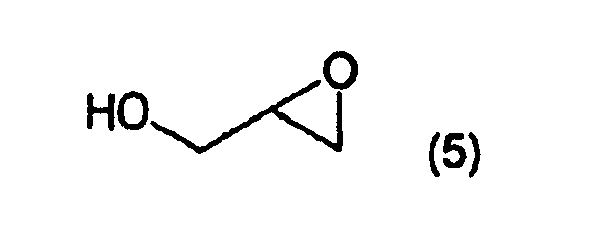
- Verfahren nach Anspruch 3, ferner umfassend das Epoxidieren der Verbindung der Formel (4), um eine Verbindung der Formel (5) zu bilden:
- Verfahren nach einem der vorangehenden Ansprüche, wobei R1 und R2 ausgewählt sind aus der Gruppe bestehend aus Acetalschutzgruppen, cyclischen Carbonatschutzgruppen, Alkoxyschutzgruppen, Aryloxyschutzgruppen, Acyloxyschutzgruppen, Haloschutzgruppen, Sulfonyloxyschutzgruppen, Sulfatschutzgruppen, Phosphatschutzgruppen, Saccharidschutzgruppen und Kombinationen davon.
- Verfahren nach Anspruch 5, worin R1 und R2 eine Alkyliden-, Aryliden- oder Acylidenacetalschutzgruppe bedeuten.
- Verfahren nach Anspruch 6, worin R1 und R2 eine Benzyliden-, Ethyliden-, Methyliden- oder Propylidenacetalschutzgruppe bedeuten.
- Verfahren nach einem der vorangehenden Ansprüche, wobei das Hypohalit Hypochlorit oder Hypobromit ist.
Applications Claiming Priority (3)
| Application Number | Priority Date | Filing Date | Title |
|---|---|---|---|
| US8749698P | 1998-06-01 | 1998-06-01 | |
| US87496P | 1998-06-01 | ||
| EP99955263A EP1084099B1 (de) | 1998-06-01 | 1999-05-28 | Verfahren zur herstellung von geschützten 3-amino-1,2-dihydroxypropanacetal und derivate davon |
Related Parent Applications (1)
| Application Number | Title | Priority Date | Filing Date |
|---|---|---|---|
| EP99955263A Division EP1084099B1 (de) | 1998-06-01 | 1999-05-28 | Verfahren zur herstellung von geschützten 3-amino-1,2-dihydroxypropanacetal und derivate davon |
Publications (2)
| Publication Number | Publication Date |
|---|---|
| EP1331218A1 EP1331218A1 (de) | 2003-07-30 |
| EP1331218B1 true EP1331218B1 (de) | 2006-12-27 |
Family
ID=26154154
Family Applications (1)
| Application Number | Title | Priority Date | Filing Date |
|---|---|---|---|
| EP03006773A Expired - Lifetime EP1331218B1 (de) | 1998-06-01 | 1999-05-28 | Verfahren zur Herstellung von geschützten 3-Amino-1,2-Dihydroxypropanacetal und Derivate davon |
Country Status (1)
| Country | Link |
|---|---|
| EP (1) | EP1331218B1 (de) |
Citations (1)
| Publication number | Priority date | Publication date | Assignee | Title |
|---|---|---|---|---|
| US4900847A (en) * | 1985-04-04 | 1990-02-13 | Massachusetts Institute Of Technology | Catalytic asymmetric epoxidation |
Family Cites Families (1)
| Publication number | Priority date | Publication date | Assignee | Title |
|---|---|---|---|---|
| AU3345599A (en) * | 1998-04-14 | 1999-11-01 | Samsung Fine Chemicals Co., Ltd. | A process for preparing chiral (s)-2,3-disubstituted-1-propylamine derivatives |
-
1999
- 1999-05-28 EP EP03006773A patent/EP1331218B1/de not_active Expired - Lifetime
Patent Citations (1)
| Publication number | Priority date | Publication date | Assignee | Title |
|---|---|---|---|---|
| US4900847A (en) * | 1985-04-04 | 1990-02-13 | Massachusetts Institute Of Technology | Catalytic asymmetric epoxidation |
Non-Patent Citations (3)
| Title |
|---|
| DANKLMAIER J. ET AL: "Synthese and struktur diastereomerenreiner 2,6-disubsituierter 3-Morpholinone", LIEBIGS ANN.CHEM., 1988, pages 1149 - 1153, XP000986227 * |
| FURROW M.E. ET AL: "Practical access to highly enantioenriched C-3 building blocks via hydrolytic kinetic resolution.", J.ORG.CHEM., vol. 63, 1998, pages 6776 - 6777 * |
| SOWDEN J.C. ET AL: "l-Glycidol", J.AM.CHEM.SOC., 1942, pages 1291 - 1293 * |
Also Published As
| Publication number | Publication date |
|---|---|
| EP1331218A1 (de) | 2003-07-30 |
Similar Documents
| Publication | Publication Date | Title |
|---|---|---|
| ES2338538T3 (es) | Metodo para la preparacion de hexahidrofuro(2,3-b)furan-3-ol. | |
| EP3347348B1 (de) | Herstellung von 3-hydroxy-3,6-dimethylhexahydrobenzofuran-2-on und derivaten davon | |
| WO2007089527B1 (en) | Method of forming a dianhydrosugar alcohol | |
| JP2011506552A (ja) | ローズオキシドの製造方法 | |
| WO1998011087A1 (en) | Process for preparing 1,3-dioxolane-4-methanol compounds | |
| US20080009639A1 (en) | Preparation of oseltamivir phosphate (Tamiflu) and intermediates starting from D-glucose or D-xylose | |
| EP1084099B1 (de) | Verfahren zur herstellung von geschützten 3-amino-1,2-dihydroxypropanacetal und derivate davon | |
| EP1331218B1 (de) | Verfahren zur Herstellung von geschützten 3-Amino-1,2-Dihydroxypropanacetal und Derivate davon | |
| EP1071654B1 (de) | Verfahren zur herstellung chiraler (s)-2,3-disubstituierter 1-propylamin-derivate | |
| JP3296824B2 (ja) | 1,3―ジオキソラン―4―メタノール化合物の製造法 | |
| EP1086072B1 (de) | Verfahren zur herstellung von geschützten dihydroxypropyl-trialkylammoniumsalzen und derivaten davon | |
| EP0139486B1 (de) | Verfahren zur Herstellung von Zucker-Ketalen | |
| JP5955769B2 (ja) | (1s,4r)−2−オキサ−3−アザビシクロ[2.2.1]ヘプト−5−エンの製造方法 | |
| WO2008053206A2 (en) | Process for preparation of aldonic acids and derivatives thereof | |
| Faigl et al. | Synthesis and enantioselective rearrangement of (Z)‐4‐triphenylmethoxy‐2, 3‐epoxybutan‐1‐ol enantiomers | |
| EP0463470A2 (de) | Verfahren zur Herstellung eines Fluorotetrahydrofuranonderivates | |
| JP2011178698A (ja) | 5−ヒドロキシ−1,3−ジオキサンの製造方法および該方法により得られた5−ヒドロキシ−1,3−ジオキサンを原料とした分岐型グリセロール3量体の製造方法 | |
| JP2007302591A (ja) | 1,2−プロパンジオールアセタール誘導体の製造方法 |
Legal Events
| Date | Code | Title | Description |
|---|---|---|---|
| PUAI | Public reference made under article 153(3) epc to a published international application that has entered the european phase |
Free format text: ORIGINAL CODE: 0009012 |
|
| 17P | Request for examination filed |
Effective date: 20030325 |
|
| AC | Divisional application: reference to earlier application |
Ref document number: 1084099 Country of ref document: EP Kind code of ref document: P |
|
| AK | Designated contracting states |
Designated state(s): AT BE CH CY DE DK ES FI FR GB GR IE IT LI LU MC NL PT SE |
|
| AKX | Designation fees paid |
Designated state(s): AT BE CH CY DE DK ES FI FR GB GR IE IT LI LU MC NL PT SE |
|
| 17Q | First examination report despatched |
Effective date: 20050323 |
|
| GRAP | Despatch of communication of intention to grant a patent |
Free format text: ORIGINAL CODE: EPIDOSNIGR1 |
|
| GRAS | Grant fee paid |
Free format text: ORIGINAL CODE: EPIDOSNIGR3 |
|
| GRAA | (expected) grant |
Free format text: ORIGINAL CODE: 0009210 |
|
| AC | Divisional application: reference to earlier application |
Ref document number: 1084099 Country of ref document: EP Kind code of ref document: P |
|
| AK | Designated contracting states |
Kind code of ref document: B1 Designated state(s): AT BE CH CY DE DK ES FI FR GB GR IE IT LI LU MC NL PT SE |
|
| REG | Reference to a national code |
Ref country code: GB Ref legal event code: FG4D |
|
| REG | Reference to a national code |
Ref country code: IE Ref legal event code: FG4D |
|
| REF | Corresponds to: |
Ref document number: 69934614 Country of ref document: DE Date of ref document: 20070208 Kind code of ref document: P |
|
| REG | Reference to a national code |
Ref country code: PT Ref legal event code: SC4A Free format text: AVAILABILITY OF NATIONAL TRANSLATION Effective date: 20070215 |
|
| REG | Reference to a national code |
Ref country code: GR Ref legal event code: EP Ref document number: 20070400516 Country of ref document: GR |
|
| REG | Reference to a national code |
Ref country code: DK Ref legal event code: T3 |
|
| REG | Reference to a national code |
Ref country code: SE Ref legal event code: TRGR |
|
| ET | Fr: translation filed | ||
| REG | Reference to a national code |
Ref country code: ES Ref legal event code: FG2A Ref document number: 2277626 Country of ref document: ES Kind code of ref document: T3 |
|
| PLBE | No opposition filed within time limit |
Free format text: ORIGINAL CODE: 0009261 |
|
| STAA | Information on the status of an ep patent application or granted ep patent |
Free format text: STATUS: NO OPPOSITION FILED WITHIN TIME LIMIT |
|
| 26N | No opposition filed |
Effective date: 20070928 |
|
| PGFP | Annual fee paid to national office [announced via postgrant information from national office to epo] |
Ref country code: NL Payment date: 20081031 Year of fee payment: 10 |
|
| PGFP | Annual fee paid to national office [announced via postgrant information from national office to epo] |
Ref country code: MC Payment date: 20081103 Year of fee payment: 10 Ref country code: DK Payment date: 20081111 Year of fee payment: 10 Ref country code: IE Payment date: 20081113 Year of fee payment: 10 Ref country code: DE Payment date: 20081201 Year of fee payment: 10 Ref country code: LU Payment date: 20081118 Year of fee payment: 10 Ref country code: CH Payment date: 20081103 Year of fee payment: 10 |
|
| PGFP | Annual fee paid to national office [announced via postgrant information from national office to epo] |
Ref country code: PT Payment date: 20081031 Year of fee payment: 10 Ref country code: FI Payment date: 20081105 Year of fee payment: 10 Ref country code: ES Payment date: 20081211 Year of fee payment: 10 Ref country code: AT Payment date: 20081103 Year of fee payment: 10 |
|
| PGFP | Annual fee paid to national office [announced via postgrant information from national office to epo] |
Ref country code: SE Payment date: 20081103 Year of fee payment: 10 Ref country code: IT Payment date: 20081110 Year of fee payment: 10 Ref country code: CY Payment date: 20081112 Year of fee payment: 10 |
|
| PGFP | Annual fee paid to national office [announced via postgrant information from national office to epo] |
Ref country code: FR Payment date: 20081030 Year of fee payment: 10 |
|
| PGFP | Annual fee paid to national office [announced via postgrant information from national office to epo] |
Ref country code: GR Payment date: 20081126 Year of fee payment: 10 Ref country code: GB Payment date: 20081031 Year of fee payment: 10 |
|
| PGFP | Annual fee paid to national office [announced via postgrant information from national office to epo] |
Ref country code: BE Payment date: 20090126 Year of fee payment: 10 |
|
| BERE | Be: lapsed |
Owner name: MICHIGAN STATE UNIVERSITY Effective date: 20090531 |
|
| REG | Reference to a national code |
Ref country code: PT Ref legal event code: MM4A Free format text: LAPSE DUE TO NON-PAYMENT OF FEES Effective date: 20091130 |
|
| PG25 | Lapsed in a contracting state [announced via postgrant information from national office to epo] |
Ref country code: MC Free format text: LAPSE BECAUSE OF NON-PAYMENT OF DUE FEES Effective date: 20090531 |
|
| REG | Reference to a national code |
Ref country code: CH Ref legal event code: PL |
|
| REG | Reference to a national code |
Ref country code: DK Ref legal event code: EBP |
|
| GBPC | Gb: european patent ceased through non-payment of renewal fee |
Effective date: 20090528 |
|
| PG25 | Lapsed in a contracting state [announced via postgrant information from national office to epo] |
Ref country code: LI Free format text: LAPSE BECAUSE OF NON-PAYMENT OF DUE FEES Effective date: 20090531 Ref country code: FI Free format text: LAPSE BECAUSE OF NON-PAYMENT OF DUE FEES Effective date: 20090528 Ref country code: CH Free format text: LAPSE BECAUSE OF NON-PAYMENT OF DUE FEES Effective date: 20090531 Ref country code: AT Free format text: LAPSE BECAUSE OF NON-PAYMENT OF DUE FEES Effective date: 20090528 |
|
| NLV4 | Nl: lapsed or anulled due to non-payment of the annual fee |
Effective date: 20091201 |
|
| PG25 | Lapsed in a contracting state [announced via postgrant information from national office to epo] |
Ref country code: NL Free format text: LAPSE BECAUSE OF NON-PAYMENT OF DUE FEES Effective date: 20091201 |
|
| REG | Reference to a national code |
Ref country code: FR Ref legal event code: ST Effective date: 20100129 |
|
| PG25 | Lapsed in a contracting state [announced via postgrant information from national office to epo] |
Ref country code: PT Free format text: LAPSE BECAUSE OF NON-PAYMENT OF DUE FEES Effective date: 20091130 |
|
| PG25 | Lapsed in a contracting state [announced via postgrant information from national office to epo] |
Ref country code: FR Free format text: LAPSE BECAUSE OF NON-PAYMENT OF DUE FEES Effective date: 20090602 Ref country code: IE Free format text: LAPSE BECAUSE OF NON-PAYMENT OF DUE FEES Effective date: 20090528 Ref country code: DK Free format text: LAPSE BECAUSE OF NON-PAYMENT OF DUE FEES Effective date: 20090531 |
|
| PG25 | Lapsed in a contracting state [announced via postgrant information from national office to epo] |
Ref country code: GB Free format text: LAPSE BECAUSE OF NON-PAYMENT OF DUE FEES Effective date: 20090528 Ref country code: CY Free format text: LAPSE BECAUSE OF NON-PAYMENT OF DUE FEES Effective date: 20090528 |
|
| PG25 | Lapsed in a contracting state [announced via postgrant information from national office to epo] |
Ref country code: BE Free format text: LAPSE BECAUSE OF NON-PAYMENT OF DUE FEES Effective date: 20090531 Ref country code: DE Free format text: LAPSE BECAUSE OF NON-PAYMENT OF DUE FEES Effective date: 20091201 Ref country code: GR Free format text: LAPSE BECAUSE OF NON-PAYMENT OF DUE FEES Effective date: 20091202 |
|
| REG | Reference to a national code |
Ref country code: ES Ref legal event code: FD2A Effective date: 20090529 |
|
| PG25 | Lapsed in a contracting state [announced via postgrant information from national office to epo] |
Ref country code: ES Free format text: LAPSE BECAUSE OF NON-PAYMENT OF DUE FEES Effective date: 20090529 |
|
| PG25 | Lapsed in a contracting state [announced via postgrant information from national office to epo] |
Ref country code: IT Free format text: LAPSE BECAUSE OF NON-PAYMENT OF DUE FEES Effective date: 20090528 |
|
| PG25 | Lapsed in a contracting state [announced via postgrant information from national office to epo] |
Ref country code: LU Free format text: LAPSE BECAUSE OF NON-PAYMENT OF DUE FEES Effective date: 20090528 |
|
| PG25 | Lapsed in a contracting state [announced via postgrant information from national office to epo] |
Ref country code: SE Free format text: LAPSE BECAUSE OF NON-PAYMENT OF DUE FEES Effective date: 20090529 |