EP1328546B1 - Cyclopeptide, verfahren zu ihrer herstellung und ihre verwendung zur hemmung oder stimulierung von angiogenese - Google Patents
Cyclopeptide, verfahren zu ihrer herstellung und ihre verwendung zur hemmung oder stimulierung von angiogenese Download PDFInfo
- Publication number
- EP1328546B1 EP1328546B1 EP01974427A EP01974427A EP1328546B1 EP 1328546 B1 EP1328546 B1 EP 1328546B1 EP 01974427 A EP01974427 A EP 01974427A EP 01974427 A EP01974427 A EP 01974427A EP 1328546 B1 EP1328546 B1 EP 1328546B1
- Authority
- EP
- European Patent Office
- Prior art keywords
- gln
- ile
- pro
- gly
- arg
- Prior art date
- Legal status (The legal status is an assumption and is not a legal conclusion. Google has not performed a legal analysis and makes no representation as to the accuracy of the status listed.)
- Expired - Lifetime
Links
- 102000001189 Cyclic Peptides Human genes 0.000 title claims abstract description 128
- 108010069514 Cyclic Peptides Proteins 0.000 title claims abstract description 128
- 238000000034 method Methods 0.000 title claims abstract description 31
- 239000012190 activator Substances 0.000 title abstract description 3
- VEEGZPWAAPPXRB-BJMVGYQFSA-N (3e)-3-(1h-imidazol-5-ylmethylidene)-1h-indol-2-one Chemical compound O=C1NC2=CC=CC=C2\C1=C/C1=CN=CN1 VEEGZPWAAPPXRB-BJMVGYQFSA-N 0.000 title 1
- 229940121369 angiogenesis inhibitor Drugs 0.000 title 1
- 239000004037 angiogenesis inhibitor Substances 0.000 title 1
- 125000006850 spacer group Chemical group 0.000 claims abstract description 44
- 230000033115 angiogenesis Effects 0.000 claims abstract description 20
- 150000001875 compounds Chemical class 0.000 claims description 28
- 150000002894 organic compounds Chemical class 0.000 claims description 26
- 210000004027 cell Anatomy 0.000 claims description 25
- -1 polysiloxane chain Polymers 0.000 claims description 21
- 229920000620 organic polymer Polymers 0.000 claims description 8
- 238000006471 dimerization reaction Methods 0.000 claims description 7
- 230000002401 inhibitory effect Effects 0.000 claims description 7
- 150000002500 ions Chemical class 0.000 claims description 7
- 230000003213 activating effect Effects 0.000 claims description 6
- 230000002255 enzymatic effect Effects 0.000 claims description 6
- 239000002202 Polyethylene glycol Substances 0.000 claims description 5
- 230000005865 ionizing radiation Effects 0.000 claims description 5
- 229920001223 polyethylene glycol Polymers 0.000 claims description 5
- 239000007787 solid Substances 0.000 claims description 5
- 229920001577 copolymer Polymers 0.000 claims description 4
- 150000002430 hydrocarbons Chemical class 0.000 claims description 4
- 239000004952 Polyamide Substances 0.000 claims description 3
- 239000004721 Polyphenylene oxide Substances 0.000 claims description 3
- 230000000975 bioactive effect Effects 0.000 claims description 3
- NBVXSUQYWXRMNV-UHFFFAOYSA-N fluoromethane Chemical compound FC NBVXSUQYWXRMNV-UHFFFAOYSA-N 0.000 claims description 3
- HCDGVLDPFQMKDK-UHFFFAOYSA-N hexafluoropropylene Chemical group FC(F)=C(F)C(F)(F)F HCDGVLDPFQMKDK-UHFFFAOYSA-N 0.000 claims description 3
- 229910003480 inorganic solid Inorganic materials 0.000 claims description 3
- 239000008194 pharmaceutical composition Substances 0.000 claims description 3
- 210000002381 plasma Anatomy 0.000 claims description 3
- 229920002647 polyamide Polymers 0.000 claims description 3
- 229920000768 polyamine Polymers 0.000 claims description 3
- 229920000728 polyester Polymers 0.000 claims description 3
- 229920000570 polyether Polymers 0.000 claims description 3
- BQCIDUSAKPWEOX-UHFFFAOYSA-N 1,1-Difluoroethene Chemical compound FC(F)=C BQCIDUSAKPWEOX-UHFFFAOYSA-N 0.000 claims description 2
- 239000004215 Carbon black (E152) Substances 0.000 claims description 2
- 229920002988 biodegradable polymer Polymers 0.000 claims description 2
- 239000004621 biodegradable polymer Substances 0.000 claims description 2
- 150000004676 glycans Chemical class 0.000 claims description 2
- 239000003102 growth factor Substances 0.000 claims description 2
- 229930195733 hydrocarbon Natural products 0.000 claims description 2
- 229920002338 polyhydroxyethylmethacrylate Polymers 0.000 claims description 2
- 229920001282 polysaccharide Polymers 0.000 claims description 2
- 239000005017 polysaccharide Substances 0.000 claims description 2
- 229920002451 polyvinyl alcohol Polymers 0.000 claims description 2
- 235000019422 polyvinyl alcohol Nutrition 0.000 claims description 2
- VGGSQFUCUMXWEO-UHFFFAOYSA-N Ethene Chemical compound C=C VGGSQFUCUMXWEO-UHFFFAOYSA-N 0.000 claims 1
- 239000005977 Ethylene Substances 0.000 claims 1
- 210000003989 endothelium vascular Anatomy 0.000 claims 1
- 108090000765 processed proteins & peptides Proteins 0.000 abstract description 66
- 239000003112 inhibitor Substances 0.000 abstract description 6
- 238000002360 preparation method Methods 0.000 abstract description 5
- 102000004190 Enzymes Human genes 0.000 abstract description 4
- 108090000790 Enzymes Proteins 0.000 abstract description 4
- 230000014399 negative regulation of angiogenesis Effects 0.000 abstract description 4
- 108010073929 Vascular Endothelial Growth Factor A Proteins 0.000 description 54
- 102000005789 Vascular Endothelial Growth Factors Human genes 0.000 description 54
- 108010019530 Vascular Endothelial Growth Factors Proteins 0.000 description 54
- YMWUJEATGCHHMB-UHFFFAOYSA-N Dichloromethane Chemical compound ClCCl YMWUJEATGCHHMB-UHFFFAOYSA-N 0.000 description 40
- DTQVDTLACAAQTR-UHFFFAOYSA-N Trifluoroacetic acid Chemical compound OC(=O)C(F)(F)F DTQVDTLACAAQTR-UHFFFAOYSA-N 0.000 description 28
- 150000001413 amino acids Chemical class 0.000 description 23
- SJRJJKPEHAURKC-UHFFFAOYSA-N N-Methylmorpholine Chemical compound CN1CCOCC1 SJRJJKPEHAURKC-UHFFFAOYSA-N 0.000 description 22
- 239000000243 solution Substances 0.000 description 21
- 102000004196 processed proteins & peptides Human genes 0.000 description 20
- 229920005989 resin Polymers 0.000 description 20
- 239000011347 resin Substances 0.000 description 20
- 108010053099 Vascular Endothelial Growth Factor Receptor-2 Proteins 0.000 description 19
- 102100037697 Uridylate-specific endoribonuclease Human genes 0.000 description 17
- QOSSAOTZNIDXMA-UHFFFAOYSA-N Dicylcohexylcarbodiimide Chemical compound C1CCCCC1N=C=NC1CCCCC1 QOSSAOTZNIDXMA-UHFFFAOYSA-N 0.000 description 15
- SECXISVLQFMRJM-UHFFFAOYSA-N N-Methylpyrrolidone Chemical compound CN1CCCC1=O SECXISVLQFMRJM-UHFFFAOYSA-N 0.000 description 15
- 230000006870 function Effects 0.000 description 15
- 238000003786 synthesis reaction Methods 0.000 description 15
- 239000007790 solid phase Substances 0.000 description 14
- 230000027455 binding Effects 0.000 description 12
- NPZTUJOABDZTLV-UHFFFAOYSA-N hydroxybenzotriazole Substances O=C1C=CC=C2NNN=C12 NPZTUJOABDZTLV-UHFFFAOYSA-N 0.000 description 12
- VHYFNPMBLIVWCW-UHFFFAOYSA-N 4-Dimethylaminopyridine Chemical compound CN(C)C1=CC=NC=C1 VHYFNPMBLIVWCW-UHFFFAOYSA-N 0.000 description 11
- JGFZNNIVVJXRND-UHFFFAOYSA-N N,N-Diisopropylethylamine (DIPEA) Chemical compound CCN(C(C)C)C(C)C JGFZNNIVVJXRND-UHFFFAOYSA-N 0.000 description 11
- 230000015572 biosynthetic process Effects 0.000 description 11
- 239000000047 product Substances 0.000 description 11
- WYURNTSHIVDZCO-UHFFFAOYSA-N Tetrahydrofuran Chemical compound C1CCOC1 WYURNTSHIVDZCO-UHFFFAOYSA-N 0.000 description 10
- 102100033177 Vascular endothelial growth factor receptor 2 Human genes 0.000 description 10
- 230000005764 inhibitory process Effects 0.000 description 10
- ASOKPJOREAFHNY-UHFFFAOYSA-N 1-Hydroxybenzotriazole Chemical compound C1=CC=C2N(O)N=NC2=C1 ASOKPJOREAFHNY-UHFFFAOYSA-N 0.000 description 9
- WEVYAHXRMPXWCK-UHFFFAOYSA-N Acetonitrile Chemical compound CC#N WEVYAHXRMPXWCK-UHFFFAOYSA-N 0.000 description 9
- 239000006144 Dulbecco’s modified Eagle's medium Substances 0.000 description 9
- XEKOWRVHYACXOJ-UHFFFAOYSA-N Ethyl acetate Chemical compound CCOC(C)=O XEKOWRVHYACXOJ-UHFFFAOYSA-N 0.000 description 9
- OKKJLVBELUTLKV-UHFFFAOYSA-N Methanol Chemical compound OC OKKJLVBELUTLKV-UHFFFAOYSA-N 0.000 description 9
- HEMHJVSKTPXQMS-UHFFFAOYSA-M Sodium hydroxide Chemical compound [OH-].[Na+] HEMHJVSKTPXQMS-UHFFFAOYSA-M 0.000 description 9
- 230000008878 coupling Effects 0.000 description 9
- 238000010168 coupling process Methods 0.000 description 9
- 238000005859 coupling reaction Methods 0.000 description 9
- 239000002609 medium Substances 0.000 description 9
- 229910052757 nitrogen Inorganic materials 0.000 description 9
- IJGRMHOSHXDMSA-UHFFFAOYSA-N Atomic nitrogen Chemical compound N#N IJGRMHOSHXDMSA-UHFFFAOYSA-N 0.000 description 8
- 108091008605 VEGF receptors Proteins 0.000 description 8
- 102000009484 Vascular Endothelial Growth Factor Receptors Human genes 0.000 description 8
- 238000010511 deprotection reaction Methods 0.000 description 8
- 238000004128 high performance liquid chromatography Methods 0.000 description 8
- 230000008569 process Effects 0.000 description 8
- 230000002829 reductive effect Effects 0.000 description 8
- 239000002904 solvent Substances 0.000 description 8
- 230000026731 phosphorylation Effects 0.000 description 7
- 238000006366 phosphorylation reaction Methods 0.000 description 7
- 229920006254 polymer film Polymers 0.000 description 7
- XLYOFNOQVPJJNP-UHFFFAOYSA-N water Substances O XLYOFNOQVPJJNP-UHFFFAOYSA-N 0.000 description 7
- UHOVQNZJYSORNB-UHFFFAOYSA-N Benzene Chemical compound C1=CC=CC=C1 UHOVQNZJYSORNB-UHFFFAOYSA-N 0.000 description 6
- 108091003079 Bovine Serum Albumin Proteins 0.000 description 6
- DHMQDGOQFOQNFH-UHFFFAOYSA-N Glycine Chemical compound NCC(O)=O DHMQDGOQFOQNFH-UHFFFAOYSA-N 0.000 description 6
- NQRYJNQNLNOLGT-UHFFFAOYSA-N Piperidine Chemical compound C1CCNCC1 NQRYJNQNLNOLGT-UHFFFAOYSA-N 0.000 description 6
- VYPSYNLAJGMNEJ-UHFFFAOYSA-N Silicium dioxide Chemical compound O=[Si]=O VYPSYNLAJGMNEJ-UHFFFAOYSA-N 0.000 description 6
- YXFVVABEGXRONW-UHFFFAOYSA-N Toluene Chemical compound CC1=CC=CC=C1 YXFVVABEGXRONW-UHFFFAOYSA-N 0.000 description 6
- 150000001732 carboxylic acid derivatives Chemical class 0.000 description 6
- LOKCTEFSRHRXRJ-UHFFFAOYSA-I dipotassium trisodium dihydrogen phosphate hydrogen phosphate dichloride Chemical compound P(=O)(O)(O)[O-].[K+].P(=O)(O)([O-])[O-].[Na+].[Na+].[Cl-].[K+].[Cl-].[Na+] LOKCTEFSRHRXRJ-UHFFFAOYSA-I 0.000 description 6
- 239000012894 fetal calf serum Substances 0.000 description 6
- 239000012071 phase Substances 0.000 description 6
- 239000002953 phosphate buffered saline Substances 0.000 description 6
- 229920000642 polymer Polymers 0.000 description 6
- 238000007363 ring formation reaction Methods 0.000 description 6
- 238000001308 synthesis method Methods 0.000 description 6
- 125000003088 (fluoren-9-ylmethoxy)carbonyl group Chemical group 0.000 description 5
- HIXDQWDOVZUNNA-UHFFFAOYSA-N 2-(3,4-dimethoxyphenyl)-5-hydroxy-7-methoxychromen-4-one Chemical compound C=1C(OC)=CC(O)=C(C(C=2)=O)C=1OC=2C1=CC=C(OC)C(OC)=C1 HIXDQWDOVZUNNA-UHFFFAOYSA-N 0.000 description 5
- QTBSBXVTEAMEQO-UHFFFAOYSA-N Acetic acid Chemical compound CC(O)=O QTBSBXVTEAMEQO-UHFFFAOYSA-N 0.000 description 5
- COLNVLDHVKWLRT-MRVPVSSYSA-N D-phenylalanine Chemical compound OC(=O)[C@H](N)CC1=CC=CC=C1 COLNVLDHVKWLRT-MRVPVSSYSA-N 0.000 description 5
- 108010037362 Extracellular Matrix Proteins Proteins 0.000 description 5
- 102000010834 Extracellular Matrix Proteins Human genes 0.000 description 5
- 101000851007 Homo sapiens Vascular endothelial growth factor receptor 2 Proteins 0.000 description 5
- 102000005741 Metalloproteases Human genes 0.000 description 5
- 108010006035 Metalloproteases Proteins 0.000 description 5
- NIXOWILDQLNWCW-UHFFFAOYSA-N acrylic acid group Chemical group C(C=C)(=O)O NIXOWILDQLNWCW-UHFFFAOYSA-N 0.000 description 5
- 150000001412 amines Chemical class 0.000 description 5
- 230000000694 effects Effects 0.000 description 5
- RTZKZFJDLAIYFH-UHFFFAOYSA-N ether Substances CCOCC RTZKZFJDLAIYFH-UHFFFAOYSA-N 0.000 description 5
- 210000002744 extracellular matrix Anatomy 0.000 description 5
- 230000026341 positive regulation of angiogenesis Effects 0.000 description 5
- 230000035755 proliferation Effects 0.000 description 5
- 102000005962 receptors Human genes 0.000 description 5
- 108020003175 receptors Proteins 0.000 description 5
- 238000003756 stirring Methods 0.000 description 5
- BDNKZNFMNDZQMI-UHFFFAOYSA-N 1,3-diisopropylcarbodiimide Chemical compound CC(C)N=C=NC(C)C BDNKZNFMNDZQMI-UHFFFAOYSA-N 0.000 description 4
- JKMHFZQWWAIEOD-UHFFFAOYSA-N 2-[4-(2-hydroxyethyl)piperazin-1-yl]ethanesulfonic acid Chemical compound OCC[NH+]1CCN(CCS([O-])(=O)=O)CC1 JKMHFZQWWAIEOD-UHFFFAOYSA-N 0.000 description 4
- HEDRZPFGACZZDS-UHFFFAOYSA-N Chloroform Chemical compound ClC(Cl)Cl HEDRZPFGACZZDS-UHFFFAOYSA-N 0.000 description 4
- 238000005033 Fourier transform infrared spectroscopy Methods 0.000 description 4
- UFWIBTONFRDIAS-UHFFFAOYSA-N Naphthalene Chemical compound C1=CC=CC2=CC=CC=C21 UFWIBTONFRDIAS-UHFFFAOYSA-N 0.000 description 4
- ISWSIDIOOBJBQZ-UHFFFAOYSA-N Phenol Chemical compound OC1=CC=CC=C1 ISWSIDIOOBJBQZ-UHFFFAOYSA-N 0.000 description 4
- 238000006243 chemical reaction Methods 0.000 description 4
- 239000003153 chemical reaction reagent Substances 0.000 description 4
- 229940126214 compound 3 Drugs 0.000 description 4
- TXCDCPKCNAJMEE-UHFFFAOYSA-N dibenzofuran Chemical compound C1=CC=C2C3=CC=CC=C3OC2=C1 TXCDCPKCNAJMEE-UHFFFAOYSA-N 0.000 description 4
- 238000002474 experimental method Methods 0.000 description 4
- 238000001914 filtration Methods 0.000 description 4
- 125000000524 functional group Chemical group 0.000 description 4
- 230000005012 migration Effects 0.000 description 4
- 238000013508 migration Methods 0.000 description 4
- 239000000178 monomer Substances 0.000 description 4
- 239000012074 organic phase Substances 0.000 description 4
- 229910052760 oxygen Inorganic materials 0.000 description 4
- 239000001301 oxygen Substances 0.000 description 4
- 239000002244 precipitate Substances 0.000 description 4
- 239000000758 substrate Substances 0.000 description 4
- 238000012360 testing method Methods 0.000 description 4
- 244000265913 Crataegus laevigata Species 0.000 description 3
- PEDCQBHIVMGVHV-UHFFFAOYSA-N Glycerine Chemical compound OCC(O)CO PEDCQBHIVMGVHV-UHFFFAOYSA-N 0.000 description 3
- 239000007995 HEPES buffer Substances 0.000 description 3
- FAPWRFPIFSIZLT-UHFFFAOYSA-M Sodium chloride Chemical compound [Na+].[Cl-] FAPWRFPIFSIZLT-UHFFFAOYSA-M 0.000 description 3
- 239000007864 aqueous solution Substances 0.000 description 3
- 125000003118 aryl group Chemical group 0.000 description 3
- QVGXLLKOCUKJST-UHFFFAOYSA-N atomic oxygen Chemical compound [O] QVGXLLKOCUKJST-UHFFFAOYSA-N 0.000 description 3
- 239000012620 biological material Substances 0.000 description 3
- 239000012888 bovine serum Substances 0.000 description 3
- 125000003178 carboxy group Chemical group [H]OC(*)=O 0.000 description 3
- 230000012292 cell migration Effects 0.000 description 3
- 210000004978 chinese hamster ovary cell Anatomy 0.000 description 3
- 229940125773 compound 10 Drugs 0.000 description 3
- MTHSVFCYNBDYFN-UHFFFAOYSA-N diethylene glycol Chemical compound OCCOCCO MTHSVFCYNBDYFN-UHFFFAOYSA-N 0.000 description 3
- 210000002889 endothelial cell Anatomy 0.000 description 3
- 239000000706 filtrate Substances 0.000 description 3
- 239000000499 gel Substances 0.000 description 3
- 125000005842 heteroatom Chemical group 0.000 description 3
- IIRDTKBZINWQAW-UHFFFAOYSA-N hexaethylene glycol Chemical compound OCCOCCOCCOCCOCCOCCO IIRDTKBZINWQAW-UHFFFAOYSA-N 0.000 description 3
- 125000002887 hydroxy group Chemical group [H]O* 0.000 description 3
- ZLVXBBHTMQJRSX-VMGNSXQWSA-N jdtic Chemical compound C1([C@]2(C)CCN(C[C@@H]2C)C[C@H](C(C)C)NC(=O)[C@@H]2NCC3=CC(O)=CC=C3C2)=CC=CC(O)=C1 ZLVXBBHTMQJRSX-VMGNSXQWSA-N 0.000 description 3
- 238000004949 mass spectrometry Methods 0.000 description 3
- 239000000203 mixture Substances 0.000 description 3
- 230000007170 pathology Effects 0.000 description 3
- 229910052698 phosphorus Inorganic materials 0.000 description 3
- 238000011160 research Methods 0.000 description 3
- 239000000377 silicon dioxide Substances 0.000 description 3
- 230000002194 synthesizing effect Effects 0.000 description 3
- LXAVCFDWHMZCJH-UHFFFAOYSA-N 2-[4-(hydroxymethyl)-3-methoxyphenoxy]butanoic acid Chemical compound CCC(C(O)=O)OC1=CC=C(CO)C(OC)=C1 LXAVCFDWHMZCJH-UHFFFAOYSA-N 0.000 description 2
- HXOYWJCDYVODON-UHFFFAOYSA-N 4-[4-(hydroxymethyl)-3-methoxyphenoxy]butanoic acid Chemical compound COC1=CC(OCCCC(O)=O)=CC=C1CO HXOYWJCDYVODON-UHFFFAOYSA-N 0.000 description 2
- YYROPELSRYBVMQ-UHFFFAOYSA-N 4-toluenesulfonyl chloride Chemical compound CC1=CC=C(S(Cl)(=O)=O)C=C1 YYROPELSRYBVMQ-UHFFFAOYSA-N 0.000 description 2
- XKRFYHLGVUSROY-UHFFFAOYSA-N Argon Chemical compound [Ar] XKRFYHLGVUSROY-UHFFFAOYSA-N 0.000 description 2
- OUYCCCASQSFEME-MRVPVSSYSA-N D-tyrosine Chemical compound OC(=O)[C@H](N)CC1=CC=C(O)C=C1 OUYCCCASQSFEME-MRVPVSSYSA-N 0.000 description 2
- 108010010803 Gelatin Proteins 0.000 description 2
- 229920002971 Heparan sulfate Polymers 0.000 description 2
- WHUUTDBJXJRKMK-VKHMYHEASA-N L-glutamic acid Chemical compound OC(=O)[C@@H](N)CCC(O)=O WHUUTDBJXJRKMK-VKHMYHEASA-N 0.000 description 2
- ZDXPYRJPNDTMRX-VKHMYHEASA-N L-glutamine Chemical compound OC(=O)[C@@H](N)CCC(N)=O ZDXPYRJPNDTMRX-VKHMYHEASA-N 0.000 description 2
- 108091054455 MAP kinase family Proteins 0.000 description 2
- 102000043136 MAP kinase family Human genes 0.000 description 2
- PXHVJJICTQNCMI-UHFFFAOYSA-N Nickel Chemical compound [Ni] PXHVJJICTQNCMI-UHFFFAOYSA-N 0.000 description 2
- 102000007079 Peptide Fragments Human genes 0.000 description 2
- 108010033276 Peptide Fragments Proteins 0.000 description 2
- OAICVXFJPJFONN-UHFFFAOYSA-N Phosphorus Chemical compound [P] OAICVXFJPJFONN-UHFFFAOYSA-N 0.000 description 2
- 108091000080 Phosphotransferase Proteins 0.000 description 2
- 229920000361 Poly(styrene)-block-poly(ethylene glycol) Polymers 0.000 description 2
- JUJWROOIHBZHMG-UHFFFAOYSA-N Pyridine Chemical compound C1=CC=NC=C1 JUJWROOIHBZHMG-UHFFFAOYSA-N 0.000 description 2
- XUIMIQQOPSSXEZ-UHFFFAOYSA-N Silicon Chemical compound [Si] XUIMIQQOPSSXEZ-UHFFFAOYSA-N 0.000 description 2
- ATJFFYVFTNAWJD-UHFFFAOYSA-N Tin Chemical compound [Sn] ATJFFYVFTNAWJD-UHFFFAOYSA-N 0.000 description 2
- XSQUKJJJFZCRTK-UHFFFAOYSA-N Urea Chemical compound NC(N)=O XSQUKJJJFZCRTK-UHFFFAOYSA-N 0.000 description 2
- 230000004913 activation Effects 0.000 description 2
- 150000001335 aliphatic alkanes Chemical class 0.000 description 2
- 238000005937 allylation reaction Methods 0.000 description 2
- 125000003275 alpha amino acid group Chemical group 0.000 description 2
- 125000003277 amino group Chemical group 0.000 description 2
- 238000004458 analytical method Methods 0.000 description 2
- RDOXTESZEPMUJZ-UHFFFAOYSA-N anisole Chemical compound COC1=CC=CC=C1 RDOXTESZEPMUJZ-UHFFFAOYSA-N 0.000 description 2
- 239000012298 atmosphere Substances 0.000 description 2
- 239000000872 buffer Substances 0.000 description 2
- 230000004663 cell proliferation Effects 0.000 description 2
- 230000001413 cellular effect Effects 0.000 description 2
- 208000037976 chronic inflammation Diseases 0.000 description 2
- 208000037893 chronic inflammatory disorder Diseases 0.000 description 2
- 229940125904 compound 1 Drugs 0.000 description 2
- 229940125898 compound 5 Drugs 0.000 description 2
- 238000009833 condensation Methods 0.000 description 2
- 230000005494 condensation Effects 0.000 description 2
- 125000004122 cyclic group Chemical group 0.000 description 2
- 230000002950 deficient Effects 0.000 description 2
- 238000011161 development Methods 0.000 description 2
- 230000018109 developmental process Effects 0.000 description 2
- MGHPNCMVUAKAIE-UHFFFAOYSA-N diphenylmethanamine Chemical compound C=1C=CC=CC=1C(N)C1=CC=CC=C1 MGHPNCMVUAKAIE-UHFFFAOYSA-N 0.000 description 2
- 229940079593 drug Drugs 0.000 description 2
- 239000003814 drug Substances 0.000 description 2
- 238000010894 electron beam technology Methods 0.000 description 2
- 239000003480 eluent Substances 0.000 description 2
- 150000002148 esters Chemical class 0.000 description 2
- 239000013505 freshwater Substances 0.000 description 2
- 238000007306 functionalization reaction Methods 0.000 description 2
- 239000008273 gelatin Substances 0.000 description 2
- 229920000159 gelatin Polymers 0.000 description 2
- 235000019322 gelatine Nutrition 0.000 description 2
- 235000011852 gelatine desserts Nutrition 0.000 description 2
- 229910052732 germanium Inorganic materials 0.000 description 2
- GNPVGFCGXDBREM-UHFFFAOYSA-N germanium atom Chemical compound [Ge] GNPVGFCGXDBREM-UHFFFAOYSA-N 0.000 description 2
- 238000011534 incubation Methods 0.000 description 2
- 238000004519 manufacturing process Methods 0.000 description 2
- 239000012528 membrane Substances 0.000 description 2
- 230000009871 nonspecific binding Effects 0.000 description 2
- 239000011574 phosphorus Substances 0.000 description 2
- 102000020233 phosphotransferase Human genes 0.000 description 2
- 229920000139 polyethylene terephthalate Polymers 0.000 description 2
- 239000005020 polyethylene terephthalate Substances 0.000 description 2
- 229920001296 polysiloxane Polymers 0.000 description 2
- 238000001556 precipitation Methods 0.000 description 2
- 125000002924 primary amino group Chemical group [H]N([H])* 0.000 description 2
- 102000004169 proteins and genes Human genes 0.000 description 2
- 108090000623 proteins and genes Proteins 0.000 description 2
- 238000000746 purification Methods 0.000 description 2
- 238000011002 quantification Methods 0.000 description 2
- 150000003254 radicals Chemical class 0.000 description 2
- 239000012429 reaction media Substances 0.000 description 2
- 238000010992 reflux Methods 0.000 description 2
- 238000012552 review Methods 0.000 description 2
- 150000003839 salts Chemical class 0.000 description 2
- 239000010703 silicon Substances 0.000 description 2
- 229910052710 silicon Inorganic materials 0.000 description 2
- 238000010532 solid phase synthesis reaction Methods 0.000 description 2
- 238000004611 spectroscopical analysis Methods 0.000 description 2
- UCSJYZPVAKXKNQ-HZYVHMACSA-N streptomycin Chemical compound CN[C@H]1[C@H](O)[C@@H](O)[C@H](CO)O[C@H]1O[C@@H]1[C@](C=O)(O)[C@H](C)O[C@H]1O[C@@H]1[C@@H](NC(N)=N)[C@H](O)[C@@H](NC(N)=N)[C@H](O)[C@H]1O UCSJYZPVAKXKNQ-HZYVHMACSA-N 0.000 description 2
- ISXSCDLOGDJUNJ-UHFFFAOYSA-N tert-butyl prop-2-enoate Chemical compound CC(C)(C)OC(=O)C=C ISXSCDLOGDJUNJ-UHFFFAOYSA-N 0.000 description 2
- 229910052718 tin Inorganic materials 0.000 description 2
- 238000012546 transfer Methods 0.000 description 2
- IHQVNHXTBXVBJX-UHFFFAOYSA-N tripyrrolidin-1-yl(triazol-1-yloxy)phosphanium Chemical compound C1CCCN1[P+](N1CCCC1)(N1CCCC1)ON1N=NC=C1 IHQVNHXTBXVBJX-UHFFFAOYSA-N 0.000 description 2
- 238000005406 washing Methods 0.000 description 2
- FJQZXCPWAGYPSD-UHFFFAOYSA-N 1,3,4,6-tetrachloro-3a,6a-diphenylimidazo[4,5-d]imidazole-2,5-dione Chemical compound ClN1C(=O)N(Cl)C2(C=3C=CC=CC=3)N(Cl)C(=O)N(Cl)C12C1=CC=CC=C1 FJQZXCPWAGYPSD-UHFFFAOYSA-N 0.000 description 1
- ADFXKUOMJKEIND-UHFFFAOYSA-N 1,3-dicyclohexylurea Chemical compound C1CCCCC1NC(=O)NC1CCCCC1 ADFXKUOMJKEIND-UHFFFAOYSA-N 0.000 description 1
- 238000005160 1H NMR spectroscopy Methods 0.000 description 1
- IHPYMWDTONKSCO-UHFFFAOYSA-N 2,2'-piperazine-1,4-diylbisethanesulfonic acid Chemical compound OS(=O)(=O)CCN1CCN(CCS(O)(=O)=O)CC1 IHPYMWDTONKSCO-UHFFFAOYSA-N 0.000 description 1
- 125000003903 2-propenyl group Chemical group [H]C([*])([H])C([H])=C([H])[H] 0.000 description 1
- DZLQIBLCPOQPPA-UHFFFAOYSA-N 3-[6-(2-aminoethyl)dibenzofuran-4-yl]propanoic acid Chemical compound O1C2=C(CCC(O)=O)C=CC=C2C2=C1C(CCN)=CC=C2 DZLQIBLCPOQPPA-UHFFFAOYSA-N 0.000 description 1
- IFKCSBMTPCWQDR-UHFFFAOYSA-N 3-dibenzofuran-1-ylpropanoic acid Chemical compound O1C2=CC=CC=C2C2=C1C=CC=C2CCC(=O)O IFKCSBMTPCWQDR-UHFFFAOYSA-N 0.000 description 1
- FWMNVWWHGCHHJJ-SKKKGAJSSA-N 4-amino-1-[(2r)-6-amino-2-[[(2r)-2-[[(2r)-2-[[(2r)-2-amino-3-phenylpropanoyl]amino]-3-phenylpropanoyl]amino]-4-methylpentanoyl]amino]hexanoyl]piperidine-4-carboxylic acid Chemical compound C([C@H](C(=O)N[C@H](CC(C)C)C(=O)N[C@H](CCCCN)C(=O)N1CCC(N)(CC1)C(O)=O)NC(=O)[C@H](N)CC=1C=CC=CC=1)C1=CC=CC=C1 FWMNVWWHGCHHJJ-SKKKGAJSSA-N 0.000 description 1
- ZCYVEMRRCGMTRW-UHFFFAOYSA-N 7553-56-2 Chemical compound [I] ZCYVEMRRCGMTRW-UHFFFAOYSA-N 0.000 description 1
- GAWIXWVDTYZWAW-UHFFFAOYSA-N C[CH]O Chemical group C[CH]O GAWIXWVDTYZWAW-UHFFFAOYSA-N 0.000 description 1
- RYGMFSIKBFXOCR-UHFFFAOYSA-N Copper Chemical compound [Cu] RYGMFSIKBFXOCR-UHFFFAOYSA-N 0.000 description 1
- 125000000180 D-prolyl group Chemical group N1[C@@H](C(=O)*)CCC1 0.000 description 1
- 206010012689 Diabetic retinopathy Diseases 0.000 description 1
- 101000876610 Dictyostelium discoideum Extracellular signal-regulated kinase 2 Proteins 0.000 description 1
- KCXVZYZYPLLWCC-UHFFFAOYSA-N EDTA Chemical compound OC(=O)CN(CC(O)=O)CCN(CC(O)=O)CC(O)=O KCXVZYZYPLLWCC-UHFFFAOYSA-N 0.000 description 1
- 102000003974 Fibroblast growth factor 2 Human genes 0.000 description 1
- 108090000379 Fibroblast growth factor 2 Proteins 0.000 description 1
- WQZGKKKJIJFFOK-GASJEMHNSA-N Glucose Natural products OC[C@H]1OC(O)[C@H](O)[C@@H](O)[C@@H]1O WQZGKKKJIJFFOK-GASJEMHNSA-N 0.000 description 1
- HTTJABKRGRZYRN-UHFFFAOYSA-N Heparin Chemical compound OC1C(NC(=O)C)C(O)OC(COS(O)(=O)=O)C1OC1C(OS(O)(=O)=O)C(O)C(OC2C(C(OS(O)(=O)=O)C(OC3C(C(O)C(O)C(O3)C(O)=O)OS(O)(=O)=O)C(CO)O2)NS(O)(=O)=O)C(C(O)=O)O1 HTTJABKRGRZYRN-UHFFFAOYSA-N 0.000 description 1
- 101001052493 Homo sapiens Mitogen-activated protein kinase 1 Proteins 0.000 description 1
- 206010021143 Hypoxia Diseases 0.000 description 1
- 229930182816 L-glutamine Natural products 0.000 description 1
- OUYCCCASQSFEME-QMMMGPOBSA-N L-tyrosine Chemical compound OC(=O)[C@@H](N)CC1=CC=C(O)C=C1 OUYCCCASQSFEME-QMMMGPOBSA-N 0.000 description 1
- 108040008097 MAP kinase activity proteins Proteins 0.000 description 1
- 102000019149 MAP kinase activity proteins Human genes 0.000 description 1
- 206010027476 Metastases Diseases 0.000 description 1
- 102100024193 Mitogen-activated protein kinase 1 Human genes 0.000 description 1
- 238000005481 NMR spectroscopy Methods 0.000 description 1
- 206010029113 Neovascularisation Diseases 0.000 description 1
- 239000000020 Nitrocellulose Substances 0.000 description 1
- 229910019142 PO4 Inorganic materials 0.000 description 1
- 239000002033 PVDF binder Substances 0.000 description 1
- 208000034038 Pathologic Neovascularization Diseases 0.000 description 1
- 229930182555 Penicillin Natural products 0.000 description 1
- JGSARLDLIJGVTE-MBNYWOFBSA-N Penicillin G Chemical compound N([C@H]1[C@H]2SC([C@@H](N2C1=O)C(O)=O)(C)C)C(=O)CC1=CC=CC=C1 JGSARLDLIJGVTE-MBNYWOFBSA-N 0.000 description 1
- 239000004793 Polystyrene Substances 0.000 description 1
- 102000001708 Protein Isoforms Human genes 0.000 description 1
- 108010029485 Protein Isoforms Proteins 0.000 description 1
- 102000004022 Protein-Tyrosine Kinases Human genes 0.000 description 1
- 108090000412 Protein-Tyrosine Kinases Proteins 0.000 description 1
- 108010071390 Serum Albumin Proteins 0.000 description 1
- 102000007562 Serum Albumin Human genes 0.000 description 1
- DBMJMQXJHONAFJ-UHFFFAOYSA-M Sodium laurylsulphate Chemical compound [Na+].CCCCCCCCCCCCOS([O-])(=O)=O DBMJMQXJHONAFJ-UHFFFAOYSA-M 0.000 description 1
- 238000000944 Soxhlet extraction Methods 0.000 description 1
- 102000016549 Vascular Endothelial Growth Factor Receptor-2 Human genes 0.000 description 1
- 239000002253 acid Substances 0.000 description 1
- HFBMWMNUJJDEQZ-UHFFFAOYSA-N acryloyl chloride Chemical compound ClC(=O)C=C HFBMWMNUJJDEQZ-UHFFFAOYSA-N 0.000 description 1
- 239000004480 active ingredient Substances 0.000 description 1
- 239000008186 active pharmaceutical agent Substances 0.000 description 1
- BHELZAPQIKSEDF-UHFFFAOYSA-N allyl bromide Chemical compound BrCC=C BHELZAPQIKSEDF-UHFFFAOYSA-N 0.000 description 1
- 125000000539 amino acid group Chemical group 0.000 description 1
- 150000008064 anhydrides Chemical class 0.000 description 1
- 230000003302 anti-idiotype Effects 0.000 description 1
- 239000002246 antineoplastic agent Substances 0.000 description 1
- 238000013459 approach Methods 0.000 description 1
- 229910052786 argon Inorganic materials 0.000 description 1
- 150000001491 aromatic compounds Chemical class 0.000 description 1
- 238000003556 assay Methods 0.000 description 1
- 238000000376 autoradiography Methods 0.000 description 1
- 239000011324 bead Substances 0.000 description 1
- 230000008901 benefit Effects 0.000 description 1
- 239000012148 binding buffer Substances 0.000 description 1
- 239000012867 bioactive agent Substances 0.000 description 1
- 230000004071 biological effect Effects 0.000 description 1
- 230000000903 blocking effect Effects 0.000 description 1
- 239000000316 bone substitute Substances 0.000 description 1
- 210000004899 c-terminal region Anatomy 0.000 description 1
- 210000001043 capillary endothelial cell Anatomy 0.000 description 1
- 239000004202 carbamide Substances 0.000 description 1
- 229910002091 carbon monoxide Inorganic materials 0.000 description 1
- 239000003054 catalyst Substances 0.000 description 1
- 238000005119 centrifugation Methods 0.000 description 1
- 238000004587 chromatography analysis Methods 0.000 description 1
- 238000003776 cleavage reaction Methods 0.000 description 1
- 239000002299 complementary DNA Substances 0.000 description 1
- 229940125782 compound 2 Drugs 0.000 description 1
- 230000001276 controlling effect Effects 0.000 description 1
- 238000007796 conventional method Methods 0.000 description 1
- 229910052802 copper Inorganic materials 0.000 description 1
- 239000010949 copper Substances 0.000 description 1
- 239000013058 crude material Substances 0.000 description 1
- 238000005520 cutting process Methods 0.000 description 1
- 239000002254 cytotoxic agent Substances 0.000 description 1
- 229940127089 cytotoxic agent Drugs 0.000 description 1
- 231100000599 cytotoxic agent Toxicity 0.000 description 1
- LHCGBIFHSCCRRG-UHFFFAOYSA-N dichloroborane Chemical compound ClBCl LHCGBIFHSCCRRG-UHFFFAOYSA-N 0.000 description 1
- LMBWSYZSUOEYSN-UHFFFAOYSA-N diethyldithiocarbamic acid Chemical compound CCN(CC)C(S)=S LMBWSYZSUOEYSN-UHFFFAOYSA-N 0.000 description 1
- 238000009826 distribution Methods 0.000 description 1
- 229950004394 ditiocarb Drugs 0.000 description 1
- 231100000673 dose–response relationship Toxicity 0.000 description 1
- 230000002900 effect on cell Effects 0.000 description 1
- 239000012636 effector Substances 0.000 description 1
- 238000005323 electroforming Methods 0.000 description 1
- 230000013020 embryo development Effects 0.000 description 1
- 230000003511 endothelial effect Effects 0.000 description 1
- 230000032050 esterification Effects 0.000 description 1
- 238000005886 esterification reaction Methods 0.000 description 1
- CCIVGXIOQKPBKL-UHFFFAOYSA-N ethanesulfonic acid Chemical compound CCS(O)(=O)=O CCIVGXIOQKPBKL-UHFFFAOYSA-N 0.000 description 1
- 238000001704 evaporation Methods 0.000 description 1
- 230000008020 evaporation Effects 0.000 description 1
- 239000013604 expression vector Substances 0.000 description 1
- 208000030533 eye disease Diseases 0.000 description 1
- 238000004992 fast atom bombardment mass spectroscopy Methods 0.000 description 1
- 239000012467 final product Substances 0.000 description 1
- 239000008103 glucose Substances 0.000 description 1
- 238000010438 heat treatment Methods 0.000 description 1
- 229920000669 heparin Polymers 0.000 description 1
- 229960002897 heparin Drugs 0.000 description 1
- 150000002391 heterocyclic compounds Chemical class 0.000 description 1
- 238000006197 hydroboration reaction Methods 0.000 description 1
- 230000007062 hydrolysis Effects 0.000 description 1
- 238000006460 hydrolysis reaction Methods 0.000 description 1
- 230000007954 hypoxia Effects 0.000 description 1
- 239000005457 ice water Substances 0.000 description 1
- 238000002513 implantation Methods 0.000 description 1
- 238000000338 in vitro Methods 0.000 description 1
- 238000001727 in vivo Methods 0.000 description 1
- 239000002198 insoluble material Substances 0.000 description 1
- 230000003993 interaction Effects 0.000 description 1
- 230000002452 interceptive effect Effects 0.000 description 1
- 229910052740 iodine Inorganic materials 0.000 description 1
- 239000011630 iodine Substances 0.000 description 1
- 208000028867 ischemia Diseases 0.000 description 1
- 230000005923 long-lasting effect Effects 0.000 description 1
- 239000012139 lysis buffer Substances 0.000 description 1
- 239000000463 material Substances 0.000 description 1
- 230000007246 mechanism Effects 0.000 description 1
- 229910052751 metal Inorganic materials 0.000 description 1
- 239000002184 metal Substances 0.000 description 1
- UZKWTJUDCOPSNM-UHFFFAOYSA-N methoxybenzene Substances CCCCOC=C UZKWTJUDCOPSNM-UHFFFAOYSA-N 0.000 description 1
- 239000003226 mitogen Substances 0.000 description 1
- 230000004048 modification Effects 0.000 description 1
- 238000012986 modification Methods 0.000 description 1
- 238000000329 molecular dynamics simulation Methods 0.000 description 1
- FEKRFYZGYUTGRY-UHFFFAOYSA-N n'-ethylmethanediimine Chemical compound CCN=C=N FEKRFYZGYUTGRY-UHFFFAOYSA-N 0.000 description 1
- 229910052759 nickel Inorganic materials 0.000 description 1
- FEMOMIGRRWSMCU-UHFFFAOYSA-N ninhydrin Chemical compound C1=CC=C2C(=O)C(O)(O)C(=O)C2=C1 FEMOMIGRRWSMCU-UHFFFAOYSA-N 0.000 description 1
- 229920001220 nitrocellulos Polymers 0.000 description 1
- 239000012299 nitrogen atmosphere Substances 0.000 description 1
- 238000010534 nucleophilic substitution reaction Methods 0.000 description 1
- 229920002113 octoxynol Polymers 0.000 description 1
- 230000005853 oncogenic activation Effects 0.000 description 1
- 230000008520 organization Effects 0.000 description 1
- 229940049954 penicillin Drugs 0.000 description 1
- 108010091867 peptide P Proteins 0.000 description 1
- 238000010647 peptide synthesis reaction Methods 0.000 description 1
- 125000001151 peptidyl group Chemical group 0.000 description 1
- 102000013415 peroxidase activity proteins Human genes 0.000 description 1
- 108040007629 peroxidase activity proteins Proteins 0.000 description 1
- 238000002823 phage display Methods 0.000 description 1
- NBIIXXVUZAFLBC-UHFFFAOYSA-K phosphate Chemical compound [O-]P([O-])([O-])=O NBIIXXVUZAFLBC-UHFFFAOYSA-K 0.000 description 1
- 239000010452 phosphate Substances 0.000 description 1
- 230000035790 physiological processes and functions Effects 0.000 description 1
- 230000003169 placental effect Effects 0.000 description 1
- 229920005569 poly(vinylidene fluoride-co-hexafluoropropylene) Polymers 0.000 description 1
- 229920002223 polystyrene Polymers 0.000 description 1
- 229920002981 polyvinylidene fluoride Polymers 0.000 description 1
- 230000003389 potentiating effect Effects 0.000 description 1
- VYXXMAGSIYIYGD-NWAYQTQBSA-N propan-2-yl 2-[[[(2R)-1-(6-aminopurin-9-yl)propan-2-yl]oxymethyl-(pyrimidine-4-carbonylamino)phosphoryl]amino]-2-methylpropanoate Chemical compound CC(C)OC(=O)C(C)(C)NP(=O)(CO[C@H](C)Cn1cnc2c(N)ncnc12)NC(=O)c1ccncn1 VYXXMAGSIYIYGD-NWAYQTQBSA-N 0.000 description 1
- UMJSCPRVCHMLSP-UHFFFAOYSA-N pyridine Natural products COC1=CC=CN=C1 UMJSCPRVCHMLSP-UHFFFAOYSA-N 0.000 description 1
- 230000035484 reaction time Effects 0.000 description 1
- 108091008598 receptor tyrosine kinases Proteins 0.000 description 1
- 102000027426 receptor tyrosine kinases Human genes 0.000 description 1
- 102000037983 regulatory factors Human genes 0.000 description 1
- 108091008025 regulatory factors Proteins 0.000 description 1
- 238000004007 reversed phase HPLC Methods 0.000 description 1
- 230000002441 reversible effect Effects 0.000 description 1
- 229920006395 saturated elastomer Polymers 0.000 description 1
- 230000007017 scission Effects 0.000 description 1
- 238000011894 semi-preparative HPLC Methods 0.000 description 1
- 210000002966 serum Anatomy 0.000 description 1
- 230000011664 signaling Effects 0.000 description 1
- 125000004469 siloxy group Chemical group [SiH3]O* 0.000 description 1
- 239000002356 single layer Substances 0.000 description 1
- 239000011734 sodium Substances 0.000 description 1
- 239000011780 sodium chloride Substances 0.000 description 1
- 238000002415 sodium dodecyl sulfate polyacrylamide gel electrophoresis Methods 0.000 description 1
- 159000000000 sodium salts Chemical class 0.000 description 1
- 230000009870 specific binding Effects 0.000 description 1
- 239000007858 starting material Substances 0.000 description 1
- 230000000638 stimulation Effects 0.000 description 1
- 229960005322 streptomycin Drugs 0.000 description 1
- 238000006467 substitution reaction Methods 0.000 description 1
- 125000005931 tert-butyloxycarbonyl group Chemical group [H]C([H])([H])C(OC(*)=O)(C([H])([H])[H])C([H])([H])[H] 0.000 description 1
- YLQBMQCUIZJEEH-UHFFFAOYSA-N tetrahydrofuran Natural products C=1C=COC=1 YLQBMQCUIZJEEH-UHFFFAOYSA-N 0.000 description 1
- WROMPOXWARCANT-UHFFFAOYSA-N tfa trifluoroacetic acid Chemical compound OC(=O)C(F)(F)F.OC(=O)C(F)(F)F WROMPOXWARCANT-UHFFFAOYSA-N 0.000 description 1
- 230000001225 therapeutic effect Effects 0.000 description 1
- 238000004809 thin layer chromatography Methods 0.000 description 1
- HNKJADCVZUBCPG-UHFFFAOYSA-N thioanisole Chemical compound CSC1=CC=CC=C1 HNKJADCVZUBCPG-UHFFFAOYSA-N 0.000 description 1
- 210000001519 tissue Anatomy 0.000 description 1
- 230000017423 tissue regeneration Effects 0.000 description 1
- 238000007070 tosylation reaction Methods 0.000 description 1
- 238000001890 transfection Methods 0.000 description 1
- ZGYICYBLPGRURT-UHFFFAOYSA-N tri(propan-2-yl)silicon Chemical compound CC(C)[Si](C(C)C)C(C)C ZGYICYBLPGRURT-UHFFFAOYSA-N 0.000 description 1
- 125000002221 trityl group Chemical group [H]C1=C([H])C([H])=C([H])C([H])=C1C([*])(C1=C(C(=C(C(=C1[H])[H])[H])[H])[H])C1=C([H])C([H])=C([H])C([H])=C1[H] 0.000 description 1
- 230000005747 tumor angiogenesis Effects 0.000 description 1
- 230000004614 tumor growth Effects 0.000 description 1
- 238000000825 ultraviolet detection Methods 0.000 description 1
- 230000002792 vascular Effects 0.000 description 1
- 208000019553 vascular disease Diseases 0.000 description 1
- 239000013598 vector Substances 0.000 description 1
- 238000012800 visualization Methods 0.000 description 1
- 238000001262 western blot Methods 0.000 description 1
Images
Classifications
-
- C—CHEMISTRY; METALLURGY
- C07—ORGANIC CHEMISTRY
- C07K—PEPTIDES
- C07K14/00—Peptides having more than 20 amino acids; Gastrins; Somatostatins; Melanotropins; Derivatives thereof
- C07K14/435—Peptides having more than 20 amino acids; Gastrins; Somatostatins; Melanotropins; Derivatives thereof from animals; from humans
- C07K14/52—Cytokines; Lymphokines; Interferons
-
- A—HUMAN NECESSITIES
- A61—MEDICAL OR VETERINARY SCIENCE; HYGIENE
- A61P—SPECIFIC THERAPEUTIC ACTIVITY OF CHEMICAL COMPOUNDS OR MEDICINAL PREPARATIONS
- A61P35/00—Antineoplastic agents
-
- A—HUMAN NECESSITIES
- A61—MEDICAL OR VETERINARY SCIENCE; HYGIENE
- A61P—SPECIFIC THERAPEUTIC ACTIVITY OF CHEMICAL COMPOUNDS OR MEDICINAL PREPARATIONS
- A61P9/00—Drugs for disorders of the cardiovascular system
-
- C—CHEMISTRY; METALLURGY
- C07—ORGANIC CHEMISTRY
- C07K—PEPTIDES
- C07K7/00—Peptides having 5 to 20 amino acids in a fully defined sequence; Derivatives thereof
- C07K7/04—Linear peptides containing only normal peptide links
- C07K7/08—Linear peptides containing only normal peptide links having 12 to 20 amino acids
-
- C—CHEMISTRY; METALLURGY
- C07—ORGANIC CHEMISTRY
- C07K—PEPTIDES
- C07K7/00—Peptides having 5 to 20 amino acids in a fully defined sequence; Derivatives thereof
- C07K7/64—Cyclic peptides containing only normal peptide links
-
- A—HUMAN NECESSITIES
- A61—MEDICAL OR VETERINARY SCIENCE; HYGIENE
- A61K—PREPARATIONS FOR MEDICAL, DENTAL OR TOILETRY PURPOSES
- A61K38/00—Medicinal preparations containing peptides
Definitions
- the present invention relates to novel cyclopeptides and systems comprising them which make it possible to control angiogenesis.
- Angiogenesis is a neovascularization mechanism originating from a preexisting capillary network. It is particularly important and indispensable during many physiological processes such as embryonic development, placental implantation, but also in various pathologies, in particular the growth of tumors, the development of metastases, ischemia, vascular diseases. eye and chronic inflammatory diseases (see Ferrara et al, Nature Medicine, Vol 5, No. 12, December 1999, pages 1361-1364 [1] and Hagedorn and Bikfalvi [2]). Angiogenesis is also essential in tissue regeneration and the long-lasting colonization of implanted biomaterials such as bone substitutes.
- Angiogenesis is a multiphasic process that initially involves migration, attachment, and adherence of cells endothelial, then to their proliferation and their organization in tubes, in order to form the vascular network necessary for the development of the tissues.
- VEGF vascular endothelial growth factor
- VEGF exists in four isoforms, A, B, C and D; and among these, isoform A, which comprises 165 amino acids, is a potent regulator of tumor angiogenesis and appears to be involved in other pathologies such as diabetic retinopathy or chronic inflammatory diseases.
- VEGF-A is produced by normal or transformed cells. Its expression may be induced by hypoxia, oncogenic activation or activation by growth factors, such as FGF-2 fibroblast growth factor.
- VEGF-A binds to different receptors, including the kinase-domain receptor KDR (VEGFR 2), which appears to be a very important effector in pathological angiogenesis. Also, the inhibition of angiogenesis through the KDR receptor could be an interesting therapeutic approach.
- VEGF-A which comprises 165 amino acids was described at the end of 1997, and available at the end of June 1998, as is apparent from the document (see Muller YA in Structure, 1997, 5, pages 1325-1338, [ 3]).
- the present invention specifically relates to new cyclopeptides having a higher binding affinity with the KDR receptor than that provided by the above-mentioned products, which allows their use in activating systems or inhibitors of angiogenesis.
- the Arg and Gly residues of the cyclopeptide are joined by a chain which may comprise one or more organic molecules chosen from natural and synthetic amino acids, ie compounds comprising a COOH group and an optionally substituted NH 2 group.
- the amino acids can be in L form or in D form.
- the synthetic amino acids may be, for example, aromatic and / or heterocyclic compounds comprising a COOH group and an NH 2 group on a structure making it possible to give a spatial conformation close to that of VEGF to the peptide sequence of interest (SEQ ID NO: 1).
- the aromatic parts can be derived from benzene, naphthalene, dibenzofuran.
- the heteroatoms may be oxygen, nitrogen, silicon, germanium, tin or phosphorus.
- the compound When the compound has a substituted NH 2 group, it may be of the NHR type with R representing a hydrocarbon group, optionally having functional groups of the carboxy, ester, ether, hydroxy and siloxy type.
- the chain that binds the ends of the peptide sequence comprises an amino acid in D form, preferably D-Phe or D-Tyr.
- the cyclopeptides of the invention can be used to control angiogenesis and to treat the various pathologies related to angiogenesis. For these applications, they can be used as a solution or in systems or biomaterials.
- cyclopeptides are used in the form of a solution, they are generally aqueous solutions that can be administered orally or injectable.
- the cyclopeptide can be used either to ensure the inhibition of angiogenesis by binding the cyclopeptide to a VEGF receptor, or to ensure the activation of angiogenesis by coupling two cyclopeptides on a suitable organic compound to give them an efficient spatial configuration , allowing the dimerization of VEGF receptors.
- the cyclopeptides can be coupled if necessary to bioactive agents.
- the pharmaceutically acceptable organic compound may comprise alternating hydrophilic-hydrophobic sequences and functions that are reactive with the functions of the side chains of the amino acids of the cyclopeptide.
- cyclopeptides When used in the form of systems or biomaterials, these can also be performed to ensure either inhibition or activation of angiogenesis.
- these comprise one or more cyclopeptides, each covalently bound to an organic spacer arm which may itself be covalently bound to a support.
- a single cyclopeptide when the system is in contact with VEGF receptors, a single cyclopeptide binds to a VEGF receptor and prevents dimerization of the receptor and activation of angiogenesis.
- these comprise two cyclopeptides covalently bound to an organic compound, in order to dispose the two cyclopeptides in a spatial configuration that is effective for activate angiogenesis.
- Organic compounds are pharmaceutically acceptable compounds. They may be formed from alternating hydrophilic-hydrophobic sequences, for example of the polyethylene glycol / alkane or fluoroalkane type, and may comprise functions that are reactive with the amine, hydroxyl, carboxylic acid or other functional groups of the side chains of the cyclopeptide to ensure its fixation on the compound. ; they can also include functions of the acrylic type.
- the organic compounds which may be used may also comprise aromatic parts and / or heteroatoms so as to maintain, on the one hand, the two cyclopeptides in an effective configuration and to allow, on the other hand, the fixing of these two cyclopeptides, in this configuration, on various supports.
- the aromatic parts can be derived from benzene, naphthalene, dibenzofuran.
- the heteroatoms may be oxygen, nitrogen, silicon, germanium, tin or phosphorus.
- the distance between the two cyclopeptides attached to the organic compound is such that, when the system is brought into contact with cells expressing vascular endothelial growth factor receptors VEGF, allows the dimerization of these receptors.
- the organic compound supporting the two cyclopeptides is generally connected to a support by means of an organic spacer arm.
- the spacer arm comprises for example a hydrocarbon-based, fluorocarbon chain, polyether, polyethylene glycol, polyamine, polyamide, polyester, polysiloxane or a combination thereof, which is functionalized at each end to form a covalent bond, on the one hand, with the cyclopeptide and, on the other hand, with the support .
- the organic spacer arm further comprises a pattern or a peptitide sequence capable of being cut by an enzymatic system.
- the cutting of the spacer arm thus makes it possible to release the active cyclopeptides at the desired locations.
- the enzymatic system may be metalloproteases of the extracellular matrix or other enzymes.
- the motif is a peptide sequence which is a substrate of these metalloproteases of the extracellular matrix, for example the following peptide sequence: HOOC-Ala-Gly-Leu-Leu-Gly-Gln-Pro-Gly-NH 2
- the spacer arm may further comprise bioactive compounds which will also be released at the desired location during the breaking of this spacer arm.
- bioactive compounds may be for example cytotoxic agents, anticancer agents or any other active ingredient that one would like to bring to the level of KDR receptors.
- the support on which the cyclopeptide (s) is attached may be an organic or inorganic solid.
- the polymer used is advantageously a biocompatible, biodegradable or non-biodegradable polymer.
- the cyclopeptides of the invention can be prepared by methods involving a step of automatic synthesis of a linear peptide on a solid phase by a conventional method, followed by coupling of the ends of the linear peptide, either after having released the peptide of the solid phase, either by releasing it from the solid phase.
- the subject of the invention is also a process for the preparation of a system comprising a support on which the cyclopeptide (s) is attached, which consists in subjecting an organic polymer support to irradiation by means of ionizing radiation, plasmas or photons, on defined areas of the support, and then graft on these areas of the support an organic spacer arm on which is or will be fixed the cyclopeptide.
- the irradiation is carried out through a mask to define the areas of the support to be modified.
- the ionizing radiation used can be beams of electrons or fast heavy ions.
- the cyclopeptides can be attached to the organic spacer arms before grafting.
- the method further comprises a step of fixing the cyclopeptides on the organic spacer arms, after grafting thereof.
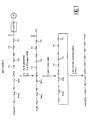
- FIG. 1 represents the first mode of synthesis of a cyclopeptide according to the invention.
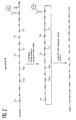
- FIG. 2 represents the second mode of synthesis of a cyclopeptide according to the invention.
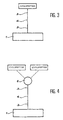
- Figure 3 illustrates the binding of a cyclopeptide according to the invention on a support by means of an organic spacer arm.
- FIG. 4 illustrates the attachment of an organic compound carrying two cyclopeptides on a support by means of a spacer arm.
- VEGF-A vascular endothelial growth factor
- Peptides P1 to P6, P10, P14 and P15 are linear peptides and peptides P7 to P9, P11, P12, P13 and P16 to P24 are cyclopeptides.
- Cyclopeptides P7 to P9, P11, P12, P13, P16 to P18 and P23 are prepared using Synthesis Method A, the first embodiment of the process for synthesizing the cyclopeptides of the invention.
- the cyclopeptides P12, P13 and P19 to P22 are prepared using the synthesis method B, the second embodiment of the process for synthesizing the cyclopeptides of the invention.
- the linear peptide is first synthesized on a solid phase P by batch synthesis using the Fmoc / tBu protection technique, and an Applied Biosystems 430A automatic synthesizer.
- acid-labile 2-chlorotrityl preloaded resins for example H-His (Trt) -2-ClTrt and H-Ile-2-ClTrt resins, or HMPB-BHA resins are used.
- polystyrene BHA functionalized with a linker which is Rinker's 4-hydroxymethyl-3-methoxy-phenoxybutanoic acid for example Fmoc-Gly-HMPB-BHA resin.
- the first line represents the linear peptide whose side chains are protected either by trityl groups (Trt) in the case of the amino groups of His and Gln, the Boc group (t-butyloxycarbonyl) in the case of the group amino of Lys and 2,2,5,7,8-pentamethyl-chroman-6-sulfonyl (Pmc) in the case of Arg.
- Trt trityl groups
- Boc group t-butyloxycarbonyl
- Pmc 2,2,5,7,8-pentamethyl-chroman-6-sulfonyl
- the linear peptide is then separated from the solid phase P by treatment with a 1% solution of trifluoroacetic acid (TFA) in dichloromethane (DCM).
- TFA trifluoroacetic acid
- DCM dichloromethane
- a protected peptide fragment is thus obtained with a high yield and a high degree of purity and a negligible loss of groups protecting the side chains of the amino acids.
- the protected linear peptides are analyzed by reversed-phase HPLC high performance liquid chromatography (Merck Lichrosob RP-18 column, 7 ⁇ m , 0.4 ⁇ 25 cm) using a linear gradient ranging from 70 to 100% B in A, the solvent A being a 0.1% aqueous solution of TFA and the solvent B being an aqueous solution containing 0.1% TFA and 70% acetonitrile.
- the cyclization of the protected linear peptide is then carried out. For this purpose, it is dissolved in DCM to obtain a final concentration of 1 mg / ml. 6 equivalents of N, N-diisopropylethylamine are added to the solution. (DIEA) or N-methylmorpholine (NMM), and cyclization is carried out using benzotriazol-1-yl-oxy-tris-pyrrolidino-phosphonium hexafluorophosphate (PyBOP) / N-hydroxybenzotriazole (HOBt) using three equivalents of each coupling reagent. The reaction medium is maintained at 25 ° C. under a nitrogen atmosphere and with gentle stirring for 24 to 48 hours until the cyclization is complete, which is verified by HPLC.
- the solvent is removed by evaporation under reduced pressure and ice-cold water is added to the residue.
- the crude precipitate is filtered off, washed with fresh water, dried in a high vacuum desiccator over NaOH, and used for total deprotection of the side chains without further purification.
- Deprotection of the side chains of the cyclopeptide is carried out using a 95% TFA solution in the presence of the reagents (phenol, thioanisole, triisopropylsilane, water) for 2 to 3 hours. The majority of the TFA is then evaporated to obtain good precipitation of the deprotected crude cyclopeptide, and the volume of ice-cold ether is added 10 times. After filtration and washing with fresh ether, the precipitate is dried over NaOH and lyophilized. Semi-preparative purifications are then performed on an Applied Biosystems HPLC column using the Lichrosorb C18 reverse phase column (250 x 10). Buffers A and B described above are used.
- FIG. 1 illustrates the protected cyclopeptide and then the deprotection step resulting in the cyclopeptide P7 of Table 1.
- HOBt, DCC, TFA, DIEA, NMM and piperidine reagents from Aldrich are also used.
- the HPLC are carried out on Merck's Lichrosorb RP-18 column (7- ⁇ m, 0.4 ⁇ 25 cm), and on Lichrosorb C-18 column (5 ⁇ m , 0.4 ⁇ 25 cm) of Interchim by eluting with a linear gradient of the solvent B in the solvent A.
- the solvent A comprises 0.1% TFA in H 2 O.
- the solvent B comprises 0.1% TFA, 70% acetonitrile and 30% water.
- a flow rate of 1 ml / min is used over a period of 30 minutes.
- UV detection is performed at 214 nanometers and 280 nanometers.
- the purified peptides are characterized by amino acid analysis, in performing hydrolysis in 6M HCl and 2% phenol at 110 ° C for 20 to 24 hours, and FAB-MS mass spectrometry.
- the synthesis method B is now described, ie the second embodiment of the process for synthesizing the cyclopeptides of the invention.
- Synthesis mode B is illustrated in FIG. 2 in the case of peptide P19.
- the linear peptide P10 is first synthesized by solid phase synthesis using the Applied Biosystems 430A automatic synthesizer, as in Synthesis Method A.
- the first amino acid C-terminal Fmoc-Glu-OAllyl is fixed on NovaSyn TGA resin of 90 ⁇ m (solid phase P) by its side chain by using a symmetric anhydride method.
- the resin is swelled in N-methylpyrrolidone (NMP) for 30 minutes.
- NMP N-methylpyrrolidone
- DIPCDI N-diisopropylcarbodiimide
- the fixing of the carboxylic acid is completed by esterification catalyzed by 4-dimethylaminopyridine (DMAP), at the rate of 0.1 equivalent for 2 hours, to give a final substitution of 0.25 mmol / g.
- DMAP 4-dimethylaminopyridine
- the charge of the resin is estimated by UV quantification of the piperidine-Fmoc adduct at 290 nm.
- Commercial resin Fmoc-L-Glu- (PEG-PS) -Allyl (0.18 mmol / g) from Perkin Elmer was also used.
- Cyclization of the peptide is then carried out on the solid phase as follows.
- the resin is treated with 20% piperidine in NMP to liberate the N-terminal amino group of the peptide and washed with 1N HOBt in NMP, followed by NMP and DCM.
- Solid phase cyclization is carried out using 6 equivalents of PyBOP, 6 equivalents of HOBt and 12 equivalents of DIEA in NMP for 4 to 6 hours. The completion of the cyclization is verified by the ninhydrin test.
- the resin was washed several times with MMP and DCM, and dried under high vacuum overnight. The protected cyclopeptide is shown in FIG.
- the cyclopeptide is then separated from the solid phase and deprotected from the side chains of the amino acids. This is done by means of 95% TFA and the acidolysis product is purified by semi-preparative HPLC as described above.
- the homogeneous fractions obtained by HPLC are combined and lyophilized to obtain the desired cyclopeptides with a satisfactory degree of purity (greater than 95% by analytical HPLC).
- linear peptides P1 to P6, P10, P14 and P15 of Table 1 are prepared by conventional peptide synthesis.
- Table 2 illustrates the structure and molecular weight of peptides P1 to P22 with reference to the peptide sequence of VEGF-A which has 165 amino acids.
- the peptides P1 to P24 are tested for their binding property of VEGF on its KDR receptor.
- CHOm VEGFR2 cells are obtained by transfection of Chinese hamster ovary cells deficient in heparan sulfate with VEGFR2 cDNA in a psV-7d vector as described by Jonca et al in J. Biol. Chem., 1997, 272, pages 24203 [11].
- the CHOm VEGFR2 cells are routinely cultured in Eagle's modified Dulbecco medium supplemented with 10% (V / V) fetal calf serum (FCS), 50 U / ml penicillin, 50 ⁇ g / ml streptomycin 1 mg / ml glucose and 2 mM L-glutamine at 37 ° C in a 5% CO 2 atmosphere.
- V / V fetal calf serum
- radioactively labeled VEGF with 125 I-Na was used using iodine beads (Iodogen).
- the specific activity of 125 I-VEGF is from 150,000 to 200,000 cpm / ng.
- the cells are seeded in 3.5 cm diameter dishes, pre-coated with 0.15% gelatin, at a density of 200,000 cells per dish and cultured in complete medium for 2 days.
- the subconfluent cans are transferred at 4 ° C.
- the cells are washed twice with ice-cold phosphate buffered saline (PBS) and incubated with different peptide concentrations and 5 ng / mL of 125 I-VEGF, in the presence or absence of 50 ng / mL heparin, in binding buffer (DMEM containing 20 mmol / L HEPES, pH 7.4, 0.15% gelatin) for 2 hours at 4 ° C.
- binding buffer DMEM containing 20 mmol / L HEPES, pH 7.4, 0.15% gelatin
- the cells are washed 3 times with ice-cold PBS and solubilized in 1 ml of buffer with 2% Triton X 100, 10% glycerol, 1 mg / ml serum albumin. -bovine BSA.
- the level of cell-bound radioactivity is counted in a Kontron MR-250 gamma counter.
- Nonspecific binding is determined by incubating the cells with 125 I-VEGF and a 200-fold excess of unlabeled VEGF.
- Specific binding is calculated by subtracting the non-specific binding from the total binding.
- IC 50 ie the concentration in ⁇ M necessary to inhibit 50% of the binding of VEGF to the KDR receptor
- cyclopeptides P11, P16, P17, P19, P20, P23 and P24 are very effective in inhibiting the binding of VEGF to the KDR receptor.
- the cyclopeptide P22 which corresponds to the cyclopeptide described in US Pat. No. 5,939,383 [8] is no more effective than the linear peptides P1 to P6, P10, P14 and P15 for inhibiting this bond.
- the peptides inhibit the binding of 125 I-VEGF to VEGFR2 receptor are then tested in experiments angiogenesis in vitro, ex vivo and in vivo and their effect on cell signaling.
- results are presented concerning the effect of the active peptides on cell proliferation, cell migration and on the activation of p42 and p44 kinases (MAP kinases: mitogen-activated kinases).
- Cell proliferation is measured by cell counting. 7000 endothelial cells are placed in 24-well plates (Costar) in DMEM medium containing newborn bovine serum. After the cells have adhered, the cells are washed in serum-free DMEM and incubated with DMEM medium containing 1% neonatal bovine serum, 10 ng / ml VEGF in the presence or absence of different peptide concentrations. Two days later, the cells are again stimulated with VEGF in the presence or absence of different peptide concentrations. On the fifth day, the cells are trypsinized and counted with a Coulter counter.
- the peptide P11 (circular) shows a strong inhibition of the proliferation cellular. In contrast, the linear peptide is inactive (Table 3).
- the insoluble material is removed by centrifugation and 50 ⁇ g / ml of protein extract are separated by sodium dodecyl sulfate (SDS) polyacrylamide gel electrophoresis under denaturing conditions.
- SDS sodium dodecyl sulfate
- the proteins are then transferred from the gel to a nitrocellulose membrane (Amersham Pharmacia Biotech, Orsay) with a transfer device (Semi-dry transfer, Bio-Rad, lvry-sur-Seine, France).
- the membrane is then incubated with the primary antibodies against p42 / p44 and then secondary coupled to peroxidase. Visualization is performed using the ECLplus system (Amersham Pharmacia Biotech, Orsay).
- the results are quantified using the Image Quant program (Molecular Dynamics).
- the peptide P11 (cyclic) strongly inhibits the phosphorylation of p42 / p44.
- the linear peptide has no effect (Table 3).
- Table 3 indicates the effect of the P11 peptide on proliferation and cell migration and on phosphorylation of MAP kinases (p42 and p44). The experiments were performed as indicated. Inhibition of proliferation and migration is indicated in inhibition values at 50% of the biological effect (IC 50). 50 ⁇ M peptides were used for the phosphorylation experiments. The degree of phosphorylation is estimated after quantification of the signals obtained from the autoradiography films and the results are expressed as percent inhibition with respect to the signal obtained with 10 ng / ml of VEGF alone.
- cyclopeptides of the invention can be used for the production of angiogenesis inhibitory or activating systems, either in soluble form or by coupling them to appropriate supports.
- the cyclopeptide is coupled to a suitable support 1 via an organic spacer arm 3, which may comprise a unit 4 capable of being cut by an enzymatic system.
- the organic spacer arm may consist of a hydrocarbon chain, fluorocarbon, polyether, polyethylene glycol, polyamine, polyamide, polyester, polysiloxane or a combination thereof, which is functionalized at each end for forming a covalent bond, on the one hand, with the cyclopeptide and, on the other hand, with the support 1.
- the unit 4 capable of being cut by an enzymatic system present in the spacer arm 3 can be in particular a peptide sequence which is a substrate for enzymes such as the metalloproteases of the extracellular matrix.
- this motif thus makes it possible to release the cyclopeptide at the desired place when it is in contact with the appropriate enzymes, thus enabling the cyclopeptide to fulfill its function of inhibiting the binding of VEGF to the KDR receptor and of controlling the angiogenesis.
- FIG 3 there is shown a single cyclopeptide bonded to the support.
- supports comprising a large number of cyclopeptides, each linked to the support by an organic spacer arm with or without a pattern such as 4.
- FIG. 4 shows another embodiment of the systems of the invention, in which two cyclopeptides are used to obtain a KDR receptor activating effect.
- two cyclopeptides are attached to a compound 6 which is itself connected to the support 1 by an organic spacer arm 3; this arm may also include a pattern 4 may be cut by an enzymatic system.
- the distance between the two fixed cyclopeptides is such that when the system is brought into contact with cells expressing VEGF receptors, it allows the dimerization of these receptors.
- the organic spacer arm 3 may be of the same type as that of FIG. 3 and comprise a pattern 4 of the same type as that of FIG.
- the organic compound 6 may be formed of hydrophilic-hydrophobic alternating sequences, of the polyethylene glycol / alkane or fluoroalkane type, to allow an appropriate arrangement of the two cyclopeptides.
- the binding of each cyclopeptide on this compound implements amine or carboxylic acid functions of the side chains of the cyclopeptide or functions of acrylic type.
- the support 1 used in the various embodiments of the systems of the invention may be in solid form or in gel form. It can be an organic or inorganic solid.
- the support is a biocompatible organic polymer, which may or may not be biodegradable.
- the attachment of the organic spacer arm to this polymer can be carried out chemically or radiochemically.
- the organic polymer support is subjected to irradiation by means of ionizing radiation, plasmas or photons on the defined areas of the support which will receive the spacer arm, and then grafted on these zones the organic spacer arm, either directly or via a radical polymerizable monomer (radio-grafting) comprising for example amine or carboxylic acid functions.
- the coupling to the radiografted polymer or not is done for example by creation of amide bonds, either between the carboxylic acid functions and the amine functions introduced at the end of the spacer arms, or between the amine functions of the support and the carboxylic acid functions introduced at the end of the spacer arms. the end of the spacer arms.
- the organic compound has the formula: HOOC CH 2 CH 2 O (CH 2 CH 2 O) 5 (CH 2 ) 3 NH (CH 2 CH 2 O) 5 CH 2 CH 2 COOH (compound 1)
- the organic compound 1 is prepared by carrying out the following steps.
- Step No. 1 Condensation of hexaethylene glycol on tert-butyl acrylate.
- anhydrous THF is added with hexaethylene glycol all under nitrogen and stirring. Na then adds that it is allowed to dissolve.
- Tert-butyl acrylate is added. It is allowed to run for 20 hours at room temperature. 1N HCl is added to neutralize the solution.
- the THF is evaporated under reduced pressure and the solution is then drowned in saturated saline water. The solution is then extracted with ethyl acetate three times. All of the organic phases are again embedded in saturated salt water. The organic phase is recovered and the ethyl acetate is evaporated.
- the pure product (compound 3) is recovered in a yield of 96%.
- Step No. 2 Functionalization of the other end of compound 3 by azidation.
- the compound 4 is placed with DMF under N 2 , then NaN 3 is added. The whole is allowed to run for 20 hours, the solution becomes opaque. The solution is sintered, then the DMF is coevaporated with toluene. A white precipitate is obtained which is diluted with ether. The solution is again sintered and the ether is evaporated.
- Step 3 Functionalization of the other end of compound 3 by allylation.
- the synthesis is carried out in THF.
- Compound 7 is treated with FmocOSu, according to the method used for example by Chetyrkina et al., Tetrahedron Letters 2000, 41, 1923-1926 [16].
- Step 6 Deprotection of tert-butyloxycarbonyl groups.
- the compound 8 is placed to which is added the anisole, then the TFA.
- the reaction is allowed to run for 1 h 30 min at 25 ° C, then the TFA is evaporated under reduced pressure.
- the crude is then passed through a column of silica (70/230) with eluent 95/5. CH 2 Cl 2 / MeOH, then 90/10 CH 2 Cl 2 / MeOH.
- the pure compound 9 is recovered in a yield of 65%.
- the P23 cyclopeptides are attached to the two functional groups (COOH) of compound 9 by operating in the following manner.
- Compound 9 is placed in solution in THF and activated with N, N-dimethylpropyl, ethylcarbodiimide.
- the product obtained is characterized by Fourier transform infrared spectrometry, NMR proton and mass spectrometry. It corresponds to the desired product.
- the deprotection of the NH group of compound 9 is first carried out by treatment with piperidine.
- the spacer arm is prepared by carrying out the following reaction:
- the compound 10 is condensed on the peptide P, which is a metalloprotease substrate of the extracellular matrix, during the last stage of its solid phase synthesis, and then the whole is released from the resin without deprotection of the side chains.
- the molecule obtained is then condensed by means of dicyclohexyl carbodiimide on the deprotected compound 9.
- the side chains of the peptide of the spacer arm are then deprotected and the arm is then fixed on a polymer support via the acrylic functions of the arm.
- EDP polyethylene terephthalate
- a nickel or copper metal grid placed on the polymer film a nickel or copper metal grid, a thickness of 50 microns , pierced with circular holes with a diameter of 5 to 10 microns regularly distributed over its entire surface, with a step about 100 ⁇ m.
- the grid was made by electroforming to present a perfect reproducibility and a very high precision of the order of micrometer.
- the irradiation is carried out under an atmosphere containing oxygen.
- the grid is removed from the polymer film and the irradiated polymer film is brought into contact with the organic compound to which the two cyclopeptides are attached in order to graft this compound, via the spacer arm, onto the polymer film.
- This fixation is carried out by bringing the film into contact with a 10 -2 M solution of the organic compound obtained above, in acetonitrile, operating at 40 ° C.
- the organic compound is thus grafted with the acrylic functions of the spacer arm on the irradiated zones of the polymer film.
- the final product is characterized by FT-IR and XPS spectrometry.
- the organic compound is placed in solution in chloroform and activated with dicyclohexylcarbodiimide DCCI, then an amount corresponding to 1 equivalent is added. molar of each cyclopeptide and the reaction medium is maintained for 12 hours at 4 ° C. The precipitate of dicyclohexylurea is removed by filtration and the filtrate is then evaporated under reduced pressure.
- the product obtained is characterized by Fourier transform infrared spectrometry, proton NMR and mass spectrometry, as previously.
- a spacer arm is then fixed on the NH group of the organic compound as in Example 1.
- the assembly is then fixed on a support consisting of an industrial film 25 ⁇ m thick polyvinylidene fluoride / hexafluoropropylene PVDF-HFP.
- the film is subjected to a Soxhlet extraction in refluxing dichloromethane at a temperature of 40 ° C. for 12 hours, in order to remove any trace of organic monomer.
- the film is then irradiated under air with fast heavy ions.
- the ions used are oxygen ions having a primary energy Ep of about 10 MeV / uma, at fluences of between 10 7 and 10 9 ions / cm 2 and at intensities of the order of 10 2 to 5 ⁇ 10 2 nA.
- Ep primary energy
- a low-fluence regime is chosen so that there is no overlap of the latent traces.
- This regime is directly determined by the parameters of the irradiation (atomic number of the ion, primary energy, fluence).
- the random distribution of the active centers in the disturbed zone created during the irradiation makes it possible to radiograft at least two organic spacer arms each carrying a cyclopeptide, blocking the distance between the anchor points so that the distance d between two cyclopeptides promotes the dimerization of VEGF receptors.
- the irradiated zones are used for grafting, thanks to the free radicals created along the latent trace of the ion and the emergence thereof on the surface of the polymer film, organic spacer arms carrying the cyclopeptides obtained as it is. is described above, by reaction of their acrylic type function with the irradiated support.
- This coupling is carried out by heating at 40 ° C. the irradiated film placed in the presence of a 10 -3 M solution of the organic arms carrying the cyclopeptides in tetrahydrofuran.
- the final compound is characterized by FT-IR and XPS spectrometry.
Landscapes
- Chemical & Material Sciences (AREA)
- Health & Medical Sciences (AREA)
- Organic Chemistry (AREA)
- Life Sciences & Earth Sciences (AREA)
- General Health & Medical Sciences (AREA)
- Medicinal Chemistry (AREA)
- Biochemistry (AREA)
- Biophysics (AREA)
- Genetics & Genomics (AREA)
- Molecular Biology (AREA)
- Proteomics, Peptides & Aminoacids (AREA)
- Veterinary Medicine (AREA)
- Public Health (AREA)
- Gastroenterology & Hepatology (AREA)
- Zoology (AREA)
- Chemical Kinetics & Catalysis (AREA)
- General Chemical & Material Sciences (AREA)
- Nuclear Medicine, Radiotherapy & Molecular Imaging (AREA)
- Pharmacology & Pharmacy (AREA)
- Animal Behavior & Ethology (AREA)
- Toxicology (AREA)
- Engineering & Computer Science (AREA)
- Bioinformatics & Cheminformatics (AREA)
- Heart & Thoracic Surgery (AREA)
- Cardiology (AREA)
- Medicines That Contain Protein Lipid Enzymes And Other Medicines (AREA)
- Peptides Or Proteins (AREA)
- Medicinal Preparation (AREA)
- Preparation Of Compounds By Using Micro-Organisms (AREA)
Claims (23)
- Cyclopeptid, ausgewählt aus den folgenden Verbindungen:P11: Cyclo(DPhe-Pro-Gln-Ile-Met-Arg-Ile-Lys-Pro-His-Gln-Gly-Gln-His-Ile-Gly-Glu) SEQ ID Nr. 5P16: Cyclo(Arg-Ile-Lys-Pro-His-Gln-Gly) SEQ ID Nr. 8P17: Cyclo(Pro-Arg-Ile-Lys-Pro-His-Gln-Gly) SEQ ID Nr. 9P19: Cyclo(Gln-Ile-Met-Arg-Ile-Lys-Pro-His-Gln-Gly-Gln-His-Ile-Gly-Glu) SEQ ID Nr. 10P20: Cyclo(DPhe-Pro-Gln-Ile-Met-Arg-Ile-Lys-Pro-His-Gln-Gly-Gln-His-Ile-Gly) SEQ ID Nr. 11P23: Cyclo (DTyr-Pro-Arg-Ile-Lys-Pro-His-Gln) SEQ ID Nr. 13P24 : Cyclo(Gly-Arg-Ile-Lys-Pro-His) SEQ ID Nr. 25.
- Pharmazeutische Zusammensetzung zum Hemmen (Verhindern) der Angiogenese, die ein Cyclopeptid umfasst, das ausgewählt ist aus den folgenden Cyclopeptiden:P11: Cyclo(DPhe-Pro-Gln-Ile-Met-Arg-Ile-Lys-Pro-His-Gln-Gly-Gln-His-Ile-Gly-Glu) SEQ ID Nr: 5P16: Cyclo(Arg-Ile-Lys-Pro-His-Gln-Gly) SEQ ID Nr: 8P17: Cyclo(Pro-Arg-Ile-Lys-Pro-His-Gln-Gly) SEQ ID Nr: 9P19: Cyclo(Gln-Ile-Met-Arg-Ile-Lys-Pro-His-Gln-Gly-Gln-His-Ile-Gly-Glu) SEQ ID Nr: 10P20: Cyclo(DPhe-Pro-Gln-lle-Met-Arg-lle-Lys-Pro-His-Gln-Gly-Gln-His-lle-Gly) SEQ ID Nr. 11P23: Cyclo(DTyr-Pro-Arg-Ile-Lys-Pro-His-Gln) SEQ ID Nr. 13P24: Cyclo(Gly-Arg-Ile-Lys-Pro-His) SEQ ID Nr. 25.
- Pharmazeutische Zusammensetzung zum Aktivieren der Angiogenese, die zwei identische oder unterschiedliche Cyclopeptide umfasst, die mit einer pharmazeutisch akzeptablen organischen Verbindung gekoppelt sind, wobei die Cyclopeptide ausgewählt sind aus den folgenden Cyclopeptiden:P11: Cyclo(DPhe-Pro-Gln-Ile-Met-Arg-Ile-Lys-Pro-His-Gln-Gly-Gln-His-Ile-Gly-Glu) SEQ ID Nr. 5P16: Cyclo(Arg-Ile-Lys-Pro-His-Gln-Gly) SEQ ID Nr. 8P17: Cyclo(Pro-Arg-Ile-Lys-Pro-His-Gln-Gly) SEQ ID Nr. 9P19: Cyclo(Gln-Ile-Met-Arg-Ile-Lys-Pro-His-Gln-Gly-Gln-His-Ile-Gly-Glu) SEQ ID Nr. 10P20: Cyclo(DPhe-Pro-Gln-Ile-Met-Arg-Ile-Lys-Pro-His-Gln-Gly-Gln-His-Ile-Gly) SEQ ID Nr. 11P23: Cyclo(DTyr-Pro-Arg-Ile-Lys-Pro-His-Gln) SEQ ID Nr. 13P24 : Cyclo(Gly-Arg-Ile-Lys-Pro-His) SEQ ID Nr. 25.
- System, das ein Cyclopeptid nach Anspruch 1 umfasst, das an einen organischen Abstandhalter-Arm kovalent gebunden ist.
- System nach Anspruch 4, in dem der organische Abstandhalter-Arm kovalent an einen Träger gebunden ist.
- System, das zwei Cyclopeptide nach Anspruch 1 umfasst, die an eine organische Verbindung kovalent gebunden sind.
- System nach Anspruch 6, in dem der Abstand zwischen den beiden Cyclopeptiden derart ist, dass dann, wenn das System mit Zellen in Kontakt gebracht wird, welche die Rezeptoren des Wachstumsfaktors des Gefäßendothels (VEGF) exprimieren, der Abstand die Dimerisation dieser Rezeptoren ermöglicht.
- System nach einem der Ansprüche 6 und 7, in dem die organische Verbindung mittels eines organischen Abstandhalter-Arms kovalent an einen Träger gebunden ist.
- System, das einen festen Träger umfasst, an dem Cyclopeptide nach Anspruch 1 durch eine kovalente Bindung fixiert sind, wobei jedes der Cyclopeptide mittels eines organischen Abstandhalter-Arms an den Träger gebunden ist.
- System nach einem der Ansprüche 4, 5, 8 und 9, in dem der Abstandhalter-Arm eine Kohlenwasserstoff-, Fluorkohlenstoff-, Polyether-, Polyethylenglycol-, Polyamin-, Polyamid-, Polyester-, Polysiloxan-Kette oder eine Kombination derselben umfasst, die an jedem Ende funktionalisiert ist (eine funktionelle Gruppe aufweist), um eine kovalente Bindung auszubilden einerseits gegenüber dem Cyclopeptid und andererseits gegenüber dem Träger.
- System nach einem der Ansprüche 4 bis 10, in dem der organische Abstandhalter-Arm außerdem eine wiederkehrende Einheit umfasst, die durch ein enzymatisches System geschnitten werden kann.
- System nach Anspruch 11, in dem der organische Abstandhalter-Arm außerdem eine bioaktive Verbindung umfasst.
- System nach einem der Ansprüche 5, 8 und 9, in dem der Träger ein organischer oder anorganischer Feststoff ist.
- System nach einem der Ansprüche 5, 8 und 9, in dem der Träger ein organisches Polymer in Form eines Feststoffes oder in Form eines Gels ist.
- System nach Anspruch 14, in dem das organische Polymer ein biokompatibles, biologisch abbaubares oder nicht abbaubares Polymer ist.
- System nach Anspruch 15, in dem das organische Polymer ausgewählt ist aus der Gruppe Ethylenpolyterephthalat, der Copolymeren von Vinylidenfluorid und Hexafluorpropylen, der Polyvinylalkohole, der Polyhydroxyethylmethacrylate, der Polysacharide und ihren Copolymeren.
- System nach einem der Ansprüche 4 und 5 zum Hemmen (Verhindern) der Angiogenese.
- System nach einem der Ansprüche 6 bis 8 zum Aktivieren der Angiogenese.
- Verfahren zur Herstellung eines Systems nach einem der Ansprüche 14 bis 16, das darin besteht, dass man einen Träger aus einem organischen Polymer auf definierten Zonen des Trägers mit ionisierenden Strahlen, Plasmastrahlen oder Photonenstrahlen bestrahlt und anschließend auf diese Zonen des Trägers den organischen Abstandhalter-Arm aufpfropft.
- Verfahren nach Anspruch 19, bei dem man die Bestrahlung durch eine Maske hindurch durchführt.
- Vorfahren nach Anspruch 19, bei dem die ionisierenden Strahlen ein Bündel von Elektronen oder schnellen schweren Ionen darstellen.
- Verfahren nach Anspruch 19, bei dem die Cyclopeptide vor dem Aufpfropfen an den organischen Abstandhalter-Armen fixiert werden.
- Verfahren nach Anspruch 19, das außerdem eine Stufe umfasst, in der die Polypeptide an den organischen Abstandhalter-Armen fixiert werden, nachdem diese aufgepfropft worden sind.
Applications Claiming Priority (3)
| Application Number | Priority Date | Filing Date | Title |
|---|---|---|---|
| FR0012654 | 2000-10-04 | ||
| FR0012654A FR2814744B1 (fr) | 2000-10-04 | 2000-10-04 | Cyclopeptides, leur procede de preparation et leur utilisation comme inhibiteur ou activateur de l'angiogenese |
| PCT/FR2001/003049 WO2002028895A2 (fr) | 2000-10-04 | 2001-10-02 | Cyclopeptides, leur procede de preparation et leur utilisation comme inhibiteur ou activateur de l'angiogenese |
Publications (2)
| Publication Number | Publication Date |
|---|---|
| EP1328546A2 EP1328546A2 (de) | 2003-07-23 |
| EP1328546B1 true EP1328546B1 (de) | 2007-02-21 |
Family
ID=8854977
Family Applications (1)
| Application Number | Title | Priority Date | Filing Date |
|---|---|---|---|
| EP01974427A Expired - Lifetime EP1328546B1 (de) | 2000-10-04 | 2001-10-02 | Cyclopeptide, verfahren zu ihrer herstellung und ihre verwendung zur hemmung oder stimulierung von angiogenese |
Country Status (15)
| Country | Link |
|---|---|
| US (2) | USRE44022E1 (de) |
| EP (1) | EP1328546B1 (de) |
| JP (1) | JP4303958B2 (de) |
| AT (1) | ATE354589T1 (de) |
| AU (2) | AU2001293948B2 (de) |
| CA (1) | CA2424506A1 (de) |
| DE (1) | DE60126802T2 (de) |
| DK (1) | DK1328546T3 (de) |
| ES (1) | ES2282293T3 (de) |
| FR (1) | FR2814744B1 (de) |
| IL (1) | IL155117A0 (de) |
| NO (1) | NO20031377L (de) |
| NZ (1) | NZ525069A (de) |
| RU (1) | RU2249599C2 (de) |
| WO (1) | WO2002028895A2 (de) |
Families Citing this family (12)
| Publication number | Priority date | Publication date | Assignee | Title |
|---|---|---|---|---|
| US20050100963A1 (en) | 2002-03-01 | 2005-05-12 | Dyax Corporation | KDR and VEGF/KDR binding peptides and their use in diagnosis and therapy |
| US7794693B2 (en) * | 2002-03-01 | 2010-09-14 | Bracco International B.V. | Targeting vector-phospholipid conjugates |
| US7211240B2 (en) * | 2002-03-01 | 2007-05-01 | Bracco International B.V. | Multivalent constructs for therapeutic and diagnostic applications |
| US7261876B2 (en) | 2002-03-01 | 2007-08-28 | Bracco International Bv | Multivalent constructs for therapeutic and diagnostic applications |
| US8623822B2 (en) * | 2002-03-01 | 2014-01-07 | Bracco Suisse Sa | KDR and VEGF/KDR binding peptides and their use in diagnosis and therapy |
| ES2692166T3 (es) * | 2003-03-03 | 2018-11-30 | Dyax Corp. | Péptidos que se unen específicamente al receptor de HGF (cMet) y usos de los mismos |
| US20090093016A1 (en) * | 2006-01-17 | 2009-04-09 | N.V. Organon | Selective Enzymatic Hydrolysis of C-Terminal Tert-Butyl Esters of Peptides |
| US8227413B2 (en) | 2006-10-19 | 2012-07-24 | Ramot At Tel-Aviv University Ltd. | Compositions and methods for inducing angiogenesis |
| US8741850B2 (en) | 2009-07-24 | 2014-06-03 | Advanced Accelerator Applications S.A. | Compounds modulators of VEGF activity and uses thereof |
| FR2969999B1 (fr) | 2011-01-03 | 2013-02-08 | Commissariat Energie Atomique | Conjugue, son procede de preparation et ses utilisations |
| WO2014034922A1 (ja) * | 2012-09-03 | 2014-03-06 | 国立大学法人東京大学 | 血管内皮細胞増殖因子受容体阻害ペプチド |
| CN103724290B (zh) * | 2013-11-15 | 2015-04-29 | 浙江大学 | 一种环肽化合物clavatustide A及其产生菌、制备方法和应用 |
Family Cites Families (5)
| Publication number | Priority date | Publication date | Assignee | Title |
|---|---|---|---|---|
| DE4237456A1 (de) * | 1992-11-06 | 1994-05-11 | Merck Patent Gmbh | Cyclopeptide |
| DE4310643A1 (de) * | 1993-04-01 | 1994-10-06 | Merck Patent Gmbh | Cyclische Adhäsionsinhibitoren |
| US5939383A (en) * | 1996-11-15 | 1999-08-17 | Remacle; Jose | Cyclic peptides bearing a tail designed for subsequent chemical coupling and process for preparing same |
| EP1056773A2 (de) * | 1998-02-11 | 2000-12-06 | Resolution Pharmaceuticals Inc. | Für angiogenese spezifische moleküle |
| AU776473C (en) * | 1999-03-11 | 2005-04-14 | Entremed, Inc | Compositions and methods for treating cancer and hyperproliferative disorders |
-
2000
- 2000-10-04 FR FR0012654A patent/FR2814744B1/fr not_active Expired - Fee Related
-
2001
- 2001-10-02 DE DE60126802T patent/DE60126802T2/de not_active Expired - Lifetime
- 2001-10-02 CA CA002424506A patent/CA2424506A1/en not_active Abandoned
- 2001-10-02 WO PCT/FR2001/003049 patent/WO2002028895A2/fr not_active Ceased
- 2001-10-02 RU RU2003112701/04A patent/RU2249599C2/ru not_active IP Right Cessation
- 2001-10-02 IL IL15511701A patent/IL155117A0/xx unknown
- 2001-10-02 AU AU2001293948A patent/AU2001293948B2/en not_active Ceased
- 2001-10-02 EP EP01974427A patent/EP1328546B1/de not_active Expired - Lifetime
- 2001-10-02 US US12/418,101 patent/USRE44022E1/en not_active Expired - Fee Related
- 2001-10-02 AU AU9394801A patent/AU9394801A/xx active Pending
- 2001-10-02 DK DK01974427T patent/DK1328546T3/da active
- 2001-10-02 NZ NZ525069A patent/NZ525069A/en not_active IP Right Cessation
- 2001-10-02 US US10/381,734 patent/US7199100B2/en not_active Ceased
- 2001-10-02 AT AT01974427T patent/ATE354589T1/de not_active IP Right Cessation
- 2001-10-02 JP JP2002532477A patent/JP4303958B2/ja not_active Expired - Fee Related
- 2001-10-02 ES ES01974427T patent/ES2282293T3/es not_active Expired - Lifetime
-
2003
- 2003-03-26 NO NO20031377A patent/NO20031377L/no not_active Application Discontinuation
Also Published As
| Publication number | Publication date |
|---|---|
| NZ525069A (en) | 2004-09-24 |
| EP1328546A2 (de) | 2003-07-23 |
| NO20031377L (no) | 2003-05-02 |
| IL155117A0 (en) | 2003-10-31 |
| US20040092434A1 (en) | 2004-05-13 |
| DK1328546T3 (da) | 2007-06-04 |
| CA2424506A1 (en) | 2002-04-11 |
| DE60126802T2 (de) | 2007-11-08 |
| JP2004510784A (ja) | 2004-04-08 |
| WO2002028895A2 (fr) | 2002-04-11 |
| AU2001293948B2 (en) | 2005-11-03 |
| DE60126802D1 (de) | 2007-04-05 |
| USRE44022E1 (en) | 2013-02-19 |
| ES2282293T3 (es) | 2007-10-16 |
| JP4303958B2 (ja) | 2009-07-29 |
| RU2249599C2 (ru) | 2005-04-10 |
| ATE354589T1 (de) | 2007-03-15 |
| FR2814744A1 (fr) | 2002-04-05 |
| WO2002028895A3 (fr) | 2002-06-06 |
| NO20031377D0 (no) | 2003-03-26 |
| AU9394801A (en) | 2002-04-15 |
| US7199100B2 (en) | 2007-04-03 |
| FR2814744B1 (fr) | 2002-11-29 |
Similar Documents
| Publication | Publication Date | Title |
|---|---|---|
| EP1328546B1 (de) | Cyclopeptide, verfahren zu ihrer herstellung und ihre verwendung zur hemmung oder stimulierung von angiogenese | |
| CN115297886A (zh) | IL-7Rα结合化合物 | |
| CN112402622A (zh) | 靶向pd-l1的抗肿瘤多肽纳米药物载体及其应用 | |
| CN117357693B (zh) | 一种皮肤损伤修复水凝胶敷料及其制备方法 | |
| EP0298820A1 (de) | Peptid-Derivate und deren therapeutische Verwendung | |
| Guryanov et al. | Copper (II) lysinate and pseudoproline assistance in the convergent synthesis of the GLP-1 receptor agonists liraglutide and semaglutide | |
| JPH10504551A (ja) | 真核細胞の相互間の接着能力を改変するための細胞接着ペプチド | |
| JP4682364B2 (ja) | 細胞培養基板 | |
| CN109311910B (zh) | 他克莫司偶联物、其组合物、及其用途 | |
| JPS6327360B2 (de) | ||
| EP2108698A1 (de) | Vaskuläres endothelzell-bindendes peptid | |
| JPS6149320B2 (de) | ||
| FR2797441A1 (fr) | Derives des cyclohexane, cyclohexene, cyclohexadiene et benzene pour la preparation de ligands du recepteur du mannose | |
| US20260049107A1 (en) | Artificial viral capsid | |
| FR2943062A1 (fr) | Nouveau peptide promoteur de l'adhesion et de la migration cellulaire | |
| JPH10182696A (ja) | gp120に対して親和性を有するペプチド | |
| JP5940542B2 (ja) | 細胞導入ペプチドと皮膚導入促進剤とを組み合わせた皮膚導入システムおよび美白剤 | |
| DE19845434C1 (de) | Gewebebindende Peptide, ihre Identifizierung, Herstellung und Verwendung | |
| JP5062719B2 (ja) | ケージドペプチド | |
| CN116947969A (zh) | 一种靶向pd-l1的多肽、制备方法,组装形成纳米球及应用 | |
| CN114957463A (zh) | 改造的骨髓干细胞及其制备的人工皮肤 | |
| CA2289110A1 (fr) | Analogues peptidiques et leurs utilisations notamment dans des compositions pharmaceutiques et pour le diagnostic | |
| CN114957466A (zh) | 一种干细胞在制备人工皮肤中的用途 | |
| EP0872555A1 (de) | Bakterielle peptidbibliothek | |
| WO2008110695A1 (fr) | Nouvelles molecules multimeriques, leur procede de preparation, et leur utilisation pour la preparation de medicaments |
Legal Events
| Date | Code | Title | Description |
|---|---|---|---|
| PUAI | Public reference made under article 153(3) epc to a published international application that has entered the european phase |
Free format text: ORIGINAL CODE: 0009012 |
|
| 17P | Request for examination filed |
Effective date: 20030324 |
|
| AK | Designated contracting states |
Designated state(s): AT BE CH CY DE DK ES FI FR GB GR IE IT LI LU MC NL PT SE TR |
|
| AX | Request for extension of the european patent |
Extension state: AL LT LV MK RO SI |
|
| GRAP | Despatch of communication of intention to grant a patent |
Free format text: ORIGINAL CODE: EPIDOSNIGR1 |
|
| RAP1 | Party data changed (applicant data changed or rights of an application transferred) |
Owner name: COMMISSARIAT A L'ENERGIE ATOMIQUE Owner name: UNIVERSITE VICTOR SEGALEN BORDEAUX 2 Owner name: UNIVERSITE BORDEAUX 1 |
|
| GRAS | Grant fee paid |
Free format text: ORIGINAL CODE: EPIDOSNIGR3 |
|
| GRAA | (expected) grant |
Free format text: ORIGINAL CODE: 0009210 |
|
| AK | Designated contracting states |
Kind code of ref document: B1 Designated state(s): AT BE CH CY DE DK ES FI FR GB GR IE IT LI LU MC NL PT SE TR |
|
| REG | Reference to a national code |
Ref country code: GB Ref legal event code: FG4D Free format text: NOT ENGLISH |
|
| REG | Reference to a national code |
Ref country code: CH Ref legal event code: EP |
|
| REF | Corresponds to: |
Ref document number: 60126802 Country of ref document: DE Date of ref document: 20070405 Kind code of ref document: P |
|
| REG | Reference to a national code |
Ref country code: IE Ref legal event code: FG4D Free format text: LANGUAGE OF EP DOCUMENT: FRENCH |
|
| GBT | Gb: translation of ep patent filed (gb section 77(6)(a)/1977) |
Effective date: 20070509 |
|
| REG | Reference to a national code |
Ref country code: SE Ref legal event code: TRGR |
|
| PG25 | Lapsed in a contracting state [announced via postgrant information from national office to epo] |
Ref country code: PT Free format text: LAPSE BECAUSE OF FAILURE TO SUBMIT A TRANSLATION OF THE DESCRIPTION OR TO PAY THE FEE WITHIN THE PRESCRIBED TIME-LIMIT Effective date: 20070723 |
|
| REG | Reference to a national code |
Ref country code: ES Ref legal event code: FG2A Ref document number: 2282293 Country of ref document: ES Kind code of ref document: T3 |
|
| PLBE | No opposition filed within time limit |
Free format text: ORIGINAL CODE: 0009261 |
|
| STAA | Information on the status of an ep patent application or granted ep patent |
Free format text: STATUS: NO OPPOSITION FILED WITHIN TIME LIMIT |
|
| 26N | No opposition filed |
Effective date: 20071122 |
|
| PGFP | Annual fee paid to national office [announced via postgrant information from national office to epo] |
Ref country code: DK Payment date: 20071015 Year of fee payment: 7 Ref country code: ES Payment date: 20071005 Year of fee payment: 7 Ref country code: NL Payment date: 20071003 Year of fee payment: 7 |
|
| PGFP | Annual fee paid to national office [announced via postgrant information from national office to epo] |
Ref country code: FI Payment date: 20071012 Year of fee payment: 7 Ref country code: CH Payment date: 20071026 Year of fee payment: 7 Ref country code: AT Payment date: 20071011 Year of fee payment: 7 |
|
| PGFP | Annual fee paid to national office [announced via postgrant information from national office to epo] |
Ref country code: BE Payment date: 20071213 Year of fee payment: 7 Ref country code: SE Payment date: 20071004 Year of fee payment: 7 |
|
| PG25 | Lapsed in a contracting state [announced via postgrant information from national office to epo] |
Ref country code: GR Free format text: LAPSE BECAUSE OF FAILURE TO SUBMIT A TRANSLATION OF THE DESCRIPTION OR TO PAY THE FEE WITHIN THE PRESCRIBED TIME-LIMIT Effective date: 20070522 |
|
| PG25 | Lapsed in a contracting state [announced via postgrant information from national office to epo] |
Ref country code: MC Free format text: LAPSE BECAUSE OF NON-PAYMENT OF DUE FEES Effective date: 20071031 |
|
| BERE | Be: lapsed |
Owner name: UNIVERSITE VICTOR SEGALEN BORDEAUX 2 Effective date: 20081031 Owner name: UNIVERSITE BORDEAUX 1 Effective date: 20081031 Owner name: COMMISSARIAT A L'ENERGIE ATOMIQUE Effective date: 20081031 |
|
| REG | Reference to a national code |
Ref country code: CH Ref legal event code: PL |
|
| REG | Reference to a national code |
Ref country code: DK Ref legal event code: EBP |
|
| EUG | Se: european patent has lapsed | ||
| NLV4 | Nl: lapsed or anulled due to non-payment of the annual fee |
Effective date: 20090501 |
|
| PG25 | Lapsed in a contracting state [announced via postgrant information from national office to epo] |
Ref country code: CY Free format text: LAPSE BECAUSE OF FAILURE TO SUBMIT A TRANSLATION OF THE DESCRIPTION OR TO PAY THE FEE WITHIN THE PRESCRIBED TIME-LIMIT Effective date: 20070221 Ref country code: FI Free format text: LAPSE BECAUSE OF NON-PAYMENT OF DUE FEES Effective date: 20081002 Ref country code: NL Free format text: LAPSE BECAUSE OF NON-PAYMENT OF DUE FEES Effective date: 20090501 |
|
| PG25 | Lapsed in a contracting state [announced via postgrant information from national office to epo] |
Ref country code: LU Free format text: LAPSE BECAUSE OF NON-PAYMENT OF DUE FEES Effective date: 20071002 Ref country code: AT Free format text: LAPSE BECAUSE OF NON-PAYMENT OF DUE FEES Effective date: 20081002 |
|
| PGFP | Annual fee paid to national office [announced via postgrant information from national office to epo] |
Ref country code: IE Payment date: 20071011 Year of fee payment: 7 |
|
| PG25 | Lapsed in a contracting state [announced via postgrant information from national office to epo] |
Ref country code: BE Free format text: LAPSE BECAUSE OF NON-PAYMENT OF DUE FEES Effective date: 20081031 Ref country code: TR Free format text: LAPSE BECAUSE OF FAILURE TO SUBMIT A TRANSLATION OF THE DESCRIPTION OR TO PAY THE FEE WITHIN THE PRESCRIBED TIME-LIMIT Effective date: 20070221 |
|
| PG25 | Lapsed in a contracting state [announced via postgrant information from national office to epo] |
Ref country code: DK Free format text: LAPSE BECAUSE OF NON-PAYMENT OF DUE FEES Effective date: 20081031 Ref country code: LI Free format text: LAPSE BECAUSE OF NON-PAYMENT OF DUE FEES Effective date: 20081031 Ref country code: IE Free format text: LAPSE BECAUSE OF NON-PAYMENT OF DUE FEES Effective date: 20081002 Ref country code: CH Free format text: LAPSE BECAUSE OF NON-PAYMENT OF DUE FEES Effective date: 20081031 |
|
| REG | Reference to a national code |
Ref country code: ES Ref legal event code: FD2A Effective date: 20081003 |
|
| PG25 | Lapsed in a contracting state [announced via postgrant information from national office to epo] |
Ref country code: ES Free format text: LAPSE BECAUSE OF NON-PAYMENT OF DUE FEES Effective date: 20081003 |
|
| PG25 | Lapsed in a contracting state [announced via postgrant information from national office to epo] |
Ref country code: SE Free format text: LAPSE BECAUSE OF NON-PAYMENT OF DUE FEES Effective date: 20081003 |
|
| PGFP | Annual fee paid to national office [announced via postgrant information from national office to epo] |
Ref country code: IT Payment date: 20131011 Year of fee payment: 13 |
|
| PG25 | Lapsed in a contracting state [announced via postgrant information from national office to epo] |
Ref country code: IT Free format text: LAPSE BECAUSE OF NON-PAYMENT OF DUE FEES Effective date: 20141002 |
|
| REG | Reference to a national code |
Ref country code: FR Ref legal event code: PLFP Year of fee payment: 15 |
|
| REG | Reference to a national code |
Ref country code: FR Ref legal event code: PLFP Year of fee payment: 16 |
|
| PGFP | Annual fee paid to national office [announced via postgrant information from national office to epo] |
Ref country code: FR Payment date: 20161028 Year of fee payment: 16 Ref country code: DE Payment date: 20161013 Year of fee payment: 16 Ref country code: GB Payment date: 20161014 Year of fee payment: 16 |
|
| REG | Reference to a national code |
Ref country code: DE Ref legal event code: R119 Ref document number: 60126802 Country of ref document: DE |
|
| GBPC | Gb: european patent ceased through non-payment of renewal fee |
Effective date: 20171002 |
|
| REG | Reference to a national code |
Ref country code: FR Ref legal event code: ST Effective date: 20180629 |
|
| PG25 | Lapsed in a contracting state [announced via postgrant information from national office to epo] |
Ref country code: DE Free format text: LAPSE BECAUSE OF NON-PAYMENT OF DUE FEES Effective date: 20180501 Ref country code: GB Free format text: LAPSE BECAUSE OF NON-PAYMENT OF DUE FEES Effective date: 20171002 |
|
| PG25 | Lapsed in a contracting state [announced via postgrant information from national office to epo] |
Ref country code: FR Free format text: LAPSE BECAUSE OF NON-PAYMENT OF DUE FEES Effective date: 20171031 |