BACKGRAOUND OF THE INVENTION
The present invention relates to a transition
metal compound, a catalyst for polymerizing olefin,
an olefin base polymer using the above catalyst and a
production process for the same. More specifically,
the present invention relates to a transition metal
compound which is useful as a catalyst component for
polymerizing olefin and which is easily synthesized,
a highly active catalyst for polymerizing olefin
which comprises the above transition metal compound
and which efficiently provides olefin base
homopolymers and copolymers, an olefin base polymer
obtained by using this catalyst and a process for
efficiently producing the same.
RELATED ART
As a catalyst for producing soluble polyolefin,
a catalyst called a metallocene catalyst comprising a
compound having a cyclopentadienyl ring as a ligand
containing the fourth periodic table group transition
metal have so far been known (Japanese Patent
Application Laid-Open No. 19309/1983, Japanese Patent
Application Laid-Open No. 217209/1985, Japanese
Patent Application Laid-Open No. 167307/1990 and the
like). These metallocene catalysts are characterized
in that they provide polymers having a narrow
molecular weight distribution and are excellent in a
copolymerizing property, but they have the defect
that complicated operation is necessary in
synthesizing a metallocene compound and that the
production cost inevitably comes higher.
On the other hand, as a novel catalyst which is
different from them, the fourth periodic table group
transition metal complexes of a non-metallocene base
(Japanese Patent Application Laid-Open No.
315109/1999) and catalyst systems comprising various
non-metallocene base transition metal complexes
(Japanese Patent Application Laid-Open No.
227608/1992, Japanese Patent Application Laid-Open No.
203106/1986, Japanese Patent Application Laid-Open No.
115311/1991, International Patent Publication No. 99-12981
and International Patent Publication No. 98-27124)
are developed in recent years. It is known
that the non-metallocene base transition metal
complexes described above are easily synthesized and
provide catalysts for polymerizing olefins having a
high activity.
However, catalysts systems comprising these
non-metallocene base transition metal complexes are
highly active to ethylene but have a very low
activity in producing homopolymers and copolymers of
α-olefins having 3 or more carbon atoms such as
propylene, and they are not satisfactory from an
industrial point of view.
DISCLOSURE OF THE INVENTION
Under such circumstances, an object of the
present invention is to provide a novel transition
metal compound which is useful as a catalyst
component for polymerizing propylene and other α-olefins
as well as ethylene and which is easily
synthesized, a highly active catalyst for
polymerizing olefins which comprises the above
transition metal compound and which efficiently
provides various olefin base homopolymers and
copolymers, an olefin base polymer and copolymer
obtained by using the above catalyst for
polymerization. A further object of the present
invention is to provide a production process for the
same transition metal compound, catalyst, etc.
Intensive researches repeated by the present
inventors in order to achieve the object of the
present invention have resulted in finding that a
transition metal compound having a specific structure
is easily synthesized and useful as a catalyst
component for polymerizing not only ethylene but also
propylene and other α-olefins and that a catalyst
for polymerization comprising the above transition
metal compound and an activation cocatalyst has a
high activity and efficiently provides ethylene
(co)polymers, propylene (co)polymers and other olefin
base (co)polymers. The present invention has been
completed based on such knowledges.
That is, the present invention provides:
BEST MODE FOR CARRYING OUT THE INVENTION
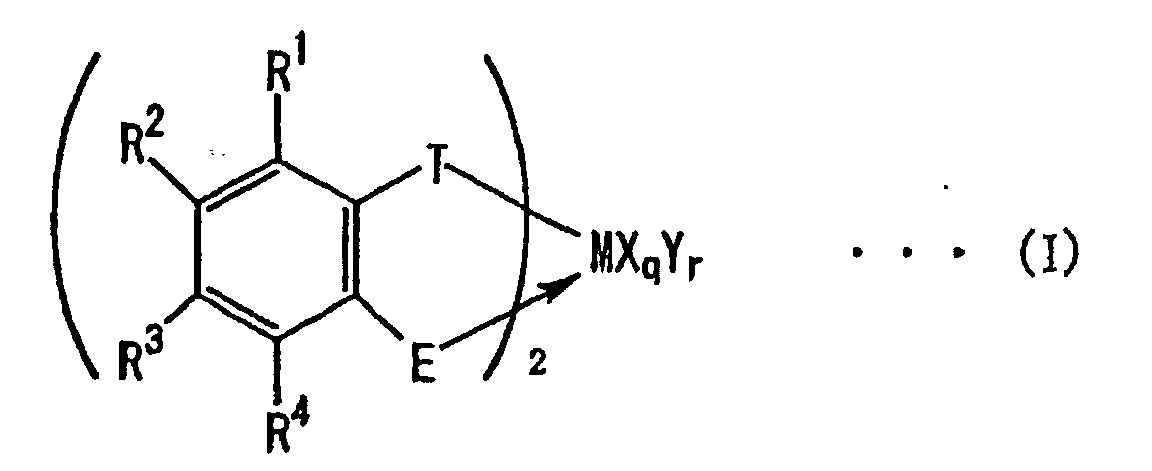
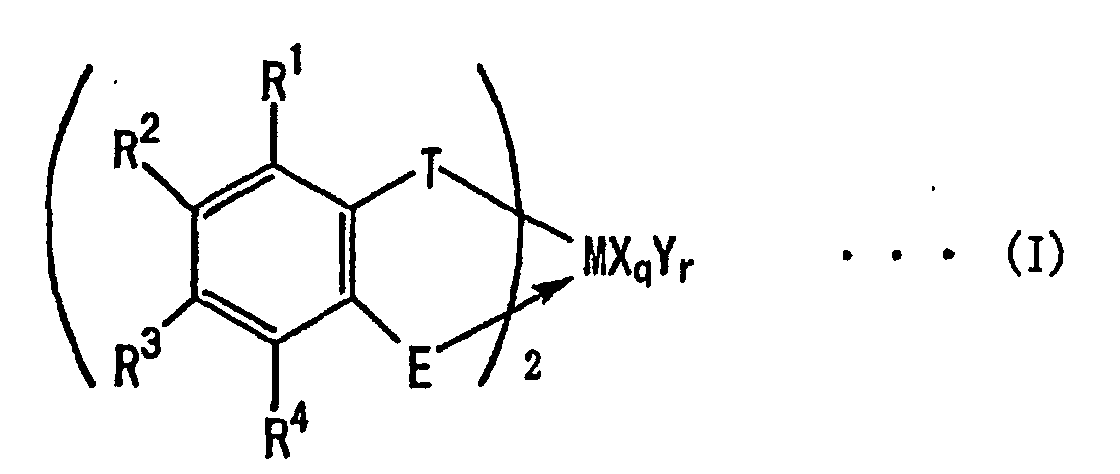
The transition metal compound of the present
invention is a novel compound represented by Formula
(I) :
In Formula (I), M represents a transition metal
element of the fourth group in the periodic table,
and the specific examples thereof include titanium,
zirconium and hafnium. Further in Formula (I), X
represents a σ bonding ligand which is bonded to M,
and when plural X's are present, plural X's may be
the same as or different from each other. Said X
includes a hydrogen atom, a halogen atom, a
hydrocarbon group having 1 to 20 carbon atoms, an
alkoxyl group having 1 to 20 carbon atoms, an aryloxy
group having 6 to 20 carbon atoms, an amide group
having 1 to 20 carbon atoms, a silicon-containing
group having 1 to 30 carbon atoms, a phosphide group
having 1 to 20 carbon atoms, a sulfide group having 1
to 20 carbon atoms and an acyl group having 1 to 20
carbon atoms. The halogen atom includes a chlorine
atom, a fluorine atom, a bromine atom and an iodine
atom. The hydrocarbon group having 1 to 20 carbon
atoms includes, to be specific, alkyl groups such as
methyl, ethyl, propyl, butyl, hexyl, cyclohexyl and
octyl and alkenyl groups such as vinyl, propenyl and
cyclohexenyl; arylalkyl groups such as benzyl,
phenylethyl and phenylpropyl; and aryl groups such as
phenyl tolyl, dimethylphenyl, trimethylphenyl,
ethylphenyl, propylphenyl, biphenyl, naphthyl,
methylnaphthyl, anthracenyl and phenanthryl. The
alkoxyl group having 1 to 20 carbon atoms includes
alkoxyl groups such as methoxy, ethoxy, propoxy and
butoxy, phenylmethoxy and phenylethoxy. The aryloxy
group having 6 to 20 carbon atoms includes phenoxy,
methylphenoxy and dimethylphenoxy. The amide group
having 1 to 20 carbon atoms includes alkylamide
groups such as dimethylamide, diethylamide,
dipropylamide, dibutylamide, dicyclohexylamide and
methylethylamide; alkenylamide groups such as
divinylamide, dipropenylamide and
dicyclohexenylamide; arylalkylamide groups such as
dibenzylamide, phenylethylamide and
phenylpropylamide; and arylamide groups such
diphenylamide and dinaphthylamide. The silicon-containing
group having 1 to 30 carbon atoms includes
monohydrocarbon-substituted silyl groups such as
methylsilyl and phenylsilyl; dihydrocarbon-substituted
silyl groups such as dimethylsilyl and
diphenylsilyl; trihydrocarbon-substituted silyl
groups such as trimethylsilyl, triethylsilyl,
tripropylsilyl, dimethyl (t-butyl) silyl,
tricyclohexylsilyl, triphenylsilyl,
dimethylphenylsilyl, methyldiphenylsilyl,
tritolylsilyl and trinaphthylsilyl; hydrocarbon-substituted
silyl ether groups such as trimethylsilyl
ether; silicon-substituted alkyl groups such as
trimethylsilylmethyl and phenyldimethylsilylethyl;
silicon-substituted aryl groups such as
trimethylsilylphenyl, and dimethylhydrosilyl and
methyldihydrosilyl. The sulfide group having 1 to 20
carbon atoms includes alkylsulfide groups such as
methylsulfide, ethylsulfide, propylsulfide,
butylsulfide, hexylsulfide, cyclohexylsulfide and
octylsulfide; alkenylsulfide groups such as
vinylsulfide, propenylsulfide and
cyclohexenylsulfide; arylalkylsulfide groups such as
benzylsulfide, phenylethylsulfide and
phenylpropylsulfide; and arylsulfide groups such as
phenylsulfide, tolylsulfide, dimethylphenylsulfide,
trimethylphenylsulfide, ethylphenylsulfide,
propylphenylsulfide, biphenylsulfide, naphthylsulfide,
methylnaphthylsulfide, anthracenylsulfide and
phenanthrylsulfide.
The acyl group having 1 to 20 carbon atoms
includes alkylacyl groups such as formyl, acetyl,
propionyl, butylyl, valeryl, palmitoyl, stearoyl and
oleoyl; arylacyl groups such as benzoyl, toluoyl,
salyciloyl, cynnamoyl, naphthoyl and phthaloyl; and
oxalyl, malonyl and succinyl which are derived from
dicarboxylic acids such as oxalic acid, malonic acid
and succinic acid.
Further in Formula (I), Y represents a Lewis
base, and when plural Y's are present, they may be
the same or different. Said Y includes amines,
ethers, phosphines, thioethers, esters and nitriles.
As the specific examples of Y, amines such as ammonia,
methylamine, aniline, dimethylamine, diethylamine, N-methylaniline,
diphenylamine, N, N-dimethylaniline,
trimethylamine, triethylamine, tri-n-butylamine,
methyldiphenylamine, pyridine and p-bromo-N, N-dimethylaniline,
phosphines such as triethylphosphine,
triphenylphosphine and diphenylphosphine, thioethers
such as tetrahydrothiophene, esters such as ethyl
benzoate and nitriles such as acetonitrile and
benzonitrile can be described.
Furthermore in Formula (I), T represents a
group containing a σ bonding atom which is bonded to
M and includes, to be specific, R6 2C<, R6 2Si<, R6 2Ge<,
R6 2Sn<, R6B<, R6Al<, R6P<, R6N<, oxygen (-O-), sulfur
(-S-) and selenium (-Se-) (provided that R6 is a
hydrogen atom, a halogen atom, a hydrocarbon group
having 1 to 20 carbon atoms, a halogen-containing
hydrocarbon group having 1 to 20 carbon atoms, a
silicon-containing group or a hetero atom-containing
group, and when plural R6's are present, plural R6's
may be the same as or different from each other).
Among them, oxygen (-O-), sulfur (-S-) or selenium (-Se-),
particularly oxygen is preferred in terms of
easiness in synthesis and a yield.
Furthermore in Formula (I), E is a group
containing an atom which can coordinate with M via a
lone pair and represents -OR5, -SR5, -SeR5, -NR5 2,
-PR5 2 or -P (O)R5 2 (provided that R5 is a hydrogen atom,
a halogen atom, a hydrocarbon group having 1 to 20
carbon atoms, a halogen-containing hydrocarbon group
having 1 to 20 carbon atoms, a silicon-containing
group or a hetero atom-containing group, and when
plural R5's are present, plural R5's may be the same
as or different from each other). Among them, -NR5 2
or -P (O)R5 2, particularly -PR5 2 is preferred in terms
of easiness in synthesis and a polymer yield.
Similarly in Formula (I), q is 1 or 2 and
represents [(valency of M) - 2], and r represents an
integer of 0 to 3.
Moreover in Formula (I) , R1 to R4 each
represent a hydrogen atom, a halogen atom, a
hydrocarbon group having 1 to 20 carbon atoms, a
halogen-containing hydrocarbon group having 1 to 20
carbon atoms, a silicon-containing group or a hetero
atom-containing group. These R1 to R4 may be the same
as or different from each other and may form a ring
together with an adjacent group.
In these R1 to R4 and R5 and R6 described above,
the examples of the hydrocarbon group having 1 to 20
carbon atoms include alkyl groups such as methyl,
ethyl, n-propyl, isopropyl, n-butyl, sec-butyl, tert-butyl,
hexyl, cyclohexyl and octyl; alkenyl groups
such as vinyl, propenyl and cyclohexenyl; arylalkyl
groups such as benzyl, phenylethyl and phenylpropyl;
and aryl groups such as phenyl tolyl, dimethylphenyl,
trimethylphenyl, ethylphenyl, propylphenyl, biphenyl,
naphthyl, methylnaphthyl, anthracenyl and phenanthryl.
The examples of the halogen-containing
hydrocarbon group having 1 to 20 carbon atoms include
p-fluorophenyl, 3,5-difluorophenyl, 3,4,5-trifluorophenyl,
pentafluorophenyl, 3,5-bis
(trifluoromethyl) phenyl and fluorobutyl. A silicon-containing
group having 1 to 20 carbon atoms is
preferred as the silicon-containing group and
includes, to be specific, monohydrocarbon-substituted
silyl groups such as methylsilyl and phenylsilyl;
dihydrocarbon-substituted silyl groups such as
dimethylsilyl and diphenylsilyl; trihydrocarbon-substituted
silyl groups such as trimethylsilyl,
triethylsilyl, tripropylsilyl, dimethyl (t-butyl)
silyl, tricyclohexylsilyl, triphenylsilyl,
dimethylphenylsilyl, methyldiphenylsilyl,
tritolylsilyl and trinaphthylsilyl; hydrocarbon-substituted
silyl ether groups such as trimethylsilyl
ether; and silicon-substituted alkyl groups such as
trimethylsilylmethyl and bis(trimethylsilyl)methyl.
Further, the examples of the hetero atom-containing
group include methoxyethyl,
diisopropylaminoethyl, furyl, methylfuryl, benzofuryl,
methylthioethyl and thienyl.
Typical examples of the transition metal
compound represented by Formula (I) described above
are bis (2-diphenylphosphinophenoxy) zirconium
dichloride, bis (2-dimethylphosphinophenoxy)
zirconium dichloride, bis (2-diphenylphosphino-6-methylphenoxy)
zirconium dichloride, bis (2-diphenylphosphino-6-isopropylphenoxy)
zirconium
dichloride, bis (2-diphenylphosphino-4-isopropylphenoxy)
zirconium dichloride, bis (2-diphenylphosphino-6-tert-butylphenoxy)
zirconium
dichloride, bis (2-diphenylphosphino-4-tert-butylphenoxy)zirconium
dichloride, bis (2-diphenylphosphino-4,6-di-tert-butylphenoxy)zirconium
dichloride, bis(2-diphenylphosphino-4,6-diisopropylphenoxy)zirconium
dichloride, bis(2-diphenylphosphino-4-methyl-6-tert-butylphenoxy)zirconium
dichloride, bis(2-diphenylphosphino-4-tert-butyl-6-methylphenoxy)-zirconium
dichloride, bis(2-dimethylaminophenoxy)-zirconium
dichloride, bis(2-dimethylamino-6-methylphenoxy)zirconium
dichloride, bis(2-dimethylamino-6-isopropylphenoxy)
zirconium dichloride,
bis(2-dimethylamino-4-isopropylphenoxy)zirconium
dichloride, bis (2-dimethylamino-6-tert-butylphenoxy)-zirconium
dichloride, bis(2-dimethylamino-4-tert-butylphenoxy)zirconium
dichloride, bis(2-dimethylamino-4,6-di-tert-butylphenoxy)zirconium
dichloride, bis(2-dimethylamino-4,6-diisopropylphenoxy)zirconium
dichloride, bis (2-dimethylamino-4-methyl-6-tert-butylphenoxy)zirconium
dichloride, bis(2-dimethylamino-4-tert-butyl-6-methylphenoxy)zirconium
dichloride, bis (2-methoxyphenoxy)zirconium
dichloride, bis (2-diphenylphosphino-6-trimethylsilylphenoxy)zirconium
dichloride, bis(2-diphenylphosphinothiophenoxy)-zirconium
dichloride, bis(2-diphenylphosphino-6-methylthiophenoxy)zirconium
dichloride, bis (2-diphenylphosphino-6-iso-propylthiophenoxy)zirconium
dichloride, bis(2-diphenylphosphino-6-tert-butylthiophenoxy)zirconium
dichloride, bis (2-diphenylphosphino-4,6-di-tert-butylphenoxy)zirconium
dichloride, bis(2-diphenylphosphino-4,6-di-iso-propylthiophenoxy)zirconium
dichloride, bis(2-dimethylaminothiophenoxy)zirconium
dichloride, bis (2-dimethylamino-6-iso-propylthiophenoxy)zirconium
dichloride, bis(2-dimethylamino-6-tert-butylthiophenoxy)
zirconium dichloride, bis (2-dimethylamino-4,6-di-tert-butylthiophenoxy)zirconium
dichloride, bis(2-dimethylamino-4-methyl-6-tert-butylthiophenoxy)zirconium
dichloride, bis (2-methoxythiophenoxy)zirconium
dichloride, bis(2-diphenylphosphino-6-trimethylsilylthiophenoxy)-zirconium
dichloride and compounds obtained by
substituting zirconium contained in these compounds
with titanium or hafnium. It is a matter of course
that the examples shall not be restricted to these
compounds.
The catalyst for polymerizing olefin according
to the present invention comprises (A) the transition
metal compound represented by Formula (I) described
above and an activation cocatalyst as principal
components. As the above activation cocatalyst, (B) a
compound which can be reacted with the transition
metal compound of the component (A) or a derivative
thereof to form an ionic complex, or clay, clay
mineral or an ion-exchangeable compound and (C) an
organic aluminum compound used if necessary can be
nominated.
Regarding the compound that can be reacted with
the transition metal compound of the component (A) or
the derivative thereof to form an ionic complex out
of the components (B), (B-1) an ionic compound which
is reacted with the transition metal compound of the
component (A) to form an ionic complex, (B-2)
aluminoxane, or (B-3) a Lewis acid can preferably be
given from the viewpoint that the polymerization
activity is high and the catalyst cost can be reduced.
Any compounds can be used as the (B-1)
component as long as they are ionic compounds which
are reacted with the transition metal compound of the
component (A) to form ionic complexes, but
particularly compounds represented by the following
Formulas (II) and (III) are preferred from the
viewpoint that polymerization active sites can
efficiently be formed:
([L1 - R7]h+)a([Z]-)b
([L2]h+)a([Z]-)b
(Provided that L2 is M1, R8R9M2, R10 3C or R11M2).
In Formulas (II) and (III), L1 represents a
Lewis base, and [Z]- represents a non-coordinative
anion [Z1]- or [Z2]-, in which [Z1]- is an anion
obtained by combining plural groups with an element,
that is, [M3G1G2···Gf] (in which M3 represents an
element of the 5th to 15th group in the periodic
table, preferably an element of the 13th to 15th
group in the periodic table. In the above-description,
G1 to Gf each represent a hydrogen atom, a halogen
atom, an alkyl group having 1 to 20 carbon atoms, a
dialkylamino group having 2 to 40 carbon atoms, an
alkoxyl group having 1 to 20 carbon atoms, an aryl
group having 6 to 20 carbon atoms, an aryloxy group
having 6 to 20 carbon atoms, an alkylaryl group
having 7 to 40 carbon atoms, an arylalkyl group
having 7 to 40 carbon atoms, a halogen-substituted
hydrocarbon group having 1 to 20 carbon atoms, an
acyloxyl group having 1 to 20 carbon atoms, an
organic metalloid group or a hetero atom-containing
hydrocarbon group having 2 to 20 carbon atoms. Among
G1 to Gf, two or more groups may be combined to form
a ring. Further in above description, f represents an
integer of [(valency of the central metal M3) + 1]),
[Z2]- represents a Bröensted acid alone in which a
logarithm of an inverse number of an acid
dissociation constant (pKa) is -10 or less or a
conjugate base obtained by combining a Bronsted acid
with a Lewis base or a conjugate base which is
usually defined as a superacid, and it may be
coordinated with a Lewis acid. Furthermore in the
above description, R7 represents a hydrogen atom, an
alkyl group having 1 to 20 carbon atoms, an aryl
group having 6 to 20 carbon atoms, an alkylaryl group
or an arylalkyl group; R8 and R9 each represent a
cyclopentadienyl group, a substituted
cyclopentadienyl group, a substituted indenyl group,
a fluorenyl group or a substituted fluorenyl group;
R10 represents an alkyl group having 1 to 20 carbon
atoms, an aryl group, an alkylaryl group or an
arylalkyl group; R11 represents a macrocyclic ligand
such as tetraphenylporphyrin and phthalocyanine.
Moreover in the above-description, h is an ionic
valency of [L1 - R7] and [L2] and represents an
integer of 1 to 3; a is an integer of 1 or more; b is
(h X a); M1 represents an element of the 1st to 3rd,
11th to 13th or 17th group in the periodic table; and
M2 represents an element of the 7th to 12th group in
the periodic table.
In this respect, typical examples of L1 are
amines such as ammonia, methylamine, aniline,
dimethylamine, diethylamine, N-methylaniline,
diphenylamine, N,N-dimethylaniline, trimethylamine,
triethylamine, tri-n-butylamine, methyldiphenylamine,
pyridine, p-bromo-N,N-dimethylaniline and p-nitro-N,N-dimethylaniline,
phosphines such as
triethylphosphine, triphenylphosphine and
diphenylphosphine, thioethers such as
tetrahydrothiophene, esters such as ethyl benzoate
and nitriles such as acetonitrile and benzonitrile.
Hydrogen, methyl, ethyl, benzyl and triethyl
can be given as the specific examples of R7, and
cyclopentadienyl, methylcyclopentadieny,
ethylcyclopentadienyl and pentamethylcyclopentadienyl
can be given as the specific examples of R8 and R9.
Phenyl, p-tolyl and p-methoxyphenyl can be given as
the specific examples of R10. Tetraphenylporphyrin,
phthalocyanine and methallyl can be given as the
specific examples of R11. Also, Li, Na, K, Ag, Cu, Br
and I can be given as the specific examples of M1,
and Mn, Fe, Co, Ni and Zn can be given as the
specific examples of M2.
Further, in [Z1]-, that is, [M3G1G2···Gf], B, Al,
Si, P, As and Sb are preferred as the specific
examples of M3, and B or Al is preferred. The
specific examples of G1, G2 to Gf include the
dialkylamino group such as dimethylamino and
diethylamino; the alkoxyl group or aryloxy group such
as methoxy, ethoxy, n-butoxy and phenoxy; the
hydrocarbon group such as methyl, ethyl, n-propyl,
isopropyl, n-butyl, isobutyl, n-octyl, n-eicosyl,
phenyl, p-tolyl, benzyl, 4-t-butylphenyl and 3,5-dimethylphenyl;
the halogen atom such as fluorine,
chlorine, bromine and iodine; the hetero atom-containing
hydrocarbon group such as p-fluorophenyl,
3,5-difluorophenyl, pentachlorophenyl, 3,4,5-trifluorophenyl,
pentafluorophenyl, 3,5-bis(trifluoromethyl)phenyl
and
bis(trimethylsilyl)methyl; and the organic metaloid
group such as pentamethylantimony, trimethylsilyl,
trimethylgermyl, diphenylarsine, dicyclohexyantimony
and diphenylboron.
Typical examples of the non-coordinative anion,
that is, the Brönsted acid alone in which pKa is -10
or less or the conjugate base [Z2]- obtained by
combining a Brönsted acid with a Lewis acid are
trifluoromethanesulfonic acid anion (CF3SO3)-,
bis(trifluoromethanesulfonyl) methyl anion,
bis(trifluoromethanesulfonyl) benzyl anion,
bis(trifluoromethanesulfonyl)amide, perchlorate anion
(ClO4)-, trifluoroacetic acid anion (CF3CO2)-,
hexafluoroantimony anion (SbF6)-, fluorosulfonic acid
anion (FSO3)-, chlorosulfonic acid anion (ClSO3)-,
fluorosulfonic acid anion/antimony pentafluoride
(FSO3/SbF5)-, fluorosulfonic acid anion/arsenic
pentafluoride (FSO3/AsF5)- and
trifluoromethanesulfonic acid anion/antimony
pentafluoride (CF3SO3/SbF5)-.
Typical examples of the ionic compound which is
reacted with the transition metal compound of the
component (A) described above to form the ionic
complex, that is, the (B-1) component compound are
triethylammonium tetraphenylborate, tri-n-butylammonium
tetraphenyl-borate, trimethylammonium
tetraphenylborate, tetraethylammonium
tetraphenylborate, methyl (tri-n-butyl) ammonium
tetraphenylborate, benzyl (tri-n-butyl) ammonium
tetraphenylborate, dimethyldiphenyl-ammonium
tetraphenylborate, triphenyl(methyl)ammonium
tetraphenylborate, trimethylanilinium tetraphenylborate,
methylpyridinium tetraphenylborate,
benzylpyridinium tetraphenylborate, methyl(2-cyanopyridinium)
tetraphenylborate, triethylammonium
tetrakis(pentafluorophenyl)borate, tri-n-butylammonium
tetrakis(pentafluorophenyl)borate,
triphenylammonium tetrakis(pentafluorophenyl)borate,
tetra-n-butylammonium tetrakis(pentafluorophenyl)-borate,
tetraethylammonium tetrakis(pentafluorophenyl)borate,
benzyl(tri-n-butyl)
ammonium tetrakis(pentafluorophenyl)borate,
methyldiphenylammonium tetrakis(pentafluorophenyl)-borate,
triphenyl(methyl)ammonium tetrakis(pentafluorophenyl)borate,
methylanilinium tetrakis(pentafluorophenyl)borate,
dimethylanilinium
tetrakis(pentafluorophenyl)borate, trimethylanilinium
tetrakis(pentafluorophenyl)borate, methylpyridinium
tetrakis(pentafluorophenyl)borate, benzylpyridinium
tetrakis(pentafluorophenyl)borate, methyl(2-cyanopyridinium)
tetrakis(pentafluorophenyl)borate,
benzyl(2-cyanopyridinium) tetrakis(pentafluorophenyl)borate,
methyl(4-cyanopyridinium)
tetrakis(pentafluorophenyl)borate,
triphenylphosphonium tetrakis(pentafluorophenyl)-borate,
dimethylanilinium tetrakis[3,5-di(trifluoromethyl)phenyl]borate,
ferrocenium
tetraphenylborate, silver tetraphenylborate, trityl
tetraphenylborate, tetraphenylporphyrinmanganese
tetraphenylborate, ferrocenium tetrakis(pentafluorophenyl)borate,
(1,1'-dimethylferrocenium)
tetrakis(pentafluorophenyl)borate, decamethylferrocenium
tetrakis(pentafluorophenyl)borate, silver
tetrakis(pentafluorophenyl)borate, trityl tetrakis(pentafluorophenyl)borate,
lithium tetrakis(pentafluorophenyl)borate,
sodium tetrakis(pentafluorophenyl)borate,
tetraphenylporphyrinmanganese
tetrakis(pentafluorophenyl)borate, silver
tetrafluoroborate, silver hexafluorophosphate, silver
hexafluoroarsenate, silver perchlorate, silver
trifluoroacetate and silver trifluoromethanesulfonate.
The ionic compound reacted with the transition
metal compound of said component (A) to form the
ionic complex, which is the (B-1) component, may be
used alone or in combination of two or more kinds
thereof.
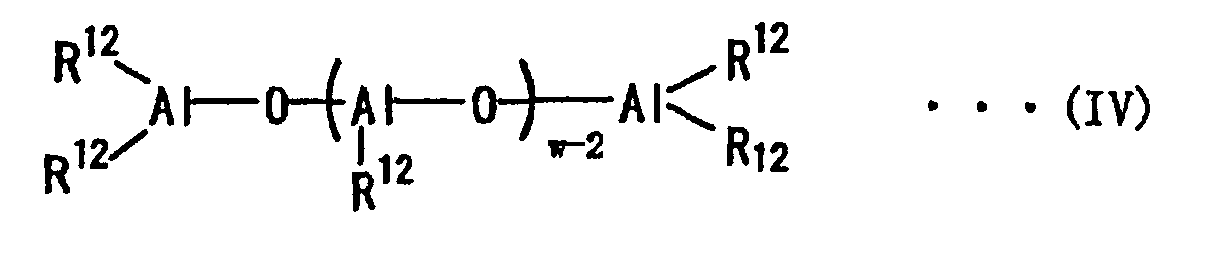
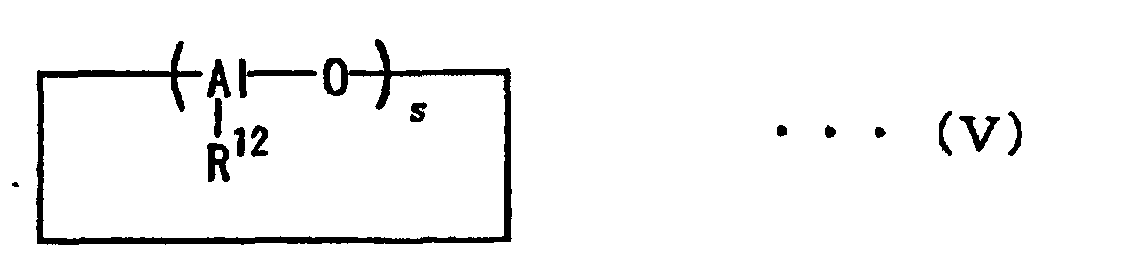
On the other hand, chain aluminoxane
represented by the following Formula (IV) and cyclic
aluminoxane represented by the following Formula (V)
can be given as the aluminoxane of the (B-2)
component:
wherein R
12's each represent an alkyl group having 1
to 20 carbon atoms, preferably 1 to 8 carbon atoms,
and they may be the same or different; w is an
integer of 2≦w≦40, and s is an integer of 1<s≦50.
To be specific, it includes aluminoxanes such
as methylaluminoxane, ethylaluminoxane and
isobutylaluminoxane.
A production process for the aluminoxane
described above includes a process in which aluminum
is brought into contact with a condensing agent such
as water. However, the means therefor shall not
specifically be restricted, and the reaction may be
carried out according to a publicly known process.
It includes, for example, a process in which an
organic aluminum compound is dissolved in an organic
solvent and in which this solution is brought into
contact with water, a process in which an organic
aluminum compound is added at first in polymerization
and then water is added thereto, a process in which
crystal water contained in a metal salt or water
adsorbed on an inorganic matter and an organic matter
is reacted with an organic aluminum compound and a
process in which tetraalkyldialuminoxane is reacted
with trialkylaluminum and further reacted with water.
Aluminoxane that is insoluble in toluene may be used.
The aluminoxane may be used alone or in combination
of two or more kinds thereof.
The Lewis acid of the (B-3) component shall not
specifically be restricted and may be either an
organic compound or a solid inorganic compound. From
the viewpoint that the active sites can efficiently
be formed, boron compounds and aluminum compounds are
preferably used as the organic compound, and
magnesium compounds and aluminum compounds are
preferably used as the inorganic compound. The above
aluminum compounds include, for example, methyl bis
(2,6-di-t-butyl-4-methylphenoxy) aluminum and methyl
(1,1-bi-naphthoxy) aluminum; the magnesium compounds
include, for example, magnesium chloride and
diethoxymagnesium; the aluminum compounds include,
for example, aluminum oxide and aluminum chloride;
the boron compounds include, for example, triphenylboron,
tris (pentafluorophenyl) boron, tris [3,5-bis
(trifluoromethyl) phenyl] boron, tris [(4-fluoromethyl)
phenyl] boron, trimethylboron,
triethylboron, tri-n-butylboron, tris(fluoromethyl)-boron,
tris(pentafluoroethyl)boron,
tris(nanofluorobutyl)boron, tris(2,4,6-trifluorophenyl)boron,
tris(3,5-difluorophenyl)boron,
tris[3,5-bis(trifluorophenyl)]boron,
bis(pentafluorophenyl)fluoroboron, diphenylfluoroboron,
bis(pentafluorophenyl)chloroboron,
dimethylfluoroboron, diethylfluoroboron, di-n-butylfluoroboron,
pentafluorophenyldifluoroboron,
phenyldifluoroboron, pentafluorophenyldichloroboron,
methyldifluoroboron, ethyldifluoroboron and n-butyldifluoroboron.
These Lewis acids may be used alone or in
combination of two or more kinds thereof.
On the other hand, in (B-4) the clay, clay
mineral or ion-exchangeable compound out of the (B)
components, clay is an aggregate of fine silicate
hydrate minerals and is a substance which exhibits
plasticity by mixing with a suitable amount of water
and kneading and shows rigidity by drying and which
is sintered by baking at a high temperature. The
clay mineral is silicate hydrate that constitutes a
principal component of clay. Either of the clay and
the clay mineral may be used for the preparation of
the olefin polymerization catalyst component
described above, and they may be either natural
substances or artificially synthesized substances.
An ion-exchangeable stratified compound is a
compound having a crystalline structure in which
planes constituted by ionic bond are parallel
superposed on each other by a weak bonding power and
in which ions contained therein are exchangeable. An
ion-exchangeable stratified compound is included in
the clay mineral.
To show the specific examples of these (B-4)
components, for example, phyllosilicic acids can be
given as the clay mineral. The phyllosilicic acids
include phyllosilicic acid and phyllosilicate. As the
phyllosilicate, natural compounds such as
montmorillonite, saponite and hectolite which belong
to a smectite group, illite and sericite which belong
to a mica group and mixed layer minerals of a
smectite group and a mica group or a mica group and a
vermiculite group can be nominated. Further,
tetrasilicon fluoride mica, laponite and smectone can
be given as the synthetic compound. In addition to
them, ionic crystalline compounds having a stratified
crystalline structure which are not clay minerals,
such as α-Zr(HPO4)2, γ-Zr(HPO4)2, α-Ti(HPO4)2 and γ-Ti(HPO4)2
can be employed.
Clays and clay minerals which do not belong to
an ion-exchangeable stratified compound include clay
which is called bentonite because of a low
montmorillonite content, Kibushi clay in which a lot
of other components are contained in montmorillonite,
gairome clay, sepiolite showing a fibrous form,
parigolskite, and amorphous or low crystalline
allophane and imogolite.
Further, a particle having a volume average
particle diameter of 10 µm or less is preferred as
the (B-4) component, and a particle having a volume
average particle diameter of 3 µm or less is more
preferred. In general, particles have a particle
diameter distribution, and the (B-4) content has
preferably a particle diameter distribution in which
a volume average particle diameter is 10 µm or less
and the particles having a volume average particle
diameter of 3.0 µm or less are contained in a
proportion of 10 % by weight or more, more preferably
a particle diameter distribution in which a volume
average particle diameter is 10 µm or less and the
particles having a volume average particle diameter
of 1.5 µm or less are contained in a proportion of
10 % by weight or more. A method for measuring the
volume average particle diameter and the contained
proportion includes, for example, a measuring method
using an equipment (CIS-1 manufactured by Galai
Production Ltd.) for measuring a particle diameter by
a light transmittance of a laser beam. Further, the
(B-4) component may be subjected to acid treatment,
alkali treatment, salts treatment or organic
substance treatment. Particularly, the component
that is pre-treated with an organic silicon compound
and an organic aluminum compound is preferred since
the polymerization activity is elevated.
Among these (B-4) components, the components
having a high capability to adsorb quaternary
ammonium salts or to react with clay to form an
intercalation product (called intercalation) are
preferable. The components shall not specifically be
restricted and include quaternary alkyl ammonium
salts, quaternary aryl ammonium salts, quaternary
arylalkyl ammonium salts, quaternary benzyl ammonium
salts, heteroaromatic ammonium salts and the like.
For example, clay or clay mineral is preferred and,
to be specific, philo-silicate is preferred. Further,
smectite is preferred, and montmorillonite is
particularly preferred. Tetrasilicon fluoride mica
is preferred as a synthetic product.
A use proportion of the catalyst component (A)
to the catalyst component (B) in the polymerizing
catalyst of the present invention falls in a range of
preferably 10:1 to 1:100, more preferably 2:1 to 1:10
in terms of a mole ratio when the (B-1) compound is
used as the catalyst component (B). If it deviates
from the range described above, the catalyst cost per
a polymer unit weight grows high, and therefore it is
not practical. Also, it falls in a range of
preferably 1:1 to 1:1,000,000, more preferably 1:10
to 1:10,000 in terms of a mole ratio when the (B-2)
compound is used. If it deviates from this range,
the catalyst cost per a polymer unit weight grows
high, and therefore it is not practical. A use
proportion of the catalyst component (A) to the
catalyst component (B-3) described above falls in a
range of preferably 10:1 to 1:2,000, more preferably
5:1 to 1:1,000 and further preferably 2:1 to 1:500 in
terms of a mole ratio. If it deviates from this
range, the catalyst cost per a polymer unit weight
goes up, and therefore it is not practical. In
respect to a use proportion of the catalyst component
(A) to the catalyst component (B-4), the transition
metal complex of the component (A) falls in a range
of 0.1 to 1,000 micromole, preferably 1 to 100
micromole per a unit weight [g] of clay of the
component (B-4).
(B-1), (B-2), (B-3) and (B-4) can be used as
the catalyst component (B-4) alone or in combination
of two or more kinds thereof.
The polymerizing catalyst of the present
invention may comprise the catalyst component (A) and
the catalyst component (B) described above as
principal components or may comprise the catalyst
component (A), the catalyst component (B) and the
organic aluminum compound (C) as principal components.
In this respect, used as the organic aluminum
compound of the component (C) described above is a
compound represented by Formula (VI):
R13 vAlQ3-v
wherein R13 represents an alkyl group having 1 to 10
carbon atoms; Q represents a hydrogen atom, an
alkoxyl group having 1 to 20 carbon atoms, an aryl
group having 6 to 20 carbon atoms or a halogen atom;
and v represents a real number of 1 to 3.
The specific examples of the compound
represented by Formula (VI) include trimethylaluminum,
triethylaluminum, triisopropylaluminum,
triisobutylaluminum, dimethylaluminum chloride,
diethylaluminum chloride, methylaluminum dichloride,
ethylaluminum dichloride, dimethylaluminum fluoride,
diisobutylaluminum hydride, diethylaluminum hydride
and ethylaluminum sesquichloride. The
trialkylaluminum compounds are preferred as this
organic aluminum compound, and among them,
trimethylaluminum and triisopropylaluminum are suited.
These organic aluminum compounds may be used
alone or in combination of two or more kinds thereof.
A use proportion of the catalyst component (A)
to the catalyst component (C) described above falls
in a range of preferably 1:1 to 1:10,000, more
preferably 1:5 to 1:2,000 and further preferably 1:10
to 1:1,000 in terms of a mole ratio. Use of the
above catalyst component (C) makes it possible to
elevate the polymerization activity per the
transition metal, but if it is too much, particularly
if it deviates from the range described above, the
organic aluminum compound comes to nothing and
remains in the polymer in a large amount. On the
other hand, if it is small, the satisfactory catalyst
activity is not obtained, and it is not preferred in
a certain case.
In the present invention, among or after
bringing the respective components into contact, the
polymer such as polyethylene and polypropylene and
the inorganic oxide such as silica and alumina may be
allowed to coexist or brought into contact. In
carrying them on a carrier, they are preferably
carried on a polymer, and such carrier polymer has a
particle diameter of usually 1 to 300 µm, preferably
10 to 200 µm and more preferably 20 to 100 µm. If
this particle diameter is smaller than 1 µm, fine
powders contained in the polymer are increased, and
if it exceeds 300 µm, coarse particles contained in
the polymer are increased and causes a reduction in
the bulk density and clogging of a hopper in a
manufacturing process. In this case, the carrier has
a specific surface area of 1 to 1,000 m2/g,
preferably 50 to 500 m2/g and a pore capacity of 0.1
to 5 m3/g, preferably 0.3 to 3 m3/g.
The contact may be carried out in hydrocarbon
such as pentane, hexane, heptane, toluene and xylene
in inert gas such as nitrogen. The addition or
contact of the respective components not only can be
carried out at a polymerizing temperature but also is
preferably carried out at -30°C to a boiling point of
each solvent, particularly a room temperature to a
boiling point of the solvent.
Such catalyst for polymerizing olefin according
to the present invention makes it possible to
homopolymerize or copolymerize not only ethylene but
also propylene and other α-olefins at a high
activity. Further, the transition metal compound
that is the catalyst component (A) is easily
synthesized, and the production cost of the catalyst
is low.
The olefin base polymer of the present
invention is obtained by using the catalyst for
polymerizing olefin described above and can be
produced by homopolymerizing olefins or
copolymerizing olefins with other olefins and/or
other monomers in the presence of the above catalyst
for polymerizing olefin.
In the production process for the olefin
polymer of the present invention, the organic
aluminum compound (C) may be used by bringing in
advance into contact with the component (A) and/or
the component (B) or may be used by adding the
component (C) to a reactor and then bringing into
contact with the component (A) and the component (B).
A use amount of the component (C) is the same as that
of the catalyst for polymerizing olefin described
above. According to the production process for the
olefin polymer of the present invention, the
homopolymerization of olefins or the copolymerization
of olefins with other olefins and/or other monomers
(that is, copolymerization of different kinds of
olefins themselves, copolymerization of olefins with
other monomers or copolymerization of different kinds
of olefins with other monomers) in the presence of
the polymerizing catalyst described above are
suitably carried out.
The above olefins shall not specifically be
restricted, and ethylene or α-olefin having 3 to 20
carbon atoms is preferred. This α-olefin includes,
for example, α-olefins such as propylene, 1-butene,
1-pentene, 1-hexene, 1-heptene, 1-octene, 1-nonene,
1-decene, 4-phenyl-1-butene, 6-phenyl-1-hexene, 3-meyhyl-1-butene,
4-meyhyl-1-butene, 3-meyhyl-1-pentene,
4-meyhyl-1-hexene, 5-meyhyl-1-hexene, 3,3-dimeyhyl-1-pentene,
3,4-dimeyhyl-1-pentene, 4,4-dimeyhyl-1-pentene
and vinylcyclohexane; halogen-substituted
α-olefins such as hexafluoropropene,
tetrafluoroethylene, 2-fluoropropene, fluoroethylene,
1,1-difluoroethylene, 3-fluoropropene,
trifluoroethylene and 3,4-dichloroethylene; cyclic
olefins such as cyclopentene, cyclohexene, norbornene,
5-methylnorbornene, 5-ethylnorbornene, 5-propylnorbornene,
5,6-dimethylnorbornene and 5-benzylnorbornene;
styrenes including styrene and
alkylstyrenes such as p-methylstyrene, p-ethylstyrene,
p-propylstyrene, p-isopropylstyrene, p-butylstyrene,
p-tert-butylstyrene, p-phenylstyrene, o-methylstyrene,
o-ethylstyrene, o-propylstyrene, o-isopropylstyrene,
m-methylstyrene, m-ethylstyrene, m-isopropylstyrene,
m-butylstyrene, mesitylstyrene, 2,4-dimethylstyrene,
2,5-dimethylstyrene and 3,5-dimethylstyrene;
alkoxystyrenes such as p-methoxystyrene, o-methoxystyrene
and m-methoxystyrene; halogenated
styrenes such as p-chlorostyrene, m-chlorostyrene, o-chlorostyrene,
p-bromostyrene, m-bromostyrene, o-bromostyrene,
p-fluorostyrene, m-fluorostyrene, o-fluorostyrene
and o-methyl-p-fluorostyrene;
trimethylsilylstyrene, vinyl benzoate and
divinylbenzene. Those suitably selected from the
olefins described above may be used for the other
olefins.
In the present invention, the olefins described
above may be used alone or in combination of two or
more kinds thereof. In copolymerizing two or more
kinds of olefins, the olefins described above can
suitably be combined.
Further, in the present invention, the olefins
described above may be copolymerized with other
monomers, and capable of being given as the other
monomers used in this case are, for example, chain
diolefins such as butadiene, isoprene, 1,4-pentadiene
and 1,5-hexadiene, polycyclic olefins such as
norbornene, 1,4,5,8-dimethano-1,2,3,4,4a,5,8,8a-octahydronaphthalene
and 2-norbornene, cyclic
diolefins such as norbornadiene, 5-ethylidenenorbornene,
5-vinylnorbornene and
dicyclopentadiene, and unsaturated esters such as
ethyl acrylate and methyl methacrylate.
In the present invention, propylene is
particularly suited as the olefins.
In the present invention, a process for
polymerizing olefins shall not specifically be
restricted, and capable of being employed are
optional polymerizing methods such as a slurry
polymerizing method, a solution polymerizing method,
a gas phase polymerizing method, a bulk polymerizing
method and a suspension polymerizing method.
When using a polymerization solvent, the
solvent includes hydrocarbons and halogenated
hydrocarbons such as benzene, toluene, xylene, n-hexane,
n-heptane, cyclohexane, methylene chloride,
chloroform, 1,2-dichloroethane and chlorobenzene.
They may be used alone or in combination of two or
more kinds thereof. Further, the monomers used for
the polymerization can be used as well as the solvent
depending on the kind thereof.
It is advantageous in terms of a polymerization
activity and a reactor efficiency to select a use
amount of the catalyst in the polymerization reaction
so that that of the component (A) falls in a range of
usually 0.5 to 100 micromole, preferably 2 to 25
micromole per liter of the solvent.
In respect to the polymerization condition, the
pressure is selected in a range of usually an
atmospheric pressure to 200 MPa·G. The
polymerization temperature falls in a range of
usually -50 to 250°C. A method for controlling a
molecular weight of the polymer includes the kind and
a use amount of the respective catalyst components,
selection of the polymerization temperature and
introduction of hydrogen. Further, in the
polymerization of olefin in the present invention,
the catalyst can be used to carry out pre-polymerization.
Bringing a small amount of olefin
into contact with the catalyst can carry out this
pre-polymerization. In this case, the polymerization
temperature is -20 to 100°C, preferably -10 to 70°C
and particularly preferably 0 to 50°C. Also, inert
hydrocarbons, aliphatic hydrocarbons, aromatic
hydrocarbons and monomers are used as a solvent used
in this pre-polymerization. In particular, aliphatic
hydrocarbons are preferred. This pre-polymerization
can be carried out as well without using solvents.
The pre-polymerization is preferably carried out so
that the pre-polymerization product has a limiting
viscosity [η] (measured in decalin at 135°C) of 0.2
deciliter/g or more, preferably 0.5 deciliter/g or
more, and the conditions are preferably controlled
so that an amount of the pre-polymerization product
is 1 to 10,000 g, preferably 10 to 1,000 g per
millimole of the transition metal component contained
in the catalyst.
The present invention shall be explained below
in further details with reference to examples, but
the present invention shall by no means be restricted
by the following examples.
Example 1
Synthesis of bis (2-diphenylphosphino-4,6-di-tert-butylphenoxy)
zirconium dichloride
In 150 ml of acetic acid, 20 g (96.9 millimole)
of 2,4-di-tert-butylphenol was dissolved, and the
solution was cooled on ice. Then, 5.0 ml (96.9
millimole) of bromine was added thereto drop by drop.
After finishing dropwise addition, the temperature
was elevated up to a room temperature, and the
solution was stirred for 8 hours. Then, the reaction
mixture was thrown into ice and water, and the
aqueous layer was extracted with diethyl ether. The
organic layer was dried on anhydrous magnesium
sulfate, and then the solvent was distilled off under
reduced pressure to obtain 19.96 g (yield: 72.0 %) of
2-bromo-4, 6-di-tert-butylphenol.
Next, 5.0 g (17.5 millimole) of 2-bromo-4,6-di-tert-butylphenol
described above was dissolved in 45
ml of dehydrated diethyl ether under nitrogen flow,
and the solution was cooled down to -30°C. Then,
23.3 ml (37.3 millimole) of a hexane solution having
an n-butyllithium concentration of 1.6 mole/liter was
added thereto, and then the solution was stirred at a
room temperature for 5 hours-. The reaction mixture
was cooled down to -30°C, and 3.26 ml (17.3
millimole) of diphenylchlorophosphine was added
thereto and stirred at a room temperature for 8 hours.
In this reaction solution, 2.6 ml (20.5 millimole) of
trimethylsilyl chloride was added, and the solution
was further stirred for 8 hours. Then, the solvent
was distilled off under reduced pressure, and the
residue was extracted with hexane. Subsequently,
after the solvent was distilled off under reduced
pressure, the residue was dissolved in hexane, and
the solution was then cooled down to separate a
precipitated solid matter, whereby 1.3 g (yield:
16 %) of 4,6-di-tert-butyl-2-diphenylphosphinophenyl
trimethylsilyl ether was obtained.
Next, 0.98 g (2.11 millimole) of this 4,6-di-tert-butyl-2-diphenylphosphinophenyl
trimethylsilyl
ether was dissolved in 15 ml of dehydrated
tetrahydrofuran under nitrogen flow, and the solution
was cooled down to -30°C. Then, a dehydrated
tetrahydrofuran solution of 0.4 g (1.06 millimole) of
a zirconium tetrachloride tetrahydrofuran adduct was
added thereto step by step, and the solution was
stirred at a room temperature for one hour. Further,
the solution was refluxed for 3 days by heating. The
solvent was distilled off under reduced pressure, and
the residue was recrystallized from
dichloromethane/hexane, whereby obtained was 0.29 g
(yield: 29.0 %) of bis (2-diphenylphosphino-4,6-di-tert-butylphenoxy)
zirconium dichloride.
Example 2
Polymerization of ethylene
In a heated and dried autoclave of one liter
400 ml of toluene and 3 millimole of
methylaluminoxane were added under nitrogen flow, and
this mixture was heated up to 50°C stirring at this
temperature for 5 minutes. Then, 3 micromole of bis
(2-diphenylphosphino-4,6-di-tert-butylphenoxy)-zirconium
dichloride obtained in Example 1 was added
thereto, and then ethylene was introduced thereinto
to elevate the pressure up to 0.68 MPa.
Polymerization was carried out in this state for 15
minutes.
After finishing the reaction, the reaction
product was thrown into methanol to filter off a
precipitated polymer, and the polymer was then washed
with methanol, followed by heating and drying it
under reduced pressure to thereby obtain 19.9 g of
polyethylene.
This polyethylene had a melting point [Tm] of
135.6°C and an intrinsic viscosity [η] (measured in
decalin at 135°C) of 3.17 deciliter/g.
The melting point [Tm] and the intrinsic
viscosity [η] were measured by the following methods.
(1) Melting point [Tm]:
The temperature was elevated from 40°C to 220°C
at 320°C/minute and maintained at 220°C for 3 minutes,
and then the temperature was lowered down to 0°C at
10°C/minute and maintained at 0°C for 3 minutes.
Further, the temperature was elevated up to 220°C at
10°C/minute, and a peak vertex in a melting peak in
this procedure was designated as a melting point [Tm].
DSC7 manufactured by Perkin Elmer Co., Ltd. was used
as the measuring instrument.
(2) Intrinsic viscosity [η]
An automatic viscometer, model VMR-053
manufactured by Rigo Co., Ltd. was used to measure it
in decalin at 135°C.
Example 3
In a heated and dried autoclave of one liter
400 ml of toluene and 3 millimole of
methylaluminoxane were added under nitrogen flow, and
this mixture was heated up to 50°C stirring at this
temperature for 5 minutes. Then, 3 micromole of bis
(2-diphenylphosphino-4,6-di-tert-butylphenoxy)
zirconium dichloride obtained in Example 1 was added
thereto, and then propylene was introduced thereinto
to elevate the pressure up to 0.68 MPa.
Polymerization was carried out in this state for one
hour. After finishing the reaction, the reaction
product was thrown into methanol to filter off a
precipitated polymer, and the polymer was then washed
with methanol, followed by heating and drying it
under reduced pressure to thereby obtain 28.3 g of
polypropylene.
This polymer had an intrinsic viscosity [η]
(measured in decalin at 135°C) of 0.20 deciliter/g.
Comparative Example 1
Propylene was polymerized in the same manner as
in Example 3, except that in Example 3, a complex
having the following structure (described in Japanese
Patent Application Laid-Open No. 315109/1999) was
substituted for bis (2-diphenylphosphino-4,6-di-tert-butylphenoxy)
zirconium dichloride:
After finishing the reaction, the reaction product
was thrown into methanol, but a solid matter was not
obtained, and an organic solvent-soluble component
was not obtained as well.
The transition metal compound of the present
invention is useful as a catalyst component for
polymerizing olefins and easily synthesized, and an
olefin-polymerizing catalyst comprising this compound
makes it possible to (co)polymerize not only ethylene
but also propylene and other α-olefins at a high
activity.
It is further understood by those skilled in
the art that the foregoing description is a preferred
embodiment of this invention and that various changes
and modifications may be made in the invention
without departing from the spirit and scope thereof.