EP1323485B1 - Ultrafine metal powder slurry with high dispersibility - Google Patents
Ultrafine metal powder slurry with high dispersibility Download PDFInfo
- Publication number
- EP1323485B1 EP1323485B1 EP02258839A EP02258839A EP1323485B1 EP 1323485 B1 EP1323485 B1 EP 1323485B1 EP 02258839 A EP02258839 A EP 02258839A EP 02258839 A EP02258839 A EP 02258839A EP 1323485 B1 EP1323485 B1 EP 1323485B1
- Authority
- EP
- European Patent Office
- Prior art keywords
- ultrafine
- metal powder
- powder
- slurry
- ultrafine metal
- Prior art date
- Legal status (The legal status is an assumption and is not a legal conclusion. Google has not performed a legal analysis and makes no representation as to the accuracy of the status listed.)
- Expired - Lifetime
Links
Images

Classifications
-
- B—PERFORMING OPERATIONS; TRANSPORTING
- B22—CASTING; POWDER METALLURGY
- B22F—WORKING METALLIC POWDER; MANUFACTURE OF ARTICLES FROM METALLIC POWDER; MAKING METALLIC POWDER; APPARATUS OR DEVICES SPECIALLY ADAPTED FOR METALLIC POWDER
- B22F9/00—Making metallic powder or suspensions thereof
- B22F9/16—Making metallic powder or suspensions thereof using chemical processes
-
- H—ELECTRICITY
- H01—ELECTRIC ELEMENTS
- H01G—CAPACITORS; CAPACITORS, RECTIFIERS, DETECTORS, SWITCHING DEVICES, LIGHT-SENSITIVE OR TEMPERATURE-SENSITIVE DEVICES OF THE ELECTROLYTIC TYPE
- H01G4/00—Fixed capacitors; Processes of their manufacture
- H01G4/002—Details
- H01G4/005—Electrodes
- H01G4/008—Selection of materials
- H01G4/0085—Fried electrodes
-
- B—PERFORMING OPERATIONS; TRANSPORTING
- B22—CASTING; POWDER METALLURGY
- B22F—WORKING METALLIC POWDER; MANUFACTURE OF ARTICLES FROM METALLIC POWDER; MAKING METALLIC POWDER; APPARATUS OR DEVICES SPECIALLY ADAPTED FOR METALLIC POWDER
- B22F1/00—Metallic powder; Treatment of metallic powder, e.g. to facilitate working or to improve properties
- B22F1/05—Metallic powder characterised by the size or surface area of the particles
- B22F1/054—Nanosized particles
- B22F1/0545—Dispersions or suspensions of nanosized particles
-
- B—PERFORMING OPERATIONS; TRANSPORTING
- B22—CASTING; POWDER METALLURGY
- B22F—WORKING METALLIC POWDER; MANUFACTURE OF ARTICLES FROM METALLIC POWDER; MAKING METALLIC POWDER; APPARATUS OR DEVICES SPECIALLY ADAPTED FOR METALLIC POWDER
- B22F1/00—Metallic powder; Treatment of metallic powder, e.g. to facilitate working or to improve properties
- B22F1/10—Metallic powder containing lubricating or binding agents; Metallic powder containing organic material
-
- B—PERFORMING OPERATIONS; TRANSPORTING
- B82—NANOTECHNOLOGY
- B82Y—SPECIFIC USES OR APPLICATIONS OF NANOSTRUCTURES; MEASUREMENT OR ANALYSIS OF NANOSTRUCTURES; MANUFACTURE OR TREATMENT OF NANOSTRUCTURES
- B82Y30/00—Nanotechnology for materials or surface science, e.g. nanocomposites
-
- H—ELECTRICITY
- H01—ELECTRIC ELEMENTS
- H01B—CABLES; CONDUCTORS; INSULATORS; SELECTION OF MATERIALS FOR THEIR CONDUCTIVE, INSULATING OR DIELECTRIC PROPERTIES
- H01B1/00—Conductors or conductive bodies characterised by the conductive materials; Selection of materials as conductors
- H01B1/20—Conductive material dispersed in non-conductive organic material
- H01B1/22—Conductive material dispersed in non-conductive organic material the conductive material comprising metals or alloys
-
- B—PERFORMING OPERATIONS; TRANSPORTING
- B22—CASTING; POWDER METALLURGY
- B22F—WORKING METALLIC POWDER; MANUFACTURE OF ARTICLES FROM METALLIC POWDER; MAKING METALLIC POWDER; APPARATUS OR DEVICES SPECIALLY ADAPTED FOR METALLIC POWDER
- B22F2998/00—Supplementary information concerning processes or compositions relating to powder metallurgy
Definitions
- the present invention relates to ultrafine metal powder slurry with high dispersibility, which may be used as, for example, conductive paste fillers or internal electrodes of multilayer ceramic capacitors.
- Ultrafine metal powders for use in internal electrodes of multilayer ceramic capacitors are high-purity metal powders having a mean particle diameter of, for example, 0.1 to 1.0 ⁇ m and having a substantially spherical shape. Such an ultrafine metal powder is mixed with a binder such as an organic resin and thereby yields a paste. A thin film of the paste is applied to a ceramic green sheet by, for example, screen printing to form an internal electrode layer. Several hundreds of plies of the ceramic green sheet with the applied paste thin film are stacked and thereby yield a laminated composite. The laminated composite is subjected to a binder burn out process, a sintering process, and a firing process and thereby yields a multilayer ceramic capacitor.
- the mean particle size used herein means a mean surface diameter (D3) in a number-based particle size distribution.
- the thickness of the internal electrode layer must be reduced from 3 ⁇ m in conventional equivalents to 1.5 ⁇ m or less.
- the ultrafine metal powder has poor dispersibility and thereby yields aggregates such as clumps, the aggregates penetrate the ceramic sheet layer and thereby lead to defective units with short-circuit of electrodes. Even if there are no penetrating aggregates, distances between the electrodes decrease to cause local current crowding to thereby shorten the life of the multilayer ceramic capacitor.
- Such ultrafine metal powders have conventionally been produced by chemical vapor deposition (CVD), in which the prepared metal powder is subjected to a wet washing process in water for purification to yield a metal-water slurry, and the metal-water slurry is subjected to a drying process to yield a dried powder.
- CVD chemical vapor deposition
- the dried powder is not sufficiently dispersed in an organic solvent in a paste preparation process step 20 shown in Fig. 2.
- the dried powder is further subjected to a dispersing process step 25 including several dispersion treatments such as ball mill dispersion, ultrasonic dispersion, and roll mill dispersion in combination.
- the ultrafine metal powder having been subjected to the drying process tends to aggregate and has poor dispersibility also in the dispersing process step 25.
- These dispersion processes using a conventional dried powder can only yield a paste comprising an ultrafine metal powder in a content of at most about 50% by mass.
- Fig. 2 shows the conventional process 20 for the making of a paste preparation of an ultrafine metal powder.
- the metal powder is purified by removing a remainder material metal chloride and thereby yields a metal-water slurry (metal-water mixture).
- the metal-water slurry is dried in a metal powder drying process step 22 and thereby yields a product ultrafine metal powder, i.e., a dried powder 23.
- aggregated particles are formed due to dry aggregation caused by liquid bridging forces and van der Waals forces acting among particles.
- Aggregation also occurs in the subsequent process step 24 for dispersing the dried powder in an organic solvent.
- metal hydroxides are formed on a surface of the ultrafine metal powder and thereby the resulting ultrafine metal powder has insufficient wettability (lipophilic property) to organic solvents. Accordingly, particles of the ultrafine metal powder having poor wettability to the organic solvents aggregate with one another in the dispersing process step 24 for dispersing the dried powder in an organic solvent.
- the dried powder 23 is supplied to a user. On the user side, the dried powder 23 is subjected to the dispersing process step 24 in an organic solvent, is further treated via a viscosity adjustment process step 27 and thereby yields a paste. To disaggregate aggregated particles formed in the drying process step 22 and in the dispersing process step 24, the process further requires complicated treatments including dispersing process step 25 including, for example, ball mill dispersion, ultrasonic dispersion, and roll mill dispersion in combination and a filtration process step 26. The process thereby requires much time and effort. Accordingly, although the dried powder 23 of the ultrafine metal powder as a product is required to include no aggregated particles and have high dispersibility, no conventional ultrafine metal powder slurry satisfies these requirements.
- a slurry with ultrafine metal powder, an organic solvent and a surfactant is known for instance from WO 01/578 85.
- the present invention provides an ultrafine metal powder slurry with high dispersibility, including an organic solvent; a surfactant having a hydrophilic group and a lipophilic group; and an ultrafine metal powder in an amount more than 60% by mass and less than 95% by mass based on the total mass of the slurry, in which the hydrophilic group of the surfactant is at least one selected from the group consisting of a sulfo group, a sulfonyldioxy group and a polyoxyethylene group with a carboxyl group, and the lipophilic group of the surfactant is an alkyl group containing 12 or more carbon atoms or an alkylphenyl group, and wherein the surfactant is at least one selected from the group consisting of polyoxyethylene lauryl ether carboxylic acids and alkylbenzenesulfonic acids.
- a method for preparing the above ultrafine metal powder slurry is also provided.
- the present invention can prevent aggregation of ultrafine particles and can provide a metallic material for conductive pastes, which includes no aggregated particles and has high dispersibility.
- the present invention can save a part of the process steps in the conventional process for the preparation of conductive pastes, can shorten the process time and can reduce labor.
- the ultrafine metal powder slurry of the present invention is preferable as a metallic material for conductive pastes and is used in an internal electrode of multilayer ceramic capacitors.
- slurry comprising an ultrafine metal powder, an organic solvent, and a surfactant is an intermediate in production processes for pastes and contains the ultrafine metal powder in a content of at most 50% by mass.
- slurry containing the ultrafine metal powder in a larger amount is preferred.
- such a slurry containing the ultrafine metal powder in a larger amount inevitably includes aggregates of the ultrafine metal powder and has poor dispersibility even after undergoing complicated dispersion treatments. If the slurry including aggregates is used as a metallic material for conductive pastes in the production of ceramic capacitors, the resulting ceramic capacitors cannot have satisfactory properties.
- a metal slurry containing an ultrafine metal powder in a content at least 60% by mass and at most 95% by mass has not been obtained according to conventional technologies and is first obtained according to the present invention.
- the ultrafine metal powder is dispersed in an organic solvent as substantially primary particles without aggregation.
- the content of the ultrafine metal powder can be controlled by controlling the amount of the organic solvent. If the content of the ultrafine metal powder is not less than 95% by mass, the organic solvent is insufficient in amount so as to be adsorbed by the ultrafine metal powder to form an organic solvent layer. Thus, aggregates of the ultrafine metal powder are suppressed from locally forming to deteriorate the dispersibility of the slurry.
- the ultrafine metal powder as a material for internal electrode layers preferably has a particle size distribution as small as possible.
- the present inventors have found that, when the ultrafine metal powder in the slurry has a particle size distribution in terms of D90 of less than 1.2 ⁇ m, the slurry has high dispersibility and can yield dense and smooth electrode layers to thereby yield satisfactory ceramic capacitors.
- "D90" in the present invention is defined as follows. First, a sample ultrafine metal powder slurry in an organic solvent is measured using a laser particle size analyzer. Then, the obtained result is associated with the particle size distribution based on the number of particles, and the value corresponding to the 90/100th-particle size in ascending order in the particle size distribution of the number is determined as D90. Such a laser particle size analyzer is generally used for analysis of dispersion of metal particles in an organic solvent.
- Preferred ultrafine metal powders for use in the present invention are high-purity metal powders having a mean particle size of , for example, 0.1 to 1.0 ⁇ m and having a substantially spherical shape. These material metal powders are preferably prepared by chemical vapor deposition in which, for example, a metal chloride is vaporized and is then reduced with H 2 to yield a metal powder.
- the amount of the surfactant is preferably more than 0.05% by mass and less than 2% by mass relative to the ultrafine metal powder.
- the surfactant in the present invention plays the following roles.
- the surfactant is adsorbed by the entire surfaces of the ultrafine metal powder particles in the water slurry to thereby form a surfactant-adsorbed layer on the surfaces of the ultrafine metal powder particles in such a manner that a lipophilic functional group faces outside.
- the lipophilic functional group serves to transfer the ultrafine metal powder from water into the organic solvent to thereby exchange or replace the solvent.
- the surfactant improves the dispersibility of the ultrafine metal powder in the organic solvent.
- the surfactant is preferably contained in such a content as to be uniformly adsorbed by the entire surfaces of the ultrafine metal powder particles.
- the amount of the surfactant is preferably at least 0.05% by mass and at most 2% by mass relative to the ultrafine metal powder. If the amount is more than 0.05% by mass, the surfactant can be sufficiently adsorbed by the entire surfaces of the ultrafine metal powder particles and can be sufficiently transferred into the organic solvent. If it is less than 2% by mass, the amount is such a sufficient amount as to be uniformly adsorbed by the entire surface of the ultrafine metal powder particles and results in cost effectiveness.
- the hydrophilic group of the surfactant is at least one selected from a sulfo group, sulfonyldioxy group and polyoxyethylene group with carboxyl group.
- the lipophilic group of the surfactant is preferably an alkyl containing 12 or more carbon atoms or an alkylphenyl. More specifically, the surfactant is at least one selected from polyoxyethylene lauryl ether carboxylic acids, and alkylbenzenesulfonic acids.
- the surfactant comprises at least one selected from a sulfo group, sulfonyldioxy group and polyoxyethylene group in combination with carboxyl group.
- a lipophilic group to transfer the ultrafine metal powder adsorbing the surfactant into an organic solvent alkyls containing 12 or more carbon atoms and alkylphenyl are found to be effective. Such alkyls containing 12 or more carbon atoms and alkylphenyl as the lipophilic group are also found to improve the dispersibility of the ultrafine metal powder in the organic solvent.
- Cations constituting alkylbenzesulfonic acid salts for use in the present invention may be any of Na, Mg, K, Ca, ammonium, and amine cations.
- amines are preferred as the cation, since a metal, if retained in the internal electrode layer,may adversely affect the electrical properties of the capacitors.
- Such amines include, but are not limited to, trimethylamine, triethylamine, tributylamine, and triethanolamine.
- Organic solvents for use herein are not specifically limited. Among them, terpene alcohols, glycols, carbitols (diethylene glycol ethyl ether and derivatives thereof), and aliphatic hydrocarbons generally used as solvents for conductive pastes are preferred.
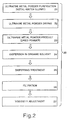
- Fig. 1 is a flow chart illustrating a process for the preparation of an ultrafine metal powder slurry with high dispersibility according to the present invention.
- a process step 11 of the purification of ultrafine metal powder is corresponding to the process step 21 of the purification of ultrafine metal powder in the conventional process 20 in Fig. 2.
- the metal-water slurry is then subjected to an organic solvent substitution process step 12 without the metal powder drying process step 22 as in the conventional process 20.
- water in the metal-water slurry is directly replaced with an organic solvent.
- the ultrafine metal powder-water slurry (concentration: 50% by mass) is subjected to mixing and agitation using, for example, a process homogenizer to thereby disperse aggregates of the ultrafine metal powder in water to primary particles.
- a surfactant and terpineol as an organic solvent are then added to the slurry in amounts of 0.5% by mass and 10% by mass, respectively, relative to the ultrafine metal powder.
- the resulting mixture is further mixed at a temperature of 15°C ⁇ 5°C for a set time period using, for example, a process homogenizer.
- terpineol is adsorbed by the surfactant adsorbed by the surface of the ultrafine metal powder and thereby forms a terpineol layer.
- terpineol substitutes for water surrounding the ultrafine metal powder.
- the solvent exchange procedure completes.
- the resulting ultrafine metal powder-terpineol slurry comprising the ultrafine metal powder, terpineol, and the surfactant forms into a precipitate in water.
- the substituted water is separated as a supernatant fluid and is drained, thus yielding an ultrafine metal powder-terpineol slurry (ultrafine metal powder-organic solvent slurry 13) having an ultrafine metal powder content of 90% by mass.
- the ultrafine metal powder-organic solvent slurry 13 does not undergo a drying process step and contains substantially no aggregated particles, which is distinguished from the conventional art. By adjusting the amount of the organic solvent, the resulting slurry can have an ultrafine metal powder content of more than 60% by mass and less than 95% by mass.
- the ultrafine metal powder-organic solvent slurry 13 can be supplied intact as a metallic material for conductive pastes.
- a conductive paste can be obtained by adding a necessary amount of a binder resin solution to the ultrafine metal powder-organic solvent slurry 13 in a viscosity adjustment process step 14 in the production of a conductive paste in the user side. Accordingly, complicated treatments such as dispersion treatments and filtration in the conventional process can be omitted.
- As a binder resin ethyl cellulose is generally used.
- the present invention can switch the conductive paste material from the conventional dried powder 23 to the ultrafine metal powder-organic solvent slurry 13, can thereby eliminate the risk of dust derived from the dried powder and can improve the working environment.
- the present invention will be illustrated in further detail with reference to several examples and comparative examples below, which are not intended to limit the scope of the invention.
- the examples wherein the surfactant is not at least one selected from the group consisting of polyoxyethilene lauryl ether carboxylic acids and alkylbenzene sulfonic acids are not part of the invention.
- a high-purity ultrafine nickel powder having a mean particle size of 0.4 ⁇ m with a substantially spherical shape was prepared by chemical vapor deposition.
- the ultrafine nickel powder was subjected to the ultrafine metal powder purification process step 11 and thereby yielded 10 L of an ultrafine nickel powder-water slurry (concentration: 50% by mass).
- the water slurry was subjected to a pretreatment by mixing and agitating using a process homogenizer (available from SMT Co., Ltd.) at a blade rotation number of 8000 rpm for 30 minutes.
- the pretreated water slurry was further mixed with polyoxyethylene lauryl ether acetate having a lipophilic group containing 12 carbon atoms (available from Nikko Chemicals Co., Ltd. under the trade name of RLM-45) as a surfactant in an amount of 0.5% by mass relative to the ultrafine nickel powder and terpineol (available from Yasuhara Chemical Co., Ltd.) as an organic solvent in an amount of 10% by mass relative to the ultrafine nickel powder.
- the resulting mixture was further blended using a process homogenizer (available from SMT Co., Ltd.) at a temperature of 15°C ⁇ 5°C at a blade rotation number of 3000 rpm for 30 minutes. In this procedure, terpineol substituted for water surrounding the ultrafine nickel powder and thereby yielded an ultrafine nickel powder-terpineol slurry as a precipitate in water.
- the separated supernatant fluid was drained to thereby yield an ultrafine nickel powder-terpineol slurry comprising the ultrafine nickel powder, terpineol, and the surfactant and having an ultrafine nickel powder content of 90% by mass.
- the particle size distribution of the ultrafine nickel powder-terpineol slurry was determined using a laser particle size analyzer under the following conditions:
- the pre-dispersed solution was charged to the analyzer to reach a sufficient absorbance to measure.
- the dispersibility was determined in terms of D90 (90% diameter) in a particle size distribution. The lower D90 is, the higher the dispersibility is.
- the dispersibility was determined according to the following criteria:
- the solvent substitution was determined according to the following criteria:
- An ultrafine nickel powder-terpineol slurry was prepared by the same procedure of Example 1, except that the polyoxyethylene lauryl ether acetate having a lipophilic group containing 12 carbon atoms (available from Nikko Chemicals Co., Ltd. under the trade name of RLM-45) as the surfactant was used in an amount of 0.1% by mass relative to the ultrafine nickel powder.
- the polyoxyethylene lauryl ether acetate having a lipophilic group containing 12 carbon atoms available from Nikko Chemicals Co., Ltd. under the trade name of RLM-45
- An ultrafine nickel powder-terpineol slurry was prepared by the same procedure of Example 1, except that the polyoxyethylene lauryl ether acetate having a lipophilic group containing 12 carbon atoms (available from Nikko Chemicals Co., Ltd. under the trade name of RLM-45) as the surfactant was used in an amount of 1.0% by mass relative to the ultrafine nickel powder.
- the polyoxyethylene lauryl ether acetate having a lipophilic group containing 12 carbon atoms available from Nikko Chemicals Co., Ltd. under the trade name of RLM-45
- An ultrafine nickel powder-terpineol slurry was prepared by the same procedure of Example 1, except that the polyoxyethylene lauryl ether acetate having a lipophilic group containing 12 carbon atoms (available from Nikko Chemicals Co., Ltd. under the trade name of RLM-45) as the surfactant was used in an amount of 2.0% by mass relative to the ultrafine nickel powder.
- the polyoxyethylene lauryl ether acetate having a lipophilic group containing 12 carbon atoms available from Nikko Chemicals Co., Ltd. under the trade name of RLM-45
- An ultrafine nickel powder-terpineol slurry was prepared by the same procedure of Example 1, except that the polyoxyethylene lauryl ether acetate having a lipophilic group containing 12 carbon atoms (available from Nikko Chemicals Co., Ltd. under the trade name of RLM-45) as the surfactant was used in an amount of 0.04% by mass relative to the ultrafine nickel powder.
- the polyoxyethylene lauryl ether acetate having a lipophilic group containing 12 carbon atoms available from Nikko Chemicals Co., Ltd. under the trade name of RLM-45
- An ultrafine nickel powder-terpineol slurry was prepared by the same procedure of Example 1, except that the polyoxyethylene lauryl ether acetate having a lipophilic group containing 12 carbon atoms (available from Nikko Chemicals Co., Ltd. under the trade name of RLM-45) as the surfactant was used in an amount of 0.01% by mass relative to the ultrafine nickel powder.
- the polyoxyethylene lauryl ether acetate having a lipophilic group containing 12 carbon atoms available from Nikko Chemicals Co., Ltd. under the trade name of RLM-45
- An ultrafine nickel powder-terpineol slurry was prepared by the same procedure of Example 1, except that the amount of terpineol was changed to 25% by mass.
- the resulting slurry had an ultrafine nickel powder content of 80% by mass.
- An ultrafine nickel powder-terpineol slurry was prepared by the same procedure of Example 1, except that the amount of terpineol was changed to 6% by mass.
- the resulting slurry had an ultrafine nickel powder content of 94% by mass.
- An ultrafine nickel powder-terpineol slurry was prepared by the same procedure of Example 1, except that the amount of terpineol was changed to 42% by mass.
- the resulting slurry had an ultrafine nickel powder content of 70% by mass.
- An ultrafine nickel powder-terpineol slurry was prepared by the same procedure of Example 1, except that the amount of terpineol was changed to 65% by mass.
- the resulting slurry had an ultrafine nickel powder content of 61% by mass.
- An ultrafine nickel powder-terpineol slurry was prepared by the same procedure of Example 1, except that a carboxylated polyoxyethylene alkyl ether with a lipophilic group having an alkyl containing 13 carbon atoms (available from Nikko Chemicals Co., Ltd. under the trade name of ECT-7) was used as the surfactant.
- An ultrafine nickel powder-terpineol slurry was prepared by the same procedure of Example 1, except that triethanolamine lauryl sulfate with a lipophilic group having an alkyl containing 15 carbon atoms (available from Kao Corporation under the trade name of EMAL TD) was used as the surfactant.
- An ultrafine nickel powder-terpineol slurry was prepared by the same procedure of Example 1, except that a polyoxyethylene alkyl phenyl ether phosphate having an alkylphenyl as a lipophilic group (available from Nikko Chemicals Co., Ltd. under the trade name of DNPP-4) was used as the surfactant.
- a polyoxyethylene alkyl phenyl ether phosphate having an alkylphenyl as a lipophilic group available from Nikko Chemicals Co., Ltd. under the trade name of DNPP-4
- An ultrafine nickel powder-terpineol slurry was prepared by the same procedure of Example 1, except that a polyoxyethylene alkyl phenyl ether phosphate having an alkylphenyl as a lipophilic group (available from Nikko Chemicals Co., Ltd. under the trade name of DNPP-4) and a polyoxyethylene alkyl phenyl ether having an alkylphenyl as a lipophilic group (available from Nikko Chemicals Co., Ltd. under the trade name of NP-7.5) were used as the surfactant in amounts of 0.4% by mass and 0.1% by mass, respectively, relative to the ultrafine nickel powder.
- a polyoxyethylene alkyl phenyl ether phosphate having an alkylphenyl as a lipophilic group available from Nikko Chemicals Co., Ltd. under the trade name of NP-7.5
- An ultrafine nickel powder-ethylene glycol slurry was prepared by the same procedure of Example 1, except that ethylene glycol was used as the organic solvent.
- An ultrafine nickel powder-ethyl carbitol slurry was prepared by the same procedure of Example 1, except that ethyl carbitol (diethylene glycol monoethyl ether) was used as the organic solvent.
- ethyl carbitol diethylene glycol monoethyl ether
- An ultrafine nickel powder-n-dodecane slurry was prepared by the same procedure of Example 1, except that n-dodecane (n-C 12 H 27 ; an aliphatic hydrocarbon) was used as the organic solvent.
- An ultrafine nickel powder-terpineol slurry was prepared by the same procedure of Example 1, except that an alkylbenzenesulfonic acid with a lipophilic group having an alkyl containing 12 to 15 carbon atoms (available from Lion Corporation under the trade name of Lipon LH-200) was used as the surfactant in an amount of 0.2% by mass relative to the ultrafine nickel powder.
- an alkylbenzenesulfonic acid with a lipophilic group having an alkyl containing 12 to 15 carbon atoms available from Lion Corporation under the trade name of Lipon LH-200
- An ultrafine Cu powder-terpineol slurry was prepared by the same procedure of Example 1, except that an ultrafine Cu powder was used as the ultrafine metal powder and that an alkylbenzenesulfonic acid with a lipophilic group having an alkyl containing 12 to 15 carbon atoms (available from Lion Corporation under the trade name of Lipon LH-200) is used as the surfactant in an amount of 0.2% by mass relative to the ultrafine Cu powder.
- An ultrafine Ag powder-terpineol slurry is prepared by the same procedure of Example 1, except that an ultrafine Ag powder is used as the ultrafine metal powder and that an alkylbenzenesulfonic acid with a lipophilic group having an alkyl containing 12 to 15 carbon atoms (available from Lion Corporation under the trade name of Lipon LH-200) is used as the surfactant in an amount of 0.2% by mass relative to the ultrafine Ag powder.
- An ultrafine Mo powder-terpineol slurry is prepared by the same procedure of Example 1, except that an ultrafine Mo powder is used as the ultrafine metal powder and that an alkylbenzenesulfonic acid with a lipophilic group having an alkyl containing 12 to 15 carbon atoms (available from Lion Corporation under the trade name of Lipon LH-200) is used as the surfactant in an amount of 0.2% by mass relative to the ultrafine Mo powder.
- An ultrafine W powder-terpineol slurry is prepared by the same procedure of Example 1, except that an ultrafine W powder is used as the ultrafine metal powder and that an alkylbenzenesulfonic acid with a lipophilic group having an alkyl containing 12 to 15 carbon atoms (available from Lion Corporation under the trade name of Lipon LH-200) is used as the surfactant in an amount of 0.2% by mass relative to the ultrafine W powder.
- An ultrafine Co powder-terpineol slurry is prepared by the same procedure of Example 1, except that an ultrafine Co powder is used as the ultrafine metal powder and that an alkylbenzenesulfonic acid with a lipophilic group having an alkyl containing 12 to 15 carbon atoms (available from Lion Corporation under the trade name of Lipon LH-200) is used as the surfactant in an amount of 0.2% by mass relative to the ultrafine Co powder.
- An ultrafine Ta powder-terpineol slurry is prepared by the same procedure of Example 1, except that an ultrafine Ta powder is used as the ultrafine metal powder and that an alkylbenzenesulfonic acid with a lipophilic group having an alkyl containing 12 to 15 carbon atoms (available from Lion Corporation under the trade name of Lipon LH-200) is used as the surfactant in an amount of 0.2% by mass relative to the ultrafine Ta powder.
- An ultrafine Ni-V alloy powder-terpineol slurry is prepared by the same procedure of Example 1, except that an ultrafine Ni-V alloy powder is used as the ultrafine metal powder and that an alkylbenzenesulfonic acid with a lipophilic group having an alkyl containing 12 to 15 carbon atoms (available from Lion Corporation under the trade name of Lipon LH-200) is used as the surfactant in an amount of 0.2% by mass relative to the ultrafine Ni-V alloy powder.
- An ultrafine Ni-Cr alloy powder-terpineol slurry is prepared by the same procedure of Example 1, except that an ultrafine Ni-Cr alloy powder is used as the ultrafine metal powder and that an alkylbenzenesulfonic acid with a lipophilic group having an alkyl containing 12 to 15 carbon atoms (available from Lion Corporation under the trade name of Lipon LH-200) is used as the surfactant in an amount of 0.2% by mass relative to the ultrafine Ni-Cr alloy powder.
- an ultrafine Ni-Cr alloy powder is used as the ultrafine metal powder and that an alkylbenzenesulfonic acid with a lipophilic group having an alkyl containing 12 to 15 carbon atoms (available from Lion Corporation under the trade name of Lipon LH-200) is used as the surfactant in an amount of 0.2% by mass relative to the ultrafine Ni-Cr alloy powder.
- An ultrafine Ni-Nb alloy powder-terpineol slurry is prepared by the same procedure of Example 1, except that an ultrafine Ni-Nb alloy powder is used as the ultrafine metal powder and that an alkylbenzenesulfonic acid with a lipophilic group having an alkyl containing 12 to 15 carbon atoms (available from Lion Corporation under the trade name of Lipon LH-200) is used as the surfactant in an amount of 0.2% by mass relative to the ultrafine Ni-Nb alloy powder.
- an ultrafine Ni-Nb alloy powder is used as the ultrafine metal powder and that an alkylbenzenesulfonic acid with a lipophilic group having an alkyl containing 12 to 15 carbon atoms (available from Lion Corporation under the trade name of Lipon LH-200) is used as the surfactant in an amount of 0.2% by mass relative to the ultrafine Ni-Nb alloy powder.
- An ultrafine Ni-Mo alloy powder-terpineol slurry is prepared by the same procedure of Example 1, except that an ultrafine Ni-Mo alloy powder is used as the ultrafine metal powder and that an alkylbenzenesulfonic acid with a lipophilic group having an alkyl containing 12 to 15 carbon atoms (available from Lion Corporation under the trade name of Lipon LH-200) is used as the surfactant in an amount of 0.2% by mass relative to the ultrafine Ni-Mo alloy powder.
- an ultrafine Ni-Mo alloy powder is used as the ultrafine metal powder and that an alkylbenzenesulfonic acid with a lipophilic group having an alkyl containing 12 to 15 carbon atoms (available from Lion Corporation under the trade name of Lipon LH-200) is used as the surfactant in an amount of 0.2% by mass relative to the ultrafine Ni-Mo alloy powder.
- An ultrafine Ni-Ta alloy powder-terpineol slurry is prepared by the same procedure of Example 1, except that an ultrafine Ni-Ta alloy powder is used as the ultrafine metal powder and that an alkylbenzenesulfonic acid with a lipophilic group having an alkyl containing 12 to 15 carbon atoms (available from Lion Corporation under the trade name of Lipon LH-200) is used as the surfactant in an amount of 0.2% by mass relative to the ultrafine Ni-Ta alloy powder.
- an ultrafine Ni-Ta alloy powder is used as the ultrafine metal powder and that an alkylbenzenesulfonic acid with a lipophilic group having an alkyl containing 12 to 15 carbon atoms (available from Lion Corporation under the trade name of Lipon LH-200) is used as the surfactant in an amount of 0.2% by mass relative to the ultrafine Ni-Ta alloy powder.
- An ultrafine Ni-W alloy powder-terpineol slurry is prepared by the same procedure of Example 1, except that an ultrafine Ni-W alloy powder is used as the ultrafine metal powder and that an alkylbenzenesulfonic acid with a lipophilic group having an alkyl containing 12 to 15 carbon atoms (available from Lion Corporation under the trade name of Lipon LH-200) is used as the surfactant in an amount of 0.2% by mass relative to the ultrafine Ni-W alloy powder.
- an ultrafine Ni-W alloy powder is used as the ultrafine metal powder and that an alkylbenzenesulfonic acid with a lipophilic group having an alkyl containing 12 to 15 carbon atoms (available from Lion Corporation under the trade name of Lipon LH-200) is used as the surfactant in an amount of 0.2% by mass relative to the ultrafine Ni-W alloy powder.
- An ultrafine Ni-Zr alloy powder-terpineol slurry is prepared by the same procedure of Example 1, except that an ultrafine Ni-Zr alloy powder is used as the ultrafine metal powder and that an alkylbenzenesulfonic acid with a lipophilic group having an alkyl containing 12 to 15 carbon atoms (available from Lion Corporation under the trade name of Lipon LH-200) is used as the surfactant in an amount of 0.2% by mass relative to the ultrafine Ni-Zr alloy powder.
- an ultrafine Ni-Zr alloy powder is used as the ultrafine metal powder and that an alkylbenzenesulfonic acid with a lipophilic group having an alkyl containing 12 to 15 carbon atoms (available from Lion Corporation under the trade name of Lipon LH-200) is used as the surfactant in an amount of 0.2% by mass relative to the ultrafine Ni-Zr alloy powder.
- An ultrafine Ni-Y alloy powder-terpineol slurry is prepared by the same procedure of Example 1, except that an ultrafine Ni-Y alloy powder is used as the ultrafine metal powder and that an alkylbenzenesulfonic acid with a lipophilic group having an alkyl containing 12 to 15 carbon atoms (available from Lion Corporation under the trade name of Lipon LH-200) is used as the surfactant in an amount of 0.2% by mass relative to the ultrafine Ni-Y alloy powder.
- An ultrafine Ni-La alloy powder-terpineol slurry is prepared by the same procedure of Example 1, except that an ultrafine Ni-La alloy powder is used as the ultrafine metal powder and that an alkylbenzenesulfonic acid with a lipophilic group having an alkyl containing 12 to 15 carbon atoms (available from Lion Corporation under the trade name of Lipon LH-200) is used as the surfactant in an amount of 0.2% by mass relative to the ultrafine Ni-La alloy powder.
- an ultrafine Ni-La alloy powder is used as the ultrafine metal powder and that an alkylbenzenesulfonic acid with a lipophilic group having an alkyl containing 12 to 15 carbon atoms (available from Lion Corporation under the trade name of Lipon LH-200) is used as the surfactant in an amount of 0.2% by mass relative to the ultrafine Ni-La alloy powder.
- An ultrafine Ni-Mg alloy powder-terpineol slurry is prepared by the same procedure of Example 1, except that an ultrafine Ni-Mg alloy powder is used as the ultrafine metal powder and that an alkylbenzenesulfonic acid with a lipophilic group having an alkyl containing 12 to 15 carbon atoms (available from Lion Corporation under the trade name of Lipon LH-200) is used as the surfactant in an amount of 0.2% by mass relative to the ultrafine Ni-Mg alloy powder.
- an ultrafine Ni-Mg alloy powder is used as the ultrafine metal powder and that an alkylbenzenesulfonic acid with a lipophilic group having an alkyl containing 12 to 15 carbon atoms (available from Lion Corporation under the trade name of Lipon LH-200) is used as the surfactant in an amount of 0.2% by mass relative to the ultrafine Ni-Mg alloy powder.
- An ultrafine Ni-Ti alloy powder-terpineol slurry is prepared by the same procedure of Example 1, except that an ultrafine Ni-Ti alloy powder is used as the ultrafine metal powder and that an alkylbenzenesulfonic acid with a lipophilic group having an alkyl containing 12 to 15 carbon atoms (available from Lion Corporation under the trade name of Lipon LH-200) is used as the surfactant in an amount of 0.2% by mass relative to the ultrafine Ni-Ti alloy powder.
- an ultrafine Ni-Ti alloy powder is used as the ultrafine metal powder and that an alkylbenzenesulfonic acid with a lipophilic group having an alkyl containing 12 to 15 carbon atoms (available from Lion Corporation under the trade name of Lipon LH-200) is used as the surfactant in an amount of 0.2% by mass relative to the ultrafine Ni-Ti alloy powder.
- An ultrafine Ni-Ba alloy powder-terpineol slurry is prepared by the same procedure of Example 1, except that an ultrafine Ni-Ba alloy powder is used as the ultrafine metal powder and that an alkylbenzenesulfonic acid with a lipophilic group having an alkyl containing 12 to 15 carbon atoms (available from Lion Corporation under the trade name of Lipon LH-200) is used as the surfactant in an amount of 0.2% by mass relative to the ultrafine Ni-Ba alloy powder.
- an ultrafine Ni-Ba alloy powder is used as the ultrafine metal powder and that an alkylbenzenesulfonic acid with a lipophilic group having an alkyl containing 12 to 15 carbon atoms (available from Lion Corporation under the trade name of Lipon LH-200) is used as the surfactant in an amount of 0.2% by mass relative to the ultrafine Ni-Ba alloy powder.
- An ultrafine Ni-Ca alloy powder-terpineol slurry is prepared by the same procedure of Example 1, except that an ultrafine Ni-Ca alloy powder is used as the ultrafine metal powder and that an alkylbenzenesulfonic acid with a lipophilic group having an alkyl containing 12 to 15 carbon atoms (available from Lion Corporation under the trade name of Lipon LH-200) is used as the surfactant in an amount of 0.2% by mass relative to the ultrafine Ni-Ca alloy powder.
- an ultrafine Ni-Ca alloy powder is used as the ultrafine metal powder and that an alkylbenzenesulfonic acid with a lipophilic group having an alkyl containing 12 to 15 carbon atoms (available from Lion Corporation under the trade name of Lipon LH-200) is used as the surfactant in an amount of 0.2% by mass relative to the ultrafine Ni-Ca alloy powder.
- An ultrafine Ni-W-Ca alloy powder-terpineol slurry is prepared by the same procedure of Example 1, except that an ultrafine Ni-W-Ca alloy powder is used as the ultrafine metal powder and that an alkylbenzenesulfonic acid with a lipophilic group having an alkyl containing 12 to 15 carbon atoms (available from Lion Corporation under the trade name of Lipon LH-200) is used as the surfactant in an amount of 0.2% by mass relative to the ultrafine Ni-W-Ca alloy powder.
- An ultrafine Ni-Mg-Zr alloy powder-terpineol slurry is prepared by the same procedure of Example 1, except that an ultrafine Ni-Mg-Zr alloy powder is used as the ultrafine metal powder and that an alkylbenzenesulfonic acid with a lipophilic group having an alkyl containing 12 to 15 carbon atoms (available from Lion Corporation under the trade name of Lipon LH-200) is used as the surfactant in an amount of 0.2% by mass relative to the ultrafine Ni-Mg-Zr alloy powder.
- An ultrafine Ni-Mo-Mn alloy powder-terpineol slurry is prepared by the same procedure of Example 1, except that an ultrafine Ni-Mo-Mn alloy powder is used as the ultrafine metal powder and that an alkylbenzenesulfonic acid with a lipophilic group having an alkyl containing 12 to 15 carbon atoms (available from Lion Corporation under the trade name of Lipon LH-200) is used as the surfactant in an amount of 0.2% by mass relative to the ultrafine Ni-Mo-Mn alloy powder.
- An ultrafine Cu-V alloy powder-terpineol slurry is prepared by the same procedure of Example 1, except that an ultrafine Cu-V alloy powder is used as the ultrafine metal powder and that an alkylbenzenesulfonic acid with a lipophilic group having an alkyl containing 12 to 15 carbon atoms (available from Lion Corporation under the trade name of Lipon LH-200) is used as the surfactant in an amount of 0.2% by mass relative to the ultrafine Cu-V alloy powder.
- An ultrafine Cu-Cr alloy powder-terpineol slurry is prepared by the same procedure of Example 1, except that an ultrafine Cu-Cr alloy powder is used as the ultrafine metal powder and that an alkylbenzenesulfonic acid with a lipophilic group having an alkyl containing 12 to 15 carbon atoms (available from Lion Corporation under the trade name of Lipon LH-200) is used as the surfactant in an amount of 0.2% by mass relative to the ultrafine Cu-Cr alloy powder.
- An ultrafine Cu-Nb alloy powder-terpineol slurry is prepared by the same procedure of Example 1, except that an ultrafine Cu-Nb alloy powder is used as the ultrafine metal powder and that an alkylbenzenesulfonic acid with a lipophilic group having an alkyl containing 12 to 15 carbon atoms (available from Lion Corporation under the trade name of Lipon LH-200) is used as the surfactant in an amount of 0.2% by mass relative to the ultrafine Cu-Nb alloy powder.
- an ultrafine Cu-Nb alloy powder is used as the ultrafine metal powder and that an alkylbenzenesulfonic acid with a lipophilic group having an alkyl containing 12 to 15 carbon atoms (available from Lion Corporation under the trade name of Lipon LH-200) is used as the surfactant in an amount of 0.2% by mass relative to the ultrafine Cu-Nb alloy powder.
- An ultrafine Cu-Mo alloy powder-terpineol slurry is prepared by the same procedure of Example 1, except that an ultrafine Cu-Mo alloy powder is used as the ultrafine metal powder and that an alkylbenzenesulfonic acid with a lipophilic group having an alkyl containing 12 to 15 carbon atoms (available from Lion Corporation under the trade name of Lipon LH-200) is used as the surfactant in an amount of 0.2% by mass relative to the ultrafine Cu-Mo alloy powder.
- An ultrafine Cu-Ta alloy powder-terpineol slurry is prepared by the same procedure of Example 1, except that an ultrafine Cu-Ta alloy powder is used as the ultrafine metal powder and that an alkylbenzenesulfonic acid with a lipophilic group having an alkyl containing 12 to 15 carbon atoms (available from Lion Corporation under the trade name of Lipon LH-200) is used as the surfactant in an amount of 0.2% by mass relative to the ultrafine Cu-Ta alloy powder.
- an ultrafine Cu-Ta alloy powder is used as the ultrafine metal powder and that an alkylbenzenesulfonic acid with a lipophilic group having an alkyl containing 12 to 15 carbon atoms (available from Lion Corporation under the trade name of Lipon LH-200) is used as the surfactant in an amount of 0.2% by mass relative to the ultrafine Cu-Ta alloy powder.
- An ultrafine Cu-W alloy powder-terpineol slurry is prepared by the same procedure of Example 1, except that an ultrafine Cu-W alloy powder is used as the ultrafine metal powder and that an alkylbenzenesulfonic acid with a lipophilic group having an alkyl containing 12 to 15 carbon atoms (available from Lion Corporation under the trade name of Lipon LH-200) is used as the surfactant in an amount of 0.2% by mass relative to the ultrafine Cu-W alloy powder.
- An ultrafine Cu-Zr alloy powder-terpineol slurry is prepared by the same procedure of Example 1, except that an ultrafine Cu-Zr alloy powder is used as the ultrafine metal powder and that an alkylbenzenesulfonic acid with a lipophilic group having an alkyl containing 12 to 15 carbon atoms (available from Lion Corporation under the trade name of Lipon LH-200) is used as the surfactant in an amount of 0.2% by mass relative to the ultrafine Cu-Zr alloy powder.
- An ultrafine Cu-Y alloy powder-terpineol slurry is prepared by the same procedure of Example 1, except that an ultrafine Cu-Y alloy powder is used as the ultrafine metal powder and that an alkylbenzenesulfonic acid with a lipophilic group having an alkyl containing 12 to 15 carbon atoms (available from Lion Corporation under the trade name of Lipon LH-200) is used as the surfactant in an amount of 0.2% by mass relative to the ultrafine Cu-Y alloy powder.
- An ultrafine Cu-La alloy powder-terpineol slurry is prepared by the same procedure of Example 1, except that an ultrafine Cu-La alloy powder was used as the ultrafine metal powder and that an alkylbenzenesulfonic acid with a lipophilic group having an alkyl containing 12 to 15 carbon atoms (available from Lion Corporation under the trade name of Lipon LH-200) is used as the surfactant in an amount of 0.2% by mass relative to the ultrafine Cu-La alloy powder.
- An ultrafine Cu-Mg alloy powder-terpineol slurry is prepared by the same procedure of Example 1, except that an ultrafine Cu-Mg alloy powder is used as the ultrafine metal powder and that an alkylbenzenesulfonic acid with a lipophilic group having an alkyl containing 12 to 15 carbon atoms (available from Lion Corporation under the trade name of Lipon LH-200) is used as the surfactant in an amount of 0.2% by mass relative to the ultrafine Cu-Mg alloy powder.
- An ultrafine nickel powder-terpineol slurry was prepared by the process steps (the process steps 21, 22, 23, and 24 in Fig. 2) of the conventional paste intermediate preparation process 20.
- a high-purity ultrafine nickel powder prepared by chemical vapor deposition having a mean particle size of 0.4 ⁇ m and having a substantially spherical shape was used.
- 100% by mass of terpineol available from Yasuhara Chemical Co., Ltd.
- a surfactant was added to the mixture in an amount of 0.5% by mass relative to the ultrafine nickel powder.
- the resulting mixture was subjected to a dispersion operation for 1 hour using a cake mixer and thereby yielded an ultrafine nickel powder-terpineol slurry.
- the product slurry corresponds to a product after the completion of the process step 24 of the conventional process 20 for dispersion in an organic solvent.
- An ultrafine nickel powder-terpineol slurry was prepared by the same procedure of Example 1, except that the amount of terpineol (available from Yasuhara Chemical Co., Ltd.) was changed to 3% by mass.
- the resulting slurry had an ultrafine nickel powder content of 97% by mass.
- An ultrafine nickel powder-terpineol slurry was prepared by the same procedure of Example 1, except that a polyoxyethylene alkyl ether with a lipophilic group having an alkyl containing 10 carbon atoms (available from Kao Corporation under the trade name of Emulgen 707) was used as the surfactant.
- An ultrafine nickel powder-terpineol slurry was prepared by the same procedure of Example 1, except that a sorbitan fatty acid ester having a sorbitan group as a hydrophilic group (available from Kao Corporation under the trade name of Rheodol SP-030) was used as the surfactant.
- a conductive paste was prepared by adding 10 parts by weight of a binder resin solution containing terpineol and 12% by mass ethyl cellulose to 100 parts by weight of the ultrafine nickel powder-terpineol slurry obtained in Example 1 having an ultrafine nickel powder content of 90% by mass, mixing the mixture for 30 minutes using an agitator, and adjusting the viscosity of the mixture to an ultrafine nickel powder content of about 80% by mass.
- a conductive paste was prepared by the same procedure of Application Example 1, except that the ultrafine nickel powder-terpineol slurry obtained in Example 18 having an ultrafine nickel powder content of 90% by mass was used as the material.
- a conductive paste was prepared by the same procedure of Application Example 1, except that the ultrafine Cu powder-terpineol slurry obtained in Example 19 having an ultrafine Cu powder content of 90% by mass was used as the material.
- a conductive paste was prepared by adding 10 parts by weight of a binder resin solution containing terpineol and 12% by mass ethyl cellulose to 100 parts by weight of the ultrafine nickel powder-terpineol slurry obtained in Comparative Example 1 having an ultrafine nickel powder content of 50% by mass, mixing the mixture for 1 hour using an agitator, allowing the mixture to pass through a three-roll mill five times, filtering the mixture using a cartridge filter-type pressure filter and adjusting the viscosity of the mixture to an ultrafine nickel powder content of about 45% by mass.
- the dispersibility of the conductive pastes obtained in Application Examples 1 to 3 and Comparative Application Example 1 was determined in the following manner: A film of a sample conductive paste was applied to plate glass to a dry thickness from 1 to 2 ⁇ m by hand screen printing and was dried in a drying oven; and protrusions on a surface of the dried conductive paste film were counted. The dispersibility was rated by the number of protrusions per 1 square centimeter in the sample. The less the number of protrusions is, the higher the dispersibility is. The compositions and the rated dispersibility of the conductive pastes are shown in Table 3.
- Tables 1 and 2 show that the ultrafine metal powder slurries of the present invention have a high metal content and exhibit excellent dispersibility.
- Table 3 shows that the ultrafine metal powder slurry of the present invention used as a material can save in labor in process steps and can yield conductive pastes having a high metal content and exhibiting high dispersibility.
- the present invention can provide ultrafine metal powder slurries for use in conductive pastes, which have a significantly high ultrafine metal powder content and exhibit high dispersibility. They can avoid part of the process steps in the conventional conductive paste production process, can shorten process time and can reduce labor.
- the use of the ultrafine metal powder slurry eliminates the risk of inhalation of dust derived from a dried powder and thereby yields a good working environment. Accordingly, the ultrafine metal powder slurries of the present invention have much significance in terms of safety and sanitation.
Landscapes
- Engineering & Computer Science (AREA)
- Chemical & Material Sciences (AREA)
- Nanotechnology (AREA)
- Dispersion Chemistry (AREA)
- Physics & Mathematics (AREA)
- Materials Engineering (AREA)
- Power Engineering (AREA)
- Inorganic Chemistry (AREA)
- Composite Materials (AREA)
- Microelectronics & Electronic Packaging (AREA)
- Manufacturing & Machinery (AREA)
- Condensed Matter Physics & Semiconductors (AREA)
- General Physics & Mathematics (AREA)
- Crystallography & Structural Chemistry (AREA)
- Spectroscopy & Molecular Physics (AREA)
- Chemical Kinetics & Catalysis (AREA)
- General Chemical & Material Sciences (AREA)
- Powder Metallurgy (AREA)
- Conductive Materials (AREA)
- Manufacture Of Metal Powder And Suspensions Thereof (AREA)
- Ceramic Capacitors (AREA)
Description
- The present invention relates to ultrafine metal powder slurry with high dispersibility, which may be used as, for example, conductive paste fillers or internal electrodes of multilayer ceramic capacitors.
- Ultrafine metal powders for use in internal electrodes of multilayer ceramic capacitors are high-purity metal powders having a mean particle diameter of, for example, 0.1 to 1.0 µm and having a substantially spherical shape. Such an ultrafine metal powder is mixed with a binder such as an organic resin and thereby yields a paste. A thin film of the paste is applied to a ceramic green sheet by, for example, screen printing to form an internal electrode layer. Several hundreds of plies of the ceramic green sheet with the applied paste thin film are stacked and thereby yield a laminated composite. The laminated composite is subjected to a binder burn out process, a sintering process, and a firing process and thereby yields a multilayer ceramic capacitor. The mean particle size used herein means a mean surface diameter (D3) in a number-based particle size distribution.
- To yield downsized and high-capacity multilayer ceramic capacitors, several hundreds to thousand plies of a ceramic green sheet with an internal electrode layer must be stacked. To accomplish this technology, the thickness of the internal electrode layer must be reduced from 3 µm in conventional equivalents to 1.5 µm or less.
- If the ultrafine metal powder has poor dispersibility and thereby yields aggregates such as clumps, the aggregates penetrate the ceramic sheet layer and thereby lead to defective units with short-circuit of electrodes. Even if there are no penetrating aggregates, distances between the electrodes decrease to cause local current crowding to thereby shorten the life of the multilayer ceramic capacitor.
- Such ultrafine metal powders have conventionally been produced by chemical vapor deposition (CVD), in which the prepared metal powder is subjected to a wet washing process in water for purification to yield a metal-water slurry, and the metal-water slurry is subjected to a drying process to yield a dried powder. These processes inevitably cause aggregated particles. Accordingly, the dried powder is not sufficiently dispersed in an organic solvent in a paste
preparation process step 20 shown in Fig. 2. Accordingly, the dried powder is further subjected to adispersing process step 25 including several dispersion treatments such as ball mill dispersion, ultrasonic dispersion, and roll mill dispersion in combination. However, the ultrafine metal powder having been subjected to the drying process tends to aggregate and has poor dispersibility also in thedispersing process step 25. These dispersion processes using a conventional dried powder can only yield a paste comprising an ultrafine metal powder in a content of at most about 50% by mass. - Fig. 2 shows the
conventional process 20 for the making of a paste preparation of an ultrafine metal powder. In a metal powderpurification process step 21, the metal powder is purified by removing a remainder material metal chloride and thereby yields a metal-water slurry (metal-water mixture). The metal-water slurry is dried in a metal powderdrying process step 22 and thereby yields a product ultrafine metal powder, i.e., a driedpowder 23. In thedrying process step 22, aggregated particles are formed due to dry aggregation caused by liquid bridging forces and van der Waals forces acting among particles. - Aggregation also occurs in the
subsequent process step 24 for dispersing the dried powder in an organic solvent. In thedrying process step 22, metal hydroxides are formed on a surface of the ultrafine metal powder and thereby the resulting ultrafine metal powder has insufficient wettability (lipophilic property) to organic solvents. Accordingly, particles of the ultrafine metal powder having poor wettability to the organic solvents aggregate with one another in thedispersing process step 24 for dispersing the dried powder in an organic solvent. - The dried
powder 23 is supplied to a user. On the user side, the driedpowder 23 is subjected to thedispersing process step 24 in an organic solvent, is further treated via a viscosityadjustment process step 27 and thereby yields a paste. To disaggregate aggregated particles formed in thedrying process step 22 and in thedispersing process step 24, the process further requires complicated treatments includingdispersing process step 25 including, for example, ball mill dispersion, ultrasonic dispersion, and roll mill dispersion in combination and afiltration process step 26. The process thereby requires much time and effort. Accordingly, although the driedpowder 23 of the ultrafine metal powder as a product is required to include no aggregated particles and have high dispersibility, no conventional ultrafine metal powder slurry satisfies these requirements. - In addition, when the dried
powder 23 supplied to the user is taken out from a package and is treated in the air using the above complicated treatments, an operator exposes himself to the jeopardy of inhaling metal dust. - A slurry with ultrafine metal powder, an organic solvent and a surfactant is known for instance from WO 01/578 85.
- To solve the above problems, the present invention provides an ultrafine metal powder slurry with high dispersibility, including an organic solvent; a surfactant having a hydrophilic group and a lipophilic group; and an ultrafine metal powder in an amount more than 60% by mass and less than 95% by mass based on the total mass of the slurry, in which the hydrophilic group of the surfactant is at least one selected from the group consisting of a sulfo group, a sulfonyldioxy group and a polyoxyethylene group with a carboxyl group, and the lipophilic group of the surfactant is an alkyl group containing 12 or more carbon atoms or an alkylphenyl group, and wherein the surfactant is at least one selected from the group consisting of polyoxyethylene lauryl ether carboxylic acids and alkylbenzenesulfonic acids.
- A method for preparing the above ultrafine metal powder slurry is also provided.
- The present invention can prevent aggregation of ultrafine particles and can provide a metallic material for conductive pastes, which includes no aggregated particles and has high dispersibility. In addition, the present invention can save a part of the process steps in the conventional process for the preparation of conductive pastes, can shorten the process time and can reduce labor.
- The above-described and further features and advantages of the present invention will become apparent from the following description of the preferred embodiments with reference to the attached drawings, in which:
- Fig. 1 is a flow chart of a preparation process according to the present invention; and
- Fig. 2 is a flow chart of a conventional preparation process.
-
- The ultrafine metal powder slurry of the present invention is preferable as a metallic material for conductive pastes and is used in an internal electrode of multilayer ceramic capacitors.
- Conventional slurry comprising an ultrafine metal powder, an organic solvent, and a surfactant is an intermediate in production processes for pastes and contains the ultrafine metal powder in a content of at most 50% by mass. For the production of conductive pastes, slurry containing the ultrafine metal powder in a larger amount is preferred. However, such a slurry containing the ultrafine metal powder in a larger amount inevitably includes aggregates of the ultrafine metal powder and has poor dispersibility even after undergoing complicated dispersion treatments. If the slurry including aggregates is used as a metallic material for conductive pastes in the production of ceramic capacitors, the resulting ceramic capacitors cannot have satisfactory properties.
- A metal slurry containing an ultrafine metal powder in a content at least 60% by mass and at most 95% by mass has not been obtained according to conventional technologies and is first obtained according to the present invention. In the slurry of the present invention, the ultrafine metal powder is dispersed in an organic solvent as substantially primary particles without aggregation.
- The content of the ultrafine metal powder can be controlled by controlling the amount of the organic solvent. If the content of the ultrafine metal powder is not less than 95% by mass, the organic solvent is insufficient in amount so as to be adsorbed by the ultrafine metal powder to form an organic solvent layer. Thus, aggregates of the ultrafine metal powder are suppressed from locally forming to deteriorate the dispersibility of the slurry.
- The ultrafine metal powder as a material for internal electrode layers preferably has a particle size distribution as small as possible. The present inventors have found that, when the ultrafine metal powder in the slurry has a particle size distribution in terms of D90 of less than 1.2 µm, the slurry has high dispersibility and can yield dense and smooth electrode layers to thereby yield satisfactory ceramic capacitors. "D90" in the present invention is defined as follows. First, a sample ultrafine metal powder slurry in an organic solvent is measured using a laser particle size analyzer. Then, the obtained result is associated with the particle size distribution based on the number of particles, and the value corresponding to the 90/100th-particle size in ascending order in the particle size distribution of the number is determined as D90. Such a laser particle size analyzer is generally used for analysis of dispersion of metal particles in an organic solvent.
- Preferred ultrafine metal powders for use in the present invention are high-purity metal powders having a mean particle size of , for example, 0.1 to 1.0 µm and having a substantially spherical shape. These material metal powders are preferably prepared by chemical vapor deposition in which, for example, a metal chloride is vaporized and is then reduced with H2 to yield a metal powder.
- The amount of the surfactant is preferably more than 0.05% by mass and less than 2% by mass relative to the ultrafine metal powder. The surfactant in the present invention plays the following roles. The surfactant is adsorbed by the entire surfaces of the ultrafine metal powder particles in the water slurry to thereby form a surfactant-adsorbed layer on the surfaces of the ultrafine metal powder particles in such a manner that a lipophilic functional group faces outside. The lipophilic functional group serves to transfer the ultrafine metal powder from water into the organic solvent to thereby exchange or replace the solvent. In addition, the surfactant improves the dispersibility of the ultrafine metal powder in the organic solvent. Accordingly, the surfactant is preferably contained in such a content as to be uniformly adsorbed by the entire surfaces of the ultrafine metal powder particles. The amount of the surfactant is preferably at least 0.05% by mass and at most 2% by mass relative to the ultrafine metal powder. If the amount is more than 0.05% by mass, the surfactant can be sufficiently adsorbed by the entire surfaces of the ultrafine metal powder particles and can be sufficiently transferred into the organic solvent. If it is less than 2% by mass, the amount is such a sufficient amount as to be uniformly adsorbed by the entire surface of the ultrafine metal powder particles and results in cost effectiveness.
- The hydrophilic group of the surfactant is at least one selected from a sulfo group, sulfonyldioxy group and polyoxyethylene group with carboxyl group. The lipophilic group of the surfactant is preferably an alkyl containing 12 or more carbon atoms or an alkylphenyl. More specifically, the surfactant is at least one selected from polyoxyethylene lauryl ether carboxylic acids, and alkylbenzenesulfonic acids.
- As a hydrophilic group to be effectively adsorbed by the ultrafine metal powder in water, the surfactant comprises at least one selected from a sulfo group, sulfonyldioxy group and polyoxyethylene group in combination with carboxyl group. As a lipophilic group to transfer the ultrafine metal powder adsorbing the surfactant into an organic solvent, alkyls containing 12 or more carbon atoms and alkylphenyl are found to be effective. Such alkyls containing 12 or more carbon atoms and alkylphenyl as the lipophilic group are also found to improve the dispersibility of the ultrafine metal powder in the organic solvent.
- Cations constituting alkylbenzesulfonic acid salts for use in the present invention may be any of Na, Mg, K, Ca, ammonium, and amine cations. For use in an internal electrode of multilayer ceramic capacitors, amines are preferred as the cation, since a metal, if retained in the internal electrode layer,may adversely affect the electrical properties of the capacitors. Such amines include, but are not limited to, trimethylamine, triethylamine, tributylamine, and triethanolamine. Organic solvents for use herein are not specifically limited. Among them, terpene alcohols, glycols, carbitols (diethylene glycol ethyl ether and derivatives thereof), and aliphatic hydrocarbons generally used as solvents for conductive pastes are preferred.
- Several embodiments of the present invention will be illustrated in detail with reference to the attached drawings. Fig. 1 is a flow chart illustrating a process for the preparation of an ultrafine metal powder slurry with high dispersibility according to the present invention. A
process step 11 of the purification of ultrafine metal powder (metal-water slurry) is corresponding to theprocess step 21 of the purification of ultrafine metal powder in theconventional process 20 in Fig. 2. - In the
slurry preparation process 10 according to the present invention, the metal-water slurry is then subjected to an organic solventsubstitution process step 12 without the metal powderdrying process step 22 as in theconventional process 20. In theprocess step 12, water in the metal-water slurry is directly replaced with an organic solvent. Initially, the ultrafine metal powder-water slurry (concentration: 50% by mass) is subjected to mixing and agitation using, for example, a process homogenizer to thereby disperse aggregates of the ultrafine metal powder in water to primary particles. - A surfactant and terpineol as an organic solvent are then added to the slurry in amounts of 0.5% by mass and 10% by mass, respectively, relative to the ultrafine metal powder. The resulting mixture is further mixed at a temperature of 15°C ± 5°C for a set time period using, for example, a process homogenizer. Thus, terpineol is adsorbed by the surfactant adsorbed by the surface of the ultrafine metal powder and thereby forms a terpineol layer. Thus, terpineol substitutes for water surrounding the ultrafine metal powder.
- When the terpineol layer surrounding the ultrafine metal powder becomes a continuous phase, the solvent exchange procedure completes. The resulting ultrafine metal powder-terpineol slurry comprising the ultrafine metal powder, terpineol, and the surfactant forms into a precipitate in water. The substituted water is separated as a supernatant fluid and is drained, thus yielding an ultrafine metal powder-terpineol slurry (ultrafine metal powder-organic solvent slurry 13) having an ultrafine metal powder content of 90% by mass.
- The ultrafine metal powder-organic
solvent slurry 13 does not undergo a drying process step and contains substantially no aggregated particles, which is distinguished from the conventional art. By adjusting the amount of the organic solvent, the resulting slurry can have an ultrafine metal powder content of more than 60% by mass and less than 95% by mass. The ultrafine metal powder-organicsolvent slurry 13 can be supplied intact as a metallic material for conductive pastes. A conductive paste can be obtained by adding a necessary amount of a binder resin solution to the ultrafine metal powder-organicsolvent slurry 13 in a viscosityadjustment process step 14 in the production of a conductive paste in the user side. Accordingly, complicated treatments such as dispersion treatments and filtration in the conventional process can be omitted. As a binder resin, ethyl cellulose is generally used. - The present invention can switch the conductive paste material from the conventional dried
powder 23 to the ultrafine metal powder-organicsolvent slurry 13, can thereby eliminate the risk of dust derived from the dried powder and can improve the working environment. - The present invention will be illustrated in further detail with reference to several examples and comparative examples below, which are not intended to limit the scope of the invention. The examples wherein the surfactant is not at least one selected from the group consisting of polyoxyethilene lauryl ether carboxylic acids and alkylbenzene sulfonic acids are not part of the invention.
- A high-purity ultrafine nickel powder having a mean particle size of 0.4 µm with a substantially spherical shape was prepared by chemical vapor deposition. The ultrafine nickel powder was subjected to the ultrafine metal powder
purification process step 11 and thereby yielded 10 L of an ultrafine nickel powder-water slurry (concentration: 50% by mass). The water slurry was subjected to a pretreatment by mixing and agitating using a process homogenizer (available from SMT Co., Ltd.) at a blade rotation number of 8000 rpm for 30 minutes. - The pretreated water slurry was further mixed with polyoxyethylene lauryl ether acetate having a lipophilic group containing 12 carbon atoms (available from Nikko Chemicals Co., Ltd. under the trade name of RLM-45) as a surfactant in an amount of 0.5% by mass relative to the ultrafine nickel powder and terpineol (available from Yasuhara Chemical Co., Ltd.) as an organic solvent in an amount of 10% by mass relative to the ultrafine nickel powder. The resulting mixture was further blended using a process homogenizer (available from SMT Co., Ltd.) at a temperature of 15°C ± 5°C at a blade rotation number of 3000 rpm for 30 minutes. In this procedure, terpineol substituted for water surrounding the ultrafine nickel powder and thereby yielded an ultrafine nickel powder-terpineol slurry as a precipitate in water.
- The separated supernatant fluid was drained to thereby yield an ultrafine nickel powder-terpineol slurry comprising the ultrafine nickel powder, terpineol, and the surfactant and having an ultrafine nickel powder content of 90% by mass.
- The particle size distribution of the ultrafine nickel powder-terpineol slurry was determined using a laser particle size analyzer under the following conditions:
- Analyzer: Laser diffraction particle size analyzer (available from Shimadzu Corporation; Model SALD-2100)
- Analysis conditions:
- Sample mass: 30.00 to 36.00 mg
- Dispersion medium: Terpineol 100 ml
- Pre-dispersion: Ultrasonic homogenizer (available from Nihon Seiki Seisakusho Co., Ltd.; Model US-600)
- Pre-dispersion time: 5 min.
-
- The pre-dispersed solution was charged to the analyzer to reach a sufficient absorbance to measure. The dispersibility was determined in terms of D90 (90% diameter) in a particle size distribution. The lower D90 is, the higher the dispersibility is.
- Based on D90, the dispersibility was determined according to the following criteria:
- Very poor: D90 was equal to or more than 2.0 µm
- Poor: D90 was equal to or more than 1.5 µm and less than 2.0 µm
- Fair: D90 was equal to or more than 1.2 µm and less than 1.5 µm
- Good: D90 was less than 1.2 µm
-
- The solvent substitution was determined according to the following criteria:
- Good: Complete exchange
- Fair: Insufficient exchange (metal powder floated in the supernatant fluid)
- Poor: Poor exchange (no metal-organic solvent slurry formed)
-
- An ultrafine nickel powder-terpineol slurry was prepared by the same procedure of Example 1, except that the polyoxyethylene lauryl ether acetate having a lipophilic group containing 12 carbon atoms (available from Nikko Chemicals Co., Ltd. under the trade name of RLM-45) as the surfactant was used in an amount of 0.1% by mass relative to the ultrafine nickel powder.
- An ultrafine nickel powder-terpineol slurry was prepared by the same procedure of Example 1, except that the polyoxyethylene lauryl ether acetate having a lipophilic group containing 12 carbon atoms (available from Nikko Chemicals Co., Ltd. under the trade name of RLM-45) as the surfactant was used in an amount of 1.0% by mass relative to the ultrafine nickel powder.
- An ultrafine nickel powder-terpineol slurry was prepared by the same procedure of Example 1, except that the polyoxyethylene lauryl ether acetate having a lipophilic group containing 12 carbon atoms (available from Nikko Chemicals Co., Ltd. under the trade name of RLM-45) as the surfactant was used in an amount of 2.0% by mass relative to the ultrafine nickel powder.
- An ultrafine nickel powder-terpineol slurry was prepared by the same procedure of Example 1, except that the polyoxyethylene lauryl ether acetate having a lipophilic group containing 12 carbon atoms (available from Nikko Chemicals Co., Ltd. under the trade name of RLM-45) as the surfactant was used in an amount of 0.04% by mass relative to the ultrafine nickel powder.
- An ultrafine nickel powder-terpineol slurry was prepared by the same procedure of Example 1, except that the polyoxyethylene lauryl ether acetate having a lipophilic group containing 12 carbon atoms (available from Nikko Chemicals Co., Ltd. under the trade name of RLM-45) as the surfactant was used in an amount of 0.01% by mass relative to the ultrafine nickel powder.
- An ultrafine nickel powder-terpineol slurry was prepared by the same procedure of Example 1, except that the amount of terpineol was changed to 25% by mass. The resulting slurry had an ultrafine nickel powder content of 80% by mass.
- An ultrafine nickel powder-terpineol slurry was prepared by the same procedure of Example 1, except that the amount of terpineol was changed to 6% by mass. The resulting slurry had an ultrafine nickel powder content of 94% by mass.
- An ultrafine nickel powder-terpineol slurry was prepared by the same procedure of Example 1, except that the amount of terpineol was changed to 42% by mass. The resulting slurry had an ultrafine nickel powder content of 70% by mass.
- An ultrafine nickel powder-terpineol slurry was prepared by the same procedure of Example 1, except that the amount of terpineol was changed to 65% by mass. The resulting slurry had an ultrafine nickel powder content of 61% by mass.
- An ultrafine nickel powder-terpineol slurry was prepared by the same procedure of Example 1, except that a carboxylated polyoxyethylene alkyl ether with a lipophilic group having an alkyl containing 13 carbon atoms (available from Nikko Chemicals Co., Ltd. under the trade name of ECT-7) was used as the surfactant.
- An ultrafine nickel powder-terpineol slurry was prepared by the same procedure of Example 1, except that triethanolamine lauryl sulfate with a lipophilic group having an alkyl containing 15 carbon atoms (available from Kao Corporation under the trade name of EMAL TD) was used as the surfactant.
- An ultrafine nickel powder-terpineol slurry was prepared by the same procedure of Example 1, except that a polyoxyethylene alkyl phenyl ether phosphate having an alkylphenyl as a lipophilic group (available from Nikko Chemicals Co., Ltd. under the trade name of DNPP-4) was used as the surfactant.
- An ultrafine nickel powder-terpineol slurry was prepared by the same procedure of Example 1, except that a polyoxyethylene alkyl phenyl ether phosphate having an alkylphenyl as a lipophilic group (available from Nikko Chemicals Co., Ltd. under the trade name of DNPP-4) and a polyoxyethylene alkyl phenyl ether having an alkylphenyl as a lipophilic group (available from Nikko Chemicals Co., Ltd. under the trade name of NP-7.5) were used as the surfactant in amounts of 0.4% by mass and 0.1% by mass, respectively, relative to the ultrafine nickel powder.
- An ultrafine nickel powder-ethylene glycol slurry was prepared by the same procedure of Example 1, except that ethylene glycol was used as the organic solvent.
- An ultrafine nickel powder-ethyl carbitol slurry was prepared by the same procedure of Example 1, except that ethyl carbitol (diethylene glycol monoethyl ether) was used as the organic solvent.
- An ultrafine nickel powder-n-dodecane slurry was prepared by the same procedure of Example 1, except that n-dodecane (n-C12H27; an aliphatic hydrocarbon) was used as the organic solvent.
- An ultrafine nickel powder-terpineol slurry was prepared by the same procedure of Example 1, except that an alkylbenzenesulfonic acid with a lipophilic group having an alkyl containing 12 to 15 carbon atoms (available from Lion Corporation under the trade name of Lipon LH-200) was used as the surfactant in an amount of 0.2% by mass relative to the ultrafine nickel powder.
- An ultrafine Cu powder-terpineol slurry was prepared by the same procedure of Example 1, except that an ultrafine Cu powder was used as the ultrafine metal powder and that an alkylbenzenesulfonic acid with a lipophilic group having an alkyl containing 12 to 15 carbon atoms (available from Lion Corporation under the trade name of Lipon LH-200) is used as the surfactant in an amount of 0.2% by mass relative to the ultrafine Cu powder.
- An ultrafine Ag powder-terpineol slurry is prepared by the same procedure of Example 1, except that an ultrafine Ag powder is used as the ultrafine metal powder and that an alkylbenzenesulfonic acid with a lipophilic group having an alkyl containing 12 to 15 carbon atoms (available from Lion Corporation under the trade name of Lipon LH-200) is used as the surfactant in an amount of 0.2% by mass relative to the ultrafine Ag powder.
- An ultrafine Mo powder-terpineol slurry is prepared by the same procedure of Example 1, except that an ultrafine Mo powder is used as the ultrafine metal powder and that an alkylbenzenesulfonic acid with a lipophilic group having an alkyl containing 12 to 15 carbon atoms (available from Lion Corporation under the trade name of Lipon LH-200) is used as the surfactant in an amount of 0.2% by mass relative to the ultrafine Mo powder.
- An ultrafine W powder-terpineol slurry is prepared by the same procedure of Example 1, except that an ultrafine W powder is used as the ultrafine metal powder and that an alkylbenzenesulfonic acid with a lipophilic group having an alkyl containing 12 to 15 carbon atoms (available from Lion Corporation under the trade name of Lipon LH-200) is used as the surfactant in an amount of 0.2% by mass relative to the ultrafine W powder.
- An ultrafine Co powder-terpineol slurry is prepared by the same procedure of Example 1, except that an ultrafine Co powder is used as the ultrafine metal powder and that an alkylbenzenesulfonic acid with a lipophilic group having an alkyl containing 12 to 15 carbon atoms (available from Lion Corporation under the trade name of Lipon LH-200) is used as the surfactant in an amount of 0.2% by mass relative to the ultrafine Co powder.
- An ultrafine Ta powder-terpineol slurry is prepared by the same procedure of Example 1, except that an ultrafine Ta powder is used as the ultrafine metal powder and that an alkylbenzenesulfonic acid with a lipophilic group having an alkyl containing 12 to 15 carbon atoms (available from Lion Corporation under the trade name of Lipon LH-200) is used as the surfactant in an amount of 0.2% by mass relative to the ultrafine Ta powder.
- An ultrafine Ni-V alloy powder-terpineol slurry is prepared by the same procedure of Example 1, except that an ultrafine Ni-V alloy powder is used as the ultrafine metal powder and that an alkylbenzenesulfonic acid with a lipophilic group having an alkyl containing 12 to 15 carbon atoms (available from Lion Corporation under the trade name of Lipon LH-200) is used as the surfactant in an amount of 0.2% by mass relative to the ultrafine Ni-V alloy powder.
- An ultrafine Ni-Cr alloy powder-terpineol slurry is prepared by the same procedure of Example 1, except that an ultrafine Ni-Cr alloy powder is used as the ultrafine metal powder and that an alkylbenzenesulfonic acid with a lipophilic group having an alkyl containing 12 to 15 carbon atoms (available from Lion Corporation under the trade name of Lipon LH-200) is used as the surfactant in an amount of 0.2% by mass relative to the ultrafine Ni-Cr alloy powder.
- An ultrafine Ni-Nb alloy powder-terpineol slurry is prepared by the same procedure of Example 1, except that an ultrafine Ni-Nb alloy powder is used as the ultrafine metal powder and that an alkylbenzenesulfonic acid with a lipophilic group having an alkyl containing 12 to 15 carbon atoms (available from Lion Corporation under the trade name of Lipon LH-200) is used as the surfactant in an amount of 0.2% by mass relative to the ultrafine Ni-Nb alloy powder.
- An ultrafine Ni-Mo alloy powder-terpineol slurry is prepared by the same procedure of Example 1, except that an ultrafine Ni-Mo alloy powder is used as the ultrafine metal powder and that an alkylbenzenesulfonic acid with a lipophilic group having an alkyl containing 12 to 15 carbon atoms (available from Lion Corporation under the trade name of Lipon LH-200) is used as the surfactant in an amount of 0.2% by mass relative to the ultrafine Ni-Mo alloy powder.
- An ultrafine Ni-Ta alloy powder-terpineol slurry is prepared by the same procedure of Example 1, except that an ultrafine Ni-Ta alloy powder is used as the ultrafine metal powder and that an alkylbenzenesulfonic acid with a lipophilic group having an alkyl containing 12 to 15 carbon atoms (available from Lion Corporation under the trade name of Lipon LH-200) is used as the surfactant in an amount of 0.2% by mass relative to the ultrafine Ni-Ta alloy powder.
- An ultrafine Ni-W alloy powder-terpineol slurry is prepared by the same procedure of Example 1, except that an ultrafine Ni-W alloy powder is used as the ultrafine metal powder and that an alkylbenzenesulfonic acid with a lipophilic group having an alkyl containing 12 to 15 carbon atoms (available from Lion Corporation under the trade name of Lipon LH-200) is used as the surfactant in an amount of 0.2% by mass relative to the ultrafine Ni-W alloy powder.
- An ultrafine Ni-Zr alloy powder-terpineol slurry is prepared by the same procedure of Example 1, except that an ultrafine Ni-Zr alloy powder is used as the ultrafine metal powder and that an alkylbenzenesulfonic acid with a lipophilic group having an alkyl containing 12 to 15 carbon atoms (available from Lion Corporation under the trade name of Lipon LH-200) is used as the surfactant in an amount of 0.2% by mass relative to the ultrafine Ni-Zr alloy powder.
- An ultrafine Ni-Y alloy powder-terpineol slurry is prepared by the same procedure of Example 1, except that an ultrafine Ni-Y alloy powder is used as the ultrafine metal powder and that an alkylbenzenesulfonic acid with a lipophilic group having an alkyl containing 12 to 15 carbon atoms (available from Lion Corporation under the trade name of Lipon LH-200) is used as the surfactant in an amount of 0.2% by mass relative to the ultrafine Ni-Y alloy powder.
- An ultrafine Ni-La alloy powder-terpineol slurry is prepared by the same procedure of Example 1, except that an ultrafine Ni-La alloy powder is used as the ultrafine metal powder and that an alkylbenzenesulfonic acid with a lipophilic group having an alkyl containing 12 to 15 carbon atoms (available from Lion Corporation under the trade name of Lipon LH-200) is used as the surfactant in an amount of 0.2% by mass relative to the ultrafine Ni-La alloy powder.
- An ultrafine Ni-Mg alloy powder-terpineol slurry is prepared by the same procedure of Example 1, except that an ultrafine Ni-Mg alloy powder is used as the ultrafine metal powder and that an alkylbenzenesulfonic acid with a lipophilic group having an alkyl containing 12 to 15 carbon atoms (available from Lion Corporation under the trade name of Lipon LH-200) is used as the surfactant in an amount of 0.2% by mass relative to the ultrafine Ni-Mg alloy powder.
- An ultrafine Ni-Ti alloy powder-terpineol slurry is prepared by the same procedure of Example 1, except that an ultrafine Ni-Ti alloy powder is used as the ultrafine metal powder and that an alkylbenzenesulfonic acid with a lipophilic group having an alkyl containing 12 to 15 carbon atoms (available from Lion Corporation under the trade name of Lipon LH-200) is used as the surfactant in an amount of 0.2% by mass relative to the ultrafine Ni-Ti alloy powder.
- An ultrafine Ni-Ba alloy powder-terpineol slurry is prepared by the same procedure of Example 1, except that an ultrafine Ni-Ba alloy powder is used as the ultrafine metal powder and that an alkylbenzenesulfonic acid with a lipophilic group having an alkyl containing 12 to 15 carbon atoms (available from Lion Corporation under the trade name of Lipon LH-200) is used as the surfactant in an amount of 0.2% by mass relative to the ultrafine Ni-Ba alloy powder.
- An ultrafine Ni-Ca alloy powder-terpineol slurry is prepared by the same procedure of Example 1, except that an ultrafine Ni-Ca alloy powder is used as the ultrafine metal powder and that an alkylbenzenesulfonic acid with a lipophilic group having an alkyl containing 12 to 15 carbon atoms (available from Lion Corporation under the trade name of Lipon LH-200) is used as the surfactant in an amount of 0.2% by mass relative to the ultrafine Ni-Ca alloy powder.
- An ultrafine Ni-W-Ca alloy powder-terpineol slurry is prepared by the same procedure of Example 1, except that an ultrafine Ni-W-Ca alloy powder is used as the ultrafine metal powder and that an alkylbenzenesulfonic acid with a lipophilic group having an alkyl containing 12 to 15 carbon atoms (available from Lion Corporation under the trade name of Lipon LH-200) is used as the surfactant in an amount of 0.2% by mass relative to the ultrafine Ni-W-Ca alloy powder.
- An ultrafine Ni-Mg-Zr alloy powder-terpineol slurry is prepared by the same procedure of Example 1, except that an ultrafine Ni-Mg-Zr alloy powder is used as the ultrafine metal powder and that an alkylbenzenesulfonic acid with a lipophilic group having an alkyl containing 12 to 15 carbon atoms (available from Lion Corporation under the trade name of Lipon LH-200) is used as the surfactant in an amount of 0.2% by mass relative to the ultrafine Ni-Mg-Zr alloy powder.
- An ultrafine Ni-Mo-Mn alloy powder-terpineol slurry is prepared by the same procedure of Example 1, except that an ultrafine Ni-Mo-Mn alloy powder is used as the ultrafine metal powder and that an alkylbenzenesulfonic acid with a lipophilic group having an alkyl containing 12 to 15 carbon atoms (available from Lion Corporation under the trade name of Lipon LH-200) is used as the surfactant in an amount of 0.2% by mass relative to the ultrafine Ni-Mo-Mn alloy powder.
- An ultrafine Cu-V alloy powder-terpineol slurry is prepared by the same procedure of Example 1, except that an ultrafine Cu-V alloy powder is used as the ultrafine metal powder and that an alkylbenzenesulfonic acid with a lipophilic group having an alkyl containing 12 to 15 carbon atoms (available from Lion Corporation under the trade name of Lipon LH-200) is used as the surfactant in an amount of 0.2% by mass relative to the ultrafine Cu-V alloy powder.
- An ultrafine Cu-Cr alloy powder-terpineol slurry is prepared by the same procedure of Example 1, except that an ultrafine Cu-Cr alloy powder is used as the ultrafine metal powder and that an alkylbenzenesulfonic acid with a lipophilic group having an alkyl containing 12 to 15 carbon atoms (available from Lion Corporation under the trade name of Lipon LH-200) is used as the surfactant in an amount of 0.2% by mass relative to the ultrafine Cu-Cr alloy powder.
- An ultrafine Cu-Nb alloy powder-terpineol slurry is prepared by the same procedure of Example 1, except that an ultrafine Cu-Nb alloy powder is used as the ultrafine metal powder and that an alkylbenzenesulfonic acid with a lipophilic group having an alkyl containing 12 to 15 carbon atoms (available from Lion Corporation under the trade name of Lipon LH-200) is used as the surfactant in an amount of 0.2% by mass relative to the ultrafine Cu-Nb alloy powder.
- An ultrafine Cu-Mo alloy powder-terpineol slurry is prepared by the same procedure of Example 1, except that an ultrafine Cu-Mo alloy powder is used as the ultrafine metal powder and that an alkylbenzenesulfonic acid with a lipophilic group having an alkyl containing 12 to 15 carbon atoms (available from Lion Corporation under the trade name of Lipon LH-200) is used as the surfactant in an amount of 0.2% by mass relative to the ultrafine Cu-Mo alloy powder.
- An ultrafine Cu-Ta alloy powder-terpineol slurry is prepared by the same procedure of Example 1, except that an ultrafine Cu-Ta alloy powder is used as the ultrafine metal powder and that an alkylbenzenesulfonic acid with a lipophilic group having an alkyl containing 12 to 15 carbon atoms (available from Lion Corporation under the trade name of Lipon LH-200) is used as the surfactant in an amount of 0.2% by mass relative to the ultrafine Cu-Ta alloy powder.
- An ultrafine Cu-W alloy powder-terpineol slurry is prepared by the same procedure of Example 1, except that an ultrafine Cu-W alloy powder is used as the ultrafine metal powder and that an alkylbenzenesulfonic acid with a lipophilic group having an alkyl containing 12 to 15 carbon atoms (available from Lion Corporation under the trade name of Lipon LH-200) is used as the surfactant in an amount of 0.2% by mass relative to the ultrafine Cu-W alloy powder.
- An ultrafine Cu-Zr alloy powder-terpineol slurry is prepared by the same procedure of Example 1, except that an ultrafine Cu-Zr alloy powder is used as the ultrafine metal powder and that an alkylbenzenesulfonic acid with a lipophilic group having an alkyl containing 12 to 15 carbon atoms (available from Lion Corporation under the trade name of Lipon LH-200) is used as the surfactant in an amount of 0.2% by mass relative to the ultrafine Cu-Zr alloy powder.
- An ultrafine Cu-Y alloy powder-terpineol slurry is prepared by the same procedure of Example 1, except that an ultrafine Cu-Y alloy powder is used as the ultrafine metal powder and that an alkylbenzenesulfonic acid with a lipophilic group having an alkyl containing 12 to 15 carbon atoms (available from Lion Corporation under the trade name of Lipon LH-200) is used as the surfactant in an amount of 0.2% by mass relative to the ultrafine Cu-Y alloy powder.
- An ultrafine Cu-La alloy powder-terpineol slurry is prepared by the same procedure of Example 1, except that an ultrafine Cu-La alloy powder was used as the ultrafine metal powder and that an alkylbenzenesulfonic acid with a lipophilic group having an alkyl containing 12 to 15 carbon atoms (available from Lion Corporation under the trade name of Lipon LH-200) is used as the surfactant in an amount of 0.2% by mass relative to the ultrafine Cu-La alloy powder.
- An ultrafine Cu-Mg alloy powder-terpineol slurry is prepared by the same procedure of Example 1, except that an ultrafine Cu-Mg alloy powder is used as the ultrafine metal powder and that an alkylbenzenesulfonic acid with a lipophilic group having an alkyl containing 12 to 15 carbon atoms (available from Lion Corporation under the trade name of Lipon LH-200) is used as the surfactant in an amount of 0.2% by mass relative to the ultrafine Cu-Mg alloy powder.
- An ultrafine nickel powder-terpineol slurry was prepared by the process steps (the process steps 21, 22, 23, and 24 in Fig. 2) of the conventional paste
intermediate preparation process 20. In this procedure, a high-purity ultrafine nickel powder prepared by chemical vapor deposition having a mean particle size of 0.4 µm and having a substantially spherical shape was used. To 1000 g of the ultrafine nickel powder product (dried powder), 100% by mass of terpineol (available from Yasuhara Chemical Co., Ltd.) was added to yield a mixture having an ultrafine nickel powder content of 50% by mass. A surfactant was added to the mixture in an amount of 0.5% by mass relative to the ultrafine nickel powder. The resulting mixture was subjected to a dispersion operation for 1 hour using a cake mixer and thereby yielded an ultrafine nickel powder-terpineol slurry. The product slurry corresponds to a product after the completion of theprocess step 24 of theconventional process 20 for dispersion in an organic solvent. - An ultrafine nickel powder-terpineol slurry was prepared by the same procedure of Example 1, except that the amount of terpineol (available from Yasuhara Chemical Co., Ltd.) was changed to 3% by mass. The resulting slurry had an ultrafine nickel powder content of 97% by mass.
- An ultrafine nickel powder-terpineol slurry was prepared by the same procedure of Example 1, except that a polyoxyethylene alkyl ether with a lipophilic group having an alkyl containing 10 carbon atoms (available from Kao Corporation under the trade name of Emulgen 707) was used as the surfactant.
- An ultrafine nickel powder-terpineol slurry was prepared by the same procedure of Example 1, except that a sorbitan fatty acid ester having a sorbitan group as a hydrophilic group (available from Kao Corporation under the trade name of Rheodol SP-030) was used as the surfactant.
- The physical properties of the slurries according to the examples and comparative examples are shown in Tables 1 and 2.
- To verify that the slurries according to the present invention have good dispersibility as a conductive paste and that they can save in labor in a process for producing a conductive paste, a series of conductive pastes was prepared using the ultrafine nickel powder slurries according to the present invention.
- A conductive paste was prepared by adding 10 parts by weight of a binder resin solution containing terpineol and 12% by mass ethyl cellulose to 100 parts by weight of the ultrafine nickel powder-terpineol slurry obtained in Example 1 having an ultrafine nickel powder content of 90% by mass, mixing the mixture for 30 minutes using an agitator, and adjusting the viscosity of the mixture to an ultrafine nickel powder content of about 80% by mass.
- A conductive paste was prepared by the same procedure of Application Example 1, except that the ultrafine nickel powder-terpineol slurry obtained in Example 18 having an ultrafine nickel powder content of 90% by mass was used as the material.
- A conductive paste was prepared by the same procedure of Application Example 1, except that the ultrafine Cu powder-terpineol slurry obtained in Example 19 having an ultrafine Cu powder content of 90% by mass was used as the material.
- A conductive paste was prepared by adding 10 parts by weight of a binder resin solution containing terpineol and 12% by mass ethyl cellulose to 100 parts by weight of the ultrafine nickel powder-terpineol slurry obtained in Comparative Example 1 having an ultrafine nickel powder content of 50% by mass, mixing the mixture for 1 hour using an agitator, allowing the mixture to pass through a three-roll mill five times, filtering the mixture using a cartridge filter-type pressure filter and adjusting the viscosity of the mixture to an ultrafine nickel powder content of about 45% by mass.
- The dispersibility of the conductive pastes obtained in Application Examples 1 to 3 and Comparative Application Example 1 was determined in the following manner: A film of a sample conductive paste was applied to plate glass to a dry thickness from 1 to 2 µm by hand screen printing and was dried in a drying oven; and protrusions on a surface of the dried conductive paste film were counted. The dispersibility was rated by the number of protrusions per 1 square centimeter in the sample. The less the number of protrusions is, the higher the dispersibility is. The compositions and the rated dispersibility of the conductive pastes are shown in Table 3.
- Tables 1 and 2 show that the ultrafine metal powder slurries of the present invention have a high metal content and exhibit excellent dispersibility. Table 3 shows that the ultrafine metal powder slurry of the present invention used as a material can save in labor in process steps and can yield conductive pastes having a high metal content and exhibiting high dispersibility.
- The present invention can provide ultrafine metal powder slurries for use in conductive pastes, which have a significantly high ultrafine metal powder content and exhibit high dispersibility. They can avoid part of the process steps in the conventional conductive paste production process, can shorten process time and can reduce labor. The use of the ultrafine metal powder slurry eliminates the risk of inhalation of dust derived from a dried powder and thereby yields a good working environment. Accordingly, the ultrafine metal powder slurries of the present invention have much significance in terms of safety and sanitation.


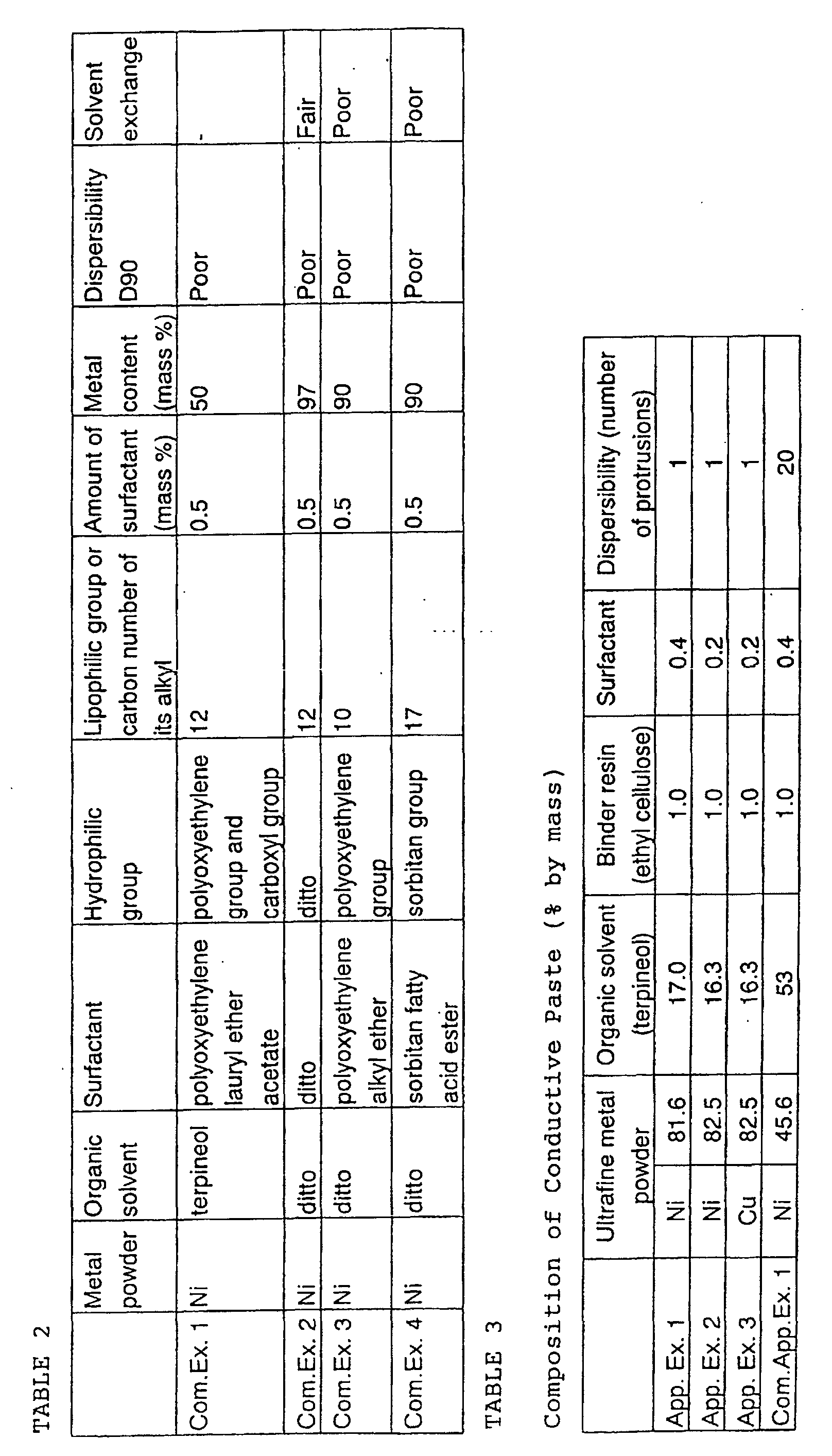
- While the present invention has been described with reference to what are presently considered to be the preferred embodiments, it is to be understood that the invention is not limited to the disclosed embodiments. On the contrary, the invention is intended to cover various modifications and equivalent arrangements included within the spirit and scope of the appended claims. The scope of the following claims is to be accorded the broadest interpretation so as to encompass all such modifications and equivalent structures and functions.
Claims (7)
- An ultrafine metal powder slurry with high dispersibility, comprising:whereinan organic solvent;a surfactant having a hydrophilic group and a lipophilic group; andan ultrafine metal powder in an amount more than 60% by mass and less than 95% by mass based on the mass of slurry,
the hydrophilic group of the surfactant is at least one selected from the group consisting of a sulfo group, a sulfonyldioxy group and a polyoxyethylene group with a carboxyl group,
wherein the lipophilic group of the surfactant is an alkyl group containing 12 or more carbon atoms or an alkylphenyl group, and
wherein the surfactant is at least one selected from the group consisting of polyoxyethylene lauryl ether carboxylic acids and alkylbenzenesulfonic acids. - A slurry according to claim 1, wherein the ultrafine metal powder has a particle size distribution D90 of less than 1.2 µm.
- A slurry according to claim 1 or 2, wherein the amount of the surfactant is more than 0.05% by mass and less than 2% by mass relative to the ultrafine metal powder.
- A slurry according to any of claims 1 to 3, wherein the ultrafine metal powder comprises at least one metal selected from the group consisting of nickel, copper, silver, molybdenum, tungsten, cobalt, and tantalum.
- A slurry according to any of claims 1 to 3, wherein the ultrafine metal powder is an alloy powder comprising nickel and at least one element selected from the group consisting of V, Cr, Nb, Mo, Ta, W, Zr, Y, La, Mg, Ti, Ba, and Ca.
- A slurry according to any of claims 1 to 3, wherein the ultrafine metal powder is an alloy powder comprising copper and at least one element selected from the group consisting of V, Cr, Nb, Mo, Ta, W, Zr, Y, La, Mg, Ti, Ba, and Ca.
- A method for preparing the ultrafine metal powder slurry according to any preceding claim, the method comprising steps of:producing an ultrafine metal powder;purifying the ultrafine metal powder with water to form an ultrafine metal powder-water slurry;subjecting the ultrafine metal powder-water slurry to mixing and agitation; andperforming an organic solvent substitution process, by adding a surfactant and an organic solvent to the ultrafine metal powder-water slurry and mixing; wherein
in the organic solvent substitution process the water in the ultrafine metal powder-water slurry is directly replaced by the organic solvent, and the substituted water is separated as a supernatant fluid and is drained, without drying or filtration, from the resulting ultrafine metal powder-surfactant-organic solvent precipitate.
Applications Claiming Priority (6)
| Application Number | Priority Date | Filing Date | Title |
|---|---|---|---|
| JP2001389998 | 2001-12-21 | ||
| JP2001389998 | 2001-12-21 | ||
| JP2002265835 | 2002-09-11 | ||
| JP2002265835 | 2002-09-11 | ||
| JP2002338014A JP4020764B2 (en) | 2001-12-21 | 2002-11-21 | Super fine metal slurry with excellent dispersibility |
| JP2002338014 | 2002-11-21 |
Publications (2)
| Publication Number | Publication Date |
|---|---|
| EP1323485A1 EP1323485A1 (en) | 2003-07-02 |
| EP1323485B1 true EP1323485B1 (en) | 2005-06-15 |
Family
ID=27347985
Family Applications (1)
| Application Number | Title | Priority Date | Filing Date |
|---|---|---|---|
| EP02258839A Expired - Lifetime EP1323485B1 (en) | 2001-12-21 | 2002-12-20 | Ultrafine metal powder slurry with high dispersibility |
Country Status (8)
| Country | Link |
|---|---|
| US (1) | US6881239B2 (en) |
| EP (1) | EP1323485B1 (en) |
| JP (1) | JP4020764B2 (en) |
| KR (1) | KR100652325B1 (en) |
| CN (1) | CN1288670C (en) |
| CA (1) | CA2415035C (en) |
| DE (1) | DE60204650T2 (en) |
| TW (1) | TWI245295B (en) |
Families Citing this family (42)
| Publication number | Priority date | Publication date | Assignee | Title |
|---|---|---|---|---|
| DE69819740T2 (en) * | 1997-02-24 | 2004-09-30 | Superior Micropowders Llc, Albuquerque | AEROSOL METHOD AND DEVICE, PARTICULATE PRODUCTS, AND ELECTRONIC DEVICES MADE THEREOF |
| US20060159838A1 (en) * | 2005-01-14 | 2006-07-20 | Cabot Corporation | Controlling ink migration during the formation of printable electronic features |
| RU2241721C1 (en) * | 2003-07-02 | 2004-12-10 | Государственное научное учреждение Всероссийский научно-исследовательский технологический институт ремонта и эксплуатации машинно-тракторного парка | Method for preparing composition |
| JP4495644B2 (en) * | 2004-07-30 | 2010-07-07 | Jfeミネラル株式会社 | Metal super fine slurry |
| TWI310570B (en) * | 2004-07-30 | 2009-06-01 | Jfe Mineral Co Ltd | Ultrafine metal powder slurry |
| JP4581584B2 (en) * | 2004-09-17 | 2010-11-17 | 株式会社村田製作所 | Multilayer ceramic capacitor and manufacturing method thereof |
| US8383014B2 (en) | 2010-06-15 | 2013-02-26 | Cabot Corporation | Metal nanoparticle compositions |
| WO2006076615A1 (en) * | 2005-01-14 | 2006-07-20 | Cabot Corporation | Ink-jet printing of compositionally no-uniform features |
| WO2006076614A1 (en) * | 2005-01-14 | 2006-07-20 | Cabot Corporation | A process for manufacturing application specific printable circuits (aspc's) and other custom electronic devices |
| WO2006076606A2 (en) * | 2005-01-14 | 2006-07-20 | Cabot Corporation | Optimized multi-layer printing of electronics and displays |
| WO2006076608A2 (en) * | 2005-01-14 | 2006-07-20 | Cabot Corporation | A system and process for manufacturing custom electronics by combining traditional electronics with printable electronics |
| US8167393B2 (en) * | 2005-01-14 | 2012-05-01 | Cabot Corporation | Printable electronic features on non-uniform substrate and processes for making same |
| TW200640596A (en) * | 2005-01-14 | 2006-12-01 | Cabot Corp | Production of metal nanoparticles |
| US7824466B2 (en) | 2005-01-14 | 2010-11-02 | Cabot Corporation | Production of metal nanoparticles |
| WO2006076603A2 (en) * | 2005-01-14 | 2006-07-20 | Cabot Corporation | Printable electrical conductors |
| ES2353397T3 (en) * | 2005-01-14 | 2011-03-01 | Cabot Corporation | SECURITY DEVICE, ITS USE, AND PROCESSES TO PRODUCE THEM. |
| KR100790856B1 (en) * | 2005-07-15 | 2008-01-03 | 삼성전기주식회사 | Multilayer Ceramic Capacitors Containing Phosphoric Acid Dispersant |
| KR100768706B1 (en) * | 2006-06-08 | 2007-10-19 | 삼성전기주식회사 | Metal ink composition for inkjet |
| KR100777662B1 (en) * | 2006-06-14 | 2007-11-29 | 삼성전기주식회사 | Conductive Ink Composition for Inkjet |
| KR100987973B1 (en) * | 2006-08-09 | 2010-10-18 | 디아이씨 가부시끼가이샤 | Metal Nanoparticle Dispersion and Manufacturing Method Thereof |
| DE102007037079A1 (en) * | 2006-10-25 | 2008-04-30 | Bayer Materialscience Ag | Silver-containing aqueous formulation and its use for the production of electrically conductive or reflective coatings |
| EP1987960B1 (en) | 2007-05-03 | 2013-10-23 | Teknologian tutkimuskeskus VTT | Conductive ink and conductor |
| JP2011011182A (en) * | 2009-07-06 | 2011-01-20 | Sanyo Chem Ind Ltd | Dispersant |
| JP5890603B2 (en) * | 2009-08-28 | 2016-03-22 | Dowaエレクトロニクス株式会社 | Metal nanoparticles and aggregates thereof, metal nanoparticle dispersions, and members formed using the same |
| WO2011078140A1 (en) * | 2009-12-22 | 2011-06-30 | Dic株式会社 | Conductive paste for screen printing |
| WO2011148520A1 (en) * | 2010-05-26 | 2011-12-01 | 第一工業製薬株式会社 | Dispersant and dispersion composition |
| DE102011077907B4 (en) | 2011-06-21 | 2013-07-11 | Leibniz-Institut Für Festkörper- Und Werkstoffforschung Dresden E.V. | METHOD FOR PRODUCING PRINTED MAGNETIC FUNCTIONAL ELEMENTS FOR RESISTANCE SENSORS AND PRINTED MAGNETIC FUNCTIONAL ELEMENTS |
| JP5795949B2 (en) * | 2011-11-25 | 2015-10-14 | 第一工業製薬株式会社 | Resin composition for optical materials |
| CN102664057B (en) * | 2012-05-17 | 2013-11-27 | 合肥工业大学 | Conductive copper paste for surface electrode of chip ceramic capacitor and preparation method thereof |
| JP5969354B2 (en) * | 2012-10-31 | 2016-08-17 | 新日鉄住金化学株式会社 | Method for producing dispersible nickel fine particle slurry |
| US9085699B2 (en) * | 2013-01-22 | 2015-07-21 | Eastman Kodak Company | Silver metal nanoparticle composition |
| JP6398847B2 (en) * | 2014-04-16 | 2018-10-03 | 信越化学工業株式会社 | Titanium oxide solid solution organic solvent dispersion, method for producing the same, and coating agent |
| CN104174841B (en) * | 2014-08-18 | 2016-08-24 | 东莞市戍普电子科技有限公司 | Superelevation holds manufacture method and nickel slurry, the MLCC that MLCC starches with nickel |
| JP6222373B2 (en) * | 2014-09-26 | 2017-11-01 | 住友金属鉱山株式会社 | Nickel paste and method for producing nickel paste |
| CN105161221B (en) * | 2015-10-20 | 2017-05-24 | 西安创联光电新材料有限公司 | Preparation method of copper electronic paste for piezoelectric ceramics |
| JP6897278B2 (en) * | 2016-04-25 | 2021-06-30 | 住友金属鉱山株式会社 | Nickel paste and nickel paste manufacturing method |
| JP7064684B2 (en) * | 2017-02-01 | 2022-05-11 | 住友金属鉱山株式会社 | Internal electrode paste and its manufacturing method, and monolithic ceramic capacitors |
| JP7263694B2 (en) * | 2017-12-07 | 2023-04-25 | 住友金属鉱山株式会社 | Nickel paste for multilayer ceramic capacitors |
| WO2020144746A1 (en) * | 2019-01-08 | 2020-07-16 | 住友金属鉱山株式会社 | Nickel paste for multilayer ceramic capacitors |
| TWI795509B (en) * | 2019-01-14 | 2023-03-11 | 日商住友金屬鑛山股份有限公司 | Nickel Paste for Multilayer Ceramic Capacitors |
| CN110340374A (en) * | 2019-08-06 | 2019-10-18 | 攀钢集团研究院有限公司 | The preparation method of vanadium chromium titanium powder |
| CN113270270B (en) * | 2021-05-27 | 2022-04-05 | 广东省先进陶瓷材料科技有限公司 | Anti-oxidation nickel slurry and preparation method and application thereof |
Family Cites Families (12)
| Publication number | Priority date | Publication date | Assignee | Title |
|---|---|---|---|---|
| US4752528A (en) * | 1984-09-17 | 1988-06-21 | Toray Industries, Inc. | Modified fine particles and a process for their production |
| US4904411A (en) * | 1986-04-25 | 1990-02-27 | Ceramics Process Systems Corp. | Highly loaded, pourable suspensions of particulate materials |
| US4978643A (en) * | 1987-04-09 | 1990-12-18 | Ceramics Process Systems Corporation | Forming whisker reinforced sintered ceramics with polymerizable binder precursors |
| US4894746A (en) * | 1987-06-06 | 1990-01-16 | Murata Manufacturing Co., Ltd. | Laminated capacitor with fuse function |
| US5047182A (en) * | 1987-11-25 | 1991-09-10 | Ceramics Process Systems Corporation | Complex ceramic and metallic shaped by low pressure forming and sublimative drying |
| JP2806578B2 (en) * | 1989-12-11 | 1998-09-30 | 日本ゼオン株式会社 | Magnetic recording media |
| US5268233A (en) * | 1991-11-22 | 1993-12-07 | The Lubrizol Corporation | Methods of preparing sintered shapes and green shapes used therein |
| JPH05266462A (en) * | 1991-11-25 | 1993-10-15 | Tdk Corp | Magnetic recording medium |
| US6447571B1 (en) | 1998-07-15 | 2002-09-10 | Toho Titanium Co., Ltd. | Metal powder |
| AU5566899A (en) * | 1998-08-17 | 2000-03-06 | Procter & Gamble Company, The | Multifunctional detergent materials |
| JP4385457B2 (en) * | 1999-11-19 | 2009-12-16 | 堺化学工業株式会社 | Method for producing fine spherical metal nickel fine powder |
| KR100447965B1 (en) | 2000-01-31 | 2004-09-13 | 토호 티타늄 가부시키가이샤 | Nickel power dispersion, method of producing nickel power dispersion and method of producing conductive paste |
-
2002
- 2002-11-21 JP JP2002338014A patent/JP4020764B2/en not_active Expired - Fee Related
- 2002-12-13 US US10/318,147 patent/US6881239B2/en not_active Expired - Lifetime
- 2002-12-20 KR KR1020020081613A patent/KR100652325B1/en not_active Expired - Fee Related
- 2002-12-20 TW TW091136867A patent/TWI245295B/en not_active IP Right Cessation
- 2002-12-20 DE DE60204650T patent/DE60204650T2/en not_active Expired - Lifetime
- 2002-12-20 EP EP02258839A patent/EP1323485B1/en not_active Expired - Lifetime
- 2002-12-20 CA CA002415035A patent/CA2415035C/en not_active Expired - Fee Related
- 2002-12-23 CN CNB021570736A patent/CN1288670C/en not_active Expired - Lifetime
Also Published As
| Publication number | Publication date |
|---|---|
| TW200301491A (en) | 2003-07-01 |
| KR20030053036A (en) | 2003-06-27 |
| TWI245295B (en) | 2005-12-11 |
| JP4020764B2 (en) | 2007-12-12 |
| JP2004158397A (en) | 2004-06-03 |
| EP1323485A1 (en) | 2003-07-02 |
| CN1288670C (en) | 2006-12-06 |
| US6881239B2 (en) | 2005-04-19 |
| CN1427422A (en) | 2003-07-02 |
| HK1056791A1 (en) | 2004-02-27 |
| CA2415035A1 (en) | 2003-06-21 |
| US20030145680A1 (en) | 2003-08-07 |
| CA2415035C (en) | 2009-04-21 |
| DE60204650T2 (en) | 2005-11-03 |
| DE60204650D1 (en) | 2005-07-21 |
| KR100652325B1 (en) | 2006-11-29 |
Similar Documents
| Publication | Publication Date | Title |
|---|---|---|
| EP1323485A1 (en) | Ultrafine metal powder slurry with high dispersibility | |
| US7601197B2 (en) | Ultrafine metal powder slurry | |
| JP4495644B2 (en) | Metal super fine slurry | |
| JPH05503502A (en) | Improved ceramic dielectric compositions and methods for enhancing dielectricity | |
| KR20090115854A (en) | Metal nanoparticle dispersions, preparation method thereof and synthesis method of metal nanoparticles | |
| TWI284069B (en) | Surface-treated ultrafine metal powder, method for producing the same, conductive metal paste of the same, and multilayer ceramic capacitor using said paste | |
| JP5326647B2 (en) | Method for producing composition for forming electrode of solar cell | |
| JP5522885B2 (en) | Nickel powder, method for producing the same, and conductive paste | |
| JP5435063B2 (en) | Method for producing composition for forming electrode of solar cell and method for forming the electrode | |
| JP2017182932A (en) | Metal powder paste manufacturing method, metal powder paste screen printing method, electrode manufacturing method, chip multilayer ceramic capacitor manufacturing method, and metal powder paste | |
| JP3798994B2 (en) | Metal powder, method for producing the same, and conductive paste containing the metal powder | |
| JP5151229B2 (en) | Composition for forming electrode of solar cell, method for forming the electrode, and method for producing solar cell using the electrode obtained by the forming method | |
| DE102016002890A1 (en) | Process for the preparation of an ink, ink and their use | |
| JP2001167631A (en) | Ultrafine particle conductor paste, method for producing the same, conductor film using the paste, and multilayer ceramic electronic component | |
| CN113242774B (en) | Silver paste | |
| TWI908790B (en) | Method for producing inorganic fine powder | |
| JP2005146386A (en) | Method for producing metal powder slurry and nickel powder slurry obtained by the method | |
| JP2004183027A (en) | Method for manufacturing nickel powder, nickel powder, electroconductive paste, and multilayered ceramic electronic component | |
| JP4081867B2 (en) | Inorganic powder and method for producing inorganic powder | |
| JP2003034801A (en) | Metal powder and manufacturing method therefor | |
| JP3727904B2 (en) | Metal powder and method for producing the same | |
| CN113226596B (en) | Silver paste | |
| KR20200066075A (en) | The manufacturing method of silver powder with improved washability |
Legal Events
| Date | Code | Title | Description |
|---|---|---|---|
| PUAI | Public reference made under article 153(3) epc to a published international application that has entered the european phase |
Free format text: ORIGINAL CODE: 0009012 |
|
| AK | Designated contracting states |
Designated state(s): AT BE BG CH CY CZ DE DK EE ES FI FR GB GR IE IT LI LU MC NL PT SE SI SK TR |
|
| AX | Request for extension of the european patent |
Extension state: AL LT LV MK RO |
|
| 17P | Request for examination filed |
Effective date: 20030718 |
|
| 17Q | First examination report despatched |
Effective date: 20031028 |
|
| AKX | Designation fees paid |
Designated state(s): BE DE FR GB NL |
|
| GRAP | Despatch of communication of intention to grant a patent |
Free format text: ORIGINAL CODE: EPIDOSNIGR1 |
|
| GRAS | Grant fee paid |
Free format text: ORIGINAL CODE: EPIDOSNIGR3 |
|
| GRAA | (expected) grant |
Free format text: ORIGINAL CODE: 0009210 |
|
| AK | Designated contracting states |
Kind code of ref document: B1 Designated state(s): BE DE FR GB NL |
|
| REG | Reference to a national code |
Ref country code: GB Ref legal event code: FG4D |
|
| REF | Corresponds to: |
Ref document number: 60204650 Country of ref document: DE Date of ref document: 20050721 Kind code of ref document: P |
|
| ET | Fr: translation filed | ||
| PLBE | No opposition filed within time limit |
Free format text: ORIGINAL CODE: 0009261 |
|
| STAA | Information on the status of an ep patent application or granted ep patent |
Free format text: STATUS: NO OPPOSITION FILED WITHIN TIME LIMIT |
|
| 26N | No opposition filed |
Effective date: 20060316 |
|
| REG | Reference to a national code |
Ref country code: DE Ref legal event code: R082 Ref document number: 60204650 Country of ref document: DE Representative=s name: HASELTINE LAKE LLP, DE |
|
| REG | Reference to a national code |
Ref country code: FR Ref legal event code: PLFP Year of fee payment: 14 |
|
| REG | Reference to a national code |
Ref country code: FR Ref legal event code: PLFP Year of fee payment: 15 |
|
| PGFP | Annual fee paid to national office [announced via postgrant information from national office to epo] |
Ref country code: FR Payment date: 20161111 Year of fee payment: 15 |
|
| PGFP | Annual fee paid to national office [announced via postgrant information from national office to epo] |
Ref country code: BE Payment date: 20161114 Year of fee payment: 15 |
|
| PGFP | Annual fee paid to national office [announced via postgrant information from national office to epo] |
Ref country code: DE Payment date: 20171212 Year of fee payment: 16 Ref country code: NL Payment date: 20171115 Year of fee payment: 16 |
|
| PGFP | Annual fee paid to national office [announced via postgrant information from national office to epo] |
Ref country code: GB Payment date: 20171220 Year of fee payment: 16 |
|
| REG | Reference to a national code |
Ref country code: FR Ref legal event code: ST Effective date: 20180831 |
|
| REG | Reference to a national code |
Ref country code: BE Ref legal event code: MM Effective date: 20171231 |
|
| PG25 | Lapsed in a contracting state [announced via postgrant information from national office to epo] |
Ref country code: FR Free format text: LAPSE BECAUSE OF NON-PAYMENT OF DUE FEES Effective date: 20180102 |
|
| PG25 | Lapsed in a contracting state [announced via postgrant information from national office to epo] |
Ref country code: BE Free format text: LAPSE BECAUSE OF NON-PAYMENT OF DUE FEES Effective date: 20171231 |
|
| REG | Reference to a national code |
Ref country code: DE Ref legal event code: R119 Ref document number: 60204650 Country of ref document: DE |
|
| REG | Reference to a national code |
Ref country code: NL Ref legal event code: MM Effective date: 20190101 |
|
| GBPC | Gb: european patent ceased through non-payment of renewal fee |
Effective date: 20181220 |
|
| PG25 | Lapsed in a contracting state [announced via postgrant information from national office to epo] |
Ref country code: NL Free format text: LAPSE BECAUSE OF NON-PAYMENT OF DUE FEES Effective date: 20190101 |
|
| PG25 | Lapsed in a contracting state [announced via postgrant information from national office to epo] |
Ref country code: DE Free format text: LAPSE BECAUSE OF NON-PAYMENT OF DUE FEES Effective date: 20190702 |
|
| PG25 | Lapsed in a contracting state [announced via postgrant information from national office to epo] |
Ref country code: GB Free format text: LAPSE BECAUSE OF NON-PAYMENT OF DUE FEES Effective date: 20181220 |