TECHNICAL FIELD
The present invention relates to an improved
chemical method for converting a 2- or
4-nitrobenzenesulfonamide to a corresponding amine. The
nitrobenzenesulfonamide is a compound in which an amino
group is protected with a nitrobenzenesulfonyl group which
is a protective group, and is widely used. The method of
the present invention is extremely useful as a method for
removing the above protective group in producing an
optically active amine useful as an intermediate of a
pharmaceutical or an agricultural chemical, or an
intermediate of a physiologically active substance or the
like.
BACKGROUND ART
It is known that a 2- or 4-nitrobenzenesulfonyl
group is useful as an amino protective group for an
optically active amine or an amino acid which is important
as an intermediate of a pharmaceutical or a physiologically
active substance, and the group is often used in the course
of synthesis of such a compound. As methods for removing
the nitrobenzenesulfonyl group, only methods as described
below are known in which a thiolate ion is allowed to act
in the coexistence of a base:
DISCLOSURE OF THE INVENTION
However, in any of the above methods, the ill-smelling
thiol compounds have to be used. For industrially
carrying out the above-described methods, there is the
serious problem that special equipment in which
consideration for the environment such as smell-removing
measures is taken is required, or that treatment for making
the thiol compounds odorless after reaction, which are
ordinarily used in excess, becomes necessary. Accordingly,
the development of a method for removing the 2- or 4-nitrobenzenesulfonyl
group has been desired which can avoid the
use of a thiol, is simple, has general-purpose properties,
and is more industrially advantageous.
In view of the above-described state, the present
inventor has made intensive studies for solving such a
problem. As a result, the inventor has discovered that the
nitrobenzenesulfonyl group bonded to an amino group can be
easily removed to convert the nitrobenzenesulfonamide to a
corresponding amine by allowing an alkali metal alkoxide to
act on a 2- or 4-nitrobenzenesulfonamide, thus completing
the present invention.
That is to say, the present invention relates to a
method for removing a nitrobenzenesulfonyl group from a
nitrobenzenesulfonamide and a method for producing an amine
derivative using this method, having the following
constitutions:
wherein R
1 and R
2 are the same as described above, and R
3
represents a substituted oxycarbonyl group or an acyl group.
BEST MODE FOR CARRYING OUT THE INVENTION
The present invention is described in detail below.
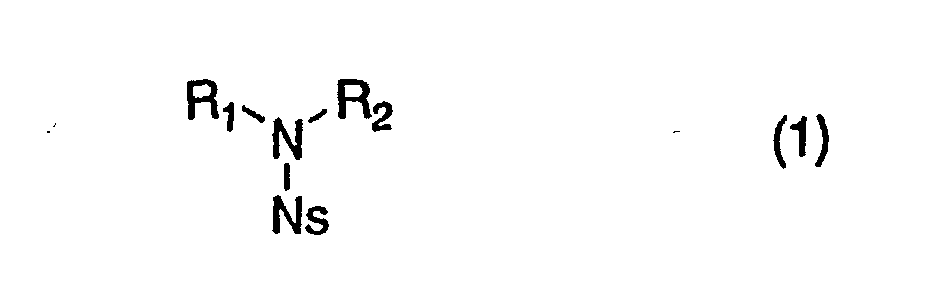
First, the 2- or 4-nitrobenzenesulfonamide used as
a starting material in the present invention is represented
by the following formula (1):
wherein R
1 and R
2, which are the same or different, each
represents a hydrogen atom or an aliphatic or alicyclic
hydrocarbon group which may be substituted, or an atomic
group in which R
1 and R
2 combine with each other at their
ends together with an adjacent nitrogen atom to form a
cyclic amine which may be substituted; and Ns represents a
2-nitrobenzenesulfonyl group or a 4-nitrobenzenesulfonyl
group.
The above-described compound (hereinafter referred
to as compound (1)) is usually synthesized by allowing a
corresponding amine with a 2- or 4-nitrobenzenesulfonyl
halide in a solvent, in the coexistence of a base. As the
2- or 4-nitrobenzenesulfonyl halide, a chloride thereof is
suitably used.
Furthermore, as the above-described base, either an
organic base or an inorganic base can be used. As the
organic base, generally, a tertiary amine which does not
consume the 2- or 4-nitrobenzenesulfonyl halide by reaction
with the reagent is suitably used. Examples include
trimethylamine, triethylamine, tri-n-propylamine,
tri-n-butylamine, diisopropylethylamine,
N,N,N',N'-tetramethylethylenediamine,
N,N,N',N'-tetramethyl-1,3-propanediamine,
N-methylmorpholine, N,N'-dimethylpiperazine,
1,4-diazabicyclo[2.2.2]octane, 1,5-diazabicyclo[4.3.0]-5-nonene,
1,8-diazabicyclo[5.4.0]-7-undecene and the like.
Heterocyclic aromatic amines such as pyridine,
4-dimethylaminopyridine, collidine, lutidine and the like
are also available.
Examples of the inorganic base include alkali metal
hydroxides such as lithium hydroxide, sodium hydroxide,
potassium hydroxide and the like, alkaline earth metal
hydroxides such as magnesium hydroxide, calcium hydroxide,
barium hydroxide and the like, alkaline metal carbonates
such as lithium carbonate, sodium carbonate, potassium
carbonate, cesium carbonate and the like, and quaternary
ammonium hydroxides such as tetrabutylammonium hydroxide,
tetraethylammonium hydroxide, tetramethylammonium hydroxide
and the like.
Although there is no particular limitation on the
solvent used in the reaction, suitably used are organic
solvents, water, mixed solvents of hydrophilic organic
solvents and water, and the like, which are usually often
employed. Examples of these solvents include methylene
chloride, chloroform, N,N-dimethylformamide, acetonitrile,
dioxane, tetrahydrofuran, dimethoxyethane, tert-butyl
alcohol, water-dioxane, water-tetrahydrofuran and the like.
Furthermore, besides synthesis by sulfonylation of
the amine as described above, compound (1) can also be
synthesized by further conversion of a compound already
having the nitrobenzenesulfonyl group, and can also be
synthesized through alkylation from an alkali metal salt of
the nitrobenzenesulfonamide.
As an example of conversion of the compound already
having the nitrobenzenesulfonyl group, for example, JP-A-11-171855
discloses an example of synthesis of (S)-N-(2-nitrobenzenesulfonyl)azetidine-2-carboxylic
acid by
cyclization of methyl (S)-N-(2-nitrobenzenesulfonyl)-α-amino-γ-iodobutyrate
and subsequent hydrolysis.
Furthermore, an example is described in Tetrahedron Lett.,
38: 5253 (1997) in which N-(4-nitrobenzenesulfonyl)-1-substituted-2-propylamine
substituted by each of various
nucleophiles is synthesized by ring opening reaction of
2-methylnosylaziridine (nosyl and nitrobenzenesulfonyl have
the same meaning) with the nucleophiles. Still furthermore,
an example is described in J. Am. Chem. Soc., 122, 976
(2000) in which optically active
[N-(4-trifluoromethylphenyl)phenylmethyl]-4-nitrobenzenesulfonamide
is synthesized by introducing a
phenyl group by nucleophilic addition into an
N-alkylidenesulfonamide prepared from
4-trifluoromethylbenzaldehyde and 4-nitrobenzenesulfonamide.
Furthermore, as an example of synthesis through
alkylation from the alkali metal salt of the
nitrobenzenesulfonamide, a production example is describe,
for example, in Angew. Chem. Int. Ed., 39: 1323 (2000) in
which optically active methyl β-substituted-β-N-(2-nitrobenzenesulfonyl)aminopropionate
is produced by
reaction of a sodium salt of 2-nitrobenzenesulfonamide with
β-lactone variously substituted. Still furthermore, an
example is described in J. Am. Chem. Soc., 121:6761 (1999)
in which an optically active
N-(2-nitrobenzenesulfonyl)benzylallylamine derivative is
produced by reaction of a lithium salt of
N-(2-nitrobenzenesulfonyl)benzylamine with an allyl
carbonate derivative.
R1 and R2 of compound (1), which are the same or
different, each represents a hydrogen atom or an aliphatic
or alicyclic hydrocarbon group which may be substituted, or
an atomic group in which R1 and R2 combine with each other
at their ends together with an adjacent nitrogen atom to
form a cyclic amine which may be substituted.
The aliphatic or alicyclic hydrocarbon group of the
aliphatic or alicyclic hydrocarbon group which may be
substituted includes a straight-chain, branched or cyclic
hydrocarbon group having from 1 to 10 carbon atoms, and
specifically, it is methyl, ethyl, vinyl, ethynyl, n-propyl,
isopropyl, cyclopropyl, allyl, propargyl, n-butyl, isobutyl,
sec-butyl, tert-butyl, cyclobutyl, cyclopentyl, neopentyl,
cyclohexyl, n-octyl or the like. These groups may be
substituted at any positions at which they are
substitutable. Although asymmetric carbon atoms can be
produced by substitution, the asymmetric carbon atoms may
be contained in the above-described groups. That is to say,
they may be optically active.
Substituents by which the above-described
hydrocarbon groups may be substituted include a hydroxyl
group, a carboxylic acid group, an ester group, an amido
group, an amino group, a cyano group, an alkoxyl group, an
alkylthio group, an arylthio group, an aryl group, a
heterocyclic group, a halogen atom and the like.
Specifically, they include an ester group such as
methoxycarbonyl, ethoxycarbonyl, isopropyloxycarbonyl,
tert-butoxycarbonyl, benzyloxycarbonyl or the like, an
amido group such as carbamoyl, N-methylcarbamoyl, N,N-dimethylcarbamoyl,
N-ethylcarbamoyl, N,N-diethylcarbamoyl,
N,N-dibenzylcarbamoyl or the like, an amino group such as
amino, N-methylamino, N,N-dimethylamino, N-ethylamino,
N,N-diethylamino, N-benzylamino, N,N-dibenzylamino or the
like, an alkoxyl group such as methoxy, ethoxy, isopropoxy,
tert-butoxy, benzyloxy or the like, an alkylthio group such
as methylthio, ethylthio, benzylthio or the like, an
arylthio group such as phenylthio or the like, an aryl
group such as phenyl, tolyl, naphthyl or the like, a
heterocyclic group such as azetidinyl, pyrrolidinyl,
piperidyl, piperazinyl, morpholinyl, tetrahydrofuranyl,
tetrahydropyranyl, furyl, thienyl, imidazolyl, pyridyl,
quionlyl, isoquinolyl or the like, and a halogen atom such
as fluorine, chlorine, bromine, iodine or the like.
Furthermore, when R1 and R2 combine with each other
at their ends together with an adjacent nitrogen atom to
form a cyclic amine which may be substituted, the cyclic
amine includes, for example, an azetidine ring, a
pyrrolidine ring, a piperidine ring and the like. These
rings may be substituted at any positions at which they are
substitutable. Similarly to the case of the above-described
aliphatic or alicyclic hydrocarbon groups,
asymmetric carbon atoms can be produced. However, the
asymmetric carbon atoms may be contained in the above-described
groups. That is to say, they may be optically
active. Substituents by which the above-described rings
may be substituted include substituents similar to those
for the above-described aliphatic or alicyclic hydrocarbon
groups.
Furthermore, substituent Ns in compound (1) is a
2-nitrobenzenesulfonyl group or a 4-nitrobenzenesulfonyl
group.
Compound (1) useful as an intermediate of a
pharmaceutical or an agricultural chemical includes a
nitrobenzenesulfonamide of (S)-3-aminopyrrolidine,
(S)-3-amino-2-pyrrolidone or the like, and the like, as
well as a nitrobenzenesulfonamide of an α-amino acid
derivative such as (S)-azetidine-2-carboxylic acid, (R)-proline
or the like, a nitrobenzenesulfonamide of a β-amino
acid derivative such as (S)-phenyl-β-alanine, (S)-3-pyridyl-β-alanine
or the like, and a
nitrobenzenesulfonamide of an amino alcohol derivative such
as (R)-phenylglycinol, (1R,2R)-1-amino-2-indanol, (R)-1-(3-pyridyl)-2-aminoethanol,
(R)-1-(3-chlorophenyl)-2-aminoethanol,
(S)-3-hydroxypyrrolidine or the like.
Then, removing reaction of the nitrobenzenesulfonyl
group by the contact of compound (1) with the alkali metal
alkoxide is described.
The alkali metal alkoxides used in this removing
reaction include lithium methoxide, sodium methoxide,
potassium methoxide, lithium ethoxide, sodium ethoxide,
sodium tert-butoxide, potassium tert-butoxide and the like.
The alkoxide is preferably a methoxide, and the alkali
metal is preferably sodium or lithium. Sodium methoxide is
particularly preferred among others. As the above-described
alkali metal alkoxides, either ones which can
usually be purchased can be used as such, or for example,
ones generated from organolithium compounds or alkali metal
amide compounds and the corresponding alcohols in the
reaction system can be used, if necessary.
As to the amount of the alkali metal alkoxide used,
when compound (1) has no substituent reactive with the
alkali metal alkoxide, the amount equimolar or more to
compound (1) is required. However, from the economical
point, the amount nearer to the equimolar amount is more
desirable. On the other hand, when compound (1) has
substituents reactive with the alkali metal alkoxide (for
example, a carboxyl group or a hydroxyl group), it is
necessary to use the alkali metal alkoxide in an amount of
at least the number of moles obtained by adding 1 to the
number of these substituents. Usually, it is suitably used
in a 0.5- to 2.5-fold molar equivalent excess, in addition
to the calculated amount.
The above-described reaction is usually conducted
in a solvent. There is no particular limitation on the
solvent used, as long as it does not inactivate the alkali
metal alkoxide. Examples include aliphatic hydrocarbon
solvents such as hexane, heptane and the like, aromatic
hydrocarbon solvents such as toluene, xylene and the like,
ether solvents such as tetrahydrofuran, dimethoxyethane,
dioxane, tert-butyl methyl ether, isopropyl ether and the
like, nitrile solvents such as acetonitrile, propionitrile
and the like, amide solvents such as N,N-dimethylformamide
and the like, sulfoxide solvents such as dimethyl sulfoxide
and the like, alcohol solvents such as methanol, ethanol
and the like, and the like. Ether solvents are
particularly suitably used. These solvents may be used
either alone or as a mixture of two or more of them.
Although the amount thereof used is within the range of
from the 5- to 40-fold solvent volume (ml) based on the
substrate mass (g) of compound (1), the smaller amount is
desirable, considering economy and productivity.
The reaction temperature is preferably 0°C or
higher, and more preferably 20°C or higher from the
viewpoint of reaction speed. The upper limit is the
boiling point of the solvent. The reaction time is
considerably different depending on the reaction conditions,
so that it is difficult to show it generally. However,
usually, a reaction solution is analyzed with time by use
of analytical means of common use such as thin layer
chromatography (TLC), high performance liquid
chromatography (HPLC), gas chromatography (GLC) and the
like, and the disappearance of starting materials is
confirmed, thereby knowing the end point of the reaction.
Thus, the reaction can be terminated.
The product in which the nitrobenzenesulfonyl group
has been removed by the above-described reaction is
isolated as described below, as needed.
When a water-soluble solvent is used as the
reaction solvent, the reaction solvent is first removed by
evaporation prior to extraction. However, it is not
necessarily removed by evaporation in some cases. The
reaction solvent may be removed by evaporation either after
or before neutralization of the alkali metal alkoxide used
with an acid, but preferably after neutralization.
Alternatively, when the reaction solvent is not water-soluble,
it may not be removed by evaporation, and
neutralization and extraction are conducted as such.
Although there is no particular limitation on the
acid used for neutralization of the alkali metal alkoxide
used, an inorganic acid is usually employed. Preferably,
hydrochloric acid, sulfuric acid or the like appropriately
diluted is used. In the succeeding extraction, the product
is an amine, so that the solution is made acidic to convert
the amine to a salt with an acid, and the desired product
is first extracted with acidic water into an aqueous layer,
for separating the desired product from a by-product
derived from the nitrobenzenesulfonyl group in the above-described
reaction. Then, the aqueous layer is made basic,
and the desired product is extracted as a free amine with a
suitable solvent.
An alkali used for making the aqueous layer basic
is an alkali metal hydroxide, an alkali metal carbonate or
the like, and an aqueous solution of sodium hydroxide, an
aqueous solution of sodium carbonate or the like is
suitably used. Although there is no particular limitation
on the solvent used for extraction, ether, hexane, ethyl
acetate, toluene or the like can be suitably used. When
the reaction product is a highly water soluble compound
such as a free amino acid or the like, water extraction is
conducted with acidic water in the same manner as described
above, followed by adjustment to a suitable pH, and
isolation and purification can also be conducted using an
ion exchange resin.
Usually, the desired product isolated as described
above has a purity sufficient to carry out further
conversion. However, the purity may be further heightened
by chromatography, crystallization, distillation or the
like if necessary.
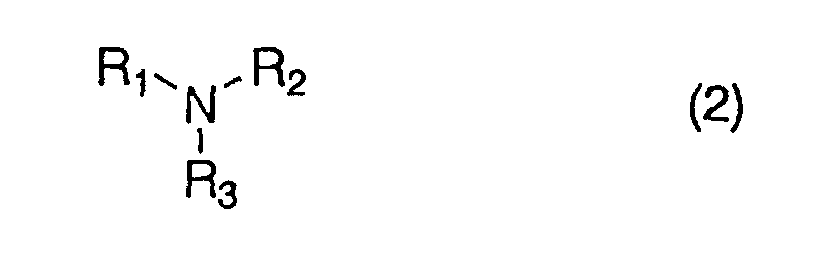
Furthermore, the product in which the
nitrobenzenesulfonyl group is removed in the above-described
reaction is not necessarily required to be
isolated, and a substituted oxycarbonyl group or an acyl
group can be introduced into a free amino group to produce
a compound represented by formula (2) (hereinafter referred
to as compound (2)).
Then, the method of the present invention for
producing compound (2) is described.
Substituents R1 and R2 in compound (2) are the same
as in compound (1). Furthermore, substituent R3 is a
substituted oxycarbonyl group or an acyl group. The
substituted oxycarbonyl group as used herein indicates an
alkoxycarbonyl group usually often used as a protective
group, and includes, for example, methoxycarbonyl,
ethoxycarbonyl, tert-butoxycarbonyl, allyloxycarbonyl,
benzyloxycarbonyl and the like. The acyl group includes,
for example, formyl, acetyl, chloroacetyl, trifluoroacetyl,
trichloroacetyl, benzoyl and the like, which are usually
often used as a protective group. Besides, the acyl group
may be an acyl residue of an amino acid appropriately
protected.
For introducing the above-described substituent R3
into the compound in which the nitrobenzenesulfonyl group
is removed from compound (1) to convert it to compound (2),
a base may be allowed to coexist newly after neutralization
of the solution subjected to the above-described removing
reaction, and to react with an activated, substituted
oxycarbonyl compound or an activated acyl compound. The
activated, substituted oxycarbonyl compound as used herein
is, for example, a substituted oxycarbonyl compound
activated in the form of a halide, an active ester, an
anhydride, an azide, a cyanide or the like, and includes,
for example, methyl chlorocarbonate, ethyl chlorocarbonate,
di-tert-butyl dicarbonate, tert-butoxycarbonylazide,
diallyl dicarbonate, benzyl chlorocarbonate, dibenzyl
dicarbonate and the like. Furthermore, the activated acyl
compound is an acyl compound activated in the form of a
halide, an active ester, an anhydride, an active amide, a
cyanide or the like, and includes, for example, acetic
anhydride, acetyl chloride, pentafluorophenyl acetate,
p-nitrophenyl acetate, acetylimidazole, trifluoroacetic
acid anhydride, benzoyl chloride, benzoyl cyanide and the
like. In either case of the activated, substituted
oxycarbonyl compound and the activated acyl compound,
usually, a chloride is suitably used.
Although there is no particular limitation on the
base allowed to coexist in the reaction, there can be used,
for example, an organic tertiary amine such as
triethylamine, diisopropylethylamine, pyridine or the like,
an inorganic base such as sodium carbonate, potassium
carbonate, sodium hydrogen carbonate, sodium hydroxide,
magnesium oxide or the like, or the like. As a solvent for
the above-described reaction, the solvent used in the
preceding reaction may be either used as such, or replaced
by another solvent as needed.
Compound (2) produced as described above is
isolated by extraction and concentration after removal of
the reaction solvent by evaporation if necessary. In
extraction, for example, toluene, ethyl acetate or the like
is suitably used. The product isolated by concentration
may be further heightened in the purity by chromatography,
crystallization, distillation or the like as needed.
Examples
The present invention is described with reference
to examples in greater detail, but it would be understood
that the present invention is not limited thereto.
Reference Example 1
Preparation of N-(2-nitrobenzenesulfonyl)benzhydrylamine:
N-(2-Nitrobenzenesulfonyl)benzhydrylamine used in
the following examples was prepared as described below.
2-Nitrobenzenesulfonyl chloride (2.50 g) was added
to a methylene chloride solution (30 ml) containing
benzhydrylamine (1.87 g) and triethylamine (1.58 g) under
ice cooling, followed by stirring for 3.3 hours under ice
cooling and for 68.7 hours at room temperature. Water (40
ml), 6 N hydrochloric acid (2 ml) and methylene chloride
(10 ml) were added to the reaction mixture, followed by
extraction and solution separation, and the aqueous layer
was extracted again with methylene chloride (10 ml). The
resulting extract was dried over sodium sulfate, filtered,
concentrated and further dissolved again in ethyl acetate
(70 ml), followed by washing with water (20 ml). The
organic layer was dried over sodium sulfate, filtered,
concentrated and dried under vacuum to obtain
N-(2-nitrobenzenesulfonyl)benzhydrylamine (3.71 g; yield:
98.7%).
Reference Example 2
Preparation of N-(4-nitrobenzenesulfonyl)benzhydrylamine:
N-(4-Nitrobenzenesulfonyl)benzhydrylamine used in
the following examples was prepared as described below.
4-Nitrobenzenesulfonyl chloride (2.51 g) was added
to a methylene chloride solution (30 ml) containing
benzhydrylamine (2.12 g) and triethylamine (1.62 g) under
ice cooling, followed by stirring for 3 hours under ice
cooling and for 69 hours at room temperature. Water (30
ml), 1 N hydrochloric acid (12 ml) and methylene chloride
(5 ml) were added to the reaction mixture, followed by
extraction and solution separation, and the aqueous layer
was extracted again with methylene chloride (10 ml). The
resulting extract was concentrated, and ethyl acetate (80
ml) and water (50 ml) were further added, followed by
solution separation. The organic layer was washed in turn
with saturated aqueous solution of sodium bicarbonate (10
ml) and water (25 ml), and concentrated. The resulting
solid was washed with a mixed solution of ether (9
ml)/hexane (20 ml) and successively with hexane (10 ml),
and dried under vacuum to obtain N-(4-nitrobenzenesulfonyl)benzhydrylamine
(3.81 g; yield: 91.3%).
Reference Example 3
Preparation of (S)-N-(2-nitrobenzenesulfonyl)proline:
(S)-N-(2-Nitrobenzenesulfonyl)proline used in the
following example was prepared as described below.
2-Nitrobenzenesulfonyl chloride (5.79 g) was added
to a mixed solution of tetrahydrofuran (20 ml)/water (17
ml) containing (S)-proline (2.00 g), 5 N sodium hydroxide
(3.5 ml) and sodium carbonate (3.77 g) under ice cooling,
followed by stirring for 1 hour under ice cooling and for
22 hours at room temperature. Water (20 ml) was added to
the reaction mixture, and the organic solvent was removed
by evaporation under reduced pressure. Then, water (20 ml),
5 N sodium hydroxide (4 ml) and ethyl acetate (100 ml) were
added, followed by extraction and solution separation, and
the organic layer was extracted again with water (15 ml).
Ethyl acetate (50 ml) and 6 N hydrochloric acid (20 ml)
were added to the resulting aqueous layer, followed by
extraction and solution separation, and the aqueous layer
was extracted again with ethyl acetate (50 ml). The
resulting organic layer was dried over sodium sulfate,
filtered, concentrated and dried under vacuum to obtain
(S)-N-(2-nitrobenzenesulfonyl)proline (5.53 g; yield:
quantitative).
Reference Example 4
Preparation of (S)-N-(2-nitrobenzenesulfonyl)azetidine-2-carboxylic
acid:
(S)-N-(2-Nitrobenzenesulfonyl)azetidine-2-carboxylic
acid used in the following examples was prepared
as described below.
A mixed solution of tetrahydrofuran (70 ml)/water
(60 ml) containing (
S)-
N-(tert-butoxycarbonyl)azetidine-2-carboxylic
acid (20.51 g; also containing (
R)-isomer) and
sulfuric acid (10.03 g) was stirred for 1 hour under ice
cooling, 1.5 hours at room temperature, and for 28 hours
under heating at 45 to 48°C. On the way, 6 N hydrochloric
acid (20 ml) was further added after about 20 hours. The
reaction mixture was cooled with ice, and sodium carbonate
(38.92 g), 2-nitrobenzenesulfonyl chloride (29.42 g),
tetrahydrofuran (50 ml) and water (60 ml) were added in
turn thereto, followed by stirring for 70 minutes under ice
cooling and for 37 hours at room temperature. On the way,
sodium carbonate (5.45 g) was further added after 30
minutes. Water (140 ml) was added to the reaction mixture,
and the organic solvent was removed by evaporation under
reduced pressure. Then, water (40 ml) and ethyl acetate
(140 ml) were added, followed by extraction and solution
separation, and the organic layer was extracted again with
water (100 ml). Ethyl acetate (30 ml) and concentrated
hydrochloric acid (40 ml) were added to the resulting
aqueous layer, and ethyl acetate (100 ml) was further added,
followed by extraction and solution separation. The
aqueous layer was extracted again with ethyl acetate (120
ml). The resulting organic layer was dried over sodium
sulfate, filtered, concentrated and dried under vacuum to
obtain (
S)-
N-(2-nitrobenzenesulfonyl)azetidine-2-carboxylic
acid (26.2 g; yield: 89.8%). Analysis according to high
performance liquid chromatography (HPLC) resulted in 46.4%
ee.
| Conditions of HPLC analysis: |
| Column | Chiralcel OD-R (manufactured by Daicel Chemical Industries, Ltd.) |
| Mobile phase | Acetonitrile/aqueous solution of perchloric acid (pH 2.0) = 99/1 (Vol/Vol) |
| Detection | 210 nm |
(S)-2-[N-(2-nitrobenzenesulfonyl)amino]-6-(N-benzylamino)-6-methyl-4-heptynoic
acid used in the
following example was prepared by the same method as
described in Japanese Patent Application No. Hei 12-039415
using (S)-N-(2-nitrobenzenesulfonyl)aziridine-2-carboxylic
acid, N-benzyl-1,1-dimethylpropargylamine and
n-butyllithium.
Reference Example 6
Preparation of (R)-N-(2-nitrobenzenesulfonyl)phenylglycinol:
(R)-N-(2-Nitrobenzenesulfonyl)phenylglycinol used
in the following example was prepared as described below.
A tetrahydrofuran solution (10 ml) containing
2-nitrobenzenesulfonyl chloride (3.28 g) was added to a
mixed solution of tetrahydrofuran (20 ml)/water (5 ml)
containing (R)-phenylglycinol (1.85 g) and triethylamine
(2.11 g) at room temperature, followed by stirring for 70.5
hours. The organic solvent was removed from the reaction
mixture by evaporation under reduced pressure. Then, water
(20 ml) and ethyl acetate (30 ml) were added, followed by
extraction and solution separation, and the aqueous layer
was extracted again with ethyl acetate (15 ml). The
resulting extract was filtered through a short column
filled with silica gel (30.17 g), and the silica gel was
washed with ethyl acetate to confirm the termination of
elution of the desired product. The resulting filtrate was
concentrated and dried under vacuum to obtain
(R)-N-(2-nitrobenzenesulfonyl)phenylglycinol (4.08 g;
yield: 93.8%).
Example 1
Removal of nitrobenzenesulfonyl group and synthesis of
benzhydrylamine:
A 28% sodium methoxide/methanol solution (0.34 ml;
1.52 molar equivalents) was added to a solution of
N-(2-nitrobenzenesulfonyl)benzhydrylamine (401.6 mg) in dry
dioxane (3 ml) at room temperature in an argon atmosphere,
followed by stirring for 23 hours at room temperature. The
reaction solvents were removed by evaporation under reduced
pressure, and water (10 ml), 2 N sulfuric acid (1.5 ml) and
ether (15 ml) were added to the resulting concentrate,
followed by extraction and solution separation. The
organic layer was extracted again with water (5 ml). To
the resulting aqueous layer, 5 N sodium hydroxide (1 ml)
was added, and extraction was conducted twice with ether
(13 ml), followed by drying over sodium sulfate, filtration,
concentration and drying under vacuum to obtain
benzhydrylamine (205.2 mg; yield: quantitative).
1H-NMR (CDCl3) δ 1.79 (br s, 2H), 5.21 (s, 1H), 7.18-7.42 (m,
10H)
Example 2
Removal of nitrobenzenesulfonyl group and synthesis of
benzhydrylamine:
A 28% sodium methoxide/methanol solution (0.42 ml;
1.49 molar equivalents) was added to a solution of
N-(2-nitrobenzenesulfonyl)benzhydrylamine (503.3 mg) in dry
tetrahydrofuran (5 ml) at room temperature in an argon
atmosphere, followed by stirring for 2 hours at room
temperature. When water (8.5 ml), 3 N hydrochloric acid
(1.5 ml) and ether (5 ml) were added to the concentrate
obtained by removing the reaction solvents by evaporation
under reduced pressure, an insoluble solid was observed.
Accordingly, 2 N sulfuric acid (1.5 ml) and ether (10 ml)
were further added. The insoluble solid remained, so that
it was separated by filtration. Solution separation was
conducted for the filtrate, and the organic layer was
extracted again with a mixed solution of 2 N sulfuric acid
(1 ml)/water (9 ml). Five normal sodium hydroxide (4 ml)
was added to the resulting aqueous layer, which was
combined with the solid previously separated by filtration,
and extraction was conducted four times with ether (10 ml),
followed by drying over sodium sulfate, filtration and
concentration. Hexane (15 ml) was added to the concentrate
containing the solid, and insoluble matter was filtered and
washed with hexane (10 ml). The resulting filtrate was
concentrated and dried under vacuum to obtain
benzhydrylamine (164.3 mg; yield: 65.6%). Furthermore, the
ether layer remained in the preceding extraction with water
was dried over sodium sulfate and filtered, and combined
with the filtered solid obtained after above-described
washing with hexane, followed by concentration. Hexane (15
ml) was added to the concentrate containing the solid, and
the solid was filtered and washed with hexane (10 ml),
followed by drying under vacuum to recover unreacted
materials (162.3 mg; yield: 32.2%).
Example 3
Removal of nitrobenzenesulfonyl group and synthesis of
benzhydrylamine:
A 28% sodium methoxide/methanol solution (0.34 ml;
1.51 molar equivalents) was added to a solution of
N-(2-nitrobenzenesulfonyl)benzhydrylamine (402.1 mg) in dry
acetonitrile (3 ml) at room temperature in a nitrogen
atmosphere, followed by stirring for 27 hours at room
temperature. On the way, a 28% sodium methoxide/methanol
solution (0.34 ml; 1.51 molar equivalents) was further
added after 10 hours. The reaction mixture was cooled with
ice, 1 N hydrochloric acid (5 ml) was added, and the
reaction solvents were removed by evaporation under reduced
pressure. Water (5 ml), 1 N hydrochloric acid (5 ml) and
ether (30 ml) were added to the resulting concentrate,
followed by extraction and solution separation, and the
organic layer was extracted again with water (5 ml).
Sodium hydroxide (0.62 g) was added to the resulting
aqueous layer, and extraction was conducted three times
with ether (20 ml), followed by drying over sodium sulfate,
filtration, concentration and drying under vacuum to obtain
benzhydrylamine (155.9 mg; yield: 77.9%).
Example 4
Removal of nitrobenzenesulfonyl group and synthesis of
benzhydrylamine:
A 28% sodium methoxide/methanol solution (0.34 ml;
1.51 molar equivalents) was added to a solution of
N-(2-nitrobenzenesulfonyl)benzhydrylamine (402.1 mg) in
dimethyl sulfoxide (2 ml) at room temperature in a nitrogen
atmosphere, followed by stirring for 95 hours at room
temperature. On the way, a 28% sodium methoxide/methanol
solution (0.34 ml; 1.51 molar equivalents) was further
added after 22.5 hours. To the reaction mixture, 1 N
hydrochloric acid (6 ml), water (5 ml) and ether (20 ml)
were added, followed by extraction and solution separation.
The organic layer was extracted again with water (3 ml).
Sodium hydroxide (0.32 g) was added to the resulting
aqueous layer, and extraction was conducted twice with
ether (20 ml). After the organic layer was washed with
water (6 ml), it was dried over sodium sulfate, filtered,
concentrated and dried under vacuum to obtain 135.6 mg of
an oily product. This product obtained contained
ingredients other than the desired product, so that the
following treatment was conducted. Hexane (20 ml), 1 N
hydrochloric acid (3 ml) and water (4 ml) were added to the
above-described oily product, followed by solution
separation, and the organic layer was extracted again with
water (5 ml). Sodium hydroxide (0.47 g) was added to the
resulting aqueous layer, and extraction was conducted with
hexane (30 ml). The organic layer was dried over sodium
sulfate, filtered, concentrated and dried under vacuum to
obtain 116.8 mg of an oily product. This oily product was
similarly treated again to obtain a benzhydrylamine-containing
oily product (96.4 mg; yield: less than 48%).
Example 5
Removal of nitrobenzenesulfonyl group and synthesis of
benzhydrylamine:
A 28% sodium methoxide/methanol solution (0.34 ml;
1.51 molar equivalents) was added to a solution of
N-(4-nitrobenzenesulfonyl)benzhydrylamine (402.0 mg) in dry
dimethoxyethane (3 ml) at room temperature in a nitrogen
atmosphere, followed by stirring for 7 hours at room
temperature and for 40 hours under heating at 46 to 49°C.
On the way, dry dimethoxyethane (3 ml) was further added
after 7 hours, and a 28% sodium methoxide/methanol solution
(0.34 ml; 1.51 molar equivalents) was further added about
18 hours after heating. The reaction mixture was cooled
with ice, and 1 N hydrochloric acid (5 ml) was added. The
reaction solvents were removed by evaporation under reduced
pressure, and water (5 ml), 1 N hydrochloric acid (5 ml)
and ether (25 ml) were added to the resulting concentrate,
followed by extraction and solution separation. The
organic layer was extracted again with water (5 ml).
Sodium hydroxide (0.61 g) was added to the resulting
aqueous layer, and extraction was conducted three times
with ether (20 ml), followed by drying over sodium sulfate,
filtration, concentration and drying under vacuum to obtain
benzhydrylamine (191.2 mg; yield: 95.6%).
Example 6
Removal of nitrobenzenesulfonyl group and synthesis of
(S)-N-benzyloxycarbonylproline:
A 28% sodium methoxide/methanol solution (1.65 ml;
2.50 molar equivalents) was added to a solution of
(S)-N-(2-nitrobenzenesulfonyl)proline (963.5 mg) in dry
N,N-dimethylformamide (10 ml) at room temperature in a
nitrogen atmosphere, followed by stirring for 4 hours at
room temperature. The reaction mixture was cooled with ice.
Then, 1 N hydrochloric acid (8 ml), successively
triethylamine (1.8 ml; 4.0 molar equivalents) and
benzyloxycarbonyl chloride (0.78 ml; 1.7 molar equivalents)
were added, followed by stirring for 1 hour under ice
cooling and for 65 hours at room temperature. The reaction
solvents were removed by evaporation under reduced pressure,
and water (40 ml), 5 N sodium hydroxide (0.7 ml) and ether
(30 ml) were added to the resulting concentrate, followed
by extraction and solution separation. The organic layer
was extracted again with water (5 ml). One normal
hydrochloric acid (7 ml) was added to the resulting aqueous
layer, and extraction was conducted three times with ether
(30 ml), followed by drying over sodium sulfate, filtration,
concentration and drying under vacuum to obtain 666.3 mg of
an oily product. This oily product was purified by silica
gel column chromatography (developing solution: methylene
chloride/hexane = 1/1 to 2/1 → ethyl acetate/hexane = 1/5
to 3/10) to obtain (S)-N-benzyloxycarbonylproline (364.2
mg; overall yield: 45.5%). HPLC analysis conducted under
the same conditions as in Reference Example 4 resulted in
100% ee.
1H-NMR (CDCl3) δ 1.96 (m, 2H), 2.05-2.35 (m, 2H), 3.49 (m,
2H), 4.42 (m, 1H), 5.18 (m, 2H), 7.34 (m, 5H)
Example 7
Removal of nitrobenzenesulfonyl group and synthesis of
(S)-N-(tert-butoxycarbonyl)azetidine-2-carboxylic acid:
A 28% sodium methoxide/methanol solution (0.77 ml;
2.50 molar equivalents) was added to a solution of
(S)-N-(2-nitrobenzenesulfonyl)azetidine-2-carboxylic acid
(429.4 mg; 46.4% ee) in dry dimethoxyethane (5 ml) at room
temperature in a nitrogen atmosphere, followed by stirring
for 3 hours at room temperature. One normal hydrochloric
acid (2.25 ml), successively triethylamine (0.33 ml; 1.58
molar equivalents) and a dimethoxyethane solution (1.5 ml)
containing di-tert-butyl dicarbonate (387.6 mg; 1.17 molar
equivalents) were added to the reaction mixture, followed
by stirring for 17 hours at room temperature. The reaction
solvents were removed by evaporation under reduced pressure,
and water (3 ml), ethyl acetate (15 ml) and 1 N
hydrochloric acid (4 ml) were added to the resulting
concentrate under ice cooling, followed by extraction and
solution separation. The aqueous layer was extracted twice
with ethyl acetate (15 ml and 10 ml). The resulting
organic layer was dried over sodium sulfate, filtered and
concentrated to obtain an oily product. This oily product
was purified by silica gel column chromatography
(developing solution: methylene chloride/hexane = 1/1 to
2/1 → ethyl acetate/hexane = 1/10 to 1/2) to obtain (S)-N-(tert-butoxycarbonyl)azetidine-2-carboxylic
acid (184.6 mg;
overall yield: 61.1%). HPLC analysis conducted under the
same conditions as in Reference Example 4 resulted in 38.8%
ee.
1H-NMR (CDCl3) δ 1.48 (s, 9H), 2.40-2.60 (br s, 2H), 3.80-4.00
(br s, 2H), 4.80 (t, 1H)
Example 8
Removal of nitrobenzenesulfonyl group and synthesis of
(S)-N-(tert-butoxycarbonyl)azetidine-2-carboxylic acid:
A 1 M lithium methoxide/methanol solution (3.75 ml;
2.50 molar equivalents) was added to a solution of
(S)-N-(2-nitrobenzenesulfonyl)azetidine-2-carboxylic acid
(429.4 mg; 46.4% ee) in dry dimethoxyethane (5 ml) at room
temperature in a nitrogen atmosphere, followed by stirring
for 94 hours at room temperature. One normal hydrochloric
acid (2.25 ml), successively triethylamine (0.33 ml; 1.58
molar equivalents) and a dimethoxyethane solution (1.5 ml)
containing di-tert-butyl dicarbonate (397.7 mg; 1.20 molar
equivalents) were added to the reaction mixture, followed
by stirring for 24 hours at room temperature. On the way,
water (6 ml) was further added for decreasing insoluble
matter. The reaction solvents were removed by evaporation
under reduced pressure, and ethyl acetate (15 ml) and 1 N
hydrochloric acid (8 ml) were added to the resulting
concentrate under ice cooling, followed by extraction and
solution separation. The aqueous layer was extracted three
times with ethyl acetate (15 ml). The resulting organic
layer was dried over sodium sulfate, filtered and
concentrated to obtain an oily product. This oily product
was purified by silica gel column chromatography in the
same manner as in Example 7 to obtain (S)-N-(tert-butoxycarbonyl)azetidine-2-carboxylic
acid (146.5 mg;
overall yield: 48.5%). HPLC analysis conducted under the
same conditions as in Reference Example 4 resulted in 38.0%
ee.
Example 9
Removal of nitrobenzenesulfonyl group and synthesis of
(S)-2-[N-(tert-Butoxycarbonyl)amino]-6-(N-benzylamino)-6-methyl-4-heptynoic
acid:
A 28% sodium methoxide/methanol solution (0.75 ml;
3.50 molar equivalents) was added to a solution of
(
S)-2-[N-(2-nitrobenzenesulfonyl)amino]-6-(N-benzylamino)-6-methyl-4-heptynoic
acid (471.1 mg) in dry dimethoxyethane
(7 ml) at room temperature in an argon atmosphere, followed
by stirring for 43 hours at room temperature, and the
disappearance of the starting materials was confirmed.
Sulfuric acid (0.18 g) was added to the reaction mixture at
room temperature, and stirred for 10 minutes, followed by
concentration and evaporation to dryness to obtain a foamy
product (0.78 g). Ethyl acetate (20 ml) and ethanol (4 ml)
were added, and the mixture was heated with a dryer. Then,
the insoluble matter was separated by filtration, and
washed with ethyl acetate (3 ml). The solid separated by
filtration was washed with methanol (9 ml), and the soluble
matter was collected. Furthermore, the ethyl
acetate/ethanol filtrate was concentrated, and ethyl
acetate (10 ml) and water (3 ml) were added, followed by
solution separation. The organic layer was extracted again
with water (2 ml), and the resulting aqueous layer and the
above-described methanol soluble matter were combined,
followed by concentration and evaporation to dryness to
obtain a foamy product (0.54 g). This was converted to
(
S)-2-[
N-(2-tert-butoxycarbonyl)amino]-6-(
N-benzylamino)-6-methyl-4-heptynoic
acid, and the optical purity was
analyzed. Thionyl chloride (0.6 ml) was slowly added
dropwise to a solution of the above-described foamy product
(0.54 g) in methanol (13 ml) under ice cooling, and the
mixture was stirred overnight between a temperature under
ice cooling and at room temperature. Thionyl chloride (0.6
ml) and methanol (3 ml) were further added under ice
cooling, and the mixture was further stirred for 1.5 hours
between a temperature under ice cooling and at room
temperature, and for 5 hours under heating at 50°C. The
reaction mixture was concentrated under reduced pressure,
and ethyl acetate (10 ml) and a cold saturated aqueous
solution of sodium bicarbonate (5 ml) were added to the
concentrate, followed by solution separation. The aqueous
layer was extracted again with ethyl acetate (12 ml). The
resulting extracted layer was concentrated to about 5 ml,
and an ethyl acetate solution (3 ml) containing di-tert-butyl
dicarbonate (0.3 g) was added, followed by stirring
for 1.5 hours at room temperature. Citric acid (0.75 g)
and cold water (15 ml) were added to the reaction solution,
followed by solution separation, and the organic layer was
extracted again with cold water (8 ml). The desired
product still remained in the organic layer, so that
reextraction was further conducted with cold water (10 ml)
containing citric acid (0.42 g). Sodium carbonate (1.45 g)
was added to the resulting aqueous layer, which was
extracted twice with ethyl acetate (25 ml and 22 ml),
followed by drying over sodium sulfate, filtration,
concentration and drying under vacuum to obtain (
S)-2-[
N-(
tert-butoxycarbonyl)amino]-6-(N-benzylamino)-6-methyl-4-heptynoic
acid (270 mg; overall yield: 68%). HPLC analysis
was conducted under the following conditions. Analysis
according to high performance liquid chromatography using
an optically active column resulted in 96% ee.
| Conditions of HPLC analysis: |
| Column | Chiralcel OD-H (manufactured by Daicel Chemical Industries, Ltd.) |
| Mobile phase | Hexane/2-propanol = 99/1 (Vol/Vol) |
| Detection | 210 nm |
1H-NMR (CDCl
3) δ 1.37 (s, 6H), 1.45 (s, 9H), 2.68-2.86 (m,
2H), 3.76 (s, 3H), 3.82 (s, 2H), 4.48 (m, 1H), 5.32 (br d,
1H), 7.21-7.40 (m, 5H)
A 28% sodium methoxide/methanol solution (3.4 ml;
3.50 molar equivalents) was added to a solution of
(
R)-
N-(2-nitrobenzenesulfonyl)phenylglycinol (1519.8 mg) in
dry dimethoxyethane (15 ml) at room temperature in a
nitrogen atmosphere, followed by stirring for 1 hour at
room temperature, and for 2.5 hours under heating at 49 to
50°C. The reaction mixture was concentrated under reduced
pressure, and water (10 ml), ether (30 ml) and an aqueous
solution (5 ml) containing sulfuric acid (1.64 g) were
added, followed by extraction and solution separation. The
organic layer was extracted again with water (10 ml).
Sodium hydroxide (2.18 g) was added to the resulting
aqueous layer under ice cooling, and sodium sulfate was
further added to saturation. Extraction was conducted
three times with tetrahydrofuran (15 ml). The resulting
extracted layer was concentrated, and dried under vacuum to
obtain a solid-containing oily product. Tetrahydrofuran
(20 ml) was added to this oily product, and insoluble
matter was separated by filtration through a short column
filled with sodium sulfate, followed by washing with
tetrahydrofuran (5 ml). The resulting filtrate was
concentrated and dried under vacuum to obtain 554 mg of an
oily product. Water (7 ml) and activated carbon (20.7 mg)
were added to this oily product, and heating by a dryer was
carried out for 5 minutes. After standing to cool at room
temperature, insoluble matter was separated by filtration
through a short column of celite, and washed three times
with water (1 ml). A filtrate aqueous solution was
concentrated and evaporated to dryness to obtain
(R)-phenylglycinol (416 mg; yield: 64.3%). HPLC analysis
conducted under the following conditions resulted in 86.4%
ee.
| Conditions of HPLC analysis: |
| Column | Crown Pack CR (+) (manufactured by Daicel Chemical Industries, Ltd.) |
| Mobile phase | Methanol/aqueous solution of perchloric acid (pH 2.0) = 99/1 (Vol/Vol) |
| Detection | 210 nm |
1H-NMR (CDCl
3) δ 3.52 (m, 1H), 3.68 (m, 1H), 4.00 (dd, J=4.4,
8.3 Hz, 1H), 7.22-7.33 (m, 5H)
According to the method of the present invention,
the 2- or 4-nitrobenzenesulfonamides are allowed to react
with the alkali metal alkoxides, whereby the corresponding
amines can be produced without using the thiol compounds,
which are compounds having a strong bad smell.
Furthermore, substituted oxycarbonylation or
acylation is possible without isolating the amines.
Thus, according to the method of the present
invention, the amines or the amine derivatives can be
produced easily and industrially advantageously by
denitrobenzenesulfonylation.