EP1320624B1 - Silicatein-vermittelte synthese von amorphen silikaten und siloxanen und ihre verwendung - Google Patents
Silicatein-vermittelte synthese von amorphen silikaten und siloxanen und ihre verwendung Download PDFInfo
- Publication number
- EP1320624B1 EP1320624B1 EP01969458A EP01969458A EP1320624B1 EP 1320624 B1 EP1320624 B1 EP 1320624B1 EP 01969458 A EP01969458 A EP 01969458A EP 01969458 A EP01969458 A EP 01969458A EP 1320624 B1 EP1320624 B1 EP 1320624B1
- Authority
- EP
- European Patent Office
- Prior art keywords
- silicatein
- recombinant
- cdna
- protein
- host cell
- Prior art date
- Legal status (The legal status is an assumption and is not a legal conclusion. Google has not performed a legal analysis and makes no representation as to the accuracy of the status listed.)
- Expired - Lifetime
Links
- 101710120260 Silicatein Proteins 0.000 title claims abstract description 115
- 238000003786 synthesis reaction Methods 0.000 title abstract description 26
- 230000015572 biosynthetic process Effects 0.000 title abstract description 25
- -1 siloxanes Chemical class 0.000 title abstract description 24
- 150000004760 silicates Chemical class 0.000 title abstract description 22
- 230000001404 mediated effect Effects 0.000 title description 11
- 108090000623 proteins and genes Proteins 0.000 claims abstract description 49
- 102000004169 proteins and genes Human genes 0.000 claims abstract description 40
- 102000004190 Enzymes Human genes 0.000 claims abstract description 12
- 108090000790 Enzymes Proteins 0.000 claims abstract description 12
- 230000014509 gene expression Effects 0.000 claims description 37
- 239000002299 complementary DNA Substances 0.000 claims description 32
- 238000000034 method Methods 0.000 claims description 31
- 210000004027 cell Anatomy 0.000 claims description 25
- 238000004519 manufacturing process Methods 0.000 claims description 21
- 241000544639 Suberites domuncula Species 0.000 claims description 14
- 108020001507 fusion proteins Proteins 0.000 claims description 12
- 102000037865 fusion proteins Human genes 0.000 claims description 11
- 108020004705 Codon Proteins 0.000 claims description 9
- 238000000746 purification Methods 0.000 claims description 9
- 241000588724 Escherichia coli Species 0.000 claims description 8
- 241000243142 Porifera Species 0.000 claims description 8
- 241000206761 Bacillariophyta Species 0.000 claims description 7
- 108091005804 Peptidases Proteins 0.000 claims description 6
- 239000004365 Protease Substances 0.000 claims description 6
- 102100037486 Reverse transcriptase/ribonuclease H Human genes 0.000 claims description 6
- HNDVDQJCIGZPNO-UHFFFAOYSA-N histidine Natural products OC(=O)C(N)CC1=CN=CN1 HNDVDQJCIGZPNO-UHFFFAOYSA-N 0.000 claims description 5
- 241000206750 Cylindrotheca fusiformis Species 0.000 claims description 4
- 240000004808 Saccharomyces cerevisiae Species 0.000 claims description 3
- 210000004899 c-terminal region Anatomy 0.000 claims description 3
- 238000003776 cleavage reaction Methods 0.000 claims description 3
- 238000002360 preparation method Methods 0.000 claims description 3
- 230000007017 scission Effects 0.000 claims description 3
- 239000007790 solid phase Substances 0.000 claims description 3
- 108091026890 Coding region Proteins 0.000 claims description 2
- 241000124008 Mammalia Species 0.000 claims 2
- 210000004897 n-terminal region Anatomy 0.000 claims 2
- 230000009261 transgenic effect Effects 0.000 claims 1
- BPQQTUXANYXVAA-UHFFFAOYSA-N Orthosilicate Chemical group [O-][Si]([O-])([O-])[O-] BPQQTUXANYXVAA-UHFFFAOYSA-N 0.000 abstract description 20
- 230000004048 modification Effects 0.000 abstract description 15
- 238000012986 modification Methods 0.000 abstract description 15
- 235000012239 silicon dioxide Nutrition 0.000 abstract description 11
- 229910021486 amorphous silicon dioxide Inorganic materials 0.000 abstract description 8
- 150000001875 compounds Chemical class 0.000 abstract description 8
- 230000006698 induction Effects 0.000 abstract description 2
- 125000005624 silicic acid group Chemical class 0.000 abstract 1
- VYPSYNLAJGMNEJ-UHFFFAOYSA-N Silicium dioxide Chemical compound O=[Si]=O VYPSYNLAJGMNEJ-UHFFFAOYSA-N 0.000 description 34
- 235000018102 proteins Nutrition 0.000 description 34
- 229920001296 polysiloxane Polymers 0.000 description 20
- LIVNPJMFVYWSIS-UHFFFAOYSA-N silicon monoxide Chemical compound [Si-]#[O+] LIVNPJMFVYWSIS-UHFFFAOYSA-N 0.000 description 15
- 229910004283 SiO 4 Inorganic materials 0.000 description 14
- XUIMIQQOPSSXEZ-UHFFFAOYSA-N Silicon Chemical compound [Si] XUIMIQQOPSSXEZ-UHFFFAOYSA-N 0.000 description 13
- 239000012620 biological material Substances 0.000 description 13
- 229910052710 silicon Inorganic materials 0.000 description 13
- 239000010703 silicon Substances 0.000 description 12
- 150000001413 amino acids Chemical class 0.000 description 11
- 239000000377 silicon dioxide Substances 0.000 description 11
- 239000000463 material Substances 0.000 description 10
- 229910004298 SiO 2 Inorganic materials 0.000 description 9
- 235000001014 amino acid Nutrition 0.000 description 9
- 150000001450 anions Chemical class 0.000 description 9
- KPUWHANPEXNPJT-UHFFFAOYSA-N disiloxane Chemical group [SiH3]O[SiH3] KPUWHANPEXNPJT-UHFFFAOYSA-N 0.000 description 9
- 239000003814 drug Substances 0.000 description 9
- 239000002253 acid Substances 0.000 description 8
- 230000000975 bioactive effect Effects 0.000 description 8
- 230000002255 enzymatic effect Effects 0.000 description 8
- 229920000642 polymer Polymers 0.000 description 8
- 230000008569 process Effects 0.000 description 8
- HEMHJVSKTPXQMS-UHFFFAOYSA-M sodium hydroxide Inorganic materials [OH-].[Na+] HEMHJVSKTPXQMS-UHFFFAOYSA-M 0.000 description 8
- 239000000243 solution Substances 0.000 description 8
- 239000013598 vector Substances 0.000 description 8
- 108020004635 Complementary DNA Proteins 0.000 description 7
- 102000007056 Recombinant Fusion Proteins Human genes 0.000 description 7
- 108010008281 Recombinant Fusion Proteins Proteins 0.000 description 7
- 238000002955 isolation Methods 0.000 description 7
- GYHNNYVSQQEPJS-UHFFFAOYSA-N Gallium Chemical compound [Ga] GYHNNYVSQQEPJS-UHFFFAOYSA-N 0.000 description 6
- 150000007513 acids Chemical class 0.000 description 6
- 238000009833 condensation Methods 0.000 description 6
- 230000005494 condensation Effects 0.000 description 6
- 239000010410 layer Substances 0.000 description 6
- 239000010453 quartz Substances 0.000 description 6
- 239000000758 substrate Substances 0.000 description 6
- XLYOFNOQVPJJNP-UHFFFAOYSA-N water Substances O XLYOFNOQVPJJNP-UHFFFAOYSA-N 0.000 description 6
- 238000004132 cross linking Methods 0.000 description 5
- 230000000694 effects Effects 0.000 description 5
- 239000000284 extract Substances 0.000 description 5
- 239000011521 glass Substances 0.000 description 5
- 239000011159 matrix material Substances 0.000 description 5
- 102000006392 myotrophin Human genes 0.000 description 5
- 108010058605 myotrophin Proteins 0.000 description 5
- 229910000077 silane Inorganic materials 0.000 description 5
- 150000004819 silanols Chemical class 0.000 description 5
- 150000003377 silicon compounds Chemical class 0.000 description 5
- 229920000388 Polyphosphate Polymers 0.000 description 4
- 125000000217 alkyl group Chemical group 0.000 description 4
- 125000003118 aryl group Chemical group 0.000 description 4
- 239000002537 cosmetic Substances 0.000 description 4
- 238000006911 enzymatic reaction Methods 0.000 description 4
- 239000010437 gem Substances 0.000 description 4
- BPHPUYQFMNQIOC-NXRLNHOXSA-N isopropyl beta-D-thiogalactopyranoside Chemical compound CC(C)S[C@@H]1O[C@H](CO)[C@H](O)[C@H](O)[C@H]1O BPHPUYQFMNQIOC-NXRLNHOXSA-N 0.000 description 4
- 239000000203 mixture Substances 0.000 description 4
- 108020004707 nucleic acids Proteins 0.000 description 4
- 102000039446 nucleic acids Human genes 0.000 description 4
- 150000007523 nucleic acids Chemical class 0.000 description 4
- 239000001205 polyphosphate Substances 0.000 description 4
- 235000011176 polyphosphates Nutrition 0.000 description 4
- 239000004065 semiconductor Substances 0.000 description 4
- 108090000695 Cytokines Proteins 0.000 description 3
- 102000004127 Cytokines Human genes 0.000 description 3
- BOTDANWDWHJENH-UHFFFAOYSA-N Tetraethyl orthosilicate Chemical compound CCO[Si](OCC)(OCC)OCC BOTDANWDWHJENH-UHFFFAOYSA-N 0.000 description 3
- 229910052782 aluminium Inorganic materials 0.000 description 3
- 230000001580 bacterial effect Effects 0.000 description 3
- 239000000872 buffer Substances 0.000 description 3
- 230000003197 catalytic effect Effects 0.000 description 3
- XCLIHDJZGPCUBT-UHFFFAOYSA-N dimethylsilanediol Chemical compound C[Si](C)(O)O XCLIHDJZGPCUBT-UHFFFAOYSA-N 0.000 description 3
- 229940079593 drug Drugs 0.000 description 3
- 238000012377 drug delivery Methods 0.000 description 3
- 239000013604 expression vector Substances 0.000 description 3
- 229910052733 gallium Inorganic materials 0.000 description 3
- 229910052732 germanium Inorganic materials 0.000 description 3
- GNPVGFCGXDBREM-UHFFFAOYSA-N germanium atom Chemical compound [Ge] GNPVGFCGXDBREM-UHFFFAOYSA-N 0.000 description 3
- 125000002887 hydroxy group Chemical group [H]O* 0.000 description 3
- 229910052500 inorganic mineral Inorganic materials 0.000 description 3
- 229920002521 macromolecule Polymers 0.000 description 3
- 238000002844 melting Methods 0.000 description 3
- 230000008018 melting Effects 0.000 description 3
- 239000011707 mineral Substances 0.000 description 3
- 235000010755 mineral Nutrition 0.000 description 3
- 239000000123 paper Substances 0.000 description 3
- 239000013612 plasmid Substances 0.000 description 3
- 239000004033 plastic Substances 0.000 description 3
- 229920003023 plastic Polymers 0.000 description 3
- 108090000765 processed proteins & peptides Proteins 0.000 description 3
- 238000004904 shortening Methods 0.000 description 3
- 238000001890 transfection Methods 0.000 description 3
- 108091032973 (ribonucleotides)n+m Proteins 0.000 description 2
- QKNYBSVHEMOAJP-UHFFFAOYSA-N 2-amino-2-(hydroxymethyl)propane-1,3-diol;hydron;chloride Chemical compound Cl.OCC(N)(CO)CO QKNYBSVHEMOAJP-UHFFFAOYSA-N 0.000 description 2
- 108091028026 C-DNA Proteins 0.000 description 2
- IAZDPXIOMUYVGZ-UHFFFAOYSA-N Dimethylsulphoxide Chemical compound CS(C)=O IAZDPXIOMUYVGZ-UHFFFAOYSA-N 0.000 description 2
- LFQSCWFLJHTTHZ-UHFFFAOYSA-N Ethanol Chemical compound CCO LFQSCWFLJHTTHZ-UHFFFAOYSA-N 0.000 description 2
- FFEARJCKVFRZRR-BYPYZUCNSA-N L-methionine Chemical compound CSCC[C@H](N)C(O)=O FFEARJCKVFRZRR-BYPYZUCNSA-N 0.000 description 2
- 101710163270 Nuclease Proteins 0.000 description 2
- 108700026244 Open Reading Frames Proteins 0.000 description 2
- 229910020175 SiOH Inorganic materials 0.000 description 2
- BLRPTPMANUNPDV-UHFFFAOYSA-N Silane Chemical compound [SiH4] BLRPTPMANUNPDV-UHFFFAOYSA-N 0.000 description 2
- FAPWRFPIFSIZLT-UHFFFAOYSA-M Sodium chloride Chemical compound [Na+].[Cl-] FAPWRFPIFSIZLT-UHFFFAOYSA-M 0.000 description 2
- 238000010521 absorption reaction Methods 0.000 description 2
- 229910052910 alkali metal silicate Inorganic materials 0.000 description 2
- XAGFODPZIPBFFR-UHFFFAOYSA-N aluminium Chemical compound [Al] XAGFODPZIPBFFR-UHFFFAOYSA-N 0.000 description 2
- 125000004429 atom Chemical group 0.000 description 2
- 229920001400 block copolymer Polymers 0.000 description 2
- 239000000316 bone substitute Substances 0.000 description 2
- 238000006555 catalytic reaction Methods 0.000 description 2
- 239000000919 ceramic Substances 0.000 description 2
- 230000008859 change Effects 0.000 description 2
- 238000010367 cloning Methods 0.000 description 2
- 229920001577 copolymer Polymers 0.000 description 2
- 230000008878 coupling Effects 0.000 description 2
- 238000010168 coupling process Methods 0.000 description 2
- 238000005859 coupling reaction Methods 0.000 description 2
- 229910021488 crystalline silicon dioxide Inorganic materials 0.000 description 2
- 238000001514 detection method Methods 0.000 description 2
- 150000002009 diols Chemical class 0.000 description 2
- 229920001971 elastomer Polymers 0.000 description 2
- 239000000945 filler Substances 0.000 description 2
- 235000013305 food Nutrition 0.000 description 2
- 229910001751 gemstone Inorganic materials 0.000 description 2
- 239000007943 implant Substances 0.000 description 2
- 230000006872 improvement Effects 0.000 description 2
- 210000003000 inclusion body Anatomy 0.000 description 2
- 238000011534 incubation Methods 0.000 description 2
- 229910052610 inosilicate Inorganic materials 0.000 description 2
- 239000002502 liposome Substances 0.000 description 2
- 239000000314 lubricant Substances 0.000 description 2
- 229930182817 methionine Natural products 0.000 description 2
- 239000002086 nanomaterial Substances 0.000 description 2
- 229910052605 nesosilicate Inorganic materials 0.000 description 2
- 150000004762 orthosilicates Chemical class 0.000 description 2
- 125000004430 oxygen atom Chemical group O* 0.000 description 2
- 229910052573 porcelain Inorganic materials 0.000 description 2
- BWHMMNNQKKPAPP-UHFFFAOYSA-L potassium carbonate Chemical compound [K+].[K+].[O-]C([O-])=O BWHMMNNQKKPAPP-UHFFFAOYSA-L 0.000 description 2
- 235000019353 potassium silicate Nutrition 0.000 description 2
- 239000005060 rubber Substances 0.000 description 2
- 150000003839 salts Chemical class 0.000 description 2
- 239000000523 sample Substances 0.000 description 2
- NTHWMYGWWRZVTN-UHFFFAOYSA-N sodium silicate Chemical compound [Na+].[Na+].[O-][Si]([O-])=O NTHWMYGWWRZVTN-UHFFFAOYSA-N 0.000 description 2
- 238000001179 sorption measurement Methods 0.000 description 2
- 239000000126 substance Substances 0.000 description 2
- 229910052645 tectosilicate Inorganic materials 0.000 description 2
- 239000004753 textile Substances 0.000 description 2
- 210000001519 tissue Anatomy 0.000 description 2
- IJOOHPMOJXWVHK-UHFFFAOYSA-N trimethylsilyl-trifluoromethansulfonate Natural products C[Si](C)(C)Cl IJOOHPMOJXWVHK-UHFFFAOYSA-N 0.000 description 2
- RNFJDJUURJAICM-UHFFFAOYSA-N 2,2,4,4,6,6-hexaphenoxy-1,3,5-triaza-2$l^{5},4$l^{5},6$l^{5}-triphosphacyclohexa-1,3,5-triene Chemical compound N=1P(OC=2C=CC=CC=2)(OC=2C=CC=CC=2)=NP(OC=2C=CC=CC=2)(OC=2C=CC=CC=2)=NP=1(OC=1C=CC=CC=1)OC1=CC=CC=C1 RNFJDJUURJAICM-UHFFFAOYSA-N 0.000 description 1
- JEPVUMTVFPQKQE-AAKCMJRZSA-N 2-[(1s,2s,3r,4s)-1,2,3,4,5-pentahydroxypentyl]-1,3-thiazolidine-4-carboxylic acid Chemical compound OC[C@H](O)[C@@H](O)[C@H](O)[C@H](O)C1NC(C(O)=O)CS1 JEPVUMTVFPQKQE-AAKCMJRZSA-N 0.000 description 1
- 102000005600 Cathepsins Human genes 0.000 description 1
- 108010084457 Cathepsins Proteins 0.000 description 1
- 241000195493 Cryptophyta Species 0.000 description 1
- 108020004414 DNA Proteins 0.000 description 1
- 238000002965 ELISA Methods 0.000 description 1
- 102100029727 Enteropeptidase Human genes 0.000 description 1
- 108010013369 Enteropeptidase Proteins 0.000 description 1
- 241001465754 Metazoa Species 0.000 description 1
- 238000000636 Northern blotting Methods 0.000 description 1
- MBDHLQKZIVIDEY-UHFFFAOYSA-N Olivin Natural products COc1cc(C=C(C)/C(=O)c2c(O)cc(O)cc2O)ccc1O MBDHLQKZIVIDEY-UHFFFAOYSA-N 0.000 description 1
- 229910019142 PO4 Inorganic materials 0.000 description 1
- 239000011398 Portland cement Substances 0.000 description 1
- 229920002684 Sepharose Polymers 0.000 description 1
- MTCFGRXMJLQNBG-UHFFFAOYSA-N Serine Natural products OCC(N)C(O)=O MTCFGRXMJLQNBG-UHFFFAOYSA-N 0.000 description 1
- 229910018557 Si O Inorganic materials 0.000 description 1
- 229910008051 Si-OH Inorganic materials 0.000 description 1
- 229910020489 SiO3 Inorganic materials 0.000 description 1
- 239000006087 Silane Coupling Agent Substances 0.000 description 1
- 201000010001 Silicosis Diseases 0.000 description 1
- 229910002808 Si–O–Si Inorganic materials 0.000 description 1
- 229910006358 Si—OH Inorganic materials 0.000 description 1
- CDBYLPFSWZWCQE-UHFFFAOYSA-L Sodium Carbonate Chemical compound [Na+].[Na+].[O-]C([O-])=O CDBYLPFSWZWCQE-UHFFFAOYSA-L 0.000 description 1
- 108020005038 Terminator Codon Proteins 0.000 description 1
- 241000769134 Tethya aurantium Species 0.000 description 1
- ATJFFYVFTNAWJD-UHFFFAOYSA-N Tin Chemical compound [Sn] ATJFFYVFTNAWJD-UHFFFAOYSA-N 0.000 description 1
- 239000006096 absorbing agent Substances 0.000 description 1
- 239000003513 alkali Substances 0.000 description 1
- 125000003545 alkoxy group Chemical group 0.000 description 1
- 229910000323 aluminium silicate Inorganic materials 0.000 description 1
- 150000001412 amines Chemical class 0.000 description 1
- 230000003321 amplification Effects 0.000 description 1
- 239000010425 asbestos Substances 0.000 description 1
- 238000003556 assay Methods 0.000 description 1
- 230000003816 axenic effect Effects 0.000 description 1
- 230000009286 beneficial effect Effects 0.000 description 1
- 230000008901 benefit Effects 0.000 description 1
- 229910052614 beryl Inorganic materials 0.000 description 1
- 238000005842 biochemical reaction Methods 0.000 description 1
- 230000004071 biological effect Effects 0.000 description 1
- 230000009141 biological interaction Effects 0.000 description 1
- 230000008512 biological response Effects 0.000 description 1
- 230000033558 biomineral tissue development Effects 0.000 description 1
- 229920001222 biopolymer Polymers 0.000 description 1
- 239000008280 blood Substances 0.000 description 1
- 210000004369 blood Anatomy 0.000 description 1
- 210000000988 bone and bone Anatomy 0.000 description 1
- 210000000481 breast Anatomy 0.000 description 1
- 239000002775 capsule Substances 0.000 description 1
- 150000001768 cations Chemical class 0.000 description 1
- 230000021164 cell adhesion Effects 0.000 description 1
- 230000010261 cell growth Effects 0.000 description 1
- 239000004568 cement Substances 0.000 description 1
- 238000005119 centrifugation Methods 0.000 description 1
- 238000006243 chemical reaction Methods 0.000 description 1
- 239000003795 chemical substances by application Substances 0.000 description 1
- 238000011097 chromatography purification Methods 0.000 description 1
- 230000004186 co-expression Effects 0.000 description 1
- 239000011248 coating agent Substances 0.000 description 1
- 238000000576 coating method Methods 0.000 description 1
- 239000002131 composite material Substances 0.000 description 1
- 210000002808 connective tissue Anatomy 0.000 description 1
- 238000010276 construction Methods 0.000 description 1
- 238000001816 cooling Methods 0.000 description 1
- 238000002316 cosmetic surgery Methods 0.000 description 1
- 229910052906 cristobalite Inorganic materials 0.000 description 1
- 229920006037 cross link polymer Polymers 0.000 description 1
- 239000000287 crude extract Substances 0.000 description 1
- 239000013078 crystal Substances 0.000 description 1
- 125000004122 cyclic group Chemical group 0.000 description 1
- 229910052607 cyclosilicate Inorganic materials 0.000 description 1
- XUJNEKJLAYXESH-UHFFFAOYSA-N cysteine Natural products SCC(N)C(O)=O XUJNEKJLAYXESH-UHFFFAOYSA-N 0.000 description 1
- 235000018417 cysteine Nutrition 0.000 description 1
- 125000000151 cysteine group Chemical group N[C@@H](CS)C(=O)* 0.000 description 1
- 238000013016 damping Methods 0.000 description 1
- 210000003298 dental enamel Anatomy 0.000 description 1
- 230000001066 destructive effect Effects 0.000 description 1
- 239000003599 detergent Substances 0.000 description 1
- 238000000502 dialysis Methods 0.000 description 1
- QZVSYHUREAVHQG-UHFFFAOYSA-N diberyllium;silicate Chemical compound [Be+2].[Be+2].[O-][Si]([O-])([O-])[O-] QZVSYHUREAVHQG-UHFFFAOYSA-N 0.000 description 1
- 239000003989 dielectric material Substances 0.000 description 1
- 230000029087 digestion Effects 0.000 description 1
- 125000000118 dimethyl group Chemical group [H]C([H])([H])* 0.000 description 1
- 235000013870 dimethyl polysiloxane Nutrition 0.000 description 1
- KDJOAYSYCXTQGG-UHFFFAOYSA-N disilicic acid Chemical compound O[Si](O)(O)O[Si](O)(O)O KDJOAYSYCXTQGG-UHFFFAOYSA-N 0.000 description 1
- 230000008030 elimination Effects 0.000 description 1
- 238000003379 elimination reaction Methods 0.000 description 1
- 238000005516 engineering process Methods 0.000 description 1
- 125000001495 ethyl group Chemical group [H]C([H])([H])C([H])([H])* 0.000 description 1
- 210000003527 eukaryotic cell Anatomy 0.000 description 1
- 238000000605 extraction Methods 0.000 description 1
- 239000010433 feldspar Substances 0.000 description 1
- 239000003063 flame retardant Substances 0.000 description 1
- 239000006260 foam Substances 0.000 description 1
- 238000009920 food preservation Methods 0.000 description 1
- 238000010230 functional analysis Methods 0.000 description 1
- 230000004927 fusion Effects 0.000 description 1
- 239000001963 growth medium Substances 0.000 description 1
- 150000002366 halogen compounds Chemical class 0.000 description 1
- 230000036541 health Effects 0.000 description 1
- UQEAIHBTYFGYIE-UHFFFAOYSA-N hexamethyldisiloxane Chemical compound C[Si](C)(C)O[Si](C)(C)C UQEAIHBTYFGYIE-UHFFFAOYSA-N 0.000 description 1
- 239000005556 hormone Substances 0.000 description 1
- 229940088597 hormone Drugs 0.000 description 1
- 229910052892 hornblende Inorganic materials 0.000 description 1
- 238000009396 hybridization Methods 0.000 description 1
- 125000001183 hydrocarbyl group Chemical group 0.000 description 1
- 230000007062 hydrolysis Effects 0.000 description 1
- 238000006460 hydrolysis reaction Methods 0.000 description 1
- 230000002209 hydrophobic effect Effects 0.000 description 1
- 230000003100 immobilizing effect Effects 0.000 description 1
- 239000004615 ingredient Substances 0.000 description 1
- 229910052909 inorganic silicate Inorganic materials 0.000 description 1
- 238000003780 insertion Methods 0.000 description 1
- 230000037431 insertion Effects 0.000 description 1
- 239000000543 intermediate Substances 0.000 description 1
- 238000005342 ion exchange Methods 0.000 description 1
- 239000010978 jasper Substances 0.000 description 1
- NLYAJNPCOHFWQQ-UHFFFAOYSA-N kaolin Chemical compound O.O.O=[Al]O[Si](=O)O[Si](=O)O[Al]=O NLYAJNPCOHFWQQ-UHFFFAOYSA-N 0.000 description 1
- 229910052622 kaolinite Inorganic materials 0.000 description 1
- 239000010985 leather Substances 0.000 description 1
- 239000006166 lysate Substances 0.000 description 1
- 239000011777 magnesium Substances 0.000 description 1
- ZADYMNAVLSWLEQ-UHFFFAOYSA-N magnesium;oxygen(2-);silicon(4+) Chemical compound [O-2].[O-2].[O-2].[Mg+2].[Si+4] ZADYMNAVLSWLEQ-UHFFFAOYSA-N 0.000 description 1
- 210000004962 mammalian cell Anatomy 0.000 description 1
- 238000009364 mariculture Methods 0.000 description 1
- 238000005259 measurement Methods 0.000 description 1
- 229940126601 medicinal product Drugs 0.000 description 1
- 239000002609 medium Substances 0.000 description 1
- 239000000155 melt Substances 0.000 description 1
- 239000012528 membrane Substances 0.000 description 1
- 229910052751 metal Inorganic materials 0.000 description 1
- 239000002184 metal Substances 0.000 description 1
- 229910044991 metal oxide Inorganic materials 0.000 description 1
- 150000004706 metal oxides Chemical class 0.000 description 1
- 150000002739 metals Chemical class 0.000 description 1
- ZJBHFQKJEBGFNL-UHFFFAOYSA-N methylsilanetriol Chemical compound C[Si](O)(O)O ZJBHFQKJEBGFNL-UHFFFAOYSA-N 0.000 description 1
- JLUFWMXJHAVVNN-UHFFFAOYSA-N methyltrichlorosilane Chemical compound C[Si](Cl)(Cl)Cl JLUFWMXJHAVVNN-UHFFFAOYSA-N 0.000 description 1
- 239000006082 mold release agent Substances 0.000 description 1
- 239000002808 molecular sieve Substances 0.000 description 1
- MEFBJEMVZONFCJ-UHFFFAOYSA-N molybdate Chemical compound [O-][Mo]([O-])(=O)=O MEFBJEMVZONFCJ-UHFFFAOYSA-N 0.000 description 1
- 230000007935 neutral effect Effects 0.000 description 1
- 231100000252 nontoxic Toxicity 0.000 description 1
- 230000003000 nontoxic effect Effects 0.000 description 1
- 238000003199 nucleic acid amplification method Methods 0.000 description 1
- 239000002674 ointment Substances 0.000 description 1
- PIHTXGRVQBTVRE-KFYAXVMHSA-N olivin Chemical compound OC1=CC(O)=C2C(O)=C(C(=O)[C@H]([C@H]([C@H](OC)C(=O)[C@@H](O)[C@@H](C)O)C3)O)C3=CC2=C1 PIHTXGRVQBTVRE-KFYAXVMHSA-N 0.000 description 1
- 239000010450 olivine Substances 0.000 description 1
- 229910052609 olivine Inorganic materials 0.000 description 1
- 239000011022 opal Substances 0.000 description 1
- 239000011368 organic material Substances 0.000 description 1
- 150000003961 organosilicon compounds Chemical class 0.000 description 1
- 125000001190 organyl group Chemical group 0.000 description 1
- 230000020477 pH reduction Effects 0.000 description 1
- 239000003973 paint Substances 0.000 description 1
- 239000002245 particle Substances 0.000 description 1
- 239000002304 perfume Substances 0.000 description 1
- 230000035699 permeability Effects 0.000 description 1
- 239000012071 phase Substances 0.000 description 1
- 229910052842 phenakite Inorganic materials 0.000 description 1
- 125000001997 phenyl group Chemical group [H]C1=C([H])C([H])=C(*)C([H])=C1[H] 0.000 description 1
- 235000021317 phosphate Nutrition 0.000 description 1
- 150000003013 phosphoric acid derivatives Chemical class 0.000 description 1
- 229910052615 phyllosilicate Inorganic materials 0.000 description 1
- 229920000435 poly(dimethylsiloxane) Polymers 0.000 description 1
- 238000003752 polymerase chain reaction Methods 0.000 description 1
- 238000006116 polymerization reaction Methods 0.000 description 1
- 108020000161 polyphosphate kinase Proteins 0.000 description 1
- 229910000027 potassium carbonate Inorganic materials 0.000 description 1
- 230000003334 potential effect Effects 0.000 description 1
- 238000012545 processing Methods 0.000 description 1
- 125000001436 propyl group Chemical group [H]C([*])([H])C([H])([H])C([H])([H])[H] 0.000 description 1
- 230000030788 protein refolding Effects 0.000 description 1
- 230000012743 protein tagging Effects 0.000 description 1
- 230000002797 proteolythic effect Effects 0.000 description 1
- 230000035484 reaction time Effects 0.000 description 1
- 230000009467 reduction Effects 0.000 description 1
- 239000005871 repellent Substances 0.000 description 1
- 238000011160 research Methods 0.000 description 1
- 229920005989 resin Polymers 0.000 description 1
- 239000011347 resin Substances 0.000 description 1
- 108091008146 restriction endonucleases Proteins 0.000 description 1
- 229910052895 riebeckite Inorganic materials 0.000 description 1
- 238000012216 screening Methods 0.000 description 1
- 239000013535 sea water Substances 0.000 description 1
- 239000013049 sediment Substances 0.000 description 1
- 238000004062 sedimentation Methods 0.000 description 1
- 238000000926 separation method Methods 0.000 description 1
- 150000004756 silanes Chemical class 0.000 description 1
- 238000002444 silanisation Methods 0.000 description 1
- RMAQACBXLXPBSY-UHFFFAOYSA-N silicic acid Chemical compound O[Si](O)(O)O RMAQACBXLXPBSY-UHFFFAOYSA-N 0.000 description 1
- 150000003376 silicon Chemical class 0.000 description 1
- RWMKKWXZFRMVPB-UHFFFAOYSA-N silicon(4+) Chemical compound [Si+4] RWMKKWXZFRMVPB-UHFFFAOYSA-N 0.000 description 1
- 229920002545 silicone oil Polymers 0.000 description 1
- 229920002050 silicone resin Polymers 0.000 description 1
- 229920002379 silicone rubber Polymers 0.000 description 1
- 239000004945 silicone rubber Substances 0.000 description 1
- 239000002356 single layer Substances 0.000 description 1
- 239000011734 sodium Substances 0.000 description 1
- URGAHOPLAPQHLN-UHFFFAOYSA-N sodium aluminosilicate Chemical compound [Na+].[Al+3].[O-][Si]([O-])=O.[O-][Si]([O-])=O URGAHOPLAPQHLN-UHFFFAOYSA-N 0.000 description 1
- 239000011780 sodium chloride Substances 0.000 description 1
- 239000007787 solid Substances 0.000 description 1
- 241000894007 species Species 0.000 description 1
- 230000000087 stabilizing effect Effects 0.000 description 1
- 238000010561 standard procedure Methods 0.000 description 1
- 239000007858 starting material Substances 0.000 description 1
- 239000011550 stock solution Substances 0.000 description 1
- 239000002344 surface layer Substances 0.000 description 1
- 230000002194 synthesizing effect Effects 0.000 description 1
- 229920001059 synthetic polymer Polymers 0.000 description 1
- 239000000454 talc Substances 0.000 description 1
- 229910052623 talc Inorganic materials 0.000 description 1
- SYRHIZPPCHMRIT-UHFFFAOYSA-N tin(4+) Chemical compound [Sn+4] SYRHIZPPCHMRIT-UHFFFAOYSA-N 0.000 description 1
- 229940034610 toothpaste Drugs 0.000 description 1
- 239000000606 toothpaste Substances 0.000 description 1
- 230000000699 topical effect Effects 0.000 description 1
- 235000013619 trace mineral Nutrition 0.000 description 1
- 239000011573 trace mineral Substances 0.000 description 1
- 238000012546 transfer Methods 0.000 description 1
- 230000009466 transformation Effects 0.000 description 1
- 230000007704 transition Effects 0.000 description 1
- 238000002054 transplantation Methods 0.000 description 1
- 229910052905 tridymite Inorganic materials 0.000 description 1
- HQYALQRYBUJWDH-UHFFFAOYSA-N trimethoxy(propyl)silane Chemical compound CCC[Si](OC)(OC)OC HQYALQRYBUJWDH-UHFFFAOYSA-N 0.000 description 1
- AAPLIUHOKVUFCC-UHFFFAOYSA-N trimethylsilanol Chemical compound C[Si](C)(C)O AAPLIUHOKVUFCC-UHFFFAOYSA-N 0.000 description 1
- 150000004072 triols Chemical class 0.000 description 1
- 239000002023 wood Substances 0.000 description 1
- 210000005253 yeast cell Anatomy 0.000 description 1
- 239000010457 zeolite Substances 0.000 description 1
- 229910052845 zircon Inorganic materials 0.000 description 1
- GFQYVLUOOAAOGM-UHFFFAOYSA-N zirconium(iv) silicate Chemical compound [Zr+4].[O-][Si]([O-])([O-])[O-] GFQYVLUOOAAOGM-UHFFFAOYSA-N 0.000 description 1
Images



Classifications
-
- C—CHEMISTRY; METALLURGY
- C12—BIOCHEMISTRY; BEER; SPIRITS; WINE; VINEGAR; MICROBIOLOGY; ENZYMOLOGY; MUTATION OR GENETIC ENGINEERING
- C12N—MICROORGANISMS OR ENZYMES; COMPOSITIONS THEREOF; PROPAGATING, PRESERVING, OR MAINTAINING MICROORGANISMS; MUTATION OR GENETIC ENGINEERING; CULTURE MEDIA
- C12N9/00—Enzymes; Proenzymes; Compositions thereof; Processes for preparing, activating, inhibiting, separating or purifying enzymes
-
- C—CHEMISTRY; METALLURGY
- C07—ORGANIC CHEMISTRY
- C07K—PEPTIDES
- C07K14/00—Peptides having more than 20 amino acids; Gastrins; Somatostatins; Melanotropins; Derivatives thereof
- C07K14/435—Peptides having more than 20 amino acids; Gastrins; Somatostatins; Melanotropins; Derivatives thereof from animals; from humans
- C07K14/43504—Peptides having more than 20 amino acids; Gastrins; Somatostatins; Melanotropins; Derivatives thereof from animals; from humans from invertebrates
-
- C—CHEMISTRY; METALLURGY
- C12—BIOCHEMISTRY; BEER; SPIRITS; WINE; VINEGAR; MICROBIOLOGY; ENZYMOLOGY; MUTATION OR GENETIC ENGINEERING
- C12N—MICROORGANISMS OR ENZYMES; COMPOSITIONS THEREOF; PROPAGATING, PRESERVING, OR MAINTAINING MICROORGANISMS; MUTATION OR GENETIC ENGINEERING; CULTURE MEDIA
- C12N9/00—Enzymes; Proenzymes; Compositions thereof; Processes for preparing, activating, inhibiting, separating or purifying enzymes
- C12N9/88—Lyases (4.)
-
- C—CHEMISTRY; METALLURGY
- C12—BIOCHEMISTRY; BEER; SPIRITS; WINE; VINEGAR; MICROBIOLOGY; ENZYMOLOGY; MUTATION OR GENETIC ENGINEERING
- C12P—FERMENTATION OR ENZYME-USING PROCESSES TO SYNTHESISE A DESIRED CHEMICAL COMPOUND OR COMPOSITION OR TO SEPARATE OPTICAL ISOMERS FROM A RACEMIC MIXTURE
- C12P3/00—Preparation of elements or inorganic compounds except carbon dioxide
Definitions
- Silicon is the second most common element in the earth's crust (over 80% of the earth's crust is made up of from silicates) and occurs in various compounds.
- silicon compounds not only represent the most species-rich class of minerals, but are also more economical Respect extremely important. They will be large and varied Form used. Glass, porcelain, enamel, pottery, cement and water glass are technically important materials made of silicates. The catalytic properties some silicates are used synthetically. if other elements, especially aluminum, some otherwise occupied by silicon Occupy lattice sites. These aluminosilicates include e.g. the Feldspaten and the zeolites; the importance of the latter lies particularly in their molecular sieve and ion exchange properties founded. Al u.
- Ca silicates have as fillers in the paint, Rubber, plastics and paper industry, magnesium silicate (talc) as an absorber and filler in cosmetics and pharmaceuticals and alkali aluminum silicates as a replacement for phosphates gained importance in detergents. Also for setting Portland cement silicates play an important role. Because some silicates have free OH groups on their surfaces (analogous to the silanols), reactive groups can be attached there; you uses this property in the solid phase technique for immobilization.
- Silicon dioxide (SiO 2 ) is a solid with a high melting point, which occurs in both crystallized and amorphous form. In all these forms, each silicon atom is tetrahedrally surrounded by four oxygen atoms (coordination number: 4). Crystallized silicon dioxide occurs in various modifications (quartz, tridymite, cristobalite, etc.). The most common form of crystalline SiO 2 is quartz. Amorphous silicon dioxide minerals include agate, opal and flint. Quartz glass, which is obtained by melting quartz and slowly cooling the melt, no longer shows any crystal surfaces. It is used, among other things, for the production of quartz lamps (because of its permeability to ultraviolet rays) and heat-resistant apparatus. The shells of diatoms (diatoms) also consist of amorphous SiO 2 .
- Silicon also has the coordination number 4 in silicas and silicates.
- the tetrahedral [SiO 4 ] 4- ion tends to polymerize by linking SiO 4 units. Two Si atoms are connected to each other via an O atom.
- orthodiesilicic acid pyro-silicic acid; H 6 Si 2 O 7
- H 6 Si 2 O 7 metasilicic acid
- the polysilicic acids have an amorphous (disordered) structure.
- the salts of orthodiesilicic acids (orthosilicates) with the composition Me 2 SiO 4 contain individual [SiO 4 ] 4 anions.
- the water-soluble alkali silicates which can be obtained, for example, by melting quartz with soda, lye or potassium carbonate, contain [SiO 4 ] 4- - and [Si 2 O 7 ] 6- - and [Si 3 O 10 ] 8- anions (and larger anions).
- Such "water glass” solutions from which the dissolved particles can be separated by dialysis on a membrane, are used, among other things, for cementing glass and porcelain, for impregnating paper, as a flame retardant for wood and for food preservation.
- the condensation process leading to the polysilicic acids or polysilicates can be carried out by partially replacing the OH groups of the silica with monovalent organyl residues, control those that do not participate in the condensation process (production of various Silicone).
- Synthetic silicas are amorphous, non-toxic and, in contrast to the crystalline SiO 2 modifications, do not lead to the formation of silicose.
- silanols and siloxanes consist in allowing water to act on organic silicon derivatives, such as, for example, trimethyl silicon chloride [(CH 3 ) 3 SiCl], whereby silanols, such as, for example, trimethylsilanol, are first formed: (CH 3 ) 3 SiCl + H 2 O ⁇ (CH 3 ) 3 Si-OH + HCl
- siloxanes such as hexamethyldisiloxane [(CH 3 ) 3 Si-O-Si (CH 3 ) 3 ] are formed by elimination of water: 2 (CH 3 ) 3 SiOH ⁇ (CH 3 ) 3 Si-O-SiCH 3 ) 3 + H 2 O
- silicones high-molecular compounds with ring-like or chain-like structures or three-dimensionally cross-linked macromolecules
- silicones can be produced (via the intermediates dimethylsilanediol or methylsilanetriol): (CH 3 ) 2 SiCl 2 + 2 H 2 O ⁇ (CH 3 ) 2 Si (OH) 2 + 2 HCl n (CH 3 ) 2 Si (OH) 2 ⁇ (CH 3 ) 2 SiO n + n H 2 O
- Silicone oils increase with increasing chain length. Silicones play a significant role Role as engineering materials. Slightly cross-linked chains show rubber elasticity (Silicone rubber; use: seals etc.), highly cross-linked silicones are resinous (silicone resins).
- organisms especially sponges and algae
- silicate frameworks under natural conditions, i.e. at lower Temperature and low pressure to form.
- the advantages of this synthetic route are: high Specificity, coordinated formation, controllability and possibility of synthesis of nanostructures.
- silicatein a silicate-forming enzyme
- a possible solution is the synthesis of the recombinant protein (recombinant Silicatein) using the known cDNA or gene sequence. This allows the effective enzymatic synthesis of silicates.
- the modified recombinant enzyme has a higher pH and temperature stability than the natural and the recombinant with complete c-DNA sequence.
- the modified recombinant protein also has an enzymatic activity in a wide pH range on (4.5-10) in contrast to the natural and recombinant protein with a complete c-DNA sequence, which is at pH values in the neutral range (pH 7.0). is active.
- the silicate protein of sponges contains characteristic sequence segments, some of which are mentioned: region around the serine-rich amino acid clusters (in S. domuncula : amino acids 267-277); Area around the cysteine, the first amino acid of the catalytic triad (in S. domuncula: amino acid 138), which is absent in silicatein and is present in the related enzymes, the cathepsins; Area around the transition between the propeptide and the processed peptide (in S. domuncula: amino acids 112/113).
- cDNA libraries e.g. B. in ZapExpress and in Escherichia coli XL1-Blue MRF ', can then with suitable degenerate primers (for example: the reverse primer 5'-GAA / GCAG7CCGIGAIGAA / GTCA / GTAG / CAC-3' together with the 5 'vector-specific Primer [region around amino acids 267-277] - or the forward primer on the same protein segment together with the 3 'vector-specific primer) the gene for silicatein can be identified by means of the technique of the polymerase chain reaction; a corresponding vector-specific primer is used for this.
- the synthesis product obtained is used for screening in the relevant cDNA library.
- the identified clone (s) is then subcloned into a vector (for example pGem-T ) and then sequenced.
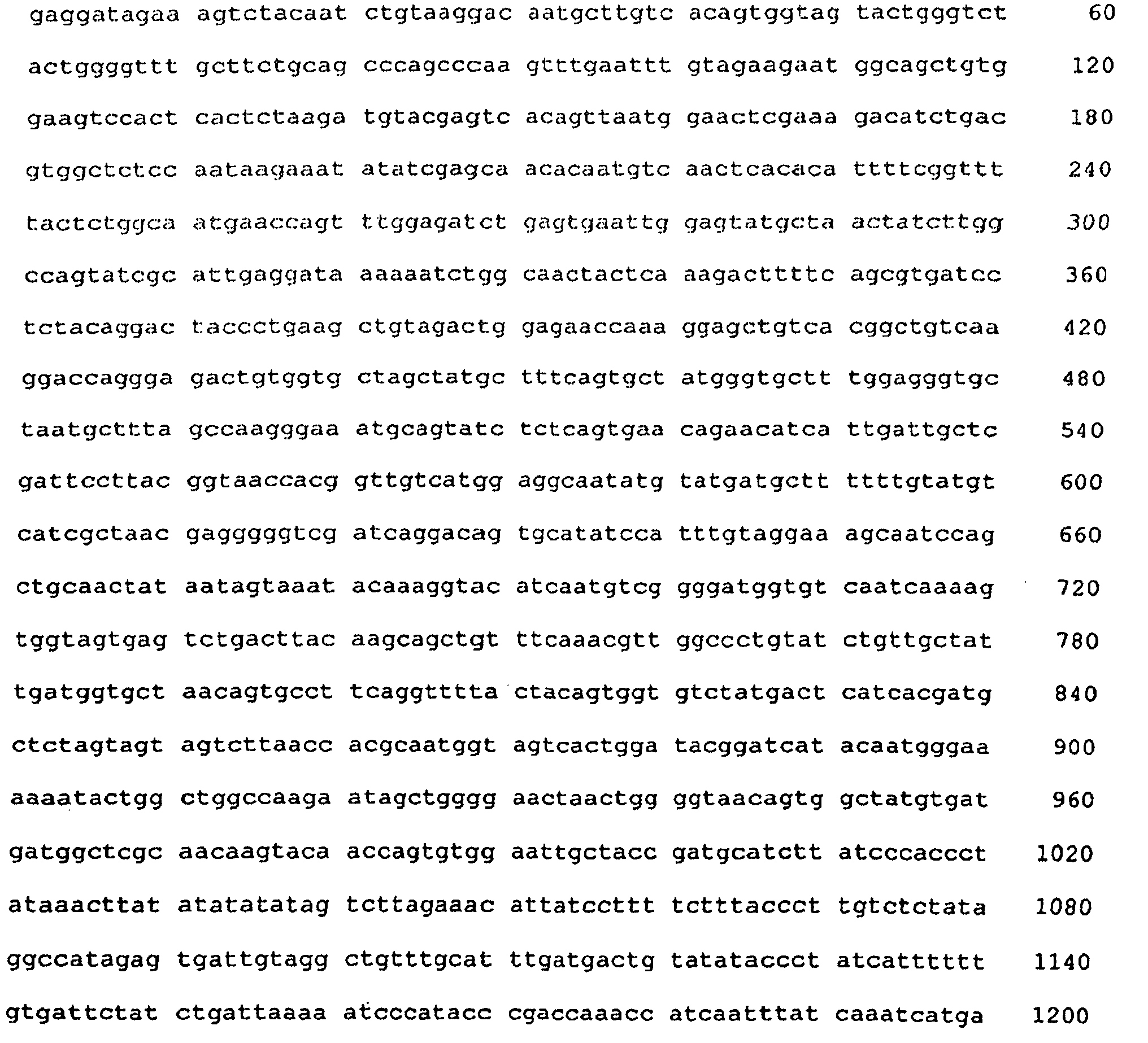
- Figure 1 shows an example of the cDNA for silicatein from Suberites domuncula .
- Recombinant silicatein is preferably produced in E. coli XL1-Blue. However, production in yeast and mammalian cells is also possible and has been carried out successfully.
- the cDNA is converted into an appropriate vector, e.g. B. pQE-30 .
- Other expression vectors have also been found to be suitable.
- expression of silicatein is induced by induction with usually IPTG (isopropyl- ⁇ -D-thiogalactopyranoside) (Ausubel, FM, Brent, R., guitarist, RE, Moore, DD, Smith, JA, Seidmann, JG & Struhl, K. (1995) Current Protocols in Molecular Biology. John Wiley and Sons, New York).
- the expression of silicatein and the purification of the recombinant protein via z. B. the histidine tag, which is present on the recombinant protein, can on appropriate affinity columns, e.g. B. a Ni-NTA matrix (Skorokhod, A., Shucke, H., Diehl-Seifert, B., Steffen, R, Hofmeister A., and Müller WEG Cell. Mol. Biol. 43: 509-519 ; 1997).
- affinity columns e.g. B. a Ni-NTA matrix (Skorokhod, A., Schcke, H., Diehl-Seifert, B., Steffen, R, Hofmeister A., and Müller WEG Cell. Mol. Biol. 43: 509-519 ; 1997).
- the isolation, cloning and expression of the cDNA for silicatein can be carried out from other silicon dioxide-producing organisms, for example from diatoms (for example Cylindrotheca fusiformis ).
- diatoms for example Cylindrotheca fusiformis
- the extraction of diatoms in axenic cultures is state of the art (Kröger, N., Bergsdorf, C., and Sumper M. Europ. J. Biochem. 239: 259-264; 1996).
- Silicatein is the enzyme that amorphous silicate, e.g. B. synthesized in sponges. Therefore, the silicatein can also be obtained from the organisms themselves.
- the silicatein e.g. B. from the sponge
- domuncula the spiculae consisting of amorphous silicate
- the spicules are obtained by sedimentation.
- the amorphous silicate of the Spiculae is in an alkaline environment, e.g. B. in dilute sodium hydroxide solution.
- the organic fibrils of the spicules, which contain the silicatein, are obtained by centrifugation (e.g. 20,000 ⁇ g; 1 hour; 4 ° C.).
- the protein is high in salt, such as. B. 1 M NaCl, but also brought into solution by the "protein refolding kit".
- the silicatein is then purified on an affinity matrix.
- the affinity matrix is prepared by immobilizing a silicatein-specific antibody on a solid phase (CNB-activated Sepharose or other suitable carrier). Monoclonal or polyclonal antibodies against silicatein are used as antibodies, which are produced by standard methods (Osterman, LA Methods of Protein and Nucleic Acid Research Vol. 2; Springer-Verlag [Berlin] 1984). The antibody is coupled to the column matrix according to the manufacturer's instructions (Pharmacia). The pure silicatein is eluted by changing the pH or changing the ionic strength.
- Other affinity matrices such as polymeric silicates or copolymeric silicates / germanates have also been used successfully. The silicatein is eluted from these matrices at a pH around the isoelectic point of silicatein (in the case of the S. domuncula silicatein at a pH of about 6).
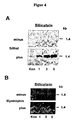
- silicatein gene has suitable silicate concentrations in the medium (usually 60 ⁇ M) and induced by myotrophin (1 ⁇ g / ml) can be ( Figure 4A, B).
- the measurement of the enzymatic activity of the recombinant silicatin is common performed as follows.
- the recombinant silicatein is used overnight against one for the Reaction suitable buffer, such as 25 mM Tris-HCl, pH 6.8 dialyzed [other buffers within a pH range of 4.5 to 10.5 are also suitable].
- a suitable buffer as 25 mM Tris-HCl (pH 6.8) and dissolved with 1 ml of a usually 1-4.5 mM tetraethoxysilane solution added.
- the enzymatic reaction can take place at room temperature - however can also be carried out at temperatures between 5 ° C and about 65 ° C.
- the average Incubation time is 60 min. During this period, are usually 300 nmol amorphous silicate (as molybdate-reactive, soluble silicate) per 100 ⁇ g silicatein synthesized.
- the material is placed in a table top centrifuge centrifuged (12,000 x g; 15 min; + 4 ° C), washed with ethanol and air dried. Then the sediment with z. B. 1 M NaOH hydrolyzed. In the resulting Solution is using a molybdate-based detection method, such as. B. the silicone assay (Merck), silicate measured quantitatively.
- a molybdate-based detection method such as. B. the silicone assay (Merck), silicate measured quantitatively.
- silicatein in addition to the substrate tetraethoxysilane also polymerized other silane alkoxides.
- silicatein Synthesis can be used: tetraalkoxysilanes, trialkoxysilanols, Dialkoxysilane diols, monoalkoxysilane triols, alkyl or aryl trialkoxysilanes, alkyl or Aryl dialkoxysilanols or alkyl or aryl monoalkoxysilane diols or the corresponding (Alkyl or aryl substituted) alkoxy compounds of gallium (IV), tin (IV) or lead (IV).
- Mixtures of these substrates are also recognized by the enzyme polymerized. Mixed polymers can thus also be produced.
- the substrates such as tetraethoxysilane, dissolved in dimethyl sulfoxide in a stock solution of usually 500 mM and then diluted down to the desired final concentration.
- Fusion proteins with silicatein are obtained as follows.
- a suitable expression vector for example pQE-30
- the silicatein cDNA - with z. B. a Bam HI restriction site at the 5 'terminus and z. B. a Sal I restriction site at the 3 'terminus - is produced.
- the stop codon in the silicatein cDNA is removed.
- the PCR technique is used and primers which have the relevant restriction sites are used for amplification.
- the cDNA for the second protein is obtained accordingly, with the same interface at the 5'-terminus as at the 3'-terminus of the silicatein cDNA (in the example Sal I) and a different from the other at the 3'-terminus (e.g. a Hin dIII site) is present.
- alternative restriction enzymes can be used. Linkers can also be inserted between the two cDNAs ( Figure 5A).
- cDNAs are ligated according to the usual procedures, purified and in the pQE-30 vector (Quiagen) inserted.
- the ligation follows the histidine tag (about 6 histidine codons).
- the expression and purification of the fusion protein can be like described above (section 2.1.2).
- a protease cleavage site e.g. B. an enterokinase site
- a codon for one new start methionine in front of the coding region of the gene for the bioactive protein be inserted.
- the (fusion) protein becomes proteolytic split. Now both proteins are available separately ( Figure 5B).
- both proteins can be expressed on one construct - but separately.
- the silica gene is connected after the His day in an expression vector.
- a stop codon is inserted at the end of the silicatein cDNA.
- a His day is the cDNA for preceded by the bioactive protein.
- This gene also receives a stop codon ( Figure 5C).
- the His tags can be deleted if the proteins are used for functional analysis in the concerned Host cells are used.
- both bacterial and eukaryotic cells can be used.
- the expression as described under 4.1 to 4.3 can also be used for three or more open reading frames be used.
- biomaterials The biological response of organisms (or biological extracts / products) to (Exposed and / or implanted) biomaterials are largely due to their surface structure and chemistry determined. Therefore there is a need for methods for surface modification such biomaterials.
- the goal is always the beneficial chemical-physical Preserve properties of the biomolecules. Therefore only the outermost Surface are modified, as this affects their biological interactions become.
- Sialinization to modify material surfaces can in particular be used to modify hydroxylated or amine-rich Surfaces are used, such as surfaces of glass, silicon, germanium, Aluminum, quartz and many metal oxides that are rich in hydroxyl groups.
- a literature overview can be found in: B.D. Ratner et al. (Ed.) Biomaterials Science - An Introduction to Materials in Medicine. Academic Press, San Diego, 1996.
- a "mild” method compared to the physical / chemical methods used is the modification of biomaterials based solely on biochemical reactions with the aid of the method according to the invention (use of recombinant / purified silicatein) (silicatein-mediated enzymatic synthesis of amorphous SiO 2 -, Surfaces containing siloxane or siloxane block copolymers).
- the modified zone on the material surface should be as thin in most cases be as possible, since modified surface layers that are too thick, the mechanical and can change the functional properties of the material. This can be done by Varying the reaction time and substrate concentration in the silicatein-mediated enzymatic reaction can be achieved in a simple manner.
- silicatein-mediated enzymatic reaction enables a multitude of different ones Biomaterials that have either a protein (silicatein) binding surface possess by nature or which are protein-binding through a previous modification biomaterials including polymers, metals, Ceramics and glasses.
- Silanes can form two types of surface structures. Very thin (monolayer) Layers if only traces of surface-adsorbed water are present, or, if there is more water, thicker layers of silane consisting of both Si-O groups, which are bound to the surface, as well as silane units, which are three-dimensional, form polymer network, exist. Such modifications can, for example prepared by treating hydroxylated surfaces with n-propyl-trimethoxysilane become.
- the controlled synthesis of SiO 2 or siloxane shells by means of the recombinant or the silicatein purified from various sources results in a use for encapsulating biomolecules (including proteins and nucleic acids) and bioactive molecules (including hormones, pharmaceuticals and cytokines) with which The aim is to change or improve their biological properties (such as protease and nuclease resistance, temperature stability) or their release (controlled “drug delivery", also enabling topical "drug delivery”).
- biomolecules including proteins and nucleic acids
- bioactive molecules including hormones, pharmaceuticals and cytokines
- WO 9614832 Al 19960523 discloses a method for the production of synthetic liposomes from polyphosphates to increase the absorption of Drugs ("drug delivery"). By building up such a liposome stabilizing Silicatein can be used to increase the efficiency of the method.
- the controlled synthesis of SiO 2 or siloxane shells using the recombinant or the silicatein purified from various sources can also be used to encapsulate cells during transplantations (improvement of the biocompatibility).
- silicatein for surface modification (contact zone treatment) of (silicon) semiconductors or silicon chips and their use
- the recombinant and the silicatein purified from various sources can also be used for Surface modification of (silicon or germanium) semiconductors or (silicon or Germanium) biosensor chips are used. This enables a connection with Cells or other structures made of organic material are produced. These "matrices” can be used to measure the electrical properties of cells become. Such silicatein-modified semiconductors (or silicon microchips) can can also be used as biosensors.
- the recombinant and the silicatein purified from various sources are able to form amorphous SiO 2 .
- the amorphous or finely crystalline modifications of SiO 2 (opals) include agate, jasper, onyx and others. Due to the possibility of synthesizing amorphous SiO 2 under controlled conditions with the help of recombinant or purified from various sources, with targeted insertion of foreign molecules / atoms can consequently result in the use of the method according to the invention for producing the abovementioned and other gemstones / semi-precious stones.
- silicatein for the synthesis of silicon (gallium, tin or lead -) compounds (including so-called sila pharmaceuticals)
- Silicon is known as a trace element, which is apparently responsible for the formation of connective tissue and bone (mineralization) is needed.
- sila pharmaceuticals pharmaceuticals in which C through Si is replaced with potential effects on the organism
- the production of silicon-organic Compounds as the basis for so-called sila pharmaceuticals is medical Interest [see: Chem. Of our time 14, 197-207 (1980), as well as: Bioactive Organosilicon Compounds (Topics Curr. Chem. 84), Berlin, Springer 1979)]; the synthesis of such Compounds under mild (enzymatic) conditions is by means of the invention Procedure (using the recombinant or from different sources cleaned silicateins) possible.
- silicon compounds with the aid of the invention Process can be synthesized under mild (enzymatic) conditions (use of the recombinant or of the silicatein purified from various sources) in medicine and cosmetics are: Use of silicon compounds synthesized in this way as an ingredient or the basis of ointments and as a component of toothpaste [for use in cosmetics, see: perfume. Kosmet. 67, 232-239, 326-336, 384-389 (1986); 68, 195-203 (1987)].
- Silicon compounds with the help of the inventive method under mild (enzymatic) conditions were synthesized (use of the recombinant or of silicatein purified from various sources) can also be used for other purposes use: lubricant (plastic processing), lubricant (plastic gear), Foam damping agent, mold release agent (hydrophobicizing glass, ceramics, textiles, leather) and dielectrics (e.g. in transformers).
- siloxane resins used in technology such as (more or less cross-linked) polymethyl or polymethylphenysiloxanes.
- silane triols RSi (OH) 3 formed by condensation of the silicatein-mediated catalysis lead to the synthesis of leaf structure-like polymers of the gross composition R 2 Si 2 O 3 .
- the degree of crosslinking and the expansion of these polymers can be varied by controlled admixture of silanediols and silanols. This enables enzymatically tailored silicone structures with characteristic, controllable properties to be produced.
- the siloxane skeleton can be linked to various hydrocarbon residues his. This allows its properties to be modified.
- the recombinant silicatein By means of the recombinant silicatein, the recombinant silicatein fusion proteins or of the purified silica, it is possible to create specific two- and three-dimensional, screen, mesh, cage or other shaped structures made of amorphous silicon dioxide, siloxanes or other silicon (IV) - [or gallium (IV) -, tin (IV) - or lead (IV) -] compounds synthesize on a nano-scale, being associated with these enzymes Macromolecules (synthetic polymers or biopolymers) as "guide rails" for the Synthesis can be used.
- Such syntheses are also in use using mariculture or sponges or other silicate-producing sponges kept in aquariums Organisms as well as with genetically modified ones, originally not for silicate synthesis qualified organisms possible.
- the structures formed can be used in nanotechnology are used (for example as "miniature sieves" for separation processes in the Nanoscale).
- A Concentration of transcripts for silicatein in primmorphs of S. domuncula .
- B Effect of recombinant myotrophin on the expression of silicatein in primmorphs.
Landscapes
- Chemical & Material Sciences (AREA)
- Health & Medical Sciences (AREA)
- Life Sciences & Earth Sciences (AREA)
- Organic Chemistry (AREA)
- Zoology (AREA)
- Wood Science & Technology (AREA)
- Engineering & Computer Science (AREA)
- Genetics & Genomics (AREA)
- Bioinformatics & Cheminformatics (AREA)
- General Health & Medical Sciences (AREA)
- Biochemistry (AREA)
- Biotechnology (AREA)
- Microbiology (AREA)
- General Engineering & Computer Science (AREA)
- Molecular Biology (AREA)
- Medicinal Chemistry (AREA)
- Biomedical Technology (AREA)
- Chemical Kinetics & Catalysis (AREA)
- Toxicology (AREA)
- Gastroenterology & Hepatology (AREA)
- Biophysics (AREA)
- Proteomics, Peptides & Aminoacids (AREA)
- Tropical Medicine & Parasitology (AREA)
- General Chemical & Material Sciences (AREA)
- Peptides Or Proteins (AREA)
- Preparation Of Compounds By Using Micro-Organisms (AREA)
- Silicates, Zeolites, And Molecular Sieves (AREA)
- Immobilizing And Processing Of Enzymes And Microorganisms (AREA)
- Silicon Polymers (AREA)
- Detergent Compositions (AREA)
- Silicon Compounds (AREA)
- Formation Of Insulating Films (AREA)
- Enzymes And Modification Thereof (AREA)
Description
<120> Silicatein-vermittelte Synthese von amorphen Silikaten und Siloxanen und ihre Verwendung
<140> PCT/EP01/08423
<141> 2001-07-20
<160> 2
<211> 1200
<212> DNA
<213> Suberites domuncula
<211> 330
<212> PRT
<213> Suberites domuncula


Claims (7)
- Verfahren zur Herstellung von rekombinantem Silicatein in einer Wirtszelle, dadurch gekennzeichnet, daß es eine Verkürzung des zu exprimierenden rekombinanten Silicateins in der N-terminalen Region seiner codierenden cDNA, die vom Beginn des Propetids bis zur ersten Disulfidbrücke reicht, und/oder die Verkürzung des zu exprimierenden rekombinanten Silicateins durch Einfügung eines Stop-Codons in der von der letzten Disulfidbrücke reichenden C-terminalen kodierenden Region seiner cDNA, und Isolierung des funktionell hochaktiven Enzympräparats umfaßt.
- Verfahren zur Herstellung von rekombinantem Silicatein in einer Wirtszelle nach Anspruch 1, dadurch gekennzeichnet, daß als Wirtszelle Zellen von Escherichia coli, Hefen, Säugern oder Primmorphen, wie Meeresschwämme oder Diatomeen verwendet werden.
- Verfahren zur Herstellung von rekombinantem Silicatein in einer Wirtszelle nach Anspruch 1 oder 2, dadurch gekennzeichnet, daß als Wirtszellen Zellen von Cylindrotheca fusiformis verwendet werden.
- Verfahren zur Herstellung von rekombinantem Silicatein in einer Wirtszelle nach einem der vorangehenden Ansprüche, dadurch gekennzeichnet, daß das rekombinante Silikatein als (a) Fusionsprotein (chimäres Protein) oder (b) in einer getrennte Protein-Expression (Protease-Spaltstelle) oder (c) in einer zweiten getrennten Protein-Expression (Kassetten-Expression) und in Form einer modifizierten Silicatein-cDNA-Sequenz exprimiert wird.
- Verfahren zur Herstellung von rekombinantem Silicatein in einer Wirtszelle nach einem der vorangehenden Ansprüche, dadurch gekennzeichnet, daß es als weiteren Schritt eine Reinigung des Silicateins mittels polyklonaler Antikörper oder mittels eines Histidin-Tags umfaßt.
- Verfahren zur Herstellung von rekombinantem Silicatein in einer Wirtszelle nach Anspruch 5, dadurch gekennzeichnet, daß der polyklonale Antikörper an eine feste Phase gekoppelt wird.
- Transgene Wirtszelle, insbesondere Zelle von Escherichia coli, Hefen, Säugern oder Primmorphen, wie Meeresschwämme, wie Suberites domuncula, oder Diatomeen, wie Cylindrotheca fusiformis, wobei die Zelle ein rekombinantes Silicatein exprimiert, das eine Verkürzung des zu exprimierenden rekombinanten Silicateins in der N-terminalen Region seiner codierenden cDNA, die vom Beginn des Propetids bis zur ersten Disulfidbrücke reicht, und/oder die Verkürzung des zu exprimierenden rekombinanten Silicateins durch Einfügung eines Stop-Codons in der von der letzten Disulfidbrücke reichenden C-terminalen kodierenden Region seiner cDNA umfaßt.
Applications Claiming Priority (3)
| Application Number | Priority Date | Filing Date | Title |
|---|---|---|---|
| DE10037270A DE10037270B4 (de) | 2000-07-28 | 2000-07-28 | Silicatein-vermittelte Synthese von amorphen Silikaten und Siloxanen und ihre Verwendung |
| DE10037270 | 2000-07-28 | ||
| PCT/EP2001/008423 WO2002010420A2 (de) | 2000-07-28 | 2001-07-20 | Silicatein-vermittelte synthese von amorphen silikaten und siloxanen und ihre verwendung |
Publications (2)
| Publication Number | Publication Date |
|---|---|
| EP1320624A2 EP1320624A2 (de) | 2003-06-25 |
| EP1320624B1 true EP1320624B1 (de) | 2004-09-22 |
Family
ID=7650838
Family Applications (1)
| Application Number | Title | Priority Date | Filing Date |
|---|---|---|---|
| EP01969458A Expired - Lifetime EP1320624B1 (de) | 2000-07-28 | 2001-07-20 | Silicatein-vermittelte synthese von amorphen silikaten und siloxanen und ihre verwendung |
Country Status (11)
| Country | Link |
|---|---|
| US (1) | US7169589B2 (de) |
| EP (1) | EP1320624B1 (de) |
| JP (1) | JP2004516818A (de) |
| CN (1) | CN1261451C (de) |
| AT (1) | ATE277194T1 (de) |
| AU (2) | AU2001289713B2 (de) |
| CA (1) | CA2414602A1 (de) |
| DE (2) | DE10037270B4 (de) |
| NO (1) | NO20030407D0 (de) |
| NZ (1) | NZ523474A (de) |
| WO (1) | WO2002010420A2 (de) |
Families Citing this family (18)
| Publication number | Priority date | Publication date | Assignee | Title |
|---|---|---|---|---|
| GB2401368A (en) * | 2001-12-20 | 2004-11-10 | Procter & Gamble | Biosynthesis of cyclic siloxanes |
| US6811145B2 (en) * | 2002-05-07 | 2004-11-02 | Edward L. Gibbs | Barrier formed by resistance projection welding |
| DE10240035A1 (de) * | 2002-08-30 | 2004-03-11 | Rehm, Bernd H.A., PD Dr.rer.nat. | Biogene Polyester-Partikel definierter Größe mit funktionalisierten Oberflächen:Herstellungsverfahren und pharmazeutische Zubereitungen, in denen diese enthalten sind |
| DE10246186B4 (de) * | 2002-10-03 | 2005-07-07 | Johannes-Gutenberg-Universität Mainz | Abbau und Modifizierung von Silicaten und Siliconen durch Silicase und Verwendung des reversiblen Enzyms |
| DE10352433B4 (de) * | 2003-11-10 | 2012-10-11 | Nanotecmarin Gmbh | Polypeptid eines Silicatein-ß aus Suberites domuncula, dafür kodierende Nukleinsäure, deren Verwendungen, diese Nukleinsäure umfassender Vektor und dieses Polypeptid exprimierende Wirtszelle |
| US7455998B2 (en) * | 2004-03-03 | 2008-11-25 | Dow Corning Corporation | Methods for forming structurally defined organic molecules |
| US8523150B2 (en) * | 2004-03-15 | 2013-09-03 | Edward L. Gibbs | Fence with tiltable picket |
| DE102004021229A1 (de) * | 2004-04-30 | 2005-11-24 | Heiko Dr. Schwertner | Enzymatisches Verfahren zur Herstellung bioaktiver, Osteoblasten-stimulierender Oberflächen und Verwendung |
| DE102004021230A1 (de) * | 2004-04-30 | 2005-11-24 | Heiko Dr. Schwertner | Enzym-und Template-gesteuerte Synthese von Silica aus nicht-organischen Siliciumverbindungen sowie Aminosilanen und Silazanen und Verwendung |
| DE102005061248B4 (de) | 2005-12-20 | 2007-09-20 | Infineon Technologies Ag | Systemträger mit in Kunststoffmasse einzubettenden Oberflächen, Verfahren zur Herstellung eines Systemträgers und Verwendung einer Schicht als Haftvermittlerschicht |
| CN101506365A (zh) * | 2006-08-23 | 2009-08-12 | 海洋纳米技术有限公司 | 生物硅-粘附蛋白纳米复合材料:合成和在牙科中的应用 |
| EP2248824A1 (de) | 2009-04-27 | 2010-11-10 | Matthias Dr. Wiens | Verwendung von Silintaphin zur strukturorientierten Herstellung von (Nano-) Verbundwerkstoffen in Medizin und (Nano-) Technologie |
| EP2246435A1 (de) | 2009-04-29 | 2010-11-03 | Consiglio Nazionale delle Ricerche - INFM Istituto Nazionale per la Fisica della Materia | Mittels Silicatein-vermittelter Schablonierung hergestellte Silikonderivatschichten/-filme und Herstellungsverfahren dafür |
| DE102009024603A1 (de) | 2009-06-10 | 2010-12-16 | Nanotecmarin Gmbh | Enzymatisches Verfahren zur Herstellung von Biosilica als Bestandteil einer bioaktiven Zahnpasta und Verwendung |
| EP2409710A1 (de) | 2010-06-29 | 2012-01-25 | NanotecMARIN GmbH | Injizierbares Material und Material, das als Arzneimittel oder Nahrungsergänzung zur Prophylaxe oder Behandlung von Osteoporose verwendet wird |
| EP2409682A1 (de) | 2010-07-19 | 2012-01-25 | Werner E. G. MÜLLER | Hydroxyapatitbindende Nano- und Mikropartikel zur Kariesprophylaxe und zur Reduzierung von Zahnüberempfindlichkeit |
| EP2489346A1 (de) | 2011-01-26 | 2012-08-22 | NanotecMARIN GmbH | Nahrungsergänzungsmittel und injizierbares Material zur Prophylaxe und Behandlung von Osteoporose und anderen Knochenerkrankungen |
| DE102016004090A1 (de) | 2015-04-16 | 2016-10-20 | Florian Draenert | ZUSAMMENSETZUNG ElNES BlOMATERlALS |
Family Cites Families (1)
| Publication number | Priority date | Publication date | Assignee | Title |
|---|---|---|---|---|
| EP1153063A4 (de) * | 1998-12-18 | 2003-05-28 | Univ California | Verfahren, zusammensetzungen und biomimetische katalysatoren für die in-vitro synthese von silikia, polysilsequioxanen, polysiloxanen und polymetallo-oxanen |
-
2000
- 2000-07-28 DE DE10037270A patent/DE10037270B4/de not_active Expired - Fee Related
-
2001
- 2001-07-20 WO PCT/EP2001/008423 patent/WO2002010420A2/de not_active Ceased
- 2001-07-20 NZ NZ523474A patent/NZ523474A/en unknown
- 2001-07-20 US US10/343,104 patent/US7169589B2/en not_active Expired - Fee Related
- 2001-07-20 CN CNB01813484XA patent/CN1261451C/zh not_active Expired - Fee Related
- 2001-07-20 EP EP01969458A patent/EP1320624B1/de not_active Expired - Lifetime
- 2001-07-20 AT AT01969458T patent/ATE277194T1/de not_active IP Right Cessation
- 2001-07-20 CA CA002414602A patent/CA2414602A1/en not_active Abandoned
- 2001-07-20 DE DE50103793T patent/DE50103793D1/de not_active Expired - Lifetime
- 2001-07-20 AU AU2001289713A patent/AU2001289713B2/en not_active Ceased
- 2001-07-20 JP JP2002516336A patent/JP2004516818A/ja active Pending
- 2001-07-20 AU AU8971301A patent/AU8971301A/xx active Pending
-
2003
- 2003-01-27 NO NO20030407A patent/NO20030407D0/no not_active Application Discontinuation
Also Published As
| Publication number | Publication date |
|---|---|
| EP1320624A2 (de) | 2003-06-25 |
| CN1460110A (zh) | 2003-12-03 |
| CA2414602A1 (en) | 2002-02-07 |
| NO20030407L (no) | 2003-01-27 |
| WO2002010420A2 (de) | 2002-02-07 |
| JP2004516818A (ja) | 2004-06-10 |
| US20030134391A1 (en) | 2003-07-17 |
| CN1261451C (zh) | 2006-06-28 |
| AU2001289713B2 (en) | 2007-02-01 |
| NZ523474A (en) | 2005-03-24 |
| DE10037270B4 (de) | 2007-09-13 |
| ATE277194T1 (de) | 2004-10-15 |
| DE10037270A1 (de) | 2002-02-14 |
| AU2001289713A2 (en) | 2002-02-13 |
| AU8971301A (en) | 2002-02-13 |
| US7169589B2 (en) | 2007-01-30 |
| NO20030407D0 (no) | 2003-01-27 |
| WO2002010420A3 (de) | 2003-04-03 |
| DE50103793D1 (de) | 2004-10-28 |
Similar Documents
| Publication | Publication Date | Title |
|---|---|---|
| DE10037270B4 (de) | Silicatein-vermittelte Synthese von amorphen Silikaten und Siloxanen und ihre Verwendung | |
| Shimizu et al. | Glassin, a histidine-rich protein from the siliceous skeletal system of the marine sponge Euplectella, directs silica polycondensation | |
| EP1546319B1 (de) | Abbau und modifizierung von silicaten und siliconen durch silicase und verwendung des reversiblen enzyms | |
| EP1727830B1 (de) | Biologischer klebstoff aus muscheln | |
| US20100047224A1 (en) | Biosilica-Adhesive Protein Nanocomposite Materials: Synthesis and Application in Dentistry | |
| DE3241589A1 (de) | Implantate und verfahren zu deren herstellung | |
| Nazeri et al. | Heterologous production of hyaluronic acid in Nicotiana tabacum hairy roots expressing a human hyaluronan synthase 2 | |
| EP1740706B1 (de) | Enzymatisches Verfahren zur Herstellung bioaktiver, Osteoblasten-stimulierender Oberflachen und Verwendung derselben | |
| DE10352433B4 (de) | Polypeptid eines Silicatein-ß aus Suberites domuncula, dafür kodierende Nukleinsäure, deren Verwendungen, diese Nukleinsäure umfassender Vektor und dieses Polypeptid exprimierende Wirtszelle | |
| DE102004021230A1 (de) | Enzym-und Template-gesteuerte Synthese von Silica aus nicht-organischen Siliciumverbindungen sowie Aminosilanen und Silazanen und Verwendung | |
| CN110904082B (zh) | 盐耐受的木糖苷酶突变体t326dh328d及制备和用途 | |
| JPH11164880A (ja) | チタニア含有無機・有機混成生体活性材料の製造方法 | |
| Nazeri et al. | Biosynthesis of hyaluronic acid in nicotiana tabacum plants: an efficient and safe method for large-scale production | |
| DE102009024603A1 (de) | Enzymatisches Verfahren zur Herstellung von Biosilica als Bestandteil einer bioaktiven Zahnpasta und Verwendung | |
| Wang et al. | Properties and applications of biosilica enzymatically synthesized by aquatic/marine sponges | |
| Wang et al. | Enzymatically synthesized biosilica | |
| KR101860040B1 (ko) | 식물세포 배양시스템으로 생산된 피부 생리활성 산성 섬유아세포성장인자 | |
| EP1731597A1 (de) | Selenium angereichete Flüssigmedien zur Kultivierung siliziumhaltiger Schwämme und zur biogenen Silikaproduktion |
Legal Events
| Date | Code | Title | Description |
|---|---|---|---|
| PUAI | Public reference made under article 153(3) epc to a published international application that has entered the european phase |
Free format text: ORIGINAL CODE: 0009012 |
|
| 17P | Request for examination filed |
Effective date: 20021128 |
|
| AK | Designated contracting states |
Designated state(s): AT BE CH CY DE DK ES FI FR GB GR IE IT LI LU MC NL PT SE TR |
|
| AX | Request for extension of the european patent |
Extension state: AL LT LV MK RO SI |
|
| GRAP | Despatch of communication of intention to grant a patent |
Free format text: ORIGINAL CODE: EPIDOSNIGR1 |
|
| GRAS | Grant fee paid |
Free format text: ORIGINAL CODE: EPIDOSNIGR3 |
|
| GRAA | (expected) grant |
Free format text: ORIGINAL CODE: 0009210 |
|
| AK | Designated contracting states |
Kind code of ref document: B1 Designated state(s): AT BE CH CY DE DK ES FI FR GB GR IE IT LI LU MC NL PT SE TR |
|
| PG25 | Lapsed in a contracting state [announced via postgrant information from national office to epo] |
Ref country code: NL Free format text: LAPSE BECAUSE OF FAILURE TO SUBMIT A TRANSLATION OF THE DESCRIPTION OR TO PAY THE FEE WITHIN THE PRESCRIBED TIME-LIMIT Effective date: 20040922 Ref country code: TR Free format text: LAPSE BECAUSE OF FAILURE TO SUBMIT A TRANSLATION OF THE DESCRIPTION OR TO PAY THE FEE WITHIN THE PRESCRIBED TIME-LIMIT Effective date: 20040922 Ref country code: IE Free format text: LAPSE BECAUSE OF FAILURE TO SUBMIT A TRANSLATION OF THE DESCRIPTION OR TO PAY THE FEE WITHIN THE PRESCRIBED TIME-LIMIT Effective date: 20040922 Ref country code: FI Free format text: LAPSE BECAUSE OF FAILURE TO SUBMIT A TRANSLATION OF THE DESCRIPTION OR TO PAY THE FEE WITHIN THE PRESCRIBED TIME-LIMIT Effective date: 20040922 |
|
| REG | Reference to a national code |
Ref country code: GB Ref legal event code: FG4D Free format text: NOT ENGLISH |
|
| REG | Reference to a national code |
Ref country code: CH Ref legal event code: EP |
|
| GBT | Gb: translation of ep patent filed (gb section 77(6)(a)/1977) |
Effective date: 20040922 |
|
| REG | Reference to a national code |
Ref country code: IE Ref legal event code: FG4D Free format text: GERMAN |
|
| REF | Corresponds to: |
Ref document number: 50103793 Country of ref document: DE Date of ref document: 20041028 Kind code of ref document: P |
|
| PG25 | Lapsed in a contracting state [announced via postgrant information from national office to epo] |
Ref country code: DK Free format text: LAPSE BECAUSE OF FAILURE TO SUBMIT A TRANSLATION OF THE DESCRIPTION OR TO PAY THE FEE WITHIN THE PRESCRIBED TIME-LIMIT Effective date: 20041222 Ref country code: SE Free format text: LAPSE BECAUSE OF FAILURE TO SUBMIT A TRANSLATION OF THE DESCRIPTION OR TO PAY THE FEE WITHIN THE PRESCRIBED TIME-LIMIT Effective date: 20041222 Ref country code: GR Free format text: LAPSE BECAUSE OF FAILURE TO SUBMIT A TRANSLATION OF THE DESCRIPTION OR TO PAY THE FEE WITHIN THE PRESCRIBED TIME-LIMIT Effective date: 20041222 |
|
| PG25 | Lapsed in a contracting state [announced via postgrant information from national office to epo] |
Ref country code: ES Free format text: LAPSE BECAUSE OF FAILURE TO SUBMIT A TRANSLATION OF THE DESCRIPTION OR TO PAY THE FEE WITHIN THE PRESCRIBED TIME-LIMIT Effective date: 20050102 |
|
| LTIE | Lt: invalidation of european patent or patent extension |
Effective date: 20040922 |
|
| NLV1 | Nl: lapsed or annulled due to failure to fulfill the requirements of art. 29p and 29m of the patents act | ||
| REG | Reference to a national code |
Ref country code: IE Ref legal event code: FD4D |
|
| ET | Fr: translation filed | ||
| PG25 | Lapsed in a contracting state [announced via postgrant information from national office to epo] |
Ref country code: CY Free format text: LAPSE BECAUSE OF FAILURE TO SUBMIT A TRANSLATION OF THE DESCRIPTION OR TO PAY THE FEE WITHIN THE PRESCRIBED TIME-LIMIT Effective date: 20050720 Ref country code: AT Free format text: LAPSE BECAUSE OF NON-PAYMENT OF DUE FEES Effective date: 20050720 Ref country code: LU Free format text: LAPSE BECAUSE OF NON-PAYMENT OF DUE FEES Effective date: 20050720 |
|
| PLBE | No opposition filed within time limit |
Free format text: ORIGINAL CODE: 0009261 |
|
| STAA | Information on the status of an ep patent application or granted ep patent |
Free format text: STATUS: NO OPPOSITION FILED WITHIN TIME LIMIT |
|
| PG25 | Lapsed in a contracting state [announced via postgrant information from national office to epo] |
Ref country code: MC Free format text: LAPSE BECAUSE OF NON-PAYMENT OF DUE FEES Effective date: 20050731 |
|
| 26N | No opposition filed |
Effective date: 20050623 |
|
| REG | Reference to a national code |
Ref country code: CH Ref legal event code: PL |
|
| REG | Reference to a national code |
Ref country code: CH Ref legal event code: AEN Free format text: DAS PATENT IST AUFGRUND DES WEITERBEHANDLUNGSANTRAGS VOM 30.03.2006 REAKTIVIERT WORDEN. |
|
| PGFP | Annual fee paid to national office [announced via postgrant information from national office to epo] |
Ref country code: BE Payment date: 20070103 Year of fee payment: 6 |
|
| PG25 | Lapsed in a contracting state [announced via postgrant information from national office to epo] |
Ref country code: PT Free format text: LAPSE BECAUSE OF NON-PAYMENT OF DUE FEES Effective date: 20050222 |
|
| BERE | Be: lapsed |
Owner name: *SCHRODER HEINZ C. Effective date: 20070731 Owner name: *KRASKO ANATOLI Effective date: 20070731 Owner name: *MULLER WERNER E. G. Effective date: 20070731 Owner name: *LORENZ BERND Effective date: 20070731 |
|
| PG25 | Lapsed in a contracting state [announced via postgrant information from national office to epo] |
Ref country code: BE Free format text: LAPSE BECAUSE OF NON-PAYMENT OF DUE FEES Effective date: 20070731 |
|
| REG | Reference to a national code |
Ref country code: CH Ref legal event code: PL |
|
| REG | Reference to a national code |
Ref country code: CH Ref legal event code: AEN Free format text: DAS PATENT IST AUFGRUND DES WEITERBEHANDLUNGSANTRAGS VOM 09.03.2009 REAKTIVIERT WORDEN. |
|
| REG | Reference to a national code |
Ref country code: CH Ref legal event code: PL |
|
| REG | Reference to a national code |
Ref country code: CH Ref legal event code: AEN Free format text: DAS PATENT IST AUFGRUND DES WEITERBEHANDLUNGSANTRAGS VOM 09.03.2010 REAKTIVIERT WORDEN. |
|
| REG | Reference to a national code |
Ref country code: FR Ref legal event code: TP |
|
| REG | Reference to a national code |
Ref country code: GB Ref legal event code: 732E Free format text: REGISTERED BETWEEN 20100610 AND 20100616 |
|
| REG | Reference to a national code |
Ref country code: CH Ref legal event code: PL |
|
| REG | Reference to a national code |
Ref country code: CH Ref legal event code: AEN Free format text: DAS PATENT IST AUFGRUND DES WEITERBEHANDLUNGSANTRAGS VOM 14.03.2011 REAKTIVIERT WORDEN. |
|
| REG | Reference to a national code |
Ref country code: CH Ref legal event code: PL |
|
| REG | Reference to a national code |
Ref country code: CH Ref legal event code: AEN Free format text: WEITERBEHANDLUNG GUTGEHEISSEN |
|
| PG25 | Lapsed in a contracting state [announced via postgrant information from national office to epo] |
Ref country code: CH Free format text: LAPSE BECAUSE OF NON-PAYMENT OF DUE FEES Effective date: 20110731 Ref country code: LI Free format text: LAPSE BECAUSE OF NON-PAYMENT OF DUE FEES Effective date: 20110731 |
|
| REG | Reference to a national code |
Ref country code: CH Ref legal event code: PK Free format text: DAS PATENT IST AUFGRUND DES WEITERBEHANDLUNGSANTRAGS VOM 10.4.2012 REAKTIVIERT WORDEN. |
|
| PGRI | Patent reinstated in contracting state [announced from national office to epo] |
Ref country code: CH Effective date: 20120411 Ref country code: LI Effective date: 20120411 |
|
| REG | Reference to a national code |
Ref country code: CH Ref legal event code: PL |
|
| REG | Reference to a national code |
Ref country code: CH Ref legal event code: AECN Free format text: DAS PATENT IST AUFGRUND DES WEITERBEHANDLUNGSANTRAGS VOM 14.03.2013 REAKTIVIERT WORDEN. |
|
| PGFP | Annual fee paid to national office [announced via postgrant information from national office to epo] |
Ref country code: IT Payment date: 20130719 Year of fee payment: 13 |
|
| REG | Reference to a national code |
Ref country code: CH Ref legal event code: PL |
|
| REG | Reference to a national code |
Ref country code: CH Ref legal event code: AECN Free format text: DAS PATENT IST AUFGRUND DES WEITERBEHANDLUNGSANTRAGS VOM 17. MAERZ 2014 REAKTIVIERT WORDEN. |
|
| REG | Reference to a national code |
Ref country code: CH Ref legal event code: PL |
|
| REG | Reference to a national code |
Ref country code: CH Ref legal event code: AECN Free format text: DAS PATENT IST AUFGRUND DES WEITERBEHANDLUNGSANTRAGS VOM 16. MAERZ 2015 REAKTIVIERT WORDEN. |
|
| PG25 | Lapsed in a contracting state [announced via postgrant information from national office to epo] |
Ref country code: IT Free format text: LAPSE BECAUSE OF NON-PAYMENT OF DUE FEES Effective date: 20140720 |
|
| PGFP | Annual fee paid to national office [announced via postgrant information from national office to epo] |
Ref country code: CH Payment date: 20150316 Year of fee payment: 14 |
|
| REG | Reference to a national code |
Ref country code: FR Ref legal event code: PLFP Year of fee payment: 15 |
|
| PGFP | Annual fee paid to national office [announced via postgrant information from national office to epo] |
Ref country code: DE Payment date: 20150730 Year of fee payment: 15 Ref country code: GB Payment date: 20150715 Year of fee payment: 15 |
|
| PGFP | Annual fee paid to national office [announced via postgrant information from national office to epo] |
Ref country code: FR Payment date: 20150629 Year of fee payment: 15 |
|
| REG | Reference to a national code |
Ref country code: CH Ref legal event code: PL |
|
| PG25 | Lapsed in a contracting state [announced via postgrant information from national office to epo] |
Ref country code: LI Free format text: LAPSE BECAUSE OF NON-PAYMENT OF DUE FEES Effective date: 20150731 Ref country code: CH Free format text: LAPSE BECAUSE OF NON-PAYMENT OF DUE FEES Effective date: 20150731 |
|
| REG | Reference to a national code |
Ref country code: DE Ref legal event code: R119 Ref document number: 50103793 Country of ref document: DE |
|
| GBPC | Gb: european patent ceased through non-payment of renewal fee |
Effective date: 20160720 |
|
| PG25 | Lapsed in a contracting state [announced via postgrant information from national office to epo] |
Ref country code: FR Free format text: LAPSE BECAUSE OF NON-PAYMENT OF DUE FEES Effective date: 20160801 Ref country code: DE Free format text: LAPSE BECAUSE OF NON-PAYMENT OF DUE FEES Effective date: 20170201 |
|
| REG | Reference to a national code |
Ref country code: FR Ref legal event code: ST Effective date: 20170331 |
|
| PG25 | Lapsed in a contracting state [announced via postgrant information from national office to epo] |
Ref country code: GB Free format text: LAPSE BECAUSE OF NON-PAYMENT OF DUE FEES Effective date: 20160720 |