EP1318157A1 - Surfactant for emulsion polymerization - Google Patents
Surfactant for emulsion polymerization Download PDFInfo
- Publication number
- EP1318157A1 EP1318157A1 EP01963561A EP01963561A EP1318157A1 EP 1318157 A1 EP1318157 A1 EP 1318157A1 EP 01963561 A EP01963561 A EP 01963561A EP 01963561 A EP01963561 A EP 01963561A EP 1318157 A1 EP1318157 A1 EP 1318157A1
- Authority
- EP
- European Patent Office
- Prior art keywords
- group
- mol
- surfactant
- emulsion
- denotes
- Prior art date
- Legal status (The legal status is an assumption and is not a legal conclusion. Google has not performed a legal analysis and makes no representation as to the accuracy of the status listed.)
- Granted
Links
- 239000004094 surface-active agent Substances 0.000 title claims abstract description 55
- 238000007720 emulsion polymerization reaction Methods 0.000 title claims abstract description 25
- 239000000203 mixture Substances 0.000 claims abstract description 67
- 239000000839 emulsion Substances 0.000 claims abstract description 49
- 229920000642 polymer Polymers 0.000 claims abstract description 42
- 150000001875 compounds Chemical class 0.000 claims abstract description 39
- 238000000034 method Methods 0.000 claims abstract description 32
- 125000004432 carbon atom Chemical group C* 0.000 claims abstract description 17
- 125000002947 alkylene group Chemical group 0.000 claims abstract description 10
- 125000006353 oxyethylene group Chemical group 0.000 claims abstract description 10
- 125000005702 oxyalkylene group Chemical group 0.000 claims abstract description 8
- 150000001768 cations Chemical class 0.000 claims abstract description 4
- 125000002255 pentenyl group Chemical group C(=CCCC)* 0.000 claims abstract description 3
- 239000000178 monomer Substances 0.000 claims description 28
- 239000002736 nonionic surfactant Substances 0.000 claims description 19
- 239000003945 anionic surfactant Substances 0.000 claims description 16
- 125000000217 alkyl group Chemical group 0.000 claims description 6
- 125000000129 anionic group Chemical group 0.000 claims description 5
- 238000006116 polymerization reaction Methods 0.000 abstract description 22
- XLYOFNOQVPJJNP-UHFFFAOYSA-N water Substances O XLYOFNOQVPJJNP-UHFFFAOYSA-N 0.000 abstract description 21
- 239000000126 substance Substances 0.000 abstract description 11
- 229920006254 polymer film Polymers 0.000 abstract description 9
- 239000011248 coating agent Substances 0.000 abstract description 5
- 238000000576 coating method Methods 0.000 abstract description 5
- 125000003545 alkoxy group Chemical group 0.000 abstract 1
- -1 alkyl sulfate salts Chemical class 0.000 description 75
- CPJRRXSHAYUTGL-UHFFFAOYSA-N isopentenyl alcohol Chemical compound CC(=C)CCO CPJRRXSHAYUTGL-UHFFFAOYSA-N 0.000 description 48
- IAYPIBMASNFSPL-UHFFFAOYSA-N Ethylene oxide Chemical class C1CO1 IAYPIBMASNFSPL-UHFFFAOYSA-N 0.000 description 27
- WQDUMFSSJAZKTM-UHFFFAOYSA-N Sodium methoxide Chemical compound [Na+].[O-]C WQDUMFSSJAZKTM-UHFFFAOYSA-N 0.000 description 24
- IIACRCGMVDHOTQ-UHFFFAOYSA-N sulfamic acid Chemical compound NS(O)(=O)=O IIACRCGMVDHOTQ-UHFFFAOYSA-N 0.000 description 21
- OKTJSMMVPCPJKN-UHFFFAOYSA-N Carbon Chemical compound [C] OKTJSMMVPCPJKN-UHFFFAOYSA-N 0.000 description 20
- 229910052799 carbon Inorganic materials 0.000 description 20
- QTBSBXVTEAMEQO-UHFFFAOYSA-N Acetic acid Chemical compound CC(O)=O QTBSBXVTEAMEQO-UHFFFAOYSA-N 0.000 description 18
- 238000006243 chemical reaction Methods 0.000 description 18
- 239000011541 reaction mixture Substances 0.000 description 16
- 239000012299 nitrogen atmosphere Substances 0.000 description 14
- 238000001914 filtration Methods 0.000 description 13
- RBACIKXCRWGCBB-UHFFFAOYSA-N 1,2-Epoxybutane Chemical compound CCC1CO1 RBACIKXCRWGCBB-UHFFFAOYSA-N 0.000 description 12
- 230000000052 comparative effect Effects 0.000 description 11
- QGZKDVFQNNGYKY-UHFFFAOYSA-N Ammonia Chemical compound N QGZKDVFQNNGYKY-UHFFFAOYSA-N 0.000 description 8
- IJGRMHOSHXDMSA-UHFFFAOYSA-N Atomic nitrogen Chemical compound N#N IJGRMHOSHXDMSA-UHFFFAOYSA-N 0.000 description 8
- 239000003995 emulsifying agent Substances 0.000 description 8
- 238000004519 manufacturing process Methods 0.000 description 8
- 239000000047 product Substances 0.000 description 7
- 229920002554 vinyl polymer Polymers 0.000 description 7
- 229920003171 Poly (ethylene oxide) Polymers 0.000 description 6
- XXROGKLTLUQVRX-UHFFFAOYSA-N allyl alcohol Chemical compound OCC=C XXROGKLTLUQVRX-UHFFFAOYSA-N 0.000 description 6
- 239000008367 deionised water Substances 0.000 description 6
- 229910021641 deionized water Inorganic materials 0.000 description 6
- 239000002245 particle Substances 0.000 description 6
- USHAGKDGDHPEEY-UHFFFAOYSA-L potassium persulfate Chemical compound [K+].[K+].[O-]S(=O)(=O)OOS([O-])(=O)=O USHAGKDGDHPEEY-UHFFFAOYSA-L 0.000 description 6
- 238000010992 reflux Methods 0.000 description 6
- 125000000391 vinyl group Chemical group [H]C([*])=C([H])[H] 0.000 description 6
- RTZKZFJDLAIYFH-UHFFFAOYSA-N Diethyl ether Chemical compound CCOCC RTZKZFJDLAIYFH-UHFFFAOYSA-N 0.000 description 5
- 150000002118 epoxides Chemical class 0.000 description 5
- 239000004711 α-olefin Substances 0.000 description 5
- NIXOWILDQLNWCW-UHFFFAOYSA-M Acrylate Chemical compound [O-]C(=O)C=C NIXOWILDQLNWCW-UHFFFAOYSA-M 0.000 description 4
- 229910021529 ammonia Inorganic materials 0.000 description 4
- ROOXNKNUYICQNP-UHFFFAOYSA-N ammonium persulfate Chemical compound [NH4+].[NH4+].[O-]S(=O)(=O)OOS([O-])(=O)=O ROOXNKNUYICQNP-UHFFFAOYSA-N 0.000 description 4
- 239000007795 chemical reaction product Substances 0.000 description 4
- 239000003999 initiator Substances 0.000 description 4
- 229910052757 nitrogen Inorganic materials 0.000 description 4
- 238000005160 1H NMR spectroscopy Methods 0.000 description 3
- KZMGYPLQYOPHEL-UHFFFAOYSA-N Boron trifluoride etherate Chemical compound FB(F)F.CCOCC KZMGYPLQYOPHEL-UHFFFAOYSA-N 0.000 description 3
- GOOHAUXETOMSMM-UHFFFAOYSA-N Propylene oxide Chemical group CC1CO1 GOOHAUXETOMSMM-UHFFFAOYSA-N 0.000 description 3
- 230000032683 aging Effects 0.000 description 3
- 239000003973 paint Substances 0.000 description 3
- JRKICGRDRMAZLK-UHFFFAOYSA-L persulfate group Chemical group S(=O)(=O)([O-])OOS(=O)(=O)[O-] JRKICGRDRMAZLK-UHFFFAOYSA-L 0.000 description 3
- QAOWNCQODCNURD-UHFFFAOYSA-N sulfuric acid group Chemical group S(O)(O)(=O)=O QAOWNCQODCNURD-UHFFFAOYSA-N 0.000 description 3
- OZAIFHULBGXAKX-UHFFFAOYSA-N 2-(2-cyanopropan-2-yldiazenyl)-2-methylpropanenitrile Chemical compound N#CC(C)(C)N=NC(C)(C)C#N OZAIFHULBGXAKX-UHFFFAOYSA-N 0.000 description 2
- BBBUAWSVILPJLL-UHFFFAOYSA-N 2-(2-ethylhexoxymethyl)oxirane Chemical compound CCCCC(CC)COCC1CO1 BBBUAWSVILPJLL-UHFFFAOYSA-N 0.000 description 2
- SMZOUWXMTYCWNB-UHFFFAOYSA-N 2-(2-methoxy-5-methylphenyl)ethanamine Chemical compound COC1=CC=C(C)C=C1CCN SMZOUWXMTYCWNB-UHFFFAOYSA-N 0.000 description 2
- YSUQLAYJZDEMOT-UHFFFAOYSA-N 2-(butoxymethyl)oxirane Chemical compound CCCCOCC1CO1 YSUQLAYJZDEMOT-UHFFFAOYSA-N 0.000 description 2
- NIXOWILDQLNWCW-UHFFFAOYSA-N 2-Propenoic acid Natural products OC(=O)C=C NIXOWILDQLNWCW-UHFFFAOYSA-N 0.000 description 2
- NLHHRLWOUZZQLW-UHFFFAOYSA-N Acrylonitrile Chemical compound C=CC#N NLHHRLWOUZZQLW-UHFFFAOYSA-N 0.000 description 2
- QGZKDVFQNNGYKY-UHFFFAOYSA-O Ammonium Chemical group [NH4+] QGZKDVFQNNGYKY-UHFFFAOYSA-O 0.000 description 2
- CIWBSHSKHKDKBQ-JLAZNSOCSA-N Ascorbic acid Chemical compound OC[C@H](O)[C@H]1OC(=O)C(O)=C1O CIWBSHSKHKDKBQ-JLAZNSOCSA-N 0.000 description 2
- KAKZBPTYRLMSJV-UHFFFAOYSA-N Butadiene Chemical compound C=CC=C KAKZBPTYRLMSJV-UHFFFAOYSA-N 0.000 description 2
- MHAJPDPJQMAIIY-UHFFFAOYSA-N Hydrogen peroxide Chemical compound OO MHAJPDPJQMAIIY-UHFFFAOYSA-N 0.000 description 2
- RRHGJUQNOFWUDK-UHFFFAOYSA-N Isoprene Chemical compound CC(=C)C=C RRHGJUQNOFWUDK-UHFFFAOYSA-N 0.000 description 2
- VVQNEPGJFQJSBK-UHFFFAOYSA-N Methyl methacrylate Chemical compound COC(=O)C(C)=C VVQNEPGJFQJSBK-UHFFFAOYSA-N 0.000 description 2
- PPBRXRYQALVLMV-UHFFFAOYSA-N Styrene Chemical compound C=CC1=CC=CC=C1 PPBRXRYQALVLMV-UHFFFAOYSA-N 0.000 description 2
- QAOWNCQODCNURD-UHFFFAOYSA-L Sulfate Chemical compound [O-]S([O-])(=O)=O QAOWNCQODCNURD-UHFFFAOYSA-L 0.000 description 2
- WYURNTSHIVDZCO-UHFFFAOYSA-N Tetrahydrofuran Chemical compound C1CCOC1 WYURNTSHIVDZCO-UHFFFAOYSA-N 0.000 description 2
- XSQUKJJJFZCRTK-UHFFFAOYSA-N Urea Chemical compound NC(N)=O XSQUKJJJFZCRTK-UHFFFAOYSA-N 0.000 description 2
- XTXRWKRVRITETP-UHFFFAOYSA-N Vinyl acetate Chemical compound CC(=O)OC=C XTXRWKRVRITETP-UHFFFAOYSA-N 0.000 description 2
- LXEKPEMOWBOYRF-UHFFFAOYSA-N [2-[(1-azaniumyl-1-imino-2-methylpropan-2-yl)diazenyl]-2-methylpropanimidoyl]azanium;dichloride Chemical compound Cl.Cl.NC(=N)C(C)(C)N=NC(C)(C)C(N)=N LXEKPEMOWBOYRF-UHFFFAOYSA-N 0.000 description 2
- 150000001252 acrylic acid derivatives Chemical class 0.000 description 2
- 239000000853 adhesive Substances 0.000 description 2
- 230000001070 adhesive effect Effects 0.000 description 2
- 229910001870 ammonium persulfate Inorganic materials 0.000 description 2
- QVGXLLKOCUKJST-UHFFFAOYSA-N atomic oxygen Chemical compound [O] QVGXLLKOCUKJST-UHFFFAOYSA-N 0.000 description 2
- CQEYYJKEWSMYFG-UHFFFAOYSA-N butyl acrylate Chemical compound CCCCOC(=O)C=C CQEYYJKEWSMYFG-UHFFFAOYSA-N 0.000 description 2
- 125000000484 butyl group Chemical group [H]C([*])([H])C([H])([H])C([H])([H])C([H])([H])[H] 0.000 description 2
- 239000004202 carbamide Substances 0.000 description 2
- 239000003795 chemical substances by application Substances 0.000 description 2
- 238000004945 emulsification Methods 0.000 description 2
- 238000010556 emulsion polymerization method Methods 0.000 description 2
- 239000011521 glass Substances 0.000 description 2
- 239000000463 material Substances 0.000 description 2
- 239000001301 oxygen Substances 0.000 description 2
- 229910052760 oxygen Inorganic materials 0.000 description 2
- CFJYNSNXFXLKNS-UHFFFAOYSA-N p-menthane Chemical compound CC(C)C1CCC(C)CC1 CFJYNSNXFXLKNS-UHFFFAOYSA-N 0.000 description 2
- 150000002978 peroxides Chemical class 0.000 description 2
- ASUAYTHWZCLXAN-UHFFFAOYSA-N prenol Chemical compound CC(C)=CCO ASUAYTHWZCLXAN-UHFFFAOYSA-N 0.000 description 2
- 150000003254 radicals Chemical class 0.000 description 2
- 239000011734 sodium Substances 0.000 description 2
- GEHJYWRUCIMESM-UHFFFAOYSA-L sodium sulfite Chemical compound [Na+].[Na+].[O-]S([O-])=O GEHJYWRUCIMESM-UHFFFAOYSA-L 0.000 description 2
- GRMUDDCXHJUDJJ-UHFFFAOYSA-M sodium;10-(3-methylbut-3-enoxy)decane-1-sulfonate Chemical compound [Na+].CC(=C)CCOCCCCCCCCCCS([O-])(=O)=O GRMUDDCXHJUDJJ-UHFFFAOYSA-M 0.000 description 2
- 125000000542 sulfonic acid group Chemical group 0.000 description 2
- NEJDKFPXHQRVMV-UHFFFAOYSA-N (E)-2-Methyl-2-buten-1-ol Natural products CC=C(C)CO NEJDKFPXHQRVMV-UHFFFAOYSA-N 0.000 description 1
- KEQGZUUPPQEDPF-UHFFFAOYSA-N 1,3-dichloro-5,5-dimethylimidazolidine-2,4-dione Chemical compound CC1(C)N(Cl)C(=O)N(Cl)C1=O KEQGZUUPPQEDPF-UHFFFAOYSA-N 0.000 description 1
- WPWHSFAFEBZWBB-UHFFFAOYSA-N 1-butyl radical Chemical group [CH2]CCC WPWHSFAFEBZWBB-UHFFFAOYSA-N 0.000 description 1
- FRPZMMHWLSIFAZ-UHFFFAOYSA-N 10-undecenoic acid Chemical compound OC(=O)CCCCCCCCC=C FRPZMMHWLSIFAZ-UHFFFAOYSA-N 0.000 description 1
- OEPOKWHJYJXUGD-UHFFFAOYSA-N 2-(3-phenylmethoxyphenyl)-1,3-thiazole-4-carbaldehyde Chemical compound O=CC1=CSC(C=2C=C(OCC=3C=CC=CC=3)C=CC=2)=N1 OEPOKWHJYJXUGD-UHFFFAOYSA-N 0.000 description 1
- NEJDKFPXHQRVMV-HWKANZROSA-N 2-Methyl-2-buten-1-ol Chemical compound C\C=C(/C)CO NEJDKFPXHQRVMV-HWKANZROSA-N 0.000 description 1
- POAOYUHQDCAZBD-UHFFFAOYSA-N 2-butoxyethanol Chemical compound CCCCOCCO POAOYUHQDCAZBD-UHFFFAOYSA-N 0.000 description 1
- SBYMUDUGTIKLCR-UHFFFAOYSA-N 2-chloroethenylbenzene Chemical compound ClC=CC1=CC=CC=C1 SBYMUDUGTIKLCR-UHFFFAOYSA-N 0.000 description 1
- 125000003903 2-propenyl group Chemical group [H]C([*])([H])C([H])=C([H])[H] 0.000 description 1
- FRIBMENBGGCKPD-UHFFFAOYSA-N 3-(2,3-dimethoxyphenyl)prop-2-enal Chemical compound COC1=CC=CC(C=CC=O)=C1OC FRIBMENBGGCKPD-UHFFFAOYSA-N 0.000 description 1
- NSPPRYXGGYQMPY-UHFFFAOYSA-N 3-Methylbuten-2-ol-1 Natural products CC(C)C(O)=C NSPPRYXGGYQMPY-UHFFFAOYSA-N 0.000 description 1
- 125000006032 3-methyl-3-butenyl group Chemical group 0.000 description 1
- 239000004342 Benzoyl peroxide Substances 0.000 description 1
- OMPJBNCRMGITSC-UHFFFAOYSA-N Benzoylperoxide Chemical compound C=1C=CC=CC=1C(=O)OOC(=O)C1=CC=CC=C1 OMPJBNCRMGITSC-UHFFFAOYSA-N 0.000 description 1
- BHPQYMZQTOCNFJ-UHFFFAOYSA-N Calcium cation Chemical group [Ca+2] BHPQYMZQTOCNFJ-UHFFFAOYSA-N 0.000 description 1
- UXVMQQNJUSDDNG-UHFFFAOYSA-L Calcium chloride Chemical compound [Cl-].[Cl-].[Ca+2] UXVMQQNJUSDDNG-UHFFFAOYSA-L 0.000 description 1
- DGAQECJNVWCQMB-PUAWFVPOSA-M Ilexoside XXIX Chemical compound C[C@@H]1CC[C@@]2(CC[C@@]3(C(=CC[C@H]4[C@]3(CC[C@@H]5[C@@]4(CC[C@@H](C5(C)C)OS(=O)(=O)[O-])C)C)[C@@H]2[C@]1(C)O)C)C(=O)O[C@H]6[C@@H]([C@H]([C@@H]([C@H](O6)CO)O)O)O.[Na+] DGAQECJNVWCQMB-PUAWFVPOSA-M 0.000 description 1
- JLVVSXFLKOJNIY-UHFFFAOYSA-N Magnesium ion Chemical group [Mg+2] JLVVSXFLKOJNIY-UHFFFAOYSA-N 0.000 description 1
- 241000276489 Merlangius merlangus Species 0.000 description 1
- CERQOIWHTDAKMF-UHFFFAOYSA-N Methacrylic acid Chemical compound CC(=C)C(O)=O CERQOIWHTDAKMF-UHFFFAOYSA-N 0.000 description 1
- IGFHQQFPSIBGKE-UHFFFAOYSA-N Nonylphenol Natural products CCCCCCCCCC1=CC=C(O)C=C1 IGFHQQFPSIBGKE-UHFFFAOYSA-N 0.000 description 1
- NPYPAHLBTDXSSS-UHFFFAOYSA-N Potassium ion Chemical compound [K+] NPYPAHLBTDXSSS-UHFFFAOYSA-N 0.000 description 1
- DWAQJAXMDSEUJJ-UHFFFAOYSA-M Sodium bisulfite Chemical compound [Na+].OS([O-])=O DWAQJAXMDSEUJJ-UHFFFAOYSA-M 0.000 description 1
- FKNQFGJONOIPTF-UHFFFAOYSA-N Sodium cation Chemical compound [Na+] FKNQFGJONOIPTF-UHFFFAOYSA-N 0.000 description 1
- ULUAUXLGCMPNKK-UHFFFAOYSA-N Sulfobutanedioic acid Chemical compound OC(=O)CC(C(O)=O)S(O)(=O)=O ULUAUXLGCMPNKK-UHFFFAOYSA-N 0.000 description 1
- LEHOTFFKMJEONL-UHFFFAOYSA-N Uric Acid Chemical compound N1C(=O)NC(=O)C2=C1NC(=O)N2 LEHOTFFKMJEONL-UHFFFAOYSA-N 0.000 description 1
- TVWHNULVHGKJHS-UHFFFAOYSA-N Uric acid Natural products N1C(=O)NC(=O)C2NC(=O)NC21 TVWHNULVHGKJHS-UHFFFAOYSA-N 0.000 description 1
- BZHJMEDXRYGGRV-UHFFFAOYSA-N Vinyl chloride Chemical compound ClC=C BZHJMEDXRYGGRV-UHFFFAOYSA-N 0.000 description 1
- 239000003463 adsorbent Substances 0.000 description 1
- 229910001413 alkali metal ion Inorganic materials 0.000 description 1
- 229910052784 alkaline earth metal Inorganic materials 0.000 description 1
- 150000005215 alkyl ethers Chemical class 0.000 description 1
- 125000005037 alkyl phenyl group Chemical group 0.000 description 1
- XYLMUPLGERFSHI-UHFFFAOYSA-N alpha-Methylstyrene Chemical compound CC(=C)C1=CC=CC=C1 XYLMUPLGERFSHI-UHFFFAOYSA-N 0.000 description 1
- 150000003863 ammonium salts Chemical class 0.000 description 1
- 235000010323 ascorbic acid Nutrition 0.000 description 1
- 229960005070 ascorbic acid Drugs 0.000 description 1
- 239000011668 ascorbic acid Substances 0.000 description 1
- 125000000751 azo group Chemical group [*]N=N[*] 0.000 description 1
- SRSXLGNVWSONIS-UHFFFAOYSA-N benzenesulfonic acid Chemical compound OS(=O)(=O)C1=CC=CC=C1 SRSXLGNVWSONIS-UHFFFAOYSA-N 0.000 description 1
- 229940092714 benzenesulfonic acid Drugs 0.000 description 1
- 235000019400 benzoyl peroxide Nutrition 0.000 description 1
- INLLPKCGLOXCIV-UHFFFAOYSA-N bromoethene Chemical compound BrC=C INLLPKCGLOXCIV-UHFFFAOYSA-N 0.000 description 1
- 229910001424 calcium ion Inorganic materials 0.000 description 1
- 239000003054 catalyst Substances 0.000 description 1
- 239000003638 chemical reducing agent Substances 0.000 description 1
- XTHPWXDJESJLNJ-UHFFFAOYSA-N chlorosulfonic acid Substances OS(Cl)(=O)=O XTHPWXDJESJLNJ-UHFFFAOYSA-N 0.000 description 1
- WRKRMDNAUJERQT-UHFFFAOYSA-N cumene hydroxyperoxide Chemical compound OOOO.CC(C)C1=CC=CC=C1 WRKRMDNAUJERQT-UHFFFAOYSA-N 0.000 description 1
- 238000000354 decomposition reaction Methods 0.000 description 1
- 125000002704 decyl group Chemical group [H]C([H])([H])C([H])([H])C([H])([H])C([H])([H])C([H])([H])C([H])([H])C([H])([H])C([H])([H])C([H])([H])C([H])([H])* 0.000 description 1
- 230000006866 deterioration Effects 0.000 description 1
- LSXWFXONGKSEMY-UHFFFAOYSA-N di-tert-butyl peroxide Chemical compound CC(C)(C)OOC(C)(C)C LSXWFXONGKSEMY-UHFFFAOYSA-N 0.000 description 1
- 150000001993 dienes Chemical class 0.000 description 1
- 125000003438 dodecyl group Chemical group [H]C([H])([H])C([H])([H])C([H])([H])C([H])([H])C([H])([H])C([H])([H])C([H])([H])C([H])([H])C([H])([H])C([H])([H])C([H])([H])C([H])([H])* 0.000 description 1
- 238000001035 drying Methods 0.000 description 1
- 238000002296 dynamic light scattering Methods 0.000 description 1
- 229920001971 elastomer Polymers 0.000 description 1
- 230000007613 environmental effect Effects 0.000 description 1
- 230000032050 esterification Effects 0.000 description 1
- 238000005886 esterification reaction Methods 0.000 description 1
- UIWXSTHGICQLQT-UHFFFAOYSA-N ethenyl propanoate Chemical compound CCC(=O)OC=C UIWXSTHGICQLQT-UHFFFAOYSA-N 0.000 description 1
- 125000001495 ethyl group Chemical group [H]C([H])([H])C([H])([H])* 0.000 description 1
- 238000011156 evaluation Methods 0.000 description 1
- IMBKASBLAKCLEM-UHFFFAOYSA-L ferrous ammonium sulfate (anhydrous) Chemical compound [NH4+].[NH4+].[Fe+2].[O-]S([O-])(=O)=O.[O-]S([O-])(=O)=O IMBKASBLAKCLEM-UHFFFAOYSA-L 0.000 description 1
- 238000005187 foaming Methods 0.000 description 1
- 238000007710 freezing Methods 0.000 description 1
- 230000008014 freezing Effects 0.000 description 1
- 125000004051 hexyl group Chemical group [H]C([H])([H])C([H])([H])C([H])([H])C([H])([H])C([H])([H])C([H])([H])* 0.000 description 1
- 230000001771 impaired effect Effects 0.000 description 1
- 230000000977 initiatory effect Effects 0.000 description 1
- 239000001023 inorganic pigment Substances 0.000 description 1
- 150000002500 ions Chemical class 0.000 description 1
- 229920002521 macromolecule Polymers 0.000 description 1
- 229910001425 magnesium ion Inorganic materials 0.000 description 1
- 125000005394 methallyl group Chemical group 0.000 description 1
- 125000002496 methyl group Chemical group [H]C([H])([H])* 0.000 description 1
- 238000002156 mixing Methods 0.000 description 1
- 125000001421 myristyl group Chemical group [H]C([*])([H])C([H])([H])C([H])([H])C([H])([H])C([H])([H])C([H])([H])C([H])([H])C([H])([H])C([H])([H])C([H])([H])C([H])([H])C([H])([H])C([H])([H])C([H])([H])[H] 0.000 description 1
- 230000003472 neutralizing effect Effects 0.000 description 1
- 150000002825 nitriles Chemical class 0.000 description 1
- 125000001400 nonyl group Chemical group [H]C([*])([H])C([H])([H])C([H])([H])C([H])([H])C([H])([H])C([H])([H])C([H])([H])C([H])([H])C([H])([H])[H] 0.000 description 1
- SNQQPOLDUKLAAF-UHFFFAOYSA-N nonylphenol Chemical compound CCCCCCCCCC1=CC=CC=C1O SNQQPOLDUKLAAF-UHFFFAOYSA-N 0.000 description 1
- CCCMONHAUSKTEQ-UHFFFAOYSA-N octadec-1-ene Chemical group CCCCCCCCCCCCCCCCC=C CCCMONHAUSKTEQ-UHFFFAOYSA-N 0.000 description 1
- 125000002347 octyl group Chemical group [H]C([*])([H])C([H])([H])C([H])([H])C([H])([H])C([H])([H])C([H])([H])C([H])([H])C([H])([H])[H] 0.000 description 1
- 150000001451 organic peroxides Chemical class 0.000 description 1
- 229930004008 p-menthane Natural products 0.000 description 1
- 125000000913 palmityl group Chemical group [H]C([*])([H])C([H])([H])C([H])([H])C([H])([H])C([H])([H])C([H])([H])C([H])([H])C([H])([H])C([H])([H])C([H])([H])C([H])([H])C([H])([H])C([H])([H])C([H])([H])C([H])([H])C([H])([H])[H] 0.000 description 1
- 125000001147 pentyl group Chemical group C(CCCC)* 0.000 description 1
- 239000000049 pigment Substances 0.000 description 1
- 229920003023 plastic Polymers 0.000 description 1
- 239000004033 plastic Substances 0.000 description 1
- 229910001414 potassium ion Inorganic materials 0.000 description 1
- 239000002683 reaction inhibitor Substances 0.000 description 1
- XWGJFPHUCFXLBL-UHFFFAOYSA-M rongalite Chemical compound [Na+].OCS([O-])=O XWGJFPHUCFXLBL-UHFFFAOYSA-M 0.000 description 1
- 239000005060 rubber Substances 0.000 description 1
- 238000005185 salting out Methods 0.000 description 1
- 150000003839 salts Chemical class 0.000 description 1
- 238000007086 side reaction Methods 0.000 description 1
- 229910052708 sodium Inorganic materials 0.000 description 1
- 229940079827 sodium hydrogen sulfite Drugs 0.000 description 1
- 235000010267 sodium hydrogen sulphite Nutrition 0.000 description 1
- 229910001415 sodium ion Inorganic materials 0.000 description 1
- 235000010265 sodium sulphite Nutrition 0.000 description 1
- RPACBEVZENYWOL-XFULWGLBSA-M sodium;(2r)-2-[6-(4-chlorophenoxy)hexyl]oxirane-2-carboxylate Chemical compound [Na+].C=1C=C(Cl)C=CC=1OCCCCCC[C@]1(C(=O)[O-])CO1 RPACBEVZENYWOL-XFULWGLBSA-M 0.000 description 1
- 125000004079 stearyl group Chemical group [H]C([*])([H])C([H])([H])C([H])([H])C([H])([H])C([H])([H])C([H])([H])C([H])([H])C([H])([H])C([H])([H])C([H])([H])C([H])([H])C([H])([H])C([H])([H])C([H])([H])C([H])([H])C([H])([H])C([H])([H])C([H])([H])[H] 0.000 description 1
- 238000003756 stirring Methods 0.000 description 1
- 229920003051 synthetic elastomer Polymers 0.000 description 1
- 239000005061 synthetic rubber Substances 0.000 description 1
- CIHOLLKRGTVIJN-UHFFFAOYSA-N tert‐butyl hydroperoxide Chemical compound CC(C)(C)OO CIHOLLKRGTVIJN-UHFFFAOYSA-N 0.000 description 1
- 125000000383 tetramethylene group Chemical group [H]C([H])([*:1])C([H])([H])C([H])([H])C([H])([H])[*:2] 0.000 description 1
- 238000004448 titration Methods 0.000 description 1
- 125000002948 undecyl group Chemical group [H]C([*])([H])C([H])([H])C([H])([H])C([H])([H])C([H])([H])C([H])([H])C([H])([H])C([H])([H])C([H])([H])C([H])([H])C([H])([H])[H] 0.000 description 1
- 229940116269 uric acid Drugs 0.000 description 1
- 229920001567 vinyl ester resin Polymers 0.000 description 1
- 239000002351 wastewater Substances 0.000 description 1
- 238000004065 wastewater treatment Methods 0.000 description 1
Classifications
-
- C—CHEMISTRY; METALLURGY
- C08—ORGANIC MACROMOLECULAR COMPOUNDS; THEIR PREPARATION OR CHEMICAL WORKING-UP; COMPOSITIONS BASED THEREON
- C08F—MACROMOLECULAR COMPOUNDS OBTAINED BY REACTIONS ONLY INVOLVING CARBON-TO-CARBON UNSATURATED BONDS
- C08F16/00—Homopolymers and copolymers of compounds having one or more unsaturated aliphatic radicals, each having only one carbon-to-carbon double bond, and at least one being terminated by an alcohol, ether, aldehydo, ketonic, acetal or ketal radical
- C08F16/12—Homopolymers and copolymers of compounds having one or more unsaturated aliphatic radicals, each having only one carbon-to-carbon double bond, and at least one being terminated by an alcohol, ether, aldehydo, ketonic, acetal or ketal radical by an ether radical
- C08F16/14—Monomers containing only one unsaturated aliphatic radical
- C08F16/26—Monomers containing oxygen atoms in addition to the ether oxygen
-
- C—CHEMISTRY; METALLURGY
- C08—ORGANIC MACROMOLECULAR COMPOUNDS; THEIR PREPARATION OR CHEMICAL WORKING-UP; COMPOSITIONS BASED THEREON
- C08F—MACROMOLECULAR COMPOUNDS OBTAINED BY REACTIONS ONLY INVOLVING CARBON-TO-CARBON UNSATURATED BONDS
- C08F16/00—Homopolymers and copolymers of compounds having one or more unsaturated aliphatic radicals, each having only one carbon-to-carbon double bond, and at least one being terminated by an alcohol, ether, aldehydo, ketonic, acetal or ketal radical
- C08F16/12—Homopolymers and copolymers of compounds having one or more unsaturated aliphatic radicals, each having only one carbon-to-carbon double bond, and at least one being terminated by an alcohol, ether, aldehydo, ketonic, acetal or ketal radical by an ether radical
- C08F16/14—Monomers containing only one unsaturated aliphatic radical
- C08F16/30—Monomers containing sulfur
-
- C—CHEMISTRY; METALLURGY
- C08—ORGANIC MACROMOLECULAR COMPOUNDS; THEIR PREPARATION OR CHEMICAL WORKING-UP; COMPOSITIONS BASED THEREON
- C08F—MACROMOLECULAR COMPOUNDS OBTAINED BY REACTIONS ONLY INVOLVING CARBON-TO-CARBON UNSATURATED BONDS
- C08F2/00—Processes of polymerisation
- C08F2/12—Polymerisation in non-solvents
- C08F2/16—Aqueous medium
- C08F2/22—Emulsion polymerisation
- C08F2/24—Emulsion polymerisation with the aid of emulsifying agents
- C08F2/26—Emulsion polymerisation with the aid of emulsifying agents anionic
Definitions
- the present invention relates to a surfactant for emulsion polymerization, its composition and a method of producing a polymer emulsion by using the same.
- the present invention provides a polymer emulsion which is superior in polymerization stability, mechanical stability and chemical stability and provides a polymer film having high water resistance.
- Polymer emulsions obtained by emulsion polymerization of a vinyl type monomer such as vinyl acetate and acrylate esters are widely used for industrial uses in the fields of paints, adhesives, paper-making and textile-making as they stand or as plastics and rubbers of the polymer separated therefrom.
- Anionic surfactants such as alkyl sulfate salts, alkylbenzene sulfonate salts, polyoxyethylene alkyl ether salts and polyoxyethylene alkylphenyl ether salts and nonionic surfactants such as polyoxyethylene alkyl ethers and polyoxyethylene alkylphenyl ethers are used as emulsifiers for the emulsion polymerization.
- the emulsifier in the emulsion polymerization not only affects an initiation reaction and propagation reaction of polymerization but also has an influence on the stability of a polymer emulsion during polymerization and further on the mechanical stability, chemical stability, freezing stability and storage stability of a produced polymer emulsion and also has a large influence on the properties of the emulsion such as particle diameter, viscosity and foaming characteristics and further on the water resistance, moisture resistance, heat resistance, adhesiveness and sticking characteristics of the polymer film when the polymer emulsion is made into the film.
- a polymer coating film is formed by drying a polymer emulsion.
- an emulsifier left in the polymer coating film causes a deterioration in water resistance, adhesiveness, weatherability and heat resistance.
- an emulsifier is contained in waste water when a polymer is isolated from a polymer emulsion by means of, for example, salting out, posing the problem of increased work load for waste water treatment.
- a surfactant which is generally called a reactive surfactant and has a radical polymerizable unsaturated bond in its molecule is proposed to improve, particularly, the water resistance and adhesiveness of a polymer film.
- the reactive surfactants include anionic or nonionic surfactants.
- the anionic reactive surfactant is superior in polymerization stability to the nonionic reactive surfactant and is widely used in the fields requiring the water resistance of a film. Since, in the paint applications, inorganic pigments are added in a large amount, it is necessary to use a nonionic reactive surfactant to maintain the stability of an emulsion and therefore a nonionic reactive surfactant has been used singly or a mixture of an anionic surfactant and a nonionic reactive surfactant has been used.
- a nonionic reactive surfactant produced by further adding an alkylene oxide to 1,3-di-substituted-2-propanol obtained by a reaction of a polyoxyalkylene alkyl (or alkylphenyl) ether, or an alkanol and an alkylphenol with allyl glyceryl ether is disclosed in JP-A 62-104802.
- these conventional nonionic reactive surfactants have insufficient polymerization stability and are therefore unsatisfactory.
- JP-W 3-503168 discloses RO-(R' O) m -(EO) n-1 -CH 2 HCH 2 X.
- X represents OH, Cl, t-amino group, sulfonic acid group (SO 3 ), sulfuric acid group (SO 4 ) or the like or a salt thereof.
- a method using a so-called anionic reactive surfactant having an ethylenic unsaturated bond as a polymerizable group in its molecule is proposed.
- a method using a polyoxyalkylene ether sulfate having an allyl or methallyl group as a polymerizable group is disclosed in JP-A 61-223011.
- a result obtained by performing emulsion polymerization by using sodium oxyalkanesulfonate using a 3-methyl-3-butenyl group as a polymerizable group, namely, sodium 10-(3-methyl-3-butenyloxy)decane-1-sulfonate is described in Macromolecules, Vol. 32, page 5967 (1999).
- these reactive surfactants it is required for these reactive surfactants to have the characteristics that they are superior in polymerization stability and the mechanical stability and chemical stability of the generated polymer emulsion, have good ability to copolymerize with a monomer and impart high water resistance to a polymer film. Also, it is required for these reactive surfactants to allow the emulsion to have a small particle, to possess a low viscosity and to be free from any environmental problem. Also, in a polymerization method (pre-emulsion method) in which a monomer, water and an emulsifier are emulsified to make a monomer emulsion in advance and then the monomer emulsion is added dropwise, it is also required that the stability of the monomer emulsion is highly stable. No reactive surfactant satisfying all of these requirements has been obtained so far.
- the present invention has the object of providing a reactive surfactant composition for emulsion polymerization which fulfills all of the above requirements and a method of producing a polymer emulsion by using the surfactant composition.
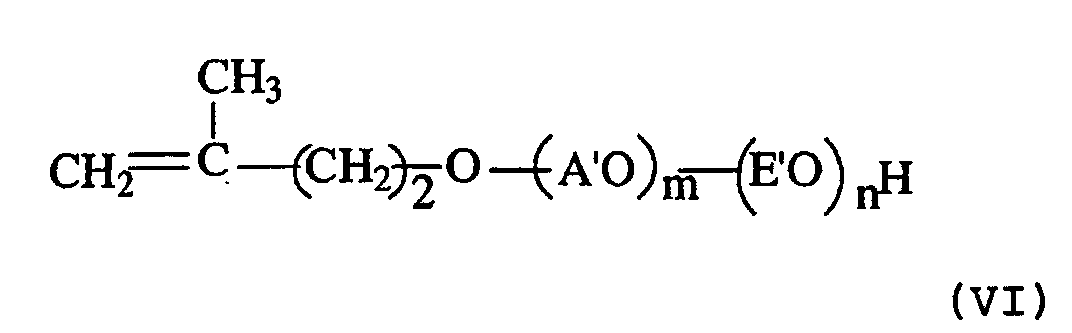
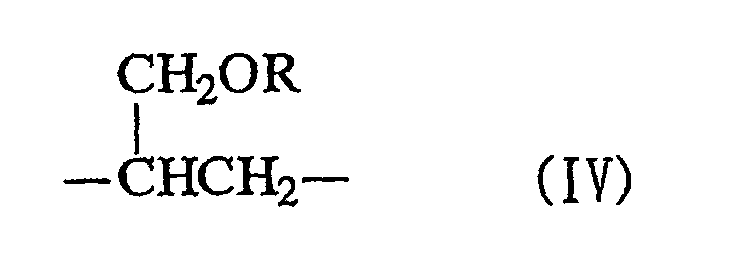
- the present invention resides in a surfactant for emulsion polymerization, the surfactant comprising at least one compound selected from unsaturated compounds having a pentenyl group to which an alkylene oxide is added and represented by the formula (I), (II) or (VI): wherein A represents a straight-chain or branched alkylene group having 3 to 18 carbon atoms or an alkoxymethylethylene group represented by the formula (III) or (IV): wherein R represents a straight-chain or branched alkyl group having 4 to 18 carbon atoms, EO represents an oxyethylene group, a denotes a number of 0 to 50, b denotes a number of 0 to 200 wherein a and b are not 0 at the same time and M represents a cation, provided that the - (AO) - groups a in number [- (AO) a -] and the - (EO) - groups b in number [-(EO) b - ] may be connected
- the present invention provides a surfactant composition for emulsion polymerization, the surfactant composition comprising the aforementioned unsaturated compound and other anionic or nonionic surfactants, a method of producing a polymer emulsion by emulsion-polymerizing a monomer using the above unsaturated compound and a use of the aforementioned unsaturated compound as a surfactant for emulsion polymerization.
- the unsaturated compound which is a sulfate ester salt represented by the formula (I) or (II) will be explained.
- Examples of the straight-chain or branched alkylene group having 3 to 18 carbon atoms which is represented by A in the above formula (I) or (II) include propylene, ethylethylene (butylene), dimethylethylene, butylethylene, octylethylene, decylethylene, dodecylethylene, tetradecylethylene and hexadecylethylene.
- Examples of the straight-chain or branched alkyl group having 4 to 18 carbon atoms which is represented by R in the formula (III) or (IV) include a butyl group, pentyl group, hexyl group, octyl group, 2-ethylhexyl group, nonyl group, decyl group, undecyl group, dodecyl group, tetradecyl group, hexadecyl group and octadecyl group.
- a represents the average addition mol number of an oxyalkylene group or an alkoxymethyloxyethylene group and is in a range from 0 to 50 and preferably 0 to 20.
- the particle diameter of the polymer emulsion can be made smaller and high polymerization stability is obtained and this is therefore particularly preferable. 5 ⁇ (Carbon number of A or R - 2.8) ⁇ a ⁇ 15
- b represents an average addition mol number of an oxyethylene group and is in a range from 0 to 200, preferably 1 to 50 and more preferably 5 to 25. a and b are not 0 at the same time. When a and b are 0 at the same time, an insufficient chemical stability is obtained.
- the -(AO)- groups a in number and the -(EO)- groups b in number may be connected either in a block sequence or in a random sequence. In the case of the block sequence, the order of arrangement of the - (A0) a block and the -(EO) b - block may be optional and the -(AO)- groups a in number may be the same as or different from one another.
- Examples of the cation represented by M include alkali metal ions such as a sodium ion and potassium ion, alkali earth metal ions such as a calcium ion and magnesium ion, ammonium ion and ammonium ion substituted with an alkyl group having 1 to 4 carbon atoms.
- the sulfate ester salt(I) or (II) according to the present invention may be produced using a known method and is obtained, for example, by the following method. Specifically, ⁇ -olefin epoxide or alkyl glycidyl ether is added to 3-methyl-3-buten-1-ol in the presence of a catalyst and ethylene oxide is added to the reaction product by a usual method, or ethylene oxide is added to 3-methyl-3-buten-1-ol and then ⁇ -olefin epoxide or alkyl glycidyl ether is added to the reaction product, to obtain ether alcohol, which is then sulfated by a sulfurizing agent, followed by neutralizing by a basic material.
- the sulfurizing agent is chlorosulfonic acid, anhydrous sulfuric acid and amidosulfuric acid.
- amidosulfuric acid an ammonium salt has been already formed and therefore it is not always necessary to neutralize by a basic material.
- the sulfate ester salt(I) is preferable from the viewpoint of the properties of a polymer coating film produced from a produced polymer emulsion.
- A' O is an oxyalkylene group having 3 to 18 carbon atoms and is preferably an oxybutylene group or an oxypropylene group. Also, when two or more types of alkylene oxide are added, they may be added by any of random addition and block addition. Also, both addition methods may be combined.
- the number m showing the average addition mol number of an oxyalkylene group is 0 to 50 and preferably 0 to 20.
- the above m is preferably a number satisfying the formula (VII) and more preferably a number satisfying the formula (VIII) . 2 ⁇ ⁇ (Carbon number of A'O - 2.8) ⁇ m + 2 ⁇ ⁇ 14 4 ⁇ ⁇ (Carbon number of A'O - 2.8) ⁇ m + 2 ⁇ ⁇ 14
- the number n showing the average addition mol number of an oxyethylene group is 5 to 200, preferably 10 to 60 and particularly preferably 10 to 40 from the viewpoint of polymerization stability and the compatibility of the polymer emulsion with a pigment.
- the unsaturated compound (VI) may be produced by a known method. Specifically, it may be obtained by adding an alkylene oxide having 3 to 18 carbon atoms and ethylene oxide or by adding only ethylene oxide to 3-methyl-3-buten-1-ol.
- the total content of the sulfate ester (I) or (II) is preferably 5 to 100% by weight and more preferably 20 to 100% by weight.
- the content of the unsaturated compound (VI) in the composition of the reactive surfactant (VI) according to the present invention is preferably 20 to 100% by weight and more preferably 50 to 100% by weight.
- the composition of the reactive surfactant (VI) in the present invention preferably contains an anionic surfactant from the viewpoint of polymerization stability.
- the anionic surfactant used in the present invention is preferably a reactive anionic surfactant having a radical polymerizable unsaturated bond.
- sulfosuccinate type reactive surfactants described in JP-A No. 58-203960 and JP-B No. 49-46291 and sulfate ester salt type reactive surfactants described in JP-A No. 62-104802 and JP-A No. 4-53802 may be used.
- non-reactive anionic surfactants may be used to the extent that the water resistance of a film produced from the emulsion is not impaired.
- non-reactive anionic surfactant include n-alkyl sulfate ester salts, linear alkylbenzene sulfonate salts, polyoxyethylene alkyl ether sulfate salts and polyoxyethylene alkylphenyl ether sulfate salts.
- the mixing ratio of the unsaturated compound (VI) /the anionic surfactant is preferably 85/15 to 30/70 and more preferably 80/20 to 50/50 from the viewpoint of polymerization stability and chemical stability.
- the method of producing a polymer emulsion according to the present invention is a method in which the surfactant composition according to the present invention is used to emulsion-polymerize a vinyl type monomer.
- the amount of the composition of the surfactant (I) or (II) to be used in the emulsion polymerization is preferably 0.1 to 10% by weight per the total amount of the vinyl monomers.
- composition of the reactive surfactant (VI) in the present invention is used in an amount ranging from 0.1 to 20 parts by weight, preferably 0.2 to 10 parts by weight and particularly preferably 0.5 to 5 parts by weight per 100 parts by weight of the monomers.
- vinyl type monomer used in the present invention examples include aromatic vinyl monomers such as styrene, ⁇ -methylstyrene and chlorostyrene; (meth)acrylate esters such as methyl(meth)acrylate, ethyl(meth)acrylate, butyl(meth)acrylate and 2-ethylhexyl(meth)acrylate; (meth)acrylic acid; vinyl halides and vinylidene halides such as vinyl chloride, vinyl bromide and vinylidene chloride; vinyl esters such as vinyl acetate and vinyl propionate; nitriles such as acrylonitrile and (meth)acrylonitrile; and conjugated dienes such as butadiene and isoprene. These monomers may be polymerized singly or two or more of these monomers may be copolymerized.
- the amount of the vinyl type monomer to be used is preferably 40 to 60% by weight based on the total system.
- any of those used in usual emulsion polymerization may be used.
- the initiator examples include persulfates such as potassium persulfate and ammonium persulfate, inorganic peroxides such as hydrogen peroxide, organic peroxides such as t-butyl peroxide, cumene hydroxyperoxide, paramenthane peroxide, t-butyl hydroperoxide, benzoyl peroxide and cumene hydroperoxide and azo type compounds such as azobisisobutyronitrile, 2, 2'-azobis(2-amidinopropane) dihydrochloride or 2,2'-azobis(2-amidinopropane) dihydrochloride.
- Persulfates such as potassium persulfate and ammonium persulfate are preferable.
- sodium hydrogensulfite, ferrous ammonium sulfate and the like may be used as a polymerization promoter.
- redox type initiators obtained by combining a reducing agent such as sodium sulfite, Rongalite or ascorbic acid with a peroxide compound may be used.
- a method of adding a monomer a monomer addition method, a batch method or an emulsion addition method may be used.
- the emulsion addition method(pre-emulsion method) is preferable from the viewpoint of polymerization stability. It is preferable that the addition time is 1 to 8 hours and the aging time is 1 to 5 hours.
- the polymerization temperature is adjusted by the decomposition temperature of the initiator and is preferably 70 to 80°C in the case of a persulfate.
- the surfactant composition of the present invention When used as an emulsifier for emulsion polymerization, good polymerization stability and mechanical stability are secured and also, a polymer emulsion ensuring that a polymer film produced therefrom has good water resistance is obtained.
- Examples 1 to 16 relate to inventions using the unsaturated compound represented by the formula (I) or (II) .
- Examples VI-1 to VI-5 relate to inventions using the unsaturated compound represented by the formula (VI).
- a sulfate ester salt produced by the method shown below according to the present invention and a conventional type anionic surfactant were mixed in the ratio shown in Table 1 to prepare surfactant compositions according to the present invention and comparative surfactant compositions.
- emulsion polymerization was carried out by the method shown below and the performance of the product was evaluated. The results are shown in Table 1.
- a reaction vessel equipped with a stirrer, a thermometer, a dropping funnel and a reflux condenser was charged with 397 g (4.6 mol) of 3-methyl-3-buten-1-ol (manufactured by Tokyo Kasei Kogyo Co., Ltd.) and 3.11 g (0.0576 mol) of powdery sodium methoxide.
- 236.7 g (1.15 mol) of ⁇ -olefin epoxides (AOE X24, manufactured by Daicel Chemical Industries Ltd.) having 12 and 14 carbon atoms was added dropwise to the mixture at 130°C over 4 hours in a nitrogen atmosphere and the resulting mixture was kept at the same temperature for 12 hours.
- the reflux condenser was replaced with a distilling condenser to remove unreacted 3-methyl-3-buten-1-ol under reduced pressure.
- the average addition mol number of ⁇ -olefin epoxide was 1.32.
- 300 g of the resulting reaction mixture was placed in an autoclave and 477 g of ethylene oxide was added to the reaction mixture in the condition of 140°C and 0.3 MPa.
- 87.8 g of a part of the resulting reaction mixture and 12.0 g of amidosulfuric acid were placed in a reaction container equipped with a stirrer and a thermometer and reacted at 120°C for 90 minutes in a nitrogen atmosphere to sulfurize.
- a reaction container equipped with a stirrer, a thermometer, a dropping funnel and a reflux condenser was charged with 310 g (3.6 mol) of 3-methyl-3-buten-1-ol and 1.95 g (0.0361 mol) of powdery sodium methoxide.
- 223.6 g (1.2 mol) of 2-ethylhexyl glycidyl ether was added dropwise to the mixture at 130°C over 2.5 hours in a nitrogen atmosphere and the resulting mixture was kept at the same temperature for 5 hours.
- the reflux condenser was replaced with a distilling condenser to remove unreacted 3-methyl-3-buten-1-ol under reduced pressure.
- a reaction container equipped with a stirrer, a thermometer, a dropping funnel and a reflux condenser was charged with 1801 g (2.1 mol) of 3-methyl-3-buten-1-ol and 3.4g (0.0629 mol) of powdery sodium methoxide.
- 273.4 g (2.1 mol) of butyl glycidyl ether was added dropwise to the mixture at 140°C over 2 hours in a nitrogen atmosphere and the resulting mixture was kept at the same temperature for 7 hours.
- the reflux condenser was replaced with a distilling condenser to remove unreacted 3-methyl-3-buten-1-ol under reduced pressure. According to 1 H-NMR, the average addition mol number of butyl glycidyl ether was 1.72.
- a reaction container equipped with a stirrer and a thermometer was charged with 76.7 g (0.15 mol) of an ethylene oxide (10 mol) adduct of 3-methyl-3-buten-1-ol which was obtained by the method shown in the production example of the sulfate ester (A-7) and 0.243 g (0.0045 mol) of powdery sodium methoxide.
- 24.7 g (0.12 mol) of ⁇ -olefin epoxides (AOE X24, manufactured by Daicel Chemical Industries Ltd.) having 12 and 14 carbon atoms was added dropwise to the mixture at 140°C over 1 hour in a nitrogen atmosphere and the resulting mixture was kept at the same temperature for 4 hours.
- a reaction container equipped with a stirrer, a thermometer and a dropping funnel was charged with 60.0 g (0.697 mol) of 3-methyl-3-buten-1-ol (manufactured by Tokyo Kasei Kogyo Co., Ltd.), which was then cooled to 10°C in a nitrogen atmosphere.
- 1.98 g (0.0140 mol) of boron trifluoride diethyl ether complex (manufactured by Wako Pure Chemical Industries, Ltd.) was added and 251 g (3.48 mol) of 1,2-epoxybutane (butylene oxide) was added dropwise at 7 to 10°C. After the dropping was completed, the mixture was kept at 10°C for one hour.
- a four-neck glass flask equipped with a stirrer, a nitrogen-introducing tube and a thermometer was charged with 1.0 mol (887g) of the resulting compound, 1.05 mol (102 g) of amidosulfuric acid and 0.1 mol (6.0 g) of uric acid as a side-reaction inhibitor.
- the mixture was reacted at 105°C for 2 hours and further at 115°C for 2 hours with stirring in a nitrogen atmosphere.
- the sulfate ester salts obtained above were used in the following polymerization reaction.
- Nonionic surfactant (a-1) is N-(2-aminoethyl)-2-aminoethyl-N-(2-aminoethyl)-2-aminoethyl-N-(2-aminoethyl)-2-aminoethyl-N-(2-a)-2-aminoethyl-N-(2-a)-2-aminoethyl-N-(a-1)
- Nonionic surfactant (a-2) is N-(N-2)
- Nonionic surfactant (a-3) is N-(N-3)
- the mixture was stirred in a water bath under a nitrogen stream to allow a rise in temperature until the internal temperature in the flask became 80°C. After the temperature rose, 326.4 g of the above monomer emulsion was added dropwise over 3 hours from a dropping funnel. After the resulting mixture was aged for one hour, it was cooled to ambient temperature to obtain a polymer emulsion. The temperature in the flask was kept at 80 ⁇ 2°C during dropping and aging. Also, in the case where the monomer emulsion to be dropped was separated in the dropping funnel, a small stirrer was placed in the dropping funnel to keep the emulsion even.
- a separable flask was charged with 135.4 g of deionized water, 0.25 g of potassium persulfate and 36.3 g of the above monomer emulsion and the mixture was stirred for 15 minutes in a nitrogen stream. Next, the mixture was stirred in a water bath kept at 80°C under a nitrogen stream to raise the temperature of the mixture. The mixture was initially polymerized for 30 minutes and 326.3 g of the above monomer emulsion was added dropwise over 3 hours. The temperature in the flask was kept at 80 ⁇ 2°C during dropping. The mixture was kept at 80°C for one hour after the dropping was finished to age. After the aging was finished, the aged mixture was cooled to the room temperature to obtain a polymer emulsion.
- the polymer emulsion was subjected to filtration using a 200 mesh stainless screen and the coagula stuck to a reactor wall, a stirrer blade and the like after the polymerization were also collected and filtered in the same manner.
- the obtained both residues were washed with water, dried at 105°C under 26.6 kPa and weighed to find the amount of the coagula.
- the polymerization stability was expressed by the weight percentage of the coagula based on the total amount of the used monomer.
- a Brookfield viscometer was used to measure the viscosity of the polymer emulsion neutralized by aqueous 25% ammonia at 25°C at a revolution of 12 r/min.
- the polymer emulsion after neutralized was diluted with deionized water to bring the polymer concentration to 3% and subjected to titration using an aqueous 1 molL -1 calcium chloride solution to measure a concentration at which a coagulate arose.
- the polymer emulsion neutralized by aqueous 25% ammonia was applied to a slide glass plate and dried at 60°C to produce a polymer film.
- the polymer film was immersed in 25°C deionized water to evaluate the condition of whiting according to the following standard.
Landscapes
- Chemical & Material Sciences (AREA)
- Health & Medical Sciences (AREA)
- Chemical Kinetics & Catalysis (AREA)
- Medicinal Chemistry (AREA)
- Polymers & Plastics (AREA)
- Organic Chemistry (AREA)
- Emulsifying, Dispersing, Foam-Producing Or Wetting Agents (AREA)
- Polymerisation Methods In General (AREA)
Abstract


Description
- The present invention relates to a surfactant for emulsion polymerization, its composition and a method of producing a polymer emulsion by using the same. The present invention provides a polymer emulsion which is superior in polymerization stability, mechanical stability and chemical stability and provides a polymer film having high water resistance.
- Polymer emulsions obtained by emulsion polymerization of a vinyl type monomer such as vinyl acetate and acrylate esters are widely used for industrial uses in the fields of paints, adhesives, paper-making and textile-making as they stand or as plastics and rubbers of the polymer separated therefrom.
- Anionic surfactants such as alkyl sulfate salts, alkylbenzene sulfonate salts, polyoxyethylene alkyl ether salts and polyoxyethylene alkylphenyl ether salts and nonionic surfactants such as polyoxyethylene alkyl ethers and polyoxyethylene alkylphenyl ethers are used as emulsifiers for the emulsion polymerization.
- The emulsifier in the emulsion polymerization not only affects an initiation reaction and propagation reaction of polymerization but also has an influence on the stability of a polymer emulsion during polymerization and further on the mechanical stability, chemical stability, freezing stability and storage stability of a produced polymer emulsion and also has a large influence on the properties of the emulsion such as particle diameter, viscosity and foaming characteristics and further on the water resistance, moisture resistance, heat resistance, adhesiveness and sticking characteristics of the polymer film when the polymer emulsion is made into the film. In paint or adhesive applications, a polymer coating film is formed by drying a polymer emulsion. In this case, it is known that an emulsifier left in the polymer coating film causes a deterioration in water resistance, adhesiveness, weatherability and heat resistance. Also, in the production of synthetic rubbers and the like, an emulsifier is contained in waste water when a polymer is isolated from a polymer emulsion by means of, for example, salting out, posing the problem of increased work load for waste water treatment.
- As an emulsifier for emulsion polymerization, various surfactants are used. A surfactant which is generally called a reactive surfactant and has a radical polymerizable unsaturated bond in its molecule is proposed to improve, particularly, the water resistance and adhesiveness of a polymer film.
- The reactive surfactants include anionic or nonionic surfactants. Like non-reactive surfactants, the anionic reactive surfactant is superior in polymerization stability to the nonionic reactive surfactant and is widely used in the fields requiring the water resistance of a film. Since, in the paint applications, inorganic pigments are added in a large amount, it is necessary to use a nonionic reactive surfactant to maintain the stability of an emulsion and therefore a nonionic reactive surfactant has been used singly or a mixture of an anionic surfactant and a nonionic reactive surfactant has been used.
- As conventional nonionic reactive surfactants, butylene oxide or ethylene oxide adducts of allyl alcohol and ethylene oxide adducts of undecenoic acid are disclosed in JP-A 59-42035 and JP-A 59-81302. Also, a nonionic reactive surfactant produced by further adding an alkylene oxide to 1,3-di-substituted-2-propanol obtained by a reaction of a polyoxyalkylene alkyl (or alkylphenyl) ether, or an alkanol and an alkylphenol with allyl glyceryl ether is disclosed in JP-A 62-104802. However, these conventional nonionic reactive surfactants have insufficient polymerization stability and are therefore unsatisfactory.
- Moreover, JP-W 3-503168 (WO-A 89-12618, EP-A 422120) discloses RO-(R' O)m-(EO)n-1-CH2HCH2X. X represents OH, Cl, t-amino group, sulfonic acid group (SO3), sulfuric acid group (SO4) or the like or a salt thereof.
- Also, a method using a so-called anionic reactive surfactant having an ethylenic unsaturated bond as a polymerizable group in its molecule is proposed. For example, a method using a polyoxyalkylene ether sulfate having an allyl or methallyl group as a polymerizable group is disclosed in JP-A 61-223011. A result obtained by performing emulsion polymerization by using sodium oxyalkanesulfonate using a 3-methyl-3-butenyl group as a polymerizable group, namely, sodium 10-(3-methyl-3-butenyloxy)decane-1-sulfonate is described in Macromolecules, Vol. 32, page 5967 (1999).
- However, if each of these reactive surfactants is singly used, stability during polymerization is almost insufficient. In this case, there is the problem that a conventional type emulsifier must be used together. Also, in the case of sodium 10-(3-methyl-3-butenyloxy)decane-1-sulfonate, the production of the compound itself is not easy from the viewpoint of reaction temperature and yield, posing the problem that it is less economical.
- It is required for these reactive surfactants to have the characteristics that they are superior in polymerization stability and the mechanical stability and chemical stability of the generated polymer emulsion, have good ability to copolymerize with a monomer and impart high water resistance to a polymer film. Also, it is required for these reactive surfactants to allow the emulsion to have a small particle, to possess a low viscosity and to be free from any environmental problem. Also, in a polymerization method (pre-emulsion method) in which a monomer, water and an emulsifier are emulsified to make a monomer emulsion in advance and then the monomer emulsion is added dropwise, it is also required that the stability of the monomer emulsion is highly stable. No reactive surfactant satisfying all of these requirements has been obtained so far.
- It is an object of the present invention to provide a surfactant composition for emulsion polymerization, the composition providing a polymer emulsion which is highly stable during polymerization and ensures that a polymer coating film produced from the polymer emulsion has good properties, and also to provide a method of producing a polymer emulsion by using the surfactant composition.
- Namely, the present invention has the object of providing a reactive surfactant composition for emulsion polymerization which fulfills all of the above requirements and a method of producing a polymer emulsion by using the surfactant composition.
- The present invention resides in a surfactant for emulsion polymerization, the surfactant comprising at least one compound selected from unsaturated compounds having a pentenyl group to which an alkylene oxide is added and represented by the formula (I), (II) or (VI):
 wherein A represents a straight-chain or branched alkylene group having 3 to 18 carbon atoms or an alkoxymethylethylene group represented by the formula (III) or (IV):
 wherein R represents a straight-chain or branched alkyl group having 4 to 18 carbon atoms, EO represents an oxyethylene group, a denotes a number of 0 to 50, b denotes a number of 0 to 200 wherein a and b are not 0 at the same time and M represents a cation, provided that the - (AO) - groups a in number [- (AO)a-] and the - (EO) - groups b in number [-(EO)b- ] may be connected either in a block sequence or in a random sequence wherein in the case of the block sequence, the order of arrangement of the - (AO) - block and the (EO) - block may be optional and the - (AO) - groups a in number may be the same as or different from one another;
 wherein A'O represents an oxyalkylene group having 3 to 18 carbon atoms, E'O represents an oxyethylene group, m denotes a number of 0 to 50 showing an average addition mol number of an oxyalkylene group and n denotes a number of 5 to 200 showing an average addition mol number of an oxyethylene group, provided that the -(A'O)- groups m in number [ -(A'O)m-] may be the same or different.
- Moreover, the present invention provides a surfactant composition for emulsion polymerization, the surfactant composition comprising the aforementioned unsaturated compound and other anionic or nonionic surfactants, a method of producing a polymer emulsion by emulsion-polymerizing a monomer using the above unsaturated compound and a use of the aforementioned unsaturated compound as a surfactant for emulsion polymerization.
- The unsaturated compound which is a sulfate ester salt represented by the formula (I) or (II) will be explained.
- Examples of the straight-chain or branched alkylene group having 3 to 18 carbon atoms which is represented by A in the above formula (I) or (II) include propylene, ethylethylene (butylene), dimethylethylene, butylethylene, octylethylene, decylethylene, dodecylethylene, tetradecylethylene and hexadecylethylene. Examples of the straight-chain or branched alkyl group having 4 to 18 carbon atoms which is represented by R in the formula (III) or (IV) include a butyl group, pentyl group, hexyl group, octyl group, 2-ethylhexyl group, nonyl group, decyl group, undecyl group, dodecyl group, tetradecyl group, hexadecyl group and octadecyl group. a represents the average addition mol number of an oxyalkylene group or an alkoxymethyloxyethylene group and is in a range from 0 to 50 and preferably 0 to 20. When the carbon number of A or R and a fulfill the formula (V) in the case where other surfactants are not used together, the particle diameter of the polymer emulsion can be made smaller and high polymerization stability is obtained and this is therefore particularly preferable.
- b represents an average addition mol number of an oxyethylene group and is in a range from 0 to 200, preferably 1 to 50 and more preferably 5 to 25. a and b are not 0 at the same time. When a and b are 0 at the same time, an insufficient chemical stability is obtained. The -(AO)- groups a in number and the -(EO)- groups b in number may be connected either in a block sequence or in a random sequence. In the case of the block sequence, the order of arrangement of the - (A0)a block and the -(EO)b- block may be optional and the -(AO)- groups a in number may be the same as or different from one another. Examples of the cation represented by M include alkali metal ions such as a sodium ion and potassium ion, alkali earth metal ions such as a calcium ion and magnesium ion, ammonium ion and ammonium ion substituted with an alkyl group having 1 to 4 carbon atoms.
- It has in particular preferably a block sequence shown in the following formula:and meets the condition of the formula (V), b being in a range from 5 to 20.

- The sulfate ester salt(I) or (II) according to the present invention may be produced using a known method and is obtained, for example, by the following method. Specifically, α-olefin epoxide or alkyl glycidyl ether is added to 3-methyl-3-buten-1-ol in the presence of a catalyst and ethylene oxide is added to the reaction product by a usual method, or ethylene oxide is added to 3-methyl-3-buten-1-ol and then α-olefin epoxide or alkyl glycidyl ether is added to the reaction product, to obtain ether alcohol, which is then sulfated by a sulfurizing agent, followed by neutralizing by a basic material. Given as examples of the sulfurizing agent are chlorosulfonic acid, anhydrous sulfuric acid and amidosulfuric acid. When amidosulfuric acid is used, an ammonium salt has been already formed and therefore it is not always necessary to neutralize by a basic material.
- Among the sulfate ester salts (I) and (II) in the present invention, the sulfate ester salt(I) is preferable from the viewpoint of the properties of a polymer coating film produced from a produced polymer emulsion.
- Next, the unsaturated compound represented by the formula (VI) will be explained.
- A' O is an oxyalkylene group having 3 to 18 carbon atoms and is preferably an oxybutylene group or an oxypropylene group. Also, when two or more types of alkylene oxide are added, they may be added by any of random addition and block addition. Also, both addition methods may be combined. The number m showing the average addition mol number of an oxyalkylene group is 0 to 50 and preferably 0 to 20. The above m is preferably a number satisfying the formula (VII) and more preferably a number satisfying the formula (VIII) .
- In the formula (VI), the number n showing the average addition mol number of an oxyethylene group is 5 to 200, preferably 10 to 60 and particularly preferably 10 to 40 from the viewpoint of polymerization stability and the compatibility of the polymer emulsion with a pigment.
- The unsaturated compound (VI) may be produced by a known method. Specifically, it may be obtained by adding an alkylene oxide having 3 to 18 carbon atoms and ethylene oxide or by adding only ethylene oxide to 3-methyl-3-buten-1-ol.
- Next, the composition of the above unsaturated compound will be explained.
- Although other anionic surfactants or nonionic surfactants may be used together in the composition of the surfactant (I) or (II) according to the present invention, the total content of the sulfate ester (I) or (II) is preferably 5 to 100% by weight and more preferably 20 to 100% by weight.
- The content of the unsaturated compound (VI) in the composition of the reactive surfactant (VI) according to the present invention is preferably 20 to 100% by weight and more preferably 50 to 100% by weight.
- The composition of the reactive surfactant (VI) in the present invention preferably contains an anionic surfactant from the viewpoint of polymerization stability. The anionic surfactant used in the present invention is preferably a reactive anionic surfactant having a radical polymerizable unsaturated bond. For example, sulfosuccinate type reactive surfactants described in JP-A No. 58-203960 and JP-B No. 49-46291 and sulfate ester salt type reactive surfactants described in JP-A No. 62-104802 and JP-A No. 4-53802 may be used.
- Also, non-reactive anionic surfactants may be used to the extent that the water resistance of a film produced from the emulsion is not impaired. Examples of the non-reactive anionic surfactant include n-alkyl sulfate ester salts, linear alkylbenzene sulfonate salts, polyoxyethylene alkyl ether sulfate salts and polyoxyethylene alkylphenyl ether sulfate salts.
- When using the unsaturated compound (VI) and the anionic surfactant together, the mixing ratio of the unsaturated compound (VI) /the anionic surfactant (ratio by weight) is preferably 85/15 to 30/70 and more preferably 80/20 to 50/50 from the viewpoint of polymerization stability and chemical stability.
- Next, the following explanations will be furnished concerning the above unsaturated compound and emulsion polymerization using the composition.
- The method of producing a polymer emulsion according to the present invention is a method in which the surfactant composition according to the present invention is used to emulsion-polymerize a vinyl type monomer. The amount of the composition of the surfactant (I) or (II) to be used in the emulsion polymerization is preferably 0.1 to 10% by weight per the total amount of the vinyl monomers.
- The composition of the reactive surfactant (VI) in the present invention is used in an amount ranging from 0.1 to 20 parts by weight, preferably 0.2 to 10 parts by weight and particularly preferably 0.5 to 5 parts by weight per 100 parts by weight of the monomers.
- Examples of the vinyl type monomer used in the present invention include aromatic vinyl monomers such as styrene, α-methylstyrene and chlorostyrene; (meth)acrylate esters such as methyl(meth)acrylate, ethyl(meth)acrylate, butyl(meth)acrylate and 2-ethylhexyl(meth)acrylate; (meth)acrylic acid; vinyl halides and vinylidene halides such as vinyl chloride, vinyl bromide and vinylidene chloride; vinyl esters such as vinyl acetate and vinyl propionate; nitriles such as acrylonitrile and (meth)acrylonitrile; and conjugated dienes such as butadiene and isoprene. These monomers may be polymerized singly or two or more of these monomers may be copolymerized. The amount of the vinyl type monomer to be used is preferably 40 to 60% by weight based on the total system.
- As the initiator used in the emulsion polymerization according to the present invention, any of those used in usual emulsion polymerization may be used.
- Examples of the initiator include persulfates such as potassium persulfate and ammonium persulfate, inorganic peroxides such as hydrogen peroxide, organic peroxides such as t-butyl peroxide, cumene hydroxyperoxide, paramenthane peroxide, t-butyl hydroperoxide, benzoyl peroxide and cumene hydroperoxide and azo type compounds such as azobisisobutyronitrile, 2, 2'-azobis(2-amidinopropane) dihydrochloride or 2,2'-azobis(2-amidinopropane) dihydrochloride. Persulfates such as potassium persulfate and ammonium persulfate are preferable.
- Also, as a polymerization promoter, sodium hydrogensulfite, ferrous ammonium sulfate and the like may be used.
- Further, redox type initiators obtained by combining a reducing agent such as sodium sulfite, Rongalite or ascorbic acid with a peroxide compound may be used.
- As a method of adding a monomer, a monomer addition method, a batch method or an emulsion addition method may be used. Among these methods, the emulsion addition method(pre-emulsion method) is preferable from the viewpoint of polymerization stability. It is preferable that the addition time is 1 to 8 hours and the aging time is 1 to 5 hours. The polymerization temperature is adjusted by the decomposition temperature of the initiator and is preferably 70 to 80°C in the case of a persulfate.
- When the surfactant composition of the present invention is used as an emulsifier for emulsion polymerization, good polymerization stability and mechanical stability are secured and also, a polymer emulsion ensuring that a polymer film produced therefrom has good water resistance is obtained.
- In the following examples, all designations of % indicate weight percentage (wt. %), unless otherwise noted.
- Examples 1 to 16 relate to inventions using the unsaturated compound represented by the formula (I) or (II) . Examples VI-1 to VI-5 relate to inventions using the unsaturated compound represented by the formula (VI).
- A sulfate ester salt produced by the method shown below according to the present invention and a conventional type anionic surfactant were mixed in the ratio shown in Table 1 to prepare surfactant compositions according to the present invention and comparative surfactant compositions. Using this surfactant composition, emulsion polymerization was carried out by the method shown below and the performance of the product was evaluated. The results are shown in Table 1.
- A reaction vessel equipped with a stirrer, a thermometer, a dropping funnel and a reflux condenser was charged with 397 g (4.6 mol) of 3-methyl-3-buten-1-ol (manufactured by Tokyo Kasei Kogyo Co., Ltd.) and 3.11 g (0.0576 mol) of powdery sodium methoxide. 236.7 g (1.15 mol) of α-olefin epoxides (AOE X24, manufactured by Daicel Chemical Industries Ltd.) having 12 and 14 carbon atoms was added dropwise to the mixture at 130°C over 4 hours in a nitrogen atmosphere and the resulting mixture was kept at the same temperature for 12 hours. The reflux condenser was replaced with a distilling condenser to remove unreacted 3-methyl-3-buten-1-ol under reduced pressure. According to 1H-NMR, the average addition mol number of α-olefin epoxide was 1.32. 300 g of the resulting reaction mixture was placed in an autoclave and 477 g of ethylene oxide was added to the reaction mixture in the condition of 140°C and 0.3 MPa. Next, 87.8 g of a part of the resulting reaction mixture and 12.0 g of amidosulfuric acid were placed in a reaction container equipped with a stirrer and a thermometer and reacted at 120°C for 90 minutes in a nitrogen atmosphere to sulfurize. Unreacted amidosulfuric acid was removed by filtration under pressure to obtain a sulfate ester salt(A-1) represented by the following formula.(R: mixture of an n-C10H21 group and an n-C12H25 group)

(Carbon number of A or R - 2.8) × a = (11.6 - 2.8) × 0.8 = 7.0
The carbon number of R was found by calculating a molecular weight backwards from the following: oxygen of oxirane (%) = 7.8. - A reaction container equipped with a stirrer, a thermometer, a dropping funnel and a reflux condenser was charged with 310 g (3.6 mol) of 3-methyl-3-buten-1-ol and 1.95 g (0.0361 mol) of powdery sodium methoxide. 223.6 g (1.2 mol) of 2-ethylhexyl glycidyl ether was added dropwise to the mixture at 130°C over 2.5 hours in a nitrogen atmosphere and the resulting mixture was kept at the same temperature for 5 hours. The reflux condenser was replaced with a distilling condenser to remove unreacted 3-methyl-3-buten-1-ol under reduced pressure. According to 1H-NMR, the average addition mol number of 2-ethylhexyl glycidyl ether was 1.53. 284 g of the resulting reaction mixture was placed in an autoclave and 438 g of ethylene oxide was added to the reaction mixture in the condition of 130°C and 0.4 MPa. Next, 88.4 g of a part of the resulting reaction mixture and 12.6 g of amidosulfuric acid were placed in a reaction container equipped with a stirrer and a thermometer and reacted at 120°C for 90 minutes in a nitrogen atmosphere to sulfurize. Unreacted amidosulfuric acid was removed by filtration under pressure to obtain a sulfate ester salt(A-2) represented by the following formula.(R: 2-ethylhexyl group)

(Carbon number of A or R - 2.8) × a = 8.0 - A reaction container equipped with a stirrer, a thermometer, a dropping funnel and a reflux condenser was charged with 1801 g (2.1 mol) of 3-methyl-3-buten-1-ol and 3.4g (0.0629 mol) of powdery sodium methoxide. 273.4 g (2.1 mol) of butyl glycidyl ether was added dropwise to the mixture at 140°C over 2 hours in a nitrogen atmosphere and the resulting mixture was kept at the same temperature for 7 hours. The reflux condenser was replaced with a distilling condenser to remove unreacted 3-methyl-3-buten-1-ol under reduced pressure. According to 1H-NMR, the average addition mol number of butyl glycidyl ether was 1.72. 368 g of the resulting reaction mixture was placed in an autoclave and 558 g of ethylene oxide was added to the reaction mixture in the condition of 140°C and 0.4 MPa. Next, 82.9 g of a part of the resulting reaction mixture and 11.4 g of amidosulfuric acid were placed in a reaction container equipped with a stirrer and a thermometer and reacted at 120°C for 90 minutes in a nitrogen atmosphere to sulfurize. Unreacted amidosulfuric acid was removed by filtration under pressure to obtain a sulfate ester salt(A-3) represented by the following formula.(R: n-C4H9 group)

(Carbon number of A or R - 2.8) × a = 2.0 - An autoclave was charged with 390 g (4.5 mol) of 3-methyl-3-buten-1-ol and 7.58 g (0.1351 mol) of KOH. 1621 g (22.5 mol) of 1,2-epoxybutane was added to the mixture in the condition of 145°C and 0.3 MPa. In succession, 1985 g (45 mol) of ethylene oxide was added to the resulting mixture in the condition of 150°C and 0.3 MPa. Next, 261 g, a part of the resulting reaction mixture and 34.7 g of amidosulfuric acid were placed in a reaction container equipped with a stirrer and a thermometer and reacted at 120°C for 90 minutes in a nitrogen atmosphere to sulfurize. Unreacted amidosulfuric acid was removed by filtration under pressure to obtain a sulfate ester salt(A-4) represented by the following formula.(Carbon number of A or R - 2.8) × a = 6.0

- An autoclave was charged with 310 g (3.6 mol) of 3-methyl-2-buten-1-ol (manufactured by Tokyo Kasei Kogyo Co., Ltd.) and 7.26 g (0.134 mol) of powdery sodium methoxide. 1298 g (18 mol) of 1,2-epoxybutane was added to the mixture and in succession, 1586 g (36 mol) of ethylene oxide was added to the resulting mixture in the condition of 130°C and 0.3 MPa. Next, 84.7 g, a part of the resulting reaction mixture and 9.60 g of amidosulfuric acid were placed in a reaction container equipped with a stirrer and a thermometer and reacted at 120°C for 90 minutes in a nitrogen atmosphere to sulfurize. Unreacted amidosulfuric acid was removed by filtration under pressure to obtain a sulfate ester salt(A-5) represented by the following formula.(Carbon number of A or R - 2.8) × a = 6.0

- An autoclave was charged with 301 g (3.49 mol) of 3-methyl-3-buten-1-ol and 11.3 g (0.209 mol) of powdery sodium methoxide. 2030 g (34.9 mol) of propylene oxide was added to the mixture and in succession, 1537 g (34.9 mol) of ethylene oxide was added to the resulting mixture in the condition of 130°C and 0.3 MPa. Next, 81.1 g, a part of the resulting reaction mixture and 8.42 g of amidosulfuric acid were placed in a reaction container equipped with a stirrer and a thermometer and reacted at 120°C for 90 minutes in a nitrogen atmosphere to sulfurize. Unreacted amidosulfuric acid was removed by filtration under pressure to obtain a sulfate ester salt (A-6) represented by the following formula.(Carbon number of A or R - 2.8) × a = 2.0

- An autoclave was charged with 340 g (3.95 mol) of 3-methyl-3-buten-1-ol and 6.40 g (0.118 mol) of powdery sodium methoxide. 1740 g (39.5 mol) of ethylene oxide was added to the mixture in the condition of 130°C and 0.3 MPa. Next, 100 g, a part of the resulting reaction mixture and 19.9 g of amidosulfuric acid were placed in a reaction container equipped with a stirrer and a thermometer and reacted at 120°C for 90 minutes in a nitrogen atmosphere to sulfurize. Unreacted amidosulfuric acid was removed by filtration under pressure to obtain a sulfate ester salt(A-7) represented by the following formula.(Carbon number of A or R - 2.8) × a = 0

- A reaction container equipped with a stirrer and a thermometer was charged with 76.7 g (0.15 mol) of an ethylene oxide (10 mol) adduct of 3-methyl-3-buten-1-ol which was obtained by the method shown in the production example of the sulfate ester (A-7) and 0.243 g (0.0045 mol) of powdery sodium methoxide. 24.7 g (0.12 mol) of α-olefin epoxides (AOE X24, manufactured by Daicel Chemical Industries Ltd.) having 12 and 14 carbon atoms was added dropwise to the mixture at 140°C over 1 hour in a nitrogen atmosphere and the resulting mixture was kept at the same temperature for 4 hours. Next, 14.18 g of amidosulfuric acid was added to the aged mixture, which was reacted at 120°C for 90 minutes in a nitrogen atmosphere to sulfurize. Unreacted amidosulfuric acid was removed by filtration under pressure to obtain a sulfate ester salt(A-8) represented by the following formula.(R: mixture of an n-C10H21 group and an n-C12H25 group)
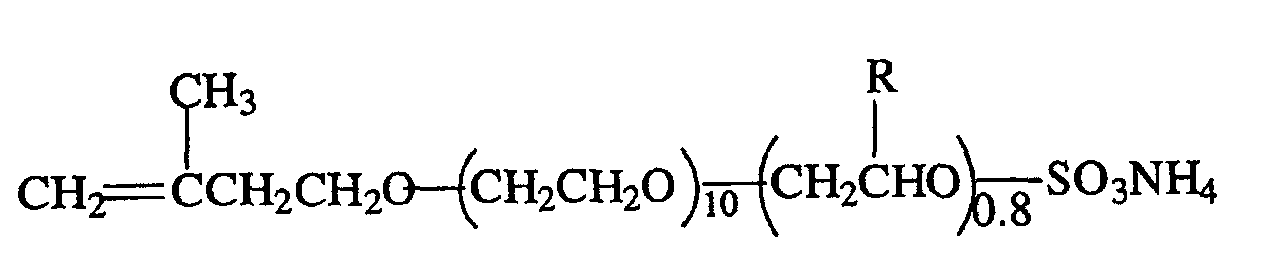
(Carbon number of A or R - 2.8) × a = (11.6 - 2.8) × 0.8 = 7.0
The carbon number of R was found by calculating a molecular weight backwards from the following: oxygen of oxirane (%) = 7.8. - A reaction container equipped with a stirrer, a thermometer and a dropping funnel was charged with 60.0 g (0.697 mol) of 3-methyl-3-buten-1-ol (manufactured by Tokyo Kasei Kogyo Co., Ltd.), which was then cooled to 10°C in a nitrogen atmosphere. 1.98 g (0.0140 mol) of boron trifluoride diethyl ether complex (manufactured by Wako Pure Chemical Industries, Ltd.) was added and 251 g (3.48 mol) of 1,2-epoxybutane (butylene oxide) was added dropwise at 7 to 10°C. After the dropping was completed, the mixture was kept at 10°C for one hour. 6.2 g of an adsorbent, Kyoward 500SH (manufactured by Kyowa Chemical Industry Co., Ltd.) was added to the mixture, which was then stirred at the room temperature for one hour and subjected to filtration under pressure to obtain an 1,2-epoxybutane (5 mol) adduct of 3-methyl-3-buten-1-ol.
- An autoclave was charged with 500 g (1.12 mol) of the 1,2-epoxybutane (5 mol) adduct of 3-methyl-3-buten-1-ol obtained in the above method and 1.88 g (0.0336 mol) of KOH and the mixture was dehydrated at 100°C under 0.004 Mpa. Then, 493 g (11.2 mol) of ethylene oxide was added in the condition of 120°C and 0.3 Mpa to obtain an 1,2-epoxybutane (5 mol) and ethylene oxide (10 mol) adduct of 3-methyl-3-buten-1-ol.
- A four-neck glass flask equipped with a stirrer, a nitrogen-introducing tube and a thermometer was charged with 1.0 mol (887g) of the resulting compound, 1.05 mol (102 g) of amidosulfuric acid and 0.1 mol (6.0 g) of uric acid as a side-reaction inhibitor. The mixture was reacted at 105°C for 2 hours and further at 115°C for 2 hours with stirring in a nitrogen atmosphere. The reaction mixture was then cooled, followed by filtration under pressure and a sulfate esterification product was taken out to obtain a sulfate ester salt(A-9) represented by the following formula.(Carbon number of A or R - 2.8) × a = 6.0

- 603 g (8.36 mol) of 1,2-epoxybutane was added to 60.0 g (0.697 mol) of 3-methyl-3-buten-1-ol in the presence of 2.97 g (0.0209 mol) of boron trifluoride diethyl ether complex in the same manner as in the production of the sulfate ester (A-9) to obtain an 1,2-epoxybutane (12 mol) adduct. An autoclave was charged with 500 g (0.526 mol) of the resulting compound and 0.885 g (0.0158 mol) of KOH and the mixture was dehydrated at 100°C under 0.004 MPa. Then, 463 g (10.5 mol) of ethylene oxide was added to the dehydrated mixture under the condition of 120°C and 0.3 MPa to obtain a BO (12 mol) and EO (20 mol) adduct of 3-methyl-3-buten-1-ol.
- 0 .6 mol (58 . 3 g) of amidosulfuric acid was reacted with 0.5 mol (916 g) of the resulting compound in the presence of 0.05 mol (3.0 g) of urea in the same manner as in the production of the sulfate ester (A-9) . After the reaction was completed, the reaction mixture was cooled, followed by filtration under pressure to obtain a sulfate ester salt (A-10).(Carbon number of A or R - 2.8) × a = 14.4

- 502 g (6.97 mol) of 1,2-epoxybutane was added to 60.0 g (0.697 mol) of 3-methyl-3-buten-1-ol in the presence of 2.97 g (0.0209 mol) of boron trifluoride diethyl ether complex in the same manner as in the production of the sulfate ester salt (A-9) to obtain an 1, 2-epoxybutane (10 mol) adduct. An autoclave was charged with 500 g (0.620 mol) of the resulting compound and 1.04 g (0.0186 mol) of KOH and the mixture was dehydrated at 100°C under 0.004 MPa. Then, 410 g (7.3 mol) of ethylene oxide was added to the dehydrated mixture under the condition of 120°C and 0.3 MPa to obtain a BO (10 mol) and EO (20 mol) adduct of 3-methyl-3-buten-1-ol.
- 0.6 mol (58.3 g) of amidosulfuric acid was reacted with 0.5 mol (733 g) of the resulting compound in the presence of 0.05 mol (3.0 g) of urea in the same manner as in the production of the sulfate ester salt(A-9). After the reaction was completed, the reaction mixture was cooled, followed by filtration under pressure to obtain a sulfate ester salt(A-11) .(Carbon number of A or R - 2.8) × a = 12.0

- The sulfate ester salts obtained above were used in the following polymerization reaction.
- The following compounds (a-1) to (a-3) as the unsaturated compound (VI), the following compounds (b-1) to (b-5) as comparative reactive nonionic surfactants and the following compounds (c-1) and (c-2) as anionic surfactants were used and formulated in the proportions shown in Table VI-1 to prepare reactive surfactant compositions according to the present invention and comparative reactive surfactant compositions. Using these reactive surfactant compositions, emulsion polymerization was carried out using the following method to evaluate the performance of each product. The results are shown in Table VI-1.{(Carbon number of AO - 2.8) × m + 2} = 8
 {(Carbon number of AO - 2.8) × m + 2} = 4
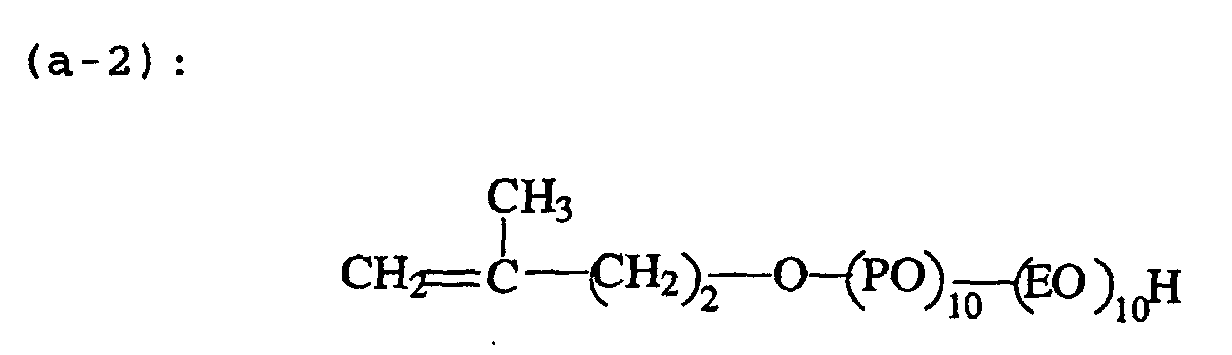 {(Carbon number of AO - 2.8) × m + 2} = 2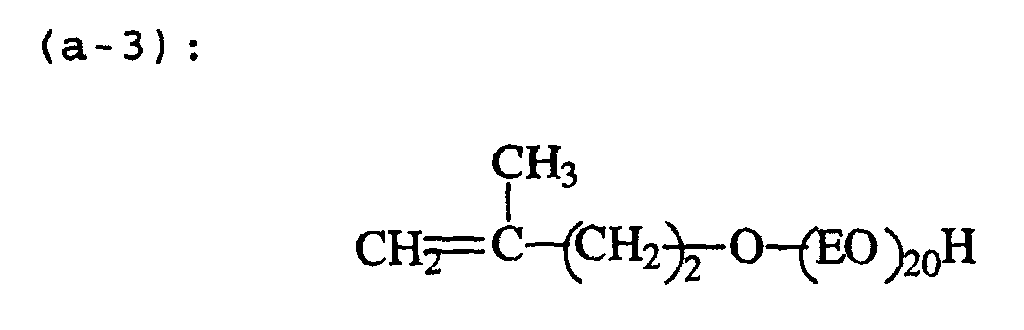
- An autoclave was charged with 390 g (4.5 mol) of 3-methyl-3-buten-1-ol and 7.58 g (0.1351 mol) of KOH, to which were then added 1621 g (22.5 mol) of 1,2-epoxybutane in the condition of 145°C of 0.3 MPa and then 2973 g (67.5 mol) of ethylene oxide in the condition of 150°C and 0.3 MPa. The resulting product was cooled and neutralized using 8.1 g (0.1351 mol) of acetic acid to obtain a nonionic surfactant (a-1) .
- An autoclave was charged with 301 g (3.49 mol) of 3-methyl-3-buten-1-ol and 11.3 g (0.209 mol) of powdery sodium methoxide, to which were then added 2030 g (34.9 mol) of propylene oxide and then 1537 g (34.9 mol) of ethylene oxide in the condition of 130°C and 0.3 MPa. The resulting product was cooled and neutralized using 12.5 g (0.21 mol) of acetic acid to obtain a nonionic surfactant (a-2).
- An autoclave was charged with 340 g (3.95 mol) of 3-methyl-3-buten-1-ol and 6.40 g (0.118 mol) of powdery sodium methoxide, to which was then added 3480 g (79 mol) of ethylene oxide in the condition of 130°C and 0 .3 MPa . Then, the resulting product was cooled and neutralized using 7.1 g (0.118 mol) of acetic acid to obtain a nonionic surfactant (a-3) .
- An autoclave was charged with 290 . 4 g (5.0 mol) of allyl alcohol and 8.1 g (0.15 mol) of powdery sodium methoxide, to which was then added 7709 g (175 mol) of ethylene oxide in the condition of 130°C and 0.3 MPa. Then, the resulting product was cooled and neutralized using 9.0 g (0.15 mol) of acetic acid to obtain a comparative nonionic surfactant (b-1).
- An autoclave was charged with 290 . 4 g (5.0 mol) of allyl alcohol and 10.8 g (0.2 mol) of powdery sodium methoxide, to which were then added 3606 g (50 mol) of 1,2-epoxybutane in the condition of 130°C of 0.3 MPa and then 7709 g (175 mol) of ethylene oxide in the condition of 130°C and 0.3 MPa. The resulting reaction product was cooled and neutralized using 12.0 g (0.20 mol) of acetic acid to obtain a comparative nonionic surfactant (b-2).
- An autoclave was charged with 288.4 g (4.0 mol) of 2-methyl-2-buten-1-ol and 6.48 g (0.12 mol) of powdery sodium methoxide, to which was then added 3524 g (80 mol) of ethylene oxide in the condition of 130°C and 0.3 MPa. The resulting reaction product was cooled and neutralized using 7.2 g (0.12 mol) of acetic acid to obtain a comparative nonionic surfactant (b-3).
- (b-1): CH2=CH-CH2-O-(EO)35H
- (b-2) : CH2=CH-CH2-O-(BO)10-(EO)35H
- (b-3) :

- (b-4): Compound disclosed in JP-A No. 62-104802
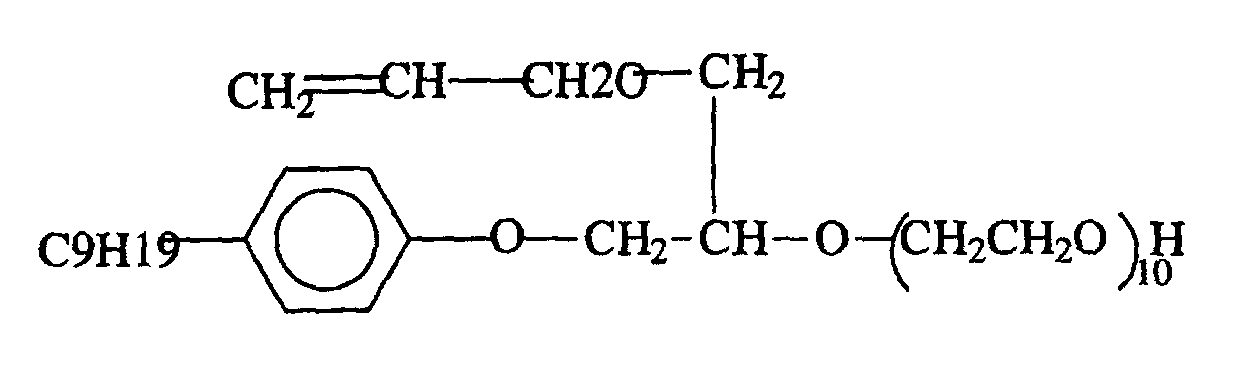
- (b-5) : Nonylphenol • ethylene oxide (35 mol) adduct
- (c-1) : Compound disclosed in JP-A No. 58-203960
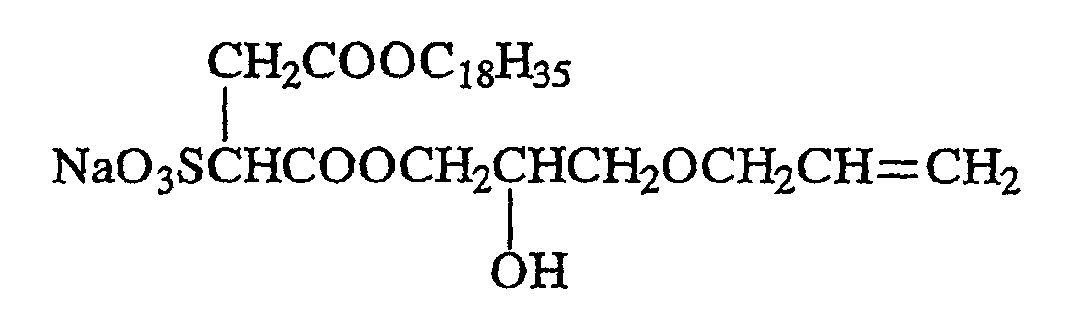
- (c-2): Na salt of linear alkyl(12 carbon atoms)benzenesulfonic acid
-
- 5.5 g of a surfactant composition and 0.28 g of potassium persulfate were dissolved in 117.8 g of deionized water weighed in a beaker. 2.8 g of acrylic acid, 136.1 g of butyl acrylate and 136.1 g of methylmethacrylate were added to the mixture, which was then emulsified using a homomixer at 5000 r/min for 10 minutes, to obtain a monomer emulsion. A separable flask was charged with 137.9 g of deionized water, 0.25 g of potassium persulfate and 36.2 g of the above monomer emulsion and the mixture was stirred for 15 minutes in a nitrogen stream. Next, the mixture was stirred in a water bath under a nitrogen stream to allow a rise in temperature until the internal temperature in the flask became 80°C. After the temperature rose, 326.4 g of the above monomer emulsion was added dropwise over 3 hours from a dropping funnel. After the resulting mixture was aged for one hour, it was cooled to ambient temperature to obtain a polymer emulsion. The temperature in the flask was kept at 80 ± 2°C during dropping and aging. Also, in the case where the monomer emulsion to be dropped was separated in the dropping funnel, a small stirrer was placed in the dropping funnel to keep the emulsion even.
- 2.8 g of acrylic acid, 136.1 g of butyl acrylate and 136.1 g of methylmethacrylate were mixed to prepare a monomer mixture. 5.5 g of a reactive surfactant composition and 0.275 g of potassium persulfate were dissolved in 117.9 g of deionized water. The above monomer mixture was mixed with the solution, which was then emulsified using a homomixer at 5000 r/min for 10 minutes, to obtain an even monomer emulsion.
- A separable flask was charged with 135.4 g of deionized water, 0.25 g of potassium persulfate and 36.3 g of the above monomer emulsion and the mixture was stirred for 15 minutes in a nitrogen stream. Next, the mixture was stirred in a water bath kept at 80°C under a nitrogen stream to raise the temperature of the mixture. The mixture was initially polymerized for 30 minutes and 326.3 g of the above monomer emulsion was added dropwise over 3 hours. The temperature in the flask was kept at 80 ± 2°C during dropping. The mixture was kept at 80°C for one hour after the dropping was finished to age. After the aging was finished, the aged mixture was cooled to the room temperature to obtain a polymer emulsion.
- The polymer emulsion was subjected to filtration using a 200 mesh stainless screen and the coagula stuck to a reactor wall, a stirrer blade and the like after the polymerization were also collected and filtered in the same manner. The obtained both residues were washed with water, dried at 105°C under 26.6 kPa and weighed to find the amount of the coagula. The polymerization stability was expressed by the weight percentage of the coagula based on the total amount of the used monomer.
- 50 g of the polymer emulsion neutralized by aqueous 25% ammonia was placed in a Malon stability tester, which was rotated for 5 minutes in the condition of 10 kgf and 1000 r/min. The generated coagulum was filtered using a 200 mesh stainless screen and the residue was washed with water, dried at 105°C under 26.6 kPa for 2 hours and weighed to express the percentage of the dried residue based on the polymer.
- A particle-diameter measuring instrument by a dynamic light scattering method, Coulter N4 Plus manufactured by Beckman Coulter, Inc. was used to measure the average particle diameter of the polymer particle in the polymer emulsion neutralized by aqueous 25% ammonia.
- A Brookfield viscometer was used to measure the viscosity of the polymer emulsion neutralized by aqueous 25% ammonia at 25°C at a revolution of 12 r/min.
- The polymer emulsion after neutralized was diluted with deionized water to bring the polymer concentration to 3% and subjected to titration using an aqueous 1 molL-1 calcium chloride solution to measure a concentration at which a coagulate arose.
- The polymer emulsion neutralized by aqueous 25% ammonia was applied to a slide glass plate and dried at 60°C to produce a polymer film. The polymer film was immersed in 25°C deionized water to evaluate the condition of whiting according to the following standard.
- o ○: Not whited at all after one hour passed
- ○: Slightly whited after one hour passed
- Δ: Whited in 10 to 30 minutes
- ×: Whited immediately
-
- The results of the compounds (I) and (II) are described in Table 1 and the results of the compound (VI) are described in Table 2.*1 Conventional type anionic surfactant
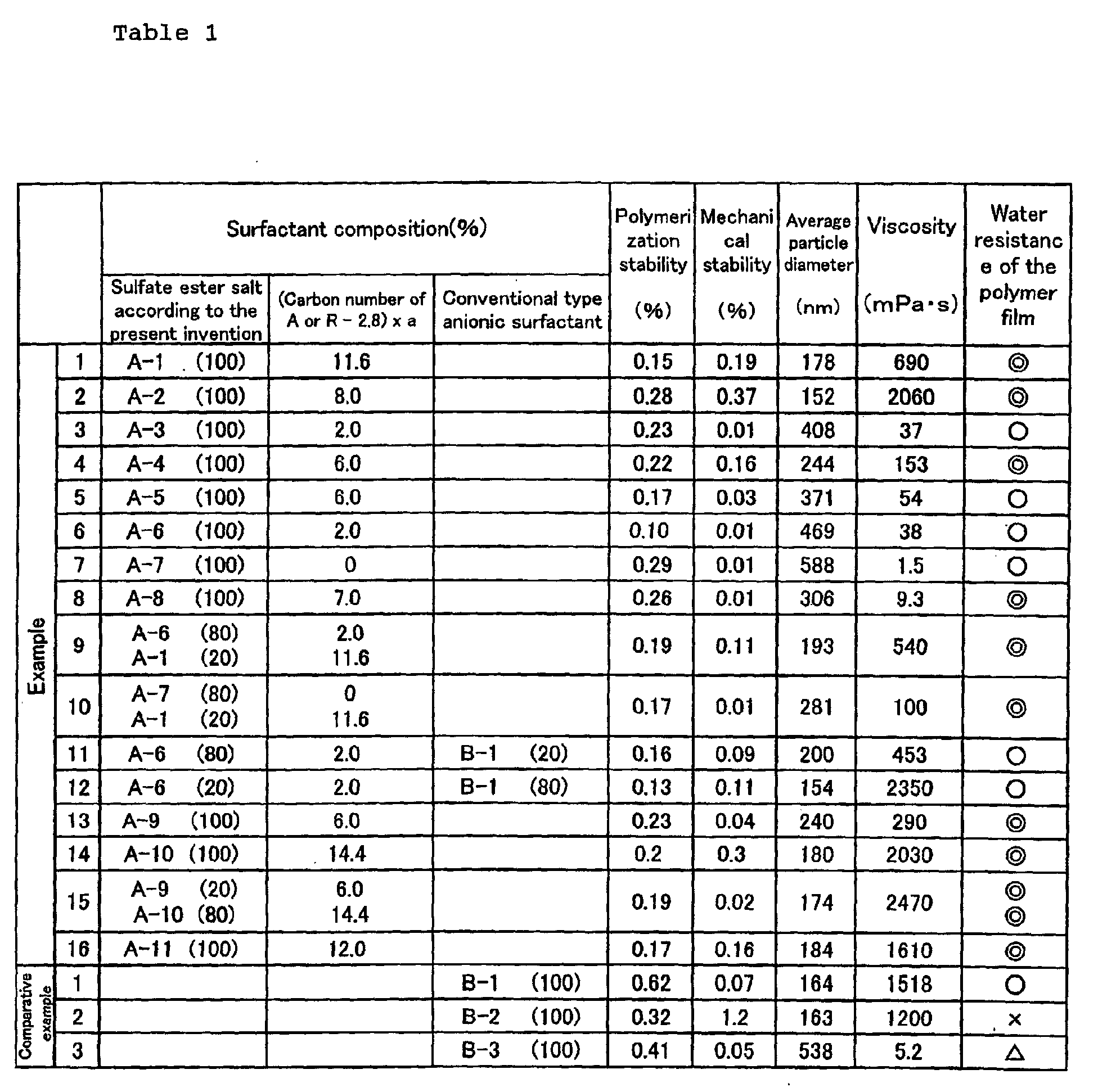
B-1: Mixture ofand (Compounds synthesized by the method described in JP-A No. 58-203960)
B-2:(Compound synthesized by the method described in JP-A No. 61-223011)

Claims (4)
- A surfactant for emulsion polymerization, comprising at least one compound selected from the group consisting of unsaturated compounds having a pentenyl group to which an alkylene oxide is added and represented by the formula (I), (II) or (VI):
 wherein A represents a straight-chain or branched alkylene group having 3 to 18 carbon atoms or an alkoxymethylethylene group represented by the formula (III) or (IV):
 wherein R represents a straight-chain or branched alkyl group having 4 to 18 carbon atoms, EO represents an oxyethylene group, a denotes a number of 0 to 50, b denotes a number of 0 to 200, a and b are not 0 at the same time and M represents a cation, provided that the -(AO)- groups a in number and the -(EO)- groups b in number may be connected either in a block sequence or in a random sequence; in the case of the block sequence, the order of arrangement of the -(AO)- block and the -(EO)- block may be optional and the -(AO)- groups a in number may be the same as or different from one another.
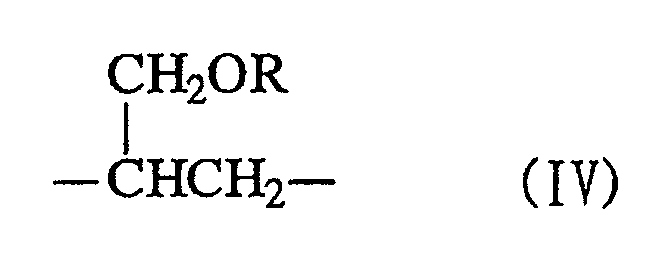 wherein A'O represents an oxyalkylene group having 3 to 18 carbon atoms, E'O represents an oxyethylene group, m denotes a number of 0 to 50 showing an average addition mol number of an oxyalkylene group and n denotes a number of 5 to 200 showing an average addition mol number of an oxyethylene group, provided that the -(A'O)-groups m in number [-(A' O)m-] may be the same as or different from one another.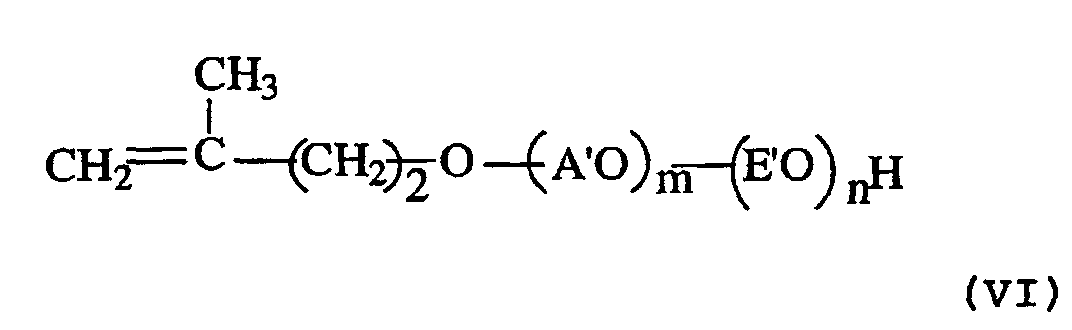
- A surfactant composition for emulsion polymerization, comprising the unsaturated compound as claimed in Claim 1 and another anionic or nonionic surfactant.
- A method of producing a polymer emulsion by emulsion-polymerizing a monomer using the unsaturated compound as claimed in Claim 1.
- Use of the unsaturated compound as claimed in Claim 1 as a surfactant for emulsion polymerization.
Applications Claiming Priority (5)
| Application Number | Priority Date | Filing Date | Title |
|---|---|---|---|
| JP2000274731A JP3756391B2 (en) | 2000-09-11 | 2000-09-11 | Surfactant composition for emulsion polymerization |
| JP2000274731 | 2000-09-11 | ||
| JP2000287431A JP4112164B2 (en) | 2000-09-21 | 2000-09-21 | Reactive surfactant composition for emulsion polymerization |
| JP2000287431 | 2000-09-21 | ||
| PCT/JP2001/007840 WO2002022692A1 (en) | 2000-09-11 | 2001-09-10 | Surfactant for emulsion polymerization |
Publications (3)
| Publication Number | Publication Date |
|---|---|
| EP1318157A1 true EP1318157A1 (en) | 2003-06-11 |
| EP1318157A4 EP1318157A4 (en) | 2004-07-14 |
| EP1318157B1 EP1318157B1 (en) | 2006-03-01 |
Family
ID=26599634
Family Applications (1)
| Application Number | Title | Priority Date | Filing Date |
|---|---|---|---|
| EP01963561A Expired - Lifetime EP1318157B1 (en) | 2000-09-11 | 2001-09-10 | Surfactant for emulsion polymerization |
Country Status (4)
| Country | Link |
|---|---|
| US (1) | US7098250B2 (en) |
| EP (1) | EP1318157B1 (en) |
| DE (1) | DE60117571T2 (en) |
| WO (1) | WO2002022692A1 (en) |
Cited By (4)
| Publication number | Priority date | Publication date | Assignee | Title |
|---|---|---|---|---|
| EP2455156A1 (en) * | 2010-11-18 | 2012-05-23 | Cognis IP Management GmbH | Low viscosity aqueous compounds |
| EP2476712A1 (en) * | 2011-01-18 | 2012-07-18 | Cognis IP Management GmbH | Copolymerisable tensides |
| CN103224622A (en) * | 2013-03-19 | 2013-07-31 | 上海优创化学品有限公司 | Double-bond-containing alcohol ether sulfate and production method thereof |
| WO2020185513A1 (en) * | 2019-03-08 | 2020-09-17 | Stepan Company | Reactive surfactants |
Families Citing this family (14)
| Publication number | Priority date | Publication date | Assignee | Title |
|---|---|---|---|---|
| DE10239932B4 (en) * | 2002-08-21 | 2006-12-07 | Clariant Produkte (Deutschland) Gmbh | Copolymers of alkylene oxides and glycidyl ethers and their use as polymerizable emulsifiers |
| US20060264332A1 (en) * | 2005-05-20 | 2006-11-23 | Halliburton Energy Services, Inc. | Methods of using reactive surfactants in subterranean operations |
| JP5281278B2 (en) * | 2007-12-11 | 2013-09-04 | 花王株式会社 | Surfactant composition for emulsion polymerization |
| US8592040B2 (en) | 2008-09-05 | 2013-11-26 | Basf Se | Polymer emulsion coating or binding formulations and methods of making and using same |
| DE102008061048A1 (en) * | 2008-12-11 | 2010-06-17 | Henkel Ag & Co. Kgaa | Self-precipitating aqueous particulate composition containing pigment-binder particles |
| CN102834566B (en) | 2010-03-23 | 2016-04-27 | 巴斯夫欧洲公司 | Paper Coating or bonding preparaton and its production and use |
| US9102848B2 (en) | 2011-02-28 | 2015-08-11 | Basf Se | Environmentally friendly, polymer dispersion-based coating formulations and methods of preparing and using same |
| BR112014004105B1 (en) | 2011-08-24 | 2020-09-15 | Sasol Olefins & Surfactants Gmbh | SURFACE COMPOSITION FOR EMULSION POLYMERIZATION AND METHOD FOR THE PRODUCTION OF POLYMER EMULSION |
| KR101493664B1 (en) * | 2011-12-20 | 2015-02-13 | 다이이치 고교 세이야쿠 가부시키가이샤 | Emulsifying agent for emulsion polymerization, and emulsion polymerization method using same |
| JP6302232B2 (en) | 2013-12-16 | 2018-03-28 | 花王株式会社 | Colored fine particle dispersion |
| JP6915825B2 (en) * | 2015-10-09 | 2021-08-04 | 花王株式会社 | Reactive surfactant composition for emulsion polymerization |
| US20200031967A1 (en) * | 2016-09-30 | 2020-01-30 | Nippon Shokubai Co., Ltd. | Sulfuric-acid-(salt)-ester-group-containing copolymer and method for producing same |
| JP6791554B2 (en) | 2016-12-14 | 2020-11-25 | 花王株式会社 | Method for manufacturing polymer emulsion for water resistant coating film |
| JP7836632B2 (en) * | 2024-07-25 | 2026-03-27 | 株式会社Adeka | Surfactant composition, emulsion polymerization composition, method for producing polymer emulsion, and polymer emulsion |
Family Cites Families (12)
| Publication number | Priority date | Publication date | Assignee | Title |
|---|---|---|---|---|
| GB2124636B (en) | 1982-07-29 | 1985-08-07 | Ici Plc | Polymerisation process |
| ZA836922B (en) | 1982-10-01 | 1984-06-27 | Ici Plc | Polymerisation process |
| JPS61223011A (en) | 1985-03-28 | 1986-10-03 | Sanyo Chem Ind Ltd | Polymer modifier and modification therewith |
| JPS62104802A (en) | 1985-07-24 | 1987-05-15 | Asahi Denka Kogyo Kk | Emulsifier for emulsion polymerization |
| JPS6268806A (en) | 1985-09-19 | 1987-03-28 | Nippon Shokubai Kagaku Kogyo Co Ltd | Novel water-soluble copolymer and production thereof |
| JP2672385B2 (en) | 1988-06-20 | 1997-11-05 | ピーピージー・インダストリーズ・インコーポレイテッド | Polymerizable surfactant |
| JP2676854B2 (en) * | 1988-12-16 | 1997-11-17 | 日本油脂株式会社 | Polyoxyalkylene unsaturated ether-maleic acid ester copolymer and use thereof |
| JP3995763B2 (en) | 1997-07-10 | 2007-10-24 | 株式会社Adeka | Surfactant |
| JP3832554B2 (en) * | 2000-01-11 | 2006-10-11 | 信越化学工業株式会社 | Painted article |
| JP3658264B2 (en) | 2000-02-28 | 2005-06-08 | 株式会社日本触媒 | Novel alkali-soluble thickener |
| JP3615683B2 (en) | 2000-02-28 | 2005-02-02 | 株式会社日本触媒 | Thickener |
| JP4271363B2 (en) * | 2000-12-15 | 2009-06-03 | 花王株式会社 | Preparation of alkenyl polyether |
-
2001
- 2001-09-10 WO PCT/JP2001/007840 patent/WO2002022692A1/en not_active Ceased
- 2001-09-10 US US10/344,851 patent/US7098250B2/en not_active Expired - Lifetime
- 2001-09-10 DE DE60117571T patent/DE60117571T2/en not_active Expired - Lifetime
- 2001-09-10 EP EP01963561A patent/EP1318157B1/en not_active Expired - Lifetime
Non-Patent Citations (2)
| Title |
|---|
| No further relevant documents disclosed * |
| See also references of WO0222692A1 * |
Cited By (8)
| Publication number | Priority date | Publication date | Assignee | Title |
|---|---|---|---|---|
| EP2455156A1 (en) * | 2010-11-18 | 2012-05-23 | Cognis IP Management GmbH | Low viscosity aqueous compounds |
| US20120130035A1 (en) * | 2010-11-18 | 2012-05-24 | Cognis Ip Management Gmbh | Low-Viscosity Aqueous Compositions |
| US8519071B2 (en) | 2010-11-18 | 2013-08-27 | Cognis Ip Management Gmbh | Low-viscosity aqueous compositions |
| EP2476712A1 (en) * | 2011-01-18 | 2012-07-18 | Cognis IP Management GmbH | Copolymerisable tensides |
| WO2012097837A1 (en) * | 2011-01-18 | 2012-07-26 | Cognis Ip Management Gmbh | Copolymerizable surfactants |
| CN103224622A (en) * | 2013-03-19 | 2013-07-31 | 上海优创化学品有限公司 | Double-bond-containing alcohol ether sulfate and production method thereof |
| CN103224622B (en) * | 2013-03-19 | 2016-05-18 | 上海优创化学品有限公司 | A kind of double bond containing alcohol ether sulfuric ester or salt and production method thereof |
| WO2020185513A1 (en) * | 2019-03-08 | 2020-09-17 | Stepan Company | Reactive surfactants |
Also Published As
| Publication number | Publication date |
|---|---|
| DE60117571D1 (en) | 2006-04-27 |
| EP1318157A4 (en) | 2004-07-14 |
| US20040048963A1 (en) | 2004-03-11 |
| EP1318157B1 (en) | 2006-03-01 |
| WO2002022692A1 (en) | 2002-03-21 |
| DE60117571T2 (en) | 2007-01-18 |
| US7098250B2 (en) | 2006-08-29 |
Similar Documents
| Publication | Publication Date | Title |
|---|---|---|
| EP1318157B1 (en) | Surfactant for emulsion polymerization | |
| US5296627A (en) | Ethylenically unsaturated poly(alkyleneoxy) surfactants | |
| CN101896506B (en) | Surfactant composition for emulsion polymerization | |
| WO1989012618A1 (en) | Polymerizable surfactant | |
| EP0011806A1 (en) | Liquid emulsion polymers, process for preparing them and aqueous compositions thickened with these emulsions | |
| EP2964609A1 (en) | Anionic surfactant compositions and use thereof | |
| JP3756391B2 (en) | Surfactant composition for emulsion polymerization | |
| JP3868831B2 (en) | Reactive surfactant | |
| JP6329153B2 (en) | Anionic surfactant composition and use thereof | |
| US8519071B2 (en) | Low-viscosity aqueous compositions | |
| JP3868834B2 (en) | Reactive surfactant composition for emulsion polymerization | |
| JP2002097212A (en) | Reactive surfactant composition for emulsion polymerization | |
| JP4663934B2 (en) | New phosphate ester type surfactant | |
| JP5005176B2 (en) | Paint composition | |
| JP4160438B2 (en) | Novel sulfate ester type surfactant | |
| CA1339429C (en) | Caustic-stable modified polycarboxylate compound and method of making the same | |
| JP2004277678A (en) | New nonionic surfactant | |
| CN108137721B (en) | Reactive surfactant composition for emulsion polymerization | |
| JP2016160283A (en) | Reactive surfactant for emulsion polymerization and method for producing polymer emulsion using the same | |
| JP2019528335A (en) | Crosslinkable surfactant | |
| US20080139744A1 (en) | Fatty Alcohol Polyglycol Ether Sulfates as Emulsifiers for Emulsion Polymerization | |
| JP2000344805A (en) | Reactive surfactant | |
| JPH0575002B2 (en) | ||
| JPH07165807A (en) | Emulsifier for emulsion polymerization |
Legal Events
| Date | Code | Title | Description |
|---|---|---|---|
| PUAI | Public reference made under article 153(3) epc to a published international application that has entered the european phase |
Free format text: ORIGINAL CODE: 0009012 |
|
| 17P | Request for examination filed |
Effective date: 20030225 |
|
| AK | Designated contracting states |
Designated state(s): AT BE CH CY DE DK ES FI FR GB GR IE IT LI LU MC NL PT SE TR |
|
| RBV | Designated contracting states (corrected) |
Designated state(s): DE FR GB |
|
| A4 | Supplementary search report drawn up and despatched |
Effective date: 20040601 |
|
| 17Q | First examination report despatched |
Effective date: 20050111 |
|
| GRAP | Despatch of communication of intention to grant a patent |
Free format text: ORIGINAL CODE: EPIDOSNIGR1 |
|
| GRAS | Grant fee paid |
Free format text: ORIGINAL CODE: EPIDOSNIGR3 |
|
| GRAA | (expected) grant |
Free format text: ORIGINAL CODE: 0009210 |
|
| AK | Designated contracting states |
Kind code of ref document: B1 Designated state(s): DE FR GB |
|
| REG | Reference to a national code |
Ref country code: GB Ref legal event code: FG4D |
|
| REF | Corresponds to: |
Ref document number: 60117571 Country of ref document: DE Date of ref document: 20060427 Kind code of ref document: P |
|
| ET | Fr: translation filed | ||
| PLBE | No opposition filed within time limit |
Free format text: ORIGINAL CODE: 0009261 |
|
| STAA | Information on the status of an ep patent application or granted ep patent |
Free format text: STATUS: NO OPPOSITION FILED WITHIN TIME LIMIT |
|
| 26N | No opposition filed |
Effective date: 20061204 |
|
| REG | Reference to a national code |
Ref country code: FR Ref legal event code: PLFP Year of fee payment: 16 |
|
| REG | Reference to a national code |
Ref country code: FR Ref legal event code: PLFP Year of fee payment: 17 |
|
| PGFP | Annual fee paid to national office [announced via postgrant information from national office to epo] |
Ref country code: DE Payment date: 20170905 Year of fee payment: 17 Ref country code: GB Payment date: 20170906 Year of fee payment: 17 |
|
| REG | Reference to a national code |
Ref country code: FR Ref legal event code: PLFP Year of fee payment: 18 |
|
| REG | Reference to a national code |
Ref country code: DE Ref legal event code: R119 Ref document number: 60117571 Country of ref document: DE |
|
| GBPC | Gb: european patent ceased through non-payment of renewal fee |
Effective date: 20180910 |
|
| PG25 | Lapsed in a contracting state [announced via postgrant information from national office to epo] |
Ref country code: DE Free format text: LAPSE BECAUSE OF NON-PAYMENT OF DUE FEES Effective date: 20190402 |
|
| PG25 | Lapsed in a contracting state [announced via postgrant information from national office to epo] |
Ref country code: GB Free format text: LAPSE BECAUSE OF NON-PAYMENT OF DUE FEES Effective date: 20180910 |
|
| PGFP | Annual fee paid to national office [announced via postgrant information from national office to epo] |
Ref country code: FR Payment date: 20190815 Year of fee payment: 19 |
|
| PG25 | Lapsed in a contracting state [announced via postgrant information from national office to epo] |
Ref country code: FR Free format text: LAPSE BECAUSE OF NON-PAYMENT OF DUE FEES Effective date: 20200930 |