EP1312339A1 - Verfahren zum Färben von menschlichen Haaren - Google Patents
Verfahren zum Färben von menschlichen Haaren Download PDFInfo
- Publication number
- EP1312339A1 EP1312339A1 EP01126488A EP01126488A EP1312339A1 EP 1312339 A1 EP1312339 A1 EP 1312339A1 EP 01126488 A EP01126488 A EP 01126488A EP 01126488 A EP01126488 A EP 01126488A EP 1312339 A1 EP1312339 A1 EP 1312339A1
- Authority
- EP
- European Patent Office
- Prior art keywords
- hair
- composition applied
- reactive dye
- process step
- human hair
- Prior art date
- Legal status (The legal status is an assumption and is not a legal conclusion. Google has not performed a legal analysis and makes no representation as to the accuracy of the status listed.)
- Granted
Links
- 238000000034 method Methods 0.000 title claims description 24
- 238000004040 coloring Methods 0.000 title description 5
- 239000000203 mixture Substances 0.000 claims abstract description 25
- 239000000985 reactive dye Substances 0.000 claims abstract description 18
- 238000001035 drying Methods 0.000 claims abstract description 8
- 238000004043 dyeing Methods 0.000 claims abstract description 6
- 238000005406 washing Methods 0.000 claims abstract description 5
- QGZKDVFQNNGYKY-UHFFFAOYSA-N Ammonia Chemical compound N QGZKDVFQNNGYKY-UHFFFAOYSA-N 0.000 claims description 6
- BVKZGUZCCUSVTD-UHFFFAOYSA-M Bicarbonate Chemical compound OC([O-])=O BVKZGUZCCUSVTD-UHFFFAOYSA-M 0.000 claims description 3
- 239000003513 alkali Substances 0.000 claims description 3
- 229910021529 ammonia Inorganic materials 0.000 claims description 3
- AFOSIXZFDONLBT-UHFFFAOYSA-N divinyl sulfone Chemical group C=CS(=O)(=O)C=C AFOSIXZFDONLBT-UHFFFAOYSA-N 0.000 claims description 3
- GSEJCLTVZPLZKY-UHFFFAOYSA-N Triethanolamine Chemical compound OCCN(CCO)CCO GSEJCLTVZPLZKY-UHFFFAOYSA-N 0.000 claims description 2
- BVKZGUZCCUSVTD-UHFFFAOYSA-L Carbonate Chemical compound [O-]C([O-])=O BVKZGUZCCUSVTD-UHFFFAOYSA-L 0.000 claims 1
- 239000000975 dye Substances 0.000 description 9
- JUJWROOIHBZHMG-UHFFFAOYSA-N Pyridine Chemical compound C1=CC=NC=C1 JUJWROOIHBZHMG-UHFFFAOYSA-N 0.000 description 8
- 239000000243 solution Substances 0.000 description 7
- 230000037308 hair color Effects 0.000 description 6
- UMJSCPRVCHMLSP-UHFFFAOYSA-N pyridine Natural products COC1=CC=CN=C1 UMJSCPRVCHMLSP-UHFFFAOYSA-N 0.000 description 4
- XLYOFNOQVPJJNP-UHFFFAOYSA-N water Substances O XLYOFNOQVPJJNP-UHFFFAOYSA-N 0.000 description 4
- 102000011782 Keratins Human genes 0.000 description 3
- 108010076876 Keratins Proteins 0.000 description 3
- HEMHJVSKTPXQMS-UHFFFAOYSA-M Sodium hydroxide Chemical compound [OH-].[Na+] HEMHJVSKTPXQMS-UHFFFAOYSA-M 0.000 description 3
- 239000003795 chemical substances by application Substances 0.000 description 3
- 239000000982 direct dye Substances 0.000 description 3
- 230000007613 environmental effect Effects 0.000 description 3
- 230000003700 hair damage Effects 0.000 description 3
- 230000003647 oxidation Effects 0.000 description 3
- 238000007254 oxidation reaction Methods 0.000 description 3
- 239000000126 substance Substances 0.000 description 3
- NLXLAEXVIDQMFP-UHFFFAOYSA-N Ammonia chloride Chemical compound [NH4+].[Cl-] NLXLAEXVIDQMFP-UHFFFAOYSA-N 0.000 description 2
- 241000283707 Capra Species 0.000 description 2
- 206010013786 Dry skin Diseases 0.000 description 2
- LFQSCWFLJHTTHZ-UHFFFAOYSA-N Ethanol Chemical compound CCO LFQSCWFLJHTTHZ-UHFFFAOYSA-N 0.000 description 2
- 230000002378 acidificating effect Effects 0.000 description 2
- 239000000443 aerosol Substances 0.000 description 2
- 230000003113 alkalizing effect Effects 0.000 description 2
- 230000000694 effects Effects 0.000 description 2
- 239000000839 emulsion Substances 0.000 description 2
- 238000000605 extraction Methods 0.000 description 2
- 239000006260 foam Substances 0.000 description 2
- 239000000499 gel Substances 0.000 description 2
- JVTAAEKCZFNVCJ-UHFFFAOYSA-N lactic acid Chemical compound CC(O)C(O)=O JVTAAEKCZFNVCJ-UHFFFAOYSA-N 0.000 description 2
- 230000005923 long-lasting effect Effects 0.000 description 2
- BWHMMNNQKKPAPP-UHFFFAOYSA-L potassium carbonate Chemical compound [K+].[K+].[O-]C([O-])=O BWHMMNNQKKPAPP-UHFFFAOYSA-L 0.000 description 2
- 239000000758 substrate Substances 0.000 description 2
- 0 *C(C[C@@]1N=Nc2c(*)cc(*)c(*C=C)c2)=C(C=C(*)[C@](C2O)N=Nc3c([*-])cc(*)c(*C=C)c3)C2=C1N Chemical compound *C(C[C@@]1N=Nc2c(*)cc(*)c(*C=C)c2)=C(C=C(*)[C@](C2O)N=Nc3c([*-])cc(*)c(*C=C)c3)C2=C1N 0.000 description 1
- HZAXFHJVJLSVMW-UHFFFAOYSA-N 2-Aminoethan-1-ol Chemical compound NCCO HZAXFHJVJLSVMW-UHFFFAOYSA-N 0.000 description 1
- RZVHIXYEVGDQDX-UHFFFAOYSA-N 9,10-anthraquinone Chemical group C1=CC=C2C(=O)C3=CC=CC=C3C(=O)C2=C1 RZVHIXYEVGDQDX-UHFFFAOYSA-N 0.000 description 1
- DGAQECJNVWCQMB-PUAWFVPOSA-M Ilexoside XXIX Chemical compound C[C@@H]1CC[C@@]2(CC[C@@]3(C(=CC[C@H]4[C@]3(CC[C@@H]5[C@@]4(CC[C@@H](C5(C)C)OS(=O)(=O)[O-])C)C)[C@@H]2[C@]1(C)O)C)C(=O)O[C@H]6[C@@H]([C@H]([C@@H]([C@H](O6)CO)O)O)O.[Na+] DGAQECJNVWCQMB-PUAWFVPOSA-M 0.000 description 1
- QAOWNCQODCNURD-UHFFFAOYSA-L Sulfate Chemical compound [O-]S([O-])(=O)=O QAOWNCQODCNURD-UHFFFAOYSA-L 0.000 description 1
- 239000000980 acid dye Substances 0.000 description 1
- 239000012670 alkaline solution Substances 0.000 description 1
- 235000019270 ammonium chloride Nutrition 0.000 description 1
- 239000007864 aqueous solution Substances 0.000 description 1
- 150000004649 carbonic acid derivatives Chemical class 0.000 description 1
- 239000012876 carrier material Substances 0.000 description 1
- 239000004359 castor oil Substances 0.000 description 1
- 235000019438 castor oil Nutrition 0.000 description 1
- 238000006243 chemical reaction Methods 0.000 description 1
- 239000006103 coloring component Substances 0.000 description 1
- 239000008139 complexing agent Substances 0.000 description 1
- 230000003750 conditioning effect Effects 0.000 description 1
- 239000000470 constituent Substances 0.000 description 1
- 239000002537 cosmetic Substances 0.000 description 1
- 230000006378 damage Effects 0.000 description 1
- 125000000664 diazo group Chemical group [N-]=[N+]=[*] 0.000 description 1
- PPSZHCXTGRHULJ-UHFFFAOYSA-N dioxazine Chemical group O1ON=CC=C1 PPSZHCXTGRHULJ-UHFFFAOYSA-N 0.000 description 1
- 239000006185 dispersion Substances 0.000 description 1
- 239000003205 fragrance Substances 0.000 description 1
- 125000000524 functional group Chemical group 0.000 description 1
- ZEMPKEQAKRGZGQ-XOQCFJPHSA-N glycerol triricinoleate Natural products CCCCCC[C@@H](O)CC=CCCCCCCCC(=O)OC[C@@H](COC(=O)CCCCCCCC=CC[C@@H](O)CCCCCC)OC(=O)CCCCCCCC=CC[C@H](O)CCCCCC ZEMPKEQAKRGZGQ-XOQCFJPHSA-N 0.000 description 1
- 229910052736 halogen Inorganic materials 0.000 description 1
- 150000002367 halogens Chemical class 0.000 description 1
- 125000000623 heterocyclic group Chemical group 0.000 description 1
- 239000004310 lactic acid Substances 0.000 description 1
- 235000014655 lactic acid Nutrition 0.000 description 1
- 238000005259 measurement Methods 0.000 description 1
- 239000007800 oxidant agent Substances 0.000 description 1
- 150000002978 peroxides Chemical class 0.000 description 1
- IEQIEDJGQAUEQZ-UHFFFAOYSA-N phthalocyanine Chemical compound N1C(N=C2C3=CC=CC=C3C(N=C3C4=CC=CC=C4C(=N4)N3)=N2)=C(C=CC=C2)C2=C1N=C1C2=CC=CC=C2C4=N1 IEQIEDJGQAUEQZ-UHFFFAOYSA-N 0.000 description 1
- 235000015497 potassium bicarbonate Nutrition 0.000 description 1
- 229910000027 potassium carbonate Inorganic materials 0.000 description 1
- 235000011181 potassium carbonates Nutrition 0.000 description 1
- 239000002243 precursor Substances 0.000 description 1
- 238000002360 preparation method Methods 0.000 description 1
- RUOJZAUFBMNUDX-UHFFFAOYSA-N propylene carbonate Chemical compound CC1COC(=O)O1 RUOJZAUFBMNUDX-UHFFFAOYSA-N 0.000 description 1
- 150000003216 pyrazines Chemical class 0.000 description 1
- 150000003230 pyrimidines Chemical class 0.000 description 1
- 235000015424 sodium Nutrition 0.000 description 1
- CDBYLPFSWZWCQE-UHFFFAOYSA-L sodium carbonate Substances [Na+].[Na+].[O-]C([O-])=O CDBYLPFSWZWCQE-UHFFFAOYSA-L 0.000 description 1
- 229910000029 sodium carbonate Inorganic materials 0.000 description 1
- 239000002904 solvent Substances 0.000 description 1
- 239000003381 stabilizer Substances 0.000 description 1
- 239000004094 surface-active agent Substances 0.000 description 1
- 229920001059 synthetic polymer Polymers 0.000 description 1
- 239000002562 thickening agent Substances 0.000 description 1
- 150000003918 triazines Chemical class 0.000 description 1
- 238000003809 water extraction Methods 0.000 description 1
Classifications
-
- A—HUMAN NECESSITIES
- A61—MEDICAL OR VETERINARY SCIENCE; HYGIENE
- A61K—PREPARATIONS FOR MEDICAL, DENTAL OR TOILETRY PURPOSES
- A61K8/00—Cosmetics or similar toiletry preparations
- A61K8/18—Cosmetics or similar toiletry preparations characterised by the composition
- A61K8/30—Cosmetics or similar toiletry preparations characterised by the composition containing organic compounds
- A61K8/46—Cosmetics or similar toiletry preparations characterised by the composition containing organic compounds containing sulfur
- A61K8/463—Cosmetics or similar toiletry preparations characterised by the composition containing organic compounds containing sulfur containing sulfuric acid derivatives, e.g. sodium lauryl sulfate
-
- A—HUMAN NECESSITIES
- A61—MEDICAL OR VETERINARY SCIENCE; HYGIENE
- A61Q—SPECIFIC USE OF COSMETICS OR SIMILAR TOILETRY PREPARATIONS
- A61Q5/00—Preparations for care of the hair
- A61Q5/10—Preparations for permanently dyeing the hair
-
- A—HUMAN NECESSITIES
- A61—MEDICAL OR VETERINARY SCIENCE; HYGIENE
- A61K—PREPARATIONS FOR MEDICAL, DENTAL OR TOILETRY PURPOSES
- A61K2800/00—Properties of cosmetic compositions or active ingredients thereof or formulation aids used therein and process related aspects
- A61K2800/80—Process related aspects concerning the preparation of the cosmetic composition or the storage or application thereof
- A61K2800/94—Involves covalent bonding to the substrate
Definitions
- the invention relates to a novel method for coloring human Hair that has long-lasting dyeings with good color properties such as light, Washing and environmental stability results, even with repeated use none Hair damage occurs.
- oxidation dye preparation which contain oxidation dye precursors and oxidizing agents, permanent Achieve hair coloring, because it reacts directly with the hair takes place. With repeated short-term use, however, especially with sensitive hair, hair damage occur.
- the invention is based on the task, the disadvantages of both methods avoid and permanent hair coloring without any hair damage cause.
- Reactive dyes have been known for a long time; in addition to a coloring component, they have at least one reactive group in the molecule which is bound to the substrate by reaction with functional groups of the substrate, in the present case the hair keratin.
- these reactive substances which are defined, for example, in Römpp Chemie Lexikon, 9th edition, pp. 3805-3806, with extensive references, also contain hydrophilic groups.
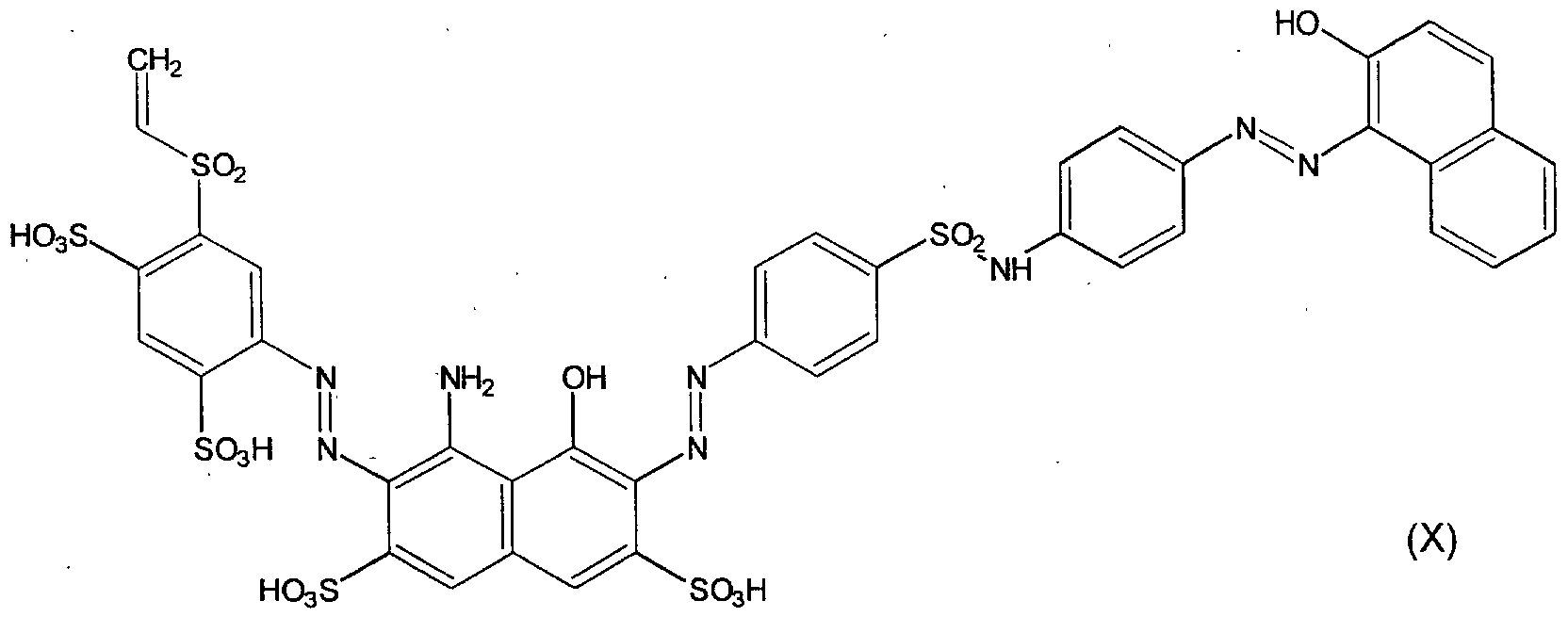
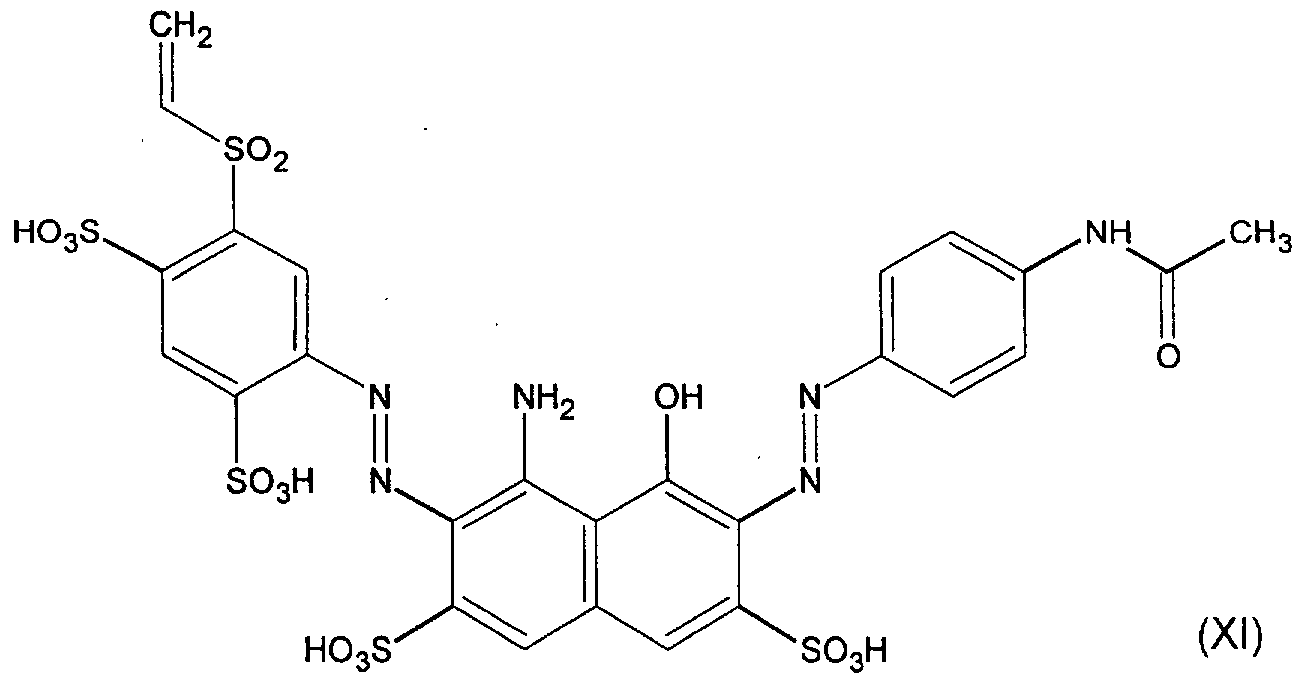
- Particularly preferred reactive dyes are those of the formulas:
- Reactive dyes with halogen-containing, heterocyclic are also suitable Residues such as triazines, pyrazines, pyrimidines, etc.
- coloring groups are diazo groups, anthraquinone groups, Phthalocyanine and dioxazine structures are suitable.
- the reactive dyes can be used in all media used for coloring hair, in particular solutions, emulsions, gels or (foam) aerosols which contain the substances customary in such compositions, such as surface-active agents, thickeners, fragrances, stabilizers, solubilizers, natural and / or contain synthetic polymers, complexing agents, etc.; the composition of these carrier materials is generally known and is described, for example, in the monograph by K. Schrader, Fundamentals and Recipes of Cosmetics, 2nd Edition (1989), pp. 796-798.
- the pH of the composition is between 2 and 5, preferably about 2.5 to 4, and is adjusted in a manner known per se.
- the concentration of the reactive dyes in the composition applied to the hair depends on the structure thereof and the desired color intensity; it is generally from about 0.01 to about 5, in particular from about 0.05 to 2.5, preferably from about 0.1 to about 1% by weight. Direct dyes can also be added to shade the coloring.
- the exposure time of this acidic reactive dye composition is preferably about 10 to 30 minutes; it can be reduced by exposure to heat.
- a further operation b) can be switched on, which includes an intermediate rinsing and optionally drying of the hair.
- the alkaline composition to be applied following process step b) and, if carried out optionally, c) has a pH of 7.5 to 12, preferably about 8 to 11, in particular about 8.5 to 10.
- alkalizing agents are ammonia, monoethanolamine and alkali carbonates and bicarbonates such as sodium and potassium carbonate and bicarbonate. In principle, however, other alkalizing agents such as di- and triethanolamine as well as further hydroxyalkanolamines can also be used.
- the time of exposure of the alkaline composition to the hair is about 1 to 20, preferably about 5 to 15 minutes. The hair is then washed or rinsed and dried.
- This alkaline composition can also be present as a solution, emulsion, dispersion, gel or (foam) aerosol and can contain further constituents, for example caring or conditioning substances. These components are known per se to the person skilled in the art and therefore do not require any further explanation.
- Peroxide treatment can further lighten the hair become.
Landscapes
- Life Sciences & Earth Sciences (AREA)
- Health & Medical Sciences (AREA)
- Animal Behavior & Ethology (AREA)
- General Health & Medical Sciences (AREA)
- Public Health (AREA)
- Veterinary Medicine (AREA)
- Birds (AREA)
- Epidemiology (AREA)
- Cosmetics (AREA)
Abstract
Description
In der Regel enthalten diese Reaktivstoffe, die beispielsweise in Römpp Chemie Lexikon, 9. Aufl., S. 3805-3806, mit ausführlichen Literaturhinweisen definiert sind, auch noch hydrophile Gruppen.
Erfindungsgemäß werden bevorzugt Reaktivfarbstoffe eingesetzt, die entweder mindestens eine Vinylsulfongruppe aufweisen oder mindestens eine Sulfatoethylsulfongruppe enthalten, die Sulfat abspalten kann und in die Vinylsulfongruppe übergeht, die dann mit reaktiven Gruppen des Haarkeratins reagiert.


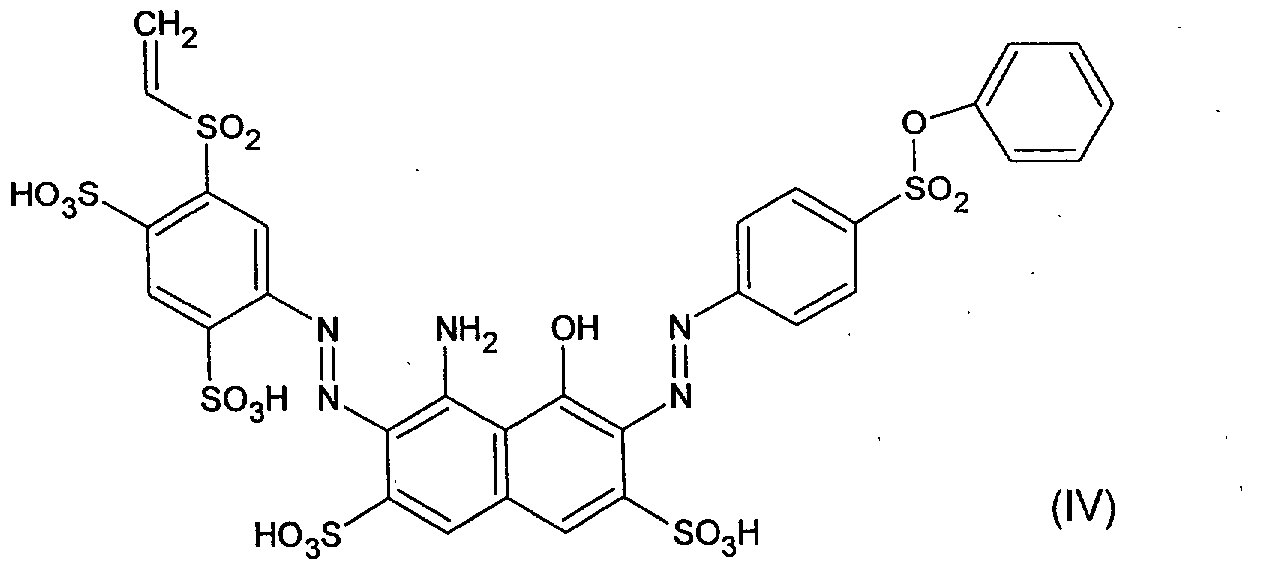

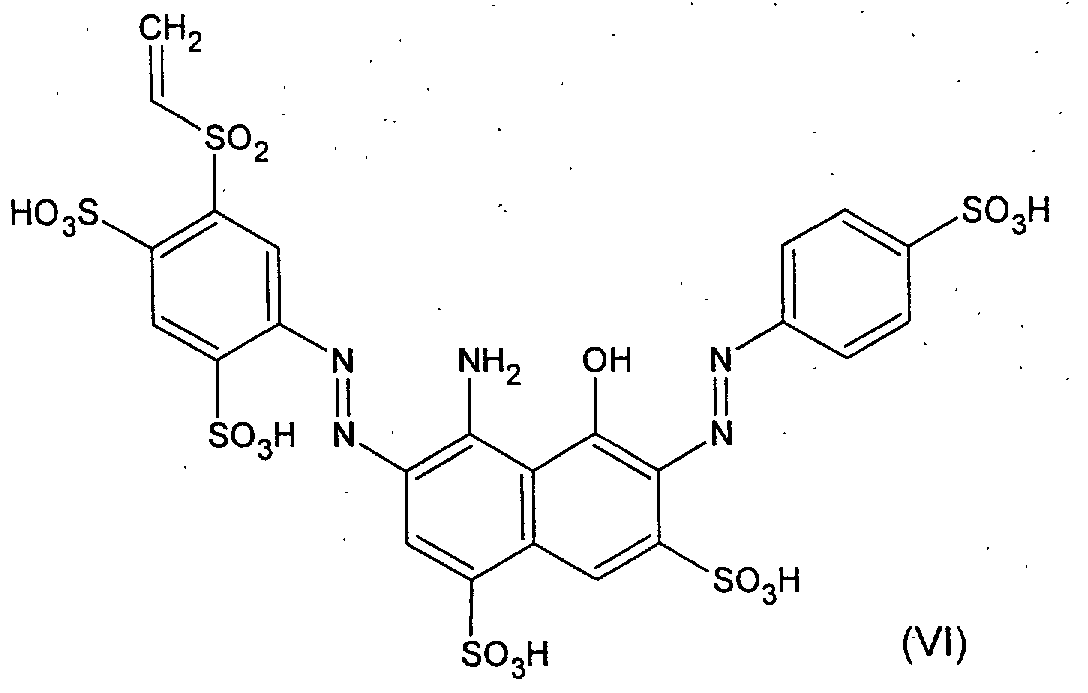
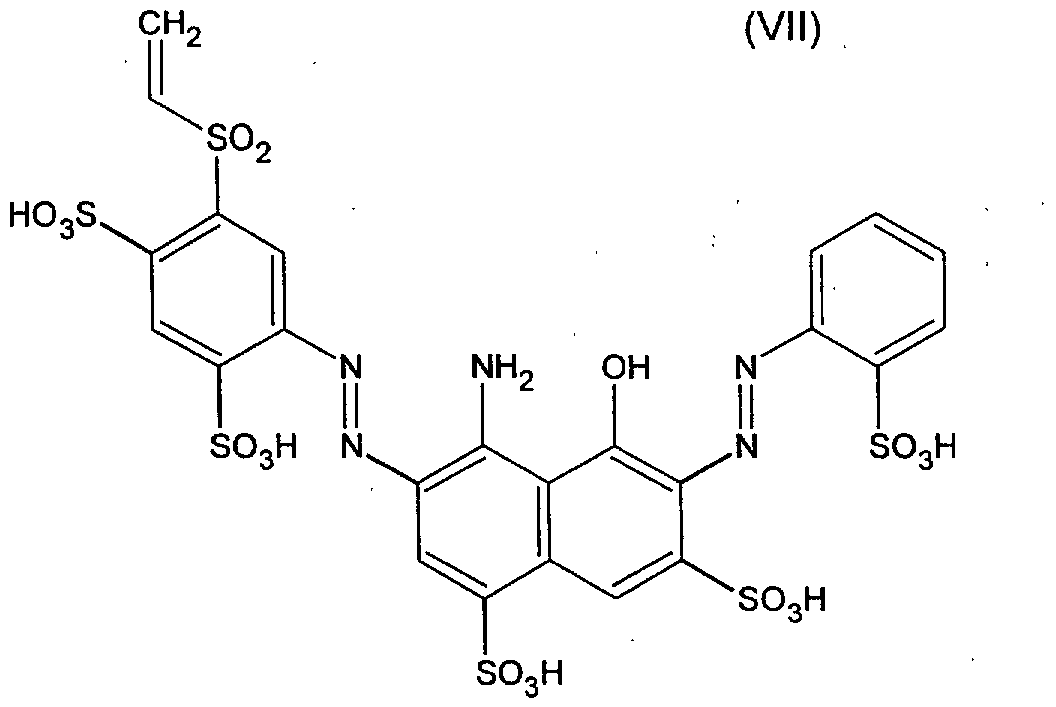

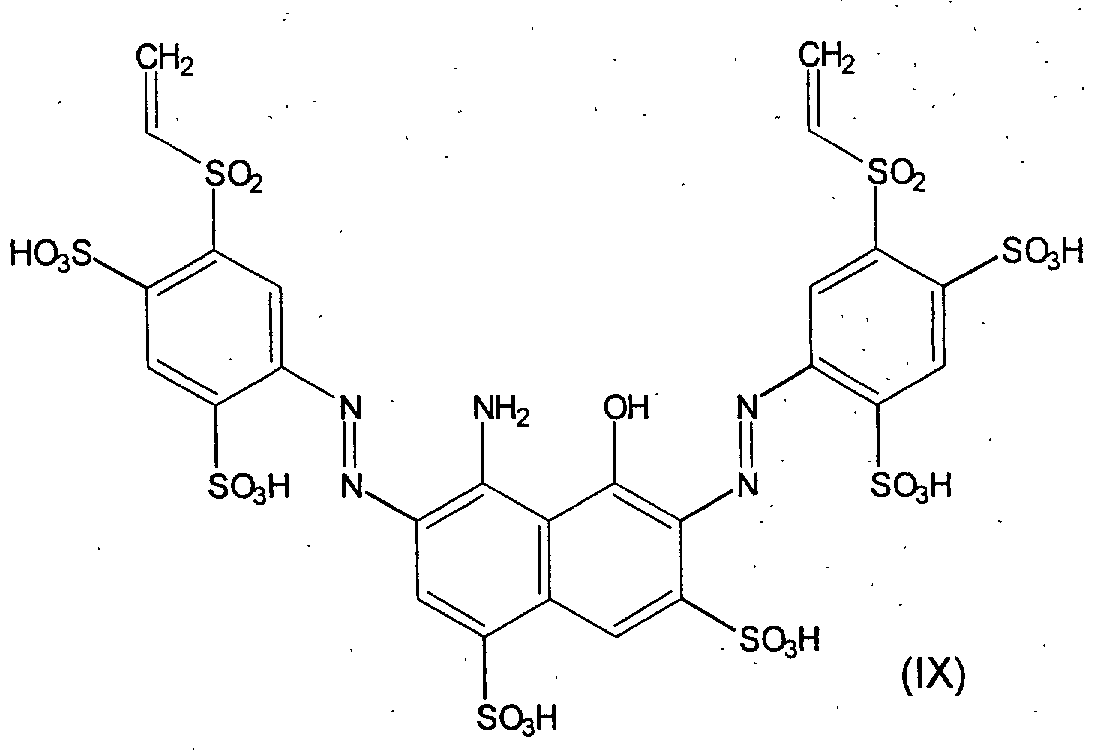
Der pH-Wert der Zusammensetzung liegt zwischen 2 und 5, vorzugsweise etwa 2,5 bis 4, und wird auf an sich bekannte Weise eingestellt.
Dabei können zur Nuancierung der Färbung auch direktziehende Farbstoffe zugesetzt werden.
Die Einwirkungszeit dieser sauren Reaktivfarbstoff-Zusammensetzung liegt vorzugsweise bei etwa 10 bis 30 Minuten; sie kann durch Wärmeeinwirkung vermindert werden.
Zwischen die Verfahrensschritte b) und d), d.h. Einwirkung der sauren Reaktivfarbstoff-Zusammensetzung und Aufbringung der alkalischen Zusammensetzung, kann ein weiterer Arbeitsgang b) eingeschaltet werden, der eine zwischenzeitliche Spülung und gegebenenfalls Trocknung des Haares beinhaltet.
Die im Anschluß an den Verfahrensschritt b) und, falls fakultativ durchgeführt, c) aufzubringende alkalische Zusammensetzung weist einen pH-Wert von 7,5 bis 12, vorzugsweise etwa 8 bis 11, insbesondere etwa 8,5 bis 10 auf.
Grundsätzlich können jedoch auch andere Alkalisierungsmittel wie Di- und Triethanolamin sowie weitere Hydroxyalkanolamine eingesetzt werden.
Die Einwirkungszeit der alkalischen Zusammensetzung auf dem Haar beträgt etwa 1 bis 20, vorzugsweise etwa 5 bis 15 Minuten.
Danach wird das Haar gewaschen bzw. gespült und getrocknet.
Diese alkalische Zusammensetzung kann ebenfalls als Lösung, Emulsion, Dispersion, Gel oder (Schaum-)Aerosol vorliegen und weitere Bestandteile, z.B. pflegende oder konditionierende Substanzen, enthalten.
Diese Bestandteile sind dem Fachmann an sich bekannt und bedürfen daher keiner weiteren Erläuterungen.
Es wurden sowohl die Farbintensität durch die bekannte Messung der ΔE-Werte als auch die Bindung des Farbstoffs an das Haar durch die Bestimmung der Stabilität der Farbstoffaufnahme mittels Extraktion durch ein Pyridin/Wasser-Gemisch im Vergleich zu nicht erfindungsgemäß behandelten Haarsträhnen, d.h. solchen, bei denen keine alkalische Nachbehandlung durchgeführt worden war, untersucht.
Die 72-stündige Extraktion durch eine 50%-ige wäßrige Pyridinlösung ist ein Maß für die Menge des Farbstoffs, der mit dem Haarkeratin reagiert hat, d.h., je mehr Farbstoff mittels Pyridin extrahiert wird, desto niedriger der Bindungsgrad und damit die Farbwirkung.
| 25,0 (Gew.-%) | Propylencarbonat |
| 5,0 | Ethanol |
| 3,0 | PEG-40 Hydriertes Ricinusöl |
| 5,0 | Milchsäure |
| 0,3 | NaOH, 32%-ig |
| 0,1 | Reaktivfarbstoff |
| ad 100,0 | Wasser |
Die erhaltenen Ergebnisse sind in der folgenden Tabelle dokumentiert:
| Reaktivfarbstoff (Allgemeine Formel | Extrahierbarer Farbstoff aus dem Ziegenhaar | Farbe |
| VI | 2% | Blau |
| VII | 2% | Blau |
| III | 2% | Blau |
| IV | 6% | Blau |
| V | 4% | Blau |
| VIII | 8% | Schwarz |
| IX | 3% | Schwarz |
| X | 21% | Schwarz |
| XI | 2% | Schwarz |
Claims (7)
- Verfahren zum Färben von menschlichen Haaren, gekennzeichnet durch die Kombination folgender Verfahrensschritte:a) Aufbringen einer Zusammensetzung mit einem pH-Wert von 2 bis 5, enthaltend mindestens einen Reaktivfarbstoff, auf menschliches Haar;b) Einwirkenlassen zwischen etwa 5 bis 45 Minuten;c) gegebenenfalls Spülen und Trocknen;d) Aufbringen einer alkalischen Zusammensetzung mit einem pH-Wert von 7,5 bis 12;e) Einwirkenlassen für 1 bis 20 Minuten; undf) Ausspülen bzw. Auswaschen und Trocknen des gefärbten Haares.
- Verfahren nach Anspruch 1, dadurch gekennzeichnet, daß die in der Verfahrensstufe a) aufgebrachte Zusammensetzung mindestens einen Reaktivfarbstoff der folgenden Formeln

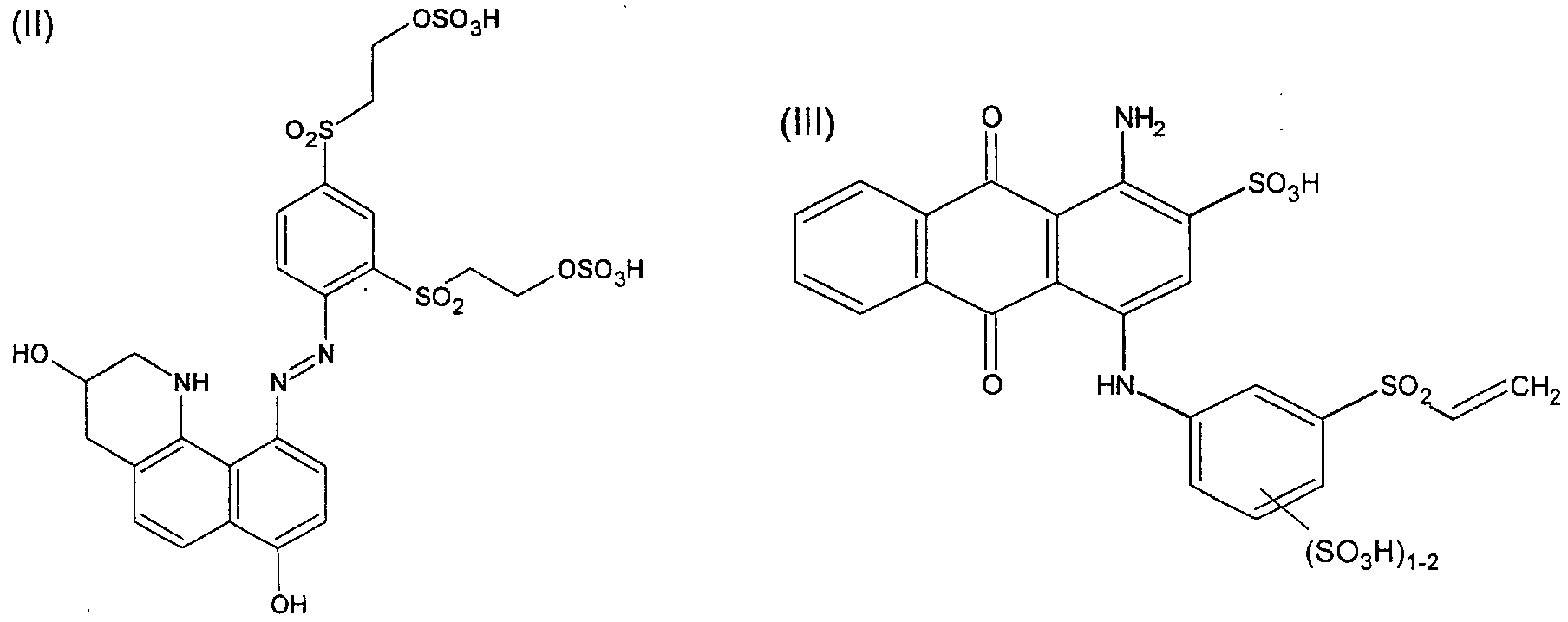

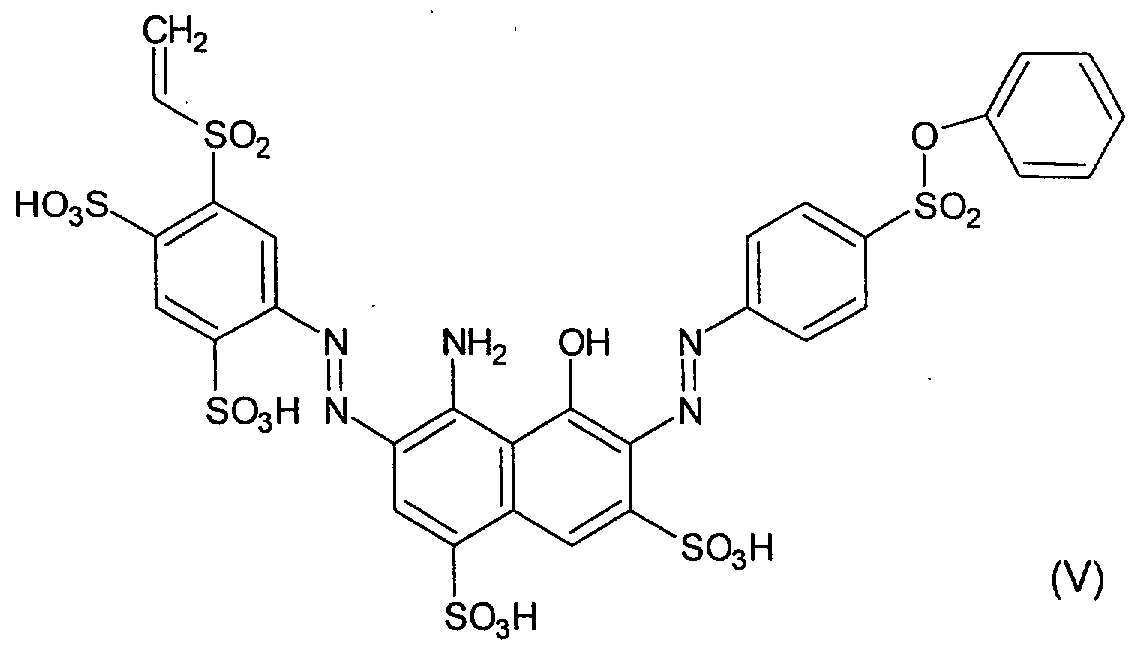
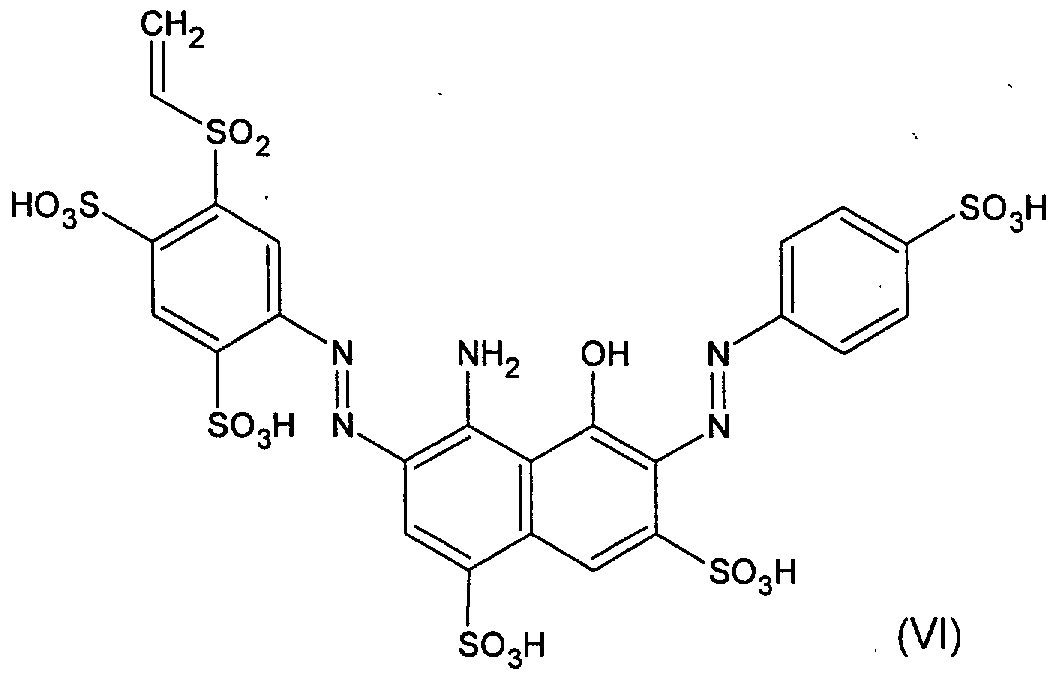

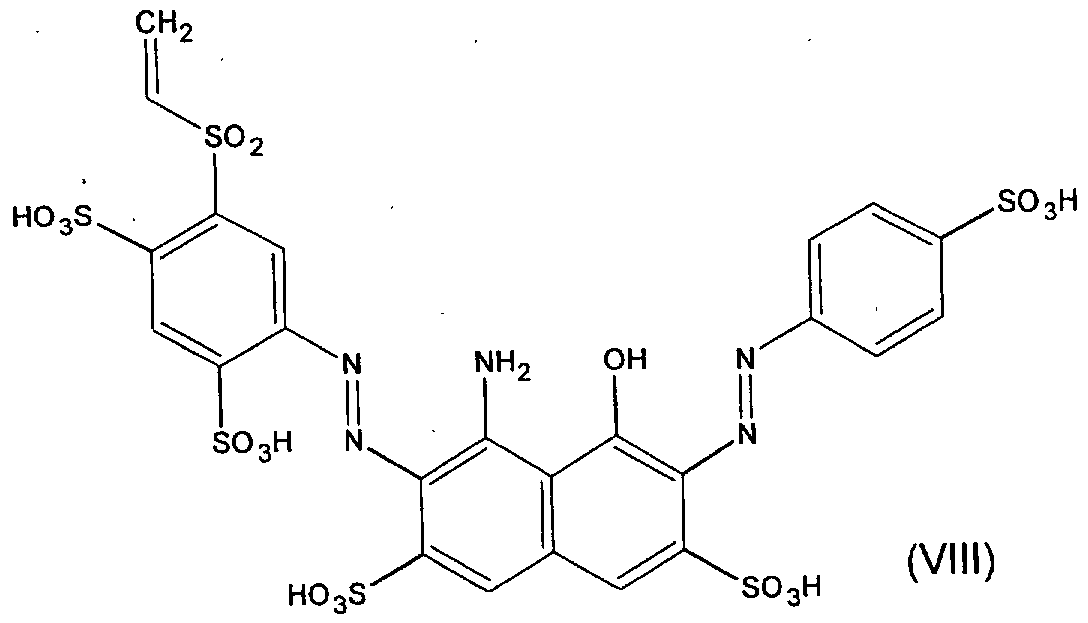
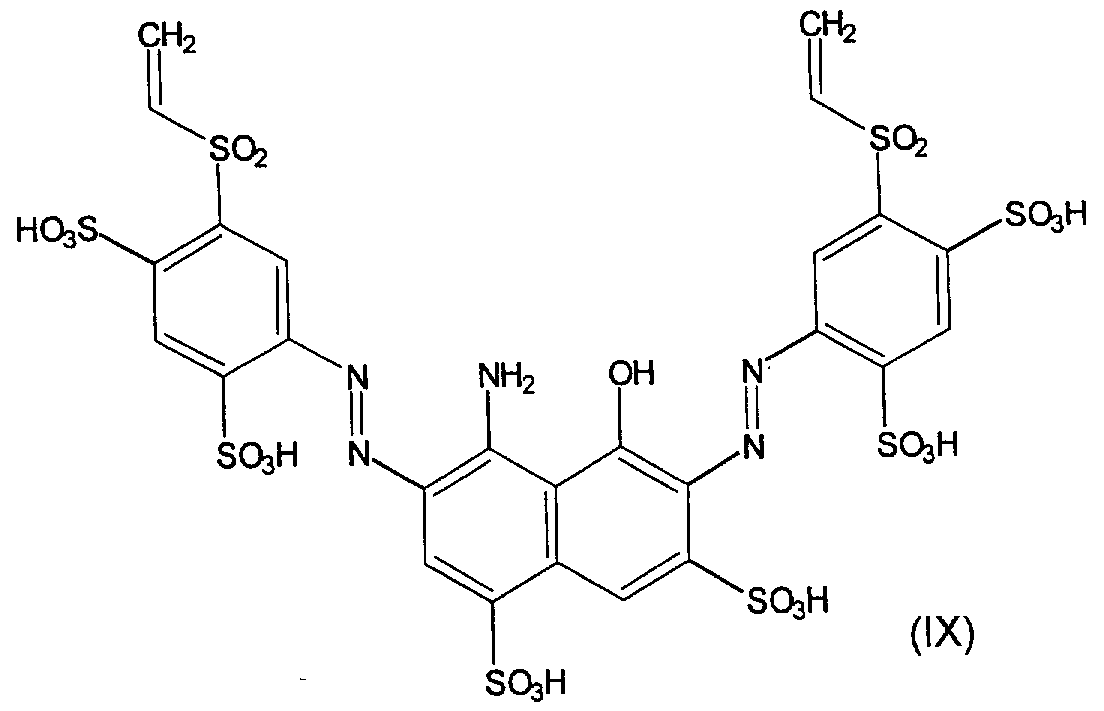
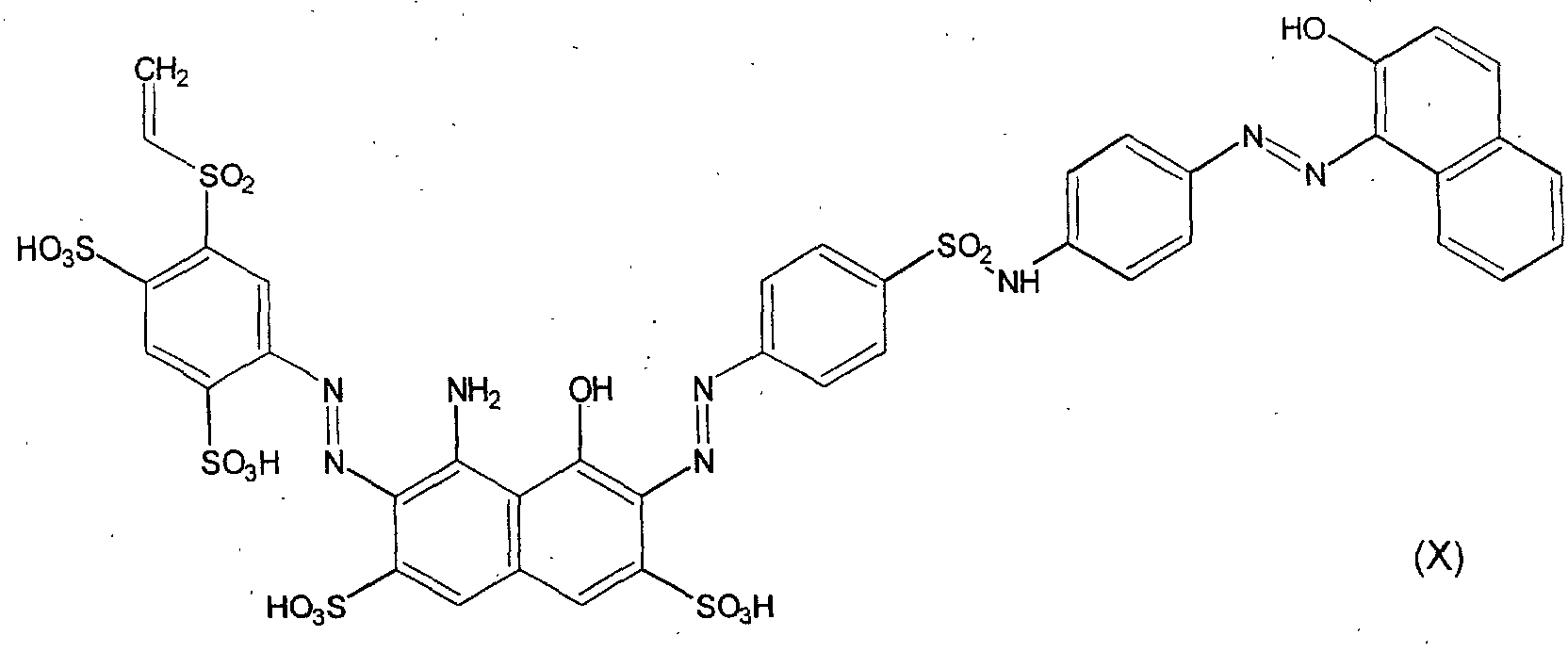 enthält.

- Verfahren nach Anspruch 1 oder 2, dadurch gekennzeichnet, daß die in der Verfahrensstufe a) aufgebrachte Zusammensetzung mindestens einen Reaktivfarbstoff, der mindestens eine Vinylsulfongruppe aufweist, enthält.
- Verfahren nach Anspruch 1 oder 2, dadurch gekennzeichnet, daß die in der Verfahrensstufe a) aufgebrachte Zusammensetzung mindestens einen Reaktivfarbstoff, der mindestens eine Sulfatoethylsulfongruppe aufweist, enthält.
- Verfahren nach einem oder mehreren der Ansprüche 1 bis 4, dadurch gekennzeichnet, daß die in der Verfahrensstufe d) aufgebrachte alkalische Zusammensetzung einen pH-Wert von 8 bis 11 aufweist.
- Verfahren nach einem oder mehreren der Ansprüche 1 bis 5, dadurch gekennzeichnet, daß die in der Verfahrensstufe d) aufgebrachte alkalische Zusammensetzung Ammoniak und/oder Mono-, Di- oder Triethanolamin enthält.
- Verfahren nach einem oder mehreren der Ansprüche 1 bis 5, dadurch gekennzeichnet, daß die in der Verfahrensstufe d) aufgebrachte alkalische Zusammensetzung mindestens ein Alkalicarbonat und/oder Alkalihydrogencarbonat enthält.
Priority Applications (3)
| Application Number | Priority Date | Filing Date | Title |
|---|---|---|---|
| EP01126488A EP1312339B1 (de) | 2001-11-12 | 2001-11-12 | Verfahren zum Färben von menschlichen Haaren |
| AT01126488T ATE318577T1 (de) | 2001-11-12 | 2001-11-12 | Verfahren zum färben von menschlichen haaren |
| DE50109050T DE50109050D1 (de) | 2001-11-12 | 2001-11-12 | Verfahren zum Färben von menschlichen Haaren |
Applications Claiming Priority (1)
| Application Number | Priority Date | Filing Date | Title |
|---|---|---|---|
| EP01126488A EP1312339B1 (de) | 2001-11-12 | 2001-11-12 | Verfahren zum Färben von menschlichen Haaren |
Publications (2)
| Publication Number | Publication Date |
|---|---|
| EP1312339A1 true EP1312339A1 (de) | 2003-05-21 |
| EP1312339B1 EP1312339B1 (de) | 2006-03-01 |
Family
ID=8179182
Family Applications (1)
| Application Number | Title | Priority Date | Filing Date |
|---|---|---|---|
| EP01126488A Expired - Lifetime EP1312339B1 (de) | 2001-11-12 | 2001-11-12 | Verfahren zum Färben von menschlichen Haaren |
Country Status (3)
| Country | Link |
|---|---|
| EP (1) | EP1312339B1 (de) |
| AT (1) | ATE318577T1 (de) |
| DE (1) | DE50109050D1 (de) |
Citations (5)
| Publication number | Priority date | Publication date | Assignee | Title |
|---|---|---|---|---|
| US2657205A (en) * | 1950-01-09 | 1953-10-27 | Hoechst Ag | Dyes containing a vinyl sulfone |
| US4102641A (en) * | 1972-09-29 | 1978-07-25 | Avon Products, Inc. | Method of dyeing human hair with reactive dyes |
| US4257770A (en) * | 1978-07-21 | 1981-03-24 | Sumitomo Chemical Company, Limited | Disazo dye composition |
| DE19731166A1 (de) * | 1997-07-21 | 1999-01-28 | Basf Ag | Verwendung von Reaktivfarbstoffen zum Färben von Haaren |
| US6086639A (en) * | 1999-03-09 | 2000-07-11 | Dystar Textilfarben Gmbh & Co. Deutschland Kg | Black dye mixtures of fiber-reactive azo dyes and use thereof for dyeing hydroxy- and/or carboxamido-containing fiber material |
-
2001
- 2001-11-12 DE DE50109050T patent/DE50109050D1/de not_active Expired - Lifetime
- 2001-11-12 AT AT01126488T patent/ATE318577T1/de not_active IP Right Cessation
- 2001-11-12 EP EP01126488A patent/EP1312339B1/de not_active Expired - Lifetime
Patent Citations (5)
| Publication number | Priority date | Publication date | Assignee | Title |
|---|---|---|---|---|
| US2657205A (en) * | 1950-01-09 | 1953-10-27 | Hoechst Ag | Dyes containing a vinyl sulfone |
| US4102641A (en) * | 1972-09-29 | 1978-07-25 | Avon Products, Inc. | Method of dyeing human hair with reactive dyes |
| US4257770A (en) * | 1978-07-21 | 1981-03-24 | Sumitomo Chemical Company, Limited | Disazo dye composition |
| DE19731166A1 (de) * | 1997-07-21 | 1999-01-28 | Basf Ag | Verwendung von Reaktivfarbstoffen zum Färben von Haaren |
| US6086639A (en) * | 1999-03-09 | 2000-07-11 | Dystar Textilfarben Gmbh & Co. Deutschland Kg | Black dye mixtures of fiber-reactive azo dyes and use thereof for dyeing hydroxy- and/or carboxamido-containing fiber material |
Also Published As
| Publication number | Publication date |
|---|---|
| ATE318577T1 (de) | 2006-03-15 |
| EP1312339B1 (de) | 2006-03-01 |
| DE50109050D1 (de) | 2006-04-27 |
Similar Documents
| Publication | Publication Date | Title |
|---|---|---|
| EP0277996B1 (de) | Mittel zum oxidativen färben von haaren, verfahren zu seiner herstellung und verwendung des mittels | |
| WO1980000214A1 (fr) | Preparation permettant la coloration de cheveux | |
| DE68918161T2 (de) | Färbemittel für Keratinfasern. | |
| DE29624635U1 (de) | Aufhellende Zusammensetzung zum Färben von Keratinfasern, die einen speziellen Direktfarbstoff enthält | |
| EP0467026B1 (de) | Mittel zur Färbung von Haaren und Anwendung desselben | |
| EP1086685B1 (de) | Zwei-komponenten-kit eine lösung und eine Emulsion enthaltend und verfahren zum entfärben von gefärbten Haaren | |
| DE69417698T2 (de) | Verfahren zum oxydatieven Färben von keratinen Fasern unter Anwendung von Wasserdampf | |
| DE3829870A1 (de) | Farbstoffloesungen fuer die haarfaerbung | |
| EP0727203B1 (de) | Oxidationshaarfärbemittel | |
| DE4227864A1 (de) | Alkylglycoside in Färbemitteln | |
| DE69818991T2 (de) | Haarfärben mit melanin-prekursoren in der anwesenheit von jodat und peroxid | |
| EP0761200B1 (de) | Mittel zur Färbung und Tönung von menschlichen Haaren | |
| EP0852136A1 (de) | Verfahren zum Färben von keratinhaltigen Fasern | |
| EP0663204A1 (de) | Haarfärbemittel | |
| DE1802395A1 (de) | Mittel zum Faerben von Keratinfasern | |
| DD297324A5 (de) | Verfahren zur haarfaerbung mit direktfarbstoffen | |
| DE2340219A1 (de) | Haarfaerbe- und konditionierungsmittel | |
| DE4115148A1 (de) | Haarfaerbemittel | |
| DE2924230C2 (de) | ||
| DE10114546B4 (de) | Verfahren zum Färben von menschlichen Haaren | |
| DE1769916A1 (de) | Verfahren zum Faerben keratinischer Fasern und dafuer geeignete Zubereitungen | |
| EP1312339B1 (de) | Verfahren zum Färben von menschlichen Haaren | |
| EP1656928B1 (de) | Verfahren zum Färben von menschlichen Haaren | |
| EP0896519B1 (de) | Färbemittel zur färbung von keratinischen fasern | |
| DE102004045353A1 (de) | Mittel zur Entfernung von Oxidationshaarfarben |
Legal Events
| Date | Code | Title | Description |
|---|---|---|---|
| PUAI | Public reference made under article 153(3) epc to a published international application that has entered the european phase |
Free format text: ORIGINAL CODE: 0009012 |
|
| AK | Designated contracting states |
Designated state(s): AT BE CH CY DE DK ES FI FR GB GR IE IT LI LU MC NL PT SE TR |
|
| AX | Request for extension of the european patent |
Extension state: AL LT LV MK RO SI |
|
| 17P | Request for examination filed |
Effective date: 20031022 |
|
| AKX | Designation fees paid |
Designated state(s): AT BE CH CY DE DK ES FI FR GB GR IE IT LI LU MC NL PT SE TR |
|
| 17Q | First examination report despatched |
Effective date: 20040421 |
|
| GRAP | Despatch of communication of intention to grant a patent |
Free format text: ORIGINAL CODE: EPIDOSNIGR1 |
|
| GRAS | Grant fee paid |
Free format text: ORIGINAL CODE: EPIDOSNIGR3 |
|
| GRAA | (expected) grant |
Free format text: ORIGINAL CODE: 0009210 |
|
| AK | Designated contracting states |
Kind code of ref document: B1 Designated state(s): AT BE CH CY DE DK ES FI FR GB GR IE IT LI LU MC NL PT SE TR |
|
| PG25 | Lapsed in a contracting state [announced via postgrant information from national office to epo] |
Ref country code: IT Free format text: LAPSE BECAUSE OF FAILURE TO SUBMIT A TRANSLATION OF THE DESCRIPTION OR TO PAY THE FEE WITHIN THE PRESCRIBED TIME-LIMIT;WARNING: LAPSES OF ITALIAN PATENTS WITH EFFECTIVE DATE BEFORE 2007 MAY HAVE OCCURRED AT ANY TIME BEFORE 2007. THE CORRECT EFFECTIVE DATE MAY BE DIFFERENT FROM THE ONE RECORDED. Effective date: 20060301 Ref country code: FI Free format text: LAPSE BECAUSE OF FAILURE TO SUBMIT A TRANSLATION OF THE DESCRIPTION OR TO PAY THE FEE WITHIN THE PRESCRIBED TIME-LIMIT Effective date: 20060301 Ref country code: NL Free format text: LAPSE BECAUSE OF FAILURE TO SUBMIT A TRANSLATION OF THE DESCRIPTION OR TO PAY THE FEE WITHIN THE PRESCRIBED TIME-LIMIT Effective date: 20060301 Ref country code: IE Free format text: LAPSE BECAUSE OF FAILURE TO SUBMIT A TRANSLATION OF THE DESCRIPTION OR TO PAY THE FEE WITHIN THE PRESCRIBED TIME-LIMIT Effective date: 20060301 |
|
| REG | Reference to a national code |
Ref country code: GB Ref legal event code: FG4D Free format text: NOT ENGLISH |
|
| RIC1 | Information provided on ipc code assigned before grant |
Ipc: A61Q 5/10 20060101ALI20060109BHEP Ipc: A61K 8/46 20060101AFI20060109BHEP |
|
| REG | Reference to a national code |
Ref country code: CH Ref legal event code: EP |
|
| REG | Reference to a national code |
Ref country code: IE Ref legal event code: FG4D Free format text: LANGUAGE OF EP DOCUMENT: GERMAN |
|
| REF | Corresponds to: |
Ref document number: 50109050 Country of ref document: DE Date of ref document: 20060427 Kind code of ref document: P |
|
| GBT | Gb: translation of ep patent filed (gb section 77(6)(a)/1977) |
Effective date: 20060410 |
|
| PG25 | Lapsed in a contracting state [announced via postgrant information from national office to epo] |
Ref country code: SE Free format text: LAPSE BECAUSE OF FAILURE TO SUBMIT A TRANSLATION OF THE DESCRIPTION OR TO PAY THE FEE WITHIN THE PRESCRIBED TIME-LIMIT Effective date: 20060601 Ref country code: DK Free format text: LAPSE BECAUSE OF FAILURE TO SUBMIT A TRANSLATION OF THE DESCRIPTION OR TO PAY THE FEE WITHIN THE PRESCRIBED TIME-LIMIT Effective date: 20060601 |
|
| PG25 | Lapsed in a contracting state [announced via postgrant information from national office to epo] |
Ref country code: ES Free format text: LAPSE BECAUSE OF FAILURE TO SUBMIT A TRANSLATION OF THE DESCRIPTION OR TO PAY THE FEE WITHIN THE PRESCRIBED TIME-LIMIT Effective date: 20060612 |
|
| PG25 | Lapsed in a contracting state [announced via postgrant information from national office to epo] |
Ref country code: PT Free format text: LAPSE BECAUSE OF FAILURE TO SUBMIT A TRANSLATION OF THE DESCRIPTION OR TO PAY THE FEE WITHIN THE PRESCRIBED TIME-LIMIT Effective date: 20060801 |
|
| NLV1 | Nl: lapsed or annulled due to failure to fulfill the requirements of art. 29p and 29m of the patents act | ||
| ET | Fr: translation filed | ||
| REG | Reference to a national code |
Ref country code: IE Ref legal event code: FD4D |
|
| PG25 | Lapsed in a contracting state [announced via postgrant information from national office to epo] |
Ref country code: CH Free format text: LAPSE BECAUSE OF NON-PAYMENT OF DUE FEES Effective date: 20061130 Ref country code: BE Free format text: LAPSE BECAUSE OF NON-PAYMENT OF DUE FEES Effective date: 20061130 Ref country code: MC Free format text: LAPSE BECAUSE OF NON-PAYMENT OF DUE FEES Effective date: 20061130 Ref country code: LI Free format text: LAPSE BECAUSE OF NON-PAYMENT OF DUE FEES Effective date: 20061130 |
|
| PLBE | No opposition filed within time limit |
Free format text: ORIGINAL CODE: 0009261 |
|
| STAA | Information on the status of an ep patent application or granted ep patent |
Free format text: STATUS: NO OPPOSITION FILED WITHIN TIME LIMIT |
|
| 26N | No opposition filed |
Effective date: 20061204 |
|
| REG | Reference to a national code |
Ref country code: CH Ref legal event code: PL |
|
| BERE | Be: lapsed |
Owner name: KPSS-KAO PROFESSIONAL SALON SERVICES G.M.B.H. Effective date: 20061130 |
|
| PG25 | Lapsed in a contracting state [announced via postgrant information from national office to epo] |
Ref country code: AT Free format text: LAPSE BECAUSE OF NON-PAYMENT OF DUE FEES Effective date: 20061112 |
|
| PG25 | Lapsed in a contracting state [announced via postgrant information from national office to epo] |
Ref country code: GR Free format text: LAPSE BECAUSE OF FAILURE TO SUBMIT A TRANSLATION OF THE DESCRIPTION OR TO PAY THE FEE WITHIN THE PRESCRIBED TIME-LIMIT Effective date: 20060602 |
|
| PG25 | Lapsed in a contracting state [announced via postgrant information from national office to epo] |
Ref country code: TR Free format text: LAPSE BECAUSE OF FAILURE TO SUBMIT A TRANSLATION OF THE DESCRIPTION OR TO PAY THE FEE WITHIN THE PRESCRIBED TIME-LIMIT Effective date: 20060301 Ref country code: LU Free format text: LAPSE BECAUSE OF NON-PAYMENT OF DUE FEES Effective date: 20061112 |
|
| PG25 | Lapsed in a contracting state [announced via postgrant information from national office to epo] |
Ref country code: CY Free format text: LAPSE BECAUSE OF FAILURE TO SUBMIT A TRANSLATION OF THE DESCRIPTION OR TO PAY THE FEE WITHIN THE PRESCRIBED TIME-LIMIT Effective date: 20060301 |
|
| REG | Reference to a national code |
Ref country code: FR Ref legal event code: CD Owner name: KAO GERMANY GMBH, DE Effective date: 20120411 |
|
| PGFP | Annual fee paid to national office [announced via postgrant information from national office to epo] |
Ref country code: GB Payment date: 20121130 Year of fee payment: 12 |
|
| PGFP | Annual fee paid to national office [announced via postgrant information from national office to epo] |
Ref country code: FR Payment date: 20121219 Year of fee payment: 12 |
|
| PGFP | Annual fee paid to national office [announced via postgrant information from national office to epo] |
Ref country code: DE Payment date: 20130131 Year of fee payment: 12 |
|
| GBPC | Gb: european patent ceased through non-payment of renewal fee |
Effective date: 20131112 |
|
| REG | Reference to a national code |
Ref country code: FR Ref legal event code: ST Effective date: 20140731 |
|
| PG25 | Lapsed in a contracting state [announced via postgrant information from national office to epo] |
Ref country code: DE Free format text: LAPSE BECAUSE OF NON-PAYMENT OF DUE FEES Effective date: 20140603 |
|
| REG | Reference to a national code |
Ref country code: DE Ref legal event code: R119 Ref document number: 50109050 Country of ref document: DE Effective date: 20140603 |
|
| PG25 | Lapsed in a contracting state [announced via postgrant information from national office to epo] |
Ref country code: GB Free format text: LAPSE BECAUSE OF NON-PAYMENT OF DUE FEES Effective date: 20131112 Ref country code: FR Free format text: LAPSE BECAUSE OF NON-PAYMENT OF DUE FEES Effective date: 20131202 |