EP1310218A2 - Lichthärtegerät - Google Patents
Lichthärtegerät Download PDFInfo
- Publication number
- EP1310218A2 EP1310218A2 EP02019468A EP02019468A EP1310218A2 EP 1310218 A2 EP1310218 A2 EP 1310218A2 EP 02019468 A EP02019468 A EP 02019468A EP 02019468 A EP02019468 A EP 02019468A EP 1310218 A2 EP1310218 A2 EP 1310218A2
- Authority
- EP
- European Patent Office
- Prior art keywords
- light
- emitting diode
- curing device
- emission
- spectrum
- Prior art date
- Legal status (The legal status is an assumption and is not a legal conclusion. Google has not performed a legal analysis and makes no representation as to the accuracy of the status listed.)
- Granted
Links
- 238000000016 photochemical curing Methods 0.000 title 1
- 238000001228 spectrum Methods 0.000 claims abstract description 28
- 230000035945 sensitivity Effects 0.000 claims abstract description 27
- 238000000295 emission spectrum Methods 0.000 claims abstract description 17
- 230000005855 radiation Effects 0.000 claims abstract description 11
- 230000003595 spectral effect Effects 0.000 claims abstract description 11
- 229930006711 bornane-2,3-dione Natural products 0.000 claims description 14
- 239000000203 mixture Substances 0.000 claims description 8
- 238000000034 method Methods 0.000 claims description 5
- 230000000379 polymerizing effect Effects 0.000 claims description 3
- 125000002362 bornane-2,3-dione group Chemical group 0.000 claims 1
- 239000000463 material Substances 0.000 abstract description 5
- 239000005548 dental material Substances 0.000 abstract description 4
- 239000003999 initiator Substances 0.000 abstract 7
- VNQXSTWCDUXYEZ-UHFFFAOYSA-N 1,7,7-trimethylbicyclo[2.2.1]heptane-2,3-dione Chemical compound C1CC2(C)C(=O)C(=O)C1C2(C)C VNQXSTWCDUXYEZ-UHFFFAOYSA-N 0.000 description 13
- 230000002349 favourable effect Effects 0.000 description 5
- 238000010586 diagram Methods 0.000 description 3
- 238000006116 polymerization reaction Methods 0.000 description 3
- 238000003801 milling Methods 0.000 description 2
- 239000004568 cement Substances 0.000 description 1
- 238000001816 cooling Methods 0.000 description 1
- 238000011161 development Methods 0.000 description 1
- 230000018109 developmental process Effects 0.000 description 1
- 238000000227 grinding Methods 0.000 description 1
- 230000003993 interaction Effects 0.000 description 1
- 238000004519 manufacturing process Methods 0.000 description 1
- 239000013307 optical fiber Substances 0.000 description 1
- 238000012805 post-processing Methods 0.000 description 1
- 238000000926 separation method Methods 0.000 description 1
Images
Classifications
-
- A—HUMAN NECESSITIES
- A61—MEDICAL OR VETERINARY SCIENCE; HYGIENE
- A61C—DENTISTRY; APPARATUS OR METHODS FOR ORAL OR DENTAL HYGIENE
- A61C19/00—Dental auxiliary appliances
- A61C19/003—Apparatus for curing resins by radiation
- A61C19/004—Hand-held apparatus, e.g. guns
Definitions
- the invention relates to a light curing device, according to the preamble of claim 1, and a method for polymerizing of polymerizable compositions, according to the preamble of Claim 14.
- Such light curing devices are used when light polymerizable Masses should be hardened in a targeted manner.
- the hardened by light curing devices in the prior art polymerizable compositions used are e.g. Cements that all must be used in excess. These surpluses are extremely hard after curing and require a high one Time spent, these surpluses with suitable dental Remove instruments, for example by milling. Furthermore, removing hard excesses means one higher wear of the grinding or milling instruments.
- the two different photoinitiators has, the mass first over the first Partial photoinitiator with a corresponding wavelength cure, then remove the excess, and then over the second photoinitiator to carry out a final hardening.
- the system has not prevailed after the Realization of two photoinitiators is quite complex and the interaction in double systems and only partial Curing is difficult to control. Therefore, usually the excess is removed after hardening, but it does requires considerably more time.
- the invention is based on the object Light curing device according to the preamble of claim 1 and a Polymerization process according to the preamble of Claim 14 to create an improved dimensional accuracy enable with light curing, but still more flexible with Use of various polymerizable compositions.
- the light curing device according to the invention or the invention
- the process creates the possibility with simple means that cure polymerizable mass gradually, in one first stage a partially polymerized, lightly processed Received material and finished in a second stage cured material is obtained.
- the ratio of the intensities between the light output during the first period and the light emission during The second period can be started in a wide range adjust the requirements, as well as the duration of the first and the second period. That is advantageous Radiation intensity of the first light-emitting diode also at least 100 mW per qcm set while the radiation intensity the second light-emitting diode at least 300, preferably 600 to 1000 mW should be per qcm. With a higher radiation intensity the first LED and / or a longer one the first period is the partially polymerized material somewhat firmer so that the excess removal also with commercially available dental instruments can be done mechanically, while at a lower radiation intensity and / or a modeling or a shorter first period of time Editing can be done.
- the spectra of the first LED and the sensitivity of the photoinitiator are clearly different from each other, and in particular the Maxima have a clear wavelength separation.
- the intensity maximum of the first light-emitting diode is preferably such chosen that its wavelength is greater than the wavelength of the Sensitivity maximum of the photoinitiator is.
- camphorquinone can be used as a photoinitiator, and the first light-emitting diode can be designed as a green light-emitting diode his.
- the wavelength maxima are then about 470 and 505 nm, are clearly different.
- the second LED selected so that its emission maximum with the Sensitivity maximum of the photoinitiator coincides, and that the spectra coincide as much as possible.
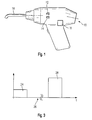
- the light curing device 10 shown in FIG. 1 is a hand-held device trained, either via a cable, not shown is mains powered or via a battery pack for operates off-grid. It doesn't point illustrated fan for cooling its light source.
- light-emitting diodes or LEDs are provided, the term light-emitting diodes here also being laser diodes and include other solid-state emitters.
- 1 is a first, green light-emitting diode 12 is shown.
- the light emitting diode 12 is arranged next to a second, blue light-emitting diode 14, so that light emitted by one of the light emitting diodes is optional an optical fiber 16 is supplied through which it passes through and can affect the dental area.
- the LEDs 12 and 14 with a control device 18, which is schematic in Fig. 1 is shown to be controlled.
- the control device allows a program-controlled switch-on, the regarding the intensity and the duration is predetermined, but in certain limits also via programming steps from User is changeable, it being possible to customize to provide the dental material used.
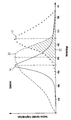
- FIG. 2 is a diagram to show the emission spectra the green and blue LEDs 12 and 14 applied. Both emission spectra run in themselves known manner essentially in the manner of a Gaussian curve, the maximum of the emission of the green light emitting diode at about 505 nm, and the maximum emission of the blue LED is around 460 nm. The steepness of the flanks The Gaussian curve is such that the emission values of the blue LED at the emission maximum of the green LED has already dropped to almost zero, while vice versa Emission value of the green LED at the emission maximum of blue LED has reached almost zero.
- Fig. 2 is the sensitivity of camphorquinone 20 applied as a photoinitiator.
- the sensitivity spectrum overlaps strongly with the Emission spectrum of the blue LED.
- the area of overlap lies essentially between 460 and 500 nm.
- the maxima of the blue ones are correct Light emitting diode 14 and 20 of camphorquinone do not completely match. Rather, the spectral maximum of the blue light-emitting diode lies somewhat below the sensitivity maximum of Camphorquinone, around 9 nm towards shorter wavelengths relocated.
- the slope of the emission curve of the blue LED is significantly larger than the slope of the flanks the spectrum of the camphorquinone sensitivity curve, especially at the shorter wavelengths or the - in the 2 - left flank.
- the representation in Fig. 2 is standardized so that the maxima of blue light emitting diode 14, the green light emitting diode 12 and Camphorquinone 20 are registered at the same height.
- the spectra are chosen so that the Camphorquinone spectrum 20 the spectrum of the blue light-emitting diode 14 surrounds, i.e. clearly to the right and left of the maximum has larger values.
- the difference areas thus formed Spectra are right and left of the maximum of the blue ones LED 14 about the same size, so that the spectrum of The blue light-emitting diode is considered approximately symmetrical to the spectrum of camphorquinone is present. It has been shown that through this essentially symmetrical choice of spectra one particularly good final hardness can be achieved. If, on the other hand, the Maxima of the blue light emitting diode 14 and 20 of camphorquinone the same wavelength are chosen, arise to each other asymmetrical spectra that deteriorated somewhat Show hardening results.
- the area of overlap is again viewed from the surface 22 between the green light emitting diode 12 and Camphorquinone 20 about a quarter of the total area of the Spectrum of camphorquinone.
- Such a design has become as particularly favorable for the realization of the Partial polymerization highlighted.
- the desired hardness can also be easily determined using the Set the radiation duration.
- 3 is the green LED 12 during a first period 24 with a Radiation intensity of 500 mW per qcm switched on.
- To The dental mass has reached the end of the first period 24 fully hardened that post-processing to remove excess can be done. This happens during one Excess removal period 26 that may be so long can, as the dentist needs for the excess removal.
- both periods are 24 and 28 chosen the same length. It goes without saying that on it an adjustment to the requirements can also be made can.
Landscapes
- Health & Medical Sciences (AREA)
- General Health & Medical Sciences (AREA)
- Veterinary Medicine (AREA)
- Epidemiology (AREA)
- Life Sciences & Earth Sciences (AREA)
- Animal Behavior & Ethology (AREA)
- Oral & Maxillofacial Surgery (AREA)
- Public Health (AREA)
- Dentistry (AREA)
- Dental Tools And Instruments Or Auxiliary Dental Instruments (AREA)
- Dental Preparations (AREA)
- Led Device Packages (AREA)
- Glass Compositions (AREA)
- Heating, Cooling, Or Curing Plastics Or The Like In General (AREA)
- Polymerisation Methods In General (AREA)
Abstract
Description
- Fig. 1
- ein schematisch dargestelltes Lichthärtgerät mit zwei Leuchtdioden unterschiedlicher Emissionsspektren;
- Fig. 2
- ein Diagramm zur Darstellung der Emissions- und Empfindlichkeitsspektren für das erfindungsgemäße Lichthärtgerät in der Ausführungsform gemäß Fig. 1; und
- Fig. 3
- ein Zeitdiagramm zur Darstellung der Zeitabschnitte für den Betrieb des erfindungsgemäßen Lichthärtgeräts.
Claims (16)
- Lichthärtgerät für den Dentalbereich, mit mindestens zwei Leuchtdioden und/oder Leuchtdiodengruppen mit unterschiedlichen spektralen Emissionsmaxima, wobei das Lichthärtgerät für das Polymerisieren einer polymerisierbaren Masse bestimmt ist, die mindestens einen Photoinitiator aufweist, der ein Empfindlichkeitsspektrum mit einer maximalen spektralen Empfindlichkeit aufweist, und wobei die maximale spektrale Empfindlichkeit des Photoinitiators von dem Emissionsmaximum der ersten Leuchtdiode verschieden ist, dadurch gekennzeichnet, dass das Emissionsspektrum der ersten Leuchtdiode (12) eine lediglich teilweise Überlappung mit dem Empfindlichkeitsspektrum des Photoinitiators (20) aufweist und das Emissionsspektrum der zweiten Leuchtdiode (14) eine demgegenüber größere Überlappung mit dem Empfindlichkeitsspektrum des Photoinitiators (20) aufweist.
- Lichthärtgerät nach Anspruch 1, dadurch gekennzeichnet, dass sich das Empfindlichkeitsmaximum des Photoinitiators (20) um weniger als 20 nm, insbesondere weniger als 15 nm, von dem Emissionsmaximum der zweiten Leuchtdiode (14) unterscheidet und bevorzugt bei einer Wellenlänge vorgesehen ist, die um etwa 10 nm größer als die Wellenlänge des Emissionsmaximum der zweiten Leuchtdiode (14) ist.
- Lichthärtgerät nach einem der vorhergehenden Ansprüche, dadurch gekennzeichnet, dass die zweite Leuchtdiode (14) ein Emissionsspektrum mit mindestens einer steileren Flanke, bevorzugt mit steileren Flanken als das Empfindlichkeitsspektrum des Photoinitiators (20) aufweist, und dass das Emissionsspektrum der zweiten Leuchtdiode (14) vom Flächeninhalt her betrachtet im Wesentlichen symmetrisch innerhalb des Empfindlichkeitsspektrum des Photoinitiators (20) vorgesehen ist.
- Lichthärtgerät nach Anspruch 1, dadurch gekennzeichnet, dass der Photoinitiator Campherchinon (20) ist und ein Empfindlichkeitsmaximum von etwa 470 nm aufweist und das Emissionsmaximum der ersten Leuchtdiode (12) eine größere Wellenlänge als 470 nm aufweist.
- Lichthärtgerät nach einem der vorhergehenden Ansprüche, dadurch gekennzeichnet, dass das Emissionsspektrum der ersten Leuchtdiode (12) beim Empfindlichkeitsmaximum des Photoinitiators (20) deutlich geringer, insbesondere um eine Zehnerpotenz, als die Emission beim Emissionsmaximum ist.
- Lichthärtgerät nach einem der vorhergehenden Ansprüche, dadurch gekennzeichnet, dass die über das Spektrum integrierte Strahlungsintensität der ersten Leuchtdiode (12) mindestens 100 mW pro qcm beträgt.
- Lichthärtgerät nach einem der vorhergehenden Ansprüche, dadurch gekennzeichnet, dass die erste Leuchtdiode (12) ihr Emissionsmaximum im grünen Spektralbereich hat und dieses Maximum vorzugsweise im Bereich von 500 bis 520 nm, insbesondere bei etwa 503 bis 508 nm, besonders bei 505 nm liegt.
- Lichthärtgerät nach einem der vorhergehenden Ansprüche, dadurch gekennzeichnet, dass die Strahlungsintensität der zweiten Leuchtdiode (14) über das Spektrum der zweiten Leuchtdiode (14) betrachtet mindestens 300 mW pro qcm, bevorzugt 600 bis 1000 mW pro qcm beträgt.
- Lichthärtgerät nach einem der vorhergehenden Ansprüche, dadurch gekennzeichnet, dass das Emissionsmaximum der zweiten Leuchtdiode (14) im Bereich von 440 bis 470 nm liegt.
- Lichthärtgerät nach einem der vorhergehenden Ansprüche, dadurch gekennzeichnet, dass je eine Mehrzahl erster Leuchtdioden und eine Mehrzahl zweiter Leuchtdioden vorgesehen sind, die je gemeinsam ansteuerbar sind.
- Lichthärtgerät nach einem der vorhergehenden Ansprüche, dadurch gekennzeichnet, dass eine Steuervorrichtung (18) vorgesehen ist, mit welcher die erste Leuchtdiode (12) einschaltbar ist, bevor die zweite Leuchtdiode (14) einschaltbar ist, und dass die Steuervorrichtung (18) die erste Leuchtdiode (12) für einen ersten vorgegebenen Zeitabschnitt (24) und die zweite Leuchtdiode (14) für einen zweiten vorgegebenen Zeitabschnitt (28) einschaltet.
- Lichthärtgerät nach einem der vorhergehenden Ansprüche, dadurch gekennzeichnet, dass die Dentalmasse mindestens zwei Photoinitiatoren aufweist.
- Lichthärtgerät nach einem der vorhergehenden Ansprüche, dadurch gekennzeichnet, dass die erste Leuchtdiode (12) eine größere Wellenlänge und eine geringere Intensität als die zweite Leuchtdiode (14) aufweist.
- Verfahren zum Polymerisieren von polymerisierbaren Massen für Dentalzwecke mit einem Lichthärtgerät (10), das Strahlung der Masse für einen vorgegebenen Zeitabschnitt zuführt, wobei das Lichthärtgerät (10) zwei Leuchtdioden (12, 14) mit unterschiedlichen Emissionsspektren aufweist, dadurch gekennzeichnet, dass das Lichthärtgerät (10) während eines ersten Zeitabschnitts (24) mit einer ersten Leuchtdiode (12) eingeschaltet wird, die ein Emissionsspektrum aufweist, dass mit einem Empfindlichkeitsspektrum eines Photoinitiators (20) der Masse lediglich teilweise überlappt.
- Verfahren nach Anspruch 14, dadurch gekennzeichnet, dass das Lichthärtgerät (10) eine zweite Leuchtdiode (14) aufweist, deren Emissionsspektrum im Wesentlichen mit dem Empfindlichkeitsspektrum des Photoinitiators (20) übereinstimmt und die nach der ersten Leuchtdiode (12) eingeschaltet wird.
- Verfahren nach einem der Ansprüche 14 oder 15, dadurch gekennzeichnet, dass die Masse mit der ersten Leuchtdiode (12) während eines ersten Zeitabschnitts (24) lediglich teilweise ausgehärtet wird, dann ein Überschuss entfernt wird und anschließend hieran die Masse mit der zweiten Leuchtdiode (14) vollständing gehärtet wird.
Applications Claiming Priority (2)
| Application Number | Priority Date | Filing Date | Title |
|---|---|---|---|
| DE10155034 | 2001-11-09 | ||
| DE10155034A DE10155034B4 (de) | 2001-11-09 | 2001-11-09 | Lichthärtgerät und Verfahren zum Polymerisieren von polymerisierbaren Massen |
Publications (3)
| Publication Number | Publication Date |
|---|---|
| EP1310218A2 true EP1310218A2 (de) | 2003-05-14 |
| EP1310218A3 EP1310218A3 (de) | 2003-08-27 |
| EP1310218B1 EP1310218B1 (de) | 2008-10-15 |
Family
ID=7705159
Family Applications (1)
| Application Number | Title | Priority Date | Filing Date |
|---|---|---|---|
| EP02019468A Expired - Lifetime EP1310218B1 (de) | 2001-11-09 | 2002-08-30 | Lichthärtegerät |
Country Status (5)
| Country | Link |
|---|---|
| EP (1) | EP1310218B1 (de) |
| JP (1) | JP2003144462A (de) |
| AT (1) | ATE410974T1 (de) |
| CA (1) | CA2403413A1 (de) |
| DE (2) | DE10155034B4 (de) |
Cited By (3)
| Publication number | Priority date | Publication date | Assignee | Title |
|---|---|---|---|---|
| WO2004002361A1 (en) * | 2002-06-28 | 2004-01-08 | 3M Innovative Properties Company | Processes for forming dental materials and device |
| JP2013530763A (ja) * | 2010-07-07 | 2013-08-01 | ソシエテ プール ラ コンセプシオン デ アプリカシオン デ テクニク エレクトロニク−サテレク | スペクトル掃引型光架橋装置 |
| EP3968864A4 (de) * | 2019-05-13 | 2023-01-18 | Akos Elemér Gombos | Verfahren und vorrichtung zum entfernen eines ektoparasiten von der haut |
Families Citing this family (3)
| Publication number | Priority date | Publication date | Assignee | Title |
|---|---|---|---|---|
| JP2004250673A (ja) * | 2003-01-28 | 2004-09-09 | National Institute For Materials Science | ゲル化コロイド結晶前駆体とゲル化コロイド結晶、及びゲル化コロイド結晶の作製方法とその作製装置 |
| WO2008103494A2 (en) * | 2007-02-23 | 2008-08-28 | Dentsply International Inc. | Methods for making dental restorations using two-phase light-curing materials |
| EP2579075A1 (de) * | 2011-10-06 | 2013-04-10 | Ivoclar Vivadent AG | Stabförmiger Lichtleiter |
Family Cites Families (8)
| Publication number | Priority date | Publication date | Assignee | Title |
|---|---|---|---|---|
| DE3404904C2 (de) * | 1984-02-11 | 1986-01-16 | Kulzer & Co GmbH, 6393 Wehrheim | Verfahren zur Herstellung von kieferorthopädischen Geräten und Apparaturen |
| DE19721311C1 (de) * | 1997-05-21 | 1998-12-03 | Eka Ges Fuer Medizinisch Tech | Bestrahlungsgerät zur Polymerisation von lichthärtenden Kunststoffen |
| EP1031326A1 (de) * | 1999-02-05 | 2000-08-30 | Jean-Michel Decaudin | Gerät zur Photoaktivierung von lichtempfindlichen Verbundwerkstoffen insbesondere im Dentalbereich |
| FR2805148B1 (fr) * | 2000-02-17 | 2003-01-31 | Francois Duret | Dispositif de photopolymerisation d'application dentaire |
| EP1138276A1 (de) * | 2000-03-29 | 2001-10-04 | CMS-Dental ApS | Gerät zum Aushärten von Dentalwerkstoffen |
| DE10125343C2 (de) * | 2001-05-23 | 2003-09-18 | Ivoclar Vivadent Ag | Beleuchtungsvorrichtung |
| DE10125340B4 (de) * | 2001-05-23 | 2004-08-05 | Ivoclar Vivadent Ag | Dentales Lichtgerät |
| DE10127416B4 (de) * | 2001-06-06 | 2008-01-03 | Ivoclar Vivadent Ag | Lichthärtgerät sowie Lichtquelle mit einer Mehrzahl von LED's und einem Kühlkörper |
-
2001
- 2001-11-09 DE DE10155034A patent/DE10155034B4/de not_active Expired - Fee Related
-
2002
- 2002-08-30 AT AT02019468T patent/ATE410974T1/de active
- 2002-08-30 EP EP02019468A patent/EP1310218B1/de not_active Expired - Lifetime
- 2002-08-30 DE DE50212890T patent/DE50212890D1/de not_active Expired - Fee Related
- 2002-09-16 CA CA002403413A patent/CA2403413A1/en not_active Abandoned
- 2002-10-22 JP JP2002306586A patent/JP2003144462A/ja active Pending
Non-Patent Citations (1)
| Title |
|---|
| None |
Cited By (4)
| Publication number | Priority date | Publication date | Assignee | Title |
|---|---|---|---|---|
| WO2004002361A1 (en) * | 2002-06-28 | 2004-01-08 | 3M Innovative Properties Company | Processes for forming dental materials and device |
| US7134875B2 (en) | 2002-06-28 | 2006-11-14 | 3M Innovative Properties Company | Processes for forming dental materials and device |
| JP2013530763A (ja) * | 2010-07-07 | 2013-08-01 | ソシエテ プール ラ コンセプシオン デ アプリカシオン デ テクニク エレクトロニク−サテレク | スペクトル掃引型光架橋装置 |
| EP3968864A4 (de) * | 2019-05-13 | 2023-01-18 | Akos Elemér Gombos | Verfahren und vorrichtung zum entfernen eines ektoparasiten von der haut |
Also Published As
| Publication number | Publication date |
|---|---|
| DE50212890D1 (de) | 2008-11-27 |
| EP1310218A3 (de) | 2003-08-27 |
| DE10155034A1 (de) | 2003-05-28 |
| EP1310218B1 (de) | 2008-10-15 |
| ATE410974T1 (de) | 2008-10-15 |
| CA2403413A1 (en) | 2003-05-09 |
| JP2003144462A (ja) | 2003-05-20 |
| DE10155034B4 (de) | 2006-03-09 |
Similar Documents
| Publication | Publication Date | Title |
|---|---|---|
| EP0827723B1 (de) | Verfahren und Vorrichtung zum Aushärten von lichtempfindlichen polymeren Zusammensetzungen | |
| DE10111704B4 (de) | Verfahren zur Herstellung eines Kunststoffteils | |
| DE60305832T2 (de) | Lichthärtgerät mit ausgewähltem Spektrum | |
| EP0157824B1 (de) | Folienförmige dentalmatrize | |
| DE19613566C2 (de) | Vorrichtung und Verfahren zum Aushärten eines lichthärtenden Kunststoff-Füllungsmaterials | |
| EP3308740B1 (de) | Lichthärtgerät für dentalrestaurationsmaterialien | |
| EP2897552A1 (de) | Vorrichtung und verfahren zur applikation von lichtkompositen | |
| DE10225749A1 (de) | Medizinische Gerätschaften für Behandlungen im dentalen Bereich mittels eines Lasers | |
| DE10155034B4 (de) | Lichthärtgerät und Verfahren zum Polymerisieren von polymerisierbaren Massen | |
| DE69318697T2 (de) | Inlay, inlayhalter sowie zahnwiederherstellungsset | |
| DE19928805A1 (de) | Dentalgerät mit einer Anzeigeeinheit | |
| EP2246008A2 (de) | Verfahren zur Herstellung von künstlichem Zahnersatz | |
| DE10125340B4 (de) | Dentales Lichtgerät | |
| DE69617539T2 (de) | Kontrollvorrichtung für Polymerisierungslampe | |
| EP3445275A1 (de) | Verfahren zur polymerisation von dentalpolymerisationskompositharz und lichtbestrahlungsvorrichtung | |
| WO2013135516A1 (de) | Verfahren und vorrichtung zur beleuchtung eines arbeitsfeldes im zuge einer medizinischen behandlung unter einsatz lichthärtender werkstoffe | |
| DE3504938A1 (de) | Belichtungsverfahren und -vorrichtung | |
| EP4215152B1 (de) | Dentalhandgerät zum aushärten von material und anregen von fluoreszenz | |
| EP1208812A1 (de) | Modularer Farbschlüssel, Dentalkit, Referenzelement und Verfahren zur Farbauswahl | |
| EP1264581A2 (de) | Kunststoffzahn sowie Verfahren zu seiner Herstellung | |
| WO2018215489A1 (de) | Arbeitsfeldbeleuchtung für zahnärztliche behandlungsplätze | |
| CH695539A5 (de) | Verfahren und Vorrichtung zur Visualisation von Kunststoffwerkstoffen in der Medizintechnik. | |
| EP4275650A1 (de) | Dentalhandgerät zum härten eines polymers | |
| DE10144414A1 (de) | Lichthärtgerät | |
| EP3991687A1 (de) | System aus einem laser und einem adhäsiv zum befestigen eines dentalrestaurationsteils |
Legal Events
| Date | Code | Title | Description |
|---|---|---|---|
| PUAI | Public reference made under article 153(3) epc to a published international application that has entered the european phase |
Free format text: ORIGINAL CODE: 0009012 |
|
| AK | Designated contracting states |
Designated state(s): AT BE BG CH CY CZ DE DK EE ES FI FR GB GR IE IT LI LU MC NL PT SE SK TR |
|
| AX | Request for extension of the european patent |
Extension state: AL LT LV MK RO SI |
|
| PUAL | Search report despatched |
Free format text: ORIGINAL CODE: 0009013 |
|
| AK | Designated contracting states |
Designated state(s): AT BE BG CH CY CZ DE DK EE ES FI FR GB GR IE IT LI LU MC NL PT SE SK TR |
|
| AX | Request for extension of the european patent |
Extension state: AL LT LV MK RO SI |
|
| 17P | Request for examination filed |
Effective date: 20030911 |
|
| AKX | Designation fees paid |
Designated state(s): AT BE BG CH CY CZ DE DK EE ES FI FR GB GR IE IT LI LU MC NL PT SE SK TR |
|
| 17Q | First examination report despatched |
Effective date: 20050929 |
|
| GRAP | Despatch of communication of intention to grant a patent |
Free format text: ORIGINAL CODE: EPIDOSNIGR1 |
|
| GRAS | Grant fee paid |
Free format text: ORIGINAL CODE: EPIDOSNIGR3 |
|
| GRAA | (expected) grant |
Free format text: ORIGINAL CODE: 0009210 |
|
| AK | Designated contracting states |
Kind code of ref document: B1 Designated state(s): AT BE BG CH CY CZ DE DK EE ES FI FR GB GR IE IT LI LU MC NL PT SE SK TR |
|
| REG | Reference to a national code |
Ref country code: CH Ref legal event code: NV Representative=s name: KELLER & PARTNER PATENTANWAELTE AG Ref country code: CH Ref legal event code: EP Ref country code: GB Ref legal event code: FG4D Free format text: NOT ENGLISH |
|
| REG | Reference to a national code |
Ref country code: IE Ref legal event code: FG4D Free format text: LANGUAGE OF EP DOCUMENT: GERMAN |
|
| REF | Corresponds to: |
Ref document number: 50212890 Country of ref document: DE Date of ref document: 20081127 Kind code of ref document: P |
|
| REG | Reference to a national code |
Ref country code: SE Ref legal event code: TRGR |
|
| NLV1 | Nl: lapsed or annulled due to failure to fulfill the requirements of art. 29p and 29m of the patents act | ||
| PG25 | Lapsed in a contracting state [announced via postgrant information from national office to epo] |
Ref country code: BG Free format text: LAPSE BECAUSE OF FAILURE TO SUBMIT A TRANSLATION OF THE DESCRIPTION OR TO PAY THE FEE WITHIN THE PRESCRIBED TIME-LIMIT Effective date: 20090115 Ref country code: ES Free format text: LAPSE BECAUSE OF FAILURE TO SUBMIT A TRANSLATION OF THE DESCRIPTION OR TO PAY THE FEE WITHIN THE PRESCRIBED TIME-LIMIT Effective date: 20090126 |
|
| PG25 | Lapsed in a contracting state [announced via postgrant information from national office to epo] |
Ref country code: NL Free format text: LAPSE BECAUSE OF FAILURE TO SUBMIT A TRANSLATION OF THE DESCRIPTION OR TO PAY THE FEE WITHIN THE PRESCRIBED TIME-LIMIT Effective date: 20081015 Ref country code: FI Free format text: LAPSE BECAUSE OF FAILURE TO SUBMIT A TRANSLATION OF THE DESCRIPTION OR TO PAY THE FEE WITHIN THE PRESCRIBED TIME-LIMIT Effective date: 20081015 Ref country code: PT Free format text: LAPSE BECAUSE OF FAILURE TO SUBMIT A TRANSLATION OF THE DESCRIPTION OR TO PAY THE FEE WITHIN THE PRESCRIBED TIME-LIMIT Effective date: 20090316 |
|
| REG | Reference to a national code |
Ref country code: IE Ref legal event code: FD4D |
|
| PG25 | Lapsed in a contracting state [announced via postgrant information from national office to epo] |
Ref country code: DK Free format text: LAPSE BECAUSE OF FAILURE TO SUBMIT A TRANSLATION OF THE DESCRIPTION OR TO PAY THE FEE WITHIN THE PRESCRIBED TIME-LIMIT Effective date: 20081015 Ref country code: EE Free format text: LAPSE BECAUSE OF FAILURE TO SUBMIT A TRANSLATION OF THE DESCRIPTION OR TO PAY THE FEE WITHIN THE PRESCRIBED TIME-LIMIT Effective date: 20081015 Ref country code: IE Free format text: LAPSE BECAUSE OF FAILURE TO SUBMIT A TRANSLATION OF THE DESCRIPTION OR TO PAY THE FEE WITHIN THE PRESCRIBED TIME-LIMIT Effective date: 20081015 |
|
| PLBE | No opposition filed within time limit |
Free format text: ORIGINAL CODE: 0009261 |
|
| STAA | Information on the status of an ep patent application or granted ep patent |
Free format text: STATUS: NO OPPOSITION FILED WITHIN TIME LIMIT |
|
| PG25 | Lapsed in a contracting state [announced via postgrant information from national office to epo] |
Ref country code: CZ Free format text: LAPSE BECAUSE OF FAILURE TO SUBMIT A TRANSLATION OF THE DESCRIPTION OR TO PAY THE FEE WITHIN THE PRESCRIBED TIME-LIMIT Effective date: 20081015 |
|
| 26N | No opposition filed |
Effective date: 20090716 |
|
| PG25 | Lapsed in a contracting state [announced via postgrant information from national office to epo] |
Ref country code: SK Free format text: LAPSE BECAUSE OF FAILURE TO SUBMIT A TRANSLATION OF THE DESCRIPTION OR TO PAY THE FEE WITHIN THE PRESCRIBED TIME-LIMIT Effective date: 20081015 |
|
| BERE | Be: lapsed |
Owner name: IVOCLAR VIVADENT AG Effective date: 20090831 |
|
| PG25 | Lapsed in a contracting state [announced via postgrant information from national office to epo] |
Ref country code: MC Free format text: LAPSE BECAUSE OF NON-PAYMENT OF DUE FEES Effective date: 20090831 |
|
| PG25 | Lapsed in a contracting state [announced via postgrant information from national office to epo] |
Ref country code: BE Free format text: LAPSE BECAUSE OF NON-PAYMENT OF DUE FEES Effective date: 20090831 |
|
| PG25 | Lapsed in a contracting state [announced via postgrant information from national office to epo] |
Ref country code: DE Free format text: LAPSE BECAUSE OF NON-PAYMENT OF DUE FEES Effective date: 20100302 |
|
| PG25 | Lapsed in a contracting state [announced via postgrant information from national office to epo] |
Ref country code: GR Free format text: LAPSE BECAUSE OF FAILURE TO SUBMIT A TRANSLATION OF THE DESCRIPTION OR TO PAY THE FEE WITHIN THE PRESCRIBED TIME-LIMIT Effective date: 20090116 |
|
| PG25 | Lapsed in a contracting state [announced via postgrant information from national office to epo] |
Ref country code: LU Free format text: LAPSE BECAUSE OF NON-PAYMENT OF DUE FEES Effective date: 20090830 |
|
| PG25 | Lapsed in a contracting state [announced via postgrant information from national office to epo] |
Ref country code: TR Free format text: LAPSE BECAUSE OF FAILURE TO SUBMIT A TRANSLATION OF THE DESCRIPTION OR TO PAY THE FEE WITHIN THE PRESCRIBED TIME-LIMIT Effective date: 20081015 |
|
| PG25 | Lapsed in a contracting state [announced via postgrant information from national office to epo] |
Ref country code: CY Free format text: LAPSE BECAUSE OF FAILURE TO SUBMIT A TRANSLATION OF THE DESCRIPTION OR TO PAY THE FEE WITHIN THE PRESCRIBED TIME-LIMIT Effective date: 20081015 |
|
| REG | Reference to a national code |
Ref country code: CH Ref legal event code: PCAR Free format text: NEW ADDRESS: EIGERSTRASSE 2 POSTFACH, 3000 BERN 14 (CH) |
|
| REG | Reference to a national code |
Ref country code: FR Ref legal event code: PLFP Year of fee payment: 15 |
|
| REG | Reference to a national code |
Ref country code: FR Ref legal event code: PLFP Year of fee payment: 16 |
|
| PGFP | Annual fee paid to national office [announced via postgrant information from national office to epo] |
Ref country code: SE Payment date: 20170712 Year of fee payment: 16 |
|
| REG | Reference to a national code |
Ref country code: FR Ref legal event code: PLFP Year of fee payment: 17 |
|
| PGFP | Annual fee paid to national office [announced via postgrant information from national office to epo] |
Ref country code: FR Payment date: 20180627 Year of fee payment: 17 |
|
| PGFP | Annual fee paid to national office [announced via postgrant information from national office to epo] |
Ref country code: GB Payment date: 20180627 Year of fee payment: 17 Ref country code: IT Payment date: 20180626 Year of fee payment: 17 |
|
| PGFP | Annual fee paid to national office [announced via postgrant information from national office to epo] |
Ref country code: AT Payment date: 20180628 Year of fee payment: 17 Ref country code: CH Payment date: 20180709 Year of fee payment: 17 |
|
| REG | Reference to a national code |
Ref country code: SE Ref legal event code: EUG |
|
| PG25 | Lapsed in a contracting state [announced via postgrant information from national office to epo] |
Ref country code: SE Free format text: LAPSE BECAUSE OF NON-PAYMENT OF DUE FEES Effective date: 20180831 |
|
| REG | Reference to a national code |
Ref country code: AT Ref legal event code: MM01 Ref document number: 410974 Country of ref document: AT Kind code of ref document: T Effective date: 20190830 |
|
| GBPC | Gb: european patent ceased through non-payment of renewal fee |
Effective date: 20190830 |
|
| PG25 | Lapsed in a contracting state [announced via postgrant information from national office to epo] |
Ref country code: AT Free format text: LAPSE BECAUSE OF NON-PAYMENT OF DUE FEES Effective date: 20190830 |
|
| PG25 | Lapsed in a contracting state [announced via postgrant information from national office to epo] |
Ref country code: LI Free format text: LAPSE BECAUSE OF NON-PAYMENT OF DUE FEES Effective date: 20190831 Ref country code: CH Free format text: LAPSE BECAUSE OF NON-PAYMENT OF DUE FEES Effective date: 20190831 |
|
| PG25 | Lapsed in a contracting state [announced via postgrant information from national office to epo] |
Ref country code: FR Free format text: LAPSE BECAUSE OF NON-PAYMENT OF DUE FEES Effective date: 20190831 |
|
| PG25 | Lapsed in a contracting state [announced via postgrant information from national office to epo] |
Ref country code: GB Free format text: LAPSE BECAUSE OF NON-PAYMENT OF DUE FEES Effective date: 20190830 Ref country code: IT Free format text: LAPSE BECAUSE OF NON-PAYMENT OF DUE FEES Effective date: 20190830 |