EP1306441A1 - Method of improving gene transfer efficiency into plant cells - Google Patents
Method of improving gene transfer efficiency into plant cells Download PDFInfo
- Publication number
- EP1306441A1 EP1306441A1 EP00949977A EP00949977A EP1306441A1 EP 1306441 A1 EP1306441 A1 EP 1306441A1 EP 00949977 A EP00949977 A EP 00949977A EP 00949977 A EP00949977 A EP 00949977A EP 1306441 A1 EP1306441 A1 EP 1306441A1
- Authority
- EP
- European Patent Office
- Prior art keywords
- plant
- tissue
- agrobacterium
- cells
- gene
- Prior art date
- Legal status (The legal status is an assumption and is not a legal conclusion. Google has not performed a legal analysis and makes no representation as to the accuracy of the status listed.)
- Granted
Links
Images

Classifications
-
- C—CHEMISTRY; METALLURGY
- C12—BIOCHEMISTRY; BEER; SPIRITS; WINE; VINEGAR; MICROBIOLOGY; ENZYMOLOGY; MUTATION OR GENETIC ENGINEERING
- C12N—MICROORGANISMS OR ENZYMES; COMPOSITIONS THEREOF; PROPAGATING, PRESERVING, OR MAINTAINING MICROORGANISMS; MUTATION OR GENETIC ENGINEERING; CULTURE MEDIA
- C12N5/00—Undifferentiated human, animal or plant cells, e.g. cell lines; Tissues; Cultivation or maintenance thereof; Culture media therefor
- C12N5/04—Plant cells or tissues
-
- C—CHEMISTRY; METALLURGY
- C12—BIOCHEMISTRY; BEER; SPIRITS; WINE; VINEGAR; MICROBIOLOGY; ENZYMOLOGY; MUTATION OR GENETIC ENGINEERING
- C12N—MICROORGANISMS OR ENZYMES; COMPOSITIONS THEREOF; PROPAGATING, PRESERVING, OR MAINTAINING MICROORGANISMS; MUTATION OR GENETIC ENGINEERING; CULTURE MEDIA
- C12N15/00—Mutation or genetic engineering; DNA or RNA concerning genetic engineering, vectors, e.g. plasmids, or their isolation, preparation or purification; Use of hosts therefor
- C12N15/09—Recombinant DNA-technology
- C12N15/63—Introduction of foreign genetic material using vectors; Vectors; Use of hosts therefor; Regulation of expression
- C12N15/79—Vectors or expression systems specially adapted for eukaryotic hosts
- C12N15/82—Vectors or expression systems specially adapted for eukaryotic hosts for plant cells, e.g. plant artificial chromosomes (PACs)
- C12N15/8201—Methods for introducing genetic material into plant cells, e.g. DNA, RNA, stable or transient incorporation, tissue culture methods adapted for transformation
-
- C—CHEMISTRY; METALLURGY
- C12—BIOCHEMISTRY; BEER; SPIRITS; WINE; VINEGAR; MICROBIOLOGY; ENZYMOLOGY; MUTATION OR GENETIC ENGINEERING
- C12N—MICROORGANISMS OR ENZYMES; COMPOSITIONS THEREOF; PROPAGATING, PRESERVING, OR MAINTAINING MICROORGANISMS; MUTATION OR GENETIC ENGINEERING; CULTURE MEDIA
- C12N15/00—Mutation or genetic engineering; DNA or RNA concerning genetic engineering, vectors, e.g. plasmids, or their isolation, preparation or purification; Use of hosts therefor
- C12N15/09—Recombinant DNA-technology
- C12N15/63—Introduction of foreign genetic material using vectors; Vectors; Use of hosts therefor; Regulation of expression
- C12N15/79—Vectors or expression systems specially adapted for eukaryotic hosts
- C12N15/82—Vectors or expression systems specially adapted for eukaryotic hosts for plant cells, e.g. plant artificial chromosomes (PACs)
- C12N15/8201—Methods for introducing genetic material into plant cells, e.g. DNA, RNA, stable or transient incorporation, tissue culture methods adapted for transformation
- C12N15/8202—Methods for introducing genetic material into plant cells, e.g. DNA, RNA, stable or transient incorporation, tissue culture methods adapted for transformation by biological means, e.g. cell mediated or natural vector
- C12N15/8205—Agrobacterium mediated transformation
-
- C—CHEMISTRY; METALLURGY
- C12—BIOCHEMISTRY; BEER; SPIRITS; WINE; VINEGAR; MICROBIOLOGY; ENZYMOLOGY; MUTATION OR GENETIC ENGINEERING
- C12N—MICROORGANISMS OR ENZYMES; COMPOSITIONS THEREOF; PROPAGATING, PRESERVING, OR MAINTAINING MICROORGANISMS; MUTATION OR GENETIC ENGINEERING; CULTURE MEDIA
- C12N15/00—Mutation or genetic engineering; DNA or RNA concerning genetic engineering, vectors, e.g. plasmids, or their isolation, preparation or purification; Use of hosts therefor
- C12N15/09—Recombinant DNA-technology
- C12N15/63—Introduction of foreign genetic material using vectors; Vectors; Use of hosts therefor; Regulation of expression
- C12N15/79—Vectors or expression systems specially adapted for eukaryotic hosts
- C12N15/82—Vectors or expression systems specially adapted for eukaryotic hosts for plant cells, e.g. plant artificial chromosomes (PACs)
- C12N15/8201—Methods for introducing genetic material into plant cells, e.g. DNA, RNA, stable or transient incorporation, tissue culture methods adapted for transformation
- C12N15/8206—Methods for introducing genetic material into plant cells, e.g. DNA, RNA, stable or transient incorporation, tissue culture methods adapted for transformation by physical or chemical, i.e. non-biological, means, e.g. electroporation, PEG mediated
Definitions
- the present invention relates to a method for promoting efficiency of gene transfer into plant cells.
- the method for transformation using Agrobacterium has a number of excellent features including, in general, the high efficiency, the small number of copies of the transferred gene, the feature that the gene may be transferred without fragmenting a specific region called T-DNA, and the feature that the frequency of mutation occurred during cultivation is low because transformants may be obtained by cultivation for a short period of time. Therefore, the method is widely used as the most useful method for transforming various plants.
- the Agrobacterium method is an extremely excellent method for transforming plants, whether the transformation is successful or not and the transformation efficiency largely varies depending on the plant species, genotype and the plant tissue used (Potrykus et al. 1998 (Reference (36))). That is, there are species with which the transformation has not been successful, and species with which the transformation may be attained only with limited varieties. Further, there are species with which the tissue to be used is limited so that a large amount of materials cannot be treated. To prepare a practical variety by genetic recombination(genetic engineering), it is necessary to prepare a large number of transformed plants and to select the line having the desired character therefrom. However, at present, the type of plants with which a large number of transformed plants may be prepared for this purpose is limited. Thus, to develop an improved method by which this problem may be overcome is strongly demanded.
- the method for transformation via Agrobacterium differs in the starting material, composition of the culture medium and the like, it is almost common to the Agrobacterium method that the method comprises making a tissue which is a starting material contact a suspension of Agrobacterium, selecting transformed cells after co-culturing, and growing transformed plants.
- the Agrobacterium is infected without performing a special treatment except for sterilization treatment which is carried out as required (Rogers et al. 1988 (Reference (37)), Visser 1991 (Reference (41)), McCormick 1991 (Reference (31)), Lindsey et al. 1991 (Reference (30))).
- studies for improving transformation system has been carried out mainly on the Agrobacterium strain, constitution of the vector, composition of medium, types of selection marker gene and promoter, the type of the tissue used as the material, and the like.
- an object of the present invention is to provide a method for promoting efficiency of gene transfer into plant cells, by which gene transfer can be attained simply with a higher efficiency than the conventional gene transfer by Agrobacterium method, without injuring the tissue.
- the present inventors intensively studied to discover that in the gene transfer method using Agrobacterium, the gene transfer efficiency may be significantly promoted by heating and centrifuging the plant cells or plant tissue subjected to the gene transfer, thereby completing the present invention.
- the present invention provides a method for promoting efficiency of gene transfer into plant cells by a bacterium belonging to genus Agrobacterium, comprising heating and centrifuging said plant cells or plant tissue.
- the present invention a method for promoting efficiency of gene transfer into plant cells, by which gene transfer can be attained simply with a higher efficiency than the conventional gene transfer by Agrobacterium method, without injuring the tissue, has been provided.
- the method of the present invention may be applied to both monocotyledons and dicotyledons. Further, the plants such as creeping bent grass which could not be hitherto transformed by Agrobacterium method can be transformed by the method of the present invention.
- the method of the present invention for promoting efficiency of gene transfer into plant cells by a bacterium belonging to genus Agrobacterium comprises heating and centrifuging the plant cells or plant tissue.
- the plant cells or plant tissue may be contacted with the bacterium belonging to genus Agrobacterium under normal gravity after heating and centrifuging the plant cells or tissue, or the plant cells or tissue may be contacted with the bacterium belonging to genus Agrobacterium while heating and/or centrifuging the plant cells or tissue.
- these treatments may be carried out simultaneously, or one of these treatments may be carried out before the other treatment.
- the conditions of the heat treatment may appropriately be selected depending on the type of the plant used and the like, and may usually be carried out at a temperature of 30°C to 60°C, preferably 33°C to 55°C, more preferably 37°C to 52°C.
- the time of the heat treatment may appropriately be selected depending on the heating temperature, type of the plant used, the type of the cells or tissue to be heat-treated and so on, and is usually 5 seconds to 24 hours.
- the heating temperature is high, the efficiency of transferring genes may be significantly promoted even if the time of the heat treatment is short. For example, when the heating temperature is 60°C, heat treatment for about 5 seconds may significantly promote the efficiency of gene transfer.
- the heating temperature when the heating temperature is as low as about 34°C, the efficiency of gene transfer may be promoted by heat treatment for several tens of hours. In most cases, particularly preferred heating conditions are 37°C to 52°C for 1 minute to 24 hours, and the appropriate heating conditions for the particular plant cells or tissue may be easily selected by a routine experiment. By heating the plant cells or plant tissue at a temperature not lower than 55°C for a long time, the plant cells may be damaged and the efficiency of transformation may be decreased. Therefore, when the heating temperature is not lower than 55°C, the heating time is preferably short, for example, not longer than 3 minutes, preferably not longer than 1 minute so as to avoid damaging of the plant cells.
- the conditions for centrifugation may appropriately be selected depending on the type of the plant used and the like, and may usually be carried out under a centrifugation acceleration of 100G to 250,000G, preferably 500G to 200,000G, more preferably 1000G to 150,000G.
- the time for centrifugation may appropriately be selected depending on the centrifugal acceleration, type of the plant used and so on, and is usually and preferably not less than one second. There is no upper limit of the centrifugation time, and about 10 minutes may usually be sufficient for attaining the object of the centrifugation.
- the centrifugal acceleration is large, the efficiency of transferring genes may be significantly promoted even if the centrifugation time is very short, for example, 1 second or less.
- centrifugal acceleration when the centrifugal acceleration is small, the efficiency of transferring genes may be significantly promoted by conducting the centrifugation for a long time.
- especially preferred centrifugation conditions are about 500G to 200,0000, especially 1000G to 150,0000 for about 1 second to 2 hours, and the appropriate centrifugation conditions for the particular plant cells or tissue may be easily selected by a routine experiment.
- the method of the present invention is characterized by using the plant cells or plant tissue which were(was) heated and centrifuged, or by contacting the plant cells or plant tissue with a bacterium belonging to the genus Agrobacterium while conducting the heat treatment and/or centrifugation, and as the method for gene transfer or transformation per se using the bacterium belonging to the genus Agrobacterium, a well-known method may be applied as it is.
- the method for gene transfer or transformation per se into plants using a bacterium belonging to the genus Agrobacterium is well-known in the art and is widely used.
- a group of genes existing in the virulence region ( vir region) in the Ti plasmid is required for the excision of T-DNA and its transfer to plants, and the border sequences existing at the both ends of the T-DNA are necessary for the T-DNA to be excised.
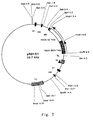
- Agrobacterium rhizogenes which is another bacterium belonging to the genus Agrobacterium has a similar system on the Ri plasmid (Figs. 3 and 4).
- T-DNA is incorporated into the plant genome by infection of Agrobacterium, it was expected that a desired gene may be incorporated into the plant genome by inserting the desired gene in the T-DNA.
- Ti plasmid is as large as not less than 190 kb, it was difficult to insert a gene into the T-DNA by a standard technique of genetic engineering. Thus, a method for transferring a foreign gene into the T-DNA was developed.
- disarmed strains such as LBA4404 (Hoekema et al., 1983 (Reference (14))), C58C1(pGV3850) (Zambryski et al., 1983 (Reference (44))), and GV3Ti11SE (Fraley et al., 1985 (Reference (10))), that have tumorigenic Ti plasmids from which hormone synthetase genes were eliminated, were prepared (Fig. 3).
- Two methods employing such a strain that is, a method by which a desired gene is transferred into the Ti plasmid of Agrobacterium , and a method by which a T-DNA having a desired gene is transferred into Agrobacterium , were developed.
- the vir region contains vir A, vir B, vir C, vir D, vir E and virG (Plant Biotechnology Encyclopedia (Enterprise Co., Ltd. (1989)), and the vir region is defined as those containing all of vir A, vir B, vir C, vir D, vir E and vir G.
- the binary vector is a small plasmid which is replicable in both Agrobacterium and E.
- Binary vector includes pBIN19 (Bevan, 1984 (Reference (5))), pBI121 (Jefferson, 1987 (Reference (21))), pGA482 (An et al., 1988 (Reference (2)), Japanese Laid-open Patent Application (Kokai) No. 60-70080 (EP120516)), and a number of new binary vectors have been constructed based on these vectors.
- Similar vectors have been constructed and are used for transformation.
- Agrobacterium A281 (Watson et al., 1975 (Reference (42))) is a super-virulent strain, whose host spectrum is wide and whose efficiency of transformation is higher than other strains (Hood et al., 1987(Reference (15)); Komari, 1989 (Reference (23))). This feature is brought about by a Ti plasmid pTiBo542 contained in A281 (Hood et al., 1984 (Reference (18)); Jin et al., 1987 (Reference (22)); Komari et al., 1986 (Reference (26))).
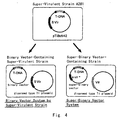
- Another system is "super-binary" vector system (Hiei et al., 1994 (Reference (13)); Ishida et al., 1996 (Reference (20)); Komari et al., 1999 (Reference (28)), WO94/00977, WO95/06722) (Fig. 4). Since this system comprises a disarmed type Ti plasmid having the vir region ( vir A, vir B, vir C, vir D, vir E and vir G) (each of these may also be hereinafter referred to as "vir fragment region") and a plasmid having T-DNA, this is a kind of the binary vector system.
- a super-binary vector (Komari, 1990a (Reference (24)) in which a vir region fragment (preferably a fragment containing at least vir B or vir G, more preferably a fragment at least containing vir B and vir G) substantially lacking at least one of the fragments of vir region is incorporated into the plasmid having the T-DNA, i.e., the binary vector.
- a vir region fragment preferably a fragment containing at least vir B or vir G, more preferably a fragment at least containing vir B and vir G
- homologous recombination via the triparental mating method may be employed as an easy method (Komari et al., 1996 (Reference (27))).
- the host bacterium belonging to the genus Agrobacterium is not restricted, and Agrobacterium tumefaciens (e.g., the above-described Agrobacterium tumefaciens LBA4404 (Hoekema et al., 1983 (Reference (14))) and EHA101 (Hood et al., 1986 (Reference (17))) may preferably be employed.
- Agrobacterium tumefaciens e.g., the above-described Agrobacterium tumefaciens LBA4404 (Hoekema et al., 1983 (Reference (14))) and EHA101 (Hood et al., 1986 (Reference (17))
- LBA4404 Hoekema et al., 1983 (Reference (14)
- EHA101 Hood et al., 1986 (Reference (17)
- the method of the present invention may be applied to any of the gene transfer systems as long as it is based on the expression of the group of genes in the vir region in the bacterium belonging to the genus Agrobacterium so as to obtain significant effect.
- the method of the present invention may be applied to any of the vector systems such as the above-described intermediate vectors, binary vectors, super-virulent binary vectors and super-binary vectors so as to obtain the advantageous effect of the present invention.
- the method of the present invention may also be applied to the vector systems obtained by modification of these vectors (e.g., those wherein the entire or a part of the vir region of a bacterium belonging to the genus Agrobacterium is excised and additionally incorporated into the plasmid, or the entire or a part of the vir region of a bacterium belonging to the genus Agrobacterium is excised and is transferred into Agrobacterium as a part of a new plasmid). Further, needless to say, by the method of the present invention, the efficiency of transfer of the T-DNA region of wild type Agrobacterium is promoted so as to promote the infection efficiency.
- the desired gene to be transferred into the plant may be inserted into a restriction site in the T-DNA region of the above-described plasmid by a conventional method, and the Agrobacterium into which the desired gene was incorporated may be selected based on an appropriate selection marker such as a drug resistant gene against a drug such as kanamycin or paromomycin.
- an appropriate selection marker such as a drug resistant gene against a drug such as kanamycin or paromomycin.
- the desired DNA may be inserted by the triparental mating method utilizing the homologous recombination in the cell of the bacterium belonging to the genus Agrobacterium .
- Transfer of the plasmid into a bacterium belonging to the genus Agrobacterium such as Agrobacterium tumefaciens may be carried out by a known method including the above-mentioned triparental mating method, electroporation method, electroinjection method and chemical treatments with PEG or the like.
- the gene which is to be transferred into the plant is, in principle, arranged between the left and right border sequences of the T-DNA as in the conventional method.
- the plasmid since the plasmid is annular, the plasmid may contain only one border sequence. Alternatively, in cases where a plurality of genes are to be arranged at different sites, the plasmid may contain three or more border sequences.
- arrangement of the desired plasmid in the Ti or Ri plasmid may be performed in the cell of the bacterium belonging to the genus Agrobacterium, or the desired gene may be arranged in another plasmid. Further, the desired gene may be arranged in a plurality of types of plasmids.
- Transfer of a gene into the plant cells via a bacterium belonging to the genus Agrobacterium may be attained by simply making the plant cells or plant tissue contact the bacterium belonging to the genus Agrobacterium .
- a cell suspension of the bacterium belonging to the genus Agrobacterium having a population density of about 10 6 to 10 11 cells/ml is prepared, and the plant cells or the plant tissue are(is) immersed in the suspension for about 3 to 10 minutes, followed by co-culturing the resultant on a solid medium for several days, thereby attaining the transfer of the gene.
- the cells or the tissue to be subjected to the gene transfer are(is) not restricted at all and may be a leaf, root, stem, fruit or any other portion of the plant. Further, dedifferentiated tissue such as a callus or a non-dedifferentiated tissue such as an embryo may be employed.
- dedifferentiated tissue such as a callus or a non-dedifferentiated tissue such as an embryo may be employed.
- the type of the plant is not restricted at all, and angiosperms are preferred. As long as the plant is an angiosperm, either dicotyledon or monocotyledon is preferred.
- the efficiency of gene transfer is significantly promoted when compared with the conventional Agrobacterium method. Further, not only the efficiency of gene transfer to the plants to which genes were able to be transferred by the conventional Agrobacterium method, but also gene transfer can be first attained by the method of the present invention to the plants to which genes could not be hitherto transferred by the conventional Agrobacterium method. Therefore, the term "promoting efficiency of gene transfer" includes the cases where the gene transfer is first attained to the plants to which genes could not hitherto be transferred by a known method (that is, such a case can be considered as a case wherein the efficiency of gene transfer which was 0% by the known method is promoted).
- LBA4404(pIG121Hm) Hiei et al., 1994 (Reference (13))
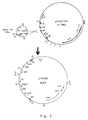
- LBA4404(pNB131) see Fig. 2
- LBA4404(pTOK233) Hiei et al., 1994 (Reference (13))
- pNB131 was obtained.
- the T-DNA region of pIG121Hm contain a kanamycin resistant (nptII) gene driven by nos promoter, a hygromycin resistant (hpt) gene driven by 35S promoter of cauliflower mosaic virus (CaMV), and a GUS gene driven by the 35S promoter, which GUS gene contains introns of the catalase gene of castor bean (Ohta, S. et al., 1990 (Reference (33)).
- the T-DNA region of pNB131 contains a bar gene driven by 35S promoter, and a GUS gene driven by the 35S promoter, which GUS gene contains introns (described above).
- the T-DNA region of pTOK233 contains an nptII gene driven by nos promoter, an hpt gene driven by 35S promoter, and a GUS gene driven by the 35S promoter, which GUS gene contains introns (described above).
- the plasmid pTOK233 is a super-binary vector having high ability of transformation ( Komari, T. et al., 1999 (Reference (28))).
- the sample tissue was placed in a centrifugal tube containing sterilized water, and centrifugation was performed at 25°C at 20,000G for 1 to 60 minutes.
- phosphate buffer containing 1.0 mM 5-bromo-4-chloro-3-indolyl- ⁇ -D-glucuronic acid (X-gluc) and 20% methanol was added. After incubating the resultant at 37°C for 24 hours, tissues colored in blue were observed under microscope.
- the scutella of the grown embryos were divided into 4 to 7 pieces with a lancet and the divided scutella were cultured on 2N6 medium (described above) not containing a selection drug for several days under luminous condition. Then the scutella were transferred to 2N6 medium containing 50 to 100 mg/l hygromycin and cultured at 30°C under luminous condition for about 2 to 3 weeks.
- 2N6 medium containing 50 to 100 mg/l hygromycin and cultured at 30°C under luminous condition for about 2 to 3 weeks.
- As the medium containing 10 mg/l phosphonothricin (PPT) as a selection drug CC medium (Potrykus et al. 1979 (Reference (34)) containing 2 mg/l 2,4-D and not containing coconut water was used.
- the drug resistant calli formed on the medium were transferred to N6-7 medium (Hiei et al. 1994 (Reference (13))) and secondary selection was conducted for 7 days at 30°C under luminous condition.
- Each medium contained combination of 250 mg/l cefotaxime and 250 mg/l carbenicillin sodium, or contained 250 mg/l cefotaxime alone.
- As the medium-solidifier 4 g/l Gelrite was used.
- the drug resistant calli grown on the medium was subjected to the X-Gluc treatment and expression of the GUS gene was checked as described above.
- Hiei et al. (1994 (Reference (13))) reported that transformation may be attained with a relatively high efficiency using calli of rice.
- Aldemita RR et al. 1996 (Reference (1))) reported a case of transformation using rice immature embryo.
- the above-described combined treatment method is very effective.
- the quality of immature embryo is likely varied depending on the environment of culturing so that it is not easy to always obtain immature embryo suited for transformation, it may be possible to keep high efficiency of transformation by subjecting the immature embryo to the combined treatments.
- transformants may be obtained by employing the combined treatment method for the varieties with which a transformant has not hitherto been obtained.
- Heat/Centrifugation Treatments and Transient Expression of GUS Gene in Scutella of Immature Embryos (Variety: Asanohikari) Treatment Temperature (Treatment Time) Centrifugal Acceleration (Treatment Time) Number of Sample Immature Embryos Number of Immature Embryos Percentage of GUS-Expressed Area in Surface of Scutellum (%) 0 0-1 1-10 10-20 20-50 50-80 80-100 - - 20 3 8 8 1 0 0 0 46°C (5 min) - 20 1 6 7 4 2 0 0 - 20,000G (30 min) 20 0 1 4 7 7 1 0 46°C (5 min) 20,000G (30 min) 20 0 0 0 2 9 8 1 Sample Strain: LBA4404(pIG121Hm); Duration of Co-cul
- Immature embryos of maize with a size of about 1.2 mm (variety: A188, obtained from National Institute of Agrobiological Resources, The Ministry of Agriculture, Forestry and Fisheries) were aseptically collected and placed in a tube containing 2 ml of LS-inf liquid medium. After washing the embryos once with the same medium, 2.0 ml of fresh medium was added. Heat treatment was carried out by immersing the tube in a water bath at 46°C for 3 minutes. Centrifugation treatment was performed by centrifuging the tube with a cooling centrifuge at 20 KG, at 4°C for 30 minutes. Combined heat/centrifugation treatments were carried out by conducting the above-described heat treatment and then conducting the above-described centrifugation treatment.
- the control was left to stand at room temperature for the same period of time. After the treatments, the medium was removed, and 1.0 ml of a suspension of Agrobacterium tumefaciens LBA4404(pSB131)(Ishida et al. 1986 (Reference (20)) with a population density of about 1 x 10 9 cfu/ml in LS-inf liquid medium containing 100 ⁇ M acetosyringone rubber was added, followed by stirring the mixture with a vortex mixer for 30 seconds. After leaving the mixture to stand at room temperature for 5 minutes, the embryos were plated on LS-AS medium containing 10 ⁇ M AgNO 3 such that the surface of each hypocotyl contacts the medium.
- the plasmid pSB131 is a super-binary vector.
- the immature embryos after the co-culturing were cultured on a medium containing phsphinothricin (PPT) and 10 ⁇ M AgNO 3 , thereby carrying out selection of the transformed cells.
- the calli grown on the selection medium were placed on a regeneration medium containing PPT, regeneration of transformed plants was carried out.
- a portion of a leaf of each regenerated plant was excised and the transient expression of the GUS gene was checked by the treatment with X-gluc as in Example 1.
- the above-described medium and method for culturing were in accordance with Ishida, Y. et al. 1996 (Reference (20)).
- the results of transformation of the immature embryos infected with LBA4404(pSB 131) are shown in Table 7. From the control immature embryos which were not subjected to the heat treatment, transformed plants were obtained at a efficiency of 10.7%. On the other hand, the efficiency of transformation of the immature embryos subjected to the centrifugation treatment at 20KG at 4°C for 30 minutes was 13.3%, so that the efficiency was higher than that of the control group. The efficiency of the transformation of the embryos subjected to the heat treatment was 20%, which is about the twice that of the non-treated group. Further, the efficiency of transformation of the embryos subjected to the combined heat treatment and centrifugation treatment was 29.6% which was about three times that of the control group.
- Mature seeds of creeping bent grass ( Agrostis palustris cv. Pencross, Yukijirushi Shubyo Co., Ltd.) were sterilized and placed on a medium (TG2 medium) containing MS inorganic salts, MS vitamins, 4 mg/l dicamba, 0.5 mg/l 6BA, 0.7 g/l proline, 0.5 g/l MES, 20 g/l sucrose and 3 g/l gelrite (pH 5.8), followed by culturing the seeds at 25°C in the dark.
- the derived calli were subcultured on the medium having the same composition to grow embryogenic calli.
- the obtained embryogenic calli were transferred to liquid medium (TG2L) which had the same composition as TG2 except that it did not contain gelrite, and cultured under shaking at 25°C in the dark to obtain cells of suspension culture.
- the cells of suspension culture on 3 to 4 days after the subculture were placed in a tube containing 2 ml of TG2L medium. After once washing the calli with the same medium, 2 ml of fresh medium was added. The tube was immersed in a water bath at 46°C for 5 minutes. After removing the medium and adding the same fresh liquid medium, the resultant was centrifuged at 5000 rpm at 4°C for 10 minutes. The control was left to stand at room temperature.
- the medium was removed and 1.0 ml of a suspension of Agrobacterium tumefaciens LBA4404(pTOK233) (described above) in TG2-inf medium (the same composition as TG2 medium except that proline, MES and gelrite are removed and 48.46 g/l sucrose, and 36.04 g/l glucose were added) at a population density of about 1 x 10 9 cfu/ml was added, followed by stirring the resulting mixture for 30 seconds by a vortex mixer.
- TG2-inf medium the same composition as TG2 medium except that proline, MES and gelrite are removed and 48.46 g/l sucrose, and 36.04 g/l glucose were added
- TG2-AS medium was the TG2L medium supplemented with 10 g/l glucose, 100 ⁇ M acetosyringone, 4 g/l type I agarose (pH5.8), and cultured at 25°C for 3 days i the dark.
- the cells were then washed three times with TG2L medium containing 250 mg/l cefotaxime and carbenicillin.
- the cells were then suspended in the same buffer and cultured under shaking at 25°C in the dark at 70 rpm.
- the cells were subcultured on a medium having the same composition except that 50 mg/l hygromycin was added. After culturing the cells for another week, an aliquot was sampled and treated with X-gluc to check the expression of the GUS gene.
- GUS gene expression in the suspended cultured cells of creeping bent grass infected with LBA4404(pTOK233) is shown in Table 8.
- the control group only one cell cluster showed expression of GUS.
- the heat treatment and centrifugation treatment about 30% of the cell clusters showed expression of GUS gene.
- the area in which the GUS gene was expressed was larger in the cell clusters subjected to heat and centrifugation treatments than that of the control group.
Landscapes
- Health & Medical Sciences (AREA)
- Life Sciences & Earth Sciences (AREA)
- Genetics & Genomics (AREA)
- Engineering & Computer Science (AREA)
- Biomedical Technology (AREA)
- Biotechnology (AREA)
- Bioinformatics & Cheminformatics (AREA)
- Organic Chemistry (AREA)
- Chemical & Material Sciences (AREA)
- Zoology (AREA)
- Wood Science & Technology (AREA)
- General Engineering & Computer Science (AREA)
- Molecular Biology (AREA)
- Biochemistry (AREA)
- Microbiology (AREA)
- Cell Biology (AREA)
- General Health & Medical Sciences (AREA)
- Biophysics (AREA)
- Plant Pathology (AREA)
- Physics & Mathematics (AREA)
- Botany (AREA)
- Micro-Organisms Or Cultivation Processes Thereof (AREA)
- Breeding Of Plants And Reproduction By Means Of Culturing (AREA)
- Steroid Compounds (AREA)
- Pharmaceuticals Containing Other Organic And Inorganic Compounds (AREA)
Abstract
Description
| Heat/Centrifugation Treatments and Transient Expression of GUS Gene in Scutella of Immature Embryos (Variety: Asanohikari) | |||||||||
| Treatment Temperature (Treatment Time) | Centrifugal Acceleration (Treatment Time) | Number of Sample Immature Embryos | Number of Immature Embryos | ||||||
| Percentage of GUS-Expressed Area in Surface of Scutellum (%) | |||||||||
| 0 | 0-1 | 1-10 | 10-20 | 20-50 | 50-80 | 80-100 | |||
| - | - | 20 | 3 | 8 | 8 | 1 | 0 | 0 | 0 |
| 46°C (5 min) | - | 20 | 1 | 6 | 7 | 4 | 2 | 0 | 0 |
| - | 20,000G (30 min) | 20 | 0 | 1 | 4 | 7 | 7 | 1 | 0 |
| 46°C (5 min) | 20,000G (30 min) | 20 | 0 | 0 | 0 | 2 | 9 | 8 | 1 |
| Sample Strain: LBA4404(pIG121Hm); Duration of Co-culturing: 5 days |
| Heat/Centrifugation Treatments and Transient Expression of GUS Gene in Scutella of Immature Embryos (Variety: Asanohikari) | |||||||||
| Treatment Temperature (Treatment Time) | Centrifugal Acceleration (Treatment Time) | Number of Sample Immature Embryos | Number of Immature Embryos | ||||||
| Percentage of GUS-Expressed Area in Surface of Scutellum (%) | |||||||||
| 0 | 0-1 | 1-10 | 10-20 | 20-50 | 50-80 | 80-100 | |||
| - | - | 20 | 3 | 13 | 4 | 0 | 0 | 0 | 0 |
| 46°C (5 min) | - | 20 | 0 | 0 | 10 | 7 | 3 | 0 | 0 |
| - | 20,000G (30 min) | 20 | 0 | 0 | 3 | 9 | 8 | 0 | 0 |
| 46°C (5 min) | 20,000G (30 min) | 20 | 0 | 0 | 0 | 3 | 14 | 3 | 0 |
| Sample Strain: LBA4404(pNB131); Duration of Co-culturing: 6 days |
| Heat/Centrifugation Treatments and Efficiency of Selection of Transformed Calli (Variety: Asanohikari) | ||||
| Treatment Temperature (Treatment Time) | Centrifugal Acceleration (Treatment Time) | Number of Sample Sections of Immature Embryo (A) | Number of Hm-resistant GUS-Positive Calli (B) | B/A(%) |
| - | - | 50 | 6 | 12.0 |
| 46°C (5 min) | - | 51 | 15 | 29.4 |
| - | 20,0000 (30 min) | 51 | 29 | 56.9 |
| 46°C (5 min) | 20,0000 (30 min) | 46 | 29 | 63.0 |
| Sample Strain: LBA4404(pIG121Hm); Duration of Co-culturing: 5 days, Hm: 100 mg/l hygromycin |
| Heat/Centrifugation Treatments and Efficiency of Selection of Transformed Calli (Variety: Asanohikari) | ||||
| Treatment Temperature (Treatment Time) | Centrifugal Acceleration (Treatment Time) | Number of Sample Sections of Immature Embryo (A) | Number of Hm-resistant GUS-Positive Calli (B) | B/A(%) |
| - | - | 60 | 7 | 11.7 |
| 46°C (5 min) | - | 60 | 9 | 15.0 |
| - | 20,000G (1min) | 60 | 48 | 80.0 |
| - | 20,000G (60 min) | 60 | 48 | 80.0 |
| 46°C, 5 min | 20,0000 (1 min) | 60 | 51 | 85.0 |
| 46°C, 5 min | 20,000G (60 min) | 60 | 51 | 85.0 |
| Sample Strain: LBA4404(pIG121Hm); Duration of Co-culturing: 6 days, Hm: 100 mg/l hygromycin |
| Heat/Centrifugation Treatments and Efficiency of Selection of Transformed Calli (Variety: Asanohikari) | ||||
| Treatment Temperature (Treatment Time) | Centrifugal Acceleration (Treatment Time) | Number of Sample Sections of Immature Embryo (A) | Number of Hm-resistant GUS-Positive Calli (B) | B/A(%) |
| - | - | 62 | 18 | 29.0 |
| 46°C (5 min) | - | 64 | 32 | 52.5 |
| - | 20,000G (30 min) | 60 | 39 | 65.0 |
| 46°C, 5 min | 20,000G (30 min) | 60 | 41 | 68.3 |
| Sample Strain: LBA4404(pNB131); Duration of Co-culturing: 6 days, PPT: 10 mg/l phosphinothricin |
| Influence on Efficiency of Gene Transfer by Treatments (Infected with LBA4404(pSB131)) | |||||
| Treatment | Sample Immature Embryo | G U S | |||
| +++ | ++ | + | - | ||
| Not Treated | 9 | 0 | 3 | 6 | 0 |
| Heat | 9 | 1 | 7 | 1 | 0 |
| Centrifugation | 12 | 0 | 3 | 9 | 0 |
| Heat and Centrifugation | 17 | 5 | 9 | 3 | 0 |
| Transient expression of GUS gene in immature embryos after co-culturing |
| Influence on Efficiency of Gene Transfer by Treatments (LBA4404(pSB131) was transferred) | ||||
| Treatment | Number of Sample Immature Embryos | PPT-resistant callus (%) | PPT-resistant plant (%) | GUS+ plant (%) |
| Not Treated | 28 | 9 (32.1) | 9 (32.1) | 3 (10.7) |
| Heat | 30 | 18 (60.0) | 15(50.0) | 6 (20.0) |
| Centrifugation | 30 | 14(46.6) | 9(30.0) | 4(13.3) |
| Heat and Centrifugation | 27 | 23(85.2) | 20(74.1) | 8(29.6) |
| Both the number of calli and number of plants do not include clones. |
| Effect of Heat and Centrifugation Treatments on Efficiency of Gene Transfer into Suspended Cultured Cells of Creeping Bent Grass | |||
| Treatment | Number of Cell Clusters | ||
| Total Number | GUS+ | GUS+ (%) | |
| Heat and Centrifugation Treatment | 79 | 23 | 29.1 |
| Control | 101 | 1 | 1.0 |
| Expression of GUS gene was checked two weeks after co-culturing |
Claims (25)
- A method for promoting efficiency of gene transfer into plant cells by a bacterium belonging to genus Agrobacterium, comprising heating and centrifuging said plant cells or plant tissue.
- The method according to claim 1, wherein said gene transfer is carried out after heating and centrifuging said plant cells or plant tissue.
- The method according to claim 1 or 2, wherein the heat treatment is carried out at a temperature of 33°C to 60°C.
- The method according to claim 3, wherein the heat treatment is carried out at a temperature of 35°C to 55°C.
- The method according to claim 4, wherein the heat treatment is carried out at a temperature of 37°C to 52°C.
- The method according to any one of claims 1 to5, wherein the heat treatment is carried out for 5 seconds to 24 hours.
- The method according to claim 1 or 2, wherein the heat treatment is carried out at a temperature of 37°C to 52°C for 1 minute to 24 hours.
- The method according to any one of claims 1 to 7, wherein the centrifugation is carried out under a centrifugal acceleration of 100G to 250,000G.
- The method according to claim 8, wherein said centrifugation is carried out under a centrifugal acceleration of 500G to 200,000G.
- The method according to claim 9, wherein said centrifugation is carried out under a centrifugal acceleration of 1000G to 150,000G.
- The method according to any one of claims 1 to 10, wherein said centrifugation is carried out for 1 second to 4 hours.
- A method for preparing a plant characterized by using the method according to claim I to 11.
- Plant cells, plant tissue or plant prepared by the method according to claims 1 to 12.
- The method according to any one of claims 1 to 11, wherein said plant cells or plant tissue used are(is) originated from an angiosperm.
- A method for preparing an angiosperm characterized by using the method according to claim 14.
- Angiosperm cells, angiosperm tissue or angiosperm prepared by the method according to claim 14 or 15.
- The method according to claim 14, wherein said plant cells or plant tissue used are(is) originated from a monocotyledon.
- A method for preparing a monocotyledon characterized by using the method according to claim 17.
- The monocotyledon cells, monocotyledon tissue or monocotyledon prepared by the method according to claim 17 or 18.
- The method according to claim 17, wherein said plant cells or plant tissue are(is) originated from a plant belonging to family Gramineae.
- A method for preparing a plant belonging to family Gramineae characterized by using the method according to claim 20.
- The cells of the plant belonging to family Gramineae, the tissue of the plant belonging to family Gramineae, or the plant belonging to family Gramineae prepared by the method according to claim 20 or 21.
- The method according to claim 20, wherein said plant cells or plant tissue are(is) of rice or maize.
- A method for preparing rice or maize characterized by using the method according to claim 23.
- Rice cells, rice tissue, rice, maize cells, maize tissue or maize prepared by the method according to claim 23 or 24.
Applications Claiming Priority (1)
| Application Number | Priority Date | Filing Date | Title |
|---|---|---|---|
| PCT/JP2000/005214 WO2002012521A1 (en) | 1999-06-04 | 2000-08-03 | Method of improving gene transfer efficiency into plant cells |
Publications (3)
| Publication Number | Publication Date |
|---|---|
| EP1306441A1 true EP1306441A1 (en) | 2003-05-02 |
| EP1306441A4 EP1306441A4 (en) | 2004-09-08 |
| EP1306441B1 EP1306441B1 (en) | 2008-12-17 |
Family
ID=11736323
Family Applications (1)
| Application Number | Title | Priority Date | Filing Date |
|---|---|---|---|
| EP00949977A Expired - Lifetime EP1306441B1 (en) | 2000-08-03 | 2000-08-03 | Method of improving gene transfer efficiency into plant cells |
Country Status (9)
| Country | Link |
|---|---|
| US (1) | US7902426B1 (en) |
| EP (1) | EP1306441B1 (en) |
| KR (1) | KR100767867B1 (en) |
| CN (1) | CN1273604C (en) |
| AT (1) | ATE417933T1 (en) |
| AU (1) | AU785336B2 (en) |
| CA (1) | CA2386126C (en) |
| DE (1) | DE60041157D1 (en) |
| WO (1) | WO2002012521A1 (en) |
Cited By (5)
| Publication number | Priority date | Publication date | Assignee | Title |
|---|---|---|---|---|
| EP1669444A4 (en) * | 2003-08-13 | 2006-11-29 | Japan Tobacco Inc | Method of elevating transformation efficiency in plant by adding copper ion |
| ES2299285A1 (en) * | 2004-11-26 | 2008-05-16 | Universidad De Vigo | Vegetal material transforming method for use in field of plant breeding, involves transforming vegetal material, where material is explant from adult tree, which comprises two leaves and axillary or apical bud |
| US7812222B2 (en) | 2003-08-13 | 2010-10-12 | Japan Tobacco Inc. | Method of transducing gene into plant material |
| US8058514B2 (en) | 2007-02-28 | 2011-11-15 | Japan Tobacco Inc. | Agrobacterium-mediated method for producing transformed plant without selection step |
| US8101820B2 (en) | 2007-02-28 | 2012-01-24 | Japan Tobacco Inc. | Method for increasing transformation efficiency in plants, comprising coculture step for culturing plant tissue with coculture medium containing 3,6-dichloro-o-anisic acid |
Families Citing this family (5)
| Publication number | Priority date | Publication date | Assignee | Title |
|---|---|---|---|---|
| JP2011120478A (en) * | 2008-03-31 | 2011-06-23 | Japan Tobacco Inc | Agrobacterium-mediated method for producing transformed plant |
| CN102469769B (en) | 2009-07-29 | 2016-06-22 | 日本烟草产业株式会社 | Use edaphic bacillus that the plant of Triticum carries out the manufacture method converting plant of the method for channel genes and the plant of Triticum |
| JP2013212051A (en) | 2010-07-29 | 2013-10-17 | Japan Tobacco Inc | Method of gene introduction into hordeum plant using agrobacterium bacterium and method of production of transformed plant of hordeum plant |
| CN106413388B (en) * | 2014-05-01 | 2020-06-30 | 孟山都技术公司 | Adjuvant delivery of plant treatment agents |
| US20200087673A1 (en) * | 2017-06-02 | 2020-03-19 | Fraunhofer-Gesellschaft zur Förderung der angewandten Forschung e.V. | Method for automated transformation of a plant cell pack |
Family Cites Families (19)
| Publication number | Priority date | Publication date | Assignee | Title |
|---|---|---|---|---|
| EP0290799B9 (en) * | 1983-01-13 | 2004-09-01 | Max-Planck-Gesellschaft zur Förderung der Wissenschaften e.V. | Transgenic dicotyledonous plant cells and plants |
| NL8300699A (en) | 1983-02-24 | 1984-09-17 | Univ Leiden | METHOD FOR BUILDING FOREIGN DNA INTO THE NAME OF DIABIC LOBAL PLANTS; METHOD FOR PRODUCING AGROBACTERIUM TUMEFACIENS BACTERIEN; STABLE COINTEGRATE PLASMIDS; PLANTS AND PLANT CELLS WITH CHANGED GENETIC PROPERTIES; PROCESS FOR PREPARING CHEMICAL AND / OR PHARMACEUTICAL PRODUCTS. |
| NL8300698A (en) | 1983-02-24 | 1984-09-17 | Univ Leiden | METHOD FOR BUILDING FOREIGN DNA INTO THE NAME OF DIABIC LOBAL PLANTS; AGROBACTERIUM TUMEFACIENS BACTERIA AND METHOD FOR PRODUCTION THEREOF; PLANTS AND PLANT CELLS WITH CHANGED GENETIC PROPERTIES; PROCESS FOR PREPARING CHEMICAL AND / OR PHARMACEUTICAL PRODUCTS. |
| NL8401048A (en) | 1984-04-03 | 1985-11-01 | Rijksuniversiteit Leiden En Pr | METHOD FOR BUILDING FOREIGN DNA INTO THE NAME OF LOBELIC PLANTS. |
| US5231019A (en) * | 1984-05-11 | 1993-07-27 | Ciba-Geigy Corporation | Transformation of hereditary material of plants |
| JPH04330234A (en) | 1991-03-20 | 1992-11-18 | Japan Tobacco Inc | Cucumber mosaic virus resistant tomato and method for preparing the same |
| DK0604662T3 (en) * | 1992-07-07 | 2008-10-20 | Japan Tobacco Inc | Method of Transforming Monocotyledon |
| US5712112A (en) | 1992-11-04 | 1998-01-27 | National Science Council Of R.O.C. | Gene expression system comprising the promoter region of the alpha-amylase genes |
| EP0672752B1 (en) | 1993-09-03 | 2004-05-26 | Japan Tobacco Inc. | Method of transforming monocotyledon by using scutellum of immature embryo |
| JP3102888B2 (en) | 1993-12-08 | 2000-10-23 | 日本たばこ産業株式会社 | Plant transformation method and vector therefor |
| JPH10117776A (en) | 1996-10-22 | 1998-05-12 | Japan Tobacco Inc | Indicine Transformation Method |
| JP3312867B2 (en) * | 1996-11-08 | 2002-08-12 | 北興化学工業株式会社 | Method for transforming plant and method for producing transformed plant |
| US6162965A (en) | 1997-06-02 | 2000-12-19 | Novartis Ag | Plant transformation methods |
| MX257801B (en) * | 1997-06-02 | 2008-06-10 | Syngenta Participations Ag | Plant transformation methods |
| KR20000068610A (en) | 1997-07-23 | 2000-11-25 | 미즈노 마사루 | Method for selecting transformed cells |
| AU2594300A (en) * | 1998-12-23 | 2000-07-12 | Samuel Roberts Noble Foundation, Inc., The | Plant transformation process |
| JP2000342255A (en) | 1999-06-04 | 2000-12-12 | Japan Tobacco Inc | Method for improving the efficiency of gene transfer into plant cells |
| JP3141084B2 (en) | 1999-07-21 | 2001-03-05 | 農林水産省農業生物資源研究所長 | Ultra-rapid transformation of monocotyledonous plants |
| ATE414779T1 (en) | 1999-09-30 | 2008-12-15 | Japan Tobacco Inc | VECTORS FOR TRANSFORMING PLANTS |
-
2000
- 2000-08-03 DE DE60041157T patent/DE60041157D1/en not_active Expired - Lifetime
- 2000-08-03 AU AU63180/00A patent/AU785336B2/en not_active Expired
- 2000-08-03 EP EP00949977A patent/EP1306441B1/en not_active Expired - Lifetime
- 2000-08-03 AT AT00949977T patent/ATE417933T1/en not_active IP Right Cessation
- 2000-08-03 KR KR1020027004031A patent/KR100767867B1/en not_active Expired - Lifetime
- 2000-08-03 WO PCT/JP2000/005214 patent/WO2002012521A1/en not_active Ceased
- 2000-08-03 CN CNB008138176A patent/CN1273604C/en not_active Expired - Lifetime
- 2000-08-03 US US10/089,695 patent/US7902426B1/en not_active Expired - Fee Related
- 2000-08-03 CA CA2386126A patent/CA2386126C/en not_active Expired - Lifetime
Cited By (8)
| Publication number | Priority date | Publication date | Assignee | Title |
|---|---|---|---|---|
| EP1669444A4 (en) * | 2003-08-13 | 2006-11-29 | Japan Tobacco Inc | Method of elevating transformation efficiency in plant by adding copper ion |
| US7709700B2 (en) | 2003-08-13 | 2010-05-04 | Japan Tobacco Inc. | Method for improving plant transformation efficiency by adding copper ion |
| US7812222B2 (en) | 2003-08-13 | 2010-10-12 | Japan Tobacco Inc. | Method of transducing gene into plant material |
| ES2299285A1 (en) * | 2004-11-26 | 2008-05-16 | Universidad De Vigo | Vegetal material transforming method for use in field of plant breeding, involves transforming vegetal material, where material is explant from adult tree, which comprises two leaves and axillary or apical bud |
| ES2299285B2 (en) * | 2004-11-26 | 2009-12-07 | Universidad De Vigo | PROCEDURE FOR TRANSFORMING VEGETABLE MATERIAL FROM ADULT TREES. |
| US8058514B2 (en) | 2007-02-28 | 2011-11-15 | Japan Tobacco Inc. | Agrobacterium-mediated method for producing transformed plant without selection step |
| US8101820B2 (en) | 2007-02-28 | 2012-01-24 | Japan Tobacco Inc. | Method for increasing transformation efficiency in plants, comprising coculture step for culturing plant tissue with coculture medium containing 3,6-dichloro-o-anisic acid |
| CN101668418B (en) * | 2007-02-28 | 2013-03-20 | 日本烟草产业株式会社 | Method for improvement of efficiency of transformation in plant, comprising co-culture step for culturing plant tissue in co-culture medium containing 3,6-dichloro-2-methoxybenzoic acids |
Also Published As
| Publication number | Publication date |
|---|---|
| CN1377421A (en) | 2002-10-30 |
| US7902426B1 (en) | 2011-03-08 |
| KR20020092916A (en) | 2002-12-12 |
| CA2386126C (en) | 2010-07-13 |
| CA2386126A1 (en) | 2002-02-14 |
| DE60041157D1 (en) | 2009-01-29 |
| WO2002012521A1 (en) | 2002-02-14 |
| CN1273604C (en) | 2006-09-06 |
| EP1306441B1 (en) | 2008-12-17 |
| ATE417933T1 (en) | 2009-01-15 |
| KR100767867B1 (en) | 2007-10-17 |
| AU6318000A (en) | 2002-02-18 |
| EP1306441A4 (en) | 2004-09-08 |
| AU785336B2 (en) | 2007-01-18 |
Similar Documents
| Publication | Publication Date | Title |
|---|---|---|
| US7960611B2 (en) | Method for promoting efficiency of gene introduction into plant cells | |
| US7803988B2 (en) | Plant transformation method | |
| EP0687730B1 (en) | Method of transforming plant and vector therefor | |
| US10266835B2 (en) | Agrobacterium bacterium to be used in plant transformation method | |
| WO2007069301A1 (en) | Method of elevating transforming efficiency by using powder | |
| JP2011120478A (en) | Agrobacterium-mediated method for producing transformed plant | |
| US7902426B1 (en) | Method of improving gene transfer efficiency into plant cells utilizing heat and centrifugation | |
| JP4424784B2 (en) | Methods for improving the efficiency of gene transfer into plant cells | |
| Lindsey | Transgenic plant research | |
| JP2000342255A (en) | Method for improving the efficiency of gene transfer into plant cells | |
| EP1424887A1 (en) | In planta transformation by embryo imbibition of agrobacterium | |
| JP4428757B2 (en) | Methods for improving the efficiency of gene transfer into plant cells | |
| JPWO2007069643A1 (en) | Method to improve transformation efficiency using powder |
Legal Events
| Date | Code | Title | Description |
|---|---|---|---|
| PUAI | Public reference made under article 153(3) epc to a published international application that has entered the european phase |
Free format text: ORIGINAL CODE: 0009012 |
|
| 17P | Request for examination filed |
Effective date: 20020418 |
|
| AK | Designated contracting states |
Designated state(s): AT BE CH CY DE DK ES FI FR GB GR IE IT LI LU MC NL PT SE |
|
| AX | Request for extension of the european patent |
Extension state: AL LT LV MK RO SI |
|
| RIC1 | Information provided on ipc code assigned before grant |
Ipc: 7A 01H 4/00 B Ipc: 7C 12N 15/82 B Ipc: 7C 12N 5/14 B Ipc: 7C 12N 15/84 A |
|
| A4 | Supplementary search report drawn up and despatched |
Effective date: 20040723 |
|
| 17Q | First examination report despatched |
Effective date: 20040930 |
|
| GRAP | Despatch of communication of intention to grant a patent |
Free format text: ORIGINAL CODE: EPIDOSNIGR1 |
|
| RIN1 | Information on inventor provided before grant (corrected) |
Inventor name: ISHIDA, YUJI,JAPAN TOBACCO INC. PLANT BREEDING Inventor name: HIEI, YUKOH,JAPAN TOBACCO INC. PLANT BREEDING Inventor name: KASAOKA, KEISUKE,JAPAN TOBACCO INC. PLANT BREEDI. |
|
| GRAS | Grant fee paid |
Free format text: ORIGINAL CODE: EPIDOSNIGR3 |
|
| GRAA | (expected) grant |
Free format text: ORIGINAL CODE: 0009210 |
|
| AK | Designated contracting states |
Kind code of ref document: B1 Designated state(s): AT BE CH CY DE DK ES FI FR GB GR IE IT LI LU MC NL PT SE |
|
| REG | Reference to a national code |
Ref country code: GB Ref legal event code: FG4D |
|
| REG | Reference to a national code |
Ref country code: CH Ref legal event code: EP |
|
| REG | Reference to a national code |
Ref country code: IE Ref legal event code: FG4D |
|
| REF | Corresponds to: |
Ref document number: 60041157 Country of ref document: DE Date of ref document: 20090129 Kind code of ref document: P |
|
| PG25 | Lapsed in a contracting state [announced via postgrant information from national office to epo] |
Ref country code: NL Free format text: LAPSE BECAUSE OF FAILURE TO SUBMIT A TRANSLATION OF THE DESCRIPTION OR TO PAY THE FEE WITHIN THE PRESCRIBED TIME-LIMIT Effective date: 20081217 Ref country code: FI Free format text: LAPSE BECAUSE OF FAILURE TO SUBMIT A TRANSLATION OF THE DESCRIPTION OR TO PAY THE FEE WITHIN THE PRESCRIBED TIME-LIMIT Effective date: 20081217 |
|
| NLV1 | Nl: lapsed or annulled due to failure to fulfill the requirements of art. 29p and 29m of the patents act | ||
| PG25 | Lapsed in a contracting state [announced via postgrant information from national office to epo] |
Ref country code: ES Free format text: LAPSE BECAUSE OF FAILURE TO SUBMIT A TRANSLATION OF THE DESCRIPTION OR TO PAY THE FEE WITHIN THE PRESCRIBED TIME-LIMIT Effective date: 20090328 |
|
| PG25 | Lapsed in a contracting state [announced via postgrant information from national office to epo] |
Ref country code: PT Free format text: LAPSE BECAUSE OF FAILURE TO SUBMIT A TRANSLATION OF THE DESCRIPTION OR TO PAY THE FEE WITHIN THE PRESCRIBED TIME-LIMIT Effective date: 20090518 Ref country code: SE Free format text: LAPSE BECAUSE OF FAILURE TO SUBMIT A TRANSLATION OF THE DESCRIPTION OR TO PAY THE FEE WITHIN THE PRESCRIBED TIME-LIMIT Effective date: 20090317 Ref country code: AT Free format text: LAPSE BECAUSE OF FAILURE TO SUBMIT A TRANSLATION OF THE DESCRIPTION OR TO PAY THE FEE WITHIN THE PRESCRIBED TIME-LIMIT Effective date: 20081217 |
|
| PLBE | No opposition filed within time limit |
Free format text: ORIGINAL CODE: 0009261 |
|
| STAA | Information on the status of an ep patent application or granted ep patent |
Free format text: STATUS: NO OPPOSITION FILED WITHIN TIME LIMIT |
|
| PG25 | Lapsed in a contracting state [announced via postgrant information from national office to epo] |
Ref country code: DK Free format text: LAPSE BECAUSE OF FAILURE TO SUBMIT A TRANSLATION OF THE DESCRIPTION OR TO PAY THE FEE WITHIN THE PRESCRIBED TIME-LIMIT Effective date: 20081217 |
|
| 26N | No opposition filed |
Effective date: 20090918 |
|
| PG25 | Lapsed in a contracting state [announced via postgrant information from national office to epo] |
Ref country code: MC Free format text: LAPSE BECAUSE OF NON-PAYMENT OF DUE FEES Effective date: 20090831 |
|
| REG | Reference to a national code |
Ref country code: CH Ref legal event code: PL |
|
| PG25 | Lapsed in a contracting state [announced via postgrant information from national office to epo] |
Ref country code: LI Free format text: LAPSE BECAUSE OF NON-PAYMENT OF DUE FEES Effective date: 20090831 Ref country code: CH Free format text: LAPSE BECAUSE OF NON-PAYMENT OF DUE FEES Effective date: 20090831 |
|
| PG25 | Lapsed in a contracting state [announced via postgrant information from national office to epo] |
Ref country code: IE Free format text: LAPSE BECAUSE OF NON-PAYMENT OF DUE FEES Effective date: 20090803 |
|
| PG25 | Lapsed in a contracting state [announced via postgrant information from national office to epo] |
Ref country code: GR Free format text: LAPSE BECAUSE OF FAILURE TO SUBMIT A TRANSLATION OF THE DESCRIPTION OR TO PAY THE FEE WITHIN THE PRESCRIBED TIME-LIMIT Effective date: 20090318 |
|
| PG25 | Lapsed in a contracting state [announced via postgrant information from national office to epo] |
Ref country code: IT Free format text: LAPSE BECAUSE OF FAILURE TO SUBMIT A TRANSLATION OF THE DESCRIPTION OR TO PAY THE FEE WITHIN THE PRESCRIBED TIME-LIMIT Effective date: 20081217 |
|
| PG25 | Lapsed in a contracting state [announced via postgrant information from national office to epo] |
Ref country code: LU Free format text: LAPSE BECAUSE OF NON-PAYMENT OF DUE FEES Effective date: 20090803 |
|
| PG25 | Lapsed in a contracting state [announced via postgrant information from national office to epo] |
Ref country code: CY Free format text: LAPSE BECAUSE OF FAILURE TO SUBMIT A TRANSLATION OF THE DESCRIPTION OR TO PAY THE FEE WITHIN THE PRESCRIBED TIME-LIMIT Effective date: 20081217 |
|
| REG | Reference to a national code |
Ref country code: FR Ref legal event code: PLFP Year of fee payment: 17 |
|
| REG | Reference to a national code |
Ref country code: FR Ref legal event code: PLFP Year of fee payment: 18 |
|
| REG | Reference to a national code |
Ref country code: FR Ref legal event code: PLFP Year of fee payment: 19 |
|
| PGFP | Annual fee paid to national office [announced via postgrant information from national office to epo] |
Ref country code: FR Payment date: 20190730 Year of fee payment: 20 Ref country code: DE Payment date: 20190723 Year of fee payment: 20 |
|
| PGFP | Annual fee paid to national office [announced via postgrant information from national office to epo] |
Ref country code: BE Payment date: 20190716 Year of fee payment: 20 |
|
| PGFP | Annual fee paid to national office [announced via postgrant information from national office to epo] |
Ref country code: GB Payment date: 20190731 Year of fee payment: 20 |
|
| REG | Reference to a national code |
Ref country code: DE Ref legal event code: R071 Ref document number: 60041157 Country of ref document: DE |
|
| REG | Reference to a national code |
Ref country code: GB Ref legal event code: PE20 Expiry date: 20200802 |
|
| REG | Reference to a national code |
Ref country code: BE Ref legal event code: MK Effective date: 20200803 |
|
| PG25 | Lapsed in a contracting state [announced via postgrant information from national office to epo] |
Ref country code: GB Free format text: LAPSE BECAUSE OF EXPIRATION OF PROTECTION Effective date: 20200802 |