EP1306144A1 - Verfahren zur kontinuierlichen Oberflächenbehandlung eines Aluminiumprofils - Google Patents
Verfahren zur kontinuierlichen Oberflächenbehandlung eines Aluminiumprofils Download PDFInfo
- Publication number
- EP1306144A1 EP1306144A1 EP01811036A EP01811036A EP1306144A1 EP 1306144 A1 EP1306144 A1 EP 1306144A1 EP 01811036 A EP01811036 A EP 01811036A EP 01811036 A EP01811036 A EP 01811036A EP 1306144 A1 EP1306144 A1 EP 1306144A1
- Authority
- EP
- European Patent Office
- Prior art keywords
- profile
- substances
- profile surface
- die opening
- zirconium
- Prior art date
- Legal status (The legal status is an assumption and is not a legal conclusion. Google has not performed a legal analysis and makes no representation as to the accuracy of the status listed.)
- Withdrawn
Links
Images

Classifications
-
- B—PERFORMING OPERATIONS; TRANSPORTING
- B21—MECHANICAL METAL-WORKING WITHOUT ESSENTIALLY REMOVING MATERIAL; PUNCHING METAL
- B21C—MANUFACTURE OF METAL SHEETS, WIRE, RODS, TUBES, PROFILES OR LIKE SEMI-MANUFACTURED PRODUCTS OTHERWISE THAN BY ROLLING; AUXILIARY OPERATIONS USED IN CONNECTION WITH METAL-WORKING WITHOUT ESSENTIALLY REMOVING MATERIAL
- B21C23/00—Extruding metal; Impact extrusion
- B21C23/009—Gas treatment of work
-
- B—PERFORMING OPERATIONS; TRANSPORTING
- B21—MECHANICAL METAL-WORKING WITHOUT ESSENTIALLY REMOVING MATERIAL; PUNCHING METAL
- B21C—MANUFACTURE OF METAL SHEETS, WIRE, RODS, TUBES, PROFILES OR LIKE SEMI-MANUFACTURED PRODUCTS OTHERWISE THAN BY ROLLING; AUXILIARY OPERATIONS USED IN CONNECTION WITH METAL-WORKING WITHOUT ESSENTIALLY REMOVING MATERIAL
- B21C29/00—Cooling or heating extruded work or parts of the extrusion press
-
- C—CHEMISTRY; METALLURGY
- C23—COATING METALLIC MATERIAL; COATING MATERIAL WITH METALLIC MATERIAL; CHEMICAL SURFACE TREATMENT; DIFFUSION TREATMENT OF METALLIC MATERIAL; COATING BY VACUUM EVAPORATION, BY SPUTTERING, BY ION IMPLANTATION OR BY CHEMICAL VAPOUR DEPOSITION, IN GENERAL; INHIBITING CORROSION OF METALLIC MATERIAL OR INCRUSTATION IN GENERAL
- C23C—COATING METALLIC MATERIAL; COATING MATERIAL WITH METALLIC MATERIAL; SURFACE TREATMENT OF METALLIC MATERIAL BY DIFFUSION INTO THE SURFACE, BY CHEMICAL CONVERSION OR SUBSTITUTION; COATING BY VACUUM EVAPORATION, BY SPUTTERING, BY ION IMPLANTATION OR BY CHEMICAL VAPOUR DEPOSITION, IN GENERAL
- C23C16/00—Chemical coating by decomposition of gaseous compounds, without leaving reaction products of surface material in the coating, i.e. chemical vapour deposition [CVD] processes
- C23C16/22—Chemical coating by decomposition of gaseous compounds, without leaving reaction products of surface material in the coating, i.e. chemical vapour deposition [CVD] processes characterised by the deposition of inorganic material, other than metallic material
- C23C16/30—Deposition of compounds, mixtures or solid solutions, e.g. borides, carbides, nitrides
- C23C16/40—Oxides
- C23C16/401—Oxides containing silicon
- C23C16/402—Silicon dioxide
-
- C—CHEMISTRY; METALLURGY
- C23—COATING METALLIC MATERIAL; COATING MATERIAL WITH METALLIC MATERIAL; CHEMICAL SURFACE TREATMENT; DIFFUSION TREATMENT OF METALLIC MATERIAL; COATING BY VACUUM EVAPORATION, BY SPUTTERING, BY ION IMPLANTATION OR BY CHEMICAL VAPOUR DEPOSITION, IN GENERAL; INHIBITING CORROSION OF METALLIC MATERIAL OR INCRUSTATION IN GENERAL
- C23C—COATING METALLIC MATERIAL; COATING MATERIAL WITH METALLIC MATERIAL; SURFACE TREATMENT OF METALLIC MATERIAL BY DIFFUSION INTO THE SURFACE, BY CHEMICAL CONVERSION OR SUBSTITUTION; COATING BY VACUUM EVAPORATION, BY SPUTTERING, BY ION IMPLANTATION OR BY CHEMICAL VAPOUR DEPOSITION, IN GENERAL
- C23C8/00—Solid state diffusion of only non-metal elements into metallic material surfaces; Chemical surface treatment of metallic material by reaction of the surface with a reactive gas, leaving reaction products of surface material in the coating, e.g. conversion coatings, passivation of metals
- C23C8/06—Solid state diffusion of only non-metal elements into metallic material surfaces; Chemical surface treatment of metallic material by reaction of the surface with a reactive gas, leaving reaction products of surface material in the coating, e.g. conversion coatings, passivation of metals using gases
-
- C—CHEMISTRY; METALLURGY
- C23—COATING METALLIC MATERIAL; COATING MATERIAL WITH METALLIC MATERIAL; CHEMICAL SURFACE TREATMENT; DIFFUSION TREATMENT OF METALLIC MATERIAL; COATING BY VACUUM EVAPORATION, BY SPUTTERING, BY ION IMPLANTATION OR BY CHEMICAL VAPOUR DEPOSITION, IN GENERAL; INHIBITING CORROSION OF METALLIC MATERIAL OR INCRUSTATION IN GENERAL
- C23C—COATING METALLIC MATERIAL; COATING MATERIAL WITH METALLIC MATERIAL; SURFACE TREATMENT OF METALLIC MATERIAL BY DIFFUSION INTO THE SURFACE, BY CHEMICAL CONVERSION OR SUBSTITUTION; COATING BY VACUUM EVAPORATION, BY SPUTTERING, BY ION IMPLANTATION OR BY CHEMICAL VAPOUR DEPOSITION, IN GENERAL
- C23C8/00—Solid state diffusion of only non-metal elements into metallic material surfaces; Chemical surface treatment of metallic material by reaction of the surface with a reactive gas, leaving reaction products of surface material in the coating, e.g. conversion coatings, passivation of metals
- C23C8/06—Solid state diffusion of only non-metal elements into metallic material surfaces; Chemical surface treatment of metallic material by reaction of the surface with a reactive gas, leaving reaction products of surface material in the coating, e.g. conversion coatings, passivation of metals using gases
- C23C8/08—Solid state diffusion of only non-metal elements into metallic material surfaces; Chemical surface treatment of metallic material by reaction of the surface with a reactive gas, leaving reaction products of surface material in the coating, e.g. conversion coatings, passivation of metals using gases only one element being applied
- C23C8/10—Oxidising
- C23C8/16—Oxidising using oxygen-containing compounds, e.g. water, carbon dioxide
Definitions
- the invention relates to a method for the continuous treatment of the surface one by pressing a preheated aluminum bolt or from an aluminum alloy through the die opening of an extrusion press manufactured profile.
- the profile temperature is high at the die outlet and consequently the aluminum surface extremely reactive. Reacts after exiting the die hence the aluminum on the profile surface immediately with the oxygen from the environment, and a so-called "natural" oxide layer is formed.
- This The layer is compact, but only very thin. That is why Protective function is severely restricted and cannot serve as an adhesive base for another Serve coating.
- the surface treatment of aluminum profiles takes place on the pressed and cooled profile in one or more separate Operations. These include, for example, chemical and / or electrolytic Process for degreasing, pickling and building a suitable one Coating.
- the invention has for its object a method of the aforementioned Provide way with which a protective layer on the profile surface can be produced in a simple and inexpensive manner.
- a as temporary corrosion protection and / or as a primer for further coatings serving layer after the profile emerges from the die opening at least one substance in the gaseous state or in the form of a Aerosols to react on and / or with the profile surface to form the Layer is directed onto the hot, reactive profile surface.
- the formation of the layer on the profile surface can by the reaction of the substances directed onto the profile surface in the form of a decomposition reaction or a reaction between two or more substances on the profile surface prevailing high temperature.
- the reaction of the fabrics with the profile surface including that on the fresh one Aluminum surface with oxygen oxidation reaction.
- Preferred substances in the gaseous state include, for example, water vapor as a basis with proportions of at least one substance selected from the Group of amines, ethanolamines, ammonium, molybdenum, cerium, zirconium, Titanium, barium and silicon salts.
- the water vapor can be avoided premature hydrolysis and / or reaction separated from others Fabrics are directed to the profile surface.
- the substances in the gaseous state also include organometallic compounds, which contain at least one of the metals silicon, titanium or zirconium.
- organometallic compounds include at least one Substance selected from the group of metal alkoxides, metal diketonates, metal carboxylates, Silanes, siloxanes and titanates.
- the substances in the form of an aerosol preferably comprise a substance selected from the group of amines, ethanolamines, ammonium, molybdenum, cerium, Zirconium, titanium, barium and silicon salts.
- the substances by means of a carrier gas, preferably by means of nitrogen on the profile surface.
- Reactive gases such as oxygen or ozone
- Reactive gases can also be separated of other substances on the profile surface.
- a hollow round profile with an outer diameter of 10 mm was produced from an alloy AlMgSi 0.5 on an extrusion press with a pressing speed of 12 m / min. After the profile emerged from the die opening, a temperature of 530 ° C. was measured on the profile surface. Using an ultrasonic nebulizer, a mixture of tetraethoxysilane and nitrogen as carrier gas was passed onto the profile surface at a temperature of 140 ° C. The layer of SiO 2 found on the profile surface after the profile had cooled had a thickness of 20 nm.
- the protective layer created is an ideal base for a powder coating. The protective effect of the SiO 2 layer corresponds approximately to that of a conventional adhesive base layer produced by yellow chromating with Cr (VI).
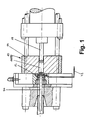
- An extruder 10 shown in Fig. 1 has a in Figs. 2 and 3 in Press tool 12 shown in detail.
- the press tool 12 is a recipient 14 with a recipient chamber designed to receive a metal bolt 17 16 on.
- a press stamp 18 is used to press one into the Recipient chamber 16 introduced and already warmed to the pressing temperature Metal bolt 17 through the pressing tool 12 to form a profile or profile strand 20 emerging from the pressing tool 12.
- the pressing tool 12 comprises a die 22 which is used to produce a hollow profile is equipped with a mandrel 23. During the extrusion process the metal (17) emerges from the recipient chamber under the influence of the press ram 18 16 into the die 22 and leaves it at a shaping Opening 24 as a section 20.
- the die 22 is formed in two parts in the present case, because of the formation an insert 26 is provided on the outer circumference of the profile strand 20.
- the Die 22 with the insert 26 is inserted into a holder 28 which overlaps a sealing ring 30 is supported on a pressure ring 32, which in turn in a pressure ring holder 34 is received.
- the ring 32 is annular a channel-like recess 36, of which channels 38 are close to the shaping one Opening 24 of the die 22 open.
- the recess 38 is with two leads 40 for introducing the to react with the profile surface in Contacting substances or reagents equipped.
- the supply of the reactive Substances in the gaseous state or in the form of aerosols are made using a supply line 42 shown in Fig. 1 via the supply lines 40 in the channel-like recess 36 and further via the channels 38 to the shaping Opening 24 of the die 22.
- the substances or reagents are directly at the matrix exit passed to the surface of the profile strand 20.
- Embodiments can also supply the reactive substances via the Matrix independent pipe systems and possibly further from the matrix done away.
Landscapes
- Chemical & Material Sciences (AREA)
- Engineering & Computer Science (AREA)
- Mechanical Engineering (AREA)
- Chemical Kinetics & Catalysis (AREA)
- Materials Engineering (AREA)
- Metallurgy (AREA)
- Organic Chemistry (AREA)
- Inorganic Chemistry (AREA)
- General Chemical & Material Sciences (AREA)
- Physical Or Chemical Processes And Apparatus (AREA)
Abstract
Description
- Prozessgase werden über die heisse Profiloberfläche im Bereich der Matrizenöffnung geleitet
- Die Prozessgase reagieren auf und/oder mit der heissen Aluminiumoberfläche
- Auf der Profiloberfläche wird durch die chemische Reaktion eine Schicht erzeugt.
- Fig. 1 eine Strangpresse mit einer Zufuhrleitung für Reagenzien;
- Fig. 2 ein Detail der Strangpresse von Fig. 1;
- Fig. 3 einen Schnitt durch Fig. 2 entlang deren Linie I-I.
Claims (11)
- Verfahren zur kontinuierlichen Behandlung der Oberfläche eines durch Verpressen eines vorgewärmten Bolzens (17) aus Aluminium oder aus einer Aluminiumlegierung durch die Matrizenöffnung (24) einer Strangpresse (10) hergestellten Profils(20),
dadurch gekennzeichnet, dass
zur Erzeugung einer als temporärer Korrosionsschutz und/oder als Haftgrund für weitere Beschichtungen dienenden Schicht nach dem Austritt des Profils (20) aus der Matrizenöffnung (24) wenigstens ein Stoff in gasförmigem Zustand oder in der Form eines Aerosols zur Reaktion auf und/oder mit der Profiloberfläche unter Bildung der Schicht auf die heisse, reaktive Profiloberfläche geleitet wird. - Verfahren nach Anspruch 1, dadurch gekennzeichnet, dass die Stoffe bei einer Profiltemperatur zwischen der Austrittstemperatur an der Matrizenöffnung (24) und 350°C, vorzugsweise zwischen der Austrittstemperatur an der Matrizenöffnung (24) und 450°C, auf die Profiloberfläche geleitet werden.
- Verfahren nach Anspruch 2, dadurch gekennzeichnet, dass die Stoffe unmittelbar nach dem Austritt des Profils (20) aus der Matrizenöffnung (24) auf die Profiloberfläche geleitet werden.
- Verfahren nach einem der Ansprüche 1 bis 3, dadurch gekennzeichnet, dass die Stoffe in gasförmigem Zustand Wasserdampf als Basis mit einem Anteil wenigstens eines Stoffes ausgewählt aus der Gruppe der Amine, Ethanolamine, Ammonium-, Molybdän-, Cer-, Zirkonium-, Titan-, Bariumund Silizium-Salze umfassen.
- Verfahren nach Anspruch 4, dadurch gekennzeichnet, dass Wasserdampf getrennt von weiteren Stoffen auf die Profiloberfläche geleitet wird.
- Verfahren nach einem der Ansprüche 1 bis 3, dadurch gekennzeichnet, dass die Stoffe in gasförmigem Zustand metallorganische Verbindungen umfassen.
- Verfahren nach Anspruch 6, dadurch gekennzeichnet, dass die metallorganischen Verbindungen wenigstens eines der Metalle Silizium, Titan oder Zirkonium enthalten.
- Verfahren nach Anspruch 6, dadurch gekennzeichnet, dass die metallorganischen Verbindungen wenigstens einen Stoff ausgewählt aus der Gruppe der Metall-Alkoxyde, Metall-Diketonate, Metall-Carboxylate, Silane, Siloxane und Titanate umfassen.
- Verfahren nach einem der Ansprüche 1 bis 3, dadurch gekennzeichnet, dass die Stoffe in der Form eines Aerosols wenigstens einen Stoff ausgewählt aus der Gruppe der Amine, Ethanolamine, Ammonium-, Molybdän-, Cer-, Zirkonium-, Titan-, Barium- und Silizium-Salze umfassen.
- Verfahren nach einem der Ansprüche 1 bis 9, dadurch gekennzeichnet, dass die Stoffe mittels eines Trägergases, vorzugsweise mittels Stickstoff, auf die Profiloberfläche geleitet werden.
- Verfahren nach einem der Ansprüche 1 bis 3, dadurch gekennzeichnet, dass reaktive Gase, insbesondere Sauerstoff oder Ozon, getrennt von weiteren Stoffen auf die Profiloberfläche geleitet werden.
Priority Applications (1)
| Application Number | Priority Date | Filing Date | Title |
|---|---|---|---|
| EP01811036A EP1306144A1 (de) | 2001-10-23 | 2001-10-23 | Verfahren zur kontinuierlichen Oberflächenbehandlung eines Aluminiumprofils |
Applications Claiming Priority (1)
| Application Number | Priority Date | Filing Date | Title |
|---|---|---|---|
| EP01811036A EP1306144A1 (de) | 2001-10-23 | 2001-10-23 | Verfahren zur kontinuierlichen Oberflächenbehandlung eines Aluminiumprofils |
Publications (1)
| Publication Number | Publication Date |
|---|---|
| EP1306144A1 true EP1306144A1 (de) | 2003-05-02 |
Family
ID=8184208
Family Applications (1)
| Application Number | Title | Priority Date | Filing Date |
|---|---|---|---|
| EP01811036A Withdrawn EP1306144A1 (de) | 2001-10-23 | 2001-10-23 | Verfahren zur kontinuierlichen Oberflächenbehandlung eines Aluminiumprofils |
Country Status (1)
| Country | Link |
|---|---|
| EP (1) | EP1306144A1 (de) |
Cited By (2)
| Publication number | Priority date | Publication date | Assignee | Title |
|---|---|---|---|---|
| EP2165778A1 (de) * | 2008-09-23 | 2010-03-24 | Behr GmbH & Co. KG | Herstellungsverfahren, Strangpresse und Matrize für ein Strangpress-Hohlprofil sowie Strangpress-Hohlprofil und Wärmetauscher mit einem Strangpress-Hohlprofil |
| EP2489448A1 (de) * | 2011-02-16 | 2012-08-22 | Alcan Centre De Recherches De Voreppe | Inline-Oberflächenbehandlung zur Herstellung von Aluminiumstrangpressprofilen mit korrosionsbeständiger Beschichtung und daraus hergestellte Strangpressprofile |
Citations (4)
| Publication number | Priority date | Publication date | Assignee | Title |
|---|---|---|---|---|
| US2762115A (en) * | 1952-01-29 | 1956-09-11 | American Brass Co | Protecting hot extruded metal |
| JPS5499088A (en) * | 1978-01-23 | 1979-08-04 | Satsuki Kitani | Metal aluminum surface coating method |
| JPS58316A (ja) * | 1981-06-25 | 1983-01-05 | Mitsubishi Alum Co Ltd | 耐孔食性を有するアルミニウム管の製造方法 |
| JPH0195812A (ja) * | 1987-10-06 | 1989-04-13 | Kobe Steel Ltd | 間接押出しプレス |
-
2001
- 2001-10-23 EP EP01811036A patent/EP1306144A1/de not_active Withdrawn
Patent Citations (4)
| Publication number | Priority date | Publication date | Assignee | Title |
|---|---|---|---|---|
| US2762115A (en) * | 1952-01-29 | 1956-09-11 | American Brass Co | Protecting hot extruded metal |
| JPS5499088A (en) * | 1978-01-23 | 1979-08-04 | Satsuki Kitani | Metal aluminum surface coating method |
| JPS58316A (ja) * | 1981-06-25 | 1983-01-05 | Mitsubishi Alum Co Ltd | 耐孔食性を有するアルミニウム管の製造方法 |
| JPH0195812A (ja) * | 1987-10-06 | 1989-04-13 | Kobe Steel Ltd | 間接押出しプレス |
Non-Patent Citations (3)
| Title |
|---|
| DATABASE WPI Section Ch Week 197937, Derwent World Patents Index; Class M14, AN 1979-67081B, XP002199427 * |
| PATENT ABSTRACTS OF JAPAN vol. 007, no. 071 (M - 202) 24 March 1983 (1983-03-24) * |
| PATENT ABSTRACTS OF JAPAN vol. 013, no. 305 (M - 849) 13 July 1989 (1989-07-13) * |
Cited By (2)
| Publication number | Priority date | Publication date | Assignee | Title |
|---|---|---|---|---|
| EP2165778A1 (de) * | 2008-09-23 | 2010-03-24 | Behr GmbH & Co. KG | Herstellungsverfahren, Strangpresse und Matrize für ein Strangpress-Hohlprofil sowie Strangpress-Hohlprofil und Wärmetauscher mit einem Strangpress-Hohlprofil |
| EP2489448A1 (de) * | 2011-02-16 | 2012-08-22 | Alcan Centre De Recherches De Voreppe | Inline-Oberflächenbehandlung zur Herstellung von Aluminiumstrangpressprofilen mit korrosionsbeständiger Beschichtung und daraus hergestellte Strangpressprofile |
Similar Documents
| Publication | Publication Date | Title |
|---|---|---|
| DE2739258C2 (de) | Verfahren zur Aufbringung einer Siliciumcarbid und Siliciumnitrid enthaltenden Schutzschicht auf Kohlenstofformkörper | |
| DE69117385T2 (de) | Verfahren zur Herstellung eines Überzugs aus Nitrid oder Karbonitrid | |
| EP0668938B1 (de) | Werkzeug und verfahren zur beschichtung eines werkzeuggrundkörpers | |
| EP2086879B2 (de) | Verfahren zur herstellung von trichlorsilan | |
| DE1951359B2 (de) | Verfahren zum Überziehen eines Trägermaterials mit einem Metall-Karbonitrid | |
| EP1011884A1 (de) | Strangpresswerkzeug, verfahren zu dessen herstellung sowie seine verwendung | |
| DE2233699A1 (de) | Verfahren zur erhoehung der abreibfestigkeit der oberflaeche von hartmetallteilen | |
| DE2718518B2 (de) | Verfahren zum Abscheiden einer Schicht auf der Innenseite von Hohlräumen eines Werkstückes | |
| DE102010062357A1 (de) | Vorrichtung und Verfahren zur Herstellung eines mit zumindest einer Korrosionsschutzschicht beschichteten magnesiumhaltigen Substrats | |
| EP2944706A1 (de) | Verfahren zur Herstellung eines durch Warmumformen geformten Stahlbauteils aus einem eine metallische Beschichtung aufweisendem Stahlblech, ein solches Stahlblech sowie ein daraus durch Warmumformen hergestelltes Stahlbauteil | |
| DE69304819T2 (de) | Verfahren zur Herstellung einer Silizium-enthaltenden Schicht auf ein metallisches Substrat sowie Anti-Korrosionsbehandlung | |
| WO1997007260A1 (de) | Verbundkörper und verfahren zu dessen herstellung | |
| EP2988858B1 (de) | Verfahren und vorrichtung zur herstellung von silanen | |
| WO2024041751A1 (de) | Vermeidung von nitrierungen beim betrieb eines ammoniakspaltofens | |
| EP0544987A1 (de) | Verfahren zur Behandlung von legierten Stählen und Refraktärmetallen | |
| EP1339638B1 (de) | Verfahren zur herstellung von hochreinem, granularem silizium | |
| DE3544975C1 (de) | Verfahren zur Herstellung eines beschichteten Formkoerpers | |
| EP2473649B1 (de) | Verfahren zum aufbringen von schichten | |
| DE69405002T2 (de) | Verfahren zur herstellung von diamant- und diamantartigen beschichtungen | |
| EP0219764A2 (de) | Verbessertes Siliciumnitrid und Verfahren zu dessen Herstellung | |
| EP0326661B1 (de) | Verfahren zur Erzeugung von Synthesegasen aus kohlenwasserstoffhaltigen Einsatzstoffen | |
| EP3310712B1 (de) | Effizientes verfahren zum entgiften von cyanidhaltigen abgasen und abwässern in einem verfahren zur herstellung von alkalimetallcyaniden | |
| DE19526558C2 (de) | Verfahren zur Herstellung eines Aluminium-Sinters | |
| DE102016206376B4 (de) | Kreisprozess zur energieeffizienten Herstellung von Ammoniak | |
| DE2723501C2 (de) | Verfahren und Vorrichtung zum Abscheiden von Siliziumnitridschichten auf Halbleiteranordnungen |
Legal Events
| Date | Code | Title | Description |
|---|---|---|---|
| PUAI | Public reference made under article 153(3) epc to a published international application that has entered the european phase |
Free format text: ORIGINAL CODE: 0009012 |
|
| AK | Designated contracting states |
Designated state(s): AT BE CH CY DE DK ES FI FR GB GR IE IT LI LU MC NL PT SE TR |
|
| AX | Request for extension of the european patent |
Extension state: AL LT LV MK RO SI |
|
| 17P | Request for examination filed |
Effective date: 20031017 |
|
| AKX | Designation fees paid |
Designated state(s): AT BE CH CY DE DK ES FI FR GB GR IE IT LI LU MC NL PT SE TR |
|
| AXX | Extension fees paid |
Extension state: SI Payment date: 20031017 |
|
| 17Q | First examination report despatched |
Effective date: 20041011 |
|
| GRAP | Despatch of communication of intention to grant a patent |
Free format text: ORIGINAL CODE: EPIDOSNIGR1 |
|
| STAA | Information on the status of an ep patent application or granted ep patent |
Free format text: STATUS: THE APPLICATION IS DEEMED TO BE WITHDRAWN |
|
| 18D | Application deemed to be withdrawn |
Effective date: 20051026 |