EP1303092A2 - Selektive Tapfwertinitialisierung in einem Mehrträgerentzerrer - Google Patents
Selektive Tapfwertinitialisierung in einem Mehrträgerentzerrer Download PDFInfo
- Publication number
- EP1303092A2 EP1303092A2 EP02019906A EP02019906A EP1303092A2 EP 1303092 A2 EP1303092 A2 EP 1303092A2 EP 02019906 A EP02019906 A EP 02019906A EP 02019906 A EP02019906 A EP 02019906A EP 1303092 A2 EP1303092 A2 EP 1303092A2
- Authority
- EP
- European Patent Office
- Prior art keywords
- tap
- equalizer
- initializing
- initialization
- ofdm signal
- Prior art date
- Legal status (The legal status is an assumption and is not a legal conclusion. Google has not performed a legal analysis and makes no representation as to the accuracy of the status listed.)
- Withdrawn
Links
Images



Classifications
-
- H—ELECTRICITY
- H04—ELECTRIC COMMUNICATION TECHNIQUE
- H04J—MULTIPLEX COMMUNICATION
- H04J11/00—Orthogonal multiplex systems, e.g. using WALSH codes
-
- H—ELECTRICITY
- H04—ELECTRIC COMMUNICATION TECHNIQUE
- H04L—TRANSMISSION OF DIGITAL INFORMATION, e.g. TELEGRAPHIC COMMUNICATION
- H04L25/00—Baseband systems
- H04L25/02—Details ; arrangements for supplying electrical power along data transmission lines
- H04L25/03—Shaping networks in transmitter or receiver, e.g. adaptive shaping networks
- H04L25/03006—Arrangements for removing intersymbol interference
- H04L25/03012—Arrangements for removing intersymbol interference operating in the time domain
- H04L25/03019—Arrangements for removing intersymbol interference operating in the time domain adaptive, i.e. capable of adjustment during data reception
- H04L25/03038—Arrangements for removing intersymbol interference operating in the time domain adaptive, i.e. capable of adjustment during data reception with a non-recursive structure
-
- H—ELECTRICITY
- H04—ELECTRIC COMMUNICATION TECHNIQUE
- H04L—TRANSMISSION OF DIGITAL INFORMATION, e.g. TELEGRAPHIC COMMUNICATION
- H04L25/00—Baseband systems
- H04L25/02—Details ; arrangements for supplying electrical power along data transmission lines
- H04L25/03—Shaping networks in transmitter or receiver, e.g. adaptive shaping networks
- H04L25/03006—Arrangements for removing intersymbol interference
- H04L2025/0335—Arrangements for removing intersymbol interference characterised by the type of transmission
- H04L2025/03375—Passband transmission
- H04L2025/03414—Multicarrier
-
- H—ELECTRICITY
- H04—ELECTRIC COMMUNICATION TECHNIQUE
- H04L—TRANSMISSION OF DIGITAL INFORMATION, e.g. TELEGRAPHIC COMMUNICATION
- H04L25/00—Baseband systems
- H04L25/02—Details ; arrangements for supplying electrical power along data transmission lines
- H04L25/03—Shaping networks in transmitter or receiver, e.g. adaptive shaping networks
- H04L25/03006—Arrangements for removing intersymbol interference
- H04L2025/03433—Arrangements for removing intersymbol interference characterised by equaliser structure
- H04L2025/03439—Fixed structures
- H04L2025/03445—Time domain
- H04L2025/03471—Tapped delay lines
- H04L2025/03477—Tapped delay lines not time-recursive
-
- H—ELECTRICITY
- H04—ELECTRIC COMMUNICATION TECHNIQUE
- H04L—TRANSMISSION OF DIGITAL INFORMATION, e.g. TELEGRAPHIC COMMUNICATION
- H04L25/00—Baseband systems
- H04L25/02—Details ; arrangements for supplying electrical power along data transmission lines
- H04L25/03—Shaping networks in transmitter or receiver, e.g. adaptive shaping networks
- H04L25/03006—Arrangements for removing intersymbol interference
- H04L2025/03592—Adaptation methods
- H04L2025/03598—Algorithms
- H04L2025/03611—Iterative algorithms
-
- H—ELECTRICITY
- H04—ELECTRIC COMMUNICATION TECHNIQUE
- H04L—TRANSMISSION OF DIGITAL INFORMATION, e.g. TELEGRAPHIC COMMUNICATION
- H04L25/00—Baseband systems
- H04L25/02—Details ; arrangements for supplying electrical power along data transmission lines
- H04L25/03—Shaping networks in transmitter or receiver, e.g. adaptive shaping networks
- H04L25/03006—Arrangements for removing intersymbol interference
- H04L2025/03592—Adaptation methods
- H04L2025/03598—Algorithms
- H04L2025/03611—Iterative algorithms
- H04L2025/03656—Initialisation
-
- H—ELECTRICITY
- H04—ELECTRIC COMMUNICATION TECHNIQUE
- H04L—TRANSMISSION OF DIGITAL INFORMATION, e.g. TELEGRAPHIC COMMUNICATION
- H04L25/00—Baseband systems
- H04L25/02—Details ; arrangements for supplying electrical power along data transmission lines
- H04L25/03—Shaping networks in transmitter or receiver, e.g. adaptive shaping networks
- H04L25/03006—Arrangements for removing intersymbol interference
- H04L2025/03592—Adaptation methods
- H04L2025/03598—Algorithms
- H04L2025/03681—Control of adaptation
-
- H—ELECTRICITY
- H04—ELECTRIC COMMUNICATION TECHNIQUE
- H04L—TRANSMISSION OF DIGITAL INFORMATION, e.g. TELEGRAPHIC COMMUNICATION
- H04L25/00—Baseband systems
- H04L25/02—Details ; arrangements for supplying electrical power along data transmission lines
- H04L25/03—Shaping networks in transmitter or receiver, e.g. adaptive shaping networks
- H04L25/03006—Arrangements for removing intersymbol interference
- H04L2025/03592—Adaptation methods
- H04L2025/03598—Algorithms
- H04L2025/03681—Control of adaptation
- H04L2025/037—Detection of convergence state
-
- H—ELECTRICITY
- H04—ELECTRIC COMMUNICATION TECHNIQUE
- H04L—TRANSMISSION OF DIGITAL INFORMATION, e.g. TELEGRAPHIC COMMUNICATION
- H04L25/00—Baseband systems
- H04L25/02—Details ; arrangements for supplying electrical power along data transmission lines
- H04L25/03—Shaping networks in transmitter or receiver, e.g. adaptive shaping networks
- H04L25/03006—Arrangements for removing intersymbol interference
- H04L2025/03592—Adaptation methods
- H04L2025/03726—Switching between algorithms
-
- H—ELECTRICITY
- H04—ELECTRIC COMMUNICATION TECHNIQUE
- H04L—TRANSMISSION OF DIGITAL INFORMATION, e.g. TELEGRAPHIC COMMUNICATION
- H04L25/00—Baseband systems
- H04L25/02—Details ; arrangements for supplying electrical power along data transmission lines
- H04L25/03—Shaping networks in transmitter or receiver, e.g. adaptive shaping networks
- H04L25/03006—Arrangements for removing intersymbol interference
- H04L2025/03592—Adaptation methods
- H04L2025/03745—Timing of adaptation
- H04L2025/03764—Timing of adaptation only during predefined intervals
- H04L2025/0377—Timing of adaptation only during predefined intervals during the reception of training signals
Definitions
- the present invention relates to processing orthogonal frequency division multiplexed ("OFDM”) signals.
- OFDM orthogonal frequency division multiplexed
- a local area network may be wired or wireless.
- a wireless local area network (“wireless LAN” or “WLAN”) is a flexible data communications system implemented as an extension to, or as an alternative for, a wired local area network (“wired LAN”) within a building or campus.
- WLANs Using electromagnetic waves, WLANs transmit and receive data over the air, minimizing the need for wired connections.
- WLANs combine data connectivity with user mobility, and, through simplified configuration, enable movable LANs.
- WLANs have a range of transmission technologies to choose from when designing a WLAN.
- Some exemplary technologies are multicarrier systems, spread spectrum systems, narrowband systems, and infrared systems. Although each system has its own benefits and detriments, one particular type of multicarrier transmission system, orthogonal frequency division multiplexing ("OFDM”), has proven to be exceptionally useful for WLAN communications.
- OFDM orthogonal frequency division multiplexing
- OFDM is a robust technique for efficiently transmitting data over a channel.
- the technique uses a plurality of subcarrier frequencies (“subcarriers”) within a channel bandwidth to transmit data. These subcarriers are arranged for optimal bandwidth efficiency as compared to conventional frequency division multiplexing ("FDM"), which can waste portions of the channel bandwidth in order to separate and isolate the subcarrier frequency spectra and thereby avoid inter-carrier interference ("ICI").
- FDM frequency division multiplexing
- ICI inter-carrier interference
- an OFDM receiver typically converts a received signal from the time-domain into frequency-domain representations of the signal.
- conventional OFDM receivers accomplish this by sampling the time-domain signal and then applying Fast Fourier Transforms ("FFTs") to blocks of the samples.
- FFTs Fast Fourier Transforms
- the resulting frequency-domain data generally includes a complex value (e.g., magnitude component and phase component, or real component and imaginary component) for each respective subcarrier.
- the receiver typically applies an equalizer to the frequency-domain data before recovering the baseband data that was modulated onto each subcarrier.
- the equalizer corrects for multi-path distortion effects of the channel through which the OFDM signal was transmitted.
- Some receivers may also use the equalizer to correct for other problems encountered with OFDM communications, such as, for example, carrier frequency offset (i.e., a difference between the transmitter and receiver frequencies), and/or sampling frequency offset (i.e., a difference between the transmitter and receiver sampling clock frequencies).
- Carrier frequency offset and sampling frequency offset can result in a loss of orthogonality between the subcarriers, which results in inter-carrier interference ("ICI") and a severe increase in the bit error rate (“BER”) of the data recovered by the receiver.
- the equalizer of the OFDM receiver typically has one or more taps which receive a tap setting corresponding to the complex correction (e.g., real correction and imaginary correction, or magnitude correction and phase correction) for each subcarrier.
- equalizer taps Historically, initialization of the equalizer taps has been a noisy process.
- Conventional OFDM receivers typically initialize the equalizer taps with (X/Y), which represents a division of a predetermined, stored frequency-domain representation of an expected OFDM signal (i.e., a "training symbol” or "X") by the frequency-domain representation of the corresponding actual received signal ("Y").
- the taps are typically initialized based on just one or maybe an average of two training symbols, and they are re-initialized upon receipt of each new packet of data.
- a method for initializing an equalizer in an Orthogonal Frequency Division Multiplexing (“OFDM”) receiver includes inhibiting, based at least in part on (a) an equalizer tap being less than a first limit and (b) a time between OFDM signals being less than a second limit, an initialization of the tap.
- a method includes initializing equalizer taps upon startup, re-initializing the taps upon a passage of a predetermined time between OFDM signals, and selectively re-initializing at least one tap upon divergence of the tap.
- an apparatus includes an equalizer and a tap initialization controller coupled thereto. The tap initialization controller is configured to inhibit, based at least in part on (a) a tap being less than a first limit and (b) a time between OFDM signals being less than a second limit, an initialization of the tap.
- OFDM receiver 20 includes a sampler 24, an FFT processor 28, a training symbol extractor 32, an adaptive equalizer 36, and downstream processors 40.
- OFDM receiver 20 is configured to receive OFDM transmissions and recover baseband data therefrom.
- the received transmissions may conform to the proposed ETSI-BRAN HIPERLAN/2 (Europe) and/or the IEEE 802.11a (USA) wireless LAN standards, which are herein incorporated by reference, or they may conform to any other suitable protocols or standard formats for burst communications systems (where each new data packet starts with a preamble that includes a training symbol).
- OFDM receiver 20 may be embodied in hardware, software, or any suitable combination thereof. Additionally, OFDM receiver 20 may be integrated into other hardware and/or software. For example, OFDM receiver 20 may be part of a WLAN adapter that is implemented as a PC card for a notebook or palmtop computer, as a card in a desktop computer, or integrated within a hand-held computer. Further, it should be readily appreciated that various components of OFDM receiver 20 may suitably be interconnected by various control inputs and outputs (not shown) for the communication of various control settings. For example, FFT processor 28 may include a suitable input for receiving window synchronization settings.
- Sampler 24 is configured to receive transmitted OFDM signals and generate time-domain samples or data therefrom. To this end, sampler 24 includes suitable input signal conditioning and an analog-to-digital converter ("ADC").
- ADC analog-to-digital converter
- FFT processor 28 is coupled to sampler 24 to receive time-domain data therefrom.
- FFT processor 28 is configured generate frequency-domain representations or data from the time-domain data by performing FFT operations on blocks of the time-domain data.
- Training symbol extractor 32 is coupled to FFT processor 28 to receive frequency-domain data therefrom.
- Training symbol extractor 32 is configured to extract training symbols from training sequences that have been included in the transmitted OFDM signals.
- a training sequence contains predetermined transmission values for all of the subcarriers of the OFDM carrier.
- a "training symbol” may be viewed as the predetermined frequency-domain value for a particular subcarrier.
- the present invention may be used to sequentially process data for a plurality of subcarriers, and/or various components of the present invention may be suitably replicated and coupled to parallel process data for a plurality of subcarriers.
- Adaptive equalizer 36 is coupled to training symbol extractor 32 to receive training symbols therefrom and is coupled to FFT processor 28 to receive frequency-domain data therefrom.
- adaptive equalizer 36 is configured to reduce the multi-path distortion effects of the channel through which the OFDM signals have been transmitted. The configuration and operation of adaptive equalizer 36 is discussed in further detail below.
- Downstream processors 40 are coupled to adaptive equalizer 36 to receive equalized frequency-domain data therefrom. Downstream processors 40 are configured to recover baseband data that was included in the transmitted OFDM signals.
- sampler 24 receives OFDM signals and generates time-domain data therefrom.
- FFT processor 28 generates frequency-domain data from the time-domain data by performing FFT operations on blocks of the time-domain data, and training symbol extractor 32 extracts training symbols from training sequences that have been included in the OFDM signals.
- adaptive equalizer 36 reduces multi-path distortion effects of the OFDM transmission channel. The operation of adaptive equalizer 36 is discussed in further detail below.
- Downstream processors 40 recover baseband data that was included in the transmitted OFDM signals.
- Adaptive equalizer 36 includes initialization generator 54, reference training symbol storage 58, equalizer tap storage 64, switch 68, equalizer filter 72, tap adapter 96, slicer 104, and tap initialization controller 108.
- OFDM receiver 20 FIG. 1
- adaptive equalizer 36 may be embodied in hardware, software, or any suitable combination thereof.
- adaptive equalizer 36 is configured to generate an initial equalizer tap setting based on a training symbol and an adaptive algorithm, and to generate subsequent tap settings based on data symbols and an adaptive algorithm.
- Initialization generator 54 is coupled to training symbol extractor 32 (FIG. 1) to receive training symbols therefrom and is coupled to reference training symbol storage 58 to receive a predetermined reference training symbol therefrom. Initialization generator 54 is configured to generate an initial tap setting based on a received training symbol and the reference training symbol.
- Reference training symbol storage 58 is coupled to initialization generator 54 to provide the reference training symbol thereto.
- Reference training symbol storage 58 is configured to store the reference training symbol (real part and imaginary part, or magnitude and phase).
- Equalizer tap storage 64 is coupled to switch 68 to selectively receive either the initial tap setting from initialization generator 54 or a updated tap setting from tap adapter 96. Further, equalizer tap storage 64 is coupled to tap adapter 96 to provide an old tap setting thereto. Also, equalizer tap storage 64 is coupled to equalizer filter 72 to provide the latest tap setting thereto. Equalizer tap storage 64 is configured to store a tap setting (real part and imaginary part, or magnitude and phase).
- Equalizer filter 72 includes a first input port 80, a second input port 84, and an output port 88.
- Input port 80 is coupled to equalizer tap storage 64 to receive the latest tap setting therefrom.
- Input port 84 is coupled to FFT processor 28 (FIG. 1) to receive data symbols therefrom.
- Equalizer filter 72 is configured to generate an equalizer output at output port 88 that represents a frequency-domain multiplication of the data received through its two input ports.
- Tap adapter 96 is coupled to output port 88 of equalizer filter 72 to receive the equalizer output therefrom. Further, tap adapter 96 is coupled to input port 84 of equalizer filter 72 and FFT processor 28 (FIG. 1) to receive data symbols therefrom. Tap adapter 96 is also coupled to slicer 104 to receive a slicer output therefrom. Slicer 104 is discussed in further detail below. Also, tap adapter 96 is coupled to switch 68 to selectively provide the latest tap setting to equalizer tap storage 64. Additionally, as noted above, tap adapter 96 is coupled to equalizer tap storage 64 to receive an old tap setting therefrom, and tap adapter 96 is also coupled to slicer 104.
- tap adapter 96 is configured to generate tap settings based on a least-mean-squares ("LMS") on any other suitable adaptive algorithm. Further, tap adapter 96 is coupled to tap initialization controller 108 to provide the error from the adaptive algorithm thereto.
- LMS least-mean-squares
- Slicer 104 is coupled to output port 88 of equalizer filter 72 to receive the equalizer output therefrom. Further, slicer 104 is coupled to tap adapter 96 to provide the slicer output thereto. Slicer 104 is configured to generate the slicer output based on a decision as to which of a plurality of predetermined possible data values is closest to the actual equalizer output.
- Tap initialization controller 108 is coupled to tap adapter 96 to receive the error therefrom. Further, tap initialization controller 108 is coupled to training symbol extractor 32 (FIG. 1) to receive training symbols therefrom. Also, tap initialization controller 108 is coupled to switch 68 (indicated by the dashed lines) to selectively control the operation of switch 68. Tap initialization controller 108 is configured to cause the present invention to switch between various operational modes as is discussed in further detail below (see FIG. 4, FIG. 5, and FIG. 6).
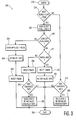
- adaptive equalizer 36 executes the methods and modes discussed below in connection with FIG. 3, FIG. 4, FIG. 5, and FIG. 6.
- method 200 is generally directed to a burst communications system (where each new data packet starts with a preamble that includes a training symbol).
- sampler 24 or some other suitable component of OFDM receiver 20 (FIG. 1) automatically sets (i.e., makes "TRUE” or logical 1) a NEW BURST flag upon receipt of a new transmission or "burst.”
- sampler 24 or some other suitable component of OFDM receiver 20 (FIG. 1) maintains a timer that can be accessed by tap initialization controller 108 (FIG. 2).
- tap initialization controller 108 enters method 200. This entry into method 200 is triggered by a real-time interrupt, a suitably recurring subroutine call, or any suitable arrangement of hardware and/or software that causes tap initialization controller 108 to repeat method 200 at suitable intervals. From step 210, tap initialization controller 108 proceeds to step 220.
- tap initialization controller 108 determines whether NEW BURST flag is TRUE. If so, then OFDM receiver 20 (FIG. 1) has received a new transmission. Accordingly, if NEW BURST flag is TRUE then tap initialization controller 108 proceeds to step 230; else, tap initialization controller 108 proceeds to step 330 (below).
- tap initialization controller 108 clears NEW BURST flag (i.e., makes the new burst flag "FALSE” or logical "0"). It should be readily appreciated that clearing the new burst flag at this point prevents tap initialization controller 108 from repeating this branch of method 200 until after another new transmission has been received. From step 230, tap initialization controller 108 proceeds to step 240.
- tap initialization controller 108 determines whether a STARTUP flag is TRUE. If so, then the latest received transmission is the first transmission received since OFDM receiver 20 has been powered up or otherwise reset (of course, this assumes that STARTUP flag has been made TRUE by power-up and/or reset processes of OFDM receiver 20).
- tap initialization controller 108 proceeds to step 250, step 260, step 264, and step 350 where tap initialization controller 108 clears STARTUP flag, initializes all of the equalizer taps by coupling (via switch 68) initialization generator 54 to equalizer tap storage 64 for each equalizer tap, resets a TIMER that measures a time between reception of the latest two transmissions, and exits method 200, respectively.
- STARTUP flag is FALSE then tap initialization controller 108 proceeds to step 270.
- tap initialization controller 108 determines whether the TIMER that measures the time between reception of the latest two transmissions exceeds a predetermined limit. If so, then it is presumed that the channel has probably changed enough to require re-initialization of all of the equalizer taps. Accordingly, if the TIMER exceeds the limit then initialization controller 108 proceeds to step 310, step 320, and step 350, where tap initialization controller 108 resets or clears the TIMER, re-initializes all of the equalizer taps, and exits method 200, respectively. On the other hand, if the TIMER does not exceed the limit then tap initialization controller 108 proceeds to step 280.
- tap initialization controller 108 resets the TIMER.
- tap initialization controller 108 since the tap initialization controller 108 has determined that a new transmission has been received (see step 220, above) within the predetermined time limit (see step 270, above), tap initialization controller 108 resets the TIMER so that a new time interval can be measured between the present transmission and the next transmission. From step 280, tap initialization controller 108 proceeds to step 290.
- tap initialization controller 108 determines whether any of the equalizer tap settings for the respective subcarriers has diverged by comparing the respective error received from tap adapter 96 to a predetermined limit. It should be noted that in alternative embodiments, tap initialization controller 108 may suitably compare the actual tap setting values to suitable predetermined limits rather than or in addition to determining divergence based on the error from the adaptive algorithm. In any event, if any of the taps has diverged, then tap initialization controller 108 proceeds to step 300; else, tap initialization controller 108 exits method 200 at step 350.
- tap initialization controller 108 selectively re-initializes the equalizer taps (i.e., re-initializes only those equalizer taps that have diverged). It should be appreciated that selectively re-initializing the taps avoids undesirable re-introduction of the channel noise into the taps settings that have not diverged and have been refined from their initial values by adapting based on received data. From step 300, tap initialization controller 108 proceeds to exit method 200 at step 350.
- tap initialization controller 108 determines whether any of the equalizer tap settings for the respective subcarriers has diverged by comparing the respective error received from tap adapter 96 to a predetermined limit. It should be noted that in alternative embodiments, tap initialization controller 108 may suitably compare the actual tap setting values to suitable predetermined limits rather than or in addition to determining divergence based on the error from the adaptive algorithm. In any event, if any of the taps has diverged, then tap initialization controller 108 proceeds to step 340; else, tap initialization controller 108 exits method 200 at step 350.
- tap initialization controller 108 selectively re-initializes the equalizer taps (i.e., re-initializes only those equalizer taps that have diverged). It should be appreciated that selectively re-initializing the taps avoids undesirable reintroduction of the channel noise into the taps settings that have not diverged and have been refined from their initial values by adapting based on received data. From step 340, tap initialization controller 108 proceeds to exit method 200 at step 350.
- tap initialization controller 108 Upon the first transmission received after startup (i.e., power-up, reboot, or the like), tap initialization controller 108 puts switch 68 in the state shown in FIG. 2 and thereby couples initialization generator 54 to equalizer tap storage 64 through switch 68.
- Initialization generator 54 receives training symbols from the first transmission (via training symbol extractor 32) and generates initial equalizer tap settings for all subcarriers based on these training symbols. The initial tap settings are stored in equalizer tap storage 64 and received by equalizer filter 72 via input port 80.
- FIG. 5 an illustration of a wholesale re-initialization mode 500 according to the present invention is shown.
- tap initialization controller 108 holds switch 68 in its alternate state from that shown in FIG. 2, thereby allowing tap adapter 96 to update the equalizer tap settings based on the received data and the adaptive algorithm.
- tap initialization controller 108 puts switch 68 in the state shown in FIG. 2 and thereby couples initialization generator 54 to equalizer tap storage 64 through switch 68.
- initialization generator 54 receives training symbols from the second transmission (via training symbol extractor 32) and generates new initial equalizer tap settings for all subcarriers based on these training symbols.
- the new initial tap settings are stored in equalizer tap storage 64 and received by equalizer filter 72 via input port 80.
- tap initialization controller 108 puts switch 68 back into its alternate state from that shown in FIG. 2, thereby allowing tap adapter 96 to update the equalizer tap settings based on the data from the second transmission and the adaptive algorithm.
- FIG. 6 an illustration of a selective re-initialization mode 600 according to the present invention is shown.
- tap initialization controller 108 holds switch 68 in its alternate state from that shown in FIG. 2, thereby allowing tap adapter 96 to update the equalizer tap settings based on the received data and the adaptive algorithm.
- tap initialization controller 108 leaves switch 68 in its alternate state from that shown in FIG. 2 for all subcarriers except those whose tap settings have diverged. Where one or more tap settings have diverged, tap initialization controller 108 puts switch 68 in the state shown in FIG. 2 for re-initializing the diverged tap settings (and leaves switch 68 in its alternate state for the subcarriers whose tap settings have not diverged).
- initialization generator 54 receives training symbols from the second transmission (via training symbol extractor 32) and generates a new initial equalizer tap setting (based on the respective training symbol) to replace each diverged tap setting.
- the new initial tap settings are stored in equalizer tap storage 64 and received by equalizer filter 72 via input port 80.
- tap initialization controller 108 puts switch 68 back into its alternate state from that shown in FIG. 2 (for all subcarriers), thereby allowing tap adapter 96 to update the equalizer tap settings based on the data from the second transmission and the adaptive algorithm.
- tap adapter 96 continues to adapt the settings of those taps that are not selectively re-initialized (based on the data received on the respective subcarriers).
- tap initialization controller 108 maintains the selective re-initialization mode as long as the time between the end and the beginning of successive transmissions does not exceed the predetermined limit. If the time exceeds the limit, then tap initialization controller 108 initiates wholesale re-initialization mode 500 (FIG. 5).
- FIG. 6 shows back-to-back transmissions (where the time between the transmissions is practically zero) tap initialization controller 108 considers any time between successive transmissions that does not exceed the limit to qualify for selective re-initialization mode 600.
- tap initialization controller 108 responds to a time of 1.9 seconds between the end of one transmission and the beginning of the next in a like manner as its response to a time of 0.1 seconds (in both cases, tap initialization controller 108 causes OFDM receiver 20 to operate according to selective re-initialization mode 600).
- an OFDM receiver inhibits, based at least in part on (a) an equalizer tap being less than a first limit and (b) a time between OFDM signals being less than a second limit, an initialization of the tap.
Landscapes
- Engineering & Computer Science (AREA)
- Computer Networks & Wireless Communication (AREA)
- Signal Processing (AREA)
- Power Engineering (AREA)
- Cable Transmission Systems, Equalization Of Radio And Reduction Of Echo (AREA)
Applications Claiming Priority (2)
| Application Number | Priority Date | Filing Date | Title |
|---|---|---|---|
| US955651 | 2001-09-19 | ||
| US09/955,651 US20020021750A1 (en) | 2000-05-12 | 2001-09-19 | Method and apparatus for selective equalizer tap initialization in an OFDM system |
Publications (2)
| Publication Number | Publication Date |
|---|---|
| EP1303092A2 true EP1303092A2 (de) | 2003-04-16 |
| EP1303092A3 EP1303092A3 (de) | 2006-07-12 |
Family
ID=25497142
Family Applications (1)
| Application Number | Title | Priority Date | Filing Date |
|---|---|---|---|
| EP02019906A Withdrawn EP1303092A3 (de) | 2001-09-19 | 2002-09-04 | Selektive Tapfwertinitialisierung in einem Mehrträgerentzerrer |
Country Status (7)
| Country | Link |
|---|---|
| US (1) | US20020021750A1 (de) |
| EP (1) | EP1303092A3 (de) |
| JP (1) | JP2003124908A (de) |
| KR (1) | KR20030025175A (de) |
| CN (1) | CN1409505A (de) |
| BR (1) | BR0203545A (de) |
| MX (1) | MXPA02009137A (de) |
Cited By (5)
| Publication number | Priority date | Publication date | Assignee | Title |
|---|---|---|---|---|
| GB2406758A (en) * | 2003-09-30 | 2005-04-06 | Ubinetics Ltd | Updating filter coefficients for multi-path equalisation |
| GB2439366A (en) * | 2006-06-20 | 2007-12-27 | Nec Technologies | Resource block scheduling in communication networks |
| US7400692B2 (en) | 2004-01-14 | 2008-07-15 | Interdigital Technology Corporation | Telescoping window based equalization |
| US7437135B2 (en) | 2003-10-30 | 2008-10-14 | Interdigital Technology Corporation | Joint channel equalizer interference canceller advanced receiver |
| EP2100371A4 (de) * | 2006-12-20 | 2012-01-04 | Broadcom Corp | Schwundausgleich |
Families Citing this family (12)
| Publication number | Priority date | Publication date | Assignee | Title |
|---|---|---|---|---|
| US20020021750A1 (en) * | 2000-05-12 | 2002-02-21 | Belotserkovsky Maxim B. | Method and apparatus for selective equalizer tap initialization in an OFDM system |
| US6753791B2 (en) * | 2000-06-22 | 2004-06-22 | Halliburton Energy Services, Inc. | Burst QAM downhole telemetry system |
| US20030161415A1 (en) * | 2002-02-26 | 2003-08-28 | Eyal Krupka | Iterative channel tracking |
| US7103098B2 (en) * | 2002-03-15 | 2006-09-05 | Intel Corporation | Adaptive receiver for multiplex/multi-access communications |
| US7177354B2 (en) * | 2003-04-22 | 2007-02-13 | Zenith Electronics Corporation | Method and apparatus for the control of a decision feedback equalizer |
| US7321550B2 (en) * | 2004-02-17 | 2008-01-22 | Industrial Technology Research Institute | Method of equalization in an OFDM system |
| US7738548B2 (en) * | 2007-01-08 | 2010-06-15 | Harris Corporation | System and method for communicating at low signal-to-noise ratio using injected training symbols |
| CA2703484A1 (en) * | 2007-10-31 | 2009-05-07 | Thomson Licensing | Synchronizing initialization data to time bursts in a mobile communications system |
| US8934526B2 (en) * | 2010-06-28 | 2015-01-13 | Miguel Marquina | Improvements relating to equalizers |
| US9197455B2 (en) * | 2011-08-12 | 2015-11-24 | Tektronix, Inc. | Two stage adaptive equalizer for a batch receiver |
| US8971463B2 (en) * | 2011-11-18 | 2015-03-03 | Vixs Systems, Inc. | Channel estimation in a communications system |
| WO2014186610A1 (en) * | 2013-05-16 | 2014-11-20 | Zte (Usa) Inc. | Half-cycled orthogonal frequency divisional multiplexing transmission and reception |
Family Cites Families (38)
| Publication number | Priority date | Publication date | Assignee | Title |
|---|---|---|---|---|
| US3914691A (en) * | 1974-08-21 | 1975-10-21 | Bell Telephone Labor Inc | Repositioning of equalizer tap-gain coefficients |
| US3978407A (en) * | 1975-07-23 | 1976-08-31 | Codex Corporation | Fast start-up adaptive equalizer communication system using two data transmission rates |
| JPS6047530A (ja) * | 1983-08-26 | 1985-03-14 | Nec Corp | 選択性フェ−ディング保護方式 |
| US4621366A (en) * | 1984-02-22 | 1986-11-04 | Universal Data Systems, Inc. | Modem equalizer training using previously stored parameters |
| US4709374A (en) * | 1984-07-05 | 1987-11-24 | American Telephone And Telegraph Company | Technique for decision-directed equalizer train/retrain |
| US5297165A (en) * | 1990-07-06 | 1994-03-22 | Nippon Telegraph And Telephone Corporation | Equalizer for radio receive signal |
| JP2797153B2 (ja) * | 1991-05-10 | 1998-09-17 | 松下電器産業株式会社 | データ受信装置 |
| JP2649766B2 (ja) * | 1993-01-20 | 1997-09-03 | 国際電信電話株式会社 | 等化後選択合成ダイバーシチ受信方式 |
| US5841484A (en) * | 1994-02-10 | 1998-11-24 | Philips Electronics North North America Corporation | Blind equalizer method and apparatus for HDTY transmission using an NTSC rejection filter for mitigating co-channel interference |
| US5956624A (en) * | 1994-07-12 | 1999-09-21 | Usa Digital Radio Partners Lp | Method and system for simultaneously broadcasting and receiving digital and analog signals |
| US5550862A (en) * | 1994-08-01 | 1996-08-27 | Rockwell International Corporation | Method and apparatus for centering equalizer taps |
| FI943613A7 (fi) * | 1994-08-03 | 1996-02-04 | Nokia Technology Gmbh | Menetelmä ja kanavakorjain digitaalisen signaalin taajuustasossa suoritettavaa kanavakorjausta varten |
| JPH08167867A (ja) * | 1994-12-15 | 1996-06-25 | Fujitsu Ltd | 無線受信装置及び同無線受信装置における受信系切替制御方法 |
| US5748677A (en) * | 1996-01-16 | 1998-05-05 | Kumar; Derek D. | Reference signal communication method and system |
| TW349296B (en) * | 1996-05-21 | 1999-01-01 | Ibm | Wireless communication apparatus, wireless communication method, and wireless communication system |
| US5949796A (en) * | 1996-06-19 | 1999-09-07 | Kumar; Derek D. | In-band on-channel digital broadcasting method and system |
| US5694423A (en) * | 1996-08-06 | 1997-12-02 | Lucent Technologies Inc. | Method and apparatus for detecting and correcting misconvergence of a blind equalizer |
| CA2302289C (en) * | 1996-08-29 | 2005-11-08 | Gregory G. Raleigh | Spatio-temporal processing for communication |
| WO1998010555A2 (en) * | 1996-09-02 | 1998-03-12 | Telia Ab (Publ) | Improvements in, or relating to, multi-carrier transmission systems |
| JPH10106158A (ja) * | 1996-09-30 | 1998-04-24 | Toshiba Corp | ディスク記憶装置及び同装置に適用する波形等化回路 |
| EP1062444A4 (de) * | 1996-10-22 | 2001-04-11 | Kalsi Eng Inc | Flexibler keilschieber |
| KR100226698B1 (ko) * | 1996-12-28 | 1999-10-15 | 전주범 | 직교 주파수 분할 다중화 수신 시스템의 채널 등화 장치 |
| US5999349A (en) * | 1996-12-30 | 1999-12-07 | Daewoo Electronics Co., Ltd. | Waveform equalization apparatus |
| US6167082A (en) * | 1997-03-06 | 2000-12-26 | Level One Communications, Inc. | Adaptive equalizers and methods for carrying out equalization with a precoded transmitter |
| US5835895A (en) * | 1997-08-13 | 1998-11-10 | Microsoft Corporation | Infinite impulse response filter for 3D sound with tap delay line initialization |
| US6219378B1 (en) * | 1997-09-17 | 2001-04-17 | Texas Instruments Incorporated | Digital subscriber line modem initialization |
| US6188722B1 (en) * | 1998-04-29 | 2001-02-13 | Nortel Networks Limited | Sequential blind convergence process in an adaptive decision feedback equalizer |
| US5990734A (en) * | 1998-06-19 | 1999-11-23 | Datum Telegraphic Inc. | System and methods for stimulating and training a power amplifier during non-transmission events |
| US5990738A (en) * | 1998-06-19 | 1999-11-23 | Datum Telegraphic Inc. | Compensation system and methods for a linear power amplifier |
| EP0981206B1 (de) * | 1998-08-19 | 2005-11-23 | Siemens Aktiengesellschaft | Spreizspektrumempfänger zur Verminderung von Nachbarsymbolstörungen |
| US6141393A (en) * | 1999-03-03 | 2000-10-31 | Motorola, Inc. | Method and device for channel estimation, equalization, and interference suppression |
| US6535552B1 (en) * | 1999-05-19 | 2003-03-18 | Motorola, Inc. | Fast training of equalizers in discrete multi-tone (DMT) systems |
| US6765969B1 (en) * | 1999-09-01 | 2004-07-20 | Motorola, Inc. | Method and device for multi-user channel estimation |
| FR2798542B1 (fr) * | 1999-09-13 | 2002-01-18 | France Telecom | Recepteur a multiplexage par repartition en frequences orthogonales avec estimation iterative de canal et procede correspondant |
| US20020021750A1 (en) * | 2000-05-12 | 2002-02-21 | Belotserkovsky Maxim B. | Method and apparatus for selective equalizer tap initialization in an OFDM system |
| US7023937B2 (en) * | 2001-03-01 | 2006-04-04 | Texas Instruments Incorporated | Receiver window design for multicarrier communication systems |
| US6597733B2 (en) * | 2001-03-05 | 2003-07-22 | Ensemble Communications, Inc. | Equalizer performance enhancements for broadband wireless applications |
| US7042937B2 (en) * | 2001-04-23 | 2006-05-09 | Koninklijke Philips Electronics N.V. | Hybrid frequency-time domain equalizer |
-
2001
- 2001-09-19 US US09/955,651 patent/US20020021750A1/en not_active Abandoned
-
2002
- 2002-09-03 KR KR1020020052698A patent/KR20030025175A/ko not_active Withdrawn
- 2002-09-04 EP EP02019906A patent/EP1303092A3/de not_active Withdrawn
- 2002-09-11 BR BR0203545-6A patent/BR0203545A/pt not_active IP Right Cessation
- 2002-09-18 JP JP2002271203A patent/JP2003124908A/ja not_active Withdrawn
- 2002-09-18 MX MXPA02009137A patent/MXPA02009137A/es unknown
- 2002-09-19 CN CN02142771A patent/CN1409505A/zh active Pending
Cited By (6)
| Publication number | Priority date | Publication date | Assignee | Title |
|---|---|---|---|---|
| GB2406758A (en) * | 2003-09-30 | 2005-04-06 | Ubinetics Ltd | Updating filter coefficients for multi-path equalisation |
| GB2406758B (en) * | 2003-09-30 | 2006-04-19 | Ubinetics Ltd | Equalisation techniques |
| US7437135B2 (en) | 2003-10-30 | 2008-10-14 | Interdigital Technology Corporation | Joint channel equalizer interference canceller advanced receiver |
| US7400692B2 (en) | 2004-01-14 | 2008-07-15 | Interdigital Technology Corporation | Telescoping window based equalization |
| GB2439366A (en) * | 2006-06-20 | 2007-12-27 | Nec Technologies | Resource block scheduling in communication networks |
| EP2100371A4 (de) * | 2006-12-20 | 2012-01-04 | Broadcom Corp | Schwundausgleich |
Also Published As
| Publication number | Publication date |
|---|---|
| EP1303092A3 (de) | 2006-07-12 |
| CN1409505A (zh) | 2003-04-09 |
| BR0203545A (pt) | 2003-06-03 |
| KR20030025175A (ko) | 2003-03-28 |
| JP2003124908A (ja) | 2003-04-25 |
| US20020021750A1 (en) | 2002-02-21 |
| MXPA02009137A (es) | 2005-07-25 |
Similar Documents
| Publication | Publication Date | Title |
|---|---|---|
| US6944244B2 (en) | Mechanism for OFDM equalizer tap initialization using an adaptive algorithm | |
| CN1258892C (zh) | 正交频分复用系统的复杂度降低的快速付里叶变换窗同步 | |
| US6771591B1 (en) | Method and system for processing orthogonal frequency division multiplexed signals | |
| US20020021750A1 (en) | Method and apparatus for selective equalizer tap initialization in an OFDM system | |
| JP4459049B2 (ja) | 直交周波数分割多元通信受信機における隣接チャネル間干渉を低減する方法及び装置 | |
| US20070280394A1 (en) | Method for Determining a Residual Frequency Offset, Communication System, Method for Transmitting a Message, Transmitter, Method for Processing a Message and Receiver | |
| CN100583700C (zh) | 正交频分多路复用接收机的集中式缓冲器结构 | |
| WO2006065016A1 (en) | Method for estimating frequency/time offset and apparatus using the same in ofdm communication system | |
| US20080069250A1 (en) | Multipath processing systems and methods | |
| JP3793463B2 (ja) | Ofdm用サンプリング誤差検出装置、検出方法、および、ofdm用受信装置 | |
| HK1039001B (en) | Reduced complexity fft window synchronization for an orthogonal frequency division multiplexing system | |
| JP2009153220A (ja) | 直交周波数分割多重(ofdm)レシーバのための集中バッファアーキテクチャ |
Legal Events
| Date | Code | Title | Description |
|---|---|---|---|
| PUAI | Public reference made under article 153(3) epc to a published international application that has entered the european phase |
Free format text: ORIGINAL CODE: 0009012 |
|
| AK | Designated contracting states |
Designated state(s): AT BE BG CH CY CZ DE DK EE ES FI FR GB GR IE IT LI LU MC NL PT SE SK TR |
|
| AX | Request for extension of the european patent |
Extension state: AL LT LV MK RO SI |
|
| RAP1 | Party data changed (applicant data changed or rights of an application transferred) |
Owner name: THOMSON LICENSING |
|
| PUAL | Search report despatched |
Free format text: ORIGINAL CODE: 0009013 |
|
| AK | Designated contracting states |
Kind code of ref document: A3 Designated state(s): AT BE BG CH CY CZ DE DK EE ES FI FR GB GR IE IT LI LU MC NL PT SE SK TR |
|
| AX | Request for extension of the european patent |
Extension state: AL LT LV MK RO SI |
|
| AKX | Designation fees paid | ||
| REG | Reference to a national code |
Ref country code: DE Ref legal event code: 8566 |
|
| STAA | Information on the status of an ep patent application or granted ep patent |
Free format text: STATUS: THE APPLICATION IS DEEMED TO BE WITHDRAWN |
|
| 18D | Application deemed to be withdrawn |
Effective date: 20070403 |