EP1302487A1 - Resin containing phosphate group - Google Patents
Resin containing phosphate group Download PDFInfo
- Publication number
- EP1302487A1 EP1302487A1 EP01949911A EP01949911A EP1302487A1 EP 1302487 A1 EP1302487 A1 EP 1302487A1 EP 01949911 A EP01949911 A EP 01949911A EP 01949911 A EP01949911 A EP 01949911A EP 1302487 A1 EP1302487 A1 EP 1302487A1
- Authority
- EP
- European Patent Office
- Prior art keywords
- polymerizable monomer
- group
- phosphate group
- containing resin
- parts
- Prior art date
- Legal status (The legal status is an assumption and is not a legal conclusion. Google has not performed a legal analysis and makes no representation as to the accuracy of the status listed.)
- Granted
Links
Classifications
-
- C—CHEMISTRY; METALLURGY
- C09—DYES; PAINTS; POLISHES; NATURAL RESINS; ADHESIVES; COMPOSITIONS NOT OTHERWISE PROVIDED FOR; APPLICATIONS OF MATERIALS NOT OTHERWISE PROVIDED FOR
- C09D—COATING COMPOSITIONS, e.g. PAINTS, VARNISHES OR LACQUERS; FILLING PASTES; CHEMICAL PAINT OR INK REMOVERS; INKS; CORRECTING FLUIDS; WOODSTAINS; PASTES OR SOLIDS FOR COLOURING OR PRINTING; USE OF MATERIALS THEREFOR
- C09D5/00—Coating compositions, e.g. paints, varnishes or lacquers, characterised by their physical nature or the effects produced; Filling pastes
- C09D5/36—Pearl essence, e.g. coatings containing platelet-like pigments for pearl lustre
-
- C—CHEMISTRY; METALLURGY
- C08—ORGANIC MACROMOLECULAR COMPOUNDS; THEIR PREPARATION OR CHEMICAL WORKING-UP; COMPOSITIONS BASED THEREON
- C08F—MACROMOLECULAR COMPOUNDS OBTAINED BY REACTIONS ONLY INVOLVING CARBON-TO-CARBON UNSATURATED BONDS
- C08F220/00—Copolymers of compounds having one or more unsaturated aliphatic radicals, each having only one carbon-to-carbon double bond, and only one being terminated by only one carboxyl radical or a salt, anhydride ester, amide, imide or nitrile thereof
- C08F220/02—Monocarboxylic acids having less than ten carbon atoms; Derivatives thereof
- C08F220/10—Esters
- C08F220/12—Esters of monohydric alcohols or phenols
- C08F220/16—Esters of monohydric alcohols or phenols of phenols or of alcohols containing two or more carbon atoms
- C08F220/18—Esters of monohydric alcohols or phenols of phenols or of alcohols containing two or more carbon atoms with acrylic or methacrylic acids
- C08F220/1804—C4-(meth)acrylate, e.g. butyl (meth)acrylate, isobutyl (meth)acrylate or tert-butyl (meth)acrylate
-
- C—CHEMISTRY; METALLURGY
- C08—ORGANIC MACROMOLECULAR COMPOUNDS; THEIR PREPARATION OR CHEMICAL WORKING-UP; COMPOSITIONS BASED THEREON
- C08F—MACROMOLECULAR COMPOUNDS OBTAINED BY REACTIONS ONLY INVOLVING CARBON-TO-CARBON UNSATURATED BONDS
- C08F230/00—Copolymers of compounds having one or more unsaturated aliphatic radicals, each having only one carbon-to-carbon double bond, and containing phosphorus, selenium, tellurium or a metal
- C08F230/02—Copolymers of compounds having one or more unsaturated aliphatic radicals, each having only one carbon-to-carbon double bond, and containing phosphorus, selenium, tellurium or a metal containing phosphorus
-
- C—CHEMISTRY; METALLURGY
- C09—DYES; PAINTS; POLISHES; NATURAL RESINS; ADHESIVES; COMPOSITIONS NOT OTHERWISE PROVIDED FOR; APPLICATIONS OF MATERIALS NOT OTHERWISE PROVIDED FOR
- C09D—COATING COMPOSITIONS, e.g. PAINTS, VARNISHES OR LACQUERS; FILLING PASTES; CHEMICAL PAINT OR INK REMOVERS; INKS; CORRECTING FLUIDS; WOODSTAINS; PASTES OR SOLIDS FOR COLOURING OR PRINTING; USE OF MATERIALS THEREFOR
- C09D5/00—Coating compositions, e.g. paints, varnishes or lacquers, characterised by their physical nature or the effects produced; Filling pastes
- C09D5/38—Paints containing free metal not provided for above in groups C09D5/00 - C09D5/36
Definitions
- the present invention relates to a novel phosphate group-containing resin and a water based metallic coating material composition comprising the above phosphate group-containing resin.
- a water based metallic coating material containing a metallic pigment such as aluminum flake has the problem that the metallic pigment is brought into contact with a large amount of water contained in the coating material and corroded to generate hydrogen gas.
- phosphoric acid esters are added to a water based metallic coating material to protect the surface of a metallic pigment with the phosphoric acid esters making use of an adsorptive action exerted by an acidic hydroxyl group bonded to a phosphorus atom of the above esters to inhibit reaction caused by direct contact of water with the metallic pigment.
- a water based metallic coating material comprising an aluminum flake treated with a phosphoric acid ester in Japanese Patent Application Laid-Open No.168670/1983, a water based metallic coating material comprising a phosphoric acid ester of caprolactone in Japanese Patent Application Laid-Open No.29607/1986, a water based metallic coating material comprising a reaction product of orthophosphoric acid and an epoxy compound in Japanese Patent Application Laid-Open No.47771/1986, a water based metallic coating material comprising a phosphate-containing acryl polymer obtained from orthophosphoric acid and a glycidy group-containing acryl polymer in Japanese Patent Application Laid-Open No.190765/1989 and a water based metallic coating material comprising a polymer of styrene and allyl alcohol and a reaction product of p-t-amylphenol and orthophosphoric acid or phosphorus pentaoxide in Japanese Patent Publication No.46624/1990.
- a phosphate group-containing resin which is a copolymer of two kinds of some specific phosphate group-containing polymerizable monomers and a polymerizable monomer having two tertiary alkyl groups in a molecule is excellent in an adsorptive property to the surface of a metallic pigment and effective for inhibiting a reaction of water with a metallic pigment over a long period of time and that a coating film formed from a water based metallic coating material comprising such phosphate group-containing resin is excellent in performances such as an adhesive property, a water resistance, a chipping resistance and a metallic finish feeling.
- a phosphate group-containing resin obtained by copolymerizing:
- a water based metallic coating material composition comprising the phosphate group-containing resin described above and a metallic pigment.
- Polymerizable monomer (a) having a phosphoric acid monoester group (a) having a phosphoric acid monoester group :
- the polymerizable monomer (a) is a phosphoric acid diester compound having each at least one phosphate group represented by a formula [-OPO(OR)(OH)] and polymerizable double bond in a molecule, wherein R represents a hydrocarbon group having 4 to 10 carbon atoms, and to be specific, it includes, for example, linear or branched chain alkyl groups such as butyl, isobutyl, sec-butyl, tert-butyl, pentyl, isopentyl, hexyl, octyl, 2-ethylhexyl, decyl and isodecyl.
- R represents a hydrocarbon group having 4 to 10 carbon atoms, and to be specific, it includes, for example, linear or branched chain alkyl groups such as butyl, isobutyl, sec-butyl, tert-butyl, pentyl, isopentyl, hexyl, oc
- a phosphoric acid monoester represented by (HO) 2 PO(OR)
- R glycidyl group-containing compound having a polymerizable double bond
- Polymerizable monomer (b) having a phosphoric acid group (b) having a phosphoric acid group:
- the polymerizable monomer (b) is a compound having each at least one a phosphoric acid group represented by a formula [-OPO(OH) 2 ] and polymerizable double bond in a molecule, and to be specific, it includes, for example, (2-acryloyloxyethyl) acid phosphate, (2-methacryloyloxyethyl) acid phosphate, (2-acryloyloxypropyl) acid phosphate and (2-methacryloyloxypropyl) acid phosphate.
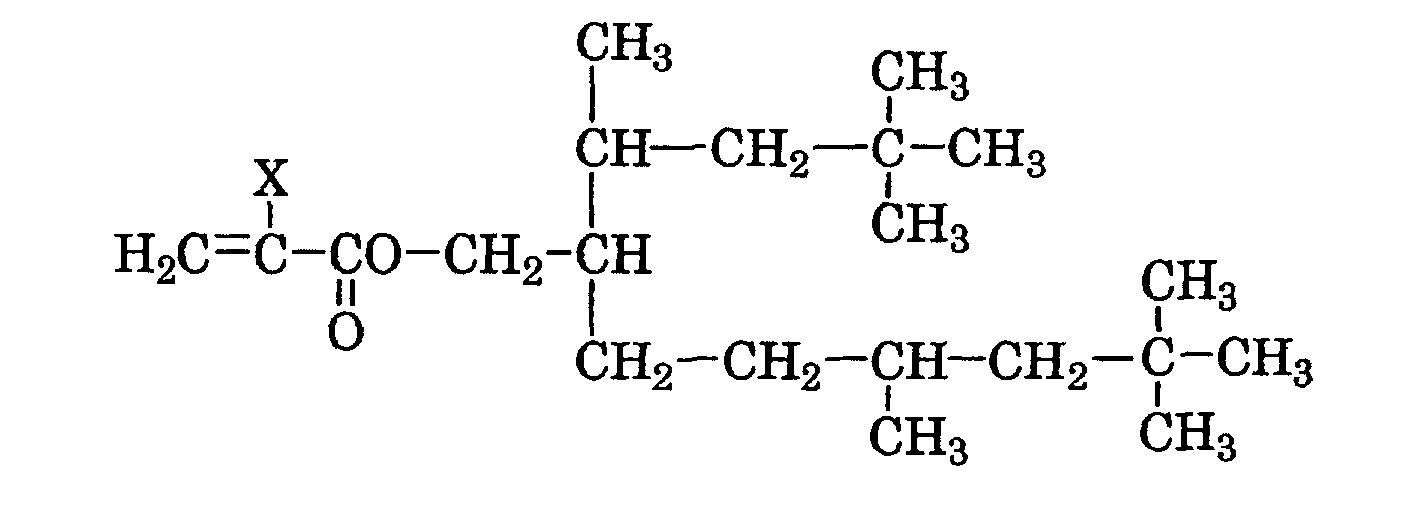
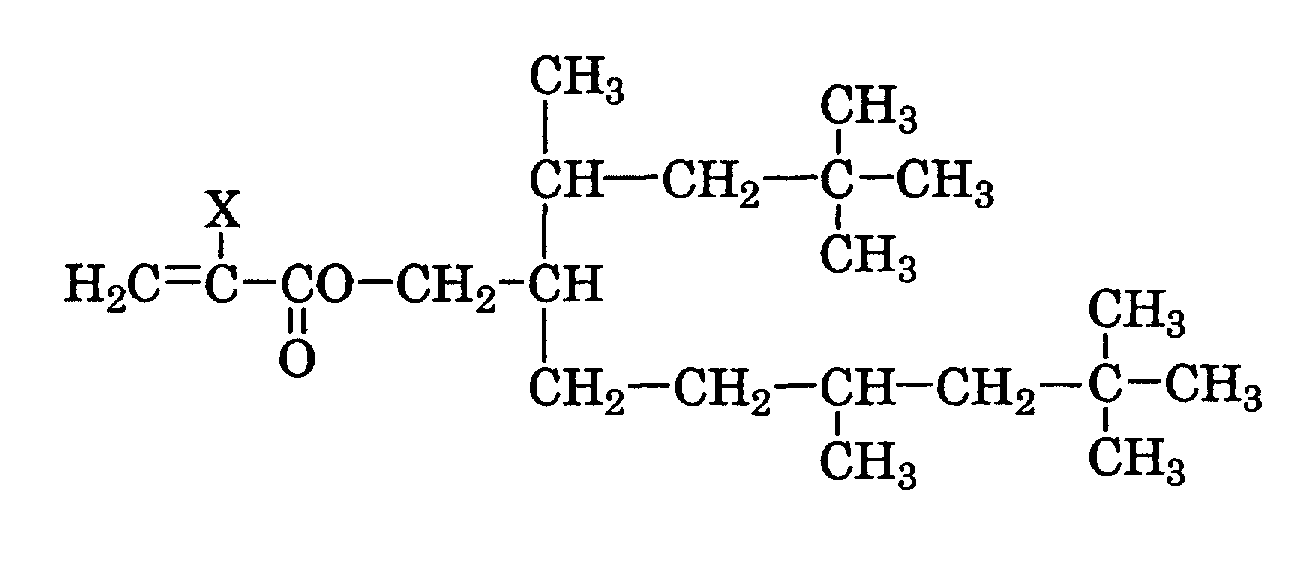
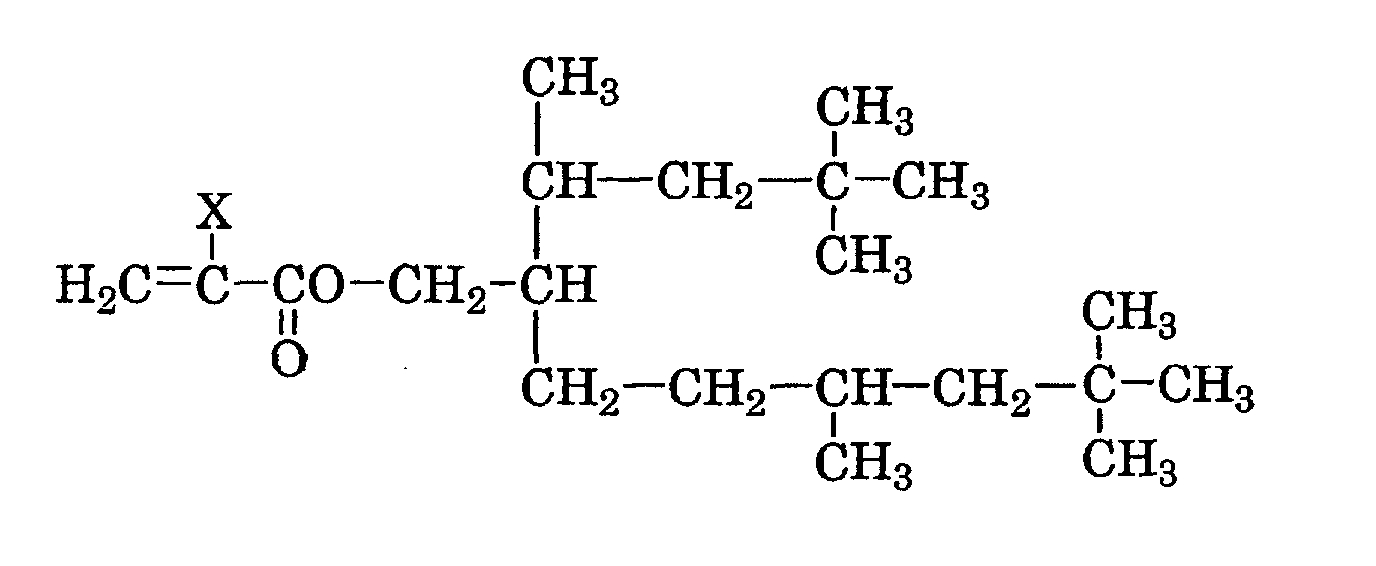
- the polymerizable monomer (c) is a compound represented by: (wherein X represents hydrogen or methyl) in a molecule, and it has two tertiary alkyl groups in a molecule, in which three methyl groups are bonded to one carbon atom.
- X represents hydrogen or methyl
- This monomer (c) makes it easy to allow metallic flakes to be aligned parallel to the coated face in the water based metallic coating material of the present invention and makes it possible to elevate the metallic appearance of the coating film.
- the phosphate group-containing resin of the present invention is obtained by copolymerizing as essential components, the polymerizable monomer (a), the polymerizable monomer (b) and the polymerizable monomer (c) each described above, and if necessary, the other polymerizable monomer (d) in addition thereto can be used in combination as a copolymerization component.
- the other polymerizable monomer (d) is a compound having at least one polymerizable double bond in a molecule other than the polymerizable monomers (a), (b) and (c) each described above, and it includes compounds exemplified below.
- the phosphate group-containing resin of the present invention can be produced by copolymerizing the polymerizable monomers (a) to (d) each described above in the presence of a polymerization initiator by a conventionally known method, for example, a solution polymerization method.
- a use proportion of these polymerizable monomers in copolymerization shall not strictly be restricted and can be changed over a wide range depending on characteristics desired to the phosphate group-containing resin produced. In general, it can fall in the following range based on the total amount of the polymerizable monomers (a) to (d):
- the phosphate group-containing resin of the present invention can have a weight average molecular weight falling in a range of usually 3,000 to 100,000, preferably 5,000 to 50,000 and particularly preferably 5,000 to 30,000 and an acid value falling in a range of 20 to 140 mgKOH/g, particularly 40 to 120 mgKOH/g and further particularly 50 to 100 mgKOH/g originating in a phosphoric acid group.
- the phosphate group-containing resin of the present invention can contain, if necessary, a carboxyl group and/or a hydroxyl group, and a content of these groups falls preferably in a range of 100 mgKOH/g or less, particularly 0 to 80 mgKOH/g in terms of an acid value originating in a carboxyl group and 0 to 120 mgKOH/g, particularly 15 to 100 mgKOH/g in terms of a hydroxyl value.
- the phosphate group-containing resin provided by the present invention is very useful as a passivator for the metallic pigment in the water based metallic coating material and not only protects the metallic pigment from corrosion caused by reaction with water over a long period of time but also is excellent in an aligning property of the metallic pigment, and blending of the phosphate group-containing resin makes it possible to provide the water based metallic coating material composition which is excellent in a storage stability and excellent as well in coating film performances such as an adhesive property, a water resistance, a chipping resistance and a metallic finish feeling.
- the water based metallic coating material composition comprising the phosphate group-containing resin of the present invention and the metallic pigment.
- the water based metallic coating material composition of the present invention can be prepared by mixing and dispersing a base resin, a curing agent, the phosphate group-containing resin of the present invention and the metallic pigment and, if necessary, the other coating material additives in a water based medium.
- the base resin includes, for example, water-soluble or water-dispersible reins such as alkyd resins, acryl resins, polyester resins and urethane resins. These resins have preferably cross-linking functional groups such as a hydroxyl group, a carboxyl group and an epoxy group in the molecules thereof.
- the curing agent includes melamine resins, blocked polyisocyanate compounds, epoxy compounds and carboxyl group-containing compounds which can be reacted with these functional groups.
- a blending proportion of the base resin and the curing agent falls suitably in a range of 50 to 90%, particularly 60 to 80% in the former case and 50 to 10%, particularly 40 to 20% in the latter case each based on the total solid matter weight of the both.
- the metallic pigment is a pigment which provides the coating film with a sparkling brilliant feeling and a light coherent pattern, and to be specific, capable of being used is at least one pigment selected from non-leafing type or leafing type aluminum (including deposited aluminum), aluminum oxide, copper, zinc, brass, nickel, mica and micas coated with titanium oxide and iron oxide. These metallic pigments are preferably flake-shaped. A blending proportion of the metallic pigment falls suitably in a range of usually 1 to 50 parts by weight, particularly 5 to 30 parts by weight per 100 parts by weight of the total of the base resin and the curing agent.
- a blending proportion of the phosphate group-containing resin of the present invention falls suitably in a range of usually 0.1 to 15 parts by weight, particularly 0.5 to 10 parts by weight in terms of a solid matter per 100 parts by weight of the metallic pigment.
- the phosphate group-containing resin of the present invention can be neutralized in advance with a base such as, for example, ammonia, dimethylamine, triethylamine, ethanolamine and dimethylethanolamine prior to blending with the coating material.
- a base such as, for example, ammonia, dimethylamine, triethylamine, ethanolamine and dimethylethanolamine prior to blending with the coating material.
- the water based metallic coating material composition of the present invention can be prepared, for example, by mixing and dispersing the base resin, the curing agent, the phosphate group-containing resin of the present invention and the metallic pigment each described above, if necessary, together with coating material additives such as a solid color pigment, an extender pigment, a hydrophilic organic solvent, a surface controlling agent and a settling inhibitor in a water based medium by a conventionally known method.
- the phosphate group-containing resin of the present invention and the metallic pigment are preferably mixed in advance, and the mixture thereof is preferably mixed and dispersed in a water based medium together with the base resin and the curing agent.
- the metallic pigment is homogeneously mixed with the phosphate group-containing resin solution of the present invention in which a solid matter content is controlled to 40 to 70% by weight in the proportion described above to adsorb the phosphate group-containing resin on the surface of the metallic pigment, and it is then neutralized with the base described above and dispersed. Then, it is preferably mixed and dispersed in water together with the base resin and the curing agent.
- the coating material composition of the present invention can be coated directly on an article to be coated such as a metal-made or plastic-made automobile outside plate.
- an undercoating material such as an electrodepositable coating material and, if necessary, an intermediate coating material are coated thereon in advance, and these coating films are cured.
- the coating material composition of the present invention is preferably coated on the coated face thereof.
- a viscosity of the coating material composition of the present invention is controlled to a range of 10 to 30 seconds/Ford cup #4/20°C and preferably coated d by a method such as airless spray, air spray and an electrostatic method so that a film thickness is 10 to 40 ⁇ m in terms of a cured film thickness.
- the metallic coating film thus formed can usually be cured by heating at a temperature of about 100 to about 170°C for 10 to 40 minutes. Further, after curing this metallic coating film or without curing it, a clear coating material can further be coated on this metallic coated face.
- the present invention shall more specifically be explained below with reference to examples related to the present invention and comparative examples. Both of parts and percentage are based on weight, and a thickness of the coating film is that of the cured coating film.
- a reactor equipped with a stirrer, a temperature-controller and a condenser was charged with a mixed solvent of 27.5 parts of methoxypropanol and 27.5 parts of isobutanol and heated to 110°C. It was maintained at the same temperature, and then dropwise added to the mixed solvent described above in 4 hours was 121.5 parts of a mixture comprising 25 parts of styrene, 27.5 parts of n-butyl methacrylate, 20 parts of "Isostearyl Acrylate" (trade name, corresponding to the polymerizable monomer (c), manufactured by Osaka Organic Chemical Co., Ltd.), 7.5 parts of 4-hydroxybutyl acrylate, 15 parts of a phosphate group-containing polymerizable monomer (a1) (remark 1), 12.5 parts of 2-methacryloyloxyethyl acid phosphate (corresponding to the polymerizable monomer (b)), 10 parts of isobutanol and 4 parts of t-butylperoxy
- a mixture comprising 0.5 part of t-butylperoxyoctanoate and 20 parts of isopropanol was dropwise added thereto in one hour. Then, the mixture was stirred and ripened for one hour to obtain a phosphate group-containing resin solution (I).
- the above resin had an acid value of 83 mgKOH/g originating in a phosphate group, a hydroxyl group value of 29.2 mgKOH/g originating in 4-hydroxybutyl acrylate, a weight average molecular weight of 10000 and a solid matter content of 50%.
- Phosphate group-containing polymerizable monomer (a1) A reactor equipped with a stirrer, a temperature-controller and a condenser was charged with 57.55 parts of monobutyl phosphate and 41.1 parts of isobutanol, and 42.45 parts of glycidyl methacrylate was dropwise added thereto in 2 hours under air flow, followed by further stirring and ripening for one hour. Then, 58.88 parts of isopropanol was added to dilute the solution to obtain a phosphate group-containing polymerizable monomer It had an acid value of 285 mgKOH/g originating in a phosphoric acid group and a solid matter content of 50%.
- a reactor equipped with a stirrer, a temperature-controller and a condenser was charged with a mixed solvent of 27.5 parts of methoxypropanol and 27.5 parts of isobutanol and heated to 110°C. It was maintained at the same temperature, and then dropwise added to the mixed solvent described above in 4 hours was 121.5 parts of a mixture comprising 50 parts of styrene, 7.5 parts of n-butyl methacrylate, 15 parts of "Isostearyl Acrylate" (trade name, corresponding to the polymerizable monomer (c), manufactured by Osaka Organic Chemical Co., Ltd.), 7.5 parts of 4-hydroxybutyl acrylate, 15 parts of the phosphate group-containing polymerizable monomer (a1) (remark 1), 12.5 parts of 2-methacryloyloxyethyl acid phosphate (corresponding to the polymerizable monomer (b)), 10 parts of isobutanol and 4 parts of t-butylperoxyo
- a mixture comprising 0.5 part of t-butylperoxyoctanoate and 20 parts of isopropanol was dropwise added thereto in one hour. Then, the mixture was stirred and ripened for one hour to obtain a phosphate group-containing resin solution (II).
- the above resin had an acid value of 83 mgKOH/g originating in a phosphoric acid group, a hydroxyl group value of 29.2 mgKOH/g originating in 4-hydroxybutyl acrylate, a weight average molecular weight of 10000 and a solid matter content of 50%.
- the emulsion was ripened for one hour, and A solution prepared by dissolving 0.294 part of dimethylethanolamine in 19.53 parts of deionized water was added thereto.
- the emulsion thus obtained had a solid matter content of 25%, a pH of 8.5 and a particle diameter of 120 nm.
- Polyester aqueous solution A reactor equipped with a stirrer, a partial condenser, a whole condenser and a torque meter was charged with 78.75 parts (0.75 mole) of neopentyl glycol, 34.13 parts (0.25 mole) of trimethylolpropane, 65.7 parts (0.45 mole) of adipic acid and 74.7 parts (0.45 mole) of isophthalic acid and heated from 150 to 230°C in 3 hours, and it was maintained at the same temperature for 1.5 hour to carry out condensation reaction while allowing condensed water to flow out to the outside of the system.
- a water-soluble polyester resin thus obtained had an acid value of 25 mgKOH/g, a hydroxyl group value of 93 mgKOH/g and a number average molecular weight of 1700. Added thereto was 9 parts of dimethylethanolamine to neutralize the solution, and the solid matter content was adjusted to 35% by deionized water.
- a reactor of one liter equipped with a stirrer, a thermometer and a condenser was charged with 183 parts of ethylene glycol monobutyl ether and heated to 130°C, and dropwise added thereto at the same temperature in 3 hours were a monomer solution comprising 69.6 parts of glycidyl methacrylate, 144.01 parts of hydroxyethyl methacrylate, 98.4 parts of methyl methacrylate and 120 parts of lauryl methacrylate and 96 parts of a xylene solution containing 24 parts of azobisisobutyronitrile to react them.
- Example 3 a water based metallic coating material was obtained in the same manner as in Example 3, except that 3.6 parts of the reaction product (solid matter content: 54.5%) described above was substituted for 3.92 parts of the resin solution (I) obtained in Example 3. It had a pH of 8.4 to 8.5 and a solid matter content of 25%.
- Example 2 a water based metallic coating material was prepared in the same manner as in Example 1, except that 3.65 parts of the corrosion inhibitor solution described above was added in place of the phosphate group-containing resin obtained in Example 1 and that the solution was neutralized with 0.28 part of methylethanolamine.
- Resin solution (III) A reactor equipped with a stirrer, a temperature-controller and a condenser was charged with a mixed solvent of 27.5 parts of methoxypropanol and 27.5 parts of isobutanol, and it was heated to 110°C and maintained at the same temperature.
- a mixture comprising 0.5 part of t-butylperoxyoctanoate and 20 parts of isopropanol was dropwise added thereto in one hour. Then, the mixture was stirred and ripened for one bour to obtain a phosphate group-containing resin solution (III).
- This resin had an acid value of 83 mgKOH/g originating in a phosphoric acid group, a hydroxyl group value of 29.2 mgKOH/g originating in 4-hydroxybutyl acrylate, a weight average molecular weight of 10,000 and a solid matter content of 50%.
- Measurement of gas generating amount put in the bottom of an Erlenmeyer flask having a capacity of 300 ml was 150 g of the water based metallic coating materials obtained in Examples 3 and 4 and Comparative Examples 1, 2, 3 and 4 (all of them had a solid matter content of 25% and a content of a flaky aluminum metallic pigment of 8%), and a measuring pipette was inserted into the central part of this vessel in an almost vertical direction. The lower end part thereof was immersed in the water based metallic coating material, and a space of about 5 mm was provided between the lower end part thereof and the flask bottom.
- the water based metallic coating materials obtained in Examples 3 and 4 and Comparative Examples 1, 2, 3 and 4 were coated on a steel plate on which a cationically electrodepositable coating material and an intermediate coating material were coated and cured by heating so that the film thickness was 15 ⁇ m, and the steel plate was left standing at a room temperature for 2 minutes. Then, "Magicron KINO1001" (trade name, carboxyl group-containing acryl resin epoxy group-containing compound-containing organic solvent base acid epoxy type clear coating material manufactured by Kansai Paint Co., Ltd.) was coated thereon so that the film thickness was 30 ⁇ m, and it was heated at 140°C for 30 minutes to cure both coating films at the same time. The double coating film thus obtained was tested for a layer-to-layer adhesive property, a water resistance, a chipping resistance, a metallic appearance and a flip-flop property. The results thereof are shown in Table 1.
- the double coating film on the coated steel plate was cut by a cutter so that it reached the base to make 100 cross-cuts having a size of 1 mm ⁇ 1 mm, and an adhesive cellophane tape was adhered on the surface thereof to investigate the number of the cross-cut coating film remaining thereon after quickly peeling the tape at 20°C.
- the coated steel plate was dipped in warm water of 40°C for 240 hours and pulled up, and it was dried at a room temperature for 12 hours. Then, it was tested in the same manner as that in the layer-to-layer adhesive property test described above. It was evaluated according to the same criteria.
Landscapes
- Chemical & Material Sciences (AREA)
- Organic Chemistry (AREA)
- Health & Medical Sciences (AREA)
- Chemical Kinetics & Catalysis (AREA)
- Medicinal Chemistry (AREA)
- Polymers & Plastics (AREA)
- Life Sciences & Earth Sciences (AREA)
- Engineering & Computer Science (AREA)
- Materials Engineering (AREA)
- Wood Science & Technology (AREA)
- Paints Or Removers (AREA)
- Addition Polymer Or Copolymer, Post-Treatments, Or Chemical Modifications (AREA)
Abstract
Description
- polymerizable monomer (a):
- 0.5 to 30% by weight, preferably 1 to 20% by weight and particularly preferably 1.5 to 15% by weight,
- polymerizable monomer (b):
- 1 to 35% by weight, preferably 3 to 20% by weight and particularly preferably 5 to 18% by weight,
- polymerizable monomer (c):
- 3 to 35% by weight, preferably 5 to 30% by weight and particularly preferably 8 to 25% by weight, and
- polymerizable monomer (d):
- 0 to 95.5% by weight, preferably 30 to 91% by weight and particularly preferably 42 to 85.5% by weight.
(Remark 1) Phosphate group-containing polymerizable monomer (a1): A reactor equipped with a stirrer, a temperature-controller and a condenser was charged with 57.55 parts of monobutyl phosphate and 41.1 parts of isobutanol, and 42.45 parts of glycidyl methacrylate was dropwise added thereto in 2 hours under air flow, followed by further stirring and ripening for one hour. Then, 58.88 parts of isopropanol was added to dilute the solution to obtain a phosphate group-containing polymerizable monomer It had an acid value of 285 mgKOH/g originating in a phosphoric acid group and a solid matter content of 50%.
(Remark 2) Acryl emulsion: A reactor equipped with a stirrer, a temperature-controller and a condenser was charged with 32.1 parts of deionized water and 0.267 part of "N-562SF" (emulsifier, manufactured by Nippon Nyukazai Co., Ltd.) and heated to 80°C, and then 0.033 part of ammonium persulfate dissolved in 1.110 part of deionized water was added thereto to ripen the mixture for 20 minutes. Then, mixed were 14.45 parts of methyl methacrylate, 7.12 parts of n-butyl methacrylate, 0.67 part of allyl methacrylate, 21.63 parts of deionized water and 0.267 part of "N-562SF" to prepare a pre-emulsion, and the resulting pre-emulsion was dropwise added to the reactor in 2 hours, followed by ripening it for one hour. Then, mixed were 2.29 parts of methyl methacrylate, 2.48 parts of n-butyl methacrylate, 0.98 part of 2-hydroxyethyl acrylate, 0.78 part of methacrylic acid, 9.77 parts of deionized water and 0.114 part of "N-562SF" to prepare a pre-emulsion, and the resulting pre-emulsion was dropwise added to the reactor in 2 hours. A solution prepared by dissolving 0.003 part of ammonium persulfate in 1.110 part of deionized water was dropwise added together with this emulsion in 2 hours. Then, the emulsion was ripened for one hour, and A solution prepared by dissolving 0.294 part of dimethylethanolamine in 19.53 parts of deionized water was added thereto. The emulsion thus obtained had a solid matter content of 25%, a pH of 8.5 and a particle diameter of 120 nm.
(Remark 3) 35% Polyester aqueous solution: A reactor equipped with a stirrer, a partial condenser, a whole condenser and a torque meter was charged with 78.75 parts (0.75 mole) of neopentyl glycol, 34.13 parts (0.25 mole) of trimethylolpropane, 65.7 parts (0.45 mole) of adipic acid and 74.7 parts (0.45 mole) of isophthalic acid and heated from 150 to 230°C in 3 hours, and it was maintained at the same temperature for 1.5 hour to carry out condensation reaction while allowing condensed water to flow out to the outside of the system. Then, 3 parts of toluene was added thereto to continue stirring and dehydration while refluxing to carry out reaction until an acid value originating in a carboxyl group became 8 mgKOH/g, and resulting water was removed by subjecting it to azeotropy with toluene. Then, the temperature was lowered to 170°C, and 6.72 parts (0.035 mole) of trimellitic anhydride was added thereto. The solution was ripened at the same temperature for 30 minutes, and then 20 parts of butylcarbitol was added thereto, followed by reducing the temperature to 80°C.
(Remark 4) Resin solution (III): A reactor equipped with a stirrer, a temperature-controller and a condenser was charged with a mixed solvent of 27.5 parts of methoxypropanol and 27.5 parts of isobutanol, and it was heated to 110°C and maintained at the same temperature. Then, dropwise added to the mixed solvent described above in 4 hours was 121.5 parts of a mixture comprising 25 parts of styrene, 47.5 parts of n-butyl methacrylate, 7.5 parts of 4-hydroxybutyl acrylate, 15 parts of the phosphate group-containing polymerizable monomer (a1) (remark 1), 12.5 parts of 2-methacryloyloxyethyl acid phosphate (corresponding to the polymerizable monomer (b)), 10 parts of isobutanol and 4 parts of t-butylperoxyoctanoate. Further, a mixture comprising 0.5 part of t-butylperoxyoctanoate and 20 parts of isopropanol was dropwise added thereto in one hour. Then, the mixture was stirred and ripened for one bour to obtain a phosphate group-containing resin solution (III). This resin had an acid value of 83 mgKOH/g originating in a phosphoric acid group, a hydroxyl group value of 29.2 mgKOH/g originating in 4-hydroxybutyl acrylate, a weight average molecular weight of 10,000 and a solid matter content of 50%.
| Example | Comparative Example | |||||
| 3 | 4 | 1 | 2 | 3 | 4 | |
| Gas generating amount | 0.1 | 0 | 20< | 18.8 | 6.2 | 7 |
| Layer-to-layer adhesive Layer to layer adhesive property | ○ | ○ | × | × | ○ | ○ |
| Water resistance | ○ | ○ | × | × | ○ | ○ |
| Chipping resistance | ○ | ○ | × | Δ | Δ | Δ |
| Metallic appearance | ○ | ○ | × | × | Δ | Δ |
| Flip-flop property | 1.72 | 1.8 | 1.3 | 1.35 | 1.5 | 1.53 |
Claims (15)
- A phosphate group-containing resin obtained by copolymerizing:wherein X represents hydrogen or methyl.(a) a polymerizable monomer having a phosphate group represented by a formula [-OPO(OR)(OH)] (wherein R represents a hydrocarbon group having 4 to 10 carbon atoms),(b) a polymerizable monomer having a phosphoric acid group represented by a formula [-OPO(OH)2] and(c) a (meth)acrylate base polymerizable monomer having two tertiary alkyl groups in a molecule, which is represented by:
- The phosphate group-containing resin as described in Claim 1, wherein the polymerizable monomer (a) is a compound having each at least one phosphate group represented by a formula [-OPO(OR)(OH)] and polymerizable double bond in a molecule.
- The phosphate group-containing resin as described in Claim 1, wherein the polymerizable monomer (a) is obtained by reacting one acidic hydroxyl group contained in a phosphoric acid monoester represented by (HO)2PO(OR) with a glycidyl group-containing compound having a polymerizable double bond.
- The phosphate group-containing resin as described in Claim 1, wherein the polymerizable monomer (b) is a compound having each at least one phosphoric acid group represented by a formula [-OPO(OH)2] and polymerizable double bond in a molecule.
- The phosphate group-containing resin as described in Claim 1, wherein the polymerizable monomer (b) is selected from the group consisting of (2-acryloyloxyethyl) acid phosphate, (2-methacryloyloxyethyl) acid phosphate, (2-acryloyloxyproyl) acid phosphate and (2-methacryloyloxyproyl) acid phosphate.
- The phosphate group-containing resin as described in Claim 1, obtained by further copolymerizing the other polymerizable monomer (d).
- The phosphate group-containing resin as described in Claim 6, wherein the polymerizable monomer (d) is selected from the group consisting of methyl methacrylate, ethyl (meth)acrylate, propyl (meth)acrylate, butyl (meth)acrylate, 2-ethylhexyl (meth)acrylate, lauryl (meth)acrylate, hydroxyethyl (meth)acrylate, hydroxypropyl (meth)acrylate, glycidyl (meth)acrylate, (meth)acrylic acid, maleic acid, maleic anhydride, styrene, α-methylstyrene, vinyltoluene, (meth)acrylonitrile and vinyl acetate.
- The phosphate group-containing resin as described in Claim 1, obtained by copolymerizing 0.5 to 30% by weight of the polymerizable monomer (a), 1 to 35% by weight of the polymerizable monomer (b), 3 to 35% by weight of the polymerizable monomer (c) and 0 to 95.5% by weight of the polymerizable monomer (d) based on the total amount of the polymerizable monomers (a) to (d).
- The phosphate group-containing resin as described in Claim 1, obtained by copolymerizing 1 to 20% by weight of the polymerizable monomer (a), 3 to 20% by weight of the polymerizable monomer (b), 5 to 30% by weight of the polymerizable monomer (c) and 30 to 91% by weight of the polymerizable monomer (d) based on the total amount of the polymerizable monomers (a) to (d).
- The phosphate group-containing resin as described in Claim 1, having a weight average molecular weight falling in a range of 3,000 to 100,000 and an acidic value falling in a range of 20 to 140 mgKOH/g originating in a phosphoric acid group.
- The phosphate group-containing resin as described in Claim 1, having a weight average molecular weight falling in a range of 5,000 to 50,000 and an acidic value falling in a range of 40 to 120 mgKOH/g originating in a phosphoric acid group.
- The phosphate group-containing resin as described in Claim 1, having an acidic value falling in a range of 100 mgKOH/g or less originating in a carboxyl group and a hydroxyl group value falling in a range of 0 to 120 mgKOH/g or less.
- A water based metallic coating material composition comprising the phosphate group-containing resin as described in Claim 1 and a metallic pigment.
- The water based metallic coating material composition as described in Claim 13, comprising the phosphate group-containing resin in an amount falling in a range of 0.1 to 15 parts by weight in terms of a solid matter per 100 parts by weight of the metallic pigment.
- An article coated with the water based metallic coating material composition as described in claim 13.
Applications Claiming Priority (3)
| Application Number | Priority Date | Filing Date | Title |
|---|---|---|---|
| JP2000202176 | 2000-07-04 | ||
| JP2000202176 | 2000-07-04 | ||
| PCT/JP2001/005790 WO2002002660A1 (en) | 2000-07-04 | 2001-07-04 | Resin containing phosphate group |
Publications (3)
| Publication Number | Publication Date |
|---|---|
| EP1302487A1 true EP1302487A1 (en) | 2003-04-16 |
| EP1302487A4 EP1302487A4 (en) | 2004-08-18 |
| EP1302487B1 EP1302487B1 (en) | 2006-09-13 |
Family
ID=18699741
Family Applications (1)
| Application Number | Title | Priority Date | Filing Date |
|---|---|---|---|
| EP01949911A Expired - Lifetime EP1302487B1 (en) | 2000-07-04 | 2001-07-04 | Resin containing phosphate group |
Country Status (5)
| Country | Link |
|---|---|
| US (1) | US6617409B2 (en) |
| EP (1) | EP1302487B1 (en) |
| JP (1) | JP3907585B2 (en) |
| DE (1) | DE60123064T2 (en) |
| WO (1) | WO2002002660A1 (en) |
Cited By (2)
| Publication number | Priority date | Publication date | Assignee | Title |
|---|---|---|---|---|
| WO2008044583A1 (en) * | 2006-10-03 | 2008-04-17 | Kansai Paint Co., Ltd. | Aqueous metallic coating composition and method for forming a multilayer coating film |
| CN110655610A (en) * | 2013-05-28 | 2020-01-07 | 路博润高级材料公司 | Halogen-free flame-retardant polymer |
Families Citing this family (12)
| Publication number | Priority date | Publication date | Assignee | Title |
|---|---|---|---|---|
| JP4235476B2 (en) * | 2002-03-29 | 2009-03-11 | 関西ペイント株式会社 | Pigment dispersion resin and aqueous pigment dispersion containing the same |
| DE10242106A1 (en) * | 2002-09-11 | 2004-04-15 | Fraunhofer-Gesellschaft zur Förderung der angewandten Forschung e.V. | Phosphorus-containing carboxylic acid derivatives with organic polymerizable groups |
| WO2005007755A1 (en) * | 2003-07-18 | 2005-01-27 | Toyo Aluminium Kabushiki Kaisha | Flake pigment, coating material and powder coating composition each containing the same, and surface-treating agent for flaky particle for use therein |
| JP4847680B2 (en) * | 2004-01-27 | 2011-12-28 | 関西ペイント株式会社 | Water-based paint, method for producing the water-based paint, and coating method |
| JP5059288B2 (en) * | 2004-10-21 | 2012-10-24 | 関西ペイント株式会社 | Water-based paint composition |
| JP2009028692A (en) * | 2007-07-30 | 2009-02-12 | Nippon Paint Co Ltd | Coating method |
| JP2009028689A (en) * | 2007-07-30 | 2009-02-12 | Nippon Paint Co Ltd | Coating method |
| US8354471B2 (en) * | 2008-12-29 | 2013-01-15 | Basf Coatings Gmbh | Acrylic electrocoat composition and process replacing phosphate pretreatment |
| WO2011059454A1 (en) * | 2009-11-16 | 2011-05-19 | Elementis Specialties, Inc. | Phosphate-group containing resin and use thereof |
| WO2011127641A1 (en) * | 2010-04-12 | 2011-10-20 | Deuchem (Shanghai) Chemical Co., Ltd. | Phosphate group-containing resin and use thereof |
| CA2854137C (en) | 2011-10-31 | 2019-08-27 | Lubrizol Advanced Materials, Inc. | Non-halogen flame retardant as coatings for fibrous filter media |
| BR112014010342B1 (en) * | 2011-10-31 | 2021-03-30 | Lubrizol Advanced Materials, Inc | COMPOSITION, FLAME RETARDANT POLYMER, AND, PROCESSES TO PRODUCE A FLAME RETARDANT MONOMERIC COMPOSITION AND A FLAME RETARDANT POLYMER |
Family Cites Families (11)
| Publication number | Priority date | Publication date | Assignee | Title |
|---|---|---|---|---|
| GB8515564D0 (en) * | 1985-06-19 | 1985-07-24 | Ici Plc | Coating compositions |
| AU2668188A (en) * | 1987-12-10 | 1989-07-06 | Ppg Industries, Inc. | Water-based coating compositions containing aluminum pigments and antigassing agents |
| JPH03182569A (en) * | 1989-12-13 | 1991-08-08 | Nippon Oil & Fats Co Ltd | Metallic coating composition preventing electrostatic leak |
| JPH05271580A (en) * | 1992-03-26 | 1993-10-19 | Nippon Oil & Fats Co Ltd | Aqueous coating composition |
| JPH0770483A (en) * | 1993-09-07 | 1995-03-14 | Nippon Oil & Fats Co Ltd | Coating composition |
| JPH07138521A (en) * | 1993-11-16 | 1995-05-30 | Dainippon Ink & Chem Inc | Vinyl Copolymer for Paint and Resin Composition for Paint Comprising the Same |
| JP3182569B2 (en) | 1994-02-18 | 2001-07-03 | 日信工業株式会社 | Hydraulic pressure control valve for vehicle brake |
| JP3512464B2 (en) * | 1994-04-08 | 2004-03-29 | 株式会社ジーシー | Metal surface treatment agent |
| CA2278285C (en) * | 1997-01-21 | 2003-07-08 | Kansai Paint Company, Limited | Aqueous metallic coating composition and method for forming topcoat |
| JPH10309455A (en) * | 1997-05-13 | 1998-11-24 | Dainippon Ink & Chem Inc | Fluorinated surfactant and composition using the same |
| JP4264161B2 (en) | 1999-06-16 | 2009-05-13 | 関西ペイント株式会社 | Pigment dispersion resin and pigment dispersion paste composition |
-
2001
- 2001-07-04 EP EP01949911A patent/EP1302487B1/en not_active Expired - Lifetime
- 2001-07-04 WO PCT/JP2001/005790 patent/WO2002002660A1/en not_active Ceased
- 2001-07-04 US US10/312,405 patent/US6617409B2/en not_active Expired - Lifetime
- 2001-07-04 JP JP2002507909A patent/JP3907585B2/en not_active Expired - Fee Related
- 2001-07-04 DE DE60123064T patent/DE60123064T2/en not_active Expired - Lifetime
Cited By (6)
| Publication number | Priority date | Publication date | Assignee | Title |
|---|---|---|---|---|
| WO2008044583A1 (en) * | 2006-10-03 | 2008-04-17 | Kansai Paint Co., Ltd. | Aqueous metallic coating composition and method for forming a multilayer coating film |
| GB2454151A (en) * | 2006-10-03 | 2009-04-29 | Kansai Paint Co Ltd | Aqueous metallic coating composition and method for forming a multilayer coating film |
| CN101522835B (en) * | 2006-10-03 | 2011-03-23 | 关西涂料株式会社 | Aqueous metallic coating composition and method for forming a multilayer coating film |
| GB2454151B (en) * | 2006-10-03 | 2011-09-07 | Kansai Paint Co Ltd | Aqueous metallic coating composition and method for forming a multilayer coating film |
| US8076413B2 (en) | 2006-10-03 | 2011-12-13 | Kansai Paint Co., Ltd. | Aqueous metallic coating composition and method for forming a multilayer coating film |
| CN110655610A (en) * | 2013-05-28 | 2020-01-07 | 路博润高级材料公司 | Halogen-free flame-retardant polymer |
Also Published As
| Publication number | Publication date |
|---|---|
| JP3907585B2 (en) | 2007-04-18 |
| DE60123064D1 (en) | 2006-10-26 |
| JPWO2002002660A1 (en) | 2004-02-26 |
| EP1302487A4 (en) | 2004-08-18 |
| US20030114617A1 (en) | 2003-06-19 |
| WO2002002660A1 (en) | 2002-01-10 |
| US6617409B2 (en) | 2003-09-09 |
| EP1302487B1 (en) | 2006-09-13 |
| DE60123064T2 (en) | 2007-04-12 |
Similar Documents
| Publication | Publication Date | Title |
|---|---|---|
| US6617409B2 (en) | Resin containing phosphate group | |
| CA1273733A (en) | Gas inhibition of metallic pigmented aqueous polymeric coating compositions | |
| US4675358A (en) | Coating compositions | |
| CA2278285C (en) | Aqueous metallic coating composition and method for forming topcoat | |
| KR20080110906A (en) | How to apply a corrosion resistant layer on metal surfaces | |
| JP5127519B2 (en) | Water-based metallic paint composition | |
| EP1187885B1 (en) | Binding agents modified by nanoparticles for coating agents and use of the same | |
| EP0667377A2 (en) | Nitro-substituted polymeric corrosion inhibitors for aluminium flake pigment | |
| EP1213334A1 (en) | Aqueous coating compositions with phosphonic acid based compounds | |
| EP1877497A1 (en) | Method of stabilizing metal pigments against gassing | |
| US8008405B2 (en) | Method of stabilizing metal pigments against gassing | |
| JP4411108B2 (en) | Paint finishing method | |
| JP4847680B2 (en) | Water-based paint, method for producing the water-based paint, and coating method | |
| JPH05271580A (en) | Aqueous coating composition | |
| WO2007144192A1 (en) | Pendant acidic phosphonic ester group-containing copolymers of olefinically unsaturated monomers, process for their preparation and use thereof | |
| JP4759366B2 (en) | Resin for pigment dispersion | |
| US20060128887A1 (en) | Phosphonic acid-modified microgel dispersion | |
| JP5052374B2 (en) | Phosphate group-containing resin | |
| JP4916704B2 (en) | Water-based metallic paint composition | |
| US20040180146A1 (en) | Coating finishing method | |
| JP2007197705A (en) | Aqueous metallic coating composition | |
| JPH0770483A (en) | Coating composition | |
| HK1146292A (en) | Method of stabilizing metal pigments against gassing |
Legal Events
| Date | Code | Title | Description |
|---|---|---|---|
| PUAI | Public reference made under article 153(3) epc to a published international application that has entered the european phase |
Free format text: ORIGINAL CODE: 0009012 |
|
| 17P | Request for examination filed |
Effective date: 20030123 |
|
| AK | Designated contracting states |
Designated state(s): AT BE CH CY DE DK ES FI FR GB GR IE IT LI LU MC NL PT SE TR |
|
| RBV | Designated contracting states (corrected) |
Designated state(s): AT BE CH DE FR GB LI |
|
| A4 | Supplementary search report drawn up and despatched |
Effective date: 20040706 |
|
| GRAP | Despatch of communication of intention to grant a patent |
Free format text: ORIGINAL CODE: EPIDOSNIGR1 |
|
| RBV | Designated contracting states (corrected) |
Designated state(s): DE FR GB |
|
| GRAS | Grant fee paid |
Free format text: ORIGINAL CODE: EPIDOSNIGR3 |
|
| GRAA | (expected) grant |
Free format text: ORIGINAL CODE: 0009210 |
|
| AK | Designated contracting states |
Kind code of ref document: B1 Designated state(s): DE FR GB |
|
| RAP1 | Party data changed (applicant data changed or rights of an application transferred) |
Owner name: KANSAI PAINT CO., LTD. |
|
| REG | Reference to a national code |
Ref country code: GB Ref legal event code: FG4D |
|
| REF | Corresponds to: |
Ref document number: 60123064 Country of ref document: DE Date of ref document: 20061026 Kind code of ref document: P |
|
| REG | Reference to a national code |
Ref country code: FR Ref legal event code: RN |
|
| EN | Fr: translation not filed | ||
| PLBE | No opposition filed within time limit |
Free format text: ORIGINAL CODE: 0009261 |
|
| STAA | Information on the status of an ep patent application or granted ep patent |
Free format text: STATUS: NO OPPOSITION FILED WITHIN TIME LIMIT |
|
| REG | Reference to a national code |
Ref country code: FR Ref legal event code: FC |
|
| 26N | No opposition filed |
Effective date: 20070614 |
|
| ET | Fr: translation filed | ||
| REG | Reference to a national code |
Ref country code: FR Ref legal event code: PLFP Year of fee payment: 15 |
|
| PGFP | Annual fee paid to national office [announced via postgrant information from national office to epo] |
Ref country code: DE Payment date: 20150630 Year of fee payment: 15 |
|
| PGFP | Annual fee paid to national office [announced via postgrant information from national office to epo] |
Ref country code: FR Payment date: 20150629 Year of fee payment: 15 |
|
| REG | Reference to a national code |
Ref country code: DE Ref legal event code: R119 Ref document number: 60123064 Country of ref document: DE |
|
| PG25 | Lapsed in a contracting state [announced via postgrant information from national office to epo] |
Ref country code: DE Free format text: LAPSE BECAUSE OF NON-PAYMENT OF DUE FEES Effective date: 20170201 Ref country code: FR Free format text: LAPSE BECAUSE OF NON-PAYMENT OF DUE FEES Effective date: 20160801 |
|
| REG | Reference to a national code |
Ref country code: FR Ref legal event code: ST Effective date: 20170331 |
|
| PGFP | Annual fee paid to national office [announced via postgrant information from national office to epo] |
Ref country code: GB Payment date: 20170628 Year of fee payment: 17 |
|
| GBPC | Gb: european patent ceased through non-payment of renewal fee |
Effective date: 20180704 |
|
| PG25 | Lapsed in a contracting state [announced via postgrant information from national office to epo] |
Ref country code: GB Free format text: LAPSE BECAUSE OF NON-PAYMENT OF DUE FEES Effective date: 20180704 |