EP1300447A1 - Composition polymère supramoléculaire, ainsi que son procédé de fabrication et cable comportant une telle composition - Google Patents
Composition polymère supramoléculaire, ainsi que son procédé de fabrication et cable comportant une telle composition Download PDFInfo
- Publication number
- EP1300447A1 EP1300447A1 EP02292288A EP02292288A EP1300447A1 EP 1300447 A1 EP1300447 A1 EP 1300447A1 EP 02292288 A EP02292288 A EP 02292288A EP 02292288 A EP02292288 A EP 02292288A EP 1300447 A1 EP1300447 A1 EP 1300447A1
- Authority
- EP
- European Patent Office
- Prior art keywords
- group
- polymer
- polymer chain
- composition
- composition according
- Prior art date
- Legal status (The legal status is an assumption and is not a legal conclusion. Google has not performed a legal analysis and makes no representation as to the accuracy of the status listed.)
- Withdrawn
Links
- 239000000203 mixture Substances 0.000 title claims abstract description 77
- 238000004519 manufacturing process Methods 0.000 title claims description 20
- 229920000642 polymer Polymers 0.000 claims abstract description 78
- 125000000524 functional group Chemical group 0.000 claims abstract description 45
- 229920002677 supramolecular polymer Polymers 0.000 claims abstract description 17
- 239000001257 hydrogen Substances 0.000 claims abstract description 16
- 229910052739 hydrogen Inorganic materials 0.000 claims abstract description 16
- 238000009413 insulation Methods 0.000 claims abstract description 11
- VGGSQFUCUMXWEO-UHFFFAOYSA-N Ethene Chemical compound C=C VGGSQFUCUMXWEO-UHFFFAOYSA-N 0.000 claims description 19
- 239000005977 Ethylene Substances 0.000 claims description 17
- 150000001412 amines Chemical class 0.000 claims description 16
- 229920001577 copolymer Polymers 0.000 claims description 16
- -1 1-methyl 2,4-phenylene Chemical group 0.000 claims description 14
- 238000000034 method Methods 0.000 claims description 11
- 229920001296 polysiloxane Polymers 0.000 claims description 11
- 125000000391 vinyl group Chemical group [H]C([*])=C([H])[H] 0.000 claims description 10
- 229920002554 vinyl polymer Polymers 0.000 claims description 10
- 239000012948 isocyanate Substances 0.000 claims description 9
- 150000002513 isocyanates Chemical class 0.000 claims description 9
- XTXRWKRVRITETP-UHFFFAOYSA-N Vinyl acetate Chemical compound CC(=O)OC=C XTXRWKRVRITETP-UHFFFAOYSA-N 0.000 claims description 8
- 150000002978 peroxides Chemical class 0.000 claims description 8
- 230000008569 process Effects 0.000 claims description 8
- 150000004756 silanes Chemical class 0.000 claims description 8
- 239000004593 Epoxy Substances 0.000 claims description 7
- UFHFLCQGNIYNRP-UHFFFAOYSA-N Hydrogen Chemical compound [H][H] UFHFLCQGNIYNRP-UHFFFAOYSA-N 0.000 claims description 7
- ATJFFYVFTNAWJD-UHFFFAOYSA-N Tin Chemical compound [Sn] ATJFFYVFTNAWJD-UHFFFAOYSA-N 0.000 claims description 7
- 235000013877 carbamide Nutrition 0.000 claims description 7
- XSQUKJJJFZCRTK-UHFFFAOYSA-N urea group Chemical group NC(=O)N XSQUKJJJFZCRTK-UHFFFAOYSA-N 0.000 claims description 7
- 150000001875 compounds Chemical class 0.000 claims description 6
- 125000003700 epoxy group Chemical group 0.000 claims description 6
- BASFCYQUMIYNBI-UHFFFAOYSA-N platinum Chemical compound [Pt] BASFCYQUMIYNBI-UHFFFAOYSA-N 0.000 claims description 6
- 229920000647 polyepoxide Polymers 0.000 claims description 6
- 150000003672 ureas Chemical class 0.000 claims description 6
- 229920001519 homopolymer Polymers 0.000 claims description 5
- 125000006850 spacer group Chemical group 0.000 claims description 5
- 239000002972 grafting catalyst Substances 0.000 claims description 4
- 229920006125 amorphous polymer Polymers 0.000 claims description 3
- 239000000945 filler Substances 0.000 claims description 3
- 229910052697 platinum Inorganic materials 0.000 claims description 3
- 229920001971 elastomer Polymers 0.000 claims description 2
- 239000000806 elastomer Substances 0.000 claims description 2
- 229920001169 thermoplastic Polymers 0.000 claims description 2
- 238000001125 extrusion Methods 0.000 description 20
- 239000004698 Polyethylene Substances 0.000 description 10
- 229920000573 polyethylene Polymers 0.000 description 10
- 238000013329 compounding Methods 0.000 description 9
- 239000000470 constituent Substances 0.000 description 7
- 229920006037 cross link polymer Polymers 0.000 description 6
- 230000000930 thermomechanical effect Effects 0.000 description 6
- 238000007654 immersion Methods 0.000 description 5
- 239000000463 material Substances 0.000 description 5
- CPLXHLVBOLITMK-UHFFFAOYSA-N Magnesium oxide Chemical compound [Mg]=O CPLXHLVBOLITMK-UHFFFAOYSA-N 0.000 description 4
- WYURNTSHIVDZCO-UHFFFAOYSA-N Tetrahydrofuran Chemical compound C1CCOC1 WYURNTSHIVDZCO-UHFFFAOYSA-N 0.000 description 4
- 238000004132 cross linking Methods 0.000 description 4
- 0 CCCC(C)(**OC(*1CC1)=O)C(C)CNC=CCCC Chemical compound CCCC(C)(**OC(*1CC1)=O)C(C)CNC=CCCC 0.000 description 3
- YMWUJEATGCHHMB-UHFFFAOYSA-N Dichloromethane Chemical compound ClCCl YMWUJEATGCHHMB-UHFFFAOYSA-N 0.000 description 3
- 241001080024 Telles Species 0.000 description 3
- 150000001336 alkenes Chemical class 0.000 description 3
- 230000015572 biosynthetic process Effects 0.000 description 3
- 238000006243 chemical reaction Methods 0.000 description 3
- 238000000354 decomposition reaction Methods 0.000 description 3
- XLYOFNOQVPJJNP-UHFFFAOYSA-N water Substances O XLYOFNOQVPJJNP-UHFFFAOYSA-N 0.000 description 3
- JMMZCWZIJXAGKW-UHFFFAOYSA-N 2-methylpent-2-ene Chemical compound CCC=C(C)C JMMZCWZIJXAGKW-UHFFFAOYSA-N 0.000 description 2
- 229920002943 EPDM rubber Polymers 0.000 description 2
- BAPJBEWLBFYGME-UHFFFAOYSA-N Methyl acrylate Chemical compound COC(=O)C=C BAPJBEWLBFYGME-UHFFFAOYSA-N 0.000 description 2
- IMNFDUFMRHMDMM-UHFFFAOYSA-N N-Heptane Chemical compound CCCCCCC IMNFDUFMRHMDMM-UHFFFAOYSA-N 0.000 description 2
- BLRPTPMANUNPDV-UHFFFAOYSA-N Silane Chemical compound [SiH4] BLRPTPMANUNPDV-UHFFFAOYSA-N 0.000 description 2
- 239000004202 carbamide Substances 0.000 description 2
- 125000004432 carbon atom Chemical group C* 0.000 description 2
- 239000003054 catalyst Substances 0.000 description 2
- 238000010586 diagram Methods 0.000 description 2
- AYOHIQLKSOJJQH-UHFFFAOYSA-N dibutyltin Chemical compound CCCC[Sn]CCCC AYOHIQLKSOJJQH-UHFFFAOYSA-N 0.000 description 2
- 238000010494 dissociation reaction Methods 0.000 description 2
- 230000005593 dissociations Effects 0.000 description 2
- DRUOQOFQRYFQGB-UHFFFAOYSA-N ethoxy(dimethyl)silicon Chemical compound CCO[Si](C)C DRUOQOFQRYFQGB-UHFFFAOYSA-N 0.000 description 2
- 239000007789 gas Substances 0.000 description 2
- 229920001903 high density polyethylene Polymers 0.000 description 2
- 239000004700 high-density polyethylene Substances 0.000 description 2
- 238000009434 installation Methods 0.000 description 2
- 239000000395 magnesium oxide Substances 0.000 description 2
- 230000036961 partial effect Effects 0.000 description 2
- 239000002243 precursor Substances 0.000 description 2
- QQONPFPTGQHPMA-UHFFFAOYSA-N propylene Natural products CC=C QQONPFPTGQHPMA-UHFFFAOYSA-N 0.000 description 2
- 230000002441 reversible effect Effects 0.000 description 2
- 239000004065 semiconductor Substances 0.000 description 2
- 229910000077 silane Inorganic materials 0.000 description 2
- 230000002269 spontaneous effect Effects 0.000 description 2
- VZGDMQKNWNREIO-UHFFFAOYSA-N tetrachloromethane Chemical compound ClC(Cl)(Cl)Cl VZGDMQKNWNREIO-UHFFFAOYSA-N 0.000 description 2
- YLQBMQCUIZJEEH-UHFFFAOYSA-N tetrahydrofuran Natural products C=1C=COC=1 YLQBMQCUIZJEEH-UHFFFAOYSA-N 0.000 description 2
- 150000003606 tin compounds Chemical class 0.000 description 2
- HKOFSFMJTFFTKA-UHFFFAOYSA-N (5,9-diethyl-7-phenyltridecan-7-yl)urea Chemical compound CCCCC(CC)CC(CC(CC)CCCC)(NC(N)=O)C1=CC=CC=C1 HKOFSFMJTFFTKA-UHFFFAOYSA-N 0.000 description 1
- LIKMAJRDDDTEIG-UHFFFAOYSA-N 1-hexene Chemical compound CCCCC=C LIKMAJRDDDTEIG-UHFFFAOYSA-N 0.000 description 1
- BKOOMYPCSUNDGP-UHFFFAOYSA-N 2-methylbut-2-ene Chemical compound CC=C(C)C BKOOMYPCSUNDGP-UHFFFAOYSA-N 0.000 description 1
- 125000003903 2-propenyl group Chemical group [H]C([*])([H])C([H])=C([H])[H] 0.000 description 1
- ZQDPJFUHLCOCRG-UHFFFAOYSA-N 3-hexene Chemical compound CCC=CCC ZQDPJFUHLCOCRG-UHFFFAOYSA-N 0.000 description 1
- JSDZSLGMRRSAHD-UHFFFAOYSA-N 3-methylbutan-2-ylcyclopropane Chemical compound CC(C)C(C)C1CC1 JSDZSLGMRRSAHD-UHFFFAOYSA-N 0.000 description 1
- QTBSBXVTEAMEQO-UHFFFAOYSA-M Acetate Chemical compound CC([O-])=O QTBSBXVTEAMEQO-UHFFFAOYSA-M 0.000 description 1
- NIXOWILDQLNWCW-UHFFFAOYSA-M Acrylate Chemical compound [O-]C(=O)C=C NIXOWILDQLNWCW-UHFFFAOYSA-M 0.000 description 1
- 239000005995 Aluminium silicate Substances 0.000 description 1
- RYGMFSIKBFXOCR-UHFFFAOYSA-N Copper Chemical compound [Cu] RYGMFSIKBFXOCR-UHFFFAOYSA-N 0.000 description 1
- VQTUBCCKSQIDNK-UHFFFAOYSA-N Isobutene Chemical group CC(C)=C VQTUBCCKSQIDNK-UHFFFAOYSA-N 0.000 description 1
- 229910018540 Si C Inorganic materials 0.000 description 1
- 239000002253 acid Substances 0.000 description 1
- NIXOWILDQLNWCW-UHFFFAOYSA-N acrylic acid group Chemical group C(C=C)(=O)O NIXOWILDQLNWCW-UHFFFAOYSA-N 0.000 description 1
- 230000009471 action Effects 0.000 description 1
- 230000006978 adaptation Effects 0.000 description 1
- PNEYBMLMFCGWSK-UHFFFAOYSA-N aluminium oxide Inorganic materials [O-2].[O-2].[O-2].[Al+3].[Al+3] PNEYBMLMFCGWSK-UHFFFAOYSA-N 0.000 description 1
- 235000012211 aluminium silicate Nutrition 0.000 description 1
- 150000008064 anhydrides Chemical class 0.000 description 1
- 229940045985 antineoplastic platinum compound Drugs 0.000 description 1
- 230000003416 augmentation Effects 0.000 description 1
- RJNJWHFSKNJCTB-UHFFFAOYSA-N benzylurea Chemical compound NC(=O)NCC1=CC=CC=C1 RJNJWHFSKNJCTB-UHFFFAOYSA-N 0.000 description 1
- CQEYYJKEWSMYFG-UHFFFAOYSA-N butyl acrylate Chemical compound CCCCOC(=O)C=C CQEYYJKEWSMYFG-UHFFFAOYSA-N 0.000 description 1
- 239000006229 carbon black Substances 0.000 description 1
- 239000004927 clay Substances 0.000 description 1
- 238000009833 condensation Methods 0.000 description 1
- 230000005494 condensation Effects 0.000 description 1
- 229910052802 copper Inorganic materials 0.000 description 1
- 239000010949 copper Substances 0.000 description 1
- 239000003431 cross linking reagent Substances 0.000 description 1
- 230000000593 degrading effect Effects 0.000 description 1
- 125000005442 diisocyanate group Chemical group 0.000 description 1
- WSSSPWUEQFSQQG-UHFFFAOYSA-N dimethylbutene Natural products CC(C)CC=C WSSSPWUEQFSQQG-UHFFFAOYSA-N 0.000 description 1
- 238000009826 distribution Methods 0.000 description 1
- 150000002148 esters Chemical class 0.000 description 1
- UIWXSTHGICQLQT-UHFFFAOYSA-N ethenyl propanoate Chemical compound CCC(=O)OC=C UIWXSTHGICQLQT-UHFFFAOYSA-N 0.000 description 1
- 125000001495 ethyl group Chemical group [H]C([H])([H])C([H])([H])* 0.000 description 1
- 229920001038 ethylene copolymer Polymers 0.000 description 1
- 230000002349 favourable effect Effects 0.000 description 1
- 238000010438 heat treatment Methods 0.000 description 1
- 125000004435 hydrogen atom Chemical group [H]* 0.000 description 1
- 230000000977 initiatory effect Effects 0.000 description 1
- 230000003993 interaction Effects 0.000 description 1
- 238000002955 isolation Methods 0.000 description 1
- NLYAJNPCOHFWQQ-UHFFFAOYSA-N kaolin Chemical compound O.O.O=[Al]O[Si](=O)O[Si](=O)O[Al]=O NLYAJNPCOHFWQQ-UHFFFAOYSA-N 0.000 description 1
- 230000000670 limiting effect Effects 0.000 description 1
- 230000007774 longterm Effects 0.000 description 1
- 125000002496 methyl group Chemical group [H]C([H])([H])* 0.000 description 1
- 239000010445 mica Substances 0.000 description 1
- 229910052618 mica group Inorganic materials 0.000 description 1
- 238000002156 mixing Methods 0.000 description 1
- JRZJOMJEPLMPRA-UHFFFAOYSA-N olefin Natural products CCCCCCCC=C JRZJOMJEPLMPRA-UHFFFAOYSA-N 0.000 description 1
- 125000004430 oxygen atom Chemical group O* 0.000 description 1
- 230000037361 pathway Effects 0.000 description 1
- HVAMZGADVCBITI-UHFFFAOYSA-M pent-4-enoate Chemical compound [O-]C(=O)CCC=C HVAMZGADVCBITI-UHFFFAOYSA-M 0.000 description 1
- YWAKXRMUMFPDSH-UHFFFAOYSA-N pentene Chemical compound CCCC=C YWAKXRMUMFPDSH-UHFFFAOYSA-N 0.000 description 1
- 150000003058 platinum compounds Chemical class 0.000 description 1
- 229920000098 polyolefin Polymers 0.000 description 1
- 238000002360 preparation method Methods 0.000 description 1
- 125000004805 propylene group Chemical group [H]C([H])([H])C([H])([*:1])C([H])([H])[*:2] 0.000 description 1
- 238000000746 purification Methods 0.000 description 1
- 230000002829 reductive effect Effects 0.000 description 1
- 230000000284 resting effect Effects 0.000 description 1
- 229910010271 silicon carbide Inorganic materials 0.000 description 1
- 150000003384 small molecules Chemical class 0.000 description 1
- 239000002904 solvent Substances 0.000 description 1
- 238000003786 synthesis reaction Methods 0.000 description 1
- 229920001897 terpolymer Polymers 0.000 description 1
- UKRDPEFKFJNXQM-UHFFFAOYSA-N vinylsilane Chemical compound [SiH3]C=C UKRDPEFKFJNXQM-UHFFFAOYSA-N 0.000 description 1
- 238000004073 vulcanization Methods 0.000 description 1
Images
Classifications
-
- H—ELECTRICITY
- H01—ELECTRIC ELEMENTS
- H01B—CABLES; CONDUCTORS; INSULATORS; SELECTION OF MATERIALS FOR THEIR CONDUCTIVE, INSULATING OR DIELECTRIC PROPERTIES
- H01B3/00—Insulators or insulating bodies characterised by the insulating materials; Selection of materials for their insulating or dielectric properties
- H01B3/18—Insulators or insulating bodies characterised by the insulating materials; Selection of materials for their insulating or dielectric properties mainly consisting of organic substances
- H01B3/30—Insulators or insulating bodies characterised by the insulating materials; Selection of materials for their insulating or dielectric properties mainly consisting of organic substances plastics; resins; waxes
- H01B3/44—Insulators or insulating bodies characterised by the insulating materials; Selection of materials for their insulating or dielectric properties mainly consisting of organic substances plastics; resins; waxes vinyl resins; acrylic resins
- H01B3/441—Insulators or insulating bodies characterised by the insulating materials; Selection of materials for their insulating or dielectric properties mainly consisting of organic substances plastics; resins; waxes vinyl resins; acrylic resins from alkenes
-
- C—CHEMISTRY; METALLURGY
- C08—ORGANIC MACROMOLECULAR COMPOUNDS; THEIR PREPARATION OR CHEMICAL WORKING-UP; COMPOSITIONS BASED THEREON
- C08L—COMPOSITIONS OF MACROMOLECULAR COMPOUNDS
- C08L101/00—Compositions of unspecified macromolecular compounds
- C08L101/02—Compositions of unspecified macromolecular compounds characterised by the presence of specified groups, e.g. terminal or pendant functional groups
-
- C—CHEMISTRY; METALLURGY
- C08—ORGANIC MACROMOLECULAR COMPOUNDS; THEIR PREPARATION OR CHEMICAL WORKING-UP; COMPOSITIONS BASED THEREON
- C08L—COMPOSITIONS OF MACROMOLECULAR COMPOUNDS
- C08L83/00—Compositions of macromolecular compounds obtained by reactions forming in the main chain of the macromolecule a linkage containing silicon with or without sulfur, nitrogen, oxygen or carbon only; Compositions of derivatives of such polymers
- C08L83/04—Polysiloxanes
- C08L83/08—Polysiloxanes containing silicon bound to organic groups containing atoms other than carbon, hydrogen and oxygen
Definitions
- the present invention relates to a polymer composition supramolecular as well as a process allowing the manufacture of such composition intended in particular to be used in accessories for cables or as sheath and / or insulation of telecommunications cables or of power cables.
- thermomechanical properties For this type of use, we are looking for compositions which have good thermomechanical properties.
- compositions which best meet this criterion are based on crosslinked polymers in which a structure three-dimensional is formed by covalent bonds between the chains.
- compositions based on crosslinked polymers are obtained using silanes such as vinyl silane, often grafted onto polymers.
- Such crosslinking process involves in particular after extrusion a immersion of the composition in a heated water pool. Through Consequently, such immersion being particularly expensive and requiring specific infrastructure, the duration of cable manufacturing containing such a composition is long and not very compatible with industrial requirements.
- the composition obtained is generally difficult to recycle due to the presence of crosslinking bridges which are bonds of the C-Si-O-Si-C type.
- compositions based on crosslinked polymers are obtained peroxidically. This requires after the extrusion a decomposition of the peroxide under gas pressure and at high temperature in long tubes so-called vulcanization. This decomposition conditions the crosslinking. Of more, gas pressure can alter certain properties of polymers (deformation of the insulation ). Therefore, the peroxide pathway leads to expensive and limited use compositions. In addition, the composition obtained is generally difficult to recycle due to the connections covalent type C-C.
- crosslinking agents such as silane or peroxide are introduced either during “compounding”, that is to say during preparation of the composition in an internal mixer, i.e. at the start of the next step of extrusion.
- Extrusion temperature must be below the temperature of decomposition of the peroxide or of condensation of the silane leading to a pre-crosslinking of the composition degrading its properties finals. The composition is therefore quite viscous so that the speed extrusion is low.
- compositions of the prior art are obtained after a series complex and expensive steps and are not very recyclable.
- the object of the present invention is to develop a composition less expensive than those based on known crosslinked polymers, simple manufacturing, quickly extrudable, recyclable, and having good thermomechanical properties.
- a supramolecular polymer composition according to the invention includes at least two polymer chains belonging to the same polymer or two separate polymers.
- the composition can use a wide range of polymers which are, depending on the desired applications, with or without branching, loaded or not, and preferably among the most widespread and least expensive. Likewise, we choose groupings appropriate functional (low cost, easy grafting on chains, ).
- the polymer (s) according to the invention have a structure which is not formed by covalent bonds between the chains like crosslinked polymers but by link (s) intermolecular (s) of hydrogen type.
- the polymer composition supramolecular according to the invention forms a resting supramolecular structure on intermolecular bonds resulting for example from attraction electrostatic between two partially charged molecules and signs opposite, one belonging to the first functional group according to the invention and the other to the second functional group.
- Intermolecular bonds can be strong enough to provide the composition with a high creep resistance with temperature and provide good long-term stability. This is particularly interesting for the manufacture of sheaths or cable insulations.
- the composition according to the invention makes it possible to easily obtain finished products having great flexibility.
- the manufacture of the composition supramolecular polymer according to the invention does not require immersion in water or specific heat treatments.
- the grafting stage first and second functional groupings can be carried out compounding time and at room temperature. This allows minimize the number of manufacturing steps and use equipment existing. In this way, costs are reduced and manufacturing is simple and fast.
- the viscosity is not increased by so that it is possible to increase the extrusion speed.
- an intermolecular bond is more easily broken than a covalent bond for example during an extrusion which combines a temperature rise and strong shear.
- composition according to the invention allows to obtain finished products that are recyclable: the initial properties of basic components according to the invention not being altered, the latter are reusable.
- the polymer or polymers according to the invention are more easily recyclable than the crosslinked polymers of the prior art.
- composition according to the invention may further comprise a third functional group associated with at least one of the first or second functional groupings by at minus a hydrogen-type intermolecular bond.
- the functional groups can be chosen among ureas and preferably among bevels.
- Ureas such as bevelled are groups of small molecules currently undergoing fundamental research. These bevelled are presented in particular by S. Boileau et al., “Soluble Supramolecular Polymers Bases On Urea compounds ", New Journal of Chemistry, 2000, 24, pages 845-848. This document discloses certain processes for the synthesis of symmetrical bevels (diagram 1c), for example by reaction of a diisocyanate with an appropriate amine. In solvent medium such as heptane, carbon tetrachloride or dichloromethane, it is mentioned that these bevelled are likely to associate with each other by hydrogen bonds resulting from the interaction of an oxygen atom of a part and two hydrogen atoms on the other hand (diagram 1 d).
- solvent medium such as heptane, carbon tetrachloride or dichloromethane
- the bevel comprising a so-called spacer group arranged between two urea functions, said spacer group is 1-methyl 2,4-phenylene.
- the first functional group can be identical to the second functional group.
- each of the first and second chains polymers belongs to a polymer chosen from amorphous polymers, polymers at least partially crystalline, and preferably homopolymers of ethylene, copolymers of ethylene and vinyl acetate and silicones.
- a crystalline polymer gives the composition according to the invention good mechanical properties because it helps to strengthen its structure.
- a crystalline polymer may be a homopolymer of an olefin having from 2 to 6 carbon atoms or a copolymer of two olefins each having 2 to 6 carbon atoms, these olefins being, for example, ethylene, propylene, butene, pentene, hexene, isobutylene, methyl butene, methyl pentene, dimethyl butene or ethyl butene.
- polyethylene preferably high density polyethylene (HDPE) because this are polymers of wide distribution therefore inexpensive and having dielectric characteristics compatible with the necessary specifications the development of materials for power cables.
- HDPE high density polyethylene
- An amorphous polymer gives the composition according to the invention of flexibility.
- polymers which can enter the composition according to the invention mention may be made of the copolymers of a compound with ethylenic unsaturation such as ethylene and an unsaturated ester, such as copolymers of ethylene and vinyl acetate (EVA), the copolymers ethylene and vinyl propionate, copolymers of ethylene and allyl acetate, copolymers of ethylene and allyl propionate.
- EVA ethylene and vinyl acetate
- the EVA copolymer is preferably used for its properties of flexibility, its ability to accept high load rates giving thus a fireproof material.
- the copolymers can be chosen ethylene and butyl acrylate (EBA), ethylene and ethyl copolymers acrylate (EEA), copolymers of ethylene and methyl acrylate (EMA), ethylene-propylene-diene monomer terpolymers (EPDM), copolymers ethylene and propylene (EPR).
- the composition can also contain a functionalized polymer of the PE type, an ethylene copolymer, such as an EVA or an EPR, PP or propylene copolymer, which has a for example grafted functionality such as epoxy, anhydride, acid acrylic.
- the first functional group can carry at least one first group that is selectively reactive with the first polymer chain
- the second functional group can carry at least one second group that is selectively reactive with the second polymer chain
- the first and second reactive groups being chosen from alkoxysilanes, vinyls, silanes, epoxies, amines and isocyanates.
- the first and second reactive groups vary in consequence depending on the nature of the polymer chains carrying the grafting.
- the first grouping functional carries a single first group selectively reactive with the first polymer chain
- the second functional group carries a only second group selectively reactive with the second chain polymeric, the first and second reactive groups being chosen among alkoxysilanes, vinyls, silanes and epoxies, amines and isocyanates.
- composition according to the invention comprises a grafting catalyst chosen from amines, compounds based on platinum, tin compounds and preferably tin salts.
- composition according to the invention may further comprise at least one charge.
- the charge can be a reactive charge such as magnesia surface reactive, alumina, kaolin and mica on the one hand, or non reactive on the other hand such as chalk, carbon black, magnesia not reactive and natural or synthetic clay.
- a composition according to the invention comprises a first polymeric EVA chain on which is grafted at least a first bevelled bearing an alkoxysilane and a second polymeric EVA chain on which at least one is grafted second bevelled carrying an alkoxysilane.
- the grafting step and the association step are preferably performed at the time of compounding.
- a second stage of association can occur after extrusion.
- intermolecular bonds can form between one side and / or the other of the grafted functional groups and on the other side of the non-grafted groups which reinforces the supramolecular structure of the composition.
- the functional groups can be chosen among the ureas and preferably the bevelled ones and the first and second functional groups can preferably be identical.
- the grafting step can be carried out in the presence of a grafting catalyst chosen from amines, platinum compounds, tin compounds and preferably tin salts.
- the grafting step is performed in the presence of peroxide.
- the peroxide will preferably be chosen in order to grafting reactive groups such as vinyls onto a polyolefin such than polyethylene.
- At least one filler can be added during one of the grafting steps and Association.
- the extrusion of the composition according to the invention can advantageously be appropriately produced to produce various finished products benefiting from the mechanical properties and heat resistance that has the composition according to the invention.
- cables of energy or telecommunications whose insulation and / or sheath can contain the composition according to the invention.
- each first and second asymmetrical bevelled monofunctional is a (2,6-diethylphenyl, 3- (dimethylethoxysilane) -propyl) ureido toluene, which has on one side the group 3- (dimethylethoxysilane) -propyl selectively reactive with EVA and on the other the 2,6-diethylphenyl group which is not reactive with EVA.
- a group spacer which corresponds to 1-methyl 2,4-phenylene is disposed between the two urea functions.
- the grafts of the first bevel on the first chain polymeric EVA, and the second bevelled on the second chain EVA polymer intervenes during compounding between 140 ° C and 210 ° C in the presence of a tin-based catalyst such as dilaureate dibutyl tin (DBTL).
- a tin-based catalyst such as dilaureate dibutyl tin (DBTL).
- a self-association of the first bevelled with the second bevelled by at least one hydrogen bond, four bonds hydrogen in this example, is produced during compounding.
- the two bevelled can dissociate and then spontaneously associate again after extrusion.
- thermomechanical properties as well as the resistance creep or deformation are good.
- the SHORE A hardness is low, which is advantageous, especially in the case of use as a sheath or cable insulation.
- This composition can then be used again (extruded at new) at any time and retains intact mechanical properties.
- the grafts of the first bevel on the first chain polymeric EVA, and the second bevelled on the second chain EVA polymers are involved in compounding.
- an association of the first bevelled with the second bevelled by four hydrogen bonds is produced during compounding as well that an association of the third bevelled with the first and / or the second bevelled by at least one hydrogen bond.
- the bevelled can dissociate and then spontaneously associate again after extrusion,
- thermomechanical properties as well as the creep resistance or deformation are good and SHORE A hardness is low, which is advantageous, especially in the case of use as a sheath or cable insulation.
- the grafts of the first bevel on the first chain PE polymer, and the second bevelled on the second chain polymeric PE are involved in compounding in the presence of peroxide.
- the bevelled can dissociate and then spontaneously associate again after extrusion.
- thermomechanical properties as well as the creep resistance or deformation are good and SHORE A hardness is low, which is advantageous, especially in the case of use as a sheath or cable insulation.
- THF tetrahydrofuran
- a self-association of the first bevelled with the second bevelled by four hydrogen bonds is carried out during the purification of the product.
- the first and second bevelled can dissociate then associate with spontaneously again after extrusion.
- thermomechanical properties as well as the resistance creep or deformation are good.
- the SHORE A hardness is low, which is advantageous, especially in the case of use as a sheath or cable insulation.
- composition can then be reworked (extruded at new) at any time and retains intact mechanical properties.
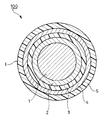
- the power cable 100 has a conductive core 1 surrounded an isolation structure I which is coaxial with it.
- this structure I comprises at least a first semiconductor layer 2 placed at the contact of the core 1 of the cable 100, itself surrounded by a second electrically insulating layer 3, in turn covered by a third semiconductor layer 4.
- the outer layer 5 is a sheath which serves to cable protection 100 and contains the polymer composition supramolecular according to the present invention.
- a mixture of the constituents indicated in Example 1 is produced by continuous or discontinuous mixer then the composition is implemented by extrusion.
- the material is transported using a zone screw feed to the die.
- the material plasticizes under the action of mixing induced by the rotation of the screw and the heat supplied from outside. Pressure gradually increases along the forcing screw thus the material to pass through the die to give it a fixed shape in exit from the latter.
- This technique allows thanks to the adaptation of a appropriate die head to cover copper wires or wires beforehand isolated.
- composition forming the cable sheath can then be put back into work, that is to say extruded again to form a new sheath, at any time for example after six months or more of using the cable.
- the sheath produced with the recycled composition retains properties mechanical similar to that of the first sheath because the properties the initials of the constituents according to the invention are not altered.
- the supramolecular polymer compositions according to the invention also apply to the insulation of low energy cables, medium, high or very high voltage as well as the production of protection not only of power cables (low, medium, high or very high voltage) but also telecommunications cables.
Landscapes
- Chemical & Material Sciences (AREA)
- Health & Medical Sciences (AREA)
- Chemical Kinetics & Catalysis (AREA)
- Medicinal Chemistry (AREA)
- Polymers & Plastics (AREA)
- Organic Chemistry (AREA)
- Physics & Mathematics (AREA)
- Spectroscopy & Molecular Physics (AREA)
- Organic Insulating Materials (AREA)
- Compositions Of Macromolecular Compounds (AREA)
- Insulated Conductors (AREA)
- Silicon Polymers (AREA)
Abstract
Description
- une première chaíne polymérique sur laquelle est greffé au moins un premier groupement fonctionnel,
- une deuxième chaíne polymérique sur laquelle est greffé au moins un deuxième groupement fonctionnel,
- une étape de greffage d'un premier groupement fonctionnel sur une première chaíne polymérique, et une étape de greffage d'un deuxième groupement fonctionnel sur une deuxième chaíne polymérique,
- une étape dite d'association des premier et deuxième groupements fonctionnels par au moins une liaison intermoléculaire de type hydrogène.
- une mise en oeuvre à température ambiante, sans immersion dans de l'eau à partir des installations existantes,
- une augmentation de la vitesse d'extrusion de la composition obtenue du fait de la faible viscosité de la composition.
- chacune desdites première et deuxième chaínes polymériques peut appartenir à un polymère choisi parmi les élastomères, les polymères thermoplastiques, et de préférence les homopolymères d'éthylène, les copolymères d'éthylène et d'acétate de vinyle et les silicones,
- le premier groupement fonctionnel peut comprendre un premier groupement sélectivement réactif avec le premier polymère,
- ledit deuxième groupement fonctionnel peut comprendre un groupement sélectivement réactif avec le deuxième polymère,
- une première chaíne polymérique d'un EVA,
- une première bisurée portant un alcoxysilane sélectivement réactif avec la première chaíne polymérique,
- une deuxième chaíne polymérique du même EVA distincte de la première chaíne polymérique,
- une deuxième bisurée portant un alcoxysilane sélectivement réactif avec la deuxième chaíne polymérique.


- une première chaíne polymérique d'un EVA,
- une première bisurée portant un alcoxysilane sélectivement réactif avec la première chaíne polymérique,
- une deuxième chaíne polymérique du même EVA distincte de la première chaíne polymérique,
- une deuxième bisurée portant un alcoxysilane sélectivement réactif avec la deuxième chaíne polymérique,
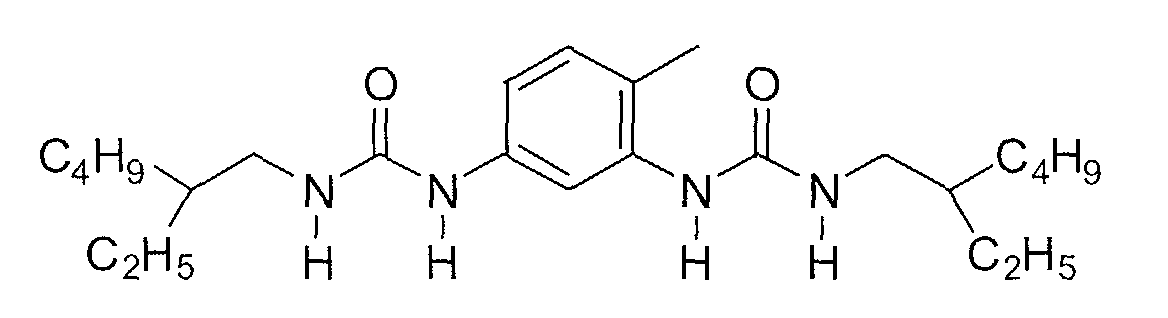
- une troisième bisurée sans groupement sélectivement réactif avec
l'EVA telle que la bis(2-éthylhexyl) uréido toluène correspondant à une
bisurée symétrique comportant un groupement non réactif 2-éthyl hexyl
de chaque côté et de formule développée suivante:
- une première chaíne polymérique d'un polyéthylène (PE),
- une première bisurée portant un vinyle sélectivement réactif avec la
première chaíne polymérique, telle que la bisurée dissymétrique
monofonctionnelle comportant un groupement 4-nbutylphényl d'un côté
et allylique réactif de l'autre côté, de formule développée suivante :

- une deuxième chaíne polymérique du même PE distincte de la première chaíne polymérique,
- une deuxième bisurée portant un vinyle sélectivement réactif avec la deuxième chaíne polymérique, par exemple identique à la deuxième bisurée.
- une première chaíne polymérique d'un silicone comportant un nombre
m supérieur ou égal à un de fonction(s) amine(s) pendante(s), par
exemple de formule développée suivante :

- une première molécule avec un groupement sélectivement réactif
avec la première chaíne polymérique, par exemple une urée précurseur
d'une première bisurée telle que la (BuP/NCO) monoisocyanate qui
comporte une urée et un groupement 4-nbutylphényl, de formule
développée suivante :

- une deuxième chaíne polymérique du même silicone distincte de la première chaíne polymérique,
- une deuxième molécule identique à la première molécule et précurseur d'une deuxième bisurée, comportant un groupement sélectivement réactif avec la deuxième chaíne polymérique.

Claims (18)
- Composition polymère supramoléculaire comprenant :lesdits premier et deuxième groupements fonctionnels étant associés entre eux par au moins une liaison intermoléculaire de type hydrogène.une première chaíne polymérique sur laquelle est greffé au moins un premier groupement fonctionnel,une deuxième chaíne polymérique sur laquelle est greffé au moins un deuxième groupement fonctionnel,
- Composition selon la revendication 1 caractérisée en ce qu'elle comprend en outre un troisième groupement fonctionnel associé avec au moins l'un desdits premier et deuxième groupements fonctionnels par au moins une liaison intermoléculaire de type hydrogène.
- Composition selon l'une des revendications 1 ou 2 lesdits groupements fonctionnels sont choisis parmi les urées et de préférence parmi les bisurées.
- Composition selon la revendication 3 caractérisée en ce que, la bisurée comprenant un groupement dit groupement espaceur disposé entre deux fonctions urées, ledit groupement espaceur est le 1-méthyl 2,4-phénylène.
- Composition selon l'une des revendications 1 à 4 caractérisée en ce que ledit premier groupement fonctionnel est identique audit deuxième groupement fonctionnel.
- Composition selon l'une des revendications 1 à 5 caractérisée en ce que chacune desdites première et deuxième chaínes polymériques appartient à un polymère choisi parmi les polymères amorphes, les polymères au moins partiellement cristallins, et de préférence les homopolymères d'éthylène, les copolymères d'éthylène et d'acétate de vinyle et les silicones.
- Composition selon l'une des revendications 1 à 6 caractérisée en ce que :lesdits premier et deuxième groupements réactifs étant choisis parmi les alcoxysilanes, les vinyles, les silanes, les époxy, les amines et les isocyanates.ledit premier groupement fonctionnel porte au moins un premier groupement sélectivement réactif avec ladite première chaíne polymérique,ledit deuxième groupement fonctionnel porte au moins un deuxième groupement sélectivement réactif avec ladite deuxième chaíne polymérique,
- Composition selon l'une des revendications 1 à 7 caractérisée en ce que :lesdits premier et deuxième groupements réactifs étant choisis parmi les alcoxysilanes, les vinyles, les silanes, les époxy, les amines et les isocyanates.ledit premier groupement fonctionnel porte un premier groupement sélectivement réactif avec ladite première chaíne polymérique,ledit deuxième groupement fonctionnel porte un deuxième groupement sélectivement réactif avec ladite deuxième chaíne polymérique,
- Composition selon l'une des revendications 1 à 8 caractérisée en ce qu'elle comprend un catalyseur de greffage choisi parmi les amines, les composés à base de platine, les composés à base d'étain et de préférence les sels d'étain.
- Composition selon l'une des revendications 1 à 9 caractérisée en ce qu'elle comprend en outre au moins une charge.
- Composition selon l'une des revendications 1 à 10 caractérisée en ce qu'elle comporte une première chaíne polymérique d'EVA sur laquelle est greffée au moins une première bisurée portant un alcoxysilane et une deuxième chaíne polymérique d'EVA sur laquelle est greffée au moins une deuxième bisurée portant un alcoxysilane.
- Procédé de fabrication d'une composition polymère supramoléculaire contenant une pluralité de groupements fonctionnels, ledit procédé comportantune étape de greffage d'un premier desdits groupements fonctionnels sur une première chaíne polymérique, et une étape de greffage d'un deuxième desdits groupements fonctionnels sur une deuxième chaíne polymérique,une étape dite d'association desdits premier et deuxième groupements fonctionnels par au moins une liaison intermoléculaire de type hydrogène.
- Procédé de fabrication selon la revendication 12 caractérisée en ce que lesdits groupements fonctionnels sont choisis parmi les urées et de préférence les bisurées et en ce que lesdits premier et deuxième groupements fonctionnels sont de préférence identiques.
- Procédé de fabrication selon l'une des revendications 12 ou 13 caractérisé en ce que ladite étape de greffage est réalisée en présence d'un catalyseur de greffage choisi parmi les amines, les composés à base de platine, les composés à base d'étain et de préférence les sels d'étain.
- Procédé de fabrication selon l'une des revendications 12 à 14 caractérisée en ce que :chacune desdites première et deuxième chaínes polymériques appartient à un polymère choisi parmi les élastomères, les polymères thermoplastiques, et de préférence les homopolymères d'éthylène, les copolymères d'éthylène et d'acétate de vinyle et les silicones,ledit premier groupement fonctionnel comprend un premier groupement sélectivement réactif avec ladite première chaíne polymérique,ledit deuxième groupement fonctionnel comprend un deuxième groupement sélectivement réactif avec ladite deuxième chaíne polymérique,lesdits groupements réactifs étant de préférence identique et choisis parmi les alcoxysilanes, les vinyles, les silanes, les époxy, les amines et les isocyanates.
- Procédé de fabrication selon l'une des revendications 12 à 15 caractérisé en ce que ladite étape de greffage est réalisée en présence de peroxyde.,
- Procédé de fabrication selon l'une des revendications 11 à 16 caractérisé en ce qu'au moins une charge est ajoutée durant l'une desdites étapes de greffage et d'association.
- Câble (100) comprenant une isolation et/ou une gaine (5) contenant la composition polymère supramoléculaire obtenue par le procédé selon l'une des revendications 12 à 17.
Applications Claiming Priority (2)
| Application Number | Priority Date | Filing Date | Title |
|---|---|---|---|
| FR0112934A FR2830256A1 (fr) | 2001-10-03 | 2001-10-03 | Composition polymere supramoleculaire, ainsi que son procede de fabrication et cable comportant une telle composition |
| FR0112934 | 2001-10-03 |
Publications (1)
| Publication Number | Publication Date |
|---|---|
| EP1300447A1 true EP1300447A1 (fr) | 2003-04-09 |
Family
ID=8868043
Family Applications (1)
| Application Number | Title | Priority Date | Filing Date |
|---|---|---|---|
| EP02292288A Withdrawn EP1300447A1 (fr) | 2001-10-03 | 2002-09-18 | Composition polymère supramoléculaire, ainsi que son procédé de fabrication et cable comportant une telle composition |
Country Status (4)
| Country | Link |
|---|---|
| US (1) | US20030092838A1 (fr) |
| EP (1) | EP1300447A1 (fr) |
| JP (1) | JP2003231817A (fr) |
| FR (1) | FR2830256A1 (fr) |
Families Citing this family (13)
| Publication number | Priority date | Publication date | Assignee | Title |
|---|---|---|---|---|
| US8389700B2 (en) * | 2002-09-23 | 2013-03-05 | Alcatel Lucent | Agent delivery system capable of selectively releasing an agent |
| US7919600B2 (en) * | 2002-09-23 | 2011-04-05 | Alcatel-Lucent Usa Inc. | Compositions that reversibly gel and de-gel |
| EP1569984B1 (fr) * | 2002-12-09 | 2012-01-11 | SupraPolix B.V. | Polymeres de siloxane a unites de liaison a hydrogene quadruple complementaire |
| WO2005042641A1 (fr) * | 2003-11-04 | 2005-05-12 | Suprapolix B.V. | Preparation de polymeres supramoleculaires contenant des unites de liaison hydrogene quadruples dans le squelette polymere |
| JP5183198B2 (ja) * | 2004-07-12 | 2013-04-17 | スープラポリックス ビー.ブイ. | 超分子イオノマー |
| US7227149B2 (en) * | 2004-12-30 | 2007-06-05 | General Electric Company | Method and system for positron emission tomography image reconstruction |
| EP1877113B1 (fr) | 2005-05-04 | 2011-11-09 | SupraPolix B.V. | Matériau supramoléculaire modulaire, bioresorbable et biologiquement actif |
| EP2087027B1 (fr) | 2006-11-20 | 2011-10-05 | SupraPolix B.V. | Polymères supramoléculaires obtenus à partir d'éléments constitutifs faciles à mettre en oeuvre et à bas point de fusion |
| US8628789B2 (en) | 2007-03-23 | 2014-01-14 | Suprapolix, B.V. | Strong reversible hydrogels |
| US8754213B2 (en) * | 2008-07-04 | 2014-06-17 | Suprapolix B.V. | High flow supramolecular compounds |
| EP2450394B1 (fr) | 2010-11-05 | 2017-06-07 | SupraPolix B.V. | Procédé de préparation d'un polymère supra-moléculaire |
| US11118048B2 (en) * | 2016-09-21 | 2021-09-14 | Massachusetts Institute Of Technology | Nanostructures for the assembly of materials |
| US10654977B2 (en) * | 2018-02-01 | 2020-05-19 | City University Of Hong Kong | Underwater self-healable materials, methods of making thereof, and products comprising same |
Citations (6)
| Publication number | Priority date | Publication date | Assignee | Title |
|---|---|---|---|---|
| EP0015556A1 (fr) * | 1979-03-06 | 1980-09-17 | E.I. Du Pont De Nemours And Company | Articles laminaires de polyoléfine et d'un second polymère et procédé pour les préparer |
| JPS5673812A (en) * | 1979-11-20 | 1981-06-18 | Dainichi Nippon Cables Ltd | Semiconductor composition |
| DE4209057A1 (de) * | 1992-03-20 | 1993-09-23 | Bayer Ag | Verfahren zur herstellung von formkoerpern |
| JPH09251811A (ja) * | 1996-01-11 | 1997-09-22 | Tatsuta Electric Wire & Cable Co Ltd | 耐屈曲低摩擦性を有するケーブル外被又はエアホースのための樹脂組成物 |
| WO1999028389A1 (fr) * | 1997-11-12 | 1999-06-10 | S.C. Johnson Commercial Markets, Inc. | Compositions a base de solvant contenant une composition polymere pratiquement non gelifiee |
| JPH11265621A (ja) * | 1998-03-17 | 1999-09-28 | Fujikura Ltd | 絶縁電力ケーブルおよびその接続部 |
-
2001
- 2001-10-03 FR FR0112934A patent/FR2830256A1/fr not_active Withdrawn
-
2002
- 2002-09-18 EP EP02292288A patent/EP1300447A1/fr not_active Withdrawn
- 2002-09-20 JP JP2002275433A patent/JP2003231817A/ja not_active Withdrawn
- 2002-09-20 US US10/251,619 patent/US20030092838A1/en not_active Abandoned
Patent Citations (6)
| Publication number | Priority date | Publication date | Assignee | Title |
|---|---|---|---|---|
| EP0015556A1 (fr) * | 1979-03-06 | 1980-09-17 | E.I. Du Pont De Nemours And Company | Articles laminaires de polyoléfine et d'un second polymère et procédé pour les préparer |
| JPS5673812A (en) * | 1979-11-20 | 1981-06-18 | Dainichi Nippon Cables Ltd | Semiconductor composition |
| DE4209057A1 (de) * | 1992-03-20 | 1993-09-23 | Bayer Ag | Verfahren zur herstellung von formkoerpern |
| JPH09251811A (ja) * | 1996-01-11 | 1997-09-22 | Tatsuta Electric Wire & Cable Co Ltd | 耐屈曲低摩擦性を有するケーブル外被又はエアホースのための樹脂組成物 |
| WO1999028389A1 (fr) * | 1997-11-12 | 1999-06-10 | S.C. Johnson Commercial Markets, Inc. | Compositions a base de solvant contenant une composition polymere pratiquement non gelifiee |
| JPH11265621A (ja) * | 1998-03-17 | 1999-09-28 | Fujikura Ltd | 絶縁電力ケーブルおよびその接続部 |
Non-Patent Citations (3)
| Title |
|---|
| DATABASE WPI Section Ch Week 198132, Derwent World Patents Index; Class A17, AN 1981-57595D, XP002196279 * |
| DATABASE WPI Section Ch Week 199748, Derwent World Patents Index; Class A14, AN 1997-523808, XP002196280 * |
| DATABASE WPI Section Ch Week 199952, Derwent World Patents Index; Class A17, AN 1999-606469, XP002196278 * |
Also Published As
| Publication number | Publication date |
|---|---|
| JP2003231817A (ja) | 2003-08-19 |
| US20030092838A1 (en) | 2003-05-15 |
| FR2830256A1 (fr) | 2003-04-04 |
Similar Documents
| Publication | Publication Date | Title |
|---|---|---|
| FR2830256A1 (fr) | Composition polymere supramoleculaire, ainsi que son procede de fabrication et cable comportant une telle composition | |
| EP0141733A1 (fr) | Procédé de réticulation de polymères d'éthylène contenant des fonctions anhydride, compositions polymères réticulables et application de ces compositions à l'enduction de substrats | |
| EP2344584A1 (fr) | Composition semi-conductrice pour cables electriques | |
| WO2011067505A1 (fr) | Composition utile comme melange-maitre de reticulation comprenant une polyolefine fonctionnelle | |
| CA2408197C (fr) | Procede de fabrication d'une gaine de cable par extrusion et reticulation d'une composition a base de polymere greffe silane, et cable comportant une gaine obtenue par ce procede | |
| BE897044A (fr) | Composition semiconductrice thermoplastique resistant a la deformation a chaud et conducteur electrique isle comprenant cette composition | |
| BE1008790A3 (fr) | Compositions a base de copolymeres du fluorure de vinylidene comprenant du polychlorure de vinyle et leur utilisation en cablerie. | |
| CN1283712C (zh) | 室温硅烷交联聚乙烯塑料及其制备方法 | |
| EP0481898B1 (fr) | Compositions réticulables à base de polyéthylène et les matériaux réticulés qui en dérivent | |
| EP1156066A1 (fr) | Composition à propriétés thermomécaniques améliorées et procédé pour sa réticulation | |
| EP1288218B1 (fr) | Procédé de fabrication d'un corps cylindrique et cable comportant un corps obtenu par ce procédé | |
| EP0769518B1 (fr) | Composition réticulable de polymère du fluorure de vinylidène, procédé pour réticuler la composition et articles façonnés | |
| EP0686658A1 (fr) | Polyamides à performances thermomécaniques améliorées, leur procédé de préparation et leur utilisation après réticulation | |
| EP1806379B1 (fr) | Procédé de réticulation d'un polymère chargé et à base de polyéthylène | |
| EP3635756A1 (fr) | Câble résistant au feu | |
| EP0175624B1 (fr) | Compositions à base de polyuréthane et comportant un polymère d'oxime éthylénique, procédé de préparation desdites compositions et leurs utilisations | |
| EP2681251B1 (fr) | Polyolefines modifiees, reticulables apres transformation, et procede de fabrication desdites polyolefines | |
| EP1502923A1 (fr) | Procédé d'extrusion et de réticulation de composition polymérique chargée | |
| EP2850132B1 (fr) | Couche thermoplastique d'un câble, tuyau, revêtement ou analogue | |
| EP4451293A1 (fr) | Couche de polymère réticulé pour dispositif électrique | |
| EP0565424B1 (fr) | Matériau synthétique, notamment pour l'isolation électrique des câbles d'énergie haute-tension | |
| EP3799079A1 (fr) | Couche réticulée pour câble | |
| JPS5980439A (ja) | 架橋成形体の製造方法 | |
| FR2535726A1 (fr) | Procede de greffage d'un silane sur une polyolefine en vue de sa reticulation ainsi que les melanges a base de silane necessaires a la mise en oeuvre d'un tel procede, en particulier sur des extrudeuses ordinaires | |
| FR2860797A1 (fr) | Procede de reticulation d'un polymere greffe silane |
Legal Events
| Date | Code | Title | Description |
|---|---|---|---|
| PUAI | Public reference made under article 153(3) epc to a published international application that has entered the european phase |
Free format text: ORIGINAL CODE: 0009012 |
|
| AK | Designated contracting states |
Kind code of ref document: A1 Designated state(s): AT BE BG CH CY CZ DE DK EE ES FI FR GB GR IE IT LI LU MC NL PT SE SK TR Designated state(s): AT BE BG CH CY CZ DE DK EE ES FI FR GB GR IE IT LI LU MC NL PT SE SK TR |
|
| AX | Request for extension of the european patent |
Extension state: AL LT LV MK RO SI |
|
| 17P | Request for examination filed |
Effective date: 20031009 |
|
| AKX | Designation fees paid |
Designated state(s): AT BE BG CH CY CZ DE DK EE ES FI FR GB GR IE IT LI LU MC NL PT SE SK TR |
|
| AXX | Extension fees paid |
Extension state: SI Payment date: 20031009 Extension state: RO Payment date: 20031009 Extension state: MK Payment date: 20031009 Extension state: LV Payment date: 20031009 Extension state: LT Payment date: 20031009 Extension state: AL Payment date: 20031009 |
|
| STAA | Information on the status of an ep patent application or granted ep patent |
Free format text: STATUS: THE APPLICATION HAS BEEN WITHDRAWN |
|
| 18W | Application withdrawn |
Effective date: 20040107 |