EP1298427A1 - Verfahren zur Beurteilung der Konzentration einer flüssigen Lösung und Verwendung dieses Verfahrens - Google Patents
Verfahren zur Beurteilung der Konzentration einer flüssigen Lösung und Verwendung dieses Verfahrens Download PDFInfo
- Publication number
- EP1298427A1 EP1298427A1 EP01810942A EP01810942A EP1298427A1 EP 1298427 A1 EP1298427 A1 EP 1298427A1 EP 01810942 A EP01810942 A EP 01810942A EP 01810942 A EP01810942 A EP 01810942A EP 1298427 A1 EP1298427 A1 EP 1298427A1
- Authority
- EP
- European Patent Office
- Prior art keywords
- concentration
- solution
- temperature
- methanol
- bodies
- Prior art date
- Legal status (The legal status is an assumption and is not a legal conclusion. Google has not performed a legal analysis and makes no representation as to the accuracy of the status listed.)
- Withdrawn
Links
Images
Classifications
-
- H—ELECTRICITY
- H01—ELECTRIC ELEMENTS
- H01M—PROCESSES OR MEANS, e.g. BATTERIES, FOR THE DIRECT CONVERSION OF CHEMICAL ENERGY INTO ELECTRICAL ENERGY
- H01M8/00—Fuel cells; Manufacture thereof
- H01M8/10—Fuel cells with solid electrolytes
- H01M8/1009—Fuel cells with solid electrolytes with one of the reactants being liquid, solid or liquid-charged
- H01M8/1011—Direct alcohol fuel cells [DAFC], e.g. direct methanol fuel cells [DMFC]
-
- G—PHYSICS
- G01—MEASURING; TESTING
- G01N—INVESTIGATING OR ANALYSING MATERIALS BY DETERMINING THEIR CHEMICAL OR PHYSICAL PROPERTIES
- G01N9/00—Investigating density or specific gravity of materials; Analysing materials by determining density or specific gravity
- G01N9/36—Analysing materials by measuring the density or specific gravity, e.g. determining quantity of moisture
-
- H—ELECTRICITY
- H01—ELECTRIC ELEMENTS
- H01M—PROCESSES OR MEANS, e.g. BATTERIES, FOR THE DIRECT CONVERSION OF CHEMICAL ENERGY INTO ELECTRICAL ENERGY
- H01M8/00—Fuel cells; Manufacture thereof
- H01M8/04—Auxiliary arrangements, e.g. for control of pressure or for circulation of fluids
- H01M8/04082—Arrangements for control of reactant parameters, e.g. pressure or concentration
- H01M8/04186—Arrangements for control of reactant parameters, e.g. pressure or concentration of liquid-charged or electrolyte-charged reactants
- H01M8/04194—Concentration measuring cells
-
- Y—GENERAL TAGGING OF NEW TECHNOLOGICAL DEVELOPMENTS; GENERAL TAGGING OF CROSS-SECTIONAL TECHNOLOGIES SPANNING OVER SEVERAL SECTIONS OF THE IPC; TECHNICAL SUBJECTS COVERED BY FORMER USPC CROSS-REFERENCE ART COLLECTIONS [XRACs] AND DIGESTS
- Y02—TECHNOLOGIES OR APPLICATIONS FOR MITIGATION OR ADAPTATION AGAINST CLIMATE CHANGE
- Y02E—REDUCTION OF GREENHOUSE GAS [GHG] EMISSIONS, RELATED TO ENERGY GENERATION, TRANSMISSION OR DISTRIBUTION
- Y02E60/00—Enabling technologies; Technologies with a potential or indirect contribution to GHG emissions mitigation
- Y02E60/30—Hydrogen technology
- Y02E60/50—Fuel cells
Definitions
- the present invention relates to a method for assessing the concentration of Solutions of a solid or a liquid in a liquid solvent according to the preamble of claim 1.
- Their application to the regulation of the methanol concentration in direct methanol fuel cell systems refers to the field of fuel cell technology.
- methanol CH 3 OH has the advantage over hydrogen H 2 that it is liquid under normal ambient conditions and that the existing infrastructure can be used for distribution and storage.
- the safety requirements are much cheaper than with hydrogen.
- the generation of hydrogen from methanol at the place of use itself is entirely feasible by means of reforming, but it has a delayed cold start behavior.
- methanol is directly electrochemically oxidized, ie without the previous intermediate step of reforming to H 2 .
- a dilute methanol solution is generally used, the solution being circulated and the concentration desired for optimum operation being regulated by adding concentrated methanol.
- Methods for evaluating the methanol concentration are known which evaluate the dielectric properties or the density of the methanol solution.
- Galilean thermometers are used to display the room temperature. How it works is based on the Archimedes principle, according to which every solid body in liquid Environment experiences a buoyancy equal to the weight of those displaced by the body Liquid corresponds. The amount of buoyancy is therefore determined by the density of the solid Body and the density of the liquid are determined. The density in turn changes with the Temperature, this change being much higher for a liquid than for a solid body.
- the object of the present invention is a method for assessing the concentration to create a solution of a substance in a liquid solvent which is based on the concentration dependence of the density of the solution is based as well as simple and fail-safe is. It is a further object of the invention to provide a method for regulating the methanol concentration a direct methanol fuel cell system with the same properties to accomplish. These tasks are accomplished by a method with the features of the claim 1 and a use of this method with the features of the claim 9 solved.
- the essence of the invention is to assess the concentration of the solution of a substance in use a Galilean thermometer in a liquid solvent. This requires of course, that the density of the solid or liquid, which is in the solvent is solved, is different from the density of the solvent. Depending on the one you want Precision assessment will be one or more bodies with different densities placed in the solution. From the resulting positions - on the surface of the solution floating or diving to the bottom of the solution - the body becomes the concentration assessed, i.e. at least one upper or lower limit determines or even approximately the exact concentration value is determined. In particular, an assessment of a Change in concentration, for example due to consumption of the solute or evaporation of the solvent, simply possible.
- the densities of the bodies are chosen so that that it is the density of the solution at an average temperature but different reference concentrations of the solute. Is the actual temperature at the time of observation approximately equal to the average temperature mentioned above the concentration to be assessed lies between the comparison concentrations of the floating ones and the sunken body. If only one body is used, the Density corresponds to a medium concentration, and the density of the solute is higher as the density of the solvent, the following statement can be made: If the body floats on the surface, the actual concentration of the solution lies above the middle concentration, otherwise below.
- bodies can with different densities assigned to two or more reference temperatures become. Then their positions - depending on the temperature - show the lower or exceeding different concentrations.
- a separate Thermometer measured the temperature of the solution.
- the densities of the bodies are measured that at different comparison temperatures the density of the solution at a fixed mean concentration.
- the method according to the invention is in particular for an assessment of the methanol content a solution of methanol in water.
- the temperature dependence of the The density of a methanol solution is small compared to its concentration dependency.
- the density of a methanol solution decreases with an increase the concentration by one percent by about the same amount as with a temperature increase around 10 ° C. Relatively sufficient to cover a certain temperature range few different comparison temperatures or subsets Bodies.
- the method is suitably used to control the methanol concentration in direct methanol fuel cells used in which in the circulating methanol solution the methanol is consumed at an unknown rate. Most often with such systems already a cheap temperature measuring device for determining the solution temperature available. According to the invention, the methanol concentration is increased in this control the exact actual concentration is not determined. Thus, it is one of the above Assessments of concentration or changes in concentration, in particular relative to a known target concentration value of the methanol solution, largely sufficient for deciding whether and if so how much concentrated methanol to solve should be added.
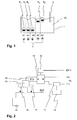
- FIG. 1 shows a possible modification of a so-called Galileo thermometer for assessing the concentration C of a solution SL.
- Each body K n has a density ⁇ n , which is equal to the density of the solution SL at a specific mean concentration C m and one of five different comparison temperatures T n (25, 40, 60, 80 or 95 ° C).
- the temperature T of the solution SL is determined by means of a temperature measuring device 2.
- the body K p whose equivalent comparison temperature T p is closest to the actually measured temperature T is now decisive for the assessment of the concentration C.
- each body floating ⁇ or lowered ⁇ , is determined with a proximity sensor 3.
- the body K 3 has sunk to the bottom of the container 1, from which it can be concluded that the actual concentration C of the solution SL of interest is below the average concentration C m .
- the assessment method shown is subject to errors. It is conceivable that, for example, at a temperature T of 69 ° C the temperature-related decrease in density ⁇ T of the solution compared to its value at 60 ° C exceeds a concentration-related increase in density ⁇ C compared to the mean value C m and from the position of Body K 3 the wrong conclusion is drawn (decrease in concentration). Such sources of error are all the more significant the greater the temperature dependence of the density of the solution (d ⁇ / Dt) and the greater the distance between two successive comparison temperatures (T i -T i-1 ).
- FIG. 2 shows a direct methanol fuel cell system with a fuel cell stack 10, as is provided in particular for autonomous operation (stand alone).
- Oxygen O 2 is preferably supplied as a component of air on the cathode side with a blower (not shown ) .
- the water present in the exhaust air is separated again in a condenser 11 and fed into a water tank 12.
- the anode-side methanol solution is circulated in an anode circuit 13, which includes a methanol solution reservoir 14 as a buffer. Both the water and the methanol solution are moved by pumps, not shown.
- the methanol solution reservoir 14 is replenished with concentrated methanol from a methanol tank 15 and water from the water tank 12 if necessary. In this self-sufficient system, only the methanol tank 15 has to be refilled periodically from outside.
- the fuel cell stack 10 is electrically connected via an inverter 16 to a circuit with a consumer, not shown.
- the electrochemical reaction in the fuel cells 10 consumes depending on the load or related performance methanol.
- both methanol and Water at an unknown rate through the electrolyte to the cathode.
- the level in the methanol solution reservoir 14 with a level sensor 17 monitored and, if necessary, refilling by adding water from the water tank 12 be initiated.
- the correct methanol concentration typically between 0.5 and 5 percent by weight, at least approximately.
- Sensor 18 used which works on the principle described above and a Concentration dependence of the density of the methanol solution evaluates.
- the sensor 18 allows an adequate assessment of the methanol concentration for the control, in particular of deviations from a target value or changes over time, and dispenses with an exact determination of the current actual value.
Landscapes
- Chemical & Material Sciences (AREA)
- Life Sciences & Earth Sciences (AREA)
- General Chemical & Material Sciences (AREA)
- Sustainable Development (AREA)
- Sustainable Energy (AREA)
- Manufacturing & Machinery (AREA)
- Chemical Kinetics & Catalysis (AREA)
- Electrochemistry (AREA)
- Engineering & Computer Science (AREA)
- Analytical Chemistry (AREA)
- Health & Medical Sciences (AREA)
- Physics & Mathematics (AREA)
- Biochemistry (AREA)
- General Health & Medical Sciences (AREA)
- General Physics & Mathematics (AREA)
- Immunology (AREA)
- Pathology (AREA)
- Investigating Or Analyzing Materials Using Thermal Means (AREA)
- Fuel Cell (AREA)
Abstract
Description
- 1
- Behälter
- 2
- Temperaturmessgerät
- 3
- Näherungssensor
- 10
- Brennstoffzellenstapel
- 11
- Kondensator
- 12
- Wassertank
- 13
- Anodenkreislauf
- 14
- Methanollösungsreservoir
- 15
- Methanoltank
- 16
- Wechselrichter
- 17
- Niveausensor
- 18
- Methanolkonzentrationssensor
- C
- Konzentration
- SL
- Lösung
Claims (9)
- Verfahren zur Beurteilung einer Konzentration (C) einer Lösung (SL) eines Feststoffes (S) oder einer Flüssigkeit (L) in einem Lösungsmittel, dessen Dichte von derjenigen des Feststoffes (S) oder der Flüssigkeit (L) verschieden ist,
dadurch gekennzeichnet, dass in die Lösung (SL) eine Menge von N Körpern eingetaucht werden, wobei N ≥ 1 ist und jeder Körper (Kn) eine Dichte (ρn) aufweist, welche der Dichte der Lösung (SL) bei bestimmten Kombinationen von Temperatur (Tn) und Konzentration (Cn) entspricht, und dass aus einer Position (↑, ↓) mindestens eines Körpers (Kp) die Konzentration (C) des gelösten Feststoffes (S) oder der gelösten Flüssigkeit (L) in der Lösung (SL) beurteilt wird. - Verfahren nach Anspruch 1, dadurch gekennzeichnet, dass die Position (↑, ↓) des mindestens einen Körpers (Kp) mittels eines Näherungssensors (3) detektiert wird.
- Verfahren nach Anspruch 2, dadurch gekennzeichnet, dass die Position (↑, ↓) des mindestens einen Körpers (Kp) mittels eines Näherungssensors (3), welcher im Boden oder unterhalb eines die Lösung (SL) enthaltenden Behälters (1) angeordnet ist, detektiert wird.
- Verfahren nach Anspruch 1, dadurch gekennzeichnet, dass die Dichten (ρn) der N Körper einer Folge von monoton aufsteigenden Vergleichskonzentrationen (Cn) für eine mittlere Temperatur (Tm) entsprechen, und dass die Konzentration (C) der Lösung (SL) als oberhalb der grössten Konzentration (Cp) der aufschwimmenden Körper und unterhalb der kleinsten Konzentration (Cp+1) der gesunkenen Körper liegend beurteilt wird.
- Verfahren nach Anspruch 4, dadurch gekennzeichnet, dass mittels eines separaten Temperaturmessgeräts (2) eine Temperatur (T) der Lösung (SL) gemessen wird, dass für mindestens zwei Vergleichstemperaturen (T;) jeweils eine Untermenge von Ni Körpern eingetaucht wird, wobei Ni ≥ 1 ist, und dass die Konzentration (C) der Lösung (SL) anhand derjenigen Untermenge von Np Körpern beurteilt wird, deren Vergleichstemperatur (Tp) am nächsten bei der gemessenen Temperatur (T) liegt.
- Verfahren nach Anspruch 5, dadurch gekennzeichnet, dass mindestens einer der Körper zwei zu verschiedenen Vergleichstemperaturen (Ti, Tj) gehörenden Untermengen (Ni, Nj) zugeordnet ist.
- Verfahren nach Anspruch 1, dadurch gekennzeichnet, dass mittels eines separaten Temperaturmessgeräts (2) eine Temperatur (T) der Lösung (SL) gemessen wird, dass die Dichten (ρn) der N Körper einer Folge von monoton aufsteigenden Vergleichstemperaturen (Tn) bei einer mittleren Konzentration (Cm) entsprechen, und dass derjenige Körper (Kp) selektiert wird, dessen Vergleichstemperatur (Tp) am nächsten bei der gemessenen Temperatur (T) liegt und die Konzentration (M) der Mischung je nach der Position (↑, ↓) des selektierten Körpers (Kp) als unterhalb oder überhalb der mittleren Konzentration (Cm) liegend beurteilt wird.
- Verfahren nach einem der Ansprüche 1-7, dadurch gekennzeichnet, dass die gelöste Flüssigkeit Methanol und das Lösungsmittel Wasser ist.
- Verwendung eines Verfahrens nach Anspruch 8 zur Regelung der Methanolkonzentration (C) eines Direkt-Methanol-Brennstoffzellensystems mit mindestens einer Brennstoffzelle und einem separaten Methanolreservoir (15), wobei je nach Beurteilung der Konzentration (C) der Lösung (SL) Methanol aus dem Methanolreservoir (15) zugeführt wird.
Priority Applications (1)
| Application Number | Priority Date | Filing Date | Title |
|---|---|---|---|
| EP01810942A EP1298427A1 (de) | 2001-09-27 | 2001-09-27 | Verfahren zur Beurteilung der Konzentration einer flüssigen Lösung und Verwendung dieses Verfahrens |
Applications Claiming Priority (1)
| Application Number | Priority Date | Filing Date | Title |
|---|---|---|---|
| EP01810942A EP1298427A1 (de) | 2001-09-27 | 2001-09-27 | Verfahren zur Beurteilung der Konzentration einer flüssigen Lösung und Verwendung dieses Verfahrens |
Publications (1)
| Publication Number | Publication Date |
|---|---|
| EP1298427A1 true EP1298427A1 (de) | 2003-04-02 |
Family
ID=8184163
Family Applications (1)
| Application Number | Title | Priority Date | Filing Date |
|---|---|---|---|
| EP01810942A Withdrawn EP1298427A1 (de) | 2001-09-27 | 2001-09-27 | Verfahren zur Beurteilung der Konzentration einer flüssigen Lösung und Verwendung dieses Verfahrens |
Country Status (1)
| Country | Link |
|---|---|
| EP (1) | EP1298427A1 (de) |
Cited By (5)
| Publication number | Priority date | Publication date | Assignee | Title |
|---|---|---|---|---|
| RU2270991C1 (ru) * | 2004-08-10 | 2006-02-27 | Ольга Викторовна Епимахова | Способ определения концентрации уксусной кислоты |
| DE102005033821A1 (de) * | 2005-07-11 | 2007-01-18 | Deutsches Zentrum für Luft- und Raumfahrt e.V. | Direktoxidations-Brennstoffzellensystem und Verfahren zur Steuerung/Regelung des Wasserhaushalts eines Direktoxidations-Brennstoffzellensystems |
| WO2024030117A1 (en) * | 2022-08-01 | 2024-02-08 | Halliburton Energy Services, Inc. | Density sensor for quantifying production fluid content |
| CN119023914A (zh) * | 2024-10-28 | 2024-11-26 | 南京市云影生物科技有限公司 | 一种用于测定液体溶剂含量比例的测定方法及其系统 |
| US12196077B2 (en) | 2022-08-01 | 2025-01-14 | Halliburton Energy Services, Inc. | Sensor for quantifying production fluid percentage content |
Citations (5)
| Publication number | Priority date | Publication date | Assignee | Title |
|---|---|---|---|---|
| DE3327252A1 (de) * | 1983-07-28 | 1985-02-07 | GFD Gerätebau für Druckmaschinen GmbH, 8851 Thierhaupten | Alkoholdosiergeraet fuer das feuchtwasser in einer offset-druckmaschine |
| JPS62177431A (ja) * | 1986-01-31 | 1987-08-04 | Mitsubishi Electric Corp | エツチング速度測定装置 |
| US4702109A (en) * | 1986-04-21 | 1987-10-27 | Parker Hannifin Corporation | In-line hydrometer |
| GB2241582A (en) * | 1989-03-09 | 1991-09-04 | Ramona Thomas Angelo | Measuring specific gravity of car radiator fluid |
| WO2001024297A1 (de) * | 1999-09-24 | 2001-04-05 | Siemens Aktiengesellschaft | Bestimmung der alkoholkonzentration im elektrolyt von brennstoffzellen |
-
2001
- 2001-09-27 EP EP01810942A patent/EP1298427A1/de not_active Withdrawn
Patent Citations (5)
| Publication number | Priority date | Publication date | Assignee | Title |
|---|---|---|---|---|
| DE3327252A1 (de) * | 1983-07-28 | 1985-02-07 | GFD Gerätebau für Druckmaschinen GmbH, 8851 Thierhaupten | Alkoholdosiergeraet fuer das feuchtwasser in einer offset-druckmaschine |
| JPS62177431A (ja) * | 1986-01-31 | 1987-08-04 | Mitsubishi Electric Corp | エツチング速度測定装置 |
| US4702109A (en) * | 1986-04-21 | 1987-10-27 | Parker Hannifin Corporation | In-line hydrometer |
| GB2241582A (en) * | 1989-03-09 | 1991-09-04 | Ramona Thomas Angelo | Measuring specific gravity of car radiator fluid |
| WO2001024297A1 (de) * | 1999-09-24 | 2001-04-05 | Siemens Aktiengesellschaft | Bestimmung der alkoholkonzentration im elektrolyt von brennstoffzellen |
Non-Patent Citations (1)
| Title |
|---|
| PATENT ABSTRACTS OF JAPAN vol. 012, no. 023 (P - 658) 23 January 1988 (1988-01-23) * |
Cited By (7)
| Publication number | Priority date | Publication date | Assignee | Title |
|---|---|---|---|---|
| RU2270991C1 (ru) * | 2004-08-10 | 2006-02-27 | Ольга Викторовна Епимахова | Способ определения концентрации уксусной кислоты |
| DE102005033821A1 (de) * | 2005-07-11 | 2007-01-18 | Deutsches Zentrum für Luft- und Raumfahrt e.V. | Direktoxidations-Brennstoffzellensystem und Verfahren zur Steuerung/Regelung des Wasserhaushalts eines Direktoxidations-Brennstoffzellensystems |
| DE102005033821B4 (de) * | 2005-07-11 | 2011-03-10 | Deutsches Zentrum für Luft- und Raumfahrt e.V. | Direktoxidations-Brennstoffzellensystem und Verfahren zur Steuerung/Regelung des Wasserhaushalts eines Direktoxidations-Brennstoffzellensystems |
| WO2024030117A1 (en) * | 2022-08-01 | 2024-02-08 | Halliburton Energy Services, Inc. | Density sensor for quantifying production fluid content |
| US12196077B2 (en) | 2022-08-01 | 2025-01-14 | Halliburton Energy Services, Inc. | Sensor for quantifying production fluid percentage content |
| US12662937B2 (en) | 2022-08-01 | 2026-06-23 | Halliburton Energy Services, Inc. | Sensor for quantifying production fluid percentage content |
| CN119023914A (zh) * | 2024-10-28 | 2024-11-26 | 南京市云影生物科技有限公司 | 一种用于测定液体溶剂含量比例的测定方法及其系统 |
Similar Documents
| Publication | Publication Date | Title |
|---|---|---|
| DE102012209467B4 (de) | Vorrichtung und verfahren zur steuerung der wasserstoffkonzentration für ein brennstoffzellensystem | |
| EP1383191B1 (de) | Fluidtrennvorrichtung | |
| DE10393382T5 (de) | Flüssigbrennstoffdirektzufuhr-Brennstoffzellensystem; Verfahren zur Betriebssteuerung und Betriebssteuervorrichtung | |
| DE112009005282B4 (de) | Brennstoffzellensystem | |
| EP1280218A1 (de) | Verfahren zur Regelung der Methanolkonzentration in direkt-Methanol-Brennstoffzellen | |
| DE112005001088T5 (de) | Brennstoffzellensystem | |
| DE102011109304A1 (de) | Wasserstoffkonzentrationssensor, der eine aus einer Wasserstoffpartialdruckdifferenz resultierende Zellenspannung verwendet | |
| DE112007000141B4 (de) | Vorrichtung zur Berechnung des stöchiometrischen Verhältnisses von vorgegebenem Gas für jede Einheitszelle eines Brennstoffzellensystems | |
| DE112010004579T5 (de) | Brennstoffzellensystem und steuerungsverfahren desselben | |
| DE112011101590T5 (de) | Brennstoffzellensystem | |
| EP2807695B1 (de) | System zur energieerzeugung bzw. -speicherung auf elektrochemischer basis | |
| DE102008061771A1 (de) | Brennstoffzelleneinheit für gasförmige Brennstoffe | |
| DE10037233A1 (de) | CO-Gassensor | |
| DE19945928C1 (de) | Bestimmung der Alkoholkonzentration im Elektrolyt von Brennstoffzellen | |
| EP0684469A2 (de) | Messgerät zur Konzentrationsbestimmung von Alkoholen | |
| WO2016102213A1 (de) | Verfahren und vorrichtung zum betreiben eines gassensors zum analysieren eines abgases einer verbrennungskraftmaschine und gassensor | |
| DE2321087A1 (de) | Brennstoffzellenaggregat | |
| DE2416716A1 (de) | Vorrichtung zur bestimmung von chemikalien im pruefungsstrom | |
| DE102006001645B4 (de) | Vorrichtung zur Steuerung von mit relativer Feuchte in Verbindung stehenden Bedingungen in einer Anordnung für elektrochemische Umwandlung und Steuerungsverfahren | |
| DE102017223801B4 (de) | Flüssigkeitspegelzustand-Erfassungsvorrichtung und Brennstoffzellensystem | |
| DE102023204445A1 (de) | Konditionierungsverfahren und Diagnoseverfahren für ein Brennstoffzellensystem | |
| DE19516695C2 (de) | Flüssigkeitsbehälter mit Niveauregulierung | |
| EP1293778B1 (de) | Vorrichtung zur Konzentrationsüberwachung in Fluiden | |
| DE102004052806B4 (de) | Direktmethanolbrennstoffzellensystem und Verfahren zu dessen Betrieb | |
| DE2254858A1 (de) | Ozonmesszelle |
Legal Events
| Date | Code | Title | Description |
|---|---|---|---|
| PUAI | Public reference made under article 153(3) epc to a published international application that has entered the european phase |
Free format text: ORIGINAL CODE: 0009012 |
|
| AK | Designated contracting states |
Kind code of ref document: A1 Designated state(s): AT BE CH CY DE DK ES FI FR GB GR IE IT LI LU MC NL PT SE TR Designated state(s): AT BE CH CY DE DK ES FI FR GB GR IE IT LI LU MC NL PT SE TR |
|
| AX | Request for extension of the european patent |
Extension state: AL LT LV MK RO SI |
|
| AKX | Designation fees paid | ||
| 17P | Request for examination filed |
Effective date: 20031201 |
|
| RBV | Designated contracting states (corrected) |
Designated state(s): DE |
|
| RBV | Designated contracting states (corrected) |
Designated state(s): DE FR GB IT |
|
| REG | Reference to a national code |
Ref country code: DE Ref legal event code: 8566 |
|
| 17Q | First examination report despatched |
Effective date: 20041124 |
|
| STAA | Information on the status of an ep patent application or granted ep patent |
Free format text: STATUS: THE APPLICATION IS DEEMED TO BE WITHDRAWN |
|
| 18D | Application deemed to be withdrawn |
Effective date: 20050607 |