EP1294426B1 - Vorrichtung zur Erfassung der Atmungstätigkeit einer Person - Google Patents
Vorrichtung zur Erfassung der Atmungstätigkeit einer Person Download PDFInfo
- Publication number
- EP1294426B1 EP1294426B1 EP01962819A EP01962819A EP1294426B1 EP 1294426 B1 EP1294426 B1 EP 1294426B1 EP 01962819 A EP01962819 A EP 01962819A EP 01962819 A EP01962819 A EP 01962819A EP 1294426 B1 EP1294426 B1 EP 1294426B1
- Authority
- EP
- European Patent Office
- Prior art keywords
- signal
- signal processing
- processing means
- smoothing
- respiratory
- Prior art date
- Legal status (The legal status is an assumption and is not a legal conclusion. Google has not performed a legal analysis and makes no representation as to the accuracy of the status listed.)
- Expired - Lifetime
Links
Images


Classifications
-
- A—HUMAN NECESSITIES
- A61—MEDICAL OR VETERINARY SCIENCE; HYGIENE
- A61M—DEVICES FOR INTRODUCING MEDIA INTO, OR ONTO, THE BODY; DEVICES FOR TRANSDUCING BODY MEDIA OR FOR TAKING MEDIA FROM THE BODY; DEVICES FOR PRODUCING OR ENDING SLEEP OR STUPOR
- A61M16/00—Devices for influencing the respiratory system of patients by gas treatment, e.g. ventilators; Tracheal tubes
- A61M16/021—Devices for influencing the respiratory system of patients by gas treatment, e.g. ventilators; Tracheal tubes operated by electrical means
- A61M16/022—Control means therefor
- A61M16/024—Control means therefor including calculation means, e.g. using a processor
- A61M16/026—Control means therefor including calculation means, e.g. using a processor specially adapted for predicting, e.g. for determining an information representative of a flow limitation during a ventilation cycle by using a root square technique or a regression analysis
-
- A—HUMAN NECESSITIES
- A61—MEDICAL OR VETERINARY SCIENCE; HYGIENE
- A61M—DEVICES FOR INTRODUCING MEDIA INTO, OR ONTO, THE BODY; DEVICES FOR TRANSDUCING BODY MEDIA OR FOR TAKING MEDIA FROM THE BODY; DEVICES FOR PRODUCING OR ENDING SLEEP OR STUPOR
- A61M16/00—Devices for influencing the respiratory system of patients by gas treatment, e.g. ventilators; Tracheal tubes
- A61M16/0051—Devices for influencing the respiratory system of patients by gas treatment, e.g. ventilators; Tracheal tubes with alarm devices
-
- A—HUMAN NECESSITIES
- A61—MEDICAL OR VETERINARY SCIENCE; HYGIENE
- A61M—DEVICES FOR INTRODUCING MEDIA INTO, OR ONTO, THE BODY; DEVICES FOR TRANSDUCING BODY MEDIA OR FOR TAKING MEDIA FROM THE BODY; DEVICES FOR PRODUCING OR ENDING SLEEP OR STUPOR
- A61M16/00—Devices for influencing the respiratory system of patients by gas treatment, e.g. ventilators; Tracheal tubes
- A61M16/0003—Accessories therefor, e.g. sensors, vibrators, negative pressure
- A61M2016/0015—Accessories therefor, e.g. sensors, vibrators, negative pressure inhalation detectors
- A61M2016/0018—Accessories therefor, e.g. sensors, vibrators, negative pressure inhalation detectors electrical
- A61M2016/0021—Accessories therefor, e.g. sensors, vibrators, negative pressure inhalation detectors electrical with a proportional output signal, e.g. from a thermistor
-
- A—HUMAN NECESSITIES
- A61—MEDICAL OR VETERINARY SCIENCE; HYGIENE
- A61M—DEVICES FOR INTRODUCING MEDIA INTO, OR ONTO, THE BODY; DEVICES FOR TRANSDUCING BODY MEDIA OR FOR TAKING MEDIA FROM THE BODY; DEVICES FOR PRODUCING OR ENDING SLEEP OR STUPOR
- A61M16/00—Devices for influencing the respiratory system of patients by gas treatment, e.g. ventilators; Tracheal tubes
- A61M16/0003—Accessories therefor, e.g. sensors, vibrators, negative pressure
- A61M2016/003—Accessories therefor, e.g. sensors, vibrators, negative pressure with a flowmeter
- A61M2016/0033—Accessories therefor, e.g. sensors, vibrators, negative pressure with a flowmeter electrical
- A61M2016/0039—Accessories therefor, e.g. sensors, vibrators, negative pressure with a flowmeter electrical in the inspiratory circuit
Definitions
- the invention relates to a device for detecting the respiratory activity of a person and for controlling the time course of the pressure of breathing gas according to the preamble of patent claim 1.
- the aim is generally to have the lowest possible respiratory pressure level at which sufficient pneumatic splinting of the upper respiratory tract is ensured. It has been found that this pressure level is subject to considerable fluctuations in certain patients. In order to take these fluctuations of the required therapy pressure into account, attempts have been made with so-called auto-CPAP devices that automatically make a temporary increase in the therapy pressure, for example, when snoring sounds occur. There are also CPAP devices are known in which the timing of the respiratory gas flow is detected and analyzed for any signs of airway obstruction. If signs of airway obstruction exist, a temporary increase in therapy pressure will also be induced.
- Auto-CPAP devices are also known in which the patient's current physiological condition is determined by applying defined pressure pulses to the breathing gas supplied to the patient via a breathing gas line, conclusions being drawn on the current ones, for example based on an impedance measurement associated therewith Obstruction can be drawn.
- the invention has for its object to provide a device for detecting the breathing activity as well as the specification of physical parameters in the supply of a breathing gas to a person, which allows a more precise assessment of the physiological condition of the patient.
- the respiratory gas pressure set by a corresponding CPAP device can be determined patient-specifically with high reliability and without any special diagnostic effort.
- the assessment concept according to the invention also makes it possible to dispense with an active change in the ventilation pressure, which was previously required for monitoring the physiological condition of the patient, and to determine the physiological condition of the patient with high reliability without arbitrarily induced pressure experiments.
- the length of the first time period for determining the reference relationship is such that it extends over at least two breathing cycles. It is possible to define the generation of the reference relationship using a criteria field.
- This criteria field preferably contains a plurality of entries which determine how the reference relationship is formed from the detected first and second signals. For example, for certain properties of the reference relationship, it is possible to evaluate the first and second signals detected over a longer period, whereas shorter observation periods are selected for other properties of the reference relationship.
- At least one filter device is provided for filtering the first and / or second Signals based on a predetermined frequency range. This makes it possible to largely eliminate certain detection-related noise influences.
- the signal processing device comprises at least one smoothing device for smoothing the reference relationship using predetermined smoothing criteria.
- These smoothing criteria can be adapted adaptively according to a particularly preferred embodiment of the invention. It is also possible to select predetermined smoothing criteria for certain respiratory conditions, or to tune the smoothing criteria to the currently detected respiratory condition.
- the parameters of the filter device are adaptively tuned.
- the adaptation behavior can preferably be determined by inputting corresponding parameters.
- the signal processing device preferably comprises a counter for counting the fulfillment of predetermined criteria within predetermined time periods. If necessary, the time periods can be variably adjusted to the current respiratory state.
- the detection of the indicative of the respiratory gas pressure parameters can for example be done via a pressure sensor, which is integrated into a corresponding CPAP device and detects, for example via a Meßschlauchtechnisch the static pressure in the region of a patient applied to the respiratory mask.
- the indicative of the respiratory gas flow second signals can be determined for example via a Meßblendenan Aunt, which is used in a Atemgasmakerssweg.
- the transition from the inspiration phase into the expiration phase takes place via a pronounced flank, on the basis of which reliable detection of individual breaths is made possible.
- the first time derivative of the Atemgasflußkurve can be estimated. The local extremes of the estimated first derivative correspond to the maximum slope of the respiratory flow at the transition between inspiration and expiration. From the expiration, the beginning of inspiration is searched by searching the previous extrema from the estimated second derivative. Further advantageous Ausgestattungen of the invention are the subject of the dependent claims.
- the length of the first period of time is preferably such that it extends over at least two breathing cycles.
- a second device is provided for providing a second signal indicative of the dynamic and / or static breathing gas pressure.
- at least one filter device is provided for filtering or attenuation of the first and / or second signals.
- the signal processing device preferably comprises a smoothing device for smoothing the reference relationship using selected smoothing criteria.
- the smoothing criteria are preferably changed adaptively.
- the signal processing device preferably comprises a smoothing device for smoothing or damping the reference relationship.
- At least one of said smoothing means is preferably arranged to smooth out based on statistical approaches.
- the signal processing device preferably comprises a threshold value evaluation device for evaluating the correlation relationship with regard to threshold value criteria, in particular zero crossings.
- the signal processing means advantageously comprises a counter for counting the fulfillment of predetermined criteria within a predetermined period of time.
- the filtering and / or smoothing parameters are preferably adapted adaptively.
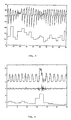
- Fig. 1 above 50 seconds of the flow curve of a patient in the sleep stage NREM 2 are shown.
- the lower graph shows the estimated first derivative of the flux curve. Between the two curves, the times automatically detected here are marked by vertical lines.
- the upper graph shown in FIG. 1 shows a respiratory gas flow curve of a patient in the NREM 2 sleep stage.
- the high vertical line of the middle graphene marks the end of the inspiration, the low vertical line marks the beginning of the inspiration.
- the first derivative of the flux curve from which the end and the beginning of the inspiration can be detected is shown as the lower graph. Due to the different extreme values of the first derivative of the respiratory gas flow curve, a distinction can be reliably made between the individual respiratory phases.
- FIG. 2 by way of example, a 50-second section from a respiratory flow curve of a patient in the NREM 2 is shown above. In the middle a selected breath is shown. The lower curve shows the correlation between the data series above and the individual breathing pattern. The correlation curve has values between 1 and -1, where the correlation becomes equal to 1 when the two breaths match each other and become equal to -1 when the curves are negatively correlated with each other, ie when a peak in the respiratory pattern is exactly one valley in the corresponds to the considered data piece.
- the correlation curve On the basis of the correlation curve it can be recognized whether 1. the breathing is regular, and whether, 2. breaths are completely absent. If the successive breathing patterns are similar, then the correlation curve has a periodic history with local maxima near 1 and local minima near -1.
- the difference to 1 is calculated at each local maximum and averaged over all the values thus obtained.
- This mean between 0 and 1, can be used as a measure of how well the breathing pattern matches past breathing cycles.
- Fig. 3 the respiratory flow curve of a patient in NREM 2 sleep can be seen at the top.
- the data below shows the mean deviation of the correlation maxima from 1.
- Fig. 4 corresponds basically to Fig. 3, but the flux curve here comes from the REM sleep stage.
- the comparison of the mean correlation maxima according to FIG. 3 and FIG. 4 shows that the mean difference of the correlation maxima to 1 in the REM sleep stage is significantly greater.
- the detection of snoring can be determined based on the variance of CPAP pressure in one breath, according to a particularly preferred embodiment of the invention.
- Figure 5 shows an excerpt from a respiratory signal, below which is the corresponding CPAP pressure.
- the curve below shows the variance of CPAP pressure per breath pressure. The variance increases significantly when the CPAP signal is altered by snoring of the patient.
- the most advantageous evaluable data are the inspiration time, the expiration time, the maximum flow during inspiration, the maximum flow during expiration, the inspiratory volume and the expiratory volume.
- the flow-limited breathing can be recognized on the basis of the inspiratory volume or also based on the relative change in the maximum inspiratory flow. Knowing the approximate start and end times of inspiration, one can determine the point of maximum inspiration. If this point in time is in the first half of the inspiration, it can be concluded with a high statistical probability of a flow-limited inspiration and a corresponding correction of the ventilation pressure to be caused.
- Cheyne Stoke's respiration is the periodic course of the respiration, which is reflected in a periodic course of the inspiratory volume and can hereby be distinguished from the other non-stable respiratory patterns.
- the correlation curve can be used in a particularly advantageous manner to control the detection of the points in time of the beginning and end of inspiration, since a local maximum in the correlation curve represents a characteristic with high statistical reliability for a breath.
Landscapes
- Health & Medical Sciences (AREA)
- Life Sciences & Earth Sciences (AREA)
- General Health & Medical Sciences (AREA)
- Engineering & Computer Science (AREA)
- Anesthesiology (AREA)
- Biomedical Technology (AREA)
- Heart & Thoracic Surgery (AREA)
- Pulmonology (AREA)
- Hematology (AREA)
- Animal Behavior & Ethology (AREA)
- Emergency Medicine (AREA)
- Public Health (AREA)
- Veterinary Medicine (AREA)
- Measurement Of The Respiration, Hearing Ability, Form, And Blood Characteristics Of Living Organisms (AREA)
- Investigating Or Analysing Biological Materials (AREA)
- Measuring Pulse, Heart Rate, Blood Pressure Or Blood Flow (AREA)
- Percussion Or Vibration Massage (AREA)
Description
- Die Erfindung betrifft eine Vorrichtung zur Erfassung der Atmungstätigkeit einer Person sowie zur Steuerung des zeitlichen Verlaufes des Druckes von Atemgas gemäß dem Oberbegriff von Patentanspruch 1.
- Auf Grundlage einer CPAP-Therapie ist es möglich, schlafbezogenen Atmungsstörungen auf physiologisch gut verträgliche Weise vorzubeugen.
- Durch die Zufuhr des Atemgases unter einem gegenüber dem Umgebungsdruck definiert angehobenen Druckniveau wird es möglich, eine pneumatische Schienung der oberen Atemwege zu erreichen, wodurch auf wirkungsvolle Weise etwaigen Obstruktionen in diesem Bereich vorgebeugt werden kann oder zumindest im Rahmen einer vorübergehenden Verengung der Atemwege eine ausreichende Sauerstoffversorgung des Patienten sichergestellt ist. Im Hinblick auf eine möglichst hohe physiologische Verträglichkeit wird allgemein ein möglichst niedriges Beatmungsdruckniveau, bei welchem eine ausreichende pneumatische Schienung der oberen Atemwege gewährleistet ist, angestrebt. Es hat sich gezeigt, daß dieser Druckpegel bei bestimmten Patienten erheblichen Schwankungen unterliegt. Um diesen Schwankungen des erforderlichen Therapiedruckes Rechnung zu tragen, sind Versuche mit sogenannten Auto-CPAP-Geräten unternommen worden, die beispielsweise beim Auftreten von Schnarchgeräuschen selbsttätig eine vorübergehende Erhöhung des Therapiedrucks vornehmen. Es sind auch CPAP-Geräte bekannt, bei welchen der zeitliche Verlauf des Atemgasstromes erfaßt wird und auf etwaige Anzeichen für eine Atemwegsobstruktion analysiert wird. Falls Anzeichen für eine Atemwegsobstruktion vorliegen, wird ebenfalls eine vorübergehende Anhebung des Therapiedruckes veranlaßt.
- Es sind auch Auto-CPAP-Geräte bekannt, bei welchen der momentane physiologische Zustand des Patienten dadurch bestimmt wird, daß auf das, über eine Atemgasleitung dem Patienten zugeführte Atemgas definierte Druckimpulse aufgebracht werden, wobei beispielsweise auf Grundlage einer hiermit einhergehenden Impedanzmessung Schlüsse auf den momentanen Obstruktionsgrad gezogen werden können.
- Aus
WO 97/28838 - Hinsichtlich der bislang zur Anwendung gelangten Druck-Regelungskonzepte zur selbsttätigen, patientenbezogenen Anpassung des Beatmungsdruckes besteht das Problem, daß die hierdurch veranlaßten Änderungen des Beatmungsdruckes von den betroffenen Patienten nur beschränkt akzeptiert werden. Zudem besteht das Problem, daß die bekannten Auto-CPAP-Systeme teilweise erst auf erhebliche Atmungsstörungen reagieren.
- Der Erfindung liegt die Aufgabe zugrunde, eine Vorrichtung zur Erfassung der Atmungstätigkeit sowie zur Vorgabe physikalischer Parameter bei der Zufuhr eines Atemgases zu einer Person zu schaffen, die eine präzisere Beurteilung des physiologischen Zustandes des Patienten ermöglicht.
- Diese Aufgabe wird erfindungsgemäß gelöst eine Vorrichtung gemäß Patentanspruch 1.
- Dadurch wird es auf vorteilhafte Weise möglich, eine extrem scharfe Klassifizierung der Atmungstätigkeit der atmenden Person vorzunehmen und hierauf basierend eine auf den physiologischen Zustand des Patienten präzise abgestimmte Einstellung des Beatmungsdruckes physiologisch gut verträgliche Weise vorzunehmen, ohne hierbei das natürliche Schlafverhalten zu stören. Die auf der präzisen Klassifizierung bzw. Detektion der Atmungstätigkeit basierende Drucksteuerung führt zu einer deutlich verbesserten Therapieakzeptanz und ermöglicht eine vorausschauende Anpassung des Beatmungsdruckes, durch welche mit hoher Wahrscheinlichkeit dem Eintritt etwaiger Atemwegsobstruktionen vorgebeugt werden kann.
- Auf Grundlage des erfindungsgemäßen Beurteilungskonzeptes wird es auf vorteilhafte Weise möglich, sicherzustellen, daß der durch ein entsprechendes CPAP-Gerät eingestellte Atemgasdruck mit hoher Zuverlässigkeit und ohne besonderen Diagnoseaufwand patientenspezifisch festgelegt werden kann. Durch das erfindungsgemäße Beurteilungskonzept wird es zudem möglich, von einer aktiven Änderung des Beatmungsdruckes, wie sie bislang zur Überwachung des physiologischen Zustands des Patienten erforderlich war, abzusehen und den physiologischen Zustand des Patienten mit hoher Zuverlässigkeit ohne willkürlich hervorgerufene Druckexperimente zu ermitteln.
- Erfindungsgemäß ist die Länge der ersten Zeitspanne zur Ermittlung der Referenzbeziehung derart bemessen, daß diese sich über wenigstens zwei Atemzyklen erstreckt. Es ist möglich, die Generierung der Referenzbeziehung durch ein Kriterienfeld zu definieren. Dieses Kriterienfeld enthält vorzugsweise mehrere Einträge, durch welche festgelegt ist, wie die Referenzbeziehung aus den erfaßten ersten und zweiten Signalen gebildet wird. Beispielsweise ist es möglich, für bestimmte Eigenschaften der Referenzbeziehung die über einen längeren Zeitraum erfaßten ersten und zweiten Signale auszuwerten, wogegen für andere Eigenschaften der Referenzbeziehung kürzere Beobachtungszeiträume gewählt sind.
- Gemäß einer besonders bevorzugten Ausführungsform der Erfindung ist wenigstens eine Filtereinrichtung vorgesehen, zum Filtern des ersten und/oder zweiten Signales auf Grundlage eines vorbestimmten Frequenzbereiches. Hierdurch wird es möglich, bestimmte erfassungsbedingte Rauscheinflüsse weitgehend auszuschalten.
- Gemäß einer weiteren besonders bevorzugten Ausführungsform der Erfindung umfaßt die Signalverarbeitungseinrichtung wenigstens eine Glättungseinrichtung zur Glättung der Referenzbeziehung unter Anwendung vorgegebener Glättungskriterien. Diese Glättungskriterien können gemäß einer besonders bevorzugten Ausführungsform der Erfindung adaptiv abgestimmt werden. Es ist auch möglich, für bestimmte Atmungszustände vorbestimmte Glättungskriterien auszuwählen, oder die Glättungskriterien auf den momentan erfaßten Atmungszustand abzustimmen.
- Vorzugsweise werden auch die Parameter der Filtereinrichtung adaptiv abgestimmt. Das Adaptionsverhalten kann vorzugsweise durch Eingabe entsprechender Parameter festgelegt werden.
- Die Signalverarbeitungseinrichtung umfasst vorzugsweise eine Zähleinrichtung zum Zählen der Erfüllung vorbestimmter Kriterien innerhalb vorbestimmter Zeitspannen. Die Zeitspannen können ggf. auf den momentanen Atmungszustand variabel abgestimmt werden.
- Die Erfassung der hinsichtlich des Atemgasdruckes indikativen Parameter kann beispielsweise über einen Drucksensor erfolgen, der in ein entsprechendes CPAP-Gerät integriert ist und beispielsweise über eine Meßschlauchleitung den statischen Druck im Bereich einer am Patienten applizierten Atemmaske erfaßt. Die hinsichtlich des Atemgasstromes indikativen zweiten Signale können beispielsweise über eine Meßblendenanordnung ermittelt werden, die in einem Atemgasversorgungsweg eingesetzt ist.
- Durch die erfindungsgemäß vorgeschlagene Vorrichtung, bzw. auf Grundlage des durch diese Vorrichtung apparativ verwirklichten Analyseverfahrens wird eine robuste Detektion der einzelnen Atemzüge der atmenden Person möglich. In vorteilhafterweise erfolgt der Übergang aus der Inspirationsphase in die Expirationsphase über ein ausgeprägte Flanke, auf deren Grundlage eine sichere Erkennung einzelner Atemzüge ermöglicht wird. In vorteilhafter Weise kann die erste zeitliche Ableitung der Atemgasflußkurve geschätzt werden. Die lokalen Extrema der geschätzten ersten Ableitung entsprechen der maximalen Steigung des Atemflusses beim Übergang zwischen Inspiration und Expiration. Von der Exspiration aus wird der Anfang der Inspiration gesucht, indem eine Suche der vorhergehenden Extrema aus der geschätzten zweiten Ableitung erfolgt. Weitere vorteilhafte Ausgestattungen der Erfindung sind Gegenstand der Unteransprüche.
- Die Länge der ersten Zeitspanne ist vorzugsweise derart bemessen, daß sich diese über wenigstens zwei Atemzyklen erstreckt. Vorzugsweise ist eine zweite Einrichtung vorgesehen ist zur Bereitstellung eines hinsichtlich des dynamischen und/oder statischen Atemgasdruckes indikativen zweiten Signales. In vorteilhafter Weise ist wenigstens eine Filtereinrichtung vorgesehen, zur Filterung oder Dämpfung der ersten und/oder zweiten Signale.
- Die Signalverarbeitungseinrichtung umfasst vorzugsweise eine Glättungseinrichtung, zur Glättung der Referenzbeziehung unter Anwendung ausgewählter Glättungskriterien. Die Glättungskriterien werden vorzugsweise adaptiv verändert. Die Signalverarbeitungseinrichtung umfaßt vorzugsweise eine Glättungseinrichtung zur Glättung oder Dämpfung der Referenzbeziehung.
- Wenigstens eine der genannten Glättungseinrichtungen ist vorzugsweise derart ausgebildet, daß diese eine Glättung auf Grundlage statistischer Ansätze vornimmt. Die Signalverarbeitungseinrichtung umfaßt vorzugsweise eine Schwellwertbetrachtungseinrichtung, zur Auswertung der Korrelationsbeziehung hinsichtlich Schwellwertkriterien, insbesondere Nulldurchgänge. Die Signalverarbeitungseinrichtung umfast in vorteilhafter Weise eine Zähleinrichtung, zum Zählen der Erfüllung vorbestimmter Kriterien innerhalb einer vorbestimmten Zeitspanne. Die Filter- und/oder Glättungsparameter werden vorzugsweise adaptiv angepaßt.
- Weitere Einzelheiten und Merkmale ergeben sich aus der nachfolgenden Beschreibung in Verbindung mit der Zeichnung. Es zeigen:
- Fig. 1:
- Oben: Datenausschnitt aus der Flußkurve eines Patienten in NREM 2.
Mitte: Die hohe vertikale Linie markiert das Ende der Inspiration, die niedrige vertikale Linie markiert den Beginn der Inspiration.
Unten: Erste Ableitung der Flußkurve anhand der das Ende und der Anfang der Inspiration detektiert werden können; - Fig. 2:
- Oben: Datenausschnitt aus der Flußkurve eines Patienten im NREM 2.
Mitte: Der letzte Atemzyklus aus der oberen Datenreihe wurde als Referenzbeziehung für das Atemflußmuster ausgewählt.
Unten: Korrelation zwischen dem Datenstück oben (Referenz-beziehung) und dem Atemflußmuster in der Mitte. - Fig. 3:
- Oben: Datenausschnitt aus der Flußkurve eines Patienten im
NREM 2.
Unten: Mittlere Abweichung der Korrelationsmaxima von 1. - Fig. 4:
- Oben: Datenausschnitt aus der Flußkurve eines Patienten im REM.
Unten: Mittlere Abweichung der Korrelationsmaxima von 1. - Fig. 5:
- Oben: Datenausschnitt aus der Flußkurve eines Patienten.
Mitte: Zugehörige CPAP-Druckkurve.
Unten: Varianz des CPAP-Signals pro Atemzug. - In Fig. 1 sind oben 50 Sekunden der Flußkurve eines Patienten im Schlafstadium NREM 2 dargestellt. Die untere Kurve zeigt die geschätzte erste Ableitung der Flußkurve. Zwischen den beiden Kurven sind die hierbei automatisch detektierten Zeitpunkte durch vertikale Linien markiert.
- Zur Unterscheidung zwischen stabiler und nichtstabiler Atmung wird ein Maß für die Ähnlichkeit mehrerer aufeinanderfolgender Atemzyklen betrachtet. Als Maß für die Ähnlichkeit eignet sich hierfür die Höhe einer Kreuzkorrelationsfunktion des aktuellen Atemzyklus mit den vorhergehenden Atemzyklen. Der in Fig.1 dargestellte obere Graph zeigt hierbei eine Atemgas-Flußkurve eines Patienten im NREM 2-Schlafstadium. Die hohe vertikale Linie des mittleren Graphens markiert das Ende der Inspiration, die niedrige vertikale Linie markiert den Beginn der Inspiration. Die erste Ableitung der Flußkurve anhand der das Ende und der Anfang der Inspiration detektiert werden können ist als unterer Graph dargestellt. Aufgrund der unterschiedlichen Extremwerte der ersten Ableitung der Atemgasflusskurve kann zuverlässig zwischen den einzelnen Atemphasen unterschieden werden.
- In Fig. 2 ist oben beispielhaft ein 50-Sekunden-Ausschnitt aus einer Atemflußkurve eines Patienten im NREM 2 dargestellt. In der Mitte ist ein ausgewählter Atemzug abgebildet. In der unteren Kurve ist die Korrelation zwischen der Datenreihe oben und dem einzelnen Atemmuster gezeigt. Die Korrelationskurve hat Werte zwischen 1 und -1, wobei die Korrelation gleich 1 wird, wenn die beiden Atemzüge genau aufeinander passen und gleich -1 werden, wenn die Kurven negativ miteinander korreliert sind, d.h., wenn eine Spitze im Atemmuster genau mit einem Tal im betrachteten Datenstück übereinstimmt.
- Anhand der Korrelationskurve ist erkennbar, ob 1. die Atmung regelmäßig ist, und ob, 2. Atemzüge ganz fehlen. Wenn die aufeinanderfolgenden Atemmuster ähnlich sind, dann hat die Korrelationskurve einen periodischen Verlauf mit lokalen Maxima nahe bei 1 und lokalen Minima nahe bei -1.
- In der in Fig. 2 dargestellten Korreiationskurve wird hierbei an jedem lokalen Maximum die Differenz zu 1 berechnet und über alle so erhaltenen Werte gemittelt. Dieser zwischen 0 und 1 liegendende Mittelwert kann als Maß dafür verwendet werden, wie gut das Atemmuster mit den vergangenen Atemzyklen übereinstimmt.
- In Fig. 3 ist oben die Atemflußkurve eines Patienten im NREM 2-Schlaf zu sehen. In der Datenreihe unten ist die mittlere Abweichung der Korrelationsmaxima von 1 dargestellt.
- Fig. 4 entspricht im Grunde Fig. 3, jedoch stammt die Flußkurve hier aus dem REM-Schlafstadium. Der Vergleich der mittleren Korrelationsmaxima nach Fig. 3 und Fig. 4 zeigt, daß die mittlere Differenz der Korrelationsmaxima zu 1 im REM-Schlafstadium deutlich größer ist.
- Die nachfolgende Tabelle zeigt, welche Gruppe von Atemzuständen sich mit dem vorangehend beschriebenen Ähnlichkeitsmaß unterscheiden lassen.
Stabile Atmung Nichtstabile Atmung Normalatmung in Ruhe Irreguläre Atmung im REM Atmung mit Schnarchen Obstruktive Apnoe Mundatmung Wachatmung Periodische Atmung mit Flußlimitation Cheyne Stoke'sche Atmung Gedämpftes Atemflußsignal - Die Detektion von Schnarchen kann gemäß einer besonders bevorzugten Ausführungsform der Erfindung auf Grundlage der Varianz des CPAP-Druckes in einem Atemzug ermittelt werden. In Abbildung 5 ist oben ein Ausschnitt aus einem Atemflußsignal dargestellt, darunter ist der zugehörige CPAP-Druck abgebildet. In der darunterliegenden Kurve ist die Varianz des CPAP-Druckes pro Atemdruck zu sehen. Die Varianz nimmt deutlich zu, wenn das CPAP-Signal durch Schnarchen des Patienten verändert wird.
- Auf Grundlage der durch das erfindungsgemäße Konzept zuverlässig detektierten Zeitpunkte für den Anfang und das Ende der Inspiration, können weitere wichtige Merkmale für die Unterscheidung von Atemzuständen gewonnen werden. Besonders vorteilhaft auswertbare Angaben sind hierbei die Inspirationszeit, die Expirationszeit, der maximale Fluß während der Inspiration, der maximale Fluß während der Expiration, das Inspirationsvolumen und das Expirationsvolumen.
- Artefakte durch Mundatmung können in besonders vorteilhafter Weise zuverlässig erfaßt werden, da in diesem Falle eine negative Korrelation existiert. Obstruktive Apnoen können dadurch erfaßt werden, daß bestimmte Korrelationspeaks deutlich abgeschwächt sind, oder im Regelfall vollständig fehlen.
- Sofern die Inspiration flußlimittiert ist, kann auf Grundlage des der Erfindung zugrundeliegenden Konzeptes die flußlimittierte Atmung anhand des Inspirationsvolumens oder auch anhand der relativen Änderung des maximalen Inspirationsflusses erkannt werden. Wenn man den ungefähren Anfangs- und Endzeitpunkt der Inspiration kennt, kann man den Zeitpunkt der maximalen Inspiration bestimmen. Wenn dieser Zeitpunkt in der ersten Hälfte der Inspiration liegt, kann mit hoher statistischer Wahrscheinlichkeit auf eine flußlimittierte Inspiration geschlossen werden und eine entsprechende Korrektur des Beatmungsdruckes veranlaßt werden.
- Charakteristisch für die Cheyne Stoke'sche Atmung ist der periodische Verlauf der Atmung, der sich in einem periodischen Verlauf des Inspirationsvolumens wiederspiegelt und sich hiermit von den anderen nichtstabilen Atemmustern unterscheiden läßt.
- Die Korrelationskurve kann in besonders vorteilhafter Weise zur Kontrolle der Detektion der Zeitpunkte des Inspirationsbeginns und -endes verwendet werden, da ein lokales Maxima in der Korrelationskurve ein mit hoher statistischer Sicherheit aussagefähiges Merkmal für einen Atemzug darstellt.
- Auf Grundlage des der erfindungsgemäßen Vorrichtung zugrundeliegenden Analysekonzeptes wird es möglich, mit statistisch hoher Sicherheit einzelne Atemzüge zu erkennen und weitreichende Rückschlüsse auf den momentanen Zustand des Patienten zu ziehen. Durch die so gewonnenen Informationen wird es möglich, den Therapiedruck vorausschauend und unter vergleichsweise geringen Änderungsgradienten auf die physiologischen Bedürfnisse des Patienten abzustimmen. Hierdurch wird eine besonders hohe Therapieakzeptanz erreicht.
Claims (9)
- Vorrichtung zur Erfassung der Atmungstätigkeit einer Person mit wenigstens einer ersten Einrichtung zur Bereitstellung eines hinsichtlich eines Atemgasstromes v indikativen ersten Signals, und
wenigstens einer Signalverarbeitungseinrichtung zur Verarbeitung des ersten Signals;
wobei die Signalverarbeitungseinrichtung derart ausgebildet ist, daß diese eine Korrelationsbeziehung zwischen einer Referenzbeziehung und dem ersten Signal ermittelt und
auf Grundlage einer Betrachtung wenigstens der Korrelationsbeziehung ein für die Atmungstätigkeit oder den physiologischen Zustand der atmenden Person, indikatives Ausgangssignal erzeugt und die Atemgasdrucksteuerung hierauf abstimmt, dadurch gekennzeichnet, dass die Signalverarbeitungseinrichtung jene Referenzbeziehung auf Grundlage des über eine erste Zeitspanne erfassten ersten Signals ermittelt, und dass die Länge der ersten Zeitspanne derart bemessen ist, dass sich diese über wenigstens zwei Atemzyklen erstreckt. - Vorrichtung nach Anspruch 1, dadurch gekennzeichnet, dass eine zweite Einrichtung vorgesehen ist zur Bereitstellung eines hinsichtlich des dynamischen und/oder statischen Atemgasdruckes indikativen zweiten Signales.
- Vorrichtung nach Anspruch 1 oder 2, dadurch gekennzeichnet, dass die Signalverarbeitungseinrichtung derart konfiguriert ist, dass die Generierung der Referenzbeziehung durch ein Kriterienfeld erfolgt wobei dieses Kriterienfeld mehrere Einträge enthält, durch welche festgelegt ist, wie die Referenzbeziehung aus den erfassten ersten und zweiten Signalen gebildet wird.
- Vorrichtung nach Anspruch 1, dadurch gekennzeichnet, dass die Signalverarbeitungseinrichtung derart konfiguriert ist, dass für bestimmte Eigenschaften der Referenzbeziehung die erfassten ersten und zweiten Signale über einen längeren Zeitraum ausgewertet werden, wogegen für andere Eigenschaften der Referenzbeziehung kürzere Beobachtungszeiträunie gewählt sind.
- Vorrichtung nach wenigstens einem der Ansprüche 1 oder 2, dadurch gekennzeichnet, dass wenigstens eine Filtereinrichtung vorgesehen ist, zur Filterung oder Dämpfung der ersten und/oder zweiten Signale.
- Vorrichtung nach wenigstens einem der Ansprüche 1 bis 5, dadurch gekennzeichnet, dass die Signalverarbeitungseinrichtung eine Glättungseinrichtung umfaßt, zur Glättung der Referenzbeziehung unter Anwendung ausgewählter Glättungskriterien.
- Vorrichtung nach Anspruch 6, dadurch gekennzeichnet, dass die Signalverarbeitungseinrichtung derart konfiguriert ist, dass die Glättungskriterien adaptiv verändert werden.
- Vorrichtung nach wenigstens einem der Ansprüche 6 oder 7, sofern rückbezogen auf Anspruch 5, dadurch gekennzeichnet, dass die Signalverarbeitungseinrichtung derart konfiguriert ist, dass Filter parameter adaptiv angepaßt werden.
- Vorrichtung nach wenigstens einem der Ansprüche 6 bis 8, dadurch gekennzeichnet, dass die Signalverarbeitungseinrichtung derart konfiguriert ist, dass Glättungsparameter adaptiv angepaßt werden.
Applications Claiming Priority (3)
| Application Number | Priority Date | Filing Date | Title |
|---|---|---|---|
| DE10031079A DE10031079A1 (de) | 2000-06-30 | 2000-06-30 | Vorrichtung zur Erfassung der Atmungsstätigkeit einer Person sowie Vorrichtung zur Vorgabe physikalischer Parameter bei der Zufuhr eines Atemgases |
| DE10031079 | 2000-06-30 | ||
| PCT/EP2001/007574 WO2002000283A1 (de) | 2000-06-30 | 2001-07-02 | Vorrichtung zur erfassung der atmungstätigkeit einer person |
Publications (2)
| Publication Number | Publication Date |
|---|---|
| EP1294426A1 EP1294426A1 (de) | 2003-03-26 |
| EP1294426B1 true EP1294426B1 (de) | 2007-06-27 |
Family
ID=7646843
Family Applications (1)
| Application Number | Title | Priority Date | Filing Date |
|---|---|---|---|
| EP01962819A Expired - Lifetime EP1294426B1 (de) | 2000-06-30 | 2001-07-02 | Vorrichtung zur Erfassung der Atmungstätigkeit einer Person |
Country Status (6)
| Country | Link |
|---|---|
| US (3) | US7089936B2 (de) |
| EP (1) | EP1294426B1 (de) |
| AT (1) | ATE365570T1 (de) |
| AU (1) | AU2001283919A1 (de) |
| DE (3) | DE10031079A1 (de) |
| WO (1) | WO2002000283A1 (de) |
Families Citing this family (84)
| Publication number | Priority date | Publication date | Assignee | Title |
|---|---|---|---|---|
| DE10031079A1 (de) | 2000-06-30 | 2002-02-07 | Map Gmbh | Vorrichtung zur Erfassung der Atmungsstätigkeit einer Person sowie Vorrichtung zur Vorgabe physikalischer Parameter bei der Zufuhr eines Atemgases |
| AU9320301A (en) | 2000-09-28 | 2002-04-08 | Invacare Corp | Carbon dioxide-based bi-level cpap control |
| DE10118475B4 (de) * | 2001-04-12 | 2007-08-16 | Map Medizin-Technologie Gmbh | Steuerungseinrichtung zur Vorgabe eines Atemgasdruckes |
| DE10118968B4 (de) * | 2001-04-18 | 2007-03-01 | The Scientific Consulting Group Gmbh | Verfahren zum Steuern des Solldrucks eines Geräts zur Durchführung der CPAP-Therapie sowie ein Gerät zur Durchführung der CPAP-Therapie |
| DE10161057A1 (de) * | 2001-12-12 | 2003-07-10 | Heptec Gmbh | Verfahren zur Steuerung des Differenzdrucks in einem CPAP-Gerät sowie CPAP-Gerät |
| US7661426B2 (en) * | 2002-11-19 | 2010-02-16 | Michael Lauk | Method for controlling the pressure supplied by a CPAP device, CPAP device and storage medium |
| US7189204B2 (en) | 2002-12-04 | 2007-03-13 | Cardiac Pacemakers, Inc. | Sleep detection using an adjustable threshold |
| US6949075B2 (en) * | 2002-12-27 | 2005-09-27 | Cardiac Pacemakers, Inc. | Apparatus and method for detecting lung sounds using an implanted device |
| US20050080348A1 (en) | 2003-09-18 | 2005-04-14 | Stahmann Jeffrey E. | Medical event logbook system and method |
| US6954702B2 (en) * | 2003-02-21 | 2005-10-11 | Ric Investments, Inc. | Gas monitoring system and sidestream gas measurement system adapted to communicate with a mainstream gas measurement system |
| US7152598B2 (en) | 2003-06-23 | 2006-12-26 | Invacare Corporation | System and method for providing a breathing gas |
| US7621270B2 (en) | 2003-06-23 | 2009-11-24 | Invacare Corp. | System and method for providing a breathing gas |
| AU2004261207B2 (en) * | 2003-07-28 | 2011-02-17 | Salter Labs, Llc | Respiratory therapy system including a nasal cannula assembly |
| US6988994B2 (en) | 2003-08-14 | 2006-01-24 | New York University | Positive airway pressure system and method for treatment of sleeping disorder in patient |
| US7896812B2 (en) | 2003-08-14 | 2011-03-01 | New York University | System and method for diagnosis and treatment of a breathing pattern of a patient |
| US8606356B2 (en) | 2003-09-18 | 2013-12-10 | Cardiac Pacemakers, Inc. | Autonomic arousal detection system and method |
| US7720541B2 (en) | 2003-08-18 | 2010-05-18 | Cardiac Pacemakers, Inc. | Adaptive therapy for disordered breathing |
| US7610094B2 (en) | 2003-09-18 | 2009-10-27 | Cardiac Pacemakers, Inc. | Synergistic use of medical devices for detecting medical disorders |
| US7510531B2 (en) | 2003-09-18 | 2009-03-31 | Cardiac Pacemakers, Inc. | System and method for discrimination of central and obstructive disordered breathing events |
| US7887493B2 (en) | 2003-09-18 | 2011-02-15 | Cardiac Pacemakers, Inc. | Implantable device employing movement sensing for detecting sleep-related disorders |
| US7662101B2 (en) | 2003-09-18 | 2010-02-16 | Cardiac Pacemakers, Inc. | Therapy control based on cardiopulmonary status |
| EP2008581B1 (de) | 2003-08-18 | 2011-08-17 | Cardiac Pacemakers, Inc. | Patientenüberwachungs-, Diagnose- und/oder Therapiesysteme und -verfahren |
| US8002553B2 (en) | 2003-08-18 | 2011-08-23 | Cardiac Pacemakers, Inc. | Sleep quality data collection and evaluation |
| US7572225B2 (en) | 2003-09-18 | 2009-08-11 | Cardiac Pacemakers, Inc. | Sleep logbook |
| US7575553B2 (en) | 2003-09-18 | 2009-08-18 | Cardiac Pacemakers, Inc. | Methods and systems for assessing pulmonary disease |
| US10154811B2 (en) * | 2003-09-03 | 2018-12-18 | Resmed R&D Germany Gmbh | Detection appliance and method for observing sleep-related breathing disorders |
| DE102004014538A1 (de) * | 2004-03-23 | 2005-10-13 | Seleon Gmbh | Verfahren zur Steuerung eines BiLevel-Geräts sowie BiLevel-Gerät |
| US7630755B2 (en) | 2005-05-04 | 2009-12-08 | Cardiac Pacemakers Inc. | Syncope logbook and method of using same |
| US8528551B2 (en) | 2005-06-14 | 2013-09-10 | Resmed Limited | Acclimatization therapy for first time users |
| DE102006032620B3 (de) * | 2006-07-13 | 2007-11-22 | Hoffrichter Gmbh | Beatmungsgerät zur Behandlung von obstruktiver Schlafapnoe und Verfahren zu dessen Steuerung |
| US20080060647A1 (en) * | 2006-09-12 | 2008-03-13 | Invacare Corporation | System and method for delivering a breathing gas |
| WO2008037020A1 (en) * | 2006-09-27 | 2008-04-03 | Resmed Ltd | Methods and apparatus for assessing sleep quality |
| KR101397207B1 (ko) * | 2007-06-12 | 2014-05-20 | 삼성전자주식회사 | 이동 통신 시스템에서 공통제어채널 송수신 방법 및 장치 |
| US20090020122A1 (en) * | 2007-07-16 | 2009-01-22 | Helmut Hoffrichter | Respiratory device for treating obstructive sleep apnea and method for controlling said device |
| WO2009026582A1 (en) | 2007-08-23 | 2009-02-26 | Invacare Corporation | Method and apparatus for adjusting desired pressure in positive airway pressure devices |
| US8746248B2 (en) | 2008-03-31 | 2014-06-10 | Covidien Lp | Determination of patient circuit disconnect in leak-compensated ventilatory support |
| EP2313138B1 (de) | 2008-03-31 | 2018-09-12 | Covidien LP | System und verfahren zur bestimmung von lecks in beatmungsgeräten während stabiler phasen innerhalb eines atemzugs |
| US8267085B2 (en) | 2009-03-20 | 2012-09-18 | Nellcor Puritan Bennett Llc | Leak-compensated proportional assist ventilation |
| US8272380B2 (en) | 2008-03-31 | 2012-09-25 | Nellcor Puritan Bennett, Llc | Leak-compensated pressure triggering in medical ventilators |
| US8457706B2 (en) | 2008-05-16 | 2013-06-04 | Covidien Lp | Estimation of a physiological parameter using a neural network |
| US20090306528A1 (en) * | 2008-06-06 | 2009-12-10 | Salter Labs | Adaptive temperature sensor for breath monitoring device |
| JP2011522618A (ja) | 2008-06-06 | 2011-08-04 | サルター ラブス | 呼吸監視装置に適応可能な温度検出器 |
| US20090306529A1 (en) * | 2008-06-06 | 2009-12-10 | Salter Labs | Adaptive temperature sensor for breath monitoring device |
| US20100168600A1 (en) * | 2008-06-06 | 2010-07-01 | Salter Labs | Support structure for airflow temperature sensor and the method of using the same |
| WO2010021556A1 (en) * | 2008-08-19 | 2010-02-25 | Fisher & Paykel Healthcare Limited | Breathing transition detection |
| US8551006B2 (en) | 2008-09-17 | 2013-10-08 | Covidien Lp | Method for determining hemodynamic effects |
| US8302602B2 (en) | 2008-09-30 | 2012-11-06 | Nellcor Puritan Bennett Llc | Breathing assistance system with multiple pressure sensors |
| US8517017B2 (en) | 2009-01-08 | 2013-08-27 | Hancock Medical, Inc. | Self-contained, intermittent positive airway pressure systems and methods for treating sleep apnea, snoring, and other respiratory disorders |
| US8424521B2 (en) | 2009-02-27 | 2013-04-23 | Covidien Lp | Leak-compensated respiratory mechanics estimation in medical ventilators |
| US8418691B2 (en) | 2009-03-20 | 2013-04-16 | Covidien Lp | Leak-compensated pressure regulated volume control ventilation |
| WO2011006199A1 (en) * | 2009-07-16 | 2011-01-20 | Resmed Ltd | Detection of sleep condition |
| US8789529B2 (en) | 2009-08-20 | 2014-07-29 | Covidien Lp | Method for ventilation |
| US8676285B2 (en) | 2010-07-28 | 2014-03-18 | Covidien Lp | Methods for validating patient identity |
| US9592356B2 (en) | 2010-09-10 | 2017-03-14 | Koninklijke Philips N.V. | System and method for identifying breathing transitions |
| US8554298B2 (en) | 2010-09-21 | 2013-10-08 | Cividien LP | Medical ventilator with integrated oximeter data |
| DE102010055243B4 (de) * | 2010-12-20 | 2016-10-27 | Drägerwerk AG & Co. KGaA | Automatisch gesteuertes Beatmungsgerät |
| DE102010055253B4 (de) * | 2010-12-20 | 2016-11-10 | Drägerwerk AG & Co. KGaA | Automatisch gesteuertes Beatmungsgerät |
| US8327846B2 (en) | 2011-02-08 | 2012-12-11 | Hancock Medical, Inc. | Positive airway pressure system with head position control |
| US9089657B2 (en) | 2011-10-31 | 2015-07-28 | Covidien Lp | Methods and systems for gating user initiated increases in oxygen concentration during ventilation |
| US20130197387A1 (en) * | 2012-01-18 | 2013-08-01 | Rest Devices, Inc. | System and Method for Measuring Movement of a Body Part |
| US9993604B2 (en) | 2012-04-27 | 2018-06-12 | Covidien Lp | Methods and systems for an optimized proportional assist ventilation |
| US10362967B2 (en) | 2012-07-09 | 2019-07-30 | Covidien Lp | Systems and methods for missed breath detection and indication |
| US9027552B2 (en) | 2012-07-31 | 2015-05-12 | Covidien Lp | Ventilator-initiated prompt or setting regarding detection of asynchrony during ventilation |
| US10314989B2 (en) | 2013-01-28 | 2019-06-11 | Hancock Medical, Inc. | Position control devices and methods for use with positive airway pressure systems |
| US10010264B2 (en) | 2013-07-25 | 2018-07-03 | Shape Medical Systems, Inc. | Pattern recognition system for quantifying the likelihood of the contribution of multiple possible forms of chronic disease to patient reported dyspnea |
| US9675771B2 (en) | 2013-10-18 | 2017-06-13 | Covidien Lp | Methods and systems for leak estimation |
| WO2015148169A1 (en) * | 2014-03-28 | 2015-10-01 | Shape Medical Systems, Inc. | Pattern recognition system for quantifying the likelihood of the contribution of multiple possible forms of chronic disease to patient reported dyspnea |
| WO2016028525A1 (en) | 2014-08-18 | 2016-02-25 | Hancock Medical, Inc. | Portable pap device with humidification |
| US10112022B2 (en) | 2014-09-18 | 2018-10-30 | Devilbiss Healthcare Llc | Method for detecting an inspiratory flow limitation during sleep-disordered breathing |
| US9950129B2 (en) | 2014-10-27 | 2018-04-24 | Covidien Lp | Ventilation triggering using change-point detection |
| USD776802S1 (en) | 2015-03-06 | 2017-01-17 | Hancock Medical, Inc. | Positive airway pressure system console |
| JP6480598B2 (ja) | 2015-04-02 | 2019-03-13 | ヒル−ロム サービシーズ プライヴェート リミテッド | 呼吸装置用マニホールド |
| JP6815069B2 (ja) * | 2015-07-28 | 2021-01-20 | 日本光電工業株式会社 | 波形解析方法、波形解析装置、波形解析プログラム、及び波形解析プログラムが記憶されたコンピュータ読取可能な記憶媒体 |
| US11298074B2 (en) | 2015-12-08 | 2022-04-12 | Fisher & Paykel Healthcare Limited | Flow-based sleep stage determination |
| DE102016206442A1 (de) * | 2016-04-15 | 2017-10-19 | Hamilton Medical Ag | Beatmungsgerät mit verbesserter Synchronität beim Übergang von exspiratorischem zu inspiratorischem Betrieb |
| EP3457926A4 (de) | 2016-05-19 | 2020-09-09 | Hancock Medical, Inc. | System zur erkennung von positionsbedingter obstruktiver schlafapnoe |
| EP3537961B1 (de) | 2016-11-10 | 2025-06-25 | The Research Foundation for The State University of New York | System, verfahren und biomarker für verstopfungen der atemwege |
| US11154214B2 (en) | 2017-04-14 | 2021-10-26 | Shape Medical Systems, Inc. | Gas exchange systems and methods for calculating ventilatory threshold and evaluating pulmonary arterial hypertension |
| EP3793656A1 (de) | 2018-05-14 | 2021-03-24 | Covidien LP | Systeme und verfahren zur erfassung der atemleistung unter verwendung von signalverzerrung |
| US11752287B2 (en) | 2018-10-03 | 2023-09-12 | Covidien Lp | Systems and methods for automatic cycling or cycling detection |
| KR102797043B1 (ko) | 2018-10-23 | 2025-04-21 | 레스메드 피티와이 엘티디 | Cpap 시스템의 셋업을 위한 시스템 및 방법 |
| US11497439B2 (en) | 2019-03-05 | 2022-11-15 | Shape Medical Systems, Inc. | Pattern recognition system for classifying the functional status of patients with chronic heart, lung, and pulmonary vascular diseases |
| US11324954B2 (en) | 2019-06-28 | 2022-05-10 | Covidien Lp | Achieving smooth breathing by modified bilateral phrenic nerve pacing |
| EP4197576A1 (de) * | 2021-12-20 | 2023-06-21 | Koninklijke Philips N.V. | Steuerung eines atemunterstützungssystems |
Family Cites Families (33)
| Publication number | Priority date | Publication date | Assignee | Title |
|---|---|---|---|---|
| FR1584980A (de) | 1968-01-23 | 1970-01-09 | ||
| DE6913203U (de) | 1969-04-01 | 1969-08-07 | Kaltenbach & Voigt | Technikhandstueck, insbesondere fuer zahnaerztliche zwecke |
| DE6921181U (de) | 1969-05-24 | 1969-12-11 | Albert Hoppe | Eis-zerkleinerer |
| US5199424A (en) * | 1987-06-26 | 1993-04-06 | Sullivan Colin E | Device for monitoring breathing during sleep and control of CPAP treatment that is patient controlled |
| US5134995A (en) * | 1989-05-19 | 1992-08-04 | Puritan-Bennett Corporation | Inspiratory airway pressure system with admittance determining apparatus and method |
| US5239995A (en) * | 1989-09-22 | 1993-08-31 | Respironics, Inc. | Sleep apnea treatment apparatus |
| US5148802B1 (en) * | 1989-09-22 | 1997-08-12 | Respironics Inc | Method and apparatus for maintaining airway patency to treat sleep apnea and other disorders |
| US5146918A (en) * | 1991-03-19 | 1992-09-15 | Medtronic, Inc. | Demand apnea control of central and obstructive sleep apnea |
| US5174287A (en) * | 1991-05-28 | 1992-12-29 | Medtronic, Inc. | Airway feedback measurement system responsive to detected inspiration and obstructive apnea event |
| US5458137A (en) * | 1991-06-14 | 1995-10-17 | Respironics, Inc. | Method and apparatus for controlling sleep disorder breathing |
| US5203343A (en) * | 1991-06-14 | 1993-04-20 | Board Of Regents, The University Of Texas System | Method and apparatus for controlling sleep disorder breathing |
| JP3566285B2 (ja) * | 1991-11-14 | 2004-09-15 | ユニバーシティー テクノロジーズ インターナショナル インコーポレイテッド | 自動cpapシステム |
| US5335654A (en) * | 1992-05-07 | 1994-08-09 | New York University | Method and apparatus for continuous adjustment of positive airway pressure for treating obstructive sleep apnea |
| US5490502A (en) | 1992-05-07 | 1996-02-13 | New York University | Method and apparatus for optimizing the continuous positive airway pressure for treating obstructive sleep apnea |
| US5438980A (en) * | 1993-01-12 | 1995-08-08 | Puritan-Bennett Corporation | Inhalation/exhalation respiratory phase detection circuit |
| DE69433051T2 (de) | 1993-11-05 | 2004-06-03 | Resmed Ltd., North Ryde | Sensor für Apnoe und Hindernis im Luftweg eines Atmungssystems |
| EP0661071B1 (de) * | 1993-12-01 | 2000-02-02 | Resmed Limited | Vorrichtung zur Erzeugung eines kontinuierlichen positiven Atemwegdruckes (CPAP) |
| AUPM279393A0 (en) * | 1993-12-03 | 1994-01-06 | Rescare Limited | Estimation of flow and detection of breathing in cpap treatment |
| US6105575A (en) * | 1994-06-03 | 2000-08-22 | Respironics, Inc. | Method and apparatus for providing positive airway pressure to a patient |
| US5483969A (en) * | 1994-09-21 | 1996-01-16 | Medtronic, Inc. | Method and apparatus for providing a respiratory effort waveform for the treatment of obstructive sleep apnea |
| DE19500529C5 (de) * | 1995-01-11 | 2007-11-22 | Dräger Medical AG & Co. KG | Bedieneinheit für ein Beatmungsgerät |
| DE19538473A1 (de) | 1995-10-16 | 1997-04-17 | Map Gmbh | Vorrichtung und Verfahren zur quantitativen Analyse von Schlafstörungen |
| DE19706092C2 (de) | 1997-02-17 | 2000-02-24 | Map Gmbh | Verfahren für das Schalten in die Ein- oder Ausatmungsphase bei einem CPAP-Therapiegerät |
| AUPP026997A0 (en) | 1997-11-07 | 1997-12-04 | Resmed Limited | Administration of cpap treatment pressure in presence of apnea |
| DE19752094C1 (de) * | 1997-11-25 | 1999-07-15 | Bundesrep Deutschland | Verfahren zur Bestimmung wenigstens einer diagnostischen Information aus Signalmustern medizinischer Sensorsysteme |
| DE19837656A1 (de) * | 1998-08-19 | 2000-02-24 | Map Gmbh | Verfahren und Vorrichtung für das Schalten in die Ein- oder Ausatmungsphase bei der CPAP-Therapie |
| AU5737399A (en) | 1998-08-19 | 2000-03-14 | Map Medizintechnik Fur Arzt Und Patient Gmbh & Co. Kg | Method and device for switching the inspiration or expiration phase during cpap therapy |
| DE19849571B4 (de) | 1998-10-27 | 2004-12-02 | Map Medizin-Technologie Gmbh | Beatmungsgerät zur Zufuhr eines Atemgases zu einem Patienten unter einem auf den Patienten abgestimmten Behandlungsdruck |
| AUPP693398A0 (en) | 1998-11-05 | 1998-12-03 | Resmed Limited | Fault diagnosis in CPAP and NIPPV devices |
| FR2793145B1 (fr) | 1999-05-04 | 2003-10-24 | Map Medizintechnik Fur Arzt Un | Dispositif pour l'amenee d'un gaz respiratoire en surpression et agencement de commande pour la commande de celui-ci |
| US6553992B1 (en) * | 2000-03-03 | 2003-04-29 | Resmed Ltd. | Adjustment of ventilator pressure-time profile to balance comfort and effectiveness |
| DE10031079A1 (de) | 2000-06-30 | 2002-02-07 | Map Gmbh | Vorrichtung zur Erfassung der Atmungsstätigkeit einer Person sowie Vorrichtung zur Vorgabe physikalischer Parameter bei der Zufuhr eines Atemgases |
| DE10118968B4 (de) | 2001-04-18 | 2007-03-01 | The Scientific Consulting Group Gmbh | Verfahren zum Steuern des Solldrucks eines Geräts zur Durchführung der CPAP-Therapie sowie ein Gerät zur Durchführung der CPAP-Therapie |
-
2000
- 2000-06-30 DE DE10031079A patent/DE10031079A1/de not_active Withdrawn
-
2001
- 2001-07-02 AT AT01962819T patent/ATE365570T1/de not_active IP Right Cessation
- 2001-07-02 DE DE50112667T patent/DE50112667D1/de not_active Expired - Lifetime
- 2001-07-02 US US10/070,346 patent/US7089936B2/en not_active Expired - Lifetime
- 2001-07-02 WO PCT/EP2001/007574 patent/WO2002000283A1/de not_active Ceased
- 2001-07-02 EP EP01962819A patent/EP1294426B1/de not_active Expired - Lifetime
- 2001-07-02 DE DE10192802T patent/DE10192802D2/de not_active Expired - Fee Related
- 2001-07-02 AU AU2001283919A patent/AU2001283919A1/en not_active Abandoned
-
2006
- 2006-06-19 US US11/454,835 patent/US7934500B2/en not_active Expired - Fee Related
-
2011
- 2011-03-23 US US13/064,412 patent/US8408205B2/en not_active Expired - Fee Related
Also Published As
| Publication number | Publication date |
|---|---|
| US7089936B2 (en) | 2006-08-15 |
| DE10031079A1 (de) | 2002-02-07 |
| US20020185131A1 (en) | 2002-12-12 |
| AU2001283919A1 (en) | 2002-01-08 |
| EP1294426A1 (de) | 2003-03-26 |
| DE50112667D1 (de) | 2007-08-09 |
| ATE365570T1 (de) | 2007-07-15 |
| US8408205B2 (en) | 2013-04-02 |
| DE10192802D2 (de) | 2003-11-13 |
| US20060272641A1 (en) | 2006-12-07 |
| WO2002000283A1 (de) | 2002-01-03 |
| US7934500B2 (en) | 2011-05-03 |
| US20110208082A1 (en) | 2011-08-25 |
Similar Documents
| Publication | Publication Date | Title |
|---|---|---|
| EP1294426A1 (de) | Vorrichtung zur Erfassung der Atmungstätigkeit einer Person | |
| EP1357967B1 (de) | Vorrichtung zur Zufuhr eines Atemgases | |
| DE69731899T2 (de) | Vorrichtung zum optimieren des kontinuierlichen positiven luftwegdrucks zum behandeln des atemstillstandes im schlaf bei verlegten atemwegen | |
| DE69318576T2 (de) | HILFSGERäT FüR DIE BEATMUNG, INSBESONDERE FüR DIE BEHANDLUNG DES SCHLAFATEMSTILLSTANDES | |
| DE69533708T2 (de) | System für die Optiemierung des kontinuierlichen, positiven Atemwegdrucks zur Behandlung des Atemstillstandes im Schlaf bei verlegten Atemwegen | |
| DE69721837T2 (de) | An die Bedürfnisse des Patienten angepasste künstliche Beatmung | |
| DE69034178T2 (de) | Drucksystem Für Atmungswege | |
| DE102004006396B4 (de) | Vorrichtung zur Beatmung sowie Verfahren zur Steuerung eines Beatmungsgerätes | |
| DE69434028T2 (de) | Regelung bei einer Behandlung mit kontinuierlichem positiven Atemwegsdruck | |
| DE69224745T2 (de) | Vorrichtung zur behebung von atemstörungen während des schlafes | |
| EP1727580B1 (de) | Verfahren zur steuerung eines bilevel-geräts sowie bilevel-gerät | |
| DE19540344A1 (de) | Respirationsgerät | |
| EP3769668A1 (de) | Atemzuganalysator, beatmungsgerät und verfahren zur atemzuganalyse | |
| DE102006052572B3 (de) | Verfahren und Beatmungseinrichtung zur druckunterstützten Spontanatmung | |
| DE102007011924A1 (de) | Verfahren und Vorrichtung zur Steuerung eines Beatmungsgerätes | |
| EP2989978B1 (de) | Beatmungsgerät zur detektion einer cheyene-strokes-atmung | |
| DE102007033047A1 (de) | Vorrichtung und Verfahren zur Erkennung von obstruktiven Ereignissen | |
| EP2162061B1 (de) | Nachweis einer apnoe mit blutdruckabhängig erfassten signalen | |
| DE10118968B4 (de) | Verfahren zum Steuern des Solldrucks eines Geräts zur Durchführung der CPAP-Therapie sowie ein Gerät zur Durchführung der CPAP-Therapie | |
| EP4004937A1 (de) | Vorrichtung zur unterstützenden beatmung eines lebewesens und computerprogramm | |
| DE10118475B4 (de) | Steuerungseinrichtung zur Vorgabe eines Atemgasdruckes | |
| EP3827859B1 (de) | Vorrichtung zur veränderung des atemgas-druckes in abhängigkeit von einem mass der herzleistung | |
| DE10253935B3 (de) | Verfahren zum Steuern des von einem CPAP-Gerät gelieferten Drucks, CPAP-Gerät sowie Speichermedium | |
| DE10164445B4 (de) | Vorrichtung zur Generierung eines hinsichtlich des physiologischen Zustands einer Person spezifischen Auswertungsresultats | |
| DE102017005629A1 (de) | Beatmungsgerät zur APAP-Beatmung |
Legal Events
| Date | Code | Title | Description |
|---|---|---|---|
| PUAI | Public reference made under article 153(3) epc to a published international application that has entered the european phase |
Free format text: ORIGINAL CODE: 0009012 |
|
| 17P | Request for examination filed |
Effective date: 20020703 |
|
| AK | Designated contracting states |
Kind code of ref document: A1 Designated state(s): AT BE CH CY DE DK ES FI FR GB GR IE IT LI LU MC NL PT SE TR |
|
| AX | Request for extension of the european patent |
Extension state: AL LT LV MK RO SI |
|
| 17Q | First examination report despatched |
Effective date: 20050422 |
|
| RAP1 | Party data changed (applicant data changed or rights of an application transferred) |
Owner name: MAP MEDIZIN-TECHNOLOGIE GMBH |
|
| RTI1 | Title (correction) |
Free format text: DEVICE FOR DETECTING THE RESPIRATORY ACTIVITY OF A PERSON |
|
| GRAP | Despatch of communication of intention to grant a patent |
Free format text: ORIGINAL CODE: EPIDOSNIGR1 |
|
| GRAS | Grant fee paid |
Free format text: ORIGINAL CODE: EPIDOSNIGR3 |
|
| GRAA | (expected) grant |
Free format text: ORIGINAL CODE: 0009210 |
|
| RIN1 | Information on inventor provided before grant (corrected) |
Inventor name: VOEGELE, HARALD Inventor name: JAKOBS, RAINER Inventor name: SCHNEIDER, HARTMUT Inventor name: MADAUS, STEFAN |
|
| AK | Designated contracting states |
Kind code of ref document: B1 Designated state(s): AT BE CH CY DE DK ES FI FR GB GR IE IT LI LU MC NL PT SE TR |
|
| REG | Reference to a national code |
Ref country code: GB Ref legal event code: FG4D Free format text: NOT ENGLISH |
|
| REG | Reference to a national code |
Ref country code: CH Ref legal event code: EP |
|
| REG | Reference to a national code |
Ref country code: IE Ref legal event code: FG4D Free format text: LANGUAGE OF EP DOCUMENT: GERMAN |
|
| REF | Corresponds to: |
Ref document number: 50112667 Country of ref document: DE Date of ref document: 20070809 Kind code of ref document: P |
|
| REG | Reference to a national code |
Ref country code: SE Ref legal event code: TRGR |
|
| GBT | Gb: translation of ep patent filed (gb section 77(6)(a)/1977) |
Effective date: 20070926 |
|
| ET | Fr: translation filed | ||
| NLV1 | Nl: lapsed or annulled due to failure to fulfill the requirements of art. 29p and 29m of the patents act | ||
| REG | Reference to a national code |
Ref country code: IE Ref legal event code: FD4D |
|
| BERE | Be: lapsed |
Owner name: MAP MEDIZIN-TECHNOLOGIE G.M.B.H. Effective date: 20070731 |
|
| PG25 | Lapsed in a contracting state [announced via postgrant information from national office to epo] |
Ref country code: ES Free format text: LAPSE BECAUSE OF FAILURE TO SUBMIT A TRANSLATION OF THE DESCRIPTION OR TO PAY THE FEE WITHIN THE PRESCRIBED TIME-LIMIT Effective date: 20071008 Ref country code: NL Free format text: LAPSE BECAUSE OF FAILURE TO SUBMIT A TRANSLATION OF THE DESCRIPTION OR TO PAY THE FEE WITHIN THE PRESCRIBED TIME-LIMIT Effective date: 20070627 Ref country code: IE Free format text: LAPSE BECAUSE OF FAILURE TO SUBMIT A TRANSLATION OF THE DESCRIPTION OR TO PAY THE FEE WITHIN THE PRESCRIBED TIME-LIMIT Effective date: 20070627 Ref country code: PT Free format text: LAPSE BECAUSE OF FAILURE TO SUBMIT A TRANSLATION OF THE DESCRIPTION OR TO PAY THE FEE WITHIN THE PRESCRIBED TIME-LIMIT Effective date: 20071127 |
|
| REG | Reference to a national code |
Ref country code: CH Ref legal event code: PL |
|
| PG25 | Lapsed in a contracting state [announced via postgrant information from national office to epo] |
Ref country code: LI Free format text: LAPSE BECAUSE OF NON-PAYMENT OF DUE FEES Effective date: 20070731 Ref country code: DK Free format text: LAPSE BECAUSE OF FAILURE TO SUBMIT A TRANSLATION OF THE DESCRIPTION OR TO PAY THE FEE WITHIN THE PRESCRIBED TIME-LIMIT Effective date: 20070627 Ref country code: GR Free format text: LAPSE BECAUSE OF FAILURE TO SUBMIT A TRANSLATION OF THE DESCRIPTION OR TO PAY THE FEE WITHIN THE PRESCRIBED TIME-LIMIT Effective date: 20070928 Ref country code: IT Free format text: LAPSE BECAUSE OF FAILURE TO SUBMIT A TRANSLATION OF THE DESCRIPTION OR TO PAY THE FEE WITHIN THE PRESCRIBED TIME-LIMIT Effective date: 20070627 Ref country code: MC Free format text: LAPSE BECAUSE OF NON-PAYMENT OF DUE FEES Effective date: 20070731 Ref country code: CH Free format text: LAPSE BECAUSE OF NON-PAYMENT OF DUE FEES Effective date: 20070731 |
|
| PLBE | No opposition filed within time limit |
Free format text: ORIGINAL CODE: 0009261 |
|
| STAA | Information on the status of an ep patent application or granted ep patent |
Free format text: STATUS: NO OPPOSITION FILED WITHIN TIME LIMIT |
|
| 26N | No opposition filed |
Effective date: 20080328 |
|
| PG25 | Lapsed in a contracting state [announced via postgrant information from national office to epo] |
Ref country code: BE Free format text: LAPSE BECAUSE OF NON-PAYMENT OF DUE FEES Effective date: 20070731 |
|
| PG25 | Lapsed in a contracting state [announced via postgrant information from national office to epo] |
Ref country code: AT Free format text: LAPSE BECAUSE OF NON-PAYMENT OF DUE FEES Effective date: 20070702 |
|
| PG25 | Lapsed in a contracting state [announced via postgrant information from national office to epo] |
Ref country code: FI Free format text: LAPSE BECAUSE OF FAILURE TO SUBMIT A TRANSLATION OF THE DESCRIPTION OR TO PAY THE FEE WITHIN THE PRESCRIBED TIME-LIMIT Effective date: 20070627 |
|
| PG25 | Lapsed in a contracting state [announced via postgrant information from national office to epo] |
Ref country code: CY Free format text: LAPSE BECAUSE OF FAILURE TO SUBMIT A TRANSLATION OF THE DESCRIPTION OR TO PAY THE FEE WITHIN THE PRESCRIBED TIME-LIMIT Effective date: 20070627 |
|
| PG25 | Lapsed in a contracting state [announced via postgrant information from national office to epo] |
Ref country code: LU Free format text: LAPSE BECAUSE OF NON-PAYMENT OF DUE FEES Effective date: 20070702 |
|
| PG25 | Lapsed in a contracting state [announced via postgrant information from national office to epo] |
Ref country code: TR Free format text: LAPSE BECAUSE OF FAILURE TO SUBMIT A TRANSLATION OF THE DESCRIPTION OR TO PAY THE FEE WITHIN THE PRESCRIBED TIME-LIMIT Effective date: 20070627 |
|
| REG | Reference to a national code |
Ref country code: DE Ref legal event code: R081 Ref document number: 50112667 Country of ref document: DE Owner name: RESMED R&D GERMANY GMBH, DE Free format text: FORMER OWNER: MAP MEDIZIN-TECHNOLOGIE GMBH, 82152 PLANEGG, DE Effective date: 20130221 Ref country code: DE Ref legal event code: R082 Ref document number: 50112667 Country of ref document: DE Representative=s name: VOSSIUS & PARTNER, DE Effective date: 20130221 Ref country code: DE Ref legal event code: R082 Ref document number: 50112667 Country of ref document: DE Representative=s name: VOSSIUS & PARTNER PATENTANWAELTE RECHTSANWAELT, DE Effective date: 20130221 |
|
| REG | Reference to a national code |
Ref country code: FR Ref legal event code: CD Owner name: RESMED R&D GERMANY GMBH, DE Effective date: 20131108 |
|
| REG | Reference to a national code |
Ref country code: FR Ref legal event code: PLFP Year of fee payment: 15 |
|
| REG | Reference to a national code |
Ref country code: FR Ref legal event code: PLFP Year of fee payment: 16 |
|
| PGFP | Annual fee paid to national office [announced via postgrant information from national office to epo] |
Ref country code: SE Payment date: 20160721 Year of fee payment: 16 |
|
| REG | Reference to a national code |
Ref country code: FR Ref legal event code: PLFP Year of fee payment: 17 |
|
| REG | Reference to a national code |
Ref country code: SE Ref legal event code: EUG |
|
| PG25 | Lapsed in a contracting state [announced via postgrant information from national office to epo] |
Ref country code: SE Free format text: LAPSE BECAUSE OF NON-PAYMENT OF DUE FEES Effective date: 20170703 |
|
| REG | Reference to a national code |
Ref country code: FR Ref legal event code: PLFP Year of fee payment: 18 |
|
| PGFP | Annual fee paid to national office [announced via postgrant information from national office to epo] |
Ref country code: FR Payment date: 20190913 Year of fee payment: 20 |
|
| PGFP | Annual fee paid to national office [announced via postgrant information from national office to epo] |
Ref country code: GB Payment date: 20200624 Year of fee payment: 20 |
|
| PGFP | Annual fee paid to national office [announced via postgrant information from national office to epo] |
Ref country code: DE Payment date: 20200617 Year of fee payment: 20 |
|
| REG | Reference to a national code |
Ref country code: DE Ref legal event code: R071 Ref document number: 50112667 Country of ref document: DE |
|
| REG | Reference to a national code |
Ref country code: GB Ref legal event code: PE20 Expiry date: 20210701 |
|
| PG25 | Lapsed in a contracting state [announced via postgrant information from national office to epo] |
Ref country code: GB Free format text: LAPSE BECAUSE OF EXPIRATION OF PROTECTION Effective date: 20210701 |