EP1293700A2 - Zuspanneinrichtung für Scheibenbremsen - Google Patents
Zuspanneinrichtung für Scheibenbremsen Download PDFInfo
- Publication number
- EP1293700A2 EP1293700A2 EP02007555A EP02007555A EP1293700A2 EP 1293700 A2 EP1293700 A2 EP 1293700A2 EP 02007555 A EP02007555 A EP 02007555A EP 02007555 A EP02007555 A EP 02007555A EP 1293700 A2 EP1293700 A2 EP 1293700A2
- Authority
- EP
- European Patent Office
- Prior art keywords
- force
- cam
- absorption system
- energy
- metering device
- Prior art date
- Legal status (The legal status is an assumption and is not a legal conclusion. Google has not performed a legal analysis and makes no representation as to the accuracy of the status listed.)
- Granted
Links
Images


Classifications
-
- F—MECHANICAL ENGINEERING; LIGHTING; HEATING; WEAPONS; BLASTING
- F16—ENGINEERING ELEMENTS AND UNITS; GENERAL MEASURES FOR PRODUCING AND MAINTAINING EFFECTIVE FUNCTIONING OF MACHINES OR INSTALLATIONS; THERMAL INSULATION IN GENERAL
- F16D—COUPLINGS FOR TRANSMITTING ROTATION; CLUTCHES; BRAKES
- F16D65/00—Parts or details
- F16D65/14—Actuating mechanisms for brakes; Means for initiating operation at a predetermined position
- F16D65/16—Actuating mechanisms for brakes; Means for initiating operation at a predetermined position arranged in or on the brake
- F16D65/18—Actuating mechanisms for brakes; Means for initiating operation at a predetermined position arranged in or on the brake adapted for drawing members together, e.g. for disc brakes
-
- B—PERFORMING OPERATIONS; TRANSPORTING
- B60—VEHICLES IN GENERAL
- B60T—VEHICLE BRAKE CONTROL SYSTEMS OR PARTS THEREOF; BRAKE CONTROL SYSTEMS OR PARTS THEREOF, IN GENERAL; ARRANGEMENT OF BRAKING ELEMENTS ON VEHICLES IN GENERAL; PORTABLE DEVICES FOR PREVENTING UNWANTED MOVEMENT OF VEHICLES; VEHICLE MODIFICATIONS TO FACILITATE COOLING OF BRAKES
- B60T13/00—Transmitting braking action from initiating means to ultimate brake actuator with power assistance or drive; Brake systems incorporating such transmitting means, e.g. air-pressure brake systems
- B60T13/02—Transmitting braking action from initiating means to ultimate brake actuator with power assistance or drive; Brake systems incorporating such transmitting means, e.g. air-pressure brake systems with mechanical assistance or drive
- B60T13/04—Transmitting braking action from initiating means to ultimate brake actuator with power assistance or drive; Brake systems incorporating such transmitting means, e.g. air-pressure brake systems with mechanical assistance or drive by spring or weight
-
- F—MECHANICAL ENGINEERING; LIGHTING; HEATING; WEAPONS; BLASTING
- F16—ENGINEERING ELEMENTS AND UNITS; GENERAL MEASURES FOR PRODUCING AND MAINTAINING EFFECTIVE FUNCTIONING OF MACHINES OR INSTALLATIONS; THERMAL INSULATION IN GENERAL
- F16D—COUPLINGS FOR TRANSMITTING ROTATION; CLUTCHES; BRAKES
- F16D2125/00—Components of actuators
- F16D2125/18—Mechanical mechanisms
- F16D2125/20—Mechanical mechanisms converting rotation to linear movement or vice versa
- F16D2125/22—Mechanical mechanisms converting rotation to linear movement or vice versa acting transversely to the axis of rotation
- F16D2125/28—Cams; Levers with cams
-
- F—MECHANICAL ENGINEERING; LIGHTING; HEATING; WEAPONS; BLASTING
- F16—ENGINEERING ELEMENTS AND UNITS; GENERAL MEASURES FOR PRODUCING AND MAINTAINING EFFECTIVE FUNCTIONING OF MACHINES OR INSTALLATIONS; THERMAL INSULATION IN GENERAL
- F16D—COUPLINGS FOR TRANSMITTING ROTATION; CLUTCHES; BRAKES
- F16D2125/00—Components of actuators
- F16D2125/18—Mechanical mechanisms
- F16D2125/20—Mechanical mechanisms converting rotation to linear movement or vice versa
- F16D2125/34—Mechanical mechanisms converting rotation to linear movement or vice versa acting in the direction of the axis of rotation
- F16D2125/36—Helical cams, Ball-rotating ramps
-
- F—MECHANICAL ENGINEERING; LIGHTING; HEATING; WEAPONS; BLASTING
- F16—ENGINEERING ELEMENTS AND UNITS; GENERAL MEASURES FOR PRODUCING AND MAINTAINING EFFECTIVE FUNCTIONING OF MACHINES OR INSTALLATIONS; THERMAL INSULATION IN GENERAL
- F16D—COUPLINGS FOR TRANSMITTING ROTATION; CLUTCHES; BRAKES
- F16D2125/00—Components of actuators
- F16D2125/18—Mechanical mechanisms
- F16D2125/58—Mechanical mechanisms transmitting linear movement
- F16D2125/64—Levers
-
- F—MECHANICAL ENGINEERING; LIGHTING; HEATING; WEAPONS; BLASTING
- F16—ENGINEERING ELEMENTS AND UNITS; GENERAL MEASURES FOR PRODUCING AND MAINTAINING EFFECTIVE FUNCTIONING OF MACHINES OR INSTALLATIONS; THERMAL INSULATION IN GENERAL
- F16D—COUPLINGS FOR TRANSMITTING ROTATION; CLUTCHES; BRAKES
- F16D2125/00—Components of actuators
- F16D2125/18—Mechanical mechanisms
- F16D2125/58—Mechanical mechanisms transmitting linear movement
- F16D2125/64—Levers
- F16D2125/645—Levers with variable leverage, e.g. movable fulcrum
-
- F—MECHANICAL ENGINEERING; LIGHTING; HEATING; WEAPONS; BLASTING
- F16—ENGINEERING ELEMENTS AND UNITS; GENERAL MEASURES FOR PRODUCING AND MAINTAINING EFFECTIVE FUNCTIONING OF MACHINES OR INSTALLATIONS; THERMAL INSULATION IN GENERAL
- F16D—COUPLINGS FOR TRANSMITTING ROTATION; CLUTCHES; BRAKES
- F16D2125/00—Components of actuators
- F16D2125/18—Mechanical mechanisms
- F16D2125/58—Mechanical mechanisms transmitting linear movement
- F16D2125/66—Wedges
Definitions
- the invention relates to an application device for Disc brakes according to the preamble of the claim 1.
- Such an application device is from the EP 0 644 358 B1 is known.
- a lever is provided for energy transmission has a lever bearing, which is in relation to the Force absorption system is located at a fixed location.
- the Lever has two points of force application, a first Force application point with a specified lever length, the the force absorption system acts, and a second Force application point at a changeable position of the Lever arms for the action of the power cartridge.
- the Power cartridge designed to pivot around a pivot point, being an adjustment device for setting the desired Position of the second force application point is provided.
- the known device allows a reversal the working stroke, d. H. with a decrease in Brake application, part of the force absorption system recover elastic deformation energy contained and in the energy-storing power generator feed in, which increases the energy in the power generator the proportion of the recovered deformation energy elevated.
- this principle of energy recovery finds a mutual transfer of energy from the force generator on the one hand and from energy from the force absorption system to the force generator on the other hand instead. As a result, the known device achieved good efficiency.
- the known device has the disadvantage that that the design of a lever with fixed lever bearing and the necessary for the adjustment Lever arm length and the pivoted Power generator with the necessary for the pivoting Adjustment device comparable large space required. With the limited spatial Installation conditions, such as. B. in disc brakes are given for motor vehicles is the known device therefore difficult to use.
- the invention is therefore based on the object Application device of the type mentioned at the beginning improve that while maintaining the benefits of Energy recovery to their realization a reduced space is required.
- the invention is based on the finding that the lever arrangement a certain one according to the known script Embodiment for a mechanical transmission with variable Represents gear ratio.
- the invention Solution also represents a mechanical Gearbox with variable transmission ratio represents that for its realization, however, compared to the known font requires less space.
- the force generator arranged stationary.
- This has the advantage that a pivoting of the power generator, which acts as a spring accumulator is trained and due to the strong feathers has a considerable mass, which when swiveling according to the principle of the known script as adverse inertia, not required is.
- this inertia that attacks at the center of gravity of the force generator, e.g. on dynamic problems with brake delivery to lead.
- the fixed one does not apply Arrangement of the spring accumulator this considerable Inertial force; Inertial forces only pass through the adjustment of the dosing device cams due to the considerably smaller masses of the cam discs however, are significantly reduced.
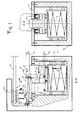
- the dosing device slide is moved by the adjusting device (3) according to the driver braking specification in the explained direction (9) along the displacement axis the adjusting device moved; the Roller storage is designed such that the metering device slide (3) in all other directions of movement relative to the cover surface of the spring housing (12) is tied up. So there is only one degree of freedom available.
- cam disks (4) and (5) are connected to the Housing (6) and the force absorption system (7) are one first (14) and a second (15) roll are provided.
- the first role (14) is designed as a double role. In terms of their logical functioning as a support [cf. below] also becomes a related one Pair of roles claimed as "one role”.
- the first roller (14) is fixed in the housing (6) [the housing cover (13) of the actual storage location for the first roll (4) is form-fitting with the Housing (6) connected] and rolls on a horizontal Dosing device slide displacement (3) along the surface path of the first cam (4) from. Changed during such a shift the stroke of the compression spring (11); this stroke is thereby determines on which point of the cam track surface the first cam (4) the first Roller (14) supports.
- Execution is the maximum vertical shift [Shifting the brake lever from the starting position (18) to the maximum position (18 '), each based on the Center of the second roller (15)] the distance b (16).
- the force generator (2) is used for generation the actuation stroke for a disc brake, wherein when driving through the actuation stroke of the force generator (2) with a variable force in a certain Direction [in Fig. 1 in the vertical direction (8)] acts and the change in force by the metering device (3) is made, which in turn by a changed on this acting adjustment becomes.
- the process described is reversible.
- the force absorption system formed by the disc brake develops a counter force that changes depending on the stroke on an elastic deformation of predominantly the Brake pads and other application elements such.
- the brake lever (18) is based, and therefore increases substantially linear with the actuation stroke or increases accordingly linearly with it.
- the force generator (2) gives one through the adjustment device caused enlargement of the on the Force system acting part of the force in energy stored in it [increase in stroke the compression spring (11) leads to energy output] and takes on one caused by the adjusting device Reduction of those acting on the force absorption system Force the one absorbed by the force absorption system Energy at least partially back on [the downsizing of the stroke of the compression spring leads to energy consumption].
- the adjustment device for the dosing slide (3) can be realized in many ways; for example it is possible to provide a pincer drive in the on the lower boundary surface of the Metering device slide [over the rollers] one Rack is attached using a motor-driven Gear is moved translationally.
- the force vectors acting on the metering device slide (3) according to FIG. 1 are drawn in for the case of the energy-optimized contours of the first (4) and second (5) cam disc.
- the force vector F Ke acting in the vertical direction on the metering device slide (3) is split into two force vectors, a support force vector F Ab acting on the housing and a force vector F Br acting on the brake lever (18).
- the direction of the support force vector F Ab passing through the center of the first roller (14) is given by the tangent to the contour of the first cam (4) at the point of contact with the roller, and the direction of the center of the second roller (15) also passing through the center of the roller Braking force vector F Br is given by the tangent to the second cam (5) at the point of contact with the roller.
- the sum of the vertical force components F Br_v and F Ab_v is equal to the force vector F Ke (28).
- the slide In the energy-optimized state, the slide must be able to be shifted from one position to another without force, and this forceless shift occurs when the horizontal force components F Ab_h (34) and P Br_h (33) are present for each position of the metering device slide (3) ) cancel each other out.
- this condition can be used to determine the energy-optimized contours of the first (4) and second (5) cam.
- the force generator (2) and the force absorption system (7) are identical with the explanations in Fig. 1.
- the metering device (3) are the rigidly coupled first (4) and second (5) cams not more translational than rotary as a swivel movement adjusted; the dosing device is a dosing device swivel cam (3) trained.
- the pivoting of the metering device cam lies between [clockwise (17)] 0 ° of the starting position and 90 ° of the maximum position.
- Fig. 3 is the metering device pivot cam in the starting position with normal Strength drawn under the reference number (3), and he is with a thin line under the reference symbol (3 '') with a swivel angle of approximately 2/3 of the maximum position drawn [for reasons of clarity, since in the maximum location lines coincide, which is understanding function impaired].
- this drawn Braking position (3 '') has increased due to the stroke of the Compression spring (11) the center line by a distance c (24) shifted in the vertical direction (8), resulting in a vertical displacement of the brake lever by the distance d (25) leads relative to the starting position.
- the contour of the first cam (4) is not circular arc, but it has a special shape, which is characterized in that in the direction of the maximum position there is a gradient. So would on the second cam (5) do not apply any force [the Brake lever (18) with the second roller (15) is omitted], so would be through the action of the force generator (2) the dosing device swivel cam (3) into the Maximum position swiveled.
- the contour of the second cam (5) is also not in the shape of a circular arc, but its special one Form is characterized in that it is in the direction the starting position has a gradient.
- the force absorption system (7) thus generates swivel cams on the metering device (3) a left turn Hold on while the force generator (2) is on the dosing device swivel cam (3) a clockwise Moment.
- Fig. 1 can be appropriate interpretation of the contours of the first (4) and second (5) cam the principle of the energy swing realize.
- contours for the cams To interpret (4) and (5) such that the resulting Torque around the centerline of the swivel axis (20) for each swivel angle of the metering device swivel cam (3) becomes zero; in this case an ideal energy swing is realized, d. H. it energy is lost from the power generator (2) in transmit the force absorption system (7) and vice versa.
- the curves also, as indicated in the explanations for FIG. 1, by solving mathematical equations that are based on energy-optimized Conditions are determined.
- swivel cam (3) can have different parameters positively influence the interpretation, such as B. the radii, on which the contours of the cams (4) and (5) put on their respective roles. It can also be advantageous, the roles (14) and (15), which in Fig. 3 perpendicularly above the pivot axis center line (20) stand to move a bit sideways to balance the moment the cam around the center line (20) beneficial to influence.
- the function of a parking brake is easy by realizing in the maximum position in The contour of the second Kuvenscade (5) provided a dent into which the second roller (15) engages [The dent catch is also on the first Kuvensplatte (4) realizable].
- the parking brake can also be realized by in the maximum position, the second cam (5) [or also the first cuvette (4)] by a pin that z. B. to be actuated with the aid of a solenoid, relatively to the housing (6) is fixed.
- fixations can also be attached in the starting position and advantageous for transport and / or for securing assembly be used.
- the mechanical Power transmission also through a hydraulic Power transmission to be replaced.
- the hydraulic brake cylinder of the The wheel brake is connected to a hydraulic line Hydraulic master cylinder positively connected to the housing (6) connected to the piston of which second roller (15) is rotatably attached so that the second roller (15), as shown in Fig. 3, in one Brake actuation rolls over the second cam (5).
- this solution can always be advantageous where, for reasons of space, the force generator (2) is not directly can be accommodated on the bike.
- the reenactment of Brake can then z. B. by today's oil refill technology can be realized, of course a “dry” Adjustment "is always preferable.
- the adjusting device pivots this cam over the axis of the pivot axis center line (20).
- the adjusting device is thus designed as a rotary device, its axis of rotation being arranged perpendicular to the axis of the force generator (2) [the force vector F Ke acts on the metering device (3) along the central axis of the force generator (2); see Fig. 2].
- the adjustment device for the embodiment according to 3 is formed by an electric swivel motor, the z. B. realized by a bevel gear motor is, in which a bevel gear attached to the motor in a circular rack element attached to the metering device cam (3) intervenes.
- the adjustment motor is there fixed to the cover of the spring housing (12) and, like the cams (4) and (5), does the Lifting movements of the force generator (2) with.
- Dosing device (3) according to FIG. 4 is on the force generator (2) an arrangement as described above on a circular disc with a first (4, 4a) and a second (5, 5a) pair of cams arranged.
- Each cam disc covers an angular segment of 180 °, so that they belong together Cam discs covered the entire circular arc by 360 ° is.
- the cams are here as belonging together Couples trained, but they correspond in their Function of the individual cams as shown in Fig. 1 and 3 are explained.
- a role as a double role [pair of roles] also serves the pairing of one Cam disc only to prevent torque, which especially in those in such a clamping device acting high forces, to a deadlock of the facility. In this sense also becomes a related pair of cams according to their logical functioning as "one Cam "claimed.
- the first pair of cams (4, 4a) is supported the first pair of rollers (14, 14a) mounted on the housing from.
- the metering device (3) is used to actuate the brake the adjusting device, not shown, in clockwise rotation Direction (17) from 0 ° [starting position] to 180 ° [Maximum position] pivoted; in Fig. 4 is the metering device rotary cam (3) in one swivel shown by 90 ° [half maximum actuation angle]. in the The course of this twist rolls the first pair of rollers (14, 14a) on the surface tracks of the first Cam disc pair (4, 4a) with their slope from and the stroke increases in accordance with the "loss of height" the compression spring (11), and the rotating device rotating cam (3) is synchronized with this increase in stroke raised. In the illustrated pivoting of This vertical displacement [spring stroke] is 90 ° Distance c (24).
- angle segments of the cam disc pairs (4, 4a) and (5, 5a) of 180 ° in the exemplary embodiment [maximum resolution for the maximum possible application angle of 180 °] can also be chosen smaller; every angular segment between 0 ° and 180 ° is possible, whereby the angle segments are identical for both pairs of cams must be chosen.
- the gearbox can be used as a chain, spur or bevel gear Planetary gear, but also others Drive types are conceivable.
Landscapes
- Engineering & Computer Science (AREA)
- General Engineering & Computer Science (AREA)
- Mechanical Engineering (AREA)
- Physics & Mathematics (AREA)
- Fluid Mechanics (AREA)
- Transportation (AREA)
- Transmission Devices (AREA)
- Braking Arrangements (AREA)
Abstract
Description
- Fig. 1
- die Zuspanneinrichtung unter Verwendung einer Dosiereinrichtung mit zwei translatorisch verstellten Kurvenscheiben,
- Fig. 2
- ein Kräftediagramm für die Zuspanneinrichtung nach Fig. 1,
- Fig. 3
- die Zuspanneinrichtung unter Verwendung einer Dosiereinrichtung mit zwei rotatorisch verstellten Kurvenscheiben nach dem SchwenkNocken-Prinzip,
- Fig. 4
- die Zuspanneinrichtung unter Verwendung einer Dosiereinrichtung mit zwei rotatorisch verstellten Kurvenscheiben nach dem RotationsNocken-Prinzip.
Claims (10)
- Zuspanneinrichtung für Scheibenbremsen, gekennzeichnet durch die folgenden Merkmale:gekennzeichnet durch die folgenden Merkmale:a) Es ist eine Krafterzeugungseinrichtung zur Erzeugung eines Betätigungshubes für eine Scheibenbremse vorgesehen;b) beim Durchfahren des Betätigungshubes wirkt die Krafterzeugungseinrichtung mit veränderbarer Kraft in einer bestimmten Richtung, wobei der Betrieb reversibel ist;c) die Krafterzeugungseinrichtung wirkt auf ein Kraftaufnahmesystem ein, welches eine sich hubabhängig verändernde Gegenkraft entwickelt;d) die Veränderung der Gegenkraft beruht auf einer elastischen Verformung und steigt im wesentlichen linear an bzw. nimmt entsprechend linear ab;e) es ist eine Dosiereinrichtung zur Veränderung der auf das Kraftaufnahmesystem wirkenden Kraft vorgesehen;f) es ist eine auf die Dosiereinrichtung einwirkende Verstelleinrichtung vorgesehen;g) die Krafterzeugungseinrichtung ist so ausgebildet, daß sie bei einer durch die Verstelleinrichtung veranlaßten Vergrößerung der auf das Kraftaufnahmesystem wirkenden Kraft einen Teil der in ihr gespeicherten Energie abgeben kann;h) die Krafterzeugungseinrichtung ist so ausgebildet, daß sie bei einer durch die Verstelleinrichtung veranlaßten Verkleinerung der auf das Kraftaufnahmesystem wirkenden Kraft die von dem Kraftaufnahmesystem aufgenommene Energie zumindest teilweise wieder aufnehmen kann;i) Die Dosiereinrichtung ist kraftschlüssig mit der Krafterzeugungseinrichtung verbunden;k) die Dosiereinrichtung ist unter Verwendung von mindestens zwei starr miteinander gekoppelten Kurvenscheiben realisiert;
- Einrichtung nach Anspruch 1, dadurch gekennzeichnet, daß die Dosiereinrichtung in einstückiger Ausführung zwischen der Krafterzeugungseinrichtung und dem Kraftaufnahmesystem angeordnet ist.
- Einrichtung nach Anspruch 1 oder 2, gekennzeichnet durch die folgenden Merkmale:a) für die Dosiereinrichtung sind zwei Kurvenscheiben vorgesehen;b) eine erste Kurvenscheibe ist mit dem Gehäuse kraftschlüssig verbunden;c) eine zweite Kurvenscheibe ist mit dem Kraftaufnahmesystem kraftschlüssig verbunden;d) die erste und die zweite Kurvenscheibe weisen eine unterschiedliche Charakteristik auf.
- Einrichtung nach Anspruch 3, dadurch gekennzeichnet, daß eine synchrone Betätigung der Kurvenscheiben durch die Verstelleinrichtung vorgesehen ist.
- Einrichtung nach Anspruch 3, dadurch gekennzeichnet, daß die Verstelleinrichtung als translatorische Einrichtung ausgeführt ist.
- Einrichtung nach Anspruch 1, dadurch gekennzeichnet, daß die Verstelleinrichtung als rotatorische Einrichtung ausgeführt ist.
- Einrichtung nach Anspruch 6, dadurch gekennzeichnet, daß die Drehachse der Verstelleinrichtung parallel zur Achse der Krafterzeugungseinrichtung angeordnet ist.
- Einrichtung nach Anspruch 6, dadurch gekennzeichnet, daß die Drehachse der Verstelleinrichtung senkrecht zur Achse der Krafterzeugungseinrichtung angeordnet ist.
- Einrichtung nach mindestens einem der Ansprüche 1 bis 8, dadurch gekennzeichnet, daß die Krafterzeugungseinrichtung ortsfest gegenüber dem Kraftaufnahmesystem angeordnet ist.
- Einrichtung nach mindestens einem der Ansprüche 1 bis 9, gekennzeichnet durch die folgenden Merkmale:a) die Dosiereinrichtung ist so ausgebildet, daß bei Vergrößerung der auf das Kraftaufnahmesystem wirkenden Kraft der Betrag des von der Krafterzeugungseinrichtung abgegebenen Energieanteils gleich dem Betrag des vom Kraftaufnahmesystem aufgenommenen Energieanteils ist, wobei die Vorzeichen des von der Krafterzeugungseinrichtung abgegebenen und des vom Kraftaufnahmesystem aufgennommenen Energieanteils unterschiedlich sind;b) in der Dosiereinrichtung sind zwei Konturen vorgesehen, eine erste Kontur zur Abgabe des Energieanteils aus der Krafterzeugungseinrichtung und eine zweite Kontur zur Aufnahme des Energieanteils vom Kraftaufnahmesystem;c) die erste Kontur ist durch die Stützfläche der ersten Kurvenscheibe gebildet;d) die zweite Kontur ist durch die Stützfläche der zweiten Kurvenscheibe gebildet.
Applications Claiming Priority (2)
| Application Number | Priority Date | Filing Date | Title |
|---|---|---|---|
| DE10140076A DE10140076A1 (de) | 2001-08-16 | 2001-08-16 | Zuspanneinrichtung für Scheibenbremsen |
| DE10140076 | 2001-08-16 |
Publications (3)
| Publication Number | Publication Date |
|---|---|
| EP1293700A2 true EP1293700A2 (de) | 2003-03-19 |
| EP1293700A3 EP1293700A3 (de) | 2004-07-07 |
| EP1293700B1 EP1293700B1 (de) | 2006-11-02 |
Family
ID=7695537
Family Applications (1)
| Application Number | Title | Priority Date | Filing Date |
|---|---|---|---|
| EP02007555A Expired - Lifetime EP1293700B1 (de) | 2001-08-16 | 2002-04-03 | Zuspanneinrichtung für Scheibenbremsen |
Country Status (3)
| Country | Link |
|---|---|
| US (1) | US6662908B2 (de) |
| EP (1) | EP1293700B1 (de) |
| DE (2) | DE10140076A1 (de) |
Cited By (1)
| Publication number | Priority date | Publication date | Assignee | Title |
|---|---|---|---|---|
| CN104482080A (zh) * | 2014-11-14 | 2015-04-01 | 江苏大学 | 电磁与摩擦集成制动系统及其控制方法 |
Families Citing this family (14)
| Publication number | Priority date | Publication date | Assignee | Title |
|---|---|---|---|---|
| DE10046981A1 (de) * | 2000-09-22 | 2002-04-25 | Bosch Gmbh Robert | Radbremsvorrichtung |
| EP1645769A3 (de) * | 2004-10-07 | 2006-04-26 | LuK Lamellen und Kupplungsbau Beteiligungs KG | Vorrichtung zur Betätigung einer Kupplung |
| DE102005048884B3 (de) * | 2005-10-12 | 2007-05-03 | Siemens Ag | Elektromechanische Bremse mit Kraftspeicher und nachgeschalteter Kraftübersetzungseinheit |
| ES2313194T3 (es) * | 2005-12-14 | 2009-03-01 | Fondazione Torino Wireless | Dispositivo de accionamiento electromecanico para un sistema de frenado de un automovil y sistema de frenado equipado con dicho dispositivo. |
| DE102006010216B3 (de) * | 2006-03-06 | 2007-10-25 | Knorr-Bremse Systeme für Nutzfahrzeuge GmbH | Scheibenbremse mit Kraftspeicher |
| DE102006012440A1 (de) * | 2006-03-17 | 2007-09-20 | Siemens Ag | Bremse mit Spindel und Kurvenscheiben-Anordnung |
| DE102006050804A1 (de) * | 2006-04-06 | 2007-10-18 | Knorr-Bremse Systeme für Nutzfahrzeuge GmbH | Bremsvorrichtung mit elastischem Energiespeicher |
| DE102011083910A1 (de) * | 2011-09-30 | 2013-04-04 | Siemens Aktiengesellschaft | Elektromechanische Betätigungsanordnung einer elektromechanischen Bremse und elektromechanische Bremse |
| KR101822204B1 (ko) * | 2012-12-17 | 2018-01-26 | 현대자동차주식회사 | 차량용 클러치 액추에이터 |
| AT513989A1 (de) * | 2013-03-11 | 2014-09-15 | Ve Vienna Engineering Forschungs Und Entwicklungs Gmbh | Elektrisch betätigte Reibungsbremse |
| DE102014113848A1 (de) * | 2014-09-24 | 2016-03-24 | Knorr-Bremse Systeme für Nutzfahrzeuge GmbH | Zuspanneinrichtung einer Scheibenbremse |
| EP3271602B1 (de) * | 2015-03-16 | 2021-01-27 | Faiveley Transport Nordic AB | Bremszylinder |
| JP7308070B2 (ja) * | 2019-04-26 | 2023-07-13 | ナブテスコ株式会社 | ブレーキ装置およびブレーキ制御システム |
| DE102019120341A1 (de) | 2019-07-26 | 2021-01-28 | Thyssenkrupp Ag | Stellvorrichtung für ein mechanisches Bremssystem |
Citations (2)
| Publication number | Priority date | Publication date | Assignee | Title |
|---|---|---|---|---|
| EP0644358B1 (de) | 1993-09-08 | 1996-06-19 | Knorr-Bremse Ag | Bremsanlage mit einer Krafterzeugungseinrichtung zum Erzeugen eines reversiblen Arbeitshubs |
| WO2001044677A1 (de) | 1998-12-17 | 2001-06-21 | Wabco Gmbh | Zuspanneinrichtung, bremse mit einer zuspanneinrichtung |
Family Cites Families (4)
| Publication number | Priority date | Publication date | Assignee | Title |
|---|---|---|---|---|
| DE2905258A1 (de) * | 1979-02-12 | 1980-08-21 | Hans O Schroeter | Bremsbetaetigungsvorrichtung mit einem betaetigungshebel und veraenderlicher uebersetzung |
| DE9407623U1 (de) * | 1994-05-06 | 1995-09-07 | Lucas Industries P.L.C., Solihull, West Midlands | Betätigungsvorrichtung für eine Fahrzeugbremse, insbesondere Scheibenbremse |
| DE19851668A1 (de) * | 1998-11-10 | 2000-05-11 | Bosch Gmbh Robert | Radbremsvorrichtung |
| DE19945702A1 (de) * | 1999-09-23 | 2001-04-19 | Knorr Bremse Systeme | Zuspannvorrichtung für eine Fahrzeugbremse |
-
2001
- 2001-08-16 DE DE10140076A patent/DE10140076A1/de not_active Withdrawn
-
2002
- 2002-04-03 DE DE50208581T patent/DE50208581D1/de not_active Expired - Lifetime
- 2002-04-03 EP EP02007555A patent/EP1293700B1/de not_active Expired - Lifetime
- 2002-08-15 US US10/219,407 patent/US6662908B2/en not_active Expired - Lifetime
Patent Citations (2)
| Publication number | Priority date | Publication date | Assignee | Title |
|---|---|---|---|---|
| EP0644358B1 (de) | 1993-09-08 | 1996-06-19 | Knorr-Bremse Ag | Bremsanlage mit einer Krafterzeugungseinrichtung zum Erzeugen eines reversiblen Arbeitshubs |
| WO2001044677A1 (de) | 1998-12-17 | 2001-06-21 | Wabco Gmbh | Zuspanneinrichtung, bremse mit einer zuspanneinrichtung |
Cited By (2)
| Publication number | Priority date | Publication date | Assignee | Title |
|---|---|---|---|---|
| CN104482080A (zh) * | 2014-11-14 | 2015-04-01 | 江苏大学 | 电磁与摩擦集成制动系统及其控制方法 |
| CN104482080B (zh) * | 2014-11-14 | 2017-01-11 | 江苏大学 | 电磁与摩擦集成制动系统及其控制方法 |
Also Published As
| Publication number | Publication date |
|---|---|
| EP1293700A3 (de) | 2004-07-07 |
| US6662908B2 (en) | 2003-12-16 |
| DE50208581D1 (de) | 2006-12-14 |
| DE10140076A1 (de) | 2003-02-27 |
| EP1293700B1 (de) | 2006-11-02 |
| US20030034212A1 (en) | 2003-02-20 |
Similar Documents
| Publication | Publication Date | Title |
|---|---|---|
| EP2925654B1 (de) | Fangvorrichtung zu einem fahrkörper einer aufzugsanlage | |
| DE10392252B4 (de) | Scheibenbremse | |
| EP1293700A2 (de) | Zuspanneinrichtung für Scheibenbremsen | |
| EP4003798B1 (de) | Stellvorrichtung für ein mechanisches bremssystem | |
| EP1537340B1 (de) | Scheibenbremse | |
| EP0146750B1 (de) | Bremseinheit für Schienenfahrzeuge | |
| DE3922186C2 (de) | Kurvenscheiben-Schwingantrieb | |
| EP1994304A1 (de) | Scheibenbremse mit kraftspeicher | |
| EP0207184A1 (de) | Schwenkscheiben-Reibgetriebe | |
| DE1812109C3 (de) | Hydraulische Schere | |
| EP3980658B1 (de) | Bremsvorrichtung | |
| AT522087B1 (de) | Bremsvorrichtung | |
| DE633532C (de) | Schaltvorrichtung fuer Wechselgetriebe, insbesondere von Kraftfahrzeugen, die mit einem nachgiebig gelagerten Motor verbunden sind | |
| DE102021115795A1 (de) | Bremssattel einer elektromechanisch betreibbaren Reibungsbremse eines Fahrzeuges | |
| DE4040016C2 (de) | Scheibenbremse für Industriemaschinen | |
| DE1675142B2 (de) | Betaetigungsvorrichtung fuer innenbackenbremsen mit zwei nebeneinanderliegenden bremsschuhpaaren | |
| DE10105752A1 (de) | Scheibenbremse | |
| DE60110818T2 (de) | Vorrichtung zum variieren der positionierung von walzwerkswalzen für flachprodukte | |
| DE2331590C3 (de) | Lastdruckbremse für einen Hebezeugantrieb | |
| DE952270C (de) | Bremseinrichtung mit einer Vorrichtung zur Verhinderung von Gleitbewegungen zwischen Rad und Laufbahn | |
| DE671595C (de) | Innenbackenbremse mit zwei Bremsbacken | |
| DE3614203C2 (de) | Schaftsteuervorrichtung einer Webmaschine | |
| DE361963C (de) | Vom Wagengewicht beeinflusste Bremse fuer Eisenbahnwagen | |
| DE19940059C2 (de) | Doppel-Bremsfangvorrichtung für Aufzüge oder Regalbediengeräte (RBG) | |
| DE2656283C2 (de) | Vorrichtung zum Einstellen eines Summentypenträgers an Schreib- oder ähnlichen Büromaschinen |
Legal Events
| Date | Code | Title | Description |
|---|---|---|---|
| PUAI | Public reference made under article 153(3) epc to a published international application that has entered the european phase |
Free format text: ORIGINAL CODE: 0009012 |
|
| AK | Designated contracting states |
Kind code of ref document: A2 Designated state(s): AT BE CH CY DE DK ES FI FR GB GR IE IT LI LU MC NL PT SE TR Designated state(s): AT BE CH CY DE DK ES FI FR GB GR IE IT LI LU MC NL PT SE TR |
|
| AX | Request for extension of the european patent |
Extension state: AL LT LV MK RO SI |
|
| PUAL | Search report despatched |
Free format text: ORIGINAL CODE: 0009013 |
|
| AK | Designated contracting states |
Kind code of ref document: A3 Designated state(s): AT BE CH CY DE DK ES FI FR GB GR IE IT LI LU MC NL PT SE TR |
|
| AX | Request for extension of the european patent |
Extension state: AL LT LV MK RO SI |
|
| RIC1 | Information provided on ipc code assigned before grant |
Ipc: 7F 16D 65/18 A Ipc: 7B 60T 13/04 B |
|
| 17P | Request for examination filed |
Effective date: 20050107 |
|
| AKX | Designation fees paid |
Designated state(s): DE FR IT SE |
|
| GRAP | Despatch of communication of intention to grant a patent |
Free format text: ORIGINAL CODE: EPIDOSNIGR1 |
|
| GRAS | Grant fee paid |
Free format text: ORIGINAL CODE: EPIDOSNIGR3 |
|
| GRAA | (expected) grant |
Free format text: ORIGINAL CODE: 0009210 |
|
| AK | Designated contracting states |
Kind code of ref document: B1 Designated state(s): DE FR IT SE |
|
| REF | Corresponds to: |
Ref document number: 50208581 Country of ref document: DE Date of ref document: 20061214 Kind code of ref document: P |
|
| REG | Reference to a national code |
Ref country code: SE Ref legal event code: TRGR |
|
| RAP2 | Party data changed (patent owner data changed or rights of a patent transferred) |
Owner name: WABCO GMBH |
|
| ET | Fr: translation filed | ||
| PLBE | No opposition filed within time limit |
Free format text: ORIGINAL CODE: 0009261 |
|
| STAA | Information on the status of an ep patent application or granted ep patent |
Free format text: STATUS: NO OPPOSITION FILED WITHIN TIME LIMIT |
|
| 26N | No opposition filed |
Effective date: 20070803 |
|
| PGFP | Annual fee paid to national office [announced via postgrant information from national office to epo] |
Ref country code: SE Payment date: 20140415 Year of fee payment: 13 Ref country code: FR Payment date: 20140425 Year of fee payment: 13 Ref country code: IT Payment date: 20140415 Year of fee payment: 13 |
|
| REG | Reference to a national code |
Ref country code: SE Ref legal event code: EUG |
|
| PG25 | Lapsed in a contracting state [announced via postgrant information from national office to epo] |
Ref country code: IT Free format text: LAPSE BECAUSE OF NON-PAYMENT OF DUE FEES Effective date: 20150403 |
|
| REG | Reference to a national code |
Ref country code: FR Ref legal event code: ST Effective date: 20151231 |
|
| PG25 | Lapsed in a contracting state [announced via postgrant information from national office to epo] |
Ref country code: FR Free format text: LAPSE BECAUSE OF NON-PAYMENT OF DUE FEES Effective date: 20150430 Ref country code: SE Free format text: LAPSE BECAUSE OF NON-PAYMENT OF DUE FEES Effective date: 20150404 |
|
| PGFP | Annual fee paid to national office [announced via postgrant information from national office to epo] |
Ref country code: DE Payment date: 20200430 Year of fee payment: 19 |
|
| REG | Reference to a national code |
Ref country code: DE Ref legal event code: R119 Ref document number: 50208581 Country of ref document: DE |
|
| PG25 | Lapsed in a contracting state [announced via postgrant information from national office to epo] |
Ref country code: DE Free format text: LAPSE BECAUSE OF NON-PAYMENT OF DUE FEES Effective date: 20211103 |