EP1291806A1 - Procédé de lecture d'étiquettes électroniques par identification de leur code - Google Patents
Procédé de lecture d'étiquettes électroniques par identification de leur code Download PDFInfo
- Publication number
- EP1291806A1 EP1291806A1 EP02292167A EP02292167A EP1291806A1 EP 1291806 A1 EP1291806 A1 EP 1291806A1 EP 02292167 A EP02292167 A EP 02292167A EP 02292167 A EP02292167 A EP 02292167A EP 1291806 A1 EP1291806 A1 EP 1291806A1
- Authority
- EP
- European Patent Office
- Prior art keywords
- bits
- rank
- code
- tag
- identification
- Prior art date
- Legal status (The legal status is an assumption and is not a legal conclusion. Google has not performed a legal analysis and makes no representation as to the accuracy of the status listed.)
- Granted
Links
Images



Classifications
-
- G—PHYSICS
- G06—COMPUTING OR CALCULATING; COUNTING
- G06K—GRAPHICAL DATA READING; PRESENTATION OF DATA; RECORD CARRIERS; HANDLING RECORD CARRIERS
- G06K7/00—Methods or arrangements for sensing record carriers, e.g. for reading patterns
- G06K7/10—Methods or arrangements for sensing record carriers, e.g. for reading patterns by electromagnetic radiation, e.g. optical sensing; by corpuscular radiation
- G06K7/10009—Methods or arrangements for sensing record carriers, e.g. for reading patterns by electromagnetic radiation, e.g. optical sensing; by corpuscular radiation sensing by radiation using wavelengths larger than 0.1 mm, e.g. radio-waves or microwaves
- G06K7/10019—Methods or arrangements for sensing record carriers, e.g. for reading patterns by electromagnetic radiation, e.g. optical sensing; by corpuscular radiation sensing by radiation using wavelengths larger than 0.1 mm, e.g. radio-waves or microwaves resolving collision on the communication channels between simultaneously or concurrently interrogated record carriers.
- G06K7/10029—Methods or arrangements for sensing record carriers, e.g. for reading patterns by electromagnetic radiation, e.g. optical sensing; by corpuscular radiation sensing by radiation using wavelengths larger than 0.1 mm, e.g. radio-waves or microwaves resolving collision on the communication channels between simultaneously or concurrently interrogated record carriers. the collision being resolved in the time domain, e.g. using binary tree search or RFID responses allocated to a random time slot
- G06K7/10039—Methods or arrangements for sensing record carriers, e.g. for reading patterns by electromagnetic radiation, e.g. optical sensing; by corpuscular radiation sensing by radiation using wavelengths larger than 0.1 mm, e.g. radio-waves or microwaves resolving collision on the communication channels between simultaneously or concurrently interrogated record carriers. the collision being resolved in the time domain, e.g. using binary tree search or RFID responses allocated to a random time slot interrogator driven, i.e. synchronous
- G06K7/10049—Methods or arrangements for sensing record carriers, e.g. for reading patterns by electromagnetic radiation, e.g. optical sensing; by corpuscular radiation sensing by radiation using wavelengths larger than 0.1 mm, e.g. radio-waves or microwaves resolving collision on the communication channels between simultaneously or concurrently interrogated record carriers. the collision being resolved in the time domain, e.g. using binary tree search or RFID responses allocated to a random time slot interrogator driven, i.e. synchronous binary tree
-
- G—PHYSICS
- G06—COMPUTING OR CALCULATING; COUNTING
- G06K—GRAPHICAL DATA READING; PRESENTATION OF DATA; RECORD CARRIERS; HANDLING RECORD CARRIERS
- G06K7/00—Methods or arrangements for sensing record carriers, e.g. for reading patterns
- G06K7/0008—General problems related to the reading of electronic memory record carriers, independent of its reading method, e.g. power transfer
Definitions
- the invention relates to a method of reading a set of electronic tags each comprising a distinct identification code of N bits and located in the electromagnetic field (EM) of a device interrogator.
- EM electromagnetic field
- the invention also relates to a system of reading a set of labels by a device interrogator, labels and device interrogator each comprising means transmitter / receiver of signals, as well as means of sequencing and storage means.
- the invention applies, in general, to any transaction between an interrogating system and answering systems (more simply called "Labels"), of which we do not know, a priori, neither the number, or identification codes.
- the invention finds applications in the field of the recognition of individuals carrying badges, or medical surveillance of individuals with implants, or in the area of accounting and control of objects carrying labels, such as luggage at an airport, or products in a production chain or for the management of stocks of goods.
- the invention can be applied, in particular, to the continuous inventory of contents of a supermarket shopping cart, in which the buyer may deposit or withdraw, at any time, a or several products.
- multi-label reading a multiple reading labels
- the labels present in the EM field of this device interrogator provide their identification code, successively bit by bit, until this one be fully identified.
- a label detects that the code being identified is different from his, she is momentarily inhibited, that is to say, it becomes mute, so that the continuous identification cycle with others labels, until there is only one left uninhibited label.
- the code of this label is then identified.
- the identified label is permanently inhibited and the other labels remove their momentary inhibition.
- the identification procedure is then reset to identify another label.
- patent application FR-A-2 776 094 describes a method for improving the technique described previously by decreasing the time code acquisition. This process proposes save the number of messages exchanged between the interrogator device and labels in browsing a search tree. In that case, the detection of the identification codes of the labels is done successively, one after the other.
- the aim of the invention is to remedy disadvantages of the techniques previously described in decreasing the number of messages sent by the device interrogator.
- Another object of the invention is to provide several modes of analysis of the codes of the labels taking into account the intended application and constraints related to this application.
- the order numbers are consecutive to each other.
- the order numbers of labels are updated as and when bit detection of the identification codes.
- the method comprises a step of checking, after identification of all the labels present in the field electromagnetic, identification codes detected by calling all the labels already listed.
- the call of all already listed labels is carried out by means of order numbers.
- the identification of a label is performed in a sequential fashion in which the codes of the blocks of m successive bits of labels are analyzed label by label in sweeping a search tree from a rank of block of bits up to the last bit block rank for each code.
- the sequential mode comprises two variants, a first variant called fashion systematically where after identification of a label, the resumption of the analysis of the tree takes place at first block of m bits, a second variant, called depth mode where after label identification the analysis of the tree is carried out starting from the rank k the higher where at least two m-bit values have been detected.
- the identification of a label is carried out according to a parallel mode in which blocks of m bits of the same rank are analyzed for all labels.
- the parallel mode comprises two variants, a first variant, called the width mode, in which the analysis of a rank k + 1 from a rank k is performed by interrogating each partial order number consecutively.
- a second variant, called simultaneous mode in which the analysis of a rank k + 1 from a rank k is carried out in two phases, ie a first phase in which all the labels of all the numbers of order indicate the value of their (k + 1) th block and a second phase in which the (k + 1) th block is analyzed if all the labels do not have the same block at rank k + 1.
- the process according to the invention is implemented through a system of reading a set of labels at means of an interrogator device, labels and the interrogator device comprising means signal transceiver connected via means of modulation / demodulation with sequencing means, and memory means connected to said means of sequencing.
- the interrogation device further includes means for analyzing each label block m bits per block of m bits, and for calculate, for each label, a serial number representing the number of tags identified before said label so that said interrogator knows at any time the number of labels present in the electromagnetic field, and a first memory for storing a table of correspondence between order numbers and codes identified, each label also includes means for calculating sequence numbers, and means for storing said order numbers.
- the method of the invention consists of a reading the identification codes of a set of labels present in the electromagnetic field an interrogator device.
- the codes identification are binary, all different one others, and have the same known length. Also, throughout the rest of the description, we consider that each identification code of a tag contains N bits, where N is an integer.
- the process of identifying the codes of labels is made according to the invention by analysis of successive blocks of m bits, block rank of m bits per rank of block of m bits, by traversing a tree of binary search, of which each branch represents the value of a block of m bits. Two branches representing two blocks having at least one different bit are connected via a node.
- the search tree can be followed in from the block of bits of highest value to the block of bits of lower value, or conversely, the two courses leading to two processes quite symmetrical.
- the method of the invention therefore proposes determine all the blocks of bits constituting the codes labels, block rank of m bits per block rank of m bits, the block rank of m bits being the position current of the m-bit block pointer constituting the ID code being played.
- the analyzed tags emit the value of the bits constituting the block of this rank. For this, as illustrated in FIG. 1, 2 m contiguous time slots are defined.
- the labels emit a "BEEP" in the time interval 2 v corresponding to the value v of the block of m bits being analyzed.
- the method of the invention is to browse the binary tree, rank of block of m bits per block row of m bits, in order to determine if there is a collision of blocks of m bits or no, that is, if there is a possibility of new codes.
- a collision is managed by assigning a number of separate order to each label or group labels with the same code start. The numbers order to know, at each rank of block of m bits, the maximum number of possible codes present at this level, taking into account all the possible hypotheses.
- the order numbers allow, in the mode of preferred embodiment of the invention, to make the call of all the labels in order to eliminate the hypotheses invalid and therefore to determine the actual list of identification codes.
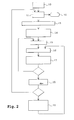
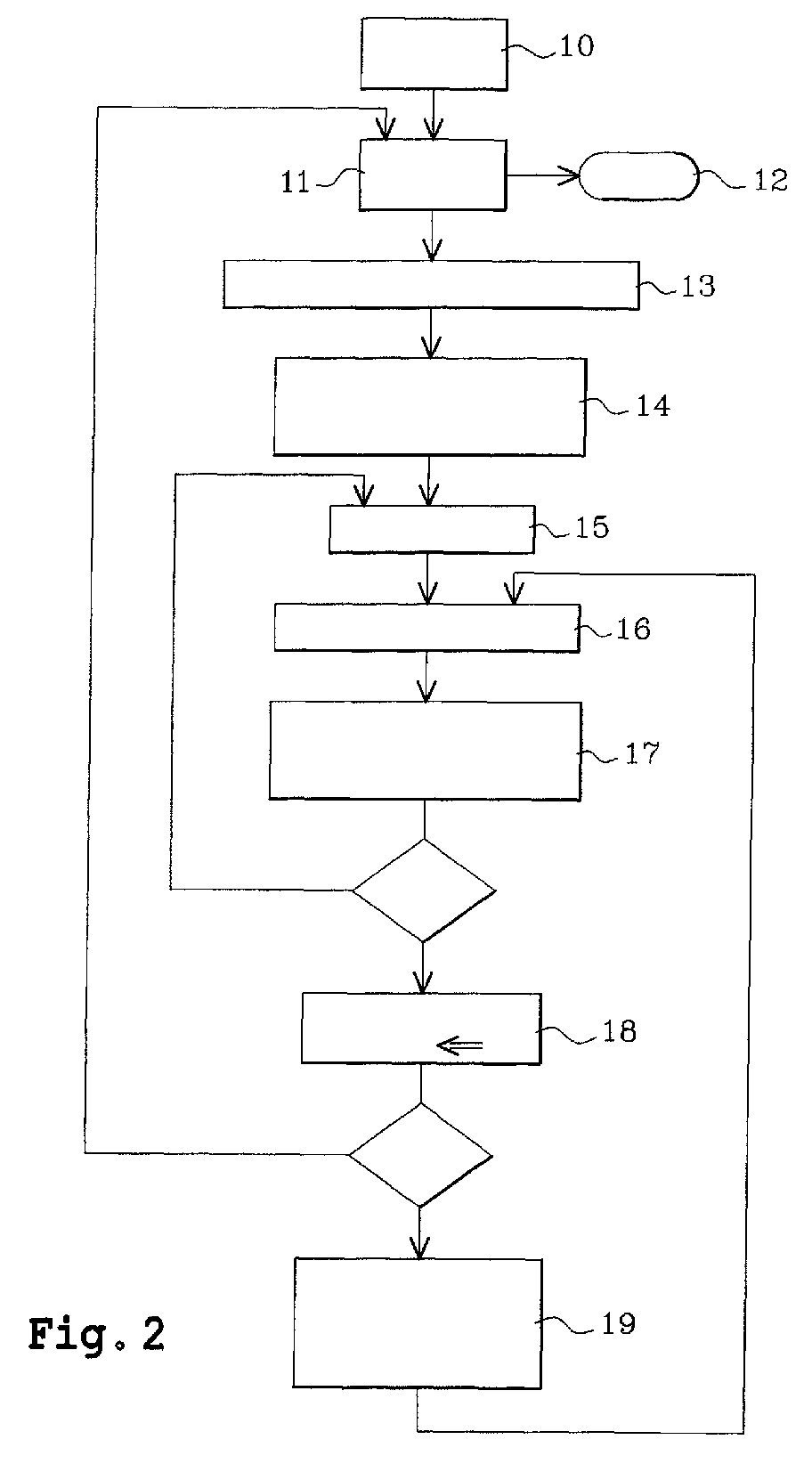
- FIG. 2 shows a functional diagram of the method of the invention for the sequential modes.
- Step 10 is the beginning of the sequencing.
- the number of order N0 being analyzed is initialized to -1, all the labels present in the field electromagnetic drive emit the value of the first block of m bits of their identifier.
- a label penetrating into the electromagnetic field after this step and before the end of the cycle identification will not participate in this cycle Identification. She will remain silent while waiting a new message of beginning of reading cycle.
- step 15 we proceed to the following analysis rank: only the labels belonging to the path selected by the reader from the beginning of analysis of the tree to the rank k send the value of (k + 1) th block of m bits.
- Steps 16 and 17 are respectively identical to steps 13 and 14: only rank number analyzed is different. These steps are performed so much that the last rank was not analyzed.
- Step 18 marks the end of identifying a label: the reader updates the table of correspondence order number ⁇ identification code, the tag identified is assigned the serial number NO In progress.
- step 19 activate the step 19 where the reader searches the register multicode memorization the highest rank where several replies were received; it tells the labels the rank from which the analysis start again ; the serial number is incremented and in the correspondence table it copies the value to the address NO-1 in the address NO.
- step 16 only labels belonging to the path selected by the reader from row O up to the current rank emit the value of their block of current rank.
- Step 30 is the beginning of sequencing: the number of partial order numbers from the previous rank NO (rank -1) is initialized to 0, as well as the rank RANG counter of m bits being analyzed. All labels present in the electromagnetic field of the interrogator emit their first block of m bits. A label entering the electromagnetic field after this step and before the end of the cycle identification will not participate in this cycle Identification. She will remain silent while waiting a new message of beginning of reading cycle.
- Step 31 of reading rank consists of know all the values of the blocks of m bits of the rank being analyzed.
- an index i and the counters of partial order numbers NO (rank) rank being analyzed are initialized to zero.
- step 32 end LM.
- the interrogator at step 33 indicates to the tags the values found in step 31 and the algorithm gets continue at step 34.
- Steps 34, 35, 36 and 37 are common to two parallel modes: they consist of analyzing successively all the order numbers present at the rank preceding rank being analyzed.
- step 34 only the labels having the order number i at the previous rank issue their value.
- Step 35 is used by the interrogator to update the counter of sequence numbers NO (rank) of rank being analyzed, for update the correspondence table; through the issuance of the VBIP command the reader indicates to labels the values read in step 34, and the labels update their partial order number for the current rank.
- step 36 the index i is incremented analysis of the order numbers of the previous rank. Yes all these serial numbers were not analyzed, we go to step 34. Otherwise, the number counter order of the previous rank NO (rank-1) is initialized by NO (rank) in step 37.
- step 41 end LM. Otherwise, the number of rank is incremented in step 38 and the analysis of the rank resumes in step 31.
- Figure 4 shows a search tree to identify the codes of six labels, A, B, C, D, E and F each having N bits.
- bit blocks comprise each 4 bits.
- the successive ranks of the bit blocks are designated by the references R0 to R3 where R3 represents the initial level of research corresponding to the root of the search tree in which no code is yet identified, and the level R0 represents the final level of research where all the codes are identified.
- the identification is carried out label by tag sweeping the tree from row R3 to row R0. Codes are identified four bits by four bits.
- each label assigns itself a serial number corresponding to the number of labels identified before she.
- a correspondence table between the numbers order and identification codes is established for ensure rapid exchange between labels and the interrogator after the identification phase.
- the following table illustrates the evolution of the sequence numbers during the tree search according to a first variant of the sequential mode in which the resumption of the analysis of the tree after identification of a label is made from the root.
- uninhibited tags issue their second block upon request from the interrogator.
- the latter selects one and the labels that do not have the second block selected are momentarily inhibited.
- Others listen to a request from the interrogator to issue the next block. This procedure is repeated to the last rank R0 of the N-bit code.
- Rank R0 is reached by browsing successively branches 0-1-2, 0-1-3, and 0-1-4 allowing respectively the identification of the code complete labels A, B and C.
- the resumption of the analysis of the tree after identification a label is made from the last row block where partially identified tags and identical are different.
- the analysis tree has at least two branches corresponding to blocks that differ by at least one bit.
- uninhibited tags issue their second blocks upon request from the interrogator.
- the latter selects one and the labels that do not have this second block momentarily inhibit themselves.
- the others are listening a request from the interrogator to issue the block next four bits. This procedure is repeated until the last block, that is to say until reading a complete N-bit code.
- the rank R0 is reached by browsing successively branches 0-1-2, to identify label A, then branch 3 from row R1 to identify the label B, then the branch 4, from the rank R1, to identify the label C.
- the identification of the code of the label D is obtained by traversing the branches 5-6-7, the identification of the code of the label E, in browsing branches 8-9 from rank R2 and that of the label F by browsing the branches 10-11-12 from the rank R0.
- the match list is updated as and when the identification of blocks of m bits.
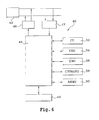
- the method described above is implemented by a system comprising an interrogator device 40 and tags 42 having transceiver means 44 connected signals, via means of modulation / demodulation 46, 47, to means of sequencing 48.
- the interrogator device 40 comprises in besides means to analyze each 42 block label of m bits per block of m bits, and to calculate, for each label 42, a serial number representing the number of label groups with the same code partially identified so that said interrogator 40 knows at any time the number of groups of labels present in the field electromagnetic, a first memory 49 intended to memorize a correspondence table between the numbers order and partially identified codes, a first counter of rank 58 indicating the number of the group of bits being analyzed and a second counter 52 indicating the number of labels is totally identified or partially identified.
- Each label 42 also includes means for calculate the sequence numbers, a first counter 68 to count the rank of blocks of bits in progress analysis and a first memory 74 to memorize said order numbers and to store the code identification of the label.
- each label 42 operating in sequential mode further comprises a second counter of serial number 60 intended for count the fully identified tags, and in the case of sequential mode depth a second memory of sequence numbers 64 to memorize the number node where the tag was not selected.
Landscapes
- Engineering & Computer Science (AREA)
- Physics & Mathematics (AREA)
- Toxicology (AREA)
- Artificial Intelligence (AREA)
- Computer Vision & Pattern Recognition (AREA)
- General Physics & Mathematics (AREA)
- Theoretical Computer Science (AREA)
- Health & Medical Sciences (AREA)
- Computer Networks & Wireless Communication (AREA)
- Electromagnetism (AREA)
- General Health & Medical Sciences (AREA)
- Mobile Radio Communication Systems (AREA)
- Near-Field Transmission Systems (AREA)
- Radar Systems Or Details Thereof (AREA)
Abstract
Description
- un mode séquentiel dans lequel les codes des blocs de m bits successifs des étiquettes sont analysés étiquette par étiquette en balayant un arbre de recherche à partir d'un rang de bloc de bits jusqu'au dernier rang de bloc de bits pour chaque code ;
- ou un mode parallèle dans lequel les blocs de m bits de même rang sont analysés pour toutes les étiquettes avant d'analyser les blocs de rang suivant.
- La figure 1 représente un chronogramme illustrant les séquences d'échange d'informations entre le dispositif interrogateur et une étiquette ;
- les figures 2 et 3 représentent le diagramme fonctionnel du procédé de l'invention respectivement pour un mode séquentiel et pour un mode parallèle ;
- les figures 4 et 5 représentent des exemples de recherche arborescente avec le procédé de l'invention ; et
- les figures 6 et 7 représentent schématiquement respectivement un dispositif interrogateur et une étiquette du système de l'invention.
- soit un seul des intervalles de temps est occupé et la valeur du bloc de m bits est connue pour le rang k analysé et on peut passer au rang k+1,
- soit plusieurs intervalles de temps sont occupés et il convient soit de sélectionner une valeur et poursuivre l'analyse au rang k+1 dans le mode séquentiel, soit de réattribuer des numéros d'ordre au rang k avant de poursuivre l'analyse au rang k+1 dans le mode parallèle.
- aucune réponse : passage à l'étape 12 "fin d'algorithme",
- au moins une réponse : passage à l'étape 14. L'interrogateur sélectionne parmi les valeurs présentes la branche qui va être analysée, met à jour le code et, si le nombre de valeurs trouvées est supérieur à 1, mémorise qu'il y a plusieurs codes au rang en cours d'analyse.
| Etiquette identifiée | Branche parcourue | Numéro d'ordre attribué |
| A | 0-1-2 | 0 |
| B | 0-1-3 | 1 |
| C | 0-1-4 | 2 |
| D | 5-6-7 | 3 |
| E | 5-8-9 | 4 |
| F | 10-11-12 | 5 |
| Etiquette identifiée | Branche parcourue | Numéro d'ordre attribué |
| A | 0-1-2 | 0 |
| B | 3 | 1 |
| C | 4 | 2 |
| D | 5-6-7 | 3 |
| E | 8-9 | 4 |
| F | 10-11-12 | 5 |
- une première phase dans laquelle toutes les étiquettes de tous les numéros d'ordre indiquent la valeur de leur (k+1)iéme bloc ;
- et une deuxième phase dans laquelle le (k+1)iéme bloc est analysé si toutes les étiquettes n'ont pas le même bloc au rang k+1.
| Etiquettes Et | Rang3 | Rang2 | Rang1 | Rang0 |
| Etiquette A | 0 | 0 | 0 | 0 |
| Etiquette B | 0 | 0 | 0 | 1 |
| Etiquette C | 0 | 0 | 0 | 2 |
| Etiquette D | 0 | 1 | 1 | 3 |
| Etiquette E | 0 | 1 | 2 | 4 |
| Etiquette F | 0 | 2 | 3 | 5 |




- un mode séquentiel dans lequel les codes des blocs de m bits successifs des étiquettes sont analysés étiquette par étiquette en balayant un arbre de recherche à partir du premier rang de bloc de bits jusqu'au dernier rang de bloc de bits pour chaque code ;
- et un mode parallèle dans lequel les blocs de m bits de même rang sont analysés simultanément pour toutes les étiquettes.
- une deuxième mémoire 50 destinée à mémoriser les noeuds à branches multiples de l'arbre d'analyse dans le mode séquentiel le deuxième compteur d'étiquettes 52 indiquant le nombre d'étiquettes totalement identifiées (ce compteur 52 joue aussi ce rôle dans le mode séquentiel systématique.
- un troisième compteur de numéros d'ordre 54 indiquant le nombre de groupes d'étiquettes identifiées dans le rang d'analyse k+1 ;
- un quatrième compteur de numéros d'ordre 56 indiquant le nombre de numéros d'ordre traités dans le rang d'analyse en cours pour le mode parallèle, le deuxième compteur de numéros d'ordre 52 indiquant le nombre de groupes d'étiquettes ayant le même code partiellement identifié au rang d'analyse k,
- une deuxième mémoire 72 destinée à mémoriser le nombre de groupes ayant un code partiellement identifié identique au rang d'analyse k,
- un deuxième compteur de numéro d'ordre 62 destiné à indiquer le numéro d'ordre en cours d'analyse dans le mode parallèle ;
- une troisième mémoire 70 destinée à mémoriser le numéro d'ordre attribué à une étiquette lors du traitement d'un rang k dans le mode parallèle.
Claims (16)
- Procédé de lecture d'un ensemble d'étiquettes électroniques comprenant chacune un code d'identification distinct de N bits et situées dans le champ électromagnétique d'un dispositif interrogateur, caractérisé en ce qu'il comporte les étapes suivantes :a) pour chaque code de N bits donné, définir un bloc élémentaire d'analyse comportant m bits, m étant un sous-multiple de N supérieur à 1 ;b) analyser le code de chaque étiquette en parcourant ce code bloc de m bits par bloc de m bits ;c) attribuer un même numéro d'ordre, à toutes les étiquettes ayant le même code partiellement identifié au rang d'analyse courant, le nombre de numéros d'ordre attribués représentant le nombre de groupes d'étiquettes ayant le même code partiellement identifié ;d) établir une table de correspondance entre chaque numéro d'ordre et la valeur du code partiellement identifié.
- Procédé selon la revendication 1,
caractérisé en ce que les numéros d'ordre attribués sont consécutifs les uns aux autres. - Procédé selon la revendication 2,
caractérisé en ce que les numéros d'ordre des étiquettes sont mis à jour au fur et à mesure de la détection des bits des codes d'identification. - Procédé selon l'une quelconque des revendications 1 à 3, caractérisé en ce qu'il consiste à vérifier, après identification de toutes les étiquettes présentes dans le champ électromagnétique, les codes d'identification détectés par un appel des étiquettes déjà identifiées.
- Procédé selon la revendication 4,
caractérisé en ce que l'appel des étiquettes déjà identifiées est effectué au moyen des numéros d'ordre. - Procédé selon l'une quelconque des revendications 1 à 5, caractérisé en ce l'identification d'une étiquette est réalisée selon un mode séquentiel dans lequel les codes des blocs de m bits successifs des étiquettes sont analysés étiquette par étiquette en balayant un arbre de recherche à partir d'un rang de bloc de bits jusqu'au dernier rang de bloc de bits pour chaque code.
- Procédé selon la revendication 6,
caractérisé en ce que l'identification d'une étiquette est réalisée selon un mode systématique dans lequel après identification d'une étiquette, la reprise de l'analyse de l'arbre s'effectue au premier bloc de m bits. - Procédé selon la revendication 6,
caractérisé en ce que l'identification d'une étiquette est réalisée selon un mode profondeur dans lequel après identification d'une étiquette, l'analyse de l'arbre s'effectue à partir du rang k le plus élevé où au moins deux valeurs de m bits ont été détectées. - Procédé selon l'une quelconque des revendications 1 à 5, caractérisé en ce que l'identification d'une étiquette est réalisée selon un mode parallèle dans lequel les blocs de m bits de même rang sont analysés pour toutes les étiquettes.
- Procédé selon la revendication 9,
caractérisé en ce qu'en mode parallèle, l'analyse d'un rang k+1 à partir d'un rang k est effectuée en interrogeant consécutivement chaque numéro d'ordre. - Procédé selon la revendication 9,
caractérisé en ce qu'en mode parallèle, l'analyse d'un rang k+1 à partir d'un rang k est effectuée en deux phases, soit une première phase dans laquelle toutes les étiquettes de tous les numéros d'ordre indiquent la valeur de leur (k+1)iéme bloc et une deuxième phase dans laquelle le (k+1)iéme bloc est analysé numéro d'ordre par numéro d'ordre si toutes les étiquettes n'ont pas le même bloc au rang k+1. - Système de lecture d'un ensemble d'étiquettes (42) par un dispositif interrogateur (40), les étiquettes (42) et le dispositif interrogateur (40) comportant chacun des moyens émetteur-récepteur (44) de signaux reliés via des moyens de modulation/démodulation (46,47) à des moyens de séquencement (48), caractérisé en ce que le dispositif interrogateur (40) comporte en outre des moyens pour analyser chaque étiquette (42) bloc de m bits par bloc de m bits, et pour calculer, pour chaque étiquette (42), un numéro d'ordre représentant le nombre de groupes d'étiquettes ayant le même code partiellement identifié de sorte que ledit interrogateur (40) connaisse à tout moment le nombre de groupes d'étiquettes présentes dans le champ électromagnétique, et une première mémoire (49) destinée à mémoriser une table de correspondance entre les numéros d'ordre et les codes partiellement identifiés, un premier compteur de rang (58) indiquant le numéro du groupe de bits en cours d'analyse et un deuxième compter (52) indiquant le nombre d'étiquettes soit totalement identifiées, soit partiellement identifiées, et en ce que chaque étiquette (42) comporte également des moyens pour calculer les numéros d'ordre, et un premier compteur (68) pour compter les rangs de blocs de bits en cours d'analyse et une première mémoire (74) pour mémoriser lesdits numéros d'ordre et pour stocker le code d'identification de l'étiquette.
- Système selon la revendication 12,
caractérisé en ce que lesdits moyens pour analyser chaque étiquette consistent en des algorithmes aptes à fonctionner selon deux modes :un mode séquentiel dans lequel les codes des blocs de m bits successifs des étiquettes sont analysés étiquette par étiquette en balayant un arbre de recherche à partir d'un rang de bloc de bits jusqu'au dernier rang de bloc de bits pour chaque code ;ou un mode parallèle dans lequel les blocs de m bits de même rang sont analysés pour toutes les étiquettes avant d'analyser les blocs de rang suivant. - Système selon la revendication 12,
caractérisé en ce que le dispositif interrogateur fonctionnant en mode séquentiel, chaque étiquette comporte en outre un deuxième compteur (60) d'étiquettes totalement identifiées. - Système selon la revendication 12,
caractérisé en ce que le dispositif interrogateur fonctionnant en mode séquentiel profondeur, comporte en outre une deuxième mémoire (50) destinée à mémoriser les noeuds à branches multiples de l'arbre d'analyse dans le mode séquentiel et en ce que chaque étiquette comporte en outre une deuxième mémoire (64) pour mémoriser le numéro du noeud auquel l'étiquette n'a pas été sélectionnée et un deuxième compteur (60) d'étiquettes totalement identifiées. - Système selon la revendication 12,
caractérisé en ce que le dispositif interrogateur fonctionnant en mode parallèle, comporte en outre :un troisième compteur de numéros d'ordre (54) indiquant le nombre de groupes d'étiquettes identifiées dans le rang d'analyse k+1 ;un quatrième compteur de numéros d'ordre (56) indiquant le nombre de numéros d'ordre traités dans le rang d'analyse en cours pour le mode parallèle ; et que chaque étiquette (42) comporteune deuxième mémoire (72) destinée à mémoriser le nombre de groupes ayant un code partiellement identifié identique au rang d'analyse k,un deuxième compteur de numéro d'ordre (62) destiné à indiquer le numéro d'ordre en cours d'analyse dans le mode parallèle ;une troisième mémoire (70) destinée à mémoriser le numéro d'ordre attribué à une étiquette lors du traitement d'un rang k dans le mode parallèle.
Applications Claiming Priority (2)
| Application Number | Priority Date | Filing Date | Title |
|---|---|---|---|
| FR0111476A FR2829259B1 (fr) | 2001-09-05 | 2001-09-05 | Procede de lecture d'etiquettes electroniques par identification de leur code par bloc de bits |
| FR0111476 | 2001-09-05 |
Publications (2)
| Publication Number | Publication Date |
|---|---|
| EP1291806A1 true EP1291806A1 (fr) | 2003-03-12 |
| EP1291806B1 EP1291806B1 (fr) | 2010-01-27 |
Family
ID=8866983
Family Applications (1)
| Application Number | Title | Priority Date | Filing Date |
|---|---|---|---|
| EP02292167A Expired - Lifetime EP1291806B1 (fr) | 2001-09-05 | 2002-09-03 | Procédé de lecture d'étiquettes électroniques par identification de leur code |
Country Status (5)
| Country | Link |
|---|---|
| US (1) | US7075452B2 (fr) |
| EP (1) | EP1291806B1 (fr) |
| JP (1) | JP4402340B2 (fr) |
| DE (1) | DE60235219D1 (fr) |
| FR (1) | FR2829259B1 (fr) |
Families Citing this family (3)
| Publication number | Priority date | Publication date | Assignee | Title |
|---|---|---|---|---|
| GB2426365A (en) * | 2004-03-10 | 2006-11-22 | Advanced Analysis And Integrat | A microcircuit for product authentication in which an identifier and a count of the number of times the circuit has been interrogated are stored. |
| US20050237157A1 (en) * | 2004-04-13 | 2005-10-27 | Impinj, Inc. | RFID tag systems, RFID tags and RFID processes with branch node indexing |
| KR100612699B1 (ko) * | 2005-03-10 | 2006-08-16 | 에스케이 텔레콤주식회사 | 태그 인식 충돌 방지 rfid 시스템 및 태그 식별 방법 |
Citations (3)
| Publication number | Priority date | Publication date | Assignee | Title |
|---|---|---|---|---|
| EP0696011A2 (fr) * | 1994-07-27 | 1996-02-07 | Texas Instruments Deutschland Gmbh | Appareil et méthode pour l'identification d'une multiplicité de transpondeurs |
| EP0942386A1 (fr) * | 1998-03-12 | 1999-09-15 | Commissariat A L'energie Atomique | Procédé et systeme de lecture multiple d'un ensemble d'étiquettes portant des codes d'identification distincts |
| EP1093075A1 (fr) * | 1999-10-14 | 2001-04-18 | Texas Instruments Deutschland Gmbh | Methode d'identification d'une pluralité de transpondeurs |
Family Cites Families (4)
| Publication number | Priority date | Publication date | Assignee | Title |
|---|---|---|---|---|
| FR2677135B1 (fr) | 1991-05-28 | 1997-09-12 | Commissariat Energie Atomique | Systeme d'identification automatique d'objets ou d'individus par interrogation a distance |
| US5673037A (en) * | 1994-09-09 | 1997-09-30 | International Business Machines Corporation | System and method for radio frequency tag group select |
| US6661335B1 (en) * | 1999-09-24 | 2003-12-09 | Ge Interlogix, Inc. | System and method for locating radio frequency identification tags |
| US6725014B1 (en) * | 2000-08-17 | 2004-04-20 | Honeywell International, Inc. | Method and system for contention resolution in radio frequency identification systems |
-
2001
- 2001-09-05 FR FR0111476A patent/FR2829259B1/fr not_active Expired - Fee Related
-
2002
- 2002-09-02 JP JP2002256939A patent/JP4402340B2/ja not_active Expired - Fee Related
- 2002-09-03 DE DE60235219T patent/DE60235219D1/de not_active Expired - Lifetime
- 2002-09-03 EP EP02292167A patent/EP1291806B1/fr not_active Expired - Lifetime
- 2002-09-04 US US10/233,520 patent/US7075452B2/en not_active Expired - Fee Related
Patent Citations (3)
| Publication number | Priority date | Publication date | Assignee | Title |
|---|---|---|---|---|
| EP0696011A2 (fr) * | 1994-07-27 | 1996-02-07 | Texas Instruments Deutschland Gmbh | Appareil et méthode pour l'identification d'une multiplicité de transpondeurs |
| EP0942386A1 (fr) * | 1998-03-12 | 1999-09-15 | Commissariat A L'energie Atomique | Procédé et systeme de lecture multiple d'un ensemble d'étiquettes portant des codes d'identification distincts |
| EP1093075A1 (fr) * | 1999-10-14 | 2001-04-18 | Texas Instruments Deutschland Gmbh | Methode d'identification d'une pluralité de transpondeurs |
Also Published As
| Publication number | Publication date |
|---|---|
| EP1291806B1 (fr) | 2010-01-27 |
| JP2003216892A (ja) | 2003-07-31 |
| DE60235219D1 (de) | 2010-03-18 |
| FR2829259A1 (fr) | 2003-03-07 |
| FR2829259B1 (fr) | 2003-10-24 |
| JP4402340B2 (ja) | 2010-01-20 |
| US7075452B2 (en) | 2006-07-11 |
| US20030132834A1 (en) | 2003-07-17 |
Similar Documents
| Publication | Publication Date | Title |
|---|---|---|
| CA2191787C (fr) | Procede d'interrogation a distance d'etiquettes, station et etiquette pour sa mise en oeuvre | |
| EP0586492B1 (fr) | Systeme d'identification automatique d'objets ou d'individus par interrogation a distance | |
| EP0942386B1 (fr) | Procédé et systeme de lecture multiple d'un ensemble d'étiquettes portant des codes d'identification distincts | |
| KR101143069B1 (ko) | 하나 이상의 태그의 집합 내의 태그 개수 추정 방법 | |
| EP1232471B1 (fr) | Procede d'identification d'etiquettes electroniques par rondes adaptatives | |
| EP1228478A1 (fr) | Systeme de transpondeurs tenant compte du niveau de bruit environnant | |
| EP0935222B1 (fr) | Procédé d'identification de cartes électroniques présentes dans une zone d'investigation | |
| EP0495708B1 (fr) | Système de communication entre une borne et des mobiles | |
| FR2776096A1 (fr) | Procede et systeme de lecture d'un ensemble dynamique d'etiquettes portant des codes d'identification distincts | |
| CA2283685C (fr) | Procede perfectionne de gestion des collisions dans un systeme d'echange de donnees sans contact | |
| EP1257964B1 (fr) | Procede de lecture d'etiquettes electroniques par identification simultanee de leur code | |
| EP0944016B1 (fr) | Procédé perfectionné d'identification de cartes électroniques | |
| EP1291806B1 (fr) | Procédé de lecture d'étiquettes électroniques par identification de leur code | |
| CN108494977A (zh) | 短信号码的识别方法、装置和系统 | |
| EP0942387B1 (fr) | Procédé et système de lecture multiple d'un ensemble dynamique d'étiquettes | |
| EP0957442A1 (fr) | Système d'identification électronique d'une pluralité de transpondeurs | |
| FR2785423A1 (fr) | Perfectionnement aux procedes d'identification de cartes electroniques | |
| FR2799856A1 (fr) | Procede et dispositif d'identification et de gestion chronologiques a distance d'etiquettes mobiles dans un champ d'interrogation | |
| FR2862406A1 (fr) | Procede d'identification d'etiquettes electroniques, etiquettes electroniques et base-station le mettant en oeuvre. | |
| WO2003060734A1 (fr) | Procédé d'anti-collision d'éléments à identifier par un ordinateur hôte | |
| FR2953669A1 (fr) | Systeme d'achat destine notamment aux surfaces de ventes |
Legal Events
| Date | Code | Title | Description |
|---|---|---|---|
| PUAI | Public reference made under article 153(3) epc to a published international application that has entered the european phase |
Free format text: ORIGINAL CODE: 0009012 |
|
| AK | Designated contracting states |
Designated state(s): AT BE BG CH CY CZ DE DK EE ES FI FR GB GR IE IT LI LU MC NL PT SE SK TR Kind code of ref document: A1 Designated state(s): AT BE BG CH CY CZ DE DK EE ES FI FR GB GR IE IT LI LU MC NL PT SE SK TR |
|
| AX | Request for extension of the european patent |
Extension state: AL LT LV MK RO SI |
|
| 17P | Request for examination filed |
Effective date: 20030811 |
|
| AKX | Designation fees paid |
Designated state(s): DE GB IT |
|
| RAP1 | Party data changed (applicant data changed or rights of an application transferred) |
Owner name: COMMISSARIAT A L'ENERGIE ATOMIQUE |
|
| 17Q | First examination report despatched |
Effective date: 20071227 |
|
| GRAP | Despatch of communication of intention to grant a patent |
Free format text: ORIGINAL CODE: EPIDOSNIGR1 |
|
| GRAC | Information related to communication of intention to grant a patent modified |
Free format text: ORIGINAL CODE: EPIDOSCIGR1 |
|
| GRAS | Grant fee paid |
Free format text: ORIGINAL CODE: EPIDOSNIGR3 |
|
| GRAA | (expected) grant |
Free format text: ORIGINAL CODE: 0009210 |
|
| AK | Designated contracting states |
Kind code of ref document: B1 Designated state(s): DE GB IT |
|
| REG | Reference to a national code |
Ref country code: GB Ref legal event code: FG4D Free format text: NOT ENGLISH |
|
| REF | Corresponds to: |
Ref document number: 60235219 Country of ref document: DE Date of ref document: 20100318 Kind code of ref document: P |
|
| PLBE | No opposition filed within time limit |
Free format text: ORIGINAL CODE: 0009261 |
|
| STAA | Information on the status of an ep patent application or granted ep patent |
Free format text: STATUS: NO OPPOSITION FILED WITHIN TIME LIMIT |
|
| 26N | No opposition filed |
Effective date: 20101028 |
|
| PGFP | Annual fee paid to national office [announced via postgrant information from national office to epo] |
Ref country code: DE Payment date: 20140911 Year of fee payment: 13 |
|
| PGFP | Annual fee paid to national office [announced via postgrant information from national office to epo] |
Ref country code: GB Payment date: 20140917 Year of fee payment: 13 |
|
| PGFP | Annual fee paid to national office [announced via postgrant information from national office to epo] |
Ref country code: IT Payment date: 20140915 Year of fee payment: 13 |
|
| REG | Reference to a national code |
Ref country code: DE Ref legal event code: R119 Ref document number: 60235219 Country of ref document: DE |
|
| PG25 | Lapsed in a contracting state [announced via postgrant information from national office to epo] |
Ref country code: IT Free format text: LAPSE BECAUSE OF NON-PAYMENT OF DUE FEES Effective date: 20150903 |
|
| GBPC | Gb: european patent ceased through non-payment of renewal fee |
Effective date: 20150903 |
|
| PG25 | Lapsed in a contracting state [announced via postgrant information from national office to epo] |
Ref country code: GB Free format text: LAPSE BECAUSE OF NON-PAYMENT OF DUE FEES Effective date: 20150903 Ref country code: DE Free format text: LAPSE BECAUSE OF NON-PAYMENT OF DUE FEES Effective date: 20160401 |