EP1290938B1 - Raphanus mit erhöhtem Anthocyanspiegel - Google Patents
Raphanus mit erhöhtem Anthocyanspiegel Download PDFInfo
- Publication number
- EP1290938B1 EP1290938B1 EP01203441A EP01203441A EP1290938B1 EP 1290938 B1 EP1290938 B1 EP 1290938B1 EP 01203441 A EP01203441 A EP 01203441A EP 01203441 A EP01203441 A EP 01203441A EP 1290938 B1 EP1290938 B1 EP 1290938B1
- Authority
- EP
- European Patent Office
- Prior art keywords
- plant
- sprout
- anthocyanins
- raphanus
- sprouts
- Prior art date
- Legal status (The legal status is an assumption and is not a legal conclusion. Google has not performed a legal analysis and makes no representation as to the accuracy of the status listed.)
- Expired - Lifetime
Links
- 235000010208 anthocyanin Nutrition 0.000 title claims abstract description 121
- 229930002877 anthocyanin Natural products 0.000 title claims abstract description 121
- 239000004410 anthocyanin Substances 0.000 title claims abstract description 121
- 150000004636 anthocyanins Chemical class 0.000 title claims abstract description 119
- 241000220259 Raphanus Species 0.000 title claims abstract description 100
- 241000196324 Embryophyta Species 0.000 claims abstract description 71
- 238000000034 method Methods 0.000 claims abstract description 29
- 238000002835 absorbance Methods 0.000 claims abstract description 17
- 239000000463 material Substances 0.000 claims description 32
- XLYOFNOQVPJJNP-UHFFFAOYSA-N water Substances O XLYOFNOQVPJJNP-UHFFFAOYSA-N 0.000 claims description 20
- 238000004519 manufacturing process Methods 0.000 claims description 15
- 230000035784 germination Effects 0.000 claims description 13
- 230000001488 breeding effect Effects 0.000 claims description 11
- 238000009395 breeding Methods 0.000 claims description 10
- 239000007787 solid Substances 0.000 claims description 8
- 229910052799 carbon Inorganic materials 0.000 claims description 4
- 238000004040 coloring Methods 0.000 claims description 4
- 238000001816 cooling Methods 0.000 claims description 4
- 125000000956 methoxy group Chemical group [H]C([H])([H])O* 0.000 claims description 4
- 238000011084 recovery Methods 0.000 claims description 4
- 238000003306 harvesting Methods 0.000 claims description 3
- 230000000050 nutritive effect Effects 0.000 claims description 3
- 150000001453 anthocyanidins Chemical group 0.000 claims 1
- 210000003296 saliva Anatomy 0.000 claims 1
- 238000012216 screening Methods 0.000 claims 1
- 238000005507 spraying Methods 0.000 claims 1
- 235000011293 Brassica napus Nutrition 0.000 abstract description 26
- 240000008100 Brassica rapa Species 0.000 abstract description 26
- 235000000540 Brassica rapa subsp rapa Nutrition 0.000 abstract description 26
- 244000211187 Lepidium sativum Species 0.000 abstract description 4
- 230000008821 health effect Effects 0.000 abstract description 4
- 235000007849 Lepidium sativum Nutrition 0.000 abstract description 3
- 239000000284 extract Substances 0.000 description 29
- OKKJLVBELUTLKV-UHFFFAOYSA-N Methanol Chemical compound OC OKKJLVBELUTLKV-UHFFFAOYSA-N 0.000 description 18
- 235000006140 Raphanus sativus var sativus Nutrition 0.000 description 15
- BDAGIHXWWSANSR-UHFFFAOYSA-N methanoic acid Natural products OC=O BDAGIHXWWSANSR-UHFFFAOYSA-N 0.000 description 12
- IJGRMHOSHXDMSA-UHFFFAOYSA-N Atomic nitrogen Chemical compound N#N IJGRMHOSHXDMSA-UHFFFAOYSA-N 0.000 description 8
- 241001024304 Mino Species 0.000 description 8
- 150000001875 compounds Chemical class 0.000 description 8
- -1 oxygen radicals Chemical class 0.000 description 8
- 235000005733 Raphanus sativus var niger Nutrition 0.000 description 7
- 244000155437 Raphanus sativus var. niger Species 0.000 description 7
- 238000001228 spectrum Methods 0.000 description 7
- OSWFIVFLDKOXQC-UHFFFAOYSA-N 4-(3-methoxyphenyl)aniline Chemical compound COC1=CC=CC(C=2C=CC(N)=CC=2)=C1 OSWFIVFLDKOXQC-UHFFFAOYSA-N 0.000 description 6
- YMWUJEATGCHHMB-UHFFFAOYSA-N Dichloromethane Chemical compound ClCCl YMWUJEATGCHHMB-UHFFFAOYSA-N 0.000 description 6
- 150000001452 anthocyanidin derivatives Chemical group 0.000 description 6
- 235000013305 food Nutrition 0.000 description 6
- 235000019253 formic acid Nutrition 0.000 description 6
- 235000011299 Brassica oleracea var botrytis Nutrition 0.000 description 5
- 235000017647 Brassica oleracea var italica Nutrition 0.000 description 5
- 244000308180 Brassica oleracea var. italica Species 0.000 description 5
- 238000000605 extraction Methods 0.000 description 5
- 239000007788 liquid Substances 0.000 description 5
- 239000002689 soil Substances 0.000 description 5
- 230000008033 biological extinction Effects 0.000 description 4
- 239000001913 cellulose Substances 0.000 description 4
- 229920002678 cellulose Polymers 0.000 description 4
- 239000003086 colorant Substances 0.000 description 4
- 238000005520 cutting process Methods 0.000 description 4
- 230000014759 maintenance of location Effects 0.000 description 4
- KZMACGJDUUWFCH-UHFFFAOYSA-O malvidin Chemical group COC1=C(O)C(OC)=CC(C=2C(=CC=3C(O)=CC(O)=CC=3[O+]=2)O)=C1 KZMACGJDUUWFCH-UHFFFAOYSA-O 0.000 description 4
- 229910052757 nitrogen Inorganic materials 0.000 description 4
- 239000008194 pharmaceutical composition Substances 0.000 description 4
- WSFSSNUMVMOOMR-UHFFFAOYSA-N Formaldehyde Chemical compound O=C WSFSSNUMVMOOMR-UHFFFAOYSA-N 0.000 description 3
- VEXZGXHMUGYJMC-UHFFFAOYSA-N Hydrochloric acid Chemical compound Cl VEXZGXHMUGYJMC-UHFFFAOYSA-N 0.000 description 3
- 238000004458 analytical method Methods 0.000 description 3
- 238000011088 calibration curve Methods 0.000 description 3
- 235000013399 edible fruits Nutrition 0.000 description 3
- 235000012041 food component Nutrition 0.000 description 3
- 239000005417 food ingredient Substances 0.000 description 3
- 238000004128 high performance liquid chromatography Methods 0.000 description 3
- 125000002887 hydroxy group Chemical group [H]O* 0.000 description 3
- 239000000203 mixture Substances 0.000 description 3
- 239000001301 oxygen Substances 0.000 description 3
- 229910052760 oxygen Inorganic materials 0.000 description 3
- 239000000047 product Substances 0.000 description 3
- 108090000623 proteins and genes Proteins 0.000 description 3
- 238000000746 purification Methods 0.000 description 3
- 150000003254 radicals Chemical class 0.000 description 3
- 230000010153 self-pollination Effects 0.000 description 3
- 239000000758 substrate Substances 0.000 description 3
- 235000013311 vegetables Nutrition 0.000 description 3
- JVJFIQYAHPMBBX-UHFFFAOYSA-N 4-hydroxynonenal Chemical compound CCCCCC(O)C=CC=O JVJFIQYAHPMBBX-UHFFFAOYSA-N 0.000 description 2
- IKHGUXGNUITLKF-UHFFFAOYSA-N Acetaldehyde Chemical compound CC=O IKHGUXGNUITLKF-UHFFFAOYSA-N 0.000 description 2
- LFQSCWFLJHTTHZ-UHFFFAOYSA-N Ethanol Chemical compound CCO LFQSCWFLJHTTHZ-UHFFFAOYSA-N 0.000 description 2
- MHAJPDPJQMAIIY-UHFFFAOYSA-N Hydrogen peroxide Chemical compound OO MHAJPDPJQMAIIY-UHFFFAOYSA-N 0.000 description 2
- XEEYBQQBJWHFJM-UHFFFAOYSA-N Iron Chemical compound [Fe] XEEYBQQBJWHFJM-UHFFFAOYSA-N 0.000 description 2
- 240000004658 Medicago sativa Species 0.000 description 2
- 235000017587 Medicago sativa ssp. sativa Nutrition 0.000 description 2
- 206010028980 Neoplasm Diseases 0.000 description 2
- NBBJYMSMWIIQGU-UHFFFAOYSA-N Propionic aldehyde Chemical compound CCC=O NBBJYMSMWIIQGU-UHFFFAOYSA-N 0.000 description 2
- 239000002253 acid Substances 0.000 description 2
- 238000007792 addition Methods 0.000 description 2
- 230000032683 aging Effects 0.000 description 2
- QVGXLLKOCUKJST-UHFFFAOYSA-N atomic oxygen Chemical compound [O] QVGXLLKOCUKJST-UHFFFAOYSA-N 0.000 description 2
- 244000052616 bacterial pathogen Species 0.000 description 2
- 230000015572 biosynthetic process Effects 0.000 description 2
- 201000011510 cancer Diseases 0.000 description 2
- 238000006243 chemical reaction Methods 0.000 description 2
- VEVZSMAEJFVWIL-UHFFFAOYSA-O cyanidin cation Chemical group [O+]=1C2=CC(O)=CC(O)=C2C=C(O)C=1C1=CC=C(O)C(O)=C1 VEVZSMAEJFVWIL-UHFFFAOYSA-O 0.000 description 2
- 238000000354 decomposition reaction Methods 0.000 description 2
- 230000000694 effects Effects 0.000 description 2
- 238000005562 fading Methods 0.000 description 2
- 229930182470 glycoside Natural products 0.000 description 2
- 150000002338 glycosides Chemical class 0.000 description 2
- JARKCYVAAOWBJS-UHFFFAOYSA-N hexanal Chemical compound CCCCCC=O JARKCYVAAOWBJS-UHFFFAOYSA-N 0.000 description 2
- 235000009584 malvidin Nutrition 0.000 description 2
- 239000002609 medium Substances 0.000 description 2
- 239000003595 mist Substances 0.000 description 2
- 238000004806 packaging method and process Methods 0.000 description 2
- 239000000123 paper Substances 0.000 description 2
- HGBOYTHUEUWSSQ-UHFFFAOYSA-N pentanal Chemical compound CCCCC=O HGBOYTHUEUWSSQ-UHFFFAOYSA-N 0.000 description 2
- 239000010451 perlite Substances 0.000 description 2
- 235000019362 perlite Nutrition 0.000 description 2
- 239000004033 plastic Substances 0.000 description 2
- 239000000843 powder Substances 0.000 description 2
- 230000002265 prevention Effects 0.000 description 2
- 239000000243 solution Substances 0.000 description 2
- 239000000126 substance Substances 0.000 description 2
- 229910052902 vermiculite Inorganic materials 0.000 description 2
- 239000010455 vermiculite Substances 0.000 description 2
- 235000019354 vermiculite Nutrition 0.000 description 2
- SATICYYAWWYRAM-VNKDHWASSA-N (E,E)-hepta-2,4-dienal Chemical compound CC\C=C\C=C\C=O SATICYYAWWYRAM-VNKDHWASSA-N 0.000 description 1
- ZSBBXCYFJOZGFX-UHFFFAOYSA-N 2-phenylchromen-2-ol Chemical compound O1C2=CC=CC=C2C=CC1(O)C1=CC=CC=C1 ZSBBXCYFJOZGFX-UHFFFAOYSA-N 0.000 description 1
- PYWFGGNTBVBZAT-GQCTYLIASA-N 4-hydroxy-2-octenal Chemical compound CCCCC(O)\C=C\C=O PYWFGGNTBVBZAT-GQCTYLIASA-N 0.000 description 1
- JYTUBIHWMKQZRB-ONEGZZNKSA-N 4-hydroxyhexenal Chemical compound CCC(O)\C=C\C=O JYTUBIHWMKQZRB-ONEGZZNKSA-N 0.000 description 1
- 229920001817 Agar Polymers 0.000 description 1
- 241000219198 Brassica Species 0.000 description 1
- 235000003351 Brassica cretica Nutrition 0.000 description 1
- 235000003343 Brassica rupestris Nutrition 0.000 description 1
- ZTQSAGDEMFDKMZ-UHFFFAOYSA-N Butyraldehyde Chemical compound CCCC=O ZTQSAGDEMFDKMZ-UHFFFAOYSA-N 0.000 description 1
- 101150079794 CGN gene Proteins 0.000 description 1
- OYPRJOBELJOOCE-UHFFFAOYSA-N Calcium Chemical compound [Ca] OYPRJOBELJOOCE-UHFFFAOYSA-N 0.000 description 1
- 208000024172 Cardiovascular disease Diseases 0.000 description 1
- VEXZGXHMUGYJMC-UHFFFAOYSA-M Chloride anion Chemical compound [Cl-] VEXZGXHMUGYJMC-UHFFFAOYSA-M 0.000 description 1
- ZAMOUSCENKQFHK-UHFFFAOYSA-N Chlorine atom Chemical compound [Cl] ZAMOUSCENKQFHK-UHFFFAOYSA-N 0.000 description 1
- GCPYCNBGGPHOBD-UHFFFAOYSA-N Delphinidin Chemical group OC1=Cc2c(O)cc(O)cc2OC1=C3C=C(O)C(=O)C(=C3)O GCPYCNBGGPHOBD-UHFFFAOYSA-N 0.000 description 1
- CTKINSOISVBQLD-UHFFFAOYSA-N Glycidol Chemical compound OCC1CO1 CTKINSOISVBQLD-UHFFFAOYSA-N 0.000 description 1
- 241000238631 Hexapoda Species 0.000 description 1
- 241000257303 Hymenoptera Species 0.000 description 1
- FYYHWMGAXLPEAU-UHFFFAOYSA-N Magnesium Chemical compound [Mg] FYYHWMGAXLPEAU-UHFFFAOYSA-N 0.000 description 1
- WSMYVTOQOOLQHP-UHFFFAOYSA-N Malondialdehyde Chemical compound O=CCC=O WSMYVTOQOOLQHP-UHFFFAOYSA-N 0.000 description 1
- 241001465754 Metazoa Species 0.000 description 1
- 229930182559 Natural dye Natural products 0.000 description 1
- 108091005461 Nucleic proteins Proteins 0.000 description 1
- OAICVXFJPJFONN-UHFFFAOYSA-N Phosphorus Chemical compound [P] OAICVXFJPJFONN-UHFFFAOYSA-N 0.000 description 1
- ZLMJMSJWJFRBEC-UHFFFAOYSA-N Potassium Chemical compound [K] ZLMJMSJWJFRBEC-UHFFFAOYSA-N 0.000 description 1
- 241000286862 Siliqua Species 0.000 description 1
- OUUQCZGPVNCOIJ-UHFFFAOYSA-M Superoxide Chemical compound [O-][O] OUUQCZGPVNCOIJ-UHFFFAOYSA-M 0.000 description 1
- 208000025865 Ulcer Diseases 0.000 description 1
- 240000000851 Vaccinium corymbosum Species 0.000 description 1
- 235000003095 Vaccinium corymbosum Nutrition 0.000 description 1
- 235000017537 Vaccinium myrtillus Nutrition 0.000 description 1
- 241001464837 Viridiplantae Species 0.000 description 1
- 241000219094 Vitaceae Species 0.000 description 1
- 206010052428 Wound Diseases 0.000 description 1
- 208000027418 Wounds and injury Diseases 0.000 description 1
- 238000000862 absorption spectrum Methods 0.000 description 1
- 239000004480 active ingredient Substances 0.000 description 1
- 239000008272 agar Substances 0.000 description 1
- 150000001299 aldehydes Chemical class 0.000 description 1
- 229930014669 anthocyanidin Natural products 0.000 description 1
- 235000008758 anthocyanidins Nutrition 0.000 description 1
- 208000003464 asthenopia Diseases 0.000 description 1
- 230000004888 barrier function Effects 0.000 description 1
- QKSKPIVNLNLAAV-UHFFFAOYSA-N bis(2-chloroethyl) sulfide Chemical compound ClCCSCCCl QKSKPIVNLNLAAV-UHFFFAOYSA-N 0.000 description 1
- 235000021014 blueberries Nutrition 0.000 description 1
- 239000011575 calcium Substances 0.000 description 1
- 229910052791 calcium Inorganic materials 0.000 description 1
- 230000000711 cancerogenic effect Effects 0.000 description 1
- 231100000315 carcinogenic Toxicity 0.000 description 1
- 235000010980 cellulose Nutrition 0.000 description 1
- 238000005119 centrifugation Methods 0.000 description 1
- 239000003795 chemical substances by application Substances 0.000 description 1
- 239000000460 chlorine Substances 0.000 description 1
- 229910052801 chlorine Inorganic materials 0.000 description 1
- 235000019804 chlorophyll Nutrition 0.000 description 1
- 238000004587 chromatography analysis Methods 0.000 description 1
- 239000000356 contaminant Substances 0.000 description 1
- 230000010154 cross-pollination Effects 0.000 description 1
- 239000000287 crude extract Substances 0.000 description 1
- 238000012258 culturing Methods 0.000 description 1
- 235000007336 cyanidin Nutrition 0.000 description 1
- JKHRCGUTYDNCLE-UHFFFAOYSA-O delphinidin Chemical group [O+]=1C2=CC(O)=CC(O)=C2C=C(O)C=1C1=CC(O)=C(O)C(O)=C1 JKHRCGUTYDNCLE-UHFFFAOYSA-O 0.000 description 1
- 235000007242 delphinidin Nutrition 0.000 description 1
- 230000006866 deterioration Effects 0.000 description 1
- 235000015872 dietary supplement Nutrition 0.000 description 1
- 238000010790 dilution Methods 0.000 description 1
- 239000012895 dilution Substances 0.000 description 1
- 239000000975 dye Substances 0.000 description 1
- 238000011067 equilibration Methods 0.000 description 1
- 239000003337 fertilizer Substances 0.000 description 1
- 239000000706 filtrate Substances 0.000 description 1
- 238000001914 filtration Methods 0.000 description 1
- 229930003935 flavonoid Natural products 0.000 description 1
- 150000002215 flavonoids Chemical class 0.000 description 1
- 235000017173 flavonoids Nutrition 0.000 description 1
- NWKFECICNXDNOQ-UHFFFAOYSA-N flavylium Chemical compound C1=CC=CC=C1C1=CC=C(C=CC=C2)C2=[O+]1 NWKFECICNXDNOQ-UHFFFAOYSA-N 0.000 description 1
- 235000013376 functional food Nutrition 0.000 description 1
- 230000013595 glycosylation Effects 0.000 description 1
- 238000006206 glycosylation reaction Methods 0.000 description 1
- 235000021021 grapes Nutrition 0.000 description 1
- 238000000227 grinding Methods 0.000 description 1
- 239000001963 growth medium Substances 0.000 description 1
- 235000008216 herbs Nutrition 0.000 description 1
- 125000000623 heterocyclic group Chemical group 0.000 description 1
- 238000000265 homogenisation Methods 0.000 description 1
- 238000003898 horticulture Methods 0.000 description 1
- 230000007062 hydrolysis Effects 0.000 description 1
- 238000006460 hydrolysis reaction Methods 0.000 description 1
- TUJKJAMUKRIRHC-UHFFFAOYSA-N hydroxyl Chemical compound [OH] TUJKJAMUKRIRHC-UHFFFAOYSA-N 0.000 description 1
- 230000033444 hydroxylation Effects 0.000 description 1
- 238000005805 hydroxylation reaction Methods 0.000 description 1
- 230000001771 impaired effect Effects 0.000 description 1
- 238000010348 incorporation Methods 0.000 description 1
- 230000002757 inflammatory effect Effects 0.000 description 1
- 239000003112 inhibitor Substances 0.000 description 1
- 229910052500 inorganic mineral Inorganic materials 0.000 description 1
- 229910052742 iron Inorganic materials 0.000 description 1
- 238000002955 isolation Methods 0.000 description 1
- 230000002248 lipoperoxidative effect Effects 0.000 description 1
- 239000011777 magnesium Substances 0.000 description 1
- 229910052749 magnesium Inorganic materials 0.000 description 1
- 230000004060 metabolic process Effects 0.000 description 1
- 239000012569 microbial contaminant Substances 0.000 description 1
- 239000011707 mineral Substances 0.000 description 1
- 235000010460 mustard Nutrition 0.000 description 1
- 239000000978 natural dye Substances 0.000 description 1
- 238000002414 normal-phase solid-phase extraction Methods 0.000 description 1
- 102000039446 nucleic acids Human genes 0.000 description 1
- 108020004707 nucleic acids Proteins 0.000 description 1
- 150000007523 nucleic acids Chemical class 0.000 description 1
- 239000002417 nutraceutical Substances 0.000 description 1
- 235000021436 nutraceutical agent Nutrition 0.000 description 1
- 239000003960 organic solvent Substances 0.000 description 1
- 230000003647 oxidation Effects 0.000 description 1
- 238000007254 oxidation reaction Methods 0.000 description 1
- 238000012856 packing Methods 0.000 description 1
- 239000002245 particle Substances 0.000 description 1
- 230000001717 pathogenic effect Effects 0.000 description 1
- 239000003415 peat Substances 0.000 description 1
- XFDQJKDGGOEYPI-UHFFFAOYSA-O peonidin Chemical group C1=C(O)C(OC)=CC(C=2C(=CC=3C(O)=CC(O)=CC=3[O+]=2)O)=C1 XFDQJKDGGOEYPI-UHFFFAOYSA-O 0.000 description 1
- 229930015721 peonidin Chemical group 0.000 description 1
- 235000006404 peonidin Nutrition 0.000 description 1
- 229940097156 peroxyl Drugs 0.000 description 1
- AFOLOMGWVXKIQL-UHFFFAOYSA-O petunidin Chemical group OC1=C(O)C(OC)=CC(C=2C(=CC=3C(O)=CC(O)=CC=3[O+]=2)O)=C1 AFOLOMGWVXKIQL-UHFFFAOYSA-O 0.000 description 1
- 229930015717 petunidin Chemical group 0.000 description 1
- 235000006384 petunidin Nutrition 0.000 description 1
- 229910052698 phosphorus Inorganic materials 0.000 description 1
- 239000011574 phosphorus Substances 0.000 description 1
- 230000000258 photobiological effect Effects 0.000 description 1
- 238000000252 photodiode array detection Methods 0.000 description 1
- 239000000049 pigment Substances 0.000 description 1
- 239000011591 potassium Substances 0.000 description 1
- 229910052700 potassium Inorganic materials 0.000 description 1
- 238000002360 preparation method Methods 0.000 description 1
- 238000004321 preservation Methods 0.000 description 1
- 239000003755 preservative agent Substances 0.000 description 1
- 230000002335 preservative effect Effects 0.000 description 1
- 230000001681 protective effect Effects 0.000 description 1
- 102000004169 proteins and genes Human genes 0.000 description 1
- 238000011002 quantification Methods 0.000 description 1
- 238000011160 research Methods 0.000 description 1
- 241000894007 species Species 0.000 description 1
- 239000006228 supernatant Substances 0.000 description 1
- 208000024891 symptom Diseases 0.000 description 1
- 239000008399 tap water Substances 0.000 description 1
- 235000020679 tap water Nutrition 0.000 description 1
- DKVBOUDTNWVDEP-NJCHZNEYSA-N teicoplanin aglycone Chemical compound N([C@H](C(N[C@@H](C1=CC(O)=CC(O)=C1C=1C(O)=CC=C2C=1)C(O)=O)=O)[C@H](O)C1=CC=C(C(=C1)Cl)OC=1C=C3C=C(C=1O)OC1=CC=C(C=C1Cl)C[C@H](C(=O)N1)NC([C@H](N)C=4C=C(O5)C(O)=CC=4)=O)C(=O)[C@@H]2NC(=O)[C@@H]3NC(=O)[C@@H]1C1=CC5=CC(O)=C1 DKVBOUDTNWVDEP-NJCHZNEYSA-N 0.000 description 1
- 231100000331 toxic Toxicity 0.000 description 1
- 230000002588 toxic effect Effects 0.000 description 1
- 231100000397 ulcer Toxicity 0.000 description 1
- 230000002792 vascular Effects 0.000 description 1
- 230000017260 vegetative to reproductive phase transition of meristem Effects 0.000 description 1
- 239000011782 vitamin Substances 0.000 description 1
- 235000013343 vitamin Nutrition 0.000 description 1
- 229940088594 vitamin Drugs 0.000 description 1
- 229930003231 vitamin Natural products 0.000 description 1
- 235000010374 vitamin B1 Nutrition 0.000 description 1
- 239000011691 vitamin B1 Substances 0.000 description 1
- 235000019154 vitamin C Nutrition 0.000 description 1
- 239000011718 vitamin C Substances 0.000 description 1
- 238000005406 washing Methods 0.000 description 1
- 239000003643 water by type Substances 0.000 description 1
Images

Classifications
-
- A—HUMAN NECESSITIES
- A01—AGRICULTURE; FORESTRY; ANIMAL HUSBANDRY; HUNTING; TRAPPING; FISHING
- A01H—NEW PLANTS OR NON-TRANSGENIC PROCESSES FOR OBTAINING THEM; PLANT REPRODUCTION BY TISSUE CULTURE TECHNIQUES
- A01H5/00—Angiosperms, i.e. flowering plants, characterised by their plant parts; Angiosperms characterised otherwise than by their botanic taxonomy
- A01H5/04—Stems
-
- A—HUMAN NECESSITIES
- A01—AGRICULTURE; FORESTRY; ANIMAL HUSBANDRY; HUNTING; TRAPPING; FISHING
- A01H—NEW PLANTS OR NON-TRANSGENIC PROCESSES FOR OBTAINING THEM; PLANT REPRODUCTION BY TISSUE CULTURE TECHNIQUES
- A01H5/00—Angiosperms, i.e. flowering plants, characterised by their plant parts; Angiosperms characterised otherwise than by their botanic taxonomy
- A01H5/06—Roots
-
- A—HUMAN NECESSITIES
- A01—AGRICULTURE; FORESTRY; ANIMAL HUSBANDRY; HUNTING; TRAPPING; FISHING
- A01H—NEW PLANTS OR NON-TRANSGENIC PROCESSES FOR OBTAINING THEM; PLANT REPRODUCTION BY TISSUE CULTURE TECHNIQUES
- A01H6/00—Angiosperms, i.e. flowering plants, characterised by their botanic taxonomy
- A01H6/20—Brassicaceae, e.g. canola, broccoli or rucola
- A01H6/206—Raphanus sativus [radish]
Definitions
- the present invention relates to plants of the species Raphanus sativa that contain increased levels of anthocyanins.
- the invention relates to edible Raphanus sprouts containing increased levels of anthocyanins, as well as to methods for their production.
- Sprouts may be produced by germinating seeds in either liquid medium and harvested before the cotyledons appear, as is e.g. done with alfalfa.
- seeds may be sown onto a water-soaked solid support, such as cellulose, and allowed to germinate and grow in e.g. small disposable containers until or beyond the cotyledons appear. Further growth of the plantlets may be arrested, e.g. by cooling the plantlets, usually before the plants reach a height of about 4 to 15 cm. The plantlets are then ready for consumption.
- cress, daikon (a type of radish sprout) and mustard grown this way are very popular and many other vegetables and herbs are nowadays also available in the form of sprouts.
- the popularity of vegetable sprouts may at least in part be explained by the notion that they are healthy.
- Sprouts are indeed known to be very rich in vitamins and minerals such as the vitamins C and B1, potassium, calcium, phosphorus, magnesium and iron, while at the same time they are low in calories.
- Daikon sprouts i.e. sprouts of Raphanus sativa longipinatus, are particularly popular in the U.S. and in Japan were they are usually sold as young two-leafed green plants.
- daikon sprouts do not contain anthocyanins, a compound that could further contribute to the health promoting effect of these sprouts.
- Anthocyanins are present in many plants of higher order where they are responsible for the red, violet, blue or bluish black colours of flowers and fruits They are heterocyclic 2-phenyl-chromenol multiring systems (see also Formula 1) of varying hydroxylation patterns and varying absorption spectra in the visible light range.
- the sugar-free aglycon components of anthocyanins are referred to as anthocyanidins. They are obtained easily by hydrolysis of the glycosides contained in common fruits.
- anthocyanins have drawn attention for their health promoting effects (see e.g. WO 92/03146 ).
- anthocyanins can act as scavengers for oxygen radicals such as superoxide anion radical, hydrogen peroxide, hydroxyl radical, alkoxyl radicals, peroxyl radicals, for singulett oxygen, and many other radicals.
- oxygen radicals such as superoxide anion radical, hydrogen peroxide, hydroxyl radical, alkoxyl radicals, peroxyl radicals, for singulett oxygen, and many other radicals.
- Anthocyanins have also been described as photobiological inhibitors that intervene as regulators and detoxifiers in sensitised photoreactions which take place through oxygen, thereby preventing the radical and radical chain reactions which damage cells and nucleic acids and protein molecules.
- Anthocyanins also protect against cell toxic and carcinogenic aldehydes such as e.g. 4-hydroxy-hexenal, 4-hydroxy-octenal, 4-hydroxy-nonenal, propanal, butanal, pentanal, hexanal, 2,4-hepta-dienal, malonic dialdehyde, and others. They even prevent the formation thereof within the framework of lipoperoxidative chain reactions. As such they may aid in the prevention of cancer or may delay the effects of ageing. Furthermore, they detoxify the acetaldehyde resulting from ethanol decomposition and the formaldehyde resulting from methanol decomposition.
- aldehydes such as e.g. 4-hydroxy-hexenal, 4-hydroxy-octenal, 4-hydroxy-nonenal, propanal, butanal, pentanal, hexanal, 2,4-hepta-dienal, malonic dialdehyde, and others. They even prevent the formation thereof within the
- Raphanus Some species of Raphanus do produce anthocyanins, as is most notable from the red colour on the outside of the radish varieties as usually sold in Europe and the U.S.
- Giusti et al. (Journal of Food Science 1998, Vol. 63, p219-224 ) relates to increasing of anthocyanin levels in radish roots in order to extract pigments for use as colorants.
- Raphanus sprouts are available that contain appreciable levels of anthocyanins.
- it is an object of the present invention to provide for Raphanus plants containing increased levels of anthocyanins in particular, it is an object of the present invention to provide for Raphanus plants, the sprouts of which contain increased levels of anthocyanins.
- fruits like blueberry or grapes include (1) the much shorter cultivation time; (2) the relatively high concentration of anthocyanins in the sprouts allowing to consume only small amounts of the sprouts to meet a certain anthocyanin intake; and (3) the great variety a dishes and recipes in which the sprouts may be applied.
- the invention relates to a plant of the species Raphanus sativa, whereby the plant upon germination of its seed produces a sprout that comprises one or more anthocyanins at a level of at least 800 nmol per gram fresh weight of sprout.
- a Raphanus sprout is herein defined as any developmental stage of a Raphanus plant ranging from a germinating seed to a plantlet that has a height of no more than 20, preferably no more than 17, 15, 14, 12 or 10 cm.
- a Raphanus sprout is a Raphanus plant in a developmental stage beyond a germinating seed and preferably having no more than two leaves, i.e. the cotyledons. Further preferred embodiments of Raphanus sprout are herein defined below.
- the Raphanus sativa plants of the invention, or sprouts or turnips thereof, comprise anthocyanins at a level of at least 800, 1500, 3000, 4000, 5000 or 6000 nmol per gram of fresh weight plant material.
- Fresh plant material of the Raphanus plants of the invention has an anthocyanin content of at least 800, 1500, 2500, 3500 or 4500 ppm (parts per million).
- the anthocyanin levels or content may be determined photospectrometrically, using a malvine calibration curve to estimate the anthocyanin levels or contents of anthocyanins extracted from fresh plant material as described in Example 4.
- these anthocyanin levels are present in sprouts of the Raphanus plants of the invention.
- anthocyanin levels relate to the total level of anthocyanins and thus may comprise the various glycosylation forms of the anthocyanins as well as anthocyanins with different anthocyanidin moieties as defined below.
- the anthocyanin levels are expressed per gram fresh weight of plant material, whereby preferably, if present, the roots have been removed by cutting prior to the determination of the fresh weight of the material to be extracted.
- the anthocyanin levels in the Raphanus plants of the invention may be defined by comparison to a reference plant of the invention such as the Raphanus sativa line V33, (i.e. ATCC No. PTA-3630).
- a Raphanus plants of the invention preferably has an anthocyanin content of preferably at least 2, 5, 10, 20, 50 or 75% of the anthocyanin content of the Raphanus sativa line V33, (i.e. ATCC No. PTA-3630), whereby the anthocyanin content of both plants is determined in the same part(s) of the plants and/or at the same developmental stage of the plants and using the same analytical technique.
- the Raphanus plants of the invention comprise anthocyanins.
- Anthocyanins are herein defined as compounds having the following characteristics: (1) comprising a molecular structure as shown in Formula 1, having a 2-phenyl benzopyrylium cation (flavylium ion); (2) an intense red, pink, violet, or purple colour; (3) a strong shift in colour at high alkaline pH (towards green to yellow); (4) solubility in water.
- the anthocyanins contained in the Raphanus plants of the invention preferably comprise an anthocyanin having an anthocyanidin moiety with the structure of Formula 1, wherein R 1 is OH or OCH 3 , and wherein R 2 is H, OH, or OCH 3 .
- the anthocyanin may contain one or more glycosides attached to any of the hydroxyl groups of the anthocyanidin moiety, but not to each of the hydroxyl groups, whereby preferably at least the hydroxyl group in the 3 position is glycosylated.
- the Raphanus plants of the invention comprise anthocyanins that preferably have an absorbance maximum at a wavelength higher than 515, 520, 525, or 530 nm and preferably at wavelength less than 550, 545, 540 or 535 nm.
- the Raphanus plants of the invention preferably comprise anthocyanins that comprise an anthocyanin having an anthocyanidin moiety selected from the group consisting of cyanidin, peonidin, delphinidin, petunidin and malvidin, and more preferably the anthocyanins comprise an anthocyanin wherein the anthocyanidin moiety is malvidin.
- the Raphanus plant of the invention preferably is a plant of the species Raphanus sativa , more preferably the plant is obtained through breeding and selection from the Raphanus sativa lines CGN 6924, CGN 7240, or both. Most preferably, the Raphanus plants of the invention are obtained through breeding and selection from the Raphanus sativa line V33, (i.e. ATCC No. PTA-3630).
- Methods for breeding and selection of the Raphanus plants of the invention are well known to the skilled person. Generally such methods may include self- and cross-pollination and selection of new lines on the basis of colour, colour intensity, time of fading of the (purple) colour to green, seed production, uniformity of germination time, height/length of the plant(let)s, absence of green descendants, taste, and size/shape of cotyledons.
- intensify breeding two generations may be grown per year, alternating growth in the Northern and Southern Hemisphere.
- interesting lines have not produced (sufficient) seed it may be necessary to maintain the line vegetatively in order to re-attempt seed production in the next season. This may require cutting of plants fully flowering.
- a particularly advantageous method concerns cutting small shoots on the radish turnip together with some turnip tissue, treating it with cuttings-powder and incubating the slip under high humidity to grow roots.
- the invention in another aspect relates to a Raphanus plant of the invention, wherein the plant is a sprout as herein defined above.
- the sprout is a sprout prior to the two-leafed stage, i.e. so-called "alfalfa-type sprouts".
- Such sprouts may be cultured by methods and packaged in suitable containers for shipping and marketing as herein described below.
- the containers preferably contain a plurality of such sprouts wherein the sprouts are preferably ready for consumption.
- the invention relates to a Raphanus plant of the invention, wherein the plant is a plantlet that has at least two leaves.
- the plantlet has two leaves or no more than two leaves.
- the height or length of the plantlets, as measured from the root-tip to the top of the plantlet, is preferably at least 3, 4, or 5 cm and is preferably less than 20, 17, 15, 14, 12, 10, 8 or 6 cm.
- These plantlets/sprouts may be referred to as "cress-type sprouts" and are generally also referred to as micro-vegetables in the art.
- Such sprouts may be cultured by methods and packaged in suitable containers for shipping and marketing as herein described below.
- the containers preferably contain a plurality of such sprouts wherein the sprouts are preferably ready for consumption.
- the container contains at least 1, 2, 3, 4, 5, 6, or 8 plantlets per cm 2 .
- the invention relates to material from a Raphanus plant of the invention as herein defined above.
- the material may be a root, a stem, a stalk, a leaf, a petal, a siliqua, a seed, and wherein said seed is characterized in that the seed upon germination produces a sprout and said sprout comprises anthocyanins at a level of at least 800 nmol per gram fresh weight of sprout.
- the material may suitably be used for various purposes, including breeding or culturing the Raphanus plants of the invention, as food or a food ingredient, as (part of) a pharmaceutical composition or for isolation of anthocyanins that may be used for various purposes as herein defined below.
- the turnips of the Raphanus plants of the invention are characterised in that the anthocyanins are not (only) present in the skin but also in the turnip itself, which is in contrast to the usual red radish that is has a white core and where the anthocyanins are only present in its skin.
- the invention relates to a Raphanus plant that produces turnips containing anthocyanins within the turnip itself, i.e. in the core of turnip and/or throughout the turnip.
- the turnip may contain anthocyanins with an absorbance maximum at a wavelength higher than 500 or 505 nm and less than 520 or 515 nm, or around 510 nm.
- the turnip may preferably contain anthocyanins with an absorbance maximum at a wavelength higher than 510 or 515 nm and less than 540 or 535 nm, or around between 520 and 530 nm.
- the anthocyanin content of the turnip is preferably as herein defined above.
- the invention relates to methods for cultivating and/or producing the purple Raphanus sprouts of the invention.
- such methods produce sprouts suitable for human (or animal) consumption, i.e. the sprouts are edible.
- a sprout is suitable for human consumption if it does not have non-edible substrate such as soil attached or clinging to it.
- the sprouts are grown on a non-nutritive solid support, such as agar, paper towel, blotting paper, Vermiculite, Perlite, etc., with water and light supplied.
- a particularly preferred non-nutritive solid support for use in the method of the invention is cellulose which may be applied in the form of pads, sheets or particles such as e.g. described in Dutch Patent No. 1001570 .
- a sprout is not grown in soil, but on a solid support, there is no need for it to be washed to remove non-edible soil. If a sprout is grown in a particulate solid support, such as soil, Vermiculite, Perlite, or cellulose, washing may be required to achieve a sprout suitable for human consumption.
- a particulate solid support such as soil, Vermiculite, Perlite, or cellulose
- the Raphanus sprouts of the invention are preferably grown in containers which are suitable for shipping and marketing.
- containers are plastic boxes or jars which contain a wetted pad at the bottom.
- the containers allow light to penetrate while providing a mechanically protective barrier.
- Numerous methods for the cultivation of sprouts are known, as exemplified by Dutch Patent No. 192969 ; U.S. Pat. Nos. 3,733,745 ; 3,643,376 ; 3,945,148 ; 4,130,964 ; 4,292,760 or 4,086,725 ; Steve Meyerowitz, In: "The Complete Guide to Sprouting, Sprouts The Miracle Food” Sproutman Publications, May 1998; James C.
- the Raphanus sprouts of the instant invention can be stored and shipped in diverse types of containers such as jars, bags and boxes, open or closed, i.e. with or without lids, among many others. Any of the known methods for growing, packaging and shipping of sprouts are suitable.
- Methods for producing Raphanus sprouts of the invention at least comprise the steps of (a) germinating seed of a Raphanus plant as herein defined above, in a suitable medium, under suitable conditions, and optionally in a container; and (b) growing the germinated seeds obtained in (a) under suitable conditions until a sprout of a desired developmental stage is obtained.
- the desired developmental stage may be a sprout prior to the appearance of the cotyledons, or may be a plantlet having at least two leaves and preferably no more than two leaves.
- a suitable growth medium preferably just contains water. Depending on the local quality of the tap-water further purification of the water may be required to demineralise the water and/or to remove chlorine, organic residues or other contaminants.
- the water is preferably free of microbial contaminants.
- Germination is preferably carried out at a temperature of 15-25°C, preferably at high humidity, most preferably a relative humidity of 100%. Germination may suitably be performed in a germination cell or room with controlled temperature and humidity.
- a preferred embodiment of the invention concerns a method for producing Raphanus sprouts of the Alfalfa-type.
- the methods applied are essentially similar to those used for producing Alfalfa sprouts.
- Seeds are washed and/or soaked and placed in a rotating drum or container. Preferably this is done under climate controlled conditions with optimal (near 100%) humidity.
- the seeds rotate fast enough to avoid clinging of the seeds, yet slow enough to avoid damage to the germs.
- Germination may be performed with or without light and preferably at a temperature between 15 and 25°C. The temperature may be varied during the growth period.
- the sprouts When the sprouts have grown to a desired stage, usually after about 100 hours (plus or minus 48 hours), they are harvested from the drum or container and may be washed with water.
- the sprouts may then be packaged into a variety of containers such as jars, bags and boxes in unit quantities ranging from 25 grams to bulk packing.
- a further preferred embodiment of the invention concerns a method for producing Raphanus sprouts in the form of plantlets having at least two leaves and preferably no more than two leaves, i.e. preferably only having cotyledons and no true leaves.
- the method comprises the steps of (a) germinating seed of a Raphanus plant as defined herein above on a non-nutrative solid support (as described herein above) containing water and preferably no fertiliser or other additions, at a density of 3 - 12 seeds per cm 2 , at a temperature of 10-35°C, preferably 15-25°C, at high humidity and, optionally in the dark; (b) growing the germinated seeds obtained in (a) at a temperature of at least 10°C but no more than 35°C, preferably 15-25°C, at a humidity of at least 70% and under a daily cycle of light, until the germinated seeds have grown into plantlets having at least two leaves and a height of preferably at least 3, 4, or 5 cm; and optionally, (c)
- a further aspect of the invention relates to the (mass)production of seed for the purple Raphanus sprouts.
- Seed of a suitable Raphanus line producing purple sprout is sown in a field with suitable soil and a suitable climate. Seed is preferably sown in the months of October to May in the Northern Hemisphere or in the months of April to September in the Southern Hemisphere. Plants are grown and allowed to flower and pollinated with the help of insects, preferably bees. The plants are allowed grow further and to ripen with seeds. The plants are then preferably mown in a swath, after which they continue to ripen and are allowed to dry under the influence of wind and sun.
- a threshing machine is preferably used to harvest the seeds, which may be further selected on the basis of colour, shape and size, such that uniform batches of seed are obtained.
- the invention relates to methods for producing anthocyanin, wherein the anthocyanin preferably is an anthocyanin as herein defined above.
- the method comprises the steps of (a) growing a Raphanus plant of the invention; (b) harvesting the Raphanus plant or a part thereof; (c) recovery of the anthocyanins in the plant or part thereof; and (d) optionally purification of the anthocyanins.
- the Raphanus plant to be applied in the method may be any Raphanus plant as herein defined.
- the entire Raphanus plant may be harvested, which may a sprout or a plantlet as herein defined above.
- anthocyanin-rich parts of the plants may be harvested such as e.g.
- Recovery of the anthocyanins will usually comprise some form of grinding or homogenisation of the plant or parts thereof and may further comprise extraction of the anthocyanins with water or preferably a diluted acid in water, such as e.g. 5% formic acid, or with organic solvents such as methanol, which may preferably also contain an acid, such as e.g. 5% formic acid.
- Methods for recovery and extraction of anthocyanins from plant materials are well known in the art and may likewise be applied to the Raphanus plants of the invention.
- the anthocyanins may be further purified by e.g. chromatography as described in the Examples below (see also Fiorini, 1995, J. Chromatogr.
- anthocyanin preparations may be used for a variety of purposes, including e.g. their incorporation into foods or drinks, as a food ingredient, as a natural colouring agent or dye for food, drinks or other materials, as a (food or pharmaceutical grade) preservative, in particular for the preservation of oxidation sensitive compositions or they may be formulated in to food supplements or into pharmaceutical compositions in a manner known per se for anthocyanins from other sources, as e.g. described in WO 92/03146 .
- compositions may be used in the treatment of wounds, ulcers, inflammatory symptoms, and pathogenic conditions of the vascular system or of disturbances caused by a deterioration of the lipoid or glycide metabolisms.
- compositions comprising the anthocyanins of the invention may be used to improve (night) vision and/or treat tired eyes.
- Such compositions may further be used in the prevention of cancer and cardiovascular disease, and in reducing the effects of ageing, such as impaired memory.
- the anthocyanin containing plants of the invention, or parts thereof may be used as such for the above purposes.
- the advantages of the invention include the plants, plantlets, sprouts and plant parts of the invention possessing health promoting effects as compared to the prior art Raphanus plants. These plants or parts thereof may thus be used as nutraceuticals or functional foods. A further advantage of these plants and parts thereof is that they have an attractive colour that may be used to add a new decorative aspect to recipes and dishes.
- the plants of the invention may further advantageously be applied as source for anthocyanins, which may be isolated therefrom for a variety of purposes including active ingredients in pharmaceutical compositions, food ingredient and/or as natural dye.
- the plants of the invention have been obtained through classical breeding techniques from naturally occurring isolates. As such these plants are non-GMO, thereby greatly increasing the public acceptance of these plants or products therefrom.
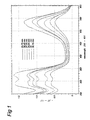
- FIG 1 Spectra of the anthocyanins as extracted from sprout of the Raphanus sativa line V33. The absorbance versus the wavelength is shown for each of the anthocyanins eluting from the HPLC at different times as indicated (see Example 4 for experimental details).
- FIG 2 Spectra of the anthocyanins as extracted from sprout of the Raphanus sativa line CGN 6924 (starting cultivar). The absorbance versus the wavelength is shown for each of the anthocyanins eluting from the HPLC at different times as indicated (see Example 4 for experimental details).
- Raphanus sativa lines as available from public gene banks were screened for their capability to produce a purple sprout. 14 of those lines were found to produce a sprout with at least some purple colouring. After several generations of self-pollination and selection, most descendants did not produce a sufficiently intense purple colour. Only 2 out of the 14 lines produced a significantly intense purple colour and were selected for further breeding. These two lines, CGN 6924 and CGN 7240 were both obtained from the CGN gene bank at Plant Research International (formerly CPRO-DLO), Wageningen, The Netherlands and originated from the former German Democratic Republic and from China, respectively. Starting from these three lines a high frequency further breeding program was undertaken whereby two generations were grown per year, alternating growth in the Northern and Southern Hemisphere.
- Raphanus (daikon) sprout in the form of "cress” (Sakura Cress®) is described in Dutch Patent No. 192969 .
- seed of a purple Raphanus line is placed in plastic containers (of e.g. 6 x 8 cm surface) having a water soaked solid support ("substrate") such as e.g. a sheet or pad of cellulose or fin peat on the bottom.
- substrate water soaked solid support
- the seeds are sown at a high density of about 3-6 seeds per cm 2 .
- the containers with the seeds are then allowed to germinate at 15-24°C at high humidity (preferably a relative humidity of 100%).
- Germination may suitably be performed in the dark or with lighting and preferably is carried out in a germination cell or room with controlled temperature and humidity. After germination, which usually takes about 48 hours, the containers with seedlings are placed in a greenhouse where the temperature is kept at 15°C or higher (preferably not higher than 25°C) and humidity is preferably kept above 70% (relative humidity). The plantlets are then allowed to grow for another 48-72 hours until they reach a height of 5 - 14 cm and usually having no more than 2 leaves, i.e. the cotyledons. Additional light may be given to make the plantlets more sturdy. When the plantlets have reached the desired height or number of leaves, growth is arrested by cooling down to 2°C. The plantlets are further kept, stored and transported at this temperature, preferably until consumption.
- Seed of the V33 line is washed and soaked in water and placed in a slowly rotating drum at 15 - 25°C, under addition of a fine mist of water. This mist is provided every hour or differently according to the growing method and planning of the grower.
- the seeds slowly tumble in the drum, fast enough not to cling together and slow enough not to break the germs. After 100 hours with a variation of about 48 hours, the sprouts have developed into a red/purple shiny product, which is then washed and ready for packaging.
- the ratio of seed to harvestable product usually is 1:8 till 1:10, i.e. 1 kg seeds provides 8 to 10 kg of sprouts. Additional lighting may be added during the germination resulting in a more intense purple colour.
- the materials were ground to a fine powder in a Waring blender that was pre-cooled with liquid nitrogen.
- the ground materials were treated with a 5-fold excess (volume in ml per weight in grams) of dichloromethane for removal of lipophilic substances such as chlorophyl.
- dichloromethane After filtration of dichloromethane, the material was extracted overnight in the dark in a 5-fold excess (volume in ml per weight in grams) of a 5% formic acid solution in water.
- the non-dissolved materials were removed by centrifugation after which the coloured supernatant was filtered.
- the filtrate was stored at 4°C in the dark.
- the freeze-dried extracts thus obtained were weighed to determine the yields.
- the extracts were analysed using a Waters HPLC system with a photodiodearray-detection system, such that spectra were obtained for all the compounds in the extract.
- the anthocyanin compounds in the extracts were quantified using a calibration curve based on malvine (malvidine-(3,5)-diglucoside). The latter compound is probably the basis of one or more of the anthocyanins in the purple Raphanus plant materials.
- the applied system consisted of a 150 ⁇ 4.6 (internal diameter) mm Luna 3 ⁇ m reversed phase-(C 18 -) column, using a flow of 0.75 ml/min. with an eluens consisting of a 35 to 55% methanol gradient in 5% formic acid.
- the yields for the extracts were as follows: Broccoli 36.8 mg 0.19 % Mino White 51.0 mg 0.25 % V33 sprouts 236.4 mg 0.78 % CGN 6924 cultivar 47.2 mg 0.24 % Recipar 30.9 mg 0.19 % V33 turnips 52.2 mg 0.16 %
- yields relate to the total weights of the extracts over the total weights of the extracted plant materials.
- the CGN 6924 chromatogram ( Figure 2 ) clearly differs from the V33 chromatogram in the presence of a number of peaks (not anthocyanins) with an absorbance in the UV-range and eluting 40-47 min (see Figure 2 at 254 en 340 nm).
- Anthocyanins are present in the CGN 6924 material but only in small amounts (see Figure 2 at 510 nm ).
- the anthocyanins in the CGN 6924 line clearly differ from the anthocyanins in the V33 line by having an absorbance maximum at 515 nm instead of a maximum in the range of 530-535 nm.
- a relatively high extinction is also found at 325 and at 285 nm, with the strongest extinction at 325 nm. However it cannot be exclude that other, non-anthocyanin compounds co-elute that influence the extinction in this area.
- the V33 turnips contain large quantities of anthocyanins. However, in contrast to the usual red radish the anthocyanins are not present in the skin but rather in the turnip itself.
- the spectra of these anthocyanins are interesting as they show two types of anthocyanins: one with an absorbance maximum at approximately 510 nm and one with a maximum at 520-530 nm.
- the colour of the extract is therefore also in between the colours of the extracts of the red radish skins and of the V33 sprouts.
- the other maxima have normal values of 285 and 325-330 nm.
- the anthocyanins with a maximum at 520-530 nm elute in the same area as those found in the V33 sprouts, indicating that these are probably the same compounds. However, clearly also different anthocyanins are present in this extract as is evident from the absorbance at 510 nm.
- the anthocyanins found in the skins of the red radish turnips of the "Hoogvliet" variety clearly differ from those found in the V33 sprouts by having an absorbance maximum at 508-510 nm and a clearly higher extinction at 285 nm as compared to that at 325 nm.
- a calibration curve was made using increasing concentrations of commercially available malvine chloride. This curve was used to estimate the quantities of anthocyanins per extract and also per amount of plant material.
- Table 1 shows the estimated quantities of anthocyanin expressed in nmol per ⁇ gram extract and in nmol per gram plant material, respectively.
- Table 2 shows the estimated quantities of anthocyanin content of the extracts and of the plant materials, respectively. Table 1 .
Landscapes
- Life Sciences & Earth Sciences (AREA)
- Health & Medical Sciences (AREA)
- Physiology (AREA)
- Botany (AREA)
- Developmental Biology & Embryology (AREA)
- Environmental Sciences (AREA)
- Natural Medicines & Medicinal Plants (AREA)
- Agricultural Chemicals And Associated Chemicals (AREA)
- Cultivation Of Plants (AREA)
- Pharmaceuticals Containing Other Organic And Inorganic Compounds (AREA)
- Breeding Of Plants And Reproduction By Means Of Culturing (AREA)
- Saccharide Compounds (AREA)
- Medicines Containing Plant Substances (AREA)
Claims (14)
- Raphanus sativa Pflanze, erhältlich durch Auslesen von Raphanus sativa Pflanzen auf ihre Fähigkeit hin, Keimlinge mit mindestens etwas violetter Färbung zu erzeugen, Selbstbestäuben und/oder Kreuzen besagter Pflanzen für mehrere Generationen und Auswählen von Abkömmlingen, die Keimlinge mit violetter Färbung aufweisen, dadurch gekennzeichnet, dass der Keimling der besagten Pflanze Anthocyanine in einer Höhe von mindestens 800 nmol pro Gramm Frischgewicht de s Keimlings umfasst.
- Pflanze nach Anspruch 1, wobei die Anthocyanine ein Absorptionsmaximum im Bereich von 515 - 550 nm besitzen.
- Pflanze nach Anspruch 1, wobei die Anthocyanine ein Anthocyanin umfassen, welches einen Anthocyanidin-Rest hat, der die Struktur von Formel 1 besitzt, und wobei R1 OH oder OCH3 ist, und wobei R2 H, OH oder OCH3 ist.
- Pflanze nach Anspruch 1, wobei die Pflanze durch Züchtung und Selektion aus Raphanus sativa Linien CGN 6924, CGN 7240, ATTC No. PTA-3630 oder Kombinationen davon erhalten wird.
- Keimling erhalten von einer Pflanze nach Anspruch 1.
- Keimling nach Anspruch 5, wobei der Keimling vor dem Zwei-Blatt Stadium ist.
- Behälter enthaltend eine Vielzahl von Keimlingen nach Anspruch 6.
- Keimling nach Anspruch 5, wobei der Keimling ein Pflänzchen ist, welches mindestens zwei Blätter und eine Höhe von weniger als 20 cm aufweist.
- Behälter enthaltend eine Vielzahl von Pflänzchen nach Anspruch 8.
- Behälter nach Anspruch 9, wobei der Behälter mindestens 3 Pflänzchen pro cm2 enthält.
- Material von einer Pflanze nach Anspruch 1, wobei das Material ein Samen ist und wobei besagter Samen dadurch charakterisiert ist, dass der Samen bei Keimung einen Keimling erzeugt und besagter Keimling Anthocyanine in einer Höhe von mindestens 800 nmol pro Gramm Frischgewicht des Keimlings umfasst.
- Verfahren zur Erzeugung eines Keimlings wie in Anspruch 5 definiert, wobei das Verfahren die Schritte umfasst:(a) Keimen eines Samens einer Raphanus sativa Pflanze in einem Medium umfassend Wasser, bei 10 - 35 Grad Celsius unter hoher Luftfeuchtigkeit und wahlweise in einem Behälter, wobei die Raphanus sativa Pflanze eine Pflanze wie definiert in einem beliebigen der Ansprüche 1-4 ist;(b) Züchten der gekeimten Samen erhalten in (a) unter in (a) definierten Bedingungen bis ein Keimling des gewünschten Entwicklungsstadiums erhalten ist,wobei in (a) das Saatgut unter hoher Luftfeuchtigkeit in einer rotierenden Trommel oder Behälter gekeimt wird, während das Saatgut mindestens einmal mit Wasser besprüht wird und wahlweise mit der Zugabe von Licht, und in (b) die gekeimten Samen für mindestens 48 Stunden gezüchtet werden.
- Verfahren zur Erzeugung eines Keimlings wie in Anspruch 5 definiert, wobei das Verfahren die Schritte umfasst:(a) Keimen eines Samens einer Raphanus sativa Pflanze in einem Medium umfassend Wasser, bei 10 - 35 Grad Celsius unter hoher Luftfeuchtigkeit und wahlweise in einem Behälter, wobei die Raphanus sativa Pflanze eine Pflanze wie definiert in einem beliebigen der Ansprüche 1- 4 ist;(b) Züchten der gekeimten Samen erhalten in (a) unter in (a) definierten Bedingungen bis ein Keimling des gewünschtem Entwicklungsstadiums erhalten ist,wobei in (a) der Samen auf einem nicht-nahrhaften, festen, Wasser enthaltenden Untergrund gekeimt wird, bei einer Dichte von 3-12 Samen pro cm2, bei einer Temperatur von 15-35 Grad Celsius, bei hoher Luftfeuchtigkeit, und wobei in (b) die gekeimten Samen bei einer Temperatur von mindestens 15 - 35 Grad Celsius, bei einer Luftfeuchtigkeit von mindestens 70 % und unter einem täglichen Zyklus von Licht und wahlweise mit zusätzlicher Belichtung gezüchtet werden bis die gekeimten Samen zu Pflänzchen herangewachsen sind, die mindestens zwei Blätter aufweisen, und wahlweise das Verfahren einen Schritt (c) umfasst, wobei weiteres Wachstum der Pflänzchen durch Abkühlen auf eine Temperatur zwischen 1 und 6 Grad Celsius aufgehalten wird.
- Verfahren zum Erzeugen von Anthocyanin, wobei das Verfahren die Schritte umfasst:(a) Züchten einer Raphanus sativa Pflanze wie in einem beliebigen der Ansprüche 1-4 definiert;(b) Ernten der Raphanus sativa Pflanze oder eines Teils davon;(c) Rückgewinnung der Anthocyanine in der Pflanze oder eines Teils davon; und(d) wahlweise das Aufreinigen der Anthocyanine.
Priority Applications (11)
| Application Number | Priority Date | Filing Date | Title |
|---|---|---|---|
| ES01203441T ES2309031T3 (es) | 2001-09-07 | 2001-09-07 | Raphanus con niveles de antocianina aumentados. |
| EP01203441A EP1290938B1 (de) | 2001-09-07 | 2001-09-07 | Raphanus mit erhöhtem Anthocyanspiegel |
| CA2357307A CA2357307C (en) | 2001-09-07 | 2001-09-07 | Raphanus with increased anthocyanin levels |
| DE60134550T DE60134550D1 (de) | 2001-09-07 | 2001-09-07 | Raphanus mit erhöhtem Anthocyanspiegel |
| US09/948,110 US6686517B2 (en) | 2001-09-07 | 2001-09-07 | Raphanus with increased anthocyanin levels |
| AT01203441T ATE398919T1 (de) | 2001-09-07 | 2001-09-07 | Raphanus mit erhöhtem anthocyanspiegel |
| DK01203441T DK1290938T3 (da) | 2001-09-07 | 2001-09-07 | Raphanus med forhöjede anthocyaninniveauer |
| JP2001311631A JP4152615B2 (ja) | 2001-09-07 | 2001-10-09 | アントシアニンレベルの増大したRaphanus |
| AU2002300802A AU2002300802B2 (en) | 2001-09-07 | 2002-08-29 | Raphanus with increased anthocyanin levels |
| NZ521140A NZ521140A (en) | 2001-09-07 | 2002-09-02 | Methods for producing Raphanus sativa sprouts with increased anthocyanin levels |
| NO20024162A NO20024162L (no) | 2001-09-07 | 2002-09-02 | Raphanus med ökede antocyaninverdier |
Applications Claiming Priority (3)
| Application Number | Priority Date | Filing Date | Title |
|---|---|---|---|
| EP01203441A EP1290938B1 (de) | 2001-09-07 | 2001-09-07 | Raphanus mit erhöhtem Anthocyanspiegel |
| CA2357307A CA2357307C (en) | 2001-09-07 | 2001-09-07 | Raphanus with increased anthocyanin levels |
| US09/948,110 US6686517B2 (en) | 2001-09-07 | 2001-09-07 | Raphanus with increased anthocyanin levels |
Publications (2)
| Publication Number | Publication Date |
|---|---|
| EP1290938A1 EP1290938A1 (de) | 2003-03-12 |
| EP1290938B1 true EP1290938B1 (de) | 2008-06-25 |
Family
ID=27791809
Family Applications (1)
| Application Number | Title | Priority Date | Filing Date |
|---|---|---|---|
| EP01203441A Expired - Lifetime EP1290938B1 (de) | 2001-09-07 | 2001-09-07 | Raphanus mit erhöhtem Anthocyanspiegel |
Country Status (11)
| Country | Link |
|---|---|
| US (1) | US6686517B2 (de) |
| EP (1) | EP1290938B1 (de) |
| JP (1) | JP4152615B2 (de) |
| AT (1) | ATE398919T1 (de) |
| AU (1) | AU2002300802B2 (de) |
| CA (1) | CA2357307C (de) |
| DE (1) | DE60134550D1 (de) |
| DK (1) | DK1290938T3 (de) |
| ES (1) | ES2309031T3 (de) |
| NO (1) | NO20024162L (de) |
| NZ (1) | NZ521140A (de) |
Cited By (1)
| Publication number | Priority date | Publication date | Assignee | Title |
|---|---|---|---|---|
| WO2011072848A1 (en) | 2009-12-17 | 2011-06-23 | Nunhems B.V. | Tetraploid corn salad |
Families Citing this family (4)
| Publication number | Priority date | Publication date | Assignee | Title |
|---|---|---|---|---|
| US7304210B2 (en) * | 2001-09-07 | 2007-12-04 | Gain Harvest Development Ltd. | Raphanus with increased anthocyanin levels |
| US8491670B2 (en) * | 2007-06-21 | 2013-07-23 | Suntava, Llc | Anthocyanin pigment/dye compositions and method of providing composition through extraction from corn |
| WO2009016620A2 (en) | 2007-07-27 | 2009-02-05 | The State Of Israel, Ministry Of Agriculture & Rural Development, Agricultural Research Organization, (A.R.O.), Volcani Center | Pomegranate sprouts, preparations derived therefrom and compositions comprising same |
| JP6949319B2 (ja) * | 2016-11-04 | 2021-10-13 | 株式会社サラダコスモ | フィトケミカル高度含有アブラナ科スプラウト及びその生産方法 |
Family Cites Families (17)
| Publication number | Priority date | Publication date | Assignee | Title |
|---|---|---|---|---|
| US3643376A (en) * | 1969-10-08 | 1972-02-22 | Everton G Poindexter | Production of seed sprouts |
| US3733745A (en) | 1970-04-01 | 1973-05-22 | Hasselfors Bruks Ab | Germination and seedling promoting unit |
| US3945148A (en) | 1975-03-10 | 1976-03-23 | George Clem Oyama | Method and apparatus for growing bean sprouts |
| US4130964A (en) | 1975-12-01 | 1978-12-26 | Caballero Edward A | Apparatus and method for growing legume sprouts |
| US4086725A (en) | 1976-06-25 | 1978-05-02 | Tsiang Kwang Li | Method and apparatus for growing plant sprouts |
| US4292760A (en) | 1979-07-19 | 1981-10-06 | Krave Carl A | Method, apparatus and package for sprouting seeds |
| IE832860L (en) * | 1983-12-05 | 1984-06-05 | Toshiro Kancko | Cultivation of vegetables |
| JPS60227610A (ja) * | 1984-04-25 | 1985-11-12 | 株式会社 大生機械 | 芽物野菜の栽培装置 |
| GB2163634A (en) | 1984-08-30 | 1986-03-05 | Agricultural Requisites & Mech | Seed sprouting apparatus and method |
| CA1332880C (en) * | 1986-10-17 | 1994-11-08 | Takashi Adachi | Plant cultivation method |
| JPS6486820A (en) * | 1987-09-28 | 1989-03-31 | Miyachi Foods Kk | Method for cultivating 'kaiware daikon' and apparatus therefor |
| JPH02265474A (ja) * | 1989-04-06 | 1990-10-30 | Nippon Shokubai Kagaku Kogyo Co Ltd | 赤色色素および該色素含有毛状組織の製造方法 |
| NL192969C (nl) * | 1989-04-27 | 1998-07-03 | Gerrit Koppert | Werkwijze voor het kweken van eetbare planten alsmede houders met aldus gekweekt plantaardig materiaal. |
| UA26442C2 (uk) | 1990-08-20 | 1999-08-30 | Герхард Оленшлегер | Фармкомпозиція для профілактики і лікуваhhя захворюваhь, пов'язаhих з порушеhhям обміhу речовиh |
| KR950004772B1 (ko) * | 1991-08-12 | 1995-05-10 | 주식회사진로 | 청피홍심무우의 조직배양에 의한 안토시아닌계 적색 색소의 생산방법 |
| KR0153422B1 (ko) * | 1993-07-09 | 1998-11-16 | 유채준 | 지하의 복합 무선중계 시스템 |
| US6521818B1 (en) * | 1998-07-01 | 2003-02-18 | John Hopkins School Of Medicine | Development of novel highly chemoprotectant crucifer germplasm |
-
2001
- 2001-09-07 EP EP01203441A patent/EP1290938B1/de not_active Expired - Lifetime
- 2001-09-07 DE DE60134550T patent/DE60134550D1/de not_active Expired - Lifetime
- 2001-09-07 DK DK01203441T patent/DK1290938T3/da active
- 2001-09-07 US US09/948,110 patent/US6686517B2/en not_active Expired - Lifetime
- 2001-09-07 CA CA2357307A patent/CA2357307C/en not_active Expired - Fee Related
- 2001-09-07 ES ES01203441T patent/ES2309031T3/es not_active Expired - Lifetime
- 2001-09-07 AT AT01203441T patent/ATE398919T1/de active
- 2001-10-09 JP JP2001311631A patent/JP4152615B2/ja not_active Expired - Fee Related
-
2002
- 2002-08-29 AU AU2002300802A patent/AU2002300802B2/en not_active Ceased
- 2002-09-02 NZ NZ521140A patent/NZ521140A/en not_active IP Right Cessation
- 2002-09-02 NO NO20024162A patent/NO20024162L/no not_active Application Discontinuation
Non-Patent Citations (2)
| Title |
|---|
| NOZZOLILLO C.: "An investigation of the intracellular site of anthocyanoplasts using isolted protoplasts and vacuoles", PLANT CELL REPORTS, vol. 7, 1988, pages 389 - 392 * |
| SONG J.I. YOUNG: "Expression of CHS, CHI and DFR genes in response to light in small radish seedlings", JOURNAL OF PLANT BIOLOGY, vol. 41, no. 4, 1998, pages 277 - 282 * |
Cited By (1)
| Publication number | Priority date | Publication date | Assignee | Title |
|---|---|---|---|---|
| WO2011072848A1 (en) | 2009-12-17 | 2011-06-23 | Nunhems B.V. | Tetraploid corn salad |
Also Published As
| Publication number | Publication date |
|---|---|
| CA2357307A1 (en) | 2003-03-07 |
| CA2357307C (en) | 2013-08-06 |
| AU2002300802B2 (en) | 2007-08-23 |
| US6686517B2 (en) | 2004-02-03 |
| ES2309031T3 (es) | 2008-12-16 |
| JP4152615B2 (ja) | 2008-09-17 |
| DK1290938T3 (da) | 2008-11-24 |
| NO20024162L (no) | 2003-03-10 |
| ATE398919T1 (de) | 2008-07-15 |
| US20030106109A1 (en) | 2003-06-05 |
| NZ521140A (en) | 2004-03-26 |
| DE60134550D1 (de) | 2008-08-07 |
| JP2003102302A (ja) | 2003-04-08 |
| NO20024162D0 (no) | 2002-09-02 |
| EP1290938A1 (de) | 2003-03-12 |
Similar Documents
| Publication | Publication Date | Title |
|---|---|---|
| Shulman et al. | Pomegranate fruit development and maturation | |
| Gazula et al. | Temperature and cultivar effects on anthocyanin and chlorophyll b concentrations in three related Lollo Rosso lettuce cultivars | |
| Fathy et al. | Micropropagation and biomass production of Rubus fruticosus L.(blackberry) plant | |
| MXPA01000219A (es) | Desarrollo de nuevo germen plasma crucifera altamente quimioprotector. | |
| Ahlawat et al. | Black mulberry (Morus nigra) | |
| KR101805553B1 (ko) | 새싹 보리의 재배 방법과 새싹 보리를 이용한 음료 | |
| Chen et al. | ZZ: a unique tropical ornamental foliage plant | |
| Allai et al. | Black currant | |
| US6686517B2 (en) | Raphanus with increased anthocyanin levels | |
| KR101821485B1 (ko) | 새싹 채소종자 발아방법 | |
| Narina et al. | Moringa and tamarind: potential drought-tolerant perennial crops | |
| US7304210B2 (en) | Raphanus with increased anthocyanin levels | |
| KR20210141898A (ko) | 새싹보리 분말의 제조방법 | |
| Horibe et al. | Effects of light wavelength on daughter cladode growth and quality in edible cactus Nopalea cochenillifera cultured in a plant factory with artificial light | |
| KR101508952B1 (ko) | 운모에서 추출한 미네랄을 이용한 새싹마늘 재배방법 | |
| Sau et al. | Guava | |
| Moreno et al. | Strawberries: antioxidant properties, health benefits and innovative technologies | |
| Della Rahayu et al. | Asymbiotic seed germination and plantlet development of Dendrobium spectabile (Blume) Miq. | |
| Kshirsagar et al. | Effect of postharvest preservatives on vase life of cut rose (Rosa hybrida L.) cv. Top secret | |
| Awad | The apple skin: colourful healthiness: developmental and environmental regulation of flavonoids and chlorogenic acid in apples | |
| Serrano-Martínez et al. | Effect of plant age and saline water on antioxidant and peroxidase activity in sweet pepper fruit | |
| Horibe et al. | Red and blue light ratio affects the growth and quality of edible cactus (Nopalea cochenillifera). | |
| KR102308123B1 (ko) | 기능성이 향상된 메밀싹 및 새싹채소의 재배방법 | |
| Ramanayake | Viability of excised embryos, shoot proliferation and in-vitro flowering in a species of rattan Calamus thwaitesii Becc. | |
| Sunian | Development of Sterilisation Procedures and In vitro studies of Nymphaea lotus |
Legal Events
| Date | Code | Title | Description |
|---|---|---|---|
| PUAI | Public reference made under article 153(3) epc to a published international application that has entered the european phase |
Free format text: ORIGINAL CODE: 0009012 |
|
| AK | Designated contracting states |
Kind code of ref document: A1 Designated state(s): AT BE CH CY DE DK ES FI FR GB GR IE IT LI LU MC NL PT SE TR |
|
| AX | Request for extension of the european patent |
Extension state: AL LT LV MK RO SI |
|
| 17P | Request for examination filed |
Effective date: 20030314 |
|
| RAP1 | Party data changed (applicant data changed or rights of an application transferred) |
Owner name: GAIN HARVEST DEVELOPMENT LTD |
|
| RIN1 | Information on inventor provided before grant (corrected) |
Inventor name: KOPPERT, GERRIT |
|
| AKX | Designation fees paid |
Designated state(s): AT BE CH CY DE DK ES FI FR GB GR IE IT LI LU MC NL PT SE TR |
|
| 17Q | First examination report despatched |
Effective date: 20040120 |
|
| 17Q | First examination report despatched |
Effective date: 20040120 |
|
| 17Q | First examination report despatched |
Effective date: 20040120 |
|
| GRAP | Despatch of communication of intention to grant a patent |
Free format text: ORIGINAL CODE: EPIDOSNIGR1 |
|
| RIN1 | Information on inventor provided before grant (corrected) |
Inventor name: KOPPERT, GERRIT |
|
| GRAS | Grant fee paid |
Free format text: ORIGINAL CODE: EPIDOSNIGR3 |
|
| GRAA | (expected) grant |
Free format text: ORIGINAL CODE: 0009210 |
|
| AK | Designated contracting states |
Kind code of ref document: B1 Designated state(s): AT BE CH CY DE DK ES FI FR GB GR IE IT LI LU MC NL PT SE TR |
|
| REG | Reference to a national code |
Ref country code: GB Ref legal event code: FG4D |
|
| REG | Reference to a national code |
Ref country code: CH Ref legal event code: EP |
|
| REF | Corresponds to: |
Ref document number: 60134550 Country of ref document: DE Date of ref document: 20080807 Kind code of ref document: P |
|
| REG | Reference to a national code |
Ref country code: SE Ref legal event code: TRGR |
|
| REG | Reference to a national code |
Ref country code: CH Ref legal event code: NV Representative=s name: BRAUNPAT BRAUN EDER AG |
|
| REG | Reference to a national code |
Ref country code: IE Ref legal event code: FG4D |
|
| PG25 | Lapsed in a contracting state [announced via postgrant information from national office to epo] |
Ref country code: FI Free format text: LAPSE BECAUSE OF FAILURE TO SUBMIT A TRANSLATION OF THE DESCRIPTION OR TO PAY THE FEE WITHIN THE PRESCRIBED TIME-LIMIT Effective date: 20080625 |
|
| REG | Reference to a national code |
Ref country code: DK Ref legal event code: T3 |
|
| REG | Reference to a national code |
Ref country code: ES Ref legal event code: FG2A Ref document number: 2309031 Country of ref document: ES Kind code of ref document: T3 |
|
| PG25 | Lapsed in a contracting state [announced via postgrant information from national office to epo] |
Ref country code: PT Free format text: LAPSE BECAUSE OF FAILURE TO SUBMIT A TRANSLATION OF THE DESCRIPTION OR TO PAY THE FEE WITHIN THE PRESCRIBED TIME-LIMIT Effective date: 20081125 |
|
| PG25 | Lapsed in a contracting state [announced via postgrant information from national office to epo] |
Ref country code: MC Free format text: LAPSE BECAUSE OF NON-PAYMENT OF DUE FEES Effective date: 20080930 |
|
| PLBE | No opposition filed within time limit |
Free format text: ORIGINAL CODE: 0009261 |
|
| STAA | Information on the status of an ep patent application or granted ep patent |
Free format text: STATUS: NO OPPOSITION FILED WITHIN TIME LIMIT |
|
| 26N | No opposition filed |
Effective date: 20090326 |
|
| PG25 | Lapsed in a contracting state [announced via postgrant information from national office to epo] |
Ref country code: CY Free format text: LAPSE BECAUSE OF FAILURE TO SUBMIT A TRANSLATION OF THE DESCRIPTION OR TO PAY THE FEE WITHIN THE PRESCRIBED TIME-LIMIT Effective date: 20080625 |
|
| PG25 | Lapsed in a contracting state [announced via postgrant information from national office to epo] |
Ref country code: TR Free format text: LAPSE BECAUSE OF FAILURE TO SUBMIT A TRANSLATION OF THE DESCRIPTION OR TO PAY THE FEE WITHIN THE PRESCRIBED TIME-LIMIT Effective date: 20080625 |
|
| PG25 | Lapsed in a contracting state [announced via postgrant information from national office to epo] |
Ref country code: GR Free format text: LAPSE BECAUSE OF FAILURE TO SUBMIT A TRANSLATION OF THE DESCRIPTION OR TO PAY THE FEE WITHIN THE PRESCRIBED TIME-LIMIT Effective date: 20080926 |
|
| REG | Reference to a national code |
Ref country code: NL Ref legal event code: SD Effective date: 20111229 |
|
| REG | Reference to a national code |
Ref country code: FR Ref legal event code: PLFP Year of fee payment: 16 |
|
| PGFP | Annual fee paid to national office [announced via postgrant information from national office to epo] |
Ref country code: GB Payment date: 20160930 Year of fee payment: 16 Ref country code: CH Payment date: 20160926 Year of fee payment: 16 Ref country code: IE Payment date: 20160926 Year of fee payment: 16 Ref country code: DK Payment date: 20160926 Year of fee payment: 16 Ref country code: LU Payment date: 20160926 Year of fee payment: 16 |
|
| PGFP | Annual fee paid to national office [announced via postgrant information from national office to epo] |
Ref country code: SE Payment date: 20160923 Year of fee payment: 16 Ref country code: AT Payment date: 20160928 Year of fee payment: 16 Ref country code: FR Payment date: 20160927 Year of fee payment: 16 |
|
| PGFP | Annual fee paid to national office [announced via postgrant information from national office to epo] |
Ref country code: BE Payment date: 20160926 Year of fee payment: 16 |
|
| PGFP | Annual fee paid to national office [announced via postgrant information from national office to epo] |
Ref country code: DE Payment date: 20161130 Year of fee payment: 16 |
|
| PGFP | Annual fee paid to national office [announced via postgrant information from national office to epo] |
Ref country code: IT Payment date: 20160922 Year of fee payment: 16 Ref country code: ES Payment date: 20161024 Year of fee payment: 16 |
|
| PGFP | Annual fee paid to national office [announced via postgrant information from national office to epo] |
Ref country code: NL Payment date: 20170919 Year of fee payment: 17 |
|
| REG | Reference to a national code |
Ref country code: DE Ref legal event code: R119 Ref document number: 60134550 Country of ref document: DE |
|
| REG | Reference to a national code |
Ref country code: DK Ref legal event code: EBP Effective date: 20170930 |
|
| REG | Reference to a national code |
Ref country code: CH Ref legal event code: PL |
|
| REG | Reference to a national code |
Ref country code: SE Ref legal event code: EUG |
|
| REG | Reference to a national code |
Ref country code: AT Ref legal event code: MM01 Ref document number: 398919 Country of ref document: AT Kind code of ref document: T Effective date: 20170907 |
|
| GBPC | Gb: european patent ceased through non-payment of renewal fee |
Effective date: 20170907 |
|
| REG | Reference to a national code |
Ref country code: IE Ref legal event code: MM4A |
|
| REG | Reference to a national code |
Ref country code: BE Ref legal event code: MM Effective date: 20170930 |
|
| PG25 | Lapsed in a contracting state [announced via postgrant information from national office to epo] |
Ref country code: LU Free format text: LAPSE BECAUSE OF NON-PAYMENT OF DUE FEES Effective date: 20170907 |
|
| REG | Reference to a national code |
Ref country code: FR Ref legal event code: ST Effective date: 20180531 |
|
| PG25 | Lapsed in a contracting state [announced via postgrant information from national office to epo] |
Ref country code: CH Free format text: LAPSE BECAUSE OF NON-PAYMENT OF DUE FEES Effective date: 20170930 Ref country code: GB Free format text: LAPSE BECAUSE OF NON-PAYMENT OF DUE FEES Effective date: 20170907 Ref country code: DE Free format text: LAPSE BECAUSE OF NON-PAYMENT OF DUE FEES Effective date: 20180404 Ref country code: IE Free format text: LAPSE BECAUSE OF NON-PAYMENT OF DUE FEES Effective date: 20170907 Ref country code: LI Free format text: LAPSE BECAUSE OF NON-PAYMENT OF DUE FEES Effective date: 20170930 |
|
| PG25 | Lapsed in a contracting state [announced via postgrant information from national office to epo] |
Ref country code: AT Free format text: LAPSE BECAUSE OF NON-PAYMENT OF DUE FEES Effective date: 20170907 Ref country code: FR Free format text: LAPSE BECAUSE OF NON-PAYMENT OF DUE FEES Effective date: 20171002 Ref country code: IT Free format text: LAPSE BECAUSE OF NON-PAYMENT OF DUE FEES Effective date: 20170907 Ref country code: BE Free format text: LAPSE BECAUSE OF NON-PAYMENT OF DUE FEES Effective date: 20170930 |
|
| REG | Reference to a national code |
Ref country code: ES Ref legal event code: FD2A Effective date: 20181019 |
|
| PG25 | Lapsed in a contracting state [announced via postgrant information from national office to epo] |
Ref country code: DK Free format text: LAPSE BECAUSE OF NON-PAYMENT OF DUE FEES Effective date: 20170930 |
|
| PG25 | Lapsed in a contracting state [announced via postgrant information from national office to epo] |
Ref country code: ES Free format text: LAPSE BECAUSE OF NON-PAYMENT OF DUE FEES Effective date: 20170908 |
|
| REG | Reference to a national code |
Ref country code: NL Ref legal event code: MM Effective date: 20181001 |
|
| PG25 | Lapsed in a contracting state [announced via postgrant information from national office to epo] |
Ref country code: NL Free format text: LAPSE BECAUSE OF NON-PAYMENT OF DUE FEES Effective date: 20181001 |
|
| PG25 | Lapsed in a contracting state [announced via postgrant information from national office to epo] |
Ref country code: SE Free format text: LAPSE BECAUSE OF NON-PAYMENT OF DUE FEES Effective date: 20170908 |