EP1285003B1 - Verwendung von sekundärem zellwandpolymer prokaryontischer mikroorganismen - Google Patents
Verwendung von sekundärem zellwandpolymer prokaryontischer mikroorganismen Download PDFInfo
- Publication number
- EP1285003B1 EP1285003B1 EP01925182A EP01925182A EP1285003B1 EP 1285003 B1 EP1285003 B1 EP 1285003B1 EP 01925182 A EP01925182 A EP 01925182A EP 01925182 A EP01925182 A EP 01925182A EP 1285003 B1 EP1285003 B1 EP 1285003B1
- Authority
- EP
- European Patent Office
- Prior art keywords
- layer
- molecules
- cell wall
- secondary cell
- functional
- Prior art date
- Legal status (The legal status is an assumption and is not a legal conclusion. Google has not performed a legal analysis and makes no representation as to the accuracy of the status listed.)
- Expired - Lifetime
Links
- 229920000642 polymer Polymers 0.000 title claims description 53
- 210000002421 cell wall Anatomy 0.000 title claims description 41
- 244000005700 microbiome Species 0.000 title claims description 3
- 150000002632 lipids Chemical class 0.000 claims description 112
- 239000012528 membrane Substances 0.000 claims description 77
- 102000004169 proteins and genes Human genes 0.000 claims description 68
- 108090000623 proteins and genes Proteins 0.000 claims description 68
- 230000027455 binding Effects 0.000 claims description 42
- 239000002131 composite material Substances 0.000 claims description 38
- 210000004027 cell Anatomy 0.000 claims description 12
- 239000011159 matrix material Substances 0.000 claims description 9
- 230000002209 hydrophobic effect Effects 0.000 claims description 8
- 238000001471 micro-filtration Methods 0.000 claims description 8
- 239000002052 molecular layer Substances 0.000 claims description 5
- 230000009870 specific binding Effects 0.000 claims description 5
- 238000013537 high throughput screening Methods 0.000 claims description 4
- 230000000503 lectinlike effect Effects 0.000 claims description 4
- 239000000693 micelle Substances 0.000 claims description 3
- 238000007877 drug screening Methods 0.000 claims description 2
- 239000010410 layer Substances 0.000 description 150
- 235000018102 proteins Nutrition 0.000 description 53
- 239000000243 solution Substances 0.000 description 43
- 238000000034 method Methods 0.000 description 33
- 239000002502 liposome Substances 0.000 description 31
- 101710168515 Cell surface glycoprotein Proteins 0.000 description 23
- 101710099182 S-layer protein Proteins 0.000 description 23
- 239000000872 buffer Substances 0.000 description 23
- QKNYBSVHEMOAJP-UHFFFAOYSA-N 2-amino-2-(hydroxymethyl)propane-1,3-diol;hydron;chloride Chemical compound Cl.OCC(N)(CO)CO QKNYBSVHEMOAJP-UHFFFAOYSA-N 0.000 description 18
- 238000001953 recrystallisation Methods 0.000 description 18
- 125000003277 amino group Chemical group 0.000 description 15
- 238000004519 manufacturing process Methods 0.000 description 14
- LFQSCWFLJHTTHZ-UHFFFAOYSA-N Ethanol Chemical compound CCO LFQSCWFLJHTTHZ-UHFFFAOYSA-N 0.000 description 12
- 108010082913 S-layer proteins Proteins 0.000 description 12
- 230000001580 bacterial effect Effects 0.000 description 12
- QFMZQPDHXULLKC-UHFFFAOYSA-N 1,2-bis(diphenylphosphino)ethane Chemical compound C=1C=CC=CC=1P(C=1C=CC=CC=1)CCP(C=1C=CC=CC=1)C1=CC=CC=C1 QFMZQPDHXULLKC-UHFFFAOYSA-N 0.000 description 11
- 230000008569 process Effects 0.000 description 11
- 229930186217 Glycolipid Natural products 0.000 description 10
- 239000007787 solid Substances 0.000 description 10
- 239000000126 substance Substances 0.000 description 10
- 241000193385 Geobacillus stearothermophilus Species 0.000 description 9
- 230000015572 biosynthetic process Effects 0.000 description 9
- 238000006243 chemical reaction Methods 0.000 description 9
- 238000011534 incubation Methods 0.000 description 9
- UIIMBOGNXHQVGW-UHFFFAOYSA-M Sodium bicarbonate Chemical compound [Na+].OC([O-])=O UIIMBOGNXHQVGW-UHFFFAOYSA-M 0.000 description 8
- HVYWMOMLDIMFJA-DPAQBDIFSA-N cholesterol Chemical compound C1C=C2C[C@@H](O)CC[C@]2(C)[C@@H]2[C@@H]1[C@@H]1CC[C@H]([C@H](C)CCCC(C)C)[C@@]1(C)CC2 HVYWMOMLDIMFJA-DPAQBDIFSA-N 0.000 description 8
- 230000006870 function Effects 0.000 description 8
- 230000003993 interaction Effects 0.000 description 8
- 239000012064 sodium phosphate buffer Substances 0.000 description 8
- 238000000108 ultra-filtration Methods 0.000 description 8
- 241000203069 Archaea Species 0.000 description 7
- 150000001720 carbohydrates Chemical class 0.000 description 7
- 239000000203 mixture Substances 0.000 description 7
- 230000004048 modification Effects 0.000 description 7
- 238000012986 modification Methods 0.000 description 7
- CSCPPACGZOOCGX-UHFFFAOYSA-N Acetone Chemical compound CC(C)=O CSCPPACGZOOCGX-UHFFFAOYSA-N 0.000 description 6
- 101710092462 Alpha-hemolysin Proteins 0.000 description 6
- OKKJLVBELUTLKV-UHFFFAOYSA-N Methanol Chemical compound OC OKKJLVBELUTLKV-UHFFFAOYSA-N 0.000 description 6
- DBMJMQXJHONAFJ-UHFFFAOYSA-M Sodium laurylsulphate Chemical compound [Na+].CCCCCCCCCCCCOS([O-])(=O)=O DBMJMQXJHONAFJ-UHFFFAOYSA-M 0.000 description 6
- 230000000694 effects Effects 0.000 description 6
- 238000005259 measurement Methods 0.000 description 6
- 238000002360 preparation method Methods 0.000 description 6
- 125000003396 thiol group Chemical group [H]S* 0.000 description 6
- SXRSQZLOMIGNAQ-UHFFFAOYSA-N Glutaraldehyde Chemical compound O=CCCCC=O SXRSQZLOMIGNAQ-UHFFFAOYSA-N 0.000 description 5
- 239000000232 Lipid Bilayer Substances 0.000 description 5
- MSFSPUZXLOGKHJ-UHFFFAOYSA-N Muraminsaeure Natural products OC(=O)C(C)OC1C(N)C(O)OC(CO)C1O MSFSPUZXLOGKHJ-UHFFFAOYSA-N 0.000 description 5
- 108010013639 Peptidoglycan Proteins 0.000 description 5
- 235000014633 carbohydrates Nutrition 0.000 description 5
- 239000000969 carrier Substances 0.000 description 5
- 239000003153 chemical reaction reagent Substances 0.000 description 5
- 102000037865 fusion proteins Human genes 0.000 description 5
- 108020001507 fusion proteins Proteins 0.000 description 5
- 239000011148 porous material Substances 0.000 description 5
- 239000002356 single layer Substances 0.000 description 5
- 239000000725 suspension Substances 0.000 description 5
- 238000005406 washing Methods 0.000 description 5
- YBJHBAHKTGYVGT-ZKWXMUAHSA-N (+)-Biotin Chemical compound N1C(=O)N[C@@H]2[C@H](CCCCC(=O)O)SC[C@@H]21 YBJHBAHKTGYVGT-ZKWXMUAHSA-N 0.000 description 4
- KILNVBDSWZSGLL-KXQOOQHDSA-N 1,2-dihexadecanoyl-sn-glycero-3-phosphocholine Chemical compound CCCCCCCCCCCCCCCC(=O)OC[C@H](COP([O-])(=O)OCC[N+](C)(C)C)OC(=O)CCCCCCCCCCCCCCC KILNVBDSWZSGLL-KXQOOQHDSA-N 0.000 description 4
- DIYPCWKHSODVAP-UHFFFAOYSA-N 1-[3-(2,5-dioxopyrrol-1-yl)benzoyl]oxy-2,5-dioxopyrrolidine-3-sulfonic acid Chemical compound O=C1C(S(=O)(=O)O)CC(=O)N1OC(=O)C1=CC=CC(N2C(C=CC2=O)=O)=C1 DIYPCWKHSODVAP-UHFFFAOYSA-N 0.000 description 4
- HEDRZPFGACZZDS-UHFFFAOYSA-N Chloroform Chemical compound ClC(Cl)Cl HEDRZPFGACZZDS-UHFFFAOYSA-N 0.000 description 4
- 102000008857 Ferritin Human genes 0.000 description 4
- 108050000784 Ferritin Proteins 0.000 description 4
- 238000008416 Ferritin Methods 0.000 description 4
- 102000004310 Ion Channels Human genes 0.000 description 4
- 108010052285 Membrane Proteins Proteins 0.000 description 4
- 102000018697 Membrane Proteins Human genes 0.000 description 4
- OVRNDRQMDRJTHS-OZRXBMAMSA-N N-acetyl-beta-D-mannosamine Chemical compound CC(=O)N[C@@H]1[C@H](O)O[C@H](CO)[C@@H](O)[C@@H]1O OVRNDRQMDRJTHS-OZRXBMAMSA-N 0.000 description 4
- 108010090804 Streptavidin Proteins 0.000 description 4
- 230000003592 biomimetic effect Effects 0.000 description 4
- 125000002915 carbonyl group Chemical group [*:2]C([*:1])=O 0.000 description 4
- 235000012000 cholesterol Nutrition 0.000 description 4
- 238000005516 engineering process Methods 0.000 description 4
- 239000012634 fragment Substances 0.000 description 4
- 238000005227 gel permeation chromatography Methods 0.000 description 4
- KRHYYFGTRYWZRS-UHFFFAOYSA-N hydrofluoric acid Substances F KRHYYFGTRYWZRS-UHFFFAOYSA-N 0.000 description 4
- 238000007654 immersion Methods 0.000 description 4
- 125000002924 primary amino group Chemical group [H]N([H])* 0.000 description 4
- 238000006268 reductive amination reaction Methods 0.000 description 4
- 229910000030 sodium bicarbonate Inorganic materials 0.000 description 4
- 235000017557 sodium bicarbonate Nutrition 0.000 description 4
- 239000002344 surface layer Substances 0.000 description 4
- 238000012360 testing method Methods 0.000 description 4
- 235000012431 wafers Nutrition 0.000 description 4
- XLYOFNOQVPJJNP-UHFFFAOYSA-N water Substances O XLYOFNOQVPJJNP-UHFFFAOYSA-N 0.000 description 4
- 241001112741 Bacillaceae Species 0.000 description 3
- 241000894006 Bacteria Species 0.000 description 3
- 239000004971 Cross linker Substances 0.000 description 3
- PIICEJLVQHRZGT-UHFFFAOYSA-N Ethylenediamine Chemical compound NCCN PIICEJLVQHRZGT-UHFFFAOYSA-N 0.000 description 3
- 239000004372 Polyvinyl alcohol Substances 0.000 description 3
- LCTONWCANYUPML-UHFFFAOYSA-M Pyruvate Chemical compound CC(=O)C([O-])=O LCTONWCANYUPML-UHFFFAOYSA-M 0.000 description 3
- HEMHJVSKTPXQMS-UHFFFAOYSA-M Sodium hydroxide Chemical compound [OH-].[Na+] HEMHJVSKTPXQMS-UHFFFAOYSA-M 0.000 description 3
- 239000012505 Superdex™ Substances 0.000 description 3
- 125000003172 aldehyde group Chemical group 0.000 description 3
- 150000001413 amino acids Chemical group 0.000 description 3
- 239000008346 aqueous phase Substances 0.000 description 3
- 230000008901 benefit Effects 0.000 description 3
- 230000005540 biological transmission Effects 0.000 description 3
- 238000005119 centrifugation Methods 0.000 description 3
- 238000010382 chemical cross-linking Methods 0.000 description 3
- 230000001427 coherent effect Effects 0.000 description 3
- 238000010276 construction Methods 0.000 description 3
- 229920001577 copolymer Polymers 0.000 description 3
- 230000008021 deposition Effects 0.000 description 3
- 238000001514 detection method Methods 0.000 description 3
- 238000009792 diffusion process Methods 0.000 description 3
- 238000009826 distribution Methods 0.000 description 3
- 150000002148 esters Chemical class 0.000 description 3
- 239000000499 gel Substances 0.000 description 3
- 239000000463 material Substances 0.000 description 3
- 239000012299 nitrogen atmosphere Substances 0.000 description 3
- 230000003647 oxidation Effects 0.000 description 3
- 238000007254 oxidation reaction Methods 0.000 description 3
- KHIWWQKSHDUIBK-UHFFFAOYSA-N periodic acid Chemical compound OI(=O)(=O)=O KHIWWQKSHDUIBK-UHFFFAOYSA-N 0.000 description 3
- 239000012071 phase Substances 0.000 description 3
- 150000003904 phospholipids Chemical class 0.000 description 3
- 229920002451 polyvinyl alcohol Polymers 0.000 description 3
- 239000008057 potassium phosphate buffer Substances 0.000 description 3
- 239000011541 reaction mixture Substances 0.000 description 3
- 230000007480 spreading Effects 0.000 description 3
- 238000003892 spreading Methods 0.000 description 3
- 230000000087 stabilizing effect Effects 0.000 description 3
- 238000002198 surface plasmon resonance spectroscopy Methods 0.000 description 3
- CBCKQZAAMUWICA-UHFFFAOYSA-N 1,4-phenylenediamine Chemical compound NC1=CC=C(N)C=C1 CBCKQZAAMUWICA-UHFFFAOYSA-N 0.000 description 2
- MSWZFWKMSRAUBD-IVMDWMLBSA-N 2-amino-2-deoxy-D-glucopyranose Chemical compound N[C@H]1C(O)O[C@H](CO)[C@@H](O)[C@@H]1O MSWZFWKMSRAUBD-IVMDWMLBSA-N 0.000 description 2
- HRPVXLWXLXDGHG-UHFFFAOYSA-N Acrylamide Chemical compound NC(=O)C=C HRPVXLWXLXDGHG-UHFFFAOYSA-N 0.000 description 2
- VVJKKWFAADXIJK-UHFFFAOYSA-N Allylamine Chemical compound NCC=C VVJKKWFAADXIJK-UHFFFAOYSA-N 0.000 description 2
- 229920002307 Dextran Polymers 0.000 description 2
- PEDCQBHIVMGVHV-UHFFFAOYSA-N Glycerine Chemical compound OCC(O)CO PEDCQBHIVMGVHV-UHFFFAOYSA-N 0.000 description 2
- 108090000288 Glycoproteins Proteins 0.000 description 2
- 102000003886 Glycoproteins Human genes 0.000 description 2
- 241000193386 Lysinibacillus sphaericus Species 0.000 description 2
- OVRNDRQMDRJTHS-FMDGEEDCSA-N N-acetyl-beta-D-glucosamine Chemical compound CC(=O)N[C@H]1[C@H](O)O[C@H](CO)[C@@H](O)[C@@H]1O OVRNDRQMDRJTHS-FMDGEEDCSA-N 0.000 description 2
- 239000002262 Schiff base Substances 0.000 description 2
- 150000004753 Schiff bases Chemical class 0.000 description 2
- BLRPTPMANUNPDV-UHFFFAOYSA-N Silane Chemical compound [SiH4] BLRPTPMANUNPDV-UHFFFAOYSA-N 0.000 description 2
- VYPSYNLAJGMNEJ-UHFFFAOYSA-N Silicium dioxide Chemical compound O=[Si]=O VYPSYNLAJGMNEJ-UHFFFAOYSA-N 0.000 description 2
- XUIMIQQOPSSXEZ-UHFFFAOYSA-N Silicon Chemical compound [Si] XUIMIQQOPSSXEZ-UHFFFAOYSA-N 0.000 description 2
- 108010067973 Valinomycin Proteins 0.000 description 2
- 239000002253 acid Substances 0.000 description 2
- 235000001014 amino acid Nutrition 0.000 description 2
- 229940024606 amino acid Drugs 0.000 description 2
- 238000004458 analytical method Methods 0.000 description 2
- 238000004873 anchoring Methods 0.000 description 2
- 239000002585 base Substances 0.000 description 2
- MSWZFWKMSRAUBD-UHFFFAOYSA-N beta-D-galactosamine Natural products NC1C(O)OC(CO)C(O)C1O MSWZFWKMSRAUBD-UHFFFAOYSA-N 0.000 description 2
- 230000033228 biological regulation Effects 0.000 description 2
- 229960002685 biotin Drugs 0.000 description 2
- 235000020958 biotin Nutrition 0.000 description 2
- 239000011616 biotin Substances 0.000 description 2
- 239000007853 buffer solution Substances 0.000 description 2
- 125000003178 carboxy group Chemical group [H]OC(*)=O 0.000 description 2
- 150000001732 carboxylic acid derivatives Chemical class 0.000 description 2
- 210000000170 cell membrane Anatomy 0.000 description 2
- 238000012412 chemical coupling Methods 0.000 description 2
- 238000003776 cleavage reaction Methods 0.000 description 2
- 239000011248 coating agent Substances 0.000 description 2
- 238000000576 coating method Methods 0.000 description 2
- FCFNRCROJUBPLU-UHFFFAOYSA-N compound M126 Natural products CC(C)C1NC(=O)C(C)OC(=O)C(C(C)C)NC(=O)C(C(C)C)OC(=O)C(C(C)C)NC(=O)C(C)OC(=O)C(C(C)C)NC(=O)C(C(C)C)OC(=O)C(C(C)C)NC(=O)C(C)OC(=O)C(C(C)C)NC(=O)C(C(C)C)OC1=O FCFNRCROJUBPLU-UHFFFAOYSA-N 0.000 description 2
- 150000001875 compounds Chemical class 0.000 description 2
- 239000003431 cross linking reagent Substances 0.000 description 2
- MHMNJMPURVTYEJ-UHFFFAOYSA-N fluorescein-5-isothiocyanate Chemical compound O1C(=O)C2=CC(N=C=S)=CC=C2C21C1=CC=C(O)C=C1OC1=CC(O)=CC=C21 MHMNJMPURVTYEJ-UHFFFAOYSA-N 0.000 description 2
- 238000004108 freeze drying Methods 0.000 description 2
- 238000007306 functionalization reaction Methods 0.000 description 2
- 230000004927 fusion Effects 0.000 description 2
- 239000011521 glass Substances 0.000 description 2
- 229960002442 glucosamine Drugs 0.000 description 2
- 150000002337 glycosamines Chemical class 0.000 description 2
- PCHJSUWPFVWCPO-UHFFFAOYSA-N gold Chemical compound [Au] PCHJSUWPFVWCPO-UHFFFAOYSA-N 0.000 description 2
- 239000010931 gold Substances 0.000 description 2
- 229910052737 gold Inorganic materials 0.000 description 2
- 238000011835 investigation Methods 0.000 description 2
- 150000002500 ions Chemical class 0.000 description 2
- -1 lactal lactone Chemical class 0.000 description 2
- 239000013554 lipid monolayer Substances 0.000 description 2
- 238000002156 mixing Methods 0.000 description 2
- 239000000178 monomer Substances 0.000 description 2
- QPJSUIGXIBEQAC-UHFFFAOYSA-N n-(2,4-dichloro-5-propan-2-yloxyphenyl)acetamide Chemical compound CC(C)OC1=CC(NC(C)=O)=C(Cl)C=C1Cl QPJSUIGXIBEQAC-UHFFFAOYSA-N 0.000 description 2
- 229920001542 oligosaccharide Polymers 0.000 description 2
- 150000002482 oligosaccharides Chemical group 0.000 description 2
- 239000002245 particle Substances 0.000 description 2
- 239000000047 product Substances 0.000 description 2
- 230000007017 scission Effects 0.000 description 2
- 238000000926 separation method Methods 0.000 description 2
- 238000007873 sieving Methods 0.000 description 2
- 229910000077 silane Inorganic materials 0.000 description 2
- 229910052710 silicon Inorganic materials 0.000 description 2
- 239000010703 silicon Substances 0.000 description 2
- 229910052814 silicon oxide Inorganic materials 0.000 description 2
- 238000002415 sodium dodecyl sulfate polyacrylamide gel electrophoresis Methods 0.000 description 2
- JQWHASGSAFIOCM-UHFFFAOYSA-M sodium periodate Chemical compound [Na+].[O-]I(=O)(=O)=O JQWHASGSAFIOCM-UHFFFAOYSA-M 0.000 description 2
- 238000001179 sorption measurement Methods 0.000 description 2
- 230000006641 stabilisation Effects 0.000 description 2
- 238000011105 stabilization Methods 0.000 description 2
- UMGDCJDMYOKAJW-UHFFFAOYSA-N thiourea Chemical compound NC(N)=S UMGDCJDMYOKAJW-UHFFFAOYSA-N 0.000 description 2
- FCFNRCROJUBPLU-DNDCDFAISA-N valinomycin Chemical compound CC(C)[C@@H]1NC(=O)[C@H](C)OC(=O)[C@@H](C(C)C)NC(=O)[C@@H](C(C)C)OC(=O)[C@H](C(C)C)NC(=O)[C@H](C)OC(=O)[C@@H](C(C)C)NC(=O)[C@@H](C(C)C)OC(=O)[C@H](C(C)C)NC(=O)[C@H](C)OC(=O)[C@@H](C(C)C)NC(=O)[C@@H](C(C)C)OC1=O FCFNRCROJUBPLU-DNDCDFAISA-N 0.000 description 2
- ZRWBSKCFKHSDHD-LVQVYYBASA-N (2r,6s)-2-amino-7-[[(1r)-1-carboxyethyl]amino]-6-[[(4r)-4-carboxy-4-(heptanoylamino)butanoyl]amino]-7-oxoheptanoic acid Chemical compound CCCCCCC(=O)N[C@@H](C(O)=O)CCC(=O)N[C@H](C(=O)N[C@H](C)C(O)=O)CCC[C@@H](N)C(O)=O ZRWBSKCFKHSDHD-LVQVYYBASA-N 0.000 description 1
- NECLRKWCWAVXSY-HXFLIBJXSA-N (2s,3s,4r,5s)-4,5-diacetamido-2,3-dihydroxy-6-oxohexanoic acid Chemical compound CC(=O)N[C@H](C=O)[C@@H](NC(C)=O)[C@H](O)[C@H](O)C(O)=O NECLRKWCWAVXSY-HXFLIBJXSA-N 0.000 description 1
- SLKDGVPOSSLUAI-PGUFJCEWSA-N 1,2-dihexadecanoyl-sn-glycero-3-phosphoethanolamine zwitterion Chemical compound CCCCCCCCCCCCCCCC(=O)OC[C@H](COP(O)(=O)OCCN)OC(=O)CCCCCCCCCCCCCCC SLKDGVPOSSLUAI-PGUFJCEWSA-N 0.000 description 1
- FJLUATLTXUNBOT-UHFFFAOYSA-N 1-Hexadecylamine Chemical compound CCCCCCCCCCCCCCCCN FJLUATLTXUNBOT-UHFFFAOYSA-N 0.000 description 1
- HVCOBJNICQPDBP-UHFFFAOYSA-N 3-[3-[3,5-dihydroxy-6-methyl-4-(3,4,5-trihydroxy-6-methyloxan-2-yl)oxyoxan-2-yl]oxydecanoyloxy]decanoic acid;hydrate Chemical compound O.OC1C(OC(CC(=O)OC(CCCCCCC)CC(O)=O)CCCCCCC)OC(C)C(O)C1OC1C(O)C(O)C(O)C(C)O1 HVCOBJNICQPDBP-UHFFFAOYSA-N 0.000 description 1
- SQNWFKZOFAOCHM-UHFFFAOYSA-N 3-azaniumyl-2-methylprop-2-enoate Chemical compound [NH3+]C=C(C)C([O-])=O SQNWFKZOFAOCHM-UHFFFAOYSA-N 0.000 description 1
- 102000034573 Channels Human genes 0.000 description 1
- 108091006146 Channels Proteins 0.000 description 1
- CKLJMWTZIZZHCS-UHFFFAOYSA-N D-OH-Asp Natural products OC(=O)C(N)CC(O)=O CKLJMWTZIZZHCS-UHFFFAOYSA-N 0.000 description 1
- CKLJMWTZIZZHCS-UWTATZPHSA-N D-aspartic acid Chemical compound OC(=O)[C@H](N)CC(O)=O CKLJMWTZIZZHCS-UWTATZPHSA-N 0.000 description 1
- WQZGKKKJIJFFOK-QTVWNMPRSA-N D-mannopyranose Chemical compound OC[C@H]1OC(O)[C@@H](O)[C@@H](O)[C@@H]1O WQZGKKKJIJFFOK-QTVWNMPRSA-N 0.000 description 1
- 206010013710 Drug interaction Diseases 0.000 description 1
- 241000588724 Escherichia coli Species 0.000 description 1
- WQZGKKKJIJFFOK-GASJEMHNSA-N Glucose Natural products OC[C@H]1OC(O)[C@H](O)[C@@H](O)[C@@H]1O WQZGKKKJIJFFOK-GASJEMHNSA-N 0.000 description 1
- JZNWSCPGTDBMEW-UHFFFAOYSA-N Glycerophosphorylethanolamin Natural products NCCOP(O)(=O)OCC(O)CO JZNWSCPGTDBMEW-UHFFFAOYSA-N 0.000 description 1
- ROHFNLRQFUQHCH-YFKPBYRVSA-N L-leucine Chemical compound CC(C)C[C@H](N)C(O)=O ROHFNLRQFUQHCH-YFKPBYRVSA-N 0.000 description 1
- 238000001074 Langmuir--Blodgett assembly Methods 0.000 description 1
- ROHFNLRQFUQHCH-UHFFFAOYSA-N Leucine Natural products CC(C)CC(N)C(O)=O ROHFNLRQFUQHCH-UHFFFAOYSA-N 0.000 description 1
- 108010028921 Lipopeptides Proteins 0.000 description 1
- CERQOIWHTDAKMF-UHFFFAOYSA-N Methacrylic acid Chemical compound CC(=C)C(O)=O CERQOIWHTDAKMF-UHFFFAOYSA-N 0.000 description 1
- KWYHDKDOAIKMQN-UHFFFAOYSA-N N,N,N',N'-tetramethylethylenediamine Chemical compound CN(C)CCN(C)C KWYHDKDOAIKMQN-UHFFFAOYSA-N 0.000 description 1
- OVRNDRQMDRJTHS-UHFFFAOYSA-N N-acelyl-D-glucosamine Natural products CC(=O)NC1C(O)OC(CO)C(O)C1O OVRNDRQMDRJTHS-UHFFFAOYSA-N 0.000 description 1
- MBLBDJOUHNCFQT-LXGUWJNJSA-N N-acetylglucosamine Natural products CC(=O)N[C@@H](C=O)[C@@H](O)[C@H](O)[C@H](O)CO MBLBDJOUHNCFQT-LXGUWJNJSA-N 0.000 description 1
- VWQUYADOKWWGNT-UHFFFAOYSA-N N=C1CCCS1.OC(=N)CCCS Chemical compound N=C1CCCS1.OC(=N)CCCS VWQUYADOKWWGNT-UHFFFAOYSA-N 0.000 description 1
- IOVCWXUNBOPUCH-UHFFFAOYSA-N Nitrous acid Chemical compound ON=O IOVCWXUNBOPUCH-UHFFFAOYSA-N 0.000 description 1
- 229910019142 PO4 Inorganic materials 0.000 description 1
- NBIIXXVUZAFLBC-UHFFFAOYSA-N Phosphoric acid Chemical group OP(O)(O)=O NBIIXXVUZAFLBC-UHFFFAOYSA-N 0.000 description 1
- 108010076504 Protein Sorting Signals Proteins 0.000 description 1
- 101710139999 S-layer protein 2 Proteins 0.000 description 1
- 229920005654 Sephadex Polymers 0.000 description 1
- 239000012507 Sephadex™ Substances 0.000 description 1
- UIIMBOGNXHQVGW-DEQYMQKBSA-M Sodium bicarbonate-14C Chemical compound [Na+].O[14C]([O-])=O UIIMBOGNXHQVGW-DEQYMQKBSA-M 0.000 description 1
- 241000193447 Thermoanaerobacter thermohydrosulfuricus Species 0.000 description 1
- 101710120037 Toxin CcdB Proteins 0.000 description 1
- XSQUKJJJFZCRTK-UHFFFAOYSA-N Urea Natural products NC(N)=O XSQUKJJJFZCRTK-UHFFFAOYSA-N 0.000 description 1
- 241000700605 Viruses Species 0.000 description 1
- 238000000560 X-ray reflectometry Methods 0.000 description 1
- 238000006640 acetylation reaction Methods 0.000 description 1
- 150000007513 acids Chemical class 0.000 description 1
- 230000004913 activation Effects 0.000 description 1
- 239000013543 active substance Substances 0.000 description 1
- 238000010640 amide synthesis reaction Methods 0.000 description 1
- 150000001408 amides Chemical class 0.000 description 1
- ROOXNKNUYICQNP-UHFFFAOYSA-N ammonium persulfate Chemical compound [NH4+].[NH4+].[O-]S(=O)(=O)OOS([O-])(=O)=O ROOXNKNUYICQNP-UHFFFAOYSA-N 0.000 description 1
- 239000012935 ammoniumperoxodisulfate Substances 0.000 description 1
- 239000000427 antigen Substances 0.000 description 1
- 102000036639 antigens Human genes 0.000 description 1
- 108091007433 antigens Proteins 0.000 description 1
- 239000007864 aqueous solution Substances 0.000 description 1
- 229960005261 aspartic acid Drugs 0.000 description 1
- 230000004888 barrier function Effects 0.000 description 1
- 238000007068 beta-elimination reaction Methods 0.000 description 1
- 230000004071 biological effect Effects 0.000 description 1
- 238000005460 biophysical method Methods 0.000 description 1
- 230000006287 biotinylation Effects 0.000 description 1
- 238000007413 biotinylation Methods 0.000 description 1
- 210000004899 c-terminal region Anatomy 0.000 description 1
- 125000000609 carbazolyl group Chemical class C1(=CC=CC=2C3=CC=CC=C3NC12)* 0.000 description 1
- 150000001718 carbodiimides Chemical group 0.000 description 1
- 150000001735 carboxylic acids Chemical class 0.000 description 1
- 230000015556 catabolic process Effects 0.000 description 1
- 230000001413 cellular effect Effects 0.000 description 1
- 238000004140 cleaning Methods 0.000 description 1
- 230000000052 comparative effect Effects 0.000 description 1
- 230000008878 coupling Effects 0.000 description 1
- 238000010168 coupling process Methods 0.000 description 1
- 238000005859 coupling reaction Methods 0.000 description 1
- 238000004132 cross linking Methods 0.000 description 1
- 238000002425 crystallisation Methods 0.000 description 1
- 230000008025 crystallization Effects 0.000 description 1
- 125000000151 cysteine group Chemical group N[C@@H](CS)C(=O)* 0.000 description 1
- 230000009615 deamination Effects 0.000 description 1
- 238000006481 deamination reaction Methods 0.000 description 1
- 238000006731 degradation reaction Methods 0.000 description 1
- 238000011161 development Methods 0.000 description 1
- 239000000385 dialysis solution Substances 0.000 description 1
- 238000006193 diazotization reaction Methods 0.000 description 1
- 235000014113 dietary fatty acids Nutrition 0.000 description 1
- 229940079593 drug Drugs 0.000 description 1
- 239000003814 drug Substances 0.000 description 1
- 238000012377 drug delivery Methods 0.000 description 1
- 238000002296 dynamic light scattering Methods 0.000 description 1
- 238000001493 electron microscopy Methods 0.000 description 1
- 238000003372 electrophysiological method Methods 0.000 description 1
- 239000003480 eluent Substances 0.000 description 1
- 238000002474 experimental method Methods 0.000 description 1
- 239000000284 extract Substances 0.000 description 1
- 239000000194 fatty acid Substances 0.000 description 1
- 229930195729 fatty acid Natural products 0.000 description 1
- 150000004665 fatty acids Chemical class 0.000 description 1
- 239000011888 foil Substances 0.000 description 1
- 239000008103 glucose Substances 0.000 description 1
- 150000004676 glycans Chemical class 0.000 description 1
- 235000011187 glycerol Nutrition 0.000 description 1
- 238000001341 grazing-angle X-ray diffraction Methods 0.000 description 1
- 229960000789 guanidine hydrochloride Drugs 0.000 description 1
- PJJJBBJSCAKJQF-UHFFFAOYSA-N guanidinium chloride Chemical compound [Cl-].NC(N)=[NH2+] PJJJBBJSCAKJQF-UHFFFAOYSA-N 0.000 description 1
- 125000002887 hydroxy group Chemical group [H]O* 0.000 description 1
- 230000003308 immunostimulating effect Effects 0.000 description 1
- 238000010348 incorporation Methods 0.000 description 1
- 150000002540 isothiocyanates Chemical class 0.000 description 1
- TWNIBLMWSKIRAT-VFUOTHLCSA-N levoglucosan Chemical group O[C@@H]1[C@@H](O)[C@H](O)[C@H]2CO[C@@H]1O2 TWNIBLMWSKIRAT-VFUOTHLCSA-N 0.000 description 1
- GZQKNULLWNGMCW-PWQABINMSA-N lipid A (E. coli) Chemical class O1[C@H](CO)[C@@H](OP(O)(O)=O)[C@H](OC(=O)C[C@@H](CCCCCCCCCCC)OC(=O)CCCCCCCCCCCCC)[C@@H](NC(=O)C[C@@H](CCCCCCCCCCC)OC(=O)CCCCCCCCCCC)[C@@H]1OC[C@@H]1[C@@H](O)[C@H](OC(=O)C[C@H](O)CCCCCCCCCCC)[C@@H](NC(=O)C[C@H](O)CCCCCCCCCCC)[C@@H](OP(O)(O)=O)O1 GZQKNULLWNGMCW-PWQABINMSA-N 0.000 description 1
- AGBQKNBQESQNJD-UHFFFAOYSA-N lipoic acid Chemical compound OC(=O)CCCCC1CCSS1 AGBQKNBQESQNJD-UHFFFAOYSA-N 0.000 description 1
- 235000019136 lipoic acid Nutrition 0.000 description 1
- 230000004807 localization Effects 0.000 description 1
- 150000004668 long chain fatty acids Chemical class 0.000 description 1
- 238000000691 measurement method Methods 0.000 description 1
- 229910052751 metal Inorganic materials 0.000 description 1
- 239000002184 metal Substances 0.000 description 1
- 150000002739 metals Chemical class 0.000 description 1
- MBLBDJOUHNCFQT-UHFFFAOYSA-N n-(3,4,5,6-tetrahydroxy-1-oxohexan-2-yl)acetamide Chemical compound CC(=O)NC(C=O)C(O)C(O)C(O)CO MBLBDJOUHNCFQT-UHFFFAOYSA-N 0.000 description 1
- 229950006780 n-acetylglucosamine Drugs 0.000 description 1
- 210000004897 n-terminal region Anatomy 0.000 description 1
- 238000010899 nucleation Methods 0.000 description 1
- 230000006911 nucleation Effects 0.000 description 1
- 230000000737 periodic effect Effects 0.000 description 1
- 230000035699 permeability Effects 0.000 description 1
- 230000004526 pharmaceutical effect Effects 0.000 description 1
- NBIIXXVUZAFLBC-UHFFFAOYSA-K phosphate Chemical compound [O-]P([O-])([O-])=O NBIIXXVUZAFLBC-UHFFFAOYSA-K 0.000 description 1
- 239000010452 phosphate Substances 0.000 description 1
- 239000008363 phosphate buffer Substances 0.000 description 1
- 150000008104 phosphatidylethanolamines Chemical class 0.000 description 1
- 229920003023 plastic Polymers 0.000 description 1
- 238000006116 polymerization reaction Methods 0.000 description 1
- 229920001282 polysaccharide Polymers 0.000 description 1
- 239000005017 polysaccharide Substances 0.000 description 1
- 238000001556 precipitation Methods 0.000 description 1
- 150000003141 primary amines Chemical class 0.000 description 1
- 230000009993 protective function Effects 0.000 description 1
- 239000012460 protein solution Substances 0.000 description 1
- 230000009467 reduction Effects 0.000 description 1
- 238000006722 reduction reaction Methods 0.000 description 1
- 230000002829 reductive effect Effects 0.000 description 1
- 230000003252 repetitive effect Effects 0.000 description 1
- 239000000523 sample Substances 0.000 description 1
- 239000012488 sample solution Substances 0.000 description 1
- 238000012216 screening Methods 0.000 description 1
- 150000003335 secondary amines Chemical class 0.000 description 1
- 230000008054 signal transmission Effects 0.000 description 1
- FZHAPNGMFPVSLP-UHFFFAOYSA-N silanamine Chemical compound [SiH3]N FZHAPNGMFPVSLP-UHFFFAOYSA-N 0.000 description 1
- 239000007974 sodium acetate buffer Substances 0.000 description 1
- BEOOHQFXGBMRKU-UHFFFAOYSA-N sodium cyanoborohydride Chemical compound [Na+].[B-]C#N BEOOHQFXGBMRKU-UHFFFAOYSA-N 0.000 description 1
- 239000007790 solid phase Substances 0.000 description 1
- 241000894007 species Species 0.000 description 1
- 238000003756 stirring Methods 0.000 description 1
- TXDNPSYEJHXKMK-UHFFFAOYSA-N sulfanylsilane Chemical compound S[SiH3] TXDNPSYEJHXKMK-UHFFFAOYSA-N 0.000 description 1
- 239000006228 supernatant Substances 0.000 description 1
- 238000003786 synthesis reaction Methods 0.000 description 1
- 230000008685 targeting Effects 0.000 description 1
- 238000010998 test method Methods 0.000 description 1
- 229960002663 thioctic acid Drugs 0.000 description 1
- CNHYKKNIIGEXAY-UHFFFAOYSA-N thiolan-2-imine Chemical group N=C1CCCS1 CNHYKKNIIGEXAY-UHFFFAOYSA-N 0.000 description 1
- 150000003573 thiols Chemical class 0.000 description 1
- ZWZVWGITAAIFPS-UHFFFAOYSA-N thiophosgene Chemical compound ClC(Cl)=S ZWZVWGITAAIFPS-UHFFFAOYSA-N 0.000 description 1
- HHLJUSLZGFYWKW-UHFFFAOYSA-N triethanolamine hydrochloride Chemical compound Cl.OCCN(CCO)CCO HHLJUSLZGFYWKW-UHFFFAOYSA-N 0.000 description 1
- 239000013598 vector Substances 0.000 description 1
Images


Classifications
-
- B—PERFORMING OPERATIONS; TRANSPORTING
- B01—PHYSICAL OR CHEMICAL PROCESSES OR APPARATUS IN GENERAL
- B01D—SEPARATION
- B01D71/00—Semi-permeable membranes for separation processes or apparatus characterised by the material; Manufacturing processes specially adapted therefor
- B01D71/06—Organic material
- B01D71/74—Natural macromolecular material or derivatives thereof
-
- C—CHEMISTRY; METALLURGY
- C07—ORGANIC CHEMISTRY
- C07K—PEPTIDES
- C07K17/00—Carrier-bound or immobilised peptides; Preparation thereof
- C07K17/02—Peptides being immobilised on, or in, an organic carrier
- C07K17/10—Peptides being immobilised on, or in, an organic carrier the carrier being a carbohydrate
Definitions
- the invention relates to the use of secondary cell wall polymer prokaryotic microorganisms and on composite bodies from a carrier and a Molecular layer.
- Crystalline cell surface layers are among the most common surface structures of prokaryotic organisms (Archaebacteria and eubacteria). S layers are made from a single protein or Glycoprotein species (Mr approx. 50,000 to 200,000) built up. [Sleytr, U.B., P. Messner, D. Pum and M. Sára. (eds) 1996. Crystalline Bacterial Cell Surface Proteins. In: Molecular Biology Intelligence Unit. Academic Press, R.G. Austin, USA .; Sleytr, U.B., P. Messner, D. Pum and M. Sára. 1999.
- Crystalline bacterial cell surface layers (S-layers): from supramolecular cell structure to biomimetics and nanotechnology. Angew. Chem. Int. Ed. 38: 1034 to 1054. ; Sleytr, U.B. and T.J. Beveridge. 1999. Bacterial S-layers. Trends microbiol. 7 (6): 253-260.] Isolated S-layer (glyco) proteins of numerous organisms have the Ability to self-assemble to monomolecular crystalline lattices in suspension solid supports (e.g. silicon wafers, polymers, metals), at the water / air interface as well as spread lipid films and liposomes. The pores of the S layers are of regular size and morphology.
- suspension solid supports e.g. silicon wafers, polymers, metals
- S-layer (glyco) proteins from numerous Bacillaceae on spread lipid films e.g. phospholipids, tetraether lipids and other amphiphilic molecules
- the Lipids initially in a trough at the water / air interface using the Langmuir technique spread in the form of a monomolecular layer.
- the spread lipid film between barriers is set to a defined spreading pressure.
- the re-crystallization of the S-layer (glyco) proteins on the spread lipid film are the dissolved S-layer (glyco) proteins are introduced into the subphase, where they pass through either Diffusion or by active mixing of the subphase to the spread lipid film.
- the pH value, the ionic strength and the ion composition of the subphase can have an influence on the recrystallization behavior of the S-layer (glyco) proteins.
- the recrystallization in the form of a closed monomolecular S layer occurs from nucleation seeds (crystallites).
- the individual crystalline S-layer domains grow until they meet and become one unite coherent layer.
- double layers also arise, the individual layers can connect to the inside or outside.
- preliminary tests have shown that S-layer supported lipid films have a much higher mechanical Show stability as "naked" lipid films. Further preliminary tests have shown that the recrystallization of an S layer does not affect the functionality of lipid membranes is affected. So the specific conductivity and specific capacity of Lipid membranes in the course of the formation of a coherent, associated S layer not significantly changed Sleytr, U.B., P. Messner, D.
- ⁇ -hemolysin shows that these heptameric pores (from seven identical ⁇ -HL molecules existing transmembrane pores) only if the pore-forming molecules are raised from the lipid side. Because of the The ⁇ -HL molecules can have a molecular sieving effect in the ultrafiltration range of the S layer however, do not penetrate through the S-layer lattice to the lipid membrane. On the other hand could be shown that smaller molecules (e.g. ion channels such as valinomycin) differ from raised on both sides, insert into the lipid membrane and subsequently as functional ion channels can be measured using electrophysiological methods.
- ion channels such as valinomycin
- S-layer supported Lipid membranes essentially correspond to the supramolecular principle of construction Cellular membrane of those archaebacteria (Archaee) that only have one outside the cytoplasmic membrane S-layer as a cell wall component. Because isolated S-layer (glyco) proteins from Archaebacteria brought to recrystallization much more difficult on lipid films S-layer (glyco) proteins from others are preferred prokaryotic organisms (e.g. Bacillaceae). The composite S layer produced Lipid films are thus biomimetic structures that the archaebacteria Cell envelopes are modeled, etc. without necessarily the to have to use native building blocks of the archaebacteria.
- SUM-supported lipid membranes could also lead to completely new ones Applications for functional lipid membranes lead. It is essential easier to put a lipid film on a SUM (e.g. with Langmuir Blodgett- or Langmuir Shufer-Technik) or to assemble directly on this, as the first Make lipid film by spreading on a trough and then the S-layer proteins the subphase to recrystallize the lipid film. The use of SUMs would also the. Development of new test methods based on the principle of voltage-clamp measurement technology enable, such as when screening pharmaceutical substances for their effect on membrane-integrated or -associated molecules (e.g. ion channels, Signal transmission molecules) are required.
- membrane-integrated or -associated molecules e.g. ion channels, Signal transmission molecules
- the current state of knowledge is methods for the production of composite S-layer lipid films, the S-layer (glyco) proteins from a solution of lipid films (e.g. Langmuir films, black lipid membranes) in mesoscopic or macroscopic dimensions be brought to recrystallization.
- lipid films e.g. Langmuir films, black lipid membranes
- the invention is based on the object, new ways of To achieve stabilization of lipid films.
- this object is achieved in that isolated, cleaned secondary Cell wall polymer for oriented monomolecular binding of (functional) Molecules, preferably molecular layers and / or for the addition of functional Molecules can be used on molecules of a carrier. This allows the specific Interactions between one or more domains of S-layer proteins and so-called secondary cell wall polymers for the production of supramolecular Structures are used.
- S-layer membranes are already one of many States granted patent (see e.g. European patent 0154620 B1). Essentially the process is based on the deposition of S-layer fragments or Cell wall fragments of S-layer-bearing prokaryotes on porous supports; (preferably) Microfiltration membranes with open-cell, sponge-like structure or membranes, which were manufactured using the Kemsgur technique (e.g. Nuclepore membranes). After Deposition of a coherent S-layer layer (this can also consist of several Individual layers), the S-layer lattice becomes intra- and intermolecular chemical cross-linked (preferably with glutaraldehyde).
- SUMs as carriers for functional lipid membranes (or Membranes made from other film-forming e.g. amphiphilic molecules) compared to the methods described above for recrystallization of S layers on spread lipid films essential technological and achieve application advantages.
- the binding of the secondary cell wall polymers can advantageously be via corresponding domains of the functional molecules, preferably molecular layers and / or the carrier, which ensures that on the one hand an accurate Localization and, on the other hand, precise alignment of the functional molecules or Molecular layers are present.
- the binding of the secondary cell wall polymers can Molecules, preferably molecular layers or the molecules of the carrier lectin-like bonds occur, which is also an exact selection of the domains or Epitopes for binding the molecules or molecular layers to the support made possible.
- the secondary Cell wall polymers are the links between polymeric support structures and are functional molecules, molecular groups or molecular layers, whereby the polymeric support structures directly equipped with appropriate functional molecules can be.
- the support structures can be microfiltration membranes.
- the molecular layers can be ordered in the form of monomolecular crystalline Protein layers are present, which is due to the crystalline structure of the protein layer on the one hand, corresponding filters with a sharp cut-off can be achieved and on the other hand these protein molecules in turn directly or indirectly with functional molecules can be equipped.
- the monomolecularly ordered crystalline protein layers on their sides facing away from the secondary cell wall polymers each with one or be provided with several identical or different functional domains, whereby the Protein layers are used as mediators for an orderly binding of further molecules are.
- the monomolecularly ordered molecules can be used for special binding possibilities have amphiphilic character and consist of hydrophobic chains and hydrophilic secondary Cell wall polymers exist. This allows the direction of attachment to an aqueous or non-aqueous phase can be controlled.
- the molecules of the carrier be monomolecularly crystalline ordered protein layers, the secondary Cell wall polymers to form a composite composite link form a functional lipid layer.
- the lipid molecules become corresponding distanced from the protein layers, with a firm hold of the lipid layer on the Protein layers is achieved.
- Two can function over the functional lipid layers composite composite bodies are mirror-inverted to each other. This enables the formation of layers according to the so-called sandwich principle.
- the monomolecularly crystalline ordered protein layers can same or different protein molecules exist, which enables the Outside of the composite body different binding domains, charges, functional molecules and the like are present, which greatly expands the area of application.
- the functional lipid layer can have a vesicular structure, which the Enables artificial composite bodies adapted according to nature.
- the invention also relates to a composite body a carrier and a molecular layer, which are characterized according to the invention is that the molecules of this molecular layer are oriented monomolecularly on the support corresponding to the use according to the invention via extracted, purified secondary cell wall polymer chains are bound with the ends of the polymer chains modified. This enables the formation of precisely structured chemical and functionally well-defined composite body.
- the secondary cell wall polymer chains on the support and / or the binding molecules are anchored via a lectin-like bond, whereby a Matching domains of the protein molecules corresponding binding is achieved.
- a stable composite body can be monomolecular on a polymer matrix crystalline ordered protein layers are bound via the secondary cell wall polymers, these secondary cell wall polymers of both anchoring and Alignment and / or the targeted distribution. It can also be sent to the monomolecularly crystalline ordered protein layers on the secondary Cell wall polymers facing away from lipid films or vesicles, whereby further uses are possible.
- the monomolecular crystalline ordered protein layers on the secondary cell wall polymers facing away functional domains at regular intervals and arrangements be provided as to the targeted attachment of further functional molecules enables the protein layers.
- the secondary cell wall polymers can be monomolecular crystalline ordered protein layer, which is preferably applied directly to a support stick out and bind a functional lipid layer. This is due to the preferably a stable support layer applied directly to a support obtained, the lipid layers free of interactions with the protein layer on the secondary cell wall polymers are bound. Two of these can Protein layers across the functional lipid layer in mirror image opposite be bound together, creating a stable sandwich-like composite body is achieved.
- a protein layer can consist of different protein molecules than that another protein layer, so that different on the two sides of the composite body Binding relationships, domains and functions can exist.
- the Composite body spanning the mouth opening at one end of a tube be arranged.
- SUM tube one tube provided with the composite body according to the invention
- numerous could be placed side by side arranged SUM tubes at the same time for measuring processes on functional Use lipid membranes.
- measurement methods at which in the first step all SUM tubes with functional lipid membranes be coated. This could be done by immersing it in a spread tetraether lipid film take place in which, in a previous step, functional molecules are incorporated become.
- SUMs could also be used in conjunction with SCWP as carriers for functional Serve lipid membranes in the macroscopic range. There is hardly any at the moment comparable carrier layers for large-scale stabilization of lipid membranes.
- composite bodies according to the invention can be more specific as carriers functional molecules for diagnostics, drug targeting, drug delivery, art virus drug screening, High-throughput screening or the like be used.
- vesicular structures are also created e.g. Liposomes or lipid drops (lipid particles) that are covered with S layers.
- a micelle made of self-assembled hydrophobic can also be used as a carrier Chains are used.
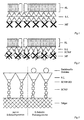
- S-layers from a solution of S-layer (glyco) protein be recrystallized. This process would result in a complete monomolecular S layer Cover the polymer surface.
- S-layer (glyco) proteins also S-layer fusion proteins, with built-in specific functions (e.g. streptavidin biotin binding domain, protein A, protein G, antibody or Antigen domains), for which recrystallization can be used, can be done via this Process achieve a very uniform functionalization of polymer matrices (see Fig. 3).
- S-layer fusion protein according to FIG. 4 could be used simultaneously also two or more identical but differently functionalized S-layer proteins are used. This would result in the uniform protein base structures form a uniform S-layer grid on the SCWP, but at discrete intervals (but with statistical distribution) different binding sites (functional domains) having.
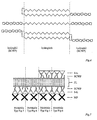
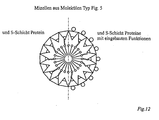
- Fig. 5 shows the use of amphiphilic molecules consisting of SCWP and hydrophobic chains, for example glycolipids in the molecular structure concept correspond. Similar molecules are also found in the plasma membranes of Archaebacteria (Archaea) found. The production of glycolipid equivalent molecules shown.
- Fig. 6 shows the use of naturally occurring or fully synthetic Molecules, which consist of a central hydrophobic part and two hydrophilic Domains exist.
- FIG. 7 illustrates the use of the molecules shown in FIGS. 5 and 6 for the production of composite SUM / lipid membranes.
- the use of the in Figs. 5 and 6 schematically shown amphiphilic molecules allows a wide variation in Construction of composite SUM / lipid membranes.
- the fundamental is particularly noteworthy Possibility to use two different SCWPs that are on different S layer Bind proteins.
- an S-layer (e.g. type A) is placed on the microfiltration membrane applied.
- This process corresponds essentially to that already described above Process for the production of SUMs.
- a monolayer of amphiphilic molecules (suitable for the production of functional lipid membranes see Examples) using either the Langmuir Shufer or Langmuir Blodgett technique reared.
- the monolayer is connected to the SUM by a specific one Interaction between the SCWP part of the amphiphilic molecules and the S layer at the SUM.
- This anchoring of lipid monolayers to S layers on SUMs resulted to a significant increase in stability and functional life Lipid membranes.
- the molecules in FIG. 6 can also be used the molecules mentioned are used to produce the functional lipid membrane, the latter being the production of a functional lipid membrane in one step enable.
- a second step another monolayer of amphiphilic molecules be raised. If this outer layer contains amphiphilic molecules with an SCWP part, can use the exposed SCWP chains as specific binding sites for another Serve S layer.
- This second S layer can be made, for example, on the lipid membrane a solution of S-layer (glyco) proteins can be recrystallized. Alternatively, you can the S layer can also be recrystallized in a first step on the water / air boundary and only subsequently applied (e.g. lowered) to the lipid membrane.
- the supramolecular layer system shown in Fig. 8 can be used uniform or different SCWP-S-layer partners.
- S-layer type A and SCWP type A as well as S-layer type A and SCWP type A shown with S-layer type B and SCWP type B.
- lipid membranes are in the form of Lipid vesicles (so-called liposomes) are offered. In the liposomes are also preferably the desired functional molecules have already been incorporated. Under appropriate Experimental conditions open the lipid vesicles upon contact with the surface of the solid Carrier to finally form a continuous lipid film.
- the SCWP system can optionally also be used for this, as shown in FIG. 9 accelerate this vesicle fusion and the binding of the lipid film to the SUM to consolidate.
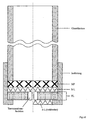
- the SUM at the end of a glass or plastic tube should be like this be mounted so that a SUM-spanned aperture is created.
- This part would, in principle correspond to the opening of a patch clamp or voltage clamp pipette; with the The difference is that the (functional) lipid membrane does not support the opening of the pipette spanned, but supported by the SUM. Applying the lipid membrane and their functionalization could be according to the various ones already described above Methods are done.
- SUM tubes Another advantage of using SUM tubes is seen in that after the application of the lipid membrane a further S layer by deposition or Recrystallization (see Fig. 7 and Fig. 8) could be applied. This additional S layer would perform both a (further) stabilizing and protective function. In this connection, the sharp molecular separation limit of the S layers remind.
- lipid membrane After applying the lipid membrane to the SUM or before or after one possible recrystallization of a further S layer can be an inter- and / or intramolecular chemical crosslinking of the S-layer (glycoprotein) matrix and the Lipid film take place. To do this, appropriate crosslinkers would have to be added to the aqueous phase be introduced.
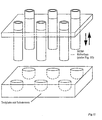
- the SUM tubes can be used either individually or in groups (see Fig. 11).
- An arrangement in groups enables the application of the lipid membranes in one work step and subsequently parallel measurements in any number of vessels in which there are different substances, the effect of which on the functionalized membranes is to be tested.
- active substances could also be added directly into the glass tubes filled with buffer solutions or H 2 O.
- the environment conditions e.g.
- the carbohydrate portion can be derived from an intact SCWP, from chemical components Degradation from SCWP-produced partial structures (oligosaccharide fragments) or from synthetically produced partial structures of the Scwp (oligosaccharide derivatives) exist.
- the functional part of the molecule can bind to lipid phases as a function (e.g. liposomes) or gold, firmly anchored to a solid phase, e.g. P-layer), or a polymerizability (the conjugate formed acts as a co-monomer), further one pharmaceutical effect, also a combined function, such as binding to lipid phases and immunostimulating effect (lipid A derivatives, lipopeptides of the type FK-565) or finally have detectability (e.g. fluorescence).
- lipid phases e.g. liposomes
- gold firmly anchored to a solid phase, e.g. P-layer
- a polymerizability the conjugate formed acts as a co-monomer
- further one pharmaceutical effect also a combined function, such as binding to lipid phases and immunostimulating effect (lipid A derivatives, lipopeptides of the type FK-565) or finally have detectability (e.g. fluorescence).
- the carbohydrate portion and the functional portion can be linked in different ways, namely by reductive amination (formation of Schiff bases with subsequent reduction to secondary amines, Thiourea formation or Amide formation.
- the reductive amination can be carried out on the carbonyl component on the carbohydrate part by splitting off the reducing phosphoric acid residue from the SCWP to form reducing SCWP, by partial de-N-acetylation and deamination with nitrous acid to form anhydromannose (anhydroglucose?) End groups, by ⁇ -elimination from SCWP containing uronic acid, or by cleavage with periodate (possibly partial cleavage).
- the reductive amination by phosphatidylethanolamine, by ethylenediamine, propoylenediamine or introduction of an amino group at the reducing end of the SCWP, by allylamine, aminomethacrylic acid and their derivatives, other amino compounds with unsaturated groups (Aldrich catalog) or S-layers ( ⁇ -Lysine-NH 2 groups) are made.
- Amino groups on the carbohydrate part can result from the reaction of a carbonyl component with ethylenediamine or other diamino compounds.
- the carbonyl component on the functional part can be obtained as a Smith product from S-layer or from polysaccharides.
- the thioharrist formation can be done by means of FITC (fluorescein isothiocyanate) or by Conversion of primary amines to isothiocyanates by reaction with thiophosgene respectively.
- FITC fluorescein isothiocyanate
- amide can by means of the carboxylic acid portion of the carbohydrate (SCWP) Bromoxidation lactal lactone, on the amino component analogous to the reductive amination, on the amino component on the carbohydrate (SCWP) by formation by reaction of a Carbonyl component with ethylenediamine or another diamino compound, and am Carboxylic acid part of the functional molecule as an active ester of long chain fatty acids and branched fatty acids, as active esters of asparagic acid or lipoic acid, and as Active esters of methacrylic acid (derivatives) and other unsaturated carboxylic acids take place.
- the secondary cell wall polymers were made from peptidoglycan-containing succuli from various Bacillaceae using 48% hydrofluoric acid (HF) according to the instructions from Ries et al. (1997) extracted, purified by gel chromatography, the eluates against A. purif. dialyzed, the internal dialysates frozen at -20 ° C and lyophilized.
- HF hydrofluoric acid
- the organisms used, their S-layer proteins and SCWP have the following names: Bacillus stearothermophilus PV72 / p6 (Sära et al., 1996), SbsA (Kuen et al., 1994), type A SCWP (Egelseer et al., 1998 ); Bacillus stearothermophilus ATCC 12980 (Egelseer et al., 1996), SbsC (Jarosch et al., 2000), type A SCWP (Egelseer et al., 1998); B.
- N-acetylglucosamine 2: 1; negatively charged by pyruvate ketals, glycerin and uronic acids present; very complex structure; Structure not yet fully understood (MG max ⁇ 24,000) N-terminus ( 3 SLH-Motife; AS 33-204) B.
- N-acetylmannosamine 2: 1, every 2nd N-acetylmannosamine residue carries a pyruvate ketal; Structure clarified (MG max ⁇ 10,000) N-terminus (3 SLH-Motife AS 33-202) Th .
- the modification of the reducing end (latent aldehyde group) of SCWP types A, B, C and D was carried out as follows: 10 mg of the lyophilized material were dissolved in 2 ml saturated carbazole hydrazide solution (pH 6.2). Then 200 ⁇ l sodium cyanoborohydride (NaBH 3 CN; 20 mg / ml A. purif.) Were added, incubated for 15 minutes at 100 ° C., then for 16 hours at 90 ° C. To remove the excess reagents, 24 hours against A. purif. dialyzed, the samples frozen at -20 ° C and lyophilized.
- NaBH 3 CN sodium cyanoborohydride
- the inner dialysate was subsequently lyophilized and 0.5 mg of the lyophilized material was hydrolyzed with 6N HCl for 6 h at 110 ° C. for amino acid and amino sugar analysis (amino acid analyzer Biotronik; Maintal, D).
- the degree of modification of the polymer chains which was> 95% for all SCWPs, could be determined from the ratio of glucosamine to leucine.
- Example 2 To activate the introduced amino groups, 5 mg of the lyophilisates from Example 1 were dissolved in 500 ⁇ l of a solution of p-phenylenediamine (10 mg / ml A. purif.). Subsequently, 100 ⁇ l of NaBH 3 CN solution (20 mg / ml A. purif.) Were metered in, incubated at 100 ° C. for 15 min, then at 90 ° C. for 16 h. The reagents were then dialyzed (18 h, 4 ° C) against A. purif.
- group 2 binding of the modified SCWPs to molecules of a solid Support for the oriented monomolecular binding of S-layer proteins
- Example 6 Use of microfiltration membranes (MF) as solid supports
- the MF was removed and washed five times with 50 mM TRIS-HCl buffer (pH 7.2). The MF was then placed in a solution of SpbA protein (100 ⁇ g / ml 10 mM CaCl 2 solution) and incubated at 20 ° C. for 6 h. To remove unbound S-layer protein, the MF was washed five times with 10 ml of 50 mM TRIS-HCl buffer (pH 7.2) and cut into 1 mm 2 large pieces, which were mixed with 100 ⁇ l of an SDS solution (sodium dodecyl sulfate; 10% in A. purif.) Were extracted for 10 min at 100 ° C.
- SDS solution sodium dodecyl sulfate; 10% in A. purif.
- Example 7 Use of a silicon oxide wafer (SOW) as a solid support
- SOW with a size of 3 ⁇ 5 mm were incubated in 500 ⁇ l of a solution of aminosilane (5% in A. purif., PH 3.5) at 37 ° C. for 30 min. After washing five times with A. purif. and ethanol, the silanized SOW were dried at 110 ° C. for 15 min, finally in a solution of m-maleimidbenzoyl sulfosuccinimide ester (sulfo-MBS, Pierce; 150 ⁇ g / ml 0.1 M sodium phosphate buffer, pH 7.0) for 2 hours at 37 ° C. preactivated, and with A. purif. washed.
- m-maleimidbenzoyl sulfosuccinimide ester sulfo-MBS, Pierce; 150 ⁇ g / ml 0.1 M sodium phosphate buffer, pH 7.0
- SbsB and r had bound SbsB to the inside of the subunits (N-terminal region which bears the 3 SLH motifs). From numerous studies on SOWs it is known that SbsB binds SCWP to the outside in the absence of type B (Neubauer et al., 2000). Accordingly, the oriented binding of the S-layer subunits to the SOW took place via the type B SCWP covalently bound to the solid support. Instead of SbsB, recombinantly produced SbsB-streptavidin fusion protein can also be used.
- Example 8 Use of a silicon oxide wafer (SOW) as a solid support
- thiol groups a 3 ⁇ 5 mm SOW was placed in a solution of 3-mercaptosilane (7% in 50% acetone) at 37 ° C. for 30 minutes. After washing five times with 50% acetone, the SOW were dried at 110 ° C. for 15 minutes under an N 2 atmosphere.
- 500 ⁇ l of a solution of 2-2'-dipyridyl disulfide (5 mg / ml 10% ethanol) was placed on the SOW. The incubation time was 2 hours at 20 ° C. After removing the SOW, it was washed several times with 10% ethanol and A. purif.
- the SOW loaded with type A SCWP was placed in a solution of the following S-layer protein forms (100 ⁇ g / ml 50 mM TRIS-HCl buffer, pH 7.2) for a period of 8 h: SbsC (wild type -Protein), r SbsC 31-1099 , r SbsC 258-1099 and r SbsC 342-1099 .
- SbsC wild type -Protein
- r SbsC 31-1099 r SbsC 258-1099
- r SbsC 342-1099 The last two forms lacked the N-terminal binding region responsible for type A SCWP (Jarosch et al., 2000).
- the SOW was incubated with the different S-layer protein forms with TRIS-HCl buffer and A. purif. washed and then examined in the AFM.
- the oblique S-layer lattice which is formed by the S-layer protein SbsC, made it possible to clearly determine the binding side. It was shown that the base vectors had the same orientation as on intact cells or cell wall fragments from B. stearothermophilus ATCC 12980. In the case of the N-terminally shortened r SbsC forms, no lattice structure was found in the AFM.
- Example 9 Use of MF as a solid support
- Type A SCWP which was modified as described in Example 1, was bound to carbodiimide-activated MF (see Example 6).
- the following forms of SbsC were offered in a concentration of 150 ⁇ g / ml 50 mM TRIS-HCl buffer (pH 7.2), and the membrane discs with a diameter of 14 mm were incubated for 8 h at 20 ° C: r SbsC 31-1099 , r SbsC 258-1099 , r SbsC 342-1099 ,, r SbsC 31-844 , r SbsC 31-860 , r SbsC 31-880 , r SbsC 31-900 , r SbsC 31-920 and SbsC.
- the MFs were washed with 50 mM TRIS-HCl buffer (pH 7.2), cut into 1 mm 2 particles, extracted with SDS solution and examined by means of SDS-PAGE (see Example 6). Based on the corresponding standard series, the bound amount of those forms which bore the complete N-terminus could be estimated between 80-100 ⁇ g / cm 2 MF. In contrast, in the case of r SbsC 258-1099 and r SbsC 342-1099 there was no binding to the MF functionalized with type A SCWP. The use of the different shortened forms confirmed the results of the affinity studies (Egelseer et al., 1998; Jarosch et al., 2000) and the SPR measurements that only the N-terminus is responsible for the interaction with the SCWP.
- DPPE dipalmitoylphosphatidylethanolamine
- Example 11 GLs from all types of SCWPs
- SCWPs instead of the SCWP with a reducing end, those modified according to Example 2 were used SCWPs with a free thiol group used.
- DPPE was used as the lipid component used.
- the GLs were cleaned as described in Example 10 gel chromatography using a Superdex S75 column.
- Lipsomes, the DPPC, cholesterol and GL according to Example 10 or 11 from Type C SCWP in a molar ratio of 10: 5: 4 were, according to the Mader et al. (1999) and prepared by means of gel chromatography from the Initial components cleaned.
- the liposomes that are for the reaction was used corresponded to a DPPC concentration of 2 ⁇ mol / ml 0.2 M sodium acetate buffer (pH 4.5). So much sodium periodate was added to this suspension added that a final concentration of 20 mM was reached.
- the reaction mixture was incubated for 1 hour in the dark at 20 ° C. with stirring. After centrifugation and Wash the liposomes twice with 0.2 M sodium hydrogen carbonate solution (pH 8.2) these were in 2 ml of a solution of ferritin (1 mg / ml 0.2 M Sodium bicarbonate, pH 8.2) incubated for 4 h at 20 ° C. The liposomes were then washed several times with sodium hydrogen carbonate solution. For Investigations in the transmission electron microscope were carried out on both the samples negatively contrasted, as well as embedded for ultra-thin sections.
- Example 12 The liposomes described in Example 12, which the GL from DPPE and Type B SCWP contained (see Example 10), were used for the oriented recrystallization of the S-layer protein SbsB used. On liposomes containing DPPE and cholesterol binds SbsB to the outside so that the N-terminus with the binding region for the type B SCWP is directed into the external environment (Mader et al., 1999).
- liposomes containing the GL from DPPE and type B SCWP
- Example 14 Modification of DPPC / cholesterol / HDA-containing liposomes with SCWP
- Liposomes were as described by Mader et al. (1999). That under Example 2 described, modified with 2-iminothiolane type C SCWP became Functionalize the liposome surface used. For this reason, the Liposomes corresponding to a DPPC concentration of 5 ⁇ mol in 3 ml 0.2 M sodium phosphate buffer (pH 7.0) suspended, and 2 mg sulfo-MBS to activate the free Amino groups from HDA added.
- a C-terminal recombinant in E. coli- produced SbsB-streptavidin fusion protein (4 mg lyophilisate) was dissolved in 2 ml of 6 M guanidine hydrochloride in 50 mM TRIS-HCl buffer (pH 7.2), 0.8 mg of streptavidin was added, and the solution was stirred for 1 h at 20 ° C. against A. purif. dialyzed.
- Example 16 Lipid bilayer with channel protein with a silicon wafer as a solid surface
- Example 17 Use of an S-layer ultrafiltration membrane (SUM) as a solid carrier
- a SUM disc (diameter 25 mm) was placed in an ultrafiltration cell inserted so that only the outside of the S layer was exposed.
- the free carboxyl groups of the S-layer protein were removed by adding an EDC solution (6 mg / ml A. purif .; pH 4.7) 80 min at 20 ° C activated, the membrane surface three times with ice-cold A. purif. washed, and then 2 ml of a solution of the type A modified according to Example 1 SCWP (1 mg / ml; pH 9.0) for covalent binding on the outside of the S layer applied.
- EDC solution 6 mg / ml A. purif .; pH 4.7
- SCWP 1 mg / ml; pH 9.0
- SbsA protein 100 ⁇ g / ml 50 mM TRIS-HCl buffer, pH 7.2
- SbsA protein 100 ⁇ g / ml 50 mM TRIS-HCl buffer, pH 7.2
- SDS-PAGE A SbsA-SCWP-SUM produced in parallel was used to stabilize the S-layer protein crosslinked with glutaraldehyde (as described in Example 16), and to Coating with a DPPE film and integral membrane proteins (e.g. ⁇ -hameolysin) used.
- Example 20 Preparation of a copolymer using polyvinyl alcohol
- a solution of polyvinyl alcohol (PVA; 3% in A. purif.) Is prepared and added 1 ml of this solution is added with 20 mg of native type A SCWP. Then be Pour 100 ⁇ l on a cleaned slide and stabilize the film this dried at 37 ° C for 30 minutes. Alternatively, the film can be incubated in a Solution of glutaraldehyde (0.5% in 0.1 M sodium phosphate buffer, pH 7.2) over a Period of 10 minutes can be chemically fixed. The one with A. purif. washed PVA-SCWP film is used as a matrix for the oriented recrystallization of the S-layer protein SbsC used (see examples 8 and 9)
Landscapes
- Chemical & Material Sciences (AREA)
- Organic Chemistry (AREA)
- General Health & Medical Sciences (AREA)
- Life Sciences & Earth Sciences (AREA)
- Biochemistry (AREA)
- Biophysics (AREA)
- Health & Medical Sciences (AREA)
- Genetics & Genomics (AREA)
- Medicinal Chemistry (AREA)
- Molecular Biology (AREA)
- Proteomics, Peptides & Aminoacids (AREA)
- Chemical Kinetics & Catalysis (AREA)
- Peptides Or Proteins (AREA)
- Investigating Or Analysing Biological Materials (AREA)
- Micro-Organisms Or Cultivation Processes Thereof (AREA)
Description
reduktive Aminierung (Bildung von Schiff'schen Basen mit nachfolgender Reduktion zu sekundären Aminen,
Thiohanstoffbildung oder
Amidbildung.
| Organismus | 1. S-Schicht-Protein 2. Gittertyp 3. Gesamtlänge 4. Signalpeptid | GenBank Accession Number | SCWP | Hauptkomponenten des SCWP / maximales MG | Interaktion des SCWP mit dem |
| B. stearothermophilus PV72/p6 | SbsA hexagonal 1 228 30 | X 71092 | Typ A | Glukose : N-Acetylglukosamin : 2,3-Dideoxy-2,3-Diacetamido-mannuronsäure = 1 : 1 : 2; Struktur aufgeklärt (MGmax 50,000) | N-Terminus (AS 31-257) keine SLH-Motife |
| B. stearothermophilus ATCC 12980 | SbsC schräg 1 099 30 | AF055578 | Typ A | ident wie oben | N-Terminus (AS 31-257) keine SLH-Motife |
| B. stearothermophilus Mut 1 | SbsD schräg 940 30 | AF228338 | Typ A | ident wie oben | N-Terminus (AS 31-257) keine SLH-Motife |
| B. stearothermophilus PV72/p2 | SbsB schräg 920 31 | X 98095 | Typ B | N-Acetylglukosamin : N-Acetylmannos-amin = 2: 1; durch Pyruvatketale negativ geladen, Glycerin und Uronsäuren vorhanden; sehr komplex aufgebaut; Struktur noch nicht vollständig aufgeklärt (MGmax ∼ 24,000) | N-Terminus (3 SLH- Motife; AS 33-204) |
| B. sphaericus CCM 2177 | SbpA quadratisch 1 322 30 | AF211170 | Typ C | N-Acetylgtukosamin : N-Acetylmannosamin = 2 : 1, jeder 2. N-Acetylmannosamin rest trägt ein Pyruvatketal; Struktur aufgeklärt (MGmax ∼ 10,000) | N-Terminus (3 SLH-Motife AS 33-202) |
| Th. thermohydrosulfuricus L111-69 | SttA hexagonal nicht bekannt | keine | Typ D | N-Acetylglukosamin : N-Acetylmannosamin : Mannose = 1 : 0.5 : 1; durch Pyruvatketale negativ geladen; Struktur noch nicht aufgeklärt (MGmax ∼ 25,000) | N-Terminus |
Claims (27)
- Verwendung von extrahiertem, gereinigtem sekundärem Zellwandpolymer prokaryontischer Mikroorganismen zur orientierten monomolekularen Bindung von (funktionellen) Molekülschichten und/oder deren Anlagerung an Molekülen eines Trägers.
- Verwendung nach Anspruch 1, dadurch gekennzeichnet, daß die Bindung der sekundären Zellwandpolymere über entsprechende Domänen der funktionellen Molekülschichten und/oder des Trägers erfolgt.
- Verwendung nach Anspruch 1 oder 2, dadurch gekennzeichnet, daß die Bindung der sekundären Zellwandpolymere an den Molekülschichten und/oder den Molekülen des Trägers über lektinartige Bindungen erfolgt.
- Verwendung nach einem der Ansprüche 1 bis 3, dadurch gekennzeichnet,daß die sekundären Zellwandpolymere die Bindeglieder zwischen polymeren Trägerstrukturen und funktionellen Molekülen bzw. Molekülgruppen sind.
- Verwendung nach 4, dadurch gekennzeichnet, daß die polymeren Trägerstrukturen Mikrofiltrationsmembranen sind.
- Verwendung nach Anspruch 4 oder 5, dadurch gekennzeichnet, daß die Molekülschichten zweidimensionale kristalline Proteinschichten sind.
- Verwendung nach Anspruch 6, dadurch gekennzeichnet, daß die zweidimensionalen kristallinen Proteinschichten ihrerseits Träger einer funktionellen Lipidmembran sind.
- Verwendung nach Anspruch 6, dadurch gekennzeichnet, daß die zweidimensionalen kristallinen Proteinschichten an ihren den sekundären Zellwandpolymeren abgewandten Seiten mit je einer oder mehreren gleichen oder verschiedenen funktionellen Domänen versehen sind.
- Verwendung nach einem der Ansprüche 1 bis 3, dadurch gekennzeichnet, daß die monomolekular gebundenen Moleküle hydrophobe Ketten sind und mit den hydrophilen sekundären Zellwandpolymeren amphiphile Moleküle bilden.
- Verwendung nach einem der Ansprüche 1 bis 3, dadurch gekennzeichnet, daß die Moleküle des Trägers jene von zweidimensionalen kristallinen Proteinschichten sind, wobei die sekundären Zellwandpolymere unter Bildung eines zusammengesetzten Verbundkörpers die Bindeglieder zu einer funktionellen Lipidschicht sind.
- Verwendung nach Anspruch 10, dadurch gekennzeichnet, daß über die funktionelle Lipidschicht zweite zusammengesetzte Verbundkörper spiegelbildlich aneinander gebunden sind.
- Verwendung nach Anspruch 11, dadurch gekennzeichnet, daß die kristallinen Proteinschichten aus gleichen oder unterschiedlichen Proteinmolekülen bestehen.
- Verwendung nach einem der Ansprüche 10 bis 12, dadurch gekennzeichnet, daß die funktionelle Lipidschicht vesikuläre Struktur aufweisen.
- Verwendung nach Anspruch 1, dadurch gekennzeichnet, daß der Träger eine Micelle aus hydrophoben selbstorganisierten Ketten ist.
- Verbundkörper aus einem Träger und einer Molekülschicht, dadurch gekennzeichnet, daß die Moleküle dieser Molekülschicht orientiert monomolekular an dem Träger über extrahierte, gereinigte sekundäre Zellwandpolymerketten gebunden sind, wobei die Enden der Polymerketten modifiziert sind.
- Verbundkörper nach Anspruch 15, dadurch gekennzeichnet, daß die sekundären Zellwandpolymerketten am Träger und/oder den zu bindenden Molekülen über eine lektinartige Bindung verankert sind.
- Verbundkörper nach Anspruch 15 oder 16, dadurch gekennzeichnet, daß auf einer Polymermatrix kristalline Proteinschichten über die sekundären Zellwandpolymere gebunden sind.
- Verbundkörper nach Anspruch 17, dadurch gekennzeichnet, daß an den kristallinen Proteinschichten an der den sekundären Zellwandpolymeren abgewandten Seite Lipidfilme oder -vesikel angeordnet sind.
- Verbundkörper nach Anspruch 17, dadurch gekennzeichnet, daß an den kristallinen Proteinschichten an der den sekundären Zellwandpolymeren abgewandten Seite funktionelle Domänen in regelmäßigen Abständen und Anordnungen vorgesehen sind.
- Verbundkörper nach Anspruch 19, dadurch gekennzeichnet, daß die funktionellen Domänen unterschiedlich, jedoch in regelmäßigen Mustern vorgesehen sind.
- Verbundkörper nach Anspruch 15 oder 16, dadurch gekennzeichnet, daß die sekundären Zellwandpolymere von einer kristallinen Proteinschicht, die vorzugsweise direkt auf einen Träger aufgebracht ist, wegragen und eine funktionelle Lipidschicht binden.
- Verbundkörper nach Anspruch 21, dadurch gekennzeichnet, daß zwei derartige Proteinschichten über die funktionelle Lipidschicht spiegelbildlich gegenüberliegend aneinander gebunden sind.
- Verbundkörper nach Anspruch 22, dadurch gekennzeichnet, daß die eine Proteinschicht aus anderen Proteinmolekülen besteht als die andere Proteinschicht.
- Verbundkörper nach einem der Ansprüche 15 bis 23, dadurch gekennzeichnet, daß er die Mündungsöffnung an einem Ende eines Röhrchens überspannend angeordnet ist.
- Verbundkörper nach einem der Ansprüche 15 bis 24, dadurch gekennzeichnet, daß der Träger eine Micelle aus hydrophoben, selbstorganisierten Ketten ist.
- Verbundkörper nach einem der Ansprüche 15 bis 25, dadurch gekennzeichnet, daß er Träger spezieller funktioneller Moleküle für Diagnostika, Drug-Screening, High Throughputscreening od.dgl ist.
- Verbundkörper nach einem der Ansprüche 15 bis 25, dadurch gekennzeichnet, daß er zur spezifischen Bindung von Zellen, vorzugsweise in Monoschichten, eingesetzt ist wobei gegebenenfalls das SCWP an der Oberfläche der Zellen exponiert ist.
Priority Applications (1)
| Application Number | Priority Date | Filing Date | Title |
|---|---|---|---|
| AT01925182T ATE275584T1 (de) | 2000-04-26 | 2001-04-24 | Verwendung von sekundärem zellwandpolymer prokaryontischer mikroorganismen |
Applications Claiming Priority (3)
| Application Number | Priority Date | Filing Date | Title |
|---|---|---|---|
| AT7322000 | 2000-04-26 | ||
| AT0073200A AT409423B (de) | 2000-04-26 | 2000-04-26 | Verwendung von sekundärem zellwandpolymer prokaryontischer mikroorganismen |
| PCT/AT2001/000122 WO2001081425A1 (de) | 2000-04-26 | 2001-04-24 | Verwendung von sekundärem zellwandpolymer prokaryontischer mikroorganismen |
Publications (2)
| Publication Number | Publication Date |
|---|---|
| EP1285003A1 EP1285003A1 (de) | 2003-02-26 |
| EP1285003B1 true EP1285003B1 (de) | 2004-09-08 |
Family
ID=3680108
Family Applications (1)
| Application Number | Title | Priority Date | Filing Date |
|---|---|---|---|
| EP01925182A Expired - Lifetime EP1285003B1 (de) | 2000-04-26 | 2001-04-24 | Verwendung von sekundärem zellwandpolymer prokaryontischer mikroorganismen |
Country Status (8)
| Country | Link |
|---|---|
| US (1) | US7125707B2 (de) |
| EP (1) | EP1285003B1 (de) |
| JP (1) | JP4122157B2 (de) |
| AT (1) | AT409423B (de) |
| AU (2) | AU2001252010B8 (de) |
| CA (1) | CA2407639A1 (de) |
| DE (1) | DE50103547D1 (de) |
| WO (1) | WO2001081425A1 (de) |
Families Citing this family (10)
| Publication number | Priority date | Publication date | Assignee | Title |
|---|---|---|---|---|
| US7244349B2 (en) | 1997-12-17 | 2007-07-17 | Molecular Devices Corporation | Multiaperture sample positioning and analysis system |
| US20020144905A1 (en) | 1997-12-17 | 2002-10-10 | Christian Schmidt | Sample positioning and analysis system |
| US7067046B2 (en) | 2000-08-04 | 2006-06-27 | Essen Instruments, Inc. | System for rapid chemical activation in high-throughput electrophysiological measurements |
| US7270730B2 (en) | 2000-08-04 | 2007-09-18 | Essen Instruments, Inc. | High-throughput electrophysiological measurement system |
| AT410805B (de) | 2001-05-29 | 2003-08-25 | Sleytr Uwe B | Verfahren zum erzeugen einer schicht funktioneller moleküle |
| WO2006005370A1 (en) * | 2004-07-15 | 2006-01-19 | Nano S Biotechnologie Gmbh | Substrate for a device for electrophysiological measurements |
| AT502713B1 (de) * | 2005-10-19 | 2008-08-15 | Univ Wien Bodenkultur | Verfahren zur herstellung von lipid-membranen |
| CN104906636B (zh) * | 2015-05-19 | 2018-01-12 | 河海大学常州校区 | 一种三维管状多细胞结构的制备方法 |
| WO2020068609A1 (en) * | 2018-09-28 | 2020-04-02 | Siemens Healthcare Diagnostics Inc. | Compositions and methods for removing interfering substances |
| US12508316B2 (en) | 2019-02-21 | 2025-12-30 | The Penn State Research Foundation | Synthesis of biomimetic cell wall structure |
Family Cites Families (4)
| Publication number | Priority date | Publication date | Assignee | Title |
|---|---|---|---|---|
| AT381463B (de) * | 1984-03-09 | 1986-10-27 | Sleytr Uwe B | Definierte poren aufweisende membran, verfahren zu ihrer herstellung und verwendung derselben |
| CA1307632C (en) * | 1984-12-21 | 1992-09-22 | Uwe B. Sleytr | Forming membrane structure by applying protein suspension to carrier |
| ATE123339T1 (de) | 1988-03-28 | 1995-06-15 | Sleytr Uwe B | Verwendung einer mit immobilisierten molekülen bzw. substanzen versehenen membrane. |
| JP3040551B2 (ja) * | 1991-09-05 | 2000-05-15 | 株式会社カネカメディックス | 人工塞栓形成用高分子溶液 |
-
2000
- 2000-04-26 AT AT0073200A patent/AT409423B/de not_active IP Right Cessation
-
2001
- 2001-04-24 DE DE50103547T patent/DE50103547D1/de not_active Expired - Fee Related
- 2001-04-24 EP EP01925182A patent/EP1285003B1/de not_active Expired - Lifetime
- 2001-04-24 US US10/258,803 patent/US7125707B2/en not_active Expired - Fee Related
- 2001-04-24 CA CA002407639A patent/CA2407639A1/en not_active Abandoned
- 2001-04-24 AU AU2001252010A patent/AU2001252010B8/en not_active Ceased
- 2001-04-24 WO PCT/AT2001/000122 patent/WO2001081425A1/de not_active Ceased
- 2001-04-24 AU AU5201001A patent/AU5201001A/xx active Pending
- 2001-04-24 JP JP2001578512A patent/JP4122157B2/ja not_active Expired - Fee Related
Also Published As
| Publication number | Publication date |
|---|---|
| JP4122157B2 (ja) | 2008-07-23 |
| ATA7322000A (de) | 2001-12-15 |
| WO2001081425A1 (de) | 2001-11-01 |
| AU2001252010B2 (en) | 2006-03-30 |
| EP1285003A1 (de) | 2003-02-26 |
| JP2003531390A (ja) | 2003-10-21 |
| AT409423B (de) | 2002-08-26 |
| AU5201001A (en) | 2001-11-07 |
| DE50103547D1 (de) | 2004-10-14 |
| CA2407639A1 (en) | 2001-11-01 |
| US7125707B2 (en) | 2006-10-24 |
| AU2001252010B8 (en) | 2006-05-11 |
| US20040033576A1 (en) | 2004-02-19 |
Similar Documents
| Publication | Publication Date | Title |
|---|---|---|
| EP0154620B1 (de) | Struktur mit Membranen, die durchgehende Poren aufweisen, Verfahren zum Herstellen dieser Struktur sowie Verwendungen der Struktur | |
| DE69416116T2 (de) | Effektorenhaltige mittel mit verlängerter zirkulationsdauer sowie verfahren | |
| DE69030811T2 (de) | Rezeptormembranen und selektive steuerung des ionenflusses durch ionophoren | |
| EP2895198B1 (de) | Nichtkovalente selbstorganisierende hydrogelmatrix für biotechnologische anwendungen | |
| AT409423B (de) | Verwendung von sekundärem zellwandpolymer prokaryontischer mikroorganismen | |
| DE69232006T2 (de) | Pharmazeutische zusammensetzungen | |
| Weigert et al. | Surface modification of an ultrafiltration membrane with crystalline structure and studies on interactions with selected protein molecules | |
| WO2002010759A2 (de) | Beschichtung für verschiedenartige substrate sowie verfahren zu deren herstellung | |
| EP2164949A1 (de) | Biomaterial basierend auf einem hydrophilen polymeren träger | |
| DE102004041340A1 (de) | Nanopartikel und Verfahren zu deren Herstellung | |
| DE2322562A1 (de) | Verfahren zur bestimmung eines oder mehrerer antigene in einer probe | |
| Labour et al. | Thick collagen-based 3D matrices including growth factors to induce neurite outgrowth | |
| DE69820861T2 (de) | Teilchenförmige arzneimittelträger | |
| WO2002097118A1 (de) | Verfahren zum erzeugen einer schicht funktioneller moleküle | |
| Schuster et al. | S-layer proteins as key components of a versatile molecular construction kit for biomedical nanotechnology | |
| EP1325334A2 (de) | Verfahren zur immobilisierung von lipidschichten | |
| EP0362339B1 (de) | Verwendung einer mit immobilisierten Molekülen bzw. Substanzen versehenen Membrane | |
| JP5007446B2 (ja) | カーボンナノホーン複合体、該複合体を含む抗菌剤及び微生物殺滅方法 | |
| EP0189019A1 (de) | Struktur mit Membranen, die durchgehende Poren aufweisen, Verfahren zum Herstellen dieser Struktur sowie Verwendung der Struktur | |
| EP1381863A1 (de) | System für die membranpermeationsmessung | |
| DE60033640T2 (de) | Kolorimetrisches bestimmungsverfahren | |
| FR2754828A1 (fr) | Structure membranaire artificielle, procede et polymere pour sa preparation, procede de preparation de ce polymere, particule et film comprenant cette structure | |
| Zhang et al. | Characterization and regulation of 2D–3D convertible lipid membrane transformation | |
| DE3886775T2 (de) | Zahnbehandlung durch freisetzung von vesikeln. | |
| DE10158713A1 (de) | Träger mit immobilisierten Antigenen oder Antikörpern und Verfahren zu dessen Herstellen |
Legal Events
| Date | Code | Title | Description |
|---|---|---|---|
| PUAI | Public reference made under article 153(3) epc to a published international application that has entered the european phase |
Free format text: ORIGINAL CODE: 0009012 |
|
| 17P | Request for examination filed |
Effective date: 20021126 |
|
| AK | Designated contracting states |
Kind code of ref document: A1 Designated state(s): AT BE CH CY DE DK ES FI FR GB GR IE IT LI LU MC NL PT SE TR |
|
| AX | Request for extension of the european patent |
Extension state: AL LT LV MK RO SI |
|
| 17Q | First examination report despatched |
Effective date: 20030704 |
|
| GRAP | Despatch of communication of intention to grant a patent |
Free format text: ORIGINAL CODE: EPIDOSNIGR1 |
|
| GRAS | Grant fee paid |
Free format text: ORIGINAL CODE: EPIDOSNIGR3 |
|
| RAP1 | Party data changed (applicant data changed or rights of an application transferred) |
Owner name: NANO-S BIOTECHNOLOGIE GMBH |
|
| GRAA | (expected) grant |
Free format text: ORIGINAL CODE: 0009210 |
|
| AK | Designated contracting states |
Kind code of ref document: B1 Designated state(s): AT BE CH CY DE DK ES FI FR GB GR IE IT LI LU MC NL PT SE TR |
|
| AX | Request for extension of the european patent |
Extension state: AL LT LV MK RO SI |
|
| PG25 | Lapsed in a contracting state [announced via postgrant information from national office to epo] |
Ref country code: IT Free format text: LAPSE BECAUSE OF FAILURE TO SUBMIT A TRANSLATION OF THE DESCRIPTION OR TO PAY THE FEE WITHIN THE PRE;WARNING: LAPSES OF ITALIAN PATENTS WITH EFFECTIVE DATE BEFORE 2007 MAY HAVE OCCURRED AT ANY TIME BEFORE 2007. THE CORRECT EFFECTIVE DATE MAY BE DIFFERENT FROM THE ONE RECORDED.SCRIBED TIME-LIMIT Effective date: 20040908 Ref country code: FI Free format text: LAPSE BECAUSE OF FAILURE TO SUBMIT A TRANSLATION OF THE DESCRIPTION OR TO PAY THE FEE WITHIN THE PRESCRIBED TIME-LIMIT Effective date: 20040908 Ref country code: NL Free format text: LAPSE BECAUSE OF FAILURE TO SUBMIT A TRANSLATION OF THE DESCRIPTION OR TO PAY THE FEE WITHIN THE PRESCRIBED TIME-LIMIT Effective date: 20040908 Ref country code: TR Free format text: LAPSE BECAUSE OF FAILURE TO SUBMIT A TRANSLATION OF THE DESCRIPTION OR TO PAY THE FEE WITHIN THE PRESCRIBED TIME-LIMIT Effective date: 20040908 |
|
| REG | Reference to a national code |
Ref country code: GB Ref legal event code: FG4D Free format text: NOT ENGLISH |
|
| REG | Reference to a national code |
Ref country code: CH Ref legal event code: EP Ref country code: CH Ref legal event code: NV Representative=s name: ISLER & PEDRAZZINI AG |
|
| REG | Reference to a national code |
Ref country code: IE Ref legal event code: FG4D Free format text: GERMAN |
|
| REF | Corresponds to: |
Ref document number: 50103547 Country of ref document: DE Date of ref document: 20041014 Kind code of ref document: P |
|
| PG25 | Lapsed in a contracting state [announced via postgrant information from national office to epo] |
Ref country code: SE Free format text: LAPSE BECAUSE OF FAILURE TO SUBMIT A TRANSLATION OF THE DESCRIPTION OR TO PAY THE FEE WITHIN THE PRESCRIBED TIME-LIMIT Effective date: 20041208 Ref country code: GR Free format text: LAPSE BECAUSE OF FAILURE TO SUBMIT A TRANSLATION OF THE DESCRIPTION OR TO PAY THE FEE WITHIN THE PRESCRIBED TIME-LIMIT Effective date: 20041208 Ref country code: DK Free format text: LAPSE BECAUSE OF FAILURE TO SUBMIT A TRANSLATION OF THE DESCRIPTION OR TO PAY THE FEE WITHIN THE PRESCRIBED TIME-LIMIT Effective date: 20041208 |
|
| PG25 | Lapsed in a contracting state [announced via postgrant information from national office to epo] |
Ref country code: ES Free format text: LAPSE BECAUSE OF FAILURE TO SUBMIT A TRANSLATION OF THE DESCRIPTION OR TO PAY THE FEE WITHIN THE PRESCRIBED TIME-LIMIT Effective date: 20041219 |
|
| GBT | Gb: translation of ep patent filed (gb section 77(6)(a)/1977) |
Effective date: 20050111 |
|
| LTIE | Lt: invalidation of european patent or patent extension |
Effective date: 20040908 |
|
| NLV1 | Nl: lapsed or annulled due to failure to fulfill the requirements of art. 29p and 29m of the patents act | ||
| PG25 | Lapsed in a contracting state [announced via postgrant information from national office to epo] |
Ref country code: CY Free format text: LAPSE BECAUSE OF FAILURE TO SUBMIT A TRANSLATION OF THE DESCRIPTION OR TO PAY THE FEE WITHIN THE PRESCRIBED TIME-LIMIT Effective date: 20050424 Ref country code: LU Free format text: LAPSE BECAUSE OF NON-PAYMENT OF DUE FEES Effective date: 20050424 Ref country code: AT Free format text: LAPSE BECAUSE OF NON-PAYMENT OF DUE FEES Effective date: 20050424 |
|
| PG25 | Lapsed in a contracting state [announced via postgrant information from national office to epo] |
Ref country code: BE Free format text: LAPSE BECAUSE OF NON-PAYMENT OF DUE FEES Effective date: 20050430 Ref country code: MC Free format text: LAPSE BECAUSE OF NON-PAYMENT OF DUE FEES Effective date: 20050430 |
|
| PLBE | No opposition filed within time limit |
Free format text: ORIGINAL CODE: 0009261 |
|
| STAA | Information on the status of an ep patent application or granted ep patent |
Free format text: STATUS: NO OPPOSITION FILED WITHIN TIME LIMIT |
|
| ET | Fr: translation filed | ||
| 26N | No opposition filed |
Effective date: 20050609 |
|
| BERE | Be: lapsed |
Owner name: *NANO-S BIOTECHNOLOGIE G.M.B.H. Effective date: 20050430 |
|
| REG | Reference to a national code |
Ref country code: CH Ref legal event code: PCAR Free format text: ISLER & PEDRAZZINI AG;POSTFACH 1772;8027 ZUERICH (CH) |
|
| BERE | Be: lapsed |
Owner name: *NANO-S BIOTECHNOLOGIE G.M.B.H. Effective date: 20050430 |
|
| PG25 | Lapsed in a contracting state [announced via postgrant information from national office to epo] |
Ref country code: PT Free format text: LAPSE BECAUSE OF NON-PAYMENT OF DUE FEES Effective date: 20050208 |
|
| PGFP | Annual fee paid to national office [announced via postgrant information from national office to epo] |
Ref country code: IE Payment date: 20090304 Year of fee payment: 9 |
|
| PGFP | Annual fee paid to national office [announced via postgrant information from national office to epo] |
Ref country code: DE Payment date: 20090529 Year of fee payment: 9 |
|
| PGFP | Annual fee paid to national office [announced via postgrant information from national office to epo] |
Ref country code: CH Payment date: 20090505 Year of fee payment: 9 Ref country code: FR Payment date: 20090227 Year of fee payment: 9 |
|
| PGFP | Annual fee paid to national office [announced via postgrant information from national office to epo] |
Ref country code: GB Payment date: 20090415 Year of fee payment: 9 |
|
| REG | Reference to a national code |
Ref country code: CH Ref legal event code: PL |
|
| GBPC | Gb: european patent ceased through non-payment of renewal fee |
Effective date: 20100424 |
|
| REG | Reference to a national code |
Ref country code: IE Ref legal event code: MM4A |
|
| REG | Reference to a national code |
Ref country code: FR Ref legal event code: ST Effective date: 20101230 |
|
| PG25 | Lapsed in a contracting state [announced via postgrant information from national office to epo] |
Ref country code: IE Free format text: LAPSE BECAUSE OF NON-PAYMENT OF DUE FEES Effective date: 20100426 |
|
| PG25 | Lapsed in a contracting state [announced via postgrant information from national office to epo] |
Ref country code: CH Free format text: LAPSE BECAUSE OF NON-PAYMENT OF DUE FEES Effective date: 20100430 Ref country code: LI Free format text: LAPSE BECAUSE OF NON-PAYMENT OF DUE FEES Effective date: 20100430 Ref country code: DE Free format text: LAPSE BECAUSE OF NON-PAYMENT OF DUE FEES Effective date: 20101103 |
|
| PG25 | Lapsed in a contracting state [announced via postgrant information from national office to epo] |
Ref country code: GB Free format text: LAPSE BECAUSE OF NON-PAYMENT OF DUE FEES Effective date: 20100424 |
|
| PG25 | Lapsed in a contracting state [announced via postgrant information from national office to epo] |
Ref country code: FR Free format text: LAPSE BECAUSE OF NON-PAYMENT OF DUE FEES Effective date: 20100430 |