EP1284269A2 - Vanadium-Imidoaryl-Komplexe für die Olefinpolymerisation - Google Patents
Vanadium-Imidoaryl-Komplexe für die Olefinpolymerisation Download PDFInfo
- Publication number
- EP1284269A2 EP1284269A2 EP02016985A EP02016985A EP1284269A2 EP 1284269 A2 EP1284269 A2 EP 1284269A2 EP 02016985 A EP02016985 A EP 02016985A EP 02016985 A EP02016985 A EP 02016985A EP 1284269 A2 EP1284269 A2 EP 1284269A2
- Authority
- EP
- European Patent Office
- Prior art keywords
- catalyst
- compounds
- vanadium
- electron
- mmol
- Prior art date
- Legal status (The legal status is an assumption and is not a legal conclusion. Google has not performed a legal analysis and makes no representation as to the accuracy of the status listed.)
- Withdrawn
Links
Images

Classifications
-
- C—CHEMISTRY; METALLURGY
- C08—ORGANIC MACROMOLECULAR COMPOUNDS; THEIR PREPARATION OR CHEMICAL WORKING-UP; COMPOSITIONS BASED THEREON
- C08F—MACROMOLECULAR COMPOUNDS OBTAINED BY REACTIONS ONLY INVOLVING CARBON-TO-CARBON UNSATURATED BONDS
- C08F4/00—Polymerisation catalysts
- C08F4/42—Metals; Metal hydrides; Metallo-organic compounds; Use thereof as catalyst precursors
- C08F4/72—Metals; Metal hydrides; Metallo-organic compounds; Use thereof as catalyst precursors selected from metals not provided for in group C08F4/44
- C08F4/74—Metals; Metal hydrides; Metallo-organic compounds; Use thereof as catalyst precursors selected from metals not provided for in group C08F4/44 selected from refractory metals
- C08F4/76—Metals; Metal hydrides; Metallo-organic compounds; Use thereof as catalyst precursors selected from metals not provided for in group C08F4/44 selected from refractory metals selected from titanium, zirconium, hafnium, vanadium, niobium or tantalum
-
- C—CHEMISTRY; METALLURGY
- C07—ORGANIC CHEMISTRY
- C07F—ACYCLIC, CARBOCYCLIC OR HETEROCYCLIC COMPOUNDS CONTAINING ELEMENTS OTHER THAN CARBON, HYDROGEN, HALOGEN, OXYGEN, NITROGEN, SULFUR, SELENIUM OR TELLURIUM
- C07F9/00—Compounds containing elements of Groups 5 or 15 of the Periodic Table
- C07F9/005—Compounds of elements of Group 5 of the Periodic Table without metal-carbon linkages
Definitions
- the present invention relates to vanadium-imidoaryl compounds with electron-withdrawing Containing substituents on the aryl group and compositions Vanadium-imidoaryl compounds with electron-withdrawing substituents on the aryl group, which are particularly suitable as catalysts for the polymerization of olefins, especially the ethene / propene or ethene / ⁇ -olefin copolymerization and the terpolymerization of these monomers with dienes.
- EP-A2-0 518 415 describes vanadium-imidoaryl complexes and their use for the production of EPDM, an improved incorporation of diene being achieved compared to catalysts based on VOCl 3 . However, these catalysts have significantly lower activities than VOCl 3 .
- EP-A1-0 532 098 describes vanadium-imidoaryl complexes which are substituted in the ortho positions of the aryl group and their use as catalysts for the polymerization of olefins at low Al / V ratios. Alkyl substituents are described as being particularly favorable. At high Al / V ratios, identical products with slightly reduced catalyst activities are obtained compared to catalysts based on VOCl 3 .
- WO-94/14854-A1 describes vanadium-imidoaryl amides as catalysts high activity for EPDM production, again preferably a dialkyl-substituted one Aryl group is used in the imide.
- the invention therefore relates to vanadium-imidoaryl compounds with electron-withdrawing Substituents on the aryl group.
- the aryl group R is distinguished by the fact that it bears one or more electron-withdrawing substituents. In addition to these substituents, the aryl group can of course carry further substituents. R is preferably a C 6 -C 14 aryl group.
- C 6 -C 14 aryl is understood to mean all mono- or polynuclear aryl radicals having 6 to 14 carbon atoms known to the person skilled in the art, such as phenyl, naphthyl, fluorenyl, and the aryl group can also carry further substituents.
- Suitable substituents here are hydrogen, halogen, nitro, C 1 -C 10 alkoxy or also C 1 -C 10 alkyl, and also C 6 -C 14 cycloalkyl or aryl, such as bromophenyl, chlorophenyl, toloyl and nitrophenyl.
- C 1 -C 10 alkoxy is understood to mean all linear or branched alkoxy radicals with 1 to 10 C atoms known to the person skilled in the art, such as methoxy, ethoxy, n-propoxy, i-propoxy, n-butoxy, i -Butoxy-, t-butoxy-, n-pentoxy-, i-pentoxy-, neo-pentoxy- and hexoxy-, heptoxy-, octoxy-, nonoxy- and decoxy-, which in turn can be substituted.
- C 1 -C 10 alkyl is understood to mean all linear or branched alkyl radicals having 1 to 10 C atoms known to the person skilled in the art, such as methyl, ethyl, n-propyl, i-propyl, n-butyl, i-butyl, t-butyl , n-pentyl, i-pentyl, neo-pentyl and hexyl, heptyl, octyl, nonyl and decyl, which in turn can in turn be substituted.
- Suitable substituents here are hydrogen, halogen, nitro, hydroxyl, or also C 1 -C 10 alkyl, and also C 6 -C 14 cycloalkyl or aryl, such as benzoyl, trimethylphenyl, ethylphenyl, chloromethyl, chloroethyl and nitromethyl.
- C 6 -C 14 - Cycloalkyl is understood to mean all mono- or polynuclear cycloalkyl radicals having 6 to 14 C atoms known to the person skilled in the art, such as cyclohexyl, cycloheptyl, cyclooctyl and cyclononyl or else partially or fully hydrogenated fluorenyl, which in turn can be substituted.
- Suitable substituents here are hydrogen, halogen, nitro, C 1 -C 10 alkoxy or also C 1 -C 10 alkyl, and also C 6 -C 12 cycloalkyl or aryl, such as methylcyclohexyl, chlorocyclohexyl and nitrocyclohexyl.
- Halogen and perhalogenated alkyl groups are preferred as electron-withdrawing groups Substituents used. Chlorine, bromine and iodine are particularly preferred Substituents.
- the monoanionic ligands can also be chelating Ligands can be connected to one another and / or to the imide.
- Preferred monoanionic ligands are halogen, C 1 -C 10 alkoxy, C 6 -C 14 aryloxy and amido groups. Halogen and C 1 -C 14 aryloxy groups are particularly preferred.
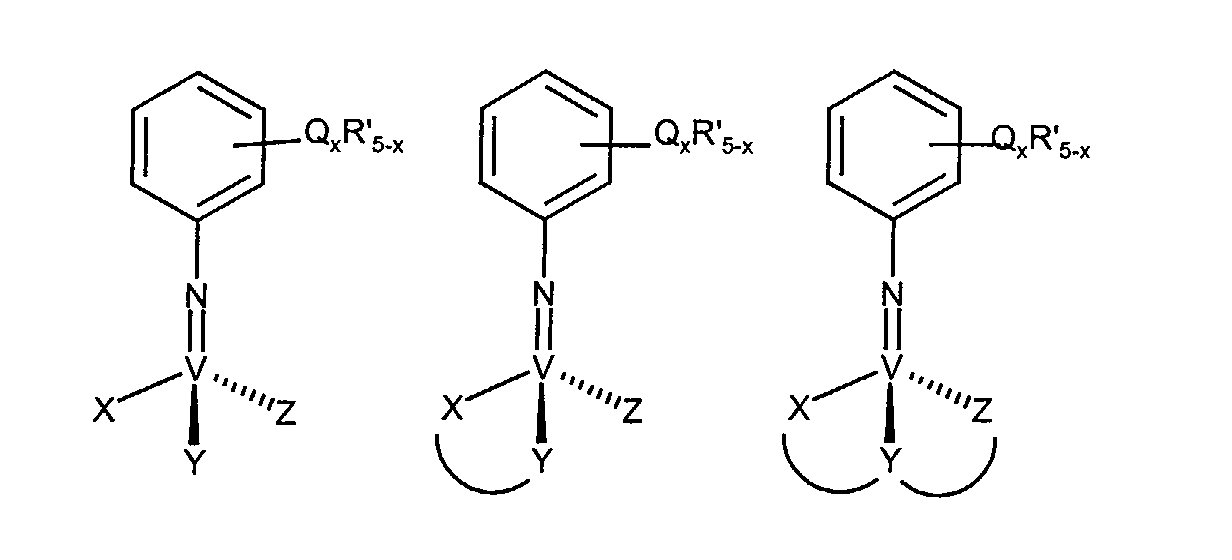
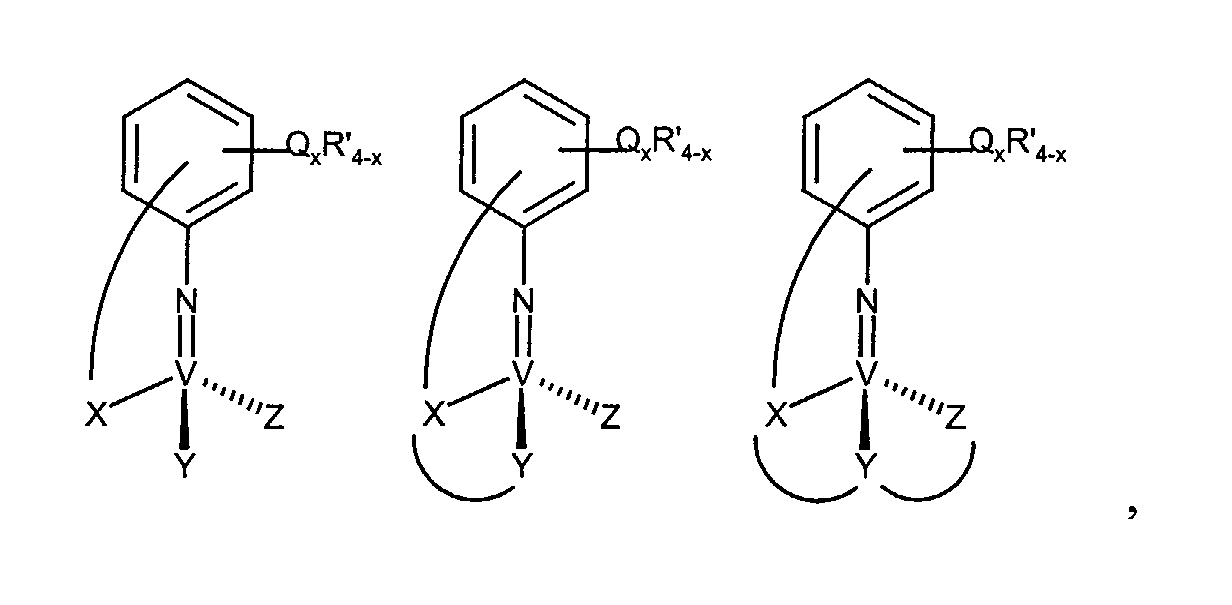
- Preferred structures of the vanadium-imidoaryl compounds according to the invention with electron-withdrawing substituents on the aryl group are: where Q for said electron-withdrawing group (s) and R 'represent further substituents of the aryl group which, as already said, are selected from the group consisting of hydrogen, halogen, nitro, C 1 -C 10 alkoxy or also C 1 -C 10 alkyl, and C 6 -C 14 cycloalkyl or C 6 -C 14 aryl.
- the invention further relates to compositions comprising Vanadium-imidoaryl compounds with electron-withdrawing substituents on the Aryl group and an organo-metallic compound of groups 1, 2, 12 or 13 of the Periodic Table of the Elements according to IUPAC 1985, at least one Hydrocarbon group here directly via a carbon atom to the metal atom is bound.
- Preferred organometallic compounds are compounds of aluminum, Sodium, lithium, zinc and magnesium. Those of the Aluminum.
- the hydrocarbon group attached to the metal atom is preferably a C 1 -C 10 alkyl group.
- Examples are amyl sodium, butyllithium, diethyl zinc, butyl magnesium chloride, dibutyl magnesium.
- the molar ratio between organometallic compound and vanadium can be in wide ranges can be varied. Generally it will range from 1 to 1 to Vary 5000 to 1. The range between 1 to 1 and 500 to 1 is preferred. The range between 2 to 1 and 100 to 1 is particularly preferred.
- the composition is suitable as a catalyst.
- This use is a further object of the invention.
- the connection is particularly suitable as Catalyst for the polymerization of olefins, especially the ethene / propene or ethene / ⁇ -olefin copolymerization and the terpolymerization of these monomers with service.
- the catalyst can be modified by additives known to the person skilled in the art, which increase the productivity of the catalyst and / or the properties of the change polymer obtained.
- Halogen-containing compounds are preferred as activity-increasing additives, in particular halogenated hydrocarbons used.
- Said hydrocarbons can contain further heteroatoms, such as oxygen, nitrogen, phosphorus and Contain sulfur.
- Compounds which contain little halogen (1 contain up to 2 atoms per molecule), since the halogen concentration in the polymer can be kept low.
- Other activity-increasing additives are Lewis acids, such as AlCl 3 , BCl 3 or SiCl 4 , or Lewis bases, such as esters, amines, ammonia, ketones, alcohols, ethers.
- Preferred carrier materials are particulate, organic or inorganic solids whose pore volume is between 0.1 and 15 ml / g, preferably between 0.25 and 5 ml / g, the specific surface area of which is greater than 1, preferably 10 to 1000 m 2 / g (BET), the grain size of which is between 10 and 2500 ⁇ m, preferably between 50 and 1000 ⁇ m, and which can be suitably modified on its surface.
- the specific surface is determined in the usual way according to DIN 66 131, the pore volume by the centrifugation method according to McDaniel, J. Colloid Interface Sci. 1980, 78, 31 and the particle size according to Cornillaut, Appl. Opt. 1972, 11 , 265.
- inorganic solids examples include silica gels, Precipitated silicas, clays, aluminosilicates, talc, zeolites, carbon black, inorganic Oxides, such as silicon dioxide, aluminum oxide, magnesium oxide, titanium dioxide, inorganic chlorides, such as magnesium chloride, sodium chloride, Lithium chloride, calcium chloride, zinc chloride, or calcium carbonate.
- inorganic Oxides such as silicon dioxide, aluminum oxide, magnesium oxide, titanium dioxide
- inorganic chlorides such as magnesium chloride, sodium chloride, Lithium chloride, calcium chloride, zinc chloride, or calcium carbonate.
- the named, inorganic solids that meet the above specification and are therefore particularly suitable for use as carrier materials for example described in more detail in Ullmann's encyclopedia of industrial chemistry, Volume 21, p. 439 ff (silica gel), Volume 23, p. 311 ff (clays), Volume 14, p. 633 ff (carbon black) and volume 24, pp. 575
- Suitable organic solids are powdery, polymeric materials, preferably in the form of free-flowing powders, with the above-mentioned properties.
- examples include, without wishing to restrict the present invention: polyolefins, such as, for example, polyethene, polypropene, polystyrene, polystyrene- co- divinylbenzene, polybutadiene, polyethers, such as, for example, polyethylene oxide, polyoxytetramethylene or polysulfides, such as, for example, poly- p- phenylene sulfide.
- Particularly suitable materials are polypropylene, polystyrene or polystyrene- co- divinylbenzene.
- organic solids mentioned which meet the above-mentioned specification and are therefore particularly suitable for use as carrier materials, are described in more detail, for example, in Ullmann's Encyclopedia of Industrial Chemistry, volume 19, p. 195 ff (polypropylene), and volume 19, p. 265 ff (polystyrene).
- the supported catalyst system can be produced in a wide temperature range respectively.
- the temperature is between melting and Boiling point of the inert solvent mixture.
- temperatures from -50 to + 200 ° C, preferably -20 to 100 ° C, particularly preferably 20 to 60 ° C, worked.
- the invention further relates to a process for homo- or co-polymerization of olefins, preferably ethene, propene, isobutene, 1-butene, 2-butene, 1-hexene, 1-octene, 4-methyl-1-pentene, unsaturated alicyclic compounds such as e.g. cyclopentene, Norbornene, and a process for the co-polymerization of these monomers with one or more dienes, preferably ethylidene norbornene, vinyl norbornene, Dicyclopentadiene, 1,4-hexadiene.
- olefins preferably ethene, propene, isobutene, 1-butene, 2-butene, 1-hexene, 1-octene, 4-methyl-1-pentene, unsaturated alicyclic compounds such as e.g. cyclopentene, Norbornene, and a process for the co-polymer
- the invention further relates to a method for the homo- and copolymerization of conjugated dienes such as butadiene and isoprene and their copolymerization with olefins, alicyclic olefins, styrene and Styrene derivatives, as well as polar vinyl monomers, e.g. Acrylonitrile, methyl acrylate, Butyl acrylate, methyl methacrylate.
- conjugated dienes such as butadiene and isoprene and their copolymerization with olefins, alicyclic olefins, styrene and Styrene derivatives, as well as polar vinyl monomers, e.g. Acrylonitrile, methyl acrylate, Butyl acrylate, methyl methacrylate.
- the polymerization is preferably carried out by bringing the olefins into contact with the catalyst system according to the invention dissolved in suitable solvents, in gaseous form, in liquid form in finely divided form or in suspension in liquid diluent.
- the catalysts are generally used in amounts in the range from 10 -10 to 10 -1 mol% per mol of monomer.
- gaseous, liquid or sprayed monomers can further gases or finely divided liquids are mixed in, either dilution, the Spraying or heat dissipation.
- Pentane-insoluble fractions are filtered off and the filtrate is evaporated to dryness in order to obtain the complex. Yield 6.3g (85%) C: 20.79 (calc. 20.49); H: 0.57 (calc. 0.63); N: 4.02 (calc.
- the solution turns dark brown immediately. After stirring for 15 h at room temperature, the dark red solution in vac. dried. The residue is taken up in 20 ml of pentane.
- the product turns out to be red wax.
- the compound is a red oil at room temperature.
- the apparatus which is thermostatted to 40 ° C., is evacuated to 5 * 10 -2 for 30 min. Then propene, which has been cleaned to a pressure of 1.5 bar, is injected. 40 ml of absolute hexane and 0.408 mmol (18.5 eq) of a 15% solution of ethyl aluminum sesquichloride (Witco) in heptane are added to the autoclave in the propene countercurrent. The apparatus is then closed under a propene atmosphere in order to fill a pressure syringe with 50 ml of hexane and 0.096 mmol (4.4 eq) dichlorophenylacetic acid ethyl ester in the propene countercurrent.
- An inerted autoclave is filled with 1500 ml of hexane and 6.0 g of ethylidene norbornene and heated to the polymerization temperature of 40 ° C. Then ethene and propene are pressed in a ratio of 1:19 up to a pressure of 7 bar.
- the catalyst components 0.05 mmol V component, 1 mmol ethyl aluminum sequichloride (Witco) and 0.25 mmol dichlorophenylacetic acid ethyl ester
- the regulation is made by dosing ethene.
- vanadium-imidoaryl catalysts with strongly electron-withdrawing groups here o, o, p-Cl
- o, o, p-Cl strongly electron-withdrawing groups
- EASC Ethyl aluminum sesquichloride
- DEC diethyl aluminum chloride
- Methylaluminoxane was obtained as a 30% solution in toluene from the company Witco, freed from the solvent and stored as a solid.
- 2,4,6-trichlorophenylsulfinylamine is obtained according to the literature specification (A. Meller, W. Maringgele, H. Fetzer; Chem. Ber. 113 (1980), 1950-1961 according to p. 1954, method A) synthesized.
- the reaction mixture is stirred at room temperature for 15 hours. In between, no significant change in color is observed. After the solvent has been stripped off, a dark red residue is obtained. The residue is taken up in hexane. At -80 ° C the product precipitates as a dark red solid. Yield: 3.05 g (78%) 1 H NMR (300 MHz, CDCl 3 ): 7.14 (m, 2H), 8.00 (m, 2H).
- 2,4,6-Tribromophenylsulfinylamine is according to literature (Michaelis; lobster; Chem. Ber. 24 (1891) p. 755, line 1; Michaelis; lobster; Justus Liebigs Ann. Chem. 274 (1893) 221 after page 221 from line 26).
- the apparatus which is thermostatted to 40 ° C., is evacuated to 5 * 10 -2 for 30 min. Then propene, which has been cleaned to a pressure of 1.5 bar, is injected. 40 ml of absolute hexane and 0.408 mmol (18.5 eq) of a 15% solution of ethylaluminum sesquichloride in heptane are added to the autoclave in the propene countercurrent. The apparatus is then closed under a propene atmosphere in order to fill a pressure syringe with 50 ml of hexane and 0.096 mmol (4.4 eq) dichlorophenylacetic acid ethyl ester in the propene countercurrent.
- the apparatus which is thermostatted to 40 ° C., is evacuated to 5 * 10 -2 for 30 min. Then propene, which has been cleaned to a pressure of 1.5 bar, is injected. 40 ml of absolute hexane and 0.408 mmol (18.5 eq) of a 15% solution of ethylaluminum sesquichloride in heptane are added to the autoclave in the propene countercurrent. The apparatus is then closed under a propene atmosphere in order to fill a pressure syringe with 50 ml of hexane and 0.096 mmol (4.4 eq) dichlorophenylacetic acid ethyl ester in the propene countercurrent.
- the apparatus which is thermostatted to 40 ° C., is evacuated to 5 * 10 -2 for 30 min. Then propene, which has been cleaned to a pressure of 1.5 bar, is injected. 40 ml of absolute hexane and 18.8 equivalents of the cocatalyst are added to the autoclave in the propene countercurrent. The apparatus is then closed under a propene atmosphere in order to fill a pressure syringe with 50 ml of hexane and 0.096 mmol (4.4 eq) dichlorophenylacetic acid ethyl ester in the propene countercurrent.
- vanadium-imidoaryl catalysts such as Catalyst D with strongly electron-withdrawing groups (here o, o, p-Cl) through different Cocatalysts can be activated.
- An inerted autoclave is filled with 1500 ml of hexane and 6.0 g of ethylidene norbornene and heated to the polymerization temperature of 40 ° C. Then ethene and propene are injected in a ratio of 1:19 to a pressure of 7 bar.
- the catalyst components (0.05 mmol V component, 1 mmol ethyl aluminum sequichloride and 0.25 mmol dichlorophenylacetic acid ethyl ester) are simultaneously introduced into the reactor via pressure burettes and then polymerized at a pressure of 7.0 bar. The regulation is made by dosing ethene. The experiment is ended after half an hour and the batch is transferred to a container filled with ethanol.
- vanadium-imidoaryl catalysts D, E and F are strong electron-withdrawing groups (here o, o, p-Cl) on the aryl radical independently of the Structure of the remaining substituents also significantly more in EPDM production Polymer result as those described in EP-A1-0523 098 and WO-94/14854-A1 alkyl substituted analogues A, B and C.
- the apparatus which is thermostatted to 40 ° C., is evacuated to 5 * 10 -2 for 30 min. Then propene, which has been cleaned to a pressure of 1.5 bar, is injected. 40 ml of absolute hexane and 0.408 mmol (18.5 eq) of a 15% solution of ethylaluminum sesquichloride in heptane are added to the autoclave in the propene countercurrent. The apparatus is then closed under a propene atmosphere in order to fill a pressure syringe with 50 ml of hexane and 0.096 mmol (4.4 eq) dichlorophenylacetic acid ethyl ester in the propene countercurrent.
- vanadium-imidoaryl catalysts according to the invention which, in addition to the imido group, carry chelating ligands on the vanadium (K, L, M, N, O) can advantageously be used for the ethene / propene copolymerization. They are more active than VOCl 3 , which represents the prior art and, as the comparison of test results for catalysts K and L with that for catalyst I shows, they are also more active than vanadium-imidoaryl catalysts which do not carry any electron-withdrawing substituents.
Landscapes
- Chemical & Material Sciences (AREA)
- Organic Chemistry (AREA)
- Engineering & Computer Science (AREA)
- Materials Engineering (AREA)
- Health & Medical Sciences (AREA)
- Chemical Kinetics & Catalysis (AREA)
- Medicinal Chemistry (AREA)
- Polymers & Plastics (AREA)
- Transition And Organic Metals Composition Catalysts For Addition Polymerization (AREA)
- Organic Low-Molecular-Weight Compounds And Preparation Thereof (AREA)
Abstract
Description
wobei R für eine einen oder mehrere elektronenziehenden Substituenten tragende Arylgruppe steht,
wobei X,Y,Z unabhängig voneinander verschiedene oder gleichartige monoanionische Liganden sind, die miteinander und/oder mit der Arylgruppe des Imids, bzw. dessen Substituenten verbunden sein können.

Ausbeute 16,83g (96 %)
C: 44.64 (calc. 43.34); H: 5.47 (calc. 5.15); N: 4.50 (calc. 4.21)
1H-NMR (200 MHz, C6D6): 1.16 (d, 12H, CH(CH3)2), 4.32 (sep, 2H, CH(CH3)2), 6.60-6.68 (m,3H, HArom) ppm
13C-NMR (50 MHz, C6D6): 24.0 (CH(CH3)2), 29.3 (CH(CH3)2), 122.8 (CArom-meta), 128.5 (CArom-para), 132.7 (CArom-ortho), 151.6 (=N-CArom) ppm.
51 V-NMr (105 MHz, C6D6): 392 ppm.
Ausbeute: 660 mg (92%)
1H-NMR (300 MHz, CDCl3): 1.02 (d, 12H, 3J(HH) = 6.6 Hz, CH(CH3)2), 1.08 (d, 12H, 3J(HH) = 6.90 Hz, CH(CH3)2), 3.19 (sep, 2H, 3J(HH) = 6.90 Hz, CH(CH3)2), 3.62 (sep, 2H, 3J(HH) = 6.90 Hz, CH(CH3)2), 6.86-7.64 (m, 6H, Harom).
13C-NMR (75.5 MHz, CDCl3): 22.5, 22.8 (CH(CH3)2), 26,4, 27.9 ( CH(CH3)2), 121.4, 122.2, 122.4, 123.4, 125.2, 129.4, 135.5 (Carom).
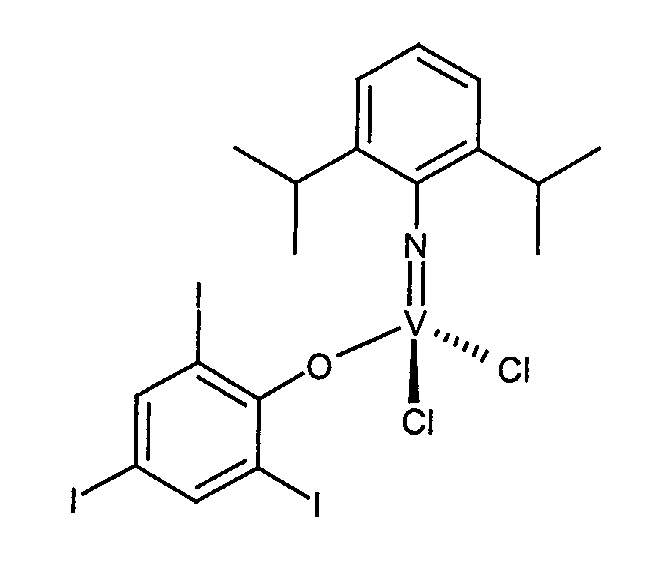
Ausbeute: 2.70 g (82%)
1H-NMR (300 MHz, CDCl3): 1.11 (d, 12H, 3J(HH) = 6.60 Hz, CH(CH 3)2), 3.70 (sep, 2H, 3J(HH) = 6.60 Hz, CH(CH3)2), 6.95 (m, 3H, NAr-H), 8.03 (s, 2H OAr-H).
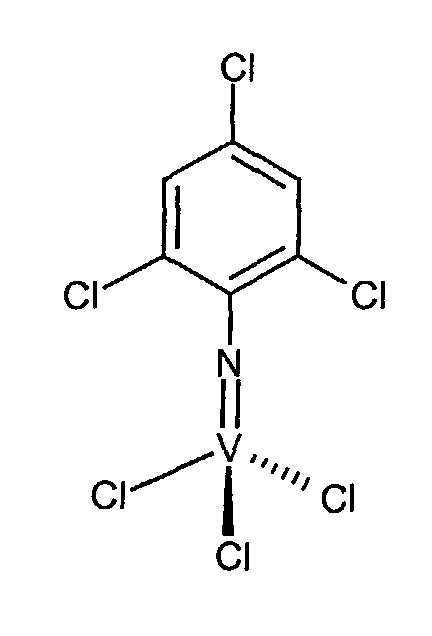
Ausbeute 6.3g (85%)
C: 20.79 (ber. 20.49); H: 0.57 (ber. 0.63); N: 4.02 (ber. 3.98)
1H-NMR (200MHz, C6D6): 6.24 (s, 2H, Ar-Hmeta) ppm
13C-NMR (50MHz, C6D6): 128.3 (Ar-Cmeta), 135.9, 136.7 (Ar-Cortho+Cpara) ppm
51V-NMR (131 MHz, C6D6): 276.6 ppm
IR (Nujol): 1551vs, 1522m, 1512m, 1306m, 1206m, 1190m, 1153s, 1084m, 1063w, 972w, 876w, 858s, 839w, 820s, 806m, 729w, 721w, 710w, 696w, 669w, 611w, 575w, 529w, 484w, 453s cm-1
EI-MS: m/z= 352 (M+, 12 %), 196 (C6H2Cl3N+, 100 %), 158 (VCl3 +, 28 %)

Ausbeute: 2.41 g (91 %)
1H-NMR (300 MHz, CDCl3): 1.10 (d, 12H, 3J(HH) = 6.60 Hz, CH(CH3)2), 3.15 (sep, 2H, 3J(HH) = 6.60 Hz, CH(CH3)2), 7.05 (m, 5H, Harom).
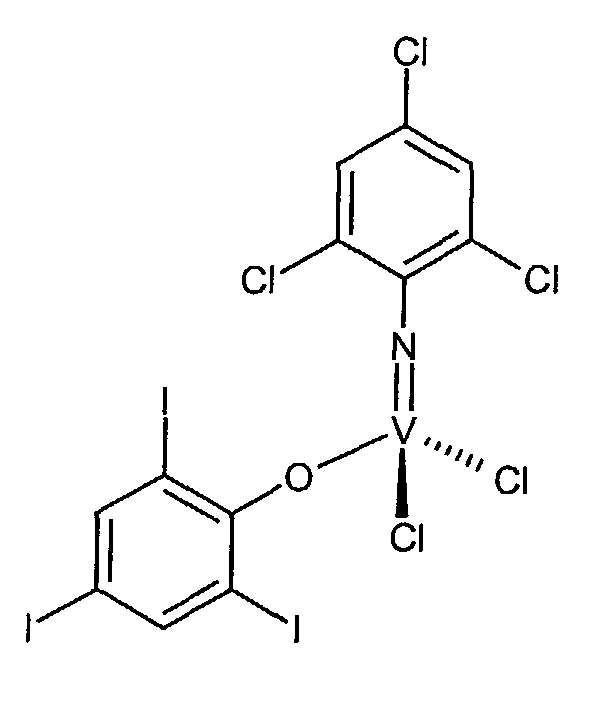
Ausbeute: 3.05 g (78 %)
1H-NMR (300 MHz, CDCl3): 7.14 (m, 2H), 8.00 (m, 2H).
| Ergebnisse der Ethen/Propen Copolymerisation durch Vanadium-Imidoaryl-Katalysatoren. | |
| Katalysator | Ausbeute [g] |
| (2,6-iPr2Ph)-N=VCl3 | 7.2 |
| (2,4,6-Cl3Ph)-N=VCl3 | 9.3 |
| (2,6-iPr2Ph)-N=V-O-(2,6-iPr2Ph)Cl2 | 8.6 |
| (2,4,6-Cl3Ph)-N=V-O-(2,6-iPr2Ph)Cl2 | 10.5 |
| (2,6-iPr2Ph)-N=V-O-(2,4,6-I3Ph)Cl2 | 9.0 |
| (2,4,6-Cl3Ph)-N=V-O-(2,4,6-I3Ph)Cl2 | 10.7 |
| Ergebnisse der Ethen/Propen/Ethylidennorbornen Terpolymerisation durch Vanadium-Katalysatoren. | |||||||
| Katalysator | Ausbeute [g] | E [wt%] | P [wt%] | ENB [wt%] | Tg [°C] | Mw | Mw/Mn |
| O=VCl3 | 25.9 | 46.0 | 44.2 | 9.8 | -46 | 205000 | 2.3 |
| (2,4,6-Cl3Ph)-N=VCl3 | 31.3 | 48.3 | 42.0 | 9.7 | -46 | 227000 | 1.9 |

Ausbeute 16,83g (96 %)
C: 44.64 (calc. 43.34); H: 5.47 (calc. 5.15); N: 4.50 (calc. 4.21)
1H-NMR (200 MHz, C6D6): 1.16 (d, 12H, CH(CH3)2), 4.32 (sep, 2H, CH(CH3)2), 6.60-6.68 (m,3H, HArom) ppm
13C-NMR (50 MHz, C6D6): 24.0 (CH(CH3)2), 29.3 (CH(CH3)2), 122.8 (CArom-meta), 128.5 (CArom-para), 132.7 (CArom-ortho), 151.6 (=N-CArom) ppm.
51 V-NMr (105 MHz, C6D6): 392 ppm.

Ausbeute: 660 mg (92 %)
1H-NMR (300 MHz, CDCl3): 1.02 (d, 12H, 3J(HH) = 6.6 Hz, CH(CH3)2), 1.08 (d, 12H, 3J(HH) = 6.90 Hz, CH(CH3)2), 3.19 (sep, 2H, 3J(HH) = 6.90 Hz, CH(CH3)2), 3.62 (sep, 2H, 3J(HH) = 6.90 Hz, CH(CH3)2), 6.86-7.64 (m, 6H, Harom).
13C-NMR (75.5 MHz, CDCl3): 22.5, 22.8 (CH(CH3)2), 26,4, 27.9 ( CH(CH3)2), 121.4, 122.2, 122.4, 123.4, 125.2, 129.4, 135.5 (Carom).
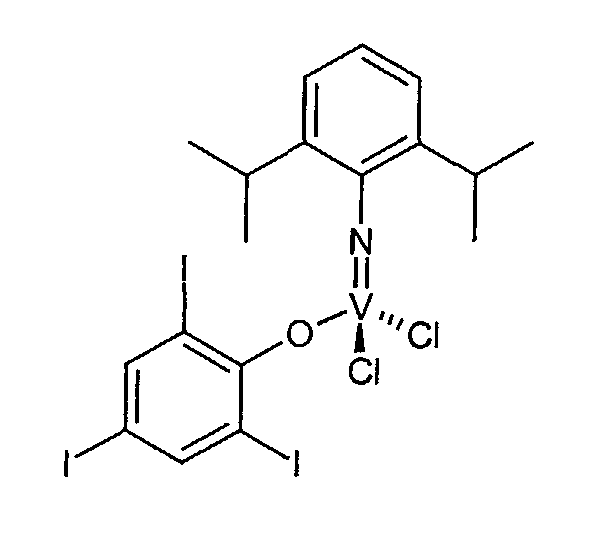
Ausbeute: 2.70 g (82 %)
1H-NMR (300 MHz, CDCl3): 1.11 (d, 12H, 3J(HH) = 6.60 Hz, CH(CH 3)2), 3.70 (sep, 2H, 3J(HH) = 6.60 Hz, CH(CH3)2), 6.95 (m, 3H, NAr-H), 8.03 (s, 2H OAr-H).
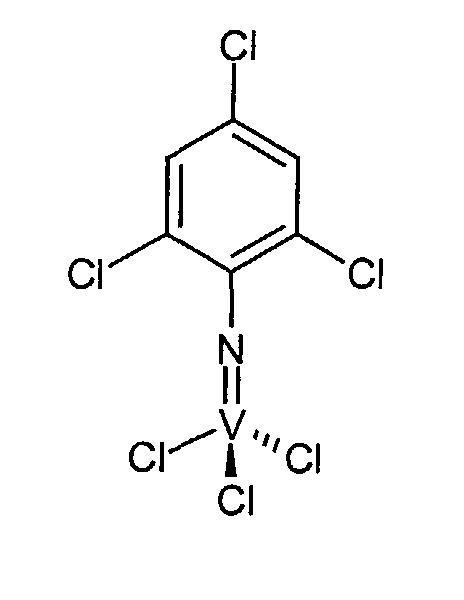
Ausbeute 6.3g (85 %)
C: 20.79 (ber. 20.49); H: 0.57 (ber. 0.57); N: 4.02 (ber. 3.98)
1H-NMR (200MHz, C6D6): 6.24 (s, 2H, Ar-Hmeta) ppm
13C-NMR (50MHz, C6D6): 128.3 (Ar-Cmeta), 135.9, 136.7 (Ar-Cortho+Cpara) ppm
51V-NMR (131 MHz, C6D6): 276.6 ppm
IR (Nujol): 1551vs, 1522m, 1512m, 1306m, 1206m, 1190m, 1153s, 1084m, 1063w, 972w, 876w, 858s, 839w, 820s, 806m, 729w, 721w, 710w, 696w, 669w, 611w, 575w, 529w, 484w, 453s cm-1
EI-MS: m/z= 352 (M+, 12%), 196 (C6H2Cl3N+, 100%), 158 (VCl3 +, 28%)

Ausbeute: 2.41 g (91 %)
1H-NMR (300 MHz, CDCl3): 1.10 (d, 12H, 3J(HH) = 6.60 Hz, CH(CH3)2), 3.15 (sep, 2H, 3J(HH) = 6.60 Hz, CH(CH3)2), 7.05 (m, 5H, Harom).

Ausbeute: 3.05 g (78 %)
1H-NMR (300 MHz, CDCl3): 7.14 (m, 2H), 8.00 (m, 2H).
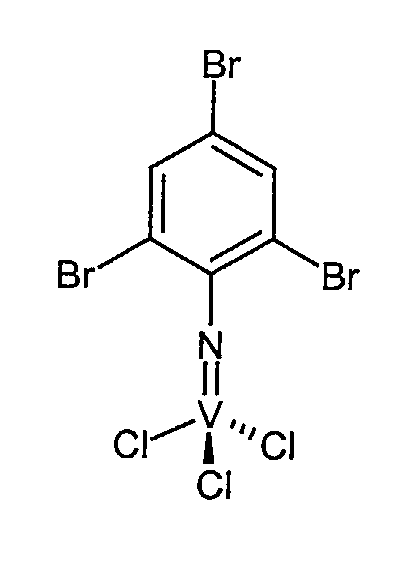
Ausbeute:13.96 g (91 %).
1H-NMR: (200MHz, CDCl3): 7.44 (s, 2H, Ar-H) ppm
EI-MS: m/z = 485 (M+); 328 (C6H2Br3N+, 16 %); 248 (C6H2Br2N+, 7 %); 158 (VCl3 +,3 %);
36 (Cl+, 100 %)
| Ergebnisse der Ethen/Propen Copolymerisation durch Vanadium-Imidoaryl-Katalysatoren | |
| Katalysator | Ausbeute [g] |
| VOCl3 | 7.2 |
| Katalysator A | 6.4 |
| Katalysator D | 8.4 |
| Katalysator G | 9.8 |
| Ergebnisse der Ethen/Propen Copolymerisation durch Vanadium-Imidoaryl-Katalysatoren | ||||
| Katalysator | Tmax [°C] | Ausbeute [g] | E [wt%] | P [wt%] |
| Katalysator A | 49 | 7.2 | 75.2 | 24.8 |
| Katalysator B | 51 | 8.6 | 75.4 | 24.6 |
| Katalysator C | 48 | 9.0 | 78.3 | 21.7 |
| Katalysator D | 53 | 9.3 | 72.1 | 27.9 |
| Katalysator E | 52 | 10.5 | 74.9 | 25.1 |
| Katalysator F | 48 | 10.7 | 77.1 | 22.9 |
| Ergebnisse der Ethen/Propen Copolymerisation durch Katalysator D = (2,4,6-Cl3Ph)-N=VCl3 in Verbindung mit verschiedenen Cokatalysatoren | |
| CoKatalysator | Ausbeute [g] |
| Methylaluminoxan | 1.50 |
| Diethylaluminiumchlorid | 6.50 |
| Ethylaluminiumsequichlorid | 8.40 |
| Ergebnisse der Ethen/Propen/Ethylidennorbornen Terpolymerisation durch Vanadium-Katalysatoren | ||||||||
| Katalysator | Ausbeute [g] | E [wt%] | P [wt%] | ENB [wt%] | Tg [°C] | Mw | Mn | Mw/Mn |
| VOCl3 | 25.9 | 46 | 44.2 | 9.8 | -46 | 205000 | 89000 | 2.3 |
| Katalysator A | 29.4 | 44.1 | 45.8 | 10.1 | -47 | 284000 | 142000 | 2.0 |
| Katalysator B | 36.3 | 48.8 | 41.3 | 9.9 | -46 | 255000 | 140000 | 1.8 |
| Katalysator C | 34.1 | 46.6 | 44.1 | 9.3 | -48 | 254000 | 138000 | 1.8 |
| Katalysator D | 31.3 | 48.3 | 42 | 9.7 | -46 | 227000 | 117000 | 1.9 |
| Katalysator E | 45.9 | 48.4 | 42.7 | 8.9 | -47 | 254000 | 128000 | 2.0 |
| Katalysator F | 46.2 | 48.1 | 43 | 9 | -48 | 239000 | 115500 | 2.1 |
| Katalysator G | 33.9 | 46.9 | 42.8 | 10.3 | -45 | 227000 | 110000 | 2.1 |

C: 14.83 (ber. 14.39); H: 0.61 (ber. 0.40); N: 2.75 (ber. 2.80)
EI-MS: m/z = 517 (M+).
Ausbeute: 4.40 g (78 %)
C: 11.44 (ber. 11.51); H: 0.62 (ber. 0.32); N: 2.25 (ber. 2.24)
1H-NMR: (200MHz, C6D6): 7.50 (s, 2H, Ar-H) ppm.

Ausbeute: 368 mg (51 %)
1H-NMR: (200MHz, CDCl3): 1,18 (s, 18H, CH3),1,22 (d, 12H, CH3), 2,86 (sep, 2H,
sp3-CH), 6,73 (t, 2H, Ar-H),6,97 (d, 1H, Ar-H),7,87 (s, 2H, sp2-CH) ppm
IR-Spektrum (in Nujol): 3407 w, 2959 vs, 2926 vs, 2857 vs, 2361 w, 2344 w, 1630 m, 1422 w, 1364 m, 1339 m, 1290 w, 1262 s, 1215 m, 1098 s, 1022 s, 990 w, 934 w, 866 w, 806 s, 770 m, 752 m, 729 w, 669 w, 432 vs, 413 vs.
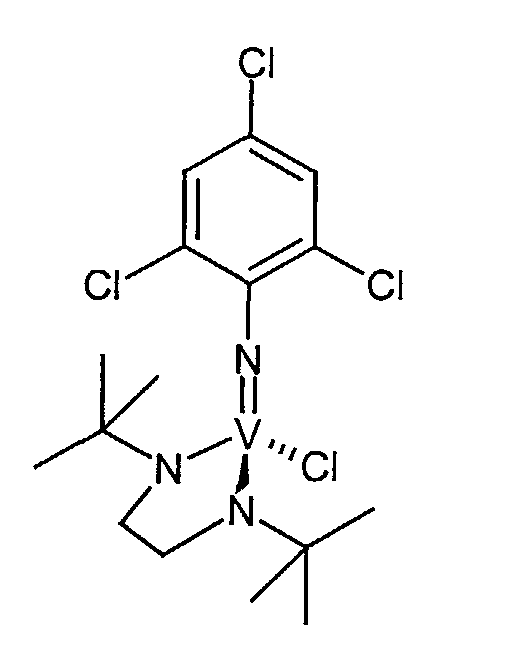
(2,4,6-Cl3Ph)-N=VCl3 wird gemäß Beispiel 11 hergestellt.
Ausbeute: 200 mg (52 %)
1H-NMR: (200MHz, CDCl3):1,19 (s, 18H, CH3), 7,13 (d, 2H, Ar-H), 7,87 (s, 2H, sp2-CH) ppm.
13C-NMR: (50MHz, CDCl3): 28,38 (CH3), 30,02 (CH3), 57,18 (sp2C),126,59 (Ar),156,90 (Ar-Cl) ppm
IR-Spektrum (in Nujol): 3402 w, 2901 vs, 2724 w, 2361 w, 2344 w, 1630 m, 1559 w, 1298 m, 1262 m, 1211 w, 1098 m, 1022 m, 934 w, 858 m, 802 m, 723 m, 669 w, 428 vs, 401 vs
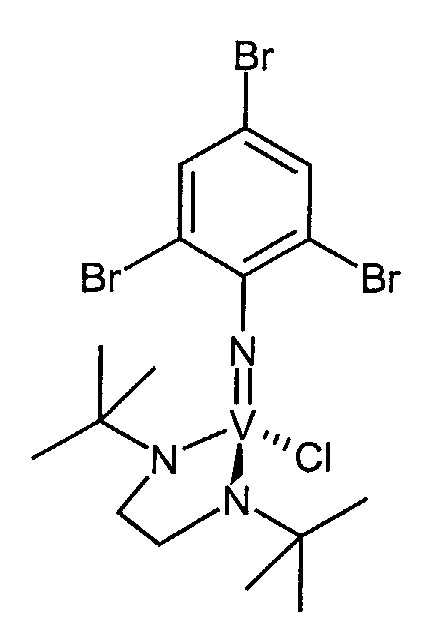
(2,4,6-Br3Ph)-N=VCl3 wird gemäß Beispiel 14 hergestellt.
Ausbeute: 368 mg (51 %)
C: 32.06 (ber. 32.99); H: 3.62 (ber. 3.81); N: 7.00 (ber. 7.26)
1H-NMR: (200MHz, CDCl3): 1,21 (s, 18H, CH3), 7,12; (s, 2H, Ar-H), 8,01 (s, 2H, sp2-CH)
13C-NMR: (50MHz, CDCl3): 31,28 (sp3-C),159,61 (Ar-Br) ppm
IR-Spektrum (in Nujol) 2928 vs, 2724 w, 2361 w, 2344 w, 1632 s, 1362 s, 1337 w, 1260 m, 1213 s, 1098 m, 1026 m, 934 w, 878 w, 858 w, 806 m, 774 m, 747 m

Ausbeute: 1,38 g (85 %)
1H-NMR: (300MHz, CDCl3): 1.30 (s, 18H, C(CH3)3), 1.44 (s, 18H, C(CH3)3), 1.75 (d, 3H, CH3, 3J(HH)=6.84 Hz), 4.85 (q, 3J(HH)= 6.87Hz, 1 H, CH-CH3), 7.08-7.38(m 6H, Ar-H) ppm
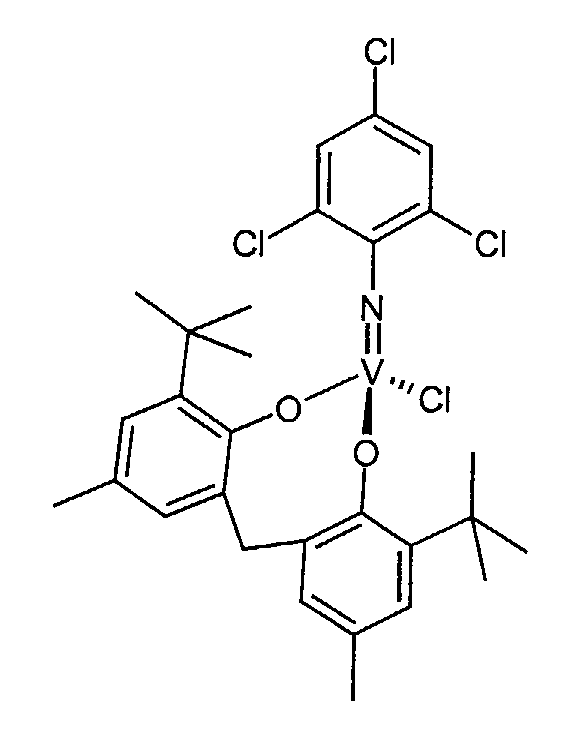
Ausbeute: 1.04 g (82 %)
1H-NMR: (200MHz, CDCl3): 1,37 (s, 18H, C(CH3)3, 2.23 (s, 6H, CH3), 4,59(m, 2H, CH2), 7.17(m 6H, Ar-H) ppm
IR-Spektrum (in Nujol): 3400 w, 3350 m, 3179 w, 2930 s, 2870 s, 2729 m, 2683 w, 2376 m, 2340 w, 2050 m, 2026 w, 1623 w, 1590 s, 1540 w, 1518 w, 1302 m, 1281 w, 1268 m, 1219 m, 1170 w, 1165 w, 1100 m, 1075 w, 1024 w, 1000 m, 978 w, 930 w, 909 m, 891 w, 870 m, 851 w, 833 1, 800 m, 776 m, 760 w, 721 s, 678 w, 660 m, 423 m, 412 m.
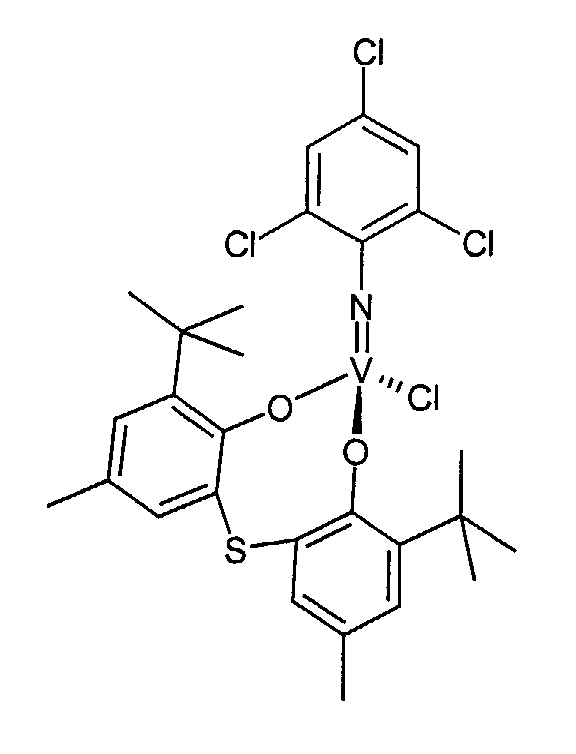
Ausbeute: 0,72 g (78 %)
1H-NMR: (300MHz, CDCl3): 1.30 (s, 18H, C(CH3)3), 2.25 (s, 6H, CH3), 716 (m 6H, Ar-H) ppm
| Ergebnisse der Ethen/Propen Copolymerisation durch Vanadium-Imidoaryl-Katalysatoren | ||||
| Katalysator | Tmax. [°C] | Ausbeute [g] | E [wt%] | P [wt%] |
| VOCl3 | 57.3 | 5.1 | 59.9 | 40.1 |
| Katalysator D | 64.2 | 8.2 | 64.1 | 35.9 |
| Katalysator G | 61.7 | 9.6 | ||
| Katalysator H | 64.8 | 6.0 | ||
| Katalysator I | 59.5 | 8.4 | 63.4 | 36.6 |
| Katalysator K | 63.1 | 9.2 | 64.0 | 36.0 |
| Katalysator L | 61.8 | 8.5 | 65.0 | 35.0 |
| Katalysator M | 64.4 | 8.6 | 63.0 | 37.0 |
| Katalysator N | 59.5 | 6.5 | 62.8 | 37.2 |
| Katalysator O | 62.4 | 6.2 | 61.9 | 38.1 |
Claims (11)
- Vanadium-Imidoaryl-Verbindungen mit elektronenziehenden Substituenten an der Arylgruppe.
- Verbindungen gemäss Anspruch 1, welche der allgemeinen Formel R-N=VCl3 (I) oder R-N=VXYZ (II) genügen,
wobei R für eine einen oder mehrere elektronenziehenden Substituenten tragende Arylgruppe steht,
wobei X,Y,Z unabhängig voneinander verschiedene oder gleichartige monoanionische Liganden sind, die miteinander und/oder mit der Arylgruppe des Imids, bzw. dessen Substituenten verbunden sein können. - Verbindungen gemäss Anspruch 1 oder 2, dadurch gekennzeichnet, dass sie einer der folgenden Strukturen entsprechen
 wobei Q für besagte elektronenziehende(n) Gruppe(n) und R' weitere Substituenten der Arylgruppe darstellen, die ausgewählt werden aus der Gruppe bestehend aus Wasserstoff, Halogen-, Nitro-, C1-C10-Alkoxy-, C1-C10-Alkyl-, C6-C14-Cycloalkyl oder C6-C14-Aryl.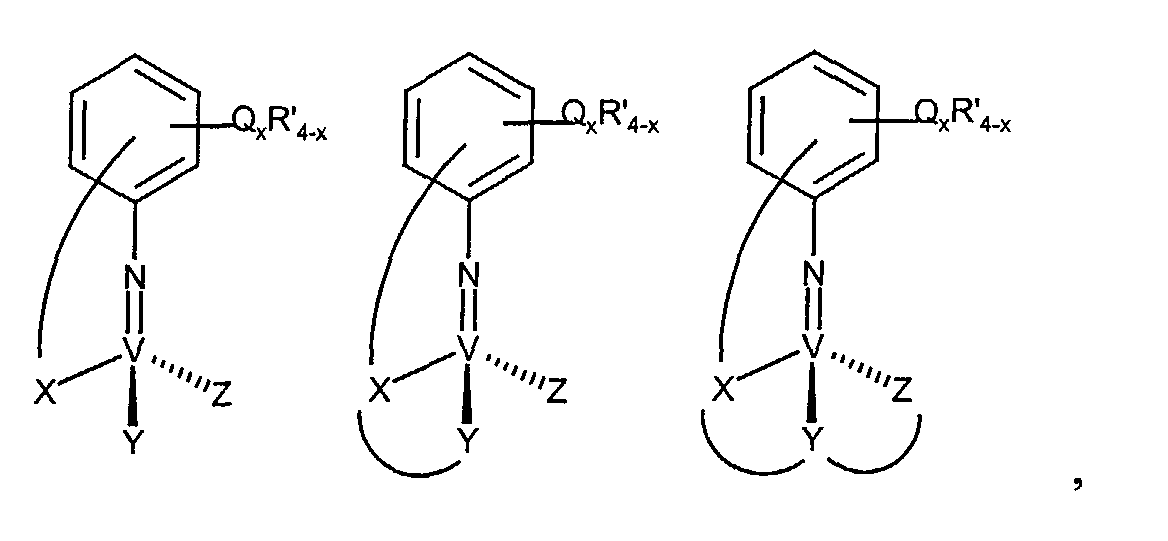
- Verbindungen gemäss einem der Ansprüche 1-3, dadurch gekennzeichnet, dass als elektronenziehende Gruppe(n) eine oder mehrere Verbindungen der Gruppe Halogen-, halogenierte Alkylgruppen, Nitro-, Cyano-, Carbonyl- und Carboxylgruppen verwendet werden.
- Zusammensetzungen enthaltend Vanadium-Imidoaryl-Verbindungen mit elektronenziehenden Substituenten an der Arylgruppe und eine organo-metallische Verbindung der Gruppen 1, 2, 12 oder 13 des Periodensystems der Elemente gemäss IUPAC 1985, wobei in besagter organo-metallischer Verbindung mindestens eine Kohlenwasserstoffgruppe hierbei direkt über ein Kohlenstoffatom an das Metallatom gebunden ist.
- Zusammensetzung gemäss Anspruch 5, dadurch gekennzeichnet, dass sie als Vanadium-Imidoaryl-Verbindungen eine Verbindung gemäss einem der Ansprüche 1-4 und als organo-metallische Verbindung eine Verbindung des Aluminiums, Natriums, Lithiums, Zinks oder Magnesiums enthalten.
- Verwendung einer Zusammensetzung gemäss Anspruch 5 oder 6 als Katalysator.
- Katalysator für die Polymerisation von Olefinen, enthaltend eine Zusammensetzung gemäß Anspruch 5 oder 6 oder eine Verbindung gemäss Anspruch 1.
- Katalysator gemäss Anspruch 8, dadurch gekennzeichnet, dass zusätzlich eine Verbindung aus der Gruppe halogenhaltige Verbindungen, halogenhaltige Kohlenwasserstoffe, Lewis Säuren oder Lewis Basen und Gemische aus zwei oder mehreren dieser Stoffe enthalten ist.
- Verfahren zur Homo- oder Co-Polymerisation von Olefinen gegebenenfalls mit einem oder mehreren Dienen, dadurch gekennzeichnet, dass in Gegenwart eines Katalysators gemäss Anspruch 8 oder 9 polymerisiert wird.
- Verfahren zur Homo- oder Co-Polymerisation von Olefinen gegebenenfalls mit einem oder mehreren Dienen, dadurch gekennzeichnet, dass in Gegenwart einer Verbindung gemäss Anspruch 1 oder einer Zusammensetzung gemäss Anspruch 5 polymerisiert wird.
Applications Claiming Priority (2)
| Application Number | Priority Date | Filing Date | Title |
|---|---|---|---|
| DE10140135A DE10140135A1 (de) | 2001-08-16 | 2001-08-16 | Vanadium-Imidoaryl-Komplexe für die Olefinpolymerisation |
| DE10140135 | 2001-08-16 |
Publications (2)
| Publication Number | Publication Date |
|---|---|
| EP1284269A2 true EP1284269A2 (de) | 2003-02-19 |
| EP1284269A3 EP1284269A3 (de) | 2003-09-24 |
Family
ID=7695580
Family Applications (1)
| Application Number | Title | Priority Date | Filing Date |
|---|---|---|---|
| EP02016985A Withdrawn EP1284269A3 (de) | 2001-08-16 | 2002-08-05 | Vanadium-Imidoaryl-Komplexe für die Olefinpolymerisation |
Country Status (9)
| Country | Link |
|---|---|
| US (1) | US20030130451A1 (de) |
| EP (1) | EP1284269A3 (de) |
| JP (1) | JP2003137849A (de) |
| KR (1) | KR20030015864A (de) |
| BR (1) | BR0203228A (de) |
| CA (1) | CA2398244A1 (de) |
| DE (1) | DE10140135A1 (de) |
| MX (1) | MXPA02007955A (de) |
| TW (1) | TW593378B (de) |
Families Citing this family (7)
| Publication number | Priority date | Publication date | Assignee | Title |
|---|---|---|---|---|
| WO2005082531A1 (en) * | 2004-02-23 | 2005-09-09 | Uea Enterprises Ltd | Transition metal complexes and their uses as catalysts |
| KR100643006B1 (ko) * | 2006-03-13 | 2006-11-13 | 장종복 | 방화셔터용 안전장치 |
| WO2010151433A1 (en) * | 2009-06-26 | 2010-12-29 | Dow Global Technologies Inc. | Process selectively polymerizing ethylene and catalyst therefor |
| JP6735163B2 (ja) * | 2016-06-22 | 2020-08-05 | 株式会社Adeka | バナジウム化合物、薄膜形成用原料及び薄膜の製造方法 |
| CN114380928B (zh) * | 2022-01-04 | 2022-09-30 | 吉林大学 | 一种单、双苯硫亚胺钒烯烃聚合催化剂的制备方法和应用 |
| CN114395058B (zh) * | 2022-03-08 | 2023-05-12 | 合肥工业大学 | 一种双核钒催化剂及其制备方法和用途 |
| CN118598909B (zh) * | 2024-05-29 | 2025-01-24 | 天津大学 | 一种op二齿第五副族五价金属配合物的制备及应用 |
Family Cites Families (4)
| Publication number | Priority date | Publication date | Assignee | Title |
|---|---|---|---|---|
| US5086023A (en) * | 1991-06-13 | 1992-02-04 | Akzo N.V. | Catalyst for EPDM polymerization |
| NL9101536A (nl) * | 1991-09-11 | 1993-04-01 | Dsm Nv | Katalysator en werkwijze voor de bereiding van een amorf copolymeer van etheen. |
| BE1006453A3 (nl) * | 1992-12-21 | 1994-08-30 | Dsm Nv | Katalysator en werkwijze voor een ziegler polymerisatie. |
| US5851945A (en) * | 1997-02-07 | 1998-12-22 | Exxon Chemical Patents Inc. | Olefin polymerization catalyst compositions comprising group 5 transition metal compounds stabilized in their highest metal oxidation state |
-
2001
- 2001-08-16 DE DE10140135A patent/DE10140135A1/de not_active Withdrawn
-
2002
- 2002-08-05 EP EP02016985A patent/EP1284269A3/de not_active Withdrawn
- 2002-08-09 US US10/216,574 patent/US20030130451A1/en not_active Abandoned
- 2002-08-14 TW TW091118231A patent/TW593378B/zh not_active IP Right Cessation
- 2002-08-14 KR KR1020020048080A patent/KR20030015864A/ko not_active Withdrawn
- 2002-08-15 JP JP2002236919A patent/JP2003137849A/ja active Pending
- 2002-08-15 CA CA002398244A patent/CA2398244A1/en not_active Abandoned
- 2002-08-15 MX MXPA02007955A patent/MXPA02007955A/es unknown
- 2002-08-15 BR BR0203228-7A patent/BR0203228A/pt not_active IP Right Cessation
Also Published As
| Publication number | Publication date |
|---|---|
| KR20030015864A (ko) | 2003-02-25 |
| EP1284269A3 (de) | 2003-09-24 |
| CA2398244A1 (en) | 2003-02-16 |
| DE10140135A1 (de) | 2003-02-27 |
| TW593378B (en) | 2004-06-21 |
| JP2003137849A (ja) | 2003-05-14 |
| BR0203228A (pt) | 2003-05-27 |
| US20030130451A1 (en) | 2003-07-10 |
| MXPA02007955A (es) | 2003-05-02 |
Similar Documents
| Publication | Publication Date | Title |
|---|---|---|
| DE69615554T2 (de) | Auf pyridin enthaltende zweizähnige liganden basierender übergangsmetallkatalysator | |
| DE69334188T2 (de) | Verfahren zur Herstellung von einem geträgertem Aktivatorkomponenten | |
| DE2653379A1 (de) | Uebergangsmetallverbindung, verfahren zur herstellung derselben und ihre anwendeng beim polymerisationsverfahren | |
| DE69900794T2 (de) | Herstellung von halbsandwich substituierten katalysator-vorläufern | |
| EP1200453B1 (de) | Imidochromverbindungen in katalysatorsystemen für die olefinpolymerisation | |
| DE60005185T2 (de) | Übergangsmetallkomplexe und olefin-polymerisationsverfahren | |
| EP1284270B1 (de) | Vanadium-Imido-Phosphoraniminato-Komplexe für die Olefinpolymerisation | |
| DE60011507T2 (de) | Katalysator basierend auf einem Übergangsmetall aus den Gruppen 8, 9 und 10 für die Polymerisation von Olefinen | |
| EP0878489A1 (de) | Verbindungen der Seltenen Erden und ihre Verwendung als Polymerisationskatalysatoren für ungesättigte Verbindungen | |
| EP1171480B1 (de) | Verfahren zur polymerisation von olefinen | |
| DE60005640T2 (de) | Zweizähnige Nickel- und Palladium-komplexe und Polymerisationskatalysatoren | |
| DE19919870A1 (de) | Verfahren zur Suspensions-Polymerisation von konjugierten Dienen | |
| DE60012878T2 (de) | Diiminverbindungen | |
| DE10140135A1 (de) | Vanadium-Imidoaryl-Komplexe für die Olefinpolymerisation | |
| EP1284271A1 (de) | Katalysatoren für die Olefinpolymerisation | |
| EP1558593B1 (de) | Übergangsmetallkatalysatoren für (co)polymerisation von olefinischen monomeren | |
| EP0007061B1 (de) | Verfahren zur Polymerisation von 1-Oelfinen | |
| EP0727447B1 (de) | Neue Trägerkatalysatoren, Verfahren zu deren Herstellung sowie deren Verwendung zur Polymerisation konjugierter Diene in der Gasphase | |
| DE19753135A1 (de) | Aluminiumalkylkomplexe als Cokatalysatoren | |
| DE60021210T2 (de) | Eisen enthaltender olefincopolymerisationskatalysator | |
| EP1607397A1 (de) | Vanadium-Amido-Komplexe für die Olefinpolymerisation | |
| WO1998039369A2 (de) | Chirale halbsandwich-metallocen-katalysatoren und verfahren zur stereospezifischen polymerisation von olefinen damit | |
| EP0965599A1 (de) | Verfahren zur Herstellung von geträgerten Polymerisationskatalysatorsystemen und Verwendung dieser zur Homo-und Copolymerisation ungesättigter Momomere | |
| EP0690748A1 (de) | Koordinations-katalysatorsysteme enthaltend intramolekular stabilisierte metallorganische verbindungen | |
| DE60205612T2 (de) | Verfahren zur herstellung von ep(d) m elastomere kopolymere und terpolymere |
Legal Events
| Date | Code | Title | Description |
|---|---|---|---|
| PUAI | Public reference made under article 153(3) epc to a published international application that has entered the european phase |
Free format text: ORIGINAL CODE: 0009012 |
|
| AK | Designated contracting states |
Designated state(s): AT BE BG CH CY CZ DE DK EE ES FI FR GB GR IE IT LI LU MC NL PT SE SK TR |
|
| AX | Request for extension of the european patent |
Extension state: AL LT LV MK RO SI |
|
| PUAL | Search report despatched |
Free format text: ORIGINAL CODE: 0009013 |
|
| AK | Designated contracting states |
Kind code of ref document: A3 Designated state(s): AT BE BG CH CY CZ DE DK EE ES FI FR GB GR IE IT LI LU MC NL PT SE SK TR |
|
| AX | Request for extension of the european patent |
Extension state: AL LT LV MK RO SI |
|
| 17P | Request for examination filed |
Effective date: 20040324 |
|
| AKX | Designation fees paid |
Designated state(s): DE FR GB IT NL |
|
| RAP1 | Party data changed (applicant data changed or rights of an application transferred) |
Owner name: LANXESS DEUTSCHLAND GMBH |
|
| 17Q | First examination report despatched |
Effective date: 20050705 |
|
| STAA | Information on the status of an ep patent application or granted ep patent |
Free format text: STATUS: THE APPLICATION IS DEEMED TO BE WITHDRAWN |
|
| 18D | Application deemed to be withdrawn |
Effective date: 20060117 |