EP1284154A2 - Electrochemical element and electrochemical element apparatus - Google Patents
Electrochemical element and electrochemical element apparatus Download PDFInfo
- Publication number
- EP1284154A2 EP1284154A2 EP02017768A EP02017768A EP1284154A2 EP 1284154 A2 EP1284154 A2 EP 1284154A2 EP 02017768 A EP02017768 A EP 02017768A EP 02017768 A EP02017768 A EP 02017768A EP 1284154 A2 EP1284154 A2 EP 1284154A2
- Authority
- EP
- European Patent Office
- Prior art keywords
- electrode
- solid electrolyte
- electrochemical element
- electrolyte membrane
- possessing
- Prior art date
- Legal status (The legal status is an assumption and is not a legal conclusion. Google has not performed a legal analysis and makes no representation as to the accuracy of the status listed.)
- Withdrawn
Links
Images



Classifications
-
- H—ELECTRICITY
- H01—ELECTRIC ELEMENTS
- H01M—PROCESSES OR MEANS, e.g. BATTERIES, FOR THE DIRECT CONVERSION OF CHEMICAL ENERGY INTO ELECTRICAL ENERGY
- H01M4/00—Electrodes
- H01M4/86—Inert electrodes with catalytic activity, e.g. for fuel cells
- H01M4/8605—Porous electrodes
- H01M4/8621—Porous electrodes containing only metallic or ceramic material, e.g. made by sintering or sputtering
-
- H—ELECTRICITY
- H01—ELECTRIC ELEMENTS
- H01M—PROCESSES OR MEANS, e.g. BATTERIES, FOR THE DIRECT CONVERSION OF CHEMICAL ENERGY INTO ELECTRICAL ENERGY
- H01M4/00—Electrodes
- H01M4/86—Inert electrodes with catalytic activity, e.g. for fuel cells
-
- H—ELECTRICITY
- H01—ELECTRIC ELEMENTS
- H01M—PROCESSES OR MEANS, e.g. BATTERIES, FOR THE DIRECT CONVERSION OF CHEMICAL ENERGY INTO ELECTRICAL ENERGY
- H01M14/00—Electrochemical current or voltage generators not provided for in groups H01M6/00 - H01M12/00; Manufacture thereof
-
- H—ELECTRICITY
- H01—ELECTRIC ELEMENTS
- H01M—PROCESSES OR MEANS, e.g. BATTERIES, FOR THE DIRECT CONVERSION OF CHEMICAL ENERGY INTO ELECTRICAL ENERGY
- H01M8/00—Fuel cells; Manufacture thereof
- H01M8/02—Details
-
- H—ELECTRICITY
- H01—ELECTRIC ELEMENTS
- H01M—PROCESSES OR MEANS, e.g. BATTERIES, FOR THE DIRECT CONVERSION OF CHEMICAL ENERGY INTO ELECTRICAL ENERGY
- H01M4/00—Electrodes
- H01M4/86—Inert electrodes with catalytic activity, e.g. for fuel cells
- H01M4/8636—Inert electrodes with catalytic activity, e.g. for fuel cells with a gradient in another property than porosity
- H01M4/8642—Gradient in composition
-
- H—ELECTRICITY
- H01—ELECTRIC ELEMENTS
- H01M—PROCESSES OR MEANS, e.g. BATTERIES, FOR THE DIRECT CONVERSION OF CHEMICAL ENERGY INTO ELECTRICAL ENERGY
- H01M4/00—Electrodes
- H01M4/86—Inert electrodes with catalytic activity, e.g. for fuel cells
- H01M4/90—Selection of catalytic material
- H01M4/92—Metals of platinum group
- H01M4/921—Alloys or mixtures with metallic elements
-
- Y—GENERAL TAGGING OF NEW TECHNOLOGICAL DEVELOPMENTS; GENERAL TAGGING OF CROSS-SECTIONAL TECHNOLOGIES SPANNING OVER SEVERAL SECTIONS OF THE IPC; TECHNICAL SUBJECTS COVERED BY FORMER USPC CROSS-REFERENCE ART COLLECTIONS [XRACs] AND DIGESTS
- Y02—TECHNOLOGIES OR APPLICATIONS FOR MITIGATION OR ADAPTATION AGAINST CLIMATE CHANGE
- Y02E—REDUCTION OF GREENHOUSE GAS [GHG] EMISSIONS, RELATED TO ENERGY GENERATION, TRANSMISSION OR DISTRIBUTION
- Y02E60/00—Enabling technologies; Technologies with a potential or indirect contribution to GHG emissions mitigation
- Y02E60/30—Hydrogen technology
- Y02E60/50—Fuel cells
Definitions
- the present invention relates to an electrochemical element for carrying out energy conversion between a chemical energy and an electric energy using a solid electrolyte.
- Fig. 9 is a block diagram of an electrochemical element disclosed in, for example, the Japanese Patent Publication (unexamined) No.63343/1994 as an energy conversion element using a solid electrolyte.
- a first electrode 2 is formed on one side of a solid electrolyte membrane 1 possessing hydrogen ion conductivity, and a second electrode 3 is formed on the other side of the solid electrolyte membrane 1.
- the solid electrolyte membrane 1 is , for example, National-117 (trademark) produced by Du Pont de Nemours and Co.
- the first electrode 2 is a mixed layer of a platinum-plated stainless fiber having a power-feeding performance, an expand metal of titanium, a platinum black functioning as a catalyst, and solid electrolyte components.
- the second electrode 3 is a mixed layer of a platinum-plated stainless fiber having a power-feeding performance, a platinum black functioning as a catalyst and solid electrolyte components.
- Numeral 4 designates a direct current power supply. A plus side of the direct current power supply 4 is connected to the first electrode 2, and a minus side thereof is connected to the second electrode 3.
- decomposition of water takes place at the first electrode 2, while generation of water takes place at the second electrode 3. Accordingly, water moves from the high water activity side space (I) on the side of high humidity to the low waver activity space (II) on the side of low humidity.
- an output voltage in the case of collecting an electronic energy utilizing the difference in water activity between the two electrodes 2 and 3 is so low as to be several mV, even if humidity on one surface is set to a level of 100% and humidity on the other surface set to a level of 10% thereby establishing an activity difference by ten times between the two electrodes 2 and 3. Accordingly, a problem exists in that it is difficult to elevate the output voltage.
- the present invention has an object of providing an electrochemical element in which an output voltage can be elevated by establishing a larger difference in water activity between the two electrodes.
- the foregoing object is achieved by providing an electrochemical element in which a first electrode functioning as a catalyst and possessing a hydrophilic property is formed on one side of a solid electrolyte membrane composed of a solid electrolyte possessing a hydrogen ion conductivity, and a second electrode functioning as a catalyst and possessing a water-repellent property is formed on the other side of the solid electrolyte membrane.
- a first electrode functioning as a catalyst and possessing a hydrophilic property is formed on one side of a solid electrolyte membrane composed of a solid electrolyte possessing a hydrogen ion conductivity
- a second electrode functioning as a catalyst and possessing a water-repellent property is formed on the other side of the solid electrolyte membrane.
- Fig. 1 is a schematic block diagram showing a first preferred embodiment.
- reference numeral 5 designates a solid electrolyte membrane, which is a solid electrolyte possessing a hydrogen ion conductivity.
- the solid electrolyte membrane 5 for example, Nafion-117 (trade mark) produced by Du Pont de Nemours and Co. is employed.
- Numeral 6 designates a first electrode functioning as a catalyst and possessing a hydrophilic property. This first electrode 6 is formed on one side of the solid electrolyte membrane 5.
- the first electrode 6 is formed in such a manner that two types of metal components different in oxidation tendency are made into an alloy, and one metal component having a higher oxidation tendency is oxidized to disperse oxide fine particles 6a on the surface of the first electrode 6. Further the first electrode 6 is press-fitted to the solid electrolyte membrane 5.
- an alloy such as a solid solution of 20 % Ti by atom in Pt functioning as a catalyst and having a power-feeding performance is heat-treated at a temperature of 500°C under 900 atmospheres of pure oxygen.
- Ti was precipitated on the surface and an internal part of the alloy in the form of TiO2 particles of anatase type or rutile type.
- a concentration gradient of Ti occurs within the alloy to boost dispersion of Ti from the internal part toward the surface thereof. Therefore the surface is coated with hydrophilic TiO2 particles of which area fraction is approximately 70%.
- Numeral 7 designates a second electrode functioning as a catalyst and possessing a water-repellent property.
- This second electrode 7 is formed on the other side of the solid electrolyte membrane 5.
- the second electrode 7 is formed in such a manner that two types of metal components different in oxidation tendency are made into an alloy, and one metal component having a higher oxidation tendency is oxidized to selectively remove a resultant second oxide particle 7a that is present on the surface of the alloy.
- a fractal shaped protrusion 7b was formed.
- an alloy such as 15 atomic % Si dissolved in Pt functioning as a catalyst and performing a power-feeding was heat-treated at a temperature of 800'C under 950 atmospheres of pure oxygen.
- Si was precipitated on the surface and the internal part of the alloy in the form of SiO2 particles.
- a fractal surface having a fractal dimensionality of 2.25 was obtained.
- a predetermined number of protrusions were formed in the range of several nm to several hundred nm.
- this fractal surface was subjected to a methoxy type silane coupling treatment, whereby the second electrode 7 possessing a super water-repellent property of which contact angle for drops of water was 150 degrees was formed.
- Numeral 8 designates a load connected between the two electrodes 6 and 7.
- (H2O) is a water activity (mmHg), (H + ) is a hydrogen ion concentration (mol/L), and (02) is an oxygen pressure (mmHg).
- R is a gas constant
- T is an absolute temperature [K]
- F is a Farady constant
- the electrochemical element according to the first embodiment includes: the solid electrolyte membrane 5 made of the solid electrolyte possessing a hydrogen ion conductivity; the first electrode 6 formed on one side of this solid electrolyte membrane 5 and functioning as a catalyst and possessing a hydrophilic property; and the second electrode 7 formed on the other side of the solid electrolyte membrane 5 and functioning as a catalyst and possessing a water-repellent property.
- output characteristic can be improved as shown in Fig. 4 and output voltage can be elevated.
- the first electrode 6 is formed by making an alloy of two types of metal components different in oxidation tendency, and oxidizing one metal component of higher oxidation tendency to disperse the first oxide fine particles 6a on the surface of the alloy.
- the second electrode 7 is formed by making an alloy of two types of metal components different in oxidation tendency, oxidizing one metal component of higher oxidation tendency, and selectively removing the resultant second oxide fine particles 7a present on the surface of the alloy thereby forming protrusions .
- the surface of the first electrode is made of a conductor having porosity so as to generate capillary action, thereby improvement in hydrophilic property being achieved.
- a fractal surface is a generic term of a configuration having a non-integer dimension, and shows a degree of surface roughness.
- the degree of the fractal surface is scaled by a fractal dimensionality D, and the D is desired to be not less than 2.01 in this embodiment. If the fractal dimensionality is not more than this value, any surface roughness exerting an effect on the contact angle for water drops will not be expected.
- a DC power supply is connected thereto in place of the load 8.
- a back flow of water from the first electrode 6 side to the second electrode 7 side is suppressed, and consequently water transfer performance comes to be 1.6g/h resulting in considerable improvement as compared with the prior art.
- the first electrode 6 is formed in such a manner that an alloy of two types of metal such as Pt and Ti is formed into a wire rod. This wire rod is then subjected to an internal oxidation, and compressed under a pressure of not less than 3 atmospheres. Thus a wire rod in which hydrophilic TiO2 particles are dispersed is formed, and this wire rod is formed into a web shape.
- the second electrode 7 is formed as in such a manner that TiO2 particles are removed from the wire rod surface in which the hydrophilic TiO2 particles are dispersed, and then subjected to the methoxysilane coupling treatment thereby obtaining a water-repellent property. This wire rod is then formed into a web shape eventually forming the second electrode 7. Then the solid electrolyte membrane 5 is interposed between the first electrode 6 and the second electrode 7, and fixed there by means of a hot press (190°C, 30Kg/cm 2 ) whereby a similar advantage is expected.
- a hot press 190°C, 30Kg/
- Fig. 5 is a schematic block diagram showing a second preferred embodiment.
- reference numeral 5 designates the same the solid electrolyte membrane 5 as in the first embodiment.
- Numeral 9 designates a first electrode formed on one side of the solid electrolyte membrane 5.
- This first electrode 9 is composed of a reaction part 9a functioning as a catalyst on the side adjacent to the solid electrolyte membrane 5, and a hydrophilic part 9b possessing a hydrophilic property on the surface of the mentioned reaction part 9a.
- the hydrophilic part 9b is made of a porous metal obtained, for example, by platinum-plating a titanium surface, and is formed so as to perform a capillary action by establishing a larger ratio between a depth direction and a pore diameter.
- Numeral 10 designates a second electrode formed on the other side of the solid electrolyte membrane 5.
- This second electrode 10 is composed of a reaction part 10a functioning as a catalyst on the side adjacent to the solid electrolyte membrane 5, and a water-repellent part 10b possessing a water-repellent property on the surface of the reaction part 10a.
- the water-repellent part 10b is formed in such a manner that a mixed layer of a fluorine compound having a CF3 terminal group and containing 1% to 30 % fluorine and platinum serving as a catalyst is formed into a protrusion by a plasma CVD in which a silane fluoride and platinum are employed as basic materials.
- the protrusion is several nm to several hundred nm in height.
- Numeral 11 designates a load connected between the two electrodes 9 and 10.
- the electrochemical element according to the first embodiment includes: the solid electrolyte membrane 5 made of the solid electrolyte possessing a hydrogen ion conductivity; the first electrode 9 formed on one side of this solid electrolyte membrane 5 and functioning as a catalyst and possessing a hydrophilic property; and the second electrode 10 formed on the other side of the solid electrolyte membrane 5 and functioning as a catalyst and possessing a water-repellent property.
- output characteristic can be improved as shown in Fig. 4 and output voltage can be elevated.
- a mixture consisting of 55 to 95 weight % polytetrafluoroethylene (PTFE) particles, 5 to 35 weight % polyvinylidene fluoride (PVDF) and 1 to 5 weight % perfluoroether is adhered to the second electrode 7 and 10.
- PTFE polytetrafluoroethylene
- PVDF polyvinylidene fluoride
- perfluoroether 1 to 5 weight % perfluoroether
- any water-repellent property is not demonstrated, and in the case of PTFE being not less than 95%, any adhesive force is not demonstrated.
- PVDF being not more than 5%
- there is no adhesive strength and in the case of PVDF being not less than 5%, the water-repellent property is lowered.
- perfluoroether being not more than 1 % , the water-repellent property is not maintained, and in the case of perfluoroether being not less than 5 % , the water-repellent property is lowered.
- Fig. 6 is a schematic block diagram showing a third preferred embodiment.
- reference numeral 5 designates the same solid electrolyte membrane as in the foregoing first embodiment.
- Numeral 12 designates a first electrode formed by Pt electroless plating on one side of the solid electrolyte membrane 5 and functioning as a catalyst.
- a surface of the first electrode 12 is irradiated with at least one of plasma, vacuum ultraviolet light and ozone gas thereby providing hydrophilicity. It is preferable that the first electrode 12 is provided with hydrophilicity by depositing and adhering a substance having a hydrophilic group onto the first electrode 12.
- Numeral 13 designates a second electrode formed by Pt electroless plating on the other side of the solid electrolyte membrane 5 and functioning as a catalyst.
- a water-repellent component is deposited and adhered to the surface of the second electrode 13 by any of CVD, sputtering, vapor deposition and dipping.
- a water-repellent silicone oxide membrane such as tetramethylsilane or trimethylmethoxysilane can be deposited and adhered thereto.
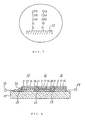
- a water-repellent silicone membrane possessing a water-repellent property can be deposited and adhered thereto (see Fig. 7).
- a water-repellent polyhtetrafuloroetylene membrane can be adhered and deposited onto the second electrode 13.
- a vapor deposition using polytetrafuloroethylene as a sputtering material a water-repellent polytetrafluoroethylene membrane can be adhered and deposited onto the second electrode 13.
- a water-repellent fluorine compound membrane can be deposited and adhered onto the second electrode 13.
- Numeral 14 designates a load connected between the two electrodes 12 and 13.
- the solid electrolyte membrane 5 possessing a hydrogen ion conductivity and the surface of the first electrode 12 formed on one side of the solid electrolyte membrane and functioning as a catalyst and possessing a hydrophilic property 5 was irradiated with at least any of plasma, vacuum ultraviolet light and ozone gas, whereby a super hydrophilic property of which contact angle for water drop is 0 degree was obtained.
- a decomposite obtained by decomposing perfluoroalkyl-silane using a plasma CVD was deposited and adhered to the second electrode 13 formed on the other side of the solid electrolyte membrane 5 and functioning as a catalyst and possessing a water-repellent property, whereby a super water-repellent property of which contact angle for water drops is 150 degrees was obtained.
- the electrochemical element according to the first embodiment includes: the solid electrolyte membrane 5 made of the solid electrolyte possessing a hydrogen ion conductivity; the first electrode 12 formed on one side of this solid electrolyte membrane 5 and functioning as a catalyst and possessing a hydrophilic property; and the second electrode 13 formed on the other side of the solid electrolyte membrane 5 and functioning as a catalyst and possessing a water-repellent property.
- output characteristic can be improved as shown in Fig. 4 and output voltage can be elevated.
- Fig. 8 is a schematic block diagram showing a fourth preferred embodiment.
- reference numeral 5 is the same solid electrolyte membrane as in the foregoing first embodiment.
- Numeral 15 designates a flat plate-shaped base body having insulation performance, made of a porous ceramic, for example.
- Numeral 16 designates a first electrode made of a conductor such as metal or ceramic, formed at intervals of a predetermined distance on the base body 15 and functioning as a catalyst and possessing a hydrophilic property. This first electrode 16 is formed so as to generate a capillary action by establishing a larger ratio between a depth direction and a pore diameter.
- the solid electrolyte membrane 5 is formed so that top surface of the first electrode 16 and one side of the solid electrolyte membrane 5 come in contact.
- Numeral 17 designates a second electrode formed on the other side of the solid electrolyte membrane 5, and this second electrode 17 functions as a catalyst and possesses a water-repellent property.
- the components indicated by 15 to 17 integrally form an electrochemical element 18.
- Numeral 19 designates a first terminal, which is connected to the first electrode at a right end in the drawing.
- Numeral 20 designates a second terminal, which is connected to the second electrode at a left end in the drawing through a later-mentioned connector 22.
- Numeral 21 designates a connector, which provides a connection between the first electrode 16 of one of the adjacent electrochemical elements 18 and the second electrode 17 of the other electrochemical element 18.
- Numeral 22 designates a connector, which provides a connection between the second electrode 17 and the second terminal 20 located at the left end in the drawing.
- Numeral 23 designates an insulator such as alumina, and this insulator 23 provides insulation between the solid electrolyte membrane 5 and first electrode 16, and each of the connectors 21 and 22.
- Numeral 24 designates an insulator such as alumina, and this insulator 24 provides insulation between the solid electrolyte membrane 5 and second electrode 17, and the connector 21.
- electrochemical element a plurality of electrochemical elements 18 being series-connected is described as an example.
- the electrochemical element is constructed of a single electrochemical element 18 to be used as a single unit, or plural pieces of electrochemical elements are series-connected. In either construction, a similar advantage can be expected.
- the electrochemical element 18 being formed on the flat plate-shaped base body 15 is described as an example. However, by forming the base body 15 cylindrical, forming the electrochemical element 18 on an inner surface of the cylindrical base body 15, and passing through inside the cylinder, electric power can be obtained.
- an electric energy can be extracted from a vapor energy at a high temperature of not less than 300°C.
- the electrochemical element includes: a solid electrolyte membrane made of a solid electrolyte possessing a hydrogen ion conductivity; a first electrode formed on one side of this solid electrolyte membrane and functioning as a catalyst and possessing a hydrophilic property which electrode; and a second electrode formed on the other side of the solid electrolyte membrane and functioning as a catalyst and possessing a water-repellent property; in which the electrochemical element is disposed on a base body having insulation performance and porosity.
- the electrochemical element includes: a solid electrolyte membrane made of a solid electrolyte possessing a hydrogen ion conductivity; a first electrode formed on one side of this solid electrolyte membrane and functioning as a catalyst and possessing a hydrophilic; and a second electrode formed on the other side of the solid electrolyte membrane and functioning as a catalyst and possessing a water-repellent property; in which plural electrochemical elements are disposed on a base body having an insulation performance and porosity, and the first electrode of one of the adjacent electrochemical elements and the second electrode of the other electrochemical element are connected to each other.
- output characteristic can be improved, and consequently output voltage can be elevated.
- the electrochemical element includes: a solid electrolyte membrane made of a solid electrolyte and possessing a hydrogen ion conductivity; a first electrode formed on one side of the solid electrolyte membrane and functioning as a catalyst and possessing a hydrophilic property; and a second electrode formed on the other side of the solid electrolyte membrane and functioning as a catalyst and possessing a water-repellent; in which the electrochemical element is disposed on an inner or outer surface of a cylindrical base body having an insulation performance and porosity.
Landscapes
- Chemical & Material Sciences (AREA)
- Chemical Kinetics & Catalysis (AREA)
- Electrochemistry (AREA)
- General Chemical & Material Sciences (AREA)
- Engineering & Computer Science (AREA)
- Ceramic Engineering (AREA)
- Sustainable Energy (AREA)
- Sustainable Development (AREA)
- Manufacturing & Machinery (AREA)
- Life Sciences & Earth Sciences (AREA)
- Electrodes For Compound Or Non-Metal Manufacture (AREA)
- Electrolytic Production Of Non-Metals, Compounds, Apparatuses Therefor (AREA)
- Fuel Cell (AREA)
- Drying Of Gases (AREA)
- Inert Electrodes (AREA)
- Hybrid Cells (AREA)
Abstract
Description
Claims (9)
- An electrochemical element comprising: a solid electrolyte membrane composed of a solid electrolyte and possessing a hydrogen ion conductivity; a first electrode formed on one side of said solid electrolyte membrane and functioning as a catalyst and possessing a hydrophilic property; and a second electrode formed on the other side of said solid electrolyte membrane and functioning as a catalyst and possessing a water-repellent property.
- The electrochemical element according to claim 1, wherein surface of the first electrode 12 is irradiated with at least one of plasma, vacuum ultraviolet light and ozone.
- The electrochemical element according to claim 1, wherein water-repellent a component is deposited and adhered to the surface of the second electrode.
- The electrochemical element according to any claim 1 to 3, wherein the surface of the first electrode is made of a conductor having porosity to generate capillary action.
- The electrochemical element according to claim 1, wherein using either an organic compound or an organic fluorine compound as a raw material, a water-repellent component is deposited and adhered to the surface of the second electrode by any of CVD, sputtering, vapor deposition and dipping.
- The electrochemical element according to claim 1 or 5, wherein the surface of the second electrode is formed to be irregular, needle-like or fractal.
- An electrochemical element apparatus comprising:wherein said electrochemical element is disposed on a base body having insulation performance and porosity.a solid electrolyte membrane made of a solid electrolyte possessing a hydrogen ion conductivity; a first electrode formed on one side of said solid electrolyte membrane andfunctioning as a catalyst and possessing a hydrophilic property which electrode; and a second electrode formed on the other side of said solid electrolyte membrane andfunctioning as a catalyst and possessing a water-repellent property;
- The electrochemical element apparatus according to claim 7;wherein a plurality of said electrochemical elements are disposed on a base body having an insulation performance and porosity, and said first electrode of one of the adjacent electrochemical elements and said second electrode of the other electrochemical element are connected to each other.
- The electrochemical element apparatus according to claim 7;wherein said electrochemical element is disposed on an inner or outer surface of a cylindrical base body having an insulation performance and porosity.
Applications Claiming Priority (2)
| Application Number | Priority Date | Filing Date | Title |
|---|---|---|---|
| JP2001247038 | 2001-08-16 | ||
| JP2001247038A JP3798276B2 (en) | 2001-08-16 | 2001-08-16 | Electrochemical element and electrochemical element apparatus |
Publications (2)
| Publication Number | Publication Date |
|---|---|
| EP1284154A2 true EP1284154A2 (en) | 2003-02-19 |
| EP1284154A3 EP1284154A3 (en) | 2007-12-26 |
Family
ID=19076457
Family Applications (1)
| Application Number | Title | Priority Date | Filing Date |
|---|---|---|---|
| EP02017768A Withdrawn EP1284154A3 (en) | 2001-08-16 | 2002-08-09 | Electrochemical element and electrochemical element apparatus |
Country Status (5)
| Country | Link |
|---|---|
| US (1) | US7074515B2 (en) |
| EP (1) | EP1284154A3 (en) |
| JP (1) | JP3798276B2 (en) |
| KR (2) | KR100649088B1 (en) |
| CN (1) | CN1285089C (en) |
Cited By (3)
| Publication number | Priority date | Publication date | Assignee | Title |
|---|---|---|---|---|
| WO2005034271A3 (en) * | 2003-09-18 | 2005-10-27 | 3M Innovative Properties Co | Fuel cell gas diffusion layer |
| WO2005117176A3 (en) * | 2004-05-24 | 2006-03-23 | Univ Milano Bicocca | Method for making components for fuel cells and fuel cells made thereby |
| EP1879249A4 (en) * | 2005-04-28 | 2012-03-28 | Canon Kk | Hydrophobic catalyst layer for solid polymer fuel cell, method for producing same, solid polymer fuel cell and method for manufacturing same |
Families Citing this family (17)
| Publication number | Priority date | Publication date | Assignee | Title |
|---|---|---|---|---|
| JP2005174564A (en) * | 2003-12-08 | 2005-06-30 | Hitachi Ltd | Polymer electrolyte membrane / electrode assembly for fuel cell, fuel cell using the same, and electronic device equipped with the fuel cell |
| JP4908778B2 (en) * | 2004-06-30 | 2012-04-04 | キヤノン株式会社 | Method for producing catalyst layer of polymer electrolyte fuel cell and method for producing polymer electrolyte fuel cell |
| JP4882225B2 (en) * | 2004-12-02 | 2012-02-22 | 大日本印刷株式会社 | Water-repellent electrode catalyst layer, catalyst layer transfer sheet and catalyst layer-electrolyte assembly for polymer electrolyte fuel cell |
| US8182884B2 (en) | 2005-02-28 | 2012-05-22 | GM Global Technology Operations LLC | Process for application of a hydrophilic coating to fuel cell bipolar plates |
| US20060240312A1 (en) * | 2005-04-25 | 2006-10-26 | Tao Xie | Diffusion media, fuel cells, and fuel cell powered systems |
| WO2007021688A2 (en) * | 2005-08-12 | 2007-02-22 | Gm Global Technology Operations, Inc. | Process for application of a hydrophilic coating to fuel cell bipolar plates |
| JP4832063B2 (en) * | 2005-11-30 | 2011-12-07 | 三井化学株式会社 | Electrolysis cell and electrolysis method using the same |
| JP5045021B2 (en) * | 2006-08-08 | 2012-10-10 | トヨタ自動車株式会社 | FUEL CELL ELECTRODE, MANUFACTURING METHOD THEREOF, AND FUEL CELL HAVING THE FUEL CELL ELECTRODE |
| JP5157333B2 (en) * | 2007-09-05 | 2013-03-06 | カシオ計算機株式会社 | Gas-liquid separator, power generator and electronic device |
| KR200450500Y1 (en) * | 2008-07-02 | 2010-10-07 | 삼주이엔지 주식회사 | Onshore Refrigeration and Refrigeration Equipment |
| WO2011008195A2 (en) * | 2009-07-13 | 2011-01-20 | Hewlett Packard Development Company L .P. | Memristive device |
| JP5603928B2 (en) * | 2010-03-23 | 2014-10-08 | 本田技研工業株式会社 | Electrochemical device |
| CN102181878B (en) * | 2011-04-22 | 2013-11-13 | 北京航空航天大学 | Static water supply proton exchange membrane brine electrolysis device |
| KR101438890B1 (en) * | 2012-06-28 | 2014-09-15 | 현대자동차주식회사 | Membrane electrode assembly with enhanced hydrophobicity and manufacturing method thereof |
| CN103855419B (en) * | 2012-11-29 | 2016-02-03 | 中国科学院大连化学物理研究所 | A kind of thermoelectric cell |
| CN104689692B (en) * | 2015-03-31 | 2016-08-24 | 苏州大学 | Device and method for treating waste gas by air plasma |
| WO2025204938A1 (en) * | 2024-03-28 | 2025-10-02 | 富士フイルム株式会社 | Membrane electrode assembly, method for producing same, and catalyst layer for membrane electrode |
Family Cites Families (21)
| Publication number | Priority date | Publication date | Assignee | Title |
|---|---|---|---|---|
| JPS58165266A (en) * | 1982-03-26 | 1983-09-30 | Hitachi Ltd | Fuel cell |
| JPS58166636A (en) * | 1982-03-27 | 1983-10-01 | Hitachi Ltd | Fuel cell |
| JPS6364267A (en) * | 1986-09-04 | 1988-03-22 | Mitsubishi Electric Corp | Fuel cell |
| JP2670141B2 (en) | 1989-05-12 | 1997-10-29 | 田中貴金属工業株式会社 | Water repellent method |
| JP2831061B2 (en) * | 1989-11-28 | 1998-12-02 | 三菱重工業株式会社 | Gas diffusion electrode and solid polymer electrolyte fuel cell body using the same |
| JP3573771B2 (en) * | 1993-11-09 | 2004-10-06 | 株式会社豊田中央研究所 | Fuel cell |
| JPH07211329A (en) * | 1994-01-14 | 1995-08-11 | Tanaka Kikinzoku Kogyo Kk | Method for manufacturing gas diffusion electrode |
| JPH0881776A (en) * | 1994-09-14 | 1996-03-26 | Sekisui Chem Co Ltd | Substrate surface treatment method |
| JPH08138715A (en) * | 1994-11-09 | 1996-05-31 | Fuji Electric Co Ltd | Polymer electrolyte fuel cell and method of manufacturing the same |
| JPH08164319A (en) * | 1994-12-12 | 1996-06-25 | Opt D D Melco Lab:Kk | Dehumidifying element |
| US5631099A (en) * | 1995-09-21 | 1997-05-20 | Hockaday; Robert G. | Surface replica fuel cell |
| JP3591123B2 (en) * | 1996-03-08 | 2004-11-17 | トヨタ自動車株式会社 | Fuel cell and fuel cell electrode |
| JPH10270052A (en) * | 1997-03-27 | 1998-10-09 | Toyota Central Res & Dev Lab Inc | Method for producing electrode for gas reaction system or gas generation system battery |
| JP3583897B2 (en) * | 1997-04-11 | 2004-11-04 | 三洋電機株式会社 | Fuel cell |
| US6024848A (en) * | 1998-04-15 | 2000-02-15 | International Fuel Cells, Corporation | Electrochemical cell with a porous support plate |
| JPH11339815A (en) * | 1998-05-29 | 1999-12-10 | Aisin Seiki Co Ltd | Solid polymer electrolyte fuel cell and method for manufacturing the same |
| JP2000243411A (en) * | 1999-02-16 | 2000-09-08 | Toyota Motor Corp | Assembly of electrolyte membrane and electrode for fuel cell and method of manufacturing the same |
| JP3941031B2 (en) | 1999-11-18 | 2007-07-04 | 五郎 山内 | Waterproof electroacoustic transducer |
| US6331694B1 (en) * | 1999-12-08 | 2001-12-18 | Lincoln Global, Inc. | Fuel cell operated welder |
| JP2001176536A (en) | 1999-12-14 | 2001-06-29 | Mitsubishi Electric Corp | Generator |
| JP2004522257A (en) * | 2000-11-14 | 2004-07-22 | ザ リージェンツ オブ ザ ユニバーシティ オブ カリフォルニア | Methanol fuel cell with air breathing |
-
2001
- 2001-08-16 JP JP2001247038A patent/JP3798276B2/en not_active Expired - Fee Related
-
2002
- 2002-08-06 US US10/212,048 patent/US7074515B2/en not_active Expired - Fee Related
- 2002-08-09 EP EP02017768A patent/EP1284154A3/en not_active Withdrawn
- 2002-08-15 CN CNB021302197A patent/CN1285089C/en not_active Expired - Fee Related
- 2002-08-16 KR KR1020020048544A patent/KR100649088B1/en not_active Expired - Fee Related
-
2005
- 2005-02-16 KR KR1020050012772A patent/KR100560558B1/en not_active Expired - Fee Related
Cited By (4)
| Publication number | Priority date | Publication date | Assignee | Title |
|---|---|---|---|---|
| WO2005034271A3 (en) * | 2003-09-18 | 2005-10-27 | 3M Innovative Properties Co | Fuel cell gas diffusion layer |
| WO2005117176A3 (en) * | 2004-05-24 | 2006-03-23 | Univ Milano Bicocca | Method for making components for fuel cells and fuel cells made thereby |
| EP1879249A4 (en) * | 2005-04-28 | 2012-03-28 | Canon Kk | Hydrophobic catalyst layer for solid polymer fuel cell, method for producing same, solid polymer fuel cell and method for manufacturing same |
| US8722220B2 (en) | 2005-04-28 | 2014-05-13 | Canon Kabushiki Kaisha | Hydrophobic catalyst layer for polymer electrolyte fuel cell and method of producing the same, and polymer electrolyte fuel cell and method of producing the same |
Also Published As
| Publication number | Publication date |
|---|---|
| JP2003059506A (en) | 2003-02-28 |
| US20030044671A1 (en) | 2003-03-06 |
| US7074515B2 (en) | 2006-07-11 |
| KR20050043809A (en) | 2005-05-11 |
| JP3798276B2 (en) | 2006-07-19 |
| CN1402281A (en) | 2003-03-12 |
| KR20030016172A (en) | 2003-02-26 |
| EP1284154A3 (en) | 2007-12-26 |
| KR100560558B1 (en) | 2006-03-15 |
| KR100649088B1 (en) | 2006-11-24 |
| CN1285089C (en) | 2006-11-15 |
Similar Documents
| Publication | Publication Date | Title |
|---|---|---|
| US7074515B2 (en) | Electrochemical element and electrochemical element apparatus | |
| Arai et al. | AC impedance analysis of bifunctional air electrodes for metal‐air batteries | |
| CN100452513C (en) | Solid polymer electrolyte fuel cell unit | |
| US20050123816A1 (en) | Cell unit of solid polymeric electrolyte type fuel cell | |
| KR101459406B1 (en) | Catalyst, electrode, fuel cell, gas detoxification apparatus, and methods for producing catalyst and electrode | |
| WO1998019351A2 (en) | Nanostructured ion conducting solid electrolytes | |
| Oncescu et al. | A microfabricated low cost enzyme-free glucose fuel cell for powering low-power implantable devices | |
| US11415540B2 (en) | Technologies using nitrogen-functionalized pseudo-graphite | |
| JP6108042B2 (en) | Titanium material, separator, polymer electrolyte fuel cell, and method for producing titanium material | |
| Oskam et al. | Sol− Gel Synthesis and Characterization of Carbon/Ceramic Composite Electrodes | |
| EP0713931B1 (en) | Method of manufacturing thin zirconia films by electrophoretic deposition | |
| JP4861168B2 (en) | Fuel cell separator based on austenitic stainless steel | |
| Lin et al. | Intercalation of Hydrogen in Perovskite Oxide for Pseudocapacitive Energy Storage | |
| CN102958599A (en) | Membrane electrode assembly, fuel cell, gas-eliminating unit, and method for producing membrane electrode assembly | |
| CN100527493C (en) | Production method of fuel cell and fuel cell | |
| KR101372645B1 (en) | Metal separator for fuel cell and method of manufacturing the same | |
| JP2002042827A (en) | Fuel cell separator, method of manufacturing the same, and fuel cell | |
| Xiao-Feng et al. | Carbon nanotube capacitor materials loaded with different amounts of ruthenium oxide | |
| JP2019171704A (en) | Metal plate, separator, cell, and fuel battery | |
| Therese et al. | Electrosynthesis of Ln (OH) 3 (Ln= La, Nd) coatings on stainless steel substrates | |
| Evoen | Electrocatalysis in solid acid fuel cell electrodes | |
| Zaka et al. | Single Source Precursor Synthesis of Lead Titanate (PbTiO3) for the Electrochemical Detection of Nitric Oxide (NO) | |
| KR20190130229A (en) | Manufacturing method of nitrogen-doped porous graphene | |
| Gulaboski | Electrochemical Dictionary | |
| Wang et al. | Electrocatalytic properties of an Sr0. 25Bi0. 5FeO3–δ/LSGM interface |
Legal Events
| Date | Code | Title | Description |
|---|---|---|---|
| PUAI | Public reference made under article 153(3) epc to a published international application that has entered the european phase |
Free format text: ORIGINAL CODE: 0009012 |
|
| AK | Designated contracting states |
Designated state(s): AT BE BG CH CY CZ DE DK EE ES FI FR GB GR IE IT LI LU MC NL PT SE SK TR |
|
| AX | Request for extension of the european patent |
Extension state: AL LT LV MK RO SI |
|
| RAP1 | Party data changed (applicant data changed or rights of an application transferred) |
Owner name: YAMAUCHI, GORO Owner name: TAKAI, OSAMU Owner name: MITSUBISHI DENKI KABUSHIKI KAISHA |
|
| PUAL | Search report despatched |
Free format text: ORIGINAL CODE: 0009013 |
|
| AK | Designated contracting states |
Kind code of ref document: A3 Designated state(s): AT BE BG CH CY CZ DE DK EE ES FI FR GB GR IE IT LI LU MC NL PT SE SK TR |
|
| AX | Request for extension of the european patent |
Extension state: AL LT LV MK RO SI |
|
| 17P | Request for examination filed |
Effective date: 20080328 |
|
| AKX | Designation fees paid |
Designated state(s): DE FR GB |
|
| 17Q | First examination report despatched |
Effective date: 20090604 |
|
| STAA | Information on the status of an ep patent application or granted ep patent |
Free format text: STATUS: THE APPLICATION IS DEEMED TO BE WITHDRAWN |
|
| 18D | Application deemed to be withdrawn |
Effective date: 20091015 |