EP1284134A2 - External skin preparations for suppressing sebum secretion - Google Patents
External skin preparations for suppressing sebum secretion Download PDFInfo
- Publication number
- EP1284134A2 EP1284134A2 EP01932233A EP01932233A EP1284134A2 EP 1284134 A2 EP1284134 A2 EP 1284134A2 EP 01932233 A EP01932233 A EP 01932233A EP 01932233 A EP01932233 A EP 01932233A EP 1284134 A2 EP1284134 A2 EP 1284134A2
- Authority
- EP
- European Patent Office
- Prior art keywords
- extract
- sebum secretion
- matrix metalloproteinase
- skin
- sebaceous gland
- Prior art date
- Legal status (The legal status is an assumption and is not a legal conclusion. Google has not performed a legal analysis and makes no representation as to the accuracy of the status listed.)
- Granted
Links
Images


Classifications
-
- A—HUMAN NECESSITIES
- A61—MEDICAL OR VETERINARY SCIENCE; HYGIENE
- A61K—PREPARATIONS FOR MEDICAL, DENTAL OR TOILETRY PURPOSES
- A61K31/00—Medicinal preparations containing organic active ingredients
- A61K31/12—Ketones
-
- A—HUMAN NECESSITIES
- A61—MEDICAL OR VETERINARY SCIENCE; HYGIENE
- A61K—PREPARATIONS FOR MEDICAL, DENTAL OR TOILETRY PURPOSES
- A61K31/00—Medicinal preparations containing organic active ingredients
- A61K31/33—Heterocyclic compounds
- A61K31/395—Heterocyclic compounds having nitrogen as a ring hetero atom, e.g. guanethidine or rifamycins
- A61K31/435—Heterocyclic compounds having nitrogen as a ring hetero atom, e.g. guanethidine or rifamycins having six-membered rings with one nitrogen as the only ring hetero atom
- A61K31/44—Non condensed pyridines; Hydrogenated derivatives thereof
- A61K31/4406—Non condensed pyridines; Hydrogenated derivatives thereof only substituted in position 3, e.g. zimeldine
-
- A—HUMAN NECESSITIES
- A61—MEDICAL OR VETERINARY SCIENCE; HYGIENE
- A61K—PREPARATIONS FOR MEDICAL, DENTAL OR TOILETRY PURPOSES
- A61K36/00—Medicinal preparations of undetermined constitution containing material from algae, lichens, fungi or plants, or derivatives thereof, e.g. traditional herbal medicines
-
- A—HUMAN NECESSITIES
- A61—MEDICAL OR VETERINARY SCIENCE; HYGIENE
- A61K—PREPARATIONS FOR MEDICAL, DENTAL OR TOILETRY PURPOSES
- A61K8/00—Cosmetics or similar toiletry preparations
- A61K8/02—Cosmetics or similar toiletry preparations characterised by special physical form
- A61K8/0212—Face masks
-
- A—HUMAN NECESSITIES
- A61—MEDICAL OR VETERINARY SCIENCE; HYGIENE
- A61K—PREPARATIONS FOR MEDICAL, DENTAL OR TOILETRY PURPOSES
- A61K8/00—Cosmetics or similar toiletry preparations
- A61K8/18—Cosmetics or similar toiletry preparations characterised by the composition
- A61K8/30—Cosmetics or similar toiletry preparations characterised by the composition containing organic compounds
- A61K8/49—Cosmetics or similar toiletry preparations characterised by the composition containing organic compounds containing heterocyclic compounds
- A61K8/4906—Cosmetics or similar toiletry preparations characterised by the composition containing organic compounds containing heterocyclic compounds with one nitrogen as the only hetero atom
- A61K8/4933—Cosmetics or similar toiletry preparations characterised by the composition containing organic compounds containing heterocyclic compounds with one nitrogen as the only hetero atom having sulfur as an exocyclic substituent, e.g. pyridinethione
-
- A—HUMAN NECESSITIES
- A61—MEDICAL OR VETERINARY SCIENCE; HYGIENE
- A61K—PREPARATIONS FOR MEDICAL, DENTAL OR TOILETRY PURPOSES
- A61K8/00—Cosmetics or similar toiletry preparations
- A61K8/18—Cosmetics or similar toiletry preparations characterised by the composition
- A61K8/96—Cosmetics or similar toiletry preparations characterised by the composition containing materials, or derivatives thereof of undetermined constitution
- A61K8/97—Cosmetics or similar toiletry preparations characterised by the composition containing materials, or derivatives thereof of undetermined constitution from algae, fungi, lichens or plants; from derivatives thereof
-
- A—HUMAN NECESSITIES
- A61—MEDICAL OR VETERINARY SCIENCE; HYGIENE
- A61K—PREPARATIONS FOR MEDICAL, DENTAL OR TOILETRY PURPOSES
- A61K8/00—Cosmetics or similar toiletry preparations
- A61K8/18—Cosmetics or similar toiletry preparations characterised by the composition
- A61K8/96—Cosmetics or similar toiletry preparations characterised by the composition containing materials, or derivatives thereof of undetermined constitution
- A61K8/97—Cosmetics or similar toiletry preparations characterised by the composition containing materials, or derivatives thereof of undetermined constitution from algae, fungi, lichens or plants; from derivatives thereof
- A61K8/9783—Angiosperms [Magnoliophyta]
- A61K8/9789—Magnoliopsida [dicotyledons]
-
- A—HUMAN NECESSITIES
- A61—MEDICAL OR VETERINARY SCIENCE; HYGIENE
- A61K—PREPARATIONS FOR MEDICAL, DENTAL OR TOILETRY PURPOSES
- A61K8/00—Cosmetics or similar toiletry preparations
- A61K8/18—Cosmetics or similar toiletry preparations characterised by the composition
- A61K8/96—Cosmetics or similar toiletry preparations characterised by the composition containing materials, or derivatives thereof of undetermined constitution
- A61K8/97—Cosmetics or similar toiletry preparations characterised by the composition containing materials, or derivatives thereof of undetermined constitution from algae, fungi, lichens or plants; from derivatives thereof
- A61K8/9783—Angiosperms [Magnoliophyta]
- A61K8/9794—Liliopsida [monocotyledons]
-
- A—HUMAN NECESSITIES
- A61—MEDICAL OR VETERINARY SCIENCE; HYGIENE
- A61P—SPECIFIC THERAPEUTIC ACTIVITY OF CHEMICAL COMPOUNDS OR MEDICINAL PREPARATIONS
- A61P17/00—Drugs for dermatological disorders
-
- A—HUMAN NECESSITIES
- A61—MEDICAL OR VETERINARY SCIENCE; HYGIENE
- A61P—SPECIFIC THERAPEUTIC ACTIVITY OF CHEMICAL COMPOUNDS OR MEDICINAL PREPARATIONS
- A61P17/00—Drugs for dermatological disorders
- A61P17/08—Antiseborrheics
-
- A—HUMAN NECESSITIES
- A61—MEDICAL OR VETERINARY SCIENCE; HYGIENE
- A61P—SPECIFIC THERAPEUTIC ACTIVITY OF CHEMICAL COMPOUNDS OR MEDICINAL PREPARATIONS
- A61P17/00—Drugs for dermatological disorders
- A61P17/10—Anti-acne agents
-
- A—HUMAN NECESSITIES
- A61—MEDICAL OR VETERINARY SCIENCE; HYGIENE
- A61Q—SPECIFIC USE OF COSMETICS OR SIMILAR TOILETRY PREPARATIONS
- A61Q19/00—Preparations for care of the skin
-
- A—HUMAN NECESSITIES
- A61—MEDICAL OR VETERINARY SCIENCE; HYGIENE
- A61Q—SPECIFIC USE OF COSMETICS OR SIMILAR TOILETRY PREPARATIONS
- A61Q19/00—Preparations for care of the skin
- A61Q19/008—Preparations for oily skin
-
- A—HUMAN NECESSITIES
- A61—MEDICAL OR VETERINARY SCIENCE; HYGIENE
- A61K—PREPARATIONS FOR MEDICAL, DENTAL OR TOILETRY PURPOSES
- A61K2800/00—Properties of cosmetic compositions or active ingredients thereof or formulation aids used therein and process related aspects
- A61K2800/74—Biological properties of particular ingredients
- A61K2800/78—Enzyme modulators, e.g. Enzyme agonists
- A61K2800/782—Enzyme inhibitors; Enzyme antagonists
-
- A—HUMAN NECESSITIES
- A61—MEDICAL OR VETERINARY SCIENCE; HYGIENE
- A61Q—SPECIFIC USE OF COSMETICS OR SIMILAR TOILETRY PREPARATIONS
- A61Q1/00—Make-up preparations; Body powders; Preparations for removing make-up
- A61Q1/02—Preparations containing skin colorants, e.g. pigments
-
- A—HUMAN NECESSITIES
- A61—MEDICAL OR VETERINARY SCIENCE; HYGIENE
- A61Q—SPECIFIC USE OF COSMETICS OR SIMILAR TOILETRY PREPARATIONS
- A61Q19/00—Preparations for care of the skin
- A61Q19/08—Anti-ageing preparations
Definitions
- the present invention relates to drugs for external application to the skin for inhibiting sebum secretion. More specifically, the present invention relates to drugs for inhibiting sebum secretion comprising, as an active ingredient having an excellent antagonistic effect against matrix metalloproteinase activity.
- the possible mechanism of drugs for inhibiting sebum secretion is two fold: the effect of suppressing the growth of sebaceous gland cells and the effect of inhibiting the lipid synthesis of sebaceous gland cells. Since the former includes the above female hormones having potential effects, there is a need for drugs, for inhibiting sebum secretion, that exhibit equivalent effects without being accompanied by side effects (without hormone actions). However, no such substances have been found so far.
- the present inventors have performed an in-depth investigation on the mechanism responsible for the growth of sebaceous gland cells and sebum secretion, and have found that matrix metalloproteinase is enhanced in the sebaceous gland cells which have come to secrete sebum in excess and, specifically, gelatinase, belonging to the matrix metalloproteinases, is enhanced.
- matrix metalloproteinase is enhanced in the sebaceous gland cells which have come to secrete sebum in excess and, specifically, gelatinase, belonging to the matrix metalloproteinases.
- the present invention relates to drugs for external application for inhibiting sebum secretion comprising a matrix metalloproteinase inhibitor as an active ingredient.
- the present invention also relates to a method of inhibiting sebum secretion wherein a matrix metalloproteinase inhibitor is applied to the skin.
- FIG. 1 A shows the result of observation, with in situ zymography, of gelatinase in the sebaceous gland area of a human forehead.
- a broken line represents the contour of the sebaceous gland area, and the white area indicated by the arrow represents gelatin degradation activity.
- B shows the result of observation, with in situ zymography, of gelatinase in the sebaceous gland area of a human scalp.
- a broken line represents the contour of the sebaceous gland area, and the white area indicated by the arrow indicates gelatin degradation activity.
- FIG. 2 A shows a hematoxylin-eosin stain of the skin of a mouse that was not irradiated with UVB.
- FIG. 3 A shows the result of observation, with in situ zymography, of gelatinase behavior in the sebaceous gland area of the skin not irradiated with UVB.
- the arrow indicates the sebaceous gland area.
- FIG. 4 A shows the result of observation, with in situ zymography, of the sebaceous gland area of the skin to which an active ingredient A, a matrix metalloproteinase inhibitor, was transdermally applied, and a broken line indicates the result of the epidermal area and the sebaceous gland organ area.
- B shows the result of in situ zymography of the skin to which a solvent was only applied, and a broken line indicates the result of the epidermal area and the sebaceous gland organ area.
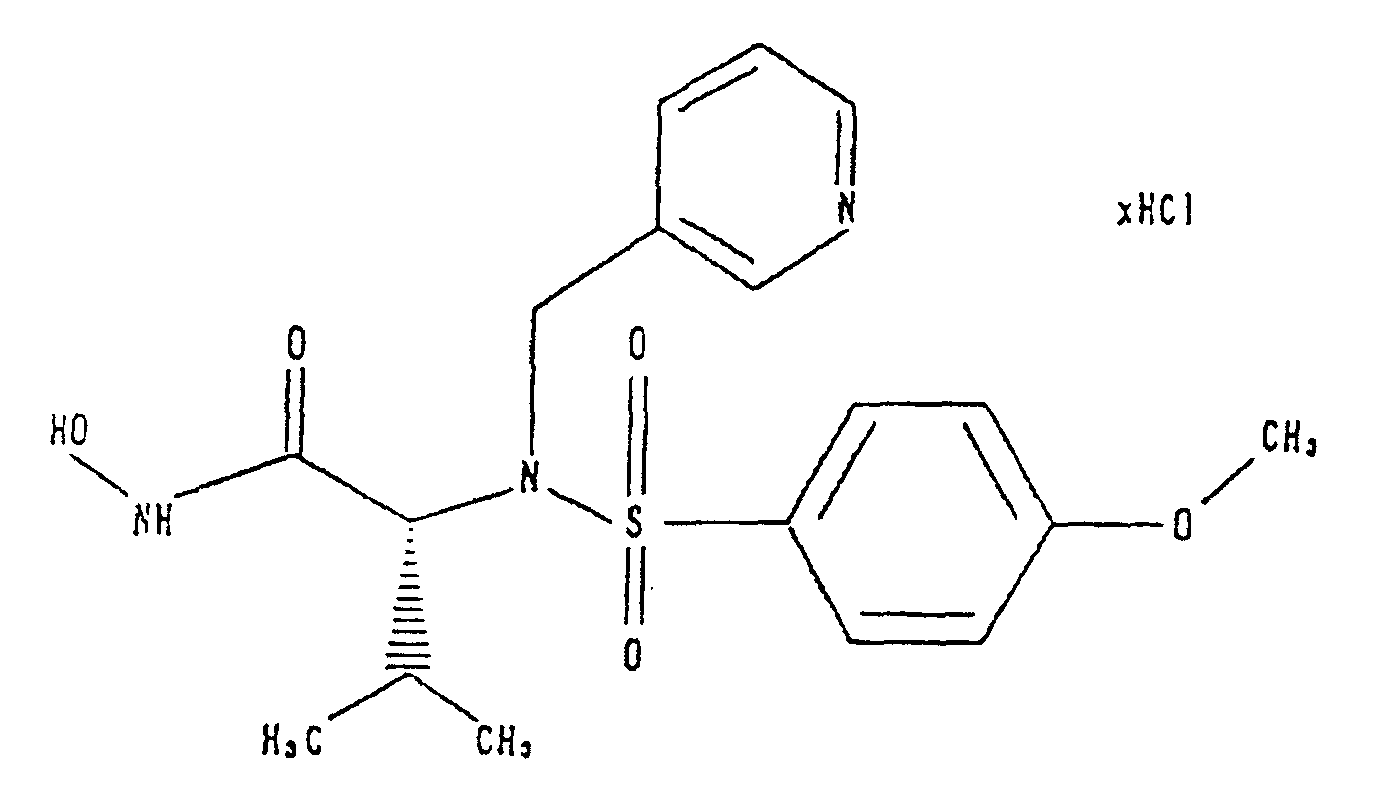
- an active ingredient of the drug for inhibiting sebum secretion may be any substance that inhibits matrix metalloproteinase, and there can be mentioned for example N-hydroxy-2(R)-[[4-methoxyphenyl)sulfonyl](3-picolyl)amino]-3-methylbutanamide (termed as active ingredient A) belonging to the hydroxamic acid derivatives, or a salt thereof, for example a hydrochloride.
- the structure of the hydrochloride of active ingredient A is represented by the following formula:
- doxycycline having a tetracycline backbone and curcumine, as a natural compound, for which an excellent gelatinase inhibiting effect was found, and plant extracts (turmeric extract) containing it, and the following plant extracts for which the MMPs inhibiting effect has been confirmed:
- Thymus serpyllum L. Valeriana fauriei Briquet or its related plants (Valerianaceae), Diospyros kaki Thunberg (Ebenaceae), Astragalus sinicus Linne (Leguminosae), Crataegus cuneata Siebold et Zuccarini (Rosaceae), Paeonia suffruticosa Andrews (Poeonia montan Sims) (Paeoniaceae), Theasinensis Linne var.
- the present inventors have found, for the first time, that drugs for external application to the skin containing a matrix metalloproteinase antagonist for use in the present invention exhibit the effect of inhibiting the sebum secretion of the skin.
- matrix metalloproteinases include, for example, gelatinase etc.
- the metalloproteinase inhibitor of the present invention is a substance that inhibits the above-mentioned matrix metalloproteinases.
- the drugs for external application containing a matrix metalloproteinase antagonist for use in the present invention are used as cosmetics for inhibiting sebum secretion, and the amount blended of the matrix metalloproteinase antagonist is 0.0001-20% by weight in tems of dry weight, preferably 0.0001-10.0% by weight relative to the total amount of the drug.
- the amount is less than 0.0001% by weight, the effect mentioned in the present invention cannot be fully exhibited, and when it exceeds 20.0% by weight, it is difficult to formulate into drugs and thus is undesirable.
- the blending of the amount over 10.0% by weight does not result in significant increasess in efficacy.
- the matrix metalloproteinase antagonist-blended drugs for external application of the present invention may be blended, as appropriate, with ingredients used for drugs for external application such as common cosmetics and pharmaceutical drugs, including for example whitening agents, moisturizers, antioxidants, oily components, UV absorbers, surfactants, thickening agent, alcohols, powder components, coloring agents, aqueous components, water, various skin nutrients, and the like as needed.
- ingredients used for drugs for external application such as common cosmetics and pharmaceutical drugs, including for example whitening agents, moisturizers, antioxidants, oily components, UV absorbers, surfactants, thickening agent, alcohols, powder components, coloring agents, aqueous components, water, various skin nutrients, and the like as needed.
- sequestering agents such as edetate disodium, edetate trisodium, sodium citrate, sodium polyphosphate, sodium metaphosphate, and gluconic acid, caffeine, tannin, verapamil, tranexamic acid and derivatives thereof, licorice extracts, glabridin, hot water extracts of padauk fruit, various crude drugs, tocopherol acetate, drugs such as glycyrrhetic acid and derivatives thereof or salts thereof, vitamin C, ascorbic acid magnesium phosphate, ascorbic acid glucoside, arbutin, other whitening agents such as kojic acid, sugars such as glucose, fructose, mannose, sucrose and trehalose, vitamin A such as retinoic acid, retinol, retinol acetate, and retinol palmitate, and the like.
- sequestering agents such as edetate disodium, edetate trisodium, sodium citrate, sodium polyphosphate, sodium
- Drugs for external application to the skin containing the matrix metalloproteinase antagonist of the present invention may be any substances that are conventionally used in drugs for external application to the skin such as ointments, creams, emulsions, lotions, packs, and baths, and the dosage forms are not specifically limited.
- the present invention will now be explained in more details with examples. It should be noted that the present invention is not limited by these examples.
- the amount blended is expressed in % by weight.
- Example 1 Cream (Formulation) Stearic acid 5.0 % by weight Stearyl alcohol 4.0 Isopropyl myristate 18.0 Glycerin monostearate 3.0 Propylene glycol 10.0 Hydrochloride of active ingredient A 1.0 Caustic potash 0.2 Sodium bisulfite 0.01 Preservative Proper amount Perfume Proper amount Ion exchanged water Balance
- propylene glycol, active ingredient A and caustic potash are added and dissolved, and then heated and maintained at 70°C (aqueous phase).
- the other ingredients are mixed, melted under heating and maintained at 70°C (oily phase).
- the oily phase is gradually added to the aqueous phase, and after the total amount has been added, the temperature is maintained for some time in order to allow a reaction to occur. It is then homogeneously emulsified by a homomixer, and cooled to 30°C under sufficient stirring.
- Example 2 Example 2.
- Cream Stearic acid 2.0 % by weight Stearyl alcohol 7.0 Hydrogenated lanolin 2.0 Squalane 5.0 2-octyldodecyl alcohol 6.0 Polyoxyethylene (25 mole) cetylalcohol ether 3.0 Glycerin monostearate 2.0 Propylene glycol 5.0 Extract of tormentilla (dry weight) 0.05 Sodium bisulfite 0.03 Ethyl paraben 0.3 Flavor Proper amount Ion exchanged water Balance
- aqueous phase aqueous phase
- the other ingredients are mixed, melted under heating and maintained at 70°C (oily phase).
- the oily phase is added to the aqueous phase to pre-emulsify, and after homogeneously emulsified by a homomixer, it is cooled to 30°C under sufficient stirring.
- Example 3
- Cream Solid paraffin 5.0 % by weight Beeswax 10.0 Vaseline 15.0 Liquid paraffin 41.0 Glycerin monostearate 2.0 Polyoxyethylene (20 mole) sorbitan monolaurate 2.0 Soap powder 0.1 Borax 0.2 Curcumine extract (dry weight) 0.01 Sodium bisulfite 0.03 Ethyl paraben 0.3 Perfume Proper amount Ion exchanged water Balance
- soap powder and borax are added, dissolved under heating, and maintained at 70°C (aqueous phase).
- the other ingredients are mixed, melted under heating, and maintained at 70°C (oily phase).
- the oily phase is gradually added to the aqueous phase to allow a reaction to occur. After the reaction is complete, it is homogeneously emulsified by a homomixer, and after emulsification it is cooled to 30°C under sufficient stirring.
- Emulsion Stearic acid 2.5 % by weight Cetyl alcohol 1.5 Vaseline 5.0 Liquid paraffin 10.0 Polyoxyethylene (10 mole) monooleate 2.0 Polyethylene glycol 1500 3.0 Triethanolamine 1.0 Carboxyvinyl polymer 0.05 (Trade name: Carbopol 941, B.F. Goodrich Chemical company) Avocado extract (dry weight) 0.01 Sodium bisulfite 0.01 Ethyl paraben 0.3 Flavor Proper amount Ion exchanged water Balance
- phase A carboxyvinyl polymer is dissolved (phase A).
- polyethylene glycol 1500 and triethanolamine are added, dissolved under heating, and maintained at 70°C (aqueous phase).
- the other ingredients are mixed, melted under heating, and maintained at 70°C (oily phase).
- the oily phase is added to the aqueous phase to pre-emulsify, to which phase A is added and homogeneously emulsified by a homomixer. After emulsification, it is cooled to 30°C under sufficient stirring.
- Example 5 Example 5
- Emulsion (Formulation) Microcrystalline wax 1.0 % by weight Beexwax 2.0 Lanoline 20.0 Liquid paraffin 10.0 Squalane 5.0 Sorbitan sesquioleate 4.0 Polyoxyethylene (20 mole) sorbitan monooleate 1.0 Propylene glycol 7.0
- Avocado extract (dry weight) 10.0 Sodium bisulfite 0.01 Ethyl paraben 0.3 Perfume Proper amount Ion exchanged water Balance
- Carbopol 940 is homogeneously dissolved, while the hydrochloride of active ingredient A and polyoxyethylene (50 mole) oleylalcohol ether are dissolved and added to the aqueous phase. Then, the other ingredients are added, and caustic soda and L-arginine are added to neutralize it and to increase viscosity.
- Example 7
- Phase A Ethyl alcohol (95%) 10.0 % by weight Polyoxyethylene (20 mole) octyldodecanol 1.0 Panthothenilethyl ether 0.1 Coconut extract (dry weight) 1.5 Methyl paraben 0.15
- Phase B Potassium hydroxide 0.1
- Phase C Glycerin 5.0 Dipropylene glycol 10.0 Sodium bisulfite 0.03 Carboxyvinyl polymer 0.2 (Trade name:Carbopol 940, B.F. Goodrich Chemical company) Purified water Balance
- Phase A and phase B are separately dissolved, and phase A is added to phase C. Then phase B is added thereto and filling is performed.
- Example 8. Pack (Formulation) (Phase A) Dipropylene glycol 5.0 % by weight Polyoxyethylene (60 mole) hydrogenated castor oil 5.0 (Phase B) Extract of Blumea balsamifera 0.01 (dry weight) Olive oil 5.0 Tocopherol acetate 0.2 Ethyl parabene 0.2 Perfume 0.2 (Phase C) Sodium bisulfite 0.03 Polyvinyl alcohol 13.0 (degree of saponification 90, degree of polymerization 2,000) Ethanol 7.0 Purified water Balance
- Phase A, phase B and phase C are separately, homogeneously dissolved, and phase A is added to phase B to solubilize. Then this is added to phase C and filling is performed.
- Example 9 Solid foundation (Formulation) Talc 43.1 % by weight Kaolin 15.0 Cericite 10.0 Zinc flower 7.0 Titanium dioxide 3.8 Yellow iron oxide 2.9 Black iron oxide 0.2 Squalane 8.0 Isostearic acid 4.0 Monooleic acid POE sorbitan 3.0 Isocetyl Octoate 2.0 Extract of Cinnamomum eassin 1.0 (dry weight) Preservative Proper amount Perfume Proper amount
- Powder components of talc and black iron oxide are mixed well in the blender, and then oily components of squalane to isocetyl octaoate, the hydrochloride of active ingredient A, a preservative and a flavor are added thereto, and after blending well, it is filled into a container and molded.
- Example 10 Powder components of talc and black iron oxide are mixed well in the blender, and then oily components of squalane to isocetyl octaoate, the hydrochloride of active ingredient A, a preservative and a flavor are added thereto, and after blending well, it is filled into a container and molded.
- Example 10 Example 10
- Emulsified foundation (cream type) (Formulation) (Powder portion) Titanium dioxide 10.3 % by weight Cericite 5.4 Kaolin 3.0 Yellow iron oxide 0.8 Red iron oxide 0.3 Black iron oxide 0.2 (oily phase) Decamethylcyclopentasiloxane 11.5 Liquid paraffin 4.5 Polyoxyethylene modified Dimethylpolysiloxane 4.0 (aqueous phase) Purified water 50.0 1,3-butyleneglycol 4.5 Tormentilla extract (dry weight) 1.5 Sorbitan sesquioleate 3.0 Preservative Proper amount Perfume Proper amount
- aqueous phase is stirred under heating, a fully mixed and ground powder portion is added thereto and treated by a homomixer.
- a flavor is added under stirring, and then cooled to room temperature.
- Fig. 1A shows the result of an in situ zymography of the sebaceous gland tissue in the forehead area of the normal skin, and Fig.
- FIG. 1B shows the result of an in situ zymography of each sebaceous gland tissue present in the scalp area. It can be seen that little gelatinase activity is detected in the sebaceous gland in the scalp whereas in the forehead area in which sebaceous glands are well developed, gelatinase activity is enhanced.
- Fig. 3A, Fig. 3B and Fig. 3C show the result of gelatinase activity in the periphery of the sebaceous gland area examined by an in situ zymography.
- the UVB non-irradiated epidermal area no gelatinase activity is observed, and only a slight activity is observed in the sebaceous gland area (Fig. 3A).
- a very potential gelatinase activity is evident in the UVB irradiated and thereby developed epidermal area and sebaceous gland areas (Fig. 3B) (S. Inomata et al., Jpn. J. Dermatol., Vol. 111(3), 532 (2000)).
- the gelatin degradation activity detected in an in situ zymography may result from proteinases other than gelatinase (MMPs), but the addition of a MMPa inhibitor (EDTA) in the in situ zymography reaction process in vitro inhibited the gelatin degradation at the epidermal area and the sebaceous gland area, as shown in Fig. 3C, it is obvious that it results from a gelatinase belonging to the MMPs (S. Inomata et al., Jpn. J. Dermatol., Vol. 111(3), 532 (2000)).
- MMPs proteinases other than gelatinase
- EDTA MMPa inhibitor
- UV is generally known to activate the sebaceous gland cells on the skin and thereby to enhance the amount of sebum secretion, which has been reported on a model using hairless mice (R.H. Lesnik et al., Arch Dermatol., Vol. 284, 106 (1992)).
- Bissett et al. (Phytochem. Phytobiol, Vol.
- the matrix metalloproteinase inhibitor-blended drugs for external application to the skin of the present invention exhibit the effect of inhibiting sebum secretion, and act favorably in preventing and/or improving acne, oily skins, keratotic plug inhibition, pore reduction, and the like.
Landscapes
- Health & Medical Sciences (AREA)
- Life Sciences & Earth Sciences (AREA)
- Veterinary Medicine (AREA)
- Public Health (AREA)
- General Health & Medical Sciences (AREA)
- Animal Behavior & Ethology (AREA)
- Epidemiology (AREA)
- Birds (AREA)
- Engineering & Computer Science (AREA)
- Pharmacology & Pharmacy (AREA)
- Medicinal Chemistry (AREA)
- Chemical & Material Sciences (AREA)
- Botany (AREA)
- Mycology (AREA)
- Dermatology (AREA)
- Microbiology (AREA)
- Biotechnology (AREA)
- Chemical Kinetics & Catalysis (AREA)
- Bioinformatics & Cheminformatics (AREA)
- General Chemical & Material Sciences (AREA)
- Organic Chemistry (AREA)
- Nuclear Medicine, Radiotherapy & Molecular Imaging (AREA)
- Alternative & Traditional Medicine (AREA)
- Medical Informatics (AREA)
- Natural Medicines & Medicinal Plants (AREA)
- Cosmetics (AREA)
- Acyclic And Carbocyclic Compounds In Medicinal Compositions (AREA)
- Medicines Containing Plant Substances (AREA)
Abstract
Description

| Example 1. Cream | |
| (Formulation) | |
| Stearic acid | 5.0 % by weight |
| Stearyl alcohol | 4.0 |
| Isopropyl myristate | 18.0 |
| Glycerin monostearate | 3.0 |
| Propylene glycol | 10.0 |
| Hydrochloride of active ingredient A | 1.0 |
| Caustic potash | 0.2 |
| Sodium bisulfite | 0.01 |
| Preservative | Proper amount |
| Perfume | Proper amount |
| Ion exchanged water | Balance |
| Example 2. Cream | |
| (Formulation) | |
| Stearic acid | 2.0 % by weight |
| Stearyl alcohol | 7.0 |
| Hydrogenated lanolin | 2.0 |
| Squalane | 5.0 |
| 2-octyldodecyl alcohol | 6.0 |
| Polyoxyethylene (25 mole) | |
| cetylalcohol ether | 3.0 |
| Glycerin monostearate | 2.0 |
| Propylene glycol | 5.0 |
| Extract of tormentilla (dry weight) | 0.05 |
| Sodium bisulfite | 0.03 |
| Ethyl paraben | 0.3 |
| Flavor | Proper amount |
| Ion exchanged water | Balance |
| Example 3. Cream | |
| (Formulation) | |
| Solid paraffin | 5.0 % by weight |
| Beeswax | 10.0 |
| Vaseline | 15.0 |
| Liquid paraffin | 41.0 |
| Glycerin monostearate | 2.0 |
| Polyoxyethylene (20 mole) | |
| sorbitan monolaurate | 2.0 |
| Soap powder | 0.1 |
| Borax | 0.2 |
| Curcumine extract (dry weight) | 0.01 |
| Sodium bisulfite | 0.03 |
| Ethyl paraben | 0.3 |
| Perfume | Proper amount |
| Ion exchanged water | Balance |
| Example 4. Emulsion | |
| (Formulation) | |
| Stearic acid | 2.5 % by weight |
| Cetyl alcohol | 1.5 |
| Vaseline | 5.0 |
| Liquid paraffin | 10.0 |
| Polyoxyethylene (10 mole) | |
| monooleate | 2.0 |
| Polyethylene glycol 1500 | 3.0 |
| Triethanolamine | 1.0 |
| Carboxyvinyl polymer | 0.05 |
| (Trade name: Carbopol 941, | |
| B.F. Goodrich Chemical company) | |
| Avocado extract (dry weight) | 0.01 |
| Sodium bisulfite | 0.01 |
| Ethyl paraben | 0.3 |
| Flavor | Proper amount |
| Ion exchanged water | Balance |
| Example 5. Emulsion | |
| (Formulation) | |
| Microcrystalline wax | 1.0 % by weight |
| Beexwax | 2.0 |
| Lanoline | 20.0 |
| Liquid paraffin | 10.0 |
| Squalane | 5.0 |
| Sorbitan sesquioleate | 4.0 |
| Polyoxyethylene (20 mole) | |
| sorbitan monooleate | 1.0 |
| Propylene glycol | 7.0 |
| Avocado extract (dry weight) | 10.0 |
| Sodium bisulfite | 0.01 |
| Ethyl paraben | 0.3 |
| Perfume | Proper amount |
| Ion exchanged water | Balance |
| Example 6. Jelly | |
| (Formulation) | |
| 95% ethyl alcohol | 10.0 % by weight |
| Dipropylene glycol | 15.0 |
| Polyoxyethylene (50 mole) | |
| oleylalcohol ether | 2.0 |
| Carboxyvinyl polymer | 1.0 |
| (Trade name: Carbopol 940, | |
| B.F. Goodrich Chemical company) | |
| Caustic soda | 0.15 |
| L-arginine | 0.1 |
| Mangostin extract (dry weight) | 7.0 |
| Sodium 2-hydroxy-4-methoxybenzophenone | |
| sulfonate | 0.05 |
| Ethylenediaminetetraacetic acid | |
| trisodium dihydrate | 0.05 |
| Methyl paraben | 0.2 |
| Perfume | Proper amount |
| Ion exchanged water | Balance |
| Example 7. Beauty lotion | |
| (Formulation) | |
| (Phase A) | |
| Ethyl alcohol (95%) | 10.0 % by weight |
| Polyoxyethylene (20 mole) | |
| octyldodecanol | 1.0 |
| Panthothenilethyl ether | 0.1 |
| Coconut extract (dry weight) | 1.5 |
| Methyl paraben | 0.15 |
| (Phase B) | |
| Potassium hydroxide | 0.1 |
| (Phase C) | |
| Glycerin | 5.0 |
| Dipropylene glycol | 10.0 |
| Sodium bisulfite | 0.03 |
| Carboxyvinyl polymer | 0.2 |
| (Trade name:Carbopol 940, | |
| B.F. Goodrich Chemical company) | |
| Purified water | Balance |
| Example 8. Pack | |
| (Formulation) | |
| (Phase A) | |
| Dipropylene glycol | 5.0 % by weight |
| Polyoxyethylene (60 mole) | |
| hydrogenated castor oil | 5.0 |
| (Phase B) | |
| Extract of Blumea balsamifera | 0.01 |
| (dry weight) | |
| Olive oil | 5.0 |
| Tocopherol acetate | 0.2 |
| Ethyl parabene | 0.2 |
| Perfume | 0.2 |
| (Phase C) | |
| Sodium bisulfite | 0.03 |
| Polyvinyl alcohol | 13.0 |
| (degree of saponification 90, | |
| degree of polymerization 2,000) | |
| Ethanol | 7.0 |
| Purified water | Balance |
| Example 9. Solid foundation | |
| (Formulation) | |
| Talc | 43.1 % by weight |
| Kaolin | 15.0 |
| Cericite | 10.0 |
| Zinc flower | 7.0 |
| Titanium dioxide | 3.8 |
| Yellow iron oxide | 2.9 |
| Black iron oxide | 0.2 |
| Squalane | 8.0 |
| Isostearic acid | 4.0 |
| Monooleic acid POE sorbitan | 3.0 |
| Isocetyl Octoate | 2.0 |
| Extract of Cinnamomum eassin | 1.0 |
| (dry weight) | |
| Preservative | Proper amount |
| Perfume | Proper amount |
| Example 10. Emulsified foundation (cream type) | |
| (Formulation) | |
| (Powder portion) | |
| Titanium dioxide | 10.3 % by weight |
| Cericite | 5.4 |
| Kaolin | 3.0 |
| Yellow iron oxide | 0.8 |
| Red iron oxide | 0.3 |
| Black iron oxide | 0.2 |
| (oily phase) | |
| Decamethylcyclopentasiloxane | 11.5 |
| Liquid paraffin | 4.5 |
| Polyoxyethylene modified | |
| Dimethylpolysiloxane | 4.0 |
| (aqueous phase) | |
| Purified water | 50.0 |
| 1,3-butyleneglycol | 4.5 |
| Tormentilla extract (dry weight) | 1.5 |
| Sorbitan sesquioleate | 3.0 |
| Preservative | Proper amount |
| Perfume | Proper amount |

| Effect of inhibiting sebum secretion | |
| Test substance | Ratio of sebum inhibition (%) |
| Hydrochloride of active ingredient A | 79 |
| Extract of Potentilla tormentilla S. | 99 |
| Curcumine | 77 |
| Extract of Persea americana Mill. | 70 |
| Extract of Garcincia mangostana L. | 73 |
| Extract of Cocos nucifera L. | 100 |
| Extract of Blumea balsamifera | 80 |
| Extract of Woodfordia floribunda Salisb. | 51 |
| Extract of Cinamomum cassia B1. | 93 |
| <Positive control> Estradiol 0.6 mg/kg oral administration | 65 |
Claims (9)
- An external composition to the skin, for inhibiting sebum secretion, comprising a matrix metalloproteinase inhibitor as an active ingredient.
- The external composition to the skin, for inhibiting sebum secretion, according to claim 1 wherein the matrix metalloproteinase is a protease belonging to the gelatinase group.
- The external composition to the skin, for inhibiting sebum secretion, according to claim 1 wherein said matrix metalloproteinase inhibitor is active substance A represented by the following formula:, an extract of Potentilla tormentilla S., Curcumine, an extract of Persea americana Mill., an extract of Garcinia mangostana L., an extract of Cocos nucifera L., an extract of Blumea balsamifera (L) DC., or an extract of Cinnamomum cassia B1.

- A method of inhibiting sebum secretion which comprises administering a matrix metalloproteinase inhibitor to the skin.
- The method of inhibiting sebum secretion according to claim 4 wherein the matrix metalloproteinase is a protease belonging to the gelatinase group.
- The method of inhibiting sebum secretion according to claim 4 wherein said matrix metalloproteinase inhibitor is active substance A represented by the following formula:, an extract of Potentilla tormentilla S., Curcumine, an extract of Persea americana Mill., an extract of Garcinia mangostana L., an extract of Cocos nucifera L., an extract of Blumea balsamifera (L) DC., or an extract of Cinnamomum cassia B1.

- The use of a matrix metalloproteinase inhibitor for the production of external composition to the skin for inhibiting sebum secretion.
- The use according to claim 7 wherein the matrix metalloproteinase is a proteinase belonging to the gelatinase group.
- The use according to claim 7 wherein said matrix metalloproteinase inhibitor is active substance A represented by the following formula:, an extract of Potentilla tormentilla S., Curcumine, an extract of Persea americana Mill., an extract of Garcinia mangostana L., an extract of Cocos nucifera L., an extract of Blumea balsamifera (L) DC., or an extract of Cinnamomum cassia B1.
Applications Claiming Priority (5)
| Application Number | Priority Date | Filing Date | Title |
|---|---|---|---|
| JP2000197309 | 2000-05-26 | ||
| JP2000197309 | 2000-05-26 | ||
| JP2001151391A JP2002047125A (en) | 2000-05-26 | 2001-05-21 | External preparation for skin for suppressing sebum secretion |
| JP2001151391 | 2001-05-21 | ||
| PCT/JP2001/004336 WO2001089471A2 (en) | 2000-05-26 | 2001-05-23 | External skin preparations for suppressing sebum secretion |
Publications (3)
| Publication Number | Publication Date |
|---|---|
| EP1284134A2 true EP1284134A2 (en) | 2003-02-19 |
| EP1284134A4 EP1284134A4 (en) | 2005-04-20 |
| EP1284134B1 EP1284134B1 (en) | 2007-03-28 |
Family
ID=26595033
Family Applications (1)
| Application Number | Title | Priority Date | Filing Date |
|---|---|---|---|
| EP01932233A Revoked EP1284134B1 (en) | 2000-05-26 | 2001-05-23 | External skin preparations for suppressing sebum secretion |
Country Status (8)
| Country | Link |
|---|---|
| US (2) | US20040009241A1 (en) |
| EP (1) | EP1284134B1 (en) |
| JP (1) | JP2002047125A (en) |
| KR (1) | KR100878711B1 (en) |
| CN (1) | CN1303988C (en) |
| DE (1) | DE60127548T2 (en) |
| TW (1) | TWI231219B (en) |
| WO (1) | WO2001089471A2 (en) |
Cited By (4)
| Publication number | Priority date | Publication date | Assignee | Title |
|---|---|---|---|---|
| WO2004105718A1 (en) * | 2003-06-03 | 2004-12-09 | Unilever Plc | Skin lightening composition comprising an extract of plants from the families of symplocos or rubia |
| WO2005053625A1 (en) * | 2003-12-05 | 2005-06-16 | Emmanouel Marinos | Composition comprising urginea maritima or drimia maritima, laurus nobilis, adiantum capillus-veneris, and persea americana and its use against hair greasiness, hair loss and for promoting hair growth |
| EP1465577A4 (en) * | 2001-12-27 | 2006-05-24 | Avon Prod Inc | Methods for improving the aesthetic appearance of skin |
| EP2391374A4 (en) * | 2009-02-02 | 2014-01-08 | Laila Nutraceuticals | COMPOSITION FROM SPHAERANTHUS INDICUS AND GARCINIA MANGOSTANA TO CONTROL METABOLIC SYNDROME |
Families Citing this family (20)
| Publication number | Priority date | Publication date | Assignee | Title |
|---|---|---|---|---|
| JP5252765B2 (en) * | 2003-12-26 | 2013-07-31 | 学校法人東京薬科大学 | Sebum production inhibitor, sebaceous gland development inhibitor, and skin external preparation |
| US20060115555A1 (en) * | 2004-12-01 | 2006-06-01 | Foulger Sidney W | Nutritional supplements containing xanthone extracts |
| US20060115556A1 (en) * | 2004-12-01 | 2006-06-01 | Foulger Sidney W | Nutritional supplement drink containing xanthone extracts |
| US20070048246A1 (en) * | 2005-09-01 | 2007-03-01 | Biophysica Research, Inc. | Novel skin care compositions |
| JP2009242332A (en) * | 2008-03-31 | 2009-10-22 | Pias Arise Kk | Vitamin d receptor activator, and skin care preparation for external use, cosmetic and quasi-drug comprising the vitamin d receptor activator |
| KR100981343B1 (en) * | 2008-04-02 | 2010-09-10 | (주)더페이스샵 | Cosmetic composition for shrinking pores |
| US8846063B2 (en) * | 2008-12-16 | 2014-09-30 | Kimberly-Clark Worldwide, Inc. | Personal care composition containing a volatile and a terpene alcohol |
| US10105347B2 (en) | 2009-02-02 | 2018-10-23 | Laila Nutraceuticals | Sphaeranthus indicus derived ingredients and their compositions for enhancing physical performance and energy levels |
| US20120015063A1 (en) | 2009-03-31 | 2012-01-19 | Hiroaki Higuchi | Composition for treatment and/or prevention of skin disorder |
| KR100955389B1 (en) | 2009-06-29 | 2010-04-29 | (주)바이오에프디엔씨 | Cosmetic composition for pore-minimizing and inhibition of sebum secretion containing natural materials |
| KR101273066B1 (en) * | 2009-10-30 | 2013-06-10 | (주)아모레퍼시픽 | Composition for Reducing Skin Pore Size or Secreting Sebum Containing flower extract of Potentilla chinensis |
| PH12013500451A1 (en) * | 2010-09-11 | 2013-05-20 | Laila Nutraceuticals | Sphaeranthus indicus derived ingredients and their compositions for enhancing physical performance and energy levels |
| FR3004937B1 (en) * | 2013-04-25 | 2015-05-22 | Oreal | USE OF AN ESSENTIAL OIL OF ORIGANUM MAJORANA AS AGENT FOR TREATING AND / OR PREVENTING FAT SKINS AND / OR ASSOCIATED SKIN AHEET DEFECTS |
| KR101533624B1 (en) * | 2013-06-25 | 2015-07-07 | 한국콜마주식회사 | A Cosmetic Composition Containing Extracts of Potentilla kleiniana Wight et Arnott Having antibacterial Activity |
| CN105662940B (en) * | 2016-01-05 | 2018-05-18 | 深圳典立生物科技有限公司 | Active compound and preparation method thereof and its application in cosmetics or skin care item |
| KR20200007194A (en) * | 2018-07-12 | 2020-01-22 | 코스맥스 주식회사 | Cosmetic composition for reducing sebum secretion and pore size reduction including wintergreen extract |
| CN113425647A (en) * | 2021-08-06 | 2021-09-24 | 贵州省中国科学院天然产物化学重点实验室(贵州医科大学天然产物化学重点实验室) | Preparation method and application of blumea balsamifera dreg total flavone extract |
| CN114796113B (en) * | 2022-01-06 | 2023-05-30 | 贵州大学 | Application of a kind of Aina sesame oil nanoemulsion in the preparation of antitumor drugs and wound repair drugs |
| KR20240066951A (en) | 2022-11-04 | 2024-05-16 | 주식회사 에버바이오 | Cosmetic Composition for Skin Protection Comprising Extract of Scutellaria baicalensis |
| CN120938827A (en) * | 2024-05-14 | 2025-11-14 | 株式会社资生堂 | Promoters of lipid synthesis in sebaceous gland cells |
Family Cites Families (19)
| Publication number | Priority date | Publication date | Assignee | Title |
|---|---|---|---|---|
| US3824304A (en) * | 1972-06-05 | 1974-07-16 | A Villanueva | Hair conditioner |
| US3932665A (en) * | 1974-04-05 | 1976-01-13 | Scott Eugene J Van | Process for the treatment of acne vulgaris utilizing retinal |
| LU83173A1 (en) * | 1981-02-27 | 1981-06-05 | Oreal | NOVEL COSMETIC COMPOSITIONS FOR THE TREATMENT OF HAIR AND SKIN CONTAINING POWDER RESULTING FROM THE SPRAYING OF AT LEAST ONE PLANT AND A COHESION AGENT |
| JPS59164712A (en) * | 1983-03-09 | 1984-09-17 | Kanebo Ltd | Skin makeup composition having improved inhibitory action on sebum secretion |
| JP2534695B2 (en) * | 1987-03-03 | 1996-09-18 | ポーラ化成工業株式会社 | Sebum secretion inhibitor and cosmetics |
| AU636595B2 (en) * | 1989-01-19 | 1993-05-06 | Ortho Pharmaceutical Corporation | Method for the treatment or prevention of intrinsically aged skin with retinoids |
| US5248503A (en) * | 1992-01-03 | 1993-09-28 | Emanuel King Rosalba | Herbal dietary supplement |
| US5455258A (en) * | 1993-01-06 | 1995-10-03 | Ciba-Geigy Corporation | Arylsulfonamido-substituted hydroxamic acids |
| GB9300478D0 (en) * | 1993-01-07 | 1993-03-03 | Hunter Douglas Ind Bv | A panel system and a panelling member therefor |
| JP3103274B2 (en) * | 1994-06-01 | 2000-10-30 | 花王株式会社 | Sebum secretion inhibitor |
| JPH0987155A (en) * | 1995-09-27 | 1997-03-31 | Shiseido Co Ltd | Ultraviolet absorber and skin external preparation containing the same |
| JP2002515898A (en) * | 1997-02-25 | 2002-05-28 | ザ リージェンツ オブ ザ ユニバーシティ オブ ミシガン | Methods and compositions for preventing and treating aging in human skin |
| US5935596A (en) * | 1997-03-20 | 1999-08-10 | Chesebrough-Pond's Usa Co. | Delivery of skin benefit agents via adhesive strips |
| FR2782638B1 (en) * | 1998-08-28 | 2003-04-11 | Shiseido Internat France S A S | COSMETIC USE OF FATTY ACIDS |
| JP2000095663A (en) * | 1998-09-24 | 2000-04-04 | Kose Corp | Agent for external use containing plant extract |
| WO2000051562A1 (en) * | 1999-03-03 | 2000-09-08 | Shiseido Company, Ltd. | Matrix metalloprotease inhibitor and utilization thereof |
| JP2000256171A (en) * | 1999-03-12 | 2000-09-19 | Ichimaru Pharcos Co Ltd | Cosmetic composition |
| US6193995B1 (en) * | 1999-03-24 | 2001-02-27 | Zhang Zhenzhen | Herbal mixture for treating nasal congestion |
| DE19927229B4 (en) * | 1999-06-10 | 2004-09-09 | Coty B.V. | Cosmetic enzyme and its use |
-
2001
- 2001-05-21 JP JP2001151391A patent/JP2002047125A/en active Pending
- 2001-05-23 US US10/277,000 patent/US20040009241A1/en not_active Abandoned
- 2001-05-23 EP EP01932233A patent/EP1284134B1/en not_active Revoked
- 2001-05-23 WO PCT/JP2001/004336 patent/WO2001089471A2/en not_active Ceased
- 2001-05-23 KR KR1020027015767A patent/KR100878711B1/en not_active Expired - Fee Related
- 2001-05-23 DE DE60127548T patent/DE60127548T2/en not_active Revoked
- 2001-05-23 CN CNB018092276A patent/CN1303988C/en not_active Expired - Fee Related
- 2001-05-25 TW TW090112652A patent/TWI231219B/en not_active IP Right Cessation
-
2005
- 2005-11-10 US US11/270,438 patent/US20060057229A1/en not_active Abandoned
Cited By (6)
| Publication number | Priority date | Publication date | Assignee | Title |
|---|---|---|---|---|
| EP1465577A4 (en) * | 2001-12-27 | 2006-05-24 | Avon Prod Inc | Methods for improving the aesthetic appearance of skin |
| US7825157B2 (en) | 2001-12-27 | 2010-11-02 | Avon Products, Inc. | Methods for improving the aesthetic appearance of skin |
| WO2004105718A1 (en) * | 2003-06-03 | 2004-12-09 | Unilever Plc | Skin lightening composition comprising an extract of plants from the families of symplocos or rubia |
| WO2005053625A1 (en) * | 2003-12-05 | 2005-06-16 | Emmanouel Marinos | Composition comprising urginea maritima or drimia maritima, laurus nobilis, adiantum capillus-veneris, and persea americana and its use against hair greasiness, hair loss and for promoting hair growth |
| EP2391374A4 (en) * | 2009-02-02 | 2014-01-08 | Laila Nutraceuticals | COMPOSITION FROM SPHAERANTHUS INDICUS AND GARCINIA MANGOSTANA TO CONTROL METABOLIC SYNDROME |
| AU2010220058B2 (en) * | 2009-02-02 | 2016-02-18 | Laila Nutra Private Limited | Composition from Sphaeranthus indicus and Garcinia mangostana for the control of metabolic syndrome |
Also Published As
| Publication number | Publication date |
|---|---|
| US20060057229A1 (en) | 2006-03-16 |
| KR100878711B1 (en) | 2009-01-14 |
| WO2001089471A3 (en) | 2002-07-18 |
| DE60127548D1 (en) | 2007-05-10 |
| DE60127548T2 (en) | 2007-12-06 |
| JP2002047125A (en) | 2002-02-12 |
| EP1284134A4 (en) | 2005-04-20 |
| EP1284134B1 (en) | 2007-03-28 |
| KR20030005381A (en) | 2003-01-17 |
| US20040009241A1 (en) | 2004-01-15 |
| CN1427714A (en) | 2003-07-02 |
| TWI231219B (en) | 2005-04-21 |
| WO2001089471A2 (en) | 2001-11-29 |
| CN1303988C (en) | 2007-03-14 |
Similar Documents
| Publication | Publication Date | Title |
|---|---|---|
| EP1284134B1 (en) | External skin preparations for suppressing sebum secretion | |
| KR100345096B1 (en) | Cosmetic and/or dermatological composition containing at least one extract of mulberry, at least one extract of skullcap and at least one salicylic acid derivative | |
| JP2001192317A (en) | Matrix metalloproteinases inhibitor | |
| JP2002255850A (en) | Skin aging inhibitor | |
| JPH04124122A (en) | Blackening agent of preventing gray hair | |
| JP3544609B2 (en) | Anti-aging agent | |
| JPH11246347A (en) | Preparation for external use for skin bleaching | |
| JP2001139466A (en) | Inhibitor for matrix metalloproteinase activity and cosmetic for anti-aging | |
| JPH06271452A (en) | Skin cosmetic containing extract of plant of cactuses | |
| JPH0812566A (en) | Inhibitor of tyrosinase activity | |
| JPH1179970A (en) | Collagenase inhibitor | |
| JP2000159631A (en) | Collagenase inhibitor | |
| JP2004182635A (en) | External skin preparation | |
| JPH0925209A (en) | Skin preparation for external use | |
| JPH07258063A (en) | External preparation for skin | |
| JPH1029922A (en) | Preparation for external use for skin | |
| JP2000226311A (en) | Anti-aging agent | |
| JPH11246386A (en) | Elastase inhibitor | |
| JP2000154132A (en) | Anti-aging agent | |
| KR19990072830A (en) | Antiplasmin agent | |
| JPH06172150A (en) | Skin cosmetics | |
| JPH1029928A (en) | Skin preparation for external use | |
| JPH11335230A (en) | External preparation for skin | |
| TWI920952B (en) | Composition for brightening containing sodium pyruvate | |
| JPH10203922A (en) | Cosmetic |
Legal Events
| Date | Code | Title | Description |
|---|---|---|---|
| PUAI | Public reference made under article 153(3) epc to a published international application that has entered the european phase |
Free format text: ORIGINAL CODE: 0009012 |
|
| 17P | Request for examination filed |
Effective date: 20021126 |
|
| AK | Designated contracting states |
Designated state(s): AT BE CH CY DE DK ES FI FR GB GR IE IT LI LU MC NL PT SE TR |
|
| RAP1 | Party data changed (applicant data changed or rights of an application transferred) |
Owner name: SHISEIDO COMPANY, LTD. |
|
| RBV | Designated contracting states (corrected) |
Designated state(s): AT BE CH CY DE FR GB IT LI |
|
| A4 | Supplementary search report drawn up and despatched |
Effective date: 20050304 |
|
| GRAP | Despatch of communication of intention to grant a patent |
Free format text: ORIGINAL CODE: EPIDOSNIGR1 |
|
| RIC1 | Information provided on ipc code assigned before grant |
Ipc: A61Q 19/00 20060101ALI20060927BHEP Ipc: A61K 8/49 20060101AFI20060927BHEP Ipc: A61K 36/73 20060101ALI20060927BHEP Ipc: A61K 31/4406 20060101ALI20060927BHEP Ipc: A61K 36/54 20060101ALI20060927BHEP Ipc: A61P 17/10 20060101ALI20060927BHEP Ipc: A61K 8/97 20060101ALI20060927BHEP |
|
| RBV | Designated contracting states (corrected) |
Designated state(s): DE FR GB IT |
|
| GRAS | Grant fee paid |
Free format text: ORIGINAL CODE: EPIDOSNIGR3 |
|
| GRAA | (expected) grant |
Free format text: ORIGINAL CODE: 0009210 |
|
| RBV | Designated contracting states (corrected) |
Designated state(s): DE FR IT |
|
| AK | Designated contracting states |
Kind code of ref document: B1 Designated state(s): DE FR IT |
|
| REF | Corresponds to: |
Ref document number: 60127548 Country of ref document: DE Date of ref document: 20070510 Kind code of ref document: P |
|
| ET | Fr: translation filed | ||
| PLBI | Opposition filed |
Free format text: ORIGINAL CODE: 0009260 |
|
| PLAX | Notice of opposition and request to file observation + time limit sent |
Free format text: ORIGINAL CODE: EPIDOSNOBS2 |
|
| 26 | Opposition filed |
Opponent name: HENKEL KOMMANDITGESELLSCHAFT AUF AKTIEN Effective date: 20071219 |
|
| PLAF | Information modified related to communication of a notice of opposition and request to file observations + time limit |
Free format text: ORIGINAL CODE: EPIDOSCOBS2 |
|
| PLBB | Reply of patent proprietor to notice(s) of opposition received |
Free format text: ORIGINAL CODE: EPIDOSNOBS3 |
|
| PGFP | Annual fee paid to national office [announced via postgrant information from national office to epo] |
Ref country code: DE Payment date: 20080731 Year of fee payment: 8 |
|
| PGFP | Annual fee paid to national office [announced via postgrant information from national office to epo] |
Ref country code: IT Payment date: 20080528 Year of fee payment: 8 |
|
| PLAB | Opposition data, opponent's data or that of the opponent's representative modified |
Free format text: ORIGINAL CODE: 0009299OPPO |
|
| RDAF | Communication despatched that patent is revoked |
Free format text: ORIGINAL CODE: EPIDOSNREV1 |
|
| R26 | Opposition filed (corrected) |
Opponent name: HENKEL AG & CO. KGAA Effective date: 20071219 |
|
| RDAG | Patent revoked |
Free format text: ORIGINAL CODE: 0009271 |
|
| STAA | Information on the status of an ep patent application or granted ep patent |
Free format text: STATUS: PATENT REVOKED |
|
| 27W | Patent revoked |
Effective date: 20090330 |
|
| PGFP | Annual fee paid to national office [announced via postgrant information from national office to epo] |
Ref country code: FR Payment date: 20090406 Year of fee payment: 9 |
|
| REG | Reference to a national code |
Ref country code: FR Ref legal event code: ST Effective date: 20110131 |