EP1282295A2 - Konvertierungseinrichtung und Konvertierungsverfahren für einen akustischen Zugang zu einem Computernetzwerk - Google Patents
Konvertierungseinrichtung und Konvertierungsverfahren für einen akustischen Zugang zu einem Computernetzwerk Download PDFInfo
- Publication number
- EP1282295A2 EP1282295A2 EP02014598A EP02014598A EP1282295A2 EP 1282295 A2 EP1282295 A2 EP 1282295A2 EP 02014598 A EP02014598 A EP 02014598A EP 02014598 A EP02014598 A EP 02014598A EP 1282295 A2 EP1282295 A2 EP 1282295A2
- Authority
- EP
- European Patent Office
- Prior art keywords
- document
- conversion device
- documents
- voice gateway
- textual
- Prior art date
- Legal status (The legal status is an assumption and is not a legal conclusion. Google has not performed a legal analysis and makes no representation as to the accuracy of the status listed.)
- Ceased
Links
Images


Classifications
-
- H—ELECTRICITY
- H04—ELECTRIC COMMUNICATION TECHNIQUE
- H04M—TELEPHONIC COMMUNICATION
- H04M3/00—Automatic or semi-automatic exchanges
- H04M3/42—Systems providing special services or facilities to subscribers
- H04M3/487—Arrangements for providing information services, e.g. recorded voice services or time announcements
- H04M3/493—Interactive information services, e.g. directory enquiries ; Arrangements therefor, e.g. interactive voice response [IVR] systems or voice portals
- H04M3/4938—Interactive information services, e.g. directory enquiries ; Arrangements therefor, e.g. interactive voice response [IVR] systems or voice portals comprising a voice browser which renders and interprets, e.g. VoiceXML
-
- H—ELECTRICITY
- H04—ELECTRIC COMMUNICATION TECHNIQUE
- H04M—TELEPHONIC COMMUNICATION
- H04M2201/00—Electronic components, circuits, software, systems or apparatus used in telephone systems
- H04M2201/60—Medium conversion
-
- H—ELECTRICITY
- H04—ELECTRIC COMMUNICATION TECHNIQUE
- H04M—TELEPHONIC COMMUNICATION
- H04M7/00—Arrangements for interconnection between switching centres
- H04M7/006—Networks other than PSTN/ISDN providing telephone service, e.g. Voice over Internet Protocol (VoIP), including next generation networks with a packet-switched transport layer
Definitions
- the invention relates to a conversion device for acoustic access to a computer network according to the type specified in claim 1 and a corresponding conversion process according to the in Claim 11 specified Art.
- An acoustic, especially language-based approach to a computer network such as that Internet is particularly useful in situations where which either do not have a computer as an access device Is available or a user only one voice control or navigation of the access is possible, for example when running a Motor vehicle.
- the applicant's 59 850 A1 is a communication system and a method of providing one Communication link between a user of a connected to a first communication network Telephone and one on a second communication network connected server known. This is supposed to especially a voice-based approach in particular to the Internet.
- a user can log into a Dial in connection device. About these Connection device he receives a voice-based Internet access. The connection device sets instructions spoken by the user in Instructions for the Internet, such as loading a specific web page. Once the appropriate Side of the connector is loaded them using a so-called text-to-speech facility translated into language and over to the user read the phone aloud.
- a so-called text-to-speech facility translated into language and over to the user read the phone aloud.
- this System and procedure only such web pages in good Quality processed, i.e. acoustically reproduced be specially prepared for it, so are manipulated. For example, in such Web pages special constructs for acoustic Playback can be inserted (see below).
- VoiceXML VoiceXML
- XML eXtensible Markup Language
- VoiceXML is similar to that Markup language HTML (HyperText Markup Language) for the description of internet or web pages been designed.
- HTML HyperText Markup Language
- WML Wireless Markup Language
- This Markup language was developed for web pages, accessed by so-called micro-browsers can be.
- micro browsers are for small, especially mobile, end devices have been developed and take into account their limited Display options due to small displays.
- WML Web pages created are mostly for retrieval created by mobile phones as end devices.
- WAP Wireless Application Protocol
- the WAP specification serves entirely general to standardize communication in wireless networks.
- WAP accesses include important for companies, their sales representatives, for example want to make internal databases mobile accessible.
- voice-based access to the company-internal databases - like it from DE 199 59 850 A1 mentioned at the outset is known.
- a WAP-compatible device is then not required for this.
- Such access is in principle from everyone Telephone set possible.
- a voice-based access for sales representatives be particularly advantageous if this often with the Motor vehicle are traveling.
- the object of the present invention is therefore a Conversion facility and a Conversion procedure for acoustic access to a computer network, in particular at least one Information server of the computer network too allow with an acoustic access to Documents with textual and / or graphic content with high quality without modification of the documents is made possible.
- This task is done by a conversion facility for acoustic access to a computer network with the features of claim 1 and by a appropriate conversion process with the Features solved according to claim 11.
- the invention is based on the idea that in Computer networks such as the Internet Existing abundance of documents with graphic and / or textual content through an essentially automatic conversion or conversion also via an acoustic access to the computer network to make it accessible. As a result, the Effort of a manual or semi-automatic Document conversion reduced. On the other hand, can essentially unrestricted acoustic access to the information on the computer network become. Furthermore, a content provider has no effort his offer of information for an acoustic Revise access.
- a conversion device for a acoustic access to a computer network suggested that for converting textual and / or documents containing graphic content in a format is designed for a voice gateway is suitable for processing.
- Hierbel will be none Document changes made, i.e. this remain essentially unaffected.
- the conversion device to at least one Access information server, the textual and / or graphic content, especially in the form of documents, has, for example XML or WML pages.
- the Conversion device can for example between the at least one information server and one or multiple voice gateways are switched. In this case it essentially serves as an interpreter between the Voice gateway and the textual and / or graphic Contents of documents that are created using the acoustic Access can be accessed by a user.
- the Voice gateway is the connection between the computer network and the acoustic, in particular voice-based access, for example using a Phone provided.
- the voice gateway can on the one hand acoustic information in control commands and on the other hand data in acoustic information implement. It acts as an interpreter between Computer network and a user of the acoustic Access.
- the conversion device preferably comprises a client and a server.
- the server is used for Processing requests of the voice gateway.
- the Client is for generating commands to request containing textual and / or graphic content Documents of at least one information server of the Computer network trained. Accordingly, the Conversion device to the outside, in particular interface-wise as a web client and server.
- the conversion device can also be such be trained that from the information server to the Content delivered in the format for the client Voice gateway to be converted.
- a transformation thus takes place dynamically, i.e. directly on request a web page from the information server. This is the converted content always up-to-date, as it is only available at Requirement generated by acoustic access becomes.
- the Conversion facility in a preferred Embodiment at least one filter function on the is adjustable so that one from all elements Document with textual and / or graphic content only the elements that are filtered into the format for the voice gateway are convertible.
- the conversion device is preferably for Communicate using the HTTP and / or protocols HTTPS with the voice gateway and the at least one Information server trained.
- the Conversion facility in a special preferred embodiment HTTP (S) interfaces in Direction to the voice gateway and at least one Information Server.
- HTTP (S) interfaces in Direction to the voice gateway and at least one Information Server.
- the Conversion facility a full support of the HTTP (S) protocol with, for example, "Redirect”, Offer "cookies" and similar functions.
- the conversion device can be a parser have, which for parsing preferably textual Content is trained.
- trained parsers can be sent to the specific applications of acoustic Access adapted and be accordingly fast.
- the computer network is preferably the Internet or an intranet.
- a WML server can be provided to one Sales representatives of a company have access to Databases via a WAP-capable mobile device such as a WAP mobile phone or a WAP browser Allow handheld or palmtop computers.
- the voice access can now be used to Sales representatives also with a conventional one Telephone or mobile phone access to the mentioned Find database.
- the content can be in the markup language WML be created.
- the voice gateway comprises one VoiceXML interpreter. Accordingly, the Conversion device preferably for converting the textual and / or graphic content in the Marking language VoiceXML trained.
- the at least one information server be a WML server, its content in particular using a WAP-capable mobile device, for example a cell phone or one Handheld computers, are available.
- the voice gateway is preferably one Telecommunication network, for example a mobile radio or a public telephone network. This will provide essentially global access allows. Above all, in principle there is only one simple phone (or even a cell phone or a IP phone according to the H.323 standard) not yet once must be MVF-capable for an acoustic, then voice-based, access to the computer network sufficient.
- the invention further relates to a Conversion procedure for acoustic access to a computer network in which the invention Conversion device is used.
- the converter requests a procedure Receiving a request from the voice gateway to the store and converting a document with textual and / or graphic content the corresponding document from an information server. After delivery of the it converts the content of the requested document into a format suitable for the voice gateway.
- the conversion device for converting the textual and / or graphic content of the delivered Document. Then it creates a second one Document in the format for the voice gateway and transmits it to the voice gateway.
- the analysis and Generation of the second document will in particular based on decision logic and dynamic filters carried out.
- the decision logic chooses the elements of the delivered document to be converted.
- the dynamic filters are used to filter Elements that should not be converted for example graphics. Alternatively, graphics can also converted into a specially provided text become.
- Application root document bound When requesting the Voice gateways for loading and converting a document with textual and / or graphic content Application root document bound. This document can also be generated dynamically on request.
- the Application root document is used for global definition of functions and variables for the format for that Voice Gateway. At least one function can be used Handling errors during a conversion can occur, and variables for sequence control of the Include conversion.
- Either that is application root Document is the same for all documents or is based on a start address of a document to be converted generated.
- Conversion device can be configured that only documents of predeterminable Information servers are loaded and converted can. In other words, access is through that Voice gateway and the conversion facility to the Restrictable information in the computer network. On User who has access via the voice gateway the computer network, then - if from Content provider wanted - only a limited one Access to information on the computer network.
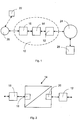
- Fig. 1 is an IP (Internet Protocol) network 10 as Computer network shown.
- IP network 10 can on the one hand by means of a mobile terminal device 22, for example a WAP-compatible mobile phone, and on the other hand, using a conventional telephone 28 be accessed. Access is with the mobile Terminal 22 via a mobile radio gateway 26, which on the one side in radio contact with the mobile terminal 22 and on the other hand with the computer network or IP network 10 is connected.
- the phone 28 is over a public telecommunications network 24 with the IP network 10 connected.
- the IP network 10 comprises a WML server 16 on which textual and / or graphic information in the form of Documents are filed.
- the documents are with the Markup language WML created and primarily for retrieval using WAP-enabled mobile devices.
- IP network 10 Conversion device 14 with the WML server 16 connected. Furthermore, the conversion device 14 connected to a voice gateway 12, the one acoustic or voice access to the IP network 10 allows.
- the voice gateway 12 then establishes a connection between the public telecommunications network 24 and the IP network or computer network 10 ago and offers that Users a navigation option or Possibility of accessing information via his telephone 28 from the IP network 10, more precisely from Information of the WML server 16.
- the user needs thus for retrieving the information from the WML server 16 no terminal with display. He can get the information practically from anywhere, i.e. where voice access is possible is retrieve.
- Conversion device 14 Since the information or information stored on the WML server Documents actually for display on a display of a mobile terminal 22 are thought of Conversion device 14 the automatic Conversion of the information or documents into a for the voice gateway 12 suitable for processing Format; in the present embodiment this is the markup language VoiceXML, which is specially designed for Voice navigation or acoustic navigation through the Internet has been standardized.
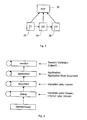
- the exact structure of the conversion device results from Fig. 2.
- the Conversion facility similar to a client-server Architecture.
- the conversion device 14 has a client 18 and a server 20.
- the server 20 the converter 14 is with the Voice gateway 12 connected. Communication between the voice gateway 12 and the server 20 are carried out by means of of the HTTP (S) protocol.
- the client 18 the The conversion device 14 is in turn connected to the WML server 16 connected. He also communicates using the HTTP (S) protocol with the WML server.
- Voice gateway 12 requests a document from the server 20 of the conversion device 14 by means of a specific command. This requirement is met in the conversion device to the client 18 passed on by the WML server 16 also by means of a request from a special Command loads the corresponding document.
- the WML server 16 transmits the requested WML document to the client 18.
- This document is then in the conversion device 14 from WML to VoiceXML converted and from the server 20 to the voice gateway transfer.
- the voice gateway 12 now generates according to the instructions of the document in VoiceXML a speech output.
- the document becomes concrete User who has access via the voice gateway 12 opened and requested the document.
- the voice gateway 12 has one for this purpose Text-to-speech facility (not shown). Voice input from the user is provided by a (not shown) automatic speech recognizer in Voice gateway 12 processed.
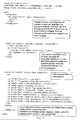
- FIG. 3 In the process of converting the data from the WML server 16 requested document in the Conversion device 14 becomes one in FIG. 3 shown Application Root Document 30 retrieved or requested documents 32, 34, 36 bound.
- the application root document 30 serves specifically for mapping certain tasks in the requested document 32, 34, 36 in language constructs in VoiceXML. This figure is about variables and Connections are made in the application root document.
- the Application root document 30 is requested to a Document D1 32 bound; the same applies to that of requested document D1 32 referenced documents D2 34 and D3 36 bound.
- Characters are often used in the markup language WML like "+” or ">>” used to format documents.
- these characters can be customized via or configurable filters, i.e. dynamic filters, with other characters that are more suitable for VoiceXML be replaced.
- the replacement takes place regarding acoustic reproduction. Concrete become signs that are poorly reproduced acoustically let in suitable for acoustic reproduction Characters converted. Signs that are not at all play acoustically and do not replace it sensibly are simply replaced with spaces.
- Another increase in navigation speed can by a so-called "prefetch" of documents contained in the requested document References are referenced.
- Prefetch when requesting a document and in particular when converting references to referenced documents evaluated; the referenced documents loaded by the converter 14 and so to speak parallel to the requested document converted. The converted and not yet dated User requested pages are then in the Converter 14 in a memory stored. If the user has a reference in the Request the requested document, i.e. want to call this eliminates the time for requesting again of the document referenced by the reference and Converting. This speeds up access to referenced documents considerably.
- a "prefetch" is particularly useful for static documents. at dynamic documents is more of a "prefetch” critical because of the content of these documents by submissions depends on the user. A is therefore preferred “Prefetch” only carried out with static documents.
- grammars are the interface between a user and the voice gateway 12. They have to be created with special care because it significantly influences navigation.
- a global grammar assigns phrases, among other things Navigation such as "Back", “Help”, “Reload” or the like. Usually these are Phrases referenced in the Application Root document.
- the associated functions in the programming language JAVA or via " ⁇ form>" constructs can also be found in the Application Root document Are defined. However, you can use VoiceXML documents be overwritten.
- document grammars contain link lists for the entire document. Dialog grammars result from the in the current dialog of a user links valid on the computer network.
- a dialogue includes the scope of a " ⁇ card>" construct in the Markup language WML.
- each link has a unique Receives identifier in the grammar. Either it can the link label itself and / or a clearly generated one Be identifier. In both cases, one must Be clear to users what a link is. For example, this can be done through a special acoustic emphasis of the link or by moving ahead or To be put aside a hint.
- phrases such as "I would like to” or “uh” should be represented in the grammar. in principle the format of the grammar can be chosen freely. It however, it is recommended that the grammar conforms to "Speech Recognition Grammar Specification" of the W3C interpreted.
- help texts are for every URL (Uniform Resource Locator) freely adjustable. hereby you can get specific help with navigation give.
- URL Uniform Resource Locator
- Error handling can be for any URL can be set individually.
- Forms need to be analyzed and be transferred accordingly in VoiceXML. in this connection there are various options, free entries to be implemented using the " ⁇ object>" tag. Such However, implementation must be from voice gateway 12 get supported. It is therefore optional, i.e. can can be switched on or off.
- the form treatment can be adapted to different voice gateways. A decision on implementation can be made for example via the HTTP header field "User-Agent" respectively. The exact implementation of fields for Entering data should in particular be individual be adjustable.
- WML scripts can be done directly in VoiceXML because WML scripts are JAVA scripts. Indeed function calls must be correctly integrated in VoiceXML become.
- the JAVA script implementation can be done via dynamic Filters removed or even edited.
- WML variables should be mapped in the document. If a special JAVA construction or the regular VoiceXML variables are used is in essentially equivalent. The only thing that matters is that these variables are available in the wider context stand.
- So-called GET and POST methods are in HTTP Are defined. These can be used in WML. Both Methods should be mapped correctly in VoiceXML, otherwise server scripts do not provide adequate answers can generate. For this, all links in the WML document to be changed so that the voice gateway 12 the further requests are not sent to the WML server 16 sends, but continues to communicate via the Conversion is done.
- FIGS. 5 to 7 are still concrete Examples of converting a WML document (Fig. 5) into a VoiceXML document (Fig. 7a and continued on 7b) using an application root document (Fig. 6) shown.
- the source texts shown in the figures are with annotations for easier understanding provided and thus largely self-explanatory. Therefore no further explanation is given here.
Landscapes
- Engineering & Computer Science (AREA)
- Signal Processing (AREA)
- Computer And Data Communications (AREA)
- Communication Control (AREA)
Abstract
Description
- Fig. 1
- die prinzipielle Anordnung eines Ausführungsbeispiels der erfindungsgemäßen Vorrichtung mit einem WML-Server als Informationsserver;
- Fig. 2
- den detaillierten Aufbau der Konvertierungseinrichtung von Fig. 1 und deren Verbindung mit dem WML-Server und dem Sprachgateway;
- Fig. 3
- die Beziehung zwischen einem Application Root Dokument und umzuwandelnden Dokumenten;
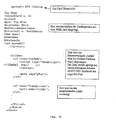
- Fig. 4
- die unterschiedlichen Sichtweisen einer auf VoiceXML basierenden Anwendung;
- Fig. 5
- ein Beispiel eines WML-Dokuments;
- Fig. 6
- ein Beispiel eines Application Root Documents; und
- Fig. 7a, 7b
- das in Fig. 5 gezeigte WML-Dokument nach einer Umwandlung in ein VoiceXML-Dokument.
- 10
- Computernetzwerk
- 12
- Sprachgateway
- 14
- Konvertierungsgateway
- 16
- Informationsserver
- 18
- Client
- 20
- Server
- 22
- mobiles Endgerät
- 24
- Telekommunikationsnetz
- 26
- Mobilfunk-Gateway
- 28
- Telefon
- 30
- Application Root Dokument
- 32
- Dokument D1
- 34
- Dokument D2
- 36
- Dokument D3
Claims (19)
- Konvertierungseinrichtung (14) für einen akustischen Zugang zu einem Computernetzwerk (10), die für das Umwandeln von textuellen und/oder grafische Inhalte enthaltenden Dokumenten ohne Veränderung der Dokumente in ein Format ausgebildet ist, das für ein Sprachgateway (12) zum Verarbeiten geeignet ist.
- Konvertierungseinrichtung nach Anspruch 1, dadurch gekennzeichnet, dass sie einen Client (18) und einen Server (20) umfasst, wobei der Server (20) zum Verarbeiten von Anforderungen von mindestens einem Sprachgateway (12) und der Client (18) zum Erzeugen von Befehlen zum Anfordern von textuelle und/oder grafische Inhalte enthaltenden Dokumenten von mindestens einem Informationsserver (16) des Computernetzwerks ausgebildet sind.
- Konvertierungseinrichtung nach Anspruch 2, dadurch gekennzeichnet, dass sie derart ausgebildet ist, dass von dem mindestens einen Informationsserver (16) an den Client (18) gelieferte Inhalte in das Format für das Sprachgateway (12) umgewandelt werden.
- Konvertierungseinrichtung nach einem der vorangehenden Ansprüche, dadurch gekennzeichnet, dass sie mindestens eine Filterfunktion aufweist, die derart einstellbar ist, dass aus allen Elementen eines Dokuments mit textuellem und/oder grafischem Inhalt nur die Elemente gefiltert werden, die in das Format für das Sprachgateway (12) umwandelbar sind.
- Konvertierungseinrichtung nach einem der vorangehenden Ansprüche, dadurch gekennzeichnet, dass sie zum Kommunizieren mittels HTTP und/oder HTTPS mit dem Sprachgateway (12) und dem mindestens einen Informationsserver (16) ausgebildet ist.
- Konvertierungseinrichtung nach einem der vorangehenden Ansprüche, dadurch gekennzeichnet, dass sie einen Parser aufweist, der zum Parsen von vorzugsweise textuellen Inhalten ausgebildet ist.
- Konvertierungseinrichtung nach einem der vorangehenden Ansprüche, dadurch gekennzeichnet, dass die Inhalte in der Auszeichnungssprache WML erstellt sind.
- Konvertierungseinrichtung nach Anspruch 7, dadurch gekennzeichnet, dass sie zum Umwandeln der textuellen und/oder grafischen Inhalte in die Auszeichnungssprache VoiceXML ausgebildet ist.
- Konvertierungseinrichtung nach einem der Ansprüche 2-8, dadurch gekennzeichnet, dass der mindestens eine Informationsserver (10) ein WML-Server ist, dessen Inhalte insbesondere mittels eines WAP-fähigen mobilen Endgeräts (22) abrufbar sind.
- Konvertierungseinrichtung nach einem der vorangehenden Ansprüche, dadurch gekennzeichnet, dass das Sprachgateway (12) mit einem Telekommunikationsnetz (24) verbunden ist.
- Konvertierungsverfahren für einen akustischen Zugang zu einem Computernetzwerk (10), bei dem eine Konvertierungseinrichtung nach einem der vorangehenden Ansprüche eingesetzt wird, und wobei die Konvertierungseinrichtung (14) bei Eingehen einer Anforderung von einem Sprachgateway (12) zum Laden und Konvertieren eines Dokuments mit textuellem und/oder grafischem Inhalt das entsprechende Dokument von einem Informationsserver (16) anfordert und nach Lieferung des angeforderten Dokuments dessen Inhalt in ein zur Verarbeitung durch das Sprachgateway (12) geeignetes Format umwandelt.
- Verfahren nach Anspruch 11, dadurch gekennzeichnet, dass die Konvertierungseinrichtung (12) zum Konvertieren den textuellen und/oder grafischen Inhalt des gelieferten Dokuments analysiert und ein zweites Dokument im Format zum Verarbeiten für das Sprachgateway (12) erzeugt und an das Sprachgateway (12) übermittelt.
- Verfahren nach Anspruch 11 oder 12, dadurch gekennzeichnet, dass bei einer Anforderung vom Sprachgateway (12) zum Laden und Umwandeln eines Dokuments mit textuellem und/oder grafischem Inhalt ein Application Root Dokument gebunden wird, das zur globalen Definition von Funktionen und Variablen für das Format für das Sprachgateway (12) dient.
- Verfahren nach Anspruch 13, dadurch gekennzeichnet, dass das Application Root Dokument mindestens eine Funktion zur Fehlerbehandlung und Variablen zur Ablaufsteuerung des Dialoges umfasst.
- Verfahren nach Anspruch 13 oder 14, dadurch gekennzeichnet, dass das Application Root Dokument für alle Dokumente gleich oder anhand einer Startadresse eines umzuwandelnden Dokuments erzeugt wird.
- Verfahren nach einem der Ansprüche 11-15, dadurch gekennzeichnet, dass alle weiteren erreichbaren Dokumente, für die in einem Dokument Verweise vorhanden sind, von der Konvertierungseinrichtung (14) geladen, umgewandelt und in dieser zwischen gespeichert werden.
- Verfahren nach einem der Ansprüche 11-16, dadurch gekennzeichnet, dass bereits von der Konvertierungseinrichtung (14) umgewandelte Dokumente in einem Cache-Speicher abgelegt und bei nochmaliger Anforderung aus dem Cache-Speicher geladen werden.
- Verfahren nach einem der Ansprüche 11-17, dadurch gekennzeichnet, dass die Konvertierungseinrichtung (14) derart konfiguriert wird, dass nur Dokumente von vorbestimmbaren Informationsservern (16) geladen und umgewandelt werden können.
- Verfahren nach einem der Ansprüche 11-18, dadurch gekennzeichnet, dass alle weiteren erreichbaren Dokumente, für die in einem Dokument Verweise vorhanden sind, von der Konvertierungseinrichtung (14) geladen, und die darin enthaltenen Verweise in Verweislisten des aktuellen Dokumentes übernommen werden.
Applications Claiming Priority (2)
| Application Number | Priority Date | Filing Date | Title |
|---|---|---|---|
| DE2001138059 DE10138059A1 (de) | 2001-08-03 | 2001-08-03 | Konvertierungseinrichtung und Konvertierungsverfahren für einen akustischen Zugang zu einem Computernetzwerk |
| DE10138059 | 2001-08-03 |
Publications (2)
| Publication Number | Publication Date |
|---|---|
| EP1282295A2 true EP1282295A2 (de) | 2003-02-05 |
| EP1282295A3 EP1282295A3 (de) | 2004-05-12 |
Family
ID=7694226
Family Applications (1)
| Application Number | Title | Priority Date | Filing Date |
|---|---|---|---|
| EP02014598A Ceased EP1282295A3 (de) | 2001-08-03 | 2002-07-02 | Konvertierungseinrichtung und Konvertierungsverfahren für einen akustischen Zugang zu einem Computernetzwerk |
Country Status (2)
| Country | Link |
|---|---|
| EP (1) | EP1282295A3 (de) |
| DE (1) | DE10138059A1 (de) |
Cited By (3)
| Publication number | Priority date | Publication date | Assignee | Title |
|---|---|---|---|---|
| WO2004107667A1 (en) * | 2003-06-02 | 2004-12-09 | Fält Communications AB | Mobile data communication |
| WO2005106847A3 (de) * | 2004-04-29 | 2006-03-16 | Volkswagen Ag | Verfahren und vorrichtung für einen akustischen zugang zu einem anwendungsrechner |
| DE102010001564A1 (de) | 2010-02-03 | 2011-08-04 | Bayar, Seher, 51063 | Verfahren und Computerprogrammprodukt zur automatisierten konfigurierbaren akustischen Wiedergabe und Bearbeitung von Internetseiteninhalten |
Families Citing this family (1)
| Publication number | Priority date | Publication date | Assignee | Title |
|---|---|---|---|---|
| DE102006059787B4 (de) * | 2006-12-15 | 2009-04-02 | Vodafone Holding Gmbh | Verfahren zur Übertragung von Daten auf ein Mobilfunkendgerät |
Family Cites Families (8)
| Publication number | Priority date | Publication date | Assignee | Title |
|---|---|---|---|---|
| GB9523759D0 (en) * | 1995-11-21 | 1996-01-24 | Pollitt Alexander J | World wide web information retrieval system |
| US6018710A (en) * | 1996-12-13 | 2000-01-25 | Siemens Corporate Research, Inc. | Web-based interactive radio environment: WIRE |
| JPH10271223A (ja) * | 1997-02-18 | 1998-10-09 | Lucent Technol Inc | ウェブ情報へのアクセス提供装置及び方法 |
| US5899975A (en) * | 1997-04-03 | 1999-05-04 | Sun Microsystems, Inc. | Style sheets for speech-based presentation of web pages |
| US6115686A (en) * | 1998-04-02 | 2000-09-05 | Industrial Technology Research Institute | Hyper text mark up language document to speech converter |
| US7685252B1 (en) * | 1999-10-12 | 2010-03-23 | International Business Machines Corporation | Methods and systems for multi-modal browsing and implementation of a conversational markup language |
| DE19959850A1 (de) * | 1999-12-10 | 2001-06-13 | Deutsche Telekom Ag | Kommunikationssystem und Verfahren zum Bereitstellen eines Internet-Zugangs über ein Telefon |
| DE19964030A1 (de) * | 1999-12-30 | 2001-07-05 | Ibm | Effizientes Laden von Dokumenten auf dem Internet |
-
2001
- 2001-08-03 DE DE2001138059 patent/DE10138059A1/de not_active Withdrawn
-
2002
- 2002-07-02 EP EP02014598A patent/EP1282295A3/de not_active Ceased
Cited By (4)
| Publication number | Priority date | Publication date | Assignee | Title |
|---|---|---|---|---|
| WO2004107667A1 (en) * | 2003-06-02 | 2004-12-09 | Fält Communications AB | Mobile data communication |
| WO2005106847A3 (de) * | 2004-04-29 | 2006-03-16 | Volkswagen Ag | Verfahren und vorrichtung für einen akustischen zugang zu einem anwendungsrechner |
| DE102010001564A1 (de) | 2010-02-03 | 2011-08-04 | Bayar, Seher, 51063 | Verfahren und Computerprogrammprodukt zur automatisierten konfigurierbaren akustischen Wiedergabe und Bearbeitung von Internetseiteninhalten |
| WO2011095457A2 (de) | 2010-02-03 | 2011-08-11 | Bayar, Seher | Verfahren und computerprogrammprodukt zur automatisierten konfigurierbaren akustischen wiedergabe und bearbeitung von internetseiteninhalten |
Also Published As
| Publication number | Publication date |
|---|---|
| EP1282295A3 (de) | 2004-05-12 |
| DE10138059A1 (de) | 2003-02-13 |
Similar Documents
| Publication | Publication Date | Title |
|---|---|---|
| DE69835718T2 (de) | Verfahren und Gerät zur Sprachinteraktion über ein Netzwerk unter Verwendung von parametrierbaren Interaktionsdefinitionen | |
| DE60005326T2 (de) | Erkennungseinheiten mit komplementären sprachmodellen | |
| DE60028561T2 (de) | Bereitstellung von kundendiensten, die daten aus datenquellen abrufen, wobei die datenquellen die vom kunden geforderten formate nicht notwendigerweise unterstützen | |
| DE60015531T2 (de) | Client-server spracherkennungssystem | |
| DE60225086T2 (de) | Webfähige Erkennungsarchitektur | |
| DE10125406A1 (de) | Verfahren und Einrichtung zum Koppeln eines Visual Browsers mit einem Voice Browser | |
| DE60207217T2 (de) | Verfahren zum ermöglichen der sprachinteraktion mit einer internet-seite | |
| WO2003054731A9 (de) | Verfahren zur rechnergestützten transformation strukturierter dokumente | |
| EP3095114B1 (de) | Verfahren und system zur erzeugung eines steuerungsbefehls | |
| DE10220521A1 (de) | Verfahren und System zur Verarbeitung von Sprachdaten und Klassifizierung von Gesprächen | |
| DE102005013639A1 (de) | Verfahren und System zum Ausgeben von Daten | |
| EP1282295A2 (de) | Konvertierungseinrichtung und Konvertierungsverfahren für einen akustischen Zugang zu einem Computernetzwerk | |
| DE10220522B4 (de) | Verfahren und System zur Verarbeitung von Sprachdaten mittels Spracherkennung und Frequenzanalyse | |
| DE102008059197A1 (de) | Verfahren und Vorrichtung zur verteilten Konfiguration von Telematik-Diensten in Kraftfahrzeug-Systemen | |
| DE10118125A1 (de) | Automatisches Auskunftssystem | |
| EP1344370B1 (de) | Kommunikationsanordnung und verfahren für kommunikationssysteme mit interaktiver sprachfunktion | |
| EP1321851A2 (de) | Verfahren zum Betrieb eines Sprach-Dialogsystems | |
| EP1457029A1 (de) | Verfahren zum austausch von informationen mittels sprache über ein paketorientiertes netzwerk | |
| DE69833470T2 (de) | Verfahren und Gerät zur Aktualisierung von Textdaten für eine elektrische Einrichtung | |
| EP1240775B1 (de) | Kommunikationssystem und verfahren zum bereitstellen eines internet-zugangs über ein telefon | |
| EP1164575A2 (de) | Ausgabe einer Sprachansage | |
| EP1659571A2 (de) | Sprachdialogsystem und Verfahren zum Betreiben | |
| EP1363271A1 (de) | Verfahren und System zur Verarbeitung und Speicherung von Sprachinformationen eines Dialogs | |
| EP1150479A2 (de) | Verfahren zur interaktive Informationsabfrage mittels eines Mobiltelefons | |
| EP1177667B1 (de) | Netzwerk, interpreter für ein derartiges netzwerk und verfahren zum betreiben eines netzwerkes |
Legal Events
| Date | Code | Title | Description |
|---|---|---|---|
| PUAI | Public reference made under article 153(3) epc to a published international application that has entered the european phase |
Free format text: ORIGINAL CODE: 0009012 |
|
| AK | Designated contracting states |
Designated state(s): AT BE BG CH CY CZ DE DK EE ES FI FR GB GR IE IT LI LU MC NL PT SE SK TR |
|
| AX | Request for extension of the european patent |
Extension state: AL LT LV MK RO SI |
|
| PUAL | Search report despatched |
Free format text: ORIGINAL CODE: 0009013 |
|
| RIC1 | Information provided on ipc code assigned before grant |
Ipc: 7G 10L 13/08 B Ipc: 7H 04M 7/00 B Ipc: 7H 04M 3/493 A |
|
| AK | Designated contracting states |
Kind code of ref document: A3 Designated state(s): AT BE BG CH CY CZ DE DK EE ES FI FR GB GR IE IT LI LU MC NL PT SE SK TR |
|
| AX | Request for extension of the european patent |
Extension state: AL LT LV MK RO SI |
|
| 17P | Request for examination filed |
Effective date: 20041112 |
|
| 17Q | First examination report despatched |
Effective date: 20041215 |
|
| AKX | Designation fees paid |
Designated state(s): AT BE BG CH CY CZ DE DK EE ES FI FR GB GR IE IT LI LU MC NL PT SE SK TR |
|
| STAA | Information on the status of an ep patent application or granted ep patent |
Free format text: STATUS: THE APPLICATION HAS BEEN REFUSED |
|
| 18R | Application refused |
Effective date: 20100204 |