EP1281706A1 - Verfahren zur Herstellung von Alkenoxiden aus Alkenen - Google Patents

Verfahren zur Herstellung von Alkenoxiden aus Alkenen Download PDF

Info

Publication number
EP1281706A1
EP1281706A1 EP02016266A EP02016266A EP1281706A1 EP 1281706 A1 EP1281706 A1 EP 1281706A1 EP 02016266 A EP02016266 A EP 02016266A EP 02016266 A EP02016266 A EP 02016266A EP 1281706 A1 EP1281706 A1 EP 1281706A1
Authority
EP
European Patent Office
Prior art keywords
hydrocarbon
adsorbent
adsorber
gas
desorption
Prior art date
Legal status (The legal status is an assumption and is not a legal conclusion. Google has not performed a legal analysis and makes no representation as to the accuracy of the status listed.)
Withdrawn
Application number
EP02016266A
Other languages
English (en)
French (fr)
Inventor
Markus Dr. Weisbeck
Christoph Dr. Zurlo
Gerhard Dr. Wegener
Günter Dr. Schümmer
Georg Dr. Wiessmeier
Current Assignee (The listed assignees may be inaccurate. Google has not performed a legal analysis and makes no representation or warranty as to the accuracy of the list.)
Covestro Deutschland AG
Original Assignee
Bayer AG
Priority date (The priority date is an assumption and is not a legal conclusion. Google has not performed a legal analysis and makes no representation as to the accuracy of the date listed.)
Filing date
Publication date
Application filed by Bayer AG filed Critical Bayer AG
Publication of EP1281706A1 publication Critical patent/EP1281706A1/de
Withdrawn legal-status Critical Current

Links

Images

Classifications

    • CCHEMISTRY; METALLURGY
    • C07ORGANIC CHEMISTRY
    • C07DHETEROCYCLIC COMPOUNDS
    • C07D301/00Preparation of oxiranes
    • C07D301/02Synthesis of the oxirane ring
    • C07D301/03Synthesis of the oxirane ring by oxidation of unsaturated compounds, or of mixtures of unsaturated and saturated compounds
    • C07D301/04Synthesis of the oxirane ring by oxidation of unsaturated compounds, or of mixtures of unsaturated and saturated compounds with air or molecular oxygen
    • CCHEMISTRY; METALLURGY
    • C07ORGANIC CHEMISTRY
    • C07DHETEROCYCLIC COMPOUNDS
    • C07D301/00Preparation of oxiranes
    • C07D301/32Separation; Purification
    • CCHEMISTRY; METALLURGY
    • C07ORGANIC CHEMISTRY
    • C07DHETEROCYCLIC COMPOUNDS
    • C07D301/00Preparation of oxiranes
    • C07D301/02Synthesis of the oxirane ring
    • C07D301/03Synthesis of the oxirane ring by oxidation of unsaturated compounds, or of mixtures of unsaturated and saturated compounds
    • C07D301/04Synthesis of the oxirane ring by oxidation of unsaturated compounds, or of mixtures of unsaturated and saturated compounds with air or molecular oxygen
    • C07D301/08Synthesis of the oxirane ring by oxidation of unsaturated compounds, or of mixtures of unsaturated and saturated compounds with air or molecular oxygen in the gaseous phase

Definitions

  • the invention relates to a process for the catalytic partial oxidation of Hydrocarbons in the presence of oxygen and at least one reducing agent, characterized in that the reaction mixture by a Layer containing catalyst and a downstream adsorbent Layer in which the partially oxidized hydrocarbon is adsorbed conducts.
  • the catalytic gas phase partial oxidation of hydrocarbons in the presence of molecular oxygen and a reducing agent is known.
  • WO-99/43431-A1 As catalysts compositions are used which include nanoscale gold particles contain.
  • US-B-4,692,535 discloses the separation of high molecular weight Poly (propene oxide) of propene oxide by contact with activated carbon.
  • US-B-4 187 287, US-B-5 352 807 and EP-A1-0 736 528 disclose the separation of various organic contaminants from alkene oxides, such as propene oxide and butene oxide, by treatment with solid activated carbons.
  • a selective adsorption of partial oxidation products from catalytic gas phase direct oxidation reactions with molecular oxygen and a reducing agent but is not described.
  • the object of the present invention is to provide a separation method for the product from the reaction mixture in the production of hydrocarbon oxides by partial oxidation of hydrocarbon in the presence of Oxygen and a reducing agent and a catalyst.
  • Another object of the present invention is to provide a method in which a high total sales of alkene is achieved.
  • the object is achieved according to the invention by a method for catalytic partial oxidation of hydrocarbons in the presence of oxygen and at least a reducing agent, characterized in that the reaction mixture by a layer containing a catalyst and a downstream adsorbent containing layer in which the partially oxidized hydrocarbon is adsorbed, conducts.
  • hydrocarbon includes unsaturated or saturated hydrocarbons understood as olefins or alkanes, which also contain heteroatoms such as N, O, P, S or halogens can contain.
  • the organic component to be oxidized can acyclic, monocyclic, bicyclic or polycyclic and can be monoolefinic, be diolefinic or polyolefinic.
  • the Double bonds are conjugated and non-conjugated.
  • Hydrocarbons are preferred oxidized, from which such oxidation products are formed, the Partial pressure is low enough to continuously remove the product from the catalyst.
  • the oxygen can be used in various forms, e.g. molecular Oxygen, air and nitrogen oxide. Molecular oxygen is preferred.
  • Hydrogen is particularly suitable as a reducing agent. It can be any known Hydrogen source are used, e.g. pure hydrogen, cracker hydrogen, Syngas or hydrogen from dehydrogenation of hydrocarbons and alcohols. In another embodiment of the invention, the hydrogen can also generated in situ in an upstream reactor, e.g. through dehydration of propane or isobutane or alcohols such as isobutanol. The hydrogen can also as complex-bound species, e.g. Catalyst hydrogen complex in which Reaksystem be introduced.
  • the essential starting gases described above can optionally also be added a diluent gas such as nitrogen, helium, argon, methane, carbon dioxide, carbon monoxide or similar, predominantly inert gases. Mixtures of the inert components described can also be used.
  • the inert component additive is used to transport the heat released exothermic oxidation reaction and often from a safety point of view Cheap. If the process according to the invention is carried out in the gas phase, preferably gaseous dilution components such as e.g. Nitrogen, helium, argon, Methane and possibly water vapor and carbon dioxide are used. Water vapor and Although carbon dioxide is not completely inert, it does so at low concentrations ( ⁇ 2% by volume of the total reaction gases) often has a positive effect.
  • a diluent gas such as nitrogen, helium, argon, methane, carbon dioxide, carbon monoxide or similar, predominantly inert gases. Mixtures of the inert components described can also be used.
  • the relative molar ratio of hydrocarbon, oxygen, reducing agent (especially hydrogen) and optionally a diluent gas is in wide ranges variable.
  • Oxygen is preferred in the range of 1-30 mol%, particularly preferably 5-25 mol% used.
  • hydrocarbon on a molar basis
  • the hydrocarbon content is typically greater than 1 mol% and less than 96 mol%.
  • Hydrocarbon contents are preferred in the range from 5 to 90 mol%, particularly preferably from 20 to 85 mol% used.
  • the molar proportion of reducing agent (especially hydrogen) - in relation to the total number of moles of hydrocarbon, oxygen, reducing agent and diluent gas - can be varied within a wide range.
  • typical Reducing agent contents are greater than 0.1 mol%, preferably 2-80 mol%, particularly preferably 3-70 mol%.
  • compositions containing noble metal particles are advantageously used as catalysts with a diameter of less than 51 nm on a titanium and / or silicon portion containing carrier material used.
  • Gold and / or silver are preferably used as precious metal particles.
  • the silver particles preferably have a diameter in the range from 0.5 to 50 nm, preferably 0.5 to 20 nm and particularly preferably 0.5 to 15 nm.
  • Preferred catalyst support materials are those in DE-A1-199 59 525 and Support materials mentioned in DE-A1-100 23 717, particularly preferably organic-inorganic Hybrid materials (hybrid carrier materials, Ormosile) are used.
  • Organic-inorganic hybrid materials in the sense of the invention are organic modified glasses, preferred in sol-gel processes via hydrolysis and condensation reactions soluble precursor connections arise and in the network contain non-hydrolyzable terminal and / or bridging organic groups. These materials and their manufacture include in DE-A1-199 59 525, DE-A1-100 23,717, which is hereby incorporated by reference for the purposes of U.S. patent practice be included in the present application.
  • Very particularly preferred hybrid carrier materials with a share in the sol-gel network built-in and / or embedded free silicon-hydrogen units can be used particularly advantageously from titanium and silane precursor compounds according to Manufacture DE-A1-199 59 525.
  • the carrier materials can also contain proportions of Group 5 promoter metals of the periodic table according to IUPAC (1985), such as vanadium, niobium and tantalum, are preferred Tantalum, group 3, preferably yttrium, group 4, preferably zirconium Group 8, preferably Fe, of group 15, preferably antimony, of group 13, preferred Aluminum, boron, thallium and metals of group 14, preferably germanium, contain.
  • the additional metals (promoters) are often in oxidic form in front.
  • the noble metal-containing compositions according to the invention can be used at temperatures > 10 ° C, preferably in the range of 80-250 ° C, particularly preferably in the range of 120-215 ° C can be used. At the high temperatures can be coupled in Plants steam are generated as an energy source. With skillful procedures can the steam e.g. be used for product refurbishment.
  • reaction pressures of> 1 bar are preferred, particularly preferably 2-50 bar.
  • the catalyst load can be varied over a wide range.
  • Catalyst loads of 0.5-100 l gas per ml catalyst and hour used, catalyst loads of 2-50 l gas per ml are particularly preferred Catalyst and hour selected.
  • Preferred adsorbents are zeolites or molecular sieves and activated carbons used.
  • zeolites hydrophobic zeolites with pore sizes in the range from 0.3 to 100 nm, preferably 3.1 to 50 nm like Wesalith DAZ F20 (Degussa AG) and Wesalith DAY F20 (Degussa AG) preferred.
  • Organically modified zeolites, e.g. after silylation or treatment with organofluorine materials, can also be used advantageously.
  • Water is often only incompletely adsorbed on the relatively hydrophobic zeolites.
  • adsorbent containing layer yet another suitable for the adsorption of water Layer consisting of e.g. 3A molecular sieves to operate.
  • the adsorbed reaction product (hydrocarbon oxide) be removed again from the adsorbent.
  • the adsorption and subsequent desorption can be carried out using the known methods such as pressure swing adsorption / desorption, temperature swing adsorption / desorption or desorption can be carried out by steam treatment.
  • the hydrocarbon oxide adsorption increases with increasing pressures and / or falling Temperatures favored, and by heating and / or pressure reduction reduced.
  • the hydrocarbon oxide adsorption is advantageously carried out at a reaction pressure of approx. 1-30 bar.
  • the subsequent hydrocarbon oxide desorption then takes place advantageous at reduced pressure.
  • a pressure difference between adsorption and desorption of ⁇ 30 bar, particularly preferably set from ⁇ 25 bar.
  • the gas stream depleted of partial oxidation products is preferably used for Reaction after a further cleaning, e.g. Drying in the Reactor returned.
  • This gas flow essentially consists of unreacted Hydrocarbon, reducing agent, oxygen and possibly a diluent gas. This circular procedure with regular separation of the reaction products significantly higher total sales can be achieved.
  • the concentration of the reaction products in the layer containing the adsorbent significantly reduces the processing effort.
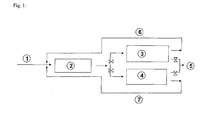
  • FIG. 1 A flow diagram of a process for the oxidation of propylene to propylene oxide with two adsorbers is shown in FIG. 1.
  • 1 stands for Feed (C 3 H 6 , H 2 , O 2 ), 2 for reactor, 3 for PO-Ad (de) sorption, 4 for PO-Ad (de) sorption, 5 for PO, 6 for C 3 H 6 / H 2 / O 2 and 7 also for C 3 H 6 / H 2 / O 2 .
  • the layers containing adsorbent are, in particular in Case of three or more adsorbers, advantageously operated alternately, i.e. an adsorber is in the "Loading" process step, the second in the “Regeneration” process step and the third (if available or any other one that may exist Adsorber) in the "Stand-by” process step.
  • the product-containing gas stream is e.g. transported by means of a fan over the adsorber in the "loading" position.
  • the product-containing gas stream advantageously flows through the adsorber from below up.
  • the mass transition zone advantageously moves in the adsorbent layer from the bottom up.
  • the product concentration is advantageous from one Analyzer (e.g. GC device) monitored and registered. When a limit concentration is reached can the adsorption on the adsorber, which is in readiness is to be switched. The previously loaded adsorber is in regeneration switched.
  • the switch from "loading” to “regeneration” takes place, for example, either automatically via FID-GC measurement (flame ionization detector, gas chromatography analysis) or within certain time intervals or manually in Manual operation.
  • FID-GC measurement flame ionization detector, gas chromatography analysis
  • the "regeneration” can be done in several ways, e.g. through pressure swing ad (de) sorption or Temperatur Playad (de) sorption, or with steam.
  • Regeneration of the adsorber bed with water vapor advantageously comprises the work steps Steaming, purging with inert gas, for example nitrogen, drying and cooling if necessary.
  • the desorption of hydrocarbon oxide is preferably carried out with im Range of 80-150 ° C hot, superheated steam at normal pressure or elevated Equipment Press.
  • the adsorbers are advantageously vaporized in countercurrent to the hydrocarbon oxide-containing reaction gas from top to bottom. This procedure ensures that the top adsorbent layer remains practically free of hydrocarbon oxide.
  • the adsorber bed becomes by vapor deposition heated to for example in the range of 70-150 ° C and the adsorbed Desorbed hydrocarbon oxide. With the steam flow, the hydrocarbon oxide stirred to the adsorber bottom, where there is the adsorber via the regenerate line leaves.
  • Cooling water or brine of, for example, 20 ° C. is used as the cooling medium used in counterflow to the operating medium.
  • the condensed and cooled regenerate preferably flows to the free slope Sump container and is pumped from there for hydrocarbon oxide separation promoted.
  • the adsorbent layer After vapor deposition, the adsorbent layer is hot and moist. When drying and cooling with air there is a risk of the formation of explosive gas mixtures.
  • the maximum oxygen content in the system should therefore be ⁇ 20% by volume.
  • the supervision the oxygen content takes place, for example, using an oxygen measuring device.
  • the drying and cooling of the adsorbent layer is therefore advantageously carried out using inert gases such as nitrogen.
  • inert gases such as nitrogen.
  • the gas flushing takes place for economic reasons in a closed cycle.
  • the adsorber is first flushed with nitrogen (approx. Three times the adsorber volume).
  • the nitrogen displaces the water vapor and strips at the same time the remaining hydrocarbon oxide amounts of the contact water adhering to the absorber out.
  • the absorption layer is preferably dried in a closed one Pipeline circuit using inert gas (e.g. nitrogen).
  • inert gas e.g. nitrogen
  • the nitrogen gas flow from bottom to top over the adsorber bed.
  • the nitrogen flow is in the steam-heated heat exchanger, for example heats and heats in the range of 100-130 ° C by water evaporation first adsorbent layer cooled to the cooling limit temperature and desorbed here adsorbed water.
  • After leaving the adsorber the warm, moist one becomes Nitrogen flow using, for example, two heat exchangers connected in series condensed and cooled.
  • the water / solvent condensate is in passed the sump container. As soon as the temperature in the middle of the adsorber bed increases, the drying process is ended.
  • the cooling process is analogous to the drying process with the exception that the Heater is switched off. At the beginning of the cooler is the lower layer of the adsorber bed cooled, while the upper layer is displaced by the cooling heated nitrogen flow, is still heated and dried. simultaneously further solvents are desorbed from the upper adsorbent layer.
  • Adsorber As soon as the adsorber has cooled to, for example, 30 ° C., it can be completely regenerated Adsorber be loaded again.
  • propene is particularly preferred to propene oxide oxidized.
  • the process according to the invention is also in the liquid phase for the oxidation of Suitable for hydrocarbons.
  • the invention is carried out in the liquid phase expediently becomes an oxidation-stable and thermally stable inert liquid selected, such as alcohols, polyalcohols, polyethers, halogenated hydrocarbons, Silicone oils. Both in the presence of organic hydroperoxides (ROOH) z.
  • ROOH organic hydroperoxides
  • olefins in the liquid phase selectively on the catalysts described converted to epoxides, as well as in the presence of hydrogen peroxide or in the presence of oxygen and hydrogen, olefins become selective in the liquid phase converted to epoxides on the catalysts described.
  • a metal tube reactor with an inner diameter of 10 mm and a length of 30 cm was used, which was tempered by means of an oil thermostat.
  • the reactor was with a set of four mass flow controllers (hydrocarbon, oxygen, Hydrogen, nitrogen) supplied with starting gases.
  • 1 g of catalyst was used for the reaction (2x2 mm; see following catalyst preparation instructions) at 160 ° C and 3 bar submitted.
  • the standard catalyst load was 5 l gas / (g cat. X h).
  • Hydrocarbon was used in propene.
  • the catalyst productivity is included Use of propene as hydrocarbon in 200 g propene oxide / (kg cat.
  • reaction gas stream was then through a downstream adsorber (Metal tube, 10 mm inner diameter and 30 cm length; filled with adsorber fixed bed) headed under system pressure.
  • the loaded adsorber was used for desorption relaxed to 100 mbar and the desorbed material by means of a cold trap (-40 ° C) collected.
  • This example first describes the preparation of a powdery catalytic active organic-inorganic hybrid material, consisting of a silicon and titanium-containing, organic-inorganic hybrid material with free silane hydrogen units, which coated with gold particles (0.04% by weight) via incipient wetness has been. The fine powdered catalyst material is then extruded transferred.
  • organic-inorganic hybrid material synthesized in accordance with the above catalyst preparation, were mixed with 5 g of silicon dioxide sol (Levasil, Bayer, 300 m 2 / g, 30% by weight of SiO 2 in water) and 1.0 g of SiO 2 powder (Ultrasil VN3, Degussa) mixed intensively for 2 h.
  • the resulting plastic mass was mixed with 2 g of sodium silicate solution (Aldrich), homogenized intensively for 5 minutes and then shaped into 2 mm strands in an extruder.
  • the strands thus produced were first dried at room temperature for 8 hours and then at 120 ° C. for 5 hours and then tempered at 400 ° C. for 4 hours under a nitrogen atmosphere.
  • the mechanically stable molded body has a high lateral pressure resistance.
  • the annealed 2x2 mm moldings were used as a catalyst in the gas phase epoxidation of propene with molecular oxygen in the presence of hydrogen.
  • the reaction gas (analysis at the reactor outlet; before adsorber) contains 1.5 vol .-% propene oxide, 2.5 vol .-% water, 0.15 vol .-% by-products (including acetaldehyde, propionaldehyde, acetone, acetic acid).
  • the reaction gas was passed through an adsorber, which was filled with 5 g of DAY F20 (Degussa).
  • the propene oxide gas concentration after the adsorber was measured by GC as a function of time.
  • the capacity of DAY F20 on propene oxide is approx. 200 g propene oxide / (kg DAY xh).
  • Time [h] Propene oxide concentration in the gas phase [vol .-%] (behind adsorber) 0 0 1 0 2 0 2.5 0.1 2.7 0.2 3 0.3 4 1.0 5 1.45 6 1.46
  • the adsorbed epoxy can be 90% desorbed while reducing the pressure to 100 mbar become. There were five cycles of “loading the adsorbent” and “regeneration of the adsorbent ". From cycle 2, the PO desorption rate was> 97%.
  • the reaction gas (analysis at the reactor outlet; before adsorber) contains 1.5% by volume Propene oxide, 2.5 vol% water, 0.15 vol% by-products (e.g. acetaldehyde, propionaldehyde, Acetone, acetic acid).
  • the reaction gas was passed through an adsorber passed, which was filled with 5 g DAZ F20 (Degussa).
  • the propene oxide gas concentration after the adsorber was measured by GC as a function of time.
  • the capacity of DAZ F20 in propene oxide is approx. 100 g propene oxide / (kg DAZ xh).
  • the adsorbed epoxide can be desorbed to 84% by reducing the pressure to 100 mbar become. There were five cycles of “loading the adsorbent” and “regeneration of the adsorbent ". From cycle 2, the PO desorption rate was> 95%.
  • the reaction gas (analysis at the reactor outlet; before adsorber) contains 1.5% by volume Propene oxide, 2.5 vol% water, 0.15 vol% by-products (e.g. acetaldehyde, propionaldehyde, Acetone, acetic acid).
  • the reaction gas was passed through an adsorber passed, which was filled with 5 g of activated carbon (Degussa).
  • the propene oxide gas concentration after the adsorber was measured by GC as a function of time.
  • the capacity of activated carbon on propene oxide is approx. 200 g propene oxide / (kg activated carbon xh).
  • the adsorbed epoxide can be 95% desorbed while reducing the pressure to 100 mbar become. There were five cycles of “loading the adsorbent” and “regeneration of the adsorbent ". From cycle 2, the PO desorption rate was> 95%.

Landscapes

  • Chemical & Material Sciences (AREA)
  • Organic Chemistry (AREA)
  • Organic Low-Molecular-Weight Compounds And Preparation Thereof (AREA)
  • Epoxy Compounds (AREA)
  • Solid-Sorbent Or Filter-Aiding Compositions (AREA)
  • Low-Molecular Organic Synthesis Reactions Using Catalysts (AREA)

Abstract

Die Erfindung betrifft ein Verfahren zur katalytischen partiellen Oxidation von Kohlenwasserstoffen in Gegenwart von Sauerstoff und wenigstens einem Reduktionsmittel, dadurch gekennzeichnet, dass man das Reaktionsgemisch durch eine Katalysator enthaltende Schicht und eine nachgeschaltete Adsorptionsmittel enthaltende Schicht, in der der partiell oxidierte Kohlenwasserstoff adsorbiert wird, leitet <IMAGE>

Description

Die Erfindung betrifft ein Verfahren zur katalytischen partiellen Oxidation von Kohlenwasserstoffen in Gegenwart von Sauerstoff und wenigstens einem Reduktionsmittel, dadurch gekennzeichnet, dass man das Reaktionsgemisch durch eine Katalysator enthaltende Schicht und eine nachgeschaltete Adsorptionsmittel enthaltende Schicht, in der der partiell oxidierte Kohlenwasserstoff adsorbiert wird, leitet.
Die katalytische Gasphasen-Partialoxidation von Kohlenwasserstoffen in Gegenwart von molekularem Sauerstoff und einem Reduktionsmittel ist bekannt. (DE-A1-199 59 525, DE-A1-100 23 717, US-B-5 623 090, WO-98/00413-A1, WO-98/00415-A1, WO-98/00414-A1, WO-00/59632-A1, EP-A1-0827779. WO-99/43431-A1). Als Katalysatoren werden Zusammensetzungen eingesetzt die u.a. nanoskalige Goldpartikel enthalten.
Methoden zur selektiven Trennung der Partialoxidationsprodukte von den Edukten und den Nebenprodukten aus oben genannter Partialoxidation werden jedoch nicht offenbart.
Prinzipiell sind Methoden zur Reinigung von Alkenoxiden, wie beispielsweise Propenoxid, an festen Aktivkohlen bekannt.
US-B-4 692 535 offenbart beispielsweise die Abtrennung von hoch molekularen Poly(propenoxid) von Propenoxid durch Kontakt an Aktivkohlen.
US-B-4 187 287, US-B-5 352 807 und EP-A1-0 736 528 offenbaren die Abtrennung von verschiedenen organischen Verunreinigungen von Alkenoxiden, wie Propenoxid und Butenoxid, durch Behandlung mit festen Aktivkohlen.
Eine selektive Adsorption von Partialoxidationsprodukten aus katalytischen Gasphasen-Direkt-Oxidationsreaktionen mit molekularem Sauerstoff und einem Reduktionsmittel wird aber nicht beschrieben.
Die Partialoxidation mit einem Sauerstoff-Wasserstoff-Gemisch arbeitet in einem Temperaturbereich von 140 bis 210°C und liegt damit deutlich niedriger, als Partialoxidation, bei denen nur Sauerstoff, also kein zusätzlicher Wasserstoff, verwendet wird (z.B. Ethen-Partialoxidation zu Ethenoxid; T = 210-240°C).
Die niedrige Reaktionstemperatur von << 210°C in dem erfindungsgemäßen Verfahren mit Sauerstoff und Wasserstoff hat zur Folge, dass nahezu keine Totaloxidation stattfindet und daher nur Spuren von Kohlendioxid gebildet werden. Anstelle von Kohlendioxid weist das Produktspektrum neben dem Epoxid als Hauptprodukt aber viele weitere Partialoxidationsprodukte wie Aldehyde, Ketone, Säuren, Ester, Ether in geringen Konzentrationen auf. Diese Nebenprodukte können in wässrigen Systemen den pH-Wert senken und somit die Stabilität des Epoxides verringern.
Die selektive Abtrennung von Partialoxidationsprodukten von nicht-kondensierbaren Eduktgasen - wie Kohlenwasserstoff, Sauerstoff, Wasserstoff, Verdünnungsgas - Wasser, Wasserdampf und vor allem sauer reagierenden Nebenprodukten, wie Carbonsäuren und Aldehyden, ist nicht offenbart.
Alle publizierten Anmeldungen zur selektiven Oxidation von Kohlenwasserstoffen in Gegenwart von Sauerstoff und einem Reduktionsmittel erreichen nur einen kleinen Kohlenwasserstoffumsatz von kleiner 10 %. Alle Verfahren arbeiten daher bei einer technischen Realisierung mit sehr großen Kreislaufgasmengen. Die Isolierung von sehr kleinen Volumina an Wertprodukten (z.B. 2 Vol.-% Kohlenwasserstoffoxid) aus großen Gasmengen (z.B. 98 Vol.-% Gas bestehend aus Kohlenwasserstoff, Wasserstoff, Sauerstoff, Wasser, Acetaldehyd, Propionaldehyd, Aceton, Essigsäure, Formaldehyd) ist sehr aufwendig. Die Wirtschaftlichkeit der beschriebenen selektiven Oxidationen wird daher entscheidend von den Kosten der Wertproduktisolierung bestimmt.
Die Aufgabe der vorliegenden Erfindung ist die Bereitstellung eines Abtrenn-Verfahrens für das Produkt aus dem Reaktionsgemisch bei der Herstellung von Kohlenwasserstoffoxiden durch partielle Oxidation von Kohlenwasserstoff in Gegenwart von Sauerstoff und eines Reduziermittels und eines Katalysators.
Eine weitere Aufgabe der vorliegenden Erfindung ist die Bereitstellung eines Verfahrens, bei dem ein hoher Gesamtumsatz an Alken erzielt wird.
Die Aufgabe wird erfindungsgemäß gelöst durch ein Verfahren zur katalytischen partiellen Oxidation von Kohlenwasserstoffen in Gegenwart von Sauerstoff und wenigstens einem Reduktionsmittel, dadurch gekennzeichnet, dass man das Reaktionsgemisch durch eine Katalysator enthaltende Schicht und eine nachgeschaltete Adsorptionsmittel enthaltende Schicht, in der der partiell oxidierte Kohlenwasserstoff adsorbiert wird, leitet.
Unter dem Begriff Kohlenwasserstoff werden ungesättigte oder gesättigte Kohlenwasserstoffe wie Olefine oder Alkane verstanden, die auch Heteroatome wie N, O, P, S oder Halogene enthalten können. Die zu oxidierende organische Komponente kann azyklisch, monozyklisch, bizyklisch oder polyzyklisch und kann monoolefinisch, diolefinisch oder polyolefinisch sein.
Bei Kohlenwasserstoffen mit zwei oder mehreren Doppelbindungen können die Doppelbindungen konjugiert und nichtkonjugiert vorliegen. Bevorzugt werden Kohlenwasserstoffe oxidiert, aus denen solche Oxidationsprodukte gebildet werden, deren Partialdruck niedrig genug liegt, um das Produkt ständig vom Katalysator zu entfernen. Bevorzugt sind ungesättigte und gesättigte Kohlenwasserstoffe mit 2 bis 20, vorzugsweise 2 bis 12 Kohlenwasserstoffatomen, insbesondere Ethen, Ethan, Propen, Propan, Isobutan, Isobutylen, 1-Buten, 2-Buten, cis-2-Buten, trans-2-Buten, 1,3-Butadien, Pentene, Pentan, 1-Hexen, Hexene, Hexan, Hexadien, Cyclohexen, Benzol.
Der Sauerstoff kann in verschiedenster Form eingesetzt werden, z.B. molekularer Sauerstoff, Luft und Stickstoffoxid. Molekularer Sauerstoff wird bevorzugt.
Als Reduktionsmittel eignet sich insbesondere Wasserstoff. Es kann jede bekannte Wasserstoffquelle genutzt werden, wie z.B. reiner Wasserstoff, Cracker-Wasserstoff, Synthesegas oder Wasserstoff aus Dehydrierung von Kohlenwasserstoffen und Alkoholen. In einer anderen Ausführungsform der Erfindung kann der Wasserstoff auch in einem vorgeschalteten Reaktor in situ erzeugt werden, z.B. durch Dehydrierung von Propan oder Isobutan oder Alkoholen wie Isobutanol. Der Wasserstoff kann auch als Komplex-gebundene Spezies, z.B. Katalysator-Wasserstoffkomplex, in das Reaksystem eingeführt werden.
Zu den essentiell notwendigen oben beschriebenen Eduktgasen kann optional auch ein Verdünnungsgas, wie Stickstoff, Helium, Argon, Methan, Kohlendioxid, Kohlenmonoxid oder ähnliche, sich überwiegend inert verhaltende Gase, eingesetzt werden. Auch Mischungen der beschriebenen Inertkomponenten können eingesetzt werden. Der Inertkomponentenzusatz ist zum Transport der freiwerdenden Wärme dieser exothermen Oxidationsreaktion und aus sicherheitstechnischen Gesichtspunkten oft günstig. Wird der erfmdungsgemäße Prozess in der Gasphase durchgeführt, werden bevorzugt gasförmige Verdünnungskomponenten wie z.B. Stickstoff, Helium, Argon, Methan und evtl. Wasserdampf und Kohlendioxid verwendet. Wasserdampf und Kohlendioxid sind zwar nicht völlig inert, bewirken aber bei kleinen Konzentrationen (< 2 Vol.-% der gesamten Reaktionsgase) häufig einen positiven Effekt.
Das relative molare Verhältnis von Kohlenwasserstoff, Sauerstoff, Reduktionsmittel (insbesondere Wasserstoff) und optional einem Verdünnungsgas ist in weiten Bereichen variierbar.
Bevorzugt wird im Bereich von 1-30 mol-%, besonders bevorzugt 5-25 mol-% Sauerstoff eingesetzt.
Bevorzugt wird ein Überschuss von Kohlenwasserstoff, bezogen auf eingesetzten Sauerstoff (auf molarer Basis) eingesetzt. Der Kohlenwasserstoffgehalt liegt typischerweise größer 1 mol-% und kleiner als 96 mol-%. Bevorzugt werden Kohlenwasserstoffgehalte im Bereich von 5 bis 90 mol-%, besonders bevorzugt von 20 bis 85 mol-% eingesetzt. Der molare Reduktionsmittelanteil (insbesondere Wasserstoffanteil) - in Bezug auf die Gesamtmolzahl aus Kohlenwasserstoff, Sauerstoff, Reduktionsmittel und Verdünnungsgas - kann in weiten Bereichen variiert werden. Typische Reduktionsmittelgehalte liegen bei größer als 0,1 mol-%, bevorzugt bei 2-80 mol-%, besonders bevorzugt bei 3-70 mol-%.
Als Katalysatoren werden vorteilhaft Zusammensetzungen enthaltend Edelmetallpartikel mit einem Durchmesser kleiner 51 nm auf einem Titan- und/oder Siliziumanteile enthaltendem Trägermaterial eingesetzt.
Bevorzugt werden Gold und/oder Silber als Edelmetallpartikel eingesetzt. Bevorzugt besitzen die Goldpartikel einen Durchmesser im Bereich von 0,3 bis 10 nm, bevorzugt 0,9 bis 9 nm und besonders bevorzugt 1,0 bis 8 nm. Bevorzugt besitzen die Silberpartikel einen Durchmesser im Bereich von 0,5 bis 50 nm, bevorzugt 0,5 bis 20 nm und besonders bevorzugt 0,5 bis 15 nm.
Als Katalysator-Trägermaterialien werden bevorzugt die in DE-A1-199 59 525 und DE-A1-100 23 717 genannten Trägermaterialien, besonders bevorzugt organischanorganische Hybridmaterialien (Hybridträgermaterialien, Ormosile) verwendet.
Organisch-anorganische Hybridmaterialien im Sinne der Erfindung sind organisch modifizierte Gläser, die bevorzugt in Sol-Gel-Prozessen über Hydrolyse- und Kondensationsreaktionen löslicher Vorläuferverbindungen entstehen und im Netzwerk nicht hydrolysierbare terminale und/oder verbrückende organische Gruppen enthalten. Diese Materialien und deren Herstellung ist u.a. in DE-A1-199 59 525, DE-A1-100 23 717 offenbart, welche hiermit für die Zwecke der US-Patentpraxis als Referenz in die vorliegende Anmeldung aufgenommen werden.
Ganz besonders bevorzugte Hybridträgermaterialien mit einem Anteil an im Sol-Gel-Netzwerk eingebauten und/oder eingelagerten freien Silizium-Wasserstoff Einheiten lassen sich besonders vorteilhaft aus Titan- und Silanvorläuferverbindungen gemäss DE-A1-199 59 525 herstellen.
Zur Generierung von Goldpartikel auf den Trägermaterialien eignen sich die in den Dokumenten US-A-5 623 090, WO-98/00413-A1, WO-98/00415-A1, WO-98/00414-A1, WO-00/59632-A1, EP-A1-0827779 und WO-99/43431-A1 offenbarten Verfahren, wie Abscheidung-Ausfällung (Deposition-Precipitation), Coprecipitation, Imprägnierung in Lösung, Incipient-wetness, Kolloid-Verfahren, Sputtern, CVD (chemical vapor deposition), PVD (physical vapor deposition) und Mikroemulsion. Die Methoden Incipient Wetness, Lösungsmittelimprägnierung und eine Kombination aus Imprägnierung der Trägermaterialien mit Edelmetallprecursorn und sofort anschließender Trocknung durch Sprüh- oder Wirbelbetttechnologie werden in den Anmeldungen DE-A1-199 59 525, DE-A1-100 23 717 offenbart und sind besonders vorteilhaft.
Die Trägermaterialien können auch Anteile von Promotor-Metallen aus der Gruppe 5 des Periodensystems nach IUPAC (1985), wie Vanadium, Niob und Tantal, bevorzugt Tantal, der Gruppe 3, bevorzugt Yttrium, der Gruppe 4, bevorzugt Zirkon, der Gruppe 8, bevorzugt Fe, der Gruppe 15, bevorzugt Antimon, der Gruppe 13, bevorzugt Aluminium, Bor, Thallium und Metalle der Gruppe 14, bevorzugt Germanium, enthalten. Die zusätzlichen Metalle (Promotoren) liegen häufig in oxidischer Form vor.
Die erfindungsgemäßen edelmetallhaltigen Zusammensetzungen können bei Temperaturen > 10°C, bevorzugt im Bereich von 80-250°C, besonders bevorzugt im Bereich von 120-215°C eingesetzt werden. Bei den hohen Temperaturen kann in gekoppelten Anlagen Dampf als Energieträger erzeugt werden. Bei geschickter Verfahrensführung kann der Dampf z.B. zur Produktaufarbeitung genutzt werden.
Vorteilhaft wird die Oxidationsreaktion bei erhöhten Reaktionsdrücken durchgeführt. Bevorzugt sind Reaktionsdrücke von > 1 bar, besonders bevorzugt 2-50 bar.
Die Katalysatorbelastung kann in weiten Bereichen variiert werden. Bevorzugt werden Katalysatorbelastungen von 0,5-100 l Gas pro ml Katalysator und Stunde verwendet, besonders bevorzugt werden Katalysatorbelastungen von 2-50 l Gas pro ml Katalysator und Stunde gewählt.
Bei der katalytischen Oxidation von Kohlenwasserstoffen in Gegenwart von Wasserstoff entsteht in der Regel Wasser als Koppelprodukt zum entsprechenden selektiven Oxidationsprodukt.
Die kontinuierliche Trennung der bei der Direkt-Oxidation in Gegenwart von Sauerstoff und einem Reduktionsmittel entstehenden Partialoxidationsprodukte vom Reaktionsgemisch gelingt überraschend auch in Gegenwart von Wasser und / oder Wasserdampf und sauer reagierenden Nebenprodukten durch selektive Adsorption an geeigneten Adsorbentien ohne Zersetzung dieser Adsorptionsprodukte.
Als Adsorptionsmittel kommen daher alle Feststoffe in Frage, die in der Lage sind, partiell oxidierte Kohlenwasserstoffe ohne Zersetzung auch in Gegenwart von Wasser und/oder Wasserdampf und sauer reagierenden Nebenprodukten zu adsorbieren. Die Adsorptionsmittel enthaltende Schicht darf dabei keine Folgereaktionen der adsorbierten Partialoxidationsprodukte initiieren.
Bevorzugt werden als Adsorptionsmittel Zeolithe, bzw. Molsiebe und Aktivkohlen verwendet. Bei Zeolithen werden hydrophobe Zeolithe mit Porengrößen im Bereich von 0,3 bis 100 nm, bevorzugt 3,1 bis 50 nm wie Wesalith DAZ F20 (Degussa AG) und Wesalith DAY F20 (Firma Degussa AG) bevorzugt. Organisch modifizierte Zeolithe, z.B. nach Silylierung oder Behandlung mit fluororganischen Materialien, können ebenfalls vorteilhaft verwendet werden.
Wasser wird an den relativ hydrophoben Zeolithen häufig nur unvollständig adsorbiert. Bei verschiedenen Verfahren, wie beispielsweise Druckwechsel- oder Temperaturwechsel-Ad(De)sorption kann es daher günstig sein, hinter der Adsorptionsmittel enthaltenden Schicht noch eine weitere für die Adsorption von Wasser geeignete Schicht, bestehend aus z.B. 3A-Molekularsieben, zu betreiben.
Nach einer gewissen Zeit muss das adsorbierte Reaktionsprodukt (Kohlenwasserstoffoxid) wieder vom Adsorptionsmittel entfernt werden.
Die Adsorption und anschließende Desorption kann hierbei nach den bekannten Verfahren wie Druckwechsel-Adsorption/Desorption, Temperaturwechsel-Adsorption/Desorption oder Desorption durch Wasserdampfbehandlung durchgeführt werden.
Die Kohlenwasserstoffoxid-Adsorption wird mit steigenden Drücken und/oder fallenden Temperaturen begünstigt, und durch Erwärmung und/oder Druckerniedrigung verringert.
Die Kohlenwasserstoffoxid-Adsorption erfolgt vorteilhaft bei Reaktionsdruck von ca. 1-30 bar. Die anschließende Kohlenwasserstoffoxid-Desorption erfolgt anschließend vorteilhaft bei verringertem Druck. Aus wirtschaftlichen Gründen muss dabei ein Kompromiss zwischen leichter Kohlenwasserstoffoxid-Desorption bei geringen Drücken und Kosten für die anschließende Gaskomprimierung gefunden werden. Vorzugsweise wird ein Druckunterschied zwischen Adsorption und Desorption von ≤30 bar, besonders bevorzugt von < 25 bar eingestellt.
Da die Adsorption durch Temperaturerhöhung verringert wird, kann adsorbiertes Kohlenwasserstoffoxid auch durch Aufheizen des beladenen Adsorberbettes desorbiert werden. Zur Erhaltung der vollständigen Kohlenwasserstoffoxid - Selektivität sollte die Temperatur im Adsorber während des Prozessschrittes "Regeneration" bei maximal 200°C, vorzugsweise maximal 180°C liegen.
Der von Partialoxidationsprodukten abgereicherte Gasstrom wird vorzugsweise zur erneuten Reaktion eventuell nach einer weiteren Reinigung, z.B. Trocknung, in den Reaktor zurückgeführt. Dieser Gasstrom besteht im wesentlichen aus nicht umgesetztem Kohlenwasserstoff, Reduktionsmittel, Sauerstoff und evtl. einem Verdünnungsgas. Durch diese Kreislauffahrweise mit regelmäßiger Abtrennung der Reaktionsprodukte können wesentlich erhöhte Gesamtumsätze erreicht werden. Die Aufkonzentrierung der Reaktionsprodukte in der Adsorptionsmittel enthaltenden Schicht senkt den Aufarbeitungsaufwand deutlich.
Ein Fliessbild eines Verfahrens für die Oxidation von Propylen zu Propylenoxid mit zwei Adsorbern ist in Figur 1 dargestellt. Hier steht 1 für Feed (C3H6, H2, O2), 2 für Reaktor, 3 für PO-Ad(De)sorption, 4 für PO-Ad(De)sorption, 5 für PO, 6 für C3H6/H2/O2 und 7 ebenfalls für C3H6/H2/O2.
Die Adsorptionsmittel enthaltende Schichten (Adsorber) werden, insbesondere im Falle von drei oder mehr Adsorbern, vorteilhaft im Wechsel betrieben, d.h. ein Adsorber befindet sich im Prozessschritt "Beladen", der zweite im Prozessschritt "Regeneration" und der dritte (falls vorhanden oder auch jeder weitere eventuell vorhandene Adsorber) im Prozessschritt "Stand-by". Der produkthaltige Gasstrom wird z.B. mittels eines Ventilators über den in Stellung "Beladen" befindlichen Adsorber befördert. Der produkthaltige Gasstrom durchströmt den Adsorber vorteilhaft von unten nach oben.
Beim Beladevorgang wandert die Massenübergangszone vorteilhaft in der Adsorberschicht von unten nach oben. Die Produkt-Konzentration wird vorteilhaft von einem Analysengerät (z.B. GC-Gerät) überwacht und registriert. Bei Erreichen einer Grenzkonzentration kann die Adsorption auf den Adsorber, welcher sich in Bereitschaft befindet, umgeschaltet werden. Der vorher beladene Adsorber wird in Regeneration umgeschaltet.
Die Umschaltung von "Beladen" auf "Regeneration" erfolgt beispielsweise entweder automatisch über eine FID-GC-Messung (Flammen-Ionisations-Detektor, Gas-Chromatographie-Analyse) oder innerhalb gewisser Zeitintervalle oder manuell im Handbetrieb.
Die "Regeneration" kann auf mehrere Arten erfolgen, z.B. durch Druckwechselad(de)sorption oder Temperaturwechselad(de)sorption, oder mit Wasserdampf.
Regeneration des Adsorberbettes mit Wasserdampf umfasst vorteilhaft die Arbeitsschritte Bedampfen, Spülen mit Inertgas, beispielsweise Stickstoff, Trocknen und ggf. Kühlen. Die Desorption von Kohlenwasserstoffoxid erfolgt vorzugsweise mit im Bereich von 80-150°C heißem, überhitzten Wasserdampf bei Normaldruck oder erhöhten Apparatedrücken. Die Bedampfung der Adsorber erfolgt vorteilhaft im Gegenstrom zum Kohlenwasserstoffoxid-haltigen Reaktionsgas von oben nach unten. Bei dieser Vorgehensweise wird dafür gesorgt, dass die oberste Adsorberschicht praktisch frei von Kohlenwasserstoffoxid bleibt. Durch das Bedampfen wird das Adsorberbett auf beispielsweise im Bereich von 70-150°C aufgeheizt und das adsorbierte Kohlenwasserstoffoxid desorbiert. Mit dem Dampfstrom wird das Kohlenwasserstoffoxid zum Adsorberboden gerührt, wo es den Adsorber über die Regeneratleitung verlässt.
In den Regeneratkühlern findet die Kondensation des Wasserdampf-Kohlenwasserstoffoxid-Gemisches statt.
Als Kühlmedium wird beispielsweise Kühlwasser oder Sole von beispielsweise 20°C im Gegenstrom zum Betriebsmedium verwendet.
Bevorzugt fließt das kondensierte und gekühlte Regenerat im freien Gefälle zum Sumpfbehälter und wird von dort mittels Pumpe zur Kohlenwasserstoffoxidseparierung gefördert.
Nach der Bedampfung ist die Adsorberschicht heiß und feucht. Bei einer Trocknung und Kühlung mit Luft besteht die Gefahr der Bildung explosiver Gasgemische. Der maximale Sauerstoffgehalt im System sollte daher < 20 Vol.-% betragen. Die Überwachung des Sauerstoffgehaltes erfolgt beispielsweise über ein Sauerstoffmessgerät.
Die Trocknung und Kühlung der Adsorberschicht erfolgt daher vorteilhaft mit Inertgasen wie beispielsweise Stickstoff. Aus wirtschaftlichen Gründen erfolgt die Inergasspülung im geschlossenen Kreislauf.
Dazu wird der Adsorber zunächst mit Stickstoff gespült (ca. dreifaches Adsorbervolumen). Der Stickstoff verdrängt den Wasserdampf und strippt gleichzeitig aus dem des Absorbers anhaftendem Kontaktwasser die restlichen Kohlenwasserstoffoxidmengen aus.
Das Trocknen der Absorberschicht erfolgt vorzugsweise in einem geschlossenen Rohrleitungskreislauf mittels Inertgas (z.B. Stickstoff). Mit einem Ventilator wird beispielsweise der Stickstoffgasstrom von unten nach oben über das Adsorberbett geführt. Der Stickstoffstrom wird im dampfbeheizten Wärmetauscher auf beispielsweise im Bereich von 100-130°C erwärmt und heizt die durch Wasserverdampfung zunächst auf Kühlgrenztemperatur abgekühlte Adsorberschicht auf und desorbiert hierbei adsorbiertes Wasser. Nach Verlassen des Adsorbers wird der warme, feuchte Stickstoffstrom mittels beispielsweise zweier hintereinandergeschalteter Wärmetauscher kondensiert und gekühlt. Das anfallende Wasser/Lösemittelkondensat wird in den Sumpfbehälter geleitet. Sobald die Temperatur in der Mitte des Adsorberbettes ansteigt, wird der Trocknungsvorgang beendet.
Der Kühlvorgang verläuft analog zum Trockenvorgang mit der Ausnahme, dass der Erhitzer ausgeschaltet ist. Zu Beginn des Kühlers wird die untere Schicht des Adsorberbettes gekühlt, während die obere Schicht durch den bei der Kühlung verdrängten aufgeheizten Stickstoffstrom, immer noch geheizt und getrocknet wird. Gleichzeitig werden aus der oberen Adsorberschicht weitere Lösemittel desorbiert.
Sobald der Adsorber auf beispielsweise 30°C abgekühlt ist, kann der vollständig regenerierte Adsorber wieder beladen werden.
Besonders bevorzugt wird in dem erfindungsgemäßen Verfahren Propen zu Propenoxid oxidiert.
Das erfindungsgemäße Verfahren ist auch in der Flüssigphase zur Oxidation von Kohlenwasserstoffe geeignet. Bei Ausführung der Erfindung in der Flüssigphase wird zweckmäßigerweise eine oxidationsstabile und thermisch stabile inerte Flüssigkeit gewählt, wie Alkohole, Polyalkohole, Polyether, halogenierte Kohlenwasserstoffe, Silikonöle. Sowohl in Gegenwart von organischen Hydroperoxiden (ROOH) werden z. B. Olefine in der Flüssigphase selektiv an den beschriebenen Katalysatoren zu Epoxiden umgesetzt, als auch in Gegenwart von Wasserstoffperoxid oder in Gegenwart von Sauerstoff und Wasserstoff werden Olefine in der Flüssigphase selektiv an den beschriebenen Katalysatoren zu Epoxiden umgesetzt.
Die charakteristischen Eigenschaften der vorliegenden Erfindung werden an Hand von Testreaktionen in den folgenden Beispielen veranschaulicht.
Beispiele Vorschrift zum Test der Adsorption von katalytisch hergestelltem Roh-Propenoxid an geeigneten festen Adsorbern (Testvorschrift)
Es wurde ein Metallrohrreaktor mit 10 mm Innendurchmesser und 30 cm Länge eingesetzt, welcher mittels eines Ölthermostaten temperiert wurde. Der Reaktor wurde mit einem Satz von vier Massendurchflussregler (Kohlenwasserstoff, Sauerstoff, Wasserstoff, Stickstoff) mit Eduktgasen versorgt. Zur Reaktion wurden 1 g Katalysator (2x2 mm; siehe nachfolgende Katalysatorpräparationsvorschrift) bei 160°C und 3 bar vorgelegt. Die Standardkatalysatorbelastung lag bei 5 l Gas / (g Kat. x h). Als Kohlenwasserstoff wurde Propen eingesetzt. Die Katalysatorproduktivität liegt bei Verwendung von Propen als Kohlenwasserstoff bei 200 g Propenoxid/(kg Kat. x h) Der Reaktionsgasstrom wurde anschließend durch einen nachgeschalteten Adsorber (Metallrohr, 10 mm Innendurchmesser und 30 cm Länge; gefüllt mit Adsorberfestbett) unter Systemdruck geleitet. Zur Desorption wurde der beladene Adsorber auf 100 mbar entspannt und das desorbierte Material mittels einer Kühlfalle (-40°C) aufgefangen.
Zur Durchführung der Oxidationsreaktionen wurde ein Gasstrom, nachfolgend immer als Standard-Gaszusammensetzung bezeichnet, ausgewählt: C3H6 / H2 / O2 / : 60 / 30 / 10 % Vol.-%,. Die Reaktionsgase wurden gaschromatographisch vor und hinter dem Adsorber quantitativ analysiert. Die gaschromatographische Auftrennung der einzelnen Reaktionsprodukte erfolgte durch eine kombinierte FID/WLD-Methode, bei der drei Kapillarsäulen durchlaufen werden:
  • FID: HP-Innowax, 0,32 mm Innendurchmesser, 60 m lang, 0,25 µm Schichtdicke.
  • WLD: Hintereinanderschaltung von
    HP-Plot Q, 0,32 mm Innendurchmesser, 30 m lang, 20 µm Schichtdicke
    HP-Plot Molsieve 5 A, 0,32 mm Innendurchmesser, 30 m lang, 12 um Schichtdicke.
  • (FID = Flammen-Ionisation-Detektor; WLD = Wärme-Leitfähigkeitsdetektor)
  • Katalysatorherstellung
    Dieses Beispiel beschreibt zunächst die Präparation eines pulverförmigen katalytisch aktiven organisch-anorganischen Hybridmaterials, bestehend aus einem Silizium- und Titan-haltigen, organisch-anorganischen Hybridmaterial mit freien Silanwasserstoffeinheiten, welches mit Goldteilchen (0,04 Gew.-%) über Incipient-Wetness belegt wurde. Anschließend wird das feinpulverige Katalysatormaterial in Extrudate überführt.
    184,29 g Methyltrimethoxysilan (1,35 mol) und 25,24 g Triethoxysilan (153,6 mmol) werden vorgelegt. 44,79 g p-Toluolsulfonsäure (0,1 n) werden hinzugefügt und anschließend mit 17,14 g Tetrapropoxytitan, gelöst in 40 g Ethanol, versetzt. Nach einer Alterungszeit von 12 h wurde das Gel zwei mal mit je 200 ml Hexan gewaschen, 2 h bei RT und 8 Stunden bei 120°C unter Luft getrocknet.
    10,1 g getrocknetes Sol-Gel-Material wurde mit 5 g einer 0,16 %igen Lösung von HAuCl4 x H2O in Methanol unter Rühren imprägniert (Incipient Wetness), bei RT im Luftstrom getrocknet, dann 8 h bei 120°C unter Luft und anschließend 5 h bei 400°C unter Stickstoffatmosphäre getempert. Das so hergestellte katalytisch aktive organisch-anorganische Hybridmaterial enthält 0,04 Gew.-% Gold.
    Extrudatbildung
    8,5 g organisch-anorganisches Hybridmaterial, synthetisiert gemäß obiger Katalysatorherstellung wurden mit 5 g Siliziumdioxidsol (Levasil, Bayer, 300 m2/g, 30 Gew.-% SiO2 in Wasser) und 1,0 g SiO2-Pulver (Ultrasil VN3, Degussa) 2 h lang intensiv vermischt. Die erhaltene plastische Masse wurde mit 2 g Natriumsilicatlösung (Aldrich) versetzt, 5 min intensiv homogenisiert und dann in einer Strangpresse zu 2 mm-Strängen verformt. Die so hergestellten Stränge wurden zunächst 8 h bei Raumtemperatur und dann 5 h bei 120°C getrocknet und anschließend 4 h unter Stickstoffatmosphäre bei 400°C getempert. Der mechanisch stabile Formkörper hat eine hohe Seitendruckfestigkeit.
    Die getemperten 2x2 mm Formkörper wurden als Katalysator in der Gasphasen-Epoxidation von Propen mit molekularem Sauerstoff in Gegenwart von Wasserstoff verwendet.
    Beispiel 1
    Das Reaktionsgas (Analyse am Reaktorausgang; vor Adsorber) enthält 1,5 Vol.-% Propenoxid, 2,5 Vol.-% Wasser, 0,15 Vol.-% Nebenprodukte (u.a. Acetaldehyd, Propionaldehyd, Aceton, Essigsäure). Das Reaktionsgas wurde durch einen Adsorber geleitet, der mit 5 g DAY F20 (Firma Degussa) gefüllt wurde. Die Propenoxid-Gaskonzentration nach dem Adsorber wurde per GC in Abhängigkeit von der Zeit gemessen. Die Kapazität von DAY F20 an Propenoxid beträgt ca. 200 g Propenoxid/(kg DAY x h).
    Zeit [h] Propenoxid-Konzentration in der Gasphase [Vol.-%] (hinter Adsorber)
    0 0
    1 0
    2 0
    2,5 0,1
    2,7 0,2
    3 0,3
    4 1,0
    5 1,45
    6 1,46
    Das adsorbierte Epoxid kann unter Druckverminderung auf 100 mbar zu 90 % desorbiert werden. Es wurden fünf Zyklen "Beladen des Adsorbens" und "Regeneration des Adsorbens" gefahren. Ab Zyklus 2 betrug die PO-Desorptionsrate > 97 %.
    Beispiel 2
    Das Reaktionsgas (Analyse am Reaktorausgang; vor Adsorber) enthält 1,5 Vol.-% Propenoxid, 2,5 Vol.-% Wasser, 0,15 Vol.-% Nebenprodukte (u.a. Acetaldehyd, Propionaldehyd, Aceton, Essigsäure). Das Reaktionsgas wurde durch einen Adsorber geleitet, der mit 5 g DAZ F20 (Firma Degussa) gefüllt wurde. Die Propenoxid-Gaskonzentration nach dem Adsorber wurde per GC in Abhängigkeit der Zeit gemessen.
    Die Kapazität von DAZ F20 an Propenoxid beträgt ca. 100 g Propenoxid/(kg DAZ x h).
    Zeit [h] Propenoxid-Konzentration in der Gasphase [Vol.-%] nach dem Absorber
    0 0
    1 0
    2 0,4
    2,5 1,4
    3 1,46
    Das adsorbierte Epoxid kann unter Druckverminderung auf 100 mbar zu 84 % desorbiert werden. Es wurden fünf Zyklen "Beladen des Adsorbens" und "Regeneration des Adsorbens" gefahren. Ab Zyklus 2 betrug die PO-Desorptionsrate >95 %.
    Beispiel 3
    Das Reaktionsgas (Analyse am Reaktorausgang; vor Adsorber) enthält 1,5 Vol.-% Propenoxid, 2,5 Vol.-% Wasser, 0,15 Vol.-% Nebenprodukte (u.a. Acetaldehyd, Propionaldehyd, Aceton, Essigsäure). Das Reaktionsgas wurde durch einen Adsorber geleitet, der mit 5 g Aktivkohle (Firma Degussa) gefüllt wurde. Die Propenoxid-Gaskonzentration nach dem Adsorber wurde per GC in Abhängigkeit der Zeit gemessen.
    Die Kapazität von Aktivkohle an Propenoxid beträgt ca. 200 g Propenoxid/(kg Aktivkohle x h).
    Zeit [h] Propenoxid-Konzentration in der Gasphase [Vol.-%] nach dem Absorber
    0 0
    1 0
    2 0
    2,5 0
    3 0
    4 0,5
    5 1,4
    6 1,45
    7 1,45
    Das adsorbierte Epoxid kann unter Druckverminderung auf 100 mbar zu 95 % desorbiert werden. Es wurden fünf Zyklen "Beladen des Adsorbens" und "Regeneration des Adsorbens" gefahren. Ab Zyklus 2 betrug die PO-Desorptionsrate >95 %.

    Claims (7)

    1. Verfahren zur katalytischen partiellen Oxidation von Kohlenwasserstoffen in Gegenwart von Sauerstoff und wenigstens einem Reduktionsmittel, dadurch gekennzeichnet, dass man das Reaktionsgemisch durch eine Katalysator enthaltende Schicht und eine nachgeschaltete Adsorptionsmittel enthaltende Schicht, in der der partiell oxidierte Kohlenwasserstoff adsorbiert wird, leitet.
    2. Verfahren nach Anspruch 1, dadurch gekennzeichnet, dass man nach der Adsorption des partiell oxidierten Kohlenwasserstoffes das Reaktionsgas in die Reaktion zurückführt.
    3. Verfahren nach Anspruch 1 oder 2, dadurch gekennzeichnet, dass man die Adsorption des partiell oxidierten Kohlenwasserstoffes in Gegenwart von nicht-kondensierbaren Gasen durchführt.
    4. Verfahren nach einem der Ansprüche 1 bis 3, dadurch gekennzeichnet, dass man als Adsorptionsmittel Zeolithe und/oder Aktivkohlen einsetzt.
    5. Verfahren nach einem der Ansprüche 1 bis 4, dadurch gekennzeichnet dass man als Adsorptionsmittel hydrophobe und/oder durch Silylierung und/oder Behandlung mit fluororganischen Verbindungen organisch modifizierte Zeolithe einsetzt.
    6. Verfahren nach einem der Ansprüche 1 bis 5, dadurch gekennzeichnet, dass man das Adsorptionsmittel nach der Adsorption des partiell oxidierten Kohlenwasserstoffes mittels Desorption regeneriert.
    7. Verfahren nach Anspruch 6, bei dem man die Desorption mittels Druckwechseldesorption, Temperaturwechseldesorption oder durch Behandlung mit Wasserdampf durchführt.
    EP02016266A 2001-08-02 2002-07-23 Verfahren zur Herstellung von Alkenoxiden aus Alkenen Withdrawn EP1281706A1 (de)

    Applications Claiming Priority (2)

    Application Number Priority Date Filing Date Title
    DE10137784 2001-08-02
    DE10137784A DE10137784A1 (de) 2001-08-02 2001-08-02 Verfahren zur Herstellung von Alkenoxiden aus Alkenen

    Publications (1)

    Publication Number Publication Date
    EP1281706A1 true EP1281706A1 (de) 2003-02-05

    Family

    ID=7694057

    Family Applications (1)

    Application Number Title Priority Date Filing Date
    EP02016266A Withdrawn EP1281706A1 (de) 2001-08-02 2002-07-23 Verfahren zur Herstellung von Alkenoxiden aus Alkenen

    Country Status (14)

    Country Link
    US (1) US20030045734A1 (de)
    EP (1) EP1281706A1 (de)
    JP (1) JP2003176280A (de)
    KR (1) KR20030013300A (de)
    CN (1) CN1405160A (de)
    BR (1) BR0202972A (de)
    CA (1) CA2396530A1 (de)
    DE (1) DE10137784A1 (de)
    HK (1) HK1052700A1 (de)
    HU (1) HUP0202560A2 (de)
    MX (1) MXPA02007459A (de)
    PL (1) PL355268A1 (de)
    RU (1) RU2002120525A (de)
    SG (1) SG105552A1 (de)

    Cited By (1)

    * Cited by examiner, † Cited by third party
    Publication number Priority date Publication date Assignee Title
    US8765630B2 (en) 2003-10-16 2014-07-01 Dow Technology Investments Llc Catalysts having enhanced stability, efficiency and/or activity for alkylene oxide production

    Families Citing this family (7)

    * Cited by examiner, † Cited by third party
    Publication number Priority date Publication date Assignee Title
    DE10137826A1 (de) * 2001-08-02 2003-02-13 Bayer Ag Verfahren zur Herstellung und Isolierung von Alkenoxiden aus Alkenen
    NL1020603C2 (nl) * 2002-05-15 2003-11-18 Tno Werkwijze voor het drogen van een product met behulp van een regeneratief adsorbens.
    US6884898B1 (en) * 2003-12-08 2005-04-26 Arco Chemical Technology, L.P. Propylene oxide process
    US7238817B1 (en) * 2006-02-22 2007-07-03 Lyondell Chemical Technology, L.P. Direct epoxidation process
    EP2532411A1 (de) 2011-06-10 2012-12-12 Süd-Chemie AG Druckwechseladsorptionsverfahren
    CN110201487B (zh) * 2019-06-24 2021-06-25 浙江天采云集科技股份有限公司 一种乙烯法制环氧乙烷中高纯度高收率甲烷致稳气净化与再利用方法
    CN114082383B (zh) * 2021-12-27 2023-08-08 红宝丽集团泰兴化学有限公司 环氧化反应稳定性的提升方法及提升装置

    Citations (5)

    * Cited by examiner, † Cited by third party
    Publication number Priority date Publication date Assignee Title
    US2172025A (en) * 1939-09-05 Manufacture ofethylene oxide
    EP0275680A1 (de) * 1986-12-22 1988-07-27 Arco Chemical Technology, Inc. Reinigung von Propylenoxid
    EP0585023A1 (de) * 1992-08-21 1994-03-02 The Boc Group, Inc. Herstellung von partiell oxydierten Produkten
    US5352807A (en) * 1992-02-20 1994-10-04 Arco Chemical Technology, L.P. Propylene oxide purification
    WO2000059632A1 (en) * 1999-04-08 2000-10-12 The Dow Chemical Company Process for the hydro-oxidation of olefins to olefin oxides using oxidized gold catalyst

    Family Cites Families (3)

    * Cited by examiner, † Cited by third party
    Publication number Priority date Publication date Assignee Title
    DE10137783A1 (de) * 2001-08-02 2003-02-13 Bayer Ag Verfahren zur Herstellung von Epoxiden aus Alkenen
    DE10137826A1 (de) * 2001-08-02 2003-02-13 Bayer Ag Verfahren zur Herstellung und Isolierung von Alkenoxiden aus Alkenen
    DE10139531A1 (de) * 2001-08-10 2003-02-20 Bayer Ag Verfahren zur Epoxidierung von Kohlenwasserstoffen

    Patent Citations (5)

    * Cited by examiner, † Cited by third party
    Publication number Priority date Publication date Assignee Title
    US2172025A (en) * 1939-09-05 Manufacture ofethylene oxide
    EP0275680A1 (de) * 1986-12-22 1988-07-27 Arco Chemical Technology, Inc. Reinigung von Propylenoxid
    US5352807A (en) * 1992-02-20 1994-10-04 Arco Chemical Technology, L.P. Propylene oxide purification
    EP0585023A1 (de) * 1992-08-21 1994-03-02 The Boc Group, Inc. Herstellung von partiell oxydierten Produkten
    WO2000059632A1 (en) * 1999-04-08 2000-10-12 The Dow Chemical Company Process for the hydro-oxidation of olefins to olefin oxides using oxidized gold catalyst

    Cited By (1)

    * Cited by examiner, † Cited by third party
    Publication number Priority date Publication date Assignee Title
    US8765630B2 (en) 2003-10-16 2014-07-01 Dow Technology Investments Llc Catalysts having enhanced stability, efficiency and/or activity for alkylene oxide production

    Also Published As

    Publication number Publication date
    CN1405160A (zh) 2003-03-26
    HK1052700A1 (zh) 2003-09-26
    JP2003176280A (ja) 2003-06-24
    DE10137784A1 (de) 2003-02-13
    KR20030013300A (ko) 2003-02-14
    HUP0202560A2 (hu) 2004-01-28
    RU2002120525A (ru) 2004-02-20
    BR0202972A (pt) 2003-05-27
    HU0202560D0 (de) 2002-10-28
    US20030045734A1 (en) 2003-03-06
    PL355268A1 (en) 2003-02-10
    SG105552A1 (en) 2004-08-27
    MXPA02007459A (es) 2005-06-20
    CA2396530A1 (en) 2003-02-02

    Similar Documents

    Publication Publication Date Title
    DE69824148T2 (de) Verfahren, Katalysator und Vorrichtung zur Herstellung von Acetaldehyd aus Essigsäure
    Bienholz et al. Selective hydrogenolysis of glycerol over copper catalysts both in liquid and vapour phase: Correlation between the copper surface area and the catalyst's activity
    EP3529227B1 (de) Verfahren zur herstellung von dienen
    EP1536886A2 (de) Adsorptionsmasse und verfahren zur entfernung von kohlenmonoxid aus stoffströmen
    DE19922038A1 (de) Verfahren zur Oligomerisierung von C2- bis C8-Olefinen
    EP1281706A1 (de) Verfahren zur Herstellung von Alkenoxiden aus Alkenen
    EP1121350A1 (de) Verfahren zur oxidation einer mindestens eine c-c-doppelbindung aufweisenden organischen verbindung
    EP1281705A2 (de) Verfahren zur Herstellung von Epoxiden aus Alkenen
    DE10137826A1 (de) Verfahren zur Herstellung und Isolierung von Alkenoxiden aus Alkenen
    CH634290A5 (de) Verfahren zur herstellung von nitrosobenzol.
    EP1966083A2 (de) Verfahren zur isolierung von n2o
    EP1477225A1 (de) Katalysator
    DE19845857A1 (de) Verfahren zur katalytischen Oligomerisierung von Monoolefinen
    Ko et al. Efficient direct synthesis of 2-ethylhexanal from n-butyraldehyde and hydrogen using palladium modified base catalysts
    Bai et al. Influence of acid–base properties of the support on copper-based catalysts for catalytic dehydrogenation of 2-butanol
    EP0887332B1 (de) Verfahren zur Addition von Hydroxylgruppen enthaltenden Verbindungen an Alkine oder Allene
    CN1125802C (zh) 香叶醇气相选择氧化制备柠檬醛的方法
    Jablonski et al. Citral condensation with acetone on Na–MgO and Li–MgO catalysts
    DE10030637A1 (de) Katalysatoren auf Basis Erdalkalititanat als Träger für metallisches Gold zur selektiven Oxidation von Kohlenwasserstoffen
    CA3039337C (en) Process for producing dienes
    WO2009013161A1 (de) Verfahren zur katalytischen n2o-reduktion mit gleichzeitiger gewinnung von wasserstoff und leichten alkenen
    DE1197442B (de) Verfahren zur Herstellung von alpha, beta-ungesaettigten Aldehyden oder Ketonen
    WO2014128191A1 (de) Verfahren zur entfernung von sauerstoff aus c4-kohlenwasserstoffströmen
    DE10300526A1 (de) Silberhaltige Katalysatoren zur Umsetzung von Substraten mit C-C-Doppelbindungen
    CN103880662A (zh) 一种乙醇直接脱氢制备乙酸乙酯的制备方法

    Legal Events

    Date Code Title Description
    PUAI Public reference made under article 153(3) epc to a published international application that has entered the european phase

    Free format text: ORIGINAL CODE: 0009012

    AK Designated contracting states

    Designated state(s): AT BE BG CH CY CZ DE DK EE ES FI FR GB GR IE IT LI LU MC NL PT SE SK TR

    AX Request for extension of the european patent

    Extension state: AL LT LV MK RO SI

    17P Request for examination filed

    Effective date: 20030805

    17Q First examination report despatched

    Effective date: 20030829

    AKX Designation fees paid

    Designated state(s): AT BE BG CH CY CZ DE DK EE ES FI FR GB GR IE IT LI LU MC NL PT SE SK TR

    AXX Extension fees paid

    Extension state: RO

    Payment date: 20030805

    RAP1 Party data changed (applicant data changed or rights of an application transferred)

    Owner name: BAYER MATERIALSCIENCE AG

    STAA Information on the status of an ep patent application or granted ep patent

    Free format text: STATUS: THE APPLICATION IS DEEMED TO BE WITHDRAWN

    18D Application deemed to be withdrawn

    Effective date: 20040109