EP1281698A1 - Composition désactivante de surface de béton ou mortier et son procédé d'application - Google Patents
Composition désactivante de surface de béton ou mortier et son procédé d'application Download PDFInfo
- Publication number
- EP1281698A1 EP1281698A1 EP02291898A EP02291898A EP1281698A1 EP 1281698 A1 EP1281698 A1 EP 1281698A1 EP 02291898 A EP02291898 A EP 02291898A EP 02291898 A EP02291898 A EP 02291898A EP 1281698 A1 EP1281698 A1 EP 1281698A1
- Authority
- EP
- European Patent Office
- Prior art keywords
- composition according
- concrete
- hase
- acid
- concentration
- Prior art date
- Legal status (The legal status is an assumption and is not a legal conclusion. Google has not performed a legal analysis and makes no representation as to the accuracy of the status listed.)
- Granted
Links
Images

Classifications
-
- C—CHEMISTRY; METALLURGY
- C04—CEMENTS; CONCRETE; ARTIFICIAL STONE; CERAMICS; REFRACTORIES
- C04B—LIME, MAGNESIA; SLAG; CEMENTS; COMPOSITIONS THEREOF, e.g. MORTARS, CONCRETE OR LIKE BUILDING MATERIALS; ARTIFICIAL STONE; CERAMICS; REFRACTORIES; TREATMENT OF NATURAL STONE
- C04B41/00—After-treatment of mortars, concrete, artificial stone or ceramics; Treatment of natural stone
- C04B41/009—After-treatment of mortars, concrete, artificial stone or ceramics; Treatment of natural stone characterised by the material treated
-
- C—CHEMISTRY; METALLURGY
- C04—CEMENTS; CONCRETE; ARTIFICIAL STONE; CERAMICS; REFRACTORIES
- C04B—LIME, MAGNESIA; SLAG; CEMENTS; COMPOSITIONS THEREOF, e.g. MORTARS, CONCRETE OR LIKE BUILDING MATERIALS; ARTIFICIAL STONE; CERAMICS; REFRACTORIES; TREATMENT OF NATURAL STONE
- C04B41/00—After-treatment of mortars, concrete, artificial stone or ceramics; Treatment of natural stone
- C04B41/53—After-treatment of mortars, concrete, artificial stone or ceramics; Treatment of natural stone involving the removal of at least part of the materials of the treated article, e.g. etching, drying of hardened concrete
- C04B41/5323—After-treatment of mortars, concrete, artificial stone or ceramics; Treatment of natural stone involving the removal of at least part of the materials of the treated article, e.g. etching, drying of hardened concrete to make grain visible, e.g. for obtaining exposed aggregate concrete
-
- C—CHEMISTRY; METALLURGY
- C04—CEMENTS; CONCRETE; ARTIFICIAL STONE; CERAMICS; REFRACTORIES
- C04B—LIME, MAGNESIA; SLAG; CEMENTS; COMPOSITIONS THEREOF, e.g. MORTARS, CONCRETE OR LIKE BUILDING MATERIALS; ARTIFICIAL STONE; CERAMICS; REFRACTORIES; TREATMENT OF NATURAL STONE
- C04B41/00—After-treatment of mortars, concrete, artificial stone or ceramics; Treatment of natural stone
- C04B41/60—After-treatment of mortars, concrete, artificial stone or ceramics; Treatment of natural stone of only artificial stone
- C04B41/72—After-treatment of mortars, concrete, artificial stone or ceramics; Treatment of natural stone of only artificial stone involving the removal of part of the materials of the treated articles, e.g. etching
Definitions
- the present invention relates to a surface deactivating composition of concrete or mortar, a process for obtaining a deactivated concrete or mortar using this composition and their uses.
- Deactivated concretes or mortars are materials in which cement surface has been removed, leaving the aggregates to appear in relief and thus allowing to obtain a certain aesthetic effect.
- the surface appearance is determined by the quality of the mold (vertical surfaces and bottom of mold) or by the quality of finish surfaces obtained by trowelling (horizontal surfaces).
- the resulting aspect is that of a smooth concrete, or almost smooth, and whose color is essentially determined by that of cement and fines.
- Concretes intended to be deactivated should preferably have a particle size distribution of aggregates in order to ensure the regularity of their appearance when they are visible on the surface.
- compositions already placed on the market include a taken, most often associated with a product called “cure” which is generally a resin solubilized in an aliphatic solvent, forming a film which limits the concrete drying before “washing”.
- compositions therefore have the drawback of containing solvents unwanted volatiles according to recent C.O.V. (volatile organic compounds) in the environment.
- retarders mention may be made of gluconates or resins cyclic aminoplasts described in patent FR-A-2,722,777.
- aqueous compositions based on styrene butadiene type latex acting as a "cure” agent, containing a cyclic aminoplast resin as a retarder and optionally an agent rheology modifier, namely a thickener: cellulose ether or compound of HASE type (emulsion, soluble in alkalis, of a modified polymer hydrophobic) to avoid run-off on sloping floors.
- cure aqueous compositions based on styrene butadiene type latex, acting as a "cure” agent, containing a cyclic aminoplast resin as a retarder and optionally an agent rheology modifier, namely a thickener: cellulose ether or compound of HASE type (emulsion, soluble in alkalis, of a modified polymer hydrophobic) to avoid run-off on sloping floors.
- HASE type emulsion, soluble in alkalis, of a modified polymer hydrophobic
- This thickener is in low concentration ( ⁇ 0.5% by weight) so that the composition is sufficiently fluid to be sprayed.
- compositions placed on the market are available in power ranges (i.e. retarder concentration) suitable for usual aggregate sizes and climatic conditions of the site because the temperature affects the setting of the cement and the speed of diffusion of the active ingredient.
- a first object of the invention is therefore to overcome the drawbacks associated with climatic imponderables by proposing a deactivating composition which makes it possible to choose the deactivation power regardless of the outside temperature during the production of concrete and regardless of the duration of action of said concrete composition before cleaning ("washing").
- the deactivating composition according to the invention must be able to be applied by conventional methods such as spraying.
- the composition must also have a high viscosity to avoid possible drips or accumulations in the low points, while favoring the regular and homogeneous distribution on the concrete surface to be treated. Or spraying with compositions containing agents rheology modifiers (thickeners) is not easy.
- a second object of the invention is therefore to propose a homogeneous composition having rheological characteristics allowing on the one hand its spraying and on the other hand its application without drips or accumulations.
- composition according to the invention namely a deactivating surface composition for concrete or mortar comprising a retarder, water and possibly a rheology-modifying agent of the type HASE (alkali-soluble emulsion of a modified polymer hydrophobic), characterized in that the retarder is a carboxylic acid and in that that the HASE concentration is greater than or equal to 0.5% by weight.
- HASE concentration is between 1 and 10% by weight, and preferably between 5 and 6% by weight.
- the combination of a HASE, in particular at such a level of concentration, with a carboxylic acid in the acid form, not its salt, allows surprising to obtain a deactivating composition, low viscosity, easy to spray, the rheology of which changes (by thickening) only in contact with the concrete surface (passing from a viscosity of 5,000 to 10,000 mPa.s for example). he there are then no problems of sagging nor of accumulation in the low points.
- the deactivating composition according to the invention can even be used on walls vertical.
- the HASE type rheology modifier can consist of either homopolymers obtained from acrylic acid, methacrylic acid or acrylamide, or copolymers obtained from the same monomers with, in plus acrylic esters in various proportions.
- the retarder can in particular be chosen from acetic acid, acid tartaric, citric acid, gluconic acid or lactic acid.
- the surprising character of the invention lies in the fact that when one uses a combination of a carboxylic acid (mostly usually already known as a retarder) and a rheology-modifying agent of the type HASE, in particular at a concentration greater than or equal to 0.5%, in a formula for surface deactivation, the setting delay of the concrete skin is practically insensitive to temperature (especially between 5 and 40 ° C approximately) and insensitive to the concrete washing deadline after spraying the deactivator.
- a carboxylic acid mostly usually already known as a retarder
- a rheology-modifying agent of the type HASE in particular at a concentration greater than or equal to 0.5%
- composition according to the invention being an aqueous solution, it has plus the advantage of not containing petroleum solvents. She cannot be involved in the C.O.V. (Volatile Organic Compounds) in atmosphere according to Council Directive 1999/12 / EC on the reduction of emissions of volatile organic compounds due to the use of organic solvents in certain activities and facilities.
- C.O.V. Volatile Organic Compounds
- the present invention also relates to the method for modifying the surface of a concrete or mortar during setting, consisting of applying a deactivating composition according to the invention in proportions of the order of 0.25 ⁇ 0.05 liter per square meter of said surface, then wash this surface with water after a specified period.
- composition according to the invention can be used for deactivation of concrete or mortar made with any type of cement, in particular type cements CEM I or CEM II.
- the constituents are introduced into a 90 liter mixer. After one pre-homogenization step, water is introduced. Mixing is further extended 2 minutes then the concrete is poured into the 30 cm x 30 cm x 5 cm molds.
- the concrete is vibrated, using a vibrating needle, it is floated so to obtain a perfectly smooth surface.
- the deactivator is applied using a compressed air sprayer. The applied amount is 0.22 liters per square meter. After a determined period, the boards are cleaned with pressurized water ( ⁇ 90 bars).
- a road surface geometry was used: the method of measuring the height to the sand. It is a measure of macrotexture. Texture is measured in accordance with standard NF P98-216-1. It is a measure of average height the texture of a surface by filling the hollows with a given volume of specified sand.
- the deactivating composition according to the invention comprises (proportions expressed as percentages by weight of dry extract): Latex 9.4 Retarder (carboxylic acid) 1 to 20 Rheology modifier (HASE) 6 Anti-foaming agent (polydimethylsiloxane) 0.05 Water QSP 100
- the latex used here is an aqueous dispersion of styrene copolymer carboxylated anionic butadiene.
- Latex works as a curing product for fresh concrete (useful to avoid too strong drying of the concrete during hot weather) and also allows to opacify the aqueous composition in order to color it better (the operator checking so where he applied the solution).
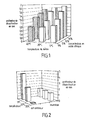
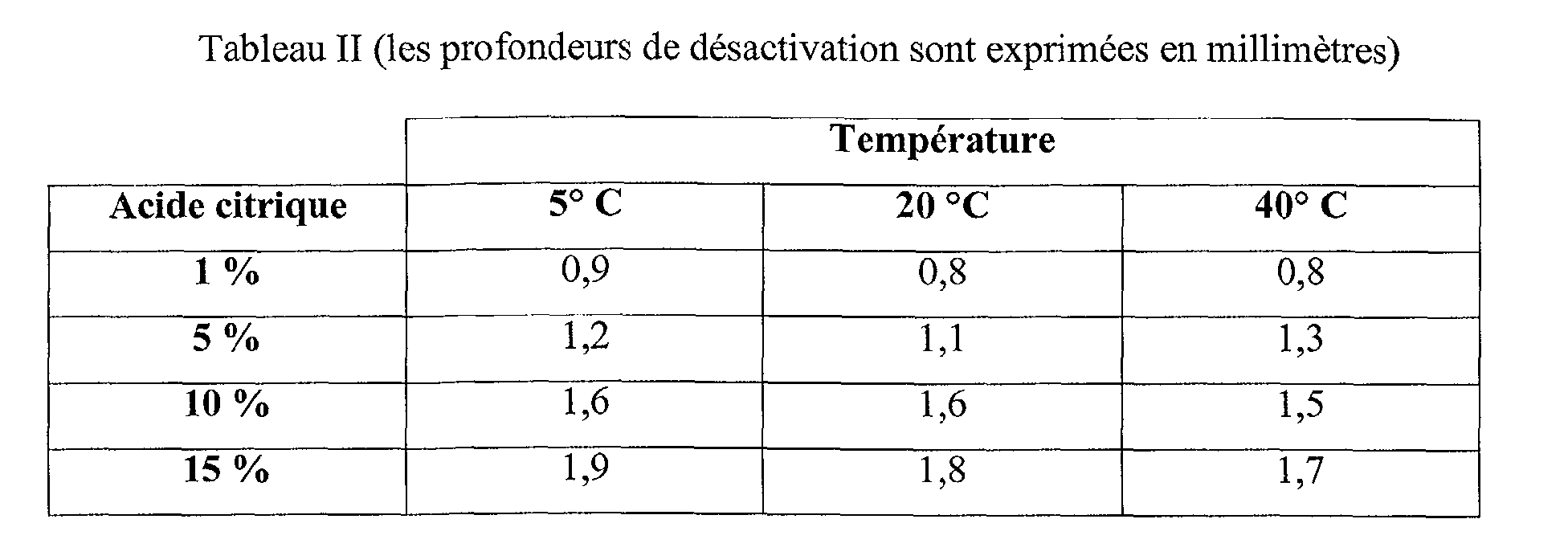
- the deactivation depths as a function of the citric acid concentration and the temperature of the concrete for a washing time at 20 hours are presented in Table II, and visualized in FIG. 1.
- deactivation depth is proportional to the amount of carboxylic acid (retarder) added, but practically independent of the temperature.
- This example relates to the comparison against a composition according to the invention, containing 6% of HASE and a concentration of citric acid equal to 5% by weight and a composition according to the prior art containing 5% of retarder of cyclic aminoplast resin type and less than 0.5% by weight of HASE.
- Different concrete temperatures (5 to 35 ° C) have been tested as well as different washing times (16 to 24 hours).
- Figure 2 shows the comparative results obtained for the two compositions above depending on the temperature at a wash time 8 p.m.
- the effect of the temperature on the deactivation depth remains much weaker than for the combination of the prior art (approximately 6 times less). As for the impact of the variation in the washing schedule, this manifests itself for the combination of Prior Art and not for the combination of the invention.
- the deactivation depth was measured by varying the nature of the CEM I cement (Portland cement containing at least 95% clinker) and CEM II (Portland cement containing at least 65% clinker), all other things being equal elsewhere, with a composition according to the invention. Three self-timer concentrations were tested, at 20 ° C and 40 ° C. The results are presented in FIG. 3.
- an aqueous solution according to the invention was sprayed at 0.22 liters per m 2 .
Landscapes
- Chemical & Material Sciences (AREA)
- Engineering & Computer Science (AREA)
- Ceramic Engineering (AREA)
- Materials Engineering (AREA)
- Structural Engineering (AREA)
- Organic Chemistry (AREA)
- Curing Cements, Concrete, And Artificial Stone (AREA)
- Aftertreatments Of Artificial And Natural Stones (AREA)
Abstract
Description
| Latex type styrène-butadiène | 7,5 |
| Retardateur | 1 à 20 |
| Résine aminoplaste cyclique | |
| (Epaississant HASE) | (0,45) |
| Agent antimousse | 0,1 |
| Eau | Qsq 100 |

- la figure 1 montre la profondeur de désactivation d'une composition selon l'invention contenant de l'acide citrique comme retardateur, en fonction de la concentration en acide citrique et à différentes températures du béton.
- la figure 2 présente une comparaison entre une composition selon l'invention et une composition selon l'Art Antérieur, à différentes températures pour un temps de lavage de 20 heures.
- la figure 3 montre l'action de la composition selon l'invention sur deux types de ciment Portland.
- et la figure 4 présente des comparaisons entre divers acides carboxyliques dans des compositions selon l'invention.
| Ciment CPJ CEM II A 42,5 | 330 |
| Sable 0/4 mm | 394 |
| Gravillon 4/8 mm | 94 |
| Gravillon 8/16 mm | 1.299 |
| Eau totale | 162 |
| Latex | 9,4 |
| Retardateur (acide carboxylique) | 1 à 20 |
| Agent modificateur de rhéologie (HASE) | 6 |
| Agent anti-mousse (polydiméthylsiloxane) | 0,05 |
| Eau | QSP 100 |
(16 à 24 heures). Les résultats sont présentés dans le Tableau III suivant.
| (profondeurs de désactivation en mm) | |||||||
| Retardateur 5 % | Art Antérieur [HASE] < 0,5 % | Invention [HASE] = 6 % | |||||
| Echéance Température | 16 H | 20 H | 24 H | 16 H | 20 H | 24 H | |
| 5° C | 4,71 | 4,35 | 3,96 | 1,40 | 1,33 | 1,26 | |
| 20° C | 2,46 | 2,06 | 1,68 | 1,26 | 1,19 | 1,12 | |
| 35° C | 0,20 | 0 | 0 | 1,11 | 1,05 | 0,98 | |
| Ecart (5° - 35°) | 4,5 | 4,35 | 3,96 | 0,29 | 0,28 | 0,28 | |
| % de variation | 98 | 100 | 100 | 20 | 24 | 24 |
| (profondeurs de désactivation en mm) | |||||||
| Retardateur 10 % | Art Antérieur [HASE] < 0,5 % | Invention [HASE] = 6 % | |||||
| Echéance Température | 16 H | 20 H | 24 H | 16 H | 20 H | 24 H | |
| 5° C | 4,98 | 4,61 | 4,22 | 1,70 | 1,62 | 1,57 | |
| 20° C | 2,73 | 2,33 | 1,95 | 1,55 | 1,48 | 1,41 | |
| 35° C | 0,47 | 0,08 | 0 | 1,41 | 1,34 | 1,28 | |
| Ecart (5° - 35°) | 4,51 | 4,53 | 4,22 | 0,29 | 0,28 | 0,29 | |
| % de variation | 90 | 98 | 100 | 17 | 17 | 18 |
| (profondeurs de désactivation en mm) | |||||||
| Retardateur 18 % | Art Antérieur [HASE] < 0,5 % | Invention [HASE] = 6 % | |||||
| Echéance Température | 16 H | 20 H | 24 H | 16 H | 20 H | 24 H | |
| 5° C | 5,39 | 5,01 | 4,56 | 2,18 | 2,10 | 2,02 | |
| 20° C | 3,14 | 2,76 | 2,37 | 2,03 | 1,98 | 1,90 | |
| 35° C | 1,06 | 0,5 | 0,11 | 1,90 | 1,83 | 1,77 | |
| Ecart(5° - 35°) | 4,33 | 4,51 | 5,45 | 0,28 | 0,27 | 0,25 | |
| % de variation | 80 | 90 | 98 | 13 | 13 | 12 |
celle-ci se manifeste pour la combinaison de l'Art Antérieur et non pour la combinaison de l'invention.
Claims (10)
- Composition désactivante de surface pour béton ou mortier comportant un retardateur, de l'eau et éventuellement un agent modificateur de rhéologie de type HASE (émulsion, soluble dans les alcalis, d'un polymère à modification hydrophobe), caractérisée en ce que le retardateur est un acide carboxylique et en ce que la concentration en HASE est supérieure ou égale à 0,5 % en poids.
- Composition selon la revendication 1, caractérisée en ce que la concentration en HASE est comprise entre 1 et 10 % en poids.
- Composition selon l'une des revendications 1 ou 2, caractérisée en ce que la concentration en HASE est comprise entre 5 et 6 % en poids.
- Composition selon l'une des revendications 1 à 3, caractérisée en ce que l'acide carboxylique a pour formule générale (I)
 R1 étant H ou -CH2-COOHR2 étant H ou OHR3 étant H, CH3, -(CHOH)n -CH2OH ou (CHOH)n -COOH et n étant un entier de 1 à 3.
 - Composition selon l'une des revendications 1 à 4, caractérisée en ce que le retardateur est choisi parmi : l'acide acétique, l'acide tartrique, l'acide citrique, l'acide gluconique, l'acide lactique.
- Composition selon la revendication 4, caractérisée en ce que l'acide carboxylique est un acide α alcool.
- Composition selon l'une des revendications 1 à 6, caractérisée en ce que la concentration en acide carboxylique est supérieure à environ 0,5 % en poids.
- Procédé de modification de la surface d'un béton ou d'un mortier durant sa prise consistant à appliquer une composition désactivante selon l'une des revendications précédentes dans des proportions de l'ordre de 0,25 ± 0,05 litre par mètre carré de ladite surface, puis à laver à l'eau cette surface après une période déterminée.
- Utilisation de la composition selon l'une des revendications 1 à 7 ou du procédé selon la revendication 8 pour la désactivation de béton ou mortier réalisés avec des ciments de type CEM I ou CEM II.
- Utilisation de la composition selon l'une des revendications 1 à 7 ou du procédé selon la revendication 8 à des températures comprises entre 5 et 40° C environ.
Applications Claiming Priority (2)
| Application Number | Priority Date | Filing Date | Title |
|---|---|---|---|
| FR0110310A FR2828192B1 (fr) | 2001-08-01 | 2001-08-01 | Composition desactivante de surface de beton ou mortier et son procede d'application |
| FR0110310 | 2001-08-01 |
Publications (2)
| Publication Number | Publication Date |
|---|---|
| EP1281698A1 true EP1281698A1 (fr) | 2003-02-05 |
| EP1281698B1 EP1281698B1 (fr) | 2005-04-20 |
Family
ID=8866176
Family Applications (1)
| Application Number | Title | Priority Date | Filing Date |
|---|---|---|---|
| EP02291898A Expired - Lifetime EP1281698B1 (fr) | 2001-08-01 | 2002-07-26 | Composition désactivante de surface de béton ou mortier et son procédé d'application |
Country Status (5)
| Country | Link |
|---|---|
| US (1) | US6648963B2 (fr) |
| EP (1) | EP1281698B1 (fr) |
| CA (1) | CA2396208C (fr) |
| ES (1) | ES2240672T3 (fr) |
| FR (1) | FR2828192B1 (fr) |
Cited By (2)
| Publication number | Priority date | Publication date | Assignee | Title |
|---|---|---|---|---|
| EP1661874A1 (fr) * | 2004-11-25 | 2006-05-31 | Sika Technology AG | Composition désactivante de surface pour béton ou mortier comprenant un tensio-actif non ionique. |
| EP3112327A1 (fr) * | 2015-06-30 | 2017-01-04 | HeidelbergCement AG | Revetements semi-rigides a haute adherence et leur procede de fabrication |
Families Citing this family (4)
| Publication number | Priority date | Publication date | Assignee | Title |
|---|---|---|---|---|
| ES2477888T3 (es) | 2010-01-20 | 2014-07-18 | W.R. Grace & Co.-Conn. | Retardante del fraguado aplicado a una superficie que induce una alta curación |
| FR2992961B1 (fr) | 2012-07-04 | 2014-08-29 | Chryso | Procede de creation de motifs sur une surface en beton |
| FR3039541B1 (fr) | 2015-07-31 | 2017-09-08 | Chryso | Procede de creation de motifs sur la surface d'une composition a base de liant hydraulique par impression |
| EP3737655A4 (fr) | 2018-01-08 | 2021-10-06 | GCP Applied Technologies Inc. | Formulation de retardateur de surface et procédé de réplication d'un aspect d'attaque acide ou de sablage sur un matériau cimentaire |
Citations (1)
| Publication number | Priority date | Publication date | Assignee | Title |
|---|---|---|---|---|
| DD230861A1 (de) * | 1983-12-16 | 1985-12-11 | Handwerkskammer Des Bezirkes P | Abbindeverzoegerer fuer betonoberflaechen, insbesondere fuer waschterrazzo und waschbeton |
Family Cites Families (3)
| Publication number | Priority date | Publication date | Assignee | Title |
|---|---|---|---|---|
| DE230861C (fr) | ||||
| US4004066A (en) * | 1975-08-06 | 1977-01-18 | Aluminum Company Of America | Method of protecting concrete |
| FR2722777B1 (fr) | 1994-07-20 | 1996-10-04 | Axim | Retardateur de prise et son application dans les betons, mortiers et/ou coulis |
-
2001
- 2001-08-01 FR FR0110310A patent/FR2828192B1/fr not_active Expired - Fee Related
-
2002
- 2002-07-26 EP EP02291898A patent/EP1281698B1/fr not_active Expired - Lifetime
- 2002-07-26 ES ES02291898T patent/ES2240672T3/es not_active Expired - Lifetime
- 2002-07-31 US US10/207,824 patent/US6648963B2/en not_active Expired - Lifetime
- 2002-07-31 CA CA002396208A patent/CA2396208C/fr not_active Expired - Lifetime
Patent Citations (1)
| Publication number | Priority date | Publication date | Assignee | Title |
|---|---|---|---|---|
| DD230861A1 (de) * | 1983-12-16 | 1985-12-11 | Handwerkskammer Des Bezirkes P | Abbindeverzoegerer fuer betonoberflaechen, insbesondere fuer waschterrazzo und waschbeton |
Non-Patent Citations (1)
| Title |
|---|
| TAMBURRINO JEFFREY: "High Performance, Cost-Effective Rheology Modifiers for the Coatings Industry", PUBLICATION SUR L'INTERNET, 23 October 2000 (2000-10-23), XP002193697, Retrieved from the Internet <URL:http://www.pcimag.com/CDA/ArticleInformation/features/BNP__Features__Item/0,1846,13468,00.html> [retrieved on 20020320] * |
Cited By (2)
| Publication number | Priority date | Publication date | Assignee | Title |
|---|---|---|---|---|
| EP1661874A1 (fr) * | 2004-11-25 | 2006-05-31 | Sika Technology AG | Composition désactivante de surface pour béton ou mortier comprenant un tensio-actif non ionique. |
| EP3112327A1 (fr) * | 2015-06-30 | 2017-01-04 | HeidelbergCement AG | Revetements semi-rigides a haute adherence et leur procede de fabrication |
Also Published As
| Publication number | Publication date |
|---|---|
| US6648963B2 (en) | 2003-11-18 |
| FR2828192B1 (fr) | 2004-01-23 |
| EP1281698B1 (fr) | 2005-04-20 |
| CA2396208C (fr) | 2009-10-20 |
| US20030110988A1 (en) | 2003-06-19 |
| ES2240672T3 (es) | 2005-10-16 |
| CA2396208A1 (fr) | 2003-02-01 |
| FR2828192A1 (fr) | 2003-02-07 |
Similar Documents
| Publication | Publication Date | Title |
|---|---|---|
| CN104944828B (zh) | 水泥基高分子聚合物防水砂浆添加剂及其制备方法和应用 | |
| US11884600B2 (en) | Method for preparing an improved finished concrete product | |
| CN104903410A (zh) | 用于临时覆盖和保护表面的水溶性涂层 | |
| US20250091963A1 (en) | Surface retarder formulation and method for replicating an acid etch or sand blast aspect on cementitious material | |
| CN105541230B (zh) | 仿石材干粉涂料及其施工方法 | |
| EP1281698B1 (fr) | Composition désactivante de surface de béton ou mortier et son procédé d'application | |
| EP2358649A1 (fr) | Utilisation d'au moins un ether de cellulose pour reduire le retrait et/ou la fissuration plastique dans le beton | |
| FR2746792A1 (fr) | Enduits monocouche d'impermeabilisation | |
| EP2632876B1 (fr) | Désactivant de surface éliminable à sec | |
| EP1661874A1 (fr) | Composition désactivante de surface pour béton ou mortier comprenant un tensio-actif non ionique. | |
| FR2476669A1 (fr) | Composition d'appret applicable sur fonds de mortier de ciment ou de beton | |
| KR20160150225A (ko) | 침투성 도포 방수제 및 그를 이용한 시공방법 | |
| Ganesh et al. | Polymer modified mortar and concrete present status a review | |
| US7185472B1 (en) | Concrete-based material, and method of applying the same | |
| US20140272381A1 (en) | Polystyrene foam products with improved adhesion and water resistance, and methods of making the same | |
| EP3049375B1 (fr) | Produit de finition d'un sol exterieur en beton fraichement coule, assurant une protection contre les effets des cycles de gel-degel en presence de sels de deverglacage | |
| WO2015059141A1 (fr) | Composition de cure pour composition hydraulique assurant une adhérence renforcée | |
| WO2011148091A1 (fr) | Superplastifiant à base de nanoparticules minérales à surface modifiée pour mortier et béton | |
| US8221533B2 (en) | Method to render surfaces water repellent | |
| JP7135849B2 (ja) | 含浸型セメント系硬化体耐久性向上剤 | |
| FR3035659B1 (fr) | Utilisation d'une composition comprenant un mono- a tetra- alkylenate en c7-c15 de mono- a tetra- (trialkanol en c3-c6) comme auxiliaire de mise en œuvre de produits bitumineux et/ou de beton | |
| JP2025162793A (ja) | コンクリート用養生剤、及び、これを利用したコンクリートの養生方法 | |
| KR100618920B1 (ko) | 액상의 시멘트 혼합물을 사용한 미장방법 | |
| JP2009241383A (ja) | コンクリート製品の製造方法 | |
| JPS58133867A (ja) | コンクリ−ト構造物の表面施工法及び検査塗布剤 |
Legal Events
| Date | Code | Title | Description |
|---|---|---|---|
| PUAI | Public reference made under article 153(3) epc to a published international application that has entered the european phase |
Free format text: ORIGINAL CODE: 0009012 |
|
| AK | Designated contracting states |
Designated state(s): AT BE BG CH CY CZ DE DK EE ES FI FR GB GR IE IT LI LU MC NL PT SE SK TR |
|
| AX | Request for extension of the european patent |
Extension state: AL LT LV MK RO SI |
|
| 17P | Request for examination filed |
Effective date: 20030728 |
|
| AKX | Designation fees paid |
Designated state(s): BE ES FR GR IT |
|
| REG | Reference to a national code |
Ref country code: DE Ref legal event code: 8566 |
|
| 17Q | First examination report despatched |
Effective date: 20040428 |
|
| GRAP | Despatch of communication of intention to grant a patent |
Free format text: ORIGINAL CODE: EPIDOSNIGR1 |
|
| GRAS | Grant fee paid |
Free format text: ORIGINAL CODE: EPIDOSNIGR3 |
|
| GRAA | (expected) grant |
Free format text: ORIGINAL CODE: 0009210 |
|
| AK | Designated contracting states |
Kind code of ref document: B1 Designated state(s): BE ES FR GR IT |
|
| REG | Reference to a national code |
Ref country code: IE Ref legal event code: FG4D Free format text: LANGUAGE OF EP DOCUMENT: FRENCH |
|
| REG | Reference to a national code |
Ref country code: GR Ref legal event code: EP Ref document number: 20050402012 Country of ref document: GR |
|
| REG | Reference to a national code |
Ref country code: ES Ref legal event code: FG2A Ref document number: 2240672 Country of ref document: ES Kind code of ref document: T3 |
|
| PLBE | No opposition filed within time limit |
Free format text: ORIGINAL CODE: 0009261 |
|
| STAA | Information on the status of an ep patent application or granted ep patent |
Free format text: STATUS: NO OPPOSITION FILED WITHIN TIME LIMIT |
|
| 26N | No opposition filed |
Effective date: 20060123 |
|
| REG | Reference to a national code |
Ref country code: FR Ref legal event code: PLFP Year of fee payment: 15 |
|
| PGFP | Annual fee paid to national office [announced via postgrant information from national office to epo] |
Ref country code: IT Payment date: 20160725 Year of fee payment: 15 |
|
| PGFP | Annual fee paid to national office [announced via postgrant information from national office to epo] |
Ref country code: FR Payment date: 20160721 Year of fee payment: 15 Ref country code: GR Payment date: 20160720 Year of fee payment: 15 |
|
| PGFP | Annual fee paid to national office [announced via postgrant information from national office to epo] |
Ref country code: BE Payment date: 20160720 Year of fee payment: 15 Ref country code: ES Payment date: 20160715 Year of fee payment: 15 |
|
| REG | Reference to a national code |
Ref country code: FR Ref legal event code: ST Effective date: 20180330 |
|
| PG25 | Lapsed in a contracting state [announced via postgrant information from national office to epo] |
Ref country code: GR Free format text: LAPSE BECAUSE OF NON-PAYMENT OF DUE FEES Effective date: 20180208 Ref country code: FR Free format text: LAPSE BECAUSE OF NON-PAYMENT OF DUE FEES Effective date: 20170731 |
|
| REG | Reference to a national code |
Ref country code: BE Ref legal event code: MM Effective date: 20170731 |
|
| PG25 | Lapsed in a contracting state [announced via postgrant information from national office to epo] |
Ref country code: IT Free format text: LAPSE BECAUSE OF NON-PAYMENT OF DUE FEES Effective date: 20170726 Ref country code: BE Free format text: LAPSE BECAUSE OF NON-PAYMENT OF DUE FEES Effective date: 20170731 |
|
| REG | Reference to a national code |
Ref country code: ES Ref legal event code: FD2A Effective date: 20181030 |
|
| PG25 | Lapsed in a contracting state [announced via postgrant information from national office to epo] |
Ref country code: ES Free format text: LAPSE BECAUSE OF NON-PAYMENT OF DUE FEES Effective date: 20170727 |