EP1281383A1 - Polymerisierbares Dentalmaterial auf der Basis chromophorer Xerogele - Google Patents
Polymerisierbares Dentalmaterial auf der Basis chromophorer Xerogele Download PDFInfo
- Publication number
- EP1281383A1 EP1281383A1 EP02016298A EP02016298A EP1281383A1 EP 1281383 A1 EP1281383 A1 EP 1281383A1 EP 02016298 A EP02016298 A EP 02016298A EP 02016298 A EP02016298 A EP 02016298A EP 1281383 A1 EP1281383 A1 EP 1281383A1
- Authority
- EP
- European Patent Office
- Prior art keywords
- dental material
- meth
- acrylate
- weight
- xerogel
- Prior art date
- Legal status (The legal status is an assumption and is not a legal conclusion. Google has not performed a legal analysis and makes no representation as to the accuracy of the status listed.)
- Granted
Links
- 239000005548 dental material Substances 0.000 title claims abstract description 39
- 239000011230 binding agent Substances 0.000 claims abstract description 14
- 229910002091 carbon monoxide Inorganic materials 0.000 claims abstract description 14
- 238000009833 condensation Methods 0.000 claims abstract description 11
- 230000003301 hydrolyzing effect Effects 0.000 claims abstract description 11
- 229910052751 metal Inorganic materials 0.000 claims abstract description 11
- 239000002184 metal Substances 0.000 claims abstract description 11
- 229910052760 oxygen Inorganic materials 0.000 claims abstract description 11
- 230000005494 condensation Effects 0.000 claims abstract description 10
- 150000004703 alkoxides Chemical class 0.000 claims abstract description 6
- 238000000034 method Methods 0.000 claims abstract description 6
- 229910052723 transition metal Inorganic materials 0.000 claims abstract description 5
- 125000000217 alkyl group Chemical group 0.000 claims abstract description 4
- 125000004430 oxygen atom Chemical group O* 0.000 claims abstract description 4
- 150000003624 transition metals Chemical class 0.000 claims abstract description 4
- 238000002360 preparation method Methods 0.000 claims abstract description 3
- NIXOWILDQLNWCW-UHFFFAOYSA-M Acrylate Chemical compound [O-]C(=O)C=C NIXOWILDQLNWCW-UHFFFAOYSA-M 0.000 claims description 20
- 239000002131 composite material Substances 0.000 claims description 16
- 239000000945 filler Substances 0.000 claims description 14
- 239000000203 mixture Substances 0.000 claims description 12
- -1 4- (N, N-dimethylamino) benzoic acid ester Chemical class 0.000 claims description 11
- 239000000463 material Substances 0.000 claims description 10
- RTZKZFJDLAIYFH-UHFFFAOYSA-N Diethyl ether Chemical compound CCOCC RTZKZFJDLAIYFH-UHFFFAOYSA-N 0.000 claims description 9
- 238000004519 manufacturing process Methods 0.000 claims description 7
- 229910052726 zirconium Inorganic materials 0.000 claims description 6
- 125000000751 azo group Chemical group [*]N=N[*] 0.000 claims description 5
- 239000004568 cement Substances 0.000 claims description 5
- 150000001875 compounds Chemical class 0.000 claims description 5
- 238000011049 filling Methods 0.000 claims description 5
- 229910052739 hydrogen Inorganic materials 0.000 claims description 5
- 239000001257 hydrogen Substances 0.000 claims description 5
- 125000002496 methyl group Chemical group [H]C([H])([H])* 0.000 claims description 5
- 239000003505 polymerization initiator Substances 0.000 claims description 5
- 229910052719 titanium Inorganic materials 0.000 claims description 5
- UFHFLCQGNIYNRP-UHFFFAOYSA-N Hydrogen Chemical compound [H][H] UFHFLCQGNIYNRP-UHFFFAOYSA-N 0.000 claims description 4
- 229910004298 SiO 2 Inorganic materials 0.000 claims description 4
- ISAOCJYIOMOJEB-UHFFFAOYSA-N benzoin Chemical compound C=1C=CC=CC=1C(O)C(=O)C1=CC=CC=C1 ISAOCJYIOMOJEB-UHFFFAOYSA-N 0.000 claims description 4
- IISBACLAFKSPIT-UHFFFAOYSA-N bisphenol A Chemical compound C=1C=C(O)C=CC=1C(C)(C)C1=CC=C(O)C=C1 IISBACLAFKSPIT-UHFFFAOYSA-N 0.000 claims description 4
- 239000003638 chemical reducing agent Substances 0.000 claims description 4
- GHLKSLMMWAKNBM-UHFFFAOYSA-N dodecane-1,12-diol Chemical compound OCCCCCCCCCCCCO GHLKSLMMWAKNBM-UHFFFAOYSA-N 0.000 claims description 4
- 239000003999 initiator Substances 0.000 claims description 4
- VNQXSTWCDUXYEZ-UHFFFAOYSA-N 1,7,7-trimethylbicyclo[2.2.1]heptane-2,3-dione Chemical compound C1CC2(C)C(=O)C(=O)C1C2(C)C VNQXSTWCDUXYEZ-UHFFFAOYSA-N 0.000 claims description 3
- 125000003118 aryl group Chemical group 0.000 claims description 3
- 229930006711 bornane-2,3-dione Natural products 0.000 claims description 3
- 125000001495 ethyl group Chemical group [H]C([H])([H])C([H])([H])* 0.000 claims description 3
- 125000004435 hydrogen atom Chemical group [H]* 0.000 claims description 3
- 229910052757 nitrogen Inorganic materials 0.000 claims description 3
- 125000000636 p-nitrophenyl group Chemical group [H]C1=C([H])C(=C([H])C([H])=C1*)[N+]([O-])=O 0.000 claims description 3
- 230000000737 periodic effect Effects 0.000 claims description 3
- ATOUXIOKEJWULN-UHFFFAOYSA-N 1,6-diisocyanato-2,2,4-trimethylhexane Chemical compound O=C=NCCC(C)CC(C)(C)CN=C=O ATOUXIOKEJWULN-UHFFFAOYSA-N 0.000 claims description 2
- 125000004098 2,6-dichlorobenzoyl group Chemical group O=C([*])C1=C(Cl)C([H])=C([H])C([H])=C1Cl 0.000 claims description 2
- JKNCOURZONDCGV-UHFFFAOYSA-N 2-(dimethylamino)ethyl 2-methylprop-2-enoate Chemical compound CN(C)CCOC(=O)C(C)=C JKNCOURZONDCGV-UHFFFAOYSA-N 0.000 claims description 2
- UEKHZPDUBLCUHN-UHFFFAOYSA-N 2-[[3,5,5-trimethyl-6-[2-(2-methylprop-2-enoyloxy)ethoxycarbonylamino]hexyl]carbamoyloxy]ethyl 2-methylprop-2-enoate Chemical compound CC(=C)C(=O)OCCOC(=O)NCCC(C)CC(C)(C)CNC(=O)OCCOC(=O)C(C)=C UEKHZPDUBLCUHN-UHFFFAOYSA-N 0.000 claims description 2
- BQZJOQXSCSZQPS-UHFFFAOYSA-N 2-methoxy-1,2-diphenylethanone Chemical compound C=1C=CC=CC=1C(OC)C(=O)C1=CC=CC=C1 BQZJOQXSCSZQPS-UHFFFAOYSA-N 0.000 claims description 2
- RZVHIXYEVGDQDX-UHFFFAOYSA-N 9,10-anthraquinone Chemical group C1=CC=C2C(=O)C3=CC=CC=C3C(=O)C2=C1 RZVHIXYEVGDQDX-UHFFFAOYSA-N 0.000 claims description 2
- YYVYAPXYZVYDHN-UHFFFAOYSA-N 9,10-phenanthroquinone Chemical compound C1=CC=C2C(=O)C(=O)C3=CC=CC=C3C2=C1 YYVYAPXYZVYDHN-UHFFFAOYSA-N 0.000 claims description 2
- 229930185605 Bisphenol Natural products 0.000 claims description 2
- QSJXEFYPDANLFS-UHFFFAOYSA-N Diacetyl Chemical group CC(=O)C(C)=O QSJXEFYPDANLFS-UHFFFAOYSA-N 0.000 claims description 2
- WOBHKFSMXKNTIM-UHFFFAOYSA-N Hydroxyethyl methacrylate Chemical compound CC(=C)C(=O)OCCO WOBHKFSMXKNTIM-UHFFFAOYSA-N 0.000 claims description 2
- CERQOIWHTDAKMF-UHFFFAOYSA-N Methacrylic acid Chemical compound CC(=C)C(O)=O CERQOIWHTDAKMF-UHFFFAOYSA-N 0.000 claims description 2
- AMFGWXWBFGVCKG-UHFFFAOYSA-N Panavia opaque Chemical compound C1=CC(OCC(O)COC(=O)C(=C)C)=CC=C1C(C)(C)C1=CC=C(OCC(O)COC(=O)C(C)=C)C=C1 AMFGWXWBFGVCKG-UHFFFAOYSA-N 0.000 claims description 2
- 244000028419 Styrax benzoin Species 0.000 claims description 2
- 235000000126 Styrax benzoin Nutrition 0.000 claims description 2
- 235000008411 Sumatra benzointree Nutrition 0.000 claims description 2
- GSEJCLTVZPLZKY-UHFFFAOYSA-N Triethanolamine Chemical compound OCCN(CCO)CCO GSEJCLTVZPLZKY-UHFFFAOYSA-N 0.000 claims description 2
- ZJCCRDAZUWHFQH-UHFFFAOYSA-N Trimethylolpropane Chemical compound CCC(CO)(CO)CO ZJCCRDAZUWHFQH-UHFFFAOYSA-N 0.000 claims description 2
- 150000001412 amines Chemical class 0.000 claims description 2
- 229960002130 benzoin Drugs 0.000 claims description 2
- RWCCWEUUXYIKHB-UHFFFAOYSA-N benzophenone Chemical group C=1C=CC=CC=1C(=O)C1=CC=CC=C1 RWCCWEUUXYIKHB-UHFFFAOYSA-N 0.000 claims description 2
- 239000012965 benzophenone Substances 0.000 claims description 2
- 125000001797 benzyl group Chemical group [H]C1=C([H])C([H])=C(C([H])=C1[H])C([H])([H])* 0.000 claims description 2
- CDQSJQSWAWPGKG-UHFFFAOYSA-N butane-1,1-diol Chemical compound CCCC(O)O CDQSJQSWAWPGKG-UHFFFAOYSA-N 0.000 claims description 2
- 125000000484 butyl group Chemical group [H]C([*])([H])C([H])([H])C([H])([H])C([H])([H])[H] 0.000 claims description 2
- INSRQEMEVAMETL-UHFFFAOYSA-N decane-1,1-diol Chemical compound CCCCCCCCCC(O)O INSRQEMEVAMETL-UHFFFAOYSA-N 0.000 claims description 2
- FOTKYAAJKYLFFN-UHFFFAOYSA-N decane-1,10-diol Chemical compound OCCCCCCCCCCO FOTKYAAJKYLFFN-UHFFFAOYSA-N 0.000 claims description 2
- MTHSVFCYNBDYFN-UHFFFAOYSA-N diethylene glycol Chemical compound OCCOCCO MTHSVFCYNBDYFN-UHFFFAOYSA-N 0.000 claims description 2
- 235000019382 gum benzoic Nutrition 0.000 claims description 2
- WXZMFSXDPGVJKK-UHFFFAOYSA-N pentaerythritol Chemical compound OCC(CO)(CO)CO WXZMFSXDPGVJKK-UHFFFAOYSA-N 0.000 claims description 2
- 125000001997 phenyl group Chemical group [H]C1=C([H])C([H])=C(*)C([H])=C1[H] 0.000 claims description 2
- 229920001223 polyethylene glycol Polymers 0.000 claims description 2
- QQONPFPTGQHPMA-UHFFFAOYSA-N propylene Natural products CC=C QQONPFPTGQHPMA-UHFFFAOYSA-N 0.000 claims description 2
- UWHCKJMYHZGTIT-UHFFFAOYSA-N tetraethylene glycol Chemical compound OCCOCCOCCOCCO UWHCKJMYHZGTIT-UHFFFAOYSA-N 0.000 claims description 2
- ZIBGPFATKBEMQZ-UHFFFAOYSA-N triethylene glycol Chemical compound OCCOCCOCCO ZIBGPFATKBEMQZ-UHFFFAOYSA-N 0.000 claims description 2
- 125000001834 xanthenyl group Chemical group C1=CC=CC=2OC3=CC=CC=C3C(C12)* 0.000 claims description 2
- CDULGHZNHURECF-UHFFFAOYSA-N 2,3-dimethylaniline 2,4-dimethylaniline 2,5-dimethylaniline 2,6-dimethylaniline 3,4-dimethylaniline 3,5-dimethylaniline Chemical group CC1=CC=C(N)C(C)=C1.CC1=CC=C(C)C(N)=C1.CC1=CC(C)=CC(N)=C1.CC1=CC=C(N)C=C1C.CC1=CC=CC(N)=C1C.CC1=CC=CC(C)=C1N CDULGHZNHURECF-UHFFFAOYSA-N 0.000 claims 1
- XWTGEDNUGUMEPF-UHFFFAOYSA-N 5,5-dichlorocyclohexa-1,3-diene Chemical compound ClC1(Cl)CC=CC=C1 XWTGEDNUGUMEPF-UHFFFAOYSA-N 0.000 claims 1
- 239000012765 fibrous filler Substances 0.000 claims 1
- VYPSYNLAJGMNEJ-UHFFFAOYSA-N Silicium dioxide Chemical compound O=[Si]=O VYPSYNLAJGMNEJ-UHFFFAOYSA-N 0.000 abstract description 13
- 239000000377 silicon dioxide Substances 0.000 abstract description 6
- 229910044991 metal oxide Inorganic materials 0.000 abstract description 4
- 239000006103 coloring component Substances 0.000 abstract description 2
- 235000012239 silicon dioxide Nutrition 0.000 abstract description 2
- 229910052717 sulfur Inorganic materials 0.000 abstract description 2
- 125000002947 alkylene group Chemical group 0.000 abstract 1
- 229910052681 coesite Inorganic materials 0.000 abstract 1
- 229910052906 cristobalite Inorganic materials 0.000 abstract 1
- 125000005702 oxyalkylene group Chemical group 0.000 abstract 1
- 229910052682 stishovite Inorganic materials 0.000 abstract 1
- 229910052905 tridymite Inorganic materials 0.000 abstract 1
- 239000000049 pigment Substances 0.000 description 14
- XLYOFNOQVPJJNP-UHFFFAOYSA-N water Substances O XLYOFNOQVPJJNP-UHFFFAOYSA-N 0.000 description 12
- 239000002904 solvent Substances 0.000 description 11
- LFQSCWFLJHTTHZ-UHFFFAOYSA-N Ethanol Chemical compound CCO LFQSCWFLJHTTHZ-UHFFFAOYSA-N 0.000 description 10
- 239000010936 titanium Substances 0.000 description 8
- 239000000499 gel Substances 0.000 description 7
- BOTDANWDWHJENH-UHFFFAOYSA-N Tetraethyl orthosilicate Chemical compound CCO[Si](OCC)(OCC)OCC BOTDANWDWHJENH-UHFFFAOYSA-N 0.000 description 5
- 239000000178 monomer Substances 0.000 description 5
- 239000001052 yellow pigment Substances 0.000 description 5
- UQSXHKLRYXJYBZ-UHFFFAOYSA-N Iron oxide Chemical compound [Fe]=O UQSXHKLRYXJYBZ-UHFFFAOYSA-N 0.000 description 4
- BLRPTPMANUNPDV-UHFFFAOYSA-N Silane Chemical compound [SiH4] BLRPTPMANUNPDV-UHFFFAOYSA-N 0.000 description 4
- WYURNTSHIVDZCO-UHFFFAOYSA-N Tetrahydrofuran Chemical compound C1CCOC1 WYURNTSHIVDZCO-UHFFFAOYSA-N 0.000 description 4
- 230000015572 biosynthetic process Effects 0.000 description 4
- 229910052799 carbon Inorganic materials 0.000 description 4
- 238000006243 chemical reaction Methods 0.000 description 4
- 238000004040 coloring Methods 0.000 description 4
- 230000000694 effects Effects 0.000 description 4
- 239000002245 particle Substances 0.000 description 4
- 229910000077 silane Inorganic materials 0.000 description 4
- 125000006850 spacer group Chemical group 0.000 description 4
- 239000000126 substance Substances 0.000 description 4
- 229910010413 TiO 2 Inorganic materials 0.000 description 3
- 239000000654 additive Substances 0.000 description 3
- 239000003086 colorant Substances 0.000 description 3
- 239000000975 dye Substances 0.000 description 3
- 150000004706 metal oxides Chemical class 0.000 description 3
- 239000012860 organic pigment Substances 0.000 description 3
- 238000006116 polymerization reaction Methods 0.000 description 3
- 150000004756 silanes Chemical class 0.000 description 3
- 238000003786 synthesis reaction Methods 0.000 description 3
- KJCVRFUGPWSIIH-UHFFFAOYSA-N 1-naphthol Chemical compound C1=CC=C2C(O)=CC=CC2=C1 KJCVRFUGPWSIIH-UHFFFAOYSA-N 0.000 description 2
- CSCPPACGZOOCGX-UHFFFAOYSA-N Acetone Chemical compound CC(C)=O CSCPPACGZOOCGX-UHFFFAOYSA-N 0.000 description 2
- GWEVSGVZZGPLCZ-UHFFFAOYSA-N Titan oxide Chemical compound O=[Ti]=O GWEVSGVZZGPLCZ-UHFFFAOYSA-N 0.000 description 2
- 150000001252 acrylic acid derivatives Chemical class 0.000 description 2
- 230000002411 adverse Effects 0.000 description 2
- 229910052782 aluminium Inorganic materials 0.000 description 2
- 238000013459 approach Methods 0.000 description 2
- 239000003054 catalyst Substances 0.000 description 2
- 239000011350 dental composite resin Substances 0.000 description 2
- NJDNXYGOVLYJHP-UHFFFAOYSA-L disodium;2-(3-oxido-6-oxoxanthen-9-yl)benzoate Chemical compound [Na+].[Na+].[O-]C(=O)C1=CC=CC=C1C1=C2C=CC(=O)C=C2OC2=CC([O-])=CC=C21 NJDNXYGOVLYJHP-UHFFFAOYSA-L 0.000 description 2
- 238000001704 evaporation Methods 0.000 description 2
- 239000011521 glass Substances 0.000 description 2
- 239000001023 inorganic pigment Substances 0.000 description 2
- 239000007800 oxidant agent Substances 0.000 description 2
- 239000004033 plastic Substances 0.000 description 2
- 229920000642 polymer Polymers 0.000 description 2
- 239000011148 porous material Substances 0.000 description 2
- 239000011164 primary particle Substances 0.000 description 2
- 238000010526 radical polymerization reaction Methods 0.000 description 2
- 239000001054 red pigment Substances 0.000 description 2
- 238000003980 solgel method Methods 0.000 description 2
- YLQBMQCUIZJEEH-UHFFFAOYSA-N tetrahydrofuran Natural products C=1C=COC=1 YLQBMQCUIZJEEH-UHFFFAOYSA-N 0.000 description 2
- YZTDRUCJEUCHIC-UHFFFAOYSA-N 1-(4,4-dichlorocyclohexa-1,5-dien-1-yl)-2-phenylethane-1,2-dione Chemical compound C1=CC(Cl)(Cl)CC=C1C(=O)C(=O)C1=CC=CC=C1 YZTDRUCJEUCHIC-UHFFFAOYSA-N 0.000 description 1
- WFQDTOYDVUWQMS-UHFFFAOYSA-N 1-fluoro-4-nitrobenzene Chemical compound [O-][N+](=O)C1=CC=C(F)C=C1 WFQDTOYDVUWQMS-UHFFFAOYSA-N 0.000 description 1
- SJECZPVISLOESU-UHFFFAOYSA-N 3-trimethoxysilylpropan-1-amine Chemical compound CO[Si](OC)(OC)CCCN SJECZPVISLOESU-UHFFFAOYSA-N 0.000 description 1
- 229910018072 Al 2 O 3 Inorganic materials 0.000 description 1
- DKPFZGUDAPQIHT-UHFFFAOYSA-N Butyl acetate Natural products CCCCOC(C)=O DKPFZGUDAPQIHT-UHFFFAOYSA-N 0.000 description 1
- UXVMQQNJUSDDNG-UHFFFAOYSA-L Calcium chloride Chemical compound [Cl-].[Cl-].[Ca+2] UXVMQQNJUSDDNG-UHFFFAOYSA-L 0.000 description 1
- 229920000049 Carbon (fiber) Polymers 0.000 description 1
- XEKOWRVHYACXOJ-UHFFFAOYSA-N Ethyl acetate Natural products CCOC(C)=O XEKOWRVHYACXOJ-UHFFFAOYSA-N 0.000 description 1
- 229910002588 FeOOH Inorganic materials 0.000 description 1
- KRHYYFGTRYWZRS-UHFFFAOYSA-N Fluorane Chemical compound F KRHYYFGTRYWZRS-UHFFFAOYSA-N 0.000 description 1
- KFZMGEQAYNKOFK-UHFFFAOYSA-N Isopropanol Chemical compound CC(C)O KFZMGEQAYNKOFK-UHFFFAOYSA-N 0.000 description 1
- NTIZESTWPVYFNL-UHFFFAOYSA-N Methyl isobutyl ketone Chemical compound CC(C)CC(C)=O NTIZESTWPVYFNL-UHFFFAOYSA-N 0.000 description 1
- UIHCLUNTQKBZGK-UHFFFAOYSA-N Methyl isobutyl ketone Natural products CCC(C)C(C)=O UIHCLUNTQKBZGK-UHFFFAOYSA-N 0.000 description 1
- 238000005481 NMR spectroscopy Methods 0.000 description 1
- 239000004952 Polyamide Substances 0.000 description 1
- NRCMAYZCPIVABH-UHFFFAOYSA-N Quinacridone Chemical compound N1C2=CC=CC=C2C(=O)C2=C1C=C1C(=O)C3=CC=CC=C3NC1=C2 NRCMAYZCPIVABH-UHFFFAOYSA-N 0.000 description 1
- 206010041662 Splinter Diseases 0.000 description 1
- 229910000831 Steel Inorganic materials 0.000 description 1
- RTAQQCXQSZGOHL-UHFFFAOYSA-N Titanium Chemical compound [Ti] RTAQQCXQSZGOHL-UHFFFAOYSA-N 0.000 description 1
- QCWXUUIWCKQGHC-UHFFFAOYSA-N Zirconium Chemical compound [Zr] QCWXUUIWCKQGHC-UHFFFAOYSA-N 0.000 description 1
- 239000006096 absorbing agent Substances 0.000 description 1
- 238000000862 absorption spectrum Methods 0.000 description 1
- 150000001298 alcohols Chemical class 0.000 description 1
- 125000001931 aliphatic group Chemical group 0.000 description 1
- AZDRQVAHHNSJOQ-UHFFFAOYSA-N alumane Chemical class [AlH3] AZDRQVAHHNSJOQ-UHFFFAOYSA-N 0.000 description 1
- XAGFODPZIPBFFR-UHFFFAOYSA-N aluminium Chemical compound [Al] XAGFODPZIPBFFR-UHFFFAOYSA-N 0.000 description 1
- 239000001000 anthraquinone dye Substances 0.000 description 1
- 239000000987 azo dye Substances 0.000 description 1
- 239000001058 brown pigment Substances 0.000 description 1
- 239000001110 calcium chloride Substances 0.000 description 1
- 229910001628 calcium chloride Inorganic materials 0.000 description 1
- 239000004917 carbon fiber Substances 0.000 description 1
- 230000015556 catabolic process Effects 0.000 description 1
- 230000000052 comparative effect Effects 0.000 description 1
- 239000000805 composite resin Substances 0.000 description 1
- 239000004567 concrete Substances 0.000 description 1
- 230000008602 contraction Effects 0.000 description 1
- 238000001816 cooling Methods 0.000 description 1
- 239000013256 coordination polymer Substances 0.000 description 1
- 238000004132 cross linking Methods 0.000 description 1
- 238000006731 degradation reaction Methods 0.000 description 1
- 125000000664 diazo group Chemical group [N-]=[N+]=[*] 0.000 description 1
- 239000002270 dispersing agent Substances 0.000 description 1
- 239000006185 dispersion Substances 0.000 description 1
- 238000001035 drying Methods 0.000 description 1
- 238000000635 electron micrograph Methods 0.000 description 1
- 238000001493 electron microscopy Methods 0.000 description 1
- 230000032050 esterification Effects 0.000 description 1
- 238000005886 esterification reaction Methods 0.000 description 1
- 150000002148 esters Chemical class 0.000 description 1
- MKVYSRNJLWTVIK-UHFFFAOYSA-N ethyl carbamate;2-methylprop-2-enoic acid Chemical class CCOC(N)=O.CC(=C)C(O)=O.CC(=C)C(O)=O MKVYSRNJLWTVIK-UHFFFAOYSA-N 0.000 description 1
- 230000008020 evaporation Effects 0.000 description 1
- 238000002474 experimental method Methods 0.000 description 1
- 239000000835 fiber Substances 0.000 description 1
- 229910021485 fumed silica Inorganic materials 0.000 description 1
- 125000000524 functional group Chemical group 0.000 description 1
- 239000003365 glass fiber Substances 0.000 description 1
- 239000002241 glass-ceramic Substances 0.000 description 1
- 238000010438 heat treatment Methods 0.000 description 1
- FUZZWVXGSFPDMH-UHFFFAOYSA-N hexanoic acid Chemical compound CCCCCC(O)=O FUZZWVXGSFPDMH-UHFFFAOYSA-N 0.000 description 1
- 235000021268 hot food Nutrition 0.000 description 1
- 239000000017 hydrogel Substances 0.000 description 1
- 229910000040 hydrogen fluoride Inorganic materials 0.000 description 1
- 230000007062 hydrolysis Effects 0.000 description 1
- 238000006460 hydrolysis reaction Methods 0.000 description 1
- 150000004679 hydroxides Chemical class 0.000 description 1
- 239000012442 inert solvent Substances 0.000 description 1
- 239000003112 inhibitor Substances 0.000 description 1
- 239000010954 inorganic particle Substances 0.000 description 1
- XEEYBQQBJWHFJM-UHFFFAOYSA-N iron Substances [Fe] XEEYBQQBJWHFJM-UHFFFAOYSA-N 0.000 description 1
- 235000014413 iron hydroxide Nutrition 0.000 description 1
- NCNCGGDMXMBVIA-UHFFFAOYSA-L iron(ii) hydroxide Chemical compound [OH-].[OH-].[Fe+2] NCNCGGDMXMBVIA-UHFFFAOYSA-L 0.000 description 1
- 150000002576 ketones Chemical class 0.000 description 1
- 239000007788 liquid Substances 0.000 description 1
- 150000002734 metacrylic acid derivatives Chemical class 0.000 description 1
- NYGZLYXAPMMJTE-UHFFFAOYSA-M metanil yellow Chemical group [Na+].[O-]S(=O)(=O)C1=CC=CC(N=NC=2C=CC(NC=3C=CC=CC=3)=CC=2)=C1 NYGZLYXAPMMJTE-UHFFFAOYSA-M 0.000 description 1
- 239000002855 microbicide agent Substances 0.000 description 1
- 238000005580 one pot reaction Methods 0.000 description 1
- 230000003287 optical effect Effects 0.000 description 1
- 239000001053 orange pigment Substances 0.000 description 1
- 239000011146 organic particle Substances 0.000 description 1
- 125000002080 perylenyl group Chemical group C1(=CC=C2C=CC=C3C4=CC=CC5=CC=CC(C1=C23)=C45)* 0.000 description 1
- CSHWQDPOILHKBI-UHFFFAOYSA-N peryrene Natural products C1=CC(C2=CC=CC=3C2=C2C=CC=3)=C3C2=CC=CC3=C1 CSHWQDPOILHKBI-UHFFFAOYSA-N 0.000 description 1
- 238000000016 photochemical curing Methods 0.000 description 1
- IEQIEDJGQAUEQZ-UHFFFAOYSA-N phthalocyanine Chemical compound N1C(N=C2C3=CC=CC=C3C(N=C3C4=CC=CC=C4C(=N4)N3)=N2)=C(C=CC=C2)C2=C1N=C1C2=CC=CC=C2C4=N1 IEQIEDJGQAUEQZ-UHFFFAOYSA-N 0.000 description 1
- 239000004014 plasticizer Substances 0.000 description 1
- 229920002647 polyamide Polymers 0.000 description 1
- 125000003367 polycyclic group Chemical group 0.000 description 1
- 239000000843 powder Substances 0.000 description 1
- 230000002028 premature Effects 0.000 description 1
- 238000003825 pressing Methods 0.000 description 1
- 125000004805 propylene group Chemical group [H]C([H])([H])C([H])([*:1])C([H])([H])[*:2] 0.000 description 1
- 239000010453 quartz Substances 0.000 description 1
- 238000003847 radiation curing Methods 0.000 description 1
- 150000003254 radicals Chemical class 0.000 description 1
- 239000011541 reaction mixture Substances 0.000 description 1
- 238000004626 scanning electron microscopy Methods 0.000 description 1
- 238000000926 separation method Methods 0.000 description 1
- RMAQACBXLXPBSY-UHFFFAOYSA-N silicic acid Chemical class O[Si](O)(O)O RMAQACBXLXPBSY-UHFFFAOYSA-N 0.000 description 1
- 239000007787 solid Substances 0.000 description 1
- 238000000371 solid-state nuclear magnetic resonance spectroscopy Methods 0.000 description 1
- 238000001179 sorption measurement Methods 0.000 description 1
- 239000003381 stabilizer Substances 0.000 description 1
- 239000010959 steel Substances 0.000 description 1
- 238000003756 stirring Methods 0.000 description 1
- 239000000725 suspension Substances 0.000 description 1
- 150000003512 tertiary amines Chemical class 0.000 description 1
- 238000012360 testing method Methods 0.000 description 1
- 150000003609 titanium compounds Chemical class 0.000 description 1
- 239000004408 titanium dioxide Substances 0.000 description 1
- 230000002110 toxicologic effect Effects 0.000 description 1
- 231100000027 toxicology Toxicity 0.000 description 1
- 125000005369 trialkoxysilyl group Chemical group 0.000 description 1
- 239000001003 triarylmethane dye Substances 0.000 description 1
- 235000021269 warm food Nutrition 0.000 description 1
- 238000010792 warming Methods 0.000 description 1
- 239000012463 white pigment Substances 0.000 description 1
- 239000001018 xanthene dye Substances 0.000 description 1
- XASAPYQVQBKMIN-UHFFFAOYSA-K ytterbium(iii) fluoride Chemical compound F[Yb](F)F XASAPYQVQBKMIN-UHFFFAOYSA-K 0.000 description 1
Images

Classifications
-
- C—CHEMISTRY; METALLURGY
- C07—ORGANIC CHEMISTRY
- C07F—ACYCLIC, CARBOCYCLIC OR HETEROCYCLIC COMPOUNDS CONTAINING ELEMENTS OTHER THAN CARBON, HYDROGEN, HALOGEN, OXYGEN, NITROGEN, SULFUR, SELENIUM OR TELLURIUM
- C07F7/00—Compounds containing elements of Groups 4 or 14 of the Periodic Table
- C07F7/02—Silicon compounds
- C07F7/08—Compounds having one or more C—Si linkages
- C07F7/18—Compounds having one or more C—Si linkages as well as one or more C—O—Si linkages
- C07F7/1804—Compounds having Si-O-C linkages
-
- A—HUMAN NECESSITIES
- A61—MEDICAL OR VETERINARY SCIENCE; HYGIENE
- A61K—PREPARATIONS FOR MEDICAL, DENTAL OR TOILETRY PURPOSES
- A61K6/00—Preparations for dentistry
- A61K6/60—Preparations for dentistry comprising organic or organo-metallic additives
- A61K6/65—Dyes
- A61K6/66—Photochromic dyes
-
- A—HUMAN NECESSITIES
- A61—MEDICAL OR VETERINARY SCIENCE; HYGIENE
- A61K—PREPARATIONS FOR MEDICAL, DENTAL OR TOILETRY PURPOSES
- A61K6/00—Preparations for dentistry
- A61K6/80—Preparations for artificial teeth, for filling teeth or for capping teeth
- A61K6/884—Preparations for artificial teeth, for filling teeth or for capping teeth comprising natural or synthetic resins
- A61K6/887—Compounds obtained by reactions only involving carbon-to-carbon unsaturated bonds
-
- A—HUMAN NECESSITIES
- A61—MEDICAL OR VETERINARY SCIENCE; HYGIENE
- A61K—PREPARATIONS FOR MEDICAL, DENTAL OR TOILETRY PURPOSES
- A61K6/00—Preparations for dentistry
- A61K6/80—Preparations for artificial teeth, for filling teeth or for capping teeth
- A61K6/884—Preparations for artificial teeth, for filling teeth or for capping teeth comprising natural or synthetic resins
- A61K6/891—Compounds obtained otherwise than by reactions only involving carbon-to-carbon unsaturated bonds
- A61K6/896—Polyorganosilicon compounds
Definitions
- the invention relates to dental materials, the chromophores Xerogels included as a coloring component.
- Dental materials are mostly used for aesthetic reasons colored substances added to visually match the natural To adapt tooth structure.
- dyes are usually used or pigments used.
- pigments used for photopolymerizable dental materials the problem arises that both dyes and Pigments adversely affect the depth of hardening of the materials, i.e. to reduce the depth of hardening to lead. This effect occurs increasingly with filling composites, where also the addition of fillers to an additional Reduction of the transparency of the material leads. Accordingly is used for restorative materials according to the international Standard ISO 4049 (2000) a depth of hardening of at least 1.5 mm required.
- the inorganic pigments are often metal oxides o the hydroxides, such as titanium dioxide or ZnO as white pigment, iron oxide (Fe 2 O 3 ) as red pigment or iron hydroxide (FeOOH) as yellow pigment.
- the organic pigments can be divided into azo pigments (eg monoazo yellow and orange pigments, disazo pigments or ⁇ -naphthol pigments) and non-azo or polycyclic pigments (eg phthalocyanine, quinacridone, perylene or flavanthrone pigments) (cf. W. Herbst and K. Hunger, Industrial Organic Pigments, VCH, Weinheim 1987, 4 ff.).
- the object of the invention is colored dental materials with an improved depth of cure during photopolymerization provide.
- X and Sp are preferably not omitted at the same time.
- Xerogels are solid substances that form from silica gels when the liquid dispersant by evaporation, suction or Pressing is removed. These are colloidal, dense or loose, shaped or unshaped silica, the a fine pore structure and therefore a high adsorption capacity exhibits (cf. Ullmann's encyclopedia of technical Chemistry, 4th edition, Volume 21, Verlag Chemie, Weinheim etc. 1982, 458 ff.) Silica gels of very variable structure are through the sol-gel processing of mixtures of silicic acid esters, e.g. of a tetraalkoxysilane with an organically modified Trialkoxysilane, or with other metal alkoxides, e.g.
- xerogels are preferred Xerogels understood in the narrower sense, i.e. Xerogels that in Drying process, based on the hydrogel, a volume contraction suffer.
- the chromophoric xerogels according to the invention are via the sol gel Process by hydrolytic co-condensation of tetraalkoxysilanes, e.g. Tetraethoxysilane (TEOS), with chromophoric trialkoxysilanes and optionally other metal alkoxides accessible.
- Chromophoric trialkoxysilane is understood to mean such silanes that carry a chromophore as an organic residue. It a colored xerogel is obtained, the chromophoric xerogel referred to as.
- Preferred further metal alkoxides are zirconium and titanium compounds, such as Zr (OC 2 H 5 ) 4 , Zr (OC 3 H 7 ) 4 , Zr (OC 4 H 9 ) 4 , Ti (OC 2 H 5 ) 4 , Ti (OC 3 H 7 ) 4 and Ti (OC 4 H 9 ) 4 .
- Preferred aluminum compounds are Al (OCH 3 ) 3 , Al (OC 2 H 5 ) 3 , Al (OC 3 H 7 ) 3 and Al (OC 4 H 9 ) 3 .
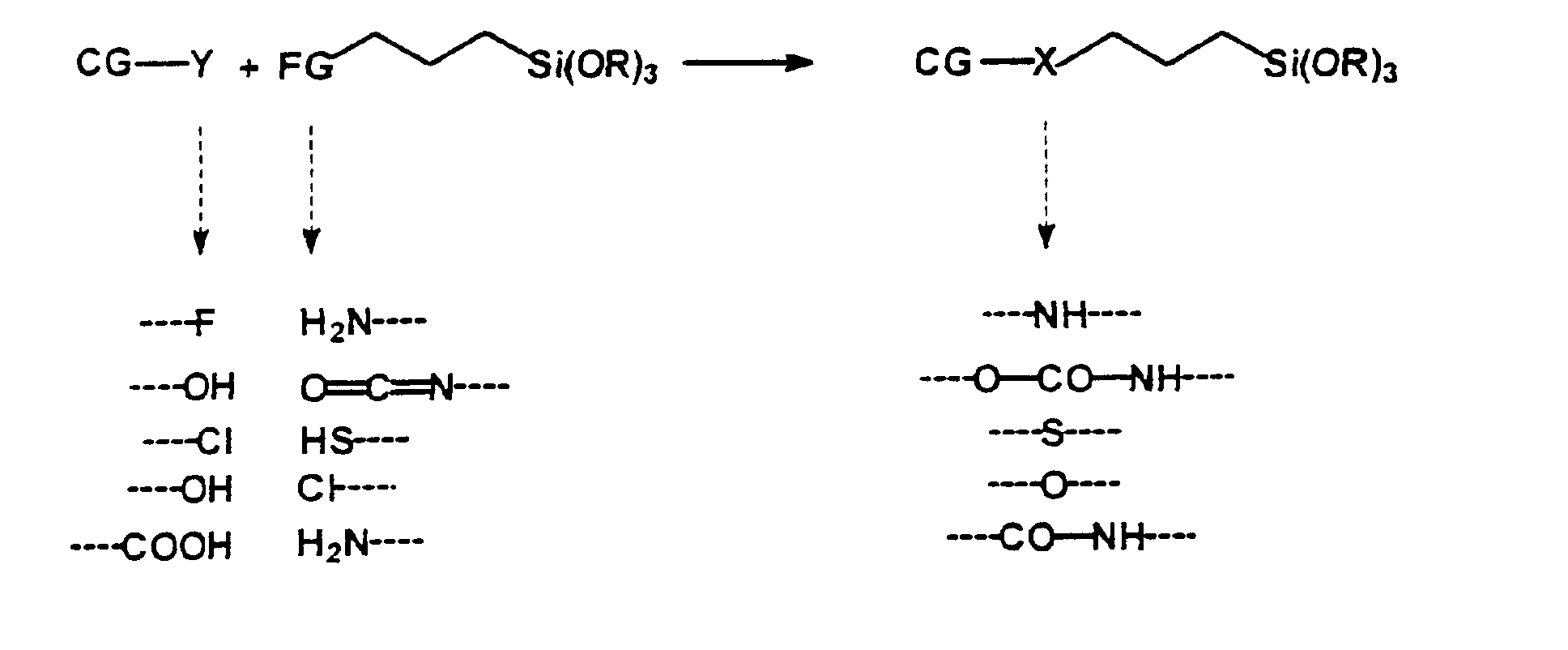
- Chromophore trialkoxysilanes can be obtained, for example, by the chemical reaction of propyltrialkoxysilanes functionalized in the 3-position, for example 3-amino-, 3-chloro-, 3-isocyanato or 3-mercaptotriethoxysilane, with suitably functionalized chromophoric compounds, e.g. B .:
- Y and FG each stand for the functional groups with which the chromophoric compound or the alkyltrialkoxysilane must be equipped in order to enable a reaction in the manner described to form group X.
- Y and FG preferably have the meaning given above and are preferably also implemented in the combinations shown.
- chromophoric xerogels by hydrolytic Condensation, one preferably proceeds in such a way that the hydrolyzing Silanes in the presence of a hydrolysis and condensation catalyst with the required amount of water and the resulting mixture is stirred.
- a mixture is preferred made of TEOS and chromophorem silane.
- the silanes can either as such or dissolved in a suitable solvent available.
- the water is added at room temperature or with slight cooling. After the gel has been formed, the Reaction approach to complete implementation are available for a long time and then separates the solvent used by heating or Evacuate from.
- Aliphatic solvents are the main solvents Alcohols such as As ethanol or i-propanol, dialkyl ketones, such as Acetone or methyl isobutyl ketone, ether, such as. B. Diethyl ether or tetrahydrofuran (THF), esters, such as ethyl or butyl acetate, and their mixtures in question.
- the xerogel obtained can be used for Separation of unreacted components again with a inert solvent and then washed to constant weight be dried. If the hydrolytic condensation in Carried out in the presence of reactive Zr, Ti or Al compounds, the water should be added gradually at approx. 0 to 30 ° C. It is preferred not to use the water as such but in Form of water-based solvents, e.g. aqueous Ethanol, or release it through a chemical reaction, for example by esterification.
- Xerogels with a BET specific surface area of 50 to 800 m 2 / g, in particular 200 to 600 m 2 / g, are preferred.
- the primary particle size of the xerogels determined by means of scanning electron microscopy (SEM) is preferably in the range from 0.1 to 20 ⁇ m, in particular 0.1 to 5 ⁇ m.
- the particle size is a number-average value.
- the pore size determined by means of the BJH method Barnett ET et al .; J.Amer.Soc. 73 (1951) 373) is preferably in the range from 1 to 15 nm, in particular 1 to 10 nm.
- the residual water or solvent content should be below 2.0% by weight, preferably less than 1.0% by weight.
- Simple groups are preferably used as the chromophore, which are coloring, e.g. 4-nitrophenyl derivatives, or also Groups consisting of the known classes of dyes, such as. B. Azo dyes, di- and triarylmethane dyes, xanthene dyes or anthraquinone dyes, and which derive from the radical polymerization does not adversely affect.
- connection of the chromophore to the heteropolysiloxane framework is preferably carried out via a spacer Sp, the propylene groups is particularly preferred as a spacer.
- the propylene groups is particularly preferred as a spacer.
- Functionalized propyltrialkoxysilane which is the starting component where spacers are used are commercially available.
- CO-NH, NH-CO, O-CO-NH, NH-CO-O and NR are particularly suitable as connecting group X.
- the connecting group primarily serves to connect the chromophoric group to the spacer Sp and thus also to the hydrolytically condensable trialkoxysilyl group.
- the chromophoric xerogels are characterized by high color stability over many years, stability against heat, important e.g. when ingesting hot food, and chemical stability towards oxidants or reducing agents. Farther they are in fat, water, alcohol or other solvents not soluble and behave towards the other components inert from dental materials. They are also toxicological harmless.
- chromophore xerogel with a polymerizable binder preferably an organic polymerizable binder mixed. This usually results in a dispersion of the xerogel obtained in the binder. Then the mixture with an initiator for radical polymerization, preferably a photoinitiator, and optionally with other additives and fillers added.
- Suitable free-radically polymerizable binders particularly polymerizable monomers, such as mono (meth) acrylates, e.g. Methyl, ethyl, butyl, benzyl, furfuryl or phenyl (meth) acrylate, as well as the multifunctional known as crosslinking monomers
- Acrylates and methacrylates for example dimethacrylates, such as urethane dimethacrylates, bisphenol A di (meth) acrylate, Bis-GMA (an addition product of methacrylic acid and bisphenol adiglycidyl ether), UDMA (an addition product from 2-hydroxyethyl methacrylate and 2,2,4-trimethylhexamethylene diisocyanate), di-, Tri- or tetraethylene glycol di (meth) acrylate, decanediol di (meth) acrylate, Trimethylolpropane tri (meth) acrylate, pentaerythritol
- the binder content is preferably in the range from 10 to 90 wt .-%, particularly preferably 10 to 80 wt .-%, based on the Total mass of the dental material.
- benzophenone benzoin and their derivatives or ⁇ -diketones or their derivatives, such as 9,10-phenanthrenequinone, Diacetyl or 4,4-dichlorobenzil used.
- Camphorquinone and 2,2-methoxy-2-phenyl-acetophenone and especially preferably ⁇ -diketones, such as camphorquinone in combination with Amines as reducing agents, preferably tertiary amines, such as e.g.
- Initiators are preferably used in an amount of 0.1 to 5.0 % By weight, particularly preferably 0.2 to 2.0% by weight, each based on the total mass of the dental material.
- the dental materials according to the invention can be filled with organic or inorganic particles or fibers to improve the mechanical properties.
- Preferred inorganic particulate fillers are amorphous spherical materials based on oxides, such as ZrO 2 and TiO 2 , or mixed oxides composed of SiO 2 , ZrO 2 and / or TiO 2 , metal oxides with a primary particle size of approx. 40 to 300 nm, splinter polymers with a Particle size of 10-100 ⁇ m (see R.
- Nanoparticulate or microfine fillers such as pyrogenic silica or precipitated silica, as well as macro or mini-fillers, such as quartz, glass-ceramic - Or glass powder with an average particle size of 0.01 to 5 ⁇ m, as well as radiopaque fillers such as ytterbium trifluoride and ground radiopaque glasses with an average particle size between approx. 0.5 and 5 ⁇ m.
- glass fibers, polyamide or carbon fibers can also be used.
- the filler content depends on the desired use of the dental material.
- Cements preferably contain 5 to 60 % By weight, in particular 20 to 60% by weight, of veneering materials preferably 50 to 90 wt .-%, in particular 60 to 80 wt .-% and Filling composites preferably 50 to 90% by weight, in particular 75 up to 85 wt .-% filler, each based on the total mass of Dental Materials.
- compositions used according to the invention contain other additives, e.g. stabilizers, Flavorings, microbicidal agents, optical brighteners, Plasticizers or UV absorbers, inhibitors to prevent premature polymerization and photostabilizers for protection against photooxidative degradation.
- additives e.g. stabilizers, Flavorings, microbicidal agents, optical brighteners, Plasticizers or UV absorbers, inhibitors to prevent premature polymerization and photostabilizers for protection against photooxidative degradation.
- additives are preferred in small amounts from 0.1 to 3.0 in total, in particular 0.1 up to 1.0 wt .-%, based on the total mass of Dental Materials.
- the dental materials according to the invention show during the polymerization compared to materials with conventional pigments Surprisingly, a greater depth of hardening. It can also the chromophoric xerogel content compared to conventional ones Pigments can be reduced significantly without a reduction the color intensity occurs.
- the dental materials are particularly suitable as cements, Facing materials and especially filling composites.
- the chromophore xerogel was examined by means of electron microscopy and 13 C-MAS-CP solid-state NMR. An electron micrograph of the product is shown in Figure 1, the NMR examination gave the following result:
- Example 2 Preparation of a yellow-colored dental Composites based on a chromophore xerogel
- Yellow pigments based on iron oxide are primarily used to color tooth-colored composites. Accordingly, a composite colored in this way was selected as a comparative example. In a preliminary test, it was determined which concentration of chromophoric xerogel is necessary in order to obtain the same color effect as with Light Yellow 8G.
- the method for determining the depth of cure was in accordance with ISO 4049 procedure.
- Example 3 Production of a dark colored dental Composites based on a chromophore xerogel
- tooth-colored composites In addition to yellow pigments, tooth-colored composites also use red, brown and black pigments in order to obtain an optimal tooth color.
- a composite was produced in the Vita shade A3.5, a relatively dark shade, again comparing the yellow pigments light yellow 8 G and the chromophore xerogel.
- Composition of the composite pastes (data in% by weight) and their depth of hardening during photopolymerization Compare paste Xerogel paste Monomer and filler 99.9347 99.9582 Brown pigment 0.0301 0.0301 Red pigment 0.0103 0.0103 Black pigment 0.0004 0.0004 Light yellow 8 G. 0.0245 0 Xerogel from Ex. 1 0 0.0010 Depth of hardening (mm) 3.6 4.0
Landscapes
- Health & Medical Sciences (AREA)
- Oral & Maxillofacial Surgery (AREA)
- Life Sciences & Earth Sciences (AREA)
- Epidemiology (AREA)
- Animal Behavior & Ethology (AREA)
- General Health & Medical Sciences (AREA)
- Public Health (AREA)
- Veterinary Medicine (AREA)
- Organic Chemistry (AREA)
- Plastic & Reconstructive Surgery (AREA)
- Chemical & Material Sciences (AREA)
- Dental Preparations (AREA)
- Silicon Polymers (AREA)
- Polymerisation Methods In General (AREA)
- Graft Or Block Polymers (AREA)
Abstract
Description
- Me
- ein Hauptgruppenmetall der II. bis III. Hauptgruppe oder ein Übergangsmetall der IV. Nebengruppe des Periodensystems der Elemente bedeutet;
- n
- 1 oder 2 ist, wobei m gleich 1 oder 2 ist wenn n gleich 1 ist und m gleich 3 ist wenn n gleich 2 ist;
- Sp
- ein C1- bis C10-Alkylenrest oder C2- bis C10-Oxyalkylenrest mit 1 bis 4 Sauerstoffatomen ist oder entfällt;
- X
- eine Verbindungsgruppe, wie CO-O, O-CO, CO-NH, NH-CO, O-CO-NH, NH-CO-O, NR, O, oder S ist oder entfällt, wobei R Wasserstoff oder ein C1- bis C6-Alkyl-Rest ist;
- CG
- ein Chromophor ist;
- a
- eine ganze Zahl von 0 bis 20 ist und
- b
- eine ganze Zahl von 0 bis 5 ist.
- Me
- Ti, Zr und/oder Al;
- Sp
- ein C1- bis C4-Alkylenrest, vorzugsweise ein Propylenrest;
- X
- CO-NH, NH-CO, O-CO-NH, NH-CO oder NR;
- R
- Wasserstoff oder ein C1- bis C4-Alkyl-Rest, vorzugsweise Methyl;
- CG
- eine 4-Nitrophenyl-Gruppe, aromatische Azogruppe, Di- oder Triarylmethangruppe, Xanthengruppe oder Anthrachinongruppe;
- a
- 0, 1, 2, 3, 4 oder 5; und/oder
- b
- 0, 1, 2, oder 3.


| Zusammensetzung der Kompositpasten (Angaben in Gew-%) und deren Durchhärtungstiefe bei der Photopolymerisation: | ||
| Vergleichspaste | Xerogel-Paste | |
| Monomer | 21,8 | 21,8 |
| Füller | 77,9 | 78,19 |
| Lichtgelb 8G | 0,3 | 0 |
| Xerogel aus Bsp. 1 | 0 | 0,01 |
| Durchhärtungstiefe (mm) | 3,9 | 4,9 |
| Zusammensetzung der Kompositpasten (Angaben in Gew.-%) und deren Durchhärtungstiefe bei der Photopolymerisation | ||
| Vergleichspaste | Xerogel-Paste | |
| Monomer und Füller | 99,9347 | 99,9582 |
| Braun-Pigment | 0,0301 | 0,0301 |
| Rot-Pigment | 0,0103 | 0,0103 |
| Schwarz-Pigment | 0,0004 | 0,0004 |
| Lichtgelb 8 G | 0,0245 | 0 |
| Xerogel aus Bsp. 1 | 0 | 0,0010 |
| Durchhärtungstiefe (mm) | 3,6 | 4,0 |
Claims (15)
- Dentalmaterial auf der Basis polymerisierbarer Bindemittel, dadurch gekennzeichnet, daß es mindestens ein chromophores Xerogel der Formel I enthält:
- Me
- ein Hauptgruppenmetall der II. bis III. Hauptgruppe oder ein Übergangsmetall der IV. Nebengruppe des Periodensystems der Elemente bedeutet;
- n
- 1 oder 2 ist, wobei m gleich 1 oder 2 ist wenn n gleich 1 ist und m gleich 3 ist wenn n gleich 2 ist;
- Sp
- ein C1- bis C10-Alkylenrest oder C2- bis C10-Oxyalkylenrest mit 1 bis 4 Sauerstoffatomen ist oder entfällt;
- X
- eine Verbindungsgruppe, wie CO-O, O-CO, CO-NH, NH-CO, O-CO-NH, NH-CO-O, NR, O, oder S ist oder entfällt, wobei R Wasserstoff oder ein C1- bis C6-Alkyl-Rest ist;
- CG
- ein Chromophor ist;
- a
- eine ganze Zahl von 0 bis 20 ist und
- b
- eine ganze Zahl von 0 bis 5 ist.
- Dentalmaterial nach Anspruch 1, dadurch gekennzeichnet, daß
- Me
- Ti, Zr und/oder Al ist; und/oder
- Sp
- ein C1- bis C4-Alkylenrest, vorzugsweise ein Propylenrest ist; und/oder
- X
- CO-NH, NH-CO, O-CO-NH, NH-CO-O oder NR ist; und/oder
- R
- Wasserstoff oder ein C1- bis C4-Alkyl-Rest, vorzugsweise Methyl ist; und/oder
- CG
- eine 4-Nitrophenyl-Gruppe, aromatische Azogruppe, Dioder Triarylmethangruppe, Xanthengruppe oder Anthrachinongruppe ist; und/oder
- a
- ist 0, 1, 2, 3, 4 oder 5 ist und/oder
- b
- ist 0, 1, 2, oder 3 ist.
- Dentalmaterial nach Anspruch 1 oder 2, dadurch gekennzeichnet, daß es einen Initiator für die radikalische Photopolymerisation enthält.
- Dentalmaterial nach Anspruch 3, dadurch gekennzeichnet, daß es als Initiator ein Benzophenon, Benzoin, α-Diketon, wie 9,10-Phenanthrenchinon, Diacetyl, 4,4-Dichlorbenzil, Campherchinon, 2,2-Methoxy-2-phenyl-acetophenon, Acylphosphin, wie 2,4,6-Trimethylbenzoyldiphenyl- oder Bis(2,6-dichlorbenzoyl)-4-N-propylphenylphosphinoxid, oder ein Derivat der genannten Verbindungen enthält.
- Dentalmaterial nach Anspruch 3 oder 4, dadurch gekennzeichnet, daß es zusätzlich ein Amin als Reduktionsmittel enthält, vorzugsweise 4-(N,N-Dimethylamino)-benzoesäureester,N,N-Dimethylaminoethylmethacrylat, N,N-Dimethyl-sym.xylidin und/oder Triethanolamin.
- Dentalmaterial nach einem der Ansprüche 1 bis 5, dadurch gekennzeichnet, daß es als polymerisierbares Bindemittel Mono(meth)acrylat, z.B. Methyl-, Ethyl-, Butyl-, Benzyl-, Furfuryl- oder Phenyl(meth)acrylat, mehrfunktionelles (Meth)acrylat, wie z.B. Bisphenol-A-di(meth)acrylat, Bis-GMA (ein Additionsprodukt aus Methacrylsäure und Bisphenol-Adiglycidylether), UDMA (ein Additionsprodukt aus 2-Hydroxyethylmethacrylat und 2,2,4-Trimethylhexamethylendiisocyanat), Di-, Tri- oder Tetraethylenglycoldi(meth)acrylat, Decandioldi(meth)acrylat,Trimethylolpropantri(meth)acrylat, Pentaerythrittetra(meth)acrylat, Butandioldi(meth)acrylat, 1,10-Decandioldi(meth)acrylat oder 1,12-Dodecandioldi(meth)acrylat oder eine Mischung dieser Verbindungen enthält.
- Dentalmaterial nach einem der Ansprüche 1 bis 6, dadurch gekennzeichnet, daß es anorganischen oder organischen, teilchenförmigen oder faserförmigen Füllstoff enthält.
- Dentalmaterial nach einem der Ansprüche 1 bis 7, dadurch gekennzeichnet, daß esenthält, jeweils bezogen auf die Gesamtmasse des Dentalmaterials.(a) 0,0001 bis 1,0 Gew.-%, vorzugsweise 0,001 bis 0,1 Gew.-%, chromophores Xerogel der Formel (I);(b) 10 bis 98 Gew.-%, vorzugsweise 10 bis 80 Gew.-% polymerisierbares Bindemittel; und(c) 0,1 bis 5,0 Gew.-%, vorzugsweise 0,2 bis 2,0 Gew.-% Polymerisationsinitiator
- Dentalmaterial nach Anspruch 8, dadurch gekennzeichnet, daß es als weitere Komponente (d) 0 bis 90 Gew.-%, vorzugsweise 0 bis 80 Gew. % Füllstoff enthält, bezogen auf die Gesamtmasse des Dentalmaterials.
- Chromophores Xerogel der Formel I:
- Me
- ein Hauptgruppenmetall der II. bis III. Hauptgruppe oder ein Übergangsmetall der IV. Nebengruppe des Periodensystems der Elemente bedeutet;
- n
- 1 oder 2 ist, wobei m gleich 1 oder 2 ist wenn n gleich 1 ist und m gleich 3 ist wenn n gleich 2 ist;
- Sp
- ein C1- bis C10-Alkylenrest oder C2- bis C10-Oxyalkylenrest mit 1 bis 4 Sauerstoffatomen ist oder entfällt;
- X
- eine Verbindungsgruppe, wie CO-O, O-CO, CO-NH, NH-CO, O-CO-NH, NH-CO-O, NR, O, oder S ist oder entfällt, wobei R Wasserstoff oder ein C1- bis C6-Alkyl-Rest ist;
- CG
- ein Chromophor ist;
- a
- eine ganze Zahl von 0 bis 20 ist und
- b
- eine ganze Zahl von 0 bis 5 ist.
- Verwendung eines chromophoren Xerogels gemäß Anspruch 10 zur Herstellung eines Dentalmaterials.
- Verwendung nach Anspruch 11 zur Herstellung eines photohärtbaren Dentalmaterials.
- Verwendung nach Anspruch 11 oder 12 zur Herstellung von Zementen, Verblendmaterialien oder Füllungskompositen.
- Verfahren zur Herstellung von chromophorem Xerogel gemäß Anspruch 10 bei dem man ein Tetraalkoxysilan und ein chromophores Trialkoxysilan durch hydrolytische Kondensation miteinander umsetzt.
- Verfahren nach Anspruch 14 bei dem man die hydrolytische Kondensation in Gegenwart eines oder mehrerer weiterer Metallalkoxide durchführt.
Applications Claiming Priority (2)
| Application Number | Priority Date | Filing Date | Title |
|---|---|---|---|
| DE10137372 | 2001-07-31 | ||
| DE10137372A DE10137372C2 (de) | 2001-07-31 | 2001-07-31 | Polymerisierbares Dentalmaterial auf der Basis chromophorer Xerogele |
Publications (2)
| Publication Number | Publication Date |
|---|---|
| EP1281383A1 true EP1281383A1 (de) | 2003-02-05 |
| EP1281383B1 EP1281383B1 (de) | 2005-09-21 |
Family
ID=7693779
Family Applications (1)
| Application Number | Title | Priority Date | Filing Date |
|---|---|---|---|
| EP02016298A Expired - Lifetime EP1281383B1 (de) | 2001-07-31 | 2002-07-24 | Polymerisierbares Dentalmaterial auf der Basis chromophorer Xerogele |
Country Status (6)
| Country | Link |
|---|---|
| US (1) | US6833394B2 (de) |
| EP (1) | EP1281383B1 (de) |
| JP (1) | JP3990606B2 (de) |
| AT (1) | ATE304835T1 (de) |
| CA (1) | CA2396604A1 (de) |
| DE (2) | DE10137372C2 (de) |
Cited By (3)
| Publication number | Priority date | Publication date | Assignee | Title |
|---|---|---|---|---|
| WO2004103421A1 (de) * | 2003-05-22 | 2004-12-02 | Artoss Gmbh | Anorganisches resorbierbares knochenersatzmaterial |
| WO2007025698A3 (de) * | 2005-08-29 | 2008-03-20 | Artoss Gmbh | Osteoinduktives material und verfahren zur herstellung desselben |
| CN100591365C (zh) * | 2003-05-22 | 2010-02-24 | 阿托斯有限责任公司 | 无机的可再吸收性骨替代材料 |
Families Citing this family (5)
| Publication number | Priority date | Publication date | Assignee | Title |
|---|---|---|---|---|
| US20040206932A1 (en) * | 2002-12-30 | 2004-10-21 | Abuelyaman Ahmed S. | Compositions including polymerizable bisphosphonic acids and methods |
| JP4507581B2 (ja) * | 2003-12-11 | 2010-07-21 | 株式会社豊田中央研究所 | 色素含有メソ多孔体の製造方法 |
| CN101557791B (zh) * | 2006-12-13 | 2013-05-22 | 3M创新有限公司 | 使用具有酸性组分和可光漂白染料的牙科用组合物的方法 |
| JP2009280822A (ja) * | 2009-07-03 | 2009-12-03 | Honeywell Internatl Inc | フォトリソグラフィ用のスピンオングラス反射防止性コーティング |
| JP6061728B2 (ja) * | 2013-02-27 | 2017-01-18 | 株式会社オートネットワーク技術研究所 | ラジカル、アニオン併用型光硬化材料 |
Citations (8)
| Publication number | Priority date | Publication date | Assignee | Title |
|---|---|---|---|---|
| DE4002726A1 (de) * | 1989-02-06 | 1990-09-06 | Univ Schiller Jena | Zahnrestaurationswerkstoffe |
| WO1993000878A1 (en) * | 1991-07-12 | 1993-01-21 | British Technology Group Ltd. | Sol gel composition for producing glassy coatings |
| EP0744172A2 (de) * | 1995-05-26 | 1996-11-27 | Ivoclar Ag | Photochromer Dentalwerkstoff |
| US5583178A (en) * | 1994-06-30 | 1996-12-10 | Minnesota Mining And Manufacturing Company | Cure-indicating molding and coating composition |
| DE19811900A1 (de) * | 1998-03-18 | 1999-09-23 | Feinchemie Gmbh Sebnitz | Biokompatibles Kompositmaterial |
| EP0948955A1 (de) * | 1997-06-09 | 1999-10-13 | Kuraray Co., Ltd. | Polymerisierbare zusammensetzung für dentalanwendungen |
| DE19846660A1 (de) * | 1998-10-09 | 2000-04-13 | Inst Oberflaechenmodifizierung | Hochtemperaturbeständige polymerisierbare Metalloxidpartikel |
| DE19950284A1 (de) * | 1999-10-19 | 2001-04-26 | Deltamed Medizinprodukte Gmbh | Mit sichtbarem Licht aushärtende Zusammensetzung und deren Verwendung |
Family Cites Families (4)
| Publication number | Priority date | Publication date | Assignee | Title |
|---|---|---|---|---|
| DE3903407A1 (de) * | 1989-02-06 | 1990-08-09 | Blendax Werke Schneider Co | Dentales fuellungsmaterial |
| GB9300261D0 (en) * | 1993-01-08 | 1993-03-03 | British Tech Group | Sol-gel composition for producing glassy coatings |
| US5883153A (en) * | 1993-04-15 | 1999-03-16 | Shofu Inc. | Fluoride ion sustained release preformed glass ionomer filler and dental compositions containing the same |
| GB9309397D0 (en) * | 1993-05-07 | 1993-06-23 | Patel Bipin C M | Laser treatment |
-
2001
- 2001-07-31 DE DE10137372A patent/DE10137372C2/de not_active Expired - Fee Related
-
2002
- 2002-07-23 JP JP2002214427A patent/JP3990606B2/ja not_active Expired - Fee Related
- 2002-07-24 DE DE50204310T patent/DE50204310D1/de not_active Expired - Fee Related
- 2002-07-24 AT AT02016298T patent/ATE304835T1/de active
- 2002-07-24 EP EP02016298A patent/EP1281383B1/de not_active Expired - Lifetime
- 2002-07-30 US US10/209,590 patent/US6833394B2/en not_active Expired - Lifetime
- 2002-07-31 CA CA002396604A patent/CA2396604A1/en not_active Abandoned
Patent Citations (8)
| Publication number | Priority date | Publication date | Assignee | Title |
|---|---|---|---|---|
| DE4002726A1 (de) * | 1989-02-06 | 1990-09-06 | Univ Schiller Jena | Zahnrestaurationswerkstoffe |
| WO1993000878A1 (en) * | 1991-07-12 | 1993-01-21 | British Technology Group Ltd. | Sol gel composition for producing glassy coatings |
| US5583178A (en) * | 1994-06-30 | 1996-12-10 | Minnesota Mining And Manufacturing Company | Cure-indicating molding and coating composition |
| EP0744172A2 (de) * | 1995-05-26 | 1996-11-27 | Ivoclar Ag | Photochromer Dentalwerkstoff |
| EP0948955A1 (de) * | 1997-06-09 | 1999-10-13 | Kuraray Co., Ltd. | Polymerisierbare zusammensetzung für dentalanwendungen |
| DE19811900A1 (de) * | 1998-03-18 | 1999-09-23 | Feinchemie Gmbh Sebnitz | Biokompatibles Kompositmaterial |
| DE19846660A1 (de) * | 1998-10-09 | 2000-04-13 | Inst Oberflaechenmodifizierung | Hochtemperaturbeständige polymerisierbare Metalloxidpartikel |
| DE19950284A1 (de) * | 1999-10-19 | 2001-04-26 | Deltamed Medizinprodukte Gmbh | Mit sichtbarem Licht aushärtende Zusammensetzung und deren Verwendung |
Non-Patent Citations (1)
| Title |
|---|
| CLAUDE, CHARLES; GARETZ, BRUCE; OKAMOTO, YOSHIYUKI: "Organically modified silicates that exhibit nonlinear optical properties by the sol-gel technique", POLYMER PREPRINTS (AMERICAN CHEMICAL SOCIETY, DIVISION OF POLYMER CHEMISTRY), vol. 34, no. 1, 1993, NY (USA), pages 709 - 710, XP008010318 * |
Cited By (3)
| Publication number | Priority date | Publication date | Assignee | Title |
|---|---|---|---|---|
| WO2004103421A1 (de) * | 2003-05-22 | 2004-12-02 | Artoss Gmbh | Anorganisches resorbierbares knochenersatzmaterial |
| CN100591365C (zh) * | 2003-05-22 | 2010-02-24 | 阿托斯有限责任公司 | 无机的可再吸收性骨替代材料 |
| WO2007025698A3 (de) * | 2005-08-29 | 2008-03-20 | Artoss Gmbh | Osteoinduktives material und verfahren zur herstellung desselben |
Also Published As
| Publication number | Publication date |
|---|---|
| ATE304835T1 (de) | 2005-10-15 |
| DE50204310D1 (de) | 2006-02-02 |
| DE10137372C2 (de) | 2003-07-10 |
| CA2396604A1 (en) | 2003-01-31 |
| DE10137372A1 (de) | 2003-02-27 |
| EP1281383B1 (de) | 2005-09-21 |
| US20030060536A1 (en) | 2003-03-27 |
| JP3990606B2 (ja) | 2007-10-17 |
| US6833394B2 (en) | 2004-12-21 |
| JP2003055126A (ja) | 2003-02-26 |
Similar Documents
| Publication | Publication Date | Title |
|---|---|---|
| DE19617931C5 (de) | Verwendung eines gefüllten und polymerisierbaren Materials als Dentalmaterial | |
| EP3150641B1 (de) | Acylgermanium-photoinitiatoren und verfahren zu deren herstellung | |
| EP0040232B2 (de) | Verwendung von kieselsäuregranulaten als füllstoffe für dentalmassen | |
| EP4085893B1 (de) | Transparente, bruchzähe polymerisationsharze zur herstellung dentaler formkörper | |
| EP3166569B1 (de) | Komposite mit gesteuerter netzwerkstruktur | |
| EP1970042B1 (de) | Verwendung von polymerisierbaren Calix[n]arenen als Dentalmaterialien | |
| EP1716836B1 (de) | Oberflächenmodifizierte Füllstoffe | |
| DE19508586C2 (de) | Polymerisierbarer Dentalwerkstoff | |
| DE102005018351A1 (de) | Widerstandsfähige, langlebige, dentale Komposite | |
| EP1732499B1 (de) | Härtbare dentalmaterialien mit einer einstellbaren transluzenz | |
| DE102013007894A9 (de) | Langlebiges Dentalmaterial mit verbesserten transparenten Eigenschaften | |
| EP3868767B1 (de) | Langwellig absorbierende photoinitiatoren | |
| EP1568347B1 (de) | Dispersionen nanoskaliger, nicht-agglomerierter Teilchen zum Einsatz in Dentalmaterialien | |
| DE10137372C2 (de) | Polymerisierbares Dentalmaterial auf der Basis chromophorer Xerogele | |
| EP3363423A1 (de) | Dentaler kompositblock zur herstellung permanenter indirekter restaurationen im cad/cam verfahren | |
| EP2004131B1 (de) | Dentalmaterialien enthaltend hydrophobe, nanopartikuläre kieselsäurecokondensate und deren verwendung | |
| EP2461785A2 (de) | Antimikrobiell ausgestattete dentalmaterialien, insbesondere zur verhinderung von plaqueanlagerungen | |
| EP3590489A1 (de) | Dentalwerkstoffe auf basis von monofunktionellen biphenylmethacrylaten | |
| WO2017108456A1 (de) | Dentalmaterialien mit lichtinduzierter reversibler farbgebung | |
| EP2883528B1 (de) | Dentalwerkstoffe auf Basis von polymerisierbaren Aziden und Alkinen | |
| DE29624496U1 (de) | Gefülltes und polymerisierbares Dentalmaterial |
Legal Events
| Date | Code | Title | Description |
|---|---|---|---|
| PUAI | Public reference made under article 153(3) epc to a published international application that has entered the european phase |
Free format text: ORIGINAL CODE: 0009012 |
|
| AK | Designated contracting states |
Designated state(s): AT BE BG CH CY CZ DE DK EE ES FI FR GB GR IE IT LI LU MC NL PT SE SK TR |
|
| AX | Request for extension of the european patent |
Extension state: AL LT LV MK RO SI |
|
| 17P | Request for examination filed |
Effective date: 20021218 |
|
| AKX | Designation fees paid |
Designated state(s): AT BE BG CH CY CZ DE DK EE ES FI FR GB GR IE IT LI LU MC NL PT SE SK TR |
|
| 17Q | First examination report despatched |
Effective date: 20031219 |
|
| GRAP | Despatch of communication of intention to grant a patent |
Free format text: ORIGINAL CODE: EPIDOSNIGR1 |
|
| GRAS | Grant fee paid |
Free format text: ORIGINAL CODE: EPIDOSNIGR3 |
|
| RIN1 | Information on inventor provided before grant (corrected) |
Inventor name: MOSZNER, NORBERT Inventor name: SPANGE, STEFAN Inventor name: BURTSCHER, PETER Inventor name: RHEINBERGER, VOLKER |
|
| GRAA | (expected) grant |
Free format text: ORIGINAL CODE: 0009210 |
|
| AK | Designated contracting states |
Kind code of ref document: B1 Designated state(s): AT BE BG CH CY CZ DE DK EE ES FI FR GB GR IE IT LI LU MC NL PT SE SK TR |
|
| PG25 | Lapsed in a contracting state [announced via postgrant information from national office to epo] |
Ref country code: IE Free format text: LAPSE BECAUSE OF FAILURE TO SUBMIT A TRANSLATION OF THE DESCRIPTION OR TO PAY THE FEE WITHIN THE PRESCRIBED TIME-LIMIT Effective date: 20050921 Ref country code: CZ Free format text: LAPSE BECAUSE OF FAILURE TO SUBMIT A TRANSLATION OF THE DESCRIPTION OR TO PAY THE FEE WITHIN THE PRESCRIBED TIME-LIMIT Effective date: 20050921 Ref country code: NL Free format text: LAPSE BECAUSE OF FAILURE TO SUBMIT A TRANSLATION OF THE DESCRIPTION OR TO PAY THE FEE WITHIN THE PRESCRIBED TIME-LIMIT Effective date: 20050921 Ref country code: SK Free format text: LAPSE BECAUSE OF FAILURE TO SUBMIT A TRANSLATION OF THE DESCRIPTION OR TO PAY THE FEE WITHIN THE PRESCRIBED TIME-LIMIT Effective date: 20050921 Ref country code: FI Free format text: LAPSE BECAUSE OF FAILURE TO SUBMIT A TRANSLATION OF THE DESCRIPTION OR TO PAY THE FEE WITHIN THE PRESCRIBED TIME-LIMIT Effective date: 20050921 |
|
| REG | Reference to a national code |
Ref country code: GB Ref legal event code: FG4D Free format text: NOT ENGLISH |
|
| REG | Reference to a national code |
Ref country code: CH Ref legal event code: EP Ref country code: CH Ref legal event code: NV Representative=s name: KELLER & PARTNER PATENTANWAELTE AG |
|
| GBT | Gb: translation of ep patent filed (gb section 77(6)(a)/1977) |
Effective date: 20050921 |
|
| REG | Reference to a national code |
Ref country code: IE Ref legal event code: FG4D Free format text: LANGUAGE OF EP DOCUMENT: GERMAN |
|
| REF | Corresponds to: |
Ref document number: 50204310 Country of ref document: DE Date of ref document: 20051027 Kind code of ref document: P |
|
| REG | Reference to a national code |
Ref country code: SE Ref legal event code: TRGR |
|
| PG25 | Lapsed in a contracting state [announced via postgrant information from national office to epo] |
Ref country code: DK Free format text: LAPSE BECAUSE OF FAILURE TO SUBMIT A TRANSLATION OF THE DESCRIPTION OR TO PAY THE FEE WITHIN THE PRESCRIBED TIME-LIMIT Effective date: 20051221 Ref country code: GR Free format text: LAPSE BECAUSE OF FAILURE TO SUBMIT A TRANSLATION OF THE DESCRIPTION OR TO PAY THE FEE WITHIN THE PRESCRIBED TIME-LIMIT Effective date: 20051221 Ref country code: BG Free format text: LAPSE BECAUSE OF FAILURE TO SUBMIT A TRANSLATION OF THE DESCRIPTION OR TO PAY THE FEE WITHIN THE PRESCRIBED TIME-LIMIT Effective date: 20051221 |
|
| PG25 | Lapsed in a contracting state [announced via postgrant information from national office to epo] |
Ref country code: ES Free format text: LAPSE BECAUSE OF FAILURE TO SUBMIT A TRANSLATION OF THE DESCRIPTION OR TO PAY THE FEE WITHIN THE PRESCRIBED TIME-LIMIT Effective date: 20060101 |
|
| REG | Reference to a national code |
Ref country code: SE Ref legal event code: RPOT |
|
| REF | Corresponds to: |
Ref document number: 50204310 Country of ref document: DE Date of ref document: 20060202 Kind code of ref document: P |
|
| PG25 | Lapsed in a contracting state [announced via postgrant information from national office to epo] |
Ref country code: PT Free format text: LAPSE BECAUSE OF FAILURE TO SUBMIT A TRANSLATION OF THE DESCRIPTION OR TO PAY THE FEE WITHIN THE PRESCRIBED TIME-LIMIT Effective date: 20060221 |
|
| NLV1 | Nl: lapsed or annulled due to failure to fulfill the requirements of art. 29p and 29m of the patents act | ||
| REG | Reference to a national code |
Ref country code: IE Ref legal event code: FD4D |
|
| ET | Fr: translation filed | ||
| PLBE | No opposition filed within time limit |
Free format text: ORIGINAL CODE: 0009261 |
|
| STAA | Information on the status of an ep patent application or granted ep patent |
Free format text: STATUS: NO OPPOSITION FILED WITHIN TIME LIMIT |
|
| PG25 | Lapsed in a contracting state [announced via postgrant information from national office to epo] |
Ref country code: BE Free format text: LAPSE BECAUSE OF NON-PAYMENT OF DUE FEES Effective date: 20060731 Ref country code: MC Free format text: LAPSE BECAUSE OF NON-PAYMENT OF DUE FEES Effective date: 20060731 |
|
| 26N | No opposition filed |
Effective date: 20060622 |
|
| BERE | Be: lapsed |
Owner name: IVOCLAR VIVADENT AG Effective date: 20060731 |
|
| PG25 | Lapsed in a contracting state [announced via postgrant information from national office to epo] |
Ref country code: EE Free format text: LAPSE BECAUSE OF FAILURE TO SUBMIT A TRANSLATION OF THE DESCRIPTION OR TO PAY THE FEE WITHIN THE PRESCRIBED TIME-LIMIT Effective date: 20050921 |
|
| PG25 | Lapsed in a contracting state [announced via postgrant information from national office to epo] |
Ref country code: LU Free format text: LAPSE BECAUSE OF NON-PAYMENT OF DUE FEES Effective date: 20060724 Ref country code: TR Free format text: LAPSE BECAUSE OF FAILURE TO SUBMIT A TRANSLATION OF THE DESCRIPTION OR TO PAY THE FEE WITHIN THE PRESCRIBED TIME-LIMIT Effective date: 20050921 |
|
| PG25 | Lapsed in a contracting state [announced via postgrant information from national office to epo] |
Ref country code: CY Free format text: LAPSE BECAUSE OF FAILURE TO SUBMIT A TRANSLATION OF THE DESCRIPTION OR TO PAY THE FEE WITHIN THE PRESCRIBED TIME-LIMIT Effective date: 20050921 |
|
| PGFP | Annual fee paid to national office [announced via postgrant information from national office to epo] |
Ref country code: DE Payment date: 20080924 Year of fee payment: 7 |
|
| PG25 | Lapsed in a contracting state [announced via postgrant information from national office to epo] |
Ref country code: DE Free format text: LAPSE BECAUSE OF NON-PAYMENT OF DUE FEES Effective date: 20100202 |
|
| PGFP | Annual fee paid to national office [announced via postgrant information from national office to epo] |
Ref country code: CH Payment date: 20140722 Year of fee payment: 13 |
|
| PGFP | Annual fee paid to national office [announced via postgrant information from national office to epo] |
Ref country code: FR Payment date: 20140724 Year of fee payment: 13 Ref country code: SE Payment date: 20140722 Year of fee payment: 13 Ref country code: AT Payment date: 20140620 Year of fee payment: 13 Ref country code: GB Payment date: 20140721 Year of fee payment: 13 |
|
| PGFP | Annual fee paid to national office [announced via postgrant information from national office to epo] |
Ref country code: IT Payment date: 20140728 Year of fee payment: 13 |
|
| REG | Reference to a national code |
Ref country code: CH Ref legal event code: PCAR Free format text: NEW ADDRESS: EIGERSTRASSE 2 POSTFACH, 3000 BERN 14 (CH) |
|
| REG | Reference to a national code |
Ref country code: CH Ref legal event code: PL |
|
| REG | Reference to a national code |
Ref country code: SE Ref legal event code: EUG |
|
| REG | Reference to a national code |
Ref country code: AT Ref legal event code: MM01 Ref document number: 304835 Country of ref document: AT Kind code of ref document: T Effective date: 20150724 |
|
| GBPC | Gb: european patent ceased through non-payment of renewal fee |
Effective date: 20150724 |
|
| PG25 | Lapsed in a contracting state [announced via postgrant information from national office to epo] |
Ref country code: CH Free format text: LAPSE BECAUSE OF NON-PAYMENT OF DUE FEES Effective date: 20150731 Ref country code: GB Free format text: LAPSE BECAUSE OF NON-PAYMENT OF DUE FEES Effective date: 20150724 Ref country code: IT Free format text: LAPSE BECAUSE OF NON-PAYMENT OF DUE FEES Effective date: 20150724 Ref country code: LI Free format text: LAPSE BECAUSE OF NON-PAYMENT OF DUE FEES Effective date: 20150731 |
|
| REG | Reference to a national code |
Ref country code: FR Ref legal event code: ST Effective date: 20160331 |
|
| PG25 | Lapsed in a contracting state [announced via postgrant information from national office to epo] |
Ref country code: FR Free format text: LAPSE BECAUSE OF NON-PAYMENT OF DUE FEES Effective date: 20150731 Ref country code: AT Free format text: LAPSE BECAUSE OF NON-PAYMENT OF DUE FEES Effective date: 20150724 Ref country code: SE Free format text: LAPSE BECAUSE OF NON-PAYMENT OF DUE FEES Effective date: 20150725 |