EP1276144B1 - Verfahren und Vorrichtung, um den Durchbruch ultradünner dielektrischer Schichten festzustellen - Google Patents
Verfahren und Vorrichtung, um den Durchbruch ultradünner dielektrischer Schichten festzustellen Download PDFInfo
- Publication number
- EP1276144B1 EP1276144B1 EP02447071.8A EP02447071A EP1276144B1 EP 1276144 B1 EP1276144 B1 EP 1276144B1 EP 02447071 A EP02447071 A EP 02447071A EP 1276144 B1 EP1276144 B1 EP 1276144B1
- Authority
- EP
- European Patent Office
- Prior art keywords
- readings
- values
- breakdown
- current
- ref
- Prior art date
- Legal status (The legal status is an assumption and is not a legal conclusion. Google has not performed a legal analysis and makes no representation as to the accuracy of the status listed.)
- Expired - Lifetime
Links
Images


Classifications
-
- H—ELECTRICITY
- H10—SEMICONDUCTOR DEVICES; ELECTRIC SOLID-STATE DEVICES NOT OTHERWISE PROVIDED FOR
- H10P—GENERIC PROCESSES OR APPARATUS FOR THE MANUFACTURE OR TREATMENT OF DEVICES COVERED BY CLASS H10
- H10P74/00—Testing or measuring during manufacture or treatment of wafers, substrates or devices
- H10P74/20—Testing or measuring during manufacture or treatment of wafers, substrates or devices characterised by the properties tested or measured, e.g. structural or electrical properties
- H10P74/203—Structural properties, e.g. testing or measuring thicknesses, line widths, warpage, bond strengths or physical defects
Definitions
- Oxide breakdown is one of the most threatening failure mechanisms in integrated circuits. As the oxide thickness is decreased in the sub-5nm range, the breakdown definition itself is no longer clear and its detection becomes problematic.
- the present invention is related to methods of detecting the breakdown in dielectric layers, in particular oxide layers of such low thickness.
- SBD is usually associated with a smaller current jump during a Constant Voltage Stress (CVS) or a smaller voltage drop during Constant Current Stress (CCS) compared to the HBD case.
- CVS Constant Voltage Stress
- CCS Constant Current Stress
- the soft and hard breakdowns are caused by the same physical mechanism: SBD is considered to be a breakdown without the thermal runaway effects that lead to a low-resistance breakdown path connecting gate and substrate [1].
- SBD occurs when the generated density of traps during a CVS or CCS has sufficiently increased to generate (at some random place on the capacitor area) a breakdown path of traps connecting anode with cathode.
- SBD is (just as HBD) a local event.
- Ig-Vg characteristic of the SBD is, apart from some statistical fluctuations, independent of the test area [3].
- This IV-curve is the most unambiguous signature of an SBD event, and measuring it is therefore the most direct way to detect SBD.
- this approach has the disadvantage that the stress needs to be interrupted at regular time intervals to measure the low voltage current. This is time-consuming and might influence the time-to-breakdown, especially when the current or voltage overshoot at the start of each stress interval is not well-controlled.
- US 5804975 discloses the detection of the breakdown of an ultra-thin dielectric layer by applying a test signal to the layer. Measurements are taken of noise signals present in the layer during the application of the test signal. At breakdown, a significant increase occurs in the amplitude of the measured noise signals.
- the present invention aims to provide a accurate method for detecting soft breakdown events in integrated circuit devices, wherein a reduced sensitivity is present to pre-breakdown events, resulting in a lower probability of erroneous breakdown detection.
- the present invention is related to a method for detecting breakdown in a dielectric layer, comprising the steps of:
- the value of said one selected reading is the median (m r ) of the values of said set of readings.
- a second set of readings is measured, said second set consisting of at least twice the amount of readings of said first set of readings, and wherein said reference value is a function of the value of a selected reading of said second set, said selected reading being selected in the same way as said selected reading of said first set.
- the value of said selected reading of said second set is the median (m ref ) of the values of said second set of readings.
- the sorting of said sets of readings is preferably done according to an indirect insertion sorting technique.
- said signal is a voltage signal, corresponding to a voltage difference across said layer, and said readings are absolute values of the change of the current flowing through said layer, as a consequence of said voltage signal, said change being calculated on the basis of a set of current readings, as the difference between two subsequent current readings of said set.
- said signal is a current signal, corresponding to a current flowing through said layer, and said readings are absolute values of the change of the voltage across said layer, as a consequence of said current signal, said change being calculated on the basis of a set of voltage readings, as the difference between two subsequent voltage readings of said set.
- an apparatus for detecting breakdown in a dielectric layer comprising:
- said means for comparing comprises means for sorting said sets of readings according to an indirect insertion sorting technique.
- said test signal may be a voltage signal, corresponding to a voltage difference across said layer, in which case said readings are absolute values of current changes.
- said test signal may be a current signal, corresponding to a current through said layer, in which case said readings are absolute values of voltage changes.
- the present invention is related to a new optimized trigger algorithm for SBD based on gate current noise increase that is sufficiently reliable to be applied for real-time, automatic BD detection. Automated BD tests often stress the devices till HBD occurs. The method according to the invention even allows interruption of the CVS upon detection of SBD, resulting in considerably shorter overall test times.
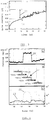
- the current vs. time behaviour in small dimension transistors during a Constant Voltage Stress shows RTS-like events 2 as illustrated in fig. 1 .
- These gate current jumps are not breakdowns, but pre-breakdown events because the t BD -distributions obtained on two different areas by triggering on these jumps do not line up after the well-known area scaling law has been applied.
- a 5 percent step trigger is needed to approximate the noise-triggered distribution. Only the noise-triggered distributions line up for both areas, proving that the gate current steps observed in small area devices are not breakdowns, but pre-breakdown events.
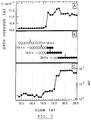
- the simplest approach to applying noise for breakdown detection is monitoring the sample standard deviation of a number of gate current values, preferably in a subset containing a fixed number n r of consecutive current measurements including the last measured value.
- the set should be chosen sufficiently large to generate statistically relevant parameters, but it should still be sufficiently small to allow for an acceptable time resolution.
- the 'running' estimate s' for the standard deviation ⁇ will increase when the gate current noise increases at breakdown.
- the present invention solves this problem in an elegant way by selecting a value of the ⁇ set which is not an outlier value, as the breakdown monitor.
- An outlier value can then be defined as a value which is significantly higher or lower than the majority of values in the set.
- outlier values are identified by the fact that they exceed a predefined border value, such 10 -9 A in the example above.
- the selected value is the median m r of the ⁇ set.
- finding the median of a dataset consists of sorting the data and taking the middle value as the central value estimator, see the vertical arrows above each set of ⁇ I-values.
- the average of the middle two values is taken. This complication can be avoided by requiring an odd number of ⁇ values.
- curve 23 shows the evolution of m r as a function of time. m r is not increased by the gate current peak, which introduces only one high ⁇ I-value in the set, which in turn does not affect the running median m r .
- a running reference value is constructed along with the running non-outlier value, preferably the median m r .
- the running reference is constructed in an identical way as m r , but it is based on n ref current values, with n ref >2 ⁇ n r .
- a second set of n ref -1 current changes is calculated on the basis of the n ref current values, and the running reference is selected as a non-outlier value of said second set.
- the running reference is the median m ref of said second set. Breakdown is triggered when a significant difference between m ref and m r is detected, or equivalently, when the ratio m r /m ref exceeds a given value 'a'.
- the median m r is compared to a reference value which is a linear function a.m ref , of the reference median m ref .
- a.m ref a linear function of the reference median m ref .
- this test simply reduces to finding when the square root of the F-ratio exceeds a fixed detection threshold which can be calculated before the stress measurement starts.
- a default 99.73% value for the significance probability is preferably chosen, as this corresponds with the 3 ⁇ limits for a normally distributed signal, which is commonly used for statistical process control purposes.
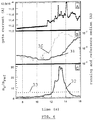
- Fig. 6A shows the current increase due to SBD.
- Curves 30 and 31 represent the m r and m ref values, as a function of time.
- the m r -curve 30 shows a rather gradual increase, making it difficult for a simple step detecting algorithm to trigger properly.
- Fig. 6C shows the evolution of the ratio m r /m ref .
- the real-time detection algorithm has to be designed in a computationally efficient way, so that it can keep up with the stream of incoming current values from the measurement hardware. Performing a complete sort of each range subset upon acquisition of a new current value would take a considerable amount of the computation time needed by the algorithm. It is more efficient to perform an indirect insertion sort (see also reference [6]) "on the fly" on an array of moving range values stored in a cyclic way. Indirect sorting reorders an array of indices to the data points instead of the data points themselves.
- the m r /m ref ratio detection level determines the detection efficiency of the algorithm: for Gaussian noise, a higher m r /m ref ratio lowers the ⁇ risk (representing the probability of false early detections) at the expense of a higher ⁇ risk (representing the probability of overlooking a true noise increase due to SBD). A proper balance between these two risks should be determined for a given measurement setup by means of a calibration procedure.
- n r and n ref values enhance the distinctive power of the detection algorithm: both the ⁇ risk and the ⁇ risk are predictably lower for Gaussian noise.
- increasing n r and n ref also enhances the robustness of the algorithm against "non-Normal" events like spikes, pre-BD steps, and more specifically, longer RTS-like signals, as a larger amount of outlier ranges have to accumulate in the sorted moving range statistic before they reach its middle.
- using larger n r and n ref values for detection is at the expense of a lower time resolution for the t BD values: as half of the short range sample collection time is taken as the average delay time for detection, longer samples correspond with a larger uncertainty on t BD .
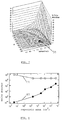
- the 3D surface plot in fig. 7 shows an experimental verification of the algorithm efficiency as a function of n r and the m r /m ref -ratio detection level.
- the t BD times (either SBD or HBD) of a set of NMOS transistors with 2.4 nm gate oxide thickness stressed in inversion at 4.4V were determined through visual inspection of the I(t) curves measured till HBD. Some I(t) curves showing a slow gradual increase of the noise were discarded from the original dataset, as it was too hard to unambiguously pinpoint the SBD time on them. Note that once the SBD detection algorithm according to the invention is tuned properly, it can be used to determine the SBD time for the "problem" I(t) curves as well.
- the percentage of false detections were then plotted as a function of n r and m r /m ref ( fig. 7 ) .
- n r and m r /m ref values lead to an extremely high percentage of false early SBD detections (above 50%). In this region of the plot, the experimental ⁇ risk dominates.
- higher n r and m r /m ref values lead to a relatively high percentage of late detections (above 5%): the experimental ⁇ risk dominates in that region of the plot.
- Fig. 9 shows the detection margin for a 1 mm 2 capacitor as a function of the stress voltage.
- the background noise of the measurement system must be smaller than the signature noise attributed to SBD.
- the resolution of the current meter must be such that it is capable of measuring the noise before breakdown.
- Digital current meters return quantised current levels when the true current fluctuations are close to their resolution limit, resulting in occasional zero m ref values.
- the algorithm can be protected against this by replacing any of the corresponding zero ⁇ ref values with the user-specified ⁇ ref value, if occurring.
- the voltage source compliance setting can be used as a separate trigger for HBD.
- some voltage sources return a constant measured current value when in compliance. The noise detection algorithm cannot be used for detection of the HBD event then, so that this separate HBD trigger is even mandatory for such configurations.
- the present invention is related to an accurate and robust triggering algorithm for soft breakdown based on gate current noise increase that is sufficiently reliable to be applied for real-time, automatic BD detection, with acceptable execution speed if implemented properly. Triggering on current spikes or pre-BD events is avoided. This test assures correct SBD-detection in a wide range of stress conditions and various geometries. The efficiency of the algorithm and the influence of its parameters have been discussed.
- Appendix 1 The median moving range as a robust sigma estimator
- This appendix explains how the concept of a robust ⁇ estimator originates from Statistical Process Control (SPC) and derives the relationship between the median moving range and the corresponding sigma predictor for a Normally distributed signal.
- SPC Statistical Process Control
- a process In a production environment, a process is under control when the variation of a chosen output parameter is within a given required tolerance.
- the capability of a process is defined as the ratio between this tolerance and the lowest achievable output variation.
- Statistical process control is the method of choice to assess this capability, and to timely detect significant deviations from the target output.
- the mean moving range E(r) of a process characteristic signal is often used to predict its short term variation.
- the historical data used for that purpose often show slow process drifts, so that the historical sample standard deviation s' becomes significantly larger than the true short term random deviation ⁇ reflecting the process capability.
- the mean moving range filters out most of the signal drift, if occurring.
- a sufficient amount of historical data is needed to reliably predict the true population ⁇ value using a predictor based on the mean moving range.
- a sufficiently long process characteristic even shows sudden shifts caused by input parameter adjustments (e.g. to correct for a known drift due to machine wearout). Such shifts show up as outliers in the moving range statistic.
- the mean moving range is linearly sensitive to outliers, so that a ⁇ predictor based on it can become artificially larger and cause an underestimation of the process capability.
- steps and RTS-like signals can also be seen as sudden shifts of the characteristic signal.
- the median moving range m r even filters out such outliers, so that a ⁇ predictor based on it will be more robust against that type of non-Normality of the signal.
- the proof is based on the properties of a Poisson process.
- the moving range statistic (with a subgroup size of 2) consists of taking the absolute value of those differences, thus mirroring the left side of the density function to the right. Due to the symmetry of the density function, this simply doubles the part to the right of the vertical axis.
- This appendix shows how the execution time of the algorithm can be reduced considerably by using indirect insertion sorting for the real-time computation of both median moving range values.
- This approach even allows to store only a single array of (n ref -1) range values in memory and to perform the indirect insertion sort for both m r and m ref using 2 arrays of indices to that same ⁇ subset.
- the index array Sh_rng_indx is filled. Because the indices are uniquely defined, it is possible to continue as follows:
Landscapes
- Testing Of Individual Semiconductor Devices (AREA)
- Testing Or Measuring Of Semiconductors Or The Like (AREA)
- Testing Relating To Insulation (AREA)
Claims (5)
- Verfahren zur Erkennung eines Durchschlags (1, 12) einer dielektrischen Schicht, umfassend die Schritte:- Anwenden eines Signals auf die dielektrische Schicht,- Messen einer Mehrzahl Messwertsätze mit Werten, die mit dem Signal zusammenhängen,- Suchen und Identifizieren von Ausreißer-Messwerten in jedem der Sätze, wobei die Ausreißer-Messwerte dadurch definiert sind, dass sie Werte aufweisen, die die Mehrheit der Werte des Satzes deutlich übersteigen bzw. unterschreiten,- Auswählen eines Messwerts, der kein Ausreißer-Messwert ist, aus jedem der Sätze,- Vergleichen des Werts des ausgewählten Messwerts mit einem Bezugswert, damit das Überschreiten des Werts zum Schluss führt, dass eine vorgegebene Wahrscheinlichkeit eines Durchschlagzustandes der Schicht vorliegt,dadurch gekennzeichnet, dass- für jeden Messwertsatz ein zweiter Messwertsatz gemessen wird, wobei der zweite Messwertsatz aus mindestens dem Zweifachen der Anzahl der Messwerte des ersten Messwertsatzes besteht, und wobei der Bezugswert eine Funktion eines ausgewählten Messwerts des zweiten Messwertsatzes ist, wobei der ausgewählte Messwert auf die gleiche Weise ausgewählt wird wie der ausgewählte Messwert des ersten Messwertsatzes, und- der Wert des ausgewählten Messwerts des zweiten Messwertsatzes der Median (mref) der Werte des zweiten Messwertsatzes ist, und- die Funktion eine lineare Funktion f(mref) = amref mit einem vorgegebenen Faktor "a" ist.
- Verfahren nach Anspruch 1, wobei der Wert des einen ausgewählten Messwerts der Median (mr) der Werte des ersten Messwertsatzes ist.
- Verfahren nach einem der Ansprüche 1 - 2, wobei das Sortieren der Messwertsätze gemäß einer indirekten Insertion-Sorting-Methode erfolgt.
- Verfahren nach Anspruch 3, wobei das Signal ein Spannungssignal ist, das einem Spannungsunterschied über der Schicht entspricht, und wobei die Messwerte absolute Werte der Änderung, infolge des Spannungssignal, des durch die Schicht fließenden Stroms sind, wobei die Änderung aufgrund eines Satzes mit Spannungsmesswerten als Unterschied zwischen zwei anschließenden Strommesswerten des Satzes berechnet wird.
- Verfahren nach Anspruch 3, wobei das Signal ein Stromsignal ist, das einem durch die Schicht fließenden Strom entspricht, und wobei die Messwerte absolute Werte der Änderung, infolge des Stromsignals, der Spannung über der Schicht sind, wobei die Änderung aufgrund eines Satzes mit Spannungsmesswerten als Unterschied zwischen zwei anschließenden Spannungsmesswerten des Satzes berechnet wird.
Applications Claiming Priority (2)
| Application Number | Priority Date | Filing Date | Title |
|---|---|---|---|
| US28702801P | 2001-04-27 | 2001-04-27 | |
| US287028P | 2001-04-27 |
Publications (3)
| Publication Number | Publication Date |
|---|---|
| EP1276144A2 EP1276144A2 (de) | 2003-01-15 |
| EP1276144A3 EP1276144A3 (de) | 2009-06-24 |
| EP1276144B1 true EP1276144B1 (de) | 2019-02-27 |
Family
ID=23101166
Family Applications (1)
| Application Number | Title | Priority Date | Filing Date |
|---|---|---|---|
| EP02447071.8A Expired - Lifetime EP1276144B1 (de) | 2001-04-27 | 2002-04-22 | Verfahren und Vorrichtung, um den Durchbruch ultradünner dielektrischer Schichten festzustellen |
Country Status (2)
| Country | Link |
|---|---|
| US (1) | US6777972B2 (de) |
| EP (1) | EP1276144B1 (de) |
Families Citing this family (4)
| Publication number | Priority date | Publication date | Assignee | Title |
|---|---|---|---|---|
| JP4051332B2 (ja) * | 2003-11-07 | 2008-02-20 | 株式会社日立ハイテクノロジーズ | 検査データ解析システム |
| US8493075B2 (en) | 2010-09-08 | 2013-07-23 | International Business Machines Corporation | Method and apparatus for preventing circuit failure |
| US9285417B2 (en) | 2013-01-02 | 2016-03-15 | Globalfoundries Inc. | Low-voltage IC test for defect screening |
| CN119247057B (zh) * | 2024-09-25 | 2025-09-16 | 华中科技大学 | 一种获取电介质击穿强度所需最小样本数的确定方法 |
Family Cites Families (3)
| Publication number | Priority date | Publication date | Assignee | Title |
|---|---|---|---|---|
| US5804975A (en) * | 1996-09-18 | 1998-09-08 | Lucent Technologies Inc. | Detecting breakdown in dielectric layers |
| US6255841B1 (en) * | 1999-05-20 | 2001-07-03 | Lucent Technologies, Inc. | Statistical system and method for testing integrated circuits |
| JP2001021609A (ja) * | 1999-07-07 | 2001-01-26 | Mitsubishi Electric Corp | 半導体集積回路の検査方法 |
-
2002
- 2002-04-22 US US10/127,381 patent/US6777972B2/en not_active Expired - Lifetime
- 2002-04-22 EP EP02447071.8A patent/EP1276144B1/de not_active Expired - Lifetime
Non-Patent Citations (1)
| Title |
|---|
| None * |
Also Published As
| Publication number | Publication date |
|---|---|
| EP1276144A2 (de) | 2003-01-15 |
| EP1276144A3 (de) | 2009-06-24 |
| US6777972B2 (en) | 2004-08-17 |
| US20030016046A1 (en) | 2003-01-23 |
Similar Documents
| Publication | Publication Date | Title |
|---|---|---|
| US8266572B2 (en) | Method for acquiring overshoot voltage and analyzing degradation of a gate insulation using the same | |
| US7619435B2 (en) | Method and system for derivation of breakdown voltage for MOS integrated circuit devices | |
| US6242934B1 (en) | Background leakage zeroing by temperature and voltage dependence for IDDQ measurement and defect resolution | |
| Alam et al. | A study of soft and hard breakdown-Part II: Principles of area, thickness, and voltage scaling | |
| US6326792B1 (en) | Method and apparatus for lifetime prediction of dielectric breakdown | |
| US5804975A (en) | Detecting breakdown in dielectric layers | |
| US5485097A (en) | Method of electrically measuring a thin oxide thickness by tunnel voltage | |
| US5793212A (en) | Method of measuring the breakdown charge of a dielectric film | |
| KR101074832B1 (ko) | 전기회로에 있어서의 결함들을 분류하고 전기회로에 대한공정문제들을 인식하는 시스템 및 방법 | |
| US6014034A (en) | Method for testing semiconductor thin gate oxide | |
| US6777972B2 (en) | Method and apparatus for detecting breakdown in ultra thin dielectric layers | |
| Alers et al. | J-ramp on sub-3 nm dielectrics: noise as a breakdown criterion | |
| US12158442B2 (en) | IC structure moisture ingress detection by current hump in current-voltage response curve | |
| US6524872B1 (en) | Using fast hot-carrier aging method for measuring plasma charging damage | |
| US6528335B2 (en) | Electrical method for assessing yield-limiting asperities in silicon-on-insulator wafers | |
| KR100640637B1 (ko) | 회로에 설계된 모스 트랜지스터의 시간 의존형 유전체 브렉다운 특성 불량 검출 방법 | |
| Van Beek et al. | Ultrafast RVS as an efficient method to measure oxide breakdown in the EOS and ESD time domain | |
| Afanasenko et al. | Online Degradation Detection and Estimation of SiC Power MOSFET based on TSEP | |
| Balachandran et al. | Improvement of SRAM-based failure analysis using calibrated Iddq testing | |
| JP2007258488A (ja) | 絶縁膜の絶縁破壊寿命推定方法 | |
| JP2584093B2 (ja) | 絶縁膜の信頼性評価方法 | |
| US7315974B2 (en) | Method for detecting faults in electronic devices, based on quiescent current measurements | |
| US20080229264A1 (en) | Semiconductor evaluation apparatus, semiconductor evaluation method and semiconductor evaluation program | |
| US6858448B2 (en) | Method for evaluating and manufacturing a semiconductor device | |
| KR100515880B1 (ko) | 반도체 소자의 게이트 산화막 항복 전압 측정 방법 |
Legal Events
| Date | Code | Title | Description |
|---|---|---|---|
| PUAI | Public reference made under article 153(3) epc to a published international application that has entered the european phase |
Free format text: ORIGINAL CODE: 0009012 |
|
| AK | Designated contracting states |
Kind code of ref document: A2 Designated state(s): AT BE CH CY DE DK ES FI FR GB GR IE IT LI LU MC NL PT SE TR |
|
| AX | Request for extension of the european patent |
Free format text: AL;LT;LV;MK;RO;SI |
|
| PUAL | Search report despatched |
Free format text: ORIGINAL CODE: 0009013 |
|
| AK | Designated contracting states |
Kind code of ref document: A3 Designated state(s): AT BE CH CY DE DK ES FI FR GB GR IE IT LI LU MC NL PT SE TR |
|
| AX | Request for extension of the european patent |
Extension state: AL LT LV MK RO SI |
|
| RAP1 | Party data changed (applicant data changed or rights of an application transferred) |
Owner name: IMEC |
|
| 17P | Request for examination filed |
Effective date: 20091127 |
|
| AKX | Designation fees paid |
Designated state(s): AT BE CH CY DE DK ES FI FR GB GR IE IT LI LU MC NL PT SE TR |
|
| 17Q | First examination report despatched |
Effective date: 20100308 |
|
| STAA | Information on the status of an ep patent application or granted ep patent |
Free format text: STATUS: EXAMINATION IS IN PROGRESS |
|
| RAP1 | Party data changed (applicant data changed or rights of an application transferred) |
Owner name: IMEC VZW |
|
| GRAP | Despatch of communication of intention to grant a patent |
Free format text: ORIGINAL CODE: EPIDOSNIGR1 |
|
| STAA | Information on the status of an ep patent application or granted ep patent |
Free format text: STATUS: GRANT OF PATENT IS INTENDED |
|
| INTG | Intention to grant announced |
Effective date: 20180913 |
|
| GRAS | Grant fee paid |
Free format text: ORIGINAL CODE: EPIDOSNIGR3 |
|
| GRAA | (expected) grant |
Free format text: ORIGINAL CODE: 0009210 |
|
| STAA | Information on the status of an ep patent application or granted ep patent |
Free format text: STATUS: THE PATENT HAS BEEN GRANTED |
|
| RIC1 | Information provided on ipc code assigned before grant |
Ipc: H01L 21/66 20060101AFI20021120BHEP |
|
| AK | Designated contracting states |
Kind code of ref document: B1 Designated state(s): AT BE CH CY DE DK ES FI FR GB GR IE IT LI LU MC NL PT SE TR |
|
| REG | Reference to a national code |
Ref country code: GB Ref legal event code: FG4D |
|
| REG | Reference to a national code |
Ref country code: CH Ref legal event code: EP |
|
| REG | Reference to a national code |
Ref country code: DE Ref legal event code: R096 Ref document number: 60249798 Country of ref document: DE |
|
| REG | Reference to a national code |
Ref country code: AT Ref legal event code: REF Ref document number: 1102555 Country of ref document: AT Kind code of ref document: T Effective date: 20190315 |
|
| REG | Reference to a national code |
Ref country code: IE Ref legal event code: FG4D |
|
| REG | Reference to a national code |
Ref country code: NL Ref legal event code: MP Effective date: 20190227 |
|
| PG25 | Lapsed in a contracting state [announced via postgrant information from national office to epo] |
Ref country code: NL Free format text: LAPSE BECAUSE OF FAILURE TO SUBMIT A TRANSLATION OF THE DESCRIPTION OR TO PAY THE FEE WITHIN THE PRESCRIBED TIME-LIMIT Effective date: 20190227 Ref country code: SE Free format text: LAPSE BECAUSE OF FAILURE TO SUBMIT A TRANSLATION OF THE DESCRIPTION OR TO PAY THE FEE WITHIN THE PRESCRIBED TIME-LIMIT Effective date: 20190227 Ref country code: PT Free format text: LAPSE BECAUSE OF FAILURE TO SUBMIT A TRANSLATION OF THE DESCRIPTION OR TO PAY THE FEE WITHIN THE PRESCRIBED TIME-LIMIT Effective date: 20190627 Ref country code: FI Free format text: LAPSE BECAUSE OF FAILURE TO SUBMIT A TRANSLATION OF THE DESCRIPTION OR TO PAY THE FEE WITHIN THE PRESCRIBED TIME-LIMIT Effective date: 20190227 |
|
| PG25 | Lapsed in a contracting state [announced via postgrant information from national office to epo] |
Ref country code: GR Free format text: LAPSE BECAUSE OF FAILURE TO SUBMIT A TRANSLATION OF THE DESCRIPTION OR TO PAY THE FEE WITHIN THE PRESCRIBED TIME-LIMIT Effective date: 20190528 |
|
| REG | Reference to a national code |
Ref country code: AT Ref legal event code: MK05 Ref document number: 1102555 Country of ref document: AT Kind code of ref document: T Effective date: 20190227 |
|
| PG25 | Lapsed in a contracting state [announced via postgrant information from national office to epo] |
Ref country code: DK Free format text: LAPSE BECAUSE OF FAILURE TO SUBMIT A TRANSLATION OF THE DESCRIPTION OR TO PAY THE FEE WITHIN THE PRESCRIBED TIME-LIMIT Effective date: 20190227 Ref country code: ES Free format text: LAPSE BECAUSE OF FAILURE TO SUBMIT A TRANSLATION OF THE DESCRIPTION OR TO PAY THE FEE WITHIN THE PRESCRIBED TIME-LIMIT Effective date: 20190227 Ref country code: IT Free format text: LAPSE BECAUSE OF FAILURE TO SUBMIT A TRANSLATION OF THE DESCRIPTION OR TO PAY THE FEE WITHIN THE PRESCRIBED TIME-LIMIT Effective date: 20190227 |
|
| REG | Reference to a national code |
Ref country code: DE Ref legal event code: R097 Ref document number: 60249798 Country of ref document: DE |
|
| REG | Reference to a national code |
Ref country code: CH Ref legal event code: PL |
|
| REG | Reference to a national code |
Ref country code: BE Ref legal event code: MM Effective date: 20190430 |
|
| PG25 | Lapsed in a contracting state [announced via postgrant information from national office to epo] |
Ref country code: AT Free format text: LAPSE BECAUSE OF FAILURE TO SUBMIT A TRANSLATION OF THE DESCRIPTION OR TO PAY THE FEE WITHIN THE PRESCRIBED TIME-LIMIT Effective date: 20190227 Ref country code: MC Free format text: LAPSE BECAUSE OF FAILURE TO SUBMIT A TRANSLATION OF THE DESCRIPTION OR TO PAY THE FEE WITHIN THE PRESCRIBED TIME-LIMIT Effective date: 20190227 Ref country code: LU Free format text: LAPSE BECAUSE OF NON-PAYMENT OF DUE FEES Effective date: 20190422 |
|
| PLBE | No opposition filed within time limit |
Free format text: ORIGINAL CODE: 0009261 |
|
| STAA | Information on the status of an ep patent application or granted ep patent |
Free format text: STATUS: NO OPPOSITION FILED WITHIN TIME LIMIT |
|
| GBPC | Gb: european patent ceased through non-payment of renewal fee |
Effective date: 20190527 |
|
| PG25 | Lapsed in a contracting state [announced via postgrant information from national office to epo] |
Ref country code: LI Free format text: LAPSE BECAUSE OF NON-PAYMENT OF DUE FEES Effective date: 20190430 Ref country code: CH Free format text: LAPSE BECAUSE OF NON-PAYMENT OF DUE FEES Effective date: 20190430 |
|
| 26N | No opposition filed |
Effective date: 20191128 |
|
| PG25 | Lapsed in a contracting state [announced via postgrant information from national office to epo] |
Ref country code: BE Free format text: LAPSE BECAUSE OF NON-PAYMENT OF DUE FEES Effective date: 20190430 |
|
| PG25 | Lapsed in a contracting state [announced via postgrant information from national office to epo] |
Ref country code: TR Free format text: LAPSE BECAUSE OF FAILURE TO SUBMIT A TRANSLATION OF THE DESCRIPTION OR TO PAY THE FEE WITHIN THE PRESCRIBED TIME-LIMIT Effective date: 20190227 |
|
| PG25 | Lapsed in a contracting state [announced via postgrant information from national office to epo] |
Ref country code: IE Free format text: LAPSE BECAUSE OF NON-PAYMENT OF DUE FEES Effective date: 20190422 Ref country code: GB Free format text: LAPSE BECAUSE OF NON-PAYMENT OF DUE FEES Effective date: 20190527 |
|
| PGFP | Annual fee paid to national office [announced via postgrant information from national office to epo] |
Ref country code: FR Payment date: 20200319 Year of fee payment: 19 |
|
| PGFP | Annual fee paid to national office [announced via postgrant information from national office to epo] |
Ref country code: DE Payment date: 20200319 Year of fee payment: 19 |
|
| PG25 | Lapsed in a contracting state [announced via postgrant information from national office to epo] |
Ref country code: CY Free format text: LAPSE BECAUSE OF FAILURE TO SUBMIT A TRANSLATION OF THE DESCRIPTION OR TO PAY THE FEE WITHIN THE PRESCRIBED TIME-LIMIT Effective date: 20190227 |
|
| REG | Reference to a national code |
Ref country code: DE Ref legal event code: R119 Ref document number: 60249798 Country of ref document: DE |
|
| PG25 | Lapsed in a contracting state [announced via postgrant information from national office to epo] |
Ref country code: DE Free format text: LAPSE BECAUSE OF NON-PAYMENT OF DUE FEES Effective date: 20211103 Ref country code: FR Free format text: LAPSE BECAUSE OF NON-PAYMENT OF DUE FEES Effective date: 20210430 |