EP1273428A1 - Polyester film and process for producing the same - Google Patents
Polyester film and process for producing the same Download PDFInfo
- Publication number
- EP1273428A1 EP1273428A1 EP00906744A EP00906744A EP1273428A1 EP 1273428 A1 EP1273428 A1 EP 1273428A1 EP 00906744 A EP00906744 A EP 00906744A EP 00906744 A EP00906744 A EP 00906744A EP 1273428 A1 EP1273428 A1 EP 1273428A1
- Authority
- EP
- European Patent Office
- Prior art keywords
- film
- less
- polyester
- layer
- light
- Prior art date
- Legal status (The legal status is an assumption and is not a legal conclusion. Google has not performed a legal analysis and makes no representation as to the accuracy of the status listed.)
- Withdrawn
Links
Classifications
-
- B—PERFORMING OPERATIONS; TRANSPORTING
- B29—WORKING OF PLASTICS; WORKING OF SUBSTANCES IN A PLASTIC STATE IN GENERAL
- B29C—SHAPING OR JOINING OF PLASTICS; SHAPING OF MATERIAL IN A PLASTIC STATE, NOT OTHERWISE PROVIDED FOR; AFTER-TREATMENT OF THE SHAPED PRODUCTS, e.g. REPAIRING
- B29C59/00—Surface shaping of articles, e.g. embossing; Apparatus therefor
- B29C59/16—Surface shaping of articles, e.g. embossing; Apparatus therefor by wave energy or particle radiation, e.g. infrared heating
-
- C—CHEMISTRY; METALLURGY
- C08—ORGANIC MACROMOLECULAR COMPOUNDS; THEIR PREPARATION OR CHEMICAL WORKING-UP; COMPOSITIONS BASED THEREON
- C08J—WORKING-UP; GENERAL PROCESSES OF COMPOUNDING; AFTER-TREATMENT NOT COVERED BY SUBCLASSES C08B, C08C, C08F, C08G or C08H
- C08J5/00—Manufacture of articles or shaped materials containing macromolecular substances
- C08J5/18—Manufacture of films or sheets
-
- C—CHEMISTRY; METALLURGY
- C08—ORGANIC MACROMOLECULAR COMPOUNDS; THEIR PREPARATION OR CHEMICAL WORKING-UP; COMPOSITIONS BASED THEREON
- C08J—WORKING-UP; GENERAL PROCESSES OF COMPOUNDING; AFTER-TREATMENT NOT COVERED BY SUBCLASSES C08B, C08C, C08F, C08G or C08H
- C08J7/00—Chemical treatment or coating of shaped articles made of macromolecular substances
- C08J7/12—Chemical modification
- C08J7/123—Treatment by wave energy or particle radiation
-
- G—PHYSICS
- G11—INFORMATION STORAGE
- G11B—INFORMATION STORAGE BASED ON RELATIVE MOVEMENT BETWEEN RECORD CARRIER AND TRANSDUCER
- G11B5/00—Recording by magnetisation or demagnetisation of a record carrier; Reproducing by magnetic means; Record carriers therefor
- G11B5/62—Record carriers characterised by the selection of the material
- G11B5/73—Base layers, i.e. all non-magnetic layers lying under a lowermost magnetic recording layer, e.g. including any non-magnetic layer in between a first magnetic recording layer and either an underlying substrate or a soft magnetic underlayer
- G11B5/739—Magnetic recording media substrates
- G11B5/73923—Organic polymer substrates
- G11B5/73927—Polyester substrates, e.g. polyethylene terephthalate
- G11B5/73931—Two or more layers, at least one layer being polyester
-
- G—PHYSICS
- G11—INFORMATION STORAGE
- G11B—INFORMATION STORAGE BASED ON RELATIVE MOVEMENT BETWEEN RECORD CARRIER AND TRANSDUCER
- G11B5/00—Recording by magnetisation or demagnetisation of a record carrier; Reproducing by magnetic means; Record carriers therefor
- G11B5/84—Processes or apparatus specially adapted for manufacturing record carriers
- G11B5/8404—Processes or apparatus specially adapted for manufacturing record carriers manufacturing base layers
-
- B—PERFORMING OPERATIONS; TRANSPORTING
- B29—WORKING OF PLASTICS; WORKING OF SUBSTANCES IN A PLASTIC STATE IN GENERAL
- B29C—SHAPING OR JOINING OF PLASTICS; SHAPING OF MATERIAL IN A PLASTIC STATE, NOT OTHERWISE PROVIDED FOR; AFTER-TREATMENT OF THE SHAPED PRODUCTS, e.g. REPAIRING
- B29C35/00—Heating, cooling or curing, e.g. crosslinking or vulcanising; Apparatus therefor
- B29C35/02—Heating or curing, e.g. crosslinking or vulcanizing during moulding, e.g. in a mould
- B29C35/08—Heating or curing, e.g. crosslinking or vulcanizing during moulding, e.g. in a mould by wave energy or particle radiation
- B29C35/0805—Heating or curing, e.g. crosslinking or vulcanizing during moulding, e.g. in a mould by wave energy or particle radiation using electromagnetic radiation
- B29C2035/0827—Heating or curing, e.g. crosslinking or vulcanizing during moulding, e.g. in a mould by wave energy or particle radiation using electromagnetic radiation using UV radiation
-
- B—PERFORMING OPERATIONS; TRANSPORTING
- B29—WORKING OF PLASTICS; WORKING OF SUBSTANCES IN A PLASTIC STATE IN GENERAL
- B29K—INDEXING SCHEME ASSOCIATED WITH SUBCLASSES B29B, B29C OR B29D, RELATING TO MOULDING MATERIALS OR TO MATERIALS FOR MOULDS, REINFORCEMENTS, FILLERS OR PREFORMED PARTS, e.g. INSERTS
- B29K2067/00—Use of polyesters or derivatives thereof, as moulding material
-
- B—PERFORMING OPERATIONS; TRANSPORTING
- B29—WORKING OF PLASTICS; WORKING OF SUBSTANCES IN A PLASTIC STATE IN GENERAL
- B29K—INDEXING SCHEME ASSOCIATED WITH SUBCLASSES B29B, B29C OR B29D, RELATING TO MOULDING MATERIALS OR TO MATERIALS FOR MOULDS, REINFORCEMENTS, FILLERS OR PREFORMED PARTS, e.g. INSERTS
- B29K2105/00—Condition, form or state of moulded material or of the material to be shaped
- B29K2105/25—Solid
- B29K2105/253—Preform
- B29K2105/256—Sheets, plates, blanks or films
-
- B—PERFORMING OPERATIONS; TRANSPORTING
- B29—WORKING OF PLASTICS; WORKING OF SUBSTANCES IN A PLASTIC STATE IN GENERAL
- B29K—INDEXING SCHEME ASSOCIATED WITH SUBCLASSES B29B, B29C OR B29D, RELATING TO MOULDING MATERIALS OR TO MATERIALS FOR MOULDS, REINFORCEMENTS, FILLERS OR PREFORMED PARTS, e.g. INSERTS
- B29K2995/00—Properties of moulding materials, reinforcements, fillers, preformed parts or moulds
- B29K2995/0037—Other properties
- B29K2995/0072—Roughness, e.g. anti-slip
-
- B—PERFORMING OPERATIONS; TRANSPORTING
- B29—WORKING OF PLASTICS; WORKING OF SUBSTANCES IN A PLASTIC STATE IN GENERAL
- B29K—INDEXING SCHEME ASSOCIATED WITH SUBCLASSES B29B, B29C OR B29D, RELATING TO MOULDING MATERIALS OR TO MATERIALS FOR MOULDS, REINFORCEMENTS, FILLERS OR PREFORMED PARTS, e.g. INSERTS
- B29K2995/00—Properties of moulding materials, reinforcements, fillers, preformed parts or moulds
- B29K2995/0037—Other properties
- B29K2995/0087—Wear resistance
-
- B—PERFORMING OPERATIONS; TRANSPORTING
- B29—WORKING OF PLASTICS; WORKING OF SUBSTANCES IN A PLASTIC STATE IN GENERAL
- B29L—INDEXING SCHEME ASSOCIATED WITH SUBCLASS B29C, RELATING TO PARTICULAR ARTICLES
- B29L2007/00—Flat articles, e.g. films or sheets
- B29L2007/008—Wide strips, e.g. films, webs
-
- B—PERFORMING OPERATIONS; TRANSPORTING
- B29—WORKING OF PLASTICS; WORKING OF SUBSTANCES IN A PLASTIC STATE IN GENERAL
- B29L—INDEXING SCHEME ASSOCIATED WITH SUBCLASS B29C, RELATING TO PARTICULAR ARTICLES
- B29L2017/00—Carriers for sound or information
- B29L2017/008—Tapes
-
- C—CHEMISTRY; METALLURGY
- C08—ORGANIC MACROMOLECULAR COMPOUNDS; THEIR PREPARATION OR CHEMICAL WORKING-UP; COMPOSITIONS BASED THEREON
- C08J—WORKING-UP; GENERAL PROCESSES OF COMPOUNDING; AFTER-TREATMENT NOT COVERED BY SUBCLASSES C08B, C08C, C08F, C08G or C08H
- C08J2367/00—Characterised by the use of polyesters obtained by reactions forming a carboxylic ester link in the main chain; Derivatives of such polymers
- C08J2367/02—Polyesters derived from dicarboxylic acids and dihydroxy compounds
-
- Y—GENERAL TAGGING OF NEW TECHNOLOGICAL DEVELOPMENTS; GENERAL TAGGING OF CROSS-SECTIONAL TECHNOLOGIES SPANNING OVER SEVERAL SECTIONS OF THE IPC; TECHNICAL SUBJECTS COVERED BY FORMER USPC CROSS-REFERENCE ART COLLECTIONS [XRACs] AND DIGESTS
- Y10—TECHNICAL SUBJECTS COVERED BY FORMER USPC
- Y10S—TECHNICAL SUBJECTS COVERED BY FORMER USPC CROSS-REFERENCE ART COLLECTIONS [XRACs] AND DIGESTS
- Y10S428/00—Stock material or miscellaneous articles
- Y10S428/90—Magnetic feature
-
- Y—GENERAL TAGGING OF NEW TECHNOLOGICAL DEVELOPMENTS; GENERAL TAGGING OF CROSS-SECTIONAL TECHNOLOGIES SPANNING OVER SEVERAL SECTIONS OF THE IPC; TECHNICAL SUBJECTS COVERED BY FORMER USPC CROSS-REFERENCE ART COLLECTIONS [XRACs] AND DIGESTS
- Y10—TECHNICAL SUBJECTS COVERED BY FORMER USPC
- Y10T—TECHNICAL SUBJECTS COVERED BY FORMER US CLASSIFICATION
- Y10T428/00—Stock material or miscellaneous articles
- Y10T428/24—Structurally defined web or sheet [e.g., overall dimension, etc.]
- Y10T428/24355—Continuous and nonuniform or irregular surface on layer or component [e.g., roofing, etc.]
-
- Y—GENERAL TAGGING OF NEW TECHNOLOGICAL DEVELOPMENTS; GENERAL TAGGING OF CROSS-SECTIONAL TECHNOLOGIES SPANNING OVER SEVERAL SECTIONS OF THE IPC; TECHNICAL SUBJECTS COVERED BY FORMER USPC CROSS-REFERENCE ART COLLECTIONS [XRACs] AND DIGESTS
- Y10—TECHNICAL SUBJECTS COVERED BY FORMER USPC
- Y10T—TECHNICAL SUBJECTS COVERED BY FORMER US CLASSIFICATION
- Y10T428/00—Stock material or miscellaneous articles
- Y10T428/31504—Composite [nonstructural laminate]
- Y10T428/31678—Of metal
- Y10T428/31681—Next to polyester, polyamide or polyimide [e.g., alkyd, glue, or nylon, etc.]
-
- Y—GENERAL TAGGING OF NEW TECHNOLOGICAL DEVELOPMENTS; GENERAL TAGGING OF CROSS-SECTIONAL TECHNOLOGIES SPANNING OVER SEVERAL SECTIONS OF THE IPC; TECHNICAL SUBJECTS COVERED BY FORMER USPC CROSS-REFERENCE ART COLLECTIONS [XRACs] AND DIGESTS
- Y10—TECHNICAL SUBJECTS COVERED BY FORMER USPC
- Y10T—TECHNICAL SUBJECTS COVERED BY FORMER US CLASSIFICATION
- Y10T428/00—Stock material or miscellaneous articles
- Y10T428/31504—Composite [nonstructural laminate]
- Y10T428/31786—Of polyester [e.g., alkyd, etc.]
Definitions
- the present invention relates to a polyester film having fine protrusions formed on a surface. More specifically, the present invention relates to a polyester film that has good running durability and wear resistance and also has extremely good productivity and, when used as a base material for a magnetic recording medium particularly having a ferromagnetic metal thin film layer thereon, exhibits good output characteristics, and also relates to a process for producing the polyester film.
- irradiation with ultraviolet light is employed in the coating or lamination of a chemical substance (e.g., UV-curable resin) on a surface of a polyester film to improve the adhesion, cohesion, anti-static properties, mechanical properties, optical properties and so on or in the patterning of the surface with a photosensitive resin (e.g., Japanese Unexamined Patent Application Publication No. 11-6513).
- a chemical substance e.g., UV-curable resin
- a photosensitive resin e.g., Japanese Unexamined Patent Application Publication No. 11-6513
- irradiation of a film with ultraviolet light has been employed for denaturing a chemical substance applied on the film (e.g., curing of an ultraviolet curable resin layer) or for modifying the chemical properties of the film surface (e.g., improvement in adhesion of the surface).
- the object of the present invention is to provide a high quality polyester film that has a surface superior in running durability and wear resistance, exhibits good output characteristics when used in a magnetic recording medium, and is superior in productivity, process simplification and production cost, and also to provide a production process for the polyester film.
- the present inventors have made intensive studies for the purpose of achieving the above object. As a result, it has been found that a method for forming surface protrusions by an internal heating system utilizing electron transition caused by irradiation with ultraviolet light can make it possible to form fine protrusions on the irradiated surface stably, so that a polyester film surface can be produced that is far superior to that produced by the conventional surface protrusion formation technologies achieved by heat transfer or external radiant heating with hot air, a heated roll or an infrared heater. This finding leads to the accomplishment of the invention.
- a magnetic recording medium having good output characteristics can be produced stably.
- the production process for a polyester film of the present invention encompasses the following desirable embodiments.
- the film produced by the present process is characterized in that: (1) fine protrusions are present on at least one surface of the film, the ratio of 10-point average roughness Rz to center line average roughness Ra (Rz/Ra) on the surface is less than 20, and the concentration of carboxyl groups in the surface layer part of a thin layer which provides the surface is greater than that in the inside of the thin layer; and/or (2) a film surface portion that contains no protrusion with a protrusion height of 10 nm or more constitutes at least 5% of the whole film surface, and the number of protrusions with a protrusion height of not less than 3 nm and less than 5 nm in the film surface portion is not less than 1x10 6 /mm 2 and less than 1x10 9 /mm 2 .
- the polyester refers to a polymer produced by condensation polymerization of a diol and a dicarboxylic acid.
- the dicarboxylic acid is typically terephthalic acid, isophthalic acid, phthalic acid, naphthalenedicarboxylic acid, adipic acid, sebacic acid or the like.
- the diol is typically ethylene glycol, trimethylene glycol, tetramethylene glycol, cyclohexane dimethanol or the like.
- polyester examples include polymethylene terephthalate, polyethylene terephthalate, polypropylene terephthalate, polyethylene isophthalate, tetramethylene terephthalate, polyethylene-p-oxybenzoate, poly-1,4-cyclohexylene dimethylene terephthalate and polyethylene-2,6-naphthalate.
- the energy density refers to an integrated value which is measured with a UV meter equipped with a sensor capable of detecting light of 300 to 390 nm in wavelength.
- the energy density is less than 0.1 J/cm 2 or the irradiation time is shorter than 0.01 second, then fine protrusions are not likely to be formed. On the contrary, if the energy density exceeds 10 J/cm 2 or the irradiation time exceeds 100 seconds, then deterioration of the surface would be increased and the wear resistance would be degraded.
- the film surface with UV light after irradiating the film surface with UV light, it is preferred to stretch the film in a longitudinal direction and/or a transverse direction.
- the irradiation with UV light is performed prior to stretching a biaxially oriented polyester film in a longitudinal direction and/or a transverse direction.
- the biaxially oriented polyester film refers to a polyester film oriented both in a transverse direction and a machine direction.
- the transverse direction and the machine direction mean a longitudinal direction and a transverse direction of the film, respectively.
- the degree of orientation fn of the film surface is preferably 0.08 to 0.20, more preferably 0.01 to 0.19, in view of the scratch resistance.
- the inorganic particles include, for example, particles of an oxide such as silicon oxide, aluminum oxide, magnesium oxide and titanium oxide; a composite oxide such as kaolin, talk and montmorillionite; a carbonate such as calcium carbonate and barium carbonate; a sulfate such as calcium sulfate and barium sulfate; a titanate such as barium titanate and potassium titanate; a phosphate such as calcium phosphate tribasic, calcium phosphate dibasic and calcium phosphate monobasic; or the like, but are not restricted to these compounds. Two or more of these compounds may be used in combination depending on the intended use.
- an oxide such as silicon oxide, aluminum oxide, magnesium oxide and titanium oxide
- a composite oxide such as kaolin, talk and montmorillionite
- a carbonate such as calcium carbonate and barium carbonate
- a sulfate such as calcium sulfate and barium sulfate
- a titanate such as barium titanate and potassium titanate
- the measurement was made by adding hexafluoroisopropanol dropwise onto the film surface on a spin coater to dissolve the film surface or, alternatively, shaving a portion of the surface layer part with a razor to reduce the thickness of the thin layer to 1/2 of the original thickness and then doing the above-mentioned carboxyl group labeling.
- Measure device Apparatus body SSX-100 (manufactured by SSI, USA) X ray source Al-K ⁇ (10kv, 20 mA) (Conditions for measurement) Degree of vacuum 5 ⁇ 10 -7 Pa Photo escape angle 35°
- compositional analysis was made by means of the microscopic FT-IR method (Fourier's transformation microscopy infrared spectroscopy).
- the content of particles was determined based on the ratio of peak arising from a carbonyl group in a polyester to peak arising from materials other than the polyester.
- the ratio of polyester weight to a total weight of polyester plus other materials was determined from a calibration curve prepared in advance with use of samples of known weights.
- An X-ray microanalyzer may also be employed, if required.
- a solvent can be selectively used which dissolve a polyester but does not dissolve a particle material
- the polyester was dissolved, and the particles were separated by centrifugally from the polyester.
- the weight percentage of the particle material was determined.
- the films were ranked as follows. Scratches with 0.5 ⁇ m or less in depth excellent Scratches with 0.5 to 2 ⁇ m in depth good Scratches with 2 ⁇ m or greater in depth unacceptable
- the state of surface protrusion formation was evaluated by determining a surface roughness Ra as measured by the method in (4) above and the number of surface protrusions as determined by the method in (8) above at 10 locations in a transverse direction and 30 locations in a longitudinal direction of the film as a 10 cm spacing, and the state of the film was ranked on the following scales on the basis of the variation in determined values.
- Pellets of polyethylene terephthalate were prepared in the conventional manner in which 0.2% by weight of spherical crosslinked polystyrene particles with an average particle diameter of 0.2 ⁇ m and 0.05% by weight of spherical crosslinked polystyrene particles with an average particle diameter of 0.3 ⁇ m (intrinsic viscosity: 0.62, melting point: 258°C, ⁇ Tcg: 80°C).
- a deposit layer of cobalt-nickel alloy (Ni: 20% by weight) was provided in a thickness of 200 nm on the surface of the A layer side of the film using a continuous vacuum deposition apparatus in the presence of a trace amount of oxygen.
- a carbon protective layer was formed on the deposit layer surface in the conventional manner, and the resultant film was slit in a 8 mm width to obtain a pancake. From the pancake, a 200 m tape was taken and installed in a cassette as a cassette tape with a ferromagnetic metal thin film layer (ME tape). The output characteristics of the tape were evaluated and the results are shown in Table 3.
- Example 3 in the case where the energy density is increased, the surface fine protrusions can be formed satisfactorily even when the irradiation time is reduced to 1/3 of that employed in Example 1.
- the surface deterioration was promoted, scratch resistance was somewhat reduced, and surface roughness and number of protrusions were also reduced.
- the non-stretched film was introduced to a converging UV light irradiation device and irradiated with UV light from the both surfaces of the film for 1.0 second.
- the UV lamp used was of the same type as in Example 1.
- the film was stretched 3.5 times in a longitudinal direction at 90°C, and then stretched 4.8 times in a transverse direction at 95°C at a stretching rate of 2000%/min.
- the resultant film was subjected to heat treatment at 220°C for 5 seconds under constant tension, thereby obtaining a biaxially oriented polyester film with a thickness of 7 ⁇ m.
- the non-stretched film was heated with a radiation heater so that the film surface temperature became 185°C and heat-treated at the same temperature for 4 seconds.
- the resultant film was stretched 4.2 times in a transverse direction at 110°C with a tenter.
- the film was stretched 1.3 times in a longitudinal direction at 120°C followed by heat treatment at 210°C for 5 seconds under constant tension, thereby obtaining a biaxially oriented polyester film with a B layer thickness of 1 ⁇ m and a whole thickness of 7 ⁇ m.
- a ferromagnetic thin film layer was formed in the same manner as in Example 1, thereby obtaining a cassette tape (ME tape).
- polyester A polyethylene terephthalate polymerized in the conventional manner (polymerization catalysts: 0.20% by weight of magnesium acetate, 0.03% by weight of antimony trioxide and 0.20% by weight of dimethyl phenylphosphate as a phosphorus compound) was used (intrinsic viscosity: 0.63, melting point: 258°C, ⁇ Tcg: 68°C, solution haze: 1.8%).
- polyester B polyester pellets without particles were used. The pellets were separately dried, and supplied to two extruders, respectively.
- the polyester film of the present invention produced by the present process is quite useful as a base film for a magnetic recording material, particularly for a magnetic recording medium having a ferromagnetic metal thin film layer thereon.
- the present polyester film can also be widely and effectively utilized for various film applications such as thermal transfer ribbons, heat-sensitive mimeograph stencils and electric capacitors.
Landscapes
- Chemical & Material Sciences (AREA)
- Health & Medical Sciences (AREA)
- Manufacturing & Machinery (AREA)
- Engineering & Computer Science (AREA)
- Chemical Kinetics & Catalysis (AREA)
- Medicinal Chemistry (AREA)
- Polymers & Plastics (AREA)
- Organic Chemistry (AREA)
- Toxicology (AREA)
- Materials Engineering (AREA)
- General Chemical & Material Sciences (AREA)
- Manufacture Of Macromolecular Shaped Articles (AREA)
- Magnetic Record Carriers (AREA)
- Laminated Bodies (AREA)
Abstract
The present invention provides a polyester film
particularly useful as a base film for a magnetic recording
medium such as cassette-type magnetic tape of a digital
recording mode and a production process thereof. The
polyester film is produced by irradiating UV light onto a
surface of a film in a non-stretched stage or a stage prior
to the completion of stretching to form fine protrusions on
the surface. The fine protrusions on the film surface are
specified by the ratio of 10-point average roughness Rz to
center line average roughness Ra (Rz/Ra) on the surface
(less than 20), the difference in concentration of carboxyl
groups between the surface layer part and the inside of the
film, and the number of fine protrusions.
Description
The present invention relates to a polyester film
having fine protrusions formed on a surface. More
specifically, the present invention relates to a polyester
film that has good running durability and wear resistance
and also has extremely good productivity and, when used as a
base material for a magnetic recording medium particularly
having a ferromagnetic metal thin film layer thereon,
exhibits good output characteristics, and also relates to a
process for producing the polyester film.
Polyester films can be formed in a continuous manner
into large area films which cannot be produced with other
resin materials. In addition, because of their good
properties in strength, durability, transparency,
flexibility and surface characteristics, they have been used
in the fields needing them in large quantities, such as
magnetic recording, industrial, packaging, agricultural and
building materials. Among them, biaxially oriented
polyester films have been used in various fields because of
their good mechanical, thermal and electric properties and
good chemical resistance. In particular, as base films for
magnetic tapes, polyester films are unrivaled by other films
in usefulness.
In recent years, in the process for processing a
polyester film, the process for deposition and application
of a magnetic layer during the magnetic recording medium
production or the process for application of a heat
sensitive transfer layer during the thermal transfer
material production, it is demanded to increase the
processing speed or to further improve the quality of a
finished product. As these requirements grow, it is also
required that polyester films have a film surface with more
improved running durability and wear resistance.
To meet the requirements stated above, it is known to
be effective to uniformly form fine protrusions on a surface
of a polyester film. For example, a polyester film is known
in which substantially spherical silica particles such as
colloidal silica are contained to provide fine protrusions
on the film surface (e.g., Japanese Unexamined Patent
Application Publication No. 59-171623). A polyester film is
also known in which a thin film layer containing fine
particles that provide surface protrusions is laminated on a
base layer (e.g., Japanese Unexamined Patent Application
Publication Nos. 62-130848, 2-77431 and 8-30958).
On the other hand, magnetic recording media are
becoming denser with each passing year and the wavelength
employed for recording is becoming shorter, and the mode of
recording is shifting from analogue form to digital form.
When a ferromagnetic metal thin film layer is provided on
one surface of a base film to produce a magnetic recording
medium, the ferromagnetic metal thin film layer is usually
provided on an ultra-flat film surface. In this case, since
the ferromagnetic thin film layer generally has a thickness
of as thin as about 0.02 to 0.5 µm, the surface geography of
the base film may be directly reflected as the surface
geography of the finished ferromagnetic thin film.
Therefore, it is strongly required to reduce the height of
surface protrusions of a base film and form ultra-fine
protrusions at high density to provide surface smoothness
and surface slipperiness, and development of films having a
surface that satisfies these requirements has been demanded.
If ultra-fine particles are contained in the film
surface in a large amount, however, generation of coarse
protrusions caused by aggregation of the particles cannot be
avoided and it would be difficult to form fine protrusions
uniformly and at high density by using particles. Although
addition of particles is effective for imparting surface
slipperiness to the finished film and reducing the friction
coefficient between the film and a conveyor roll during the
film forming/processing process, problems still remain that
coarse protrusions may drop off onto the conveyer roll so as
to scratching the film and that the output characteristics
of a magnetic tape produced using the film may be
deteriorated. Therefore, it is quite difficult to employ
the above-mentioned particle addition method as the means
for forming ultra-fine protrusions at a high density in the
industrial production.
An alternative method is known in which desired fine
protrusions are formed on a surface by the action of
crystallization of polyester without relying on the particle
addition method (e.g., Japanese Unexamined Patent
Application Publication No. 7-1575). According to the
method utilizing the crystallization of polyester, the
finished film can have good running durability and wear
resistance since generation of voids around the particles
can be prevented.
As the techniques for utilizing the crystallization of
polyester, there are known a heat treatment method by
winding a polyester film around a heated roll; a heat
treatment method with an infrared heater; and a method of
heating with a stenter. However, these methods have serious
problems of (1) and (2) below. In these conventional
heating methods, since the whole film is heated, there is
also such a problem that troubles resulting from slack and
adhesion of the film may frequently occur.
Alternatively, it has been employed to irradiate a film
with ultraviolet light for modification of chemical
properties and patterning of a film surface. For example,
irradiation with ultraviolet light is employed in the
coating or lamination of a chemical substance (e.g., UV-curable
resin) on a surface of a polyester film to improve
the adhesion, cohesion, anti-static properties, mechanical
properties, optical properties and so on or in the
patterning of the surface with a photosensitive resin (e.g.,
Japanese Unexamined Patent Application Publication No. 11-6513).
There is a method in which an ultraviolet curable
resin layer containing powder particles is provided on the
film surface and the curable resin layer is then irradiated
with ultraviolet light to form recessed-and-projecting
patterns on the surface (e.g., Japanese Unexamined Patent
Application Publication Nos. 11-277451 and 10-296944). As a
method for chemically modifying the film surface, there is a
method in which active oxygen is generated by the
combination of ozone treatment and ultraviolet ray treatment
to improve the adhesion of the film surface (e.g., Japanese
Unexamined Patent Application Publication Nos. 5-68934 and
11-236460).
As mentioned above, irradiation of a film with
ultraviolet light has been employed for denaturing a
chemical substance applied on the film (e.g., curing of an
ultraviolet curable resin layer) or for modifying the
chemical properties of the film surface (e.g., improvement
in adhesion of the surface).
The object of the present invention is to provide a
high quality polyester film that has a surface superior in
running durability and wear resistance, exhibits good output
characteristics when used in a magnetic recording medium,
and is superior in productivity, process simplification and
production cost, and also to provide a production process
for the polyester film.
The present inventors have made intensive studies for
the purpose of achieving the above object. As a result, it
has been found that a method for forming surface protrusions
by an internal heating system utilizing electron transition
caused by irradiation with ultraviolet light can make it
possible to form fine protrusions on the irradiated surface
stably, so that a polyester film surface can be produced
that is far superior to that produced by the conventional
surface protrusion formation technologies achieved by heat
transfer or external radiant heating with hot air, a heated
roll or an infrared heater. This finding leads to the
accomplishment of the invention.
That is, the production process for a polyester film of
the present invention is characterized in that at least one
surface of a film is irradiated with ultraviolet light to
form fine protrusions on the surface.
Since the irradiation with ultraviolet light enables to
heat the film surface more selectively, the formation of
fine protrusions on the polyester surface can be achieved
quite readily. By the irradiation with ultraviolet light, a
higher-order structure of the polyester can be formed. As a
result, fine protrusions can be formed stably and
efficiently and a polyester film can be produced with good
productivity that has surface properties good in wear
resistance and running durability and suitable for use in a
magnetic recording medium.
Using the film according to the present invention as a
base film, a magnetic recording medium having good output
characteristics can be produced stably.
The production process for a polyester film of the
present invention encompasses the following desirable
embodiments.
The film produced by the present process is
characterized in that: (1) fine protrusions are present on
at least one surface of the film, the ratio of 10-point
average roughness Rz to center line average roughness Ra
(Rz/Ra) on the surface is less than 20, and the
concentration of carboxyl groups in the surface layer part
of a thin layer which provides the surface is greater than
that in the inside of the thin layer; and/or (2) a film
surface portion that contains no protrusion with a
protrusion height of 10 nm or more constitutes at least 5%
of the whole film surface, and the number of protrusions
with a protrusion height of not less than 3 nm and less than
5 nm in the film surface portion is not less than 1x10⁶/mm2
and less than 1x10⁹/mm2.
The polyester film encompasses the following desirable
embodiments.
Hereinbelow, the present invention is illustrated in
detail.
As used herein, the polyester refers to a polymer
produced by condensation polymerization of a diol and a
dicarboxylic acid. The dicarboxylic acid is typically
terephthalic acid, isophthalic acid, phthalic acid,
naphthalenedicarboxylic acid, adipic acid, sebacic acid or
the like. The diol is typically ethylene glycol,
trimethylene glycol, tetramethylene glycol, cyclohexane
dimethanol or the like. Examples of the polyester include
polymethylene terephthalate, polyethylene terephthalate,
polypropylene terephthalate, polyethylene isophthalate,
tetramethylene terephthalate, polyethylene-p-oxybenzoate,
poly-1,4-cyclohexylene dimethylene terephthalate and
polyethylene-2,6-naphthalate.
The polyester may be a homopolymer or copolymer. As a
copolymerizable component, a diol component such as
diethylene glycol, neopentyl glycol, and polyalkylene
glycol; and a dicarboxylic acid component such as adipic
acid, sebacic acid, phthalic acid, isophthalic acid and 2,6-naphthalenedicarboxylic
acid, for example, may be used.
Besides the above mentioned dicarboylic acid components
and diol components, aromatic hydroxycarboxylic acids such
as p-hydroxybenzoic acid, m-hydroxybenzoic acid, 2,6-hydroxynaphtoic
acid, p-aminophenol and p-aminobenzoic acid
may be copolymerized in such a small amount that the
advantages of the present invention are not hindered.
In the polyester film of the present invention, a
heterogeneous polymer other than the polyester used as the
matrix may be blended as long as the advantages of the
present invention are not hindered. The heterogeneous
polymer is preferably blended in an amount of 0.1 to 30% by
weight, more preferably 0.5 to 15% by weight, most
preferably 1 to 10% by weight, based on 100% by weight of
the polyester. Preferred examples of the heterogeneous
polymer include a polyimide, a polyether imide, a
copolymerized polyester containing a mesogen group (a liquid
crystal substituent) in the main chain, a polycarbonate and
a styrene-based polymer with a number average molecular
weight of 20000 or less.
A blend polymer prepared by appropriately blending the
above-mentioned polyesters may also be used, such as a blend
of polyethylene terephthalate and polyethylene-2,6-naphthalate.
The intrinsic viscosity of the polyester film of the
present invention is preferably 0.55 to 1.0. The intrinsic
viscosity is more preferably 0.60 to 0.9, and most
preferably 0.65 to 0.8. If the intrinsic viscosity of the
film exceeds 1.0, fine protrusions may not be formed on the
polyester surface. If the intrinsic viscosity is less than
0.55, the breakage of the film may frequently occur during
the film formation.
As used herein, the ultraviolet light (hereinafter,
referred to as UV light) means light containing light with
wavelengths of not longer than 400 nm. Particularly, it is
preferred to irradiate light with wavelengths of 270 to 330
nm selectively. The light source used for this purpose is
preferably a device capable of irradiating light having a
relative intensity of light of 270 to 300 nm in wavelength
of not less than 10%. More preferably, light with
wavelengths of shorter than 250 nm is substantially cut and
is not contained. In other words, it is preferred to use a
light source capable of irradiating light having a relative
intensity of light of shorter than 250 nm in wavelength of
less than 1%. When the relative intensity of light of 270
to 300 nm in wavelength is less than 10%, fine protrusions
may not be formed on the film surface if the energy density
during the irradiation is not increased and it would take
much time for formation of protrusions, which is also
disadvantageous in the economical viewpoint. If light with
wavelengths of less than 250 nm is irradiated onto the film,
the photo-degradation of the polyester would increase and
the wear resistance of the film surface would be frequently
degraded, which should be kept in mind. The relative
intensity of light with wavelengths of 270 to 300 nm is
preferably 25% or greater, and more preferably 35% or
greater.
As the light source used in the present invention, for
example, a lamp such as a high pressure mercury lamp and a
metal halide type of lamp and a laser beam irradiation
device can be preferably used. Particularly preferred is a
metal halide type of light source.
When a lamp is used as the light source, the mode for
irradiating light may be of any type, such as converging
type, parallel (semi-converging) type and diffusing type,
and may be properly selected depending on the composition of
the polymer used, the production conditions, the facility
used for the production and the like.
When a laser beam irradiation device is used, the type
of the device is not particularly restricted, but a device
capable of irradiating a laser beam with wavelengths of 270
to 330 nm is particularly effective.
For the irradiation with UV light in the present
invention, it is preferred to selectively use light with
wavelengths of 270 to 330 nm. Therefore, it may also be
preferred to use various optical filters in combination.
The optical filter includes, for example, an optical
coherence filter, a bandpass filter, a short wavelength
cutting filter, a long wavelength cutting filter and a
absorptive material such as quartz glass and a colored glass.
In the present invention, it is preferred to irradiate
with UV light having an energy density of 0.1 to 10 J/cm2
for an irradiation time of 0.01 to 100 seconds. As used
herein, the energy density refers to an integrated value
which is measured with a UV meter equipped with a sensor
capable of detecting light of 300 to 390 nm in wavelength.
If the energy density is less than 0.1 J/cm2 or the
irradiation time is shorter than 0.01 second, then fine
protrusions are not likely to be formed. On the contrary,
if the energy density exceeds 10 J/cm2 or the irradiation
time exceeds 100 seconds, then deterioration of the surface
would be increased and the wear resistance would be degraded.
The more preferred irradiation conditions include the
energy density of 0.2 to 5 J/cm2 and the irradiation time of
0.1 to 20 seconds. The still more preferred irradiation
conditions include the energy density of 0.4 to 3 J/cm2 and
the irradiation time of 0.2 to 10 seconds.
In the present invention, after irradiating the film
surface with UV light, it is preferred to stretch the film
in a longitudinal direction and/or a transverse direction.
Particularly preferably, the irradiation with UV light is
performed prior to stretching a biaxially oriented polyester
film in a longitudinal direction and/or a transverse
direction. As used herein, the biaxially oriented polyester
film refers to a polyester film oriented both in a
transverse direction and a machine direction. The
transverse direction and the machine direction mean a
longitudinal direction and a transverse direction of the
film, respectively.
In the polyester film of the present invention, the
degree of orientation fn of the film surface is preferably
0.08 to 0.20, more preferably 0.01 to 0.19, in view of the
scratch resistance.
The film to be irradiated with UV light may be a non-stretched
film produced by the extrusion/casting process or
a film produced by stretching the non-stretched film in a
transverse direction and/or a machine direction. Among
these, a non-stretched film, a slightly oriented film which
has been slightly stretched in a transverse direction, or a
monoaxially stretched film which has been stretched in a
transverse direction is preferred for the irradiation with
UV light. It is most preferred to irradiate a non-stretched
film with UV light.
In the polyester film of the present invention which is
produced by the above-mentioned UV light irradiation method,
the ratio of 10-point average roughness Rz to center line
average roughness Ra (Rz/Ra) on at least one surface of the
film is less than 20; and the concentration of carboxyl
groups in the surface layer part of a thin layer which
provides the surface is greater than that in the inside of
the thin layer. If the ratio of 10-point average roughness
Rz to center line average roughness Ra (Rz/Ra) is 20 or more,
then the film surface protrusions would be nonuniform in
height. As a result, wear resistance of the film would be
unsatisfactory and, when used in a magnetic tape, output
characteristics of the magnetic tape would also be
unsatisfactory.
To improve the wear resistance of the film and the
output characteristics of the magnetic tape produced using
the film by the formation of fine protrusions on the film
surface, it is preferred that the surface roughness Rz/Ra
value be lower. However, it is quite difficult to produce a
film with a Rz/Ra value of less than 2 in the industrial
scale and, if produced, the productivity of the film is
often poor. Therefore, the lower limit of the Rz/Ra value
is preferably 2. The ratio of 10-point average roughness Rz
to center line average roughness Ra (Rz/Ra) on at least one
surface of the film is preferably less than 15, more
preferably less than 10.
The center line average roughness Rz of the surface is
preferably 0.3 to 200 nm, more preferably 0.4 to 100 nm,
still more preferably 0.5 to 30 nm.
In the film of the present invention, to achieve the
intended film properties of the present invention, it is
required that the concentration of carboxyl groups in the
surface layer part of a thin layer which provides the
surface having fine protrusions thereon be greater than that
in the inside of the thin layer. The difference in
concentration of carboxyl groups between the surface layer
part of a thin layer which provides the surface having fine
protrusions thereon and the inside of the thin layer
(concentration of carboxyl groups in the surface layer part-concentration
of carboxyl group in the inside) is preferably
not less than 0.001 and less than 0.020, more preferably not
less than 0.003 and less than 0.015. If the difference in
concentration of carboxyl groups between the surface layer
part and the inside of the thin layer is 0.020 or greater,
then the surface degradation would occur and therefore wear
resistance would be deteriorated, which should be kept in
mind.
In the film of the present invention, a film surface
portion that contains no protrusion with 10 nm or larger in
height constitutes at least 5%, preferably at least 10%, of
the whole film surface, and the number of protrusions with
not lower than 3 nm and lower than 5 nm in protrusion height
on the film surface portion is not less than 1x10⁶/mm2 and
less than 1x10⁹/mm2, preferably not less than 2x10⁶/mm2 and
less than 5x10⁸/mm2, more preferably not less than 5x10⁶/mm2
and less than 8x10⁷/mm2. Although it is industrially
possible to form only protrusions with less than 10 nm in
height on the whole surface, the upper limit of the ratio of
the film surface portion containing no protrusion with less
than 10 nm in height is preferably 95% or less. If the
ratio does not fall within the range, running durability of
the film would become poor, problems of deterioration in
handling properties and generation of films surface defects
(e.g., scratches) would occur during the film
formation/processing process, and a problem of contamination
during the process would also occur.
In the film surface portion that contains no protrusion
with 10 nm or greater in thickness (as determined using an
atomic force microscope (AFM) at the field of view of 0.5 µm
× 0.5 µm), the grain size at the protrusion height threshold
value of 3 nm is preferably not less than 1 nm2 and less
than 5000 nm2.
If the number of surface protrusions with not less than
3 nm and less than 5 nm in protrusion height on the film
surface portion containing no protrusion with 10 nm or
greater in height does not fall within the above-mentioned
range, it is not preferable since it would be difficult to
achieve good running durability or scratch resistance. The
formation of fine protrusions greatly in number is further
desirable, since the friction between the film and an object
to be contact with the film can be reduced and, therefore,
scratch resistance of the film and output characteristics of
a magnetic tape produced using the film can be further
improved.
In the film of the present invention, when the number
of the protrusions with 3 nm or more in height is determined
under the enlarged field of 5 µm × 5 µm to take an AFM image
in the above-mentioned AFM method, it is preferred that the
number of the protrusions be 2x10³ to 1x10⁸ protrusions/mm2.
More preferably, the number of the protrusions is 2x10⁴ to
5x10⁷ protrusions/mm2 in view of running durability and
scratch resistance.
Since the fine protrusions on the film surface formed
by irradiation with UV light of the present invention are
not principally those formed around core particles added as
seeds, they have lower hardness compared with fine
protrusions formed around core particles. The fine
protrusions formed by the present process are relatively
soft. Therefore, even when the film is run on a plastic
guide, the scraping of the guide is reduced and a problem
resulting from the scraping of the guide surface can be
eliminated.. Since the protrusions are relatively soft and
the protrusion height is uniform, a problem of wearing of a
MR head (Magnetic Resistance Head) utilizing magnetic
resistance effect for use in magnetic recording media can
also be eliminated.
Whether the protrusions on the film surface formed by
irradiation with UV light of the present invention are those
induced from core particles added as seeds (hereinafter,
also referred to as "core particle-induced protrusions) or
not can be determined by the following method, and it is
preferred that the percentage of the protrusions not induced
from core particles be at least 70%.
A film is etched with a suitable solvent to remove the
beneath portions of protrusions to be determined in the
direction of film thickness. If a material that constitutes
the protrusions remains as an insoluble matter, then the
protrusions are presumed as those induced from particles
added externally or deposited internally (I). If no
insoluble matter remains, then the protrusions are presumed
as those not induced from particles (II). The solvent that
is preferably used for this purpose may be a mixed solvent
such as phenol/carbon tetrachloride (weight ratio: 6:4).
The frequencies of (I) and (II) are determined by this
method with the field of view of about 1 mm2. The
percentage of the particle-induced protrusions is expressed
by (II)/[(I)+(II)].
Alternatively, for determining whether the surface
protrusions are those induced from particles or not, a
method may also be employed in which an ultra-thin sectional
slice of a film is observed with a transmission electron
microscope (TEM) and a protrusion whose length taken in the
direction of film thickness exceeds the average film surface
protrusion height is presumed as a protrusion induced from a
particle. The method for determining whether the surface
protrusions are those induced from particles or not is not
restricted to those methods mentioned above and other
suitable method may be employed.
In the polyester film of the present invention, it is
not necessary to add particles in view of the surface
protrusion formation. However, inorganic or organic
particles, other various additives such as antioxidizing
agents, antistatic agents and nucleating agents may be added,
as long as the advantages of the present invention are not
hindered.
The inorganic particles include, for example, particles
of an oxide such as silicon oxide, aluminum oxide, magnesium
oxide and titanium oxide; a composite oxide such as kaolin,
talk and montmorillionite; a carbonate such as calcium
carbonate and barium carbonate; a sulfate such as calcium
sulfate and barium sulfate; a titanate such as barium
titanate and potassium titanate; a phosphate such as calcium
phosphate tribasic, calcium phosphate dibasic and calcium
phosphate monobasic; or the like, but are not restricted to
these compounds. Two or more of these compounds may be used
in combination depending on the intended use.
The organic particles include, for example, particles
of polystyrene or crosslinked polystyrene, crosslinked
particles of stylene-acrylate or an acrylate, vinyl-based
particles such as those of styrene-methacrylate or a
methacrylate, particles of benzoguanamine-formaldehyde,
silicone or polytetrafluoroethylene or the like. However,
they are not restricted to these compounds and any particles
may be used as long as at least portion of the particles are
organic polymer microparticles insoluble in polyester.
When these particles are contained, the particle
diameter in the form of monodisperse particles and/or the
primary particle diameter in the form of aggregate particles
is not less than 1 nm and less than 300 nm, preferably not
less than 5 nm and less than 200 nm, and still more
preferably not less than 10 nm and less than 100 nm. If the
particle diameter is less than 1 nm, then the particles are
likely to aggregate and coarse protrusion may be formed. If
the particle diameter is greater than 300 nm, then it is
difficult to achieve good scraping resistance of the film
and output characteristics of a magnetic tape produced using
the film. The content of the particles is not less than
0.01% by weight and less than 1% by weight, preferably not
less than 0.05% by weight and less than 0.5% by weight. If
the content of the particle exceeds 1% by weight, then it is
not only difficult to produce the film of the present
invention but also generation of course protrusion is likely
to occur due to the aggregation of the particles and,
therefore, it would become difficult to achieve satisfactory
scraping resistance of the film and output characteristics
of a magnetic tape produced using the film.
When the film is a monolayered polyester film, fine
protrusions may be formed by effecting the irradiation with
UV light according to the present invention only in the
extreme surface layer part of the film. Accordingly,
although the film of the present invention may be a
monolayered film, the film is preferably of a laminated
structure for the purpose of forming fine protrusions
greatly in number or forming different types of surface
protrusions on the surface and the back surface of the film.
When the film is has a laminated structure, the thin film of
the surface means a laminated layer part on the film surface,
whereas when the film has a monolayered structure, it means
the whole film.
When the film has a laminated structure, it is
preferred to laminate a polyester layer (A layer) on which
fine protrusions are formed by the irradiation with UV light
onto at least one surface of other polyester layer (B layer).
For an A/B two-layered structure, the B layer may contain
particles or not, but it is preferred to contain particles
in view of handling of the film and winding properties.
When particles are contained in both A layer and B layer, it
is preferred that B layer contain larger particles than
those contained in A layer.
When the film of the present invention is used as a
base film for a magnetic recording medium, it is desirable
that a magnetic layer be provided on the surface where the
surface protrusions are formed by irradiation with UV light
(i.e., the surface of the A layer side when the film has a
laminated structure), but is not particularly restricted.
In the present invention, it preferred that the
difference in crystallinity parameter between the surface
layer part of at least one surface and the central layer
part of the film as determined by Raman spectrometry be 1.0
or less. If the difference in crystallinity parameter
determined by Raman spectrometry exceeds 1.0, then the
amount of curls generated during the storage in the form of
a roll under high temperature/high humidity conditions is
likely to increase and the surface evenness of the film is
likely to become poor. For a magnetic tape application,
poor surface evenness may cause undesirable adhesion between
the tape and a head, resulting in deterioration of output
characteristics.
The whole thickness of the film of the present
invention may be suitably specified depending on the
application purpose and the intended use. For magnetic
material application, the whole thickness is preferably 1 to
20 µm in general. Particularly, it is preferred that the
whole thickness be 2 to 9 µm for high density magnetic
recording coating-type medium application and be 3 to 9 µm
for high density magnetic recording deposition-type medium
application. For floppy disk application, the whole
thickness is preferably 30 to 100 µm. For industrial
material application, the whole thickness is preferably 1 to
6 µm for thermal transfer ribbon application, 0.5 to 10 µm
for electric capacitor application and 0.5 to 5 µm for heat
sensitive mimeograph stencil application.
Hereinbelow, the production process for a polyester
film is explained more in detail. However, the present
invention is not limited by the following explanation of
production examples.
The polyester used in the present invention may be any
one produced by the conventional method. When particles are
contained in the polyester, the particles may be added at
any stage, for example, prior to polymerization, during
polymerization or after polymerization. However, it is
preferred to add the particles by dissolving the particles
in a diol component (e.g., ethylene glycol) to obtain a
slurry and then mixing and dispersing the slurry in the
polyester prior to completion of the polymerization to
thereby polymerize the ethylene glycol with a predetermined
dicarboxyl acid component. To further enhance the
advantages of the present invention, it is effective to
heat-treat the slurry of the particles in ethylene glycol at
a temperature of 150 to 230°C, particularly 180 to 210°C, for
30 minutes to 5 hours, preferably 1 to 3 hours.
As the method for controlling the content of the
particles added, it is effective to employ a method of
controlling the content by distilling high concentration
particle master pellets with a polymer that substantially
contains no particle during the film formation.
Hereinbelow, the production of an A/B two-layered
laminated polyester film that is composed of A layer
composed of polyester A and B layer composed of polyester B
is illustrated as an example. The polyester used in the
present invention is preferably polyethylene terephthalate
(PET) mainly composed of ethylene terephthalate. PET may be
produced by direct polymerization method or DMT method. For
the production by DMT method, it is preferred to use calcium
acetate as a transesterification catalyst. During the
polymerization step, it is also preferred to use (but not
limited to) a germanium compound as a polymerization
catalyst. As the germanium catalyst, as known in the art,
the following materials may be used: (1) amorphous germanium
oxide, (2) crystalline germanium oxide with 5 µm or smaller,
(3) a solution prepared by dissolving germanium oxide in
glycol in the presence of an alkali metal or an alkaline
earth metal and (4) a solution of germanium oxide in glycol
prepared by dissolving germanium oxide in water, adding
glycol to the solution and then evaporating the solution to
remove water.
The solution haze of the polyester may be 5% or less,
preferably 3% or less, more preferably 1% or less. If the
solution haze exceeds 5%, the amount of deposited particles
and particles added in the solution would be increased and,
therefore, a surface desired in the present invention may
not be formed and scraping resistance may be degraded.
The raw materials for polyester A and polyester B are
separately dried in vacuo at 180°C for at least 3 hours,
supplied respectively to two single- or twin-screw extruders
which has been heated to 270 to 310°C under nitrogen gas
stream or in vacuo so that the intrinsic viscosity is not
decreased, and then extruded from a T die as a sheet.
Polyester A and polyester B are laminated together in a
polymer tube or a die.
Subsequently, the molten laminated sheet is
electrostatically caused to closely contact with a drum that
has been cooled at a surface temperature of 10 to 40°C and
cooled to solidify, thereby obtaining a substantially
amorphous non-stretched laminated film. To enhance the
advantages of the present invention, it is preferred to
control the lamination thickness of each layer by
controlling the amount of a polymer extruded by means of a
static mixer and a gear pump provided in the polymer pass.
The resultant non-stretched film is irradiated with UV
light having an energy density of 0.1 to 10 J/cm2 for an
irradiation time ranging from 0.01 to 100 seconds. As
stated above, the irradiation with UV light may be performed
after obtaining the non-stretched film, after stretching the
film slightly or after stretching the film in a transverse
and/or machine direction. In the present invention, it is
preferred to irradiate the non-stretched film. The
atmosphere employed for the irradiation with UV light may be
under room temperature conditions or heated conditions of 50
to 200°C. In the present invention, it is preferred to
irradiate with UV light under room temperature conditions,
in view of good productivity such as simplification of the
process.
Subsequently, if required, the non-stretched film is
biaxially stretched to cause the biaxial orientation. As
the stretching method, successive biaxial stretching method
or simultaneous biaxial stretching method may be employed.
To produce the film of the present invention without
breakage, it is effective to use successive biaxial
stretching method in which a film is first stretched in a
longitudinal direction and then in a transverse direction.
The stretching in a longitudinal direction is usually
performed using a roll, and the stretching temperature is 80
to 180°C, preferably 90 to 150°C. The stretching in a
longitudinal direction is preferably performed in one step
or multiple steps (two or more steps) at a temperature
higher than the glass transition temperature Tg of polyester
A by 15°C or more at a stretching ratio of 2 to 8 times,
preferably 2.5 to 7 times, whereby the film of the present
invention can be produced readily.
The stretching in a transverse direction is preferably
performed using a known tenter at a stretching temperature
of 90 to 160°C, preferably 100 to 150°C at a stretching ratio
of 2.5 to 6 times, preferably 3 to 5 times at a stretching
rate of 3000 to 30000%/min. Subsequently, the stretched
film is heat-treated. The heat treatment may be performed
at a temperature of 180 to 250°C, particularly 200 to 240°C
for 1 to 20 seconds. Subsequently, after intermediately
cooled at 100 to 180°C, the film is cooled to room
temperature and rolled up, if necessary, while relaxing in a
transverse and/or machine direction, whereby the desired
biaxially oriented polyester film can be produced. If it is
desired to increase the strength of the film in a transverse
or machine direction, it is preferred to stretch the film
again in a transverse/machine direction prior to the heat
treatment. In this case, preferred stretching conditions
include a stretching temperature of 110 to 150°C and the
stretching ratio of 1.1 to 1.8.
In the production example mentioned above, the
production of the film using a successive twin-screw
extruder is illustrated as an example. However, the film
may be produced using a simultaneous twin-screw extruder.
In this case, it is preferred to use a stretching apparatus
of which driving mode for a clip is a linear motor mode.
The emission spectrum of light from a light source
(wavelength (nm) vs. luminescence intensity (mJ)) is
measured using a spectroscope under conditions of 25°C, 60
RH and 1 atm. The data of the emission spectra obtained
were analyzed and the relative intensity of light with 270
to 300 nm in wavelength was determined according to the
following equation.
Relative intensity = [(integrated value of luminescence
intensity of 270-300 nm in emission spectra) / maximum
luminescence intensity] × 100 (%)
The maximum luminescence intensity refers to a
luminescence intensity of wavelength which shows the maximum
intensity in the emission spectra. For a UV lamp preferably
used in the present invention, the maximum luminescence
intensity is a luminescence intensity of 365 nm or 254 nm.
An integral value was determined using an UV meter
manufactured by Japan Storage Battery Co., Ltd. (UV350N
model), and an integrated value was determined.
Measurement was made using ESCA according to the method
described in the literature by Nakayama et al. (Y. Nakayama
et al., "Surface and Interface analysis", vol. 24,
711(1996)). The apparatus and conditions used for the
measurement are given below. In a measurement sample,
carboxyl groups were vapor-phase labeled with
trifluoroethanol. The binding energy was adjusted so that
the peak C1s value became 284.6 eV. The concentration of
carboxyl groups was calculated as a ratio relative to the
number of carbon atoms in the detection depth.
For the determination of the concentration of carboxyl
groups in the inside of the film of the thin layer, the
measurement was made by adding hexafluoroisopropanol
dropwise onto the film surface on a spin coater to dissolve
the film surface or, alternatively, shaving a portion of the
surface layer part with a razor to reduce the thickness of
the thin layer to 1/2 of the original thickness and then
doing the above-mentioned carboxyl group labeling.
| (Measuring device) | |
| Apparatus body | SSX-100 (manufactured by SSI, USA) |
| X ray source | Al-Kα (10kv, 20 mA) |
| (Conditions for measurement) | |
| Degree of vacuum | 5 × 10⁻⁷ Pa |
| Photo escape angle | 35° |
The center line average roughness Ra and the 10-point
average roughness Rz (both were measured in nm) were
measured by use of a high precision thin film gap measuring
instrument ET-10 produced by Kosaka Kenkyusho. The
measurement conditions are given below. Twenty cycles of
measurement were conducted while the film was being scanned
in a transverse direction, and then the resultant values
were averaged.
| (Conditions for measurement) | |
| Radius of feeler tip | 0.5 µm |
| Load of feeler | 5 mg |
| Length of measurement | 0.5 mm |
| Cut-off value | 0.08 mm |
An atomic force microscope (AFM) was used to determine
the film surface under the conditions given below.
| (Conditions for measurement) | |
| Device | NanoScope III AFM |
| (manufactured by Digital Instruments) | |
| Canti lever | Silicon single crystal |
| Mode of scanning | Tapping mode |
| Scanning area | 0.5 µm × 0.5 µm |
| Scanning rate | 0.5 Hz |
An AFM image with a field of 0.5 µm × 0.5 µm was taken
randomly 100 times. The ratio of frequency of the images
having no protrusion with 10 nm or greater in height was
determined as the ratio of the film surface portion having
no protrusion with 10 nm or greater in height relative to
the whole film surface (%).
Among the AFM images taken in the measurement of (5)
above, AFM images having no protrusion with 10 nm or greater
in protrusion height were used. The number of protrusions
with 3 nm or greater in protrusion height and the number of
protrusions with 5 nm or greater in protrusion height were
counted using a protrusion height threshold value of 3 nm
and 5 nm in the field of 0.5 µm × 0.5 µm, respectively. The
number of protrusions with 5 nm or greater in protrusion
height was subtracted from the number of protrusions with 3
nm or greater in protrusion height, and the resultant values
were averaged and then converted to the number of
protrusions per 1 mm2.
Among the AFM images taken in the measurement in (5)
above, AFM images having no protrusion with 10 nm or greater
in protrusion height were used. The grain size was
determined using a protrusion height threshold value of 3 nm
and the resultant values were averaged.
AFM images were taken in the same manner as in (5)
above, except that the scanning area in the AFM measurement
conditions was changed to 5 µm × 5 µm (protrusions with 10
nm or greater in protrusion height might be contained). The
measurement of protrusions with 3 nm or greater in height
was performed 20 times, the resultant values were averaged,
and then the resultant values were averaged and then
converted to the number of protrusions per 1 mm2.
Measurement was made with DSC (differential scanning
calorimeter) II model manufactured by Perkin-Elmer. The
conditions for measurement are given below. Ten mg of a
sample was set in a DSC device and melted at 300°C for 5
minutes, followed by quenching of the melt in liquid
nitrogen. The resultant specimen was heated at 10°C/min.
and checked in respect of its glass transition point Tg.
Temperature rise was continued, and a crystallizing
exothermic peak temperature derived from a glass state was
measured as a cold crystallization temperature (Tcc); an
endothermic peak temperature derived from crystal fusion was
measured as a fusion temperature (Tm); and a crystallizing
exothermic peak temperature derived from during temperature
drop was measured as a crystallization temperature in
temperature drop (Tmc).
The difference between Tcc and Tg (Tcc-Tg) is defined
as the crystallization parameter (ΔTcg).
The intrinsic viscosity was determined as a value
measured at 25°C at a concentration of 0.1 g/ml in orthochlorophenol.
The unit was expressed in [dl/g].
Two grams of a polyester was dissolved in 20 ml of a
mixed solvent phenol/carbon tetrachloride (weight ratio of
6/4) and the solution haze was determined according to ASTM-D-1003-52
using a light pass of 20 mm.
The crystallinity was evaluated in the surface layer
part and the central layer part of the film with a laser
Raman microprobe.
The apparatus and conditions used for the measurement
are given below.
The surface layer part refers to a layer part lying
below the film surface at a depth of 1 µm, and the central
layer part refers to a layer part lying at a depth of about
1/2 of the film thickness ± 0.5 µm.
A film sample to be measured was embedded in an epoxy
resin, the cross section was polished, and the surface layer
part and the central layer part were measured on Raman
spectra (n = 5). The half band width of 1730 cm-1 which
corresponded to the stretching vibration of carboxyl was
defined as a parameter of crystallinity.
A smaller parameter value means a higher crystallinity
of a film.
| Device for measurement | Rmanor U-1000 (Jovin-Yvon) | |
| Microprobe : Olympus BH-2 model | ||
| Objective lends : 100x | ||
| Light source | Argon ion laser (5145A) | |
| Detector | PM: RCA31034/Photon Counting System | |
| Conditions for measurement | SLIT | 1000 µm |
| LASER | 100 mW | |
| GATE TIME | 1.0 second | |
| SCAN SPEED | 12 cm-1/min | |
| SAMPLING INTERVAL | 0.2 cm-1 | |
| REPEAT TIME | 6 |
A polyester is removed from a film by means of plasma
ashing, whereby particles were caused to expose from
external view. The conditions for this procedure are
selected so that the polymer is ashed but the particles can
be protected almost completely from being impaired.
Observation is made of the particles by a scanning electron
microscope (SEM), and the resultant particle images are
treated by an image analyzer. The magnification of SEM is
set to be approximately 2000 to 30000 times, and the field
in single measurement is chosen from about 10 to 50 µm in
one side. In terms of 5000 or more particles in number
observed at varied locations, the volume average diameter d
is determined by the particle diameter and volume fraction.
When the particles are of an organic nature or the like
and are apt to become greatly impaired due to plasma ashing
at low temperature, the following method may be employed.
The film is observed in cross section by a transmission
electron microscope (TEM) at a magnification of 3000 to
400000 times. The thickness of a slice for TEM inspection
is set at about 100 nm and measured at a field of 500 or
more at varied locations. The volume average particle
diameter d is obtained in the same manner as above.
Compositional analysis was made by means of the
microscopic FT-IR method (Fourier's transformation
microscopy infrared spectroscopy). The content of particles
was determined based on the ratio of peak arising from a
carbonyl group in a polyester to peak arising from materials
other than the polyester. In order to convert the peak
height ratio to the corresponding weight ratio, the ratio of
polyester weight to a total weight of polyester plus other
materials was determined from a calibration curve prepared
in advance with use of samples of known weights. An X-ray
microanalyzer may also be employed, if required. In the
case where a solvent can be selectively used which dissolve
a polyester but does not dissolve a particle material, the
polyester was dissolved, and the particles were separated by
centrifugally from the polyester. Thus, the weight
percentage of the particle material was determined.
A laminated film is observed cross-sectionally at an
accelerating voltage of 100 kV with use of a transmission
electron microscope (H-600 model, manufactured by Hitachi
Ltd.) and by means of an ultra slicing method (RuO4 dyeing).
The interface of the laminate is captured, from which the
thickness of the laminate is determined. Magnifications are
not particularly restricted since they are usually chosen
depending on the thickness of laminates to be measured.
However, 1 tens of thousands to 10 tens of thousands are
suitable. When the laminate interface is hardly recognized,
a depth distribution of inorganic ions is determined by
means of a secondary ion mass spectrometer. The maximum
value in the direction of depth is determined on the basis
of the surface, and a depth found equivalent to 1/2 of the
maximum value is taken as the thickness of the laminate.
Scratching test was made by means of a continuous
loading scratch resistance tester HEIDON-18 under the
conditions given below and the depth of scratches were
determined with a non-contact roughness meter TOPO-3D
manufactured by WYKO.
| [Conditions for evaluation] | |
| Scratching needle | made of sapphire |
| Radius of curvature of tip 200 µm | |
| Loading | 50 g |
| Running rate | 10 cm/min |
On the basis of the depth of scratches, the films were ranked as follows.
| Scratches with 0.5 µm or less in depth | excellent |
| Scratches with 0.5 to 2 µm in depth | good |
| Scratches with 2 µm or greater in depth | unacceptable |
The state of surface protrusion formation was evaluated
by determining a surface roughness Ra as measured by the
method in (4) above and the number of surface protrusions as
determined by the method in (8) above at 10 locations in a
transverse direction and 30 locations in a longitudinal
direction of the film as a 10 cm spacing, and the state of
the film was ranked on the following scales on the basis of
the variation in determined values.
An ME tape was measured on C/N at 7 MHz ± 1 MHz using a
commercially available VTR device for Hi 8 (EV-BS3000,
manufactured by Sony Corporation). The C/N value thus
obtained was compared to that of a commercial video tape for
Hi 8 (120-minute, ME) and ranked on the following scales.

When the determined value for output characteristics of
a tape is greater than that of the commercial video tape for
Hi 8 (120 minutes ME) by +1dB, the tape is deemed to be
satisfactory as a VTR tape of digital recording mode.
An MP tape was measured on C/N at 7 MHz ± 1 MHz using a
commercial VTR device for Hi 8 (EV-BS3000, manufactured by
Sony Corporation). The C/N value thus obtained was compared
to that of a commercial video tape for Hi 8 (120 minutes,
ME) and ranked on the following scales.
Hereinbelow, the present invention will be illustrated
by the following examples and comparative examples.
An A/B two-layered laminated film composed of the
following polyester A and polyester B was produced.
Bis(hydroxymethyl) terephthalate was prepared from
dimethyl terephthalate and ethylene glycol using magnesium
acetate as a. catalyst in the conventional manner. The
bis(hydroxymethyl) terephthalate was polymerized using
germanium oxide as a catalyst, thereby obtaining pellets of
polyethylene terephthalate which contained fine particles
generated from polymerization catalyst residues (i.e.,
inside particles) as little as possible (intrinsic
viscosity: 0.65, melting point: 258°C, ΔTcg: 82°C, solution
haze: 0.1%).
Pellets of polyethylene terephthalate were prepared in
the conventional manner in which 0.2% by weight of spherical
crosslinked polystyrene particles with an average particle
diameter of 0.2 µm and 0.05% by weight of spherical
crosslinked polystyrene particles with an average particle
diameter of 0.3 µm (intrinsic viscosity: 0.62, melting
point: 258°C, ΔTcg: 80°C).
The pellets prepared above were separately dried in
vacuo at 180°C for 3 hours and then supplied to two
extruders, respectively. The polyester A and polyester B
were molten at 290°C and 285°C, respectively, filtered
separately in the conventional manner, and then laminated
through a rectangular intermixing block (feed block) for
two-layered lamination. The thickness of each layer was
adjusted by controlling the rotation speed of a gear pump
placed on each line to control the extruder output.
Subsequently, the resultant laminate was caused to closely
contact with a casting drum of 25°C in surface temperature
electrostatically and then cooled to solidify, thereby
giving a non-stretched film.
The non-stretched film was irradiated with UV light
from the A layer side of the film at 25°C for 1.5 second in
an atmosphere of 1 atm with adjusting the irradiation length
so that the energy density became 0.7 J/cm2. As the light
source of UV light, a metal halide type UV lamp manufactured
by Japan Storage Battery Co., Ltd. (Type A, MAN500L, 120W/cm,
relative intensity of 270-300 nm of 38% (maximum light
emission intensity: 365 nm)) was used, and wavelengths less
than 250 nm were cut off.
The UV-irradiated non-stretched film was introduced to
a transverse stretching apparatus consisting of plural
heated rolls and stretched 3.4 times in a longitudinal
direction in two steps at 95°C. Subsequently, the film was
introduced in a stenter with the film end being cramped with
a clip and then stretched 4.2 times in a transverse
direction at 95°C at a stretching rate of 250%/min. The
biaxially stretched film was stretched again 1.2 times in a
longitudinal direction at 120°C. The resultant film was
heat-treated at 210°C for 5 seconds under constant tension,
thereby producing a biaxially oriented polyester film having
an A layer thickness of 6 µm and a whole thickness of 7 µm.
The conditions for UV light irradiation are shown in Table 1,
and the results of evaluation of the film are shown in
Tables 2 and 3.
A deposit layer of cobalt-nickel alloy (Ni: 20% by
weight) was provided in a thickness of 200 nm on the surface
of the A layer side of the film using a continuous vacuum
deposition apparatus in the presence of a trace amount of
oxygen. A carbon protective layer was formed on the deposit
layer surface in the conventional manner, and the resultant
film was slit in a 8 mm width to obtain a pancake. From the
pancake, a 200 m tape was taken and installed in a cassette
as a cassette tape with a ferromagnetic metal thin film
layer (ME tape). The output characteristics of the tape
were evaluated and the results are shown in Table 3.
As shown in these tables, according to the present
process utilizing irradiation with UV light, fine
protrusions could be formed at high speed and stably and a
polyester film stable in quality was obtained.
Substantially the same manner as in Example 1 was
performed, except that the conditions for UV light
irradiation were changed to those shown in Table 1, thereby
obtaining a biaxially oriented polyester film with a
thickness of 7 µm. In Example 2, a high pressure mercury
lamp was used; in Example 3, the same high power type of
metal halide lamp as that used in Example 1 was used; and in
Example 4, a low pressure mercury lamp was used. In the low
pressure mercury lamp, the relative intensity of light with
wavelength of 270-300 nm was 5% and light with wavelengths
of less than 250 nm were contained.
The film obtained in Example 2 using a high pressure
mercury lamp as the light source had the film
characteristics according to the present invention, although
the number of surface protrusions was somewhat reduced.
As shown in Example 3, in the case where the energy
density is increased, the surface fine protrusions can be
formed satisfactorily even when the irradiation time is
reduced to 1/3 of that employed in Example 1. In the film
obtained in Example 4 using a low pressure mercury lamp with
wavelengths of less than 250 nm, the surface deterioration
was promoted, scratch resistance was somewhat reduced, and
surface roughness and number of protrusions were also
reduced.
A ferromagnetic metal thin film layer was formed on the
A layer-side surface of each of the films, thereby producing
cassette tapes (ME tapes).
In this example, a mono-layered polyester film is
exemplified. Pellets of polyethylene terephthalate
polymerized in the conventional manner using, as
polymerization catalysts, 0.10% by weight of magnesium
acetate, 0.03% by weight of antimony trioxide, 0.35% by
weight of dimethyl phenylphosphate (intrinsic viscosity:
0.62, melting point: 258°C, ΔTcg: 51°C, solution haze: 0.7%)
and pellets of polyester A produced in Example 1 were
separately dried, mixed together at a ratio of 3:7, supplied
to an extruder, extruded at 280°C and then cooled, thereby
obtaining an non-stretched film. The non-stretched film was
introduced to a converging UV light irradiation device and
irradiated with UV light from the both surfaces of the film
for 1.0 second. The UV lamp used was of the same type as in
Example 1. Subsequently, the film was stretched 3.5 times
in a longitudinal direction at 90°C, and then stretched 4.8
times in a transverse direction at 95°C at a stretching rate
of 2000%/min. The resultant film was subjected to heat
treatment at 220°C for 5 seconds under constant tension,
thereby obtaining a biaxially oriented polyester film with a
thickness of 7 µm.
In the resultant mono-layered film, fine protrusions
were formed stably and the surface quality was stable.
A ferromagnetic metal thin film layer was formed on the
surface of the resultant film which did not contact with a
casting drum in the same manner as in Example 1, thereby
producing a cassette tape (ME tape).
A biaxially oriented polyester film with a thickness of
7 µm was produced substantially the same manner as in
Example 5, except that the power of the lamp used for the UV
light irradiation was increased to shorten the irradiation
time. By increasing the power of the lamp, numerous fine
surface protrusions could be formed at high speed by UV
irradiation for as short as 0.5 second. In this case, a
polyester film with stable surface quality could be formed
continuously.
A ferromagnetic metal thin film layer was formed on the
film in the same manner as in Example 5, thereby obtaining a
cassette tape (ME tape).
In this example, the polyester prepared in Example 5
was used as polyester A, and polyester A containing no
particles prepared in Example 1 was used as polyester B.
These polyesters were separately supplied to two extruders
and polyester A and polyester B were molten at 275°C and
280°C, respectively, extruded and laminated through a
rectangular intermixing block (feed block) for three-layered
lamination. The resultant laminate was electrostatically
caused to closely contact with a casting drum of 20°C in
surface temperature, thereby giving a non-stretched A/B/A
three-layered film. The non-stretched film was irradiation
with the same light source of UV light as in Example 3 from
the both surfaces of the film for 1.0 second. The resultant
film was stretched in a longitudinal direction, in a
transverse direction and a transverse direction in turn in
the same manner as in Example 1, heat-treated at 220°C under
constant tension for 10 seconds, was relaxed at a ratio of
2% in a transverse direction, thereby obtaining a biaxially
oriented polyester film with an A layer thickness of 1.5 µm
and a whole thickness of 7 µm.
A ferromagnetic metal thin film layer was formed on the
surface of film which did not contact with a casting drum in
the same manner as in Example 1, thereby obtaining a
cassette tape (ME tape).
An A/B two-layered lamination film was produced.
Substantially the same procedure as in Example 1 was
performed, except that the polyester A prepared in Example 1
blended with 0.3% by weight of spherical silica particles
with an average particle diameter of 0.03 µm was used as the
polymer for the A layer side. UV light was irradiated on
the film surface of the A layer side for 2.0 seconds with
adjusting the irradiation length so that energy density of
0.7 J/cm2 was achieved. In this manner, a biaxially
oriented laminated film with an A-layer thickness of 6 µm
and a whole thickness of 7 µm was obtained.
A ferromagnetic metal thin film layer was formed on the
A layer-side surface of the film in the same manner as in
Example 1, thereby obtaining a cassette tape (ME tape).
A biaxially oriented polyester film and a cassette tape
(ME tape) were produced substantially in the same manner as
in Example 8, except that the particles to be blended with
polyester A were alumina particles with a primary particle
diameter of 0.02 µm and the conditions for UV irradiation
were changed to those given in Table 1.
In these comparative examples, an example of forming
fine protrusions on a film surface by the conventional heat
treatment method is illustrated.
Comparative Example 1 illustrates an A/B/A type of
laminated film of the same type as in Example 7, and
Comparative Example 2 illustrates a mono-layered film of the
same type as in Example 5. Substantially the same procedure
as in Example 7 or 5 was performed, except that the non-stretched
film was not irradiated with UV light but was
subjected to heat treatment instead. In this manner,
biaxially oriented polyester films with a thickness of 7 µm
and cassette tapes (ME tapes) were produced.
For the A/B/A type of laminated film of Comparative
Example 1, the non-stretched film was heated with a
radiation heater so that the film surface temperature became
185°C and heat-treated at the same temperature for 4 seconds.
For the mono-layered film of Comparative Example 2, the
non-stretched film was heated so that the film surface
temperature became 150°C and heat-treated at the same
temperature for 20 seconds.
The results of evaluation of the resultant films are
shown in Tables 2 and 3. In these Comparative Examples,
surface protrusions by the action of crystallization could
be formed on the film surface and the surfaces superior in
scratch resistance were achieved. However, the protrusions
on the film surface were non-uniform in size, the surface
roughness Ra and the number of fine protrusions varied by
more than 40%, and therefore it was fail to produce films
with stable quality.
In these comparative examples, an example of forming
fine protrusions on the film surface by providing a thin
film layer produced by the conventional particle addition
method.
In Comparative Example 3, for the formation of an A/B
type of two-layered laminated film, a non-stretched film was
produced substantially in the same manner as in Example 8,
except that spherical silica particles with an average
particle diameter of 0.03 µm were blended to the A layer
polymer in an amount of 1.0% by weight (intrinsic viscosity:
0.65, melting point: 259°C, ΔTcg: 81°C).
The non-stretched film was subjected to substantially
the same procedure as in Example 1, except that irradiation
with UV light was not performed, thereby obtaining a
biaxially stretched film. As shown in Table 2, since the
amount of particles added was increased for the sake of
forming numerous fine protrusions, coarse protrusions were
formed due to aggregation of the particles, the number of
protrusions was decreased, and scraping resistance of the
film and output characteristics of a magnetic tape using the
film were deteriorated.
In Comparative Example 4, an A/B two-layered non-stretched
film was prepared in the same manner as in Example
1, and then monoaxially stretched 3.4 times in a
longitudinal direction. On the surface of the A layer side,
a coating solution with the following formula which
contained water soluble polymers and fine particles with a
particle diameter of 20 nm was coated so that the solid
coating concentration became 20 mg/m2.
| [Water soluble coating solution] | |
| Methyl cellulose | 0.10% by weight |
| Water soluble polyester | 0.3% by weight |
| Aminoethysilane coupling agent | 0.01% by weight |
| Ultra-fine silica | 0.03% by weight |
| (average particle diameter: 20 nm) |
The resultant film was stretched 4.2 times in a
transverse direction at 110°C with a tenter. The film was
stretched 1.3 times in a longitudinal direction at 120°C
followed by heat treatment at 210°C for 5 seconds under
constant tension, thereby obtaining a biaxially oriented
polyester film with a B layer thickness of 1 µm and a whole
thickness of 7 µm. On the surface of the coating layer side,
a ferromagnetic thin film layer was formed in the same
manner as in Example 1, thereby obtaining a cassette tape
(ME tape).
In these comparative examples, although the film
surface having fine protrusions thereon could be achieved,
no surface portion that did not contain protrusions with 10
nm or larger in height could not be taken from the film
surface in the AFM evaluation (field: 0.5 µm × 0.5 µm).
Since the surface protrusions formed by such coating method
are mainly composed of protrusions generated from particles
in the coating, particles are present on the film surface in
an exposed state and, therefore, are likely to be drop off.
As a result, a problem in film surface defect may occur that
such particles are scraped during the film formation and
slitting process, causing scratches on the film surface.
The scratch resistance of the film and the output
characteristics of a ME tape using the film were
deteriorated.
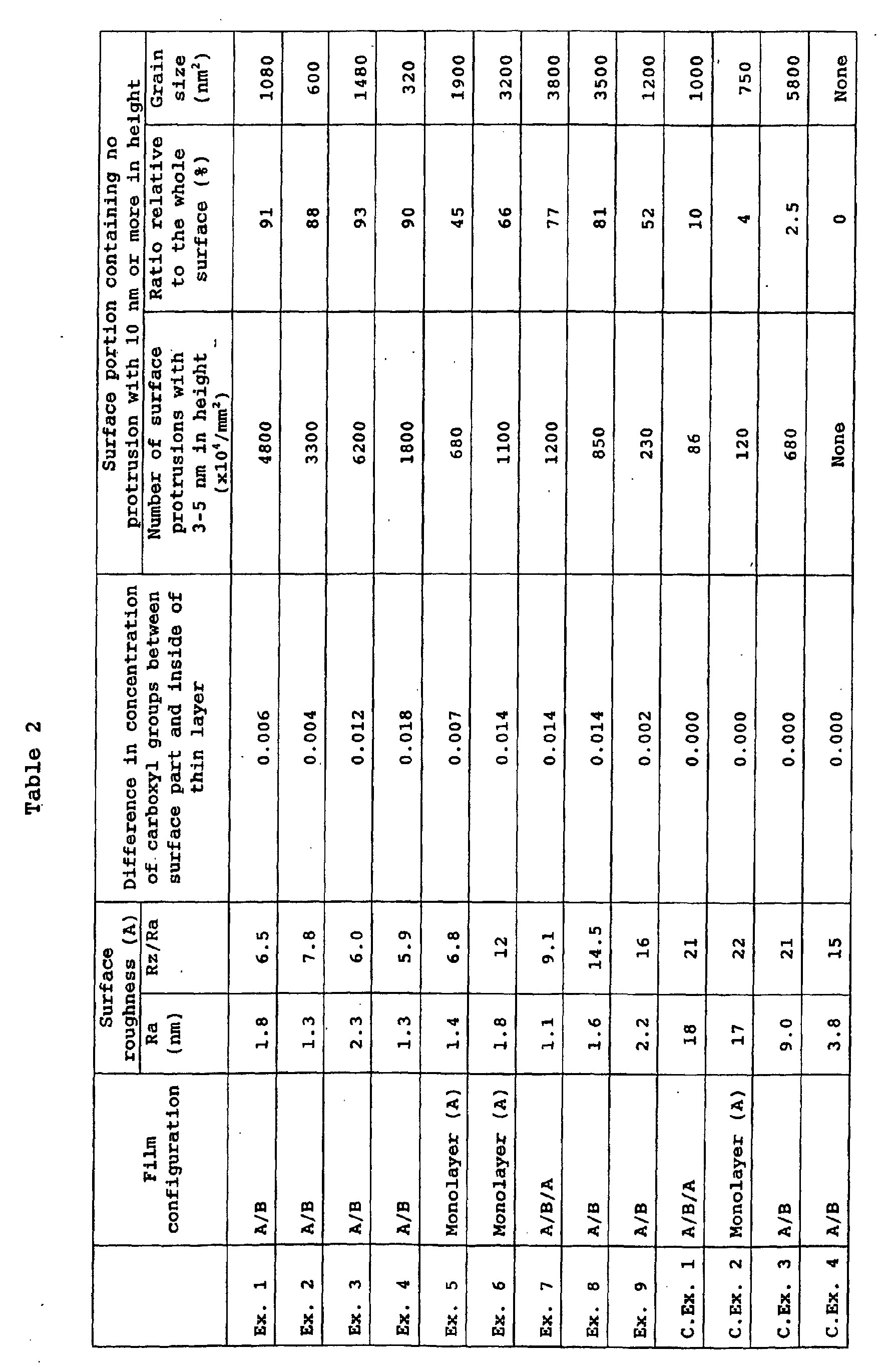
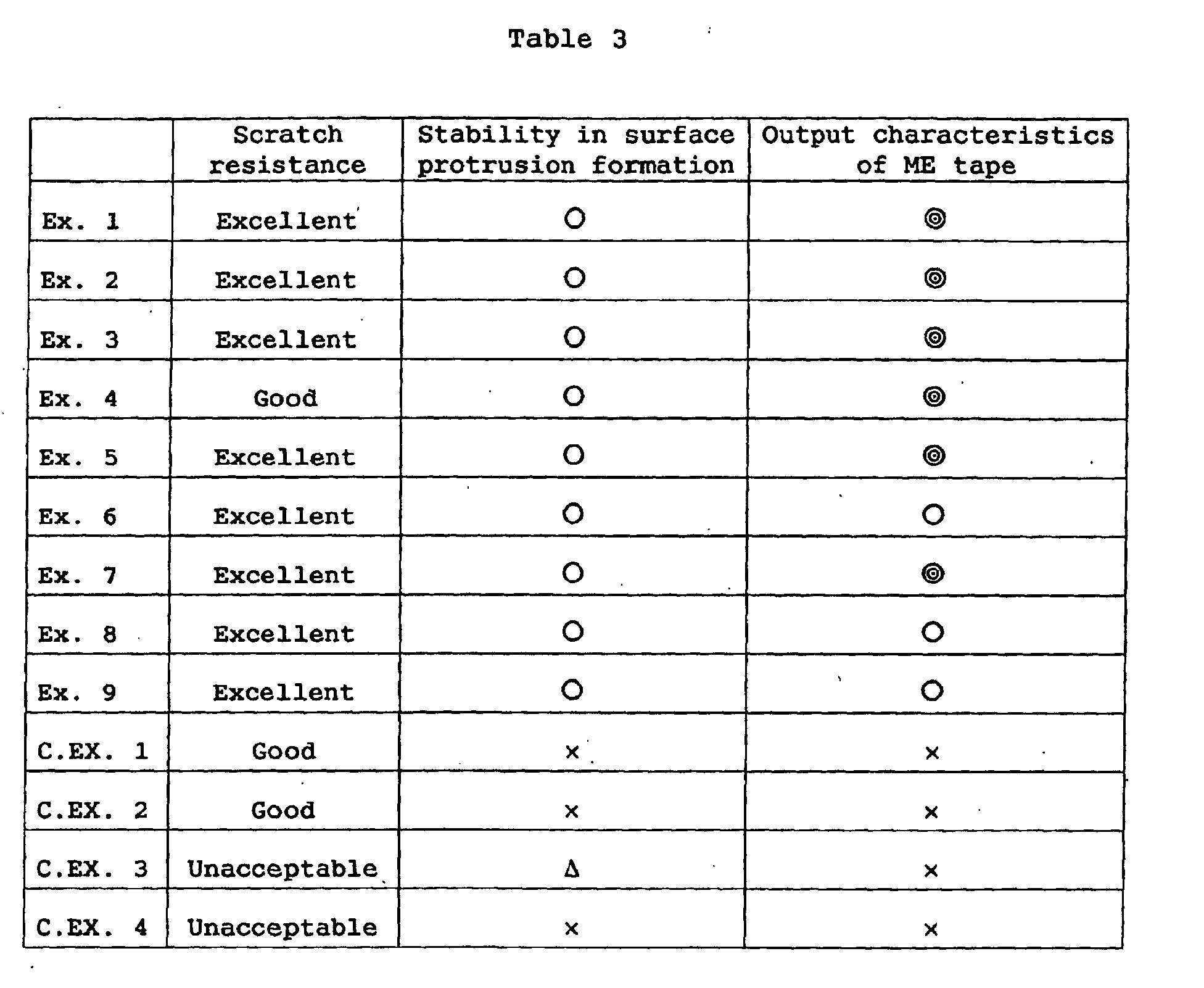
| Light source of UV light | Energy density during irradiation (J/cm2) | Irradiation time (sec) | ||
| Type | Relative intensity of light with 270-300 nm wavelengths (%) | |||
| Ex. 1 | Metal halide, parallel type | 38 | 0.7 | 1.5 |
| Ex. 2 | High pressure mercury, Parallel type | 15 | 0.7 | 1.5 |
| Ex. 3 | Metal halide, parallel type | 38 | 2.7 | 0.5 |
| Ex. 4 | Low pressure mercury, Parallel type | 5 | 0.7 | 0.5 |
| Ex. 5 | Metal halide, converging type | 38 | 0.5 | 1.0 |
| Ex. 6 | Metal halide, converging type | 38 | 3.0 | 0.5 |
| Ex. 7 | Metal halide, converging type | 38 | 2.0 | 1.0 |
| Ex. 8 | Metal halide, parallel type | 38 | 0.7 | 2.0 |
| Ex. 9 | Metal halide, parallel type | 38 | 0.5 | 1.0 |
An A/B two-layered laminated film was prepared.
As polyester A, pellets of polyethylene terephthalate
that was polymerized in the conventional manner using 0.06%
by weight of magnesium acetate, 0.008% by weight of antimony
trioxide and 0.02% by weight of trimethyl phosphate as
polymerization catalysts and blended with 0.1% by weight of
spherical crosslinked polystyrene particles with an average
particle diameter of 0.3 µm and 0.1% by weight of alumina
particles with a primary particle diameter of 0.02 µm
(intrinsic viscosity: 0.62, melting point: 259°C, ΔTcg: 81°C)
were used.
As polyester B, pellets of polyethylene terephthalate
blended in the conventional manner with 0.5% by weight of
spherical crosslinked polystyrene particles with an average
particle diameter of 0.3 µm and 0.07% by weight of spherical
crosslinked polystyrene particles with an average particle
diameter of 0.6 µm were used.
The pellets were separately dried in vacuo at 180°C for
3 hours and then supplied to two extruders, respectively.
The polyester A and polyester B were molten at 285°C, and
then laminated through a rectangular intermixing block (feed
block) for two-layered lamination. The resultant laminate
was caused to closely contact a casting drum with surface
temperature of 25°C electrostatically and then cooled to
solidify, thereby giving a non-stretched film. The non-stretched
film was irradiated with UV light on the surface
of the A layer side of the film for 2.5 second with
adjusting the irradiation length so that the energy density
became 3.0 J/cm2. The resultant film was introduced to a
transverse stretching apparatus consisting of plural heated
rolls and stretched 3.4 times in a longitudinal direction in
three steps at 90°C. The film was stretched 3.8 times in a
transverse direction at 100°C at a stretching rate of
2000%/min. The biaxially stretched film was stretched again
1.6 times in a longitudinal direction at 130°C. The
resultant film was heat-treated at 210°C for 5 seconds under
constant tension, thereby producing a biaxially oriented
polyester film with an A layer thickness of 6.6 µm and a
whole thickness of 7 µm. The conditions for UV light
irradiation are shown in Table 4, and the results of
evaluation of the film are shown in Tables 5 and 6.
A magnetic coating and a non-magnetic coating having
the compositions given below were coated in an overlaying
manner on the surface of the A layer side of the film using
an extrusion coater (the upper layer is the magnetic coating
in a coating thickness of 0.2 µm; the lower layer is the
non-magnetic coating in a coating thickness of 1.8 µm),
magnetically oriented, and then dried. On the surface of
the opposite side, a back coat layer having the composition
given below was formed in the conventional manner. The
resultant film was calendered using a small test calender
(steel roll/steel roll, 5 steps) at 85°C at a linear
pressure of 200 kg/cm, and then cured at 60°C for 48 hours.
The film destined to form into tapes was slit to thereby
produce a pancake. From the pancake, a tape was taken and
installed in a cassette, thereby producing a cassette tape
having a metal-coated magnetic layer.
| [Composition of magnetic coating] | |
| Ferromagnetic metal powder | 100 parts by weight |
| Sodium sulfonate-modified vinyl chloride copolymer | |
| 10 parts by weight | |
| Sodium sulfonate-modified polyurethane | |
| 10 parts by weight | |
| Polyisocyanate | 5 parts by weight |
| Stearic acid | 1.5 parts by weight |
| Oleic acid | 1 part by weight |
| Carbon black | 1 part by weight |
| Alumina | 10 parts by weight |
| Methyl ethyl ketone | 75 parts by weight |
| Cyclohexanone | 75 parts by weight |
| Toluene | 75 parts by weight |
| [Composition of non-magnetic lower layer] | |
| Titanium oxide | 100 parts by weight |
| Carbon black | 10 parts by weight |
| Sodium sulfonate-modified vinyl chloride copolymer | |
| 10 parts by weight | |
| Sodium sulfonate-modified polyurethane | 10 parts by weight |
| Methyl ethyl ketone | 30 parts by weight |
| Methyl isobutyl ketone | 30 parts by weight |
| Toluene | 30 parts by weight |
| [Composition of back coat layer] | |
| Carbon black | 95 parts by weight |
| (average particle diameter: 20 nm) | |
| Carbon black | 5 parts by weight |
| (average particle diameter: 280 nm) | |
| α-Alumina | 0.1 part by weight |
| Zinc oxide | 0.3 part by weight |
| Sodium sulfonate-modified vinyl chloride copolymer | |
| 30 parts by weight | |
| Sodium sulfonate-modified polyurethane | 20 parts by weight |
| Methyl ethyl ketone | 300 parts by weight |
| Cyclohexanone | 200 parts by weight |
| Toluene | 100 parts by weight |
As shown in the tables, according to the present method
using irradiation with UV light, fine protrusions could be
formed at high speed and stably, a polyester film superior
in scratch resistance was obtained and, when a metal-coated
magnetic layer was provided on the A layer side surface and
a back coat layer was provided on the B layer side surface
to produce a magnetic tape (ME tape), output characteristics
of the magnetic tape became good.
An A/B/A three-layered laminated film was prepared.
As the polymer for the A layer (polyester A),
polyethylene terephthalate polymerized in the conventional
manner (polymerization catalysts: 0.20% by weight of
magnesium acetate, 0.03% by weight of antimony trioxide and
0.20% by weight of dimethyl phenylphosphate as a phosphorus
compound) was used (intrinsic viscosity: 0.63, melting
point: 258°C, ΔTcg: 68°C, solution haze: 1.8%). As polyester
B, polyester pellets without particles were used. The
pellets were separately dried, and supplied to two extruders,
respectively. The polyester A and polyester B were molted
at 275°C and 285°C, respectively, and laminated through a
rectangular intermixing block (feed block) for three-layered
lamination. The resultant laminate was caused to closely
contact with a casting drum and cooled to solidify, thereby
producing an A/B/A three-layered non-stretched film.
The non-stretched film was irradiation with UV light
from the both surfaces under the conditions given in Table 4.
The resultant film was stretched and heat-treated in the
same manner as in Example 10, thereby obtaining a biaxially
oriented polyester film with an A layer thickness of 1 µm
and a whole thickness of 7 µm.
A magnetic coating and a non-magnetic coating were
coated on the surface which did not contact with the casting
drum, magnetically oriented and dried in the same manner as
in Example 10. A back coat layer was formed on the opposite
side of the film, calendered and then cured, thereby
obtaining a cassette tape (MP tape) having a metal-coated
magnetic layer thereon. By employing the UV irradiation
conditions as shown in Table 4, although the diameters of
the surface protrusions produced by UV irradiation became
large, the surface protrusions could be formed at high speed
and, therefore, a polyester film superior in scratch
resistance and output characteristics in the form of a MP
tape could be formed continuously.
A biaxially oriented polyester film and a cassette tape
(MP tape) with a metal-coated magnetic layer were prepared,
substantially in the same manner as in Example 11, except
that the non-stretched film was not irradiated with UV light.
Since UV light was not irradiated, such problems occurred
that fine protrusions could not be formed and friction
between the film and the rolls during the film
formation/slitting process was increased, causing scratches
on the film surface. The scratch resistance of the film and
output characteristics of the MP tape were deteriorated.
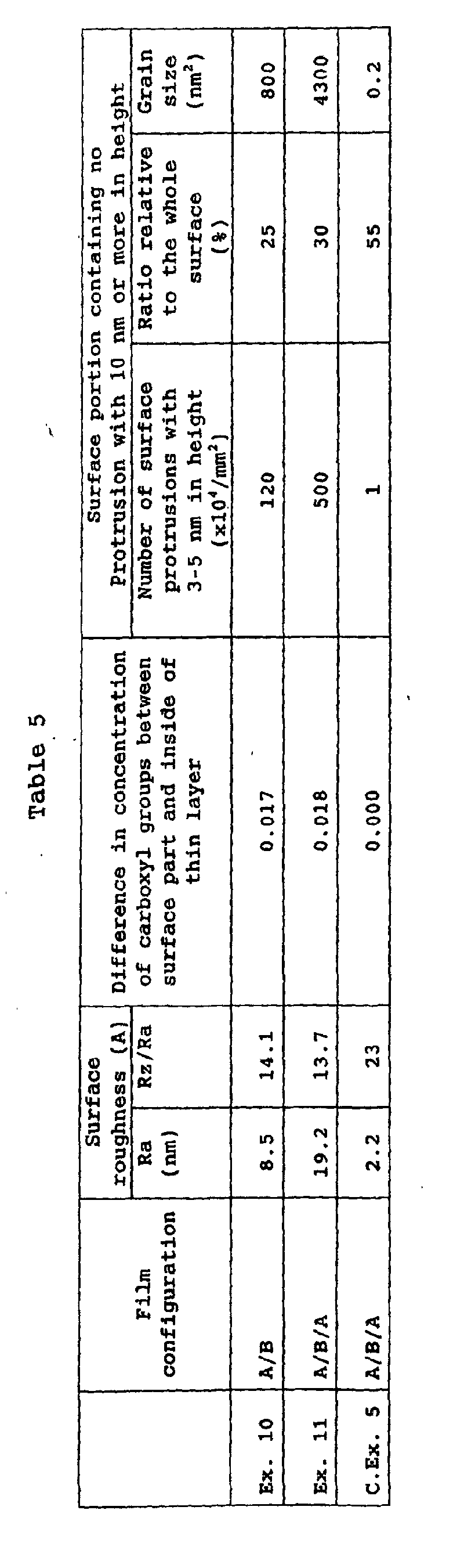

| Light source of UV light | Energy density during irradiation (J/cm2) | Irradiation time (sec) | ||
| Type | Relative intensity of light with 270-300 nm wavelengths (%) | |||
| Ex. 10 | Metal halide, parallel type | 38 | 3.0 | 2.5 |
| Ex. 11 | Metal halide, converging type | 38 | 3.5 | 2.0 |
According to the production process for a polyester
film of the present invention, fine protrusions can be
formed on a surface of a polyester film extremely readily, a
polyester film can be produced stably which exhibits good
wear resistance and running durability and good output
characteristics when used as a base film for a magnetic tape,
and the film can be formed at high speed advantageously.
Therefore, the present process is quite useful for
production of polyester films in industrial scale.
The polyester film of the present invention produced by
the present process is quite useful as a base film for a
magnetic recording material, particularly for a magnetic
recording medium having a ferromagnetic metal thin film
layer thereon. In addition, the present polyester film can
also be widely and effectively utilized for various film
applications such as thermal transfer ribbons, heat-sensitive
mimeograph stencils and electric capacitors.
Claims (14)
- A process for producing a polyester film, comprising irradiating at least one surface of the film with UV light to form fine protrusion on the surface.
- The process for producing a polyester film according to Claim 1, wherein the irradiation with UV light is performed using a light source that a relative intensity of light with wavelengths of 270 to 300 nm is 10% or greater and that a light with wavelengths of less than 250 nm is not substantially contained.
- The process for producing a polyester film according to Claim 1 or 2, wherein the energy density during the UV light irradiation is not less than 0.1 J/cm2 and not more than 10 J/cm2 and the irradiation time is 0.01 to 100 seconds.
- The process for producing a polyester film according to Claim 1 or 2, wherein, after irradiating at least one surface of the film with UV light, the film is stretched in a longitudinal direction and/or a transverse direction.
- A polyester film characterized in that fine protrusions are present on at least one surface of the film; the ratio of 10-point average roughness Rz to center line average roughness Ra (Rz/Ra) on the surface is less than 20; and the concentration of carboxyl groups in the surface layer part of a thin layer which provides the surface is greater than that in the inside of the thin layer.
- A polyester film characterized in that a film surface portion containing no protrusion with 10 nm or more in height constitutes at least 5% of the whole film surface; and the number of protrusions with not less than 3 nm and less than 5 nm in protrusion height in the film surface portion is not less than 1x10⁶/mm2 and less than 1x10⁹/mm2.
- A polyester film characterized in that fine protrusions are present on at least one surface of the film; the ratio of 10-point average roughness Rz to center line average roughness Ra (Rz/Ra) on the surface is less than 20; the concentration of carboxyl groups in the surface layer part of a thin layer which provides the surface is greater than that in the inside of the thin layer; a film surface portion that contains no protrusion with 10 nm or more in height constitutes at least 5% of the whole film surface; and the number of protrusions with not less than 3 nm and less than 5 nm in protrusion height in the film surface portion is not less than 1x10⁶/mm2 and less than 1x10⁹/mm2.
- The polyester film according to Claim 5 or 7, wherein the difference in concentration of carboxyl groups between the surface layer part of a thin layer which provides the surface having fine protrusions thereon and the inside of the thin layer is not less than 0.001.
- The polyester film according to Claim 6 or 7, wherein, in the film surface portion containing no protrusion with 10 nm or more in height, the grain size at the protrusion height threshold value of 3 nm is not less than 1 nm2 and less than 5000 nm2.
- The polyester film according to Claim 5, 6 or 7, wherein particles having a particle diameter in the form of monodisperse particles and/or a primary particle diameter in the form of aggregate particles of not less than 1 nm and less than 300 nm are contained in an amount of not smaller than 0.01% by weight and smaller than 1% by weight.
- The polyester film according to Claim 5, 6 or 7, wherein the film is a laminated film that has A layer mainly composed of polyester A laminated on at least one surface of B layer mainly composed of polyester B.
- A magnetic recording medium comprising a magnetic layer provided on a surface having fine protrusions thereon of a polyester film as recited in Claim 5, 6 or 7.
- The magnetic recording medium according to Claim 12, wherein the magnetic recording medium is a cassette-type magnetic tape of a digital recording mode.
- The magnetic recording medium according to Claim 12, wherein the magnetic layer is a ferromagnetic metal thin film layer.
Applications Claiming Priority (1)
| Application Number | Priority Date | Filing Date | Title |
|---|---|---|---|
| PCT/JP2000/001367 WO2001066336A1 (en) | 2000-03-07 | 2000-03-07 | Polyester film and process for producing the same |
Publications (2)
| Publication Number | Publication Date |
|---|---|
| EP1273428A1 true EP1273428A1 (en) | 2003-01-08 |
| EP1273428A4 EP1273428A4 (en) | 2006-05-17 |
Family
ID=11735763
Family Applications (1)
| Application Number | Title | Priority Date | Filing Date |
|---|---|---|---|
| EP00906744A Withdrawn EP1273428A4 (en) | 2000-03-07 | 2000-03-07 | Polyester film and process for producing the same |
Country Status (5)
| Country | Link |
|---|---|
| US (1) | US7026064B1 (en) |
| EP (1) | EP1273428A4 (en) |
| KR (1) | KR20020081353A (en) |
| CN (1) | CN1212227C (en) |
| WO (1) | WO2001066336A1 (en) |
Cited By (4)
| Publication number | Priority date | Publication date | Assignee | Title |
|---|---|---|---|---|
| EP1734067A4 (en) * | 2004-02-17 | 2008-03-05 | Toray Industries | BIAXIALLY ORIENTED POLYESTER FOIL |
| EP2431406A4 (en) * | 2009-05-15 | 2012-10-10 | Toray Industries | Biaxially oriented polyester film and magnetic recording medium |
| WO2019003056A1 (en) * | 2017-06-29 | 2019-01-03 | 3M Innovative Properties Company | Article and methods of making the same |
| US12473408B2 (en) | 2019-07-31 | 2025-11-18 | Toyobo Co., Ltd. | Biaxially oriented polyester film |
Families Citing this family (10)
| Publication number | Priority date | Publication date | Assignee | Title |
|---|---|---|---|---|
| JP2004039195A (en) * | 2002-07-08 | 2004-02-05 | Sony Corp | Magnetic recording media |
| JP2005129184A (en) * | 2003-10-27 | 2005-05-19 | Fuji Photo Film Co Ltd | Magnetic recording medium |
| EP2005433B1 (en) * | 2006-02-14 | 2017-01-25 | Toray Plastics (America), Inc. | Biaxially oriented polyester film for molding process |
| JP2009031631A (en) * | 2007-07-30 | 2009-02-12 | Fujifilm Corp | Method for producing transparent polymer film, transparent polymer film, retardation film, polarizing plate and liquid crystal display device produced by the method |
| US10580447B2 (en) * | 2015-05-18 | 2020-03-03 | Sony Corporation | Magnetic recording medium with controlled surface characteristics |
| JP7283040B2 (en) * | 2017-08-30 | 2023-05-30 | 東レ株式会社 | thermoplastic resin film |
| JP7206857B2 (en) * | 2017-12-18 | 2023-01-18 | 東レ株式会社 | polyester film |
| WO2019123990A1 (en) * | 2017-12-20 | 2019-06-27 | 東レ株式会社 | Biaxially oriented thermoplastic resin film |
| CN110246521A (en) * | 2019-06-05 | 2019-09-17 | 陈佳 | A kind of magnetized layer of audio tape |
| CN119305282B (en) * | 2024-12-17 | 2025-03-18 | 四川省新都永志印务有限公司 | Anti-oxidation transparent high-barrier composite film, preparation device and preparation method |
Family Cites Families (8)
| Publication number | Priority date | Publication date | Assignee | Title |
|---|---|---|---|---|
| JPS54138076A (en) * | 1978-04-19 | 1979-10-26 | Toray Ind Inc | Surface modification of plastic molded article |
| US5175043A (en) * | 1987-12-11 | 1992-12-29 | Teijin Ltd. | Aromatic polymer molded article with modified surface condition and process for producing the same |
| JPH07121573B2 (en) * | 1988-02-12 | 1995-12-25 | ダイアホイルヘキスト株式会社 | Composite film |
| CA2086467A1 (en) * | 1992-01-07 | 1993-07-08 | Kenji Kato | Optical tape |
| DE4211712A1 (en) * | 1992-04-08 | 1993-10-14 | Basf Magnetics Gmbh | Flat polyethylene terephthalate materials with low surface roughness as well as a process for their production and their use |
| JPH05318577A (en) * | 1992-05-19 | 1993-12-03 | Teijin Ltd | Biaxially oriented polyester film for magnetic recording media |
| DE69716145T2 (en) * | 1996-02-05 | 2003-06-12 | Teijin Ltd., Osaka | Biaxially oriented composite film |
| JPH10157024A (en) * | 1996-11-29 | 1998-06-16 | Teijin Ltd | Laminated film |
-
2000
- 2000-03-07 CN CNB008192987A patent/CN1212227C/en not_active Expired - Fee Related
- 2000-03-07 WO PCT/JP2000/001367 patent/WO2001066336A1/en not_active Ceased
- 2000-03-07 KR KR1020027011095A patent/KR20020081353A/en not_active Withdrawn
- 2000-03-07 EP EP00906744A patent/EP1273428A4/en not_active Withdrawn
- 2000-03-07 US US10/220,128 patent/US7026064B1/en not_active Expired - Fee Related
Cited By (6)
| Publication number | Priority date | Publication date | Assignee | Title |
|---|---|---|---|---|
| EP1734067A4 (en) * | 2004-02-17 | 2008-03-05 | Toray Industries | BIAXIALLY ORIENTED POLYESTER FOIL |
| US7582369B2 (en) | 2004-02-17 | 2009-09-01 | Toray Industries, Inc. | Biaxially oriented polyester film |
| EP2431406A4 (en) * | 2009-05-15 | 2012-10-10 | Toray Industries | Biaxially oriented polyester film and magnetic recording medium |
| WO2019003056A1 (en) * | 2017-06-29 | 2019-01-03 | 3M Innovative Properties Company | Article and methods of making the same |
| US11493673B2 (en) | 2017-06-29 | 2022-11-08 | 3M Innovative Properties Company | Article and methods of making the same |
| US12473408B2 (en) | 2019-07-31 | 2025-11-18 | Toyobo Co., Ltd. | Biaxially oriented polyester film |
Also Published As
| Publication number | Publication date |
|---|---|
| US7026064B1 (en) | 2006-04-11 |
| CN1212227C (en) | 2005-07-27 |
| WO2001066336A1 (en) | 2001-09-13 |
| KR20020081353A (en) | 2002-10-26 |
| EP1273428A4 (en) | 2006-05-17 |
| CN1450952A (en) | 2003-10-22 |
Similar Documents
| Publication | Publication Date | Title |
|---|---|---|
| EP0663286B2 (en) | Biaxially oriented laminated polyester film | |
| EP0612790B1 (en) | Biaxially oriented polyester film | |
| EP0378154B1 (en) | Biaxially oriented polyester film | |
| US7026064B1 (en) | Polyester film and method for producing the same | |
| EP0453276B1 (en) | Biaxially oriented polyester film for magnetic recording media | |
| EP0624454B1 (en) | Polyester film and process for producing it | |
| JP4655334B2 (en) | Biaxially oriented polyester film | |
| JP5177096B2 (en) | Polyester film and method for producing the same | |
| JPH09141797A (en) | Biaxially oriented laminated polyester film | |
| JP2666498B2 (en) | Metal thin film magnetic recording media | |
| JP7283040B2 (en) | thermoplastic resin film | |
| JP2687621B2 (en) | Biaxially oriented thermoplastic resin film for magnetic tape base | |
| JPH11269283A (en) | Biaxially oriented polyester film | |
| JPWO2001066336A1 (en) | Polyester film and its manufacturing method | |
| JPH08337664A (en) | Polyester film and manufacturing method thereof | |
| JP2000143846A (en) | Polyester film and method for producing the same | |
| JPH11207906A (en) | Biaxially oriented laminated polyester film | |
| JP2550236B2 (en) | Biaxially oriented polyester film for magnetic recording media | |
| JPH07166034A (en) | Polyester film | |
| JP2804434B2 (en) | Biaxially oriented thermoplastic resin film | |
| JP2650441B2 (en) | Biaxially oriented laminated film | |
| JPH04151231A (en) | Biaxially oriented polyester film for magnetic recording medium | |
| JPH0565355A (en) | Biaxially oriented polyester film for magnetic recording media | |
| JPH0812793A (en) | Polyester film | |
| JPH041237A (en) | Biaxially oriented polyester film for magnetic recording medium |
Legal Events
| Date | Code | Title | Description |
|---|---|---|---|
| PUAI | Public reference made under article 153(3) epc to a published international application that has entered the european phase |
Free format text: ORIGINAL CODE: 0009012 |
|
| 17P | Request for examination filed |
Effective date: 20020926 |
|
| AK | Designated contracting states |
Kind code of ref document: A1 Designated state(s): DE FR GB |
|
| A4 | Supplementary search report drawn up and despatched |
Effective date: 20060405 |
|
| 17Q | First examination report despatched |
Effective date: 20080918 |
|
| STAA | Information on the status of an ep patent application or granted ep patent |
Free format text: STATUS: THE APPLICATION IS DEEMED TO BE WITHDRAWN |
|
| 18D | Application deemed to be withdrawn |
Effective date: 20141223 |