EP1273238A2 - Animal feed additives and feedstuff containing said additives - Google Patents
Animal feed additives and feedstuff containing said additives Download PDFInfo
- Publication number
- EP1273238A2 EP1273238A2 EP20020022611 EP02022611A EP1273238A2 EP 1273238 A2 EP1273238 A2 EP 1273238A2 EP 20020022611 EP20020022611 EP 20020022611 EP 02022611 A EP02022611 A EP 02022611A EP 1273238 A2 EP1273238 A2 EP 1273238A2
- Authority
- EP
- European Patent Office
- Prior art keywords
- feed
- additives
- weight
- additive
- formic acid
- Prior art date
- Legal status (The legal status is an assumption and is not a legal conclusion. Google has not performed a legal analysis and makes no representation as to the accuracy of the status listed.)
- Withdrawn
Links
- 235000019730 animal feed additive Nutrition 0.000 title claims abstract description 13
- 239000000654 additive Substances 0.000 title description 91
- 239000000203 mixture Substances 0.000 claims abstract description 37
- BINNZIDCJWQYOH-UHFFFAOYSA-M potassium;formic acid;formate Chemical compound [K+].OC=O.[O-]C=O BINNZIDCJWQYOH-UHFFFAOYSA-M 0.000 claims abstract description 20
- 241001465754 Metazoa Species 0.000 claims description 20
- XLYOFNOQVPJJNP-UHFFFAOYSA-N water Substances O XLYOFNOQVPJJNP-UHFFFAOYSA-N 0.000 claims description 16
- CBOCVOKPQGJKKJ-UHFFFAOYSA-L Calcium formate Chemical compound [Ca+2].[O-]C=O.[O-]C=O CBOCVOKPQGJKKJ-UHFFFAOYSA-L 0.000 claims description 15
- 235000019255 calcium formate Nutrition 0.000 claims description 15
- 238000006243 chemical reaction Methods 0.000 claims description 15
- 239000004281 calcium formate Substances 0.000 claims description 14
- 229940044172 calcium formate Drugs 0.000 claims description 14
- 206010012735 Diarrhoea Diseases 0.000 claims description 9
- 239000003674 animal food additive Substances 0.000 claims description 9
- MRXCOLWWZJKPPA-UHFFFAOYSA-L disodium diformate Chemical compound [Na+].[Na+].[O-]C=O.[O-]C=O MRXCOLWWZJKPPA-UHFFFAOYSA-L 0.000 claims description 9
- 235000021050 feed intake Nutrition 0.000 claims description 9
- 241000283690 Bos taurus Species 0.000 claims description 5
- 239000007864 aqueous solution Substances 0.000 claims description 5
- 244000144977 poultry Species 0.000 claims description 4
- YDVCSVVUQFMIBY-UHFFFAOYSA-J tetrasodium tetraformate Chemical compound [Na+].[Na+].[Na+].[Na+].[O-]C=O.[O-]C=O.[O-]C=O.[O-]C=O YDVCSVVUQFMIBY-UHFFFAOYSA-J 0.000 claims description 4
- 244000309466 calf Species 0.000 claims description 3
- 230000001737 promoting effect Effects 0.000 claims description 2
- 230000000063 preceeding effect Effects 0.000 claims 1
- BDAGIHXWWSANSR-UHFFFAOYSA-N methanoic acid Natural products OC=O BDAGIHXWWSANSR-UHFFFAOYSA-N 0.000 description 80
- 230000000996 additive effect Effects 0.000 description 45
- OSWFIVFLDKOXQC-UHFFFAOYSA-N 4-(3-methoxyphenyl)aniline Chemical compound COC1=CC=CC(C=2C=CC(N)=CC=2)=C1 OSWFIVFLDKOXQC-UHFFFAOYSA-N 0.000 description 40
- 235000019253 formic acid Nutrition 0.000 description 40
- 239000002253 acid Substances 0.000 description 20
- 239000002274 desiccant Substances 0.000 description 14
- 229940044170 formate Drugs 0.000 description 13
- 239000000047 product Substances 0.000 description 13
- 150000003839 salts Chemical class 0.000 description 12
- 239000011734 sodium Substances 0.000 description 11
- 229910052708 sodium Inorganic materials 0.000 description 11
- DGAQECJNVWCQMB-PUAWFVPOSA-M Ilexoside XXIX Chemical compound C[C@@H]1CC[C@@]2(CC[C@@]3(C(=CC[C@H]4[C@]3(CC[C@@H]5[C@@]4(CC[C@@H](C5(C)C)OS(=O)(=O)[O-])C)C)[C@@H]2[C@]1(C)O)C)C(=O)O[C@H]6[C@@H]([C@H]([C@@H]([C@H](O6)CO)O)O)O.[Na+] DGAQECJNVWCQMB-PUAWFVPOSA-M 0.000 description 10
- BSXZJWHTFAEYDT-UHFFFAOYSA-N diazanium diformate Chemical compound [NH4+].[NH4+].[O-]C=O.[O-]C=O BSXZJWHTFAEYDT-UHFFFAOYSA-N 0.000 description 10
- 238000012360 testing method Methods 0.000 description 10
- 238000002474 experimental method Methods 0.000 description 9
- 238000004519 manufacturing process Methods 0.000 description 9
- BDAGIHXWWSANSR-UHFFFAOYSA-M Formate Chemical compound [O-]C=O BDAGIHXWWSANSR-UHFFFAOYSA-M 0.000 description 8
- 239000011575 calcium Substances 0.000 description 8
- HEMHJVSKTPXQMS-UHFFFAOYSA-M Sodium hydroxide Chemical compound [OH-].[Na+] HEMHJVSKTPXQMS-UHFFFAOYSA-M 0.000 description 7
- 230000000694 effects Effects 0.000 description 7
- 230000000384 rearing effect Effects 0.000 description 7
- VYPSYNLAJGMNEJ-UHFFFAOYSA-N Silicium dioxide Chemical compound O=[Si]=O VYPSYNLAJGMNEJ-UHFFFAOYSA-N 0.000 description 6
- 229910052791 calcium Inorganic materials 0.000 description 6
- 150000004675 formic acid derivatives Chemical class 0.000 description 6
- 239000013589 supplement Substances 0.000 description 6
- ZLMJMSJWJFRBEC-UHFFFAOYSA-N Potassium Chemical compound [K] ZLMJMSJWJFRBEC-UHFFFAOYSA-N 0.000 description 5
- 241000282887 Suidae Species 0.000 description 5
- 229910052500 inorganic mineral Inorganic materials 0.000 description 5
- 239000011707 mineral Substances 0.000 description 5
- 229910052700 potassium Inorganic materials 0.000 description 5
- 235000018102 proteins Nutrition 0.000 description 5
- 108090000623 proteins and genes Proteins 0.000 description 5
- 102000004169 proteins and genes Human genes 0.000 description 5
- 238000003860 storage Methods 0.000 description 5
- OYPRJOBELJOOCE-UHFFFAOYSA-N Calcium Chemical compound [Ca] OYPRJOBELJOOCE-UHFFFAOYSA-N 0.000 description 4
- VZCYOOQTPOCHFL-OWOJBTEDSA-N Fumaric acid Chemical compound OC(=O)\C=C\C(O)=O VZCYOOQTPOCHFL-OWOJBTEDSA-N 0.000 description 4
- 235000019197 fats Nutrition 0.000 description 4
- 235000015097 nutrients Nutrition 0.000 description 4
- 239000011591 potassium Substances 0.000 description 4
- 240000008042 Zea mays Species 0.000 description 3
- 235000005824 Zea mays ssp. parviglumis Nutrition 0.000 description 3
- 235000002017 Zea mays subsp mays Nutrition 0.000 description 3
- 238000007792 addition Methods 0.000 description 3
- 235000005822 corn Nutrition 0.000 description 3
- 235000005911 diet Nutrition 0.000 description 3
- 230000037213 diet Effects 0.000 description 3
- 235000011087 fumaric acid Nutrition 0.000 description 3
- 235000012054 meals Nutrition 0.000 description 3
- 235000013372 meat Nutrition 0.000 description 3
- 239000003755 preservative agent Substances 0.000 description 3
- 230000002335 preservative effect Effects 0.000 description 3
- 239000000377 silicon dioxide Substances 0.000 description 3
- 238000003307 slaughter Methods 0.000 description 3
- 239000000243 solution Substances 0.000 description 3
- 235000012424 soybean oil Nutrition 0.000 description 3
- 239000003549 soybean oil Substances 0.000 description 3
- 239000000758 substrate Substances 0.000 description 3
- QGZKDVFQNNGYKY-UHFFFAOYSA-O Ammonium Chemical compound [NH4+] QGZKDVFQNNGYKY-UHFFFAOYSA-O 0.000 description 2
- 241000894006 Bacteria Species 0.000 description 2
- VTYYLEPIZMXCLO-UHFFFAOYSA-L Calcium carbonate Chemical compound [Ca+2].[O-]C([O-])=O VTYYLEPIZMXCLO-UHFFFAOYSA-L 0.000 description 2
- 241000233866 Fungi Species 0.000 description 2
- 241000287828 Gallus gallus Species 0.000 description 2
- 240000005979 Hordeum vulgare Species 0.000 description 2
- 235000007340 Hordeum vulgare Nutrition 0.000 description 2
- FAPWRFPIFSIZLT-UHFFFAOYSA-M Sodium chloride Chemical compound [Na+].[Cl-] FAPWRFPIFSIZLT-UHFFFAOYSA-M 0.000 description 2
- 208000021017 Weight Gain Diseases 0.000 description 2
- 239000004480 active ingredient Substances 0.000 description 2
- 239000013543 active substance Substances 0.000 description 2
- 235000013339 cereals Nutrition 0.000 description 2
- 230000007797 corrosion Effects 0.000 description 2
- 238000005260 corrosion Methods 0.000 description 2
- 238000000354 decomposition reaction Methods 0.000 description 2
- XBDQKXXYIPTUBI-UHFFFAOYSA-N dimethylselenoniopropionate Natural products CCC(O)=O XBDQKXXYIPTUBI-UHFFFAOYSA-N 0.000 description 2
- 238000001704 evaporation Methods 0.000 description 2
- 230000008020 evaporation Effects 0.000 description 2
- 239000001530 fumaric acid Substances 0.000 description 2
- 239000011521 glass Substances 0.000 description 2
- 235000006109 methionine Nutrition 0.000 description 2
- 229930182817 methionine Natural products 0.000 description 2
- 150000002763 monocarboxylic acids Chemical class 0.000 description 2
- 239000013642 negative control Substances 0.000 description 2
- 230000000050 nutritive effect Effects 0.000 description 2
- 229910052698 phosphorus Inorganic materials 0.000 description 2
- BITYAPCSNKJESK-UHFFFAOYSA-N potassiosodium Chemical class [Na].[K] BITYAPCSNKJESK-UHFFFAOYSA-N 0.000 description 2
- WFIZEGIEIOHZCP-UHFFFAOYSA-M potassium formate Chemical class [K+].[O-]C=O WFIZEGIEIOHZCP-UHFFFAOYSA-M 0.000 description 2
- 235000019260 propionic acid Nutrition 0.000 description 2
- 239000004460 silage Substances 0.000 description 2
- 239000007921 spray Substances 0.000 description 2
- 239000000126 substance Substances 0.000 description 2
- VZCYOOQTPOCHFL-UHFFFAOYSA-N trans-butenedioic acid Natural products OC(=O)C=CC(O)=O VZCYOOQTPOCHFL-UHFFFAOYSA-N 0.000 description 2
- 238000011282 treatment Methods 0.000 description 2
- 235000019786 weight gain Nutrition 0.000 description 2
- 230000004584 weight gain Effects 0.000 description 2
- 235000007319 Avena orientalis Nutrition 0.000 description 1
- 244000075850 Avena orientalis Species 0.000 description 1
- 235000014698 Brassica juncea var multisecta Nutrition 0.000 description 1
- 235000006008 Brassica napus var napus Nutrition 0.000 description 1
- 240000000385 Brassica napus var. napus Species 0.000 description 1
- 235000006618 Brassica rapa subsp oleifera Nutrition 0.000 description 1
- 235000004977 Brassica sinapistrum Nutrition 0.000 description 1
- KRKNYBCHXYNGOX-UHFFFAOYSA-K Citrate Chemical compound [O-]C(=O)CC(O)(CC([O-])=O)C([O-])=O KRKNYBCHXYNGOX-UHFFFAOYSA-K 0.000 description 1
- 235000019750 Crude protein Nutrition 0.000 description 1
- 239000004470 DL Methionine Substances 0.000 description 1
- 235000019733 Fish meal Nutrition 0.000 description 1
- 108010068370 Glutens Proteins 0.000 description 1
- BVHLGVCQOALMSV-JEDNCBNOSA-N L-lysine hydrochloride Chemical compound Cl.NCCCC[C@H](N)C(O)=O BVHLGVCQOALMSV-JEDNCBNOSA-N 0.000 description 1
- FFEARJCKVFRZRR-BYPYZUCNSA-N L-methionine Chemical compound CSCC[C@H](N)C(O)=O FFEARJCKVFRZRR-BYPYZUCNSA-N 0.000 description 1
- GUBGYTABKSRVRQ-QKKXKWKRSA-N Lactose Natural products OC[C@H]1O[C@@H](O[C@H]2[C@H](O)[C@@H](O)C(O)O[C@@H]2CO)[C@H](O)[C@@H](O)[C@H]1O GUBGYTABKSRVRQ-QKKXKWKRSA-N 0.000 description 1
- 235000019738 Limestone Nutrition 0.000 description 1
- 239000004472 Lysine Substances 0.000 description 1
- KDXKERNSBIXSRK-UHFFFAOYSA-N Lysine Natural products NCCCCC(N)C(O)=O KDXKERNSBIXSRK-UHFFFAOYSA-N 0.000 description 1
- OAICVXFJPJFONN-UHFFFAOYSA-N Phosphorus Chemical compound [P] OAICVXFJPJFONN-UHFFFAOYSA-N 0.000 description 1
- 235000019764 Soybean Meal Nutrition 0.000 description 1
- 229920002472 Starch Polymers 0.000 description 1
- 241000209140 Triticum Species 0.000 description 1
- 235000021307 Triticum Nutrition 0.000 description 1
- VUFYBGFLAWKKSM-UHFFFAOYSA-N [NH4+].[Na].[O-]C=O Chemical class [NH4+].[Na].[O-]C=O VUFYBGFLAWKKSM-UHFFFAOYSA-N 0.000 description 1
- VEUACKUBDLVUAC-UHFFFAOYSA-N [Na].[Ca] Chemical compound [Na].[Ca] VEUACKUBDLVUAC-UHFFFAOYSA-N 0.000 description 1
- 235000011054 acetic acid Nutrition 0.000 description 1
- 150000001242 acetic acid derivatives Chemical class 0.000 description 1
- 150000001243 acetic acids Chemical class 0.000 description 1
- 150000007513 acids Chemical class 0.000 description 1
- 235000001014 amino acid Nutrition 0.000 description 1
- 150000001413 amino acids Chemical class 0.000 description 1
- VZTDIZULWFCMLS-UHFFFAOYSA-N ammonium formate Chemical compound [NH4+].[O-]C=O VZTDIZULWFCMLS-UHFFFAOYSA-N 0.000 description 1
- -1 ammonium ions Chemical class 0.000 description 1
- 238000004458 analytical method Methods 0.000 description 1
- ZBFQIHWNVRNKAH-UHFFFAOYSA-M azanium sodium diformate Chemical compound [NH4+].[Na+].[O-]C=O.[O-]C=O ZBFQIHWNVRNKAH-UHFFFAOYSA-M 0.000 description 1
- 230000015572 biosynthetic process Effects 0.000 description 1
- YYRMJZQKEFZXMX-UHFFFAOYSA-L calcium bis(dihydrogenphosphate) Chemical compound [Ca+2].OP(O)([O-])=O.OP(O)([O-])=O YYRMJZQKEFZXMX-UHFFFAOYSA-L 0.000 description 1
- 229910000019 calcium carbonate Inorganic materials 0.000 description 1
- 239000001506 calcium phosphate Substances 0.000 description 1
- 150000001732 carboxylic acid derivatives Chemical class 0.000 description 1
- 150000001735 carboxylic acids Chemical class 0.000 description 1
- 239000000969 carrier Substances 0.000 description 1
- 238000005119 centrifugation Methods 0.000 description 1
- 239000013065 commercial product Substances 0.000 description 1
- 235000019784 crude fat Nutrition 0.000 description 1
- 235000021051 daily weight gain Nutrition 0.000 description 1
- 230000003247 decreasing effect Effects 0.000 description 1
- 238000013461 design Methods 0.000 description 1
- 238000011161 development Methods 0.000 description 1
- 238000001035 drying Methods 0.000 description 1
- 239000000284 extract Substances 0.000 description 1
- 239000000835 fiber Substances 0.000 description 1
- 239000004467 fishmeal Substances 0.000 description 1
- XVVLAOSRANDVDB-UHFFFAOYSA-N formic acid Chemical compound OC=O.OC=O XVVLAOSRANDVDB-UHFFFAOYSA-N 0.000 description 1
- 150000002238 fumaric acids Chemical class 0.000 description 1
- 235000021312 gluten Nutrition 0.000 description 1
- 231100001261 hazardous Toxicity 0.000 description 1
- 239000004615 ingredient Substances 0.000 description 1
- 238000011850 initial investigation Methods 0.000 description 1
- 229910021432 inorganic complex Inorganic materials 0.000 description 1
- 239000013067 intermediate product Substances 0.000 description 1
- 238000011835 investigation Methods 0.000 description 1
- 239000008101 lactose Substances 0.000 description 1
- 230000002045 lasting effect Effects 0.000 description 1
- 239000006028 limestone Substances 0.000 description 1
- 239000007788 liquid Substances 0.000 description 1
- 229960003646 lysine Drugs 0.000 description 1
- 235000018977 lysine Nutrition 0.000 description 1
- 229910052751 metal Inorganic materials 0.000 description 1
- 239000002184 metal Substances 0.000 description 1
- 229910021645 metal ion Inorganic materials 0.000 description 1
- FFEARJCKVFRZRR-UHFFFAOYSA-N methionine Chemical compound CSCCC(N)C(O)=O FFEARJCKVFRZRR-UHFFFAOYSA-N 0.000 description 1
- 239000011785 micronutrient Substances 0.000 description 1
- 235000013369 micronutrients Nutrition 0.000 description 1
- 229910000150 monocalcium phosphate Inorganic materials 0.000 description 1
- 235000019691 monocalcium phosphate Nutrition 0.000 description 1
- 150000007524 organic acids Chemical class 0.000 description 1
- 238000004806 packaging method and process Methods 0.000 description 1
- 230000000737 periodic effect Effects 0.000 description 1
- 239000011574 phosphorus Substances 0.000 description 1
- 239000013641 positive control Substances 0.000 description 1
- 230000008092 positive effect Effects 0.000 description 1
- ZUBXQNLJMQVJDZ-UHFFFAOYSA-L potassium sodium diformate Chemical compound [Na+].[K+].[O-]C=O.[O-]C=O ZUBXQNLJMQVJDZ-UHFFFAOYSA-L 0.000 description 1
- 239000000843 powder Substances 0.000 description 1
- 230000002265 prevention Effects 0.000 description 1
- 150000004672 propanoic acids Chemical class 0.000 description 1
- IUVKMZGDUIUOCP-BTNSXGMBSA-N quinbolone Chemical compound O([C@H]1CC[C@H]2[C@H]3[C@@H]([C@]4(C=CC(=O)C=C4CC3)C)CC[C@@]21C)C1=CCCC1 IUVKMZGDUIUOCP-BTNSXGMBSA-N 0.000 description 1
- 239000004456 rapeseed meal Substances 0.000 description 1
- 235000020183 skimmed milk Nutrition 0.000 description 1
- 239000011780 sodium chloride Substances 0.000 description 1
- 239000007787 solid Substances 0.000 description 1
- 239000004455 soybean meal Substances 0.000 description 1
- 238000013112 stability test Methods 0.000 description 1
- 239000008107 starch Substances 0.000 description 1
- 235000019698 starch Nutrition 0.000 description 1
- 230000009469 supplementation Effects 0.000 description 1
- 239000000725 suspension Substances 0.000 description 1
- 230000002195 synergetic effect Effects 0.000 description 1
- 235000013343 vitamin Nutrition 0.000 description 1
- 235000015099 wheat brans Nutrition 0.000 description 1
Classifications
-
- A—HUMAN NECESSITIES
- A23—FOODS OR FOODSTUFFS; TREATMENT THEREOF, NOT COVERED BY OTHER CLASSES
- A23K—FODDER
- A23K50/00—Feeding-stuffs specially adapted for particular animals
-
- A—HUMAN NECESSITIES
- A23—FOODS OR FOODSTUFFS; TREATMENT THEREOF, NOT COVERED BY OTHER CLASSES
- A23K—FODDER
- A23K20/00—Accessory food factors for animal feeding-stuffs
- A23K20/10—Organic substances
- A23K20/105—Aliphatic or alicyclic compounds
-
- A—HUMAN NECESSITIES
- A23—FOODS OR FOODSTUFFS; TREATMENT THEREOF, NOT COVERED BY OTHER CLASSES
- A23K—FODDER
- A23K20/00—Accessory food factors for animal feeding-stuffs
- A23K20/20—Inorganic substances, e.g. oligoelements
- A23K20/22—Compounds of alkali metals
-
- A—HUMAN NECESSITIES
- A23—FOODS OR FOODSTUFFS; TREATMENT THEREOF, NOT COVERED BY OTHER CLASSES
- A23K—FODDER
- A23K20/00—Accessory food factors for animal feeding-stuffs
- A23K20/20—Inorganic substances, e.g. oligoelements
- A23K20/24—Compounds of alkaline earth metals, e.g. magnesium
-
- Y—GENERAL TAGGING OF NEW TECHNOLOGICAL DEVELOPMENTS; GENERAL TAGGING OF CROSS-SECTIONAL TECHNOLOGIES SPANNING OVER SEVERAL SECTIONS OF THE IPC; TECHNICAL SUBJECTS COVERED BY FORMER USPC CROSS-REFERENCE ART COLLECTIONS [XRACs] AND DIGESTS
- Y10—TECHNICAL SUBJECTS COVERED BY FORMER USPC
- Y10S—TECHNICAL SUBJECTS COVERED BY FORMER USPC CROSS-REFERENCE ART COLLECTIONS [XRACs] AND DIGESTS
- Y10S426/00—Food or edible material: processes, compositions, and products
- Y10S426/807—Poultry or ruminant feed
Definitions
- the present invention relates to animal feed additives comprising disalts of formic acid.
- the invention further comprises animal feedstuff containing said additives.
- Another problem is making additives that are free-flowing and which easily can be mixed with the other ingredients of the feedstuff. The additives must also be stable during storage and able to endure the temperatures they are exposed to during production of the feed, without decomposing.
- Calcium formate has a low water solubility and can only be used in limited amounts to avoid too high total content of calcium in the feed.
- concentration of formate in the additive is rather low and the effect is only of the same order of magnitude or lower as when formic acid is added to the feed. This is further shown in an article by M. Kirchgessner and F.X. Roth, "Use of formates.in the feeding of piglets", Landwirtsch. Anlagen 40, 2-3, 1987. On page 149 it is stated that "Cafo (calcium formate) influenced the feed consumption of the piglets only slightly; the animals improved feed conversion at about 5% at the highest dose levels (2.7/2.6% Cafo)".
- a preservative composition for adding to animal feedstuff comprising a binary blend of formic acid and propionic acid with synergistic activity.
- the aqueous blend of acids is impregnated in a solid carrier such as silica. 0.1-10% of the blend is used in feed for pigs, cattle or poultry.
- a solid carrier such as silica.
- 0.1-10% of the blend is used in feed for pigs, cattle or poultry.
- One disadvantage of the additive is that the percentage of active agent on the carrier is rather low. Further, due to the poor thermal stability of the product the risk for losing some of the acid during production and storage is rather high and thereby the effective cost of the active substance is increased.
- the impregnated carrier might also cause damage to the equipment and those being exposed to the product due to leakage/evaporation of acid from the carrier.
- aqueous solutions of complex salts from ammonium ions and/or of a metal selected from Group I and II of the Periodic Table and at least one carboxylic acid The ratio of acid to ammonium and/or metal ions being in the range of 2:1.and.4:1.on a chemical equivalent basis.
- concentration of water in the aqueous solution being between 15-75% by weight of the total composition.
- Said solution of complex salts or disalts of carboxylic acids is stated to be a preservative composition to prevent growth of mould, bacteria and fungi and therefor useful in animal feed which in the patent is also named "substrate".
- the liquid composition When applied as a preservative to a substrate the liquid composition suitably contain between 0.1-5% of the inorganic complex acid salt based on the weight of the substrate treated.
- ammonium diformate in silage which is not the same type of animal feedstuff which the present application relates to.
- Ammonium diformate is the most unstable of all the diformates and the teachings of this patent does not give any teaching for application of diformates except for silage and similar types of feedstuff and then in connection with prevention/reduction of growth of mould, fungi and bacteria.
- the main object of the present invention was to arrive at a new additive comprising salts of formic acid.
- a further object was to arrive at such additives that possessed high concentrations of the active ingredients and still being free-flowing and stable during storage and handling, including production of the final feedstuff.
- a further object was to obtain animal feedstuffs containing the new additive in desired amounts for obtaining the required effects and still being within the specifications with regard to total content of elements like sodium, potassium and calcium.
- Potassium diformate is a most stable crystalline salt having decomposition temperature above 120°C while ammonium diformates are less stable and decomposes in the range 20-25°C.
- Sodium diformate is reported to decompose in the range 100-120°C.
- Sodium tetra-formate can also be formed according to a similar reaction mechanism. When these salts decompose, acid is released.
- the thermal stability of the diformates shows a declining tendency from potassium to ammonium diformate. Leakage of formic acid from the ammonium diformate proved to be substantially larger than for potassium diformate and this confirms the reported low decomposition temperature for the former component.
- Formate content >50% Formic acid content >20% Water content as low as possible, generally ⁇ 1% Desiccants as low as possible, generally ⁇ 1%
- the final feedstuff generally contains 0.5-2% of formate based additives and the total content of sodium, potassium, calcium, ammonium and desiccant have to be kept within the specified values for feedstuffs, especially with regard to the sodium- and calcium content.
- the additive product should preferably be dry and free-flowing for simplifying handling during packaging and handling in the feed production equipment.
- the feed additive should not cause corrosion problems in the production equipment, accordingly the leakage of formic acid from dry additive and the final feedstuff should be very low.
- Additives having a high content of potassium diformate were free-flowing, thermally stable and gave hardly any smell.
- ammonium diformate was mixed into the additive, drying of the product was found to be difficult. Such products were more hygroscopic than potassium- and sodium diformate based products. Ammonium diformate increased the smell of formic acid from the product.
- Concentrated solutions of diformates for instance 55-70%, preferably potassium- and/or sodium diformate, could also be used as additive component to be mixed with the basic feed in amounts giving corresponding contents of formates in the feedstuffs as with the above described dry additives.
- diformate solutions are used, special.care must be taken to secure even distribution of the additive in the basic feed.
- the additives according to the invention were mixed with conventional fodder in amounts of 0.2-2.5 weight%.
- Such animal feedstuffs according to the invention were found to be especially useful for piglets and pigs. Similar effects on.poultry, calves and cows are expected, but not investigated thoroughly.
- the animal feed additives according to the invention comprises disalts of formic acid in amounts of 20-99 weight% potassium diformate, 0-50 weight% sodium di-/tetraformate, 0-25 weight% calcium formate and 0-5 weight% water.
- the additive may also comprise a desiccant.
- the most preferred additives are characterised in that the additives comprises 20-60 weight% potassium diformate, 20-50 weight% sodium di/tetra-formate, 0-25 weight% calcium formate, 1-4 weight% desiccant and 0-5 weight% water.
- Another preferred additive type comprises 60-99 weight% potassium diformate, 0-28 weight% calcium formate, 1-4 weight% desiccant and 0-5 weight% water.
- This example shows the results of testing of several additive compositions with regard to stability, measured as loss of formic acid.
- 26 different compositions of additives comprising diformates were made. These additives contained different types and ratios of diformates and in addition calcium formate and desiccant could be added. The amount of water in the additives were also measured. The total weight of the additives made varied from 173-536 grams and from each additive composition samples of 25 grams were taken for stability tests. These tests were performed by placing the 25 gram samples 25°C.in a glass bell together with a beaker with 1N NaOH lye. The glass bell was sealed and by removing the beaker after 2, 4 and 7 days respectively and analyse the lye with regard to acid the loss or leakage of acid from the additive could be measured. The relative stability of the various additive compositions could thus be determined. Two known commercial additives containing formic acid were also tested in the same way and the results were compared with those of the additives according to the invention.
- the content of formic acid will be about 20% and the total content of formate about 65%.
- the content of formic acid will be about 30% and the total content of formate about 65%.
- the percental frequency of diarrhoea (days of diarrhoea x 100/number of animals/days of experiment) were calculated for the piglets with the following results: Group Supplement Diarrhoea frequency 1 one 8.2% 2 0.85% formic acid 6.7% 3 0.65% Type I additive 8.7% 4 1.30% Type I additive 6.6% 5 1.95% Type I additive 6.3% 6 0.65% Type II additive 8.4% 7 1.30% Type II additive 5.8% 8 1.95% Type II additive 5.4%
- This example shows the results of tests performed on slaughter pigs.
- the tests comprised application of four different feedstuffs, the first one called “Standard feed” had the following composition: "Standard feed” weight% Barley 78.78 Soya meal 10.00 Rape meal, Canola 8.00 Lime stone meal 1.50 Monocalcium phosphate 1.00 Salt (Sodium chloride) 0.50 Micro minerals 0.04 Vitamines 0.03 L-Lycine 0.15
- the new additive and feedstuff according to the invention improves the feed conversion and the relation between meat and lard for the slaughter pigs, even relative to formic acid.
- the new additives are suitable for promoting growth and mainly to improve feed conversion rate, especially during the prestarter period. There were no significant differences between the two additives, but with Type I sometimes higher dosages seemed to be necessary to reach the same efficiency as with Type II additives. The influence on the diarrhoea frequency proved to be slightly positive with application of the new additives.
Landscapes
- Chemical & Material Sciences (AREA)
- Life Sciences & Earth Sciences (AREA)
- Polymers & Plastics (AREA)
- Animal Husbandry (AREA)
- Zoology (AREA)
- Engineering & Computer Science (AREA)
- Food Science & Technology (AREA)
- Birds (AREA)
- Inorganic Chemistry (AREA)
- Fodder In General (AREA)
- Feed For Specific Animals (AREA)
Abstract
Description
- The present invention relates to animal feed additives comprising disalts of formic acid. The invention further comprises animal feedstuff containing said additives.
- A general problem with feed additives comprising monocarboxylic acids, and especially formic acid, are loss of acid due to evaporation. This causes an off-spec product and corrosion problems in the equipment for making the feed and is also hazardous to those handling the additive and the feedstuff. Another problem is making additives that are free-flowing and which easily can be mixed with the other ingredients of the feedstuff. The additives must also be stable during storage and able to endure the temperatures they are exposed to during production of the feed, without decomposing.
- Application and effects thereof of monocarboxylic acids like formic acid and formates like calcium formate in animal feedstuff are generally known in the art. The effects of these additives have been found to give increased growth rate, improvements of feed conversion and reduced diarrhoea frequency. Thus it is known from EP 0317668 A1 that promoted growth of piglets can be achieved by applying a conventional fodder containing 5-25% of a dry mixture containing 3-5 parts of calcium formate. Said dry mixture further contains 1-25 parts fat, 18-28 parts protein, 13-20 parts minerals, 3-5 parts citrate and 30-50 parts lactose. However, this additive does have some disadvantages and limitations of use. Calcium formate has a low water solubility and can only be used in limited amounts to avoid too high total content of calcium in the feed. The concentration of formate in the additive is rather low and the effect is only of the same order of magnitude or lower as when formic acid is added to the feed. This is further shown in an article by M. Kirchgessner and F.X. Roth, "Use of formates.in the feeding of piglets", Landwirtsch. Forschung 40, 2-3, 1987. On page 149 it is stated that "Cafo (calcium formate) influenced the feed consumption of the piglets only slightly; the animals improved feed conversion at about 5% at the highest dose levels (2.7/2.6% Cafo)".
- From EP 219997 it is further known a preservative composition for adding to animal feedstuff comprising a binary blend of formic acid and propionic acid with synergistic activity. The aqueous blend of acids is impregnated in a solid carrier such as silica. 0.1-10% of the blend is used in feed for pigs, cattle or poultry. One disadvantage of the additive is that the percentage of active agent on the carrier is rather low. Further, due to the poor thermal stability of the product the risk for losing some of the acid during production and storage is rather high and thereby the effective cost of the active substance is increased. The impregnated carrier might also cause damage to the equipment and those being exposed to the product due to leakage/evaporation of acid from the carrier.
- The nutritive effect of fumaric acid by varying the protein quality and protein content of the feed on fattening performance of broilers is described in an article in Archiv für Geflügelkunde 1991, 55 (5) pages 224-232, Eugen Ulmer & Co, Stuttgart,.Germany. On the average fumaric acid seemed to improve final live weight by 3.9% and feed conversion by 2.6%, whereas the feed intake was not affected. The nutritive effect on weight gains decreased from 4.2-2% during the several growth periods. Feed utilisation changed from 3 over 2 to 2.5% The increase in efficiency of the organic acid related to the lower nutrient supply was more pronounced only in period 0-14 days.
- In the product data sheet for PRESCO International.there is described application of the additive "Formic Spray" (formic acid on a carrier) in amounts of 0.5-1.5% in feedstuff for piglets, pigs, cows, broilers and layers. Said additive is stated to improve in general the efficiency of feedstuff for these animals. this additive has, however, experienced a considerable loss of formic acid during storage.
- In GB Patent No. 1.505.388 there is described formation of aqueous solutions of complex salts from ammonium ions and/or of a metal selected from Group I and II of the Periodic Table and at least one carboxylic acid. The ratio of acid to ammonium and/or metal ions being in the range of 2:1.and.4:1.on a chemical equivalent basis. The concentration of water in the aqueous solution being between 15-75% by weight of the total composition. Said solution of complex salts or disalts of carboxylic acids is stated to be a preservative composition to prevent growth of mould, bacteria and fungi and therefor useful in animal feed which in the patent is also named "substrate". When applied as a preservative to a substrate the liquid composition suitably contain between 0.1-5% of the inorganic complex acid salt based on the weight of the substrate treated. The only example relating to use of formates is ammonium diformate in silage which is not the same type of animal feedstuff which the present application relates to. Ammonium diformate is the most unstable of all the diformates and the teachings of this patent does not give any teaching for application of diformates except for silage and similar types of feedstuff and then in connection with prevention/reduction of growth of mould, fungi and bacteria.
- The main object of the present invention was to arrive at a new additive comprising salts of formic acid.
- A further object was to arrive at such additives that possessed high concentrations of the active ingredients and still being free-flowing and stable during storage and handling, including production of the final feedstuff.
- A further object was to obtain animal feedstuffs containing the new additive in desired amounts for obtaining the required effects and still being within the specifications with regard to total content of elements like sodium, potassium and calcium.
- In their search for new additives for animal feedstuffs the inventors desired to retain the advantages and positive effects of the above described active ingredients. The problem was to overcome the disadvantages of the known additives. Various special mixtures of formates, acetates and the like were investigated without success. Then it was focused on possible application of various types and mixtures of diformates.
- In the literature it was found that potassium-, sodium- and ammonium formates could form double salts with formic acid. Calcium formates did not form such double or disalts. Similar disalts can also be formed from acetic-, propionic- and fumaric acids with their respective salts. According to the literature, Gmelins Handbuch der anorganischen Chemie, 8 Ed. System No 21 and 22, Verlag Chemie G.M. B. H., Berlin 1928, pages 818-857 and pages 919-949, respectively.
- Potassium diformate is a most stable crystalline salt having decomposition temperature above 120°C while ammonium diformates are less stable and decomposes in the range 20-25°C. Sodium diformate is reported to decompose in the range 100-120°C. Sodium tetra-formate can also be formed according to a similar reaction mechanism. When these salts decompose, acid is released.
- The information about the above stated disalts are rather limited and there is not reported commercial production of such salts. However, the reported stability for the sodium- and potassium salts made them interesting in the actual respect as the production of feedstuffs can be performed within the temperature range where some of these salts are stable. Further investigations revealed a considerable reduction in hygroscopicity compared with formates, and mixing them with minor amounts of desiccants like special types of silica, starch and the like gave very promising results considering storage and handling properties.
- Various compositions and mixtures of diformates were tested with regard to obtaining additives having high contents of acid and its salt, especially sodium and/or potassium formates and formic acid. The theoretical portion of formic acid in the disalt increased from potassium formate to ammonium formate as follows:
Formate Formic acid % Formate % Decomp. temp. °C Potassium diformate 35.3 69.2 120-125 Sodium diformate 40.3 78.9 100-120 Ammonium diformate 42.2 82.5 25-30 Sodium tetraformate 18.4 72 100-120 - The thermal stability of the diformates shows a declining tendency from potassium to ammonium diformate. Leakage of formic acid from the ammonium diformate proved to be substantially larger than for potassium diformate and this confirms the reported low decomposition temperature for the former component.
- From Table I it can be seen that relatively high contents of formic acid can be obtained by using diformates as formate source in the feed additives. In addition to that, the formic acid will be bound stably in the disalt, especially the potassium- and sodium salts. This implies that leakage of acid and the resulting unstability thereof will be substantially reduced. This has been found to be of great importance both with regard to stability and handling properties during production of the final feed containing the formate additives.
- Based on the above initial investigations, the following requirements for feed additives based on diformates were defined:
Formate content >50% Formic acid content >20% Water content as low as possible, generally <1% Desiccants as low as possible, generally <1% - The additive product should preferably be dry and free-flowing for simplifying handling during packaging and handling in the feed production equipment.
- The feed additive should not cause corrosion problems in the production equipment, accordingly the leakage of formic acid from dry additive and the final feedstuff should be very low.
- The various additive mixtures were for practical reasons made in several steps. Thus one first made potassium diformate from which water had been removed by centrifugation down to about 5%, preferably residual water was removed in a drier unit, but a desiccant can be added to additives containing less than 5% water. Thus a dry, free-flowing product was obtained. Sodium- and ammonium diformate products were made in a similar way. Then these intermediate products were mixed in desired proportions to obtain feed additive products. The experiences from said lab scale production of the additives were the following:
- Additives having a high content of potassium diformate were free-flowing, thermally stable and gave hardly any smell.
- If the sodium diformate/tetraformate content was increased in the additive, then the product smelled more strongly.
- If ammonium diformate was mixed into the additive, drying of the product was found to be difficult. Such products were more hygroscopic than potassium- and sodium diformate based products. Ammonium diformate increased the smell of formic acid from the product.
- Concentrated solutions of diformates, for instance 55-70%, preferably potassium- and/or sodium diformate, could also be used as additive component to be mixed with the basic feed in amounts giving corresponding contents of formates in the feedstuffs as with the above described dry additives. When diformate solutions are used, special.care must be taken to secure even distribution of the additive in the basic feed.
- The additives according to the invention were mixed with conventional fodder in amounts of 0.2-2.5 weight%. Such animal feedstuffs according to the invention were found to be especially useful for piglets and pigs. Similar effects on.poultry, calves and cows are expected, but not investigated thoroughly.
- The animal feed additives according to the invention comprises disalts of formic acid in amounts of 20-99 weight% potassium diformate, 0-50 weight% sodium di-/tetraformate, 0-25 weight% calcium formate and 0-5 weight% water. The additive may also comprise a desiccant. The most preferred additives are characterised in that the additives comprises 20-60 weight% potassium diformate, 20-50 weight% sodium di/tetra-formate, 0-25 weight% calcium formate, 1-4 weight% desiccant and 0-5 weight% water.
- Another preferred additive type comprises 60-99 weight% potassium diformate, 0-28 weight% calcium formate, 1-4 weight% desiccant and 0-5 weight% water.
- The scope and special features of the invention are as defined by the attached claims.
- The invention will be further explained in connection with the following examples.
- This example shows the results of testing of several additive compositions with regard to stability, measured as loss of formic acid. 26 different compositions of additives comprising diformates were made. These additives contained different types and ratios of diformates and in addition calcium formate and desiccant could be added. The amount of water in the additives were also measured. The total weight of the additives made varied from 173-536 grams and from each additive composition samples of 25 grams were taken for stability tests. These tests were performed by placing the 25 gram samples 25°C.in a glass bell together with a beaker with 1N NaOH lye. The glass bell was sealed and by removing the beaker after 2, 4 and 7 days respectively and analyse the lye with regard to acid the loss or leakage of acid from the additive could be measured. The relative stability of the various additive compositions could thus be determined. Two known commercial additives containing formic acid were also tested in the same way and the results were compared with those of the additives according to the invention.
- These known additives comprises formic acid on porous carriers of silica. The compositions of the recipes which were tested with regard to loss of acid are shown in Table Ia. As can be seen from Table Ib not all the recipes were tested. The compositions and the loss of acid as a function of time are shown in Table Ib below.

 The results of the above tests shows that formic acid bound to potassium diformate and/or sodium di/tetra-formate are far more stable than ammonium diformate. In this test the best additive composition showed.a loss of formic acid in the range of 2% over a period of 7 days, compared to 3-6% over a 7 days period when the additive contained a high content of ammonium diformate. The commercial product," Formic Spray" and "Formic Stabil" had losses of formic acid between 12-18% already after 4 days.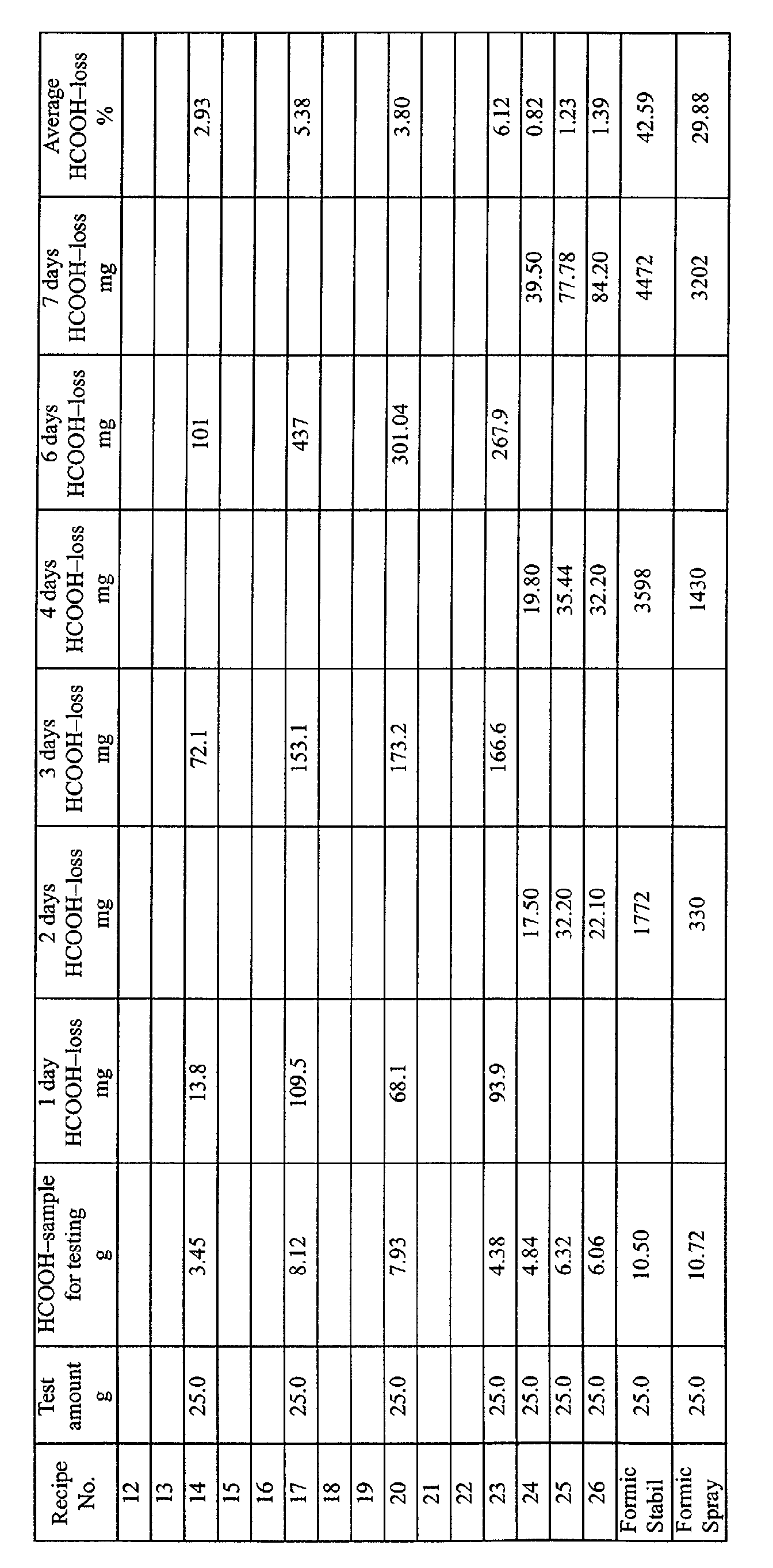
- Based on the results from the above tests it was concluded that the most preferred additive compositions would be based on potassium and/or sodium diformates and a desiccant.
- Two major types of additive compositions were then made for testing in feedstuffs.
Potassium diformate 40-50% Sodium di/tetra-formate 20-25% Calcium formate 20-25% Desiccant 2-5% Water 3-6% Potassium diformate 82-85% Calcium formate 9-12% Water 2-4% Desiccant 2-4% - The two additives mentioned above were tested in a feeding experiment lasting 42 days. It was conducted with a total of 96 piglets (females and castrated males) in two consecutive runs. 2 x 6 litters with 8 weaned piglets each were bought from a piglet producing farm to reach a totally randomised complete block design. These 8 piglets of each litter, formed one experimental block, were randomly allotted to one of the 8 treatments described below, having equal numbers of females and castrates in each group:
Group Diet supplemented with 1 no supplement = negative control 2 0.85% formic acid = positive control 3 0.65% Type I additive 4 1.30% Type I additive 5 1.95% Type I additive 6 0.65% Type II additive 7 1.30% Type II additive 8 1.95% Type II additive Composition of the feed mixtures (%) Prestarter Piglet rearing feed Corn 28.2 28.5 Barley - 5.0 Wheat - 30.0 Wheat bran 14.0 10.0 Rolled oats 10.0 - Soybean oil meal, extr. 15.1 9.5 Skimmed milk powder 14.0 - Corn gluten feed 5.0 5.0 Fish meal 5.0 5.7 Fat mixture 3.0 - Soybean oil - 1.1 Vitam. mineral premix 1.6 1.6 L-Lysine HCl 0.10 0.17 DL-Methionine 0.09 - Type 1 and 2 supplement and adjustment to energy, protein and Ca content 3.91 3.43 Concentrations of nutrients and energy in the feed mixtures used (% of FM) Prestarter Piglet rearing feed Dry matter 89.7 87.9 Crude ash 6.9 5.4 Crude protein 22.1 18.0 Crude fat 4.9 5.0 Crude fibre 5.5 4.4 N-free extracts 50.3 55.1 Lysine 13.5 10.0 Methionine 5.1 3.4 Calcium 10.5 9.0 Phosphorus 8.6 7.5 Sodium 1.4 2.0 Energy (MJ MR/kg) 13.2 13.0 - The influence of the additions used on the pH and the acid binding capacity of the individual feed mixtures (10% feed suspensions) is shown in Table IV.
pH value and acid binding capacity of the feed mixtures used Group 1 2 3 4 5 6 7 8 Supplement - 0.83% 0.65% 1.30% 1.95% 0.65% 1.30% 1.96% formic acid Type 1 Type 2 Prestarter pH value 5.10 4.10 5.18 4.57 4.41 4.76 4.69 4.50 acid binding capacity (meq HCl/kg for pH 3.0) 672 660 716 748 760 706 756 805 Piglet rearing feed pH value 5.16 4.28 5.00 4.71 4.63 6.38 5.12 4.94 acid binding cap. (meq HCl/kg for pH 3.0) 544 529 595 605 672 608 639 664 - In both diets the initial pH value of 5.1-5.2 in the unsupplemented control feed, which already was rather low, dropped by adding Type I or II additives to a minimum of pH 4.4 depending of the dosage, but did never reach that value caused by adding pure formic acid. In the prestarter there was no difference between the effects of Type I and Type II additives, but in the rearing feed Type I additives caused 0.4 units lower pH values compared with Type II additives. The acid binding capacity, which means the amount of HCl addition necessary to reach a pH value of 3.0 in the feed, reacted contrarily to the pH values. The higher the supplementation and the lower the pH value, the higher was the acid binding capacity, indicating a greater buffer capacity of the added substances.
- With Type II additives this effect was the greater. The distinctly stronger acid binding capacity of the prestarter diet compared with the rearing feed mixture was due to its higher protein and mineral contents.
- The weight development, feed intake and feed conversion of the piglets during the whole experiment are shown in the following Table V:
Live weights, daily gains, daily feed intake and feed conversion rate during the whole experiment (day 1-42) Group 1 2 3 4 5 6 7 8 Supplement - 0.86% 0.65% 1.30% 1.95% 0.65% 1.30% 1.95% formic acid Type 1 Type 2 Initial weight, 6.66 6.73 6.66 6.65 6.65 6.67 6.66 6.65 (kg) ±0.70 ±0.56 ±0.81 ±0.82 ±0.69 ±0.72 ±0.90 ±0.89 relative 100 101 100 100 100 100 100 100 Final weight, 26.66 28.67 27.80 29.54 29.85 29.50 28.04 29.07 (kg) ±3.23 ±4.81 ±2.54 ±4.08 ±3.29 ±3.87 ±3.11 ±3.63 relative 100 108 104 111 112 111 105 112 Daily gains 476 523 503 545 553 544 509 656 (g) ±71 ±105 ±52 ±82 ±73 ±79 ±61 ±73 relative 100 110 106 115 116 114 107 117 Daily feed intake 768 817 7 888 816 848 860 780 845 (g) ±113 ±159 ±96 ±126 ±117 ±121 ±88 ±102 relative 100 106 103 110 110 112 102 110 Feed conversion 1.62 1.57 1.58 1.55 1.53 1.59 1.53 1.52 (kg feed/kg gain) ± 0.07 ± 0.07 ± 0.05 ± 0.04 ± 0.05 ± 0.07 ± 0.06 ± 0.05 relative 100 97 96 96 94 98 94 94 - With a mean live weight of 6.7 kg, the same for each group, the piglets with the new additives gained 22.5 kg during the whole experiment of 42 days. Meanwhile the animals of the negative control group gained just 20.0 kg, those with pure formic acid addition 22.0 kg. Group 8 however, (1.95% Type II additive) had a significantly higher weight than group 1. 16-17%.higher daily weight gains during the whole experiment were only observed with the highest dosages of the new additives. The feed conversion rate was markedly better with feed additives, especially with 1.95% of Type I (group 5) or 1.30%, respectively 1.95% of Type II additives (group 7 and 8). Both Type I and II seemed to be more effective than pure formic acid.
- For the two separate experimental periods (see Table VI) it was proved that the new additives were more efficient within the prestarter feeding (day 1-21), according to growth between 6.5-16 kg, than within the consecutive rearing feeding (day 22-42). With average daily gains during this first period being 20% higher with Type II and 13% higher with Type I additives compared to group 1 without additives. Especially Type II gave an even gr
Live weights, daily gains, daily feed intake and feed conversion rate during both experimental periods (day 1-21) Group 1 2 3 4 5 6 7 8 Supplement - 0.85% 0.65% 1.30% 1.95% 0.65% 1.30% 1.95% formic acid Type 1 Type 2 1st. period (day 1-21) Daily gains 372 432 396 435 434 458 410 461 (g) ±71 ±89 ±54 ± 77 ±86 ±80 ±78 ±68 relative 100 116 106 117 117 123 110 124 Daily feed intake 487 516 498 521 520 550 484 646 (g) ±77 ±92 ±64 ±85 ±83 ±90 ±81 ±71 relative 100 106 102 107 107 113 99 112 Feed conversion 1.32 1.20 1.26 1.20 1.21 1.21 1.19 1.19 (kg feed/kg grain) ±0.10 ±0.06 ±0.06 ±0.05 ±0.07 ±0.08 ±0.07 ±0.05 relative 100 91 95 91 92 92 90 90 2nd. period (day 22-42) Daily gains 580 613 611 654 871 629 608 649 (g) ±110 ±124 ±78 ±100 ±76 ±83 ±65 ±98 relative 100 106 105 113 116 108 105 112 Daily feed intake 1 049 1 117 1 078 1 172 1 176 1 171 1 078 1 144 (g) ±171 ± 230 ±143 ±187 ±163 ±158 ±111 ±147 relative 100 106 103 112 112 112 103 109 Feed conversion 1.82 1.83 1.77 1.79 1.75 1.86 1.77 1.77 (kg feed/kg grain) ±0.12 ±0.11 ±0.10 ±0.07 ±0.12 ±0.09 ±0.11 ±0.09 relative 100 101 97 98 96 102 97 97 - Additionally to the performance data, the percental frequency of diarrhoea (days of diarrhoea x 100/number of animals/days of experiment) were calculated for the piglets with the following results:
Group Supplement Diarrhoea frequency 1 one 8.2% 2 0.85% formic acid 6.7% 3 0.65% Type I additive 8.7% 4 1.30% Type I additive 6.6% 5 1.95% Type I additive 6.3% 6 0.65% Type II additive 8.4% 7 1.30% Type II additive 5.8% 8 1.95% Type II additive 5.4% - As can be seen from this experiment the diarrhoea frequency was in fact very low. Mainly minor cases of diarrhoea were observed, which often happen when piglets are fed ad lib. There seemed to be some tendency to lower diarrhoea frequency with higher dosages of the new additives, especially with Type II additives.
- This example shows the results of tests performed on slaughter pigs. The tests comprised application of four different feedstuffs, the first one called "Standard feed" had the following composition:
"Standard feed" weight% Barley 78.78 Soya meal 10.00 Rape meal, Canola 8.00 Lime stone meal 1.50 Monocalcium phosphate 1.00 Salt (Sodium chloride) 0.50 Micro minerals 0.04 Vitamines 0.03 L-Lycine 0.15 - The following feedstuffs were used:
- Group 1.
- Standard Feed
- Group 2.
- Standard Feed + Ca/Na-formates 50/50 corresponding to 1% formic acid.
- Group 3.
- Standard Feed + 1% pure formic acid.
- Group 4.
- Standard Feed + Type II additive, corresponding to 1% formic acid.
- From these tests it can be seen that the new additive and feedstuff according to the invention improves the feed conversion and the relation between meat and lard for the slaughter pigs, even relative to formic acid.
- From the above experiments it can be seen that the new additives are suitable for promoting growth and mainly to improve feed conversion rate, especially during the prestarter period. There were no significant differences between the two additives, but with Type I sometimes higher dosages seemed to be necessary to reach the same efficiency as with Type II additives. The influence on the diarrhoea frequency proved to be slightly positive with application of the new additives.
- 1. Animal feed additive comprising diformates,
characterized in that
the additive comprises 20-99 weight% potassium diformate, 0-50 weight% sodium di/tetra-formate, 0-25 weight% calcium formate, and 0-5 weight% water. - 2. Animal feed additive according to 1,
characterized in that
the additive comprises 0-4 weight% desiccant. - 3. Animal feed additive according to 1,
characterized in that
the additive comprises 20-60 weight% potassium diformate, 20-50 weight% sodium di/tetra-formate, 0-25 weight% calcium formate, 1-4 weight% desiccant and 0-5 weight% water. - 4. Animal feed additive according to 1,
characterized in that
60-99 weight% potassium diformate, 0-25 weight% calcium formate, 1-4 weight% desiccant and 0-4 weight% water. - 5. Animal feed additive according to 1,
characterized in that
the additive is an aqueous solution having a concentration of 55-70 weight% of potassium- and/or sodium diformate. - 6. Animal feedstuff comprising disalts of formic acid,
characterized i that
the feedstuff comprises 0.2-2.5 weight% of additives according to 1-5. -
| Test group: | 1 | 2 | 3 | 4 |
| Number of animals | 12 | 12 | 12 | 12 |
| Animals slaughtered | 11 | 11 | 12 | 12 |
| Starting weight kg | 23.19 | 22.54 | 23.00 | 23.17 |
| Slaughter weight kg | 98.00 | 99.18 | 99.00 | 99.33 |
| Area of meat in cutlet, cm2 | 39.85 | 39.51 | 42.50 | 43.00 |
| Area of fat in cutlet, cm2 | 29.98 | 19.63 | 19.21 | 17.29 |
| Meat in per cent of cutlet | 51.90 | 66.86 | 68.87 | 71.32 |
| Feed units fattening/kg corrected weight gain | 2.35 | 2.26 | 2.22 | 2.19 |
Claims (11)
- Use of a composition comprising 20-99 weight % potassium diformate as an animal feed additive.
- Use acoording to claim 1 for the promotion of growth.
- Use according to claim 1 for the improvement of feed conversion and/or improvement of feed intake.
- Use according to claim 1 for the reduction of diarrhoea frequency.
- Use of animal feed additive according to any of the preceeding claims characterised in that the feed additive further comprises0-50 weight % sodium diformate or sodium tetraformate0-25 weight % calcium formate and0-5 weight % water
- Use according to claims 1 to 5 in animal feed for pig and/or piglets.
- Use according to claims 1 to 5 in animal feed for poultry, calves and/or cows.
- Use of animal feed additive for promoting growth, characterised in that the feed additive is in an aqueous solution having a concentration of 55-70 weight % of potassium- and/or sodium diformate.
- Use of animal feed additive for improvement of feed conversion and/or improvement of feed intake, characterised in that the feed additive is in an aqueous solution having a concentration of 55-70 weight % of potassium- and/or sodium diformate.
- Use according to claims 8 and/or 9 in animal feed for pig and/or piglets.
- Use according to claims 8 and/or 9 in animal feed for poultry, calves and/or cows.
Applications Claiming Priority (3)
| Application Number | Priority Date | Filing Date | Title |
|---|---|---|---|
| NO951883 | 1995-05-12 | ||
| NO951883A NO300912B1 (en) | 1995-05-12 | 1995-05-12 | Animal feed additives and feed containing such additives |
| EP96914469A EP0825818A1 (en) | 1995-05-12 | 1996-05-10 | Animal feed additives and feedstuff containing said additives |
Related Parent Applications (1)
| Application Number | Title | Priority Date | Filing Date |
|---|---|---|---|
| EP96914469A Division EP0825818A1 (en) | 1995-05-12 | 1996-05-10 | Animal feed additives and feedstuff containing said additives |
Publications (2)
| Publication Number | Publication Date |
|---|---|
| EP1273238A2 true EP1273238A2 (en) | 2003-01-08 |
| EP1273238A3 EP1273238A3 (en) | 2003-01-15 |
Family
ID=19898204
Family Applications (2)
| Application Number | Title | Priority Date | Filing Date |
|---|---|---|---|
| EP20020022611 Withdrawn EP1273238A3 (en) | 1995-05-12 | 1996-05-10 | Animal feed additives and feedstuff containing said additives |
| EP96914469A Withdrawn EP0825818A1 (en) | 1995-05-12 | 1996-05-10 | Animal feed additives and feedstuff containing said additives |
Family Applications After (1)
| Application Number | Title | Priority Date | Filing Date |
|---|---|---|---|
| EP96914469A Withdrawn EP0825818A1 (en) | 1995-05-12 | 1996-05-10 | Animal feed additives and feedstuff containing said additives |
Country Status (23)
| Country | Link |
|---|---|
| US (1) | US5935625A (en) |
| EP (2) | EP1273238A3 (en) |
| JP (2) | JPH11504818A (en) |
| KR (1) | KR100419039B1 (en) |
| CN (1) | CN1082346C (en) |
| AR (1) | AR001929A1 (en) |
| AU (1) | AU709672B2 (en) |
| BG (1) | BG102089A (en) |
| BR (1) | BR9608833A (en) |
| CA (1) | CA2220672C (en) |
| CZ (1) | CZ350697A3 (en) |
| DE (1) | DE825818T1 (en) |
| EA (1) | EA000406B1 (en) |
| ES (1) | ES2114515T1 (en) |
| HU (1) | HU224633B1 (en) |
| LT (1) | LT4353B (en) |
| MX (1) | MX9708690A (en) |
| NO (1) | NO300912B1 (en) |
| NZ (1) | NZ308235A (en) |
| PL (1) | PL183238B1 (en) |
| RO (1) | RO117141B1 (en) |
| SK (1) | SK150497A3 (en) |
| WO (1) | WO1996035337A1 (en) |
Cited By (2)
| Publication number | Priority date | Publication date | Assignee | Title |
|---|---|---|---|---|
| WO2004112496A1 (en) * | 2003-06-24 | 2004-12-29 | Basf Aktiengesellschaft | Coated preparations that contain at least one hydroformate |
| CN100438771C (en) * | 2003-06-24 | 2008-12-03 | 巴斯福股份公司 | Formulation comprising at least one hydrogen formate |
Families Citing this family (33)
| Publication number | Priority date | Publication date | Assignee | Title |
|---|---|---|---|---|
| NO304093B1 (en) * | 1996-11-01 | 1998-10-26 | Norsk Hydro As | Procedure for the production of fish feed and fish feed |
| DE19739319A1 (en) * | 1997-09-08 | 1999-03-11 | Basf Ag | Soaked salts, a process for their preparation, their use |
| MD1782G2 (en) * | 2000-12-28 | 2002-05-31 | Государственный Университет Молд0 | Process for stimulating the productivity of furproducing rabbits |
| NO313371B1 (en) * | 2001-02-13 | 2002-09-23 | Norsk Hydro As | impregnating agent |
| US7001625B2 (en) * | 2001-07-30 | 2006-02-21 | Kemin Industires, Inc. | Solid phase synthesis of salts of organic acids including butyric acid |
| US6986909B2 (en) * | 2001-07-30 | 2006-01-17 | Kemin Industries, Inc. | Solid phase synthesis of salts of organic acid |
| AR040415A1 (en) * | 2002-07-12 | 2005-04-06 | Basf Ag | PREPARATIONS CONTAINING SHORT CHAIN CARBOXYLICAL DIFORMIATES AND ACIDS, A PROCEDURE FOR OBTAINING AND USING AS ANIMAL FOOD |
| DE10231891A1 (en) * | 2002-07-12 | 2004-01-22 | Basf Ag | Coated formulation containing sodium, potassium, cesium and/or ammonium diformate is used in premix for animal feed or additive, as performance and/or growth promoter; acidifier; preservative or silage or in fertilizer |
| DE10237380A1 (en) * | 2002-08-12 | 2004-02-19 | Basf Ag | Production of formic acid-formate e.g. as preservative or animal feed additive, involves partial hydrolysis of methyl formate with water, distillation to give formic acid and water, and combination with the corresponding formate |
| DE10237379A1 (en) * | 2002-08-12 | 2004-02-19 | Basf Ag | Production of formic acid-formate e.g. preservative and animal feed additive, comprises partial hydrolysis of methyl formate, separation of formic acid, base hydrolysis of remaining ester and combination with formic acid |
| US20040175434A1 (en) * | 2002-08-30 | 2004-09-09 | Novus International, Inc. | Antimicrobial compositions |
| DE10261577A1 (en) * | 2002-12-23 | 2004-07-01 | Basf Ag | Use of hydroformate (s) |
| US7465471B2 (en) | 2003-03-21 | 2008-12-16 | Novus International, Inc. | Palatability of aquaculture feed |
| DE10321733A1 (en) * | 2003-05-14 | 2004-12-02 | Basf Ag | Process for the production of formic acid formates |
| NO320989B1 (en) * | 2003-12-05 | 2006-02-20 | Pigeon Vitality As | Feed additive containing a carboxylic acid and / or its salt as a basic component of the additive. |
| MY158458A (en) * | 2005-04-13 | 2016-10-14 | Basf Ag | Sodium diformate production and use |
| DE102005020890A1 (en) * | 2005-05-04 | 2006-11-09 | Basf Ag | Preparation of sodium formate |
| JPWO2007023889A1 (en) * | 2005-08-26 | 2009-02-26 | キヤノンセミコンダクターエクィップメント株式会社 | Flow analysis system |
| DE102005062931A1 (en) | 2005-12-29 | 2007-07-05 | Basf Ag | Preparing solid sodium formate, useful as fodder additive for animal fodder, comprises preparing aqueous solution having sodium formate and formic acid, reacting solid phase with base to form mixture, mixing mixture with formic acid |
| US8691843B2 (en) | 2006-07-12 | 2014-04-08 | Novus International, Inc. | Antioxidant combinations for use in ruminant feed rations |
| CN101790305A (en) | 2007-07-03 | 2010-07-28 | 诺华丝国际股份有限公司 | Piglet feed rations low in fermentable carbohydrates |
| US8404714B2 (en) | 2008-01-04 | 2013-03-26 | Novus International, Inc. | Combinations to improve animal health and performance |
| CN101502299B (en) * | 2009-03-17 | 2011-10-19 | 湛江市第一兽药厂 | Yuerkang feed addictive for tilapia |
| US8877272B2 (en) * | 2009-08-17 | 2014-11-04 | Paulo Roberto De Lima Portilho | 1-monopropionine compound and its isomer 3-monopropionine as preserving agents for animal feed, grains and animal-origin meals |
| CN101744098B (en) * | 2009-12-25 | 2013-03-20 | 广州市闽益生物科技有限公司 | Drying protective agent of high-activity fermented bean pulp |
| TW201141387A (en) * | 2010-01-15 | 2011-12-01 | Mosaic Co | Granulated monocalcium phosphate product containing abrasivity and lubricity additives |
| US8834945B2 (en) | 2010-01-15 | 2014-09-16 | Mos Holdings Inc. | Granulated phosphate product containing abrasivity and lubricity additives |
| AT510946B1 (en) | 2010-11-26 | 2015-03-15 | Erber Ag | Feed additive and use |
| CN105050421A (en) | 2013-03-11 | 2015-11-11 | 美盛有限公司 | Granulated feed phosphate compsition including feed enzymes |
| DE102014007673A1 (en) * | 2014-05-27 | 2015-12-03 | AQ Marketing AG | Salt mixture to supplement the mineral balance in the aquarium sector, ready-to-use solution of the salt mixture, use of the salt mixture and by the latter preserved aquarium ornamental stone |
| DE102016203477A1 (en) | 2016-03-03 | 2017-09-07 | Addcon Europe Gmbh | Preparation and use of alkali metal diformates with medium-chain fatty acid derivatives |
| CN108208318A (en) * | 2018-01-05 | 2018-06-29 | 浙江新篁生物技术有限公司 | A kind of sea crab feed addictive and its manufacturing method |
| CN111109466B (en) * | 2019-12-18 | 2023-08-22 | 南京同凯兆业生物技术有限责任公司 | High-calcium high-potassium broussonetia papyrifera leaf feed additive and preparation method and application thereof |
Citations (1)
| Publication number | Priority date | Publication date | Assignee | Title |
|---|---|---|---|---|
| EP0317668A1 (en) * | 1986-07-10 | 1989-05-31 | Coöperatieve Weiproduktenfabriek "Borculo" W.A. | A method of promoting the health and the growth of piglets |
Family Cites Families (7)
| Publication number | Priority date | Publication date | Assignee | Title |
|---|---|---|---|---|
| GB1505388A (en) * | 1975-11-27 | 1978-03-30 | Bp Chem Int Ltd | Acid salt solutions |
| US4182940A (en) * | 1978-08-29 | 1980-01-08 | Ford Motor Company | High voltage distributor for dual ignition system |
| IE790121L (en) * | 1978-09-14 | 1980-03-14 | Bp Nutrition U K Ltd | Milk replacer compositions |
| EP0112080A1 (en) * | 1982-12-11 | 1984-06-27 | BP Chemicals Limited | Compound animal feedstuffs |
| GB8525061D0 (en) * | 1985-10-10 | 1985-11-13 | Bp Chem Int Ltd | Antimicrobial additives |
| EP0316683A3 (en) * | 1987-11-13 | 1990-08-16 | BASF Aktiengesellschaft | Feed for piglets, fattening-pigs and poultry |
| US5637312A (en) * | 1995-03-29 | 1997-06-10 | Tock; Richard W. | Digestion enhancer for ruminant animals comprising a formate salt |
-
1995
- 1995-05-12 NO NO951883A patent/NO300912B1/en not_active IP Right Cessation
-
1996
- 1996-05-10 CZ CZ973506A patent/CZ350697A3/en unknown
- 1996-05-10 NZ NZ308235A patent/NZ308235A/en not_active IP Right Cessation
- 1996-05-10 JP JP8533973A patent/JPH11504818A/en active Pending
- 1996-05-10 EP EP20020022611 patent/EP1273238A3/en not_active Withdrawn
- 1996-05-10 RO RO97-02092A patent/RO117141B1/en unknown
- 1996-05-10 CN CN96194736A patent/CN1082346C/en not_active Expired - Lifetime
- 1996-05-10 WO PCT/NO1996/000114 patent/WO1996035337A1/en not_active Ceased
- 1996-05-10 EP EP96914469A patent/EP0825818A1/en not_active Withdrawn
- 1996-05-10 PL PL96323476A patent/PL183238B1/en unknown
- 1996-05-10 CA CA002220672A patent/CA2220672C/en not_active Expired - Lifetime
- 1996-05-10 SK SK1504-97A patent/SK150497A3/en unknown
- 1996-05-10 ES ES96914469T patent/ES2114515T1/en active Pending
- 1996-05-10 US US08/952,340 patent/US5935625A/en not_active Expired - Lifetime
- 1996-05-10 KR KR1019970708040A patent/KR100419039B1/en not_active Expired - Fee Related
- 1996-05-10 DE DE0825818T patent/DE825818T1/en active Pending
- 1996-05-10 EA EA199700377A patent/EA000406B1/en not_active IP Right Cessation
- 1996-05-10 AU AU57816/96A patent/AU709672B2/en not_active Expired
- 1996-05-10 MX MX9708690A patent/MX9708690A/en unknown
- 1996-05-10 HU HU9801943A patent/HU224633B1/en active IP Right Grant
- 1996-05-10 BR BR9608833A patent/BR9608833A/en not_active IP Right Cessation
- 1996-05-13 AR AR33649396A patent/AR001929A1/en active IP Right Grant
-
1997
- 1997-11-07 LT LT97-176A patent/LT4353B/en not_active IP Right Cessation
- 1997-12-01 BG BG102089A patent/BG102089A/en unknown
-
2004
- 2004-07-01 JP JP2004196141A patent/JP2004321191A/en active Pending
Patent Citations (1)
| Publication number | Priority date | Publication date | Assignee | Title |
|---|---|---|---|---|
| EP0317668A1 (en) * | 1986-07-10 | 1989-05-31 | Coöperatieve Weiproduktenfabriek "Borculo" W.A. | A method of promoting the health and the growth of piglets |
Non-Patent Citations (20)
| Title |
|---|
| "4. Boku-Symposium Tierernährung Tierernährung ohne antibiotische Leistungsförderer", 27 October 2005, BOKU, Vienna, ISBN: 3-900962-62-6, article EIDELSBURGER ET AL.: "Zum Einfluss von Kaliumdiformiat auf die Mast- und Schlachtleistungen von Schweinen" * |
| ANDERSON D.B.; MCCRACKEN V.J.; AMINOV R.I.; SIMPSON J.M.; MACKIE R.I.; VERSTEGEN M.W.A.; GASKINS H.R., NUTRITION ABSTRACTS AND REVIEWS SERIES B: LIVESTOCK FEEDS AND FEEDING, vol. 70, 2000, pages 101 - 108 |
| ANONYMOUS: "Scientific Opinion on the safety and efficacy of Formi(TM) LHS (potassium diformate) as a feed additive for sows EFSA Panel on Additives and Products or Substances used in Animal Feed (FEEDAP)", EFSA JOURNAL,, vol. 7, no. 9, 1 January 2009 (2009-01-01), pages 1 - 17, XP007923062 * |
| BEKEL, B.; KIRCHGESSNER, M.; ROTH, F.X., JOURNAL OF ANIMAL PHYSIOLOGY AND ANIMAL NUTRITION, vol. 67, 1992, pages 93 - 100 |
| BYRD JA; HARGIS B.M.; CALDWELL DJ.; BAILEY R.H.; HERRON KL.; MCREYNOLDS J.L.; BREWER R.L.; ANDERSON R.C.; BISCHOFF K.M.; CALLAWAY, POULTRY SCIENCE, vol. 80, 2001, pages 278 - 283 |
| LÜCKSTÄDT ET AL.: "Effects of Potassium Diformate on Growth Perofmance and Diarrhoea Rate in Piglets in Comparison to Antibiotics", PROCEEDINGS OF THE 15TH AAAP ANIMAL SCIENCE CONGRESS, 2012, pages 1796 - 1800 * |
| MARGARETH OEVERLAND: "Simple salt approved as alternative growth promoter", vol. 9, no. 4/5, 1 January 2001 (2001-01-01), pages 25 - 27, XP007923053, ISSN: 0928-124X, Retrieved from the Internet <URL:http://www.allaboutfeed.net/PageFiles/10272/001_boerderij-download-AAF10967D01.pdf> * |
| MIKKELSEN L L ET AL: "Effect of potassium diformate on growth performance and gut microbiota in broiler chickens challenged with necrotic enteritis", BRITISH POULTRY SCIENCE, vol. 50, no. 1, 2009, pages 66 - 75, ISSN: 0007-1668 * |
| MROZ., Z.; JONGBLOED, A.W.; PARTANEN K.; VAN DICPEN, J.TH.M.; KEMME P.A.; KOGUT J., JOURNAL OF ANIMAL SCIENCE, vol. 76, no. 1, 1997, pages 177 |
| MURAI A.; KITA K.; TSURUTA S.; OKUMURA J., JAPANESE POULTRY SCIENCE, vol. 38, 2001, pages 146 - 151 |
| PARTENEN, K.H.; MROZ, Z., NUTRITION RESEARCH REVIEWS, vol. 12, 1999, pages 1 - 30 |
| PATTERN J.D.; WALDROUP P.W., POULTRY SCIENCE, vol. 67, 1988, pages 1178 - 1182 |
| POTOCARERO-KHAN ET AL.: "Effect of Potassium diformate on performance in piglets - comparison with Zinc oxide and colistin under Spanish conditions", BOOK ABSTRACTS, 10TH INTERNATIONAL SYMPOSIUM ON DIGESTIVE PHYSIOLOGY IN PIGS, 25 May 2006 (2006-05-25), pages 2.39 * |
| SELLE ET AL.: "EFFECTS OF POTASSIUM DIFORMATE INCLUSION IN BROILER DIETS ON GROWTH PERFORMANCE AND NUTRIENT UTILISATION", PROC. AUST. POULT. SCI. SYM. 2004, 2004, pages 55 - 58 * |
| SELLE, P.H.; RAVINDRAN, V; RAVINDRAN, G.; PITTOLO, P.H; BRYDEN, W.L., ASIAN-AUSTRALASIAN JOURNAL OF ANIMAL SCIENCES, vol. 16, 2003, pages 394 - 402 |
| SKINNER, J.T.; IZAT, A. L.; WALDROUP, P.W., POULTRY SCIENCE, vol. 70, 1991, pages 1444 - 1447 |
| VOGT V.H.; MATTHEA, S.; HARNISCH. S.; RISTIC, M., ARCHIV. FÜR GEFLÜGELKUNDE, vol. 43, 1979, pages 54 - 60 |
| VOGT V.H.; MATTHES. S.; HARNISCH, S., ARCHIV FÜR GEFLÜGELKUNDE, vol. 45, 1981, pages 221 - 232 |
| VOGT V.H.; MATTHES. S.; HARNISCH, S., ARCHIV FÜR GEFLÜGELKUNDE, vol. 46, 1982, pages 223 - 227 |
| WALDROUP A.; KANIAWATI S.; MAUROMOUSTAKOS A., JOURNAL OF FOOD PROTECTION, vol. 58, 1995, pages 482489 |
Cited By (2)
| Publication number | Priority date | Publication date | Assignee | Title |
|---|---|---|---|---|
| WO2004112496A1 (en) * | 2003-06-24 | 2004-12-29 | Basf Aktiengesellschaft | Coated preparations that contain at least one hydroformate |
| CN100438771C (en) * | 2003-06-24 | 2008-12-03 | 巴斯福股份公司 | Formulation comprising at least one hydrogen formate |
Also Published As
Similar Documents
| Publication | Publication Date | Title |
|---|---|---|
| US5935625A (en) | Animal feed additives and feedstuff containing said additives | |
| MXPA97008690A (en) | Food additives for animals and food containing these aditi | |
| US4729896A (en) | Buffered animal feed supplement block | |
| CA1328371C (en) | Animal feed supplement with filler | |
| Sansoucy et al. | Molasses-urea blocks as a multinutrient supplement for ruminants | |
| CA1208063A (en) | Feed supplement for ruminant animals | |
| Tiwari et al. | Urea molasses mineral blocks as a feed supplement: effect on growth and nutrient utilization in buffalo calves | |
| Ayyat et al. | Effects of heat stress on growth, carcass traits and blood components of New Zealand White rabbits fed various dietary energy–fibre levels, under Egyptian conditions | |
| US4296132A (en) | Dog food of improved acceptability | |
| US4925637A (en) | Liquid feed supplement for monogastric animals | |
| Gomez | Use of cassava products in pig feeding. | |
| CA2361542A1 (en) | Chromium-carboxylic acid feed supplement | |
| Langlands et al. | The nutrition of ruminants grazing native and improved pastures. II.* Responses of grazing cattle to molasses and urea supplementation | |
| Lynch et al. | Effects of ethanol, heat, and lipid treatment of soybean meal on nitrogen utilization by ruminants | |
| US5077068A (en) | Liquid feed supplement for monogastric animals | |
| US4196194A (en) | Feeding dairy cattle | |
| US4196195A (en) | Feeding beef cattle | |
| Gomez | Use of cassava products in pig feeding | |
| US4900562A (en) | Feed intake limiting composition comprising calcium hydroxide for cattle | |
| JPH02286047A (en) | Feed for milk cow | |
| CA1248404A (en) | Animal feed supplement | |
| CA1098363A (en) | Use of malic acid as an animal feed additive | |
| US4563355A (en) | Food compositions for pigs and processes for the feeding of pigs | |
| Hamada | A new supplementary molasses block feed for the ruminant to improve the production efficiency under poor feeding condition | |
| Stewart Jr et al. | USING DISTILLERS GRAINS |
Legal Events
| Date | Code | Title | Description |
|---|---|---|---|
| PUAI | Public reference made under article 153(3) epc to a published international application that has entered the european phase |
Free format text: ORIGINAL CODE: 0009012 |
|
| PUAL | Search report despatched |
Free format text: ORIGINAL CODE: 0009013 |
|
| 17P | Request for examination filed |
Effective date: 20021009 |
|
| AC | Divisional application: reference to earlier application |
Ref document number: 825818 Country of ref document: EP |
|
| AK | Designated contracting states |
Kind code of ref document: A2 Designated state(s): AT BE CH DE DK ES FI FR GB GR IE IT LI NL PT SE |
|
| AK | Designated contracting states |
Kind code of ref document: A3 Designated state(s): AT BE CH DE DK ES FI FR GB GR IE IT LI NL PT SE |
|
| RIN1 | Information on inventor provided before grant (corrected) |
Inventor name: HJORNEVIK, LEIF Inventor name: PLOENES, FRANZ Inventor name: JOHNSEN, FREDDY |
|
| AKX | Designation fees paid |
Designated state(s): AT BE CH DE DK ES FI FR GB GR IE IT LI NL PT SE |
|
| 17Q | First examination report despatched |
Effective date: 20060727 |
|
| RAP1 | Party data changed (applicant data changed or rights of an application transferred) |
Owner name: BASF SE |
|
| GRAJ | Information related to disapproval of communication of intention to grant by the applicant or resumption of examination proceedings by the epo deleted |
Free format text: ORIGINAL CODE: EPIDOSDIGR1 |
|
| GRAP | Despatch of communication of intention to grant a patent |
Free format text: ORIGINAL CODE: EPIDOSNIGR1 |
|
| INTG | Intention to grant announced |
Effective date: 20140117 |
|
| GRAP | Despatch of communication of intention to grant a patent |
Free format text: ORIGINAL CODE: EPIDOSNIGR1 |
|
| RIC1 | Information provided on ipc code assigned before grant |
Ipc: A23K 50/30 20160101AFI20160316BHEP |
|
| INTG | Intention to grant announced |
Effective date: 20160404 |
|
| STAA | Information on the status of an ep patent application or granted ep patent |
Free format text: STATUS: THE APPLICATION IS DEEMED TO BE WITHDRAWN |
|
| 18D | Application deemed to be withdrawn |
Effective date: 20160817 |