EP1270798A1 - Liquid finishing agent composition for textile product - Google Patents
Liquid finishing agent composition for textile product Download PDFInfo
- Publication number
- EP1270798A1 EP1270798A1 EP01917551A EP01917551A EP1270798A1 EP 1270798 A1 EP1270798 A1 EP 1270798A1 EP 01917551 A EP01917551 A EP 01917551A EP 01917551 A EP01917551 A EP 01917551A EP 1270798 A1 EP1270798 A1 EP 1270798A1
- Authority
- EP
- European Patent Office
- Prior art keywords
- group
- finishing composition
- textile products
- fatty acids
- component
- Prior art date
- Legal status (The legal status is an assumption and is not a legal conclusion. Google has not performed a legal analysis and makes no representation as to the accuracy of the status listed.)
- Granted
Links
Images

Classifications
-
- D—TEXTILES; PAPER
- D06—TREATMENT OF TEXTILES OR THE LIKE; LAUNDERING; FLEXIBLE MATERIALS NOT OTHERWISE PROVIDED FOR
- D06M—TREATMENT, NOT PROVIDED FOR ELSEWHERE IN CLASS D06, OF FIBRES, THREADS, YARNS, FABRICS, FEATHERS OR FIBROUS GOODS MADE FROM SUCH MATERIALS
- D06M15/00—Treating fibres, threads, yarns, fabrics, or fibrous goods made from such materials, with macromolecular compounds; Such treatment combined with mechanical treatment
- D06M15/19—Treating fibres, threads, yarns, fabrics, or fibrous goods made from such materials, with macromolecular compounds; Such treatment combined with mechanical treatment with synthetic macromolecular compounds
- D06M15/37—Macromolecular compounds obtained otherwise than by reactions only involving carbon-to-carbon unsaturated bonds
- D06M15/643—Macromolecular compounds obtained otherwise than by reactions only involving carbon-to-carbon unsaturated bonds containing silicon in the main chain
- D06M15/647—Macromolecular compounds obtained otherwise than by reactions only involving carbon-to-carbon unsaturated bonds containing silicon in the main chain containing polyether sequences
-
- D—TEXTILES; PAPER
- D06—TREATMENT OF TEXTILES OR THE LIKE; LAUNDERING; FLEXIBLE MATERIALS NOT OTHERWISE PROVIDED FOR
- D06M—TREATMENT, NOT PROVIDED FOR ELSEWHERE IN CLASS D06, OF FIBRES, THREADS, YARNS, FABRICS, FEATHERS OR FIBROUS GOODS MADE FROM SUCH MATERIALS
- D06M13/00—Treating fibres, threads, yarns, fabrics or fibrous goods made from such materials, with non-macromolecular organic compounds; Such treatment combined with mechanical treatment
- D06M13/10—Treating fibres, threads, yarns, fabrics or fibrous goods made from such materials, with non-macromolecular organic compounds; Such treatment combined with mechanical treatment with compounds containing oxygen
- D06M13/184—Carboxylic acids; Anhydrides, halides or salts thereof
-
- D—TEXTILES; PAPER
- D06—TREATMENT OF TEXTILES OR THE LIKE; LAUNDERING; FLEXIBLE MATERIALS NOT OTHERWISE PROVIDED FOR
- D06M—TREATMENT, NOT PROVIDED FOR ELSEWHERE IN CLASS D06, OF FIBRES, THREADS, YARNS, FABRICS, FEATHERS OR FIBROUS GOODS MADE FROM SUCH MATERIALS
- D06M13/00—Treating fibres, threads, yarns, fabrics or fibrous goods made from such materials, with non-macromolecular organic compounds; Such treatment combined with mechanical treatment
- D06M13/10—Treating fibres, threads, yarns, fabrics or fibrous goods made from such materials, with non-macromolecular organic compounds; Such treatment combined with mechanical treatment with compounds containing oxygen
- D06M13/224—Esters of carboxylic acids; Esters of carbonic acid
-
- D—TEXTILES; PAPER
- D06—TREATMENT OF TEXTILES OR THE LIKE; LAUNDERING; FLEXIBLE MATERIALS NOT OTHERWISE PROVIDED FOR
- D06M—TREATMENT, NOT PROVIDED FOR ELSEWHERE IN CLASS D06, OF FIBRES, THREADS, YARNS, FABRICS, FEATHERS OR FIBROUS GOODS MADE FROM SUCH MATERIALS
- D06M13/00—Treating fibres, threads, yarns, fabrics or fibrous goods made from such materials, with non-macromolecular organic compounds; Such treatment combined with mechanical treatment
- D06M13/322—Treating fibres, threads, yarns, fabrics or fibrous goods made from such materials, with non-macromolecular organic compounds; Such treatment combined with mechanical treatment with compounds containing nitrogen
- D06M13/325—Amines
- D06M13/328—Amines the amino group being bound to an acyclic or cycloaliphatic carbon atom
-
- D—TEXTILES; PAPER
- D06—TREATMENT OF TEXTILES OR THE LIKE; LAUNDERING; FLEXIBLE MATERIALS NOT OTHERWISE PROVIDED FOR
- D06M—TREATMENT, NOT PROVIDED FOR ELSEWHERE IN CLASS D06, OF FIBRES, THREADS, YARNS, FABRICS, FEATHERS OR FIBROUS GOODS MADE FROM SUCH MATERIALS
- D06M13/00—Treating fibres, threads, yarns, fabrics or fibrous goods made from such materials, with non-macromolecular organic compounds; Such treatment combined with mechanical treatment
- D06M13/322—Treating fibres, threads, yarns, fabrics or fibrous goods made from such materials, with non-macromolecular organic compounds; Such treatment combined with mechanical treatment with compounds containing nitrogen
- D06M13/35—Heterocyclic compounds
- D06M13/352—Heterocyclic compounds having five-membered heterocyclic rings
-
- D—TEXTILES; PAPER
- D06—TREATMENT OF TEXTILES OR THE LIKE; LAUNDERING; FLEXIBLE MATERIALS NOT OTHERWISE PROVIDED FOR
- D06M—TREATMENT, NOT PROVIDED FOR ELSEWHERE IN CLASS D06, OF FIBRES, THREADS, YARNS, FABRICS, FEATHERS OR FIBROUS GOODS MADE FROM SUCH MATERIALS
- D06M13/00—Treating fibres, threads, yarns, fabrics or fibrous goods made from such materials, with non-macromolecular organic compounds; Such treatment combined with mechanical treatment
- D06M13/322—Treating fibres, threads, yarns, fabrics or fibrous goods made from such materials, with non-macromolecular organic compounds; Such treatment combined with mechanical treatment with compounds containing nitrogen
- D06M13/46—Compounds containing quaternary nitrogen atoms
- D06M13/463—Compounds containing quaternary nitrogen atoms derived from monoamines
-
- D—TEXTILES; PAPER
- D06—TREATMENT OF TEXTILES OR THE LIKE; LAUNDERING; FLEXIBLE MATERIALS NOT OTHERWISE PROVIDED FOR
- D06M—TREATMENT, NOT PROVIDED FOR ELSEWHERE IN CLASS D06, OF FIBRES, THREADS, YARNS, FABRICS, FEATHERS OR FIBROUS GOODS MADE FROM SUCH MATERIALS
- D06M13/00—Treating fibres, threads, yarns, fabrics or fibrous goods made from such materials, with non-macromolecular organic compounds; Such treatment combined with mechanical treatment
- D06M13/322—Treating fibres, threads, yarns, fabrics or fibrous goods made from such materials, with non-macromolecular organic compounds; Such treatment combined with mechanical treatment with compounds containing nitrogen
- D06M13/46—Compounds containing quaternary nitrogen atoms
- D06M13/47—Compounds containing quaternary nitrogen atoms derived from heterocyclic compounds
- D06M13/473—Compounds containing quaternary nitrogen atoms derived from heterocyclic compounds having five-membered heterocyclic rings
-
- D—TEXTILES; PAPER
- D06—TREATMENT OF TEXTILES OR THE LIKE; LAUNDERING; FLEXIBLE MATERIALS NOT OTHERWISE PROVIDED FOR
- D06M—TREATMENT, NOT PROVIDED FOR ELSEWHERE IN CLASS D06, OF FIBRES, THREADS, YARNS, FABRICS, FEATHERS OR FIBROUS GOODS MADE FROM SUCH MATERIALS
- D06M2200/00—Functionality of the treatment composition and/or properties imparted to the textile material
- D06M2200/20—Treatment influencing the crease behaviour, the wrinkle resistance, the crease recovery or the ironing ease
-
- D—TEXTILES; PAPER
- D06—TREATMENT OF TEXTILES OR THE LIKE; LAUNDERING; FLEXIBLE MATERIALS NOT OTHERWISE PROVIDED FOR
- D06M—TREATMENT, NOT PROVIDED FOR ELSEWHERE IN CLASS D06, OF FIBRES, THREADS, YARNS, FABRICS, FEATHERS OR FIBROUS GOODS MADE FROM SUCH MATERIALS
- D06M2200/00—Functionality of the treatment composition and/or properties imparted to the textile material
- D06M2200/50—Modified hand or grip properties; Softening compositions
-
- Y—GENERAL TAGGING OF NEW TECHNOLOGICAL DEVELOPMENTS; GENERAL TAGGING OF CROSS-SECTIONAL TECHNOLOGIES SPANNING OVER SEVERAL SECTIONS OF THE IPC; TECHNICAL SUBJECTS COVERED BY FORMER USPC CROSS-REFERENCE ART COLLECTIONS [XRACs] AND DIGESTS
- Y10—TECHNICAL SUBJECTS COVERED BY FORMER USPC
- Y10T—TECHNICAL SUBJECTS COVERED BY FORMER US CLASSIFICATION
- Y10T428/00—Stock material or miscellaneous articles
- Y10T428/13—Hollow or container type article [e.g., tube, vase, etc.]
- Y10T428/1334—Nonself-supporting tubular film or bag [e.g., pouch, envelope, packet, etc.]
-
- Y—GENERAL TAGGING OF NEW TECHNOLOGICAL DEVELOPMENTS; GENERAL TAGGING OF CROSS-SECTIONAL TECHNOLOGIES SPANNING OVER SEVERAL SECTIONS OF THE IPC; TECHNICAL SUBJECTS COVERED BY FORMER USPC CROSS-REFERENCE ART COLLECTIONS [XRACs] AND DIGESTS
- Y10—TECHNICAL SUBJECTS COVERED BY FORMER USPC
- Y10T—TECHNICAL SUBJECTS COVERED BY FORMER US CLASSIFICATION
- Y10T428/00—Stock material or miscellaneous articles
- Y10T428/13—Hollow or container type article [e.g., tube, vase, etc.]
- Y10T428/1352—Polymer or resin containing [i.e., natural or synthetic]
Definitions
- the present invention relates to a liquid finishing composition used for textile products such as clothes.
- the present invention relates to a liquid finishing composition suitably used for textile products including a variety of fibrous goods such as shirts, pants and blouses, which should satisfy the requirements for softness and for natural HARI (anti-drape) upon the finish of the same.
- finishing agents for textile products comprising, as main components, various kinds of quaternary ammonium salts in order to impart softness or flexibility to textile products after washing.
- di- (long chain) type quaternary ammonium salts are generally used.
- the finishing agent for textile products comprising a di-(long chain) type quaternary ammonium salt as a main component shows an excellent softness-imparting effect, but it suffers from such problems that some of fibers and/or articles for clothes treated with the finishing agent lose their HARI and KOSHI(stiffness) depending on the kinds thereof and therefore, the use thereof is not preferred. In addition, it shows only a slight effect of reducing wrinkles formed due to washing.
- J.P. KOKAI Japanese Un-Examined Patent Publication
- J.P. KOKAI No. Hei 1-162878 discloses an aqueous base formulation for conditioning fabrics, which comprises a water-dispersible cationic softener and a nonionic softener consisting of a specific siloxane.
- J.P. KOKAI No. Hei 2-191774 discloses a condensed type softening and finishing agent for clothes, which comprises a quaternary ammonium salt and a specific silicone derivative.
- any finishing agent for textile products which can not only impart desirable softness to textile products, but also maintain the HARI (anti-drape) and KOSHI of these textile products and likewise permits the reduction of wrinkles formed due to washing.
- an object of the present invention is to provide a liquid finishing composition for textile products, which can impart desirable softness to fibrous products such as fibers and clothes, can maintain HARI, which means “anti-drape” in the whole specification, and KOSHI, which means “stiffness” in the whole specification, of the fibrous products and shows an effect of reducing the wrinkles formed during washing.
- the inventors of this invention have intensively studied to achieve the foregoing object, have found that it is effective for accomplishing the foregoing object to simultaneously use a specific modified silicone and an amine compound or a neutralized product thereof or a quaternary derivative thereof in a specific ratio, simultaneous with a specific fatty acid compound and have thus completed the present invention.
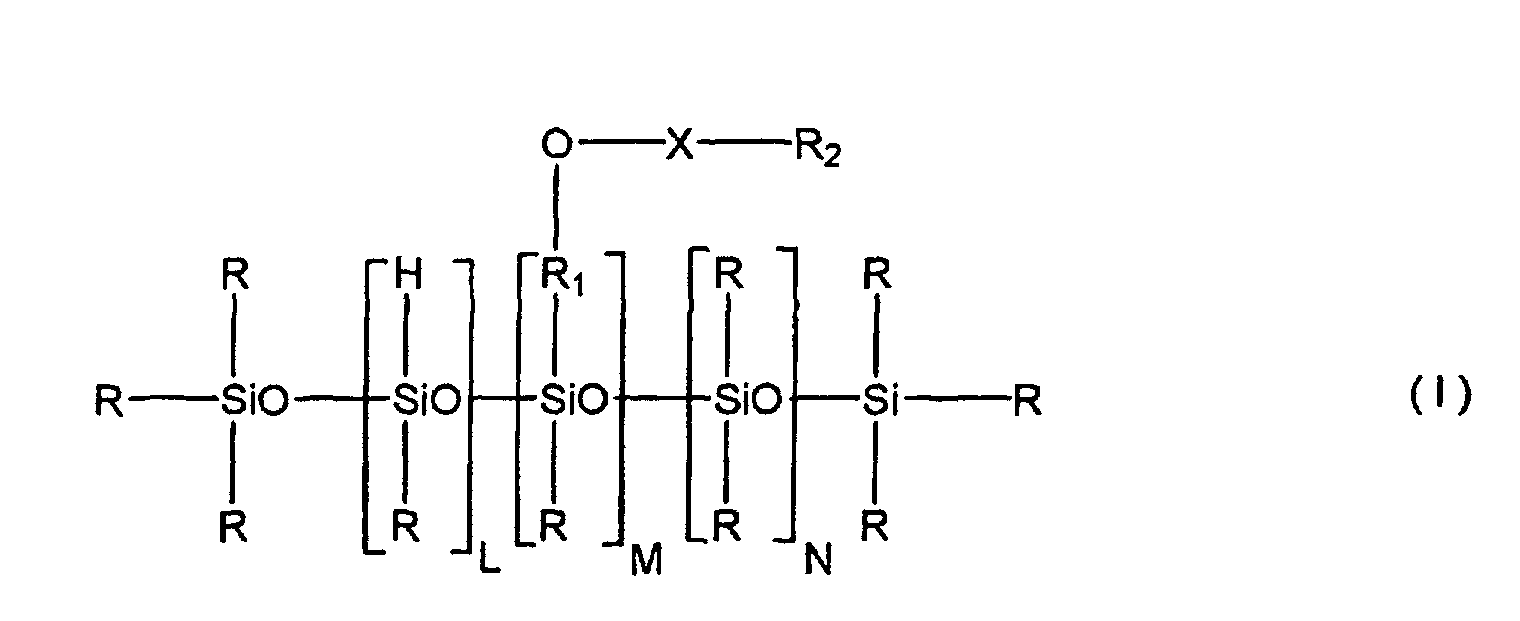
- a liquid finishing composition for textile products comprising (A) at least one modified silicone represented by the following general formula (I): wherein R may be the same or different and each represents a saturated or unsaturated hydrocarbon group having 1 to 4 carbon atoms, R 1 represents a saturated or unsaturated hydrocarbon group having 1 to 4 carbon atoms, R 2 represents a hydrogen atom or a saturated or unsaturated hydrocarbon group having 1 to 4 carbon atoms, X represents a polyoxyalkylene group, each of L, M and N represents an average number of each corresponding repeating unit, wherein L represents a numerical value ranging from 0 to 5, M represents a numerical value ranging from 1 to 100 and N represents a numerical value ranging from 10 to 1000, provided that the rate of weight of the polyoxyethylene chain moieties present in the polyoxyalkylene group X is not less than 10% and less than 50% on the basis of the total weight of the molecule; (B) an amine compound containing, in the molecule, at least
- the component (A) used in the present invention is a modified silicone represented by the following general formula (I):
- the substituents represented by R may be the same or different and each of these substituents is a saturated or unsaturated hydrocarbon group having 1 to 4 carbon atoms.
- Specific examples of the substituent R include saturated hydrocarbon groups such as methyl, ethyl, propyl and butyl groups, with methyl group being preferred among others.
- the substituent represented by R 1 is a saturated or unsaturated, straight or branched hydrocarbon group having 1 to 4 carbon atoms.
- Examples of preferred substituents R 1 are saturated hydrocarbon groups such as methylene, ethylene, propylene and butylene groups, with propylene group being more preferred among others.
- the substituent represented by R 2 is a hydrogen atom or a saturated or unsaturated, straight or branched hydrocarbon group having 1 to 4 carbon atoms.
- R 2 represents a hydrocarbon group
- saturated hydrocarbon groups such as methyl, ethyl, propyl and butyl groups.
- Hydrogen atom is particularly preferred as the substituent R 2 .
- the polyoxyalkylene group X represents a polyoxyalkylene group.
- the polyoxyalkylene group X may be, for instance, a polyoxyethylene, polyoxypropylene or polyoxybutylene group or may likewise be a group comprising oxyethylene units, oxypropylene units and/or oxybutylene units arranged randomly or in the form of blocks .
- the rate (by weight) of the polyoxyethylene chain moieties present in the polyoxyalkylene group should be not less than 10% and less than 50% on the basis of the total weight of the molecule from the viewpoint of impartment of preferred softness to textile products and reduction of wrinkles due to washing.
- the rate (by weight) of the polyoxyethylene chain moieties present in the polyoxyalkylene group preferably falls within the range of from 15 to 45% and more preferably 20 to 35% on the basis of the total weight of the molecule. Moreover, the rate (by weight) of the polyoxyethylene chain moieties preferably ranges from 50 to 100% and more preferably 65 to 100% on the basis of the weight of the polyoxyalkylene group X.
- Each L, M and N represents an average number of each corresponding repeating unit, and more specifically, L ranges from 0 to 5, preferably 0 to 1, M ranges from 1 to 100, preferably 1 to 50 and N ranges from 10 to 1000 and preferably 20 to 500.
- the modified silicone represented by the general formula (I) may be one having a block copolymer structure in which the repeating units are arranged in blocks or one having a random copolymer structure in which the repeating units are randomly arranged.
- the component (A) usable herein may be a single modified silicone represented by the general formula (I) or may comprise a plurality of different modified silicones.
- the method for preparing the modified silicone represented by the general formula (I) is not limited to a particular one, but may be generally prepared by an addition reaction of silicone oil having Si-H groups with a polyether having a terminal carbon-carbon double bond.
- the molecular weight of the modified silicone used in the present invention as the component (A) preferably ranges from 3,000 to 200,000 and more preferably 5,000 to 100,000.
- the modified silicone as the component (A) is blended into the finishing composition of the invention in an amount ranging from 0.5 to 30% by weight and more preferably 1 to 20% by weight, in order to impart a sufficient finishing effect to the composition and to make the viscosity of the finishing composition moderate.
- the amount of each component blended into the composition means the value determined when balanced with purified water or an aqueous solvent in this specification.
- the component (B) used in the present invention is an amine compound containing, in the molecule, at least one saturated or unsaturated hydrocarbon group having 6 to 26 carbon atoms, a neutralized product or quaternary derivative thereof or mixture thereof.
- the amine compound or neutralized product or quaternary derivative thereof includes, in the molecule, at least one, preferably 1 to 3 and most preferably 2 saturated or unsaturated hydrocarbon groups having 6 to 26 and preferably 14 to 22 carbon atoms such as an alkyl group or an alkenyl group.
- the hydrocarbon group may include, for instance, an ester group, a inverse ester group, an amide group, a inverse amide group and/or an ether group in its chain.
- these hydrocarbon groups may be introduced into the foregoing amine compound or the like through the use of currently industrially used materials such as fatty acids obtained by hydrogenating or partially hydrogenating un-hydrogenated fatty acids derived from tallow or unsaturated portion thereof; and fatty acids and fatty acid esters obtained by hydrogenating or partially hydrogenating un-hydrogenated fatty acids derived from plants such as seeds of palm trees and oil palm trees or fatty acid ester, or unsaturated portion thereof.
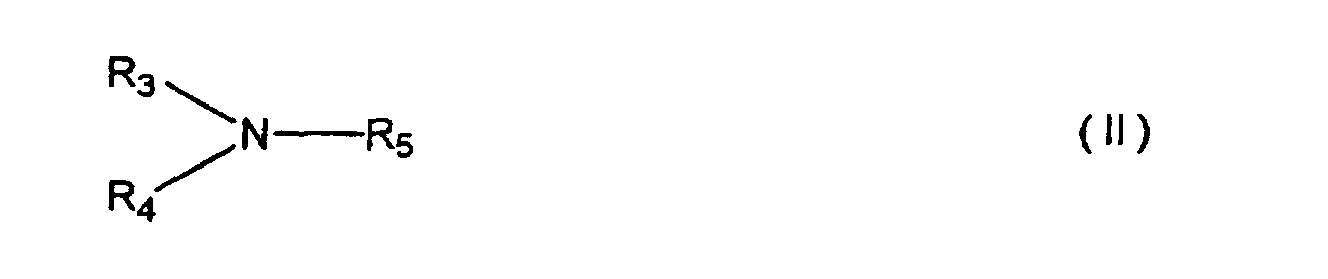
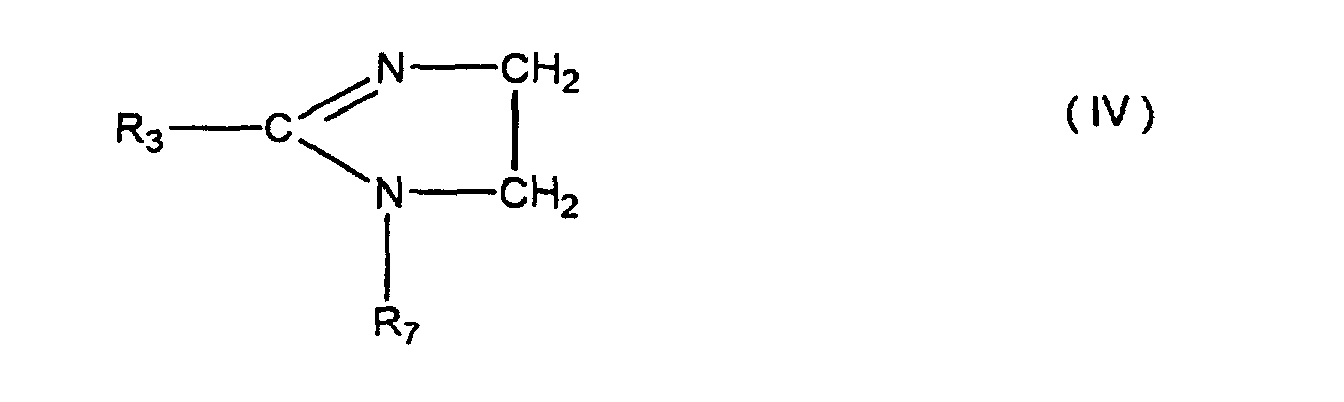
- amine compounds or neutralized products or quaternary derivatives thereof used as the component (B) include those represented by the following general formulas (II) to (IV):
- R 3 represents a saturated or unsaturated, straight or branched hydrocarbon group having 8 to 22 carbon atoms and free of any separating group such as an ester group and when it is an unsaturated hydrocarbon group, the cis/trans ratio thereof is preferably not less than 40/60;
- the neutralization of the amine compound is carried out using the usual acid.
- acids are inorganic acids such as hydrochloric acid, sulfuric acid and phosphoric acid and organic acids such as benzoic acid, citric acid, malic acid, succinic acid and acrylic acid.
- the quaternary derivative of the amine compound may be prepared by adding an alkyl group to a tertiary amine having a long chain alkyl group(s) according to the per-alkylation technique.
- Per-alkylating agents usable herein may be, for instance, dimethyl-sulfuric acid and benzyl chloride.
- a lower alkyl halide such as methyl iodide, methyl chloride, ethyl chloride or butyl bromide, diethyl-sulfuric acid or epichlorohydrin, in place of these per-alkylating agents.
- the quaternary derivative of the amine compound may be prepared by acting a long chain alkyl halide on a lower tertiary amine.
- the long chain alkyl halide may be one having an ether bond in the chain.
- the long chain alkyl halide used in the reaction may be replaced with, for instance, a chloroalkyl ester such as chloromethyl ester, chloroethyl ester or chloropropyl ester, or a chloromethylated derivative of an acid amide.
- the amine compounds or neutralized products or quaternary derivatives thereof may be used alone or in any combination of at least two of them.
- Further improved softness can be imparted to textile products, when the rate by weight of the amine compound, the neutralized product or quaternary derivative thereof, or a mixture thereof, having at least two hydrocarbon groups, present in the component (B) used in the present invention is adjusted to a level of not less than 70% by weight and preferably 75 to 100% by weight on the basis of the total weight of the component (B).
- the amine compound or the neutralized product or quaternary derivative thereof, used as the component (B) is suitably blended into the finishing composition of the present invention in an amount ranging from 3 to 50% by weight and more preferably 5 to 30% by weight on the basis of the weight of the finishing composition in order to enjoy a sufficient finishing effect and to make the viscosity of the finishing agent moderate.
- the weight ratio of Component (A):Component (B) in the finishing composition for textile products according to the present invention falls within the range of from 5: 95 to 50: 50 and preferably 10: 90 to 40: 60 in order to impart favorable softness to the textile products and to simultaneously maintain the HARI and KOSHI of the products and reduce wrinkles formed due to the washing of the same.
- the component (C) used herein is at least one compound selected from the group consisting of C 10 to C 22 fatty acids, C 10 to C 22 fatty acid salts and esters of C 10 to C 22 fatty acids with alcohols.
- the incorporation of the component (C) into the finishing composition may impart more favorable softness to clothes.
- the C 10 to C 22 , preferably C 12 to C 20 hydrocarbon moieties present in the fatty acids and fatty acid salts may be, for instance, straight or branched, aliphatic or cyclic hydrocarbon groups.
- Such fatty acids may be, for instance, fats and oils derived from animals and plants and fatty acids derived from such animal and plants' fats and oils.
- Specific examples thereof include tallow-derived fatty acids, palm oil-derived fatty acids, soybean oil-derived fatty acids, lard-derived fatty acids, sunflower oil-derived fatty acids, olive oil-derived fatty acids, safflower oil-derived fatty acids or partially or fully hydrogenated products thereof, lauric acid, myristic acid, palmitic acid, stearic acid, oleic acid or elaidic acid, but are not restricted to these specific examples.
- preferably used herein are palmitic acid, stearic acid, oleic acid and elaidic acid.
- neutral salts of fatty acids preferred examples are Na salts, K salts, Ca salts, Mg salts and triethanolamine salts, with Na salts and Ca salts being more preferably used.
- ester derivatives as the component (C) include those listed below: Esters of lower alcohols such as methanol, ethanol and isopropyl alcohol or trivalent to hexavalent polyhydric alcohols such as glycerin, pentaerythritol, sorbitol and triethanolamine with long chain fatty acids such as lauric acid, palmitic acid, stearic acid, oleic acid and elaidic acid.
- esters with polyhydric alcohols a part of the OH groups is preferably esterified rather than all of the OH groups of the alcohols are fully esterified.
- esters used as the component (C) are methyl stearate, methyl palmitate, methyl oleate, methyl ester of elaidic acid, monostearin and pentaerythritol monostearate.
- the amount of the component (C) to be blended into the finishing composition of the present invention ranges from 0.5 to 5% by weight and preferably 0.8 to 3% by weight based on the weight of the composition. If the amount thereof falls within the range defined above, not only favorable softness can be imparted to textile products, but also the HARI and KOSHI of the products can be maintained.
- the finishing composition preferably has a pH value ranging from 1 to 6 and more preferably 2 to 5 in order to improve the ability of the amine compound to be adsorbed onto fibers.
- the finishing composition of the present invention may optionally comprise, for instance, additives used in the usual finishing agents for domestic use in such an amount that they never adversely affect the desired effects of the present invention.
- additives include nonionic surfactants obtained by the addition of 5 to 100 moles, on the average, of alkylene oxide to C 8 to C 22 straight or branched higher alcohols, amines or methyl esters of fatty acids; higher alcohols; water-soluble salts such as common salt, ammonium chloride, calcium chloride, magnesium chloride and potassium chloride; solvents such as ethyl alcohol, isopropyl alcohol, ethylene glycol, propylene glycol, isopropylene glycol and hexylene glycol; urea; bactericides; antioxidants; dyes; pigments; hydrocarbons; cellulose derivatives; UV light absorbers; fluorescent whitenings; and perfumes.
- the alkylene oxide for preparing the nonionic surfactants may be, for instance, ethylene oxide, propylene oxide and butylene oxide, with ethylene oxide being preferably used.
- the nonionic surfactants also include those further comprising propylene oxide and/or butylene oxide moieties in addition to ethylene oxide moieties.
- the nonionic surfactant is preferably one obtained by the addition of 5 to 100 moles of ethylene oxide to a C 8 to C 22 straight or branched higher alcohol.
- the carbon chain length of the higher alcohol used for preparing the nonionic surfactant preferably corresponds to C 10 to C 16 and more preferably C 12 to C 14 .
- the carbon chain length of the amine or the methyl ester of fatty acid used for preparing the nonionic surfactant preferably corresponds to C 10 to C 18 and more preferably C 12 to C 18 .
- the average molar number of added ethylene oxide units preferably ranges from 10 to 80 and particularly preferably 20 to 60.
- the average molar number of propylene oxide and/or butylene oxide units added together with ethylene oxide units preferably ranges from 1 to 5 and more preferably 1 to 3.
- the nonionic surfactants may be prepared by adding ethylene oxide to C 8 to C 22 straight or branched higher alcohols, amines or methyl esters of fatty acids and then adding propylene oxide or butylene oxide to the resulting ethylene oxide adduct; or may be prepared by first adding propylene oxide or butylene oxide to C 8 to C 22 straight or branched higher alcohols, amines or methyl esters of fatty acids and then adding ethylene oxide to the resulting adduct; or may further be prepared by randomly adding ethylene oxide, propylene oxide and butylene oxide to C 8 to C 22 straight or branched higher alcohols, amines or methyl esters of fatty acids.
- the nonionic surfactant is preferably blended into the composition in an amount ranging from 0.1 to 10% by weight and more preferably 0.5 to 5% by weight.
- the higher alcohol is preferably blended into the composition in an amount ranging from 0.1 to 5% by weight and more preferably 0.1 to 3% by weight.
- the water-soluble salt such as common salt or calcium chloride is preferably blended into the composition in an amount ranging from 0.05 to 3% by weight and more preferably 0.1 to 2% by weight.
- the solvent such as ethyl alcohol, isopropyl alcohol or ethylene glycol is preferably blended into the composition in an amount ranging from 0.1 to 20% by weight and more preferably 0.1 to 10% by weight.
- a container for holding the product of the present invention may be one comprising a dispensing cap, a nozzle cap and a container body.
- typical examples of materials for such dispensing cap are high-density polyethylene, low-density polyethylene, polyethylene terephthalate, polypropylene, polycarbonate and acrylic resins and the inner volume of the dispensing cap desirably ranges from 10 to 80 mL.
- the dispensing cap in general has a circular cross-sectional shape, but the cross-sectional shape thereof may likewise be a polygon such as a tetragonal, hexagonal or octagonal one.
- the dispensing cap may optionally have markings or prints, on the internal or external surface, for dispensing the content of the container and/or may be knurled to prevent a slippage.
- the dispensing cap may comprise a pigment, an antistatic agent, a UV light absorber and/or a slip agent.
- the nozzle cap is a cap body blended into a cylindrical opening of the container body, wherein a partition is provided within the assembled cylinder-like member to separate the member into upper and lower portions and the partition is provided with an opening for discharging the content of the container.
- Materials for the nozzle cap used herein are selected from, for instance, high-density polyethylene, low-density polyethylene, polyethylene terephthalate, polypropylene, polycarbonate and acrylic resins.
- the nozzle cap may comprise a pigment, an antistatic agent, a UV light absorber and/or a slip agent.
- the container body is selected from those prepared from materials such as high-density polyethylene, low-density polyethylene, polyethylene terephthalate, polypropylene, polycarbonate and acrylic resins.
- the container body may have any cross-sectional shape such as a circular shape or an ellipsoidal shape and the inner volume thereof desirably ranges from 200 to 3000 mL. It is also possible to improve the usability of the container by fitting, for instance, a handgrip and/or a label on the container.
- the container body may comprise a pigment, an antistatic agent, a UV light absorber and/or a slip agent.
- the product of the present invention may be contained in a pouch comprising a multi-layer film.
- Fig. 1 shows such a pouch capable of holding the product of the present invention, but Fig. 1 simply shows an embodiment of such a pouch and the pouch is not limited to any such particular embodiment.
- a standing pouch 1 as shown in Fig. 1 comprises a sealed portion 2 formed by heat-sealing a plastic film, and the sealed portion 2 is provided with a guide line 5 for cutting, which separate a pouch body 3 from a portion 4 to be cut off and a tubular closed path 7 extending from a liquid agent-containing portion 6 of the pouch body to a position crossing over the guide line 5 for cutting.
- This closed path 7 forms a discharge path 8 for the liquid agent wherein the position corresponding to the guide line 5 for cutting serves as a discharge opening 9 for the content of the container when the portion 4 is cut along the guide line 5 for cutting.
- the discharge path 8 for discharge is a cylindrical body projecting towards the exterior of the container so that the liquid can easily be transferred. Ribs 11 are positioned in the proximity to the discharge path and these serve to prevent any obstruction of the discharge path due to bending of a container for refilling when transferring the liquid.
- the discharge path 8 in the proximity to the discharge opening 9 is shaped in such a manner that the portion is projected from the pouch body 3 along with the sealed portions 2a, 2a formed on and under the discharge path.
- the shape of the discharge port 10 is not limited to any specific one.
- the discharge path is preferably arranged at the upper part of the container, in particular, a corner thereof.
- the discharge port may be realized by cutting with scissors or by manually tearing off the desired part of the container.
- Such a container capable of being manually torn can be obtained by appropriately devising the construction or structure of the film or by forming at least one continuous cutting line using a carbon dioxide gas laser or by forming a perforation.
- a pipe may be fitted to the discharge port.
- multi-layer films examples include nylon, polyethylene, polypropylene, ethylene-vinyl alcohol copolymer and polyethylene terephthalate from the viewpoint of the quality stability and fragrance stability of the contents of the container, the strength of the pouch and the usability of the container and from the economical standpoint.
- multi-layer films at least two such materials are used, but at least two films identical to one another may be used.
- multi-layer films desirably comprise at least two members selected from nylon, polyethylene, polypropylene and polyethylene terephthalate.
- the thickness of the pouch preferably falls within the range of from 20 to 400 ⁇ m from the viewpoint of the quality stability and fragrance stability of the contents of the container and the strength of the packaging body and from the economical standpoint. If the thickness is less than 20 ⁇ m, the strength of the packaging body is reduced and this would result in the leakage of the content thereof upon, for instance, accidental dropping during transportation. On the other hand, if the thickness exceeds 400 ⁇ m, the production cost thereof increases and the environmental load is also high. Moreover, the overall hardness of the packaging body increases and this leads to the deterioration of the usability thereof when the consumers practically use the same.
- the finishing composition for textile products according to the present invention can be prepared by dissolving or dispersing the Components (A), (B) and (C) as well as optional components in purified water or an aqueous solvent.
- solvents usable herein are lower alcohols such as ethanol and isopropanol and polyhydric alcohols such as ethylene glycol, propylene glycol, glycerin and hexylene glycol.
- finishing composition for textile products according to the present invention is desirably used in such an amount that the concentration of the component (B) ranges from 20 to 300 ppm and more desirably 45 to 200 ppm on the basis of the total amount of water practically used for finishing textile products.
- modified silicones used were modified silicones A-1 to A-5 of the present invention and a modified silicone A-6 as a comparative sample, having structures listed in the following Table 1, respectively.
- the long chain hydrocarbon group-containing compounds B-1, B-2, B-9 and B-13 were prepared from mixtures of saturated fatty acids each having 18 carbon atoms with unsaturated fatty acids each containing one unsaturated group having 18 carbon atoms, the ultimate weight ratio of saturated hydrocarbon group/unsaturated hydrocarbon group thereof was found to be 80/20 and the ratio of stereoisomers of the unsaturated hydrocarbon groups or the cis/trans ratio was found to be 45/55.
- acyloxyethyl group and acylaminoethyl group were derived from mixtures of saturated fatty acids each having 18 carbon atoms with unsaturated fatty acids each carrying one unsaturated group having 18 carbon atoms, the ultimate weight ratio of saturated acyl group/unsaturated acyl group thereof was found to be 60/40 and the ratio of stereoisomers of the unsaturated acyl groups or the cis/trans ratio was found to be 45/55.
- acyloxyethyl group and acylaminopropyl ethyl group were derived from saturated fatty acids having 18 carbon atoms and saturated fatty acids having 16 carbon atoms and the ultimate weight ratio of C 18 /C 16 was found to be 70/30.
- compositions of the perfumes blended into the finishing composition are specified in the following Table 6.
- the present invention permits not only the impartment of favorable softness to textile products, but also the maintenance of desired HARI and KOSHI of the products and the reduction of wrinkles formed due to the washing of the same, through the simultaneous use of a specific modified silicone; an amine compound or a neutralized product or quaternary derivative thereof; and a specific fatty acid compound in a finishing composition.
Landscapes
- Engineering & Computer Science (AREA)
- Textile Engineering (AREA)
- Chemical & Material Sciences (AREA)
- Chemical Kinetics & Catalysis (AREA)
- Treatments For Attaching Organic Compounds To Fibrous Goods (AREA)
- Compositions Of Macromolecular Compounds (AREA)
Abstract
Description

(B) an amine compound containing, in the molecule, at least one saturated or unsaturated hydrocarbon group having 6 to 26 carbon atoms, a neutralized product or quaternary derivative thereof or mixture thereof, wherein the rate of the compounds each containing, in the molecule, at least two saturated or unsaturated hydrocarbon groups each having 6 to 26 carbon atoms is not less than 70% by weight on the basis of the total weight of the component (B); and (C) at least one compound selected from the group consisting of C10 to C22 fatty acids, C10 to C22 fatty acid salts and esters of C10 to C22 fatty acids with alcohols, wherein the ratio (by weight) of Component (A) : Component (B) ranges from 5: 95 to 50: 50.

| Chemical Structure | Rate (% by weight) of POE Chains in Group X Relative to Entire Molecule () | |||||||
| R | R1 | R2 | L | M | N | |||
| A-1 | CH3 | C3H6 | H | 0 | 3 | 75 | 20 | (POE/POP = 100/0) |
| A-2 | CH3 | C3H6 | H | 0 | 3 | 45 | 28 | (POE/POP = 100/0) |
| A-3 | CH3 | C3H6 | H | 0 | 3 | 28 | 38 | (POE/POP = 100/0) |
| A-4 | CH3 | C3H6 | H | 1 | 6 | 150 | 20 | (POE/POP = 100/0) |
| A-5 | CH3 | C3H6 | H | 0 | 10 | 115 | 32 | (POE/POP = 50/50) |
| A-6 | CH3 | C3H6 | H | 0 | 3 | 7 | 67 | (POE/POP = 100/0) |
| Chemical Structure | |
| B-1 | A product obtained by quaternizing an amine compound represented by Formula (II) with methyl chloride (provided that R3 and R4 are hydrocarbon groups each having 18 carbon atoms and R5 is a methyl group) |
| B-2 | A product obtained by quaternizing an amine compound represented by Formula (II) with methyl chloride (provided that R3 is a hydrocarbon group having 18 carbon atoms and R4 and R5 are methyl groups) |
| B-3 | A product obtained by quaternizing an amine compound represented by Formula (III) with methyl chloride (provided that R6 and R7 are acyloxyethyl groups each having 20 carbon atoms in all and R8 is a methyl group) |
| B-4 | A product obtained by quaternizing an amine compound represented by Formula (III) with methyl chloride (provided that R6 is an acyloxyethyl group having 20 carbon atoms in all, R7 is a C2H4OH group and R8 is a methyl group) |
| B-5 | A product obtained by quaternizing an amine compound represented by Formula (III) with dimethyl-sulfuric acid (provided that R6 and R7 are acyloxyethyl groups each having 20 carbon atoms in all and R8 is a C2H4OH group) |
| B-6 | A product obtained by quaternizing an amine compound represented by Formula (III) with dimethyl-sulfuric acid (provided that R6 is an acyloxyethyl group having 20 carbon atoms in all, and R7 and R8 are C2H4OH groups, respectively) |
| B-7 | A product obtained by quaternizing an amine compound |
| represented by Formula (III) with dimethyl-sulfuric acid (provided that R6, R7 and R8 are acyloxyethyl groups each having 20 carbon atoms in all) | |
| B-8 | A product obtained by quaternizing an amine compound represented by Formula (III) with methyl chloride (provided that R6 is an acyloxyethyl group having 20 carbon atoms in all, R7 is an acylaminopropyl group having 21 carbon atoms in all and R8 is a methyl group) |
| B-9 | A hydrochloride of an amine compound represented by Formula (II) (provided that R3 and R4 are hydrocarbon groups each having 18 carbon atoms and R5 is a methyl group) |
| B-10 | A hydrochloride of an amine compound represented by Formula (III) (provided that R6 and R7 are acyloxyethyl groups each having 20 carbon atoms in all and R8 is a methyl group) |
| B-11 | A methyl-sulfate of an amine compound represented by Formula (III) (provided that R6 and R7 are acyloxyethyl groups each having 20 carbon atoms in all and R8 is a C2H4OH group) |
| B-12 | A hydrochloride of an amine compound represented by Formula (III) (provided that R6 is an acyloxyethyl group having 20 carbon atoms in all, R7 is an acylaminopropyl group having 21 carbon atoms in all and R8 is a methyl group) |
| B-13 | An amine compound represented by Formula (IV) (provided that R3 is a hydrocarbon group having 17 carbon atoms and R7 is an acylaminoethyl group having 20 carbon atoms in all) |
| B-14 | A methyl-sulfate of an amine compound represented by Formula (III) (provided that R6, R7 and R8 are acyloxyethyl groups each having 20 carbon atoms in all) |
| Component (C) | |
| C-1 | Stearic acid |
| C-2 | Stearic acid/methyl palmitate = 7/3 (weight ratio) |
| C-3 | Pentaerythritol monostearate |
| C-4 | Hexanoic acid |
| A (% by weight) | B (% by weight) | C (% by weight) | Ratio (% by weight) | ||
| Comparative Example | |||||
| 1 | B-1 (9.4) | 0/100 | 95 | ||
| B-2 (0.5) | |||||
| B-9 (0.1) | |||||
| 2 | A-6 (2.0) | B-1 (7.5) | 20/80 | 95 | |
| B-2 (0.4) | |||||
| B-9 (0.1) | |||||
| 3 | A-1 (7.0) | B-1 (3.0) | 70/30 | 100 | |
| 4 | A-1 (2.0) | B-3 (6.2) | C-4 (1.0) | 20/80 | 81 |
| B-4 (1.5) | |||||
| B-10 (0.3) | |||||
| 5 | A-1 (2.0) | B-5 (1.0) | C-1 (2.0) | 20/80 | 12 |
| B-6 (7.0) |
| A (% by weight) | B (% by weight) | C (% by weight) | A/B | Ratio (% by weight) | |
| Example | |||||
| 1 | A-1 (2.0) | B-1 (7.5) | C-1 (1.0) | 20/80 | 95 |
| B-2 (0.4) | |||||
| B-9 (0.1) | |||||
| 2 | A-2 (2.0) | B-1 (7.5) | C-2 (1.0) | 20/80 | 95 |
| B-2 (0.4) | |||||
| B-9 (0.1) | |||||
| 3 | A-1 (2.0) | B-3 (6.2) | C-2 (1.5) | 20/80 | 81 |
| B-4 (1.5) | |||||
| B-10 (0.3) | |||||
| 4 | A-5 (4.3) | B-8 (10.0) | C-3 (1.0) | 30/70 | 100 |
| 5 | A-3 (5.4) | B-12 (8.0) | C-1 (1.0) | 40/60 | 100 |
| 6 | A-2 (1.5) | B-13 (10.0) | C-3 (1.0) | 13/87 | 100 |
| 7 | A-2 (1.5) | B-5 (5.6) | C-1 (2.0) | 12/88 | 77 |
| B-6 (2.6) | |||||
| B-7 (1.6) | |||||
| B-11 (0.2) | |||||
| B-14 (1.5) | |||||
| 8 | A-1 (3.5) | B-5 (7.4) | C-2 (1.0) | 19/81 | 77 |
| B-6 (3.4) | |||||
| B-7 (2.0) | |||||
| B-11 (0.2) | |||||
| B-14 (2.0) |
| Perfume Composition | |
| Component | Amount (% by weight) |
| Eugenol | 0.5 |
| Geraniol | 1.0 |
| Bacdanol | 2.0 |
| Dipropylene glycol | 3.0 |
| Linalool | 3.0 |
| Phenylethyl alcohol | 5.0 |
| 9-Decene-1-ol | 0.1 |
| Citronellol | 2.0 |
| Isoeugenol | 0.1 |
| Cedrol | 0.4 |
| Cis-3-hexenol | 3.0 |
| Nerol | 1.0 |
| Terpineol | 3.0 |
| Borneol | 0.2 |
| Cis-3-hexenyl salicylate | 3.0 |
| Dibutyl hydroxytoluene | 0.5 |
| Methyl atrarate | 0.1 |
| Menthol | 0.3 |
| Nonanal | 0.2 |
| Decanal | 0.2 |
| Undecanal | 0.2 |
| 2-Methyl undecanal | 0.1 |
| Anisaldehyde | 2.0 |
| Heliotropin | 1.0 |
| Hexyl cinnamic aldehyde | 2.0 |
| Lilial | 4.0 |
| Lyral | 2.0 |
| Vanillin | 0.1 |
| Ethyl vanillin | 0.1 |
| Muscone | 0.1 |
| Cyclohexadecenone | 1.0 |
| Musk ketone | 0.5 |
| Tonalide | 5.0 |
| Ionone | 0.2 |
| Methyl ionone | 3.0 |
| Iso E Supar | 6.0 |
| β -Methyl naphthyl | 0.1 |
| ketone | |
| Cashmeran | 0.2 |
| Damascone | 0.3 |
| Geranyl acetate | 0.2 |
| Citronellyl acetate | 0.5 |
| Phenylethyl acetate | 1.0 |
| Methyl dihydrojasmonate | 5.0 |
| Benzyl acetate | 4.0 |
| Linalyl acetate | 2.0 |
| Terpinyl acetate | 2.0 |
| Acetyl cedrene | 2.0 |
| p-tert-Butylcyclohexyl | 2.0 |
| acetate | |
| 2-tert-Butylcyclohexyl | 0.3 |
| acetate | |
| Methyl anthranilate | 0.2 |
| Dimethylbenzyl carbinyl | 2.0 |
| acetate | |
| Limonene | 6.0 |
| Pinene | 2.0 |
| Myrcene | 1.0 |
| Caryophyllene | 1.0 |
| Cyclopentadecanolide | 1.0 |
| γ-Decalactone | 0.1 |
| γ-Undecalactone | 0.2 |
| Coumarin | 1.0 |
| Galaxolide | 6.0 |
| Orange oil | 2.0 |
| Ambroxan | 0.3 |
| Farenal | 0.2 |
| Geranyl nitrile | 0.3 |
| Lavandin oil | 1.0 |
| Indole | 0.2 |
| Total | 100 |
| Dungaree Shirt | |||
| Evaluati on marks (as compared with control) | Softness | HARI, KOSHI | Degree of Wrinkles observed after drying |
| +2 | Distinctly softer than that observed for the control | HARI and KOSHI distinctly higher than those observed for the control | Distinctly smaller than those observed for the control |
| +1 | Slightly softer than that observed for the control | HARI and KOSHI slightly higher than those observed for the control | Slightly smaller than those observed for the control |
| 0 | Almost identical to that observed for the control | HARI and KOSHI almost identical to those observed for the control | Almost identical to those observed for the control |
| -1 | Slightly inferior to that observed for the control | HARI and KOSHI slightly inferior to those observed for the control | Slightly larger than those observed for the control |
| -2 | Distinctly inferior to the softness observed for the control | HARI and KOSHI distinctly inferior to those observed for the control | Distinctly larger than those observed for the control |
| Dungaree Shirt | |||
| Ex. No. | Softness | HARI, KOSHI | Degree of Wrinkles after drying |
| Comp. Ex. 1 | 0 | 0 | 0 |
| Comp. Ex. 2 | 0 | 0 | 0 |
| Comp. Ex. 3 | -2 | +1 | -1 |
| Comp. Ex. 4 | 0 | +2 | +2 |
| Comp. Ex. 5 | -1 | +2 | +1 |
| Ex. 1 | +1 | +2 | +2 |
| Ex. 2 | +1 | +2 | +1 |
| Ex. 3 | +1 | +2 | +2 |
| Ex. 4 | +1 | +1 | +1 |
| Ex. 5 | +1 | +2 | +1 |
| Ex. 6 | +1 | +2 | +2 |
| Ex. 7 | +1 | +1 | +2 |
| Ex. 8 | +1 | +2 | +1 |
Claims (18)
- A liquid finishing composition for textile products comprising:(A) at least one modified silicone represented by the following general formula (I):wherein R may be the same or different and each represents a saturated or unsaturated hydrocarbon group having 1 to 4 carbon atoms, R1 represents a saturated or unsaturated hydrocarbon group having 1 to 4 carbon atoms, R2 represents a hydrogen atom or a saturated or unsaturated hydrocarbon group having 1 to 4 carbon atoms, X represents a polyoxyalkylene group, each of L, M and N represents an average number of each corresponding repeating units,

wherein L represents a numerical value ranging from 0 to 5, M represents a numerical value ranging from 1 to 100 and N represents a numerical value ranging from 10 to 1000, provided that the rate of weight of the polyoxyethylene chain moieties present in the polyoxyalkylene group X is not less than 10% and less than 50% on the basis of the total weight of the molecule;(B) an amine compound containing, in the molecule, at least one saturated or unsaturated hydrocarbon group having 6 to 26 carbon atoms, a neutralized product or quaternary derivative thereof or mixture thereof, wherein the rate of the compounds each containing, in the molecule, at least two saturated or unsaturated hydrocarbon groups each having 6 to 26 carbon atoms is not less than 70% by weight on the basis of the total weight of the component (B); and(C) at least one compound selected from the group consisting of C10 to C22 fatty acids, C10 to C22 fatty acid salts and esters of C10 to C22 fatty acids with alcohols,
wherein the ratio (by weight) of Component (A) :Component (B) ranges from 5: 95 to 50: 50. - The liquid finishing composition for textile products according to claim 1,
wherein in the general formula (I),R represents a methyl, ethyl, propyl or butyl group,R1 represents a methylene, ethylene, propylene or butylene group,R2 represents a hydrogen atom or a methyl, ethyl, propyl or butyl group,
provided that the rate of weight of the polyoxyethylene chain moieties present in the polyoxyalkylene group X is not less than 10% and less than 50% on the basis of the total weight of the molecule,L ranges from 0 to 1,M ranges from 1 to 50 andN ranges from 20 to 500. - The liquid finishing composition for textile products according to claim 1 or 2, wherein the molecular weight of the modified silicone represented by the general formula (I) as the component (A) ranges from 3,000 to 200,000.
- The liquid finishing composition for textile products according to claim 3, wherein the molecular weight of the modified silicone represented by the general formula (I) and used as the component (A) ranges from 5,000 to 100,000.
- The liquid finishing composition for textile products according to claim 1, wherein the liquid finishing composition comprises the modified silicone represented by the general formula (I) and used as the component (A) in an amount ranging from 0.5 to 30% on the basis of the total weight of the composition.
- The liquid finishing composition for textile products according to claim 1, wherein the component (B) is at least one member selected from amine compounds represented by the following general formulas (II) to (IV) or neutralized products or quaternary derivatives thereof:

 wherein,
 R3 represents a saturated or unsaturated, straight or branched hydrocarbon group having 8 to 22 carbon atoms and free of any separating group;R4 is identical to R3 or R5;R5 is an alkyl or hydroxyalkyl group having 1 to 3 carbon atoms or a group represented by the formula: -(CH2-CH(Y)-O)n-H (wherein Y represents a hydrogen atom or - CH3 and n is a numerical value ranging from 2 to 10);R6 is a saturated or unsaturated, straight or branched hydrocarbon group having 6 to 26 carbon atoms and separated by an ester group, a inverse ester group, an amide group, a inverse amide group or an ether group; andR7 and R8 are identical to R6 or R4.
 - The liquid finishing composition for textile products according to claim 6, wherein the component (B) is at least one member selected from amine compounds represented by the general formula (III) or neutralized products or quaternary derivatives thereof.
- The liquid finishing composition for textile products according to claim 1, wherein the rate of the compounds containing at least two hydrocarbon groups, present in the component (B) ranges from 75 to 100% by weight on the basis of the total weight of the component (B) .
- The liquid finishing composition for textile products according to claim 1, wherein the component (C) is a member selected from the group consisting of tallow-derived fatty acids, palm oil-derived fatty acids, soybean oil-derived fatty acids, lard-derived fatty acids, sunflower oil-derived fatty acids, olive oil-derived fatty acids, safflower oil-derived fatty acids or partially or fully hydrogenated products thereof; lauric acid, myristic acid, palmitic acid, stearic acid or oleic acid; Na salts, K salts, Ca salts, Mg salts or triethanolamine salts of these fatty acids; and esters of these fatty acids with lower alcohols or 3 to 6 valent polyhydric alcohols.
- The liquid finishing composition for textile products according to claim 9, wherein the component (C) is a member selected from the group consisting of palmitic acid, stearic acid, oleic acid or elaidic acid; Na salts and Ca salts of these fatty acids; and methyl stearate, methyl palmitate, methyl oleate, methyl elaidate, monostearin and pentaerythritol monostearate.
- The liquid finishing composition for textile products according to claim 1, wherein the component (C) is blended into the finishing composition in an amount ranging from 0.5 to 5% by weight on the basis of the total weight of the composition.
- The liquid finishing composition for textile products according to claim 1, wherein it further comprises a nonionic surfactant prepared by adding 5 to 100 moles of alkylene oxides on the average to C8 to C22 straight or branched higher alcohols, amines or methyl esters of fatty acids.
- The liquid finishing composition for textile products according to claim 1, wherein it further comprises at least one member selected from the group consisting of ethyl alcohol, isopropyl alcohol, ethylene glycol, propylene glycol, isopropylene glycol and hexylene glycol.
- The liquid finishing composition for textile products according to claim 1, wherein the balance of the composition is purified water.
- The liquid finishing composition for textile products according to claim 1, wherein it has a pH value ranging from 1 to 6.
- A liquid finishing composition for textile products packaged in a pouch which comprises:a pouch comprising a multi-layer film andthe liquid finishing composition for textile products according to claim 1 packed in the pouch.
- The liquid finishing composition for textile products packaged in a pouch according to claim 16, wherein the multi-layer film comprises at least two members selected from the group consisting of nylon, polyethylene, polypropylene and polyethylene terephthalate and the thickness of the pouch ranges from 20 to 400µm.
- Use of a liquid finishing composition for textile products according to claim 1 wherein the concentration of the component (B) ranges from 20 ppm to 300 ppm with respect to the amount of water used.
Applications Claiming Priority (3)
| Application Number | Priority Date | Filing Date | Title |
|---|---|---|---|
| JP2000101997 | 2000-04-04 | ||
| JP2000101997 | 2000-04-04 | ||
| PCT/JP2001/002573 WO2001075218A1 (en) | 2000-04-04 | 2001-03-28 | Liquid finishing agent composition for textile product |
Publications (3)
| Publication Number | Publication Date |
|---|---|
| EP1270798A1 true EP1270798A1 (en) | 2003-01-02 |
| EP1270798A4 EP1270798A4 (en) | 2006-06-07 |
| EP1270798B1 EP1270798B1 (en) | 2007-01-24 |
Family
ID=18615950
Family Applications (1)
| Application Number | Title | Priority Date | Filing Date |
|---|---|---|---|
| EP01917551A Expired - Lifetime EP1270798B1 (en) | 2000-04-04 | 2001-03-28 | Liquid finishing agent composition for textile product |
Country Status (7)
| Country | Link |
|---|---|
| US (1) | US6852244B2 (en) |
| EP (1) | EP1270798B1 (en) |
| JP (1) | JP4478370B2 (en) |
| AU (1) | AU2001244591A1 (en) |
| BR (1) | BR0109823A (en) |
| DE (2) | DE60126257T4 (en) |
| WO (1) | WO2001075218A1 (en) |
Cited By (1)
| Publication number | Priority date | Publication date | Assignee | Title |
|---|---|---|---|---|
| CN109072541A (en) * | 2016-06-30 | 2018-12-21 | 松本油脂制药株式会社 | Fibre finish and its utilization |
Families Citing this family (10)
| Publication number | Priority date | Publication date | Assignee | Title |
|---|---|---|---|---|
| DE10221521A1 (en) * | 2002-05-14 | 2003-12-04 | Ge Bayer Silicones Gmbh & Co | Formulations of silicone softeners for textile finishing |
| WO2005044206A1 (en) * | 2003-11-04 | 2005-05-19 | The Procter & Gamble Company | Fragrances comprising residual accords |
| JP4611626B2 (en) * | 2003-11-27 | 2011-01-12 | ライオン株式会社 | Antistatic composition |
| JP4727271B2 (en) * | 2005-03-30 | 2011-07-20 | 花王株式会社 | Textile treatment composition |
| JP5082279B2 (en) * | 2006-04-07 | 2012-11-28 | 東洋製罐株式会社 | Pouch container |
| JP6018523B2 (en) * | 2013-02-28 | 2016-11-02 | 花王株式会社 | Liquid softener composition |
| US10913787B2 (en) * | 2015-06-10 | 2021-02-09 | Firmenich Sa | Method of identifying musk compounds |
| US10035970B2 (en) | 2016-05-09 | 2018-07-31 | Basf Se | Friction-reducing compound, method of producing same, and lubricant composition |
| MX2023005559A (en) * | 2020-11-16 | 2023-05-29 | Procter & Gamble | LIQUID CONDITIONING COMPOSITIONS COMPRISING A QUATERNARY ESTER DERIVED IN PART FROM TRANS FATTY ACIDS. |
| CN113388459B (en) | 2021-05-26 | 2022-03-01 | 宁波芮颂生物科技有限公司 | Preparation method of anti-cat and dog allergen finishing composition solution |
Family Cites Families (14)
| Publication number | Priority date | Publication date | Assignee | Title |
|---|---|---|---|---|
| US3974076A (en) * | 1974-01-11 | 1976-08-10 | The Procter & Gamble Company | Fabric softener |
| EP0317135B1 (en) * | 1987-11-19 | 1993-01-27 | The British Petroleum Company p.l.c. | Fabric conditioners |
| JP2693803B2 (en) * | 1989-01-13 | 1997-12-24 | 花王株式会社 | Concentrated softening agent for clothing |
| NO901662L (en) * | 1989-04-17 | 1990-12-21 | Monsanto Co | DRY HERBICID PREPARATION WITH IMPROVED WATER SOLUBILITY. |
| US5254269A (en) * | 1991-11-26 | 1993-10-19 | Lever Brothers Company, Division Of Conopco, Inc. | Fabric conditioning composition containing an emulsified silicone mixture |
| JP2992156B2 (en) * | 1992-01-18 | 1999-12-20 | 花王株式会社 | Soft finish |
| US5916863A (en) * | 1996-05-03 | 1999-06-29 | Akzo Nobel Nv | High di(alkyl fatty ester) quaternary ammonium compound from triethanol amine |
| US6491840B1 (en) * | 2000-02-14 | 2002-12-10 | The Procter & Gamble Company | Polymer compositions having specified PH for improved dispensing and improved stability of wrinkle reducing compositions and methods of use |
| JP3907313B2 (en) * | 1998-04-27 | 2007-04-18 | 竹本油脂株式会社 | Treatment agent for synthetic fiber used in false twisting process and method for treating synthetic fiber |
| WO1999055948A1 (en) * | 1998-04-27 | 1999-11-04 | The Procter & Gamble Company | Wrinkle reducing composition |
| JP4039750B2 (en) * | 1998-10-05 | 2008-01-30 | ライオン株式会社 | Liquid finish composition for textile products |
| US6579584B1 (en) * | 1998-12-10 | 2003-06-17 | Cryovac, Inc. | High strength flexible film package utilizing thin film |
| US6512015B1 (en) * | 2000-06-30 | 2003-01-28 | Dow Corning Corporation | Silicone foam control compositions |
| US6687621B2 (en) * | 2000-11-20 | 2004-02-03 | The Procter & Gamble Company | Predictive method for polymers |
-
2001
- 2001-03-28 EP EP01917551A patent/EP1270798B1/en not_active Expired - Lifetime
- 2001-03-28 JP JP2001573086A patent/JP4478370B2/en not_active Expired - Fee Related
- 2001-03-28 BR BR0109823-3A patent/BR0109823A/en not_active IP Right Cessation
- 2001-03-28 WO PCT/JP2001/002573 patent/WO2001075218A1/en not_active Ceased
- 2001-03-28 AU AU2001244591A patent/AU2001244591A1/en not_active Abandoned
- 2001-03-28 DE DE60126257T patent/DE60126257T4/en not_active Expired - Lifetime
- 2001-03-28 DE DE60126257A patent/DE60126257D1/en not_active Expired - Lifetime
-
2002
- 2002-10-04 US US10/263,657 patent/US6852244B2/en not_active Expired - Fee Related
Cited By (1)
| Publication number | Priority date | Publication date | Assignee | Title |
|---|---|---|---|---|
| CN109072541A (en) * | 2016-06-30 | 2018-12-21 | 松本油脂制药株式会社 | Fibre finish and its utilization |
Also Published As
| Publication number | Publication date |
|---|---|
| DE60126257D1 (en) | 2007-03-15 |
| BR0109823A (en) | 2003-06-24 |
| US20030136937A1 (en) | 2003-07-24 |
| AU2001244591A1 (en) | 2001-10-15 |
| EP1270798A4 (en) | 2006-06-07 |
| DE60126257T2 (en) | 2007-12-20 |
| US6852244B2 (en) | 2005-02-08 |
| JP4478370B2 (en) | 2010-06-09 |
| DE60126257T4 (en) | 2008-05-29 |
| WO2001075218A1 (en) | 2001-10-11 |
| EP1270798B1 (en) | 2007-01-24 |
Similar Documents
| Publication | Publication Date | Title |
|---|---|---|
| US6852244B2 (en) | Liquid finishing composition for textile products | |
| JP6479859B2 (en) | Composition comprising a quaternary ammonium compound, a cationic polysaccharide and a nonionic polysaccharide | |
| KR20010034019A (en) | Novel quaternary ammonuim compounds, compositions containing them, and uses thereof | |
| KR20170095319A (en) | Transparent fabric care compositions | |
| JPWO2001075218A1 (en) | Liquid finishing composition for textile products | |
| JP4039750B2 (en) | Liquid finish composition for textile products | |
| JP4954793B2 (en) | Textile treatment composition | |
| JP2002327375A (en) | Softener composition | |
| JP5396642B2 (en) | Liquid finish composition for textile products | |
| JP4641814B2 (en) | Textile treatment composition | |
| US7404827B2 (en) | Fabric treating agent composition | |
| JP4368760B2 (en) | Textile treatment composition | |
| ES2250198T3 (en) | EMPLOYMENT OF FABRIC SOFTENING COMPOSITIONS. | |
| JP4633368B2 (en) | Textile treatment composition | |
| JP2883668B2 (en) | Anti-wrinkle composition for clothing | |
| JP7199867B2 (en) | A fragrance composition for textiles. | |
| JP4695281B2 (en) | Liquid finish composition for textile products | |
| US20030236181A1 (en) | Fabric softeners and treatment agents and methods of use thereof | |
| JP4727271B2 (en) | Textile treatment composition | |
| JP3517124B2 (en) | Liquid finish composition for textile products | |
| JP7164073B2 (en) | Fiber treatment composition | |
| KR100708521B1 (en) | liquid finishing agent composition for a textile goods | |
| JP2000110076A (en) | Liquid finish composition for textile products | |
| KR101454926B1 (en) | Ultraviolet absorptive finishing agent composition for textile product | |
| JP3776273B2 (en) | Softener composition |
Legal Events
| Date | Code | Title | Description |
|---|---|---|---|
| PUAI | Public reference made under article 153(3) epc to a published international application that has entered the european phase |
Free format text: ORIGINAL CODE: 0009012 |
|
| 17P | Request for examination filed |
Effective date: 20021014 |
|
| AK | Designated contracting states |
Kind code of ref document: A1 Designated state(s): AT BE CH CY DE DK ES FI FR GB GR IE IT LI LU MC NL PT SE TR |
|
| AX | Request for extension of the european patent |
Free format text: AL;LT;LV;MK;RO;SI |
|
| RBV | Designated contracting states (corrected) |
Designated state(s): BE DE GB IT NL SE |
|
| A4 | Supplementary search report drawn up and despatched |
Effective date: 20060504 |
|
| GRAP | Despatch of communication of intention to grant a patent |
Free format text: ORIGINAL CODE: EPIDOSNIGR1 |
|
| GRAS | Grant fee paid |
Free format text: ORIGINAL CODE: EPIDOSNIGR3 |
|
| GRAA | (expected) grant |
Free format text: ORIGINAL CODE: 0009210 |
|
| AK | Designated contracting states |
Kind code of ref document: B1 Designated state(s): BE DE GB IT NL SE |
|
| PG25 | Lapsed in a contracting state [announced via postgrant information from national office to epo] |
Ref country code: NL Free format text: LAPSE BECAUSE OF FAILURE TO SUBMIT A TRANSLATION OF THE DESCRIPTION OR TO PAY THE FEE WITHIN THE PRESCRIBED TIME-LIMIT Effective date: 20070124 |
|
| REG | Reference to a national code |
Ref country code: GB Ref legal event code: FG4D |
|
| REF | Corresponds to: |
Ref document number: 60126257 Country of ref document: DE Date of ref document: 20070315 Kind code of ref document: P |
|
| PG25 | Lapsed in a contracting state [announced via postgrant information from national office to epo] |
Ref country code: SE Free format text: LAPSE BECAUSE OF FAILURE TO SUBMIT A TRANSLATION OF THE DESCRIPTION OR TO PAY THE FEE WITHIN THE PRESCRIBED TIME-LIMIT Effective date: 20070424 |
|
| NLV1 | Nl: lapsed or annulled due to failure to fulfill the requirements of art. 29p and 29m of the patents act | ||
| PLBE | No opposition filed within time limit |
Free format text: ORIGINAL CODE: 0009261 |
|
| STAA | Information on the status of an ep patent application or granted ep patent |
Free format text: STATUS: NO OPPOSITION FILED WITHIN TIME LIMIT |
|
| 26N | No opposition filed |
Effective date: 20071025 |
|
| PG25 | Lapsed in a contracting state [announced via postgrant information from national office to epo] |
Ref country code: BE Free format text: LAPSE BECAUSE OF FAILURE TO SUBMIT A TRANSLATION OF THE DESCRIPTION OR TO PAY THE FEE WITHIN THE PRESCRIBED TIME-LIMIT Effective date: 20070124 |
|
| PGFP | Annual fee paid to national office [announced via postgrant information from national office to epo] |
Ref country code: IT Payment date: 20120321 Year of fee payment: 12 |
|
| PGFP | Annual fee paid to national office [announced via postgrant information from national office to epo] |
Ref country code: DE Payment date: 20130320 Year of fee payment: 13 Ref country code: GB Payment date: 20130327 Year of fee payment: 13 |
|
| REG | Reference to a national code |
Ref country code: DE Ref legal event code: R119 Ref document number: 60126257 Country of ref document: DE |
|
| GBPC | Gb: european patent ceased through non-payment of renewal fee |
Effective date: 20140328 |
|
| REG | Reference to a national code |
Ref country code: DE Ref legal event code: R119 Ref document number: 60126257 Country of ref document: DE Effective date: 20141001 |
|
| PG25 | Lapsed in a contracting state [announced via postgrant information from national office to epo] |
Ref country code: DE Free format text: LAPSE BECAUSE OF NON-PAYMENT OF DUE FEES Effective date: 20141001 Ref country code: GB Free format text: LAPSE BECAUSE OF NON-PAYMENT OF DUE FEES Effective date: 20140328 |
|
| PG25 | Lapsed in a contracting state [announced via postgrant information from national office to epo] |
Ref country code: IT Free format text: LAPSE BECAUSE OF NON-PAYMENT OF DUE FEES Effective date: 20140328 |