EP1264913A1 - Titanium less susceptible to discoloration in the atmosphere and method for producing same - Google Patents
Titanium less susceptible to discoloration in the atmosphere and method for producing same Download PDFInfo
- Publication number
- EP1264913A1 EP1264913A1 EP01906282A EP01906282A EP1264913A1 EP 1264913 A1 EP1264913 A1 EP 1264913A1 EP 01906282 A EP01906282 A EP 01906282A EP 01906282 A EP01906282 A EP 01906282A EP 1264913 A1 EP1264913 A1 EP 1264913A1
- Authority
- EP
- European Patent Office
- Prior art keywords
- titanium
- discoloration
- set forth
- treatment
- atmospheric environment
- Prior art date
- Legal status (The legal status is an assumption and is not a legal conclusion. Google has not performed a legal analysis and makes no representation as to the accuracy of the status listed.)
- Granted
Links
Images

Classifications
-
- C—CHEMISTRY; METALLURGY
- C25—ELECTROLYTIC OR ELECTROPHORETIC PROCESSES; APPARATUS THEREFOR
- C25D—PROCESSES FOR THE ELECTROLYTIC OR ELECTROPHORETIC PRODUCTION OF COATINGS; ELECTROFORMING; APPARATUS THEREFOR
- C25D11/00—Electrolytic coating by surface reaction, i.e. forming conversion layers
- C25D11/02—Anodisation
- C25D11/26—Anodisation of refractory metals or alloys based thereon
-
- Y—GENERAL TAGGING OF NEW TECHNOLOGICAL DEVELOPMENTS; GENERAL TAGGING OF CROSS-SECTIONAL TECHNOLOGIES SPANNING OVER SEVERAL SECTIONS OF THE IPC; TECHNICAL SUBJECTS COVERED BY FORMER USPC CROSS-REFERENCE ART COLLECTIONS [XRACs] AND DIGESTS
- Y10—TECHNICAL SUBJECTS COVERED BY FORMER USPC
- Y10S—TECHNICAL SUBJECTS COVERED BY FORMER USPC CROSS-REFERENCE ART COLLECTIONS [XRACs] AND DIGESTS
- Y10S428/00—Stock material or miscellaneous articles
- Y10S428/922—Static electricity metal bleed-off metallic stock
- Y10S428/923—Physical dimension
- Y10S428/924—Composite
- Y10S428/926—Thickness of individual layer specified
Definitions
- the present invention relates to titanium resistant to discoloration in an atmospheric environment when used for outdoor applications (roofing, walls, etc.) and a process of production of the same.
- Titanium exhibits an extremely superior corrosion resistance in an atmospheric environment, so is being used for building material applications like roofing and walls in seashore regions. It has been more than a decade since titanium began to be used for roofing materials etc., but up until now there have been no examples reported of the occurrence of corrosion. Depending on the environment of use, however, sometimes the surface of the titanium used changes to a dark gold color over a long period of time. The discoloration is limited to the surface layer, so the anticorrosive function of the titanium is not impaired, but this is sometimes a problem from the viewpoint of the aesthetic appearance.
- the titanium surface has to be wiped with a mixed acid of nitric acid and fluoric acid, or another acid or else be lightly polished by polishing paper or a polishing agent to remove the discolored portion.
- a mixed acid of nitric acid and fluoric acid or another acid or else be lightly polished by polishing paper or a polishing agent to remove the discolored portion.
- the present invention has as its object to provide titanium resistant to discoloration in an atmospheric environment and a process for the production of the same which prevent discoloration from occurring when using titanium in an atmospheric environment such as roofing or wall materials and which eliminate a drop in the aesthetic appearance over a long period of time.
- the present invention was perfected based on this discovery and has as its gist the following:
- the inventors worked to elucidate such effects of the environment and material factors on the discoloration of titanium by selecting regions of different environments around Japan and conducting tests exposing titanium given various types of finishing treatments and by removing titanium roofing which had actually discolored and analyzing the titanium surface.
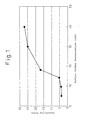
- FIG. 1 shows the relationship between the results of measurement of the color difference before and after a four-year exposure test conducted on titanium sheet in Okinawa and the average amount of carbon in a range to 100 nm from the titanium surface measured using an Auger electron spectroscopy. Further, as environment factors promoting discoloration, they found that acid rain had a large effect.
- the concentration of carbon at the titanium surface is defined.
- the carbon present at the titanium surface is believed to increase the rate of dissolution of titanium when titanium is used in an atmospheric environment and as a result increase the thickness of the titanium oxide at the titanium surface, cause interference color, and cause coloring.
- the amount of carbon as shown in FIG. 1, the occurrence of discoloration is suppressed in a region of the amount of carbon in a range to 100 nm from the outermost surface of not more than 14 at%, so the concentration of carbon has to be reduced to not more than 14 at%.
- the solid solution limit of carbon in titanium is about 1 at% at 700°C. So long as not dissolving the titanium under pressure, an amount of carbon promoting discoloration will not penetrate into the titanium. Carbon penetrates titanium for example during cold rolling when the rolling oil breaks down and penetrates the titanium surface and in the case or annealing or vacuum annealing and when carbon penetrates the surface layer of the titanium due to ion sputtering, an accelerator, vapor deposition, electrodischarge machining, etc.
- the layer of concentration of carbon at the titanium surface exceeds tens of nm, however, coloring occurs due to an interference action.
- an extremely good relationship is obtained between the average carbon concentration 100 nm from the surface and discoloration, so it is possible to strikingly improve the discoloration resistance by reducing the average carbon concentration in the range up to 100 nm from the surface to not more than 14 at%.
- by forming a relatively thick surface oxide film it is possible to further strikingly improve the discoloration resistance.
- the thickness of the oxide film having such a characteristic has to be at least 12 nm. If less than 12 nm, it is not possible to obtain a sufficient protective function. When the thickness of the oxide film is over 40 nm, however, the stress acting on the oxide film increases and the protective function falls even with the occurrence of partial cracks, so the thickness of the oxide film has to be reduced to not more than 40 nm.
- the most desirable thickness of the oxide film is in the range of 20 to 30 nm.
- the existence of such penetration of carbon to the titanium surface can be measured using an Auger electron spectroscopy. That is, it is possible to perform Auger analysis a distance of for example 5 nm or 10 nm from the titanium surface, measure the concentration at least to a depth of at least 100 nm, and use the average value of the same to find the average carbon concentration.
- titanium carbides are in many cases TiC, but while smaller in quantity than TiC, there are also carbides like Ti 2 C or Ti(CxN1-x) where the concentration of titanium in the carbide is high and carbides containing nitrogen. TiC, however, is the most prevalent carbide in terms of quantity. By reducing the amount of TiC present, it is possible to also reduce the amount of presence of other titanium carbides and titanium carbonitrides.
- the ratio (X1/X2) of the (200) peak intensity X1 of TiC to the (110) peak intensity X2 of titanium in X-ray diffraction of the surface is made not more than 0.18.
- FIG. 2 shows the relationship between the ratio (X1/X2) between the (200) X-ray peak intensity (X1) of the TiC of the titanium surface and the (110) peak intensity (X2) of metal titanium using a thin-film X-ray diffraction system giving information from the titanium surface and the color difference before and after a discoloration promotion test in the laboratory. It was learned that the value of the color difference increases, that is, discoloration is promoted, if the ratio exceeds 0.18 in the presence of TiC.
- X-ray diffraction measurement was performed using a RINT1500 made by Rigaku Corporation. The measurement was performed using a copper tube (tube voltage 50 kV, tube current 150 mA) and thin-film attachment under conditions of an incidence angle to the sample surface of 0.5 degree.
- the divergent slit, scattering slit, and receiving slit of the wide angle goniometer used were 0.40 mm, 8.00 mm, and 5.00 mm. Further, a monochrometer was used. The receiving slit of the monochrometer was made 0.60 mm. The test piece was rotated in plane at a rotational speed of 50 rpm, and the measurement conducted under conditions of a scan speed of 2 degrees per minute.
- the titanium carbides at the titanium surface can be identified by observation of the surface of a test sample from the sectional direction through a transmission electron microscope. In this case, however, it is not necessarily easy to throw light on the quantitative relationship between the presence of any discoloration and the amount and size of precipitation of titanium carbides - due in part to the fact that the observed region is limited to a local region. Therefore, in the present invention, a technique for measuring the surface area of a relatively broad area such as X-ray measurement is employed. When using a transmission electron microscope to observe a considerable area of a titanium surface, of course superior discoloration resistance is exhibited if no precipitation of titanium carbides is observed at all.
- titanium sheet or strip As the form by which titanium is used in an atmospheric environment, a titanium sheet or strip is common.
- a process of production giving titanium of this form discoloration resistance is disclosed.
- titanium sheet and strip used for outdoor applications are cold rolled to a predetermined thickness by cold rolling and then annealed in a temperature region of from 650°C to near 850°C to soften the material to enable various types of processing.
- Titanium sheet and strip produced through such a production process sometimes suffer from greater discoloration of the titanium due to penetration of carbon into the titanium surface arising due to cold rolling oil remaining on the titanium surface.
- the mechanical removal method it is possible to adopt the method of peeling the surface layer using polishing or shot blasting.
- the chemical removal method it is possible to dip the titanium in an acid solution or an alkali solution dissolving the titanium.
- the region penetrated by the carbon is on the micron order (depth of penetration of carbon into titanium surface depends on heat treatment temperature and time), it is essential to remove the titanium to a depth of at least 1 ⁇ m.
- the technique of dipping the titanium in a mixed solution of nitric acid and fluoric acid is particularly preferred.
- regions of concentration of carbon or regions of precipitation of titanium carbides, titanium carbonitrides, and titanium nitrides formed on the titanium surface due to the cold rolling process using a mechanical or chemical technique regions of high carbon concentration and regions of the above precipitated compounds will be formed on the surface of the final titanium cold rolled sheet or strip and the discoloration of the titanium will sometimes be promoted when using the titanium sheet or strip in an atmospheric environment.
- the above (6) relates to the above (5). It has as its object to greatly improve the productivity by performing the degreasing and improvement of the discoloration resistance for cold rolled titanium sheet or strip simultaneously by a single step. Degreasing is often performed by dipping in an alkali solution or spraying an alkali solution. However, just dipping in an alkali solution or spraying of an alkali solution is not enough to cause the titanium surface to dissolve to improve the discoloration resistance.
- the electrolysis conditions are preferably a change in polarity from (+) to (-) or from (-) to (+) since the organic matter is removed when the titanium becomes a (-) polarity and the dissolution reaction of titanium is promoted when the titanium becomes a (+) polarity.
- the current density if the current density is not at least 0.05 A/cm 2 , it is not possible to remove the deposited organic matter and cause a dissolution reaction of the titanium. Further, regarding the electrolysis time, at least 5 seconds are required. If the current density is made high, since generally the required amount of electricity is determined by the current density x time, the required time becomes smaller, but in the case of electrolytic cleaning as explained above, a considerable percentage of the current is consumed at the anode for generation of oxygen and at the cathode for generation of hydrogen, so even if the current density is made high, at least 5 seconds are required as the electrolysis time. Regarding the current density, if over 5 A/cm 2 , the solution generates remarkable heat and problems arise in operation, so 5 A/cm 2 is made the upper limit of the electrolytic current density.
- Titanium can be used to produce various types of colored materials utilizing interference colors obtained by changing the thickness of the titanium oxides on the titanium surface.
- Such colored titanium materials feature the superior corrosion resistance of titanium and can give an aesthetic appearance, so is used as wall paneling or roofing materials where corrosion resistance and aesthetic appearance are required.
- a colored titanium material is produced by a method such as atmospheric oxidation or anodic oxidation in an aqueous solution.
- the above (3) of the present invention and the above (7) of the process of production of the same relate to a colored titanium material produced by an oxidation process or anodic oxidation in an alkali aqueous solution or acidic solution.
- a colored titanium material is formed with a layer of titanium oxide on the titanium surface, so is believed to be superior in discoloration resistance in the case of use in an atmospheric environment compared with pristine titanium.
- such colored titanium materials believed superior in discoloration resistance also sometimes discolor depending on the usage environment. This discoloration of the colored titanium is promoted by the regions of concentration of carbon or the precipitation of titanium carbides, titanium carbonitrides, and titanium nitrides present at the underlying titanium oxide layer in the same way as the case of pristine titanium.
- the thickness of the oxide film ranges from several 10 nm to several 100 nm. As explained above, this is small compared with the distance of penetration of carbon at the titanium surface (on the micron order). Therefore, when producing a colored titanium material using as a starting material titanium with concentrated carbon or precipitated titanium carbides, titanium carbonitrides, and titanium oxide on its surface, regions of concentration of carbon or regions of precipitation of titanium carbides remain at the underlying titanium oxide layer (metal titanium side), so the discoloration resistance of the colored titanium material is degraded. Therefore, it is possible to improve the discoloration resistance of a colored titanium material by removing the regions of concentration of carbon or the titanium carbides, titanium carbonitrides, and titanium nitrides present at the underlying portion of the titanium oxide.
- the titanium produced in accordance with the above (4) to (7) can be further improved in discoloration resistance by steam treatment at least once.
- the mechanism for improvement of the discoloration resistance due to steam treatment is not sufficiently elucidated, but it is guessed that the defects in the passive state film at the titanium surface are repaired. Water molecules are believed to be closely involved in this repair.
- a temperature of at least 100°C is necessary. If less than 100°C, it is not possible to obtain enough heat energy as required for repair of defects in the passive state film. If the temperature of the steam treatment is over 550°C, however, the oxide film at the titanium surface grows thick and a porous coating results and the protective action drops, so this is not preferred.
- the reaction is believed to proceed considerably fast at the above temperature range. It is possible to hold the titanium material in steam for at least 10 seconds or spray the titanium material with steam raised to the above temperature so as to bring the titanium into contact with the steam and greatly increase the discoloration resistance. To obtain stable results, however, it is preferable to hold the material or spray it for several minutes. Note that there is no deterioration in the discoloration resistance with steam treatment for more than 60 minutes, but the effect of improvement of the discoloration resistance becomes substantially saturated at that point, so 60 minutes was made the upper limit.
- the pre-treatment for the steam treatment is not particularly limited, but if organic contaminant remains on the titanium surface, the effect of the steam treatment will fall, so it is necessary to treat the titanium surface using a suitable solvent or weak alkali degreasing agent.
- This pre-treatment is not anything special and may be performed by a usual degreasing step.
- tap water etc. may be used for the water used for the steam treatment. Depending on the difference in the ingredients contained in the water, however, there might be a detrimental effect on the test results, so when using fresh water etc. as it is, it might sometimes be better to conduct preliminary tests etc. and use tap water when good test results cannot be obtained.
- Table 1 shows the results of measurement of the color difference before and after a dipping test (effect of acid rain) when dipping titanium of different average carbon concentrations in a range to 100 nm from the outermost surface in a pH 3 sulfuric acid solution at 60°C for 2 weeks and an investigation of the effect of the carbon concentration on the discoloration.
- these titanium materials include flat surface cold rolled materials and roughened shot blasted materials etc.
- the average carbon concentration at the surface not more than 14 at% in accordance with the process of the present invention and making the thickness of the oxide film at the outermost surface a range of 12 to 40 nm, a superior discoloration resistance of a color difference before and after the test of not more than about 5 is exhibited.
- the surface carbon concentration was measured using an Auger electron spectroscopy. In this measurement, the results include the solid solution carbon and carbon in the titanium carbides. It is not possible to separate the solid solution carbon and carbon included in the carbides. That is, the carbon concentration of the titanium surface shown in Table 1 ends up including the solid solution carbon and the carbon included in the carbides.
- Table 2 shows the results of investigation of the effects of TiC on the discoloration of titanium by a method similar to the above for titanium of different amounts of TiC on the surface using a X-ray diffraction system.
- Table 2 shows the results of investigation of the effects of TiC on the discoloration of titanium by a method similar to the above for titanium of different amounts of TiC on the surface using a X-ray diffraction system.
- Table 2 shows the results of investigation of the effects of TiC on the discoloration of titanium by a method similar to the above for titanium of different amounts of TiC on the surface using a X-ray diffraction system.
- Table 2 shows the results of investigation of the effects of TiC on the discoloration of titanium by a method similar to the above for titanium of different amounts of TiC on the surface using a X-ray diffraction system.
- Table 2 shows the results of investigation of the effects of TiC on the discoloration of titanium by a method similar to the above for titanium of different amounts of TiC on the
- Table 3 shows the results of measurement of the color difference before and after a discoloration promotion test when annealing a titanium strip cold rolled to a thickness of 0.6 mm in an argon gas, then suitably thereafter removing the surface layer of the titanium strip by chemical dissolution and mechanical removal to the indicated depth and testing that material in a pH 3 sulfuric acid solution.
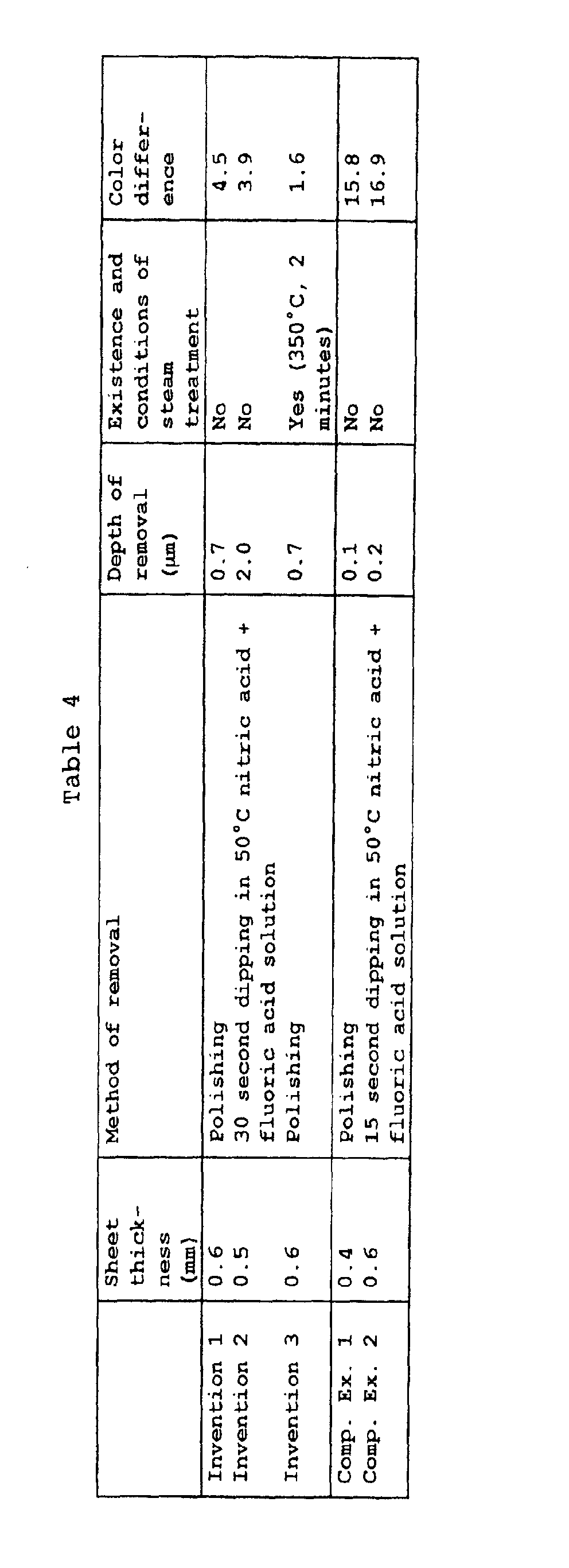
- Table 4 shows the results of measurement of the color difference before and after a dipping test when dipping in a pH 3 sulfuric acid solution a titanium strip cold rolled to a thickness of 0.4 mm in a nitric and fluoric acid solution so as to dissolve several ⁇ m of the titanium surface or when dipping a titanium strip from which several ⁇ m of the surface layer has been removed by mechanical polishing. As shown in Table 4, it is learned that such a titanium strip exhibits an extremely superior discoloration resistance.
- Table 5 shows the results of measurement of the color difference before and after a dipping test when electrolytically cleaning a titanium strip cold rolled to a thickness of 0.5 mm in a pH 9 to 15 alkali solution under various current density conditions, then suitably thereafter annealing it in argon gas and vacuum at 640°C for 8 hours, then performing the test in a pH 3 60°C sulfuric acid solution for 14 days.
- Table 5 it was learned that samples electrolytically cleaned in a pH 11 to 15 solution in accordance with the process of the present invention exhibit a superior discoloration resistance.
- Table 6 shows the results of measurement by Auger spectroanalysis of the average carbon concentration in a range to 100 nm from the outermost surface before treatment of the colored titanium produced by anodic oxidation in a 1% phosphoric acid solution and by heating in the atmosphere and the results of evaluation of the discoloration resistance of the colored titanium material (gold and blue).
- titanium suppressed in increased concentration of carbon at the titanium surface or precipitation of titanium carbides, titanium carbonitrides, and titanium nitrides has an extremely superior discoloration resistance and is particularly effective for applications in outdoor environments such as roofing or wall paneling.
Landscapes
- Chemical & Material Sciences (AREA)
- Engineering & Computer Science (AREA)
- Chemical Kinetics & Catalysis (AREA)
- Electrochemistry (AREA)
- Materials Engineering (AREA)
- Metallurgy (AREA)
- Organic Chemistry (AREA)
- Cleaning And De-Greasing Of Metallic Materials By Chemical Methods (AREA)
- Other Surface Treatments For Metallic Materials (AREA)
- Solid-Phase Diffusion Into Metallic Material Surfaces (AREA)
- Analysing Materials By The Use Of Radiation (AREA)
- Chemical Treatment Of Metals (AREA)
Abstract
Description
| Average carbon concentration at titanium surface () | Thickness of surface oxide layer | Color difference (before and after discoloration test) | |
| Invention 1 | 3.5 (at%) | 12 (nm) | 4 |
| Invention 2 | 5.5 | 20 | 4.5 |
| Invention 3 | 7.5 | 37 | 4.8 |
| Invention 4 | 9 | 22 | 5 |
| | 13 | 13 | 4.9 |
| Comp. Ex. 1 | 15 | 6 | 13 |
| Comp. Ex. 2 | 24 | 5 | 22 |
| Comp. Ex. 3 | 30 | 7 | 25 |
| Comp. Ex. 4 | 37 | 9 | 27 |
| Comp. Ex. 5 | 7.5 | 5 | 15.8 |
| Peak intensity ratio (X1/X2) | Thickness of surface oxide film | Color difference (before and after discoloration test) | |
| Invention 1 | 0 | 12 | 3.4 |
| Invention 2 | 0.1 | 20 | 4.2 |
| Invention 3 | 0.16 | 37 | 4.3 |
| Comp. Ex. 1 | 0.14 | 5 | 11 |
| Comp. Ex. 2 | 0.2 | 6 | 12 |
| Comp. Ex. 3 | 0.22 | 4 | 20 |
| Comp. Ex. 4 | 0.24 | 3 | 22 |
| Comp. Ex. 5 | 0.26 | 5 | 28 |



Claims (16)
- Titanium resistant to discoloration in an atmospheric environment characterized by having an average carbon concentration in a range to a depth of 100 nm from an outermost surface of not more than 14 at% and having an oxide film of a thickness of 12 to 40 nm at the outermost surface.
- Titanium as set forth in claim 1, characterized by having an oxide film causing an interference color at its surface.
- Titanium resistant to discoloration in an atmospheric environment characterized in that, in X-ray diffraction of its surface, a ratio (X1/X2) of a (200) peak intensity X1 of TiC to a (110) peak intensity X2 of titanium is not more than 0.18 and by having an oxide film of a thickness of 12 to 40 nm at its outermost surface.
- Titanium as set forth in claim 1, characterized by having an oxide film causing an interference color at its surface.
- A process of production of titanium resistant to discoloration in an atmospheric environment characterized by cold rolling the titanium, then annealing it in vacuum or an inert gas, then suitably thereafter mechanically or chemically removing at least 1 µm of the titanium surface.
- A process as set forth in claim 5, characterized by further performing, as after-treatment, treatment for anodically oxidizing the surface in an electrolyte solution or heating it to oxidize in the atmosphere.
- A process as set forth in claim 5 or 6, characterized by further performing steam treatment for bringing the surface into contact with 100 to 550°C steam for 10 seconds to 60 minutes at least once.
- A process as set forth in claim 7, characterized in that said steam treatment is performed as a final step in the production process.
- A process of production of titanium resistant to discoloration in an atmospheric environment characterized by cold rolling the titanium, then mechanically or chemically removing at least 0.5 µm of the surface, then suitably thereafter annealing in vacuum or an inert gas.
- A process as set forth in claim 9, characterized by further performing, as after-treatment, treatment for anodically oxidizing the surface in an electrolyte solution or heating it to oxidize in the atmosphere.
- A process as set forth in claim 9 or 10, characterized by further performing steam treatment for bringing the surface into contact with 100 to 550°C steam for 10 seconds to 60 minutes at least once.
- A process as set forth in claim 11, characterized in that said steam treatment is performed as a final step in the production process.
- A process of production of titanium resistant to discoloration in an atmospheric environment characterized by cold rolling the titanium, then electrolytically cleaning it in a pH 11 to 15 alkali solution in a range of current density of 0.05 to 5A/cm2, then suitably thereafter annealing in vacuum or an inert gas.
- A process as set forth in claim 13, characterized by further performing, as after-treatment, treatment for anodically oxidizing the surface in an electrolyte solution or heating it to oxidize in the atmosphere.
- A process as set forth in claim 13 or 14, characterized by further performing steam treatment for bringing the surface into contact with 100 to 550°C steam for 10 seconds to 60 minutes at least once.
- A process as set forth in claim 15, characterized in that said steam treatment is performed as a final step in the production process.
Applications Claiming Priority (7)
| Application Number | Priority Date | Filing Date | Title |
|---|---|---|---|
| JP2000046627 | 2000-02-23 | ||
| JP2000046627 | 2000-02-23 | ||
| JP2000128500 | 2000-04-27 | ||
| JP2000128500 | 2000-04-27 | ||
| JP2001011149A JP3566930B2 (en) | 2000-02-23 | 2001-01-19 | Titanium hardly causing discoloration in atmospheric environment and method for producing the same |
| JP2001011149 | 2001-01-19 | ||
| PCT/JP2001/001385 WO2001062999A1 (en) | 2000-02-23 | 2001-02-23 | Titanium less susceptible to discoloration in the atmosphere and method for producing same |
Publications (3)
| Publication Number | Publication Date |
|---|---|
| EP1264913A1 true EP1264913A1 (en) | 2002-12-11 |
| EP1264913A4 EP1264913A4 (en) | 2003-03-26 |
| EP1264913B1 EP1264913B1 (en) | 2005-12-21 |
Family
ID=27342463
Family Applications (1)
| Application Number | Title | Priority Date | Filing Date |
|---|---|---|---|
| EP01906282A Expired - Lifetime EP1264913B1 (en) | 2000-02-23 | 2001-02-23 | Titanium less susceptible to discoloration in the atmosphere and method for producing same |
Country Status (5)
| Country | Link |
|---|---|
| US (1) | US6863987B2 (en) |
| EP (1) | EP1264913B1 (en) |
| JP (1) | JP3566930B2 (en) |
| DE (1) | DE60116066T2 (en) |
| WO (1) | WO2001062999A1 (en) |
Cited By (5)
| Publication number | Priority date | Publication date | Assignee | Title |
|---|---|---|---|---|
| EP1306468A4 (en) * | 2000-07-28 | 2009-04-08 | Nippon Steel Corp | TITANIUM-BASED MATERIAL HAVING REDUCED SENSITIVITY TO DECOLORATION AND PROCESS FOR PRODUCING THE MATERIAL |
| EP2061111A1 (en) * | 2007-11-15 | 2009-05-20 | Kabushiki Kaisha Kobe Seiko Sho (Kobe Steel, Ltd.) | Titanium substrate for forming separator for fuel cell and method of manufacturing the separator |
| EP1887094A4 (en) * | 2005-05-31 | 2009-11-11 | Nippon Steel Corp | PURE TITANIUM OR COLORED TITANIUM ALLOY HAVING A LOW TREND TO DECOLORIZATION IN AN ATMOSPHERIC ENVIRONMENT |
| EP2366809A4 (en) * | 2008-12-17 | 2012-05-30 | Sumitomo Metal Ind | TITANIUM MATERIAL AND PROCESS FOR PRODUCING TITANIUM MATERIAL |
| CN102481565A (en) * | 2009-06-01 | 2012-05-30 | 新日本制铁株式会社 | Titanium-based Material Responsive To Visible Light And Having Excellent Photocatalytic Activity, And Process For Producing Same |
Families Citing this family (24)
| Publication number | Priority date | Publication date | Assignee | Title |
|---|---|---|---|---|
| WO2005056866A1 (en) * | 2003-12-09 | 2005-06-23 | Central Research Institute Of Electric Power Industry | Multifunctional material having carbon-doped titanium oxide layer |
| ATE459733T1 (en) | 2003-12-09 | 2010-03-15 | Central Res Inst Elect | METHOD FOR PRODUCING A SUBSTRATE WITH A LAYER OF CARBON-DOPED TITANIUM OXIDE |
| JP4721113B2 (en) * | 2006-03-15 | 2011-07-13 | 三菱マテリアル株式会社 | Method for producing sponge-like titanium sintered body with excellent corrosion resistance |
| CA2646189C (en) | 2006-04-14 | 2011-07-26 | Toyota Jidosha Kabushiki Kaisha | Noble metal plating of titanium components |
| EP2031687B1 (en) * | 2006-06-15 | 2015-08-05 | Nippon Steel & Sumitomo Metal Corporation | Pure titanium or titanium alloy separator for solid polymer fuel cell and method for producing the same |
| US20080083611A1 (en) * | 2006-10-06 | 2008-04-10 | Tegal Corporation | High-adhesive backside metallization |
| JP2008122170A (en) * | 2006-11-10 | 2008-05-29 | Asahi Kasei Homes Kk | Weather resistance deterioration diagnosis method for exterior members |
| JP5072019B2 (en) * | 2007-03-29 | 2012-11-14 | Jx日鉱日石金属株式会社 | Fuel cell separator material and fuel cell separator |
| WO2009034845A1 (en) * | 2007-09-14 | 2009-03-19 | Toyota Jidosha Kabushiki Kaisha | Process for producing separator for fuel cell |
| JP5081570B2 (en) * | 2007-10-19 | 2012-11-28 | 住友金属工業株式会社 | Titanium material and titanium material manufacturing method |
| US20090246385A1 (en) * | 2008-03-25 | 2009-10-01 | Tegal Corporation | Control of crystal orientation and stress in sputter deposited thin films |
| US8691057B2 (en) * | 2008-03-25 | 2014-04-08 | Oem Group | Stress adjustment in reactive sputtering |
| US8482375B2 (en) * | 2009-05-24 | 2013-07-09 | Oem Group, Inc. | Sputter deposition of cermet resistor films with low temperature coefficient of resistance |
| US9065081B2 (en) * | 2009-08-03 | 2015-06-23 | Nippon Steel & Sumitomo Metal Corporation | Titanium material for solid polymer fuel cell separator use and method of production of same |
| JP5440033B2 (en) * | 2009-08-28 | 2014-03-12 | 新日鐵住金株式会社 | Evaluation method of discoloration resistance of titanium in atmospheric environment |
| JP5443285B2 (en) * | 2010-06-29 | 2014-03-19 | 新日鐵住金株式会社 | Colored pure titanium that is unlikely to discolor in the atmosphere |
| EP2522683B1 (en) | 2011-05-10 | 2013-12-11 | Hüttenes-Albertus Chemische-Werke GmbH | Silicic ester modified phenol/formaldehyde novolaks and their use for the production of resin coated substrates |
| CN103707119B (en) * | 2013-12-30 | 2016-05-25 | 金华市亚虎工具有限公司 | A kind of complete motor-driven feeding puncher |
| JP6922779B2 (en) * | 2018-02-20 | 2021-08-18 | 日本製鉄株式会社 | Titanium lumber |
| JP6493632B1 (en) * | 2018-04-03 | 2019-04-03 | 新日鐵住金株式会社 | Titanium plate |
| KR102409091B1 (en) | 2018-06-18 | 2022-06-16 | 닛폰세이테츠 가부시키가이샤 | titanium material |
| US11032930B2 (en) * | 2019-05-28 | 2021-06-08 | Apple Inc. | Titanium surfaces with improved color consistency and resistance to color change |
| CN116133765B (en) * | 2020-09-16 | 2025-04-15 | 日本制铁株式会社 | Titanium material and method for producing the same |
| CN118632944A (en) | 2022-03-11 | 2024-09-10 | 日本制铁株式会社 | Titanium |
Family Cites Families (7)
| Publication number | Priority date | Publication date | Assignee | Title |
|---|---|---|---|---|
| JPS60238465A (en) * | 1984-05-11 | 1985-11-27 | Nippon Stainless Steel Co Ltd | Manufacture of bright-annealed titanium and titanium alloy material with superior formability |
| JPS6286197A (en) * | 1985-10-01 | 1987-04-20 | Kobe Steel Ltd | Production of colored titanium material having excellent adhesiveness |
| JPS62284056A (en) * | 1986-06-03 | 1987-12-09 | Nippon Steel Corp | Pretreatment of titanium and titanium alloy before heating |
| JPH01234551A (en) * | 1988-03-15 | 1989-09-19 | Nippon Mining Co Ltd | Manufacture of titanium stock excellent in workability |
| JP3348361B2 (en) * | 1992-12-08 | 2002-11-20 | 新日本製鐵株式会社 | Titanium plate excellent in press formability and surface treatment method thereof |
| DE4423664A1 (en) * | 1994-07-07 | 1996-05-15 | Bwg Bergwerk Walzwerk | Process for producing cold-rolled steel strips from stainless steel and metal strips, in particular from titanium alloys |
| JP3255610B2 (en) * | 1998-06-18 | 2002-02-12 | 株式会社神戸製鋼所 | Titanium material or titanium alloy material excellent in discoloration resistance, method for producing the same, and exterior material for building |
-
2001
- 2001-01-19 JP JP2001011149A patent/JP3566930B2/en not_active Expired - Lifetime
- 2001-02-23 DE DE60116066T patent/DE60116066T2/en not_active Expired - Lifetime
- 2001-02-23 EP EP01906282A patent/EP1264913B1/en not_active Expired - Lifetime
- 2001-02-23 US US10/220,030 patent/US6863987B2/en not_active Expired - Lifetime
- 2001-02-23 WO PCT/JP2001/001385 patent/WO2001062999A1/en not_active Ceased
Cited By (11)
| Publication number | Priority date | Publication date | Assignee | Title |
|---|---|---|---|---|
| EP1306468A4 (en) * | 2000-07-28 | 2009-04-08 | Nippon Steel Corp | TITANIUM-BASED MATERIAL HAVING REDUCED SENSITIVITY TO DECOLORATION AND PROCESS FOR PRODUCING THE MATERIAL |
| US7594973B2 (en) * | 2000-07-28 | 2009-09-29 | Nippon Steel Corporation | Titanium material less susceptible to discoloration and method for production thereof |
| EP1887094A4 (en) * | 2005-05-31 | 2009-11-11 | Nippon Steel Corp | PURE TITANIUM OR COLORED TITANIUM ALLOY HAVING A LOW TREND TO DECOLORIZATION IN AN ATMOSPHERIC ENVIRONMENT |
| US9885102B2 (en) | 2005-05-31 | 2018-02-06 | Nippon Steel & Sumitomo Metal Corporation | Colored pure titanium or titanium alloy having low susceptibility to discoloration in atmospheric environment |
| EP2061111A1 (en) * | 2007-11-15 | 2009-05-20 | Kabushiki Kaisha Kobe Seiko Sho (Kobe Steel, Ltd.) | Titanium substrate for forming separator for fuel cell and method of manufacturing the separator |
| EP2366809A4 (en) * | 2008-12-17 | 2012-05-30 | Sumitomo Metal Ind | TITANIUM MATERIAL AND PROCESS FOR PRODUCING TITANIUM MATERIAL |
| US9487882B2 (en) | 2008-12-17 | 2016-11-08 | Nippon Steel & Sumitomo Metal Corporation | Titanium material and method for producing titanium material |
| CN102481565A (en) * | 2009-06-01 | 2012-05-30 | 新日本制铁株式会社 | Titanium-based Material Responsive To Visible Light And Having Excellent Photocatalytic Activity, And Process For Producing Same |
| EP2438990A4 (en) * | 2009-06-01 | 2013-05-01 | Nippon Steel & Sumitomo Metal Corp | VISIBLY SENSITIVE TITANIUM-BASED MATERIAL WITH EXCELLENT PHOTOCATALYTIC ACTIVITY, AND METHOD OF MANUFACTURING THE SAME |
| US8865612B2 (en) | 2009-06-01 | 2014-10-21 | Nippon Steel & Sumitomo Metal Corporation | Titanium-based material having visible light response and excellent in photocatalytic activity and method of production of same |
| CN102481565B (en) * | 2009-06-01 | 2015-03-25 | 新日铁住金株式会社 | Titanium-based Material Responsive To Visible Light And Having Excellent Photocatalytic Activity, And Process For Producing Same |
Also Published As
| Publication number | Publication date |
|---|---|
| WO2001062999A1 (en) | 2001-08-30 |
| US20030168133A1 (en) | 2003-09-11 |
| DE60116066T2 (en) | 2006-09-28 |
| DE60116066D1 (en) | 2006-01-26 |
| US6863987B2 (en) | 2005-03-08 |
| JP2002012962A (en) | 2002-01-15 |
| EP1264913A4 (en) | 2003-03-26 |
| EP1264913B1 (en) | 2005-12-21 |
| JP3566930B2 (en) | 2004-09-15 |
Similar Documents
| Publication | Publication Date | Title |
|---|---|---|
| EP1264913B1 (en) | Titanium less susceptible to discoloration in the atmosphere and method for producing same | |
| EP1870489B1 (en) | Method to obtain a corrosion-resistant and shiny substrate | |
| EP0565029B1 (en) | Grain oriented silicon steel sheet having low core loss and method of manufacturing same | |
| KR101319551B1 (en) | Titanium material having low contact resistance for use in separator for solid polymer-type fuel cell and process for producing the titanium material | |
| DE69811446T2 (en) | Metallic material or film with a fluorinated surface and fluorination process | |
| Umehara et al. | An investigation of the structure and corrosion resistance of permanganate conversion coatings on AZ91D magnesium alloy | |
| EP3467154A1 (en) | Sn-plated steel sheet | |
| EP0407349A2 (en) | Electrode for use in electrolytic processes and process for manufacturing it | |
| US7594973B2 (en) | Titanium material less susceptible to discoloration and method for production thereof | |
| Treverton et al. | XPS studies of dc and ac anodic films on aluminium formed in sulphuric acid | |
| Taveira et al. | The influence of surface treatments in hot acid solutions on the corrosion resistance and oxide structure of stainless steels | |
| DE2815955A1 (en) | METHOD OF MANUFACTURING AN ELECTRODE BY COATING A METAL SUBSTRATE | |
| Treverton et al. | Topographical and surface chemical studies of chromate-phosphate pretreatment films on aluminium surfaces | |
| Junior et al. | In situ oxidation of Cr (III) for the corrosion protection of Zn: A Cr (VI)-free process to substitute chromate conversion coatings | |
| Traverso et al. | Corrosion inhibition of Al 6061 T6/Al2O3p 10%(v/v) composite in 3.5% NaCl solution with addition of cerium (III) chloride | |
| EP1340839A1 (en) | Whiskerless galvanized product having multi-layer rust prevention film, composition for forming multi-layer rust prevention film and manufacturing method of whiskerless galvanized product having multi-layer rust prevention film | |
| KR102007103B1 (en) | Method for manufacturing steel sheet coated with zinc-based coating layer | |
| Huang et al. | Surface modification for wettability enhancement by thermal oxidation and argon atmospheric pressure plasma jet on sputtered copper | |
| EP2366809B1 (en) | Titanium material and method for producing titanium material | |
| JP2003328144A (en) | Method for producing titanium that does not easily discolor in the atmospheric environment | |
| Hesamedini | Trivalent chromium based conversion coatings containing cobalt on the zinc plated steel | |
| JP2005272870A (en) | Titanium or titanium alloy that does not easily discolor in the atmosphere | |
| JP4221340B2 (en) | Titanium and titanium alloy which hardly cause discoloration in atmospheric environment and method for producing the same | |
| Oki et al. | Corrosion and Adhesion Performance of Ferric Ion-Based Hybrid Nano-Conversion Coatings on Aluminum Alloy | |
| Din et al. | Aluminium Alloy AA6060 surface treatment with high temperature steam containing chemical additives |
Legal Events
| Date | Code | Title | Description |
|---|---|---|---|
| PUAI | Public reference made under article 153(3) epc to a published international application that has entered the european phase |
Free format text: ORIGINAL CODE: 0009012 |
|
| 17P | Request for examination filed |
Effective date: 20020919 |
|
| AK | Designated contracting states |
Kind code of ref document: A1 Designated state(s): AT BE CH CY DE DK ES FI FR GB GR IE IT LI LU MC NL PT SE TR |
|
| A4 | Supplementary search report drawn up and despatched |
Effective date: 20030212 |
|
| 17Q | First examination report despatched |
Effective date: 20030526 |
|
| RBV | Designated contracting states (corrected) |
Designated state(s): AT BE CH DE FR IT LI |
|
| GRAP | Despatch of communication of intention to grant a patent |
Free format text: ORIGINAL CODE: EPIDOSNIGR1 |
|
| RBV | Designated contracting states (corrected) |
Designated state(s): DE FR IT |
|
| GRAS | Grant fee paid |
Free format text: ORIGINAL CODE: EPIDOSNIGR3 |
|
| GRAA | (expected) grant |
Free format text: ORIGINAL CODE: 0009210 |
|
| AK | Designated contracting states |
Kind code of ref document: B1 Designated state(s): DE FR IT |
|
| REF | Corresponds to: |
Ref document number: 60116066 Country of ref document: DE Date of ref document: 20060126 Kind code of ref document: P |
|
| ET | Fr: translation filed | ||
| PLBE | No opposition filed within time limit |
Free format text: ORIGINAL CODE: 0009261 |
|
| STAA | Information on the status of an ep patent application or granted ep patent |
Free format text: STATUS: NO OPPOSITION FILED WITHIN TIME LIMIT |
|
| 26N | No opposition filed |
Effective date: 20060922 |
|
| REG | Reference to a national code |
Ref country code: DE Ref legal event code: R082 Ref document number: 60116066 Country of ref document: DE Representative=s name: VOSSIUS & PARTNER, DE Effective date: 20130227 Ref country code: DE Ref legal event code: R081 Ref document number: 60116066 Country of ref document: DE Owner name: NIPPON STEEL & SUMITOMO METAL CORPORATION, JP Free format text: FORMER OWNER: NIPPON STEEL CORP., TOKIO/TOKYO, JP Effective date: 20130227 Ref country code: DE Ref legal event code: R082 Ref document number: 60116066 Country of ref document: DE Representative=s name: VOSSIUS & PARTNER PATENTANWAELTE RECHTSANWAELT, DE Effective date: 20130227 |
|
| REG | Reference to a national code |
Ref country code: FR Ref legal event code: CA Effective date: 20130913 Ref country code: FR Ref legal event code: CD Owner name: NIPPON STEEL & SUMITOMO METAL CORPORATION, JP Effective date: 20130913 |
|
| REG | Reference to a national code |
Ref country code: FR Ref legal event code: PLFP Year of fee payment: 16 |
|
| REG | Reference to a national code |
Ref country code: FR Ref legal event code: PLFP Year of fee payment: 17 |
|
| REG | Reference to a national code |
Ref country code: FR Ref legal event code: PLFP Year of fee payment: 18 |
|
| REG | Reference to a national code |
Ref country code: DE Ref legal event code: R082 Ref document number: 60116066 Country of ref document: DE Representative=s name: VOSSIUS & PARTNER PATENTANWAELTE RECHTSANWAELT, DE Ref country code: DE Ref legal event code: R081 Ref document number: 60116066 Country of ref document: DE Owner name: NIPPON STEEL CORPORATION, JP Free format text: FORMER OWNER: NIPPON STEEL & SUMITOMO METAL CORPORATION, TOKYO, JP |
|
| PGFP | Annual fee paid to national office [announced via postgrant information from national office to epo] |
Ref country code: IT Payment date: 20200128 Year of fee payment: 20 Ref country code: DE Payment date: 20200211 Year of fee payment: 20 |
|
| PGFP | Annual fee paid to national office [announced via postgrant information from national office to epo] |
Ref country code: FR Payment date: 20200113 Year of fee payment: 20 |
|
| REG | Reference to a national code |
Ref country code: DE Ref legal event code: R071 Ref document number: 60116066 Country of ref document: DE |