EP1264910A1 - Steel pipe having excellent formability and method for production thereof - Google Patents
Steel pipe having excellent formability and method for production thereof Download PDFInfo
- Publication number
- EP1264910A1 EP1264910A1 EP01908167A EP01908167A EP1264910A1 EP 1264910 A1 EP1264910 A1 EP 1264910A1 EP 01908167 A EP01908167 A EP 01908167A EP 01908167 A EP01908167 A EP 01908167A EP 1264910 A1 EP1264910 A1 EP 1264910A1
- Authority
- EP
- European Patent Office
- Prior art keywords
- strength
- ray
- steel pipe
- random
- wall thickness
- Prior art date
- Legal status (The legal status is an assumption and is not a legal conclusion. Google has not performed a legal analysis and makes no representation as to the accuracy of the status listed.)
- Granted
Links
Classifications
-
- C—CHEMISTRY; METALLURGY
- C22—METALLURGY; FERROUS OR NON-FERROUS ALLOYS; TREATMENT OF ALLOYS OR NON-FERROUS METALS
- C22C—ALLOYS
- C22C38/00—Ferrous alloys, e.g. steel alloys
-
- C—CHEMISTRY; METALLURGY
- C21—METALLURGY OF IRON
- C21D—MODIFYING THE PHYSICAL STRUCTURE OF FERROUS METALS; GENERAL DEVICES FOR HEAT TREATMENT OF FERROUS OR NON-FERROUS METALS OR ALLOYS; MAKING METAL MALLEABLE, e.g. BY DECARBURISATION OR TEMPERING
- C21D8/00—Modifying the physical properties of ferrous metals or ferrous alloys by deformation combined with, or followed by, heat treatment
- C21D8/10—Modifying the physical properties of ferrous metals or ferrous alloys by deformation combined with, or followed by, heat treatment during manufacturing of tubular bodies
-
- C—CHEMISTRY; METALLURGY
- C22—METALLURGY; FERROUS OR NON-FERROUS ALLOYS; TREATMENT OF ALLOYS OR NON-FERROUS METALS
- C22C—ALLOYS
- C22C38/00—Ferrous alloys, e.g. steel alloys
- C22C38/001—Ferrous alloys, e.g. steel alloys containing N
-
- C—CHEMISTRY; METALLURGY
- C22—METALLURGY; FERROUS OR NON-FERROUS ALLOYS; TREATMENT OF ALLOYS OR NON-FERROUS METALS
- C22C—ALLOYS
- C22C38/00—Ferrous alloys, e.g. steel alloys
- C22C38/002—Ferrous alloys, e.g. steel alloys containing In, Mg, or other elements not provided for in one single group C22C38/001 - C22C38/60
-
- C—CHEMISTRY; METALLURGY
- C22—METALLURGY; FERROUS OR NON-FERROUS ALLOYS; TREATMENT OF ALLOYS OR NON-FERROUS METALS
- C22C—ALLOYS
- C22C38/00—Ferrous alloys, e.g. steel alloys
- C22C38/004—Very low carbon steels, i.e. having a carbon content of less than 0,01%
-
- C—CHEMISTRY; METALLURGY
- C22—METALLURGY; FERROUS OR NON-FERROUS ALLOYS; TREATMENT OF ALLOYS OR NON-FERROUS METALS
- C22C—ALLOYS
- C22C38/00—Ferrous alloys, e.g. steel alloys
- C22C38/02—Ferrous alloys, e.g. steel alloys containing silicon
-
- C—CHEMISTRY; METALLURGY
- C22—METALLURGY; FERROUS OR NON-FERROUS ALLOYS; TREATMENT OF ALLOYS OR NON-FERROUS METALS
- C22C—ALLOYS
- C22C38/00—Ferrous alloys, e.g. steel alloys
- C22C38/04—Ferrous alloys, e.g. steel alloys containing manganese
-
- C—CHEMISTRY; METALLURGY
- C22—METALLURGY; FERROUS OR NON-FERROUS ALLOYS; TREATMENT OF ALLOYS OR NON-FERROUS METALS
- C22C—ALLOYS
- C22C38/00—Ferrous alloys, e.g. steel alloys
- C22C38/06—Ferrous alloys, e.g. steel alloys containing aluminium
-
- C—CHEMISTRY; METALLURGY
- C22—METALLURGY; FERROUS OR NON-FERROUS ALLOYS; TREATMENT OF ALLOYS OR NON-FERROUS METALS
- C22C—ALLOYS
- C22C38/00—Ferrous alloys, e.g. steel alloys
- C22C38/12—Ferrous alloys, e.g. steel alloys containing tungsten, tantalum, molybdenum, vanadium, or niobium
-
- C—CHEMISTRY; METALLURGY
- C22—METALLURGY; FERROUS OR NON-FERROUS ALLOYS; TREATMENT OF ALLOYS OR NON-FERROUS METALS
- C22C—ALLOYS
- C22C38/00—Ferrous alloys, e.g. steel alloys
- C22C38/14—Ferrous alloys, e.g. steel alloys containing titanium or zirconium
-
- C—CHEMISTRY; METALLURGY
- C21—METALLURGY OF IRON
- C21D—MODIFYING THE PHYSICAL STRUCTURE OF FERROUS METALS; GENERAL DEVICES FOR HEAT TREATMENT OF FERROUS OR NON-FERROUS METALS OR ALLOYS; MAKING METAL MALLEABLE, e.g. BY DECARBURISATION OR TEMPERING
- C21D2201/00—Treatment for obtaining particular effects
- C21D2201/05—Grain orientation
-
- Y—GENERAL TAGGING OF NEW TECHNOLOGICAL DEVELOPMENTS; GENERAL TAGGING OF CROSS-SECTIONAL TECHNOLOGIES SPANNING OVER SEVERAL SECTIONS OF THE IPC; TECHNICAL SUBJECTS COVERED BY FORMER USPC CROSS-REFERENCE ART COLLECTIONS [XRACs] AND DIGESTS
- Y10—TECHNICAL SUBJECTS COVERED BY FORMER USPC
- Y10S—TECHNICAL SUBJECTS COVERED BY FORMER USPC CROSS-REFERENCE ART COLLECTIONS [XRACs] AND DIGESTS
- Y10S148/00—Metal treatment
- Y10S148/902—Metal treatment having portions of differing metallurgical properties or characteristics
- Y10S148/909—Tube
Definitions
- the present invention relates to a steel material used for, for example, undercarriage components, structural members, etc. of an automobile or the like and, in particular, a high strength steel pipe excellent in formability in hydroforming or the like, and to a method of producing the same.
- the strengthening of a steel sheet has been desired with the growing demands for weight reduction in automobiles.
- the strengthening of a steel sheet makes it possible to reduce the weight of an automobile through the reduction of material thickness and also to improve collision safety.
- Attempts have been made recently to form a material steel sheet or pipe of a high strength steel into components of complicated shapes by the hydroforming method for the purpose of reducing the number of components or welded flanges, in response to the demands for the weight reduction and cost reduction of an automobile.
- Actual application of new forming technologies, such as the hydroforming method is expected to bring about great advantages such as the reduction of costs and increase in the degree of freedom in design work.
- the present invention provides a steel pipe excellent in formability in hydroforming and similar forming methods and a method of producing the steel pipe by specifying the characteristics of the steel material for the pipe.
- the present inventors identified the metallographic structure and texture of a steel material excellent in formability in hydroforming and similar forming methods and a method for controlling the metallographic structure and texture.
- the present invention provides a steel pipe excellent in formability in hydroforming and similar forming methods and a method of producing the steel pipe, by specifying the structure and texture and the method for controlling them.
- the gist of the present invention is as follows:
- C is effective for increasing steel strength and, hence, 0.0005% or more of C is added but, since an addition of C in a large quantity is undesirable for controlling steel texture, the upper limit of its addition is set at 0.30%.
- Si is an element for increasing strength and deoxidizing steel as well and, therefore, its lower limit is set at 0.001%.
- An excessive addition of Si however, leads to the deterioration of wettability in plating and workability and, for this reason, the upper limit of the Si content is set at 2.0%.
- Mn is an element effective for increasing steel strength and therefore the lower limit of its content is set at 0.01%.
- the upper limit of the Mn content is set at 3.0%, because its excessive addition lowers ductility.
- the ratios of X-ray strength in orientation component group of ⁇ 110 ⁇ 110> to ⁇ 111 ⁇ 110> and orientation component of ⁇ 110 ⁇ 110> to random X-ray diffraction strength on plane at a wall thickness center constitute the property figures most strongly required in the application of hydroforming.
- the average for the ratios of the X-ray strength in the orientation component group of ⁇ 110 ⁇ 110> to ⁇ 111 ⁇ 110> to random X-ray diffraction strength, which ratios being obtained by an X-ray diffraction measurement on a plane at the wall thickness center, is determined to be 2.0 or more.
- the main orientations included in this orientation component group are ⁇ 110 ⁇ 110>, ⁇ 661 ⁇ 110>, ⁇ 441 ⁇ 110>, ⁇ 331 ⁇ 110>, ⁇ 221 ⁇ 110>, ⁇ 332 ⁇ 110>, ⁇ 443 ⁇ 110>, ⁇ 554 ⁇ 110> and ⁇ 111 ⁇ 110>.
- the ratios of the X-ray strength in these orientations to random X-ray diffraction strength can be calculated from the three-dimensional texture calculated by the vector method based on the pole figure of ⁇ 110 ⁇ , or the three-dimensional texture calculated by the series expansion method based on two or more pole figures of ⁇ 110 ⁇ , ⁇ 100 ⁇ , ⁇ 211 ⁇ and ⁇ 310 ⁇ .
- the average for the ratios of the X-ray strength in the orientation component group of ⁇ 110 ⁇ 110> to ⁇ 111 ⁇ 110> to random X-ray diffraction strength means the arithmetic average for the ratios of the X-ray strength in the above orientation components to random X-ray diffraction strength.
- the arithmetic average of the X-ray strengths of the orientation components of ⁇ 110 ⁇ 110>, ⁇ 441 ⁇ 110> and ⁇ 221 ⁇ 110> may be used as a substitute.
- ⁇ 110 ⁇ 110> is important and it is particularly desirable that the ratio of the X-ray strength in this orientation component to random X-ray diffraction strength be 3.0 or more. Needless to say, it is better yet, especially for a steel pipe for hydroforming use, if the average for the ratios of X-ray strength in the orientation component group of ⁇ 110 ⁇ 110> to ⁇ 111 ⁇ 110> to random X-ray diffraction strength is 2.0 or more and, at the same time, the ratio of X-ray strength in the orientation component of ⁇ 110 ⁇ 110> to random X-ray diffraction strength is 3.0 or more.
- the average for the ratios of the X-ray strength in the above orientation group to random X-ray diffraction strength be 3.5 or more and the ratio of the X-ray strength in the orientation component of ⁇ 110 ⁇ 110> to random X-ray diffraction strength be 5.0 or more.
- the high formability (a diameter expansion ratio of 1.25 or more under different hydroforming conditions) intended in the present invention can be achieved if at least one or more of the following ratios is/are 3.0 or more, on a plane at the wall thickness center: the ratio of the X-ray strength in the orientation component of ⁇ 111 ⁇ 110> to random X-ray diffraction strength; the average for the ratios of the X-ray strength in the orientation component group of ⁇ 110 ⁇ 110> to ⁇ 332 ⁇ 110> to random X-ray diffraction strength; and the ratio of the X-ray strength in the orientation component of ⁇ 110 ⁇ 110> to random X-ray diffraction strength.
- At least the ratios of the X-ray strength in the orientation component group of ⁇ 110 ⁇ 110> to ⁇ 332 ⁇ 110> and the orientation component of ⁇ 110 ⁇ 110> to random X-ray diffraction strength on a plane at the wall thickness center are important characteristic figures for forming by the hydroforming method.
- the diameter expansion ratio or the like particularly in hydroforming which is an object of the present invention, deteriorates to about 1.2 or less. For this reason, the value of each of the above is limited to 3.0 or less.
- the ratios of the X-ray strength in the above orientation components are measured by X-ray diffraction measurement on a plane at the wall thickness center and calculating the ratios of X-ray strength in the orientation components to the X-ray diffraction strength of a random crystal.
- the main orientation components included in the orientation component group of ⁇ 110 ⁇ 110> to ⁇ 332 ⁇ 110> are ⁇ 110 ⁇ 110>, ⁇ 661 ⁇ 110>, ⁇ 441 ⁇ 110>, ⁇ 331 ⁇ 110>, ⁇ 221 ⁇ 110>, ⁇ 332 ⁇ 110>, ⁇ 443 ⁇ 110> and ⁇ 554 ⁇ 110>.
- the main orientation components included in the orientation component group of ⁇ 100 ⁇ 110> to ⁇ 223 ⁇ 110> are ⁇ 100 ⁇ 110>, ⁇ 116 ⁇ 110>, ⁇ 114 ⁇ 110>, ⁇ 113 ⁇ 110>, ⁇ 112 ⁇ 110>, ⁇ 335 ⁇ 110> and ⁇ 223 ⁇ 110>.
- the main orientation components included in the orientation component group of ⁇ 111 ⁇ 110> to ⁇ 111 ⁇ 112> are ⁇ 111 ⁇ 110> and ⁇ 111 ⁇ 112>.
- the ratios of the X-ray strength in these orientation components to random X-ray diffraction strength can be calculated from the three-dimensional texture calculated by the vector method based on the pole figure of ⁇ 110 ⁇ , or the three-dimensional texture calculated by the series expansion method based on two or more pole figures of ⁇ 110 ⁇ , ⁇ 100 ⁇ , ⁇ 211 ⁇ and ⁇ 310 ⁇ .
- the strengths of (001)[1 -10], (116)[1 -10], (114)[1 -10], (113)[1 -10], (112)[1 -10], (335)[1 -10] and (223)[1 -10] can be used as representative figures and, in the case of the orientation component group of ⁇ 111 ⁇ 110> to ⁇ 111 ⁇ 112>, the strengths of (111)[1 -10] and (111)[-1 -12] can be used as representative figures.
- an arithmetic average in the strengths of the orientation components of (110)[1 -10], (441)[1 -10] and (221)[1 -10] can be used as a substitute.
- the orientation in which the X-ray strength is the strongest deviates from the above orientation component group by about ⁇ 5° to ⁇ 10°.
- arc section test pieces For the X-ray diffraction measurement of a steel pipe, arc section test pieces have to be cut out from the steel pipe and pressed into flat pieces for X-ray analysis. Further, when pressing the arc section test pieces into flat pieces, the strain must be as low as possible to avoid the influence of crystal rotation caused by the working and, for this reason, the upper limit of the amount of imposed strain is set at 10%, and the working has to be done under a strain not exceeding the figure. Then, the tabular test pieces thus prepared are ground to a prescribed thickness by mechanical polishing and then conditioned by a chemical or other polishing method so as to remove the strain and expose the thickness center layer for the X-ray diffraction measurement.
- the measurement may be done at an area free from segregation anywhere in the range from 3/8 to 5/8 of the wall thickness. Further, even when no segregation band is found, it is acceptable for the purpose of the present invention if a texture specified in claims of the present invention is obtained at a plane other than the plane at the wall thickness center and, for instance, in the above range from 3/8 to 5/8 of the wall thickness. Additionally, when the X-ray diffraction measurement is difficult, the EBSP or ECP technique may be employed for the measurement.
- the texture of the present invention is specified in terms of the result of the X-ray measurement at a plane at the wall thickness center or near it as stated above, it is preferable that the steel pipe have a similar texture also in wall thickness portions other than near the thickness center.
- the texture in the range from the outer surface to 1/4 or so of the wall thickness does not satisfy the requirements described above, because the texture changes as a result of shear deformation during the diameter reduction work explained hereafter.
- ⁇ hkl ⁇ uvw> means that, when the test pieces for the X-ray diffraction measurement are prepared in the manner described above, the crystal orientation perpendicular to the wall surface is ⁇ hkl> and the crystal orientation along the longitudinal direction of the steel pipe is ⁇ uvw>.
- the characteristics of the texture according to the present invention cannot be expressed using common inverse pole figures and conventional pole figures only, but it is preferable that the ratios of the X-ray strength in the above orientation components to random X-ray diffraction strength be as specified below when, for example, the inverse pole figures expressing the radial orientations of the steel pipe are measured at portions near the wall thickness center: 2 or less in ⁇ 100>, 2 or less in ⁇ 411>, 4 or less in ⁇ 211>, 15 or less in ⁇ 111>, 15 or less in ⁇ 332>, 20.0 or less in ⁇ 221> and 30.0 or less in ⁇ 110>.
- the preferred figures of X-ray strength ratios are as follows: 10 or more in the ⁇ 110> orientation and 3 or less in all the orientations other than the ⁇ 110> orientation.
- n-value It is sometimes the case in hydroforming that working is applied to a work piece isotropically to some extent and, accordingly, it is necessary to secure the n-value in the longitudinal and/or circumferential directions of the steel pipe. For this reason, the lower limit of n-value is set at 0.12 for both the directions. The effects of the present invention are realized without setting an upper limit of n-value specifically.
- n-value is defined as the value obtained at an amount of strain of 5 to 10% or 3 to 8% in the tensile test method according to Japanese Industrial Standard (JIS).
- r-value Since hydroforming includes working with material influx through the application of axial compression and, hence, for securing workability at the portions subjected to this kind of working, the lower limit of the r-value in the longitudinal direction of a steel pipe is set at 1.1. The effects of the present invention are realized without setting an upper limit of r-value specifically.
- r-value is defined as the value obtained at an amount of strain of 10% or 5% in the tensile test according to JIS.
- Al, Zr and Mg are deoxidizing elements.
- Al contributes to the enhancement of formability especially when box annealing is employed.
- An excessive addition of these elements causes the crystallization and precipitation of oxides, sulfides and nitrides in quantities, deteriorating steel cleanliness and ductility. Besides, it remarkably spoils a plating property. For this reason, it is determined to add one or more of these elements if necessary, at 0.0001 to 0.50% in total, or within the limits of 0.0001 to 0.5% for Al, 0.0001 to 0.5% for Zr and 0.0001 to 0.5% for Mg.
- Nb, Ti and V Any of Nb, Ti and V, which are added if necessary, increases steel strength by forming carbides, nitrides or carbonitrides when added at 0.001% or more, either singly or in total of two or more of them. When their total content or the content of any one of them exceeds 0.5%, they precipitate in great quantities in the grains of ferrite, which is the base phase, or at the grain boundaries in the form of carbides, nitrides or carbonitrides, deteriorating ductility.
- the addition range of Nb, Ti and V is, therefore, limited to at 0.001 to 0.5% in single addition or in total of two or more of them.
- P is an element effective for enhancing steel strength, but it deteriorates weldability and resistance to delayed crack of slabs as well as fatigue resistance and ductility. For this reason, P is determined to be added only when necessary and the range of its addition is limited to at 0.001 to 0.20%.
- B which is added if necessary, is effective for strengthening grain boundaries and increasing steel strength.
- its addition amount exceeds 0.01%, however, the above effect is saturated and, what is more, steel strength is increased more than necessary and workability is deteriorated in addition. For this reason, the content of B is limited to at 0.0001 to 0.01%.
- Ni, Cr, Cu, Co, Mo and W are steel hardening elements and therefore 0.001% or more of these elements is added, if necessary, either singly or in total of two or more of them. Since an excessive addition of these elements lowers ductility, their addition range is limited to at 0.001 to 1.5% in a single addition or in a total of two or more of them.
- Ca and a rare earth element (Rem) are elements effective for the control of inclusions, and their addition in an appropriate amount increases hot workability. Their excessive addition, however, causes hot shortness, and thus the range of their addition is defined as at 0.0001 to 0.5% in single addition or in total of two or more of them, as required.
- the rare earth elements (Rems) include Y, Sr and the lanthanoids. Industrially, it is economical to add these elements in the form of mischmetal, which is a mixture of them.
- N is effective for increasing steel strength and it may be added at 0.0001% or more. Its addition in a large quantity is, however, not desirable for the control of welding defects and, for this reason, the upper limit of its addition amount is set at 0.03%.
- Hf and Ta Hf and Ta, which are added if necessary, increase steel strength through the formation of carbides, nitrides or carbonitrides when added at 0.001% or more each. When added in excess of 2.0%, however, they precipitate in quantities in the grains of ferrite, which is the base phase, or at the grain boundaries in the form of the carbides, nitrides or carbonitrides, deteriorating ductility.
- the addition range of Hf and Ta therefore, is defined as at 0.001 to 2.0% each.
- Crystal grain size The control of crystal grain size is important for controlling texture. It is necessary for intensifying the X-ray strength in the orientation component of ⁇ 110 ⁇ 110>, particularly in the invention according to the items (8) to (12), to control the grain size of main phase ferrite to 0.1 to 200 ⁇ m.
- the orientation component of ⁇ 110 ⁇ 110> is most important for enhancing formability in the orientation component group of ⁇ 110 ⁇ 110> to ⁇ 332 ⁇ 110>.
- the grain size of ferrite is mixed in a wide range, for example in a metallographic structure in which the portions consisting of ferrite grains 0.1 to 10 ⁇ m in size and those consisting of ferrite grains 10 to 100 ⁇ m in size exist in a mixture, the effects of the present invention are maintained as long as a high X-ray strength is obtained in the orientation component of ⁇ 110 ⁇ 110>.
- the ferrite grain size is measured by the section method compliant to JIS.
- Ferrite grain boundaries can be clearly identified by using a 2 to 5% nitral solution in the case of steels having a comparatively high carbon content, or a special etching solution, SULC-G, in the case of ultra-low carbon steels (such as IF steels), after finishing a section surface, for observation, with polishing diamond having a roughness of several micrometers or by buffing.
- the special etching solution can be prepared by dissolving 2 to 10 g of dodecylbenzenesulfonic acid, 0.1 to 1 g of oxalic acid and 1 to 5 g of picric acid in 100 ml of water and then adding 2 to 3 ml of 6N hydrochloric acid.
- ferrite grain boundaries appear and their sub-grains also may appear partially.
- the ferrite grain boundaries meant here are the interfaces rendered visible to a light-optical microscope by the above sample preparation processes, including the interfaces such as the sub-grains appearing partially.
- the size and aspect ratio of ferrite grains are measured with respect to the grain boundaries thus observed.
- the ferrite grains are measured through image analysis of 20 or more fields of view of 100 to 500-power magnification, and the grain size, aspect ratio, etc. are calculated on the basis of this measurement.
- the area percentage of ferrite is measured assuming that the ferrite grains are spherical. Note that the value of area percentage is nearly equal to that of volume percentage.
- the material of the steel pipe according to the present invention may also contain structures such as pearlite, bainite, martensite, austenite, carbonitrides, etc. as metallographic structures other than ferrite.
- structures such as pearlite, bainite, martensite, austenite, carbonitrides, etc.
- the percentage of these hard phases is limited to below 50%.
- the range of the grain size of ferrite is determined to be from 0.1 to 200 ⁇ m, because it is industrially difficult to obtain recrystallization grains smaller than 0.1 ⁇ m in size, and, when crystal grains larger than 200 ⁇ m are mixed, the X-ray strength in the orientation component of ⁇ 110 ⁇ 110> falls.
- the standard deviation of the grain size of ferrite grains and their aspect ratio are limited for the purpose of increasing the ratio of X-ray strength in the orientation component group of ⁇ 110 ⁇ 110> to ⁇ 332 ⁇ 110> and suppressing the ratio of X-ray strength in the orientation component group of ⁇ 100 ⁇ 110> to ⁇ 223 ⁇ 110>.
- aspect ratio (the number of grain boundaries crossing the line segment perpendicular to the rolling direction) / (the number of grain boundaries crossing the line segment parallel to the rolling direction).
- the lower limit of the ferrite grain size is set at 1 ⁇ m for the purpose of raising the ratios of the X-ray strength in the orientation component of ⁇ 111 ⁇ 110> and/or the orientation component group of ⁇ 111 ⁇ 110> to ⁇ 332 ⁇ 110>.
- steel is refined in a blast furnace or an electric arc furnace process, then subjected to various secondary refining processes and, subsequently, cast by an ingot casting or a continuous casting method.
- continuous casting if a production process such as the one to hot-roll cast slabs without cooling is employed in combination with other production processes, the effects of the present invention are not hindered in the least.
- the effects of the present invention are not in the least adversely affected if the following production processes are combined in the production of the steel sheets for pipe forming: heating an ingot to a temperature from 1,050 to 1,300°C and then hot-rolling it at a temperature in the range from not lower than 10°C below the Ar 3 transformation point to lower than 120°C above the Ar 3 transformation point; the application of roll lubrication during hot rolling; coiling a hot band at a temperature of 750°C or below; the application of cold rolling; and the application of box annealing or continuous annealing after cold rolling. That is to say, a hot-rolled, cold-rolled or cold-rolled and annealed steel sheet may be used as the material steel sheet for the pipe forming.
- the texture of a hot-rolled or cold-rolled steel sheet It is a prerequisite for improving the formability of a steel pipe to satisfy any one or more of the following conditions 1 ⁇ to 4 ⁇ :
- Heating temperature In order to improve the formability of weld joints, the heating temperature before diameter reduction is set at the Ac 3 transformation point or above and, in order to prevent crystal grains from becoming coarse, the heating temperature is limited to 200°C above the Ac 3 transformation point or below.
- Temperature of diameter reduction work In order to facilitate the recovery from the strain hardening after the diameter reduction, the temperature during diameter reduction work is set at 650°C or higher and, in order to prevent crystal grains from becoming coarse, the temperature is limited to 900°C or below.
- Temperature of heat treatment after pipe forming The heat treatment is applied for the purpose of recovering the ductility of a steel pipe lowered by the strain during pipe forming.
- the temperature is below 650°C, a sufficient ductility recovery effect is not forthcoming, but, when the temperature exceeds 200°C above the Ac 3 transformation point, coarse crystal grains become conspicuous and the surface quality of the steel pipe is remarkably deteriorated. For this reason, the temperature is limited in the range from 650°C to 200°C above the Ac 3 transformation point.
- solution heat treatment may be applied locally as deemed necessary for obtaining required characteristics at the heat affected zones of the welded seam, independently or in combination, and several times repeatedly, if necessary. This will enhance the effects of the present invention yet further.
- the heat treatment is meant for the application only to the welded seam and the heat affected zones, and it can be applied on-line during the pipe forming or off-line.
- the effects of the present invention are not in the least hindered if diameter reduction or homogenizing heat treatment prior to the diameter reduction is applied to the steel pipe.
- the lubrication helps realize the effects of the present invention, as it enables the production of a steel pipe excellent in forming workability in which the degree of convergence of the X-ray strength in the orientation component of ⁇ 111 ⁇ 110> and/or the orientation component group of ⁇ 110 ⁇ 110> to ⁇ 332 ⁇ 110> is enhanced all across the wall thickness, as a product in which the texture, especially in the surface layer, is controlled to the ranges specified in the claims of the present invention.
- n-value in longitudinal and/or circumferential direction(s) of steel pipe This is important for enhancing the workability in hydroforming and similar working without causing the breakage or buckling of a work piece and, for this reason, an n-value is determined to be 0.18 or more in the longitudinal and/or circumferential direction(s). It is often the case that, depending on the mode of deformation during forming work, the amount of deformation is uneven in the longitudinal or circumferential direction. In order to secure good workability under different working methods, it is desirable that n-value be 0.18 or more in the longitudinal and circumferential directions.
- n-value be 0.20 or more in both the longitudinal and circumferential directions.
- the effects of the present invention can be obtained without defining an upper limit of n-value specifically.
- a high r-value is required in the longitudinal direction of a steel pipe. In such a case, in consideration of the conditions of diameter reduction work and other factors, it may become desirable to control n-value to 0.3 or less and increase the r-value in the longitudinal direction of the steel pipe.
- R-value in longitudinal direction of steel pipe According to past research, such as a report in the 50 th Japanese Joint Conference for the Technology of Plasticity (in 1999, p.447 of its proceedings), the influence of r-value on the working by hydroforming was analyzed using simulations, and the r-value in the longitudinal direction was found effective in T-shape forming, one of the fundamental deformation modes of hydroforming. Besides the above, at the FISITA World Automotive Congress, 2000A420 (June 12- 15, 2000, at Seoul), it was reported that the r-value in the longitudinal direction could be enhanced by increasing the ratio of diameter reduction.
- the present inventors discovered that, while it was necessary to maintain a high n-value, it was effective to reduce the ratio of diameter reduction or conduct the diameter reduction work at a comparatively high temperature so as to lower the r-value in the longitudinal direction.
- the upper limit of the r-value is set at 2.2.
- the lower limit of r-value is set at 0.6 or more from the viewpoint of securing formability.
- the ratio of X-ray strength in the orientation component of ⁇ 111 ⁇ 110> to random X-ray diffraction strength be 3.0 or more on a plane at the wall thickness center.
- the ratio of the X-ray strength in the orientation component of ⁇ 111 ⁇ 110> is important in the average for the ratios of the X-ray strength in the orientation component group of ⁇ 110 ⁇ 110> to ⁇ 111 ⁇ 110> to random X-ray diffraction strength. It is particularly desirable that the ratio of the X-ray strength to random X-ray diffraction strength be 3.0 or more in this orientation component, especially when products having a complicated shape or a large size are formed.
- the orientation component of ⁇ 110 ⁇ 110> is also an important orientation component.
- the ratio of the X-ray strength in the orientation component of ⁇ 110 ⁇ 110> to random X-ray diffraction strength be 5.0 or less and, for this reason, its upper limit is set at 5.0.
- ⁇ hkl ⁇ uvw> means that, when the test pieces for the X-ray diffraction measurement are prepared in the manner described above, the crystal orientation perpendicular to the wall surface is ⁇ hkl> and the crystal orientation along the longitudinal direction of the steel pipe is ⁇ uvw>.
- orientation components and orientation component groups are the same as those explained in the item (1).
- Crystal grain size and aspect ratio Since it is difficult to obtain crystal grains smaller than 0.1 ⁇ m in size industrially, and formability is adversely affected when there are crystal grains larger than 200 ⁇ m, these figures are defined as the lower and upper limits, respectively, of the grain size, the same as in the invention according to the item (12). The range of aspect ratio is defined as explained in the item (14).
- N is effective for strengthening steel and thus it is added at 0.0001% or more, but since its addition in a large quantity is not desirable for the control of welding defects, the upper limit of its content is set at 0.03%.
- Ni, Cr, Cu, Co, Mo and W As an excessive addition of these elements causes the deterioration of ductility, the addition amount of these elements is limited to at 0.001 to 5.0% in single addition or in total of two or more of them.
- the effects of the present invention are not hindered even if 0.01% or less of any of O, Sn, S, Zn, Pb, As, Sb, etc. is included as an unavoidable impurity.
- a mother pipe After being formed, a mother pipe is heated to a temperature from 50°C below the Ac 3 transformation point to 200°C above the Ac 3 transformation point and undergoes diameter reduction work at 650°C or higher at a diameter reduction ratio of 40% or less.
- a heating temperature lower than 50°C below the Ac 3 transformation point causes the deterioration of ductility and the undesirable formation of texture
- a heating temperature higher than 200°C above the Ac 3 transformation point causes the deterioration of surface properties owing to oxidation, besides the formation of coarse crystal grains. For this reason, the heating temperature is limited to the range specified above.
- the temperature of the diameter reduction work is limited as described above because, when the temperature is lower than 650°C, n-value is lowered. No upper limit is set forth specifically for the temperature of the diameter reduction work, but it is desirable to limit it to 880°C or below for fear that the surface properties may deteriorate owing to oxidation. Besides, when the diameter reduction ratio exceeds 40%, the decrease in n-value becomes conspicuous and it is feared that ductility and surface properties are deteriorated. For these reasons, the diameter reduction ratio is limited as specified above. The lower limit of the diameter reduction ratio is set at 10% for accelerating the formation of texture.
- the diameter reduction ratio is the value obtained by subtracting the quotient of the outer diameter of a product pipe divided by the diameter of a mother pipe from 1, and it means the amount by which the diameter is reduced through the working.
- the lubrication furthers the effects of the present invention, since it makes the texture especially in the surface layer conform to the range specified in the present invention, enhances the degree of convergence of the X-ray strengths to the orientation component of ⁇ 111 ⁇ 110> and/or the orientation component group of ⁇ 110 ⁇ 110> to ⁇ 111 ⁇ 110> throughout the wall thickness and appropriately suppresses the degree of convergence of the X-ray strengths to the orientation component of ⁇ 110 ⁇ 110> and, accordingly, makes it possible to produce a high strength steel pipe excellent in formability by applying various forming modes of hydroforming and similar forming methods.
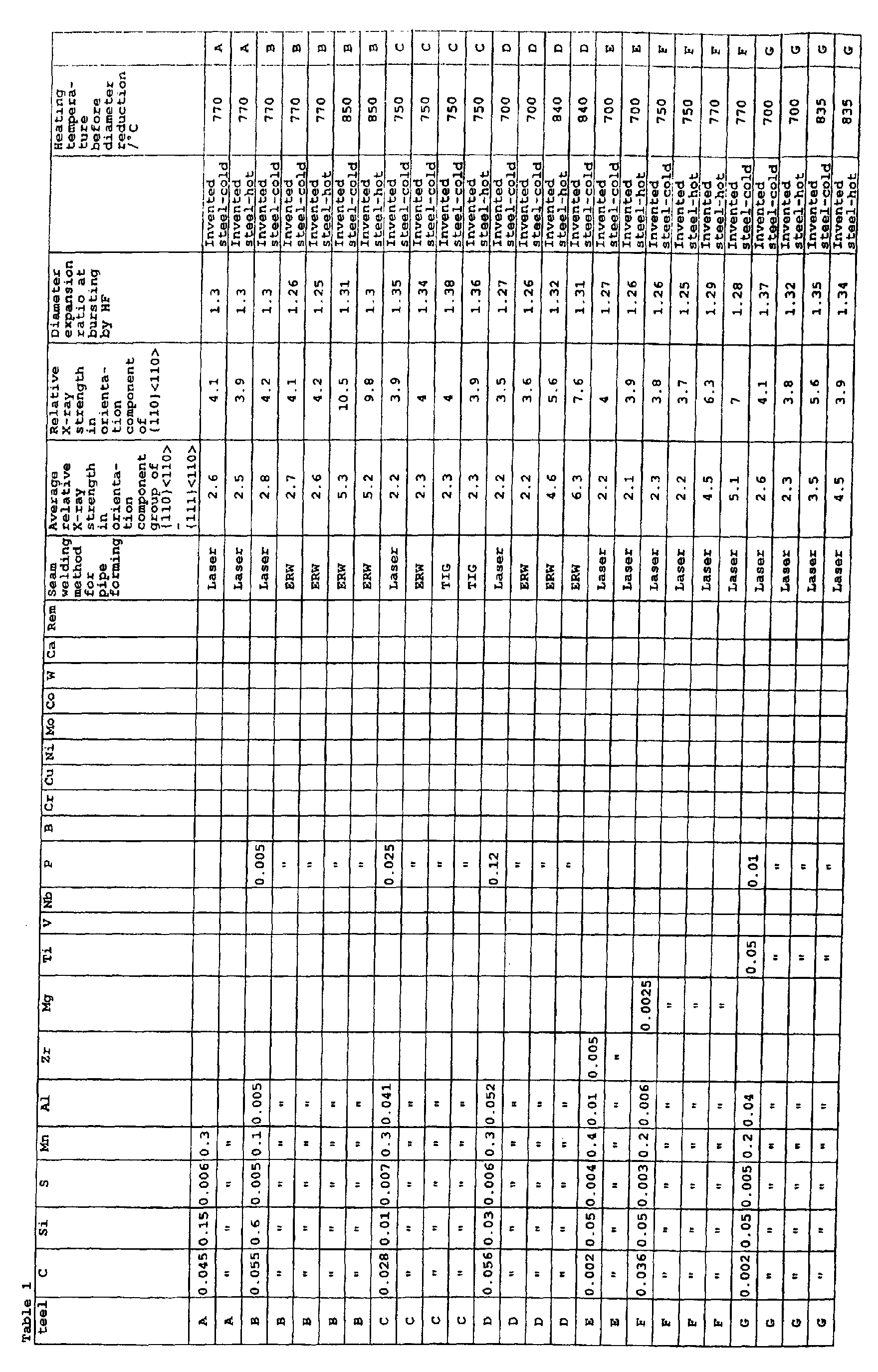
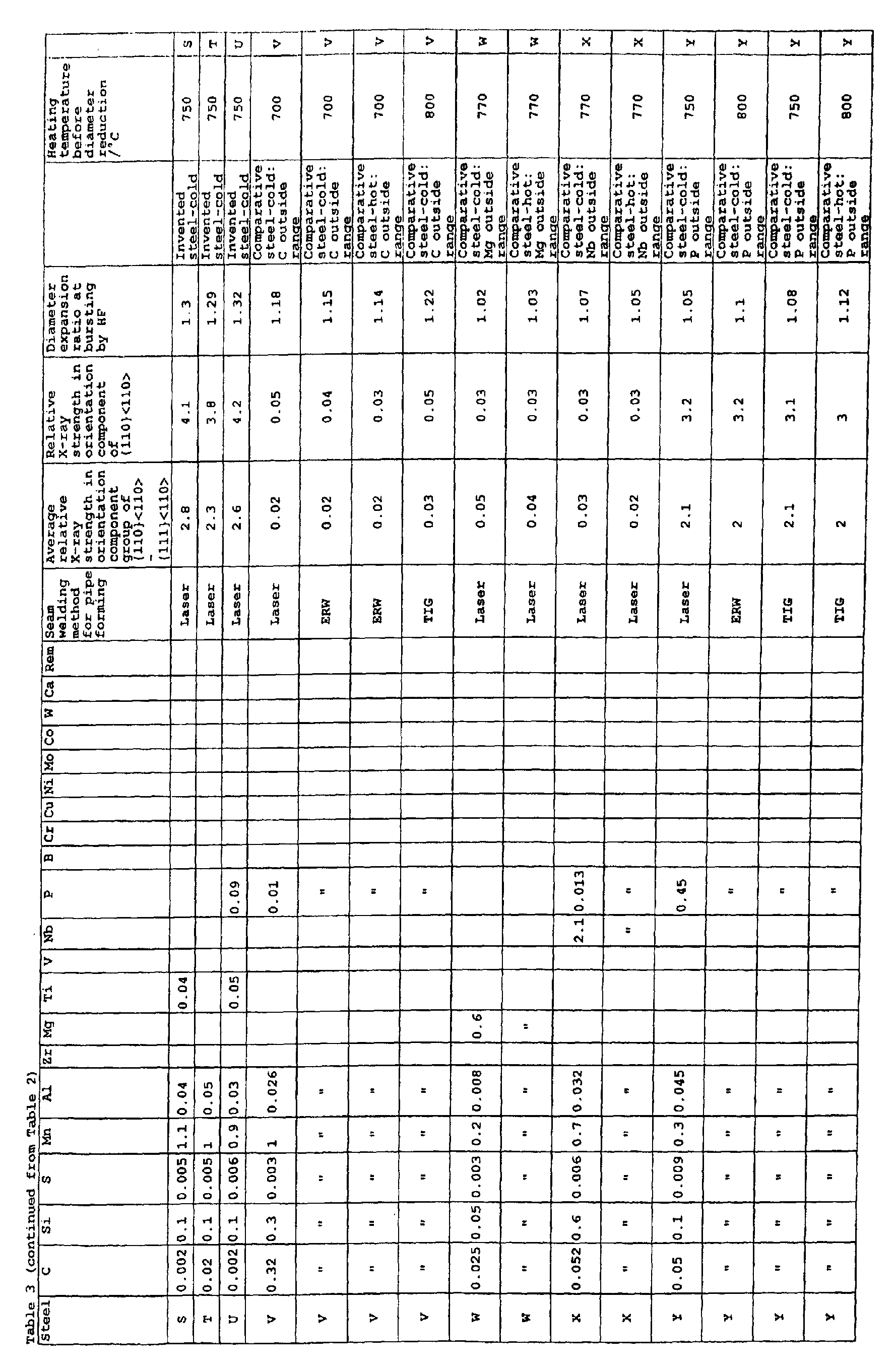
- the steels of the chemical compositions shown in Tables 1 on 4 were refined on a laboratory scale, heated to 1,200°C, hot-rolled into steel sheets 2.2 and 7 mm in thickness at a finish rolling temperature from 10°C below the Ar 3 transformation point, which is determined by the chemical composition and cooling rate of steel, to less than 120°C above the Ar 3 transformation point (roughly 900°C). Some of the steel sheets thus obtained were used for pipe forming and others for cold rolling.
- the cold-rolled steel sheets were further subjected to an annealing process to obtain cold-rolled and annealed steel sheets 2.2 mm in thickness. Then, the steel sheets were formed, in the cold, into steel pipes 108 to 49 mm in outer diameter by TIG, laser or electric resistance welding. Thereafter, the steel pipes were heated to a temperature from the Ac 3 transformation point to 200°C above it and subjected to diameter reduction work at 900 to 650°C to obtain high strength steel pipes 75 to 25 mm in outer diameter.
- Forming work by hydroforming under the condition of an axial compression amount of 1 mm at 100 bar/mm was applied to the steel pipes finally obtained until they burst.
- X-ray analysis was carried out on flat test pieces prepared by cutting out arc section test pieces from the steel pipes and then pressing them.
- the relative X-ray strength of the test pieces was obtained through the comparison with the X-ray strength of a random crystal.
- the n-values in the longitudinal and circumferential directions were measured at a strain amount of 5 to 10% or 3 to 8% and the r-values in the above directions at a strain amount of 10 or 5% on arc section test pieces cut out for the respective purposes.
- Each of invented steels A to U demonstrated a relative X-ray strength in the orientation component of ⁇ 110 ⁇ 110> of 3.0 or more, an average for the ratios of the X-ray strength in the orientation component group of ⁇ 110 ⁇ 110> to ⁇ 111 ⁇ 110> to random X-ray diffraction strength of 2.0 or more and a diameter expansion ratio as good as more than 1.25.
- the ratios of the X-ray strength in the orientation component of ⁇ 110 ⁇ 110> and the orientation component group of ⁇ 110 ⁇ 110> to ⁇ 111 ⁇ 110> to random X-ray diffraction strength were low and the diameter expansion ratio was also low.
- high-P steel Y although the relative X-ray strength in the orientation component of ⁇ 110 ⁇ 110> was high, the workability of its welded joint was low and, consequently, the diameter expansion ratio was low.
- Table 5 shows the relation between the area percentages of ferrite by grain size range and the diameter expansion ratio of steels A, B and P.
- the grain size distribution was measured on specimens for light-optical microscope observation prepared by etching a section surface parallel to the direction of rolling by the etching method explained before and using a dual image processing analyzer.
- the structure of which was a mixed grain structure the X-ray strength in the orientation component of ⁇ 110 ⁇ 110> was higher than that in other orientation components and the diameter expansion ratio was also high.
- the steels of the chemical compositions shown in Tables 6 and 7 were refined on a laboratory scale, heated to 1,200°C, hot-rolled into steel sheets 2.2 and 7 mm in thickness at a finish rolling temperature from 10°C below the Ar 3 transformation point, which is determined by the chemical composition and cooling rate of the steel, to less than 120°C above the Ar 3 transformation point (roughly 900°C). Some of the steel sheets thus obtained were used for pipe forming and others for cold rolling.
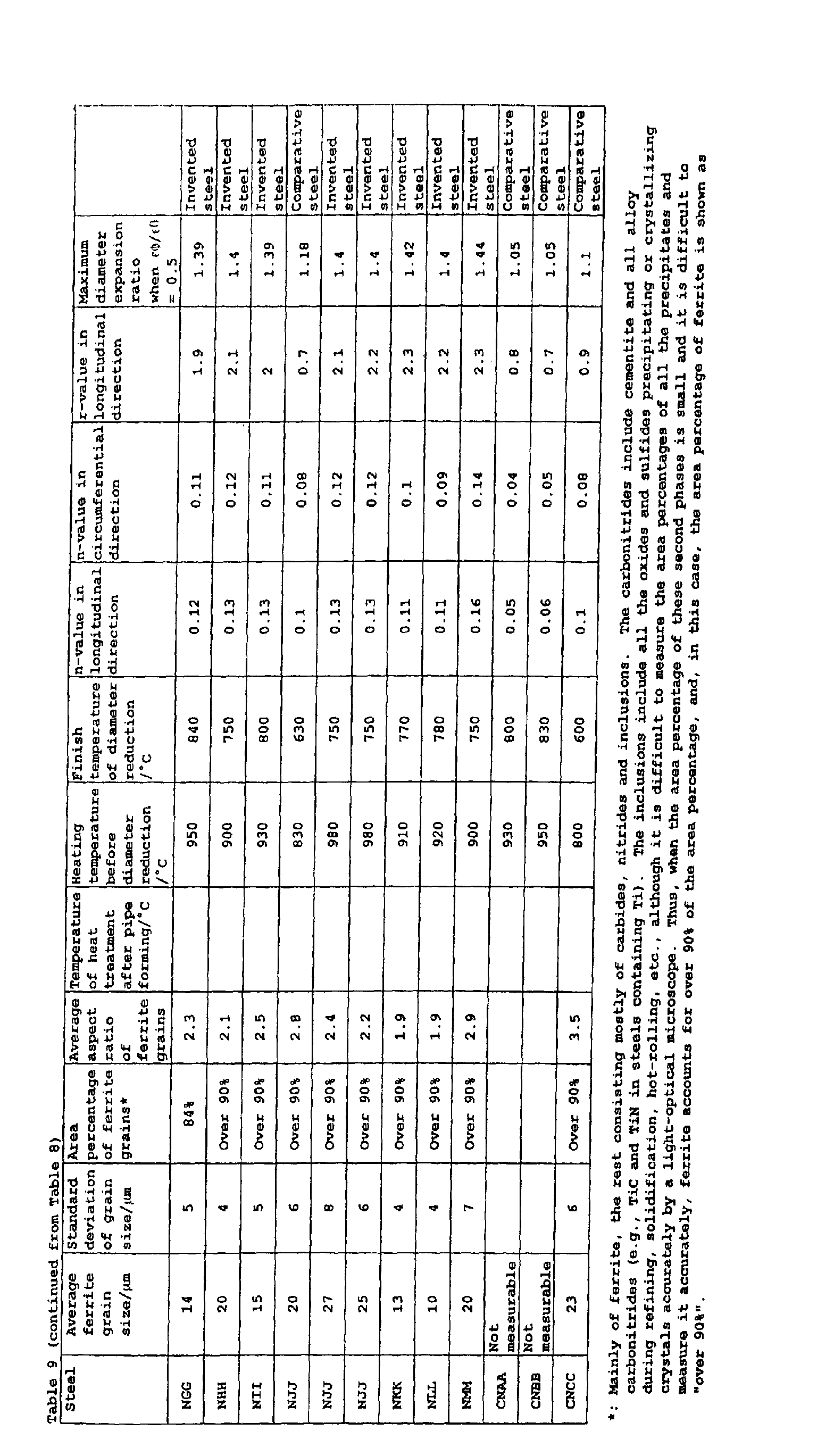
- Some of the cold-rolled steel sheets were further subjected to an annealing process to obtain cold-rolled and annealed steel sheets 2.2 mm in thickness. Then the steel sheets were formed in the cold into steel pipes 108 to 49 mm in outer diameter by electric resistance welding. Thereafter, high strength steel pipes were produced in the following manner: heating some of the steel pipes to the temperatures shown in Tables 8 and 9 and then subjecting them to diameter reduction work up to an outer diameter of 75 to 25 mm at the temperatures also shown in Tables 8 and 9; and subjecting the others to heat treatment after the pipe forming.
- Hydroforming work was applied to the steel pipes finally obtained until they burst.
- the hydroforming was applied at different amounts of axial compression and inner pressure through the control of these parameters until the pipes burst or buckled.
- This diameter expansion ratio was also used for the evaluation of the steel pipes as another indicator of the formability in hydroforming.
- Tables 8 and 9 also show the characteristics of the steels.
- the steels the matrices of which had the X-ray strength, n-values and r-values falling within the respective ranges specified in the present invention demonstrated high diameter expansion ratios.
- the pipes heated to above the Ac 3 transformation point for the diameter reduction also showed high diameter expansion ratios.
- most of the steels had ferrite as the main phase and an average grain size of 100 ⁇ m or less. As can be understood from the average grain size and its standard deviation, the ferrite grains 0.1 ⁇ m or less or 200 ⁇ m or more in size were not seen in them.
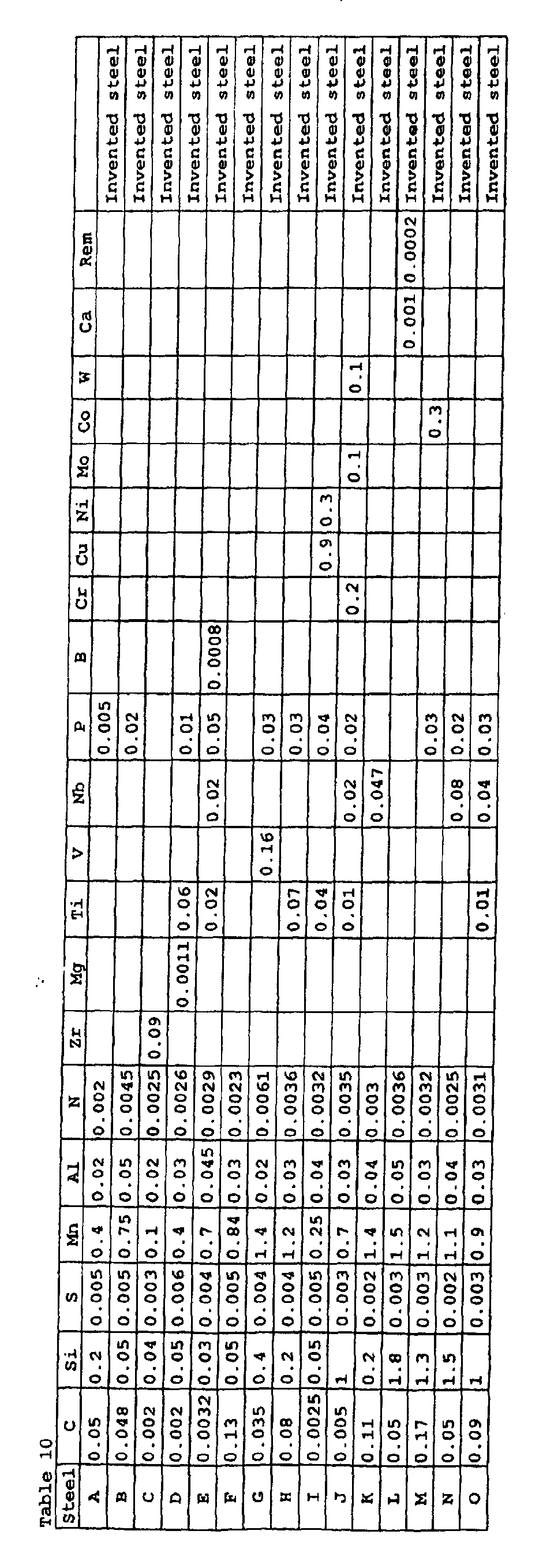
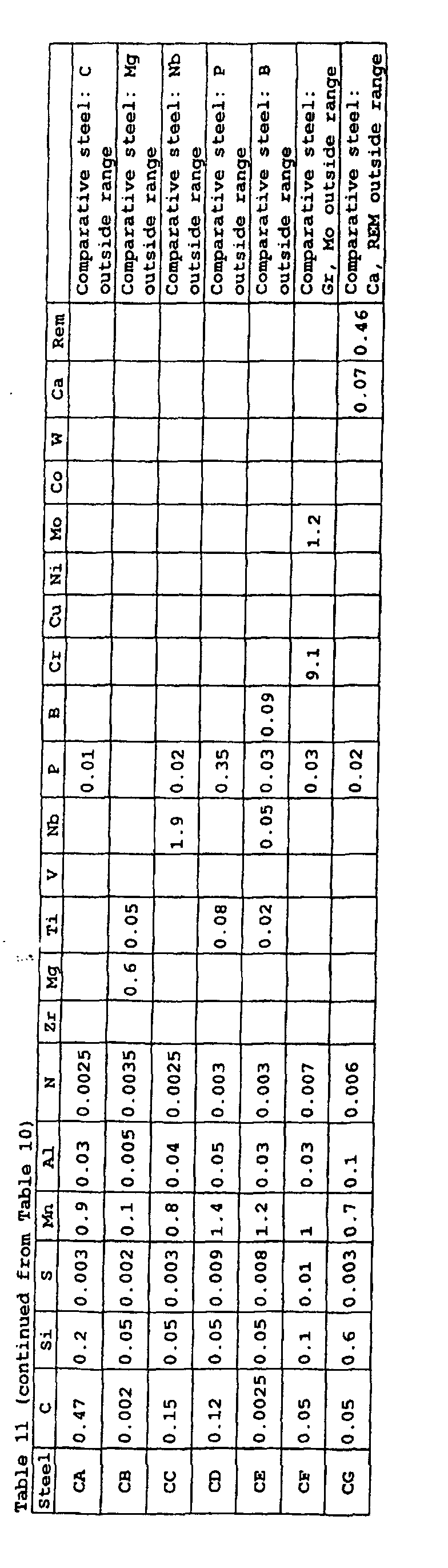
- the steels of the chemical compositions shown in Tables 10 and 11 were rolled into hot-rolled and cold rolled steel sheets 2.2 mm in thickness under the same conditions as in Example 1.
- the steel sheets were formed into steel pipes 108 or 89.1 mm in outer diameter by TIG, laser or electric resistance welding, then heated and subjected to diameter reduction to obtain high strength steel pipes 63.5 to 25 mm in outer diameter.
- the n-value(s) in the longitudinal and/or circumferential directions was/were 0.18 or more and the r-value in the longitudinal direction was less than 2.2 except for steel A which was formed into pipes by laser welding.
- the average for the ratios of the X-ray strength in the orientation component group of ⁇ 110 ⁇ 110> to ⁇ 111 ⁇ 110> to random X-ray diffraction strength was 1.5 or more and the relative X-ray strength in the orientation component of ⁇ 110 ⁇ 110> was 5.0 or less and, moreover, in some of them, the relative X-ray strength in the orientation component of ⁇ 111 ⁇ 110> was 3.0 or more.
- a good diameter expansion ratio over 1.30 was obtained in them.
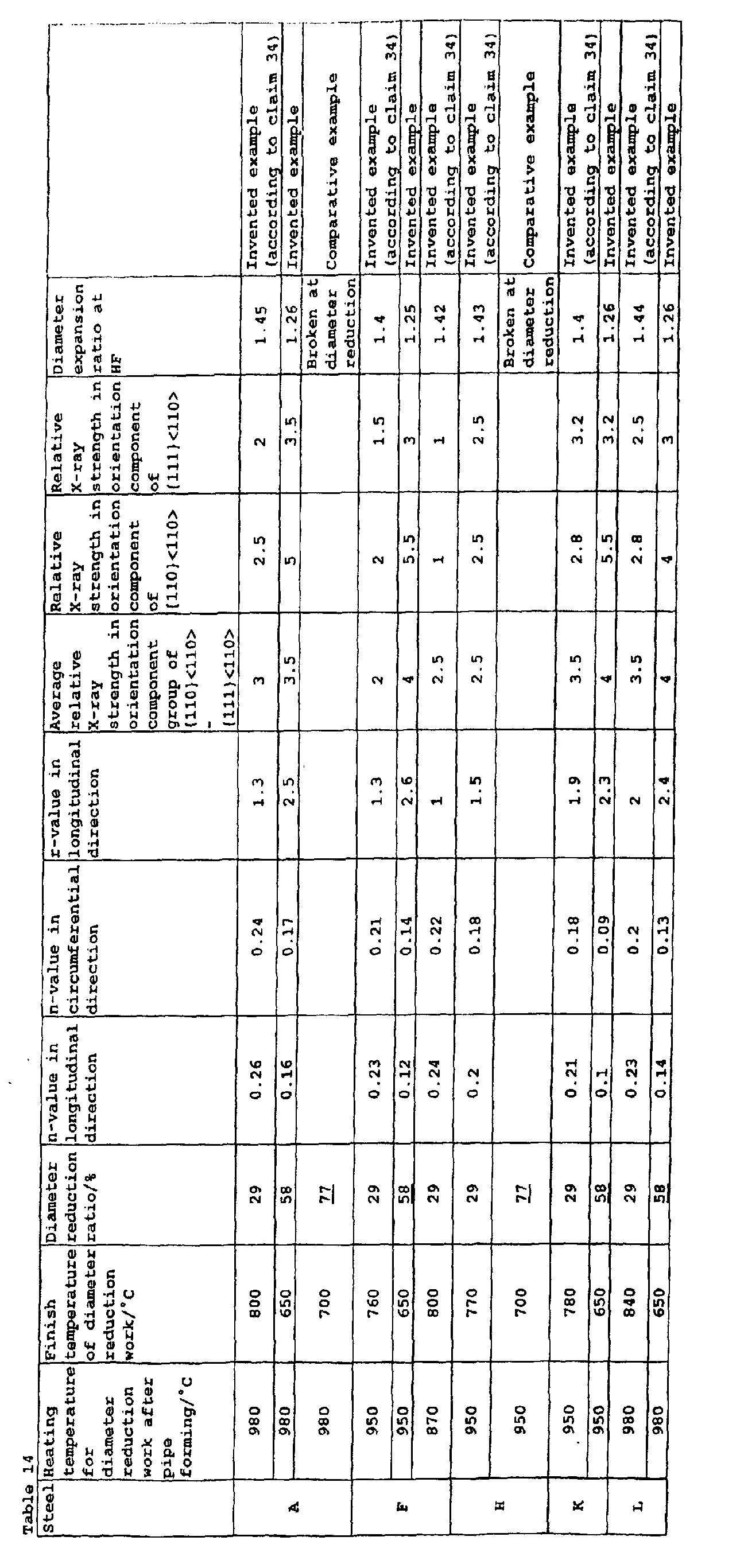
- steels A, F, H, K and L were refined on a laboratory scale, heated to 1,200°C, hot-rolled into steel sheets 2.2 mm in thickness at a finish rolling temperature from 10°C below the Ar 3 transformation point, which is determined by the chemical composition and cooling rate of the steel, to less than 120°C above the Ar 3 transformation point (roughly 900°C), and the steel sheets thus produced were used as the materials for pipe forming.
- the steel sheets were formed, in the cold, into steel pipes 108 or 89.1 mm in outer diameter by electric resistance welding. Thereafter, the steel pipes were subjected to diameter reduction work to obtain high strength steel pipes 63.55 to 25 mm in outer diameter at the heating temperatures and diameter reduction temperatures shown in Table 14.
- Table 14 shows the characteristics of the steels.
- the n-values in the longitudinal and circumferential directions were 0.18 or more and the r-value in the longitudinal direction was less than 2.2.
- the average for the ratios of the X-ray strength in the orientation component group of ⁇ 110 ⁇ 110> to ⁇ 111 ⁇ 110> to random X-ray diffraction strength was 1.5 or more and the relative X-ray strength in the orientation component of ⁇ 110 ⁇ 110> was 5.0 or less and, moreover, in some of them, the relative X-ray strength in the orientation component of ⁇ 111 ⁇ 110> was 3.0 or more.
- a good diameter expansion ratio over 1.30 was obtained in these steels.
- the present invention makes it possible to produce a high strength steel pipe excellent in formability in hydroforming and similar forming techniques by identifying the texture of a steel material excellent in formability in hydroforming and similar forming techniques and a method of controlling the texture and by specifying the texture and the controlling method.
Landscapes
- Chemical & Material Sciences (AREA)
- Engineering & Computer Science (AREA)
- Mechanical Engineering (AREA)
- Materials Engineering (AREA)
- Metallurgy (AREA)
- Organic Chemistry (AREA)
- Manufacturing & Machinery (AREA)
- Physics & Mathematics (AREA)
- Thermal Sciences (AREA)
- Crystallography & Structural Chemistry (AREA)
- Heat Treatment Of Steel (AREA)
Abstract
Description
Outside the above ranges, it is possible that n-value may deteriorate.





Claims (34)
- A steel pipe excellent in formability characterized by: containing, in mass,with the balance consisting of Fe and unavoidable impurities; and the average for the ratios of the X-ray strength in the orientation component group of {110}<110> to {111}<110> to random X-ray diffraction strength on a plane at the wall thickness center being 2.0 or more and/or the ratio of the X-ray strength in the orientation component of {110}<110> to random X-ray diffraction strength on a plane at the wall thickness center being 3.0 or more.C: 0.0005 to 0.30%,Si: 0.001 to 2.0%,Mn: 0.01 to 3.0%,
- A steel pipe excellent in formability according to claim 1, characterized by further containing, in the steel, one or more of Al, Zr and Mg at 0.0001 to 0.5 mass % in total.
- A steel pipe excellent in formability according to claim 1 or 2, characterized by further containing, in the steel, one or more of Ti, V and Nb at 0.001 to 0.5 mass % in total.
- A steel pipe excellent in formability according to any one of claims 1 to 3, characterized by further containing P at 0.001 to 0.20 mass % in the steel.
- A steel pipe excellent in formability according to any one of claims 1 to 4, characterized by further containing B at 0.0001 to 0.01 mass % in the steel.
- A steel pipe excellent in formability according to any one of claims 1 to 5, characterized by further containing, in the steel, one or more of Cr, Cu, Ni, Co, W and Mo at 0.001 to 1.5 mass % in total.
- A steel pipe excellent in formability according to any one of claims 1 to 6, characterized by further containing, in the steel, one or more of Ca and a rare earth element (Rem) at 0.0001 to 0.5 mass % in total.
- A steel pipe excellent in formability according to any one of claims 1 to 7, characterized in that: ferrite accounts for 50% or more, in terms of area percentage, of the metallographic structure; the crystal grain size of the ferrite is within the range from 0.1 to 200 µm; and the average for the ratios of the X-ray strength in the orientation component group of {110}<110> to {111}<110> to random X-ray diffraction strength on a plane at the wall thickness center is 2.0 or more and/or the ratio of the X-ray strength in the orientation component of {110}<110> to random X-ray diffraction strength on a plane at the wall thickness center is 3.0 or more.
- A steel pipe excellent in formability characterized by satisfying either one or both of the following properties:1 ○ the n-value in the longitudinal direction of the pipe being 0.12 or more, and2 ○ the n-value in the circumferential direction of the pipe being 0.12 or more.
- A steel pipe excellent in formability according to claim 9, characterized by having the property of the r-value in the longitudinal direction of the pipe being 1.1 or more.
- A steel pipe excellent in formability characterized in that the texture of the steel pipe satisfies one or more of the following conditions 1 ○ to 3 ○:1 ○ at least one or more of the following ratios being 3.0 or more: the ratio of the X-ray strength in the orientation component of {111}<110> to random X-ray diffraction strength on a plane at the wall thickness center; the average for the ratios of the X-ray strength in the orientation component group of {110}<110> to {332}<110> to random X-ray diffraction strength on a plane at the wall thickness center; and the ratio of the X-ray strength in the orientation component of {110}<110> to random X-ray diffraction strength on a plane at the wall thickness center,2 ○ at least either one or both of the following ratios being 3.0 or less: the average for the ratios of the X-ray strength in the orientation component group of {100}<110> to {223}<110> to random X-ray diffraction strength on a plane at the wall thickness center; and the ratio of the X-ray strength in the orientation component of {100}<110> to random X-ray diffraction strength on a plane at the wall thickness center, and3 ○ at least either one or both of the following conditions being satisfied: the average for the ratios of the X-ray strength in the orientation component group of {111}<110> to {111}<112> and {554}<225> to random X-ray diffraction strength on a plane at the wall thickness center being 2.0 or more; and the ratio of the X-ray strength in the orientation component of {111}<110> to random X-ray diffraction strength on a plane at the wall thickness center being 3.0 or more.
- A steel pipe excellent in formability according to any one of claims 9 to 11, characterized by containing ferrite at 50% or more in terms of area percentage and the grain size of the ferrite being in the range from 0.1 to 200 µm.
- A steel pipe excellent in formability according to any one of claims 9 to 12, characterized by: containing ferrite at 50% or more in terms of area percentage; the grain size of the ferrite ranging from 1 to 200 µm; and the standard deviation of the distribution of the grain size falling within the range of ±40% of the average grain size.
- A steel pipe excellent in formability according to any one of claims 9 to 13, characterized by: containing ferrite at 50% or more in terms of area percentage; and the average for the aspect ratios (the ratio of the grain length in the longitudinal direction to the grain thickness in the thickness direction) of ferrite grains being in the range from 0.5 to 3.0.
- A steel pipe excellent in formability according to any one of claims 9 to 14, characterized by containing, in mass,with the balance consisting of Fe and unavoidable impurities.C: 0.0005 to 0.30%,Si: 0.001 to 2.0%,Mn: 0.01 to 3.0%,P: 0.001 to 0.20%, andN: 0.0001 to 0.03%,
- A steel pipe excellent in formability according to claim 15, characterized by further containing in the steel pipe, in mass, one or more ofTi: 0.001 to 0.5%,Zr: 0.001 to 0.5% or less,Hf: 0.001 to 2.0% or less,Cr: 0.001 to 1.5% or less,Mo: 0.001 to 1.5% or less,W: 0.001 to 1.5% or less,V: 0.001 to 0.5% or less,Nb: 0.001 to 0.5% or less,Ta: 0.001 to 2.0% or less, andCo: 0.001 to 1.5% or less.
- A steel pipe excellent in formability according to claim 15 or 16, characterized by further containing, in the steel pipe, in mass, one or more ofB: 0.0001 to 0.01%,Ni 0.001 to 1.5%, andCu: 0.001 to 1.5%.
- A steel pipe excellent in formability according to any one of claims 15 to 17, characterized by further containing, in the steel pipe, in mass, one or more ofAl: 0.001 to 0.5%,Ca: 0.0001 to 0.5%,Mg: 0.0001 to 0.5%, andRem: 0.0001 to 0.5%.
- A method of producing a steel pipe excellent in formability according to any one of claims 1 to 18, characterized by forming a mother pipe using a hot-rolled or cold-rolled steel sheet satisfying any one or more of the following conditions 1 ○ to 4 ○ as the material sheet, then heating the mother pipe to a temperature in the range from the Ac3 transformation point to 200°C above the Ac3 transformation point, and then subjecting it to diameter reduction work in the temperature range from 900 to 650°C:1 ○ at least either one or both of the following conditions being satisfied: the average for the ratios of the X-ray strength in the orientation component group of {110}<110> to {111}<110> to random X-ray diffraction strength on a plane at the wall thickness center being 2.0 or more; and the ratio of the X-ray strength in the orientation component of {110}<110> to random X-ray diffraction strength on a plane at the wall thickness center being 3.0 or more,2 ○ at least one or more of the following ratios being 3.0 or more: the ratio of the X-ray strength in the orientation component of {111}<110> to random X-ray diffraction strength on a plane at the wall thickness center; the average for the ratios of the X-ray strength in the orientation component group of {110}<110> to {332}<110> to random X-ray diffraction strength on a plane at the wall thickness center; and the ratio of the X-ray strength in the orientation component of {110}<110> to random X-ray diffraction strength on a plane at the wall thickness center,3 ○ at least either one or both of the following ratios being 3.0 or less: the average for the ratios of the X-ray strength in the orientation component group of {100}<110> to {223}<110> to random X-ray diffraction strength on a plane at the wall thickness center; and the ratio of the X-ray strength in the orientation component of {100}<110> to random X-ray diffraction strength on a plane at the wall thickness center, and4 ○ at least either one or both of the following conditions being satisfied: the average for the ratios of the X-ray strength in the orientation component group of {111}<110> to {111}<112> and {554}<225> to random X-ray diffraction strength on a plane at the wall thickness center being 2.0 or more; and the ratio of the X-ray strength in the orientation component of {111}<110> to random X-ray diffraction strength on a plane at the wall thickness center being 3.0 or more.
- A method of producing a steel pipe excellent in formability according to any one of claims 1 to 18, characterized by forming a mother pipe using a hot-rolled or cold-rolled steel sheet satisfying any one or more of the following conditions 1 ○ to 4 ○ as the material sheet, and then applying heat treatment to the mother pipe at a temperature in the range from 650°C to 200°C above the Ac3 transformation point:1 ○ at least either one or both of the following conditions being satisfied: the average for the ratios of the X-ray strength in the orientation component group of {110}<110> to {111}<110> to random X-ray diffraction strength on a plane at the wall thickness center being 2.0 or more; and the ratio of the X-ray strength in the orientation component of {110}<110> to random X-ray diffraction strength on a plane at the wall thickness center being 3.0 or more,2 ○ at least one or more of the following ratios being 3.0 or more: the ratio of the X-ray strength in the orientation component of {111}<110> to random X-ray diffraction strength on a plane at the wall thickness center; the average for the ratios of the X-ray strength in the orientation component group of {110}<110> to {332}<110> to random X-ray diffraction strength on a plane at the wall thickness center; and the ratio of the X-ray strength in the orientation component of {110}<110> to random X-ray diffraction strength on a plane at the wall thickness center,3 ○ at least either one or both of the following ratios being 3.0 or less: the average for the ratios of the X-ray strength in the orientation component group of {100}<110> to {223}<110> to random X-ray diffraction strength on a plane at the wall thickness center; and the ratio of the X-ray strength in the orientation component of {100}<110> to random X-ray diffraction strength on a plane at the wall thickness center, and4 ○ at least either one or both of the following conditions being satisfied: the average for the ratios of the X-ray strength in the orientation component group of {111}<110> to {111}<112> and {554}<225> to random X-ray diffraction strength on a plane at the wall thickness center being 2.0 or more; and the ratio of the X-ray strength in the orientation component of {111}<110> to random X-ray diffraction strength on a plane at the wall thickness center being 1.5 or more.
- A steel pipe excellent in formability characterized by satisfying either one or both of the following properties:1 ○ the n-value in the longitudinal direction of the pipe being 0.18 or more, and2 ○ the n-value in the circumferential direction of the pipe being 0.18 or more.
- A steel pipe excellent in formability according to claim 21, characterized by having the property of the r-value in the longitudinal direction of the pipe being 0.6 or more but less than 2.2.
- A steel pipe excellent in formability according to claim 21 or 22, characterized in that the ratio of X-ray strength to random X-ray diffraction strength satisfies the following two conditions:1 ○ the average for the ratios of the X-ray strength in the orientation component group of {110}<110> to {111}<110> to random X-ray diffraction strength on a plane at the wall thickness center being 1.5 or more, and2 ○ the ratio of the X-ray strength in the orientation component of {110}<110> to random X-ray diffraction strength on a plane at the wall thickness center being 5.0 or less.
- A steel pipe excellent in formability according to any one of claims 21 to 23, characterized in that the ratio of the X-ray strength in the orientation component of {111}<110> to random X-ray diffraction strength on a plane at the wall thickness center is 3.0 or more.
- A steel pipe excellent in formability according to any one of claims 21 to 24, characterized by containing ferrite at 50% or more in terms of area percentage and the grain size of the ferrite being in the range from 0.1 to 200 µm.
- A steel pipe excellent in formability according to any one of claims 21 to 25, characterized by: containing ferrite at 50% or more in terms of area percentage; and the average for the aspect ratios (the ratio of the grain length in the longitudinal direction to the grain thickness in the thickness direction) of ferrite grains being in the range from 0.5 to 3.0.
- A steel pipe excellent in formability according to any one of claims 21 to 26, characterized by containing, in mass,with the balance consisting of Fe and unavoidable impurities.C: 0.0005 to 0.30%,Si: 0.001 to 2.0%,Mn: 0.01 to 3.0%, andN: 0.0001 to 0.03%,
- A steel pipe excellent in formability according to any one of claims 21 to 27, characterized by further containing, in the steel pipe, one or more of Al, Zr and Mg at 0.0001 to 0.5 mass % in total.
- A steel pipe excellent in formability according to any one of claims 21 to 28, characterized by further containing, in the steel pipe, one or more of Ti, V and Nb at 0.001 to 0.5 mass % in total.
- A steel pipe excellent in formability according to any one of claims 21 to 29, characterized by further containing P at 0.001 to 0.20 mass %, in the steel pipe.
- A steel pipe excellent in formability according to any one of claims 21 to 30, characterized by further containing B at 0.0001 to 0.01 mass %, in the steel pipe.
- A steel pipe excellent in formability according to any one of claims 21 to 31, characterized by further containing, in the steel pipe, one or more of Cr, Cu, Ni, Co, W and Mo by 0.001 to 5.0 mass % in total.
- A steel pipe excellent in formability according to any one of claims 21 to 32, characterized by further containing, in the steel pipe, one or more of Ca and a rare earth element (Rem) by 0.0001 to 0.5 mass % in total.
- A method of producing a steel pipe excellent in formability according to any one of claims 21 to 33, characterized by forming a mother pipe, then heating it to a temperature in the range from 50°C below the Ac3 transformation point to 200°C above the Ac3 transformation point, and then subjecting it to diameter reduction work in the temperature range from 650 to 900°C at a diameter reduction ratio of 10 to 40%.
Applications Claiming Priority (9)
| Application Number | Priority Date | Filing Date | Title |
|---|---|---|---|
| JP2000052574 | 2000-02-28 | ||
| JP2000052574 | 2000-02-28 | ||
| JP2000174371 | 2000-06-09 | ||
| JP2000174371 | 2000-06-09 | ||
| JP2000183662 | 2000-06-19 | ||
| JP2000183662 | 2000-06-19 | ||
| JP2000328156 | 2000-10-27 | ||
| JP2000328156 | 2000-10-27 | ||
| PCT/JP2001/001530 WO2001062998A1 (en) | 2000-02-28 | 2001-02-28 | Steel pipe having excellent formability and method for production thereof |
Publications (3)
| Publication Number | Publication Date |
|---|---|
| EP1264910A1 true EP1264910A1 (en) | 2002-12-11 |
| EP1264910A4 EP1264910A4 (en) | 2006-01-25 |
| EP1264910B1 EP1264910B1 (en) | 2008-05-21 |
Family
ID=27481078
Family Applications (1)
| Application Number | Title | Priority Date | Filing Date |
|---|---|---|---|
| EP01908167A Expired - Lifetime EP1264910B1 (en) | 2000-02-28 | 2001-02-28 | Steel pipe having excellent formability and method for production thereof |
Country Status (7)
| Country | Link |
|---|---|
| US (1) | US6866725B2 (en) |
| EP (1) | EP1264910B1 (en) |
| JP (1) | JP4264212B2 (en) |
| KR (1) | KR100514119B1 (en) |
| CN (1) | CN1144893C (en) |
| DE (1) | DE60134125D1 (en) |
| WO (1) | WO2001062998A1 (en) |
Cited By (6)
| Publication number | Priority date | Publication date | Assignee | Title |
|---|---|---|---|---|
| EP1382703A3 (en) * | 2002-07-10 | 2004-05-06 | Nippon Steel Corporation | Steel pipe having low yield ratio |
| WO2005005670A1 (en) * | 2003-06-26 | 2005-01-20 | Nippon Steel Corporation | High-strength hot-rolled steel sheet excellent in shape fixability and method of producing the same |
| CN100374586C (en) * | 2003-06-26 | 2008-03-12 | 新日本制铁株式会社 | High-strength hot-rolled steel sheet having good shape fixability and production method thereof |
| EP1905857A2 (en) | 2006-09-29 | 2008-04-02 | EZM Edelstahlzieherei Mark GmbH | High-strength steel and applications for such steel |
| EP1816225A4 (en) * | 2004-11-26 | 2009-03-25 | Jfe Steel Corp | Steel pipe having excellent electromagnetic properties and process for producing the same |
| DE102015111150A1 (en) * | 2015-07-09 | 2017-01-12 | Benteler Steel/Tube Gmbh | Steel alloy, in particular for chassis or drive component, and chassis or drive component |
Families Citing this family (76)
| Publication number | Priority date | Publication date | Assignee | Title |
|---|---|---|---|---|
| WO2004027392A1 (en) * | 2002-09-20 | 2004-04-01 | Enventure Global Technology | Pipe formability evaluation for expandable tubulars |
| JP4284405B2 (en) * | 2002-10-17 | 2009-06-24 | 独立行政法人物質・材料研究機構 | Tapping screw and its manufacturing method |
| WO2004106571A1 (en) * | 2003-05-27 | 2004-12-09 | Nippon Steel Corporation | High strength thin steel sheet excellent in resistance to delayed fracture after forming and method for preparation thereof, and automobile parts requiring strength manufactured from high strength thin steel sheet |
| JP4819305B2 (en) * | 2003-09-04 | 2011-11-24 | 日産自動車株式会社 | Method for manufacturing reinforcing member |
| JP4443910B2 (en) * | 2003-12-12 | 2010-03-31 | Jfeスチール株式会社 | Steel materials for automobile structural members and manufacturing method thereof |
| US7754344B2 (en) * | 2004-12-22 | 2010-07-13 | Nippon Steel & Sumikin Stainless Steel Corporation | Ferritic stainless steel welded pipe superior in expandability |
| JP2006265668A (en) * | 2005-03-25 | 2006-10-05 | Sumitomo Metal Ind Ltd | Seamless steel pipe for oil well |
| KR100917914B1 (en) * | 2005-04-04 | 2009-09-16 | 신닛뽄세이테쯔 카부시키카이샤 | High strength steel plate and high strength welded steel pipe with excellent ductile fracture properties and their manufacturing method |
| JP4654818B2 (en) * | 2005-07-29 | 2011-03-23 | Jfeスチール株式会社 | High-rigidity steel pipe and manufacturing method thereof |
| CZ299495B6 (en) | 2005-12-06 | 2008-08-13 | Comtes Fht, S. R. O. | A method of producing high strength low alloy steel pipes |
| US20070267110A1 (en) * | 2006-05-17 | 2007-11-22 | Ipsco Enterprises, Inc. | Method for making high-strength steel pipe, and pipe made by that method |
| EP2044228B1 (en) * | 2006-06-29 | 2010-05-19 | Tenaris Connections AG | Seamless precision steel tubes with improved isotropic toughness at low temperature for hydraulic cylinders and process for obtaining the same |
| US20080226396A1 (en) * | 2007-03-15 | 2008-09-18 | Tubos De Acero De Mexico S.A. | Seamless steel tube for use as a steel catenary riser in the touch down zone |
| MX2007004600A (en) * | 2007-04-17 | 2008-12-01 | Tubos De Acero De Mexico S A | Seamless steel pipe for use as vertical work-over sections. |
| US7862667B2 (en) * | 2007-07-06 | 2011-01-04 | Tenaris Connections Limited | Steels for sour service environments |
| MX2010005532A (en) * | 2007-11-19 | 2011-02-23 | Tenaris Connections Ltd | High strength bainitic steel for octg applications. |
| JP4547037B2 (en) * | 2007-12-07 | 2010-09-22 | 新日本製鐵株式会社 | Steel excellent in CTOD characteristics of weld heat affected zone and method for producing the same |
| KR101130837B1 (en) * | 2008-04-10 | 2012-03-28 | 신닛뽄세이테쯔 카부시키카이샤 | High-strength steel sheets which are extreamely excellent in the balance between burring workability and ductility and excellent in fatigue endurance, zinc-coated steel sheets, and processes for production of both |
| JP4547041B2 (en) * | 2008-10-27 | 2010-09-22 | 新日本製鐵株式会社 | Refractory steel material excellent in reheat embrittlement resistance and low temperature toughness of weld heat affected zone and method for producing the same |
| WO2010134323A1 (en) * | 2009-05-19 | 2010-11-25 | 新日本製鐵株式会社 | Steel material for welding and method for producing same |
| US20100319814A1 (en) * | 2009-06-17 | 2010-12-23 | Teresa Estela Perez | Bainitic steels with boron |
| KR101159926B1 (en) * | 2009-11-27 | 2012-06-25 | 현대제철 주식회사 | Method for evaluating centerline segregation in continuous casting slab |
| DE112010003086B4 (en) | 2009-07-27 | 2021-11-11 | Hyundai Steel Co. | Method for evaluating the center segregation of a continuously cast slab |
| CN101693985B (en) * | 2009-10-30 | 2012-10-10 | 天长市天翔机械厂 | Alloy material for manufacturing oil sprayer bushing |
| EP2325435B2 (en) | 2009-11-24 | 2020-09-30 | Tenaris Connections B.V. | Threaded joint sealed to [ultra high] internal and external pressures |
| CN101838775B (en) * | 2010-05-28 | 2013-09-25 | 中材装备集团有限公司 | High ductility medium carbon abrasion resistant steel |
| US9163296B2 (en) | 2011-01-25 | 2015-10-20 | Tenaris Coiled Tubes, Llc | Coiled tube with varying mechanical properties for superior performance and methods to produce the same by a continuous heat treatment |
| IT1403688B1 (en) | 2011-02-07 | 2013-10-31 | Dalmine Spa | STEEL TUBES WITH THICK WALLS WITH EXCELLENT LOW TEMPERATURE HARDNESS AND RESISTANCE TO CORROSION UNDER TENSIONING FROM SULFUR. |
| IT1403689B1 (en) | 2011-02-07 | 2013-10-31 | Dalmine Spa | HIGH-RESISTANCE STEEL TUBES WITH EXCELLENT LOW TEMPERATURE HARDNESS AND RESISTANCE TO CORROSION UNDER VOLTAGE SENSORS. |
| US8414715B2 (en) | 2011-02-18 | 2013-04-09 | Siderca S.A.I.C. | Method of making ultra high strength steel having good toughness |
| US8636856B2 (en) | 2011-02-18 | 2014-01-28 | Siderca S.A.I.C. | High strength steel having good toughness |
| US9403242B2 (en) | 2011-03-24 | 2016-08-02 | Nippon Steel & Sumitomo Metal Corporation | Steel for welding |
| WO2012141220A1 (en) * | 2011-04-12 | 2012-10-18 | 新日本製鐵株式会社 | High-strength steel plate and high-strength steel pipe having excellent deformability and low-temperature toughness, and manufacturing methods therefor |
| JP5488763B2 (en) | 2011-05-25 | 2014-05-14 | 新日鐵住金株式会社 | Cold-rolled steel sheet and manufacturing method thereof |
| ES2714302T3 (en) * | 2011-07-27 | 2019-05-28 | Nippon Steel & Sumitomo Metal Corp | High strength cold rolled steel sheet that has excellent flawlessness and precision drivability, and a manufacturing method of said sheet |
| CN102321844A (en) * | 2011-10-10 | 2012-01-18 | 钢铁研究总院 | Hot-rolled corrosion-resistant baking-hardened steel and preparation method thereof |
| CN102505093B (en) * | 2011-12-15 | 2013-10-02 | 浙江金洲管道工业有限公司 | Solid expansion tube steel for open hole completion of oil and gas well and manufacturing method thereof |
| US9340847B2 (en) | 2012-04-10 | 2016-05-17 | Tenaris Connections Limited | Methods of manufacturing steel tubes for drilling rods with improved mechanical properties, and rods made by the same |
| KR101439608B1 (en) * | 2012-07-16 | 2014-09-11 | 주식회사 포스코 | Formable hot-rolled steel sheet with excellent formability and method for manufacturing thereof |
| RU2654361C2 (en) * | 2012-07-18 | 2018-05-17 | ДЭНИЕЛ МЕЖЕМЕНТ энд КОНТРОЛ, ИНК. | Welding fixture |
| TWI487800B (en) * | 2012-09-28 | 2015-06-11 | 新報國製鐵股份有限公司 | And a method for manufacturing the same for producing a seamless steel pipe |
| CN103018141B (en) * | 2012-11-29 | 2015-11-18 | 燕山大学 | High alloy low-carbon martensitic steels original grain developer and display packing |
| US9970242B2 (en) | 2013-01-11 | 2018-05-15 | Tenaris Connections B.V. | Galling resistant drill pipe tool joint and corresponding drill pipe |
| US9187811B2 (en) | 2013-03-11 | 2015-11-17 | Tenaris Connections Limited | Low-carbon chromium steel having reduced vanadium and high corrosion resistance, and methods of manufacturing |
| US9803256B2 (en) | 2013-03-14 | 2017-10-31 | Tenaris Coiled Tubes, Llc | High performance material for coiled tubing applications and the method of producing the same |
| EP2789700A1 (en) | 2013-04-08 | 2014-10-15 | DALMINE S.p.A. | Heavy wall quenched and tempered seamless steel pipes and related method for manufacturing said steel pipes |
| EP2789701A1 (en) | 2013-04-08 | 2014-10-15 | DALMINE S.p.A. | High strength medium wall quenched and tempered seamless steel pipes and related method for manufacturing said steel pipes |
| CN110251683A (en) | 2013-06-24 | 2019-09-20 | Abl生物公司 | Antibody-drug conjugates and application thereof with improved stability |
| KR102197204B1 (en) | 2013-06-25 | 2021-01-04 | 테나리스 커넥션즈 비.브이. | High-chromium heat-resistant steel |
| CN103789629A (en) * | 2014-01-16 | 2014-05-14 | 安徽省杨氏恒泰钢管扣件加工有限公司 | Wear-resistant seamless steel tube material and preparation method thereof |
| RU2562184C1 (en) * | 2014-06-10 | 2015-09-10 | Федеральное государственное унитарное предприятие "Всероссийский научно-исследовательский институт авиационных материалов" (ФГУП "ВИАМ") | High-strength dispersion-hardening steel |
| RU2572911C1 (en) * | 2014-11-05 | 2016-01-20 | Юлия Алексеевна Щепочкина | Steel |
| CN104451447B (en) * | 2014-12-10 | 2016-10-19 | 无锡鑫常钢管有限责任公司 | A kind of Austenitic stainless steel pipe and production technology |
| US20160305192A1 (en) | 2015-04-14 | 2016-10-20 | Tenaris Connections Limited | Ultra-fine grained steels having corrosion-fatigue resistance |
| CN104928568B (en) * | 2015-06-30 | 2017-07-28 | 宝山钢铁股份有限公司 | A kind of ferrite low-density high-strength steel and its manufacture method |
| CN105112805A (en) * | 2015-08-03 | 2015-12-02 | 吴朝霞 | Rectangular steel pipe concrete prefabricated part |
| CN105113710A (en) * | 2015-08-03 | 2015-12-02 | 吴朝霞 | Concrete member for high-rise building |
| CN106436695A (en) * | 2015-08-13 | 2017-02-22 | 江鹏财 | Prefabricated piles for long-span bridge construction |
| CN105133785A (en) * | 2015-08-18 | 2015-12-09 | 刁德斌 | Building concrete member embedded with Y-shaped reinforced beams |
| CN105507235A (en) * | 2015-08-20 | 2016-04-20 | 喻良军 | Prefabricated pile for expressway bridge |
| CN105568129A (en) * | 2015-12-30 | 2016-05-11 | 芜湖恒耀汽车零部件有限公司 | Rare earth carbon steel material for automobile exhaust pipe and preparation method thereof |
| CN105673173B (en) * | 2015-12-31 | 2019-09-03 | 台州三元车辆净化器有限公司 | Exhaust pipe of a new type of high-performance material and its processing and preparation technology |
| CN105671425B (en) * | 2016-01-26 | 2017-07-11 | 安徽同盛环件股份有限公司 | A kind of preparation method of high-temperature alloy ring sealing ring |
| CN105734425A (en) * | 2016-05-09 | 2016-07-06 | 周常 | Structural material of marine drilling platform |
| US11365465B2 (en) * | 2016-08-08 | 2022-06-21 | Nippon Steel Corporation | Steel sheet |
| US11124852B2 (en) | 2016-08-12 | 2021-09-21 | Tenaris Coiled Tubes, Llc | Method and system for manufacturing coiled tubing |
| US10434554B2 (en) | 2017-01-17 | 2019-10-08 | Forum Us, Inc. | Method of manufacturing a coiled tubing string |
| WO2019010661A1 (en) * | 2017-07-13 | 2019-01-17 | 田圣林 | High toughness and high strength corrosion resistant spring |
| KR102010079B1 (en) * | 2017-09-13 | 2019-08-12 | 주식회사 포스코 | Steel sheet having excellent image clarity after painting, and method for manufacturing the same |
| CN108300944A (en) * | 2018-04-13 | 2018-07-20 | 合肥市旺友门窗有限公司 | A kind of vibration and noise reducing stainless steel pipe and preparation method thereof |
| KR102109269B1 (en) * | 2018-09-28 | 2020-05-11 | 주식회사 포스코 | Hot-rolled steel sheet for steel pipe and manufacturing method for the same |
| CN109517959A (en) * | 2018-12-17 | 2019-03-26 | 包头钢铁(集团)有限责任公司 | Effective hot rolled strip of a kind of low cost conveying and preparation method thereof |
| KR102209556B1 (en) * | 2018-12-19 | 2021-01-29 | 주식회사 포스코 | Steel sheet having excellent hole-expandability, formed member, and manufacturing method of therefor |
| CN111809113B (en) * | 2020-06-24 | 2021-12-14 | 延安嘉盛石油机械有限责任公司 | TC-50 steel grade petroleum pipe blank containing rare earth |
| CN118984884A (en) * | 2022-03-30 | 2024-11-19 | 日本制铁株式会社 | Non-oriented electromagnetic steel sheet and motor core |
| JP7666441B2 (en) * | 2022-08-02 | 2025-04-22 | Jfeスチール株式会社 | Manufacturing method of butt welded steel pipe |
Family Cites Families (13)
| Publication number | Priority date | Publication date | Assignee | Title |
|---|---|---|---|---|
| EP0196788B1 (en) * | 1985-03-06 | 1990-07-25 | Kawasaki Steel Corporation | Method of manufacturing formable as rolled thin steel sheets |
| JPS6383230A (en) * | 1986-09-27 | 1988-04-13 | Nkk Corp | Production of high-strength cold rolling steel sheet having excellent quenching hardenability and press formability |
| JP2613155B2 (en) * | 1991-09-07 | 1997-05-21 | 新日本製鐵株式会社 | ERW oil well pipe excellent in crushing characteristics and method of manufacturing the same |
| JPH0586419A (en) * | 1991-09-27 | 1993-04-06 | Nippon Steel Corp | Production of resistance welded tube excellent in bendability |
| JPH09196244A (en) * | 1996-01-19 | 1997-07-29 | Nkk Corp | Steel pipe with excellent earthquake resistance |
| MY116920A (en) * | 1996-07-01 | 2004-04-30 | Shell Int Research | Expansion of tubings |
| JPH1052713A (en) * | 1996-08-12 | 1998-02-24 | Nkk Corp | Steel pipe excellent in earthquake resistance and manufacturing method thereof |
| JP3481409B2 (en) * | 1996-12-17 | 2003-12-22 | 新日本製鐵株式会社 | Hydroforming method of steel pipe |
| WO1998049362A1 (en) * | 1997-04-30 | 1998-11-05 | Kawasaki Steel Corporation | Steel material having high ductility and high strength and process for production thereof |
| EP0924312B1 (en) * | 1997-06-26 | 2005-12-07 | JFE Steel Corporation | Method for manufacturing super fine granular steel pipe |
| JP3731103B2 (en) * | 1997-12-15 | 2006-01-05 | Jfeスチール株式会社 | High-strength ERW steel pipe excellent in hydraulic bulge formability and manufacturing method thereof |
| JP3779811B2 (en) * | 1998-03-30 | 2006-05-31 | 新日本製鐵株式会社 | ERW steel pipe with excellent workability and its manufacturing method |
| CA2381405C (en) * | 2000-06-07 | 2008-01-08 | Nippon Steel Corporation | Steel pipe excellent in formability and method of producing the same |
-
2001
- 2001-02-28 JP JP2001561805A patent/JP4264212B2/en not_active Expired - Fee Related
- 2001-02-28 EP EP01908167A patent/EP1264910B1/en not_active Expired - Lifetime
- 2001-02-28 CN CNB018050085A patent/CN1144893C/en not_active Expired - Fee Related
- 2001-02-28 WO PCT/JP2001/001530 patent/WO2001062998A1/en not_active Ceased
- 2001-02-28 US US10/220,441 patent/US6866725B2/en not_active Expired - Fee Related
- 2001-02-28 DE DE60134125T patent/DE60134125D1/en not_active Expired - Lifetime
- 2001-02-28 KR KR10-2002-7011319A patent/KR100514119B1/en not_active Expired - Fee Related
Cited By (10)
| Publication number | Priority date | Publication date | Assignee | Title |
|---|---|---|---|---|
| EP1382703A3 (en) * | 2002-07-10 | 2004-05-06 | Nippon Steel Corporation | Steel pipe having low yield ratio |
| WO2005005670A1 (en) * | 2003-06-26 | 2005-01-20 | Nippon Steel Corporation | High-strength hot-rolled steel sheet excellent in shape fixability and method of producing the same |
| KR100754035B1 (en) * | 2003-06-26 | 2007-09-04 | 신닛뽄세이테쯔 카부시키카이샤 | High-strength hot-rolled steel sheet excellent in shape fixability and method of producing the same |
| CN100374586C (en) * | 2003-06-26 | 2008-03-12 | 新日本制铁株式会社 | High-strength hot-rolled steel sheet having good shape fixability and production method thereof |
| US7485195B2 (en) | 2003-06-26 | 2009-02-03 | Nippon Steel Corporation | High-strength hot-rolled steel sheet excellent in shape fixability and method of producing the same |
| EP1816225A4 (en) * | 2004-11-26 | 2009-03-25 | Jfe Steel Corp | Steel pipe having excellent electromagnetic properties and process for producing the same |
| US7942984B2 (en) | 2004-11-26 | 2011-05-17 | Jfe Steel Corporation | Steel pipe with good magnetic properties and method of producing the same |
| EP1905857A2 (en) | 2006-09-29 | 2008-04-02 | EZM Edelstahlzieherei Mark GmbH | High-strength steel and applications for such steel |
| DE102015111150A1 (en) * | 2015-07-09 | 2017-01-12 | Benteler Steel/Tube Gmbh | Steel alloy, in particular for chassis or drive component, and chassis or drive component |
| US10415124B2 (en) | 2015-07-09 | 2019-09-17 | Benteler Steel/Tube Gmbh | Chassis or drive component |
Also Published As
| Publication number | Publication date |
|---|---|
| CN1401012A (en) | 2003-03-05 |
| US6866725B2 (en) | 2005-03-15 |
| CN1144893C (en) | 2004-04-07 |
| EP1264910B1 (en) | 2008-05-21 |
| WO2001062998A1 (en) | 2001-08-30 |
| KR100514119B1 (en) | 2005-09-13 |
| JP4264212B2 (en) | 2009-05-13 |
| EP1264910A4 (en) | 2006-01-25 |
| US20030116238A1 (en) | 2003-06-26 |
| DE60134125D1 (en) | 2008-07-03 |
| KR20020076340A (en) | 2002-10-09 |
Similar Documents
| Publication | Publication Date | Title |
|---|---|---|
| US6866725B2 (en) | Steel pipe excellent in formability and method of producing the same | |
| EP1231289B1 (en) | Steel pipe having high formability and method for producing the same | |
| EP1354973B1 (en) | High-strength steel sheet and high-strength pipe excellent in deformability and method for producing the same | |
| JPWO2001062998A1 (en) | Steel pipe with excellent formability and its manufacturing method | |
| EP0548950B1 (en) | Low-yield-ratio high-strength hot-rolled steel sheet and method of manufacturing the same | |
| JP7010418B1 (en) | High-strength hot-rolled steel sheet and its manufacturing method | |
| EP1293580A1 (en) | High carbon steel pipe excellent in cold formability and high frequency hardenability and method for producing the same | |
| US11578391B2 (en) | Nickel-containing steel for low temperature | |
| JP4220666B2 (en) | Highly corrosion-resistant steel pipe for hydroforming with excellent formability and method for producing the same | |
| US11028456B2 (en) | Electric resistance welded steel pipe for torsion beam | |
| EP4206345A1 (en) | Electric resistance welded steel pipe and method for manufacturing same | |
| JP7529049B2 (en) | Square steel pipe and its manufacturing method, hot-rolled steel sheet and its manufacturing method, and building structure | |
| JP4093177B2 (en) | Steel material for hydrofoam, electric sewing tube for hydrofoam, and manufacturing method thereof | |
| CA1308998C (en) | Hot rolled steel sheet having high resistances against secondary-work embrittlement and brazing embrittlement and adapted for ultra-deep drawing and a method for producing the same | |
| JP2014043629A (en) | Hot rolled steel sheet | |
| JP2014043630A (en) | Hot rolled steel sheet | |
| JP7719346B2 (en) | seamless steel pipe | |
| JP7323090B1 (en) | Steel plate and steel plate manufacturing method | |
| CN118679276A (en) | Steel sheet for high heat input welding and method for producing same | |
| JP7192818B2 (en) | High-strength steel plate and its manufacturing method | |
| JP7397380B2 (en) | Steel plates for hot stamping and hot stamping molded bodies | |
| JP4276370B2 (en) | High-strength steel pipe with excellent all-round pipe formability and its manufacturing method | |
| JP2002069584A (en) | High-strength steel pipe excellent in formability and method for producing the same | |
| WO2026063104A1 (en) | Hot-rolled steel sheet and method for producing same | |
| JP4406153B2 (en) | Steel pipe with excellent formability after pre-processing and its manufacturing method |
Legal Events
| Date | Code | Title | Description |
|---|---|---|---|
| PUAI | Public reference made under article 153(3) epc to a published international application that has entered the european phase |
Free format text: ORIGINAL CODE: 0009012 |
|
| 17P | Request for examination filed |
Effective date: 20020919 |
|
| AK | Designated contracting states |
Kind code of ref document: A1 Designated state(s): AT BE CH CY DE DK ES FI FR GB GR IE IT LI LU MC NL PT SE TR |
|
| RBV | Designated contracting states (corrected) |
Designated state(s): AT BE CH CY DE FR GB LI NL |
|
| A4 | Supplementary search report drawn up and despatched |
Effective date: 20051212 |
|
| 17Q | First examination report despatched |
Effective date: 20060622 |
|
| 17Q | First examination report despatched |
Effective date: 20060622 |
|
| GRAP | Despatch of communication of intention to grant a patent |
Free format text: ORIGINAL CODE: EPIDOSNIGR1 |
|
| RBV | Designated contracting states (corrected) |
Designated state(s): BE DE FR GB NL |
|
| GRAS | Grant fee paid |
Free format text: ORIGINAL CODE: EPIDOSNIGR3 |
|
| GRAA | (expected) grant |
Free format text: ORIGINAL CODE: 0009210 |
|
| RAP1 | Party data changed (applicant data changed or rights of an application transferred) |
Owner name: NIPPON STEEL CORPORATION |
|
| AK | Designated contracting states |
Kind code of ref document: B1 Designated state(s): BE DE FR GB NL |
|
| REG | Reference to a national code |
Ref country code: GB Ref legal event code: FG4D |
|
| REF | Corresponds to: |
Ref document number: 60134125 Country of ref document: DE Date of ref document: 20080703 Kind code of ref document: P |
|
| PLBE | No opposition filed within time limit |
Free format text: ORIGINAL CODE: 0009261 |
|
| STAA | Information on the status of an ep patent application or granted ep patent |
Free format text: STATUS: NO OPPOSITION FILED WITHIN TIME LIMIT |
|
| 26N | No opposition filed |
Effective date: 20090224 |
|
| PGFP | Annual fee paid to national office [announced via postgrant information from national office to epo] |
Ref country code: FR Payment date: 20100223 Year of fee payment: 10 |
|
| PGFP | Annual fee paid to national office [announced via postgrant information from national office to epo] |
Ref country code: GB Payment date: 20100224 Year of fee payment: 10 Ref country code: BE Payment date: 20100125 Year of fee payment: 10 Ref country code: DE Payment date: 20100312 Year of fee payment: 10 |
|
| PGFP | Annual fee paid to national office [announced via postgrant information from national office to epo] |
Ref country code: NL Payment date: 20100218 Year of fee payment: 10 |
|
| BERE | Be: lapsed |
Owner name: NIPPON STEEL CORP. Effective date: 20110228 |
|
| REG | Reference to a national code |
Ref country code: NL Ref legal event code: V1 Effective date: 20110901 |
|
| GBPC | Gb: european patent ceased through non-payment of renewal fee |
Effective date: 20110228 |
|
| REG | Reference to a national code |
Ref country code: FR Ref legal event code: ST Effective date: 20111102 |
|
| PG25 | Lapsed in a contracting state [announced via postgrant information from national office to epo] |
Ref country code: BE Free format text: LAPSE BECAUSE OF NON-PAYMENT OF DUE FEES Effective date: 20110228 |
|
| PG25 | Lapsed in a contracting state [announced via postgrant information from national office to epo] |
Ref country code: NL Free format text: LAPSE BECAUSE OF NON-PAYMENT OF DUE FEES Effective date: 20110901 |
|
| REG | Reference to a national code |
Ref country code: DE Ref legal event code: R119 Ref document number: 60134125 Country of ref document: DE Effective date: 20110901 |
|
| PG25 | Lapsed in a contracting state [announced via postgrant information from national office to epo] |
Ref country code: FR Free format text: LAPSE BECAUSE OF NON-PAYMENT OF DUE FEES Effective date: 20110228 |
|
| PG25 | Lapsed in a contracting state [announced via postgrant information from national office to epo] |
Ref country code: GB Free format text: LAPSE BECAUSE OF NON-PAYMENT OF DUE FEES Effective date: 20110228 |
|
| PG25 | Lapsed in a contracting state [announced via postgrant information from national office to epo] |
Ref country code: DE Free format text: LAPSE BECAUSE OF NON-PAYMENT OF DUE FEES Effective date: 20110901 |