EP1264705A1 - Recording paper for inkjet printer - Google Patents
Recording paper for inkjet printer Download PDFInfo
- Publication number
- EP1264705A1 EP1264705A1 EP01912273A EP01912273A EP1264705A1 EP 1264705 A1 EP1264705 A1 EP 1264705A1 EP 01912273 A EP01912273 A EP 01912273A EP 01912273 A EP01912273 A EP 01912273A EP 1264705 A1 EP1264705 A1 EP 1264705A1
- Authority
- EP
- European Patent Office
- Prior art keywords
- ink
- ink jet
- jet recording
- recording paper
- paper according
- Prior art date
- Legal status (The legal status is an assumption and is not a legal conclusion. Google has not performed a legal analysis and makes no representation as to the accuracy of the status listed.)
- Withdrawn
Links
Classifications
-
- C—CHEMISTRY; METALLURGY
- C08—ORGANIC MACROMOLECULAR COMPOUNDS; THEIR PREPARATION OR CHEMICAL WORKING-UP; COMPOSITIONS BASED THEREON
- C08J—WORKING-UP; GENERAL PROCESSES OF COMPOUNDING; AFTER-TREATMENT NOT COVERED BY SUBCLASSES C08B, C08C, C08F, C08G or C08H
- C08J5/00—Manufacture of articles or shaped materials containing macromolecular substances
- C08J5/18—Manufacture of films or sheets
-
- B—PERFORMING OPERATIONS; TRANSPORTING
- B41—PRINTING; LINING MACHINES; TYPEWRITERS; STAMPS
- B41M—PRINTING, DUPLICATING, MARKING, OR COPYING PROCESSES; COLOUR PRINTING
- B41M5/00—Duplicating or marking methods; Sheet materials for use therein
- B41M5/50—Recording sheets characterised by the coating used to improve ink, dye or pigment receptivity, e.g. for ink-jet or thermal dye transfer recording
- B41M5/502—Recording sheets characterised by the coating used to improve ink, dye or pigment receptivity, e.g. for ink-jet or thermal dye transfer recording characterised by structural details, e.g. multilayer materials
- B41M5/508—Supports
-
- B—PERFORMING OPERATIONS; TRANSPORTING
- B41—PRINTING; LINING MACHINES; TYPEWRITERS; STAMPS
- B41M—PRINTING, DUPLICATING, MARKING, OR COPYING PROCESSES; COLOUR PRINTING
- B41M5/00—Duplicating or marking methods; Sheet materials for use therein
- B41M5/50—Recording sheets characterised by the coating used to improve ink, dye or pigment receptivity, e.g. for ink-jet or thermal dye transfer recording
- B41M5/502—Recording sheets characterised by the coating used to improve ink, dye or pigment receptivity, e.g. for ink-jet or thermal dye transfer recording characterised by structural details, e.g. multilayer materials
- B41M5/506—Intermediate layers
-
- B—PERFORMING OPERATIONS; TRANSPORTING
- B41—PRINTING; LINING MACHINES; TYPEWRITERS; STAMPS
- B41M—PRINTING, DUPLICATING, MARKING, OR COPYING PROCESSES; COLOUR PRINTING
- B41M5/00—Duplicating or marking methods; Sheet materials for use therein
- B41M5/50—Recording sheets characterised by the coating used to improve ink, dye or pigment receptivity, e.g. for ink-jet or thermal dye transfer recording
- B41M5/52—Macromolecular coatings
- B41M5/5218—Macromolecular coatings characterised by inorganic additives, e.g. pigments, clays
-
- B—PERFORMING OPERATIONS; TRANSPORTING
- B41—PRINTING; LINING MACHINES; TYPEWRITERS; STAMPS
- B41M—PRINTING, DUPLICATING, MARKING, OR COPYING PROCESSES; COLOUR PRINTING
- B41M5/00—Duplicating or marking methods; Sheet materials for use therein
- B41M5/50—Recording sheets characterised by the coating used to improve ink, dye or pigment receptivity, e.g. for ink-jet or thermal dye transfer recording
- B41M5/52—Macromolecular coatings
- B41M5/5227—Macromolecular coatings characterised by organic non-macromolecular additives, e.g. UV-absorbers, plasticisers, surfactants
-
- Y—GENERAL TAGGING OF NEW TECHNOLOGICAL DEVELOPMENTS; GENERAL TAGGING OF CROSS-SECTIONAL TECHNOLOGIES SPANNING OVER SEVERAL SECTIONS OF THE IPC; TECHNICAL SUBJECTS COVERED BY FORMER USPC CROSS-REFERENCE ART COLLECTIONS [XRACs] AND DIGESTS
- Y10—TECHNICAL SUBJECTS COVERED BY FORMER USPC
- Y10T—TECHNICAL SUBJECTS COVERED BY FORMER US CLASSIFICATION
- Y10T428/00—Stock material or miscellaneous articles
- Y10T428/24—Structurally defined web or sheet [e.g., overall dimension, etc.]
- Y10T428/24802—Discontinuous or differential coating, impregnation or bond [e.g., artwork, printing, retouched photograph, etc.]
Definitions
- This invention relates to ink jet recording papers having high glossiness, high durability and excellent ink jet suitability.
- Ink jet recording a non-contact type recording system using water inks, has been rapidly spreading in recent years for various purposes, such as hard copy apparatuses for colored graphic data including Chinese characters due to the advantages thereof, for example, high printing speed, low noise level, ease of multi-color printing, high recording pattern flexibility, and the lack of a need for development or fixation.
- recording media should not only have high absorptivity of water inks, but also should have high water resistance to prevent the disappearance of prints even in bad weather and they should have high durability to resist tearing by strong wind.
- recording media should have high glossiness and high water absorptivity.
- ink jet recording papers for the above-described purposes, there have been developed and marketed ink jet recording papers having highly gloss ink-receiving layer formed on pulp papers, plastic films or synthetic papers.
- ink jet recording papers composed of a pulp paper substrate and high-gloss ink-receiving layer formed thereon for the above-described purposes have satisfactory glossiness and ink absorptivity, the substrate is susceptible to tearing. Thus, these ink jet recording papers suffer from a serious durability problem as a medium.
- plastic films or synthetic papers have been used as highly durable substrates.
- a large number of plastic films having excellent glossiness and ink fixation properties have been proposed in which alumina compounds are used in the ink-receiving layer.
- ink jet recording papers using an ink-receiving layer containing alumina, alumina hydrate and the like having excellent water absorptivity are disclosed in Japanese Patent Laid-Open No. 276670/1990, ibid. No. 215082/1991, ibid. No. 24335/1993, ibid. No. 218324/1994, ibid. No. 76161/1995, ibid. No. 34484/1999, ibid. No.
- plastic films employed as the substrate have no water ink absorptivity, and as such it is necessary to provide an ink-receiving layer at a high coating dose. As a result, some problems arise; such as frequent cracking in the coating layer and repeated coating operations resulting in high costs.
- a porous resin film having a liquid absorption capacity measured in accordance with "Japan TAPPI No. 51-87" of 0.5 ml/m 2 or above has high durability and absorbs water-based liquids well, and a porous resin film having a surface contact angle of 110° or below can uniformly absorb an ink even at a high ink jet rate so that these porous resin films are appropriate for media in, for example, ink jet recording (Japanese Patent Application No. 320769/1999).
- porous resin films have high ink absorptivity, they still suffer from some troubles, for example, they frequently show ink bleeding, have low water resistance against dye inks due to poor ink fixation properties, and give only less satisfactory appearance of prints due to low surface glossiness. That is to say, these films still need to be improved in ink bleeding, water resistance, and surface glossiness.
- the present invention aims at providing less expensive ink jet recording papers having high glossiness and high durability and being capable of quickly absorbing inks without causing bleeding.
- ink jet suitability can be satisfied by providing an ink-receiving layer at a low coating dose compared to the conventional resin film substrates, namely, ink jet recording papers can be produced at a lower cost, thereby completing the present invention.
- the present invention provides an ink jet recording paper having an ink-receiving layer provided on a porous resin film, wherein the porous resin film has a liquid absorption capacity measured in accordance with "Japan TAPPI No. 51-87" of 0.5 ml/m 2 or above and the ink-receiving layer has a surface glossiness (JIS-Z8741: measuring method of 60°) of 40% or above.
- the ink-receiving layer contains from 70 to 95% of an inorganic filler having an average particle diameter of 350 nm or below and from 5 to 30% by weight of a binder resin.
- the inorganic filler is at least one member selected from alumina, alumina hydrate and amorphous silica.
- ⁇ -Alumina is the preferred alumina, while pseudoboehmite is the preferred alumina hydrate.
- amorphous silica is preferred and it is more preferred that the amorphous silica comprises primary particles having an average particle diameter of 1 to 10 nm aggregating together. It is even more preferred that the amorphous silica is cation-treated silica.
- the ink-receiving layer may contain at least one member selected from a crosslinking agent and an ink fixer.
- the content of the crosslinking agent is from 1 to 20% by weight, while the content of the ink fixer is from 1 to 20% by weight.
- a top coat layer is further formed on the ink-receiving layer and the surface glossiness (JIS-Z8741: measuring method of 60°) is 50% or above.
- the top coat layer contain from 70 to 95% by weight of an inorganic filler having an average particle diameter of 350 nm or below and from 5 to 30% of a binder resin. It is also preferred that the top coat layer contain 1 to 20% by weight of an ink fixer.
- the porous resin film according to the present invention has a liquid absorption capacity measured in accordance with "Japan TAPPI No.51-87" of 5.0 ml/m 2 or above and a surface glossiness (JIS-Z8741: measuring method of 60°) of 20% or above.
- the porous resin film has an average contact angle to water of 110° or below. It is also preferred that the porous resin film have pores on the surface and inside thereof and its porosity is 10% or above.
- the porous resin film contains a thermoplastic resin and 10 to 70% by weight of a fine inorganic or organic powder. It is preferred that the average particle diameter of the fine inorganic or organic powder ranges from 0.01 to 20 ⁇ m. It is more preferred that the specific surface area of the fine inorganic or organic powder is 0.5 m 2 /g or above.
- the thermoplastic resin is a hydrophilic thermoplastic resin or a mixture of a non-hydrophilic thermoplastic resin with a hydrophilic thermoplastic resin.
- the non-hydrophilic thermoplastic resin is a polyolefin resin and the hydrophilic thermoplastic resin has a water absorption ratio within 30 minutes of 5g/g or above or the hydrophilic thermoplastic resin is soluble in water.
- the hydrophilic thermoplastic resin is a product of a reaction between an alkylene oxide compound and a dicarboxylic acid compound.
- the porous resin film has been orientated.
- the porous resin film according to the present invention has a liquid absorption capacity of 0.5 ml/m 2 or above, preferably 5 ml/m 2 or above.
- the film fails to sufficiently absorb an ink jet ink, which makes it difficult to reduce the coating doses of the ink-receiving layer, i.e., one of the objects of the present invention.
- the thickness of the porous film should be taken into consideration to elevate the liquid absorption capacity.
- the upper limit of the liquid absorption capacity is appropriately determined depending on the base material thickness and the ink-receiving layer.
- the liquid absorption capacity of the porous resin film is measured in accordance with "Japan TAPPI No.51-87" (Japan Technical Association of Pulp and Paper Industry, Pulp and Paper Test Method No. 51-87, Bristow's method).
- the value measured within an absorption period of 2 seconds is referred to as the liquid absorption capacity.
- a solvent mixture (100% by weight) comprising 70% by weight of water and 30% by weight of ethylene glycol to which a coloring dye is also added is used.
- the coloring dye malacite green, etc., may be made.
- the dye may be in an amount of about 2 parts by weight per 100 parts by weight of the solvent mixture, though the type and amount of the coloring dye to be used are not particularly restricted so long as the surface tension of the solvent to be used in the measurement is not substantially changed thereby.
- a liquid absorption test machine manufactured by Kumagai Riki Kogyo K.K. may be used.
- the liquid absorption capacity within 40 milliseconds is 0.8 ml/m 2 or above, still preferably from 1 to 500 ml/m 2 .
- the absorption in the heavy color region and drying are seemingly improved at a higher liquid absorption speed, which is measured in association with the measurement of the above-described liquid absorption capacity.
- the absorption speed in 20 milliseconds to 40 milliseconds is generally 0.02 ml/ ⁇ m 2 ⁇ (ms) 1/2 ⁇ or above, preferably from 0.1 to 100 ml/ ⁇ m 2 ⁇ (ms) 1/2 ⁇ or above.
- the porous resin film according to the present invention has a surface glossiness (JIS-Z8741: measuring method of 60°) of 20% or above.
- the average surface contact angle to water of the porous resin film according to the present invention is 110° or below, preferably from 20 to 100° and more preferably from 20 to 80°. In ink jet recording, it is particularly preferable that the surface contact angle to water ranges from 45 to 80°.
- the surface contact angle to water is 110° or below. Based on the balance between the spread of an ink jet ink in the direction parallel to the film paper plane and the penetration thereof in the film thickness direction, the surface contact may be appropriately selected in some cases depending on the ink type.
- the water contact angle of the film surface is measured by using a marketed contact angle meter.
- a contact angle meter usable in measuring the contact angle in the present invention, a contact angle meter Model CA-D (manufactured by Kyowa Kaimen Kagaku K.K.) may be cited.
- Preferred printing qualities can be obtained in such a case.
- the difference between the maximum and minimum values is 40° or below, preferably 30° or below and more preferably 15° or below.
- the porous resin film has fine pores on the surface and a water-based liquid, such as a water ink, being in contact with the surface, which is absorbed via these pores.
- a water-based liquid such as a water ink
- the number and shape of the pores on the surface of the porous resin film may be determined by microscopic observation.
- the pore shape can be observed by forming an arbitrary slice of the porous resin film sample, bonding the slice on a sample table, metallizing the face of the slice to be observed with gold, gold/palladium, etc. and then observing it under an electron microscope (for example, a scanning electron microscope Model S-2400 manufactured by Hitachi) at an arbitrary magnification adequate for the observation.
- an electron microscope for example, a scanning electron microscope Model S-2400 manufactured by Hitachi
- the number of the pores is calculated based on the number of the pores counted in the microscopic field.
- the number of pores per unit area of the porous resin film surface is 1x10 6 /m 2 or above. From the viewpoint of elevating the penetration speed of an ink jet ink, a pore number of 1x10 8 /m 2 or above is preferred. For achieving a surface strength at a favorable level, a pore number of 1x10 15 /m 2 or below is preferred and 1x10 12 /m 2 or below is more preferred.
- the pores around the surface of the porous resin film may be in various shapes such as circle or ellipse.
- the average of the maximum diameter (L) of each pore and the maximum diameter (M) in the orthogonal direction [(L+M)/2] is referred to as the average diameter.
- the diameters of at least 20 surface pores are repeatedly measured and the average is referred to as the average diameter of the surface pores of the porous resin film according to the present invention.
- the average diameter is 0.01 ⁇ m or above, preferably 0.1 ⁇ m or above and more preferably 1 ⁇ m or above.
- the average diameter is 100 ⁇ m or below, preferably 50 ⁇ m or below and more preferably 30 ⁇ m or below.
- the porous resin film according to the present invention has a porous structure having fine pores inside.
- the porosity is 10% or above, preferably 20 to 75% and more preferably 30 to 65%.
- a film material strength at a favorable level can be obtained.
- the fact that the porous resin film has pores inside thereof can be ascertained by observing the section thereof under an electron microscope.
- the porosity means the porosity calculated in accordance with the following formula or the area ratio (%) of the pores in the area of the section observed under an electron microscope.
- the porosity represented by the following formula and the area ratio have the same meaning as each other.
- the porous resin film is embedded in an epoxy resin and is solidified. Then, it is sliced, for example, in the direction parallel to the thickness direction and orthogonal to the plane direction using a microtome. Then this sectional slice is metallized and observed under a scanning electron microscope at an arbitrary magnification adequate for the observation (for example, 500 to 2000 x magnification).
- a laminate having the porous resin film on the surface thereof, the thickness and weight of the porous resin film are calculated from the thickness and basis weight (g/m 2 ) of the laminate and those of the part obtained by removing the porous resin film therefrom. Then the density ( ⁇ 1 ) of the porous resin film is determined. Further, the true density ( ⁇ 0 ) is determined from those composition ingredient and thus the porosity can be calculated in accordance with the above formula.
- the shape and size of the internal pores can be observed under a scanning electron microscope at an arbitrary magnification adequate for the observation (for example, 200 to 2000 x magnification).
- the average length in the plane direction of the pores of the porous resin film ranges from 0.1 to 1000 ⁇ m, preferably from 1 to 500 ⁇ m.
- the maximum length in the film plane direction of the pores be 1000 ⁇ m or below.
- the maximum length in the film plane diameter of the pores be 0.1 ⁇ m or above.
- the average length in the thickness direction of pores of the porous resin film according to the present invention usually ranges from 0.01 to 50 ⁇ m, preferably from 0.1 to 10 ⁇ m. To improve the water-based liquid absorption properties, a longer length in the thickness direction is the better. The upper limit can be determined by considering the achievement of an adequate mechanical strength of the film.
- the porous resin film contain from 30 to 90% by weight of a thermoplastic resin including a hydrophilic resin and from 10 to 70% by weight of a fine inorganic or organic powder.
- the thermoplastic resin may be either a mixture of a non-hydrophilic thermoplastic resin with a hydrophilic thermoplastic resin or a hydrophilic thermoplastic resin alone. It is preferred that the thermoplastic resin is a mixture of a non-hydrophilic thermoplastic resin with a hydrophilic thermoplastic resin. When the thermoplastic resin is a mixture of a non-hydrophilic thermoplastic resin with a hydrophilic thermoplastic resin, it is preferred that the content of the hydrophilic thermoplastic resin range from 5 to 100 parts by weight, more preferably from 10 to 60 parts by weight, per 100 parts by weight of the non-hydrophilic thermoplastic resin.
- non-hydrophilic thermoplastic resin to be used in the porous resin film according to the present invention examples include ethylene-based resins, such as high density polyethylene, medium density polyethylene and low density polyethylene; polyolefin-based resins, such as propylene-based resins; polymethyl-1-pentene; ethylene-cyclic olefin copolymers; polyamide-based resins, such as nylon-6, nylon-6,6, nylon-6,10, nylon-6,12 and nylon-6,T; polyethylene terephthalate and its copolymers; polyethylene naphthalate; thermoplastic polyester-based resins, such as aliphatic polyesters; and thermoplastic resins, such as polycarbonate, atactic polystyrene, syndiotactic polystyrene and polyphenylene sulfide. It is also possible to use mixtures of two or more of these resins.
- ethylene-based resins such as high density polyethylene, medium density polyethylene and low density polyethylene
- ethylene-based resins or polyolefin resins such as propylene-based resins
- propylene-based resins are preferred based on chemical resistance, low specific gravity, cost, etc.
- propylene-based resins are even more preferable.
- the propylene-based resins include isotactic polymers and syndiotactic polymers obtained by homopolymerization of propylene.
- copolymers containing as the main component polypropylene having various tacticities which are obtained by copolymerizing propylene with ⁇ -olefins such as ethylene, 1-butene, 1-hexene, 1-heptene, and 4-methyl-pentene.
- Such a copolymer may be either a bipolymer or a terpolymer or higher. Also, it may be either a random copolymer or a block copolymer. It is preferred that the propylene-based resin is used in the form of a blend with 2 to 25% by weight of another resin having a lower melting point than that of a propylene homopolymer. Examples of a low-melting resin include high density polyethylene and low density polyethylene.
- the hydrophilic thermoplastic resin is not particularly restricted, so long as it is dissolved in water or swells therein and has a plasticity at ordinary temperature or above.
- polyvinyl-based resins such as polyvinyl alcohol, copolymers thereof, crosslinked derivatives thereof, polyvinylpyrrolidone and copolymers thereof; polyacrylic resins and salts thereof (for example, sodium salts, potassium salts, lithium salts, primary to quaternary ammonium salts) such as polymers of acrylic acid esters, methacrylic acid esters and maleic acid esters containing a hydroxyalkyl group (for example, 2-hydroxyethyl, 2-hydroxypropyl), copolymers thereof, crosslinked derivatives thereof, polyacrylamide and copolymers thereof, hydrolyzates of acrylonitrile polymers and crosslinked polymers, polymers of acrylic acid and methacrylic acid, copolymers thereof and crosslinked derivatives thereof; polymaleic acid, maleic acid copolymers, crosslinked derivatives thereof and salts thereof (for example, sodium salts, potassium salts, lithium salts, primary to quaternary ammonium salts)
- the resin be dissolved in water or has a water absorption ratio of 5-fold or above, more preferably form 8- to 50-fold, within 30 minutes at ordinary temperature.
- the water absorption ratio can be determined by molding a hydrophilic resin into a sheet of about 0.1 mm in thickness by using a T-die connected to an extruder or a heat press, soaking it in distilled water at ordinary temperature (for example, 25°C) for 30 minutes to allow water absorption, and then dividing the weight after absorbing water by the weight before absorbing water.
- hydrophilic thermoplastic resin natural resins with poor heat resistance (for example acacia, tragacanth gum, corn starch, wheat starch, collagen) are not favored, since they can hardly be used at a temperature for melting plastics.
- a polyalkylene oxide-based resin that has plasticity at ordinary temperature or above and can be relatively easily shaped into a film is preferred.
- polyalkylene oxide resin to be used in the present invention examples include products obtained by reacting alkylene oxides with dibasic acids or polybasic acids having three or more carboxyl groups; ester bond-containing polyester-based polyalkylene oxides exemplified by products obtained by reacting polyalkylene oxide compounds with dicarboxylic acid compounds, lower alkyl ester compounds thereof, carboxylic acids having three or more carboxyl groups or lower alkyl ester compounds thereof; urethane bond-containing polyurethane-based polyalkylene oxides exemplified by products obtained by reacting polyalkylene oxide compounds with compounds having two or more isocyanate groups; carbonate bond-containing polyalkylene oxides exemplified by products obtained by reacting polyalkylene oxide compounds with carbonic acid diester compounds such as dialkyl carbonates; amide bond-containing polyalkylene oxides; urea- or thiourea bond-containing polyalkylene oxides; sulfide- or sulfonyl bond
- an ester bond-containing polyalkylene oxide is preferred to achieve mixing/dispersion properties with the non-hydrophilic thermoplastic resin at a higher level.
- the alkylene oxide is not particularly restricted in type. Examples thereof include ethylene oxide, propylene oxide, 1,2-epoxybutane, 1,2-epoxypentane, 1,2-epoxyhexane and other ⁇ -olefin oxides having up to 30 carbon atoms. In particular, ethylene oxide, propylene oxide, 1,2-epoxybutane or 1,2-epoxyhexane are preferred. Any one of these alkylene oxides or a combination of two or more thereof may be used. In case of using two or more alkylene oxides, they may be reacted either one by one or as a mixture thereof.
- the polyalkylene oxide compound is not particularly restricted, it is preferable to use a polymer or a copolymer of the above-described alkylene oxide(s) having a weight-average molecular weight of from 5,000 to 30,000. To achieve film-forming properties at a higher level, the weight-average molecular weight of 5,000 or above is preferred.
- the alkylene oxide addition reaction proceeds at a relatively high reaction speed and a favorable productivity is established at a weight-average molecular weight of 30,000 or below.
- the polyalkylene oxide compound may be obtained by addition-polymerizing the alkylene oxide. It is preferable, for example, to use a polyalkylene oxide compound obtained by addition-polymerization of an organic compound having two active hydrogen atoms with the alkylene oxide.
- Examples of the organic compound having two active hydrogen atoms include diols, such as ethylene glycol, diethylene glycol, propylene glycol, dipropylene glycol, 1,4-butanediol, 1,6-hexanediol, neopentyl glycol, bisphenol A, polytetramethylene glycol and cyclohexane-1,4-dimethanol; and amines, such as butylamine, laurylamine, octylamine, cyclohexylamine and aniline, though the present invention is not particularly restricted thereto. Any one of these organic compounds having two active hydrogen atoms or a combination of two or more thereof may be used. Among these compounds, it is preferable to use one of ethylene glycol, diethylene glycol, propylene glycol, dipropylene glycol, 1,4-butanediol or 1,6-hexanediol.
- diols such as ethylene glycol, diethylene glycol
- the alkylene oxide for addition-polymerization with the organic compound having two active hydrogen atoms is not particularly restricted. Examples thereof include ethylene oxide, propylene oxide, 1,2-epoxybutane, 1,2-epoxypentane, 1,2-epoxyhexane and other ⁇ -olefin oxides having up to 30 carbon atoms. Any one of these alkylene oxides or a combination of two or more thereof may be used. In case of using two or more alkylene oxides, they may be reacted either one by one or as a mixture thereof.
- a preferable polyalkylene oxide compound is one obtained by addition-polymerization of an organic compound having two active hydrogen atoms with ethylene oxide, then addition-polymerization of an alkylene oxide having four or more carbon atoms and further addition-polymerization of an ethylene oxide.
- a polyalkylene oxide-based resin having a relatively high compatibility with a non-hydrophilic resin, in particular, a polyolefin-based resin can be obtained. Accordingly, a film produced by mixing the polyalkylene oxide-based resin with a polyolefin-based resin can absorb printing ink well and thus shows an improved absorption uniformity.
- the structure of the carboxylic acid or a lower alkyl ester thereof to be reacted with the polyalkylene oxide compound is not particularly restricted, so long as it has two or more (preferably two) carboxylate groups or groups inducible into carboxylate groups in its molecule.
- Specific examples thereof include linear, branched, alicyclic or aromatic di- and tri-carboxylic acids having 6 to 36, preferably 8 to 24, carbon atoms, and lower alkyl esters of at least one of these di- and tri-carboxylic acids.
- examples thereof include sebacic acid, 1,10-decamethylenedicarboxylic acid, 1,14-tetradecamethylenedicarboxylic acid, 1,18-octadecamethylenedicarboxylic acid, 1,32-dotriacontamethylenedicarboxylic acid, cyclohexanedicarboxylic acid, phthalic acid, terephthalic acid, isophthalic acid, various isomers of naphthalenedicarboxylic acid, 4,4'-biphenylenedicarboxylic acid and lower alkyl esters thereof.
- linear dicarboxylic acids having 12 to 36 carbon atoms and lower alkyl esters of linear dicarboxylic acids having 12 to 36 carbon atoms are preferred.
- linear dicarboxylic acids having 12 to 26 carbon atoms and lower alkyl esters thereof particularly preferably linear dicarboxylic acids having 16 to 24 carbon atoms and lower alkyl esters thereof.
- linear dicarboxylic acids having 12 to 36 carbon atoms as described above include 1,10-decamethylenedicarboxylic acid, 1,14-tetradecamethylenedicarboxylic acid, 1,18-octadecamethylenedicarboxylic acid, 1,32-dotriacontamethylenedicarboxylic acid, etc.
- Examples of the lower alkyl esters thereof as described above include methyl esters, dimethyl esters, ethyl esters, diethyl esters, propyl esters and dipropyl esters of these dicarboxylic acids. Any one of these compounds or a combination of two or more thereof may be used.
- a polyalkylene oxide-based resin obtained by copolymerizing a polyalkylene oxide which is obtained by addition-polymerization of an organic compound having two active hydrogen atoms selected from among ethylene glycol, diethylene glycol, propylene glycol, dipropylene glycol and 1,4-butanediol with an alkylene oxide containing ethylene oxide as the main component and selected from among propylene oxide, 1,2-epoxybutane and 1,2-epoxyhexane and having a molecular weight of from 10,000 to 30,000, with an aliphatic dicarboxylic acid having 12 to 36 carbon atoms or a lower alkyl ester thereof and having the total molecular weight of from 20,000 to 200000, more preferably from 80,000 to 160,000, is particularly preferred.
- the porous resin film contains a fine inorganic or organic powder to impart porosity thereto.
- the fine inorganic or organic powder may be in an amount of, for example, 10 to 70% by weight. Since fine organic powders mostly have low specific gravities, the content thereof preferably ranges from 10 to 50% by weight, more preferably from 15 to 40% by weight. For a fine inorganic powder, the content preferably ranges from 20 to 65% by weight, more preferably from 40 to 65% by weight. Although a larger content of the fine powder is preferred to increase pores, the content is preferably not more than 70% by weight to achieve a film surface strength of the porous resin film at a favorable level.
- the type of fine inorganic or organic powder is not particularly restricted.
- the fine inorganic powder examples include heavy calcium carbonate, light calcium carbonate, aggregated light calcium carbonate, silica having various pore capacities, zeolite, clay, talc, titanium oxide, barium sulfate, zinc oxide, magnesium oxide, diatomaceous earth, silicon oxide and composite fine inorganic powders having cores made of hydroxyl group-containing fine inorganic powder such as silica and shells made of aluminum oxide or hydroxide.
- heavy calcium carbonate, clay or diatomaceous earth are preferred, since these materials are less expensive and can exhibit favorable pore-forming properties in case of orientation.
- the fine organic powder is selected from non-compatible resins, which have a higher melting point or glass transition point than that of the thermoplastic resin to be used as the non-hydrophilic thermoplastic resin as described above.
- non-compatible resins which have a higher melting point or glass transition point than that of the thermoplastic resin to be used as the non-hydrophilic thermoplastic resin as described above.
- specific examples thereof include polyethylene terephthalate, polybutylene terephthalate, polyamide, polycarbonate, polyethylene naphthalate, polystyrene, polymers and copolymers acrylic acid esters or methacrylic acid esters, melamine resin, polyimide, polyether ketone and polyphenylene sulfide.
- a polyolefin-based resin is used as the non-hydrophilic thermoplastic resin
- a fine organic powder selected from polyethylene terephthalate, polybutylene terephthalate, polyamide, polycarbonate, polyethylene naphthalate and polystyrene.
- fine inorganic powders are preferred due to the generation of less heat in the combustion step.
- the average particle diameter of the fine inorganic or organic powder to be used in the present invention preferably ranges from 0.01 to 20 ⁇ m, more preferably from 0.1 to 10 ⁇ m and most preferably from 0.5 to 10 ⁇ m. Due the convenience of mixing with the hydrophilic thermoplastic resin or the non-hydrophilic thermoplastic resin, it is preferable that the average particle diameter thereof is 0.01 ⁇ m or above. To minimize difficulties, such as cutting during the orientation or deterioration in surface layer strength, in case of forming pores inside by orientation so as to improve absorption properties, it is preferable that the average particle diameter is 20 ⁇ m or below.
- the particle diameter of the fine inorganic or organic powder to be used in the present invention can be determined based on the diameter corresponding to 50% in accumulation (i.e., 50% cumulative particle diameter) measured by, for example, using a particle size measurement apparatus such as a laser diffraction particle size measurement apparatus MicrotrackTM (manufactured by K.K. Nikkiso).
- a particle size measurement apparatus such as a laser diffraction particle size measurement apparatus MicrotrackTM (manufactured by K.K. Nikkiso).
- the particle diameter of a fine powder dispersed in the non-hydrophilic thermoplastic resin or the hydrophilic thermoplastic resin by melt-kneading and dispersion can be determined by measuring the diameters of at least 10 particles by observing the section of the porous resin film under an electron microscope and then calculating the average.
- the specific surface area of the fine inorganic or organic powder to be used in the present invention ranges, for example, from 0.1 to 1000 m 2 /g, preferably from 0.2 to 700 m 2 /g and more preferably from 0.5 to 100 m 2 /g.
- a fine inorganic or organic powder having a larger specific surface area contributes to the improvement in the absorption of an aqueous solvent or ink.
- the upper limit of the specific surface area may be appropriately determined depending on the purpose.
- fine inorganic or organic powders having various oil absorptions can be used.
- the oil absorption JIS-K-5101-1991, etc. ranges from 1 to 300 ml/100 g, preferably from 10 to 200 ml/100 g.
- any one of the powders as described above or a combination of two or more thereof may be used.
- a fine organic powder may be combined with a fine inorganic powder.
- the fine powder With the thermoplastic resin, it is possible to add a dispersant, an antioxidant, a compatibilizer, a flame retardant, an UV stabilizer, a coloring pigment and so on, if necessary.
- a dispersant an antioxidant, a compatibilizer, a flame retardant, an UV stabilizer, a coloring pigment and so on
- an antioxidant an UV stabilizer, etc. thereto.
- the type and content of a compatibilizer are highly important since the particle form is determined depending on these factors.
- the compatibilizer for fine organic powders include epoxy-modified polyolefins and maleic acid-modified polyolefins. It is preferable to use the compatibilizer in an amount of from 0.5 to 10 parts by weight per 100 parts by weight of the fine organic powder.
- the mixing step i.e., the hydrophilic thermoplastic resin with the non-hydrophilic thermoplastic resin and the fine inorganic or organic powder by melt-kneading or the like, it is efficacious to add a dispersion improver to thereby improve the dispersion and the dispersion stability or to lessen the difference between the maximum and minimum surface contact angles to thereby establish more uniform absorption of an aqueous liquid, if necessary.
- dispersion improvers examples include polar resin-type dispersion improvers exemplified by epoxy group-containing resins, such as ethylene-glycidyl methacrylate copolymer, ethylene-vinyl acetate-glycidyl methacrylate copolymer, glycidyl methacrylate graft-modified polypropylene and epoxidized polybutadiene-based polymer; acid-modified polyolefins, such as maleic acid-modified polypropylene; hydroxy group-containing polyolefins, such as 2-hydroxyethyl methacrylate; graft-modified polypropylene; and amino-modified polyolefins, such as 3,3-dimethylaminoethyl methacrylate graft-modified polypropylene; and phosphorus-type dispersion improvers exemplified by organic phosphorus compounds such as phosphite compounds and phosphonite compounds, more specifically
- a polar resin-type dispersion improver is used usually in an amount of 0.1 part by weight or above, preferably from 0.5 to 30 parts by weight and more preferably from 1 to 15 parts by weight, per 100 parts by weight of the non-hydrophilic thermoplastic resin, while a phosphorus type dispersion improver is used usually in an amount of 0.01 part by weight or above, preferably from 0.1 to 5 parts by weight and more preferably from 0.2 to 3 parts by weight, per 100 parts by weight of the non-hydrophilic thermoplastic resin.
- the mixing temperature and time may be appropriately determined depending on the properties of the components employed. For example, mixing in the state dissolved or disperses in a solvent or the melt-kneading method may be cited. High production efficiency can be achieved by the melt-kneading method.
- thermoplastic resin in the form of a powder or pellets is mixed with the fine inorganic or organic powder and a hydrophilizing agent are mixed in a Henschel mixer, a ribbon blender, a super mixer or the like, then kneaded in a molten state using a single- or twin-screw kneader, extruded as strands and then cut into pellets, or another method wherein the mixture is extruded into water from a strand die and then cut with the rotary cutting blade provided at the die tip may be used.
- thermoplastic resin or the fine inorganic or organic powder it is also possible to mix a hydrophilizing agent in the form of a powder, a liquid or a solution in water or an organic solvent with the thermoplastic resin or the fine inorganic or organic powder and then further mixing with other components.
- a hydrophilizing agent in the form of a powder, a liquid or a solution in water or an organic solvent
- the thermoplastic resin or the fine inorganic or organic powder and then further mixing with other components.
- the L/D (length/diameter) ratio, shear rate, specific energy, retention time, temperature, etc. may be appropriately determined depending on the properties of the components employed.
- the thickness of porous resin film according to the present invention is not particularly restricted.
- the thickness may be adjusted to 10 to 400 ⁇ m, preferably 30 to 100 ⁇ m.
- the porous resin film according to the present invention may be used as such. Alternatively, it may be laminated onto another thermoplastic film, laminate paper, pulp paper, nonwoven fabric, fabric, etc.
- the thermoplastic film on which the porous resin film is to be laminated a transparent or opaque film such as a polyester film, a polyamide film or a polyolefin film may be used.
- a recording medium can be obtained by forming an appropriate functional layer as will be described in Example hereinafter.
- a recording medium can be constructed by laminating the porous resin film according to the present invention as a surface layer on a base material layer made of a thermoplastic film.
- a recording medium having the porous resin film according to the present invention as the surface layer is particularly useful as a recording medium for ink jet recording.
- the base material layer a film containing a polypropylene-based resin and a fine inorganic powder may be cited, though the present invention is not restricted thereto.
- the total thickness of the recording medium thus constructed by laminating the porous resin film according to the present invention on another film may be adjusted to, for example, about 50 ⁇ m to 1 mm.
- porous resin film according to the present invention. Any porous resin films or recording media fall within the scope of the present invention regardless of production methods, so long as porous resin films satisfying the requirements of the present invention are used therein.
- various publicly known film production techniques and combinations thereof can be used. Examples thereof include the oriented film method taking advantage of the formation of pores by orientation, the rolling method wherein pores are formed in the course of rolling, the calender molding method, the foaming method using a foaming agent, a method using pore-containing particles, the solvent extraction method and a method wherein mixed components are dissolved and extracted. Among these methods, the oriented film method is favorable.
- the unorientated porous resin film may be laminated on the base material layer and then the composite laminate may be orientated.
- the above method wherein a laminate is preliminarily formed followed by orientation can be conveniently and less expensively performed. In this case, moreover, the pores formed in the porous resin film according to the present invention and the base material layer can be more easily controlled.
- the porous resin film can effectively act as a layer for improving ink absorption properties.
- Orientation can be performed by using various publicly known methods.
- the orientation can be performed at the glass transition temperature of the thermoplastic resin employed or higher.
- the orientation can be performed at a temperature adequate for the thermoplastic resin within a range from the glass transition temperature of the amorphous part to the melting point of the crystalline part. More specifically speaking, the orientation can be performed by longitudinal orientation using the difference in circumferential speed between rolls, lateral orientation using a tenter oven, rolling, inflation orientation using tube-shaped film and a mandrel, simultaneous biaxial orientation using a tenter oven combined with a linear motor, etc.
- the orientation ratio is not particularly restricted but appropriately determined by taking the purpose of using the porous resin film according to the present invention, the characteristics of the thermoplastic resin employed, etc. into consideration.
- the orientation ratio in a single direction ranges from about 1.2 to 12, preferably from 2 to 10, and the area ratio in biaxial orientation ranges from 1.5 to 60, preferably 10 to 50.
- the orientation ratio in a single direction ranges from about 1.2 to 10, preferably from 2 to 7, and the area ratio in biaxial orientation ranges from 1.5 to 20, preferably 4 to 12.
- the orientation is carried out at a temperature lower by 2 to 160°C than the melting point of the non-hydrophilic thermoplastic resin employed.
- the orientation temperature is lower by 2 to 60°C than the melting point thereof.
- the orientation speed preferably ranges from 20 to 350 m/min.
- the orientated thermoplastic resin film according to the present invention may be used as such. Alternatively, it may be laminated at least on one face of another base material (A) and thus employed as a laminate.
- the base material (A) include transparent or opaque films such as a polyester film, a polyamide film and a polyolefin film, a plastic board, pulp paper, nonwoven fabric, fabric, a wood plate and a metal plate.
- the resin and fine inorganic or organic powder to be used may be one selected from the above-described non-hydrophilic thermoplastic resins or a combination of two or more thereof. Also, a mixture of a non-hydrophilic thermoplastic resin with a hydrophilic thermoplastic resin may be used. Moreover, use may be made of the same resin as the one used in the porous resin film. A resin having been orientated may be employed.
- the base material (A) When using a mixture of a non-hydrophilic thermoplastic resin with a hydrophilic thermoplastic resin as the base material (A), it is preferable to use from 10 to 100 parts by weight of the hydrophilic thermoplastic resin per 100 parts by weight of the non-hydrophilic thermoplastic resin.
- the base material (A) contains, for example, from 40 to 85% by weight of a thermoplastic resin and from 15 to 60% by weight of a fine inorganic or organic powder.
- the fine powder to be used in the base material (A) may be either the same as the one used in the porous resin film or different therefrom.
- the average particle diameter thereof in the base material (A) ranges, for example, from 0.1 to 10 ⁇ m, preferably from 0.6 to 3 ⁇ m.
- the thickness of the base material (A) to be used in the laminate according to the present invention is not particularly restricted.
- the thickness ranges from 5 to 1000 ⁇ m, preferably from 20 to 500 ⁇ m.
- the thickness of the laminate according to the present invention is not particularly restricted.
- the thickness ranges from 15 to 2000 ⁇ m, preferably from 20 to 500 ⁇ m and more preferably from 25 to 350 ⁇ m.
- the porous resin film according to the present invention or the laminate using the same may be subjected to a surface oxidation treatment, if necessary.
- the surface oxidation treatment sometimes contributes to the improvement in the surface hydrophilicity and absorption properties or improvement in the application properties of the ink-receiving layer or the adhesiveness to the porous resin film.
- Specific examples of the surface oxidation treatment include the corona discharge treatment, the flame treatment, the plasma treatment, the glow discharge treatment and the ozone treatment. Among all, the corona treatment and the flame treatment are preferable and the corona treatment is more preferable.
- the treatment dose ranges from 600 to 12,000 J/m 2 (10 to 200 W min/m 2 ), preferably from 1,200 to 9,000 J/m 2 (20 to 150 W min/m 2 ).
- the dose should be 600 J/m 2 (10 W min/m 2 ) or above. Since the effect of the treatment cannot be elevated any more at a dose exceeding 12,000 J/m 2 (200 W min/m 2 ), it is enough that the dose is not more than 12,000 J/m 2 (200 W min/m 2 ).
- the treatment dose ranges from 8,000 to 200,000 J/m 2 , preferably from 20,000 to 100,000 J/m 2 .
- the dose should be 8,000 J/m 2 or above. Since the effect of the treatment cannot be elevated any more at a dose exceeding 200,000 J/m 2 , it is enough that the dose is not more than 200,000 J/m 2 .
- an ink-receiving layer having a surface glossiness (JIS-Z8741: measuring method at 60°) of 40% or above is provided so as to achieve a high glossiness in addition to favorable ink absorption properties.
- the ink-receiving layer contains from 70 to 95% by weight of an inorganic filler having an average particle diameter of 350 nm or below and from 5 to 30% by weight of a binder resin.
- Examples of the inorganic filler to be used in the present invention include spherical colloidal silica, spherical colloidal calcium carbonate, amorphous silica, pearl necklace-type colloidal silica, alumina and alumina hydrate.
- alumina or alumina hydrate are preferred, since particles of these compounds are positively charged on the surface and thus exhibit favorable fixation properties to an ink jet ink which is charged negatively.
- alumina examples include ⁇ -alumina, ⁇ -alumina, ⁇ -alumina, ⁇ -alumina, ⁇ -alumina and ⁇ -alumina. Based on ink absorption properties and glossiness, ⁇ -alumina is preferable therefor.
- alumina hydrate examples include an alumina hydrate showing a pseudoboehmite structure (pseudoboehmite) and an alumina hydrate showing an amorphous structure (amorphous alumina hydrate). Based on ink absorption properties and glossiness, pseudoboehmite is preferable therefor.
- amorphous silica since it is excellent in ink jet ink absorption properties and less expensive.
- Amorphous silica has a structure wherein primary particles having an average particle diameter of 1 to 50 nm aggregate together. It is preferable to use amorphous silica having a primary particle diameter of 1 to 10 nm, thereby improving the ink absorption properties.
- amorphous silica having a primary particle diameter of 10 nm or above in the ink-receiving layer, since the glossiness and ink absorption properties are significantly decreased.
- the reason why the amorphous silica falling within the scope of the present invention exerts favorable performance still remains unclear, it is assumed that the amorphous silica having a primary particle diameter of 1 to 10 nm would contribute to the improvement in ink absorption properties owing to the increased gaps among primary particles, in addition to the high glossiness.
- amorphous silica Methods of producing amorphous silica are roughly classified into the dry method and the wet method.
- Silica produced by any method is usable in the present invention, so long as it is amorphous silica having a primary particle diameter of 1 to 10 nm and an average particle diameter of 350 nm or below.
- amorphous silica that is obtained by milling marketed amorphous silica having an average particle diameter of 2 to 10 ⁇ m to give an average particle diameter of 350 nm or below.
- the amorphous silica may be milled by an arbitrary method without restriction, it is preferable to use a mechanical milling method using a mill from the viewpoints that milling can be effected at a low cost thereby and the thus obtained product has uniform qualities.
- the mill include an ultrasonic mill, a jet mill, a sand grinder, a roller mill and a high-speed rotary mill.
- the amorphous silica to be used in the present invention is subjected to a cation treatment.
- cationic treatment means a treatment whereby the surface of the silica is coated with a cationic agent in the course of milling or producing the silica.
- cationic agent include inorganic metal salts, cationic coupling agents and cationic polymers.
- the inorganic metal salts include inorganic metal oxide hydrates such as aluminum oxide hydrate, zirconium oxide hydrate and tin oxide hydrate; and water-soluble inorganic metal salts, such as aluminum hydroxide, aluminum sulfate, aluminum chloride, aluminum acetate, aluminum nitrate, zirconium sulfate, zirconium chloride and tin chloride.
- cationic coupling agents include cationic silane coupling agents, such as amino group-containing silane coupling agents and quaternary ammonium group-containing silane coupling agents; cationic zirconium coupling agents, such as amino group-containing zirconium coupling agents and quaternary ammonium group-containing zirconium coupling agents; cationic titanium coupling agents, such as amino group-containing titanium coupling agents and quaternary ammonium group-containing titanium coupling agents; and cationic glycidyl coupling agents, such as amino group-containing glycidyl ethers and quaternary ammonium group-containing glycidyl ethers.
- silane coupling agents such as amino group-containing silane coupling agents and quaternary ammonium group-containing silane coupling agents
- cationic zirconium coupling agents such as amino group-containing zirconium coupling agents and quaternary ammonium group-containing zirconium coupling agents
- cationic polymers include polyalkylene polyamines, such as polyethylene imine and polypropylene polyamine and derivatives thereof; acrylic polymers containing amino group or quaternary ammonium group; and polyvinyl alcohols containing amino group or quaternary ammonium group.
- the average particle diameter and primary particle diameter of the inorganic filler to be used in the ink-receiving layer in the present invention can be measured by using the same apparatus as used in the measurement of the particle diameter of the fine inorganic or organic powder of the porous resin film as described above.
- a binder resin is used as an adhesive in addition to the inorganic filler. It is preferable that the inorganic filler to the binder resin are used at the composition ratio of from 70 to 95% by weight of the inorganic filler and from 5 to 30% by weight of the binder resin.
- the content of the inorganic filler exceeds 95% by weight, the adhesiveness to the porous resin film is seriously worsened. In case where the content is less than 70% by weight, the ink absorption properties are seriously worsened.
- binder resin examples include water-soluble resins such, as polyvinyl alcohol and its derivatives; polyvinylpyrrolidone; polyacrylamide; hydroxyethylcellulose; casein; and starch; and water-insoluble resins, such as urethane-based resins, ester-based resins, epoxy-based resins, ethylene-based resins, ethylene-vinyl acetate copolymer resins, vinyl acetate-based resins, vinyl chloride-based resins, vinyl chloride-vinyl acetate copolymer resins, vinylidene chloride-based resins, vinyl chloride-vinylidene chloride copolymer resins, acrylic acid-based resins, methacrylic acid-based resins, polybutyral-based resins, silicone resins, nitrocellulose resins, styrene-acrylic copolymer resins, styrene-butadiene-based copolymer resins and acrylonitirle-buta
- polyvinyl alcohol is preferable based on miscibility with the inorganic filler and ink absorption properties.
- a crosslinking agent in an amount of from 1 to 20% by weight in the ink-receiving layer can be used.
- the crosslinking agent include urea-formaldehyde resins, melamine-formaldehyde resins, polyamide polyurea-formaldehyde resins, glyoxal, epoxy-based crosslinking agents, polyisocyanate resins, boric acid, borax and various boric acid salts.
- an ink fixer in an amount of from 1 to 20% by weight in the ink-receiving layer to thereby improve the ink fixation properties.
- the ink fixer include inorganic metal salts, cationic coupling agents and cationic polymers.
- the inorganic metal salts include inorganic metal oxide hydrates such as aluminum oxide hydrate, zirconium oxide hydrate and tin oxide hydrate; and water-soluble inorganic metal salts such as aluminum hydroxide, aluminum sulfate, aluminum chloride, aluminum acetate, aluminum nitrate, zirconium sulfate, zirconium chloride and tin chloride.
- cationic coupling agents include cationic silane coupling agents, such as amino group-containing silane coupling agents and quaternary ammonium group-containing silane coupling agents; cationic zirconium coupling agents, such as amino group-containing zirconium coupling agents and quaternary ammonium group-containing zirconium coupling agents; cationic titanium coupling agents, such as amino group-containing titanium coupling agents and quaternary ammonium group-containing titanium coupling agents; and cationic glycidyl coupling agents, such as amino group-containing glycidyl ethers and quaternary ammonium group-containing glycidyl ethers.
- silane coupling agents such as amino group-containing silane coupling agents and quaternary ammonium group-containing silane coupling agents
- cationic zirconium coupling agents such as amino group-containing zirconium coupling agents and quaternary ammonium group-containing zirconium coupling agents
- cationic polymers include polyalkylene polyamines, such as polyethylene imine and polypropylene polyamine and derivatives thereof, acrylic polymers containing amino group or quaternary ammonium group and polyvinyl alcohols containing amino group or quaternary ammonium group.
- the ink-receiving layer according to the present invention may also contain various auxiliary agents generally employed in coated paper such as a dispersant, a thickener, a defoaming agent, a preservative, an UV absorber, an antioxidant and a surfactant, if necessary.
- auxiliary agents generally employed in coated paper such as a dispersant, a thickener, a defoaming agent, a preservative, an UV absorber, an antioxidant and a surfactant, if necessary.
- the coating dose of the ink-receiving layer according to the present invention may be appropriately selected depending on the liquid absorption capacity of the porous resin film employed as the substrate.
- the coating dose preferably ranges from 5 to 30 g/m 2 .
- the coating dose is less than 5 g/m 2 , only insufficient glossiness, bleeding properties and water resistance can be obtained.
- the coating dose exceeds 30 g/m 2 , a satisfactory ink absorption can be obtained but the surface strength of the ink-receiving layer is worsened.
- the top coat layer according to the present invention preferably contains from 70 to 95% by weight of an inorganic filler having an average particle diameter of 350 nm or below and from 5 to 30% by weight of a binder resin.
- an inorganic filler having an average particle diameter of 350 nm or below and from 5 to 30% by weight of a binder resin.
- inorganic fillers and binders of the same types as used in the ink-receiving layer can be used.
- the top coat layer contains from 1 to 20% by weight of a cationic ink fixer.
- a cationic ink fixer ink fixers of the same type as used in the ink-receiving layer as described above can be used.
- the coating dose of the top coat layer may be appropriately determined depending on the types of the ink-receiving layer and the porous resin film. It ranges from 0.1 to 5.0 g/m 2 , preferably from 0.5 to 3.0 g/m 2 . When the coating dose is less than 0.1 g/m 2 , the effects of the top coat layer cannot be sufficiently achieved. Even though the coating dose exceeds 5.0 g/m 2 , the effects cannot be improved any more.
- the top coat layer according to the present invention may further contain various auxiliary agents generally employed in coated paper such as a dispersant, a thickener, a defoaming agent, a preservative, an UV absorber, an antioxidant and a surfactant, if necessary.
- auxiliary agents generally employed in coated paper such as a dispersant, a thickener, a defoaming agent, a preservative, an UV absorber, an antioxidant and a surfactant, if necessary.
- the above-described ink-receiving layer and top coat layer can be applied on the porous resin film by a method appropriately selected form among publicly known methods.
- the coating method include the blade coating method, the rod bar coating method, the roll coating method, the air knife coating method, the spray coating method, the gravure coating method, the curtain coating method, the die coating method and the comma coating method.
- the ink jet recording paper according to the present invention is usable as recording paper for melt type thermal transfer printers, sublimation type thermal transfer printers and page printers.
- a composition (a) prepared by adding 20% by weight of calcium carbonate having an average particle diameter of 3 ⁇ m to a mixture of 75% by weight of polypropylene having a melt flow rate (MFR: 230°C, 2.16 kg load) of 1 g/10 min with 5% by weight of high-density polyethylene having a melt flow rate (MFR: 190°C, 2.16 kg load) of 8 g/10 min was kneaded in an extruder controlled at a temperature of 250°C, extruded in strands and then cut to give pellets.
- This composition (a) was extruded in a sheet from a T-die connected to the extruder controlled at 250°C and then cooled with a cooling apparatus. Thus an unorientated sheet was obtained. Next, this unorientated sheet was heated to 140°C and orientated 5-fold longitudinally to give an orientated sheet.
- the sum of the amounts of the resin components and the fine powder was referred to as 100 parts by weight and 0.2 part by weight of BHT (4-methyl-2,6-di-t-butylphenol) and 0.1 part by weight of IRGANOX 1010 (a phenol-based antioxidant manufactured by Ciba-Geigy) were added thereto as antioxidants.
- BHT 4-methyl-2,6-di-t-butylphenol
- IRGANOX 1010 a phenol-based antioxidant manufactured by Ciba-Geigy
- PP1 polypropylene
- This composition was extruded with an extruder set to 240°C (temperature a).
- the thus obtained sheet was laminated on the 5-fold orientated sheet prepared by the above-described procedure and cooled to 55°C (temperature b). Then it was heated to 155°C (temperature c) and orientated 8-fold laterally using a tenter over. Next, it was annealed at 156°C (temperature d) and cooled to 50°C (temperature e).
- a porous resin film with a three-layered structure (absorption layer (b) in the front side/base material layer (a)/absorption layer (b) in the back side: thickness 72 ⁇ m/40 ⁇ m/23 ⁇ m) having a total thickness of 135 ⁇ m was obtained.
- This film was referred to as a substrate a.
- Table 1 also shows the composition and production conditions and the results of the evaluation as a substrate.
- the particle diameters of the calcium carbonate powders employed in Examples herein are 50% cumulative particle diameters measured by using a laser diffraction particle size measurement apparatus MicrotrackTM (manufactured by K.K. Nikkiso).
- the liquid absorption capacity of a porous resin film was determined by measuring the liquid absorption capacity using a liquid absorption capacity test machine manufactured by Kumagai Riki Kogyo K.K. in accordance with "Japan TAPPI No.51-87" (Japan Technical Association of Pulp and Paper Industry, Pulp and Paper Test Method No. 51-87, Bristow's method).
- a solvent mixture (100% by weight) comprising 70% by weight of water and 30% by weight of ethylene glycol in which 2 parts by weight of malacite green per 100 parts by weight of this solvent mixture was dissolved as a coloring dye was used.
- the water contact angle of the above-described porous resin film was measured with a contact angle meter (Model CA-D, manufactured by Kyowa Kaimen Kagaku K.K.) one minute after dropping pure water on the film surface. The measurement was repeated 10 times (after the completion of each measurement procedure, the used film was replaced by a fresh film having a dry surface). Then the average of the data thus obtained and the difference between the maximum and minimum angles was determined.
- a contact angle meter Model CA-D, manufactured by Kyowa Kaimen Kagaku K.K.
- a part of the porous resin film was cut and it was confirmed that the cut piece had pores on the surface and the section.
- An arbitrary part of a porous resin film sample was sliced and bonded on a sample table. Then the face to be observed was metallized and then observed under a scanning electron microscope (Model S-2400 manufactured by Hitachi) at 500 X magnification. Thus, the presence of surface pores was confirmed. The electron microscope image was output on thermal recording paper or photographed and the surface pores were counted. As a result, about 1.2 x 10 9 pores were observed per m 2 . Next, the size of each surface pore was measured and the average of 50 pores observed in the microscopic field was determined.
- the major diameter was 15.1 ⁇ m while the minor diameter was 4.9 ⁇ m.
- the average diameter was about 10 ⁇ m.
- the above-described porous resin film was embedded in an epoxy resin and solidified. Then, it was sliced in the direction parallel to the thickness direction and orthogonal to the plane direction using a microtome. Then this sectional slice was metallized and observed under a scanning electron microscope (Model S-2400 manufactured by Hitachi) at 2000 X magnification. Thus, the presence of internal pores was confirmed. The electron microscopic image in the observed region was output on thermal recording paper and the thickness of each layer was measured. Also, the whole thickness and the basis weight (g/m 2 ) were measured. Next, the absorption layer on the surface was stripped in a definite area and the basis weight and thickness of the remaining film were measured.
- the thickness and basis weight (g/m 2 ) of the porous resin film were determined.
- the density ( ⁇ 1 ) of the absorption layer was calculated by dividing the basis weight by the thickness.
- a press sheet (thickness: 1 mm) of the composition (b) was produced at 230°C and its density ( ⁇ 0 ) was determined.
- drying time was evaluated in the following four scores.
- Samples printed under the same conditions as in the above-described ink absorption test were each soaked in a sufficient amount of tap water (water temperature 25 °C) for 4 hours and then the paper face was air-dried. The extent of residual ink was evaluated with the naked eye.
- a porous resin film was obtained as in Production Example 1, with the following changes: the polyalkylene oxide in Production Example 1 was substituted with a polyalkylene oxide-based resin which was an ester of a copolymer of about 85% of ethylene oxide and about 15% of butylene oxide having an average molecular weight of about 20,000 and tetradecamethylenedicarboxylic acid having an average molecular weight as a whole of about 118,000 and a water absorption ratio of about 13 g/g in 30 minutes (abbreviation: PEPO2) and the composition ratios of the polypropylene, polyalkylene oxide copolymer and calcium carbonate were altered, and the temperatures a to e respectively as listed in Table 1 were used.
- This film was referred to as a substrate b. Table 1 summarizes the composition and production conditions and the results of the evaluation.
- a porous resin film was obtained as in Production Example 1, with the following changes: a fine powder of calcium carbonate having an average particle diameter of 2 ⁇ m (specific surface area: 2.2 m 2 /g, oil absorption measured in accordance with JIS-K5101-1991: 35 ml/100 g, abbreviation: CaCO 3 2) was used and the composition ratios as listed in Table 1 were employed.
- This film was referred to as a substrate c.
- Table 1 summarizes the composition and production conditions and the results of the evaluation.
- a porous resin film was obtained as in Production Example 1, with the following changes: 40% by weight of the non-hydrophilic thermoplastic resin (PP-1), 60% by weight of the CaCO 3 1 was used as the fine powder and no hydrophilic resin was added.
- This film was referred to as a substrate d.
- Table 1 summarizes the composition and production conditions and the results of the evaluation.
- a porous resin film was obtained as in Production Example 1, with the following changes: 30% by weight of the hydrophilic thermoplastic resin (PEPO1) and 70% by weight of the non-hydrophilic thermoplastic resin (PP-1) as the resin components were used, no fine powder was added and the orientation procedure with a tenter was omitted.
- This film was referred to as a substrate e.
- Table 1 summarizes the composition and production conditions and the results of the evaluation.
- Ink jet recording sheets were produced in the following manner by using the materials listed in Table 2 respectively in the specified amounts.
- Amorphous silica, a binder resin, a crosslinking agent, an ink fixer and water were mixed together to prepare a coating solution for forming an ink-receiving layer.
- This coating solution was applied on the front face of a porous resin film with a Mayer bar in such a manner as to give a coating dose of 15 g/m 2 after drying. Then it was solidified by drying in an oven at 110°C for 5 minutes to form an ink-receiving layer, thereby giving an ink jet recording paper.
- the suitability for ink jet printer of this ink jet recording paper was evaluated by the same method as employed in the case of the porous resin film.
- Table 3 shows the composition, surface glossiness and results of the evaluation of ink jet suitability.
- Ink jet recording sheets were produced in the following manner by using the materials listed in Table 2 respectively in the specified amounts.
- An inorganic filler, a binder resin, an ink fixer and water were mixed together to prepare a coating solution for forming a top coat layer.
- this coating solution for top coat layer was applied thereon with a Mayer bar in such a manner as to give a coating dose of 1.0 g/m 2 after drying. Then it was solidified by drying in an oven at 110°C for 1 minute to form a top coat layer, thereby giving an ink jet recording paper.
- Table 3 shows the composition, surface glossiness and results of the evaluation of ink jet printer suitability.
- An ink jet recording paper was produced as in Comparative Example 1, but with an alteration of the coating dose of the ink-receiving layer to 25 g/m 2 .
- Table 3 shows the composition, surface glossiness and results of the evaluation of ink jet printer suitability.
- Amorphous silica I Aqueous dispersion (solid content 20%) of fine silica particles having primary particle diameter of 7 nm and average particle diameter of 300 nm obtained by milling silica "Silojet 703ATM” (manufactured by Grace Japan, produced by the gel method)
- Amorphous silica 2 Aqueous dispersion (solid content 10%) of fine silica particles having primary particle diameter of 6 nm and average particle diameter of 300 nm obtained by dispersing "Mizukasil P-73TM” (manufactured by Mizusawa Industrial Chemicals, Ltd., produced by the gel method and having average particle diameter 2.5 ⁇ m) with sand grinder
- Amorphous silica 3 Aqueous dispersion (solid content 18%) of cation-treated fine silica particles having primary particle diameter of 7 nm and average particle diameter of 300 nm obtained by milling silica "Silojet 703CTM” (manufactured by Grace Japan, produced by the gel
- Ink jet recording sheets were produced in the following manner by using the materials listed in Table 4 respectively in the specified amounts.
- alumina or alumina hydrate was mixed with a binder resin to prepare a coating solution for forming an ink-receiving layer.
- This coating solution was applied on the front face of a porous resin film with a Mayer bar in such a manner as to give a coating dose of 20 g/m 2 after drying. Then it was solidified by drying in an oven at 110°C for 5 minutes to form an ink-receiving layer, thereby giving an ink jet recording paper.
- the suitability for ink jet printer of this ink jet recording paper was evaluated by the same method as employed in the case of the porous resin film. Table 5 shows the composition, surface glossiness and results of the evaluation of ink jet printer suitability.
- Ink jet recording sheets were produced in the following manner by using the materials listed in Table 4 respectively in the specified amounts.
- An ink-receiving layer was formed on a porous resin film as in Example 13.
- An inorganic filler was mixed with a binder resin to prepare a coating solution for forming a top coat layer. Then, this coating solution for top coat layer was applied on the ink-receiving layer with a Mayer bar in such a manner as to give a coating dose of 1.0 g/m 2 after drying. Then it was solidified by drying in an oven at 110°C for 1 minute to form a top coat layer, thereby giving an ink jet recording paper.
- Table 5 shows the composition, surface glossiness and results of the evaluation of ink jet printer suitability. Table 5 shows the composition, surface glossiness and results of the evaluation of ink jet printer suitability.
- An ink jet recording paper was produced as in Comparative Example 1, but with an alteration of the coating dose of the ink-receiving layer to 30 g/m 2 .
- Table 5 shows the composition, surface glossiness and results of the evaluation of ink jet printer suitability.
- Alumina 1 Dispersion in solvent mixture obtained by dispersing "Aluminium Oxide CTM” (manufactured by Nippon Aerosil, ⁇ -alumina having average particle diameter of 20 nm) with homogenizer and ultrasonic dispersion machine
- Alumina 2 Dispersion in solvent mixture obtained by dispersing "AKP3000TM” (manufactured by Sumitomo Chemical, ⁇ -alumina having average particle diameter of 550 nm) with homogenizer and ultrasonic dispersion machine
- the ink jet recording papers of the present invention having an ink-receiving layer containing an inorganic filler and a binder have high glossiness and favorable ink absorption properties without suffering from bleeding.
- the surface glossiness is further elevated by forming a top coat layer on the ink-receiving layer (Examples 10 to 12, 19 and 20),.
- ink jet recording papers using porous films excluded from the scope specified in the present invention (Comparative Examples 1, 2, 8 and 9) and ink jet recording papers using ink-receiving layers excluded from the scope specified in the present invention (Comparative Examples 4 to 7 and 11 to 13) fail to satisfy the above-described requirements and are inferior in performance.
- a comparison of the porous resin films according to the present invention (Examples 1 and 13) with conventional non-absorptive resin films (Comparative Examples 1, 3, 8 and 10) as a substrate indicates that the ink jet recording papers using the porous resin films of the present invention can be produced at a lower cost due to the reduction in the coating dose of the ink-receiving layer.
- the ink jet recording papers of the present invention are less expensive ink jet recording papers which have high glossiness and high durability and can quickly absorb ink jet inks.
Landscapes
- Chemical & Material Sciences (AREA)
- Engineering & Computer Science (AREA)
- Manufacturing & Machinery (AREA)
- Medicinal Chemistry (AREA)
- Health & Medical Sciences (AREA)
- Chemical Kinetics & Catalysis (AREA)
- Materials Engineering (AREA)
- Polymers & Plastics (AREA)
- Organic Chemistry (AREA)
- Ink Jet (AREA)
- Ink Jet Recording Methods And Recording Media Thereof (AREA)
- Laminated Bodies (AREA)
- Compositions Of Macromolecular Compounds (AREA)
Abstract
The present invention provides less expensive ink jet recording papers having
high glossiness and high durability and being capable of quickly absorbing inks without
causing bleeding.
Accordingly, the present invention provides an ink jet recording paper having an
ink-receiving layer provided on a porous resin film, wherein the porous resin film has a
liquid absorption capacity measured in accordance with "Japan TAPPI No.51-87" of 0.5
ml/m2 or above and the ink-receiving layer has a surface glossiness (JIS-28741:
measuring method at 60°) of 40% or above. It is preferable that the ink jet recording
paper contains at least one member selected from among alumina, alumina hydrate and
amorphous silica in the ink-receiving layer.
Description
This invention relates to ink jet recording papers having high glossiness, high
durability and excellent ink jet suitability.
Ink jet recording, a non-contact type recording system using water inks, has been
rapidly spreading in recent years for various purposes, such as hard copy apparatuses for
colored graphic data including Chinese characters due to the advantages thereof, for example,
high printing speed, low noise level, ease of multi-color printing, high recording pattern
flexibility, and the lack of a need for development or fixation.
Due to recent progress in high-speed printing and microprocessing, images obtained
by ink jet printing are comparable in quality to images obtained by the conventional
multi-color printing methods, such as offset printing. For a small number of copies, the ink
jet printing is less expensive than the conventional plate making systems. Under these
circumstances, attempts have been made to apply the ink jet printing to multi-color printing in
addition to color photography recording. Moreover, attempts have been also made to replace
dye inks having poor water resistance with pigment inks that have excellent water resistance
and light resistance properties so as to enlarge the application range of ink jet printers to the
formation of large-size posters and signboards for outdoor installation.
With the progress in ink jet printers, there is a corresponding requirement to improve
the qualities of recording media.
For use in large-size posters and signboards for outdoor installation, for example,
recording media should not only have high absorptivity of water inks, but also should have
high water resistance to prevent the disappearance of prints even in bad weather and they
should have high durability to resist tearing by strong wind.
To obtain high-grade prints from photographic output sources, such as printing
photographs taken by digital cameras, recording media should have high glossiness and high
water absorptivity.
As ink jet recording papers for the above-described purposes, there have been
developed and marketed ink jet recording papers having highly gloss ink-receiving layer
formed on pulp papers, plastic films or synthetic papers.
Although ink jet recording papers composed of a pulp paper substrate and high-gloss
ink-receiving layer formed thereon for the above-described purposes have satisfactory
glossiness and ink absorptivity, the substrate is susceptible to tearing. Thus, these ink jet
recording papers suffer from a serious durability problem as a medium.
There have been frequent proposals to use plastic films or synthetic papers as highly
durable substrates. In particular, a large number of plastic films having excellent glossiness
and ink fixation properties have been proposed in which alumina compounds are used in the
ink-receiving layer. For example, ink jet recording papers using an ink-receiving layer
containing alumina, alumina hydrate and the like having excellent water absorptivity are
disclosed in Japanese Patent Laid-Open No. 276670/1990, ibid. No. 215082/1991, ibid. No.
24335/1993, ibid. No. 218324/1994, ibid. No. 76161/1995, ibid. No. 34484/1999, ibid. No.
91236/1999, ibid. No. 91238/1999, ibid. No. 91242/1999, etc. In these cases, however,
plastic films employed as the substrate have no water ink absorptivity, and as such it is
necessary to provide an ink-receiving layer at a high coating dose. As a result, some
problems arise; such as frequent cracking in the coating layer and repeated coating operations
resulting in high costs.
To solve the above-described problems, the present inventors have found that a
porous resin film having a liquid absorption capacity measured in accordance with "Japan
TAPPI No. 51-87" of 0.5 ml/m2 or above has high durability and absorbs water-based liquids
well, and a porous resin film having a surface contact angle of 110° or below can uniformly
absorb an ink even at a high ink jet rate so that these porous resin films are appropriate for
media in, for example, ink jet recording (Japanese Patent Application No. 320769/1999).
Although the above-described porous resin films have high ink absorptivity, they
still suffer from some troubles, for example, they frequently show ink bleeding, have low
water resistance against dye inks due to poor ink fixation properties, and give only less
satisfactory appearance of prints due to low surface glossiness. That is to say, these films still
need to be improved in ink bleeding, water resistance, and surface glossiness.
The present invention aims at providing less expensive ink jet recording papers
having high glossiness and high durability and being capable of quickly absorbing inks
without causing bleeding.
To solve the problems as described above, the present inventors have conducted
intensive studies. As a result, they have discovered that ink jet recording papers having an
ink-receiving layer with a glossiness of a definite level or above provided on the porous resin
film that had been previously proposed by the present inventors (Japanese Patent Application
No. 320769/1999) are excellent in glossiness and durability and quickly absorb inks for ink
jet printing without causing bleeding.
The present inventors have further discovered that in case of using the
above-described porous resin film, ink jet suitability can be satisfied by providing an
ink-receiving layer at a low coating dose compared to the conventional resin film substrates,
namely, ink jet recording papers can be produced at a lower cost, thereby completing the
present invention.
Accordingly, the present invention provides an ink jet recording paper having an
ink-receiving layer provided on a porous resin film, wherein the porous resin film has a liquid
absorption capacity measured in accordance with "Japan TAPPI No. 51-87" of 0.5 ml/m2 or
above and the ink-receiving layer has a surface glossiness (JIS-Z8741: measuring method of
60°) of 40% or above.
It is preferable that the ink-receiving layer contains from 70 to 95% of an inorganic
filler having an average particle diameter of 350 nm or below and from 5 to 30% by weight of
a binder resin. In particular, it is preferable that the inorganic filler is at least one member
selected from alumina, alumina hydrate and amorphous silica.
δ-Alumina is the preferred alumina, while pseudoboehmite is the preferred alumina
hydrate.
As the inorganic filler, amorphous silica is preferred and it is more preferred that the
amorphous silica comprises primary particles having an average particle diameter of 1 to 10
nm aggregating together. It is even more preferred that the amorphous silica is cation-treated
silica.
In the present invention, the ink-receiving layer may contain at least one member
selected from a crosslinking agent and an ink fixer. The content of the crosslinking agent is
from 1 to 20% by weight, while the content of the ink fixer is from 1 to 20% by weight.
In the present invention, it is preferred that a top coat layer is further formed on the
ink-receiving layer and the surface glossiness (JIS-Z8741: measuring method of 60°) is 50%
or above.
It is preferred that the top coat layer contain from 70 to 95% by weight of an
inorganic filler having an average particle diameter of 350 nm or below and from 5 to 30% of
a binder resin. It is also preferred that the top coat layer contain 1 to 20% by weight of an ink
fixer.
It is preferred that the porous resin film according to the present invention has a
liquid absorption capacity measured in accordance with "Japan TAPPI No.51-87" of 5.0
ml/m2 or above and a surface glossiness (JIS-Z8741: measuring method of 60°) of 20% or
above.
It is preferred that the porous resin film has an average contact angle to water of 110°
or below. It is also preferred that the porous resin film have pores on the surface and inside
thereof and its porosity is 10% or above.
Concerning the composition, the porous resin film contains a thermoplastic resin and
10 to 70% by weight of a fine inorganic or organic powder. It is preferred that the average
particle diameter of the fine inorganic or organic powder ranges from 0.01 to 20 µm. It is
more preferred that the specific surface area of the fine inorganic or organic powder is 0.5
m2/g or above.
The thermoplastic resin is a hydrophilic thermoplastic resin or a mixture of a
non-hydrophilic thermoplastic resin with a hydrophilic thermoplastic resin. The
non-hydrophilic thermoplastic resin is a polyolefin resin and the hydrophilic thermoplastic
resin has a water absorption ratio within 30 minutes of 5g/g or above or the hydrophilic
thermoplastic resin is soluble in water.
It is preferred that the hydrophilic thermoplastic resin is a product of a reaction
between an alkylene oxide compound and a dicarboxylic acid compound. In a more preferred
embodiment of the present invention, the porous resin film has been orientated.
The ink jet recording paper of the present invention is described in detail below.
The porous resin film according to the present invention has a liquid absorption
capacity of 0.5 ml/m2 or above, preferably 5 ml/m2 or above.
When the liquid absorption capacity is less than 0.5 ml/m2, the film fails to
sufficiently absorb an ink jet ink, which makes it difficult to reduce the coating doses of the
ink-receiving layer, i.e., one of the objects of the present invention. The thickness of the
porous film should be taken into consideration to elevate the liquid absorption capacity. Thus,
the upper limit of the liquid absorption capacity is appropriately determined depending on the
base material thickness and the ink-receiving layer.
In the present invention, the liquid absorption capacity of the porous resin film is
measured in accordance with "Japan TAPPI No.51-87" (Japan Technical Association of Pulp
and Paper Industry, Pulp and Paper Test Method No. 51-87, Bristow's method). In the present
invention, the value measured within an absorption period of 2 seconds is referred to as the
liquid absorption capacity. As the measuring solvent, a solvent mixture (100% by weight)
comprising 70% by weight of water and 30% by weight of ethylene glycol to which a
coloring dye is also added is used. As the coloring dye malacite green, etc., may be made.
The dye may be in an amount of about 2 parts by weight per 100 parts by weight of the
solvent mixture, though the type and amount of the coloring dye to be used are not
particularly restricted so long as the surface tension of the solvent to be used in the
measurement is not substantially changed thereby.
As an example of a measuring instrument, a liquid absorption test machine
manufactured by Kumagai Riki Kogyo K.K. may be used.
A higher ink absorption speed can be obtained at a larger liquid absorption capacity
within a shorter period of time. In the present invention, the liquid absorption capacity within
40 milliseconds is 0.8 ml/m2 or above, still preferably from 1 to 500 ml/m2.
Moreover, the absorption in the heavy color region and drying are seemingly
improved at a higher liquid absorption speed, which is measured in association with the
measurement of the above-described liquid absorption capacity. In the present invention, the
absorption speed in 20 milliseconds to 40 milliseconds is generally 0.02 ml/{m2 · (ms)1/2} or
above, preferably from 0.1 to 100 ml/{m2 · (ms)1/2} or above.
It is preferred that the porous resin film according to the present invention has a
surface glossiness (JIS-Z8741: measuring method of 60°) of 20% or above.
It is not favorable for the surface glossiness of the porous resin film to be less than
20%, since the glossiness of the ink-receiving layer provided on the porous resin film is
lowered in this case.
The average surface contact angle to water of the porous resin film according to the
present invention is 110° or below, preferably from 20 to 100° and more preferably from 20 to
80°. In ink jet recording, it is particularly preferable that the surface contact angle to water
ranges from 45 to 80°.
To achieve penetration of an ink jet ink at a preferable level, the surface contact
angle to water is 110° or below. Based on the balance between the spread of an ink jet ink in
the direction parallel to the film paper plane and the penetration thereof in the film thickness
direction, the surface contact may be appropriately selected in some cases depending on the
ink type.
In the present invention, the water contact angle of the film surface is measured by
using a marketed contact angle meter. One minute after dropping pure water on the film
surface, the contact angle is measured with a dynamic contact angle meter. The measurement
is repeated 10 times for each sample. After the completion of each measurement procedure, a
fresh film having a dry surface replaces the used film. The average of the data thus obtained
is referred to as the water contact angle. As an example of the marketed contact angle meter
usable in measuring the contact angle in the present invention, a contact angle meter Model
CA-D (manufactured by Kyowa Kaimen Kagaku K.K.) may be cited.
A smaller "difference between the maximum and minimum contact values" in the
measurement of the contact angle repeated 10 times seemingly indicates a more uniform
absorption of ink or a liquid containing a water-based vehicle. Preferred printing qualities
can be obtained in such a case. For example, the difference between the maximum and
minimum values is 40° or below, preferably 30° or below and more preferably 15° or below.
According to the present invention, the porous resin film has fine pores on the
surface and a water-based liquid, such as a water ink, being in contact with the surface, which
is absorbed via these pores. The number and shape of the pores on the surface of the porous
resin film may be determined by microscopic observation.
Namely, the pore shape can be observed by forming an arbitrary slice of the porous
resin film sample, bonding the slice on a sample table, metallizing the face of the slice to be
observed with gold, gold/palladium, etc. and then observing it under an electron microscope
(for example, a scanning electron microscope Model S-2400 manufactured by Hitachi) at an
arbitrary magnification adequate for the observation. Thus, the number, size and shape of the
pores can be understood. The number of the pores is calculated based on the number of the
pores counted in the microscopic field.
The number of pores per unit area of the porous resin film surface is 1x10⁶/m2 or
above. From the viewpoint of elevating the penetration speed of an ink jet ink, a pore number
of 1x10⁸/m2 or above is preferred. For achieving a surface strength at a favorable level, a pore
number of 1x10¹⁵/m2 or below is preferred and 1x10¹²/m2 or below is more preferred.
The pores around the surface of the porous resin film may be in various shapes such
as circle or ellipse. The average of the maximum diameter (L) of each pore and the maximum
diameter (M) in the orthogonal direction [(L+M)/2] is referred to as the average diameter.
The diameters of at least 20 surface pores are repeatedly measured and the average is referred
to as the average diameter of the surface pores of the porous resin film according to the
present invention. To obtain an improved liquid absorptivity, the average diameter is 0.01 µm
or above, preferably 0.1 µm or above and more preferably 1 µm or above. To achieve a
surface strength of the porous resin film at an improved level, the average diameter is 100 µm
or below, preferably 50 µm or below and more preferably 30 µm or below.
The porous resin film according to the present invention has a porous structure
having fine pores inside. To achieve water ink-absorption and drying properties at a
favorable level, the porosity is 10% or above, preferably 20 to 75% and more preferably 30 to
65%. When the porosity is 75% or below, a film material strength at a favorable level can be
obtained. The fact that the porous resin film has pores inside thereof can be ascertained by
observing the section thereof under an electron microscope.
In the present invention, the porosity means the porosity calculated in accordance
with the following formula or the area ratio (%) of the pores in the area of the section
observed under an electron microscope. The porosity represented by the following formula
and the area ratio have the same meaning as each other. More specifically, the porous resin
film is embedded in an epoxy resin and is solidified. Then, it is sliced, for example, in the
direction parallel to the thickness direction and orthogonal to the plane direction using a
microtome. Then this sectional slice is metallized and observed under a scanning electron
microscope at an arbitrary magnification adequate for the observation (for example, 500 to
2000 x magnification). Alternatively, the porosity may be determined by taking an electron
microscopic photography and then analyzing the image to measure the area of pores observed
in the field. In an example for determining the area ratio, the pores are traced onto a tracing
film and painted over. Then the obtained image is processed with an image analyzer (Model
Luzex IID manufactured by NIRECO Corporation) to determine the pore area ratio (%), i.e.,
the porosity.
Porosity = ρ0 -ρ1 ρ0 x 100
According to the present invention, a laminate having the porous resin film on the
surface thereof, the thickness and weight of the porous resin film are calculated from the
thickness and basis weight (g/m2) of the laminate and those of the part obtained by removing
the porous resin film therefrom. Then the density (ρ1) of the porous resin film is determined.
Further, the true density (ρ0) is determined from those composition ingredient and thus the
porosity can be calculated in accordance with the above formula.
The shape and size of the internal pores can be observed under a scanning electron
microscope at an arbitrary magnification adequate for the observation (for example, 200 to
2000 x magnification).
Measuring the length of the diameter in the plane direction and the length of the
diameter in the thickness direction of at least 10 internal pores and then calculating the
respective averages determine the internal pore size.
The average length in the plane direction of the pores of the porous resin film ranges
from 0.1 to 1000 µm, preferably from 1 to 500 µm. To impart a mechanical strength at a
higher level to the porous resin film, it is preferred that the maximum length in the film plane
direction of the pores be 1000 µm or below. To obtain a water-based liquid absorption
properties at a higher level, it is preferred that the maximum length in the film plane diameter
of the pores be 0.1 µm or above.
The average length in the thickness direction of pores of the porous resin film
according to the present invention usually ranges from 0.01 to 50 µm, preferably from 0.1 to
10 µm. To improve the water-based liquid absorption properties, a longer length in the
thickness direction is the better. The upper limit can be determined by considering the
achievement of an adequate mechanical strength of the film.
According to the present invention, it is preferred that the porous resin film contain
from 30 to 90% by weight of a thermoplastic resin including a hydrophilic resin and from 10
to 70% by weight of a fine inorganic or organic powder.
The thermoplastic resin may be either a mixture of a non-hydrophilic thermoplastic
resin with a hydrophilic thermoplastic resin or a hydrophilic thermoplastic resin alone. It is
preferred that the thermoplastic resin is a mixture of a non-hydrophilic thermoplastic resin
with a hydrophilic thermoplastic resin. When the thermoplastic resin is a mixture of a
non-hydrophilic thermoplastic resin with a hydrophilic thermoplastic resin, it is preferred that
the content of the hydrophilic thermoplastic resin range from 5 to 100 parts by weight, more
preferably from 10 to 60 parts by weight, per 100 parts by weight of the non-hydrophilic
thermoplastic resin.
Examples of the non-hydrophilic thermoplastic resin to be used in the porous resin
film according to the present invention include ethylene-based resins, such as high density
polyethylene, medium density polyethylene and low density polyethylene; polyolefin-based
resins, such as propylene-based resins; polymethyl-1-pentene; ethylene-cyclic olefin
copolymers; polyamide-based resins, such as nylon-6, nylon-6,6, nylon-6,10, nylon-6,12 and
nylon-6,T; polyethylene terephthalate and its copolymers; polyethylene naphthalate;
thermoplastic polyester-based resins, such as aliphatic polyesters; and thermoplastic resins,
such as polycarbonate, atactic polystyrene, syndiotactic polystyrene and polyphenylene
sulfide. It is also possible to use mixtures of two or more of these resins.
In particular, ethylene-based resins or polyolefin resins, such as propylene-based
resins, are preferred based on chemical resistance, low specific gravity, cost, etc., and
propylene-based resins are even more preferable. Examples of the propylene-based resins
include isotactic polymers and syndiotactic polymers obtained by homopolymerization of
propylene. Also, use can be made of copolymers containing as the main component
polypropylene having various tacticities, which are obtained by copolymerizing propylene
with α-olefins such as ethylene, 1-butene, 1-hexene, 1-heptene, and 4-methyl-pentene. Such
a copolymer may be either a bipolymer or a terpolymer or higher. Also, it may be either a
random copolymer or a block copolymer. It is preferred that the propylene-based resin is
used in the form of a blend with 2 to 25% by weight of another resin having a lower melting
point than that of a propylene homopolymer. Examples of a low-melting resin include high
density polyethylene and low density polyethylene.
The hydrophilic thermoplastic resin is not particularly restricted, so long as it is
dissolved in water or swells therein and has a plasticity at ordinary temperature or above.
For example, use can be made therefor of polyvinyl-based resins such as polyvinyl
alcohol, copolymers thereof, crosslinked derivatives thereof, polyvinylpyrrolidone and
copolymers thereof; polyacrylic resins and salts thereof (for example, sodium salts,
potassium salts, lithium salts, primary to quaternary ammonium salts) such as polymers of
acrylic acid esters, methacrylic acid esters and maleic acid esters containing a hydroxyalkyl
group (for example, 2-hydroxyethyl, 2-hydroxypropyl), copolymers thereof, crosslinked
derivatives thereof, polyacrylamide and copolymers thereof, hydrolyzates of acrylonitrile
polymers and crosslinked polymers, polymers of acrylic acid and methacrylic acid,
copolymers thereof and crosslinked derivatives thereof; polymaleic acid, maleic acid
copolymers, crosslinked derivatives thereof and salts thereof (for example, sodium salts,
potassium salts, lithium salts, primary to quaternary ammonium salts) and vinyl
acetate/methyl methacrylate copolymer hydrolyzate; water-soluble nylons; urethane-based
resins, i.e., water-soluble polyurethane, highly water absorptive polyurethane and
thermoplastic polyurethane; polyalkylene oxide-based resins such as polyethylene oxide and
copolymers thereof, polypropylene oxide and copolymers thereof; polyether amides and
polyether ester amides; and polyvinylamine, polyallylamine and copolymers thereof.
Moreover, it is possible to use a resin selected from those cited in Kobunshi Kako
(1984), No. 9, pp. 32-38. In particular, it is preferred that a resin showing plasticity at
ordinary temperature or above and can be relatively easily shaped into a film be used.
To further improve the absorbing properties of an aqueous solvent or a water ink, it is
preferable that the resin be dissolved in water or has a water absorption ratio of 5-fold or
above, more preferably form 8- to 50-fold, within 30 minutes at ordinary temperature. The
water absorption ratio can be determined by molding a hydrophilic resin into a sheet of about
0.1 mm in thickness by using a T-die connected to an extruder or a heat press, soaking it in
distilled water at ordinary temperature (for example, 25°C) for 30 minutes to allow water
absorption, and then dividing the weight after absorbing water by the weight before absorbing
water.
As the hydrophilic thermoplastic resin, natural resins with poor heat resistance (for
example acacia, tragacanth gum, corn starch, wheat starch, collagen) are not favored, since
they can hardly be used at a temperature for melting plastics.
In particular, a polyalkylene oxide-based resin that has plasticity at ordinary
temperature or above and can be relatively easily shaped into a film is preferred.
Examples of the polyalkylene oxide resin to be used in the present invention include
products obtained by reacting alkylene oxides with dibasic acids or polybasic acids having
three or more carboxyl groups; ester bond-containing polyester-based polyalkylene oxides
exemplified by products obtained by reacting polyalkylene oxide compounds with
dicarboxylic acid compounds, lower alkyl ester compounds thereof, carboxylic acids having
three or more carboxyl groups or lower alkyl ester compounds thereof; urethane
bond-containing polyurethane-based polyalkylene oxides exemplified by products obtained
by reacting polyalkylene oxide compounds with compounds having two or more isocyanate
groups; carbonate bond-containing polyalkylene oxides exemplified by products obtained by
reacting polyalkylene oxide compounds with carbonic acid diester compounds such as
dialkyl carbonates; amide bond-containing polyalkylene oxides; urea- or thiourea
bond-containing polyalkylene oxides; sulfide- or sulfonyl bond-containing polyalkylene
oxides; and phosphate- or phosphite-bond containing polyalkylene oxides.
Among these resins, an ester bond-containing polyalkylene oxide is preferred to
achieve mixing/dispersion properties with the non-hydrophilic thermoplastic resin at a higher
level.
The alkylene oxide is not particularly restricted in type. Examples thereof include
ethylene oxide, propylene oxide, 1,2-epoxybutane, 1,2-epoxypentane, 1,2-epoxyhexane and
other α-olefin oxides having up to 30 carbon atoms. In particular, ethylene oxide, propylene
oxide, 1,2-epoxybutane or 1,2-epoxyhexane are preferred. Any one of these alkylene oxides
or a combination of two or more thereof may be used. In case of using two or more alkylene
oxides, they may be reacted either one by one or as a mixture thereof.
Although the polyalkylene oxide compound is not particularly restricted, it is
preferable to use a polymer or a copolymer of the above-described alkylene oxide(s) having a
weight-average molecular weight of from 5,000 to 30,000. To achieve film-forming
properties at a higher level, the weight-average molecular weight of 5,000 or above is
preferred. In producing the polyalkylene-based resin, the alkylene oxide addition reaction
proceeds at a relatively high reaction speed and a favorable productivity is established at a
weight-average molecular weight of 30,000 or below.
The polyalkylene oxide compound may be obtained by addition-polymerizing the
alkylene oxide. It is preferable, for example, to use a polyalkylene oxide compound obtained
by addition-polymerization of an organic compound having two active hydrogen atoms with
the alkylene oxide.
Examples of the organic compound having two active hydrogen atoms include diols,
such as ethylene glycol, diethylene glycol, propylene glycol, dipropylene glycol,
1,4-butanediol, 1,6-hexanediol, neopentyl glycol, bisphenol A, polytetramethylene glycol
and cyclohexane-1,4-dimethanol; and amines, such as butylamine, laurylamine, octylamine,
cyclohexylamine and aniline, though the present invention is not particularly restricted
thereto. Any one of these organic compounds having two active hydrogen atoms or a
combination of two or more thereof may be used. Among these compounds, it is preferable to
use one of ethylene glycol, diethylene glycol, propylene glycol, dipropylene glycol,
1,4-butanediol or 1,6-hexanediol.
The alkylene oxide for addition-polymerization with the organic compound having
two active hydrogen atoms is not particularly restricted. Examples thereof include ethylene
oxide, propylene oxide, 1,2-epoxybutane, 1,2-epoxypentane, 1,2-epoxyhexane and other
α-olefin oxides having up to 30 carbon atoms. Any one of these alkylene oxides or a
combination of two or more thereof may be used. In case of using two or more alkylene
oxides, they may be reacted either one by one or as a mixture thereof.
A preferable polyalkylene oxide compound is one obtained by
addition-polymerization of an organic compound having two active hydrogen atoms with
ethylene oxide, then addition-polymerization of an alkylene oxide having four or more
carbon atoms and further addition-polymerization of an ethylene oxide. By reacting the
polyalkylene oxide compound thus obtained with dicarboxylic acid compound, a
polyalkylene oxide-based resin having a relatively high compatibility with a non-hydrophilic
resin, in particular, a polyolefin-based resin can be obtained. Accordingly, a film produced by
mixing the polyalkylene oxide-based resin with a polyolefin-based resin can absorb printing
ink well and thus shows an improved absorption uniformity.
The structure of the carboxylic acid or a lower alkyl ester thereof to be reacted with
the polyalkylene oxide compound is not particularly restricted, so long as it has two or more
(preferably two) carboxylate groups or groups inducible into carboxylate groups in its
molecule. Specific examples thereof include linear, branched, alicyclic or aromatic di- and
tri-carboxylic acids having 6 to 36, preferably 8 to 24, carbon atoms, and lower alkyl esters of
at least one of these di- and tri-carboxylic acids.
More particularly speaking, examples thereof include sebacic acid,
1,10-decamethylenedicarboxylic acid, 1,14-tetradecamethylenedicarboxylic acid,
1,18-octadecamethylenedicarboxylic acid, 1,32-dotriacontamethylenedicarboxylic acid,
cyclohexanedicarboxylic acid, phthalic acid, terephthalic acid, isophthalic acid, various
isomers of naphthalenedicarboxylic acid, 4,4'-biphenylenedicarboxylic acid and lower alkyl
esters thereof. In particular, at least one of linear dicarboxylic acids having 12 to 36 carbon
atoms and lower alkyl esters of linear dicarboxylic acids having 12 to 36 carbon atoms are
preferred. In greater detail, it is preferable to use saturated linear aliphatic dicarboxylic acids
having 12 to 36 carbon atoms, unsaturated linear aliphatic dicarboxylic acids having 12 to 36
carbon atoms and lower alkyl esters thereof.
Among the above-described compounds, it is more preferable to use linear
dicarboxylic acids having 12 to 26 carbon atoms and lower alkyl esters thereof, particularly
preferably linear dicarboxylic acids having 16 to 24 carbon atoms and lower alkyl esters
thereof. Specific examples of the linear dicarboxylic acids having 12 to 36 carbon atoms as
described above include 1,10-decamethylenedicarboxylic acid,
1,14-tetradecamethylenedicarboxylic acid, 1,18-octadecamethylenedicarboxylic acid,
1,32-dotriacontamethylenedicarboxylic acid, etc. Examples of the lower alkyl esters thereof
as described above include methyl esters, dimethyl esters, ethyl esters, diethyl esters, propyl
esters and dipropyl esters of these dicarboxylic acids. Any one of these compounds or a
combination of two or more thereof may be used.
In particular, a polyalkylene oxide-based resin obtained by copolymerizing a
polyalkylene oxide, which is obtained by addition-polymerization of an organic compound
having two active hydrogen atoms selected from among ethylene glycol, diethylene glycol,
propylene glycol, dipropylene glycol and 1,4-butanediol with an alkylene oxide containing
ethylene oxide as the main component and selected from among propylene oxide,
1,2-epoxybutane and 1,2-epoxyhexane and having a molecular weight of from 10,000 to
30,000, with an aliphatic dicarboxylic acid having 12 to 36 carbon atoms or a lower alkyl
ester thereof and having the total molecular weight of from 20,000 to 200000, more
preferably from 80,000 to 160,000, is particularly preferred.
According to the present invention, it is preferable that the porous resin film contains
a fine inorganic or organic powder to impart porosity thereto. The fine inorganic or organic
powder may be in an amount of, for example, 10 to 70% by weight. Since fine organic
powders mostly have low specific gravities, the content thereof preferably ranges from 10 to
50% by weight, more preferably from 15 to 40% by weight. For a fine inorganic powder, the
content preferably ranges from 20 to 65% by weight, more preferably from 40 to 65% by
weight. Although a larger content of the fine powder is preferred to increase pores, the
content is preferably not more than 70% by weight to achieve a film surface strength of the
porous resin film at a favorable level.
The type of fine inorganic or organic powder is not particularly restricted.
Examples of the fine inorganic powder include heavy calcium carbonate, light
calcium carbonate, aggregated light calcium carbonate, silica having various pore capacities,
zeolite, clay, talc, titanium oxide, barium sulfate, zinc oxide, magnesium oxide, diatomaceous
earth, silicon oxide and composite fine inorganic powders having cores made of hydroxyl
group-containing fine inorganic powder such as silica and shells made of aluminum oxide or
hydroxide. In particular, heavy calcium carbonate, clay or diatomaceous earth are preferred,
since these materials are less expensive and can exhibit favorable pore-forming properties in
case of orientation.
To form pores, the fine organic powder is selected from non-compatible resins,
which have a higher melting point or glass transition point than that of the thermoplastic resin
to be used as the non-hydrophilic thermoplastic resin as described above. Specific examples
thereof include polyethylene terephthalate, polybutylene terephthalate, polyamide,
polycarbonate, polyethylene naphthalate, polystyrene, polymers and copolymers acrylic acid
esters or methacrylic acid esters, melamine resin, polyimide, polyether ketone and
polyphenylene sulfide. When a polyolefin-based resin is used as the non-hydrophilic
thermoplastic resin, it is particularly preferable to use a fine organic powder selected from
polyethylene terephthalate, polybutylene terephthalate, polyamide, polycarbonate,
polyethylene naphthalate and polystyrene.
Among the fine inorganic and organic powders, fine inorganic powders are preferred
due to the generation of less heat in the combustion step.
The average particle diameter of the fine inorganic or organic powder to be used in
the present invention preferably ranges from 0.01 to 20 µm, more preferably from 0.1 to 10
µm and most preferably from 0.5 to 10 µm. Due the convenience of mixing with the
hydrophilic thermoplastic resin or the non-hydrophilic thermoplastic resin, it is preferable
that the average particle diameter thereof is 0.01 µm or above. To minimize difficulties, such
as cutting during the orientation or deterioration in surface layer strength, in case of forming
pores inside by orientation so as to improve absorption properties, it is preferable that the
average particle diameter is 20 µm or below.
The particle diameter of the fine inorganic or organic powder to be used in the
present invention can be determined based on the diameter corresponding to 50% in
accumulation (i.e., 50% cumulative particle diameter) measured by, for example, using a
particle size measurement apparatus such as a laser diffraction particle size measurement
apparatus Microtrack™ (manufactured by K.K. Nikkiso). Alternatively, the particle diameter
of a fine powder dispersed in the non-hydrophilic thermoplastic resin or the hydrophilic
thermoplastic resin by melt-kneading and dispersion can be determined by measuring the
diameters of at least 10 particles by observing the section of the porous resin film under an
electron microscope and then calculating the average.
The specific surface area of the fine inorganic or organic powder to be used in the
present invention, which is measured by the BET method, ranges, for example, from 0.1 to
1000 m2/g, preferably from 0.2 to 700 m2/g and more preferably from 0.5 to 100 m2/g.
Use of a fine inorganic or organic powder having a larger specific surface area
contributes to the improvement in the absorption of an aqueous solvent or ink. When
difficulties such as insufficient dispersion caused by classification or bubbling caused by
accompanying air arise in the mixing step and dispersion with the hydrophilic thermoplastic
resin or the non-hydrophilic thermoplastic resin arise, the upper limit of the specific surface
area may be appropriately determined depending on the purpose. Moreover, fine inorganic or
organic powders having various oil absorptions can be used. For example, the oil absorption
(JIS-K-5101-1991, etc.) ranges from 1 to 300 ml/100 g, preferably from 10 to 200 ml/100 g.
As the fine powder to be used in the porous resin film according to the present
invention, any one of the powders as described above or a combination of two or more thereof
may be used. When a combination of two or more powders is used, a fine organic powder
may be combined with a fine inorganic powder.
To blend and knead the fine powder with the thermoplastic resin, it is possible to add
a dispersant, an antioxidant, a compatibilizer, a flame retardant, an UV stabilizer, a coloring
pigment and so on, if necessary. When the porous resin film as a durable material is used, it is
preferable to add an antioxidant, an UV stabilizer, etc. thereto. In case of using a fine organic
powder, the type and content of a compatibilizer are highly important since the particle form
is determined depending on these factors. Preferable examples of the compatibilizer for fine
organic powders include epoxy-modified polyolefins and maleic acid-modified polyolefins.
It is preferable to use the compatibilizer in an amount of from 0.5 to 10 parts by weight per
100 parts by weight of the fine organic powder.
In the mixing step, i.e., the hydrophilic thermoplastic resin with the non-hydrophilic
thermoplastic resin and the fine inorganic or organic powder by melt-kneading or the like, it is
efficacious to add a dispersion improver to thereby improve the dispersion and the dispersion
stability or to lessen the difference between the maximum and minimum surface contact
angles to thereby establish more uniform absorption of an aqueous liquid, if necessary.
Examples of the dispersion improvers include polar resin-type dispersion improvers
exemplified by epoxy group-containing resins, such as ethylene-glycidyl methacrylate
copolymer, ethylene-vinyl acetate-glycidyl methacrylate copolymer, glycidyl methacrylate
graft-modified polypropylene and epoxidized polybutadiene-based polymer; acid-modified
polyolefins, such as maleic acid-modified polypropylene; hydroxy group-containing
polyolefins, such as 2-hydroxyethyl methacrylate; graft-modified polypropylene; and
amino-modified polyolefins, such as 3,3-dimethylaminoethyl methacrylate graft-modified
polypropylene; and phosphorus-type dispersion improvers exemplified by organic
phosphorus compounds such as phosphite compounds and phosphonite compounds, more
specifically, bis(2,4-di-t-butylphenyl)pentaerythritol diphosphite,
bis(2,6-di-t-butyl-4-methylphenyl)pentaerythritol diphosphite, distearylpentaerythritol
diphosphite, bis(nonylphenyl)pentaerythritol diphosphite and
tetrakis(2,4-di-t-butylphenyl)-4,4'-bisphenylene diphosphonite.
To achieve ink absorption at a higher level, a polar resin-type dispersion improver is
used usually in an amount of 0.1 part by weight or above, preferably from 0.5 to 30 parts by
weight and more preferably from 1 to 15 parts by weight, per 100 parts by weight of the
non-hydrophilic thermoplastic resin, while a phosphorus type dispersion improver is used
usually in an amount of 0.01 part by weight or above, preferably from 0.1 to 5 parts by weight
and more preferably from 0.2 to 3 parts by weight, per 100 parts by weight of the
non-hydrophilic thermoplastic resin.
To mix the components constituting the porous resin film according to the present
invention, various publicly known methods can be used without particular restriction. The
mixing temperature and time may be appropriately determined depending on the properties of
the components employed. For example, mixing in the state dissolved or disperses in a
solvent or the melt-kneading method may be cited. High production efficiency can be
achieved by the melt-kneading method. Namely, a method wherein the thermoplastic resin in
the form of a powder or pellets is mixed with the fine inorganic or organic powder and a
hydrophilizing agent are mixed in a Henschel mixer, a ribbon blender, a super mixer or the
like, then kneaded in a molten state using a single- or twin-screw kneader, extruded as strands
and then cut into pellets, or another method wherein the mixture is extruded into water from a
strand die and then cut with the rotary cutting blade provided at the die tip may be used. It is
also possible to mix a hydrophilizing agent in the form of a powder, a liquid or a solution in
water or an organic solvent with the thermoplastic resin or the fine inorganic or organic
powder and then further mixing with other components. Concerning the single- or
twin-screw kneader to be used herein, the L/D (length/diameter) ratio, shear rate, specific
energy, retention time, temperature, etc. may be appropriately determined depending on the
properties of the components employed.
The thickness of porous resin film according to the present invention is not
particularly restricted. For example, the thickness may be adjusted to 10 to 400 µm,
preferably 30 to 100 µm.
The porous resin film according to the present invention may be used as such.
Alternatively, it may be laminated onto another thermoplastic film, laminate paper, pulp
paper, nonwoven fabric, fabric, etc. The thermoplastic film on which the porous resin film is
to be laminated, a transparent or opaque film such as a polyester film, a polyamide film or a
polyolefin film may be used. In particular, a recording medium can be obtained by forming
an appropriate functional layer as will be described in Example hereinafter.
For example, a recording medium can be constructed by laminating the porous resin
film according to the present invention as a surface layer on a base material layer made of a
thermoplastic film. A recording medium having the porous resin film according to the
present invention as the surface layer is particularly useful as a recording medium for ink jet
recording. As the example of the base material layer, a film containing a
polypropylene-based resin and a fine inorganic powder may be cited, though the present
invention is not restricted thereto.
The total thickness of the recording medium thus constructed by laminating the
porous resin film according to the present invention on another film may be adjusted to, for
example, about 50 µm to 1 mm.
Combining various methods well known by those skilled in the art can produce the
porous resin film according to the present invention. Any porous resin films or recording
media fall within the scope of the present invention regardless of production methods, so long
as porous resin films satisfying the requirements of the present invention are used therein.
As a method of producing the porous resin film according to the present invention
having a liquid absorption capacity of 0.5 ml/m2 or above, various publicly known film
production techniques and combinations thereof can be used. Examples thereof include the
oriented film method taking advantage of the formation of pores by orientation, the rolling
method wherein pores are formed in the course of rolling, the calender molding method, the
foaming method using a foaming agent, a method using pore-containing particles, the solvent
extraction method and a method wherein mixed components are dissolved and extracted.
Among these methods, the oriented film method is favorable.
In the orientation, it is not always necessary to orientate the porous resin film
according to the present invention alone. When it is intended to finally produce a recording
medium having the porous resin film according to the present invention provided on a base
material layer, for example, the unorientated porous resin film may be laminated on the base
material layer and then the composite laminate may be orientated. Compared with the
method where individual layers are laminated separately, the above method wherein a
laminate is preliminarily formed followed by orientation can be conveniently and less
expensively performed. In this case, moreover, the pores formed in the porous resin film
according to the present invention and the base material layer can be more easily controlled.
When using as a recording medium, in particular, it is favorable that the pore formation is
controlled so that a larger number of pores are formed in the porous resin film according to
the present invention than in the base material layer. Thus, the porous resin film can
effectively act as a layer for improving ink absorption properties.
Orientation can be performed by using various publicly known methods. When using
an amorphous resin, the orientation can be performed at the glass transition temperature of the
thermoplastic resin employed or higher. When a crystalline resin, the orientation can be
performed at a temperature adequate for the thermoplastic resin within a range from the glass
transition temperature of the amorphous part to the melting point of the crystalline part. More
specifically speaking, the orientation can be performed by longitudinal orientation using the
difference in circumferential speed between rolls, lateral orientation using a tenter oven,
rolling, inflation orientation using tube-shaped film and a mandrel, simultaneous biaxial
orientation using a tenter oven combined with a linear motor, etc.
The orientation ratio is not particularly restricted but appropriately determined by
taking the purpose of using the porous resin film according to the present invention, the
characteristics of the thermoplastic resin employed, etc. into consideration. When using a
propylene homopolymer or a copolymer thereof as the non-hydrophilic thermoplastic resin,
the orientation ratio in a single direction ranges from about 1.2 to 12, preferably from 2 to 10,
and the area ratio in biaxial orientation ranges from 1.5 to 60, preferably 10 to 50. When
using another thermoplastic resin, the orientation ratio in a single direction ranges from about
1.2 to 10, preferably from 2 to 7, and the area ratio in biaxial orientation ranges from 1.5 to 20,
preferably 4 to 12.
If necessary, heat treatment can be further performed at a high temperature. The
orientation is carried out at a temperature lower by 2 to 160°C than the melting point of the
non-hydrophilic thermoplastic resin employed. When using a propylene homopolymer or a
copolymer thereof as the non-hydrophilic thermoplastic resin, it is preferable that the
orientation temperature is lower by 2 to 60°C than the melting point thereof. The orientation
speed preferably ranges from 20 to 350 m/min.
The orientated thermoplastic resin film according to the present invention may be
used as such. Alternatively, it may be laminated at least on one face of another base material
(A) and thus employed as a laminate. Examples of the base material (A) include transparent
or opaque films such as a polyester film, a polyamide film and a polyolefin film, a plastic
board, pulp paper, nonwoven fabric, fabric, a wood plate and a metal plate.
In case where the base material (A) in the laminate is a resin film, the resin and fine
inorganic or organic powder to be used may be one selected from the above-described
non-hydrophilic thermoplastic resins or a combination of two or more thereof. Also, a
mixture of a non-hydrophilic thermoplastic resin with a hydrophilic thermoplastic resin may
be used. Moreover, use may be made of the same resin as the one used in the porous resin
film. A resin having been orientated may be employed.
When using a mixture of a non-hydrophilic thermoplastic resin with a hydrophilic
thermoplastic resin as the base material (A), it is preferable to use from 10 to 100 parts by
weight of the hydrophilic thermoplastic resin per 100 parts by weight of the non-hydrophilic
thermoplastic resin.
The base material (A) contains, for example, from 40 to 85% by weight of a
thermoplastic resin and from 15 to 60% by weight of a fine inorganic or organic powder.
The fine powder to be used in the base material (A) may be either the same as the one
used in the porous resin film or different therefrom. The average particle diameter thereof in
the base material (A) ranges, for example, from 0.1 to 10 µm, preferably from 0.6 to 3 µm.
The thickness of the base material (A) to be used in the laminate according to the
present invention is not particularly restricted. For example, the thickness ranges from 5 to
1000 µm, preferably from 20 to 500 µm.
The thickness of the laminate according to the present invention is not particularly
restricted. For example, the thickness ranges from 15 to 2000 µm, preferably from 20 to 500
µm and more preferably from 25 to 350 µm.
The porous resin film according to the present invention or the laminate using the
same may be subjected to a surface oxidation treatment, if necessary. The surface oxidation
treatment sometimes contributes to the improvement in the surface hydrophilicity and
absorption properties or improvement in the application properties of the ink-receiving layer
or the adhesiveness to the porous resin film. Specific examples of the surface oxidation
treatment include the corona discharge treatment, the flame treatment, the plasma treatment,
the glow discharge treatment and the ozone treatment. Among all, the corona treatment and
the flame treatment are preferable and the corona treatment is more preferable.
In case of the corona treatment, the treatment dose ranges from 600 to 12,000 J/m2
(10 to 200 W min/m2), preferably from 1,200 to 9,000 J/m2 (20 to 150 W min/m2). To achieve
the sufficient effect of the corona discharge treatment, the dose should be 600 J/m2 (10 W
min/m2) or above. Since the effect of the treatment cannot be elevated any more at a dose
exceeding 12,000 J/m2 (200 W min/m2), it is enough that the dose is not more than 12,000
J/m2 (200 W min/m2). In case of the flame treatment, the treatment dose ranges from 8,000 to
200,000 J/m2, preferably from 20,000 to 100,000 J/m2. To achieve the apparent effect of the
flame discharge treatment, the dose should be 8,000 J/m2 or above. Since the effect of the
treatment cannot be elevated any more at a dose exceeding 200,000 J/m2, it is enough that the
dose is not more than 200,000 J/m2.
In the present invention, an ink-receiving layer having a surface glossiness
(JIS-Z8741: measuring method at 60°) of 40% or above is provided so as to achieve a high
glossiness in addition to favorable ink absorption properties.
In order to achieve a high glossiness and favorable ink absorption properties, the
ink-receiving layer contains from 70 to 95% by weight of an inorganic filler having an
average particle diameter of 350 nm or below and from 5 to 30% by weight of a binder resin.
It is undesirable to use an inorganic filler having an average particle diameter
exceeding 350 nm, since the surface glossiness of the thus obtained ink-receiving layer is
significantly decreased.
Examples of the inorganic filler to be used in the present invention include spherical
colloidal silica, spherical colloidal calcium carbonate, amorphous silica, pearl necklace-type
colloidal silica, alumina and alumina hydrate.
Among the above-described inorganic fillers, alumina or alumina hydrate are
preferred, since particles of these compounds are positively charged on the surface and thus
exhibit favorable fixation properties to an ink jet ink which is charged negatively.
Specific examples of the alumina include α-alumina, β-alumina, γ-alumina,
δ-alumina, η-alumina and -alumina. Based on ink absorption properties and glossiness,
δ-alumina is preferable therefor.
Specific examples of the alumina hydrate include an alumina hydrate showing a
pseudoboehmite structure (pseudoboehmite) and an alumina hydrate showing an amorphous
structure (amorphous alumina hydrate). Based on ink absorption properties and glossiness,
pseudoboehmite is preferable therefor.
Among the above-described inorganic fillers, it is preferable to use amorphous silica
since it is excellent in ink jet ink absorption properties and less expensive. In order to obtain
a highly gloss ink-receiving layer, it is particularly preferable to use amorphous silica made
up of primary particles having an average particle diameter of 1 to 10 nm aggregating
together.
Amorphous silica has a structure wherein primary particles having an average
particle diameter of 1 to 50 nm aggregate together. It is preferable to use amorphous silica
having a primary particle diameter of 1 to 10 nm, thereby improving the ink absorption
properties.
It is undesirable to use amorphous silica having a primary particle diameter of 10 nm
or above in the ink-receiving layer, since the glossiness and ink absorption properties are
significantly decreased. Although the reason why the amorphous silica falling within the
scope of the present invention exerts favorable performance still remains unclear, it is
assumed that the amorphous silica having a primary particle diameter of 1 to 10 nm would
contribute to the improvement in ink absorption properties owing to the increased gaps
among primary particles, in addition to the high glossiness.
Methods of producing amorphous silica are roughly classified into the dry method
and the wet method. Silica produced by any method is usable in the present invention, so
long as it is amorphous silica having a primary particle diameter of 1 to 10 nm and an average
particle diameter of 350 nm or below.
It is also possible in the present invention to use amorphous silica that is obtained by
milling marketed amorphous silica having an average particle diameter of 2 to 10 µm to give
an average particle diameter of 350 nm or below. Although the amorphous silica may be
milled by an arbitrary method without restriction, it is preferable to use a mechanical milling
method using a mill from the viewpoints that milling can be effected at a low cost thereby and
the thus obtained product has uniform qualities. Specific examples of the mill include an
ultrasonic mill, a jet mill, a sand grinder, a roller mill and a high-speed rotary mill.
To improve the fixation properties of an ink jet ink having an anionic nature, it is
preferable that the amorphous silica to be used in the present invention is subjected to a cation
treatment.
The term "cation treatment" means a treatment whereby the surface of the silica is
coated with a cationic agent in the course of milling or producing the silica. Examples of the
cationic agent include inorganic metal salts, cationic coupling agents and cationic polymers.
Specific examples of the inorganic metal salts include inorganic metal oxide
hydrates such as aluminum oxide hydrate, zirconium oxide hydrate and tin oxide hydrate; and
water-soluble inorganic metal salts, such as aluminum hydroxide, aluminum sulfate,
aluminum chloride, aluminum acetate, aluminum nitrate, zirconium sulfate, zirconium
chloride and tin chloride.
Specific examples of the cationic coupling agents include cationic silane coupling
agents, such as amino group-containing silane coupling agents and quaternary ammonium
group-containing silane coupling agents; cationic zirconium coupling agents, such as amino
group-containing zirconium coupling agents and quaternary ammonium group-containing
zirconium coupling agents; cationic titanium coupling agents, such as amino
group-containing titanium coupling agents and quaternary ammonium group-containing
titanium coupling agents; and cationic glycidyl coupling agents, such as amino
group-containing glycidyl ethers and quaternary ammonium group-containing glycidyl
ethers.
Specific examples of the cationic polymers include polyalkylene polyamines, such
as polyethylene imine and polypropylene polyamine and derivatives thereof; acrylic
polymers containing amino group or quaternary ammonium group; and polyvinyl alcohols
containing amino group or quaternary ammonium group.
The average particle diameter and primary particle diameter of the inorganic filler to
be used in the ink-receiving layer in the present invention can be measured by using the same
apparatus as used in the measurement of the particle diameter of the fine inorganic or organic
powder of the porous resin film as described above.
In the ink-receiving layer according to the present invention, a binder resin is used as
an adhesive in addition to the inorganic filler. It is preferable that the inorganic filler to the
binder resin are used at the composition ratio of from 70 to 95% by weight of the inorganic
filler and from 5 to 30% by weight of the binder resin.
In case where the content of the inorganic filler exceeds 95% by weight, the
adhesiveness to the porous resin film is seriously worsened. In case where the content is less
than 70% by weight, the ink absorption properties are seriously worsened.
Specific examples of the binder resin include water-soluble resins such, as polyvinyl
alcohol and its derivatives; polyvinylpyrrolidone; polyacrylamide; hydroxyethylcellulose;
casein; and starch; and water-insoluble resins, such as urethane-based resins, ester-based
resins, epoxy-based resins, ethylene-based resins, ethylene-vinyl acetate copolymer resins,
vinyl acetate-based resins, vinyl chloride-based resins, vinyl chloride-vinyl acetate
copolymer resins, vinylidene chloride-based resins, vinyl chloride-vinylidene chloride
copolymer resins, acrylic acid-based resins, methacrylic acid-based resins, polybutyral-based
resins, silicone resins, nitrocellulose resins, styrene-acrylic copolymer resins,
styrene-butadiene-based copolymer resins and acrylonitirle-butadiene copolymer resins. The
water-soluble resins as cited above may be used in the form of an aqueous solution, while the
water-insoluble resins may be used in the form of a solution, an emulsion or a latex.
Among the above-described binders, polyvinyl alcohol is preferable based on
miscibility with the inorganic filler and ink absorption properties. In particular, it is
preferable to use a polyvinyl alcohol having a degree of polymerization of 2,000 or above,
preferably 3,000 or above, and a degree of saponification of 80 to 100%, preferably 80 to 95%,
based on coating film strength.
To improve the water resistance of the binder resin in the present invention, a
crosslinking agent in an amount of from 1 to 20% by weight in the ink-receiving layer can be
used. Specific examples of the crosslinking agent include urea-formaldehyde resins,
melamine-formaldehyde resins, polyamide polyurea-formaldehyde resins, glyoxal,
epoxy-based crosslinking agents, polyisocyanate resins, boric acid, borax and various boric
acid salts.
Moreover, it is preferable in the present invention to use an ink fixer in an amount of
from 1 to 20% by weight in the ink-receiving layer to thereby improve the ink fixation
properties. Examples of the ink fixer include inorganic metal salts, cationic coupling agents
and cationic polymers.
Specific examples of the inorganic metal salts include inorganic metal oxide
hydrates such as aluminum oxide hydrate, zirconium oxide hydrate and tin oxide hydrate; and
water-soluble inorganic metal salts such as aluminum hydroxide, aluminum sulfate,
aluminum chloride, aluminum acetate, aluminum nitrate, zirconium sulfate, zirconium
chloride and tin chloride.
Specific examples of the cationic coupling agents include cationic silane coupling
agents, such as amino group-containing silane coupling agents and quaternary ammonium
group-containing silane coupling agents; cationic zirconium coupling agents, such as amino
group-containing zirconium coupling agents and quaternary ammonium group-containing
zirconium coupling agents; cationic titanium coupling agents, such as amino
group-containing titanium coupling agents and quaternary ammonium group-containing
titanium coupling agents; and cationic glycidyl coupling agents, such as amino
group-containing glycidyl ethers and quaternary ammonium group-containing glycidyl
ethers.
Specific examples of the cationic polymers include polyalkylene polyamines, such
as polyethylene imine and polypropylene polyamine and derivatives thereof, acrylic
polymers containing amino group or quaternary ammonium group and polyvinyl alcohols
containing amino group or quaternary ammonium group.
The ink-receiving layer according to the present invention may also contain various
auxiliary agents generally employed in coated paper such as a dispersant, a thickener, a
defoaming agent, a preservative, an UV absorber, an antioxidant and a surfactant, if
necessary.
The coating dose of the ink-receiving layer according to the present invention may
be appropriately selected depending on the liquid absorption capacity of the porous resin film
employed as the substrate. The coating dose preferably ranges from 5 to 30 g/m2. When the
coating dose is less than 5 g/m2, only insufficient glossiness, bleeding properties and water
resistance can be obtained. In case where the coating dose exceeds 30 g/m2, a satisfactory ink
absorption can be obtained but the surface strength of the ink-receiving layer is worsened.
In order to improve the glossiness and surface scratch-proof properties, it is
preferable in the present invention to further provide a top coat layer having a surface
glossiness (JIS-Z8741: measuring method at 60°) of 50% or above on the ink-receiving layer.
The top coat layer according to the present invention preferably contains from 70 to
95% by weight of an inorganic filler having an average particle diameter of 350 nm or below
and from 5 to 30% by weight of a binder resin. As the inorganic filler and the binder resin,
inorganic fillers and binders of the same types as used in the ink-receiving layer can be used.
To improve the ink fixation properties, it is preferable that the top coat layer contains
from 1 to 20% by weight of a cationic ink fixer. As the ink fixer, ink fixers of the same type as
used in the ink-receiving layer as described above can be used.
The coating dose of the top coat layer may be appropriately determined depending
on the types of the ink-receiving layer and the porous resin film. It ranges from 0.1 to 5.0
g/m2, preferably from 0.5 to 3.0 g/m2. When the coating dose is less than 0.1 g/m2, the effects
of the top coat layer cannot be sufficiently achieved. Even though the coating dose exceeds
5.0 g/m2, the effects cannot be improved any more.
The top coat layer according to the present invention may further contain various
auxiliary agents generally employed in coated paper such as a dispersant, a thickener, a
defoaming agent, a preservative, an UV absorber, an antioxidant and a surfactant, if
necessary.
The above-described ink-receiving layer and top coat layer can be applied on the
porous resin film by a method appropriately selected form among publicly known methods.
Examples of the coating method include the blade coating method, the rod bar coating
method, the roll coating method, the air knife coating method, the spray coating method, the
gravure coating method, the curtain coating method, the die coating method and the comma
coating method.
In addition to the use as recording paper for ink jet printers, the ink jet recording
paper according to the present invention is usable as recording paper for melt type thermal
transfer printers, sublimation type thermal transfer printers and page printers.
Now, the present invention will be illustrated in greater detail by reference to the
following Production Examples, Examples, Comparative Examples and Test Examples. The
materials, amounts, ratios, operations, etc. given in these examples can be optionally altered
without departing from the spirit of the present invention. Namely, the scope of the present
invention is not restricted to the examples. Unless otherwise noted, the percentages given in
these examples are all by weight. Table 1 summarizes the materials employed. Recording
media having the porous resin films according to the present invention and comparative resin
films were produced in accordance with the following procedure.
Now, methods of producing the porous resin films (substrates a to e) will be
illustrated.
A composition (a) prepared by adding 20% by weight of calcium carbonate having
an average particle diameter of 3 µm to a mixture of 75% by weight of polypropylene having
a melt flow rate (MFR: 230°C, 2.16 kg load) of 1 g/10 min with 5% by weight of high-density
polyethylene having a melt flow rate (MFR: 190°C, 2.16 kg load) of 8 g/10 min was kneaded
in an extruder controlled at a temperature of 250°C, extruded in strands and then cut to give
pellets. This composition (a) was extruded in a sheet from a T-die connected to the extruder
controlled at 250°C and then cooled with a cooling apparatus. Thus an unorientated sheet
was obtained. Next, this unorientated sheet was heated to 140°C and orientated 5-fold
longitudinally to give an orientated sheet.
In the operation of melt-kneading resin components optionally mixed with a fine
powder in each example, the sum of the amounts of the resin components and the fine powder
was referred to as 100 parts by weight and 0.2 part by weight of BHT
(4-methyl-2,6-di-t-butylphenol) and 0.1 part by weight of IRGANOX 1010 (a phenol-based
antioxidant manufactured by Ciba-Geigy) were added thereto as antioxidants.
Separately, a mixture of 30% by weight of polypropylene (abbreviation: PP1) having
MFR of 5 g/10 min and 12% by weight of a polyalkylene oxide-based resin (an ester of a
copolymer of about 90% of ethylene oxide and about 10% of butylene oxide having an
average molecular weight of about 20,000 and octadecamethylenedicarboxylic acid having
an average molecular weight as a whole of about 114,000 and a water absorption ratio of 14
g/g in 30 minutes, abbreviation: PEPO1) was blended with 58% by weight of calcium
carbonate having an average particle diameter of 3 µm, a specific surface area determined by
the BET method of 1.8 m2/g and an oil absorption determined in accordance with
JIS-K5101-1991 of 31 ml/100 g (abbreviation: CaCO31) and treated in a twin-screw kneader
to give a composition (b).
This composition was extruded with an extruder set to 240°C (temperature a). The
thus obtained sheet was laminated on the 5-fold orientated sheet prepared by the
above-described procedure and cooled to 55°C (temperature b). Then it was heated to 155°C
(temperature c) and orientated 8-fold laterally using a tenter over. Next, it was annealed at
156°C (temperature d) and cooled to 50°C (temperature e). After slitting selvages, a porous
resin film with a three-layered structure (absorption layer (b) in the front side/base material
layer (a)/absorption layer (b) in the back side: thickness 72 µm/40 µm/23 µm) having a total
thickness of 135 µm was obtained. This film was referred to as a substrate a. Table 1 also
shows the composition and production conditions and the results of the evaluation as a
substrate.
The particle diameters of the calcium carbonate powders employed in Examples
herein are 50% cumulative particle diameters measured by using a laser diffraction particle
size measurement apparatus Microtrack™ (manufactured by K.K. Nikkiso).
The performance of the porous resin film was evaluated by the following methods.
Table 1 summarizes the results of the performance evaluation.
The liquid absorption capacity of a porous resin film was determined by measuring
the liquid absorption capacity using a liquid absorption capacity test machine manufactured
by Kumagai Riki Kogyo K.K. in accordance with "Japan TAPPI No.51-87" (Japan Technical
Association of Pulp and Paper Industry, Pulp and Paper Test Method No. 51-87, Bristow's
method). As the measuring solvent, a solvent mixture (100% by weight) comprising 70% by
weight of water and 30% by weight of ethylene glycol in which 2 parts by weight of malacite
green per 100 parts by weight of this solvent mixture was dissolved as a coloring dye was
used.
The water contact angle of the above-described porous resin film was measured with
a contact angle meter (Model CA-D, manufactured by Kyowa Kaimen Kagaku K.K.) one
minute after dropping pure water on the film surface. The measurement was repeated 10
times (after the completion of each measurement procedure, the used film was replaced by a
fresh film having a dry surface). Then the average of the data thus obtained and the difference
between the maximum and minimum angles was determined.
A part of the porous resin film was cut and it was confirmed that the cut piece had
pores on the surface and the section. An arbitrary part of a porous resin film sample was
sliced and bonded on a sample table. Then the face to be observed was metallized and then
observed under a scanning electron microscope (Model S-2400 manufactured by Hitachi) at
500 X magnification. Thus, the presence of surface pores was confirmed. The electron
microscope image was output on thermal recording paper or photographed and the surface
pores were counted. As a result, about 1.2 x 10⁹ pores were observed per m2. Next, the size
of each surface pore was measured and the average of 50 pores observed in the microscopic
field was determined. As a result, the major diameter was 15.1 µm while the minor diameter
was 4.9 µm. The average diameter was about 10 µm. When a couple of pores were located in
both sides (either horizontally or vertically) of a fine powder particle and connected to each
other, these pores were considered as a single open pore.
The above-described porous resin film was embedded in an epoxy resin and
solidified. Then, it was sliced in the direction parallel to the thickness direction and
orthogonal to the plane direction using a microtome. Then this sectional slice was metallized
and observed under a scanning electron microscope (Model S-2400 manufactured by Hitachi)
at 2000 X magnification. Thus, the presence of internal pores was confirmed. The electron
microscopic image in the observed region was output on thermal recording paper and the
thickness of each layer was measured. Also, the whole thickness and the basis weight (g/m2)
were measured. Next, the absorption layer on the surface was stripped in a definite area and
the basis weight and thickness of the remaining film were measured. Based on the
differences, the thickness and basis weight (g/m2) of the porous resin film were determined.
Thus, the density (ρ1) of the absorption layer was calculated by dividing the basis weight by
the thickness. Subsequently, a press sheet (thickness: 1 mm) of the composition (b) was
produced at 230°C and its density (ρ0) was determined. Thus, the porosity was calculated in
accordance with the following formula.
Porosity = ρ0 -ρ1 ρ0 x 100
By printing under the following conditions, suitabilities for a dye ink and a pigment
ink were evaluated.
color chart sample "S7" A4 (6.6 x 14.3 cm)
RAM 128MB Parallel I/F
After the completion of printing, the time until the complete disappearance of the ink
from the printed part judged with the naked eye was referred to as the drying time. Drying
time was evaluated in the following four scores.
In each of the print samples used in the above ink absorption test, ink bleeding was
evaluated with the naked eye in accordance with the following criteria.
Samples printed under the same conditions as in the above-described ink absorption
test were each soaked in a sufficient amount of tap water (water temperature 25 °C) for 4
hours and then the paper face was air-dried. The extent of residual ink was evaluated with the
naked eye.
A porous resin film was obtained as in Production Example 1, with the following
changes: the polyalkylene oxide in Production Example 1 was substituted with a
polyalkylene oxide-based resin which was an ester of a copolymer of about 85% of ethylene
oxide and about 15% of butylene oxide having an average molecular weight of about 20,000
and tetradecamethylenedicarboxylic acid having an average molecular weight as a whole of
about 118,000 and a water absorption ratio of about 13 g/g in 30 minutes (abbreviation:
PEPO2) and the composition ratios of the polypropylene, polyalkylene oxide copolymer and
calcium carbonate were altered, and the temperatures a to e respectively as listed in Table 1
were used. This film was referred to as a substrate b. Table 1 summarizes the composition
and production conditions and the results of the evaluation.
A porous resin film was obtained as in Production Example 1, with the following
changes: a fine powder of calcium carbonate having an average particle diameter of 2 µm
(specific surface area: 2.2 m2/g, oil absorption measured in accordance with JIS-K5101-1991:
35 ml/100 g, abbreviation: CaCO32) was used and the composition ratios as listed in Table 1
were employed. This film was referred to as a substrate c. Table 1 summarizes the
composition and production conditions and the results of the evaluation.
A porous resin film was obtained as in Production Example 1, with the following
changes: 40% by weight of the non-hydrophilic thermoplastic resin (PP-1), 60% by weight of
the CaCO31 was used as the fine powder and no hydrophilic resin was added. This film was
referred to as a substrate d. Table 1 summarizes the composition and production conditions
and the results of the evaluation.
A porous resin film was obtained as in Production Example 1, with the following
changes: 30% by weight of the hydrophilic thermoplastic resin (PEPO1) and 70% by weight
of the non-hydrophilic thermoplastic resin (PP-1) as the resin components were used, no fine
powder was added and the orientation procedure with a tenter was omitted. This film was
referred to as a substrate e. Table 1 summarizes the composition and production conditions
and the results of the evaluation.
Ink jet recording sheets were produced in the following manner by using the
materials listed in Table 2 respectively in the specified amounts.
Amorphous silica, a binder resin, a crosslinking agent, an ink fixer and water were
mixed together to prepare a coating solution for forming an ink-receiving layer. This coating
solution was applied on the front face of a porous resin film with a Mayer bar in such a
manner as to give a coating dose of 15 g/m2 after drying. Then it was solidified by drying in
an oven at 110°C for 5 minutes to form an ink-receiving layer, thereby giving an ink jet
recording paper. The suitability for ink jet printer of this ink jet recording paper was
evaluated by the same method as employed in the case of the porous resin film.
Table 3 shows the composition, surface glossiness and results of the evaluation of
ink jet suitability.
Ink jet recording sheets were produced in the following manner by using the
materials listed in Table 2 respectively in the specified amounts.
An inorganic filler, a binder resin, an ink fixer and water were mixed together to
prepare a coating solution for forming a top coat layer.
After forming an ink-receiving layer on a porous resin film as in Example 5, this
coating solution for top coat layer was applied thereon with a Mayer bar in such a manner as
to give a coating dose of 1.0 g/m2 after drying. Then it was solidified by drying in an oven at
110°C for 1 minute to form a top coat layer, thereby giving an ink jet recording paper. Table
3 shows the composition, surface glossiness and results of the evaluation of ink jet printer
suitability.
An ink jet recording paper was produced as in Comparative Example 1, but with an
alteration of the coating dose of the ink-receiving layer to 25 g/m2. Table 3 shows the
composition, surface glossiness and results of the evaluation of ink jet printer suitability.

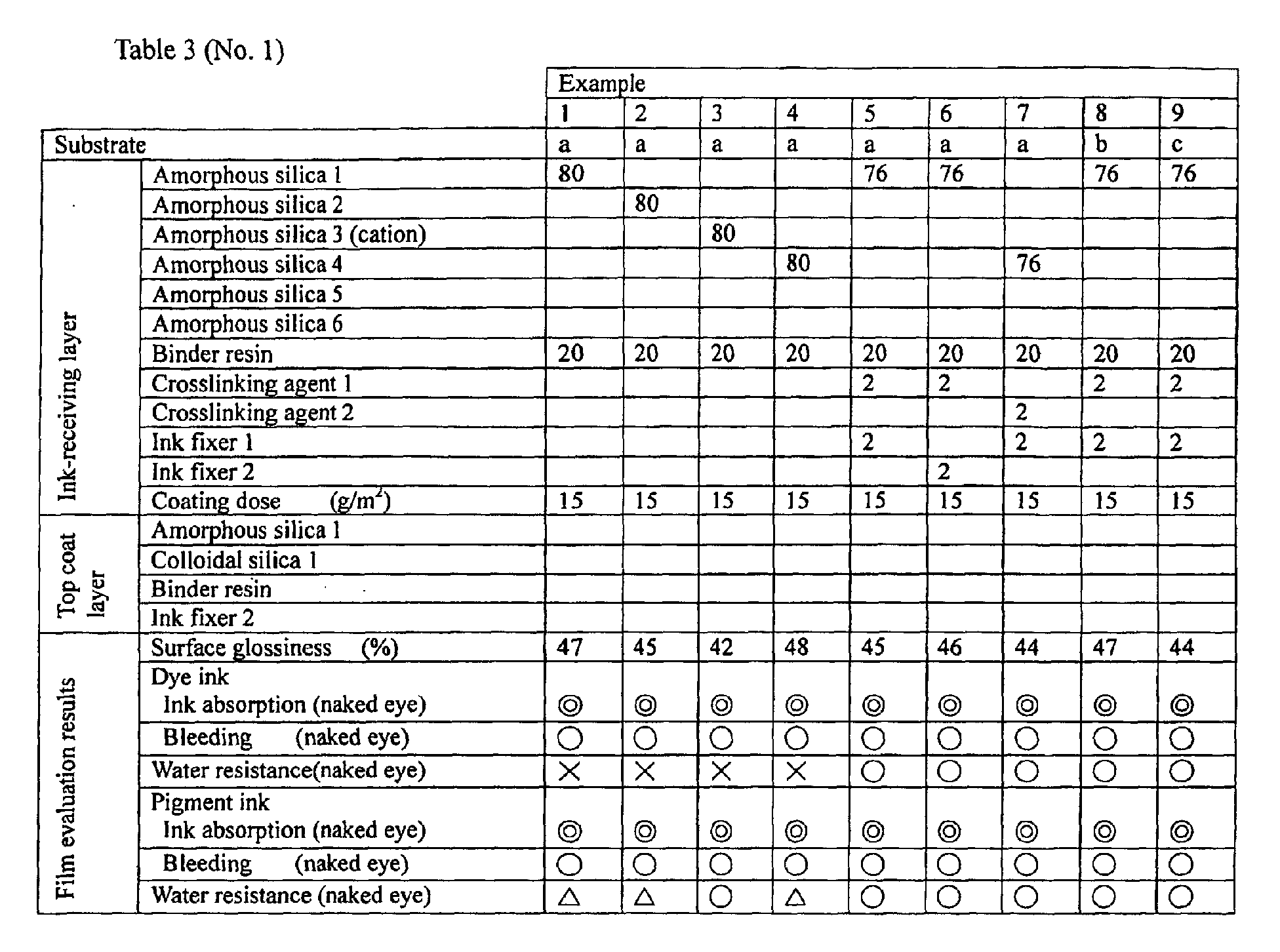

| Material | Description |
| Amorphous silica I | Aqueous dispersion (solid content 20%) of fine silica particles having primary particle diameter of 7 nm and average particle diameter of 300 nm obtained by milling silica "Silojet 703A™" (manufactured by Grace Japan, produced by the gel method) |
| Amorphous silica 2 | Aqueous dispersion (solid content 10%) of fine silica particles having primary particle diameter of 6 nm and average particle diameter of 300 nm obtained by dispersing "Mizukasil P-73™" (manufactured by Mizusawa Industrial Chemicals, Ltd., produced by the gel method and having average particle diameter 2.5 µm) with sand grinder |
| Amorphous silica 3 | Aqueous dispersion (solid content 18%) of cation-treated fine silica particles having primary particle diameter of 7 nm and average particle diameter of 300 nm obtained by milling silica "Silojet 703C™" (manufactured by Grace Japan, produced by the gel method) |
| Amorphous silica 4 | Aqueous dispersion (solid content 8%) of fine silica having primary particle diameter of 7 nm and average particle diameter of 100 nm obtained by dispersing "Aerosil 300CF™" (manufactured by Nippon Aerosil, produced by the gas phase method) with sand grinder |
| Amorphous silica 5 | Aqueous dispersion (solid content 10%) of fine silica particles having primary particle diameter of 6 nm and average particle diameter of 800 nm obtained by dispersing "Mizukasil P-73™" (manufactured by Mizusawa Industrial Chemicals, Ltd., produced by the gel method and having average particle diameter 2.5 µm) with sand grinder |
| Amorphous silica 6 | Aqueous dispersion (solid content 10%) of fine silica particles having primary particle diameter of 25 nm and average particle diameter of 300 nm obtained by dispersing "Mizukasil P-526™" (manufactured by Mizusawa Industrial Chemicals, Ltd., produced by the sedimentation method and having average particle diameter 3.0 µm) with sand grinder |
| Colloidal silica 1 | Aqueous dispersion (solid content 40%) of spherical colloidal silica "Snowtex YL™" (manufactured by Nissan Chemical Industries, Ltd., having average particle diameter of 75 nm) |
| Binder resin | Aqueous solution (solid content 10%) of "Kuraray Poval PVA-235™" (manufactured by Kuraray, polyvinyl alcohol having degree of polymerization of 3500 and degree of saponification of 88%) |
| Crosslinking agent 1 | Aqueous dispersion (solid content 80%) of "U-Ramin P-6300™" (manufactured by Mitsui Chemicals, melamine-formali resin) |
| Crosslinking agent 2 | Aqueous dispersion (solid content 4%) of sodium tetraborate decahydrate (borax, reagent manufactured by Wako Pure Chemical Industries) |
| Ink fixer 1 | Aqueous dispersion (solid content 30%) of "Sumirez Resin 1001™" (manufactured by Sumitomo Chemical, cationic acrylic polymer) |
| Ink fixer 2 | 10% aqueous dispersion of aluminum chloride hexahydrate (reagent manufactured by Wako Pure Chemical Industries) |
Ink jet recording sheets were produced in the following manner by using the
materials listed in Table 4 respectively in the specified amounts.
Namely, alumina or alumina hydrate was mixed with a binder resin to prepare a
coating solution for forming an ink-receiving layer. This coating solution was applied on
the front face of a porous resin film with a Mayer bar in such a manner as to give a coating
dose of 20 g/m2 after drying. Then it was solidified by drying in an oven at 110°C for 5
minutes to form an ink-receiving layer, thereby giving an ink jet recording paper. The
suitability for ink jet printer of this ink jet recording paper was evaluated by the same
method as employed in the case of the porous resin film. Table 5 shows the composition,
surface glossiness and results of the evaluation of ink jet printer suitability.
Ink jet recording sheets were produced in the following manner by using the
materials listed in Table 4 respectively in the specified amounts.
An ink-receiving layer was formed on a porous resin film as in Example 13. An
inorganic filler was mixed with a binder resin to prepare a coating solution for forming a
top coat layer. Then, this coating solution for top coat layer was applied on the
ink-receiving layer with a Mayer bar in such a manner as to give a coating dose of 1.0
g/m2 after drying. Then it was solidified by drying in an oven at 110°C for 1 minute to
form a top coat layer, thereby giving an ink jet recording paper. Table 5 shows the
composition, surface glossiness and results of the evaluation of ink jet printer suitability.
Table 5 shows the composition, surface glossiness and results of the evaluation of ink jet
printer suitability.
An ink jet recording paper was produced as in Comparative Example 1, but with
an alteration of the coating dose of the ink-receiving layer to 30 g/m2. Table 5 shows the
composition, surface glossiness and results of the evaluation of ink jet printer suitability.
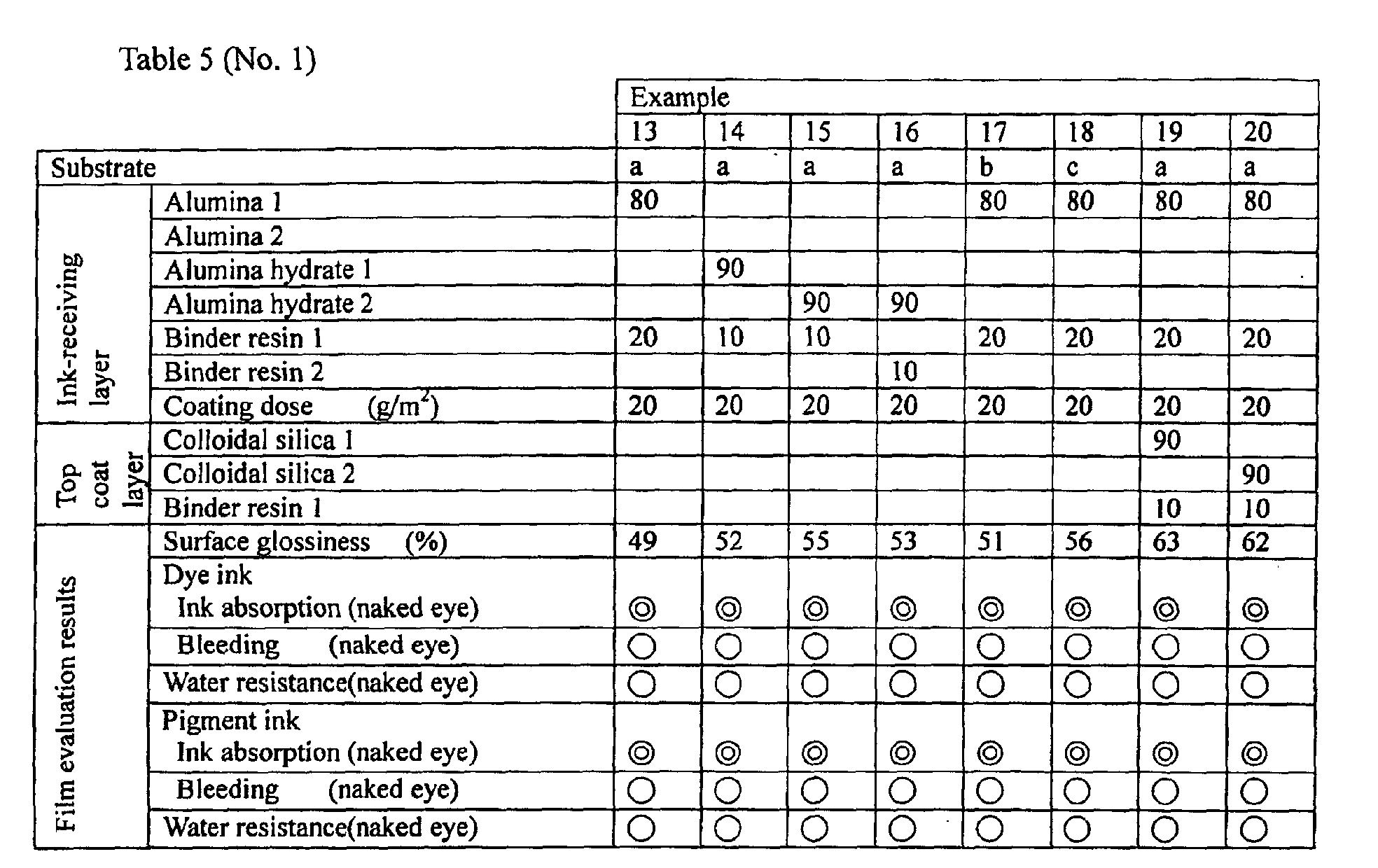

| Material | Description |
| Alumina 1 | Dispersion in solvent mixture (water/isopropyl alcohol=80/20, by weight) obtained by dispersing "Aluminium Oxide C™" (manufactured by Nippon Aerosil, δ-alumina having average particle diameter of 20 nm) with homogenizer and ultrasonic dispersion machine |
| Alumina 2 | Dispersion in solvent mixture (water/isopropyl alcohol=80/20, by weight) obtained by dispersing "AKP3000™" (manufactured by Sumitomo Chemical, α-alumina having average particle diameter of 550 nm) with homogenizer and ultrasonic dispersion machine |
| Alumina hydrate 1 | Aqueous dispersion (solid content: 7%) of fibrous pseudoboehmite "Cataloid AS-3™" (manufactured by Catalysts & Chemicals Ind., having average particle diameter of 100 nm) |
| Alumina hydrate 2 | Aqueous dispersion (solid content: 10%) of plate pseudoboehmite "Cataloid AS-2™" (manufactured by Catalysts & Chemicals Ind., having average particle diameter of 25 nm) |
| Binder resin 1 | Aqueous solution (solid content 15%) of "Kuraray Poval PVA-235™" (manufactured by Kuraray, polyvinyl alcohol having degree of polymerization of 3500 and degree of saponification of 88%) |
| Binder resin 2 | Aqueous solution (solid content 15%) of"Kuraray Poval PVA-124™" (manufactured by Kuraray, polyvinyl alcohol having degree of polymerization of 2400 and degree of saponification of 95%) |
| Colloidal silica 1 | Aqueous dispersion (solid content 40%) of spherical colloidal silica "Snowtex YL™" (manufactured by Nissan Chemical Industries, Ltd., having average particle diameter of 75 nm) |
| Colloidal silica 2 | Aqueous dispersion (solid content 20%) of pearl necklace-type colloidal silica "Snowtex PL-M™" (manufactured by Nissan Chemical Industries, Ltd., having average particle diameter of 150 nm) |
As Tables 1 to 5 clearly show, the ink jet recording papers of the present
invention having an ink-receiving layer containing an inorganic filler and a binder
(Examples 1 to 9 and 13 to 18) have high glossiness and favorable ink absorption
properties without suffering from bleeding. The surface glossiness is further elevated by
forming a top coat layer on the ink-receiving layer (Examples 10 to 12, 19 and 20),.
In contrast thereto, ink jet recording papers using porous films excluded from the
scope specified in the present invention (Comparative Examples 1, 2, 8 and 9) and ink jet
recording papers using ink-receiving layers excluded from the scope specified in the
present invention (Comparative Examples 4 to 7 and 11 to 13) fail to satisfy the
above-described requirements and are inferior in performance. A comparison of the
porous resin films according to the present invention (Examples 1 and 13) with
conventional non-absorptive resin films (Comparative Examples 1, 3, 8 and 10) as a
substrate indicates that the ink jet recording papers using the porous resin films of the
present invention can be produced at a lower cost due to the reduction in the coating dose
of the ink-receiving layer.
The ink jet recording papers of the present invention are less expensive ink jet
recording papers which have high glossiness and high durability and can quickly absorb
ink jet inks.
Claims (20)
- An ink jet recording paper having an ink-receiving layer provided on a porous resin film, wherein the porous resin film has a liquid absorption capacity measured in accordance with "Japan TAPPI No.51-87" of 0.5 ml/m2 or above and the ink-receiving layer has a surface glossiness (JIS-Z8741: measuring method at 60°) of 40% or above.
- An ink jet recording paper according to claim 1, wherein the ink-receiving layer contains from 70 to 95% by weight of an inorganic filler having an average particle diameter of 350 nm or below and from 5 to 30% by weight of a binder resin.
- An ink jet recording paper according to claim 2, which contains at least one member selected from among alumina, alumina hydrate and amorphous silica as the inorganic filler.
- An ink jet recording paper according to claim 3, wherein the amorphous silica is an aggregate of primary particles having an average particle diameter of 1 to 10 nm.
- An ink jet recording paper according to claim 4, wherein the amorphous silica is cation-treated silica.
- An ink jet recording paper according to claim 3, wherein the alumina is δ-alumina.
- An ink jet recording paper according to claim 3, wherein the alumina hydrate is pseudoboehmite.
- An ink jet recording paper according to any of claims 2 to 7, wherein the ink-receiving layer contains from 1 to 20% by weight of a crosslinking gent and from 1 to 20% by weight of an ink fixer.
- An ink jet recording paper according to any of claims 2 to 8, wherein a top coat layer is further formed on the ink-receiving layer and the surface glossiness (JIS-Z8741: measuring method at 60°) is 50% or above.
- An ink jet recording paper according to claim 9, wherein the top coat layer contains from 70 to 95% by weight of an inorganic filler having an average particle diameter of 350 nm or below and from 5 to 30% of a binder resin.
- An ink jet recording paper according to claim 10, wherein the top coat layer contains 1 to 20% by weight of an ink fixer.
- An ink jet recording paper according to claim 3, wherein the average contact angle of the porous resin film to water is 110° or below.
- An ink jet recording paper according to claim 12, wherein the porous resin film has been oriented.
- An ink jet recording paper according to claim 12 or 13, wherein the porous resin film has pores on the surface and inside thereof.
- An ink jet recording paper according to claim 14, wherein the porous resin film has a porosity of 10% or above.
- An ink jet recording paper according to claim 3, wherein the resin of the porous resin film is a thermoplastic resin containing from 10 to 70% by weight of a fine inorganic or organic powder.
- An ink jet recording paper according to claim 16, wherein the resin of the thermoplastic resin film is a hydrophilic thermoplastic resin or a mixture of a non-hydrophilic thermoplastic resin with a hydrophilic thermoplastic resin.
- An ink jet recording paper according to claim 17, wherein the non-hydrophilic thermoplastic resin is a polyolefin based resin.
- An ink jet recording paper according to claim 17, wherein the water absorption ratio of the hydrophilic thermoplastic resin within 30 minutes is 5 g/g or above or the hydrophilic thermoplastic resin is soluble in water.
- An ink jet recording paper according to claim 17, wherein the hydrophilic thermoplastic resin is a product of a reaction between an alkylene oxide compound and a dicarboxylic acid compound.
Applications Claiming Priority (5)
| Application Number | Priority Date | Filing Date | Title |
|---|---|---|---|
| JP2000069740A JP4353609B2 (en) | 2000-03-14 | 2000-03-14 | Inkjet recording paper |
| JP2000069740 | 2000-03-14 | ||
| JP2000156093 | 2000-05-26 | ||
| JP2000156093 | 2000-05-26 | ||
| PCT/JP2001/001917 WO2001068376A1 (en) | 2000-03-14 | 2001-03-12 | Recording paper for inkjet printer |
Publications (2)
| Publication Number | Publication Date |
|---|---|
| EP1264705A1 true EP1264705A1 (en) | 2002-12-11 |
| EP1264705A4 EP1264705A4 (en) | 2005-06-08 |
Family
ID=26587389
Family Applications (1)
| Application Number | Title | Priority Date | Filing Date |
|---|---|---|---|
| EP01912273A Withdrawn EP1264705A4 (en) | 2000-03-14 | 2001-03-12 | RECORDING PAPER FOR INKJET PRINTER |
Country Status (4)
| Country | Link |
|---|---|
| US (1) | US6984423B2 (en) |
| EP (1) | EP1264705A4 (en) |
| TW (1) | TWI304374B (en) |
| WO (1) | WO2001068376A1 (en) |
Cited By (6)
| Publication number | Priority date | Publication date | Assignee | Title |
|---|---|---|---|---|
| EP1331102A3 (en) * | 2002-01-29 | 2004-01-02 | Tomoegawa Paper Co. Ltd. | Ink jet recording sheet |
| EP1405883A1 (en) | 2002-10-02 | 2004-04-07 | Canon Kabushiki Kaisha | Aqueous ink, ink jet recording method, ink tank, recording unit and ink jet recording apparatus |
| EP1577710A4 (en) * | 2002-12-27 | 2009-07-29 | Yupo Corp | ELECTROPHOTOGRAPHIC FILM AND RECORDED ARTICLE USING THE SAME |
| US7981503B2 (en) | 2002-07-25 | 2011-07-19 | Yupo Corporation | Stretched resin film and label comprising the same |
| US8197791B2 (en) * | 2004-12-22 | 2012-06-12 | Evonik Degussa Gmbh | Aluminium oxide powder, dispersion and coating composition |
| EP2944668A4 (en) * | 2013-01-11 | 2015-12-30 | Tbm Co Ltd | THIN FILM MATERIAL FOR TREATMENT UTILIZATION |
Families Citing this family (19)
| Publication number | Priority date | Publication date | Assignee | Title |
|---|---|---|---|---|
| EP1264705A4 (en) | 2000-03-14 | 2005-06-08 | Yupo Corp | RECORDING PAPER FOR INKJET PRINTER |
| JP4353613B2 (en) * | 2000-04-25 | 2009-10-28 | 株式会社ユポ・コーポレーション | Porous resin film |
| ATE386069T1 (en) * | 2002-03-20 | 2008-03-15 | Yupo Corp | RECORDING PAPER AND LABEL PAPER WHICH THIS IS USED |
| JP3969255B2 (en) * | 2002-09-10 | 2007-09-05 | コニカミノルタホールディングス株式会社 | Inkjet recording paper for water-based dye ink |
| JP4292875B2 (en) * | 2003-06-02 | 2009-07-08 | 富士ゼロックス株式会社 | Recording paper manufacturing method |
| US7150901B2 (en) * | 2003-12-05 | 2006-12-19 | Eastman Kodak Company | Plasma treatment of porous inkjet receivers |
| US7361399B2 (en) * | 2004-05-24 | 2008-04-22 | International Paper Company | Gloss coated multifunctional printing paper |
| CN1960857A (en) * | 2004-05-31 | 2007-05-09 | 三井化学株式会社 | Hydrophilic porous film and multi-layered film comprising the same |
| JP2006247963A (en) * | 2005-03-09 | 2006-09-21 | Oji Paper Co Ltd | Inkjet recording sheet |
| PL2273900T3 (en) * | 2008-05-13 | 2019-08-30 | Precision Dynamics Corporation | BLANKIET SUITABLE FOR PRINTING WITH A DURABLE AND DURABLE HANDBAND AND STICKERS |
| WO2010036521A1 (en) | 2008-09-26 | 2010-04-01 | International Paper Company | Composition suitable for multifunctional printing and recording sheet containing same |
| US9656501B2 (en) | 2009-07-31 | 2017-05-23 | Hewlett-Packard Development Company, L.P. | Coating compositions |
| US8586156B2 (en) * | 2010-05-04 | 2013-11-19 | International Paper Company | Coated printable substrates resistant to acidic highlighters and printing solutions |
| EP2692536A4 (en) * | 2011-03-31 | 2014-11-05 | Dainippon Ink & Chemicals | INK JET RECORDING MEDIUM, PRINTED MATERIAL, METHOD FOR MANUFACTURING SAME, AND PACKAGING |
| EP2543516B1 (en) * | 2011-07-05 | 2014-06-04 | Canon Kabushiki Kaisha | Recording medium |
| WO2014028018A1 (en) * | 2012-08-16 | 2014-02-20 | Hewlett-Packard Development Company, L.P. | Media composition |
| WO2020056235A1 (en) | 2018-09-13 | 2020-03-19 | Avery Dennison Corporation | Universal printable topcoat for graphics |
| US12145358B2 (en) * | 2021-06-15 | 2024-11-19 | Canon Kabushiki Kaisha | Ink jet printing method |
| US20250340049A1 (en) * | 2022-06-24 | 2025-11-06 | Yupo Corporation | Recording sheet |
Family Cites Families (23)
| Publication number | Priority date | Publication date | Assignee | Title |
|---|---|---|---|---|
| JPH072430B2 (en) | 1988-12-16 | 1995-01-18 | 旭硝子株式会社 | Recording sheet |
| JPH07121608B2 (en) | 1988-12-20 | 1995-12-25 | 旭硝子株式会社 | Recording sheet |
| JPH0524335A (en) | 1991-07-17 | 1993-02-02 | Asahi Glass Co Ltd | Recording sheet |
| DE69305308T2 (en) * | 1992-12-10 | 1997-03-20 | Mitsubishi Paper Mills Ltd | Inkjet recording sheet |
| JP3186878B2 (en) | 1993-01-22 | 2001-07-11 | 旭硝子株式会社 | Coating method of sol solution |
| JP3398477B2 (en) | 1993-07-14 | 2003-04-21 | 旭硝子株式会社 | Alumina sol coating liquid for recording sheet and recording sheet |
| JPH0812871A (en) * | 1994-07-01 | 1996-01-16 | Sumitomo Seika Chem Co Ltd | Resin composition and molded products therefrom having good printability and writability |
| JPH09207429A (en) * | 1996-02-02 | 1997-08-12 | Asahi Glass Co Ltd | Inkjet recording receiver |
| JP4086924B2 (en) * | 1996-12-26 | 2008-05-14 | 株式会社ユポ・コーポレーション | Inkjet recording paper |
| EP0855420B1 (en) * | 1997-01-23 | 2004-03-31 | Yupo Corporation | Synthetic paper and inkjet recording paper with the use of the same |
| US6465086B1 (en) * | 1997-05-15 | 2002-10-15 | Oji Paper Co., Ltd. | Ink jet recording material and process for producing same |
| JPH1134484A (en) | 1997-07-23 | 1999-02-09 | Mitsubishi Paper Mills Ltd | Inkjet recording material |
| US6436513B1 (en) * | 1997-09-17 | 2002-08-20 | Oji Paper Co., Ltd. | Ink jet recording material |
| JPH1191235A (en) * | 1997-09-18 | 1999-04-06 | Mitsubishi Paper Mills Ltd | Inkjet recording material |
| JP3492164B2 (en) | 1997-09-22 | 2004-02-03 | タイホー工業株式会社 | Recording material for inkjet recording |
| JPH1191238A (en) | 1997-09-24 | 1999-04-06 | Mitsubishi Paper Mills Ltd | Manufacturing method of recording material for inkjet |
| JPH11235865A (en) * | 1998-02-20 | 1999-08-31 | Asahi Glass Co Ltd | Ink jet recording medium |
| KR20010083903A (en) * | 1998-10-12 | 2001-09-03 | 우쯔기 미쯔루 | Porous resin film |
| JP2000190433A (en) * | 1998-12-25 | 2000-07-11 | Oji Yuka Synthetic Paper Co Ltd | Recording sheet |
| JP2001139710A (en) * | 1999-11-11 | 2001-05-22 | Yupo Corp | Porous resin film |
| EP1279697A4 (en) * | 1999-12-10 | 2006-06-28 | Yupo Corp | POROUS RESIN FILM |
| EP1264705A4 (en) | 2000-03-14 | 2005-06-08 | Yupo Corp | RECORDING PAPER FOR INKJET PRINTER |
| JP4353613B2 (en) * | 2000-04-25 | 2009-10-28 | 株式会社ユポ・コーポレーション | Porous resin film |
-
2001
- 2001-03-12 EP EP01912273A patent/EP1264705A4/en not_active Withdrawn
- 2001-03-12 WO PCT/JP2001/001917 patent/WO2001068376A1/en not_active Ceased
- 2001-03-14 TW TW090105949A patent/TWI304374B/zh not_active IP Right Cessation
-
2002
- 2002-09-16 US US10/244,075 patent/US6984423B2/en not_active Expired - Fee Related
Cited By (10)
| Publication number | Priority date | Publication date | Assignee | Title |
|---|---|---|---|---|
| EP1331102A3 (en) * | 2002-01-29 | 2004-01-02 | Tomoegawa Paper Co. Ltd. | Ink jet recording sheet |
| US6893692B2 (en) | 2002-01-29 | 2005-05-17 | Tomoegawa Paper Co., Ltd. | Ink jet recording sheet |
| US7981503B2 (en) | 2002-07-25 | 2011-07-19 | Yupo Corporation | Stretched resin film and label comprising the same |
| EP1405883A1 (en) | 2002-10-02 | 2004-04-07 | Canon Kabushiki Kaisha | Aqueous ink, ink jet recording method, ink tank, recording unit and ink jet recording apparatus |
| US6976755B2 (en) | 2002-10-02 | 2005-12-20 | Canon Kabushiki Kaisha | Aqueous ink, ink jet recording method, ink tank recording unit and ink jet recording apparatus |
| EP1577710A4 (en) * | 2002-12-27 | 2009-07-29 | Yupo Corp | ELECTROPHOTOGRAPHIC FILM AND RECORDED ARTICLE USING THE SAME |
| US7862884B2 (en) | 2002-12-27 | 2011-01-04 | Yupo Corporation | Electrophotographic film and recorded material using the same |
| US8197791B2 (en) * | 2004-12-22 | 2012-06-12 | Evonik Degussa Gmbh | Aluminium oxide powder, dispersion and coating composition |
| EP2944668A4 (en) * | 2013-01-11 | 2015-12-30 | Tbm Co Ltd | THIN FILM MATERIAL FOR TREATMENT UTILIZATION |
| US10669387B2 (en) | 2013-01-11 | 2020-06-02 | Tbm Co., Ltd. | Thin film material for processing use |
Also Published As
| Publication number | Publication date |
|---|---|
| US6984423B2 (en) | 2006-01-10 |
| WO2001068376A1 (en) | 2001-09-20 |
| TWI304374B (en) | 2008-12-21 |
| EP1264705A4 (en) | 2005-06-08 |
| US20030118790A1 (en) | 2003-06-26 |
Similar Documents
| Publication | Publication Date | Title |
|---|---|---|
| US6984423B2 (en) | Ink jet recording paper | |
| US6811837B2 (en) | Porous resin film | |
| KR100523239B1 (en) | Ink jet recording material, process for producing the same and ink jet recording method using the same | |
| JP4353613B2 (en) | Porous resin film | |
| US20030072935A1 (en) | Porous resin film | |
| US20030017321A1 (en) | Porous resin film | |
| KR100384987B1 (en) | Surface-treated plastic film and inkjet recording media | |
| US20060222789A1 (en) | Extruded ink-receiving layer for use in inkjet recording | |
| JP2000190629A (en) | Recording medium, method of manufacturing the same, and image forming method | |
| JP2001164017A (en) | Porous resin film | |
| JP2001225422A (en) | Coated film | |
| JP7791325B2 (en) | Recording paper | |
| JP4353609B2 (en) | Inkjet recording paper | |
| JP2001139710A (en) | Porous resin film | |
| JP2002046346A (en) | Inkjet recording paper | |
| JP2001246830A (en) | Ink jet recording sheet | |
| JP2001151918A (en) | Porous resin film | |
| US20120052221A1 (en) | Transparent ink-jet recording films, compositions, and methods | |
| US9005725B1 (en) | Transparent ink-jet recording films, compositions, and methods | |
| JP2003251930A (en) | Inkjet recording sheet | |
| JP4508470B2 (en) | Inkjet recording paper | |
| JP2005178188A (en) | Inkjet recording material and method for manufacturing recorded article | |
| JP2005297473A (en) | Inkjet recording sheet | |
| JP2004114468A (en) | Ink jet recording medium | |
| JP2003335055A (en) | Inkjet recording sheet |
Legal Events
| Date | Code | Title | Description |
|---|---|---|---|
| PUAI | Public reference made under article 153(3) epc to a published international application that has entered the european phase |
Free format text: ORIGINAL CODE: 0009012 |
|
| 17P | Request for examination filed |
Effective date: 20020918 |
|
| AK | Designated contracting states |
Kind code of ref document: A1 Designated state(s): AT BE CH CY DE DK ES FI FR GB GR IE IT LI LU MC NL PT SE TR |
|
| RBV | Designated contracting states (corrected) |
Designated state(s): DE |
|
| A4 | Supplementary search report drawn up and despatched |
Effective date: 20050421 |
|
| STAA | Information on the status of an ep patent application or granted ep patent |
Free format text: STATUS: THE APPLICATION IS DEEMED TO BE WITHDRAWN |
|
| 18D | Application deemed to be withdrawn |
Effective date: 20060331 |