EP1256994A2 - Alkaline rechargeable battery - Google Patents
Alkaline rechargeable battery Download PDFInfo
- Publication number
- EP1256994A2 EP1256994A2 EP02253305A EP02253305A EP1256994A2 EP 1256994 A2 EP1256994 A2 EP 1256994A2 EP 02253305 A EP02253305 A EP 02253305A EP 02253305 A EP02253305 A EP 02253305A EP 1256994 A2 EP1256994 A2 EP 1256994A2
- Authority
- EP
- European Patent Office
- Prior art keywords
- separators
- battery
- electrode plate
- volume
- plate group
- Prior art date
- Legal status (The legal status is an assumption and is not a legal conclusion. Google has not performed a legal analysis and makes no representation as to the accuracy of the status listed.)
- Granted
Links
Images

Classifications
-
- H—ELECTRICITY
- H01—ELECTRIC ELEMENTS
- H01M—PROCESSES OR MEANS, e.g. BATTERIES, FOR THE DIRECT CONVERSION OF CHEMICAL ENERGY INTO ELECTRICAL ENERGY
- H01M10/00—Secondary cells; Manufacture thereof
- H01M10/24—Alkaline accumulators
- H01M10/28—Construction or manufacture
-
- H—ELECTRICITY
- H01—ELECTRIC ELEMENTS
- H01M—PROCESSES OR MEANS, e.g. BATTERIES, FOR THE DIRECT CONVERSION OF CHEMICAL ENERGY INTO ELECTRICAL ENERGY
- H01M10/00—Secondary cells; Manufacture thereof
- H01M10/34—Gastight accumulators
- H01M10/345—Gastight metal hydride accumulators
-
- H—ELECTRICITY
- H01—ELECTRIC ELEMENTS
- H01M—PROCESSES OR MEANS, e.g. BATTERIES, FOR THE DIRECT CONVERSION OF CHEMICAL ENERGY INTO ELECTRICAL ENERGY
- H01M50/00—Constructional details or processes of manufacture of the non-active parts of electrochemical cells other than fuel cells, e.g. hybrid cells
- H01M50/40—Separators; Membranes; Diaphragms; Spacing elements inside cells
- H01M50/409—Separators, membranes or diaphragms characterised by the material
- H01M50/411—Organic material
- H01M50/414—Synthetic resins, e.g. thermoplastics or thermosetting resins
- H01M50/417—Polyolefins
-
- H—ELECTRICITY
- H01—ELECTRIC ELEMENTS
- H01M—PROCESSES OR MEANS, e.g. BATTERIES, FOR THE DIRECT CONVERSION OF CHEMICAL ENERGY INTO ELECTRICAL ENERGY
- H01M10/00—Secondary cells; Manufacture thereof
- H01M10/42—Methods or arrangements for servicing or maintenance of secondary cells or secondary half-cells
- H01M2010/4292—Aspects relating to capacity ratio of electrodes/electrolyte or anode/cathode
-
- H—ELECTRICITY
- H01—ELECTRIC ELEMENTS
- H01M—PROCESSES OR MEANS, e.g. BATTERIES, FOR THE DIRECT CONVERSION OF CHEMICAL ENERGY INTO ELECTRICAL ENERGY
- H01M50/00—Constructional details or processes of manufacture of the non-active parts of electrochemical cells other than fuel cells, e.g. hybrid cells
- H01M50/40—Separators; Membranes; Diaphragms; Spacing elements inside cells
- H01M50/409—Separators, membranes or diaphragms characterised by the material
- H01M50/44—Fibrous material
-
- Y—GENERAL TAGGING OF NEW TECHNOLOGICAL DEVELOPMENTS; GENERAL TAGGING OF CROSS-SECTIONAL TECHNOLOGIES SPANNING OVER SEVERAL SECTIONS OF THE IPC; TECHNICAL SUBJECTS COVERED BY FORMER USPC CROSS-REFERENCE ART COLLECTIONS [XRACs] AND DIGESTS
- Y02—TECHNOLOGIES OR APPLICATIONS FOR MITIGATION OR ADAPTATION AGAINST CLIMATE CHANGE
- Y02E—REDUCTION OF GREENHOUSE GAS [GHG] EMISSIONS, RELATED TO ENERGY GENERATION, TRANSMISSION OR DISTRIBUTION
- Y02E60/00—Enabling technologies; Technologies with a potential or indirect contribution to GHG emissions mitigation
- Y02E60/10—Energy storage using batteries
-
- Y—GENERAL TAGGING OF NEW TECHNOLOGICAL DEVELOPMENTS; GENERAL TAGGING OF CROSS-SECTIONAL TECHNOLOGIES SPANNING OVER SEVERAL SECTIONS OF THE IPC; TECHNICAL SUBJECTS COVERED BY FORMER USPC CROSS-REFERENCE ART COLLECTIONS [XRACs] AND DIGESTS
- Y02—TECHNOLOGIES OR APPLICATIONS FOR MITIGATION OR ADAPTATION AGAINST CLIMATE CHANGE
- Y02P—CLIMATE CHANGE MITIGATION TECHNOLOGIES IN THE PRODUCTION OR PROCESSING OF GOODS
- Y02P70/00—Climate change mitigation technologies in the production process for final industrial or consumer products
- Y02P70/50—Manufacturing or production processes characterised by the final manufactured product
Definitions
- the present invention relates to an alkaline rechargeable battery, and more particularly to an alkaline rechargeable battery having an extended life by improving separators.
- a nickel-metal hydride rechargeable battery including positive electrode plates having nickel hydroxide as its active material, negative electrode plates having hydrogen-absorption alloy, and separators interposed therebetween, has been known and widely used.
- the separators are made as thin as possible to the extent that they are able to absorb a necessary quantity of electrolyte while functioning properly to prevent a short-circuit.
- a volume of the separators is set to less than 30% of a volume of the electrode plate group.
- the electrode plates gradually expand while the battery is charged and discharged repetitively, and when the volume of the separators is set to less than 30% of the volume of the electrode plate group, the expanded electrode plates crush the separators, and a quantity of the electrolyte retained in the separators is reduced. As a result, an internal resistance of the battery increases, which causes heat generation. Accordingly, an internal pressure increases and the safety vent operates to release a generated gas to the outside of the battery, whereby the electrolyte dries up and the battery becomes unusable in a short period.
- an object of the present invention is to provide an alkaline rechargeable battery having an extended life by improving separators.
- An alkaline rechargeable battery includes an electrode plate group including positive electrode plates and negative electrode plates being superimposed with separators interposed therebetween, wherein a volume of the separators at least before initial charge and discharge (a period from assemblage to an initial charge of the battery) accounts for 30 to 60% of a volume of the electrode plate group.
- a plurality of voids of the separators before the initial charge and discharge to account for 50 to 70% of the separators.
- a proportion of the voids exceeds 70%, a short-circuit readily occurs.
- the proportion of the voids is lower than 50%, a volume for retaining an electrolyte is reduced, and the life characteristics are deteriorated.
- a percentage of the volume of the electrode plate group before the initial charge and discharge in a capacity of a battery case is set to 85 to 95%.
- the percentage is lower than 85%, an interval between the electrode plates becomes so large that the output characteristics are deteriorated, which increases an internal resistance and the life characteristics are deteriorated.
- the percentage exceeds 95%, the separators are compressed, which makes it difficult for the separators to retain an electrolyte, and the life characteristics are deteriorated.
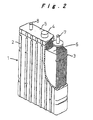
- the nickel-metal hydride rechargeable battery 1 includes a battery case 2 accommodating, together with an electrolyte, an electrode plate group 3 serving as an element for electromotive force and formed by alternately stacking positive electrode plates having nickel hydroxide as its active material and negative electrode plates having hydrogen-absorption alloy with separators interposed therebetween.
- An opening of the battery case 2 is closed with a lid 5 having a safety vent 4.
- Leads 6 are extended upward from an upper edge of each positive electrode plate on one side, and are connected to a positive electrode terminal 7.
- leads 6 are extended upward from an upper edge of each negative electrode plate on the other side, and are connected to a negative electrode terminal 8.
- the positive electrode terminal 7 and the negative electrode terminal 8 are attached to the lid 5.
- a foamed nickel provided with a 5-mm-wide unfilled portion at the end is filled with a positive electrode material mainly including nickel hydroxide, and a nickel lead is attached to the unfilled portion, whereby a positive electrode plate having a capacity of 1 Ah and a reaction area of 39.3 cm 2 is produced.
- a punched metal provided with a 5-mm-wide uncoated portion at the end is coated with a negative electrode material mainly including hydrogen-absorption alloy of 20 ⁇ m in average particle diameter, and a nickel lead is attached to the uncoated portion, whereby a negative electrode plate having a capacity of 1.25 Ah and a reaction area of 39.3 cm 2 is produced.
- the positive electrode plate is covered with a pouchshaped separator made of a 0.18-mm-thick non-woven fabric made of polypropylene fibers having a specific gravity of 0.91.
- the electrode plate group 3 is formed by alternately stacking the positive electrode plates and the negative electrode plates, which is accommodated in the battery case 2 made of synthetic resin.
- a connection with the external terminals is established by collecting the leads 6 and bonding their respective top portions to the positive electrode terminal 7 and the negative electrode terminal 8 by means of resistance welding.
- the battery case 2 is filled with 20 g of an electrolyte mainly including potassium hydroxide, and then is sealed with the lid 5, whereby a nickel-metal hydride rechargeable battery 1 is produced.
- the battery 1 is then charged and discharged at 0.1 C for activation.
- the battery 1 thus produced has a capacity of about 7 Ah.
- a life test was conducted by using nickel-metal hydride rechargeable batteries produced as above. Conditions of the life test were as follows: the battery was initially charged for 5 hours at 1 A, and in the second cycle and thereafter, the battery was discharged for four hours at 1 A, and charged for four hours and four minutes at 1 A.
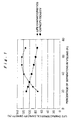
- Batteries were produced with separators respectively having a thickness of 0.10, 0.14, 0.18, 0.27, 0.41, 0.62, and 0.96 mm.
- a volume of the separators in the respective batteries accounted for 20, 25, 30, 40, 50, 60, and 70% of a volume of the electrode plate group before the initial charge and discharge.
- a proportion of the separators in the electrode plate group in volume was calculated based on a thickness of the separators at the cross section measured by cutting the battery before the initial charge and discharge in a direction perpendicular to the electrode plate group. Then, the life characteristics of the respective batteries were measured.
- the life characteristics were evaluated in terms of a percentage of a capacity, and more specifically, the expiration of the life was judged when a percentage of the battery capacity dropped to 65% or below of the initial capacity of the respective batteries, and the life characteristics were evaluated relatively on a basis of 100 with respect to those of the battery designed to have a percentage of the separators in volume of 30%.
- the results are set forth in Fig. 1.
- the capacity density of the battery is also set forth in Fig. 1.
- Batteries were produced by setting a thickness of the separators to 0.18 mm and a percentage of the separators in the electrode plate group in volume before the initial charge and discharge to 30%, and by changing a proportion of voids to 45, 50, 60, 70, and 75%.
- the life test was conducted in the same manner as was in Experiment 1. Also, the output characteristics of the respective batteries were measured. Herein, after SOC in each battery was adjusted to 60%, each was discharged at a large current, and a current value at which a time required that a voltage of the battery decreased to 1 V was 10 seconds or longer was multiplied by 1 V and outputted as the output characteristics in a unit of W. Each measured value is an average of ten batteries.
- the test results are set forth in Table 1 below. Proportion of Voids (%) Life Characteristics (Cycles) Output Characteristics (W) 45 1000 100 50 5000 130 60 6000 140 70 5000 150 75 Short-circuit Short-circuit
- Batteries were produced each with an electrode plate group formed by combining positive electrode plates, negative electrode plates, and separators by setting a thickness of the separators to 0.18 mm and a percentage of the separators in the electrode plate group in volume before the initial charge and discharge to 30%, and by changing a percentage of a volume of the electrode plate group in a capacity of the battery case to 83, 85, 90, 95, and 97%.
- the life test was conducted in the same manner as was in Experiment 1. Also, the output characteristics of the respective batteries were measured in the same manner as were in Experiment 2. The test results are set forth in Table 2 below. Percentage of Electrode Plate Group Volume in Battery Case Capacity Life Characteristics (Cycles) Output Characteristics (W) 83 1000 80 85 5000 120 90 6000 130 95 5000 130 97 1000 130
- the present invention is not limited to a nickel-metal hydride rechargeable battery, and can be applied to a nickel-cadmium battery as well. Also, the invention is applicable not only to a prismatic battery, but also to a cylindrical battery.
- the alkaline rechargeable battery of the invention it is possible to prevent compression of the separators that shortens the life of the battery. Also, it prevents the life characteristics from being deteriorated due to difficulty of releasing heat generated inside the battery to the outside. Hence, a total quantity of electricity that the battery can be charged and discharged is increased and the life characteristics of the battery are enhanced. As a result, a battery maintaining a high reliability over a long period is provided.
Landscapes
- Chemical & Material Sciences (AREA)
- Chemical Kinetics & Catalysis (AREA)
- Electrochemistry (AREA)
- General Chemical & Material Sciences (AREA)
- Engineering & Computer Science (AREA)
- Manufacturing & Machinery (AREA)
- Secondary Cells (AREA)
- Cell Separators (AREA)
- Battery Electrode And Active Subsutance (AREA)
Abstract
Description
| Proportion of Voids (%) | Life Characteristics (Cycles) | Output Characteristics (W) |
| 45 | 1000 | 100 |
| 50 | 5000 | 130 |
| 60 | 6000 | 140 |
| 70 | 5000 | 150 |
| 75 | Short-circuit | Short-circuit |
| Percentage of Electrode Plate Group Volume in Battery Case Capacity | Life Characteristics (Cycles) | Output Characteristics (W) |
| 83 | 1000 | 80 |
| 85 | 5000 | 120 |
| 90 | 6000 | 130 |
| 95 | 5000 | 130 |
| 97 | 1000 | 130 |
Claims (3)
- An alkaline rechargeable battery comprising an electrode plate group (3) formed by superimposing a positive electrode plate and a negative electrode plate with a separator interposed therebetween; and
a battery case (2, 10) for accommodating the electrode plate group (3),
characterized in that a volume of the separators before initial charge and discharge accounts for 30 to 60% of a volume of the electrode plate group (3). - The alkaline rechargeable battery according to claim 1, wherein a proportion of voids of the separators before the initial charge and discharge is 50 to 70%.
- The alkaline rechargeable battery according to claim 1, wherein a percentage of the volume of the electrode plate group (3) before the initial charge and discharge in a capacity of the battery case (2, 10) is 85 to 95%.
Applications Claiming Priority (2)
| Application Number | Priority Date | Filing Date | Title |
|---|---|---|---|
| JP2001140964A JP4126684B2 (en) | 2001-05-11 | 2001-05-11 | Nickel metal hydride secondary battery |
| JP2001140964 | 2001-05-11 |
Publications (3)
| Publication Number | Publication Date |
|---|---|
| EP1256994A2 true EP1256994A2 (en) | 2002-11-13 |
| EP1256994A3 EP1256994A3 (en) | 2004-11-17 |
| EP1256994B1 EP1256994B1 (en) | 2006-10-11 |
Family
ID=18987482
Family Applications (1)
| Application Number | Title | Priority Date | Filing Date |
|---|---|---|---|
| EP02253305A Expired - Lifetime EP1256994B1 (en) | 2001-05-11 | 2002-05-10 | Alkaline rechargeable battery |
Country Status (5)
| Country | Link |
|---|---|
| US (1) | US6835501B2 (en) |
| EP (1) | EP1256994B1 (en) |
| JP (1) | JP4126684B2 (en) |
| CN (1) | CN1303704C (en) |
| DE (1) | DE60215253T2 (en) |
Families Citing this family (7)
| Publication number | Priority date | Publication date | Assignee | Title |
|---|---|---|---|---|
| JP4031620B2 (en) | 2001-04-09 | 2008-01-09 | 松下電器産業株式会社 | Nickel metal hydride storage battery and method of using the same |
| JP3709197B2 (en) * | 2003-08-25 | 2005-10-19 | 松下電器産業株式会社 | Cylindrical battery and manufacturing method thereof |
| EP1891741A4 (en) | 2005-06-08 | 2011-08-24 | Powercast Corp | ELECTRIC POWER SUPPLY OF A RADIO FREQUENCY ENERGY COLLECTION DEVICE |
| US20090102296A1 (en) * | 2007-01-05 | 2009-04-23 | Powercast Corporation | Powering cell phones and similar devices using RF energy harvesting |
| KR101084909B1 (en) * | 2009-12-07 | 2011-11-17 | 삼성에스디아이 주식회사 | Electrode assembly block and its manufacturing method, secondary battery and its manufacturing method |
| AU2018325468B2 (en) | 2017-09-01 | 2023-09-07 | Powercast Corporation | Methods, systems, and apparatus for automatic RF power transmission and single antenna energy harvesting |
| US10763687B2 (en) | 2017-12-04 | 2020-09-01 | Powercast Corporation | Methods, systems, and apparatus for wireless recharging of battery-powered devices |
Family Cites Families (12)
| Publication number | Priority date | Publication date | Assignee | Title |
|---|---|---|---|---|
| US3377201A (en) * | 1964-03-24 | 1968-04-09 | Yardney International Corp | Spiral battery cell |
| JPS4841866B1 (en) * | 1970-02-02 | 1973-12-08 | ||
| JPS5937292B2 (en) * | 1977-10-03 | 1984-09-08 | 旭化成株式会社 | Polyolefin resin porous membrane, alkaline storage battery separator, and microfilter |
| US5318866A (en) * | 1993-04-23 | 1994-06-07 | Pall Corporation | Battery separators |
| JPH06333552A (en) | 1993-05-21 | 1994-12-02 | Japan Storage Battery Co Ltd | Nonaqueous secondary battery |
| US5492781A (en) * | 1994-01-18 | 1996-02-20 | Pall Corporation | Battery separators |
| JP3519775B2 (en) | 1994-03-16 | 2004-04-19 | 三洋電機株式会社 | Sealed nickel-hydrogen storage battery |
| KR100621302B1 (en) * | 1998-06-05 | 2006-09-13 | 디에스엠 아이피 어셋츠 비.브이. | Method for producing microporous film |
| US6265101B1 (en) * | 1998-08-21 | 2001-07-24 | Eveready Battery Company, Inc. | Battery constructions having increased internal volume for active components |
| CN1336015A (en) * | 1998-12-15 | 2002-02-13 | 杜拉塞尔公司 | electrochemical cell package |
| JP2001006748A (en) * | 1999-06-22 | 2001-01-12 | Sony Corp | Non-aqueous electrolyte battery |
| JP4659187B2 (en) * | 1999-09-14 | 2011-03-30 | 日本バイリーン株式会社 | Battery separator |
-
2001
- 2001-05-11 JP JP2001140964A patent/JP4126684B2/en not_active Expired - Lifetime
-
2002
- 2002-05-10 EP EP02253305A patent/EP1256994B1/en not_active Expired - Lifetime
- 2002-05-10 US US10/142,157 patent/US6835501B2/en not_active Expired - Lifetime
- 2002-05-10 CN CNB021189773A patent/CN1303704C/en not_active Expired - Lifetime
- 2002-05-10 DE DE60215253T patent/DE60215253T2/en not_active Expired - Lifetime
Also Published As
| Publication number | Publication date |
|---|---|
| US20030003366A1 (en) | 2003-01-02 |
| CN1303704C (en) | 2007-03-07 |
| JP2002343417A (en) | 2002-11-29 |
| EP1256994B1 (en) | 2006-10-11 |
| EP1256994A3 (en) | 2004-11-17 |
| DE60215253D1 (en) | 2006-11-23 |
| DE60215253T2 (en) | 2007-01-18 |
| JP4126684B2 (en) | 2008-07-30 |
| US6835501B2 (en) | 2004-12-28 |
| CN1385909A (en) | 2002-12-18 |
Similar Documents
| Publication | Publication Date | Title |
|---|---|---|
| JP3943822B2 (en) | Battery spiral electrode group and battery | |
| US7560188B2 (en) | Nickel-metal hydride rechargeable battery | |
| CN112018456A (en) | Method for manufacturing secondary battery and nickel-hydrogen secondary battery | |
| JP2002313412A (en) | Activation method of secondary battery | |
| US6835501B2 (en) | Alkaline rechargeable battery | |
| US7435511B2 (en) | Nickel-metal hydride storage battery | |
| JP3390309B2 (en) | Sealed alkaline storage battery | |
| US6893771B2 (en) | Battery assembly | |
| CN112117501A (en) | Method for manufacturing nickel-hydrogen secondary battery | |
| CN112886075B (en) | Method for manufacturing nickel-hydrogen storage battery | |
| US7052800B2 (en) | Separator for nickel-metal hydride storage battery and nickel-metal hydride storage battery | |
| CN114975896A (en) | Method for manufacturing nickel-metal hydride storage battery | |
| CN114300759B (en) | Method for manufacturing nickel-hydrogen storage battery | |
| JP3815511B2 (en) | Nickel / metal hydride sealed alkaline storage battery | |
| JP2002324568A (en) | Battery with multiple wound electrode groups | |
| JPH05283071A (en) | Activation of metal hydride storage battery | |
| JPH11329372A (en) | Prismatic sealed alkaline storage battery | |
| JP4235805B2 (en) | Cylindrical nickel metal hydride storage battery and battery module using the same | |
| JPH10149807A (en) | Battery pack | |
| JP2001176540A (en) | Nickel hydrogen secondary battery | |
| JPH08339821A (en) | Metal-hydrogen alkaline storage battery | |
| JPH11149938A (en) | Nickel hydrogen secondary battery | |
| JPH0642375B2 (en) | Metal-hydrogen alkaline battery | |
| JP2001068148A (en) | Nickel - hydrogen secondary battery |
Legal Events
| Date | Code | Title | Description |
|---|---|---|---|
| PUAI | Public reference made under article 153(3) epc to a published international application that has entered the european phase |
Free format text: ORIGINAL CODE: 0009012 |
|
| AK | Designated contracting states |
Kind code of ref document: A2 Designated state(s): AT BE CH CY DE DK ES FI FR GB GR IE IT LI LU MC NL PT SE TR |
|
| AX | Request for extension of the european patent |
Free format text: AL;LT;LV;MK;RO;SI |
|
| PUAL | Search report despatched |
Free format text: ORIGINAL CODE: 0009013 |
|
| AK | Designated contracting states |
Kind code of ref document: A3 Designated state(s): AT BE CH CY DE DK ES FI FR GB GR IE IT LI LU MC NL PT SE TR |
|
| AX | Request for extension of the european patent |
Extension state: AL LT LV MK RO SI |
|
| 17P | Request for examination filed |
Effective date: 20050429 |
|
| AKX | Designation fees paid |
Designated state(s): DE FR GB |
|
| GRAP | Despatch of communication of intention to grant a patent |
Free format text: ORIGINAL CODE: EPIDOSNIGR1 |
|
| GRAS | Grant fee paid |
Free format text: ORIGINAL CODE: EPIDOSNIGR3 |
|
| GRAA | (expected) grant |
Free format text: ORIGINAL CODE: 0009210 |
|
| AK | Designated contracting states |
Kind code of ref document: B1 Designated state(s): DE FR GB |
|
| REG | Reference to a national code |
Ref country code: GB Ref legal event code: FG4D |
|
| REF | Corresponds to: |
Ref document number: 60215253 Country of ref document: DE Date of ref document: 20061123 Kind code of ref document: P |
|
| ET | Fr: translation filed | ||
| PLBE | No opposition filed within time limit |
Free format text: ORIGINAL CODE: 0009261 |
|
| STAA | Information on the status of an ep patent application or granted ep patent |
Free format text: STATUS: NO OPPOSITION FILED WITHIN TIME LIMIT |
|
| 26N | No opposition filed |
Effective date: 20070712 |
|
| REG | Reference to a national code |
Ref country code: DE Ref legal event code: R084 Ref document number: 60215253 Country of ref document: DE |
|
| REG | Reference to a national code |
Ref country code: GB Ref legal event code: 746 Effective date: 20160222 |
|
| REG | Reference to a national code |
Ref country code: FR Ref legal event code: PLFP Year of fee payment: 15 |
|
| REG | Reference to a national code |
Ref country code: FR Ref legal event code: PLFP Year of fee payment: 16 |
|
| REG | Reference to a national code |
Ref country code: FR Ref legal event code: PLFP Year of fee payment: 17 |
|
| PGFP | Annual fee paid to national office [announced via postgrant information from national office to epo] |
Ref country code: DE Payment date: 20210413 Year of fee payment: 20 Ref country code: FR Payment date: 20210412 Year of fee payment: 20 |
|
| PGFP | Annual fee paid to national office [announced via postgrant information from national office to epo] |
Ref country code: GB Payment date: 20210414 Year of fee payment: 20 |
|
| REG | Reference to a national code |
Ref country code: DE Ref legal event code: R071 Ref document number: 60215253 Country of ref document: DE |
|
| REG | Reference to a national code |
Ref country code: GB Ref legal event code: PE20 Expiry date: 20220509 |
|
| PG25 | Lapsed in a contracting state [announced via postgrant information from national office to epo] |
Ref country code: GB Free format text: LAPSE BECAUSE OF EXPIRATION OF PROTECTION Effective date: 20220509 |