EP1251121A1 - Dérivés anthraquinoniques, procédé de fabrication, utilisation comme pigments et compositions cosmétiques - Google Patents
Dérivés anthraquinoniques, procédé de fabrication, utilisation comme pigments et compositions cosmétiques Download PDFInfo
- Publication number
- EP1251121A1 EP1251121A1 EP02290872A EP02290872A EP1251121A1 EP 1251121 A1 EP1251121 A1 EP 1251121A1 EP 02290872 A EP02290872 A EP 02290872A EP 02290872 A EP02290872 A EP 02290872A EP 1251121 A1 EP1251121 A1 EP 1251121A1
- Authority
- EP
- European Patent Office
- Prior art keywords
- branched
- saturated
- unsaturated
- linear
- hydrocarbon group
- Prior art date
- Legal status (The legal status is an assumption and is not a legal conclusion. Google has not performed a legal analysis and makes no representation as to the accuracy of the status listed.)
- Granted
Links
Classifications
-
- C—CHEMISTRY; METALLURGY
- C07—ORGANIC CHEMISTRY
- C07C—ACYCLIC OR CARBOCYCLIC COMPOUNDS
- C07C313/00—Sulfinic acids; Sulfenic acids; Halides, esters or anhydrides thereof; Amides of sulfinic or sulfenic acids, i.e. compounds having singly-bound oxygen atoms of sulfinic or sulfenic groups replaced by nitrogen atoms, not being part of nitro or nitroso groups
- C07C313/02—Sulfinic acids; Derivatives thereof
- C07C313/06—Sulfinamides
-
- C—CHEMISTRY; METALLURGY
- C09—DYES; PAINTS; POLISHES; NATURAL RESINS; ADHESIVES; COMPOSITIONS NOT OTHERWISE PROVIDED FOR; APPLICATIONS OF MATERIALS NOT OTHERWISE PROVIDED FOR
- C09B—ORGANIC DYES OR CLOSELY-RELATED COMPOUNDS FOR PRODUCING DYES, e.g. PIGMENTS; MORDANTS; LAKES
- C09B1/00—Dyes with anthracene nucleus not condensed with any other ring
- C09B1/16—Amino-anthraquinones
- C09B1/20—Preparation from starting materials already containing the anthracene nucleus
- C09B1/26—Dyes with amino groups substituted by hydrocarbon radicals
- C09B1/28—Dyes with amino groups substituted by hydrocarbon radicals substituted by alkyl, aralkyl or cyclo alkyl groups
- C09B1/285—Dyes with no other substituents than the amino groups
-
- A—HUMAN NECESSITIES
- A61—MEDICAL OR VETERINARY SCIENCE; HYGIENE
- A61K—PREPARATIONS FOR MEDICAL, DENTAL OR TOILETRY PURPOSES
- A61K8/00—Cosmetics or similar toiletry preparations
- A61K8/18—Cosmetics or similar toiletry preparations characterised by the composition
- A61K8/30—Cosmetics or similar toiletry preparations characterised by the composition containing organic compounds
- A61K8/40—Cosmetics or similar toiletry preparations characterised by the composition containing organic compounds containing nitrogen
- A61K8/41—Amines
- A61K8/411—Aromatic amines, i.e. where the amino group is directly linked to the aromatic nucleus
-
- A—HUMAN NECESSITIES
- A61—MEDICAL OR VETERINARY SCIENCE; HYGIENE
- A61Q—SPECIFIC USE OF COSMETICS OR SIMILAR TOILETRY PREPARATIONS
- A61Q19/00—Preparations for care of the skin
-
- C—CHEMISTRY; METALLURGY
- C07—ORGANIC CHEMISTRY
- C07C—ACYCLIC OR CARBOCYCLIC COMPOUNDS
- C07C275/00—Derivatives of urea, i.e. compounds containing any of the groups, the nitrogen atoms not being part of nitro or nitroso groups
- C07C275/04—Derivatives of urea, i.e. compounds containing any of the groups, the nitrogen atoms not being part of nitro or nitroso groups having nitrogen atoms of urea groups bound to acyclic carbon atoms
- C07C275/06—Derivatives of urea, i.e. compounds containing any of the groups, the nitrogen atoms not being part of nitro or nitroso groups having nitrogen atoms of urea groups bound to acyclic carbon atoms of an acyclic and saturated carbon skeleton
- C07C275/14—Derivatives of urea, i.e. compounds containing any of the groups, the nitrogen atoms not being part of nitro or nitroso groups having nitrogen atoms of urea groups bound to acyclic carbon atoms of an acyclic and saturated carbon skeleton being further substituted by nitrogen atoms not being part of nitro or nitroso groups
-
- A—HUMAN NECESSITIES
- A61—MEDICAL OR VETERINARY SCIENCE; HYGIENE
- A61Q—SPECIFIC USE OF COSMETICS OR SIMILAR TOILETRY PREPARATIONS
- A61Q1/00—Make-up preparations; Body powders; Preparations for removing make-up
- A61Q1/02—Preparations containing skin colorants, e.g. pigments
-
- A—HUMAN NECESSITIES
- A61—MEDICAL OR VETERINARY SCIENCE; HYGIENE
- A61Q—SPECIFIC USE OF COSMETICS OR SIMILAR TOILETRY PREPARATIONS
- A61Q1/00—Make-up preparations; Body powders; Preparations for removing make-up
- A61Q1/02—Preparations containing skin colorants, e.g. pigments
- A61Q1/04—Preparations containing skin colorants, e.g. pigments for lips
- A61Q1/06—Lipsticks
-
- A—HUMAN NECESSITIES
- A61—MEDICAL OR VETERINARY SCIENCE; HYGIENE
- A61Q—SPECIFIC USE OF COSMETICS OR SIMILAR TOILETRY PREPARATIONS
- A61Q1/00—Make-up preparations; Body powders; Preparations for removing make-up
- A61Q1/02—Preparations containing skin colorants, e.g. pigments
- A61Q1/10—Preparations containing skin colorants, e.g. pigments for eyes, e.g. eyeliner, mascara
-
- A—HUMAN NECESSITIES
- A61—MEDICAL OR VETERINARY SCIENCE; HYGIENE
- A61Q—SPECIFIC USE OF COSMETICS OR SIMILAR TOILETRY PREPARATIONS
- A61Q17/00—Barrier preparations; Preparations brought into direct contact with the skin for affording protection against external influences, e.g. sunlight, X-rays or other harmful rays, corrosive materials, bacteria or insect stings
- A61Q17/04—Topical preparations for affording protection against sunlight or other radiation; Topical sun tanning preparations
-
- C—CHEMISTRY; METALLURGY
- C07—ORGANIC CHEMISTRY
- C07C—ACYCLIC OR CARBOCYCLIC COMPOUNDS
- C07C2603/00—Systems containing at least three condensed rings
- C07C2603/02—Ortho- or ortho- and peri-condensed systems
- C07C2603/04—Ortho- or ortho- and peri-condensed systems containing three rings
- C07C2603/22—Ortho- or ortho- and peri-condensed systems containing three rings containing only six-membered rings
- C07C2603/24—Anthracenes; Hydrogenated anthracenes
Definitions
- the invention relates to a new family of compounds anthraquinonics, their manufacturing process and their use as pigments, especially in cosmetics.
- the invention also relates to cosmetic compositions containing them.
- dyes are generally soluble in water or in non-polar environments (organic solvents, oils). So they cannot be used as insoluble pigments in applications such as skin makeup, a release phenomenon being observed.
- this family of dyes has a very low industrial development potential as a pigment even if some polymerization processes, such as that described in the US patent 4,279,662, or complex processing such as that described in the patent FR 2,060,730, have attempted to improve this persistent problem.
- anthraquinone compounds with urea junction could be used as pigment, in particular in cosmetic compositions.
- These compounds, subject of the invention are insoluble or very slightly soluble in times in aqueous media, organic solvents and media oily. They therefore make it possible to solve the release problem. observed with the anthraquinone dyes of the prior art, in these media, and especially in oily media.
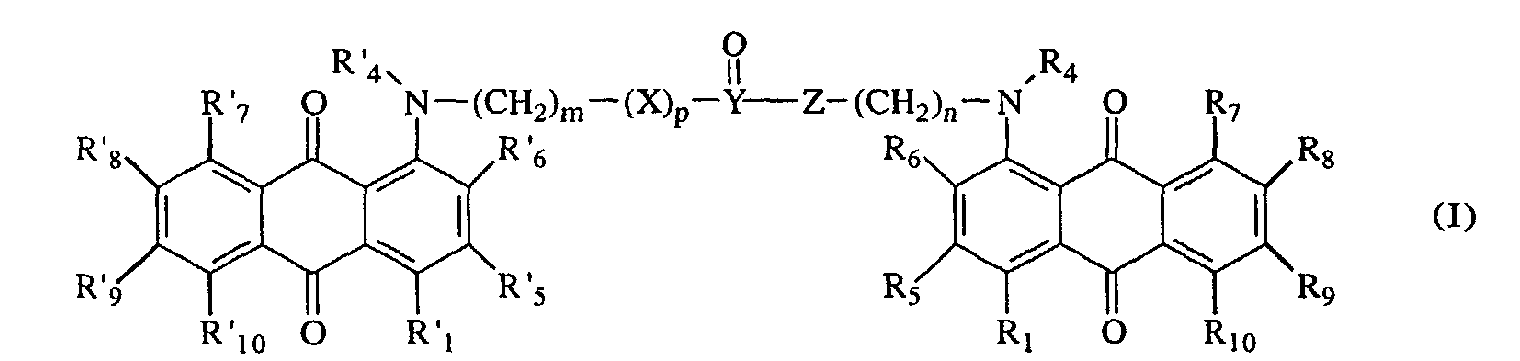
- the present invention thus relates to new compounds anthraquinonics of formula (I) below.
- Another object of the invention is a process for manufacturing these new compounds.
- Another subject of the invention is the use as a pigment of these compounds, especially in cosmetics.
- the invention also relates to cosmetic compositions containing them.
- Hydrocarbon groups suitable in the present invention are linear or branched, saturated or unsaturated, and have from 1 to 8 carbon atoms, preferably from 1 to 4 carbon atoms.
- hydrocarbon group of alkyl, alkenyl or alkynyl groups, such as, for example, groups methyl, ethyl, n-propyl, iso-propyl, n-butyl, iso-butyl, tert-butyl, methylene, ethenyl, or ethynyl.
- halogen atom of the atoms of chlorine, bromine, fluorine and iodine, preferably the chlorine atom.
- Another object of the present invention is the method of manufacture of the compounds of formula (I) above.
- the solvents suitable in the present invention are preferably aprotic dipolar solvents such as, for example, N, N-dimethylacetamide or N, N-dimethylformamide.
- the bases possibly used are notably chosen among pyridine or its derivatives, triethylamine or diisopropylethylamine.
- Said method consists in reacting an anthraquinone derivative of general formula (IV): in which n, Z, R 1 , R 4 to R 10 are as defined above for formula (I); or one of its salts, with phosgene or one of its derivatives or its substitutes such as carbonyldiimidazole, at a temperature of 0 to approximately 160 ° C. for approximately 30 minutes to approximately 20 hours, in the presence of a solvent as defined above, and optionally of a base as described above.
- IV an anthraquinone derivative of general formula (IV): in which n, Z, R 1 , R 4 to R 10 are as defined above for formula (I); or one of its salts, with phosgene or one of its derivatives or its substitutes such as carbonyldiimidazole, at a temperature of 0 to approximately 160 ° C. for approximately 30 minutes to approximately 20 hours, in the presence of a solvent as defined above, and optionally of a base as described above.
- the invention also relates to the use as a pigment of less a compound of formula (I) or (II) as defined above, and preferably 1,3-bis [3- (9,10-dioxo-9,10-dihydroanthracén-1-ylamino) propyl] urea and 1,3-bis [3- (4-methylamino-9,10-dioxo-9,10-dihydroanthracén-1-ylamino) propyl] urea.
- This new family of pigments can be used in food, cosmetics and paints, and preferably in cosmetics.
- the cosmetic composition according to the invention comprises, in a cosmetically acceptable medium, at least one compound of formula (I) or (II) as defined above.
- This compound is notably contained in an amount between 0.01 and 50% by weight, preferably between 0.1 and 25% by weight relative to the total weight of the composition.
- cosmetically acceptable medium is meant a medium compatible with all keratin materials such as the skin, nails, hair, eyelashes and eyebrows, lips, and any other area of the body and face.
- Said medium can include or be in the form of, for example, a suspension, a dispersion, a solution in medium solvent or hydroalcoholic, possibly thickened, or even gelled; a oil-in-water, water-in-oil, or multiple emulsion; a gel or a foam ; an emulsified gel; a dispersion of vesicles in particular lipids; a biphase or multiphase lotion; a spray; a powder free, compact or poured; or an anhydrous paste.
- composition when in aqueous form, in particular in the form of a dispersion, emulsion or aqueous solution, it can include an aqueous phase which includes water, water floral and / or mineral water.
- Said aqueous phase can also comprise alcohols such as C 1 -C 6 monoalcohols and / or polyols such as glycerol, butylene glycol, isoprene glycol, propylene glycol, polyethylene glycol.
- alcohols such as C 1 -C 6 monoalcohols and / or polyols such as glycerol, butylene glycol, isoprene glycol, propylene glycol, polyethylene glycol.
- composition according to the invention may optionally further comprise a surfactant, preferably in an amount of 0.01 to 30% by weight per relative to the total weight of the composition.
- the composition according to the invention may also include at least one co-emulsifier which can be chosen from oxyethylenated sorbitan monostearate, fatty alcohols such as stearyl alcohol or cetyl alcohol, or esters of fatty acids and polyols such as glyceryl stearate.
- the composition can include in addition to a film-forming polymer.
- a film-forming polymer such as nail polish, mascara, eyeliner or hairspray type composition.
- Polymers can be dissolved or dispersed in the medium cosmetically acceptable.
- the polymer can be present in the form of solution in an organic solvent or in the form of an aqueous dispersion of film-forming polymer particles.
- Said polymer can be chosen among nitrocellulose, cellulose acetobutyrate, poly (butyral vinyl), alkyd resins, polyesters, acrylic polymers, vinyl polymers, and / or polyurethanes.
- the composition can also comprise at least one plasticizer, which can be present in a content ranging from 1% to 40% in weight relative to the total weight of the composition.
- composition according to the invention can also comprise a fatty phase, in particular consisting of fatty substances liquid at 25 ° C, such oils of animal, vegetable, mineral or synthetic origin; of fatty substances solid at 25 ° C. such as waxes of animal or vegetable origin, mineral or synthetic; pasty fatty substances; gums; or their mixtures.
- a fatty phase in particular consisting of fatty substances liquid at 25 ° C, such oils of animal, vegetable, mineral or synthetic origin; of fatty substances solid at 25 ° C. such as waxes of animal or vegetable origin, mineral or synthetic; pasty fatty substances; gums; or their mixtures.
- compositions according to the invention can thus comprise volatile oils, which will evaporate on contact with the skin, but whose presence, in the cosmetic composition, is useful because they facilitate spreading the composition during application to the skin.
- volatile oils which are particularly suitable in the invention have generally, at 25 ° C, a saturated vapor pressure at least equal to 50 Pa (0.5 millibar).
- oils such as isoparaffins and in particular isododecane and oils fluorinated.
- composition according to the invention can also comprise other fatty substances, which can be chosen by a person skilled in the art on base of his general knowledge, so as to confer on the final composition the desired properties, for example in consistency and / or in texture.
- additional fatty substances can be waxes, gums and / or pasty fatty substances of animal, vegetable origin, mineral or synthetic, and mixtures thereof.
- silicone gums animal and vegetable waxes, mineral or synthetic such as microcrystalline waxes, paraffin, petrolatum, petroleum jelly, ozokerite, montan wax; the beeswax, lanolin and its derivatives; Candellila waxes, of Ouricury, Carnauba, of Japan, cocoa butter, waxes cork or sugarcane fibers; hydrogenated oils, ozokerites, fatty esters and glycerides; polyethylene waxes and waxes obtained by Fischer-Tropsch synthesis; lanolines; the silicone waxes; fluorinated waxes; polyolefins.
- composition can also contain nacres and / or fillers, as well as other pigments well known in the art.
- the nacres may be present in the composition at a rate of 0 to 20% by weight, preferably 8 to 15% by weight, and can be chosen from natural mother-of-pearl, mica coated with titanium oxide, iron oxide, natural pigment or bismuth oxychloride as well than colored titanium mica.
- the charges which can be present at a rate of 0 to 30% in weight, preferably 5 to 15%, in the composition, can be mineral or synthetic, lamellar or non-lamellar.
- composition may further comprise a dye water-soluble or liposoluble, in particular a natural organic dye such as cochineal carmine, and / or a synthetic dye such as halo-acid, azo, anthraquinone dyes.
- a dye water-soluble or liposoluble in particular a natural organic dye such as cochineal carmine, and / or a synthetic dye such as halo-acid, azo, anthraquinone dyes.
- a dye water-soluble or liposoluble in particular a natural organic dye such as cochineal carmine, and / or a synthetic dye such as halo-acid, azo, anthraquinone dyes.
- mineral dyes such as copper sulfate.
- composition can also comprise any additive usually used in the cosmetic field, such as perfumes, essential oils, preservatives, cosmetic active ingredients lipophilic or hydrophilic, moisturizers, vitamins, fatty acids essential, sphingolipids, self-tanning agents such as dihydroxyacetone (DHA), sunscreens, defoamers, sequestering agents, antioxidants, dispersing agents.
- additives such as perfumes, essential oils, preservatives, cosmetic active ingredients lipophilic or hydrophilic, moisturizers, vitamins, fatty acids essential, sphingolipids, self-tanning agents such as dihydroxyacetone (DHA), sunscreens, defoamers, sequestering agents, antioxidants, dispersing agents.
- DHA dihydroxyacetone
- the mixture is first stirred for 1 hour at room temperature and then it is heated at 40 ° C for 5 hours. After filtration, washing with water and with acetone, then drying under vacuum at 50 ° C., 4.5 g of a dark red powder (final yield 90%).
- the mixture is first stirred for 1 hour at room temperature and then it is heated at 40 ° C for 6 hours. After filtration, washing with water and with acetone, then drying under vacuum at 50 ° C., 3.9 g of a purple blue powder (final yield 73%).
Landscapes
- Organic Chemistry (AREA)
- Chemical & Material Sciences (AREA)
- Health & Medical Sciences (AREA)
- Life Sciences & Earth Sciences (AREA)
- Veterinary Medicine (AREA)
- Public Health (AREA)
- General Health & Medical Sciences (AREA)
- Animal Behavior & Ethology (AREA)
- Dermatology (AREA)
- Birds (AREA)
- Epidemiology (AREA)
- Cosmetics (AREA)
- Organic Low-Molecular-Weight Compounds And Preparation Thereof (AREA)
- Compositions Of Macromolecular Compounds (AREA)
Abstract
Description


en présence d'un solvant et éventuellement d'une base, à une température de 0 à environ 160 °C pendant environ 30 minutes à environ 20 heures.

avec du phosgène ou un de ses dérivés ou de ses substituts comme le carbonyldiimidazole, à une température de 0 à environ 160 °C pendant environ 30 minutes à environ 20 heures, en présence d'un solvant tel que défini ci-dessus, et éventuellement d'une base telle que décrite ci-dessus.
- les biopolymères polysaccharidiques comme la gomme de xanthane, la gomme de caroube, la gomme de guar, les alginates, les celluloses modifiées, les dérivés de l'amidon, les dérivés d'éthers de cellulose possédant des groupes ammoniums quaternaires, les polysaccharides cationiques ;
- les polymères synthétiques comme les poly(acide acrylique), la polyvinylpyrrolidone, le poly(alcool vinylique), les polymères à base de polyacrylamide ;
- le silicate de magnésium et d'aluminium.
- les silicones volatiles cycliques ayant de 3 à 8 atomes de silicium et de préférence de 4 à 6.
- les cyclocopolymères du type diméthylsiloxane/méthylalkylsiloxane,
- les silicones volatiles linéaires ayant de 2 à 9 atomes de silicium.
- les polyalkyl(C1-C20)siloxanes et notamment ceux à groupements terminaux triméthylsilyle, parmi lesquels on peut citer les polydiméthylsiloxanes linéaires et les alkylméthylpolysiloxanes tels que la cétyldiméthicone (nom CTFA) ;
- les silicones modifiées par des groupements aliphatiques et/ou aromatiques, éventuellement fluorés, ou par des groupements fonctionnels tels que des groupements hydroxyles, thiols et/ou amines ;
- les huiles de silicone phénylées, notamment celles de formule :

- les huiles d'origine animale, végétale ou minérale, et notamment les huiles animales ou végétales formées par des esters d'acide gras et de polyols, en particulier les triglycérides liquides, par exemple les huiles de tournesol, de maïs, de soja, de courge, de pépins de raisin, de sésame, de noisette, d'abricot, d'amandes ou d'avocat ; les huiles de poisson, le tricaprocaprylate de glycérol, ou les huiles végétales ou animales de formule RaCOORb dans laquelle Ra représente le reste d'un acide gras comportant de 7 à 19 atomes de carbone et Rb représente une chaíne hydrocarbonée ramifiée contenant de 3 à 20 atomes de carbone, par exemple, l'huile de Purcellin ; l'huile de paraffine, de vaseline, le perhydrosqualène, l'huile de germes de blé, de calophyllum, de sésame, de macadamia, de pépins de raisin, de colza, de coprah, d'arachide, de palme, de ricin, de jojoba, d'olive ou de germes de céréales ; des esters d'acides gras ; des alcools ; des acétylglycérides ; des octanoates, décanoates ou ricinoléates d'alcools ou de polyalcools ; des triglycérides d'acides gras ; des glycérides ;
- les huiles fluorées et perfluorées.
- sous la forme d'un produit de maquillage de la peau du visage, du corps ou des lèvres ou des fibres kératiniques (ongles, cils, sourcils, cheveux), tel qu'un fond de teint, une crème teintée, un fard à joues ou à paupières, une poudre libre ou compacte, un stick anti-cernes, un stick camouflant, un eye-liner, un mascara, un rouge à lèvres, un vernis-à-ongles, une composition de maquillage des cheveux ;
- sous la forme d'un produit de soin de la peau du visage ou du corps y compris le cuir chevelu, tel qu'une composition de soin (de jour, de nuit, anti-rides, hydratante, etc.) pour le visage ; une composition matifiante pour le visage ;
- sous la forme d'une composition de protection solaire ou de bronzage artificiel (autobronzant) ; ou
- sous la forme d'une composition capillaire, et notamment une crème ou un gel coiffant, une composition de teinture, d'oxydation ou directe, éventuellement sous forme de shampooing colorant.
- point de fusion supérieur à 260 °C (mesuré sur un banc Kofler),
- spectre de masse (SSQ710, CI-DI) : m/z=587,
- analyse élémentaire (C35H30N4O5, PM=586,653) :

- point de fusion supérieur à 260 °C (mesuré sur un banc Kofler),
- spectre de masse (SSQ710, EI-DEP) : m/z=644,
- analyse élémentaire (C37H36N6O5, PM=644,7280) :

- Huile de parléam 22 g
- Acide stéarique 1,5 g
- Polysorbate 60(1) (vendu sous la dénomination commerciale Tween® 60 par la société ICI) 0,9 g
- Alcool cétylique 0,5 g
- Mélange monostéarate de glycérol/stéarate de PEG 100 2,1 g
- Triéthanolamine 0,75 g
- Composé de l'exemple 1 5 g
- Propylèneglycol 3 g
- Cyclopentadiméthylsiloxane 3 g
- Carbopol 981 0,15 g
- Gomme de xanthane 0,2 g
- Eau qsp 100 g
- Talc 38 g
- Mica 20 g
- Oxychlorure de bismuth 8 g
- Stéarate de zinc 3g
- Poudre de nylon 20 g
- Composé de l'exemple 2 5 g
- Eau qsp 100 g
- Cire de polyéthylène 15 g
- Composé de l'exemple 1 10 g
- Huile de parléam qsp 100 g
Claims (17)
- Composés répondant à la formule générale (I) :dans laquelle :
 m et n, identiques ou différents, sont compris entre 1 et 20 ;X et Z représentent chacun NH ou O ;p vaut 0 ou 1 ;Y représente un atome de carbone ou un atome de soufre ;R1, R'1, R5, R'5, R6, R'6, R7, R'7, R8, R'8, R9, R'9, R10, R'10, identiques ou différents, représentent chacun un atome d'hydrogène, un atome d'halogène, un groupe hydrocarboné en C1-8, linéaire ou ramifié, saturé ou insaturé, un groupe hydroxy,
 ou ses sels,
 R2, R3, R4, R'4 et R11, identiques ou différents, représentent chacun un atome d'hydrogène, un groupe hydrocarboné en C1-8, linéaire ou ramifié, saturé ou insaturé, éventuellement hydroxylé.
 - Composés répondant à la formule générale (II) :dans laquelle :
 n vaut de 1 à 12,R1 représente un atome d'hydrogène, un atome d'halogène, un groupe hydrocarboné en C1-C8, linéaire ou ramifié, saturé ou insaturé, un groupe hydroxy, ou un groupe -NR2R3,R2, R3 et R4 représentent chacun un atome d'hydrogène ou un groupe hydrocarboné en C1-C8, linéaire ou ramifié, saturé ou insaturé,R5 et R6 représentent chacun un atome d'hydrogène, un atome d'halogène, un groupe hydrocarboné en C1-C8, linéaire ou ramifié, saturé ou insaturé, ou un groupe hydroxy.
 - Composés selon la revendication 1 ou 2, caractérisés en ce qu'ils sont choisis parmi la 1,3-bis[3-(9,10-dioxo-9,10-dihydroanthracén-1-ylamino)propyl]urée et la 1,3-bis[3-(4-méthylamino-9,10-dioxo-9,10-dihydroanthracén-1-ylamino)propyl]urée.
- Procédé de fabrication des composés selon la revendication 1, caractérisé en que l'on fait réagir ensemble les dérivés anthraquinoniques de formules générales (III) et (IV) :dans laquelle :
 A représente un groupement activant tel qu'un groupe dérivé de l'imidazole, ou encore un atome d'halogène,m est compris entre 1 et 20 ;X représente NH ou O ;p vaut 0 ou 1 ;Y représente un atome de carbone ou un atome de soufre ;R'1, R'5, R'6, R'7, R'8, R'9, et R'10, identiques ou différents, représentent chacun un atome d'hydrogène, un atome d'halogène, un groupe hydrocarboné en C1-8, linéaire ou ramifié, saturé ou insaturé, un groupe hydroxy,
 ou ses sels,
 R2, R3, R'4 et R11, identiques ou différents, représentent chacun un atome d'hydrogène, un groupe hydrocarboné en C1-8, linéaire ou ramifié, saturé ou insaturé, éventuellement hydroxylé ; etdans laquelle :
 n est compris entre 1 et 20 ;Z représente NH ou O ;R1, R5, R6, R7, R8, R9, et R10, identiques ou différents, représentent chacun un atome d'hydrogène, un atome d'halogène, un groupe hydrocarboné en C1-8, linéaire ou ramifié, saturé ou insaturé, un groupe hydroxy,
 ou ses sels,
 R2, R3, R4 et R11, identiques ou différents, représentent chacun un atome d'hydrogène, un groupe hydrocarboné en C1-8, linéaire ou ramifié, saturé ou insaturé, éventuellement hydroxylé ; et
en présence d'un solvant et éventuellement d'une base, à une température de 0 à environ 160 °C pendant environ 30 minutes à environ 20 heures. - Procédé de fabrication caractérisé en qu'il consiste à faire réagir un dérivé anthraquinonique de formule générale (IV) :dans laquelle :
 avec du phosgène ou un de ses dérivés ou de ses substituts comme le carbonyldiimidazole, à une température de 0 à environ 160 °C pendant environ 30 minutes à environ 20 heures, en présence d'un solvant, et éventuellement d'une base.n est compris entre 1 et 20 ;Z représente NH ou O ;R1, R5, R6, R7, R8, R9, et R10, identiques ou différents, représentent chacun un atome d'hydrogène, un atome d'halogène, un groupe hydrocarboné en C1-8, linéaire ou ramifié, saturé ou insaturé, un groupe hydroxy,
 ou ses sels,
 R2, R3, R4 et R11, identiques ou différents, représentent chacun un atome d'hydrogène, un groupe hydrocarboné en C1-8, linéaire ou ramifié, saturé ou insaturé, éventuellement hydroxylé ; et
 - Procédé selon la revendication 4 ou 5, caractérisé en ce que le solvant est un solvant dipolaire aprotique.
- Procédé selon l'une quelconque des revendications 4 à 6, caractérisé en ce que le solvant est le N,N-diméthylacétamide ou le N,N-diméthylformamide.
- Procédé selon l'une quelconque des revendications 4 à 7, caractérisé en ce que la base est choisie parmi la pyridine ou ses dérivés, la triéthylamine ou la diisopropyléthylamine
- Utilisation comme pigment, d'au moins un composé selon la revendication 1 ou 2.
- Utilisation selon la revendication 9, caractérisée en ce que les composés sont choisis parmi la 1,3-bis[3-(9,10-dioxo-9,10-dihydroanthracén-1-ylamino)propyl]urée et la 1,3-bis[3-(4-méthylamino-9,10-dioxo-9,10-dihydroanthracén-1-ylamino)propyl]urée.
- Utilisation comme pigment d'au moins un composé selon la revendication 1, 2 ou 3, dans une composition cosmétique.
- Composition cosmétique, caractérisée en ce qu'elle comprend, dans un milieu cosmétiquement acceptable, au moins un composé selon la revendication 1 ou 2.
- Composition cosmétique selon la revendication 12, caractérisée en ce que le composé est choisi parmi la 1,3-bis[3-(9,10-dioxo-9,10-dihydroanthracén-1-ylamino)propyl]urée et la 1,3-bis[3-(4-méthylamino-9,10-dioxo-9,10-dihydroanthracén-1-ylamino)propyl]urée.
- Composition cosmétique selon la revendication 12 ou 13, caractérisée en ce que ledit composé est contenu en une quantité allant de 0,01 à 50 % en poids.
- Composition cosmétique selon la revendication 14, caractérisée en ce que ledit composé est contenu en une quantité allant de 0,1 à 25 % en poids.
- Composition cosmétique selon l'une quelconque des revendications 12 à 15, caractérisée en ce que le milieu cosmétiquement acceptable comprend ou se présente sous la forme d'une suspension, d'une dispersion, d'une solution en milieu solvant ou hydroalcoolique, éventuellement épaissie, voire gélifiée ; d'une émulsion huile-dans-eau, eau-dans-huile, ou multiple ; d'un gel ou d'une mousse ; d'un gel émulsionné ; d'une dispersion de vésicules ; d'une lotion biphase ou multiphase ; d'un spray ; d'une poudre libre, compacte ou coulée ; ou d'une pâte anhydre.
- Composition cosmétique selon l'une quelconque des revendications 12 à 16, caractérisée en ce qu'elle se présente sous la forme d'un produit de maquillage de la peau du visage, du corps ou des lèvres ou des fibres kératiniques ; d'un produit de soin de 1a peau du visage ou du corps ; d'une composition de protection solaire ou de bronzage artificiel ; ou d'une composition capillaire.
Applications Claiming Priority (2)
| Application Number | Priority Date | Filing Date | Title |
|---|---|---|---|
| FR0104989 | 2001-04-11 | ||
| FR0104989A FR2823503B1 (fr) | 2001-04-11 | 2001-04-11 | Nouveaux composes, procede de fabrication, utilisation comme pigments et composition cosmetique |
Publications (2)
| Publication Number | Publication Date |
|---|---|
| EP1251121A1 true EP1251121A1 (fr) | 2002-10-23 |
| EP1251121B1 EP1251121B1 (fr) | 2003-10-01 |
Family
ID=8862246
Family Applications (1)
| Application Number | Title | Priority Date | Filing Date |
|---|---|---|---|
| EP02290872A Expired - Lifetime EP1251121B1 (fr) | 2001-04-11 | 2002-04-08 | Dérivés anthraquinoniques, procédé de fabrication, utilisation comme pigments et compositions cosmétiques |
Country Status (14)
| Country | Link |
|---|---|
| US (1) | US6660284B2 (fr) |
| EP (1) | EP1251121B1 (fr) |
| JP (1) | JP3871602B2 (fr) |
| KR (1) | KR100496595B1 (fr) |
| CN (1) | CN1268607C (fr) |
| AT (1) | ATE251128T1 (fr) |
| BR (1) | BR0201280A (fr) |
| CA (1) | CA2380674C (fr) |
| DE (1) | DE60200045T2 (fr) |
| ES (1) | ES2202296T3 (fr) |
| FR (1) | FR2823503B1 (fr) |
| HU (1) | HUP0201195A2 (fr) |
| MX (1) | MXPA02003632A (fr) |
| PL (1) | PL353291A1 (fr) |
Families Citing this family (5)
| Publication number | Priority date | Publication date | Assignee | Title |
|---|---|---|---|---|
| CA2383296A1 (fr) * | 2002-05-10 | 2003-11-10 | Ginette Godbout | Composition pour l'amelioration de la sante et de la structure des ongles, methode d'utilisation |
| FR2892901B1 (fr) * | 2005-11-09 | 2007-12-28 | Oreal | Dispositif de conditionnement et d'application d'un produit sur des fibres keratiniques |
| US20070292463A1 (en) * | 2005-12-22 | 2007-12-20 | Donald Spector | Compositions and methods comprising energizable particles for health use |
| US20070148105A1 (en) * | 2005-12-22 | 2007-06-28 | Donald Spector | Compositions and methods comprising magnetic particles for health use |
| KR101426510B1 (ko) | 2013-01-10 | 2014-08-13 | 주식회사 엘지생활건강 | 체모 성장 억제용 조성물 및 이를 이용한 체모 성장 억제 방법 |
Citations (5)
| Publication number | Priority date | Publication date | Assignee | Title |
|---|---|---|---|---|
| DE212436C (fr) * | ||||
| FR2039381A1 (fr) * | 1969-04-23 | 1971-01-15 | Ciba Geigy | |
| FR2125026A5 (fr) * | 1971-02-03 | 1972-09-22 | Ciba Geigy Ag | |
| FR2330742A1 (fr) * | 1974-10-16 | 1977-06-03 | Bayer Ag | Procede de production de solutions concentrees d'urees et leur application a la teinture des fibres naturelles ou synthetiques |
| US5486629A (en) * | 1992-09-01 | 1996-01-23 | Clairol, Inc. | Direct dyes having a quaternary center with a long aliphatic chain |
Family Cites Families (1)
| Publication number | Priority date | Publication date | Assignee | Title |
|---|---|---|---|---|
| DE59507501D1 (de) * | 1994-03-14 | 2000-02-03 | Ciba Sc Holding Ag | Anthrachinonfarbstoffe, Verfahren zu deren Herstellung und deren Verwendung |
-
2001
- 2001-04-11 FR FR0104989A patent/FR2823503B1/fr not_active Expired - Fee Related
-
2002
- 2002-04-05 CA CA002380674A patent/CA2380674C/fr not_active Expired - Fee Related
- 2002-04-08 AT AT02290872T patent/ATE251128T1/de not_active IP Right Cessation
- 2002-04-08 EP EP02290872A patent/EP1251121B1/fr not_active Expired - Lifetime
- 2002-04-08 ES ES02290872T patent/ES2202296T3/es not_active Expired - Lifetime
- 2002-04-08 DE DE60200045T patent/DE60200045T2/de not_active Expired - Fee Related
- 2002-04-08 CN CNB021061823A patent/CN1268607C/zh not_active Expired - Fee Related
- 2002-04-09 BR BR0201280-4A patent/BR0201280A/pt not_active IP Right Cessation
- 2002-04-09 PL PL02353291A patent/PL353291A1/xx unknown
- 2002-04-09 KR KR10-2002-0019205A patent/KR100496595B1/ko not_active Expired - Fee Related
- 2002-04-09 US US10/118,453 patent/US6660284B2/en not_active Expired - Fee Related
- 2002-04-10 HU HU0201195A patent/HUP0201195A2/hu unknown
- 2002-04-10 MX MXPA02003632A patent/MXPA02003632A/es active IP Right Grant
- 2002-04-11 JP JP2002109596A patent/JP3871602B2/ja not_active Expired - Fee Related
Patent Citations (5)
| Publication number | Priority date | Publication date | Assignee | Title |
|---|---|---|---|---|
| DE212436C (fr) * | ||||
| FR2039381A1 (fr) * | 1969-04-23 | 1971-01-15 | Ciba Geigy | |
| FR2125026A5 (fr) * | 1971-02-03 | 1972-09-22 | Ciba Geigy Ag | |
| FR2330742A1 (fr) * | 1974-10-16 | 1977-06-03 | Bayer Ag | Procede de production de solutions concentrees d'urees et leur application a la teinture des fibres naturelles ou synthetiques |
| US5486629A (en) * | 1992-09-01 | 1996-01-23 | Clairol, Inc. | Direct dyes having a quaternary center with a long aliphatic chain |
Also Published As
| Publication number | Publication date |
|---|---|
| FR2823503B1 (fr) | 2003-07-04 |
| JP2002371053A (ja) | 2002-12-26 |
| CA2380674A1 (fr) | 2002-10-11 |
| JP3871602B2 (ja) | 2007-01-24 |
| CN1268607C (zh) | 2006-08-09 |
| US6660284B2 (en) | 2003-12-09 |
| CN1380285A (zh) | 2002-11-20 |
| DE60200045D1 (de) | 2003-11-06 |
| ES2202296T3 (es) | 2004-04-01 |
| HU0201195D0 (fr) | 2002-06-29 |
| CA2380674C (fr) | 2006-08-29 |
| MXPA02003632A (es) | 2004-11-12 |
| ATE251128T1 (de) | 2003-10-15 |
| BR0201280A (pt) | 2003-03-11 |
| HUP0201195A2 (hu) | 2002-12-28 |
| KR100496595B1 (ko) | 2005-06-22 |
| EP1251121B1 (fr) | 2003-10-01 |
| US20030055273A1 (en) | 2003-03-20 |
| KR20020081065A (ko) | 2002-10-26 |
| FR2823503A1 (fr) | 2002-10-18 |
| PL353291A1 (en) | 2002-10-21 |
| DE60200045T2 (de) | 2004-06-24 |
Similar Documents
| Publication | Publication Date | Title |
|---|---|---|
| EP1392222B1 (fr) | Composition cosmetique formant apres application un polymere supramoleculaire | |
| EP0723776B2 (fr) | Composition cosmétique comprenant un composé siliconé et un ester d'acide gras | |
| EP1621560B1 (fr) | Copolymère hyperbranché comprenant des monomères sélectionnés, composition le comprenant, et procédé cosmétique | |
| CA2309296C (fr) | Composition cosmetique comprenant un compose de type indigoide | |
| EP0953343B1 (fr) | Composition cosmétique contenant un nouveau pigment | |
| CA2241260A1 (fr) | Composition cosmetique ou dermatologique contenant au moins une silicone fluoree a chaine alkyle | |
| EP1864649A2 (fr) | Composé de type bis-urée, composition le comprenant, utilisation et procédé de traitement cosmétique | |
| FR2765478A1 (fr) | Nouvelles compositions cosmetiques comprenant un polymere filmogene | |
| FR2881648A1 (fr) | Composition cosmetique comprenant une dispersion de particules de polymeres, dispersion de particules de polymeres et procede cosmetique l'utilisant | |
| FR2957081A1 (fr) | Composes de type ester de dibenzylidene sorbitol, procede de preparation, utilisation, compositions les comprenant et procede de traitement cosmetique | |
| EP1043344B1 (fr) | Composition cosmétique comprenant des polymères ayant une structure en étoiles et leur utilisation | |
| EP0847751B1 (fr) | Composition cosmétique comprenant des composés minéraux photochromes | |
| EP1134217A2 (fr) | Composition cosmétique comprenant un dérivé de furane-naphtoquinone, leur utilisation comme agent colorant, et dérivés. | |
| EP1251121B1 (fr) | Dérivés anthraquinoniques, procédé de fabrication, utilisation comme pigments et compositions cosmétiques | |
| EP1046389B1 (fr) | Composition cosmétique, notamment de maquillage, contenant un pigment dérivé de pyrrolopyrrole | |
| EP1787681A2 (fr) | Composition cosmétique texturée par un dérivé bis-urée à phase grasse liquide texturée par un composé bis-urée | |
| EP1302524A2 (fr) | Composition de maquillage comprenant un polymère à cristaux liquides | |
| FR2787023A1 (fr) | Utilisation d'un compose indigoide dans une composition cosmetique, notamment de maquillage, pour lui conferer des proprietes anti-microbiennes et de longue tenue. | |
| EP1725545A1 (fr) | Composition comprenant un compose monomerique a effet optique, procede employant ladite composition, compose monomerique, polymere le comprenant et utilisation | |
| EP1010420A1 (fr) | Composition cosmétique stable comprenant un copolymère particulier, des particules solides non enrobées et un polymère dispersant huileux | |
| FR2729947A1 (fr) | Nouveaux derives de lysine, procede de preparation, utilisations et compositions les comprenant | |
| FR2977156A1 (fr) | Composition cosmetique comprenant un polysiloxane supramoleculaire et un solvant, et procede de traitement cosmetique | |
| FR2950249A1 (fr) | Utilisation de dispersion de particules polymeriques rigides pour generer un effet coloriel | |
| WO2013001250A2 (fr) | Composition cosmétique comprenant une huile fonctionnalisée et un solvant et procédé de traitement cosmétique |
Legal Events
| Date | Code | Title | Description |
|---|---|---|---|
| PUAI | Public reference made under article 153(3) epc to a published international application that has entered the european phase |
Free format text: ORIGINAL CODE: 0009012 |
|
| 17P | Request for examination filed |
Effective date: 20020412 |
|
| AK | Designated contracting states |
Kind code of ref document: A1 Designated state(s): AT BE CH CY DE DK ES FI FR GB GR IE IT LI LU MC NL PT SE TR |
|
| AX | Request for extension of the european patent |
Free format text: AL;LT;LV;MK;RO;SI |
|
| GRAH | Despatch of communication of intention to grant a patent |
Free format text: ORIGINAL CODE: EPIDOS IGRA |
|
| GRAH | Despatch of communication of intention to grant a patent |
Free format text: ORIGINAL CODE: EPIDOS IGRA |
|
| AKX | Designation fees paid |
Designated state(s): AT BE CH CY DE DK ES FI FR GB GR IE IT LI LU MC NL PT SE TR |
|
| GRAA | (expected) grant |
Free format text: ORIGINAL CODE: 0009210 |
|
| AK | Designated contracting states |
Kind code of ref document: B1 Designated state(s): AT BE CH CY DE DK ES FI FR GB GR IE IT LI LU MC NL PT SE TR |
|
| PG25 | Lapsed in a contracting state [announced via postgrant information from national office to epo] |
Ref country code: CY Free format text: LAPSE BECAUSE OF FAILURE TO SUBMIT A TRANSLATION OF THE DESCRIPTION OR TO PAY THE FEE WITHIN THE PRESCRIBED TIME-LIMIT Effective date: 20031001 Ref country code: NL Free format text: LAPSE BECAUSE OF FAILURE TO SUBMIT A TRANSLATION OF THE DESCRIPTION OR TO PAY THE FEE WITHIN THE PRESCRIBED TIME-LIMIT Effective date: 20031001 Ref country code: FI Free format text: LAPSE BECAUSE OF FAILURE TO SUBMIT A TRANSLATION OF THE DESCRIPTION OR TO PAY THE FEE WITHIN THE PRESCRIBED TIME-LIMIT Effective date: 20031001 Ref country code: TR Free format text: LAPSE BECAUSE OF FAILURE TO SUBMIT A TRANSLATION OF THE DESCRIPTION OR TO PAY THE FEE WITHIN THE PRESCRIBED TIME-LIMIT Effective date: 20031001 Ref country code: AT Free format text: LAPSE BECAUSE OF FAILURE TO SUBMIT A TRANSLATION OF THE DESCRIPTION OR TO PAY THE FEE WITHIN THE PRESCRIBED TIME-LIMIT Effective date: 20031001 Ref country code: IE Free format text: LAPSE BECAUSE OF FAILURE TO SUBMIT A TRANSLATION OF THE DESCRIPTION OR TO PAY THE FEE WITHIN THE PRESCRIBED TIME-LIMIT Effective date: 20031001 |
|
| REG | Reference to a national code |
Ref country code: GB Ref legal event code: FG4D Free format text: NOT ENGLISH |
|
| REG | Reference to a national code |
Ref country code: CH Ref legal event code: EP |
|
| REG | Reference to a national code |
Ref country code: IE Ref legal event code: FG4D Free format text: FRENCH |
|
| REF | Corresponds to: |
Ref document number: 60200045 Country of ref document: DE Date of ref document: 20031106 Kind code of ref document: P |
|
| GBT | Gb: translation of ep patent filed (gb section 77(6)(a)/1977) |
Effective date: 20031111 |
|
| PG25 | Lapsed in a contracting state [announced via postgrant information from national office to epo] |
Ref country code: DK Free format text: LAPSE BECAUSE OF FAILURE TO SUBMIT A TRANSLATION OF THE DESCRIPTION OR TO PAY THE FEE WITHIN THE PRESCRIBED TIME-LIMIT Effective date: 20040101 Ref country code: GR Free format text: LAPSE BECAUSE OF FAILURE TO SUBMIT A TRANSLATION OF THE DESCRIPTION OR TO PAY THE FEE WITHIN THE PRESCRIBED TIME-LIMIT Effective date: 20040101 Ref country code: SE Free format text: LAPSE BECAUSE OF FAILURE TO SUBMIT A TRANSLATION OF THE DESCRIPTION OR TO PAY THE FEE WITHIN THE PRESCRIBED TIME-LIMIT Effective date: 20040101 |
|
| NLV1 | Nl: lapsed or annulled due to failure to fulfill the requirements of art. 29p and 29m of the patents act | ||
| PGFP | Annual fee paid to national office [announced via postgrant information from national office to epo] |
Ref country code: MC Payment date: 20040326 Year of fee payment: 3 |
|
| REG | Reference to a national code |
Ref country code: ES Ref legal event code: FG2A Ref document number: 2202296 Country of ref document: ES Kind code of ref document: T3 |
|
| PGFP | Annual fee paid to national office [announced via postgrant information from national office to epo] |
Ref country code: IE Payment date: 20040415 Year of fee payment: 3 Ref country code: LU Payment date: 20040415 Year of fee payment: 3 |
|
| PGFP | Annual fee paid to national office [announced via postgrant information from national office to epo] |
Ref country code: BE Payment date: 20040617 Year of fee payment: 3 |
|
| REG | Reference to a national code |
Ref country code: IE Ref legal event code: FD4D |
|
| PLBE | No opposition filed within time limit |
Free format text: ORIGINAL CODE: 0009261 |
|
| STAA | Information on the status of an ep patent application or granted ep patent |
Free format text: STATUS: NO OPPOSITION FILED WITHIN TIME LIMIT |
|
| 26N | No opposition filed |
Effective date: 20040702 |
|
| PG25 | Lapsed in a contracting state [announced via postgrant information from national office to epo] |
Ref country code: LU Free format text: LAPSE BECAUSE OF NON-PAYMENT OF DUE FEES Effective date: 20050408 |
|
| PG25 | Lapsed in a contracting state [announced via postgrant information from national office to epo] |
Ref country code: MC Free format text: LAPSE BECAUSE OF NON-PAYMENT OF DUE FEES Effective date: 20050430 Ref country code: BE Free format text: LAPSE BECAUSE OF NON-PAYMENT OF DUE FEES Effective date: 20050430 |
|
| BERE | Be: lapsed |
Owner name: L'*OREAL Effective date: 20050430 |
|
| PG25 | Lapsed in a contracting state [announced via postgrant information from national office to epo] |
Ref country code: LI Free format text: LAPSE BECAUSE OF NON-PAYMENT OF DUE FEES Effective date: 20060430 Ref country code: CH Free format text: LAPSE BECAUSE OF NON-PAYMENT OF DUE FEES Effective date: 20060430 |
|
| REG | Reference to a national code |
Ref country code: CH Ref legal event code: PL |
|
| BERE | Be: lapsed |
Owner name: L'*OREAL Effective date: 20050430 |
|
| PG25 | Lapsed in a contracting state [announced via postgrant information from national office to epo] |
Ref country code: PT Free format text: LAPSE BECAUSE OF NON-PAYMENT OF DUE FEES Effective date: 20040301 |
|
| PGFP | Annual fee paid to national office [announced via postgrant information from national office to epo] |
Ref country code: DE Payment date: 20080417 Year of fee payment: 7 Ref country code: ES Payment date: 20080520 Year of fee payment: 7 Ref country code: FR Payment date: 20080312 Year of fee payment: 7 |
|
| PGFP | Annual fee paid to national office [announced via postgrant information from national office to epo] |
Ref country code: IT Payment date: 20080424 Year of fee payment: 7 |
|
| PGFP | Annual fee paid to national office [announced via postgrant information from national office to epo] |
Ref country code: GB Payment date: 20080409 Year of fee payment: 7 |
|
| GBPC | Gb: european patent ceased through non-payment of renewal fee |
Effective date: 20090408 |
|
| REG | Reference to a national code |
Ref country code: FR Ref legal event code: ST Effective date: 20091231 |
|
| PG25 | Lapsed in a contracting state [announced via postgrant information from national office to epo] |
Ref country code: DE Free format text: LAPSE BECAUSE OF NON-PAYMENT OF DUE FEES Effective date: 20091103 |
|
| PG25 | Lapsed in a contracting state [announced via postgrant information from national office to epo] |
Ref country code: GB Free format text: LAPSE BECAUSE OF NON-PAYMENT OF DUE FEES Effective date: 20090408 Ref country code: FR Free format text: LAPSE BECAUSE OF NON-PAYMENT OF DUE FEES Effective date: 20091222 |
|
| REG | Reference to a national code |
Ref country code: ES Ref legal event code: FD2A Effective date: 20090411 |
|
| PG25 | Lapsed in a contracting state [announced via postgrant information from national office to epo] |
Ref country code: ES Free format text: LAPSE BECAUSE OF NON-PAYMENT OF DUE FEES Effective date: 20090411 |
|
| PG25 | Lapsed in a contracting state [announced via postgrant information from national office to epo] |
Ref country code: IT Free format text: LAPSE BECAUSE OF NON-PAYMENT OF DUE FEES Effective date: 20090408 |