FIELD OF THE INVENTION
The present invention relates to a novel lithographic
printing plate precursor having an image-forming layer
containing a copolymer having a fluoroaliphatic group
(hereinafter sometimes referred to as a "fluorine-based
polymer"). More specifically, the present invention
relates to a lithographic printing plate precursor capable
of providing a lithographic printing plate ensured with
uniform coated surface state free of occurrence of
production failures such as bubbling and favored with
excellent developability.
BACKGROUND OF THE INVENTION
A lithographic printing plate precursor has a
structure such that an image-forming composition is
provided on a substrate. In a typical manufacturing
process therefor, an image-forming composition dispersed or
dissolved in an organic solvent and, if desired, an upper
layer such as protective layer are coated and dried on a
surface of a support appropriately subjected to surface
treatment, undercoating, back coating and the like. In a
typical plate-making process, physical properties of an
image-forming composition on a support are changed
imagewise by the surface exposure of contact or projection
system through an image mask, or by the direct exposure
using scanning or modulation of an electromagnetic wave
based on image information from a computer, and thereafter,
the image-forming composition in the non-image area is
removed (developed), if desired, followed by a treatment
for providing hydrophilic state, ink-receptive state or
forming a protective film, whereby a lithographic printing
plate precursor having a non-image area comprising a
hydrophilic support surface layer and an image area
comprising a hydrophobic composition surface layer is
obtained. In a typical printing process of the
lithographic printing plate obtained as such, the
hydrophilic non-image area receives a fountain solution and
the lipophilic image area receives an ink, whereby an ink
image is formed on the surface. The obtained ink image is
directly or indirectly transferred to a desired printing
medium and thereby, a printed matter is obtained.
With respect to the image-forming layer used herein,
various techniques are already known, for example, a
technique of causing a negative change from soluble to
insoluble or positive change from insoluble to soluble as
physical properties on exposure, a technique of using a
photochemical reaction or a heat mode process as a
principle for the change in physical properties, or a
technique of using a heat-sensitive recording system.
Whichever image formation layer is used, technical problems
to be solved are present in common for realizing a
lithographic printing plate precursor having high
usefulness. Namely, the technical problems are (1) that
the image-forming layer has high uniformity and (2) that
the image area has high hydrophobicity and the non-image
area has high development removability. The uniformity of
the image area is mainly related to the above-described
production process in view of technique. A plate precursor
insufficient in the uniformity seriously reduces the basic
performance required for the printing plate such that a
large number of homogeneous printed matters having a high-quality
image are stably provided, and this plate precursor
is not preferred. The high hydrophobicity of the image
area is very important from the standpoint of elevating the
durability against developer in the plate-making process
and thereby obtaining excellent resolution or obtaining a
sufficiently long press line or a sufficiently high inking
property in the printing process. However, the high
hydrophobicity of the image area may cause reduction of the
solubility in an alkali aqueous solution usually used as a
developer and in turn, undesirable results may be brought
about, such as development failure of the non-image area or
generation of sludge ingredient in the developer. In other
words, the hydrophobicity of the image area and the
removability of the non-image area are simply conflicting
properties required for the image-forming layer, and a
technique capable of achieving these properties at the same
time is difficult to develop but is an important matter.
Regarding to this technical problem, a composition
containing a polymer compound having a fluoroaliphatic
group is known to be useful as an image-forming composition,
For example, JP-A-54-135004 (the term "JP-A" as used herein
means an "unexamined published Japanese patent
application") discloses this composition as an effective
technique for improving the uniformity of the image-forming
layer. JP-A-62-170950, JP-A-8-15858 and JP-A-2000-19724
disclose a copolymer containing a monomer unit having a
fluoroaliphatic group and a monomer unit having a specific
functional group, with its usefulness. In these techniques,
the deficient point in prior techniques disclosing the use
of a polymer compound having a fluoroaliphatic group is
improved merely by selecting an additional substituent
capable of reducing the adverse effect of the polymer
having a fluoroaliphatic group on the plate-making and
printing processes or the other way effectively utilizing
the polymer. To speak specifically, JP-A-62-170950
discloses an effect of more improving the function of
bringing out the layer uniformity, resulting from the
improvement of surface activation, JP-A-8-15858 discloses
an effect of eliminating the retardation of developability
ascribable to the hydrophobicity and JP-A-2000-19724
discloses an effect of forming a high-contrast image by
utilizing the hydrophobicity and the orientation force and
thereby achieving the hydrophobicity of the image area and
the removability of the non-image area. Among these
effects of the polymer compound having a fluoroaliphatic
group, the layer uniformity is considered to come out by
virtue of the surface activation capability of the polymer
compound having a fluoroaliphatic group, in other words, a
capability of reducing the surface tension of an organic
solvent dispersion solution of image-forming composition in
the production process. Other effects of the polymer
compound having a fluoroaliphatic group are considered
attributable to the high hydrophobicity of the
fluoroaliphatic group-containing polymer compound contained
in the image-forming layer of a lithographic printing plate
precursor and also to its capability of orienting,
deviating or localizing toward the surface of the image-forming
layer. That is, the fluoroaliphatic group-containing
polymer compound distribution in the image-forming
layer can be made relatively high in the vicinity
of the surface and therefore, high hydrophobicity can be
imparted particularly to the surface while maintaining the
development removability of the photosensitive layer as a
whole. For improving the polymer compound having a
fluoroaliphatic group, means other than the selection of
copolymerization components may also be used. For example,
JP-A-2000-187318 discloses a technique where an image-forming
material having excellent discrimination in
solubility between the image area and the non-image area
can be obtained by a polymer compound using a monomer unit
having two or more fluoroaliphatic groups.
As such, when the image-forming layer containing a
fluoroaliphatic compound is used for a lithographic
printing plate precursor, this image-forming layer is
effective means for solving the above-described technical
problems (1) and (2). However, the effects thereof are not
sufficiently high and in fact, more improvements are
demanded.
For example, in the case of using a positive image-forming
layer, for obtaining a good printed matter, the
image obtained after exposure and development preferably
has a discrimination as high as possible between the image
area and the non-image area, namely, a gradation (contrast)
as high as possible, in view of image reproducibility and
scratch resistance. At the same time, the requirements for
high sensitivity, no blurring, white light safety and wide
development latitude must be satisfied, however, a
technique capable of fully satisfying these requirements
has not yet been developed.
The term "soft image" as used herein means that when
an image is exposed through a step wedge and then developed,
the difference between the step number where the image
starts remaining and the step number where the layers
completely remain is large. The term "high-contrast image"
as used herein means that the difference between the step
number where the image starts remaining and the step number
where the layers completely remain is small.
The "blurring" occurs when a lith film floats up due
to a gas generated by the decomposition of a photosensitive
substance and a complete contact exposure cannot be
performed. In general, as the image has higher contrast
with equal clear sensitivity, the blurring can be more
easily eliminated. The "white light safety" indicates the
safety of sensitivity of an image against exposure of the
printing plate to white light such as fluorescent lamp and
as the image has higher contrast, the white light safety is
higher. The "step wedge" is a strip film having steps
changed in the density with a variation of 0.15 one by one
and this film is used for determining the relationship
between the exposure amount and the amount of
photosensitive layers remaining after the exposure and
development. The "clear sensitivity" means the sensitivity
when an image starts to form after the exposure and
development. The "development latitude" is used for
examining how much the image sensitivity is changed after
the exposure and development with the change in the
concentration of the developer and as the change in
sensitivity is smaller, the development latitude is higher.
In a photopolymerization-type printing plate
containing a polymerizable monomer having a double bond and
a photopolymerization initiator as a representative
negative lithographic printing plate, particularly a laser
direct exposure-type printing plate having high sensitivity
to a laser beam in the visible light region, the gradation
thereof is conventionally soft and therefore, if a printing
plate is fixed and the image exposure is performed by an
inner drum-type laser plate setter which performs the
exposure while rotating a mirror at a high speed, fogging
is readily generated due to scattered or reflected light.
In order to elevate the impression capacity of the printing
plate, it is preferred to perform the exposure with a high
energy, however, since fogging due to scattered or
reflected light goes for the worth, the exposure amount
cannot be increased to elevate the impression capacity.
The impression capacity must be elevated without causing
any generation of fogging due to scattered or reflected
light even at a high exposure amount. This problem may be
overcome by creating a high-contrast graduation. In the
image exposure by a laser, the exposure time is about 1 µ
second order per 1 dot and fogging due to scattered or
reflected light occurs when a photosensitive material is
exposed to extremely weak light for a long period of time
such as a few minutes order and the photosensitive layer is
thereby photocured. When the gradation of a photosensitive
material is contrasted, the photosensitive material is
hardly photocured by the weak light and can be removed by
the development, as a result, fogging does not occur. In
the case of a heat-sensitive lithographic printing plate on
which the drawing is performed using an infrared laser, the
discrimination between the image area and the non-image
area is low, that is, the graduation is low (soft), and
therefore, the portion touched with a hand may undergo
slipping of an image or suffer from bad stability against
external scratching.
SUMMARY OF THE INVENTION
The object of the present invention is to construct a
technique capable of solving the above-described technical
problems (1) and (2) to a level surpassing conventional
techniques. More specifically, the object of the present
invention is to provide a lithographic printing plate
precursor capable of forming a high-contrast image without
reducing the sensitivity, in which the image-forming layer
is improved in the uniformity, and the solubility and
dispersibility in a developer.
As a result of extensive investigations, the present
inventors have found that the above-described objects can
be attained by adding a specific fluorine-based polymer to
the image-forming layer. The present invention has been
accomplished based on the finding obtained by particularly
studying on specific fluoroaliphatic groups and copolymer
components.
More specifically, it has been found that a
lithographic printing plate precursor having a construction
such as (A) or (B) described later exerts an excellent
effect on the above-described technical problems (1) and
(2).
For example, it has been found that a positive
photosensitive resin composition capable of giving a
uniform coated surface state free of any surface property
failure due to bubbling during the production, and
exhibiting good solubility and dispersibility in a
developer without reducing the sensitivity, can be obtained.
Furthermore, it has been found that by adding the
fluorine-based polymer according to the present invention,
in addition to the above-described improvements in the
surface property and solubility in a developer, the
gradation of a negative lithographic printing plate
precursor is enhanced and particularly in the case of a
laser light-sensitive photopolymerization-type printing
plate, a printing plate exhibiting high sensitivity to
laser light, providing good effect against fogging due to
scattered or reflected light and having high impression
capability can be obtained.
It has been also found that in the case of a heat-sensitive
lithographic printing plate precursor, in
addition to the above-described improvements in the surface
property and solubility in a developer, a printing plate
having large discrimination and high image strength and
therefore, being free of occurrence of image slipping on
the portion touched with a hand and improved in the
stability against external scratches can be obtained.
The lithographic printing plate precursor of the
present invention comprises the following construction (A)
or (B).
wherein the fluoroaliphatic group-containing copolymer
contains a repeating unit corresponding to monomer (i)
below and a repeating unit corresponding to monomer (ii)
below:
- (i) a fluoroaliphatic group-containing monomer
represented by formula (I) below, and
- (ii) at least one of a poly(oxyalkylene) acrylate
and a poly(oxyalkylene) methacrylate:
wherein R1 represents a hydrogen atom or a methyl group; X
represents a single bond, -CH2-CH(OH)- or -CH2CH2-NHC(=O)-O-;
m represents 1 or 2.
(A') The lithographic printing plate precursor as
described in (A), wherein the monomer (ii) is at least one
of a poly(oxyethylene) acrylate and a poly(oxyethylene)
methacrylate. (B) A lithographic printing plate precursor
comprising:
a support; and an image-forming layer including a fluoroaliphatic
group-containing copolymer,
wherein the fluoroaliphatic group-containing copolymer
contains a repeating unit corresponding to monomer (i)
below, a repeating unit corresponding to monomer (ii) below
and a repeating unit corresponding to monomer (iii) below:
- (i) a fluoroaliphatic group-containing monomer
represented by formula (I) below,
- (ii) at least one of a poly(oxyalkylene) acrylate
and a poly(oxyalkylene) methacrylate, provided that a
poly(oxyethylene) acrylate and a poly(oxyethylene)
methacrylate are excluded, and
- (iii) at least one of a poly(oxyethylene) acrylate
and a poly(oxyethylene) methacrylate:
wherein R1 represents a hydrogen atom or a methyl group; X
represents a single bond, -CH2-CH(OH)- or -CH2CH2-NHC(=O)-O-;
m represents 1 or 2.
The preferable embodiments in the present invention
are set forth below.
DETAILED DESCRIPTION OF THE INVENTION
The polymer compound having a fluoroaliphatic group
on the side chain (sometimes simply referred to as a
"fluorine-based polymer") according to the present
invention is described in detail below.
The fluorine-based polymer for use in the present
invention is a polymer which satisfies the requirements
described in (A), (A') or (B).
In the present invention, at least one of the
fluoroaliphatic groups on the side chain is preferably
derived from a fluoroaliphatic compound produced by a
telomerization method (also called telomer method) or an
oligomerization method (also called oligomer method). The
method for producing these fluoroaliphatic compounds is
described, for example, in Nobuo Ishikawa (supervisor),
Fusso Kagoubutsu no Gosei to Kinou (Synthesis and Function
of Fluorocompounds), CMC, pp. 117-118 (1987), and Milos
Hudlicky and Attila E. Pavlath (compiler),
Chemistry of
Organic Fluorine Compounds II, Monograph 187, pp. 747-752,
American Chemical Society (1995). The telomerization
method is a method for synthesizing a telomer by performing
a radical polymerization of a fluorine-containing vinyl
compound such as tetrafluoroethylene using an alkyl halide
having a large chain transfer constant, such as iodide, as
the telogen (an example is shown in Scheme-1).
The obtained terminal iodinated telomer is usually
subjected to an appropriate chemical modification of the
terminal, for example, as in [Scheme 2] and thereby led to
a fluoroaliphatic compound. This compound is furthermore
converted into a desired monomer structure, if desired, and
used in the production of a fluoroaliphatic group-containing
polymer.
In the fluoroaliphatic group-containing monomer
represented by formula (I) for use in the present invention,
R1 represents a hydrogen atom or a methyl group, X
represents a single bond, -CH2-CH(OH)- or -CH2CH2-NHC(=O)-O-,
and m represents 1 or 2.
This monomer in which the perfluoroalkyl group has 8
carbon atoms can be synthesized by a method of distilling a
perfluoroalkyl starting material, purifying it using a
column or the like, taking out the component having 8
carbon atoms and acrylating or methacrylating the component,
or a method of acrylating or methacrylating perfluoroalkyl
starting materials different in the number of carbon atoms
and taking out the component having 8 carbon atoms.
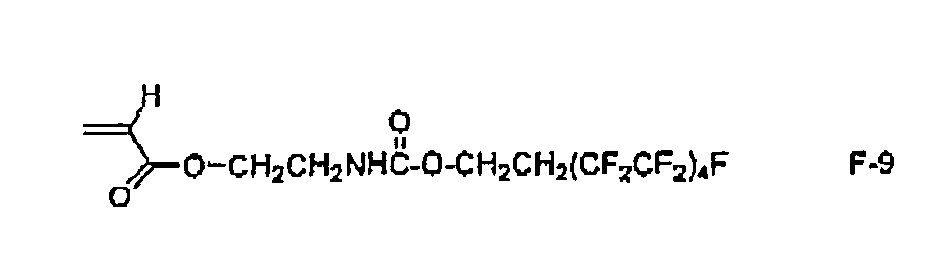
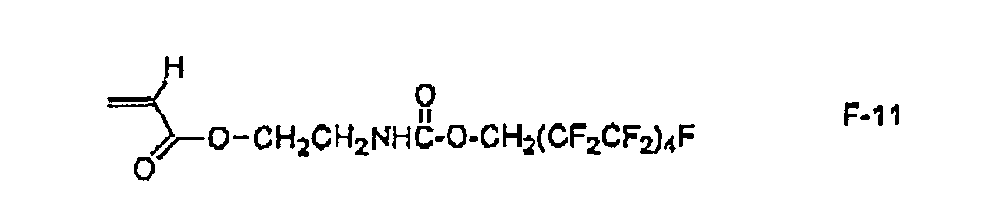
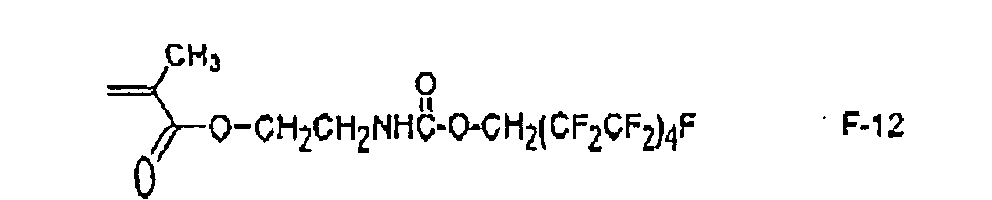
Specific examples of the fluoroaliphatic group-containing
monomer represented by formula (I) are set forth
below.
The poly(oxyalkylene) acrylate and/or poly(oxyalkylene)
methacrylate, as an essential component of the
fluorine polymer for use in the present invention, are
described below.
The polyoxyalkylene group can be represented by (OR)x,
wherein R is an alkylene group having from 2 to 4 carbon
atoms, preferably -CH2CH2-, -CH2CH2CH2-, -CH(CH3)CH2-,
-CH2CH2CH2CH2- or -CH(CH3)CH(CH3)-, and x is a positive
integer.
In the poly(oxyalkylene) group, the oxyalkylene units
may be constructed only by the same oxyalkylene unit as in
poly(oxypropylene), or two or more oxyalkylene units
different from each other may be regularly or irregularly
linked as in the case where an oxypropylene unit and an
oxyethylene unit are linked.
The atom or group bonded to the terminal of
poly(oxyalkylene) chain may be a hydrogen atom or any other
group but is preferably a hydrogen atom, an alkyl group
(preferably having from 1 to 20 carbon atoms), an allyl
group (preferably having from 1 to 20 carbon atoms) or an
aryl group (for example, having from 6 to 10 carbon atoms).
The aryl group may have a substituent such as an alkyl
group (for example, having from 1 to 10 carbon atoms) or a
halogen atom.
The poly(oxyalkylene) chain may be linked through or
may contain one or more linking bonds (for example, -CONH-Ph-NHCO-
or -S-, wherein Ph represents a phenylene group).
For providing a branched oxyalkylene unit, the linking bond
site may have 3 or more valences.
The weight average molecular weight of the
poly(oxyalkylene) group including the linking bond moiety
is preferably from 250 to 3,000.
The poly(oxyalkylene) acrylate and the
poly(oxyalkylene) methacrylate can be produced by reacting
a commercially available hydroxypoly(oxyalkylene) material,
for example, a material available on the market under the
trade name of, for example, "Pluronic" (produced by Asahi
Denka Kogyo K.K.), "Adeka Polyether" (produced by Asahi
Denka Kogyo K.K.), "carbowax" (produced by Gluco Products),
"Toriton" (produced by Rohm and Haas) or "P.E.G" (produced
by Dai-ichi Kogyo Seiyaku Co., Ltd.), with an acrylic acid,
a methacrylic acid, an acryl chloride, a methacryl chloride
or an acrylic anhydride according to a known method. Also,
a poly(oxyalkylene) diacrylate or the like produced by a
different known method may be used.
Examples of the commercially available monomer
include, as hydroxyl group-terminated polyalkylene glycol
mono(meth)acrylates, BLEMER PE-90, BLEMER PE-200, BLEMER
PE-350, BLEMER AE-90, BLEMER AE-200, BLEMER AE-400, BLEMER
PP-1000, BLEMER PP-500, BLEMER PP-800, BLEMER AP-150,
BLEMER AP-400, BLEMER AP-550, BLEMER AP-800, BLEMER 50PEP-300,
BLEMER 70PEP-350B, BLEMER AEP Series, BLEMER 55PET-400,
BLEMER 30PET-800, BLEMER 55PET-800, BLEMER AET Series,
BLEMER 30PPT-800, BLEMER 50PPT-800, BLEMER 70PPT-800,
BLEMER APT Series, BLEMER 10PPB-500B and BLEMER 10APB-500B
produced by NOF Corp. Other examples include, as alkyl-terminated
polyalkylene glycol mono(meth)acrylates, BLEMER
PME-100, BLEMER PME-200, BLEMER PME-400, BLEMER PME-1000,
BLEMER PME-4000, BLEMER AME-400, BLEMER 50POEP-800B, BLEMER
50AOEP-800B, BLEMER PLE-200, BLEMER ALE-200, BLEMER ALE-800,
BLEMER PSE-400, BLEMER PSE-1300, BLEMER ASEP Series, BLEMER
PKEP Series, BLEMER AKEP Series, BLEMER ANE-300, BLEMER
ANE-1300, BLEMER PNEP Series, BLEMER PNPE Series, BLEMER
43ANEP-500 and BLEMER 70ANEP-550 produced by NOF Corp., and
LIGHT-ESTER MC, LIGHT-ESTER 130MA, LIGHT-ESTER 041MA,
LIGHT-ACRYLATE BO-A, LIGHT-ACRYLATE EC-A, LIGHT-ACRYLATE
MTG-A, LIGHT-ACRYLATE 130A, LIGHT-ACRYLATE DPM-A, LIGHT-ACRYLATE
P-200A, LIGHT-ACRYLATE NP-4EA and LIGHT-ACRYLATE
NP-8EA produced by Kyoeisha Chemical Co., Ltd.
In the present invention, a copolymer of a monomer
represented by formula (I) and a poly(oxyalkylene) acrylate
and/or poly(oxyalkylene) methacrylate monomer, which are
essential components, is used but the copolymer preferably
further contains a poly(oxyethylene)acrylate and/or a
poly(oxyethylene) methacrylate.
The term "poly(oxyethylene) acrylate and/or poly(oxyethylene)
methacrylate" as used herein means a monomer
where the oxyalkylene group in the poly(oxyalkylene)
acrylate and/or poly(oxyalkylene)methacrylate monomer
comprises only oxyethylene. The addition of this monomer
contributes to the improvement particularly in
dispersibility and solubility.
In a more preferred embodiment, the copolymer is a
polymer obtained by copolymerizing three or more monomers,
namely, a monomer represented by formula (I), a
poly(oxyethylene) acrylate and/or poly(oxyethylene)
methacrylate, and a poly(oxyalkylene) acrylate and/or
poly(oxyalkylene) methacrylate. In this case, the
poly(oxyalkylene) acrylate and/or poly(oxyalkylene)
methacrylate is a poly(oxyalkylene) acrylate and/or
poly(oxyalkylene) methacrylate excluding poly(oxyethylene)
acrylate and/or poly(oxyethylene) methacrylate.
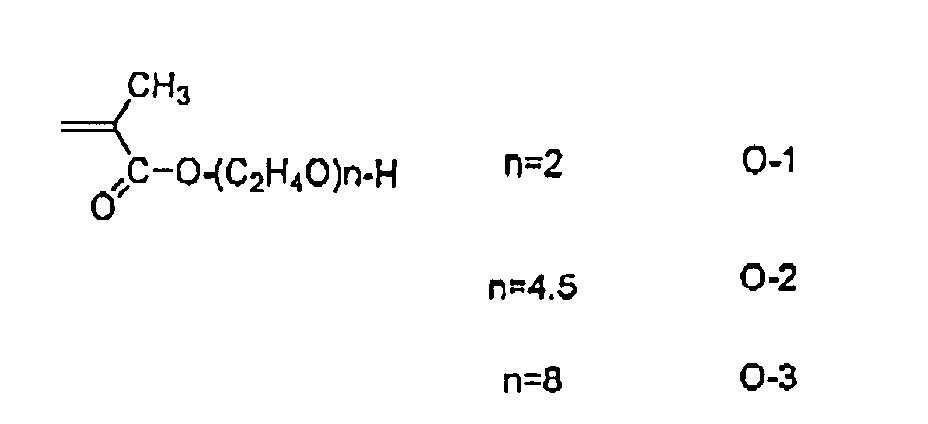
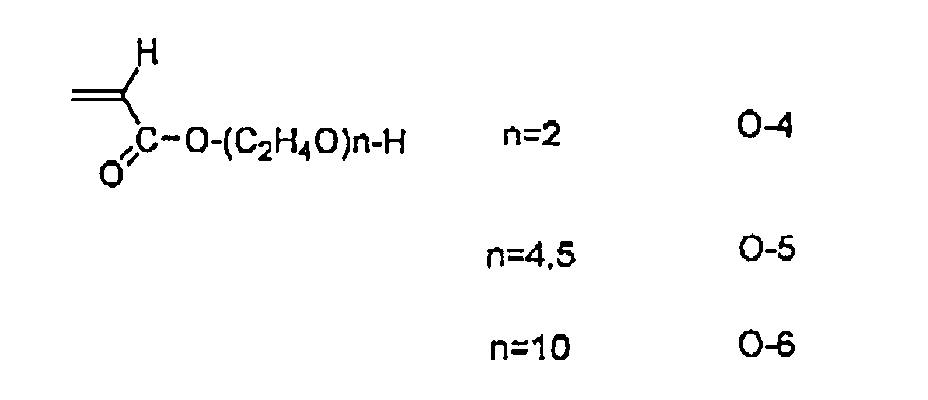
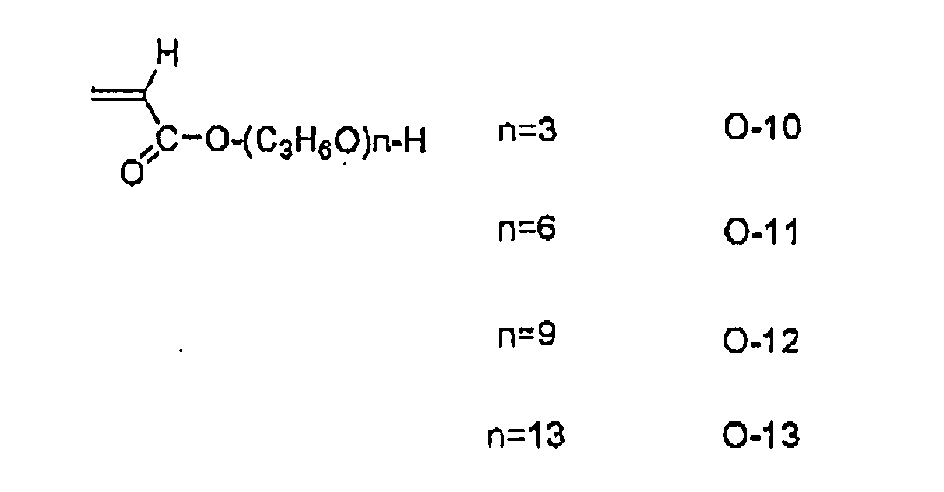
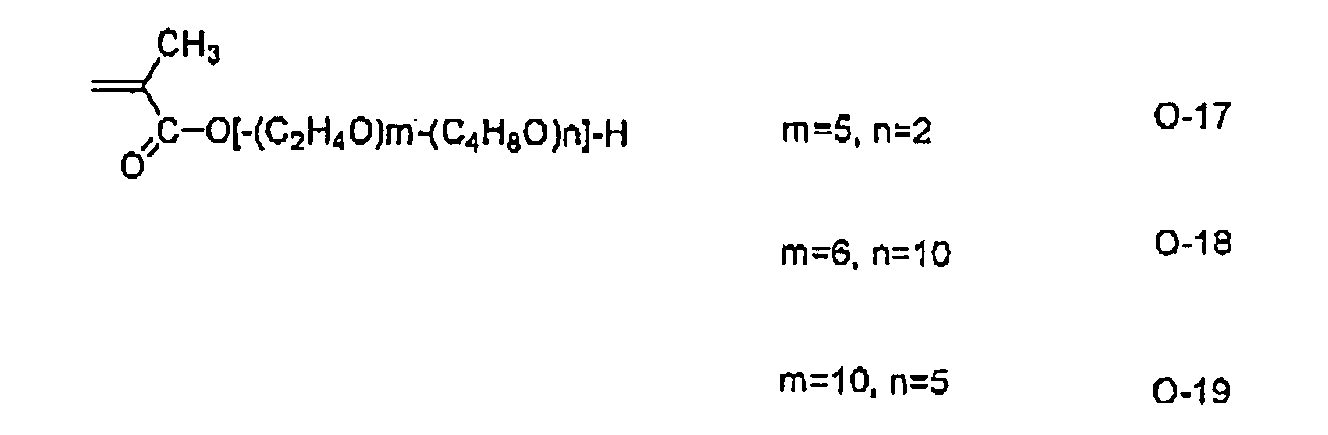
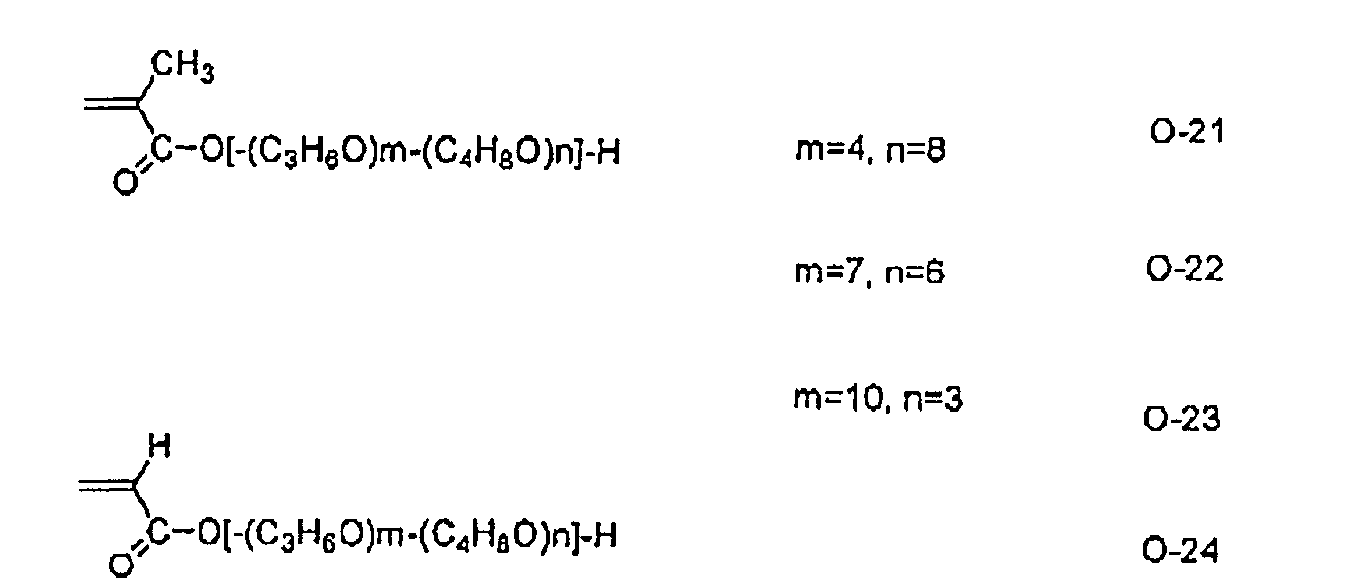
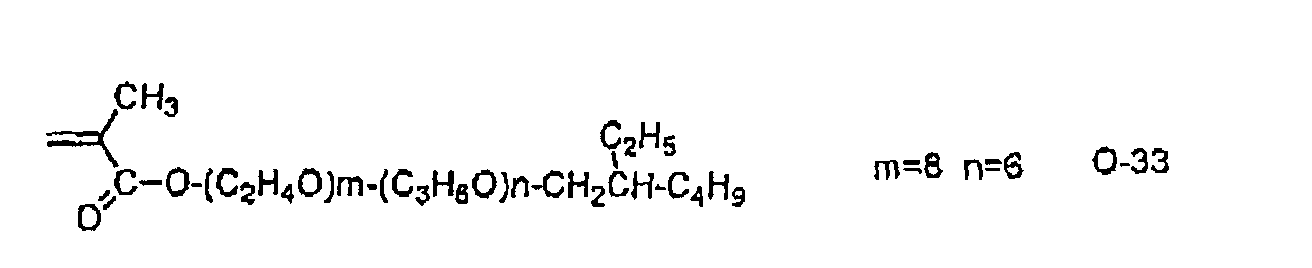
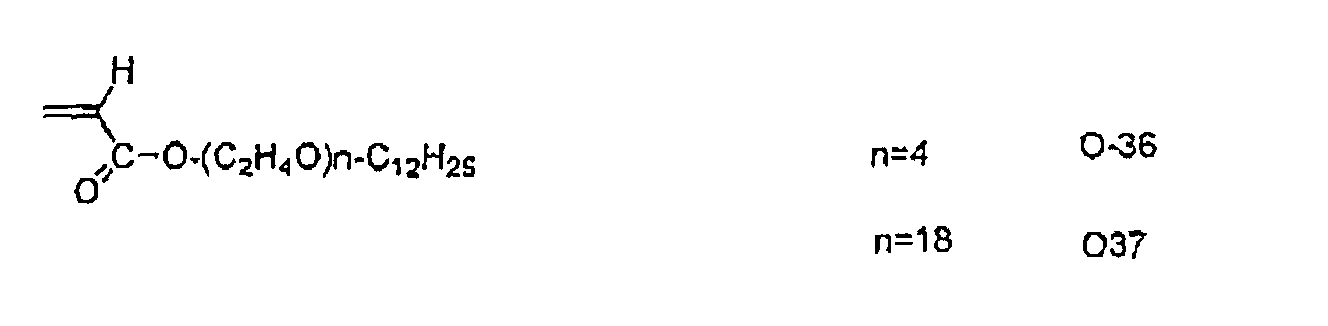
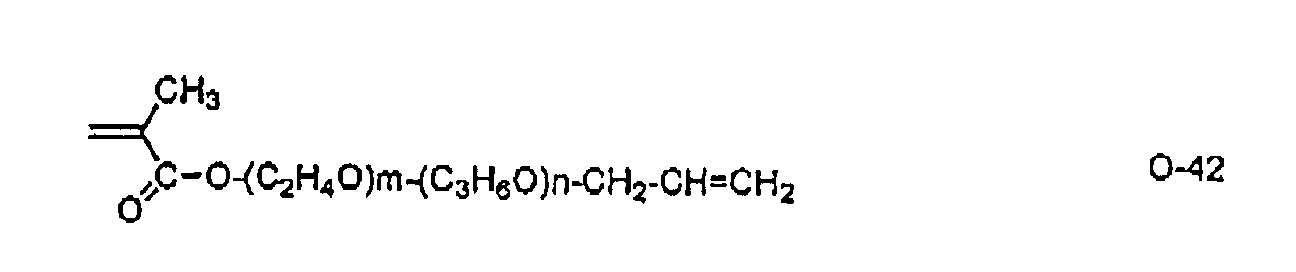
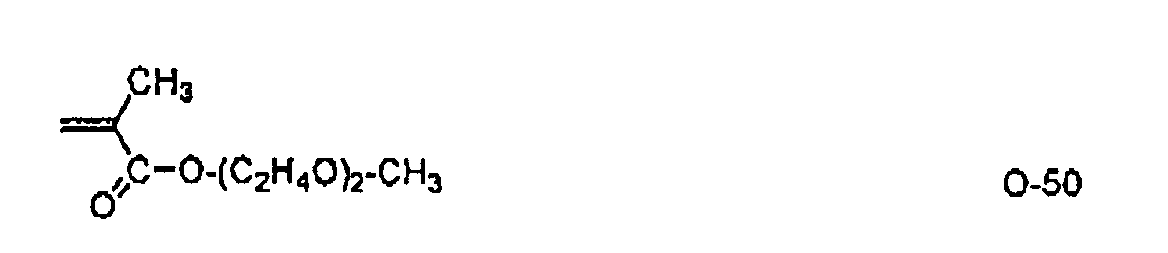
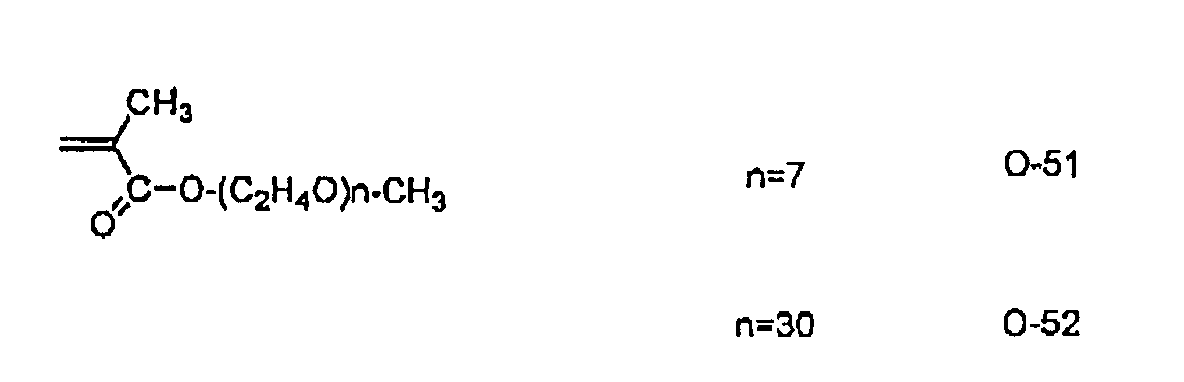
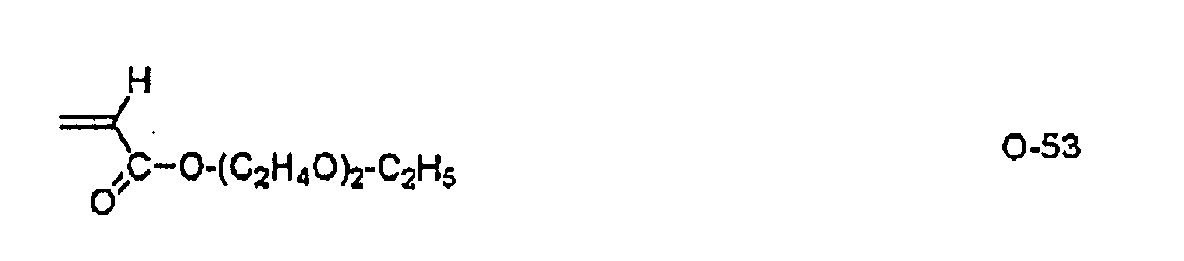
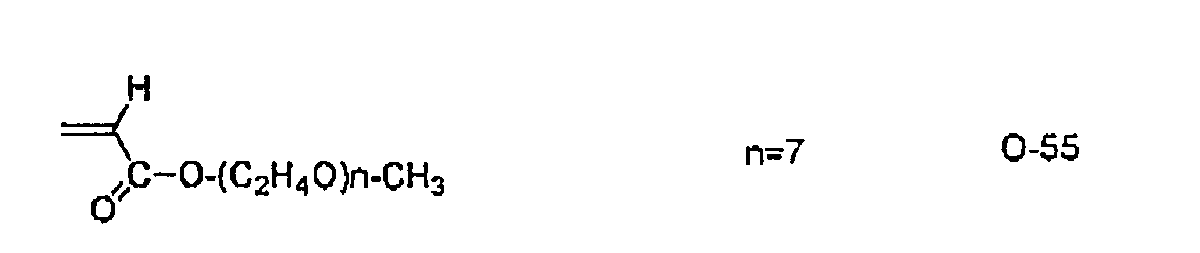
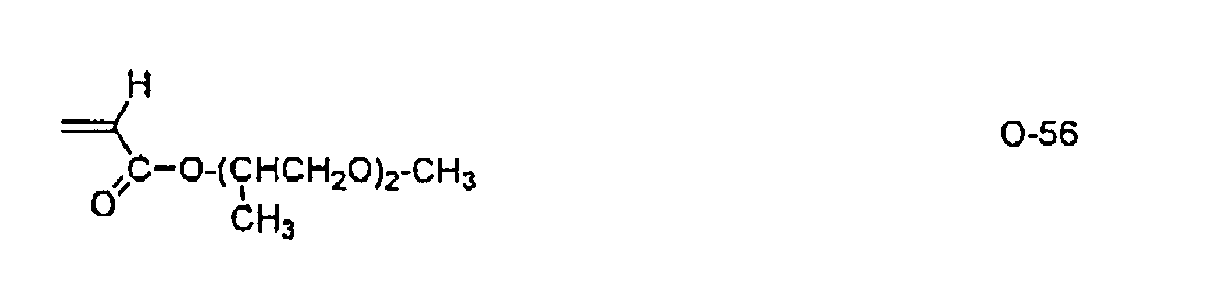
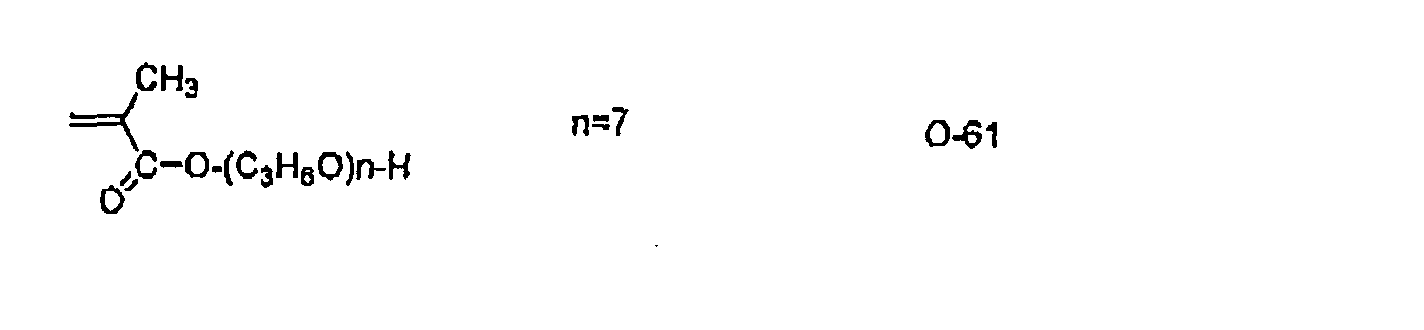
Specific examples of the poly(oxyalkylene) acrylate
and/or poly(oxyalkylene) methacrylate for use in the
present invention are set forth below, however, the present
invention is not limited thereto. In the following
specific examples, 1, m and n represent an average
polymerization degree of respective units. The
polymerization degree may have a distribution or may be
monodisperse. The bracket ([ ]) shows a random-type
polymer chain.
In the present invention, in addition to those
essential components, namely, the monomer represented by
formula (I), the poly(oxyalkylene) acrylate and/or poly(oxyalkylene)methacrylate,
and the poly(oxyethylene)
acrylate and/or poly(oxyethylene) methacrylate, a monomer
copolymerizable therewith can be reacted.
The copolymerization ratio of the other
copolymerizable monomer is preferably 20 mol% or less, more
preferably 10 mol% or less, in all monomers.
For this monomer, those described in J. Brandrup,
Polymer Handbook 2nd ed., Chapter 2, pp. 1-483, Wiley
Interscience (1975), can be used.
Examples thereof include compounds having at least
one addition-polymerizable unsaturated bond selected from
an acrylic acid, a methacrylic acid, acrylic acid esters,
methacrylic acid esters, acrylamides, methacrylamides,
allyl compounds, vinyl ethers and vinyl esters.
Specific examples thereof include the following
monomers.
Acrylic acid esters:
Methyl acrylate, ethyl acrylate, propyl acrylate,
chloroethyl acrylate, 2-hydroxyethyl acrylate, trimethylolpropane
monoacrylate, benzyl acrylate, methoxybenzyl
acrylate, furfuryl acrylate and tetrahydrofurfuryl acrylate.
Methacrylic acid esters:
Methyl methacrylate, ethyl methacrylate, propyl
methacrylate, chloroethyl methacrylate, 2-hydroxyethyl
methacrylate, trimethylolpropane monomethacrylate, benzyl
methacrylate, methoxybenzyl methacrylate, furfuryl
methacrylate and tetrahydrofurfuryl methacrylate.
Acrylamides:
Acrylamide, N-alkylacrylamide (the alkyl group is an
alkyl group having from 1 to 3 carbon atoms, e.g., methyl,
ethyl, propyl), N,N-dialkylacrylamide (the alkyl group is
an alkyl group having from 1 to 3 carbon atoms), N-hydroxyethyl-N-methylacrylamide
and N-2-acetamidoethyl-N-acetylacrylamide.
Methacrylamides:
Methacrylamide, N-alkylmethacrylamide (the alkyl
group is an alkyl group having from 1 to 3 carbon atoms,
e.g., methyl, ethyl, propyl), N,N-dialkylmethacrylamide
(the alkyl group is an alkyl group having from 1 to 3
carbon atoms), N-hydroxyethyl-N-methylmethacrylamide and N-2-acetamidoethyl-N-acetylmethacrylamide.
Allyl compounds:
Allyl esters (e.g., allyl acetate, allyl caproate,
allyl caprylate, allyl laurate, allyl palmitate, allyl
stearate, allyl benzoate, allyl acetoacetate, allyl
lactate) and allyloxy ethanol.
Vinyl ethers:
Alkyl vinyl ether (e.g., hexyl vinyl ether, octyl
vinyl ether, decyl vinyl ether, ethyl hexyl vinyl ether,
methoxy ethyl vinyl ether, ethoxyethyl vinyl ether,
chloroethyl vinyl ether, 1-methyl-2,2-dimethylpropyl vinyl
ether, 2-ethylbutyl vinyl ether, hydroxyethyl vinyl ether,
diethylene glycol vinyl ether, dimethylaminoethyl vinyl
ether, diethylaminoethyl vinyl ether, butylaminoethyl vinyl
ether, benzyl vinyl ether and tetrahydrofurfuryl vinyl
ether.
Vinyl esters:
Vinyl butyrate, vinyl isobutyrate, vinyl trimethyl
acetate, vinyl diethyl acetate, vinyl valerate, vinyl
caproate, vinyl chloroacetate, vinyl dichloroacetate, vinyl
methoxy acetate, vinyl butoxy acetate, vinyl lactate,
vinyl-β-phenyl butyrate and vinyl cyclohexyl carboxylate.
Dialkyl itaconates:
Dimethyl itaconate, diethyl itaconate and dibutyl
itaconate.
Dialkyl esters and monoalkyl esters of fumaric acid:
Dibutyl fumarate.
Others:
Crotonic acid, itaconic acid, acrylonitrile,
methacrylonitrile, maleylonitrile and styrene.
Some fluorine-based chemical products produced by
electrolytic fluorination, which have been heretofore
preferably used, are low biodegradable and highly
bioaccumulative substances and although the degree may be
small, their reproductive toxicity and growth toxicity are
worried about. The fluorine-based chemical products
according to the present invention are substances having
high environmental safety and this is advantageous in
industry.
The amount of the fluoroaliphatic group-containing
monomer represented by formula (I), which is used in the
fluorine-based polymer for use in the present invention, is
5 mol% or more, preferably from 5 to 70 mol%, still more
preferably from 7 to 60 mol%, based on each monomer in the
fluorine-based polymer.
The amount of the poly(oxyalkylene) acrylate and/or
poly(oxyalkylene) methacrylate monomer is 10 mol% or more,
preferably from 15 to 70 mol%, more preferably from 20 to
60 mol%, based on the total amount of respective monomers
of the fluorine-based polymer.
The amount of the poly(oxyethylene) acrylate and/or
poly(oxyethylene) methacrylate monomer is, in the case
where this monomer is used in combination with other
poly(oxyalkylene) acrylate and/or poly(oxyalkylene)
methacrylate monomer (the embodiment (B)), 3 mol% or more,
preferably from 5 to 50 mol%, more preferably from 10 to 30
mol%, based on the total amount of respective monomers in
the fluorine polymer. In the case where other
poly(oxyalkylene) acrylate and/or poly(oxyalkylene)
methacrylate monomer is not used (the embodiment (A')), the
amount is 10 mol% or more, preferably from 15 to 70 mol%,
more preferably from 20 to 60 mol%, based on the total
amount of respective monomers in the fluorine-based polymer.
The weight average molecular weight of the fluorine-based
polymer for use in the present invention is
preferably from 3,000 to 100,000, more preferably from
6,000 to 80,000.
Furthermore, the amount used of the fluorine-based
polymer for use in the present invention is preferably from
0.005 to 8% by weight, more preferably from 0.01 to 5% by
weight, still more preferably from 0.05 to 3% by weight,
based on the photosensitive composition (coating components
exclusive of solvent) for forming the image-forming layer.
If the amount of the fluorine-based polymer added is less
than 0.005% by weight, the effect cannot be attained
satisfactorily, whereas if it exceeds 8% by weight, the
coating may not be sufficiently dried and this adversely
affects the performance (for example, sensitivity) as a
photosensitive material.
The fluorine-based polymer for use in the present
invention can be produced by a commonly known method. For
example, the polymer may be produced by polymerizing the
above-described monomer such as (meth)acrylate having a
fluoroaliphatic group, or (meth)acrylate having a polyoxyalkylene
group, in an organic solvent with the addition of
a general-purpose radical polymerization initiator.
Depending on the case, the polymer may be produced in the
same manner as above by adding another addition-polymerizable
unsaturated compound. According to the
polymerizability of each monomer, dropwise polymerization
of performing the polymerization while adding dropwise the
monomer and an initiator in a reactor is also effective for
obtaining a polymer having a uniform composition.
Furthermore, when polymers rich in the fluorine.
component are removed using column filtration,
reprecipitation or extract withy a solvent, the repelling
failure can be improved.
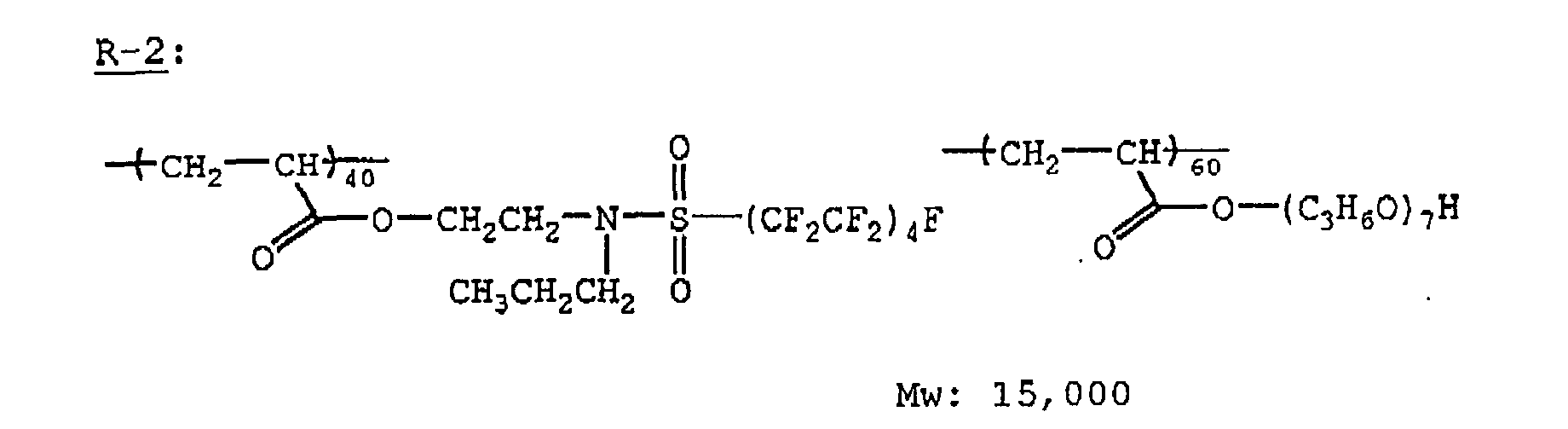
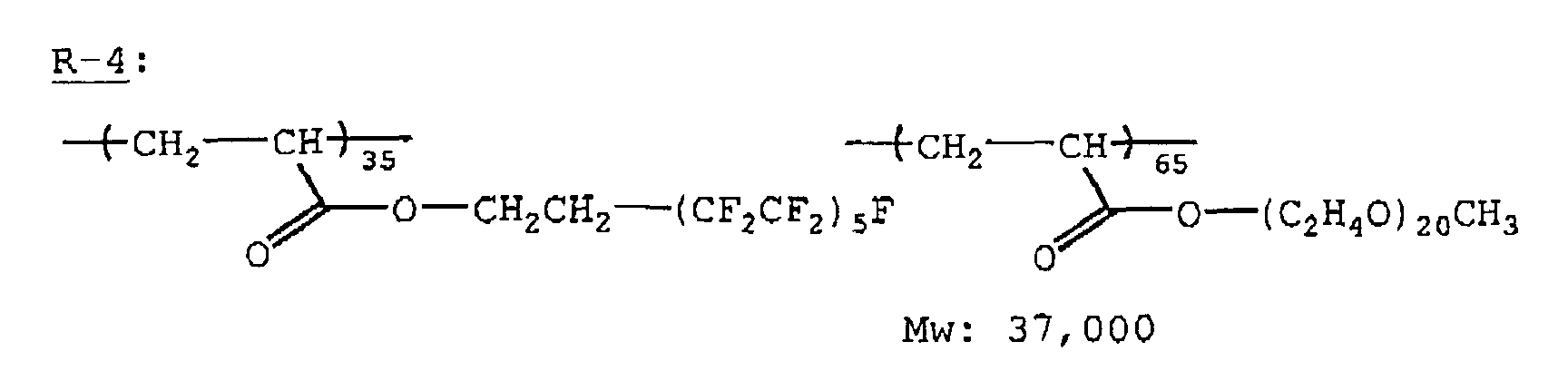
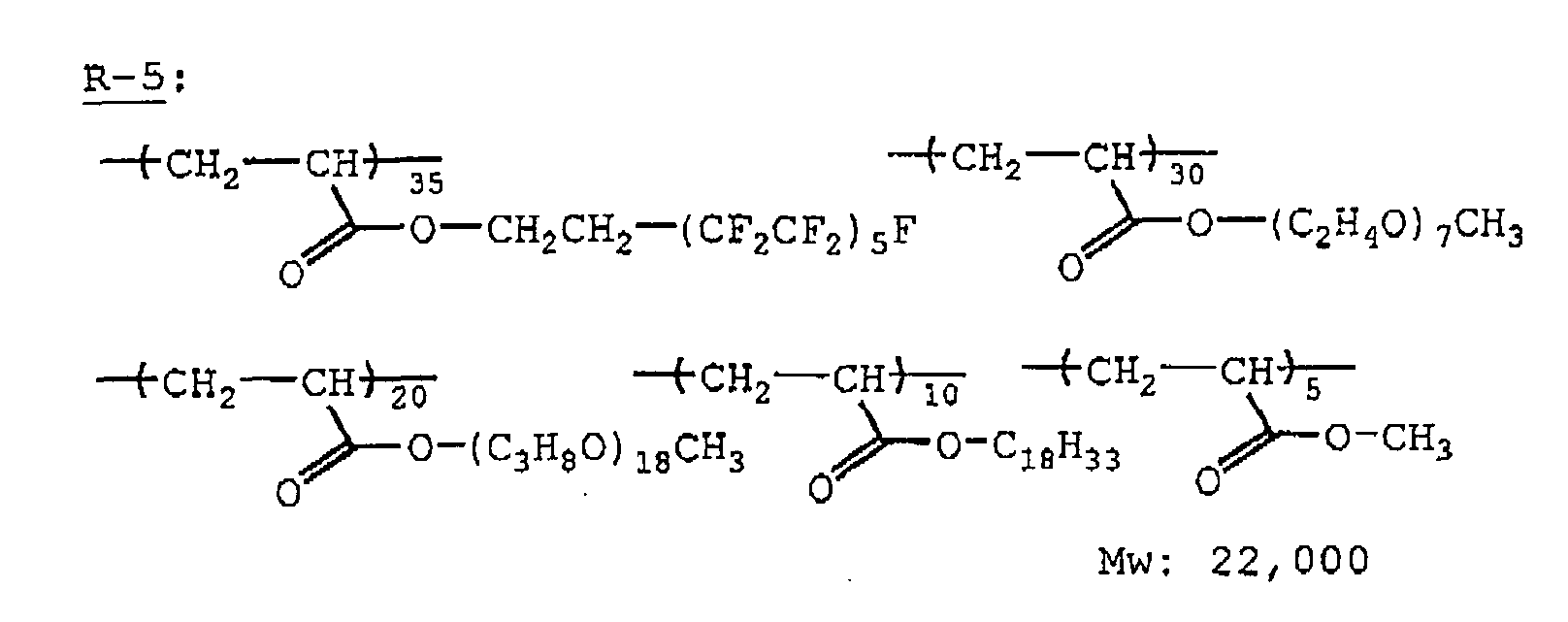
Specific examples of the fluorine-based polymer for
use in the present invention are shown in Table A, however,
the present invention is not limited thereto. In formulae,
the numerical value indicates the molar ratio of each
monomer component. In the Table, P-1 to P-20 are examples
of the copolymer of a fluorine-based monomer and a
poly(oxyalkylene) monomer and P-21 to P-40 are examples of
the terpolymer of a fluorine monomer, a poly(oxyalkylene)
monomer and a poly(oxyethylene) monomer.
| No. | Fluorine Monomer | Poly-(oxyalkylene) Monomer | Poly-(oxyethylene) Monomer | Weight Average Molecular Weight |
| P-1 | F-1 | 40 | O-11 | 60 | - | - | 20,000 |
| P-2 | F-1 | 35 | O-13 | 65 | - | - | 20,000 |
| P-3 | F-1 | 45 | O-14 | 55 | - | - | 25,000 |
| P-4 | F-1 | 40 | O-22 | 60 | - | - | 15,000 |
| P-5 | F-1 | 30 | O-26 | 70 | - | - | 30,000 |
| P-6 | F-1 | 25 | O-34 | 75 | - | - | 20,000 |
| P-7 | F-1 | 50 | O-48 | 50 | - | - | 10,000 |
| P-8 | F-1 | 40 | O-60 | 60 | - | - | 20,000 |
| P-9 | F-1 | 30 | O-62 | 70 | - | - | 15,000 |
| P-10 | F-7 | 45 | O-12 | 55 | - | - | 32,000 |
| P-11 | F-7 | 60 | O-43 | 40 | - | - | 18,000 |
| P-12 | F-9 | 40 | O-60 | 60 | - | - | 20,000 |
| P-13 | F-9 | 50 | O-63 | 50 | - | - | 40,000 |
| P-14 | F-2 | 50 | O-61 | 50 | - | - | 38,000 |
| P-15 | F-10 | 40 | O-60 | 60 | - | - | 20,000 |
| P-16 | F-8 | 40 | O-56 | 60 | - | - | 17,000 |
| P-17 | F-2 | 40 | O-33 | 60 | - | - | 8,000 |
| P-18 | F-2 | 65 | O-49 | 35 | - | - | 22,000 |
| P-19 | F-1 | 60 | O-5 | 40 | - | - | 34,000 |
| P-20 | F-1 | 60 | O-6 | 40 | - | - | 36,000 |
| P-21 | F-1 | 40 | O-60 | 50 | O-5 | 10 | 20,000 |
| P-22 | F-1 | 40 | O-62 | 55 | O-6 | 5 | 20,000 |
| P-23 | F-1 | 35 | O-13 | 50 | O-1 | 15 | 25,000 |
| P-24 | F-1 | 40 | O-19 | 50 | O-29 | 10 | 25,000 |
| P-25 | F-1 | 40 | O-24 | 50 | O-30 | 10 | 35,000 |
| P-26 | F-2 | 50 | O-48 | 30 | O-39 | 20 | 25,000 |
| P-27 | F-3 | 40 | O-60 | 40 | O-59 | 20 | 36,000 |
| P-28 | F-5 | 40 | O-60 | 45 | O-55 | 15 | 7,000 |
| P-29 | F-7 | 35 | O-22 | 45 | O-1 | 20 | 45,000 |
| P-30 | F-8 | 30 | O-25 | 60 | O-32 | 10 | 20,000 |
| P-31 | F-9 | 40 | O-60 | 50 | O-37 | 10 | 15,000 |
| P-32 | F-10 | 40 | O-61 | 50 | O-35 | 10 | 20,000 |
| P-33 | F-11 | 50 | O-10 | 40 | O-4 | 10 | 33,000 |
| P-34 | F-11 | 40 | O-9 | 45 | O-3 | 15 | 20,000 |
| P-35 | F-11 | 55 | O-11 | 30 | O-45 | 15 | 15,000 |
| P-36 | F-12 | 40 | O-8 | 50 | O-1 | 10 | 25,000 |
| P-37 | F-12 | 50 | O-33 | 25 | O-29 | 25 | 35,000 |
| P-38 | F-1 | 50 | O-26 | 35 | O-3 | 15 | 28,000 |
| P-39 | F-1 | 50 | O-49 | 35 | O-51 | 15 | 24,000 |
| P-40 | F-1 | 50 | O-18 | 35 | O-29 | 15 | 36,000 |
Other components necessary for the preparation of a
photosensitive resin composition as the composition for the
image-forming layer according to the present invention are
described below.
The photosensitive resin composition containing the
above-described fluorine-based polymer for use in the
present invention contains at least a photosensitive
compound or a light-heat converting agent in addition to
the fluorine-based polymer.
In the case of a positive photosensitive resin
composition, the photosensitive compound may be any
compound insofar as the solubility or swellability in a
developer changes between before and after the exposure but
preferred examples of the compound contained in the resin
composition include an o-quinonediazide compound. For
example, in the case of a positive photosensitive resin
composition containing an alkali-soluble resin and an o-quinonediazide
compound, the o-quinonediazide compound is
preferably a compound having at least one o-quinonediazide
group and capable of increasing the solubility in an alkali
aqueous solution upon irradiation with actinic rays.
Various structures are known therefor and these are
described in detail, for example, in J. KOSAR, Light-Sensitive
Systems, pp. 336-352, John Wiley & Sons, Inc.
(1965). For the photosensitive compound of the positive
photosensitive resin composition, sulfonic acid esters of a
hydroxyl compound of various types and an o-benzoquinonediazide
or o-naphthoquinonediazide are
particularly preferred.
Examples of the o-quinonediazide compound include an
ester of 1,2-naphthoquinone-2-diazide-5-sulfonyl chloride
and phenol·formaldehyde or cresol·formaldehyde resin; an
ester of 1,2-naphthoquinone-2-diazide-5-sulfonyl chloride
and pyrogallol·acetone resin described in U.S. Patent
3,635,709; an ester of 1,2-naphthoquinone-2-diazide-5-sulfonyl
chloride and resorcin-benzaldehyde resin described
in JP-A-63-13528;
an ester of 1,2-naphthoquinone-2-diazide-5-sulfonyl
chloride and resorcin-pyrogallol·acetone co-condensation
resin described in JP-B-62-44257 (the term "JP-B" as used
herein means an "examined Japanese patent publication"); an
esterification product of 1,2-naphthoquinone-2-diazide-5-sulfonyl
chloride to polyester having a hydroxyl group at
the terminal described in JP-B-56-45127; an esterification
product of 1,2-naphthoquinone-2-diazide-5-sulfonyl chloride
to a homopolymer of N-(4-hydroxyphenyl)methacrylamide or a
copolymer with another copolymerizable monomer described in
JP-B-50-24641; an ester of 1,2-naphthoquinone-2-diazide-5-sulfonyl
chloride and bisphenol·formaldehyde resin
described in JP-B-54-29922; an esterification product of
1,2-naphthoquinone-2-diazide-5-sulfonyl chloride to a
homopolymer of p-hydroxystyrene or a copolymer with another
copolymerizable monomer described in JP-B-52-36043; and an
ester of 1,2-naphthoquinone-2-diazide-5-sulfonyl chloride
and polyhydroxybenzophenone.
Other examples of known o-quinonediazide compounds
which can be used in the present invention include those
described in JP-A-63-80254, JP-A-58-5737, JP-A-57-111530,
JP-A-57-111531, JP-A-57-114138, JP-A-57-142635, JP-A-51-36129,
JP-B-62-3411, JP-B-62-51459 and JP-B-51-483. The
content of the o-quinonediazide compound is usually from 5
to 60% by weight, preferably from 10 to 40% by weight,
based on the entire solid content of the photosensitive
resin composition.
The photosensitive compound other than the o-quinonediazide,
which can be used, include a chemical
amplification-type photosensitive material comprising a
combination of a compound having an alkali-soluble group
protected by an acid decomposable group and a photoacid
generator. The photoacid generator used in the chemical
amplification-type photosensitive material may be a known
photoacid generator.
Examples thereof include onium salts such as
diazonium salts described in S.I. Schlesinger, Photogr. Sci.
Eng., 18, 387 (1974), T.S. Bal et al., Polymer, 21, 423
(1980), etc., ammonium salts described in U.S. Patents
4,069,055 and 4,069,056, JP-A-3-140140, etc., phosphonium
salts described in D.C. Necker et al., Macromolecules, 17,
2468 (1984), C.S. Wen et al., Teh, Proc. Conf. Rad. Curing
ASIA, p. 478, Tokyo, Oct. (1988), U.S. Patents 4,069,055
and 4,069,056, etc., iodonium salts described in J.V.
Crivello et al., Macromolecules, 10 (6), 1307 (1977), Chem.
& Eng. News, Nov. 28, p. 31 (1988), European Patents
104,143, 339,049 and 410,201, JP-A-2-150848, JP-A-2-296514,
etc., sulfonium salts described in J.V. Crivello et al.,
Polymer J., 17, 73 (1985), J.V. Crivello et al., J. Org.
Chem., 43, 3055 (1978), W.R. Watt et al., J. Polymer Sci.,
Polymer Chem. Ed., 22, 1789 (1984), J.V. Crivello et al.,
Polymer Bull., 14, 279 (1985), J.V. Crivello et al.,
Macromolecules, 14 (5), 1141 (1981), J.V. Crivello et al.,
J. Polymer Sci., Polymer Chem. Ed., 17, 2877 (1979),
European Patent 370,693, 233,567, 297,443 and 297,442, U.S.
Patents 3,902,114, 4,933,377, 410,201, 339,049, 4,760,013,
4,734,444 and 2,833,827, German Patent 2,904,626, 3,604,580
and 3,604,581, etc.,
selenonium salts described in J.V. Crivello et al.,
Macromolecules, 10 (6), 1307 (1977), J.V. Crivello et al.,
J. Polymer Sci., Polymer Chem. Ed., 17, 1047 (1979), etc.,
and arsonium salts described in C.S. Wen et al., Teh, Proc.
Conf. Rad. Curing ASIA, p. 478, Tokyo, Oct. (1988), etc.;
organic halogen compounds described in U.S. Patent
3,905,815, JP-B-46-4605, JP-A-48-36281, JP-A-55-32070, JP-A-60-239736,
JP-A-61-169835, JP-A-61-169837, JP-A-62-58241,
JP-A-62-212401, JP-A-63-70243, JP-A-63-298339, etc.;
organic metals/organic halides described in K. Meier et al.,
J. Rad. Curing, 13 (4), 26 (1986), T.P. Gill et al., Inorg.
Chem., 19, 3007 (1980), D. Astruc, Acc. Chem. Res., 19 (12),
377 (1896), JP-A-2-161445, etc.; photo-acid generators
having an o-nitrobenzyl type protective group described in
S. Hayase et al., J. Polymer Sci., 25, 753 (1987), E.
Reichmanis et al., J. Polymer Sci., Polymer Chem. Ed., 23,
1 (1985), Q.Q. Zhu et al., J. Photochem., 36, 85, 39, 317
(1987), B. Amit et al., Tetrahedron Lett., (24), 2205
(1973), D.H.R. Barton et al., J. Chem. Soc., 3571 (1965),
P.M. Collins et al., J. Chem. Soc., Perkin I, 1695 (1975),
M. Rudinstein et al., Tetrahedron Lett., (17), 1445 (1975),
J.W. Walker et al., J. Am. Chem. Soc., 110, 7170 (1988),
S.C. Busman et al., J. Imaging Technol., 11 (4), 191 (1985),
H.M. Houlihan et al., Macromolecules, 21, 2001 (1988), P.M.
Collins et al., J. Chem. Soc., Chem. Commun., 532 (1972), S.
Hayase et al., Macromolecules, 18, 1799 (1985), E.
Reichmanis et al., J. Electrochem. Soc., Solid State Sci.
Technol., 130 (6), F.M. Houlihan et al., Macromolecules, 21,
2001 (1988), European Patents 0,290,750, 046,083, 156,535,
271,851 and 0,388,343, U.S. Patents 3,901,710 and 4,181,531,
JP-A-60-198538, JP-A-53-133022, etc.;
compounds which are photochemically decomposed to
generate sulfonic acid, represented by iminosulfonate,
described in M. TUNOOKA et al., Polymer Preprints Japan, 35
(8), G. Berner et al., J. Rad. Curing, 13 (4), W.J. Mijs et
al., Coating Technol., 55 (697), 45 (1983), Akzo, H. Adachi
et al., Polymer Preprints, Japan, 37 (3), European Patents
0,199,672, 84,515, 199,672, 044,115 and 0,101,122, U.S.
Patents 4,618,564, 4,371,605 and 4,431,774, JP-A-64-18143,
JP-A-2-245756, Japanese Patent Application No. 3-140109,
etc.; and disulfone compounds described in JP-A-61-166544.
The compound which decomposes upon irradiation with
actinic rays or radiation to generate an acid is usually
added in an amount of 0.001 to 40% by weight, preferably
from 0.01 to 20% by weight, more preferably from 0.1 to 5%
by weight, based on the total weight (exclusive of the
coating solvent) of the photosensitive resin composition.
The compound having an alkali-soluble group protected
by an acid decomposable group is a compound having a -C-O-C-
or -C-O-Si- bond and examples thereof include the
followings:
The compounds (a) capable of cleaving under the
action of an acid, as a component of a light-irradiation
sensitive mixture, are described in German Patents
2,610,842 and 2,928,636. Mixtures containing the compound
(b) is described in German Patents 2,306,248 and 2,718,254.
The compounds (c) are described in Europe Patent
Publications 0,006,626 and 0,006,627, the compounds (d) are
described in Europe Patent 0,202,196, the compounds (e) are
described in German Patents 3,544,165 and 3,601,264, the
compounds (f) are described in German Patents 3,730,785 and
3,730,783, the compounds (g) are described in German Patent
3,730,783, the compounds (h) are described, for example, in
U.S. Patent 4,603,101, and the compounds (i) are described,
for example, in U.S. Patent 4,491,628 and J.M. Frechet, J.
Imaging Sci., 30, 59-64 (1986)).
The content of the compound protected by such an acid
decomposable group is usually from 1 to 60% by weight,
preferably from 5 to 40% by weight, based on the entire
solid content of the photosensitive resin composition.
The photosensitive resin composition may contain a
synthetic resin which is insoluble in water and soluble in
an alkaline aqueous solution (hereinafter referred to as an
"alkali-soluble resin"). Examples of the alkali-soluble
resin include phenol-formaldehyde resin, cresol·formaldehyde
resin, phenol·cresol·formaldehyde co-condensation
resin, phenol-modified xylene resin, polyhydroxystyrene,
halogenated polyhydroxystyrene, a copolymer of N-(4-hydroxyphenyl)methacrylamide,
a hydroquinone monomethacrylate
copolymer, sulfonylimide-type polymers
described in JP-A-7-28244 and carboxyl group-containing
polymers described in JP-A-7-36184. In addition, various
alkali-soluble polymer compounds such as acrylic resin
having a phenolic hydroxyl group described in JP-A-51-34711,
acrylic resin having a sulfonamide group described in JP-A-2-866
and a urethane-based resin may also be used. The
alkali-soluble resin or polymer compound preferably has a
weight average molecular weight of 500 to 20,000 and a
number average molecular weight of 200 to 60,000. These
alkali-soluble resins or polymer compounds may be used
individually or in combination of two or more thereof and
the amount added thereof is 80% by weight or less based on
the entire solid content of the composition.
A combination use with a condensation product of a
phenol containing a substituent of an alkyl group having
from 3 to 8 carbon atoms with formaldehyde, such as t-butylphenol
formaldehyde resin and octylphenol formaldehyde
resin, described in U.S. Patent 4,123,279 is advantageous
from the standpoint of enhancing the ink-receptivity of an
image. This alkali-soluble resin is usually added in an
amount of 90% by weight or less based on the entire solid
content of the composition.
The photosensitive resin composition may contain, if
desired, a cyclic acid anhydride for elevating the
sensitivity, a printing out agent for obtaining a visible
image immediately after the exposure, a dye serving as the
image coloring agent, a filler and the like.
The photosensitive resin composition for use in the
present invention preferably contains a cyclic acid
anhydride, a phenol and an organic acid for elevating the
sensitivity. Examples of the cyclic acid anhydride include
phthalic anhydride, tetrahydrophthalic anhydride,
hexahydrophthalic anhydride, 3,6-endoxy-Δ4-tetrahydrophthalic
anhydride, tetrachlorophthalic anhydride, maleic
anhydride, chloromaleic anhydride, α-phenylmaleic anhydride,
succinic anhydride and pyromellitic anhydride described in
U.S. Patent 4,115,128. Examples of the phenols include
bisphenol A, p-nitrophenol, p-ethoxyphenol, 2,3/4-trihydroxybenzophenone,
4-hydroxybenzophenone, 2,4,4'-trihydroxybenzophenone,
4,4',4"-trihydroxytriphenylmethane
and 4,4',3",4"-tetrahydroxy-3,5,3',5'-tetramethyltriphenylmethane.
Examples of the organic acids include sulfonic acids,
sulfinic acids, alkylsulfuric acids, phosphonic acids,
phosphinic acids, phosphates and carboxylic acids described
in JP-A-60-88942 and JP-A-2-96755. Specific examples
thereof include p-toluenesulfonic acid, dodecylbenzenesulfonic
acid, p-toluenesulfinic acid, ethylsulfuric acid,
phenylphosphonic acid, phenylphosphinic acid, phenyl
phosphate, diphenyl phosphate, benzoic acid, isophthalic
acid, adipic acid, p-toluic acid, 3,4-dimethoxybenzoic acid,
phthalic acid, terephthalic acid, 1,4-cyclohexene-2,2-dicarboxylic
acid, erucic acid, lauric acid, n-undecanoic
acid and ascorbic acid. The ratio of these cyclic acid
anhydrides, phenols and organic acids occupying in the
photosensitive resin composition is preferably from 0.05 to
15% by weight, more preferably from 0.1 to 5% by weight,
based on the entire solid content in the composition.
Examples of the printing out agent for obtaining a
visible image immediately after the exposure include a
combination of a photosensitive compound capable of
releasing an acid upon exposure and an organic dye of
forming a salt with the acid and thereby changing the color
tone.
Examples of the photosensitive compound capable of
releasing an acid upon exposure include o-naphthoquinonediazide-4-sulfonic
acid halogenide described in JP-A-50-36209;
trihalomethyl-2-pyrone and trihalomethyl-s-triazine
described in JP-A-53-36223; various o-naphthoquinonediazide
compounds described in JP-A-55-62444; 2-trihalomethyl-5-allyl-1,3,4-oxadiazole
compounds described
in JP-A-55-77742; and diazonium salts. These compounds may
be used individually or in combination and the amount added
thereof is preferably from 0.3 to 15% by weight based on
the entire solid content of the composition.
The photosensitive resin composition for use in the
present invention may contain at least one organic dye
capable of changing the color tone thereof by interacting
with a photolytic product of a compound which photolyzes to
generate an acidic substance. Examples of the organic dye
which can be used include diphenylmethane-based, triallylmethane-based,
thiazine-based, oxazine-based, phenazine-based,
xanthene-based, anthraquinone-based, iminonaphthoquinone-based
and azomethine-based dyes.
Specific examples thereof include Brilliant Green,
eosin, Ethyl Violet, Erythrosine B, Methyl Green, Crystal
Violet, Basic Fuchsine, phenolphthalein, 1/3-diphenyltriazine,
Alizarin Red S, Thymolphthalein, Methyl
Violet 2B, Quinaldine Red, Rose Bengale,
Thymolsulfophthalein, Xylenol Blue, Methyl Orange, Orange
IV, diphenyl thiocarbazone, 2,7-dichlorofluorescein, Para
Methyl Red, Congo Red, Benzopurpurine 4B, α-Naphthyl Red,
Nile Blue 2B, Nile Blue A, phenacetarin, Methyl Violet,
Malachite Green, Para Fuchsine, Oil Blue #603 (produced by
Orient Chemical Industry Co., Ltd.), Oil Pink #312
(produced by Orient Chemical Industry Co., Ltd.), Oil Red
5B (produced by Orient Chemical Industry Co., Ltd.), Oil
Scarlet #308 (produced by Orient Chemical Industry Co.,
Ltd.), Oil Red OG (produced by Orient Chemical Industry Co.,
Ltd.), Oil Red RR (produced by Orient Chemical Industry Co.,
Ltd.), Oil Green #502 (produced by Orient Chemical Industry
Co., Ltd.), Spiron Red BEH Special (produced by Hodogaya
Chemical Co., Ltd.), Victoria Pure Blue BOH (produced by
Hodogaya Chemical Co., Ltd.),
Patent Pure Blue (produced by Sumitomo Mikuni
Chemical Co., Ltd.), Sudan Blue II (produced by BASF), m-Cresol
Purple, Cresol Red, Rhodamine B, Rhodamine 6G, Fast
Acid Violet R, Sulforhodamine B, Auramine, 4-p-diethylaminophenyliminonaphthoquinone,
2-carboxyanilino-4-p-diethylaminophenyliminonaphthoquinone,
2-carbostearylamino-4-p-dihydroxyethyl-aminophenyliminonaphthoquinone,
p-methoxybenzoyl-p'-diethylamino-o'-methylphenyliminoacetanilide,
cyano-p-diethylaminophenyliminoacetanilide, 1-phenyl-3-methyl-4-p-diethylaminophenylimino-5-pyrazolone
and 1-β-naphthyl-4-p-diethylaminophenylimino-5-pyrazolone.
Particularly preferred organic dyes are
triarylmethane dyes. Of triarylmethane dyes, the dyes
described in JP-A-62-2932471 and Japanese Patent
Application No. 4-112844, having a sulfonic acid compound
as the counter anion, are useful. These dyes may be used
individually or as a mixture and the amount added thereof
is preferably from 0.3 to 15% by weight based on the total
weight of the photosensitive resin composition. If desired,
this organic dye may be used in combination with another
dye or pigment and the amount used thereof is 70% by weight
or less, preferably 50% by weight or less, based on the
total weight of the dyes and pigments.
The case where the photosensitive resin composition
for use in the present invention is used for the image-forming
layer (photosensitive layer) of a photopolymerizable
printing plate as a negative printing plate
is described below. In the case where the photosensitive
resin composition is a photopolymerizable photosensitive
resin composition, the main components thereof include a
compound containing an addition-polymerizable ethylenic
double bond and a photopolymerization initiator, in
addition to the above-described fluorine-based polymer. If
desired, compounds such as thermal polymerization inhibitor
may be added.
The compound containing an addition-polymerizable
double bond can be freely selected from the compounds
having at least one, preferably two or more, terminal
ethylenic unsaturated bond(s). Examples thereof include
compounds having a chemical form such as monomer,
prepolymer, namely, dimer, trimer and oligomer, and a
mixture or copolymer thereof. Examples of the monomer and
its copolymer include esters of an unsaturated carboxylic
acid (for example, an acrylic acid, a methacrylic acid, an
itaconic acid, a crotonic acid, an isocrotonic acid or a
maleic acid) and an aliphatic polyhydric alcohol compound,
and an amide of an unsaturated carboxylic acid and an
aliphatic polyvalent amine compound.
Specific examples of the ester monomer of an
aliphatic polyhydric alcohol compound and an unsaturated
carboxylic acid include acrylic acid esters such as
ethylene glycol diacrylate, triethylene glycol diacrylate,
1,3-butanediol diacrylate, tetramethylene glycol diacrylate,
propylene glycol diacrylate, neopentyl glycol diacrylate,
trimethylolpropane triacrylate, trimethylolpropane tri(acryloyloxypropyl)
ether, trimethylolethane triacrylate,
hexanediol diacrylate, 1,4-cyclohexanediol diacrylate,
tetraethylene glycol diacrylate, pentaerythritol diacrylate,
pentaerythritol triacrylate, pentaerythritol tetraacrylate,
dipentaerythritol diacrylate, dipentaerythritol pentaacrylate,
dipentaerythritol hexaacrylate, sorbitol
triacrylate, sorbitol tetraacrylate, sorbitol pentaacrylate,
sorbitol hexaacrylate, tri(acryloyloxyethyl)isocyanurate
and polyester acrylate oligomer;
methacrylic acid esters such as tetramethylene glycol
dimethacrylate, triethylene glycol dimethacrylate,
neopentyl glycol dimethacrylate, trimethylolpropane
trimethacrylate, trimethylolethane trimethacrylate,
ethylene glycol dimethacrylate, 1,3-butanediol
dimethacrylate, hexanediol dimethacrylate, pentaerythritol
dimethacrylate, pentaerythritol trimethacrylate,
pentaerythritol tetramethacrylate, dipentaerythritol
dimethacrylate, dipentaerythritol hexamethacrylate,
dipentaerythritol pentamethacrylate, sorbitol
trimethacrylate, sorbitol tetramethacrylate, bis[p-(3-methacryloxy-2-hydroxypropoxy)phenyl]dimethylmethane
and
bis[p-(methacryloxyethoxy)phenyl]dimethylmethane;
itaconic acid esters such as ethylene glycol
diitaconate, propylene glycol diitaconate, 1,3-butanediol
diitaconate, 1,4-butanediol diitaconate, tetramethylene
glycol diitaconate, pentaerythritol diitaconate and
sorbitol tetraitaconate;
crotonic acid esters such as ethylene glycol
dicrotonate, tetramethylene glycol dicrotonate,
pentaerythritol dicrotonate and sorbitol tetradicrotonate;
isocrotonic acid esters such as ethylene glycol
diisocrotonate, pentaerythritol diisocrotonate and sorbitol
tetraisocrotonate; maleic acid esters such as ethylene
glycol dimaleate, triethylene glycol dimaleate,
pentaerythritol dimaleate and sorbitol tetramaleate; and a
mixture of these ester monomers.
Specific examples of the amide monomer of an
aliphatic polyhydric amine compound and an unsaturated
carboxylic acid include methylenebisacrylamide, methylenebismethacrylamide,
1,6-hexamethylenebisacrylamide, 1,6-hexamethylenebismethacrylamide,
diethylenetriaminetrisacrylamide,
xylylenebisacrylamide and xylylenebismethacrylamide.
Other examples include vinyl urethane compounds
having two or more polymerizable vinyl groups within one
molecule described in JP-B-48-41708, which are obtained by
adding a vinyl monomer having a hydroxyl group represented
by the following formula (A) to a polyisocyanate compound
having two or more isocyanate groups within one molecule:
CH2=C(R5)COOCH2CH(R6)OH
(wherein R5 and R6 each represents H or CH3).
Also, polyfunctional acrylates and methacrylates such
as urethane acrylates described in JP-A-51-37193, polyester
acrylates described in JP-A-48-64183, JP-B-49-43191 and JP-B-52-30490
and epoxy acrylates obtained by reacting an
epoxy resin with a (meth)acrylic acid may be used.
Furthermore, those described as a photocurable monomer or
oligomer in Nippon Secchaku Kyokaishi (Journal of Japan
Adhesive Society), Vol. 20, No. 7, pp. 300-308 (1984) may
be used.
The compound containing such a double bond is used in
an amount of 5 to 70% by weight, preferably from 10 to 50%
by weight, based on the solid content of all components.
The photopolymerization initiator contained in the
photopolymerizable photosensitive resin composition for use
in the present invention may be appropriately selected
according to the wavelength of light source used from
various photopolymerization initiators known in patents and
publications, and combination systems (photopolymerization
initiation systems) of two or more photopolymerization
initiators. For example, in the case of using light in the
vicinity of 400 nm as the light source, benzyl, benzoin
ether, Michler's ketone, anthraquinone, thioxanthone,
acridine, phenazine and benzophenone are being widely used.
In the case of using a visible ray at 400 nm or more,
an Ar laser, a second harmonic of semiconductor laser or an
SHG-YAG laser as the light source, various photopolymerization
initiation systems have been also proposed.
Examples thereof include a certain kind of photoreducing
dyes described in U.S. Patent 2,850,445, such as Rose
Bengale, eosin and erythrosine, and a combination system of
a dye with a photopolymerization initiator, such as a
composite initiation system of dye and amine (see, JP-B-44-20189),
a combination system of hexaarylbiimidazole,
radical generator and dye (see, JP-B-45-37377), a system of
hexaarylbiimidazole and p-dialkylaminobenzylidene ketone
(see, JP-B-47-2528 and JP-A-54-155292), a system of cyclic
cis-α-dicarbonyl compound and dye (see, JP-A-48-84183), a
system of cyclic triazine and merocyanine dye (see, JP-A-54-151024),
a system of 3-ketocoumarin and activator (see,
JP-A-52-112681 and JP-A-58-15503), a system of biimidazole,
styrene derivative and thiol (see, JP-A-59-140203), a
system of organic peroxide and dye (see, JP-A-59-1504, JP-A-59-140203,
JP-A-59-189340, JP-A-62-174203, JP-B-62-1641
and U.S. Patent 4,766,055), a system of dye and activated
halogen compound (see, JP-A-63-258903 and JP-A-2-63054),
a system of dye and borate compound (see, JP-A-62-143044,
JP-A-62-150242, JP-A-64-13140, JP-A-64-13141, JP-A-64-13142,
JP-A-64-13143, JP-A-64-13144, JP-A-64-17048, JP-A-1-229003,
JP-A-1-298348 and JP-A-1-138204), a system of
dye having a rhodanine ring and radical generator (see, JP-A-2-179643
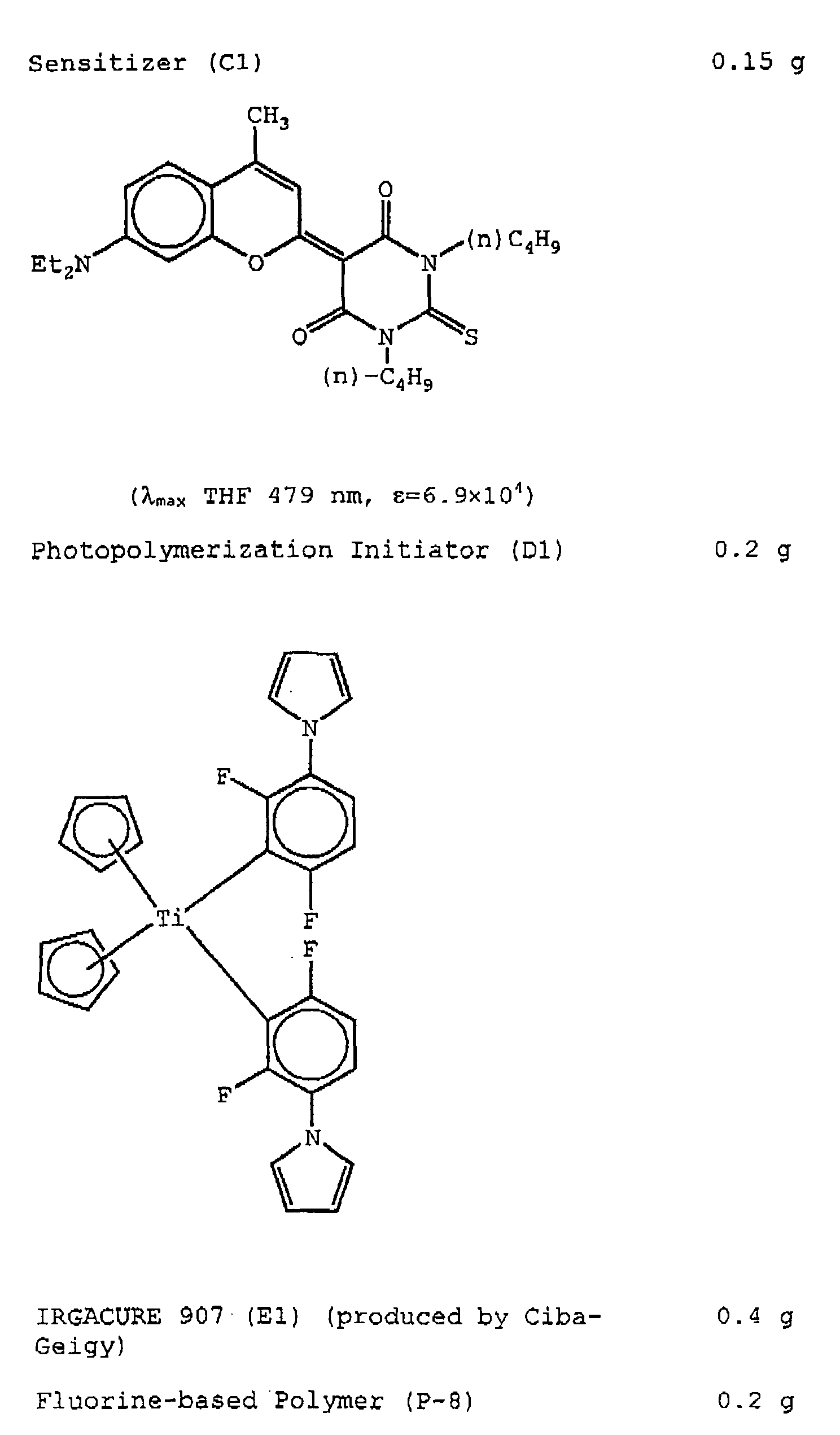
and JP-A-2-244050), a system of titanocene and
3-ketocoumarin dye (see, JP-A-63-221110), a combination
system of titanocene, xanthene dye and addition-polymerizable
ethylenic unsaturated compound containing an
amino group or a urethane group (see, JP-A-4-221958 and JP-A-4-219756),
a system of titanocene and specific
merocyanine dye (see, JP-A-6-295061) and a system of
titanocene and dye having a benzopyran ring (see, JP-A-8-334897).
The photopolymerization initiator may be used in
an amount of 0.05 to 100 parts by weight, preferably from
0.1 to 70 parts by weight, more preferably from 0.2 to 50
parts by weight, per 100 parts by weight of the ethylenic
unsaturated compound.
The photopolymerizable photosensitive resin
composition of the present invention preferably contains,
in addition to the above-described fundamental components,
a small amount of thermal polymerization inhibitor so as to
inhibit unnecessary thermal polymerization of the
polymerizable ethylenic unsaturated compound during the
production or storage of the photosensitive resin
composition. Suitable examples of the thermal
polymerization inhibitor include hydroquinone, p-methoxyphenol,
di-tert-butyl-p-cresol, pyrogallol, tert-butylcatechol,
benzoquinone, 4,4'-thiobis(3-methyl-6-tert-butylphenol),
2,2'-methylenebis(4-methyl-6-tert-butylphenol),
N-nitrosophenylhydroxylamine primary cerium salt
and N-nitrosophenylhydroxylamine aluminum salt. The amount
of the thermal polymerization inhibitor added is preferably
from about 0.01 to about 5% by weight based on the entire
solid content of the composition. Also, if desired, a
higher fatty acid derivative such as behenic acid and
behenic acid amide may be added to allow it to be present
partially on the surface of the image-forming layer during
the drying process after the coating, so that the
polymerization inhibition due to oxygen can be prevented.
The amount of the higher fatty acid derivative added is
preferably from about 0.5 to about 10% by weight of the
entire solid content of the composition.
In the lithographic printing plate where an image-forming
layer is formed using a photopolymerizable
photosensitive resin composition of the present invention,
an oxygen-shielding protective layer may be provided on the
image-forming layer for the purpose of preventing the
polymerization inhibition due to oxygen. Examples of the
water-soluble vinyl polymer contained in the oxygen-shielding
protective layer include polyvinyl alcohol,
partial ester, ether and acetal of polyvinyl alcohol, and a
copolymer thereof containing an unsubstituted vinyl alcohol
unit in a substantial amount of giving necessary water
solubility. Examples of the polyvinyl alcohol include
those having a hydrolysis degree of 71 to 100% and a
polymerization degree of 300 to 2,400.
Specific examples thereof include PVA-105, PVA-110,
PVA-117, PVA-117H, PVA-120, PVA-124, PVA-124H, PVA-CS, PVA-CST,
PVA-HC, PVA-203, PVA-204, PVA-205, PVA-210, PVA-217,
PVA-220, PVA-224, PVA-217EE, PVA-217E, PVA-220E, PVA-224E,
PVA-405, PVA-420, PVA-613 and L-8 produced by Kuraray Go.,
Ltd. Examples of the above-described copolymer include
polyvinyl acetate chloroacetate or propionate hydrolyzed to
88 to 100%, polyvinyl formal, polyvinyl acetal and a
copolymer thereof. Examples of other useful polymers
include polyvinyl pyrrolidone, gelatin and gum arabic.
These may be used individually or in combination.
In the present invention, the solvent for use in
coating the oxygen-shielding protective layer is preferably
pure water, however, an alcohol such as methanol or ethanol,
or a ketone such as acetone or methyl ethyl ketone may also
be mixed with pure water. The solid concentration in
coating solution is suitably from 1 to 20% by weight. The
oxygen-shielding protective layer for use in the present
invention may further contain known additives such as a
surfactant for elevating the coatability, and a water-soluble
plasticizer for improving the physical properties
of film. Examples of the water-soluble plasticizer include
propionamide, cyclohexanediol, glycerin and sorbitol. Also,
a water-soluble (math)acrylic monomer may be added. The
amount of the oxygen-shielding protective layer coated is
suitably from about 0.1/m2 to about 15/m2, more preferably
from 1.0/m2 to about 5.0/m2, in terms of the dry weight.
The present invention can be used not only for the
above-described positive lithographic printing plate
precursor (sometimes called a "positive PS plate") having
an image forming layer formed of a photosensitive resin
composition using a compound having quinonediazide or an
alkali-soluble group protected by an acid decomposable
group or the negative PS plate using a photopolymerization
system but also, for example, for the following
lithographic printing plate materials in the same manner:
In particular, the heat-mode laser direct drawing-type
lithographic printing plates (4) and (5) have high
usefulness because the after-heating which is a problem of
lithographic printing plate precursor commercially
available under the common name of Thermal CTP can be
dispensed with, however, due to heat diffusion to the
substrate or low heat reactivity, the discrimination
between the image area and the non-image area is
disadvantageously deficient and the stability against the
scratching is deficient. The effect of the fluorine-based
polymer for use in the present invention is very useful for
solving the problem of materials suffering from the
deficient discrimination and stability against the
scratching. More specifically, a particularly preferred
practical embodiment of the present invention is "a
lithographic printing plate precursor comprising an
aluminum substrate having provided thereon a photosensitive
layer containing a light-heat converting agent and a binder
resin, wherein the photosensitive layer can be increased or
decreased in the solubility in an alkaline developer upon
exposure to laser rays and contains the fluorine-based
polymer for use in the present invention". A more
preferred embodiment is "a lithographic printing plate
precursor comprising an aluminum substrate having provided
thereon a photosensitive layer containing a light-heat
converting agent, a heat radical generator and a radical
polymerizable compound, wherein the photosensitive layer
can be decreased in the solubility in an alkaline developer
upon exposure to laser rays and contains the fluorine-based
polymer for use in the present invention".
The materials used in respective cases are
sequentially described in detail below.
Examples of the diazo resin for use in (1) include
diazo resin represented by a salt of a condensate between
diazodiarylamine and an activated carbonyl compound. Those
which are photosensitive, water-insoluble and organic
solvent-soluble are preferred.
Particularly suitable examples of the diazo resin
include an organic acid salt or an inorganic acid salt of a
condensate between 4-diazodiphenylamine, 4-diazo-3-methyldiphenylamine,
4-diazo-4'-methyldiphenylamine, 4-diazo-3'-methyldiphenylamine,
4-diazo-4'-methoxydiphenylamine,
4-diazo-3-methyl-4'-ethoxydiphenylamine, 4-diazo-3-methoxydiphenylamine
or the like and formaldehyde, paraformaldehyde,
acetoaldehyde, benzaldehyde and 4,4'-bis-methoxymethyl
diphenyl ether.
Examples of the organic acid used here include
methanesulfonic acid, benzenesulfonic acid, toluenesulfonic
acid, xylenesulfonic acid, mesitylenesulfonic acid,
dodecylbenzenesulfonic acid, naphthalenesulfonic acid,
propylnaphthalenesulfonic acid, 1-naphthol-5-sulfonic acid,
2-nitrobenzenesulfonic acid, 3-chlorobenzenesulfonic acid
and 2-hydroxy-4-methoxybenzophenone-5-sulfonic acid.
Examples of the inorganic acid include hexafluorophosphoric
acid, tetrafluoroboric acid and thiocyanic acid. In
addition, diazo resin having a main chain of polyester
group described in JP-A-54-30121; diazo resin obtained by
reacting a polymer having a carboxylic acid anhydride
residue with a diazo compound having a hydroxyl group
described in JP-A-61-273538; and diazo resin obtained by
reacting a polyisocyanate compound with a diazo compound
having a hydroxyl group may also be used.
The amount of the diazo resin used is preferably from
0 to 40% by weight based on the solid content of the
composition. If desired, two or more diazo resins may be
used in combination. In the preparation of a negative
photosensitive resin composition, an organic polymer binder
is usually used in combination. Examples of the organic
polymer binder include acrylic resin, polyamide resin,
polyester resin, epoxy resin, polyacetal resin, polystyrene
resin and novolak resin. Furthermore, for the purpose of
improving the performance, known additives such as thermal
polymerization preventing agent, dye, pigment, plasticizer
and stability improver may be added.
Suitable examples of the dye include basic oil-soluble
dyes such as Crystal Violet, Malachite Green,
Victoria Blue, Methylene Blue, Ethyl Violet and Rhodamine B.
Examples of the commercially available product include
"Victoria Pure Blue BOH" (produced by Hodogaya Chemical Co.,
Ltd.) and "Oil Blue #603" (produced by Orient Chemical
Industry Co., Ltd.). Examples of the pigment include
Phthalocyanine Blue, Phthalocyanine Green, Dioxazine Violet
and Quinacridone Red.
Examples of the plasticizer include diethyl phthalate,
dibutyl phthalate, dioctyl phthalate, tributyl phosphate,
trioctyl phosphate, tricresyl phosphate, tri(2-chloroethyl)
phosphate and tributyl citrate. Examples of known
stability improvers include phosphoric acid, phosphorous
acid, oxalic acid, tartaric acid, malic acid, citric acid,
dipicolinic acid, polyacrylic acid, benzenesulfonic acid
and toluenesulfonic acid. In general, the amount of these
additives is preferably from 0 to 30% by weight based on
the solid content of the photosensitive resin composition,
though this may vary depending on the use end thereof.
The photo-crosslinking resin for use in (2) is
preferably a photo-crosslinking resin having affinity for
an aqueous alkali developer. Examples of the photo-crosslinking
resin which can be used include a copolymer
having a cinnamic acid group and a carboxyl group described
in JP-B-54-15711; a polyester resin having a phenylenediacrylic
acid residue and a carboxyl group described in
JP-A-60-165646; a polyester resin having a phenylenediacrylic
acid residue and a phenolic hydroxyl group
described in JP-A-60-203630; a polyester resin having a
phenylenediacrylic acid residue and sodium iminodisulfonyl
group described in JP-B-57-41658; a polymer having an azide
group and a carboxyl group on the side chain described in
JP-A-59-208552; and a polymer having a maleimide group on
the side chain.
The alkali-soluble binder and the acid generator for
use in (3) may be the same as the materials used for the
above-described positive PS plate using a compound having
an alkali-soluble group protected by an acid-decomposable
group. The acid (heat)-crosslinkable compound means a
compound which undergoes crosslinking in the presence of an
acid and examples thereof include aromatic compounds and
heterocyclic compounds, which are poly-substituted by a
hydroxymethyl group, an acetoxymethyl group or an
alkoxymethyl group. In particular, compounds obtained by
the condensation of a phenol and an aldehyde under the
basic conditions are preferred. Among these compounds,
preferred are a compound obtained by the condensation of
phenol and formaldehyde under the basic conditions, a
compound obtained in the same manner from m-cresol and
formaldehyde, a compound obtained from bisphenol A and
formaldehyde, a compound obtained from 4,4'-bisphenol and
formaldehyde, and the compounds described as the resol
resin in British Patent 2,082,339.
The acid-crosslinkable compound preferably has a
weight average molecular weight of 500, to 100,000 and a
number average molecular weight of 200 to 50,000. Other
preferred examples include aromatic compounds substituted
by an alkoxymethyl or oxylanylmethyl group disclosed in EP-A-0212482,
monomers, oligomer-melamine-formaldehyde
condensates and urea-formaldehyde condensates disclosed in
EP-A-0133126, DE-A-3634671 and German Patent 3,711,362, and
alkoxy-substituted compounds disclosed in EP-A-0212482.
Still other preferred examples include melamine-formaldehyde
derivatives having at least two free N-hydroxymethyl,
N-alkoxymethyl or N-acyloxymethyl groups.
Among these, N-alkoxymethyl derivatives are particularly
preferred.
A low molecular weight or oligomer silanol can be
used as a silicon-containing crosslinking agent. Examples
thereof include dimethyl- and diphenyl-silane diols, and
oligomers already subjected to precondensation and at the
same time, having such a unit. For example, those
disclosed in EP-A-0377155 can be used. Among the aromatic
compounds and heterocyclic compounds poly-substituted by an
alkoxymethyl group, preferred are compounds having an
alkoxymethyl group at the position adjacent to the hydroxyl
group, where the alkoxy group in the alkoxymethyl group has
18 or less carbon atoms. Particularly preferred examples
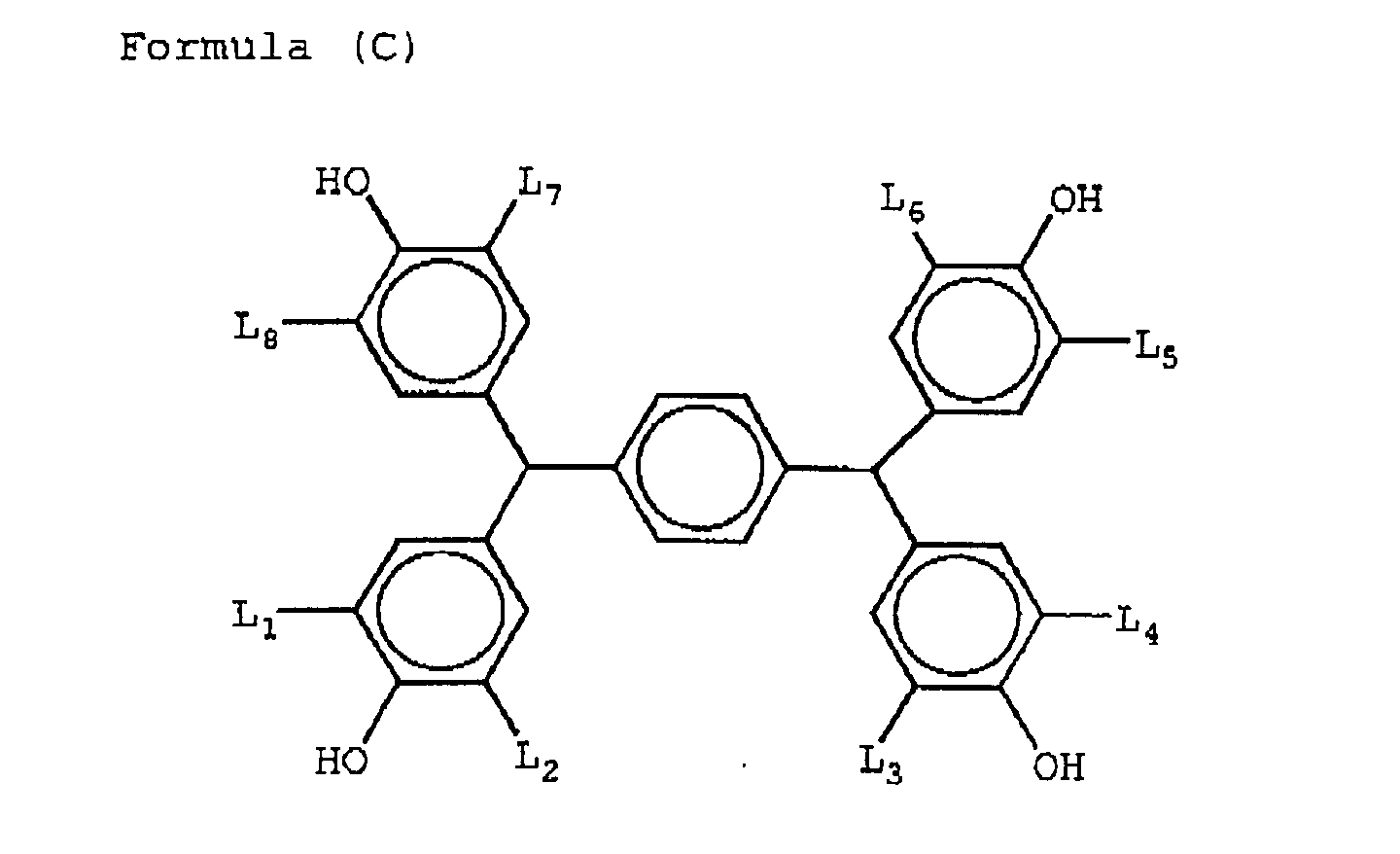
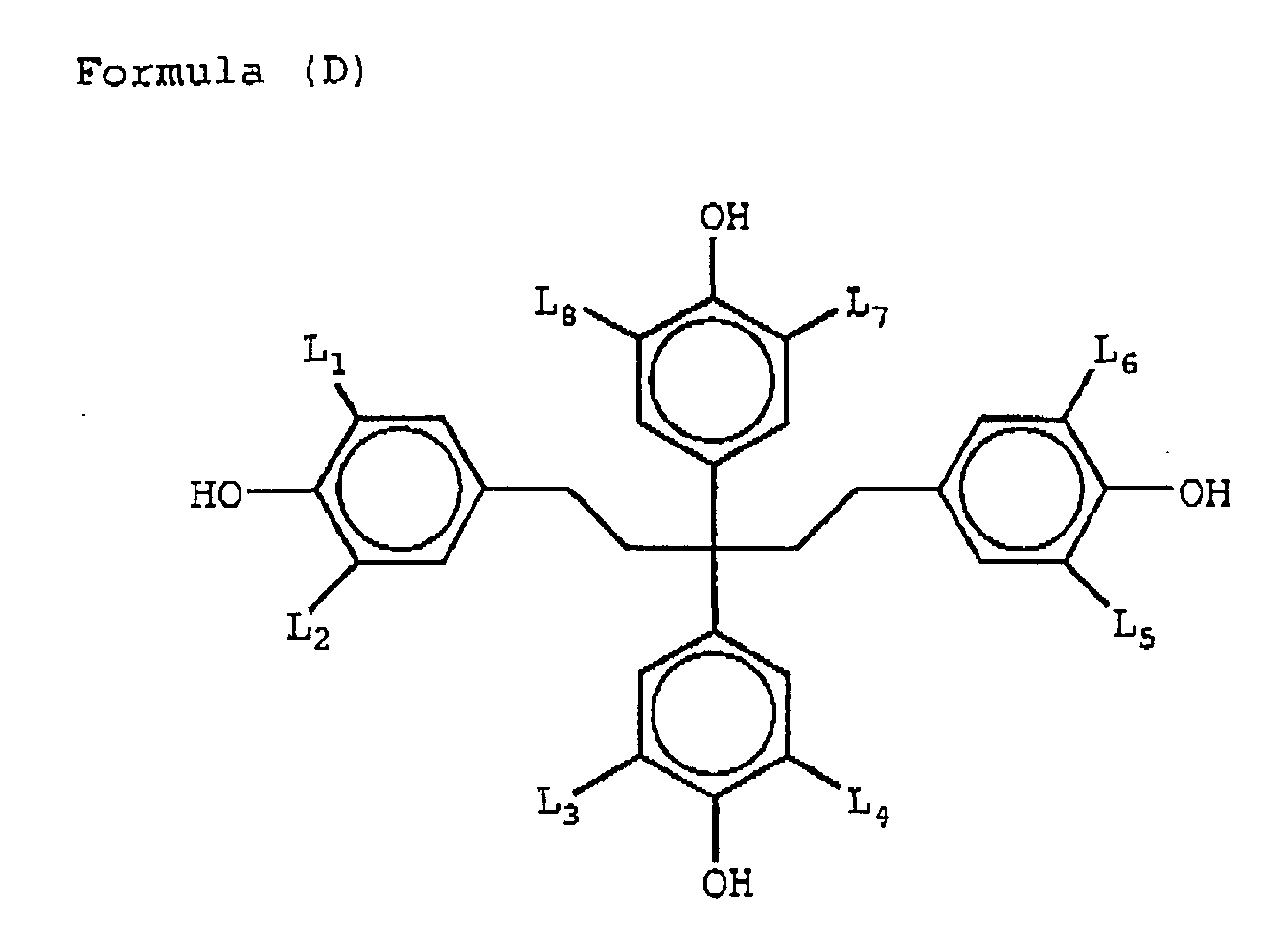
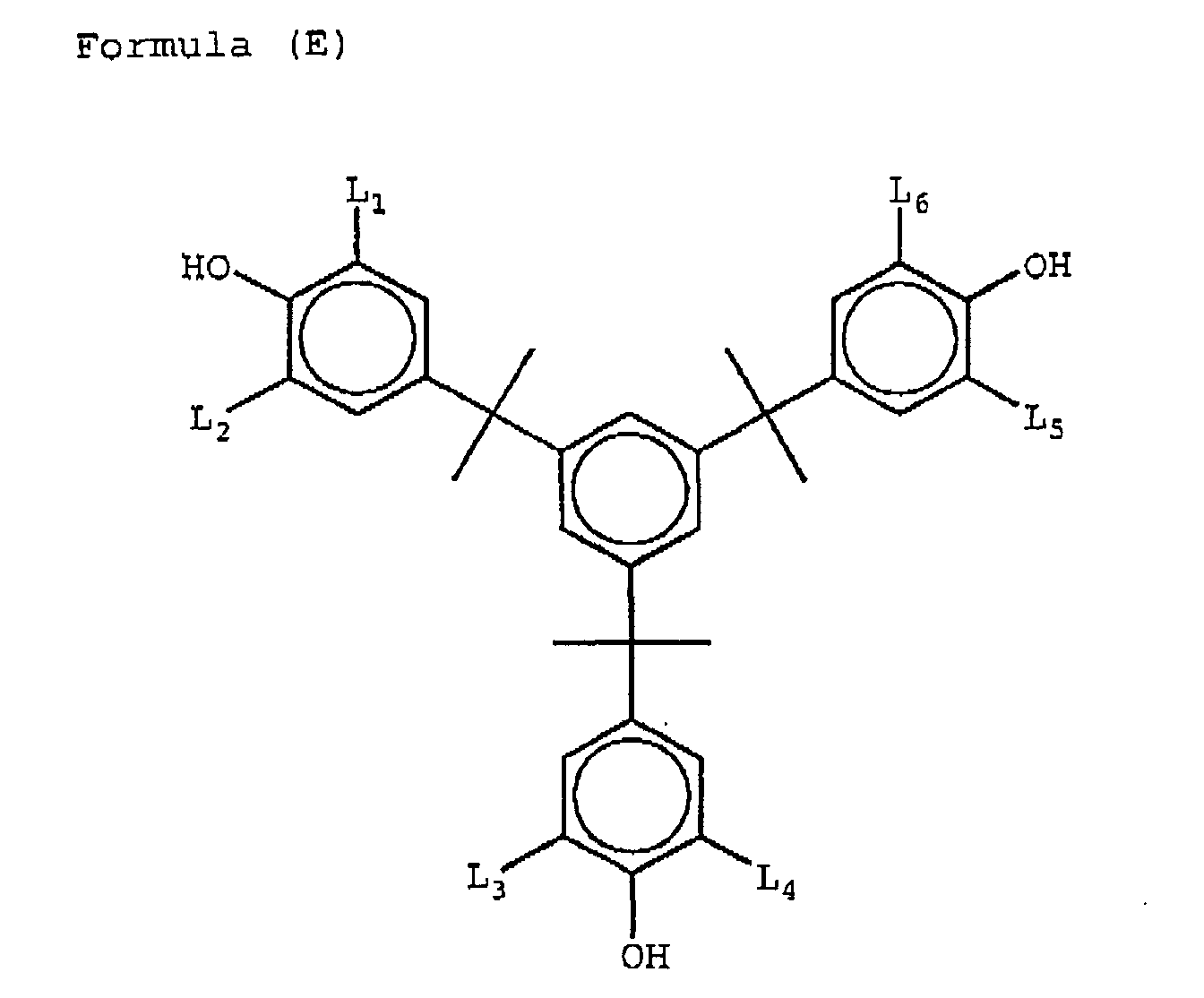
thereof include the compounds represented by the following
formulae (B) to (E):
wherein L
1 to L
8, which may be the same or different, each
represents an alkoxymethyl group substituted by an alkoxy
group having 18 or less carbon atoms, such as methoxymethyl
and ethoxyethyl. These compounds are advantageous in that
the crosslinking efficiency is high and the press life can
be improved. These heat-crosslinking compounds may be used
individually or in combination of two or more thereof.
The acid-crosslinkable compound for use in the
present invention is added in an amount of 5 to 80% by
weight, preferably from 10 to 75% by weight, more
preferably from 20 to 70% by weight, based on the entire
solid content of the image-forming layer. If the amount of
the acid-crosslinkable compound added is less than 5% by
weight, the obtained lithographic printing plate material
is worsened in the durability of the image-forming layer,
whereas if it exceeds 80% by weight, disadvantageous
results may occur in view of the stability during storage.
The alkali-soluble binder for use in (4) may be the
same as the materials used for the above-described positive
PS plate using quinonediazide. For the heat-decomposable
substance which, in the state of being not decomposed,
substantially decreases the solubility of the alkali-soluble
binder, various onium salts and quinonediazide
compounds are used because of their excellent activity of
decreasing the solubility of the alkali-soluble binder.
Examples of the onium salt include diazonium salts,
ammonium salts, phosphonium salts, iodonium salts,
sulfonium salts, selenonium salts and arsonium salts.
Suitable examples of the onium salt for use in the
present invention include diazonium salts described in S.I.
Schlesinger, Photogr. Sci. Eng., 18, 387 (1974), T.S. Bal
et al., Polymer, 21, 423 (1980), JP-A-5-158230, etc.,
ammonium salts described in U.S. Patents 4,069,055 and
4,069,056, JP-A-3-140140, etc., phosphonium salts described
in D.C. Necker et al., Macromolecules, 17, 2468 (1984), C.S.
Wen et al., Teh, Proc. Conf. Rad. Curing ASIA, p. 478,
Tokyo, Oct. (1988), U.S. Patents 4,069,055 and 4,069,056,
etc., iodonium salts described in J.V. Crivello et al.,
Macromolecules, 10 (6) 1307 (1977), Chem. & Eng. News, Nov.
28, p. 31. (1988), European Patent 104,143, U.S. Patents
339,049 and 410,201, JP-A-2-150848, JP-A-2-296514, etc.,
sulronium salts described in J.V. Crivello et al.,
Polymer J., 17, 73 (1985), J.V. Crivello et al., J. Org.
Chem., 43, 3055 (1978), W.R. Watt et al., J. Polymer Sci.,
Polymer Chem. Ed., 22, 1789 (1984), J.V. Crivello et al.,
Polymer Bull., 14, 279 (1985), J.V. Crivello et al.,
Macromolecules, 14 (5), 1141 (1981), J.V. Crivello et al.,
J. Polymer Sci., Polymer Chem. Ed., 17, 2877 (1979),
European Patents 370,693, 233,567, 297,443 and 297,442, U.S.
Patents 3,902,114, 4,933,377, 410,201, 339,049, 4,760,013,
4,734,444 and 2,833,827, German Patent 2,904,626, 3,604,580
and 3,604,581, JP-A-7-28237, etc., selenonium salts
described in J.V. Crivello et al., Macromolecules, 10 (6),
1307 (1977), J.V. Crivello et al., J. Polymer Sci., Polymer
Chem. Ed., 17, 1047 (1979), etc., and arsonium salts
described in C.S. Wen et al., Teh, Proc. Conf. Rad. Curing
ASIA, p. 478, Tokyo, Oct. (1988), etc.
Among these, diazonium salts are preferred in the
present invention. Suitable diazonium salts include those
described in JP-A-5-158230. Suitable quinonediazides
include o-quinonediazide compounds.
The o-quinonediazide compound for use in the present
embodiment is a compound having at least one o-quinonediazide
group, which increases in the alkali
solubility by the thermal decomposition. For this compound,
those having various structures may be used. The o-quinonediazide
compound improves the solubility of the
photosensitive system by virtue of two effects, namely,
that the o-quinonediazide compound loses the function of
preventing the dissolution of the alkali-soluble binder and
that the o-quinonediazide compound itself is changed into
an alkali-soluble substance. For the o-quinonediazide
compound for use in the present invention, for example, the
compounds described in J. Koser, Light-Sensitive Systems,
pp. 339-352, John Wiley & Sons. Inc. may be used, but
particularly, sulfonic acid esters and sulfonic amides of
o-quinonediazide obtained by the reaction with various
aromatic polyhydroxy compounds or aromatic amino compounds
are preferred. In addition, esters of benzoquinone-(1,2)-diazidesulfonic
acid chloride or naphthoquinone-(1,2)-diazide-5-sulfonic
acid chloride with pyrogallol-acetone
resin described in JP-B-43-28403, and esters of
benzoquinone-(1,2)-diazidesulfonic acid chloride or
naphthoquinone-(1,2)-diazide-5-sulfonic acid chloride with
phenol-formaldehyde resin described in U.S. Patents
3,046,120 and 3,188,210 may be suitably used.
Furthermore, esters of naphthoquinone-(1,2)-diazide-4-sulfonic
acid chloride with phenol-formaldehyde resin or
cresol-formaldehyde resin, and esters of naphthoquinone-(1,2)-diazide-4-sulfonic
acid chloride with pyrogallol-acetone
resin may also be suitably used. Other useful
examples of the o-quinonediazide compound include those
described in a large number of patents and publications
such as JP-A-47-5303, JP-A-48-63802, JP-A-48-63803, JP-A-48-96575,
JP-A-49-38701, JP-A-48-13354, JP-B-41-11222, JP-B-45-9610,
JP-B-49-17481, U.S. Patents 2,797,213, 3,454,400,
3,544,323, 3,573,917, 3,674,495 and 3,785,825, British
Patents 1,227,602, 1,251,345, 1,267,005, 1,329,888 and
1,330,932, and German Patent 854,890.
The amount added of the o-quinonediazide compound for
use in the present invention is preferably from 1 to 50% by
weight, more preferably from 5 to 30% by weight, still more
preferably from 10 to 30% by weight, based on the entire
solid content of the lithographic printing plate material.
These compounds may be used individually but may also be
used as a mixture of a few compounds thereof. If the
amount of the o-quinonediazide compound added is less than
1% by weight, the image recording property may change for
the worse, whereas if it exceeds 50% by weight, the image
area may deteriorate in the durability or the sensitivity
may decrease.
Examples of the counter ion of the onium salt include
tetrafluoroboric acid, hexafluorophosphoric acid, triisopropylnaphthalenesulfonic
acid, 5-nitro-o-toluenesulfonic
acid, 5-sulfosalicylic acid, 2,5-dimethylbenzenesulfonic
acid, 2,4,6-trimethylbenzenesulfonic acid, 2-nitrobenzenesulfonic
acid, 3-chlorobenzenesulfonic acid, 3-bromobenzenesulfonic
acid, 2-fluorocaprylnaphthalenesulfonic
acid, dodecylbenzenesulfonic acid, 1-naphthol-5-sulfonic
acid, 2-methoxy-4-hydroxy-5-benzoyl-benzenesulfonic
acid and para-toluenesulfonic acid. Among these,
preferred are alkylaromatic sulfonic acids such as
hexafluorophosphoric acid, triisopropylnaphthalenesulfonic
acid and 2,5-dimethylbenzenesulfonic acid. The amount
added of the above-described compound other than the o-quinonediazide
compound is preferably from 1 to 50% by
weight, more preferably from 5 to 30% by weight, still more
preferably from 10 to 30% by weight, based on the entire
solid content of the lithographic printing plate material.
Specific examples of the raw materials for use in (5)
include those described above as examples for the
photopolymerization system. Many photopolymerization
initiators are useful also as a heat radical generator. In
addition, azobis compounds (e.g., azobisisobutyronitrile),
diazonium compounds and the like may also be used as a
thermal polymerization initiator. The addition-polymerizable
compounds may be also common. The light-heat
converting agent may be any substance insofar as it can
absorb light of the exposure light source and therefore,
dyes exemplified with respect to the photopolymerization
system may all be applied. However, the high-output laser
light used actually for the heat-mode exposure is
predominantly a (near) infrared light source of 750 nm or
more. Various IR absorbents may be available, however,
heptamethine cyanine dyes, phthalocyanines, carbon black
and the like are most preferred.
According to various purposes, the photosensitive
resin composition for use in the present invention may
further contain various additives, for example, a resin
having a hydrophobic group for improving the inking
property of image, such as octylphenol·formaldehyde resin,
tert-butylphenol·formaldehyde resin, tert-butylphenol·benzaldehyde
resin, rosin-modified novolak resin, o-naphthoquinonediazidesulfonic
acid ester of the modified
novolak resin; and a plasticizer for improving the
flexibility of the coating film, such as dibutyl phthalate,
dioctyl phthalate, butyl glycolate, tricresyl phosphate and
dioctyl adipate. The amount added of these additives is
preferably from 0.01 to 30% by weight based on the entire
solid content of the composition.
Furthermore, the composition may contain a known
resin for more improving the abrasion resistance of the
film. Examples of this resin include polyvinyl acetal
resin, polyurethane resin, epoxy resin, vinyl chloride
resin, nylon, polyester resin and acrylic resin. These
resins may be used individually or in combination. The
amount added thereof is preferably from 2 to 40% by weight
based on the entire solid content of the composition.
The photosensitive resin composition for use in the
present invention may contain an anionic surfactant
described in JP-A-62-251740 and JP-A-4-68355, or an
amphoteric surfactant described in JP-A-59-121044 and JP-A-4-13149.
Specific examples of the anionic surfactant
include sorbitan tristearate, sorbitan monopalmitate,
sorbitan trioleate, stearic acid monoglyceride,
polyoxyethylene sorbitan monooleate and polyoxyethylene
nonylphenyl ether, and specific examples of the amphoteric
surfactant include alkyldi(aminoethyl) glycine,
alkylpolyaminoethylglycine hydrochloride, Amorgen K (trade
name, produced by Dai-ich Kogyo Co., Ltd., N-tetradecyl-N,N-betaine
type), 2-alkyl-N-carboxyethyl-N-hydroxyethylimidazolium
betaines and Lebon 15 (trade name, produced by
Sanyo Chemical Industries Co., Ltd., alkylimidazoline type).
The proportion of the nonionic surfactant or amphoteric
surfactant occupying in the photosensitive resin
composition is preferably from 0.05 to 15% by weight, more
preferably from 0.1 to 5% by weight, based on the entire
solid content of the composition.
Improvement of Coated Surface Property:
The photosensitive resin composition of the present
invention may contain a surfactant for improving the coated
surface property, for example, the fluorine-based
surfactant described in JP-A-62-170950 can be added. The
amount added thereof is preferably from 0.001 to 1.0% by
weight, more preferably from 0.005 to 0.5% by weight, based
on the entire photosensitive resin composition (the entire
solid content).
Furthermore, the photosensitive resin composition for
use in the present invention may contain a yellow dye,
preferably a yellow dye such that the absorbance at 417 nm
is at least 70% of the absorbance at 436 nm.
In preparing a photosensitive material for a
lithographic printing plate from a photosensitive resin
composition comprising a fluorine-based polymer according
to the present invention, the photosensitive resin
composition is provided on a support to form an image-forming
layer. More specifically, the photosensitive resin
composition is dissolved or dispersed in a single or mixed
solvent described below, coated on a support and then dried.
Although any commonly known organic solvent may be used,
those having a boiling point of 40 to 200°C, particularly
from 60 to 160°C, are selected in view of advantage at the
drying. Of course, it is preferred to select a solvent
which can dissolve the surfactant for use in the present
invention.
Examples of the organic solvent include alcohols such
as methyl alcohol, ethyl alcohol, n- or iso-propyl alcohol,
n- or iso-butyl alcohol and diacetone alcohol; ketones such
as acetone, methyl ethyl ketone, methyl propyl ketone,
methyl butyl ketone, methyl amyl ketone, methyl hexyl
ketone, diethyl ketone, diisobutyl ketone, cyclohexanone,
methylcyclohexanone and acetylacetone; hydrocarbons such as
benzene, toluene, xylene, cyclohexane and methoxybenzene;
acetic acid esters such as ethyl acetate, n- or iso-propyl
acetate, n- or iso-butyl acetate, ethylbutyl acetate and
hexyl acetate; halides such as methylene dichloride,
ethylene dichloride and monochlorobenzene; ethers such as
isopropyl ether, n-butyl ether, dioxane, dimethyldioxane
and tetrahydrofuran;
polyhydric alcohols and derivatives thereof such as
ethylene glycol, methyl cellosolve, methyl cellosolve
acetate, ethyl cellosolve, diethyl cellosolve, cellosolve
acetate, butyl cellosolve, butyl cellosolve acetate,
methoxymethoxyethanol, diethylene glycol monomethyl ether,
diethylene glycol dimethyl ether, diethylene glycol methyl
ethyl ether, diethylene glycol diethyl ether, propylene
glycol, propylene glycol monomethyl ether, propylene glycol
monomethyl ether acetate, propylene glycol monoethyl ether,
propylene glycol monoethyl ether acetate, propylene glycol
monobutyl ether and 3-methyl-3-methoxybutanol; and special
solvents such as dimethyl sulfoxide and N,N-dimethylformamide.
These solvents are suitably used
individually or in combination. The solid concentration in
the coating composition is suitably from 2 to 50% by weight.
The composition of the present invention is
preferably coated to a dry weight of 0.3 to 4.0 g/m2 using
a coating method such as roll coating, dip coating, air
knife coating, gravure coating, gravure offset coating,
hopper coating, blade coating, wire doctor coating and
spray coating. As the coated amount is smaller, the
exposure amount for image formation may be smaller but the
film strength decreases. As the coated amount is increased,
the photosensitive film becomes stronger and when used as a
printing plate, a printing plate capable of printing a
larger number of sheets (higher impression capacity) can be
obtained, though a larger amount of exposure is necessary.
The photosensitive resin composition coated on a
support is usually dried with hot air. The drying
temperature is from 30 to 200°C, preferably from 40 to
140°C. The drying temperature may be kept constant during
drying or may be elevated stepwise. In some cases, the
drying with demoisturized air may bring about good results.
The hot air is suitably supplied to the coated surface at a
rate of 0.1 to 30 m/sec, preferably from 0.5 to 20 m/sec.
Matting Layer:
On the surface of the thus-formed image-forming layer,
a matting layer is preferably provided for the purpose of
reducing the evacuating time upon contact exposure using a
vacuum flame and preventing blurring. To speak
specifically, a method of providing a matting layer
described in JP-A-50-125805, JP-B-57-6582 and JP-B-61-28986,
or a method of heat-fusing solid powder described in JP-B-62-62337
may be used.
The support used for a photosensitive lithographic
printing plate and the like is a dimensionally stable
plate-form material and materials heretofore used as a
support of printing plates may be suitably used. Examples
of such a support include paper, paper laminated with
plastic (for example, polyethylene, propylene or
polystyrene), a metal plate such as aluminum (including
aluminum alloy), zinc, iron and copper, a plastic film such
as cellulose diacetate, cellulose triacetate, cellulose
propionate, cellulose butyrate, cellulose acetate butyrate,
cellulose nitrate, polyethylene terephthalate, polyethylene,
polystyrene, polypropylene, polycarbonate and polyvinyl
acetal, and paper or plastic film having laminated or
deposited thereon a metal described above. Among these, an
aluminum plate is preferred. The aluminum plate includes a
pure aluminum plate and an aluminum alloy plate. Various
aluminum alloys can be used and examples thereof include
alloys of aluminum with a metal such as silicon, manganese,
magnesium, chromium, zinc, lead, bismuth and nickel. These
alloy compositions contain not only small amounts of iron
and titanium but also negligibly small amounts of
impurities.
The support is surface-treated, if desired. For
example, in the case of a photosensitive lithographic
printing plate, a hydrophilization treatment is applied to
the support surface. Furthermore, in the case of a support
having a metal surface, particularly aluminum surface, the
support is preferably subjected to a surface treatment such
as graining, soaking in an aqueous solution of sodium
silicate, potassium fluorozirconate, phosphate or the like,
or anodization. An aluminum plate subjected to graining
and then to soaking in an aqueous sodium silicate solution
described in U.S. Patent 2,714,066, and an aluminum plate
subjected to anodization and then to soaking in an aqueous
alkali metal silicate solution described in U.S. Patent
3,181,461 may also be suitably used. The anodization is
performed by passing a current using the aluminum plate as
an anode in an electrolytic solution comprising, for
example, an aqueous or non-aqueous solution of an inorganic
acid such as phosphoric acid, chromic acid, sulfuric acid
or boric acid, or an organic acid such as oxalic acid or
sulfamic acid. These aqueous or non-aqueous solutions may
be used individually or in combination of two or more
thereof.
The silicate electrodeposition described in U.S.
Patent 3,658,662 is also effective. These hydrophilization
treatments are performed not only to render the support
surface hydrophilic but also to prevent a harmful reaction
with the photosensitive resin composition coated thereon or
to improve the adhesion to the image-forming layer. In
advance of the graining of the aluminum plate, the surface
may be subjected to a pre-treatment, if desired, so as to
remove the rolling oil on the surface or reveal the clean
aluminum surface. In the former case, a solvent such as
trichlene, or a surfactant is used and in the latter case,
a method of using an alkali etchant such as sodium
hydroxide and potassium hydroxide is widely used.
With respect to the graining method, mechanical,
chemical and electrochemical methods all are effective.
The mechanical method includes ball polishing, blast
polishing and brush polishing of rubbing a water dispersion
slurry of abrasive such as pumice by a nylon brush. As the
chemical method, a method of soaking the plate in a
saturated aqueous solution of mineral acid aluminum salt
described in JF-A-54-31187 is suitable and as the
electrochemical method, a method of performing a.c.
electrolysis in an acidic electrolytic solution such as
hydrochloric acid, nitric acid or a combination thereof is
preferred. Among these surface roughening methods, a
surface roughening treatment using a combination of
mechanical surface roughening and electrochemical surface
roughening described in JP-A-55-137993 is preferred because
the ink-receptive image can firmly adhere to the support.
The graining by the above-described method is preferably
performed so that the aluminum plate surface can have a
center line surface roughness (Ra) of from 0.3 to 1.0 µm.
The thus-grained aluminum plate is, if desired, washed with
water and subjected to chemical etching.
For the lithographic printing plate precursor of the
present invention, an aluminum support subjected to an
electrochemical surface roughening treatment using an
aqueous solution containing a hydrochloric acid is
particularly preferably used. When a support treated as
such is used, the obtained printing plate can have very
excellent scumming property on the non-image area or
blanket at the time of printing. By using this support in
combination with the image-forming layer having excellent
discrimination between the image area and the non-image
area of the present invention, the excellent scumming
property and long press life can be attained at the same
time.
The support surface-roughened by an electrochemical
treatment using an aqueous solution containing hydrochloric
acid as the electrolytic solution, which is a preferred
practical embodiment of the present invention, is described
in detail below. In the case of an electrochemical
surface-roughening treatment using an electrolytic solution
mainly comprising hydrochloric acid, a double structure is
readily formed, where small pits having an average opening
diameter of 0.01 to a few µm and a depth/average opening
diameter ratio of 0.1 to 0.5 are formed and at the same
time, large corrugations having an average opening diameter
of a few to tens of µm are formed, and this surface-roughened
state is advantageous in view of difficulty in
scumming and press life. The electrolytic solution may
contain, if desired, a nitrate, a chloride, an amine, an
aldehyde, a phosphoric acid, a chromic acid, a boric acid,
an acetic acid, an oxalic acid or the like and among these,
an acetic acid is particularly preferred. In the
electrochemical surface-roughening treatment, the voltage
applied is preferably from 1 to 50 V, more preferably from
5 to 30 V, and the current density (peak value) is
preferably from 5 to 200 A/dm2, more preferably from 20 to
150 A/dm2. The quantity of electricity is, in total
throughout all processing steps, preferably from 10 to
2,000 C/dm2, more preferably from 200 to 1,000 C/dm2. The
temperature is preferably from 10 to 60°C, more preferably
from 15 to 45°C. The frequency is preferably from 10 to
200 Hz, more preferably from 40 to 150 Hz. The
hydrochloric acid concentration is preferably from 0.1 to
5% and the waveform of current used for the electrolysis is
appropriately selected from sine wave, rectangular wave,
trapezoidal wave, serrate wave and the like according to
the objective surface-roughened shape. The wave form is
more preferably a rectangular wave.
The electrochemical surface-roughening treatment
using a hydrochloric acid-containing aqueous solution as
the electrolytic solution can also be used in combination
with a mechanical surface-roughening treatment or an
electrochemical surface-roughening treatment different in
the conditions.
The mechanical surface-roughening treatment is
preferably performed in advance of a dissolution treatment
using the above-described aqueous alkali solution before
the electrochemical surface-roughening treatment. The
method for performing the mechanical surface-roughening
treatment is not particularly limited but brush polishing
and honing polishing are preferred. In the brush polishing,
for example, a cylindrical brush planted with bristles
having a bristle size of 0.2 to 1 mm is rotated and pressed
to the aluminum plate surface while feeding a slurry
prepared by dispersing abrasives in water to the contact
area, thereby performing the surface-roughening treatment.
In the honing polishing, a slurry prepared by dispersing
abrasives in water is ejected under pressure and collided
against the aluminum plate surface from the oblique
direction, thereby performing the surface-roughening
treatment. Furthermore, the mechanical surface-roughening
treatment may also be performed by attaching a previously
surface-roughened sheet to the aluminum plate surface and
applying a pressure thereto to transfer the roughened
surface pattern.
In the case where the mechanical surface-roughening
treatment is performed, the above-described solvent-degreasing
treatment or emulsion-degreasing treatment may
be omitted.
Examples of the electrochemical surface-roughening
treatment under different conditions include a
electrochemical surface-roughening treatment mainly using a
nitric acid.
The acidic aqueous solution mainly comprising a
nitric acid may be those usually used for the
electrochemical surface-roughening treatment using a d.c.
or a.c. current. For example, a solution obtained by
adding at least one of nitric acid compounds such as
aluminum nitrate, sodium nitrate and ammonium nitrate to an
aqueous nitric acid solution having a nitric acid
concentration of 5 to 15 g/liter, to a concentration from
0.01 g/liter to the saturation, may be used. In the acidic
aqueous solution mainly comprising a nitric acid, a metal
or the like contained in the aluminum alloy, such as iron,
copper, manganese, nickel, titanium, magnesium and silicon,
may be dissolved.
The acidic aqueous solution mainly comprising a
nitric acid is preferably a solution containing a nitric
acid, an aluminum salt and a nitrate salt and obtained by
adding aluminum nitrate and ammonium nitrate to an aqueous
nitric acid solution having a nitric acid concentration of
5 to 15 g/liter such that the aluminum ion is from 1 to 15
g/liter, preferably from 1 to 10 g/liter, and the ammonium
ion is from 10 to 300 ppm. These aluminum ion and ammonium
ion spontaneously increase during the electrochemical
surface-roughening treatment. At this time, the liquid
temperature is preferably from 10 to 95°C, more preferably
from 40 to 80°C.
In the surface-roughened support for use in the
present invention, small pits out of the surface-roughened
shapes preferably have an average opening diameter of 0.01
to 3 µm, more preferably from 0.05 to 2 µm, still more
preferably from 0.05 to 1.0 µm. Within this range,
satisfactory printing ensured with difficulty in scumming
and long press life can be attained.
The ratio of the average depth of small pits to the
average opening diameter is preferably from 0.1 to 0.5,
more preferably from 0.1 to 0.3, still more preferably from
0.15 to 0.2. Within this range, the difficulty in scumming
and the press life are prevented from deteriorating at the
printing.
The large corrugations out of the surface-roughened
shapes preferably have an average opening diameter of 3 to
20 µm, more preferably from 3 to 17 µm, still more
preferably from 4 to 10 µm. Within this range, the
difficulty in scumming and the press life are prevented
from deteriorating at the printing and also, the scumming
property advantageously does not deteriorate.
The etching solution is usually selected from aqueous
solutions of base or acid capable of dissolving aluminum.
In this case, the coating formed on the etched surface must
be different from the aluminum derived from the etching
solution component. Preferred examples of the etchant
include, as a basic substance, sodium hydroxide, potassium
hydroxide, trisodium phosphate, disodium phosphate,
tripotassium phosphate and dipotassium phosphate; and as an
acidic substance, sulfuric acid, persulfuric acid,
phosphoric acid, hydrochloric acid and salts thereof.
However, metals less ionizable than aluminum, such as salts
of zinc, chromium, cobalt, nickel or copper, are not
preferred because an unnecessary film is formed on the
etching surface. The etchant is most preferably used such
that the aluminum or alloy used dissolves at a rate of 0.3
to 40 g/m2 per the soaking time of 1 minute with the
concentration and the temperature used. The dissolution
rate, however, may be in excess of or less than this range.
Etching is performed by soaking the aluminum plate in
the above-described etching solution or coating the etching
solution on the aluminum plate, and the etching treatment
is preferably performed to have an etching amount of 0.5 to
1.0 g/m2. The etchant is preferably an aqueous solution of
a base because of its high etching rate.. In this case, smut
is generated and therefore, the plate is usually subjected
to a desmutting treatment. Examples of the acid for use in
the desmutting treatment include nitric acid, sulfuric acid,
phosphoric acid, chromic acid, hydrofluoric acid and
borofluoric acid. The etched aluminum plate is, if desired,
subjected to water washing and anodization. The anodization
may be performed by a method conventionally used in this
field. To speak specifically, a d.c. or a.c. current is
passed to aluminum in an aqueous or non-aqueous solution of
sulfuric acid, phosphoric acid, chromic acid, oxalic acid,
sulfamic acid, benzenesulfonic acid or a combination of two
or more thereof, whereby an anodic oxide film can be formed
on the aluminum support surface.
The anodization treatment conditions vary depending
on the electrolytic solution used and cannot be
indiscriminately specified, however, suitable conditions
are generally such that the electrolytic solution
concentration is from 1 to 80% by weight, the liquid
temperature is from 5 to 70°C, the current density is from
0.5 to 60 A/dm2, the voltage is from 1 to 100 V, and the
electrolysis time is from 30 seconds to 50 minutes. Among
the anodization treatments, the method of performing
anodization at a high current density in sulfuric acid
described in British Patent 1,412,768 and the method of
performing anodization using phosphoric acid as the
electrolysis bath described in U.S. Patent 3,511,661 are
preferred. The thus surface roughened and further anodized
aluminum plate may be hydrophilized, if desired. Preferred
examples of the hydrophilization method include a treatment
with an alkali metal silicate such as an aqueous sodium
silicate solution disclosed in U.S. Patents 2,714,066 and
3,181,461, a treatment with potassium fluorozirconate
disclosed in JP-B-36-22063 and a treatment with
polyvinylphosphonic acid disclosed in U.S. Patent 4/153,461.
Organic Undercoat Layer:
In the photosensitive lithographic printing plate of
the present invention, an organic undercoat layer is
preferably provided before coating an image-forming layer,
because the residual image-forming layer in the non-image
area can be reduced. The organic compound for use in the
organic undercoat layer is selected from, for example,
carboxymethyl cellulose, dextrin, gum arabic, amino group-containing
phosphonic acids (e.g., 2-aminoethylphosphonic
acid), organic phosphonic acids (e.g., phenylphosphonic
acid, naphthylphosphonic acid, alkylphosphonic acid,
glycerophosphonic acid, methylenediphosphonic acid,
ethylenediphosphonic acid) which may have a substituent,
organic phosphoric acids (e.g., phenylphosphoric acid,
naphthylphosphoric acid, alkylphosphoric acid,
glycerophosphoric acid) which may have a substituent,
organic phosphinic acids (e.g., phenylphosphinic acid,
naphthylphosphinic acid, alkylphosphinic acid,
glycerophosphinic acid) which may have a substituent, amino
acids (e.g., glycine, β-alanine), and hydrochlorides of
hydroxyl group-containing amine, such as hydrochloride of
triethanolamine. These compounds may be used as a mixture
of two or more thereof.
Also, at least one compound selected from the group
consisting of polymer compounds having a structural unit
represented by poly(p-vinylbenzoate) may be used. Specific
examples thereof include a copolymer of p-vinylbenzoate and
vinyl benzyl triethyl ammonium salt, and a copolymer of p-vinylbenzoate
and vinyl benzyl trimethyl ammonium chloride.
The organic undercoat layer can be formed by the
following method, that is, a method of dissolving the
above-described organic compound in water, an organic
solvent such as methanol, ethanol or methyl ethyl ketone,
or a mixed solvent thereof, coating the obtained solution
on an aluminum plate and then drying the solution or a
method of dissolving the organic compound in water, an
organic solvent such as methanol, ethanol or methyl ethyl
ketone, or a mixed solvent thereof, dipping an aluminum
plate in the obtained solution to allow the organic
compound to adsorb, washing the aluminum plate with water
or the like and then drying the solution to provide an
organic undercoat layer. In the former method, the
solution of the organic compound in a concentration of
0.005 to 10% by weight can be coated by various methods.
For example, any method such as bar coater coating, spin
coating, spray coating and curtain coating may be used. In
the latter method, the concentration of the solution is
from 0.01 to 20% by weight, preferably from 0.05 to 5% by
weight, the dipping temperature is from 20 to 90°C,
preferably 25 to 50°C, and the dipping time is from 0.1
second to 20 minutes, preferably from 2 seconds to 1 minute.
The solution used here may be adjusted to a pH of 1
to 12 using a basic substance such as ammonia,
triethylamine and potassium hydroxide, or an acidic
substance such as hydrochloric acid or phosphoric acid.
For the purpose of improving the tone reproducibility of
the photosensitive lithographic printing plate, a yellow
dye may be added to the solution. Furthermore, a compound
represented by the following formula (a) may also be added.
(HO)x-R5-(COOH)y
wherein R5 represents an arylene group having 14 or less
carbon atoms, which may have a substituent, and x and y
each independently represents an integer of 1 to 3.
Specific examples of the compound represented by formula
(a) include 3-hydroxybenzoic acid, 4-hydroxybenzoic acid,
salicylic acid, 1-hydroxy-2-naphthoic acid, 2-hydroxy-1-naphthoic
acid, 2-hydroxy-3-naphthoic acid, 2,4-dihydroxybenzole
acid and 10-hydroxy-9-anthracene carboxylic acid.
The dry coverage of the organic undercoat layer is suitably
from 1 to 200 mg/m2, preferably from 2 to 70 mg/m2. If the
coverage is less than 2 mg/m2, sufficiently high printing
impression cannot be obtained. The same results if the
coverage exceeds 100 mg/m2.
Backcoat:
On the back surface of the support, a backcoat is
provided, if desired. Examples of the backcoat which is
preferably used include a coating layer comprising an
organic polymer compound described in JP-A-5-45885 and a
coating comprising a metal oxide obtained by the hydrolysis
and polycondensation of an organic or inorganic metal
compound described in JP-A-6-35174. Of these coating
layers, a coating layer comprising a metal oxide obtained
from an alkoxy compound of silicon, such as Si(OCH3)4,
Si(OC2H5)4, Si(OC3H7)4 and Si(OC4H9)4, is preferred because
the silicon compound is inexpensive and easily available
and the resistance to developer is high.
The thus-manufactured lithographic printing plate is
usually subjected to image exposure and development
processing. Examples of the light source for an actinic
ray used for the image exposure include a mercury lamp, a
metal halide lamp, a xenon lamp, a chemical lamp and a
carbon arc lamp. Examples of the radiation include
electron beam, X ray, ion beam and far infrared ray. Also,
g-line, i-line, deep-UV light and high-density energy beam
(laser beam) may be used. Examples of the laser beam
include helium/neon laser, argon laser, krypton laser,
helium/cadmium laser, and KrF excimer laser. In the case
of a laser direct drawing-type printing print, a light
source emitting light having an emission wavelength from
near infrared to infrared is preferred, and solid laser and
semiconductor laser are more preferred.
Examples of the developer for use in the present
invention include the developers described in JP-B-57-7427.
The developer is suitably an aqueous solution of an
inorganic alkali agent such as sodium silicate, potassium
silicate, sodium hydroxide, potassium hydroxide, lithium
hydroxide, sodium tertiary phosphate, sodium secondary
phosphate, ammonium tertiary phosphate, ammonium secondary
phosphate, sodium metasilicate, sodium bicarbonate and
aqueous ammonia, or an organic alkali agent such as
monoethanolamine or diethanolamine. The developer is added
such that the alkali solution has a concentration of 0.1 to
10% by weight, preferably from 0.5 to 5% by weight.
The lithographic printing plate of the present
invention is useful particularly when a developer
containing substantially no silicate is used. The
developer containing silicate can elevate the
discrimination between the image area and the non-image
area and is being widely used but has a problem in that
insoluble scum is generated with use over a long period of
time, the pH of the developer is limited to high pH and
this is not preferred in view of working environment. By
incorporating the fluorine-based polymer for use in the
present invention, a sufficiently distinct discrimination
can be obtained without using a silicate developer. That
is, a preferred practical embodiment is "a plate-making
method comprising imagewise exposing a lithographic
printing plate precursor having an image-forming layer
containing the fluorine-based polymer for use in the
present invention and processing the plate precursor with a
developer containing substantially no silicate". The
"developer containing substantially no silicate" as used
herein means a developer having an SiO2 content of 0.5% by
weight or less, preferably 0.1% by weight or less, more
preferably 0.01% by weight or less.
The developer for the lithographic printing plate
using the photosensitive resin composition of the present
invention is preferably a developer containing (a) at least
one sugar selected from non-reducing sugars and (b) at
least one base and having a pH of 9.0 to 13.5. This
developer is described in detail below. Unless otherwise
indicated, the term "developer" as used herein means not
only a development initiating solution (developer in a
narrow sense) but also a developer replenisher.
This developer is preferably constructed such that
the main components comprise at least one compound selected
from non-reducing sugars and at least one base and the pH
of the solution is in the range from 9.0 to 13.5. The
non-reducing sugars are a sugar having no free aldehyde or
ketone group and not showing the reducing property. These
sugars are classified into trehalose-type oligosaccharides
in which reducing groups are bonded to each other,
glycosides in which the reducing group of a sugar is bonded
to a non-sugar, and sugar alcohols obtained by
hydrogenating and thereby reducing a sugar. Any type of
these sugars may be suitably used. The trehalose-type
oligosaccharides include saccharose and trehalose. The
glycoside includes alkyl glycosides, phenol glycosides and
mustard oil glycoside. The sugar alcohol includes D,L-arabitol,
ribitol, xylitol, D,L-sorbitol, D,L-mannitol,
D,L-iditol, D,L-talitol, dulcitol and allodulcitol. In
addition, maltitol obtained by the hydrogenation of a
disaccharide, and a reduced form (reduced sugar) obtained
by the hydrogenation of an oligosaccharide may be suitably
used. Among these non-reducing sugars, sugar alcohol and
saccharose are preferred, and D-sorbitol, saccharose and
reduced sugar are preferred because of their buffering
action in an appropriate pH range and inexpensiveness.
These non-reducing sugars may be used individually or
in combination of two or more thereof. The proportion
thereof occupying in the developer is preferably from 0.1
to 30% by weight, more preferably from 1 to 20% by weight.
If the concentration is less than this range, a
sufficiently high buffering action may not be obtained,
whereas if the concentration exceeds this range,
preparation to a high concentration is difficult, the
material cost disadvantageously rises and furthermore, when
the reducing sugar is used in combination with a base,
discoloration to brown takes place in aging and the pH
gradually lowers, as a result, the developability decreases.
The base used in combination with the non-reducing
sugar includes conventionally known alkali agents.
Examples thereof include inorganic alkali agents such as
sodium hydroxide, potassium hydroxide, lithium hydroxide,
trisodium phosphate, tripotassium phosphate, triammonium
phosphate, disodium phosphate, dipotassium phosphate,
diammonium phosphate, sodium carbonate, potassium carbonate,
ammonium carbonate, sodium hydrogencarbonate, potassium
hydrogencarbonate, ammonium hydrogencarbonate, sodium
borate, potassium borate and ammonium borate, and organic
alkali agents such as monomethylamine, dimethylamine,
trimethylamine, monoethylamine, diethylamine, triethylamine,
monoisopropylamine, diisopropylamine, triisopropylamine, n-butylamine,
monoethanolamine, diethanolamine,
triethanolamine, monoisopropanolamine, diisopropanolamine,
ethyleneimine, ethylenediamine and pyridine.
These alkali agents may be used individually or in
combination of two or more thereof. Among these, preferred
are sodium hydroxide and potassium hydroxide because the pH
can be adjusted over a wide pH range by controlling the
ratio of the alkali agent based on the non-reducing sugar.
Also, trisodium phosphate, tripotassium phosphate, sodium
carbonate and potassium carbonate are preferred because of
their buffering action. The alkali agent is added such
that pH of the developer falls within the range of 9.0 to
13.5. The pH is more preferably from 10.0 to 13.2, though
the amount of the alkali agent added is determined
according to the desired pH and the kind and amount of the
non-reducing sugar added.
In the developer, an alkaline buffer solution
comprising a weak acid exclusive of saccharides and a
strong base may further be used in combination. The weak
acid for use in the buffer solution preferably has a
dissociation constant (pKa) of 10.0 to 13.2. This weak
acid is selected from those described, for example, in
Ionization Constants of Organic Acids in Aqueous Solution,
Pergamon Press. Examples thereof include alcohols such as
2,2,3,3-tetrafluoropropanol-1 (pKa: 12.74), trifluoroethanol
(pKa: 12.37) and trichloroethanol (pKa: 12.24);
aldehydes such as pyridine-2-aldehyde (pKa: 12.68) and
pyridine-4-aldehyde (pKa: 12.05); compounds having a
phenolic hydroxyl group, such as salicylic acid (pKa: 13.0),
3-hydroxy-2-naphthoic acid (pKa: 12.84), catechol (pKa:
12.6), gallic acid (pKa: 12.4), sulfosalicylic acid (pKa:
11.7), 3,4-dihydroxysulfonic acid (pKa: 12.2), 3,4-dihydroxybenzoic
acid (pKa: 11.94), 1,2,4-trihydroxybenzene
(pKa: 11.82), hydroquinone (pKa: 11.56), pyrogallol (pKa:
11.34), o-cresol (pKa: 10.33), resorcinol (pKa: 11.27), p-cresol
(pKa: 10.27) and m-cresol (pKa: 10.09);
oximes such as 2-butanone oxime (pKa: 12.45),
acetoxime (pKa: 12.42), 1,2-cycloheptanedione dioxime (pKa:
12.3), 2-hydroxybenzaldoxime (pKa: 12.10), dimethylglyoxime
(pKa: 11.9), ethanediamide dioxime (pKa: 11.37) and
acetophenone oxime (pKa: 11.35); nucleic acid-related
substances such as adenosine (pKa: 12.56), inosine (pKa:
12.5), guanine (pKa: 12.3), cytosine (pKa: 12.2),
hypoxanthine (pKa: 12.1) and xanthine (pKa: 11.9); and
other weak acids such as diethylaminomethylphosphonic acid
(pKa: 12.32), 1-amino-3,3,3-trifluorobenzoic acid (pKa:
12.29), isopropylidenediphosphonic acid (pKa: 12.10), 1,1-ethylidenediphosphonic
acid (pKa: 11.54), 1-hydroxy-1,1-ethylidenediphosphonate
(pKa: 11.52), benzimidazole (pKa:
12.86), thiobenzamide (pKa: 12.8), picoline thioamide (pKa:
12.55) and barbituric acid (pKa: 12.5).
Among these weak acids, preferred are sulfosalicylic
acid and salicylic acid. The base which is suitably used
in combination with the weak acid includes sodium hydroxide,
ammonium hydroxide, potassium hydroxide and lithium
hydroxide. These alkali agents are used individually or in
combination of two or more thereof. These various alkali
agents are used by selecting the concentration and
combination and thereby adjusting the pH to fall in the
desired range.
If desired, the developer may contain various
surfactants and organic solvents so as to accelerate the
development and improve the dispersion of development scum
or the ink-receptivity of image area on the printing plate.
Preferred surfactant include anionic, cationic, nonionic
and amphoteric surfactants.
Preferred examples of the surfactant include nonionic
surfactants such as polyoxyethylene alkyl ethers,
polyoxyethylene alkylphenyl ethers, polyoxyethylene
polystyrylphenyl ethers, polyoxyethylene-polyoxypropylene
alkyl ethers, fatty acid partial esters of glycerol, fatty
acid partial esters of sorbitan, fatty acid partial esters
of pentaerythritol, propylene glycol mono-fatty acid esters,
fatty acid partial esters of sucrose, fatty acid partial
esters of polyoxyethylene sorbitan, fatty acid partial
esters of polyoxyethylene sorbitol, fatty acid esters of
polyethylene glycol, fatty acid partial esters of
polyglycerol, polyoxyethylated castor oil, fatty acid
partial esters of polyoxyethylene glycerol, fatty acid
diethanolamides, N,N-bis-2-hydroxyalkylamines, polyoxyethylene
alkylamines, fatty acid esters of triethanolamine
and trialkylamine oxides;
anionic surfactants such as fatty acid salts,
abietates, hydroxyalkanesulfonates, alkanesulfonates,
dialkylsulfosuccinates, straight-chained alkylbenzene
sulfonates, branched alkylbenzene sulfonates,
alkylnaphthalene sulfonates, alkylphenoxypolyoxyethylene
propylsulfonates, polyoxyethylene alkylsulfophenyl ether
salts, N-methyl-N-oleyltaurine sodium salts, N-alkylsulfosuccinic
acid monoamide disodium salts, petroleum
sulfonates, sulfurized beef tallow oil, sulfuric acid ester
salts of fatty acid alkyl ester, alkylsulfuric acid ester
salts, sulfuric acid ester salts of polyoxyethylene alkyl
ether, sulfuric ester salts of fatty acid monoglyceride,
sulfuric acid ester salts of polyoxyethylene alkylphenyl
ether, sulfuric acid ester salts of polyoxyethylene
styrylphenyl ether, alkylphosphoric acid ester salts,
phosphoric acid ester salts of polyoxyethylene alkyl ether,
phosphoric acid ester salts of polyoxyethylene alkylphenyl
ether, partially saponified products of styrene-maleic acid
anhydride copolymer, partially saponified products of
olefin-maleic acid anhydride copolymer,
and naphthalene sulfonate-formalin condensates;
cationic surfactants such as alkylamine salts, quaternary
ammonium salts (e.g., tetrabutylammonium bromide),
polyoxyethylenealkylamine salts and polyethylene polyamine
derivatives; and amphoteric surfactants such as
carboxybetaines, aminocarboxylic acids, sulfobetaines,
aminosulfuric acid esters and imidazoline derivatives. In
these surfactants, the "polyoxyethylene" can be read as
polyoxyalkylene such as polyoxymethylene, polyoxypropylene
and polyoxybutylene.
Among these surfactants, preferred are fluorine-based
surfactants containing a perfluoroalkyl group within the
molecule. Examples of this fluorine-based surfactant
include anionic surfactants such as perfluoroalkyl
carboxylate, perfluoroalkyl sulfonate and perfluoroalkylphosphoric
acid ester; amphoteric surfactants such as
perfluoroalkylbetaine; cationic surfactants such as
perfluoroalkyltrimethylammonium salt; and nonionic
surfactants such as perfluoroalkylamine oxide,
perfluoroalkyl ethylene oxide adduct, oligomer containing a
perfluoroalkyl group and a hydrophilic group, oligomer
containing a perfluoroalkyl group and a lipophilic group,
oligomer containing a perfluoroalkyl group, a hydrophilic
group and a lipophilic group, and urethane containing a
perfluoroalkyl group and a lipophilic group. These
surfactants can be used individually or in combination of
two or more thereof. The surfactant is added to the
developer in an amount of 0.001 to 10% by weight,
preferably from 0.01 to 5% by weight.
In the developer, various development stabilizers may
be used. Preferred examples thereof include polyethylene
glycol adducts of sugar alcohol, tetraalkylammonium salts
(e.g., tetrabutylammonium hydroxide), phosphonium salts
(e.g., tetrabutylphosphonium bromide) and iodonium salts
(e.g., diphenyliodonium chloride) described in JP-A-6-282079.
Other examples include anionic or amphoteric
surfactants described in JP-A-50-51324, water-soluble
cationic polymers described in JP-A-55-95946, water-soluble
amphoteric polyelectrolytes described in JP-A-56-142528.
Still other examples include alkylene glycol-added
organic boron compounds described in JP-A-59-84241, water-soluble
surfactants of polyoxyethylene-polyoxypropylene
block polymer type described in JP-A-60-111246,
alkylenediamine compounds substituted by polyoxyethylene-polyoxypropylene
described in JP-A-60-129750, polyethylene
glycol having a weight average molecular weight of 300 or
more described in JP-A-61-215554, fluorine-containing
surfactants having a cationic group described in JP-A-63-175858,
water-soluble ethylene oxide adducts obtained by
adding 4 mol or more of ethylene oxide to an acid or an
alcohol described in JP-A-2-39157, and water-soluble
polyalkylene compounds.
The developer may further contain an organic solvent,
if desired. The organic solvent is selected from those
having a water solubility of about 10% by weight or less,
preferably 5% by weight or less. Examples thereof include
1-phenylethanol, 2-phenylethanol, 3-phenyl-1-propanol, 4-phenyl-1-butanol,
4-phenyl-2-butanol, 2-phenyl-1-butanol,
2-phenoxyethanol, 2-benzyloxyethanol, o-methoxybenzyl
alcohol, m-methoxybenzyl alcohol, p-methoxybenzyl alcohol,
benzyl alcohol, cyclohexanol, 2-methylcyclohexanol, 3-methylcyclohexanol,
4-methylcyclohexanol, N-phenylethanolamine
and N-phenyldiethanolamine.
The organic solvent content is from 0.1 to 5% by
weight based on the total weight of the solution used. The
amount used thereof is closely related to the amount of
surfactant. As the amount of the organic solvent increases,
the amount of the surfactant is preferably increased,
because if the organic solvent is used in a large amount
with a small amount of surfactant, the organic solvent
cannot dissolve completely and accordingly, good
developability cannot be ensured.
The developer may further contain a reducing agent
for the purpose of preventing scumming of the printing
plate. The reducing agent is particularly effective in the
development of a negative working photosensitive
lithographic printing plate containing a photosensitive
diazonium salt compound. Preferred examples of the organic
reducing agent include phenolic compounds such as
thiosalicylic acid, hydroquinone, metol, methoxyquinone,
resorcin and 2-methylresorcin; and amine compounds such as
phenylenediamine and phenylhydrazine. Preferred examples
of the inorganic reducing agent include sodium salt,
potassium salt, ammonium salt and the like of sulfurous
acid, hydrogensulfite, phosphorous acid, hydrogenphosphite,
dihydrogenphosphite, thiosulfuric acid and dithionous acid.
Of these reducing agents, sulfites are particularly
effective in preventing the scumming. The reducing agent
is preferably used in an amount of 0.05 to 5% by weight
based on the running developer.
The developer may further contain an organic
carboxylic acid, preferably an aliphatic or aromatic
carboxylic acid having from 6 to 20 carbon atoms. Specific
examples of the aliphatic carboxylic acid include caproic
acid, enanthylic acid, caprylic acid, lauric acid, myristic
acid, palmitic acid and stearic acid. Among these, an
alkanoic acid having from 8 to 12 carbon atoms is preferred.
The aliphatic carboxylic acid may be an unsaturated fatty
acid having a double bond in the carbon chain or may have a
branched carbon chain. The aromatic carboxylic acid is a
compound having a benzene, naphthalene or anthracene ring
substituted with a carboxyl group. Specific examples
thereof include o-chlorobenzoic acid, p-chlorobenzoic acid,
o-hydroxybenzoic acid, p-hydroxybenzoic acid, o-aminobenzoic
acid, p-aminobenzoic acid, 2,4-dihydroxybenzoic
acid, 2,5-dihydroxybenzoic acid, 2,6-dihydroxybenzoic
acid, 2,3-dihydroxybenzoic acid, 3,5-dihydroxybenzoic
acid, gallic acid, 1-hydroxy-2-naphthoic
acid, 3-hydroxy-2-naphthoic acid, 2-hydroxy-1-naphthoic
acid, 1-naphthoic acid and 2-naphthoic acid. Among these,
hydroxynaphthoic acid is particularly effective.
The aliphatic or aromatic carboxylic acid is
preferably used in the form of a sodium, potassium or
ammonium salt so as to improve the. water solubility. The
organic carboxylic acid content in the developer for use in
the present invention is not particularly limited, but if
the content is less than 0.1% by weight, the effect cannot
be satisfactorily brought out, whereas if it exceeds 10% by
weight, not only the improvement cannot be elevated any
more but also when other additives are used in combination,
their dissolution may be inhibited. Accordingly, the
amount added is preferably from 0.1 to 10% by weight, more
preferably from 0.5 to 4% by weight, based on the running
developer.
The developer may further contain an antiseptic, a
coloring agent, a thickener, a defoaming agent, a hard
water softener and the like. Examples of the hard water
softener include polyphosphoric acid and a sodium,
potassium or ammonium salt thereof; aminopolycarboxylic
acids such as ethylenediaminetetraacetic acid, diethylenetriaminepentaacetic
acid, triethylenetetraminehexaacetic
acid, hydroxyethylethylenediaminetriacetic acid, nitrilotriacetic
acid, 1,2-diaminocyclohexanetetraacetic acid and
1,3-diamino-2-propanoltetraacetic acid, and a sodium,
potassium or ammonium salt thereof; and other hard water
softeners such as aminotri(methylenephosphonic acid),
ethylenediaminetetra(methylenephosphonic acid),
diethylenetriaminepenta(methylenephosphonic acid),
triethylenetetraminehexa(methylenephosphonic acid),
hydroxyethylethylenediaminetri(methylenephosphonic acid)
and 1-hydroxyethane-1,1-diphosphonic acid, and a sodium,
potassium or ammonium salt thereof.
The optimum amount of the hard water softener varies
depending on the chelating ability thereof and the hardness
and amount of hard water used, however, the amount used
thereof is generally from 0.01 to 5% by weight, preferably
0.01 to 0,5% by weight, based on the running developer. If
the amount added is less than this range, the expected
effect may not be satisfactorily attained, whereas if the
amount added exceeds this range, adverse effects may arise,
such as color slipping. The balance of the developer is
water. In view of transportation, it is advantageous to
prepare the developer as a concentrated solution reduced in
the water content than that on use and dilute the developer
with water on use. If the case is so, the developer is
suitably diluted to a concentration degree of causing
neither separation nor precipitation of each component.
As the developer for a lithographic printing plate
using the photosensitive resin composition of the present
invention, a developer described in JP-A-6-282079 may also
be used. This developer comprises an alkali metal silicate
having an SiO2/M2O (M is an alkali metal) molar ratio of
0.5 to 2.0 and a water-soluble ethylene oxide adduct
compound obtained by adding 5 mol or more of ethylene oxide
to a sugar alcohol having 4 or more hydroxyl groups. The
sugar alcohol is a polyhydric alcohol corresponding to a
sugar where the aldehyde group and the ketone group are
reduced to a primary alcohol group and a secondary alcohol
group, respectively. Specific examples of the sugar
alcohol include D,L-threitol, erythritol, D,L-arabitol,
ribitol, xylitol, D,L-sorbitol, D,L-mannitol, D,L-iditol,
D,L-talitol, dulcitol and allodulcitol. Also, diglycerol,
triglycerol, tetraglycerol, pentaglycerol and hexaglycerol
resulting from condensation of sugar alcohol may be used.
The above-described water-soluble ethylene oxide adduct
compound can be obtained by adding 5 mol or more of
ethylene oxide to one mole of sugar alcohol. If desired,
the ethylene oxide adduct compound may be block-copolymerized
with propylene oxide within the allowable
solubility range. These ethylene oxide adduct compounds
may be used individually or in combination of two or more
thereof. The amount of the water-soluble ethylene oxide
adduct compound added is suitably from 0.001 to 5% by
weight, preferably from 0.001 to 2% by weight, based on the
(running) developer.
In order to accelerate development or improve the
dispersion of development scum or the ink-receptivity of
image area, this developer may further contain various
surfactants or organic solvents described above.
The PS plate developed with a developer having the
above-described composition is then subjected to a post-treatment
with washing water, a rinsing solution containing
a surfactant or the like, and a finisher or protective gum
solution mainly comprising gum arabic, a starch derivative
or the like. The post-treatment of the PS plate of the
present invention may be performed by variously combining
these treatments.
Recently, in the plate-making and printing industries,
an automatic developing machine for PS plates is being
widely used for the purpose of rationalization and
standardization of the plate-making operation. The
automatic developing machine generally comprises a
development part and a post-treatment part, where a PS
plate transportation unit, a tank for housing each
processing solution and a spraying unit are provided and
while horizontally transporting an exposed PS plate, each
processing solution is pumped up and sprayed through spray
nozzles to perform the development and post-treatment. In
recent years, a method of transporting and dipping a PS
plate in a processing solution tank filled with a
processing solution by means of submerged guide rolls,
thereby performing the development processing, and a method
of water-washing the PS plate after the development by
feeding a small fixed amount of water to the plate surface
and re-using the waste water as diluting water of the
developer stock solution are also known.
In this automatic processing, the processing may also
be performed while replenishing respective replenishers for
the processing solutions in accordance with the processed
amount, the operation time and the like. A disposable
processing system of performing the processing with
substantially unused processing solutions may also be used.
The lithographic printing plate obtained through such
processing is mounted on an offset printing machine and
used for the printing of a large number of sheets.
Examples
The present invention is described in greater detail
below by referring to Examples, however, the present
invention should not be construed as being limited thereto.
[Examples 1 to 6 and Comparative Examples 1 and 2]
A 0.24 mm-thick aluminum plate (according to JIS A
1050) was brush-grained with a rotary nylon brush described
below while feeding to the aluminum surface a water
suspension of pumice stones having an average particle size
of about 2.1 µm. The first brush had a bristle length of
100 mm, a bristle diameter of 0.95 mm and a bristle density
of 70 pieces/cm2, and the second brush had a bristle length
of 80 mm, a bristle diameter of 0.295 mm and a bristle
density of 670 pieces/cm2. The brush rolls each was
rotated at 250 rpm. Subsequently to the brush-graining,
the aluminum plate was thoroughly rinsed with water, etched
by dipping it in 10% sodium hydroxide at 60°C for 25
seconds, washed with running water, rinsed by
neutralization with 20% nitric acid and washed with water.
This aluminum plate was then subjected to an electrolytic
surface-roughening treatment using a sine-wave alternating
electric current under the condition of 12.7 V with an
anode-time electricity of 160 coulomb/dm2 in an aqueous 1%
nitric acid solution. The surface roughness of the
resulting plate was measured and found to be 0.79 µm (Ra
indication). Thereafter, the plate was dipped in an
aqueous 1% sodium hydroxide solution at 40°C for 30 seconds,
desmutted by immersing it in an aqueous 30% sulfuric acid
solution at 60°C for 40 seconds, and then anodized in an
aqueous 20% sulfuric acid solution by passing a direct
current at a current density of 2 A/dm2 such that the oxide
film was formed to a weight of 1.6 g/m2, whereby a
substrate was prepared.
On the surface of the thus-treated substrate,
Undercoat Solution (A) having the following composition was
coated and dried at 80°C for 30 seconds. The coverage
after drying was 10 mg/m2.
Undercoat Solution (A):
| β-Alanine |
0.10 g |
| Methanol |
40 g |
| Pure water |
60 g |
As such, Substrate (I) was manufactured. On this
Substrate (I), a photosensitive solution (composition)
shown in Table 1 below was coated to 12 ml/m
2 by rod
coating and then dried at 100°C for 1 minute to obtain a
positive working photosensitive lithographic printing plate
precursor. The coated amount after the drying was 1.15
g/m
2. Furthermore, a matting layer was formed thereon as
described in JP-B-61-28986 so as to shorten the vacuum
contact time.
| Esterification product of 1,2-diazonaphthoquinone-5-sulfonyl chloride and pyrogallol-acetone resin (described in Example 1 of U.S. Patent 3,635,709) | 0.8 g |
| Cresol-formaldehyde novolak resin (mata and para ratio: 6:4, weight average molecular weight: 8,000) | 1.5 g |
| Phenol-formaldehyde resin (weight average molecular weight: 15,000) | 0.3 g |
| Poly[N-(p-aminosulfonylphenyl)acrylamide-co-n-butyl acrylate-co-diethylene glycol monomethyl ether methacrylate (molar ratio of monomers in the order: 40:40:20, average molecular weight: 40,000, number average molecular weight: 20,000) | 0.2 g |
| p-n-Octylphenol-formaldehyde resin (described in U.S. Patent 4,123,279) | 0.02 g |
| Naphthoquinonediazide-1,2-diazido-4-sulfonyl chloride | 0.01 g |
| Tetrahydrophthalic anhydride | 0.02 g |
| Pyrogallol | 0.05 g |
| 4-[p-N,N-Bis(ethoxycarbonylmethyl)aminophenyl]-2,6-bis(trichloromethyl)-S-triazine | 0.07 g |
| Dye obtained by changing the counter anion of Victoria Pure Blue BOH (produced by Hodogaya Chemical Co., Ltd.) to 1-naphthalenesulfonic acid | 0.045 g |
Fluorine-based polymer (see Table 2) shown in Table 2
| MEK/1-methoxy-2-propanol | 15 g/10 g |
| | Fluorine-Based Polymer | Amount Added (solid content) |
| Photosensitive Material 1 (Invention) | P-1 | 0.015 g |
| Photosensitive Material 2 (Invention) | P-5 | 0.02 g |
| Photosensitive Material 3 (Invention) | P-10 | 0.10 g |
| Photosensitive Material 4 (Invention) | P-15 | 0.015 g |
| Photosensitive Material 5 (Invention) | P-20 | 0.01 g |
| Photosensitive Material 6 (Invention) | P-25 | 0.06 g |
| Photosensitive Material 7 (Invention) | P-30 | 0.02 g |
| Photosensitive Material 8 (Invention) | P-35 | 0.01 g |
| Photosensitive Material 9 (Invention) | P-40 | 0.03 g |
| Photosensitive Material R1 (Comparison) | R-1 (having structure shown below) | 0.02 g |
| Photosensitive Material R2 (Comparison) | R-2 (having structure shown below) | 0.02 g |
| Photosensitive Material R3 (Comparison) | not added | none |
0.15 g of each fluorine-based polymer used in
Examples and Comparative Examples was added to 100 g of
Developer DN-3C (1:3 water dilution) produced by Fuji Photo
Film Co., Ltd. and the resulting solution which was stirred
and then allowed to stand for 24 hours was observed.
Samples where the fluorine-based polymer was dissolved and
a uniform solution was obtained were rated o ○, samples
where precipitates were slightly observed were rated ○,
samples where oil droplet-like precipitates were observed
were rated Δ; and samples where precipitates were clearly
observed were rated ×.
Furthermore, the surface state on the coated surface
of the image-forming layer of each photosensitive printing
plate thus manufactured was observed with an eye. The
surface state was shown by the number of pinholes generated
per 1 square meter.
The results obtained are shown in Table 3.
| | Photosensitive Material | Solubility in Developer | Surface State |
| Example 1 | Photosensitive Material 1 | ○ | 5 pinholes or less |
| Example 2 | Photosensitive Material 2 | ○ | 5 pinholes or less |
| Example 3 | Photosensitive Mateiral 3 | ○ | 5 to 10 pinholes |
| Example 4 | Photosensitive Photosensitive Material 4 | ○ | 5 pinholes or less |
| Example 5 | Photosensitive Material 5 | ○ | 5 pinholes or less |
| Example 6 | Photosensitive Material 6 | o ○ | 5 pinholes or less |
| Example 7 | Photosensitive Material 7 | o ○ | 5 pinholes or less 5 pinholes or less |
| Example 8 | Photosensitive Material 8 | o ○ | 5 pinholes or less |
| Example 9 | Photosensitive Material 9 | o ○ | 5 pinholes or less |
| Comparative Example 1 | Photosensitive Material R1 | × | 20 pinholes or more |
| Comparative Example 2 | Photosensitive Material R2 | Δ | 10 pinholes or more |
| Comparative Example 3 | Photosensitive Material R3 | - | mottled and uneven film throughout the surface |
As apparent from Table 3, the fluorine-based polymer
according to the present invention exhibits excellent
solubility and dispersibility in a developer and can
provide a lithographic printing plate precursor having
excellent uniformity of the image-forming layer.
[Examples 10 to 14 and Comparative Examples 4 and 5]
Photosensitive Materials 10 to 14, R4 and R5 as
lithographic printing plate precursors were manufactured
thoroughly in the same manner as in the manufacture of
Photosensitive Material 1 except for changing the fluorine-based
polymer as shown in Table 4.
| | Fluorine-Based Fluorine-Based Polymer | Amount Added (in terms of solid content) |
| Photosensitive Material 10 (Example) | P-3 | 0.02 g |
| Photosensitive Material 11 (Example) | P-22 | 0.03 g |
| Photosensitive Material 12 (Example) | P-27 | 0.04 g |
| Photosensitive Material 13 (Example) | P-32 | 0.015 g |
| Photosensitive Material 14 (Example) | P-37 | 0.02 g |
| Photosensitive Material R4 (comparison) | R-3 (having formula shown below) | 0.02 g |
| Photosensitive Material R5 (comparison) | R-4 (having formula shown below) | 0.03 g |
The thus-prepared photosensitive lithographic
printing plate precursors were evaluated as follows. Each
photosensitive lithographic printing plate precursor was
exposed by a metal halide lamp of 3 kW from a distance of
1.5 m for 1 minute through an original having a solid part
and a halftone dot part, and then developed at 30°C for 12
seconds in a PS processor 900 V manufactured by Fuji Photo
Film Co., Ltd. in which the developer shown below and FP2W
(1:1) as finisher produced by Fuji Photo Film Co., Ltd.
were charged, to manufacture lithographic printing plates.
Subsequently, printing was practiced using a printer R201
manufactured by Rholand and an ink GEOS-G(N) produced by
Dainippon Ink & Chemicals, Inc. and the inking property was
determined by counting the number of sheets until a
sufficiently high ink density could be obtained on the
image part at the initiation of printing. As the numerical
value is smaller, the lithographic printing plate is better.
Furthermore, the printing was performed until thinning
started to occur in the solid part of the printed matter,
and the press life was evaluated by determining the number
of sheets printed until the first occurrence of thinning.
As the number of sheets printed is larger, the lithographic
printing plate is more excellent. separately, 1 m
2 of each
lithographic printing plate precursor was thoroughly
exposed and developed with 100 ml of a developer and the
generation of sludge in the developer after the processing
was observed. The results are shown in Table 5.
| (Developer Composition) |
| Pure water | 90% by weight |
| D-Sorbitol | 6% by weight |
| KOH | 2.5% by weight |
| | Photosensitive Material | Inking, number of sheets | Press Life, number of of sheets | Generation of Sludge Sludge |
| Example 10 | Photosensitive Material 10 | 16 | 140,000 | none |
| Example 11 | photosensitive | 13 | 160,000 | none |
| Example 12 | Photosensitive Material 12 | 11 | 180,000 | none |
| Example 13 | Photosensitive Material 13 | 12 | 190,000 | none |
| Example 14 | Photosensitive Material 14 | 14 | 170,000 | none |
| Comparative Example 4 | Photosensitive Material R4 | 25 | 120,000 | generated and impracticable |
| Comparative Example 5 | Photosensitive Material R5 | 30 | 100,000 | generated and impracticable |
As seen from Table 5, the lithographic printing plate
precursor of the present invention gives a lithographic
printing plate satisfied in all of the inking, press life
and generation of sludge. This reveals that by virtue of
the selected fluorine monomer having a specific structure
(C8F17) and the selected copolymerization monomer having a
specific structure, the lithographic printing plate
precursor of the present invention is holding excellent
solubility and dispersibility in a developer while exerting
high inking property and high impression capacity.
[Examples 15 to 17 and Comparative Example 6]
Photosensitive Materials 15 to 17, and R5 as
lithographic printing plate precursors were prepared
thoroughly in the same manner as Photosensitive Material 1
except for changing the fluorine-based polymer as shown in
Table 6.
| | Fluorine-Based Polymer | Amount Added (in terms of solid content) |
| Photosensitive Material 15 (Invention) | P-7 | 0.015 g |
| Photosensitive Material 16 (Invention) | P-23 | 0.05 g |
| Photosensitive Material 17 (Invention) | P-33 | 0.1 g |
| Photosensitive Material R6 (Comparison) | R-5 (having structure shown below) | 0.1 g |
The thus-prepared photosensitive lithographic
printing plate precursors were evaluated as follows. Each
photosensitive lithographic printing plate precursor was
exposed by a metal halide lamp of 3 kW from a distance of
1 m for 1 minute through a step wedge (difference in
density between steps: 0.15) manufactured by Fuji Photo
Film Co., Ltd. and then developed with an aqueous solution
having an SiO
2/K
2O molar ratio of 1.16 and an SiO
2
concentration of 1.4% at 30°C for 12 seconds using PS
Processor 900V manufactured by Fuji Photo Film Co., Ltd.,
and the sensitivity was expressed by the clear step number.
As the step number is higher, the sensitivity is higher.
The gradation is expressed by the difference between the
clear step number and the solid step number of the sample
evaluated above on the sensitivity. As the obtained value
is higher, the contrast is higher. Separately, exposure
and development were performed in the same manner as in the
evaluation of sensitivity above except that solutions
having a pH reduced or increased by 0.2 based on the above-described
developer were used, and the development latitude
was evaluated by expressing the change in the solid step
number depending on the pH. As the obtained value is
smaller, the development latitude is broader. The results
are shown in Table 7.
| | Photosensitive Material | Sensitivity | Gradation | Development Latitude |
| Example | Photosensitive 15 Material 15 | 6.0 | 5.5 | 6 |
| Example 16 | Photosensitive Material 16 | 6.25 | 4.5 | 5 |
| Example 17 | Photosensitive Material 17 | 6.25 | 4.5 | 5 |
| Comparative Example 6 | Photosensitive Material R6 | 5.75 | 6.5 | 7 |
As apparent from Table 7, in Examples 15 to 17, high
contrast and good development latitude are exhibited
without reducing the sensitivity.
[Example 18]
A 0.30 mm-thick aluminum plate formed of a
construction material is was subjected to graining of the
surface using a No. 8 nylon brush and a water suspension of
800-mesh pumice stones and then thoroughly washed with
water. Subsequently, the aluminum plate was etched by
dipping it in 10% sodium hydroxide at 70°C for 60 seconds,
washed with running water, rinsed by neutralization with
20% HNO3 and washed with water. This aluminum plate was
then subjected to an electrolytic surface-roughening
treatment using a sine-wave alternating electric current
under the condition of 12.7 V with an anode-time
electricity of 300 coulomb/dm2 in an aqueous 1% nitric acid
solution. The surface roughness of the resulting plate was
measured and found to be 0.45 µm (Ra indication) .
Thereafter, the plate was desmutted by immersing it in an
aqueous 30% H2SO4 solution at 55°C for 2 minutes, and then
anodized in an aqueous 20% H2SO4 solution for 50 seconds at
a current density of 5 A/dm2 by disposing an anode on the
grained surface, as a result, the thickness was 2.7 g/m2.
The resulting plate was further immersed in an
aqueous solution containing 2.5% by weight of No. 3 sodium
silicate (SiO
2: 28-30%, Na
2O: 9-10%, Fe: 0.02% or less) and
having a pH of 11.2 at 70°C for 13 seconds, followed by
washing with water. At this time, the silicate amount was
10 mg/m
2. In this measurement, the Si element amount was
determined by fluorescent X-ray analysis. Thereafter, a
liquid composition (sol solution) of SG process was
prepared by the following procedure. In a beaker, the
components shown below were weighed and stirred at 2S°C for
20 minutes.
| Si(OC2H5)4 | 38 g |
| 3-Methacryloxypropyltrimethoxysilane | 13 g |
| Aqueous 85% phosphoric acid solution | 12 g |
| Ion exchanged water | 15 g |
| Methanol | 100 g |
The prepared solution was transferred to a three-neck
flask and after fixing a reflux condenser, the three-neck
flask was dipped in an oil bath at room temperature. While
stirring the contents of the three-neck flask by a magnetic
stirrer, the temperature was elevated to 50°C over 30
minutes. The solution was further reacted for 1 hour while
keeping the bath temperature at 50°C to obtain a liquid
composition (sol solution). The obtained sol solution was
diluted with methanol/ethylene glycol (20/1 by weight) to
0.5% by weight, coated on a substrate by a wheeler and then
dried at 100°C for 1 minute. At this time, the coated
amount was 4 mg/m
2. In the measurement of this coated
amount, the Si element amount was determined by the
fluorescent X-ray analysis and the value obtained was used
as the coated amount. On the thus-treated aluminum plate,
High-Sensitivity Polymerizable Composition 1 having a
composition shown below was coated to a dry coated weight
of 1.5 g/m
2 and dried at 100°C for 1 minute to form an
image-forming layer.
On the thus-formed image-forming layer, an aqueous
solution containing 3% by weight of polyvinyl alcohol
(saponification degree: 98 mol%/ polymerization degree:
500) was coated as an oxygen-shielding protective layer to
a dry coated weight of 2.5 g/m2, and then dried at 120°c
for 3 minutes to obtain a photopolymerizable lithographic
printing plate precursor. The image-forming layer had good
layer uniformity. On the other hand, when the fluorine-based
polymer (P-8) was excluded from the above-described
image-forming layer composition, the layer was mottled and
uneven. (Comparative Example 7) Furthermore, a comparative
photosensitive solution was prepared thoroughly in the same
manner except for changing P-8 to R-1. As a result, in the
system where R-1 was added, 10 pinholes or more were
generated per 1 square meter on the image-forming layer
film, though the generation of bubbles was reduced in the
system where P-8 was added. (Comparative Example 8)
The obtained plate was exposed under the conditions
of 4,000 dpi and 175 lines/inch in 1% steps from 1 to 99%
for respective two portions using XLP4000 (Ar laser: 75 mW,
488 nm) manufactured by Optonics. Thereafter, the plate
was subjected to after-heat-treatment by exposing it to
120°C for 20 seconds.
The development was performed by immersing the plate
in the following developer at 25°C for 30 seconds.
| (Developer) |
| 1K Potassium silicate | 30 g |
| Potassium hydroxide | 15 g |
| Water | 1,000 g |
Thereafter, the plate surface was treated with a GU-7
(produced by Fuji Photo Film Co., Ltd.) gumming solution 2-fold
diluted with water. The quantity of plate surface
energy necessary for reproducing 1% under the conditions of
4,000 dpi and 175 lines/inch was determined as the
sensitivity of the sample and found to be 0.2 mJ, revealing
that the sensitivity was sufficiently high for the
practical use. The halftone dot quality with this exposure
amount was also good and unnecessary fogging or flare was
not observed. A press life test was performed using a
printer SORKZ manufactured by Heidelberg Inc. and an ink
Kraft G(N) produced by Dainippon Ink & Chemicals, Inc., as
a result, 180,000 sheets or more of good printed matters
could be obtained.
The obtained photosensitive material was stored at
60°C for 3 days and then similarly exposed, developed and
subjected to printing. Thereafter, aging stability was
evaluated with an eye, as a result, the press life,
scumming property and image quality all were good and not
changed from those of the photosensitive material
immediately after the coating.
The heat-crosslinking lithographic printing plate
precursor is described below by referring to Examples.
<Structure of Crosslinking Agent [KZ-1]>
<Purchase of Binder Polymer [BP-1]>
Marca Linker M S-4P (trade name) (poly(p-hydroxystyrene))
produced by Maruzene Sekiyu Kagaku Co.,
Ltd. was purchased and designated as [BP-1].
[Example 19]
A 0.30 mm-thick aluminum plate (construction material
1050) was degreased by the washing with trichloroethylene
and then, this surface was grained using a nylon brush and
a water suspension of 400-mesh pumice stones and then
thoroughly washed with water. The resulting plate was
etched by immersing it in an aqueous 25% sodium hydroxide
solution at 45°C for 9 seconds and after washing with water,
further immersed in 2% HNO
3 for 20 seconds, followed by
washing with water. At this time, the etched amount of the
grained surface was about 3 g/m
2. On this plate, an anodic
oxide film was provided by passing a direct current of 3
g/m
2 at a current density of 15 A/dm
2 in an electrolytic
solution of 7% H
2SO
4, and then the plate was washed with
water and dried. On the resulting aluminum plate, an
undercoat solution shown below was coated and dried at 80°C
for 30 seconds. The dry coverage was 10 mg/m
2.
| Undercoat Solution |
| β-Alanine | 0.1 g |
| Phenylphosphonic acid | 0.05 g |
| Methanol | 40 g |
| Pure water | 60 g |
Then, Solution [G] shown below was prepared, coated
on the undercoated aluminum plate and then dried at 100°C
for 1 minute to obtain a negative lithographic printing
plate precursor. The coated surface was uniform and good.
The dry coverage was 1.5 g/m
2.
| Solution [G] |
| Fluorine-based Polymer (P-17) | 0.05 g |
| Acid Generator [SH-1] | 0.3 g |
| Crosslinking Agent [KZ-1] | 0.5 g |
| Binder Polymer [BP-1] | 1.5 g |
| Infrared Absorbent [IK-1] | 0.07 g |
| AIZEN SPILON BLUE C-RH (produced by Hodogaya Chemical Co., Ltd.) | 0.035 g |
| Methyl ethyl ketone | 12 g |
| Methyl alcohol | 10 g |
| 1-Methoxy-2-propanol | 8 g |
The structures of Acid Generator [SH-1] and Infrared
Absorbent [IK-1] used are shown below.
The surface of the thus-obtained negative
lithographic printing plate precursor was touched with a
hand and thereafter, scan-exposed by a semiconductor laser
of emitting an infrared ray at a wavelength of
approximately from 820 to 850 nm. After the exposure, the
plate was heat-treated at 110°C for 30 seconds using a
panel heater and then developed with a developer DP-4 (1:8
water dilution) produced by Fuji Photo Film Co., Ltd.
After the image formation, the portion touched by a hand
was examined with an eye whether the image was slipped or
not, as a result, generation of image slipping was not
observed.
Separately, 1 m2 of the lithographic printing plate
precursor was exposed throughout the surface and then
processed with 100 ml of a developer. After the processing,
whether sludge was generated in the developer was observed.
As a result, the generation of sludge was not observed and
good solubility in a developer was verified.
[Comparative Example 9]
A solution was prepared in the same manner as in
Example 19 except for not using the fluorine-based polymer
P-17 in the solution [G] used in Example 19. The obtained
solution was coated on the undercoated aluminum plate used
in Example 19 and dried at 100°C for 1 minute to obtain a
negative lithographic printing plate material. The coated
surface was mottled and uneven. On this lithographic
printing plate precursor, an image was formed by the same
operation as in Example 19. After the image formation, the
portion touched by a hand was examined with an eye whether
or not the image was slipped, as a result, generation of a
distinctive image slipping was observed.
[Comparative Example 10]
A solution was prepared in the same manner as in
Example 19 except for using fluorine-based polymer R-2 in
place of P-17 in the solution [G] used in Example 19. The
obtained solution was coated on the undercoated aluminum
plate used in Example 19 and dried at 100°C for 1 minute to
obtain a negative lithographic printing plate material. On
this lithographic printing plate precursor, an image was
formed by the same operation as in Example 19. After the
image formation, the portion touched by a hand was examined
with an eye whether or not the image was slipped, as a
result, generation of image slipping was observed.
Separately, 1 m2 of the lithographic printing plate
precursor was exposed throughout the surface and then
processed with 100 ml of a developer. After the processing,
whether sludge was generated in the developer was observed.
As a result, generation of sludge was distinctively
observed and the solubility and dispersibility in a
developer was revealed poor.
The thermal positive lithographic printing plate
precursor is described below by referring to Examples.
[Preparation of Copolymer 1]
Into a 20 ml-volume three-neck flask with a stirrer,
a condenser and a dropping funnel, 4.61 g (0.0192 mol) of
N-(p-aminosulfonylphenyl)methacrylamide, 2.94 g (0.0258
mol) of ethyl methacrylate, 0.80 g (0.015 mol) of
acrylonitrile and 20 g of N,N-dimethylacetamide were
charged and while heating at 65°C in a hot water bath, the
mixture was stirred. To this mixture, 0.15 g of "V-65"
(produced by Wako Pure Chemical Industries, Ltd.) was added
and while keeping at 65°C, the mixture was stirred for 2
hours in a nitrogen stream. To this reaction mixture, a
mixture containing 4.61 g of N-(p-aminosulfonylphenyl)methacrylamide,
2.94 g of ethyl methacrylate, 0.80 g
of acrylonitrile, N,N-dimethylacetamide and 0.15 g of "V-65"
was further added dropwise through the dropping funnel
over 2 hours.
After the completion of dropwise addition, the
obtained mixture was further stirred at 65°C for 2 hours.
After the completion of reaction, 40 g of methanol was
added to the mixture and cooled and the obtained mixture
was charged into 2 liter of water while stirring the water.
After stirring the mixture for 30 minutes, the precipitate
was taken out by filtration and dried to obtain 15 g of a
white solid. The weight average molecular weight
(polystyrene standard) of this specific Copolymer 1 was
measured by gel permeation chromatography and found to be
531000.
[Manufacture of Substrate]
A 0.3 mm-thick aluminum plate (construction material
1050) was degreased by the washing with trichloroethylene
and then, this surface was grained using a nylon brush and
a water suspension of 400-mesh pumice stones, followed by
thorough washing with water. The resulting plate was
etched by immersing it in an aqueous 25% sodium hydroxide
solution at 45°C for 9 seconds and after washing with water,
further immersed in 20% nitric acid for 20 seconds,
followed by washing with water. At this time, the etched
amount of the grained surface was about 3 g/m
2. On this
plate, an anodic oxide film was provided by passing a
direct current of 3 g/m
2 at a current density of 15 A/dm
2
in an electrolytic solution of 7% sulfuric acid, and then
the plate was washed with water and dried. On the
resulting aluminum plate, an undercoat solution shown below
was coated and dried at 90°C for 1 minute. The dry coated
amount of the coating was 10 mg/m
2.
| Undercoat Solution |
| β-Alanine | 0.5 g |
| Methanol | 95 g |
| Water | 5 g |
After further treating the plate with an aqueous 2.5%
by weight sodium silicate solution at 30°C for 10 seconds,
an undercoat solution shown below was coated thereon and
the coating was dried at 80°C for 15 seconds to obtain a
substrate. The dry coverage of the coating was 15 mg/m
2.
| Undercoat Solution |
| Compound shown below | 0.3 g |
| Methanol | 100 g |
| Water | 1 g |
Photosensitive Solution 1 shown below was prepared.
On the substrate obtained above, Photosensitive Solution 1
was coated to a coated amount of 1.8 g/m
2. As a result, a
lithographic printing plate precursor having excellent
coated surface state of the image-forming layer was
obtained.
| Photosensitive Solution 1 |
| Fluorine-based Polymer P-26 | 0.02 g |
| Copolymer 1 shown above | 0.75 g |
| m,p-Cresol novolak (m,p ratio: 6/4, weight average molecular weight: 3,500, containing 0.5% by weight of unreacted cresol) | 0.25 g |
| p-Toluenesulfonic acid | 0.003 g |
| Tetrahydrophthalic acid anhydride | 0.03 g |
| Dye obtained by changing the counter anion of Victoria Pure Blue BOH to 1-naphthalenesulfonic acid | 0.015 g |
| γ-Butyl lactone | 10 g |
| Methyl ethyl ketone | 10 g |
| 1-Methoxy-2-propanol | 1 g |
The obtained lithographic printing plate precursor
was evaluated on the development stability against external
scratches by the following method. The photosensitive
surface of the lithographic printing plate precursor was
scratched using a continuous load-type scratch strength
tester "Model SB62" (manufactured by Shinto Scientific Co.,
Ltd.) in such a manner that a filter paper "No. 5C"
(produced by Advantec Toyo Co.) was attached to a 1 cm-square
planar portion of a scratching jig which came to
abut the printing plate, a load of 100 g was placed thereon
and the plate was scratched at a speed of 6 cm/second.
Subsequently, the plate was exposed to a 5% halftone image
using a semiconductor layer having an output of 500 mW, a
wavelength of 830 nm and a beam size of 17 µm (1/e2), at a
main scanning speed of 5 m/sec and then developed with a
developer "DP-4" (1:8) produced by Fuji Photo Film Co., Ltd.
for 30 seconds. The obtained image formed good halftone
dots and the image part at the scratched portion was not
dissolved at all. From this, the lithographic printing
plate of the present invention was verified to have high
development stability against external scratches.
Furthermore, the photosensitive solution underwent
less generation of bubbles and the coated surface state was
good by having 5 pinholes or less per 1 square meter.
Separately, 1 m2 of the lithographic printing plate
precursor was exposed throughout the surface and then
processed with 100 ml of a developer. After the processing,
whether sludge was generated in the developer was observed.
As a result, the generation of sludge was not observed and
good solubility in a developer was verified.
[Comparative Example 11]
A lithographic printing plate precursor was obtained
in the same manner as in Example 20 except for not using
the fluorine-based polymer. The coated surface was mottled
and uneven. This lithographic printing plate precursor was
evaluated on the development stability against external
scratches in the same manner as in Example 20. In the
scratched portion, the unexposed halftone area which had to
originally have an image was removed by the development.
[Comparative Example 12]
A lithographic printing plate precursor was obtained
in the same manner as in Example 20 except for changing the
fluorine-based polymer to R-3. 15 Pinholes or more were
observed per 1 square meter and thus, the surface state was
bad. This lithographic printing plate precursor was
evaluated on the development stability against external
scratches in the same manner as in Example 20. In the
scratched portion, the unexposed halftone area which had to
originally have an image was removed by the development.
Separately, 1 m2 of the lithographic printing plate
precursor was exposed throughout the surface and then
processed with 100 ml of a developer. After the processing,
whether sludge was generated in the developer was observed.
As a result, generation of sludge was distinctively
observed and the solubility and dispersibility in a
developer were verified poor.
It is seen from the results of Example 20 and
Comparative Examples 11 and 12 that by the addition of the
specific fluorine-based polymer, the photosensitive
solution gives good surface state and the image-forming
layer before development is improved in the stability
against external scratches and furthermore, exhibits
excellent solubility and dispersibility in a developer
without causing generation of sludge.
The thermal positive lithographic printing plate
precursor of radical polymerization system is described
below by referring to Examples.
[Preparation of Support]
A molten alloy according to JIS A 1050 containing
99.5% or more of aluminum, 0.30% of Fe, 0.10% of Si, 0.02%
of Ti and 0.013% of Cu was purified and then cast. In the
purifying treatment, a degassing treatment and a treatment
with a ceramic tube filter were performed so as to remove
unnecessary gases such as hydrogen in the molten alloy.
The casting was performed by the DC casting method. The
solidified ingot having a plate thickness of 500 nm was
scalped in 10 nm from the surface to prepare an aluminum
rolled plate. By controlling the roughness of the roll for
rolling, the center line average surface roughness (Ra)
after cold rolling was adjusted to 0.2 µm. Thereafter, the
planarity was improved by applying a tension lever.
The plate was then surface-treated to prepare a
lithographic printing plate support.
First, the rolling oil on the aluminum surface was
removed by a degreasing treatment with an aqueous 10%
sodium aluminate solution at 50°C for 30 seconds and then
subjected to removal of smuts by neutralization in an
aqueous 30% sulfuric acid solution at 50°C for 30 seconds.
Thereafter, in order to have good adhesion between
the support and the image-forming layer and at the same
time, to impart water retentivity to the non-image area, a
treatment for roughening the support surface, so-called
gaining was performed. While keeping an aqueous solution
containing 1% nitric acid and 0.5% aluminum nitrate at 45°C,
an aluminum web was flown through the aqueous solution and
on the way, electrically grained by passing a sine-wave
alternating current from an indirect power feed cell at a
current density of 20 A/dm2 and a duty ratio of 1:1 and
thereby supplying an anode-side electricity of 240 C/dm2.
Thereafter, the support was etched with an aqueous 10%
sodium aluminate solution at 50°C for 30 seconds and then
desmutted by neutralization in an aqueous 30% sulfuric acid
solution at 50°C for 30 seconds.
Furthermore, in order to elevate the resistance
against abrasion and chemicals and improve the water
retentivity, an oxide film was formed on the support by
anodization. More specifically, the aluminum web was
passed through an electrolytic solution using an aqueous
20% sulfuric acid solution at 35°C as the electrolyte and
on the way, electrolyzed by feeding a direct current of 14
A/dm2 from the indirect power feed cell to form an anodic
oxide film of 2.5 g/m2.
"Undercoating"
On this aluminum support, an undercoat solution shown
below was coated by a wire bar to a dry coverage solid
content of 5 mg/m
2 and dried at 90°C for 30 seconds using a
hot air-type dryer.
| <Undercoat Solution> |
| 2-Aminoethylphosphonic acid | 0.1 g |
| Phenylphosphonic acid | 0.1 g |
| Methanol | 75 g |
| Water | 25 g |
On the thus-undercoated support, a coating solution
for an image-forming layer shown below was coated by a wire
bar and dried at 115°C for 45 seconds using a hot air-type
dryer to obtain a negative lithographic printing plate
precursor. The coated surface had excellent uniformity.
The coated amount was 1.3 g/m
2.
| <Coating Solution for Image-Forming Layer> |
| Light-heat converting agent (Cyanine Dye TN-1) | 0.10 g |
| Heat radical generator (Sulfonium Salt Compound TN-2) | 0.30 g |
| Addition-polymerizable unsaturated compound (dipentaerythritol hexaacrylate) | 1.00 g |
| Alkali-soluble binder polymer (a copolymer of allyl methacrylate and methacrylic acid, the copolymerization molar ratio: 83:17, weight average molecular weight; 125,000) | 1.2 g |
| Coloring agent (naphthalene sulfonate of Victoria Pure Blue) | 0.04 g |
| Fluorine-based Polymer (P-34) | 0.005 g |
| Methyl ethyl ketone | 10.0 g |
| 1-Methoxy-2-propanol | 8.0 g |
The obtained negative lithographic printing plate
precursor was exposed to a 50% halftone image using a
Trendsetter 3244VFS manufactured by Creo Co., Ltd., where a
water cooling-type 40 W infrared semiconductor laser was
mounted. The conditions in the exposure were such that the
output was 9 W, the revolution number of outer surface drum
was 210 rpm, the one-side energy was 100 mJ/cm2 and the
resolution was 2,400 dpi.
The exposed lithographic printing plate precursor was
then developed using an automatic developing machine
Stablon 900 N manufactured by Fuji Photo Film Co., Ltd.
The developer and the replenisher used each had the
following composition, the developing bath temperature was
30°C and the finisher used was a 1:1 water diluted solution
(pH: 10.8) of FN-6 produced by Fuji Photo Film Co., Ltd. A
uniform and good halftone image could be obtained. Using
the obtained lithographic printing plate, printing was
performed in a printing machine Heidel SOR-M manufactured
by Heidelberg Inc., as a result, 110,000 sheets or more of
printed matters could be obtained.
| <Developer> |
| Potassium carbonate | 10 g |
| Sodium dibutylnaphthalnesulfonate | 10 g |
| Ethylene glycol mononaphthyl ether | 20 g |
| Sodium sulfite | 3 g |
| Potassium hydroxyethane-diphosphonate | 2 g |
| Silicone SA730 (a surfactant produced by Toshiba Silicone) | 0.1 g |
| Water | 954.9 g |
| <Replenisher> |
| Sodium carbonate monohydrate | 13 g |
| Sodium salt of ethylene glycol mononaphthyl ether monosulfate | 10 g |
| Ethylene glycol monododecyl ether | 20 g |
| Sodium sulfite | 3 g |
| Tetrasodium ethylenediaminetetra-acetate | 1 g |
| Water | 953 g |
Furthermore, the photosensitive solution of this
Example underwent less generation of bubbles, spent 5
minutes or less until the bubbles disappeared, and gave
good surface state (5 pinholes or less per 1 square meter),
Separately, 1 m2 of the lithographic printing plate
precursor was exposed throughout the surface and then
processed with 100 ml of a developer. After the processing,
whether sludge was generated in the developer was observed.
As a result, the generation of sludge was not observed and
good solubility in a developer was verified.
(Comparative Example 13)
A lithographic printing plate precursor was
manufactured thoroughly in the same manner as in Example 21
except for removing the fluorine-based polymer from the
photosensitive solution prepared above. The image-forming
layer had insufficient uniformity. Furthermore, exposure
and development were performed in the same manner as in
Example 21, as a result, a scratch was generated in the
halftone image area.
(Comparative Example 14)
A lithographic printing plate precursor was
manufactured thoroughly in the same manner as in Example 21
except for changing the fluorine-based polymer in the
photosensitive solution prepared above to R-4. The
bubbling property was high and 30 minutes or more was
necessary until the bubbles disappeared, revealing poor
production aptitude. The image-forming layer was
insufficient in the uniformity. Furthermore, exposure and
development were performed in the same manner as in Example
21, as a result, a scratch was generated in the halftone
image area.
Separately, 1 m2 of the lithographic printing plate
precursor was exposed throughout the surface and then
processed with 100 ml of a developer. After the processing,
whether sludge was generated in the developer was observed.
As a result, the generation of sludge was distinctively
observed and the solubility and dispersibility in a
developer were verified poor.
It is seen from the results in Example 21 and
Comparative Examples 13 and 14 that by the use of the
fluorine-based polymer of the present invention, a thermal
negative lithographic printing plate having a uniform
surface state and improved in the developer resistance of
the image area can be obtained and furthermore, excellent
solubility and dispersibility in a developer and no
generation of sludge are verified.
[Examples 22 and 23]
[Preparation of aluminum substrate]
A 0.24 mm-thick aluminum plate according to JIS1050
was subjected to a pretreatment, a surface-roughening
treatment, a hydrophilic film-forming treatment and if
desired, an after-treatment in this order to manufacture an
aluminum substrate for use in a lithographic printing plate
precursor.
<surface-Roughening Treatment>
The aluminum plate surface was surface-roughened
using a nylon brush having a bristle diameter of 0.72 mm
and a bristle length of 80 mm and a water suspension of
pumice stones having an average particle size of about 15
to 35 µm and then thorough washed with water. Thereafter,
the aluminum plate was etched by dipping it in an aqueous
10% sodium hydroxide solution at 70°C for 30 seconds,
washed with running water, rinsed by neutralization with an
aqueous 20% nitric acid solution and then washed with water.
The thus mechanically surface-roughened aluminum plate was
further subjected to the following electrochemical surface-roughening
treatment.
In an aqueous hydrochloric acid solution prepared by
adding aluminum chloride to hydrochloric acid such that the
hydrochloric acid concentration was 7.5 g/liter and the
aluminum ion concentration was 5 g/liter, the aluminum
plate mechanically surface-roughened above was subjected to
an a.c. electrolysis at a liquid temperature of 35°C by
applying an alternating current using a radial cell. The
alternating current used was a sine wave generated by
adjusting the current and voltage of a commercial current
at a frequency of 60 Hz using an induction voltage
regulator and a transformer. The total quantity of
electricity when the aluminum plate was serving as the
anode was 50 C/dm2 and the Qc/Qa in one cycle of the
alternating current was 0.95.
The concentrations of hydrochloric acid and aluminum
ion in the aqueous hydrochloric acid solution were kept
constant by: determining the relationship of the
temperature, electric conductivity and ultrasonic wave
propagation velocity with the hydrochloric acid and
aluminum ion concentrations; adding a concentrated
hydrochloric acid having a concentration of 35% and water
to the inside of an electrolytic cell body from a
circulation tank, so that the temperature, electric
conductivity and ultrasonic wave propagation velocity of
the solution may be predetermined value; and overflowing
the excess aqueous hydrochloric acid solution.
Subsequently, the aluminum plate was subjected to an
etching treatment using an alkali solution containing 5% of
sodium hydroxide and 0.5% of aluminum ion at a liquid
temperature of 45°C such that the amount dissolved of
aluminum plate on the surface-roughened surface was 0.1
g/m2 and the amount dissolved on the surface opposite the
surface-roughened surface was 0.05 g/m2.
On both surfaces of the aluminum plate subjected to
the etching treatment, an aqueous sulfuric acid solution
containing 300 g/liter of sulfuric acid and 5 g/liter of
aluminum ion at a liquid temperature of 50°C was sprayed to
perform a desmutting treatment.
<Production of Substrate>
The thus surface-roughened aluminum plate was
subjected to an anodization treatment at a sulfuric acid
concentration of 170 g/liter (containing 0.5% of aluminum
ion), a liquid temperature of 30°C and a current density of
5 A/dm2 for 70 seconds and then washed with water. The
amount of anodic oxide film formed was 3.5 g/m2. Then, the
aluminum plate was dipped in an aqueous sodium hydroxide
solution at a pH of 13 and a liquid temperature of 30°C for
30 seconds and then washed with water. Furthermore, the
aluminum plate was dipped in 2,5% No. 3 sodium silicate at
25°C for 14 seconds and then washed with water, thereby
producing a substrate.
The surface-roughened shape of aluminum substrate
obtained in Production Example and the physical property
values of the hydrophilic film were described below
together with respective measuring methods.
<Measuring Methods of Average Opening Diameter of Large
Corrugations, Average Opening Diameter of Small Pits, and
Ratio of Average Depth of Small Pits to Average Opening
Diameter of Small Pits>
These values all were determined by taking an SEM
photograph of the aluminum substrate surface. For
determining the average opening diameter d2 (µm) of large
corrugations, an SEM photographic at a magnification of
1,000 was used, corrugations having a clearly
distinguishable contour were measured one by one on the
long diameter and the short diameter, the average thereof
was designated as the opening diameter of corrugation, and
the sum of opening diameters of large corrugations measured
in the SEM photograph was divided by 50 as the number of
large corrugations measured. The SEM used was T-20
manufactured by Japan Electron Optics Laboratory Co., Ltd.
For determining the average opening diameter d1 (µm)
of small pits, an SEM photograph at a magnification of
30,000 was used and the same operation as in the case of
determining the opening diameter of large corrugations was
performed. The SEM used here was S-900 manufactured by
Hitachi Ltd.
For determining the ratio h/d1 of the average depth h
(µm) of small pits to the average opening diameter d1 (µm)
of small pits, an SEM photograph of the cross section at a
magnification of 30,000 was used and an average of 50
portions measured was used.
The values in Production Example were as follows;
Average opening diameter of large corrugations: 17 µm
Average opening diameter of small pits: 0.05 µm
Ratio of average depth of small pits to average opening
diameter of small pits: 0.20
On the thus-obtained substrate, coating was provided
in the same manner as in Examples 20 and 21 to manufacture
lithographic printing plate precursors and through plate-making,
lithographic printing plates of Examples 31 and 32
were obtained. Each lithographic printing plate obtained
was mounted on a plate cylinder of a printing machine
Heidel SOR-M manufactured by Heidelberg Inc. and printing
was performed by feeding a fountain solution, then feeding
ink and further feeding paper. Subsequently, the printing
machine was stopped and the printing plate while remaining
attaching to the plate cylinder was allowed to stand at
room temperature for 1 hour. Thereafter, the printing was
re-started. After the re-starting, the number of printing
sheets printed until a good printed matter free of staining
was obtained was 8 and 10, respectively, and these are a
sufficiently small number.
In the lithographic printing plate precursor of the
present invention, the image-forming layer contains a
specific fluorine-based polymer ((1) contains at least two
components of a specific fluorine part (C8F17) and a
specific poly(oxyalkylene) acrylate or poly(oxyalkylene)
methacrylate, or (2) contains at least three components of
a specific fluorine part (C8F17), a specific poly(oxyalkylene)
acrylate or poly(oxyalkylene) methacrylate, and a
poly(oxyethylene) acrylate or poly(oxyethylene) acrylate),
whereby the image-forming layer provided can have all of
favorable properties such as excellent uniformity, high
developer resistance, good inking property, long press life,
excellent removability of the non-image area, high
solubility and dispersibility in a developer, and no
generation of sludge.
The positive lithographic printing plate precursor as
one practical embodiment of the present invention is
satisfied in that a high-contrast image can be formed
without reducing the sensitivity in the non-image area and
the development latitude is wide. Furthermore, the
negative lithographic printing plate precursor is satisfied
in that the image area has sufficiently high developer
resistance.
In any system, the image-forming layer obtained can
exhibit excellent solubility and dispersibility in a
developer without causing generation of sludge.
The entire disclosure of each and every foreign
patent application from which the benefit of foreign
priority has been claimed in the present application is
incorporated herein by reference, as if fully set forth.