EP1241138A1 - Basic metal nitrate, method for producing the same and gas-generating agent composition - Google Patents
Basic metal nitrate, method for producing the same and gas-generating agent composition Download PDFInfo
- Publication number
- EP1241138A1 EP1241138A1 EP00962888A EP00962888A EP1241138A1 EP 1241138 A1 EP1241138 A1 EP 1241138A1 EP 00962888 A EP00962888 A EP 00962888A EP 00962888 A EP00962888 A EP 00962888A EP 1241138 A1 EP1241138 A1 EP 1241138A1
- Authority
- EP
- European Patent Office
- Prior art keywords
- gas generating
- nitrate
- generating composition
- weight
- basic
- Prior art date
- Legal status (The legal status is an assumption and is not a legal conclusion. Google has not performed a legal analysis and makes no representation as to the accuracy of the status listed.)
- Granted
Links
Images



Classifications
-
- C—CHEMISTRY; METALLURGY
- C01—INORGANIC CHEMISTRY
- C01B—NON-METALLIC ELEMENTS; COMPOUNDS THEREOF; METALLOIDS OR COMPOUNDS THEREOF NOT COVERED BY SUBCLASS C01C
- C01B21/00—Nitrogen; Compounds thereof
- C01B21/06—Binary compounds of nitrogen with metals, with silicon, or with boron, or with carbon, i.e. nitrides; Compounds of nitrogen with more than one metal, silicon or boron
-
- C—CHEMISTRY; METALLURGY
- C06—EXPLOSIVES; MATCHES
- C06D—MEANS FOR GENERATING SMOKE OR MIST; GAS-ATTACK COMPOSITIONS; GENERATION OF GAS FOR BLASTING OR PROPULSION (CHEMICAL PART)
- C06D5/00—Generation of pressure gas, e.g. for blasting cartridges, starting cartridges, rockets
- C06D5/06—Generation of pressure gas, e.g. for blasting cartridges, starting cartridges, rockets by reaction of two or more solids
-
- C—CHEMISTRY; METALLURGY
- C01—INORGANIC CHEMISTRY
- C01B—NON-METALLIC ELEMENTS; COMPOUNDS THEREOF; METALLOIDS OR COMPOUNDS THEREOF NOT COVERED BY SUBCLASS C01C
- C01B21/00—Nitrogen; Compounds thereof
- C01B21/20—Nitrogen oxides; Oxyacids of nitrogen; Salts thereof
- C01B21/48—Methods for the preparation of nitrates in general
-
- C—CHEMISTRY; METALLURGY
- C01—INORGANIC CHEMISTRY
- C01G—COMPOUNDS CONTAINING METALS NOT COVERED BY SUBCLASSES C01D OR C01F
- C01G1/00—Methods of preparing compounds of metals not covered by subclasses C01B, C01C, C01D, or C01F, in general
- C01G1/08—Nitrates
-
- C—CHEMISTRY; METALLURGY
- C01—INORGANIC CHEMISTRY
- C01G—COMPOUNDS CONTAINING METALS NOT COVERED BY SUBCLASSES C01D OR C01F
- C01G3/00—Compounds of copper
- C01G3/08—Nitrates
-
- C—CHEMISTRY; METALLURGY
- C06—EXPLOSIVES; MATCHES
- C06B—EXPLOSIVES OR THERMIC COMPOSITIONS; MANUFACTURE THEREOF; USE OF SINGLE SUBSTANCES AS EXPLOSIVES
- C06B31/00—Compositions containing an inorganic nitrogen-oxygen salt
-
- C—CHEMISTRY; METALLURGY
- C01—INORGANIC CHEMISTRY
- C01P—INDEXING SCHEME RELATING TO STRUCTURAL AND PHYSICAL ASPECTS OF SOLID INORGANIC COMPOUNDS
- C01P2002/00—Crystal-structural characteristics
- C01P2002/70—Crystal-structural characteristics defined by measured X-ray, neutron or electron diffraction data
- C01P2002/74—Crystal-structural characteristics defined by measured X-ray, neutron or electron diffraction data by peak-intensities or a ratio thereof only
-
- C—CHEMISTRY; METALLURGY
- C01—INORGANIC CHEMISTRY
- C01P—INDEXING SCHEME RELATING TO STRUCTURAL AND PHYSICAL ASPECTS OF SOLID INORGANIC COMPOUNDS
- C01P2004/00—Particle morphology
- C01P2004/60—Particles characterised by their size
- C01P2004/61—Micrometer sized, i.e. from 1-100 micrometer
-
- C—CHEMISTRY; METALLURGY
- C01—INORGANIC CHEMISTRY
- C01P—INDEXING SCHEME RELATING TO STRUCTURAL AND PHYSICAL ASPECTS OF SOLID INORGANIC COMPOUNDS
- C01P2004/00—Particle morphology
- C01P2004/60—Particles characterised by their size
- C01P2004/62—Submicrometer sized, i.e. from 0.1-1 micrometer
-
- C—CHEMISTRY; METALLURGY
- C01—INORGANIC CHEMISTRY
- C01P—INDEXING SCHEME RELATING TO STRUCTURAL AND PHYSICAL ASPECTS OF SOLID INORGANIC COMPOUNDS
- C01P2006/00—Physical properties of inorganic compounds
- C01P2006/80—Compositional purity
Definitions
- the present invention relates to a novel basic metal nitrate, a process for producing the same, a gas generating composition, its molded article and a gas generator for an air bag using the gas generating composition. It is suitable for an air bag restraining system of automobiles or the like.
- US-A 4,909,549 discloses a composition comprising hydrogen-containing tetrazole and triazole compounds and an oxygen-containing oxidizing agent.
- US-A 4,370,181 discloses a gas generating composition comprising a hydrogen-free bitetrazole metal salt and an oxygen-free oxidizing agent.
- US-A 4,369,079 discloses a gas generating composition comprising a hydrogen-free bitetrazole metal salt, an alkali metal nitrate, an alkali metal nitrite, an alkaline earth metal nitrate, an alkaline earth metal nitrite or a mixture thereof.
- US-A 5,542,999 discloses a gas generating composition
- a gas generating composition comprising a fuel such as GZT, TAGN, NG (nitroguanidine), NTO or the like, a basic copper nitrate, a catalyst for reducing toxic gases and a coolant agent.
- JP-A 10-72273 discloses a gas generating composition comprising a bitetrazole metal salt, a bitetrazole ammonium salt or aminotetrazole and ammonium nitrate.
- the above non-azide based gas generating composition is problematic in a combustion temperature, a burning rate, phase transfer, amounts of carbon monoxide and nitrogen oxides generated, a gas output and the like.
- the gas generating composition of US-A 4,369,079 has a high combustion temperature, and requires a large amount of a coolant in actual use.
- the composition of US-A 5,542,999 has a low burning rate, and might not be completely burned in a short time.
- a shape is changed due to phase transfer of ammonium nitrate in the range of the use temperature, which damages a molded article of the gas generating agent, and in result, stable combustion cannot be obtained.
- JP-A 9-328389 discloses a gas generating composition
- a gas generating composition comprising a fuel and an oxidizing agent, 60 to 100 % by weight of the fuel being polyamine nitrates represented by the formulas (I) to (III) and the balance of an alkyldiamine having 2 or 3 carbon atoms, and the oxidizing agent being a copper compound.
- effects such as a high gas yield and the like are obtained only by using the polyamine nitrates as an essential component of the fuel.
- JP-A11-343192 discloses a gas generating composition
- a gas generating composition comprising a fuel mixture comprising at least two components and an oxidizing agent mixture comprising at least three components, wherein the fuel mixture contains a guanidine compound and a heterocyclic organic acid as essential components, and the oxidizing agent mixture contains a transition metal oxide, a basic copper nitrate and a metal chlorate, a metal perchlorate, ammonium perchlorate, an alkali metal nitrate, an alkaline earth metal nitrate or a mixture thereof as essential components.
- the sommeactory effects in an ignitability and a burning rate are obtained only by the combination of the fuel mixture of at least two components and the oxidizing agent mixture of at least three components.
- US-A 5,542,998 discloses a gas generating mixture comprising a fuel, an oxidizing agent and a catalyst, the oxidizing agent being a basic copper nitrate, and the catalyst being a metal oxide. It describes that a coolant agent can be used as an optional component and a slag-forming. agent is unnecessary.
- US-A 5,542,999 discloses a gas generating mixture comprising a fuel, an oxidizing agent and a catalyst, the oxidizing agent being a basic copper nitrate, and the catalyst being a supported metal or metal alloy. It describes that a coolant agent can be used as an optional component and a slag-forming agent is unnecessary.
- FR-C 2,772,370 discloses a pyrotechnic gas generating composition
- a crosslinked reducing binder selected from the group consisting of a silicone resin, an epoxy resin and a polyacrylic rubber, an additive comprising a mixture of a copper compound and an organic nitrogen-containing compound and a main oxidizing agent containing a mixture of ammonium perchlorate and a chlorine scavenger.
- a non-azide based gas generating agent for a non-azide based gas generating agent, physical and chemical interactions are exerted in some combination of a fuel and an oxidizing agent over a long period of time. Consequently, problems arise such that a fuel component is gradually decomposed and a thermal decomposition temperature of the fuel becomes lower than an originally designed temperature. When the thermal decomposition temperature of the fuel is thus decreased, the gas generating agent is sometimes degraded during a long term. Accordingly, a gas generating agent having a high storage stability with less decomposition of a fuel has been in demand.
- a object of the invention is to provide a basic metal nitrate which can provide a gas generating agent having a high process for producing the same.
- Another object of the invention is to provide a gas generating composition which is high in storage stability before actuation, as well as in safety at the time of handling, and that has, during actuation, a low combustion temperature, a high burning rate, small amounts of carbon monoxide and nitrogen oxides formed and good combustion stability.
- Still another object of the invention is to provide a gas generator for an air bag using the gas generating composition.
- the object of the invention is to provide a gas generating composition which is different in formulation from the compositions of the related art, and that has a low combustion temperature, a high burning rate, small amounts of carbon monoxide and nitrogen oxides generated and good combustion stability, its molded article and a gas generator for an air bag using the same.
- the invention provides basic metal nitrates (BCN) specified below, a process specified below, and basic metal nitrates obtained by the process. These basic metal nitrates provide gas generating compositions by being used along with other components of a gas generating agent exemplified in the invention.
- the invention provides a gas generating composition comprising a basic metal nitrate.
- This composition preferably comprises a basic metal nitrate (BCN) specified below and a basic metal nitrate obtained by a process specified below.
- BCN basic metal nitrate
- the invention provides a basic metal nitrate meeting at least one requirement of the following (a) to (d):
- the basic metal nitrate of the invention is excellent in thermal stability.
- the invention provides a process for producing a basic metal nitrate by reacting a metal nitrate with an alkali metal bicarbonate.
- the invention provides a gas generating composition
- a gas generating composition comprising a fuel and a basic metal nitrate, the basic metal nitrate meeting at least one requirement selected from the following (a-1) to (a-3):
- the invention provides a gas generating composition
- a gas generating composition comprising a fuel and a basic metal nitrate, the basic metal nitrate being in the form of secondary particles of coagulated principal particles, and the secondary particles meeting at least one requirement selected from the following (a-1) to (a-3):
- the invention provides an inflator for an air bag using the above gas generating composition.
- the basic metal nitrate in the invention includes compounds represented by the following formula. Further, some compounds are hydrates thereof.
- M represents a metal
- x' represents the number of metals
- y and y' each represent the number of NO 3 ions
- z' represents the number of OH ions
- n presents a ratio of an M(OH) z moiety to an M(NO 3 ) y moiety.
- Examples of the compounds corresponding to the formula include compounds containing, as a metal M, copper, cobalt, zinc, manganese, iron, molybdenum, bismuth and cerium, such as Cu 2 (NO 3 ) (OH) 3 , Cu 3 (NO 3 ) (OH) 5 ⁇ 2H 2 O, Co 2 (NO 3 ) (OH) 3 , Zn 2 (NO 3 ) (OH) 3 , Mn(NO 3 ) (OH) 2 , Fe 4 (NO 3 ) (OH) 11 ⁇ 2H 2 O, Bi(NO 3 ) (OH) 2 and Ce(NO 3 ) 3 (OH) ⁇ 3H 2 O.
- a metal M copper, cobalt, zinc, manganese, iron, molybdenum, bismuth and cerium
- the basic metal nitrate at least one selected from the group consisting of a basic copper nitrate (BCN), a basic cobalt nitrate, a basic zinc nitrate, a basic manganese nitrate, a basic iron nitrate, a basic molybdenum nitrate, a basic bismuth nitrate and a basic cerium nitrate is proposed.
- BCN basic copper nitrate
- a basic cobalt nitrate a basic zinc nitrate
- a basic manganese nitrate a basic iron nitrate
- a basic molybdenum nitrate a basic bismuth nitrate
- a basic cerium nitrate a basic cerium nitrate
- the invention provides, as one means for solution, a gas generating composition
- a gas generating composition comprising (a) at least one guanidine derivative selected from the group consisting of tetrazole derivatives, guanidine, guanidine carbonate, nitroguanidine, dicyandiamide, nitroaminoguanidine and nitroaminoguanidine nitrate and (b) a basic metal nitrate.
- the invention provides, as another means for solution, a gas generating composition
- a gas generating composition comprising (a) at least one guanidine derivative selected from the group consisting of tetrazole derivatives, guanidine, guanidine carbonate, nitroguanidine, dicyandiamide, nitroaminoguanidine and nitroaminoguanidine nitrate, (b) a basic metal nitrate and (c) a binder and/or a slag-forming agent.
- the invention provides, as still another means for solution, a gas generating composition
- a gas generating composition comprising (a) tetrazole derivatives, guanidine derivatives or a mixture thereof, (b) a basic metal nitrate and (d) a combustion-improving agent.
- the invention provides, as the other means for solution, a gas generating composition
- a gas generating composition comprising (a) tetrazole derivatives, guanidine derivatives or a mixture thereof, (b) a basic metal nitrate, (c) a binder and/or a slag-forming agent and (d) a combustion-improving agent.
- the invention provides, as the other means for solution, a gas generating composition comprising (a) tetrazole derivatives, guanidine derivatives or a mixture thereof and (b) a basic metal nitrate, and meeting at least one requirement selected from the following (1) to (3):
- the invention provides a gas generating composition
- a gas generating composition comprising (a) tetrazole derivatives, guanidine derivatives or a mixture thereof, (b) a basic metal nitrate and (c) a binder and/or a slag-forming agent, and meeting at least one requirement of the following (1) to (3) :
- the invention provides a molded article in the form of a single-perforated cylinder, a perforated (porous) cylinder or pellets, the molded article being obtained from the gas generating composition.
- the invention provides an inflator for an air bag using the gas generating composition and the molded article.
- the "inflator” in the invention means a pyrotechnic inflator in which a gas is supplied only from a gas generating agent and a hybrid inflator in which a gas is supplied from both a compressed gas such as argon or the like and a gas generating agent (provided a portion having a function to generate a gas by burning the gas generating agent is a "gas generator").
- the basic metal nitrate of the invention has a high thermal stability. Accordingly, even when the basic metal nitrate is allowed to stand in a high-temperature atmosphere for a long period of time (for example, ten to ten-odd years), degeneration such as decomposition or the like does not occur. Therefore, it is suitable as an oxidizing agent of a gas generating agent used in an air bag inflator as a safety device of automobiles in particular, or the like.
- the basic metal nitrate of the invention suppresses physical and chemical interactions in combination with a fuel component, especially guanidine derivatives such as nitroguanidine and the like, making it possible to prevent the decrease in thermal stability by the decrease in decomposition temperature of the fuel component.
- the process of the invention can industrially produce a basic metal nitrate such as a basic copper nitrate or the like under easily controllable reaction conditions using starting materials less costly and easily available industrially without the need of a special reaction equipment.
- the gas generating composition and its molded article of the invention are easy to handle because they have a low toxicity and are less dangerous. Further, they have a high burning rate and a low combustion temperature, and the amounts of carbon monoxide and nitrogen oxides generated in the combustion are small.
- the basic metal nitrate having the good thermal stability in the invention meets at least one requirement of the following (a) to (d). It meets preferably at least one requirement and as many requirements as possible, and most preferably all of the requirements. Further, when at least two requirements are met, it is preferable that at least requirement (a) is met.
- the process for producing the basic metal nitrate is described below.
- the basic metal nitrate of the invention can be produced, for example, by reacting a metal nitrate with an alkali metal bicarbonate.
- the reaction procedure is represented by the following reaction scheme (II) in a case of the basic copper nitrate. 4Cu(NO 3 ) 2 ⁇ 3H 2 O + 6MHCO 3 ⁇ Cu(NO 3 ) 2 ⁇ 3Cu(OH) 2 + 6MNO 3 + 6CO 2 + 12H 2 O wherein M is an alkali metal.
- reaction scheme (II) by selecting an alkali metal bicarbonate as a basic weak acid salt, the alkali metal bicarbonate is reacted with a metal nitrate, and an alkali metal ion is bound to a nitrate group to form an alkali metal nitrate that is well soluble in water.
- a bicarbonate anion is reacted with a hydrogen ion to form a carbon dioxide gas and water.
- reaction scheme (II) a nitrate formed is neutralized with a basic weak acid salt, and the neutralized weak acid is escaped from the solution as a gas because it is unstable. Accordingly, the formation of the basic metal nitrate is not interrupted.
- the process for producing the basic metal nitrate of the invention the process in which the metal nitrate is reacted with the alkali metal bicarbonate is preferable.
- a process using a strong basic material such as an alkali metal hydroxide compound or an alkali metal carbonate (for example, potassium hydroxide or sodium carbonate) is also available.
- a strong basic material such as an alkali metal hydroxide compound or an alkali metal carbonate (for example, potassium hydroxide or sodium carbonate) is also available.
- reaction schemes (III), (IV) and (V) The presence of such byproducts is considered to decrease the thermal stability.
- the metal nitrate examples include cobalt nitrate, copper nitrate, zinc nitrate, manganese nitrate, iron nitrate, molybdenum nitrate, bismuth nitrate, cerium nitrate and the like. Of these, copper nitrate is preferable. As copper nitrate, compounds represented by the following formula (I) are preferable, and copper nitrate 3-hydrate and copper nitrate 6-hydrate are more preferable. Such copper nitrate compounds are commercially available, and can be procured at low costs. Cu (NO 3 ) 2 ⁇ nH 2 O wherein n is 0 to 6.
- the metal nitrate such as copper nitrate or the like can be used in the form of an aqueous solution or by being dissolved in a mixed solvent of a water-soluble organic solvent (for example, ethanol) and water. Generally, it is used in the form of an aqueous solution.
- a water-soluble organic solvent for example, ethanol
- the concentration of the metal nitrate such as copper nitrate or the like in the solution is not particularly limited, and it can optionally be selected from a concentration of a 1 % solution to a concentration of a saturated solution.
- the amount of the solvent is 200 to 5,000 ml per one mol of the metal nitrate such as copper nitrate or the like.
- the concentration is higher than this range, the crystallization of the resulting basic metal nitrate such as a basic copper nitrate or the like tends to be worsened, and the thermal stability becomes poor.
- excess solvent is used, the effect corresponding to the amount is not obtained, and treatment such as recovery or the like of alkali metal nitrates as byproducts takes much time. Thus, it is unwanted.
- alkali metal bicarbonate that neutralizes the metal nitrate such as copper nitrate or the like can include sodium bicarbonate, potassium bicarbonate, lithium bicarbonate, rubidium bicarbonate and cesium bicarbonate.
- Sodium bicarbonate and potassium bicarbonate are preferable from the economical aspect.
- Such alkali metal bicarbonates are mass-produced industrial agents, and industrial starting materials which are less costly and easily industrially available.
- the alkali metal bicarbonate can be used in the form of a solid or a solution.
- the solvent in the form of a solution water or a mixed solvent of a water-soluble organic solvent (for example, ethanol) and water can be used.
- the alkali metal bicarbonate is used in the form of an aqueous solution.
- the amount of the solvent is preferably about 1 to 10 liters per one mol of the alkali metal bicarbonate.
- the alkali metal bicarbonate is used in the form of a solid or at a concentration higher than the above-described range, it is required to have some device, such as to decrease the concentration of nitric acid in the solution of the metal nitrate such as copper nitrate or the like.
- the alkali concentration is, in some cases, locally increased when it is added to the solution of the metal nitrate such as copper nitrate or the like, which induces formation of copper hydroxide as a side reaction and makes it impossible to form the basic metal nitrate such as a basic copper nitrate or the like having a good thermal stability with a good reproducibility.
- the mixing ratio of the metal nitrate such as copper nitrate or the like and the alkali metal bicarbonate is that the amount of the alkali metal bicarbonate is preferably 2 mols or less, more preferably 1.0 to 1.7 mols per one mol of the metal nitrate such as copper nitrate or the like.
- the amount of the alkali metal bicarbonate is less than this range, the quality of the basic metal nitrate such as a basic copper nitrate or the like is not improved, and a yield of the basic metal nitrate such as a basic copper nitrate or the like is decreased. Thus, it is meaningless in view of an industrial process. Further, when the amount is larger than this range, it is unwanted because a metal hydroxide such as copper hydroxide or the like is incorporated into the basic metal nitrate such as a basic copper nitrate or the like.
- a method for mixing the metal nitrate such as copper nitrate or the like with the alkali metal bicarbonate is not particularly limited. Generally, it is advisable that a solution of the alkali metal bicarbonate is added to a solution of the metal nitrate such as copper nitrate or the like. Besides, a method can also be employed in which the metal nitrate such as copper nitrate or the like and the alkali metal bicarbonate are added almost simultaneously to a solution of which the pH is previously adjusted to a fixed value. In the addition, it is advisable to take such measures that these are mixed with stirring in order to avoid a local increase in the alkali concentration, one or more addition ports are provided, and so forth.
- the addition speed is influenced by a reaction scale, an extent of stirring, a concentration of an aqueous solution, the number of addition ports, a mixing temperature and the like, it has to be determined in consideration of these matters. Generally, it is advisable that they are gently added to control the local alkali concentration.
- the temperature at which to mix the metal nitrate such as copper nitrate or the like with the alkali metal bicarbonate is not particularly limited. Generally, the mixing is conducted in the range of room temperature to 100°C. It is preferably conducted by heating.
- An aging time after the completion of the addition is influenced by a mixing temperature, a mixing time and the like, and it cannot absolutely be determined. However, it is advisable that when the mixing temperature is high, the aging time is shortened. When the aging time is longer than as required, a part of the resulting basic metal nitrate such as a basic copper nitrate or the like is decomposed, and the thermal stability is poor. Further, when the aging time is shorter, the basic metal nitrate such as a basic copper nitrate or the like is not satisfactorily crystallized, and the thermal stability is poor. Thus, it is advisable to determine the aging time in consideration of these influences.
- the reaction can also be conducted under the following reaction conditions other than the foregoing reaction conditions.
- the amount of the solvent is 20 to 400 ml, preferably 50 to 200 ml per one mol of the metal nitrate such as copper nitrate or the like.
- the amount of the solvent is 0.2 to 2.5 liters, preferably 0.5 to 1.5 liters per one mol of the alkali metal bicarbonate.
- the reaction temperature is 0 to 35°C, preferably 5 to 20°C.
- the gas generating composition of the invention is described below.
- the gas generating composition of the invention comprises a fuel and a basic metal nitrate, and further, as required, an additive.
- One embodiment of the basic metal nitrate used in the gas generating composition of the invention is that it meets at least one requirement selected from the following (a-1) to (a-3), preferably any two requirements, more preferably three requirements:
- a gas generating composition comprising a compound of which the stability is decreased in combination with a basic metal nitrate, for example, guanidine derivatives (for example, nitroguanidine) and a basic metal nitrate (for example, a basic copper nitrate) for the following reasons and the like.
- a basic metal nitrate for example, guanidine derivatives (for example, nitroguanidine) and a basic metal nitrate (for example, a basic copper nitrate)
- a basic metal nitrate for example, a basic copper nitrate
- the gas generating composition of the invention is not limited to this combination.
- NQ nitroguanidine
- BCN basic copper nitrate
- an interaction for example, the hydrogen bond or the van der Waals force
- water or the like is generated by a chemical reaction such as dehydration or the like to exert an adverse effect on the performance of the gas generating composition.
- requirements (a-1) to (a-3) are met, the following functional effects are provided, and the adverse effect on the performance of the gas generating composition is prevented.
- the particle diameter of BCN is too small, a large amount of BCN is adhered to the surface of NQ or the like to increase the interaction therebetween, and there occur influences such as a decrease in decomposition temperature and the like. Accordingly, the particle diameter is limited to the range of requirement (a-1), whereby the interaction can be decreased to prevent occurrence of the decrease in decomposition temperature and the like.
- the specific surface area of BCN When the specific surface area of BCN is large, the total surface area of BCN is, in comparison with the use of BCN having a small specific surface area, increased even with the same amount of BCN, so that the interaction between NQ and BCN is increased. Accordingly, the specific surface area is limited to the range of requirement (a-2), whereby the interaction can be decreased to prevent occurrence of the decrease in thermal decomposition temperature and the like.
- the other embodiment of the basic metal nitrate used in the gas generating composition of the invention further meets at least one requirement selected from (b) to (d), preferably any two requirements, more preferably three requirements in addition to (a-1) to (a-3):
- the stability of the basic copper nitrate itself can be improved. Further, by meeting requirement (d), the stability in case of the combination of nitroguanidine and the basic copper nitrate can be increased. Still further, by meeting requirements (b) to (d), the effect of controlling the interaction between nitroguanidine and the basic copper nitrate can be increased more.
- the other embodiment of the basic metal nitrate used in the gas generating composition of the invention is that the basic metal nitrate is in the form of secondary particles of coagulated principal particles, the secondary particles meeting at least one requirement selected from the following (a-1) to (a-3), preferably any two requirements, more preferably three requirements:
- the basic metal nitrate used in the gas generating composition of the invention when the basic metal nitrate used in the gas generating composition of the invention is in the form of coagulated particles, further meets at least one requirement selected from (b) to (d), preferably any two requirements, more preferably three requirements in addition to (a-1) to (a-3):
- This basic metal nitrate in the form of secondary particles of coagulated principal particles is preferably formed by coagulating a large number of principal particles having the form of needles to plates and/or spheres to similar shapes thereto.
- the "form of needles to plates” means only particles having the form of needles, only particles having the form of plates and a mixture of particles having the form of needles and particles having the form of plates with a width gradually increased from the width of particles having the form of needles.
- the "form of spheres to similar shapes thereto" means only spherical particles, only particles having the form of similar shapes thereto, for example, particles having concavo-convex portions on the spherical surface or oval particles, and a mixture of spherical particles and particles having the form of similar shapes thereto such as an oval shape and the like.
- the basic metal nitrate formed from the secondary particles is obtained by laminating and coagulating, for example, a large number of principal particles having the form of needles to plates.
- Principal particles radially arranged in the lowermost layer and laminated radially unidirectionally in order, for example, principal particles having the form of needles to plates and laminated in the "chrysanthemum shape" are proposed.
- the basic metal nitrate formed from the secondary particles of coagulated principal particles is obtained by changing the concentrations of the metal nitrate and the alkali metal bicarbonate, the reaction temperature and the aging time in the process for producing the basic metal nitrate.
- the amount of the solvent is preferably 20 to 400 ml, more preferably 50 to 200 ml per one mol of the metal nitrate such as copper nitrate or the like (based on anhydride) .
- the amount of the solvent is preferably 0.2 to 2.5 liters, more preferably 0.5 to 1.5 liters per one mol of the alkali metal bicarbonate.
- the reaction temperature is preferably 10 to 35°C, more preferably approximately room temperature.
- the aging time is preferably set to be longer than in the heating.
- the fuel contained in the gas generating composition of the invention is selected from the group consisting of guanidine derivatives, azole derivatives, triazine derivatives and transition metal complexes.
- guanidine derivatives at least one selected from the group consisting of guanidine, mono-, di- or tri-aminoguanidine nitrate, guanidine nitrate, guanidine carbonate, nitroguanidine (NQ), dicyandiamide (DCDA) and nitroaminoguanidine nitrate is proposed. Of these, nitroguanidine and dicyandiamide are preferable.
- azole derivatives at least one selected from the group consisting of tetrazole, 5-aminotetrazole, 5.5'-bi-1H-tetrazole, 5-nitroaminotetrazole, zinc salt of 5-aminotetrazole, copper salt of 5-aminotetrazole, bitetrazole, potassium salt of bitetrazole (BHTK), sodium salt of bitetrazole, magnesium salt of bitetrazole, calcium salt of bitetrazole, diammonium salt of bitetrazole (BHTNH 3 ), copper salt of bitetrazole and melamine salt of bitetrazole.
- BHTK bit salt of bitetrazole
- BHTNH 3 diammonium salt of bitetrazole
- diammonium salt of bitetrazole is preferable because the content of the nitrogen atom is 81.4 % by weight, LD 50 (oral-rat) is 2,000 mg/kg and the combustion efficiency is good.
- the bitetrazole compounds here refer to include 5-5' compounds and 1-5' compounds having two tetrazole rings, and 5-5' compounds are preferable because of the cost and the easy procurement.
- triazine derivatives at least one selected from the group consisting of melamine, trimethylolmelamine, alkylated methylolmelamine, ammeline, ammeland, cyanuric acid, melam, melem, melamine nitrate, melamine perchlorate, trihydrazinotriazine and a nitro compound of melamine is proposed.
- melamine and trihydrazinotriazine (THT) are preferable because LD 50 (oral-rat) is 3,161 mg/kg, the thermal stability is high, the safety is secured in handling and the cost is low.
- nitroguanidine is especially preferable because the physical and chemical interactions can be decreased when it is used in combination with the basic metal nitrate.
- the content of the fuel in the gas generating composition varies with the type of the oxidizing agent and the oxygen balance. It is preferably 10 to 60 % by weight, more preferably 20 to 50 % by weight.
- the content of the basic metal nitrate in the gas generating composition is preferably 40 to 90 % by weight, more preferably 50 to 80 % by weight.
- the gas generating composition can further contain an additives such as a binder, a slag-forming agent and the like.
- a binder at least one selected from the group consisting of carboxymethylcellulose (CMC), sodium salt of carboxymethylcellulose (CMCNa), potassium salt of carboxymethylcellulose, ammonium salt of carboxymethylcellulose, cellulose acetate, cellulose acetatebutylate (CAB), methyl cellulose (MC), ethyl cellulose (EC), hydroxyethyl cellulose (HEC), ethylhydroxyethyl cellulose (EHEC), hydroxypropyl cellulose (HPC), carboxymethylethyl cellulose (CMEC), fine crystalline cellulose, polyacrylic amide, amine products of polyacrylic amide, polyacrylic hydrazide, a copolymer of an acrylic amide and a metal salt of acrylic acid, a copolymer of polyacrylic amide and polyacrylic ester, polyvinyl alcohol, acrylic rubber, guar
- a metal hydroxide at least one selected from the group consisting of cobalt hydroxide and aluminum hydroxide is proposed.
- a metal carbonate and a basic metal carbonate at least one selected from the group consisting of calcium carbonate, cobalt carbonate, a basic zinc carbonate, a basic copper carbonate, a basic cobalt carbonate, a basic iron carbonate, a basic bismuth carbonate and a basic magnesium carbonate is proposed.
- a molybdate at least one selected from the group consisting of cobalt molybdate and ammonium molybdate is proposed.
- the content of the additives such as the binder and the like in the gas generating composition is preferably 0.1 to 15 % by weight, more preferably 0.5 to 12 % by weight.
- the gas generating composition of the invention it is preferable that when the gas generating composition (containing 40 g of the gas generating agent) is maintained in a closed state, specifically, it is charged into a stainless steel container having an inner capacity of 118.8 ml and maintained in a closed state at 110°C for 400 hours, the weight loss ratio of the gas generating agent is 2.0 % or less, preferably 1.0 % or less, more preferably 0.5 % or less.
- the gas generating composition of the invention can be molded in a desired shape, and formed into a molded article in the shape of a single-perforated cylinder, a perforated (porous) cylinder or pellets.
- These molded articles can be produced by a method in which the gas generating composition is mixed with water or an organic solvent and the mixture is extrusion-molded (molded articles in the form of a single-perforated cylinder and a perforated (porous) cylinder) or by a compression-molding method using a pelletizer (molded article in the form of pellets).
- the gas generating composition of the invention can be used in, for example, an inflator for an air bag of a driver side, an inflator for an air bag of apassengerside, an inflator for a side air bag, an inflator for an inflatable curtain, an inflator for a knee bolster, an inflator for an inflatable seat belt, an inflator for a tubular system and a gas generator for a pretensioner in various vehicles.
- the inflator using the gas generating composition of the invention may be a pyrotechnic type in which a gas is supplied only from a gas generating agent alone or a hybrid type in which a gas is supplied from both of a compressed gas such as argon or the like and a gas generating agent.
- the gas generating composition of the invention can also be used as an igniting agent called an enhancer (or a booster) for transferring energy of a detonator or a squib to a gas generating agent.
- an enhancer or a booster
- the gas generating composition of the invention can be a composition comprising components (a) and (b) as essential components or a composition comprising components (a), (b) and (c) as essential components.
- Tetrazole derivatives as component (a) used in the invention are preferable because the content of a nitrogen atom in a molecule is high, the toxicity is low and the burning rate is increased in combination with component (b).
- tetrazole derivatives examples include tetrazole compounds (except for bitetrazole compounds) and bitetrazole compounds.
- tetrazole compounds except for bitetrazole compounds
- at least one selected from the group consisting of tetrazole, 5-aminotetrazole, 5,5'-bi-1H-tetrazole, 5-nitroaminotetrazole, zinc salt of 5-aminotetrazole and copper salt of 5-aminotetrazole is proposed.
- bitetrazole compounds at least one selected from the group consisting of bitetrazole, potassium salt of bitetrazole (BHTK), sodium salt of bitetrazole, magnesium salt of bitetrazole, calcium salt of bitetrazole, diammonium salt of bitetrazole (BHTNH 3 ), copper salt of bitetrazole and melamine salt of bitetrazole is proposed.
- BHTK potassium salt of bitetrazole
- BHTNH 3 diammonium salt of bitetrazole
- BHTNH 3 diammonium salt of bitetrazole
- copper salt of bitetrazole and melamine salt of bitetrazole is proposed.
- diammonium bitetrazole is preferable because the content of the nitrogen atom is 81.4 % by weight, LD 50 (oral-rat) is 2,000 mg/kg and the combustion efficiency is good.
- the bitetrazole compounds here referred to include 5-5' compounds and 1-5' compounds having two tetrazole rings, and 5-5' compounds are preferable because of the cost and the easy procurement.
- the guanidine derivatives can be divided into two groups in view of the combination with other components and predetermined requirements (1) to (3) to be met.
- the first group is at least one guanidine derivative selected from the group consisting of guanidine, guanidine carbonate, nitroguanidine, dicyandiamide, nitroaminoguanidine and nitroaminoguanidine nitrate.
- the second group is at least one guanidine derivative selected from the group consisting of guanidine, mono-, di-or tri-aminoguanidine nitrate, guanidine nitrate, guanidine carbonate, nitroguanidine (NQ), dicyandiamide (DCDA), nitroaminoguanidine and nitroaminoguanidine nitrate.
- guanidine derivative selected from the group consisting of guanidine, mono-, di-or tri-aminoguanidine nitrate, guanidine nitrate, guanidine carbonate, nitroguanidine (NQ), dicyandiamide (DCDA), nitroaminoguanidine and nitroaminoguanidine nitrate.
- the guanidine derivatives as component (a) when the gas generating composition of the invention is the composition comprising components (a) and (b) as essential components or the composition comprising components (a), (b) and (c) as essential components are the guanidine derivatives of the first group.
- the basic metal nitrate as component (b) used in the invention generally includes components represented by the following formula. Further, some compounds are hydrates thereof.
- M represents a metal
- x' represents the number of metals
- y and y' each represent the number of NO 3 ions
- z' represents the number of OH ions
- n represents a ratio of an M(OH) z moiety to an M(NO 3 ) y moiety.
- Examples of the compounds corresponding to the formula include compounds containing, as a metal M, copper, cobalt, zinc, manganese, iron, molybdenum, bismuth and cerium, such as Cu 2 (NO 3 ) (OH) 3 , Cu 3 (NO 3 ) (OH) 5 ⁇ 2H 2 O, Co 2 (NO 3 ) (OH) 3 , Zn 2 (NO 3 ) (OH) 3 , Mn(NO 3 )(OH) 2 , Fe 4 (NO 3 ) (OH) 11 ⁇ 2H 2 O, Bi(NO 3 )(OH) 2 and Ce(NO 3 ) 3 (OH) ⁇ 3H 2 O.
- a metal M copper, cobalt, zinc, manganese, iron, molybdenum, bismuth and cerium
- the basic metal nitrate being component (b) at least one selected from the group consisting of a basic copper nitrate (BCN), a basic cobalt nitrate, a basic zinc nitrate, a basic manganese nitrate, a basic iron nitrate, a basic molybdenum nitrate, a basic bismuth nitrate and a basic cerium nitrate is proposed.
- BCN basic copper nitrate
- a basic cobalt nitrate a basic zinc nitrate
- a basic manganese nitrate a basic iron nitrate
- a basic molybdenum nitrate a basic bismuth nitrate
- a basic cerium nitrate a basic cerium nitrate
- the basic copper nitrate is excellent in thermal stability, as compared with ammonium nitrate as an oxidizing agent, because no phase transfer occurs in the range of the use temperature and the melting point is high. Further, since the basic copper nitrate acts to lower a combustion temperature of a gas generating agent, amounts of generated nitrogen oxides can be decreased.
- Component (b) can be a mixture of the basic metal nitrate and at least one other oxidizing agent.
- an alkali metal nitrate can be incorporated as the other oxidizing agent.
- the alkali metal nitrate is a component to increase the burning rate of the gas generating composition, and examples thereof include potassium nitrate, sodium nitrate, potassium perchlorate, lithium nitrate and the like. Of these, potassium nitrate is preferable.
- the content of the basic metal nitrate in the mixture is preferably 55 to 99.9 % by weight, more preferably 75 to 99.5 % by weight, further preferably 90 to 99.2 % by weight.
- the content of component (a) is preferably 5 to 60 % by weight, more preferably 15 to 55 % by weight.
- the content of component (b) is preferably 40 to 95 % by weight, more preferably 45 to 85 % by weight.
- a preferable example of the composition comprising components (a) and (b) is a composition comprising (a) diammonium salt of bitetrazole and (b) a basic copper nitrate.
- the content of (a) ammonium salt of bitetrazole is 5 to 60 % by weight, preferably 15 to 55 % by weight, more preferably 15 to 45 % by weight or 15 to 35 % by weight
- the content of (b) a basic copper nitrate is 40 to 95 % by weight, preferably 45 to 85 % by weight, more preferably 55 to 85 % by weight or 65 to 85 % by weight.
- compositions comprising components (a) and (b) are a composition comprising (a) nitroguanidine and (b) a basic copper nitrate.
- the content of (a) nitroguanidine is 30 to 70 % by weight, preferably 40 to 60 % by weight.
- the content of (b) a basic copper nitrate is 30 to 70 % by weight, preferably 40 to 60 % by weight.
- Still another preferable example of the composition comprising components (a) and (b) is a composition comprising (a) dicyandiamide and (b) a basic copper nitrate. In this case, it is preferable that the content of (a) dicyandiamide is 15 to 30 % by weight and the content of (b) a basic copper nitrate is 70 to 85 % by weight.
- the binder and/or the slag-forming agent as component (c) used in the invention is not crosslinkable.
- Polysaccharides including guar gum or starch as component (c) are not particularly limited so long as they are sticky and can be applied to a wet-molding method and a dry-molding method.
- examples thereof include various gums such as gum arabic except for guar gum, tragacanth gum and the like, chitin, chitosan, hyaluronic acid and the like.
- a metal oxide being component (c) at least one selected from the group consisting of copper oxide, iron oxide, zinc oxide, cobalt oxide, manganese oxide, molybdenum oxide, nickel oxide and bismuth oxide is proposed.
- a metal hydroxide at least one selected from the group consisting of cobalt hydroxide and aluminum hydroxide is proposed.
- a metal carbonate and a basic metal carbonate at least one selected from the group consisting of calcium carbonate, cobalt carbonate, a basic zinc carbonate, a basic copper carbonate, a basic cobalt carbonate, a basic iron carbonate, a basic bismuth carbonate and a basic magnesium carbonate is proposed.
- a molybdate at least one selected from the group consisting of cobalt molybdate and ammonium molybdate is proposed.
- sodium salt of carboxymethylcellulose and potassium carboxymethylcellulose are preferable. Of these, sodium carboxymethylcellulose is more preferable.
- the content of component (a) is preferably 5 to 60 % by weight, more preferably 15 to 55 % by weight.
- the content of component (b) is preferably 40 to 95 % by weight, more preferably 45 to 85 % by weight.
- the content of component (c) is preferably 0.1 to 25 % by weight, more preferably 0.1 to 15 % by weight, further preferably 0.1 to 10 % by weight.
- a preferable example of the composition comprising components (a), (b) and (c) is a composition comprising (a) diammonium salt of bitetrazole, (b) a basic copper nitrate and (c) sodium salt of carboxymethylcellulose.
- the content of (a) diammonium salt of bitetrazole is 15 to 40 % by weight
- the content of (b) a basic copper nitrate is 45 to 80 % by weight
- the content of (c) sodium carboxymethylcellulose is 0.1 to 15 % by weight.
- compositions comprising components (a), (b) and (c) is a composition comprising (a) diammonium salt of bitetrazole, (b) a basic copper nitrate, (c-1) sodium salt of carboxymethylcellulose and (c-2) component (c) except for (c-1).
- the content of (a) diammonium salt of bitetrazole is 15 to 35 % by weight
- the content of (b) a basic copper nitrate is 30 to 70 % by weight
- the content of (c-1) sodium salt of carboxymethylcellulose is 0.1 to 15 % by weight
- content of (c-2) is 1 to 45 % by weight.
- composition comprising components (a), (b) and (c) is a composition comprising (a) nitroguanidine, (b) a basic copper nitrate and (c) sodium carboxymethylcellulose.
- a composition comprising (a) nitroguanidine, (b) a basic copper nitrate and (c) sodium carboxymethylcellulose.
- the content of (a) nitroguanidine is 15 to 55 % by weight
- the content of (b) a basic copper nitrate is 45 to 70 % by weight
- content of (c) sodium salt of carboxymethylcellulose is 0.1 to 15 % by weight.
- composition comprising components (a), (b) and (c) is a composition comprising (a) nitroguanidine, (b) a basic copper nitrate, (c-1) sodium carboxymethylcellulose and (c-2) component (c) except for (c-1).
- the content of (a) nitroguanidine is 15 to 50 % by weight
- the content of (b) a basic copper nitrate is 30 to 65 % by weight
- the content of (c-1) sodium carboxymethylcellulose is 0.1 to 15 % by weight
- content of (c-2) is 1 to 40 % by weight.
- composition comprising components (a), (b) and (c) is a composition comprising (a) nitroguanidine, (b) a basic copper nitrate and (c) guar gum.
- the content of (a) nitroguanidine is preferably 20 to 60 % by weight, more preferably 30 to 50 % by weight
- the content of (b) a basic copper nitrate is preferably 35 to 75 % by weight, more preferably 40 to 65 % by weight
- content of (c) guar gum is preferably 0.1 to 10 % by weight, more preferably 1 to 8 % by weight.
- composition comprising components (a), (b) and (c) is a composition comprising (a) nitroguanidine, (b) a basic copper nitrate, (c-1) guar gum and (c-2) component (c) except for (c-1).
- the content of (a) nitroguanidine is preferably 20 to 60 % by weight, more preferably 30 to 50 % by weight
- the content of (b) a basic copper nitrate is preferably 30 to 70 % by weight, more preferably 40 to 60 % by weight
- the content of (c-1) guar gum is preferably 0.1 to 10 % by weight, more preferably 2 to 8 % by weight
- the content of (c-2) is preferably 0.1 to 10 % by weight, more preferably 0.3 to 7 % by weight.
- composition comprising (a) nitroguanidine and (b) a basic copper nitrate or the composition comprising (a) nitroguanidine, (b) a basic copper nitrate and (c) guar gum provides effects in the following points (I) to (III).
- composition comprising components (a), (b) and (c) is a composition comprising (a) dicyandiamide, (b) a basic copper nitrate and (c) sodium salt of carboxymethylcellulose.
- a composition comprising (a) dicyandiamide, (b) a basic copper nitrate and (c) sodium salt of carboxymethylcellulose.
- the content of (a) dicyandiamide is 15 to 25 % by weight
- the content of (b) a basic copper nitrate is 60 to 80 % by weight
- content of (c) sodium salt of carboxymethylcellulose is 0.1 to 20 % by weight.
- composition comprising components (a), (b) and (c) is a composition comprising (a) dicyandiamide, (b) a basic copper nitrate, (c-1) sodium salt of carboxymethylcellulose and (c-2) component (c) except for (c-1).
- the content of (a) dicyandiamide is 15 to 25 % by weight
- the content of (b) a basic copper nitrate is 55 to 75 % by weight
- the content of (c-1) sodium salt of carboxymethylcellulose is 0 to 10 % by weight or 0.1 to 10 % by weight
- content of (c-2) is 1 to 20 % by weight.
- composition comprising components (a), (b) and (c) is a composition comprising (a) guanidine nitrate, (b) a basic copper nitrate and (c) sodium salt of carboxymethylcellulose.
- a composition comprising (a) guanidine nitrate, (b) a basic copper nitrate and (c) sodium salt of carboxymethylcellulose.
- the content of (a) guanidine nitrate is 15 to 60 % by weight
- the content of (b) a basic copper nitrate is 40 to 70 % by weight
- content of (c) sodium salt of carboxymethylcellulose is 0.1 to 15 % by weight.
- composition comprising components (a), (b) and (c) is a composition comprising (a) guanidine nitrate, (b) a basic copper nitrate, (c-1) sodium salt of carboxymethylcellulose and (c-2) component (c) except for (c-1).
- the content of (a) guanidine nitrate is 15 to 55 % by weight
- the content of (b) a basic copper nitrate is 25 to 60 % by weight
- the content of (c-1) sodium salt of carboxymethylcellulose is 0.1 to 15 % by weight
- content of (c-2) is 1 to 40 % by weight.
- component (b) is a mixture of a basic copper nitrate and potassium nitrate in the gas generating composition of the invention, the effect of improving the burning rate is obtained in addition to the effects (I) to (III).
- the gas generating composition of the invention can be a composition comprising (a), (b) and (d) a combustion-controlling agent (combustion-improving agent) as essential components or a composition comprising (a), (b), (c) and (d) a combustion-controlling agent (combustion-improving agent).
- a combustion-controlling agent combustion-improving agent
- a combustion-controlling agent combustion-improving agent
- a combustion-controlling agent combustion-improving agent
- the combustion-improving agent as component (d) is a component that acts to improve combustion properties such as a burning rate, a duration of combustion, an ignitability and the like of the overall gas generating composition.
- the combustion-improving agent at least one selected from the group consisting of silicon nitride, silica, a nitrite, a nitrate, a chlorate or a perchlorate of an alkali metal or an alkaline earth metal (KNO 3 , NaNO 3 , KClO 4 or the like), iron (III) hydroxide oxide [FeO(OH)], copper oxide, iron oxide, zinc oxide, cobalt oxide and manganese oxide is proposed.
- iron (III) hydroxide oxide [FeO(OH)] of these is used, the combustion-accelerating effect of the binder is excellent when a binder having a large number of carbon atoms is incorporated, and this can contribute to accelerating the combustion of the overall gas generating composition.
- component (d) is preferably 1 to 10 parts by weight, more preferably 1 to 5 parts by weight per 100 parts by weight in total of components (a) and (b), or components (a), (b) and (c).
- a preferable example of the composition comprising components (a), (b), (c) and (d) is a composition comprising (a) nitroguanidine, (b) a basic copper nitrate, (c) guar gum and (d) the combustion-improving agent.
- the combustion-improving agent silica is preferable.
- the content of (a) nitroguanidine is 20 to 60 % by weight
- the content of (b) a basic copper nitrate is 35 to 75 % by weight
- the content of (c) guar gum is 0.1 to 10 % by weight
- the content of (d) the combustion-improving agent is 0.1 to 15 % by weight.
- the gas generating composition of the invention comprises components (a) and (b), and can meet one requirement selected from the following (1) to (3), preferably two requirements, more preferably three requirements.
- the guanidine derivatives as component (a) are guanidine derivatives of the second group.
- the gas generating composition of the invention comprises components (a), (b) and (c), and can meet one requirement selected from the following (1) to (3), preferably two requirements, more preferably three requirements.
- the details of requirements (1) to (3) are the same as described above.
- the guanidine derivatives as component (a) are guanidine derivatives of the second group.
- component (d) is not a component that inhibits the development of requirements (1) to (3). Thus, it meets requirements (1) to (3) like the composition free of component (d).
- the gas generating composition of the invention can be molded in a desired shape, and formed into a molded article in the shape of a single-perforated cylinder, a perforated (porous) cylinder or pellets.
- These molded articles can be produced by a method in which the gas generating composition is mixed with water or an organic solvent and the mixture is extrusion-molded (molded articles in the form of a single-perforated cylinder and a perforated (porous) cylinder) or by a compression-molding method using a pelletizer (molded article in the form of pellets).
- the gas generating composition of the invention can be used in, for example, an inflator for an air bag of a driver side, an inflator for an air bag of a passenger side, an inflator for a side air bag, an inflator for an inflatable curtain, an inflator for a knee bolster, an inflator for an inflatable seat belt, an inflator for a tubular system and a gas generator for a pretensioner in various vehicles.
- the gas generator using the gas generating composition of the invention or the molded article obtained therefrom may be a pyrotechnic type in which a gas is supplied only from a gas generating agent alone or a hybrid type in which a gas is supplied from both of a compressed gas such as argon or the like and a gas generating agent.
- the gas generating composition or the molded article obtained therefrom in the invention can also be used as an igniting agent called an enhancer (or a booster) for transferring energy of a detonator or a squib to a gas generating agent.
- an enhancer or a booster
- the solid matter partially contained a gray material, and the filterability was bad.
- the product turned black as a whole, decomposition was observed in the drying step, and the thermal stability was quite bad.
- the remaining washed product was dried at 110°C under reduced pressure of 1,333.22 Pa (10 mmHg) to obtain a basic metal nitrate. The results of measurements are shown in Table 1.
- a pale blue basic copper carbonate was obtained in the same manner as in Example 1 except that the amount of sodium bicarbonate was 21.4 g.
- the results of measurements are shown in Table 1.
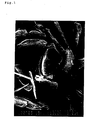
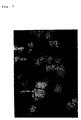
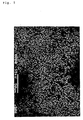
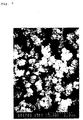
- a solution of 90.5 g of copper nitrate in 50 g of water was continuously added to 200 g of water adjusted to a pH of 3.8 with nitric acid over 5.5 hours while the temperature was maintained at 5°C. During this time, a solution of 47.5 g of sodium bicarbonate in 600 g of water was added to maintain the pH between 5.4 and 5.6. After the completion of the addition, the mixture was filtered, washed, and dried to obtain 39.7 g of a basic copper nitrate. The results of measurements of the resulting basic copper nitrate are shown in Table 2, and the scanning electron micrographs (x500, x2,000 and x5,000) are shown in Figs. 5, 6 and 7.
- NQ represents nitroguanidine
- BHTNH 3 represents ammonium salt of bitetrazole
- BHTK represents potassium bitetrazole
- DCDA represents dicyandiamide
- 5-AT represents 5-aminotetrazole
- Zn(5-AT) represents zinc salt of 5-aminotetrazole
- BCN represents a basic copper nitrate [Cu 2 (NO 3 )(OH) 3 ]
- CMCNa represents sodium salt of carboxymethylcellulose.
- a gas generating composition (containing 40 g of a gas generating agent) was charged into an aluminum container to measure a total weight. (Total weight - weight of an aluminum container) was defined as a weight of a sample before the test.
- the aluminum container filled with the sample was placed in an SUS thick container (inner capacity 118.8 ml), and covered. At this time, the container was rendered in a sealed state using a rubber packing and a clamp. This was put in a thermostat bath of 90°C or 110°C. After the lapse of 1,000 hours and 400 hours, the container was withdrawn from the thermostat bath. When the container was returned to room temperature, the container was opened, and the aluminum container was withdrawn therefrom.
- the total weight of the sample inclusive of the aluminum container was measured, and (total weight - weight of an aluminum container) was defined as a weight of the sample after the test. And, the change in weight was measured by comparing the weight before the test with that after the test to find a weight loss ratio, whereby the thermal stability was evaluated.
- the weight loss ratio was calculated from [(weight of a gas generating agent before test - weight of a gas generating agent after test)/weight of a gas generating agent before test] x 100.
- the closed container after the completion of the above thermal stability test was put into a polyvinyl chloride bag filled with approximately 2 liters of air, and the bag was then closed. A clamp was unfastened in the bag to open the closed container, and the gas in the container was released into the bag. The gas in the bag was diffused, and rendered uniform. Then, the detecting tube was pierced into the bag, and the gas concentration was quickly measured.
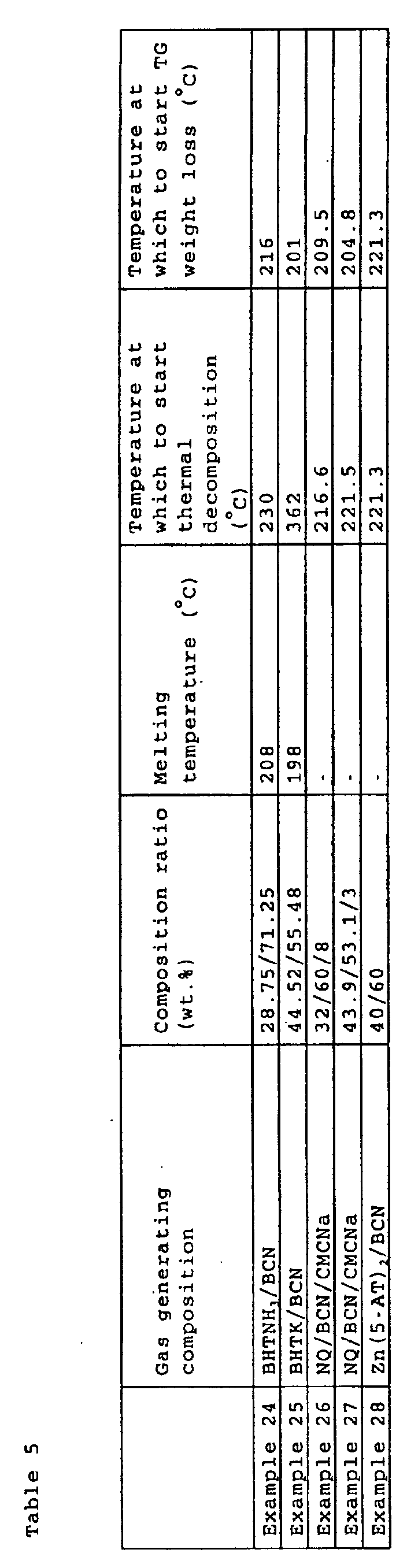
- Gas generating compositions each having a formulation shown in Table 5 were produced.
- a melting temperature with a TAS-type differential thermal analyzer manufactured by Rigaku K.K. a temperature at which to start heating and a temperature at which to start TG weight loss were measured.
- a rate of temperature rise in the measurement was 20°C/min
- a measurement atmosphere was a nitrogen gas
- an amount of a sample in the measurement was 1 to 2 mg. The results are shown in Table 5.
- the thermal stability test was conducted by the following method.
- the thermal stability test was conducted by allowing an aluminum container filled with the composition to stand in a thermostat bath of 110°C for 400 hours.
- the weight loss ratio was measured from the change in weight of the composition before and after the test, and the thermal stability was evaluated. As a result, the weight loss ratio was as low as -0.31 %, and no change in appearance was observed.
- Gas generating compositions each having a formulation shown in Table 6 were produced. Each of these compositions was molded into a strand. A burning rate was measured in a nitrogen atmosphere at a pressure of 4,900, 6,860 or 8,820 kPa. A burning rate at 6,860 kPa and a pressure index of 4,900 to 8,820 kPa are shown in Table 6.
- Gas generating compositions each having a formulation shown in Table 7 were produced. Each of the gas generating compositions was molded into 2 g of a strand. This strand was installed in a closed bomb having an inner capacity of 1 liter, and the inside of the bomb was purged with nitrogen. Further, the bomb was pressurized to 6,860 kPa with nitrogen. The strand was ignited by electronic conduction through a nichrome wire, and completely burned. Approximately 20 seconds after the electronic conduction, the burned gas was collected in a gas sampling bag, and the concentrations of NO 2 , NO, CO and CO 2 were quickly analyzed with a detecting tube.
- a gas generating composition containing 44.2 % by weight of NQ, 52.8 % by weight of BCN and 3 % by weight of guar gum was produced, and tested for a thermal stability by the following method. As a result, a weight loss ratio under conditions of 110°C and 214 hours was 0.27 %, and a weight loss ratio under conditions of 110°C and 408 hours was 0.45 %.
Landscapes
- Chemical & Material Sciences (AREA)
- Organic Chemistry (AREA)
- Inorganic Chemistry (AREA)
- Chemical Kinetics & Catalysis (AREA)
- Engineering & Computer Science (AREA)
- Combustion & Propulsion (AREA)
- Air Bags (AREA)
- Feeding, Discharge, Calcimining, Fusing, And Gas-Generation Devices (AREA)
- Catalysts (AREA)
Abstract
(a) a particle diameter of 0.5 to 40 µm; (b) a degree of crystallinity having 0.4 deg or less of a half band width of the peak in the X-ray analysis; (c) an initiation temperature of weight loss being 220°C or higher according to TG-DTA analysis; and (d) an impurity content of 1,000 ppm or less based on Na atom. Further provided is a gas generating composition which has a low toxicity, a high burning rate and a low combustion temperature and which is used in a gas generator for an air bag. The gas generating composition comprises (a) tetrazole derivatives, guanidine derivatives or a mixture thereof, (b) a basic metal nitrate and (c) a binder and/or a slag-forming agent.
Description
Cu(NO3)2·3Cu(OH)2 + 6MNO3 + 6CO2 + 12H2O
This basic metal nitrate in the form of secondary particles of coagulated principal particles is preferably formed by coagulating a large number of principal particles having the form of needles to plates and/or spheres to similar shapes thereto. The "form of needles to plates" means only particles having the form of needles, only particles having the form of plates and a mixture of particles having the form of needles and particles having the form of plates with a width gradually increased from the width of particles having the form of needles. The "form of spheres to similar shapes thereto" means only spherical particles, only particles having the form of similar shapes thereto, for example, particles having concavo-convex portions on the spherical surface or oval particles, and a mixture of spherical particles and particles having the form of similar shapes thereto such as an oval shape and the like.
Still another preferable example of the composition comprising components (a) and (b) is a composition comprising (a) dicyandiamide and (b) a basic copper nitrate. In this case, it is preferable that the content of (a) dicyandiamide is 15 to 30 % by weight and the content of (b) a basic copper nitrate is 70 to 85 % by weight.
| Temperature at which to start weight loss (°C) | Thermal stability | |
| Comparative Example 1 | 215 | pale blue → black |
| Example 1 | 220 | pale blue (no change in color) |
| Example 2 | pale blue (no change in color) | |
| Example 3 | 223 | pale blue (no change in color) |
| Example 4 | pale blue (no change in color) | |
| Comparative Example 2 | 219 | pale blue → pale gray |


| Gas generating composition | Composition ratio (wt.%) | Friction sensitivity (kgf) | Drop hammer sensitivity (cm) | |
| Example 18 | BHTNH3/BCN | 28.75/71.25 | >36.0 | >100 |
| Example 19 | BHTK/BCN | 44.52/55.48 | >36.0 | 70 - 80 |
| Example 20 | BHTNH3/BCN/CMCNa | 25.89/71.11/3 | >36.0 | >80 |
| Example 21 | NQ/BCN/CMCNa | 32/60/8 | >36.0 | >50 |
| Example 22 | NQ/BCN/guar gum | 44.2/52.8/3 | >36.0 | 60 - 70 |
| Example 23 | NQ/BCN/guar gum/KNO3 | 45.0/47.0/3/5 | >36.0 | >100 |
| Gas generating composition | Composition ratio (wt.%) | Burning rate (mm/sec) | Pressure index | |
| Example 29 | BHTNH3/BCN | 28.75/71.25 | 14.48 | 0.16 |
| Example 30 | BHTK/BCN | 44.52/55.48 | 27.92 | 0.20 |
| Example 31 | BHTNH3/BCN/CMCNa | 25.89/71.11/3 | 14.99 | 0.15 |
| Example 32 | NQ/BCN/CMCNa | 28/64/8 | 7.9 | 0.33 |
| Example 33 | NQ/BCN/CMCNa | 30/62/8 | 8.9 | 0.29 |
| Example 34 | NQ/BCN/CMCNa | 32/60/8 | 9.7 | 0.44 |
| Example 35 | NQ/BCN/guar gum | 44.2/52.8/3 | 10.8 | 0.58 |
| Example 36 | NQ/BCN/guar gum/KNO3 | 44.3/52.2/3/0.5 | 11.0 | 0.53 |
| Example 37 | NQ/BCN/guar gum/KNO3 | 44.4/51.6/3/1 | 12.0 | 0.64 |
| Example 38 | NQ/BCN/guar gum/KNO3 | 44.6/50.4/3/2 | 11.8 | 0.71 |
| Example 39 | NQ/BCN/guar gum/KNO3 | 44.7/49.3/3/3 | 15.7 | 0.48 |
| Example 40 | NQ/BCN/guar gum/KNO4 | 45.0/47.0/3/5 | 17.8 | 0.41 |


| Formulation | Composition ratio (wt.%) | Combustion temperature (K) | Gas output (mol/100 g) | |
| Example 84 | NQ/BCN/guar gum | 44.2/52.8/3 | 2168 | 2.76 |
| Example 85 | NQ/BCN/guar gum | 45.2/51.8/3 | 2156 | 2.80 |
| Example 86 | NQ/BCN/guar gum | 46.2/50.8/3 | 2145 | 2.84 |
| Example 87 | NQ/BCN/guar gum | 41.9/54.1/4 | 2131 | 2.72 |
| Example 88 | NQ/BCN/guar gum | 42.8/53.2/4 | 2121 | 2.76 |
| Example 89 | NQ/BCN/guar gum | 43.8/52.2/4 | 2110 | 2.80 |
| Example 90 | NQ/BCN/guar gum | 39.5/55.5/5 | 2096 | 2.69 |
| Example 91 | NQ/BCN/guar gum | 40.5/54.5/5 | 2084 | 2.73 |
| Example 92 | NQ/BCN/guar gum | 41.5/53.5/5 | 2073 | 2.77 |
| Example 93 | NQ/BCN/guar gum | 37.1/56.9/6 | 2059 | 2.65 |
| Example 94 | NQ/BCN/guar gum | 38.1/55.9/6 | 2048 | 2.69 |
| Example 95 | NQ/BCN/guar gum | 39.1/54.9/6 | 2036 | 2.73 |
| Example 96 | NQ/BCN/guar gum/KNO3 | 44.3/52.2/3/0.5 | 2167 | 2.76 |
| Example 97 | NQ/BCN/guar gum/KNO3 | 44.4/51.6/3/1 | 2165 | 2.76 |
| Example 98 | NQ/BCN/guar gum/KNO3 | 44.5/51.0/3/1.5 | 2164 | 2.76 |
| Example 99 | NQ/BCN/guar gum/KNO3 | 44.6/50.4/3/2 | 2163 | 2.76 |
| Example 100 | NQ/BCN/guar gum/KNO3 | 44.7/49.3/3/3 | 2162 | 2.75 |
| Example 101 | NQ/BCN/guar gum/KNO3 | 44.9/48.1/3/4 | 2160 | 2.75 |
| Example 102 | NQ/BCN/guar gum/KNO3 | 45.0/47.0/3/5 | 2159 | 2.75 |

Claims (74)
- A basic metal nitrate meeting at least one requirement of the following (a) to (d):(a) a particle diameter of 0.5 to 40 µm;(b) a degree of crystallinity having 0.35 deg or less of a half band width of the peak in the X-ray diffraction;(c) an initiation temperature of weight loss being 220 °C or higher according to TG-DTA analysis; and(d) an impurity content of 1,000 ppm or less based on Na atom.
- The basic metal nitrate as claimed in Claim 1, which is a basic copper nitrate.
- A gas generating composition comprising-the basic metal nitrate as claimed in Claim 1 or 2.
- A process for producing a basic metal nitrate comprising a step of reacting a metal nitrate with an alkali metal bicarbonate.
- The process as claimed in Claim 4, wherein the metal nitrate is at least one metal salt selected from the group consisting of cobalt, copper, zinc, manganese, iron, molybdenum, bismuth and cerium.
- The process as claimed in Claim 4 or 5, wherein the metal nitrate is copper nitrate.
- The process as claimed in Claim 6, wherein copper nitrate is represented by formula (I)
- The process as claimed in any one of Claims 4 to 7, wherein the alkali metal of the alkali metal bicarbonate is at least one selected from sodium, potassium, lithium, rubidium and cesium.
- The process as claimed in any one of Claims 4 to 8, wherein the alkali metal bicarbonate is sodium bicarbonate or potassium bicarbonate.
- A gas generating composition comprising a fuel and a basic metal nitrate, the basic metal nitrate meeting at least one requirement selected from the following (a-1) to (a-3):(a-1) a particle diameter of 0.5 to 40 µm;(a-2) a specific surface area of particles being 0.4 to 6.0 m2/g; and(a-3) a bulk density of particles being 0.4 g/ml or more.
- The gas generating composition as claimed in Claim 10, comprising a fuel and a basic metal nitrate, the basic metal nitrate meeting at least one requirement selected from (a-1) to (a-3) and further (b) to (d):(b) a degree of crystallinity having 0.35 deg or less of a half band width of the peak in the X-ray diffraction;(c) an initiation temperature of weight loss being 220 °C or higher according to TG-DTA analysis; and(d) an impurity content of 1,000 ppm or less based on Na atom.
- A gas generating composition comprising a fuel and a basic metal nitrate, the basic metal nitrate being in the form of secondary particles of coagulated principal particles, the secondary particles meeting at least one requirement selected from the following (a-1) to (a-3):(a-1) a particle diameter of 0.5 to 40 µm;(a-2) a specific surface area of particles being 0.4 to 6.0 m2/g; and(a-3) a bulk density of particles being 0.4 g/ml or more.
- The gas generating composition as claimed in Claim 12, comprising a fuel and a basic metal nitrate, the basic metal nitrate meeting at least one requirement selected from (a-1) to (a-3) and further the following(b) to (d):(b) a degree of crystallinity having 0.35 deg or less of a half band width of the peak in the X-ray diffraction;(c) an initiation temperature of weight loss being 220 °C or higher according to TG-DTA analysis; and(d) an impurity content of 1,000 ppm or less based on Na atom.
- The gas generating composition as claimed in Claim 12 or 13, wherein the basic metal nitrate in the form of the secondary particles is formed by coagulating a large number of principal particles having the form of needles to plates and/or spheres to similar shapes thereto.
- The gas generating composition as claimed in any one of Claims 10 to 14, wherein the fuel is a nitrogen-containing compound.
- The gas generating composition as claimed in any one of Claims 10 to 15, wherein the fuel is selected from the group consisting of guanidine derivatives, azole derivatives, triazine derivatives and transition metal complexes.
- The gas generating composition as claimed in any one of Claims 10 to 16, wherein the fuel is nitroguanidine.
- The gas generating composition as claimed in any one of Claims 10 to 17, wherein the basic metal nitrate is a basic copper nitrate.
- The gas generating composition as claimed in any one of Claims 10 to 18, which further comprises an additive.
- The gas generating composition as claimed in Claim 19, wherein the additive is guar gum.
- The gas generating composition as claimed in any one of claims 10 to 20, which has a weight loss ratio of 2.0 % by weight or less when it is allowed to stand in an atmosphere of a temperature of 110° for 400 hours.
- A gas generating composition comprising a fuel and the basic metal nitrate as claimed in Claim 1 or the basic metal nitrate obtained by the process as claimed in Claim 4.
- A gas generating composition comprising (a) at least one guanidine derivative selected from the group consisting of tetrazole derivatives, guanidine, guanidine carbonate, nitroguanidine, dicyandiamide, nitroaminoguanidine and nitroaminoguanidine nitrate and (b) a basic metal nitrate.
- A gas generating composition comprising (a) at least one guanidine derivative selected from the group consisting of tetrazole derivatives, guanidine, guanidine carbonate, nitroguanidine, dicyandiamide, nitroaminoguanidine and nitroaminoguanidine nitrate, (b) a basic metal nitrate and (c) a binder and/or a slag-forming agent.
- A gas generating composition comprising (a) tetrazole derivatives, guanidine derivatives or a mixture thereof, (b) a basic metal nitrate and (d) a combustion-improving agent.
- A gas generating composition comprising (a) tetrazole derivatives, guanidine derivatives or a mixture thereof, (b) a basic metal nitrate, (c) a binder and/or a slag-forming agent and (d) a combustion-improving agent.
- The gas generating composition as claimed in Claim 25 or 26, wherein (d) the combustion-improving agent is a component to improve combustion properties of the overall gas generating composition, including a burning rate, a duration of combustion and an ignitability.
- The gas generating composition as claimed in Claim 25, 26 and 27, wherein (d) the combustion-improving agent is at least one selected from the group consisting of silicon nitride, silica, a nitrite, a nitrate, a chlorate or a perchlorate of an alkali metal or an alkaline earth metal (KNO3, NaNO3, KClO4), iron (III) hydroxide oxide [FeO(OH)], copper oxide, iron oxide, zinc oxide, cobalt oxide and manganese oxide.
- A gas generating composition comprising (a) tetrazole derivatives, guanidine derivatives or a mixture thereof and (b) a basic metal nitrate and meeting at least one requirement selected from the following (1) to (3) :(1) a weight loss ratio of the gas generating composition when the gas generating composition is retained in a closed state at 90°C for 1,000 hours or at 110°C for 400 hours is 2.0 % or less,(2) concentrations of trace gases contained in a gas generated by the combustion of the gas generating composition, as values measured in a 2,800-liter tank, 400 ppm or less for CO, 40 ppm or less for NO, 8 ppm or less for NO2 and 100 ppm or less for NH3, and(3) a maximum internal pressure in a gas generator on the combustion of the gas generating composition is 7,840 to 22,500 kPa.
- A gas generating composition comprising (a) tetrazole derivatives, guanidine derivatives or a mixture thereof, (b) a basic metal nitrate and (c) a binder and/or a slag-forming agent and meeting at least one requirement selected from the following (1) to (3):(1) a weight loss ratio of the gas generating composition when the gas generating composition is retained in a closed state at 90°C for 1,000 hours or at 110°C for 400 hours is 2.0 % or less,(2) concentrations of trace gases contained in a gas generated by the combustion of the gas generating composition, as values measured in a 2,800-liter tank, 400 ppm or less for CO, 40 ppm or less for NO, 8 ppm or less for NO2 and 100 ppm or less for NH3, and(3) a maximum internal pressure in a gas generator on the combustion of the gas generating composition is 7,840 to 22,500 kPa.
- The gas generating composition as claimed in Claim 29 or 30, which further comprises (d) the combustion-improving agent as claimed in Claim 5 or 6.
- The gas generating composition as claimed in any one of Claims 23 to 31, wherein the tetrazole derivative as component (a) is at least one selected from the group consisting of tetrazole, 5-aminotetrazole, 5,5'-bi-1H-tetrazole, 5-nitroaminotetrazole, zinc salt of 5-aminotetrazole, copper salt of 5-aminotetrazole, bitetrazole, potassium salt of bitetrazole, sodium salt of bitetrazole, magnesium salt of bitetrazole, calcium salt of bitetrazole, diammonium salt of bitetrazole, copper salt of bitetrazole and melamine salt of bitetrazole.
- The gas generating composition as claimed in any one of Claims 25 to 31, wherein the guanidine derivative as component (a) is at least one selected from the group consisting of guanidine, mono-, di- or tri-aminoguanidine nitrate,.guanidine nitrate, guanidine carbonate, nitroguanidine, dicyandiamide and nitroaminoguanidine nitrate.
- The gas generating composition as claimed in any one of Claims 23 to 33, wherein the basic metal nitrate as component (b) is at least one selected from the group consisting of a basic copper nitrate, a basic cobalt nitrate, a basic zinc nitrate, a basic manganese nitrate, a basic iron nitrate, a basic molybdenum nitrate, a basic bismuth nitrate and a basic cerium nitrate.
- The gas generating composition as claimed in any one of Claims 23 to 34, wherein component (b) is a mixture of a basic metal nitrate and at least one other oxidizing agent.
- The gas generating composition as claimed in any one of Claims 23 to 35, wherein component (b) is a mixture of a basic metal nitrate and at least one other oxidizing agent which includes an alkali metal nitrate.
- The gas generating composition as claimed in any one of Claims 23 to 36, wherein when component (b) is a mixture, the alkali metal nitrate contained as at least one other oxidizing agent is potassium nitrate.
- The gas generating composition as claimed in any one of Claims 23 to 37, wherein when component (b) is a mixture, the content of the basic metal nitrate in the mixture is 55 to 99.9 % by weight.
- The gas generating composition as claimed in any one of Claims 24, 26, 27, 28 and 30 to 38, wherein the binder as component (c) is not crosslinkable.
- The gas generating composition as claimed in anyone of Claims 24, 26, 27, 28 and 30 to 38, wherein the binder and/or the slag-forming agent as component (c) is not crosslinkable and at least one selected from the group consisting of carboxymethylcellulose, sodium carboxymethylcellulose, potassium carboxymethylcellulose, ammonium carboxymethylcellulose, cellulose acetate, cellulose acetatebutylate, methyl cellulose, ethyl cellulose, hydroxyethyl cellulose, ethylhydroxyethyl cellulose, hydroxypropyl cellulose, carboxymethylethyl cellulose, fine crystalline cellulose, polyacrylic amide, aminated compounds of polyacrylic amide, polyacrylic hydrazide, a copolymer of an acrylic amide and a metal salt of acrylic acid, a copolymer of polyacrylic amide and polyacrylic ester, polyvinyl alcohol, acrylic rubber, guar gum, starch, polysaccharides including starch, silicone, molybdenum disulfide, Japanese acid clay, talc, bentonite, diatomaceous earth, kaolin, calcium stearate, silica, alumina, sodium silicate, silicon nitrate, silicon carbide, hydrotalcite, mica, ametal oxide, a metal hydroxide, a metal carbonate, a basic metal carbonate and a molybdate.
- The gas generating composition as claimed in Claim 40, wherein the metal oxide as component (c) is at least one selected from the group consisting of copper oxide, iron oxide, zinc oxide, cobalt oxide, manganese oxide, molybdenum oxide, nickel oxide and bismuth oxide, the metal hydroxide is at least one selected from the group consisting of cobalt hydroxide and aluminum hydroxide, the metal carbonate or the basic metal carbonate is at least one selected from the group consisting of calcium carbonate, cobalt carbonate, a basic zinc carbonate and a basic copper carbonate, and the molybdate is at least one selected from the group consisting of cobalt molybdate and ammonium molybdate.
- The gas generating composition as claimed in Claim 23, which comprises (a) diammonium salt of bitetrazole and (b) a basic copper nitrate.
- The gas generating composition as claimed in Claim 42, which comprises 15 to 45 % by weight of (a) diammonium salt of bitetrazole and 55 to 85 % by weight of (b) a basic copper nitrate.
- The gas generating composition as claimed in Claim 24, which comprises (a) diammonium salt of bitetrazole, (b) a basic copper nitrate and (c) sodium carboxymethylcellulose.
- The gas generating composition as claimed in Claim 44, which comprises 15 to 40 % by weight of (a) diammonium salt of bitetrazole, 45 to 80 % by weight of (b) a basic copper nitrate and 0.1 to 15 % by weight of (c) sodium carboxymethylcellulose.
- The gas generating composition as claimed in Claim 24, which comprises (a) diammonium salt of bitetrazole, (b) a basic copper nitrate, (c-1) sodium carboxymethylcellulose and (c-2) component (c) as claimed in Claim 39, 40 or 41 except said (c-1).
- The gas generating composition as claimed in Claim 46, which comprises 15 to 35 % by weight of (a) diammonium salt of bitetrazole, 30 to 70 % by weight of (b) a basic copper nitrate, 0.1 to 15 % by weight of (c-1) sodium carboxymethylcellulose and 1 to 45 % by weight of (c-2).
- The gas generating composition as claimed in Claim 23, which comprises (a) nitroguanidine and (b) a basic copper nitrate.
- The gas generating composition as claimed in Claim 48, which comprises 30 to 70 % by weight of (a) nitroguanidine and 30 to 70 % by weight of (b) a basic copper nitrate.
- The gas generating composition as claimed in Claim 24, which comprises (a) nitroguanidine, (b) a basic copper nitrate and (c) sodium carboxymethylcellulose.
- The gas generating composition as claimed in Claim 50, which comprises 15 to 55 % by weight of (a) nitroguanidine, 45 to 70 % by weight of (b) a basic copper nitrate and 0.1 to 15 % by weight of (C) sodium carboxymethylcellulose.
- The gas generating composition as claimed in claim 24, which comprises (a) nitroguanidine, (b) a basic copper nitrate, (c-1) sodium carboxymethylcellulose and (c-2) component (c) as claimed in Claim 39, 40 or 41 except said (c-1).
- The gas generating composition as claimed in Claim 52, which comprises 15 to 50 % by weight of (a) nitroguanidine, 30 to 65 % by weight of (b) a basic copper nitrate, 0.1 to 15 % by weight of (c-1) sodium carboxymethylcellulose and 1 to 40 % by weight of (c-2).
- The gas generating composition as claimed in Claim 24, which comprises (a) nitroguanidine, (b) a basic copper nitrate and (c) guar gum.
- The gas generating composition as claimed in Claim 54, which comprises 20 to 60 % by weight of (a) nitroguanidine, 35 to 75 % by weight of (b) a basic copper nitrate and 0.1 to 10 % by weight of guar gum.
- The gas generating composition as claimed in Claim 24, which comprises (a) nitroguanidine, (b) a basic copper nitrate, (c-1) guar gum and (c-2) component (c) as claimed in Claim 39, 40 or 41 except said (c-1).
- The gas generating composition as claimed in Claim 56, which comprises 20 to 60 % by weight of (a) nitroguanidine, 30 to 70 % by weight of (b) a basic copper nitrate, 0.1 to 10 % by weight of (c-1) guar gum and 0.1 to 10 % by weight of (c-2).
- The gas generating composition as claimed in Claim 27, which comprises (a) nitroguanidine, (b) a basic copper nitrate, (c) guar gum and (d) a combustion-improving agent.
- The gas generating composition as claimed in Claim 58, which comprises 20 to 60 % by weight of (a) nitroguanidine, 35 to 75 % by weight of (b) a basic copper nitrate, 0.1 to 10 % by weight of (c) guar gum and 0.1 to 15 % by weight of (d) a combustion-improving agent.
- The gas generating composition as claimed in Claim 58 or 59, wherein (d) the combustion-improving agent is silica.
- The gas generating composition as claimed in Claim 23, which comprises (a) dicyandiamide and (b) a basic copper nitrate.
- The gas generating composition as claimed in Claim 61, which comprises 15 to 30 % by weight of (a) dicyandiamide and 70 to 85 % by weight of (b) a basic copper nitrate.
- The gas generating composition as claimed in Claim 24, which comprises (a) dicyandiamide, (b) a basic copper nitrate and (c) sodium carboxymethylcellulose.
- The gas generating composition as claimed in Claim 63, which comprises 15 to 25 % by weight of (a) dicyandiamide, 60 to 80 % by weight of (b) a basic copper nitrate and 0.1 to 20 % by weight of (c) sodium carboxymethylcellulose.
- The gas generating composition as claimed in Claim 24, which comprises (a) dicyandiamide, (b) a basic copper nitrate, (c-1) sodium carboxymethylcellulose and (c-2) component (c) as claimed in Claim 39, 40 or 41 except said (c-1).
- The gas generating composition as claimed in Claim 65, which comprises 15 to 25 % by weight of (a) dicyandiamide, 55 to 75 % by weight of (b) a basic copper nitrate, 0 to 10 % by weight of (c-1) sodium carboxymethylcellulose and 1 to 20 % by weight of (c-2) component (c).
- A gas generating composition comprising (a) guanidine nitrate, (b) a basic copper nitrate and (c) sodium carboxymethylcellulose.
- The gas generating composition as claimed in Claim 67, which comprises 15 to 60 % by weight of (a) guanidine nitrate, 40 to 70 % by weight of (b) a basic copper nitrate and 0.1 to 15 % by weight of (c) sodium carboxymethylcellulose.
- A gas generating composition comprising (a) guanidine nitrate, (b) a basic copper nitrate, (c-1) sodium carboxymethylcellulose and (c-2) component (c) as claimed in Claim 39, 40 or 41 except said (c-1).
- The gas generating composition as claimed in Claim 69, which comprises 15 to 55 % by weight of (a) guanidine nitrate, 25 to 60 % by weight of (b) a basic copper nitrate, 0.1 to 15 % by weight of (c-1) sodium carboxymethylcellulose and 1 to 40 % by weight of (c-2) component (c).
- The gas generating composition as claimed in any one of Claims 35 to 70, which comprises a mixture of a basic copper nitrate and potassium nitrate as component (b).
- An inflator for an air bag using the gas generating composition as claimed in any one of Claims 3 and 10 to 71.
- A molded article in the form of a single-perforated cylinder, a perforated (porous) cylinder or pellets, the molded article being obtained from the gas generating composition as claimed in any one of Claims 3 and 10 to 71.
- An inflator for an air bag using the molded article as claimed in Claim 73.
Applications Claiming Priority (15)
| Application Number | Priority Date | Filing Date | Title |
|---|---|---|---|
| JP27197699 | 1999-09-27 | ||
| JP27197699 | 1999-09-27 | ||
| JP28750799 | 1999-10-08 | ||
| JP28750799 | 1999-10-08 | ||
| JP2000071753 | 2000-03-15 | ||
| JP2000071753 | 2000-03-15 | ||
| JP2000071680 | 2000-03-15 | ||
| JP2000071680 | 2000-03-15 | ||
| JP2000128077 | 2000-04-27 | ||
| JP2000128077 | 2000-04-27 | ||
| JP2000281421A JP4800469B2 (en) | 1999-10-08 | 2000-09-18 | Gas generant composition |
| JP2000281421 | 2000-09-18 | ||
| JP2000282972 | 2000-09-19 | ||
| JP2000282972A JP4794728B2 (en) | 1999-09-27 | 2000-09-19 | Basic metal nitrate and process for producing the same |
| PCT/JP2000/006664 WO2001023304A1 (en) | 1999-09-27 | 2000-09-27 | Basic metal nitrate, method for producing the same and gas-generating agent composition |
Publications (3)
| Publication Number | Publication Date |
|---|---|
| EP1241138A1 true EP1241138A1 (en) | 2002-09-18 |
| EP1241138A4 EP1241138A4 (en) | 2005-02-23 |
| EP1241138B1 EP1241138B1 (en) | 2009-04-08 |
Family
ID=27566784
Family Applications (1)
| Application Number | Title | Priority Date | Filing Date |
|---|---|---|---|
| EP00962888A Revoked EP1241138B1 (en) | 1999-09-27 | 2000-09-27 | Basic metal nitrate, method for producing the same and gas-generating agent composition |
Country Status (8)
| Country | Link |
|---|---|
| US (3) | US20070119530A1 (en) |
| EP (1) | EP1241138B1 (en) |
| KR (1) | KR20020048419A (en) |
| CN (1) | CN100465097C (en) |
| AU (1) | AU7446300A (en) |
| CZ (1) | CZ20021056A3 (en) |
| DE (1) | DE60041984D1 (en) |
| WO (1) | WO2001023304A1 (en) |
Cited By (13)
| Publication number | Priority date | Publication date | Assignee | Title |
|---|---|---|---|---|
| EP1526121A1 (en) * | 2003-10-20 | 2005-04-27 | Daicel Chemical Industries, Ltd. | Gas generating composition |
| FR2866022A1 (en) * | 2004-02-10 | 2005-08-12 | Snpe Materiaux Energetiques | Pyrotechnic composition for the generation of gas to inflate safety bags used in protection systems for occupants of automobile vehicles |
| US6964716B2 (en) | 2002-09-12 | 2005-11-15 | Daicel Chemical Industries, Ltd. | Gas generating composition |
| US7393395B2 (en) * | 2004-02-05 | 2008-07-01 | Nippon Mining & Metals Co., Ltd. | Surface-treating agent for metal |
| US7462342B2 (en) | 2001-03-29 | 2008-12-09 | Daicel Chemical Industries, Ltd. | Method for producing basic metal nitrate |
| US7665764B2 (en) | 2004-01-15 | 2010-02-23 | Daicel Chemical Industries, Ltd. | Gas generator for air bag |
| FR2949778A1 (en) * | 2009-09-10 | 2011-03-11 | Snpe Materiaux Energetiques | PYROTECHNIC COMPOUNDS GENERATORS OF GAS |
| EP1538137A4 (en) * | 2002-09-12 | 2011-12-21 | Daicel Chem | GAS GENERATION COMPOSITION |
| EP2450331A1 (en) * | 2010-11-05 | 2012-05-09 | Durferrit GmbH | Explosive and detonating mixture |
| EP1323696A3 (en) * | 2001-12-27 | 2012-05-16 | Trw Inc. | Cool burning gas generating material for a vehicle occupant protection apparatus |
| EP2481449A4 (en) * | 2010-01-19 | 2013-05-29 | Shaanxi J & R Fire Fighting Co | A NEW AGING-RESISTANT AEROSOL PROPELLER AND PROCESS FOR PREPARING THE SAME |
| EP2407443A4 (en) * | 2009-03-13 | 2013-11-27 | Nippon Kayaku Kk | Gas generant composition, molded object thereof, and gas generator using same |
| WO2020106356A1 (en) * | 2018-11-20 | 2020-05-28 | The Shepherd Chemical Company | Surface modifiers for preparing age-resistant inorganic salts |
Families Citing this family (30)
| Publication number | Priority date | Publication date | Assignee | Title |
|---|---|---|---|---|
| US6712918B2 (en) | 2001-11-30 | 2004-03-30 | Autoliv Asp, Inc. | Burn rate enhancement via a transition metal complex of diammonium bitetrazole |
| US6958101B2 (en) * | 2003-04-11 | 2005-10-25 | Autoliv Asp, Inc. | Substituted basic metal nitrates in gas generation |
| US8034133B2 (en) * | 2004-05-31 | 2011-10-11 | Daicel Chemical Industries, Ltd. | Gas generating composition |
| CN100376515C (en) * | 2005-03-28 | 2008-03-26 | 东方久乐汽车安全气囊有限公司 | A kind of gas generating composition and preparation method thereof |
| JP2007169094A (en) * | 2005-11-25 | 2007-07-05 | Daicel Chem Ind Ltd | Molded body of enhancer for inflator |
| CN101205158B (en) * | 2006-12-19 | 2012-06-20 | 比亚迪股份有限公司 | Safety belt pre-tighter gas production medicine as well as preparation and utilization method thereof |
| JP5085926B2 (en) * | 2006-12-21 | 2012-11-28 | 株式会社ダイセル | Gas generant composition |
| JP5441497B2 (en) * | 2009-05-21 | 2014-03-12 | 株式会社ダイセル | Gas generant composition |
| US8231747B2 (en) * | 2009-07-29 | 2012-07-31 | Autoliv Asp, Inc. | Inflator assembly |
| KR101212790B1 (en) * | 2011-05-12 | 2012-12-14 | 주식회사 한화 | Composition for gas generating agent, gas generating agent using the same and inflator comprising the gas generating agent |
| RU2476380C1 (en) * | 2011-08-04 | 2013-02-27 | Федеральное государственное бюджетное образовательное учреждение высшего профессионального образования "Юго-Западный государственный университет" (ЮЗГУ) | Method of obtaining basic chloride or copper (ii) nitrate |
| CN104114494B (en) * | 2012-02-08 | 2016-09-28 | 巴斯夫欧洲公司 | Preparation can comprise the method for the mixed carbonate of hydroxide |
| DE102012005759A1 (en) | 2012-03-23 | 2013-09-26 | Trw Airbag Systems Gmbh | GAS-CREATING COMPOSITION |
| CN103482677B (en) * | 2012-06-13 | 2015-09-30 | 湖北汉伟新材料有限公司 | A kind of preparation method of producer gas generator superfine basic copper nitrate |
| US20140261927A1 (en) * | 2013-03-13 | 2014-09-18 | Autoliv Asp, Inc. | Enhanced slag formation for copper-containing gas generants |
| CN104418676A (en) * | 2013-08-27 | 2015-03-18 | 湖北航天化学技术研究所 | Gas generating agent for gas generator and manufacturing method thereof |
| CN104418677A (en) * | 2013-08-27 | 2015-03-18 | 湖北航天化学技术研究所 | Gas generation agent and preparation method |
| CN104860788A (en) * | 2014-08-07 | 2015-08-26 | 青岛蓝农谷农产品研究开发有限公司 | High-efficiency nontoxic gas generating agent |
| JP6970190B2 (en) * | 2016-05-23 | 2021-11-24 | ジョイソン セーフティー システムズ アクウィジション エルエルシー | Gas generation compositions and their production and use methods |
| CN106517301B (en) * | 2016-10-21 | 2017-10-31 | 广州科城环保科技有限公司 | A kind of method that basic copper chloride is reclaimed in the contained waste liquid from sulfuric acid system |
| US10668311B2 (en) | 2018-03-23 | 2020-06-02 | Goodrich Corporation | Fire suppressant inert gas generator |
| CN109160868A (en) * | 2018-10-31 | 2019-01-08 | 湖北航天化学技术研究所 | A kind of gas generant for air cell |
| CN109809954B (en) * | 2018-12-29 | 2021-02-09 | 湖北航鹏化学动力科技有限责任公司 | Porous gas generating agent molded product and preparation process thereof |
| CN111943789A (en) * | 2020-09-01 | 2020-11-17 | 湖北航天化学技术研究所 | Gas generating agent and preparation method thereof |
| US20240002311A1 (en) * | 2020-10-01 | 2024-01-04 | Daicel Corporation | Gas-generating agent composition |
| CN120500469A (en) * | 2022-12-15 | 2025-08-15 | 乔伊森安全系统收购有限责任公司 | Method of forming a gas generant fuel mixture |
| CN121219251A (en) * | 2023-03-31 | 2025-12-26 | 乔伊森安全系统收购有限责任公司 | Gas generating composition |
| CN116534890A (en) * | 2023-04-25 | 2023-08-04 | 山西浙大新材料与化工研究院 | Preparation of feed-grade zinc oxide and application of feed-grade zinc oxide to weaned pigs |
| KR102642172B1 (en) * | 2023-08-01 | 2024-02-29 | 주식회사 송학환경개발 | Method for manufacturing a fire extinguishing molded body for extinguishing a forest fire |
| CN117023634B (en) * | 2023-08-25 | 2025-06-03 | 西安交通大学 | Preparation method of bismuth subnitrate |
Family Cites Families (39)
| Publication number | Priority date | Publication date | Assignee | Title |
|---|---|---|---|---|
| US3902934A (en) * | 1972-06-08 | 1975-09-02 | Specialty Products Dev Corp | Gas generating compositions |
| US4369079A (en) * | 1980-12-31 | 1983-01-18 | Thiokol Corporation | Solid non-azide nitrogen gas generant compositions |
| JPH02145422A (en) * | 1988-11-24 | 1990-06-04 | Dowa Mining Co Ltd | Production of fine copper oxide powder |
| US4909549A (en) * | 1988-12-02 | 1990-03-20 | Automotive Systems Laboratory, Inc. | Composition and process for inflating a safety crash bag |
| US5084218A (en) * | 1990-05-24 | 1992-01-28 | Trw Vehicle Safety Systems Inc. | Spheronizing process |
| US4994212A (en) * | 1990-05-24 | 1991-02-19 | Trw Vehicle Safety Systems Inc. | Process for manufacturing a gas generating material |
| JP3199458B2 (en) | 1992-05-29 | 2001-08-20 | 電気化学工業株式会社 | Cement admixture and cement composition |
| US5682014A (en) * | 1993-08-02 | 1997-10-28 | Thiokol Corporation | Bitetrazoleamine gas generant compositions |
| US5429691A (en) | 1993-08-10 | 1995-07-04 | Thiokol Corporation | Thermite compositions for use as gas generants comprising basic metal carbonates and/or basic metal nitrates |
| DE4401213C1 (en) * | 1994-01-18 | 1995-03-02 | Fraunhofer Ges Forschung | Gas-generating mixture |
| DE4401214C1 (en) * | 1994-01-18 | 1995-03-02 | Fraunhofer Ges Forschung | Gas generating mixture |
| US5725699A (en) * | 1994-01-19 | 1998-03-10 | Thiokol Corporation | Metal complexes for use as gas generants |
| DE4410477C1 (en) * | 1994-03-25 | 1995-09-14 | Flaekt Ab | Device for the surface treatment of vehicle bodies |
| JPH08231291A (en) * | 1994-12-27 | 1996-09-10 | Daicel Chem Ind Ltd | Gas generating agent composition |
| DE19507208A1 (en) * | 1995-03-02 | 1996-09-05 | Dynamit Nobel Ag | Gas generator, in particular for an airbag, with a loading container and a flame guide tube |
| JPH1087390A (en) * | 1995-10-06 | 1998-04-07 | Daicel Chem Ind Ltd | Gas generating agent for air bag |
| DE19540278A1 (en) * | 1995-10-28 | 1997-04-30 | Dynamit Nobel Ag | Lead- and barium-free igniters |
| US5608183A (en) * | 1996-03-15 | 1997-03-04 | Morton International, Inc. | Gas generant compositions containing amine nitrates plus basic copper (II) nitrate and/or cobalt(III) triammine trinitrate |
| US6234521B1 (en) * | 1996-04-08 | 2001-05-22 | Daicel Chemical Industries, Ltd. | Airbag inflator and an airbag apparatus |
| US6039820A (en) * | 1997-07-24 | 2000-03-21 | Cordant Technologies Inc. | Metal complexes for use as gas generants |
| JPH1072273A (en) | 1996-08-28 | 1998-03-17 | Nippon Kayaku Co Ltd | Gas generating agent for air bag |
| US5834679A (en) * | 1996-10-30 | 1998-11-10 | Breed Automotive Technology, Inc. | Methods of providing autoignition for an airbag inflator |
| JP3608902B2 (en) | 1997-03-24 | 2005-01-12 | ダイセル化学工業株式会社 | Gas generating agent composition and molded body thereof |
| US6562161B1 (en) * | 1997-03-24 | 2003-05-13 | Daicel Chemical Industries, Ltd. | Gas generating compositions for air bag |
| US5841065A (en) * | 1997-04-15 | 1998-11-24 | Autoliv Asp, Inc. | Gas generants containing zeolites |
| JPH11125012A (en) | 1997-10-22 | 1999-05-11 | Shimizu Corp | Casting equipment for concrete filling |
| FR2772370B1 (en) * | 1997-12-12 | 2000-01-07 | Poudres & Explosifs Ste Nale | PYROTECHNIC COMPOSITIONS GENERATING NON-TOXIC GASES BASED ON AMMONIUM PERCHLORATE |
| DE29806504U1 (en) | 1998-04-08 | 1998-08-06 | TRW Airbag Systems GmbH & Co. KG, 84544 Aschau | Azide-free, gas generating composition |
| JPH11292678A (en) * | 1998-04-15 | 1999-10-26 | Daicel Chem Ind Ltd | Gas generating agent composition for air bag |
| US6096147A (en) * | 1998-07-30 | 2000-08-01 | Autoliv Asp, Inc. | Ignition enhanced gas generant and method |
| US6412815B1 (en) * | 1998-09-28 | 2002-07-02 | Daicel Chemical Industries, Ltd. | Gas generator for air bag and air bag device |
| US6077372A (en) * | 1999-02-02 | 2000-06-20 | Autoliv Development Ab | Ignition enhanced gas generant and method |
| US6143102A (en) * | 1999-05-06 | 2000-11-07 | Autoliv Asp, Inc. | Burn rate-enhanced basic copper nitrate-containing gas generant compositions and methods |
| JP2001002488A (en) * | 1999-06-17 | 2001-01-09 | Daicel Chem Ind Ltd | Gas generating composition for pretensioner |
| KR100420563B1 (en) | 1999-06-25 | 2004-03-02 | 니뽄 가야쿠 가부시키가이샤 | Gas-generating agent composition |
| US6488310B1 (en) * | 2000-03-28 | 2002-12-03 | Daicel Chemical Industries, Ltd. | Hybrid inflator |
| TWI241277B (en) * | 2001-03-29 | 2005-10-11 | Daicel Chem | Method for the production of the basic metal nitrate |
| DE10230402B4 (en) * | 2002-07-05 | 2007-01-11 | Trw Airbag Systems Gmbh & Co. Kg | Process for the preparation of a gas generating composition |
| JP5330877B2 (en) | 2009-03-26 | 2013-10-30 | 株式会社東芝 | Photodetection device and display device |
-
2000
- 2000-09-27 CZ CZ20021056A patent/CZ20021056A3/en unknown
- 2000-09-27 AU AU74463/00A patent/AU7446300A/en not_active Abandoned
- 2000-09-27 EP EP00962888A patent/EP1241138B1/en not_active Revoked
- 2000-09-27 DE DE60041984T patent/DE60041984D1/en not_active Expired - Lifetime
- 2000-09-27 CN CNB008132895A patent/CN100465097C/en not_active Expired - Lifetime
- 2000-09-27 KR KR1020027003905A patent/KR20020048419A/en not_active Abandoned
- 2000-09-27 WO PCT/JP2000/006664 patent/WO2001023304A1/en not_active Ceased
-
2005
- 2005-09-01 US US11/216,149 patent/US20070119530A1/en not_active Abandoned
-
2008
- 2008-09-05 US US12/205,393 patent/US20090101250A1/en not_active Abandoned
-
2010
- 2010-09-08 US US12/877,632 patent/US8613821B2/en not_active Expired - Fee Related
Cited By (16)
| Publication number | Priority date | Publication date | Assignee | Title |
|---|---|---|---|---|
| US7462342B2 (en) | 2001-03-29 | 2008-12-09 | Daicel Chemical Industries, Ltd. | Method for producing basic metal nitrate |
| EP1323696A3 (en) * | 2001-12-27 | 2012-05-16 | Trw Inc. | Cool burning gas generating material for a vehicle occupant protection apparatus |
| US6964716B2 (en) | 2002-09-12 | 2005-11-15 | Daicel Chemical Industries, Ltd. | Gas generating composition |
| EP1538137A4 (en) * | 2002-09-12 | 2011-12-21 | Daicel Chem | GAS GENERATION COMPOSITION |
| EP1526121A1 (en) * | 2003-10-20 | 2005-04-27 | Daicel Chemical Industries, Ltd. | Gas generating composition |
| US7665764B2 (en) | 2004-01-15 | 2010-02-23 | Daicel Chemical Industries, Ltd. | Gas generator for air bag |
| US7393395B2 (en) * | 2004-02-05 | 2008-07-01 | Nippon Mining & Metals Co., Ltd. | Surface-treating agent for metal |
| CN100390110C (en) * | 2004-02-10 | 2008-05-28 | Snpe巨能材料公司 | Aero-pyrotechnic composition and pyrotechnic mixture, in particular for motor vehicle safety |
| WO2005077862A3 (en) * | 2004-02-10 | 2006-03-16 | Snpe Materiaux Energetiques | Gas-generating pyrotechnical compositions and pyrotechnical compounds for automotive safety |
| FR2866022A1 (en) * | 2004-02-10 | 2005-08-12 | Snpe Materiaux Energetiques | Pyrotechnic composition for the generation of gas to inflate safety bags used in protection systems for occupants of automobile vehicles |
| EP2407443A4 (en) * | 2009-03-13 | 2013-11-27 | Nippon Kayaku Kk | Gas generant composition, molded object thereof, and gas generator using same |
| FR2949778A1 (en) * | 2009-09-10 | 2011-03-11 | Snpe Materiaux Energetiques | PYROTECHNIC COMPOUNDS GENERATORS OF GAS |
| WO2011030071A3 (en) * | 2009-09-10 | 2011-05-19 | Snpe Materiaux Energetiques | Gas-generating pyrotechnic compounds |
| EP2481449A4 (en) * | 2010-01-19 | 2013-05-29 | Shaanxi J & R Fire Fighting Co | A NEW AGING-RESISTANT AEROSOL PROPELLER AND PROCESS FOR PREPARING THE SAME |
| EP2450331A1 (en) * | 2010-11-05 | 2012-05-09 | Durferrit GmbH | Explosive and detonating mixture |
| WO2020106356A1 (en) * | 2018-11-20 | 2020-05-28 | The Shepherd Chemical Company | Surface modifiers for preparing age-resistant inorganic salts |
Also Published As
| Publication number | Publication date |
|---|---|
| AU7446300A (en) | 2001-04-30 |
| DE60041984D1 (en) | 2009-05-20 |
| US20070119530A1 (en) | 2007-05-31 |
| WO2001023304A1 (en) | 2001-04-05 |
| CN100465097C (en) | 2009-03-04 |
| CZ20021056A3 (en) | 2002-10-16 |
| EP1241138A4 (en) | 2005-02-23 |
| EP1241138B1 (en) | 2009-04-08 |
| KR20020048419A (en) | 2002-06-22 |
| US20100326574A1 (en) | 2010-12-30 |
| US20090101250A1 (en) | 2009-04-23 |
| CN1376135A (en) | 2002-10-23 |
| US8613821B2 (en) | 2013-12-24 |
Similar Documents
| Publication | Publication Date | Title |
|---|---|---|
| US8613821B2 (en) | Basic metal nitrate, process for producing the same and gas generating agent composition | |
| JP4302442B2 (en) | Gas generant composition | |
| EP1254880B1 (en) | Gas-generating agent composition comprising triazine derivative | |
| US20100078098A1 (en) | Gas generating composition for inflator containing melamine cyanurate | |
| US6964716B2 (en) | Gas generating composition | |
| WO1998036938A2 (en) | Gas generants comprising transition metal nitrite complexes | |
| EP2266937B1 (en) | Gas generator composition | |
| EP1279655B1 (en) | Method for producing gas generating agent | |
| EP1448496B1 (en) | Burn rate enhancement via a transition metal complex of diammonium bitetrazole | |
| JP4800469B2 (en) | Gas generant composition | |
| JP3907548B2 (en) | Gas generator composition for inflator containing melamine cyanurate | |
| EP1235763A1 (en) | Gas generant manufacture | |
| US20050127324A1 (en) | Gas generating composition | |
| JP4794728B2 (en) | Basic metal nitrate and process for producing the same | |
| EP1195367A1 (en) | Gas generator composition | |
| US7887650B2 (en) | Gas generating composition | |
| JP2003321293A (en) | Gas generating composition having improved heat resistance | |
| EP4223728B1 (en) | Gas-generating agent composition | |
| US20040154710A1 (en) | Gas generating composition | |
| JPH11314992A (en) | Gas generator composition | |
| JP2002173326A (en) | Basic metal nitrate | |
| TWI238145B (en) | Gas generator composition | |
| JP2000154086A (en) | Gas generating composition | |
| JP2001213687A (en) | Gas generating agent |
Legal Events
| Date | Code | Title | Description |
|---|---|---|---|
| PUAI | Public reference made under article 153(3) epc to a published international application that has entered the european phase |
Free format text: ORIGINAL CODE: 0009012 |
|
| 17P | Request for examination filed |
Effective date: 20020313 |
|
| AK | Designated contracting states |
Kind code of ref document: A1 Designated state(s): AT BE CH CY DE DK ES FI FR GB GR IE IT LI LU MC NL PT SE |
|
| AX | Request for extension of the european patent |
Free format text: AL;LT;LV;MK;RO;SI |
|
| RBV | Designated contracting states (corrected) |
Designated state(s): AT BE CH CY DE ES FR GB IT LI |
|
| A4 | Supplementary search report drawn up and despatched |
Effective date: 20050112 |
|
| RIC1 | Information provided on ipc code assigned before grant |
Ipc: 7B 60R 21/26 B Ipc: 7C 06D 5/00 B Ipc: 7C 06D 5/06 B Ipc: 7C 01G 3/08 B Ipc: 7C 01G 1/08 A |
|
| 17Q | First examination report despatched |
Effective date: 20050216 |
|
| 17Q | First examination report despatched |
Effective date: 20050216 |
|
| RAP1 | Party data changed (applicant data changed or rights of an application transferred) |
Owner name: DAICEL CHEMICAL INDUSTRIES, LTD. |
|
| GRAP | Despatch of communication of intention to grant a patent |
Free format text: ORIGINAL CODE: EPIDOSNIGR1 |
|
| RBV | Designated contracting states (corrected) |
Designated state(s): DE ES FR GB IT |
|
| GRAS | Grant fee paid |
Free format text: ORIGINAL CODE: EPIDOSNIGR3 |
|
| GRAA | (expected) grant |
Free format text: ORIGINAL CODE: 0009210 |
|
| AK | Designated contracting states |
Kind code of ref document: B1 Designated state(s): DE ES FR GB IT |
|
| REG | Reference to a national code |
Ref country code: GB Ref legal event code: FG4D |
|
| REF | Corresponds to: |
Ref document number: 60041984 Country of ref document: DE Date of ref document: 20090520 Kind code of ref document: P |
|
| PG25 | Lapsed in a contracting state [announced via postgrant information from national office to epo] |
Ref country code: ES Free format text: LAPSE BECAUSE OF FAILURE TO SUBMIT A TRANSLATION OF THE DESCRIPTION OR TO PAY THE FEE WITHIN THE PRESCRIBED TIME-LIMIT Effective date: 20090719 |
|
| PLBI | Opposition filed |
Free format text: ORIGINAL CODE: 0009260 |
|
| 26 | Opposition filed |
Opponent name: NIPPON KAYAKU CO., LTD. Effective date: 20091216 |
|
| PLAX | Notice of opposition and request to file observation + time limit sent |
Free format text: ORIGINAL CODE: EPIDOSNOBS2 |
|
| GBPC | Gb: european patent ceased through non-payment of renewal fee |
Effective date: 20090927 |
|
| PLAF | Information modified related to communication of a notice of opposition and request to file observations + time limit |
Free format text: ORIGINAL CODE: EPIDOSCOBS2 |
|
| REG | Reference to a national code |
Ref country code: FR Ref legal event code: ST Effective date: 20100531 |
|
| PG25 | Lapsed in a contracting state [announced via postgrant information from national office to epo] |
Ref country code: FR Free format text: LAPSE BECAUSE OF NON-PAYMENT OF DUE FEES Effective date: 20090930 |
|
| PLBB | Reply of patent proprietor to notice(s) of opposition received |
Free format text: ORIGINAL CODE: EPIDOSNOBS3 |
|
| PG25 | Lapsed in a contracting state [announced via postgrant information from national office to epo] |
Ref country code: GB Free format text: LAPSE BECAUSE OF NON-PAYMENT OF DUE FEES Effective date: 20090927 |
|
| PG25 | Lapsed in a contracting state [announced via postgrant information from national office to epo] |
Ref country code: IT Free format text: LAPSE BECAUSE OF FAILURE TO SUBMIT A TRANSLATION OF THE DESCRIPTION OR TO PAY THE FEE WITHIN THE PRESCRIBED TIME-LIMIT Effective date: 20090408 |
|
| APBM | Appeal reference recorded |
Free format text: ORIGINAL CODE: EPIDOSNREFNO |
|
| APBP | Date of receipt of notice of appeal recorded |
Free format text: ORIGINAL CODE: EPIDOSNNOA2O |
|
| APAH | Appeal reference modified |
Free format text: ORIGINAL CODE: EPIDOSCREFNO |
|
| APBQ | Date of receipt of statement of grounds of appeal recorded |
Free format text: ORIGINAL CODE: EPIDOSNNOA3O |
|
| PGFP | Annual fee paid to national office [announced via postgrant information from national office to epo] |
Ref country code: DE Payment date: 20140923 Year of fee payment: 15 |
|
| REG | Reference to a national code |
Ref country code: DE Ref legal event code: R103 Ref document number: 60041984 Country of ref document: DE Ref country code: DE Ref legal event code: R064 Ref document number: 60041984 Country of ref document: DE |
|
| APBU | Appeal procedure closed |
Free format text: ORIGINAL CODE: EPIDOSNNOA9O |
|
| RDAF | Communication despatched that patent is revoked |
Free format text: ORIGINAL CODE: EPIDOSNREV1 |
|
| RDAG | Patent revoked |
Free format text: ORIGINAL CODE: 0009271 |
|
| STAA | Information on the status of an ep patent application or granted ep patent |
Free format text: STATUS: PATENT REVOKED |
|
| 27W | Patent revoked |
Effective date: 20141118 |
|
| REG | Reference to a national code |
Ref country code: DE Ref legal event code: R107 Ref document number: 60041984 Country of ref document: DE Effective date: 20150416 |