EP1237983B1 - Polymerizable composition, cured material thereof and method for manufacturing the same - Google Patents
Polymerizable composition, cured material thereof and method for manufacturing the same Download PDFInfo
- Publication number
- EP1237983B1 EP1237983B1 EP01922067A EP01922067A EP1237983B1 EP 1237983 B1 EP1237983 B1 EP 1237983B1 EP 01922067 A EP01922067 A EP 01922067A EP 01922067 A EP01922067 A EP 01922067A EP 1237983 B1 EP1237983 B1 EP 1237983B1
- Authority
- EP
- European Patent Office
- Prior art keywords
- compound
- polymerizable composition
- mass
- cured material
- epoxy
- Prior art date
- Legal status (The legal status is an assumption and is not a legal conclusion. Google has not performed a legal analysis and makes no representation as to the accuracy of the status listed.)
- Expired - Lifetime
Links
- 239000000203 mixture Substances 0.000 title claims abstract description 98
- 239000000463 material Substances 0.000 title claims description 69
- 238000000034 method Methods 0.000 title claims description 27
- 238000004519 manufacturing process Methods 0.000 title claims description 12
- 150000001875 compounds Chemical class 0.000 claims abstract description 135
- -1 alicyclic alkane Chemical class 0.000 claims abstract description 64
- 238000010538 cationic polymerization reaction Methods 0.000 claims abstract description 44
- 230000000977 initiatory effect Effects 0.000 claims abstract description 26
- 125000003566 oxetanyl group Chemical group 0.000 claims abstract description 26
- 125000003700 epoxy group Chemical group 0.000 claims abstract description 23
- 238000006116 polymerization reaction Methods 0.000 claims abstract description 21
- 239000002253 acid Substances 0.000 claims description 27
- BSFGSJSHRMHVAC-UHFFFAOYSA-N 3-methylspiro[7-oxabicyclo[4.1.0]heptane-4,3'-oxetane] Chemical compound CC1CC2OC2CC11COC1 BSFGSJSHRMHVAC-UHFFFAOYSA-N 0.000 claims description 26
- 125000002091 cationic group Chemical group 0.000 claims description 21
- RWSOTUBLDIXVET-UHFFFAOYSA-N Dihydrogen sulfide Chemical class S RWSOTUBLDIXVET-UHFFFAOYSA-N 0.000 claims description 12
- XMBWDFGMSWQBCA-UHFFFAOYSA-N hydrogen iodide Chemical class I XMBWDFGMSWQBCA-UHFFFAOYSA-N 0.000 claims description 10
- 239000012954 diazonium Substances 0.000 claims description 9
- 150000001989 diazonium salts Chemical class 0.000 claims description 9
- 238000010438 heat treatment Methods 0.000 claims description 8
- 230000000379 polymerizing effect Effects 0.000 claims description 7
- 125000004435 hydrogen atom Chemical group [H]* 0.000 claims description 6
- 125000002496 methyl group Chemical group [H]C([H])([H])* 0.000 claims description 6
- BKIMMITUMNQMOS-UHFFFAOYSA-N nonane Chemical compound CCCCCCCCC BKIMMITUMNQMOS-UHFFFAOYSA-N 0.000 claims description 3
- 229940126062 Compound A Drugs 0.000 claims 1
- NLDMNSXOCDLTTB-UHFFFAOYSA-N Heterophylliin A Natural products O1C2COC(=O)C3=CC(O)=C(O)C(O)=C3C3=C(O)C(O)=C(O)C=C3C(=O)OC2C(OC(=O)C=2C=C(O)C(O)=C(O)C=2)C(O)C1OC(=O)C1=CC(O)=C(O)C(O)=C1 NLDMNSXOCDLTTB-UHFFFAOYSA-N 0.000 claims 1
- 230000000694 effects Effects 0.000 abstract description 7
- 238000012656 cationic ring opening polymerization Methods 0.000 abstract description 3
- 230000001747 exhibiting effect Effects 0.000 abstract description 3
- 238000006243 chemical reaction Methods 0.000 description 25
- 239000003505 polymerization initiator Substances 0.000 description 25
- 238000001723 curing Methods 0.000 description 18
- 239000004593 Epoxy Substances 0.000 description 16
- KUBDPQJOLOUJRM-UHFFFAOYSA-N 2-(chloromethyl)oxirane;4-[2-(4-hydroxyphenyl)propan-2-yl]phenol Chemical compound ClCC1CO1.C=1C=C(O)C=CC=1C(C)(C)C1=CC=C(O)C=C1 KUBDPQJOLOUJRM-UHFFFAOYSA-N 0.000 description 14
- 238000000576 coating method Methods 0.000 description 14
- 239000003822 epoxy resin Substances 0.000 description 14
- 229920000647 polyepoxide Polymers 0.000 description 14
- YMWUJEATGCHHMB-UHFFFAOYSA-N Dichloromethane Chemical compound ClCCl YMWUJEATGCHHMB-UHFFFAOYSA-N 0.000 description 12
- 239000011248 coating agent Substances 0.000 description 11
- 230000000052 comparative effect Effects 0.000 description 11
- OKKJLVBELUTLKV-UHFFFAOYSA-N Methanol Chemical compound OC OKKJLVBELUTLKV-UHFFFAOYSA-N 0.000 description 9
- LYCAIKOWRPUZTN-UHFFFAOYSA-N Ethylene glycol Chemical compound OCCO LYCAIKOWRPUZTN-UHFFFAOYSA-N 0.000 description 8
- 230000015572 biosynthetic process Effects 0.000 description 8
- 238000003786 synthesis reaction Methods 0.000 description 8
- 238000010521 absorption reaction Methods 0.000 description 7
- 125000002723 alicyclic group Chemical group 0.000 description 7
- GYZLOYUZLJXAJU-UHFFFAOYSA-N diglycidyl ether Chemical compound C1OC1COCC1CO1 GYZLOYUZLJXAJU-UHFFFAOYSA-N 0.000 description 7
- 239000000178 monomer Substances 0.000 description 7
- ISWSIDIOOBJBQZ-UHFFFAOYSA-N Phenol Chemical compound OC1=CC=CC=C1 ISWSIDIOOBJBQZ-UHFFFAOYSA-N 0.000 description 6
- KWYUFKZDYYNOTN-UHFFFAOYSA-M Potassium hydroxide Chemical compound [OH-].[K+] KWYUFKZDYYNOTN-UHFFFAOYSA-M 0.000 description 6
- BWHMMNNQKKPAPP-UHFFFAOYSA-L potassium carbonate Chemical compound [K+].[K+].[O-]C([O-])=O BWHMMNNQKKPAPP-UHFFFAOYSA-L 0.000 description 6
- 229920005989 resin Polymers 0.000 description 6
- 239000011347 resin Substances 0.000 description 6
- TVIBBERBBAYNDL-UHFFFAOYSA-N spiro[7-oxabicyclo[4.1.0]heptane-4,3'-oxetane] Chemical compound C1OCC11CC2OC2CC1 TVIBBERBBAYNDL-UHFFFAOYSA-N 0.000 description 6
- NLZUEZXRPGMBCV-UHFFFAOYSA-N Butylhydroxytoluene Chemical compound CC1=CC(C(C)(C)C)=C(O)C(C(C)(C)C)=C1 NLZUEZXRPGMBCV-UHFFFAOYSA-N 0.000 description 5
- RTZKZFJDLAIYFH-UHFFFAOYSA-N Diethyl ether Chemical compound CCOCC RTZKZFJDLAIYFH-UHFFFAOYSA-N 0.000 description 5
- DNIAPMSPPWPWGF-UHFFFAOYSA-N Propylene glycol Chemical compound CC(O)CO DNIAPMSPPWPWGF-UHFFFAOYSA-N 0.000 description 5
- 239000007795 chemical reaction product Substances 0.000 description 5
- 208000012839 conversion disease Diseases 0.000 description 5
- 238000002156 mixing Methods 0.000 description 5
- 239000003960 organic solvent Substances 0.000 description 5
- AHHWIHXENZJRFG-UHFFFAOYSA-N oxetane Chemical compound C1COC1 AHHWIHXENZJRFG-UHFFFAOYSA-N 0.000 description 5
- 239000000047 product Substances 0.000 description 5
- 239000002904 solvent Substances 0.000 description 5
- PQFCQEAAKCVLBY-UHFFFAOYSA-N spiro[3-oxatricyclo[3.2.1.02,4]octane-6,3'-oxetane] Chemical compound C1OCC11C(C2C3O2)CC3C1 PQFCQEAAKCVLBY-UHFFFAOYSA-N 0.000 description 5
- LPMYMDRFUZDWJJ-UHFFFAOYSA-N 5-methyl-2-oxaspiro[3.5]nonane Chemical compound CC1CCCCC11COC1 LPMYMDRFUZDWJJ-UHFFFAOYSA-N 0.000 description 4
- KAKZBPTYRLMSJV-UHFFFAOYSA-N Butadiene Chemical compound C=CC=C KAKZBPTYRLMSJV-UHFFFAOYSA-N 0.000 description 4
- XUIMIQQOPSSXEZ-UHFFFAOYSA-N Silicon Chemical compound [Si] XUIMIQQOPSSXEZ-UHFFFAOYSA-N 0.000 description 4
- UCKMPCXJQFINFW-UHFFFAOYSA-N Sulphide Chemical compound [S-2] UCKMPCXJQFINFW-UHFFFAOYSA-N 0.000 description 4
- 239000003795 chemical substances by application Substances 0.000 description 4
- 239000013078 crystal Substances 0.000 description 4
- LNEPOXFFQSENCJ-UHFFFAOYSA-N haloperidol Chemical compound C1CC(O)(C=2C=CC(Cl)=CC=2)CCN1CCCC(=O)C1=CC=C(F)C=C1 LNEPOXFFQSENCJ-UHFFFAOYSA-N 0.000 description 4
- 229920003986 novolac Polymers 0.000 description 4
- 125000001997 phenyl group Chemical group [H]C1=C([H])C([H])=C(*)C([H])=C1[H] 0.000 description 4
- 230000000704 physical effect Effects 0.000 description 4
- 229910052710 silicon Inorganic materials 0.000 description 4
- 239000010703 silicon Substances 0.000 description 4
- 239000000126 substance Substances 0.000 description 4
- 235000012431 wafers Nutrition 0.000 description 4
- QTWJRLJHJPIABL-UHFFFAOYSA-N 2-methylphenol;3-methylphenol;4-methylphenol Chemical compound CC1=CC=C(O)C=C1.CC1=CC=CC(O)=C1.CC1=CC=CC=C1O QTWJRLJHJPIABL-UHFFFAOYSA-N 0.000 description 3
- VPWNQTHUCYMVMZ-UHFFFAOYSA-N 4,4'-sulfonyldiphenol Chemical compound C1=CC(O)=CC=C1S(=O)(=O)C1=CC=C(O)C=C1 VPWNQTHUCYMVMZ-UHFFFAOYSA-N 0.000 description 3
- LHMUBFAKNFRSFS-UHFFFAOYSA-N 5-methyl-2-oxaspiro[3.5]non-7-ene Chemical compound CC1CC=CCC11COC1 LHMUBFAKNFRSFS-UHFFFAOYSA-N 0.000 description 3
- CSCPPACGZOOCGX-UHFFFAOYSA-N Acetone Chemical compound CC(C)=O CSCPPACGZOOCGX-UHFFFAOYSA-N 0.000 description 3
- LCFVJGUPQDGYKZ-UHFFFAOYSA-N Bisphenol A diglycidyl ether Chemical compound C=1C=C(OCC2OC2)C=CC=1C(C)(C)C(C=C1)=CC=C1OCC1CO1 LCFVJGUPQDGYKZ-UHFFFAOYSA-N 0.000 description 3
- 238000005698 Diels-Alder reaction Methods 0.000 description 3
- XEKOWRVHYACXOJ-UHFFFAOYSA-N Ethyl acetate Chemical compound CCOC(C)=O XEKOWRVHYACXOJ-UHFFFAOYSA-N 0.000 description 3
- PEDCQBHIVMGVHV-UHFFFAOYSA-N Glycerine Chemical compound OCC(O)CO PEDCQBHIVMGVHV-UHFFFAOYSA-N 0.000 description 3
- VYPSYNLAJGMNEJ-UHFFFAOYSA-N Silicium dioxide Chemical compound O=[Si]=O VYPSYNLAJGMNEJ-UHFFFAOYSA-N 0.000 description 3
- YXFVVABEGXRONW-UHFFFAOYSA-N Toluene Chemical compound CC1=CC=CC=C1 YXFVVABEGXRONW-UHFFFAOYSA-N 0.000 description 3
- OTRKULZGGPEGEA-UHFFFAOYSA-N [1-(hydroxymethyl)-6-methylcyclohex-3-en-1-yl]methanol Chemical compound CC1CC=CCC1(CO)CO OTRKULZGGPEGEA-UHFFFAOYSA-N 0.000 description 3
- 238000002835 absorbance Methods 0.000 description 3
- 238000000862 absorption spectrum Methods 0.000 description 3
- 125000001931 aliphatic group Chemical group 0.000 description 3
- XUCHXOAWJMEFLF-UHFFFAOYSA-N bisphenol F diglycidyl ether Chemical compound C1OC1COC(C=C1)=CC=C1CC(C=C1)=CC=C1OCC1CO1 XUCHXOAWJMEFLF-UHFFFAOYSA-N 0.000 description 3
- 239000004567 concrete Substances 0.000 description 3
- 229930003836 cresol Natural products 0.000 description 3
- MTHSVFCYNBDYFN-UHFFFAOYSA-N diethylene glycol Chemical compound OCCOCCO MTHSVFCYNBDYFN-UHFFFAOYSA-N 0.000 description 3
- IEJIGPNLZYLLBP-UHFFFAOYSA-N dimethyl carbonate Chemical compound COC(=O)OC IEJIGPNLZYLLBP-UHFFFAOYSA-N 0.000 description 3
- 239000011521 glass Substances 0.000 description 3
- 125000003055 glycidyl group Chemical group C(C1CO1)* 0.000 description 3
- RAXXELZNTBOGNW-UHFFFAOYSA-N imidazole Natural products C1=CNC=N1 RAXXELZNTBOGNW-UHFFFAOYSA-N 0.000 description 3
- 239000003999 initiator Substances 0.000 description 3
- VLKZOEOYAKHREP-UHFFFAOYSA-N n-Hexane Chemical compound CCCCCC VLKZOEOYAKHREP-UHFFFAOYSA-N 0.000 description 3
- 239000003921 oil Substances 0.000 description 3
- 235000019198 oils Nutrition 0.000 description 3
- 239000000123 paper Substances 0.000 description 3
- 239000012071 phase Substances 0.000 description 3
- 239000004033 plastic Substances 0.000 description 3
- 229920003023 plastic Polymers 0.000 description 3
- 229910000027 potassium carbonate Inorganic materials 0.000 description 3
- 238000007639 printing Methods 0.000 description 3
- 239000011342 resin composition Substances 0.000 description 3
- 238000007142 ring opening reaction Methods 0.000 description 3
- 125000003003 spiro group Chemical group 0.000 description 3
- 238000003756 stirring Methods 0.000 description 3
- 238000005292 vacuum distillation Methods 0.000 description 3
- XLYOFNOQVPJJNP-UHFFFAOYSA-N water Substances O XLYOFNOQVPJJNP-UHFFFAOYSA-N 0.000 description 3
- UNMJLQGKEDTEKJ-UHFFFAOYSA-N (3-ethyloxetan-3-yl)methanol Chemical compound CCC1(CO)COC1 UNMJLQGKEDTEKJ-UHFFFAOYSA-N 0.000 description 2
- ZWEHNKRNPOVVGH-UHFFFAOYSA-N 2-Butanone Chemical compound CCC(C)=O ZWEHNKRNPOVVGH-UHFFFAOYSA-N 0.000 description 2
- AOBIOSPNXBMOAT-UHFFFAOYSA-N 2-[2-(oxiran-2-ylmethoxy)ethoxymethyl]oxirane Chemical compound C1OC1COCCOCC1CO1 AOBIOSPNXBMOAT-UHFFFAOYSA-N 0.000 description 2
- GJYCVCVHRSWLNY-UHFFFAOYSA-N 2-butylphenol Chemical compound CCCCC1=CC=CC=C1O GJYCVCVHRSWLNY-UHFFFAOYSA-N 0.000 description 2
- LULAYUGMBFYYEX-UHFFFAOYSA-N 3-chlorobenzoic acid Chemical compound OC(=O)C1=CC=CC(Cl)=C1 LULAYUGMBFYYEX-UHFFFAOYSA-N 0.000 description 2
- LMIOYAVXLAOXJI-UHFFFAOYSA-N 3-ethyl-3-[[4-[(3-ethyloxetan-3-yl)methoxymethyl]phenyl]methoxymethyl]oxetane Chemical compound C=1C=C(COCC2(CC)COC2)C=CC=1COCC1(CC)COC1 LMIOYAVXLAOXJI-UHFFFAOYSA-N 0.000 description 2
- 229930185605 Bisphenol Natural products 0.000 description 2
- VTYYLEPIZMXCLO-UHFFFAOYSA-L Calcium carbonate Chemical compound [Ca+2].[O-]C([O-])=O VTYYLEPIZMXCLO-UHFFFAOYSA-L 0.000 description 2
- LFQSCWFLJHTTHZ-UHFFFAOYSA-N Ethanol Chemical compound CCO LFQSCWFLJHTTHZ-UHFFFAOYSA-N 0.000 description 2
- WSFSSNUMVMOOMR-UHFFFAOYSA-N Formaldehyde Chemical compound O=C WSFSSNUMVMOOMR-UHFFFAOYSA-N 0.000 description 2
- UFWIBTONFRDIAS-UHFFFAOYSA-N Naphthalene Chemical compound C1=CC=CC2=CC=CC=C21 UFWIBTONFRDIAS-UHFFFAOYSA-N 0.000 description 2
- 239000005062 Polybutadiene Substances 0.000 description 2
- 239000004721 Polyphenylene oxide Substances 0.000 description 2
- WYURNTSHIVDZCO-UHFFFAOYSA-N Tetrahydrofuran Chemical compound C1CCOC1 WYURNTSHIVDZCO-UHFFFAOYSA-N 0.000 description 2
- PFHLXMMCWCWAMA-UHFFFAOYSA-N [4-(4-diphenylsulfoniophenyl)sulfanylphenyl]-diphenylsulfanium Chemical compound C=1C=C([S+](C=2C=CC=CC=2)C=2C=CC=CC=2)C=CC=1SC(C=C1)=CC=C1[S+](C=1C=CC=CC=1)C1=CC=CC=C1 PFHLXMMCWCWAMA-UHFFFAOYSA-N 0.000 description 2
- 150000001242 acetic acid derivatives Chemical class 0.000 description 2
- 150000001252 acrylic acid derivatives Chemical class 0.000 description 2
- 239000000853 adhesive Substances 0.000 description 2
- 230000001070 adhesive effect Effects 0.000 description 2
- 125000002947 alkylene group Chemical group 0.000 description 2
- TZCXTZWJZNENPQ-UHFFFAOYSA-L barium sulfate Chemical compound [Ba+2].[O-]S([O-])(=O)=O TZCXTZWJZNENPQ-UHFFFAOYSA-L 0.000 description 2
- 230000005540 biological transmission Effects 0.000 description 2
- IISBACLAFKSPIT-UHFFFAOYSA-N bisphenol A Chemical compound C=1C=C(O)C=CC=1C(C)(C)C1=CC=C(O)C=C1 IISBACLAFKSPIT-UHFFFAOYSA-N 0.000 description 2
- 239000004566 building material Substances 0.000 description 2
- 238000010276 construction Methods 0.000 description 2
- 239000004035 construction material Substances 0.000 description 2
- 238000004132 cross linking Methods 0.000 description 2
- MLUCVPSAIODCQM-NSCUHMNNSA-N crotonaldehyde Chemical compound C\C=C\C=O MLUCVPSAIODCQM-NSCUHMNNSA-N 0.000 description 2
- MLUCVPSAIODCQM-UHFFFAOYSA-N crotonaldehyde Natural products CC=CC=O MLUCVPSAIODCQM-UHFFFAOYSA-N 0.000 description 2
- 150000004292 cyclic ethers Chemical class 0.000 description 2
- ZSWFCLXCOIISFI-UHFFFAOYSA-N cyclopentadiene Chemical compound C1C=CC=C1 ZSWFCLXCOIISFI-UHFFFAOYSA-N 0.000 description 2
- 238000011161 development Methods 0.000 description 2
- 239000012153 distilled water Substances 0.000 description 2
- 229920001971 elastomer Polymers 0.000 description 2
- 238000010894 electron beam technology Methods 0.000 description 2
- 238000009472 formulation Methods 0.000 description 2
- 238000013007 heat curing Methods 0.000 description 2
- 238000012690 ionic polymerization Methods 0.000 description 2
- KWGKDLIKAYFUFQ-UHFFFAOYSA-M lithium chloride Chemical compound [Li+].[Cl-] KWGKDLIKAYFUFQ-UHFFFAOYSA-M 0.000 description 2
- QSHDDOUJBYECFT-UHFFFAOYSA-N mercury Chemical compound [Hg] QSHDDOUJBYECFT-UHFFFAOYSA-N 0.000 description 2
- 229910052753 mercury Inorganic materials 0.000 description 2
- 229910052751 metal Inorganic materials 0.000 description 2
- 239000002184 metal Substances 0.000 description 2
- 238000000465 moulding Methods 0.000 description 2
- 239000012074 organic phase Substances 0.000 description 2
- 239000003208 petroleum Substances 0.000 description 2
- 238000000016 photochemical curing Methods 0.000 description 2
- 229920002120 photoresistant polymer Polymers 0.000 description 2
- 229920002857 polybutadiene Polymers 0.000 description 2
- 229920000570 polyether Polymers 0.000 description 2
- UOHMMEJUHBCKEE-UHFFFAOYSA-N prehnitene Chemical compound CC1=CC=C(C)C(C)=C1C UOHMMEJUHBCKEE-UHFFFAOYSA-N 0.000 description 2
- 238000000746 purification Methods 0.000 description 2
- BBEAQIROQSPTKN-UHFFFAOYSA-N pyrene Chemical compound C1=CC=C2C=CC3=CC=CC4=CC=C1C2=C43 BBEAQIROQSPTKN-UHFFFAOYSA-N 0.000 description 2
- 238000010526 radical polymerization reaction Methods 0.000 description 2
- 239000005060 rubber Substances 0.000 description 2
- 239000000565 sealant Substances 0.000 description 2
- 238000007789 sealing Methods 0.000 description 2
- 230000035945 sensitivity Effects 0.000 description 2
- 229910052814 silicon oxide Inorganic materials 0.000 description 2
- 229910000679 solder Inorganic materials 0.000 description 2
- 239000007787 solid Substances 0.000 description 2
- 239000000758 substrate Substances 0.000 description 2
- 125000005409 triarylsulfonium group Chemical group 0.000 description 2
- 229920006305 unsaturated polyester Polymers 0.000 description 2
- 239000002023 wood Substances 0.000 description 2
- CYIGRWUIQAVBFG-UHFFFAOYSA-N 1,2-bis(2-ethenoxyethoxy)ethane Chemical compound C=COCCOCCOCCOC=C CYIGRWUIQAVBFG-UHFFFAOYSA-N 0.000 description 1
- ZXHDVRATSGZISC-UHFFFAOYSA-N 1,2-bis(ethenoxy)ethane Chemical compound C=COCCOC=C ZXHDVRATSGZISC-UHFFFAOYSA-N 0.000 description 1
- BGJSXRVXTHVRSN-UHFFFAOYSA-N 1,3,5-trioxane Chemical compound C1OCOCO1 BGJSXRVXTHVRSN-UHFFFAOYSA-N 0.000 description 1
- OUPZKGBUJRBPGC-UHFFFAOYSA-N 1,3,5-tris(oxiran-2-ylmethyl)-1,3,5-triazinane-2,4,6-trione Chemical compound O=C1N(CC2OC2)C(=O)N(CC2OC2)C(=O)N1CC1CO1 OUPZKGBUJRBPGC-UHFFFAOYSA-N 0.000 description 1
- WNXJIVFYUVYPPR-UHFFFAOYSA-N 1,3-dioxolane Chemical compound C1COCO1 WNXJIVFYUVYPPR-UHFFFAOYSA-N 0.000 description 1
- CZAVRNDQSIORTH-UHFFFAOYSA-N 1-ethenoxy-2,2-bis(ethenoxymethyl)butane Chemical compound C=COCC(CC)(COC=C)COC=C CZAVRNDQSIORTH-UHFFFAOYSA-N 0.000 description 1
- WJFKNYWRSNBZNX-UHFFFAOYSA-N 10H-phenothiazine Chemical compound C1=CC=C2NC3=CC=CC=C3SC2=C1 WJFKNYWRSNBZNX-UHFFFAOYSA-N 0.000 description 1
- HIPLXTICEUKKIT-UHFFFAOYSA-N 2,3-dimethyloxolane Chemical compound CC1CCOC1C HIPLXTICEUKKIT-UHFFFAOYSA-N 0.000 description 1
- UXCIJKOCUAQMKD-UHFFFAOYSA-N 2,4-dichlorothioxanthen-9-one Chemical compound C1=CC=C2C(=O)C3=CC(Cl)=CC(Cl)=C3SC2=C1 UXCIJKOCUAQMKD-UHFFFAOYSA-N 0.000 description 1
- BTJPUDCSZVCXFQ-UHFFFAOYSA-N 2,4-diethylthioxanthen-9-one Chemical compound C1=CC=C2C(=O)C3=CC(CC)=CC(CC)=C3SC2=C1 BTJPUDCSZVCXFQ-UHFFFAOYSA-N 0.000 description 1
- LCHAFMWSFCONOO-UHFFFAOYSA-N 2,4-dimethylthioxanthen-9-one Chemical compound C1=CC=C2C(=O)C3=CC(C)=CC(C)=C3SC2=C1 LCHAFMWSFCONOO-UHFFFAOYSA-N 0.000 description 1
- OAYXUHPQHDHDDZ-UHFFFAOYSA-N 2-(2-butoxyethoxy)ethanol Chemical compound CCCCOCCOCCO OAYXUHPQHDHDDZ-UHFFFAOYSA-N 0.000 description 1
- FPZWZCWUIYYYBU-UHFFFAOYSA-N 2-(2-ethoxyethoxy)ethyl acetate Chemical compound CCOCCOCCOC(C)=O FPZWZCWUIYYYBU-UHFFFAOYSA-N 0.000 description 1
- SBASXUCJHJRPEV-UHFFFAOYSA-N 2-(2-methoxyethoxy)ethanol Chemical compound COCCOCCO SBASXUCJHJRPEV-UHFFFAOYSA-N 0.000 description 1
- YSUQLAYJZDEMOT-UHFFFAOYSA-N 2-(butoxymethyl)oxirane Chemical compound CCCCOCC1CO1 YSUQLAYJZDEMOT-UHFFFAOYSA-N 0.000 description 1
- XRWMHJJHPQTTLQ-UHFFFAOYSA-N 2-(chloromethyl)thiirane Chemical compound ClCC1CS1 XRWMHJJHPQTTLQ-UHFFFAOYSA-N 0.000 description 1
- WNISWKAEAPQCJQ-UHFFFAOYSA-N 2-[(2-nonylphenoxy)methyl]oxirane Chemical compound CCCCCCCCCC1=CC=CC=C1OCC1OC1 WNISWKAEAPQCJQ-UHFFFAOYSA-N 0.000 description 1
- SYEWHONLFGZGLK-UHFFFAOYSA-N 2-[1,3-bis(oxiran-2-ylmethoxy)propan-2-yloxymethyl]oxirane Chemical compound C1OC1COCC(OCC1OC1)COCC1CO1 SYEWHONLFGZGLK-UHFFFAOYSA-N 0.000 description 1
- SHKUUQIDMUMQQK-UHFFFAOYSA-N 2-[4-(oxiran-2-ylmethoxy)butoxymethyl]oxirane Chemical compound C1OC1COCCCCOCC1CO1 SHKUUQIDMUMQQK-UHFFFAOYSA-N 0.000 description 1
- WTYYGFLRBWMFRY-UHFFFAOYSA-N 2-[6-(oxiran-2-ylmethoxy)hexoxymethyl]oxirane Chemical compound C1OC1COCCCCCCOCC1CO1 WTYYGFLRBWMFRY-UHFFFAOYSA-N 0.000 description 1
- NQBXSWAWVZHKBZ-UHFFFAOYSA-N 2-butoxyethyl acetate Chemical compound CCCCOCCOC(C)=O NQBXSWAWVZHKBZ-UHFFFAOYSA-N 0.000 description 1
- TZLVUWBGUNVFES-UHFFFAOYSA-N 2-ethyl-5-methylpyrazol-3-amine Chemical compound CCN1N=C(C)C=C1N TZLVUWBGUNVFES-UHFFFAOYSA-N 0.000 description 1
- MBNVSWHUJDDZRH-UHFFFAOYSA-N 2-methylthiirane Chemical compound CC1CS1 MBNVSWHUJDDZRH-UHFFFAOYSA-N 0.000 description 1
- YFWVGNUKWYHJNQ-UHFFFAOYSA-N 2-oxaspiro[3.5]non-6-ene Chemical compound C1OCC11CC=CCC1 YFWVGNUKWYHJNQ-UHFFFAOYSA-N 0.000 description 1
- PNLURCRXZLVRJR-UHFFFAOYSA-N 2-oxaspiro[3.5]nonane Chemical compound C1OCC11CCCCC1 PNLURCRXZLVRJR-UHFFFAOYSA-N 0.000 description 1
- CXURGFRDGROIKG-UHFFFAOYSA-N 3,3-bis(chloromethyl)oxetane Chemical compound ClCC1(CCl)COC1 CXURGFRDGROIKG-UHFFFAOYSA-N 0.000 description 1
- RVGLUKRYMXEQAH-UHFFFAOYSA-N 3,3-dimethyloxetane Chemical compound CC1(C)COC1 RVGLUKRYMXEQAH-UHFFFAOYSA-N 0.000 description 1
- SLJFKNONPLNAPF-UHFFFAOYSA-N 3-Vinyl-7-oxabicyclo[4.1.0]heptane Chemical compound C1C(C=C)CCC2OC21 SLJFKNONPLNAPF-UHFFFAOYSA-N 0.000 description 1
- GIRMTEGUIUCVDI-UHFFFAOYSA-N 3-[[2,3-bis[(3-ethyloxetan-3-yl)methoxymethyl]phenyl]methoxymethyl]-3-ethyloxetane Chemical compound C=1C=CC(COCC2(CC)COC2)=C(COCC2(CC)COC2)C=1COCC1(CC)COC1 GIRMTEGUIUCVDI-UHFFFAOYSA-N 0.000 description 1
- NHQDETIJWKXCTC-UHFFFAOYSA-N 3-chloroperbenzoic acid Chemical compound OOC(=O)C1=CC=CC(Cl)=C1 NHQDETIJWKXCTC-UHFFFAOYSA-N 0.000 description 1
- JUXZNIDKDPLYBY-UHFFFAOYSA-N 3-ethyl-3-(phenoxymethyl)oxetane Chemical compound C=1C=CC=CC=1OCC1(CC)COC1 JUXZNIDKDPLYBY-UHFFFAOYSA-N 0.000 description 1
- UOYIPLQCZOCTOA-UHFFFAOYSA-N 3-ethyl-3-[[2-[(3-ethyloxetan-3-yl)methoxymethyl]phenyl]methoxymethyl]oxetane Chemical compound C=1C=CC=C(COCC2(CC)COC2)C=1COCC1(CC)COC1 UOYIPLQCZOCTOA-UHFFFAOYSA-N 0.000 description 1
- UXUAWEIYOMKBNP-UHFFFAOYSA-N 3-ethyl-3-[[2-[2-[(3-ethyloxetan-3-yl)methoxymethyl]phenoxy]phenyl]methoxymethyl]oxetane Chemical compound C=1C=CC=C(OC=2C(=CC=CC=2)COCC2(CC)COC2)C=1COCC1(CC)COC1 UXUAWEIYOMKBNP-UHFFFAOYSA-N 0.000 description 1
- MECNWXGGNCJFQJ-UHFFFAOYSA-N 3-piperidin-1-ylpropane-1,2-diol Chemical compound OCC(O)CN1CCCCC1 MECNWXGGNCJFQJ-UHFFFAOYSA-N 0.000 description 1
- RRXFVFZYPPCDAW-UHFFFAOYSA-N 4-(7-oxabicyclo[4.1.0]heptan-4-ylmethoxymethyl)-7-oxabicyclo[4.1.0]heptane Chemical compound C1CC2OC2CC1COCC1CC2OC2CC1 RRXFVFZYPPCDAW-UHFFFAOYSA-N 0.000 description 1
- HYYPKCMPDGCDHE-UHFFFAOYSA-N 4-(7-oxabicyclo[4.1.0]heptan-4-ylmethyl)-7-oxabicyclo[4.1.0]heptane Chemical compound C1CC2OC2CC1CC1CC2OC2CC1 HYYPKCMPDGCDHE-UHFFFAOYSA-N 0.000 description 1
- IMDQDSLAUVKLAO-UHFFFAOYSA-N 4-[2-(4-carboxy-7-oxabicyclo[4.1.0]heptan-4-yl)ethyl]-7-oxabicyclo[4.1.0]heptane-4-carboxylic acid Chemical compound C1CC2OC2CC1(C(O)=O)CCC1(C(=O)O)CC2OC2CC1 IMDQDSLAUVKLAO-UHFFFAOYSA-N 0.000 description 1
- ROEMZVYTASHCAA-UHFFFAOYSA-N 5-methyl-2-oxaspiro[3.5]non-6-ene Chemical compound CC1C=CCCC11COC1 ROEMZVYTASHCAA-UHFFFAOYSA-N 0.000 description 1
- UCZUQIGEBZIIFI-UHFFFAOYSA-N 5-methylspiro[8-oxabicyclo[5.1.0]octane-4,3'-oxetane] Chemical compound CC1CC2OC2CCC11COC1 UCZUQIGEBZIIFI-UHFFFAOYSA-N 0.000 description 1
- XAYDWGMOPRHLEP-UHFFFAOYSA-N 6-ethenyl-7-oxabicyclo[4.1.0]heptane Chemical compound C1CCCC2OC21C=C XAYDWGMOPRHLEP-UHFFFAOYSA-N 0.000 description 1
- BOPCAWBPVSVBMM-UHFFFAOYSA-N 6-methylcyclohex-3-ene-1-carbaldehyde Chemical compound CC1CC=CCC1C=O BOPCAWBPVSVBMM-UHFFFAOYSA-N 0.000 description 1
- HVXZBRQFXOKCIR-UHFFFAOYSA-N 7-methyl-2-oxaspiro[3.5]nonane Chemical compound C1CC(C)CCC11COC1 HVXZBRQFXOKCIR-UHFFFAOYSA-N 0.000 description 1
- OKTJSMMVPCPJKN-UHFFFAOYSA-N Carbon Chemical compound [C] OKTJSMMVPCPJKN-UHFFFAOYSA-N 0.000 description 1
- CURLTUGMZLYLDI-UHFFFAOYSA-N Carbon dioxide Chemical compound O=C=O CURLTUGMZLYLDI-UHFFFAOYSA-N 0.000 description 1
- XDTMQSROBMDMFD-UHFFFAOYSA-N Cyclohexane Chemical compound C1CCCCC1 XDTMQSROBMDMFD-UHFFFAOYSA-N 0.000 description 1
- 238000005033 Fourier transform infrared spectroscopy Methods 0.000 description 1
- VQTUBCCKSQIDNK-UHFFFAOYSA-N Isobutene Chemical group CC(C)=C VQTUBCCKSQIDNK-UHFFFAOYSA-N 0.000 description 1
- CTQNGGLPUBDAKN-UHFFFAOYSA-N O-Xylene Chemical compound CC1=CC=CC=C1C CTQNGGLPUBDAKN-UHFFFAOYSA-N 0.000 description 1
- FQYUMYWMJTYZTK-UHFFFAOYSA-N Phenyl glycidyl ether Chemical compound C1OC1COC1=CC=CC=C1 FQYUMYWMJTYZTK-UHFFFAOYSA-N 0.000 description 1
- 239000002202 Polyethylene glycol Substances 0.000 description 1
- 239000006087 Silane Coupling Agent Substances 0.000 description 1
- FAPWRFPIFSIZLT-UHFFFAOYSA-M Sodium chloride Chemical class [Na+].[Cl-] FAPWRFPIFSIZLT-UHFFFAOYSA-M 0.000 description 1
- FZWLAAWBMGSTSO-UHFFFAOYSA-N Thiazole Chemical compound C1=CSC=N1 FZWLAAWBMGSTSO-UHFFFAOYSA-N 0.000 description 1
- GWEVSGVZZGPLCZ-UHFFFAOYSA-N Titan oxide Chemical compound O=[Ti]=O GWEVSGVZZGPLCZ-UHFFFAOYSA-N 0.000 description 1
- QYKIQEUNHZKYBP-UHFFFAOYSA-N Vinyl ether Chemical class C=COC=C QYKIQEUNHZKYBP-UHFFFAOYSA-N 0.000 description 1
- YUNWVKPGEQYTIF-UHFFFAOYSA-N [1-(hydroxymethyl)-2-methylcyclohexyl]methanol Chemical compound CC1CCCCC1(CO)CO YUNWVKPGEQYTIF-UHFFFAOYSA-N 0.000 description 1
- DHKHKXVYLBGOIT-UHFFFAOYSA-N acetaldehyde Diethyl Acetal Natural products CCOC(C)OCC DHKHKXVYLBGOIT-UHFFFAOYSA-N 0.000 description 1
- 239000000654 additive Substances 0.000 description 1
- WNROFYMDJYEPJX-UHFFFAOYSA-K aluminium hydroxide Chemical compound [OH-].[OH-].[OH-].[Al+3] WNROFYMDJYEPJX-UHFFFAOYSA-K 0.000 description 1
- 239000002518 antifoaming agent Substances 0.000 description 1
- 239000012298 atmosphere Substances 0.000 description 1
- JRPBQTZRNDNNOP-UHFFFAOYSA-N barium titanate Chemical compound [Ba+2].[Ba+2].[O-][Ti]([O-])([O-])[O-] JRPBQTZRNDNNOP-UHFFFAOYSA-N 0.000 description 1
- 229910002113 barium titanate Inorganic materials 0.000 description 1
- VEZXCJBBBCKRPI-UHFFFAOYSA-N beta-propiolactone Chemical compound O=C1CCO1 VEZXCJBBBCKRPI-UHFFFAOYSA-N 0.000 description 1
- DJUWPHRCMMMSCV-UHFFFAOYSA-N bis(7-oxabicyclo[4.1.0]heptan-4-ylmethyl) hexanedioate Chemical compound C1CC2OC2CC1COC(=O)CCCCC(=O)OCC1CC2OC2CC1 DJUWPHRCMMMSCV-UHFFFAOYSA-N 0.000 description 1
- LMMDJMWIHPEQSJ-UHFFFAOYSA-N bis[(3-methyl-7-oxabicyclo[4.1.0]heptan-4-yl)methyl] hexanedioate Chemical compound C1C2OC2CC(C)C1COC(=O)CCCCC(=O)OCC1CC2OC2CC1C LMMDJMWIHPEQSJ-UHFFFAOYSA-N 0.000 description 1
- FEXXLIKDYGCVGJ-UHFFFAOYSA-N butyl 8-(3-octyloxiran-2-yl)octanoate Chemical compound CCCCCCCCC1OC1CCCCCCCC(=O)OCCCC FEXXLIKDYGCVGJ-UHFFFAOYSA-N 0.000 description 1
- 229910000019 calcium carbonate Inorganic materials 0.000 description 1
- 229910052799 carbon Inorganic materials 0.000 description 1
- 239000006229 carbon black Substances 0.000 description 1
- 235000011089 carbon dioxide Nutrition 0.000 description 1
- 125000003178 carboxy group Chemical group [H]OC(*)=O 0.000 description 1
- 150000007942 carboxylates Chemical class 0.000 description 1
- 150000001732 carboxylic acid derivatives Chemical class 0.000 description 1
- 239000000919 ceramic Substances 0.000 description 1
- 239000004927 clay Substances 0.000 description 1
- 229910052570 clay Inorganic materials 0.000 description 1
- 239000003086 colorant Substances 0.000 description 1
- 239000000470 constituent Substances 0.000 description 1
- 238000001816 cooling Methods 0.000 description 1
- XCJYREBRNVKWGJ-UHFFFAOYSA-N copper(II) phthalocyanine Chemical compound [Cu+2].C12=CC=CC=C2C(N=C2[N-]C(C3=CC=CC=C32)=N2)=NC1=NC([C]1C=CC=CC1=1)=NC=1N=C1[C]3C=CC=CC3=C2[N-]1 XCJYREBRNVKWGJ-UHFFFAOYSA-N 0.000 description 1
- RWGFKTVRMDUZSP-UHFFFAOYSA-N cumene Chemical compound CC(C)C1=CC=CC=C1 RWGFKTVRMDUZSP-UHFFFAOYSA-N 0.000 description 1
- 150000004294 cyclic thioethers Chemical class 0.000 description 1
- 230000003247 decreasing effect Effects 0.000 description 1
- 125000000664 diazo group Chemical group [N-]=[N+]=[*] 0.000 description 1
- 235000014113 dietary fatty acids Nutrition 0.000 description 1
- 238000007865 diluting Methods 0.000 description 1
- SZXQTJUDPRGNJN-UHFFFAOYSA-N dipropylene glycol Chemical compound OCCCOCCCO SZXQTJUDPRGNJN-UHFFFAOYSA-N 0.000 description 1
- 238000004821 distillation Methods 0.000 description 1
- 150000002118 epoxides Chemical class 0.000 description 1
- JDVIRCVIXCMTPU-UHFFFAOYSA-N ethanamine;trifluoroborane Chemical compound CCN.FB(F)F JDVIRCVIXCMTPU-UHFFFAOYSA-N 0.000 description 1
- LDLDYFCCDKENPD-UHFFFAOYSA-N ethenylcyclohexane Chemical compound C=CC1CCCCC1 LDLDYFCCDKENPD-UHFFFAOYSA-N 0.000 description 1
- 150000002170 ethers Chemical class 0.000 description 1
- 229940052303 ethers for general anesthesia Drugs 0.000 description 1
- 238000011156 evaluation Methods 0.000 description 1
- 239000000194 fatty acid Substances 0.000 description 1
- 229930195729 fatty acid Natural products 0.000 description 1
- 150000004665 fatty acids Chemical class 0.000 description 1
- GVEPBJHOBDJJJI-UHFFFAOYSA-N fluoranthrene Natural products C1=CC(C2=CC=CC=C22)=C3C2=CC=CC3=C1 GVEPBJHOBDJJJI-UHFFFAOYSA-N 0.000 description 1
- VOZRXNHHFUQHIL-UHFFFAOYSA-N glycidyl methacrylate Chemical compound CC(=C)C(=O)OCC1CO1 VOZRXNHHFUQHIL-UHFFFAOYSA-N 0.000 description 1
- 229910052736 halogen Inorganic materials 0.000 description 1
- 239000011256 inorganic filler Substances 0.000 description 1
- 229910003475 inorganic filler Inorganic materials 0.000 description 1
- 239000011810 insulating material Substances 0.000 description 1
- 238000011835 investigation Methods 0.000 description 1
- FRCAGVUKJQCWBD-UHFFFAOYSA-L iodine green Chemical compound [Cl-].[Cl-].C1=CC(N(C)C)=CC=C1C(\C=1C=CC(=CC=1)[N+](C)(C)C)=C/1C=C(C)C(=[N+](C)C)C=C\1 FRCAGVUKJQCWBD-UHFFFAOYSA-L 0.000 description 1
- 150000002596 lactones Chemical class 0.000 description 1
- 239000000944 linseed oil Substances 0.000 description 1
- 235000021388 linseed oil Nutrition 0.000 description 1
- 239000007788 liquid Substances 0.000 description 1
- ZLNQQNXFFQJAID-UHFFFAOYSA-L magnesium carbonate Chemical compound [Mg+2].[O-]C([O-])=O ZLNQQNXFFQJAID-UHFFFAOYSA-L 0.000 description 1
- 239000001095 magnesium carbonate Substances 0.000 description 1
- 229910000021 magnesium carbonate Inorganic materials 0.000 description 1
- 238000005259 measurement Methods 0.000 description 1
- 238000000691 measurement method Methods 0.000 description 1
- 229910001507 metal halide Inorganic materials 0.000 description 1
- 150000005309 metal halides Chemical class 0.000 description 1
- 239000010445 mica Substances 0.000 description 1
- 229910052618 mica group Inorganic materials 0.000 description 1
- 238000012986 modification Methods 0.000 description 1
- 230000004048 modification Effects 0.000 description 1
- ZCYXXKJEDCHMGH-UHFFFAOYSA-N nonane Chemical compound CCCC[CH]CCCC ZCYXXKJEDCHMGH-UHFFFAOYSA-N 0.000 description 1
- FIBARIGPBPUBHC-UHFFFAOYSA-N octyl 8-(3-octyloxiran-2-yl)octanoate Chemical compound CCCCCCCCOC(=O)CCCCCCCC1OC1CCCCCCCC FIBARIGPBPUBHC-UHFFFAOYSA-N 0.000 description 1
- 125000000466 oxiranyl group Chemical group 0.000 description 1
- TWNQGVIAIRXVLR-UHFFFAOYSA-N oxo(oxoalumanyloxy)alumane Chemical compound O=[Al]O[Al]=O TWNQGVIAIRXVLR-UHFFFAOYSA-N 0.000 description 1
- 238000010422 painting Methods 0.000 description 1
- 125000002080 perylenyl group Chemical group C1(=CC=C2C=CC=C3C4=CC=CC5=CC=CC(C1=C23)=C45)* 0.000 description 1
- CSHWQDPOILHKBI-UHFFFAOYSA-N peryrene Natural products C1=CC(C2=CC=CC=3C2=C2C=CC=3)=C3C2=CC=CC3=C1 CSHWQDPOILHKBI-UHFFFAOYSA-N 0.000 description 1
- 229950000688 phenothiazine Drugs 0.000 description 1
- IEQIEDJGQAUEQZ-UHFFFAOYSA-N phthalocyanine Chemical compound N1C(N=C2C3=CC=CC=C3C(N=C3C4=CC=CC=C4C(=N4)N3)=N2)=C(C=CC=C2)C2=C1N=C1C2=CC=CC=C2C4=N1 IEQIEDJGQAUEQZ-UHFFFAOYSA-N 0.000 description 1
- 239000000049 pigment Substances 0.000 description 1
- 229920001223 polyethylene glycol Polymers 0.000 description 1
- 229920005862 polyol Polymers 0.000 description 1
- 150000003077 polyols Chemical class 0.000 description 1
- 229920001451 polypropylene glycol Polymers 0.000 description 1
- 239000000843 powder Substances 0.000 description 1
- 229960000380 propiolactone Drugs 0.000 description 1
- WBHQBSYUUJJSRZ-UHFFFAOYSA-M sodium bisulfate Chemical compound [Na+].OS([O-])(=O)=O WBHQBSYUUJJSRZ-UHFFFAOYSA-M 0.000 description 1
- 229910000342 sodium bisulfate Inorganic materials 0.000 description 1
- APSBXTVYXVQYAB-UHFFFAOYSA-M sodium docusate Chemical group [Na+].CCCCC(CC)COC(=O)CC(S([O-])(=O)=O)C(=O)OCC(CC)CCCC APSBXTVYXVQYAB-UHFFFAOYSA-M 0.000 description 1
- DVQHRBFGRZHMSR-UHFFFAOYSA-N sodium methyl 2,2-dimethyl-4,6-dioxo-5-(N-prop-2-enoxy-C-propylcarbonimidoyl)cyclohexane-1-carboxylate Chemical compound [Na+].C=CCON=C(CCC)[C-]1C(=O)CC(C)(C)C(C(=O)OC)C1=O DVQHRBFGRZHMSR-UHFFFAOYSA-N 0.000 description 1
- 239000003549 soybean oil Substances 0.000 description 1
- 235000012424 soybean oil Nutrition 0.000 description 1
- 125000006850 spacer group Chemical group 0.000 description 1
- NESPAMMSBVAVHO-UHFFFAOYSA-N spiro[7-oxabicyclo[2.2.1]heptane-3,3'-oxetane] Chemical compound C1OCC11C(O2)CCC2C1 NESPAMMSBVAVHO-UHFFFAOYSA-N 0.000 description 1
- CTONBKSBEDIBBU-UHFFFAOYSA-N spiro[8-oxabicyclo[5.1.0]octane-6,3'-oxetane] Chemical compound C1OCC11C2OC2CCCC1 CTONBKSBEDIBBU-UHFFFAOYSA-N 0.000 description 1
- XJPCUZKIVUNKBP-UHFFFAOYSA-N spiro[adamantane-2,3'-oxetane] Chemical compound C1OCC11C(C2)CC3CC2CC1C3 XJPCUZKIVUNKBP-UHFFFAOYSA-N 0.000 description 1
- KMHVMZLBAFHTCH-UHFFFAOYSA-N spiro[bicyclo[2.2.1]hept-2-ene-5,3'-oxetane] Chemical compound C1OCC11C(C=C2)CC2C1 KMHVMZLBAFHTCH-UHFFFAOYSA-N 0.000 description 1
- UOACLBBDYBGIJP-UHFFFAOYSA-N spiro[bicyclo[2.2.1]heptane-3,3'-oxetane] Chemical compound C1OCC11C(C2)CCC2C1 UOACLBBDYBGIJP-UHFFFAOYSA-N 0.000 description 1
- JQIUXBSYPZSDIU-UHFFFAOYSA-N spiro[bicyclo[2.2.2]octane-3,3'-oxetane] Chemical compound C1OCC11C(CC2)CCC2C1 JQIUXBSYPZSDIU-UHFFFAOYSA-N 0.000 description 1
- 150000005846 sugar alcohols Polymers 0.000 description 1
- 239000000454 talc Substances 0.000 description 1
- 229910052623 talc Inorganic materials 0.000 description 1
- 150000007984 tetrahydrofuranes Chemical class 0.000 description 1
- VOVUARRWDCVURC-UHFFFAOYSA-N thiirane Chemical compound C1CS1 VOVUARRWDCVURC-UHFFFAOYSA-N 0.000 description 1
- 150000003553 thiiranes Chemical class 0.000 description 1
- OGIDPMRJRNCKJF-UHFFFAOYSA-N titanium oxide Inorganic materials [Ti]=O OGIDPMRJRNCKJF-UHFFFAOYSA-N 0.000 description 1
- 230000009466 transformation Effects 0.000 description 1
- 238000002834 transmittance Methods 0.000 description 1
- 150000003852 triazoles Chemical class 0.000 description 1
- 125000000391 vinyl group Chemical group [H]C([*])=C([H])[H] 0.000 description 1
- 229910052724 xenon Inorganic materials 0.000 description 1
- FHNFHKCVQCLJFQ-UHFFFAOYSA-N xenon atom Chemical compound [Xe] FHNFHKCVQCLJFQ-UHFFFAOYSA-N 0.000 description 1
- 239000008096 xylene Substances 0.000 description 1
- PAPBSGBWRJIAAV-UHFFFAOYSA-N ε-Caprolactone Chemical compound O=C1CCCCCO1 PAPBSGBWRJIAAV-UHFFFAOYSA-N 0.000 description 1
Classifications
-
- C—CHEMISTRY; METALLURGY
- C08—ORGANIC MACROMOLECULAR COMPOUNDS; THEIR PREPARATION OR CHEMICAL WORKING-UP; COMPOSITIONS BASED THEREON
- C08G—MACROMOLECULAR COMPOUNDS OBTAINED OTHERWISE THAN BY REACTIONS ONLY INVOLVING UNSATURATED CARBON-TO-CARBON BONDS
- C08G59/00—Polycondensates containing more than one epoxy group per molecule; Macromolecules obtained by polymerising compounds containing more than one epoxy group per molecule using curing agents or catalysts which react with the epoxy groups
-
- G—PHYSICS
- G03—PHOTOGRAPHY; CINEMATOGRAPHY; ANALOGOUS TECHNIQUES USING WAVES OTHER THAN OPTICAL WAVES; ELECTROGRAPHY; HOLOGRAPHY
- G03F—PHOTOMECHANICAL PRODUCTION OF TEXTURED OR PATTERNED SURFACES, e.g. FOR PRINTING, FOR PROCESSING OF SEMICONDUCTOR DEVICES; MATERIALS THEREFOR; ORIGINALS THEREFOR; APPARATUS SPECIALLY ADAPTED THEREFOR
- G03F7/00—Photomechanical, e.g. photolithographic, production of textured or patterned surfaces, e.g. printing surfaces; Materials therefor, e.g. comprising photoresists; Apparatus specially adapted therefor
- G03F7/004—Photosensitive materials
- G03F7/038—Macromolecular compounds which are rendered insoluble or differentially wettable
-
- C—CHEMISTRY; METALLURGY
- C08—ORGANIC MACROMOLECULAR COMPOUNDS; THEIR PREPARATION OR CHEMICAL WORKING-UP; COMPOSITIONS BASED THEREON
- C08G—MACROMOLECULAR COMPOUNDS OBTAINED OTHERWISE THAN BY REACTIONS ONLY INVOLVING UNSATURATED CARBON-TO-CARBON BONDS
- C08G59/00—Polycondensates containing more than one epoxy group per molecule; Macromolecules obtained by polymerising compounds containing more than one epoxy group per molecule using curing agents or catalysts which react with the epoxy groups
- C08G59/14—Polycondensates modified by chemical after-treatment
- C08G59/1433—Polycondensates modified by chemical after-treatment with organic low-molecular-weight compounds
- C08G59/1438—Polycondensates modified by chemical after-treatment with organic low-molecular-weight compounds containing oxygen
- C08G59/145—Compounds containing one epoxy group
-
- C—CHEMISTRY; METALLURGY
- C08—ORGANIC MACROMOLECULAR COMPOUNDS; THEIR PREPARATION OR CHEMICAL WORKING-UP; COMPOSITIONS BASED THEREON
- C08G—MACROMOLECULAR COMPOUNDS OBTAINED OTHERWISE THAN BY REACTIONS ONLY INVOLVING UNSATURATED CARBON-TO-CARBON BONDS
- C08G59/00—Polycondensates containing more than one epoxy group per molecule; Macromolecules obtained by polymerising compounds containing more than one epoxy group per molecule using curing agents or catalysts which react with the epoxy groups
- C08G59/18—Macromolecules obtained by polymerising compounds containing more than one epoxy group per molecule using curing agents or catalysts which react with the epoxy groups ; e.g. general methods of curing
- C08G59/20—Macromolecules obtained by polymerising compounds containing more than one epoxy group per molecule using curing agents or catalysts which react with the epoxy groups ; e.g. general methods of curing characterised by the epoxy compounds used
- C08G59/22—Di-epoxy compounds
- C08G59/24—Di-epoxy compounds carbocyclic
-
- C—CHEMISTRY; METALLURGY
- C08—ORGANIC MACROMOLECULAR COMPOUNDS; THEIR PREPARATION OR CHEMICAL WORKING-UP; COMPOSITIONS BASED THEREON
- C08G—MACROMOLECULAR COMPOUNDS OBTAINED OTHERWISE THAN BY REACTIONS ONLY INVOLVING UNSATURATED CARBON-TO-CARBON BONDS
- C08G59/00—Polycondensates containing more than one epoxy group per molecule; Macromolecules obtained by polymerising compounds containing more than one epoxy group per molecule using curing agents or catalysts which react with the epoxy groups
- C08G59/18—Macromolecules obtained by polymerising compounds containing more than one epoxy group per molecule using curing agents or catalysts which react with the epoxy groups ; e.g. general methods of curing
- C08G59/68—Macromolecules obtained by polymerising compounds containing more than one epoxy group per molecule using curing agents or catalysts which react with the epoxy groups ; e.g. general methods of curing characterised by the catalysts used
-
- C—CHEMISTRY; METALLURGY
- C08—ORGANIC MACROMOLECULAR COMPOUNDS; THEIR PREPARATION OR CHEMICAL WORKING-UP; COMPOSITIONS BASED THEREON
- C08G—MACROMOLECULAR COMPOUNDS OBTAINED OTHERWISE THAN BY REACTIONS ONLY INVOLVING UNSATURATED CARBON-TO-CARBON BONDS
- C08G65/00—Macromolecular compounds obtained by reactions forming an ether link in the main chain of the macromolecule
- C08G65/02—Macromolecular compounds obtained by reactions forming an ether link in the main chain of the macromolecule from cyclic ethers by opening of the heterocyclic ring
- C08G65/04—Macromolecular compounds obtained by reactions forming an ether link in the main chain of the macromolecule from cyclic ethers by opening of the heterocyclic ring from cyclic ethers only
- C08G65/06—Cyclic ethers having no atoms other than carbon and hydrogen outside the ring
- C08G65/16—Cyclic ethers having four or more ring atoms
- C08G65/18—Oxetanes
-
- C—CHEMISTRY; METALLURGY
- C08—ORGANIC MACROMOLECULAR COMPOUNDS; THEIR PREPARATION OR CHEMICAL WORKING-UP; COMPOSITIONS BASED THEREON
- C08G—MACROMOLECULAR COMPOUNDS OBTAINED OTHERWISE THAN BY REACTIONS ONLY INVOLVING UNSATURATED CARBON-TO-CARBON BONDS
- C08G65/00—Macromolecular compounds obtained by reactions forming an ether link in the main chain of the macromolecule
- C08G65/02—Macromolecular compounds obtained by reactions forming an ether link in the main chain of the macromolecule from cyclic ethers by opening of the heterocyclic ring
- C08G65/04—Macromolecular compounds obtained by reactions forming an ether link in the main chain of the macromolecule from cyclic ethers by opening of the heterocyclic ring from cyclic ethers only
- C08G65/22—Cyclic ethers having at least one atom other than carbon and hydrogen outside the ring
-
- C—CHEMISTRY; METALLURGY
- C08—ORGANIC MACROMOLECULAR COMPOUNDS; THEIR PREPARATION OR CHEMICAL WORKING-UP; COMPOSITIONS BASED THEREON
- C08L—COMPOSITIONS OF MACROMOLECULAR COMPOUNDS
- C08L71/00—Compositions of polyethers obtained by reactions forming an ether link in the main chain; Compositions of derivatives of such polymers
- C08L71/02—Polyalkylene oxides
-
- C—CHEMISTRY; METALLURGY
- C08—ORGANIC MACROMOLECULAR COMPOUNDS; THEIR PREPARATION OR CHEMICAL WORKING-UP; COMPOSITIONS BASED THEREON
- C08G—MACROMOLECULAR COMPOUNDS OBTAINED OTHERWISE THAN BY REACTIONS ONLY INVOLVING UNSATURATED CARBON-TO-CARBON BONDS
- C08G2650/00—Macromolecular compounds obtained by reactions forming an ether link in the main chain of the macromolecule
- C08G2650/02—Macromolecular compounds obtained by reactions forming an ether link in the main chain of the macromolecule characterized by the type of post-polymerisation functionalisation
- C08G2650/16—Photopolymerisation
Definitions
- the present invention relates to a polymerizable composition which rapidly polymerizes under irradiation of an active energy ray such as ultraviolet light or an electron beam and/or under heat to provide a cured material, a method,for polymerizing the composition and a cured material obtained by polymerizing the composition.
- an active energy ray such as ultraviolet light or an electron beam and/or under heat
- Curing of a resin by an active energy ray such as ultraviolet light is favored with various characteristics such as, for example, a high curing rate, good workability due to the non-use of a solvent, and a requirement for an extremely low energy amount, and therefore this technique is playing a very important role in various fields such as wood coating, metal painting and printing.
- an active energy ray such as ultraviolet light
- studies were exclusively directed to ultraviolet light initiation radical polymerization of polyfunctional acrylates, unsaturated polyesters or the like, and various materials comprising these polyfunctional acrylates, unsaturated polyesters or the like have been heretofore used. Even at the present date, most studies are directed to ultraviolet light initiation radical polymerization.
- photoinitiation ionic polymerization is also fairly promising in various applied fields.
- the photoinitiation ionic polymerization in which various monomers can be used, has the possibility of providing cured materials having various chemical and physical properties, and therefore this technique is attracting attention.
- the photocationic polymerizable composition comprises a photocationic polymerization initiator (photoacid generator) capable of decomposing, and thereby generating an acid under irradiation of an active energy ray such as ultraviolet light, and a compound capable of causing a polymerization reaction or a crosslinking reaction by the generated acid.
- a photocationic polymerization initiator photoacid generator
- the development thereof is exclusively directed to epoxy resins having an oxirane ring which is a 3-membered cyclic ether, and the photocurable epoxy resins are known to have excellent properties in adhesion, heat resistance and chemicals resistance.
- conventional photocurable epoxy resins have a problem in that their photocuring rates are very low. Therefore, improving the curing rate while maintaining the properties of the epoxy resin is required.
- a polyfunctional oxetane monomer comprising, as its polymerizable group, more than one oxetane ring, i.e. four-membered cyclic ethers, per molecule is reported to have photocurability equal to or higher than that of the corresponding polyfunctional epoxides (see, Journal of Macromolecular Science, Vol. A 29, No. 10, page 915 (1992 ); ibid., Vol. 30, Nos. 2 & 3, page 173 ; ibid., Vol. 30, Nos. 2 & 3, page 189 (1993 )).
- a photocurable composition comprising a polyfunctional oxetane monomer as a main component had been proposed (see, JP-A (Japanese Unexamined Patent Publication (Kokai)) No. 6-16804 ).
- the ultraviolet light curable resin using this polyfunctional oxetane monomer shows a high curing rate under irradiation by ultraviolet light as compared with epoxy resins, however, it encounters difficulties in application to uses such as coating on a material having low heat resistance, e.g. paper or plastic. Also, a higher photocuring rate is required.
- the photocationic polymerization curable epoxy resin composition or the photocationic polymerization curable oxetane compound-containing resin composition may also be thermopolymerized by adding a heat cationic polymerization initiator which decomposes under heat to generate an acid, in place of adding a photocationic polymerization initiator.
- the photocationic polymerization initiator accelerates the ring-opening cationic polymerization of a cationic polymerizable compound under irradiation of an active energy ray.
- the heat cationic polymerization initiator accelerates the ring-opening cationic polymerization when the compound is externally heated or left at a room temperature, whereby this technique is particularly important in the field where the photocationic polymerization cannot be performed, for example, in curing a material having poor light transmittance or in manufacturing a thick cast molded article.
- heat cationic polymerization see JP-A NO.11-246541 , JP-A NO.11-106380 and JP-A NO.11-61034 , etc.
- the curing rate of the heat cationic polymerization curable epoxy resin composition, the heat cationic polymerization curable oxetane compound-containing resin composition or mixture thereof is not sufficiently high, and therefore in order to obtain a cured material, a high temperature treatment for a long period of time or a large amount of heat cationic polymerization initiator is required. Accordingly, a composition satisfying productivity and profitability has not yet been obtained.
- US-A-3457193 discloses a composition of 7,8-epoxyspiro[3.5]-2-oxanonane and boron trifluoride monoethylamine complex as a cationic initiator. The composition is cured under heat.
- GB-A-2310211 discloses a composition comprising a resin having an oxetane group and an epoxy group within a single molecule. Furthermore, this document discloses the use of acid-generation type cationic polymerisation initiators for mixed oxetane-epoxy systems.
- U.S. Patent No.3,388,105 describes a technique of curing an alicyclic alkane, having an oxetanyl group and
- the present invention has been accomplished, and the object of the present invention is to provide a cationic polymerizable composition capable of exhibiting high activity (rapid polymerizability, rapid curability) under irradiation of an active energy ray and/or under heat.
- a polymerizable composition as defined in the claims exhibits high activity (rapid polymerizability, rapid curability) in the cationic ring-opening polymerization under irradiation of an active energy ray and/or under heat, and at the same time, found that the polymerization product thereof (cured material) has good properties.
- the present invention has been accomplished based on these findings.
- the present invention relates to a polymerizable composition, a cured material obtained by polymerizing the composition and a method for manufacturing the cured material, described in the followings (1) to (22).
- the present invention relates to a polymerizable composition
- a polymerizable composition comprising (a) an alicyclic alkane having at least one oxetanyl group and at least one epoxy group within the same molecule and (b) a compound capable of initiating cationic polymerization under irradiation of an active energy ray and/or under heat, and also relates to a method for polymerizing the composition and a cured material of the composition.
- Examples of the alicyclic alkane (a) having at least one oxetanyl group and at least one epoxy group within the same molecule for use in the present invention include 7,8-epoxy-2-oxa-5-methylspiro[3.5]nonane, 6,7-epoxy-2-oxaspiro[3.5]nonane, 7,8-epoxy-2-oxa-5-methylspiro[3.6]decane, 5,6-epoxy-2-oxaspiro[3.6]decane, spiro[5,6-epoxynorbornane-2,3'-oxetane] and spiro[5,6-epoxy-3-methylnorbornane-2,3'-oxetane.
- 7,8-epoxy-2-oxa-5-methylspiro[3.5]nonane 6,7-epoxy-2-oxaspiro[3.5]nonane and spiro[5,6-epoxynorbornane-2,3'-oxetane].
- Alicyclic alkanes having at least one oxetanyl group and at least one epoxy group within the same molecule can be easily synthesized by a known method described, for example, in U.S. Patent 3,388,105 .
- Alicyclic alkanes (a) having at least one oxetanyl group and at least one epoxy group within the same molecule can be used individually or as a mixture of two or more thereof.
- the compound (a) is suitably blended in an amount of from 5 to 100 mass % (in the case of using two or more compounds (a), the total amount thereof) based on the total weight of the polymerizable composition of the present invention minus the weight of the compound (b) capable of initiating cationic polymerization under irradiation of an active energy ray and/or under heat.
- the compound (b) capable of initiating cationic polymerization under irradiation of an active energy ray and/or under heat for use in the present invention is a compound which is subjected to a conversion under heat or under irradiation of an active energy ray such as ultraviolet light, and thereby generates the substance capable of initiating the cationic polymerization, i.e. an acid.
- the compound (b) is one of a cationic polymerization initiator and is called an "acid generator" in the art.
- the compound (b) is hereinafter referred to as an acid generation-type cationic polymerization initiator.
- the acid generation-type cationic polymerization initiator is added in order to accelerate the ring-opening cationic polymerization of both the oxetanyl group and the epoxy group in the alicyclic alkane (a) having at least one oxetanyl group and at least one epoxy group within the same molecule of the present invention, under heat or irradiation with light such as ultraviolet light, and to allow smooth curing of the curable material or coating to proceed.
- the acid generation-type cationic polymerization initiator as used in the present invention is a compound which is subjected to a conversion under heat or under irradiation of an active energy ray such as ultraviolet light and thereby generates an acid capable of initiating the cationic polymerization, and excludes compounds originally in an acid form, such as carboxylic acid.
- Examples of the acid generation-type cationic polymerization initiator include known sulfonium salts, iodonium salts, and diazonium salts. Specific examples thereof are described below, however, the present invention is not limited to these compounds.
- Examples of the sulfonium salt-based acid generation-type cationic polymerization initiator include bis[4-(diphenylsulfonio)phenyl]sulfide bishexafluorophosphate, bis[4-(diphenylsulfonio)phenyljsulfide bishexafluoro-antimonate, bis[4-(diphenylsulfonio)phenyl]sulfide bistetrafluoroborate, bis[4-(diphenylsulfonio)phenyl]-sulfide tetrakis(pentafluorophenyl)borate, diphenyl-4-(phenylthio)phenylsulfonium hexafluorophosphate, diphenyl-4-(phenylthio)phenylsulfonium hexafluoroantimonate, diphenyl-4-(phenylthio)phenylsulf
- Examples of the iodonium salt-based acid generation-type cationic polymerization initiator include diphenyliodonium hexafluorophosphate, diphenyliodonium hexafluoroantimonate, diphenyliodonium tetrafluoroborate, diphenyliodonium tetrakis(pentafluorophenyl)borate, bis-(dodecylphenyl)iodonium hexafluorophosphate, bis(dodecylphenyl)iodonium hexafluoroantimonate, bis (dodecylphenyl)-iodonium tetrafluoroborate, bis(dodecylphenyl)iodonium tetrakis(pentafluorophenyl)borate, 4-methylphenyl-4-(l-methylethyl)phenyliodonium hexafluorophosphate
- diazonium salt-based acid generation-type cationic polymerization initiator examples include phenyldiazonium hexafluorophosphate, phenyldiazonium hexafluoroantimonate, phenyldiazonium tetrafluoroborate and phenyldiazonium tetrakis(pentafluorophenyl)borate.
- sulfonium salt-based and iodonium salt-based acid generation-type cationic polymerization initiators are preferred in view of curing rate, stability and profitability.
- the commercially available product include SP-150, SP-170, CP-66 and CP-77 produced by Asahi Denka Kogyo; CYRACURE-UVI-6990 and UVI-6974 produced by Union Carbide; CI-2855.
- the acid generation-type cationic polymerization initiator may be selected from the above-described materials and these materials may be used individually or in a combination of two or more thereof.
- the suitable range of the amount of the acid generation-type cationic polymerization initiator is not critical, but is preferably used in an amount of 0.05 to 25 parts by mass, preferably from 1 to 10 parts by mass, based on the total amount (100 parts by mass) of the polymerizable compounds (namely, the alicyclic alkane (a) having at least one oxetanyl group and at least one epoxy group within the same molecule and the compound (c)) which can be cationic polymerized by the compound (b) capable of initiating cationic polymerization under irradiation of an active energy ray and/or under heat.
- an epoxy compound commonly known and used can be employed, and this compound is not particularly limited as long as it has one or more epoxy group within one molecule.
- the compound which can be used include bisphenol A diglycidyl ether, bisphenol F diglycidyl ether, bisphenol S diglycidyl ether, brominated bisphenol A diglycidyl ether, brominated bisphenol F diglycidyl ether, brominated bisphenol S diglycidyl ether, epoxy novolak resin, hydrogenated bisphenol A diglycidyl ether, hydrogenated bisphenol F diglycidyl ether, hydrogenated bisphenol S diglycidyl ether, cresol novolak epoxy resin and triglycidyl isocyanurate.
- Examples of the alicyclic epoxy compound include (3,4-epoxycyclohexyl)methyl-3',4'-epoxycyclohexyl carboxylate, 2-(3,4-epoxycyclohexyl-5,5-spiro-3,4-epoxy)cyclohexane-meta-dioxane, bis(3,4-epoxycyclohexylmethyl) adipate, vinylcyclohexene oxide, 4-vinylepoxycyclohexane, bis(3,4-epoxy-6-methylcyclohexylmethyl) adipate, 3,4-epoxy-6-methylcyclohexyl-3',4'-epoxy-6'-methylcyclohexane carboxylate, methylenebis(3,4-epoxycyclohexane), dicyclopentadiene diepoxide, di(3,4-epoxycyclohexylmethyl) ether of ethylene glycol, and ethylenebis(
- dioctyl epoxyhexahydrophthalate di-2-ethylhexyl epoxyhexahydrophthalate, 1,4-butanedioldiglycidyl ether, 1,6-hexanedioldiglycidyl ether, glycerol triglycidyl ether, trimethylolpropane triglycidyl ether, polyethylene glycol diglycidyl ether, polypropylene glycol diglycidyl ether; polyglycidyl ethers of a polyether polyol obtained by adding one or more alkylene oxide to an aliphatic polyhydric alcohol, such as ethylene glycol, propylene glycol and glycerol; diglycidyl ethers of aliphatic long-chained dibasic acid; monoglycidyl ethers of aliphatic higher alcohol; butyl glycidyl ether, phenyl glycidyl ether,
- These compounds (c-1) having one or more epoxy group within the molecule can be used individually or as a mixture of two or more thereof.
- the compound (c-1) can be blended in an amount of 5 to 95 mass % (in the case of using two or more compounds (c-1), the total amount thereof) based on the total weight of the polymerizable composition of the present invention minus the weight of the compound (b) capable of initiating cationic polymerization under irradiation of an active energy ray and/or under heat.
- the compound (c-2) having one or more oxetanyl group within the molecule is described below.
- the compound (c-2) having one or more oxetanyl group is used for the purpose of adjusting the viscosity of the entire polymerizable composition according to its use end and also imparting effects considered to be ascribable to the oxetane compound, namely, water resistance or a reduction in curing shrinkage.
- trimethylene oxide 3,3-dimethyloxetane, 3,3-dichloromethyloxetane, 3-ethyl-3-phenoxymethyloxetane, 3-ethyl-3-hydroxymethyloxetane (EOXA, trade name, produced by Toa Gosei), bis[(3-ethyl-3-oxetanylmethoxy)methyl]benzene (also called xylylene dioxetane; XDO, trade name, produced by Toa Gosei), tri[(3-ethyl-3-oxetanylmethoxy)methyl]benzene, bis[(3-ethyl-3-oxetanylmethoxy)methylphenyl]ether, (3-ethyl-3-oxetanylmethoxy)oligodimethylsiloxane, and compounds containing a multifunctional oxetane ring having a high molecular weight, specifically,
- Examples of the compound having an alicyclic structure other than an oxetane ring within the same compound include 2-oxaspiro[3.5]nonane, 7-methyl-2-oxaspiro[3.5]nonane, spiro[adamantane-2,3'-oxetane], spiro[bicyclo[2.2.1]heptane-2,3'-oxetane], spiro[bicyclo[2.2.2]octane-2,3'-oxetane], spiro[7-oxabicyclo[2.2.1]heptane-2,3'-oxetane], 2-oxaspiro[3.5]non-6-ene, 5-methyl-2-oxaspiro[3.5]non-6-ene, spiro[bicyclo[2.2.1]hept-5-ene-2,3'-oxetane], spiro[3-methylbicyclo[2.2.1
- These compounds (c-2) having one or more oxetanyl group can be used individually or as a mixture of two or more thereof.
- the compound (c-2) can be blended in an amount of 5 to 95 mass % (in the case of using two or more compounds (c-2) in combination, the total amount thereof) based on the total weight of the polymerizable composition of the present invention minus the weight of the compound (b) capable of initiating cationic polymerization under irradiation of an active energy ray and/or under heat.
- a cationic polymerizable monomer described below can also be added to the polymerizable composition.
- This cationic polymerizable monomer is classified into the compound (c) that causes a polymerization reaction or crosslinking reaction by the acid generated from the acid generation-type cationic polymerization initiator, but other than the compound (c-1) or (c-2).
- Examples thereof include oxolane compounds such as tetrahydrofurane, 2,3-dimethyl-tetrahydrofurane; cyclic acetal compounds such as trioxan, 1,3-dioxolane and 1,3,6-trioxancyclooctane; cyclic lactone compounds such as ⁇ -propiolactone and ⁇ -caprolactone; thiirane compounds such as ethylenesulfide, 1,2-propylenesulfide and thioepichlorohydrin; thiethane compounds such as 3,3-dimethylthiethane; vinyl ether compounds such as ethylene glycol divinyl ether, triethylene glycol divinyl ether, trimethylol propane trivinyl ether; spiroorthoester compounds, a reaction product of an epoxy compound with lactone; ethylenically unsaturated compounds such as vinylcyclohexane, isobutylene and polybutadiene; cyclic ether compounds
- cationic polymerizable monomers can be added individually or in a combination of two or more thereof.
- a sensitizer may also be used for improving the polymerization rate.
- the sensitizer used to this purpose include pyrene, perylene, 2,4-diethylthioxanthone, 2,4-dimethylthioxanthone, 2,4-dichlorothioxanthone and phenothiazine.
- the sensitizer is preferably used in an amount of 0.1 to 100 parts by mass per 100 parts by mass of photoacid generation-type cationic polymerization initiator.
- the polymerizable composition of the present invention may also contain an organic solvent.
- the organic solvent is used for the purpose of adjusting the viscosity according to the use or the coating method or in the case where the polymerizable composition is solid, for dissolving and diluting the polymerizable composition and thereby enabling the coating of the polymerizable composition in a liquid form.
- organic solvent which can be used include known solvents such as acetone, hexane, ethyl acetate, diethyl ether, ethyl methyl ketone, cyclohexane, tetrahydrofurane, toluene, xylene, tetramethylbenzene, petroleum ether, petroleum naphtha and solvent naphtha; ethylene glycol monoalkyl ethers and acetates thereof; diethylene glycol mono- or di-alkyl ethers; propylene glycol monoalkyl ethers and acetates thereof; dipropylene glycol mono- or di-alkyl ethers; methyl carbitol, butyl carbitol, butyl cellosolve acetate and carbitol acetate.
- solvents such as acetone, hexane, ethyl acetate, diethyl ether, ethyl methyl ketone, cyclo
- organic solvents can be used individually or in combination of two or more thereof.
- the amount of this organic solvent used can be appropriately selected according to the use end or the coating method.
- a commonly known inorganic filler may be used, if desired, for the purpose of improving various properties, and examples thereof include barium sulfate, barium titanate, powdered silicon oxide, finely powdered silicon oxide, amorphous silica, talc, clay, magnesium carbonate, calcium carbonate, aluminum oxide, aluminum hydroxide and mica powder.
- additives may also be added, and examples thereof include a coloring agent such as Phthalocyanine Blue, Phthalocyanine Green, Iodine Green, Disazo Yellow, Crystal violet, titanium oxide, carbon black and naphthalene black; a silicone-type, fluorine-type or polymer-type defoaming agent and/or leveling agent; and an adhesion-imparting agent such as imidazole type, thiazole type, triazole type or silane coupling agent.
- a coloring agent such as Phthalocyanine Blue, Phthalocyanine Green, Iodine Green, Disazo Yellow, Crystal violet, titanium oxide, carbon black and naphthalene black
- silicone-type, fluorine-type or polymer-type defoaming agent and/or leveling agent such as imidazole type, thiazole type, triazole type or silane coupling agent.
- the polymerizable composition of the present invention can be polymerized (cured) under irradiation of an active energy ray and/or under heat.
- active energy ray can be ultraviolet light; x-rays, an electron beam, y rays or the like.
- examples of the light source include a metal halide lamp, a mercury arc lamp, a xenon arc lamp, a fluorescent lamp, a carbon arc lamp, a tungsten-halogen duplicate lamp and sunlight.
- the irradiation conditions in the polymerization (curing) under irradiation of an active energy ray may be appropriately selected according to the light transmission which varies depending on the film thickness of the polymerizable composition (the object to be cured) or the blending of a pigment or the like.
- the dose may be from 1 to 2,000 mJ/cm 2 , preferably from 10 to 1,000 mJ/cm 2 .
- the object to be cured contains a solvent, light can be irradiated after removing the solvent by heating or the like.
- the conditions are generally a temperature of approximately from 50 to 400°C and a curing time of 5 seconds to 60 minutes, preferably approximately from 80°C to 250°C and from 10 seconds to 30 minutes.
- the cured material may be heated.
- the unreacted material remaining in the cured material may be reduced and the cure distortion generated in the cured material due to irradiation of an active energy ray may be relaxed.
- hardness of the cured material may improve and in the case of a coating, adhesion against the substrate to be coated may improve.
- This post-heating can be generally performed in an atmosphere temperature of 80 to 300°C for 5 seconds to 30 minutes.
- the polymerizable composition of the present invention can be applied to substrates such as metal, rubber, plastic, paper, wood, glass, ceramic and concrete.
- Examples of the use of the photosensitive resin composition of the present invention include a coating material, an adhesive, a sealing agent, a construction and building material, a laminate, electrical and electric parts, a photoresist, a solder resist, a layer insulating material for multilayer circuit boards, concrete structure repairing, a material for cast molding, a printing ink, a sealant, and a material for stereolithography.
- EPIKOTE 828 bisphenol A-type epoxy resin, produced by Yuka Shell Epoxy K.K.; XDO: 1,4-bis[(3-ethyl-3-oxetanylmethoxy)methyl]benzene, produced by Toa Gosei; EPIKOTE 152: phenol ⁇ novolak type epoxy resin, produced by Yuka Shell Epoxy K.K.; KRM-2110: alicyclic base resin, produced by Asahi Denka Kogyo K.K.; SUN-AID SI-60L: SbF 6 type sulfonium salt cationic polymerization initiator, produced by Sanshin Kagaku Kogyo; UVI-6990: triaryl sulfonium hexafluorophosphate salt-type cationic polymerization initiator, produced by UCC.
- 6,7-epoxy-2-oxaspiro[3.5]nonane was also synthesized by the present inventors with a similar procedure as above.
- the resulting cyclic carbonate ester was heated to 250°C, and the reaction was allowed to proceed for 10 hours while distilling out the formed carbonic acid gas from the reaction system via the top of a cooling instrument.
- This reaction solution was subjected to a distillation purification to yield 230 g of 5-methyl-2-oxaspiro[3.5]nonane.
- This compound was synthesized by the present inventors in exactly the same manner as the synthesis of 7,8-epoxy-2-oxa-5-methylspiro[3.5]nonane, except for using a Diels-Alder reaction product of cyclopentadiene and acroleln in place of the Diels-Alder reaction product of butadiene and crotonaldehyde.
- the reaction conversion, the surface hardness and the pencil scratch value of cured material were determined and used as indices. Specifically, the values were determined by the following operations.
- thermopolymerizable composition 100 parts of 7,8-epoxy-2-oxa-5-methylspiro[3.5]nonane, 5 parts of an acid generation-type cationic polymerization initiator "SUN-AID SI-60L, produced by Sanshin Kagaku Kogyo K.K.” was added and thoroughly stirred to obtain a thermopolymerizable composition.
- Laminates each comprising a 2 mm-thick glass plate, wherein a 2 mm-thick rubber spacer having a 5 cm diameter bored hole is placed thereon and a thermopolymerizable composition being poured into the bored hole, and another glass plate laminated to the former plate in order to prevent the entry of air, were provided. Two units of this device were prepared and left standing in an oven at 120°C.
- Example 1 The operation was performed in exactly the same manner as in Example 1 except for using 6,7-epoxy-2-oxaspiro[3.5]nonane in place of 7,8-epoxy-2-oxa-5-methylspiro[3.5]nonane, and then the surface hardness of each cured material was measured. The results obtained are shown in Table 1.
- Example 1 The operation was performed in exactly the same manner as in Example 1 except for using a mixture of 90 parts of 7,8-epoxy-2-oxa-5-methylspiro[3.5]nonane and 10 parts of EPIKOTE 828 (produced by Yuka Shell Epoxy K.K.) in place of 100 parts of 7,8-epoxy-2-oxa-5-methyl spiro[3.5]nonane, and then the surface hardness of each cured material was measured. The results obtained are shown in Table 1.
- Example 1 The operation was performed in exactly the same manner as in Example 1 except for using a mixture of 80 parts of 7, 8-epoxy-2-oxa-5-methylspiro[3.5]nonane, 10 parts of EPIKOTE 828 (produced by Yuka Shell Epoxy K.K.) and 10 parts of 5-methyl-2-oxaspiro[3.5]nonane in place of 100 parts of 7,8-epoxy-2-oxa-5-methylspiro[3.5]nohane, and then the surface hardness of each cured material was measured. The results obtained are shown in Table 1.
- Example 1 The operation was performed in exactly the same manner as in Example 1 except for using a mixture of 10 parts of 7,8-epoxy-2-oxa-5-methylspiro[3.5]nonane and 90 parts of EPIKOTE 152 (produced by Yuka Shell Epoxy K.K.) in place of 100 parts of 7,8-epoxy-2-oxa-5-methyl spiro[3.5]nonane, and then the surface hardness of each cured material was measured. The results obtained are shown in Table 1.
- Example 1 The operations were performed in exactly the same manner as in Example 1 except for using a heat polymerizable composition having the formulations shown in Table 1, and then the surface hardness of each cured material was measured. The results obtained are shown in Table 1.
- the curing rate of epoxy resin can be improved by blending about 10 parts by mass of the alicyclic alkane (a) having at least one oxetanyl group and at least one epoxy group within the molecule of the present invention, into the epoxy resin.
- this composition was coated on a silicon wafer to a thickness of 10 ⁇ m and the conversion of the reactive groups was determined following the irradiation with a high-pressure mercury lamp at 1.45 mW/cm 2 for 10 seconds and for 30 seconds.
- Example 7 The operation was performed in exactly the same manner as in Example 7 except for using a mixture of 90 parts of 7,8-epoxy-2-oxa-5-methylspiro[3.5]nonane and 10 parts of EPIKOTE 828 (produced by Yuka Shell Epoxy K.K.) in place of 100 parts of 7,8-epoxy-2-oxa-5-methylspiro[3.5]nonane, and then the conversion and the pencil scratch value were measured. The results obtained are shown in Table 2.
- Example 7 The operation was performed in exactly the same manner as in Example 7 except for using a mixture of 50 parts of 7,8-epoxy-2-oxa-5-methylspiro[3.5]nonane and 50 parts of EPIKOTE 828 (produced by Yuka Shell Epoxy K.K.) in place of 100 parts of 7,8-epoxy-2-oxa-5-methylspiro[3.5]nonane, and then the conversion and the pencil scratch value were measured. The results obtained are shown in Table 2.
- Example 7 The operation was performed in exactly the same manner as in Example 7 except for using a photopolymerizable composition having formulations shown in Table 2, and the conversions and the pencil scratch values were measured. The results obtained are shown in Table 2.
- the present invention provides a cationic polymerizable composition exhibiting high activity (rapid curability) under heat and/or under irradiation of an active energy ray and also provides a cured material thereof and a method for producing the cured material.
- the present invention can be applied to the coating on paper or plastic having poor heat resistance and further can be applied to a coating, an adhesive, a sealing agent, a construction and building material, a laminate, electrical and electronic parts, a photoresist, a solder resist, a layer insulating film for multilayer circuit boards, concrete structure repairing, or a material for cast molding, a printing ink, a sealant, and a material for stereolithography.
Landscapes
- Chemical & Material Sciences (AREA)
- Health & Medical Sciences (AREA)
- Medicinal Chemistry (AREA)
- Chemical Kinetics & Catalysis (AREA)
- Polymers & Plastics (AREA)
- Organic Chemistry (AREA)
- Physics & Mathematics (AREA)
- General Physics & Mathematics (AREA)
- Spectroscopy & Molecular Physics (AREA)
- Emergency Medicine (AREA)
- General Chemical & Material Sciences (AREA)
- Polyethers (AREA)
- Epoxy Resins (AREA)
- Addition Polymer Or Copolymer, Post-Treatments, Or Chemical Modifications (AREA)
- Dental Preparations (AREA)
Abstract
Description
- The present invention relates to a polymerizable composition which rapidly polymerizes under irradiation of an active energy ray such as ultraviolet light or an electron beam and/or under heat to provide a cured material, a method,for polymerizing the composition and a cured material obtained by polymerizing the composition.
- Curing of a resin by an active energy ray such as ultraviolet light is favored with various characteristics such as, for example, a high curing rate, good workability due to the non-use of a solvent, and a requirement for an extremely low energy amount, and therefore this technique is playing a very important role in various fields such as wood coating, metal painting and printing. At the initial stage of development in these fields, studies were exclusively directed to ultraviolet light initiation radical polymerization of polyfunctional acrylates, unsaturated polyesters or the like, and various materials comprising these polyfunctional acrylates, unsaturated polyesters or the like have been heretofore used. Even at the present date, most studies are directed to ultraviolet light initiation radical polymerization. However, it is now recognized that photoinitiation ionic polymerization is also fairly promising in various applied fields. The photoinitiation ionic polymerization, in which various monomers can be used, has the possibility of providing cured materials having various chemical and physical properties, and therefore this technique is attracting attention.
- The photocationic polymerizable composition comprises a photocationic polymerization initiator (photoacid generator) capable of decomposing, and thereby generating an acid under irradiation of an active energy ray such as ultraviolet light, and a compound capable of causing a polymerization reaction or a crosslinking reaction by the generated acid. The development thereof is exclusively directed to epoxy resins having an oxirane ring which is a 3-membered cyclic ether, and the photocurable epoxy resins are known to have excellent properties in adhesion, heat resistance and chemicals resistance. However, conventional photocurable epoxy resins have a problem in that their photocuring rates are very low. Therefore, improving the curing rate while maintaining the properties of the epoxy resin is required.
- A polyfunctional oxetane monomer comprising, as its polymerizable group, more than one oxetane ring, i.e. four-membered cyclic ethers, per molecule is reported to have photocurability equal to or higher than that of the corresponding polyfunctional epoxides (see, Journal of Macromolecular Science, Vol. A 29, No. 10, page 915 (1992); ibid., Vol. 30, Nos. 2 & 3, page 173; ibid., Vol. 30, Nos. 2 & 3, page 189 (1993)). Also, a photocurable composition comprising a polyfunctional oxetane monomer as a main component had been proposed (see,
JP-A (Japanese Unexamined Patent Publication (Kokai)) No. 6-16804 - The photocationic polymerization curable epoxy resin composition or the photocationic polymerization curable oxetane compound-containing resin composition may also be thermopolymerized by adding a heat cationic polymerization initiator which decomposes under heat to generate an acid, in place of adding a photocationic polymerization initiator. The photocationic polymerization initiator accelerates the ring-opening cationic polymerization of a cationic polymerizable compound under irradiation of an active energy ray. On the contrary, the heat cationic polymerization initiator accelerates the ring-opening cationic polymerization when the compound is externally heated or left at a room temperature, whereby this technique is particularly important in the field where the photocationic polymerization cannot be performed, for example, in curing a material having poor light transmittance or in manufacturing a thick cast molded article. Regarding heat cationic polymerization, see
JP-A NO.11-246541 JP-A NO.11-106380 JP-A NO.11-61034 -
US-A-3457193 discloses a composition of 7,8-epoxyspiro[3.5]-2-oxanonane and boron trifluoride monoethylamine complex as a cationic initiator. The composition is cured under heat. -
GB-A-2310211 -
U.S. Patent No.3,388,105 describes a technique of curing an alicyclic alkane, having an oxetanyl group and - an epoxy group within the same molecule, by addition-reacting it under heat with a carboxyl group-containing compound. However, it is not known whether this alicyclic alkane can exhibit very high activity (curability) in the cationic ring-opening polymerization.
- Under these circumstances, the present invention has been accomplished, and the object of the present invention is to provide a cationic polymerizable composition capable of exhibiting high activity (rapid polymerizability, rapid curability) under irradiation of an active energy ray and/or under heat.
- As a result of extensive investigations to solve the above-described problems, the present inventors have found that a polymerizable composition as defined in the claims exhibits high activity (rapid polymerizability, rapid curability) in the cationic ring-opening polymerization under irradiation of an active energy ray and/or under heat, and at the same time, found that the polymerization product thereof (cured material) has good properties. The present invention has been accomplished based on these findings.
- More specifically, the present invention relates to a polymerizable composition, a cured material obtained by polymerizing the composition and a method for manufacturing the cured material, described in the followings (1) to (22).
- (1) A polymerizable composition comprising (a) a compound represented by formula (1):

- (2) The polymerizable composition according to (1), wherein said alicyclic alkane (a) is 7,8-epoxy-2-oxa-5-methylspiro[3.5]nonane.
- (3) The polymerizable composition according to (1), which comprises a compound (c) that can be cationic polymerized by said compound (b), wherein said compound (c) is other than said compound (a).
- (4) The polymerizable composition according to (3) wherein at least one of said compound (c) is a compound (c-1) having one or more epoxy group that can be cationic polymerized by said compound (b).
- (5) The polymerizable composition according to (3), wherein at least one of said compound (c) is a compound (c-2) having one or more oxetanyl group that can be cationic polymerized by said compound (b).
- (6) The polymerizable composition according to (1), wherein said alicyclic alkane (a) is blended in an amount of 5 to 100 mass % based on the total mass of the polymerizable composition minus the mass of said compound (b).
- (7) The polymerizable composition according to (4), wherein said compound (c-1) is blended in an amount of 5 to 95 mass % based on the total mass of the polymerizable composition minus the mass of said compound (b).
- (8) The polymerizable composition according to (5), wherein said compound (c-2) is blended in an amount of 5 to 95 mass % based on the total mass of the polymerizable composition minus the mass of said compound (b).
- (9) A cured material obtained by polymerizing a polymerizable composition comprising (a) a compound represented by formula (1):
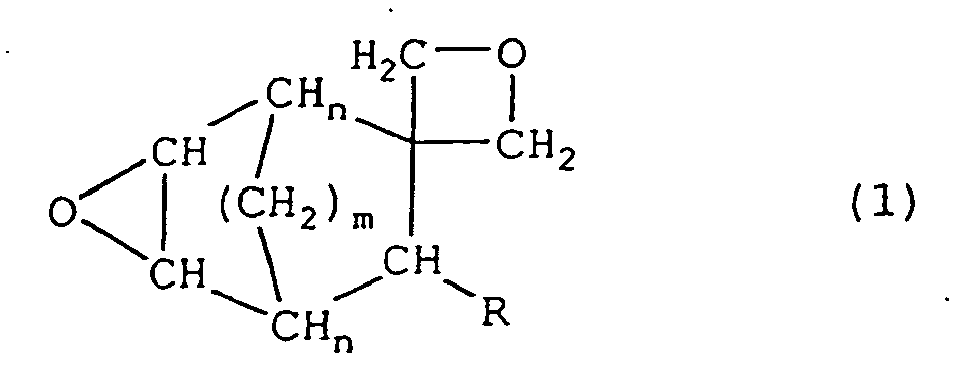
- (10) The cured material according to (9), wherein said alicyclic alkane (a) is 7,8-epoxy-2-oxa-5-methylspiro[3.5]nonane.
- (11) The cured material according to (10), which comprises a compound (c) that can be cationic polymerized by said compound (b), wherein said compound (c) is other than said compound (a).
- (12) The cured material according to (11), wherein at least one of said compound (c) is a compound (c-1) having one or more epoxy group that can be cationic polymerized by said compound (b).
- (13) The cured material according to (11), wherein at least one of said compound (c) is a compound (c-2) having one or more oxetanyl group that can be cationic polymerized by said compound (b).
- (14) The cured material according to (9), wherein said alicyclic alkane (a) is blended in an amount of 5 to 100 mass% based on the total mass of the polymerizable composition minus the mass of said compound (b).
- (15) The cured material according to (12), wherein said compound (c-1) is blended in an amount of 5 to 95 mass % based on the total mass of the polymerizable composition minus the mass of said compound (b).
- (16) The cured material according to (13), wherein said compound (c-2) is blended in an amount of 5 to 95 mass % based on the total mass of the polymerizable composition minus the mass of said compound (b).
- (17) A method for manufacturing a cured material from a polymerizable composition comprising (a) a compound represented by formula (1):

- (18) The method for manufacturing the cured material according to (17), comprising initiating the polymerization under irradiation of an active energy ray.
- (19) The method according to (18), wherein said active ray is ultraviolet light.
- (20) The method for manufacturing the cured material according to (17) comprising initiating the polymerization under heat.
- (21) The method for manufacturing the cured material according to (17) comprising initiating the polymerization under irradiation of an active energy ray and then heating the composition.
- (22) The method according to (21), wherein said active ray is ultraviolet light.
- The present invention is described in detail below.
- The present invention relates to a polymerizable composition comprising (a) an alicyclic alkane having at least one oxetanyl group and at least one epoxy group within the same molecule and (b) a compound capable of initiating cationic polymerization under irradiation of an active energy ray and/or under heat, and also relates to a method for polymerizing the composition and a cured material of the composition.
- Examples of the alicyclic alkane (a) having at least one oxetanyl group and at least one epoxy group within the same molecule for use in the present invention include 7,8-epoxy-2-oxa-5-methylspiro[3.5]nonane, 6,7-epoxy-2-oxaspiro[3.5]nonane, 7,8-epoxy-2-oxa-5-methylspiro[3.6]decane, 5,6-epoxy-2-oxaspiro[3.6]decane, spiro[5,6-epoxynorbornane-2,3'-oxetane] and spiro[5,6-epoxy-3-methylnorbornane-2,3'-oxetane. Among these, preferred are 7,8-epoxy-2-oxa-5-methylspiro[3.5]nonane, 6,7-epoxy-2-oxaspiro[3.5]nonane and spiro[5,6-epoxynorbornane-2,3'-oxetane].
- Alicyclic alkanes having at least one oxetanyl group and at least one epoxy group within the same molecule can be easily synthesized by a known method described, for example, in
U.S. Patent 3,388,105 . - Alicyclic alkanes (a) having at least one oxetanyl group and at least one epoxy group within the same molecule can be used individually or as a mixture of two or more thereof.
- The compound (a) is suitably blended in an amount of from 5 to 100 mass % (in the case of using two or more compounds (a), the total amount thereof) based on the total weight of the polymerizable composition of the present invention minus the weight of the compound (b) capable of initiating cationic polymerization under irradiation of an active energy ray and/or under heat.
- The compound (b) capable of initiating cationic polymerization under irradiation of an active energy ray and/or under heat for use in the present invention is a compound which is subjected to a conversion under heat or under irradiation of an active energy ray such as ultraviolet light, and thereby generates the substance capable of initiating the cationic polymerization, i.e. an acid. Accordingly, the compound (b) is one of a cationic polymerization initiator and is called an "acid generator" in the art. The compound (b) is hereinafter referred to as an acid generation-type cationic polymerization initiator.
- The acid generation-type cationic polymerization initiator is added in order to accelerate the ring-opening cationic polymerization of both the oxetanyl group and the epoxy group in the alicyclic alkane (a) having at least one oxetanyl group and at least one epoxy group within the same molecule of the present invention, under heat or irradiation with light such as ultraviolet light, and to allow smooth curing of the curable material or coating to proceed.
- The acid generation-type cationic polymerization initiator as used in the present invention is a compound which is subjected to a conversion under heat or under irradiation of an active energy ray such as ultraviolet light and thereby generates an acid capable of initiating the cationic polymerization, and excludes compounds originally in an acid form, such as carboxylic acid.
- Examples of the acid generation-type cationic polymerization initiator include known sulfonium salts, iodonium salts, and diazonium salts. Specific examples thereof are described below, however, the present invention is not limited to these compounds.
- Examples of the sulfonium salt-based acid generation-type cationic polymerization initiator include bis[4-(diphenylsulfonio)phenyl]sulfide bishexafluorophosphate, bis[4-(diphenylsulfonio)phenyljsulfide bishexafluoro-antimonate, bis[4-(diphenylsulfonio)phenyl]sulfide bistetrafluoroborate, bis[4-(diphenylsulfonio)phenyl]-sulfide tetrakis(pentafluorophenyl)borate, diphenyl-4-(phenylthio)phenylsulfonium hexafluorophosphate, diphenyl-4-(phenylthio)phenylsulfonium hexafluoroantimonate, diphenyl-4-(phenylthio)phenylsulfonium tetrafluoroborate, diphenyl-4-(phenylthio)phenylsulfonium tetrakis(pentafluorophenyl)borate, triphenylsulfonium hexafluorophosphate, triphenylsulfonium hexafluoroantimonate, triphenylsulfonium tetrafluoroborate, triphenylsulfonium tetrakis(pentafluorophenyl)borate, bis[4-(di(4-(2-hydroxyethoxy))phenyl-sulfonio)phenyl]sulfide bishexafluorophosphate, bis[4-(di(4-(2-hydroxyethoxy))phenylsulfonio)phenyl]sulfide bis-hexafluoroantimonate, bis[4-(di(4-(2-hydroxyethoxy))-phenylsulfonio)phenyl]sulfide bistetrafluoroborate and bis[4-(di(4-(2-hydroxyethoxy))phenylsulfonio)phenyl]sulfide tetrakis(pentafluorophenyl)borate.
- Examples of the iodonium salt-based acid generation-type cationic polymerization initiator include diphenyliodonium hexafluorophosphate, diphenyliodonium hexafluoroantimonate, diphenyliodonium tetrafluoroborate, diphenyliodonium tetrakis(pentafluorophenyl)borate, bis-(dodecylphenyl)iodonium hexafluorophosphate, bis(dodecylphenyl)iodonium hexafluoroantimonate, bis (dodecylphenyl)-iodonium tetrafluoroborate, bis(dodecylphenyl)iodonium tetrakis(pentafluorophenyl)borate, 4-methylphenyl-4-(l-methylethyl)phenyliodonium hexafluorophosphate, 4-methylphenyl-4-(1-methylethyl)phenyliodonium hexafluoroantimonate, 4-methylphenyl-4-(1-methylethyl)phenyliodonium tetrafluoroborate and 4-methylphenyl-4-(1-methylethyl)phenyliodonium tetrakis(pentafluorophenyl)borate.
- Examples of the diazonium salt-based acid generation-type cationic polymerization initiator include phenyldiazonium hexafluorophosphate, phenyldiazonium hexafluoroantimonate, phenyldiazonium tetrafluoroborate and phenyldiazonium tetrakis(pentafluorophenyl)borate.
- Among these, sulfonium salt-based and iodonium salt-based acid generation-type cationic polymerization initiators are preferred in view of curing rate, stability and profitability. Examples of the commercially available product include SP-150, SP-170, CP-66 and CP-77 produced by Asahi Denka Kogyo; CYRACURE-UVI-6990 and UVI-6974 produced by Union Carbide; CI-2855. and CI-2639 produced by Nippon Soda; San-Aid SI-60 produced by Sanshin Kagaku Kogyo K.K.; IRGACURE 261 ((2,4-cyclopentadien-1-yl) [(1-methylethyl)benzene]-Fe(II) hexafluorophosphate) produced by Ciba Specialty Chemicals; and RHODORSIL 2074 (4-methylphenyl-4-(1-methylethyl)phenyliodonium tetrakis-(pentafluorophenyl)borate) produced by Rhone Poulenc.
- The acid generation-type cationic polymerization initiator may be selected from the above-described materials and these materials may be used individually or in a combination of two or more thereof. The suitable range of the amount of the acid generation-type cationic polymerization initiator is not critical, but is preferably used in an amount of 0.05 to 25 parts by mass, preferably from 1 to 10 parts by mass, based on the total amount (100 parts by mass) of the polymerizable compounds (namely, the alicyclic alkane (a) having at least one oxetanyl group and at least one epoxy group within the same molecule and the compound (c)) which can be cationic polymerized by the compound (b) capable of initiating cationic polymerization under irradiation of an active energy ray and/or under heat. If adding it in an amount less than 0.05 parts by mass, poor sensitivity results, and a tremendously large amount of light irradiation energy or a high-temperature treatment over an extended time period will be required for curing. On the other hand, even though adding it in an amount more than 25 parts by mass, the sensitivity will not increase and this is not preferred also in view of the profitability. Moreover, the amount of the initiator remaining in the coating as an uncured component will increase, and thereby the physical properties of the cured product may deteriorate.
- For the compound (c-1) having an epoxy group for use in the present invention, an epoxy compound commonly known and used can be employed, and this compound is not particularly limited as long as it has one or more epoxy group within one molecule.
- Specific examples of the compound which can be used include bisphenol A diglycidyl ether, bisphenol F diglycidyl ether, bisphenol S diglycidyl ether, brominated bisphenol A diglycidyl ether, brominated bisphenol F diglycidyl ether, brominated bisphenol S diglycidyl ether, epoxy novolak resin, hydrogenated bisphenol A diglycidyl ether, hydrogenated bisphenol F diglycidyl ether, hydrogenated bisphenol S diglycidyl ether, cresol novolak epoxy resin and triglycidyl isocyanurate.
- Examples of the alicyclic epoxy compound include (3,4-epoxycyclohexyl)methyl-3',4'-epoxycyclohexyl carboxylate, 2-(3,4-epoxycyclohexyl-5,5-spiro-3,4-epoxy)cyclohexane-meta-dioxane, bis(3,4-epoxycyclohexylmethyl) adipate, vinylcyclohexene oxide, 4-vinylepoxycyclohexane, bis(3,4-epoxy-6-methylcyclohexylmethyl) adipate, 3,4-epoxy-6-methylcyclohexyl-3',4'-epoxy-6'-methylcyclohexane carboxylate, methylenebis(3,4-epoxycyclohexane), dicyclopentadiene diepoxide, di(3,4-epoxycyclohexylmethyl) ether of ethylene glycol, and ethylenebis(3,4-epoxycyclohexane carboxylate).
- Other examples include dioctyl epoxyhexahydrophthalate, di-2-ethylhexyl epoxyhexahydrophthalate, 1,4-butanedioldiglycidyl ether, 1,6-hexanedioldiglycidyl ether, glycerol triglycidyl ether, trimethylolpropane triglycidyl ether, polyethylene glycol diglycidyl ether, polypropylene glycol diglycidyl ether; polyglycidyl ethers of a polyether polyol obtained by adding one or more alkylene oxide to an aliphatic polyhydric alcohol, such as ethylene glycol, propylene glycol and glycerol; diglycidyl ethers of aliphatic long-chained dibasic acid; monoglycidyl ethers of aliphatic higher alcohol; butyl glycidyl ether, phenyl glycidyl ether, cresol glycidyl ether, nonylphenyl glycidyl ether, glycidyl methacrylate; monoglycidyl ethers of phenol, cresol, butylphenol or polyether alcohol obtained by adding an alkylene oxide thereto; glycidyl esters of higher fatty acid; epoxidated soybean oil; butyl epoxystearate, octyl epoxystearate, epoxidated linseed oil and epoxidated polybutadiene.
- These compounds (c-1) having one or more epoxy group within the molecule can be used individually or as a mixture of two or more thereof.
- The compound (c-1) can be blended in an amount of 5 to 95 mass % (in the case of using two or more compounds (c-1), the total amount thereof) based on the total weight of the polymerizable composition of the present invention minus the weight of the compound (b) capable of initiating cationic polymerization under irradiation of an active energy ray and/or under heat.
- The compound (c-2) having one or more oxetanyl group within the molecule is described below. The compound (c-2) having one or more oxetanyl group is used for the purpose of adjusting the viscosity of the entire polymerizable composition according to its use end and also imparting effects considered to be ascribable to the oxetane compound, namely, water resistance or a reduction in curing shrinkage.
- Specific examples thereof include trimethylene oxide, 3,3-dimethyloxetane, 3,3-dichloromethyloxetane, 3-ethyl-3-phenoxymethyloxetane, 3-ethyl-3-hydroxymethyloxetane (EOXA, trade name, produced by Toa Gosei), bis[(3-ethyl-3-oxetanylmethoxy)methyl]benzene (also called xylylene dioxetane; XDO, trade name, produced by Toa Gosei), tri[(3-ethyl-3-oxetanylmethoxy)methyl]benzene, bis[(3-ethyl-3-oxetanylmethoxy)methylphenyl]ether, (3-ethyl-3-oxetanylmethoxy)oligodimethylsiloxane, and compounds containing a multifunctional oxetane ring having a high molecular weight, specifically, oxetane oligomer (Oligo-OXT, trade name, produced by Toa Gosei)
- Examples of the compound having an alicyclic structure other than an oxetane ring within the same compound include 2-oxaspiro[3.5]nonane, 7-methyl-2-oxaspiro[3.5]nonane, spiro[adamantane-2,3'-oxetane], spiro[bicyclo[2.2.1]heptane-2,3'-oxetane], spiro[bicyclo[2.2.2]octane-2,3'-oxetane], spiro[7-oxabicyclo[2.2.1]heptane-2,3'-oxetane], 2-oxaspiro[3.5]non-6-ene, 5-methyl-2-oxaspiro[3.5]non-6-ene, spiro[bicyclo[2.2.1]hept-5-ene-2,3'-oxetane], spiro[3-methylbicyclo[2.2.1]hept-5-ene-2,3'-oxetane], 5-methyl-2-oxaspiro[3.5]nonane and spiro[3-methylbicyclo[2.2.1]heptane-2,3'-oxetane].
- These compounds (c-2) having one or more oxetanyl group can be used individually or as a mixture of two or more thereof.
- The compound (c-2) can be blended in an amount of 5 to 95 mass % (in the case of using two or more compounds (c-2) in combination, the total amount thereof) based on the total weight of the polymerizable composition of the present invention minus the weight of the compound (b) capable of initiating cationic polymerization under irradiation of an active energy ray and/or under heat.
- In the present invention, a cationic polymerizable monomer described below can also be added to the polymerizable composition. This cationic polymerizable monomer is classified into the compound (c) that causes a polymerization reaction or crosslinking reaction by the acid generated from the acid generation-type cationic polymerization initiator, but other than the compound (c-1) or (c-2). Examples thereof include oxolane compounds such as tetrahydrofurane, 2,3-dimethyl-tetrahydrofurane; cyclic acetal compounds such as trioxan, 1,3-dioxolane and 1,3,6-trioxancyclooctane; cyclic lactone compounds such as β-propiolactone and ε-caprolactone; thiirane compounds such as ethylenesulfide, 1,2-propylenesulfide and thioepichlorohydrin; thiethane compounds such as 3,3-dimethylthiethane; vinyl ether compounds such as ethylene glycol divinyl ether, triethylene glycol divinyl ether, trimethylol propane trivinyl ether; spiroorthoester compounds, a reaction product of an epoxy compound with lactone; ethylenically unsaturated compounds such as vinylcyclohexane, isobutylene and polybutadiene; cyclic ether compounds; cyclic thioether compounds; and vinyl compounds.
- These cationic polymerizable monomers can be added individually or in a combination of two or more thereof.
- In polymerizing the polymerizable composition of the present invention by an ultraviolet light which is one kind of active energy rays, a sensitizer may also be used for improving the polymerization rate. Examples of the sensitizer used to this purpose include pyrene, perylene, 2,4-diethylthioxanthone, 2,4-dimethylthioxanthone, 2,4-dichlorothioxanthone and phenothiazine. In the case of using a sensitizer, the sensitizer is preferably used in an amount of 0.1 to 100 parts by mass per 100 parts by mass of photoacid generation-type cationic polymerization initiator.
- The polymerizable composition of the present invention may also contain an organic solvent. The organic solvent is used for the purpose of adjusting the viscosity according to the use or the coating method or in the case where the polymerizable composition is solid, for dissolving and diluting the polymerizable composition and thereby enabling the coating of the polymerizable composition in a liquid form. Specific examples of the organic solvent which can be used include known solvents such as acetone, hexane, ethyl acetate, diethyl ether, ethyl methyl ketone, cyclohexane, tetrahydrofurane, toluene, xylene, tetramethylbenzene, petroleum ether, petroleum naphtha and solvent naphtha; ethylene glycol monoalkyl ethers and acetates thereof; diethylene glycol mono- or di-alkyl ethers; propylene glycol monoalkyl ethers and acetates thereof; dipropylene glycol mono- or di-alkyl ethers; methyl carbitol, butyl carbitol, butyl cellosolve acetate and carbitol acetate.
- These organic solvents can be used individually or in combination of two or more thereof. The amount of this organic solvent used can be appropriately selected according to the use end or the coating method.
- In the case of applying the polymerizable composition of the present invention to uses where adhesion, hardness or the like is required, a commonly known inorganic filler may be used, if desired, for the purpose of improving various properties, and examples thereof include barium sulfate, barium titanate, powdered silicon oxide, finely powdered silicon oxide, amorphous silica, talc, clay, magnesium carbonate, calcium carbonate, aluminum oxide, aluminum hydroxide and mica powder. Furthermore, if desired, commonly known additives may also be added, and examples thereof include a coloring agent such as Phthalocyanine Blue, Phthalocyanine Green, Iodine Green, Disazo Yellow, Crystal violet, titanium oxide, carbon black and naphthalene black; a silicone-type, fluorine-type or polymer-type defoaming agent and/or leveling agent; and an adhesion-imparting agent such as imidazole type, thiazole type, triazole type or silane coupling agent.
- The polymerizable composition of the present invention can be polymerized (cured) under irradiation of an active energy ray and/or under heat. The term "active energy ray" as used herein can be ultraviolet light; x-rays, an electron beam, y rays or the like. In the case of using ultraviolet light, examples of the light source include a metal halide lamp, a mercury arc lamp, a xenon arc lamp, a fluorescent lamp, a carbon arc lamp, a tungsten-halogen duplicate lamp and sunlight.
- The irradiation conditions in the polymerization (curing) under irradiation of an active energy ray may be appropriately selected according to the light transmission which varies depending on the film thickness of the polymerizable composition (the object to be cured) or the blending of a pigment or the like. In the case of curing a coating having a thickness of about 20 µm using ultraviolet light, the dose may be from 1 to 2,000 mJ/cm2, preferably from 10 to 1,000 mJ/cm2. Furthermore, when the object to be cured contains a solvent, light can be irradiated after removing the solvent by heating or the like.
- In the case of polymerization (curing) under heat, the conditions are generally a temperature of approximately from 50 to 400°C and a curing time of 5 seconds to 60 minutes, preferably approximately from 80°C to 250°C and from 10 seconds to 30 minutes.
- After the irradiation of an active energy ray, if desired, the cured material may be heated. By this post-heating, the unreacted material remaining in the cured material may be reduced and the cure distortion generated in the cured material due to irradiation of an active energy ray may be relaxed. As a result, hardness of the cured material may improve and in the case of a coating, adhesion against the substrate to be coated may improve. This post-heating can be generally performed in an atmosphere temperature of 80 to 300°C for 5 seconds to 30 minutes.
- The polymerizable composition of the present invention can be applied to substrates such as metal, rubber, plastic, paper, wood, glass, ceramic and concrete.
- Examples of the use of the photosensitive resin composition of the present invention include a coating material, an adhesive, a sealing agent, a construction and building material, a laminate, electrical and electric parts, a photoresist, a solder resist, a layer insulating material for multilayer circuit boards, concrete structure repairing, a material for cast molding, a printing ink, a sealant, and a material for stereolithography.
- The present invention is described in greater detail below by referring to the Examples and the Comparative Examples, however, the present invention should not be construed as being limited to these Examples. Unless otherwise indicated, the term "parts" used in Examples and Comparative Examples is "parts by mass".
- Among the materials used in the Examples and the Comparative Examples, the commercially available products shown below were used in their original condition without passing through any purification.
- EPIKOTE 828: bisphenol A-type epoxy resin, produced by Yuka Shell Epoxy K.K.; XDO: 1,4-bis[(3-ethyl-3-oxetanylmethoxy)methyl]benzene, produced by Toa Gosei; EPIKOTE 152: phenol · novolak type epoxy resin, produced by Yuka Shell Epoxy K.K.; KRM-2110: alicyclic base resin, produced by Asahi Denka Kogyo K.K.; SUN-AID SI-60L: SbF6 type sulfonium salt cationic polymerization initiator, produced by Sanshin Kagaku Kogyo; UVI-6990: triaryl sulfonium hexafluorophosphate salt-type cationic polymerization initiator, produced by UCC.
- The compounds which are not commercially available were chemically synthesized by the present inventors. That is, 7,8-epoxy-2-oxa-5-methylspiro[3.5]nonane and 6,7-epoxy-2-oxaspiro[3.5]nonane were synthesized by the present inventors with reference to
U.S.Patent No.3,388,105 . In particular, 7,8-epoxy-2-oxa-5-methylspiro[3.5]nonane was synthesized as below: - To a three-necked flask, 327 g of 2-methyl-4-cyclohexene-1-carboaldehyde, a Diels-Alder reaction product of butadiene and crotonaldehyde, 600 ml of methanol and 729 g of 37 % of formalin were charged, and then the temperature of this solution was raised to 60°C with stirring. Next, 252 g of KOH dissolved in 600 ml of distilled water was added dropwise thereto. After stirring for 7 hours, the reaction solution was concentrated under reduced pressure, which resulted in a residue with two phases. The oil phase concentrated to about 150 ml was washed with 300 ml of distilled water. After concentration under reduced pressure, 50 mg of 3,5-di(t-butyl)-4-hydroxytoluene (BHT) was added to the oil phase, and then vacuum distillation was carried out to yield 311 g (yield 82 %) of 6-methyl-3-cyclohexene-1,1-dimethanol as a colorless crystal.
- To a three-necked flask, 310 g (1.99 mol) of 6-methyl-3-cyclohexene-1,1-dimethanol, 894 g of dimethylcarbonate (DMC) and 0.93 g of potassium carbonate were charged, and was refluxed at a temperature raised to 90°C for 4 hours. The reaction solution was cooled to room temperature, and potassium carbonate was filtered off. After adding 120 mg of BHT, the remaining DMC and methanol were removed at a reduced pressure of 2 kPa (15mmHg), and then vacuum distillation was cartried out to yield 326 g (yield 89.4 %) of 6-methyl-3-cyclohexene-1,1*dimethanol cyclic carbonate ester, which is in a form of colorless crystals at room temperature.
- To a three-necked flask, 321.15 g of 6-methyl-3-cyclohexene-1,1-dimethanol cyclic carbonate ester, 642 mg (0.2 mass %) of BHT, 1.93 g of LiCl were charged, and then stirred with heating at 275°C using a mantle heater. The reaction product was immediately drained out of the reaction system at a reduced pressure of about 8kPa (60mmHg), and heating was continued until no efflux therefrom was observed. 600 mg of BHT was added to the product, and then vacuum distillation was carried out to yield 187 g (yield 71 %) of 2-oxa-9-methylspiro[3.5]non-6-ene as a transparent and colorless solution.
- 50 g of 2-oxa-9-methylspiro[3.5]non-6-ene was dissolved in 150 ml of dichloromethane, and charged into a reaction vessel. 93.7 g of m-chloroperbenzoic acid suspended in 400 ml of dichloromethane was added dropwise over 1 hour, while keeping the temperature of the reaction solution under 40°C. The crystallized m-chlorobenzoic acid was filtered off, and washed thoroughly with cold dichloromethane. 15.0 g of potassium hydroxide was charged to the organic phase, and after 30 minutes, the crystallized crystal was filtered off, and washed with cold dichloromethane. The organic phase was washed with 5 % of aqueous NaHSO4, saturated saline, followed by concentration, to yield 38.1 g (yield. 73.7 %) of 7,8-epoxy-2-oxa-5-methylspiro[3.5]nonane in a colorless semi-solid form.
- 6,7-epoxy-2-oxaspiro[3.5]nonane was also synthesized by the present inventors with a similar procedure as above.
- To a three-necked flask, 474 g of 2-methylcyclohexane-1,1-dimethanol, 405 g of dimethylcarbonate and 1.4 g of potassium carbonate were charged, heated in an oil bath at a temperature of 100°C with stirring, and the reaction was allowed to proceed for 14 hours while distilling out the formed methanol from the reaction system under atmospheric pressure. Finally, the pressure within the reaction vessel was reduced to 10 mmHg, yielding a carbonate ester in a yield of 95%.
- The resulting cyclic carbonate ester was heated to 250°C, and the reaction was allowed to proceed for 10 hours while distilling out the formed carbonic acid gas from the reaction system via the top of a cooling instrument. This reaction solution was subjected to a distillation purification to yield 230 g of 5-methyl-2-oxaspiro[3.5]nonane.
- This compound was synthesized by the present inventors in exactly the same manner as the synthesis of 7,8-epoxy-2-oxa-5-methylspiro[3.5]nonane, except for using a Diels-Alder reaction product of cyclopentadiene and acroleln in place of the Diels-Alder reaction product of butadiene and crotonaldehyde. Method for Evaluating Polymerizability and Physical Properties of Cured Material:
- In the evaluation of polymerizability and physical properties of cured material, the reaction conversion, the surface hardness and the pencil scratch value of cured material were determined and used as indices. Specifically, the values were determined by the following operations.
- 1) Reaction Conversion
The reaction conversion was calculated from the variation of infrared absorption spectrum before and after the polymerization of the polymerizable composition coated on a silicon wafer to a thickness of 10 µm.
The infrared absorption spectrum was measured by the transmission method using an FTIR measuring apparatus (Fourier transformation infrared spectrophotometer, Model VALOR-III, manufactured by Nihon Bunko K.K.).
The reaction conversion was determined from the amount of the variation, before and after the irradiation, in the absorbance of the characteristic absorption peak in the infrared absorption spectrum, more specifically, for oxetanyl group, the characteristic absorption peak at 980 cm-1; for alicyclic epoxy group, the characteristic absorption peak at from 789 to 798 cm-1; and for glycidyl group, the characteristic absorption peak at 773 cm-1, respectively, according to the following formula:
In Examples 6 to 8, the average of reaction conversion values of the oxetanyl group and the epoxy group present within the same molecule was used as the conversion. In Comparative Examples 3 to 8, the conversion was calculated from the peak of characteristic absorption (glycidyl group in EPIKOTE 828, oxetanyl group in XDO, and alicyclic epoxy group in KRM-2110) of the material used for comparison. - 2) Surface Hardness
The surface hardness of the cured materials were measured using a hardness tester manufactured by Colman Co. (GYZJ934-1). The measurement temperature was 23°C. - 3) Pencil Scratch value of Cured Material
The cured coatings of the polymerizable compositions on silicon wafers were measured in accordance with JIS K5400. - To 100 parts of 7,8-epoxy-2-oxa-5-methylspiro[3.5]nonane, 5 parts of an acid generation-type cationic polymerization initiator "SUN-AID SI-60L, produced by Sanshin Kagaku Kogyo K.K." was added and thoroughly stirred to obtain a thermopolymerizable composition. Laminates, each comprising a 2 mm-thick glass plate, wherein a 2 mm-thick rubber spacer having a 5 cm diameter bored hole is placed thereon and a thermopolymerizable composition being poured into the bored hole, and another glass plate laminated to the former plate in order to prevent the entry of air, were provided. Two units of this device were prepared and left standing in an oven at 120°C. One was taken out from the oven after 10 minutes and another was taken out after 30 minutes to obtain cured materials having a diameter of 5 cm and a thickness of 2 mm. After the cured materials had cooled to room temperature, the temperature was adjusted to 23°C and the surface hardness of each cured material with a curing time of 10 minutes or 30 minutes was measured. The results obtained are shown in Table 1.
- The operation was performed in exactly the same manner as in Example 1 except for using 6,7-epoxy-2-oxaspiro[3.5]nonane in place of 7,8-epoxy-2-oxa-5-methylspiro[3.5]nonane, and then the surface hardness of each cured material was measured. The results obtained are shown in Table 1.
- The operation was performed in exactly the same manner as in Example 1 except for using spiro[5,6-epoxynorbornane-2,3'-oxetane] in place of 7,8-epoxy-2-oxa-5-methylspiro[3.5]nonane, and then the surface hardness of each cured material was measured. The results obtained are shown in Table 1.
- The operation was performed in exactly the same manner as in Example 1 except for using a mixture of 90 parts of 7,8-epoxy-2-oxa-5-methylspiro[3.5]nonane and 10 parts of EPIKOTE 828 (produced by Yuka Shell Epoxy K.K.) in place of 100 parts of 7,8-epoxy-2-oxa-5-methyl spiro[3.5]nonane, and then the surface hardness of each cured material was measured. The results obtained are shown in Table 1.
- The operation was performed in exactly the same manner as in Example 1 except for using a mixture of 80 parts of 7, 8-epoxy-2-oxa-5-methylspiro[3.5]nonane, 10 parts of EPIKOTE 828 (produced by Yuka Shell Epoxy K.K.) and 10 parts of 5-methyl-2-oxaspiro[3.5]nonane in place of 100 parts of 7,8-epoxy-2-oxa-5-methylspiro[3.5]nohane, and then the surface hardness of each cured material was measured. The results obtained are shown in Table 1.
- The operation was performed in exactly the same manner as in Example 1 except for using a mixture of 10 parts of 7,8-epoxy-2-oxa-5-methylspiro[3.5]nonane and 90 parts of EPIKOTE 152 (produced by Yuka Shell Epoxy K.K.) in place of 100 parts of 7,8-epoxy-2-oxa-5-methyl spiro[3.5]nonane, and then the surface hardness of each cured material was measured. The results obtained are shown in Table 1.
- The operations were performed in exactly the same manner as in Example 1 except for using a heat polymerizable composition having the formulations shown in Table 1, and then the surface hardness of each cured material was measured. The results obtained are shown in Table 1.
- As is apparent from Table 1, the polymerizable compositions of the present invention in Examples 1 to 5 achieved the final hardness with heating for about 10 minutes, and this reveals that each composition had rapidly polymerized and cured.
- Also, it is seen from the comparison between Example 6 and Comparative Example 2 that the curing rate of epoxy resin can be improved by blending about 10 parts by mass of the alicyclic alkane (a) having at least one oxetanyl group and at least one epoxy group within the molecule of the present invention, into the epoxy resin.
Table 1 Blending of Polymerizable Composition and Surface Hardness of Cured Material Name of Compound Examples Comparative Examples 1 2 3 4 5 6 1 2 7,8-epoxy-2-oxa-5-methylspiro[3.5]nonane 100 0 0 90 80 10 0 0 6,7-epoxy-2-oxaspiro[3.5]nonane 0 100 0 0 0 0 0 0 Spiro[5,6-epoxynorbornane-2,3'-oxetane] 0 0 100 0 0 0 0 0 5-Methyl-2-oxaspiro[3.5]nonane 0 0 0 0 10 0 0 0 EPIKOTE 828 0 0 0 10 10 0 0 0 XDO 0 0 0 0 0 0 100 0 EPIKOTE 152 0 0 0 0 0 90 0 100 SUN-AID SI-60L 5 5 5 5 5 5 5 5 Surface hardness (hard) after heat-curing for 10 minutes 20 18 22 20 18 20 0 5 after heat-curing for 30 minutes 25 24 27 25 24 25 2 10 - To 100 parts of 7,8-epoxy-2-oxa-5-methylspiro[3.5]nonane, 5 parts of photoacid generation-type cationic polymerization initiator "UVI-6990" produced by Union Carbide K.K. was added and thoroughly stirred to obtain a photopolymerizable composition.
- Subsequently, this composition was coated on a silicon wafer to a thickness of 10 µm and the conversion of the reactive groups was determined following the irradiation with a high-pressure mercury lamp at 1.45 mW/cm2 for 10 seconds and for 30 seconds.
- Furthermore, in accordance with the measurement method of 3) Pencil Scratch Value above, the pencil scratch value of the cured coating on the silicon wafer obtained by the irradiation for 30 seconds was measured.
- The results obtained are shown together in Table 2.
- The operation was performed in exactly the same manner as in Example 7 except for using a mixture of 90 parts of 7,8-epoxy-2-oxa-5-methylspiro[3.5]nonane and 10 parts of EPIKOTE 828 (produced by Yuka Shell Epoxy K.K.) in place of 100 parts of 7,8-epoxy-2-oxa-5-methylspiro[3.5]nonane, and then the conversion and the pencil scratch value were measured. The results obtained are shown in Table 2.
- The operation was performed in exactly the same manner as in Example 7 except for using a mixture of 50 parts of 7,8-epoxy-2-oxa-5-methylspiro[3.5]nonane and 50 parts of EPIKOTE 828 (produced by Yuka Shell Epoxy K.K.) in place of 100 parts of 7,8-epoxy-2-oxa-5-methylspiro[3.5]nonane, and then the conversion and the pencil scratch value were measured. The results obtained are shown in Table 2.
- From the results of Examples 7 to 9, it was demonstrated that the conversions of oxetanyl group and alicyclic epoxy group were more improved, and a more rapid curing rate was achieved by blending an epoxy compound as a constituent element of the composition of the present invention, to the alicyclic alkane having at least one oxetanyl group and at least one epoxy group within the same molecule.
- The operation was performed in exactly the same manner as in Example 7 except for using a photopolymerizable composition having formulations shown in Table 2, and the conversions and the pencil scratch values were measured. The results obtained are shown in Table 2.
- As is apparent from Table 2, following the light irradiation, the reactive groups of the polymerizable compositions of the present invention in Examples 7 to 9 decreased rapidly, namely, they polymerized rapidly: as compared with the Comparative Examples 3 to 5, revealing that the compositions can be polymerized and cured within a short period of time.
[Table 2] Blending and Conversion of Polymerizable Composition and Pencil Scratch Value of Cured Material Examples Comparative Examples Name of Compound 7 8 9 3 4 5 7,8-epoxy-2-oxa-5-methylspiro[3.5]nonane 100 90 50 0 0 0 EPIKOTE 828 0 10 50 0 0 0 XDO 0 0 0 100 0 0 EPIKOTE 152 0 0 0 0 100 0 KRM-2110 0 0 0 0 0 100 UVI-6990 5 5 5 5 5 5 Conversion (%) after irradiation of 10 seconds 63 70 87 20 24 13 after irradiation of 30 seconds 82 83 91 46 40 29 Pencil scratch value 3H 3H 3H 3H 3H 3H - In the Examples and Comparative Examples of each Table, compounds shown below were used.
- EPIKOTE 828:
- bisphenol A-type epoxy resin, produced by Yuka Shell Epoxy K.K.
- XDO:
- 1,4-bis[(3-ethyl-3-oxetanylmethoxy)methyl]benzene, produced by Toa Gosei
- EPIKOTE 152:
- phenol·novolak type epoxy resin, produced by Yuka Shell Epoxy K.K.
- KRM-2110:
- alicyclic base resin, produced by Asahi Denka Kogyo K.K.
- SUN-AID SI-60L:SbF6 -
- type sulfonium salt cationic polymerization initiator, produced by Sanshin Kagaku Kogyo K.K.
- UVI-6990:
- triaryl sulfonium hexafluorophosphate salt-type cationic polymerization initiator, produced by UCC.
- The present invention provides a cationic polymerizable composition exhibiting high activity (rapid curability) under heat and/or under irradiation of an active energy ray and also provides a cured material thereof and a method for producing the cured material. The present invention can be applied to the coating on paper or plastic having poor heat resistance and further can be applied to a coating, an adhesive, a sealing agent, a construction and building material, a laminate, electrical and electronic parts, a photoresist, a solder resist, a layer insulating film for multilayer circuit boards, concrete structure repairing, or a material for cast molding, a printing ink, a sealant, and a material for stereolithography.
- It will be appreciated by those skilled in the art that while the invention has been described above in connection with particular embodiments and examples, the invention is not necessarily so limited and that numerous other embodiments, examples, uses, modifications and departures from the embodiments, examples and use may be made without departing from the inventive scope of this application.
Claims (22)
- A polymerizable composition comprising (a) a compound represented by formula (1):
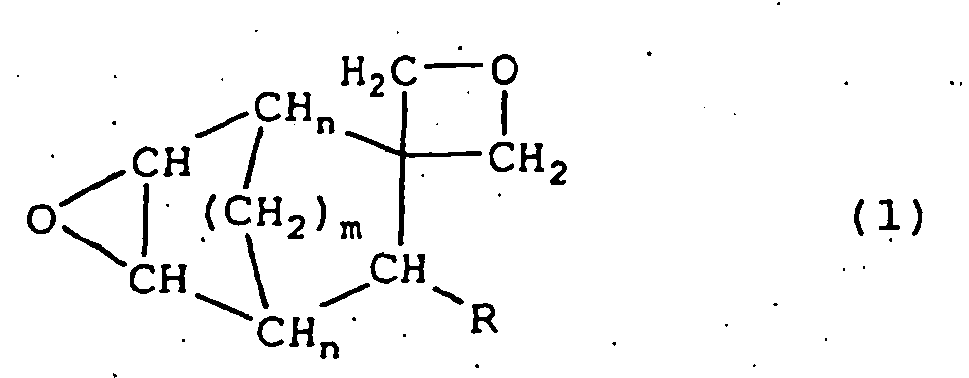
- The polymerizable composition according to claim 1, wherein said alicyclic alkane (a) is 7,8-epoxy-2-oxa-5-methylspiro[-3--5]nonane.
- The polymerizable composition according to claim 1, which comprises a compound (c) that can be cationic polymerized by said compound (b), wherein said compound (c) is other than said compound (a).
- The polymerizable composition according to claim 3, wherein at least one of said compounds (c) is a _ compound (c-1) having one or more epoxy group that can be cationic polymerized by said compound (b).
- The polymerizable composition according to claim 3, wherein at least one of said compounds (c) is a compound (c-2) having one or more oxetanyl group that can be cationic polymerized by said compound (b).
- The polymerizable composition according to claim 1, wherein said alicyclic alkane (a) is blended in an amount of 5 to 100 mass % based on the total mass of the polymerizable composition minus the mass of said compound (b).
- The polymerizable composition according to claim 4 wherein said compound (c-1) is blended in an amount of 5 to 95 mass % based on the total mass of the polymerizable composition minus the mass of said compound (b).
- The polymerizable composition according to claim 5, wherein said compound (c-2) is blended in an amount of 5 to 95 mass % based on the total mass of the polymerizable composition minus the mass of said compound
- A cured material obtained by polymerizing a polymerizable composition comprising (a) a compound represented by formula (1):

- The cured material according to claim 9 wherein said alicyclic alkane (a) is 7,8-epoxy-2-oxa-5-methylspiro[3.5]nonane.
- The cured material according to claim 10, which comprises a compound (c) that can be cationic polymerized by said compound (b), wherein said compound (c) is other than said compound (a).
- The cured material according to claim 11, wherein at least one of said compound (c) is a compound (c-1) having one or more epoxy group that can be cationic polymerized by said compound (b).
- The cured material according to claim 11, wherein at least one of said compound (c) is a compound (c-2) having one or more oxetanyl group that can be cationic polymerized by said compound (b).
- The cured material according to claim 9, wherein said alicyclic alkane (a) is blended in an amount of 5 to 100 mass% based on the total mass of the polymerizable composition minus the mass of said compound (b).
- The cured material according to claim 12 wherein said compound (c-1) is blended in an amount of 5 to 95 mass % based on the total mass of the polymerizable composition minus the mass of said compound (b).
- The cured material according to claim 13, wherein said compound (c-2) is blended in an amount of 5 to 95 mass % based on the total mass of the polymerizable composition minus the mass of said compound (b).
- A method for manufacturing a cured material from a polymerizable composition comprising (a) a compound represented by formula (1):

- The method for manufacturing the cured material according claim 17, comprising initiating the polymerization under irradiation of an active energy ray.
- The method according to claim 18, wherein said active ray is ultraviolet light.
- The method for manufacturing the cured material according to claim 17, comprising initiating the polymerization under heat.
- The method for manufacturing the cured material according to claim 17 comprising initiating the polymerization under irradiation of an active energy ray and then heating the composition.
- The method according to claim 21, wherein said active ray is ultraviolet light.
Applications Claiming Priority (3)
| Application Number | Priority Date | Filing Date | Title |
|---|---|---|---|
| JP2000130472A JP2001310938A (en) | 2000-04-28 | 2000-04-28 | Polymerizable composition, its cured product and production method |
| JP2000130472 | 2000-04-28 | ||
| PCT/JP2001/003537 WO2001083580A2 (en) | 2000-04-28 | 2001-04-24 | Polymerizable composition, cured material thereof and method for manufacturing the same |
Publications (2)
| Publication Number | Publication Date |
|---|---|
| EP1237983A2 EP1237983A2 (en) | 2002-09-11 |
| EP1237983B1 true EP1237983B1 (en) | 2007-08-01 |
Family
ID=18639569
Family Applications (1)
| Application Number | Title | Priority Date | Filing Date |
|---|---|---|---|
| EP01922067A Expired - Lifetime EP1237983B1 (en) | 2000-04-28 | 2001-04-24 | Polymerizable composition, cured material thereof and method for manufacturing the same |
Country Status (8)
| Country | Link |
|---|---|
| US (1) | US20020161068A1 (en) |
| EP (1) | EP1237983B1 (en) |
| JP (1) | JP2001310938A (en) |
| KR (1) | KR100478519B1 (en) |
| AT (1) | ATE368701T1 (en) |
| AU (1) | AU4885501A (en) |
| DE (1) | DE60129666T2 (en) |
| WO (1) | WO2001083580A2 (en) |
Families Citing this family (102)
| Publication number | Priority date | Publication date | Assignee | Title |
|---|---|---|---|---|
| US6706403B1 (en) * | 2000-05-12 | 2004-03-16 | 3M Innovative Properties Company | Rigid substrate lamination adhesive |
| JP2002040632A (en) * | 2000-07-21 | 2002-02-06 | Showa Denko Kk | Resist ink composition |
| JP4873203B2 (en) * | 2000-11-28 | 2012-02-08 | 日立化成工業株式会社 | Method of curing curable oxetane composition |
| JP4836325B2 (en) * | 2000-12-28 | 2011-12-14 | 昭和電工株式会社 | Composition for sealing resin |
| KR20120086737A (en) * | 2002-05-03 | 2012-08-03 | 디에스엠 아이피 어셋츠 비.브이. | Radiation curable resin composition and rapid prototyping process using the same |
| US7309122B2 (en) | 2003-06-24 | 2007-12-18 | Konica Minolta Medical & Graphic, Inc. | Method for storing cationic polymerizable composition and container for using thereof |
| JP4595311B2 (en) | 2003-11-06 | 2010-12-08 | コニカミノルタエムジー株式会社 | Actinic ray curable inkjet ink composition, image forming method using the same, and inkjet recording apparatus |
| JPWO2006027966A1 (en) | 2004-09-09 | 2008-05-08 | コニカミノルタエムジー株式会社 | Actinic ray curable inkjet ink, image forming method using the same, and inkjet recording apparatus |
| EP1652886A1 (en) * | 2004-09-15 | 2006-05-03 | Dainippon Ink And Chemicals, Inc. | Photocationic curable composition and new compound |
| US20080044149A1 (en) * | 2004-11-26 | 2008-02-21 | Toyo Ink Mfg. Co., Ltd. | Polymerizable Composition |
| US7950795B2 (en) | 2004-12-09 | 2011-05-31 | Konica Minolta Medical & Graphic, Inc. | Image forming method and ink-jet recording device utilizing photo-curable ink, and inkset, ink-jet recording method and ink-jet recording device utilizing photo-curable ink |
| JP4621036B2 (en) * | 2005-02-08 | 2011-01-26 | 太陽ホールディングス株式会社 | Photosensitive resin composition, cured product thereof and display panel spacer comprising the cured product |
| US20060204732A1 (en) | 2005-03-08 | 2006-09-14 | Fuji Photo Film Co., Ltd. | Ink composition, inkjet recording method, printed material, method of producing planographic printing plate, and planographic printing plate |
| JP4474317B2 (en) | 2005-03-31 | 2010-06-02 | 富士フイルム株式会社 | Preparation method of lithographic printing plate |
| JP2006321868A (en) | 2005-05-18 | 2006-11-30 | Fujifilm Holdings Corp | Ink composition, inkjet recording method, printed matter, manufacturing method of lithographic printing plate, and lithographic printing plate |
| JP2006326929A (en) | 2005-05-24 | 2006-12-07 | Fujifilm Holdings Corp | Active energy curing type ink cartridge and inkjet recorder |
| JP2007007949A (en) | 2005-06-29 | 2007-01-18 | Fujifilm Holdings Corp | Active energy curing ink jet recorder and its recording method |
| JP4662822B2 (en) | 2005-07-19 | 2011-03-30 | 富士フイルム株式会社 | Photo-curable ink jet recording apparatus |
| JP4702784B2 (en) | 2005-08-08 | 2011-06-15 | ソニー株式会社 | Liquid discharge type recording head flow path constituent material |
| JP2007051193A (en) | 2005-08-17 | 2007-03-01 | Fujifilm Corp | Ink composition, inkjet recording method, printed matter, planographic printing plate manufacturing method, and planographic printing plate |
| JP4677306B2 (en) | 2005-08-23 | 2011-04-27 | 富士フイルム株式会社 | Active energy curable ink jet recording apparatus |
| EP1757635B1 (en) | 2005-08-23 | 2008-10-08 | FUJIFILM Corporation | Curable ink comprising modified oxetane compound |
| US7795323B2 (en) | 2005-09-02 | 2010-09-14 | Konica Minolta Medical & Graphic, Inc. | Active ray curable ink-jet ink |
| JP4757574B2 (en) | 2005-09-07 | 2011-08-24 | 富士フイルム株式会社 | Ink composition, inkjet recording method, printed matter, planographic printing plate manufacturing method, and planographic printing plate |
| ATE494341T1 (en) | 2005-11-04 | 2011-01-15 | Fujifilm Corp | CURABLE INK COMPOSITION AND OXETANE COMPOUND |
| ATE518923T1 (en) | 2005-12-28 | 2011-08-15 | Fujifilm Corp | INKJET INK COMPOSITION, METHOD OF INKJET PRINTING, METHOD OF PRODUCING A PLANOGRAPHIC PRINTING PLATE, PLANOGRAPHIC PRINTING PLATE |
| JP4719606B2 (en) | 2006-03-30 | 2011-07-06 | 富士フイルム株式会社 | Inkjet head recording device |
| JP4714622B2 (en) | 2006-03-30 | 2011-06-29 | 富士フイルム株式会社 | Post-processing method and apparatus having post-processing apparatus for inkjet recording medium |
| EP2030792B1 (en) | 2006-06-22 | 2013-01-02 | Konica Minolta Medical & Graphic, Inc. | Inkjet printer and image-forming method |
| JP5276264B2 (en) | 2006-07-03 | 2013-08-28 | 富士フイルム株式会社 | INK COMPOSITION, INKJET RECORDING METHOD, PRINTED MATERIAL, AND METHOD FOR PRODUCING A lithographic printing plate |
| JP2008013646A (en) * | 2006-07-05 | 2008-01-24 | Fujifilm Corp | Ink composition, inkjet recording method, printed material, method for producing lithographic printing plate, and lithographic printing plate |
| JP4928892B2 (en) | 2006-09-29 | 2012-05-09 | 富士フイルム株式会社 | Inkjet recording device |
| ATE425876T1 (en) | 2006-11-30 | 2009-04-15 | Fujifilm Corp | INK JET RECORDING INK COMPOSITION AND INK JET RECORDING METHOD |
| US8038283B2 (en) | 2007-01-18 | 2011-10-18 | Fujifilm Corporation | Ink-jet recording apparatus |
| JP2008189776A (en) | 2007-02-02 | 2008-08-21 | Fujifilm Corp | Actinic radiation curable polymerizable composition, ink composition, ink jet recording method, printed matter, lithographic printing plate preparation method, and lithographic printing plate |
| JP5224694B2 (en) | 2007-02-06 | 2013-07-03 | 富士フイルム株式会社 | Ink composition for ink jet recording and ink jet recording method |
| JP5227521B2 (en) | 2007-02-26 | 2013-07-03 | 富士フイルム株式会社 | Ink composition, ink jet recording method, printed matter, and ink set |
| JP2008208266A (en) | 2007-02-27 | 2008-09-11 | Fujifilm Corp | Ink composition, inkjet recording method, printed material, method for producing lithographic printing plate, and lithographic printing plate |
| JP5224699B2 (en) | 2007-03-01 | 2013-07-03 | 富士フイルム株式会社 | Ink composition, inkjet recording method, printed material, method for producing lithographic printing plate, and lithographic printing plate |
| US8088566B2 (en) | 2007-03-26 | 2012-01-03 | Fujifilm Corporation | Surface-treating agent for pattern formation and pattern-forming method using the surface-treating agent |
| JP2008246793A (en) | 2007-03-29 | 2008-10-16 | Fujifilm Corp | Active energy ray curable ink jet recording apparatus |
| JP5306681B2 (en) | 2007-03-30 | 2013-10-02 | 富士フイルム株式会社 | Polymerizable compound, polymer, ink composition, printed matter, and inkjet recording method |
| JP5243072B2 (en) | 2007-03-30 | 2013-07-24 | 富士フイルム株式会社 | Ink composition, and image recording method and image recorded material using the same |
| JP5159141B2 (en) | 2007-03-30 | 2013-03-06 | 富士フイルム株式会社 | Ink composition, inkjet recording method, printed matter, lithographic printing plate preparation method |
| JP5255369B2 (en) | 2007-09-25 | 2013-08-07 | 富士フイルム株式会社 | Photocurable coating composition, overprint and method for producing the same |
| JP5111039B2 (en) | 2007-09-27 | 2012-12-26 | 富士フイルム株式会社 | Photocurable composition containing a polymerizable compound, a polymerization initiator, and a dye |
| JP5236238B2 (en) | 2007-09-28 | 2013-07-17 | 富士フイルム株式会社 | White ink composition for inkjet recording |
| JP5147348B2 (en) | 2007-09-28 | 2013-02-20 | 富士フイルム株式会社 | Ink composition |
| JP4898618B2 (en) | 2007-09-28 | 2012-03-21 | 富士フイルム株式会社 | Inkjet recording method |
| JP2009090489A (en) | 2007-10-04 | 2009-04-30 | Fujifilm Corp | Image forming method and image forming apparatus |
| JP5241211B2 (en) | 2007-11-28 | 2013-07-17 | 富士フイルム株式会社 | Ink composition and inkjet recording method |
| US8240838B2 (en) | 2007-11-29 | 2012-08-14 | Fujifilm Corporation | Ink composition for inkjet recording, inkjet recording method, and printed material |
| JP5591473B2 (en) | 2008-02-05 | 2014-09-17 | 富士フイルム株式会社 | Ink composition, inkjet recording method, and printed matter |
| US20090214797A1 (en) | 2008-02-25 | 2009-08-27 | Fujifilm Corporation | Inkjet ink composition, and inkjet recording method and printed material employing same |
| JP5287847B2 (en) | 2008-03-05 | 2013-09-11 | コニカミノルタ株式会社 | Inkjet recording apparatus and inkjet recording method |
| JP5583329B2 (en) | 2008-03-11 | 2014-09-03 | 富士フイルム株式会社 | Pigment composition, ink composition, printed matter, inkjet recording method, and polyallylamine derivative |
| JP4914862B2 (en) | 2008-03-26 | 2012-04-11 | 富士フイルム株式会社 | Inkjet recording method and inkjet recording apparatus |
| TWI427117B (en) | 2008-05-30 | 2014-02-21 | Nitto Denko Corp | Resin composition for optical components, optical component using the same and production method of optical lens |
| JP2009288598A (en) * | 2008-05-30 | 2009-12-10 | Nitto Denko Corp | Manufacturing method of optical lens and optical lens obtained thereby |
| JP5414367B2 (en) | 2008-06-02 | 2014-02-12 | 富士フイルム株式会社 | Pigment dispersion and ink composition using the same |
| JP5106285B2 (en) | 2008-07-16 | 2012-12-26 | 富士フイルム株式会社 | Photocurable composition, ink composition, and ink jet recording method using the ink composition |
| JP5383133B2 (en) | 2008-09-19 | 2014-01-08 | 富士フイルム株式会社 | Ink composition, ink jet recording method, and method for producing printed product |
| JP2010077228A (en) | 2008-09-25 | 2010-04-08 | Fujifilm Corp | Ink composition, inkjet recording method and printed material |
| ATE541905T1 (en) | 2008-09-26 | 2012-02-15 | Fujifilm Corp | INK COMPOSITION AND INK RECORDING METHOD |
| JP5461809B2 (en) | 2008-09-29 | 2014-04-02 | 富士フイルム株式会社 | Ink composition and inkjet recording method |
| JP2010115791A (en) | 2008-11-11 | 2010-05-27 | Konica Minolta Ij Technologies Inc | Image forming apparatus |
| JP5350827B2 (en) | 2009-02-09 | 2013-11-27 | 富士フイルム株式会社 | Ink composition and inkjet recording method |
| JP5225156B2 (en) | 2009-02-27 | 2013-07-03 | 富士フイルム株式会社 | Actinic radiation curable ink composition for ink jet recording, ink jet recording method and printed matter |
| JP2010202756A (en) | 2009-03-03 | 2010-09-16 | Fujifilm Corp | Active energy ray-curable ink composition, inkjet recording method, and printed matter |
| JP5441464B2 (en) | 2009-03-23 | 2014-03-12 | 富士フイルム株式会社 | Pigment dispersion, ink composition using the same, curable composition, and curable ink composition |
| JP5441463B2 (en) | 2009-03-23 | 2014-03-12 | 富士フイルム株式会社 | Pigment dispersion, ink composition using the same, curable composition, and curable ink composition |
| JP2010229349A (en) | 2009-03-27 | 2010-10-14 | Fujifilm Corp | Active energy ray curable composition, active energy ray curable ink composition, ink composition and ink jet recording method |
| JP2010235897A (en) | 2009-03-31 | 2010-10-21 | Fujifilm Corp | Non-aqueous ink, ink set, image recording method, image recording apparatus, and recorded matter |
| JP5579533B2 (en) | 2009-08-27 | 2014-08-27 | 富士フイルム株式会社 | Novel oxetane compound, active energy ray curable composition, active energy ray curable ink composition, and ink jet recording method |
| JP5583376B2 (en) | 2009-09-15 | 2014-09-03 | 富士フイルム株式会社 | Ink jet ink composition |
| JP5412350B2 (en) | 2010-03-26 | 2014-02-12 | 富士フイルム株式会社 | Article with birefringence pattern |
| JP5554114B2 (en) | 2010-03-29 | 2014-07-23 | 富士フイルム株式会社 | Actinic radiation curable ink composition for inkjet, printed matter, printed matter production method, printed matter molded product, and printed matter molded product |
| US8573765B2 (en) | 2010-03-31 | 2013-11-05 | Fujifilm Corporation | Active radiation curable ink composition, ink composition for inkjet recording, printed matter, and method of producing molded article of printed matter |
| JP2012031388A (en) | 2010-05-19 | 2012-02-16 | Fujifilm Corp | Printing method, method for preparing overprint, method for processing laminate, light-emitting diode curable coating composition, and light-emitting diode curable ink composition |
| JP5882566B2 (en) | 2010-07-09 | 2016-03-09 | 富士フイルム株式会社 | Anti-counterfeit medium with printing and birefringence pattern |
| JP5729933B2 (en) | 2010-07-28 | 2015-06-03 | 富士フイルム株式会社 | Birefringence pattern builder |
| EP2607433B1 (en) | 2010-08-19 | 2020-11-11 | Konica Minolta Holdings, Inc. | Active ray-curable ink and active ray-curable inkjet recording method |
| JP2012113000A (en) | 2010-11-19 | 2012-06-14 | Fujifilm Corp | Birefringent pattern transfer foil |
| JP5761202B2 (en) | 2010-12-10 | 2015-08-12 | コニカミノルタ株式会社 | Inkjet recording device |
| JP5351293B2 (en) | 2011-02-16 | 2013-11-27 | 富士フイルム株式会社 | Ink jet ink composition, method for producing the same, and ink jet recording method |
| JP5742411B2 (en) | 2011-04-12 | 2015-07-01 | セイコーエプソン株式会社 | Printed matter and method for producing printed matter |
| WO2012147760A1 (en) | 2011-04-27 | 2012-11-01 | コニカミノルタホールディングス株式会社 | Inkjet recording device |
| JP2012250493A (en) | 2011-06-06 | 2012-12-20 | Seiko Epson Corp | Ink set, printed matter and molded article |
| EP2551123B1 (en) | 2011-07-26 | 2016-08-17 | Seiko Epson Corporation | Printing method, printed material and molded article |
| WO2013128945A1 (en) | 2012-03-01 | 2013-09-06 | コニカミノルタ株式会社 | Inkjet printing method |
| EP2845733B1 (en) | 2012-05-01 | 2017-06-21 | Konica Minolta, Inc. | Image formation device |
| JP5752652B2 (en) | 2012-08-29 | 2015-07-22 | 富士フイルム株式会社 | Ink jet ink composition and method for producing the same, ink jet recording method, and pigment dispersion and method for producing the same |
| EP2979878B1 (en) | 2013-03-29 | 2020-09-02 | Konica Minolta, Inc. | Image formation device |
| US9541829B2 (en) | 2013-07-24 | 2017-01-10 | Orthogonal, Inc. | Cross-linkable fluorinated photopolymer |
| US9298088B2 (en) | 2013-07-24 | 2016-03-29 | Orthogonal, Inc. | Fluorinated photopolymer with fluorinated sensitizer |
| EP2851200B1 (en) | 2013-08-27 | 2020-04-01 | Konica Minolta, Inc. | Inkjet head and method for driving inkjet head |
| JP6117072B2 (en) | 2013-09-30 | 2017-04-19 | 富士フイルム株式会社 | Pigment dispersion composition, ink jet recording method, and compound production method |
| KR20160118340A (en) | 2014-02-07 | 2016-10-11 | 올싸거널 인코포레이티드 | Cross-linkable fluorinated photopolymer |
| KR101695829B1 (en) * | 2014-09-02 | 2017-01-13 | (주)솔잎기술 | A method of cationic polymerization with enhenced UV stability |
| KR102344209B1 (en) * | 2016-03-14 | 2021-12-27 | 에네오스 가부시키가이샤 | Epoxy compound, curable composition, cured product, method for preparing epoxy compound and reactive diluent |
| KR102291286B1 (en) * | 2016-03-23 | 2021-08-18 | 에네오스 가부시키가이샤 | Curable composition and cured product obtained by curing the same |
| US20190177469A1 (en) | 2017-12-13 | 2019-06-13 | Canon Kabushiki Kaisha | Curable resin composition |
Family Cites Families (15)
| Publication number | Priority date | Publication date | Assignee | Title |
|---|---|---|---|---|
| DE1301132B (en) * | 1964-10-06 | 1969-08-14 | Henkel & Cie Gmbh | Process for the production of molded articles on the basis of epoxy polyadducts |
| US3457193A (en) * | 1965-06-30 | 1969-07-22 | Union Carbide Corp | Epoxyoxacyclobutanes and polymers thereof |
| JP3161583B2 (en) * | 1995-07-21 | 2001-04-25 | 東亞合成株式会社 | Active energy ray-curable composition |
| JP3047800B2 (en) * | 1995-11-20 | 2000-06-05 | 東亞合成株式会社 | Process for producing polymer containing oxetanyl group in side chain |
| US5882842A (en) * | 1996-02-16 | 1999-03-16 | Kansai Paint Co., Ltd. | Active energy ray-curable resin composition |
| JP3839543B2 (en) * | 1996-02-16 | 2006-11-01 | 関西ペイント株式会社 | Active energy ray-curable resin composition |
| JPH1161034A (en) * | 1997-08-15 | 1999-03-05 | Kansai Paint Co Ltd | Coating composition and application method thereof |
| JP3251188B2 (en) * | 1997-01-30 | 2002-01-28 | 関西ペイント株式会社 | UV-curable can coating composition |
| DE19736471A1 (en) * | 1997-08-21 | 1999-02-25 | Espe Dental Ag | Light-induced cationic curing compositions and their use |
| JPH11152441A (en) * | 1997-11-21 | 1999-06-08 | Kansai Paint Co Ltd | Ultraviolet-curing composition for coating can |
| US6075155A (en) * | 1998-06-22 | 2000-06-13 | Rensselaer Polytechnic Institute | Radiation-curable cycloaliphatic epoxy compounds, uses thereof, and compositions containing them |
| JP3858471B2 (en) * | 1998-08-10 | 2006-12-13 | 東亞合成株式会社 | Method for producing high molecular weight polymer having oxetanyl group |
| US6232361B1 (en) * | 1998-12-11 | 2001-05-15 | Sun Chemical Corporation | Radiation curable water based cationic inks and coatings |
| US6498200B1 (en) * | 1999-01-12 | 2002-12-24 | Namics Corporation | Cationically polymerizable resin composition |
| JP2001226365A (en) * | 2000-02-15 | 2001-08-21 | Showa Denko Kk | Oxetane compound, method of preparing the same and polymerizable composition |
-
2000
- 2000-04-28 JP JP2000130472A patent/JP2001310938A/en active Pending
-
2001
- 2001-04-24 KR KR10-2001-7016885A patent/KR100478519B1/en not_active Expired - Fee Related
- 2001-04-24 AT AT01922067T patent/ATE368701T1/en not_active IP Right Cessation
- 2001-04-24 EP EP01922067A patent/EP1237983B1/en not_active Expired - Lifetime
- 2001-04-24 AU AU48855/01A patent/AU4885501A/en not_active Abandoned
- 2001-04-24 WO PCT/JP2001/003537 patent/WO2001083580A2/en not_active Ceased
- 2001-04-24 DE DE60129666T patent/DE60129666T2/en not_active Expired - Lifetime
- 2001-04-24 US US10/019,218 patent/US20020161068A1/en not_active Abandoned
Also Published As
| Publication number | Publication date |
|---|---|
| JP2001310938A (en) | 2001-11-06 |
| KR20020027381A (en) | 2002-04-13 |
| DE60129666D1 (en) | 2007-09-13 |
| EP1237983A2 (en) | 2002-09-11 |
| AU4885501A (en) | 2001-11-12 |
| DE60129666T2 (en) | 2008-05-21 |
| WO2001083580A3 (en) | 2002-06-27 |
| US20020161068A1 (en) | 2002-10-31 |
| ATE368701T1 (en) | 2007-08-15 |
| WO2001083580A2 (en) | 2001-11-08 |
| KR100478519B1 (en) | 2005-03-28 |
Similar Documents
| Publication | Publication Date | Title |
|---|---|---|
| US20020161068A1 (en) | Polymerizable composition, cured material thereof and method for manufacturing the same | |
| KR102357446B1 (en) | Photosensitive resin composition, resist laminate, cured product of photosensitive resin composition, and cured product of resist laminate (11) | |
| US6783840B2 (en) | Resist ink composition | |
| KR102118233B1 (en) | Photosensitive resin composition, resist laminate, and cured product thereof (2) | |
| JPH0931186A (en) | Composition curable with actinic radiation | |
| JP4924783B2 (en) | Alicyclic compound | |
| JP2004010783A (en) | Polymerizable composition containing oxetane compound, its cured product and method for producing the same | |
| JP7085791B2 (en) | Photosensitive resin composition and its cured product | |
| JP3820289B2 (en) | Photocurable resin composition for producing resin mold and method for producing resin mold | |
| JPH0762082A (en) | Active energy ray curable composition | |
| US20040110857A1 (en) | Photo-curable resin composition containing cyclic acetal compound and cured product | |
| JP4524083B2 (en) | Active energy ray-curable resin composition | |
| JP2002235065A (en) | Conductive adhesive composition | |
| JP4836325B2 (en) | Composition for sealing resin | |
| JP5699835B2 (en) | Curable composition, coating composition using the same, and cured products thereof | |
| WO2011136084A1 (en) | Curable resin composition for screen printing and printed wiring board | |
| KR100748149B1 (en) | Cationically photopolymerizable resin composition and optical disk surface protection material | |
| JPH07173279A (en) | Production of cured material | |
| JP4524127B2 (en) | Novel epoxy resin and curable resin composition containing the same | |
| JP2003177260A (en) | Composition for optical waveguide resin | |
| JP2002275446A (en) | Adhesive composition for surface mounting | |
| JP2023181911A (en) | Composition and cured product | |
| JP4042463B2 (en) | Active energy ray-curable resin composition | |
| JP2003213243A (en) | Adhesive composition for optical use | |
| JP2003128777A (en) | Polymerizable composition, its cured material and method for producing the same |
Legal Events
| Date | Code | Title | Description |
|---|---|---|---|
| PUAI | Public reference made under article 153(3) epc to a published international application that has entered the european phase |
Free format text: ORIGINAL CODE: 0009012 |
|
| 17P | Request for examination filed |
Effective date: 20020115 |
|
| AK | Designated contracting states |
Kind code of ref document: A2 Designated state(s): AT BE CH CY DE DK ES FI FR GB GR IE IT LI LU MC NL PT SE TR |
|
| AX | Request for extension of the european patent |
Free format text: AL;LT;LV;MK;RO;SI |
|
| 17Q | First examination report despatched |
Effective date: 20040108 |
|
| GRAP | Despatch of communication of intention to grant a patent |
Free format text: ORIGINAL CODE: EPIDOSNIGR1 |
|
| GRAS | Grant fee paid |
Free format text: ORIGINAL CODE: EPIDOSNIGR3 |
|
| GRAA | (expected) grant |
Free format text: ORIGINAL CODE: 0009210 |
|
| AK | Designated contracting states |
Kind code of ref document: B1 Designated state(s): AT BE CH CY DE DK ES FI FR GB GR IE IT LI LU MC NL PT SE TR |
|
| REG | Reference to a national code |
Ref country code: GB Ref legal event code: FG4D |
|
| REG | Reference to a national code |
Ref country code: CH Ref legal event code: EP |
|
| REG | Reference to a national code |
Ref country code: IE Ref legal event code: FG4D |
|
| REF | Corresponds to: |
Ref document number: 60129666 Country of ref document: DE Date of ref document: 20070913 Kind code of ref document: P |
|
| PG25 | Lapsed in a contracting state [announced via postgrant information from national office to epo] |
Ref country code: ES Free format text: LAPSE BECAUSE OF FAILURE TO SUBMIT A TRANSLATION OF THE DESCRIPTION OR TO PAY THE FEE WITHIN THE PRESCRIBED TIME-LIMIT Effective date: 20071112 Ref country code: FI Free format text: LAPSE BECAUSE OF FAILURE TO SUBMIT A TRANSLATION OF THE DESCRIPTION OR TO PAY THE FEE WITHIN THE PRESCRIBED TIME-LIMIT Effective date: 20070801 Ref country code: NL Free format text: LAPSE BECAUSE OF FAILURE TO SUBMIT A TRANSLATION OF THE DESCRIPTION OR TO PAY THE FEE WITHIN THE PRESCRIBED TIME-LIMIT Effective date: 20070801 |
|
| NLV1 | Nl: lapsed or annulled due to failure to fulfill the requirements of art. 29p and 29m of the patents act | ||
| REG | Reference to a national code |
Ref country code: CH Ref legal event code: PL |
|
| PG25 | Lapsed in a contracting state [announced via postgrant information from national office to epo] |
Ref country code: LI Free format text: LAPSE BECAUSE OF FAILURE TO SUBMIT A TRANSLATION OF THE DESCRIPTION OR TO PAY THE FEE WITHIN THE PRESCRIBED TIME-LIMIT Effective date: 20070801 Ref country code: CH Free format text: LAPSE BECAUSE OF FAILURE TO SUBMIT A TRANSLATION OF THE DESCRIPTION OR TO PAY THE FEE WITHIN THE PRESCRIBED TIME-LIMIT Effective date: 20070801 Ref country code: AT Free format text: LAPSE BECAUSE OF FAILURE TO SUBMIT A TRANSLATION OF THE DESCRIPTION OR TO PAY THE FEE WITHIN THE PRESCRIBED TIME-LIMIT Effective date: 20070801 |
|
| EN | Fr: translation not filed | ||
| PG25 | Lapsed in a contracting state [announced via postgrant information from national office to epo] |
Ref country code: BE Free format text: LAPSE BECAUSE OF FAILURE TO SUBMIT A TRANSLATION OF THE DESCRIPTION OR TO PAY THE FEE WITHIN THE PRESCRIBED TIME-LIMIT Effective date: 20070801 |
|
| PG25 | Lapsed in a contracting state [announced via postgrant information from national office to epo] |
Ref country code: DK Free format text: LAPSE BECAUSE OF FAILURE TO SUBMIT A TRANSLATION OF THE DESCRIPTION OR TO PAY THE FEE WITHIN THE PRESCRIBED TIME-LIMIT Effective date: 20070801 Ref country code: GR Free format text: LAPSE BECAUSE OF FAILURE TO SUBMIT A TRANSLATION OF THE DESCRIPTION OR TO PAY THE FEE WITHIN THE PRESCRIBED TIME-LIMIT Effective date: 20071102 |
|
| PG25 | Lapsed in a contracting state [announced via postgrant information from national office to epo] |
Ref country code: PT Free format text: LAPSE BECAUSE OF FAILURE TO SUBMIT A TRANSLATION OF THE DESCRIPTION OR TO PAY THE FEE WITHIN THE PRESCRIBED TIME-LIMIT Effective date: 20080102 |
|
| PLBE | No opposition filed within time limit |
Free format text: ORIGINAL CODE: 0009261 |
|
| STAA | Information on the status of an ep patent application or granted ep patent |
Free format text: STATUS: NO OPPOSITION FILED WITHIN TIME LIMIT |
|
| PG25 | Lapsed in a contracting state [announced via postgrant information from national office to epo] |
Ref country code: SE Free format text: LAPSE BECAUSE OF FAILURE TO SUBMIT A TRANSLATION OF THE DESCRIPTION OR TO PAY THE FEE WITHIN THE PRESCRIBED TIME-LIMIT Effective date: 20071101 |
|
| 26N | No opposition filed |
Effective date: 20080506 |
|
| PG25 | Lapsed in a contracting state [announced via postgrant information from national office to epo] |
Ref country code: FR Free format text: LAPSE BECAUSE OF FAILURE TO SUBMIT A TRANSLATION OF THE DESCRIPTION OR TO PAY THE FEE WITHIN THE PRESCRIBED TIME-LIMIT Effective date: 20080328 |
|
| PG25 | Lapsed in a contracting state [announced via postgrant information from national office to epo] |
Ref country code: MC Free format text: LAPSE BECAUSE OF NON-PAYMENT OF DUE FEES Effective date: 20080430 |
|
| GBPC | Gb: european patent ceased through non-payment of renewal fee |
Effective date: 20080424 |
|
| PG25 | Lapsed in a contracting state [announced via postgrant information from national office to epo] |
Ref country code: IE Free format text: LAPSE BECAUSE OF NON-PAYMENT OF DUE FEES Effective date: 20080424 |
|
| PG25 | Lapsed in a contracting state [announced via postgrant information from national office to epo] |
Ref country code: GB Free format text: LAPSE BECAUSE OF NON-PAYMENT OF DUE FEES Effective date: 20080424 |
|
| PG25 | Lapsed in a contracting state [announced via postgrant information from national office to epo] |
Ref country code: CY Free format text: LAPSE BECAUSE OF FAILURE TO SUBMIT A TRANSLATION OF THE DESCRIPTION OR TO PAY THE FEE WITHIN THE PRESCRIBED TIME-LIMIT Effective date: 20070801 |
|
| PG25 | Lapsed in a contracting state [announced via postgrant information from national office to epo] |
Ref country code: LU Free format text: LAPSE BECAUSE OF NON-PAYMENT OF DUE FEES Effective date: 20080424 |
|
| PG25 | Lapsed in a contracting state [announced via postgrant information from national office to epo] |
Ref country code: TR Free format text: LAPSE BECAUSE OF FAILURE TO SUBMIT A TRANSLATION OF THE DESCRIPTION OR TO PAY THE FEE WITHIN THE PRESCRIBED TIME-LIMIT Effective date: 20070801 |
|
| PG25 | Lapsed in a contracting state [announced via postgrant information from national office to epo] |
Ref country code: IT Free format text: LAPSE BECAUSE OF NON-PAYMENT OF DUE FEES Effective date: 20080430 |
|
| PGFP | Annual fee paid to national office [announced via postgrant information from national office to epo] |
Ref country code: DE Payment date: 20110420 Year of fee payment: 11 |
|
| REG | Reference to a national code |
Ref country code: DE Ref legal event code: R119 Ref document number: 60129666 Country of ref document: DE Effective date: 20121101 |
|
| PG25 | Lapsed in a contracting state [announced via postgrant information from national office to epo] |
Ref country code: DE Free format text: LAPSE BECAUSE OF NON-PAYMENT OF DUE FEES Effective date: 20121101 |